Kirchhoff’s Laws 
What goes in must come 
out
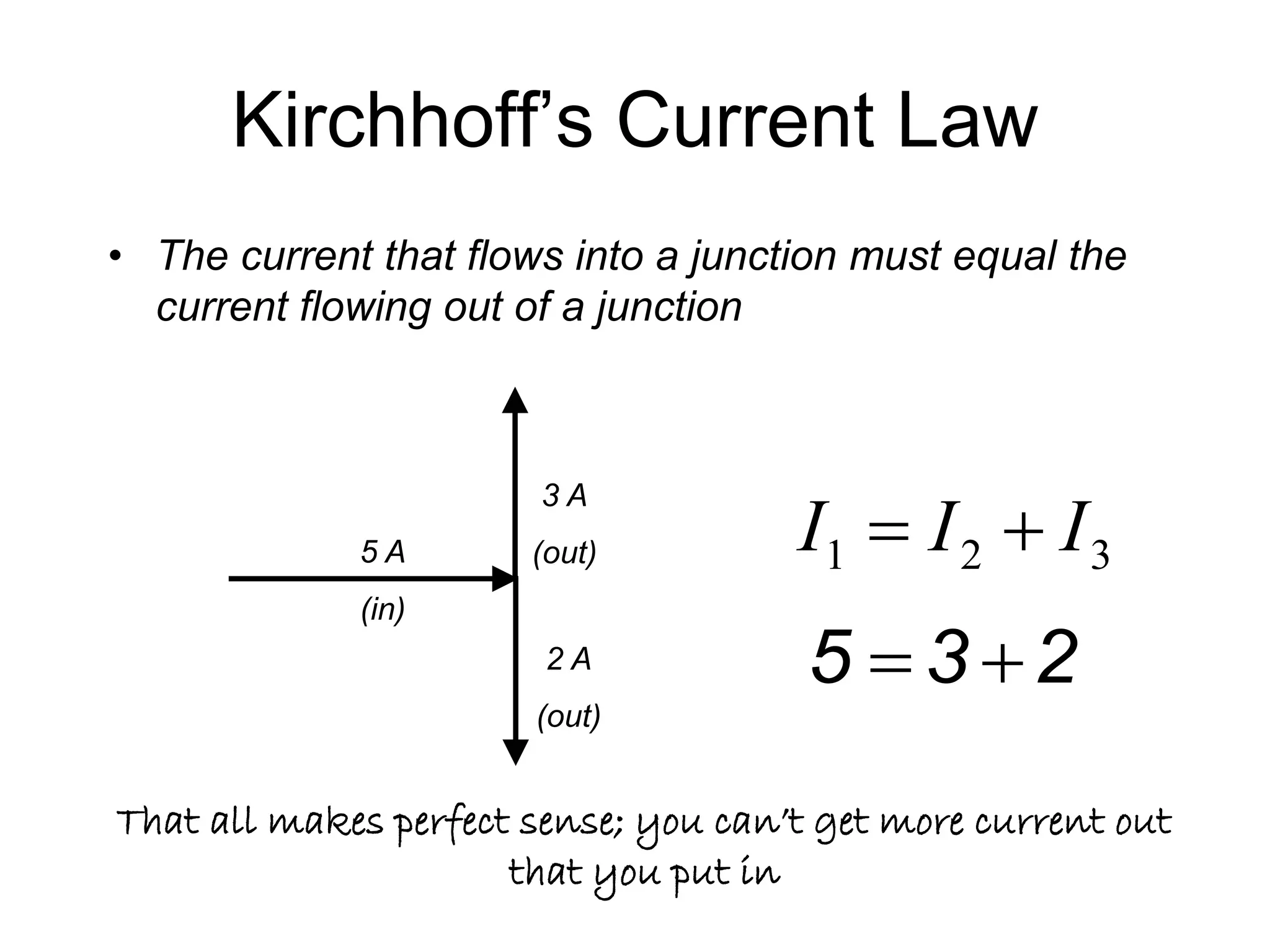
Kirchhoff’s Current Law 
• The current that flows into a junction must equal the 
current flowing out of a junction 
3 A 
(out) 
1 2 3 I  I  I 5 A 
(in) 
2 A 
(out) 
5  3 2 
That all makes perfect sense; you can’t get more current out 
that you put in
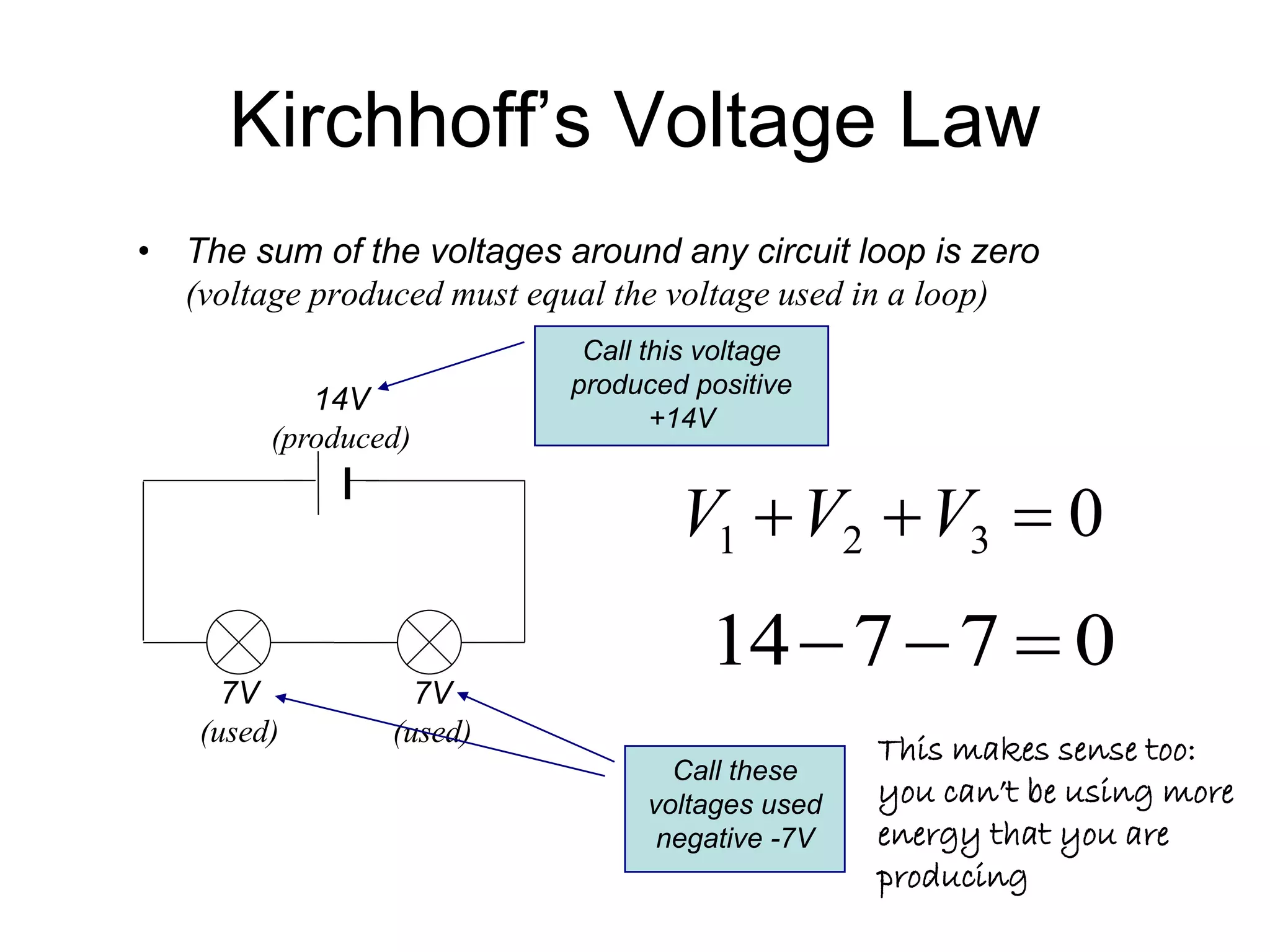
Kirchhoff’s Voltage Law 
• The sum of the voltages around any circuit loop is zero 
(voltage produced must equal the voltage used in a loop) 
1 2 3 0 V V V  
14V 
(produced) 
7V 
(used) 
7V 
(used) 
Call this voltage 
produced positive 
+14V 
1477  0 
Call these 
voltages used 
negative -7V 
This makes sense too: 
you can’t be using more 
energy that you are 
producing
Getting more complex 
• Some loops involve more than one cell or battery and 
several components. 
• It is important to work your way around a loop 
systematically in one direction (doesn’t matter which way you go 
as long as you keep going in the same direction around the whole loop)
The Rules -Cells 
1. Passing through a cell in the same direction as 
conventional current is a positive voltage (energy 
produced) 
12V 
I 
2. Passing through a cell in the opposite direction to 
conventional current 12V 
is a negative voltage (energy used) 
I 
+12V 
-12V
The Rules -Components 
1. Passing through a component in the same direction as 
conventional current is a negative voltage (energy used) 
-12V 
2. Passing through a component in the opposite direction 
to conventional current is a positive voltage (energy 
gained) 
+12V
Putting it all together 
• Working anticlockwise 
around the loop ABCDA 
AB +15V 
BC –(2X11)V 
(V=IR) 
CD +(4X3)V -5V 
so: 
+15 - 22 +12 – 5 = 0 
2A 
15V 
4 5V 
11 
B A 
C D 
5A
Try the other direction 
5A 
2A 
15V 
4 5V 
11 
B A 
C D 
• Now clockwise around 
the loop BADCB 
BA -15V 
DC +5V –(4X3)V 
(V=IR) 
CB +(11X2)V 
so: 
-15 + 5 - 12 + 22 = 0
Try this; 
• Working anticlockwise 
around the loop ABCDA 
AB +15V 
BC –(1.5X40)V 
(V=IR) 
CD +(2.5X20)V -5V 
so: 
+15 - 60 +50 – 5 = 0 
4A 
15V 
20 5V 
40 
B A 
2.5A 
C D
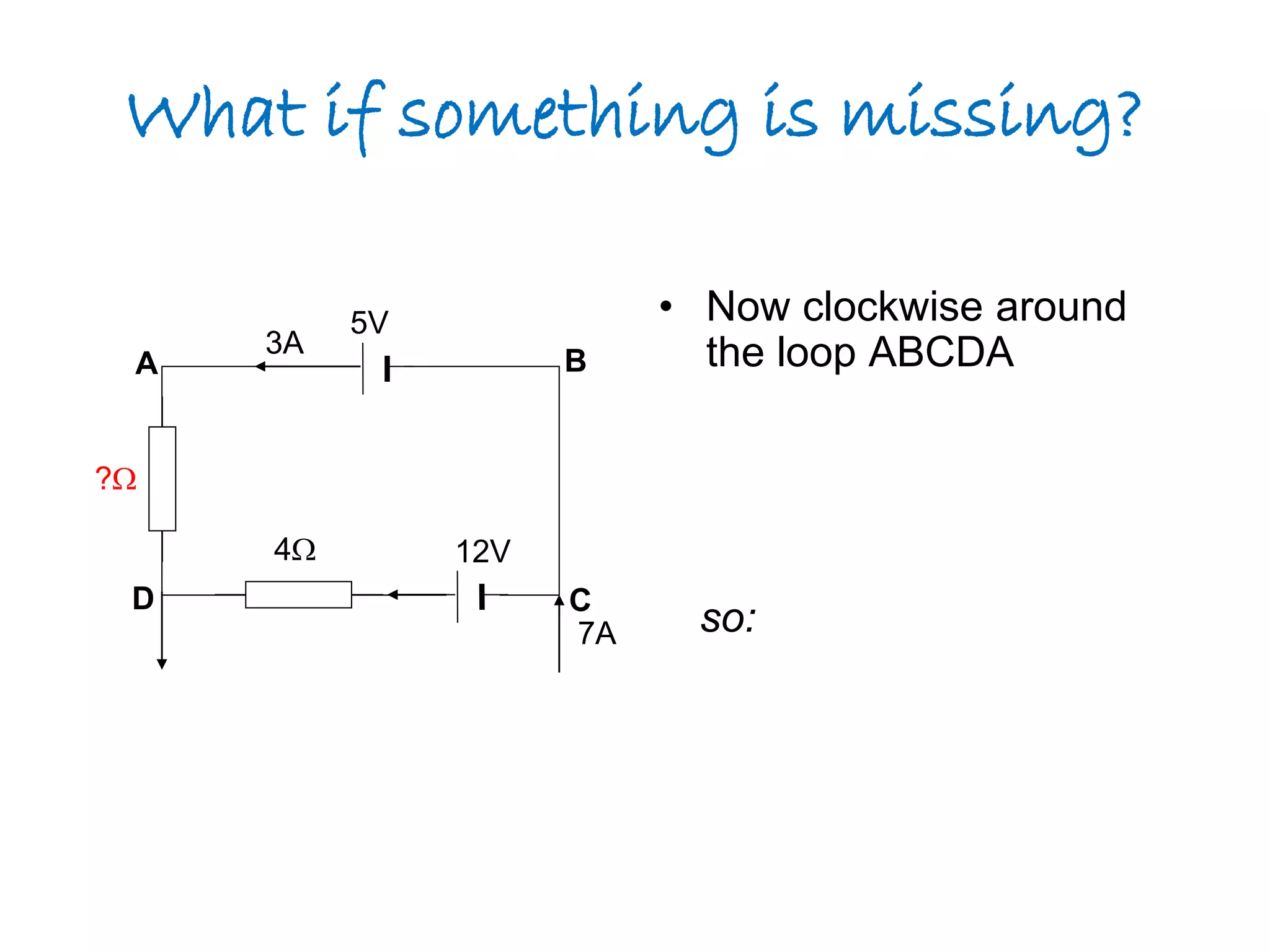
What if something is missing? 
A B 
7A 
3A 
5V 
4 12V 
? 
D C 
• Now clockwise around 
the loop ABCDA 
AB -5V 
CD +12V –(4X4)V 
(V=IR) 
DA +(3XR)V 
so: 
-5 + 12 – 16 + 3R = 0 
3R=9 
R=3 
or this one… 
• Now clockwise around 
the loop ABCDA 
AB -15V 
CD + V –(0.5X80)V 
(V=IR) 
DA +(1.5X30)V 
so: 
-15 + V – 40 + 45 = 0 
V=10V 
15V 
80 ?V 
0.5A 
30 
A B 
D C 
2A
Now some Exercises 
• Try ESA, Activity 13C, Pg 214 
• ABA, Pg 134-136
Homework

Kirchhoff’s laws

  • 1.
    Kirchhoff’s Laws Whatgoes in must come out
  • 2.
    Kirchhoff’s Current Law • The current that flows into a junction must equal the current flowing out of a junction 3 A (out) 1 2 3 I  I  I 5 A (in) 2 A (out) 5  3 2 That all makes perfect sense; you can’t get more current out that you put in
  • 3.
    Kirchhoff’s Voltage Law • The sum of the voltages around any circuit loop is zero (voltage produced must equal the voltage used in a loop) 1 2 3 0 V V V  14V (produced) 7V (used) 7V (used) Call this voltage produced positive +14V 1477  0 Call these voltages used negative -7V This makes sense too: you can’t be using more energy that you are producing
  • 4.
    Getting more complex • Some loops involve more than one cell or battery and several components. • It is important to work your way around a loop systematically in one direction (doesn’t matter which way you go as long as you keep going in the same direction around the whole loop)
  • 5.
    The Rules -Cells 1. Passing through a cell in the same direction as conventional current is a positive voltage (energy produced) 12V I 2. Passing through a cell in the opposite direction to conventional current 12V is a negative voltage (energy used) I +12V -12V
  • 6.
    The Rules -Components 1. Passing through a component in the same direction as conventional current is a negative voltage (energy used) -12V 2. Passing through a component in the opposite direction to conventional current is a positive voltage (energy gained) +12V
  • 7.
    Putting it alltogether • Working anticlockwise around the loop ABCDA AB +15V BC –(2X11)V (V=IR) CD +(4X3)V -5V so: +15 - 22 +12 – 5 = 0 2A 15V 4 5V 11 B A C D 5A
  • 8.
    Try the otherdirection 5A 2A 15V 4 5V 11 B A C D • Now clockwise around the loop BADCB BA -15V DC +5V –(4X3)V (V=IR) CB +(11X2)V so: -15 + 5 - 12 + 22 = 0
  • 9.
    Try this; •Working anticlockwise around the loop ABCDA AB +15V BC –(1.5X40)V (V=IR) CD +(2.5X20)V -5V so: +15 - 60 +50 – 5 = 0 4A 15V 20 5V 40 B A 2.5A C D
  • 10.
    What if somethingis missing? A B 7A 3A 5V 4 12V ? D C • Now clockwise around the loop ABCDA AB -5V CD +12V –(4X4)V (V=IR) DA +(3XR)V so: -5 + 12 – 16 + 3R = 0 3R=9 R=3 
  • 11.
    or this one… • Now clockwise around the loop ABCDA AB -15V CD + V –(0.5X80)V (V=IR) DA +(1.5X30)V so: -15 + V – 40 + 45 = 0 V=10V 15V 80 ?V 0.5A 30 A B D C 2A
  • 12.
    Now some Exercises • Try ESA, Activity 13C, Pg 214 • ABA, Pg 134-136
  • 13.