• CURRENT AND RESISTANCE
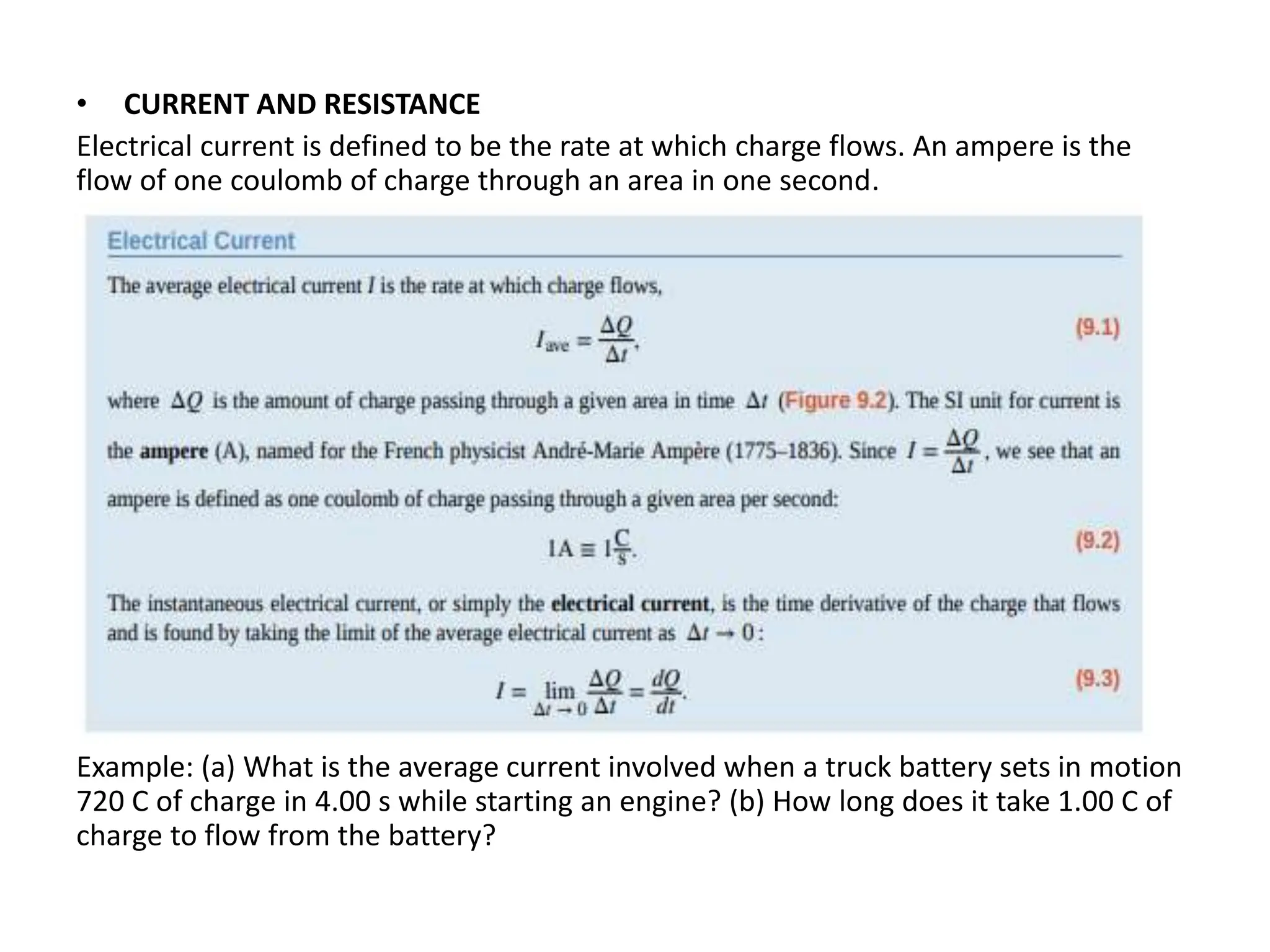
Electrical current is defined to be the rate at which charge flows. An ampere is the
flow of one coulomb of charge through an area in one second.
Example: (a) What is the average current involved when a truck battery sets in motion
720 C of charge in 4.00 s while starting an engine? (b) How long does it take 1.00 C of
charge to flow from the battery?
• (b) In this schematic, the battery is represented by parallel lines, which resemble
plates in the original design of a battery. (c) When the switch is closed, the circuit
is complete and current flows from the positive terminal to the negative terminal
of the battery.
• Current Density
it is necessary to discuss the current density, J → , a vector quantity. The current
density is the flow of charge through an infinitesimal area, divided by the area. The
current density must take into account the local magnitude and direction of the
charge flow, which varies from point to point. The unit of current density is ampere
per meter squared, and the direction is defined as the direction of net flow of positive
charges through the area.
J =
I
A
Example 1:
The current supplied to a lamp with a 100-W light bulb is 0.87 amps. The lamp is wired
using a copper wire with diameter 2.588 mm (10-gauge). Find the magnitude of the current
density.
Resistivity and Resistance
When a voltage is applied to a conductor, an electrical field E is created, and charges in the
conductor feel a force due to the electrical field. The current density J that results depends
on the electrical field and the properties of the material.
Then 𝐽 = 𝜎𝐸
where σ is the electrical conductivity. The electrical conductivity is analogous to thermal
conductivity and is a measure of a material’s ability to conduct or transmit electricity.
Since the electrical conductivity is σ = J/E , the units are
𝐴
𝑚2
𝑣
𝑚
=
𝐴
𝑉.𝑚
Note: E= ρJ
The units of electrical conductivity are therefore (Ω · m)−1
Conductivity is an intrinsic property of a material. Another intrinsic property of a material is
the resistivity, or electrical resistivity. The resistivity of a material is a measure of how
strongly a material opposes the flow of electrical current.
The symbol for resistivity is the lowercase Greek letter rho, ρ , and resistivity is the
reciprocal of electrical conductivity: ρ =
1
𝜎
The unit of resistivity in SI units is the ohm-meter (Ω · m)
• Type equation here.
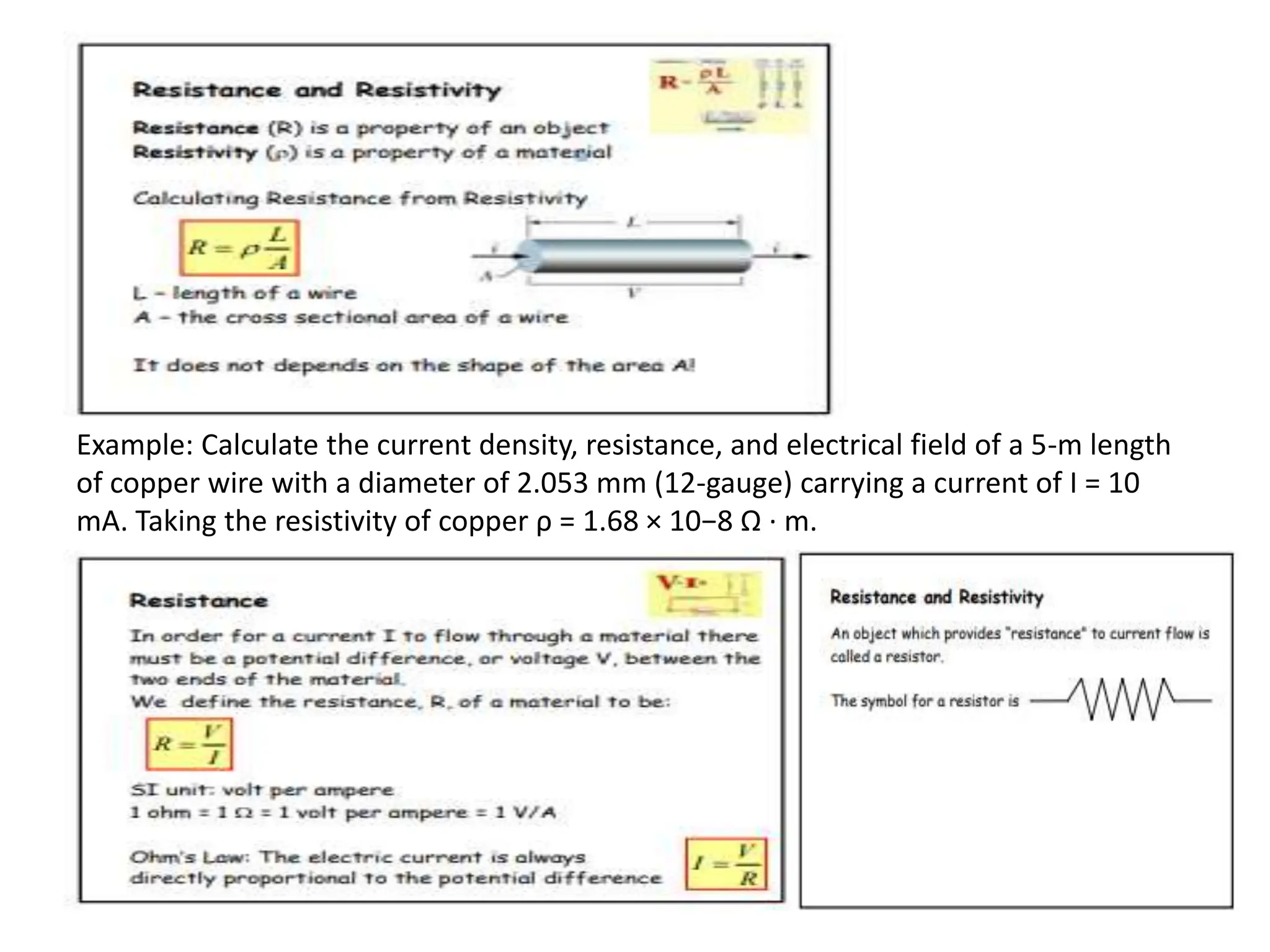
Example: Calculate the current density, resistance, and electrical field of a 5-m length
of copper wire with a diameter of 2.053 mm (12-gauge) carrying a current of I = 10
mA. Taking the resistivity of copper ρ = 1.68 × 10⁻⁸ Ω · m.
Resistors in series
Since potential difference is measured between two component points , the potential
in series is the summation of all the potentials difference within the circuit.
Resistors in parallel
The potential difference in parallel connection is the same, but the effective current is
the summation of individual currents that trespass each components .
Combination Circuits
• Equivalent Resistance, Current, and Power in a Series Circuit
A battery with a terminal voltage of 9 V is connected to a circuit consisting of four 20-
Ω and one 10-Ω resistors all in series (Figure below). Assume the battery has
negligible internal resistance. (a) Calculate the equivalent resistance of the circuit. (b)
Calculate the current through each resistor. (c) Calculate the potential drop across
each resistor. (d) Determine the total power dissipated by the resistors and the power
supplied by the battery.
Analysis of a Parallel Circuit
Three resistors R1 = 1.00 Ω, R2 = 2.00 Ω, and R3 = 2.00 Ω, are connected in parallel.
The parallel connection is attached to a V = 3.00 V voltage source. (a) What is the
equivalent resistance? (b) Find the current supplied by the source to the parallel
circuit. (c) Calculate the currents in each resistor and show that these add together to
equal the current output of the source. (d) Calculate the power dissipated by each
resistor. (e) Find the power output of the source and show that it equals the total
power dissipated by the resistors.
• Kirchhoff's Rules
below
There are two junctions in this circuit:
Junction b and Junction e. Points a, c, d, and f are not junctions, because a junction
must have three or more connections.
The equation for Junction b is I1 = I2 + I3 , and
the equation for Junction e is I2 + I3 = I1 .
These are equivalent equations, so it is necessary to keep only one of them.
When choosing the loops in the circuit, you need enough loops so that each
component is covered once, without repeating loops. Figure below shows four choices
for loops to solve a sample circuit; choices (a), (b), and (c) have a sufficient amount of
loops to solve the circuit completely. Option (d) reflects more loops than necessary to
solve the circuit.
Note: Any two loops in the system will contain all information needed to solve the
circuit. Adding the third loop provides redundant information.
Lets consider the Circuit below, analyze this circuit to find the current through each
resistor
• Next, determine the junctions. In this circuit, points b and e each have three wires
connected, making them junctions.
Applying ∑ Iin = ∑ Iout
Junction b shows that I1 = I2 + I3
and Junction e shows that I2 + I3 = I1
Since Junction e gives the same information of Junction b, it can be disregarded. This
circuit has three unknowns, so we need three linearly independent equations to
analyze it.
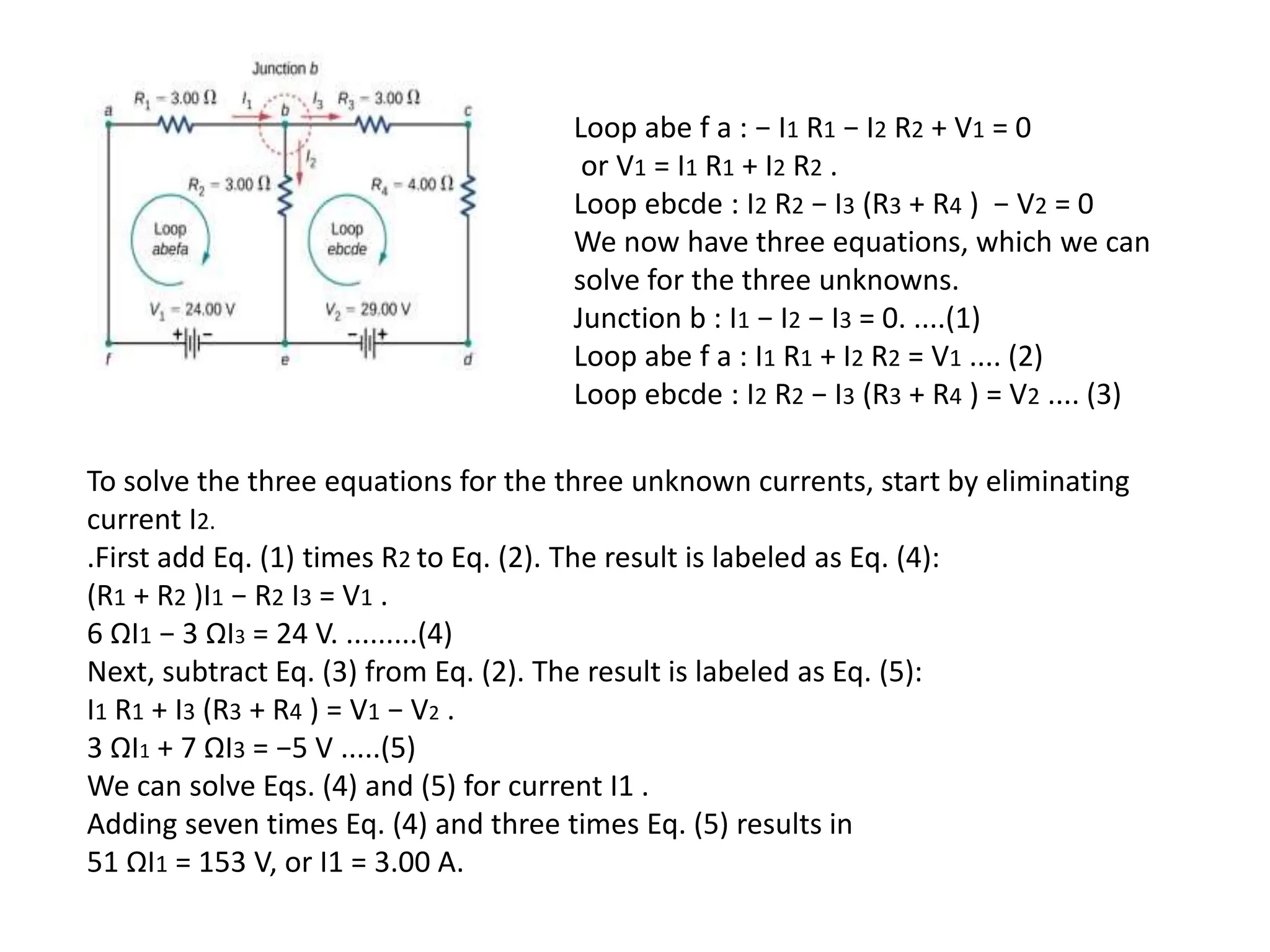
Next we need to choose the loops. Loop abefa includes the voltage source V1 and
resistors R1 and R2 . The loop starts at point a, then travels through points b, e, and f,
and then back to point a. The second loop, Loop ebcde, starts at point e and includes
resistors R2 and R3 , and the voltage source V2 .
Loop abe f a : − I1 R1 − I2 R2 + V1 = 0
or V1 = I1 R1 + I2 R2 .
Loop ebcde : I2 R2 − I3 (R3 + R4 ) − V2 = 0
We now have three equations, which we can
solve for the three unknowns.
Junction b : I1 − I2 − I3 = 0. ....(1)
Loop abe f a : I1 R1 + I2 R2 = V1 .... (2)
Loop ebcde : I2 R2 − I3 (R3 + R4 ) = V2 .... (3)
To solve the three equations for the three unknown currents, start by eliminating
current I2.
.First add Eq. (1) times R2 to Eq. (2). The result is labeled as Eq. (4):
(R1 + R2 )I1 − R2 I3 = V1 .
6 ΩI1 − 3 ΩI3 = 24 V. .........(4)
Next, subtract Eq. (3) from Eq. (2). The result is labeled as Eq. (5):
I1 R1 + I3 (R3 + R4 ) = V1 − V2 .
3 ΩI1 + 7 ΩI3 = −5 V .....(5)
We can solve Eqs. (4) and (5) for current I1 .
Adding seven times Eq. (4) and three times Eq. (5) results in
51 ΩI1 = 153 V, or I1 = 3.00 A.
Using Eq. (4) results in I3 = −2.00 A.
Finally, Eq. (1) yields I2 = I1 − I3 = 5.00 A.
One way to check that the solutions are consistent is to check the power supplied by
the voltage sources and the power dissipated by the resistors:
Pin = I1V1 + I3V2 = 130 W,
Pout =I1
2
R1 + I2
2
R2 + I3
2
R3 + I3
2
R4 = 130 W.
Example 2
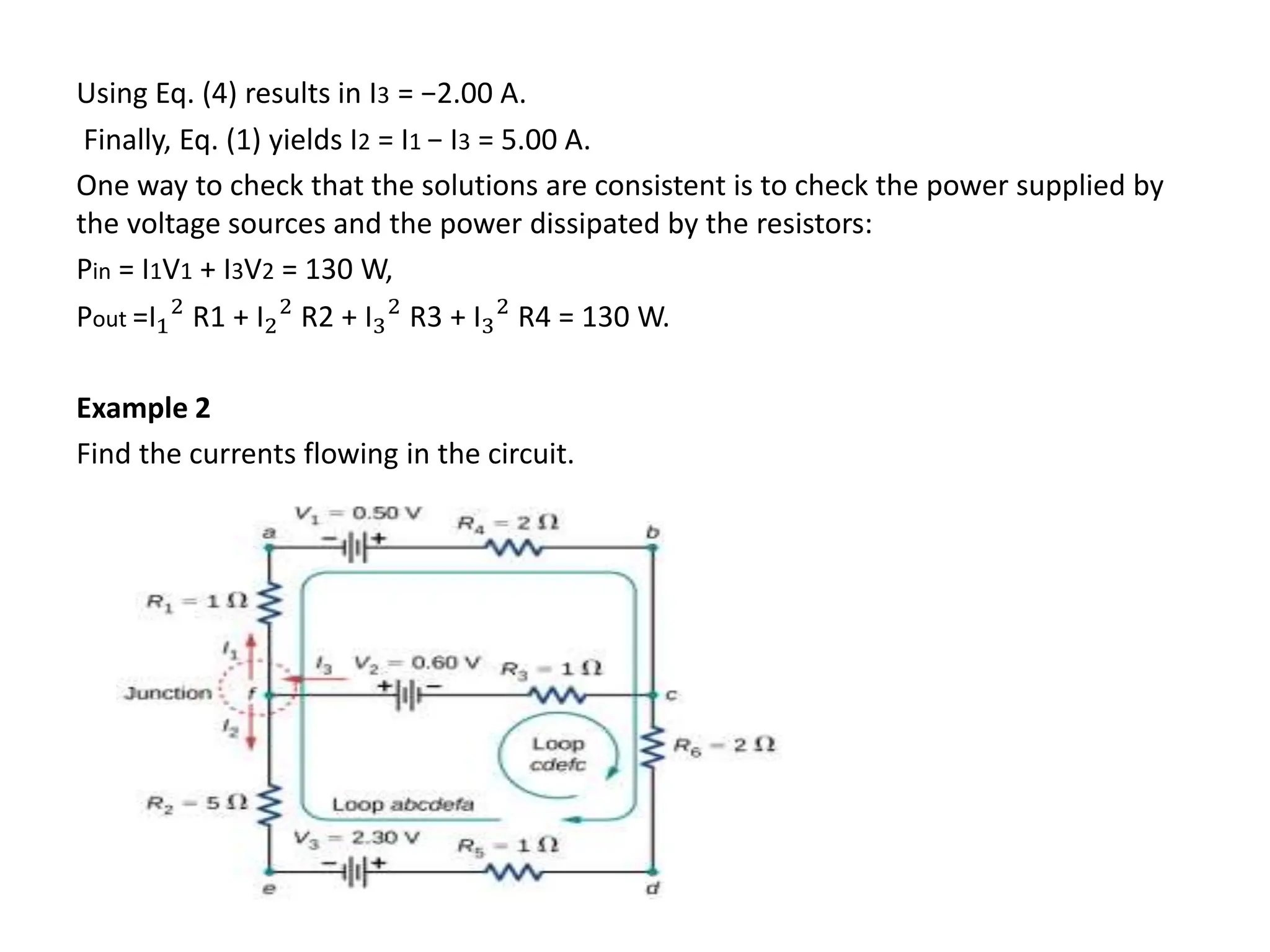
Find the currents flowing in the circuit.
 Currents have been labeled I1 , I2 , and I3 in the figure, and assumptions have
been made about their directions.
• Locations on the diagram have been labeled with letters a through h.
• In the solution, we apply the junction and loop rules, seeking three independent
equations to allow us to solve for the three unknown currents.
We have three unknowns, so three equations are required.
Junction c : I1 + I2 = I3 .
Loop abcdefa : I1 (R1 + R4 ) − I2 (R2 + R5 + R6 ) = V1 − V3 .
Loop cdefc : I2 (R2 + R5 + R6 ) + I3 R3 = V2 + V3
Simplify the equations by placing the unknowns on one side of the equations.
Junction c : I1 + I2 − I3 = 0.
Loop abcdef a : I1 (3 Ω) − I2 (8 Ω) = 0.5 V − 2.30 V.
Loop cdef c : I2 (8 Ω) + I3 (1 Ω) = 0.6 V + 2.30 V.
Simplify the equations. The first loop equation can be simplified by dividing both sides
by 3.00.
The second loop equation can be simplified by dividing both sides by 6.00.
Junction c : I1 + I2 − I3 = 0.
Loop abcde f a : I1 (3 Ω) − I2 (8 Ω) = −1.8 V.
Loop cde f c : I2 (8 Ω) + I3 (1 Ω) = 2.9 V
I1 = 0.20 A, I2 = 0.30 A, I3 = 0.50 A.
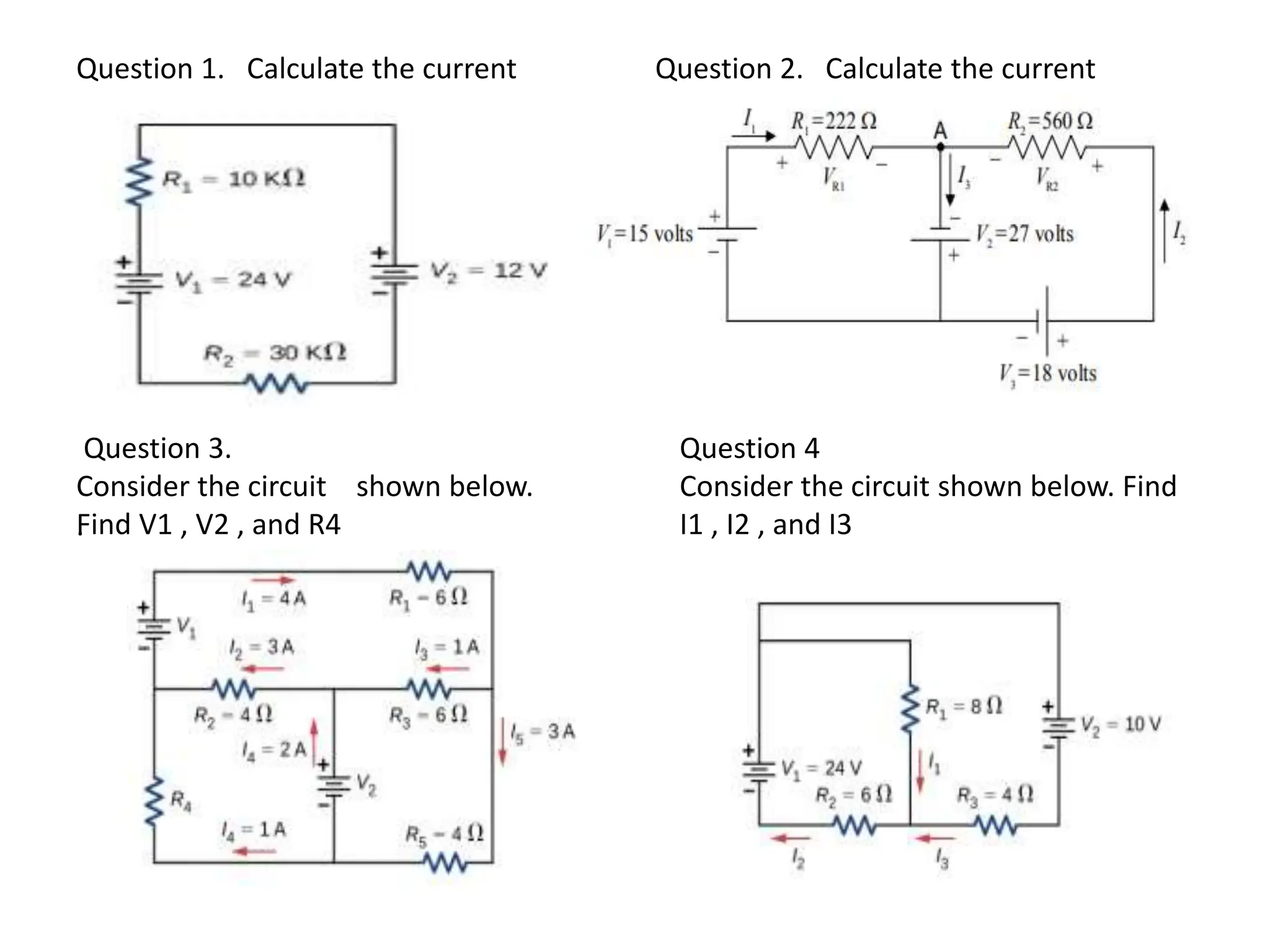
Question 1. Calculate the current Question 2. Calculate the current
.
Question 3.
Consider the circuit shown below.
Find V1 , V2 , and R4
Question 4
Consider the circuit shown below. Find
I1 , I2 , and I3

Cureent, Resistance & Kirchhoff’s Rules.pptx

  • 2.
    • CURRENT ANDRESISTANCE Electrical current is defined to be the rate at which charge flows. An ampere is the flow of one coulomb of charge through an area in one second. Example: (a) What is the average current involved when a truck battery sets in motion 720 C of charge in 4.00 s while starting an engine? (b) How long does it take 1.00 C of charge to flow from the battery?
  • 3.
    • (b) Inthis schematic, the battery is represented by parallel lines, which resemble plates in the original design of a battery. (c) When the switch is closed, the circuit is complete and current flows from the positive terminal to the negative terminal of the battery. • Current Density it is necessary to discuss the current density, J → , a vector quantity. The current density is the flow of charge through an infinitesimal area, divided by the area. The current density must take into account the local magnitude and direction of the charge flow, which varies from point to point. The unit of current density is ampere per meter squared, and the direction is defined as the direction of net flow of positive charges through the area. J = I A
  • 4.
    Example 1: The currentsupplied to a lamp with a 100-W light bulb is 0.87 amps. The lamp is wired using a copper wire with diameter 2.588 mm (10-gauge). Find the magnitude of the current density. Resistivity and Resistance When a voltage is applied to a conductor, an electrical field E is created, and charges in the conductor feel a force due to the electrical field. The current density J that results depends on the electrical field and the properties of the material. Then 𝐽 = 𝜎𝐸 where σ is the electrical conductivity. The electrical conductivity is analogous to thermal conductivity and is a measure of a material’s ability to conduct or transmit electricity. Since the electrical conductivity is σ = J/E , the units are 𝐴 𝑚2 𝑣 𝑚 = 𝐴 𝑉.𝑚 Note: E= ρJ The units of electrical conductivity are therefore (Ω · m)−1 Conductivity is an intrinsic property of a material. Another intrinsic property of a material is the resistivity, or electrical resistivity. The resistivity of a material is a measure of how strongly a material opposes the flow of electrical current. The symbol for resistivity is the lowercase Greek letter rho, ρ , and resistivity is the reciprocal of electrical conductivity: ρ = 1 𝜎 The unit of resistivity in SI units is the ohm-meter (Ω · m)
  • 5.
    • Type equationhere. Example: Calculate the current density, resistance, and electrical field of a 5-m length of copper wire with a diameter of 2.053 mm (12-gauge) carrying a current of I = 10 mA. Taking the resistivity of copper ρ = 1.68 × 10⁻⁸ Ω · m.
  • 7.
    Resistors in series Sincepotential difference is measured between two component points , the potential in series is the summation of all the potentials difference within the circuit. Resistors in parallel The potential difference in parallel connection is the same, but the effective current is the summation of individual currents that trespass each components . Combination Circuits
  • 10.
    • Equivalent Resistance,Current, and Power in a Series Circuit A battery with a terminal voltage of 9 V is connected to a circuit consisting of four 20- Ω and one 10-Ω resistors all in series (Figure below). Assume the battery has negligible internal resistance. (a) Calculate the equivalent resistance of the circuit. (b) Calculate the current through each resistor. (c) Calculate the potential drop across each resistor. (d) Determine the total power dissipated by the resistors and the power supplied by the battery. Analysis of a Parallel Circuit Three resistors R1 = 1.00 Ω, R2 = 2.00 Ω, and R3 = 2.00 Ω, are connected in parallel. The parallel connection is attached to a V = 3.00 V voltage source. (a) What is the equivalent resistance? (b) Find the current supplied by the source to the parallel circuit. (c) Calculate the currents in each resistor and show that these add together to equal the current output of the source. (d) Calculate the power dissipated by each resistor. (e) Find the power output of the source and show that it equals the total power dissipated by the resistors.
  • 11.
  • 12.
  • 13.
    There are twojunctions in this circuit: Junction b and Junction e. Points a, c, d, and f are not junctions, because a junction must have three or more connections. The equation for Junction b is I1 = I2 + I3 , and the equation for Junction e is I2 + I3 = I1 . These are equivalent equations, so it is necessary to keep only one of them. When choosing the loops in the circuit, you need enough loops so that each component is covered once, without repeating loops. Figure below shows four choices for loops to solve a sample circuit; choices (a), (b), and (c) have a sufficient amount of loops to solve the circuit completely. Option (d) reflects more loops than necessary to solve the circuit.
  • 14.
    Note: Any twoloops in the system will contain all information needed to solve the circuit. Adding the third loop provides redundant information. Lets consider the Circuit below, analyze this circuit to find the current through each resistor
  • 15.
    • Next, determinethe junctions. In this circuit, points b and e each have three wires connected, making them junctions. Applying ∑ Iin = ∑ Iout Junction b shows that I1 = I2 + I3 and Junction e shows that I2 + I3 = I1 Since Junction e gives the same information of Junction b, it can be disregarded. This circuit has three unknowns, so we need three linearly independent equations to analyze it. Next we need to choose the loops. Loop abefa includes the voltage source V1 and resistors R1 and R2 . The loop starts at point a, then travels through points b, e, and f, and then back to point a. The second loop, Loop ebcde, starts at point e and includes resistors R2 and R3 , and the voltage source V2 .
  • 16.
    Loop abe fa : − I1 R1 − I2 R2 + V1 = 0 or V1 = I1 R1 + I2 R2 . Loop ebcde : I2 R2 − I3 (R3 + R4 ) − V2 = 0 We now have three equations, which we can solve for the three unknowns. Junction b : I1 − I2 − I3 = 0. ....(1) Loop abe f a : I1 R1 + I2 R2 = V1 .... (2) Loop ebcde : I2 R2 − I3 (R3 + R4 ) = V2 .... (3) To solve the three equations for the three unknown currents, start by eliminating current I2. .First add Eq. (1) times R2 to Eq. (2). The result is labeled as Eq. (4): (R1 + R2 )I1 − R2 I3 = V1 . 6 ΩI1 − 3 ΩI3 = 24 V. .........(4) Next, subtract Eq. (3) from Eq. (2). The result is labeled as Eq. (5): I1 R1 + I3 (R3 + R4 ) = V1 − V2 . 3 ΩI1 + 7 ΩI3 = −5 V .....(5) We can solve Eqs. (4) and (5) for current I1 . Adding seven times Eq. (4) and three times Eq. (5) results in 51 ΩI1 = 153 V, or I1 = 3.00 A.
  • 17.
    Using Eq. (4)results in I3 = −2.00 A. Finally, Eq. (1) yields I2 = I1 − I3 = 5.00 A. One way to check that the solutions are consistent is to check the power supplied by the voltage sources and the power dissipated by the resistors: Pin = I1V1 + I3V2 = 130 W, Pout =I1 2 R1 + I2 2 R2 + I3 2 R3 + I3 2 R4 = 130 W. Example 2 Find the currents flowing in the circuit.
  • 18.
     Currents havebeen labeled I1 , I2 , and I3 in the figure, and assumptions have been made about their directions. • Locations on the diagram have been labeled with letters a through h. • In the solution, we apply the junction and loop rules, seeking three independent equations to allow us to solve for the three unknown currents. We have three unknowns, so three equations are required. Junction c : I1 + I2 = I3 . Loop abcdefa : I1 (R1 + R4 ) − I2 (R2 + R5 + R6 ) = V1 − V3 . Loop cdefc : I2 (R2 + R5 + R6 ) + I3 R3 = V2 + V3 Simplify the equations by placing the unknowns on one side of the equations. Junction c : I1 + I2 − I3 = 0. Loop abcdef a : I1 (3 Ω) − I2 (8 Ω) = 0.5 V − 2.30 V. Loop cdef c : I2 (8 Ω) + I3 (1 Ω) = 0.6 V + 2.30 V. Simplify the equations. The first loop equation can be simplified by dividing both sides by 3.00. The second loop equation can be simplified by dividing both sides by 6.00. Junction c : I1 + I2 − I3 = 0. Loop abcde f a : I1 (3 Ω) − I2 (8 Ω) = −1.8 V. Loop cde f c : I2 (8 Ω) + I3 (1 Ω) = 2.9 V I1 = 0.20 A, I2 = 0.30 A, I3 = 0.50 A.
  • 19.
    Question 1. Calculatethe current Question 2. Calculate the current . Question 3. Consider the circuit shown below. Find V1 , V2 , and R4 Question 4 Consider the circuit shown below. Find I1 , I2 , and I3