Prof. Dr. Nizamettin AYDIN
naydin@yildiz.edu.tr
Kirchhoff’s Current Law
Kirchhoff’s Voltage Law
BLM1612 - Circuit Theory
1
Objectives of the Lecture
• Present Kirchhoff’s Current and Voltage Laws.
• Demonstrate how these laws can be used to
find currents and voltages in a circuit.
• Explain how these laws can be used in
conjunction with Ohm’s Law.
2
Resistivity, r
• Resistivity is a material property
– Dependent on the number of free or mobile charges
(usually electrons) in the material.
• In a metal, this is the number of electrons from the outer
shell that are ionized and become part of the ‘sea of
electrons’
– Dependent on the mobility of the charges
• Mobility is related to the velocity of the charges.
• It is a function of the material, the frequency and
magnitude of the voltage applied to make the charges
move, and temperature.
3
Resistivity of Common Materials at Room Temperature (300K)
Material Resistivity (W-cm) Usage
Silver 1.64x10⁻⁸ Conductor
Copper 1.72x10⁻⁸ Conductor
Aluminum 2.8x10⁻⁸ Conductor
Gold 2.45x10⁻⁸ Conductor
Carbon (Graphite) 4x10⁻⁵ Conductor
Germanium 0.47 Semiconductor
Silicon 640 Semiconductor
Paper 1010 Insulator
Mica 5x10¹¹ Insulator
Glass 1012 Insulator
Teflon 3x10¹² Insulator
4
Resistance, R
• Resistance takes into account the physical
dimensions of the material
–where:
• L is the length along which the
carriers are moving
• A is the cross sectional areathat the
free charges move through.
5
A
L
R r

Ohm’s Law
• Voltage drop across a resistor is proportional to
the current flowing through the resistor
Units: V = AW
where A = C/s
iR

v
6
Short Circuit
• If the resistor is a perfect
conductor (or a short
circuit)
R = 0 W,
• then
v = iR = 0 V
– no matter how much
current is flowing through
the resistor
7
Open Circuit
• If the resistor is a perfect
insulator, R = ∞ W
• then
– no matter how much
voltage is applied to (or
dropped across) the
resistor.
8
Conductance, G
• Conductance is the reciprocal of resistance
G = R-1 = i/v
– Unit for conductance is S (siemens) or (mhos, )
G = As/L
where s is conductivity,
which is the inverse of resistivity, r
9
Power Dissipated by a Resistor
• p = iv = i(iR) = i2R
• p = iv = (v/R)v = v2/R
• p = iv = i(i/G) = i2/G
• p = iv = (vG)v = v2G
10
Power Dissipated by a Resistor
• Since R and G are always real positive numbers
– Power dissipated by a resistor is always positive
• The power consumed by the resistor is not
linear with respect to either the current flowing
through the resistor or the voltage dropped
across the resistor
– This power is released as heat. Thus, resistors get
hot as they absorb power (or dissipate power) from
the circuit.
11
Short and Open Circuits
• There is no power dissipated in a short circuit.
• There is no power dissipated in an open circuit.
W
0
)
0
(
)
V
0
(
v 2
2

W

 R
psc
W
0
)
(
)
A
0
(
i 2
2

W


 R
poc
12
Circuit Terminology
• Node
– point at which 2+ elements have a
common connection
• e.g., node 1, node 2, node 3
• Path
– a route through a network, through nodes
that never repeat
• e.g., 1→3→2, 1→2→3
• Loop
– a path that starts & ends on the same node
• e.g., 3→1→2→3
• Branch
– a single path in a network; contains one
element and the nodes at the 2 ends
• e.g., 1→2, 1→3, 3→2
13
Exercise
• For the circuit below:
a. Count the number of circuit elements.
b. If we move from B to C to D, have we formed a path
and/or a loop?
c. If we move from E to D to C to B to E, have we formed a
path and/or a loop?
14
Kirchhoff’s Current Law (KCL)
• Gustav Robert Kirchhoff: German university
professor, born while Ohm was experimenting
• Based upon conservation of charge
– the algebraic sum of the charge
within a system can not change.
– the algebraic sum of the currents
entering any node is zero.
15






node
node
1
0
leave
enter
N
n
n
i
i
i
Where N is the total
number of branches
connected to a node.
Kirchhoff’s Voltage Law (KVL)
• Based upon conservation of energy
– the algebraic sum of voltages dropped across components
around a loop is zero.
– The energy required to move a charge from point A to point
B must have a value independent of the path chosen.
16
 




rises
drops
M
1
m
v
v
0
v
Where M is the total number
of branches in the loop.
Example-01
• For the circuit, compute the current through R3
if it is known that the voltage source supplies a
current of 3 A.
• Use KCL
17
Example-02
• Referring to the single node below, compute:
a. iB, given iA = 1 A, iD = –2 A, iC = 3 A, and iE = 4 A
b. iE, given iA = –1 A, iB = –1 A, iC = –1 A, and iD = –1 A
• Use KCL
iA + iB - iC - iD - iE = 0
a. iB = -iA + iC + iD + iE
iB = -1 + 3 - 2 + 4 = 4 A
b. iE = iA + iB - iC - iD
iE = -1 - 1 + 1 + 1 = 0 A
18
Example-03
• Determine I, the current flowing out of the
voltage source.
– Use KCL
• 1.9 mA + 0.5 mA + I are
entering the node.
• 3 mA is leaving the node.
V1 is generating power.
mA
I
mA
mA
mA
I
mA
I
mA
mA
6
.
0
)
5
.
0
9
.
1
(
3
3
5
.
0
9
.
1







19
Example-04
• Suppose the current through R2 was entering the
node and the current through R3 was leaving the
node.
– Use KCL
• 3 mA + 0.5 mA + I are
entering the node.
• 1.9 mA is leaving the node.
V1 is dissipating power.
mA
I
mA
mA
mA
I
mA
I
mA
mA
6
.
1
)
5
.
0
3
(
9
.
1
9
.
1
5
.
0
3








20
Example-05
• If voltage drops are given instead of currents,
– you need to apply Ohm’s Law
to determine the current flowing
through each of the resistors
before you can find the current
flowing out of the voltage
supply.
• I1 is leaving the node.
• I2 is entering the node.
• I3 is entering the node.
• I is entering the node.
I3
I1
I2
mA
k
V
I
mA
k
V
I
mA
k
V
I
35
.
0
5
/
75
.
1
2
2
/
4
286
.
0
7
/
2
3
2
1

W


W


W

mA
mA
mA
I
mA
I
mA
mA
I
I
I
I
06
.
2
35
.
2
286
.
0
286
.
0
35
.
0
2
1
3
2










21
Example-06
• For each of the circuits in the figure below, determine
the voltage vx and the current ix.
– Applying KVL clockwise around the loop and Ohm’s law
22
Example-07
• For the circuit below, determine
a. vR2
b. vx
a.
b.
23
Example-08
• For the circuit below, determine
a. vR2 b. vx if vR1 = 1 V.
a.
b.
24
Example-09
• For the circuit below, determine vx
25
Example-10…
• Find the voltage across R1.
• Note that the polarity of the voltage has been assigned in
the circuit schematic.
– First, define a loop that include R1.
26
…Example-10…
• If the red loop is considered
– By convention, voltage drops are added and voltage
rises are subtracted in KVL.
–5 V – VR1+ 3 V = 0 VR1 = -2 V
27
…Example-10
• Suppose you chose the green loop instead.
• Since R2 is in parallel with I1, the voltage drop across R2 is
also 3V.
–5 V – VR1+ 3 V = 0 VR1 = -2 V
28
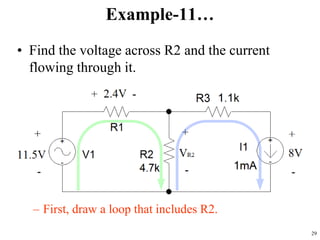
Example-11…
• Find the voltage across R2 and the current
flowing through it.
– First, draw a loop that includes R2.
29
…Example-11…
• If the green loop is used:
–11.5 V + 2.4 V + VR2= 0 VR2 = 9.1 V
30
…Example-11…
• If the blue loop is used:
• First, find the voltage drop across R3
1 mA × 1.1 kW = 1×10-3 A × 1.1×103 W = 1.1 V
1.1 V + 8 V - VR2= 0 VR2 = 9.1 V
31
…Example-11
– Once the voltage across R2 is known, Ohm’s Law
is applied to determine the current.
IR2 = 9.1 V / 4.7 kW = 9.1 V / (4.7×10³ W)
IR2 = 1.94×10⁻³ A = 1.94 mA
IR2
32

CiT-02.pptx

  • 1.
    Prof. Dr. NizamettinAYDIN naydin@yildiz.edu.tr Kirchhoff’s Current Law Kirchhoff’s Voltage Law BLM1612 - Circuit Theory 1
  • 2.
    Objectives of theLecture • Present Kirchhoff’s Current and Voltage Laws. • Demonstrate how these laws can be used to find currents and voltages in a circuit. • Explain how these laws can be used in conjunction with Ohm’s Law. 2
  • 3.
    Resistivity, r • Resistivityis a material property – Dependent on the number of free or mobile charges (usually electrons) in the material. • In a metal, this is the number of electrons from the outer shell that are ionized and become part of the ‘sea of electrons’ – Dependent on the mobility of the charges • Mobility is related to the velocity of the charges. • It is a function of the material, the frequency and magnitude of the voltage applied to make the charges move, and temperature. 3
  • 4.
    Resistivity of CommonMaterials at Room Temperature (300K) Material Resistivity (W-cm) Usage Silver 1.64x10⁻⁸ Conductor Copper 1.72x10⁻⁸ Conductor Aluminum 2.8x10⁻⁸ Conductor Gold 2.45x10⁻⁸ Conductor Carbon (Graphite) 4x10⁻⁵ Conductor Germanium 0.47 Semiconductor Silicon 640 Semiconductor Paper 1010 Insulator Mica 5x10¹¹ Insulator Glass 1012 Insulator Teflon 3x10¹² Insulator 4
  • 5.
    Resistance, R • Resistancetakes into account the physical dimensions of the material –where: • L is the length along which the carriers are moving • A is the cross sectional areathat the free charges move through. 5 A L R r 
  • 6.
    Ohm’s Law • Voltagedrop across a resistor is proportional to the current flowing through the resistor Units: V = AW where A = C/s iR  v 6
  • 7.
    Short Circuit • Ifthe resistor is a perfect conductor (or a short circuit) R = 0 W, • then v = iR = 0 V – no matter how much current is flowing through the resistor 7
  • 8.
    Open Circuit • Ifthe resistor is a perfect insulator, R = ∞ W • then – no matter how much voltage is applied to (or dropped across) the resistor. 8
  • 9.
    Conductance, G • Conductanceis the reciprocal of resistance G = R-1 = i/v – Unit for conductance is S (siemens) or (mhos, ) G = As/L where s is conductivity, which is the inverse of resistivity, r 9
  • 10.
    Power Dissipated bya Resistor • p = iv = i(iR) = i2R • p = iv = (v/R)v = v2/R • p = iv = i(i/G) = i2/G • p = iv = (vG)v = v2G 10
  • 11.
    Power Dissipated bya Resistor • Since R and G are always real positive numbers – Power dissipated by a resistor is always positive • The power consumed by the resistor is not linear with respect to either the current flowing through the resistor or the voltage dropped across the resistor – This power is released as heat. Thus, resistors get hot as they absorb power (or dissipate power) from the circuit. 11
  • 12.
    Short and OpenCircuits • There is no power dissipated in a short circuit. • There is no power dissipated in an open circuit. W 0 ) 0 ( ) V 0 ( v 2 2  W   R psc W 0 ) ( ) A 0 ( i 2 2  W    R poc 12
  • 13.
    Circuit Terminology • Node –point at which 2+ elements have a common connection • e.g., node 1, node 2, node 3 • Path – a route through a network, through nodes that never repeat • e.g., 1→3→2, 1→2→3 • Loop – a path that starts & ends on the same node • e.g., 3→1→2→3 • Branch – a single path in a network; contains one element and the nodes at the 2 ends • e.g., 1→2, 1→3, 3→2 13
  • 14.
    Exercise • For thecircuit below: a. Count the number of circuit elements. b. If we move from B to C to D, have we formed a path and/or a loop? c. If we move from E to D to C to B to E, have we formed a path and/or a loop? 14
  • 15.
    Kirchhoff’s Current Law(KCL) • Gustav Robert Kirchhoff: German university professor, born while Ohm was experimenting • Based upon conservation of charge – the algebraic sum of the charge within a system can not change. – the algebraic sum of the currents entering any node is zero. 15       node node 1 0 leave enter N n n i i i Where N is the total number of branches connected to a node.
  • 16.
    Kirchhoff’s Voltage Law(KVL) • Based upon conservation of energy – the algebraic sum of voltages dropped across components around a loop is zero. – The energy required to move a charge from point A to point B must have a value independent of the path chosen. 16       rises drops M 1 m v v 0 v Where M is the total number of branches in the loop.
  • 17.
    Example-01 • For thecircuit, compute the current through R3 if it is known that the voltage source supplies a current of 3 A. • Use KCL 17
  • 18.
    Example-02 • Referring tothe single node below, compute: a. iB, given iA = 1 A, iD = –2 A, iC = 3 A, and iE = 4 A b. iE, given iA = –1 A, iB = –1 A, iC = –1 A, and iD = –1 A • Use KCL iA + iB - iC - iD - iE = 0 a. iB = -iA + iC + iD + iE iB = -1 + 3 - 2 + 4 = 4 A b. iE = iA + iB - iC - iD iE = -1 - 1 + 1 + 1 = 0 A 18
  • 19.
    Example-03 • Determine I,the current flowing out of the voltage source. – Use KCL • 1.9 mA + 0.5 mA + I are entering the node. • 3 mA is leaving the node. V1 is generating power. mA I mA mA mA I mA I mA mA 6 . 0 ) 5 . 0 9 . 1 ( 3 3 5 . 0 9 . 1        19
  • 20.
    Example-04 • Suppose thecurrent through R2 was entering the node and the current through R3 was leaving the node. – Use KCL • 3 mA + 0.5 mA + I are entering the node. • 1.9 mA is leaving the node. V1 is dissipating power. mA I mA mA mA I mA I mA mA 6 . 1 ) 5 . 0 3 ( 9 . 1 9 . 1 5 . 0 3         20
  • 21.
    Example-05 • If voltagedrops are given instead of currents, – you need to apply Ohm’s Law to determine the current flowing through each of the resistors before you can find the current flowing out of the voltage supply. • I1 is leaving the node. • I2 is entering the node. • I3 is entering the node. • I is entering the node. I3 I1 I2 mA k V I mA k V I mA k V I 35 . 0 5 / 75 . 1 2 2 / 4 286 . 0 7 / 2 3 2 1  W   W   W  mA mA mA I mA I mA mA I I I I 06 . 2 35 . 2 286 . 0 286 . 0 35 . 0 2 1 3 2           21
  • 22.
    Example-06 • For eachof the circuits in the figure below, determine the voltage vx and the current ix. – Applying KVL clockwise around the loop and Ohm’s law 22
  • 23.
    Example-07 • For thecircuit below, determine a. vR2 b. vx a. b. 23
  • 24.
    Example-08 • For thecircuit below, determine a. vR2 b. vx if vR1 = 1 V. a. b. 24
  • 25.
    Example-09 • For thecircuit below, determine vx 25
  • 26.
    Example-10… • Find thevoltage across R1. • Note that the polarity of the voltage has been assigned in the circuit schematic. – First, define a loop that include R1. 26
  • 27.
    …Example-10… • If thered loop is considered – By convention, voltage drops are added and voltage rises are subtracted in KVL. –5 V – VR1+ 3 V = 0 VR1 = -2 V 27
  • 28.
    …Example-10 • Suppose youchose the green loop instead. • Since R2 is in parallel with I1, the voltage drop across R2 is also 3V. –5 V – VR1+ 3 V = 0 VR1 = -2 V 28
  • 29.
    Example-11… • Find thevoltage across R2 and the current flowing through it. – First, draw a loop that includes R2. 29
  • 30.
    …Example-11… • If thegreen loop is used: –11.5 V + 2.4 V + VR2= 0 VR2 = 9.1 V 30
  • 31.
    …Example-11… • If theblue loop is used: • First, find the voltage drop across R3 1 mA × 1.1 kW = 1×10-3 A × 1.1×103 W = 1.1 V 1.1 V + 8 V - VR2= 0 VR2 = 9.1 V 31
  • 32.
    …Example-11 – Once thevoltage across R2 is known, Ohm’s Law is applied to determine the current. IR2 = 9.1 V / 4.7 kW = 9.1 V / (4.7×10³ W) IR2 = 1.94×10⁻³ A = 1.94 mA IR2 32

Editor's Notes