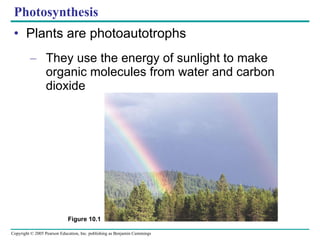
Photosynthesis Plants are photoautotrophs They use the energy of sunlight to make organic molecules from water and carbon dioxide Figure 10.1
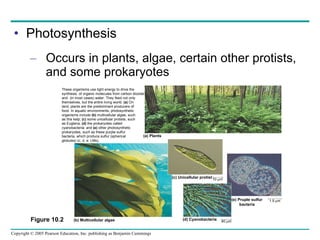
Photosynthesis Occurs in plants, algae, certain other protists, and some prokaryotes These organisms use light energy to drive the  synthesis  of organic molecules from carbon dioxide and  (in most cases) water. They feed not only themselves, but the entire living world.  (a)  On land, plants are the predominant producers of food. In aquatic environments, photosynthetic organisms include  (b)  multicellular algae, such as this kelp;  (c)  some unicellular protists, such as Euglena;  (d)  the prokaryotes called cyanobacteria; and  (e)  other photosynthetic prokaryotes, such as these purple sulfur bacteria, which produce sulfur (spherical globules) (c, d, e: LMs). (a) Plants (b) Multicellular algae (c) Unicellular protist 10   m 40   m (d) Cyanobacteria 1.5   m (e) Pruple sulfur bacteria Figure 10.2
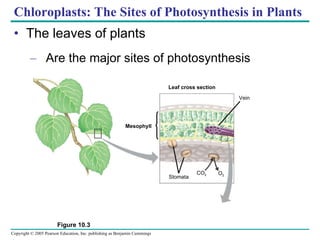
Chloroplasts: The Sites of Photosynthesis in Plants The leaves of plants Are the major sites of photosynthesis Vein Leaf cross section Figure 10.3 Mesophyll CO 2 O 2 Stomata
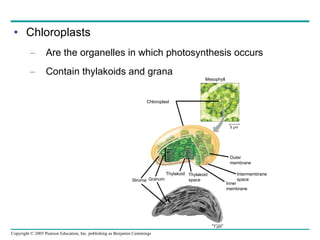
Chloroplasts Are the organelles in which photosynthesis occurs Contain thylakoids and grana Chloroplast Mesophyll 5 µm Outer membrane Intermembrane space Inner membrane Thylakoid space Thylakoid Granum Stroma 1 µm
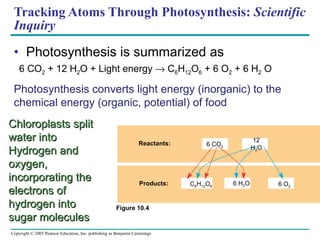
Tracking Atoms Through Photosynthesis:  Scientific Inquiry Photosynthesis is summarized as 6 CO 2  + 12 H 2 O + Light energy    C 6 H 12 O 6  + 6 O 2  + 6 H 2  O  Photosynthesis converts light energy (inorganic) to the chemical energy (organic, potential) of food Chloroplasts split water into Hydrogen and oxygen, incorporating the electrons of hydrogen into sugar molecules 6 CO 2 12 H 2 O Reactants: Products: C 6 H 12 O 6 6 H 2 O 6 O 2 Figure 10.4
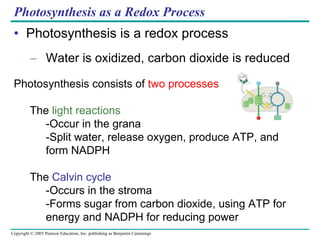
Photosynthesis as a Redox Process Photosynthesis is a redox process Water is oxidized, carbon dioxide is reduced Photosynthesis consists of  two processes The  light reactions -Occur in the grana -Split water, release oxygen, produce ATP, and  form NADPH The  Calvin cycle -Occurs in the stroma -Forms sugar from carbon dioxide, using ATP for  energy and NADPH for reducing power
An overview of photosynthesis H 2 O CO 2 Light LIGHT REACTIONS CALVIN CYCLE Chloroplast [CH 2 O] (sugar) NADPH NADP   ADP +  P O 2 Figure 10.5 ATP
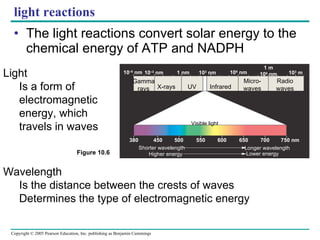
light reactions The light reactions convert solar energy to the chemical energy of ATP and NADPH Light Is a form of electromagnetic energy, which travels in waves Wavelength Is the distance between the crests of waves Determines the type of electromagnetic energy Gamma rays X-rays UV Infrared Micro- waves Radio waves 10 –5  nm 10 –3  nm 1 nm 10 3  nm 10 6  nm 1 m 10 6  nm 10 3  m 380 450 500 550 600 650 700 750 nm Visible light Shorter wavelength Higher energy Longer wavelength Lower energy Figure 10.6
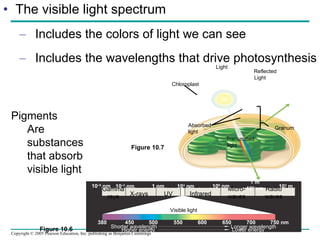
The visible light spectrum Includes the colors of light we can see Includes the wavelengths that drive photosynthesis Pigments Are substances that absorb visible light Light Reflected Light  Chloroplast Absorbed light  Granum Transmitted light  Figure 10.7 Gamma rays X-rays UV Infrared Micro- waves Radio waves 10 –5  nm 10 –3  nm 1 nm 10 3  nm 10 6  nm 1 m 10 6  nm 10 3  m 380 450 500 550 600 650 700 750 nm Visible light Shorter wavelength Higher energy Longer wavelength Lower energy Figure 10.6
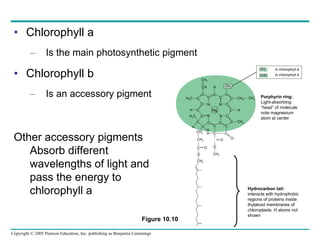
Chlorophyll a Is the main photosynthetic pigment Chlorophyll b Is an accessory pigment Other accessory pigments Absorb different wavelengths of light and pass the energy to chlorophyll a C CH CH 2 C C C C C C N N C H 3 C C C C C C C C C N C C C C N Mg H H 3 C H C CH 2 CH 3 H CH 3 C H H CH 2 CH 2 CH 2 H CH 3 C O O O O O CH 3 CH 3 CHO in chlorophyll  a in chlorophyll  b Porphyrin ring: Light-absorbing “ head” of molecule note magnesium atom at center Hydrocarbon tail: interacts with hydrophobic regions of proteins inside thylakoid membranes of chloroplasts: H atoms not shown Figure 10.10
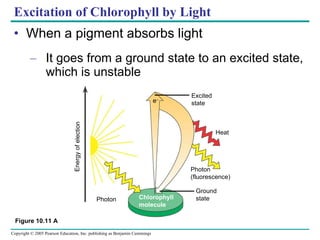
Excitation of Chlorophyll by Light When a pigment absorbs light It goes from a ground state to an excited state, which is unstable Excited state Energy of election Heat Photon (fluorescence) Chlorophyll molecule Ground state Photon e – Figure 10.11 A
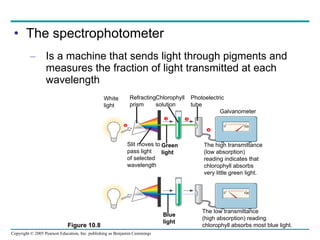
The spectrophotometer Is a machine that sends light through pigments and measures the fraction of light transmitted at each wavelength Figure 10.8 White light Refracting prism Chlorophyll solution Photoelectric tube Galvanometer Slit moves to pass light of selected wavelength  Green light The high transmittance (low absorption) reading indicates that chlorophyll absorbs very little green light. The low transmittance (high absorption) reading chlorophyll absorbs most blue light. Blue light 1 2 3 4 0 100 0 100
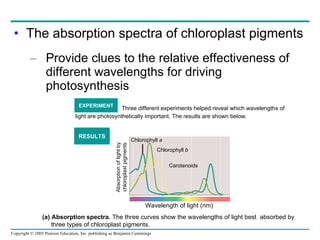
The absorption spectra of chloroplast pigments Provide clues to the relative effectiveness of different wavelengths for driving photosynthesis Three different experiments helped reveal which wavelengths of light are photosynthetically important. The results are shown below. EXPERIMENT RESULTS Absorption of light by chloroplast pigments Chlorophyll  a (a) Absorption spectra.  The three curves show the wavelengths of light best  absorbed by    three types of chloroplast pigments. Wavelength of light (nm) Chlorophyll  b Carotenoids
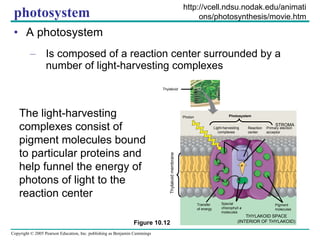
photosystem A photosystem Is composed of a reaction center surrounded by a number of light-harvesting complexes The light-harvesting complexes consist of pigment molecules bound to particular proteins and help funnel the energy of photons of light to the reaction center http://vcell.ndsu.nodak.edu/animations/photosynthesis/movie.htm Primary election acceptor Photon Thylakoid Light-harvesting complexes Reaction center Photosystem STROMA Thylakoid membrane Transfer of energy Special chlorophyll  a molecules Pigment molecules THYLAKOID SPACE (INTERIOR OF THYLAKOID) Figure 10.12 e –
The thylakoid membrane Is populated by two types of photosystems, I and II Figure 10.13 Photosystem II (PS II) Photosystem-I (PS I) ATP NADPH NADP + ADP CALVIN CYCLE CO 2 H 2 O O 2 [CH 2 O] (sugar) LIGHT REACTIONS Light Primary acceptor Pq Cytochrome complex PC e P680 e – e – O 2 + H 2 O 2 H + Light ATP Primary acceptor Fd e e – NADP + reductase Electron Transport chain Electron transport chain P700 Light NADPH NADP + + 2 H + + H +
Light Phase 1a. The pigments get excited by the photons 2a.  All pigments will pass on their energy to a chlorophyll  a  in photosystem II-P680 3a.  2 chlorophyll  a  electrons become so excited they escape 4a.  The electrons are captured by a primary electron acceptor Figure 10.13 Photosystem II (PS II) Photosystem-I (PS I) ATP NADPH NADP + ADP CALVIN CYCLE CO 2 H 2 O O 2 [CH 2 O] (sugar) LIGHT REACTIONS Light Primary acceptor Pq Cytochrome complex PC e P680 e – e – O 2 + H 2 O 2 H + Light ATP Primary acceptor Fd e e – NADP + reductase Electron Transport chain Electron transport chain P700 Light NADPH NADP + + 2 H + + H +
Photolysis (same time as 1-4 on last slide) 1b. Water is split in a process called  photolysis 2b. The water is split into 2 electrons, 2 protons (H + ) and an O 3b. The O will bind to another O from a 2 nd  water molecule and escape from the thylakoid and plant as O 2 4b. The water’s electrons are passed to PII to replace P680’s electrons that go to PI Figure 10.13 Photosystem II (PS II) Photosystem-I (PS I) ATP NADPH NADP + ADP CALVIN CYCLE CO 2 H 2 O O 2 [CH 2 O] (sugar) LIGHT REACTIONS Light Primary acceptor Pq Cytochrome complex PC e P680 e – e – O 2 + H 2 O 2 H + Light ATP Primary acceptor Fd e e – NADP + reductase Electron Transport chain Electron transport chain P700 Light NADPH NADP + + 2 H + + H +
Electron Transport Chain 1.  Each photoexcited electron passes from PII to PI via an electron transport chain 2. The “fall” creates energy to help move H+ through protein channel from the stroma to the thylakoid space, which generates a concentration gradient of H+ ( refer to information on chemiosmosis ) http://vcell.ndsu.nodak.edu/animations/photosystemII/movie.htm Figure 10.13 Photosystem II (PS II) Photosystem-I (PS I) ATP NADPH NADP + ADP CALVIN CYCLE CO 2 H 2 O O 2 [CH 2 O] (sugar) LIGHT REACTIONS Light Primary acceptor Pq Cytochrome complex PC e P680 e – e – O 2 + H 2 O 2 H + Light ATP Primary acceptor Fd e e – NADP + reductase Electron Transport chain Electron transport chain P700 Light NADPH NADP + + 2 H + + H +
Chemiosmosis LIGHT REACTOR NADP + ADP ATP NADPH CALVIN CYCLE [CH 2 O] (sugar) STROMA (Low H +  concentration) Photosystem II LIGHT H 2 O CO 2 Cytochrome complex O 2 H 2 O O 2 1 1 ⁄ 2 2 Photosystem I Light THYLAKOID SPACE (High H +  concentration) STROMA (Low H +  concentration) Thylakoid membrane ATP synthase Pq Pc Fd NADP + reductase NADPH + H + NADP +  + 2H + To Calvin cycle ADP P ATP 3 H + 2 H + +2 H + 2 H + Figure 10.17
Chemiosmosis 3. H+ is pumped from stroma into thylakoid space (lumen) 4. The H +  then diffuse back into stroma through ATP-synthase channels-ATP is produced LIGHT REACTOR NADP + ADP ATP NADPH CALVIN CYCLE [CH 2 O] (sugar) STROMA (Low H +  concentration) Photosystem II LIGHT H 2 O CO 2 Cytochrome complex O 2 H 2 O O 2 1 1 ⁄ 2 2 Photosystem I Light THYLAKOID SPACE (High H +  concentration) STROMA (Low H +  concentration) Thylakoid membrane ATP synthase Pq Pc Fd NADP + reductase NADPH + H + NADP +  + 2H + To Calvin cycle ADP P ATP 3 H + 2 H + +2 H + 2 H + Figure 10.17
Chemiosmosis 5. ATP goes to Calvin cycle LIGHT REACTOR NADP + ADP ATP NADPH CALVIN CYCLE [CH 2 O] (sugar) STROMA (Low H +  concentration) Photosystem II LIGHT H 2 O CO 2 Cytochrome complex O 2 H 2 O O 2 1 1 ⁄ 2 2 Photosystem I Light THYLAKOID SPACE (High H +  concentration) STROMA (Low H +  concentration) Thylakoid membrane ATP synthase Pq Pc Fd NADP + reductase NADPH + H + NADP +  + 2H + To Calvin cycle ADP P ATP 3 H + 2 H + +2 H + 2 H + Figure 10.17
photosystem I 1. Pigments in photosystem I are energized by photons and pass on energy to a P700 chlorophyll  a 2. P 700 oxidizes 3. The electrons from P700 are replaced by the electrons coming from PII that were passed along the electron transport chain 4. The electrons from P700 are passed through a short electron transport chain reducing NADP+ to NADPH  Figure 10.13 Photosystem II (PS II) Photosystem-I (PS I) ATP NADPH NADP + ADP CALVIN CYCLE CO 2 H 2 O O 2 [CH 2 O] (sugar) LIGHT REACTIONS Light Primary acceptor Pq Cytochrome complex PC e P680 e – e – O 2 + H 2 O 2 H + Light ATP Primary acceptor Fd e e – NADP + reductase Electron Transport chain Electron transport chain P700 Light NADPH NADP + + 2 H + + H +
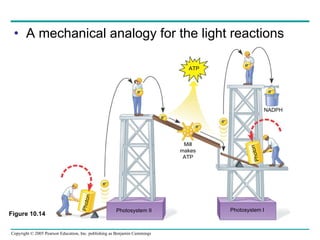
A mechanical analogy for the light reactions Mill makes ATP ATP e – e – e – e – e – Photon Photosystem II Photosystem I e – e – NADPH Photon Figure 10.14 
Light Phase PII and PI Products Produces NADPH, ATP,  (both go to Calvin Cycle) and oxygen (by-product) Figure 10.13 Photosystem II (PS II) Photosystem-I (PS I) ATP NADPH NADP + ADP CALVIN CYCLE CO 2 H 2 O O 2 [CH 2 O] (sugar) LIGHT REACTIONS Light Primary acceptor Pq Cytochrome complex PC e P680 e – e – O 2 + H 2 O 2 H + Light ATP Primary acceptor Fd e e – NADP + reductase Electron Transport chain Electron transport chain P700 Light NADPH NADP + + 2 H + + H + 1 5 7 2 3 4 6 8
Calvin cycle The Calvin cycle uses ATP and NADPH to convert CO 2  to sugar The Calvin cycle Is similar to the citric acid cycle Occurs in the stroma Also known as light-independent phase The dark phase The Calvin-Benson cycle
The Calvin cycle has three phases Carbon fixation Reduction Regeneration of the CO 2  acceptor
The Calvin cycle Phase 1: Carbon fixation Phase 2: Reduction Phase 3: Regeneration of the CO 2  acceptor (RuBP) (G3P) Input (Entering one at a time) CO 2 3 Rubisco Short-lived intermediate 3  P P 3  P P Ribulose bisphosphate (RuBP) P 3-Phosphoglycerate P 6  P 6 1,3-Bisphoglycerate 6 NADPH 6 NADPH + 6  P P 6 Glyceraldehyde-3-phosphate (G3P) 6  ATP 3  ATP 3  ADP CALVIN CYCLE P 5 P 1 G3P (a sugar) Output Light H 2 O CO 2 LIGHT REACTION ATP NADPH NADP + ADP [CH 2 O] (sugar) CALVIN CYCLE Figure 10.18 O 2 6 ADP Glucose and other organic compounds
Steps…. Carbon dioxide is reduced and bound to RuBP (ribulose biphosphate) forming a 6C sugar This is called carbon fixation The 6C is unstable and breaks into 2 3C molecules of 3-PGA (3-phosphoglycerate) This all happens with the help of the enzyme rubisco (ribulose biphosphate carboxylase) (G3P) Input (Entering one at a time) CO 2 3 Rubisco Short-lived intermediate 3  P P 3  P P Ribulose bisphosphate (RuBP) P 3-Phosphoglycerate P 6  P 6 1,3-Bisphoglycerate 6 NADPH 6 NADPH + 6  P P 6 Glyceraldehyde-3-phosphate (G3P) 6  ATP 3  ATP 3  ADP CALVIN CYCLE P 5 P 1 G3P (a sugar) Output Light H 2 O CO 2 LIGHT REACTION ATP NADPH NADP + ADP [CH 2 O] (sugar) CALVIN CYCLE Figure 10.18 O 2 6 ADP Glucose and other organic compounds
Assuming we started with 3 CO 2 … 6 molecules of 3-PGA consume energy from 6 molecules of ATP and are reduced by electrons from 6 NADPH  The reduction of the 3-PGA forms G3P 1 G3P (2 needed) will be used by the cell to form glucose and be used for cellular respiration 5 G3Ps will use 3 ATP molecules to be rearranged into 3 RuBPs (15 carbons total)  The Calvin cycle will start again (G3P) Input (Entering one at a time) CO 2 3 Rubisco Short-lived intermediate 3  P P 3  P P Ribulose bisphosphate (RuBP) P 3-Phosphoglycerate P 6  P 6 1,3-Bisphoglycerate 6 NADPH 6 NADPH + 6  P P 6 Glyceraldehyde-3-phosphate (G3P) 6  ATP 3  ATP 3  ADP CALVIN CYCLE P 5 P 1 G3P (a sugar) Output Light H 2 O CO 2 LIGHT REACTION ATP NADPH NADP + ADP [CH 2 O] (sugar) CALVIN CYCLE Figure 10.18 O 2 6 ADP Glucose and other organic compounds
Photorespiration When there’s no CO 2  present (when stomata are closed, such as when it is hot or dry to conserve water), RuBP will bind to O 2  and produce a 2 carbon molecule that is broken down into CO2  and H 2 O No ATP or glucose are produced This is called photorespiration instead of photosynthesis http://vcell.ndsu.nodak.edu/animations/photosynthesis/movie.htm (G3P) Input (Entering one at a time) CO 2 3 Rubisco Short-lived intermediate 3  P P 3  P P Ribulose bisphosphate (RuBP) P 3-Phosphoglycerate P 6  P 6 1,3-Bisphoglycerate 6 NADPH 6 NADPH + 6  P P 6 Glyceraldehyde-3-phosphate (G3P) 6  ATP 3  ATP 3  ADP CALVIN CYCLE P 5 P 1 G3P (a sugar) Output Light H 2 O CO 2 LIGHT REACTION ATP NADPH NADP + ADP [CH 2 O] (sugar) CALVIN CYCLE Figure 10.18 O 2 6 ADP Glucose and other organic compounds
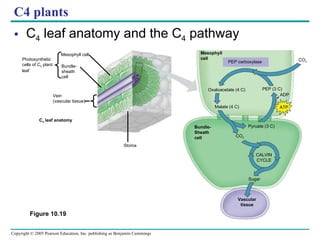
C4 plants C 4  leaf anatomy and the C 4  pathway CO 2 Mesophyll cell Bundle- sheath cell Vein (vascular tissue) Photosynthetic cells of C 4  plant leaf Stoma Mesophyll cell C 4  leaf anatomy PEP carboxylase Oxaloacetate (4 C) PEP (3 C) Malate (4 C) ADP ATP Bundle- Sheath cell CO 2 Pyruate (3 C) CALVIN CYCLE Sugar Vascular tissue Figure 10.19 CO 2
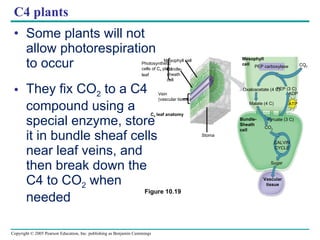
C4 plants Some plants will not allow photorespiration to occur They fix CO 2  to a C4 compound using a special enzyme, store it in bundle sheaf cells near leaf veins, and then break down the C4 to CO 2  when needed CO 2 Mesophyll cell Bundle- sheath cell Vein (vascular tissue) Photosynthetic cells of C 4  plant leaf Stoma Mesophyll cell C 4  leaf anatomy PEP carboxylase Oxaloacetate (4 C) PEP (3 C) Malate (4 C) ADP ATP Bundle- Sheath cell CO 2 Pyruate (3 C) CALVIN CYCLE Sugar Vascular tissue Figure 10.19 CO 2
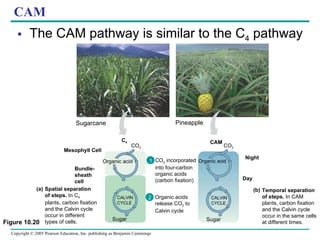
CAM CAM plants are similar to C4 plants, in that they can carry on photosynthesis even when their stomata are closed They only open their stomata at night to preserve water (they are found in very dry climates, named for the cacti species it was discovered in) They fix CO 2  into a 4C at night, then break down and use the CO 2  in the sunlight
CAM The CAM pathway is similar to the C 4  pathway Spatial separation of steps.  In C 4  plants, carbon fixation and the Calvin cycle occur in different types of cells. (a) Temporal separation of steps.  In CAM plants, carbon fixation and the Calvin cycle occur in the same cells at different times. (b) Pineapple Sugarcane Bundle- sheath cell Mesophyll Cell Organic acid CALVIN CYCLE Sugar CO 2 CO 2 Organic acid CALVIN CYCLE Sugar C 4 CAM CO 2  incorporated into four-carbon organic acids (carbon fixation) Night Day 1 2 Organic acids release CO 2  to Calvin cycle Figure 10.20
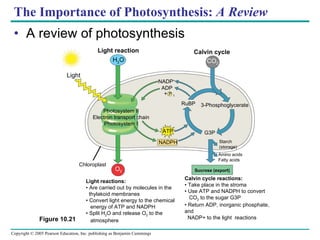
The Importance of Photosynthesis:  A Review A review of photosynthesis Light reactions: •  Are carried out by molecules in the thylakoid membranes •  Convert light energy to the chemical energy of ATP and NADPH •  Split H 2 O and release O 2  to the atmosphere  Calvin cycle reactions: •  Take place in the stroma •  Use ATP and NADPH to convert CO 2  to the sugar G3P •  Return ADP, inorganic phosphate, and    NADP+ to the light  reactions O 2 CO 2 H 2 O Light Light reaction Calvin cycle NADP + ADP ATP NADPH +  P   1 RuBP 3-Phosphoglycerate Amino acids Fatty acids Starch (storage) Sucrose (export) G3P Photosystem II Electron transport chain Photosystem I Chloroplast Figure 10.21
Organic compounds produced by photosynthesis Provide the energy and building material for ecosystems
Photosynthesis/Cellular Respiration Evolutionary Delimmas H 2 O in the PSII is broken to produce O 2  which in evolutionary terms provided the atmosphere with oxygen for the first time. Since oxygen is a necessary component of water, how did H 2 O exist (70% of earth’s surface) before O 2  was produced as a byproduct of PSII? Photosynthesis and Cellular Respiration are complete as one cycle (utilizing each other’s products as reactants, etc.) and are in perfect harmony as co-systems.  How could one (photosynthesis for example) exist before the other, as evolutionists suspect?

10 photosynthesis text

  • 1.
    Photosynthesis Plants arephotoautotrophs They use the energy of sunlight to make organic molecules from water and carbon dioxide Figure 10.1
  • 2.
    Photosynthesis Occurs inplants, algae, certain other protists, and some prokaryotes These organisms use light energy to drive the synthesis of organic molecules from carbon dioxide and (in most cases) water. They feed not only themselves, but the entire living world. (a) On land, plants are the predominant producers of food. In aquatic environments, photosynthetic organisms include (b) multicellular algae, such as this kelp; (c) some unicellular protists, such as Euglena; (d) the prokaryotes called cyanobacteria; and (e) other photosynthetic prokaryotes, such as these purple sulfur bacteria, which produce sulfur (spherical globules) (c, d, e: LMs). (a) Plants (b) Multicellular algae (c) Unicellular protist 10  m 40  m (d) Cyanobacteria 1.5  m (e) Pruple sulfur bacteria Figure 10.2
  • 3.
    Chloroplasts: The Sitesof Photosynthesis in Plants The leaves of plants Are the major sites of photosynthesis Vein Leaf cross section Figure 10.3 Mesophyll CO 2 O 2 Stomata
  • 4.
    Chloroplasts Are theorganelles in which photosynthesis occurs Contain thylakoids and grana Chloroplast Mesophyll 5 µm Outer membrane Intermembrane space Inner membrane Thylakoid space Thylakoid Granum Stroma 1 µm
  • 5.
    Tracking Atoms ThroughPhotosynthesis: Scientific Inquiry Photosynthesis is summarized as 6 CO 2 + 12 H 2 O + Light energy  C 6 H 12 O 6 + 6 O 2 + 6 H 2 O Photosynthesis converts light energy (inorganic) to the chemical energy (organic, potential) of food Chloroplasts split water into Hydrogen and oxygen, incorporating the electrons of hydrogen into sugar molecules 6 CO 2 12 H 2 O Reactants: Products: C 6 H 12 O 6 6 H 2 O 6 O 2 Figure 10.4
  • 6.
    Photosynthesis as aRedox Process Photosynthesis is a redox process Water is oxidized, carbon dioxide is reduced Photosynthesis consists of two processes The light reactions -Occur in the grana -Split water, release oxygen, produce ATP, and form NADPH The Calvin cycle -Occurs in the stroma -Forms sugar from carbon dioxide, using ATP for energy and NADPH for reducing power
  • 7.
    An overview ofphotosynthesis H 2 O CO 2 Light LIGHT REACTIONS CALVIN CYCLE Chloroplast [CH 2 O] (sugar) NADPH NADP  ADP + P O 2 Figure 10.5 ATP
  • 8.
    light reactions Thelight reactions convert solar energy to the chemical energy of ATP and NADPH Light Is a form of electromagnetic energy, which travels in waves Wavelength Is the distance between the crests of waves Determines the type of electromagnetic energy Gamma rays X-rays UV Infrared Micro- waves Radio waves 10 –5 nm 10 –3 nm 1 nm 10 3 nm 10 6 nm 1 m 10 6 nm 10 3 m 380 450 500 550 600 650 700 750 nm Visible light Shorter wavelength Higher energy Longer wavelength Lower energy Figure 10.6
  • 9.
    The visible lightspectrum Includes the colors of light we can see Includes the wavelengths that drive photosynthesis Pigments Are substances that absorb visible light Light Reflected Light Chloroplast Absorbed light Granum Transmitted light Figure 10.7 Gamma rays X-rays UV Infrared Micro- waves Radio waves 10 –5 nm 10 –3 nm 1 nm 10 3 nm 10 6 nm 1 m 10 6 nm 10 3 m 380 450 500 550 600 650 700 750 nm Visible light Shorter wavelength Higher energy Longer wavelength Lower energy Figure 10.6
  • 10.
    Chlorophyll a Isthe main photosynthetic pigment Chlorophyll b Is an accessory pigment Other accessory pigments Absorb different wavelengths of light and pass the energy to chlorophyll a C CH CH 2 C C C C C C N N C H 3 C C C C C C C C C N C C C C N Mg H H 3 C H C CH 2 CH 3 H CH 3 C H H CH 2 CH 2 CH 2 H CH 3 C O O O O O CH 3 CH 3 CHO in chlorophyll a in chlorophyll b Porphyrin ring: Light-absorbing “ head” of molecule note magnesium atom at center Hydrocarbon tail: interacts with hydrophobic regions of proteins inside thylakoid membranes of chloroplasts: H atoms not shown Figure 10.10
  • 11.
    Excitation of Chlorophyllby Light When a pigment absorbs light It goes from a ground state to an excited state, which is unstable Excited state Energy of election Heat Photon (fluorescence) Chlorophyll molecule Ground state Photon e – Figure 10.11 A
  • 12.
    The spectrophotometer Isa machine that sends light through pigments and measures the fraction of light transmitted at each wavelength Figure 10.8 White light Refracting prism Chlorophyll solution Photoelectric tube Galvanometer Slit moves to pass light of selected wavelength Green light The high transmittance (low absorption) reading indicates that chlorophyll absorbs very little green light. The low transmittance (high absorption) reading chlorophyll absorbs most blue light. Blue light 1 2 3 4 0 100 0 100
  • 13.
    The absorption spectraof chloroplast pigments Provide clues to the relative effectiveness of different wavelengths for driving photosynthesis Three different experiments helped reveal which wavelengths of light are photosynthetically important. The results are shown below. EXPERIMENT RESULTS Absorption of light by chloroplast pigments Chlorophyll a (a) Absorption spectra. The three curves show the wavelengths of light best absorbed by three types of chloroplast pigments. Wavelength of light (nm) Chlorophyll b Carotenoids
  • 14.
    photosystem A photosystemIs composed of a reaction center surrounded by a number of light-harvesting complexes The light-harvesting complexes consist of pigment molecules bound to particular proteins and help funnel the energy of photons of light to the reaction center http://vcell.ndsu.nodak.edu/animations/photosynthesis/movie.htm Primary election acceptor Photon Thylakoid Light-harvesting complexes Reaction center Photosystem STROMA Thylakoid membrane Transfer of energy Special chlorophyll a molecules Pigment molecules THYLAKOID SPACE (INTERIOR OF THYLAKOID) Figure 10.12 e –
  • 15.
    The thylakoid membraneIs populated by two types of photosystems, I and II Figure 10.13 Photosystem II (PS II) Photosystem-I (PS I) ATP NADPH NADP + ADP CALVIN CYCLE CO 2 H 2 O O 2 [CH 2 O] (sugar) LIGHT REACTIONS Light Primary acceptor Pq Cytochrome complex PC e P680 e – e – O 2 + H 2 O 2 H + Light ATP Primary acceptor Fd e e – NADP + reductase Electron Transport chain Electron transport chain P700 Light NADPH NADP + + 2 H + + H +
  • 16.
    Light Phase 1a.The pigments get excited by the photons 2a. All pigments will pass on their energy to a chlorophyll a in photosystem II-P680 3a. 2 chlorophyll a electrons become so excited they escape 4a. The electrons are captured by a primary electron acceptor Figure 10.13 Photosystem II (PS II) Photosystem-I (PS I) ATP NADPH NADP + ADP CALVIN CYCLE CO 2 H 2 O O 2 [CH 2 O] (sugar) LIGHT REACTIONS Light Primary acceptor Pq Cytochrome complex PC e P680 e – e – O 2 + H 2 O 2 H + Light ATP Primary acceptor Fd e e – NADP + reductase Electron Transport chain Electron transport chain P700 Light NADPH NADP + + 2 H + + H +
  • 17.
    Photolysis (same timeas 1-4 on last slide) 1b. Water is split in a process called photolysis 2b. The water is split into 2 electrons, 2 protons (H + ) and an O 3b. The O will bind to another O from a 2 nd water molecule and escape from the thylakoid and plant as O 2 4b. The water’s electrons are passed to PII to replace P680’s electrons that go to PI Figure 10.13 Photosystem II (PS II) Photosystem-I (PS I) ATP NADPH NADP + ADP CALVIN CYCLE CO 2 H 2 O O 2 [CH 2 O] (sugar) LIGHT REACTIONS Light Primary acceptor Pq Cytochrome complex PC e P680 e – e – O 2 + H 2 O 2 H + Light ATP Primary acceptor Fd e e – NADP + reductase Electron Transport chain Electron transport chain P700 Light NADPH NADP + + 2 H + + H +
  • 18.
    Electron Transport Chain1. Each photoexcited electron passes from PII to PI via an electron transport chain 2. The “fall” creates energy to help move H+ through protein channel from the stroma to the thylakoid space, which generates a concentration gradient of H+ ( refer to information on chemiosmosis ) http://vcell.ndsu.nodak.edu/animations/photosystemII/movie.htm Figure 10.13 Photosystem II (PS II) Photosystem-I (PS I) ATP NADPH NADP + ADP CALVIN CYCLE CO 2 H 2 O O 2 [CH 2 O] (sugar) LIGHT REACTIONS Light Primary acceptor Pq Cytochrome complex PC e P680 e – e – O 2 + H 2 O 2 H + Light ATP Primary acceptor Fd e e – NADP + reductase Electron Transport chain Electron transport chain P700 Light NADPH NADP + + 2 H + + H +
  • 19.
    Chemiosmosis LIGHT REACTORNADP + ADP ATP NADPH CALVIN CYCLE [CH 2 O] (sugar) STROMA (Low H + concentration) Photosystem II LIGHT H 2 O CO 2 Cytochrome complex O 2 H 2 O O 2 1 1 ⁄ 2 2 Photosystem I Light THYLAKOID SPACE (High H + concentration) STROMA (Low H + concentration) Thylakoid membrane ATP synthase Pq Pc Fd NADP + reductase NADPH + H + NADP + + 2H + To Calvin cycle ADP P ATP 3 H + 2 H + +2 H + 2 H + Figure 10.17
  • 20.
    Chemiosmosis 3. H+is pumped from stroma into thylakoid space (lumen) 4. The H + then diffuse back into stroma through ATP-synthase channels-ATP is produced LIGHT REACTOR NADP + ADP ATP NADPH CALVIN CYCLE [CH 2 O] (sugar) STROMA (Low H + concentration) Photosystem II LIGHT H 2 O CO 2 Cytochrome complex O 2 H 2 O O 2 1 1 ⁄ 2 2 Photosystem I Light THYLAKOID SPACE (High H + concentration) STROMA (Low H + concentration) Thylakoid membrane ATP synthase Pq Pc Fd NADP + reductase NADPH + H + NADP + + 2H + To Calvin cycle ADP P ATP 3 H + 2 H + +2 H + 2 H + Figure 10.17
  • 21.
    Chemiosmosis 5. ATPgoes to Calvin cycle LIGHT REACTOR NADP + ADP ATP NADPH CALVIN CYCLE [CH 2 O] (sugar) STROMA (Low H + concentration) Photosystem II LIGHT H 2 O CO 2 Cytochrome complex O 2 H 2 O O 2 1 1 ⁄ 2 2 Photosystem I Light THYLAKOID SPACE (High H + concentration) STROMA (Low H + concentration) Thylakoid membrane ATP synthase Pq Pc Fd NADP + reductase NADPH + H + NADP + + 2H + To Calvin cycle ADP P ATP 3 H + 2 H + +2 H + 2 H + Figure 10.17
  • 22.
    photosystem I 1.Pigments in photosystem I are energized by photons and pass on energy to a P700 chlorophyll a 2. P 700 oxidizes 3. The electrons from P700 are replaced by the electrons coming from PII that were passed along the electron transport chain 4. The electrons from P700 are passed through a short electron transport chain reducing NADP+ to NADPH Figure 10.13 Photosystem II (PS II) Photosystem-I (PS I) ATP NADPH NADP + ADP CALVIN CYCLE CO 2 H 2 O O 2 [CH 2 O] (sugar) LIGHT REACTIONS Light Primary acceptor Pq Cytochrome complex PC e P680 e – e – O 2 + H 2 O 2 H + Light ATP Primary acceptor Fd e e – NADP + reductase Electron Transport chain Electron transport chain P700 Light NADPH NADP + + 2 H + + H +
  • 23.
    A mechanical analogyfor the light reactions Mill makes ATP ATP e – e – e – e – e – Photon Photosystem II Photosystem I e – e – NADPH Photon Figure 10.14 
  • 24.
    Light Phase PIIand PI Products Produces NADPH, ATP, (both go to Calvin Cycle) and oxygen (by-product) Figure 10.13 Photosystem II (PS II) Photosystem-I (PS I) ATP NADPH NADP + ADP CALVIN CYCLE CO 2 H 2 O O 2 [CH 2 O] (sugar) LIGHT REACTIONS Light Primary acceptor Pq Cytochrome complex PC e P680 e – e – O 2 + H 2 O 2 H + Light ATP Primary acceptor Fd e e – NADP + reductase Electron Transport chain Electron transport chain P700 Light NADPH NADP + + 2 H + + H + 1 5 7 2 3 4 6 8
  • 25.
    Calvin cycle TheCalvin cycle uses ATP and NADPH to convert CO 2 to sugar The Calvin cycle Is similar to the citric acid cycle Occurs in the stroma Also known as light-independent phase The dark phase The Calvin-Benson cycle
  • 26.
    The Calvin cyclehas three phases Carbon fixation Reduction Regeneration of the CO 2 acceptor
  • 27.
    The Calvin cyclePhase 1: Carbon fixation Phase 2: Reduction Phase 3: Regeneration of the CO 2 acceptor (RuBP) (G3P) Input (Entering one at a time) CO 2 3 Rubisco Short-lived intermediate 3 P P 3 P P Ribulose bisphosphate (RuBP) P 3-Phosphoglycerate P 6 P 6 1,3-Bisphoglycerate 6 NADPH 6 NADPH + 6 P P 6 Glyceraldehyde-3-phosphate (G3P) 6 ATP 3 ATP 3 ADP CALVIN CYCLE P 5 P 1 G3P (a sugar) Output Light H 2 O CO 2 LIGHT REACTION ATP NADPH NADP + ADP [CH 2 O] (sugar) CALVIN CYCLE Figure 10.18 O 2 6 ADP Glucose and other organic compounds
  • 28.
    Steps…. Carbon dioxideis reduced and bound to RuBP (ribulose biphosphate) forming a 6C sugar This is called carbon fixation The 6C is unstable and breaks into 2 3C molecules of 3-PGA (3-phosphoglycerate) This all happens with the help of the enzyme rubisco (ribulose biphosphate carboxylase) (G3P) Input (Entering one at a time) CO 2 3 Rubisco Short-lived intermediate 3 P P 3 P P Ribulose bisphosphate (RuBP) P 3-Phosphoglycerate P 6 P 6 1,3-Bisphoglycerate 6 NADPH 6 NADPH + 6 P P 6 Glyceraldehyde-3-phosphate (G3P) 6 ATP 3 ATP 3 ADP CALVIN CYCLE P 5 P 1 G3P (a sugar) Output Light H 2 O CO 2 LIGHT REACTION ATP NADPH NADP + ADP [CH 2 O] (sugar) CALVIN CYCLE Figure 10.18 O 2 6 ADP Glucose and other organic compounds
  • 29.
    Assuming we startedwith 3 CO 2 … 6 molecules of 3-PGA consume energy from 6 molecules of ATP and are reduced by electrons from 6 NADPH The reduction of the 3-PGA forms G3P 1 G3P (2 needed) will be used by the cell to form glucose and be used for cellular respiration 5 G3Ps will use 3 ATP molecules to be rearranged into 3 RuBPs (15 carbons total) The Calvin cycle will start again (G3P) Input (Entering one at a time) CO 2 3 Rubisco Short-lived intermediate 3 P P 3 P P Ribulose bisphosphate (RuBP) P 3-Phosphoglycerate P 6 P 6 1,3-Bisphoglycerate 6 NADPH 6 NADPH + 6 P P 6 Glyceraldehyde-3-phosphate (G3P) 6 ATP 3 ATP 3 ADP CALVIN CYCLE P 5 P 1 G3P (a sugar) Output Light H 2 O CO 2 LIGHT REACTION ATP NADPH NADP + ADP [CH 2 O] (sugar) CALVIN CYCLE Figure 10.18 O 2 6 ADP Glucose and other organic compounds
  • 30.
    Photorespiration When there’sno CO 2 present (when stomata are closed, such as when it is hot or dry to conserve water), RuBP will bind to O 2 and produce a 2 carbon molecule that is broken down into CO2 and H 2 O No ATP or glucose are produced This is called photorespiration instead of photosynthesis http://vcell.ndsu.nodak.edu/animations/photosynthesis/movie.htm (G3P) Input (Entering one at a time) CO 2 3 Rubisco Short-lived intermediate 3 P P 3 P P Ribulose bisphosphate (RuBP) P 3-Phosphoglycerate P 6 P 6 1,3-Bisphoglycerate 6 NADPH 6 NADPH + 6 P P 6 Glyceraldehyde-3-phosphate (G3P) 6 ATP 3 ATP 3 ADP CALVIN CYCLE P 5 P 1 G3P (a sugar) Output Light H 2 O CO 2 LIGHT REACTION ATP NADPH NADP + ADP [CH 2 O] (sugar) CALVIN CYCLE Figure 10.18 O 2 6 ADP Glucose and other organic compounds
  • 31.
    C4 plants C4 leaf anatomy and the C 4 pathway CO 2 Mesophyll cell Bundle- sheath cell Vein (vascular tissue) Photosynthetic cells of C 4 plant leaf Stoma Mesophyll cell C 4 leaf anatomy PEP carboxylase Oxaloacetate (4 C) PEP (3 C) Malate (4 C) ADP ATP Bundle- Sheath cell CO 2 Pyruate (3 C) CALVIN CYCLE Sugar Vascular tissue Figure 10.19 CO 2
  • 32.
    C4 plants Someplants will not allow photorespiration to occur They fix CO 2 to a C4 compound using a special enzyme, store it in bundle sheaf cells near leaf veins, and then break down the C4 to CO 2 when needed CO 2 Mesophyll cell Bundle- sheath cell Vein (vascular tissue) Photosynthetic cells of C 4 plant leaf Stoma Mesophyll cell C 4 leaf anatomy PEP carboxylase Oxaloacetate (4 C) PEP (3 C) Malate (4 C) ADP ATP Bundle- Sheath cell CO 2 Pyruate (3 C) CALVIN CYCLE Sugar Vascular tissue Figure 10.19 CO 2
  • 33.
    CAM CAM plantsare similar to C4 plants, in that they can carry on photosynthesis even when their stomata are closed They only open their stomata at night to preserve water (they are found in very dry climates, named for the cacti species it was discovered in) They fix CO 2 into a 4C at night, then break down and use the CO 2 in the sunlight
  • 34.
    CAM The CAMpathway is similar to the C 4 pathway Spatial separation of steps. In C 4 plants, carbon fixation and the Calvin cycle occur in different types of cells. (a) Temporal separation of steps. In CAM plants, carbon fixation and the Calvin cycle occur in the same cells at different times. (b) Pineapple Sugarcane Bundle- sheath cell Mesophyll Cell Organic acid CALVIN CYCLE Sugar CO 2 CO 2 Organic acid CALVIN CYCLE Sugar C 4 CAM CO 2 incorporated into four-carbon organic acids (carbon fixation) Night Day 1 2 Organic acids release CO 2 to Calvin cycle Figure 10.20
  • 35.
    The Importance ofPhotosynthesis: A Review A review of photosynthesis Light reactions: • Are carried out by molecules in the thylakoid membranes • Convert light energy to the chemical energy of ATP and NADPH • Split H 2 O and release O 2 to the atmosphere Calvin cycle reactions: • Take place in the stroma • Use ATP and NADPH to convert CO 2 to the sugar G3P • Return ADP, inorganic phosphate, and NADP+ to the light reactions O 2 CO 2 H 2 O Light Light reaction Calvin cycle NADP + ADP ATP NADPH + P 1 RuBP 3-Phosphoglycerate Amino acids Fatty acids Starch (storage) Sucrose (export) G3P Photosystem II Electron transport chain Photosystem I Chloroplast Figure 10.21
  • 36.
    Organic compounds producedby photosynthesis Provide the energy and building material for ecosystems
  • 37.
    Photosynthesis/Cellular Respiration EvolutionaryDelimmas H 2 O in the PSII is broken to produce O 2 which in evolutionary terms provided the atmosphere with oxygen for the first time. Since oxygen is a necessary component of water, how did H 2 O exist (70% of earth’s surface) before O 2 was produced as a byproduct of PSII? Photosynthesis and Cellular Respiration are complete as one cycle (utilizing each other’s products as reactants, etc.) and are in perfect harmony as co-systems. How could one (photosynthesis for example) exist before the other, as evolutionists suspect?