Plant Nutrition Plants require certain chemical elements to complete their life cycle Plants derive most of their organic mass from the CO 2  of air But they also depend on soil nutrients such as water and minerals Figure 37.2 CO 2 , the source of carbon for Photosynthesis, diffuses into leaves from the air through stomata. Through stomata, leaves expel H 2 O and O 2 . H 2 O O 2 CO 2 Roots take in O 2  and expel CO 2 . The plant uses O 2  for cellular respiration but is  a net O 2  producer. O 2 CO 2 H 2 O Roots absorb H 2 O and minerals from the soil. Minerals
Macronutrients and Micronutrients More than 50 chemical elements Have been identified among the inorganic substances in plants, but not all of these are essential A chemical element is considered essential If it is required for a plant to complete a life cycle
Researchers use hydroponic culture To determine which chemicals elements are essential Figure 37.3 TECHNIQUE   Plant roots are bathed in aerated solutions of known mineral composition. Aerating the water provides the roots with oxygen for cellular respiration. A particular mineral, such as potassium, can be omitted to test whether it is essential. RESULTS   If the omitted mineral is essential, mineral deficiency symptoms occur, such as stunted growth and discolored leaves. Deficiencies of different elements may have different symptoms, which can aid in diagnosing mineral deficiencies in soil. Control:  Solution containing all minerals Experimental:  Solution without potassium APPLICATION   In hydroponic culture, plants are grown in mineral solutions without soil. One use of hydroponic culture is to identify essential elements in plants.
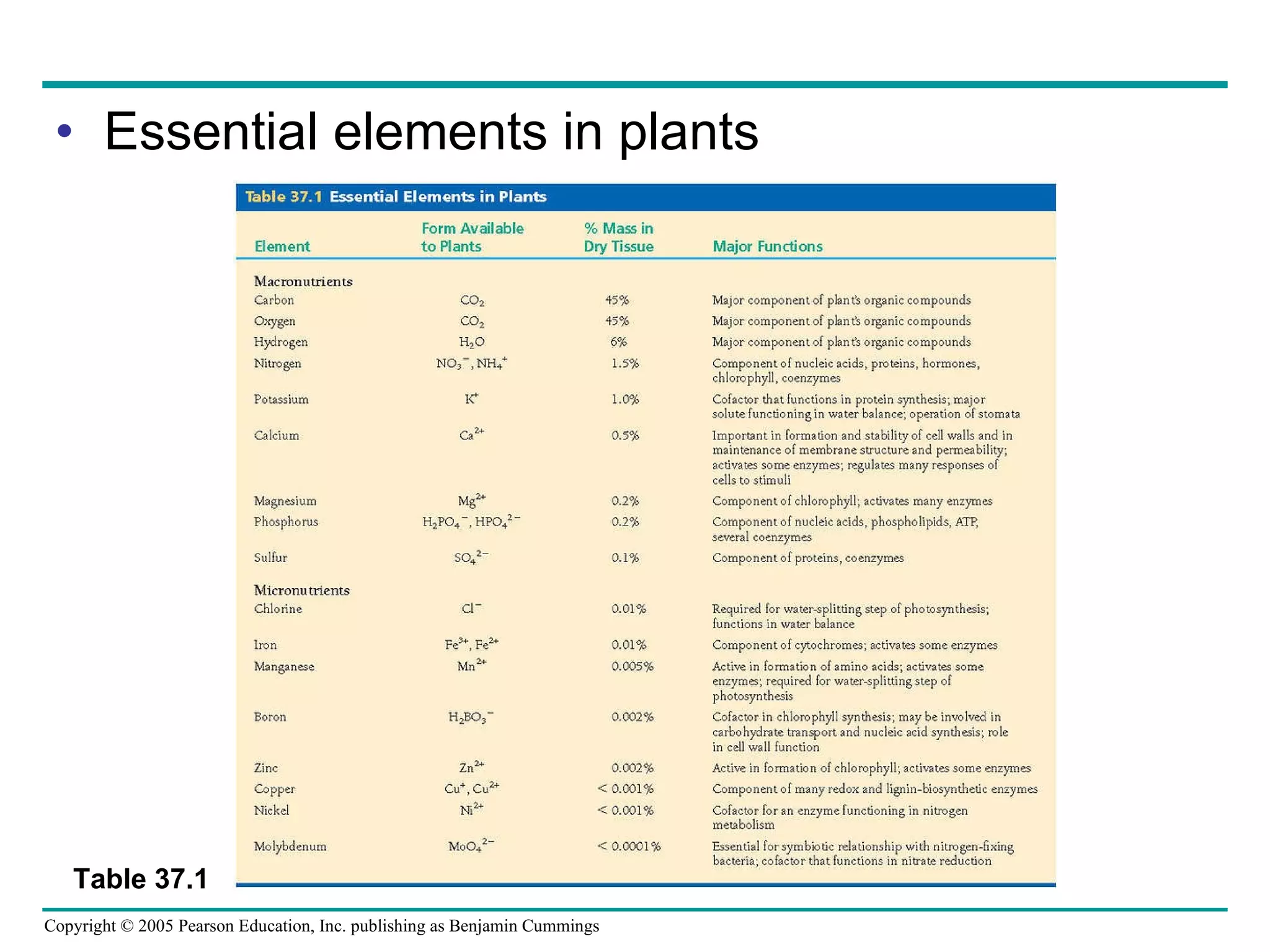
Essential elements in plants Table 37.1
Nine of the essential elements are called macronutrients Because plants require them in relatively large amounts ( CH N OPS plus K, Ca, and Mg ) The remaining eight essential elements are known as micronutrients Because plants need them in very small amounts (function mainly as cofactors,  Fe, Mn, Cu, and Zinc )
Symptoms of Mineral Deficiency The symptoms of mineral deficiency Depend partly on the nutrient’s function Depend on the mobility of a nutrient within the plant
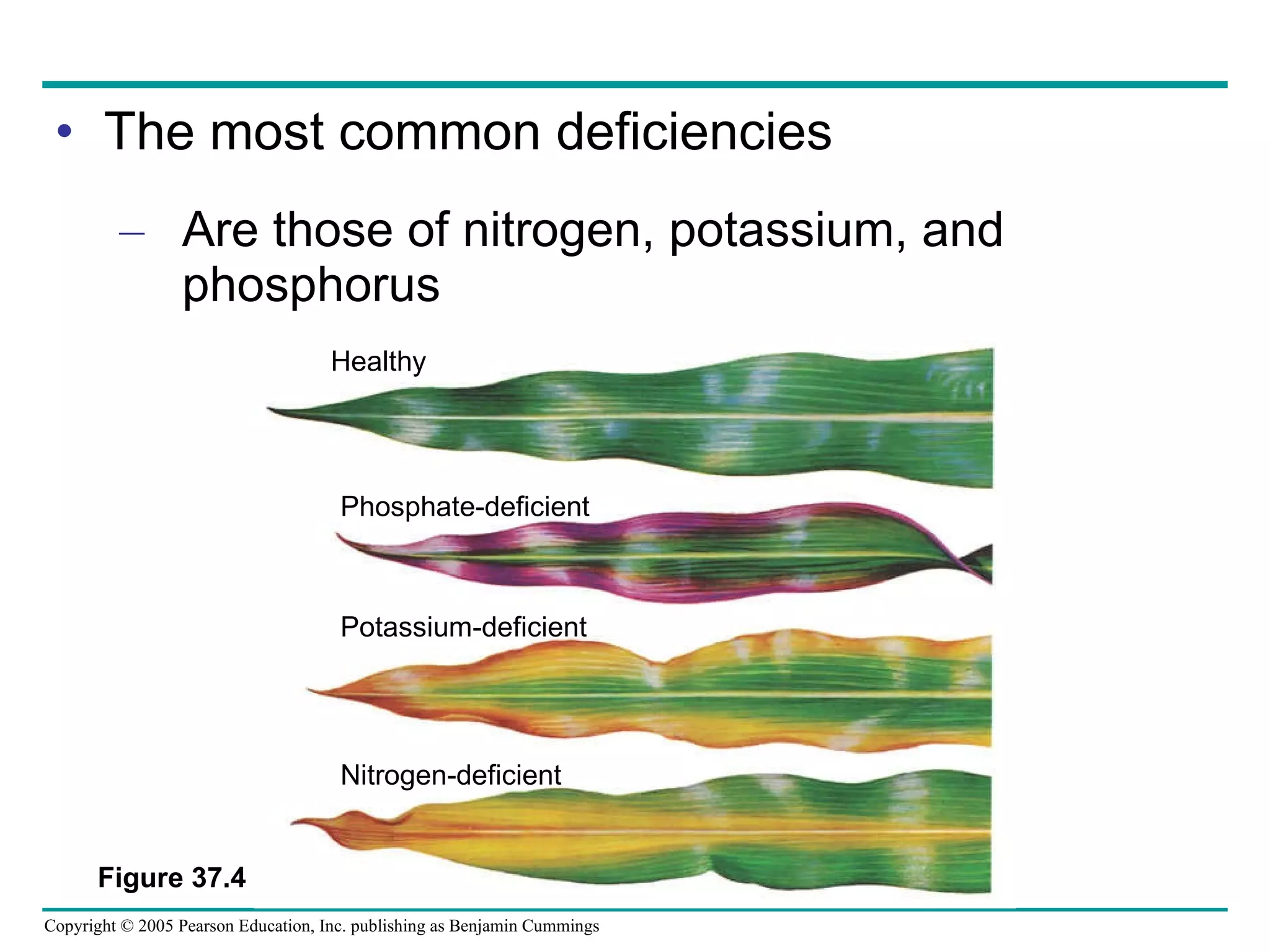
The most common deficiencies Are those of nitrogen, potassium, and phosphorus Figure 37.4 Phosphate-deficient Healthy Potassium-deficient Nitrogen-deficient
Soil quality is a major determinant of plant distribution and growth Along with climate The major factors determining whether particular plants can grow well in a certain location are the texture and composition of the soil Texture Is the soil’s general structure Composition Refers to the soil’s organic and inorganic chemical components
Fertilizers Commercially produced fertilizers Contain minerals that are either mined or prepared by industrial processes “ Organic” fertilizers Are composed of manure, fishmeal, or compost
Nitrogen  is often the mineral that has the greatest effect on plant growth Plants require nitrogen as a component of Proteins, nucleic acids, chlorophyll, and other important organic molecules
Soil Bacteria and Nitrogen Availability Nitrogen-fixing bacteria  convert atmospheric N 2 To nitrogenous minerals that plants can absorb as a nitrogen source for organic synthesis Figure 37.9 Atmosphere N 2 Soil N 2 N 2 Nitrogen-fixing bacteria Organic material (humus) NH 3  (ammonia) NH 4 +  (ammonium) H +  (From soil) NO 3 –  (nitrate) Nitrifying bacteria Denitrifying bacteria Root NH 4 + Soil Atmosphere Nitrate and  nitrogenous organic compounds exported in xylem to shoot system Ammonifying bacteria
Improving the Protein Yield of Crops Agriculture research in plant breeding Has resulted in new varieties of maize, wheat, and rice that are enriched in protein Such research Addresses the most widespread form of human malnutrition: protein deficiency
Plant nutritional adaptations often involve relationships with other organisms Two types of relationships plants have with other organisms are mutualistic Symbiotic nitrogen fixation Mycorrhizae
The Role of Bacteria in Symbiotic Nitrogen Fixation Symbiotic relationships with nitrogen-fixing bacteria Provide some plant species with a built-in source of fixed nitrogen From an agricultural standpoint The most important and efficient symbioses between plants and nitrogen-fixing bacteria occur in the  legume family (peas, beans, and other similar plants)
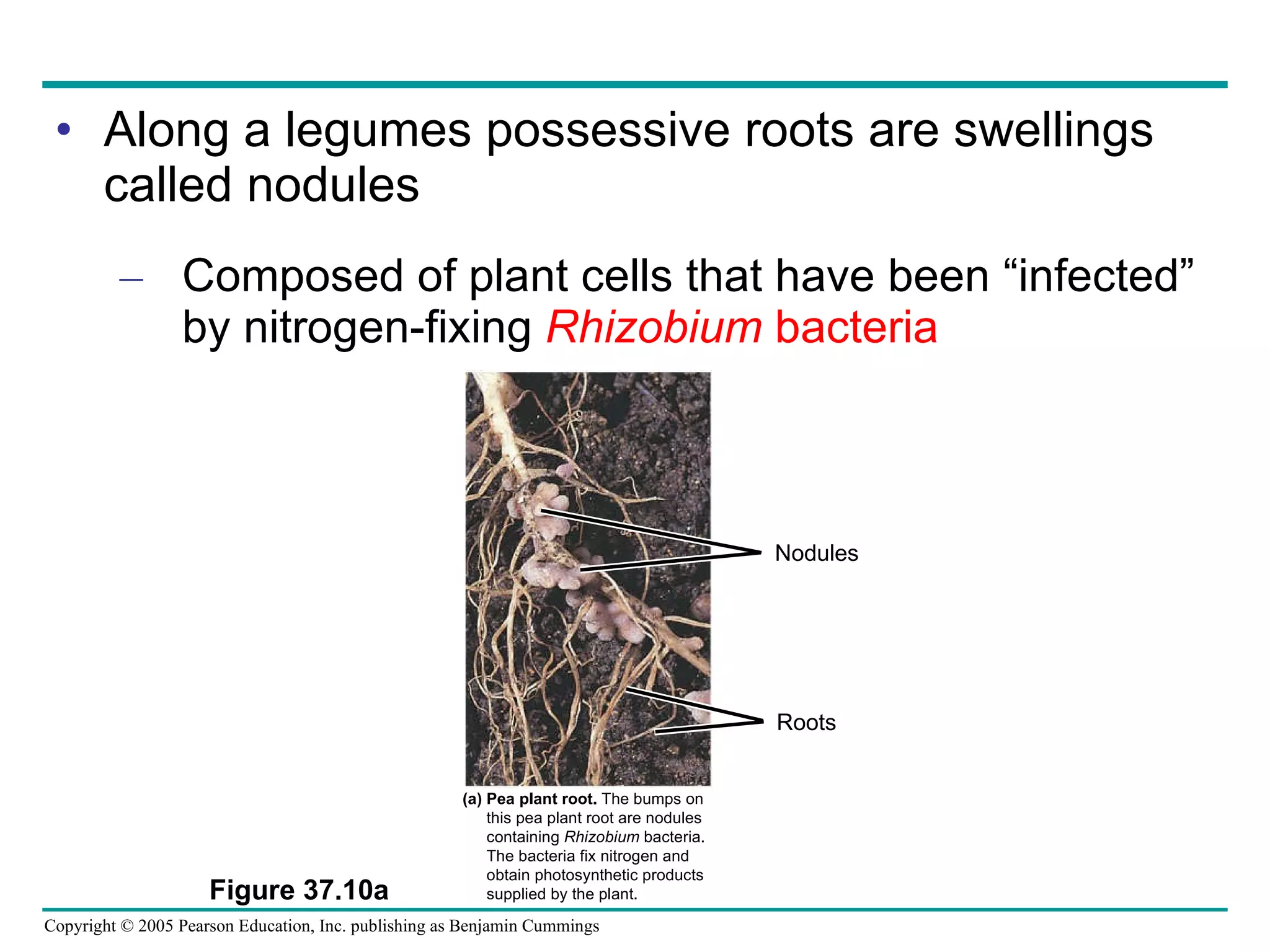
Along a legumes possessive roots are swellings called nodules Composed of plant cells that have been “infected” by nitrogen-fixing  Rhizobium  bacteria Figure 37.10a (a) Pea plant root.  The bumps on this pea plant root are nodules containing  Rhizobium  bacteria. The bacteria fix nitrogen and  obtain photosynthetic products supplied by the plant. Nodules Roots
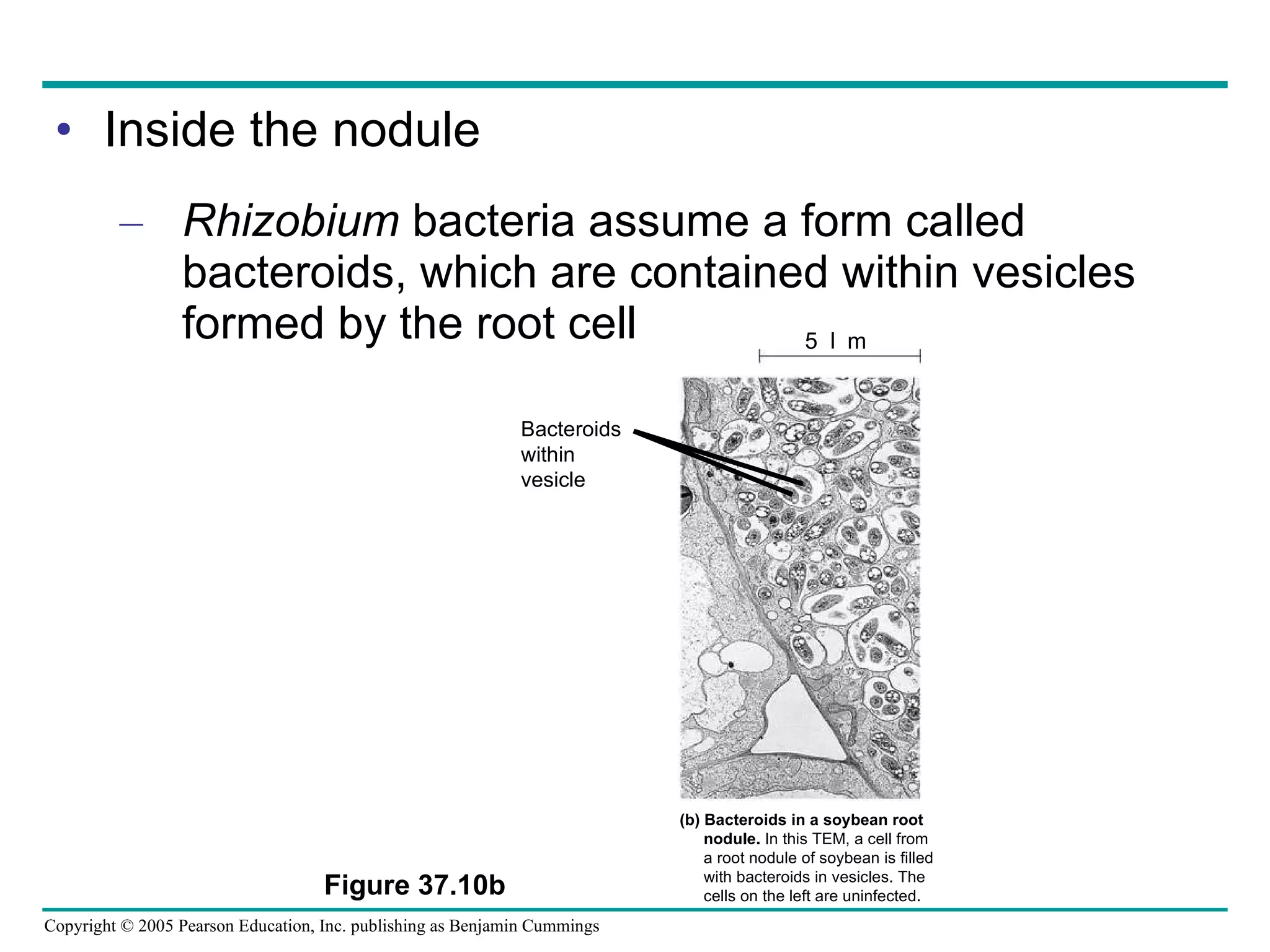
Inside the nodule Rhizobium  bacteria assume a form called bacteroids, which are contained within vesicles formed by the root cell Figure 37.10b (b) Bacteroids in a soybean root nodule.  In this TEM, a cell from a root nodule of soybean is filled with bacteroids in vesicles. The  cells on the left are uninfected. 5  m Bacteroids within vesicle
The bacteria of a nodule Obtain sugar from the plant and supply the plant with fixed nitrogen Each legume Is associated with a particular strain of  Rhizobium
Development of a soybean root nodule Figure 37.11 Infection thread Rhizobium bacteria Dividing cells in root cortex Bacteroid 2   The bacteria penetrate the cortex within the Infection thread. Cells of the cortex and pericycle begin dividing, and vesicles containing the bacteria bud into cortical cells from the branching infection thread. This process results in the formation of bacteroids. Bacteroid Bacteroid Developing root nodule Dividing cells in pericycle Infected root hair 1 2 3 Nodule vascular tissue 4 3   Growth continues in the affected regions of the cortex and pericycle, and these two masses of dividing cells fuse, forming the nodule. Roots emit chemical signals that attract  Rhizobium  bacteria. The bacteria then emit signals that stimulate root hairs to elongate and to form an infection thread by an invagination of the plasma membrane. 1 4 The nodule develops vascular tissue that supplies nutrients to the nodule and carries nitrogenous compounds into the vascular  cylinder for distribution throughout the plant.
The Molecular Biology of Root Nodule Formation The development of a nitrogen-fixing root nodule Depends on chemical dialogue between  Rhizobium  bacteria and root cells of their specific plant hosts
Symbiotic Nitrogen Fixation and Agriculture The agriculture benefits of symbiotic nitrogen fixation Underlie crop rotation In this practice A non-legume such as maize is planted one year, and the following year a legume is planted to restore the concentration of nitrogen in the soil
Mycorrhizae and Plant Nutrition Mycorrhizae Are modified roots consisting of mutualistic associations of fungi and roots The fungus Benefits from a steady supply of sugar donated by the host plant In return, the fungus Increases the surface area of water uptake and mineral absorption and supplies water and minerals to the host plant
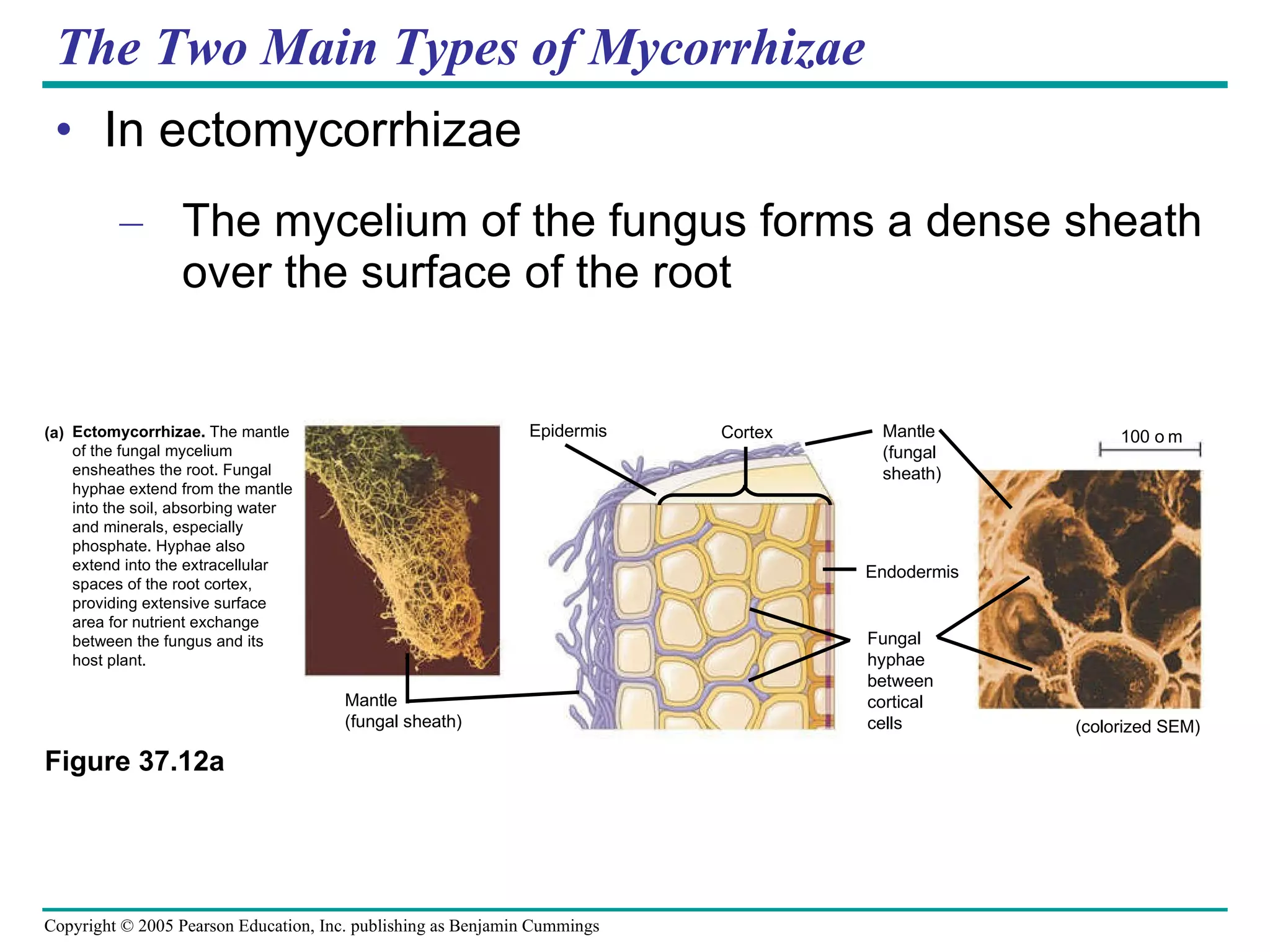
The Two Main Types of Mycorrhizae In ectomycorrhizae The mycelium of the fungus forms a dense sheath over the surface of the root Figure 37.12a a Ectomycorrhizae.  The mantle of the fungal mycelium ensheathes the root. Fungal hyphae extend from the mantle into the soil, absorbing water and minerals, especially phosphate. Hyphae also extend into the extracellular spaces of the root cortex, providing extensive surface area for nutrient exchange between the fungus and its host plant. Mantle (fungal sheath) Epidermis Cortex Mantle (fungal sheath) Endodermis Fungal hyphae between cortical cells (colorized SEM) 100 m (a)
In endomycorrhizae Microscopic fungal hyphae extend into the root Figure 37.12b Epidermis Cortex Fungal hyphae Root hair 10 m (LM, stained specimen) Cortical cells Endodermis Vesicle Casparian strip Arbuscules 2   Endomycorrhizae.  No mantle forms around the root, but microscopic fungal hyphae extend into the root. Within the root cortex, the fungus makes extensive contact with the plant through branching of hyphae that form arbuscules, providing an enormous surface area for nutrient swapping. The hyphae penetrate the cell walls, but not the plasma membranes, of cells within the cortex. (b)
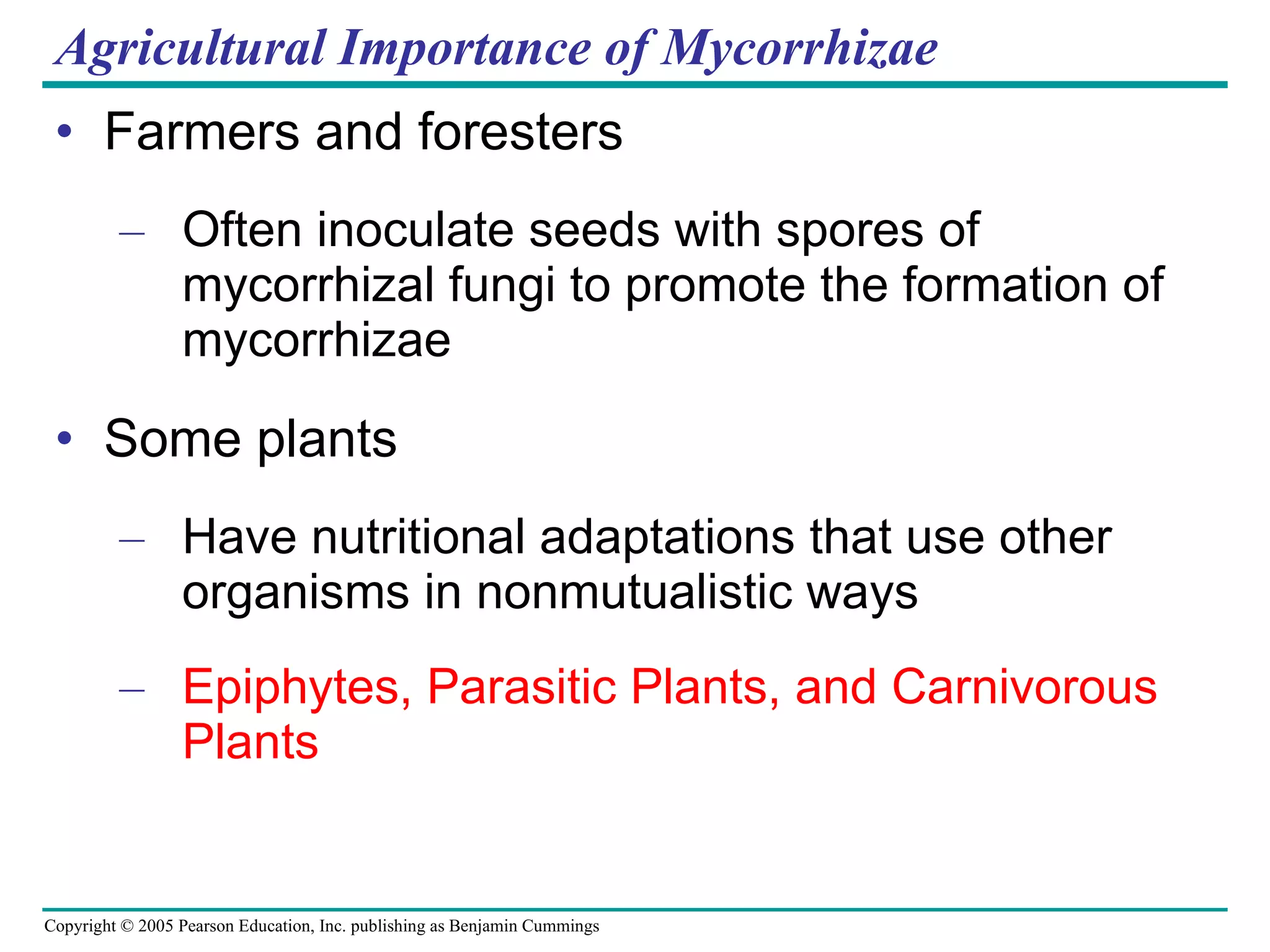
Agricultural Importance of Mycorrhizae Farmers and foresters Often inoculate seeds with spores of mycorrhizal fungi to promote the formation of mycorrhizae Some plants Have nutritional adaptations that use other organisms in nonmutualistic ways Epiphytes, Parasitic Plants, and Carnivorous Plants
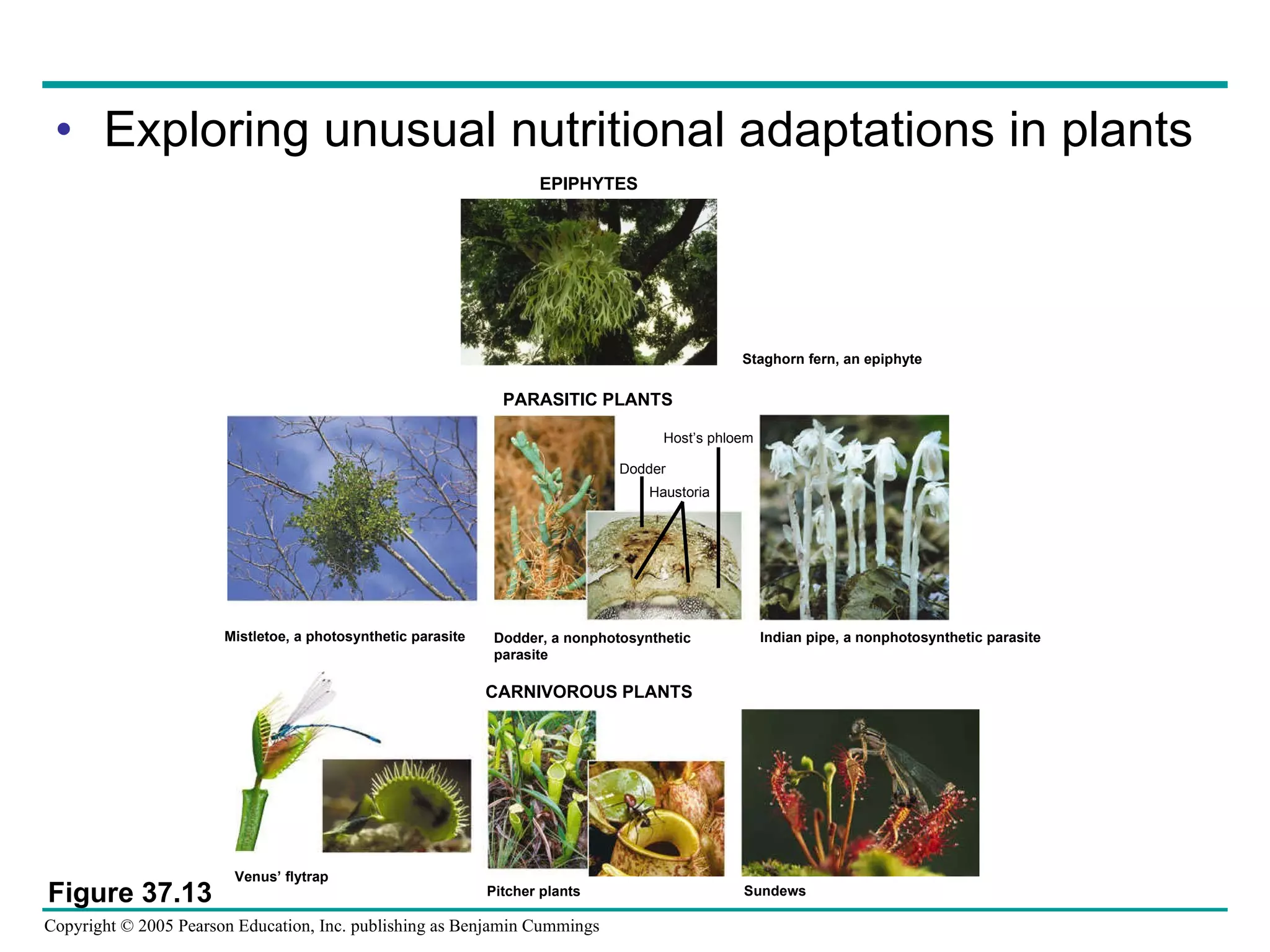
Exploring unusual nutritional adaptations in plants Figure 37.13 Staghorn fern, an epiphyte EPIPHYTES PARASITIC PLANTS CARNIVOROUS PLANTS Mistletoe, a photosynthetic parasite Dodder, a nonphotosynthetic  parasite Host’s phloem Haustoria Indian pipe, a nonphotosynthetic parasite Venus’ flytrap Pitcher plants Sundews Dodder
Angiosperm Reproduction and Biotechnology The parasitic plant  Rafflesia arnoldii Produces enormous flowers that can produce up to 4 million seeds Figure 38.1
Pollination  enables gametes to come together within a flower In angiosperms, the dominant sporophyte Produces spores that develop within flowers into male gametophytes (pollen grains) Produces female gametophytes (embryo sacs)
An overview of angiosperm reproduction Figure 38.2a, b Anther at tip of stamen Filament Anther Stamen Pollen tube Germinated pollen grain ( n ) (male gametophyte) on stigma of carpel Ovary (base of carpel) Ovule Embryo sac ( n ) (female gametophyte) FERTILIZATION Egg ( n ) Sperm ( n ) Petal Receptacle Sepal Style Ovary Key Haploid ( n ) Diploid (2 n ) (a)  An idealized flower. (b)  Simplified angiosperm life cycle. See Figure 30.10 for a more detailed version of the life cycle, including meiosis. Mature sporophyte plant ( 2n ) with flowers Seed (develops from ovule) Zygote (2 n ) Embryo (2 n ) (sporophyte) Simple fruit (develops from ovary) Germinating seed Seed Carpel Stigma
Flower Structure Flowers Are the reproductive shoots of the angiosperm sporophyte Are composed of four floral organs: sepals, petals, stamens, and carpels
Gametophyte Development and Pollination In angiosperms Pollination is the transfer of pollen from an anther to a stigma If pollination is successful, a pollen grain produces a structure called a pollen tube, which grows down into the ovary and discharges sperm near the embryo sac
Pollen Develops from microspores within  the sporangia of anthers 3 A pollen grain becomes a  mature male gametophyte  when its generative nucleus  divides and forms two sperm. This usually occurs after a  pollen grain lands on the stigma  of a carpel and the pollen  tube begins to grow. (See Figure 38.2b.)  Development of a male gametophyte  (pollen grain) (a) 2 Each microsporo- cyte divides by  meiosis to produce  four haploid  microspores,  each of which  develops into  a pollen grain. Pollen sac (microsporangium) Micro- sporocyte Micro- spores (4) Each of 4 microspores Generative cell (will form 2 sperm) Male Gametophyte (pollen grain) Nucleus  of tube cell Each one of the  microsporangia  contains diploid  microsporocytes  (microspore  mother cells). 1 75 m 20 m Ragweed pollen grain Figure 38.4a MEIOSIS MITOSIS KEY to labels Haploid ( 2n ) Diploid ( 2n )
Embryo sacs Develop from megaspores within ovules Key to labels MITOSIS MEIOSIS Ovule Ovule Integuments Embryo sac Mega- sporangium Mega- sporocyte Integuments Micropyle Surviving megaspore Antipodel Cells (3) Polar Nuclei (2) Egg (1) Synergids (2) Development of a female gametophyte  (embryo sac) (b) Within the ovule’s megasporangium  is a large diploid  cell called the  megasporocyte  (megaspore mother cell). 1 Three mitotic divisions  of the megaspore form  the embryo sac, a  multicellular female  gametophyte. The  ovule now consists of  the embryo sac along  with the surrounding  integuments (protective  tissue). 3 Female gametophyte (embryo sac) Diploid ( 2n ) Haploid ( 2n ) Figure 38.4b 100 m The megasporocyte divides by  meiosis and gives rise to four haploid cells, but in most  species only one of these  survives as the megaspore. 2
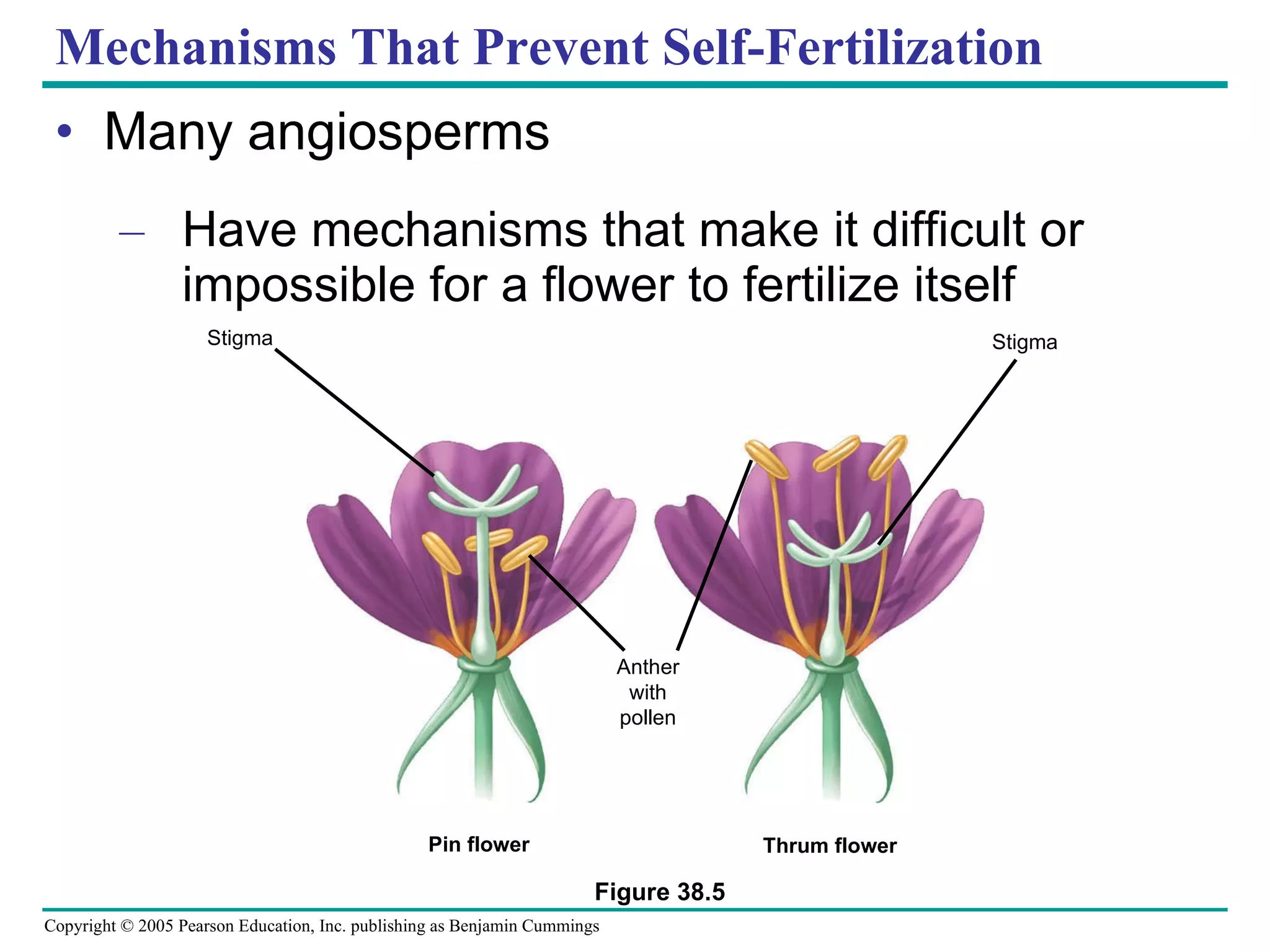
Mechanisms That Prevent Self-Fertilization Many angiosperms Have mechanisms that make it difficult or impossible for a flower to fertilize itself Figure 38.5 Stigma Anther with pollen Stigma Pin flower Thrum flower
The most common  anti-selfing mechanism  in flowering plants Is known as self-incompatibility, the  ability of a plant to reject its own pollen Researchers are unraveling the molecular mechanisms that are involved in self-incompatibility
Some plants Reject pollen that has an  S -gene matching an allele in the stigma cells Recognition of self pollen Triggers a signal transduction pathway leading to a  block in growth of a pollen tube
Double Fertilization After landing on a receptive stigma A pollen grain germinates and produces a pollen tube that extends down between the cells of the style toward the ovary The pollen tube Then discharges two sperm into the embryo sac After fertilization, ovules develop into seeds and ovaries into fruits
In double fertilization One sperm fertilizes the egg The other sperm combines with the polar nuclei, giving rise to the food-storing endosperm
Growth of the pollen tube and double fertilization Stigma Polar nuclei Egg Pollen grain Pollen tube 2 sperm Style Ovary Ovule (containing female  gametophyte, or embryo sac) Micropyle Ovule Polar nuclei Egg Two sperm about to be discharged Endosperm nucleus (3 n )  (2 polar nuclei plus sperm) Zygote (2 n ) (egg plus sperm) Figure 38.6 If a pollen grain germinates, a pollen tube grows down the style toward the ovary. 1 The pollen tube discharges two sperm into the female gametophyte (embryo sac) within an ovule. 2 One sperm fertilizes the egg, forming the zygote. The other sperm combines with the two polar nuclei of the embryo sac’s large central cell, forming a triploid cell that develops into the nutritive tissue called endosperm. 3
From Ovule to Seed After double fertilization Each ovule develops into a seed The ovary develops into a fruit enclosing the seed(s)
Endosperm Development Endosperm development Usually precedes embryo development In most monocots and some eudicots The endosperm stores nutrients that can be used by the seedling after germination In other eudicots The food reserves of the endosperm are completely exported to the cotyledons
Embryo Development The first mitotic division of the zygote is transverse Splitting the fertilized egg into a basal cell and a terminal cell Figure 38.7 Ovule Terminal cell Endosperm nucleus Basal cell Zygote Integuments Zygote Proembryo Cotyledons Shoot apex Root apex Seed coat Basal cell Suspensor Endosperm Suspensor
Structure of the Mature Seed The embryo and its food supply Are enclosed by a hard, protective seed coat In a common garden bean, a eudicot The embryo consists of the  hypocotyl, radicle, and thick cotyledons Figure 38.8a (a) Common garden bean, a eudicot with thick cotyledons.  The fleshy cotyledons store food absorbed from the endosperm before  the seed germinates. Seed coat Radicle Epicotyl Hypocotyl Cotyledons
The seeds of other eudicots, such as castor beans Have similar structures, but thin cotyledons Figure 38.8b Seed coat Endosperm Cotyledons Epicotyl Hypocotyl Radicle (b) Castor bean, a eudicot with thin cotyledons.  The narrow, membranous cotyledons (shown in edge and flat views) absorb food from the endosperm when the seed germinates. Figure 38.8b Seed coat Endosperm Cotyledons Epicotyl Hypocotyl Radicle (b) Castor bean, a eudicot with thin cotyledons.  The narrow, membranous cotyledons (shown in edge and flat views) absorb food from the endosperm when the seed germinates.
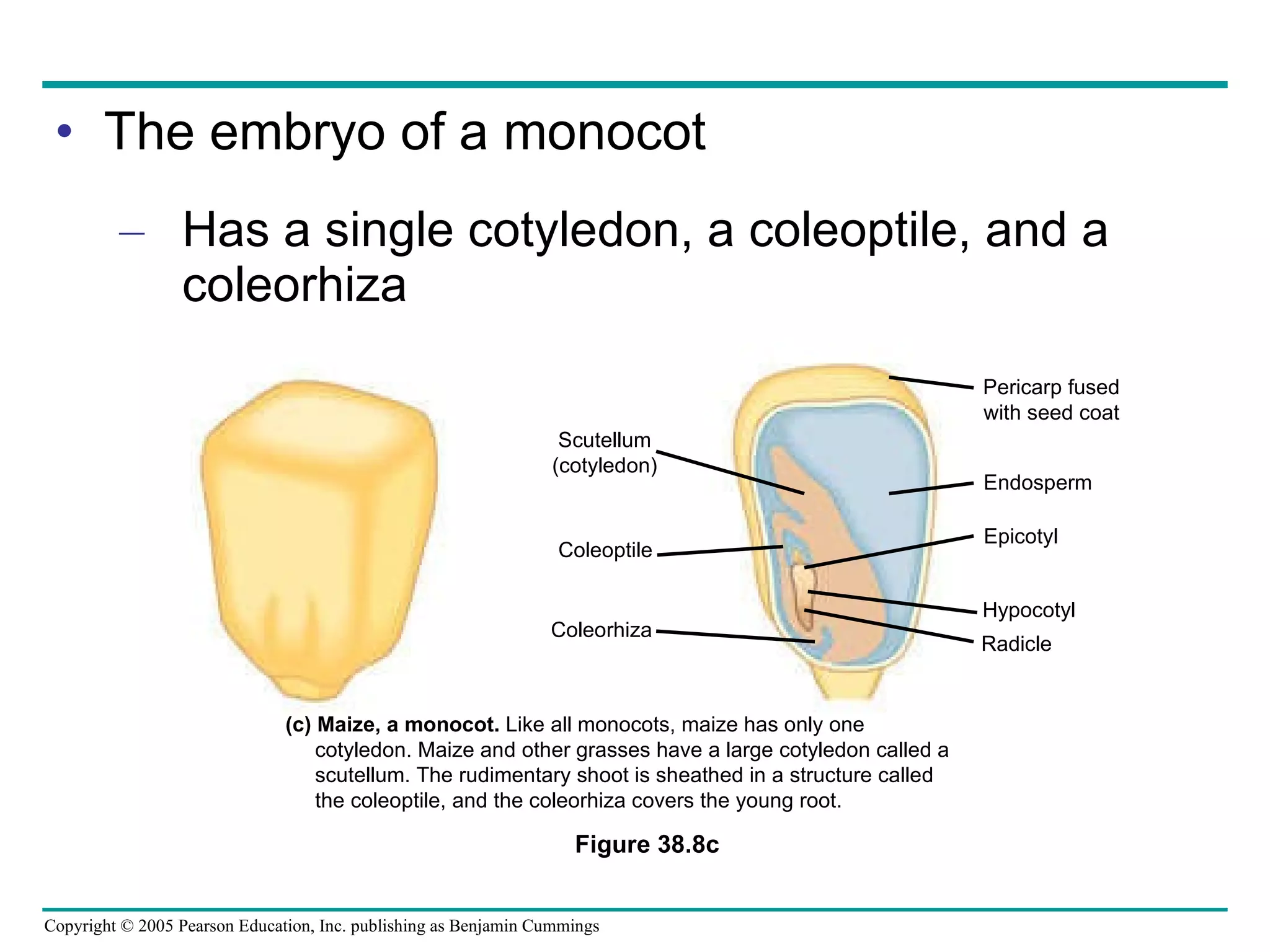
The embryo of a monocot Has a single cotyledon, a coleoptile, and a coleorhiza Figure 38.8c (c)   Maize, a monocot.  Like all monocots, maize has only one cotyledon. Maize and other grasses have a large cotyledon called a scutellum. The rudimentary shoot is sheathed in a structure called the coleoptile, and the coleorhiza covers the young root. Scutellum (cotyledon) Coleoptile Coleorhiza Pericarp fused with seed coat Endosperm Epicotyl Hypocotyl Radicle
From Ovary to Fruit A fruit Develops from the ovary Protects the enclosed seeds Aids in the dispersal of seeds by wind or animals
Fruits are classified into several types Depending on their developmental origin Figure 38.9a–c  Pineapple fruit Raspberry fruit Pea fruit Stamen Carpel (fruitlet) Stigma Ovary Raspberry flower Each segment develops from the carpel of one flower Pineapple inflorescence Stamen Carpels Flower Ovary Stigma Stamen Ovule Pea flower Seed Simple fruit.  A simple fruit  develops from a single carpel (or  several fused carpels) of one flower  (examples: pea, lemon, peanut).  (a) Aggregate fruit.  An aggregate fruit  develops from many separate  carpels of one flower (examples:  raspberry, blackberry, strawberry). (b) Multiple fruit.  A multiple fruit  develops from many carpels  of many flowers (examples:  pineapple, fig). (c)
Seed Germination As a seed matures It dehydrates and enters a phase referred to as dormancy
From Seed to Seedling Germination of seeds depends on the physical process called imbibition The uptake of water due to low water potential of the dry seed Seed dormancy Increases the chances that germination will occur at a time and place most advantageous to the seedling The breaking of seed dormancy Often requires environmental cues, such as temperature or lighting cues
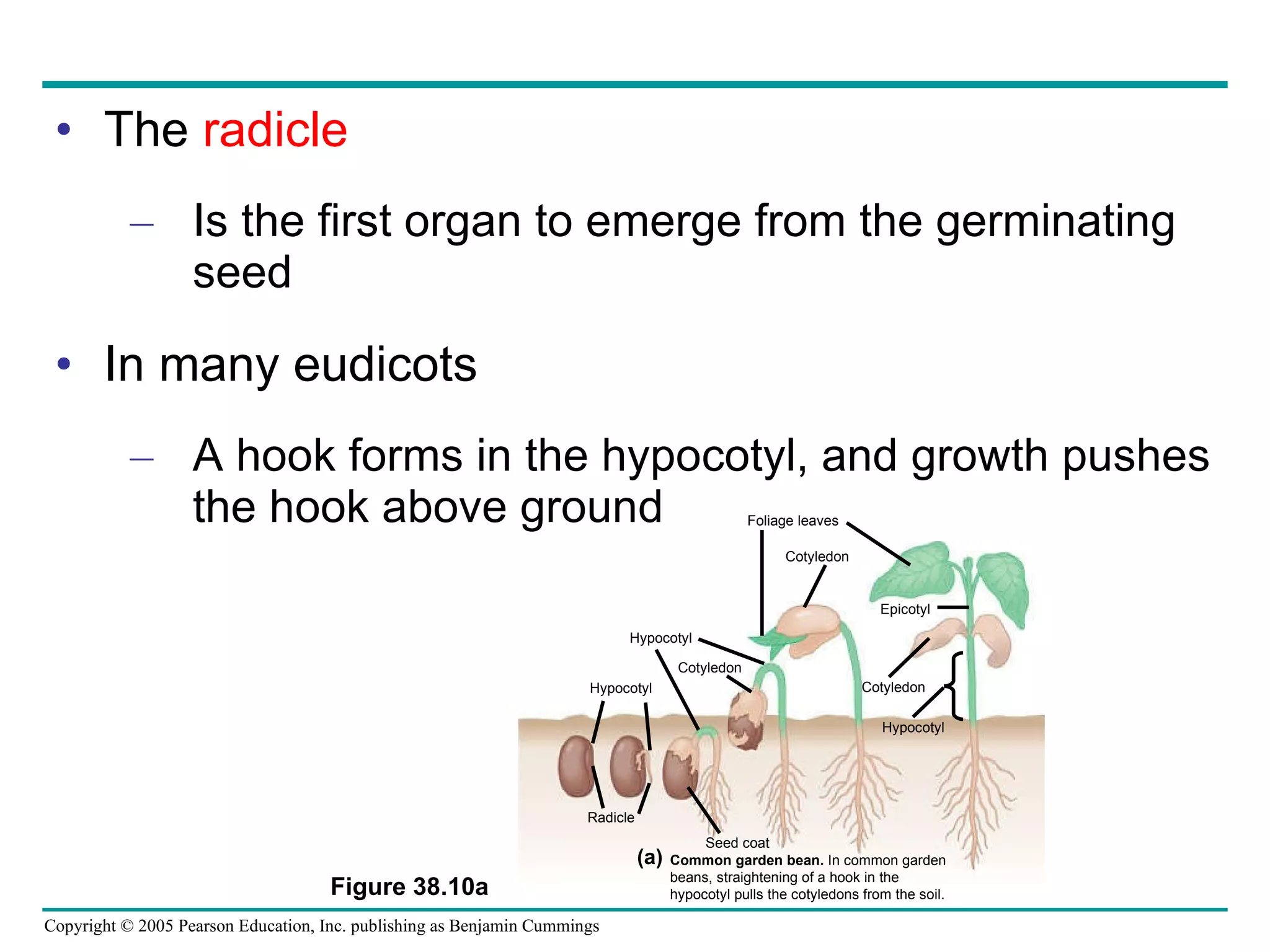
The  radicle Is the first organ to emerge from the germinating seed In many eudicots A hook forms in the hypocotyl, and growth pushes the hook above ground Figure 38.10a Foliage leaves Cotyledon Hypocotyl Radicle Epicotyl Seed coat Cotyledon Hypocotyl Cotyledon Hypocotyl Common garden bean.  In common garden  beans, straightening of a hook in the  hypocotyl pulls the cotyledons from the soil. (a)
Monocots Use a different method for breaking ground when they germinate The  coleoptile Pushes upward through the soil and into the air Figure 38.10b Foliage leaves Coleoptile Coleoptile Radicle Maize.  In maize and other grasses, the shoot grows  straight up through the tube of the coleoptile. (b)
Many flowering plants clone themselves by asexual reproduction Many angiosperm species Reproduce both asexually and sexually Sexual reproduction Generates the genetic variation that makes supposed evolutionary adaptation possible Asexual reproduction in plants Is called  vegetative reproduction
Mechanisms of Asexual Reproduction Fragmentation Is the separation of a parent plant into parts that develop into whole plants Is one of the most common modes of asexual reproduction
Vegetative Propagation and Agriculture Humans have devised various methods for asexual propagation of angiosperms Many kinds of plants Are asexually reproduced from plant fragments called  cuttings In a modification of vegetative reproduction from cuttings A twig or bud from one plant can be  grafted onto a plant of a closely related species  or a different variety of the same species
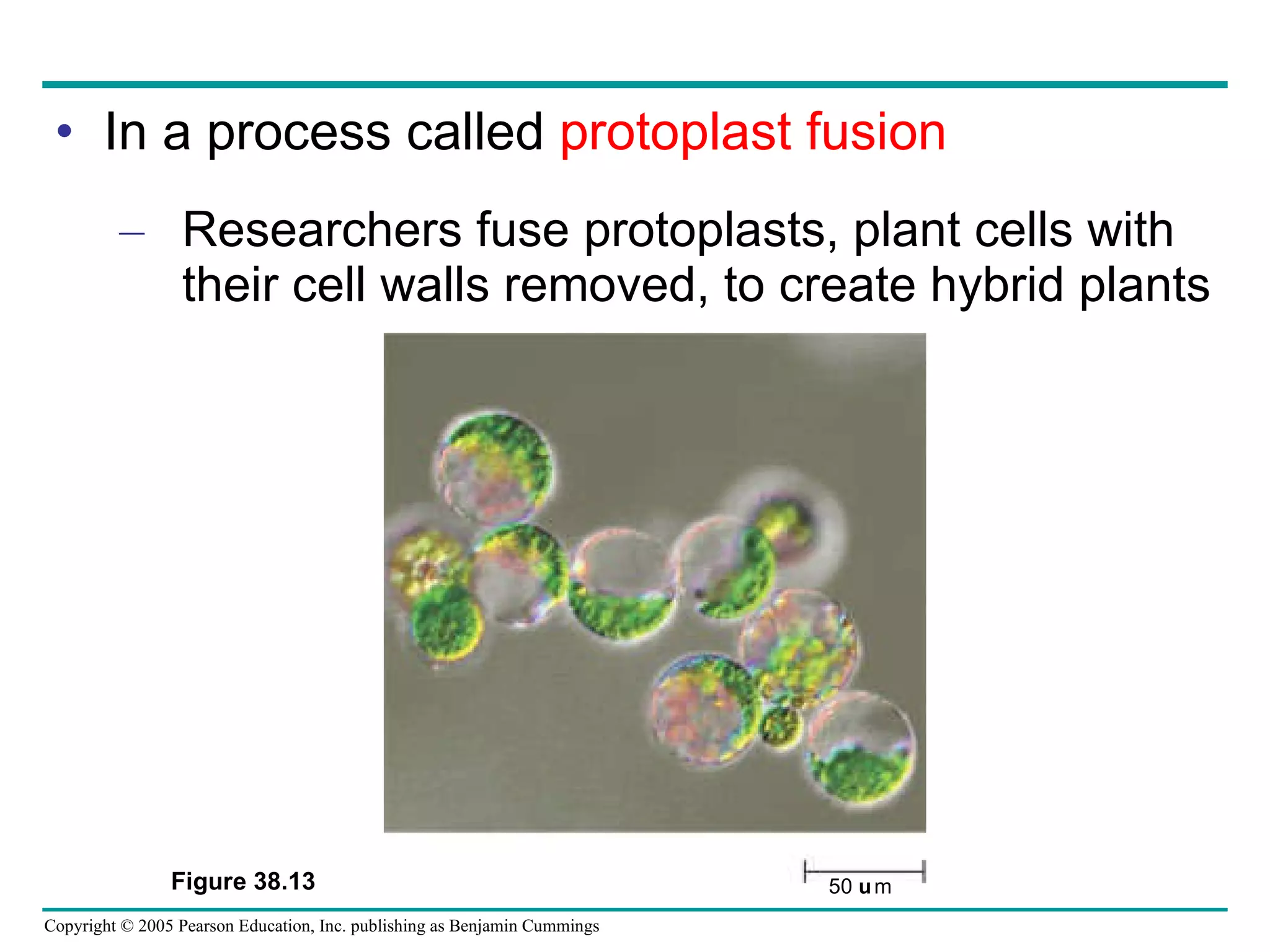
In a process called  protoplast fusion Researchers fuse protoplasts, plant cells with their cell walls removed, to create hybrid plants Figure 38.13 50 m
Plant biotechnology is transforming agriculture Plant biotechnology has two meanings It refers to innovations in the use of plants to make products of use to humans It refers to the use of  genetically modified (GM)  organisms in agriculture and industry
Artificial Selection Humans have intervened In the reproduction and genetic makeup of plants for thousands of years
Maize Is a product of artificial selection by humans Is a staple in many developing countries, but is a poor source of protein Figure 38.14
Interspecific hybridization of plants Is common in nature and has been used by breeders, ancient and modern, to introduce new genes
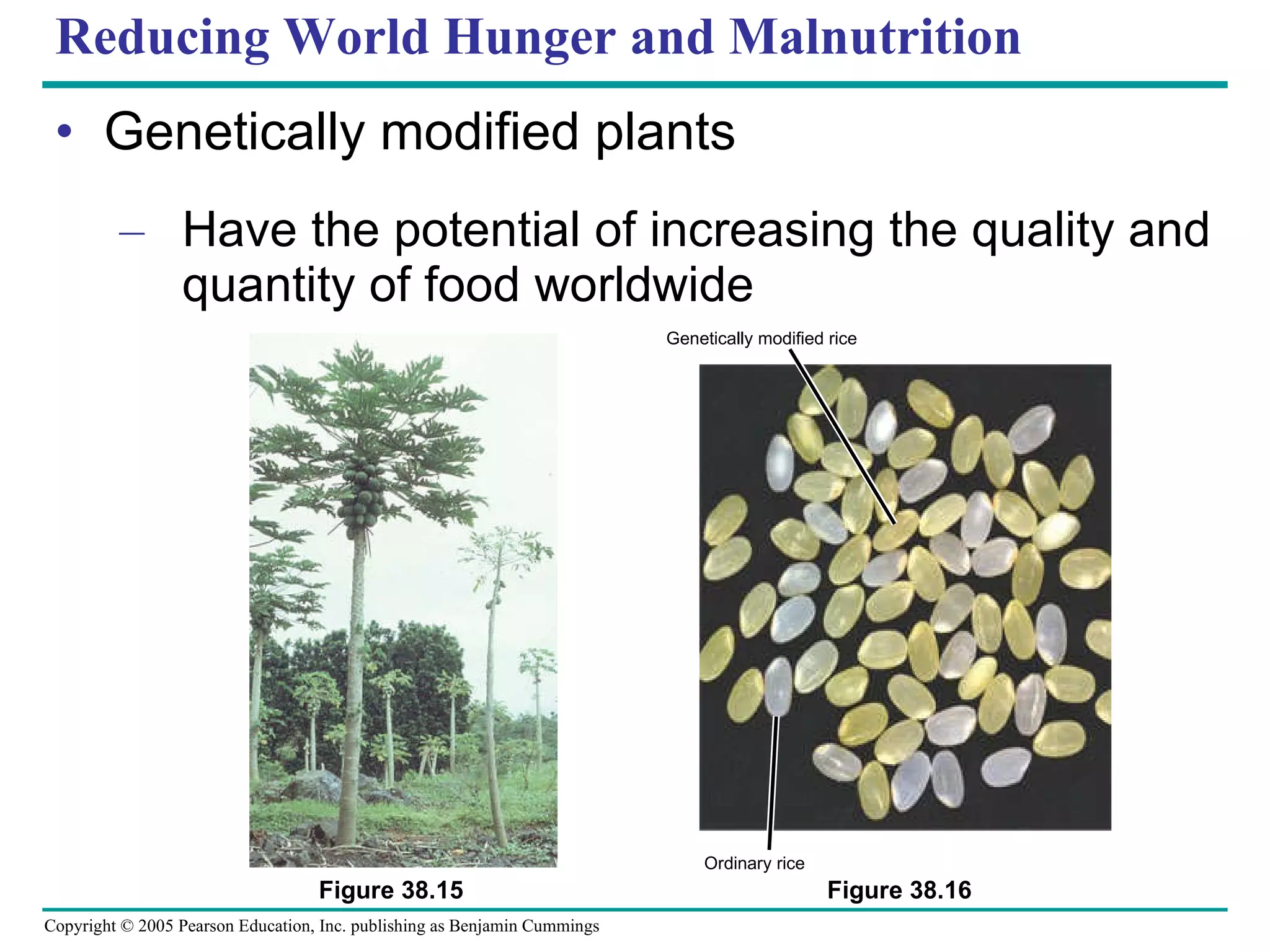
Reducing World Hunger and Malnutrition Genetically modified plants Have the potential of increasing the quality and quantity of food worldwide Figure 38.15 Ordinary rice Genetically modified rice Figure 38.16
The Debate over Plant Biotechnology There are some biologists, particularly ecologists Who are concerned about the  unknown risks  associated with the release of GM organisms (GMOs) into the environment One concern is that genetic engineering May  transfer allergens from a gene source to a plant  used for food
Possible Effects on Nontarget Organisms Many ecologists are concerned that the growing of GM crops Might have unforeseen effects on nontarget organisms Perhaps the most serious concern that some scientists raise about GM crops Is the possibility of the introduced genes escaping from a transgenic crop into related weeds through crop-to-weed hybridization Despite all the issues associated with GM crops The benefits should be considered
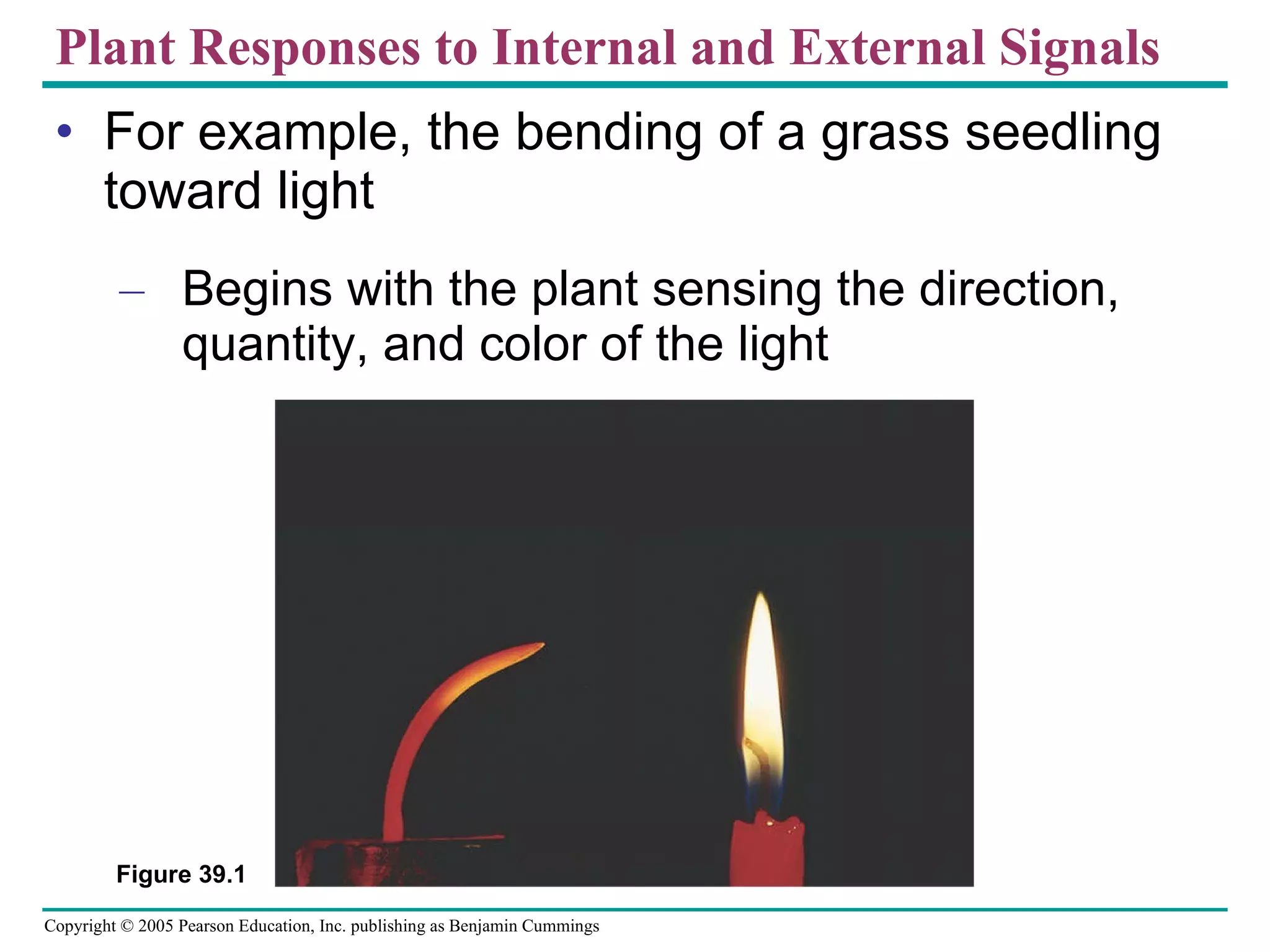
Plant Responses to Internal and External Signals For example, the bending of a grass seedling toward light Begins with the plant sensing the direction, quantity, and color of the light Figure 39.1
Signal transduction pathways link signal reception to response Plants have cellular receptors That they use to detect important changes in their environment For a stimulus to elicit a response Certain cells must have an appropriate receptor
A potato left growing in darkness Will produce shoots that do not appear healthy, and will lack elongated roots These are morphological adaptations for growing in darkness Collectively referred to as  etiolation Figure 39.2a (a) Before exposure to light.  A dark-grown potato has tall, spindly stems and nonexpanded leaves—morphological adaptations that enable the shoots to penetrate the soil. The roots are short, but there is little need for water absorption because little water is lost by the shoots.
After the potato is exposed to light The plant undergoes profound changes called  de-etiolation , in which shoots and roots grow normally Figure 39.2b (b) After a week’s exposure to natural daylight.  The potato plant begins to resemble a  typical plant with broad green leaves, short sturdy stems, and long roots. This transformation begins with the reception of light by a specific pigment, phytochrome.
The potato’s response to light Is an example of cell-signal processing Figure 39.3 CELL WALL CYTOPLASM    1   Reception 2   Transduction 3   Response Receptor Relay molecules Activation of cellular responses Hormone or environmental stimulus Plasma membrane
Reception Internal and external signals are detected by receptors Proteins that change in response to specific stimuli
Transduction Second messengers Transfer and amplify signals from receptors to proteins that cause specific responses
An example of signal transduction in plants Figure 39.4 1   Reception    2   Transduction 3   Response CYTOPLASM Plasma membrane Phytochrome activated by light Cell wall Light cGMP Second messenger produced Specific protein kinase 1 activated Transcription factor 1 NUCLEUS P P Transcription Translation De-etiolation (greening) response proteins Ca 2+ Ca 2+  channel opened Specific protein kinase 2 activated Transcription factor 2 1   The light signal is detected by the phytochrome receptor, which then activates at least two signal transduction pathways. 2   One pathway uses cGMP as a second messenger that activates a specific protein kinase.The other pathway involves an increase in cytoplasmic Ca 2+  that activates another specific protein kinase. 3   Both pathways lead to expression of genes for proteins that function in the de-etiolation (greening) response.
Response Ultimately, a signal transduction pathway Leads to a regulation of one or more cellular activities In most cases These responses to stimulation involve the increased activity of certain enzymes
Transcriptional Regulation Transcription factors bind directly to specific regions of DNA And control the transcription of specific genes Post-translational modification Involves the activation of existing proteins involved in the signal response
Plant hormones help coordinate growth, development, and responses to stimuli Hormones Are chemical signals that coordinate the different parts of an organism
The Discovery of Plant Hormones Any growth response That results in curvatures of whole plant organs toward or away from a stimulus is called a  tropism Is  often caused by hormones
A Survey of Plant Hormones
In general, hormones control plant growth and development By affecting the division, elongation, and differentiation of cells Plant hormones are produced in very low concentrations But a minute amount can have a profound effect on the growth and development of a plant organ
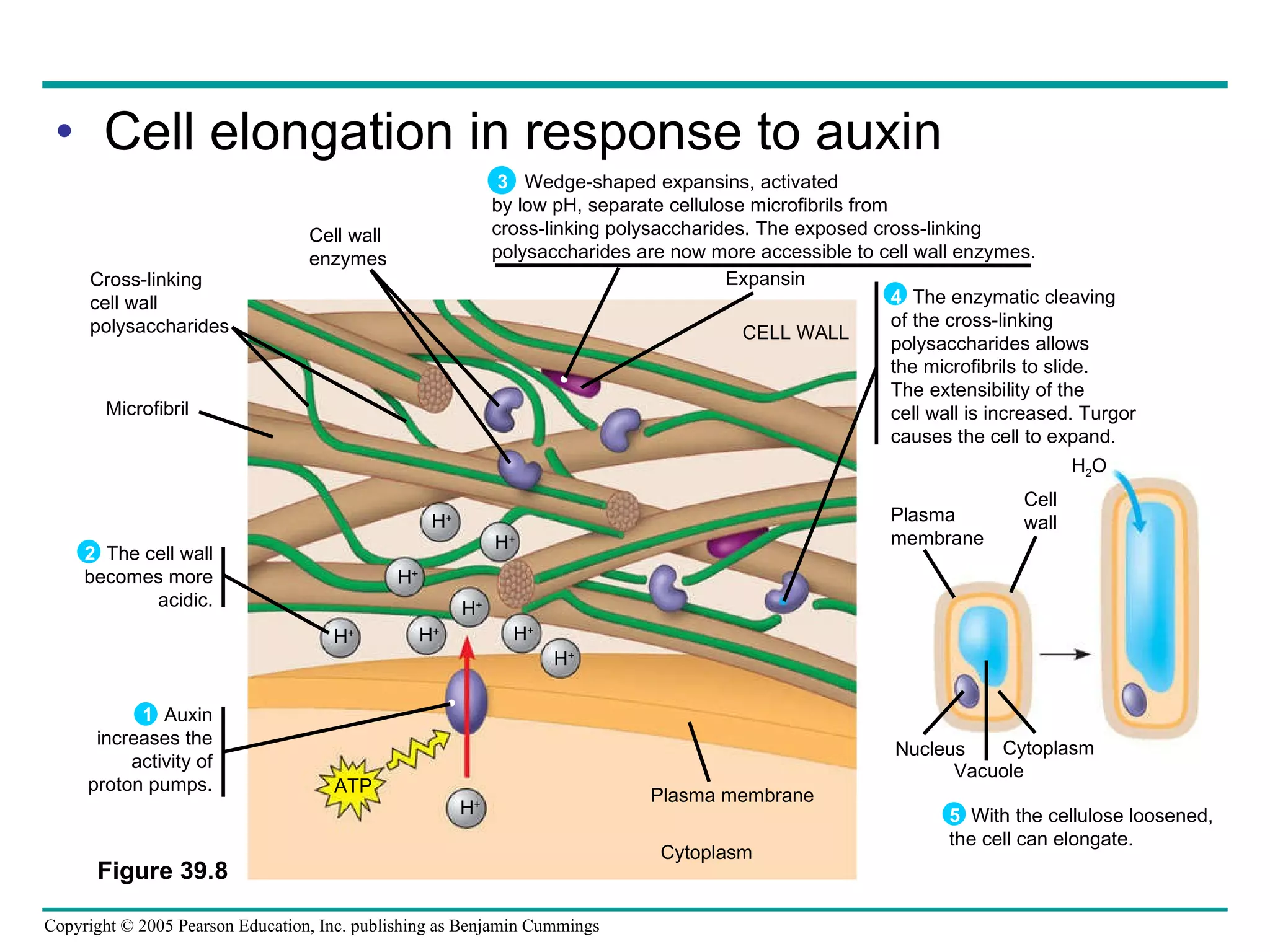
Auxin The term  auxin Is used for any chemical substance that  promotes cell elongation  in different target tissues Auxin transporters Move the hormone out of the  basal end of one cell, and into the apical end  of neighboring cells According to a model called the acid growth hypothesis Proton pumps play a major role in the growth response of cells to auxin
Cell elongation in response to auxin Figure 39.8  Expansin CELL WALL Cell wall enzymes Cross-linking cell wall polysaccharides Microfibril H + H + H + H + H + H + H + H + H + ATP Plasma membrane Plasma membrane Cell wall Nucleus Vacuole Cytoplasm H 2 O Cytoplasm 1   Auxin increases the activity of proton pumps. 4   The enzymatic cleaving of the cross-linking polysaccharides allows the microfibrils to slide. The extensibility of the cell wall is increased. Turgor causes the cell to expand. 2   The cell wall becomes more acidic. 5   With the cellulose loosened, the cell can elongate. 3  Wedge-shaped expansins, activated by low pH, separate cellulose microfibrils from cross-linking polysaccharides. The exposed cross-linking polysaccharides are now more accessible to cell wall enzymes.
Lateral and Adventitious Root Formation Auxin Is involved in the formation and branching of roots An overdose of auxins Can kill eudicots Auxin affects secondary growth By inducing cell division in the vascular cambium and influencing differentiation of secondary xylem
Cytokinins Cytokinins Stimulate  cell division and differentiation Are produced in actively growing tissues such as roots, embryos, and fruits Work together with auxin Cytokinins retard the aging of some plant organs By inhibiting protein breakdown, stimulating RNA and protein synthesis, and mobilizing nutrients from surrounding tissues
Control of Apical Dominance Cytokinins, auxin, and other factors interact in the control of apical dominance The ability of a terminal bud to suppress development of axillary buds Figure 39.9a Axillary buds
If the terminal bud is removed Plants become bushier Figure 39.9b “ Stump” after removal of apical bud Lateral branches
Gibberellins Gibberellins have a variety of effects Such as  stem elongation, fruit growth, and seed germination In stems Gibberellins stimulate cell elongation and cell division Both  auxin and gibberellins  must be present for  fruit  to set
Gibberellins are used commercially In the spraying of Thompson seedless grapes Figure 39.10
After water is imbibed, the release of gibberellins from the embryo Signals the seeds to break dormancy and germinate Germination Figure 39.11 2 2   The aleurone responds by synthesizing and secreting  digestive enzymes that hydrolyze stored nutrients in the endosperm. One example is -amylase, which hydrolyzes starch. (A similar enzyme in our saliva helps in digesting bread and other starchy foods.) Aleurone Endosperm Water Scutellum (cotyledon) GA GA  -amylase Radicle Sugar 1   After a seed imbibes water, the embryo releases gibberellin (GA) as a signal to the aleurone, the thin outer layer of the endosperm. 3   Sugars and other nutrients absorbed from the endosperm by the scutellum (cotyledon) are consumed during growth of the embryo into a seedling.
2   The aleurone responds by synthesizing and secreting  digestive enzymes that hydrolyze stored nutrients in the endosperm. One example is -amylase, which hydrolyzes starch. (A similar enzyme in our saliva helps in digesting bread and other starchy foods.) Aleurone Endosperm Water Scutellum (cotyledon) GA GA  -amylase Radicle Sugar 2 1   After a seed imbibes water, the embryo releases gibberellin (GA) as a signal to the aleurone, the thin outer layer of the endosperm. 3   Sugars and other nutrients absorbed from the endosperm by the scutellum (cotyledon) are consumed during growth of the embryo into a seedling.
Abscisic Acid Two of the many effects of abscisic acid (ABA) are Seed dormancy Drought tolerance Seed dormancy has great survival value Because it ensures that the seed will germinate only when there are optimal conditions ABA is the primary internal signal That enables plants to withstand drought (signals stomata to close)
Ethylene Plants produce ethylene ( gas ) In response to stresses such as drought, flooding, mechanical pressure, injury, and infection A burst of ethylene Is associated with the  programmed destruction of cells , organs, or whole plants (Apoptosis: Programmed Cell Death) A burst of ethylene production in the fruit Triggers the ripening process (ethylene triggers ripening and ripening triggers ethylene = positive feedback,  one bad apple spoils the bunch )
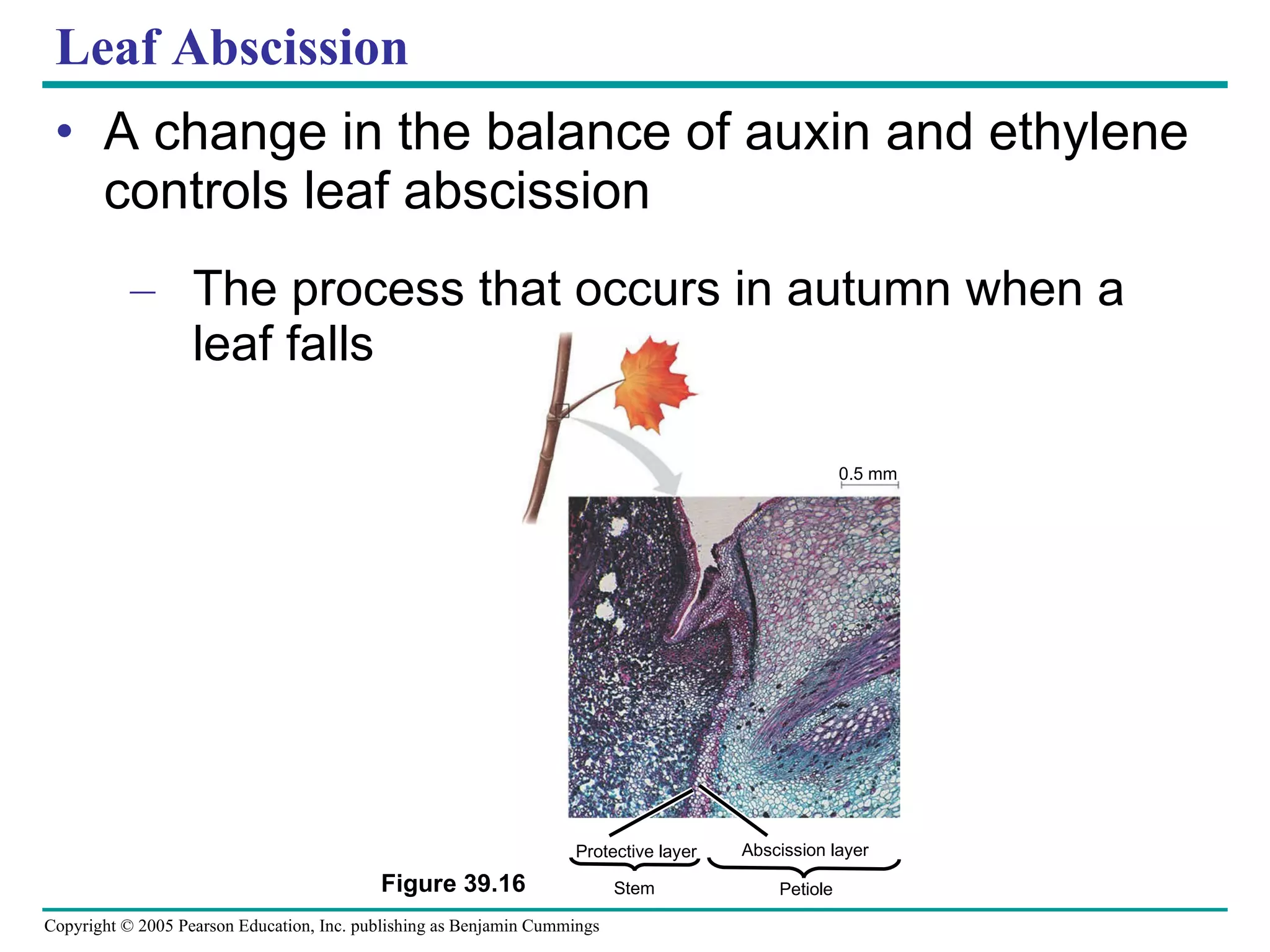
Leaf Abscission A change in the balance of auxin and ethylene controls leaf abscission The process that occurs in autumn when a leaf falls Figure 39.16 0.5 mm Protective layer Abscission layer Stem Petiole
Photomorphogenesis- plant response to light Plants not only detect the presence of light But also its direction, intensity, and wavelength (color) A graph called an action spectrum Depicts the relative response of a process to different wavelengths of light Wavelength (nm) 1.0 0.8 0.6 0.2 0 450 500 550 600 650 700 Light Time = 0 min. Time = 90 min. 0.4 400 Phototropic effectiveness relative to 436 nm
Research on action spectra and absorption spectra of pigments Led to the identification of two major classes of light receptors:  blue-light photoreceptors and phytochromes (red light) Various blue-light photoreceptors Control hypocotyl elongation, stomatal opening, and phototropism Phytochromes Regulate many of a plant’s responses to light throughout its life
A phytochrome Is the photoreceptor responsible for the opposing effects of red and far-red light A phytochrome consists of two identical proteins joined to form one functional molecule. Each of these proteins has two domains.  Chromophore Photoreceptor activity.  One domain, which functions as the photoreceptor, is covalently bonded to a nonprotein pigment, or chromophore. Kinase activity.  The other domain has protein kinase activity. The photoreceptor domains interact with the kinase domains to link light reception to cellular responses triggered by the kinase. Figure 39.19
Phytochromes exist in two photoreversible states With conversion of P r  to P fr  triggering many developmental responses Figure 39.20 Synthesis Far-red light Red light Slow conversion in darkness (some plants) Responses: seed germination, control of flowering, etc. Enzymatic destruction P fr P r
Phytochromes and Shade Avoidance The phytochrome system Also provides the plant with information about the quality of light In the “shade avoidance” response of a tree The phytochrome ratio shifts in favor of P r  when a tree is shaded
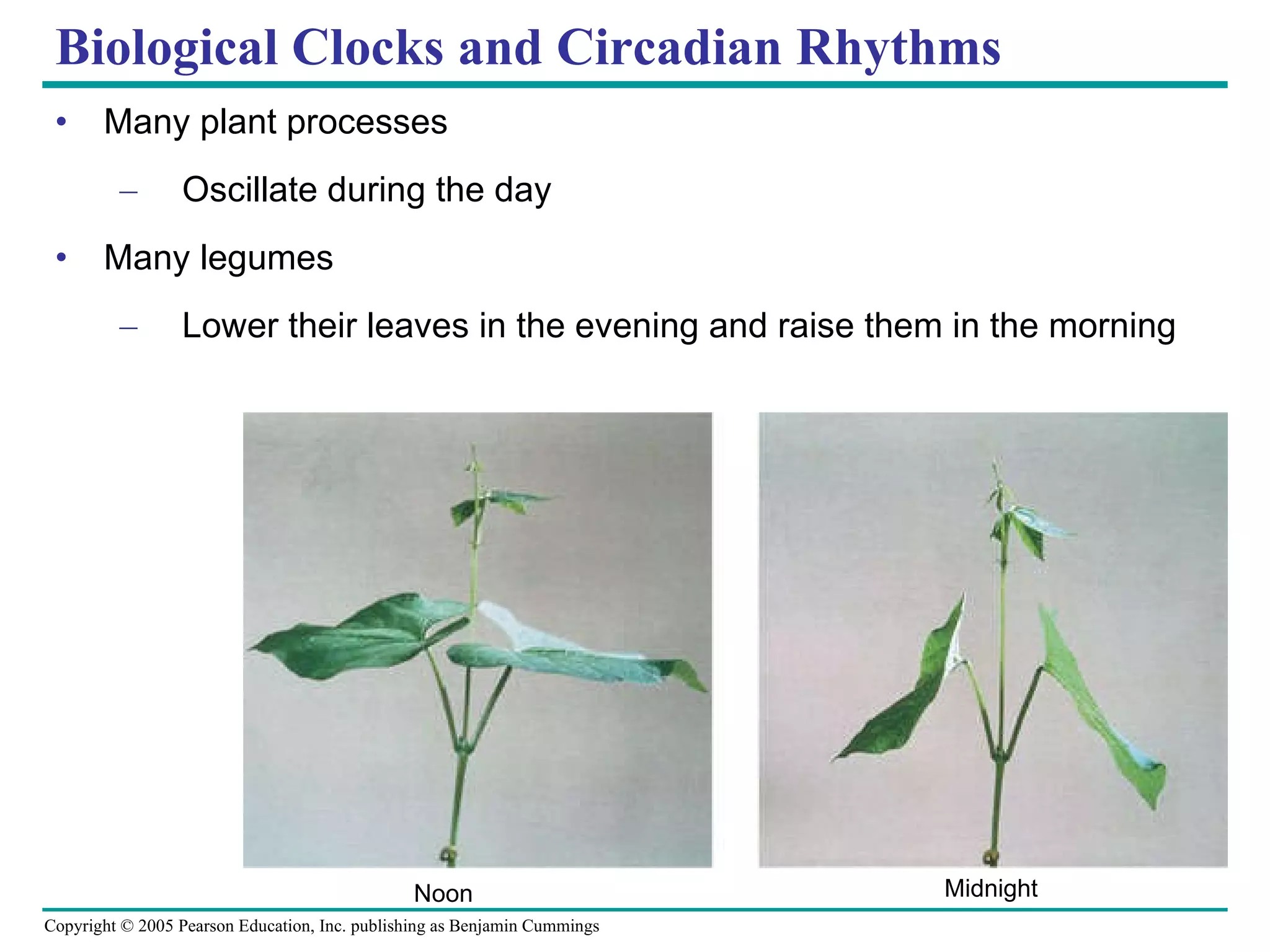
Biological Clocks and Circadian Rhythms Many plant processes Oscillate during the day Many legumes Lower their leaves in the evening and raise them in the morning Noon Midnight
Cyclical responses to environmental stimuli are called  circadian rhythms And are approximately 24 hours long Can be entrained to exactly 24 hours by the day/night cycle Phytochrome conversion marks sunrise and sunset Providing the biological clock with environmental cues
Photoperiodism and Responses to Seasons Photoperiod, the relative lengths of  night  and day Is the environmental stimulus plants use most often to detect the  time of year Photoperiodism Is a physiological response to photoperiod Some developmental processes, including  flowering  in many species Requires a certain photoperiod
Flowering times Short-day plants  – require a period of continuous darkness in order to flower. Short-day plants are actually long-night plants. These plants flower in early spring or fall.  Long-day plants  – flower only if a period of continuous darkness is shorter than the critical period. Flower in late spring or early summer. Day-neutral plants  can flower in days of any length.
Gravity Response to gravity Is known as gravitropism Roots show  positive  gravitropism Stems show  negative  gravitropism
Plants may detect gravity by the settling of  statoliths Specialized plastids containing dense starch grains Figure 39.25a, b Statoliths 20 m (a) (b)
Mechanical Stimuli Growth in response to touch Is called  thigmotropism Occurs in vines and other climbing plants Rubbing the stems of young plants a couple of times daily Results in plants that are shorter than controls
Rapid leaf movements in response to mechanical stimulation Are examples of transmission of electrical impulses called  action potentials Figure 39.27a–c (a) Unstimulated (b) Stimulated Side of pulvinus with flaccid cells Side of pulvinus with turgid cells Vein 0.5 m (c) Motor organs Leaflets after stimulation Pulvinus (motor organ)
Environmental Stresses Environmental stresses Have a potentially adverse effect on a plant’s survival, growth, and reproduction Can have a devastating impact on crop yields in agriculture
Drought During drought Plants respond to water deficit by  reducing transpiration Deeper roots continue to grow
Flooding Enzymatic destruction of cells Creates air tubes that help plants survive oxygen deprivation during flooding Figure 39.28a, b Vascular cylinder Air tubes Epidermis 100 m 100 m (a) Control root (aerated) (b) Experimental root (nonaerated)
Salt Stress Plants respond to salt stress by producing solutes tolerated at high concentrations Keeping the water potential of cells more negative than that of the soil solution Heat-shock proteins Help plants survive heat stress Altering lipid composition of membranes Is a response to  cold stress
Defenses Against Herbivores Herbivory , animals eating plants Is a stress that plants face in any ecosystem Plants counter excessive herbivory With  physical  defenses such as  thorns With  chemical  defenses such as  distasteful or toxic compounds
Some plants even “recruit” predatory animals That help defend the plant against specific herbivores Figure 39.29 Recruitment of parasitoid wasps that lay their eggs within caterpillars 4 3 Synthesis and release of volatile attractants 1 Chemical in saliva 1 Wounding 2 Signal transduction pathway
Defenses Against Pathogens A plant’s first line of defense against infection Is the physical barrier of the plant’s “skin,” the  epidermis and the periderm Once a pathogen invades a plant The plant mounts a chemical attack as a second line of defense that kills the pathogen and prevents its spread
The second defense system Is enhanced by the plant’s inherited ability to recognize certain pathogens A  virulent pathogen Is one that a plant has little specific defense against An  avirulent pathogen Is one that may harm but not kill the host plant
Gene-for-gene recognition is a widespread form of plant disease resistance That involves recognition of pathogen-derived molecules by the protein products of specific plant disease resistance ( R ) genes
A pathogen is avirulent If it has a specific  Avr  gene corresponding to a particular  R  allele in the host plant Signal molecule (ligand) from  Avr  gene product Avr  allele Plant cell is resistant Avirulent pathogen R Figure 39.30a Receptor coded by  R  allele (a) If an  Av r allele in the pathogen corresponds to an  R  allele in the host plant, the host plant will have resistance, making the pathogen avirulent.   R  alleles probably code for receptors in the plasma membranes of host plant cells.  Avr  alleles produce compounds that can act as ligands, binding to receptors in host plant cells.
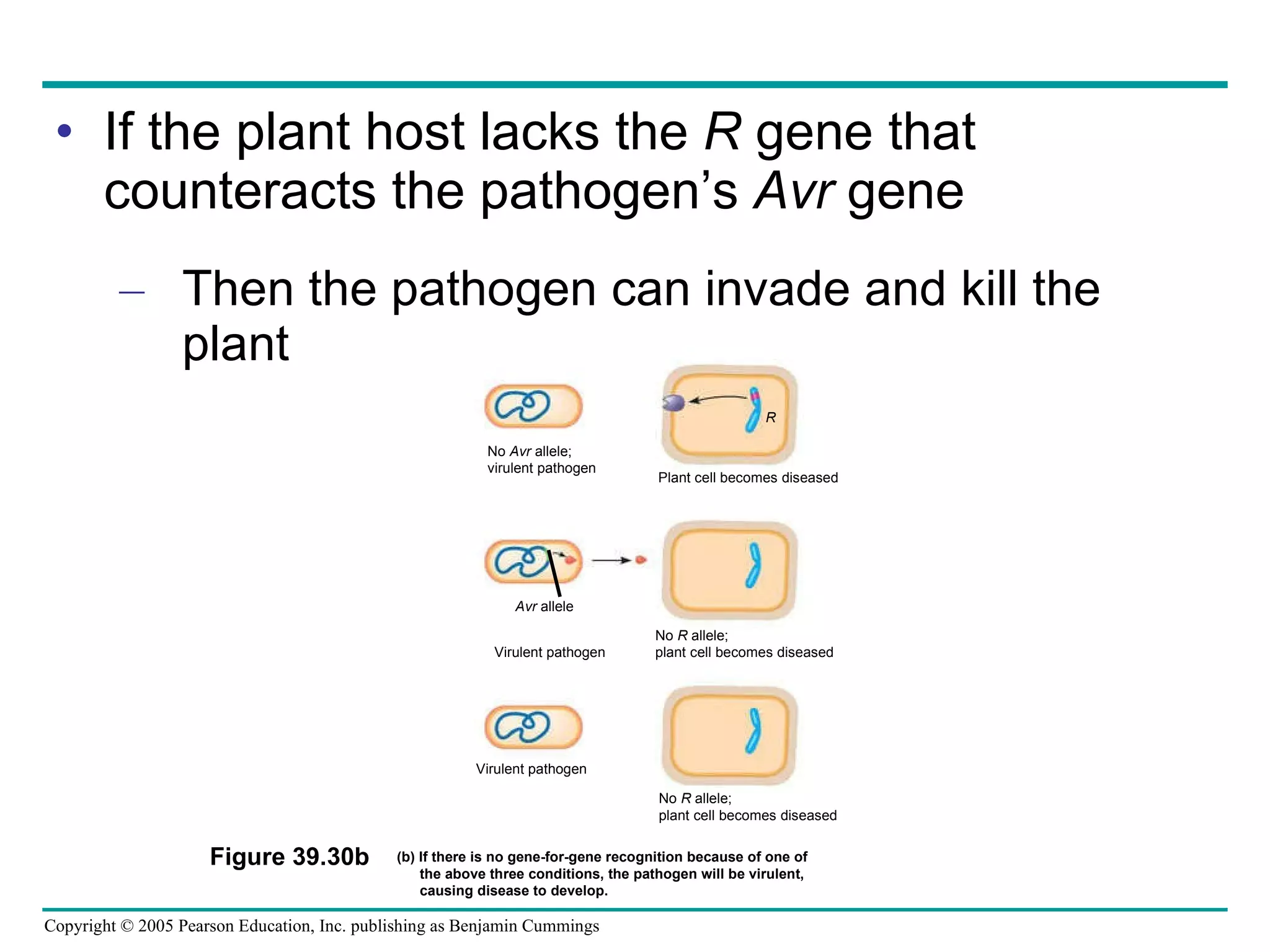
If the plant host lacks the  R  gene that counteracts the pathogen’s  Avr  gene Then the pathogen can invade and kill the plant R Figure 39.30b No  Avr  allele; virulent pathogen Plant cell becomes diseased Avr  allele No  R  allele; plant cell becomes diseased Virulent pathogen Virulent pathogen No  R  allele; plant cell becomes diseased (b) If there is no gene-for-gene recognition because of one of the above three conditions, the pathogen will be virulent, causing disease to develop.
Plant Responses to Pathogen Invasions A hypersensitive response against an avirulent pathogen Seals off the infection and kills both pathogen and host cells in the region of the infection 3 In a hypersensitive response (HR), plant cells produce anti- microbial molecules, seal off infected areas by modifying their walls, and then destroy themselves. This localized response produces lesions and protects other parts of an infected leaf. 4   Before they die, infected cells release a chemical signal, probably salicylic acid. 6  In cells remote from the infection site, the chemical initiates a signal transduction pathway. 5   The signal is distributed to the  rest of the plant. 2  This identification step triggers a signal transduction pathway. 1   Specific resistance is based on the binding of ligands from the pathogen to receptors in  plant cells. 7 Systemic acquired resistance is activated: the production of molecules that help protect the cell against a diversity of pathogens for several days. Signal 7 6 5 4 3 2 1 Avirulent pathogen Signal transduction pathway Hypersensitive response Signal transduction pathway Acquired resistance R-Avr  recognition and hypersensitive response Systemic acquired resistance Figure 39.31
Systemic Acquired Resistance Systemic acquired resistance (SAR) Is a set of generalized defense responses in organs distant from the original site of infection Is triggered by the signal molecule salicylic acid

37 plantnutrition text

  • 1.
    Plant Nutrition Plantsrequire certain chemical elements to complete their life cycle Plants derive most of their organic mass from the CO 2 of air But they also depend on soil nutrients such as water and minerals Figure 37.2 CO 2 , the source of carbon for Photosynthesis, diffuses into leaves from the air through stomata. Through stomata, leaves expel H 2 O and O 2 . H 2 O O 2 CO 2 Roots take in O 2 and expel CO 2 . The plant uses O 2 for cellular respiration but is a net O 2 producer. O 2 CO 2 H 2 O Roots absorb H 2 O and minerals from the soil. Minerals
  • 2.
    Macronutrients and MicronutrientsMore than 50 chemical elements Have been identified among the inorganic substances in plants, but not all of these are essential A chemical element is considered essential If it is required for a plant to complete a life cycle
  • 3.
    Researchers use hydroponicculture To determine which chemicals elements are essential Figure 37.3 TECHNIQUE Plant roots are bathed in aerated solutions of known mineral composition. Aerating the water provides the roots with oxygen for cellular respiration. A particular mineral, such as potassium, can be omitted to test whether it is essential. RESULTS If the omitted mineral is essential, mineral deficiency symptoms occur, such as stunted growth and discolored leaves. Deficiencies of different elements may have different symptoms, which can aid in diagnosing mineral deficiencies in soil. Control: Solution containing all minerals Experimental: Solution without potassium APPLICATION In hydroponic culture, plants are grown in mineral solutions without soil. One use of hydroponic culture is to identify essential elements in plants.
  • 4.
    Essential elements inplants Table 37.1
  • 5.
    Nine of theessential elements are called macronutrients Because plants require them in relatively large amounts ( CH N OPS plus K, Ca, and Mg ) The remaining eight essential elements are known as micronutrients Because plants need them in very small amounts (function mainly as cofactors, Fe, Mn, Cu, and Zinc )
  • 6.
    Symptoms of MineralDeficiency The symptoms of mineral deficiency Depend partly on the nutrient’s function Depend on the mobility of a nutrient within the plant
  • 7.
    The most commondeficiencies Are those of nitrogen, potassium, and phosphorus Figure 37.4 Phosphate-deficient Healthy Potassium-deficient Nitrogen-deficient
  • 8.
    Soil quality isa major determinant of plant distribution and growth Along with climate The major factors determining whether particular plants can grow well in a certain location are the texture and composition of the soil Texture Is the soil’s general structure Composition Refers to the soil’s organic and inorganic chemical components
  • 9.
    Fertilizers Commercially producedfertilizers Contain minerals that are either mined or prepared by industrial processes “ Organic” fertilizers Are composed of manure, fishmeal, or compost
  • 10.
    Nitrogen isoften the mineral that has the greatest effect on plant growth Plants require nitrogen as a component of Proteins, nucleic acids, chlorophyll, and other important organic molecules
  • 11.
    Soil Bacteria andNitrogen Availability Nitrogen-fixing bacteria convert atmospheric N 2 To nitrogenous minerals that plants can absorb as a nitrogen source for organic synthesis Figure 37.9 Atmosphere N 2 Soil N 2 N 2 Nitrogen-fixing bacteria Organic material (humus) NH 3 (ammonia) NH 4 + (ammonium) H + (From soil) NO 3 – (nitrate) Nitrifying bacteria Denitrifying bacteria Root NH 4 + Soil Atmosphere Nitrate and nitrogenous organic compounds exported in xylem to shoot system Ammonifying bacteria
  • 12.
    Improving the ProteinYield of Crops Agriculture research in plant breeding Has resulted in new varieties of maize, wheat, and rice that are enriched in protein Such research Addresses the most widespread form of human malnutrition: protein deficiency
  • 13.
    Plant nutritional adaptationsoften involve relationships with other organisms Two types of relationships plants have with other organisms are mutualistic Symbiotic nitrogen fixation Mycorrhizae
  • 14.
    The Role ofBacteria in Symbiotic Nitrogen Fixation Symbiotic relationships with nitrogen-fixing bacteria Provide some plant species with a built-in source of fixed nitrogen From an agricultural standpoint The most important and efficient symbioses between plants and nitrogen-fixing bacteria occur in the legume family (peas, beans, and other similar plants)
  • 15.
    Along a legumespossessive roots are swellings called nodules Composed of plant cells that have been “infected” by nitrogen-fixing Rhizobium bacteria Figure 37.10a (a) Pea plant root. The bumps on this pea plant root are nodules containing Rhizobium bacteria. The bacteria fix nitrogen and obtain photosynthetic products supplied by the plant. Nodules Roots
  • 16.
    Inside the noduleRhizobium bacteria assume a form called bacteroids, which are contained within vesicles formed by the root cell Figure 37.10b (b) Bacteroids in a soybean root nodule. In this TEM, a cell from a root nodule of soybean is filled with bacteroids in vesicles. The cells on the left are uninfected. 5 m Bacteroids within vesicle
  • 17.
    The bacteria ofa nodule Obtain sugar from the plant and supply the plant with fixed nitrogen Each legume Is associated with a particular strain of Rhizobium
  • 18.
    Development of asoybean root nodule Figure 37.11 Infection thread Rhizobium bacteria Dividing cells in root cortex Bacteroid 2 The bacteria penetrate the cortex within the Infection thread. Cells of the cortex and pericycle begin dividing, and vesicles containing the bacteria bud into cortical cells from the branching infection thread. This process results in the formation of bacteroids. Bacteroid Bacteroid Developing root nodule Dividing cells in pericycle Infected root hair 1 2 3 Nodule vascular tissue 4 3 Growth continues in the affected regions of the cortex and pericycle, and these two masses of dividing cells fuse, forming the nodule. Roots emit chemical signals that attract Rhizobium bacteria. The bacteria then emit signals that stimulate root hairs to elongate and to form an infection thread by an invagination of the plasma membrane. 1 4 The nodule develops vascular tissue that supplies nutrients to the nodule and carries nitrogenous compounds into the vascular cylinder for distribution throughout the plant.
  • 19.
    The Molecular Biologyof Root Nodule Formation The development of a nitrogen-fixing root nodule Depends on chemical dialogue between Rhizobium bacteria and root cells of their specific plant hosts
  • 20.
    Symbiotic Nitrogen Fixationand Agriculture The agriculture benefits of symbiotic nitrogen fixation Underlie crop rotation In this practice A non-legume such as maize is planted one year, and the following year a legume is planted to restore the concentration of nitrogen in the soil
  • 21.
    Mycorrhizae and PlantNutrition Mycorrhizae Are modified roots consisting of mutualistic associations of fungi and roots The fungus Benefits from a steady supply of sugar donated by the host plant In return, the fungus Increases the surface area of water uptake and mineral absorption and supplies water and minerals to the host plant
  • 22.
    The Two MainTypes of Mycorrhizae In ectomycorrhizae The mycelium of the fungus forms a dense sheath over the surface of the root Figure 37.12a a Ectomycorrhizae. The mantle of the fungal mycelium ensheathes the root. Fungal hyphae extend from the mantle into the soil, absorbing water and minerals, especially phosphate. Hyphae also extend into the extracellular spaces of the root cortex, providing extensive surface area for nutrient exchange between the fungus and its host plant. Mantle (fungal sheath) Epidermis Cortex Mantle (fungal sheath) Endodermis Fungal hyphae between cortical cells (colorized SEM) 100 m (a)
  • 23.
    In endomycorrhizae Microscopicfungal hyphae extend into the root Figure 37.12b Epidermis Cortex Fungal hyphae Root hair 10 m (LM, stained specimen) Cortical cells Endodermis Vesicle Casparian strip Arbuscules 2 Endomycorrhizae. No mantle forms around the root, but microscopic fungal hyphae extend into the root. Within the root cortex, the fungus makes extensive contact with the plant through branching of hyphae that form arbuscules, providing an enormous surface area for nutrient swapping. The hyphae penetrate the cell walls, but not the plasma membranes, of cells within the cortex. (b)
  • 24.
    Agricultural Importance ofMycorrhizae Farmers and foresters Often inoculate seeds with spores of mycorrhizal fungi to promote the formation of mycorrhizae Some plants Have nutritional adaptations that use other organisms in nonmutualistic ways Epiphytes, Parasitic Plants, and Carnivorous Plants
  • 25.
    Exploring unusual nutritionaladaptations in plants Figure 37.13 Staghorn fern, an epiphyte EPIPHYTES PARASITIC PLANTS CARNIVOROUS PLANTS Mistletoe, a photosynthetic parasite Dodder, a nonphotosynthetic parasite Host’s phloem Haustoria Indian pipe, a nonphotosynthetic parasite Venus’ flytrap Pitcher plants Sundews Dodder
  • 26.
    Angiosperm Reproduction andBiotechnology The parasitic plant Rafflesia arnoldii Produces enormous flowers that can produce up to 4 million seeds Figure 38.1
  • 27.
    Pollination enablesgametes to come together within a flower In angiosperms, the dominant sporophyte Produces spores that develop within flowers into male gametophytes (pollen grains) Produces female gametophytes (embryo sacs)
  • 28.
    An overview ofangiosperm reproduction Figure 38.2a, b Anther at tip of stamen Filament Anther Stamen Pollen tube Germinated pollen grain ( n ) (male gametophyte) on stigma of carpel Ovary (base of carpel) Ovule Embryo sac ( n ) (female gametophyte) FERTILIZATION Egg ( n ) Sperm ( n ) Petal Receptacle Sepal Style Ovary Key Haploid ( n ) Diploid (2 n ) (a) An idealized flower. (b) Simplified angiosperm life cycle. See Figure 30.10 for a more detailed version of the life cycle, including meiosis. Mature sporophyte plant ( 2n ) with flowers Seed (develops from ovule) Zygote (2 n ) Embryo (2 n ) (sporophyte) Simple fruit (develops from ovary) Germinating seed Seed Carpel Stigma
  • 29.
    Flower Structure FlowersAre the reproductive shoots of the angiosperm sporophyte Are composed of four floral organs: sepals, petals, stamens, and carpels
  • 30.
    Gametophyte Development andPollination In angiosperms Pollination is the transfer of pollen from an anther to a stigma If pollination is successful, a pollen grain produces a structure called a pollen tube, which grows down into the ovary and discharges sperm near the embryo sac
  • 31.
    Pollen Develops frommicrospores within the sporangia of anthers 3 A pollen grain becomes a mature male gametophyte when its generative nucleus divides and forms two sperm. This usually occurs after a pollen grain lands on the stigma of a carpel and the pollen tube begins to grow. (See Figure 38.2b.) Development of a male gametophyte (pollen grain) (a) 2 Each microsporo- cyte divides by meiosis to produce four haploid microspores, each of which develops into a pollen grain. Pollen sac (microsporangium) Micro- sporocyte Micro- spores (4) Each of 4 microspores Generative cell (will form 2 sperm) Male Gametophyte (pollen grain) Nucleus of tube cell Each one of the microsporangia contains diploid microsporocytes (microspore mother cells). 1 75 m 20 m Ragweed pollen grain Figure 38.4a MEIOSIS MITOSIS KEY to labels Haploid ( 2n ) Diploid ( 2n )
  • 32.
    Embryo sacs Developfrom megaspores within ovules Key to labels MITOSIS MEIOSIS Ovule Ovule Integuments Embryo sac Mega- sporangium Mega- sporocyte Integuments Micropyle Surviving megaspore Antipodel Cells (3) Polar Nuclei (2) Egg (1) Synergids (2) Development of a female gametophyte (embryo sac) (b) Within the ovule’s megasporangium is a large diploid cell called the megasporocyte (megaspore mother cell). 1 Three mitotic divisions of the megaspore form the embryo sac, a multicellular female gametophyte. The ovule now consists of the embryo sac along with the surrounding integuments (protective tissue). 3 Female gametophyte (embryo sac) Diploid ( 2n ) Haploid ( 2n ) Figure 38.4b 100 m The megasporocyte divides by meiosis and gives rise to four haploid cells, but in most species only one of these survives as the megaspore. 2
  • 33.
    Mechanisms That PreventSelf-Fertilization Many angiosperms Have mechanisms that make it difficult or impossible for a flower to fertilize itself Figure 38.5 Stigma Anther with pollen Stigma Pin flower Thrum flower
  • 34.
    The most common anti-selfing mechanism in flowering plants Is known as self-incompatibility, the ability of a plant to reject its own pollen Researchers are unraveling the molecular mechanisms that are involved in self-incompatibility
  • 35.
    Some plants Rejectpollen that has an S -gene matching an allele in the stigma cells Recognition of self pollen Triggers a signal transduction pathway leading to a block in growth of a pollen tube
  • 36.
    Double Fertilization Afterlanding on a receptive stigma A pollen grain germinates and produces a pollen tube that extends down between the cells of the style toward the ovary The pollen tube Then discharges two sperm into the embryo sac After fertilization, ovules develop into seeds and ovaries into fruits
  • 37.
    In double fertilizationOne sperm fertilizes the egg The other sperm combines with the polar nuclei, giving rise to the food-storing endosperm
  • 38.
    Growth of thepollen tube and double fertilization Stigma Polar nuclei Egg Pollen grain Pollen tube 2 sperm Style Ovary Ovule (containing female gametophyte, or embryo sac) Micropyle Ovule Polar nuclei Egg Two sperm about to be discharged Endosperm nucleus (3 n ) (2 polar nuclei plus sperm) Zygote (2 n ) (egg plus sperm) Figure 38.6 If a pollen grain germinates, a pollen tube grows down the style toward the ovary. 1 The pollen tube discharges two sperm into the female gametophyte (embryo sac) within an ovule. 2 One sperm fertilizes the egg, forming the zygote. The other sperm combines with the two polar nuclei of the embryo sac’s large central cell, forming a triploid cell that develops into the nutritive tissue called endosperm. 3
  • 39.
    From Ovule toSeed After double fertilization Each ovule develops into a seed The ovary develops into a fruit enclosing the seed(s)
  • 40.
    Endosperm Development Endospermdevelopment Usually precedes embryo development In most monocots and some eudicots The endosperm stores nutrients that can be used by the seedling after germination In other eudicots The food reserves of the endosperm are completely exported to the cotyledons
  • 41.
    Embryo Development Thefirst mitotic division of the zygote is transverse Splitting the fertilized egg into a basal cell and a terminal cell Figure 38.7 Ovule Terminal cell Endosperm nucleus Basal cell Zygote Integuments Zygote Proembryo Cotyledons Shoot apex Root apex Seed coat Basal cell Suspensor Endosperm Suspensor
  • 42.
    Structure of theMature Seed The embryo and its food supply Are enclosed by a hard, protective seed coat In a common garden bean, a eudicot The embryo consists of the hypocotyl, radicle, and thick cotyledons Figure 38.8a (a) Common garden bean, a eudicot with thick cotyledons. The fleshy cotyledons store food absorbed from the endosperm before the seed germinates. Seed coat Radicle Epicotyl Hypocotyl Cotyledons
  • 43.
    The seeds ofother eudicots, such as castor beans Have similar structures, but thin cotyledons Figure 38.8b Seed coat Endosperm Cotyledons Epicotyl Hypocotyl Radicle (b) Castor bean, a eudicot with thin cotyledons. The narrow, membranous cotyledons (shown in edge and flat views) absorb food from the endosperm when the seed germinates. Figure 38.8b Seed coat Endosperm Cotyledons Epicotyl Hypocotyl Radicle (b) Castor bean, a eudicot with thin cotyledons. The narrow, membranous cotyledons (shown in edge and flat views) absorb food from the endosperm when the seed germinates.
  • 44.
    The embryo ofa monocot Has a single cotyledon, a coleoptile, and a coleorhiza Figure 38.8c (c) Maize, a monocot. Like all monocots, maize has only one cotyledon. Maize and other grasses have a large cotyledon called a scutellum. The rudimentary shoot is sheathed in a structure called the coleoptile, and the coleorhiza covers the young root. Scutellum (cotyledon) Coleoptile Coleorhiza Pericarp fused with seed coat Endosperm Epicotyl Hypocotyl Radicle
  • 45.
    From Ovary toFruit A fruit Develops from the ovary Protects the enclosed seeds Aids in the dispersal of seeds by wind or animals
  • 46.
    Fruits are classifiedinto several types Depending on their developmental origin Figure 38.9a–c Pineapple fruit Raspberry fruit Pea fruit Stamen Carpel (fruitlet) Stigma Ovary Raspberry flower Each segment develops from the carpel of one flower Pineapple inflorescence Stamen Carpels Flower Ovary Stigma Stamen Ovule Pea flower Seed Simple fruit. A simple fruit develops from a single carpel (or several fused carpels) of one flower (examples: pea, lemon, peanut). (a) Aggregate fruit. An aggregate fruit develops from many separate carpels of one flower (examples: raspberry, blackberry, strawberry). (b) Multiple fruit. A multiple fruit develops from many carpels of many flowers (examples: pineapple, fig). (c)
  • 47.
    Seed Germination Asa seed matures It dehydrates and enters a phase referred to as dormancy
  • 48.
    From Seed toSeedling Germination of seeds depends on the physical process called imbibition The uptake of water due to low water potential of the dry seed Seed dormancy Increases the chances that germination will occur at a time and place most advantageous to the seedling The breaking of seed dormancy Often requires environmental cues, such as temperature or lighting cues
  • 49.
    The radicleIs the first organ to emerge from the germinating seed In many eudicots A hook forms in the hypocotyl, and growth pushes the hook above ground Figure 38.10a Foliage leaves Cotyledon Hypocotyl Radicle Epicotyl Seed coat Cotyledon Hypocotyl Cotyledon Hypocotyl Common garden bean. In common garden beans, straightening of a hook in the hypocotyl pulls the cotyledons from the soil. (a)
  • 50.
    Monocots Use adifferent method for breaking ground when they germinate The coleoptile Pushes upward through the soil and into the air Figure 38.10b Foliage leaves Coleoptile Coleoptile Radicle Maize. In maize and other grasses, the shoot grows straight up through the tube of the coleoptile. (b)
  • 51.
    Many flowering plantsclone themselves by asexual reproduction Many angiosperm species Reproduce both asexually and sexually Sexual reproduction Generates the genetic variation that makes supposed evolutionary adaptation possible Asexual reproduction in plants Is called vegetative reproduction
  • 52.
    Mechanisms of AsexualReproduction Fragmentation Is the separation of a parent plant into parts that develop into whole plants Is one of the most common modes of asexual reproduction
  • 53.
    Vegetative Propagation andAgriculture Humans have devised various methods for asexual propagation of angiosperms Many kinds of plants Are asexually reproduced from plant fragments called cuttings In a modification of vegetative reproduction from cuttings A twig or bud from one plant can be grafted onto a plant of a closely related species or a different variety of the same species
  • 54.
    In a processcalled protoplast fusion Researchers fuse protoplasts, plant cells with their cell walls removed, to create hybrid plants Figure 38.13 50 m
  • 55.
    Plant biotechnology istransforming agriculture Plant biotechnology has two meanings It refers to innovations in the use of plants to make products of use to humans It refers to the use of genetically modified (GM) organisms in agriculture and industry
  • 56.
    Artificial Selection Humanshave intervened In the reproduction and genetic makeup of plants for thousands of years
  • 57.
    Maize Is aproduct of artificial selection by humans Is a staple in many developing countries, but is a poor source of protein Figure 38.14
  • 58.
    Interspecific hybridization ofplants Is common in nature and has been used by breeders, ancient and modern, to introduce new genes
  • 59.
    Reducing World Hungerand Malnutrition Genetically modified plants Have the potential of increasing the quality and quantity of food worldwide Figure 38.15 Ordinary rice Genetically modified rice Figure 38.16
  • 60.
    The Debate overPlant Biotechnology There are some biologists, particularly ecologists Who are concerned about the unknown risks associated with the release of GM organisms (GMOs) into the environment One concern is that genetic engineering May transfer allergens from a gene source to a plant used for food
  • 61.
    Possible Effects onNontarget Organisms Many ecologists are concerned that the growing of GM crops Might have unforeseen effects on nontarget organisms Perhaps the most serious concern that some scientists raise about GM crops Is the possibility of the introduced genes escaping from a transgenic crop into related weeds through crop-to-weed hybridization Despite all the issues associated with GM crops The benefits should be considered
  • 62.
    Plant Responses toInternal and External Signals For example, the bending of a grass seedling toward light Begins with the plant sensing the direction, quantity, and color of the light Figure 39.1
  • 63.
    Signal transduction pathwayslink signal reception to response Plants have cellular receptors That they use to detect important changes in their environment For a stimulus to elicit a response Certain cells must have an appropriate receptor
  • 64.
    A potato leftgrowing in darkness Will produce shoots that do not appear healthy, and will lack elongated roots These are morphological adaptations for growing in darkness Collectively referred to as etiolation Figure 39.2a (a) Before exposure to light. A dark-grown potato has tall, spindly stems and nonexpanded leaves—morphological adaptations that enable the shoots to penetrate the soil. The roots are short, but there is little need for water absorption because little water is lost by the shoots.
  • 65.
    After the potatois exposed to light The plant undergoes profound changes called de-etiolation , in which shoots and roots grow normally Figure 39.2b (b) After a week’s exposure to natural daylight. The potato plant begins to resemble a typical plant with broad green leaves, short sturdy stems, and long roots. This transformation begins with the reception of light by a specific pigment, phytochrome.
  • 66.
    The potato’s responseto light Is an example of cell-signal processing Figure 39.3 CELL WALL CYTOPLASM   1 Reception 2 Transduction 3 Response Receptor Relay molecules Activation of cellular responses Hormone or environmental stimulus Plasma membrane
  • 67.
    Reception Internal andexternal signals are detected by receptors Proteins that change in response to specific stimuli
  • 68.
    Transduction Second messengersTransfer and amplify signals from receptors to proteins that cause specific responses
  • 69.
    An example ofsignal transduction in plants Figure 39.4 1 Reception   2 Transduction 3 Response CYTOPLASM Plasma membrane Phytochrome activated by light Cell wall Light cGMP Second messenger produced Specific protein kinase 1 activated Transcription factor 1 NUCLEUS P P Transcription Translation De-etiolation (greening) response proteins Ca 2+ Ca 2+ channel opened Specific protein kinase 2 activated Transcription factor 2 1 The light signal is detected by the phytochrome receptor, which then activates at least two signal transduction pathways. 2 One pathway uses cGMP as a second messenger that activates a specific protein kinase.The other pathway involves an increase in cytoplasmic Ca 2+ that activates another specific protein kinase. 3 Both pathways lead to expression of genes for proteins that function in the de-etiolation (greening) response.
  • 70.
    Response Ultimately, asignal transduction pathway Leads to a regulation of one or more cellular activities In most cases These responses to stimulation involve the increased activity of certain enzymes
  • 71.
    Transcriptional Regulation Transcriptionfactors bind directly to specific regions of DNA And control the transcription of specific genes Post-translational modification Involves the activation of existing proteins involved in the signal response
  • 72.
    Plant hormones helpcoordinate growth, development, and responses to stimuli Hormones Are chemical signals that coordinate the different parts of an organism
  • 73.
    The Discovery ofPlant Hormones Any growth response That results in curvatures of whole plant organs toward or away from a stimulus is called a tropism Is often caused by hormones
  • 74.
    A Survey ofPlant Hormones
  • 75.
    In general, hormonescontrol plant growth and development By affecting the division, elongation, and differentiation of cells Plant hormones are produced in very low concentrations But a minute amount can have a profound effect on the growth and development of a plant organ
  • 76.
    Auxin The term auxin Is used for any chemical substance that promotes cell elongation in different target tissues Auxin transporters Move the hormone out of the basal end of one cell, and into the apical end of neighboring cells According to a model called the acid growth hypothesis Proton pumps play a major role in the growth response of cells to auxin
  • 77.
    Cell elongation inresponse to auxin Figure 39.8 Expansin CELL WALL Cell wall enzymes Cross-linking cell wall polysaccharides Microfibril H + H + H + H + H + H + H + H + H + ATP Plasma membrane Plasma membrane Cell wall Nucleus Vacuole Cytoplasm H 2 O Cytoplasm 1 Auxin increases the activity of proton pumps. 4 The enzymatic cleaving of the cross-linking polysaccharides allows the microfibrils to slide. The extensibility of the cell wall is increased. Turgor causes the cell to expand. 2 The cell wall becomes more acidic. 5 With the cellulose loosened, the cell can elongate. 3 Wedge-shaped expansins, activated by low pH, separate cellulose microfibrils from cross-linking polysaccharides. The exposed cross-linking polysaccharides are now more accessible to cell wall enzymes.
  • 78.
    Lateral and AdventitiousRoot Formation Auxin Is involved in the formation and branching of roots An overdose of auxins Can kill eudicots Auxin affects secondary growth By inducing cell division in the vascular cambium and influencing differentiation of secondary xylem
  • 79.
    Cytokinins Cytokinins Stimulate cell division and differentiation Are produced in actively growing tissues such as roots, embryos, and fruits Work together with auxin Cytokinins retard the aging of some plant organs By inhibiting protein breakdown, stimulating RNA and protein synthesis, and mobilizing nutrients from surrounding tissues
  • 80.
    Control of ApicalDominance Cytokinins, auxin, and other factors interact in the control of apical dominance The ability of a terminal bud to suppress development of axillary buds Figure 39.9a Axillary buds
  • 81.
    If the terminalbud is removed Plants become bushier Figure 39.9b “ Stump” after removal of apical bud Lateral branches
  • 82.
    Gibberellins Gibberellins havea variety of effects Such as stem elongation, fruit growth, and seed germination In stems Gibberellins stimulate cell elongation and cell division Both auxin and gibberellins must be present for fruit to set
  • 83.
    Gibberellins are usedcommercially In the spraying of Thompson seedless grapes Figure 39.10
  • 84.
    After water isimbibed, the release of gibberellins from the embryo Signals the seeds to break dormancy and germinate Germination Figure 39.11 2 2 The aleurone responds by synthesizing and secreting digestive enzymes that hydrolyze stored nutrients in the endosperm. One example is -amylase, which hydrolyzes starch. (A similar enzyme in our saliva helps in digesting bread and other starchy foods.) Aleurone Endosperm Water Scutellum (cotyledon) GA GA  -amylase Radicle Sugar 1 After a seed imbibes water, the embryo releases gibberellin (GA) as a signal to the aleurone, the thin outer layer of the endosperm. 3 Sugars and other nutrients absorbed from the endosperm by the scutellum (cotyledon) are consumed during growth of the embryo into a seedling.
  • 85.
    2 The aleurone responds by synthesizing and secreting digestive enzymes that hydrolyze stored nutrients in the endosperm. One example is -amylase, which hydrolyzes starch. (A similar enzyme in our saliva helps in digesting bread and other starchy foods.) Aleurone Endosperm Water Scutellum (cotyledon) GA GA  -amylase Radicle Sugar 2 1 After a seed imbibes water, the embryo releases gibberellin (GA) as a signal to the aleurone, the thin outer layer of the endosperm. 3 Sugars and other nutrients absorbed from the endosperm by the scutellum (cotyledon) are consumed during growth of the embryo into a seedling.
  • 86.
    Abscisic Acid Twoof the many effects of abscisic acid (ABA) are Seed dormancy Drought tolerance Seed dormancy has great survival value Because it ensures that the seed will germinate only when there are optimal conditions ABA is the primary internal signal That enables plants to withstand drought (signals stomata to close)
  • 87.
    Ethylene Plants produceethylene ( gas ) In response to stresses such as drought, flooding, mechanical pressure, injury, and infection A burst of ethylene Is associated with the programmed destruction of cells , organs, or whole plants (Apoptosis: Programmed Cell Death) A burst of ethylene production in the fruit Triggers the ripening process (ethylene triggers ripening and ripening triggers ethylene = positive feedback, one bad apple spoils the bunch )
  • 88.
    Leaf Abscission Achange in the balance of auxin and ethylene controls leaf abscission The process that occurs in autumn when a leaf falls Figure 39.16 0.5 mm Protective layer Abscission layer Stem Petiole
  • 89.
    Photomorphogenesis- plant responseto light Plants not only detect the presence of light But also its direction, intensity, and wavelength (color) A graph called an action spectrum Depicts the relative response of a process to different wavelengths of light Wavelength (nm) 1.0 0.8 0.6 0.2 0 450 500 550 600 650 700 Light Time = 0 min. Time = 90 min. 0.4 400 Phototropic effectiveness relative to 436 nm
  • 90.
    Research on actionspectra and absorption spectra of pigments Led to the identification of two major classes of light receptors: blue-light photoreceptors and phytochromes (red light) Various blue-light photoreceptors Control hypocotyl elongation, stomatal opening, and phototropism Phytochromes Regulate many of a plant’s responses to light throughout its life
  • 91.
    A phytochrome Isthe photoreceptor responsible for the opposing effects of red and far-red light A phytochrome consists of two identical proteins joined to form one functional molecule. Each of these proteins has two domains. Chromophore Photoreceptor activity. One domain, which functions as the photoreceptor, is covalently bonded to a nonprotein pigment, or chromophore. Kinase activity. The other domain has protein kinase activity. The photoreceptor domains interact with the kinase domains to link light reception to cellular responses triggered by the kinase. Figure 39.19
  • 92.
    Phytochromes exist intwo photoreversible states With conversion of P r to P fr triggering many developmental responses Figure 39.20 Synthesis Far-red light Red light Slow conversion in darkness (some plants) Responses: seed germination, control of flowering, etc. Enzymatic destruction P fr P r
  • 93.
    Phytochromes and ShadeAvoidance The phytochrome system Also provides the plant with information about the quality of light In the “shade avoidance” response of a tree The phytochrome ratio shifts in favor of P r when a tree is shaded
  • 94.
    Biological Clocks andCircadian Rhythms Many plant processes Oscillate during the day Many legumes Lower their leaves in the evening and raise them in the morning Noon Midnight
  • 95.
    Cyclical responses toenvironmental stimuli are called circadian rhythms And are approximately 24 hours long Can be entrained to exactly 24 hours by the day/night cycle Phytochrome conversion marks sunrise and sunset Providing the biological clock with environmental cues
  • 96.
    Photoperiodism and Responsesto Seasons Photoperiod, the relative lengths of night and day Is the environmental stimulus plants use most often to detect the time of year Photoperiodism Is a physiological response to photoperiod Some developmental processes, including flowering in many species Requires a certain photoperiod
  • 97.
    Flowering times Short-dayplants – require a period of continuous darkness in order to flower. Short-day plants are actually long-night plants. These plants flower in early spring or fall. Long-day plants – flower only if a period of continuous darkness is shorter than the critical period. Flower in late spring or early summer. Day-neutral plants can flower in days of any length.
  • 98.
    Gravity Response togravity Is known as gravitropism Roots show positive gravitropism Stems show negative gravitropism
  • 99.
    Plants may detectgravity by the settling of statoliths Specialized plastids containing dense starch grains Figure 39.25a, b Statoliths 20 m (a) (b)
  • 100.
    Mechanical Stimuli Growthin response to touch Is called thigmotropism Occurs in vines and other climbing plants Rubbing the stems of young plants a couple of times daily Results in plants that are shorter than controls
  • 101.
    Rapid leaf movementsin response to mechanical stimulation Are examples of transmission of electrical impulses called action potentials Figure 39.27a–c (a) Unstimulated (b) Stimulated Side of pulvinus with flaccid cells Side of pulvinus with turgid cells Vein 0.5 m (c) Motor organs Leaflets after stimulation Pulvinus (motor organ)
  • 102.
    Environmental Stresses Environmentalstresses Have a potentially adverse effect on a plant’s survival, growth, and reproduction Can have a devastating impact on crop yields in agriculture
  • 103.
    Drought During droughtPlants respond to water deficit by reducing transpiration Deeper roots continue to grow
  • 104.
    Flooding Enzymatic destructionof cells Creates air tubes that help plants survive oxygen deprivation during flooding Figure 39.28a, b Vascular cylinder Air tubes Epidermis 100 m 100 m (a) Control root (aerated) (b) Experimental root (nonaerated)
  • 105.
    Salt Stress Plantsrespond to salt stress by producing solutes tolerated at high concentrations Keeping the water potential of cells more negative than that of the soil solution Heat-shock proteins Help plants survive heat stress Altering lipid composition of membranes Is a response to cold stress
  • 106.
    Defenses Against HerbivoresHerbivory , animals eating plants Is a stress that plants face in any ecosystem Plants counter excessive herbivory With physical defenses such as thorns With chemical defenses such as distasteful or toxic compounds
  • 107.
    Some plants even“recruit” predatory animals That help defend the plant against specific herbivores Figure 39.29 Recruitment of parasitoid wasps that lay their eggs within caterpillars 4 3 Synthesis and release of volatile attractants 1 Chemical in saliva 1 Wounding 2 Signal transduction pathway
  • 108.
    Defenses Against PathogensA plant’s first line of defense against infection Is the physical barrier of the plant’s “skin,” the epidermis and the periderm Once a pathogen invades a plant The plant mounts a chemical attack as a second line of defense that kills the pathogen and prevents its spread
  • 109.
    The second defensesystem Is enhanced by the plant’s inherited ability to recognize certain pathogens A virulent pathogen Is one that a plant has little specific defense against An avirulent pathogen Is one that may harm but not kill the host plant
  • 110.
    Gene-for-gene recognition isa widespread form of plant disease resistance That involves recognition of pathogen-derived molecules by the protein products of specific plant disease resistance ( R ) genes
  • 111.
    A pathogen isavirulent If it has a specific Avr gene corresponding to a particular R allele in the host plant Signal molecule (ligand) from Avr gene product Avr allele Plant cell is resistant Avirulent pathogen R Figure 39.30a Receptor coded by R allele (a) If an Av r allele in the pathogen corresponds to an R allele in the host plant, the host plant will have resistance, making the pathogen avirulent. R alleles probably code for receptors in the plasma membranes of host plant cells. Avr alleles produce compounds that can act as ligands, binding to receptors in host plant cells.
  • 112.
    If the planthost lacks the R gene that counteracts the pathogen’s Avr gene Then the pathogen can invade and kill the plant R Figure 39.30b No Avr allele; virulent pathogen Plant cell becomes diseased Avr allele No R allele; plant cell becomes diseased Virulent pathogen Virulent pathogen No R allele; plant cell becomes diseased (b) If there is no gene-for-gene recognition because of one of the above three conditions, the pathogen will be virulent, causing disease to develop.
  • 113.
    Plant Responses toPathogen Invasions A hypersensitive response against an avirulent pathogen Seals off the infection and kills both pathogen and host cells in the region of the infection 3 In a hypersensitive response (HR), plant cells produce anti- microbial molecules, seal off infected areas by modifying their walls, and then destroy themselves. This localized response produces lesions and protects other parts of an infected leaf. 4 Before they die, infected cells release a chemical signal, probably salicylic acid. 6 In cells remote from the infection site, the chemical initiates a signal transduction pathway. 5 The signal is distributed to the rest of the plant. 2 This identification step triggers a signal transduction pathway. 1 Specific resistance is based on the binding of ligands from the pathogen to receptors in plant cells. 7 Systemic acquired resistance is activated: the production of molecules that help protect the cell against a diversity of pathogens for several days. Signal 7 6 5 4 3 2 1 Avirulent pathogen Signal transduction pathway Hypersensitive response Signal transduction pathway Acquired resistance R-Avr recognition and hypersensitive response Systemic acquired resistance Figure 39.31
  • 114.
    Systemic Acquired ResistanceSystemic acquired resistance (SAR) Is a set of generalized defense responses in organs distant from the original site of infection Is triggered by the signal molecule salicylic acid