Chapter 48 Nervous Systems
Overview: Command and Control Center  The human brain Contains an estimated 100 billion nerve cells, or neurons Each neuron May communicate with thousands of other neurons
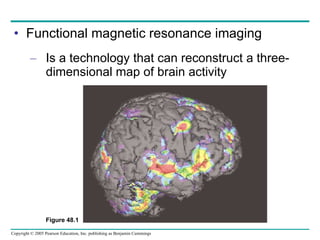
Functional magnetic resonance imaging Is a technology that can reconstruct a three-dimensional map of brain activity Figure 48.1
The results of brain imaging and other research methods Reveal that groups of neurons function in specialized circuits dedicated to different tasks
Concept 48.1: Nervous systems consist of circuits of neurons and supporting cells All animals except sponges Have some type of nervous system What distinguishes the nervous systems of different animal groups Is how the neurons are organized into circuits
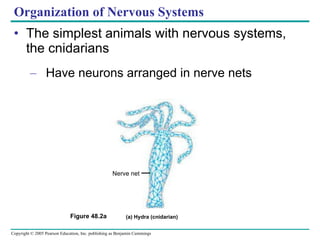
Organization of Nervous Systems The simplest animals with nervous systems, the cnidarians Have neurons arranged in nerve nets Figure 48.2a Nerve net (a) Hydra (cnidarian)
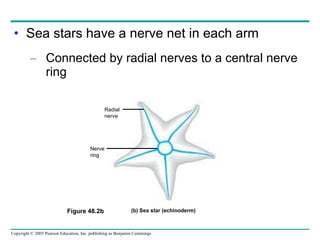
Sea stars have a nerve net in each arm Connected by radial nerves to a central nerve ring Figure 48.2b Nerve ring Radial nerve (b) Sea star (echinoderm)
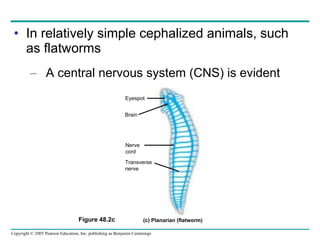
In relatively simple cephalized animals, such as flatworms A central nervous system (CNS) is evident Figure 48.2c Eyespot Brain Nerve  cord Transverse nerve (c) Planarian (flatworm)
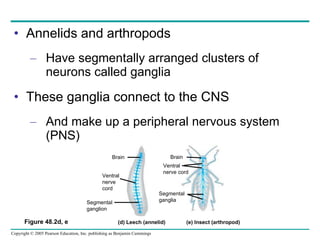
Annelids and arthropods Have segmentally arranged clusters of neurons called ganglia These ganglia connect to the CNS And make up a peripheral nervous system (PNS) Brain Ventral  nerve cord Segmental ganglion Brain Ventral nerve cord Segmental ganglia Figure 48.2d, e (d) Leech (annelid) (e) Insect (arthropod)
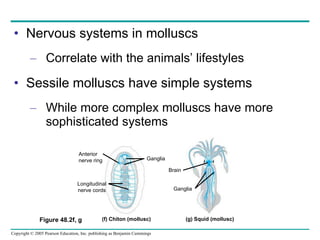
Nervous systems in molluscs Correlate with the animals’ lifestyles Sessile molluscs have simple systems While more complex molluscs have more sophisticated systems Anterior nerve ring Longitudinal nerve cords Ganglia Brain Ganglia Figure 48.2f, g  (f) Chiton (mollusc) (g) Squid (mollusc)
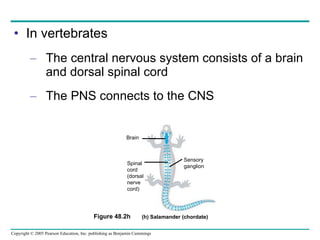
In vertebrates The central nervous system consists of a brain and dorsal spinal cord The PNS connects to the CNS Figure 48.2h Brain Spinal cord (dorsal nerve cord) Sensory ganglion (h) Salamander (chordate)
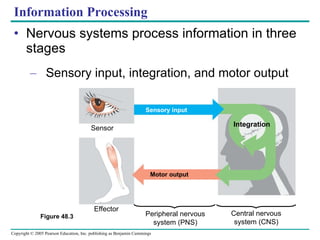
Information Processing Nervous systems process information in three stages Sensory input, integration, and motor output Figure 48.3  Sensor Effector Motor output Integration Sensory input Peripheral nervous system (PNS) Central nervous system (CNS)
Sensory neurons transmit information from sensors  That detect external stimuli and internal conditions Sensory information is sent to the CNS Where interneurons integrate the information Motor output leaves the CNS via motor neurons Which communicate with effector cells
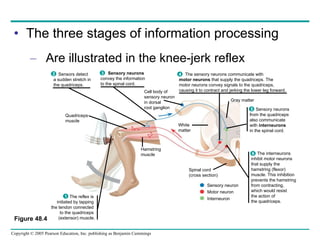
The three stages of information processing Are illustrated in the knee-jerk reflex Figure 48.4 Sensory neurons  from the quadriceps  also communicate with  interneurons   in the spinal cord. The interneurons  inhibit motor neurons  that supply the  hamstring (flexor)  muscle. This inhibition  prevents the hamstring  from contracting,  which would resist  the action of  the quadriceps. The sensory neurons communicate with  motor neurons  that supply the quadriceps. The  motor neurons convey signals to the quadriceps,  causing it to contract and jerking the lower leg forward. 4 5 6 The reflex is  initiated by tapping  the tendon connected  to the quadriceps  (extensor) muscle. 1 Sensors detect a sudden stretch in  the quadriceps. 2 Sensory neurons convey the information  to the spinal cord. 3 Quadriceps muscle Hamstring muscle Spinal cord (cross section) Gray matter White  matter Cell body of  sensory neuron in dorsal  root ganglion Sensory neuron Motor neuron Interneuron
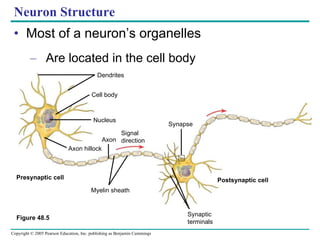
Neuron Structure Most of a neuron’s organelles Are located in the cell body Figure 48.5 Dendrites Cell body Nucleus Axon hillock Axon Signal  direction Synapse Myelin sheath Synaptic terminals Presynaptic cell Postsynaptic cell
Most neurons have dendrites Highly branched extensions that receive signals from other neurons The axon is typically a much longer extension That transmits signals to other cells at synapses That may be covered with a myelin sheath
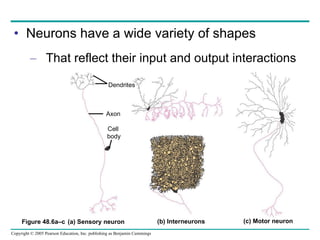
Neurons have a wide variety of shapes That reflect their input and output interactions Figure 48.6a–c Axon Cell  body Dendrites (a) Sensory neuron (b) Interneurons (c) Motor neuron
Supporting Cells (Glia) Glia are supporting cells That are essential for the structural integrity of the nervous system and for the normal functioning of neurons
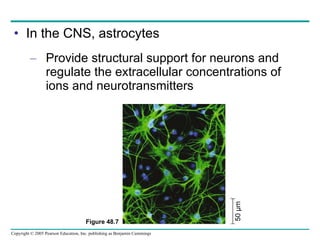
In the CNS, astrocytes Provide structural support for neurons and regulate the extracellular concentrations of ions and neurotransmitters Figure 48.7 50 µm
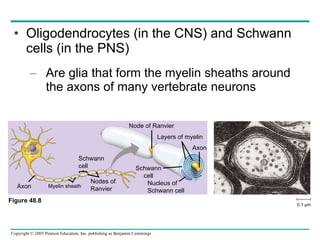
Oligodendrocytes (in the CNS) and Schwann cells (in the PNS) Are glia that form the myelin sheaths around the axons of many vertebrate neurons Myelin sheath Nodes of  Ranvier Schwann cell Schwann cell Nucleus of  Schwann cell Axon Layers of myelin Node of Ranvier 0.1 µm Axon Figure 48.8
Concept 48.2: Ion pumps and ion channels maintain the resting potential of a neuron Across its plasma membrane, every cell has a voltage  Called a membrane potential The inside of a cell is negative Relative to the outside
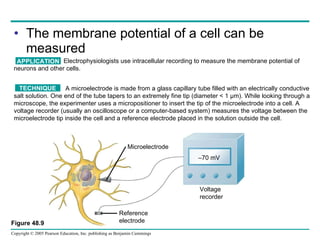
The membrane potential of a cell can be measured Figure 48.9 APPLICATION Electrophysiologists use intracellular recording to measure the membrane potential of  neurons and other cells. TECHNIQUE A microelectrode is made from a glass capillary tube filled with an electrically conductive  salt solution. One end of the tube tapers to an extremely fine tip (diameter < 1 µm). While looking through a  microscope, the experimenter uses a micropositioner to insert the tip of the microelectrode into a cell. A  voltage recorder (usually an oscilloscope or a computer-based system) measures the voltage between the  microelectrode tip inside the cell and a reference electrode placed in the solution outside the cell. Microelectrode Reference electrode Voltage  recorder – 70 mV
The Resting Potential The resting potential Is the membrane potential of a neuron that is not transmitting signals
In all neurons, the resting potential Depends on the ionic gradients that exist across the plasma membrane CYTOSOL EXTRACELLULAR FLUID [Na + ] 15 m M [K + ] 150 m M [Cl – ] 10 m M [A – ] 100 m M [Na + ] 150 m M [K + ] 5 m M [Cl – ] 120 m M – – – – – + + + + + Plasma membrane Figure 48.10
The concentration of Na +  is higher in the extracellular fluid than in the cytosol While the opposite is true for K +
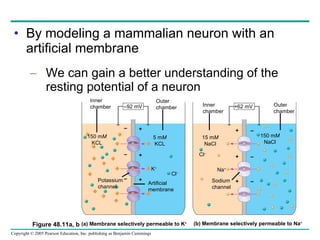
By modeling a mammalian neuron with an artificial membrane We can gain a better understanding of the resting potential of a neuron Figure 48.11a, b Inner  chamber Outer  chamber Inner  chamber Outer  chamber – 92 mV +62 mV Artificial membrane Potassium channel K + Cl – 150 m M KCL 150 m M NaCl 15 m M NaCl 5 m M KCL Cl – Na + Sodium  channel +  – +  – +  – +  – +  – +  – (a) Membrane selectively permeable to K + (b) Membrane selectively permeable to Na +
A neuron that is not transmitting signals Contains many open K +  channels and fewer open Na +  channels in its plasma membrane The diffusion of K +  and Na +  through these channels Leads to a separation of charges across the membrane, producing the resting potential
Gated Ion Channels Gated ion channels open or close In response to membrane stretch or the binding of a specific ligand In response to a change in the membrane potential
Concept 48.3: Action potentials are the signals conducted by axons If a cell has gated ion channels Its membrane potential may change in response to stimuli that open or close those channels
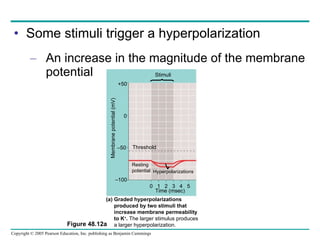
Some stimuli trigger a hyperpolarization An increase in the magnitude of the membrane potential Figure 48.12a +50 0 – 50 – 100 Time (msec) 0  1  2  3  4  5 Threshold Resting potential Hyperpolarizations Membrane potential (mV) Stimuli (a) Graded hyperpolarizations  produced by two stimuli that  increase membrane permeability  to K + .  The larger stimulus produces a larger hyperpolarization.
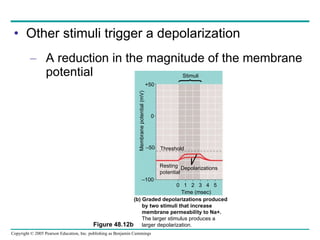
Other stimuli trigger a depolarization A reduction in the magnitude of the membrane potential Figure 48.12b +50 0 – 50 – 100 Time (msec) 0  1  2  3  4  5 Threshold Resting potential Depolarizations Membrane potential (mV) Stimuli (b) Graded depolarizations produced  by two stimuli that increase  membrane permeability to Na+. The larger stimulus produces a larger depolarization.
Hyperpolarization and depolarization Are both called graded potentials because the magnitude of the change in membrane potential varies with the strength of the stimulus
Production of Action Potentials In most neurons, depolarizations Are graded only up to a certain membrane voltage, called the threshold
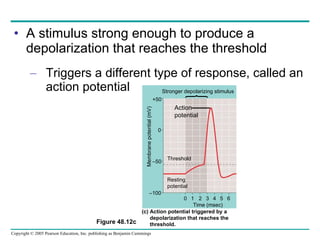
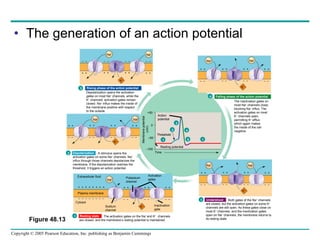
A stimulus strong enough to produce a depolarization that reaches the threshold Triggers a different type of response, called an action potential Figure 48.12c +50 0 – 50 – 100 Time (msec) 0   1   2   3    4   5   6 Threshold Resting potential Membrane potential (mV) Stronger depolarizing stimulus Action potential (c) Action potential triggered by a  depolarization that reaches the  threshold.
An action potential Is a brief all-or-none depolarization of a neuron’s plasma membrane Is the type of signal that carries information along axons
Both voltage-gated Na +  channels and voltage-gated K +  channels Are involved in the production of an action potential When a stimulus depolarizes the membrane Na +  channels open, allowing Na +  to diffuse into the cell
As the action potential subsides K +  channels open, and K +  flows out of the cell A refractory period follows the action potential During which a second action potential cannot be initiated
The generation of an action potential –  –  –  –  –  –  –  – +  +  +  +  +  +  +  + +  + +  + –  – –  – Na + Na + K + Na + Na + K + Na + Na + K + Na + K + K + Na + Na + Rising phase of the action potential Undershoot Sodium channel Action potential Resting potential Time Threshold Membrane potential  (mV) +50 0 – 50 – 100 Threshold Cytosol Figure 48.13 Depolarization opens the activation gates on most Na +  channels, while the K +  channels’ activation gates remain closed. Na +  influx makes the inside of the membrane positive with respect to the outside. The inactivation gates on most Na +  channels close, blocking Na +  influx. The activation gates on most K +  channels open, permitting K +  efflux which again makes the inside of the cell negative. A stimulus opens the activation gates on some Na +  channels. Na + influx through those channels depolarizes the membrane. If the depolarization reaches the threshold, it triggers an action potential. The activation gates on the Na +  and K +   channels are closed, and the membrane’s resting potential is maintained. Both gates of the Na +  channels are closed, but the activation gates on some K +   channels are still open. As these gates close on most K +  channels, and the inactivation gates  open on Na +  channels, the membrane returns to its resting state. +  + –  – +  + –  – +  + –  – +  + –  – +  + –  – +  + –  – +  + –  – +  + –  – +  + –  – +  + –  – +  + –  – +  + –  – +  + –  – –  – +  + –  – +  + –  – +  + –  – +  + 5 1 Resting state 2 Depolarization 3 4 Falling phase of the action potential 1 2 3 4 5 1 Plasma membrane Extracellular fluid Activation gates Potassium channel Inactivation gate
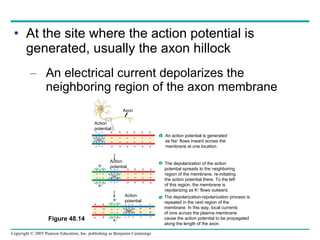
Conduction of Action Potentials An action potential can travel long distances By regenerating itself along the axon
At the site where the action potential is generated, usually the axon hillock An electrical current depolarizes the neighboring region of the axon membrane Figure 48.14 – + – + + + + + – + – + + + + + + – + – + + + + + – + – + + + + + – + – – – – – + – + – – – – – – – – – – – – – – – – – + + + + + + + + – – – – + + + + – – – – – – – – + + + + – – – – + + + + Na + Na + Na + Action potential Action potential Action potential K + K + K + Axon An action potential is generated  as Na +  flows inward across the  membrane at one location. 1 2 The depolarization of the action  potential spreads to the neighboring  region of the membrane, re-initiating  the action potential there. To the left  of this region, the membrane is  repolarizing as K +  flows outward.  3 The depolarization-repolarization process is repeated in the next region of the  membrane. In this way, local currents  of ions  across  the plasma membrane  cause the action potential to be propagated  along  the length of the axon. K +
Conduction Speed The speed of an action potential Increases with the diameter of an axon In vertebrates, axons are myelinated Also causing the speed of an action potential to increase
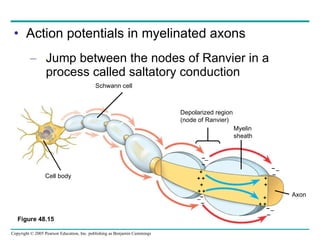
Action potentials in myelinated axons Jump between the nodes of Ranvier in a process called saltatory conduction Cell body Schwann cell Myelin  sheath Axon Depolarized region (node of Ranvier) + + + + + + + + + + + –   – –   – –   – – – – – – – Figure 48.15
Concept 48.4: Neurons communicate with other cells at synapses In an electrical synapse Electrical current flows directly from one cell to another via a gap junction The vast majority of synapses  Are chemical synapses
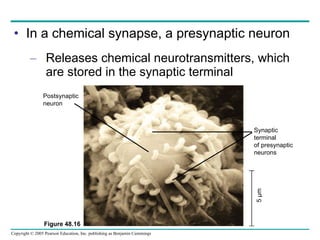
In a chemical synapse, a presynaptic neuron  Releases chemical neurotransmitters, which are stored in the synaptic terminal Figure 48.16 Postsynaptic neuron Synaptic terminal of presynaptic neurons 5 µm
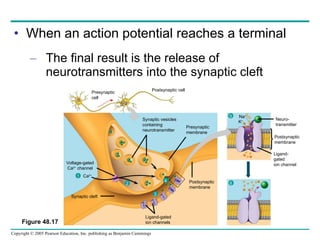
When an action potential reaches a terminal The final result is the release of neurotransmitters into the synaptic cleft Figure 48.17 Presynaptic cell Postsynaptic cell Synaptic vesicles containing neurotransmitter Presynaptic membrane Postsynaptic  membrane Voltage-gated Ca 2+  channel Synaptic cleft Ligand-gated ion channels Na + K + Ligand- gated ion channel Postsynaptic  membrane Neuro- transmitter 1 Ca 2+ 2 3 4 5 6
Direct Synaptic Transmission The process of direct synaptic transmission Involves the binding of neurotransmitters to ligand-gated ion channels
Neurotransmitter binding  Causes the ion channels to open, generating a postsynaptic potential
Postsynaptic potentials fall into two categories Excitatory postsynaptic potentials (EPSPs) Inhibitory postsynaptic potentials (IPSPs)
After its release, the neurotransmitter  Diffuses out of the synaptic cleft May be taken up by surrounding cells and degraded by enzymes
Summation of Postsynaptic Potentials Unlike action potentials Postsynaptic potentials are graded and do not regenerate themselves
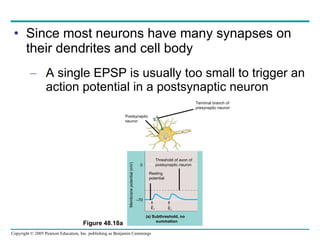
Since most neurons have many synapses on their dendrites and cell body A single EPSP is usually too small to trigger an action potential in a postsynaptic neuron Figure 48.18a E 1 E 1 Resting potential Threshold of axon of postsynaptic neuron (a) Subthreshold, no summation Terminal branch of  presynaptic neuron Postsynaptic  neuron E 1 0 – 70 Membrane potential (mV)
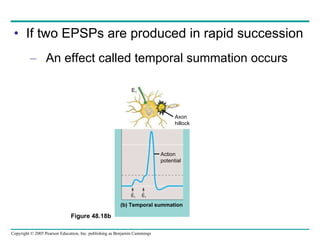
If two EPSPs are produced in rapid succession An effect called temporal summation occurs Figure 48.18b E 1 E 1 Action potential (b) Temporal summation E 1 Axon hillock
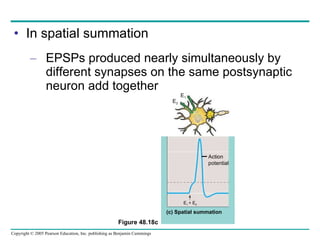
In spatial summation EPSPs produced nearly simultaneously by different synapses on the same postsynaptic neuron add together Figure 48.18c E 1  + E 2 Action potential (c) Spatial summation E 1 E 2
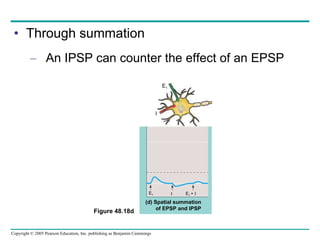
Through summation An IPSP can counter the effect of an EPSP Figure 48.18d E 1 E 1  +  I I (d) Spatial summation of EPSP and IPSP E 1 I
Indirect Synaptic Transmission In indirect synaptic transmission A neurotransmitter binds to a receptor that is not part of an ion channel This binding activates a signal transduction pathway Involving a second messenger in the postsynaptic cell, producing a slowly developing but long-lasting effect
Neurotransmitters The same neurotransmitter Can produce different effects in different types of cells
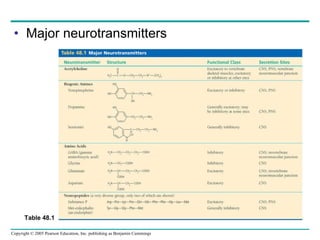
Major neurotransmitters Table 48.1
Acetylcholine Acetylcholine Is one of the most common neurotransmitters in both vertebrates and invertebrates Can be inhibitory or excitatory
Biogenic Amines Biogenic amines  Include epinephrine, norepinephrine, dopamine, and serotonin Are active in the CNS and PNS
Amino Acids and Peptides Various amino acids and peptides Are active in the brain
Gases Gases such as nitric oxide and carbon monoxide Are local regulators in the PNS
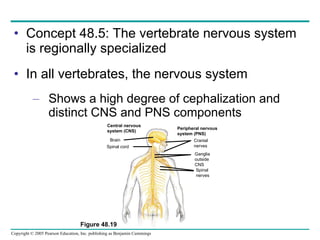
Concept 48.5: The vertebrate nervous system is regionally specialized In all vertebrates, the nervous system Shows a high degree of cephalization and distinct CNS and PNS components Figure 48.19 Central nervous system (CNS) Peripheral nervous system (PNS) Brain Spinal cord Cranial nerves Ganglia outside CNS Spinal nerves
The brain provides the integrative power That underlies the complex behavior of vertebrates The spinal cord integrates simple responses to certain kinds of stimuli And conveys information to and from the brain
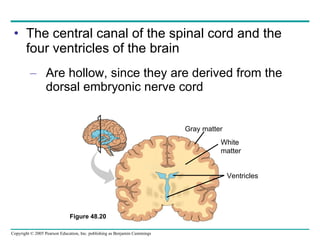
The central canal of the spinal cord and the four ventricles of the brain Are hollow, since they are derived from the dorsal embryonic nerve cord Gray matter White matter Ventricles Figure 48.20
The Peripheral Nervous System The PNS transmits information to and from the CNS And plays a large role in regulating a vertebrate’s movement and internal environment
The cranial nerves originate in the brain And terminate mostly in organs of the head and upper body The spinal nerves originate in the spinal cord And extend to parts of the body below the head
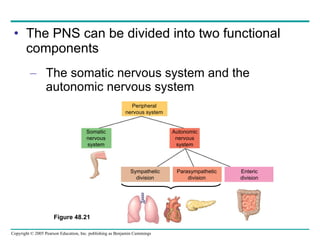
The PNS can be divided into two functional components The somatic nervous system and the autonomic nervous system Peripheral nervous system Somatic nervous system Autonomic nervous system Sympathetic division Parasympathetic division Enteric division Figure 48.21
The somatic nervous system Carries signals to skeletal muscles The autonomic nervous system Regulates the internal environment, in an involuntary manner Is divided into the sympathetic, parasympathetic, and enteric divisions
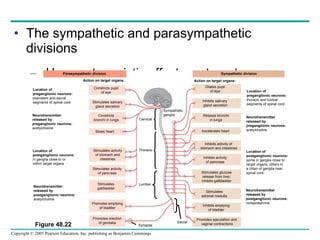
The sympathetic and parasympathetic divisions Have antagonistic effects on target organs Parasympathetic division Sympathetic division Action on target organs: Action on target organs: Location of preganglionic neurons: brainstem and sacral segments of spinal cord Neurotransmitter released by preganglionic neurons: acetylcholine Location of postganglionic neurons: in ganglia close to or within target organs Neurotransmitter released by postganglionic neurons: acetylcholine Constricts pupil of eye Stimulates salivary gland secretion Constricts bronchi in lungs Slows heart Stimulates activity of stomach and intestines Stimulates activity of pancreas Stimulates gallbladder Promotes emptying of bladder Promotes erection of genitalia Cervical Thoracic Lumbar Synapse Sympathetic ganglia Dilates pupil of eye Inhibits salivary  gland secretion Relaxes bronchi in lungs Accelerates heart Inhibits activity of  stomach and intestines Inhibits activity of pancreas Stimulates glucose release from liver; inhibits gallbladder Stimulates adrenal medulla Inhibits emptying of bladder Promotes ejaculation and  vaginal contractions Sacral Location of preganglionic neurons: thoracic and lumbar segments of spinal cord Neurotransmitter released by preganglionic neurons: acetylcholine Location of postganglionic neurons: some in ganglia close to target organs; others in a chain of ganglia near  spinal cord Neurotransmitter released by postganglionic neurons: norepinephrine Figure 48.22
The sympathetic division Correlates with the “fight-or-flight” response The parasympathetic division Promotes a return to self-maintenance functions The enteric division Controls the activity of the digestive tract, pancreas, and gallbladder
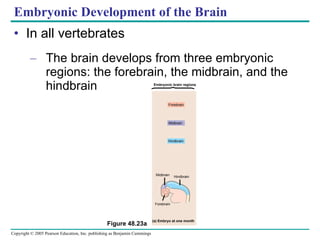
Embryonic Development of the Brain In all vertebrates The brain develops from three embryonic regions: the forebrain, the midbrain, and the hindbrain Figure 48.23a Embryonic brain regions Forebrain Midbrain Hindbrain Midbrain Hindbrain Forebrain (a) Embryo at one month
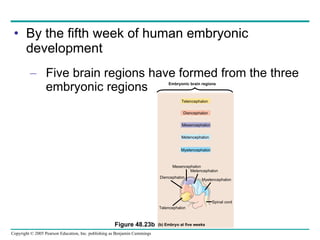
By the fifth week of human embryonic development Five brain regions have formed from the three embryonic regions Figure 48.23b Telencephalon Diencephalon Mesencephalon Metencephalon Myelencephalon (b) Embryo at five weeks Mesencephalon Metencephalon Myelencephalon Spinal cord Diencephalon Telencephalon Embryonic brain regions
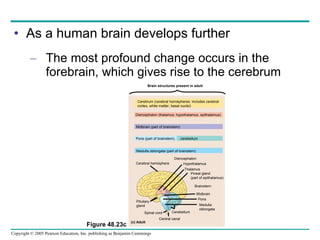
As a human brain develops further The most profound change occurs in the forebrain, which gives rise to the cerebrum Figure 48.23c Brain structures present in adult Cerebrum (cerebral hemispheres; includes cerebral cortex, white matter, basal nuclei) Diencephalon (thalamus, hypothalamus, epithalamus) Midbrain (part of brainstem) Pons (part of brainstem),  cerebellum Medulla oblongata (part of brainstem) (c) Adult Cerebral hemisphere Diencephalon: Hypothalamus Thalamus Pineal gland (part of epithalamus) Brainstem: Midbrain Pons Medulla oblongata Cerebellum Central canal Spinal cord Pituitary gland
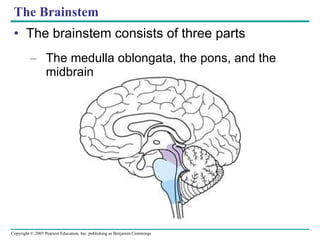
The Brainstem The brainstem consists of three parts The medulla oblongata, the pons, and the midbrain
The medulla oblongata Contains centers that control several visceral functions The pons Also participates in visceral functions The midbrain Contains centers for the receipt and integration of several types of sensory information
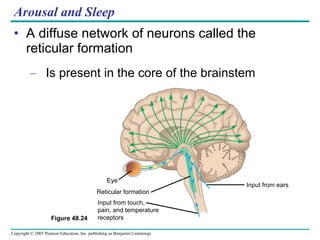
Arousal and Sleep A diffuse network of neurons called the reticular formation Is present in the core of the brainstem Figure 48.24 Eye Reticular formation Input from touch,  pain, and temperature  receptors Input from ears
A part of the reticular formation, the reticular activating system (RAS) Regulates sleep and arousal
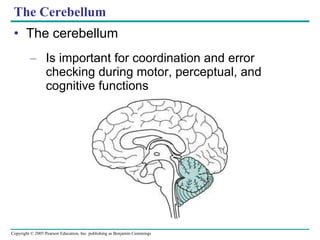
The Cerebellum The cerebellum Is important for coordination and error checking during motor, perceptual, and cognitive functions
The cerebellum  Is also involved in learning and remembering motor skills
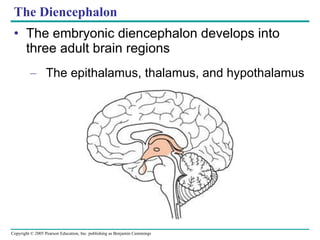
The Diencephalon The embryonic diencephalon develops into three adult brain regions The epithalamus, thalamus, and hypothalamus
The epithalamus Includes the pineal gland and the choroid plexus
The thalamus Is the main input center for sensory information going to the cerebrum and the main output center for motor information leaving the cerebrum
The hypothalamus regulates Homeostasis Basic survival behaviors such as feeding, fighting, fleeing, and reproducing
Circadian Rhythms The hypothalamus also regulates circadian rhythms Such as the sleep/wake cycle Animals usually have a biological clock Which is a pair of suprachiasmatic nuclei (SCN) found in the hypothalamus
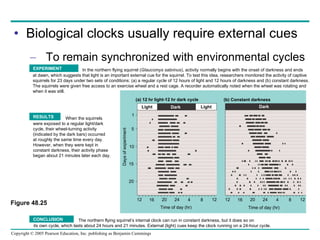
Biological clocks usually require external cues To remain synchronized with environmental cycles Figure 48.25 In the northern flying squirrel ( Glaucomys sabrinus ), activity normally begins with the onset of darkness and ends at dawn, which suggests that light is an important external cue for the squirrel. To test this idea, researchers monitored the activity of captive squirrels for 23 days under two sets of conditions: (a) a regular cycle of 12 hours of light and 12 hours of darkness and (b) constant darkness. The squirrels were given free access to an exercise wheel and a rest cage. A recorder automatically noted when the wheel was rotating and when it was still. EXPERIMENT Light Dark Light 20 15 10 5 1 (a) 12 hr light-12 hr dark cycle (b) Constant darkness 12 16 20 24 4 8 12 12 16 20 24 4 8 12 Time of day (hr) Time of day (hr) When the squirrels were exposed to a regular light/dark cycle, their wheel-turning activity  (indicated by the dark bars) occurred at roughly the same time every day. However, when they were kept in constant darkness, their activity phase began about 21 minutes later each day. RESULTS The northern flying squirrel’s internal clock can run in constant darkness, but it does so on its own cycle, which lasts about 24 hours and 21 minutes. External (light) cues keep the clock running on a 24-hour cycle. CONCLUSION Dark Days of experiment
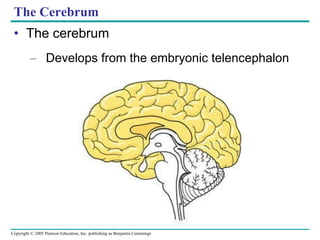
The Cerebrum The cerebrum  Develops from the embryonic telencephalon
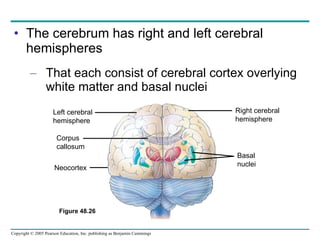
The cerebrum has right and left cerebral hemispheres That each consist of cerebral cortex overlying white matter and basal nuclei Left cerebral hemisphere Corpus callosum Neocortex Right cerebral hemisphere Basal nuclei Figure 48.26
The basal nuclei Are important centers for planning and learning movement sequences In mammals The cerebral cortex has a convoluted surface called the neocortex
In humans, the largest and most complex part of the brain  Is the cerebral cortex, where sensory information is analyzed, motor commands are issued, and language is generated
A thick band of axons, the corpus callosum Provides communication between the right and left cerebral cortices
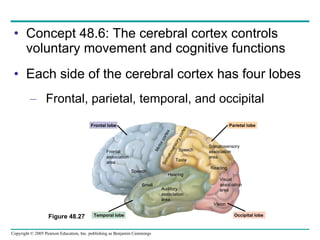
Concept 48.6: The cerebral cortex controls voluntary movement and cognitive functions Each side of the cerebral cortex has four lobes Frontal, parietal, temporal, and occipital Frontal lobe Temporal lobe Occipital lobe Parietal lobe Frontal association area Speech Smell Hearing Auditory association area Vision Visual association area Somatosensory association area Reading Speech Taste Somatosensory cortex Motor cortex Figure 48.27
Each of the lobes Contains primary sensory areas and association areas
Information Processing in the Cerebral Cortex Specific types of sensory input Enter the primary sensory areas Adjacent association areas Process particular features in the sensory input and integrate information from different sensory areas
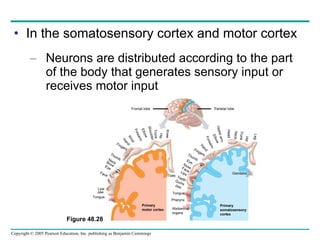
In the somatosensory cortex and motor cortex Neurons are distributed according to the part of the body that generates sensory input or receives motor input Figure 48.28  Tongue Jaw Lips Face Eye Brow Neck Thumb Fingers Hand Wrist Forearm Elbow Shoulder Trunk Hip Knee Primary motor cortex Abdominal organs Pharynx Tongue Teeth Gums Jaw Lips Face Nose Eye Fingers Hand Forearm Elbow Upper arm Trunk Hip Leg Thumb Neck Head Genitalia Primary somatosensory  cortex Toes Parietal lobe Frontal lobe
Lateralization of Cortical Function During brain development, in a process called lateralization Competing functions segregate and displace each other in the cortex of the left and right cerebral hemispheres
The left hemisphere Becomes more adept at language, math, logical operations, and the processing of serial sequences The right hemisphere Is stronger at pattern recognition, nonverbal thinking, and emotional processing
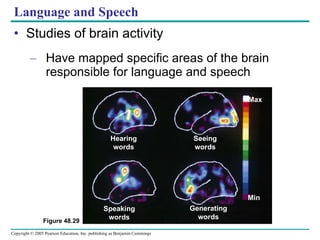
Language and Speech Studies of brain activity Have mapped specific areas of the brain responsible for language and speech Figure 48.29 Hearing words Seeing words Speaking words Generating words Max Min
Portions of the frontal lobe, Broca’s area and Wernicke’s area Are essential for the generation and understanding of language
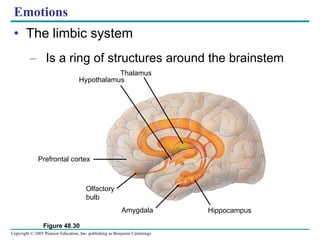
Emotions The limbic system  Is a ring of structures around the brainstem Figure 48.30 Hypothalamus Thalamus Prefrontal cortex Olfactory bulb Amygdala Hippocampus
This limbic system includes three parts of the cerebral cortex The amygdala, hippocampus, and olfactory bulb These structures interact with the neocortex to mediate primary emotions  And attach emotional “feelings” to survival-related functions
Structures of the limbic system form in early development And provide a foundation for emotional memory, associating emotions with particular events or experiences
Memory and Learning The frontal lobes Are a site of short-term memory Interact with the hippocampus and amygdala to consolidate long-term memory
Many sensory and motor association areas of the cerebral cortex Are involved in storing and retrieving words and images
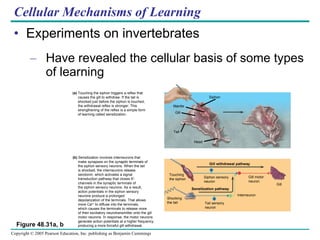
Cellular Mechanisms of Learning Experiments on invertebrates Have revealed the cellular basis of some types of learning Figure 48.31a, b (a)  Touching the siphon triggers a reflex that causes the gill to withdraw. If the tail is shocked just before the siphon is touched, the withdrawal reflex is stronger. This strengthening of the reflex is a simple form of learning called sensitization. (b)  Sensitization involves interneurons that make synapses on the  synaptic terminals  of the siphon sensory neurons. When the tail is shocked, the interneurons release serotonin, which activates a signal transduction pathway that closes K + channels in the synaptic terminals of the siphon sensory neurons. As a result, action potentials in the siphon sensory neurons produce a prolonged depolarization of the terminals. That allows more Ca 2+  to diffuse into the terminals,  which causes the terminals to release more  of their excitatory neurotransmitter onto the gill  motor neurons. In response, the motor neurons generate action potentials at a higher frequency, producing a more forceful gill withdrawal.  Siphon Mantle Gill Tail Head Gill withdrawal pathway Touching the siphon Shocking the tail Tail sensory neuron Interneuron Sensitization pathway Siphon sensory neuron Gill motor neuron Gill
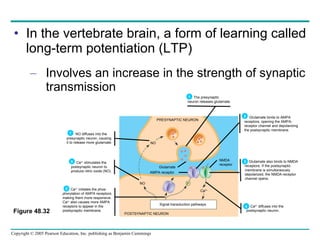
In the vertebrate brain, a form of learning called long-term potentiation (LTP) Involves an increase in the strength of synaptic transmission Figure 48.32  PRESYNAPTIC NEURON NO Glutamate NMDA receptor Signal transduction pathways NO Ca 2+ AMPA receptor POSTSYNAPTIC NEURON Ca 2+  initiates the phos- phorylation of AMPA receptors, making them more responsive. Ca 2+  also causes more AMPA receptors to appear in the postsynaptic membrane. 5 P Ca 2+  stimulates the postsynaptic neuron to produce nitric oxide (NO). 6 The presynaptic neuron releases glutamate. 1 Glutamate binds to AMPA receptors, opening the AMPA- receptor channel and depolarizing the postsynaptic membrane. 2 Glutamate also binds to NMDA receptors. If the postsynaptic membrane is simultaneously depolarized, the NMDA-receptor channel opens. 3 Ca 2+  diffuses into the postsynaptic neuron. 4 NO diffuses into the presynaptic neuron, causing  it to release more glutamate. 7
Consciousness Modern brain-imaging techniques  Suggest that consciousness may be an emergent property of the brain that is based on activity in many areas of the cortex
Concept 48.7: CNS injuries and diseases are the focus of much research Unlike the PNS, the mammalian CNS Cannot repair itself when damaged or assaulted by disease Current research on nerve cell development and stem cells May one day make it possible for physicians to repair or replace damaged neurons
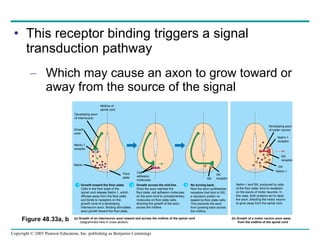
Nerve Cell Development Signal molecules direct an axon’s growth  By binding to receptors on the plasma membrane of the growth cone
This receptor binding triggers a signal transduction pathway Which may cause an axon to grow toward or away from the source of the signal Figure 48.33a, b Midline of spinal cord Developing axon of interneuron Growth cone Netrin-1 receptor Netrin-1 Floor plate Cell adhesion molecules Slit receptor Slit Developing axon  of motor neuron Netrin-1 receptor Slit receptor Slit Netrin-1 1   Growth toward the floor plate. Cells in the floor plate of the spinal cord release Netrin-1, which diffuses away from the floor plate and binds to receptors on the growth cone of a developing interneuron axon. Binding stimulates axon growth toward the floor plate. 2 Growth across the mid-line. Once the axon reaches the floor plate, cell adhesion molecules on the axon bind to complementary molecules on floor plate cells, directing the growth of the axon across the midline. 3   No turning back.   Now the axon synthesizes  receptors that bind to Slit, a repulsion protein re- leased by floor plate cells. This prevents the axon from growing back across the midline. Netrin-1 and Slit, produced by cells of the floor plate, bind to receptors on the axons of motor neurons. In this case, both proteins act to repel the axon, directing the motor neuron to grow away from the spinal cord. (a) Growth of an interneuron axon toward and across the midline of the spinal cord (diagrammed here in cross section) (b) Growth of a motor neuron axon away from the midline of the spinal cord
The genes and basic events involved in axon guidance Are similar in invertebrates and vertebrates Knowledge of these events may be applied one day To stimulate axonal regrowth following CNS damage
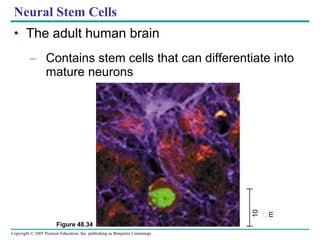
Neural Stem Cells The adult human brain Contains stem cells that can differentiate into mature neurons Figure 48.34 10 m
The induction of stem cell differentiation and the transplantation of cultured stem cells Are potential methods for replacing neurons lost to trauma or disease
Diseases and Disorders of the Nervous System Mental illnesses and neurological disorders Take an enormous toll on society, in both the patient’s loss of a productive life and the high cost of long-term health care
Schizophrenia About 1% of the world’s population Suffers from schizophrenia
Schizophrenia is characterized by Hallucinations, delusions, blunted emotions, and many other symptoms Available treatments have focused on Brain pathways that use dopamine as a neurotransmitter
Depression Two broad forms of depressive illness are known Bipolar disorder and major depression
Bipolar disorder is characterized by Manic (high-mood) and depressive (low-mood) phases In major depression Patients have a persistent low mood
Treatments for these types of depression include A variety of drugs such as Prozac and lithium
Alzheimer’s Disease Alzheimer’s disease (AD) Is a mental deterioration characterized by confusion, memory loss, and other symptoms
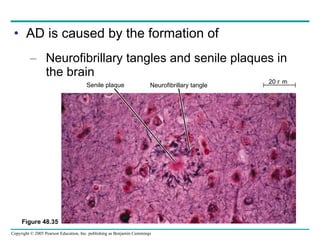
AD is caused by the formation of Neurofibrillary tangles and senile plaques in the brain Figure 48.35 Senile plaque Neurofibrillary tangle 20 m
A successful treatment for AD in humans May hinge on early detection of senile plaques
Parkinson’s Disease Parkinson’s disease is a motor disorder Caused by the death of dopamine-secreting neurons in the substantia nigra Characterized by difficulty in initiating movements, slowness of movement, and rigidity
There is no cure for Parkinson’s disease Although various approaches are used to manage the symptoms
Chapter 49 Sensory and Motor Mechanisms
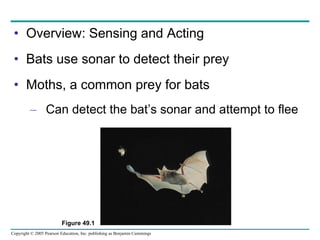
Overview: Sensing and Acting Bats use sonar to detect their prey Moths, a common prey for bats Can detect the bat’s sonar and attempt to flee Figure 49.1
Both of these organisms Have complex sensory systems that facilitate their survival The structures that make up these systems Have been transformed by evolution into diverse mechanisms that sense various stimuli and generate the appropriate physical movement
Concept 49.1: Sensory receptors transduce stimulus energy and transmit signals to the central nervous system Sensations are action potentials That reach the brain via sensory neurons Once the brain is aware of sensations It interprets them, giving the perception of stimuli
Sensations and perceptions Begin with sensory reception, the detection of stimuli by sensory receptors Exteroreceptors Detect stimuli coming from the outside of the body Interoreceptors Detect internal stimuli
Functions Performed by Sensory Receptors All stimuli represent forms of energy Sensation involves converting this energy Into a change in the membrane potential of sensory receptors
Sensory receptors perform four functions in this process Sensory transduction, amplification, transmission, and integration
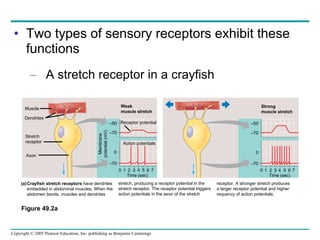
Two types of sensory receptors exhibit these functions A stretch receptor in a crayfish Figure 49.2a (a) Crayfish stretch receptors  have dendrites embedded in abdominal muscles. When the abdomen bends, muscles and dendrites stretch, producing a receptor potential in the stretch receptor. The receptor potential triggers action potentials in the axon of the stretch receptor. A stronger stretch produces a larger receptor potential and higher requency of action potentials.  Muscle Dendrites Stretch receptor Axon Membrane potential (mV) – 50 – 70 0 – 70 0 1 2 3 4 5 6 7 Time (sec) Action potentials Receptor potential Weak muscle stretch – 50 – 70 0 – 70 0 1 2 3 4 5 6 7 Time (sec) Strong muscle stretch
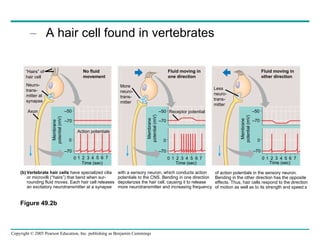
A hair cell found in vertebrates of action potentials in the sensory neuron. Bending in the other direction has the opposite effects. Thus, hair cells respond to the direction of motion as well as to its strength and speed.s (b) Vertebrate hair cells  have specialized cilia or microvilli (“hairs”) that bend when sur-rounding fluid moves. Each hair cell releases an excitatory neurotransmitter at a synapse with a sensory neuron, which conducts action potentials to the CNS. Bending in one direction depolarizes the hair cell, causing it to release more neurotransmitter and increasing frequency – 50 – 70 0 – 70 0 1 2 3 4 5 6 7 Time (sec) Action potentials No fluid movement – 50 – 70 0 – 70 0 1 2 3 4 5 6 7 Time (sec) Receptor potential Fluid moving in one direction – 50 – 70 0 – 70 0 1 2 3 4 5 6 7 Time (sec) Fluid moving in  other direction Membrane potential (mV) Membrane potential (mV) Membrane potential (mV) “ Hairs” of hair cell Neuro- trans- mitter at  synapse Axon Less neuro- trans- mitter More neuro- trans- mitter Figure 49.2b
Sensory Transduction Sensory transduction is the conversion of stimulus energy Into a change in the membrane potential of a sensory receptor This change in the membrane potential Is known as a receptor potential
Many sensory receptors are extremely sensitive With the ability to detect the smallest physical unit of stimulus possible
Amplification Amplification is the strengthening of stimulus energy By cells in sensory pathways
Transmission After energy in a stimulus has been transduced into a receptor potential Some sensory cells generate action potentials, which are transmitted to the CNS
Sensory cells without axons  Release neurotransmitters at synapses with sensory neurons
Integration The integration of sensory information Begins as soon as the information is received Occurs at all levels of the nervous system
Some receptor potentials Are integrated through summation Another type of integration is sensory adaptation A decrease in responsiveness during continued stimulation
Types of Sensory Receptors Based on the energy they transduce, sensory receptors fall into five categories Mechanoreceptors Chemoreceptors Electromagnetic receptors Thermoreceptors Pain receptors
Mechanoreceptors Mechanoreceptors sense physical deformation Caused by stimuli such as pressure, stretch, motion, and sound
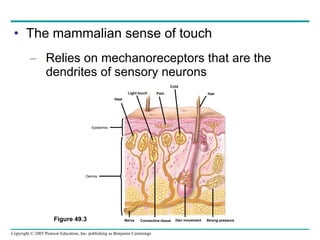
The mammalian sense of touch Relies on mechanoreceptors that are the dendrites of sensory neurons Figure 49.3 Heat Light touch Pain Cold Hair Nerve Connective tissue Hair movement Strong pressure Dermis Epidermis
Chemoreceptors Chemoreceptors include General receptors that transmit information about the total solute concentration of a solution Specific receptors that respond to individual kinds of molecules
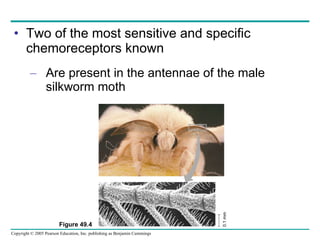
Two of the most sensitive and specific chemoreceptors known Are present in the antennae of the male silkworm moth Figure 49.4 0.1 mm
Electromagnetic Receptors Electromagnetic receptors detect various forms of electromagnetic energy Such as visible light, electricity, and magnetism
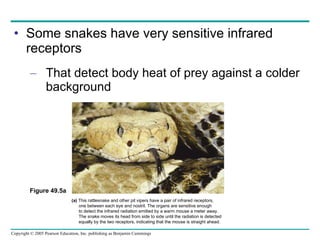
Some snakes have very sensitive infrared receptors That detect body heat of prey against a colder background Figure 49.5a (a)  This rattlesnake and other pit vipers have a pair of infrared receptors, one between each eye and nostril. The organs are sensitive enough to detect the infrared radiation emitted by a warm mouse a meter away.  The snake moves its head from side to side until the radiation is detected  equally by the two receptors, indicating that the mouse is straight ahead.
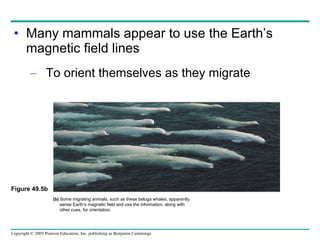
Many mammals appear to use the Earth’s magnetic field lines To orient themselves as they migrate Figure 49.5b (b)  Some migrating animals, such as these beluga whales, apparently sense Earth’s magnetic field and use the information, along with  other cues, for orientation.
Thermoreceptors Thermoreceptors, which respond to heat or cold Help regulate body temperature by signaling both surface and body core temperature
Pain Receptors In humans, pain receptors, also called nociceptors Are a class of naked dendrites in the epidermis Respond to excess heat, pressure, or specific classes of chemicals released from damaged or inflamed tissues
Concept 49.2: The mechanoreceptors involved with hearing and equilibrium detect settling particles or moving fluid Hearing and the perception of body equilibrium Are related in most animals
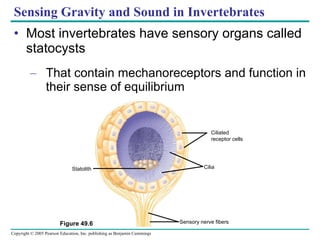
Sensing Gravity and Sound in Invertebrates Most invertebrates have sensory organs called statocysts That contain mechanoreceptors and function in their sense of equilibrium Figure 49.6 Ciliated receptor cells Cilia Statolith Sensory nerve fibers
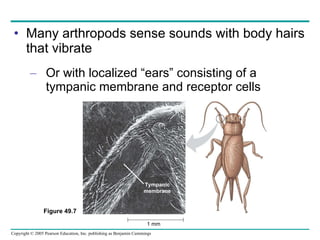
Many arthropods sense sounds with body hairs that vibrate Or with localized “ears” consisting of a tympanic membrane and receptor cells Figure 49.7 1 mm Tympanic membrane
Hearing and Equilibrium in Mammals In most terrestrial vertebrates The sensory organs for hearing and equilibrium are closely associated in the ear
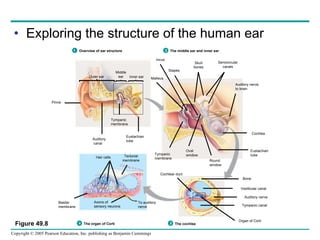
Exploring the structure of the human ear Figure 49.8 Pinna Auditory  canal Eustachian  tube Tympanic membrane Stapes Incus Malleus Skull bones Semicircular canals Auditory nerve, to brain Cochlea Tympanic membrane Oval window Eustachian  tube Round window Vestibular canal Tympanic canal Auditory nerve Bone Cochlear duct Hair cells Tectorial membrane Basilar membrane To auditory nerve Axons of  sensory neurons 1 Overview of ear structure 2 The middle ear and inner ear 4 The organ of Corti 3 The cochlea Organ of Corti Outer ear Middle ear Inner ear
Hearing Vibrating objects create percussion waves in the air That cause the tympanic membrane to vibrate The three bones of the middle ear Transmit the vibrations to the oval window on the cochlea
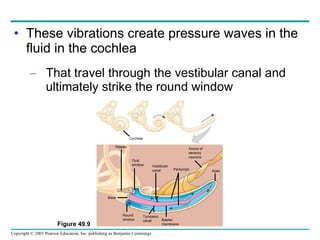
These vibrations create pressure waves in the fluid in the cochlea That travel through the vestibular canal and ultimately strike the round window Figure 49.9 Cochlea Stapes Oval  window Apex Axons of sensory neurons Round window Basilar  membrane Tympanic canal Base Vestibular canal Perilymph
The pressure waves in the vestibular canal  Cause the basilar membrane to vibrate up and down causing its hair cells to bend The bending of the hair cells depolarizes their membranes Sending action potentials that travel via the auditory nerve to the brain
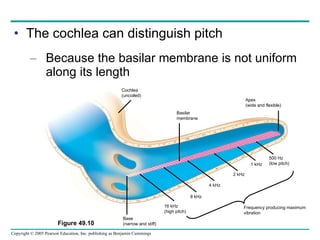
The cochlea can distinguish pitch Because the basilar membrane is not uniform along its length Figure 49.10 Cochlea (uncoiled) Basilar membrane Apex (wide and flexible) Base (narrow and stiff) 500 Hz (low pitch) 1 kHz 2 kHz 4 kHz 8 kHz 16 kHz (high pitch) Frequency producing maximum vibration
Each region of the basilar membrane vibrates most vigorously At a particular frequency and leads to excitation of a specific auditory area of the cerebral cortex
Equilibrium Several of the organs of the inner ear Detect body position and balance
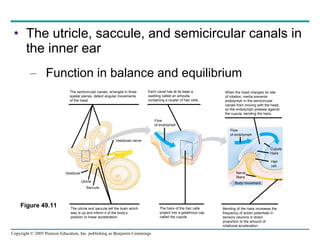
The utricle, saccule, and semicircular canals in the inner ear Function in balance and equilibrium Figure 49.11 The semicircular canals, arranged in three spatial planes, detect angular movements of the head. Body movement Nerve fibers Each canal has at its base a  swelling called an ampulla, containing a cluster of hair cells. When the head changes its rate of rotation, inertia prevents endolymph in the semicircular canals from moving with the head, so the endolymph presses against the cupula, bending the hairs. The utricle and saccule tell the brain which way is up and inform it of the body’s position or linear acceleration. The hairs of the hair cells project into a gelatinous cap called the cupula. Bending of the hairs increases the frequency of action potentials in sensory neurons in direct proportion to the amount of rotational acceleration. Vestibule Utricle Saccule Vestibular nerve Flow of endolymph Flow of endolymph Cupula Hairs Hair cell
Hearing and Equilibrium in Other Vertebrates Like other vertebrates, fishes and amphibians Also have inner ears located near the brain
Most fishes and aquatic amphibians Also have a lateral line system along both sides of their body
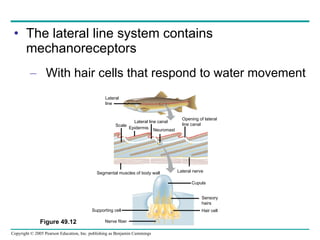
The lateral line system contains mechanoreceptors With hair cells that respond to water movement Figure 49.12 Nerve fiber Supporting cell Cupula Sensory hairs Hair cell Segmental muscles of body wall Lateral nerve Scale Epidermis Lateral line canal Neuromast Opening of lateral line canal Lateral line
Concept 49.3: The senses of taste and smell are closely related in most animals The perceptions of gustation (taste) and olfaction (smell) Are both dependent on chemoreceptors that detect specific chemicals in the environment
The taste receptors of insects are located within sensory hairs called sensilla Which are located on the feet and in mouthparts
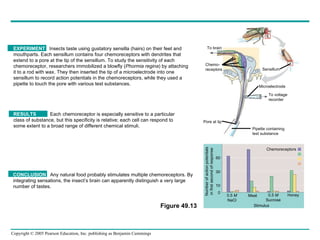
Figure 49.13 EXPERIMENT   Insects taste using gustatory sensilla (hairs) on their feet and mouthparts. Each sensillum contains four chemoreceptors with dendrites that extend to a pore at the tip of the sensillum. To study the sensitivity of each chemoreceptor, researchers immobilized a blowfly ( Phormia regina ) by attaching it to a rod with wax. They then inserted the tip of a microelectrode into one sensillum to record action potentials in the chemoreceptors, while they used a pipette to touch the pore with various test substances. Number of action potentials in first second of response CONCLUSION   Any natural food probably stimulates multiple chemoreceptors. By integrating sensations, the insect’s brain can apparently distinguish a very large  number of tastes. To brain Chemo- receptors Pore at tip Pipette containing test substance To voltage recorder Sensillum Microelectrode 50 30 10 0 0.5  M NaCl Meat 0.5  M Sucrose Honey Stimulus Chemoreceptors RESULTS   Each chemoreceptor is especially sensitive to a particular class of substance, but this specificity is relative; each cell can respond to some extent to a broad range of different chemical stimuli.
Taste in Humans The receptor cells for taste in humans Are modified epithelial cells organized into taste buds Five taste perceptions involve several signal transduction mechanisms Sweet, sour, salty, bitter, and umami (elicited by glutamate)
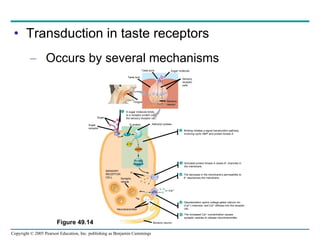
Transduction in taste receptors Occurs by several mechanisms Figure 49.14 Taste pore Sugar molecule Sensory receptor cells Sensory neuron Taste bud Tongue G protein Adenylyl cyclase — Ca 2 + ATP cAMP Protein kinase A Sugar Sugar receptor SENSORY RECEPTOR CELL Synaptic vesicle K + Neurotransmitter Sensory neuron 4 The decrease in the membrane’s permeability to K +  depolarizes the membrane. 5 Depolarization opens voltage-gated calcium ion (Ca 2+ ) channels, and Ca 2+  diffuses into the receptor cell. 6 The increased Ca 2+  concentration causes  synaptic vesicles to release neurotransmitter. 3 Activated protein kinase A closes K +  channels in the membrane. 2 Binding initiates a signal transduction pathway involving cyclic AMP and protein kinase A. 1 A sugar molecule binds  to a receptor protein on  the sensory receptor cell.
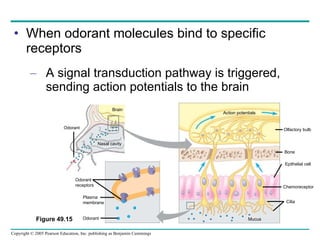
Smell in Humans Olfactory receptor cells Are neurons that line the upper portion of the nasal cavity
When odorant molecules bind to specific receptors A signal transduction pathway is triggered, sending action potentials to the brain Brain Nasal cavity Odorant Odorant receptors Plasma membrane Odorant Cilia Chemoreceptor Epithelial cell Bone Olfactory bulb Action potentials Mucus Figure 49.15
Concept 49.4: Similar mechanisms underlie vision throughout the animal kingdom Many types of light detectors Have evolved in the animal kingdom and may be homologous
Vision in Invertebrates Most invertebrates Have some sort of light-detecting organ
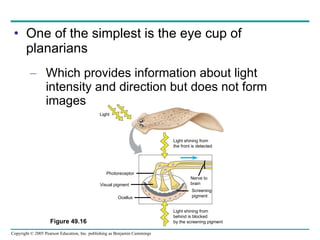
One of the simplest is the eye cup of planarians Which provides information about light intensity and direction but does not form images Figure 49.16 Light Light shining from  the front is detected Photoreceptor Visual pigment Ocellus Nerve to  brain Screening  pigment Light shining from  behind is blocked by the screening pigment
Two major types of image-forming eyes have evolved in invertebrates The compound eye and the single-lens eye
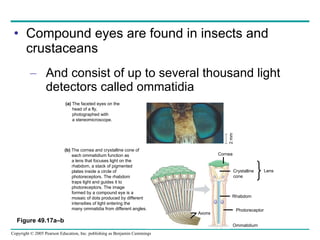
Compound eyes are found in insects and crustaceans And consist of up to several thousand light detectors called ommatidia Figure 49.17a–b Cornea Crystalline cone Rhabdom Photoreceptor Axons Ommatidium Lens 2 mm (a)  The faceted eyes on the  head of a fly, photographed with  a stereomicroscope.  (b)  The cornea and crystalline cone of  each ommatidium function as  a lens that focuses light on the  rhabdom, a stack of pigmented  plates inside a circle of  photoreceptors. The rhabdom  traps light and guides it to  photoreceptors. The image  formed by a compound eye is a  mosaic of dots produced by different  intensities of light entering the  many ommatidia from different angles.
Single-lens eyes Are found in some jellies, polychaetes, spiders, and many molluscs Work on a camera-like principle
The Vertebrate Visual System The eyes of vertebrates are camera-like But they evolved independently and differ from the single-lens eyes of invertebrates
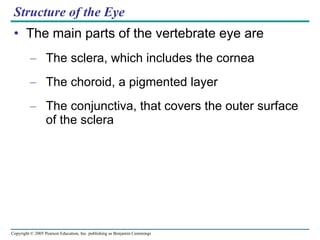
Structure of the Eye The main parts of the vertebrate eye are The sclera, which includes the cornea The choroid, a pigmented layer The conjunctiva, that covers the outer surface of the sclera
The iris, which regulates the pupil The retina, which contains photoreceptors The lens, which focuses light on the retina
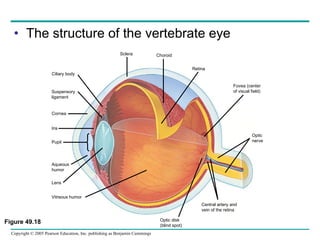
The structure of the vertebrate eye Figure 49.18 Ciliary body Iris Suspensory ligament Cornea Pupil Aqueous humor Lens Vitreous humor Optic disk (blind spot) Central artery and vein of the retina Optic nerve Fovea (center of visual field) Retina Choroid Sclera
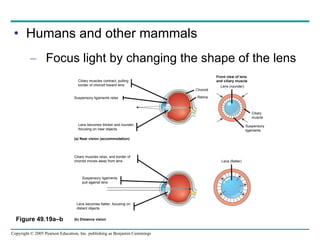
Humans and other mammals Focus light by changing the shape of the lens Figure 49.19a–b Lens (flatter) Lens (rounder) Ciliary muscle Suspensory ligaments Choroid Retina Front view of lens and ciliary muscle Ciliary muscles contract, pulling border of choroid toward lens Suspensory ligaments relax Lens becomes thicker and rounder, focusing on near objects (a) Near vision (accommodation) (b) Distance vision Ciliary muscles relax, and border of choroid moves away from lens Suspensory ligaments pull against lens Lens becomes flatter, focusing on distant objects
The human retina contains two types of photoreceptors Rods are sensitive to light but do not distinguish colors Cones distinguish colors but are not as sensitive
Sensory Transduction in the Eye Each rod or cone in the vertebrate retina Contains visual pigments that consist of a light-absorbing molecule called retinal bonded to a protein called opsin
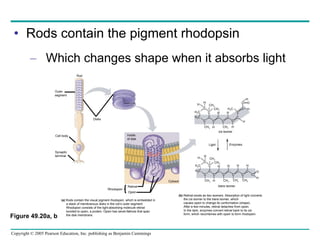
Rods contain the pigment rhodopsin Which changes shape when it absorbs light Figure 49.20a, b Rod Outer segment Cell body Synaptic terminal Disks Inside of disk (a)  Rods contain the visual pigment rhodopsin, which is embedded in a stack of membranous disks in the rod’s outer segment. Rhodopsin consists of the light-absorbing molecule retinal bonded to opsin, a protein. Opsin has seven  helices that span the disk membrane. (b)  Retinal exists as two isomers. Absorption of light converts the  cis  isomer to the  trans  isomer, which  causes opsin to change its conformation (shape).  After a few minutes, retinal detaches from opsin.  In the dark, enzymes convert retinal back to its  cis  form, which recombines with opsin to form rhodopsin. Retinal Opsin Rhodopsin Cytosol H C C H 2 C C H 2 C C H CH 3 CH 3 H C C CH 3 H CH 3 C C C C C C C H H H H O H H 3 C H C C H 2 C C H 2 C C H CH 3 CH 3 H C C CH 3 H CH 3 C C C C H H CH 3 H C C C H O CH 3 trans  isomer cis  isomer Enzymes Light
Processing Visual Information The processing of visual information Begins in the retina itself
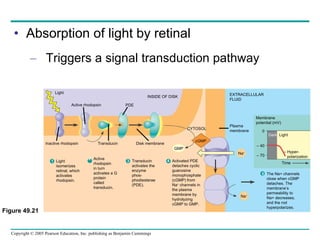
Absorption of light by retinal Triggers a signal transduction pathway Figure 49.21 EXTRACELLULAR FLUID Membrane potential (mV) 0 –  40 – 70 Dark   Light –  Hyper-   polarization Time Na + Na + cGMP CYTOSOL GMP Plasma membrane INSIDE OF DISK PDE Active rhodopsin Light Inactive rhodopsin Transducin Disk membrane 2 Active rhodopsin  in turn activates a G protein called transducin. 3 Transducin activates the enzyme phos-phodiesterae(PDE). 4 Activated PDE detaches cyclic guanosine monophosphate (cGMP) from  Na +  channels in  the plasma membrane by hydrolyzing  cGMP to GMP. 5 The Na+ channels close when cGMP detaches. The membrane’s permeability to  Na+ decreases, and the rod hyperpolarizes. 1 Light isomerizes retinal, which activates rhodopsin.
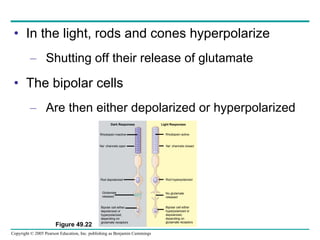
In the dark, both rods and cones Release the neurotransmitter glutamate into the synapses with neurons called bipolar cells, which are either hyperpolarized or depolarized
In the light, rods and cones hyperpolarize Shutting off their release of glutamate The bipolar cells Are then either depolarized or hyperpolarized Figure 49.22 Dark Responses Rhodopsin inactive Na +  channels open Rod depolarized Glutamate released Bipolar cell either depolarized or hyperpolarized, depending on glutamate receptors Light Responses Rhodopsin active Na +  channels closed Rod hyperpolarized No glutamate released Bipolar cell either hyperpolarized or depolarized, depending on glutamate receptors
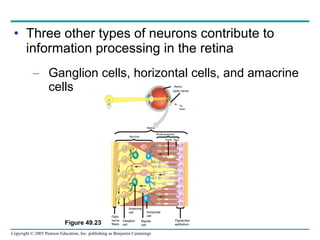
Three other types of neurons contribute to information processing in the retina Ganglion cells, horizontal cells, and amacrine cells Figure 49.23 Optic nerve fibers Ganglion cell Bipolar cell Horizontal cell Amacrine cell Pigmented epithelium Neurons Cone Rod Photoreceptors Retina Retina Optic nerve To brain
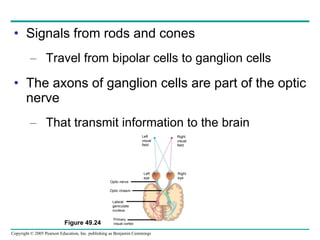
Signals from rods and cones Travel from bipolar cells to ganglion cells The axons of ganglion cells are part of the optic nerve That transmit information to the brain Figure 49.24 Left visual field Right visual field Left eye Right eye Optic nerve Optic chiasm Lateral geniculate nucleus Primary visual cortex
Most ganglion cell axons lead to the lateral geniculate nuclei of the thalamus Which relays information to the primary visual cortex Several integrating centers in the cerebral cortex Are active in creating visual perceptions
Concept 49.5: Animal skeletons function in support, protection, and movement The various types of animal movements All result from muscles working against some type of skeleton
Types of Skeletons The three main functions of a skeleton are Support, protection, and movement The three main types of skeletons are Hydrostatic skeletons, exoskeletons, and endoskeletons
Hydrostatic Skeletons A hydrostatic skeleton Consists of fluid held under pressure in a closed body compartment This is the main type of skeleton In most cnidarians, flatworms, nematodes, and annelids
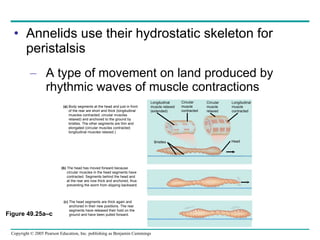
Annelids use their hydrostatic skeleton for peristalsis A type of movement on land produced by rhythmic waves of muscle contractions Figure 49.25a–c (a)  Body segments at the head and just in front of the rear are short and thick (longitudinal muscles contracted; circular muscles relaxed) and anchored to the ground by bristles. The other segments are thin and elongated (circular muscles contracted; longitudinal muscles relaxed.) (b)  The head has moved forward because circular muscles in the head segments have contracted. Segments behind the head and at the rear are now thick and anchored, thus preventing the worm from slipping backward. (c)  The head segments are thick again and anchored in their new positions. The rear segments have released their hold on the  ground and have been pulled forward. Longitudinal muscle relaxed (extended) Circular muscle contracted Circular muscle relaxed Longitudinal muscle contracted Head Bristles
Exoskeletons An exoskeleton is a hard encasement Deposited on the surface of an animal Exoskeletons Are found in most molluscs and arthropods
Endoskeletons An endoskeleton consists of hard supporting elements Such as bones, buried within the soft tissue of an animal Endoskeletons Are found in sponges, echinoderms, and chordates
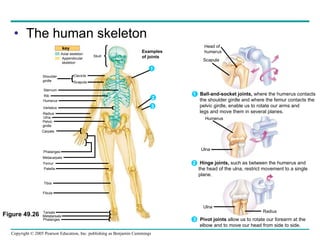
The mammalian skeleton is built from more than 200 bones Some fused together and others connected at joints by ligaments that allow freedom of movement
The human skeleton Figure 49.26 1   Ball-and-socket joints,  where the humerus contacts the shoulder girdle and where the femur contacts the pelvic girdle, enable us to rotate our arms and legs and move them in several planes. 2   Hinge joints,  such as between the humerus and the head of the ulna, restrict movement to a single plane. 3   Pivot joints  allow us to rotate our forearm at the elbow and to move our head from side to side. key Axial skeleton Appendicular skeleton Skull Shoulder girdle Clavicle Scapula Sternum Rib Humerus Vertebra Radius Ulna Pelvic girdle Carpals Phalanges Metacarpals Femur Patella Tibia Fibula Tarsals Metatarsals Phalanges 1 Examples of joints 2 3 Head of humerus Scapula Humerus Ulna Ulna Radius
Physical Support on Land In addition to the skeleton Muscles and tendons help support large land vertebrates
Concept 49.6: Muscles move skeletal parts by contracting The action of a muscle Is always to contract
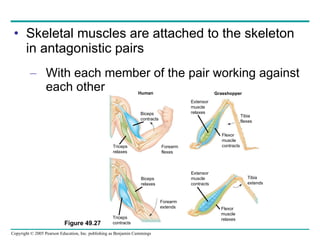
Skeletal muscles are attached to the skeleton in antagonistic pairs With each member of the pair working against each other Figure 49.27 Human Grasshopper Biceps contracts Triceps relaxes Forearm flexes Biceps relaxes Triceps contracts Forearm extends Extensor muscle relaxes Flexor muscle contracts Tibia flexes Extensor muscle contracts Flexor muscle relaxes Tibia extends
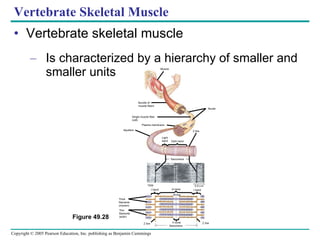
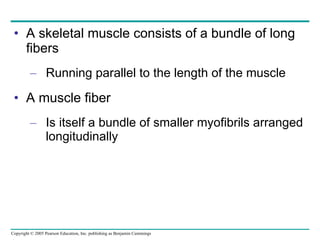
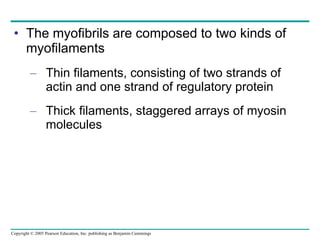
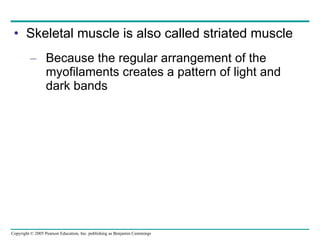
Vertebrate Skeletal Muscle Vertebrate skeletal muscle Is characterized by a hierarchy of smaller and smaller units Figure 49.28 Muscle Bundle of muscle fibers Single muscle fiber (cell) Plasma membrane Myofibril Light band Dark band Z line Sarcomere TEM 0.5 m I  band A band I  band M line Thick filaments (myosin) Thin filaments (actin) H zone Sarcomere Z line Z line Nuclei
A skeletal muscle consists of a bundle of long fibers Running parallel to the length of the muscle A muscle fiber Is itself a bundle of smaller myofibrils arranged longitudinally
The myofibrils are composed to two kinds of myofilaments Thin filaments, consisting of two strands of actin and one strand of regulatory protein Thick filaments, staggered arrays of myosin molecules
Skeletal muscle is also called striated muscle Because the regular arrangement of the myofilaments creates a pattern of light and dark bands
Each repeating unit is a sarcomere Bordered by Z lines The areas that contain the myofilments Are the I band, A band, and H zone
The Sliding-Filament Model of Muscle Contraction According to the sliding-filament model of muscle contraction The filaments slide past each other longitudinally, producing more overlap between the thin and thick filaments
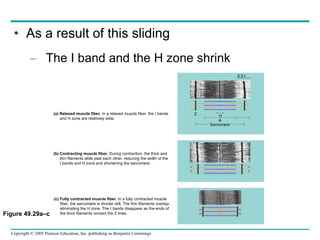
As a result of this sliding The I band and the H zone shrink Figure 49.29a–c (a) Relaxed muscle fiber.  In a relaxed muscle fiber, the  I  bands and H zone are relatively wide. (b) Contracting muscle fiber.  During contraction, the thick and thin filaments slide past each other, reducing the width of the I  bands and H zone and shortening the sarcomere. (c) Fully contracted muscle fiber.  In a fully contracted muscle fiber, the sarcomere is shorter still. The thin filaments overlap, eliminating the H zone. The  I  bands disappear as the ends of the thick filaments contact the Z lines. 0.5 m Z H A Sarcomere
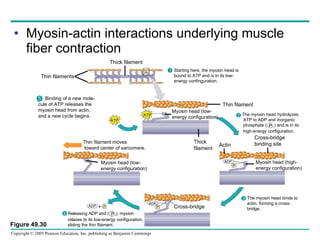
The sliding of filaments is based on The interaction between the actin and myosin molecules of the thick and thin filaments The “head” of a myosin molecule binds to an actin filament Forming a cross-bridge and pulling the thin filament toward the center of the sarcomere
Myosin-actin interactions underlying muscle fiber contraction Figure 49.30 Thick filament Thin filaments Thin filament ATP ATP ADP ADP ADP P  i P  i P  i Cross-bridge Myosin head (low- energy configuration) Myosin head (high- energy configuration) + Myosin head (low- energy configuration) Thin filament moves  toward center of sarcomere. Thick  filament Actin Cross-bridge  binding site 1 Starting here, the myosin head is bound to ATP and is in its low-energy confinguration. 2 The myosin head hydrolyzes  ATP to ADP and inorganic  phosphate (  I  ) and is in its  high-energy configuration.  P 1 The myosin head binds to actin, forming a cross- bridge.  3 4 Releasing ADP and (  i ), myosin relaxes to its low-energy configuration,  sliding the thin filament. P 5   Binding of a new mole- cule of ATP releases the  myosin head from actin, and a new cycle begins.
The Role of Calcium and Regulatory Proteins A skeletal muscle fiber contracts Only when stimulated by a motor neuron
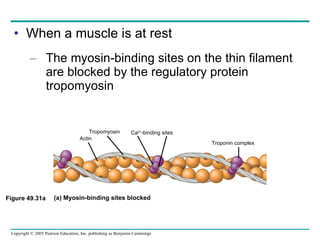
When a muscle is at rest The myosin-binding sites on the thin filament are blocked by the regulatory protein tropomyosin Figure 49.31a Actin Tropomyosin Ca 2+ -binding sites Troponin complex (a) Myosin-binding sites blocked
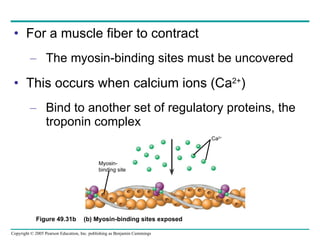
For a muscle fiber to contract The myosin-binding sites must be uncovered This occurs when calcium ions (Ca 2+ ) Bind to another set of regulatory proteins, the troponin complex Figure 49.31b Ca 2+ Myosin- binding site (b) Myosin-binding sites exposed
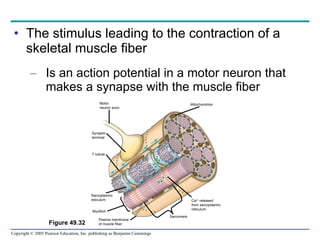
The stimulus leading to the contraction of a skeletal muscle fiber Is an action potential in a motor neuron that makes a synapse with the muscle fiber Figure 49.32 Motor neuron axon Mitochondrion Synaptic terminal T tubule Sarcoplasmic reticulum Myofibril Plasma membrane of muscle fiber Sarcomere Ca 2+  released from sarcoplasmic reticulum
The synaptic terminal of the motor neuron Releases the neurotransmitter acetylcholine, depolarizing the muscle and causing it to produce an action potential
Action potentials travel to the interior of the muscle fiber Along infoldings of the plasma membrane called transverse (T) tubules The action potential along the T tubules Causes the sarcoplasmic reticulum to release Ca 2+ The Ca 2+  binds to the troponin-tropomyosin complex on the thin filaments Exposing the myosin-binding sites and allowing the cross-bridge cycle to proceed
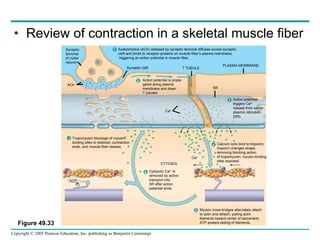
Review of contraction in a skeletal muscle fiber Figure 49.33 ACh Synaptic terminal of motor neuron Synaptic cleft T TUBULE PLASMA MEMBRANE SR ADP CYTOSOL Ca 2 Ca 2 P 2 Cytosolic Ca 2+  is  removed by active  transport into  SR after action  potential ends. 6 Acetylcholine (ACh) released by synaptic terminal diffuses across synaptic cleft and binds to receptor proteins on muscle fiber’s plasma membrane,  triggering an action potential in muscle fiber. 1 Action potential is propa- gated along plasma membrane and down T tubules. 2 Action potential triggers Ca 2+ release from sarco- plasmic reticulum (SR). 3 Myosin cross-bridges alternately attach to actin and detach, pulling actin filaments toward center of sarcomere; ATP powers sliding of filaments. 5 Calcium ions bind to troponin; troponin changes shape, removing blocking action of tropomyosin; myosin-binding sites exposed. 4 Tropomyosin blockage of myosin- binding sites is restored; contraction ends, and muscle fiber relaxes.  7
Neural Control of Muscle Tension Contraction of a whole muscle is graded Which means that we can voluntarily alter the extent and strength of its contraction
There are two basic mechanisms by which the nervous system produces graded contractions of whole muscles By varying the number of fibers that contract By varying the rate at which muscle fibers are stimulated
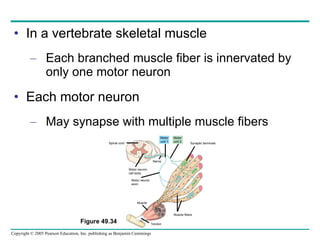
In a vertebrate skeletal muscle Each branched muscle fiber is innervated by only one motor neuron Each motor neuron May synapse with multiple muscle fibers Figure 49.34 Spinal cord Nerve Motor neuron cell body Motor unit 1 Motor unit 2 Motor neuron axon Muscle Tendon Synaptic terminals Muscle fibers
A motor unit Consists of a single motor neuron and all the muscle fibers it controls Recruitment of multiple motor neurons Results in stronger contractions
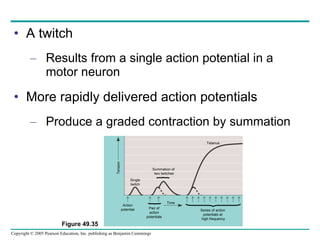
A twitch Results from a single action potential in a motor neuron More rapidly delivered action potentials Produce a graded contraction by summation Figure 49.35 Action potential Pair of action potentials Series of action  potentials at  high frequency Time Tension Single twitch Summation of  two twitches Tetanus
Tetanus is a state of smooth and sustained contraction Produced when motor neurons deliver a volley of action potentials
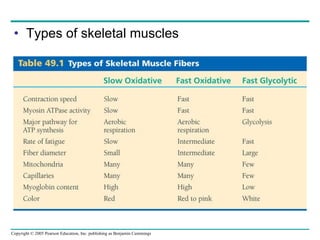
Types of Muscle Fibers Skeletal muscle fibers are classified as slow oxidative, fast oxidative, and fast glycolytic Based on their contraction speed and major pathway for producing ATP
Types of skeletal muscles
Other Types of Muscle Cardiac muscle, found only in the heart Consists of striated cells that are electrically connected by intercalated discs Can generate action potentials without neural input
In smooth muscle, found mainly in the walls of hollow organs The contractions are relatively slow and may be initiated by the muscles themselves In addition, contractions may be caused by Stimulation from neurons in the autonomic nervous system
Concept 49.7: Locomotion requires energy to overcome friction and gravity Movement is a hallmark of all animals And usually necessary for finding food or evading predators Locomotion Is active travel from place to place
Swimming Overcoming friction Is a major problem for swimmers Overcoming gravity is less of a problem for swimmers Than for animals that move on land or fly
Locomotion on Land Walking, running, hopping, or crawling on land Requires an animal to support itself and move against gravity
Diverse adaptations for traveling on land Have evolved in various vertebrates Figure 49.36
Flying Flight requires that wings develop enough lift To overcome the downward force of gravity
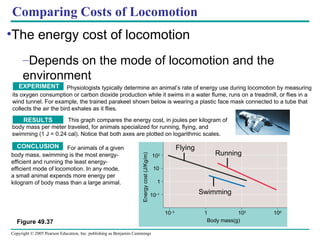
CONCLUSION For animals of a given body mass, swimming is the most energy-efficient and running the least energy-efficient mode of locomotion. In any mode,  a small animal expends more energy per kilogram of body mass than a large animal. CONCLUSION The energy cost of locomotion Depends on the mode of locomotion and the  environment Figure 49.37 Comparing Costs of Locomotion Flying Running  Swimming 10 –3 10 3 10 6 1 10 –1 10 10 2 1 Body mass(g) Energy cost (J/Kg/m) This graph compares the energy cost, in joules per kilogram of body mass per meter traveled, for animals specialized for running, flying, and swimming (1 J = 0.24 cal). Notice that both axes are plotted on logarithmic scales. RESULTS Physiologists typically determine an animal’s rate of energy use during locomotion by measuring  its oxygen consumption or carbon dioxide production while it swims in a water flume, runs on a treadmill, or flies in a   wind tunnel. For example, the trained parakeet shown below is wearing a plastic face mask connected to a tube that  collects the air the bird exhales as it flies. EXPERIMENT
Animals that are specialized for swimming Expend less energy per meter traveled than equivalently sized animals specialized for flying or running

48 nervous text

  • 1.
  • 2.
    Overview: Command andControl Center The human brain Contains an estimated 100 billion nerve cells, or neurons Each neuron May communicate with thousands of other neurons
  • 3.
    Functional magnetic resonanceimaging Is a technology that can reconstruct a three-dimensional map of brain activity Figure 48.1
  • 4.
    The results ofbrain imaging and other research methods Reveal that groups of neurons function in specialized circuits dedicated to different tasks
  • 5.
    Concept 48.1: Nervoussystems consist of circuits of neurons and supporting cells All animals except sponges Have some type of nervous system What distinguishes the nervous systems of different animal groups Is how the neurons are organized into circuits
  • 6.
    Organization of NervousSystems The simplest animals with nervous systems, the cnidarians Have neurons arranged in nerve nets Figure 48.2a Nerve net (a) Hydra (cnidarian)
  • 7.
    Sea stars havea nerve net in each arm Connected by radial nerves to a central nerve ring Figure 48.2b Nerve ring Radial nerve (b) Sea star (echinoderm)
  • 8.
    In relatively simplecephalized animals, such as flatworms A central nervous system (CNS) is evident Figure 48.2c Eyespot Brain Nerve cord Transverse nerve (c) Planarian (flatworm)
  • 9.
    Annelids and arthropodsHave segmentally arranged clusters of neurons called ganglia These ganglia connect to the CNS And make up a peripheral nervous system (PNS) Brain Ventral nerve cord Segmental ganglion Brain Ventral nerve cord Segmental ganglia Figure 48.2d, e (d) Leech (annelid) (e) Insect (arthropod)
  • 10.
    Nervous systems inmolluscs Correlate with the animals’ lifestyles Sessile molluscs have simple systems While more complex molluscs have more sophisticated systems Anterior nerve ring Longitudinal nerve cords Ganglia Brain Ganglia Figure 48.2f, g (f) Chiton (mollusc) (g) Squid (mollusc)
  • 11.
    In vertebrates Thecentral nervous system consists of a brain and dorsal spinal cord The PNS connects to the CNS Figure 48.2h Brain Spinal cord (dorsal nerve cord) Sensory ganglion (h) Salamander (chordate)
  • 12.
    Information Processing Nervoussystems process information in three stages Sensory input, integration, and motor output Figure 48.3 Sensor Effector Motor output Integration Sensory input Peripheral nervous system (PNS) Central nervous system (CNS)
  • 13.
    Sensory neurons transmitinformation from sensors That detect external stimuli and internal conditions Sensory information is sent to the CNS Where interneurons integrate the information Motor output leaves the CNS via motor neurons Which communicate with effector cells
  • 14.
    The three stagesof information processing Are illustrated in the knee-jerk reflex Figure 48.4 Sensory neurons from the quadriceps also communicate with interneurons in the spinal cord. The interneurons inhibit motor neurons that supply the hamstring (flexor) muscle. This inhibition prevents the hamstring from contracting, which would resist the action of the quadriceps. The sensory neurons communicate with motor neurons that supply the quadriceps. The motor neurons convey signals to the quadriceps, causing it to contract and jerking the lower leg forward. 4 5 6 The reflex is initiated by tapping the tendon connected to the quadriceps (extensor) muscle. 1 Sensors detect a sudden stretch in the quadriceps. 2 Sensory neurons convey the information to the spinal cord. 3 Quadriceps muscle Hamstring muscle Spinal cord (cross section) Gray matter White matter Cell body of sensory neuron in dorsal root ganglion Sensory neuron Motor neuron Interneuron
  • 15.
    Neuron Structure Mostof a neuron’s organelles Are located in the cell body Figure 48.5 Dendrites Cell body Nucleus Axon hillock Axon Signal direction Synapse Myelin sheath Synaptic terminals Presynaptic cell Postsynaptic cell
  • 16.
    Most neurons havedendrites Highly branched extensions that receive signals from other neurons The axon is typically a much longer extension That transmits signals to other cells at synapses That may be covered with a myelin sheath
  • 17.
    Neurons have awide variety of shapes That reflect their input and output interactions Figure 48.6a–c Axon Cell body Dendrites (a) Sensory neuron (b) Interneurons (c) Motor neuron
  • 18.
    Supporting Cells (Glia)Glia are supporting cells That are essential for the structural integrity of the nervous system and for the normal functioning of neurons
  • 19.
    In the CNS,astrocytes Provide structural support for neurons and regulate the extracellular concentrations of ions and neurotransmitters Figure 48.7 50 µm
  • 20.
    Oligodendrocytes (in theCNS) and Schwann cells (in the PNS) Are glia that form the myelin sheaths around the axons of many vertebrate neurons Myelin sheath Nodes of Ranvier Schwann cell Schwann cell Nucleus of Schwann cell Axon Layers of myelin Node of Ranvier 0.1 µm Axon Figure 48.8
  • 21.
    Concept 48.2: Ionpumps and ion channels maintain the resting potential of a neuron Across its plasma membrane, every cell has a voltage Called a membrane potential The inside of a cell is negative Relative to the outside
  • 22.
    The membrane potentialof a cell can be measured Figure 48.9 APPLICATION Electrophysiologists use intracellular recording to measure the membrane potential of neurons and other cells. TECHNIQUE A microelectrode is made from a glass capillary tube filled with an electrically conductive salt solution. One end of the tube tapers to an extremely fine tip (diameter < 1 µm). While looking through a microscope, the experimenter uses a micropositioner to insert the tip of the microelectrode into a cell. A voltage recorder (usually an oscilloscope or a computer-based system) measures the voltage between the microelectrode tip inside the cell and a reference electrode placed in the solution outside the cell. Microelectrode Reference electrode Voltage recorder – 70 mV
  • 23.
    The Resting PotentialThe resting potential Is the membrane potential of a neuron that is not transmitting signals
  • 24.
    In all neurons,the resting potential Depends on the ionic gradients that exist across the plasma membrane CYTOSOL EXTRACELLULAR FLUID [Na + ] 15 m M [K + ] 150 m M [Cl – ] 10 m M [A – ] 100 m M [Na + ] 150 m M [K + ] 5 m M [Cl – ] 120 m M – – – – – + + + + + Plasma membrane Figure 48.10
  • 25.
    The concentration ofNa + is higher in the extracellular fluid than in the cytosol While the opposite is true for K +
  • 26.
    By modeling amammalian neuron with an artificial membrane We can gain a better understanding of the resting potential of a neuron Figure 48.11a, b Inner chamber Outer chamber Inner chamber Outer chamber – 92 mV +62 mV Artificial membrane Potassium channel K + Cl – 150 m M KCL 150 m M NaCl 15 m M NaCl 5 m M KCL Cl – Na + Sodium channel + – + – + – + – + – + – (a) Membrane selectively permeable to K + (b) Membrane selectively permeable to Na +
  • 27.
    A neuron thatis not transmitting signals Contains many open K + channels and fewer open Na + channels in its plasma membrane The diffusion of K + and Na + through these channels Leads to a separation of charges across the membrane, producing the resting potential
  • 28.
    Gated Ion ChannelsGated ion channels open or close In response to membrane stretch or the binding of a specific ligand In response to a change in the membrane potential
  • 29.
    Concept 48.3: Actionpotentials are the signals conducted by axons If a cell has gated ion channels Its membrane potential may change in response to stimuli that open or close those channels
  • 30.
    Some stimuli triggera hyperpolarization An increase in the magnitude of the membrane potential Figure 48.12a +50 0 – 50 – 100 Time (msec) 0 1 2 3 4 5 Threshold Resting potential Hyperpolarizations Membrane potential (mV) Stimuli (a) Graded hyperpolarizations produced by two stimuli that increase membrane permeability to K + . The larger stimulus produces a larger hyperpolarization.
  • 31.
    Other stimuli triggera depolarization A reduction in the magnitude of the membrane potential Figure 48.12b +50 0 – 50 – 100 Time (msec) 0 1 2 3 4 5 Threshold Resting potential Depolarizations Membrane potential (mV) Stimuli (b) Graded depolarizations produced by two stimuli that increase membrane permeability to Na+. The larger stimulus produces a larger depolarization.
  • 32.
    Hyperpolarization and depolarizationAre both called graded potentials because the magnitude of the change in membrane potential varies with the strength of the stimulus
  • 33.
    Production of ActionPotentials In most neurons, depolarizations Are graded only up to a certain membrane voltage, called the threshold
  • 34.
    A stimulus strongenough to produce a depolarization that reaches the threshold Triggers a different type of response, called an action potential Figure 48.12c +50 0 – 50 – 100 Time (msec) 0 1 2 3   4 5 6 Threshold Resting potential Membrane potential (mV) Stronger depolarizing stimulus Action potential (c) Action potential triggered by a depolarization that reaches the threshold.
  • 35.
    An action potentialIs a brief all-or-none depolarization of a neuron’s plasma membrane Is the type of signal that carries information along axons
  • 36.
    Both voltage-gated Na+ channels and voltage-gated K + channels Are involved in the production of an action potential When a stimulus depolarizes the membrane Na + channels open, allowing Na + to diffuse into the cell
  • 37.
    As the actionpotential subsides K + channels open, and K + flows out of the cell A refractory period follows the action potential During which a second action potential cannot be initiated
  • 38.
    The generation ofan action potential –  –  –  –  –  –  –  – +  +  +  +  +  +  +  + +  + +  + –  – –  – Na + Na + K + Na + Na + K + Na + Na + K + Na + K + K + Na + Na + Rising phase of the action potential Undershoot Sodium channel Action potential Resting potential Time Threshold Membrane potential (mV) +50 0 – 50 – 100 Threshold Cytosol Figure 48.13 Depolarization opens the activation gates on most Na + channels, while the K + channels’ activation gates remain closed. Na + influx makes the inside of the membrane positive with respect to the outside. The inactivation gates on most Na + channels close, blocking Na + influx. The activation gates on most K + channels open, permitting K + efflux which again makes the inside of the cell negative. A stimulus opens the activation gates on some Na + channels. Na + influx through those channels depolarizes the membrane. If the depolarization reaches the threshold, it triggers an action potential. The activation gates on the Na + and K + channels are closed, and the membrane’s resting potential is maintained. Both gates of the Na + channels are closed, but the activation gates on some K + channels are still open. As these gates close on most K + channels, and the inactivation gates open on Na + channels, the membrane returns to its resting state. +  + –  – +  + –  – +  + –  – +  + –  – +  + –  – +  + –  – +  + –  – +  + –  – +  + –  – +  + –  – +  + –  – +  + –  – +  + –  – –  – +  + –  – +  + –  – +  + –  – +  + 5 1 Resting state 2 Depolarization 3 4 Falling phase of the action potential 1 2 3 4 5 1 Plasma membrane Extracellular fluid Activation gates Potassium channel Inactivation gate
  • 39.
    Conduction of ActionPotentials An action potential can travel long distances By regenerating itself along the axon
  • 40.
    At the sitewhere the action potential is generated, usually the axon hillock An electrical current depolarizes the neighboring region of the axon membrane Figure 48.14 – + – + + + + + – + – + + + + + + – + – + + + + + – + – + + + + + – + – – – – – + – + – – – – – – – – – – – – – – – – – + + + + + + + + – – – – + + + + – – – – – – – – + + + + – – – – + + + + Na + Na + Na + Action potential Action potential Action potential K + K + K + Axon An action potential is generated as Na + flows inward across the membrane at one location. 1 2 The depolarization of the action potential spreads to the neighboring region of the membrane, re-initiating the action potential there. To the left of this region, the membrane is repolarizing as K + flows outward. 3 The depolarization-repolarization process is repeated in the next region of the membrane. In this way, local currents of ions across the plasma membrane cause the action potential to be propagated along the length of the axon. K +
  • 41.
    Conduction Speed Thespeed of an action potential Increases with the diameter of an axon In vertebrates, axons are myelinated Also causing the speed of an action potential to increase
  • 42.
    Action potentials inmyelinated axons Jump between the nodes of Ranvier in a process called saltatory conduction Cell body Schwann cell Myelin sheath Axon Depolarized region (node of Ranvier) + + + + + + + + + + + – – – – – – – – – – – – Figure 48.15
  • 43.
    Concept 48.4: Neuronscommunicate with other cells at synapses In an electrical synapse Electrical current flows directly from one cell to another via a gap junction The vast majority of synapses Are chemical synapses
  • 44.
    In a chemicalsynapse, a presynaptic neuron Releases chemical neurotransmitters, which are stored in the synaptic terminal Figure 48.16 Postsynaptic neuron Synaptic terminal of presynaptic neurons 5 µm
  • 45.
    When an actionpotential reaches a terminal The final result is the release of neurotransmitters into the synaptic cleft Figure 48.17 Presynaptic cell Postsynaptic cell Synaptic vesicles containing neurotransmitter Presynaptic membrane Postsynaptic membrane Voltage-gated Ca 2+ channel Synaptic cleft Ligand-gated ion channels Na + K + Ligand- gated ion channel Postsynaptic membrane Neuro- transmitter 1 Ca 2+ 2 3 4 5 6
  • 46.
    Direct Synaptic TransmissionThe process of direct synaptic transmission Involves the binding of neurotransmitters to ligand-gated ion channels
  • 47.
    Neurotransmitter binding Causes the ion channels to open, generating a postsynaptic potential
  • 48.
    Postsynaptic potentials fallinto two categories Excitatory postsynaptic potentials (EPSPs) Inhibitory postsynaptic potentials (IPSPs)
  • 49.
    After its release,the neurotransmitter Diffuses out of the synaptic cleft May be taken up by surrounding cells and degraded by enzymes
  • 50.
    Summation of PostsynapticPotentials Unlike action potentials Postsynaptic potentials are graded and do not regenerate themselves
  • 51.
    Since most neuronshave many synapses on their dendrites and cell body A single EPSP is usually too small to trigger an action potential in a postsynaptic neuron Figure 48.18a E 1 E 1 Resting potential Threshold of axon of postsynaptic neuron (a) Subthreshold, no summation Terminal branch of presynaptic neuron Postsynaptic neuron E 1 0 – 70 Membrane potential (mV)
  • 52.
    If two EPSPsare produced in rapid succession An effect called temporal summation occurs Figure 48.18b E 1 E 1 Action potential (b) Temporal summation E 1 Axon hillock
  • 53.
    In spatial summationEPSPs produced nearly simultaneously by different synapses on the same postsynaptic neuron add together Figure 48.18c E 1 + E 2 Action potential (c) Spatial summation E 1 E 2
  • 54.
    Through summation AnIPSP can counter the effect of an EPSP Figure 48.18d E 1 E 1 + I I (d) Spatial summation of EPSP and IPSP E 1 I
  • 55.
    Indirect Synaptic TransmissionIn indirect synaptic transmission A neurotransmitter binds to a receptor that is not part of an ion channel This binding activates a signal transduction pathway Involving a second messenger in the postsynaptic cell, producing a slowly developing but long-lasting effect
  • 56.
    Neurotransmitters The sameneurotransmitter Can produce different effects in different types of cells
  • 57.
  • 58.
    Acetylcholine Acetylcholine Isone of the most common neurotransmitters in both vertebrates and invertebrates Can be inhibitory or excitatory
  • 59.
    Biogenic Amines Biogenicamines Include epinephrine, norepinephrine, dopamine, and serotonin Are active in the CNS and PNS
  • 60.
    Amino Acids andPeptides Various amino acids and peptides Are active in the brain
  • 61.
    Gases Gases suchas nitric oxide and carbon monoxide Are local regulators in the PNS
  • 62.
    Concept 48.5: Thevertebrate nervous system is regionally specialized In all vertebrates, the nervous system Shows a high degree of cephalization and distinct CNS and PNS components Figure 48.19 Central nervous system (CNS) Peripheral nervous system (PNS) Brain Spinal cord Cranial nerves Ganglia outside CNS Spinal nerves
  • 63.
    The brain providesthe integrative power That underlies the complex behavior of vertebrates The spinal cord integrates simple responses to certain kinds of stimuli And conveys information to and from the brain
  • 64.
    The central canalof the spinal cord and the four ventricles of the brain Are hollow, since they are derived from the dorsal embryonic nerve cord Gray matter White matter Ventricles Figure 48.20
  • 65.
    The Peripheral NervousSystem The PNS transmits information to and from the CNS And plays a large role in regulating a vertebrate’s movement and internal environment
  • 66.
    The cranial nervesoriginate in the brain And terminate mostly in organs of the head and upper body The spinal nerves originate in the spinal cord And extend to parts of the body below the head
  • 67.
    The PNS canbe divided into two functional components The somatic nervous system and the autonomic nervous system Peripheral nervous system Somatic nervous system Autonomic nervous system Sympathetic division Parasympathetic division Enteric division Figure 48.21
  • 68.
    The somatic nervoussystem Carries signals to skeletal muscles The autonomic nervous system Regulates the internal environment, in an involuntary manner Is divided into the sympathetic, parasympathetic, and enteric divisions
  • 69.
    The sympathetic andparasympathetic divisions Have antagonistic effects on target organs Parasympathetic division Sympathetic division Action on target organs: Action on target organs: Location of preganglionic neurons: brainstem and sacral segments of spinal cord Neurotransmitter released by preganglionic neurons: acetylcholine Location of postganglionic neurons: in ganglia close to or within target organs Neurotransmitter released by postganglionic neurons: acetylcholine Constricts pupil of eye Stimulates salivary gland secretion Constricts bronchi in lungs Slows heart Stimulates activity of stomach and intestines Stimulates activity of pancreas Stimulates gallbladder Promotes emptying of bladder Promotes erection of genitalia Cervical Thoracic Lumbar Synapse Sympathetic ganglia Dilates pupil of eye Inhibits salivary gland secretion Relaxes bronchi in lungs Accelerates heart Inhibits activity of stomach and intestines Inhibits activity of pancreas Stimulates glucose release from liver; inhibits gallbladder Stimulates adrenal medulla Inhibits emptying of bladder Promotes ejaculation and vaginal contractions Sacral Location of preganglionic neurons: thoracic and lumbar segments of spinal cord Neurotransmitter released by preganglionic neurons: acetylcholine Location of postganglionic neurons: some in ganglia close to target organs; others in a chain of ganglia near spinal cord Neurotransmitter released by postganglionic neurons: norepinephrine Figure 48.22
  • 70.
    The sympathetic divisionCorrelates with the “fight-or-flight” response The parasympathetic division Promotes a return to self-maintenance functions The enteric division Controls the activity of the digestive tract, pancreas, and gallbladder
  • 71.
    Embryonic Development ofthe Brain In all vertebrates The brain develops from three embryonic regions: the forebrain, the midbrain, and the hindbrain Figure 48.23a Embryonic brain regions Forebrain Midbrain Hindbrain Midbrain Hindbrain Forebrain (a) Embryo at one month
  • 72.
    By the fifthweek of human embryonic development Five brain regions have formed from the three embryonic regions Figure 48.23b Telencephalon Diencephalon Mesencephalon Metencephalon Myelencephalon (b) Embryo at five weeks Mesencephalon Metencephalon Myelencephalon Spinal cord Diencephalon Telencephalon Embryonic brain regions
  • 73.
    As a humanbrain develops further The most profound change occurs in the forebrain, which gives rise to the cerebrum Figure 48.23c Brain structures present in adult Cerebrum (cerebral hemispheres; includes cerebral cortex, white matter, basal nuclei) Diencephalon (thalamus, hypothalamus, epithalamus) Midbrain (part of brainstem) Pons (part of brainstem), cerebellum Medulla oblongata (part of brainstem) (c) Adult Cerebral hemisphere Diencephalon: Hypothalamus Thalamus Pineal gland (part of epithalamus) Brainstem: Midbrain Pons Medulla oblongata Cerebellum Central canal Spinal cord Pituitary gland
  • 74.
    The Brainstem Thebrainstem consists of three parts The medulla oblongata, the pons, and the midbrain
  • 75.
    The medulla oblongataContains centers that control several visceral functions The pons Also participates in visceral functions The midbrain Contains centers for the receipt and integration of several types of sensory information
  • 76.
    Arousal and SleepA diffuse network of neurons called the reticular formation Is present in the core of the brainstem Figure 48.24 Eye Reticular formation Input from touch, pain, and temperature receptors Input from ears
  • 77.
    A part ofthe reticular formation, the reticular activating system (RAS) Regulates sleep and arousal
  • 78.
    The Cerebellum Thecerebellum Is important for coordination and error checking during motor, perceptual, and cognitive functions
  • 79.
    The cerebellum Is also involved in learning and remembering motor skills
  • 80.
    The Diencephalon Theembryonic diencephalon develops into three adult brain regions The epithalamus, thalamus, and hypothalamus
  • 81.
    The epithalamus Includesthe pineal gland and the choroid plexus
  • 82.
    The thalamus Isthe main input center for sensory information going to the cerebrum and the main output center for motor information leaving the cerebrum
  • 83.
    The hypothalamus regulatesHomeostasis Basic survival behaviors such as feeding, fighting, fleeing, and reproducing
  • 84.
    Circadian Rhythms Thehypothalamus also regulates circadian rhythms Such as the sleep/wake cycle Animals usually have a biological clock Which is a pair of suprachiasmatic nuclei (SCN) found in the hypothalamus
  • 85.
    Biological clocks usuallyrequire external cues To remain synchronized with environmental cycles Figure 48.25 In the northern flying squirrel ( Glaucomys sabrinus ), activity normally begins with the onset of darkness and ends at dawn, which suggests that light is an important external cue for the squirrel. To test this idea, researchers monitored the activity of captive squirrels for 23 days under two sets of conditions: (a) a regular cycle of 12 hours of light and 12 hours of darkness and (b) constant darkness. The squirrels were given free access to an exercise wheel and a rest cage. A recorder automatically noted when the wheel was rotating and when it was still. EXPERIMENT Light Dark Light 20 15 10 5 1 (a) 12 hr light-12 hr dark cycle (b) Constant darkness 12 16 20 24 4 8 12 12 16 20 24 4 8 12 Time of day (hr) Time of day (hr) When the squirrels were exposed to a regular light/dark cycle, their wheel-turning activity (indicated by the dark bars) occurred at roughly the same time every day. However, when they were kept in constant darkness, their activity phase began about 21 minutes later each day. RESULTS The northern flying squirrel’s internal clock can run in constant darkness, but it does so on its own cycle, which lasts about 24 hours and 21 minutes. External (light) cues keep the clock running on a 24-hour cycle. CONCLUSION Dark Days of experiment
  • 86.
    The Cerebrum Thecerebrum Develops from the embryonic telencephalon
  • 87.
    The cerebrum hasright and left cerebral hemispheres That each consist of cerebral cortex overlying white matter and basal nuclei Left cerebral hemisphere Corpus callosum Neocortex Right cerebral hemisphere Basal nuclei Figure 48.26
  • 88.
    The basal nucleiAre important centers for planning and learning movement sequences In mammals The cerebral cortex has a convoluted surface called the neocortex
  • 89.
    In humans, thelargest and most complex part of the brain Is the cerebral cortex, where sensory information is analyzed, motor commands are issued, and language is generated
  • 90.
    A thick bandof axons, the corpus callosum Provides communication between the right and left cerebral cortices
  • 91.
    Concept 48.6: Thecerebral cortex controls voluntary movement and cognitive functions Each side of the cerebral cortex has four lobes Frontal, parietal, temporal, and occipital Frontal lobe Temporal lobe Occipital lobe Parietal lobe Frontal association area Speech Smell Hearing Auditory association area Vision Visual association area Somatosensory association area Reading Speech Taste Somatosensory cortex Motor cortex Figure 48.27
  • 92.
    Each of thelobes Contains primary sensory areas and association areas
  • 93.
    Information Processing inthe Cerebral Cortex Specific types of sensory input Enter the primary sensory areas Adjacent association areas Process particular features in the sensory input and integrate information from different sensory areas
  • 94.
    In the somatosensorycortex and motor cortex Neurons are distributed according to the part of the body that generates sensory input or receives motor input Figure 48.28 Tongue Jaw Lips Face Eye Brow Neck Thumb Fingers Hand Wrist Forearm Elbow Shoulder Trunk Hip Knee Primary motor cortex Abdominal organs Pharynx Tongue Teeth Gums Jaw Lips Face Nose Eye Fingers Hand Forearm Elbow Upper arm Trunk Hip Leg Thumb Neck Head Genitalia Primary somatosensory cortex Toes Parietal lobe Frontal lobe
  • 95.
    Lateralization of CorticalFunction During brain development, in a process called lateralization Competing functions segregate and displace each other in the cortex of the left and right cerebral hemispheres
  • 96.
    The left hemisphereBecomes more adept at language, math, logical operations, and the processing of serial sequences The right hemisphere Is stronger at pattern recognition, nonverbal thinking, and emotional processing
  • 97.
    Language and SpeechStudies of brain activity Have mapped specific areas of the brain responsible for language and speech Figure 48.29 Hearing words Seeing words Speaking words Generating words Max Min
  • 98.
    Portions of thefrontal lobe, Broca’s area and Wernicke’s area Are essential for the generation and understanding of language
  • 99.
    Emotions The limbicsystem Is a ring of structures around the brainstem Figure 48.30 Hypothalamus Thalamus Prefrontal cortex Olfactory bulb Amygdala Hippocampus
  • 100.
    This limbic systemincludes three parts of the cerebral cortex The amygdala, hippocampus, and olfactory bulb These structures interact with the neocortex to mediate primary emotions And attach emotional “feelings” to survival-related functions
  • 101.
    Structures of thelimbic system form in early development And provide a foundation for emotional memory, associating emotions with particular events or experiences
  • 102.
    Memory and LearningThe frontal lobes Are a site of short-term memory Interact with the hippocampus and amygdala to consolidate long-term memory
  • 103.
    Many sensory andmotor association areas of the cerebral cortex Are involved in storing and retrieving words and images
  • 104.
    Cellular Mechanisms ofLearning Experiments on invertebrates Have revealed the cellular basis of some types of learning Figure 48.31a, b (a) Touching the siphon triggers a reflex that causes the gill to withdraw. If the tail is shocked just before the siphon is touched, the withdrawal reflex is stronger. This strengthening of the reflex is a simple form of learning called sensitization. (b) Sensitization involves interneurons that make synapses on the synaptic terminals of the siphon sensory neurons. When the tail is shocked, the interneurons release serotonin, which activates a signal transduction pathway that closes K + channels in the synaptic terminals of the siphon sensory neurons. As a result, action potentials in the siphon sensory neurons produce a prolonged depolarization of the terminals. That allows more Ca 2+ to diffuse into the terminals, which causes the terminals to release more of their excitatory neurotransmitter onto the gill motor neurons. In response, the motor neurons generate action potentials at a higher frequency, producing a more forceful gill withdrawal. Siphon Mantle Gill Tail Head Gill withdrawal pathway Touching the siphon Shocking the tail Tail sensory neuron Interneuron Sensitization pathway Siphon sensory neuron Gill motor neuron Gill
  • 105.
    In the vertebratebrain, a form of learning called long-term potentiation (LTP) Involves an increase in the strength of synaptic transmission Figure 48.32 PRESYNAPTIC NEURON NO Glutamate NMDA receptor Signal transduction pathways NO Ca 2+ AMPA receptor POSTSYNAPTIC NEURON Ca 2+ initiates the phos- phorylation of AMPA receptors, making them more responsive. Ca 2+ also causes more AMPA receptors to appear in the postsynaptic membrane. 5 P Ca 2+ stimulates the postsynaptic neuron to produce nitric oxide (NO). 6 The presynaptic neuron releases glutamate. 1 Glutamate binds to AMPA receptors, opening the AMPA- receptor channel and depolarizing the postsynaptic membrane. 2 Glutamate also binds to NMDA receptors. If the postsynaptic membrane is simultaneously depolarized, the NMDA-receptor channel opens. 3 Ca 2+ diffuses into the postsynaptic neuron. 4 NO diffuses into the presynaptic neuron, causing it to release more glutamate. 7
  • 106.
    Consciousness Modern brain-imagingtechniques Suggest that consciousness may be an emergent property of the brain that is based on activity in many areas of the cortex
  • 107.
    Concept 48.7: CNSinjuries and diseases are the focus of much research Unlike the PNS, the mammalian CNS Cannot repair itself when damaged or assaulted by disease Current research on nerve cell development and stem cells May one day make it possible for physicians to repair or replace damaged neurons
  • 108.
    Nerve Cell DevelopmentSignal molecules direct an axon’s growth By binding to receptors on the plasma membrane of the growth cone
  • 109.
    This receptor bindingtriggers a signal transduction pathway Which may cause an axon to grow toward or away from the source of the signal Figure 48.33a, b Midline of spinal cord Developing axon of interneuron Growth cone Netrin-1 receptor Netrin-1 Floor plate Cell adhesion molecules Slit receptor Slit Developing axon of motor neuron Netrin-1 receptor Slit receptor Slit Netrin-1 1 Growth toward the floor plate. Cells in the floor plate of the spinal cord release Netrin-1, which diffuses away from the floor plate and binds to receptors on the growth cone of a developing interneuron axon. Binding stimulates axon growth toward the floor plate. 2 Growth across the mid-line. Once the axon reaches the floor plate, cell adhesion molecules on the axon bind to complementary molecules on floor plate cells, directing the growth of the axon across the midline. 3 No turning back. Now the axon synthesizes receptors that bind to Slit, a repulsion protein re- leased by floor plate cells. This prevents the axon from growing back across the midline. Netrin-1 and Slit, produced by cells of the floor plate, bind to receptors on the axons of motor neurons. In this case, both proteins act to repel the axon, directing the motor neuron to grow away from the spinal cord. (a) Growth of an interneuron axon toward and across the midline of the spinal cord (diagrammed here in cross section) (b) Growth of a motor neuron axon away from the midline of the spinal cord
  • 110.
    The genes andbasic events involved in axon guidance Are similar in invertebrates and vertebrates Knowledge of these events may be applied one day To stimulate axonal regrowth following CNS damage
  • 111.
    Neural Stem CellsThe adult human brain Contains stem cells that can differentiate into mature neurons Figure 48.34 10 m
  • 112.
    The induction ofstem cell differentiation and the transplantation of cultured stem cells Are potential methods for replacing neurons lost to trauma or disease
  • 113.
    Diseases and Disordersof the Nervous System Mental illnesses and neurological disorders Take an enormous toll on society, in both the patient’s loss of a productive life and the high cost of long-term health care
  • 114.
    Schizophrenia About 1%of the world’s population Suffers from schizophrenia
  • 115.
    Schizophrenia is characterizedby Hallucinations, delusions, blunted emotions, and many other symptoms Available treatments have focused on Brain pathways that use dopamine as a neurotransmitter
  • 116.
    Depression Two broadforms of depressive illness are known Bipolar disorder and major depression
  • 117.
    Bipolar disorder ischaracterized by Manic (high-mood) and depressive (low-mood) phases In major depression Patients have a persistent low mood
  • 118.
    Treatments for thesetypes of depression include A variety of drugs such as Prozac and lithium
  • 119.
    Alzheimer’s Disease Alzheimer’sdisease (AD) Is a mental deterioration characterized by confusion, memory loss, and other symptoms
  • 120.
    AD is causedby the formation of Neurofibrillary tangles and senile plaques in the brain Figure 48.35 Senile plaque Neurofibrillary tangle 20 m
  • 121.
    A successful treatmentfor AD in humans May hinge on early detection of senile plaques
  • 122.
    Parkinson’s Disease Parkinson’sdisease is a motor disorder Caused by the death of dopamine-secreting neurons in the substantia nigra Characterized by difficulty in initiating movements, slowness of movement, and rigidity
  • 123.
    There is nocure for Parkinson’s disease Although various approaches are used to manage the symptoms
  • 124.
    Chapter 49 Sensoryand Motor Mechanisms
  • 125.
    Overview: Sensing andActing Bats use sonar to detect their prey Moths, a common prey for bats Can detect the bat’s sonar and attempt to flee Figure 49.1
  • 126.
    Both of theseorganisms Have complex sensory systems that facilitate their survival The structures that make up these systems Have been transformed by evolution into diverse mechanisms that sense various stimuli and generate the appropriate physical movement
  • 127.
    Concept 49.1: Sensoryreceptors transduce stimulus energy and transmit signals to the central nervous system Sensations are action potentials That reach the brain via sensory neurons Once the brain is aware of sensations It interprets them, giving the perception of stimuli
  • 128.
    Sensations and perceptionsBegin with sensory reception, the detection of stimuli by sensory receptors Exteroreceptors Detect stimuli coming from the outside of the body Interoreceptors Detect internal stimuli
  • 129.
    Functions Performed bySensory Receptors All stimuli represent forms of energy Sensation involves converting this energy Into a change in the membrane potential of sensory receptors
  • 130.
    Sensory receptors performfour functions in this process Sensory transduction, amplification, transmission, and integration
  • 131.
    Two types ofsensory receptors exhibit these functions A stretch receptor in a crayfish Figure 49.2a (a) Crayfish stretch receptors have dendrites embedded in abdominal muscles. When the abdomen bends, muscles and dendrites stretch, producing a receptor potential in the stretch receptor. The receptor potential triggers action potentials in the axon of the stretch receptor. A stronger stretch produces a larger receptor potential and higher requency of action potentials. Muscle Dendrites Stretch receptor Axon Membrane potential (mV) – 50 – 70 0 – 70 0 1 2 3 4 5 6 7 Time (sec) Action potentials Receptor potential Weak muscle stretch – 50 – 70 0 – 70 0 1 2 3 4 5 6 7 Time (sec) Strong muscle stretch
  • 132.
    A hair cellfound in vertebrates of action potentials in the sensory neuron. Bending in the other direction has the opposite effects. Thus, hair cells respond to the direction of motion as well as to its strength and speed.s (b) Vertebrate hair cells have specialized cilia or microvilli (“hairs”) that bend when sur-rounding fluid moves. Each hair cell releases an excitatory neurotransmitter at a synapse with a sensory neuron, which conducts action potentials to the CNS. Bending in one direction depolarizes the hair cell, causing it to release more neurotransmitter and increasing frequency – 50 – 70 0 – 70 0 1 2 3 4 5 6 7 Time (sec) Action potentials No fluid movement – 50 – 70 0 – 70 0 1 2 3 4 5 6 7 Time (sec) Receptor potential Fluid moving in one direction – 50 – 70 0 – 70 0 1 2 3 4 5 6 7 Time (sec) Fluid moving in other direction Membrane potential (mV) Membrane potential (mV) Membrane potential (mV) “ Hairs” of hair cell Neuro- trans- mitter at synapse Axon Less neuro- trans- mitter More neuro- trans- mitter Figure 49.2b
  • 133.
    Sensory Transduction Sensorytransduction is the conversion of stimulus energy Into a change in the membrane potential of a sensory receptor This change in the membrane potential Is known as a receptor potential
  • 134.
    Many sensory receptorsare extremely sensitive With the ability to detect the smallest physical unit of stimulus possible
  • 135.
    Amplification Amplification isthe strengthening of stimulus energy By cells in sensory pathways
  • 136.
    Transmission After energyin a stimulus has been transduced into a receptor potential Some sensory cells generate action potentials, which are transmitted to the CNS
  • 137.
    Sensory cells withoutaxons Release neurotransmitters at synapses with sensory neurons
  • 138.
    Integration The integrationof sensory information Begins as soon as the information is received Occurs at all levels of the nervous system
  • 139.
    Some receptor potentialsAre integrated through summation Another type of integration is sensory adaptation A decrease in responsiveness during continued stimulation
  • 140.
    Types of SensoryReceptors Based on the energy they transduce, sensory receptors fall into five categories Mechanoreceptors Chemoreceptors Electromagnetic receptors Thermoreceptors Pain receptors
  • 141.
    Mechanoreceptors Mechanoreceptors sensephysical deformation Caused by stimuli such as pressure, stretch, motion, and sound
  • 142.
    The mammalian senseof touch Relies on mechanoreceptors that are the dendrites of sensory neurons Figure 49.3 Heat Light touch Pain Cold Hair Nerve Connective tissue Hair movement Strong pressure Dermis Epidermis
  • 143.
    Chemoreceptors Chemoreceptors includeGeneral receptors that transmit information about the total solute concentration of a solution Specific receptors that respond to individual kinds of molecules
  • 144.
    Two of themost sensitive and specific chemoreceptors known Are present in the antennae of the male silkworm moth Figure 49.4 0.1 mm
  • 145.
    Electromagnetic Receptors Electromagneticreceptors detect various forms of electromagnetic energy Such as visible light, electricity, and magnetism
  • 146.
    Some snakes havevery sensitive infrared receptors That detect body heat of prey against a colder background Figure 49.5a (a) This rattlesnake and other pit vipers have a pair of infrared receptors, one between each eye and nostril. The organs are sensitive enough to detect the infrared radiation emitted by a warm mouse a meter away. The snake moves its head from side to side until the radiation is detected equally by the two receptors, indicating that the mouse is straight ahead.
  • 147.
    Many mammals appearto use the Earth’s magnetic field lines To orient themselves as they migrate Figure 49.5b (b) Some migrating animals, such as these beluga whales, apparently sense Earth’s magnetic field and use the information, along with other cues, for orientation.
  • 148.
    Thermoreceptors Thermoreceptors, whichrespond to heat or cold Help regulate body temperature by signaling both surface and body core temperature
  • 149.
    Pain Receptors Inhumans, pain receptors, also called nociceptors Are a class of naked dendrites in the epidermis Respond to excess heat, pressure, or specific classes of chemicals released from damaged or inflamed tissues
  • 150.
    Concept 49.2: Themechanoreceptors involved with hearing and equilibrium detect settling particles or moving fluid Hearing and the perception of body equilibrium Are related in most animals
  • 151.
    Sensing Gravity andSound in Invertebrates Most invertebrates have sensory organs called statocysts That contain mechanoreceptors and function in their sense of equilibrium Figure 49.6 Ciliated receptor cells Cilia Statolith Sensory nerve fibers
  • 152.
    Many arthropods sensesounds with body hairs that vibrate Or with localized “ears” consisting of a tympanic membrane and receptor cells Figure 49.7 1 mm Tympanic membrane
  • 153.
    Hearing and Equilibriumin Mammals In most terrestrial vertebrates The sensory organs for hearing and equilibrium are closely associated in the ear
  • 154.
    Exploring the structureof the human ear Figure 49.8 Pinna Auditory canal Eustachian tube Tympanic membrane Stapes Incus Malleus Skull bones Semicircular canals Auditory nerve, to brain Cochlea Tympanic membrane Oval window Eustachian tube Round window Vestibular canal Tympanic canal Auditory nerve Bone Cochlear duct Hair cells Tectorial membrane Basilar membrane To auditory nerve Axons of sensory neurons 1 Overview of ear structure 2 The middle ear and inner ear 4 The organ of Corti 3 The cochlea Organ of Corti Outer ear Middle ear Inner ear
  • 155.
    Hearing Vibrating objectscreate percussion waves in the air That cause the tympanic membrane to vibrate The three bones of the middle ear Transmit the vibrations to the oval window on the cochlea
  • 156.
    These vibrations createpressure waves in the fluid in the cochlea That travel through the vestibular canal and ultimately strike the round window Figure 49.9 Cochlea Stapes Oval window Apex Axons of sensory neurons Round window Basilar membrane Tympanic canal Base Vestibular canal Perilymph
  • 157.
    The pressure wavesin the vestibular canal Cause the basilar membrane to vibrate up and down causing its hair cells to bend The bending of the hair cells depolarizes their membranes Sending action potentials that travel via the auditory nerve to the brain
  • 158.
    The cochlea candistinguish pitch Because the basilar membrane is not uniform along its length Figure 49.10 Cochlea (uncoiled) Basilar membrane Apex (wide and flexible) Base (narrow and stiff) 500 Hz (low pitch) 1 kHz 2 kHz 4 kHz 8 kHz 16 kHz (high pitch) Frequency producing maximum vibration
  • 159.
    Each region ofthe basilar membrane vibrates most vigorously At a particular frequency and leads to excitation of a specific auditory area of the cerebral cortex
  • 160.
    Equilibrium Several ofthe organs of the inner ear Detect body position and balance
  • 161.
    The utricle, saccule,and semicircular canals in the inner ear Function in balance and equilibrium Figure 49.11 The semicircular canals, arranged in three spatial planes, detect angular movements of the head. Body movement Nerve fibers Each canal has at its base a swelling called an ampulla, containing a cluster of hair cells. When the head changes its rate of rotation, inertia prevents endolymph in the semicircular canals from moving with the head, so the endolymph presses against the cupula, bending the hairs. The utricle and saccule tell the brain which way is up and inform it of the body’s position or linear acceleration. The hairs of the hair cells project into a gelatinous cap called the cupula. Bending of the hairs increases the frequency of action potentials in sensory neurons in direct proportion to the amount of rotational acceleration. Vestibule Utricle Saccule Vestibular nerve Flow of endolymph Flow of endolymph Cupula Hairs Hair cell
  • 162.
    Hearing and Equilibriumin Other Vertebrates Like other vertebrates, fishes and amphibians Also have inner ears located near the brain
  • 163.
    Most fishes andaquatic amphibians Also have a lateral line system along both sides of their body
  • 164.
    The lateral linesystem contains mechanoreceptors With hair cells that respond to water movement Figure 49.12 Nerve fiber Supporting cell Cupula Sensory hairs Hair cell Segmental muscles of body wall Lateral nerve Scale Epidermis Lateral line canal Neuromast Opening of lateral line canal Lateral line
  • 165.
    Concept 49.3: Thesenses of taste and smell are closely related in most animals The perceptions of gustation (taste) and olfaction (smell) Are both dependent on chemoreceptors that detect specific chemicals in the environment
  • 166.
    The taste receptorsof insects are located within sensory hairs called sensilla Which are located on the feet and in mouthparts
  • 167.
    Figure 49.13 EXPERIMENT Insects taste using gustatory sensilla (hairs) on their feet and mouthparts. Each sensillum contains four chemoreceptors with dendrites that extend to a pore at the tip of the sensillum. To study the sensitivity of each chemoreceptor, researchers immobilized a blowfly ( Phormia regina ) by attaching it to a rod with wax. They then inserted the tip of a microelectrode into one sensillum to record action potentials in the chemoreceptors, while they used a pipette to touch the pore with various test substances. Number of action potentials in first second of response CONCLUSION Any natural food probably stimulates multiple chemoreceptors. By integrating sensations, the insect’s brain can apparently distinguish a very large number of tastes. To brain Chemo- receptors Pore at tip Pipette containing test substance To voltage recorder Sensillum Microelectrode 50 30 10 0 0.5 M NaCl Meat 0.5 M Sucrose Honey Stimulus Chemoreceptors RESULTS Each chemoreceptor is especially sensitive to a particular class of substance, but this specificity is relative; each cell can respond to some extent to a broad range of different chemical stimuli.
  • 168.
    Taste in HumansThe receptor cells for taste in humans Are modified epithelial cells organized into taste buds Five taste perceptions involve several signal transduction mechanisms Sweet, sour, salty, bitter, and umami (elicited by glutamate)
  • 169.
    Transduction in tastereceptors Occurs by several mechanisms Figure 49.14 Taste pore Sugar molecule Sensory receptor cells Sensory neuron Taste bud Tongue G protein Adenylyl cyclase — Ca 2 + ATP cAMP Protein kinase A Sugar Sugar receptor SENSORY RECEPTOR CELL Synaptic vesicle K + Neurotransmitter Sensory neuron 4 The decrease in the membrane’s permeability to K + depolarizes the membrane. 5 Depolarization opens voltage-gated calcium ion (Ca 2+ ) channels, and Ca 2+ diffuses into the receptor cell. 6 The increased Ca 2+ concentration causes synaptic vesicles to release neurotransmitter. 3 Activated protein kinase A closes K + channels in the membrane. 2 Binding initiates a signal transduction pathway involving cyclic AMP and protein kinase A. 1 A sugar molecule binds to a receptor protein on the sensory receptor cell.
  • 170.
    Smell in HumansOlfactory receptor cells Are neurons that line the upper portion of the nasal cavity
  • 171.
    When odorant moleculesbind to specific receptors A signal transduction pathway is triggered, sending action potentials to the brain Brain Nasal cavity Odorant Odorant receptors Plasma membrane Odorant Cilia Chemoreceptor Epithelial cell Bone Olfactory bulb Action potentials Mucus Figure 49.15
  • 172.
    Concept 49.4: Similarmechanisms underlie vision throughout the animal kingdom Many types of light detectors Have evolved in the animal kingdom and may be homologous
  • 173.
    Vision in InvertebratesMost invertebrates Have some sort of light-detecting organ
  • 174.
    One of thesimplest is the eye cup of planarians Which provides information about light intensity and direction but does not form images Figure 49.16 Light Light shining from the front is detected Photoreceptor Visual pigment Ocellus Nerve to brain Screening pigment Light shining from behind is blocked by the screening pigment
  • 175.
    Two major typesof image-forming eyes have evolved in invertebrates The compound eye and the single-lens eye
  • 176.
    Compound eyes arefound in insects and crustaceans And consist of up to several thousand light detectors called ommatidia Figure 49.17a–b Cornea Crystalline cone Rhabdom Photoreceptor Axons Ommatidium Lens 2 mm (a) The faceted eyes on the head of a fly, photographed with a stereomicroscope. (b) The cornea and crystalline cone of each ommatidium function as a lens that focuses light on the rhabdom, a stack of pigmented plates inside a circle of photoreceptors. The rhabdom traps light and guides it to photoreceptors. The image formed by a compound eye is a mosaic of dots produced by different intensities of light entering the many ommatidia from different angles.
  • 177.
    Single-lens eyes Arefound in some jellies, polychaetes, spiders, and many molluscs Work on a camera-like principle
  • 178.
    The Vertebrate VisualSystem The eyes of vertebrates are camera-like But they evolved independently and differ from the single-lens eyes of invertebrates
  • 179.
    Structure of theEye The main parts of the vertebrate eye are The sclera, which includes the cornea The choroid, a pigmented layer The conjunctiva, that covers the outer surface of the sclera
  • 180.
    The iris, whichregulates the pupil The retina, which contains photoreceptors The lens, which focuses light on the retina
  • 181.
    The structure ofthe vertebrate eye Figure 49.18 Ciliary body Iris Suspensory ligament Cornea Pupil Aqueous humor Lens Vitreous humor Optic disk (blind spot) Central artery and vein of the retina Optic nerve Fovea (center of visual field) Retina Choroid Sclera
  • 182.
    Humans and othermammals Focus light by changing the shape of the lens Figure 49.19a–b Lens (flatter) Lens (rounder) Ciliary muscle Suspensory ligaments Choroid Retina Front view of lens and ciliary muscle Ciliary muscles contract, pulling border of choroid toward lens Suspensory ligaments relax Lens becomes thicker and rounder, focusing on near objects (a) Near vision (accommodation) (b) Distance vision Ciliary muscles relax, and border of choroid moves away from lens Suspensory ligaments pull against lens Lens becomes flatter, focusing on distant objects
  • 183.
    The human retinacontains two types of photoreceptors Rods are sensitive to light but do not distinguish colors Cones distinguish colors but are not as sensitive
  • 184.
    Sensory Transduction inthe Eye Each rod or cone in the vertebrate retina Contains visual pigments that consist of a light-absorbing molecule called retinal bonded to a protein called opsin
  • 185.
    Rods contain thepigment rhodopsin Which changes shape when it absorbs light Figure 49.20a, b Rod Outer segment Cell body Synaptic terminal Disks Inside of disk (a) Rods contain the visual pigment rhodopsin, which is embedded in a stack of membranous disks in the rod’s outer segment. Rhodopsin consists of the light-absorbing molecule retinal bonded to opsin, a protein. Opsin has seven  helices that span the disk membrane. (b) Retinal exists as two isomers. Absorption of light converts the cis isomer to the trans isomer, which causes opsin to change its conformation (shape). After a few minutes, retinal detaches from opsin. In the dark, enzymes convert retinal back to its cis form, which recombines with opsin to form rhodopsin. Retinal Opsin Rhodopsin Cytosol H C C H 2 C C H 2 C C H CH 3 CH 3 H C C CH 3 H CH 3 C C C C C C C H H H H O H H 3 C H C C H 2 C C H 2 C C H CH 3 CH 3 H C C CH 3 H CH 3 C C C C H H CH 3 H C C C H O CH 3 trans isomer cis isomer Enzymes Light
  • 186.
    Processing Visual InformationThe processing of visual information Begins in the retina itself
  • 187.
    Absorption of lightby retinal Triggers a signal transduction pathway Figure 49.21 EXTRACELLULAR FLUID Membrane potential (mV) 0 –  40 – 70 Dark Light – Hyper- polarization Time Na + Na + cGMP CYTOSOL GMP Plasma membrane INSIDE OF DISK PDE Active rhodopsin Light Inactive rhodopsin Transducin Disk membrane 2 Active rhodopsin in turn activates a G protein called transducin. 3 Transducin activates the enzyme phos-phodiesterae(PDE). 4 Activated PDE detaches cyclic guanosine monophosphate (cGMP) from Na + channels in the plasma membrane by hydrolyzing cGMP to GMP. 5 The Na+ channels close when cGMP detaches. The membrane’s permeability to Na+ decreases, and the rod hyperpolarizes. 1 Light isomerizes retinal, which activates rhodopsin.
  • 188.
    In the dark,both rods and cones Release the neurotransmitter glutamate into the synapses with neurons called bipolar cells, which are either hyperpolarized or depolarized
  • 189.
    In the light,rods and cones hyperpolarize Shutting off their release of glutamate The bipolar cells Are then either depolarized or hyperpolarized Figure 49.22 Dark Responses Rhodopsin inactive Na + channels open Rod depolarized Glutamate released Bipolar cell either depolarized or hyperpolarized, depending on glutamate receptors Light Responses Rhodopsin active Na + channels closed Rod hyperpolarized No glutamate released Bipolar cell either hyperpolarized or depolarized, depending on glutamate receptors
  • 190.
    Three other typesof neurons contribute to information processing in the retina Ganglion cells, horizontal cells, and amacrine cells Figure 49.23 Optic nerve fibers Ganglion cell Bipolar cell Horizontal cell Amacrine cell Pigmented epithelium Neurons Cone Rod Photoreceptors Retina Retina Optic nerve To brain
  • 191.
    Signals from rodsand cones Travel from bipolar cells to ganglion cells The axons of ganglion cells are part of the optic nerve That transmit information to the brain Figure 49.24 Left visual field Right visual field Left eye Right eye Optic nerve Optic chiasm Lateral geniculate nucleus Primary visual cortex
  • 192.
    Most ganglion cellaxons lead to the lateral geniculate nuclei of the thalamus Which relays information to the primary visual cortex Several integrating centers in the cerebral cortex Are active in creating visual perceptions
  • 193.
    Concept 49.5: Animalskeletons function in support, protection, and movement The various types of animal movements All result from muscles working against some type of skeleton
  • 194.
    Types of SkeletonsThe three main functions of a skeleton are Support, protection, and movement The three main types of skeletons are Hydrostatic skeletons, exoskeletons, and endoskeletons
  • 195.
    Hydrostatic Skeletons Ahydrostatic skeleton Consists of fluid held under pressure in a closed body compartment This is the main type of skeleton In most cnidarians, flatworms, nematodes, and annelids
  • 196.
    Annelids use theirhydrostatic skeleton for peristalsis A type of movement on land produced by rhythmic waves of muscle contractions Figure 49.25a–c (a) Body segments at the head and just in front of the rear are short and thick (longitudinal muscles contracted; circular muscles relaxed) and anchored to the ground by bristles. The other segments are thin and elongated (circular muscles contracted; longitudinal muscles relaxed.) (b) The head has moved forward because circular muscles in the head segments have contracted. Segments behind the head and at the rear are now thick and anchored, thus preventing the worm from slipping backward. (c) The head segments are thick again and anchored in their new positions. The rear segments have released their hold on the ground and have been pulled forward. Longitudinal muscle relaxed (extended) Circular muscle contracted Circular muscle relaxed Longitudinal muscle contracted Head Bristles
  • 197.
    Exoskeletons An exoskeletonis a hard encasement Deposited on the surface of an animal Exoskeletons Are found in most molluscs and arthropods
  • 198.
    Endoskeletons An endoskeletonconsists of hard supporting elements Such as bones, buried within the soft tissue of an animal Endoskeletons Are found in sponges, echinoderms, and chordates
  • 199.
    The mammalian skeletonis built from more than 200 bones Some fused together and others connected at joints by ligaments that allow freedom of movement
  • 200.
    The human skeletonFigure 49.26 1 Ball-and-socket joints, where the humerus contacts the shoulder girdle and where the femur contacts the pelvic girdle, enable us to rotate our arms and legs and move them in several planes. 2 Hinge joints, such as between the humerus and the head of the ulna, restrict movement to a single plane. 3 Pivot joints allow us to rotate our forearm at the elbow and to move our head from side to side. key Axial skeleton Appendicular skeleton Skull Shoulder girdle Clavicle Scapula Sternum Rib Humerus Vertebra Radius Ulna Pelvic girdle Carpals Phalanges Metacarpals Femur Patella Tibia Fibula Tarsals Metatarsals Phalanges 1 Examples of joints 2 3 Head of humerus Scapula Humerus Ulna Ulna Radius
  • 201.
    Physical Support onLand In addition to the skeleton Muscles and tendons help support large land vertebrates
  • 202.
    Concept 49.6: Musclesmove skeletal parts by contracting The action of a muscle Is always to contract
  • 203.
    Skeletal muscles areattached to the skeleton in antagonistic pairs With each member of the pair working against each other Figure 49.27 Human Grasshopper Biceps contracts Triceps relaxes Forearm flexes Biceps relaxes Triceps contracts Forearm extends Extensor muscle relaxes Flexor muscle contracts Tibia flexes Extensor muscle contracts Flexor muscle relaxes Tibia extends
  • 204.
    Vertebrate Skeletal MuscleVertebrate skeletal muscle Is characterized by a hierarchy of smaller and smaller units Figure 49.28 Muscle Bundle of muscle fibers Single muscle fiber (cell) Plasma membrane Myofibril Light band Dark band Z line Sarcomere TEM 0.5 m I band A band I band M line Thick filaments (myosin) Thin filaments (actin) H zone Sarcomere Z line Z line Nuclei
  • 205.
    A skeletal muscleconsists of a bundle of long fibers Running parallel to the length of the muscle A muscle fiber Is itself a bundle of smaller myofibrils arranged longitudinally
  • 206.
    The myofibrils arecomposed to two kinds of myofilaments Thin filaments, consisting of two strands of actin and one strand of regulatory protein Thick filaments, staggered arrays of myosin molecules
  • 207.
    Skeletal muscle isalso called striated muscle Because the regular arrangement of the myofilaments creates a pattern of light and dark bands
  • 208.
    Each repeating unitis a sarcomere Bordered by Z lines The areas that contain the myofilments Are the I band, A band, and H zone
  • 209.
    The Sliding-Filament Modelof Muscle Contraction According to the sliding-filament model of muscle contraction The filaments slide past each other longitudinally, producing more overlap between the thin and thick filaments
  • 210.
    As a resultof this sliding The I band and the H zone shrink Figure 49.29a–c (a) Relaxed muscle fiber. In a relaxed muscle fiber, the I bands and H zone are relatively wide. (b) Contracting muscle fiber. During contraction, the thick and thin filaments slide past each other, reducing the width of the I bands and H zone and shortening the sarcomere. (c) Fully contracted muscle fiber. In a fully contracted muscle fiber, the sarcomere is shorter still. The thin filaments overlap, eliminating the H zone. The I bands disappear as the ends of the thick filaments contact the Z lines. 0.5 m Z H A Sarcomere
  • 211.
    The sliding offilaments is based on The interaction between the actin and myosin molecules of the thick and thin filaments The “head” of a myosin molecule binds to an actin filament Forming a cross-bridge and pulling the thin filament toward the center of the sarcomere
  • 212.
    Myosin-actin interactions underlyingmuscle fiber contraction Figure 49.30 Thick filament Thin filaments Thin filament ATP ATP ADP ADP ADP P i P i P i Cross-bridge Myosin head (low- energy configuration) Myosin head (high- energy configuration) + Myosin head (low- energy configuration) Thin filament moves toward center of sarcomere. Thick filament Actin Cross-bridge binding site 1 Starting here, the myosin head is bound to ATP and is in its low-energy confinguration. 2 The myosin head hydrolyzes ATP to ADP and inorganic phosphate ( I ) and is in its high-energy configuration. P 1 The myosin head binds to actin, forming a cross- bridge. 3 4 Releasing ADP and ( i ), myosin relaxes to its low-energy configuration, sliding the thin filament. P 5 Binding of a new mole- cule of ATP releases the myosin head from actin, and a new cycle begins.
  • 213.
    The Role ofCalcium and Regulatory Proteins A skeletal muscle fiber contracts Only when stimulated by a motor neuron
  • 214.
    When a muscleis at rest The myosin-binding sites on the thin filament are blocked by the regulatory protein tropomyosin Figure 49.31a Actin Tropomyosin Ca 2+ -binding sites Troponin complex (a) Myosin-binding sites blocked
  • 215.
    For a musclefiber to contract The myosin-binding sites must be uncovered This occurs when calcium ions (Ca 2+ ) Bind to another set of regulatory proteins, the troponin complex Figure 49.31b Ca 2+ Myosin- binding site (b) Myosin-binding sites exposed
  • 216.
    The stimulus leadingto the contraction of a skeletal muscle fiber Is an action potential in a motor neuron that makes a synapse with the muscle fiber Figure 49.32 Motor neuron axon Mitochondrion Synaptic terminal T tubule Sarcoplasmic reticulum Myofibril Plasma membrane of muscle fiber Sarcomere Ca 2+ released from sarcoplasmic reticulum
  • 217.
    The synaptic terminalof the motor neuron Releases the neurotransmitter acetylcholine, depolarizing the muscle and causing it to produce an action potential
  • 218.
    Action potentials travelto the interior of the muscle fiber Along infoldings of the plasma membrane called transverse (T) tubules The action potential along the T tubules Causes the sarcoplasmic reticulum to release Ca 2+ The Ca 2+ binds to the troponin-tropomyosin complex on the thin filaments Exposing the myosin-binding sites and allowing the cross-bridge cycle to proceed
  • 219.
    Review of contractionin a skeletal muscle fiber Figure 49.33 ACh Synaptic terminal of motor neuron Synaptic cleft T TUBULE PLASMA MEMBRANE SR ADP CYTOSOL Ca 2 Ca 2 P 2 Cytosolic Ca 2+ is removed by active transport into SR after action potential ends. 6 Acetylcholine (ACh) released by synaptic terminal diffuses across synaptic cleft and binds to receptor proteins on muscle fiber’s plasma membrane, triggering an action potential in muscle fiber. 1 Action potential is propa- gated along plasma membrane and down T tubules. 2 Action potential triggers Ca 2+ release from sarco- plasmic reticulum (SR). 3 Myosin cross-bridges alternately attach to actin and detach, pulling actin filaments toward center of sarcomere; ATP powers sliding of filaments. 5 Calcium ions bind to troponin; troponin changes shape, removing blocking action of tropomyosin; myosin-binding sites exposed. 4 Tropomyosin blockage of myosin- binding sites is restored; contraction ends, and muscle fiber relaxes. 7
  • 220.
    Neural Control ofMuscle Tension Contraction of a whole muscle is graded Which means that we can voluntarily alter the extent and strength of its contraction
  • 221.
    There are twobasic mechanisms by which the nervous system produces graded contractions of whole muscles By varying the number of fibers that contract By varying the rate at which muscle fibers are stimulated
  • 222.
    In a vertebrateskeletal muscle Each branched muscle fiber is innervated by only one motor neuron Each motor neuron May synapse with multiple muscle fibers Figure 49.34 Spinal cord Nerve Motor neuron cell body Motor unit 1 Motor unit 2 Motor neuron axon Muscle Tendon Synaptic terminals Muscle fibers
  • 223.
    A motor unitConsists of a single motor neuron and all the muscle fibers it controls Recruitment of multiple motor neurons Results in stronger contractions
  • 224.
    A twitch Resultsfrom a single action potential in a motor neuron More rapidly delivered action potentials Produce a graded contraction by summation Figure 49.35 Action potential Pair of action potentials Series of action potentials at high frequency Time Tension Single twitch Summation of two twitches Tetanus
  • 225.
    Tetanus is astate of smooth and sustained contraction Produced when motor neurons deliver a volley of action potentials
  • 226.
    Types of MuscleFibers Skeletal muscle fibers are classified as slow oxidative, fast oxidative, and fast glycolytic Based on their contraction speed and major pathway for producing ATP
  • 227.
  • 228.
    Other Types ofMuscle Cardiac muscle, found only in the heart Consists of striated cells that are electrically connected by intercalated discs Can generate action potentials without neural input
  • 229.
    In smooth muscle,found mainly in the walls of hollow organs The contractions are relatively slow and may be initiated by the muscles themselves In addition, contractions may be caused by Stimulation from neurons in the autonomic nervous system
  • 230.
    Concept 49.7: Locomotionrequires energy to overcome friction and gravity Movement is a hallmark of all animals And usually necessary for finding food or evading predators Locomotion Is active travel from place to place
  • 231.
    Swimming Overcoming frictionIs a major problem for swimmers Overcoming gravity is less of a problem for swimmers Than for animals that move on land or fly
  • 232.
    Locomotion on LandWalking, running, hopping, or crawling on land Requires an animal to support itself and move against gravity
  • 233.
    Diverse adaptations fortraveling on land Have evolved in various vertebrates Figure 49.36
  • 234.
    Flying Flight requiresthat wings develop enough lift To overcome the downward force of gravity
  • 235.
    CONCLUSION For animalsof a given body mass, swimming is the most energy-efficient and running the least energy-efficient mode of locomotion. In any mode, a small animal expends more energy per kilogram of body mass than a large animal. CONCLUSION The energy cost of locomotion Depends on the mode of locomotion and the environment Figure 49.37 Comparing Costs of Locomotion Flying Running Swimming 10 –3 10 3 10 6 1 10 –1 10 10 2 1 Body mass(g) Energy cost (J/Kg/m) This graph compares the energy cost, in joules per kilogram of body mass per meter traveled, for animals specialized for running, flying, and swimming (1 J = 0.24 cal). Notice that both axes are plotted on logarithmic scales. RESULTS Physiologists typically determine an animal’s rate of energy use during locomotion by measuring its oxygen consumption or carbon dioxide production while it swims in a water flume, runs on a treadmill, or flies in a wind tunnel. For example, the trained parakeet shown below is wearing a plastic face mask connected to a tube that collects the air the bird exhales as it flies. EXPERIMENT
  • 236.
    Animals that arespecialized for swimming Expend less energy per meter traveled than equivalently sized animals specialized for flying or running