Chapter 41 Animal Nutrition
Overview: The Need to Feed Every mealtime is a reminder that we are heterotrophs  Dependent on a regular supply of food Figure 41.1
In general, animals fall into one of three dietary categories Herbivores eat mainly autotrophs (plants and algae) Carnivores eat other animals Omnivores regularly consume animals as well as plants or algal matter
Regardless of what an animal eats, an adequate diet must satisfy three nutritional needs Fuel for all cellular work The organic raw materials for biosynthesis Essential nutrients, substances such as vitamins that the animal cannot make for itself
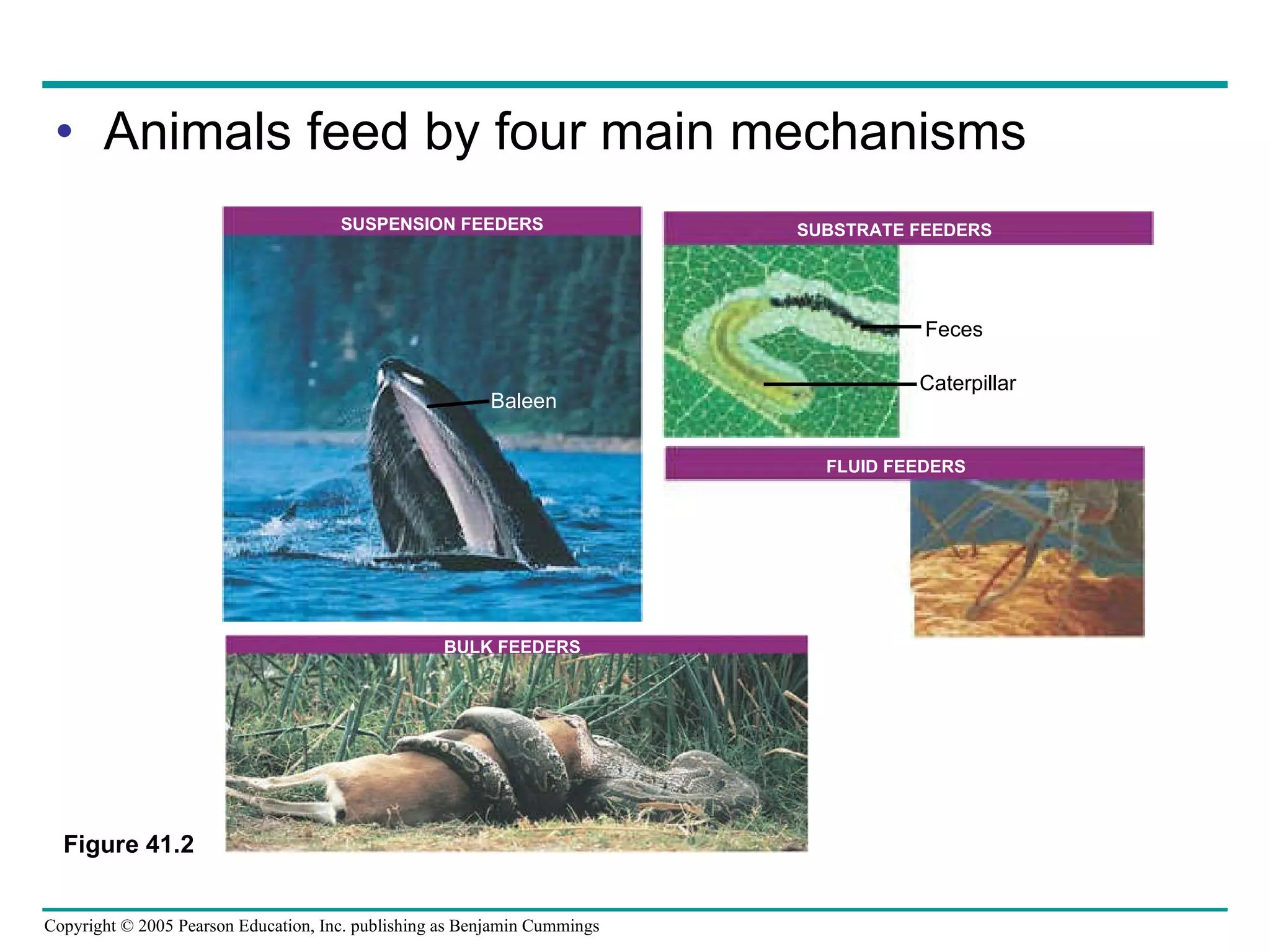
Animals feed by four main mechanisms Figure 41.2 Baleen SUSPENSION FEEDERS Feces SUBSTRATE FEEDERS BULK FEEDERS FLUID FEEDERS Caterpillar
Concept 41.1: Homeostatic mechanisms manage an animal’s energy budget Nearly all of an animal’s ATP generation Is based on the oxidation of energy-rich molecules: carbohydrates, proteins, and fats
Glucose Regulation as an Example of Homeostasis Animals store excess calories As glycogen in the liver and muscles and as fat
Glucose is a major fuel for cells Its metabolism, regulated by hormone action, is an important example of homeostasis Figure 41.3 STIMULUS: Blood glucose level rises after eating. Homeostasis: 90 mg glucose/ 100 mL blood STIMULUS: Blood glucose level drops below set point. 1 When blood glucose  level rises, a gland called  the pancreas secretes insulin, a hormone, into the blood. Insulin enhances the  transport of glucose into body  cells and stimulates the liver  and muscle cells to store  glucose as glycogen. As a  result, blood glucose level  drops. 2 Glucagon promotes the breakdown of glycogen in the liver and the release of glucose into the blood, increasing blood glucose level. 4 When blood glucose  level drops, the pancreas  secretes the hormone  glucagon, which opposes  the effect of insulin. 3
When fewer calories are taken in than are expended Fuel is taken out of storage and oxidized
Caloric Imbalance Undernourishment Occurs in animals when their diets are chronically deficient in calories Can have detrimental effects on an animal
Overnourishment Results from excessive food intake Leads to the storage of excess calories as fat Figure 41.4 100 µm
Obesity as a Human Health Problem The World Health Organization Now recognizes obesity as a major global health problem Obesity contributes to a number of health problems, including Diabetes, cardiovascular disease, and colon and breast cancer
Researchers have discovered Several of the mechanisms that help regulate body weight Over the long term, homeostatic mechanisms Are feedback circuits that control the body’s storage and metabolism of fat
Several chemical signals called hormones Regulate both long-term and short-term appetite by affecting a “satiety center” in the brain Figure 41.5 Produced by adipose (fat)  tissue,  leptin  suppresses  appetite as its level increases.  When body fat decreases,  leptin levels fall, and appetite  increases. Leptin PYY Insulin Ghrelin Secreted by the stomach  wall,  ghrelin  is one of the  signals that triggers feelings  of hunger as mealtimes  approach. In dieters who lose  weight, ghrelin levels increase,  which may be one reason  it’s so hard to stay on a diet. The hormone  PYY,   secreted by the small  intestine after meals,  acts as an appetite  suppressant that  counters the appetite  stimulant ghrelin. A rise in blood sugar level  after a meal stimulates  the pancreas to secrete  insulin  (see Figure 41.3).  In addition to its other  functions, insulin suppresses  appetite by acting on the brain.
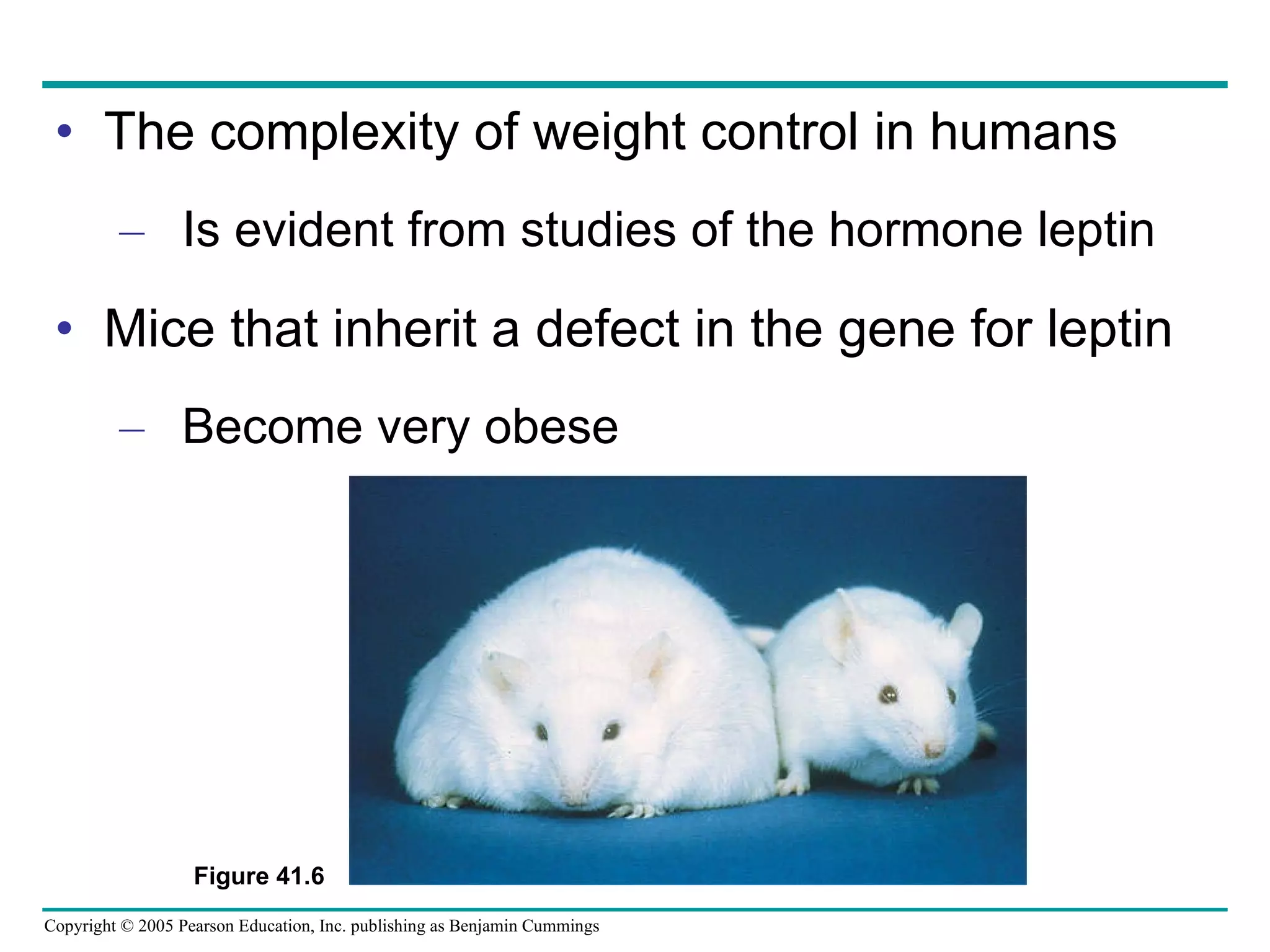
The complexity of weight control in humans Is evident from studies of the hormone leptin Mice that inherit a defect in the gene for leptin Become very obese Figure 41.6
Obesity and Evolution The problem of maintaining weight partly stems from our evolutionary past When fat hoarding was a means of survival
A species of birds called petrels Become obese as chicks due to the need to consume more calories than they burn Figure 41.7
Concept 41.2: An animal’s diet must supply carbon skeletons and essential nutrients To build the complex molecules it needs to grow, maintain itself, and reproduce An animal must obtain organic precursors (carbon skeletons) from its food
Besides fuel and carbon skeletons An animal’s diet must also supply essential nutrients in preassembled form An animal that is malnourished Is missing one or more essential nutrients in its diet
Herbivorous animals May suffer mineral deficiencies if they graze on plants in soil lacking key minerals Figure 41.8
Malnutrition Is much more common than undernutrition in human populations
Essential Amino Acids Animals require 20 amino acids And can synthesize about half of them from the other molecules they obtain from their diet The remaining amino acids, the essential amino acids Must be obtained from food in preassembled form
A diet that provides insufficient amounts of one or more essential amino acids Causes a form of malnutrition called protein deficiency Figure 41.9
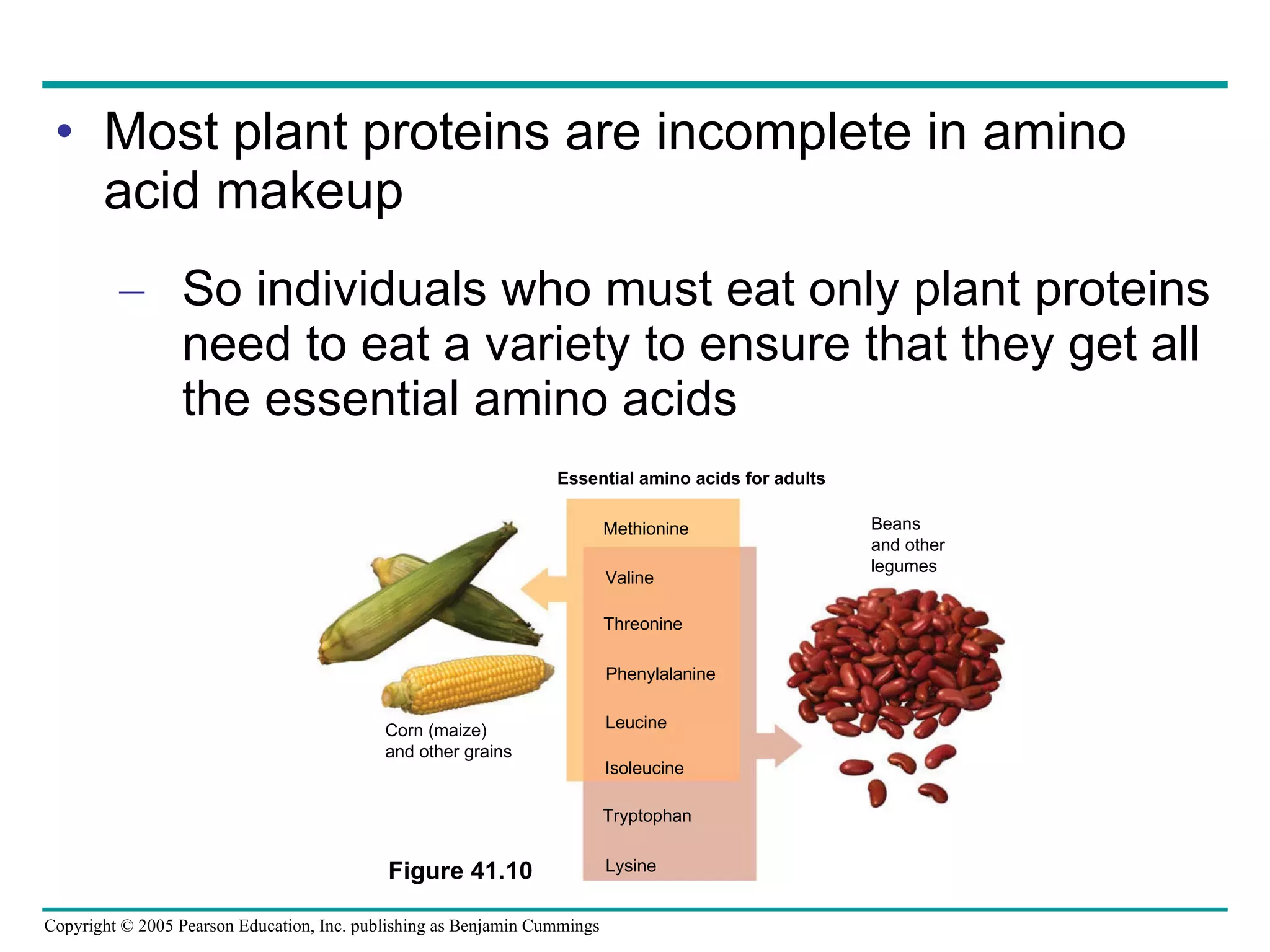
Most plant proteins are incomplete in amino acid makeup So individuals who must eat only plant proteins need to eat a variety to ensure that they get all the essential amino acids Corn (maize) and other grains Beans and other  legumes Essential amino acids for adults  Methionine Valine Threonine Phenylalanine Leucine Isoleucine Lysine Tryptophan Figure 41.10
Some animals have adaptations That help them through periods when their bodies demand extraordinary amounts of protein Figure 41.11
Essential Fatty Acids Animals can synthesize most of the fatty acids they need The essential fatty acids Are certain unsaturated fatty acids Deficiencies in fatty acids are rare
Vitamins Vitamins are organic molecules Required in the diet in small amounts To date, 13 vitamins essential to humans Have been identified
Vitamins are grouped into two categories Fat-soluble and  water-soluble Table 41.1
Minerals Minerals are simple inorganic nutrients Usually required in small amounts
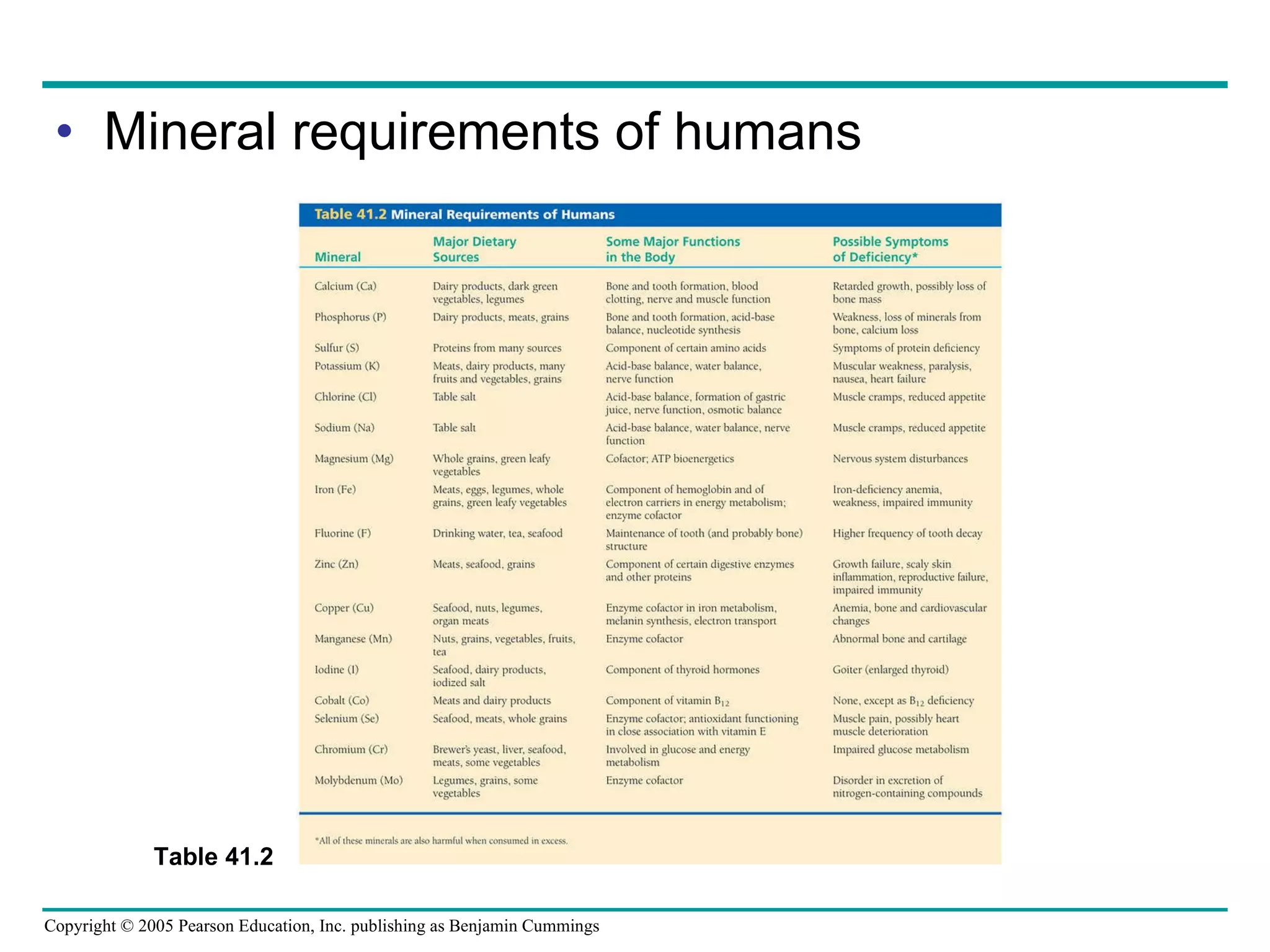
Mineral requirements of humans Table 41.2
Concept 41.3: The main stages of food processing are ingestion, digestion, absorption, and elimination Ingestion, the act of eating Is the first stage of food processing
Digestion, the second stage of food processing Is the process of breaking food down into molecules small enough to absorb Involves enzymatic hydrolysis of polymers into their monomers
Absorption, the third stage of food processing Is the uptake of nutrients by body cells Elimination, the fourth stage of food processing Occurs as undigested material passes out of the digestive compartment
The four stages of food processing Figure 41.12 Pieces of food Small molecules Mechanical digestion Food  Chemical digestion (enzymatic hydrolysis) Nutrient  molecules enter body  cells Undigested  material INGESTION 1 DIGESTION 2 ELIMINATION 4 ABSORPTION 3
Digestive Compartments Most animals process food  In specialized compartments
Intracellular Digestion In intracellular digestion Food particles are engulfed by endocytosis and digested within food vacuoles
Extracellular Digestion Extracellular digestion Is the breakdown of food particles outside cells
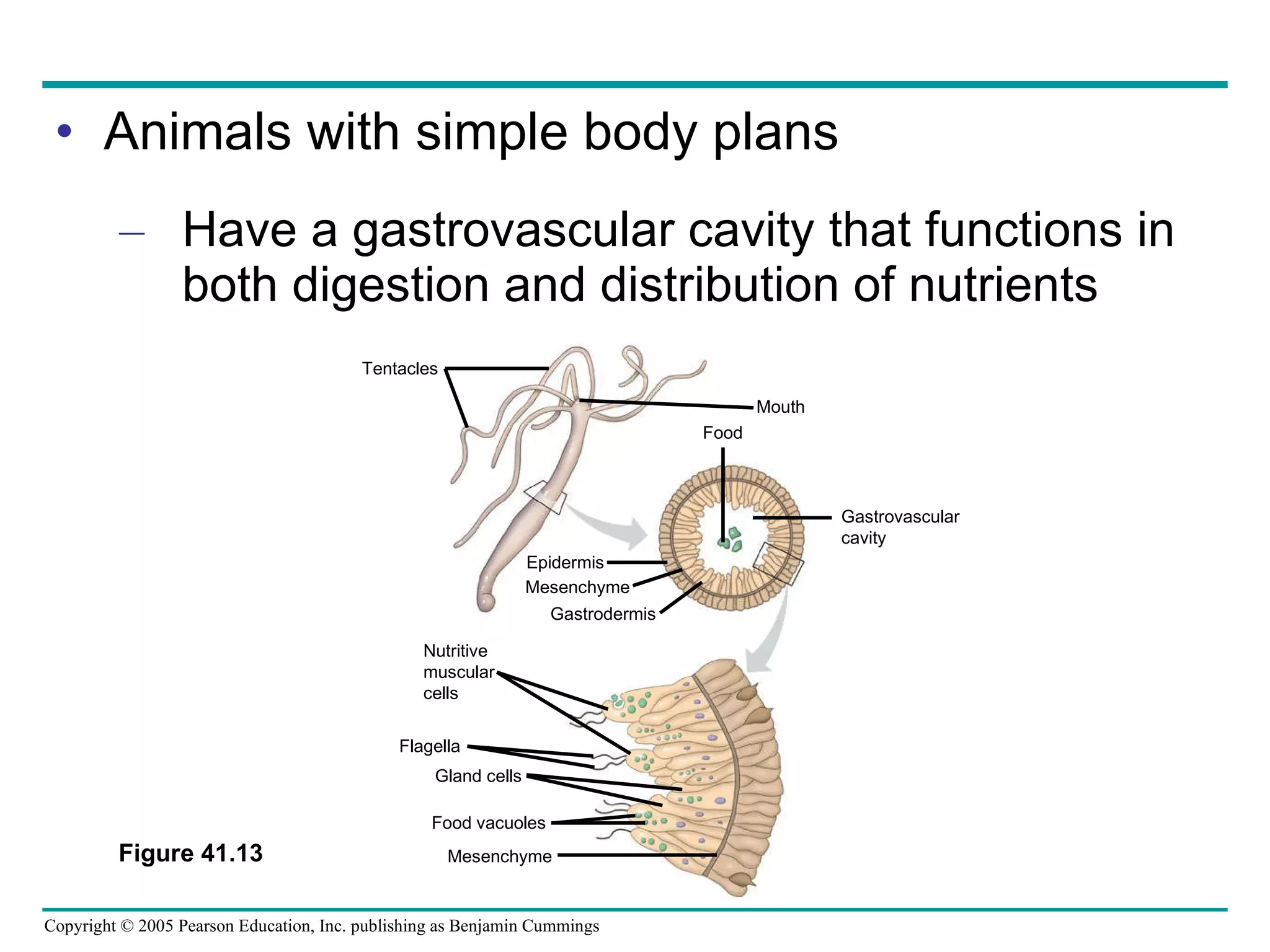
Animals with simple body plans Have a gastrovascular cavity that functions in both digestion and distribution of nutrients Figure 41.13  Gastrovascular cavity Food Epidermis Mesenchyme Gastrodermis Mouth Tentacles Mesenchyme Food vacuoles Gland cells Flagella Nutritive muscular cells
Animals with a more complex body plan Have a digestive tube with two openings, a mouth and an anus This digestive tube Is called a complete digestive tract or an alimentary canal
The digestive tube can be organized into specialized regions That carry out digestion and nutrient absorption in a stepwise fashion Esophagus Mouth Pharynx Crop Gizzard Intestine Typhlosole Lumen of intestine Esophagus Rectum Mouth Crop Anus Intestine Gizzard Stomach Mouth Esophagus Foregut Midgut Hindgut Earthworm.  The digestive tract of an earthworm includes a muscular  pharynx that sucks food in through the mouth. Food passes through the  esophagus and is stored and moistened  in the crop. The muscular gizzard, which contains small bits of sand and gravel,  pulverizes the food. Digestion and  absorption occur in the intestine,  which has a dorsal fold, the typhlosole,  that increases the surface area for  nutrient absorption. (b) Grasshopper.  A grasshopper has several  digestive chambers grouped into three  main regions: a foregut, with an esophagus  and crop; a midgut; and a hindgut. Food is  moistened and stored in the crop, but most  digestion occurs in the midgut. Gastric ceca,  pouches extending from the midgut,  absorb nutrients. (c) Bird.  Many birds have three separate chambers— the crop, stomach, and gizzard—where food is  pulverized and churned before passing into the  intestine. A bird’s crop and gizzard function very  much like those of an earthworm. In most birds,  chemical digestion and absorption of nutrients  occur in the intestine. Figure 41.14a–c Anus Anus Gastric ceca Crop
Concept 41.4: Each organ of the mammalian digestive system has specialized food-processing functions
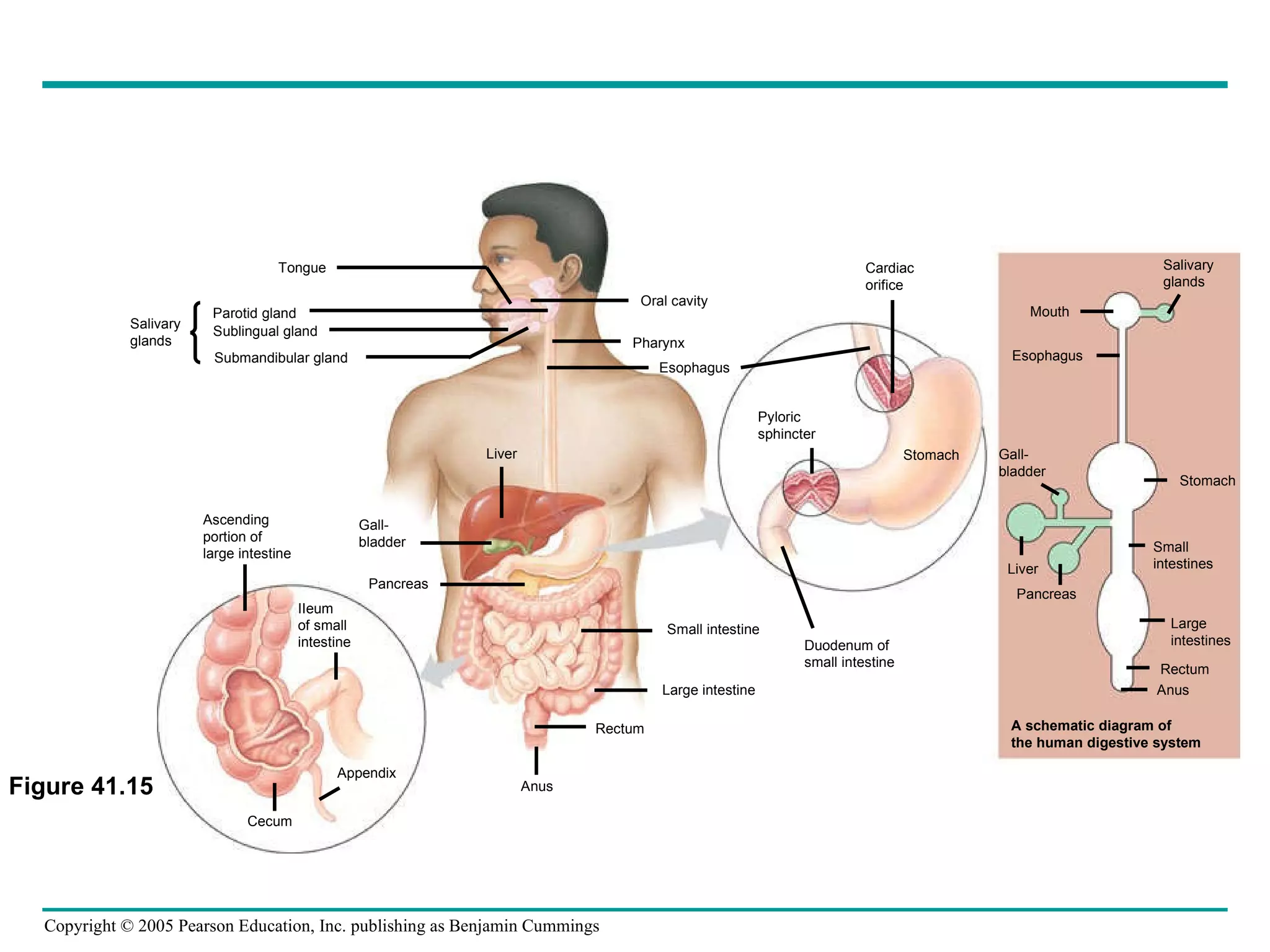
The mammalian digestive system consists of the alimentary canal And various accessory glands that secrete digestive juices through ducts
Figure 41.15 IIeum of small  intestine Duodenum of  small intestine Appendix Cecum Ascending portion of  large intestine Anus Small intestine Large intestine Rectum Liver Gall- bladder Tongue Oral cavity Pharynx Esophagus Stomach Pyloric sphincter Cardiac orifice Mouth Esophagus Salivary glands Stomach Liver Pancreas Gall- bladder Large  intestines Small  intestines Rectum Anus Parotid gland Sublingual gland Submandibular gland Salivary glands A schematic diagram of  the human digestive system Pancreas
Food is pushed along the digestive tract by peristalsis Rhythmic waves of contraction of smooth muscles in the wall of the canal
The Oral Cavity, Pharynx, and Esophagus In the oral cavity, food is lubricated and digestion begins And teeth chew food into smaller particles that are exposed to salivary amylase, initiating the breakdown of glucose polymers
The region we call our throat is the pharynx A junction that opens to both the esophagus and the windpipe (trachea) The esophagus Conducts food from the pharynx down to the stomach by peristalsis
From mouth to stomach Esophagus Epiglottis  down Tongue Pharynx Glottis Larynx Trachea Bolus of food Epiglottis up To lungs To stomach Esophageal  sphincter contracted Glottis up and closed Esophageal  sphincter relaxed Glottis down  and open Esophageal  sphincter contracted Epiglottis up Relaxed muscles Contracted muscles Relaxed muscles Stomach Figure 41.16 1 When a person is not  swallowing, the esophageal  sphincter muscle is contracted,  the epiglottis is up, and the  glottis is open, allowing air  to flow through the trachea  to the lungs. The swallowing reflex is triggered when a bolus of food reaches the pharynx. 2 The larynx, the upper part of the respiratory tract, moves upward and tips the epiglottis over the glottis, preventing food from entering the trachea. 3 The esophageal sphincter relaxes, allowing the bolus to enter the esophagus. 4 After the food has entered the esophagus, the larynx moves downward and opens the breathing passage. 5 Waves of muscular contraction  (peristalsis) move the bolus  down the esophagus  to the stomach. 6
The Stomach The stomach stores food And secretes gastric juice, which converts a meal to acid chyme Gastric juice Is made up of hydrochloric acid and the enzyme pepsin
The lining of the stomach Is coated with mucus, which prevents the gastric juice from destroying the cells Figure 41.17 Pepsin (active enzyme) HCl Parietal cell Chief cell Stomach Folds of  epithelial  tissue Esophagus Pyloric  sphincter Epithelium Pepsinogen 3 2 1 Interior surface of stomach. The interior surface of the  stomach wall is highly folded  and dotted with pits leading  into tubular gastric glands. Gastric gland.  The gastric  glands have three types of cells  that secrete different components  of the gastric juice: mucus cells,  chief cells, and parietal cells. Mucus cells  secrete mucus, which lubricates and protects the cells lining the stomach. Chief cells  secrete pepsino- gen, an inactive form of the digestive enzyme pepsin. Parietal cells  secrete hydrochloric acid (HCl). 1 Pepsinogen and HCI are secreted into the lumen of the stomach. 2 HCl converts pepsinogen to pepsin. 3 Pepsin then activates more pepsinogen, starting a chain reaction. Pepsin begins the chemical digestion of proteins. 5 µm Small  intestine Cardiac orifice
Gastric ulcers, lesions in the lining Are caused mainly by the bacterium  Helicobacter pylori Figure 41.18 1 µm Bacteria Mucus layer of  stomach
The Small Intestine  The small intestine Is the longest section of the alimentary canal Is the major organ of digestion and absorption
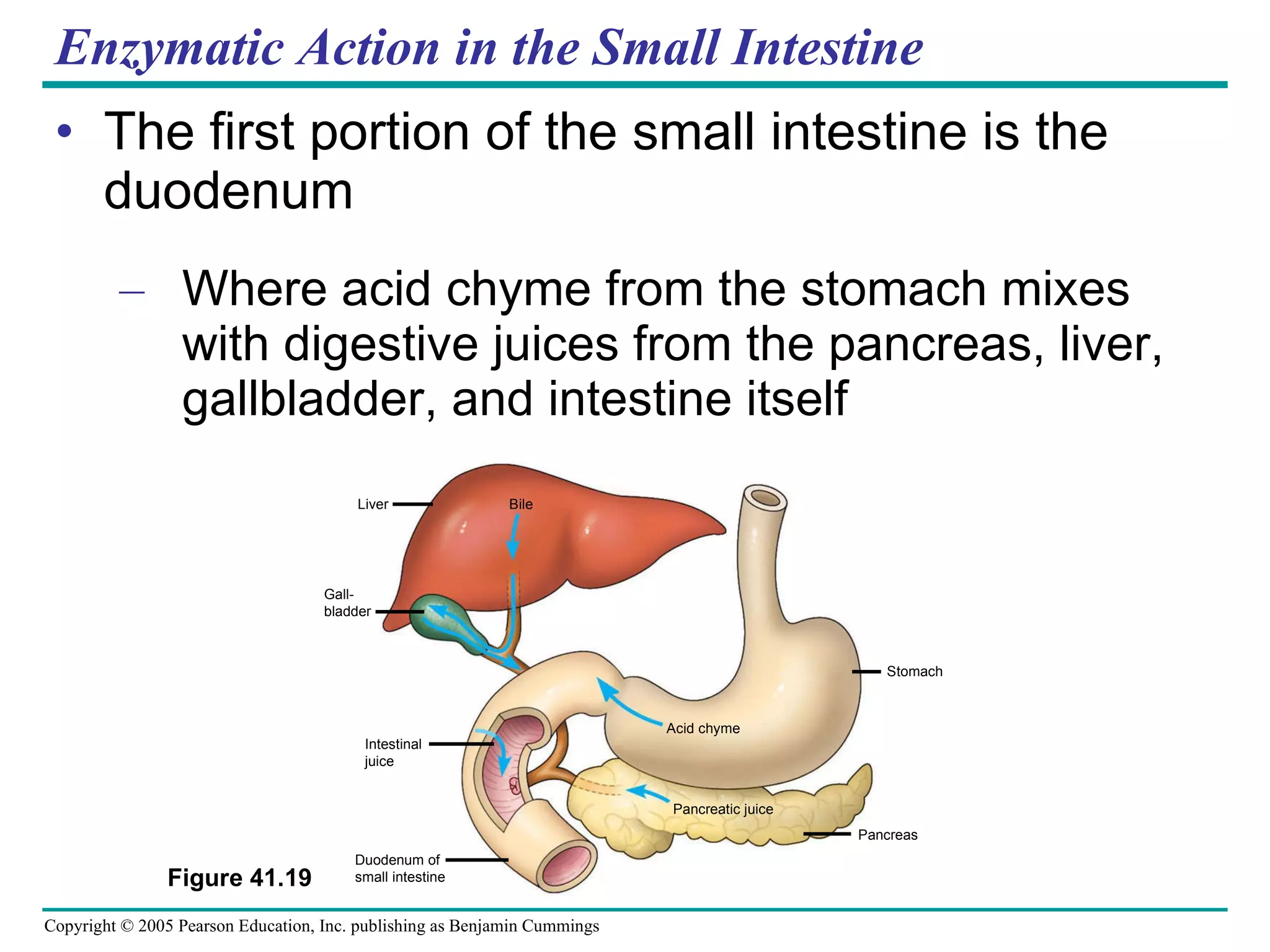
Enzymatic Action in the Small Intestine The first portion of the small intestine is the duodenum Where acid chyme from the stomach mixes with digestive juices from the pancreas, liver, gallbladder, and intestine itself Figure 41.19 Liver Bile Acid chyme Stomach Pancreatic juice Pancreas Intestinal juice Duodenum of  small intestine Gall- bladder
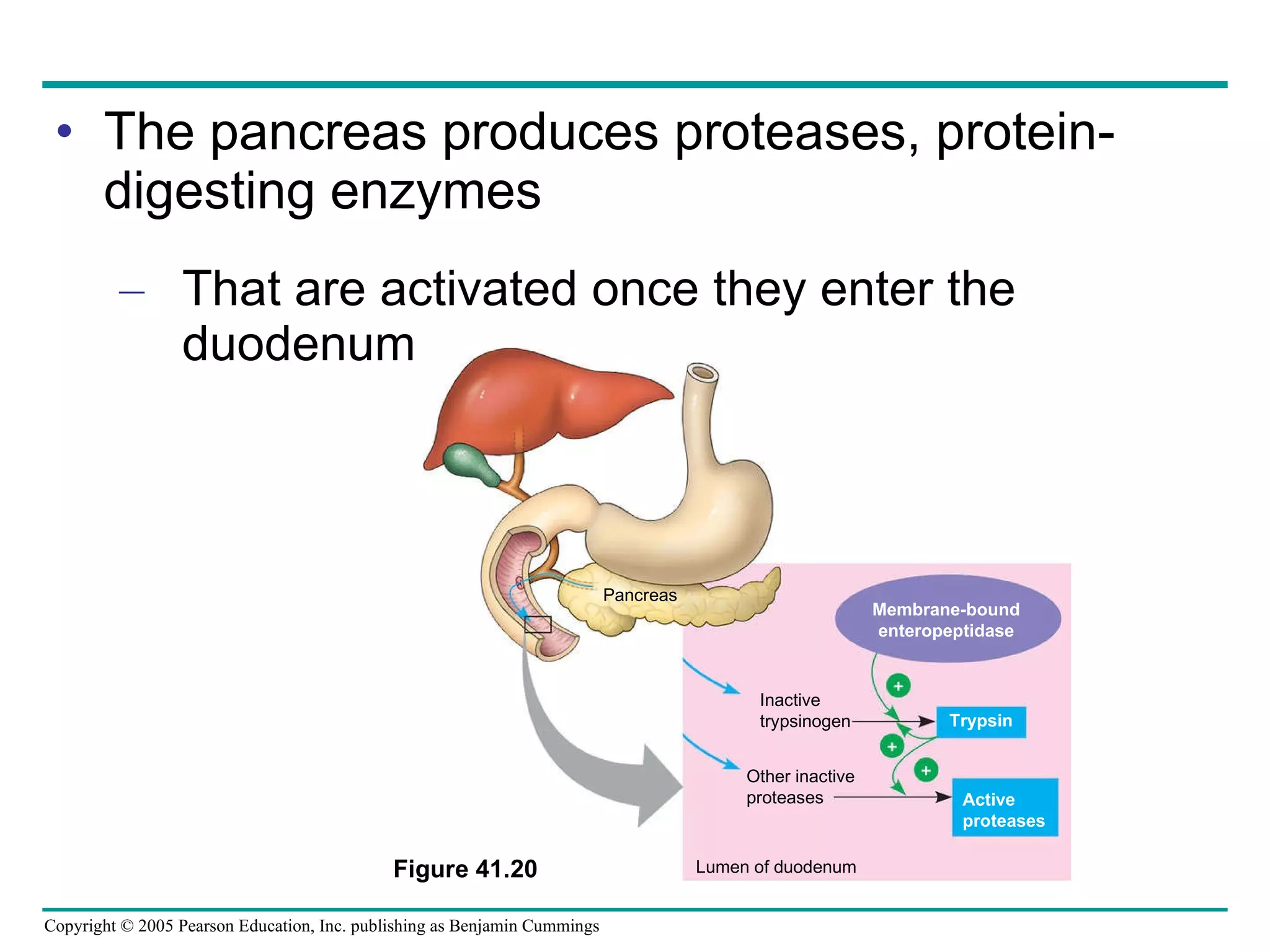
The pancreas produces proteases, protein-digesting enzymes That are activated once they enter the duodenum Figure 41.20 Pancreas Membrane-bound enteropeptidase Trypsin Active  proteases Lumen of duodenum Inactive trypsinogen Other inactive proteases
Enzymatic digestion is completed As peristalsis moves the mixture of chyme and digestive juices along the small intestine Figure 41.21 Oral cavity, pharynx, esophagus Carbohydrate digestion Polysaccharides (starch, glycogen) Disaccharides (sucrose, lactose) Salivary amylase Smaller polysaccharides, maltose Stomach Protein digestion Nucleic acid digestion Fat digestion Proteins Pepsin Small polypeptides Lumen of  small intes- tine  Polysaccharides Pancreatic amylases Maltose and other disaccharides Epithelium of small intestine (brush border) Disaccharidases Monosaccharides Polypeptides Pancreatic trypsin and chymotrypsin (These proteases cleave bonds adjacent to certain amino acids.) Smaller polypeptides Pancreatic carboxypeptidase Amino acids Small peptides Dipeptidases, carboxypeptidase, and aminopeptidase (These proteases split  off one amino acid at a time, working from opposite ends of a polypeptide.) Amino acids DNA, RNA Pancreatic nucleases Nucleotides Nucleotidases Nucleosides Nucleosidases and phosphatases Nitrogenous bases, sugars, phosphates Fat globules (Insoluble in water, fats aggregate as globules.) Bile salts Fat droplets (A coating of bile salts prevents small drop- lets from coalescing into larger globules, increasing exposure to lipase.) Pancreatic lipase Glycerol, fatty acids, glycerides
Hormones help coordinate the secretion of digestive juices into the alimentary canal Figure 41.22 Amino acids or fatty acids in the duodenum trigger the release of  cholecystokinin (CCK),  which stimulates the release of digestive enzymes from the pancreas and bile from the gallbladder. Liver Gall- bladder CCK Entero- gastrone Gastrin Stomach Pancreas Secretin CCK Duodenum Key Stimulation Inhibition Enterogastrone  secreted by the duodenum inhibits peristalsis and acid secretion by the stomach, thereby slowing digestion when acid chyme rich in fats enters the duodenum. Secreted by the duodenum,  secretin  stimulates the pancreas  to release sodium bicarbonate,  which neutralizes acid chyme  from the stomach. Gastrin  from the stomach  recirculates via the bloodstream  back to the stomach, where it  stimulates the production  of gastric juices.
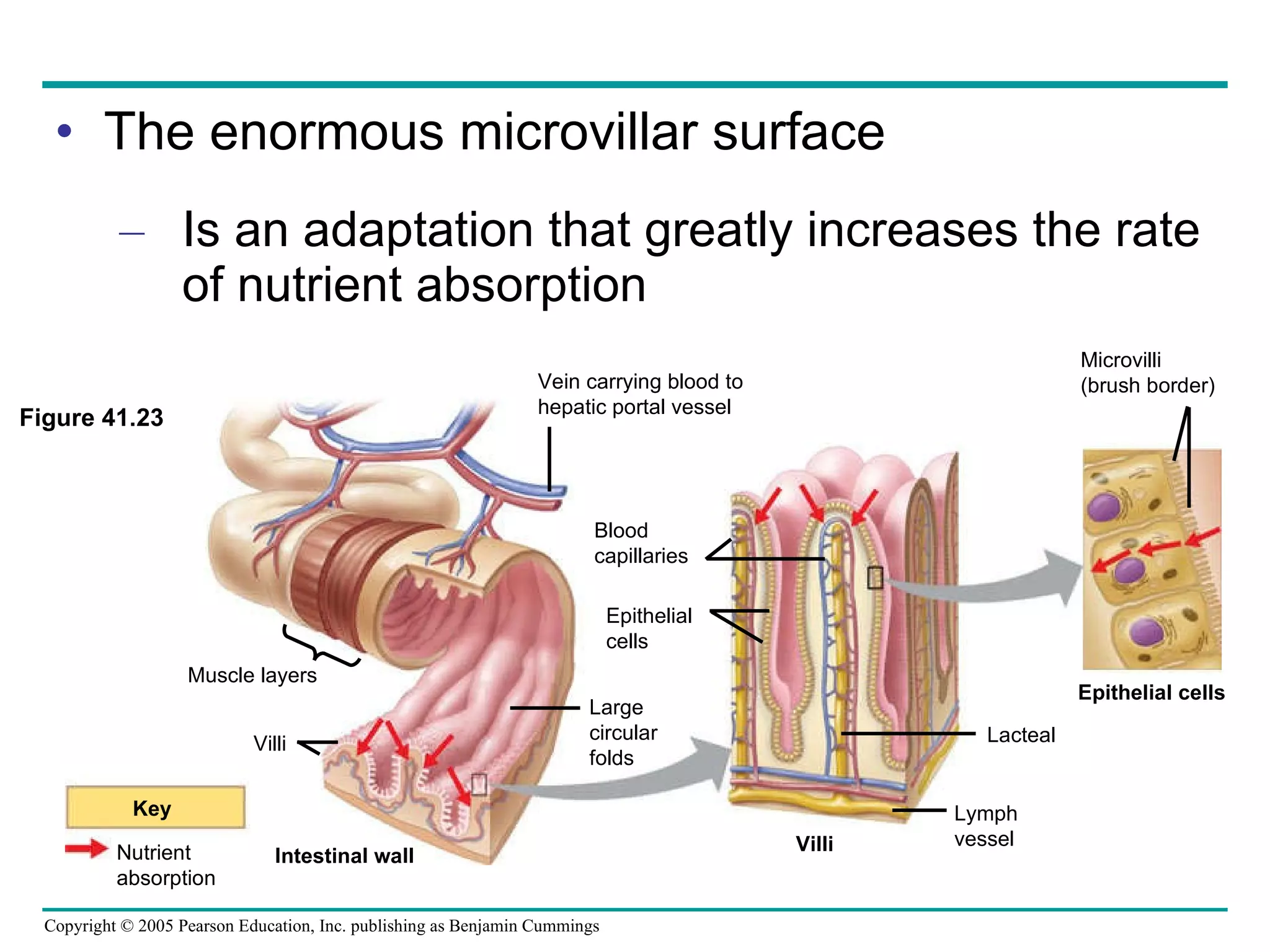
Absorption of Nutrients The small intestine has a huge surface area Due to the presence of villi and microvilli that are exposed to the intestinal lumen
The enormous microvillar surface Is an adaptation that greatly increases the rate of nutrient absorption Figure 41.23 Epithelial cells Key Nutrient absorption Vein carrying blood to  hepatic portal vessel Villi Large circular folds Intestinal wall Villi Epithelial cells Lymph  vessel Blood capillaries Lacteal Microvilli (brush border) Muscle layers
The core of each villus Contains a network of blood vessels and a small vessel of the lymphatic system called a lacteal
Amino acids and sugars Pass through the epithelium of the small intestine and enter the bloodstream After glycerol and fatty acids are absorbed by epithelial cells They are recombined into fats within these cells
These fats are then mixed with cholesterol and coated with proteins Forming small molecules called chylomicrons, which are transported into lacteals Figure 41.24 Large fat globules are  emulsified by bile salts  in the duodenum. 1 Digestion of fat by the pancreatic  enzyme lipase yields free fatty  acids and monoglycerides, which  then form micelles. 2 Fatty acids and mono- glycerides leave micelles  and enter epithelial cells  by diffusion. 3 Fat globule Lacteal Epithelial cells of small intestine Micelles made up of fatty acids, monoglycerides, and bile salts Fat droplets coated with bile salts Bile salts Chylomicrons containing fatty substances are transported out  of the epithelial cells and into  lacteals, where they are carried  away from the intestine by lymph. 4
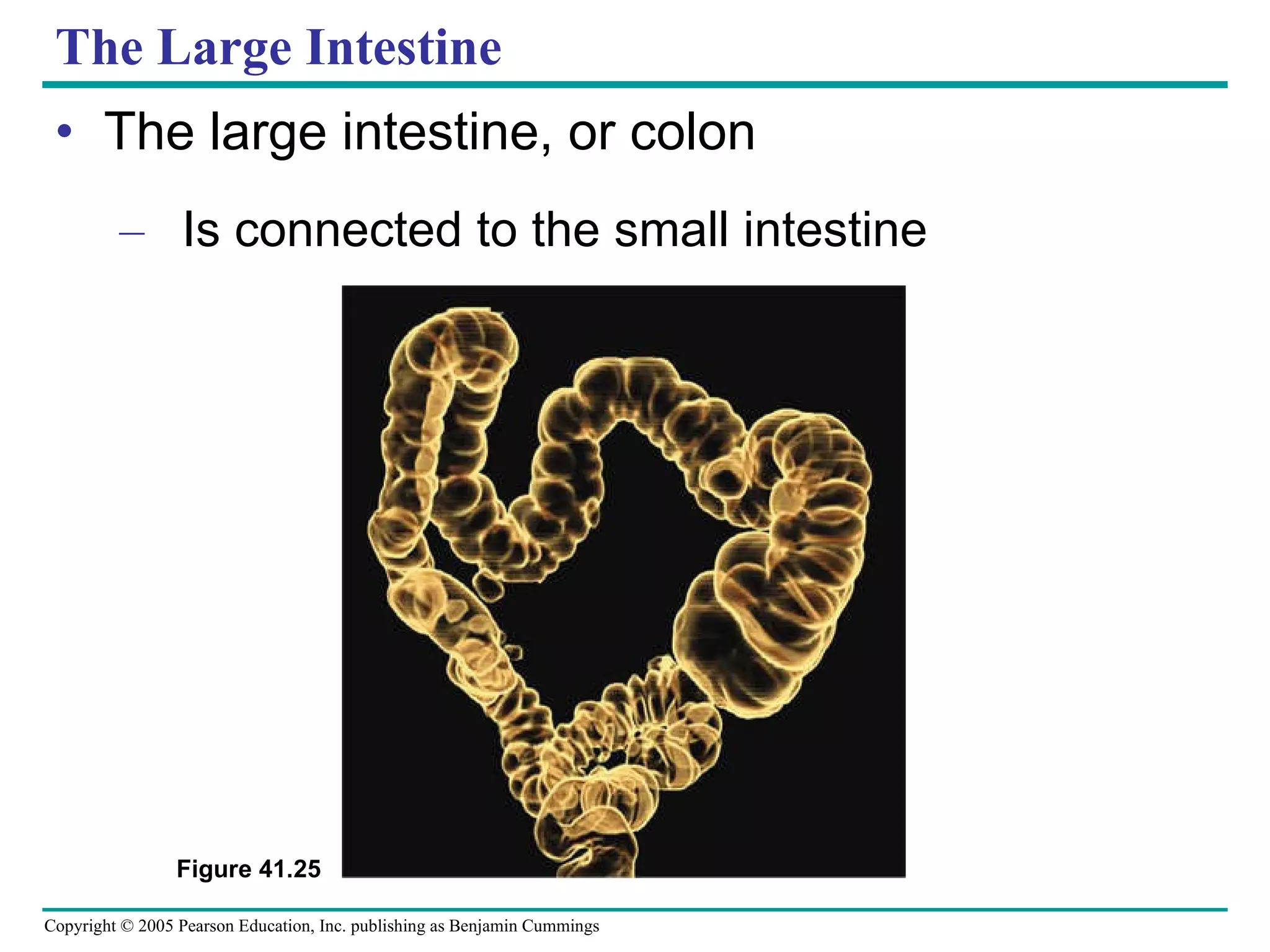
The Large Intestine The large intestine, or colon Is connected to the small intestine Figure 41.25
A major function of the colon Is to recover water that has entered the alimentary canal The wastes of the digestive tract, the feces Become more solid as they move through the colon Pass through the rectum and exit via the anus
The colon houses various strains of the bacterium  Escherichia coli Some of which produce various vitamins
Concept 41.5: Evolutionary adaptations of vertebrate digestive systems are often associated with diet
Some Dental Adaptations Dentition, an animal’s assortment of teeth Is one example of structural variation reflecting diet
Mammals have specialized dentition That best enables them to ingest their usual diet Figure 41.26a–c (a) Carnivore (b) Herbivore (c) Omnivore Incisors Canines Premolars Molars
Stomach and Intestinal Adaptations Herbivores generally have longer alimentary canals than carnivores Reflecting the longer time needed to digest vegetation Figure 41.27 Carnivore Herbivore Colon (large intestine) Cecum Stomach Small  intestine Small intestine
Symbiotic Adaptations Many herbivorous animals have fermentation chambers Where symbiotic microorganisms digest cellulose
The most elaborate adaptations for an herbivorous diet Have evolved in the animals called ruminants Figure 41.28 Reticulum.  Some boluses  also enter the reticulum. In  both the rumen and the  reticulum, symbiotic prokaryotes  and protists (mainly ciliates) go  to work on the cellulose-rich  meal. As by-products of their metabolism, the microorganisms  secrete fatty acids. The cow  periodically regurgitates and  rechews the cud (red arrows),  which further breaks down the fibers, making them more  accessible to further microbial action. Rumen.  When the cow first chews and swallows a mouthful of grass, boluses (green arrows) enter the rumen. 1 Intestine 2 Omasum.  The cow then reswallows the cud (blue arrows), which moves to the omasum, where water is removed. 3 Abomasum.  The cud, containing great numbers of microorganisms,  finally passes to the abomasum for digestion by the cow‘s own  enzymes (black arrows). 4 Esophagus
Chapter 42 Circulation and Gas Exchange
Overview: Trading with the Environment Every organism must exchange materials with its environment And this exchange ultimately occurs at the cellular level
In unicellular organisms These exchanges occur directly with the environment For most of the cells making up multicellular organisms Direct exchange with the environment is not possible
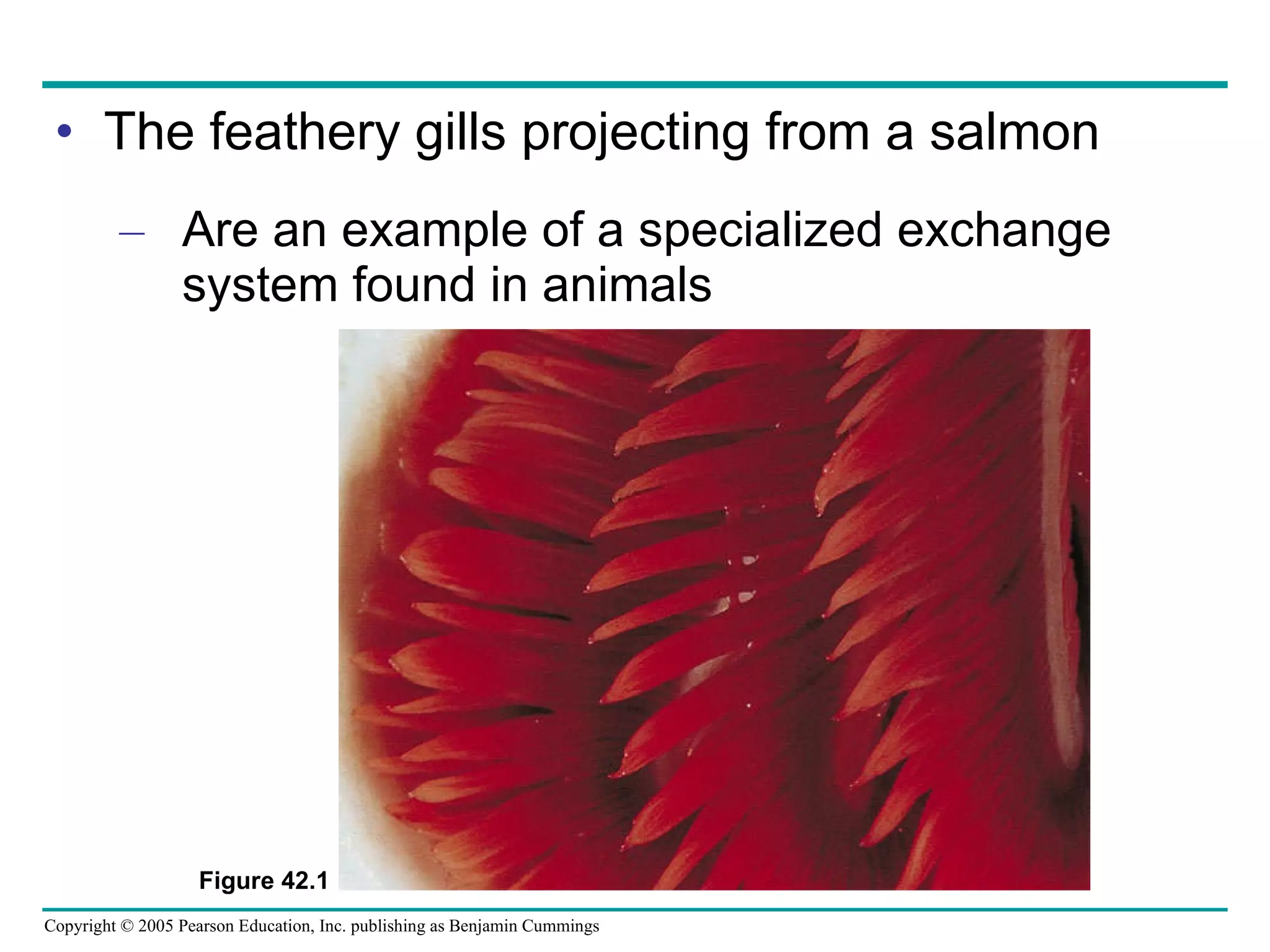
The feathery gills projecting from a salmon Are an example of a specialized exchange system found in animals Figure 42.1
Concept 42.1: Circulatory systems reflect phylogeny Transport systems Functionally connect the organs of exchange with the body cells
Most complex animals have internal transport systems That circulate fluid, providing a lifeline between the aqueous environment of living cells and the exchange organs, such as lungs, that exchange chemicals with the outside environment
Invertebrate Circulation The wide range of invertebrate body size and form Is paralleled by a great diversity in circulatory systems
Gastrovascular Cavities Simple animals, such as cnidarians Have a body wall only two cells thick that encloses a gastrovascular cavity The gastrovascular cavity Functions in both digestion and distribution of substances throughout the body
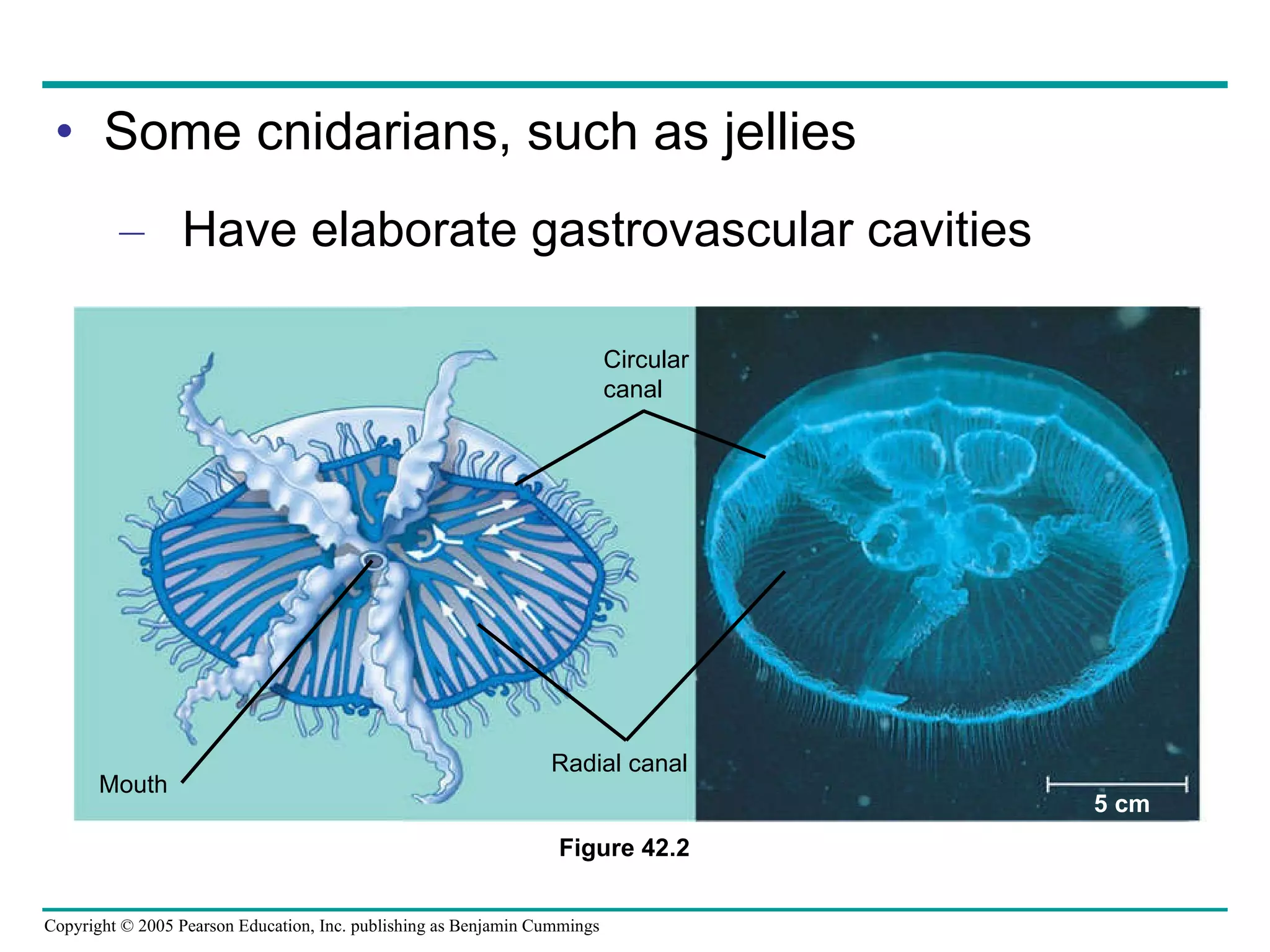
Some cnidarians, such as jellies Have elaborate gastrovascular cavities Figure 42.2 Circular canal Radial canal 5 cm Mouth
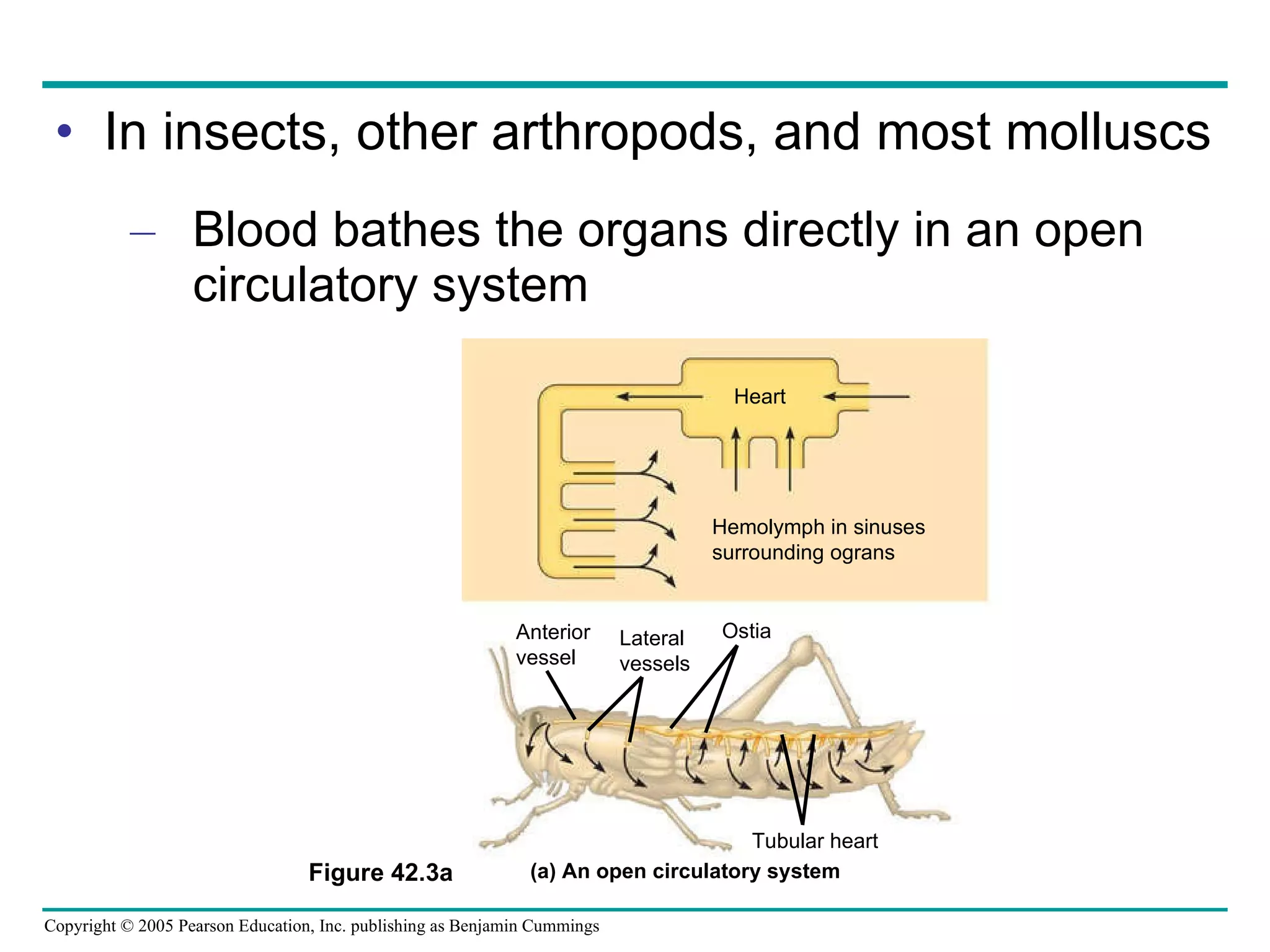
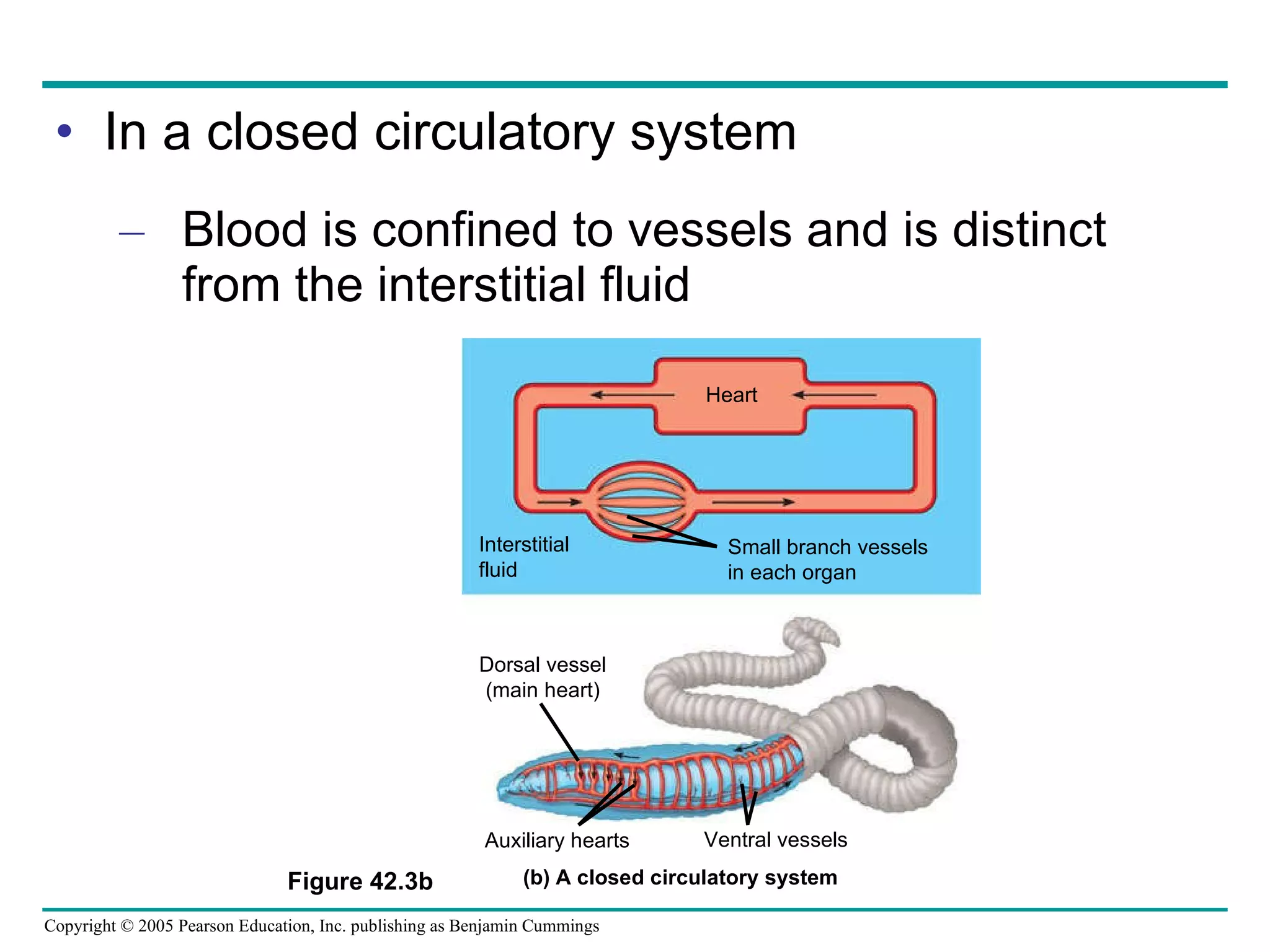
Open and Closed Circulatory Systems More complex animals Have one of two types of circulatory systems: open or closed Both of these types of systems have three basic components A circulatory fluid (blood) A set of tubes (blood vessels) A muscular pump (the heart)
In insects, other arthropods, and most molluscs Blood bathes the organs directly in an open circulatory system Heart Hemolymph in sinuses surrounding ograns Anterior  vessel Tubular heart Lateral  vessels Ostia (a) An open circulatory system Figure 42.3a
In a closed circulatory system Blood is confined to vessels and is distinct from the interstitial fluid Figure 42.3b Interstitial fluid Heart Small branch vessels  in each organ Dorsal vessel (main heart) Ventral vessels Auxiliary hearts (b) A closed circulatory system
Closed systems Are more efficient at transporting circulatory fluids to tissues and cells
Survey of Vertebrate Circulation Humans and other vertebrates have a closed circulatory system Often called the cardiovascular system Blood flows in a closed cardiovascular system Consisting of blood vessels and a two- to four-chambered heart
Arteries carry blood to capillaries The sites of chemical exchange between the blood and interstitial fluid Veins Return blood from capillaries to the heart
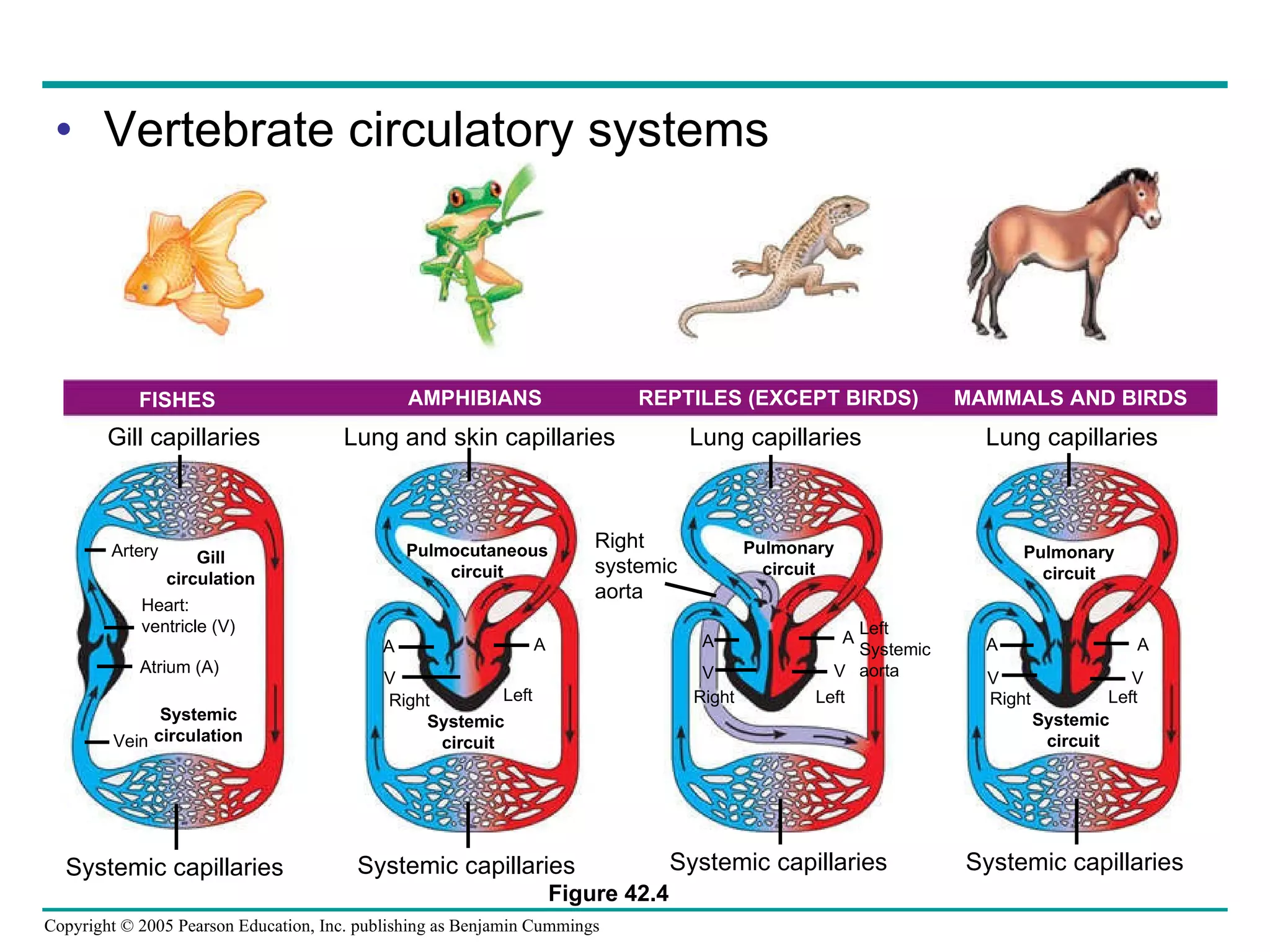
Fishes A fish heart has two main chambers One ventricle and one atrium Blood pumped from the ventricle Travels to the gills, where it picks up O 2  and disposes of CO 2
Amphibians Frogs and other amphibians Have a three-chambered heart, with two atria and one ventricle The ventricle pumps blood into a forked artery That splits the ventricle’s output into the pulmocutaneous circuit and the systemic circuit
Reptiles (Except Birds) Reptiles have double circulation With a pulmonary circuit (lungs) and a systemic circuit Turtles, snakes, and lizards Have a three-chambered heart
Mammals and Birds In all mammals and birds The ventricle is completely divided into separate right and left chambers The left side of the heart pumps and receives only oxygen-rich blood While the right side receives and pumps only oxygen-poor blood
A powerful four-chambered heart Was an essential adaptation of the endothermic way of life characteristic of mammals and birds
Vertebrate circulatory systems FISHES  AMPHIBIANS REPTILES (EXCEPT BIRDS) MAMMALS AND BIRDS Systemic capillaries Systemic capillaries Systemic capillaries Systemic capillaries Lung capillaries Lung capillaries Lung and skin capillaries Gill capillaries Right Left  Right Left  Right Left  Systemic  circuit Systemic  circuit Pulmocutaneous circuit Pulmonary circuit Pulmonary circuit Systemic circulation Vein Atrium (A) Heart: ventricle (V) Artery Gill circulation A V V V V V A A A A A Left  Systemic aorta Right  systemic aorta Figure 42.4
Concept 42.2: Double circulation in mammals depends on the anatomy and pumping cycle of the heart The structure and function of the human circulatory system Can serve as a model for exploring mammalian circulation in general
Mammalian Circulation: The Pathway Heart valves Dictate a one-way flow of blood through the heart
Blood begins its flow With the right ventricle pumping blood to the lungs In the lungs The blood loads O 2  and unloads CO 2
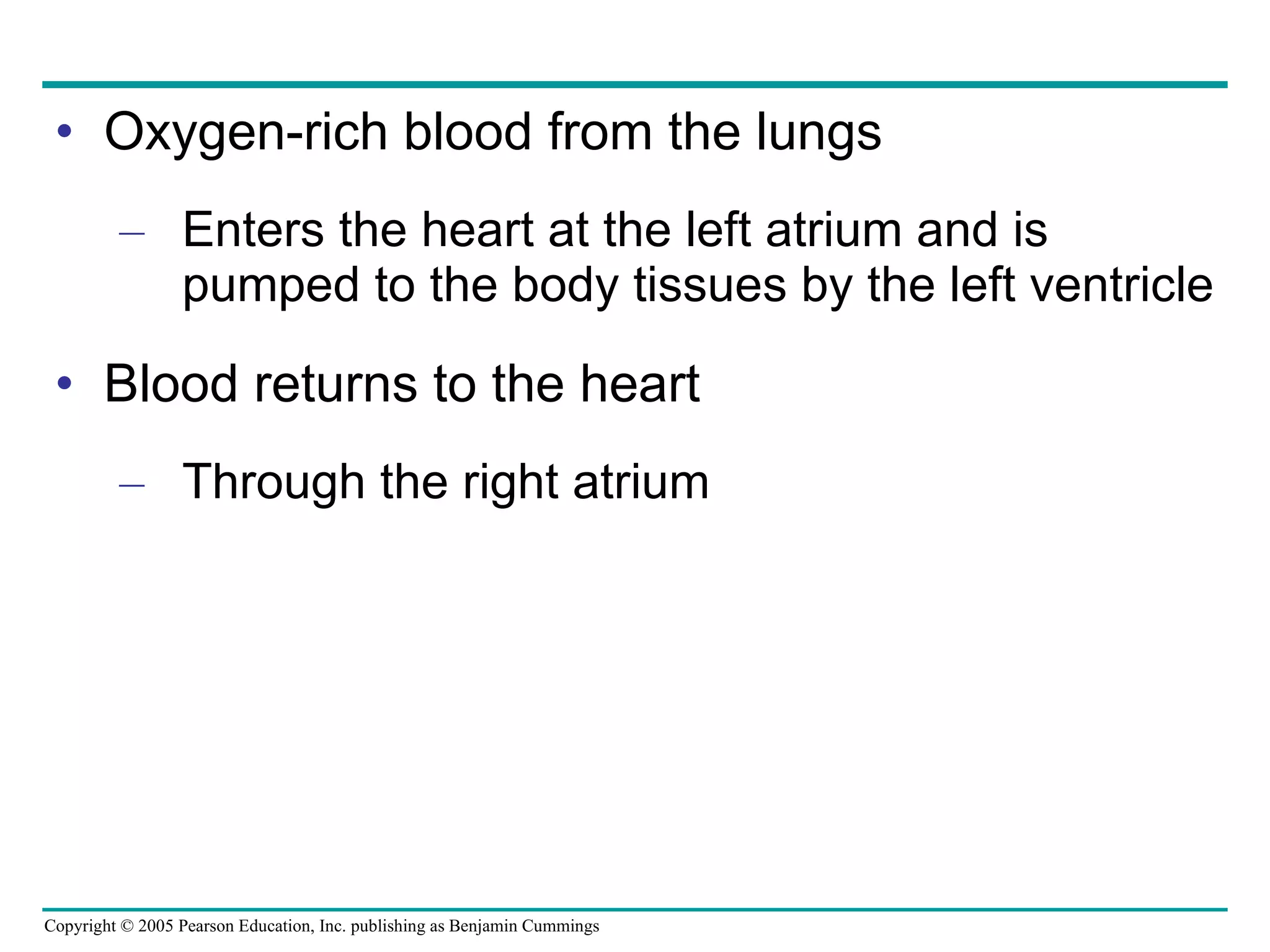
Oxygen-rich blood from the lungs Enters the heart at the left atrium and is pumped to the body tissues by the left ventricle Blood returns to the heart Through the right atrium
The mammalian cardiovascular system Pulmonary  vein Right atrium Right ventricle Posterior vena cava Capillaries of abdominal organs and hind limbs Aorta Left ventricle Left atrium Pulmonary  vein Pulmonary artery Capillaries of left lung Capillaries of head and  forelimbs  Anterior vena cava Pulmonary artery Capillaries of right lung Aorta Figure 42.5 1 10 11 5 4 6 2 9 3 3 7 8
The Mammalian Heart: A Closer Look A closer look at the mammalian heart Provides a better understanding of how double circulation works Figure 42.6 Aorta Pulmonary veins Semilunar valve Atrioventricular valve Left ventricle Right ventricle Anterior vena cava Pulmonary artery Semilunar valve Atrioventricular valve Posterior  vena cava Pulmonary veins Right atrium Pulmonary artery Left atrium
The heart contracts and relaxes In a rhythmic cycle called the cardiac cycle The contraction, or pumping, phase of the cycle Is called systole The relaxation, or filling, phase of the cycle Is called diastole
The cardiac cycle Figure 42.7 Semilunar valves closed AV valves open AV valves closed Semilunar valves open Atrial and  ventricular  diastole 1 Atrial systole;  ventricular  diastole 2 Ventricular systole;  atrial diastole 3 0.1 sec 0.3 sec 0.4 sec
The heart rate, also called the pulse Is the number of beats per minute The cardiac output Is the volume of blood pumped into the systemic circulation per minute
Maintaining the Heart’s Rhythmic Beat Some cardiac muscle cells are self-excitable Meaning they contract without any signal from the nervous system
A region of the heart called the sinoatrial (SA) node, or pacemaker Sets the rate and timing at which all cardiac muscle cells contract Impulses from the SA node Travel to the atrioventricular (AV) node At the AV node, the impulses are delayed And then travel to the Purkinje fibers that make the ventricles contract
The impulses that travel during the cardiac cycle Can be recorded as an electrocardiogram (ECG or EKG)
The control of heart rhythm Figure 42.8 SA node (pacemaker) AV node Bundle branches Heart apex Purkinje fibers 2 Signals are delayed at AV node. 1 Pacemaker generates  wave of signals  to contract.  3 Signals pass to heart apex. 4 Signals spread Throughout ventricles. ECG
The pacemaker is influenced by Nerves, hormones, body temperature, and exercise
Concept 42.3: Physical principles govern blood circulation The same physical principles that govern the movement of water in plumbing systems Also influence the functioning of animal circulatory systems
Blood Vessel Structure and Function The “infrastructure” of the circulatory system Is its network of blood vessels
All blood vessels Are built of similar tissues Have three similar layers Figure 42.9 Artery Vein 100 µm Artery Vein Arteriole Venule Connective tissue Smooth muscle Endothelium Connective tissue Smooth muscle Endothelium Valve Endothelium Basement membrane Capillary
Structural differences in arteries, veins, and capillaries Correlate with their different functions Arteries have thicker walls To accommodate the high pressure of blood pumped from the heart
In the thinner-walled veins Blood flows back to the heart mainly as a result of muscle action Figure 42.10 Direction of blood flow in vein (toward heart) Valve (open) Skeletal muscle Valve (closed)
Blood Flow Velocity Physical laws governing the movement of fluids through pipes Influence blood flow and blood pressure
The velocity of blood flow varies in the circulatory system And is slowest in the capillary beds as a result of the high resistance and large total cross-sectional area Figure 42.11 5,000 4,000 3,000 2,000 1,000 0 Aorta Arteries Arterioles Capillaries Venules Veins Venae cavae Pressure (mm Hg) Velocity (cm/sec) Area (cm 2 ) Systolic pressure Diastolic pressure 50 40 30 20 10 0 120 100 80 60 40 20 0
Blood Pressure Blood pressure Is the hydrostatic pressure that blood exerts against the wall of a vessel
Systolic pressure Is the pressure in the arteries during ventricular systole Is the highest pressure in the arteries Diastolic pressure Is the pressure in the arteries during diastole Is lower than systolic pressure
Blood pressure Can be easily measured in humans Figure 42.12 Artery Rubber cuff inflated with air Artery closed 120 120 Pressure in cuff  above 120 Pressure in cuff  below 120 Pressure in cuff  below 70 Sounds  audible in stethoscope Sounds  stop Blood pressure reading: 120/70 A typical blood pressure reading for a 20-year-old is 120/70. The units for these numbers are mm of  mercury (Hg); a blood pressure of 120 is a force that  can support a column of mercury 120 mm high. 1 A sphygmomanometer, an inflatable cuff attached to a pressure gauge, measures blood pressure in an artery. The cuff is wrapped around the upper arm and inflated  until the pressure closes the artery, so that no blood  flows past the cuff. When this occurs, the pressure  exerted by the cuff exceeds the pressure in the artery. 2 A stethoscope is used to listen for sounds of blood flow  below the cuff. If the artery is closed, there is no pulse  below the cuff. The cuff is gradually deflated until blood  begins to flow into the forearm, and sounds from blood  pulsing into the artery below the cuff can be heard with  the stethoscope. This occurs when the blood pressure  is greater than the pressure exerted by the cuff. The  pressure at this point is the systolic pressure. 3 The cuff is loosened further until the blood flows freely  through the artery and the sounds below the cuff  disappear. The pressure at this point is the diastolic  pressure remaining in the artery when the heart is relaxed. 4 70
Blood pressure is determined partly by cardiac output And partly by peripheral resistance due to variable constriction of the arterioles
Capillary Function Capillaries in major organs are usually filled to capacity But in many other sites, the blood supply varies
Two mechanisms Regulate the distribution of blood in capillary beds In one mechanism Contraction of the smooth muscle layer in the wall of an arteriole constricts the vessel
In a second mechanism Precapillary sphincters control the flow of blood between arterioles and venules Figure 42.13 a–c Precapillary sphincters Thoroughfare channel Arteriole Capillaries Venule (a) Sphincters relaxed (b) Sphincters contracted Venule Arteriole (c) Capillaries and larger vessels (SEM)  20 m
The critical exchange of substances between the blood and interstitial fluid Takes place across the thin endothelial walls of the capillaries
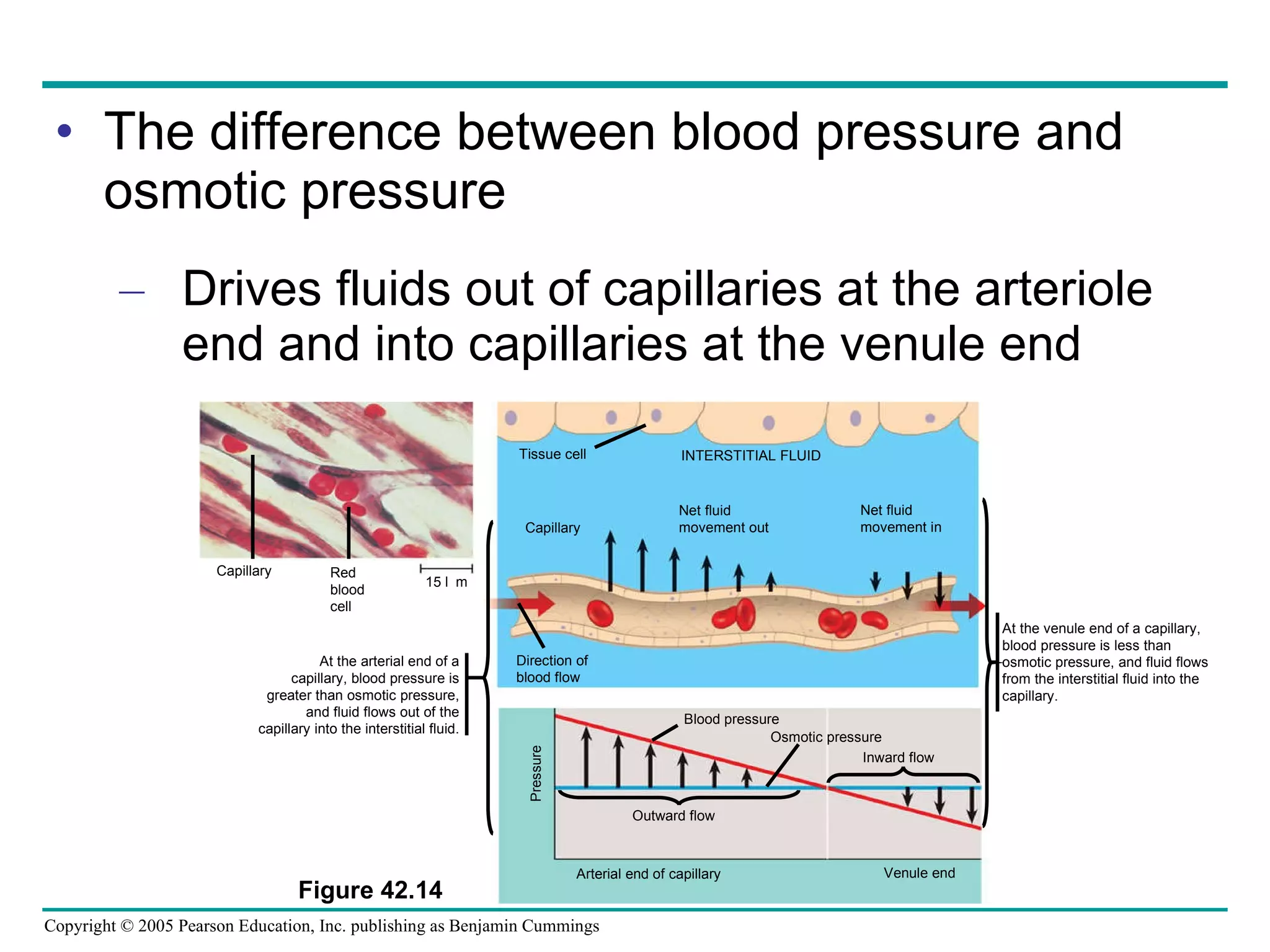
The difference between blood pressure and osmotic pressure Drives fluids out of capillaries at the arteriole end and into capillaries at the venule end At the arterial end of a capillary, blood pressure is greater than osmotic pressure, and fluid flows out of the capillary into the interstitial fluid. Capillary Red blood cell 15 m Tissue cell INTERSTITIAL FLUID Capillary Net fluid movement out Net fluid movement in Direction of  blood flow Blood pressure Osmotic pressure Inward flow Outward flow Pressure Arterial end of capillary Venule end At the venule end of a capillary, blood pressure is less than osmotic pressure, and fluid flows from the interstitial fluid into the capillary. Figure 42.14
Fluid Return by the Lymphatic System The lymphatic system Returns fluid to the body from the capillary beds Aids in body defense
Fluid reenters the circulation Directly at the venous end of the capillary bed and indirectly through the lymphatic system
Concept 42.4: Blood is a connective tissue with cells suspended in plasma Blood in the circulatory systems of vertebrates Is a specialized connective tissue
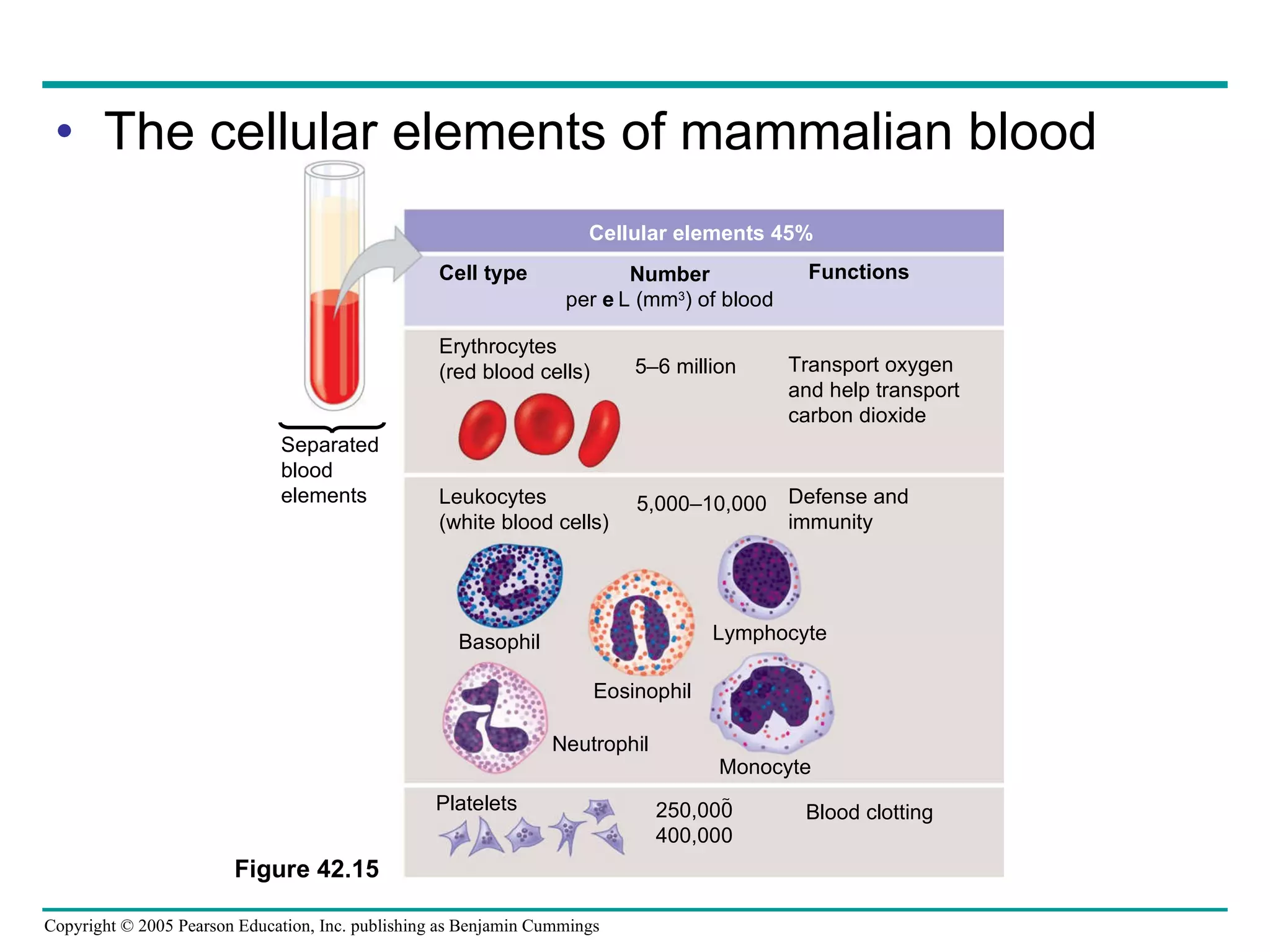
Blood Composition and Function Blood consists of several kinds of cells Suspended in a liquid matrix called plasma The cellular elements Occupy about 45% of the volume of blood
Plasma Blood plasma is about 90% water Among its many solutes are Inorganic salts in the form of dissolved ions, sometimes referred to as electrolytes
The composition of mammalian plasma Plasma 55% Constituent Major functions Water Solvent for carrying other substances Sodium Potassium Calcium Magnesium Chloride Bicarbonate Osmotic balance pH buffering, and regulation of  membrane permeability Albumin Fibringen Immunoglobulins (antibodies) Plasma proteins Icons (blood electrolytes Osmotic balance, pH buffering Substances transported by blood Nutrients (such as glucose, fatty acids, vitamins) Waste products of metabolism Respiratory gases (O 2  and CO 2 ) Hormones Defense Figure 42.15 Separated blood elements Clotting
Another important class of solutes is the plasma proteins Which influence blood pH, osmotic pressure, and viscosity Various types of plasma proteins Function in lipid transport, immunity, and blood clotting
Cellular Elements Suspended in blood plasma are two classes of cells Red blood cells, which transport oxygen White blood cells, which function in defense A third cellular element, platelets Are fragments of cells that are involved in clotting
The cellular elements of mammalian blood Figure 42.15 Cellular elements 45% Cell type Number per L (mm 3 ) of blood Functions Erythrocytes (red blood cells) 5–6 million Transport oxygen and help transport carbon dioxide Leukocytes (white blood cells) 5,000–10,000 Defense and immunity Eosinophil Basophil Platelets Neutrophil Monocyte Lymphocyte 250,000 400,000  Blood clotting Separated blood elements
Erythrocytes Red blood cells, or erythrocytes Are by far the most numerous blood cells Transport oxygen throughout the body
Leukocytes The blood contains five major types of white blood cells, or leukocytes Monocytes, neutrophils, basophils, eosinophils, and lymphocytes, which function in defense by phagocytizing bacteria and debris or by producing antibodies
Platelets Platelets function in blood clotting
Stem Cells and the Replacement of Cellular Elements The cellular elements of blood wear out And are replaced constantly throughout a person’s life
Erythrocytes, leukocytes, and platelets all develop from a common source A single population of cells called pluripotent stem cells in the red marrow of bones B cells T cells Lymphoid stem cells Pluripotent stem cells (in bone marrow) Myeloid stem cells Erythrocytes Platelets Monocytes Neutrophils Eosinophils Basophils Lymphocytes Figure 42.16
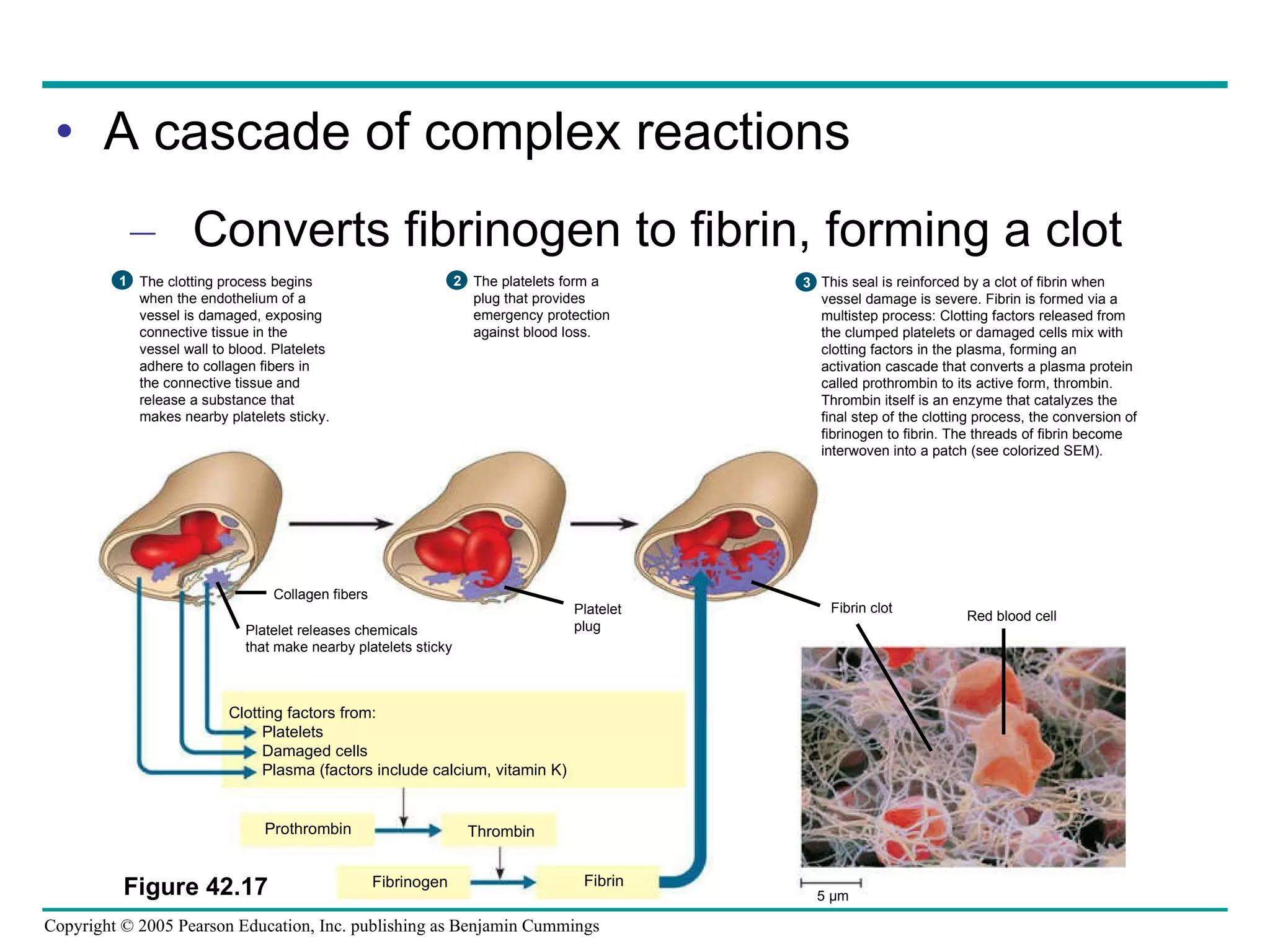
Blood Clotting When the endothelium of a blood vessel is damaged The clotting mechanism begins
A cascade of complex reactions Converts fibrinogen to fibrin, forming a clot Platelet plug Collagen fibers Platelet releases chemicals that make nearby platelets sticky Clotting factors from: Platelets Damaged cells Plasma (factors include calcium, vitamin K) Prothrombin Thrombin  Fibrinogen Fibrin 5 µm Fibrin clot Red blood cell The clotting process begins  when the endothelium of a  vessel is damaged, exposing  connective tissue in the  vessel wall to blood. Platelets adhere to collagen fibers in  the connective tissue and  release a substance that makes nearby platelets sticky. 1 The platelets form a  plug that provides emergency protection against blood loss. 2 This seal is reinforced by a clot of fibrin when  vessel damage is severe. Fibrin is formed via a multistep process: Clotting factors released from the clumped platelets or damaged cells mix with clotting factors in the plasma, forming an  activation cascade that converts a plasma protein called prothrombin to its active form, thrombin. Thrombin itself is an enzyme that catalyzes the  final step of the clotting process, the conversion of  fibrinogen to fibrin. The threads of fibrin become  interwoven into a patch (see colorized SEM). 3 Figure 42.17
Cardiovascular Disease Cardiovascular diseases Are disorders of the heart and the blood vessels Account for more than half the deaths in the United States
One type of cardiovascular disease, atherosclerosis Is caused by the buildup of cholesterol within arteries Figure 42.18a, b (a) Normal artery (b) Partly clogged artery 50 µm 250 µm Smooth muscle Connective  tissue Endothelium Plaque
Hypertension, or high blood pressure Promotes atherosclerosis and increases the risk of heart attack and stroke A heart attack Is the death of cardiac muscle tissue resulting from blockage of one or more coronary arteries A stroke Is the death of nervous tissue in the brain, usually resulting from rupture or blockage of arteries in the head
Concept 42.5: Gas exchange occurs across specialized respiratory surfaces Gas exchange Supplies oxygen for cellular respiration and disposes of carbon dioxide Figure 42.19 Organismal  level Cellular level Circulatory system Cellular respiration ATP Energy-rich molecules from food Respiratory surface Respiratory medium (air of water) O 2 CO 2
Animals require large, moist respiratory surfaces for the adequate diffusion of respiratory gases Between their cells and the respiratory medium, either air or water
Gills in Aquatic Animals Gills are outfoldings of the body surface Specialized for gas exchange
In some invertebrates The gills have a simple shape and are distributed over much of the body (a) Sea star.  The gills of a sea  star are simple tubular  projections of the skin.  The hollow core of each gill is an extension of the coelom (body cavity). Gas exchange occurs by diffusion across the gill surfaces, and fluid in the coelom circulates in and out of the gills, aiding gas transport.  The surfaces of a sea star’s  tube feet also function in  gas exchange.  Gills Tube foot Coelom Figure 42.20a
Many segmented worms have flaplike gills That extend from each segment of their body Figure 42.20b (b) Marine worm.  Many  polychaetes (marine  worms of the phylum  Annelida) have a pair  of flattened appendages  called parapodia on  each body segment. The  parapodia serve as gills and also function in crawling and swimming. Gill Parapodia
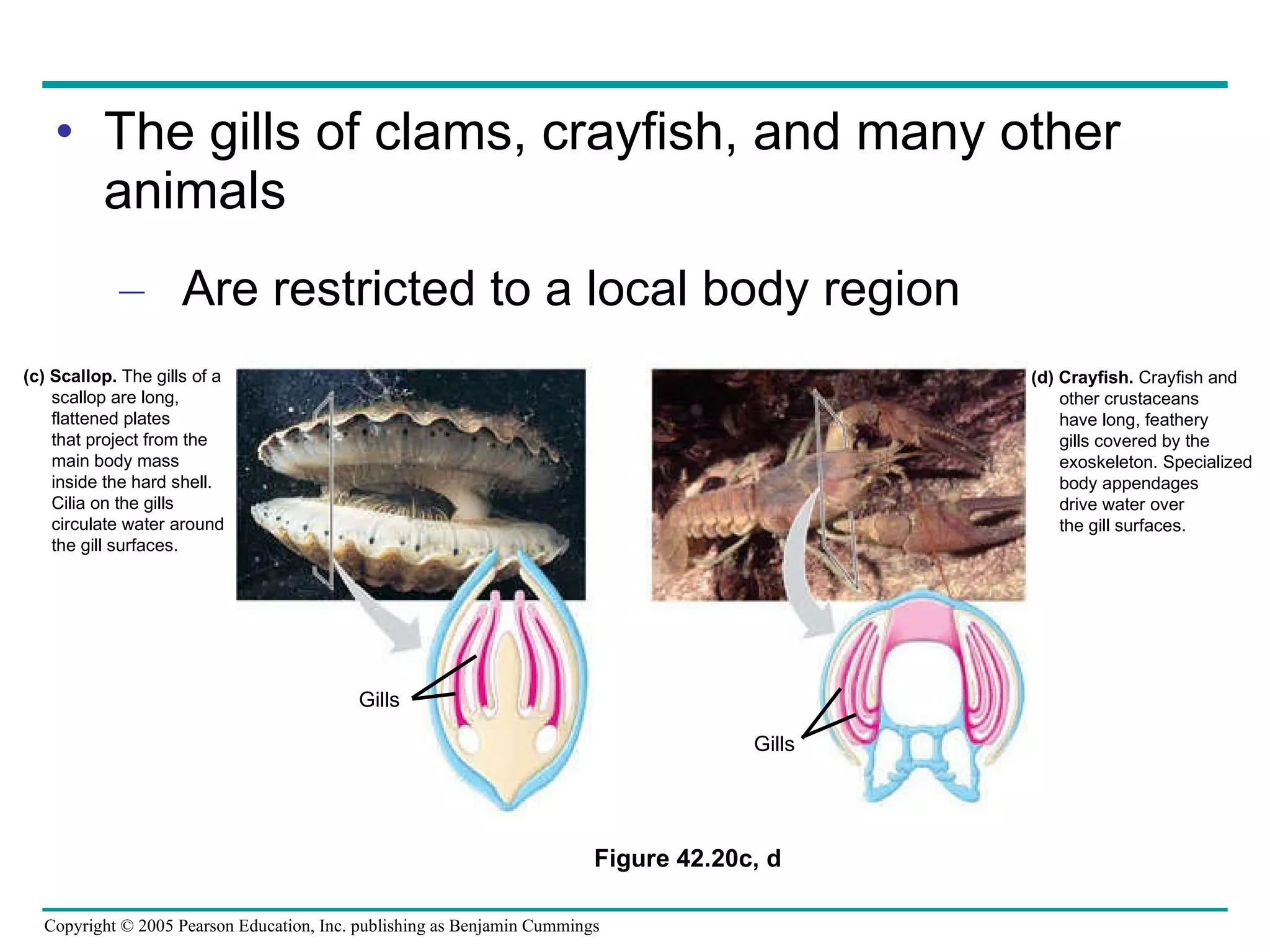
The gills of clams, crayfish, and many other animals Are restricted to a local body region Figure 42.20c, d (d) Crayfish.  Crayfish and  other crustaceans have long, feathery  gills covered by the  exoskeleton. Specialized  body appendages drive water over  the gill surfaces. (c) Scallop.  The gills of a  scallop are long,  flattened plates  that project from the main body mass  inside the hard shell. Cilia on the gills  circulate water around  the gill surfaces. Gills Gills
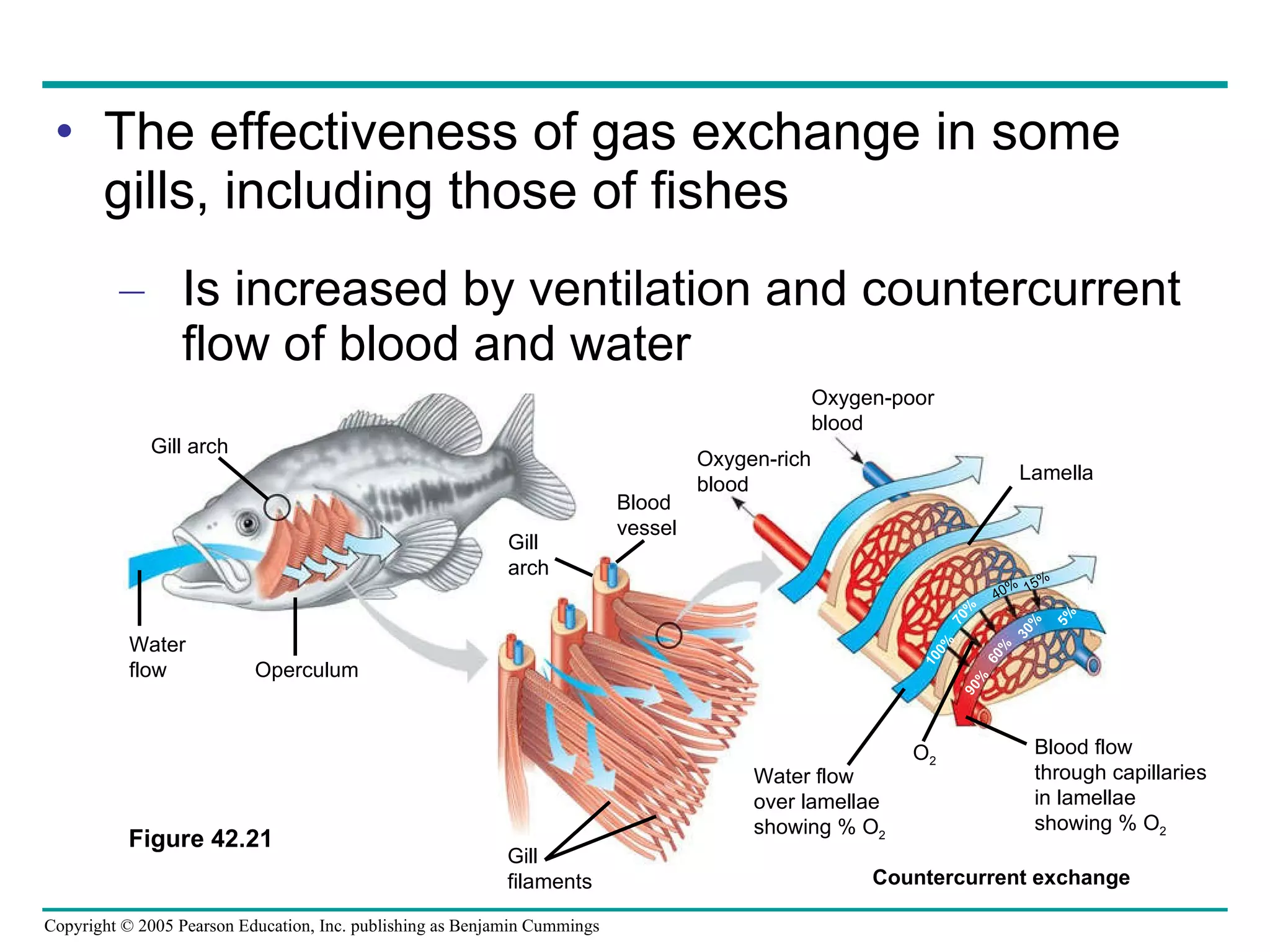
The effectiveness of gas exchange in some gills, including those of fishes Is increased by ventilation and countercurrent flow of blood and water Countercurrent exchange Figure 42.21 Gill arch Water  flow Operculum Gill  arch Blood  vessel Gill filaments Oxygen-poor blood Oxygen-rich blood Water flow over lamellae showing % O 2 Blood flow through capillaries in lamellae showing % O 2 Lamella 100% 40% 70% 15% 90% 60% 30% 5% O 2
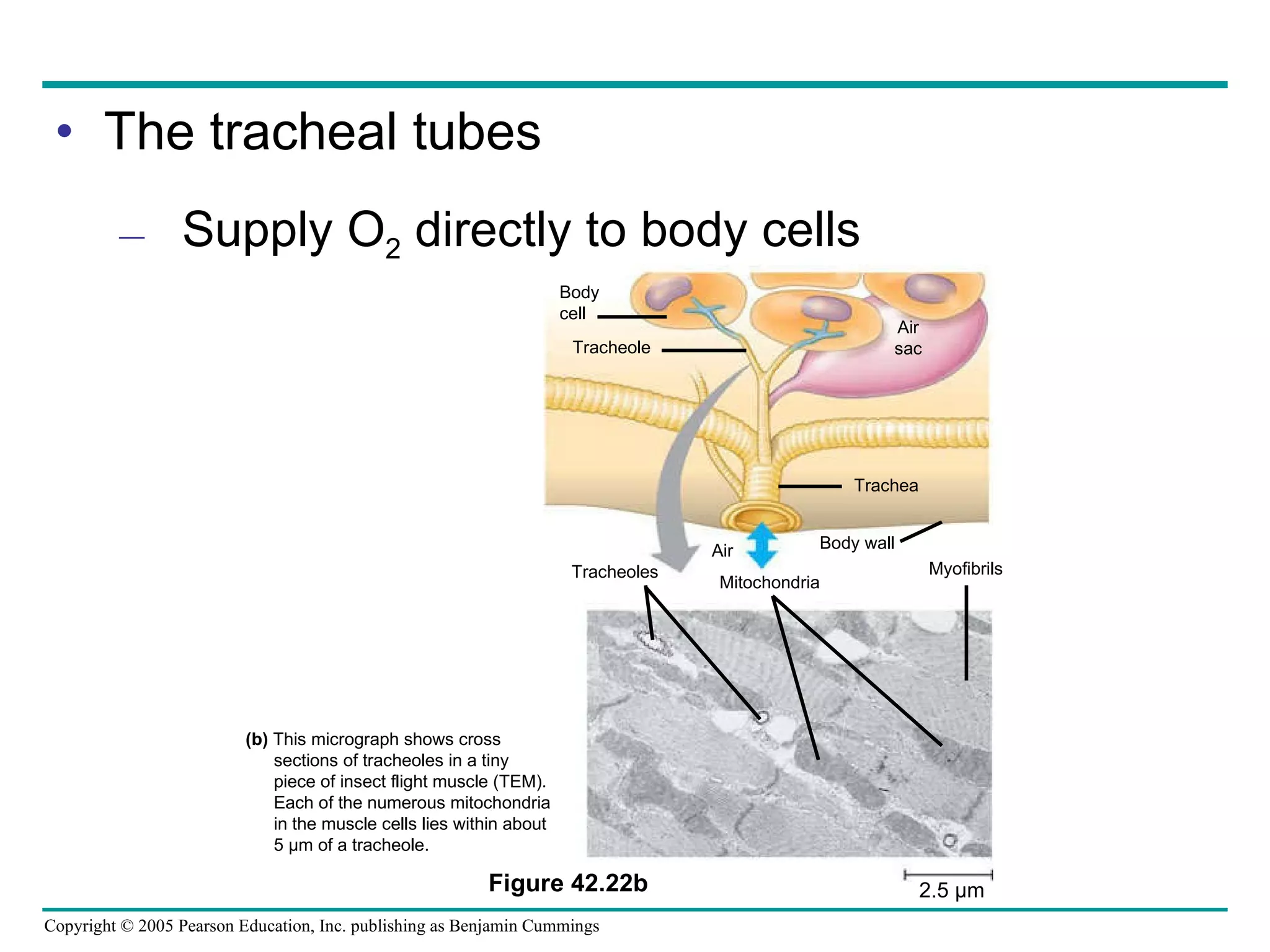
Tracheal Systems in Insects The tracheal system of insects Consists of tiny branching tubes that penetrate the body Figure 42.22a Tracheae Air sacs Spiracle (a)  The respiratory system of an insect consists of branched internal tubes that deliver air directly to body cells. Rings of chitin reinforce the largest tubes, called tracheae, keeping them from collapsing.  Enlarged portions of tracheae form air sacs near organs that require  a large supply of oxygen. Air enters the tracheae through openings  called spiracles on the insect’s body surface and passes into smaller  tubes called tracheoles. The tracheoles are closed and contain fluid (blue-gray). When the animal is active and is using more O 2 , most of the fluid is withdrawn into the body. This increases the surface area  of air in contact with cells.
The tracheal tubes Supply O 2  directly to body cells Air sac Body  cell Trachea Tracheole Tracheoles Mitochondria Myofibrils Body wall (b)  This micrograph shows cross sections of tracheoles in a tiny piece of insect flight muscle (TEM). Each of the numerous mitochondria in the muscle cells lies within about 5 µm of a tracheole. Figure 42.22b 2.5 µm Air
Lungs Spiders, land snails, and most terrestrial vertebrates Have internal lungs
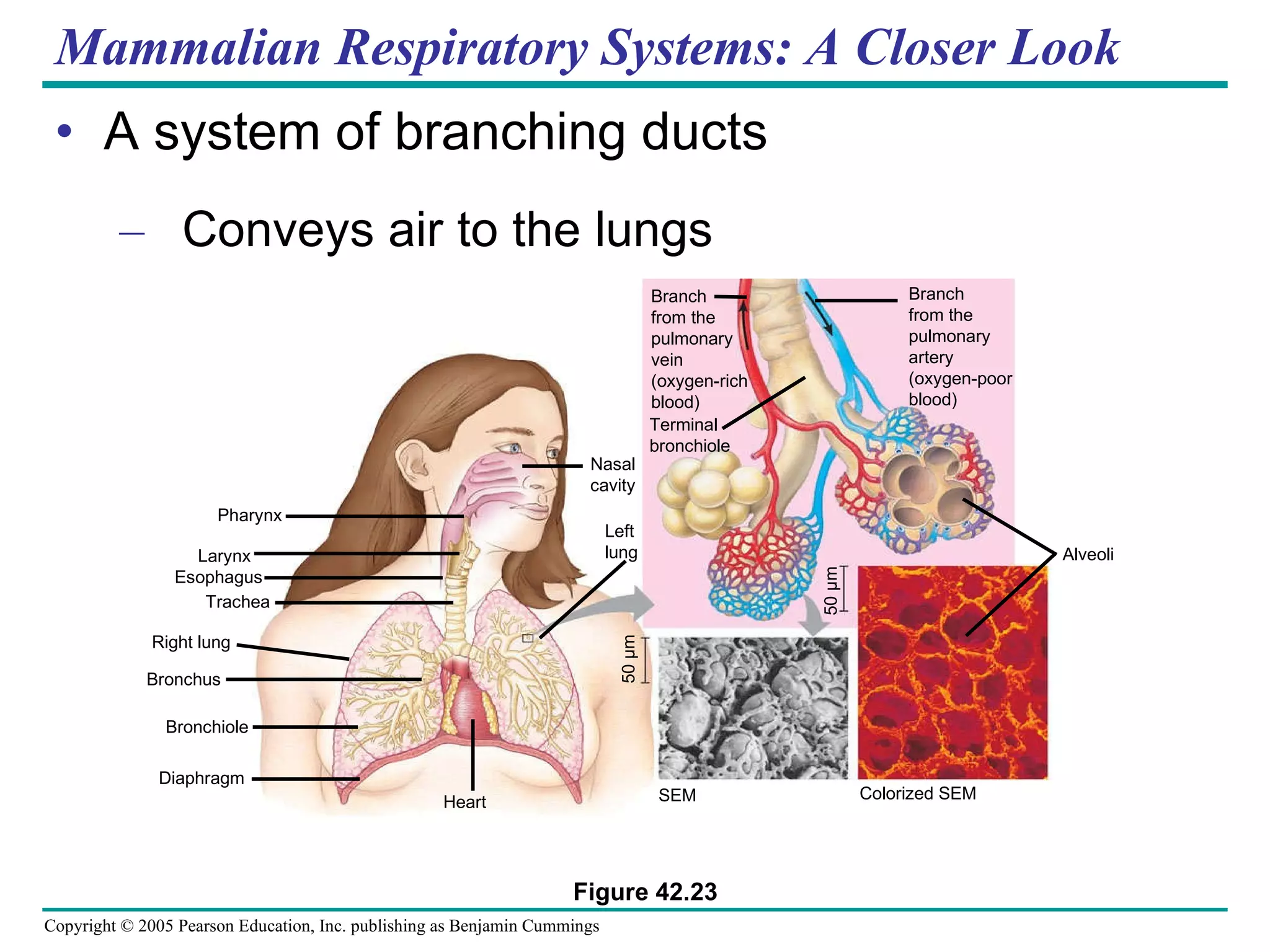
Mammalian Respiratory Systems: A Closer Look A system of branching ducts Conveys air to the lungs Branch  from the  pulmonary  vein  (oxygen-rich  blood)   Terminal  bronchiole Branch  from the pulmonary artery (oxygen-poor  blood) Alveoli Colorized SEM SEM 50 µm 50 µm Heart Left  lung Nasal cavity Pharynx Larynx Diaphragm Bronchiole Bronchus Right lung Trachea Esophagus Figure 42.23
In mammals, air inhaled through the nostrils Passes through the pharynx into the trachea, bronchi, bronchioles, and dead-end alveoli, where gas exchange occurs
Concept 42.6: Breathing ventilates the lungs The process that ventilates the lungs is breathing The alternate inhalation and exhalation of air
How an Amphibian Breathes An amphibian such as a frog Ventilates its lungs by positive pressure breathing, which forces air down the trachea
How a Mammal Breathes Mammals ventilate their lungs By negative pressure breathing, which pulls air into the lungs Air inhaled Air exhaled INHALATION Diaphragm contracts (moves down) EXHALATION Diaphragm relaxes (moves up) Diaphragm Lung Rib cage  expands as rib muscles  contract  Rib cage gets  smaller as rib muscles  relax  Figure 42.24
Lung volume increases As the rib muscles and diaphragm contract
How a Bird Breathes Besides lungs, bird have eight or nine air sacs That function as bellows that keep air flowing through the lungs INHALATION Air sacs fill EXHALATION Air sacs empty; lungs fill Anterior air sacs Trachea Lungs Lungs Posterior air sacs Air Air 1 mm Air tubes (parabronchi) in lung Figure 42.25
Air passes through the lungs In one direction only Every exhalation Completely renews the air in the lungs
Control of Breathing in Humans The main breathing control centers Are located in two regions of the brain, the medulla oblongata and the pons 4 Figure 42.26 Pons Breathing  control  centers Medulla oblongata  Diaphragm Carotid arteries Aorta Cerebrospinal fluid Rib muscles In a person at rest, these  nerve impulses result in  about 10 to 14 inhalations per minute. Between  inhalations, the muscles relax and the person exhales. The medulla’s control center  also helps regulate blood CO 2  level.  Sensors   in the medulla detect changes  in the pH (reflecting CO 2  concentration)  of the blood and cerebrospinal fluid  bathing the surface of the brain. Nerve impulses relay changes in  CO 2  and O 2  concentrations.  Other  sensors in the walls of the aorta and carotid arteries in the neck  detect changes in blood pH and send nerve impulses to the medulla.  In response, the medulla’s breathing control center alters the rate and depth of breathing, increasing both to dispose of excess CO 2  or decreasing both if CO 2  levels are depressed. The control center in the medulla sets the basic rhythm, and a control center in the pons moderates it, smoothing out the transitions between inhalations and exhalations. 1 Nerve impulses trigger  muscle contraction.  Nerves from a breathing control center in the medulla oblongata of the  brain send impulses to the diaphragm and rib muscles,  stimulating them to contract and causing inhalation. 2 The sensors in the aorta and carotid arteries also detect changes in O 2  levels in the blood and signal  the medulla to increase the breathing  rate when levels become very low.  6 5 3
The centers in the medulla Regulate the rate and depth of breathing in response to pH changes in the cerebrospinal fluid The medulla adjusts breathing rate and depth To match metabolic demands
Sensors in the aorta and carotid arteries Monitor O 2  and CO 2  concentrations in the blood Exert secondary control over breathing
Concept 42.7: Respiratory pigments bind and transport gases The metabolic demands of many organisms Require that the blood transport large quantities of O 2  and CO 2
The Role of Partial Pressure Gradients Gases diffuse down pressure gradients In the lungs and other organs Diffusion of a gas Depends on differences in a quantity called partial pressure
A gas always diffuses from a region of higher partial pressure To a region of lower partial pressure
In the lungs and in the tissues O 2  and CO 2  diffuse from where their partial pressures are higher to where they are lower
Figure 42.27 Inhaled air Exhaled air 160 0.2 O 2 CO 2 O 2 CO 2 O 2 CO 2 O 2 CO 2 O 2 CO 2 O 2 CO 2 O 2 CO 2 O 2 CO 2 40  45 40  45 100  40 104  40 104  40 120  27 CO 2 O 2 Alveolar epithelial cells Pulmonary arteries Blood  entering alveolar capillaries Blood  leaving tissue capillaries Blood  entering tissue capillaries Blood  leaving  alveolar  capillaries CO 2 O 2 Tissue  capillaries Heart Alveolar  capillaries of lung <40  >45 Tissue  cells Pulmonary veins Systemic  arteries Systemic veins O 2 CO 2 O 2 CO 2 Alveolar spaces 1 2 4 3
Respiratory Pigments Respiratory pigments Are proteins that transport oxygen Greatly increase the amount of oxygen that blood can carry
Oxygen Transport The respiratory pigment of almost all vertebrates Is the protein hemoglobin, contained in the erythrocytes
Like all respiratory pigments Hemoglobin must reversibly bind O 2 , loading O 2  in the lungs and unloading it in other parts of the body Figure 42.28 Heme group Iron atom O 2  loaded in lungs O 2  unloaded In tissues Polypeptide chain O 2 O 2
Loading and unloading of O 2 Depend on cooperation between the subunits of the hemoglobin molecule The binding of O 2  to one subunit induces the other subunits to bind O 2  with more affinity
Cooperative O 2  binding and release Is evident in the dissociation curve for hemoglobin A drop in pH Lowers the affinity of hemoglobin for O 2
O 2  unloaded from hemoglobin during normal metabolism O 2  reserve that can be unloaded from hemoglobin to tissues with high metabolism  Tissues during exercise Tissues at rest 100 80 60 40 20 0 100 80 60 40 20 0 100 80 60 40 20 0 100 80 60 40 20 0 Lungs P O 2  (mm Hg) P O 2  (mm Hg) O 2  saturation of hemoglobin (%) O 2  saturation of hemoglobin (%) Bohr shift: Additional O 2 released from  hemoglobin at  lower pH (higher CO 2 concentration) pH 7.4 pH 7.2 (a) P O 2  and Hemoglobin Dissociation at 37°C and pH 7.4 (b) pH and Hemoglobin Dissociation Figure 42.29a, b
Carbon Dioxide Transport Hemoglobin also helps transport CO 2 And assists in buffering
Carbon from respiring cells Diffuses into the blood plasma and then into erythrocytes and is ultimately released in the lungs
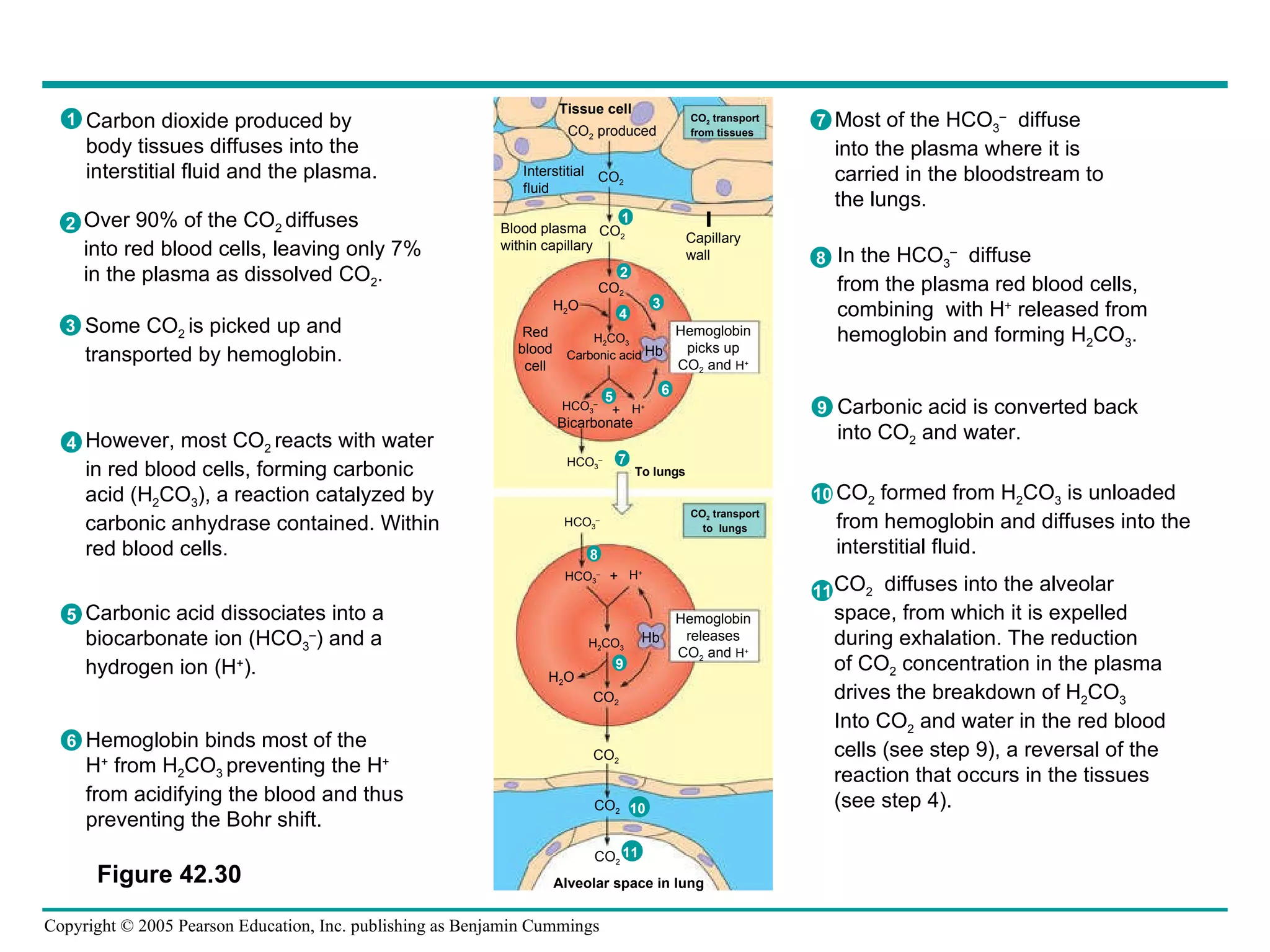
Figure 42.30 Tissue cell CO 2 Interstitial fluid CO 2  produced CO 2  transport from tissues CO 2 CO 2 Blood plasma within capillary Capillary wall H 2 O Red blood cell Hb Carbonic acid H 2 CO 3 HCO 3 – H + + Bicarbonate HCO 3 – Hemoglobin picks up CO 2  and  H + HCO 3 – HCO 3 – H + + H 2 CO 3 Hb Hemoglobin releases CO 2  and  H + CO 2  transport to  lungs H 2 O CO 2 CO 2 CO 2 CO 2 Alveolar space in lung 2 1 3 4 5 6 7 8 9 10 11 To lungs Carbon dioxide produced by body tissues diffuses into the  interstitial fluid and the plasma. Over 90% of the CO 2  diffuses  into red blood cells, leaving only 7% in the plasma as dissolved CO 2 . Some CO 2  is picked up and  transported by hemoglobin. However, most CO 2  reacts with water  in red blood cells, forming carbonic  acid (H 2 CO 3 ), a reaction catalyzed by carbonic anhydrase contained. Within red blood cells. Carbonic acid dissociates into a  biocarbonate ion (HCO 3 – ) and a  hydrogen ion (H + ). Hemoglobin binds most of the  H +  from H 2 CO 3  preventing the H +   from acidifying the blood and thus preventing the Bohr shift. CO 2   diffuses into the alveolar space, from which it is expelled during exhalation. The reduction of CO 2  concentration in the plasma drives the breakdown of H 2 CO 3  Into CO 2  and water in the red blood cells (see step 9), a reversal of the  reaction that occurs in the tissues  (see step 4). Most of the HCO 3 –   diffuse into the plasma where it is  carried in the bloodstream to  the lungs. In the HCO 3 –   diffuse from the plasma red blood cells,  combining  with H +  released from  hemoglobin and forming H 2 CO 3 . Carbonic acid is converted back  into CO 2  and water. CO 2  formed from H 2 CO 3  is unloaded from hemoglobin and diffuses into the  interstitial fluid.  1 2 3 4 5 6 7 8 9 10 11
Elite Animal Athletes Migratory and diving mammals Have evolutionary adaptations that allow them to perform extraordinary feats
The Ultimate Endurance Runner The extreme O 2  consumption of the antelope-like pronghorn Underlies its ability to run at high speed over long distances Figure 42.31
Diving Mammals Deep-diving air breathers Stockpile O 2  and deplete it slowly
Chapter 43 The Immune System
Overview: Reconnaissance, Recognition, and Response An animal must defend itself From the many dangerous pathogens it may encounter in the environment Two major kinds of defense have evolved that counter these threats Innate immunity and acquired immunity
Innate immunity Is present before any exposure to pathogens and is effective from the time of birth Involves nonspecific responses to pathogens Figure 43.1 3m
Acquired immunity, also called adaptive immunity Develops only after exposure to inducing agents such as microbes, toxins, or other foreign substances Involves a very specific response to pathogens
A summary of innate and acquired immunity INNATE IMMUNITY  Rapid responses to a  broad range of microbes ACQUIRED IMMUNITY Slower responses to  specific microbes External defenses Internal defenses Skin Mucous membranes Secretions Phagocytic cells Antimicrobial proteins Inflammatory response Natural killer cells Humoral response (antibodies) Cell-mediated response (cytotoxic  lymphocytes) Invading microbes (pathogens) Figure 43.2
Concept 43.1: Innate immunity provides broad defenses against infection A pathogen that successfully breaks through an animal’s external defenses Soon encounters several innate cellular and chemical mechanisms that impede its attack on the body
External Defenses Intact skin and mucous membranes Form physical barriers that bar the entry of microorganisms and viruses Certain cells of the mucous membranes produce mucus A viscous fluid that traps microbes and other particles
In the trachea, ciliated epithelial cells Sweep mucus and any entrapped microbes upward, preventing the microbes from entering the lungs Figure 43.3 10m
Secretions of the skin and mucous membranes Provide an environment that is often hostile to microbes Secretions from the skin Give the skin a pH between 3 and 5, which is acidic enough to prevent colonization of many microbes Also include proteins such as lysozyme, an enzyme that digests the cell walls of many bacteria
Internal Cellular and Chemical Defenses Internal cellular defenses Depend mainly on phagocytosis Phagocytes, types of white blood cells Ingest invading microorganisms Initiate the inflammatory response
Phagocytic Cells Phagocytes attach to their prey via surface receptors And engulf them, forming a vacuole that fuses with a lysosome Figure 43.4 Pseudopodia surround microbes. 1 Microbes are engulfed into cell. 2 Vacuole containing microbes forms. 3 Vacuole and lysosome fuse. 4 Toxic compounds and lysosomal enzymes destroy microbes. 5 Microbial debris is released by exocytosis. 6 Microbes MACROPHAGE Vacuole Lysosome containing enzymes
Macrophages, a specific type of phagocyte Can be found migrating through the body Can be found in various organs of the lymphatic system
The lymphatic system Plays an active role in defending the body from pathogens Adenoid Tonsil Lymph nodes Spleen Peyer’s patches (small intestine) Appendix Lymphatic vessels Masses of lymphocytes and macrophages Tissue cells Lymphatic vessel Blood capillary Lymphatic capillary Interstitial fluid Lymph node Interstitial fluid bathing the  tissues, along with the white  blood cells in it, continually  enters lymphatic capillaries. 1 Figure 43.5 Fluid inside the lymphatic capillaries, called lymph, flows through lymphatic vessels throughout the body. 2 Within lymph nodes, microbes and foreign particles present in  the circulating lymph encounter macro- phages, dendritic cells,  and lymphocytes,  which carry out  various defensive  actions. 3 Lymphatic vessels return lymph to the blood via two large ducts that drain into veins near the shoulders. 4
Antimicrobial Proteins Numerous proteins function in innate defense By attacking microbes directly of by impeding their reproduction
About 30 proteins make up the complement system Which can cause lysis of invading cells and help trigger inflammation Interferons Provide innate defense against viruses and help activate macrophages
Inflammatory Response In local inflammation, histamine and other chemicals released from injured cells Promote changes in blood vessels that allow more fluid, more phagocytes, and antimicrobial proteins to enter the tissues
Major events in the local inflammatory response Figure 43.6 Pathogen Pin Macrophage Chemical signals Capillary Phagocytic cells Red blood cell Blood clotting elements Blood clot Phagocytosis Fluid, antimicrobial proteins,  and clotting elements move  from the blood to the site. Clotting begins. 2 Chemical signals released  by activated macrophages  and mast cells at the injury  site cause nearby capillaries  to widen and become more  permeable. 1 Chemokines released by various  kinds of cells attract more  phagocytic cells from the blood to the injury site. 3 Neutrophils and macrophages phagocytose pathogens and  cell debris at the site, and the tissue heals. 4
Natural Killer Cells Natural killer (NK) cells Patrol the body and attack virus-infected body cells and cancer cells Trigger apoptosis in the cells they attack
Invertebrate Immune Mechanisms Many invertebrates defend themselves from infection By many of the same mechanisms in the vertebrate innate response
Concept 43.2: In acquired immunity, lymphocytes provide specific defenses against infection Acquired immunity Is the body’s second major kind of defense Involves the activity of lymphocytes
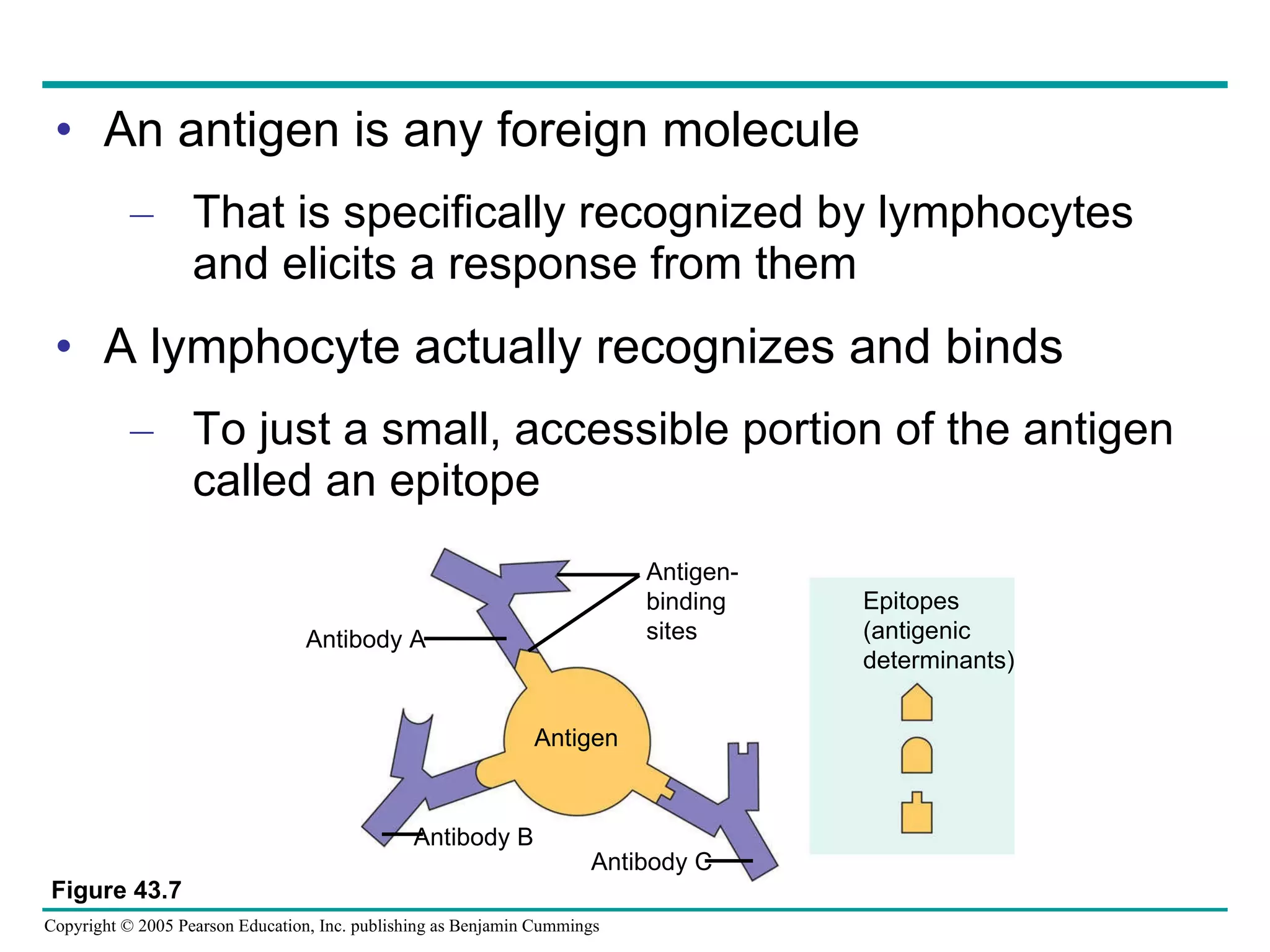
An antigen is any foreign molecule That is specifically recognized by lymphocytes and elicits a response from them A lymphocyte actually recognizes and binds To just a small, accessible portion of the antigen called an epitope Figure 43.7 Antigen- binding  sites Antibody A Antigen Antibody B Antibody C Epitopes (antigenic determinants)
Antigen Recognition by Lymphocytes The vertebrate body is populated by two main types of lymphocytes B lymphocytes (B cells) and T lymphocytes  (T cells) Which circulate through the blood The plasma membranes of both B cells  and T cells Have about 100,000 antigen receptor that all recognize the same epitope
B Cell Receptors for Antigens B cell receptors Bind to specific, intact antigens Are often called membrane antibodies or membrane immunoglobulins Figure 43.8a Antigen- binding site Antigen- binding site Disulfide bridge Light chain Heavy chains Cytoplasm of B cell V A B cell receptor consists of two identical heavy  chains and two identical light chains linked by  several disulfide bridges. (a) Variable regions Constant regions Transmembrane region Plasma membrane B cell V V C C C C V
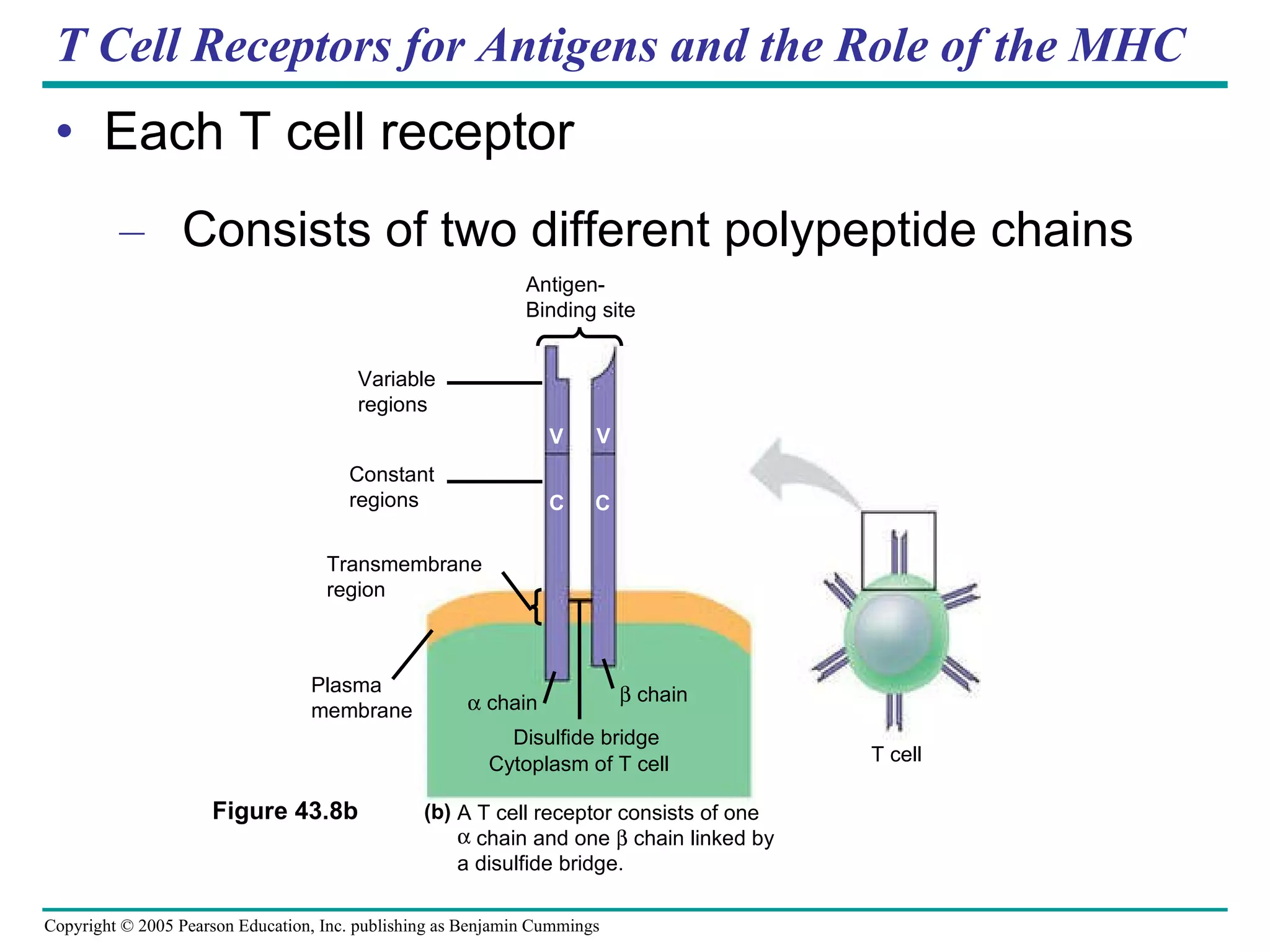
T Cell Receptors for Antigens and the Role of the MHC Each T cell receptor Consists of two different polypeptide chains Figure 43.8b V V C C Antigen- Binding site    chain Disulfide bridge    chain T cell A T cell receptor consists of one  chain and one    chain linked by  a disulfide bridge. (b) Variable regions Constant regions Transmembrane region Plasma membrane Cytoplasm of T cell
T cells bind to small fragments of antigens That are bound to normal cell-surface proteins called MHC molecules MHC molecules Are encoded by a family of genes called the major histocompatibility complex
Infected cells produce MHC molecules Which bind to antigen fragments and then are transported to the cell surface in a process called antigen presentation A nearby T cell Can then detect the antigen fragment displayed on the cell’s surface
Depending on their source Peptide antigens are handled by different classes of MHC molecules
Class I MHC molecules, found on almost all nucleated cells of the body Display peptide antigens to cytotoxic T cells Figure 43.9a Infected cell Antigen fragment Class I MHC molecule T cell receptor (a) Cytotoxic T cell A fragment of foreign protein (antigen) inside the cell associates with an MHC molecule and is transported to the cell surface. 1 The combination of MHC molecule and antigen is recognized by a T cell, alerting it to the infection. 2 1 2
Class II MHC molecules, located mainly on dendritic cells, macrophages, and B cells Display antigens to helper T cells Figure 43.9b 1 2 Microbe Antigen- presenting cell Antigen fragment Class II MHC molecule T cell receptor Helper T cell A fragment of foreign protein (antigen) inside the cell associates with an MHC molecule and is transported to the cell surface. 1 The combination of MHC molecule and antigen is recognized by a T cell, alerting it to the infection. 2 (b)
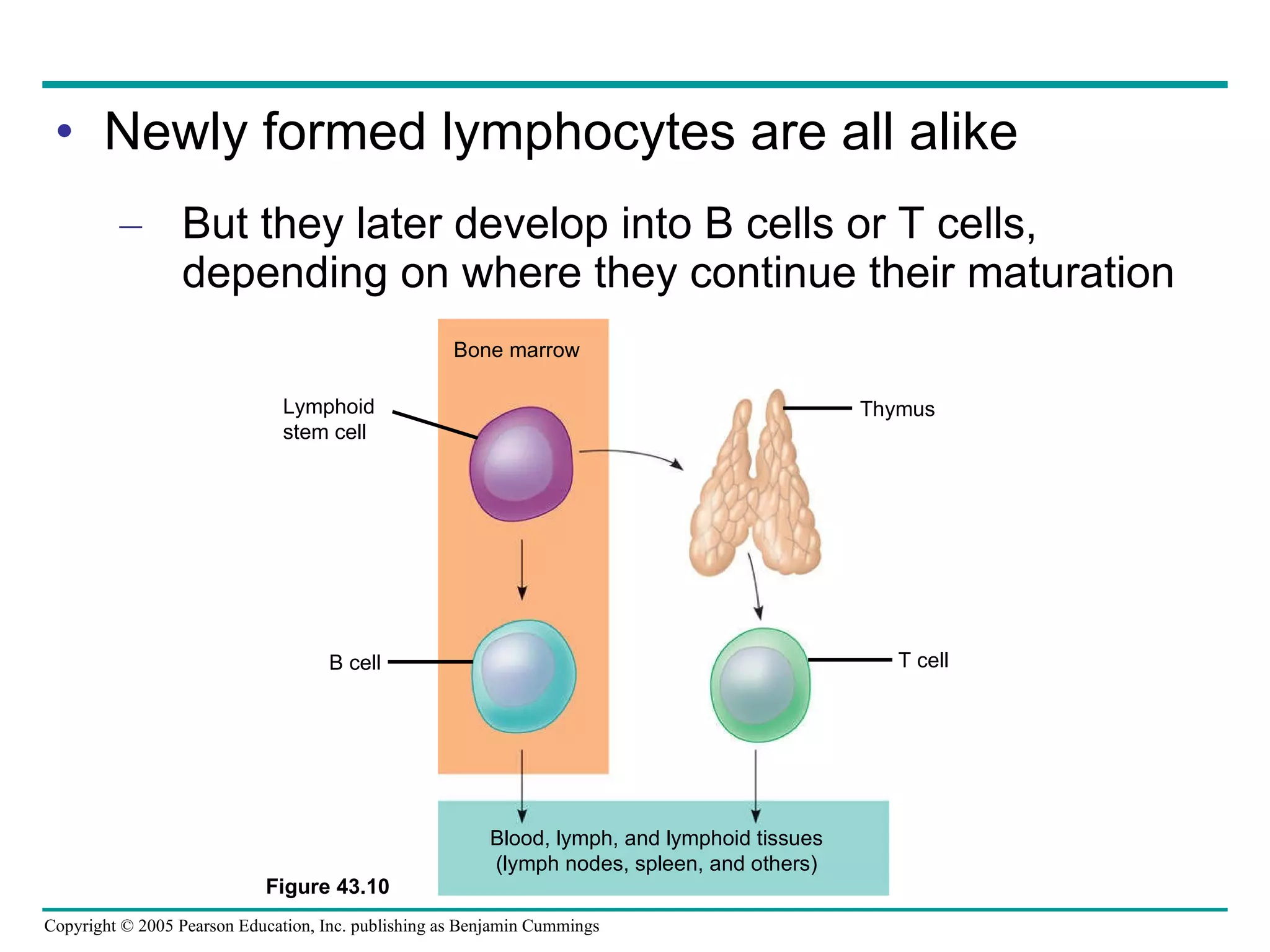
Lymphocyte Development Lymphocytes Arise from stem cells in the bone marrow
Newly formed lymphocytes are all alike But they later develop into B cells or T cells, depending on where they continue their maturation Figure 43.10 Bone marrow Lymphoid stem cell B cell Blood, lymph, and lymphoid tissues (lymph nodes, spleen, and others) T cell Thymus
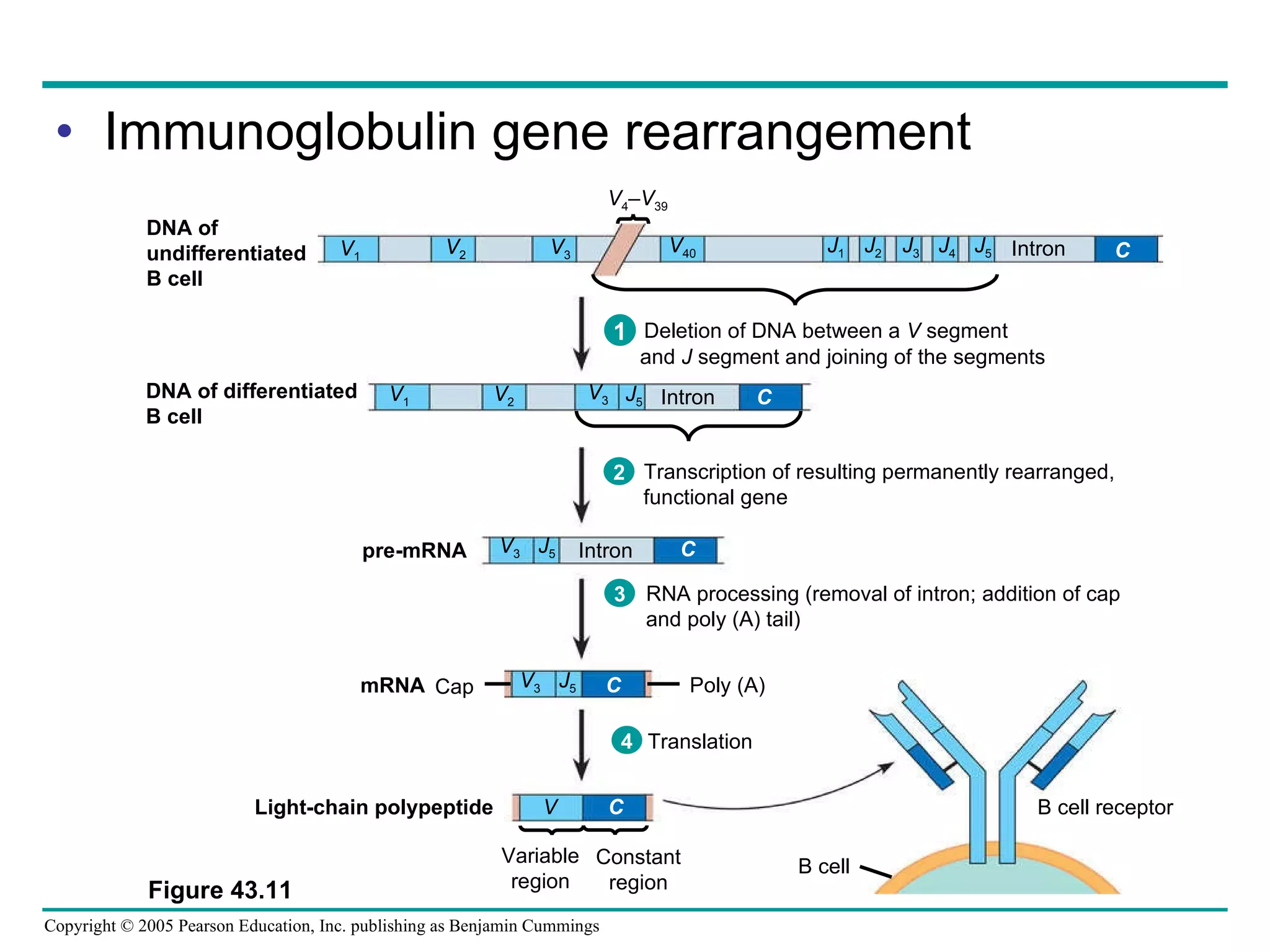
Generation of Lymphocyte Diversity by Gene Rearrangement Early in development, random, permanent gene rearrangement Forms functional genes encoding the B or T cell antigen receptor chains
Immunoglobulin gene rearrangement DNA of undifferentiated B cell DNA of differentiated B cell pre-mRNA mRNA Cap B cell B cell receptor Light-chain polypeptide Intron Intron Intron Variable region Constant region V 1 V 2 V 3 V 4 – V 39 V 40 J 1 J 2 J 3 J 4 J 5 V 1 V 2 V 3 J 5 V 3 J 5 V 3 J 5 V C C C C C Poly (A) Figure 43.11 Deletion of DNA between a  V  segment and  J  segment and joining of the segments 1 Transcription of resulting permanently rearranged, functional gene 2 RNA processing (removal of intron; addition of cap and poly (A) tail) 3 4 Translation
Testing and Removal of Self-Reactive Lymphocytes As B and T cells are maturing in the bone and thymus Their antigen receptors are tested for possible self-reactivity Lymphocytes bearing receptors for antigens already present in the body Are destroyed by apoptosis or rendered nonfunctional
Clonal Selection of Lymphocytes In a primary immune response Binding of antigen to a mature lymphocyte induces the lymphocyte’s proliferation and differentiation, a process called clonal selection
Clonal selection of B cells Generates a clone of short-lived activated effector cells and a clone of long-lived memory cells Figure 43.12 Antigen molecules Antigen receptor B cells that differ in antigen specificity  Antibody molecules Clone of memory cells Clone of plasma cells Antigen molecules bind to the antigen receptors of only one of the three B cells shown. The selected B cell proliferates, forming a clone of identical cells bearing receptors for the selecting antigen. Some proliferating cells develop into short-lived plasma cells that secrete antibodies specific for the antigen. Some proliferating cells develop into long-lived memory cells that can respond rapidly upon subsequent exposure to the same antigen.
In the secondary immune response Memory cells facilitate a faster, more efficient response Antibody concentration (arbitrary units) 10 4 10 3 10 2 10 1 10 0 0 7 14 21 28 35 42 49 56 Time (days) Figure 43.13 Antibodies to A Antibodies to B Primary response  to antigen A produces anti- bodies to A 2 Day 1: First  exposure to antigen A 1 Day 28:  Second exposure to antigen A; first exposure to  antigen B 3 Secondary response  to anti- gen A produces antibodies to A;  primary response  to anti- gen B produces antibodies to B 4
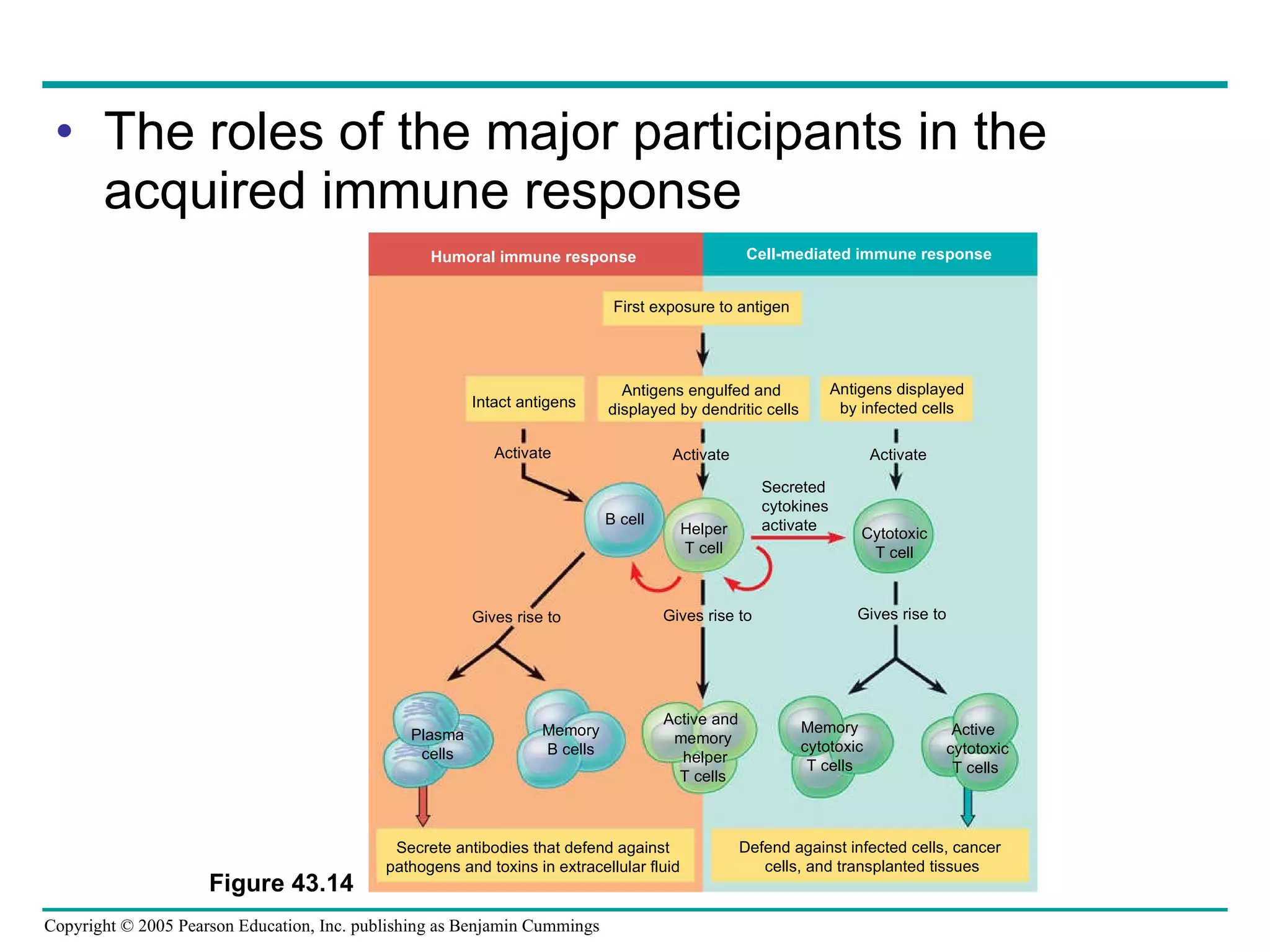
Concept 43.3: Humoral and cell-mediated immunity defend against different types of threats Acquired immunity includes two branches The humoral immune response involves the activation and clonal selection of B cells, resulting in the production of secreted antibodies The cell-mediated immune response involves the activation and clonal selection of cytotoxic T cells
The roles of the major participants in the acquired immune response Figure 43.14 Humoral immune response Cell-mediated immune response First exposure to antigen Intact antigens Antigens engulfed and  displayed by dendritic cells Antigens displayed by infected cells Activate Activate Activate Gives rise to Gives rise to Gives rise to B cell Helper T cell Cytotoxic T cell Plasma cells Memory B cells Active and  memory  helper T cells Memory  cytotoxic T cells Active   cytotoxic T cells Secrete antibodies that defend against pathogens and toxins in extracellular fluid Defend against infected cells, cancer  cells, and transplanted tissues Secreted cytokines activate
Helper T Cells: A Response to Nearly All Antigens Helper T cells produce CD4, a surface protein That enhances their binding to class II MHC molecule–antigen complexes on antigen-presenting cells Activation of the helper T cell then occurs
Activated helper T cells Secrete several different cytokines that stimulate other lymphocytes
The role of helper T cells in acquired immunity Figure 43.15 After a dendritic cell engulfs and degrades a bacterium, it displays  bacterial antigen fragments (peptides) complexed with a class II  MHC molecule on the cell surface. A specific helper T cell binds  to the displayed complex via its TCR with the aid of CD4. This  interaction promotes secretion of cytokines by the dendritic cell. Proliferation of the T cell, stimulated by cytokines from both the dendritic  cell and the T cell itself, gives rise to a clone of activated helper T cells (not shown), all with receptors for the same MHC–antigen complex. The cells in this clone secrete other cytokines  that help activate B cells and cytotoxic T cells. Cell-mediated immunity (attack on infected cells) Humoral immunity (secretion of antibodies by plasma cells) Dendritic cell Dendritic cell Bacterium Peptide antigen Class II MHC molecule TCR CD4 Helper T cell Cytokines Cytotoxic T cell B cell 1 2 3 1 2 3
Cytotoxic T Cells: A Response to Infected Cells and Cancer Cells Cytotoxic T cells make CD8 A surface protein that greatly enhances the interaction between a target cell and a cytotoxic T cell
Cytotoxic T cells Bind to infected cells, cancer cells, and transplanted tissues Binding to a class I MHC complex on an infected body cell Activates a cytotoxic T cell and differentiates it into an active killer
The activated cytotoxic T cell Secretes proteins that destroy the infected target cell Cytotoxic T cell Perforin Granzymes CD8 TCR Class I MHC molecule Target cell Peptide antigen Pore Released cytotoxic T cell Apoptotic target cell Cancer cell Cytotoxic T cell A specific cytotoxic T cell binds to a  class I MHC–antigen complex on a  target cell via its TCR with the aid of  CD8. This interaction, along with  cytokines from helper T cells, leads to  the activation of the cytotoxic cell. 1 The activated T cell releases perforin  molecules, which form pores in the  target cell membrane, and proteolytic  enzymes (granzymes), which enter the  target cell by endocytosis. 2 The granzymes initiate apoptosis within the  target cells, leading to fragmentation of the nucleus, release of small apoptotic bodies,  and eventual cell death. The released  cytotoxic T cell can attack other target cells.  3 1 2 3 Figure 43.16
B Cells: A Response to Extracellular Pathogens Activation of B cells Is aided by cytokines and antigen binding to helper T cells
The clonal selection of B cells Generates antibody-secreting plasma cells, the effector cells of humoral immunity
2 1 3 B cell Bacterium Peptide  antigen Class II  MHC molecule TCR Helper T cell CD4 Activated  helper T cell Clone of memory B cells  Cytokines Clone of plasma cells Secreted antibody molecules  Endoplasmic reticulum of  plasma cell Macrophage After a macrophage engulfs and degrades a bacterium, it displays a peptide antigen complexed with a class II MHC molecule. A helper T cell that recognizes the displayed  complex is activated with the aid of cytokines  secreted from the macrophage, forming a  clone of activated helper T cells (not shown). 1 A B cell that has taken up and degraded the  same bacterium displays class II MHC–peptide  antigen complexes. An activated helper T cell bearing receptors specific for the displayed antigen binds to the B cell. This interaction, with the aid of cytokines from the T cell, activates the B cell. 2 The activated B cell proliferates and differentiates into memory B cells and antibody-secreting  plasma cells. The secreted  antibodies are specific for the  same bacterial antigen that  initiated the response. 3 Figure 43.17
Antibody Classes The five major classes of antibodies, or immunoglobulins Differ in their distributions and functions within the body
The five classes of immunoglobulins Figure 43.18 First Ig class produced after initial exposure to  antigen; then its concentration in the blood declines Most abundant Ig class in blood; also present in  tissue fluids Only Ig class that crosses placenta, thus conferring  passive immunity on fetus Promotes opsonization, neutralization, and agglutination  of antigens; less effective in complement activation than  IgM (see Figure 43.19) Present in secretions such as tears, saliva, mucus,  and breast milk Triggers release from mast cells and basophils of  histamine and other chemicals that cause allergic  reactions (see Figure 43.20) Present primarily on surface of naive B cells that have not been exposed to antigens IgM (pentamer) IgG (monomer) IgA (dimer) IgE (monomer) J chain Secretory component J chain Transmembrane region IgD (monomer) Promotes neutralization and agglutination of  antigens; very effective in complement activation  (see Figure 43.19) Provides localized defense of mucous membranes by agglutination and neutralization of antigens (see Figure 43.19) Presence in breast milk confers passive immunity on nursing infant Acts as antigen receptor in antigen-stimulated  proliferation and differentiation of B cells (clonal  selection)
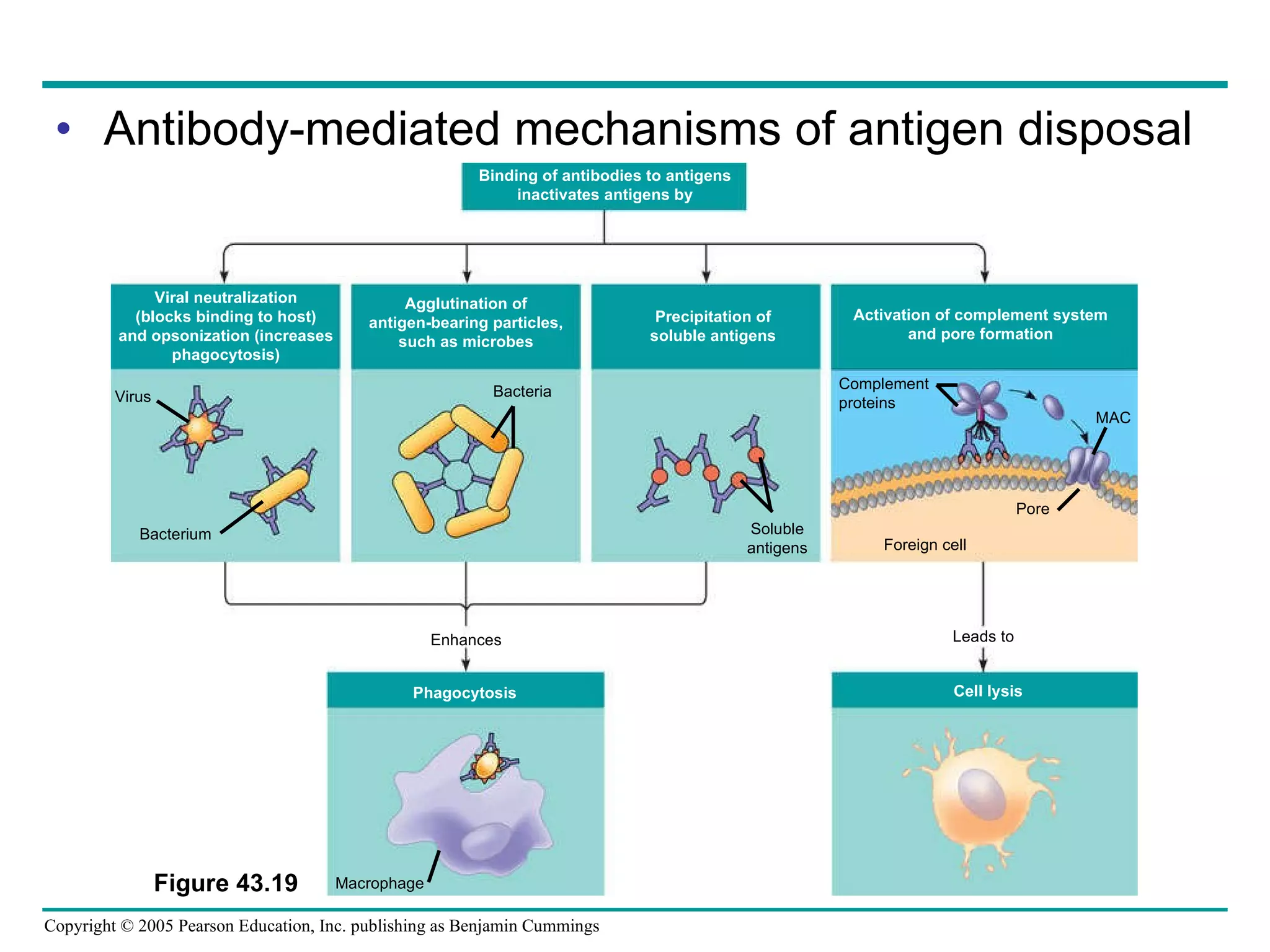
Antibody-Mediated Disposal of Antigens The binding of antibodies to antigens Is also the basis of several antigen disposal mechanisms Leads to elimination of microbes by phagocytosis and complement-mediated lysis
Antibody-mediated mechanisms of antigen disposal Binding of antibodies to antigens inactivates antigens by Viral neutralization (blocks binding to host) and opsonization (increases phagocytosis) Agglutination of antigen-bearing particles, such as microbes Precipitation of soluble antigens Activation of complement system and pore formation Bacterium Virus Bacteria Soluble antigens Foreign cell Complement proteins MAC  Pore Enhances Phagocytosis Leads to Cell lysis Macrophage Figure 43.19
Active and Passive Immunization Active immunity Develops naturally in response to an infection Can also develop following immunization, also called vaccination
In immunization A nonpathogenic form of a microbe or part of a microbe elicits an immune response to an immunological memory for that microbe
Passive immunity, which provides immediate, short-term protection Is conferred naturally when IgG crosses the placenta from mother to fetus or when IgA passes from mother to infant in breast milk Can be conferred artificially by injecting antibodies into a nonimmune person
Concept 43.4: The immune system’s ability to distinguish self from nonself limits tissue transplantation The immune system Can wage war against cells from other individuals Transplanted tissues Are usually destroyed by the recipient’s immune system
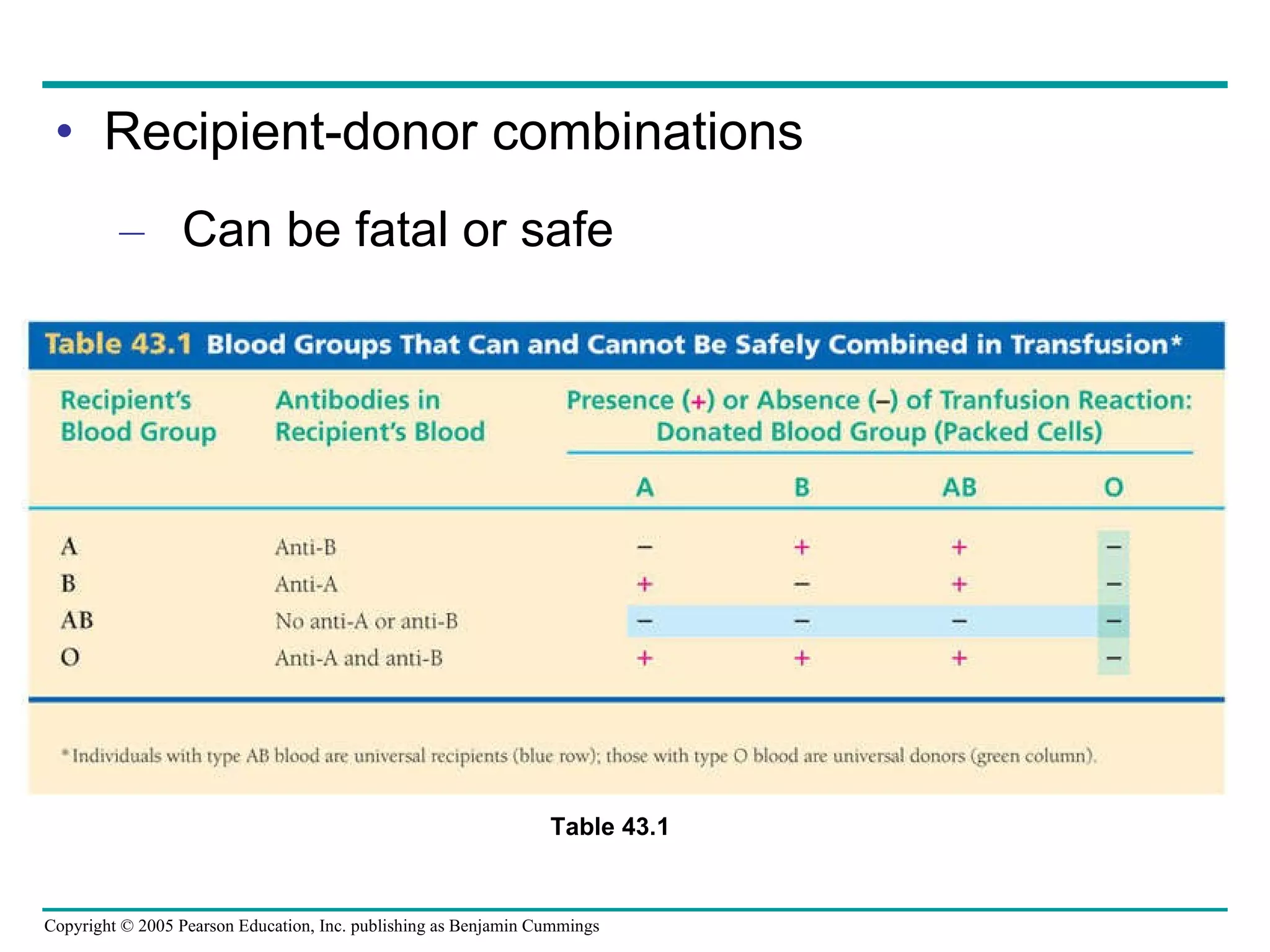
Blood Groups and Transfusions Certain antigens on red blood cells  Determine whether a person has type A, B, AB, or O blood
Antibodies to nonself blood types Already exist in the body Transfusion with incompatible blood Leads to destruction of the transfused cells
Recipient-donor combinations Can be fatal or safe Table 43.1
Another red blood cell antigen, the Rh factor Creates difficulties when an Rh-negative mother carries successive Rh-positive fetuses
Tissue and Organ Transplants MHC molecules Are responsible for stimulating the rejection of tissue grafts and organ transplants
The chances of successful transplantation are increased If the donor and recipient MHC tissue types are well matched If the recipient is given immunosuppressive drugs
Lymphocytes in bone marrow transplants May cause a graft versus host reaction in recipients
Concept 43.5: Exaggerated, self-directed, or diminished immune responses can cause disease If the delicate balance of the immune system is disrupted The effects on the individual can range from minor to often fatal consequences
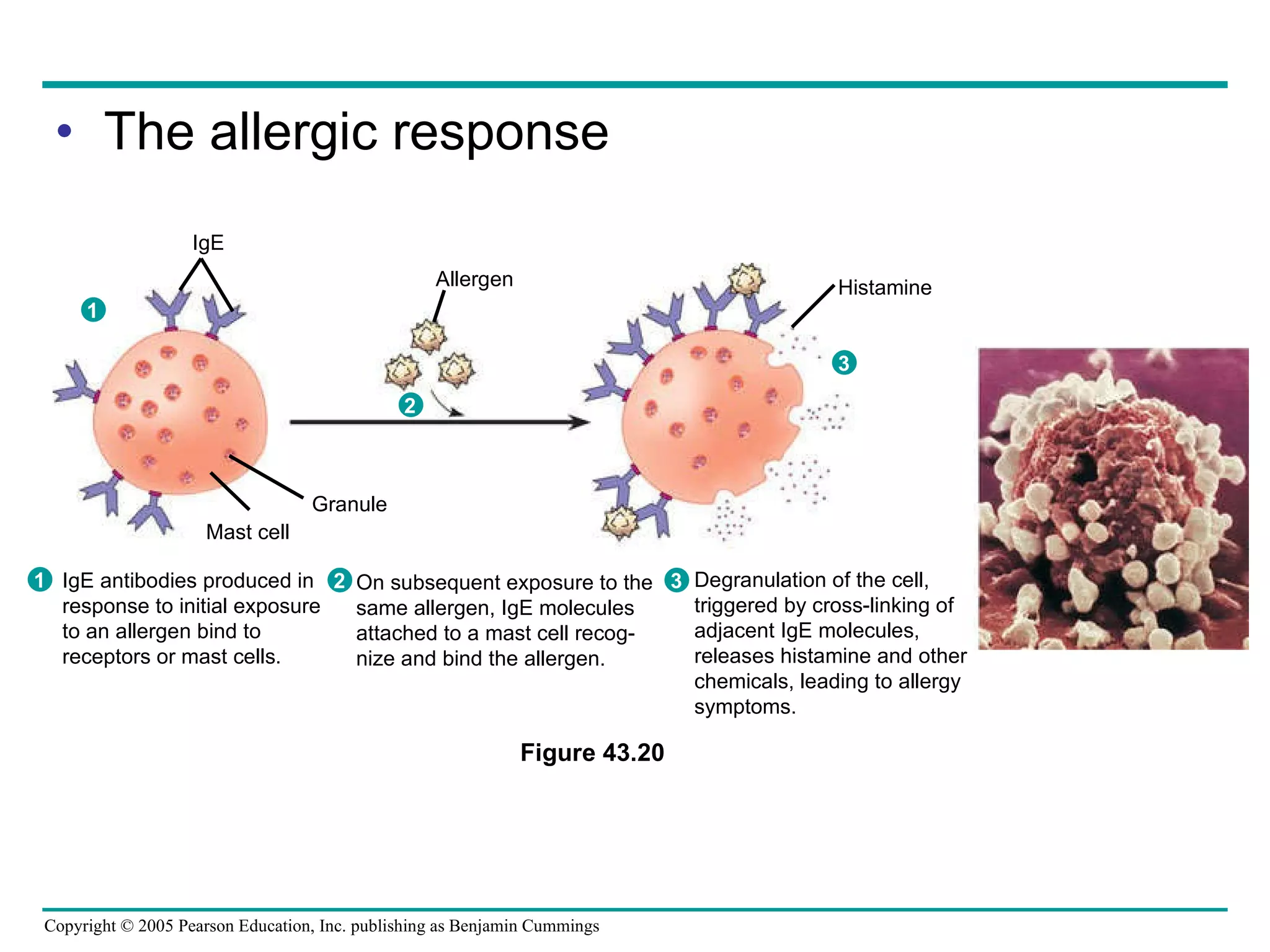
Allergies Allergies are exaggerated (hypersensitive) responses To certain antigens called allergens
In localized allergies such as hay fever IgE antibodies produced after first exposure to an allergen attach to receptors on mast cells
The next time the allergen enters the body It binds to mast cell–associated IgE molecules The mast cells then release histamine and other mediators That cause vascular changes and typical symptoms
The allergic response Figure 43.20 IgE antibodies produced in  response to initial exposure  to an allergen bind to  receptors or mast cells. 1 On subsequent exposure to the  same allergen, IgE molecules  attached to a mast cell recog- nize and bind the allergen. 2 Degranulation of the cell, triggered by cross-linking of  adjacent IgE molecules,  releases histamine and other  chemicals, leading to allergy symptoms. 3 1 2 3 Allergen IgE Histamine Granule Mast cell
An acute allergic response sometimes leads to anaphylactic shock A whole-body, life-threatening reaction that can occur within seconds of exposure to an allergen
Autoimmune Diseases In individuals with autoimmune diseases The immune system loses tolerance for self and turns against certain molecules of the body
Rheumatoid arthritis Is an autoimmune disease that leads to damage and painful inflammation of the cartilage and bone of joints Figure 43.21
Other examples of autoimmune diseases include Systemic lupus erythematosus Multiple sclerosis Insulin-dependent diabetes
Immunodeficiency Diseases An inborn or primary immunodeficiency  Results from hereditary or congenital defects that prevent proper functioning of innate, humoral, and/or cell-mediated defenses
An acquired or secondary immunodeficiency  Results from exposure to various chemical and biological agents
Inborn (Primary) Immunodeficiencies In severe combined immunodeficiency (SCID) Both the humoral and cell-mediated branches of acquired immunity fail to function
Acquired (Secondary) Immunodeficiencies Acquired immunodeficiencies Range from temporary states to chronic diseases
Stress and the Immune System Growing evidence shows That physical and emotional stress can harm immunity
Acquired Immunodeficiency Syndrome (AIDS) People with AIDS Are highly susceptible to opportunistic infections and cancers that take advantage of an immune system in collapse
Because AIDS arises from the loss of helper T cells Both humoral and cell-mediated immune responses are impaired
The loss of helper T cells Results from infection by the human immunodeficiency virus (HIV) 1µm Figure 43.22
The spread of HIV Has become a worldwide problem The best approach for slowing the spread of HIV Is educating people about the practices that transmit the virus

41 animalnutrition text

  • 1.
  • 2.
    Overview: The Needto Feed Every mealtime is a reminder that we are heterotrophs Dependent on a regular supply of food Figure 41.1
  • 3.
    In general, animalsfall into one of three dietary categories Herbivores eat mainly autotrophs (plants and algae) Carnivores eat other animals Omnivores regularly consume animals as well as plants or algal matter
  • 4.
    Regardless of whatan animal eats, an adequate diet must satisfy three nutritional needs Fuel for all cellular work The organic raw materials for biosynthesis Essential nutrients, substances such as vitamins that the animal cannot make for itself
  • 5.
    Animals feed byfour main mechanisms Figure 41.2 Baleen SUSPENSION FEEDERS Feces SUBSTRATE FEEDERS BULK FEEDERS FLUID FEEDERS Caterpillar
  • 6.
    Concept 41.1: Homeostaticmechanisms manage an animal’s energy budget Nearly all of an animal’s ATP generation Is based on the oxidation of energy-rich molecules: carbohydrates, proteins, and fats
  • 7.
    Glucose Regulation asan Example of Homeostasis Animals store excess calories As glycogen in the liver and muscles and as fat
  • 8.
    Glucose is amajor fuel for cells Its metabolism, regulated by hormone action, is an important example of homeostasis Figure 41.3 STIMULUS: Blood glucose level rises after eating. Homeostasis: 90 mg glucose/ 100 mL blood STIMULUS: Blood glucose level drops below set point. 1 When blood glucose level rises, a gland called the pancreas secretes insulin, a hormone, into the blood. Insulin enhances the transport of glucose into body cells and stimulates the liver and muscle cells to store glucose as glycogen. As a result, blood glucose level drops. 2 Glucagon promotes the breakdown of glycogen in the liver and the release of glucose into the blood, increasing blood glucose level. 4 When blood glucose level drops, the pancreas secretes the hormone glucagon, which opposes the effect of insulin. 3
  • 9.
    When fewer caloriesare taken in than are expended Fuel is taken out of storage and oxidized
  • 10.
    Caloric Imbalance UndernourishmentOccurs in animals when their diets are chronically deficient in calories Can have detrimental effects on an animal
  • 11.
    Overnourishment Results fromexcessive food intake Leads to the storage of excess calories as fat Figure 41.4 100 µm
  • 12.
    Obesity as aHuman Health Problem The World Health Organization Now recognizes obesity as a major global health problem Obesity contributes to a number of health problems, including Diabetes, cardiovascular disease, and colon and breast cancer
  • 13.
    Researchers have discoveredSeveral of the mechanisms that help regulate body weight Over the long term, homeostatic mechanisms Are feedback circuits that control the body’s storage and metabolism of fat
  • 14.
    Several chemical signalscalled hormones Regulate both long-term and short-term appetite by affecting a “satiety center” in the brain Figure 41.5 Produced by adipose (fat) tissue, leptin suppresses appetite as its level increases. When body fat decreases, leptin levels fall, and appetite increases. Leptin PYY Insulin Ghrelin Secreted by the stomach wall, ghrelin is one of the signals that triggers feelings of hunger as mealtimes approach. In dieters who lose weight, ghrelin levels increase, which may be one reason it’s so hard to stay on a diet. The hormone PYY, secreted by the small intestine after meals, acts as an appetite suppressant that counters the appetite stimulant ghrelin. A rise in blood sugar level after a meal stimulates the pancreas to secrete insulin (see Figure 41.3). In addition to its other functions, insulin suppresses appetite by acting on the brain.
  • 15.
    The complexity ofweight control in humans Is evident from studies of the hormone leptin Mice that inherit a defect in the gene for leptin Become very obese Figure 41.6
  • 16.
    Obesity and EvolutionThe problem of maintaining weight partly stems from our evolutionary past When fat hoarding was a means of survival
  • 17.
    A species ofbirds called petrels Become obese as chicks due to the need to consume more calories than they burn Figure 41.7
  • 18.
    Concept 41.2: Ananimal’s diet must supply carbon skeletons and essential nutrients To build the complex molecules it needs to grow, maintain itself, and reproduce An animal must obtain organic precursors (carbon skeletons) from its food
  • 19.
    Besides fuel andcarbon skeletons An animal’s diet must also supply essential nutrients in preassembled form An animal that is malnourished Is missing one or more essential nutrients in its diet
  • 20.
    Herbivorous animals Maysuffer mineral deficiencies if they graze on plants in soil lacking key minerals Figure 41.8
  • 21.
    Malnutrition Is muchmore common than undernutrition in human populations
  • 22.
    Essential Amino AcidsAnimals require 20 amino acids And can synthesize about half of them from the other molecules they obtain from their diet The remaining amino acids, the essential amino acids Must be obtained from food in preassembled form
  • 23.
    A diet thatprovides insufficient amounts of one or more essential amino acids Causes a form of malnutrition called protein deficiency Figure 41.9
  • 24.
    Most plant proteinsare incomplete in amino acid makeup So individuals who must eat only plant proteins need to eat a variety to ensure that they get all the essential amino acids Corn (maize) and other grains Beans and other legumes Essential amino acids for adults Methionine Valine Threonine Phenylalanine Leucine Isoleucine Lysine Tryptophan Figure 41.10
  • 25.
    Some animals haveadaptations That help them through periods when their bodies demand extraordinary amounts of protein Figure 41.11
  • 26.
    Essential Fatty AcidsAnimals can synthesize most of the fatty acids they need The essential fatty acids Are certain unsaturated fatty acids Deficiencies in fatty acids are rare
  • 27.
    Vitamins Vitamins areorganic molecules Required in the diet in small amounts To date, 13 vitamins essential to humans Have been identified
  • 28.
    Vitamins are groupedinto two categories Fat-soluble and water-soluble Table 41.1
  • 29.
    Minerals Minerals aresimple inorganic nutrients Usually required in small amounts
  • 30.
    Mineral requirements ofhumans Table 41.2
  • 31.
    Concept 41.3: Themain stages of food processing are ingestion, digestion, absorption, and elimination Ingestion, the act of eating Is the first stage of food processing
  • 32.
    Digestion, the secondstage of food processing Is the process of breaking food down into molecules small enough to absorb Involves enzymatic hydrolysis of polymers into their monomers
  • 33.
    Absorption, the thirdstage of food processing Is the uptake of nutrients by body cells Elimination, the fourth stage of food processing Occurs as undigested material passes out of the digestive compartment
  • 34.
    The four stagesof food processing Figure 41.12 Pieces of food Small molecules Mechanical digestion Food Chemical digestion (enzymatic hydrolysis) Nutrient molecules enter body cells Undigested material INGESTION 1 DIGESTION 2 ELIMINATION 4 ABSORPTION 3
  • 35.
    Digestive Compartments Mostanimals process food In specialized compartments
  • 36.
    Intracellular Digestion Inintracellular digestion Food particles are engulfed by endocytosis and digested within food vacuoles
  • 37.
    Extracellular Digestion Extracellulardigestion Is the breakdown of food particles outside cells
  • 38.
    Animals with simplebody plans Have a gastrovascular cavity that functions in both digestion and distribution of nutrients Figure 41.13 Gastrovascular cavity Food Epidermis Mesenchyme Gastrodermis Mouth Tentacles Mesenchyme Food vacuoles Gland cells Flagella Nutritive muscular cells
  • 39.
    Animals with amore complex body plan Have a digestive tube with two openings, a mouth and an anus This digestive tube Is called a complete digestive tract or an alimentary canal
  • 40.
    The digestive tubecan be organized into specialized regions That carry out digestion and nutrient absorption in a stepwise fashion Esophagus Mouth Pharynx Crop Gizzard Intestine Typhlosole Lumen of intestine Esophagus Rectum Mouth Crop Anus Intestine Gizzard Stomach Mouth Esophagus Foregut Midgut Hindgut Earthworm. The digestive tract of an earthworm includes a muscular pharynx that sucks food in through the mouth. Food passes through the esophagus and is stored and moistened in the crop. The muscular gizzard, which contains small bits of sand and gravel, pulverizes the food. Digestion and absorption occur in the intestine, which has a dorsal fold, the typhlosole, that increases the surface area for nutrient absorption. (b) Grasshopper. A grasshopper has several digestive chambers grouped into three main regions: a foregut, with an esophagus and crop; a midgut; and a hindgut. Food is moistened and stored in the crop, but most digestion occurs in the midgut. Gastric ceca, pouches extending from the midgut, absorb nutrients. (c) Bird. Many birds have three separate chambers— the crop, stomach, and gizzard—where food is pulverized and churned before passing into the intestine. A bird’s crop and gizzard function very much like those of an earthworm. In most birds, chemical digestion and absorption of nutrients occur in the intestine. Figure 41.14a–c Anus Anus Gastric ceca Crop
  • 41.
    Concept 41.4: Eachorgan of the mammalian digestive system has specialized food-processing functions
  • 42.
    The mammalian digestivesystem consists of the alimentary canal And various accessory glands that secrete digestive juices through ducts
  • 43.
    Figure 41.15 IIeumof small intestine Duodenum of small intestine Appendix Cecum Ascending portion of large intestine Anus Small intestine Large intestine Rectum Liver Gall- bladder Tongue Oral cavity Pharynx Esophagus Stomach Pyloric sphincter Cardiac orifice Mouth Esophagus Salivary glands Stomach Liver Pancreas Gall- bladder Large intestines Small intestines Rectum Anus Parotid gland Sublingual gland Submandibular gland Salivary glands A schematic diagram of the human digestive system Pancreas
  • 44.
    Food is pushedalong the digestive tract by peristalsis Rhythmic waves of contraction of smooth muscles in the wall of the canal
  • 45.
    The Oral Cavity,Pharynx, and Esophagus In the oral cavity, food is lubricated and digestion begins And teeth chew food into smaller particles that are exposed to salivary amylase, initiating the breakdown of glucose polymers
  • 46.
    The region wecall our throat is the pharynx A junction that opens to both the esophagus and the windpipe (trachea) The esophagus Conducts food from the pharynx down to the stomach by peristalsis
  • 47.
    From mouth tostomach Esophagus Epiglottis down Tongue Pharynx Glottis Larynx Trachea Bolus of food Epiglottis up To lungs To stomach Esophageal sphincter contracted Glottis up and closed Esophageal sphincter relaxed Glottis down and open Esophageal sphincter contracted Epiglottis up Relaxed muscles Contracted muscles Relaxed muscles Stomach Figure 41.16 1 When a person is not swallowing, the esophageal sphincter muscle is contracted, the epiglottis is up, and the glottis is open, allowing air to flow through the trachea to the lungs. The swallowing reflex is triggered when a bolus of food reaches the pharynx. 2 The larynx, the upper part of the respiratory tract, moves upward and tips the epiglottis over the glottis, preventing food from entering the trachea. 3 The esophageal sphincter relaxes, allowing the bolus to enter the esophagus. 4 After the food has entered the esophagus, the larynx moves downward and opens the breathing passage. 5 Waves of muscular contraction (peristalsis) move the bolus down the esophagus to the stomach. 6
  • 48.
    The Stomach Thestomach stores food And secretes gastric juice, which converts a meal to acid chyme Gastric juice Is made up of hydrochloric acid and the enzyme pepsin
  • 49.
    The lining ofthe stomach Is coated with mucus, which prevents the gastric juice from destroying the cells Figure 41.17 Pepsin (active enzyme) HCl Parietal cell Chief cell Stomach Folds of epithelial tissue Esophagus Pyloric sphincter Epithelium Pepsinogen 3 2 1 Interior surface of stomach. The interior surface of the stomach wall is highly folded and dotted with pits leading into tubular gastric glands. Gastric gland. The gastric glands have three types of cells that secrete different components of the gastric juice: mucus cells, chief cells, and parietal cells. Mucus cells secrete mucus, which lubricates and protects the cells lining the stomach. Chief cells secrete pepsino- gen, an inactive form of the digestive enzyme pepsin. Parietal cells secrete hydrochloric acid (HCl). 1 Pepsinogen and HCI are secreted into the lumen of the stomach. 2 HCl converts pepsinogen to pepsin. 3 Pepsin then activates more pepsinogen, starting a chain reaction. Pepsin begins the chemical digestion of proteins. 5 µm Small intestine Cardiac orifice
  • 50.
    Gastric ulcers, lesionsin the lining Are caused mainly by the bacterium Helicobacter pylori Figure 41.18 1 µm Bacteria Mucus layer of stomach
  • 51.
    The Small Intestine The small intestine Is the longest section of the alimentary canal Is the major organ of digestion and absorption
  • 52.
    Enzymatic Action inthe Small Intestine The first portion of the small intestine is the duodenum Where acid chyme from the stomach mixes with digestive juices from the pancreas, liver, gallbladder, and intestine itself Figure 41.19 Liver Bile Acid chyme Stomach Pancreatic juice Pancreas Intestinal juice Duodenum of small intestine Gall- bladder
  • 53.
    The pancreas producesproteases, protein-digesting enzymes That are activated once they enter the duodenum Figure 41.20 Pancreas Membrane-bound enteropeptidase Trypsin Active proteases Lumen of duodenum Inactive trypsinogen Other inactive proteases
  • 54.
    Enzymatic digestion iscompleted As peristalsis moves the mixture of chyme and digestive juices along the small intestine Figure 41.21 Oral cavity, pharynx, esophagus Carbohydrate digestion Polysaccharides (starch, glycogen) Disaccharides (sucrose, lactose) Salivary amylase Smaller polysaccharides, maltose Stomach Protein digestion Nucleic acid digestion Fat digestion Proteins Pepsin Small polypeptides Lumen of small intes- tine Polysaccharides Pancreatic amylases Maltose and other disaccharides Epithelium of small intestine (brush border) Disaccharidases Monosaccharides Polypeptides Pancreatic trypsin and chymotrypsin (These proteases cleave bonds adjacent to certain amino acids.) Smaller polypeptides Pancreatic carboxypeptidase Amino acids Small peptides Dipeptidases, carboxypeptidase, and aminopeptidase (These proteases split off one amino acid at a time, working from opposite ends of a polypeptide.) Amino acids DNA, RNA Pancreatic nucleases Nucleotides Nucleotidases Nucleosides Nucleosidases and phosphatases Nitrogenous bases, sugars, phosphates Fat globules (Insoluble in water, fats aggregate as globules.) Bile salts Fat droplets (A coating of bile salts prevents small drop- lets from coalescing into larger globules, increasing exposure to lipase.) Pancreatic lipase Glycerol, fatty acids, glycerides
  • 55.
    Hormones help coordinatethe secretion of digestive juices into the alimentary canal Figure 41.22 Amino acids or fatty acids in the duodenum trigger the release of cholecystokinin (CCK), which stimulates the release of digestive enzymes from the pancreas and bile from the gallbladder. Liver Gall- bladder CCK Entero- gastrone Gastrin Stomach Pancreas Secretin CCK Duodenum Key Stimulation Inhibition Enterogastrone secreted by the duodenum inhibits peristalsis and acid secretion by the stomach, thereby slowing digestion when acid chyme rich in fats enters the duodenum. Secreted by the duodenum, secretin stimulates the pancreas to release sodium bicarbonate, which neutralizes acid chyme from the stomach. Gastrin from the stomach recirculates via the bloodstream back to the stomach, where it stimulates the production of gastric juices.
  • 56.
    Absorption of NutrientsThe small intestine has a huge surface area Due to the presence of villi and microvilli that are exposed to the intestinal lumen
  • 57.
    The enormous microvillarsurface Is an adaptation that greatly increases the rate of nutrient absorption Figure 41.23 Epithelial cells Key Nutrient absorption Vein carrying blood to hepatic portal vessel Villi Large circular folds Intestinal wall Villi Epithelial cells Lymph vessel Blood capillaries Lacteal Microvilli (brush border) Muscle layers
  • 58.
    The core ofeach villus Contains a network of blood vessels and a small vessel of the lymphatic system called a lacteal
  • 59.
    Amino acids andsugars Pass through the epithelium of the small intestine and enter the bloodstream After glycerol and fatty acids are absorbed by epithelial cells They are recombined into fats within these cells
  • 60.
    These fats arethen mixed with cholesterol and coated with proteins Forming small molecules called chylomicrons, which are transported into lacteals Figure 41.24 Large fat globules are emulsified by bile salts in the duodenum. 1 Digestion of fat by the pancreatic enzyme lipase yields free fatty acids and monoglycerides, which then form micelles. 2 Fatty acids and mono- glycerides leave micelles and enter epithelial cells by diffusion. 3 Fat globule Lacteal Epithelial cells of small intestine Micelles made up of fatty acids, monoglycerides, and bile salts Fat droplets coated with bile salts Bile salts Chylomicrons containing fatty substances are transported out of the epithelial cells and into lacteals, where they are carried away from the intestine by lymph. 4
  • 61.
    The Large IntestineThe large intestine, or colon Is connected to the small intestine Figure 41.25
  • 62.
    A major functionof the colon Is to recover water that has entered the alimentary canal The wastes of the digestive tract, the feces Become more solid as they move through the colon Pass through the rectum and exit via the anus
  • 63.
    The colon housesvarious strains of the bacterium Escherichia coli Some of which produce various vitamins
  • 64.
    Concept 41.5: Evolutionaryadaptations of vertebrate digestive systems are often associated with diet
  • 65.
    Some Dental AdaptationsDentition, an animal’s assortment of teeth Is one example of structural variation reflecting diet
  • 66.
    Mammals have specializeddentition That best enables them to ingest their usual diet Figure 41.26a–c (a) Carnivore (b) Herbivore (c) Omnivore Incisors Canines Premolars Molars
  • 67.
    Stomach and IntestinalAdaptations Herbivores generally have longer alimentary canals than carnivores Reflecting the longer time needed to digest vegetation Figure 41.27 Carnivore Herbivore Colon (large intestine) Cecum Stomach Small intestine Small intestine
  • 68.
    Symbiotic Adaptations Manyherbivorous animals have fermentation chambers Where symbiotic microorganisms digest cellulose
  • 69.
    The most elaborateadaptations for an herbivorous diet Have evolved in the animals called ruminants Figure 41.28 Reticulum. Some boluses also enter the reticulum. In both the rumen and the reticulum, symbiotic prokaryotes and protists (mainly ciliates) go to work on the cellulose-rich meal. As by-products of their metabolism, the microorganisms secrete fatty acids. The cow periodically regurgitates and rechews the cud (red arrows), which further breaks down the fibers, making them more accessible to further microbial action. Rumen. When the cow first chews and swallows a mouthful of grass, boluses (green arrows) enter the rumen. 1 Intestine 2 Omasum. The cow then reswallows the cud (blue arrows), which moves to the omasum, where water is removed. 3 Abomasum. The cud, containing great numbers of microorganisms, finally passes to the abomasum for digestion by the cow‘s own enzymes (black arrows). 4 Esophagus
  • 70.
    Chapter 42 Circulationand Gas Exchange
  • 71.
    Overview: Trading withthe Environment Every organism must exchange materials with its environment And this exchange ultimately occurs at the cellular level
  • 72.
    In unicellular organismsThese exchanges occur directly with the environment For most of the cells making up multicellular organisms Direct exchange with the environment is not possible
  • 73.
    The feathery gillsprojecting from a salmon Are an example of a specialized exchange system found in animals Figure 42.1
  • 74.
    Concept 42.1: Circulatorysystems reflect phylogeny Transport systems Functionally connect the organs of exchange with the body cells
  • 75.
    Most complex animalshave internal transport systems That circulate fluid, providing a lifeline between the aqueous environment of living cells and the exchange organs, such as lungs, that exchange chemicals with the outside environment
  • 76.
    Invertebrate Circulation Thewide range of invertebrate body size and form Is paralleled by a great diversity in circulatory systems
  • 77.
    Gastrovascular Cavities Simpleanimals, such as cnidarians Have a body wall only two cells thick that encloses a gastrovascular cavity The gastrovascular cavity Functions in both digestion and distribution of substances throughout the body
  • 78.
    Some cnidarians, suchas jellies Have elaborate gastrovascular cavities Figure 42.2 Circular canal Radial canal 5 cm Mouth
  • 79.
    Open and ClosedCirculatory Systems More complex animals Have one of two types of circulatory systems: open or closed Both of these types of systems have three basic components A circulatory fluid (blood) A set of tubes (blood vessels) A muscular pump (the heart)
  • 80.
    In insects, otherarthropods, and most molluscs Blood bathes the organs directly in an open circulatory system Heart Hemolymph in sinuses surrounding ograns Anterior vessel Tubular heart Lateral vessels Ostia (a) An open circulatory system Figure 42.3a
  • 81.
    In a closedcirculatory system Blood is confined to vessels and is distinct from the interstitial fluid Figure 42.3b Interstitial fluid Heart Small branch vessels in each organ Dorsal vessel (main heart) Ventral vessels Auxiliary hearts (b) A closed circulatory system
  • 82.
    Closed systems Aremore efficient at transporting circulatory fluids to tissues and cells
  • 83.
    Survey of VertebrateCirculation Humans and other vertebrates have a closed circulatory system Often called the cardiovascular system Blood flows in a closed cardiovascular system Consisting of blood vessels and a two- to four-chambered heart
  • 84.
    Arteries carry bloodto capillaries The sites of chemical exchange between the blood and interstitial fluid Veins Return blood from capillaries to the heart
  • 85.
    Fishes A fishheart has two main chambers One ventricle and one atrium Blood pumped from the ventricle Travels to the gills, where it picks up O 2 and disposes of CO 2
  • 86.
    Amphibians Frogs andother amphibians Have a three-chambered heart, with two atria and one ventricle The ventricle pumps blood into a forked artery That splits the ventricle’s output into the pulmocutaneous circuit and the systemic circuit
  • 87.
    Reptiles (Except Birds)Reptiles have double circulation With a pulmonary circuit (lungs) and a systemic circuit Turtles, snakes, and lizards Have a three-chambered heart
  • 88.
    Mammals and BirdsIn all mammals and birds The ventricle is completely divided into separate right and left chambers The left side of the heart pumps and receives only oxygen-rich blood While the right side receives and pumps only oxygen-poor blood
  • 89.
    A powerful four-chamberedheart Was an essential adaptation of the endothermic way of life characteristic of mammals and birds
  • 90.
    Vertebrate circulatory systemsFISHES AMPHIBIANS REPTILES (EXCEPT BIRDS) MAMMALS AND BIRDS Systemic capillaries Systemic capillaries Systemic capillaries Systemic capillaries Lung capillaries Lung capillaries Lung and skin capillaries Gill capillaries Right Left Right Left Right Left Systemic circuit Systemic circuit Pulmocutaneous circuit Pulmonary circuit Pulmonary circuit Systemic circulation Vein Atrium (A) Heart: ventricle (V) Artery Gill circulation A V V V V V A A A A A Left Systemic aorta Right systemic aorta Figure 42.4
  • 91.
    Concept 42.2: Doublecirculation in mammals depends on the anatomy and pumping cycle of the heart The structure and function of the human circulatory system Can serve as a model for exploring mammalian circulation in general
  • 92.
    Mammalian Circulation: ThePathway Heart valves Dictate a one-way flow of blood through the heart
  • 93.
    Blood begins itsflow With the right ventricle pumping blood to the lungs In the lungs The blood loads O 2 and unloads CO 2
  • 94.
    Oxygen-rich blood fromthe lungs Enters the heart at the left atrium and is pumped to the body tissues by the left ventricle Blood returns to the heart Through the right atrium
  • 95.
    The mammalian cardiovascularsystem Pulmonary vein Right atrium Right ventricle Posterior vena cava Capillaries of abdominal organs and hind limbs Aorta Left ventricle Left atrium Pulmonary vein Pulmonary artery Capillaries of left lung Capillaries of head and forelimbs Anterior vena cava Pulmonary artery Capillaries of right lung Aorta Figure 42.5 1 10 11 5 4 6 2 9 3 3 7 8
  • 96.
    The Mammalian Heart:A Closer Look A closer look at the mammalian heart Provides a better understanding of how double circulation works Figure 42.6 Aorta Pulmonary veins Semilunar valve Atrioventricular valve Left ventricle Right ventricle Anterior vena cava Pulmonary artery Semilunar valve Atrioventricular valve Posterior vena cava Pulmonary veins Right atrium Pulmonary artery Left atrium
  • 97.
    The heart contractsand relaxes In a rhythmic cycle called the cardiac cycle The contraction, or pumping, phase of the cycle Is called systole The relaxation, or filling, phase of the cycle Is called diastole
  • 98.
    The cardiac cycleFigure 42.7 Semilunar valves closed AV valves open AV valves closed Semilunar valves open Atrial and ventricular diastole 1 Atrial systole; ventricular diastole 2 Ventricular systole; atrial diastole 3 0.1 sec 0.3 sec 0.4 sec
  • 99.
    The heart rate,also called the pulse Is the number of beats per minute The cardiac output Is the volume of blood pumped into the systemic circulation per minute
  • 100.
    Maintaining the Heart’sRhythmic Beat Some cardiac muscle cells are self-excitable Meaning they contract without any signal from the nervous system
  • 101.
    A region ofthe heart called the sinoatrial (SA) node, or pacemaker Sets the rate and timing at which all cardiac muscle cells contract Impulses from the SA node Travel to the atrioventricular (AV) node At the AV node, the impulses are delayed And then travel to the Purkinje fibers that make the ventricles contract
  • 102.
    The impulses thattravel during the cardiac cycle Can be recorded as an electrocardiogram (ECG or EKG)
  • 103.
    The control ofheart rhythm Figure 42.8 SA node (pacemaker) AV node Bundle branches Heart apex Purkinje fibers 2 Signals are delayed at AV node. 1 Pacemaker generates wave of signals to contract. 3 Signals pass to heart apex. 4 Signals spread Throughout ventricles. ECG
  • 104.
    The pacemaker isinfluenced by Nerves, hormones, body temperature, and exercise
  • 105.
    Concept 42.3: Physicalprinciples govern blood circulation The same physical principles that govern the movement of water in plumbing systems Also influence the functioning of animal circulatory systems
  • 106.
    Blood Vessel Structureand Function The “infrastructure” of the circulatory system Is its network of blood vessels
  • 107.
    All blood vesselsAre built of similar tissues Have three similar layers Figure 42.9 Artery Vein 100 µm Artery Vein Arteriole Venule Connective tissue Smooth muscle Endothelium Connective tissue Smooth muscle Endothelium Valve Endothelium Basement membrane Capillary
  • 108.
    Structural differences inarteries, veins, and capillaries Correlate with their different functions Arteries have thicker walls To accommodate the high pressure of blood pumped from the heart
  • 109.
    In the thinner-walledveins Blood flows back to the heart mainly as a result of muscle action Figure 42.10 Direction of blood flow in vein (toward heart) Valve (open) Skeletal muscle Valve (closed)
  • 110.
    Blood Flow VelocityPhysical laws governing the movement of fluids through pipes Influence blood flow and blood pressure
  • 111.
    The velocity ofblood flow varies in the circulatory system And is slowest in the capillary beds as a result of the high resistance and large total cross-sectional area Figure 42.11 5,000 4,000 3,000 2,000 1,000 0 Aorta Arteries Arterioles Capillaries Venules Veins Venae cavae Pressure (mm Hg) Velocity (cm/sec) Area (cm 2 ) Systolic pressure Diastolic pressure 50 40 30 20 10 0 120 100 80 60 40 20 0
  • 112.
    Blood Pressure Bloodpressure Is the hydrostatic pressure that blood exerts against the wall of a vessel
  • 113.
    Systolic pressure Isthe pressure in the arteries during ventricular systole Is the highest pressure in the arteries Diastolic pressure Is the pressure in the arteries during diastole Is lower than systolic pressure
  • 114.
    Blood pressure Canbe easily measured in humans Figure 42.12 Artery Rubber cuff inflated with air Artery closed 120 120 Pressure in cuff above 120 Pressure in cuff below 120 Pressure in cuff below 70 Sounds audible in stethoscope Sounds stop Blood pressure reading: 120/70 A typical blood pressure reading for a 20-year-old is 120/70. The units for these numbers are mm of mercury (Hg); a blood pressure of 120 is a force that can support a column of mercury 120 mm high. 1 A sphygmomanometer, an inflatable cuff attached to a pressure gauge, measures blood pressure in an artery. The cuff is wrapped around the upper arm and inflated until the pressure closes the artery, so that no blood flows past the cuff. When this occurs, the pressure exerted by the cuff exceeds the pressure in the artery. 2 A stethoscope is used to listen for sounds of blood flow below the cuff. If the artery is closed, there is no pulse below the cuff. The cuff is gradually deflated until blood begins to flow into the forearm, and sounds from blood pulsing into the artery below the cuff can be heard with the stethoscope. This occurs when the blood pressure is greater than the pressure exerted by the cuff. The pressure at this point is the systolic pressure. 3 The cuff is loosened further until the blood flows freely through the artery and the sounds below the cuff disappear. The pressure at this point is the diastolic pressure remaining in the artery when the heart is relaxed. 4 70
  • 115.
    Blood pressure isdetermined partly by cardiac output And partly by peripheral resistance due to variable constriction of the arterioles
  • 116.
    Capillary Function Capillariesin major organs are usually filled to capacity But in many other sites, the blood supply varies
  • 117.
    Two mechanisms Regulatethe distribution of blood in capillary beds In one mechanism Contraction of the smooth muscle layer in the wall of an arteriole constricts the vessel
  • 118.
    In a secondmechanism Precapillary sphincters control the flow of blood between arterioles and venules Figure 42.13 a–c Precapillary sphincters Thoroughfare channel Arteriole Capillaries Venule (a) Sphincters relaxed (b) Sphincters contracted Venule Arteriole (c) Capillaries and larger vessels (SEM) 20 m
  • 119.
    The critical exchangeof substances between the blood and interstitial fluid Takes place across the thin endothelial walls of the capillaries
  • 120.
    The difference betweenblood pressure and osmotic pressure Drives fluids out of capillaries at the arteriole end and into capillaries at the venule end At the arterial end of a capillary, blood pressure is greater than osmotic pressure, and fluid flows out of the capillary into the interstitial fluid. Capillary Red blood cell 15 m Tissue cell INTERSTITIAL FLUID Capillary Net fluid movement out Net fluid movement in Direction of blood flow Blood pressure Osmotic pressure Inward flow Outward flow Pressure Arterial end of capillary Venule end At the venule end of a capillary, blood pressure is less than osmotic pressure, and fluid flows from the interstitial fluid into the capillary. Figure 42.14
  • 121.
    Fluid Return bythe Lymphatic System The lymphatic system Returns fluid to the body from the capillary beds Aids in body defense
  • 122.
    Fluid reenters thecirculation Directly at the venous end of the capillary bed and indirectly through the lymphatic system
  • 123.
    Concept 42.4: Bloodis a connective tissue with cells suspended in plasma Blood in the circulatory systems of vertebrates Is a specialized connective tissue
  • 124.
    Blood Composition andFunction Blood consists of several kinds of cells Suspended in a liquid matrix called plasma The cellular elements Occupy about 45% of the volume of blood
  • 125.
    Plasma Blood plasmais about 90% water Among its many solutes are Inorganic salts in the form of dissolved ions, sometimes referred to as electrolytes
  • 126.
    The composition ofmammalian plasma Plasma 55% Constituent Major functions Water Solvent for carrying other substances Sodium Potassium Calcium Magnesium Chloride Bicarbonate Osmotic balance pH buffering, and regulation of membrane permeability Albumin Fibringen Immunoglobulins (antibodies) Plasma proteins Icons (blood electrolytes Osmotic balance, pH buffering Substances transported by blood Nutrients (such as glucose, fatty acids, vitamins) Waste products of metabolism Respiratory gases (O 2 and CO 2 ) Hormones Defense Figure 42.15 Separated blood elements Clotting
  • 127.
    Another important classof solutes is the plasma proteins Which influence blood pH, osmotic pressure, and viscosity Various types of plasma proteins Function in lipid transport, immunity, and blood clotting
  • 128.
    Cellular Elements Suspendedin blood plasma are two classes of cells Red blood cells, which transport oxygen White blood cells, which function in defense A third cellular element, platelets Are fragments of cells that are involved in clotting
  • 129.
    The cellular elementsof mammalian blood Figure 42.15 Cellular elements 45% Cell type Number per L (mm 3 ) of blood Functions Erythrocytes (red blood cells) 5–6 million Transport oxygen and help transport carbon dioxide Leukocytes (white blood cells) 5,000–10,000 Defense and immunity Eosinophil Basophil Platelets Neutrophil Monocyte Lymphocyte 250,000 400,000 Blood clotting Separated blood elements
  • 130.
    Erythrocytes Red bloodcells, or erythrocytes Are by far the most numerous blood cells Transport oxygen throughout the body
  • 131.
    Leukocytes The bloodcontains five major types of white blood cells, or leukocytes Monocytes, neutrophils, basophils, eosinophils, and lymphocytes, which function in defense by phagocytizing bacteria and debris or by producing antibodies
  • 132.
  • 133.
    Stem Cells andthe Replacement of Cellular Elements The cellular elements of blood wear out And are replaced constantly throughout a person’s life
  • 134.
    Erythrocytes, leukocytes, andplatelets all develop from a common source A single population of cells called pluripotent stem cells in the red marrow of bones B cells T cells Lymphoid stem cells Pluripotent stem cells (in bone marrow) Myeloid stem cells Erythrocytes Platelets Monocytes Neutrophils Eosinophils Basophils Lymphocytes Figure 42.16
  • 135.
    Blood Clotting Whenthe endothelium of a blood vessel is damaged The clotting mechanism begins
  • 136.
    A cascade ofcomplex reactions Converts fibrinogen to fibrin, forming a clot Platelet plug Collagen fibers Platelet releases chemicals that make nearby platelets sticky Clotting factors from: Platelets Damaged cells Plasma (factors include calcium, vitamin K) Prothrombin Thrombin Fibrinogen Fibrin 5 µm Fibrin clot Red blood cell The clotting process begins when the endothelium of a vessel is damaged, exposing connective tissue in the vessel wall to blood. Platelets adhere to collagen fibers in the connective tissue and release a substance that makes nearby platelets sticky. 1 The platelets form a plug that provides emergency protection against blood loss. 2 This seal is reinforced by a clot of fibrin when vessel damage is severe. Fibrin is formed via a multistep process: Clotting factors released from the clumped platelets or damaged cells mix with clotting factors in the plasma, forming an activation cascade that converts a plasma protein called prothrombin to its active form, thrombin. Thrombin itself is an enzyme that catalyzes the final step of the clotting process, the conversion of fibrinogen to fibrin. The threads of fibrin become interwoven into a patch (see colorized SEM). 3 Figure 42.17
  • 137.
    Cardiovascular Disease Cardiovasculardiseases Are disorders of the heart and the blood vessels Account for more than half the deaths in the United States
  • 138.
    One type ofcardiovascular disease, atherosclerosis Is caused by the buildup of cholesterol within arteries Figure 42.18a, b (a) Normal artery (b) Partly clogged artery 50 µm 250 µm Smooth muscle Connective tissue Endothelium Plaque
  • 139.
    Hypertension, or highblood pressure Promotes atherosclerosis and increases the risk of heart attack and stroke A heart attack Is the death of cardiac muscle tissue resulting from blockage of one or more coronary arteries A stroke Is the death of nervous tissue in the brain, usually resulting from rupture or blockage of arteries in the head
  • 140.
    Concept 42.5: Gasexchange occurs across specialized respiratory surfaces Gas exchange Supplies oxygen for cellular respiration and disposes of carbon dioxide Figure 42.19 Organismal level Cellular level Circulatory system Cellular respiration ATP Energy-rich molecules from food Respiratory surface Respiratory medium (air of water) O 2 CO 2
  • 141.
    Animals require large,moist respiratory surfaces for the adequate diffusion of respiratory gases Between their cells and the respiratory medium, either air or water
  • 142.
    Gills in AquaticAnimals Gills are outfoldings of the body surface Specialized for gas exchange
  • 143.
    In some invertebratesThe gills have a simple shape and are distributed over much of the body (a) Sea star. The gills of a sea star are simple tubular projections of the skin. The hollow core of each gill is an extension of the coelom (body cavity). Gas exchange occurs by diffusion across the gill surfaces, and fluid in the coelom circulates in and out of the gills, aiding gas transport. The surfaces of a sea star’s tube feet also function in gas exchange. Gills Tube foot Coelom Figure 42.20a
  • 144.
    Many segmented wormshave flaplike gills That extend from each segment of their body Figure 42.20b (b) Marine worm. Many polychaetes (marine worms of the phylum Annelida) have a pair of flattened appendages called parapodia on each body segment. The parapodia serve as gills and also function in crawling and swimming. Gill Parapodia
  • 145.
    The gills ofclams, crayfish, and many other animals Are restricted to a local body region Figure 42.20c, d (d) Crayfish. Crayfish and other crustaceans have long, feathery gills covered by the exoskeleton. Specialized body appendages drive water over the gill surfaces. (c) Scallop. The gills of a scallop are long, flattened plates that project from the main body mass inside the hard shell. Cilia on the gills circulate water around the gill surfaces. Gills Gills
  • 146.
    The effectiveness ofgas exchange in some gills, including those of fishes Is increased by ventilation and countercurrent flow of blood and water Countercurrent exchange Figure 42.21 Gill arch Water flow Operculum Gill arch Blood vessel Gill filaments Oxygen-poor blood Oxygen-rich blood Water flow over lamellae showing % O 2 Blood flow through capillaries in lamellae showing % O 2 Lamella 100% 40% 70% 15% 90% 60% 30% 5% O 2
  • 147.
    Tracheal Systems inInsects The tracheal system of insects Consists of tiny branching tubes that penetrate the body Figure 42.22a Tracheae Air sacs Spiracle (a) The respiratory system of an insect consists of branched internal tubes that deliver air directly to body cells. Rings of chitin reinforce the largest tubes, called tracheae, keeping them from collapsing. Enlarged portions of tracheae form air sacs near organs that require a large supply of oxygen. Air enters the tracheae through openings called spiracles on the insect’s body surface and passes into smaller tubes called tracheoles. The tracheoles are closed and contain fluid (blue-gray). When the animal is active and is using more O 2 , most of the fluid is withdrawn into the body. This increases the surface area of air in contact with cells.
  • 148.
    The tracheal tubesSupply O 2 directly to body cells Air sac Body cell Trachea Tracheole Tracheoles Mitochondria Myofibrils Body wall (b) This micrograph shows cross sections of tracheoles in a tiny piece of insect flight muscle (TEM). Each of the numerous mitochondria in the muscle cells lies within about 5 µm of a tracheole. Figure 42.22b 2.5 µm Air
  • 149.
    Lungs Spiders, landsnails, and most terrestrial vertebrates Have internal lungs
  • 150.
    Mammalian Respiratory Systems:A Closer Look A system of branching ducts Conveys air to the lungs Branch from the pulmonary vein (oxygen-rich blood) Terminal bronchiole Branch from the pulmonary artery (oxygen-poor blood) Alveoli Colorized SEM SEM 50 µm 50 µm Heart Left lung Nasal cavity Pharynx Larynx Diaphragm Bronchiole Bronchus Right lung Trachea Esophagus Figure 42.23
  • 151.
    In mammals, airinhaled through the nostrils Passes through the pharynx into the trachea, bronchi, bronchioles, and dead-end alveoli, where gas exchange occurs
  • 152.
    Concept 42.6: Breathingventilates the lungs The process that ventilates the lungs is breathing The alternate inhalation and exhalation of air
  • 153.
    How an AmphibianBreathes An amphibian such as a frog Ventilates its lungs by positive pressure breathing, which forces air down the trachea
  • 154.
    How a MammalBreathes Mammals ventilate their lungs By negative pressure breathing, which pulls air into the lungs Air inhaled Air exhaled INHALATION Diaphragm contracts (moves down) EXHALATION Diaphragm relaxes (moves up) Diaphragm Lung Rib cage expands as rib muscles contract Rib cage gets smaller as rib muscles relax Figure 42.24
  • 155.
    Lung volume increasesAs the rib muscles and diaphragm contract
  • 156.
    How a BirdBreathes Besides lungs, bird have eight or nine air sacs That function as bellows that keep air flowing through the lungs INHALATION Air sacs fill EXHALATION Air sacs empty; lungs fill Anterior air sacs Trachea Lungs Lungs Posterior air sacs Air Air 1 mm Air tubes (parabronchi) in lung Figure 42.25
  • 157.
    Air passes throughthe lungs In one direction only Every exhalation Completely renews the air in the lungs
  • 158.
    Control of Breathingin Humans The main breathing control centers Are located in two regions of the brain, the medulla oblongata and the pons 4 Figure 42.26 Pons Breathing control centers Medulla oblongata Diaphragm Carotid arteries Aorta Cerebrospinal fluid Rib muscles In a person at rest, these nerve impulses result in about 10 to 14 inhalations per minute. Between inhalations, the muscles relax and the person exhales. The medulla’s control center also helps regulate blood CO 2 level. Sensors in the medulla detect changes in the pH (reflecting CO 2 concentration) of the blood and cerebrospinal fluid bathing the surface of the brain. Nerve impulses relay changes in CO 2 and O 2 concentrations. Other sensors in the walls of the aorta and carotid arteries in the neck detect changes in blood pH and send nerve impulses to the medulla. In response, the medulla’s breathing control center alters the rate and depth of breathing, increasing both to dispose of excess CO 2 or decreasing both if CO 2 levels are depressed. The control center in the medulla sets the basic rhythm, and a control center in the pons moderates it, smoothing out the transitions between inhalations and exhalations. 1 Nerve impulses trigger muscle contraction. Nerves from a breathing control center in the medulla oblongata of the brain send impulses to the diaphragm and rib muscles, stimulating them to contract and causing inhalation. 2 The sensors in the aorta and carotid arteries also detect changes in O 2 levels in the blood and signal the medulla to increase the breathing rate when levels become very low. 6 5 3
  • 159.
    The centers inthe medulla Regulate the rate and depth of breathing in response to pH changes in the cerebrospinal fluid The medulla adjusts breathing rate and depth To match metabolic demands
  • 160.
    Sensors in theaorta and carotid arteries Monitor O 2 and CO 2 concentrations in the blood Exert secondary control over breathing
  • 161.
    Concept 42.7: Respiratorypigments bind and transport gases The metabolic demands of many organisms Require that the blood transport large quantities of O 2 and CO 2
  • 162.
    The Role ofPartial Pressure Gradients Gases diffuse down pressure gradients In the lungs and other organs Diffusion of a gas Depends on differences in a quantity called partial pressure
  • 163.
    A gas alwaysdiffuses from a region of higher partial pressure To a region of lower partial pressure
  • 164.
    In the lungsand in the tissues O 2 and CO 2 diffuse from where their partial pressures are higher to where they are lower
  • 165.
    Figure 42.27 Inhaledair Exhaled air 160 0.2 O 2 CO 2 O 2 CO 2 O 2 CO 2 O 2 CO 2 O 2 CO 2 O 2 CO 2 O 2 CO 2 O 2 CO 2 40 45 40 45 100 40 104 40 104 40 120 27 CO 2 O 2 Alveolar epithelial cells Pulmonary arteries Blood entering alveolar capillaries Blood leaving tissue capillaries Blood entering tissue capillaries Blood leaving alveolar capillaries CO 2 O 2 Tissue capillaries Heart Alveolar capillaries of lung <40 >45 Tissue cells Pulmonary veins Systemic arteries Systemic veins O 2 CO 2 O 2 CO 2 Alveolar spaces 1 2 4 3
  • 166.
    Respiratory Pigments Respiratorypigments Are proteins that transport oxygen Greatly increase the amount of oxygen that blood can carry
  • 167.
    Oxygen Transport Therespiratory pigment of almost all vertebrates Is the protein hemoglobin, contained in the erythrocytes
  • 168.
    Like all respiratorypigments Hemoglobin must reversibly bind O 2 , loading O 2 in the lungs and unloading it in other parts of the body Figure 42.28 Heme group Iron atom O 2 loaded in lungs O 2 unloaded In tissues Polypeptide chain O 2 O 2
  • 169.
    Loading and unloadingof O 2 Depend on cooperation between the subunits of the hemoglobin molecule The binding of O 2 to one subunit induces the other subunits to bind O 2 with more affinity
  • 170.
    Cooperative O 2 binding and release Is evident in the dissociation curve for hemoglobin A drop in pH Lowers the affinity of hemoglobin for O 2
  • 171.
    O 2 unloaded from hemoglobin during normal metabolism O 2 reserve that can be unloaded from hemoglobin to tissues with high metabolism Tissues during exercise Tissues at rest 100 80 60 40 20 0 100 80 60 40 20 0 100 80 60 40 20 0 100 80 60 40 20 0 Lungs P O 2 (mm Hg) P O 2 (mm Hg) O 2 saturation of hemoglobin (%) O 2 saturation of hemoglobin (%) Bohr shift: Additional O 2 released from hemoglobin at lower pH (higher CO 2 concentration) pH 7.4 pH 7.2 (a) P O 2 and Hemoglobin Dissociation at 37°C and pH 7.4 (b) pH and Hemoglobin Dissociation Figure 42.29a, b
  • 172.
    Carbon Dioxide TransportHemoglobin also helps transport CO 2 And assists in buffering
  • 173.
    Carbon from respiringcells Diffuses into the blood plasma and then into erythrocytes and is ultimately released in the lungs
  • 174.
    Figure 42.30 Tissuecell CO 2 Interstitial fluid CO 2 produced CO 2 transport from tissues CO 2 CO 2 Blood plasma within capillary Capillary wall H 2 O Red blood cell Hb Carbonic acid H 2 CO 3 HCO 3 – H + + Bicarbonate HCO 3 – Hemoglobin picks up CO 2 and H + HCO 3 – HCO 3 – H + + H 2 CO 3 Hb Hemoglobin releases CO 2 and H + CO 2 transport to lungs H 2 O CO 2 CO 2 CO 2 CO 2 Alveolar space in lung 2 1 3 4 5 6 7 8 9 10 11 To lungs Carbon dioxide produced by body tissues diffuses into the interstitial fluid and the plasma. Over 90% of the CO 2 diffuses into red blood cells, leaving only 7% in the plasma as dissolved CO 2 . Some CO 2 is picked up and transported by hemoglobin. However, most CO 2 reacts with water in red blood cells, forming carbonic acid (H 2 CO 3 ), a reaction catalyzed by carbonic anhydrase contained. Within red blood cells. Carbonic acid dissociates into a biocarbonate ion (HCO 3 – ) and a hydrogen ion (H + ). Hemoglobin binds most of the H + from H 2 CO 3 preventing the H + from acidifying the blood and thus preventing the Bohr shift. CO 2 diffuses into the alveolar space, from which it is expelled during exhalation. The reduction of CO 2 concentration in the plasma drives the breakdown of H 2 CO 3 Into CO 2 and water in the red blood cells (see step 9), a reversal of the reaction that occurs in the tissues (see step 4). Most of the HCO 3 – diffuse into the plasma where it is carried in the bloodstream to the lungs. In the HCO 3 – diffuse from the plasma red blood cells, combining with H + released from hemoglobin and forming H 2 CO 3 . Carbonic acid is converted back into CO 2 and water. CO 2 formed from H 2 CO 3 is unloaded from hemoglobin and diffuses into the interstitial fluid. 1 2 3 4 5 6 7 8 9 10 11
  • 175.
    Elite Animal AthletesMigratory and diving mammals Have evolutionary adaptations that allow them to perform extraordinary feats
  • 176.
    The Ultimate EnduranceRunner The extreme O 2 consumption of the antelope-like pronghorn Underlies its ability to run at high speed over long distances Figure 42.31
  • 177.
    Diving Mammals Deep-divingair breathers Stockpile O 2 and deplete it slowly
  • 178.
    Chapter 43 TheImmune System
  • 179.
    Overview: Reconnaissance, Recognition,and Response An animal must defend itself From the many dangerous pathogens it may encounter in the environment Two major kinds of defense have evolved that counter these threats Innate immunity and acquired immunity
  • 180.
    Innate immunity Ispresent before any exposure to pathogens and is effective from the time of birth Involves nonspecific responses to pathogens Figure 43.1 3m
  • 181.
    Acquired immunity, alsocalled adaptive immunity Develops only after exposure to inducing agents such as microbes, toxins, or other foreign substances Involves a very specific response to pathogens
  • 182.
    A summary ofinnate and acquired immunity INNATE IMMUNITY Rapid responses to a broad range of microbes ACQUIRED IMMUNITY Slower responses to specific microbes External defenses Internal defenses Skin Mucous membranes Secretions Phagocytic cells Antimicrobial proteins Inflammatory response Natural killer cells Humoral response (antibodies) Cell-mediated response (cytotoxic lymphocytes) Invading microbes (pathogens) Figure 43.2
  • 183.
    Concept 43.1: Innateimmunity provides broad defenses against infection A pathogen that successfully breaks through an animal’s external defenses Soon encounters several innate cellular and chemical mechanisms that impede its attack on the body
  • 184.
    External Defenses Intactskin and mucous membranes Form physical barriers that bar the entry of microorganisms and viruses Certain cells of the mucous membranes produce mucus A viscous fluid that traps microbes and other particles
  • 185.
    In the trachea,ciliated epithelial cells Sweep mucus and any entrapped microbes upward, preventing the microbes from entering the lungs Figure 43.3 10m
  • 186.
    Secretions of theskin and mucous membranes Provide an environment that is often hostile to microbes Secretions from the skin Give the skin a pH between 3 and 5, which is acidic enough to prevent colonization of many microbes Also include proteins such as lysozyme, an enzyme that digests the cell walls of many bacteria
  • 187.
    Internal Cellular andChemical Defenses Internal cellular defenses Depend mainly on phagocytosis Phagocytes, types of white blood cells Ingest invading microorganisms Initiate the inflammatory response
  • 188.
    Phagocytic Cells Phagocytesattach to their prey via surface receptors And engulf them, forming a vacuole that fuses with a lysosome Figure 43.4 Pseudopodia surround microbes. 1 Microbes are engulfed into cell. 2 Vacuole containing microbes forms. 3 Vacuole and lysosome fuse. 4 Toxic compounds and lysosomal enzymes destroy microbes. 5 Microbial debris is released by exocytosis. 6 Microbes MACROPHAGE Vacuole Lysosome containing enzymes
  • 189.
    Macrophages, a specifictype of phagocyte Can be found migrating through the body Can be found in various organs of the lymphatic system
  • 190.
    The lymphatic systemPlays an active role in defending the body from pathogens Adenoid Tonsil Lymph nodes Spleen Peyer’s patches (small intestine) Appendix Lymphatic vessels Masses of lymphocytes and macrophages Tissue cells Lymphatic vessel Blood capillary Lymphatic capillary Interstitial fluid Lymph node Interstitial fluid bathing the tissues, along with the white blood cells in it, continually enters lymphatic capillaries. 1 Figure 43.5 Fluid inside the lymphatic capillaries, called lymph, flows through lymphatic vessels throughout the body. 2 Within lymph nodes, microbes and foreign particles present in the circulating lymph encounter macro- phages, dendritic cells, and lymphocytes, which carry out various defensive actions. 3 Lymphatic vessels return lymph to the blood via two large ducts that drain into veins near the shoulders. 4
  • 191.
    Antimicrobial Proteins Numerousproteins function in innate defense By attacking microbes directly of by impeding their reproduction
  • 192.
    About 30 proteinsmake up the complement system Which can cause lysis of invading cells and help trigger inflammation Interferons Provide innate defense against viruses and help activate macrophages
  • 193.
    Inflammatory Response Inlocal inflammation, histamine and other chemicals released from injured cells Promote changes in blood vessels that allow more fluid, more phagocytes, and antimicrobial proteins to enter the tissues
  • 194.
    Major events inthe local inflammatory response Figure 43.6 Pathogen Pin Macrophage Chemical signals Capillary Phagocytic cells Red blood cell Blood clotting elements Blood clot Phagocytosis Fluid, antimicrobial proteins, and clotting elements move from the blood to the site. Clotting begins. 2 Chemical signals released by activated macrophages and mast cells at the injury site cause nearby capillaries to widen and become more permeable. 1 Chemokines released by various kinds of cells attract more phagocytic cells from the blood to the injury site. 3 Neutrophils and macrophages phagocytose pathogens and cell debris at the site, and the tissue heals. 4
  • 195.
    Natural Killer CellsNatural killer (NK) cells Patrol the body and attack virus-infected body cells and cancer cells Trigger apoptosis in the cells they attack
  • 196.
    Invertebrate Immune MechanismsMany invertebrates defend themselves from infection By many of the same mechanisms in the vertebrate innate response
  • 197.
    Concept 43.2: Inacquired immunity, lymphocytes provide specific defenses against infection Acquired immunity Is the body’s second major kind of defense Involves the activity of lymphocytes
  • 198.
    An antigen isany foreign molecule That is specifically recognized by lymphocytes and elicits a response from them A lymphocyte actually recognizes and binds To just a small, accessible portion of the antigen called an epitope Figure 43.7 Antigen- binding sites Antibody A Antigen Antibody B Antibody C Epitopes (antigenic determinants)
  • 199.
    Antigen Recognition byLymphocytes The vertebrate body is populated by two main types of lymphocytes B lymphocytes (B cells) and T lymphocytes (T cells) Which circulate through the blood The plasma membranes of both B cells and T cells Have about 100,000 antigen receptor that all recognize the same epitope
  • 200.
    B Cell Receptorsfor Antigens B cell receptors Bind to specific, intact antigens Are often called membrane antibodies or membrane immunoglobulins Figure 43.8a Antigen- binding site Antigen- binding site Disulfide bridge Light chain Heavy chains Cytoplasm of B cell V A B cell receptor consists of two identical heavy chains and two identical light chains linked by several disulfide bridges. (a) Variable regions Constant regions Transmembrane region Plasma membrane B cell V V C C C C V
  • 201.
    T Cell Receptorsfor Antigens and the Role of the MHC Each T cell receptor Consists of two different polypeptide chains Figure 43.8b V V C C Antigen- Binding site  chain Disulfide bridge  chain T cell A T cell receptor consists of one chain and one  chain linked by a disulfide bridge. (b) Variable regions Constant regions Transmembrane region Plasma membrane Cytoplasm of T cell
  • 202.
    T cells bindto small fragments of antigens That are bound to normal cell-surface proteins called MHC molecules MHC molecules Are encoded by a family of genes called the major histocompatibility complex
  • 203.
    Infected cells produceMHC molecules Which bind to antigen fragments and then are transported to the cell surface in a process called antigen presentation A nearby T cell Can then detect the antigen fragment displayed on the cell’s surface
  • 204.
    Depending on theirsource Peptide antigens are handled by different classes of MHC molecules
  • 205.
    Class I MHCmolecules, found on almost all nucleated cells of the body Display peptide antigens to cytotoxic T cells Figure 43.9a Infected cell Antigen fragment Class I MHC molecule T cell receptor (a) Cytotoxic T cell A fragment of foreign protein (antigen) inside the cell associates with an MHC molecule and is transported to the cell surface. 1 The combination of MHC molecule and antigen is recognized by a T cell, alerting it to the infection. 2 1 2
  • 206.
    Class II MHCmolecules, located mainly on dendritic cells, macrophages, and B cells Display antigens to helper T cells Figure 43.9b 1 2 Microbe Antigen- presenting cell Antigen fragment Class II MHC molecule T cell receptor Helper T cell A fragment of foreign protein (antigen) inside the cell associates with an MHC molecule and is transported to the cell surface. 1 The combination of MHC molecule and antigen is recognized by a T cell, alerting it to the infection. 2 (b)
  • 207.
    Lymphocyte Development LymphocytesArise from stem cells in the bone marrow
  • 208.
    Newly formed lymphocytesare all alike But they later develop into B cells or T cells, depending on where they continue their maturation Figure 43.10 Bone marrow Lymphoid stem cell B cell Blood, lymph, and lymphoid tissues (lymph nodes, spleen, and others) T cell Thymus
  • 209.
    Generation of LymphocyteDiversity by Gene Rearrangement Early in development, random, permanent gene rearrangement Forms functional genes encoding the B or T cell antigen receptor chains
  • 210.
    Immunoglobulin gene rearrangementDNA of undifferentiated B cell DNA of differentiated B cell pre-mRNA mRNA Cap B cell B cell receptor Light-chain polypeptide Intron Intron Intron Variable region Constant region V 1 V 2 V 3 V 4 – V 39 V 40 J 1 J 2 J 3 J 4 J 5 V 1 V 2 V 3 J 5 V 3 J 5 V 3 J 5 V C C C C C Poly (A) Figure 43.11 Deletion of DNA between a V segment and J segment and joining of the segments 1 Transcription of resulting permanently rearranged, functional gene 2 RNA processing (removal of intron; addition of cap and poly (A) tail) 3 4 Translation
  • 211.
    Testing and Removalof Self-Reactive Lymphocytes As B and T cells are maturing in the bone and thymus Their antigen receptors are tested for possible self-reactivity Lymphocytes bearing receptors for antigens already present in the body Are destroyed by apoptosis or rendered nonfunctional
  • 212.
    Clonal Selection ofLymphocytes In a primary immune response Binding of antigen to a mature lymphocyte induces the lymphocyte’s proliferation and differentiation, a process called clonal selection
  • 213.
    Clonal selection ofB cells Generates a clone of short-lived activated effector cells and a clone of long-lived memory cells Figure 43.12 Antigen molecules Antigen receptor B cells that differ in antigen specificity Antibody molecules Clone of memory cells Clone of plasma cells Antigen molecules bind to the antigen receptors of only one of the three B cells shown. The selected B cell proliferates, forming a clone of identical cells bearing receptors for the selecting antigen. Some proliferating cells develop into short-lived plasma cells that secrete antibodies specific for the antigen. Some proliferating cells develop into long-lived memory cells that can respond rapidly upon subsequent exposure to the same antigen.
  • 214.
    In the secondaryimmune response Memory cells facilitate a faster, more efficient response Antibody concentration (arbitrary units) 10 4 10 3 10 2 10 1 10 0 0 7 14 21 28 35 42 49 56 Time (days) Figure 43.13 Antibodies to A Antibodies to B Primary response to antigen A produces anti- bodies to A 2 Day 1: First exposure to antigen A 1 Day 28: Second exposure to antigen A; first exposure to antigen B 3 Secondary response to anti- gen A produces antibodies to A; primary response to anti- gen B produces antibodies to B 4
  • 215.
    Concept 43.3: Humoraland cell-mediated immunity defend against different types of threats Acquired immunity includes two branches The humoral immune response involves the activation and clonal selection of B cells, resulting in the production of secreted antibodies The cell-mediated immune response involves the activation and clonal selection of cytotoxic T cells
  • 216.
    The roles ofthe major participants in the acquired immune response Figure 43.14 Humoral immune response Cell-mediated immune response First exposure to antigen Intact antigens Antigens engulfed and displayed by dendritic cells Antigens displayed by infected cells Activate Activate Activate Gives rise to Gives rise to Gives rise to B cell Helper T cell Cytotoxic T cell Plasma cells Memory B cells Active and memory helper T cells Memory cytotoxic T cells Active cytotoxic T cells Secrete antibodies that defend against pathogens and toxins in extracellular fluid Defend against infected cells, cancer cells, and transplanted tissues Secreted cytokines activate
  • 217.
    Helper T Cells:A Response to Nearly All Antigens Helper T cells produce CD4, a surface protein That enhances their binding to class II MHC molecule–antigen complexes on antigen-presenting cells Activation of the helper T cell then occurs
  • 218.
    Activated helper Tcells Secrete several different cytokines that stimulate other lymphocytes
  • 219.
    The role ofhelper T cells in acquired immunity Figure 43.15 After a dendritic cell engulfs and degrades a bacterium, it displays bacterial antigen fragments (peptides) complexed with a class II MHC molecule on the cell surface. A specific helper T cell binds to the displayed complex via its TCR with the aid of CD4. This interaction promotes secretion of cytokines by the dendritic cell. Proliferation of the T cell, stimulated by cytokines from both the dendritic cell and the T cell itself, gives rise to a clone of activated helper T cells (not shown), all with receptors for the same MHC–antigen complex. The cells in this clone secrete other cytokines that help activate B cells and cytotoxic T cells. Cell-mediated immunity (attack on infected cells) Humoral immunity (secretion of antibodies by plasma cells) Dendritic cell Dendritic cell Bacterium Peptide antigen Class II MHC molecule TCR CD4 Helper T cell Cytokines Cytotoxic T cell B cell 1 2 3 1 2 3
  • 220.
    Cytotoxic T Cells:A Response to Infected Cells and Cancer Cells Cytotoxic T cells make CD8 A surface protein that greatly enhances the interaction between a target cell and a cytotoxic T cell
  • 221.
    Cytotoxic T cellsBind to infected cells, cancer cells, and transplanted tissues Binding to a class I MHC complex on an infected body cell Activates a cytotoxic T cell and differentiates it into an active killer
  • 222.
    The activated cytotoxicT cell Secretes proteins that destroy the infected target cell Cytotoxic T cell Perforin Granzymes CD8 TCR Class I MHC molecule Target cell Peptide antigen Pore Released cytotoxic T cell Apoptotic target cell Cancer cell Cytotoxic T cell A specific cytotoxic T cell binds to a class I MHC–antigen complex on a target cell via its TCR with the aid of CD8. This interaction, along with cytokines from helper T cells, leads to the activation of the cytotoxic cell. 1 The activated T cell releases perforin molecules, which form pores in the target cell membrane, and proteolytic enzymes (granzymes), which enter the target cell by endocytosis. 2 The granzymes initiate apoptosis within the target cells, leading to fragmentation of the nucleus, release of small apoptotic bodies, and eventual cell death. The released cytotoxic T cell can attack other target cells. 3 1 2 3 Figure 43.16
  • 223.
    B Cells: AResponse to Extracellular Pathogens Activation of B cells Is aided by cytokines and antigen binding to helper T cells
  • 224.
    The clonal selectionof B cells Generates antibody-secreting plasma cells, the effector cells of humoral immunity
  • 225.
    2 1 3B cell Bacterium Peptide antigen Class II MHC molecule TCR Helper T cell CD4 Activated helper T cell Clone of memory B cells Cytokines Clone of plasma cells Secreted antibody molecules Endoplasmic reticulum of plasma cell Macrophage After a macrophage engulfs and degrades a bacterium, it displays a peptide antigen complexed with a class II MHC molecule. A helper T cell that recognizes the displayed complex is activated with the aid of cytokines secreted from the macrophage, forming a clone of activated helper T cells (not shown). 1 A B cell that has taken up and degraded the same bacterium displays class II MHC–peptide antigen complexes. An activated helper T cell bearing receptors specific for the displayed antigen binds to the B cell. This interaction, with the aid of cytokines from the T cell, activates the B cell. 2 The activated B cell proliferates and differentiates into memory B cells and antibody-secreting plasma cells. The secreted antibodies are specific for the same bacterial antigen that initiated the response. 3 Figure 43.17
  • 226.
    Antibody Classes Thefive major classes of antibodies, or immunoglobulins Differ in their distributions and functions within the body
  • 227.
    The five classesof immunoglobulins Figure 43.18 First Ig class produced after initial exposure to antigen; then its concentration in the blood declines Most abundant Ig class in blood; also present in tissue fluids Only Ig class that crosses placenta, thus conferring passive immunity on fetus Promotes opsonization, neutralization, and agglutination of antigens; less effective in complement activation than IgM (see Figure 43.19) Present in secretions such as tears, saliva, mucus, and breast milk Triggers release from mast cells and basophils of histamine and other chemicals that cause allergic reactions (see Figure 43.20) Present primarily on surface of naive B cells that have not been exposed to antigens IgM (pentamer) IgG (monomer) IgA (dimer) IgE (monomer) J chain Secretory component J chain Transmembrane region IgD (monomer) Promotes neutralization and agglutination of antigens; very effective in complement activation (see Figure 43.19) Provides localized defense of mucous membranes by agglutination and neutralization of antigens (see Figure 43.19) Presence in breast milk confers passive immunity on nursing infant Acts as antigen receptor in antigen-stimulated proliferation and differentiation of B cells (clonal selection)
  • 228.
    Antibody-Mediated Disposal ofAntigens The binding of antibodies to antigens Is also the basis of several antigen disposal mechanisms Leads to elimination of microbes by phagocytosis and complement-mediated lysis
  • 229.
    Antibody-mediated mechanisms ofantigen disposal Binding of antibodies to antigens inactivates antigens by Viral neutralization (blocks binding to host) and opsonization (increases phagocytosis) Agglutination of antigen-bearing particles, such as microbes Precipitation of soluble antigens Activation of complement system and pore formation Bacterium Virus Bacteria Soluble antigens Foreign cell Complement proteins MAC Pore Enhances Phagocytosis Leads to Cell lysis Macrophage Figure 43.19
  • 230.
    Active and PassiveImmunization Active immunity Develops naturally in response to an infection Can also develop following immunization, also called vaccination
  • 231.
    In immunization Anonpathogenic form of a microbe or part of a microbe elicits an immune response to an immunological memory for that microbe
  • 232.
    Passive immunity, whichprovides immediate, short-term protection Is conferred naturally when IgG crosses the placenta from mother to fetus or when IgA passes from mother to infant in breast milk Can be conferred artificially by injecting antibodies into a nonimmune person
  • 233.
    Concept 43.4: Theimmune system’s ability to distinguish self from nonself limits tissue transplantation The immune system Can wage war against cells from other individuals Transplanted tissues Are usually destroyed by the recipient’s immune system
  • 234.
    Blood Groups andTransfusions Certain antigens on red blood cells Determine whether a person has type A, B, AB, or O blood
  • 235.
    Antibodies to nonselfblood types Already exist in the body Transfusion with incompatible blood Leads to destruction of the transfused cells
  • 236.
    Recipient-donor combinations Canbe fatal or safe Table 43.1
  • 237.
    Another red bloodcell antigen, the Rh factor Creates difficulties when an Rh-negative mother carries successive Rh-positive fetuses
  • 238.
    Tissue and OrganTransplants MHC molecules Are responsible for stimulating the rejection of tissue grafts and organ transplants
  • 239.
    The chances ofsuccessful transplantation are increased If the donor and recipient MHC tissue types are well matched If the recipient is given immunosuppressive drugs
  • 240.
    Lymphocytes in bonemarrow transplants May cause a graft versus host reaction in recipients
  • 241.
    Concept 43.5: Exaggerated,self-directed, or diminished immune responses can cause disease If the delicate balance of the immune system is disrupted The effects on the individual can range from minor to often fatal consequences
  • 242.
    Allergies Allergies areexaggerated (hypersensitive) responses To certain antigens called allergens
  • 243.
    In localized allergiessuch as hay fever IgE antibodies produced after first exposure to an allergen attach to receptors on mast cells
  • 244.
    The next timethe allergen enters the body It binds to mast cell–associated IgE molecules The mast cells then release histamine and other mediators That cause vascular changes and typical symptoms
  • 245.
    The allergic responseFigure 43.20 IgE antibodies produced in response to initial exposure to an allergen bind to receptors or mast cells. 1 On subsequent exposure to the same allergen, IgE molecules attached to a mast cell recog- nize and bind the allergen. 2 Degranulation of the cell, triggered by cross-linking of adjacent IgE molecules, releases histamine and other chemicals, leading to allergy symptoms. 3 1 2 3 Allergen IgE Histamine Granule Mast cell
  • 246.
    An acute allergicresponse sometimes leads to anaphylactic shock A whole-body, life-threatening reaction that can occur within seconds of exposure to an allergen
  • 247.
    Autoimmune Diseases Inindividuals with autoimmune diseases The immune system loses tolerance for self and turns against certain molecules of the body
  • 248.
    Rheumatoid arthritis Isan autoimmune disease that leads to damage and painful inflammation of the cartilage and bone of joints Figure 43.21
  • 249.
    Other examples ofautoimmune diseases include Systemic lupus erythematosus Multiple sclerosis Insulin-dependent diabetes
  • 250.
    Immunodeficiency Diseases Aninborn or primary immunodeficiency Results from hereditary or congenital defects that prevent proper functioning of innate, humoral, and/or cell-mediated defenses
  • 251.
    An acquired orsecondary immunodeficiency Results from exposure to various chemical and biological agents
  • 252.
    Inborn (Primary) ImmunodeficienciesIn severe combined immunodeficiency (SCID) Both the humoral and cell-mediated branches of acquired immunity fail to function
  • 253.
    Acquired (Secondary) ImmunodeficienciesAcquired immunodeficiencies Range from temporary states to chronic diseases
  • 254.
    Stress and theImmune System Growing evidence shows That physical and emotional stress can harm immunity
  • 255.
    Acquired Immunodeficiency Syndrome(AIDS) People with AIDS Are highly susceptible to opportunistic infections and cancers that take advantage of an immune system in collapse
  • 256.
    Because AIDS arisesfrom the loss of helper T cells Both humoral and cell-mediated immune responses are impaired
  • 257.
    The loss ofhelper T cells Results from infection by the human immunodeficiency virus (HIV) 1µm Figure 43.22
  • 258.
    The spread ofHIV Has become a worldwide problem The best approach for slowing the spread of HIV Is educating people about the practices that transmit the virus