4. Photosynthesis
Metabolism
• Anabolism- Building up larger molecule from
smaller molecules
–Energy is stored in chemical bonds
–Eg. photosynthesis
• Catabolism -Breaking down of larger molecules
to small
–Energy released
–Eg. Respiration
1
Photosynthesis
• Both anabolism and catabolism involve oxidation
reduction.
• Oxidation- loss of one or more electrons or
removal of hydrogen
• Reduction- gain of one or more electrons or
addition of H to a substance
• N.B: Hydrogen atom is often removed during
oxidation and adding during reduction
2
Photosynthesis
Photosynthesis
• literally means “synthesis using light.”
• Takes place in chloroplast
• Light energy is converted to chemical energy
and stored in chemical bonds
• Photosynthetic organisms use solar energy to
synthesize carbon compounds that cannot be
formed without the input of energy.
3
Photosynthesis
• Light energy drives the synthesis of
carbohydrates from carbon dioxide and water
with the generation of oxygen:
• Energy stored in these molecules can be used
later to power cellular processes in the plant
and can serve as the energy source for all forms
of life.
4
Photosynthesis
Light
• Light Has Characteristics of Both a Particle and a
Wave
• A wave is characterized by a wavelength,
lambda ( ), which is the distance between
successive wave crests.
• The frequency, (V), is the number of wave crests
that pass an observer in a given time.
5
Photosynthesis
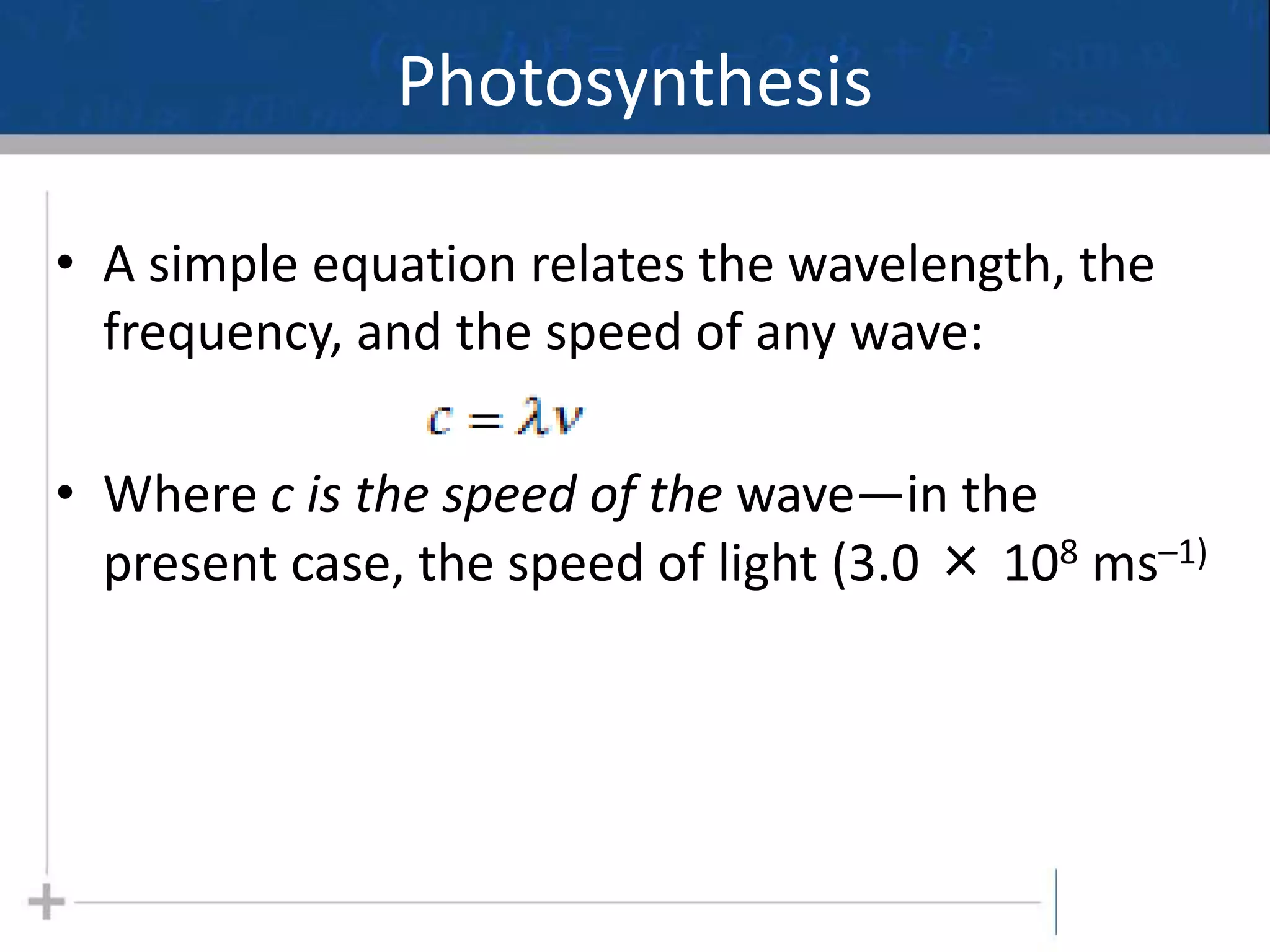
• A simple equation relates the wavelength, the
frequency, and the speed of any wave:
• Where c is the speed of the wave—in the
present case, the speed of light (3.0 × 10⁸ ms–1)
6
Photosynthesis
• Light is also a particle, which we call a photon. Each
photon contains an amount of energy that is called a
quantum (plural quanta).
• The energy content of light is not continuous but rather
is delivered in these discrete packets, the quanta.
7
Photosynthesis
• The energy (E) of a photon depends on the
frequency of the light according to a relation
known as Planck’s law:
• where h is Planck’s constant (6.626 × 10⁻³⁴ J s).
• Energy of photon depends on wave length
• Light with different wave length reach the surface
of the earth
8
Photosynthesis
• Longest wave length (radio wave) to the shortest
wavelength (gamma rays)
• 40% of radiation energy that the earth receives
visible light (violet to far red)
9
Structure of chloroplast
• Comprises three major components
• The Chloroplast is the Site of Photosynthesis
– Envelope(membrane)
– Stroma
– Thylakoid
• The most striking aspect of the structure of the
chloroplast is the extensive system of internal
membranes known as thylakoids.
• All the chlorophyll is contained within this membrane
system, which is the site of the light reactions of
photosynthesis.
10
Structure of chloroplast
• The carbon reduction reactions, which are
catalyzed by water-soluble enzymes, take place
in the stroma (plural stromata), the region of the
chloroplast outside the thylakoids.
• Most of the thylakoids appear to be very closely
associated with each other.
11
Structure of chloroplast
 These stacked membranes are known as grana lamellae
(singular lamella; each stack is called a granum), and the
exposed membranes that lack stack are stroma lamellae.
 Two separate membranes, each composed of a lipid
bilayer and together known as the envelope, surround
most types of chloroplasts
12
Structure of chloroplast
13
Thylakoid membrane
• It has 30-50 polypeptides (proteins)
• Grouped in to 5 major complexes
Photosystem I
• Reciting center for P700
• Several polypeptides
• Low chlorophyll a: chl. b ratio than PSII
• To trap light energy & induce reductions of
NADP+to NADPH
14
Thylakoid membrane
• Photosystem II
• Reactive center P 680
• Higher chlorophyll a: chl. b ratio than PSI
• To trap light and releasing of oxygen from water
• Cytocromes
• Cytochrome b6f receives electrons from PSII and
delivers them to PSI.
• It also transports additional protons into the
lumen from the stroma.
15
Thylakoid membrane
 ATP synthase -Produce ATP as protons and diffuse
back through it from the lumen into the stroma.
 Makes channel for proton to produce ATP
 Light harvesting complex
 Contain chl. a,b & other pigments (Xantophyll &
carotenoids)
 Functionally, used to capture solar energy (photon)
16
Photosynthesis: An Overview
• The net overall equation for photosynthesis is:
• Photosynthesis occurs in 2 “stages”:
1. The Light Reactions (or Light-Dependent Reactions)
2. The Calvin Cycle or
 Calvin-Benson Cycle or
 Dark Reactions or
 Light-Independent Reactions)
17
6 CO2 + 6 H2O C6H12O6 + 6 O2
light
Phase 1: Light dependent reaction
• Initiated when photons strike chlorophyll
molecules in thylakoid membrane
• During LDR:
Water molecules splitted in to H+ and O2
2 H2O → O2 + 4 H+ + 4 e–
e–from splited water pass to e-carriers (ETS)
Energy storing ATP molecules are produced
(chemosmosis)
Some H+ from splited water reduce NADP to
NADPH 18
Z scheme
19
Light reaction
• Detailed Z scheme for O2-evolving photosynthetic
organisms.
(1) The vertical arrows represent photon absorption
by the reaction center chlorophylls:
– P680 for photosystem II (PSII) and
– P700 for photosystem I (PSI).
• The excited PSII reaction center chlorophyll,
P680*, transfers an electron to pheophytin
(Pheo).
20
Light reaction
(2) On the oxidizing side of PSII (to the left of the arrow
joining P680 with P680*), P680 oxidized by light is re-
reduced by Yz , that has received electrons from oxidation
of water.
(3) On the reducing side of PSII (to the right of the arrow
joining P680 with P680*), pheophytin transfers electrons
to the acceptors QA and QB, which are plastoquinones
21
Light reaction
(4) The cytochrome b6 f complex transfers electrons to
plastocyanin (PC), a soluble protein, which in turn reduces
P700+ (oxidized P700).
(5) The acceptor of electrons from P700* (A0) is thought to
be a chlorophyll, and the next acceptor (A1) is a quinone.
• A series of membrane-bound iron–sulfur proteins (FeSX,
FeSA, and FeSB) transfers electrons to soluble ferredoxin
(Fd).
• The dashed line indicates cyclic electron flow around PSI.
22
Light reaction
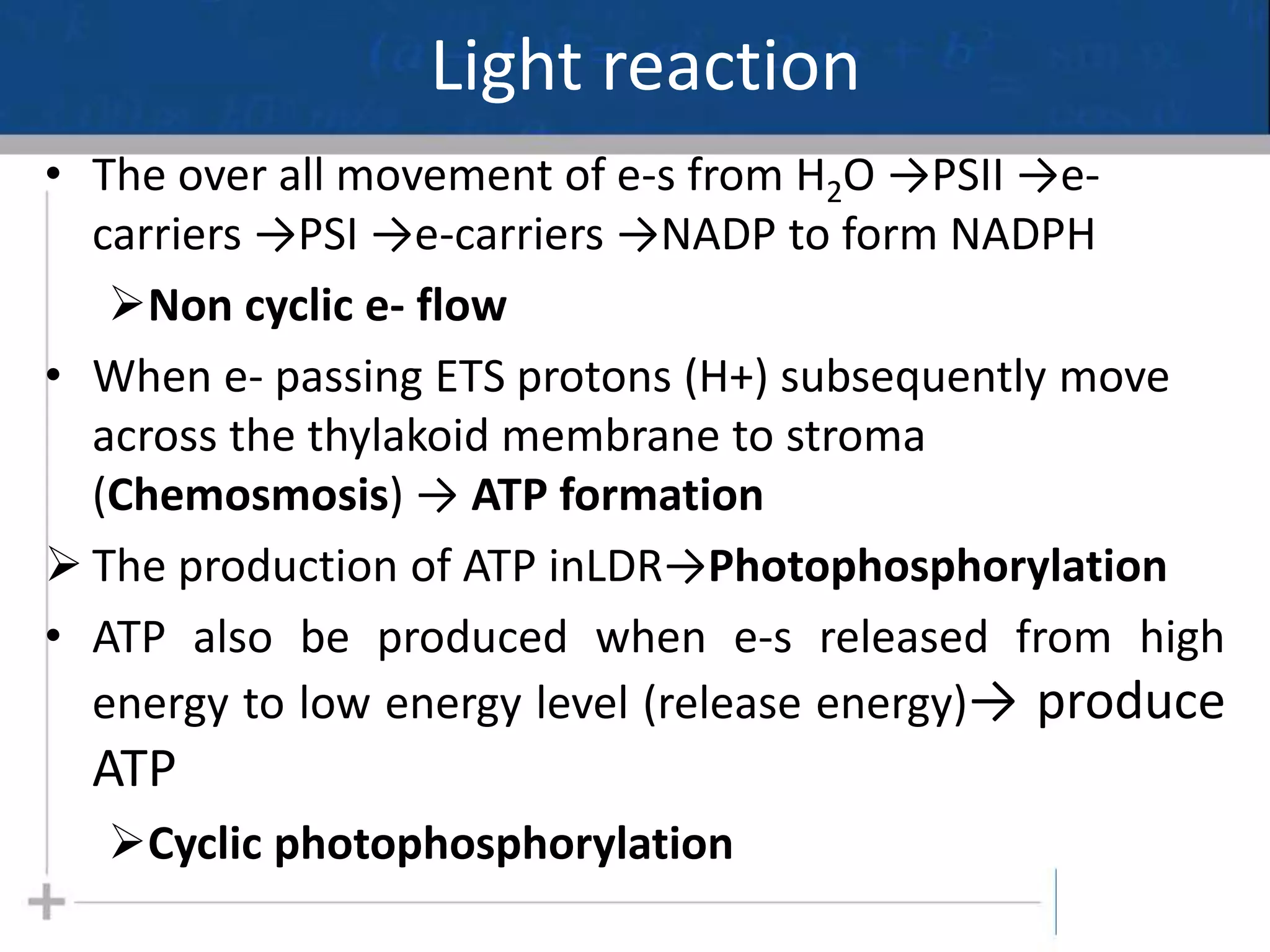
• The over all movement of e-s from H2O →PSII →e-
carriers →PSI →e-carriers →NADP to form NADPH
Non cyclic e- flow
• When e- passing ETS protons (H+) subsequently move
across the thylakoid membrane to stroma
(Chemosmosis) → ATP formation
 The production of ATP inLDR→Photophosphorylation
• ATP also be produced when e-s released from high
energy to low energy level (release energy)→ produce
ATP
Cyclic photophosphorylation
23
Photosynthesis
Phase II: Light Independent Reaction
• The Calvin Cycle, Environmental Conditions,
& Preventing Photorespiration
24
Photosynthesis: An Overview
• To follow the energy in photosynthesis,
25
light
light ATP
NADPH
Light
Reactions
thylakoids
Calvin
Cycle
stroma
Organic
compounds
(carbs)
Phase 2: The Calvin Cycle
• In the Calvin Cycle, chemical energy (from the light
reactions) and CO2 (from the atmosphere) are used to
produce organic compounds (like glucose).
• The Calvin Cycle occurs in the stroma of chloroplasts.
26
Phase 2: The Calvin Cycle
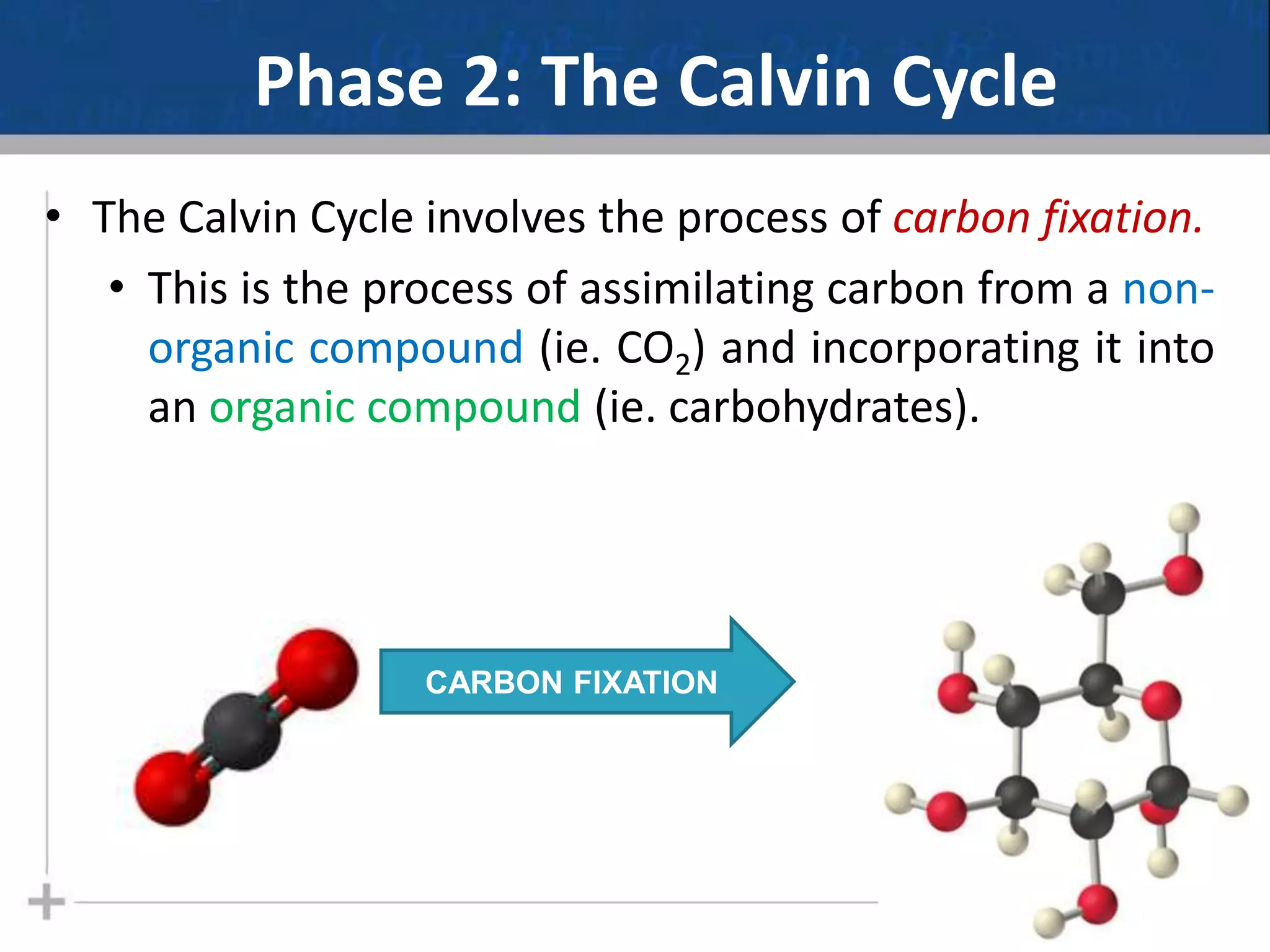
• The Calvin Cycle involves the process of carbon fixation.
• This is the process of assimilating carbon from a non-
organic compound (ie. CO2) and incorporating it into
an organic compound (ie. carbohydrates).
27
CARBON FIXATION
Phase 2: The Calvin Cycle
Step 1: Carbon Fixation
• 3 molecules of CO2 (from the atmosphere) are joined to 3
molecules of RuBP (a 5-carbon sugar) by Rubisco (an enzyme
also known as RuBP carboxylase)
28
C CC CC
C CC CC
C CC CC
C
C
C
3 carbon dioxide
molecules
3 RuBP molecules
Rubisco
This forms 3
molecules
which each
have 6 carbons
(for a total of 18
carbons!)
Phase 2: The Calvin Cycle
Step 2: Reduction
• The three 6-carbon molecules (very unstable) split in half, forming
six 3-carbon molecules.
• Then they are reduced by gaining electrons from NADPH.
• ATP is required for this molecular rearranging
29
C CC CC C
C CC CC C
C CC CC C
C CC
C CC
C CC
CC C
CC C
CC C
NADPH
NADP+
ATP ADP P
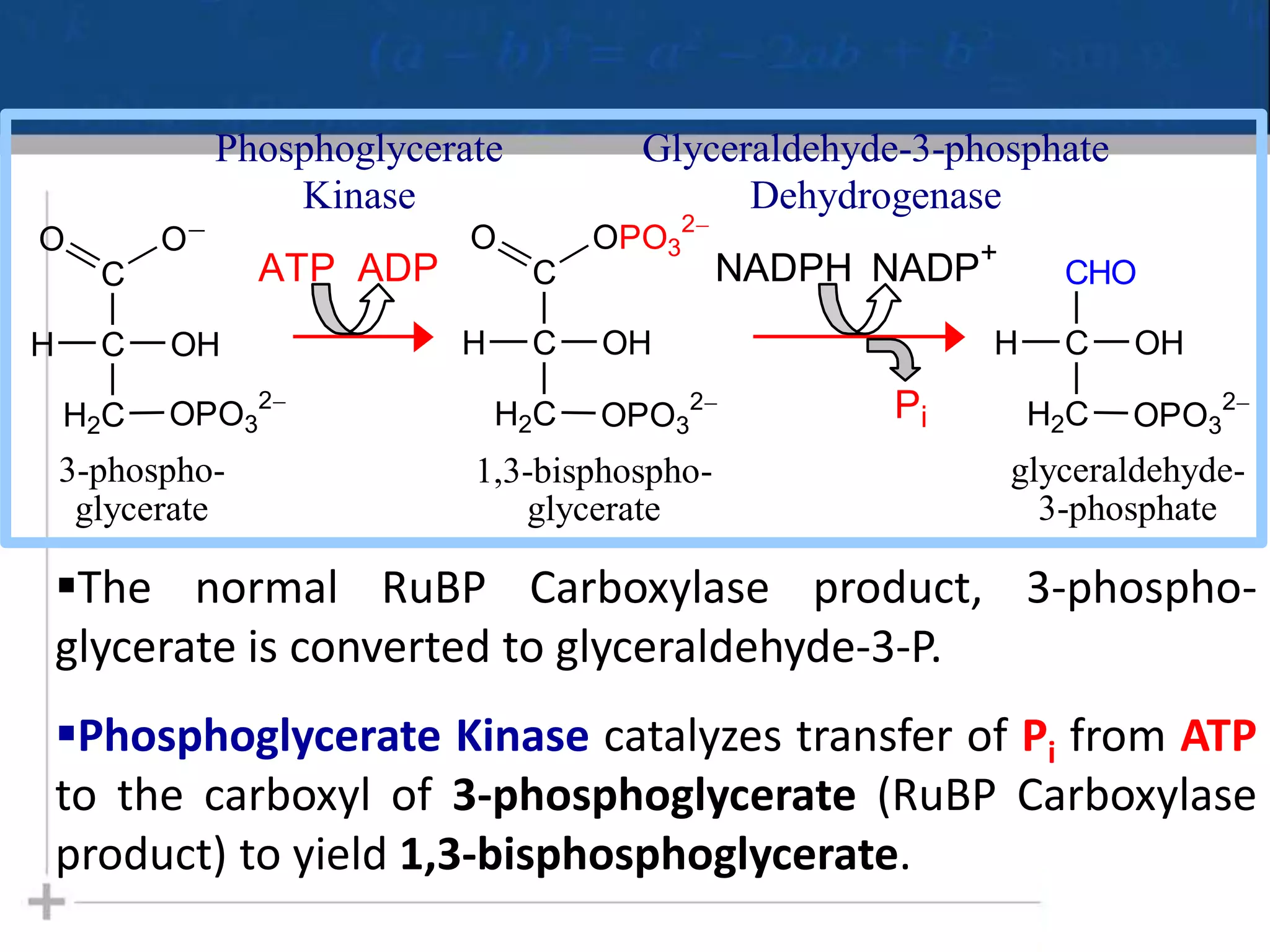
The normal RuBP Carboxylase product, 3-phospho-
glycerate is converted to glyceraldehyde-3-P.
Phosphoglycerate Kinase catalyzes transfer of Pi from ATP
to the carboxyl of 3-phosphoglycerate (RuBP Carboxylase
product) to yield 1,3-bisphosphoglycerate.
OH
H2C
CH
C
OO
OPO3
2

OH
H2C
CH
C
OPO3
2
O
OPO3
2
OH
H2C
CH
CHO
OPO3
2
ATP ADP NADPH NADP+
Pi
1,3-bisphospho-
glycerate
3-phospho-
glycerate
glyceraldehyde-
3-phosphate
Phosphoglycerate
Kinase
Glyceraldehyde-3-phosphate
Dehydrogenase
Phase 2: The Calvin Cycle
• There are now six 3-carbon molecules, which are known
as G3P or PGAL.
• Since the Calvin Cycle started with 15 carbons (three 5-
carbon molecules) and there are now 18 carbons, we
have a net gain of 3 carbons.
31
C CC
C CC
C CC
CC C
CC C
CC C
• One of these “extra” 3-carbon
G3P/PGAL molecules will exit
the cycle and be used to form ½
a glucose molecule.
Phase 2: The Calvin Cycle
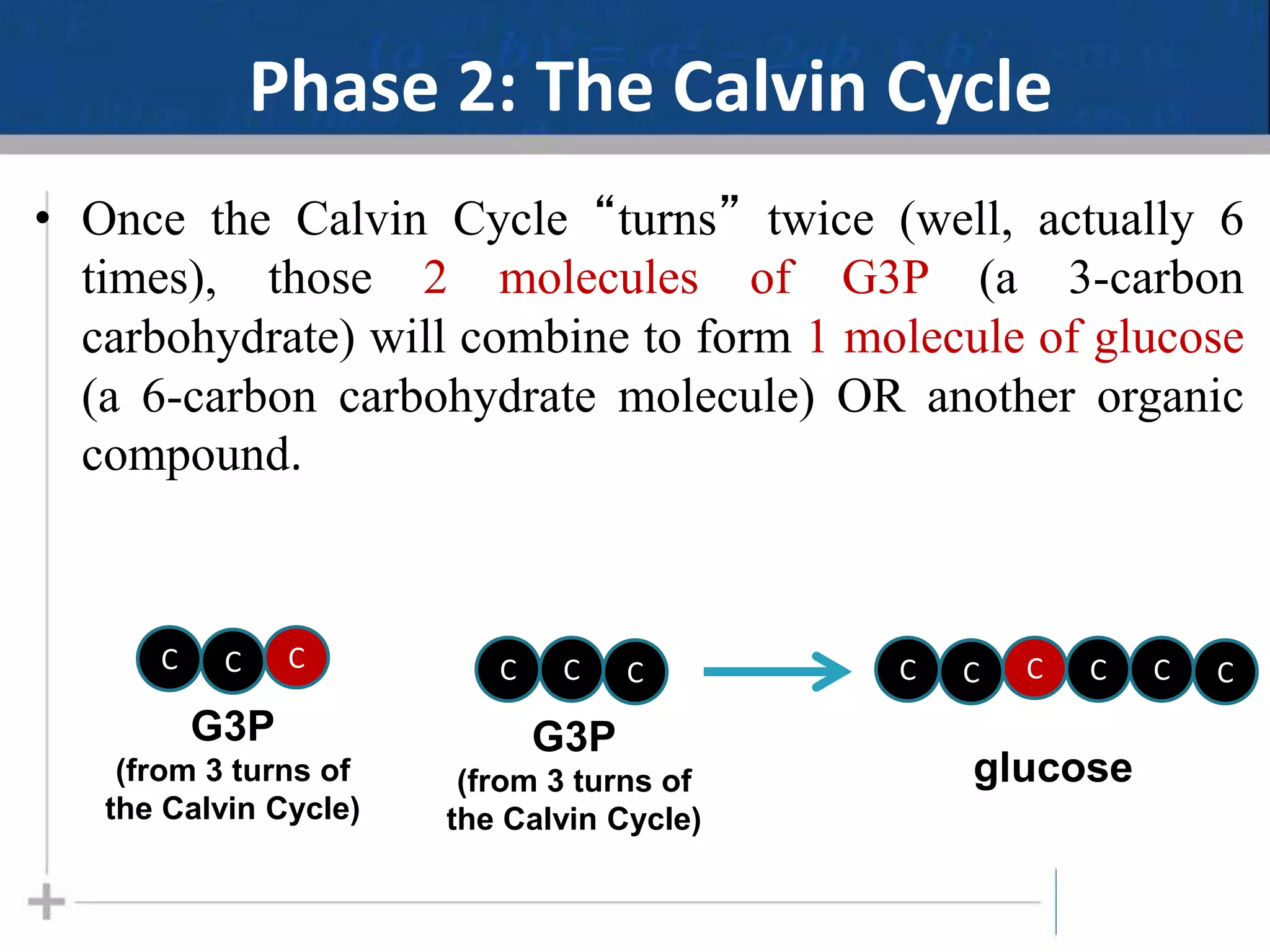
• Once the Calvin Cycle “turns” twice (well, actually 6
times), those 2 molecules of G3P (a 3-carbon
carbohydrate) will combine to form 1 molecule of glucose
(a 6-carbon carbohydrate molecule) OR another organic
compound.
32
CC C
G3P
(from 3 turns of
the Calvin Cycle)
C CC
G3P
(from 3 turns of
the Calvin Cycle)
CC C C CC
glucose
Phase 2: The Calvin Cycle
Step 3: Regeneration of RuBP
• Since this is the Calvin Cycle, we must end up back at
the beginning.
• The remaining 5 G3P molecules (3-carbons each!) get
rearranged (using ATP) to form 3 RuBP molecules (5-
carbons each).
33
C CC
C CC
C CC
C C C
CC C
5 G3P molecules
Total: 15 carbons
3 RuBP molecules
Total: 15 carbons
ATP
ADP
P
Phase 2: The Calvin Cycle
ORGANIC
COMPOUND
NADPH
NADP+
ATP
ADP
P
RuBP
CO2
Phase 2: The Calvin Cycle
35
Phase 2: The Calvin Cycle
Quick recap:
•In the Calvin Cycle, energy and electrons from the Light
Reactions (in the form of ATP and NADPH) and carbon
dioxide from the atmosphere are used to produce organic
compounds.
•The Calvin Cycle occurs in the stroma inside the
chloroplasts (inside the cells…).
•Carbon dioxide, ATP, and NADPH are required as a
(reactants).
• Organic compounds (G3P) are produced (products).
36
Photosynthesis: A Recap
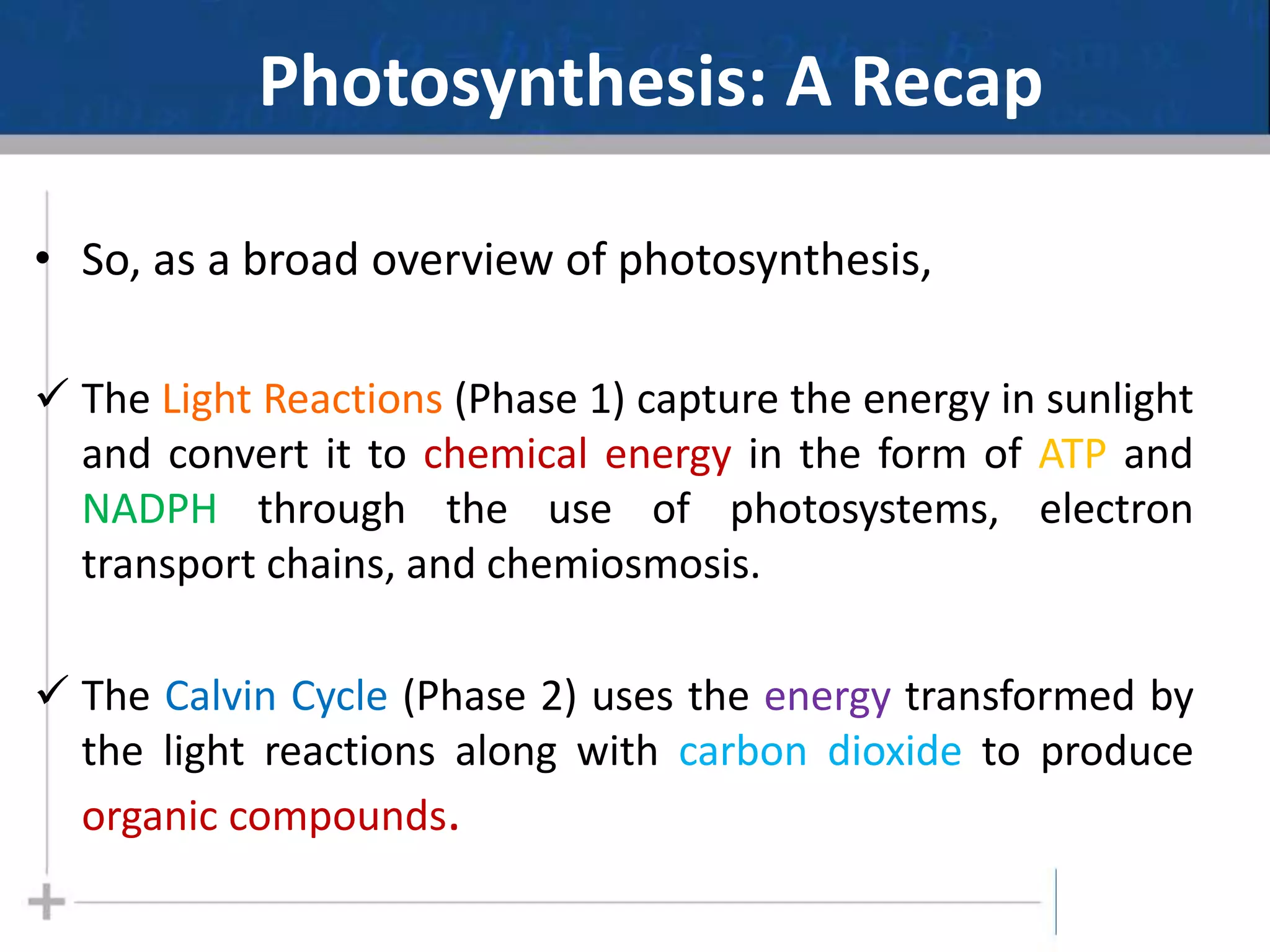
• So, as a broad overview of photosynthesis,
 The Light Reactions (Phase 1) capture the energy in sunlight
and convert it to chemical energy in the form of ATP and
NADPH through the use of photosystems, electron
transport chains, and chemiosmosis.
 The Calvin Cycle (Phase 2) uses the energy transformed by
the light reactions along with carbon dioxide to produce
organic compounds.
37
Photosynthesis: A Recap
38
The photosynthetic equation:
light
Excites
electrons
during the
light
reactions
6 H2O
Split during the
light reactions
to replace
electrons lost
from
Photosystem II
6 CO2
Provides the carbon to
produce organic
compounds during the
Calvin Cycle
Produced as a
byproduct of the
splitting of
water during the
light reactions
6 O2 C6H12O6
The organic compound
ultimately produced
during the Calvin Cycle
Most realistically, the rate of photosynthesis could be
measured by using the:
- Decrease in environmental CO2 (in a closed system)
- Increase in environmental O2 (in a closed system)
- Increase in glucose (perhaps measured using radioactive
carbon)
Environmental Factors & Photosynthesis
• The rate (or speed) of photosynthesis can vary, based on
environmental conditions.
• Light intensity
• Temperature
• Oxygen concentration 39
Environmental Factors & Photosynthesis
• Light intensity
• As light intensity increases, so too does the rate of
photosynthesis.
40
• This occurs due to increased excitation
of electrons in the photosystems.
• However, the photosystems will
eventually become saturated.
• Above this limiting level, no
further increase in photosynthetic
rate will occur.
light
saturation
point
Environmental Factors & Photosynthesis
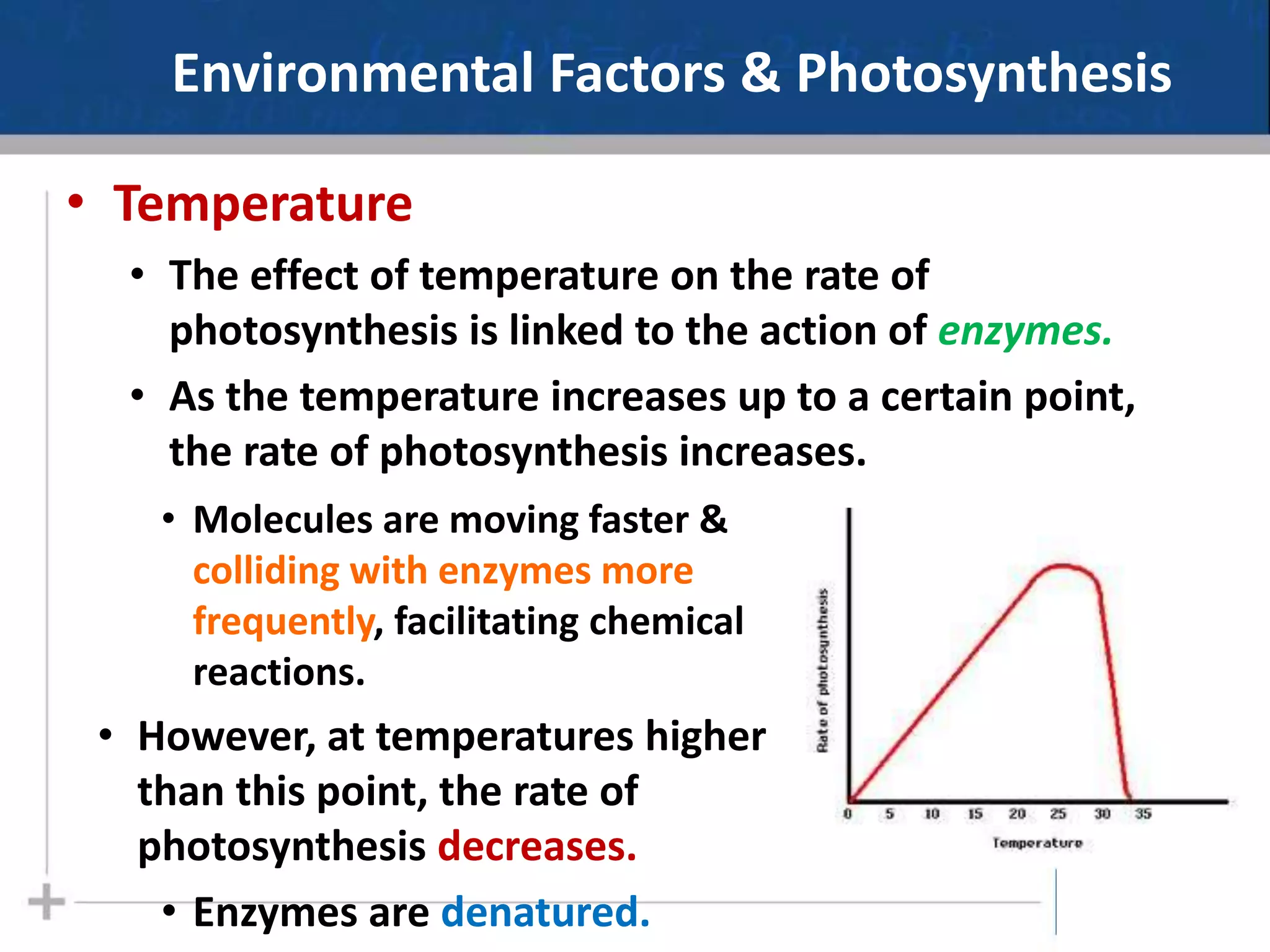
• Temperature
• The effect of temperature on the rate of
photosynthesis is linked to the action of enzymes.
• As the temperature increases up to a certain point,
the rate of photosynthesis increases.
• Molecules are moving faster &
colliding with enzymes more
frequently, facilitating chemical
reactions.
• However, at temperatures higher
than this point, the rate of
photosynthesis decreases.
• Enzymes are denatured.
Environmental Factors & Photosynthesis
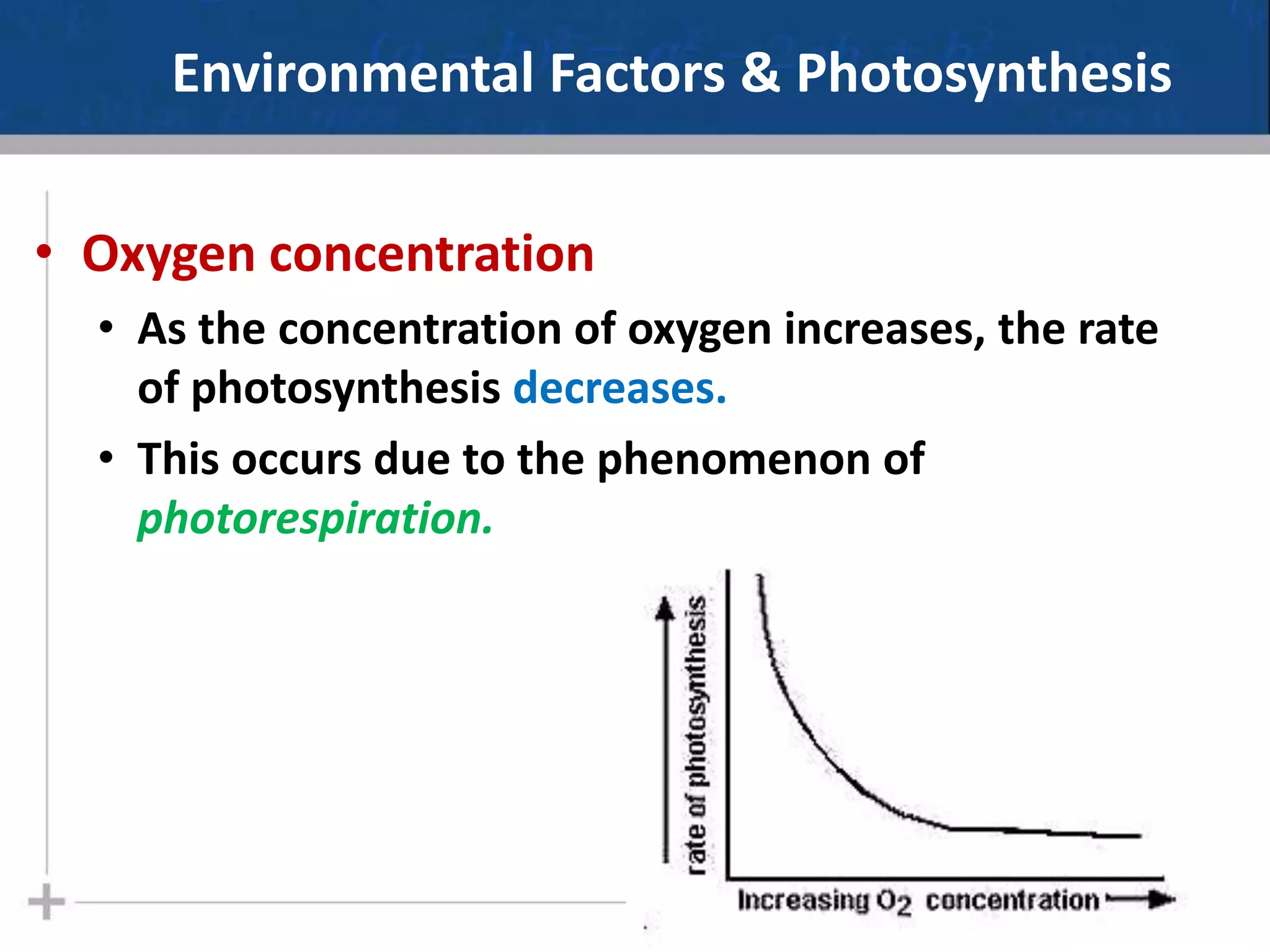
• Oxygen concentration
• As the concentration of oxygen increases, the rate
of photosynthesis decreases.
• This occurs due to the phenomenon of
photorespiration.
42
Photorespiration
• Photorespiration occurs when Rubisco (RuBP
carboxylase) joins oxygen to RuBP in the first step
of the Calvin Cycle rather than carbon dioxide.
• Whichever compound (O2 or CO2) is present in higher
concentration will be joined by Rubisco to RuBP.
• Photorespiration prevents the synthesis of glucose AND utilizes
the plant’s ATP.
43
More CO2
More O2
Rubisco joins
CO2 to RuBP
Rubisco joins
O2 to RuBP
Photosynthesis
occurs; glucose is
produced
Photorespiration
occurs; glucose is
NOT produced
Photorespiration
• Photorespiration is primarily a problem for plants under water
stress.
• When plants are under water stress, their stomata close to
prevent water loss through transpiration.
• However, this also limits gas exchange.
• O2 is still being produced (through the light reactions).
44
• Thus, the concentration of O2 is
increasing.
• CO2 is not entering the leaf since the
stomata are closed.
• Thus, as the CO2 is being used up (in the
Calvin Cycle) and not replenished, the
concentration of CO2 is decreasing.
Photorespiration
• As the concentration of O2 increases and the concentration
of CO2 decreases (due to the closure of the stomata to
prevent excessive water loss), photorespiration is favored
over photosynthesis.
• Some plant species that live in hot, dry climates (where
photorespiration is an especially big problem) have
developed mechanisms through natural selection to prevent
photorespiration.
• C4 plants
• CAM plants
45
C3 Plants
• C3 plants, which are “normal” plants, perform
the light reactions and the Calvin Cycle in the
mesophyll cells of the leaves.
46
• The bundle sheath cells of
C3 plants do not contain
chloroplasts
palisade mesophyll
spongy mesophyll
bundle sheath cells
C4 and CAM Plants
• C4 plants and CAM plants modify the process of
C3 photosynthesis to prevent photorespiration.
• Overview:
• C4 plants perform the Calvin Cycle in a different
location within the leaf than C3 plants.
• CAM plants obtain CO2 at a different time than C3
plants.
• Both C4 and CAM plants separate the initial fixing
of CO2 (carbon fixation) from the using of CO2 in
the Calvin Cycle.
47
C4 Plants: Preventing Photorespiration
• Plants that use C4 photosynthesis include corn,
sugar cane, and sorghum.
• In this process, CO2 is transferred from the
mesophyll cells into the bundle-sheath cells,
which are impermeable to CO2.
48
• This increases the concentration of
CO2.
• Thus, the Calvin Cycle is favored
over photorespiration.
• The bundle-sheath cells of C4
plants do contain chloroplasts.
C4 Plants: Preventing Photorespiration
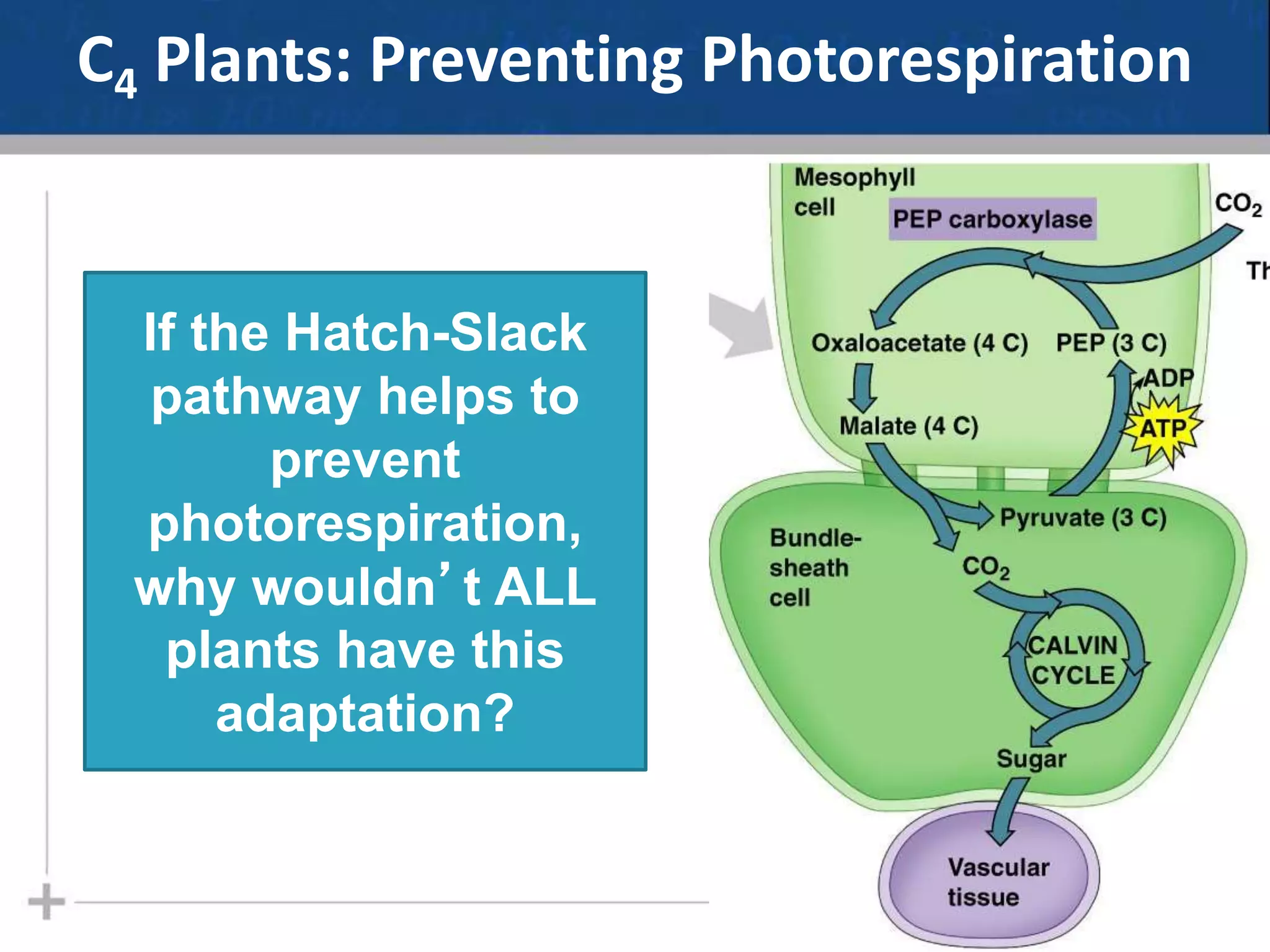
• C4 plants use the Hatch-Slack
pathway prior to the Calvin Cycle:
• PEP carboxylase adds carbon dioxide
to PEP, a 3-carbon compound, in the
mesophyll cells.
• This produces a 4-carbon
compound (which is why it’s
known as C4 photosynthesis).
• This 4-carbon molecule then moves
into the bundle-sheath cells via
plasmodesmata.
49
• In the bundle sheath cells, the CO2 is
released and the Calvin Cycle begins.
C4 Plants: Preventing Photorespiration
50
If the Hatch-Slack
pathway helps to
prevent
photorespiration,
why wouldn’t ALL
plants have this
adaptation?
C3 vs C4 Plants
A Lesson in Photoefficiency
• CO2 directly
• RuBP recipient
• RUBISCO open
• O2 can interfere
• Photorespiration
likely
51
• CO2 indirectly
• PEP recipient
• RUBISCO shielded
• O2 cannot interfere
• No photorespriation
C3 C4
C3 and C4 Plants
52
C4
C3
• soybean
• wheat
• rice
• sugar beet
• alfalfa
• spinach
• tobacco
• sunflower
• corn
• sorghum
• sugar cane
• millet
• crab grass
• Bermuda grass
• pigweed
CAM Plants: Preventing Photorespiration
• Plants that use CAM photosynthesis include
succulent plants (like cacti) and pineapples.
• In CAM (crassulacean acid metabolism)
photosynthesis, plants open their stomata at
night to obtain CO2 and release O2.
• This prevents them from drying out by keeping
their stomata closed during the hottest & driest
part of the day.
CAM Plants: Preventing Photorespiration
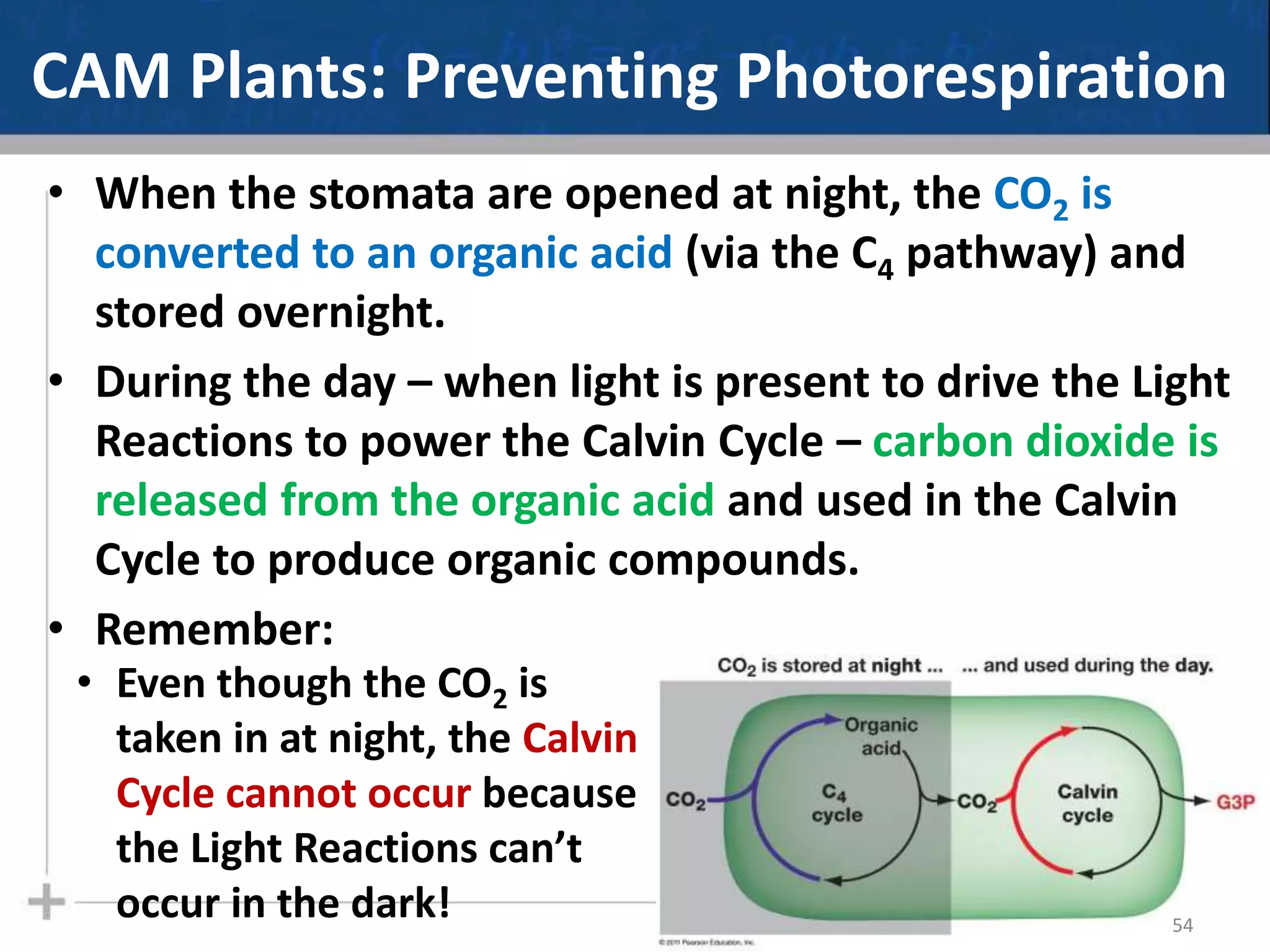
• When the stomata are opened at night, the CO2 is
converted to an organic acid (via the C4 pathway) and
stored overnight.
• During the day – when light is present to drive the Light
Reactions to power the Calvin Cycle – carbon dioxide is
released from the organic acid and used in the Calvin
Cycle to produce organic compounds.
• Remember:
54
• Even though the CO2 is
taken in at night, the Calvin
Cycle cannot occur because
the Light Reactions can’t
occur in the dark!
55
Avoiding Photorespiration
• Both C4 and CAM plants – which are primarily found in hot,
dry climates – have evolutionary adaptations which help
prevent photorespiration.
• C4 plants perform the Calvin Cycle in the bundle-
56
sheath cells.
• CAM plants
open their
stomata at
night and store
the CO2 until
morning.
5. Translocation in the phloem
57
5.1 Phloem anatomy
• Phloem is composed of two types of cells
I. Sieve tube members : relatively large more or
less cylindrical
II. Companion cells: narrow and more or less
tapered
o Companion cells are associated with sieve tube
members; metabolically very active cells
58
Phloem anatomy
• Phloem is derived from the plant cell of cambium
which also produces xylem
• Also includes fibers, parenchyma and ray cells
• Sieve tube members are laid end to end and
form sieve tube
• Porous regions of sieve tube members is called
sieve plate
• Have no nucleus at maturity
Although their cytoplasm is very active in conduction
59
Phloem anatomy
• Associated with companion cells which aid in
conduction by providing energy
• Sieve cells and sieve tubes are the chief food
conducting tissues
• Numerous plasmodesmata occurs between
companion cells and sieve tube elements
• Direction of translocation of organic molecule :
– Predominantly down ward or up ward direction
– Radial translocation also common
60
5.2 Phloem sap composition
• Phloem sap contains:
• Large amount of sugars ( of which more than 90% is
sucrose= a non reducing sugar)
• Amino acids and amines, and certain amounts of salts
• However, composition of sap vary from plant to plant
• The most common transported plant is sucrose
(glucose + fructose)
• Carbohydrates transported in phloem are almost
all non reducing sugars. This is because they are
less reactive
61
Phloem sap composition
• Reducing sugars such as Glucose, Maltose and
Fructose contain an exposed aldehyde or
keton group; too chemically reactive to be
transported in the phloem
• Thus sucrose is the most common sugar
transported in sieve tube of phloem
62
63
Translocation in sieve tubes
• Sugar produced by photosynthesis moves
through one to several paranchyma cells to
reach sieve elements In phloem
• Movement of sugar from photosynthetic cells
to sieve tube elements called vein loading while
the reverse is vein unloading
• Region that supplies sugar is called source and
that where it is utilized is known as sink
64
Translocation in sieve tubes
Sources are green leaves
Sinks are growing points of roots and shoots,
and storage organs such as fruit and seeds,
stem, rhizome, tuber, roots etc.
• Sugar concentration in sieve tube (phloem) is
the highest at the source and the lowest near
the sink
65
Mechanism of Translocation
A) Phloem loading
• There are four steps in phloem loading
I. Diffusion of triose phosphate (GA3P) from
stroma to cytoplasm where it is converted to
sucrose
II. Sucrose travels from mesophyll cells to near
sieve elements (short distance transport)
III. Sucrose enter sieve elements -companion cell
complex
66
Phloem loading
IV. Sugars are then transported to sink (long
distance transport) through vascular system
(export)
• It is believed that:
• Mass flow of sugar is passive process (long
distance transport)
• Phloem loading and unloading are active
proceses (consume ATP)
67
Phloem unloading
• i.e sieve element companion cell complex has
high concentration of sucrose and sugars
enters these cells against concentration
gradient (at cost of energy)
B. Phloem unloading
• Transport of sugar from sieve elements in to
cells of sink is generally apoplastic and to
some extent symplastic
68
Phloem unloading
• Symplastic unloading is down concentration
gradient
• Appoplastic transport may be energy
consuming
• Phloem unloading occurs in three steps
I. Transport of sugar out of sieve elements
II. The sugar diffuses in to the storage (utilizing)
tissue (sink)
III. The sugars are hydrolysed and converted in to
starch for storage
69
Mechanism…
• The most widely accepted theory about mechanism of
phloem transport is the pressure flow (mass flow)
hypothesis
• In sieve elements near to source tissue , energy driven
phloem loading leads to a build of sugars in sieve
elements
 This results in low solute potential in sieve elements
→causes a step drop in water potential →water enters
sieve elements from xylem →thus phloem turger
pressure increases →increase pressure in phloem
sieve elements (near source)
70
Mechanism…
• In sieve elements near the sink tissue, phloem
unloading leads to lower sugar concentration →results
in hign solute potential →water potential increases
→water leaves phloem and enters sink sieve elements
and xylem →thus phloem turger pressure decreses
→decreses pressure in the phloem sieve elements near
the sink.
• Pressure difference b/n phloem sieve elements near
the source (highpressure) and sink (low pressure)
results in mass flow of sugar down pressure gradient.
71
72
6. Nitrogen metabolism
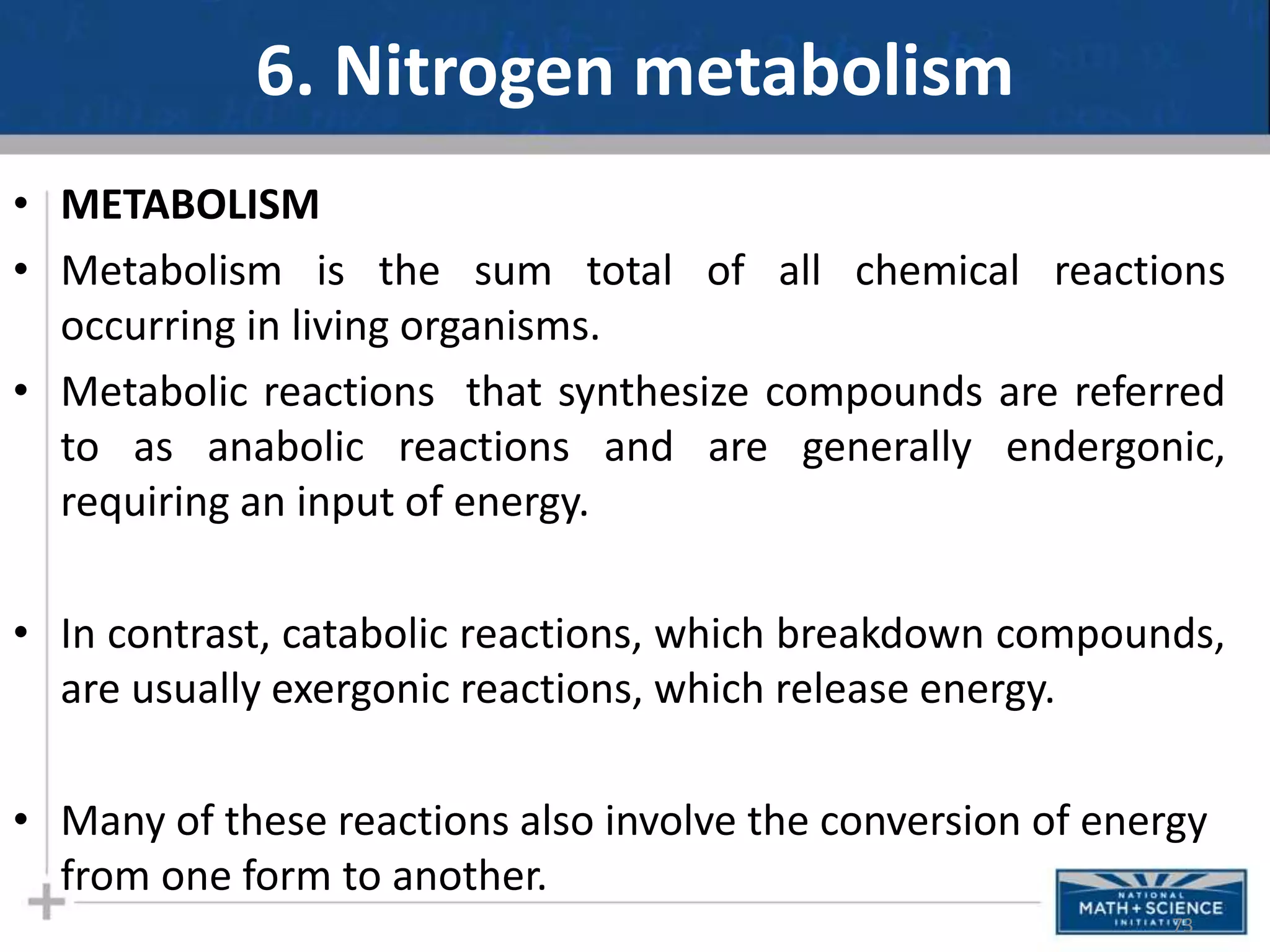
• METABOLISM
• Metabolism is the sum total of all chemical reactions
occurring in living organisms.
• Metabolic reactions that synthesize compounds are referred
to as anabolic reactions and are generally endergonic,
requiring an input of energy.
• In contrast, catabolic reactions, which breakdown compounds,
are usually exergonic reactions, which release energy.
• Many of these reactions also involve the conversion of energy
from one form to another.
73
Nitrogen fixation
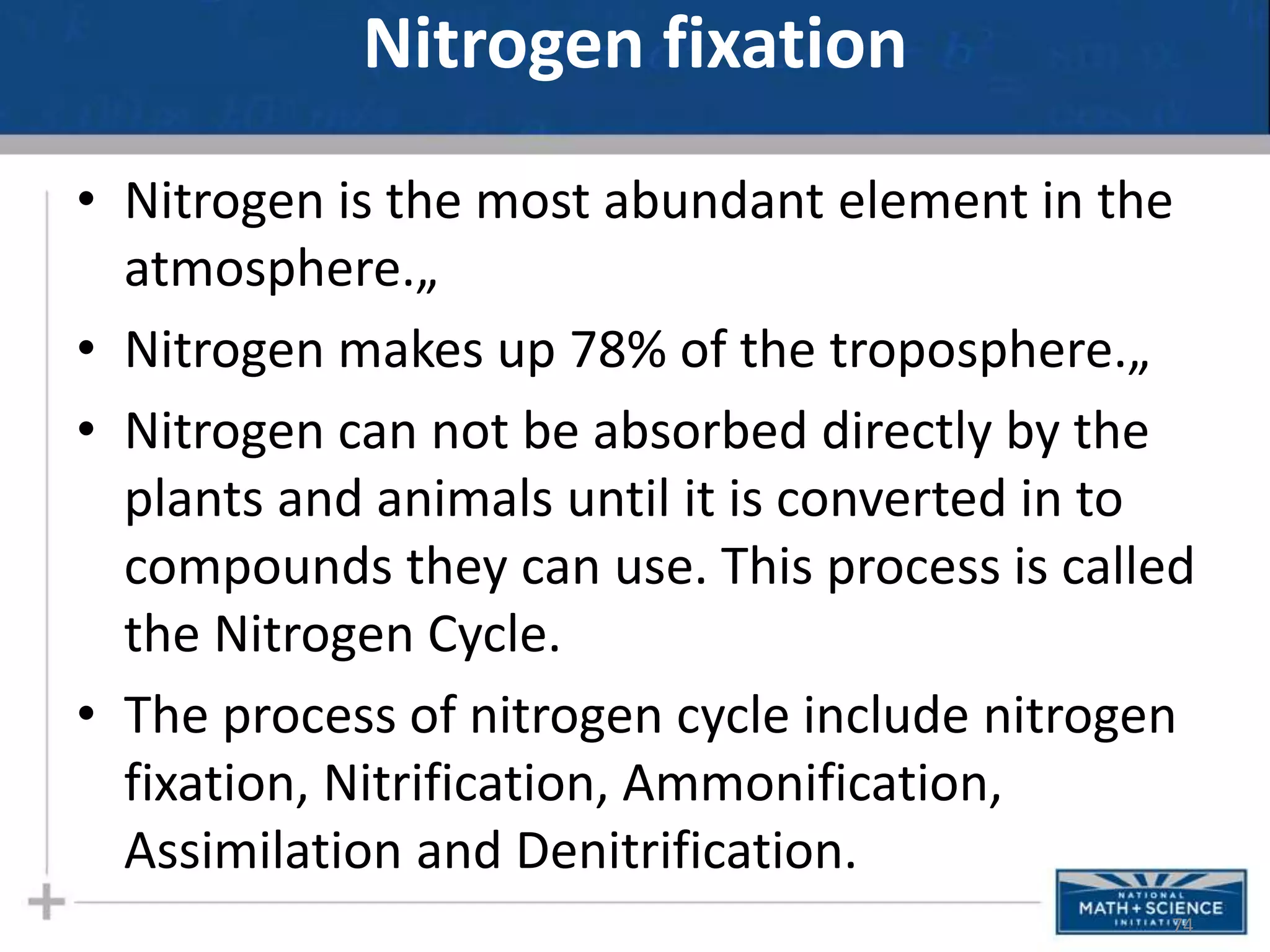
• Nitrogen is the most abundant element in the
atmosphere.„
• Nitrogen makes up 78% of the troposphere.„
• Nitrogen can not be absorbed directly by the
plants and animals until it is converted in to
compounds they can use. This process is called
the Nitrogen Cycle.
• The process of nitrogen cycle include nitrogen
fixation, Nitrification, Ammonification,
Assimilation and Denitrification.
74
7. Growth and development
• Growth:
– Apical
– Lateral
– intercallary
• Growth curve
– Lag phase
– Log exponential
– Stationary phase
75
Plant growth hormons
• Auxins
• Gibbrerelines
• Cytokinins
• Ethylene
• Abscisic acid
• Auxins
• Synthesis: shoot tip (appical meristem)
76

Photosynthesis

  • 1.
    4. Photosynthesis Metabolism • Anabolism-Building up larger molecule from smaller molecules –Energy is stored in chemical bonds –Eg. photosynthesis • Catabolism -Breaking down of larger molecules to small –Energy released –Eg. Respiration 1
  • 2.
    Photosynthesis • Both anabolismand catabolism involve oxidation reduction. • Oxidation- loss of one or more electrons or removal of hydrogen • Reduction- gain of one or more electrons or addition of H to a substance • N.B: Hydrogen atom is often removed during oxidation and adding during reduction 2
  • 3.
    Photosynthesis Photosynthesis • literally means“synthesis using light.” • Takes place in chloroplast • Light energy is converted to chemical energy and stored in chemical bonds • Photosynthetic organisms use solar energy to synthesize carbon compounds that cannot be formed without the input of energy. 3
  • 4.
    Photosynthesis • Light energydrives the synthesis of carbohydrates from carbon dioxide and water with the generation of oxygen: • Energy stored in these molecules can be used later to power cellular processes in the plant and can serve as the energy source for all forms of life. 4
  • 5.
    Photosynthesis Light • Light HasCharacteristics of Both a Particle and a Wave • A wave is characterized by a wavelength, lambda ( ), which is the distance between successive wave crests. • The frequency, (V), is the number of wave crests that pass an observer in a given time. 5
  • 6.
    Photosynthesis • A simpleequation relates the wavelength, the frequency, and the speed of any wave: • Where c is the speed of the wave—in the present case, the speed of light (3.0 × 10⁸ ms–1) 6
  • 7.
    Photosynthesis • Light isalso a particle, which we call a photon. Each photon contains an amount of energy that is called a quantum (plural quanta). • The energy content of light is not continuous but rather is delivered in these discrete packets, the quanta. 7
  • 8.
    Photosynthesis • The energy(E) of a photon depends on the frequency of the light according to a relation known as Planck’s law: • where h is Planck’s constant (6.626 × 10⁻³⁴ J s). • Energy of photon depends on wave length • Light with different wave length reach the surface of the earth 8
  • 9.
    Photosynthesis • Longest wavelength (radio wave) to the shortest wavelength (gamma rays) • 40% of radiation energy that the earth receives visible light (violet to far red) 9
  • 10.
    Structure of chloroplast •Comprises three major components • The Chloroplast is the Site of Photosynthesis – Envelope(membrane) – Stroma – Thylakoid • The most striking aspect of the structure of the chloroplast is the extensive system of internal membranes known as thylakoids. • All the chlorophyll is contained within this membrane system, which is the site of the light reactions of photosynthesis. 10
  • 11.
    Structure of chloroplast •The carbon reduction reactions, which are catalyzed by water-soluble enzymes, take place in the stroma (plural stromata), the region of the chloroplast outside the thylakoids. • Most of the thylakoids appear to be very closely associated with each other. 11
  • 12.
    Structure of chloroplast These stacked membranes are known as grana lamellae (singular lamella; each stack is called a granum), and the exposed membranes that lack stack are stroma lamellae.  Two separate membranes, each composed of a lipid bilayer and together known as the envelope, surround most types of chloroplasts 12
  • 13.
  • 14.
    Thylakoid membrane • Ithas 30-50 polypeptides (proteins) • Grouped in to 5 major complexes Photosystem I • Reciting center for P700 • Several polypeptides • Low chlorophyll a: chl. b ratio than PSII • To trap light energy & induce reductions of NADP+to NADPH 14
  • 15.
    Thylakoid membrane • PhotosystemII • Reactive center P 680 • Higher chlorophyll a: chl. b ratio than PSI • To trap light and releasing of oxygen from water • Cytocromes • Cytochrome b6f receives electrons from PSII and delivers them to PSI. • It also transports additional protons into the lumen from the stroma. 15
  • 16.
    Thylakoid membrane  ATPsynthase -Produce ATP as protons and diffuse back through it from the lumen into the stroma.  Makes channel for proton to produce ATP  Light harvesting complex  Contain chl. a,b & other pigments (Xantophyll & carotenoids)  Functionally, used to capture solar energy (photon) 16
  • 17.
    Photosynthesis: An Overview •The net overall equation for photosynthesis is: • Photosynthesis occurs in 2 “stages”: 1. The Light Reactions (or Light-Dependent Reactions) 2. The Calvin Cycle or  Calvin-Benson Cycle or  Dark Reactions or  Light-Independent Reactions) 17 6 CO2 + 6 H2O C6H12O6 + 6 O2 light
  • 18.
    Phase 1: Lightdependent reaction • Initiated when photons strike chlorophyll molecules in thylakoid membrane • During LDR: Water molecules splitted in to H+ and O2 2 H2O → O2 + 4 H+ + 4 e– e–from splited water pass to e-carriers (ETS) Energy storing ATP molecules are produced (chemosmosis) Some H+ from splited water reduce NADP to NADPH 18
  • 19.
  • 20.
    Light reaction • DetailedZ scheme for O2-evolving photosynthetic organisms. (1) The vertical arrows represent photon absorption by the reaction center chlorophylls: – P680 for photosystem II (PSII) and – P700 for photosystem I (PSI). • The excited PSII reaction center chlorophyll, P680*, transfers an electron to pheophytin (Pheo). 20
  • 21.
    Light reaction (2) Onthe oxidizing side of PSII (to the left of the arrow joining P680 with P680*), P680 oxidized by light is re- reduced by Yz , that has received electrons from oxidation of water. (3) On the reducing side of PSII (to the right of the arrow joining P680 with P680*), pheophytin transfers electrons to the acceptors QA and QB, which are plastoquinones 21
  • 22.
    Light reaction (4) Thecytochrome b6 f complex transfers electrons to plastocyanin (PC), a soluble protein, which in turn reduces P700+ (oxidized P700). (5) The acceptor of electrons from P700* (A0) is thought to be a chlorophyll, and the next acceptor (A1) is a quinone. • A series of membrane-bound iron–sulfur proteins (FeSX, FeSA, and FeSB) transfers electrons to soluble ferredoxin (Fd). • The dashed line indicates cyclic electron flow around PSI. 22
  • 23.
    Light reaction • Theover all movement of e-s from H2O →PSII →e- carriers →PSI →e-carriers →NADP to form NADPH Non cyclic e- flow • When e- passing ETS protons (H+) subsequently move across the thylakoid membrane to stroma (Chemosmosis) → ATP formation  The production of ATP inLDR→Photophosphorylation • ATP also be produced when e-s released from high energy to low energy level (release energy)→ produce ATP Cyclic photophosphorylation 23
  • 24.
    Photosynthesis Phase II: LightIndependent Reaction • The Calvin Cycle, Environmental Conditions, & Preventing Photorespiration 24
  • 25.
    Photosynthesis: An Overview •To follow the energy in photosynthesis, 25 light light ATP NADPH Light Reactions thylakoids Calvin Cycle stroma Organic compounds (carbs)
  • 26.
    Phase 2: TheCalvin Cycle • In the Calvin Cycle, chemical energy (from the light reactions) and CO2 (from the atmosphere) are used to produce organic compounds (like glucose). • The Calvin Cycle occurs in the stroma of chloroplasts. 26
  • 27.
    Phase 2: TheCalvin Cycle • The Calvin Cycle involves the process of carbon fixation. • This is the process of assimilating carbon from a non- organic compound (ie. CO2) and incorporating it into an organic compound (ie. carbohydrates). 27 CARBON FIXATION
  • 28.
    Phase 2: TheCalvin Cycle Step 1: Carbon Fixation • 3 molecules of CO2 (from the atmosphere) are joined to 3 molecules of RuBP (a 5-carbon sugar) by Rubisco (an enzyme also known as RuBP carboxylase) 28 C CC CC C CC CC C CC CC C C C 3 carbon dioxide molecules 3 RuBP molecules Rubisco This forms 3 molecules which each have 6 carbons (for a total of 18 carbons!)
  • 29.
    Phase 2: TheCalvin Cycle Step 2: Reduction • The three 6-carbon molecules (very unstable) split in half, forming six 3-carbon molecules. • Then they are reduced by gaining electrons from NADPH. • ATP is required for this molecular rearranging 29 C CC CC C C CC CC C C CC CC C C CC C CC C CC CC C CC C CC C NADPH NADP+ ATP ADP P
  • 30.
    The normal RuBPCarboxylase product, 3-phospho- glycerate is converted to glyceraldehyde-3-P. Phosphoglycerate Kinase catalyzes transfer of Pi from ATP to the carboxyl of 3-phosphoglycerate (RuBP Carboxylase product) to yield 1,3-bisphosphoglycerate. OH H2C CH C OO OPO3 2  OH H2C CH C OPO3 2 O OPO3 2 OH H2C CH CHO OPO3 2 ATP ADP NADPH NADP+ Pi 1,3-bisphospho- glycerate 3-phospho- glycerate glyceraldehyde- 3-phosphate Phosphoglycerate Kinase Glyceraldehyde-3-phosphate Dehydrogenase
  • 31.
    Phase 2: TheCalvin Cycle • There are now six 3-carbon molecules, which are known as G3P or PGAL. • Since the Calvin Cycle started with 15 carbons (three 5- carbon molecules) and there are now 18 carbons, we have a net gain of 3 carbons. 31 C CC C CC C CC CC C CC C CC C • One of these “extra” 3-carbon G3P/PGAL molecules will exit the cycle and be used to form ½ a glucose molecule.
  • 32.
    Phase 2: TheCalvin Cycle • Once the Calvin Cycle “turns” twice (well, actually 6 times), those 2 molecules of G3P (a 3-carbon carbohydrate) will combine to form 1 molecule of glucose (a 6-carbon carbohydrate molecule) OR another organic compound. 32 CC C G3P (from 3 turns of the Calvin Cycle) C CC G3P (from 3 turns of the Calvin Cycle) CC C C CC glucose
  • 33.
    Phase 2: TheCalvin Cycle Step 3: Regeneration of RuBP • Since this is the Calvin Cycle, we must end up back at the beginning. • The remaining 5 G3P molecules (3-carbons each!) get rearranged (using ATP) to form 3 RuBP molecules (5- carbons each). 33 C CC C CC C CC C C C CC C 5 G3P molecules Total: 15 carbons 3 RuBP molecules Total: 15 carbons ATP ADP P
  • 34.
    Phase 2: TheCalvin Cycle ORGANIC COMPOUND NADPH NADP+ ATP ADP P RuBP CO2
  • 35.
    Phase 2: TheCalvin Cycle 35
  • 36.
    Phase 2: TheCalvin Cycle Quick recap: •In the Calvin Cycle, energy and electrons from the Light Reactions (in the form of ATP and NADPH) and carbon dioxide from the atmosphere are used to produce organic compounds. •The Calvin Cycle occurs in the stroma inside the chloroplasts (inside the cells…). •Carbon dioxide, ATP, and NADPH are required as a (reactants). • Organic compounds (G3P) are produced (products). 36
  • 37.
    Photosynthesis: A Recap •So, as a broad overview of photosynthesis,  The Light Reactions (Phase 1) capture the energy in sunlight and convert it to chemical energy in the form of ATP and NADPH through the use of photosystems, electron transport chains, and chemiosmosis.  The Calvin Cycle (Phase 2) uses the energy transformed by the light reactions along with carbon dioxide to produce organic compounds. 37
  • 38.
    Photosynthesis: A Recap 38 Thephotosynthetic equation: light Excites electrons during the light reactions 6 H2O Split during the light reactions to replace electrons lost from Photosystem II 6 CO2 Provides the carbon to produce organic compounds during the Calvin Cycle Produced as a byproduct of the splitting of water during the light reactions 6 O2 C6H12O6 The organic compound ultimately produced during the Calvin Cycle
  • 39.
    Most realistically, therate of photosynthesis could be measured by using the: - Decrease in environmental CO2 (in a closed system) - Increase in environmental O2 (in a closed system) - Increase in glucose (perhaps measured using radioactive carbon) Environmental Factors & Photosynthesis • The rate (or speed) of photosynthesis can vary, based on environmental conditions. • Light intensity • Temperature • Oxygen concentration 39
  • 40.
    Environmental Factors &Photosynthesis • Light intensity • As light intensity increases, so too does the rate of photosynthesis. 40 • This occurs due to increased excitation of electrons in the photosystems. • However, the photosystems will eventually become saturated. • Above this limiting level, no further increase in photosynthetic rate will occur. light saturation point
  • 41.
    Environmental Factors &Photosynthesis • Temperature • The effect of temperature on the rate of photosynthesis is linked to the action of enzymes. • As the temperature increases up to a certain point, the rate of photosynthesis increases. • Molecules are moving faster & colliding with enzymes more frequently, facilitating chemical reactions. • However, at temperatures higher than this point, the rate of photosynthesis decreases. • Enzymes are denatured.
  • 42.
    Environmental Factors &Photosynthesis • Oxygen concentration • As the concentration of oxygen increases, the rate of photosynthesis decreases. • This occurs due to the phenomenon of photorespiration. 42
  • 43.
    Photorespiration • Photorespiration occurswhen Rubisco (RuBP carboxylase) joins oxygen to RuBP in the first step of the Calvin Cycle rather than carbon dioxide. • Whichever compound (O2 or CO2) is present in higher concentration will be joined by Rubisco to RuBP. • Photorespiration prevents the synthesis of glucose AND utilizes the plant’s ATP. 43 More CO2 More O2 Rubisco joins CO2 to RuBP Rubisco joins O2 to RuBP Photosynthesis occurs; glucose is produced Photorespiration occurs; glucose is NOT produced
  • 44.
    Photorespiration • Photorespiration isprimarily a problem for plants under water stress. • When plants are under water stress, their stomata close to prevent water loss through transpiration. • However, this also limits gas exchange. • O2 is still being produced (through the light reactions). 44 • Thus, the concentration of O2 is increasing. • CO2 is not entering the leaf since the stomata are closed. • Thus, as the CO2 is being used up (in the Calvin Cycle) and not replenished, the concentration of CO2 is decreasing.
  • 45.
    Photorespiration • As theconcentration of O2 increases and the concentration of CO2 decreases (due to the closure of the stomata to prevent excessive water loss), photorespiration is favored over photosynthesis. • Some plant species that live in hot, dry climates (where photorespiration is an especially big problem) have developed mechanisms through natural selection to prevent photorespiration. • C4 plants • CAM plants 45
  • 46.
    C3 Plants • C3plants, which are “normal” plants, perform the light reactions and the Calvin Cycle in the mesophyll cells of the leaves. 46 • The bundle sheath cells of C3 plants do not contain chloroplasts palisade mesophyll spongy mesophyll bundle sheath cells
  • 47.
    C4 and CAMPlants • C4 plants and CAM plants modify the process of C3 photosynthesis to prevent photorespiration. • Overview: • C4 plants perform the Calvin Cycle in a different location within the leaf than C3 plants. • CAM plants obtain CO2 at a different time than C3 plants. • Both C4 and CAM plants separate the initial fixing of CO2 (carbon fixation) from the using of CO2 in the Calvin Cycle. 47
  • 48.
    C4 Plants: PreventingPhotorespiration • Plants that use C4 photosynthesis include corn, sugar cane, and sorghum. • In this process, CO2 is transferred from the mesophyll cells into the bundle-sheath cells, which are impermeable to CO2. 48 • This increases the concentration of CO2. • Thus, the Calvin Cycle is favored over photorespiration. • The bundle-sheath cells of C4 plants do contain chloroplasts.
  • 49.
    C4 Plants: PreventingPhotorespiration • C4 plants use the Hatch-Slack pathway prior to the Calvin Cycle: • PEP carboxylase adds carbon dioxide to PEP, a 3-carbon compound, in the mesophyll cells. • This produces a 4-carbon compound (which is why it’s known as C4 photosynthesis). • This 4-carbon molecule then moves into the bundle-sheath cells via plasmodesmata. 49 • In the bundle sheath cells, the CO2 is released and the Calvin Cycle begins.
  • 50.
    C4 Plants: PreventingPhotorespiration 50 If the Hatch-Slack pathway helps to prevent photorespiration, why wouldn’t ALL plants have this adaptation?
  • 51.
    C3 vs C4Plants A Lesson in Photoefficiency • CO2 directly • RuBP recipient • RUBISCO open • O2 can interfere • Photorespiration likely 51 • CO2 indirectly • PEP recipient • RUBISCO shielded • O2 cannot interfere • No photorespriation C3 C4
  • 52.
    C3 and C4Plants 52 C4 C3 • soybean • wheat • rice • sugar beet • alfalfa • spinach • tobacco • sunflower • corn • sorghum • sugar cane • millet • crab grass • Bermuda grass • pigweed
  • 53.
    CAM Plants: PreventingPhotorespiration • Plants that use CAM photosynthesis include succulent plants (like cacti) and pineapples. • In CAM (crassulacean acid metabolism) photosynthesis, plants open their stomata at night to obtain CO2 and release O2. • This prevents them from drying out by keeping their stomata closed during the hottest & driest part of the day.
  • 54.
    CAM Plants: PreventingPhotorespiration • When the stomata are opened at night, the CO2 is converted to an organic acid (via the C4 pathway) and stored overnight. • During the day – when light is present to drive the Light Reactions to power the Calvin Cycle – carbon dioxide is released from the organic acid and used in the Calvin Cycle to produce organic compounds. • Remember: 54 • Even though the CO2 is taken in at night, the Calvin Cycle cannot occur because the Light Reactions can’t occur in the dark!
  • 55.
  • 56.
    Avoiding Photorespiration • BothC4 and CAM plants – which are primarily found in hot, dry climates – have evolutionary adaptations which help prevent photorespiration. • C4 plants perform the Calvin Cycle in the bundle- 56 sheath cells. • CAM plants open their stomata at night and store the CO2 until morning.
  • 57.
    5. Translocation inthe phloem 57
  • 58.
    5.1 Phloem anatomy •Phloem is composed of two types of cells I. Sieve tube members : relatively large more or less cylindrical II. Companion cells: narrow and more or less tapered o Companion cells are associated with sieve tube members; metabolically very active cells 58
  • 59.
    Phloem anatomy • Phloemis derived from the plant cell of cambium which also produces xylem • Also includes fibers, parenchyma and ray cells • Sieve tube members are laid end to end and form sieve tube • Porous regions of sieve tube members is called sieve plate • Have no nucleus at maturity Although their cytoplasm is very active in conduction 59
  • 60.
    Phloem anatomy • Associatedwith companion cells which aid in conduction by providing energy • Sieve cells and sieve tubes are the chief food conducting tissues • Numerous plasmodesmata occurs between companion cells and sieve tube elements • Direction of translocation of organic molecule : – Predominantly down ward or up ward direction – Radial translocation also common 60
  • 61.
    5.2 Phloem sapcomposition • Phloem sap contains: • Large amount of sugars ( of which more than 90% is sucrose= a non reducing sugar) • Amino acids and amines, and certain amounts of salts • However, composition of sap vary from plant to plant • The most common transported plant is sucrose (glucose + fructose) • Carbohydrates transported in phloem are almost all non reducing sugars. This is because they are less reactive 61
  • 62.
    Phloem sap composition •Reducing sugars such as Glucose, Maltose and Fructose contain an exposed aldehyde or keton group; too chemically reactive to be transported in the phloem • Thus sucrose is the most common sugar transported in sieve tube of phloem 62
  • 63.
  • 64.
    Translocation in sievetubes • Sugar produced by photosynthesis moves through one to several paranchyma cells to reach sieve elements In phloem • Movement of sugar from photosynthetic cells to sieve tube elements called vein loading while the reverse is vein unloading • Region that supplies sugar is called source and that where it is utilized is known as sink 64
  • 65.
    Translocation in sievetubes Sources are green leaves Sinks are growing points of roots and shoots, and storage organs such as fruit and seeds, stem, rhizome, tuber, roots etc. • Sugar concentration in sieve tube (phloem) is the highest at the source and the lowest near the sink 65
  • 66.
    Mechanism of Translocation A)Phloem loading • There are four steps in phloem loading I. Diffusion of triose phosphate (GA3P) from stroma to cytoplasm where it is converted to sucrose II. Sucrose travels from mesophyll cells to near sieve elements (short distance transport) III. Sucrose enter sieve elements -companion cell complex 66
  • 67.
    Phloem loading IV. Sugarsare then transported to sink (long distance transport) through vascular system (export) • It is believed that: • Mass flow of sugar is passive process (long distance transport) • Phloem loading and unloading are active proceses (consume ATP) 67
  • 68.
    Phloem unloading • i.esieve element companion cell complex has high concentration of sucrose and sugars enters these cells against concentration gradient (at cost of energy) B. Phloem unloading • Transport of sugar from sieve elements in to cells of sink is generally apoplastic and to some extent symplastic 68
  • 69.
    Phloem unloading • Symplasticunloading is down concentration gradient • Appoplastic transport may be energy consuming • Phloem unloading occurs in three steps I. Transport of sugar out of sieve elements II. The sugar diffuses in to the storage (utilizing) tissue (sink) III. The sugars are hydrolysed and converted in to starch for storage 69
  • 70.
    Mechanism… • The mostwidely accepted theory about mechanism of phloem transport is the pressure flow (mass flow) hypothesis • In sieve elements near to source tissue , energy driven phloem loading leads to a build of sugars in sieve elements  This results in low solute potential in sieve elements →causes a step drop in water potential →water enters sieve elements from xylem →thus phloem turger pressure increases →increase pressure in phloem sieve elements (near source) 70
  • 71.
    Mechanism… • In sieveelements near the sink tissue, phloem unloading leads to lower sugar concentration →results in hign solute potential →water potential increases →water leaves phloem and enters sink sieve elements and xylem →thus phloem turger pressure decreses →decreses pressure in the phloem sieve elements near the sink. • Pressure difference b/n phloem sieve elements near the source (highpressure) and sink (low pressure) results in mass flow of sugar down pressure gradient. 71
  • 72.
  • 73.
    6. Nitrogen metabolism •METABOLISM • Metabolism is the sum total of all chemical reactions occurring in living organisms. • Metabolic reactions that synthesize compounds are referred to as anabolic reactions and are generally endergonic, requiring an input of energy. • In contrast, catabolic reactions, which breakdown compounds, are usually exergonic reactions, which release energy. • Many of these reactions also involve the conversion of energy from one form to another. 73
  • 74.
    Nitrogen fixation • Nitrogenis the most abundant element in the atmosphere.„ • Nitrogen makes up 78% of the troposphere.„ • Nitrogen can not be absorbed directly by the plants and animals until it is converted in to compounds they can use. This process is called the Nitrogen Cycle. • The process of nitrogen cycle include nitrogen fixation, Nitrification, Ammonification, Assimilation and Denitrification. 74
  • 75.
    7. Growth anddevelopment • Growth: – Apical – Lateral – intercallary • Growth curve – Lag phase – Log exponential – Stationary phase 75
  • 76.
    Plant growth hormons •Auxins • Gibbrerelines • Cytokinins • Ethylene • Abscisic acid • Auxins • Synthesis: shoot tip (appical meristem) 76

Editor's Notes

  • #18 Photosynthesis is an endergonic reaction because it requires an input of energy to occur; that energy comes in the form of light. This is a review from the previous PowerPoint, to activate students’ prior knowledge.
  • #26 It cannot be overemphasized that energy is not MADE, but is instead transformed through the processes of photosynthesis and cellular respiration. Each of the “boxes” (light/ATP & NADPH/organic compounds) contains energy, but in a different form. Photosynthesis is a process that converts energy from an “un-usable form” (light) into a “usable form” (organic compounds), and requires an intermediate step (ATP/NADPH). This is a review from the previous PowerPoint, to activate students’ prior knowledge.
  • #29 - Only the carbons are shown in this diagram for clarity, though oxygen and hydrogen are also present. Also, the carbon atoms shown in red and those shown in black are identical, but are color-coded to show where they come from (red are CO2 from the atmosphere, black are the carbons in RuBP).
  • #30 - Emphasize to students that the NADPH and ATP required to perform these reactions as part of the Calvin Cycle were produced during the light reactions.
  • #32 Emphasize to students that these 3 extra carbons came from the carbon dioxide, which was obtained through the stomata from the atmosphere; these 3 additional carbons are denoted in red. Remember to emphasize that this is the Calvin Cycle; we end up where we began. So, since we started with 15 carbons, we will also return to 15 carbons.
  • #33 - We say that the Calvin Cycle turns twice to make one molecule of glucose (6-carbons), but really it turns 6 times; each entering carbon dioxide molecule represents one “turn” of the cycle, and 6 carbon dioxide molecules must be incorporated into organic compounds in order for one 6-carbon glucose molecule to be produced. This PowerPoint (along with many textbooks) shows 3 carbon dioxide molecules entering together for clarity (it’s hard to show 1/3 of a G3P molecule as the product of each turn of the cycle). - Glucose is what we usually think of as being the major product of photosynthesis; however, G3P (also known as PGAL) is the real product, and though it is often used to make glucose it can also be used as a carbon skeleton to form other organic molecules.
  • #34 Emphasize to students that the other G3P molecule has left the cycle and was used to form glucose (or other organic compounds). The ATP required to do this rearranging comes from the ATP generated during the light reactions.
  • #35 - This simple schematic diagram gives a basic overview of what occurs during the Calvin Cycle. Carbon dioxide enters the cycle from the atmosphere and is joined to RuBP by Rubisco. NADPH and ATP are used to “turn” the cycle, and organic compounds (such as G3P/PGAL) are produced.
  • #36 - Though the AP curriculum framework very clearly states that students do not need to memorize the steps in the Calvin cycle, the structure of the molecules and the names of the enzymes involved (except for ATP synthase), some students may find this diagram helpful in understanding the cyclical nature of the Calvin cycle.
  • #39 Emphasize to students the importance of understanding how and when each component of the photosynthetic equation is used; this is much more valuable (and less intimidating!) than simply having them memorize the equation! Most realistically, the rate of photosynthesis could be measured by using the: Decrease in environmental CO2 (in a closed system) Increase in environmental O2 (in a closed system) Increase in glucose (perhaps measured using radioactive carbon)
  • #41 - Emphasize to students what it means to be saturated – as “full” as an item can be, or at its full capacity. A sponge is a good example to illustrate saturation; if a sponge is fully saturated with water, it can be left in a bucket of water overnight and will not gain any more water. In the same way, electrons in photosystems can be excited more often as light intensity increases, but eventually a “maximum” rate of excitation will be achieved; increasing light intensity beyond this point of light saturation will not yield an increase in photosynthetic rate. Be certain students don’t confused “stopped increasing the rate” with “ceases”!
  • #42 -Ask students what type of “situation” is pictured here. They should answer an “optimum” situation is represented by this graph. -This is an excellent opportunity to review the structure & function of enzymes as 3-D proteins with three or four levels of structure (primary, secondary, tertiary, quaternary) that are subject to external stresses such as temperature extremes. Emphasize to students the increased rate of molecular motion as temperatures increase, as well as the process of denaturation on protein structure and the resultant loss of molecular function. - Emphasize to students the enzymes involved in photosynthesis, even though their names and specific functions do not need to be memorized. NADP+ reductase, Rubisco, and ATP synthase are all examples of enzymes involved in the process of photosynthesis.
  • #44 - Photorespiration is a negative process for photosynthetic organisms.
  • #46 Again, emphasize to students that photorespiration is unfavorable for photosynthetic organisms. It consumes ATP and does not produce glucose; the strong selective pressure against photorespiration has favored the proliferation of adaptations that increase the evolutionary fitness of those organisms who possess these adaptations. This is another opportunity to stress how evolutionary adaptations come to exist. A mutation occurs, which may increase or decrease an organism’s chance of survival. If the mutation allows the organism that possesses it to reproduce more than other members of his/her/its population, the mutation will be favored through natural selection and will become more common in the population as organisms that possess the favorable mutation (adaptation) survive and reproduce at higher rates than members of the population which do not possess this adaptation.
  • #48 Both C4 and CAM plants fix CO2 with an enzyme other than Rubisco (both use PEP carboxylase) so they are able to fix CO2 in spite of the relatively high concentrations of O2. Then they use that CO2 separately in a normal Calvin cycle.
  • #49 - Remember, Rubisco will join whichever compound is present in highest concentration (O2 or CO2) to RuBP; by shuttling CO2 into the bundle-sheath cells from which CO2 cannot escape, the concentration of CO2 is increased, which leads to the joining of CO2 to RuBP and the resultant production of organic compounds through the Calvin Cycle.
  • #50 - The Hatch-Slack pathway is described on this slide, and in the accompanying diagram. The movement of carbon dioxide into the bundle sheath cells from the mesophyll cells through its binding to PEP by PEP carboxylase facilitates the “stockpiling” of CO2 in the bundle-sheath cells and favors the Calvin Cycle over photorespiration.
  • #51 Prompt students to look at the diagram to answer the question. Two answers are important and should be covered: This biochemical pathway exists only in plants whose ancestors had a mutation that caused this adaptation (which turned out to be favorable for them); organisms cannot simply “choose” which pathway to use – they are at the mercy (for better or worse) of their species’ evolutionary history. The Hatch-Slack pathway utilized by C4 plants requires the use of additional ATP (note the ATP required for the conversion of pyruvate to PEP); this is in addition to the ATP required to drive the Calvin cycle. Thus, plants who utilize the Hatch-Slack pathway must “pay” for its use through the use of additional energy that is not required by C3 plants; however, in these plants the “cost” of additional ATP to prevent photorespiration is “worth it” due to their location in dry environments.
  • #55 - Emphasize to students that the Calvin Cycle is not performed at night by CAM plants (or any other!). It is impossible for the Calvin Cycle to occur while it is dark because ATP and NADPH (from the Light Reactions) are required to run the Calvin Cycle. Instead, CAM plants store their CO2 as part of malic acid overnight until it can be released and used when the Light Reactions start again during the lighted hours.
  • #56 - An excellent overview of the process of CAM photosynthesis
  • #57 - Again, stress the location difference of the Calvin Cycle between C3 and C4 plants, and the temporal difference of the uptake of CO2 between C3 and CAM plants. Both mechanisms are adaptations that promote adequate CO2 levels to promote the Calvin Cycle over photorespiration while preventing desiccation.