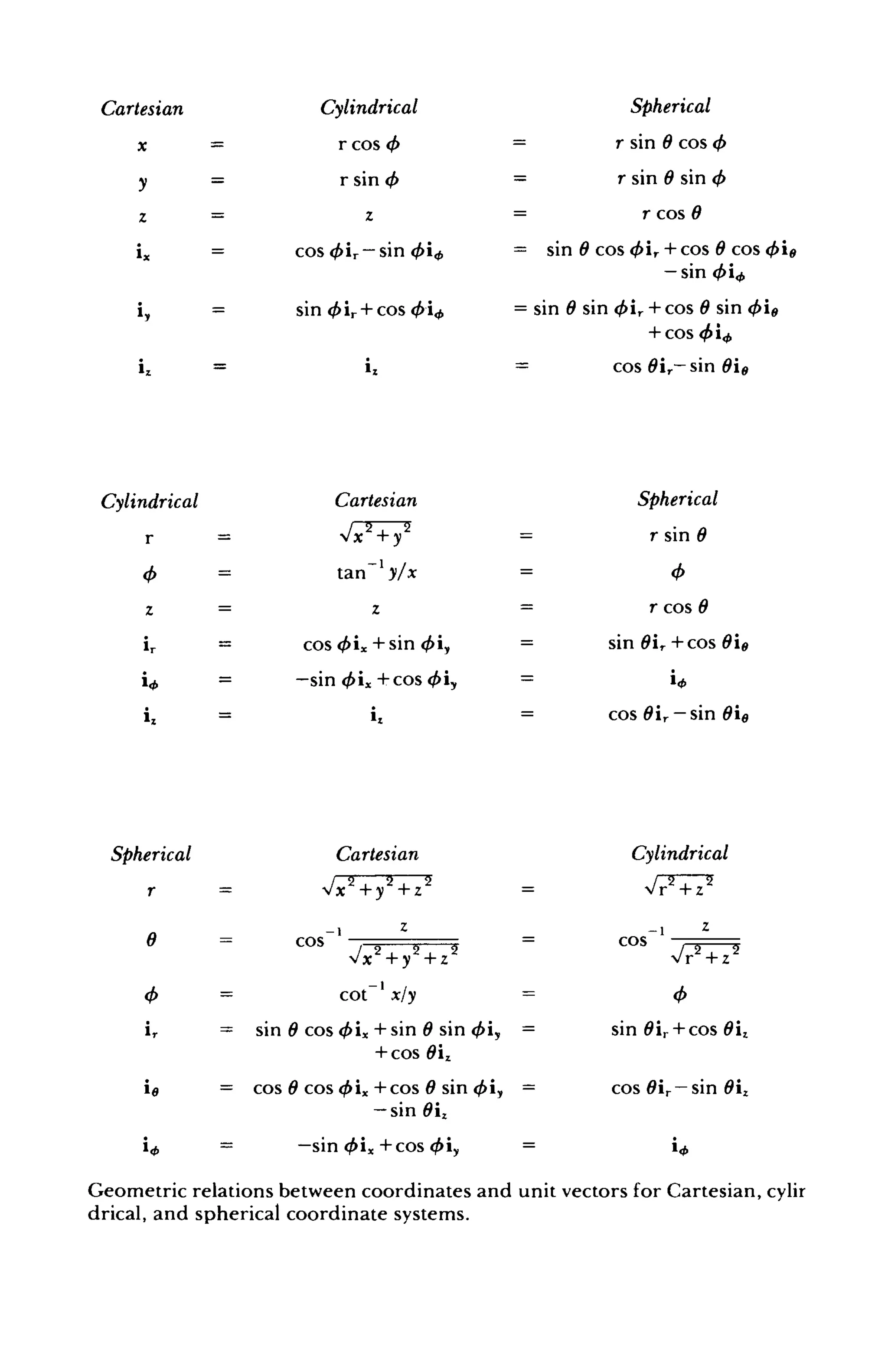
Cartesian Cylindrical Spherical
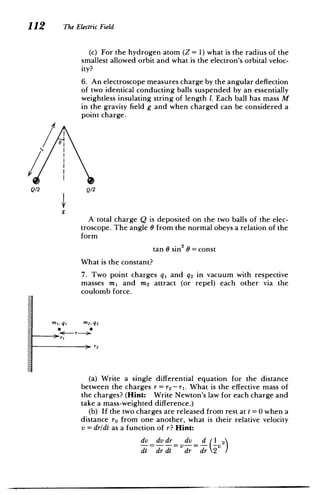
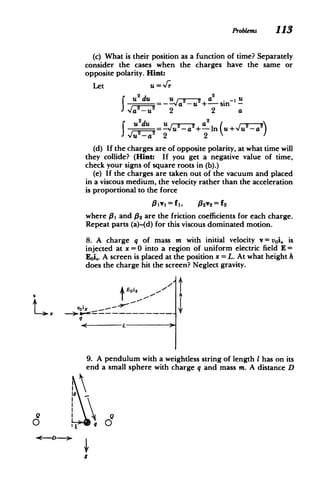
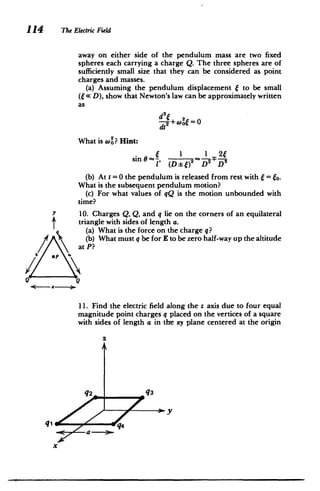
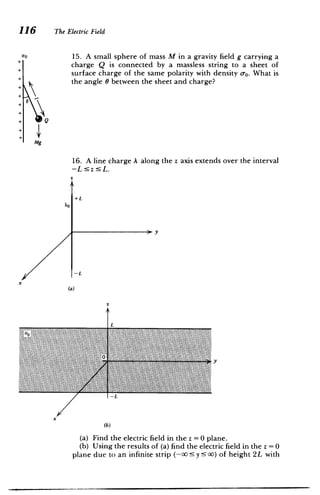
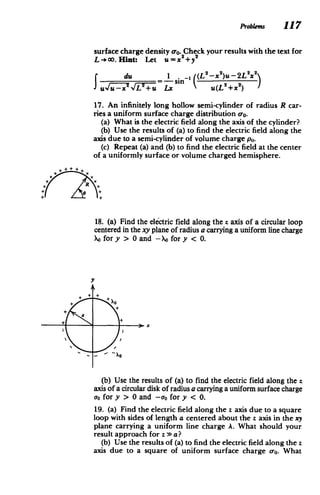
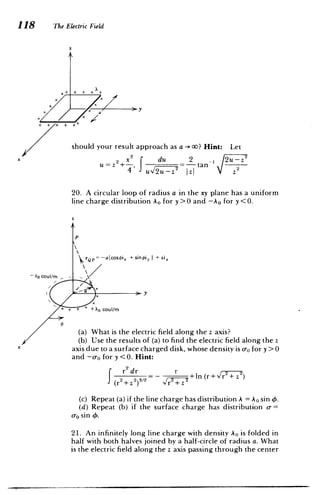
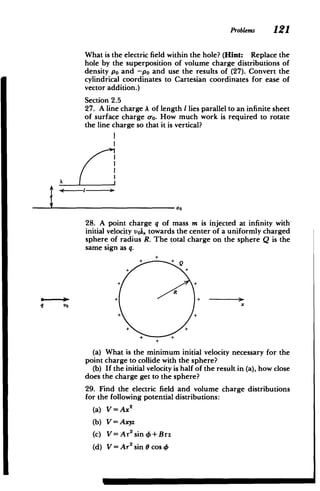
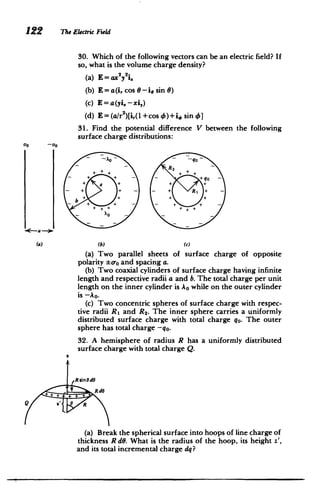
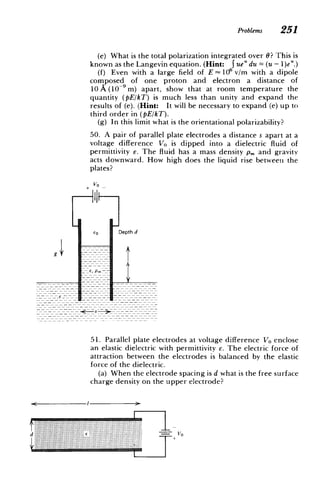
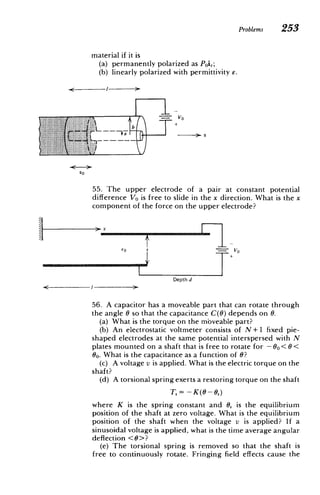
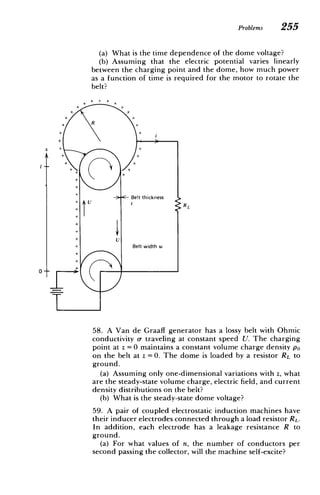
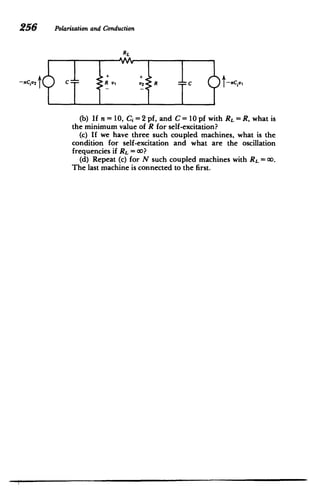
x = rcosc/ S r sin6cos 4
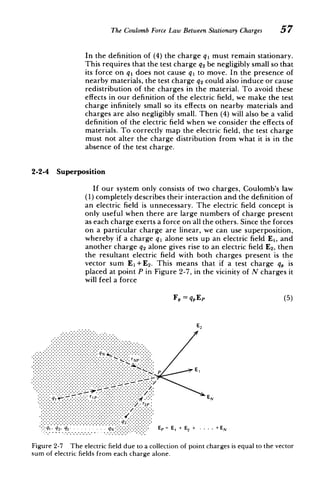
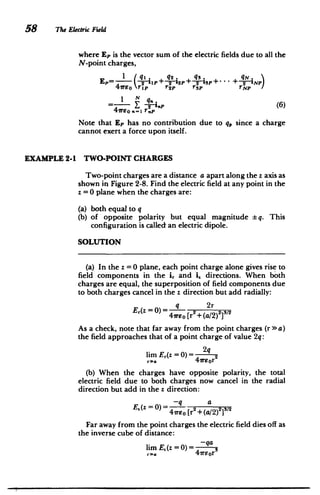
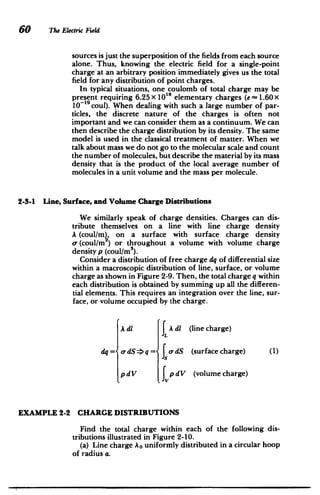
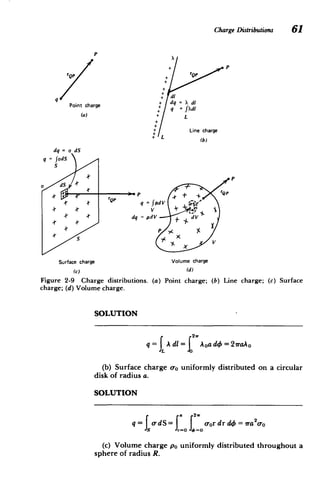
= r sin4 S r sin 6 sin4
z = z = rcos6
y
ix = Cos Oi-sin4k 4 = sin Ocos ki,+cos 6cos 4ie
-sin Ois
iY =sin 0 i,+ Cos 01
i = sin 0 sin 6i, +Cos 6 sin ie
= S il41+C541 +cos 6 io
i
1
= cos Oi,- sin Ois
Cylindrical Cartesian Spherical
=~V Ix+ y7 Sr sin 6
tan~1y/x
= z = rcos6
= cos (k ,, +sin i, = sin Oi,+cos 6ie
i4
.


= -sin ki,,+Cos 4i, = i4

= i, = cos i, -sin iO
Spherical Cartesian Cylindrical
If,- +z"
r I4x +y +z
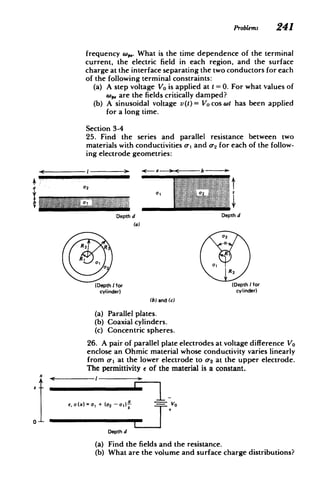
_1 z -1 z
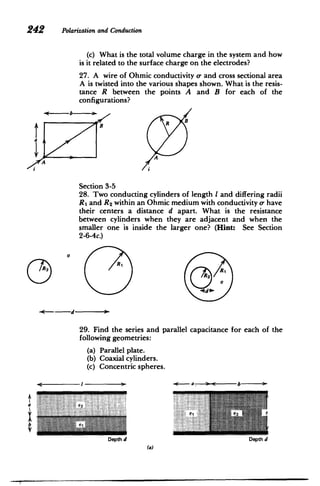
0 = Cos = cos
= cot-' x/y
i, = sinG cos kix+sin 6 sin ci, = sin i, +Cos Oi,
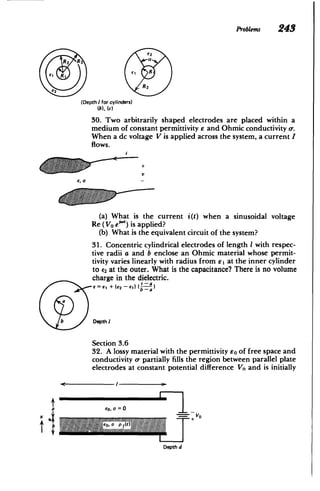
+cos i.
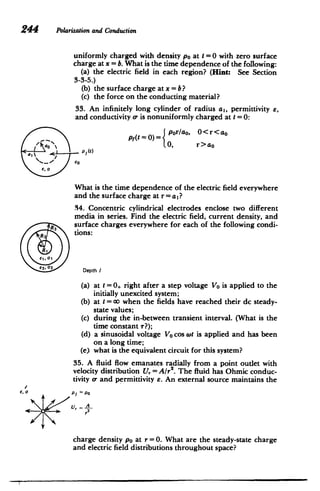
i, = cos 6 cos oi,+cos 6 sin oi, = Cos Oi,-sin Oi,
-sin Oi.
i = -sin 46i, +Cos 0i, = i4
,
Geometric relations between coordinates and unit vectors for Cartesian, cylir
drical, and spherical coordinate systems.
CartesianCoordinates(x, y, z)
Vf = Ofi.+Ofi,+Ofi.
ax ay Oz
+-A=,++-i
V- aA,, aA, aA, 2

ax ay az

aA 	 aA)
VxA ay_ a (aA
,(- _)+i
=i. (LAI )+ _8A -(
ay az	) az a.x) ay
2
f
V2f+!L+f+a
Ox2 	 j Z
CylindricalCoordinates (r, 4, z)
Of. 1 Of. Of
Vf= r+ i,+ iz
+A MA.
V -A= Ia(rA,.)+ -.
r Or r ao az
VxA=i - +ixaz Or + OA r a4
0/f a Of 1a2f a2f
V'f= r +
+
42
r Or	 On) r O
SphericalCoordinates (r, 0, 4,)
Vf=i,.+ afi+
Or r aO r sin 0 a4
V A = (r2A,)+ 1 (sin OA.) 1 oA*
r2 ar r sin 0 aI r sin 0 a4
VxA=i1 a(sin OAs) aA.
'r sineL 80 a4
I rIAM, a(rA) 1 [a(rA#) OA,.
r sin{ 0r] rL Or aeJ
2
f
V f 	 = r + r s n sin0 ) +Of I a
rf ar' Or. r- -s i n aG ai r sin 04, 0­
MAXWELL'S EQUATIONS
Integral Differential Boundary Conditions
Faraday's Law
d C B
E'-dl=-- B-dS VxE=- nx(E'-E')=0.
dtJI at
Ampere's Law with Maxwell's Displacement Current Correction
H-dl= Jf,-dS VXH=Jf+aD nX(H 2 -H 1 )=Kf
+ D-dS
~it-s
Gauss's Law
V - D=p n - (D2 -D 1)= o-
D'-dS=t pfdV
B-dS=0 V-B=0
Conservation of Charge
J,- dS+ pfdV=O V-J,+ =0 n - (J2-J)+" 0
sVd at a
Usual Linear Constitutive Laws
D=eE
B= H
Jf= o-(E+vX B)= a-E' [Ohm's law for moving media with velocity v]
PHYSICAL CONSTANTS
Constant Symbol Value units
Speed of light in vacuum c 2.9979 x 10 8
= 3 x 10⁸ m/sec
Elementary electron charge e 1.602 x 10~'9 coul
Electron rest mass M, 9.11 x 10 3
kg
Electron charge to mass ratio e 1.76 x 10" coul/kg
M,
Proton rest mass I, 1.67 x 10⁻²⁷ kg
Boltzmann constant k 1.38 x 10⁻²³ joule/*K
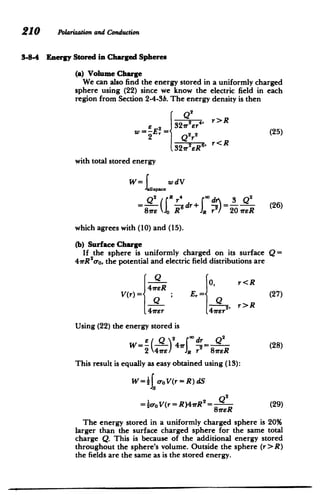
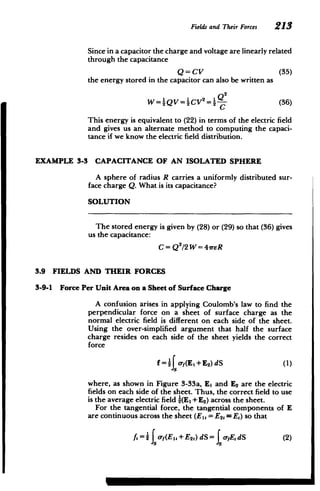
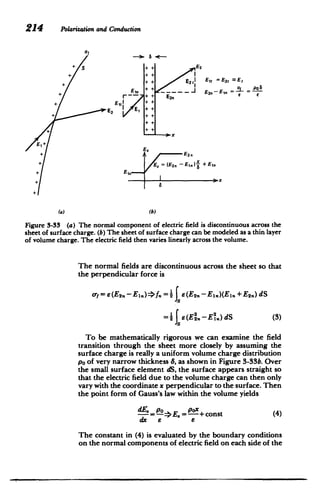
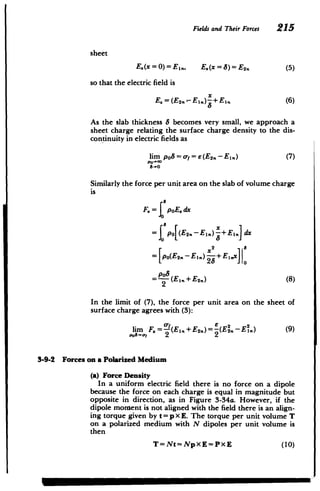
Gravitation constant G 6.67 x 10-" nt-m2
/(kg) 2
Acceleration of gravity g 9.807 m/(sec)2
10
*
Permittivity of free space 60 8.854 x 10~2~36r farad/m
Permeability of free space A0 4r X 10 henry/m
Planck's constant h 6.6256 x 10⁻³⁴ joule-sec
Impedance of free space i1o 4 376.73- 120ir ohms
Avogadro's number Ar 6.023 x 10²³ atoms/mole
I
ELECTROMAGNETIC
FIELD THEORY:
a problem solving approach
MARKUS ZAHN
Massachusetts Institute of
Technology
KRIEGER PUBLISHING COMPANY
Malabar, Florida
Original Edition 1979
Reprint Edition 1987
Reprint Edition 2003 w/corrections
Printed and Published by
KRIEGER PUBLISHING COMPANY
KRIEGER DRIVE
MALABAR, FLORIDA 32950
Copyright 0 1979, John Wiley & Sons, Inc.
Transferred to Author
Reprinted by Arrangement
All rights reserved. No part of this book may be reproduced in any form or by any means,
electronic ormechanical, including information storage and retrieval systems without permission
in writing from the publisher.
No liabilityisassumedwith respecttothe use oftheinformationcontainedherein.
Printed in the United States ofAmerica.
FROM A DECLARATION OF PRINCIPLES JOINTLY ADOPTED BY A COMMITTEE
OF THE AMERICAN BAR ASSOCIATION AND A COMMITTEE OF PUBLISHERS:
This publication is designed to provide accurate and authoritative information in regard to
the subject matter covered. It is sold with the understanding that the publisher is not engaged
in rendering legal, accounting, or other professional service. If legal advice or other expert
assistance is required, the services of a competent professional person should be sought.
Library of Congress Cataloging-in-Publication Data
Zahn, Markus, 1946­
Electromagnetic field theory: aproblem solving approach/ Markus Zahn.-Reprint ed.
w/corrections.
p. cm.

Originally published: New York : Wiley, c1979.

Includes index.

ISBN 1-57524-235-4 (alk. paper)

1. Electromagnetic fields. 2. Electrodynamics. I.Title.
QC665.E4Z32 2003
530.14'1--dc2l

2003047418

10 9 8 7 6 5 4 3 2
to my parents
V
Preface
PREFACE

Electromagnetic field theory is often the least popular
course in the electrical engineering curriculum. Heavy reli­
ance on vector and integral calculus can obscure physical
phenomena so that the student becomes bogged down in the
mathematics and loses sight of the applications. This book
instills problem solving confidence by teaching through the
use of a large number of worked examples. To keep the subject
exciting, many of these problems are based on physical pro­
cesses, devices, and models.
This text is an introductory treatment on the junior level for
a two-semester electrical engineering course starting from the
Coulomb-Lorentz force law on a point charge. The theory is
extended by the continuous superposition of solutions from
previously developed simpler problems leading to the general
integral and differential field laws. Often the same problem is
solved by different methods so that the advantages and limita­
tions of each approach becomes clear. Sample problems and
their solutions are presented for each new concept with great
emphasis placed on classical models of such physical
phenomena as polarization, conduction, and magnetization. A
large variety of related problems that reinforce the text
material are included at the end of each chapter for exercise
and homework.
It is expected that students have had elementary courses in
calculus that allow them to easily differentiate and integrate
simple functions. The text tries to keep the mathematical
development rigorous but simple by typically describing
systems with linear, constant coefficient differential and
difference equations.
The text is essentially subdivided into three main subject
areas: (1) charges as the source of the electric field coupled to
polarizable and conducting media with negligible magnetic
field; (2) currents as the source of the magnetic field coupled to
magnetizable media with electromagnetic induction generat­
ing an electric field; and (3) electrodynamics where the electric
and magnetic fields are of equal importance resulting in radi­
ating waves. Wherever possible, electrodynamic solutions are
examined in various limits to illustrate the appropriateness of
the previously developed quasi-static circuit theory approxi­
mations.
Many of my students and graduate teaching assistants have
helped in checking the text and exercise solutions and have
assisted in preparing some of the field plots.
Markus Zahn
Notes to the Student Vii
and Instructor
A NOTE TO THE STUDENT
In this text I have tried to make it as simple as possible for an
interested student to learn the difficult subject of electromag­
netic field theory by presenting many worked examples
emphasizing physical processes, devices, and models. The
problems at the back of each chapter are grouped by chapter
sections and extend the text material. To avoid tedium, most
integrals needed for problem solution are supplied as hints.
The hints also often suggest the approach needed to obtain a
solution easily. Answers to selected problems are listed at the
back of this book.
A NOTE TO THE INSTRUCTOR
An Instructor's Manual with solutions to all exercise problems
at the end of chapters is available from the author for the cost
of reproduction and mailing. Please address requests on Univer­
sity or Company letterhead to:
Prof. Markus Zahn

Massachusetts Institute of Technology

Department of Electrical Engineering and Computer Science

Cambridge, MA 01239
CONTENTS
Chapter 1-REVIEW OF VECTOR ANALYSIS
1.1 COORDINATE SYSTEMS

1.1.1 Rectangular(Cartesian)Coordinates

1.1.2 CircularCylindricalCoordinates

1.1.3 SphericalCoordinates

1.2 VECTOR ALGEBRA

1.2.1 Scalarsand Vectors

1.2.2 Multiplicationof a Vector by aScalar

1.2.3 Addition and Subtraction

1.2.4 	 The Dot (Scalar)Product

1.2.5 	 The Cross(Vector) Product

1.3 	 THE GRADIENT AND THE DEL

OPERATOR

1.3.1 	 The Gradient

1.3.2 	 CurvilinearCoordinates

(a) Cylindrical
(b) Spherical
1.3.3 	 The Line Integral

1.4 FLUX AND DIVERGENCE

1.4.1 Flux

1.4.2 Divergence

1.4.3 CurvilinearCoordinates

(a) CylindricalCoordinates
(b) SphericalCoordinates
1.4.4	 The Divergence Theorem

1.5 THE CURL AND STOKES' THEOREM

1.5.1 Curl

1.5.2 The Curlfor CurvilinearCoordinates

(a) CylindricalCoordinates
(b) SphericalCoordinates
1.5.3 Stokes' Theorem

1.5.4 Some Useful Vector Relations

(a) The Curl of the Gradient is Zero
IV x(Vf)=O]
(b) The Divergence of the Curl is Zero
[V - (V X A)= 0
PROBLEMS
Chapter 2-THE ELECTRIC FIELD
2.1 ELECTRIC CHARGE

2.1.1 	 Chargingby Contact

2.1.2 	 ElectrostaticInduction

2.1.3 	 Faraday's"Ice-Pail"Experiment

2.2 	 THE COULOMB FORCE LAW

BETWEEN STATIONARY CHARGES

2.2.1 	 Coulomb'sLaw

ix
x Contents
2.3
2.4
2.5
2.2.2 	 Units 55

2.2.3 	 The ElectricField 56

2.2.4 	 Superposition 57

CHARGE DISTRIBUTIONS 59

2.3.1 	 Line, Surface, and Volume Charge Dis­
tributions 60

2.3.2 	 The Electric Field Due to a Charge Dis­
tribution 63

2.3.3 	 Field Due to an Infinitely Long Line

Charge 64

2.3.4 	 Field Due to Infinite Sheets of Surface

Charge 65

(a) Single Sheet 	 65

(b) ParallelSheets of Opposite Sign 67

(c) Uniformly ChargedVolume 	 68

2.3.5 	 Hoops of Line Charge 69

(a) Single Hoop 	 69

(b) Disk of Surface Charge 	 69

(c) Hollow Cylinderof Surface Charge 71

(d) Cylinderof Volume Charge 72

GA USS'S LAW 72

2.4.1 	 Propertiesof the Vector Distance Between

two Points rQp 72

(a) rQp 	 72

(b) 	 Gradientof the ReciprocalDistance,

V(1/rQp) 73

(c) Laplacianof the ReciprocalDistance 73

2.4.2 	 Gauss'sLaw In IntegralForm 74

(a) 	 Point Charge Inside or Outside a

Closed Volume 74

(b) ChargeDistributions 	 75

2.4.3 	 SphericalSymmetry 76

(a) Surface Charge 	 76

(b) Volume ChargeDistribution 79

2.4.4 	 CylindricalSymmetry 80

(a) Hollow Cylinder of Surface Charge 80

(b) Cylinderof Volume Charge 	 82

2.4.5 	 Gauss'sLaw and the Divergence Theorem 82

2.4.6 	 ElectricFieldDiscontinuityAcross a Sheet
of Surface Charge 83

THE ELECTRIC POTENTIAL 84

2.5.1 	 Work Required to Move a PointCharge 84

2.5.2 	 The ElectricFieldand Stokes' Theorem 85

2.5.3 	 The Potentialand the Electric Field 86

2.5.4 	 FiniteLength Line Charge 88

2.5.5 	 ChargedSpheres 90

(a) Surface Charge 	 90

(b) Volume Charge 	 91

(c) Two Spheres 	 92
Contents xi
2.5.6 Poisson'sandLaplace'sEquations 93

2.6 	 THE METHOD OF IMAGES WITH

LINE CHARGES AND CYLINDERS 93

2.6.1 Two ParallelLine Charges 	 93

2.6.2 The Method of Images 	 96

(a) GeneralProperties 	 96

(b) 	 Line Charge Near a Conducting

Plane 96

2.6.3 Line Chargeand Cylinder 	 97

2.6.4 Two Wire Line 	 99

(a) Image Charges 	 99

(b) Forceof Attraction 	 100

(c) CapacitancePerUnit Length 101

2.7 	 THE METHOD OF IMAGES WITH

POINT CHARGES AND SPHERES 103

2.7.1 PointChargeanda GroundedSphere 103

2.7.2 	 PointChargeNeara GroundedPlane 106

2.7.3 	 Sphere With Constant Charge 109

2.7.4 Constant Voltage Sphere 110

PROBLEMS 110

Chapter 3-POLARIZATION AND CONDUCTION 135

3.1 POLARIZATION 	 136

3.1.1 	 The ElectricDipole 137

3.1.2 	 PolarizationCharge 140

3.1.3 	 The DisplacementField 143

3.1.4 	 LinearDielectrics 143

(a) Polarizability 	 143

(b) The Local ElectricField 145

3.1.5 	 Spontaneous Polarization 149

(a) Ferro-electrics 	 149

(b) Electrets 	 151

3.2 CONDUCTION 	 152

3.2.1 	 Conservationof Charge 152

3.2.2 	 ChargedGas ConductionModels 154

(a) GoverningEquations 	 154

(b) Drift-DiffusionConduction 156

(c) Ohm's Law 	 159

(d) Superconductors 	 160

3.3 FIELD BOUNDARY CONDITIONS 161

3.3.1 	 TangentialComponent of E 162

3.3.2 	 Normal Component of D 163

3.3.3 	 PointChargeAbove aDielectricBoundary 164

3.3.4 	 Normal Componentof P and eoE 165

3.3.5 	 Normal Component of J 168

3.4 RESISTANCE 	 169

3.4.1 	 Resistance Between Two Electrodes 169

3.4.2 	 ParallelPlateResistor 170
Xii 	 Contents
3.4.3 Coaxial Resistor 	 172

3.4.4 SphericalResistor 	 173

3.5 CAPACITANCE 	 173

3.5. 1 ParallelPlateElectrodes 	 173

3.5.2 Capacitancefor any Geometry 	 177

3.5.3 CurrentFlow Through a Capacitor 178

3.5.4 Capacitanceof Two ContactingSpheres 178

3.6 LOSSY MEDIA 	 181

3.6.1 
 TransientChargeRelaxation 182
3.6.2 
 Uniformly ChargedSphere 183
3.6.3 
 SeriesLossy Capacitor 184
3.6.4 
 DistributedSystems 189

3.6.5 
 Effects of Convection 194

3.6.6 The Earth and Its Atmosphere as a Leaky

(a) ChargingTransient 	 184

(b) Open Circuit 	 187

(c) Short Circuit 	 188

(d) SinusoidalSteady State 188

(a) GoverningEquations 	 189

(b) Steady State 	 191

(c) TransientSolution 192

SphericalCapacitor 195

3.7 	 FIELD-DEPENDENT'SPACE CHARGE

DISTRIBUTIONS 197

3.7.1 	 Space Charge Limited Vacuum Tube

Diode 198

3.7.2 	 Space Charge Limited Conduction in

Dielectrics 201

3.8 	 ENERGY STORED IN A DIELECTRIC

MEDIUM 204

3.8.1 	 Work Necessary to Assemble a Distribution

of Point Charges 204

(a) Assembling the Charges 	 204

(b) BindingEnergy of a Crystal 205

3.8.2 	 Work Necessary to Form a Continuous

ChargeDistribution 206

3.8.3 Energy Density of the Electric Field 208

3.8.4 Energy Stored in ChargedSpheres 210

(a) Volume Charge 	 210

(b) Surface Charge 	 210

(c) BindingEnergy of an Atom 211

3.8.5 Energy Stored In a Capacitor 	 212

3.9 FIELDS AND THEIR FORCES 	 213

3.9.1 	 Force Per Unit Area On a Sheet of Surface

Charge 213

3.9.2 Forces On a PolarizedMedium 	 215

(a) Force Density 	 215

(b) Permanently PolarizedMedium 216

(c) Linearly PolarizedMedium 218
Contents Xiii
3.9.3 	 ForcesOn a Capacitor 219

3.10 ELECTROSTATIC GENERATORS 223

3.10.1 	 Van de GraaffGenerator 223

3.10.2 	Self-Excited ElectrostaticInduction

Machines 224

3.10.3 	Self-Excited Three-PhaseAlternating

Voltages 227

3.10.4 Self-Excited Multi-FrequencyGenerators 229

PROBLEMS 231

Chapter 4-ELECTRIC FIELD BOUNDARY

VALUE PROBLEMS 257

4.1 THE UNIQUENESS THEOREM 258

4.2 	 BOUNDARY VALUE PROBLEMS IN

CARTESIAN GEOMETRIES 259

4.2.1 	 Separationof Variables 260

4.2.2 Zero SeparationConstantSolutions 261

(a) Hyperbolic Electrodes 	 261

(b) ResistorIn an Open Box 262

4.2.3 	 Nonzero SeparationConstantSolutions 264

4.2.4 SpatiallyPeriodicExcitation 265

4.2.5 RectangularHarmonics 	 267

4.2.6 	 Three-DimensionalSolutions 270

4.3 	 SEPARATION OF VARIABLES IN

CYLINDRICAL GEOMETRY 271

4.3.1 	 PolarSolutions 271

4.3.2 	 Cylinderin a Uniform ElectricField 273

(a) FieldSolutions 	 273

(b) FieldLine Plotting 	 276

4.3.3 	 Three-DimensionalSolutions 277

4.3.4 	 High Voltage InsulatorBushing 282

4.4 	 PRODUCT SOLUTIONS IN SPHERICAL

GEOMETRY 284

4.4.1 	 One-DimensionalSolutions 284

4.4.2 	 Axisymmetric Solutions 286

4.4.3 	 ConductingSpheres in a Uniform Field 288

(a) FieldSolutions 	 288

(b) FieldLine Plotting 	 290

4.4.4 	 Charged Particle Precipitation Onto a

Sphere 293

4.5 	 A NUMERICAL METHOD­
SUCCESSIVE RELAXATION 297

4.5.1 	 FiniteDifference Expansions 297

4.5.2 PotentialInsidea Square Box 298

PROBLEMS 301

Chapter5-THE MAGNETIC FIELD 	 313

5.1 FORCES ON MOVING CHARGES 314
Xiv Contents
5.2 

5.3
5.4
5.5
5.6
5.7
5.8
5.1.1 The Lorentz ForceLaw 	 314

5.1.2 	 Charge Motions in a Uniform Magnetic

Field 316

5.1.3 The MassSpectrograph 	 318

5.1.4 The Cyclotron 	 319

5.1.5 	 HallEffect 321

MAGNETIC FIELD DUE TO CUR­
RENTS 322

5.2.1 The Biot-SavartLaw 	 322

5.2.2 Line Currents 	 324

5.2.3 CurrentSheets 	 325

(a) SingleSheet of Surface Current 325

(b) Slab of Volume Current 	 327

(c) Two ParallelCurrentSheets 328

5.2.4 Hoops of Line Current 	 329

(a) Single Hoop 	 329

(b) Too Hoops (Helmholtz Coil) 331

(c) Hollow Cylinderof Surface Current 331

DIVERGENCE AND CURL OF THE

MAGNETIC FIELD 332

5.3.1 Gauss'sLaw for the MagneticField 332

5.3.2 Ampere's CircuitalLaw 	 333

5.3.3 Currents With CylindricalSymmetry 335

(a) Surface Current 	 335

(b) Volume Current 336

THE VECTOR POTENTIAL 336

5.4.1 Uniqueness 	 336

5.4.2 	 The Vector Potential of a Current Dis­
tribution 338

5.4.3 The VectorPotentialandMagneticFlux 338

(a) FiniteLength Line Current 339

(b) FiniteWidth Surface Current 341

(c) Flux Through aSquare Loop 342

MAGNETIZATION 343

5.5.1 The MagneticDipole 	 344

5.5.2 MagnetizationCurrents 	 346

5.5.3 MagneticMaterials 	 349

(a) Diamagnetism 	 349

(b) Paramagnetism 	 352

(c) Ferromagnetism 356

BOUNDARY CONDITIONS 359

5.6.1 TangentialComponent of H 	 359

5.6.2 TangentialComponent of M 	 360

5.6.3 	 Normal Component of B 360

MAGNETIC FIELD BOUNDARY

VALUE PROBLEMS 361

5.7.1 The Method of Images 	 361

5.7.2 	 Sphere in a Uniform Magnetic Field 364

MAGNETIC FIELDS AND FORCES 368
Contents XV
5.8.1 	 Magnetizable Media 368

5.8.2 	 Forceon a CurrentLoop 370

(a) Lorentz ForceOnly 	 370

(b) MagnetizationForceOnly 370

(c) Lorentz and MagnetizationForces 374

PROBLEMS 375

Chapter 6-ELECTROMAGNETIC INDUCTION 393

6.1 FARADAY'S LAW OF INDUCTION 394

6.1.1 	 The ElectromotiveForce (EMF) 394

6.1.2 	 Lenz's Law 395

(a) Short CircuitedLoop 	 397

(b) Open CircuitedLoop 	 399

(c) Reaction Force 	 400

6.1.3 	 Laminations 401

6.1.4 	 Betatron 402

6.1.5 	 Faraday'sLaw and Stokes' Theorem 404

6.2 MAGNETIC CIRCUITS 	 405

6.2.1 	 Self-Inductance 405

6.2.2 	 Reluctance 409

(a) Reluctances in Series 	 410

(b) Reluctances in Parallel 411

6.2.3 	 TransformerAction 411

(a) Voltages areNot Unique 411

(b) Ideal Transformers 	 413

(c) Real Transformers 	 416

6.3 	 FARADAY'S LAW FOR MOVING

MEDIA 417

6.3.1 The ElectricField Transformation 417

6.3.2 Ohm's Law for Moving Conductors 417

6.3.3 Faraday'sDisk (HomopolarGenerator) 420

(a) Imposed Magnetic Field 	 420

(b) Self-Excited Generator 	 422

(c) Self-Excited ac Operation 	 424

(d) PeriodicMotor Speed Reversals 426

6.3.4 Basic Motors and Generators 	 427

(a) ac Machines 	 427

(b) dc Machines 	 428

6.3.5 MHD Machines 	 430

6.3.6 Paradoxes 	 430

(a) A 	Commutatorlessdc Machine 431

(b) 	 Changes In Magnetic Flux Due to

Switching 433

(c) 	 Time VaryingNumber of Turnson a

Coil 433

6.4 	 MAGNETIC DIFFUSION INTO AN

OHMIC CONDUCTOR 435

6.4.1 Resistor-InductorModel 	 435
XVi 	 Contents
6.4.2 
 The MagneticDiffusion Equation 437

6.4.3 Transient Solution With No Motion

6.4.4 
 The SinusoidalSteady State (Skin Depth) 442

6.4.5 
 Effects of Convection 444

6.4.6 
 A LinearInduction Machine 446

6.4.7 
 Superconductors 450

(U=0) 438

6.5 ENERGY STORED IN THE MAGNETIC

FIELD 451

6.5.1 
 A Single CurrentLoop 	 451
6.5.2 
 Energy andInductance 454

6.5.3 
 CurrentDistributions 454

6.5.4 
 MagneticEnergy Density 455

6.5.5 
 The CoaxialCable 456

6.5.6 Self-Inductance, Capacitance,and Resis­
(a) ElectricalWork 	 452

(b) Mechanical Work 453

(a) ExternalInductance 	 456

(b) InternalInductance 457

tance 458

6.6 THE ENERGY METHOD FOR FORCES 460

6.6.1 	 The Principleof Virtual Work 460

6.6.2 	 Circuit Viewpoint 461

6.6.3 MagnetizationForce 464

PROBLEMS 465

Chapter 7-ELECTRODYNAMICS-FIELDS AND

WAVES 487

7.1 MAXWELL'S EQUATIONS 	 488

7.1.1 	 Displacement Current Correction to

Ampere's Law 488

7.1.2 	 Circuit Theory as a Quasi-staticApprox­
imation 490

7.2 CONSERVATION OF ENERGY 490

7.2.1 Poynting's Theorem 	 490

7.2.2 A Lossy Capacitor 	 491

7.2.3 Power in Electric Circuits 	 493

7.2.4 	 The Complex Poynting's Theorem 494

7.3 	 TRANSVERSE ELECTROMAGNETIC

WA VES 496

7.3.1
7.3.2 
 The Wave Equation 497

7.3.3 
 Sources of Plane Waves 500

Plane Waves 496

(a) Solutions 	 497

(b) Properties 499

7.3.4 A Brief Introduction to the Theory of

Relativity 503

7.4 SINUSOIDAL TIME VARIATIONS 505

7.4.1 Frequencyand Wavenumber 505

.
 I
Contents Xvii
7.4.2 	 DopplerFrequencyShifts 507

7.4.3 	 Ohmic Losses 508

(a) Low Loss Limit 	 509

(b) Large Loss Limit 	 5i1
7.4.4 	 High-FrequencyWave Propagationin

Media 511

7.4.5 	 Dispersive Media 512

7.4.6 	 Polarization 514

(a) LinearPolarization 	 515

(b) CircularPolarization 	 515

7.4.7 	 Wave Propagationin AnisotropicMedia 516

(a) Polarizers 	 517

(b) DoubleRefraction (Birefringence) 518

7.5 	 NORMAL INCIDENCE ONTO A PER­
FECT CONDUCTOR 520

7.6 	 NORMAL INCIDENCE ONTO A

DIELECTRIC 522

7.6.1 	 Lossless Dielectric 522

7.6.2 	 Time-Average Power Flow 524

7.6.3 	 Lossy Dielectric 524

(a) Low Losses 	 525

(b) LargeLosses 	 525

7.7 	 UNIFORM AND NONUNIFORMPLANE

WA VES 529

7.7.1 	 Propagationat an ArbitraryAngle 529

7.7.2 	 The Complex PropagationConstant 530

7.7.3 	 Nonuniform Plane Waves 532

7.8 	 OBLIQUE INCIDENCE ONTO A PER­
FECT CONDUCTOR 534

7.8.1 	 E FieldParallelto the Interface 534

7.8.2 	 H FieldParallelto the Interface 536

7.9 	 OBLIQUE INCIDENCE ONTO A

DIELECTRIC 538

7.9.1 	 E Parallelto the Interface 538

7.9.2 	 Brewster'sAngle of No Reflection 540

7.9.3 	 CriticalAngle of Transmission 541

7.9.4 	 H FieldParallelto the Boundary 542

7.10 APPLICATIONS TO OPTICS 544

7.10.1 	Reflectionsfrom a Mirror 545

7.10.2 LateralDisplacementof a Light Ray 545

7.10.3 	Polarizationby Reflection 546

7.10.4 Light Propagationin Water 548

(a) Submerged Source 	 548

(b) Fish Below a Boat 	 548

7.10.5 	Totally. Reflecting Prisms 549

7.10.6 	FiberOptics 550

(a) StraightLight Pipe 	 550

(b) Bent Fibers 551

PROBLEMS 552
XViii Contents
Chapter 8-GUIDED ELECTROMAGNETIC

WAVES 567

8.1 	 THE TRANSMISSION LINE EQUA­
TIONS 568

8.1.1 	 The ParallelPlate TransmissionLine 568

8.1.2 	 General TransmissionLine Structures 570

8.1.3 	 DistributedCircuitRepresentation 575

8.1.4 	 PowerFlow 576

8.1.5 	 The Wave Equation 578

8.2 	 TRANSMISSION LINE TRANSIENT

WA VES 579

8.2.1 	 Transients on Infinitely Long Trans­
mission Lines 579

8.2.2 	 Reflections from Resistive Terminations 581

(a) Reflection Coefficient 	 581

(b) Step Voltage 	 582

8.2.3 	 Approachto the dc Steady State 585

8.2.4 	 Inductors and Capacitorsas Quasi-static

Approximations to Transmission Lines 589

8.2.5 	 Reflections from Arbitrary Terminations 592

8.3 SINUSOIDAL TIME VARIATIONS 595

8.3.1 	 Solutions to the TransmissionLine Equa­
tions 595

8.3.2 	 Lossless Terminations 596

(a) Short CircuitedLine 	 596

(b) Open CircuitedLine 	 599

8.3.3 	 Reactive CircuitElements as Approxima­
tions to Short TransmissionLines 601

8.3.4 	 Effects of Line Losses 602

(a) DistributedCircuitApproach 602

(b) DistortionlessLines 	 603

(c) FieldsApproach 	 604

8.4 	 ARBITRARY IMPEDANCE TERMINA­
TIONS 607

8.4.1 	 The GeneralizedReflection Coefficient 607

8.4.2 	 Simple Examples 608

(a) 	 LoadImpedance Reflected Back to the

Source 608

(b) QuarterWavelength Matching 610

8.4.3 	 The Smith Chart 611

8.4.4 	 Standing Wave Parameters 616

8.5 STUB TUNING 	 620

8.5.1 	 Use of the Smith Chart for Admittance

Calculations 620

8.5.2 	 Single-Stub Matching 623

8.5.3 	 Double-StubMatching 625

8.6 THE RECTANGULAR WAVEGUIDE 629

8.6.1 	 GoverningEquations 630

8.6.2 	 TransverseMagnetic (TM) Modes 631
Contents xix
8.6.3 TransverseElectric (TE) Modes 635

8.6.4 Cut-Off 	 638

8.6.5 Waveguide PowerFlow 	 641

(a) PowerFlowfor the TM Modes 641

(b) Power Flow for the TE Modes 642

8.6.6 Wall Losses 	 643

8.7 DIELECTRIC WAVEGUIDE 	 644

8.7.1 TM Solutions 	 644

(a) Odd Solutions 	 645

(b) Even Solutions 	 647

8.7.2 TE Solutions 	 647

(a) Odd Solutions 	 647

(b) Even Solutions 648

PROBLEMS 649

Chapter 9-RADIATION 	 663

9.1 THE RETARDED POTENTIALS 664

9.1.1 Nonhomogeneous Wave Equations 664

9.1.2 Solutions to the Wave Equation 666

9.2 RADIATION FROM POINT DIPOLES 667

9.2.1 The ElectricDipole 	 667

9.2.2 	 Alternate Derivation Using the Scalar

Potential 669

9.2.3 The ElectricandMagneticFields 670

9.2.4 ElectricFieldLines 	 671

9.2.5 RadiationResistance 	 674

9.2.6 RayleighScattering(orwhy isthesky blue?) 677

9.2.7 Radiationfrom a PointMagneticDipole 679

9.3 POINT DIPOLE ARRAYS 	 681

9.3.1 A 	Simple Two ElementArray 681

(a) BroadsideArray 	 683

(b) End-fireArray 	 685

(c) ArbitraryCurrentPhase 685

9.3.2 An N DipoleArray 	 685

9.4 LONG DIPOLEANTENNAS 	 687

9.4.1 FarFieldSolution 	 688

9.4.2 Uniform Current 	 690

9.4.3 RadiationResistance 691

PROBLEMS 695

SOLUTIONS TO SELECTED PROBLEMS 699

INDEX 711
ELECTROMAGNETIC
FIELD THEORY:
a problem solving approach
chapter 1

review of vector analysis
2 Review of Vector Analysis
Electromagnetic field theory is the study of forces between
charged particles resulting in energy conversion or signal transmis­
sion and reception. These forces vary in magnitude and direction
with time and throughout space so that the theory is a heavy user
of vector, differential, and integral calculus. This chapter presents
a brief review that. highlights the essential mathematical tools
needed throughout the text. We isolate the mathematical details
here so that in later chapters most of our attention can be devoted
to the applications of the mathematics rather than to its
development. Additional mathematical material will be presented
as needed throughout the text.
1-1 COORDINATE SYSTEMS
A coordinate system is a way of uniquely specifying the
location of any position in space with respect to a reference
origin. Any point is defined by the intersection of three
mutually perpendicular surfaces. The coordinate axes are
then defined by the normals to these surfaces at the point. Of
course the solution to any Problem is always independent of
the choice of coordinate system used, but by taking advantage
of symmetry, computation can often be simplified by proper
choice of coordinate description. In this text we only use the
familiar rectangular (Cartesian), circular cylindrical, and
spherical coordinate systems.
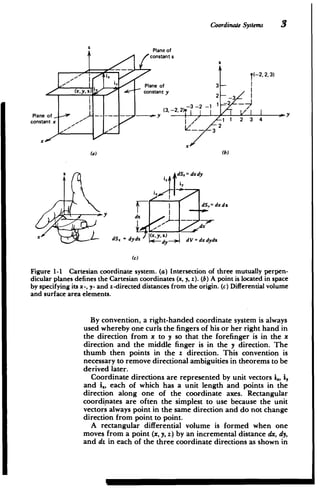
1-1-1 Rectangular (Cartesian) Coordinates
The most common and often preferred coordinate system
is defined by the intersection of three mutually perpendicular
planes as shown in Figure 1-la. Lines parallel to the lines of
intersection between planes define the coordinate axes
(x, y, z), where the x axis lies perpendicular to the plane of
constant x, the y axis is perpendicular to the plane of constant
y, and the z axis is perpendicular to the plane of constant z.
Once an origin is selected with coordinate (0, 0, 0), any other
point in the plane is found by specifying its x-directed, y-
directed, and z-directed distances from this origin as shown
for the coordinate points located in Figure 1-lb.
3
CoordinateSystems
Plane o
j constant
(-2,2,3)
iY Plane of 3
(x, y 2) 4- -~'constant y
2 -3
-
-
Plane of
constant x
- -- --
Pl.
y
(3,
-3
-2,2)9
-2 -1
I.1
11 2 3 4
x
x
(a) (b)
dS= dxdy
i,
dSy'dxdz
ddx
x dS , dydz dy dV = dx dydz
(c)
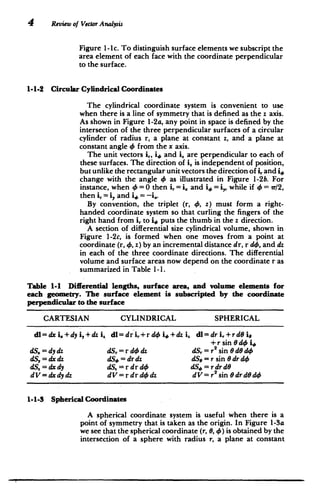
Figure 1-1 Cartesian coordinate system. (a) Intersection of three mutually perpen­
dicular planes defines the Cartesian coordinates (x, y, z). (b) A point is located in space
by specifying its x-, y- and z-directed distances from the origin. (c) Differential volume
and surface area elements.
By convention, a right-handed coordinate system is always
used whereby one curls the fingers of his or her right hand in
the direction from x to y so that the forefinger is in the x
direction and the middle finger is in the y direction. The
thumb then points in the z direction. This convention is
necessary to remove directional ambiguities in theorems to be
derived later.
Coordinate directions are represented by unit vectors i., i,
and i2, each of which has a unit length and points in the
direction along one of the coordinate axes. Rectangular
coordinates are often the simplest to use because the unit
vectors always point in the same direction and do not change
direction from point to point.
A rectangular differential volume is formed when one
moves from a point (x, y, z) by an incremental distance dx, dy,
and dz in each of the three coordinate directions as shown in
4 Review of VectorAnalysis
Figure 1-Ic. To distinguish surface elements we subscript the
area element of each face with the coordinate perpendicular
to the surface.
1-1-2 Circular Cylindrical Coordinates
The cylindrical coordinate system is convenient to use
when there is a line of symmetry that is defined as the z axis.
As shown in Figure 1-2a, any point in space is defined by the
intersection of the three perpendicular surfaces of a circular
cylinder of radius r, a plane at constant z, and a plane at
constant angle 4 from the x axis.
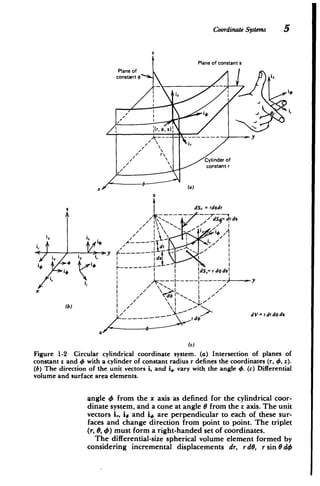
The unit vectors ir, i, and i. are perpendicular to each of
these surfaces. The direction of i, is independent of position,
but unlike the rectangular unit vectors the direction of irand i,
change with the angle 4 as illustrated in Figure 1-2b. For
instance, when 4 = 0 then i, = i, and i+ = i,, while if =r/2,
then ir= i, and i+ = -i..
By convention, the triplet (r, 4, z) must form a right-
handed coordinate system so that curling the fingers of the
right hand from i, to i4 puts the thumb in the z direction.
A section of differential size cylindrical volume, shown in
Figure 1-2c, is formed when one moves from a point at
coordinate (r, 4, z) by an incremental distance dr, r d4, and dz
in each of the three coordinate directions. The differential
volume and surface areas now depend on the coordinate r as
summarized in Table 1-1.
Table 1-1 Differential lengths, surface area, and volume elements for
each geometry. The surface element is subscripted by the coordinate
perpendicular to the surface
CARTESIAN CYLINDRICAL SPHERICAL
dl=dx i.+dy i,+dz i, dl=dri,+rd4 i+dzi. dl=dri,+rdO
is
+ r sin 0 d4 i#

dS.= dy dz dS= r d4 dz dS,= r2
sin 0 dO d46

dS,=dx dz dS#=drdz dS@ =r sin 0 dr d4

dS2 =dxdy dS.=rdrd4 dS#=rdrd

dV=dxdydz dV=rdrd44dz dV=r
2
sin8drdOd4

1-1-3 Spherical Coordinates
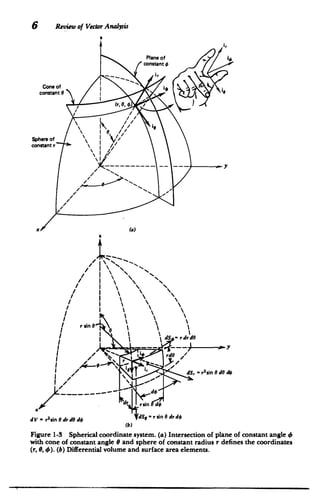
A spherical coordinate system is useful when there is a
point of symmetry that. is taken as the origin. In Figure 1-3a
we see that the spherical coordinate (r, 0, 4) is obtained by the
intersection of a sphere with radius r, a plane at constant
----------------------
CoordinateSystems 5
Plane of
constant $i
Plane of constant z
r( 0, Z);
ir
Cylinder of
constant r
(a)
dSz = rdodr
S =dr dA
. 1 
-* -..------- Tr r-
a
(b) d V
= rdrdoda
- - rd$ d
(c)
Figure 1-2 Circular cylindrical coordinate system. (a) Intersection of planes of
constant z and 4 with a cylinder of constant radius r defines the coordinates (r, 4, z).
(b) The direction of the unit vectors i, and i, vary with the angle 4. (c) Differential
volume and surface area elements.
angle 4 from the x axis as defined for the cylindrical coor­
dinate system, and a cone at angle 0 from the z axis. The unit
vectors i,, i, and i# are perpendicular to each of these sur­
faces and change direction from point to point. The triplet
(r, 8, 4) must form a right-handed set of coordinates.
The differential-size spherical volume element formed by
considering incremental displacements dr, rdO, r sin 8 d4
Review of Vector Analysis
6
A
Plane of i4
constant 4
Coneof
constant 0
(7,6,0
Sphere of
constant r
x (a)
a
r sin 0­
-Srdr d
-- dO
.r sin
=sin 8
dr do

dV r sin 0 dr dO AA

rd 4dS# dV =2si J
(b)
Figure 1-3 Spherical coordinate system. (a) Intersection of plane of constant angle 0
with cone of constant angle 9 and sphere of constant radius r defines the coordinates
(r, 9, 4). (b) Differential volume and surface area elements.
i
Vector Algebra 7
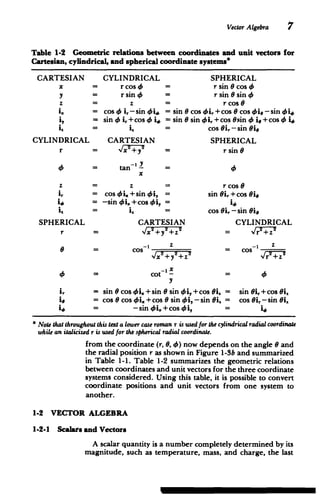
Table 1-2 Geometric relations between coordinates and unit vectors for
Cartesian, cylindrical, and spherical coordinate systems*
CAR FESIAN CYLINDRICAL SPHERICAL

x = rcoso4 = r sin 0 cos4

y = rsino4 = r sin6 sin4

z = z r cos 6

i. = coso i,-sin4i&= sin e cos 45i,+cos e cos Oio -sin 4qi,
i, = sin 4 i,+cos 4 i, = sin 6 sin 4ki, +cos 6sin 46 io +cos 4 i
i.1	 = cos Oi, -sin 6i,
CYLINDRICAL CARTESIAN SPHERICAL
r = xF+yl	 r sin 0
= tan-'Z	 4
x
z =- z = r cos 0
cos 4i.+sin 0i, = sin i, +cos i,
-sin i. +cos 0i, = i"
11 = cos 0i, -sin ie
SPHERICAL CARTESIAN CYLINDRICAL
r = x +y 2
+ z2 = Cro+z2
Z
0 = cos~1 	 = cos_ z
/x+y
2
+
4k cot-	 4
y
1~ sin 6 cos (Ai.+sin 6 sin 4ki, +cos 6Oi = sin i,+cos 6i,
16 cos 6 cos 46i. +cos 8 sin 4$i, -sin 6i. = cos ir-sin 6i.
-sin 4i.+cos Oi, =i'
* 	Note that throughout this text a lower case roman r is usedfor the cylindrical radial coordinate
while an italicized r is used forthe spherical radial coordinate.
from the coordinate (r, 0, 46) now depends on the angle G and
the radial position r as shown in Figure 1-3b and summarized
in Table 1-1. Table 1-2 summarizes the geometric relations
between coordinates and unit vectors for the three coordinate
systems considered. Using this table, it is possible to convert
coordinate positions and unit vectors from one system to
another.
1-2 VECTOR ALGEBRA
1-2-1 Scalars and Vectors
A scalar quantity is a number completely determined by its
magnitude, such as temperature, mass, and charge, the last
8 Review of Vector Analysis
being especially important in our future study. Vectors, such
as velocity and force, must-also have their direction specified
and in this text are printed in boldface type. They are
completely described by their components along three coor­
dinate directions as shown for rectangular coordinates in
Figure 1-4. A vector is represented by a directed line segment
in the direction of the vector with its length proportional to its
magnitude. The vector
A = A.i. +A~i,+Ai. (1)
in Figure 1-4 has magnitude
A =JAI =[A i+A' +A, ]"' (2)
Note that each of the components in (1) (A., A,, and A.) are
themselves scalars. The direction of each of the components
is given by the unit vectors. We could describe a vector in any
of the coordinate systems replacing the subscripts (x, y, z) by
(r, 0, z) or (r, 0, 4); however, for conciseness we often use
rectangular coordinates for general discussion.
1-2-2 Multiplication of a Vector by a Scalar
If a vector is multiplied by a positive scalar, its direction
remains unchanged but its magnitude is multiplied by the
Al
A
|t
I
I
I
I
I
A
Figure 1-4
directions.
A = At i,+ Ayiy+ Ai,
A I= A = {A2 +A 2 + A.2
A vector is described by its components along the three coordinate
--
Vector Algebra 9
scalar. If the scalar is negative, the direction of the vector is
reversed:
aA = aA.i. +aA,i,+aAzi (3)
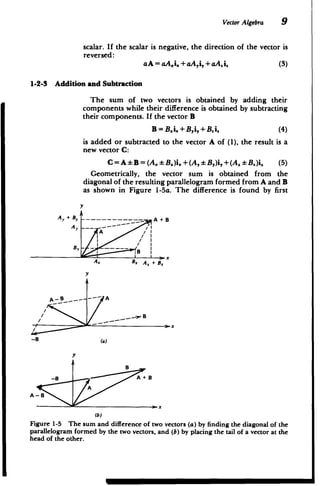
1-2-3 Addition and Subtraction
The sum of two vectors is obtained by adding their
components while their difference is obtained by subtracting
their components. If the vector B
B = B.i. +B,i,+Bzi, (4)
is added or subtracted to the vector A of (1), the result is a
new vector C:
C =A +-B= (A.*B.)i. +(A, B,)i, +(A, B.)i,, (5)
Geometrically, the vector sum is obtained from the
diagonal of the resulting parallelogram formed from A and B
as shown in Figure 1-5a. The difference is found by first
y
A + By
, --- - - - AB A +
A + 8, - - ------. , AI
A,
A
By
­
A, B- A. +B
y
A
-BBA
+
x
o
(b)
Figure 1-5 The sum and difference of two vectors (a) by finding the diagonal of the
parallelogram formed by the two vectors, and (b) by placing the tail of a vector at the
head of the other.
10 Review of Vector Analysis
drawing -B and then finding the diagonal of the paral­
lelogram formed from the sum of A and -B. The sum of the
two vectors is equivalently found by placing the tail of a vector
at the head of the other as -in Figure 1-5b.
Subtraction is the same as addition of the negative of a
vector.
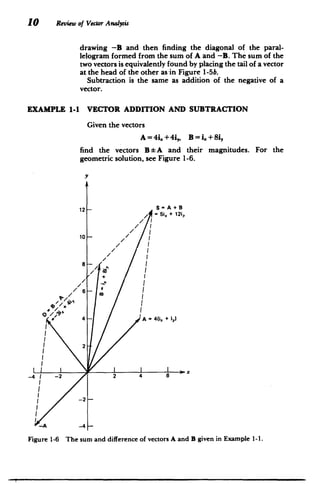
EXAMPLE 1-1 VECTOR ADDITION AND SUBTRACTION
Given the vectors
A=4i.+4i,, B=i.+8i,
find the vectors B*A and their magnitudes. For the
geometric solution, see Figure 1-6.
y
-S= A+ B
12

/= 5i, + 2iy

/'I
/ I

/ I

10

-
8

-- A I x

6

q/ / "X

4

2

X

-4 I
-
2e 4 6

-2 I­
-A -4
Figure 1-6 The sum and difference of vectors A and B given in Example 1-1.
Vector Algebra II
SOLUTION
Sum
S= A +B = (4+1)i, +(4+8)i, = 5i, + 12i,
S=[5 2+12]12= 13
Difference
D= B-A = (1 -4)i, +(8-4)i, = -3, +4i,
D = [(-3) 2+42 ]1 = 5
1-2-4 The Dot (Scalar) Product
The dot product between two vectors results in a scalar and
is defined as
A - B=AB cos 0 (6)
where 0 is the smaller angle between the two vectors. The
term A cos 0 is the component of the vector A in the direction
of B shown in Figure 1-7. One application of the dot product
arises in computing the incremental work dW necessary to
move an object a differential vector distance dl by a force F.
Only the component of force in the direction of displacement
contributes to the work
dW=F-dl (7)
The dot product has maximum value when the two vectors
are colinear (0 =0) so that the dot product of a vector with
itself is just the square of its magnitude. The dot product is
zero if the vectors are perpendicular (0 = 7r/2). These prop­
erties mean that the dot product between different orthog­
onal unit vectors at the same point is zero, while the dot
Y A
B
A B=AB cos 0

COsa

Figure 1-7 The dot product between two vectors.
12 Review of Vector Analysis
product between a unit vector and itself is unity
i. - i.= 1, i. - i,=0

i,-i,=1, i.-i2 =0 (8)

i. - i= 1, i, - i =0
Then the dot product can also be written as
A -B=(A.i.,+A,i,+Ai) -(B.i.+B,i,+Bai
)
.
= A.B. + AB, + A1B. (9)
From (6) and (9) we see that the dot product does not
depend on the order of the vectors
A-B=B-A (10)
By equating (6) to (9) we can find the angle between vectors as
Cs0=A B. + AB, + A.B,11
cos= AB
AB
Similar relations to (8) also hold in cylindrical and spherical
coordinates if we replace (x, y, z) by (r, 4, z) or (r, 0, 4). Then
(9) to (11) are also true with these coordinate substitutions.
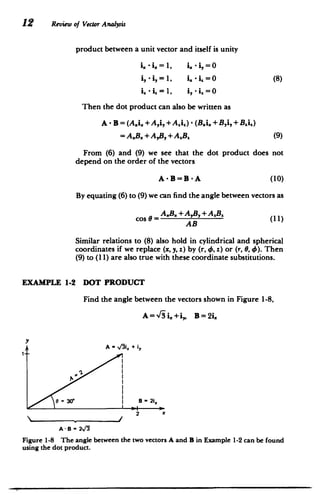
EXAMPLE 1-2 DOT PRODUCT
Find the angle between the vectors shown in Figure 1-8,
A = 3 i.+i, B= 2i.
,,A -,f3i. + i,
S=30- B - 2i.
___ ___ ___ ___ 2 X
A - B = 2r3
Figure 1-8 The angle between the two vectors A and B in Example 1-2 can be found
using the dot product.
Vector Algebra 13
SOLUTION
From (11)
cos8= =­
A,+A'] B. 2
0 = cos-I -= 30*
2
1-2-5 The Cross (Vector) Product
The cross product between two vectors A x B is defined as a
vector perpendicular to both A and B, which is in the direc­
tion of the thumb when using the right-hand rule of curling
the fingers of the right hand from A to B as shown in Figure
1-9. The magnitude of the cross product is
JAXB =AB sin 6 (12)
where 0 is the enclosed angle between A and B. Geometric­
ally, (12) gives the area of the parallelogram formed with A
and B as adjacent sides. Interchanging the order of A and B
reverses the sign of the cross product:
AXB= -BXA (13)
A x 8
A
AS
A
Positive

0 sense

from A to B

B x A = -A x B
(a) (b)
Figure 1-9 (a) The cross product between two vectors results in a vector perpendic­
ular to both vectors in the direction given by the right-hand rule. (b) Changing the
order of vectors in the cross product reverses the direction of the resultant vector.
14 Review of Vector Analysis
The cross product is zero for colinear vectors (0 =0) so that
the cross product between a vector and itself is zero and is
maximum for perpendicular vectors (0 = ir/2). For rectan­
gular unit vectors we have
i. X i.= 0, i. X i, = i', i, Xi. = -i.
i, xi, =0, i,X i=i", i, xi,= -i. (14)
i, X i,= 0, i" X i.= i,, i, xi"= -i,
These relations allow us to simply define a right-handed
coordinate system as one where
i.Xi,(15)
Similarly, for cylindrical and spherical coordinates, right-
handed coordinate systems have
irX i$ =ih, i,.xi = i, (16)
The relations of (14) allow us to write the cross product
between A and B as
Ax B = (A.i. +A,i, +Ai) X (Bji
1 +B,i, +B i)
= i. (AB.-A.B,) +i,(A.B.-A.B ) +i.(A.B, - AB:)
.
(17)
which can be compactly expressed as the determinantal
expansion
Ix i, iz
AXB=det A. A, A.
B. B, B.
=i,(AB. - AB,) +i,(AB. - A.B) +i(A.B,-AB.)
(18)
The cyclical and orderly permutation of (x, y, z) allows easy
recall of (17) and (18). If we think of xyz as a three-day week
where the last day z is followed by the first day x, the days
progress as
xyzxyzxyzxyz .-- (19)
where the three possible positive permutations are under­
lined. Such permutations of xyz in the subscripts of (18) have
positive coefficients while the odd permutations, where xyz do
not follow sequentially
xzy, yxz, zyx (20)
have negative coefficients in the cross product.
In (14)-(20) we used Cartesian coordinates, but the results
remain unchanged if we sequentially replace (x, y, z) by the
Vector Algebra 15
cylindrical coordinates (r, 0, z) or the spherical coordinates
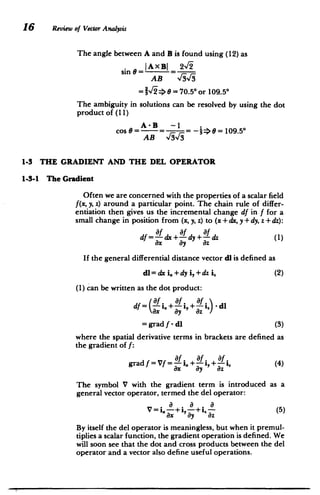
(r, 0, 4).
EXAMPLE 1-3 CROSS PRODUCT
Find the unit vector i,, perpendicular in the right-hand
sense to the vectors shown in Figure 1-10.
A =-i.+i,+i., B=i. -i,+i
What is the angle between A and B?
SOLUTION
The cross product A x B is perpendicular to both A and B
i, i, i
(
AXB=det -1 1 1 =2(i.+i,)
-
1 -1 1
The unit vector i. is in this direction but it must have a
magnitude of unity
in=AxB
A.= =-(i +i,
|AXBJ '_
'
z
A -- i + iV + i,
12
B~i2 -BxA--AxB
-i,,+
B i , +
­
2-- ~-~-- ­ - ~A = 2 i +
)
x -
­
x .1 0 v
Figure .1-10 The cross product between the two vectors in Example 1-3.
-2
16 Review of Vector Analysis
The angle between A and B is found using (12) as
2%/
sin 0= =AXBI
AB %/i%/
-2,r * =70.5* or 109.5*
The ambiguity in solutions can be resolved by using the dot
product of (11)
AB
­
1-3 THE GRADIENT AND THE DEL OPERATOR
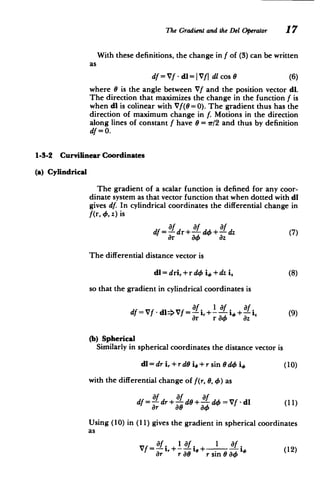
1-3-1 The Gradient
Often we are concerned with the properties of a scalar field
f(x, y, z) around a particular point. The chain rule of differ­
entiation then gives us the incremental change df in f for a
small change in position from (x, y, z) to (x + dx, y + dy, z + dz):
Of Of Of
df=-dx+-dy+-dz (1)
ax ay Oz
If the general differential distance vector dl is defined as
dl= dx i.+dy i,+dzih (2)
(1) can be written as the dot product:
( Of Of Of
df = - - i.+ f- i, +- - i) -dl
ax ay az
= grad f - dl (3)
where the spatial derivative terms in brackets are defined as
the gradient of f:
grad f = Vf =
-- i.+- i,+ f i. (4)
Ox ay az
The symbol V with the gradient term is introduced as a
general vector operator, termed the del operator:
V=i a-+i,-a +i -a(5)
ax ay az
By itself the del operator is meaningless, but when it premul­
tiplies a scalar function, the gradient operation is defined. We
will soon see that the dot and cross products between the del
operator and a vector also define useful operations.
The Gradientand the Del Operator 17
With these definitions, the change in f of (3) can be written
as
df = Vf - dl=IVfj dl cos 0 (6)
where 6 is the angle between Vf and the position vector dl.
The direction that maximizes the change in the function f is
when dl is colinear with Vf(8 = 0). The gradient thus has the
direction of maximum change in f. Motions in the direction
along lines of constant f have 6 = ir/2 and thus by definition
df=0.
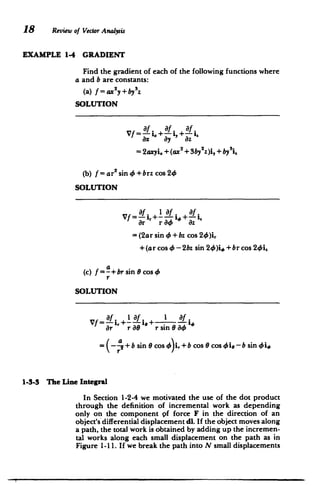
1-3-2 Curvilinear Coordinates
(a) Cylindrical
The gradient of a scalar function is defined for any coor­
dinate system as that vector function that when dotted with dl
gives df. In cylindrical coordinates the differential change in
f(r,o, z) is
df dr+- do+ dz (7)
ar do az
The differential distance vector is
dl= dri,+rdo i6 +dz i. (8)
so that the gradient in cylindrical coordinates is
Of l af Of
df = Vf - dl>Vf =+- i, + I i +- (9)
Or r 4 az
(b) Spherical
Similarly in spherical coordinates the distance vector is
dl=dri,+rdO i,+rsin
Odd i (10)
with the differential change of f(r, 8, 46) as
df= dr+ d+ d4o=Vf-dl (11)
Or 0o d4
Using (10) in (11) gives the gradient in spherical coordinates
as
Of. 101. 1 f.
Vf = -- ,+IOf ,+ I O(12)
Or r aO r sin 8o
18 Review of Vector Analysis
EXAMPLE 1-4 GRADIENT
Find the gradient of each of the following functions where
a and b are constants:
(a) f = ax2 y+ by3z
SOLUTION
af. af. a
.
= 2axyi. +(ax2 + 3by 2
z)i, + by~i
2
(b) f= ar
2
sin4+brz cos 24,
SOLUTION
Vf=-a,+ I +-f.
ar r 4, az
=(2ar sin 4+ bz cos 24)%
+(ar cos 4 -2bz sin 24)i, + br cos 24i.
(c) f =a+br
sin 0 cos 4
r
SOLUTION
af lf. 1 f.
ar r O rsin084
=(-+b sin 0 cos 4)i,+bcos 0 cos 'e-b sini
1-3-3 The Line Integral
In Section 1-2-4 we motivated the use of the dot product
through the definition of incremental work as depending
only on the component pf force F in the direction of an
object's differential displacement dl. If the object moves along
a path, the total work is obtained by adding up the incremen­
tal works along each small displacement on the path as in
Figure 1-11. If we break the path into N small displacements
The Gradientand the Del Operator 19
F,
= F7*dl,
dW,
di,
dd6 F =
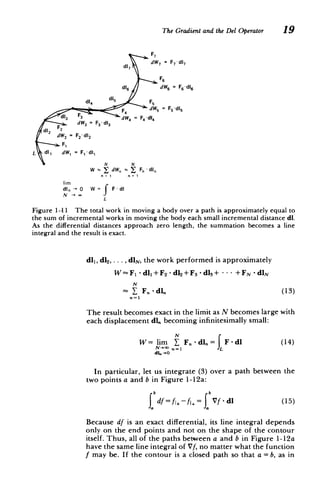
F4-d1
dW=
3
dW3 = F3 ' d 3
FC dI
F2 

dW2 = F2- d12

d F
L di1
CdF,I dW, = F, -di,
N N
w ~ dw, F - di,

,,=1 n = 1

urn
lim

dl, 0 W = F-dl

f~
N
L
Figure 1-11 The total work in moving a body over a path is approximately equal to
the sum of incremental works in moving the body each small incremental distance dl.
As the differential distances approach zero length, the summation becomes a line
integral and the result is exact.
d1i, dA
2 , . . . , dIN, the work performed is approximately
W- F 1 -dl +F 2 -d12 +F 3 -dI3+ +FN * dIN
N
Y_ F - dl (13)
n-1
The result becomes exact in the limit as N becomes large with
each displacement dl. becoming infinitesimally small:
N
W = Jim Y_ Fn - dl, F - dI (14)
N-c n=1 L
dl,-+0
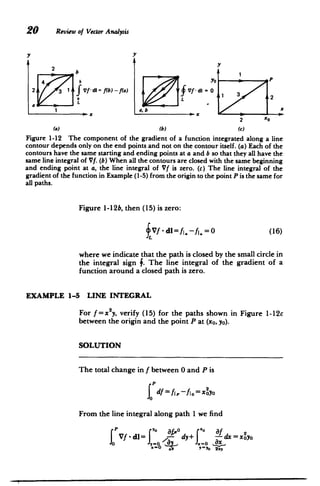
In particular, let us integrate (3) over a path between the
two points a and b in Figure 1-12a:
(15)
Vf - dl
fab df=fi-flab
Because df is an exact differential, its line integral depends
only on the end points and not on the shape of the contour
itself. Thus, all of the paths between a and b in Figure 1-12a
have the same line integral of Vf, no matter what the function
f may be. If the contour is a closed path so that a = b, as in
20 Review of Vector Analysis
iV
y
2
b -b
- = f(b)2j 431
Vf- di -- )Ta) b
LVf -di =0 3
32
2~~~~-X Ix 31 f Xd ~)fa
4 

a, b

2 2
(a) (b) (c)
Figure 1-12 The component of the gradient of a function integrated along a line
contour depends only on the end points and not on the contour itself. (a) Each of the
contours have the same starting and ending points at a and b so that they all have the
same line integral of Vf. (b) When all the contours are closed with the same beginning
and ending point at a, the line integral of Vf is zero. (c) The line integral of the
gradient of the function in Example (1-5) from the origin to the point Pis the same for
all paths.
EXAMPLE
Figure 1-12b, then (15) is zero:
vf - d1=fi.-fi.=0 (16)
where we indicate that the path is closed by the small circle in
the integral sign f. The line integral of the gradient of a
function around a closed path is zero.
1-5 LINE INTEGRAL
2
For f =x y, verify (15) for the paths shown in Figure 1-12c
between the origin and the point P at (xo, yo).
SOLUTION
The total change in f between 0 and P is
I df fA, -fi 0 = x2yo
From the line integral along path I we find
Vf - dl= X-o dy+ __dx =xoyo
'
Y=702c
Flux and Divergence 21
Similarly, along path 2 we also obtain
P' 0" af~ 73 af 2
Vf-dI= - &x+ --dy xoyo
while along path 3 we must relate x and y along the straight
line as
y =- x z dy =L dx
xo xo
to yield
Pf
Pf 3oyox
2 2
Vf - dl= :-(-dx+--dy = f - dx=xOyo
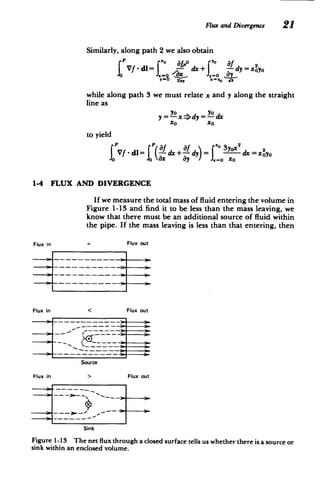
1-4 FLUX AND DIVERGENCE
If we measure the total mass of fluid entering the volume in
Figure 1-13 and find it to be less than the mass leaving, we
know that there must be an additional source of fluid within
the pipe. If the mass leaving is less than that entering, then
Flux in Flux out
Flux in < Flux out
Source
Flux in > Flux out
Sink
Figure 1-13 The net flux through a closed surface tells us whether there is a source or
sink within an enclosed volume.
22 Review of Vector Analysis
there is a sink (or drain) within the volume. In the absence of
sources or sinks, the mass-of fluid leaving equals that entering
so the flow lines are continuous. Flow lines originate at a
source and terminate at a sink.
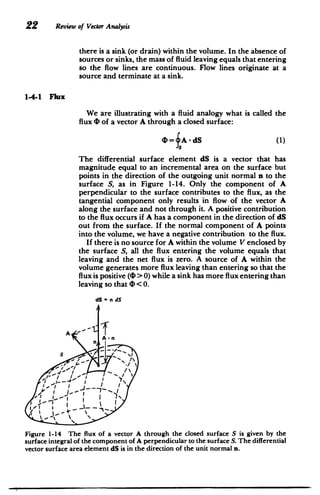
1-4.1 Flux
We are illustrating with a fluid analogy what is called the
flux (D of a vector A through a closed surface:
= fA - dS (1)
The differential surface element dS is a vector that has
magnitude equal to an incremental area on the surface but
points in the direction of the outgoing unit normal n to the
surface S, as in Figure 1-14. Only the component of A
perpendicular to the surface contributes to the flux, as the
tangential component only results in flow of the vector A
along the surface and not through it. A positive contribution
to the flux occurs if A has a component in the direction of dS
out from the surface. If the normal component of A points
into the volume, we have a negative contribution to the flux.
If there is no source for A within the volume V enclosed by
the surface S, all the flux entering the volume equals that
leaving and the net flux is zero. A source of A within the
volume generates more flux leaving than entering so that the
flux is positive (4D>0) while a sink has more flux entering than
leaving so that (D < 0.
dS - n dS
A
A n
sT j

- 4

Figure 1-14 The flux of a vector A through the closed surface S is given by the
surface integral of the component of A perpendicular to the surface S. The differential
vector surface area element dS is in the direction of the unit normal n.
Flux and Divergence 23
Thus we see that the sign and magnitude of the net flux
relates the quantity of a field through a surface to the sources
or sinks of the vector field within the enclosed volume.
1-4-2 Divergence
We can be more explicit about the relationship between the
rate of change of a vector field and its sources by applying (1)
to a volume of differential size, which for simplicity we take to
be rectangular in Figure 1-15. There are three pairs of plane
parallel surfaces perpendicular to the coordinate axes so that
(1) gives the flux as
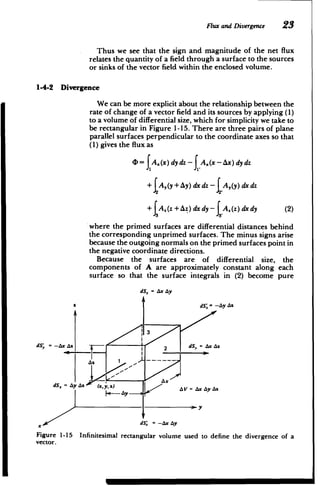
(1) = A. (x) dy dz - A. (x-Ax) dydz
+ JA,(y + Ay) dx dz - A,(y) dx dz
+ A,(z+Az)dxdy- A,(z)dxdy (2)
where the primed surfaces are differential distances behind
the corresponding unprimed surfaces. The minus signs arise
because the outgoing normals on the primed surfaces point in
the negative coordinate directions.
Because the surfaces are of differential size, the
components of A are approximately constant along each
surface so that the surface integrals in (2) become pure
dS, = Ax Ly
dS -- y A
3
dS' -Ax A dS, =Ax Az
dS' = -aA y
Figure 1-15 Infinitesimal rectangular volume used to define the divergence of a
vector.
24 Review of Vector Analysis
multiplications of the component of A perpendicular to the
surface and the surface area. The flux then reduces to the form
+ [A,(y +Ay)-A,(y)]
D(A.(x)-Ax(x-Ax)]
AX Ay
+[A. (z + Az) -A. (z)]A yA 3
+Ax Ay Az (3)
AZ
We have written (3) in this form so that in the limit as the
volume becomes infinitesimally small, each of the bracketed
terms defines a partial derivative
(A, 3A, Az
lim (D= + + V (4)
Ax-O ax ayaz
where AV = Ax Ay Az is the volume enclosed by the surface S.
The coefficient of AV in (4) is a scalar and is called the
divergence of A. It can be recognized as the dot product
between the vector del operator of Section 1-3-1 and the
vector A:
aAx 8,A, aA,
div A = V -A =--+ + (5)
ax ay az
1-4-3 Curvilinear Coordinates
In cylindrical and spherical coordinates, the divergence
operation is not simply the dot product between a vector and
the del operator because the directions of the unit vectors are
a function of the coordinates. Thus, derivatives of the unit
vectors have nonzero contributions. It is easiest to use the
generalized definition of the divergence independent of the
coordinate system, obtained from (1)-(5) as
V- A= lim J5A-dS (6)
AV-0o AV
(a) Cylindrical Coordinates
In cylindrical coordinates we use the small volume shown in
Figure 1-16a to evaluate the net flux as
= A - dS =f (r+Ar)A , dO dz - rArir d dz
+ I A dr dz - f A dr dz
J"
" fj rA,,I+A, dr doS - rA,,,drdo (7)
x
Flux and Divergence 25
S
dS, = r dr do
dS, = dr ds
As
dS, =V( + Ar) do As
(a)
dS = (r + Ar)2
sin 0 dO do
= r dr dO
) <dSd
3
o2
7' = r sin(O + AO) dr do
x/
(b)
Figure 1-16 Infinitesimal volumes used to define the divergence of a vector in
(a) cylindrical and (b) spherical geometries.
 r 7r
Again, because the volume is small, we can treat it as approx­
imately rectangular with the components of A approximately
constant along each face. Then factoring out the volume
A V =rAr AO Az in (7),
I [(r + Ar)A,,,-rA
,
[I A ] [A -A. rAr 4 Az (8)
r AO Az
M M
26 Review of Vector Analysis
lets each of the bracketed terms become a partial derivative as
the differential lengths approach zero and (8) becomes an
exact relation. The divergence is then
* s
A-dS 1 8 1BA, 8A.
V -A= lim -= (rA,)+I +- (9)
A,+o A V rOr r a4 8z
(b) Spherical Coordinates
Similar operations on the spherical volume element AV=
r2
sin 0 Ar AO A4 in Figure 1-16b defines the net flux through
the surfaces:
4= A -dS
[(r + &r)2
Ar,+, - r2
A,,]
 r2 Ar
[AA,, sin (0 +A#)-Ae,, sin 8]
r sin 8 AG
+ [A... A1.r 2
sin OAr AOAO (10)
The divergence in spherical coordinates is then
5 A -dS

V- A= lim

Ar-.O AV
=- - (r'A,) + .1 8
-(Ae 1 BA, (1
sin 0) + -- (11)
r ar r sin 80 r sinG ao
1-4-4 The Divergence Theorem
If we now take many adjoining incremental volumes of any
shape, we form a macroscopic volume V with enclosing sur­
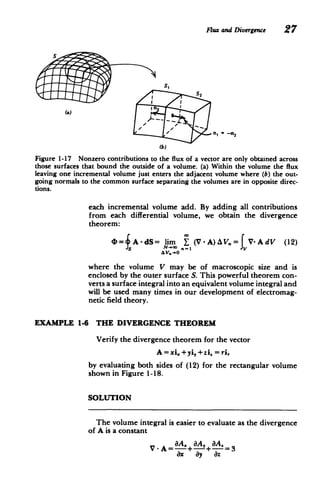
face S as shown in Figure 1-17a. However, each interior
common surface between incremental volumes has the flux
leaving one volume (positive flux contribution) just entering
the adjacent volume (negative flux contribution) as in Figure
1-17b. The net contribution to the flux for the surface integral
of (1) is zero for all interior surfaces. Nonzero contributions
to the flux are obtained only for those surfaces which bound
the outer surface S of V. Although the surface contributions
to the flux using (1) cancel for all interior volumes, the flux
obtained from (4) in terms of the divergence operation for
Flux and Divergence 27
S

S,
0 S2
(a)
152
n, -- n2
(b)
Figure 1-17 Nonzero contributions to the flux of a vector are only obtained across
those surfaces that bound the outside of a volume. (a) Within the volume the flux
leaving one incremental volume just enters the adjacent volume where (b) the out­
going normals to the common surface separating the volumes are in opposite direc­
tions.
each incremental volume add. By adding all contributions
from each differential volume, we obtain the divergence
theorem:
cI=fA-dS= lim I (V-A)AV I=f
V-AdV (12)
A V.-_O
where the volume V may be of macroscopic size and is
enclosed by the outer surface S. This powerful theorem con­
verts a surface integral into an equivalent volume integral and
will be used many times in our development of electromag­
netic field theory.
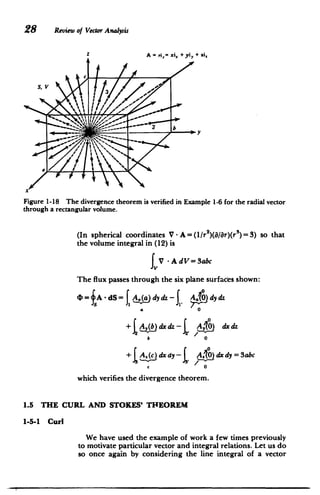
EXAMPLE 1-6 THE DIVERGENCE THEOREM
Verify the divergence theorem for the vector
A=xi.+yi,+zi. =ri,
by evaluating both sides of (12) for the rectangular volume
shown in Figure 1-18.
SOLUTION
The volume integral is easier to evaluate as the divergence
of A is a constant
e3Ax 8A, 3A.
V - A = +---+--= 3
ax ay az
28 Review of Vector Analysis
z A =ri xix + YiY + Ai,
ZA0
v,
/3/c
S, 2
I /J
b
Figure 1-18 The divergence theorem is verified in Example 1-6 for the radial vector
through a rectangular volume.
(In spherical coordinates V -A= (1/r2
)(/ar)(r3
) = 3) so that
the volume integral in (12) is
-AAV
dV=3abc
The flux passes through the six plane surfaces shown:
qD=fA-dS= jj(a dydz- AJO)dydz
a 0
+A, (b)dxdz- A,10 dx dz
b 0
+jA dxdy- A dxdy=3abc
C )0
which verifies the divergence theorem.
1.5 THE CURL AND STOKES' THEOREM
1-5-1 Curl
We have used the example of work a few times previously
to motivate particular vector and integral relations. Let us do
so once again by considering the line integral of a vector
The Curl and Stokes' .Theorem 29
around a closed path called the circulation:
C= A - dl (1)
where if C is the work, A would be the force. We evaluate (1)
for the infinitesimal rectangular contour in Figure 1-19a:
C=f A.(y)dx+ A,(x+Ax)dy+ A.(y+Ay)dx
I 3
+ A,(x) dy (2)
4
The components of A are approximately constant over each
differential sized contour leg so that (2) is approximated as
C_ ([A.(y)-A.(y +Ay)] + [A,(x +Ax)-A,(x)])A (3)
C==Y +AXy 3
y
(x. y)
(a)

n

(b)
Figure 1-19 (a) Infinitesimal rectangular contour used to define the circulation.
(b) The right-hand rule determines the positive direction perpendicular to a contour.
30 Review of Vector Analysis
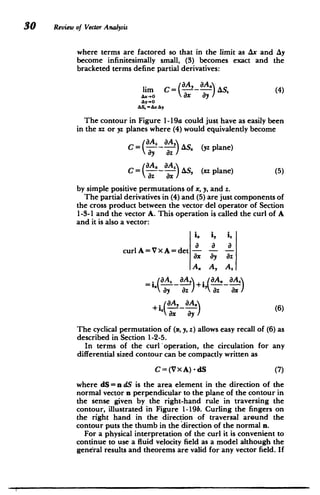
where terms are factored so that in the limit as Ax and Ay
become infinitesimally small, (3) becomes exact and the
bracketed terms define partial derivatives:
lim C= (A A) AS. (4)
Ax-O ax ay
AS-AxAy
The contour in Figure 1-19a could just have as easily been
in the xz or yz planes where (4) would equivalently become
C= --- 'AS. (yz plane)
a 8a.
C AS, (xz plane) (5)
az ax
by simple positive permutations of x, y, and z.
The partial derivatives in (4) and (5) are just components of
the cross product between the vector del operator of Section
1-3-1 and the vector A. This operation is called the curl of A
and it is also a vector:
i, i, 'z
curlA=VXA=det a
ax ay az
A. A, A.
=i. 7+i,
ay az ) (az ax
zAax
+i.ax~ ay3 (6)
+aA,
8x ay
The cyclical permutation of (x, y, z) allows easy recall of (6) as
described in Section 1-2-5.
In terms of the curl operation, the circulation for any
differential sized contour can be compactly written as
C=(Vx A) -dS (7)
where dS = n dS is the area element in the direction of the
normal vector n perpendicular to the plane of the contour in
the sense given by the right-hand rule in traversing the
contour, illustrated in Figure 1-19b. Curling the fingers on
the right hand in the direction of traversal around the
contour puts the thumb in the direction of the normal n.
For a physical interpretation of the curl it is convenient to
continue to use a fluid velocity field as a model although the
general results and theorems are valid for any vector field. If
- - - - - -- - -- - - -
-
The Curl and Stokes' Theorem 31
No circulation Nonzero circulation
Figure 1-20 A fluid with a velocity field that has a curl tends to turn the paddle wheel.
The curl component found is in the same direction as the thumb when the fingers of
the right hand are curled in the direction of rotation.
a small paddle wheel is imagined to be placed without dis­
turbance in a fluid flow, the velocity field is said to have
circulation, that is, a nonzero curl, if the paddle wheel rotates
as illustrated in Figure 1-20. The curl component found is in
the direction of the axis of the paddle wheel.
1-5-2 The Curl for Curvilinear Coordinates
A coordinate independent definition of the curl is obtained
using (7) in (1) as
~A -dl
(V x A),= lim (8)
dS.-+O dn
where the subscript n indicates the component of the curl
perpendicular to the contour. The derivation of the curl
operation (8) in cylindrical and spherical. coordinates is
straightforward but lengthy.
(a) Cylindrical Coordinates
To express each of the components of the curl in cylindrical
coordinates, we use the three orthogonal contours in Figure
1-21. We evaluate the line integral around contour a:
fA - d= A() dz + A A.(z-- Az) r d4
+ 1zA.(0+A) dz + A#(z) r d46
([A.(O+A4)-A.(O)] [A#(z)-A#(z-Az)] rAOAz
rAO AZ
(9)
M M
32 Review of Vector Analysis
(r - Ar, o + AO,
)
- Ar) A$
((r
C
A
(r ,r,
)
x- r)A-**
r,a#,s AAz
(r, ,
) (r 0r,
z, r AO 3 A ,z
(V x A)x
(r,,- I r, -
­
(rr + A, - Az
(V x A),
Figure 1-21 Incremental contours along cylindrical surface area elements used to
calculate each component of the curl of a vector in cylindrical coordinates.
to find the radial component of the curl as
fA-dI
(V x A)r = liM 1 aA= aA (10)
_-o rOA4Az r a4 az
Az-.O
We evaluate the line integral around contour b:
r Z-Az r-Ar
A -dl Ar(z)drr)dz+ Ar(z-Az)dr
+ A.(r -,Ar) dz
([Ar(z)-Ar(Z -Az)] [A.(r)-A.(r- Ar)]) A Az
AZ Ar(11)
The Curl and Stokes' Theorem 33
to find the 4 component of the curl,
A - dl OA aA
(V x A), = ur z = (12)
A&r-0 Ar Az az ar/
Az -.
The z component of the curl is found using contour c:
r +A4 rr-
1 dr
A-dl= Arldr+ rA jd4+ A,,,, dr
Sr-Ar r
+ (r-Ar)A4,.,d
S[rAp,-(r -Ar)A4,_-,] [Arl4..A.- Arl r &rA
]
rAr rA4
(13)
to yield
A - dl
__ _1 / 8 t3Ar
(V x A).= n =-- (rAO) -- (14)
Ar-O r
C
Ar AO r Or 84
A.0 -0
The curl of a vector in cylindrical coordinates is thus
(I MA, dA aA, aA
_XA'r A)
Vx A= )ir+(=-
,
r a4 Oz az Or
1 aA,
+-( (rA#) ;i, (15)
r ar
(b) Spherical Coordinates
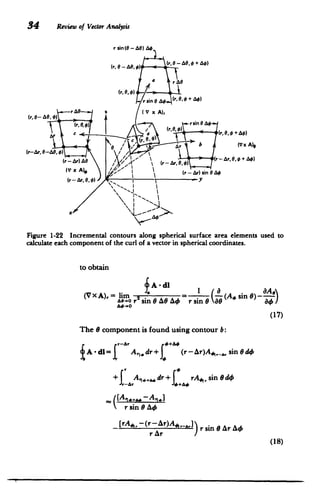
Similar operations on the three incremental contours for
the spherical element in Figure 1-22 give the curl in spherical
coordinates. We use contour a for the radial component of
the curl:
+ &0 e-A e
A - dl= , A4,r sin 0 dO + rA ,.. dO
+ r sin (0 -A)A 4 .. d+ rA,. dO
.+"4 -As
[A,. sin - A4,.-,. sin (0 - AG))
r sin e AO
[Ae,.. -A _+ r2 sin 0 AO A4 (16)
r sin 0 AO
(
A
(
34 Review of Vector Analysis
r sin (0- AO) A#
'r, - A8, +AO)
Ir,0 - AO, #)
a r AO
(r, 0,#)
rsin 0AO (r,0, + AO)
raG ( V x A),

(r,-AO. (r,6,#)

-~ ~.rsin6
A#~

(r, 0,#0
C	 (r,01,0 + AO)
4r (Vx A),

(r-Ar,6-AO, r)

(r- Ar) AO / 

(V x A),

(r - Ar) sin 0AO
(r-Ar, 0,
)
	
Y
,' ---I
X:
Figure 1-22 Incremental contours along spherical surface area elements used to
calculate each component of the curl of a vector in spherical coordinates.
to obtain
A - dl
(V X A),= 	lim = (A. sin 6)
A:-: r sin 0 AO AO r sin 0 1 O
(17)
The 0 component is found using contour b:
A -dl= A, dr+ (r- Ar)A,,, sin e do
J
+ A....dr+ rA, sin 6d4S
sr sin Ar 46
r Ar
/
(18)
I
1-5-3 Stokes'
The Curl and Stokes' Theorem 35
as
fA - di
,
(V x A),= lim )(rAo)
Ar-o r sin Ar A4 r sin e a4 4r
A4-0O
(19)
The 4 component of the curl is found using contour c:
8 r--Ar
A-dl= e-, rA1d+ A,[.dr
9-A6
+1 (r-Ar)A _ dG+ J A,,,_,,,dr
([rA,, -(r-Ar)A 1 ,,] [Al, - ArI,,] r Ar AG
 rAr r AO
(20)
as
I1 a A,
(V X.A),O = lim =- -(rA,) - (21)
Ar-o r Ar AO r r 81
The curl of a vector in spherical coordinates is thus given
from (17), (19), and (21) as
1
(A. sin 6)
aA
i,
VxA = I
r sin 0 80
+A10 ' Or
nGO4B,
A (rA.4,))i.
r sin 0 a4 ar
+- -(rAe)- a (22)
r ar
Theorem
We now piece together many incremental line contours of
the type used in Figures 1-19-1-21 to form a macroscopic
surface S like those shown in Figure 1-23. Then each small
contour generates a contribution to the circulation
dC = (V x A) - dS (23)
so that the total circulation is obtained by the sum of all the
small surface elements
C= f(V x A) - dS (24)
L
L
36 Review of Vector Analysis
0( QdC Q
n
dc
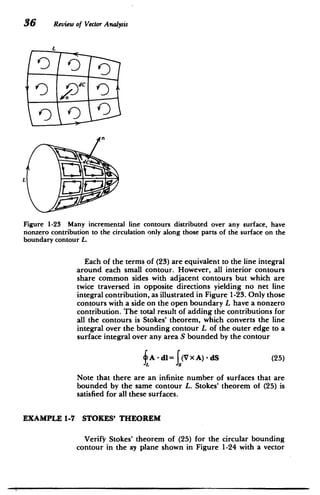
Figure 1-23 Many incremental line contours distributed over any surface, have
nonzero contribution to the circulation only along those parts of the surface on the
boundary contour L.
Each of the terms of (23) are equivalent to the line integral
around each small contour. However, all interior contours
share common sides with adjacent contours but which are
twice traversed in opposite directions yielding no net line
integral contribution, as illustrated in Figure 1-23. Only those
contours with a side on the open boundary L have a nonzero
contribution. The total result of adding the contributions for
all the contours is Stokes' theorem, which converts the line
integral over the bounding contour L of the outer edge to a
surface integral over any area S bounded by the contour
A - dl= J(V x A) - dS (25)
Note that there are an infinite number of surfaces that are
bounded by the same contour L. Stokes' theorem of (25) is
satisfied for all these surfaces.
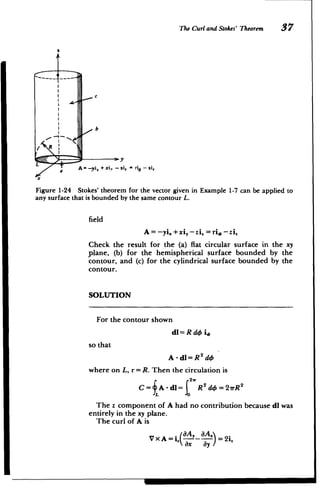
EXAMPLE 1-7 STOKES' THEOREM
Verify Stokes' theorem of (25) for the circular bounding
contour in the xy plane shown in Figure 1-24 with a vector
L
The Curl andStokes' Theorem 37
C
-
R
A = -yi. + xi. - ziz = rio - zi,

a

Figure 1-24 Stokes' theorem for the vector given in Example 1-7 can be applied to
any surface that is bounded by the same contour L.
field
A = -yi., +xi, -zi. = ri6 -zi,
Check the result for the (a) flat circular surface in the xy
plane, (b) for the hemispherical surface bounded by the
contour, and (c) for the cylindrical surface bounded by the
contour.
SOLUTION
For the contour shown
dl = R dO i"
so that
A -di= R 2
d4
where on L, r = R. Then the circulation is
C= A-dl= R2do=27rR 2
The z component of A had no contribution because dl was
entirely in the xy plane.
The curl of A is
(8A, 8A1
VxA=ix =2i,
ax ay
38 Review of Vector Analysis
(a) For the circular area in the plane of the contour, we
have that
f (Vx A) - dS = 2 dS. =2rR2
which agrees with the line integral result.
(b) For the hemispherical surface
v/2 2.
(V X A) - dS= = 0 2 - iR2
sin 0dOdO
From Table 1-2 we use the dot product relation
i - i,= cos e
which again gives the circulation as
w/2 2w 2/wco
=
o 0v2 21rR2 C=w22 R 2sin 20 dO d= -21rR
= 11o 2 e-o
(c) Similarly, for th-e cylindrical surface, we only obtain
nonzero contributions to the surface integral at the upper
circular area that is perpendicular to V X A. The integral is
then the same as part (a) as V X A is independent of z.
1-5-4 Some Useful Vector Identities
The curl, divergence, and gradient operations have some
simple but useful properties that are used throughout the
text.
(a) The Curl of the Gradient is Zero [V x (Vf)= 0]
We integrate the normal component of the vector V X (Vf)
over a surface and use Stokes' theorem
JV x (Vf) - dS= Vf - dl= 0 (26)
where the zero result is obtained from Section 1-3-3, that the
line integral of the gradient of a function around a closed
path is zero. Since the equality is true for any surface, the
vector coefficient of dS in (26) must be zero
V X(Vf)=0
The identity is also easily proved by direct computation
using the determinantal relation in Section 1-5-1 defining the
Problems 39
curl operation:
i. i, i"
a a
Vx(Vf)det
a
ax ay az
af af af
ax ay az
ix2(L - .) +~, a~f ;a-f)I+i,(AY -~af).0.
ayaz azay azax axaz axay ayax
(28)
Each bracketed term in (28) is zero because the order of
differentiation does not matter.
(b) The Divergence of the Curl of a Vector is Zero
[V -(Vx A)=0]
One might be tempted to apply the divergence theorem to
the surface integral in Stokes' theorem of (25). However, the
divergence theorem requires a closed surface while Stokes'
theorem is true in general for an open surface. Stokes'
theorem for a closed surface requires the contour L to shrink
to zero giving a zero result for the line integral. The diver­
gence theorem applied to the closed surface with vector V x A
is then
SV xA -dS =0=V-(VxA)dV=0>V-(VxA)=0
s v (29)
which proves the identity because the volume is arbitrary.
More directly we can perform the required differentiations
V- (VxA)
a, aIA.2 aA, 
 a faA2 aA. a ,aA aA2
axay az axa ay
/
ay az zax

(a2A. a2A a2A2 a2A 2A, a

x)+(!-x x - -)= 0 (30)
axay ayx ayaz ay azax 0x(z
where again the order of differentiation does not matter.
PROBLEMS
Section 1-1
1. Find the area of a circle in the xy plane centered at the
origin using:
(a) rectangular coordinates x + y2 = a2 (Hint:
2
J- _2 dx = [x a,x
2
+ a2
sin~'(x/a)])
40 Review of Vector Atawysis
(b) cylindrical coordinates r= a.
Which coordinate system is easier to use?
2. Find the volume of a sphere of radius R centered at the
origin using:
(a) 	rectangular coordinates x2+y+z2 = R (Hint:
J 2 	
(xla)])
1Ia -x dx =[xV/'-x +a'sin-
(b) cylindrical coordinates r2+Z2= R ;
(c) spherical coordinates r = R.
Which coordinate system is easiest?
Section 1-2
3. Given the three vectors
A= 3i.+2i,-i.
B= 3i. -4i, -5i,
C= i. -i,+i,,
find the following:
(a) 	 A-EB,B C,A C
(b) 	 A -B, B -C, A -C
(c) 	 AXB,BXC,AXC
(d) 	 (A x B) - C, A - (B x C) [Are they equal?]
(e) 	 A x (B x C), B(A - C) - C(A - B) [Are they equal?]
(f) 	 What is the angle between A and C and between B and
A xC?
4. Given the sum and difference between two vectors,
A+B= -i.+5i, -4i
A -	 B = 3i. -i, - 2i,
find the individual vectors A and B.
5. (a) Given two vectors A and B, show that the component
of B parallel to A is
B -A
B1
1= A
A -A
(Hint: Bi = a A. What is a?)
(b) 	 If the vectors are
A = i. - 2i,+i"
B = 3L + 5i, - 5i,
what are the components of B parallel and perpendicular to
A?
ProbLems 41
6. What are the angles between each of the following vectors:
A = 4i. - 2i, + 2i.
B = -6iL+ 3i,- 3i.
C=i.+3iy,+1.
7. Given the two vectors
A=3i.+4i, and B=7i-24i,
(a) What is their dot product?
(b) What is their cross product?
(c) What is the angle 0 between the two vectors?
8. Given the vector
A = Ai. +A,i, + Aji
the directional cosines are defined as the cosines of the angles
between A and each of the Cartesian coordinate axes. Find
each of these directional cosines and show that
2
cos a +cos/3+cos 2
A
9. A triangle is formed by the three vectors A, B, and C
B-A.
A 66 C = B - A
oc 6.
B
(a) Find the length of the vector C in terms of the lengths
of A and B and the enclosed angle Oc. The result is known as
the law of cosines. (Hint: C- C = (B - A) - (B - A).)
(b) For the same triangle, prove the law of sines:
sin 0. sin 66 sin 0,
(Hint: BXA = (C+A)XA.)
M M
42 Review of Vector Analysis
10. (a) Prove that the dot and cross can be interchanged in
the scalar triple product
(AXB) -C=(BXC) - A= (CxA) - B
(b) Show that this product gives the volume of a parallele­
piped whose base is defined by the vectors A and B and whose
height is given by C.
(c) If
A=i.+2i,, B= -i.+2i,, C=i.+i,
verify the identities of (a) and find the volume of the paral­
lelepiped formed by the vectors.
(d) Prove the vector triple product identity
A x (B x C)=B(A C)-C(A - B)
z
4
SA x B
3
­
I(A x B) - Cl
2 -IAx B
A Volume 	= (A x B) C

= (B x C) -A

= (C x A) - B

11. (a) Write the vectors A and B using Cartesian coordinates
in terms of their angles 0 and 4 from the x axis.
(b) Using the results of (a) derive the trigonometric
expansions
sin(9+4) sin 0 cos 0 +sin 4 cos 0
cos (0+4) cos 0 cos 4 -sin 6 sin 4
ProbLems 43
y
A
>x
B
Section 1-3
12. Find the gradient of each of the following functions
where a and b are constants:
(a) f=axz+bx-y
(b) f = (a/r) sin 4 + brz cos 34
(c) f = ar cos 0 +(b/r2
) sin 0
13. 	 Evaluate the line integral of the gradient of the function
f=rsin
over each of the contours 	shown.
Y
2
2a
a
2 -3
-a4
Section 1-4
14. Find the divergence 	of the following vectors:
(a) A=xi.+ i,+zi. = ri,
(b) A=(xy 2z")i.+i,+ij
(c) A = r cos Oi,+[(z/r) sin 0)]i,
(d) A= r2
sin e cos 4 [i,+i.+i-]
15. Using the divergence theorem prove the following
integral identities:
(a) JVfdV= fdS
M
44 Review of Vector Analysis
(Hint: Let A = if, where i is any constant unit vector.)
(b) VxFdV=-fFxdS
(Hint: Let A = iX F.)
(c) 	 Using the results of (a) show that the normal vector
integrated over a surface is zero:
~dS=0
(d) 	Verify (c) for the case of a sphere of radius R.
(Hint: i, = sin 0 cos i, +sin 0 sin Oi, +cos 8i..
16. 	 Using the divergence theorem prove Green's theorem
f[fVg -gVf] - dS= Jv[fv2g gV2f] dV
(Hint: V . (fVg) = fV2
g + Vf Vg.)
17. (a) Find the area element dS (magnitude and direction)
on each of the four surfaces of the pyramidal figure shown.
(b) 	Find the flux of the vector
A = ri,.=xi,+yi,+zi,
through the surface of (a).
(c) Verify the divergence theorem by also evaluating the
flux as
b= JV A dV
. 3
a
Section 1-5
18. 	 Find the curl of the following vectors:
(a) 	A=x2
yi,+y 2
zi,+xyi
x
Problems 45
A = r cos 0i.+z sin1
(b)
r
cos sin4
(c) A=r2 sin cos46i,+ 2 16
r
19. Using Stokes' theorem prove that
dl= Vf XdS
(Hint: Let A = if, where i is any constant unit vector.)
20. Verify Stokes' theorem for the rectangular bounding
contour in the xy plane with a vector field
A = (x+a)(y+b)(z +c)i.
2
!21
x
Y
2
Z
L
Check the result for (a) a flat rectangular surface in the xy
plane, and (b) for the rectangular cylinder.
21. Show that the order of differentiation for the mixed
second derivative
a (af a af
does not matter for the function
2
my
x
y
22. Some of the unit vectors in cylindrical and spherical
coordinates change direction in space and thus, unlike
Cartesian unit vectors, are not constant vectors. This means
that spatial derivatives of these unit vectors are generally
nonzero. Find the divergence and curl of all the unit vectors.
M
46 Review of Vector Analysis
23. A general right-handed orthogonal curvilinear coordinate
system is described by variables (u, v, w), where
i. x i, = i.
dSW = h h dudv
3
dV = huh hwdudvdw
u vd2 SdS, =Ahj&dudw
(u,V, W) hd
dS, = hvhI dvdw
Since the incremental coordinate quantities du, dv, and dw do
not necessarily have units of length, the differential length
elements must be multiplied by coefficients that generally are
a function of u, v, and w:
dL.=h.du, dL.=h.dv, dLw=h.dw
(a) What are the h coefficients for the Cartesian, cylindri­
cal, and spherical coordinate systems?
(b) What is the gradient of any function f(u, v, w)?
(c) What is the area of each surface and the volume of a
differential size volume element in the (u, v, w) space?
(d) What are the curl and divergence of the vector
A =Aui, + Ai,+ A.i.?
(e) What is the scalar Laplacian V2
f = V (Vf)?
(f) Check your results of (b)-(e) for the three basic coor­
dinate systems.
24. Prove the following vector identities:
(a) V(fg)=fVg+gVf
(b) V(A-B)=(A-V)B+(B -V)A+Ax(VxB)+Bx(VxA)
(c) V-(fA)=fV-A+(A-V)f
(d) V-(AxB)=B-(VXA)-A-(VXB)
(e) VX(AXB)=A(V -B)-B(V -A)+(B-V)A-(A V)B
Problems 47
(f) Vx(fA)=VfxA+fVxA
(g) (VXA)XA=(A-V)A--AV(A-A)
(h) Vx(VxA)=V(V-A)-V 2
A
25. Two points have Cartesian coordinates (1, 2, -1) and (2,
-3, 1).
(a) What is the distance between these two points?
(b) What is the unit vector along the line joining the two
points?
(c) Find a unit vector in the xy plane perpendicular to the
unit vector found in (b).
Miscellaneous
26. A series RLC circuit offers a good review in solving linear,
constant coefficient ordinary differential equations. A step
voltage Vo is applied to the initially unexcited circuit at t =0.
- R L
t=0
VO C
(a) Write a single differential equation for the current.
(b) Guess an exponential solution of the form
i(t)= fe
and find the natural frequencies of the circuit.
(c) What are the initial conditions? What are the steady-
state voltages across each element?
(d) Write and sketch the solution for i(t) when
R)2 1 R 2 1 , R 2 1
2LT LC' 2L) LC' 2L LC
(e) What is the voltage across each element?
(f) After the circuit has reached the steady state, the
terminal voltage is instantly short circuited. What is the short
circuit current?
27. Many times in this text we consider systems composed of
repetitive sequences of a basic building block. Such discrete
element systems are described by difference equations.
Consider a distributed series inductance-shunt capacitance
system excited by a sinusoidal frequency w so that the voltage
and current in the nth loop vary as
i,=Re(I.e"); v.=Re(V.e")
48 Review of Vector Analysis
__ T cT CT cT c
­
(a) By writing Kirchoff's voltage law for the nth loop, show
that the current obeys the difference equation
W2
I.+I- 2 2 ).+I.-'=0
WO
What is W2?
(b) Just as exponential solutions satisfy linear constant
coefficient differential equations, power-law solutions satisfy
linear constant coefficient difference equations
I= fAn
What values of A satisfy (a)?
(c) The general solution to (a) is a linear combination of all
the possible solutions. The circuit ladder that has N nodes is
excited in the zeroth loop by a current source
io= Re (Io e ' t
)
Find the general expression for current i, and voltage v. for
any loop when the last loop N is either open (IN = 0) or short
circuited (VN = 0). (Hint: a+4 - = 1/(a-Va-1)
(d) What are the natural frequencies of the system when
the last loop is either open or short circuited?
(Hint: (1)1/( 2
N)e j2r/2N, r = 1, 2, 3,... ,2N.)
chapter 2

the electricfield
50 The Electric Field
The ancient Greeks observed that when the fossil resin
amber was rubbed, small light-weight objects were attracted.
Yet, upon contact with the amber, they were then repelled.
No further significant advances in the understanding of this
mysterious phenomenon were made until the eighteenth
century when more quantitative electrification experiments
showed that these effects were due to electric charges, the
source of all effects we will study in this text.
2-1 ELECTRIC CHARGE
2-1-1 Charging by Contact
We now know that all matter is held together by the attrac­
tive force between equal numbers of negatively charged elec­
trons and positively charged protons. The early researchers
in the 1700s discovered the existence of these two species of
charges by performing experiments like those in Figures 2-1
to 2-4. When a glass rod is rubbed by a dry cloth, as in Figure
2-1, some of the electrons in the glass are rubbed off onto the
cloth. The cloth then becomes negatively charged because it
now has more electrons than protons. The glass rod becomes
4
+
4
4
4
4
4
K
4
4
4
4
+
4
4
4
4
4
4
4
4
4
;ii
(a) (b)
Figure 2-1 A glass rod rubbed with a dry cloth loses some of its electrons to the cloth.
The glass rod then has a net positive charge while the cloth has acquired an equal
amount of negative charge. The total charge in the system remains zero.
Electric Charge 51
positively charged as it has lost electrons leaving behind a
surplus number of protons. If the positively charged glass rod
is brought near a metal ball that is free to move as in Figure
2-2a, the electrons in the ball near the rod are attracted to the
surface leaving uncovered positive charge on the other side of
the ball. This is called electrostatic induction. There is then an
attractive force of the ball to the rod. Upon contact with the
rod, the negative charges are neutralized by some of the
positive charges on the rod, the whole combination still
retaining a net positive charge as in Figure 2-2b. This transfer
of charge is called conduction. It is then found that the now
positively charged ball is repelled from the similarly charged
rod. The metal ball is said to be conducting as charges are
easily induced and conducted. It is important that the
supporting string not be conducting, that is, insulating,
otherwise charge would also distribute itself over the whole
structure and not just on the ball.
If two such positively charged balls are brought near each
other, they will also repel as in Figure 2-3a. Similarly, these
balls could be negatively charged if brought into contact with
the negatively charged cloth. Then it is also found that two
negatively charged balls repel each other. On the other hand,
if one ball is charged positively while the other is charged
negatively, they will attract. These circumstances are sum­
marized by the simple rules:
Opposite Charges Attract. Like Charges Repel.
+
AK
3ravity xx
x
(a) (b) (c)
Figure 2-2 (a) A charged rod near a neutral ball will induce an opposite charge on
the near surface. Since the ball is initially neutral, an equal amount of positive charge
remains on the far surface. Because the negative charge is closer to the rod, it feels a
stronger attractive force than the repelling force due to the like charges. (b) Upon
contact with the rod the negative charge is neutralized leaving the ball positively
charged. (c) The like charges then repel causing the ball to deflect away.
52 The Electric Field
4­
4. .x­
4­
(b)
(a)
Figure 2-3 (a) Like charged bodies repel while (b) oppositely charged bodies attract.
In Figure 2-2a, the positively charged rod attracts the
negative induced charge but repels the uncovered positive
charge on the far end of the ball. The net force is attractive
because the positive charge on the ball is farther away from
the glass rod so that the repulsive force is less than the
attractive force.
We often experience nuisance frictional electrification
when we walk across a carpet or pull clothes out of a dryer.
When we comb our hair with a plastic comb, our hair often
becomes charged. When the comb is removed our hair still
stands up, as like charged hairs repel one another. Often
these effects result in sparks because the presence of large
amounts of charge actually pulls electrons from air molecules.
2-1-2 Electrostatic Induction
Even without direct contact net charge can also be placed
on a body by electrostatic induction. In Figure 2-4a we see
two initially neutral suspended balls in contact acquiring
opposite charges on each end because of the presence of a
charged rod. If the balls are now separated, each half retains
its net charge even if the inducing rod is removed. The net
charge on the two balls is zero, but we have been able to
isolate net positive and negative charges on each ball.
Electric Charge 53
+
(a) (b)
Figure 2-4 A net charge can be placed on a body without contact by electrostatic
induction. (a) When a charged body is brought near a neutral body, the near side
acquires the opposite charge. Being neutral, the far side takes on an equal but opposite
charge. (b) If the initially neutral body is separated, each half retains its charge.
2-1-3 Faraday's "Ice-Pail" Experiment
These experiments showed that when a charged conductor
contacted another conductor, whether charged or not, the
total charge on both bodies was shared. The presence of
charge was first qualitatively measured by an electroscope
that consisted of two attached metal foil leaves. When
charged, the mutual repulsion caused the leaves to diverge.
In 1843 Michael Faraday used an electroscope to perform
the simple but illuminating "ice-pail" experiment illustrated
in Figure 2-5. When a charged body is inside a closed isolated
conductor, an equal amount of charge appears on the outside
of the conductor as evidenced by the divergence of the elec­
troscope leaves. This is true whether or not the charged body
has contacted the inside walls of the surrounding conductor.
If it has not, opposite charges are induced on the inside wall
leaving unbalanced charge on the outside. If the charged
body is removed, the charge on the inside and outside of the
conductor drops to zero. However, if the charged body does
contact an inside wall, as in Figure 2-5c, all the charge.on the
inside wall and ball is neutralized leaving the outside charged.
Removing the initially charged body as in Figure 2-5d will
find it uncharged, while the ice-pail now holds the original
charge.
If the process shown in Figure 2-5 is repeated, the charge
on the pail can be built up indefinitely. This is the principle of
electrostatic generators where large amounts of charge are
stored by continuous deposition of small amounts of charge.
54 The Electric Field
+
+
+
+
+
+
++
+
+ +
+ 4 4 4
4 4
X k,
A
'A
(a) (b) (c)
Figure 2-5 Faraday first demonstrated the principles of charge conservation by
attaching an electroscope to an initially uncharged metal ice pail. (a) When all charges
are far away from the pail, there is no charge on the pail nor on the flexible gold leaves
of the electroscope attached to the outside of the can, which thus hang limply. (b) As a
charged ball comes within the pail, opposite charges are induced on the inner surface.
Since the pail and electroscope were originally neutral, unbalanced charge appears on
the outside of which some is on the electroscope leaves. The leaves being like charged
repel each other and thus diverge. (c) Once the charged ball is within a closed
conducting body, the charge on the outside of the pail is independent of the position
of the charged ball. If the charged ball contacts the inner surface of the pail, the inner
charges neutralize each other. The outside charges remain unchanged. (d) As the now
uncharged ball leaves the pail, the distributed charge on the outside of the pail and
electroscope remains unchanged.
This large accumulation of charge gives rise to a large force
on any other nearby charge, which is why electrostatic
generators have been used to accelerate charged particles to
very high speeds in atomic studies.
2-2 THE COULOMB FORCE LAW BETWEEN STATIONARY
CHARGES
2-2-1 Coulomb's Law
It remained for Charles Coulomb in 1785 to express these
experimental observations in a quantitative form. He used a
very sensitive torsional balance to measure the force between
The Coulomb Force Law Between StationaryCharges 55
two stationary charged balls as a function of their distance
apart. He discovered that the force between two small charges
q, and q2 (idealized as point charges of zero size) is pro­
portional to their magnitudes and inversely proportional to
the square of the distance r 12 between them, as illustrated in
Figure 2-6. The force acts along the line joining the charges
in the same or opposite direction of the unit vector i 12 and is
attractive if the-charges are of opposite sign and repulsive if
like charged. The force F2 on charge q2 due to charge qi is
equal in magnitude but opposite in direction to the force F,
on q1, the net force on the pair of charges being zero.
1 i
2 2nt[kg­
4-rso r12
2-2-2 Units
The value of the proportionality constant 1/4irsE depends
on the system of units used. Throughout this book we use SI
units (Systeme International d'Unit6s) for which the base
units are taken from the rationalized MKSA system of units
where distances are measured in meters (m), mass in kilo­
grams (kg), time in seconds (s), and electric current in
amperes (A). The unit of charge is a coulomb where 1
coulomb= 1 ampere-second. The adjective "rationalized" is
used because the factor of 47r is arbitrarily introduced into
the proportionality factor in Coulomb's law of (1). It is done
this way so as to cancel a 41r that will arise from other more
often used laws we will introduce shortly. Other derived units
are formed by combining base units.
qlq2
q2 F2 4 '12
r12
F1 =-F
2
Figure 2-6 The Coulomb force between two point charges is proportional to the
magnitude of the charges and inversely proportional to the square of the distance
between them. The force on each charge is equal in magnitude but opposite in
direction. The force vectors are drawn as if q, and q 2 are of the same sign so that the
charges repel. If q, and q2 are of opposite sign, both force vectors would point in the
opposite directions, as opposite charges attract.
56 The Electric Field
The parameter Eo is called the permittivity of free space
and has a value
2
eo= (47r X 10-
7
c
­
10;: 8.8542 X 12 farad/m [A 2
_S
4-- kg' - m 3
] (2)
367r
where c is the speed of light in vacuum (c -3 X 10" m/sec).
This relationship between the speed of light and a physical
constant was an important result of the early electromagnetic
theory in the late nineteenth century, and showed that light is
an electromagnetic wave; see the discussion in Chapter 7.
To obtain a feel of how large the force in (1) is, we compare
it with the gravitational force that is also an inverse square law
with distance. The smallest unit of charge known is that of an
electron with charge e and mass m,
e - 1.60X 10- 19 Coul, m, =9.11 X 10⁻³' kg
Then, the ratio of electric to gravitational force magnitudes
for two electrons is independent of their separation:
F, e'/(47reor2 ) e2 1 42
-= - 2 -4.16 x 10 (3)
F9 GM/r m, 47reoG
where G = 6.67 x 101 [m3
-s~ 2
-kg'] is the gravitational
constant. This ratio is so huge that it exemplifies why elec­
trical forces often dominate physical phenomena. The minus
sign is used in (3) because the gravitational force between two
masses is always attractive while for two like charges the
electrical force is repulsive.
2-2-3 The Electric Field
If the charge qi exists alone, it feels no force. If we now
bring charge q2 within the vicinity of qi, then q2 feels a force
that varies in magnitude and direction as it is moved about in
space and is thus a way of mapping out the vector force field
due to qi. A charge other than q2 would feel a different force
from q2 proportional to its own magnitude and sign. It
becomes convenient to work with the quantity of force per
unit charge that is called the electric field, because this quan­
tity is independent of the particular value of charge used in
mapping the force field. Considering q2 as the test charge, the
electric field due to qi at the position of q2 is defined as
E2 = lim F= q2 112 volts/m [kg-m-s 3 - A ] (4)
2-o
. q2 4ireor12
The Coulomb ForceLaw Between Stationary Charges 57
In the definition of (4) the charge qi must remain stationary.
This requires that the test charge q2 be negligibly small so that
its force on qi does not cause qi to move. In the presence of
nearby materials, the test charge q2 could also induce or cause
redistribution of the charges in the material. To avoid these
effects in our definition of the electric field, we make the test
charge infinitely small so its effects on nearby materials and
charges are also negligibly small. Then (4) will also be a valid
definition of the electric field when we consider the effects of
materials. To correctly map the electric field, the test charge
must not alter the charge distribution from what it is in the
absence of the test charge.
2-2-4 Superposition
If our system only consists of two charges, Coulomb's law
(1) completely describes their interaction and the definition of
an electric field is unnecessary. The electric field concept is
only useful when there are large numbers of charge present
as each charge exerts a force on all the others. Since the forces
on a particular charge are linear, we can use superposition,
whereby if a charge qi alone sets up an electric field El, and
another charge q2 alone gives rise to an electric field E2 , then
the resultant electric field with both charges present is the
vector sum E1 +E 2. This means that if a test charge q, is
placed at point P in Figure 2-7, in the vicinity of N charges it
will feel a force
F,= qEp (5)
E2
/rNP
. . .... ..
N E = E,+E2 + .... +EN
Figure 2-7 The electric field due to a collection of point charges is equal to the vector
sum of electric fields from each charge alone.
58 The Electric Field
where Ep is the vector sum of the electric fields due to all the
N-point charges,
Ep= -2 + 2__2P + S1P + Np)
+ 2
4 eo rip r2P rp rNp
= N -, 	 (6)
Note that Ep has no contribution due to q, since a charge
cannot exert a force upon itself.
EXAMPLE 2-1 TWO-POINT CHARGES
Two-point charges are a distance a apart along the z axis as
shown in Figure 2-8. Find the electric field at any point in the
z =0 plane when the charges are:
(a) 	 both equal to q
(b) 	 of opposite polarity but equal magnitude * q. This
configuration is called an electric dipole.
SOLUTION
(a) In the z =0 plane, each point charge alone gives rise to
field components in the ir and i, directions. When both
charges are equal, the superposition of field components due
to both charges cancel in the z direction but add radially:
Er(Z=0)= q 2r
47ET	 0 [r + (a/2)23
I 2
As a check, note that far away from the point charges (r >> a)
the field approaches that of a point charge of value 2q:
lim Er(z = 0)= 2
r. 4ireor
(b) When the charges have opposite polarity, the total
electric field due to both charges now cancel in the radial
direction but add in the z direction:
-q a
E.(z = 0)=-q 2 )21
4
1TEo [r +(a/2) 2
Far away from the point charges the electric field dies off as
the inverse cube of distance:
limE,(z =O)= -qa
ra 4w7or
Charge Distributions 59
2
A
y
q
q [ ri,
a
+ 1-iZ
2___
r
4~E2 [-
E
4e o I
(
==
)2~ r r ( E~) 2
+ 1/2
[2
(
a E E [2
2
+ 2
E
l+E 2 q 2r
r r
+
2] 3/2
Iq ~12
Er q rir - i,
4nreo [r2 +( )2, r2 + ]1)
2/
(a)
y
-q [ rir + i,1
q
ri,
­
i

2
471 [r +
+3/2
x
(b)
Figure 2-8 Two equal magnitude point charges are a distance a apart along the z
axis. (a) When the charges are of the same polarity, the electric field due to each is
radially directed away. In the z = 0 symmetry plane, the net field component is radial.
(b) When the charges are of opposite polarity, the electric field due to the negative
charge is directed radially inwards. In the z = 0 symmetry plane, the net field is now -z
directed.
The faster rate of decay of a dipole field is because the net
charge is zero so that the fields due to each charge tend to
cancel each other out.
2-3 CHARGE DISTRIBUTIONS
The method of superposition used in Section 2.2.4 will be
used throughout the text in relating fields to their sources.
We first find the field due to a single-point source. Because
the field equations are linear, the net field due to many point
60 The Electric Field
sources is just the superposition of the fields from each source
alone. Thus, knowing the electric field for a single-point
charge-at an arbitrary position immediately gives us the total
field for any distribution of point charges.
In typical situations, one coulomb of total charge may be
present requiring 6.25 x 10' elementary charges (e -=1.60x
10-'9
coul). When dealing with such a large number of par­
ticles, the discrete nature of the charges is often not
important and we can consider them as a continuum. We can
then describe the charge distribution by its density. The same
model is used in the classical treatment of matter. When we
talk about mass we do not go to the molecular scale and count
the number of molecules, but describe the material by its mass
density that is the product of the local average number of
molecules in a unit volume and the mass per molecule.
2-3-1 Line, Surface, and Volume Charge Distributions
We similarly speak of charge densities. Charges can dis­
tribute themselves on a line with line charge density
A (coul/m), on a surface with surface charge density
a- (coul/m2
) or throughout a volume with volume charge
density p (coul/m3
).
Consider a distribution of free charge dq of differential size
within a macroscopic distribution of line, surface, or volume
charge as shown in Figure 2-9. Then, the total charge q within
each distribution is obtained by summing up all the differen­
tial elements. This requires an integration over the line, sur­
face, or volume occupied by the charge.
A di J Adi (line charge)
dq= o-dS ->q =< a-dS (surface charge) (1)
p dV J p dV (volume charge)
EXAMPLE 2-2 CHARGE DISTRIBUTIONS
Find the total charge within each of the following dis­
tributions illustrated in Figure 2-10.
(a) Line charge A0 uniformly distributed in a circular hoop
of radius a.
ChargeDistributions
P
+ P
rQp + rQp
+ di
+dq= X di
Point charge q
+ q=J'dl
(a) + L
+ Line charge
+ L (b)
dq = a dS
q =fadS
S
P
a dS
r ~ ~ . +~~- rQP
A'
-4-4-q Ifpd V
rAp
PQ
pd X ,4'
'
- d = pdV + dV
g
S'
s.$x V
S ~ x
Surface charge Volume charge
(c) (d)
Figure 2-9 Charge distributions. (a) Point charge; (b) Line charge; (c) Surface
charge; (d) Volume charge.
SOLUTION
A dl= jAoad0=21raAo
q=
(b) Surface charge o
0 uniformly distributed on a circular
disk of radius a.
SOLUTION
a 2w
q=Jo-dS= oor dr do = 1ra2
00
(c) Volume charge po uniformly distributed throughout a
sphere of radius R.
62 The Electric Field
y y
+
+
P0
a+++
+
+x
++,4
(a) (b) (C)
z
A0
+i (, )2

+


- a
+
:--Q -21/a
3
Ira e
+


x
+


(d) (e)
Figure 2-10 Charge distributions of Example 2-2. (a) Uniformly distributed line
charge on a circular hoop. (b) Uniformly distributed surface charge on a circular disk.
(c) Uniformly distributed volume charge throughout a sphere. (d) Nonuniform line
charge distribution. (e) Smooth radially dependent volume charge distribution
throughout all space, as a simple model of the electron cloud around the positively
charged nucleus of the hydrogen atom.
SOLUTION
2s4= r
q= pdV= f '
'
por sin drdO do = 37TR P0
S= =0 =0
(d) A line charge of infinite extent in the z direction with
charge density distribution
A 0
A =jl(l)
[I +(z/a)
2
1
SOLUTION
q A dl=2 = A 0a tan - Aoira
q j -cj [1+(z/a)2] a
ChargeDistributions 63
(e) The electron cloud around the positively charged
nucleus Q in the hydrogen atom is simply modeled as the
spherically symmetric distribution
p(r)=- Q3e 2r/a
Tra
where a is called the Bohr radius.
SOLUTION
The total charge in the cloud is
q= JvpdV
=- f -e -2r/'r 2sin 0 drdO do
,.=, 1=0 f,"- ira
= -- : ~e2T/r2 dr
=- -oa
e -2'' r2
-3 (~ e~' [r2 -- ) 1)] 1_0
= -Q
2-3-2 The Electric Field Due to a Charge Distribution
Each differential charge element dq as a source at point Q
contributes to the electric field at. a point P as
dq
dE= 2 iQp (2)
41rEorQ'
where rQp is the distance between Q and P with iQp the unit
vector directed from Q to P. To find the total electric field, it
is necessary to sum up the contributions from each charge
element. This is equivalent to integrating (2) over the entire
charge distribution, remembering that both the distance rQp
and direction iQp vary for each differential element
throughout the distribution
dq
E = q Q2 (3)
111, 417rEor Qp
where (3) is a line integral for line charges (dq = A dl), a
surface integral for surface charges (dq = o-dS), a volume
64 The Electric Field
integral for a volume charge distribution (dq = p dV), or in
general, a combination of all three.
If the total charge distribution is known, the electric field is
obtained by performing the integration of (3). Some general
rules and hints in using (3) are:
1. 	 It is necessary to distinguish between the coordinates of
the field points and the charge source points. Always
integrate over the coordinates of the charges.
2. 	 Equation (3) is a vector equation and so generally has
three components requiring three integrations. Sym­
metry arguments can often be used to show that partic­
ular field components are zero.
3. 	 The distance rQp is always positive. In taking square
roots, always make sure that the positive square root is
taken.
4. 	 The solution to a particular problem can often be
obtained by integrating the contributions from simpler
differential size structures.
2-3-3 Field Due to an Infinitely Long Line Charge
An infinitely long uniformly distributed line charge Ao
along the z axis is shown in Figure 2-11. Consider the two
symmetrically located charge elements dq1 and dq2 a distance z
above and below the point P, a radial distance r away. Each
charge element alone contributes radial and z components to
the electric field. However, just as we found in Example 2-la,
the two charge elements together cause equal magnitude but
oppositely directed z field components that thus cancel leav­
ing only additive radial components:
Aodz Aordz
dEr= 4eo(z2 + r2
cos e = 4reo(z2
+ r2
) (4)
To find the total electric field we integrate over the length
of the line charge:
-Aor *( dz
Er I~
+0 2 23/2
4 reo (z +r
)
Aor z +G
2
41weo r2
(z
2
+r
2
)1
Ao
(5)
2virr
Charge Distributions 65
2
X0

dq, = X0 dz
V (r
2
)1/2 dE2
+Z2
N,
Of"
N
Ad=dE +dE 2
r
COSO (r2
+22)1/2 dE,
dq2 = XO dz
Figure 2-11 An infinitely long uniform distribution of line charge only has a radially
directed electric field because the z components of the electric field are canceled out by
symmetrically located incremental charge elements as also shown in Figure 2-8a.
2-3-4 Field Due to Infinite Sheets of Surface Charge
(a) Single Sheet
A surface charge sheet of infinite extent in the y =0 plane
has a uniform surface charge density cro as in Figure 2-12a.
We break the sheet into many incremental line charges of
thickness dx with dA = O-o dx. We could equivalently break the
surface into incremental horizontal line charges of thickness
dz. Each incremental line charge alone has a radial field
component as given by (5) that in Cartesian coordinates
results in x and y components. Consider the line charge dA 1, a
distance x to the left of P, and the symmetrically placed line
charge dA 2 the same distance x to the right of P. The x
components of the resultant fields cancel while the y
66 The Electric Field
z **
d2 = aodx
dx
/
A, =oodx
-It-­
GO dx

11
/
(x2 + ) dE
X -- { P "-- d E = +d E 2
dE2

""/ E,
2co

0
y
2e0

--
/
(a)
00 2
­
-0
''oo/eo
-a a
00
2e60
-a a
1 1i 2 III
(b)
Figure 2-12 (a) The electric field from a uniformly surface charged sheet of infinite
extent is found by summing the contributions from each incremental line charge
element. Symmetrically placed line charge elements have x field components that
cancel, but y field components that add. (b) Two parallel but oppositely charged sheets
of surface charge have fields that add in the region between the sheets but cancel
outside. (c) The electric field from a volume charge distribution is obtained by sum­
ming the contributions from each incremental surface charge element.
Charge Distributions 67
do-pody'
va
dE po dy'
2e1c
Fig. 2-12(c)
Po III
dy,
dE = 2e0
j I,
-V
E
poa
a
-a
I
­
~-p. y
p0a
-A 'o
(c)
1'
components add:
(O dx Cooy dx
dE (6)
21reo(x 2
+y2)/2 2cro(x2+y2)
The total field is then obtained by integration over all line
charge elements:
r'"

EOY dx
E = 2 2
21reo L x +y
0 y 1 tan-I+co
= - tan
­
2
ITeoY
y 1 x=-wo
o-o/2eo, y>O
(7)
-o-o/2eo, y <0
where we realized that the inverse tangent term takes the sign
of the ratio x/y so that the field reverses direction on each side
of the sheet. The field strength does not decrease with dis­
tance from the infinite sheet.
(b) Parallel Sheets of Opposite Sign
A capacitor is formed by two oppositely charged sheets of
surface charge a distance 2a apart as shown in Figure 2-12b.
p
a
P
68 The Electric Field
The fields due to each charged sheet alone are obtained from
(7) as
0.,
2Eo
y > -a i,,
2EO
y>a
E1=< E2= (8)
- i,,
2EO y <-a
2EO
,, y<a
Thus, outside the sheets in regions I and III the fields cancel
while they add in the enclosed region II. The nonzero field is
confined to the region between the charged sheets and is
independent of the spacing:
E=E1 +E 2 = 0
O jyj>a
(9)
(c) Uniformly Charged Volume
A uniformly charged volume with charge density po of
infinite extent in the x and z directions and of width 2a is
centered about the y axis, as shown in Figure 2-12c. We break
the volume distribution into incremental sheets of surface
charge of width dy' with differential surface charge density
do- = po dy'. It is necessary to distinguish the position y' of the
differential sheet of surface charge from the field point y. The
total electric field is the sum of all the fields due to each
differentially charged sheet. The problem breaks up into
three regions. In region I, where y 5 -a, each surface charge
element causes a field in the negative y direction:
E,= -
-a
dy'= ­
2E0
poa,
6o
y:5 -a (10)
Similarly, in region III, where y a, each charged sheet gives
rise to a field in the positive y direction:
E,=
_-a 2EO
poa,
EO
y>a (11)
f dy'_P0Y, -a 5y 5a (12)
For any position y in region II, where -a 5 y a, the charge
to the right of y gives rise to a negatively directed field while
the charge to the left of y causes a positively directed field:
I
E,= +2y _
2 2EO EO
The field is thus constant outside of the volume of charge and
in opposite directions on either side being the same as for a
ChargeDistributions 69
surface charged sheet with the same total charge per unit
area, aO = po2a. At the boundaries y = a, the field is
continuous, changing linearly with position between the
boundaries:
-- oa, y!-a
E,= , -a 5y5 a (13)
So
-oa
, y a
6
0
2-3-5 Superposition of Hoops of Line Charge
(a) Single Hoop
Using superposition, we can similarly build up solutions
starting from a circular hoop of radius a with uniform line
charge density Ao centered about the origin in the z = 0 plane
as shown in Figure 2-13a. Along the z axis, the distance to the
hoop perimeter (a2+Z2112 is the same for all incremental
point charge elements dq=Aoad4. Each charge element
alone contributes z- and r-directed electric field components.
However, along the z axis symmetrically placed elements 180*
apart have z components that add but radial components that
cancel. The z-directed electric field along the z axis is then
E.f2 Aoa d4cos 0 Aoaz
E = = 2(14)
0 47rEo(z + a ) 2Eo(a +Z )s/
The electric field is in the -z direction along the z axis below the
hoop.
The total charge on the hoop is q = 2waXo so that (14) can
also be written as
qz
E 4areo(a2
+z2
)
3 2
(15)
When we get far away from the hoop (I z I > a), the field
approaches that of a point charge:
q Jz>0

lim E. = * q 2 Iz<0 (16)
1%1,.a 47rEoz z <O
(b) Disk of Surface Charge
The solution for a circular disk of uniformly distributed
surface charge o- is obtained by breaking the disk into
incremental hoops of radius r with line charge dA = -odr as in
70 The Electric Field
a

j
dE + dE2
/b
I OP
dE dE2
cos = (a
2
+ 2)1/2
P
1a
2
+ 22)1
o
dq2 = XOado a dq, = XoadO
a- ~ .
A = oodr
y
xo
dr
X Hoop of line charge Disk of surface charge
(a) (b)
dr, do = po dr
- 3z
7 1 ds', do = Pa dz'
WI
2L 2L
:-it- T

00
-x­
-L -
­
Hollow cylinder of Cylinder of
surface charge volume charge
(c) (d)
Figure 2-13 (a) The electric field along the symmetry z axis of a uniformly dis­
tributed hoop of line charge is z directed. (b) The axial field from a circular disk of
surface charge is obtained by radially summing the contributions of incremental hoops
of line charge. (c) The axial field from a hollow cylinder of surface charge is obtained
by axially summing the contributions of incremental hoops of line charge. (d) The axial
field from a cylinder of volume charge is found by summing the contributions of axial
incremental disks or of radial hollow cylinders of surface charge.
Figure 2-13b. Then the incremental z-directed electric field
along the z axis due to a hoop of radius r is found from (14) as
arrz dr (127)
dE.= (17)
dE.~ r
ChargeDistributions 71
where we replace a with r, the radius of the incremental
hoop. The total electric field is then
a rdr
O-oz 2 2 1/2
2EE Jo (r +z
)
oJoz
2eo(r2
+Z
2
V1 2
o
_ ( _ z z
2E (
2eo '(a 2 +z2) )u
1/2 I
+z Izi/
_roz
(18)
z >0
2eo 2eo(a 2+z2
) 1z<0 (1
where care was taken at the lower limit (r = 0), as the magni­
tude of the square root must always be used.
As the radius of the disk gets very large, this result
approaches that of the uniform field due to an infinite sheet
of surface charge:
lim E = z>0(19)
a-00 2co 1z <0
(c) Hollow Cylinder of Surface Charge
A hollow cylinder of length 2L and radius a has its axis
along the z direction and is centered about the z =0 plane as
in Figure 2-13c. Its outer surface at r=a has a uniform
distribution of surface charge ao. It is necessary to distinguish
between the coordinate of the field point z and the source
point at z'(-L sz':5L). The hollow cylinder is broken up
into incremental hoops of line charge dA = ordz'. Then, the
axial distance from the field point at z to any incremental
hoop of line charge is (z -z'). The contribution to the axial
electric field at z due to the incremental hoop at z' is found
from (14) as
dE = aoa(z - z') dz' (20)
- z') 2
]31 2
2Eo[a
2 +(z
which when integrated over the length of the cylinder yields
ooa [L (z - z') dz'

Ez 2eO .L [a2
+(z - z')
2
3 1 2

o-oa *1
2eo [a2 +(z -z') 2 'L
[a L) 2
[a2+( +L)211/2) (21)
2
+(z 1/2
72 The Electric Field
(d) Cylinder of Volume Charge
If this same cylinder is uniformly charged throughout the
volume with charge density po, we break the volume into
differential-size hollow cylinders of thickness dr with incre­
mental surface charge do-=po dr as in Figure 2-13d. Then, the
z-directed electric field along the z axis is obtained by integra­
tion of (21) replacing a by r:
E. =-LO- f r( 2 -2122 2 12 dr
2E 0 Jo [r +(z -L) [r +(z+L) I
/
[r2+(Z+L)2]1/21 = {[r2+(Z -L)1/2 2
2eo
=-- -{[a2+(z -L)2 ]1-Iz -LI -[a 2
+(z +L) 2
1/
2
2Eo
+Iz+LL} (22)
where at the lower r=0 limit we always take the positive
square root.
This problem could have equally well been solved by
breaking the volume charge distribution into many differen­
tial-sized surface charged disks at position z'(-L z':L),
thickness dz', and effective surface charge density do =po dz'.
The field is then obtained by integrating (18).
2-4 GAUSS'S LAW
We could continue to build up solutions for given charge
distributions using the coulomb superposition integral of
Section 2.3.2. However, for geometries with spatial sym­
metry, there is often a simpler way using some vector prop­
erties of the inverse square law dependence of the electric
field.
2-4-1 Properties of the Vector Distance Between Two Points, rop
(a) rop
In Cartesian coordinates the vector distance rQp between a
source point at Q and a field point at P directed from Q to P
as illustrated in Figure 2-14 is
r2p= (x -XQ)i + (y - yQ)i, +(z - Z()I (1)
with magnitude
rQp=[(x xQ)2+(y yQ)2 +(z -ZQ)2 ]1 (2)
The unit vector in the direction of rQp is
IQP = rQP (3)
rQP
x
Gauss's Law 73
2
A
2
Q
y,
)Q~
P(x API
Q(x~~
(XL
I ~ ~ j .T' - Q
Y
x
I
XQ-
Figure 2-14 The vector distance rQp between two points Q and P.
(b) Gradient of the Reciprocal Distance, V(l/rQp)
Taking the gradient of the reciprocal of (2) yields
a
V(I = ij- . a I I
rQP) ax (QP OyaY QP) +%i.- QP)
= -r3 [(x -XQ)i. +(Y -YQ)i + (z -ZQ)i-I
rQP
= -iQP/rQp (4)
which is the negative of the spatially dependent term that we
integrate to find the electric field in Section 2.3.2.
(c) Laplacian of the Reciprocal Distance
Another useful identity is obtained by taking the diver­
gence of the gradient of the reciprocal distance. This opera­
tion is called the Laplacian of the reciprocal distance. Taking
the divergence of (4) yields
=v (7QP
IQP
rQp
x xQ ) y -Q )lz QP)
3 535
rQp rQP
74 The Electric Field
Using (2) we see that (5) reduces to
s( 1_) 0,dre T #0
(6)
r/ =I undefined rQp=0
Thus, the Laplacian of the inverse distance is zero for all
nonzero distances but is undefined when the field point is
coincident with the source point.
2-4-2 Gauss's Law In Integral Form
(a) Point Charge Inside or Outside a Closed Volume
Now consider the two cases illustrated in Figure 2-15 where
an arbitrarily shaped closed volune V either surrounds a
point charge q or is near a point charge q outside the surface
S. For either case the electric field emanates radially from the
point charge with the spatial inverse square law. We wish to
calculate the flux of electric field through the surface S sur­
rounding the volume V:
(D= E -dS
=f s2 i -dS
.41reorop
-.dS	 (7)
oV
=
dS
f eoE -dS=0	 # eoE -dS=# eoE dS=q
S S.
SS
dS
F lux ofE nrn r
surf.c
Flux of E leaving
surface
(a)	 (b)
Figure 2-15 (a) The net flux of electric field through a closed surface S due to an
outside point charge is zero because as much flux enters the near side of the surface as
leaves on the far side. (b) All the flux of electric field emanating from an enclosed point
charge passes through the surface.
Gauss's Law 75
where we used (4). We can now use the divergence theorem
to convert the surface integral to a volume integral:
fE -dS= q V -[V( -- dV (8)
S 41rE0 IV rP
When the point charge q is outside the surface every point in
the volume has a nonzero value of rQp. Then, using (6) with
rQp #0, we see that the net flux of E through the surface is
zero.
This result can be understood by examining Figure 2-15a.
The electric field emanating from q on that part of the sur­
face S nearest q has its normal component oppositely directed
to dS giving a negative contribution to the flux. However, on
the opposite side of S the electric field exits with its normal
component in the same direction as dS giving a positive
contribution to the flux. We have shown that these flux
contributions are equal in magnitude but opposite in sign so
that the net flux is zero.
As 3llustrated in Figure 2-15b, assuming q to be positive, we
see that when S surrounds the charge the electric field points
outwards with normal component in the direction of dS
everywhere on S so that the flux must be positive. If q were
negative, E and dS would be oppositely directed everywhere
so that the flux is also negative. For either polarity with
nonzero q, the flux cannot be zero. To evaluate the value of
this flux we realize that (8) is zero everywhere except where
rQp =0 so that the surface S in (8) can be shrunk down to a
small spherical surface S' of infinitesimal radius Ar sur­
rounding the point charge; the rest of the volume has rqp0 0
so that V -V(l/rQp) = 0. On this incremental surface we know
the electric field is purely radial in the same direction as dS'
with the field due to a point charge:
E -2dS=f E-dS' q 4ir(&r)2 q (g)
S s 41reo(Ar)2
E
(
If we had many point charges within the surface S, each
charge qi gives rise to a flux qsEo so that Gauss's law states that
the net flux of eoE through a closed surface is equal to the net
charge enclosed by the surface:
eoE - dS )q.' (10)
fS all qj
inside S
Any charges outside S do not contribute to the flux.
(b) 	Charge Distributions
For continuous charge distributions, the right-hand side of
(10) includes the sum of all enclosed incremental charge
76 The Electric Field
elements so that the total charge enclosed may be a line,
surface, and/or volume integral in addition to the sum of
point charges:
feoE -dS= _ q + dq
S all qi all q
inside S inside S
~~QqtfdIJ~s
= q+f Adl+f jd) (11)
-dS+tp dV)
all charge
inside S
Charges outside the volume give no contribution to the total
flux through the enclosing surface.
Gauss's law of (11) can be used to great advantage in
simplifying computations for those charges distributed with
spatial symmetry. The trick is to find a surface S that has
sections tangent to the electric field so that the dot product is
zero, or has surfaces perpendicular to the electric field and
upon which the field is constant so that the dot product and
integration become pure multiplications. If the appropriate
surface is found, the surface integral becomes very simple to
evaluate.
Coulomb's superposition integral derived in Section 2.3.2 is
often used with symmetric charge distributions to determine
if any field components are zero. Knowing the direction of
the electric field often suggests the appropriate Gaussian sur­
face upon which to integrate (11). This integration is usually
much simpler than using Coulomb's law for each charge
element.
2-4-3 Spherical Symmetry
(a) Surface Charge
A sphere of radius R has a uniform distribution of surface
charge o-o as in Figure 2-16a. Measure the angle 0 from the
line joining any point P at radial distance r to the sphere
center. Then, the distance from P to any surface charge
element on the sphere is independent of the angle 4. Each
differential surface charge element at angle 0 contributes
field components in the radial and 0 directions, but sym­
metrically located charge elements at -4 have equal field
magnitude components that add radially but cancel in the 0
direction.
Realizing from the symmetry that the electric field is purely
radial and only depends on r and not on 0 or 4, we draw
Gaussian spheres of radius r as in Figure 2-16b both inside
(r < R) and outside (r>R) the charged sphere. The Gaussian
sphere inside encloses no charge while the outside sphere
Gauss's Law 77
dE
dq2=aoR 2sin 0dd
A.. - d
Er Q
41ror2
Total
surface
S- charge
2
. Q=47rR o0
rgp +
0 R
+
r
+
dqi =ooR
2
sinOdOdo
/
+
+
Q enclosed
Q =4aR2)0
Gaussian
No Iag
No charge (spheres
enclosed s
(a) (b)
Figure 2-16 A sphere of radius R with uniformly distributed surface charge o-,. (a)
Symmetrically located charge elements show that the electric field is purely radial. (b)
Gauss's law, applied to concentric spherical surfaces inside (r< R) and outside (r > R)
the charged sphere, easily shows that the electric field within the sphere is zero and
outside is the same as if all the charge Q = 47rR Oro were concentrated as a point charge
at the origin.
encloses all the charge Q = o-o4-irR
2
}ro47rR 2
= Q, r>R
EOE - dS = EOE,47r2 = (12)
0, r<R
so that the electric field is
o-oR2
2= ] 2, r>R
E= eor 47eor (13)
0, r<R
The integration in (12) amounts to just a multiplication of
eoE, and the surface area of the Gaussian sphere because on
the sphere the electric field is constant and in the same direc­
tion as the normal ir. The electric field outside the sphere is
the same as if all the surface charge were concentrated as a
point charge at the origin.
The zero field solution for r <R is what really proved
Coulomb's law. After all, Coulomb's small spheres were not
really point charges and his measurements did have small
sources of errors. Perhaps the electric force only varied
inversely with distance by some power close to two, r-2
where 8 is very small. However, only the inverse square law
78 The Electric Field
gives a zero electric field within a uniformly surface charged
sphere. This zero field result-is true for any closed conducting
body of arbitrary shape charged on its surface with no
enclosed charge. Extremely precise measurements were made
inside such conducting surface charged bodies and the
electric field was always found to be zero. Such a closed
conducting body is used for shielding so that a zero field
environment can be isolated and is often called a Faraday
cage, after Faraday's measurements of actually climbing into
a closed hollow conducting body charged on its surface to
verify the zero field results.
To appreciate the ease of solution using Gauss's law, let us
redo the problem using the superposition integral of Section
2.3.2. From Figure 2-16a the incremental radial component
of electric field due to a differential charge element is
c-oR2
sin eded
dE,- 42sn cos a (14)
From the law of cosines the angles and distances are related as
2 2 2
rQp r +R -2rR cos 0
2 2 2 (5
R =r +rQP-2rrQpcosa
so that a is related to 0 as
r-R cos 0
[r +R -2rR cos9]
2 (16)
Then the superposition integral of Section 2.3.2 requires us
to integrate (14) as
r. f 2 o-oR2
sin 8(r-R cos 0) d0
d4
E 6=0 = 41reo[r+R-2rR cos 01 ('
After performing the easy integration over 4 that yields the
factor of 21r, we introduce the change of variable:
u =r2 +R 2-2rR cos 6
du = 2rR sin dG (18)
which allows us to rewrite the electric field integral as
(r+R)2
2 2 dU
Er oR[u+r -R]d
= 2 3/2
2
-R2 ) (r+R)2
OR U1/2 _(r
4eUr2
112 I I(r-R)2
o-oR (r+R)-|r-RI -(r 2
-R) (rR_ 12)
 R -RI)
(19)
Gauss's Law 79
where we must be very careful to take the positive square root
in evaluating the lower limit of the integral for r<R. Evalu­
ating (19) for r greater and less than R gives us (13), but with
a lot more effort.
(b) Volume Charge Distribution
If the sphere is uniformly charged throughout with density
po, then the Gaussian surface in Figure 2-17a for r>R still
encloses the total charge Q =l rR 3
po. However, now the
smaller Gaussian surface with r <R encloses a fraction of the
total charge:
Po irr3=Q(r/R)
3
,
r<R
f eoE - dS= eoE,42rr2 3 (20)
S poirR 3
Q, r>R
E, =
2
(r>R)
Total

volume

charge 

Q + r - Enclosed
S+g+ + R
I+ R2~)
Q R31 ++
/r + + 47reR
= PO(1)

Enclosed + + +
+


P+
R
Er r (r
3
< R)
47ref)R3
(a)
R do podr'
dr'2
dE, = p r 2 r>r'
Eeor
0 r < r'
(b)
Figure 2-17 (a) Gaussian spheres for a uniformly charged sphere show that the
electric field outside the sphere is again the same as if all the charge Q =irRspowere
concentrated as a point charge at r =0. (b) The solution is also obtained by summing
the contributions from incremental spherical shells of surface charge.
80 The Electric Field
so that the electric field is
rpor =Qr
Er [SeO 47reOR3
'R'21
poR3
(21)
- 2
= - , r>R
3e0 r 47rEor
2
This result could also have been obtained using the results
of (13) by breaking the spherical volume into incremental
shells of radius r', thickness dr', carrying differential surface
charge do- = po dr'as in Figure 2-17b. Then the contribution to
the field is zero inside each shell but nonzero outside:
0, r < r'
(22)
dE,r= por2 dr',
2 , r>r'
Eor
The total field outside the sphere is due to all the differential
shells, while the field inside is due only to the enclosed shells:
r12odr' p0r Qr
1 2 = - 3, r<R
eor 3 =4ire0R
E,= p dr' poR3
Q (23)
- 2' r>R
E0r2 3eor2 lreor
which agrees with (21).
2-4-4 Cylindrical Symmetry
(a) Hollow Cylinder of Surface Charge
An infinitely long cylinder of radius a has a uniform dis­
tribution of surface charge a-0, as shown in Figure 2-18a. The
angle 0 is measured from the line joining the field point P to
the center of the cylinder. Each incremental line charge ele­
ment dA = a0ado contributes to the electric field at Pas given
by the solution for an infinitely long line charge in Section
2.3.3. However, the symmetrically located element at -4
gives rise to equal magnitude field components that add
radially as measured from the cylinder center but cancel in
the 4 direction.
Because of the symmetry, the electric field is purely radial
so that we use Gauss's law with a concentric cylinder of radius
r and height L, as in Figure 2-18b where L is arbitrary. There
is no contribution to Gauss's law from the upper and lower
surfaces because the electric field is purely tangential. Along
the cylindrical wall at radius r, the electric field is constant and
Gauss's Law 81
dE1 dET = dE1 + dE 2
2 =OadO -	 dE E= 0 (r < a)
S
-- + 00
+ r
Er = r>a 	 + +
+
+
+
A = acadp	 -" I
S r
I
L
IG	 Gaussian

surfaces

(a)
+U
+
do = po dr'	 (b)
PO
+ ++
+
+ dr' dE, eo r
'
{por'dr'r>
0 r<r'
(C)
Figure 2-18 (a) Symmetrically located line charge elements on a cylinder with uni­
formly distributed surface charge show that the electric field is purely radial. (b)
Gauss's law applied to concentric cylindrical -surfaces shows that the field inside the
surface charged cylinder is zero while outside it is the same as if all the charge per unit
length a-0o 27ra were concentrated at the origin as a line charge. (c) In addition to using
the surfaces of (b) with Gauss's law for a cylinder of volume charge, we can also sum
the contributions from incremental hollow cylinders of surface charge.
purely normal so that Gauss's law simply yields
1
27raL, r > a
eoE - dS= eoL27rrL =	 (24)
0 r<a
where for r <a no charge is enclosed, while for r> a all the
charge within a height L is enclosed. The electric field outside
the cylinder is then the same as if all the charge per unit
82 The Electric Field
length A = o-o27ra were concentrated along the axis of the
cylinder:
o-oa A
_ r>a
Er= -
Eor 21Teor (25)
0, r<a
Note in (24) that the arbitrary height L canceled out.
(b) Cylinder of Volume Charge
If the cylinder is uniformly charged with density po, both
Gaussian surfaces in Figure 2-18b enclose charge
~E~d=E2-Ip0 ra2L, r~a
Eo E - dS = EOE, 21rrL =or L
~ (26)
poirr2
L, r<a
so that the electric field is
poa A
= , r>a
2eor 21reor (27)
por _ Ar 2 r<a
2e0 27reoa
where A =poira2
is the total charge per unit length on the
cylinder.
Of course, this result could also have been obtained by
integrating (25) for all differential cylindrical shells of radius
r' with thickness dr' carrying incremental surface charge do-=
po dr', as in Figure 2-18c.
por'dr'= pa= , r>a
Er= r 2eor 27reor'
Ar
Jor eor 2r ~ (28)
por' dr'=o = 2,
A r r<a
fo Eor 2eO 2reoa
2-4-5 Gauss's Law and the Divergence Theorem
If a volume distribution of charge p is completely sur­
rounded by a closed Gaussian surface S, Gauss's law of (11) is
fEoE -dS= tpdV (29)
The left-hand side of (29) can be changed to a volume
integral using the divergence theorem:
fEoE-dS= V-(EoE)dV= pdV (30)
Gauss's Law 83
Since (30) must hold for any volume, the volume integrands
in (30) must be equal, yielding the point form of Gauss's law:
V - (-oE)= p (31)
Since the permittivity of free space Eo is a constant, it can
freely move outside the divergence operator.
2-4-6 Electric Field Discontinuity Across a Sheet of Surface Charge
In Section 2.3.4a we found that the electric field changes
direction discontinuously on either side of a straight sheet of
surface charge. We can be more general by applying the
surface integral form of Gauss's law in (30) to the differential-
sized pill-box surface shown in Figure 2-19 surrounding a
small area dS of surface charge:
fEoE.dS= o-dS >o(E2.- E1.)dS=o-dS (32)
where E2 . and El. are the perpendicular components of
electric field on each side of the interface. Only the upper and
lower surfaces of the pill-box contribute in (32) because the
surface charge is assumed to have zero thickness so that the
short cylindrical surface has zero area. We thus see that the
surface charge density is proportional to the discontinuity in
the normal component of electric field across the sheet:
so(E2, - E.) = o-n - Eo(E 2 - Ei) = o- (33)
where n is perpendicular to the interface directed from
region 1 to region 2.
1E2
dS= n dS
1I
E h n-- co (E2-- E) =I
"dS = -ndS
Figure 2-19 Gauss's law applied to a differential sized pill-box surface enclosing some
surface charge shows that the normal component of EOE is discontinuous in the surface
charge density.
84 The Electric Field
2-5 THE ELECTRIC POTENTIAL
If we have two charges of opposite sign, work must be done
to separate them in opposition to the attractive coulomb
force. This work can be regained if the charges are allowed to
come together. Similarly, if the charges have the same sign,
work must be done to push them together; this work can be
regained if the charges are allowed to separate. A charge
gains energy when moved in a direction opposite to a force.
This is called potential energy because the amount of energy
depends on the position of the charge in a force field.
2-5-1 Work Required to Move a Point Charge
The work W required to move a test charge q, along any
path from the radial distance r. to the distance rb with a force
that just overcomes the coulombic force from a point charge
q, as shown in Figure 2-20, is
rb
W=- F-dI
r.
4 ,.
- (1)
No work to move

charge along spherical

paths because F - dl = 0

41reo rb ra
rb
q
Spherical
equipotential
surfaces

Figure 2-20 It takes no work to move a test charge q, along the spherical surfaces
perpendicular to the electric field due to a point charge q. Such surfaces are called
equipotential surfaces.
The Electric Potential 85
The minus sign in front of the integral is necessary because
the quantity W represents the work we must exert on the test
charge in opposition to the coulombic force between charges.
The dot product in (1) tells us that it takes no work to move
the test charge perpendicular to the electric field, which in
this case is along spheres of constant radius. Such surfaces are
called equipotential surfaces. Nonzero work is necessary to
move q to a different radius for which dl = dr i,. Then, the
work of (1) depends only on the starting and ending positions
(r. and rb) of the path and not on the shape of the path itself:
qq, f'6 dr
41reo r
qqt (1 1 (2)
4ireo rb r.
We can convince ourselves that the sign is correct by examin­
ing the case when rb is bigger than r, and the charges q and q,
are of opposite sign and so attract each other. To separate the
charges further requires us to do work on q, so that W is
positive in (2). If q and q, are the same sign, the repulsive
coulomb force would tend to separate the charges further
and perform work on q,. For force equilibrium, we would
have to exert a force opposite to the direction of motion so
that W is negative.
If the path is closed so that we begin and end at the same
point with ra = rb, the net work required for the motion is
zero. If the charges are of the opposite sign, it requires
positive work to separate them, but on the return, equal but
opposite work is performed on us as the charges attract each
other.
If there was a distribution of charges with net field E, the
work in moving the test charge against the total field E is just
the sum of the works necessary to move the test charge
against the field from each charge alone. Over a closed path
this work remains zero:
W= -qE -dl=0- E- d=0 (3)
which requires that the line integral of the electric field
around the closed path also be zero.
2-5-2 The Electric Field and Stokes' Theorem
Using Stokes' theorem of Section 1.5.3, we can convert the
line integral of the electric field to a surface integral of the
86 The Electric Field
curl of the electric field:
E -dl= (V XE) -dS (4)
From Section 1.3.3, we remember that the gradient of a scalar
function also has the property that its line integral around a
closed path is zero. This means that the electric field can be
determined from the gradient of a scalar function V called
the potential having units of volts [kg-m 2-s-3
-A-]:
E = -V V (5)
The minus sign is introduced by convention so that the elec­
tric field points in the direction of decreasing potential. From
the properties of the gradient discussed in Section 1.3.1 we
see that the electric field is always perpendicular to surfaces of
constant potential.
By applying the right-hand side of (4) to an area of
differential size or by simply taking the curl of (5) and using
the vector identity of Section 1.5.4a that the curl of the
gradient is zero, we reach the conclusion that the electric field
has zero curl:
VxE=O (6)
2-5-3 The Potential and the Electric Field
The potential difference between the two points at ra and rb
is the work per unit charge necessary to move from ra to rb:
w
V(rb)- V(ra)=-
Jrb fS 7
=f E - dl= + E - dl (7)
Note that (3), (6), and (7) are the fields version of Kirchoff's
circuit voltage law that the algebraic sum of voltage drops
around a closed loop is zero.
The advantage to introducing the potential is that it is a
scalar from which the electric field can be easily calculated.
The electric field must be specified by its three components,
while if the single potential function V is known, taking its
negative gradient immediately yields the three field
components. This is often a simpler task than solving for each
field component separately. Note in (5) that adding a constant
to the potential does not change the electric field, so the
potential is only uniquely defined to within a constant. It is
necessary to specify a reference zero potential that is often
The Electric Potential 87
taken at infinity. In actual practice zero potential is often
assigned to the earth's surface so that common usage calls the
reference point "ground."
The potential due to a single point charge q is
' qdr2 q
V(rb)- V(r.)= - =
J,47rer 47rEor,.
= ( I _ 1 (8)
47reo rb r./
If we pick our reference zero potential at r. = 00, V(r.) =0 so
that rb = r is just the radial distance from the point charge.
The scalar potential V is then interpreted as the work per
unit charge necessary to bring a charge from infinity to some
distance r from the point charge q:
V(r) 4 (9)
A1reor
The net potential from many point charges is obtained by
the sum of the potentials from each charge alone. If there is a
continuous distribution of charge, the summation becomes an
integration over all the differential charge elements dq:
V= d (10)
II q4
reorQp
where the integration is a line integral for line charges, a
surface integral for surface charges, and a volume integral
for volume charges.
The electric field formula of Section 2.3.2 obtained by
superposition of coulomb's law is easily re-obtained by taking
the negative gradient of (10), recognizing that derivatives are
to be taken with respect to field positions (x, y, z) while the
integration is over source positions (xQ, yQ, zQ). The del
operator can thus be brought inside the integral and operates
only on the quantity rQp:
dq ( I
E=-VV
JaIIq 4 reo rQp
dq
ai QP (I
where we use the results of Section 2.4. 1b for the gradient of
the reciprocal distance.
M M
88 The Electric Field
2-5-4 Finite Length Line Charge
To demonstrate the usefulness of the potential function,
consider the uniform distribution of line charge Ao of finite
length 2L centered on the z axis in Figure 2-21. Distinguish­
ing between the position of the charge element dq = Ao dz' at
z' and the field point at coordinate z, the distance between
source and field point is
rQp
=[r2+(z -z) )1/2 (12)
Substituting into (10) yields
L Ao dz'
V=JL 47reo[r2+(z- z')2 1/2
2 1/2
L +[r2
+(zZ -L)
Ao z ­
+ L )
/
41rco (z + L + [r+(
AO -z-L . 1z+L
= sinh -- -smh- (13)
47rEo r r
-L
dq X0dz'
[r
2
+ - 12
(z' 1)2
r 2odz'
d
Vp 4veo [r
2
+ (z' - 21Y11/
P(r, ., z)
xe
Figure 2-21 The potential from a finite length of line charge is obtained by adding
the potentials due to each incremental line charge element.
The Electric Potential 89
The field components are obtained from (13) by taking the
negative gradient of the potential:
aV Ao 1 1
E. = --- = -- 2 (Z + L )21/2
z 4E [r2+(Z - L )21/2
aV
Br 4wreo[r
Aor +(z -L)2 ]sz- I +[r
+(zL)2
Er=- = 2+ Z )11[ +Z 2l2
ar 47reo [r +(-L) 2
"[-L+[r (-)]]
[r2+(z+L)2 2[z+L+[r +(z+L)2]/2
SAo( z-L z+L

47reor [r2
+(z -L) 2
]1 2
[r2
+(+L)
2
]1 2
) (14)
As L becomes large, the field and potential approaches that
of an infinitely long line charge:
E= 0
=A

o
E, =k (15)
lim 27reor
-
V= (In r -ln 2L)
21rso
The potential has a constant term that becomes infinite
when L is infinite. This is because the zero potential reference
of (10) is at infinity, but when the line charge is infinitely long
the charge at infinity is nonzero. However, this infinite
constant is of no concern because it offers no contribution to
the electric field.
Far from the line charge the potential of (13) approaches
that of a point charge 2AoL:
lim V=Ao(2L) (16)
2 2
>L2
r +z 47rEor
Other interesting limits of (14) are
E. =0
lim AL
r
E 27reor(r2+L2)2
AoL z>L
A 2reo(z2
-L 2
)' z<-L
~E =A-( 1 ___
­
lim 47rEo L |z+L| z -LIL|
r= rE(L2
Z2
), -LzsL
Er=0 (17)
M
90 ne Electric Field
2-5-5 	 Charged Spheres
(a) Surface Charge
A sphere of radius R supports a uniform distribution of
surface charge ao with total charge Q = ao4wR2, as shown in
Figure 2-22a. Each incremental surface charge element
contributes to the potential as
sin 6 ded4
dV=-OR 4	
(18)
reorp
where from the law of cosines
rQP=R +r -2rR cose (19)
so that the differential change in rQp about the sphere is
2rQpdrQp= 2rR.sin 0d	 (20)
r>r'
dV= 	 Cor
de r <r'
dq =ooR
2
sin-dOd- 2Rco*l
+ + + t 2	 d =podr'
+ + r R dr'
R
+ r' + PO
(a)
Figure 2-22 (a) A sphere of radius R supports a uniform distribution of surface
charge a-0o. (b) The potential due to a uniformly volume charged sphere is found by
summing the potentials due to differential sized shells.
The Electric Potential 91
Therefore, the total potential due to the whole charged
sphere is
r+R 2w gyR
aV= drop d4
v =Pr-R=I 6==o4veor
toR r+R
2eor jr-RI
a-oR2 Q
eor 41reor' r>R
a-OR Q(21)
so 41reoR'
Then, as found in Section 2.4.3a the electric field is
c-oR2
Q

E aV_ 6 = 2, r>R

Er eor 4ireor (22)
0 r<R
Outside the sphere, the potential of (21) is the same as if all
the charge Q were concentrated at the origin as a point
charge, while inside the sphere the potential is constant and
equal to the surface potential.
(b) Volume Charge
If the sphere is uniformly charged with density po and total
charge Q = 'PrR~po, the potential can be found by breaking
the sphere into differential size shells of thickness dr' and
incremental surface charge de = po dr'. Then, integrating (21)
yields
R-rdr'=- = , r>R
e or 3eOr 4ireor
= ,o R pr' o ( 2 2 (23)
Por dr'+ dr'= ""{R L) (3
Eor , 0s 2Eo 3/
3Q / 22
= R ) r<R
81reoRS 3
where we realized from (21) that for r < R the interior shells
have a different potential contribution than exterior shells.
Then, the electric field again agrees with Section 2.4.3b:
poR3 Q
=2' r>R
E, = =- Sor 4irEor (24)
r pr Qr r<R
3eo 4ireoR5
'
92 The Electric Field
(c) Two Spheres
Two conducting spheres with respective radii R1 and R 2
have their centers a long distance D apart as shown in Figure
2-23. Different charges Q, and Q2 are put on each sphere.
Because D w R1+ R2 , each sphere can be treated as isolated.
The potential on each sphere is then
V= eOR1 , V2 47rOR2 (25)
If a wire is connected between the spheres, they are forced
to be at the same potential:
VO = q, = q2 (26)
41reOR, 41reoR2
causing a redistribution of charge. Since the total charge in
the system must be conserved,
q+ q2 = Q1+Q2 (27)
Eq. (26) requires that the charges on each sphere be
R 1(Q1 +Q 2) R 2(Q 1+Q 2) (28)
qi= , 42 (8
R,+R2 Rj+R2
so that the system potential is
VO= Q1+Q2(29)
41r.eo(R1 + R2
)
Even though the smaller sphere carries less total charge, from
(22) at r = R, where E,(R)= oo/eo, we see that the surface
electric field is stronger as the surface charge density is larger:
q Q1+Q2 VO
41reoRI 41reoRj(Rj+R2) R1 (30)
q2 Q1+Q2 Vo
41rEoR2 41reoR2(RI +R 2) R2
For this reason, the electric field is always largest near
corners and edges of equipotential surfaces, which is why
q1 V
1 -g,
47reoRI
R, 2 22
R2 V2 41reoR 2
OE, (r) =
Er E2()2
E( V 2 R2
r2
D
Figure 2-23 The charges on two spheres a long distance apart (D >> RI + R2) must
redistribute themselves when connected by a wire so that each sphere is at the same
potential. The surface electric field is then larger at the smaller sphere.
The Method of Images with Line Chargesand Cylinders 93
sharp points must be avoided in high-voltage equipment.
When the electric field exceeds a critical amount Eb, called the
breakdown strength, spark discharges occur as electrons are
pulled out of the surrounding medium. Air has a breakdown
strength of E 3 X 10⁶ volts/M. If the two spheres had the
same radius of I cm (10-2 M), the breakdown strength is
reached when VO-30,000 volts. This corresponds to a total
system charge of Q, + Q2 6.7 x 10~"coul.
2-5-6 Poisson's and Laplace's Equations
The general governing equations for the free space electric
field in integral and differential form are thus summarized as
feoE - dS= tp dV>V - E =p/Eo (31)
E -dl=0=VxE=0>E= -VV (32)
The integral laws are particularly useful for geometries
with great symmetry and with one-dimensional fields where
the charge distribution is known. Often, the electrical poten­
tial of conducting surfaces are constrained by external
sources so that the surface charge distributions, themselves
sources of electric field are not directly known and are in part
due to other charges by induction and conduction. Because of
the coulombic force between charges, the charge distribution
throughout space itself depends on the electric field and it is
necessary to self-consistently solve for the equilibrium
between the electric field and the charge distribution. These
complications often make the integral laws difficult to use,
and it becomes easier to use the differential form of the field
equations. Using the last relation of (32) in Gauss's law of (31)
yields a single equation relating the Laplacian of the potential
to the charge density:
V - (V V)= V 2
V = -p/eo 	 (33)
which is called Poisson's equation. In regions of zero charge
(p = 0) this equation reduces to Laplace's equation, V2
V =0.
2-6 	 THE METHOD OF IMAGES WITH LINE CHARGES AND
CYLINDERS
2-6-1 Two Parallel Line Charges
The potential of an infinitely long line charge A is given in
Section 2.5.4 when the length of the line L is made very large.
More directly, knowing the electric field of an infinitely long
94 The Electric Field
line charge from Section 2.3.3 allows us to obtain the poten­
tial by direct integration:
av A A r
Er= - >V=- In- (1)
ar 21Teor 27reo ro
where ro is the arbitrary reference position of zero potential.
If we have two line charges of opposite polarity A a
distance 2a apart, we choose our origin halfway between, as
in Figure 2-24a, so that the potential due to both charges is
just the superposition of potentials of (1):
A y2+(x+ a)212 (2)
V= - 2ireoIn y 2
+(xa)(2)
where the reference potential point ro cancels out and we use
Cartesian coordinates. Equipotential lines are then
y +(x+a) -4, V/=K (3)
0
y +(xa)2e
where K1 is a constant on an equipotential line. This relation is
rewritten by completing the squares as
a(+K) 2 2= 4Ka2(4)
Ki1(I-K')2
which we recognize as circles of radius r=2a/ Ki I-Kd
with centers at y=0,x=a(1+K1)/(Ki-1), as drawn by
dashed lines in Figure 2-24b. The value of K1 = 1 is a circle of
infinite radius with center at x = 0 and thus represents the
x=0 plane. For values of K 1 in the interval OsK1
1 1 the
equipotential circles are in the left half-plane, while for 1:5
K1 ! oo the circles are in the right half-plane.
The electric field is found from (2) as
A (-4axyi+2a(y2 +a2_ 2
E=-VV= 221 (5)
27rEn [y2+(x+a)
2
][Y2
+(x-a)2
One way to plot the electric field distribution graphically is
by drawing lines that are everywhere tangent to the electric
field, called field lines or lines of force. These lines are
everywhere perpendicular to the equipotential surfaces and
tell us the direction of the electric field. The magnitude is
proportional to the density of lines. For a single line charge,
the field lines emanate radially. The situation is more compli­
cated for the two line charges of opposite polarity in Figure
2-24 with the field lines always starting on the positive charge
and terminating on the negative charge.
The Method of Images with Line Chargesand Cylinders 95
y

S y
2
+ x+ a)
2
2 2

4re

o 1y +(xaf
1
2 2 2 2
[y + (x + a) ] 112 [y +{ x-a
2
1V
x
-a a
(a)
y
Field lines Equipotential lines - - -
­
2
)2 92 al1 +K,) 2 4a2 K,
x2 + (y- a cotK2
x ~ sin
a2
K2 K, -1 1-K,)
-N
iIi
1E /a
x
 N
- /1
N
­
N

N
N
N
N
­
aI
7 <K,1
O~K1 1
Figure 2-24 (a) Two parallel line charges of opposite polarity a distance 2a apart. (b)
The equipotential (dashed) and field (solid) lines form a set of orthogonal circles.
96 ne Electric Field
For the field given by (5), the equation for the lines tangent
to the electric field is
dy E 2xy d(x2 +y)
= E 2+a2 2> 2 2 2 + d(Iny)=O (6)
dx E. y+a-x a -(x +y")
where the last equality is written this way so the expression
can be directly integrated to
2
x2 +(y -acotK) 2 a
sin2
K2 (7)
where K2 is a constant determined by specifying a single
coordinate (xo, yo) along the field line of interest. The field
lines are also circles of radius a/sin K2 with centers at x
0, y = a cot K2 as drawn by the solid lines in Figure 2-24b.
2-6-2 The Method of Images
(a) General properties
When a conductor is in the vicinity of some charge, a
surface charge distribution is induced on the conductor in
order to terminate the electric field, as the field within the
equipotential surface is zero. This induced charge dis­
tribution itself then contributes to the external electric field
subject to the boundary condition that the conductor is an
equipotential surface so that the electric field terminates
perpendicularly to the surface. In general, the solution is
difficult to obtain because the surface charge distribution
cannot be known until the field is known so that we can use
the boundary condition of Section 2.4.6. However, the field
solution cannot be found until the surface charge distribution
is known.
However, for a few simple geometries, the field solution
can be found by replacing the conducting surface by
equivalent charges within the conducting body, called images,
that guarantee that all boundary conditions are satisfied.
Once the image charges are known, the problem is solved as if
the conductor were not present but with a charge distribution
composed of the original charges plus the image charges.
(b) Line Charge Near a Conducting Plane
The method of images can adapt a known solution to a new
problem by replacing conducting bodies with an equivalent
charge. For instance, we see in Figure 2-24b that the field
lines are all perpendicular to the x =0 plane. If a conductor
were placed along the x =0 plane with a single line charge A
at x = -a, the potential and electric field for x <0 is the same
as given by (2) and (5).
The Method of Images with Line Chargesand Cylinders 97
A surface charge distribution is induced on the conducting
plane in order to terminate the incident electric field as the
field must be zero inside the conductor. This induced surface
charge distribution itself then contributes to the external
electric field for x <0 in exactly the same way as for a single
image line charge -A at x =+a.
The force per unit length on the line charge A is due only to
the field from the image charge - A;
22
f= AE(-a, 0)= i. . (8)
2ireo(2a) 41rEoa
From Section 2.4.6 we know that the surface charge dis­
tribution on the plane is given by the discontinuity in normal
component of electric field:
-Aa
Or(x=0)=-EoE (x=0)= i(y2 +a 2
(9)
where we recognize that the field within the conductor is zero.
The total charge per unit length on the plane is obtained by
integrating (9) over the whole plane:
AT= a(x =0) dy
Aa +* dy
ir J, y
2
+a
2
Aa I -' y +*
=----tan -- I
ir a a 1_
=-A (10)
and just equals the image charge.
2-6-3 Line Charge and Cylinder
Because the equipotential surfaces of (4) are cylinders, the
method of images also works with a line charge A a distance D
from the center of a conducting cylinder of radius R as in
Figure 2-25. Then the radius R and distance a must fit (4) as
2a,/KI a(1+KI)
I-l' La
+
KI1=D (11) R = ,
where the upper positive sign is used when the line charge is
outside the cylinder, as in Figure 2-25a, while the lower
negative sign is used when the line charge is within the cylin­
der, as in Figure 2-25b. Because the cylinder is chosen to be in
the right half-plane, 1: K1 :5 oo, the unknown parameters K,
M
98 The Electric Field
Y Y
I /ag
/
Z~R
X
'4>-­
x
( K
-
//
,1
Il ~
-­
a~ + KX.
a(1 +K 1
)
K, -1
K1 -1 (I'
I.'
~ D
/.. -I
-
(b)
Figure 2-25 The electric field surrounding a line charge A a distance D from the
center of a conducting cylinder of radius R is the same as if the cylinder were replaced
by an image charge -A, a distance b= R 2
ID from the center. (a) Line charge outside
cylinder. (b) Line charge inside cylinder.
and a are expressed in terms of the given values R and D
from (11) as
D2-R2
K1 = (D2
*, (12)
a= 2D
For either case, the image line charge then lies a distance b
from the center of the cylinder:
R 2
a(1-+ K1)
(13)
K=-F= D
being inside the cylinder when the inducing charge is outside
(R < D), and vice versa, being outside the cylinder when the
inducing charge is inside (R >D).
The Method of Images with Line Chargesand Cylinders 99
The force per unit length on the cylinder is then just due to
the force on the image charge:
A2
A 2
D
(14)
2feo(D-b) 27reo(D
2
-R2
)
2-6-4 Two Wire Line
(a) Image Charges
We can continue to use the method of images for the case
of two parallel equipotential cylinders of differing radii R,
and R 2 having their centers a distance D apart as in Figure
2-26. We place a line charge A a distance b, from the center of
cylinder 1 and a line charge -A a distance b2 from the center
of cylinder 2, both line charges along the line joining the
centers of the cylinders. We simultaneously treat the cases
where the cylinders are adjacent, as in Figure 2-26a, or where
the smaller cylinder is inside the larger one, as in Figure
2-26b.
The position of the image charges can be found using (13)
realizing that the distance from each image charge to the
center of the opposite cylinder is D - b so that
R2
bi= ,2 b2= i (15)
D-F b2 D-b
where the upper signs are used when the cylinders are
adjacent and lower signs are used when the smaller cylinder is
inside the larger one. We separate the two coupled equations
in (15) into two quadratic equations in b, and b 2:
bi - b,+R =0
b2- D b2+R2 0
with resulting solutions
2 2 2 2 2 112
[D -R +R 2 ] D -R +R2 2
b2= 2D 2D )-)R2
S2 2 2(17)
b=[D +R 1 -R 2 ] D +R -R(17)
2D L 2D / i
We were careful to pick the roots that lay outside the region
between cylinders. If the equal magnitude but opposite
polarity image line charges are located at these positions, the
cylindrical surfaces are at a constant potential.
100 The Electric Field
b,= b2 A2 D-b
Figure 2-26 The solution for the electric field between two parallel conducting
cylinders is found by replacing the cylinders by their image charges. The surface
charge density is largest where the cylinder surfaces are closest together. This is called
the proximity effect. (a) Adjacent cylinders. (b) Smaller cylinder inside the larger one.
(b) Force of Attraction
The attractive force per unit length on cylinder 1 is the
force on the image charge A due to the field from the
opposite image charge -A:
A 2
27reo[ (D - bi)- b
2]
A 2
D2
-R2+R 2 1 2
417Eo 2D R
A
2
2
2 2 2
- ~ 2]1/ (18)
D -R2+Rl 2 v
ITEoR 2D R
The Method of Images with Line Chargesand Cylinders 101
IA

Fig. 2-26(b)
R12
-D
=b1
b2
/b, 2D
D 2
A I l
(c) Capacitance Per Unit Length
The potential of (2) in the region between the two cylinders
depends on the distances from any point to the line charges:
V= In-n (19)
27rEO S2
To find the voltage difference between the cylinders we pick
the most convenient points labeled A and B in Figure 2-26:
A B
sV(R-bIn) S = (D-bITR2) (20)
S2 =(DFb 2 -R 1) s2 =R 2 -b 2
although any two points on the surfaces could have been
used. The voltage difference is then
A I (R 1-b,)(R 2-b 2)
(
V-V 2 -ln ( (21)
2ireo (D~b2 --R1 )(D-b1 TR2 )/ 1
D
2
2
(
102 The Electric Field
This expression can be greatly reduced using the relations
DFb 2 = , D-b =:- (22)
bI 1
b
2
to
A bib2
Vi- V2=- In i
21reo R1R 2
2 2 2
A I [D -R 1 -R 2 1
2	 reo
1 2R1R2
[(D2
-R 2
2 2 1/2
+ 	 D R )-1]} (23)
R2RIR2
The potential difference V1 - V2 is linearly related to the
line charge A through a factor that only depends on the
geometry of the conductors. This factor is defined as the
capacitance per unit length and is the ratio of charge per unit
length to potential difference:
'r-
2
t 2reo1/2 C A 2
2
2 2
I - V2n E [D -R1-R + D-R, -Ri 1*
2R1R 2 2R1 R 2
21reo
cosh~ 1
2
2RIR2
where we use the identity*
_ 	
1)
1 2

In [y+(y 2
]= cosh~1 y (25)
We can examine this result in various simple limits.
Consider first the case for adjacent cylinders (D > R1 + R2 ).
1. 	 If the distance D is much larger than the radii,
lim C In 2reo 2ro (26)
Dm(RA+RO In [D2/(RIR 2)] cosh-' [D2/(2RIR2)]
2. 	 The capacitance between a cylinder and an infinite plane
can be obtained by letting one cylinder have infinite
radius but keeping finite the closest distance s =
*y =cosh x= ex + e
2

(e')2
-2ye"+ 1= 0
e' = y /
2
n(y2) 1
x =cosh-'y =In [y: (y 2- 1)"12]
The Method of Images with Point Charges and Spheres 103
D-RI-R 2 between cylinders. If we let R1 become
infinite, the capacitance becomes
lim C = 2 s+R 2 1/2
D-R,-R 2 = (finite) In sR 2 + R 2
27TEo (27)
coshW ( +R
)
2
3. 	 If the cylinders are identical so that R 1 =R2 =R, the
capacitance per unit length reduces to
lim C= 2 1 = (28)
R,=R 2 =R D sDh _ D
In T+1
- 1- cosh' D 28
2R L2R) 2R
4. 	 When the cylinders are concentric so that D=0, the
capacitance per unit length is
21m)o 27rE o
lim 	C= = 2 2 (29)
D O In (R]/R2) cosh- [(RI + R2)/(2R, R2)]
2-7 THE METHOD OF IMAGES WITH POINT CHARGES AND
SPHERES
2-7-1 Point Charge and a Grounded Sphere
A point charge q is a distance D from the center of the
conducting sphere of radius R at zero potential as shown in
Figure 2-27a. We try to use the method of images by placing a
single image charge q' a distance b from the sphere center
along the line joining the center to the point charge q.
We 	need to find values of q' and b that satisfy the zero
potential boundary condition at r = R. The potential at any
point P outside the sphere is
(
1 	 !+
4,reo s s
where the distance from P to the point charges are obtained
from the law of cosines:
s =[r2+ 2 -2rD cos 6]0 2
(
s'= [b2
+r2
-2rb cos 011/2
(4 The Electric Field
I
Conducting sphere
at zero potential
s s, r
qR
q
q D x
Inducing charge b =
0utside sphere D
C -D
(a)
Inducing charge R
inside sphere
qR
b R
'2
D
Figure 2-27 (a) The field due to a point charge q, a distance D outside a conducting
sphere of radius R, can be found by placing a single image charge -qRID at a distance
b = R'ID from the center of the sphere. (b) The same relations hold true if the charge
q is inside the sphere but now the image charge is outside the sphere, since D < R.
At r = R, the potential in (1) must be zero so that q and q'
must be of opposite polarity:
+S) = > 9) = (3)
where we square the equalities in (3) to remove the square
roots when substituting (2),
q 2
[b2
+ R2-2Rb cos 6] = q'2
[R 2+D2
-2RD cos 0] (4)
The Method of Images with PointCharges andSpheres 105
Since (4) must be true for all values of 0, we obtain the
following two equalities:
q2
(b 2
+R 2
) q 2
(R 2
+D 2
)
qub=q'2D(5
Eliminating q and q' yields a quadratic equation in b:
b2-bD 1+ R +R 2
=0 (6)
with solution
Db 2
] + -2
b=- - [1+-1
-
2 L R2/2
-{1+( )I1(R (7)
We take the lower negative root so that the image charge is
inside the sphere with value obtained from using (7) in (5):
R2
R
b= , q= -q (8)
DD
remembering from (3) that q and q' have opposite sign. We
ignore the b = D solution with q'= -q since the image charge
must always be outside the region of interest. If we allowed
this solution, the net charge at the position of the inducing
charge is zero, contrary to our statement that the net charge
is q.
The image charge distance b obeys a similar relation as was
found for line charges and cylinders in Section 2.6.3. Now,
however, the image charge magnitude does not equal the
magnitude of the inducing charge because not all the lines of
force terminate on the sphere. Some of the field lines
emanating from q go around the sphere and terminate at
infinity.
The force on the grounded sphere is then just the force on
the image charge -q' due to the field from q:
qq _ q2
R _ q2
RD
2 2
)2
4vreo(D - b)2
- 41reoD(D-b) 4irEo(D2
-R (9)
106 The Electric Field
The electric field outside the sphere is found from (1) using
(2) as
E= -V V= (![(r-D cos 0)i,+Dsin i,]
4vreos
+- [(r- b cos 6)i, +b sin ie]) (10)
On the sphere where s'= (RID)s, the surface charge dis­
tribution is found from the discontinuity in normal electric
field as given in Section 2.4.6:
q(D2 - R2)
o-(r = R)= eoE,(r = R)= 41rR[R2 +D 2
-2RD cos 013/2
(11)
The total charge on the sphere
qT= o-(r=R)2rR2
sin 0dG
= -R (D2- R 2
) 22 sin 0d 2 (12)
2 0 [R +D -2RD cos
can be evaluated by introducing the change of variable
u=R2+D -2RD cos 0, du = 2RD sin 0 d6 (13)
so that (12) integrates to
q(D2
-R 2
) (D+R9 du
2
4D (D-R) U
2
q(D 2
-R
2
) 2 (D+R) qR
4D u / 1(D-R)
2
D (14)
which just equals the image charge q'.
If the point charge q is inside the grounded sphere, the
image charge and its position are still given by (8), as illus­
trated in Figure 2-27b. Since D < R, the image charge is now
outside the sphere.
2-7-2 Point Charge Near a Grounded Plane
If the point charge is a distance a from a grounded plane,
as in Figure 2-28a, we consider the plane to be a sphere of
infinite radius R so that D = R + a. In the limit as R becomes
infinite, (8) becomes
R
lim q'= -q, b R =R-a (15)
R00 (1+a/R)
D=R+a
The Method of Images with PointChargesand Spheres 107
.­ Eo.i.
q
image charge
image charge
(a) (b)
Figure 2-28 (a) A point charge q near a conducting plane has its image charge --q
symmetrically located behind the plane. (b) An applied uniform electric field causes a
uniform surface charge distribution on the conducting plane. Any injected charge
must overcome the restoring force due to its image in order to leave the electrode.
so that the image charge is of equal magnitude but opposite
polarity and symmetrically located on the opposite side of the
plane.
The potential at any point (x, y, z) outside the conductor is
given in Cartesian coordinates as
I
V=q I
47rEo ([(x + a)2 +y2 + Z2112 [(x -- a)2+y2 + z2112) (6
with associated electric field
E=-VV= q (x +a)i.+ yi, +zi, (x-a)i,+yi,+zi*.,
47reo [(x + a )2+y2 + Z2]s12- _( +zZ 29
-a)2 +y2
(17)
Note that as required the field is purely normal to the
grounded plane
E,(x = 0) =0, E,(x = 0) = 0 (18)
The surface charge density on the conductor is given by the
discontinuity of normal E:
or(x = 0)=-eoE.(x= 0)
_q 2a
41r [y 2+ z2+a2]3/2
(19)
27rr4
qa 23/2; r2=2+ Z2
where the minus sign arises because the surface normal
points in the negative x direction.
108 The Electric Field
The total charge on the conducting surface is obtained by
integrating (19) over the whole surface:
q-= o-(x = 0)2vr dr
rdr
(""
qaI (r2+a)
(20)
= (r+a)12 =-q
As is always the case, the total charge on a conducting surface
must equal the image charge.
The force on the conductor is then due only to the field
from the image charge:
2
q
x (21)
= irsoa2
1
This attractive force prevents charges from escaping from
an electrode surface when an electric field is applied. Assume
that an electric field -Eoi. is applied perpendicular to the
electrode shown in Figure (2-28b). A uniform negative sur­
face charge distribution a = - 0 E as given in (2.4.6) arises to
terminate the electric field as there is no electric field within
the conductor. There is then an upwards Coulombic force on
the surface charge, so why aren't the electrons pulled out of
the electrode? Imagine an ejected charge -q a distance x
from the conductor. From (15) we know that an image charge
+q then appears at -x which tends to pull the charge -q back
to the electrode with a force given by (21) with a = x in
opposition to the imposed field that tends to pull the charge
away from the electrode. The total force on the charge -q is
then
2
S= qEo- q (22)
4reo(2x)
The force is zero at position x,
0=>x, = [ E 1
/
2
(23)
1161eoEol
For an electron (q= 1.6 X 10- 1 coulombs) in a field of Eo=
10 v/m, x,~ 1.9X 10- 8
m. For smaller values of x the net
force is negative tending to pull the charge back to the elec­
trode. If the charge can be propelled past x, by external
forces, the imposed field will then carry the charge away from
the electrode. If this external force is due to heating of the
electrode, the process is called thermionic emission. High
The Method of Images with PointChargesandSpheres 109
field emission even with a cold electrode occurs when the
electric field Eo becomes sufficiently large (on the order of
10 v/m) that the coulombic force overcomes the quantum
mechanical binding forces holding the electrons within the
electrode.
2-7-3 Sphere With Constant Charge
If the point charge q is outside a conducting sphere (D > R)
that now carries a constant total charge Qo, the induced
charge is still q'= -qRID. Since the total charge on the sphere
is Qo, we must find another image charge that keeps the
sphere an equipotential surface and has value Qo+qR/D.
This other image charge must be placed at the center of the
sphere, as in Figure 2-29a. The original charge q plus the
image charge q'= -qRID puts the sphere at zero potential.
The additional image charge at the center of the sphere raises
the potential of the sphere to
V = oqRD(24)
41reoR
The force on the sphere is now due to the field from the point
charge q acting on the two image charges:
q /D
f q qR (Q
4ireo D(D-b)2+ (Qo+ RID)
q qRD (Qo+ qRD)) (25)
D'
2
41rEo (D2 - R2)2+
V = V,
Do + Qo = 4xEORV
q -qR/D q -qR/D
Sphere with constant Sphere at constant
charge Qo voltage Vo
(a) (b)
Figure 2-29 (a) If a conducting sphere carries a constant charge Qo or (b) is at a
constant voltage Vo, an additional image charge is needed at the sphere center when a
charge q is nearby.
110 The Electric Field
2-7-4 Constant Voltage Sphere
If the sphere is kept at constant voltage V0 , the image
charge q'= -qRID at distance b = R 2
/D from the sphere
center still keeps the sphere at zero potential. To raise the
potential of the sphere to Vo, another image charge,
Qo=41reoRVo 	 (26)
must be placed at the sphere center, as in Figure 2-29b. The
force on the sphere is then
S qR +(27) (7
4vreo D(D-b)2 D2
PROBLEMS
Section 2.1
1. Faraday's "ice-pail" experiment is repeated with the
following sequence of steps:
(i) 	A ball with total charge Q is brought inside an
insulated metal ice-pail without touching.
(ii) 	 The outside of the pail is momentarily connected to
the ground and then disconnected so that once again
the pail is insulated.
(iii) 	Without touching the pail, the charged ball is removed.
(a) Sketch the charge distribution on the inside and outside
of the pail during each step.
(b) What is the net charge on the pail after the charged ball
is removed?
2. A sphere initially carrying a total charge Q is brought into
momentary contact with an uncharged identical sphere.
(a) How much charge is on each sphere?
(b) This process is repeated for N identical initially
uncharged spheres. How much charge is on each of the
spheres including the original charged sphere?
(c) What is the total charge in the system after the N
contacts?
Section 2.2
3. The charge of an electron was first measured by Robert A.
Millikan in 1909 by measuring the electric field necessary to
levitate a small charged oil drop against its weight. The oil
droplets were sprayed and became charged by frictional
electrification.
Problems I I I
t

+ +++ Total charge q

+ R
+


+ T +I
Eo
I'
A spherical droplet of radius R and effective mass density
p., carries a total charge q in a gravity field g. What electric
field Eoi, will suspend the charged droplet? Millikan found by
this method that all droplets carried integer multiples of
negative charge e = -1.6 x 10' coul.
4. Two small conducting balls, each of mass m, are at the end
of insulating strings of length I joined at a point. Charges are
Q1 Q2
g
placed on the balls so that they are a distance d apart. A
charge Q, is placed on ball 1. What is the charge Q2 on ball 2?
5. A point charge -Qi of mass m travels in a circular orbit of
radius R about a charge of opposite sign Q2.
R?-Q1
Q2

/
(a) What is the equilibrium angular speed of the charge
-Qi?
(b) This problem describes Bohr's one electron model of
the atom if the charge -Q1 is that of an electron and Q2 = Ze
is the nuclear charge, where Z is the number of protons.
According to the postulates of quantum mechanics the
angular momentum L of the electron must be quantized,
L = mvR = nh/2r, n = 1, 2, 3, - -
­
where h = 6.63 x 10⁻³⁴ joule-sec is Planck's constant. What are
the allowed values of R?
112 The Electric Field
(c) For the hydrogen atom (Z = 1) what is the radius of the
smallest allowed orbit and what is the electron's orbital veloc­
ity?
6. An electroscope measures charge by the angular deflection
of two identical conducting balls suspended by an essentially
weightless insulating string of length 1. Each ball has mass M
in the gravity field g and when charged can be considered a
point charge.
01
Q/2 Q12
+
A total charge Q is deposited on the two balls of the elec­
troscope. The angle 0 from the normal obeys a relation of the
form
tan 6 sin2 0 = const
What is the constant?
7. Two point charges q, and q2 in vacuum with respective
masses mi and m 2 attract (or repel) each other via the
coulomb force.
m1, q1 M2, q2
* 0
<- r->
(a) Write a single differential equation for the distance
between the charges r = r2 - ri. What is the effective mass of
the charges? (Hint: Write Newton's law for each charge and
take a mass-weighted difference.)
(b) If the two charges are released from rest at t = 0 when a
distance ro from one another, what is their relative velocity
v = dr/dt as a function of r? Hint:
dv dvdr dv d 12
- /V
dt dr dt dr dr
ProbLems 113
(c) What is their position as a function of time? Separately
consider the cases when the charges have the same or
opposite polarity. Hint:
Let U=/
2 2 2 a
JU dU U
_su- + in u~ u -s
a2
u2-du
(d) If the charges are of opposite polarity, at what time will
they collide? (Hint: If you get a negative value of time,
check your signs of square roots in (b).)
(e) If the charges are taken out of the vacuum and placed
in a viscous medium, the velocity rather than the acceleration
is proportional to the force
31v1= fI, 9 2 v2 = f
where 11 and 02 are the friction coefficients for each charge.
Repeat parts (a)-(d) for this viscous dominated motion.
8. A charge q of mass m with initial velocity v= voi, is
injected at x =0 into a region of uniform electric field E =
Eoi,. A screen is placed at the position x = L. At what height h
does the charge hit the screen? Neglect gravity.
9. A pendulum with a weightless string of length I has on its
end a small sphere with charge q and mass m. A distance D
10
Q
-- -q--­
-<-D
Q
114 The ElectricField
away on either side of the pendulum mass are two fixed
spheres each carrying a charge Q. The three spheres are of
sufficiently small size that they can be considered as point
charges and masses.
(a) Assuming the pendulum displacement f to be small
(6 D), show that Newton's law can be approximately written
as
d2c+W26 0
=
dt2
What is 0? Hint:
S 1 1 24
sin 0 ~
(
1' (D: )2 D D:­
(b) At t =0 the pendulum is released from rest with f = 6o.
What is the subsequent pendulum motion?
(c) For what values of qQ is the motion unbounded with
time?
10. Charges Q, Q, and q lie on the corners of an equilateral
triangle with sides of length a.
(a) What is the force on the charge q?
(b) What must q be for E to be zero half-way up the altitude
at P?
Q Q
a4
'a-­
11. Find the electric field along the z axis due to four equal
magnitude point charges q placed on the vertices of a square
with sides of length a in the xy plane centered at the origin
Z
q2 q3
a i­
Problems 115
when:
(a) the charges have the same polarity, q, = q2 q3= q4= q;
(b) the charges alternate in polarity, qI = q3 q, q2 = q4
-q;
(c) the charges are q, =q2q, q3=q4-q.
Section 2.3
12. Find the total charge in each of the following dis­
tributions where a is a constant parameter:
(a) An infinitely long line charge with density
,k(z) Ao e-IZI /a
(b) A spherically symmetric volume charge distributed
over all space
p(r)=­ P 4
[1 +r/a]
4
(Hint: Let u = 1+ r/a.)
(c) An infinite sheet of surface charge with density
o~oe-I x1 /a
[I+(y/b) 2
]
13. A point charge q with mass M in a gravity field g is
released from rest a distance xO above a sheet of surface
charge with uniform density 0-0.
* q
(a) What is the position of the charge as a function of time?
(b) For what value of o-o will the charge remain stationary?
(c) If o-o is less than the value of (b), at what time and with
what velocity will the charge reach the sheet?
14. A point charge q at z = 0 is a distance D away from an
infinitely long line charge with uniform density Ao.
+ (a) What is the force on the point charge q?
+ (b) What is the force on the line charge?
+ (c) Repeat (a) and (b) if the line charge has a distribution
+ Ao1I
+
+0q
_A(z)=
~ Y a
D :
00
116 The Electric Field
+
Mg
15. A small sphere of mass M in a gravity field g carrying a
charge Q is connected by a massless string to a sheet of
surface charge of the same polarity with density c-o. What is
the angle 0 between the sheet and charge?
16. A line charge A along the z axis extends over the interval
-L tz sL.
z
A
-L
x
(a)
L
I
.......... Y
.
..
..
.


I-L
(h)
(a) Find the electric field in the z = 0 plane.
(b) Using the results of (a) find the electric field in the z = 0
plane due to an infinite strip (-oo szyscoc) of height 2L with
x
ProWems 117
surface charge density o-o. Check your results with the text for
L -)co. Hint: Let ux 2
+y
2
2
du - . _n (L2_X 2
)u-2L2
x
fdU(-xN VL+-u Lx u(L 2+X2)
17. An infinitely long hollow semi-cylinder of radius R car­
ries a uniform surface charge distribution 0-o.
(a) What is the electric field along the axis of the cylinder?
(b) Use the results of (a) to find the electric field along the
axis due to a semi-cylinder of volume charge po.
(c) Repeat (a) and (b) to find the electric field at the center
of a uniformly surface or volume charged hemisphere.
18. (a) Find the electric field along the z axis of a circular loop
centered in the xy plane of radius a carrying a uniform line charge
Xofor y > 0 and -X for y < 0.
(b) Use the results of (a) to find the electric field along the z
axis of a circular disk of radius a carrying a uniform surface charge
uo for y > 0 and -ao for y < 0.
19. (a) Find the electric field along the z axis due to a square
loop with sides of length a centered about the z axis in the xy
plane carrying a uniform line charge A. What should your
result approach for z > a?
(b) Use the results of (a) to find the electric field along the z
axis due to a square of uniform surface charge a-o. What
118 The Electric Field
z
X
+
a
a
should your result approach as a +O ? Hint: Let
du 2 a 2u-z2
2 X2
~z+-= - tan
4'J uV2u -z" Jz z2
20. A circular loop of radius a in the xy plane has a uniform
line charge distribution AO for y >0 and -AO for y <0.
P
rQp= -a[COS~ia + siniy J + zi,
cou cul/ * +
(a) What is the electric field along the z axis?
(b) Use the results of (a) to find the electric field along the z
axis due to a surface charged disk, whose density is o- for y > 0
and -o-o for y <0. Hint:
r 2dr r
)
2 23/2=- +ln(r+vr
2
+z 2
(r +z ) 2
2
r + z
(c) Repeat (a) if the line charge has distribution A = AO sin 4.
(d) Repeat (b) if the surface charge has distribution o-
a-o sin 4.
21. An infinitely long line charge with density AO is folded in
half with both halves joined by a half-circle of radius a. What
is the electric field along the z axis passing through the center
Problems 119
+ + + +
+
+ + + + + +a /­
+ + + +
+
+
+
+
+z
x
of the circle. Hint:
xdx -1
J [x+2 23/2 2 +a21/2
dx _ _
=2[X2 21/12
2
J [x2
+a2
] a [x +a ]
i,= cos 4 i. + sin 4 i,
Section 2.4
22. Find the total charge enclosed within each of the follow­
ing volumes for the given electric fields:
(a) E = Ar2
i, for a sphere of radius R;
(b) E= A r2
i, for a cylinder of radius a and length L;
(c) E = A (xi, +yi,) for a cube with sides of length a having
a corner at the origin.
23. Find the electric field everywhere for the following
planar volume charge distributions:
(a) p(x)=poe*, -00: x5 00
P(X)
-b s x 5--a
-O -P (b) p () -po,
- po
IP0, a &x - b
b
p(x)
PO
-d pox
d (c) p(x)-, -d x d
d d
~~PO
M M
120 	 The Eledric Field
pIx)
Po
x (d) (x) po(1+xld), -d sx O0

-d d Ipo(I - xd), 0:5x:5

24. Find the electric field everywhere for the following
spherically symmetric volume charge distributions:
(a) p(r)=poe~'", Osr5oo
Hint: J r2
e"a dr = -a e-""[r
2
+2a 2
(r/a +1)].)
(b p(r =pi, Osr<Rl
P2, R 1<r<R
2
(c) 	 p(r)=por/R, O<r<R
25. Find the electric field everywhere for the following
cylindrically symmetric volume charge distributions:
(a) 	 p(r)=poer"/, O<r<oo
[Hint: J re radr=-a 2-ra(r/a+ 1).
O<r<a
(b) 	 p(r)= pi,
IP2, a<r<b
(c) 	 p(r)=por/a, O<r<a
y
... ...
.. '..p
rir =Xi, +yiY
S r b r'i,.={x-di,+yiy
X
..................
if 	 . .....
*
... *.
26. An infinitely long cylinder of radius R with uniform
volume charge density po has an off-axis hole of radius b with
center a distance d away from the center of the cylinder.
Problems 121
What is the electric field within the hole? (Hint: Replace the
hole by the superposition of volume charge distributions of
density po and -po and use the results of (27). Convert the
cylindrical coordinates to Cartesian coordinates for ease of
vector addition.)
Section 2.5
27. A line charge A of length I lies parallel to an infinite sheet
of surface charge o. How much work is required to rotate
the line charge so that it is vertical?
00
28. A point charge q of mass m is injected at infinity with-
initial velocity voi, towards the center of a uniformly charged
sphere of radius R. The total charge on the sphere Q is the
same sign as q.
+ +
+
R
+ + -
*
q VO x
+Q
+
(a) What is the minimum initial velocity necessary for the
point charge to collide with the sphere?
(b) If the initial velocity is half of the result in (a), how close
does the charge get to the sphere?
29. Find the electric field and volume charge distributions
for the following potential distributions:
(a) V=Ax 2
(b) V = Axyz
(c) V=Ar2
sin0+ Brz
(d) V=Ar sin cos46
122 The Electric Field
30. Which of the following vectors can be an electric field? If
so, what is the volume charge density?
2
(a) E=ax 2
y
.
(b) E = a(i, cos 0 -ie sin6)
(c) E=a(yi.-xi,)
(d) E= (a/r2
)[ir(1 +cos 4)+i sin 41
31. Find the potential difference V between the following
surface charge distributions:
0O -00
-A0-qo
­
+ + R2 +
+
+ a + +
+
- + + - - + R, +
­
b + + +
+
(a) (b) (c)
(a) Two parallel sheets of surface charge of opposite
polarity iEo0 and spacing a.
(b) Two coaxial cylinders of surface charge having infinite
length and respective radii a and b. The total charge per unit
length on the inner cylinder is A 0 while on the outer cylinder
is -Ao.
(c) Two concentric spheres of surface charge with respec­
tive radii R, and R2. The inner sphere carries a uniformly
distributed surface charge with total charge qo. The outer
sphere has total charge -qo.
32. A hemisphere of radius R has a uniformly distributed
surface charge with total charge Q.
RsinOdO
RdO
Q 6'
e
(a) Break the spherical surface into hoops of line charge of
thickness R de. What is the radius of the hoop, its height z',
and its total incremental charge dq?
Probems 123
(b) What is the potential along the z axis due to this incre­
mental charged hoop? Eliminate the dependence on 8 and
express all variables in terms of z', the height of the differen­
tial hoop of line charge.
(c) What is the potential at any position along the z axis
due to the entire hemisphere of surface charge? Hint:
dz' 2,a+bz'
f [a+bz'] 2
s= b
(d) What is the electric field along the z axis?
(e) If the hemisphere is uniformly charged throughout its
volume with total charge Q, find the potential and electric
field at all points along the z axis. (Hint: JrvIz"+r dr=
} (z2+r 2
)3
/2.)
33. Two point charges qi and q2 lie along the z axis a distance
a apart.
((. 0 t)
ri
qE
ay
q2
x
(a) Find the potential at the coordinate (r, 0,th
(Hint: r2 = r + (a/2)2
Har cos 0.)
(b) What is the electric field?
(c) An electric dipole is formed if q2 =-ql. Find an
approximate expression for the potential and electric field for
points far from the dipole, r a.
(d) What is the equation of the. field lines in this far field
limit that is everywhere tangent to the electric field
dr Er
r dG Ea
Find the equation of the field line that passes through the
point (r = ro, 0 = 7r/2). (Hint: I cot 0 dO = In sin 0.)
34. (a) Find the potentials V1, V2, and V3 at the location of
each of the three-point charges shown.
124 The Electric Field
qi
q2
r IV3r3 ++e
q3q
(a)......

d0d
(g)
(b) Now consider another set of point charges qi, q2, and q3
at the same positions and calculate the potentials V', V2, and
V3. Verify by direct substitution that
q' 1 +q'V
2 +q'sVs=q
1 V'j +q 2 V2+qV'
The generalized result for any number of charges is called
Green's reciprocity theorem,
N
S(qj V'%- q'2Vj) = 0
t=1
(c) Show that Green's reciprocity theorem remains
unchanged for perfect conductors as the potential on the
conductor is constant. The qj is then the total charge on the
conductor.
(d) A charge q at the point P is in the vicinity of a zero
potential conductor. It is known that if the conductor is
charged to a voltage V, the potential at the point P in the
absence of the point charge is V,. Find the total charge q,
induced on the grounded conductor. (Hint: Let ql= q, q2 =
qc, V2 =0, q =0, V' = V,, V2 = V.)
(e) If the conductor is a sphere of radius R and the point P
is a distance D from the center of the sphere, what is q,? Is
this result related to the method of images?
(f) A line charge A is a distance D from the center of a
grounded cylinder of radius a. What is the total charge per
unit length induced on the cylinder?
(g) A point charge q is between two zero potential perfect
conductors. What is the total charge induced on each
conducting surface? (Hint: Try q= q, q2 = q(y = 0), q3 =
q(y = d), V2 = 0, Vs=0, q' =0, V2 = Vo, V3 =0.)
(h) A point charge q travels at constant velocity vo between
shorted parallel plate electrodes of spacing d. What is the
short circuit current as a function of time?
Problems 125
Section 2.6
35. An infinitely long line charge A is a distance D from the
center of a conducting cylinder of radius R that carries a total
charge per unit length A,. What is the force per unit length on
xC
R
D
the cylinder? (Hint: Where can another image charge be
placed with the cylinder remaining an equipotential surface?)
36. An infinitely long sheet of surface charge of width d and
uniform charge density c-o is placed in the yz plane.
y
d
a30
0
3
(a)
y
00
d uO dy'
+
)
The Electric Field
(a) Find the electric field everywhere in the yz plane.
(Hint: Break the sheet into differential line charge elements
dA = aody'.)
(b) An infinitely long conducting cylinder of radius a sur­
rounds the charged sheet that has one side along the axis of
the cylinder. Find the image charge and its location due to an
incremental line charge element uo dy' at distance y'.
(c) What is the force per unit length on the cylinder?
Hint:
In (I -cy') dy'= - ccy [In (I -cy')- 1]
37. A line charge A is located at coordinate (a, b) near a
right-angled conducting corner.
y
7Y
(a
S~b) * a,
b)
x
(a) (d)
(a) Verify that the use of the three image line charges
shown satisfy all boundary conditions.
(b) What is the force per unit length on A?
(c) What charge per unit length is induced on the surfaces
x=0 and y =0?
(d) Now consider the inverse case when three line charges
of alternating polarity tA are outside a conducting corner.
What is the force on the conductor?
(e) Repeat (a)-(d) with point charges.
Section 2.7
38. A positive point charge q within a uniform electric field
Eoi2 is a distance x from a grounded conducting plane.
(a) At what value of x is the force on the charge equal to
zero?
(b) If the charge is initially at a position equal to half the
value found in (a), what minimum initial velocity is necessary
for the charge to continue on to x = +o? (Hint: E.=
-dVdx.)
x
Problems 127
t Eoi
e q
(c) If EO=0, how much work is necessary to move the
point charge from x = d to x =+00?
39. A sphere of radius R2 having a uniformly distributed
surface charge Q surrounds a grounded sphere of radius R1
.
R2
+ Q
(a) What is the total charge induced on the grounded
sphere? (Hint: Consider the image charge due to an
incremental charge dq = (Q/47r) sin 0 dO d4> at r = R2-)
(b) What are the potential and electric field distributions
everywhere?
40. A point charge q located a distance D (D < R) from the
center is within a conducting sphere of radius R that is at
constant potential VO. What is the force on q?
V= VO
R
41. A line charge of length L with uniform density AO is
orientated the two ways shown with respect to a grounded
sphere of radius R. For both cases:
128 The Electric Field
I;
4QP
R R
L
(a) Consider the incremental charge element Ao dz' a dis­
tance rQp from the sphere center. What is its image charge
and where is it located?
(b) What is the total charge induced on the sphere? Hint:
=In (z'+vR7+z'Y)
42. A conducting hemispherical projection of radius R is
placed upon a ground plane of infinite extent. A point
charge q is placed a distance d (d > R) above the center of the
hemisphere.
i
qI
d
if R
-*7Y
(a) What is the force on q? (Hint: Try placing three
image charges along the z axis to make the plane and hemi­
sphere have zero potential.)
(b) What is the total charge induced on the hemisphere at
r = R and on the ground plane IyI > R? Hint:
rdr -1
2
[r2
+d2
] 1
/
2
vr+d
ProbLems 129
43. A point charge q is placed between two parallel grounded
conducting planes a distance d apart.
t b
d
e q
(a)
R2
RI
q2, b2
RO
(c)
(a) The point charge q a distance a above the lower plane
and a distance b below the upper conductor has symmetric­
ally located image charges. However, each image charge itself
has an image in the opposite conductor. Show that an infinite
number of image charges are necessary. What are the loca­
tions of these image charges?
(b) Show that the total charge on each conductor cannot be
found by this method as the resulting series is divergent.
(c) Now consider a point charge q, a radial distance RO
from the center of two concentric grounded conducting
spheres of radii R1 and R2 . Show that an infinite number of
image charges in each sphere are necessary where, if we
denote the nth image charge in the smaller sphere as q. a
distance b. from the center and the nth image charge in the
outer sphere as q' a distance b' from the center, then
4 -- , njR R24
I b
2
b .2
b?+ R2'
130 The Electric Field
(d) Show that the equations in (c) can be simplified to
q..l -q.-I (R-1  =
=2
R2
_

R 2
(e) Try power-law solutions
q= b=Ba"
and find the characteristic values of A and a that satisfy the
equations in (d).
(f) Taking a linear combination of the solutions in (e),
evaluate the unknown amplitude coefficients by substituting
in values for n = 1 and n =2. What are all the q, and bn?
(g) What is the total charge induced on the inner sphere?
(Hint: a"= a/(1-a) for a < 1)
(h) Using the solutions of (f) with the difference relations of
(c), find q, and b'.
(i) Show that Y q. is not a convergent series so that the
total charge on the outer sphere cannot be found by this
method.
(j) Why must the total induced charge on both spheres be
-q? What then is the total induced charge on the outer
sphere?
(k) .Returning to our original problem in (a) and (b) of a
point charge between parallel planes, let the radii of the
spheres approach infinity such that the distances
d=R2 -R 1 , a=R2 -Ro, b=Ro-R1
remains finite. What is the total charge induced on each plane
conductor?
44. A point charge Q is a distance D above a ground plane.
Directly below is the center of a small conducting sphere of
radius R that rests on the plane.
(a) Find the first image charges and their positions in the
sphere and in the plane.
(b) Now find the next image of each induced in the other.
Show that two sets of image charges are induced on the
sphere where each obey the difference equations
R 2
q.R b =
=2R - b.,' b 2R -b,
ProbLems 131
SQ
D
®R
(c) Eliminating the b., show that the governing difference
equation is
1 2 1
--- -+-= 0
q.+, q. q.-I
Guess solutions of the form
P = l/q = AA'
and find the allowed values of A that satisfy the difference
equation. (Hint: For double roots of A the total solutidn is of
the form P. = (A1 + A 2n)A".)
(d) Find all the image charges and their positions in the
sphere and in the plane.
(e). Write the total charge induced on the sphere in the
form
* A
qT= Y 2
n=1[1-an ]
What are A and a?
(f) We wish to generalize this problem to that of a sphere
resting on the ground plane with an applied field E = -Eoi. at
infinity. What must the ratio QID 2
be, such that as Q and D
become infinite the field far from the sphere in the 6 = vr/2
plane is -Eoi.?
(g) In this limit what is the total charge induced on the
sphere? (Hint: Y - Vr/6.)
45. A conducting sphere of radius R at potential Vo has its
center a distance D from an infinite grounded plane.
132 The Electric Field
V = VO
R
sees 6 0
V =0
40)
R2
V = V0
q, b" q , ,b.
-­ VO
D a
(I)
(a) Show that an infinite number of image charges in the
plane and in the sphere are necessary to satsify the boundary
conditions
q.-IR
b. =
qu 2D -b.-j' 2D-b.-1
What are q, and q2?
(b) Show that the governing difference equation is
1
I--- c + ---
1
=0
q.-I q. q.+l
What is c?
Problems 133
V= VO
R2
R1
D -
-
Yf)
(c) Solve the difference equation in (b) assuming Solutions
of the form
P,,=l1q. = A k'
What values of A satisfy (b)? Hint:
C/2 + ~/)-= I
c/2 - (/2)7-1
(d) What is the position of each image charge? What is the
limiting position of the image charges as n -+ oo?
(e) Show that the capacitance (the ratio of the total charge
on the sphere to the voltage VO) can be written as an infinite
series
2 1 A 2 A3

C=CO(A 2
-1) 2A+4 +
+


What are Co and A?
(f) Show that the image charges and their positions for two
spheres obey the difference equations
q'R, R2
..=D-b., b.=D-b.
, Rl
q. b., RI
R2q, R2
q.=- b=
D :Fbn' D:Fbn
where we use the upper signs for adjacent spheres and the
lower signs when the smaller sphere of radius R1 is inside the
larger one.
134 The Electric Field
(g) Show that the governing difference equation is of the
form
P.., -FcP.+ P .- 1 = 0
What are P. and c?
(h) Solve (g) assuming solutions of the form
Pn= AA"
(i) Show that the capacitance is of the form
A A'
CO~ f) 1
C=Co(-f") 2+ 1_e2 2+ 4 0
What are Co, 6, and A?
(j) What is the capacitance when the two spheres are
concentric so that D = 0. (Hint: n = 1/(1 - a) for a <1.)
chapter 3

polarizationand
conduction
136 Polarizationand Conduction
The presence of matter modifies the electric field because
even though the material is usually charge neutral, the field
within the material can cause charge motion, called conduc­
tion, or small charge displacements, called polarization.
Because of the large number of atoms present, 6.02 x 10²³ per
gram molecular weight (Avogadro's number), slight
imbalances in the distribution have large effects on the fields
inside and outside the materials. We must then self-
consistently solve for the electric field with its effect on charge
motion and redistribution in materials, with the charges.
resultant effect back as another source of electric field.
3-1 POLARIZATION
In many electrically insulating materials, called dielectrics,
electrons are tightly bound to the nucleus. They are not
mobile, but if an electric field is applied, the negative cloud of
electrons can be slightly displaced from the positive nucleus,
as illustrated in Figure 3-la. The material is then said to have
an electronic polarization. Orientational polarizability as in
Figure 3-lb occurs in polar molecules that do not share their
No field
Electric field E
-0--.
/
-O- l-q
/
_E :F =qE
/

,
d Torque= d x qE

=p x E

F = -qE
p = qd
Electronic polarization Orientation and ionic polarization
(a) (b)
Figure 3-1 An electric dipole consists of two charges of equal magnitude but opposite
sign, separated by a small vector distance d. (a) Electronic polarization arises when the
average motion of the electron cloud about its nucleus is slightly displaced. (b) Orien­
tation polarization arises when an asymmetric polar molecule tends to line up with an
applied electric field. If the spacing d also changes, the molecule has ionic polarization.
Polarization 137
electrons symmetrically so that the net positive and negative
charges are separated. An applied electric field then exerts a
torque on the molecule that tends to align it with the field.
The ions in a molecule can also undergo slight relative dis­
placements that gives rise to ionic polarizability.
The slightly separated charges for these cases form electric
dipoles. Dielectric materials have a distribution of such
dipoles. Even though these materials are charge neutral
because each dipole contains an equal amount of positive and
negative charges, a net charge can accumulate in a region if
there is a local imbalance of positive or negative dipole ends.
The net polarization charge in such a region is also a source
of the electric field in addition to any other free charges.
3-1-1 The Electric Dipole
The simplest rpodel of an electric dipole, shown in Figure
3-2a, has a positive and negative charge of equal magnitude q
separated by a small vector displacement d directed from the
negative to positive charge along the z axis. The electric
potential is easily found at any point P as the superposition of
potentials from each point charge alone:
V= q - _ (1)
41reor+ 4r8or­
The general potential and electric field distribution for any
displacement d can be easily obtained from the geometry
relating the distances r, and r- to the spherical coordinates r
and 0. By symmetry, these distances are independent of the
angle 4. However, in dielectric materials the separation
between charges are of atomic dimensions and so are very
small compared to distances of interest far from the dipole.
So, with r, and r- much greater than the dipole spacing d, we
approximate them as
d
r~r---cos8
2
Then the potential of (1) is approximately
V qdcos0 p-i
41reor 4reor
where the vector p is called the dipole moment and is defined
as
p = qd (coul-m) (4)
138 Polarizationand Conduction
P

cosO (os
a
p qd Co2
-- 0.
- -0
0 2 0
--
0.7
-.-- r = sFn 20
r0
-- = P Cos
(b)
Figure 3-2 (a) The potential at any point P due to the electric dipole is equal to the
sum of potentials of each charge alone. (b) The equi-potential (dashed) and field lines
(solid) for a point electric dipole calibrated for 4vreo/p = 100.
Polarization 139
Because the separation of atomic charges is on the order of
1 A(10 10 m) with a charge magnitude equal to an integer
multiple of the electron charge (q = 1.6 X 10⁻¹⁹ coul), it is
convenient to express dipole moments in units of debyes
defined as I debye = 3.33 X1030 coul-m so that dipole
moments are of order p = 1.6 x 10⁻²⁹ coul-m - 4.8 debyes.
The electric field for the point dipole is then
P 3
(p-i,),- p ()
E= -V V= 3
[2 cos Oi,+sin Gbi]= 3 (5)
47rEor 47rEor
the last expressions in (3) and (5) being coordinate indepen­
dent. The potential and electric field drop off as a single
higher power in r over that of a point charge because the net
charge of the dipole is zero. As one gets far away from the
dipole, the fields due to each charge tend to cancel. The point
dipole equipotential and field lines are sketched in Figure
3-2b. The lines tangent to the electric field are
dr =-=2cot->r=rosin2
(6)
rd6 EO
where ro is the position of the field line when 6 = 7r/2. All field
lines start on the positive charge and terminate on the nega­
tive charge.
If there is more than one pair of charges, the definition of
dipole moment in (4) is generalized to a sum over all charges,
p= Y qiri (7)
all charges
where ri is the vector distance from an origin to the charge qj
as in Figure 3-3. When the net charge in the system is zero
(_ qj =0), the dipole moment is independent of the choice of
origins for if we replace ri in (7) by ri +ro, where ro is the
constant vector distance between two origins:
p= qi(ri + ro)
0
=_ q qi
gri +ro
=Y_
qiri (8)
The result is unchanged from (7) as the constant ro could be
taken outside the summation.
If we have a continuous distribution of charge (7) is further
generalized to
(9)
P all qr dq
140 Polarizationand Conduction
Z
q3 ri
q2
r3
Sy
r
dq
Xp
= f r dq
all q
Figure 3-3 The dipole moment can be defined for any distribution of charge. If the
net charge in the system is zero, the dipole moment is independent of the location of
the origin.
Then the potential and electric field far away from any
dipole distribution is given by the coordinate independent
expressions in (3) and (5) where the dipole moment p is given
by (7) and (9).
3-1-2 Polarization Charge
We enclose a large number of dipoles within a dielectric
medium with the differential-sized rectangular volume
Ax Ay Az shown in Figure 3-4a. All totally enclosed dipoles,
being charge neutral, contribute no net charge within the
volume. Only those dipoles within a distance d - n of each
surface are cut by the volume and thus contribute a net
charge where n is the unit normal to the surface at each face,
as in Figure 3-4b. If the number of dipoles per unit volume is
N, it is convenient to define the number density of dipoles as
the polarization vector P:
P=Np=Nqd (10)
The net charge enclosed near surface 1 is
dql = (Nqd )I. Ay Az = P.(x) Ay Az (11)
.
while near the opposite surface 2
dq2 = -(Nd.)I.5 +. Ay Az = -P.(x + Ax) Ay Az (12)
Polarization 141
SS
(a)
(a)
-- d -n
d
p = qd
(b)
Figure 3-4 (a) The net charge enclosed within a differential-sized volume of dipoles
has contributions only from the dipoles that are cut by the surfaces. All totally enclosed
dipoles contribute no net charge. (b) Only those dipoles within a distance d - n of the
surface are cut by the volume.
where we assume that Ay and Az are small enough that the
polarization P is essentially constant over the surface. The
polarization can differ at surface 1 at coordinate x from that
at surface 2. at coordinate x + Ax if either the number density
142 Polarizationand Conduction
N, the charge.q,or the displacement d is a function of x. The
difference in sign between (11) and (12) is because near S, the
positive charge is within the volume, while near S2 negative
charge remains in the volume. Note also that only the
component of d normal to the surface contributes to the
volume of net charge.
Similarly, near the surfaces Ss and the net charge
S4
enclosed is
dq3 = (Nqd,)I, Ax Az = P,(y) Ax Az
dq4 = -(Nd,)I,A, Ax Az = -P,(y + Ay) Ax Az
while near the surfaces S5 and S6 with normal in the z direc­
tion the net charge enclosed is
de5 = (Nd.)I. Ax Ay = P.(z) Ax Ay
(14)
dq6 = -(Nqd) 2 +&. AX AY = -P (Z +AZ) AX AY
The total charge enclosed within the volume is the sum of
(11)-(14):
dqdq 1 +dq 2 +dq+dq 4 +dq5 +dq
= P.(x )-P.(x + Ax )4 P,(y)-P,(y + Ay)
Ax Ay
+ A (z)-PA(z+AU) Ax Ay Az (15)
Az
As the volume shrinks to zero size, the polarization terms in
(15) define partial derivatives so that the polarization volume
charge density is
P,= lim dqT = - + + = -V - P (16)
A.- x AY Az x aV (6
This volume charge is also a source of the electric field and
needs to be included in Gauss's law
V - (soE)= pf +p, = pf -V - P (17)
where we subscript the free charge pf with the letter f to
distinguish it from the polarization charge p,,. The total
polarization charge within a region is obtained by integrating
(16) over the volume,
q= fpidV= JV-PdV=- fP-dS (18)
where we used the divergence theorem to relate the polariza­
tion charge to a surface integral of the polarization vector.
Polarization 143
3-1-3 The Displacement Field
Since we have no direct way of controlling the polarization
charge, it is convenient to cast Gauss's law only in terms of
free charge by defining a new vector D as
D=eoE+P (19)
This vector D is called the displacement field because it differs
from eoE due to the slight charge displacements in electric
dipoles. Using (19), (17) can be rewritten as
V - (EoE+P)=V - D=p (20)
where pf only includes the free charge and not the bound
polarization charge. By integrating both sides of (20) over a
volume and using the divergence theorem, the new integral
form of Gauss's law is
JV .DdV= D - dS= p dV (21)
In free space, the polarization P is zero so that D = soE and
(20)-(21) reduce to the free space laws used in Chapter 2.
3-1-4 Linear Dielectrics
It is now necessary to find the constitutive law relating the
polarization P to the applied electric field E. An accurate
discussion would require the use of quantum mechanics,
which is beyond the scope of this text. However, a simplified
classical model can be used to help us qualitatively under­
stand the most interesting case of a linear dielectric.
(a) Polarizability
We model the atom as a fixed positive nucleus with a sur­
rounding uniform spherical negative electron cloud, as
shown in Figure 3-5a. In the absence of an applied electric
field, the dipole moment is zero because the center of charge
for the electron cloud is coincident with the nucleus. More
formally, we can show this using (9), picking our origin at the
position of the nucleus:
0 2w R
p=Q(0) -I I I irpor 3
sin6drdOd4 (22)
- J-o
/ -o 9 0
Since the radial unit vector i, changes direction in space, it is
necessary to use Table 1-2 to write i, in terms of the constant
Cartesian unit vectors:
i, = sin 0 cos oi.+sin 0 sin Oi,+cos Oi. (23)
3
144 Polarizationand Conduction
Z

P_ 4 Q

E
Ro
Q	 p

E

E Ro
Q d
t R
2 2
+ r _2 racosO
rQP2 =a
No electric field Electric field applied
(R> RO)
(a) (b)
Figure 3-5 (a) A simple atomic classical model has a negative spherical electron cloud
of small radius Ro centered about a positive nucleus when no external electric field is
present. An applied electric field tends to move the positive charge in the direction of
the field and the negative charge in the opposite direction creating an electric dipole.
(b) The average electric field within a large sphere of radius R (R > RO) enclosing many
point dipoles is found by superposing the average fields due to each point charge.
When (23) is used in (22) the x and y components integrate to
zero when integrated over 0, while the z component is zero
when integrated over 0 so that p = 0.
An applied electric field tends to push the positive charge
in the direction of the field and the negative charge in the
opposite direction causing a slight shift d between the center
of the spherical cloud and the positive nucleus, as in Figure
3-5a. Opposing this movement is the attractive coulombic
force. Considering the center of the spherical cloud as our
origin, the self-electric field within the cloud is found from
Section 2.4.3b as
Qr (24)
4-rEoR
In equilibrium the net force F on the positive charge is zero,
F=Q Eo- =d)
0 (25)
47rEoRo
where we evaluate (24) at r = d and EL is the local polarizing
electric field acting on the dipole. From (25) the equilibrium
dipole spacing is
d = 4TreOR.EL	 (26)
Q
so that the dipole moment is written as
p= Qd=aEL, a = 4ireoR (27)
where a is called the polarizability.
Polarization 145
(b) The Local Electric Field
If this dipole were isolated, the local electric field would
equal the applied macroscopic field. However, a large
number density N of neighboring dipoles also contributes to
the polarizing electric field. The electric field changes dras­
tically from point to point within a small volume containing
many dipoles, being equal to the superposition of fields due
to each dipole given by (5). The macroscopic field is then the
average field over this small volume.
We calculate this average field by first finding the average
field due to a single point charge Q a distance a along the z
axis from the center of a spherical volume with radius R
much larger than the radius of the electron cloud (R >> Ro) as
in Figure 3-5b. The average field due to this charge over the
spherical volume is
f Q(ri,-ai )r'sin Odrd d,
<( 3
E >* 2 2 -2aCS]312
=rRo . -0 41rEo[a +r -2ra cos 9]
(28)
where we used the relationships
2 2 2r
rQp=a +r2-2ra
cos0, rQp=ri,-ai. (29)
Using (23) in (28) again results in the x and y components
being zero when integrated over 4. Only the z component is
now nonzero:
E RQ 27r f V f r
3
(cos 0-a/r) sin 0drd0
rRS (47rEO) 0=0 , [0La-+r -2ra cos 0]s12
(30)
We introduce the change of variable from 0 to u
u = r +a2-2arcos 0, du = 2ar sin0 d6 (31)
so that (30) can be integrated over u and r. Performing the u
integration first we have
<E.> 3Q 2 2_U 2
t2 drdu
8irR3o JroJ(,-.)2 4a
2
8rReo =0 4a U u=(r-a)
3Q R 2 r­
=-_ Jdr r2(a (32)
1
We were careful to be sure to take the positive square root
in the lower limit of u. Then for r>a, the integral is zero so
146 Polarization and Conduction
that the integral limits over r range from 0 to a:
SQ ( -Qa
<E,>=- 3Q 2r2
dr= (33)
8rRsoa1 ..o 4rEoR
To form a dipole we add a negative charge -Q, a small
distance d below the original charge. The average electric
field due to the dipole is then the superposition of (33) for
both charges:
<E.> - sa-(a-d)]- Qd P
4wsoR 4soR3
41rsoR
(34)
If we have a number density N of such dipoles within the
sphere, the total number of dipoles enclosed is -1TrR N so that
superposition of (34) gives us the average electric field due to
all the dipoles in-terms of the polarization vector P = Np:
NwR Np P
= (35) <E>=- 3
4vrEOR 3Uo
The total macroscopic field is then the sum of the local field
seen by each dipole and the average resulting field due to all
the dipoles
P
E= <E> +(36)
360
so that the polarization P is related to the macroscopic electric
field from (27) as
P=Np=NaE.o=NaE+ P (37)
eo)
which can be solved for P as
Na Na/so
P= E= XeoE, ,= Na/ (38)
1-Na/3EO -Na/3eo
where we introduce the electric susceptibility X, as the pro­
portionality constant between P and soE. Then, use of (38) in
(19) relates the displacement field D linearly to the electric
field:
D=eoE+P=eo(1+X,)E=EoE,E=EE (39)
where E, = I +x, is called the relative dielectric constant and
E = se~o is the permittivity of the dielectric, also simply called
the dielectric constant. In free space the susceptibility is zero
(x,=0) so that e, = 1 and the permittivity is that of free space,
E = so. The last relation in (39) is usually the most convenient
to use as all the results of Chapter 2 are also correct within
Polarization 147
linear dielectrics if we replace eo by e. Typical values of
relative permittivity are listed in Table 3-1 for various com­
mon substances. High dielectric constant materials are usually
composed of highly polar molecules.
Table 3-1 The relative permittivity for various common substances at room
temperature
E, = E/8o
Carbon Tetrachloridea 2.2
Ethanola 24
Methanol" 33
n-Hexane' 1.9
Nitrobenzene" 35
Pure Water' 80
Barium Titanateb(with 20% Strontium Titanate) >2100
Borosilicate Glass 4.0
Ruby Mica (Muscovite)b 5.4
Polyethyleneb 2.2
Polyvinyl Chloride 6.1
Teflonsb Polytetrafluorethylene) 2.1
Plexiglas 3.4
Paraffin Waxb 2.2
'From Lange's Handbook of Chemistry, 10th ed., McGraw-Hill, New York, 1961, pp.
1234-37.
bFromA. R. von Hippel (Ed.) DielectricMaterialsandApplications, M.I.T., Cambridge,
Mass., 1966, pp. 301-370
The polarizability and local electric field were only intro­
duced so that we could relate microscopic and macroscopic
fields. For most future problems we will describe materials by
their permittivity e because this constant is most easily
measured. The polarizability is then easily found as
Na Na e-E0
1-Na/3Eo 3eO E+2eo
It then becomes simplest to work with the field vectors D and
E. The polarization can always be obtained if needed from
the definition
P = D-eoE = (e -eo)E (41)
EXAMPLE 3-1 POINT CHARGE WITHIN A DIELECTRIC SPHERE
Find all the fields and charges due to a point charge q
within a linear dielectric sphere of radius R and permittivity 6
surrounded by free space, as in Figure 3-6.
148 Polarzationand Conduction
-
-
(e - eo)q
41reR 2
x
x
+
+ x -­
A- 'A
'A-C
qc
R
+ qTq, P
Figure 3-6 The electric field due to a point charge within a dielectric sphere is less
than the free space field because of the partial neutralization of the point charge by the
accumulation of dipole ends of opposite charge. The total polarization charge on the
sphere remains zero as an equal magnitude but opposite sign polarization charge
appears at the spherical interface.
SOLUTION

Applying Gauss's law of (2 1) to a sphere of any radius r
whether inside or outside the sphere, the enclosed free
charge is always q:
D- dS = D,47rr2= q > D, = all r
1 41rr
The electric field is then discontinuous at r = R,
,=
2 r<R
E, E 47rEr
-,= q2, r>R
Eo 47rEor
due to the abrupt change of permittivities. The polarization
field is
(E - Eo)q
,
47rEr2
EE,=
P,=D,-
0, r>R
Polarization 149
The volume polarization charge pp is zero everywhere,
p,=-V -P=- 2 a(r2P,)=0, O<r<R
r 7r
except at r =0 where a point polarization charge is present,
and at r = R where we have a surface polarization charge
found by using (18) for concentric Gaussian spheres of radius
r inside and outside the dielectric sphere:
r< R
eo)q/E,
qJ,=- PP-dS=-P,4rr=2{ (e - r<R
0, r>R
We know that for r<R this polarization charge must be a
point charge at the origin as there is no volume charge
contribution yielding a total point charge at the origin:
80
qT =q,+q =-q
This reduction of net charge is why the electric field within
the sphere is less than the free space value. The opposite
polarity ends of the dipoles are attracted to the point charge,
partially neutralizing it. The total polarization charge
enclosed by the sphere with r> R is zero as there is an
opposite polarity surface polarization charge at r = R with
density,
(e - eo)q
The total surface charge a-,4rR2
= (E-eo)q/e is equal in
magnitude but opposite in sign to the polarization point
charge at the origin. The total p6larization charge always
sums to zero.
3-1-5 Spontaneous Polarization
(a) Ferro-electrics
Examining (38) we see that when Na/3eo = 1 the polariza­
tion can be nonzero even if the electric field is zero. We can
just meet this condition using the value of polariza'bility in
(27) for electronic polarization if the whole volume is filled
with contacting dipole spheres of the type in Figure 3-5a so
that we have one dipole for every volume of 13rRO. Then any
slight fluctuation in the local electric field increases the
polarization, which in turn increases the local field resulting
in spontaneous polarization so that all the dipoles over a
region are aligned. In a real material dipoles are not so
150 Polarizationand Conduction
densely packed. Furthermore, more realistic statistical models
including thermally induced motions have shown that most
molecules cannot meet the conditions for spontaneous
polarization.
However, some materials have sufficient additional contri­
butions to the polarizabilities due to ionic and orientational
polarization that the condition for spontaneous polarization is
met. Such materials are called ferro-electrics, even though
they are not iron compounds, because of their similarity in
behavior to iron compound ferro-magnetic materials, which
we discuss in Section 5.5.3c. Ferro-electrics are composed of
permanently polarized regions, called domains, as illustrated
in Figure 3-7a. In the absence of an electric field, these
domains are randomly distributed so that the net macroscopic
polarization field is zero. When an electric field is applied, the
dipoles tend to align with the field so that domains with a
polarization component along the field grow at the expense of
nonaligned domains. Ferro-electrics typically have very high
permittivities such as barium titanate listed in Table 3-1.
The domains do not respond directly with the electric field
as domain orientation and growth is not a reversible process
but involves losses. The polarization P is then nonlinearly
related to the electric field E by the hysteresis curve shown in
Figure 3-8. The polarization of an initially unpolarized
sample increases with electric field in a nonlinear way until
the saturation value P.., is reached when all the domains are
completely aligned with the field. A further increase in E does
not increase P as all the dipoles are completely aligned.
As the field decreases, the polarization does not retrace its
path but follows a new path as the dipoles tend to stick to their
previous positions. Even when the electric field is zero, a
) E
No applied field Electric field applied
(a) (b)
Figure 3-7 (a) In the absence of an applied electric field, a ferro-electric material
generally has randomly distributed permanently polarized domains. Over a macro­
scopic volume, the net polarization due to all the domains is zero. (b) When an electric
field is applied, domains with a polarization component in the direction of the field
grow at the expense of nonaligned domains so that a net polarization can result.
Polarization 151
P

PE,
Figure 3-8 A typical ferro-electric hysteresis curve shows a saturation value P., when
all the domains align with the field, a remanent polarization P, when the electric field is
removed, and a negative coercive electric field - E,, necessary to bring the polarization
back to zero.
remanent polarization P, remains. To bring the polarization
to zero requires a negative coercive field -E,. Further magni­
tude increases in negative electric field continues the sym­
metric hysteresis loop until a negative saturation is reached
where all the dipoles have flipped over. If the field is now
brought to zero and continued to positive field values, the
whole hysteresis curve is traversed.
(b) Electrets
There are a class of materials called electrets that also
exhibit a permanent polarization even in the absence of an
applied electric field. Electrets are typically made using
certain waxes or plastics that are heated until they become
soft. They are placed within an electric field, tending to align
the dipoles in the same direction as the electric field, and then
allowed to harden. The dipoles are then frozen in place so
that even when the electric field is removed a permanent
polarization remains.
Other interesting polarization phenomena are:
Electrostriction-slight
change in size of a dielectric due to the
electrical force on the dipoles.
Piezo-electricity-when the electrostrictive effect is reversible
so that a mechanical strain also creates a field.
Pyro-electricity-induced polarization due to heating or
cooling.
152 Polarizationand Conduction
3-2 CONDUCTION
3-2-1 Conservation of Charge
In contrast to dielectrics, most metals have their outermost
band of electrons only weakly bound to the nucleus and are
free to move in an applied electric field. In electrolytic solu­
tions, ions of both sign are free to move. The flow of charge,
called a current, is defined as the total charge flowing through
a surface per unit time. In Figure 3-9a a single species of free
charge with density pfi and velocity vi flows through a small
differential sized surface dS. The total charge flowing through
this surface in a time At depends only on the velocity
component perpendicular to the surface:
AQ = p1 Atv. - dS (1)
The tangential component of the velocity parallel to the sur­
face dS only results in charge flow along the surface but not
through it. The total differential current through dS is then
defined as
AQ,
AI =- v dS=J, -dS ampere (2)
= -V's
At
All the charge in
dotted region has
All the chars V in a
Sleft
All the charge within shaded regio nha time At
= P Ii Vi "nas
this volume will pass through entered V i" a V: At
dS in a time At
AQ P At vi dS time At
V
V
At 

dS

Vni At
AQ =-; Atv- dS= -#JAt dS
p1
S a S
(a) (b)
Figure 3-9 The current through a surface is defined as the number of charges per
second passing through the surface. (a) The current is proportional to the component
of charge velocity perpendicular to the surface. (b) The net change of total charge
within a volume is equal to the difference of the charge entering to that leaving in a
small time At.
Conduction 153
where the free current density of these charges Jf, is a vector
and is defined as
Jf = pfivi amp/M 2
(3)
If there is more than one type of charge carrier, the net
charge density is equal to the algebraic sum of all the charge
densities, while the net current density equals the vector sum
of the current densities due to each carrier:
Pf=lpf, JF=Xpfiv (4)
Thus, even if we have charge neutrality so that p =0, a net
current can flow if the charges move with different velocities.
For example, two oppositely charged carriers with densities
Pi = -P2 Po moving with respective velocities vl .and v2 have
P1 =PI+P2=0, J1 =pIvi+p 2 v2 =pO(vI-v 2) (5)
With vI 0 V2 a net current flows with zero net charge. This is
typical in metals where the electrons are free to flow while the
oppositely charged nuclei remain stationary.
The total current I, a scalar, flowing through a macroscopic
surface S, is then just the sum of the total differential currents
of all the charge carriers through each incremental size surface
element:
I=f J -dS (6)
Now consider the charge flow through the closed volume V
with surface S shown in Figure 3-9b. A time At later, that
charge within the volume near the surface with the velocity
component outward will leave the volume, while that charge
just outside the volume with a velocity component inward will
just enter the volume. The difference in total charge is
transported by the current:
AQ = fv [pf(t + At) -p(t)] dV
= pjiviAt - dS= - JAt - dS (7)
The minus sign on the right is necessary because when vi is in
the direction of dS, charge has left the volume so that the
enclosed charge decreases. Dividing (7) through by At and
taking the limit as At ->0, we use (3) to derive the integral
conservation of charge equation:
Jf j-dS+ LpdV = (8)
M
154 Polarizationand Conduction
Using the divergence theorem, the surface integral can be
converted to a volume integral:
[v[ j,+ p-] dV =0=>V - Jf+ =0 (9)
at at
where the differential point form is obtained since the
integral must be true for any volume so that the bracketed
term must be zero at each point. From Gauss's law (V - D =pr)
(8) and (9) can also be written as
Jf+L- dS=0, V - (jf + =La10
=
at(a) (10)
where j is termed the conduction current density and aD/at
is called the displacement current density.
This is the field form of Kirchoff's cirtuit current law that
the algebraic sum of currents at a node sum to zero. Equation
(10) equivalently tells us that the net flux of total current,
conduction plus displacement, is zero so that all the current
that enters a surface must leave it. The displacement current
does not involve any charge transport so that time-varying
current .can be transmitted through space without charge
carriers. Under static conditions, the displacement current is
zero.
3-2-2 Charged Gas Conduction Models
(a) Governing Equations.
In many materials, including good conductors like metals,
ionized gases, and electrolytic solutions as well as poorer
conductors like lossy insulators and semiconductors, the
charge carriers can be classically modeled as an ideal gas
within the medium, called a plasma. We assume that we have
two carriers of equal magnitude but opposite sign q with
respective masses m, and number densities n,. These charges
may be holes and electrons in a semiconductor, oppositely
charged ions in an electrolytic solution, or electrons and
nuclei in a metal. When an electric field is applied, the posi­
tive charges move in the direction of the field while the
negative charges move in the opposite direction. These
charges collide with the host medium at respective frequen­
cies v. and v-, which then act as a viscous or frictional dis­
sipation opposing the motion. In addition to electrical and
frictional forces, the particles exert a force on themselves
through a pressure term due to thermal agitation that would
be present even if the particles were uncharged. For an ideal
gas the partial pressure p is
p = nkT Pascals [kg-s 2
-m'] (11)
Conduction 155
where n is the number density of charges, T is the absolute
temperature, and k = 1.38 X 10⁻² joule/*K is called Boltz­
mann's constant.
The net pressure force on the small rectangular volume
shown in Figure 3-10 is
p(x-Ax)-p(x). p(y)-p(y+Ay).
f,= i + A 1,
+ Az1~ A Az~i
~ ~ Ay)-~ (12)
where we see that the pressure only exerts a net force on the
volume if it is different on each opposite surface. As the
volume shrinks to infinitesimal size, the pressure terms in (12)
define partial derivatives so that the volume force density
becomes
m = -AA0-+-1,+--) =-Vp (13)
A~-0AxA L 9 ay a
A -. o
AZ-0
Then using (1 1)-(13), Newton's force law for each charge
carrier within the small volume is
av, 1
m.--= qE- m,,ve-- V(nkT) (14)
at n.
p(p +AZ)
ppx - Ax)
p~(D+
SE
Sp(s
y
Figure 3-10 Newton's force law, applied to a small rectangular volume Ax Ay Az
moving with velocity v, enclosing positive charges with number density vr. The pressure
is the force per unit area acting normally inward on each surface and only contributes
to the net force if it is different on opposite faces.
x
156 Polarizationand Conduction
where the electric field E is due to the imposed field plus the
field generated by the charges, as given by Gauss's law.
(b) Drift-Diffusion Conduction
Because in many materials the collision frequencies are
typically on the order of x - 1013 Hz, the inertia terms in (14)
are often negligible. In this limit we can easily solve (14) for
the velocity of each carrier as
1 1
lim v,= qE--V(nkT)) (15)
av*I8MC. mVve n/
The charge and current density for each carrier are simply
given as
p* =qn,,, J =p'*
= qnav* (16)
Multiplying (15) by the charge densities then gives us the
constitutive law for each current as
J,=*qnsv,= pyE- DVp, (17)
where A, are called the particle mobilities and D. are their
diffusion coefficients
A* = q [A-kg I_-s
2
], D.= kT [m2
-s-'] (18)
assuming that the system is at constant temperature. We see
that the ratio D/s,: for each carrier is the same having units
of voltage, thus called the thermal voltage:
- -= volts [kg-m2
-A 1
-s ] (19)
IA q
This equality is known as Einstein's relation.
In equilibrium when the net current of each carrier is zero,
(17) can be written in terms of the potential as (E = -V V)
J+= J_.= 0 = -p siV V F D:Vps (20)
which can be rewritten as
V[ V+lnp] =0 (21)
The bracketed term can then only be a constant, so the charge
density is related to the potential by the Boltzmann dis­
tribution:
p.= po eVIAT (22)
where we use the Einstein relation of (19) and po is the
equilibrium charge density of each carrier when V=0 and
are of equal magnitude because the system is initially neutral.
Conduction 157
To find the spatial dependence of p and V we use (22) in
Poisson's equation derived in Section 2.5.6:
2 _ (p++p-) Po -qVIT - sVTPioh
iT e e A
(23)
This equation is known as the Poisson-Boltzmann equation
because the charge densities obey Boltzmann distributions.
Consider an electrode placed at x = 0 raised to the potential
Vo with respect to a zero potential at x = co, as in Figure
3-11 a. Because the electrode is long, the potential only varies
V= Vo
0-+-G
E)0- -00

o -+-DDE

0 000-e-0G0

V = -.. -/d
0 4r
0 0GGG-+-0000 e
G 0
G ooGoG-+-ooG
0G-+-00 0 G0G 0
G G
00GG-+-00G 2q
E)
(D E) - D0( 12 o0 0
G
(D G E ) I 62n
OO 0 Er
V= Vo
0 0
0 0
)G 0
G
f k
0 E E)0
ED
V IVd VVor 0
-I
A .
kT k.T 5 = 5.0
tanh =
.
tanh tanh
'd tanhq
kT 5.0

-4.0 -2.0 4.0 ' XI1d

2.0
(a) (b)
Figure 3-11 Opposite polarity mobile charges accumulate around any net charge
inserted into a conductor described by the drift-diffusion equations, and tend to shield
out its field for distances larger than the Debye length. (a) Electrode at potential Vo
with respect to a zero potential at x = oo. The spatial decay is faster for larger values
of Vo. (b) Point charge.
158 Polarizationand Conduction
with the x coordinate so that (23) becomes
d2fl I qV 2 ekT
--
2 2-sinh V=0, V= -, l - (24)
dx lT kT 2poq
where we normalize the voltage to the thermal voltage k T/q
and ld is called the Debye length.
If (24) is multiplied by dVldx, it can be written as an exact
differential:
d 1d~ 2
hosh
d2
[(d) cosV]=0 (25)
dx 2dx da
The bracketed term must then be a constant that is evaluated
far from the electrode where the potential and electric field
E= -dV/dx are zero:
d2 V x>0
= - - (cosh F- sinh- (26)
dx LT Id 2 x<O
The different signs taken with the square root are necessary
because the electric field points in opposite directions on each
side of the electrode. The potential is then implicitly found by
direct integration as
tanh(V/4) e x>0
tanh(Vo/4) x<
The Debye length thus describes the characteristic length
over which the applied potential exerts influence. In many
materials the number density of carriers is easily of the order
of no= 102 0
/m 3
, so that at room temperature (T - 293*K), l is
typically 10 m.
Often the potentials are very small so that qV/k T< 1. Then,
the hyperbolic terms in (27), as well as in the governing
equation of (23), can be approximated by their arguments:
V2
V_- =0 (28)
This approximation is only valid when the potentials are
much less than the thermal voltage kT/q, which, at room
temperature is about 25 mv. In this limit the solution of (27)
shows that the voltage distribution decreases exponentially.
At higher values of Vo, the decay is faster, as shown in Figure
3-1 a.
If a point charge Q is inserted into the plasma medium, as
in Figure 3-11 b, the potential only depends on the radial
distance r. In the small potential limit, (28) in spherical coor­
dinates is
I a ( 2 aV V

r2r Or 2=0 (29)
Conduction 159
Realizing that this equation can be rewritten as
02 (rV)
- (rV)- )=
1 (30)
we have a linear constant coefficient differential equation in
the variable (rV) for which solutions are
rV= A1 e~/ld+ A2 e+ld (31)
Because the potential must decay and not grow far from
the charge, A 2 =0 and the solution is
V= -d' (32)
47rer
where we evaluated A I by realizing that as r->0 the potential
must approach that of an isolated point charge. Note that for
small r the potential becomes very large and the small poten­
tial approximation is violated.
(c) Ohm's Law
We have seen that the mobile charges in a system described
by the drift-diffusion equations accumulate near opposite
polarity charge and tend to shield out its effect for distances
larger than the Debye length. Because this distance is usually
so much smaller than the characteristic system dimensions,
most regions of space outside the Debye sheath are charge
neutral with equal amounts of positive and negative charge
density *po. In this region, the diffusion term in (17) is negli­
gible because there are no charge density gradients. Then the
total current density is proportional to the electric field:
J = J+ +J_= po(v+-v-) = qno(iz++s-)E = -E (33)
where o [siemans/m (m-3 -kg~ -s
3
-A 2
)] is called the Ohmic
conductivity and (33) is the point form of Ohm's law. Some­
times it is more convenient to work with the reciprocal
conductivity p, =(1/a-) (ohm-m) called the resistivity. We will
predominantly use Ohm's law to describe most media in this
text, but it is important to remember that it is often not valid
within the small Debye distances near charges. When Ohm's
law is valid, the net charge is zero, thus giving no contribution
to Gauss's law. Table 3-2 lists the Ohmic conductivities for
various materials. We see that different materials vary over
wide ranges in their ability to conduct charges.
The Ohmic conductivity of "perfect conductors" is large
and is idealized to be infinite. Since all physical currents in
(33) must remain finite, the electric field within the conductor
160 Polarizationand Conduction
is zero so that it imposes an equipotential surface:
E=o
limJ=o-E=> V=const (34)
J = finite
Table 3-2 The Ohmic conductivity
for various common substances at
room temperature
o- [siemen/m]
Silver" 6.3 x 10⁷
Copper" 5.9X 10⁷
Gold' 4.2 x 10⁷
Lead" 0.5 X 10⁷
Tin' 0.9X 10⁷
Zinc" 1.7 x 10⁷
Carbon" 7.3 x 10⁻⁴
Mercuryb 1.06 X 10⁶
Pure Water 4 x 10~
Nitrobenzeneb 5 x 10~
Methanolb 4 x 10⁵
Ethanolb 1.3 x 10­
Hexane <Ix10
'From Handbook of Chemistry and Phy­
sics, 49th ed., The Chemical Rubber Co.,
1968, p. E80.
b	
From Lange's Handbook of Chemistry,
10th ed., McGraw-Hill, New York, 1961,
pp. 1220-21.
Throughout this text electrodes are generally assumed to
be perfectly conducting and thus are at a constant potential.
The external electric field must then be incident perpendic­
ularly to the surface.
(d) Superconductors
One notable exception to Ohm's law is for superconducting
materials at cryogenic temperatures. Then, with collisions
negligible (v, =0) and the absolute temperature low (T - 0),
the electrical force on the charges is only balanced by their
inertia so that (14) becomes simply
-=* E 	 (35)
at m*
We multiply (35) by the charge densities that we assume to be
constant so that the constitutive law relating the current
Field Boundary Conditions 161
density to the electric field is
a(qnv+) _J sq n* E=W2eE, =q
2 (36)
at at m* m*e
where w,, is called the plasma frequency for each carrier.
For electrons (q = -1.6 x 10~' 9
coul, m_ = 9.1 X 10~3' kg) of
density n- 102 0
/mS within a material with the permittivity
of free space, E= eo -8.854 X 10⁻¹² farad/m, the plasma
frequency is
,_ = v'qyn/me -5.6 X 10"1 radian/sec
>f,_ = w,_/27r -9 x 10¹⁰ Hz (37)
If such a material is placed between parallel plate elec­
trodes that are open circuited, the electric field and current
density J = J+J_ must be perpendicular to the electrodes,
which we take as the x direction. If the electrode spacing is
small compared to the width, the interelectrode fields far
from the ends must then be x directed and be only a function
of x. Then the time derivative of the charge conservation
equation in (10) is
J++J_)+E at = (38)
The bracketed term is just the time derivative of the total
current density, which is zero because the electrodes are open
circuited so that using (36) in (38) yields
a2E2 2 2 2
t+ pE = 0, wp = wp,+wp_ (39)
at
which has solutions
E = A1 sin wt +A 2 cos Wot (40)
Any initial perturbation causes an oscillatory electric field at
the composite plasma frequency w,. The charges then execute
simple harmonic motion about their equilibrium position.
3-3 FIELD BOUNDARY CONDITIONS
In many problems there is a surface of discontinuity
separating dissimilar materials, such as between a conductor
and a dielectric, or between different dielectrics. We must
determine how the fields change as we cross the interface
where the material properties change abruptly.
162 Polarizationand Conduction
3-3-1 Tangential Component of E
We apply the line integral of the electric field around a
contour of differential size enclosing the interface between
dissimilar materials, as shown in Figure 3-12a. The long
sections a and c of length dI are tangential to the surface and
the short joining sections b and d are of zero length as the
interface is assumed to have zero thickness. Applying the line
integral of the electric field around this contour, from Section
2.5.6 we obtain
E - dl= (Ei -E28) di=0 (1)
where Ei, and E2 , are the components of the electric field
tangential to the interface. We get no contribution from the
normal components of field along sections b and d because
the contour lengths are zero. The minus sign arises along c
because the electric field is in the opposite direction of the
contour traversal. We thus have that the tangential
n E 2
2 L - ,5-4
L E EV
d
di
nx(E2 -E 1
1=0
(a)
dS D2
Y.
D2.
2 -'+ +
+
+
+Gf0
+ + n-(D2 -D1)=af
DI.
dS
(b)
Figure 3-12 (a) Stokes' law applied to a line integral about an interface of dis­
continuity shows that the tangential component of electric field is continuous across
the boundary. (b) Gauss's law applied to a pill-box volume straddling the interface
shows that the normal component of displacement vector is discontinuous in the free
surface charge density o-.
Field Boundary Conditions 163
components of the electric field are continuous across the
interface
Ei=E2 =>nX (E2 -EI)=0 (2)
where n is the interfacial normal shown in Figure 3-12a.
Within a perfect conductor the electric field is zero. There­
fore, from (2) we know that the tangential component of E
outside the conductor is also zero. Thus the electric field must
always terminate perpendicularly to a perfect conductor.
3-3-2 Normal Component of D
We generalize the results of Section 2.4.6 to include dielec­
tric media by again choosing a small Gaussian surface whose
upper and lower surfaces of area dS are parallel to a surface
charged interface and are joined by an infinitely thin cylin­
drical surface with zero area, as shown in Figure 3-12b. Then
only faces a and b contribute to Gauss's law:
D -dS= (D . -D.) dS= dS (3)
2
where the interface supports a free surface charge density af
and D2,. and D1, are the components of the displacement
vector on either side of the interface in the direction of the
normal n shown, pointing from region I to region 2. Reduc­
ing (3) and using more compact notation we have
D2.- DI.=af, n-(D 2 -D)=of (4)
where the minus sign in front of D, arises because the normal
on the lower surface b is -n. The normal components of the
displacement vector are discontinuous if the interface has a
surface charge density. If there is no surface charge (o- =0),
the normal components of D are continuous. If each medium
has no polarization, (4) reduces to the free space results of
Section 2.4.6.
At the interface between two different lossless dielectrics,
there is usually no surface charge (f =0), unless it was
deliberately placed, because with no conductivity there is no
current to transport charge. Then, even though the normal
component of the D field is continuous, the normal
component of the electric field is discontinuous because the
dielectric constant in each region is different.
At the interface between different conducting materials,
free surface charge may exist as the current may transport
charge to the surface discontinuity. Generally for such cases,
the surface charge density is nonzero. In particular, if one
region is a perfect conductor with zero internal electric field,
164 Polarizationand Conduction
the surface charge density on the surface is just equal to the
normal component of D field at the conductor's surface,
oy = n - D (5)
where n is the outgoing normal from the perfect conductor.
3-3-3 Point Charge Above a Dielectric Boundary
If a point charge q within a region of permittivity el is a
distance d above a planar boundary separating region I from
region II with permittivity 62, as in Figure 3-13, the tangential
component of E and in the absence of free surface charge the
normal component of D, must be continuous across the
interface. Let us try to use the method of images by placing an
image charge q' at y = -d so that the solution in region I is
due to this image charge plus the original point charge q. The
solution for the field in region II will be due to an image
charge q" at y = d, the position of the original point charge.
Note that the appropriate image charge is always outside the
region where the solution is desired. At this point we do not
know if it is possible to satisfy the boundary conditions with
these image charges, but we will try to find values of q' and q"
to do so.
Region I *q
62
Region I1
Region I eq * q" = q
S q(E2 61i Region i
(b)
Figure 3-13 (a) A point charge q above a flat dielectric boundary requires different
sets of image charges to solve for the fields in each region. (b) The field in region I is
due to the original charge and the image charge q' while the field in region II is due
only to image charge q".
Field Boundary Conditions 165
The potential in each region is
2 y O
V,2+(y d)2+z 2+(y+d)2+z2 II2),
I q (6)
2
4wE2 [x2
+(y -d) 2
+z 2
, y
with resultant electric field
E= -V V1
I (q~xi.+(y-d)i,+zi,] q'[xi +(y+d)i,+zi.I
4,rsE ( +(y --d)2+z2]3/2+ [2 +(y id) 2
+z2i3/2 ) (7)
q" (xi, +(y -d)i,+z i!
EI =-V VI = - 2 -Z9
4we 2 [x2 +(y-d)
2 +z2 I2
)
To satisfy the continuity of tangential electric field at y =0 we
have
E., =E.11 , ,,q
___ g- (8)
i 82
E 11
E. =
With no surface charge, the normal component of D must be
continuous at y = 0,
EIEj = e2 Ey1 => -q +q'= -q" (9)
Solving (8) and (9) for the unknown charges we find
(62-81)
81+82
21 2 (1 0)
(81+82)
The force on the point charge q is due only to the field
from image charge q':
qq I q2
(62-E1)
4 xle (2d)2 'L 16rE I(e I+ 92)d 2-,
3-3-4 Normal Component of P and soE
By integrating the flux of polarization over the same Gaus­
sian pillbox surface, shown in Figure 3-12b, we relate the
discontinuity in normal component of polarization to the
surface polarization charge density o-, using the relations
M M
166 Polarizationand Conduction
from Section 3.1.2:
P-dS= - adS$P 2 -PIfl = -o-,n -(P 2 -P 1 )=-O-,
(12)
The minus sign in front of o-, results because of the minus sign
relating the volume polarization charge density to the diver­
gence of P.
To summarize, polarization charge is the source of P, free
charge is the source of D, and the total charge is the source of
6oE. Using (4) and (12), the electric field interfacial dis­
continuity is
n - (E2 -E i) - [(D2 -Di)-(P 2 -P)] af+o -, (13)
60 So
For linear dielectrics it is often convenient to lump polariza­
tion effects into the permittivity e and never use the vector P,
only D and E.
For permanently polarized materials, it is usually con­
venient to replace the polarization P by the equivalent
polarization volume charge density and surface charge
density of (12) and solve for E using the coulombic super­
position integral of Section 2.3.2. In many dielectric prob­
lems, there is no volume polarization charge, but at surfaces
of discontinuity a surface polarization charge is present as
given by (12).
EXAMPLE 3-2 CYLINDER PERMANENTLY POLARIZED ALONG ITS
AXIS
A cylinder of radius a and height L is centered about the z
axis and has a uniform polarization along its axis, P = Poi., as
shown in Figure 3-14. Find the electric field E and displace­
ment vector D everywhere on its axis.
SOLUTION
With a constant polarization P, the volume polarization
charge density is zero:
P. = -V - P =0
Since P =0 outside the cylinder, the normal component of P
is discontinuous at the upper and lower surfaces yielding
uniform surface polarization charges:
o-,(z=L/2)=Po, o-p(z=-L12)=-Po
Field Boundary Conditions 167
Up PO
+++

++ + +++ z = L/2

L
P Poi
L/2
Gp -PO
x (a)
D,
.5
PZ= PO
-L/2 L/2
D -P2
oE
.
- p
0
0
-L/2 L/2
-. 5
(b)
Figure 3-14 (a) The electric field due to a uniformly polarized cylinder of length L is
the same as for two disks of surface charge of opposite polarity * Po at z = L/2. (b) The
perpendicular displacement field D, is continuous across the interfaces at z= L12
while the electric field E. is discontinuous.
168 Polarizationand Conduction
The solution for a single disk of surface charge was obtained
in Section 2.3.5b. We superpose the results for the two
disks taking care to shift the axial distance appropriately by
L/2 yielding the concise solution for the displacement field:
Po( (z+L/2) (z-L/2)
D 2 + L/2)2V'2
[a2
+(z - L/2)
2 1
)
2[a+ 2
The electric field is then
IzI > L/2
E.=fDjso,
(D.-Po)/Eo zI<L/2
These results can be examined in various limits. If the
radius a becomes very large, the electric field should
approach that of two parallel sheets of surface charge *Po, as
in Section 2.3.4b:
1zj >L/2
lim E,= 0,
. . -Po/eo, Iz| <L/2
with a zero displacement field everywhere.
In the opposite limit, for large z (z > a, z *L) far from the
cylinder, the axial electric field dies off as the dipole field with
9=0
liE2 2
lim E,= ,P=Pora L
with effective dipole moment p given by the product of the
total polarization charge at z = L/2, (Poira ), and the length L.
3-3-5 Normal Component of J
Applying the conservation of total current equation in
Section 3.2.1 to the same Gaussian pillbox surface in Figure
3-12b results in contributions again only from the upper and
lower surfaces labeled "a" and "b":
n -(J2 -j1 + (D2 --Di) =0 (14)
where we assume that no surface currents flow along the
interface. From (4), relating the surface charge density to the
discontinuity in normal D, this boundary condition can also
be written as
(U2-JO)+ (15)
=0
at
which tells us that if the current entering a surface is different
from the current leaving, charge has accumulated at the
Resistance 169
interface. In the dc steady state the normal component of J is
continuous across a boundary.
3-4 RESISTANCE
3-4-1 Resistance Between Two Electrodes
Two conductors maintained at a potential difference V
within a conducting medium will each pass a total current I,
as shown in Figure 3-15. By applying the surface integral
form of charge conservation in Section 3.2.1 to a surface S'
which surrounds both electrodes but is far enough away so
that J and D are negligibly small, we see that the only nonzero
current contributions are from the terminal wires that pass
through the surface. These must sum to zero so that the
J, E a -L far from the electrodes
r3
J JdS 0
S.
+ Electrode +'
- - +d. . J = E
II
 _ Electrode _
Figure 3-15 A voltage applied across two electrodes within an ohmic medium causes
a current to flow into one electrode and out the other. The electrodes have equal
magnitude but opposite polarity charges so that far away the fields die off as a dipole
oc(1/r3). Then, even though the surface S' is increasing as r', the flux of current goes
to zero as I/r.
170 Polarizationand Conduction
currents have equal magnitudes but flow in opposite direc­
tions. Similarly, applying charge conservation to a surface S
just enclosing the upper electrode shows that the current I
entering the electrode via the wire must just equal the total
current (conduction plus displacement) leaving the electrode.
This total current travels to the opposite electrode and leaves
via the connecting wire.
The dc steady-state ratio of voltage to current between the
two electrodes in Figure 3-15 is defined as the resistance:
R = -
V
ohm [kg-m2
_,-s-A-2 (1)
I
For an arbitrary geometry, (1) can be expressed in terms of
the fields as
1, E - dI E - dI
f,J - dS T.,oE - dS
where S is a surface completely surrounding an electrode and
L is any path joining the two electrodes. Note that the field
line integral is taken along the line from the high to low
potential electrode so that the voltage difference V is equal to
the positive line integral. From (2), we see that the resistance
only depends on the geometry and conductivity a, and not on
the magnitude of the electric field itself. If we were to
increase the voltage by any factor, the field would also
increase by this same factor everywhere so that this factor
would cancel out in the ratio of (2). The conductivity a- may
itself be a function of position.
3-4-2 Parallel Plate Resistor
Two perfectly conducting parallel plate electrodes of arbi­
trarily shaped area A and spacing I enclose a cylinder of
material with Ohmic conductivity a-, as in Figure 3-16a. The
current must flow tangential to the outer surface as the
outside medium being free space has zero conductivity so that
no current can pass through the interface. Because the
tangential component of electric field is continuous, a field
does exist in the free space region that decreases with
increasing distance from the resistor. This three-dimensional
field is difficult to calculate because it depends on three coor­
dinates.
The electric field within the resistor is much simpler to
calculate because it is perpendicular to the electrodes in the x
direction. Gauss's law with no volume charge then tells us that
Resistance 171
Area A
X
I
t ++
+
V
tJ
=aE=­ r a F
cV
+
+
rEr r Inb/a
+I+
+
Depth I
J,= r 1
)
r2 1 _ 1
R, R2
(a) (b) (c)
Figure 3-16 Simple resistor electrode geometries. (a) Parallel plates. (b) Coaxial
cylinders. (c) Concentric spheres.
this field is constant:
dE
V- (sE)=0 -=0 E.=Eo (3)
dx
However, the line integral of E between the electrodes must
be the applied voltage v:
Eo=v/1 E. dx = v = (4)
The current density is then
J= o-Eoi. = (t-v/1)i (5)
so that the total current through the electrodes is
I= J - dS= (o-v/l)A (6)
where the surface integral is reduced to a pure product
because the constant current density is incident perpendic­
ularly on the electrodes. The resistance is then
v i spacing
(7)
I oA (conductivity) (electrode area)
Typical resistance values can vary over many orders of
magnitude. If the electrodes have an area A = 1 cm2 (10-4 m2)
with spacing I = 1 mm (10~3 m) a material like copper has a
resistance R -0.17 X 10~ ohm while carbon would have a
resistance R -1.4X 10 ohm. Because of this large range of
resistance values sub-units often used are micro-ohms
(1 11= 10-6 f), milli-ohms (1 mfl= 10-3 [), kilohm (1 kfl=
10 [)), and megohms (1 Mfl= 106 fl), where the symbol 0 is
used to represent the unit of ohms.
172 Polarizationand Conduction
Although the field outside the resistor is difficult to find, we
do know that for distances far from the resistor the field
approaches that of a point dipole due to the oppositely
charged electrodes with charge density
a-f(x =0)=-y(x = 1) =Eo = evil (8)
and thus dipole moment
p = -ofy(x = O)Ali. = -EAvi. (9)
The minus sign arises because the dipole moment points
from negative to positive charge. Note that (8) is only
approximate because all of the external field lines in the free
space region must terminate on the side and back of the
electrodes giving further contributions to the surface charge
density. Generally, if the electrode spacing I is much less than
any of the electrode dimensions, this extra contribution is
very small.
3-4-3 Coaxial Resistor
Two perfectly conducting coaxial cylinders of length 1,
inner radius a, and outer radius b are maintained at a poten­
tial difference v and enclose a material with Ohmic conduc­
tivity or, as in Figure 3-16b. The electric field must then be
perpendicular to the electrodes so that with no free charge
Gauss's law requires
-(6 E) = 0=> (rEr) = 0=4 E, =- (10)
r 8r r
where c is an integration constant found from the voltage
condition
(11)
v >c =
SErdr=c lnr
a In (b/a)
The current density is then
J= -E (12)
r In (b/a)
with the total current at any radius r being a constant
1 2w v2r
I=r Jrd4 dz = av2(13)
. 0 J r In (b/a)
so that the resistance is
R In (b/a)
I 2vro­
Capacitance 173
34-4 Spherical Resistor
We proceed in the same way for two perfectly conducting
concentric spheres at a potential difference v with inner
radius R, and outer radius R2 , as in Figure 3-16c. With no
free charge, symmetry requires the electric field to be purely
radial so that Gauss's law yields
V -(eE)
0 -- (2E,)= 0*E, =, (1
r2 r r
where c is a constant found from the voltage condition as
JE,dr=-- =C= (16)
r R, (1/R,-/R2
)
The electric field and current density are inversely pro­
portional to the square of the radius
J, = -E,= 2 al(17)
( /RI- /2)
so that the current density is constant at any radius r
I= 2 r Jr 2
sin dO d4 = (l R a- (18)
CO 1-0 (1/R, - /R2)
with resistance
Rv (1/RI-1/RO
)
I 41r
3-5 CAPACITANCE
3-5-1 Parallel Plate Electrodes
Parallel plate electrodes of finite size constrained to poten­
tial difference v enclose a dielectric medium with permittivity
E. The surface charge density does not distribute itself uni­
formly, as illustrated by the fringing field lines for infinitely
thin parallel plate electrodes in Figure 3-17a. Near the edges
the electric field is highly nonuniform decreasing in magni­
tude on the back side of the electrodes. Between the elec­
trodes, far from the edges the electric field is uniform, being
the same as if the electrodes were infinitely long. Fringing
field effects can be made negligible if the electrode spacing I is
much less than the depth d or width w. For more accurate
work, end effects can be made even more negligible by using a
guard ring encircling the upper electrode, as in Figure 3-17b.
The guard ring is maintained at the same potential as the
electrode, thus except for the very tiny gap, the field between
M l
x
174 Polarizationand Conduction
I -
­
1~
- I
- !- -PP-I - 1-I­
2;
I I
A
+
4 4- 4- 4 4 4
+ I - IIm i1 4
-~~~
+
+
+
+1 + 1~~~
(a)
, Area A
t++++++++I ++++++++++­
.................... 

(b)
Figure 3-17 (a) Two infinitely thin parallel plate electrodes of finite area at potential
difference v have highly nonuniform fields outside the interelectrode region. (b) A
guard ring around one electrode removes end effects so that the field between the
electrodes is uniform. The end effects now arise at the edge of the guard ring, which is
far from the region of interest.
Capacitance 175
the electrodes is as if the end effects were very far away and
not just near the electrode edges.
We often use the phrase "neglect fringing" to mean that the
nonuniform field effects near corners and edges are negli­
gible.
With the neglect of fringing field effects near the electrode
ends, the electric field is perpendicular to the electrodes and
related to the voltage as
E. dx = v ->E. = v1 (1)
The displacement vector is then proportional to the electric
field terminating on each electrode with an equal magnitude
but opposite polarity surface charge density given by
D= eE= or(x = 0) = -of(x = 1) = evl (2)
The charge is positive where the voltage polarity is positive,
and vice versa, with the electric field directed from the posi­
tive to negative electrode. The magnitude of total free charge
on each electrode is
qf= f(x =0)A =---v (3)
The capacitance C is defined as the magnitude of the ratio
of total free charge on either electrode to the voltage
difference between electrodes:
eA
C If
V I
(permittivity) (electrode area) farad [A2
S4 -kg- -2]
spacing
(4)
Even though the system remains neutral, mobile electrons on
the lower electrode are transported through the voltage
source to the upper electrode in order to terminate the dis­
placement field at the electrode surfaces, thus keeping the
fields zero inside the conductors. Note that no charge is
transported through free space. The charge transport
between electrodes is due to work by the voltage source and
results in energy stored in the electric field.
In SI units, typical capacitance values are very small. If the
2
electrodes have an area of A = 1cm2
(10- iM ) with spacing of
1 = 1 mm (10- im), the free space capacitance is C-
0.9x 10⁻¹² farad. For this reason usual capacitance values are
expressed in microfarads (1 U f = 10-6 farad), nanofarads
(1 nf = 10-9 farad), and picofarads (1 pf = 10-' farad).
176 Polarizationand Conduction
(a)
Dipoles
Free charge
E
With a linear dielectric of permittivity E as in Figure 3-18a,
the field of (1) remains unchanged for a given voltage but the
charge on the electrodes and thus the capacitance increases
with the permittivity, as given by (3). However, if the total
free charge on each electrode were constrained, the voltage
difference would decrease by the same factor.
These results arise because of the presence of polarization
charges on the electrodes that partially cancel the free charge.
The polarization vector within the dielectric-filled parallel
plate capacitor is a constant
P. = D. - soE. = (E - so)E.= (E - eo)v/ (5)
so that the volume polarization charge density is zero.
However, with zero polarization in the electrodes, there is a
discontinuity in the normal component of polarization at the
electrode surfaces. The boundary condition of Section 3.3.4
results in an equal magnitude but opposite polarity surface
polarization charge density on each electrode, as illustrated in
P=eel
1~~0 e n
t 0
Depth d
R2 V
V
E,= r In (b/a)
22
Depth I
q(R 1 ) =eE,(r =RI)4R1 =-q(R 2 =
q(a) = eEr(r =a)2al =-q(b) 2 4rev
EEr(r = R2 )4wR 2 =

eER,(r = b)2rbl= InE/v

(b) (c)
Figure 3-18 The presence of a dielectric between the electrodes increases the capaci­
tance because for a given voltage additional free charge is needed on each electrode to
overcome the partial neutralization of the attracted opposite polarity dipole ends. (a)
Parallel plate electrodes. (b) Coaxial cylinders. (c) Concentric spheres.
V
Capacitance 177
Figure 3-18a:
00(X = 0)= -ap(x =)=-P. = -(6 -EO)VI (6)
Note that negative polarization charge appears on the posi­
tive polarity electrode and vice versa. This is because opposite
charges attract so that the oppositely charged ends of the
dipoles line up along the electrode surface partially neu­
tralizing the free charge.
3-5-2 Capacitance for any Geometry
We have based our discussion around a parallel plate
capacitor. Similar results hold for any shape electrodes in a
dielectric medium with the capacitance defined as the magni­
tude of the ratio of total free charge on an electrode to
potential difference. The capacitance is always positive by
definition and for linear dielectrics is only a function of the
geometry and dielectric permittivity and not on the voltage
levels,
C=-=
D (7)=
v 1,E-dl 1, E -dl
as multiplying the voltage by a constant factor also increases
the electric field by the same factor so that the ratio remains
unchanged.
The integrals in (7) are similar to those in Section 3.4.1 for
an Ohmic conductor. For the same geometry filled with a
homogenous Ohmic conductor or a linear dielectric, the
resistance-capacitance product is a constant independent of
the geometry:
RC= IEd1 =s-E-dS (8)
-
o-fsE-dS ILE-dI
Thus, for a given geometry, if either the resistance or capaci­
tance is known, the other quantity is known immediately from
(8). We can thus immediately write down the capacitance of
the geometries shown in Figure 3-18 assuming the medium
between electrodes is a linear dielectric with permittivity e
using the results of Sections 3.4.2-3.4.4:
SeA
Parallel Plate R =I C =
­
o-A I
In (b/a) 2'rel
Coaxial R!= I C = (9)
2Srel In (b/a)
Spherical R = I RI-I/2_>C = 4
41ro- (I /R - I/R2)
178 Polarizationand Conduction
3-5-3 Current Flow Through a Capacitor
From the definition of capacitance in (7), the current to an
electrode is
. q = d (C)=Cdv+dC
a=-=-Cv)=C +v--(10) (0
dt dt dt dt
where the last term only arises if the geometry or dielectric
permittivity changes with time. For most circuit applications,
the capacitance is independent of time and (10) reduces to the
usual voltage-current circuit relation.
In the capacitor of arbitrary geometry, shown in Figure
3-19, a conduction current i flows through the wires into the
upper electrode and out of the lower electrode changing the
amount of charge on each electrode, as given by (10). There is
no conduction current flowing in the dielectric between the
electrodes. As discussed in Section 3.2.1 the total current,
displacement plus conduction, is continuous. Between the
electrodes in a lossless capacitor, this current is entirely dis­
placement current. The displacement field is itself related to
the time-varying surface charge distribution on each elec­
trode as given by the boundary condition of Section 3.3.2.
3-5-4 Capacitance of Two Contacting Spheres
If the outer radius R 2 of the spherical capacitor in (9) is put
at infinity, we have the capacitance of an isolated sphere of
radius R as
C=4reR (11)
------------------- +­
tV
dqj
Figure 3-19 The conduction current i that travels through the connecting wire to an
electrode in a lossless capacitor is transmitted through the dielectric medium to the
opposite electrode via displacement current. No charge carriers travel through the
lossless dielectric.
Capacitance 179
If the surrounding medium is free space (e = 6o) for R = 1 m,
we have that C- x 10-9 farad - 111 pf.
We wish to find the self-capacitance of two such contacting
spheres raised to a potential Vo, as shown in Figure 3-20. The
capacitance is found by first finding the total charge on the
two spheres. We can use the method of images by first placing
an image charge qj=Q=41reRVo at the center of each
sphere to bring each surface to potential Vo. However, each
of these charges will induce an image charge q2 in the other
sphere at distance b2 from the center,
Q R R
q2 =j, b2=--=- (12)
2 D 2
where we realize that the distance from inducing charge to
the opposite sphere center is D = 2R. This image charge does
not raise the potential of either sphere. Similarly, each of
these image charges induces another image charge qs in the
other sphere at disance b3
,
q2R Q R2
q3=- -=-, b= =31R (13)
D-b2 3 D-b 2
which will induce a further image charge q4, ad infinitum. An
infinite number of image charges will be necessary, but with
the use of difference equations we will be able to add all the
image charges to find the total charge and thus the capaci­
tance.
The nth image charge q, and its distance from the center b.
are related to the (n - 1)th images as
q.-_R__ R2
q.= , b=(14)
D - b -- D--bn--1
At potential Vo
q1 q2 q3 q3 q2 q1 _n_ R R2
R
Figure 3-20 Two identical contacting spheres raised to a potential VO with respect to
infinity are each described by an infinite number of image charges q. each a distance b.
from the sphere center.
= M
180 Polarizationand Conduction
where D = 2R. We solve the first relation for b.-I as
D-b. 1 -, R
(15)
b,= qn R+D
where the second relation is found by incrementing n in the
first relation by 1. Substituting (15) into the second relation of
(14) gives us a single equation in the q.'s:
q.R Rq. 1 2 1
+D= -- +-+ -=0 (16)
q.+, qn-1 q.+, q. q.-I
If we define the reciprocal charges as
pn= I/q. (17)
then (16) becomes a homogeneous linear constant coefficient
difference equation
p.+i+2pn+P.-i = 0 (18)
Just as linear constant coefficient differential equations have
exponential solutions, (18) has power law solutions of the
form
p,=AA" (19)
where the characteristic roots A, analogous to characteristic
frequencies, are found by substitution back into (18),
A"* +2A"+A"~-=0>A2
+2A+1=(A+1) 2
=0 (20)
to yield a double root with A = -1. Because of the double root,
the superposition of both solutions is of the form
P = A I(- )"+A2n(- )" (21)
similar to the behavior found in differential equations with
double characteristic frequencies. The correctness of (21) can
be verified by direct substitution back into (18). The constants
A I and A 2 are determined from q1 and q2 as
p,=1Q=-A-A A 1=0
1 2 2A 1 (22)
P2 =--=---=+AI+2A2 A2=-­
q2 Q Q
so that the nth image charge is
.=-=_ I = n (23)
P. -(-)nn/Q n
Lossy Media 181
The capacitance is then given as the ratio of the total charge
on the two spheres to the voltage,
2 1 q. _~
.C "= 2Q * -1) 2Q
,
Vo Vo n-1 n Vo
=8reR In 2 (24)
where we recognize the infinite series to be the Taylor series
expansion of In (1 + x) with x = 1. The capacitance of two
contacting spheres is thus 2 In 2 1.39 times the capacitance
of a single sphere given by (11).
The distance from the center to each image charge is
obtained from (23) substituted into (15) as
=((- 1)" (n + 1)(n-)
bn= ( )R+
1
2R = (-i)R (25)
n(-1) n
We find the force of attraction between the spheres by
taking the sum of the forces on each image charge on one of
the spheres due to all the image charges on the other sphere.
The force on the nth image charge on one sphere due to the
mth image charge in the other sphere is
-qq. -Q_(-_)"_'" nm
fn= -7- -n (26)
41re[2R bbM]2
4weR (m+n)
where we used (23) and (25). The total force on the left
sphere is then found by summing over all values of m and n,
0 *o -Q 00 * (_-I)"+'nm
f = I Y_ fnm= _2 + M)s
m=1n=1 4reR m=, n=- (n+m)
-QE 1
6 [ln 2
- - (27)
SR
4
where the double series can be explicitly expressed.* The
force is negative because the like charge spheres repel each
other. If Qo = 1 coul with R = 1 m, in free space this force is
f-6.6x 10⁸ nt, which can lift a mass in the earth's gravity
field of 6.8 x 10⁷ kg (-3 x 10⁷ lb).
3-6 LOSSY MEDIA
Many materials are described by both a constant permit­
tivity e and constant Ohmic conductivity o-. When such a
material is placed between electrodes do we have a capacitor
* See Albert D. Wheelon, Tables of Summable Series and Integrals Involving Bessel
Functions, Holden Day, (1968) pp. 55, 56.
182 Polarizationand Conduction
or a resistor? We write the governing equations of charge
conservation and Gauss's law with linear constitutive laws:
V-J+ =0, Jf=-E+pfU (1)
at
V-D=pf, D=eE (2)
We have generalized Ohm's law in (1) to include convection
currents if the material moves with velocity U. In addition to
the conduction charges, any free charges riding with the
material also contribute to the current. Using (2) in (1) yields
a single partial differential equation in pf:
(V E)+V -(pfU)+ =0=>-+V -(pfU)+-pf=0 (3)
at at
pyle
3-6-1 Transient Charge Relaxation
Let us first assume that the medium is stationary so that
U =0. Then the solution to (3) for any initial possibly spatially
varying charge distribution po(x, y, z, t = 0) is
pf = po(x, y, z, t = 0) e ", r= El/ (4)
where r is the relaxation time. This solution is the continuum
version of the resistance-capacitance (RC) decay time in
circuits.
The solution of (4) tells us that at all positions within a
conductor, any initial charge density dies off exponentially
with time. It does not spread out in space. This is our
justification of not considering any net volume charge in
conducting media. If a system has no volume charge at t =0
(po = 0), it remains uncharged for all further time. Charge is
transported through the region by the Ohmic current, but the
net charge remains zero. Even if there happens to be an initial
volume charge distribution, for times much longer than the
relaxation time the volume charge density becomes negligibly
small. In metals, T is on the order of 10-'9 sec, which is the
justification of assuming the fields are zero within an elec­
trode. Even though their large conductivity is not infinite, for
times longer than the relaxation time T, the field solutions are
the same as if a conductor were perfectly conducting.
The question remains as to where the relaxed charge goes.
The answer is that it is carried by the conduction current to
surfaces of discontinuity where the conductivity abruptly
changes.
Lossy Media 183
3-6-2 Uniformly Charged Sphere
A sphere of radius R2 with constant permittivity e and
Ohmic conductivity a- is uniformly charged up to the radius
R1 with charge density po at time t = 0, as in Figure 3-21.
From R, to R2 the sphere is initially uncharged so that it
remains uncharged for all time. The sphere is surrounded by
free space with permittivity E0 and zero conductivity.
From (4) we can immediately write down the volume
charge distribution for all time,
r<R
1
P,= (poe_'1, (5)
0, r>Rl
where r= eo. The total charge on the sphere remains
constant, Q = 1irR po, but the volume charge is transported
by the Ohmic current to the interface at r= R2 where it
becomes a surface charge. Enclosing the system by a Gaussian
surface with r> R 2 shows that the external electric field is
time independent,
Q
E, =r 2, r>R2 (6)
41,reor
Similarly, applying Gaussian surfaces for r< R I and R I< r<
R 2 yields
pore 4Qre-"1
O<r<Rl
= ,,
3e 4rER1
E, =' (7)
Qer2
'
Rl<r<R2
4m2,
Pt= Poe d-o
E
2
41reR,
+ R2
+


4we

P/ =0 + +
+
4wER2
4zeR 2 2
+ j, Er+
+
r
4rR 2
Figure 3-21 An initial volume charge distribution within an Ohmic conductor decays
exponentially towards zero with relaxation time 7 = /a- and appears as a surface
charge at an interface of discontinuity. Initially uncharged regions are always un­
charged with the charge transported through by the current.
184 Polarization and Conduction
The surface charge density at r = R2 builds up exponentially
with time:
af(r = R 2) = eoE,(r = R 2+)- sE,(r= R2-)
Q (1-e^) (8)
47rR 2
The charge is carried from the charged region (r< R 1) to the
surface at r= R2 via the conduction current with the charge
density inbetween (RI < r < R2) remaining zero:
oQr
I e-', 0<r<Rl
J. = -E,= oQe ~
(9)
r2 , Rl<r<R
2
0, r>R2
Note that the total current, conduction plus displacement, is
zero everywhere:
81
(Qro- e
- ,rer0< r<R
41reR31
-Jc = Jd = E-= orQe _1'
at - _Z , Rl<r<R
2 (10)
A1rer2
0, r>R2
3-6-3 Series Lossy Capacitor
(a) Charging transient
To exemplify the difference between resistive and capaci­
tive behavior we examine the case of two different materials in
series stressed by a step voltage first turned on at t =0, as
shown in Figure 3-22a. Since it takes time to charge up the
interface, the interfacial surface charge cannot instan­
taneously change at t= 0 so that it remains zero at I= 0. With
no surface charge density, the displacement field is continu­
ous across the interface so that the solution at t= 0 is the
same as for two lossless series capacitors independent of the
conductivities:
D. = e E = e2E2 (11)
The voltage constraint requires that
a+b
I E.dx=Ela+E2 b=V (12)
Lossy Media 185
x x x
!p ~oq L Ta+ b.
!i !!
VW E2 012
t 1
Dx 'E
Depth d C1 E2 V Dx Dx x aD02Dx 0
e2a +eb El e2 el C2
t= 0+
(a)
x x x
e2 02 a.
V a
jig* xY Ex, D.
+ Depth d 0102V C2J. EIJ.
o2 a + alb 02 U1 02 01
t = co
t=0 (b)
RC, Rj= a , R2= O2
V-T R2 C 1
= 6 , 62d
b
C2 =
a
C2
H
(c)
Figure 3-22 Two different lossy dielectric materials in series between parallel plate
electrodes have permittivities and Ohmic conductivities that change abruptly across
the interface. (a) At t= 0, right after a step voltage is applied, the interface is
uncharged so that the displacement field is continuous with the solution the same as
for two lossless dielectrics in series. (b) Since the current is discontinuous across the
boundary between the materials, the interface will charge up. In the dc steady state the
current is continuous. (c) Each region is equivalent to a resistor and capacitor in
parallel.
so that the displacement field is
D.(t =0+)= "a' (13)
62a +e lb
The total current from the battery is due to both conduction
and displacement currents. At t = 0, the displacement current
0
186 PoLarizationand Conduction
is infinite (an impulse) as the displacement field instan­
taneously changes from zero to (13) to produce the surface
charge on each electrode:
of(x=0)=-f(x =a+b)=D. (14)
After the voltage has been on a long time, the fields
approach their steady-state values, as in Figure 3-22b.
Because there are no more time variations, the current
density must be continuous across the interface just the same
as for two series resistors independent of the permittivities,
J.(t- oo) = a-IEI= o-2E 2 = 0102 V (15)
o2a +otb
where we again used (12). The interfacial surface charge is
now
oyf(x = a)= 62E2-s.EI = (E20'1-s 10'2)V (16)
or2a+o-
1b
What we have shown is that for early times the system is
purely capacitive, while for long times the system is purely
resistive. The inbetween transient interval is found by using
(12) with charge conservation applied at the interface:
nJ2-J,+ d(D2 -DI) =0
d
=o 2E2 - -EI+ d[E2
E 2- 1EI]=0 (17)
dt

With (12) to relate E2 to El we obtain a single ordinary
differential equation in EI,
dE 1 E1 cr2V
dI+-= 0' (18)
dt r 92a+E1b
where the relaxation time is a weighted average of relaxation
times of each material:
Ey=b+ 2a (19)
a- b + o-2a
Using the initial condition of (13) the solutions for the fields
are
EI= 0'2 V (1-e )+ V ,--1,
-2a+o-b E2a+elb (20)
E2= (1-e~)+ e-
o-
2a+ -ib 62a+Elb
Lossy Media 187
Note that as t ->0 the solutions approach those of (15). The
interfacial surface charge is
of(x =a)=e 2E2- eE1=(62i -1 '2) (1-e"')V (21)
o-2a+a-,b
which is zero at t = 0 and agrees with (16) for t -> 0.
The total current delivered by the voltage source is
( dE
dE1

i-E -+e
-Id= 0-2E2+E2 -) Id
di di)

Lo-a +u- b  T) ' e2a+eib o-2a+o-1b)
+ EIE2 8(t) IdV (22)
e2 a +eib J
where the last term is the impulse current that instan­
taneously puts charge on each electrode in zero time at t =0:
0(,) -50
>f 0'8(t) dt = I
100, t=01
To reiterate, we see that for early times the capacitances
dominate and that in the steady state the resistances dominate
with the transition time depending on the relaxation times
and geometry of each region. The equivalent circuit for the
system is shown in Figure 3-22c as a series combination of a
parallel resistor-capacitor for each region.
(b) Open Circuit
Once the system is in the dc steady state, we instantaneously
open the circuit so that the terminal current is zero. Then,
using (22) with i =0, we see that the fields decay indepen­
dently in each region with the relaxation time of each region:
E-2V 81
61
c-2a+o-ib
­
El =2 02 +(23)
a-2 a+o1 b -2
The open circuit voltage and interfacial charge then decay as
V. =Ela+E
2 b= [o-2ae_"I +o-ibe~"'2]
o-2a +e-1b
(24)
oy e 2E2 --
e 1E [20-1 e --
(
= t/2 -eio2e~
a-2a + o 1b
188 Polarizationand Conduaction
(c) Short Circuit
If the dc steady-state system is instead short circuited, we
set V= 0 in (12) and (18),
Eia +Esb=O
El E1 0(25)
di r
where r is still given by (19). Since at t =0 the interfacial
surface charge cannot instantaneously change, the initial
fields must obey the relation
lim(Es2E2-e 1E)= - + E,= (e2 -1 -e 1 0 2)V (26)
t-o b / -2a+
e-ib
to yield the solutions
Ei=- E2b (E
2 -l eio2 )bV -e (27)
a (E 2a+elb)(cr2a+crib)
The short circuit current and surface charge are then
O-rIe2--10-22 Ve
L eb+e2 a /(-r 2
a+o-ib) Ea+Eb (28)
abV , V1, 8(t) Id
y= E2E2-EEi = (E2 r-e1 02)Ve
o-2a +orb
The impulse term in the current is due to the instantaneous
change in displacement field from the steady-state values
found from (15) to the initial values of (26).
(d) Sinusoidal Steady State
Now rather than a step voltage, we assume that the applied
voltage is sinusoidal,
vM)= Vo osWt (29)
and has been on a long time.
The fields in each region are still only functions of time and
not position. It is convenient to use complex notation so that
all quantities are written in the form
v(t)= Re (Vo eA")
Ei(t)=Re (Zi e"), E2(t)= Re (E2 e")
Using carets above a term to designate a complex amplitude,
the applied voltage condition of (12) requires
Pia +Z2 b = Vo (31)
Lossy Media 189
while the interfacial charge conservation equation of (17)
becomes
-2 2- 0 1 +)( (62 4 2- e 1E1 ) = [0-2+j06 2 ]E2
- [ 1 +jWuEi1=0 (32)
The solutions are
Z1 F2 Vo
ElE2V0 -(33)
(wE 2+o- 2) j6)1+0-1) [b(o+jwe)+a(- 2+jWe 2)]
which gives the interfacial surface charge amplitude as
= e2E2-eE = (34)
[b(a1 +jw i)+a(a-
2+jWs 2)]
As the frequency becomes much larger than the reciprocal
relaxation times,
(0 a -, a 2 35)
8i2
the surface charge density goes to zero. This is because the
surface charge cannot keep pace with the high-frequency
alternations, and thus the capacitive component dominates.
Thus, in experimental work charge accumulations can be
prevented if the excitation frequencies are much faster than
the reciprocal charge-relaxation times.
The total current through the electrodes is
I =(-1 + jwEI)Eild= (o2 +jWe 2)E2ld
2+jWe

ld(o1+jwe 1) (o- 2
)Vo
[b(o-i +jwj)+a(o- 2+jW'2)]
V0
(36)
R2
R2C2jW+1 R 1Cijw+1
with the last result easily obtained from the equivalent circuit
in Figure 3-22c.
3-6-4 Distributed Systems
(a) Governing Equations
In all our discussions we have assumed that the electrodes
are perfectly conducting so that they have no resistance and
the electric field terminates perpendicularly. Consider now
the parallel plate geometry shown in Figure 3-23a, where the
electrodes have a large but finite conductivity a-,. The elec­
trodes are no longer equi-potential surfaces since as the cur­
rent passes along the conductor an Ohmic iR drop results.
G
d
V
190 Polarizationand Conduction
OC R As Depthd
Al­
.
.
. . . . .-. .
. . . . . .
. . .
.
i(t)
v(t)
TCh
R As
0
(a)
R As i(s) i(a + AS)
v(z - As) -v(z) = 2i(s)R As
5(Z +As1 i(Z) -i(Z +As) = CAS
+(S)
dN) +
+GAsv(s)
v(z) GAs
21 s v(X-AZ) G
C AS
i(s)
..............

A-As R z
(b)
Figure 3-23 Lossy parallel plate electrodes with finite Ohmic conductivity a, enclose
a lossy dielectric with permittivity e and conductivity o. (a) This system can be modeled
by a distributed resistor-capacitor network. (b) Kirchoff's voltage and current laws
applied to a section of length Az allow us to describe the system by partial differential
equations.
The current is also shunted through the lossy dielectric so
that less current flows at the far end of the conductor than
near the source. We can find approximate solutions by break­
ing the continuous system into many small segments of length
Az. The electrode resistance of this small section is
Az
R Az =--­ (37)
o,-ad
where R = 1/(ogad) is just the resistance per unit length.
We have shown in the previous section that the dielectric can
be modeled as a parallel resistor-capacitor combination,
edAz 1 s
(38)
s' Az-d
-
C is the capacitance per unit length and G is the conductance
per unit length where the conductance is the reciprocal of the
Lossy Media 191
resistance. It is more convenient to work with the conduc­
tance because it is in parallel with the capacitance.
We apply Kirchoff's voltage and current laws for the section
of equivalent circuit shown in Figure 3-23b:
v(z-Az)-v(z)=2i(z)RAz
dv (z
)
i(z)- i(z + Az)= CAz +GAzv(z)
dt
The factor of 2 in the upper equation arises from the equal
series resistances of the upper and lower conductors. Divi­
ding through by Az and taking the limit as Az becomes
infinitesimally small yields the partial differential equations
-= 2iR
az
(40)
-- = C-- + Gv
az 8t
Taking 8/8z of the upper equation allows us to substitute in
the lower equation to eliminate i,
a2v av
-=2RC---+2RGv 	 (41)
which is called a transient diffusion equation. Equations (40)
and (41) are also valid for any geometry whose cross sectional
area remains constant over its length. The 2R represents the
series resistance per unit length of both electrodes, while C
and G are the capacitance and conductance per unit length of
the dielectric medium.
(b) 	Steady State
If a dc voltage Vo is applied, the steady-state voltage is
2
d v
P-2RGv ==>v= Asinh/2RGz +A2cosh/2RGz (42)
dz
where the constants are found by the boundary conditions at
z =0 and z = 1,
v(z =0)= Vo, i(z =1)=0 (43)
We take the z = I end to be open circuited. Solutions are
v(z) V cosh _G (z -1)
cosh -A2RGI
(44)
1 dv O G sinh V2RG(z -1)
-- R(z)
2R dz 2R -­
2Rcosh -f2RG1
192 Pblarizationand Conduction
(c) Transient Solution
If this dc voltage is applied as a step at t = 0, it takes time for
the voltage and current to reach these steady-state dis­
tributions. Because (41) is linear, we can use superposition
and guess a solution for the voltage that is the sum of the
steady-state solution in (44) and a transient solution that dies
off with time:
Vo cosh 12RG (z -1)
,
v(z, t)= +(z) eaa (45)
cosh ,2RGI
At this point we do not know the function i6(z) or a. Substi­
tuting the assumed solution of (45) back into (41) yields the
ordinary differential equation
if
-+p2=0, p2
=2RCa-2RG (46)
which has the trigonometric solutions
^(z)=a, sin pz +a 2 cos pz (47)
Since the time-independent'part of (45) already satisfies the
boundary conditions at z =0, the transient part must be zero
there so that a2 =0. The transient contribution to the current
i, found from (40),
i(Z t)=
O fGsinh -12RG(z - 1)+2-Ze
2R cosh2RGlI
i 1)diO(z) pal O Z(8
2R dz 2R
must still be zero at z = 1, which means that pt must be an odd
integer multiple of ir/2,
Ir 2+ G
1
pl=(2n+1) ->a. (2n+ 1) - n=0, 1,2,--­
2 2RC 21 C'
(49)
Since the boundary conditions allow an infinite number of
values of a, the most general solution is the superposition of
all allowed solutions:
cosh %/2RG(z - 1) *D 7rZ_,
V(z, 1) = VO - + Y A. sin (2n +1) - e
cosh2RG
I .- 0 21
(50)
This solution satisfies the boundary conditions but not the
initial conditions at t = 0 when the voltage is first turned on.
Before the voltage source is applied, the voltage distribution
throughout the system is zero. It must remain zero right after
Lossy Media 193
being turned on otherwise the time derivative in (40) would
be infinite, which requires nonphysical infinite currents. Thus
we impose the initial condition
cosh - 2_RG(z - 1) -wz
v(z, t = 0)=hl= VO+ Y An sin (2n+1)
­
cosh,/lIR1 '.o 21
(51)
We can solve for the amplitudes A. by multiplying (51)
through by sin (2m+1) rz/21 and then integrating over z
from 0 to 1:
cosh f2iRG(z-1)sin (2m+1)"dz
cosh %/2RG o 21
1 0 7Z iTz
+J Asin(2n+1) sin(2m+1) -dz (52)
1) jsin(21 21
The first term is easily integrated by writing the hyperbolic
cosine in terms of exponentials,* while the last term integrates
to zero for all values of m not equal to n so that the ampli­
tudes are
An = rVO(2n+1) 2 (53)
7 2RG +[(2n +1) w/2]
The total solutions are then
v(z' t) Vo cosh l2iER (z -1)
cosh %Iv'- I
(2n + 1) sin [(2n + 1) (lrz/21)]e-*-'
12 V,=o 2RG+[(2n+1)(r/2)] 2
i(z, t)= 1 av
2R az
Vo G/2R sinh
V' (z-1) (54)
cosh N/IER I
r2
Vo (2n + 1)2 cos [(2n + 1) (irz/2I)] e--'
4lR .=1 2RG+[(2n + 1) (1r21)]2
*Jcosh a(z - 1) sin bz dz
=a2+b,[a sin bz sinh a(z -L)- b cos bz cosh a(z - 1)]
)bz sin (2m+ 1)bz dz = 0 m n
Ssin (2n+
11/2 m=n
194 Polarizationand Conduction
The fundamental time constant corresponds to the smallest
value of a, which is when n = 0:
1 C
To=-= 2 (55)
ato G
+
For times long compared to 7o the system is approximately in
the steady state. Because of the fast exponential decrease for
times greater than zero, the infinite series in (54) can often be
approximated by the first term. These solutions are plotted in
Figure 3-24 for the special case where G =0. Then the
voltage distribution builds up from zero to a constant value
diffusing in from the left. The current near z =0 is initially
very large. As time increases, with G =0, the current every­
where decreases towards a zero steady state.
3-6-5 Effects of Convection
We have seen that in a stationary medium any initial charge
density decays away to a surface of discontinuity. We now
wish to focus attention on a dc steady-state system of a
conducting medium moving at constant velocity Ui., as in
Figure 3-25. A source at x =0 maintains a constant charge
density po. Then (3) in the dc steady state with constant
8RC
2
1.T
1.0
.25 1 tI?0
z~z, t) RhW:z, t)
VO Vo .5
.5
.
.01
.2 .4
X/I
.6
-I1.25
.8 1
10
.2 .4
t'70
.6
Xfl
.8 1
Figure 3-24 The transient voltage and current spatial distributions for various times
for the lossy line in Figure 3-23a with G = 0 for a step voltage excitation at z = 0 with
the z = I end open circuited. The diffusion effects arise because of the lossy electrodes
where the longest time constant is To = 8RC 2
/r
2
.
Lossy Media 195
pt (x 0) Po
Ptx) =Poe -/I xIm=E
U
U
eo POal
Figure 3-25 A moving conducting material with velocity Ui. tends to take charge
injected at x =0 with it. The steady-state charge density decreases exponentially from
the source.
velocity becomes
dpf 0­
--- +--,p =0 (56)
dx eU
which has exponentially decaying solutions
pf = po e "l,, =- (57)
where 4, represents a characteristic spatial decay length. If
the system has cross-sectional area A, the total charge q in the
system is
q pfA dx = polmA (58)
3-6-6 The Earth and its Atmosphere as a Leaky Spherical Capacitor*
In fair weather, at the earth's surface exists a dc electric
field with approximate strength of 100 V/m directed radially
toward the earth's center. The magnitude of the electric field
decreases with height above the earth's surface because of the
nonuniform electrical conductivity o-(r) of the atmosphere
approximated as
cr(r)= o-o+a(r-R )2 siemen/m (59)
where measurements have shown that
c-o~ 3x 10-14
-. 5X 10- 20 (60)
a
* M. A. Uman, "The EarthandIts Atmosphere asa Leaky SphericalCapacitor,"Am. J. Phys.
V. 42, Nov. 1974, pp. 1033-1035.
196 Polarizationand Conduction
and R ~6 x 10⁶ meter is the earth's radius. The conductivity
increases with height because of cosmic radiation in the lower
atmosphere. Because of solar radiation the atmosphere acts
as a perfect conductor above 50 km.
In the dc steady state, charge conservation of Section 3-2-1
with spherical symmetry requires
182 C
V-J= I (r*j,.)= 0 =>J, = o-(r)E, =- (61)
r 8r r
where the constant of integration C is found by specifying the
surface electric field E,(R)~ -100 V/m
O(R)E,(R)R2
(
J,.(r)= 2 (62)
At the earth's surface the current density is then
J,r(R)= o(R)E,(R)= oE,(R) -3 x 10-12 amp/M 2
(63)
The total current directed radially inwards over the whole
earth is then
I=IJ,.(R)47rR
2
1 - 1350 amp (64)
The electric field distribution throughout the atmosphere
is found from (62) as
J,.(r) 2
o-(R)E,.(R)R2
E,(r) =-- -= 2r (65)
o-(r) r o(r)
The surface charge density on the earth's surface is
of(r= R) = EoE,(R) -8.85 x 10~1" Coul/m2
(66)
This negative surface charge distribution (remember: E,(r) <
0) is balanced by positive volume charge distribution
throughout the atmosphere
EO a 2 soo-(R)E,.(R)R2
d I1
pf(r)= eoV -E =ry-(r E,.)=
r 2(67) 2e d o()
-soo-(R)E,.(R)R 2a(r-R)
r2(o-(r))2
The potential difference between the upper atmosphere
and the earth's surface is
V=- tE,(r)dr
Sr[ dr
=-o-(R)E,.(R)R'
2 L oa~~)2
Field-dependentSpace ChargeDistributions 197
a-2 + !10
-(R)E,.(R)R R- In1 2a
a R2+0-o - r
(R2_0'
ao) _a-'(r-R)
_ + (R
r(aa a aR
R22
+
+O
i r
o-(R)E,(R) R 2 R In -++ a +2 a (68)
aR2 R
a(R2+ 002
a
a) 2 Va
Using the parameters of (60), we see that aola <R2 so that
(68) approximately reduces to
V ooE,(R) R(In +1)+ rR2 (69)
aR2
aR2 2
I a
~384,000 volts
If the earth's charge were not replenished, the current flow
would neutralize the charge at the earth's surface with a time
constant of order
-r=L=300 seconds (70)
00
It is thought that localized stormy regions simultaneously
active all over the world serve as "batteries" to keep the earth
charged via negatively chariged lightning to ground and
corona at ground level, producing charge that moves from
ground to cloud. This thunderstorm current must be
upwards and balances the downwards fair weather current of
(64).
3.7 FIELD-DEPENDENT SPACE CHARGE DISTRIBUTIONS
A stationary Ohmic conductor with constant conductivity
was shown in Section 3-6-1 to not support a steady-state
volume charge distribution. This occurs because in our.clas­
sical Ohmic model in Section 3-2-2c one species of charge
(e.g., electrons in metals) move relative to a stationary back­
ground species of charge with opposite polarity so that charge
neutrality is maintained. However, if only one species of
198 Polarizationand Conduction
charge is injected into a medium, a net steady-state volume
charge distribution can result.
Because of the electric force, this distribution of volume
charge py contributes to and also in turn depends on the
electric field. It now becomes necessary to simultaneously
satisfy the coupled electrical and mechanical equations.
3-7-1 Space Charge Limited Vacuum Tube Diode
In vacuum tube diodes, electrons with charge - e and mass
m are boiled off the heated cathode, which we take as our zero
potential reference. This process is called thermionic emis­
sion. A positive potential Vo applied to the anode at x = I
accelerates the electrons, as in Figure 3-26. Newton's law for a
particular electron is
m -= -eE = e (1)
dt dx
In tjie dc steady state the velocity of the electron depends only
on its position x so that
dv dv dx dv d 2 d
m = m = m ->- (m )=-(eV) (2)
dt dx dt dx dx dx
VO
+ .5-­
+
JOA
-e
+


-+ 0.

1
2eV E +­
+ Are_ 1
+ Ar5
A .iV/
Cathode Anode
(x/I)
(a) (b)
Figure 3-26 Space charge limited vacuum tube diode. (a) Thermionic injection of
electrons from the heated cathode into vacuum with zero initial velocity. The positive
anode potential attracts the lectron whe acceleration is proportional t the local
electric field. (b) Steady-state potential, electric field, and volume charge distributions.
Field-dependentSpace Charge Distributions 199
With this last equality, we have derived the energy conser­
vation theorem
[x -eV=const (3)
DMV-eV]=0>bM
where we say that the kinetic energy 2mv
2 plus the potential
energy -eV is the constant total energy. We limit ourselves
here to the simplest case where the injected charge at the
cathode starts out with zero velocity. Since the potential is also
chosen to be zero at the cathode, the constant in (3) is zero.
The velocity is then related to the electric potential as
= (2e V)" 2 (4)
In the time-independent steady state the current density is
constant,
-g=0=>J= -JOi. (5)
dx
and is related to the charge density and velocity as
In1/2
2
Jo= -pfj Jp'f= -Joy) V 1 (6)
Note that the current flows from anode to cathode, and
thus is in the negative x direction. This minus sign is
incorporated in (5) and (6) so that Jo is positive. Poisson's
equation then requires that
V 1 V
-f > 2V=Jo 'n1/2v-/(7
= 6' (Fe) V-E
Power law solutions to this nonlinear differential equation are
guessed of the form
V = Bxt' (8)
which when substituted into (7) yields
Bp(p - )x0-2=J (;1) B -12-02 (9)
6 e)
For this assumed solution to hold for all x we require that
p 4
P -2= -- >p =- 4(10)
2 3
which then gives us the amplitude B as
B= - - )- (11)
200 Polarizationand Conduction
so that the potential is
V(x)= ( 2 2/3x41 (12)
The potential is zero at the cathode, as required, while the
anode potential Vo requires the current density to be
V(x=L)= Vo= 9 - 1 4
Jo = e V3/ (13)
which is called the Langmuir-Child law.
The potential, electric field, and charge distributions are
then concisely written as
V(x)= Vo
dV(x) 4 Vo Ix-
3
E(x) = - (14)
Pf(X) =6dEd~x) 46Vo (xy-
2
/3
and are plotted in Figure 3-26b. We see that the charge
density at the cathode is infinite but that the total charge
between the electrodes is finite,
q-T =Ip(x)A dx = - e A (15)
being equal in magnitude but opposite in sign to the total
surface charge on the anode:
4 V0
qA =o(x=l)A=-eE(x=)A=+
4 A (16)
3 1
There is no surface charge on the cathode because the electric
field is zero there.
This displacement x of each electron can be found by
substituting the potential distribution of (14) into (4),
Ax (2eVO1/ 2
(x)2/ dx 22e (1
V = => V=p dt (17
)
which integrates to
1 /2eVo 3/2
x = 27 )t
(
(18)
Field-dependentSpace ChargeDistributions 201
The charge transit time r between electrodes is found by
solving (18) with x = 1:
( 1/2
T=31 -(19)
2e Vo)
For an electron (m = 9.1 X 10~3' kg, e = 1.6x 10 '9
coul) with
100 volts applied across = 1cm (10~2 m) this time is r
5 X 10⁻⁹ sec. The peak electron velocity when it reaches the
anode is v(x = l)~6x 0 m/sec, which is approximately 50
times less than the vacuum speed of light.
Because of these fast response times vacuum tube diodes
are used in alternating voltage applications for rectification as
current only flows when the anode is positive and as
nonlinear circuit elements because of the three-halves power
law of (13) relating current and voltage.
3-7-2 Space Charge Limited Conduction in Dielectrics
Conduction properties of dielectrics are often examined by
injecting charge. In Figure 3-27, an electron beam with cur­
rent density J = -Joi, is suddenly turned on at t = 0.* In media,
the acceleration of the charge is no longer proportional to the
electric field. Rather, collisions with the medium introduce a
frictional drag so that the velocity is proportional to the elec­
tric field through the electron mobility /A:
v =-AE (20)
As the electrons penetrate the dielectric, the space charge
front is a distance s from the interface where (20) gives us
ds/dt = -- E(s) (21)
Although the charge density is nonuniformly distributed
behind the wavefront, the total charge Q within the dielectric
behind the wave front at time t is related to the current
density as
JoA = pfpE.A = -Qlt =>Q -JoAt (22)
Gauss's law applied to the rectangular surface enclosing all
the charge within the dielectric then relates the fields at the
interface and the charge front to this charge as
SE - dS= (eE(s)-soE(0)]A = Q = -JoAt (23)
* See P. K. Watson, J. M. Schneider, andH. R. Till, Electrohydrodynamic Stabilityof Space
Charge Limited Currents In Dielectric Liquids. II. ExperimentalStudy, Phys. Fluids 13
(1970), p. 1955.
202 Polarization and Conduction
Electron beam
J = -- joio
cdtion:. imi te Surface of integration for Gauss's
o law: feE(s)-e0 E(0)]A=Q=-JOAt
0 .... .. =.
V~t)............ M ii ]

e, Pt = 0 E +.4 Moving space charge front
+
ds = -gEls)

L 7IElectrode area A

I E
(a)
X
1
.
'(x - 312
1ot
2
VO­
~2e
P/ =0
2
.. Io'1122
xl1 .5 1- 0.
-(=-2I
)
E (x) __ x_1/2
Eep---- VO/1 2 1
E. =--{2J x 112
-
5-
­
PAX) 3 -X
EV,/112
0.5 1.0
1/o2 t 1
112
-1.
.5
(x/l)
(b) (c)
Figure 3-27 (a) An electron beam carrying a current -Joi. is turned on at t = 0. The
electrons travel through the dielectric with mobility p. (b) The space charge front, at a
distance s in front of the space charge limited interface at x =0, travels towards the
opposite electrode. (c) After the transit time t, = [2eLIMJo]11
' the steady-state potential,
electric field, and space charge distributions.
The maximum current flows when E(O) =0, which is called
space charge limited conduction. Then using (23) in (21)
gives us the time dependence of the space charge front:
ds yJot yLJot
2
-=- -*s(t)= (24)
dt e 2e
Behind the front Gauss's law requires
dE- P= Jo dE. Jo
(25)
dx e eE. x dx ey.
Field-dependentSpace Charge Distributions 203
while ahead of the moving space charge the charge density is
zero so that the current is carried entirely by displacement
current and the electric field is constant in space. The spatial
distribution of electric field is then obtained by integrating
(25) to
E.= I 2JOxIT, 0:!' (26)
-f2_jos/EpA, s(t):SXs5
while the charge distribution is
Pf E. -Eo/(2x), 0xs(t) (27
dx 0, S(t): X:xI
as indicated in Figure 3-27b.
The time dependence of the voltage across the dielectric is
then
v(t)= E.dx= - dx+ dx
jolt Aj2 3
= 682 s(t)s (28)
6 6E2
These transient solutions are valid until the space charge
front s, given by (24), reaches the opposite electrode with s = I
at time
= 12ellyo (29)
Thereafter, the system is in the dc steady state with the
terminal voltage Vo related to the current density as
Jo = 8 13 0 (30)
which is the analogous Langmuir-Child's law for collision
dominated media. The steady-state electric field and space
charge density are then concisely written as
3 Vo 1
= dE 3 EVO x-" 2
/' (31) =2 V
and are plotted in Figure 3-27c.
In liquids a typical ion mobility is of the order of
io m2/(volt-sec) with a permittivity of E= 2eo­
1.77x101
"farad/m. For a spacing of I = 1-2 m with a
potential difference of Vo = 10 V the current density of (30)
is jo~2x 10- amp/M2
with the transit time given by (29)
r-0.133 sec. Charge transport times in collison dominated
media are much larger than in vacuum.
204 Polarizationand Conduction
3-8 ENERGY STORED IN A DIELECTRIC MEDIUM
The work needed to assemble a charge distribution is
stored as potential energy in the electric field because if the
charges are allowed to move this work can be regained as
kinetic energy or mechanical work.
3-8-1 Work Necessary to Assemble a Distribution of Point Charges
(a) Assembling the Charges
Let us compute the work necessary to bring three already
existing free charges qg, q2, and qs from infinity to any posi­
tion, as in Figure 3-28. It takes no work to bring in the first
charge as there is no electric field present. The work neces­
sary to bring in the second charge must overcome the field
due to the first charge, while the work needed to bring in the
third charge must overcome the fields due to both other
charges. Since the electric potential developed in Section
2-5-3 is defined as the work per unit charge necessary to bring
a point charge in from infinity, the total work necessary to
bring in the three charges is
qI q,___ q2
W=q+(q)+q2l +q3 + I (1)
4 rer12 l
/ 4r r15 4'rrers/
where the final distances between the charges are defined in
Figure 3-28 and we use the permittivity e of the medium. We
can rewrite (1) in the more convenient form
W= [ q2 + q r+2___ + q
2 L41rer2 41reris L4reri2 4'rer
2 3J
+q q + 4 2 (2)
L41rer,3 47rer231
 /2
r12 r 2- 3
Figure 3-28 Three already existing point charges are brought in from an infinite
distance to their final positions.
EnergyStored in a Dielectric Medium 205
where we recognize that each bracketed term is just the
potential at the final position of each charge and includes
contributions from all the other charges, except the one
located at the position where the potential is being evaluated:
W=2[q 1 V1 +q 2 V2 +q 3 V3 ] (3)
Extending this result for any number N of already existing
free point charges yields
I IV
W =- E, q.V (4)
2n=1
The factor of - arises because the potential of a point charge
at the time it is brought in from infinity is less than the final
potential when all the charges are assembled.
(b) Binding Energy of a Crystal
One major application of (4) is in computing the largest
contribution to the binding energy of ionic crystals, such as
salt (NaCI), which is known as the Madelung electrostatic
energy. We take a simple one-dimensional model of a crystal
consisting of an infinitely long string of alternating polarity
point charges q a distance a apart, as in Figure 3-29. The
average work necessary to bring a positive charge as shown in
Figure 3-29 from infinity to its position on the line is obtained
from (4) as
1 2q 2
I11 11 I
W= -+--- ----- --- (5)
2 47rea 2 3 4 5 6
The extra factor of 2 in the numerator is necessary because
the string extends to infinity on each side. The infinite series
is recognized as the Taylor series expansion of the logarithm
2 3 4 5
In (I+x)= x +---+ (6)
2 3 4 5

((6
+q
+q -q +q -q +q -4 -q +q -q +q -q +q
<- a--)I
Figure 3-29 A one-dimensional crystal with alternating polarity charges q a dis­
tance a apart.
206 Polarizationand Conduction
where x = I so that*
W= In 2 (7)
41rea
This work is negative because the crystal pulls on the charge
as it is brought in from infinity. This means that it would take
positive work to remove the charge as it is bound to the
crystal. A typical ion spacing is about 3 A (3 x 101' m) so that
if q is a single proton (q= 1.6x 10- 19
coul), the bindingenergy
is W- 5.3 x 10O' joule. Since this number is so small it is
usually more convenient to work with units of energy per unit
electronic charge called electron volts (ev), which are obtained
by dividing W by the charge on an electron so that, in this
case, W-3.3 ev.
If the crystal was placed in a medium with higher permit­
tivity, we see from (7) that the binding energy decreases. This
is why many crystals are soluble in water, which has a relative
dielectric constant of about 80.
3-8-2 Work Necessary to Form a Continuous Charge Distribution
Not included in (4) is the self-energy of each charge itself
or, equivalently, the work necessary to assemble each point
charge. Since the potential V from a point charge q is pro­
portional to q, the self-energy is proportional q2
. However,
evaluating the self-energy of a point charge is difficult
because the potential is infinite at the point charge.
To understand the self-energy concept better it helps to
model a point charge as a small uniformly charged spherical
volume of radius R with total charge Q = shrRpo. We assem­
ble the sphere of charge from spherical shells, as shown in
Figure 3-30, each of thickness dr. and incremental charge
dq. = 41rr. drpo. As we bring in the nth shell to be placed at
radius r. the total charge already present and the potential
there are
4 3 . q. r2p
q.V=-rrpo, = r 3 (8)
* Strictly speaking, this seriesis only conditionallyconvergentforx = 1 anditssum depends on
the groupingof individual terms. If the seriesin (6) for x = 1 is rewrittenas
1 1 111 1 1 1
2 4 3 6 8 2k-1 4k-2 4k
then itssum is 2 In 2. [See J. Pleinesand S. Mahajan,On ConditionallyDivergentSeriesand
a PointChargeBetween Two ParallelGrounded Planes,Am. J. Phys. 45 (1977) p. 868.]
Energy Stored in a DielectricMedium 207
dra
.
IR
dq = po 4r2 d,
Figure 3-30 A point charge is modelled as a small uniformly charged sphere. It is
assembled by bringing in spherical shells of differential sized surface charge elements
from infinity.
so that the work required to bring in the nth shell is
pU4irr.

dW.=V.dq.= dr. (9)
The total work necessary to assemble the sphere is obtained
by adding the work needed for each shell:
R 2p4
4 2rp!R5
SQ2
W= dW. = e dr = Be 2OireR (10)
For a finite charge Q of zero radius the work becomes
infinite. However, Einstein's theory of relativity tells us that
this work necessary to assemble the charge is stored as energy
that is related to the mass as
3Q2
2 3Q2
W=mc2 = =>Q =___(__
20ireR 207remc
which then determines the radius of the charge. For the case
of an electron (Q = 1.6 x 10- 19
coul, m = 9.1 x 10⁻³i kg) in free
space (e = Eo = 8.854 x 10⁻¹² farad/m), this radius is
3(1.6 x 10 8)2
eIetOf - 20ir(8.854 x 10¹²)(9.1 X 10-')(3x 10
)
~1.69x 10¹⁵
m (12)
We can also obtain the result of (10) by using (4) where each
charge becomes a differential element dq, so that the sum­
mation becomes an integration over the continuous free
charge distribution:
W= 2f Vdq, (13)
.11q,
208 Polarizationand Conduction
For the case of the uniformly charged sphere, dqf = po dV, the
final potential within the sphere is given by the results of
Section 2-5-5b:
V=Pj R 2_- (14)
Then (13) agrees with (10):
(Rs r dr=4'rp!R_ SQ2
W=l( poVdV=4po R
2 J 4e  15e 201reR
3 1
(15)
Thus, in general, we define (13) as the energy stored in the
electric field, including the self-energy term. It differs from
(4), which only includes interaction terms between different
charges and not the infinite work necessary to assemble each
point charge. Equation (13) is valid for line, surface, and
volume charge distributions with the differential charge ele­
ments given in Section 2-3-1. Remember when using (4) and
(13) that the zero reference for the potential is assumed to be
at infinity. Adding a constant Vo to the potential will change
the energy u'nless the total charge in the system is zero
W= f (V+ Vo) dqf
=f V dq,+- VoJf
Vdqg (16)
3-8-3 Energy Density of the Electric Field
It is also convenient to express the energy W stored in a
system in terms of the electric field. We assume that we have a
volume charge distribution with density pf. Then, dqf =py dV,
where pf is related to the displacement field from Gauss's law:
W=1 fpf VdV=t V(V - D) dV (17)
Let us examine the vector expansion
V - (VD)= (D - V)V+ V(V - D)=> V(V D)= V - (VD)+D - E
(18)
where E= -V V. Then (17) becomes
W=.1v D-EdV+t V-(VD)dV (19)
Energy Stored in a Dielectric Medium 209
The last term on the right-hand side can be converted to a
surface integral using the divergence theorem:
(20)
fVD-dS
t V-(VD)dV=
If we let the volume V be of infinite extent so that the enclos­
ing surface S is at infinity, the charge distribution that only
extends over a finite volume looks like a point charge for
which the potential decreases as 1/r and the displacement
vector dies off as I/r2
. Thus the term, VD at best dies off as
1/re. Then, even though the surface area of S increases as r
2
the surface integral tends to zero as r becomes infinite as /r.
Thus, the second volume integral in (19) approaches zero:
lim V -(VD)dV = VD-dS=0 (21)
This conclusion is not true if the charge distribution is of
infinite extent, since for the case of an infinitely long line or
surface charge, the potential itself becomes infinite at infinity
because the total charge on the line or surface is infinite.
However, for finite size charge distributions, which is always
the case in reality, (19) becomes
W=2space D-EdV
= 1eE dV (22)
all space
where the integration extends over all space. This result is
true even if the permittivity e is a function of position. It is
convenient to define the energy density as the positive-
definite quantity:
W . 2 3 2
w =2
1 E joule/m [kg-m -s ] (23)
where the total energy is
W= space wdV (24)
Note that although (22) is numerically equal to (13), (22)
implies that electric energy exists in those regions where a
nonzero electric field exists even if no charge is present in that
region, while (13) implies that electric energy exists only
where the charge is nonzero. The answer as to where the
energy is stored-in the charge distribution or in the electric
field-is a matter of convenience since you cannot have one
without the other. Numerically both equations yield the same
answers but with contributions from different regions of
space.
210 Polarizationand Conduction
3-8-4 Energy Stored in Charged Spheres
(a) Volume Charge
We can also find the energy stored in a uniformly charged
sphere using (22) since we know the electric field in each
region from Section 2-4-3b. The energy density is then
Q2
r>R
22r4,
W=-E2= Er (25)
2 -Q2 r2
r< R
321r2ERs,1
with total stored energy
W= wdV
= Q2 "R 4 3 2"
dr+ ­ (26)
Ir17 20 1rER 8r R
which agrees with (10) and (15).
(b) Surface Charge
If the sphere is uniformly charged on its surface Q =
4nR2
cro, the potential and electric field distributions are
Q
Qe 0, r<R
V(r) E,= (27)
, r>R
41rEr 4Irer
Using (22) the energy stored is
Q2
E Q 2 0dr
W= --
4
7rT =(8
2 4ire / R r 8wER (28)
This result is equally as easy obtained using (13):
w=1f oo V(r=R)dS
=}ro V(r = R)4rR 2
= 8R (29)
The energy stored in a uniformly charged sphere is 20%
larger than the surface charged sphere for the same total
charge Q. This is because of the additional energy stored
throughout the sphere's volume. Outside the sphere (r> R)
the fields are the same as is the stored energy.
_ - - - - ­
-
~
-
~ ~
Energy Stored in a DielectricMedium 211
(c) Binding Energy of an Atom
In Section 3-1-4 we modeled an atom as a fixed positive
point charge nucleus Q with a surrounding uniform spheri­
cal cloud of negative charge with total charge -Q, as in
Figure 3-31. Potentials due to the positive point and negative
volume charges are found from Section 2-5-5b as
V,(r) = Q
41reor
3Q 2r 2
- 3 (R--, r<R
81reoRS 3
V_(r) =
Q , r>R (30)
41reor
The binding energy of the atom is easily found by super­
position considering first the uniformly charged negative
sphere with self-energy given in (10), (15), and (26) and then
adding the energy of the positive point charge:
3Q2
9___
W= 3Q2+Q[ V-(r = 0)] = - Q2 (31)
20rsoR 40ireoR
This is the work necessary to assemble the atom from
charges at infinity. Once the positive nucleus is in place, it
attracts the following negative charges so that the field does
work on the charges and the work of assembly in (31) is
negative. Equivalently, the magnitude of (31) is the work
necessary for us to disassemble the atom by overcoming the
attractive coulombic forces between the opposite polarity
charges.
When alternatively using (4) and (13), we only include the
potential of the negative volume charge at r = 0 acting on the
positive charge, while we include the total potential due to
both in evaluating the energy of the volume charge. We do
Total negative

charge - Q

V(r) = 3Q(R
2
_r2/3)
4reor BweoR 3
~ ~ ~~E--~_r <R
~ 4 - ,Q
-
2 3

r 
 4veor 4reOR
Figure 3-31 An atom can be modelled as a point charge Q representing the nucleus,
surrounded by a cloud of uniformly distributed electrons with total charge - Q within
a sphere of radius R.
212 Polarizationand Conduction
not consider the infinite self-energy of the point charge that
would be included if we used (22):
W=jQV_(r=0)-21 [V(r)+V-(r)]irk-dr
2 3Q r -3r2+ r4)dr =- -
l6vrEoR 8reoRg 2 R 2R
=- 4 (32)
40ireoR
3-8-5 Energy Stored in a Capacitor
In a capacitor all the charge resides on the electrodes as a
surface charge. Consider two electrodes at voltage V1 and V2
with respect to infinity, and thus at voltage difference V=
V2 - V1, as shown in Figure 3-32. Each electrode carries
opposite polarity charge with magnitude Q. Then (13) can be
used to compute the total energy stored as
W =[f Vo. dS1+ V20-
2 dS2 (33)
J2
Since each surface is an equipotential, the voltages V, and V2
may be taken outside the integrals. The integral then reduces
to the total charge Q on each electrode:
w=[VIJ
1 _1 dS1+V2 0- dS2
-Q Q
= (V2 - V1)Q= QV (34)
S2
Fiue33. Acpcto trs.nryi teeet.cfed
WV QV= CV2 Q2C
S-2 s2
Fieldsand Their Forces 213
Since in a capacitor the charge and voltage are linearly related
through the capacitance
Q=CV (35)
the energy stored in the capacitor can also be written as
W =_QV =_CV 2
(36)
This energy is equivalent to (22) in terms of the electric field
and gives us an alternate method to computing the capaci­
tance if we know the electric field distribution.
EXAMPLE 3-3 CAPACITANCE OF AN ISOLATED SPHERE
A sphere of radius R carries a uniformly distributed sur­
face charge Q. What is its capacitance?
SOLUTION
The stored energy is given by (28) or (29) so that (36) gives
us the capacitance:
C= Q2
/2 W = 41reR
3.9 FIELDS AND THEIR FORCES
3-9-1 Force Per Unit Area on a Sheet of Surface Charge
A confusion arises in applying Coulomb's law to find the
perpendicular force on a sheet of surface charge as the
normal electric field is different on each side of the sheet.
Using the over-simplified argument that half the surface
charge resides on each side of the sheet yields the correct
force
f=4o-,(Ei +E 2)dS (1)
where, as shown in Figure 3-33a, El and E2 are the electric
fields on each side of the sheet. Thus, the correct field to use
is the average electric field -(El + E2) across the sheet.
For the tangential force, the tangential components of E
are continuous across the sheet (El, = E2,= E,) so that
A =2 oy(E,+E2,) dS= IeyEdS (2)
214 Polarization and Conduction
Of
--. 5 -­
+ S ++ E2
+
++
E2 =E
E
El =
Ein E J E 2n-Ein = O
t E
E2 +
+
90 X
E,+
E 2E
E _ E 11 + E1
i
iE2
El.
(a}) (b)
Figure 3-33 (a) The normal component of electric field is discontinuous across the
sheet of surface charge. (b) The sheet of surface charge can be modeled as a thin layer
of volume charge. The electric field then varies linearly across the volume.
The normal fields are discontinuous across the sheet so that
the perpendicular force is
= -(E 2. -E 1.)>f. = 2 e(E2. -Ej.)(Ej. +E2 .) dS
J
= LE(E2. -EI . )dS (3)
To be mathematically rigorous we can examine the field
transition through the sheet more closely by assuming the
surface charge is really a uniform volume charge distribution
po of very narrow thickness 8, as shown in Figure 3-33b. Over
the small surface element dS, the surface appears straight so
that the electric field due to the volume charge can then only
vary with the coordinate x perpendicular to the surface. Then
the point form of Gauss's law within the volume yields
E.= +const (4)
dx e 8
The constant in (4) is evaluated by the boundary conditions
on the normal components of electric field on each side of the
Fields and Their Forces 215
sheet
E.(x = 0)= Ej., E.(x =8)= E2. (5)
so that the electric field is
x
E.=(E2-- E,) x+El. (6)
As the slab thickness 8 becomes very small, we approach a
sheet charge relating the surface charge density to the dis­
continuity in electric fields as
lim po8 = oa = e (E2. - El.) (7)
Po-00
8-o
Similarly the force per unit area on the slab of volume charge
is
F.= poE. dx
= po[(E2n-E2 .) +E. dx
= p(E2-Ei) -+E,,x
Pa8
=--(Ei+E2.)(8)
2
In the limit of (7), the force per unit area on the sheet of
surface charge agrees with (3):
lim F.= (Eln+E2n)=-(E2. -E.) (9)
P0
0
=C"! 2 2
3-9-2 Forces on a Polarized Medium
(a) Force Density
In a uniform electric field there is no force on a dipole
because the force on each charge is equal in magnitude but
opposite in direction, as in Figure 3-34a. However, if the
dipole moment is not aligned with the field there is an align­
ing torque given by t = p x E. The torque per unit volume T
on a polarized medium with N dipoles per unit volume is
then
T=Nt=NpXE=PXE (10)
216 Polarizationand Conduction
y
+q
d +q E(r + d) F =q[E(r + d) - E(0r
d (qd -V) E(r)
(p .V)E(r)
F_ -- E r+d E(r)
F=F +F =0 r -q
t=dxF =qdxE =pxE
Unifprm field Nonuniform field
(a) (b)
Figure 3-34 (a) A torque is felt by a dipole if its moment is not aligned with the
electric field. In a uniform electric field there is no net force on a dipole because the
force on each charge is equal in magnitude but opposite in direction. (b) There is a net
force on a dipole only in a nonuniform field.
For a linear dielectric, this torque is zero because the
polarization is induced by the field so that P and E are in the
same direction.
A net force can be applied to a dipole if the electric field is
different on each end, as in Figure 3-34b:
f = -q[E(r)-E(r+d)] (11)
For point dipoles, the dipole spacing d is very small so that the
electric field at r + d can be expanded in a Taylor series as
E(r + d) -E(r) + d- aE(r) +d, a E(r) +d. aE(r)
ax ay az
= E(r)+(d - V)E(r) (12)
Then the force on a point dipole is
f = (qd - V)E(r)= (p - V)E(r) (13)
If we have a distribution of such dipoles with number
density N, the polarization force density is
F= Nf= (Np - V)E = (P - V)E (14)
Of course, if there is any free charge present we must also
add the coulombic force density p1E.
(b) Permanently Polarized Medium
A permanently polarized material with polarization Poi, is
free to slide between parallel plate electrodes, as is shown in
Figure 3-35.
0
Fields and Their Forces 217
y
P
EV
P0 j
+
+
Depth d
0 xG
E
E=V0
E­
F = q(E, - E_)
(a)
69
I
E= VEt.
­
+ ++
Depth d
(b)
Figure 3-35 (a) A permanently polarized electret partially inserted into a capacitor
has a force on it due to the Coulombic attraction between the dipole charges and the
surface charge on the electrodes. The net force arises in the fringing field region as the
end of the dipole further from the electrode edge feels a smaller electric field.
Depending on the voltage magnitude and polarity, the electret can be pulled in or
pushed out of the capacitor. (b) A linear dielectric is always attracted into a free space
capacitor because of the net force on dipoles in the nonuniform field. The dipoles are
now aligned with the electric field, no matter the voltage polarity.
We only know the electric field in the interelectrode region
and from Example 3-2 far away from the electrodes:
V0
E,(x = xo) = -, E,( -- L
= o)= Po (15)
s EO
218 Polarizationand Conduction
Unfortunately, neither of these regions contribute to the
force because the electric field is uniform and (14) requires a
field gradient for a force. The force arises in the fringing
fields near the electrode edges where the field is nonuniform
and, thus, exerts less of a force on the dipole end further
from the electrode edges. At first glance it looks like we have a
difficult problem because we do not know the fields where the
force acts. However, because the electric field has zero curl,
V EE= (16)
the x component of the force density can be written as
P,aE
F.
ay
P, E,
'Ox
ax
=-(PE,)-E, a (17)
ax ,x
The last term in (17) is zero because P, = Po is a constant. The
total x directed force is then
f= F.dx dy dz
= .- J - (PE,)dx dy dz (18)
We do the x integration first so that the y and z integrations
are simple multiplications as the fields at the limits of the x
integration are independent of y and z:
Pisd
f = PoEsd|
I-o= Po Vod + (19) 6
o
There is a force pulling the electret between the electrodes
even if the voltage were zero due to the field generated by the
surface charge on the electrodes induced by the electret. This
force is increased if the imposed electric field and polarization
are in the same direction. If the voltage polarity is reversed,
the force is negative and the electret is pushed out if the
magnitude of the voltage exceeds Pos/so.
(c) Linearly Polarized Medium
The problem is different if the slab is polarized by the
electric field, as the polarization will then be in the direction
of the electric field and thus have x and y components in the
fringing fields near the electrode edges where the force
-
=
Z
2
8
Fields and Their Forces 219
arises, as in Figure 3-35b. The dipoles tend to line up as
shown with the positive ends attracted towards the negative
electrode and the negative dipole ends towards the positive
electrode. Because the farther ends of the dipoles are in a
slightly weaker field, there is a net force to the right tending
to draw the dielectric into the capacitor.
The force density of (14) is
=. E. + , E. EY E 20
F.= P +P,- -- O) E.- E,- (20)
ax ay ax ay
Because the electric field is curl free, as given in (16), the
force density is further simplified to
(E-EO) aE22)
F.= - (E +E) (21)
2 ax
The total force is obtained by integrating (21) over the
volume of the dielectric:
fx - EE E+)dx
(j(E dy dz
7
(e eo)sd (E 2+ 1 E ()- EO) V(2d
2 - (22)
2 (E! +E,)I,,-M-
where we knew that the fields were zero at x = -co and uni­
form at x = xo:
E,(xo) = Vo/s, E.(xo)= 0 (23)
The force is now independent of voltage polarity and always
acts in the direction to pull the dielectric into the capacitor if
6 >60.
3-9-3 Forces on a Capacitor
Consider a capacitor that has one part that can move in the
x direction so that the capacitance depends on the coordinate
x:
q =C(x)v (24)
The current is obtained by differentiating the charge with
respect to time:
.dq d dv dC(x)
= = d[C(x)v] = C(x) d-+ V di
dv dC(x)dx (25)
dt dx d(
220 Polarizationand Conduction
Note that this relation has an extra term over the usual circuit
formula, proportional to the speed of the moveable member,
where we expanded the time derivative of the capacitance by
the chain rule of differentiation. Of course, if the geometry is
fixed and does not change with time (dx/dt = 0), then (25)
reduces to the usual circuit expression. The last term is due to
the electro-mechanical coupling.
The power delivered to a time-dependent capacitance is
d
p=vi=v [C(x)v] (26)
dt
which can be expanded to the form
d 1 2 dC(x)
P = [DC(x)V ]+iv dt
d 1 , dC(x) dx
= [CQx)v I+tv (27)
di d dt
where the last term is again obtained using the chain rule of
differentiation. This expression can be put in the form
dW dx
P =-d+fx - (28)
di dt
where we identify the power p delivered to the capacitor as
going into increasing the energy storage W and mechanical
power fdxldt in moving a part of the capacitor:
W=C(x)V, 12 dC(x) (29)
W=4Cx~v, f~4v2
dx
Using (24), the stored energy and force can also be ex­
pressed in terms of the charge as
1 q 2
1 q2
dC(x) 1 2d[LIC(x)]
W=--f.=- =g
2C(x)' 2 C2(x) dx dx
(30)
To illustrate the ease in using (29) or (30) to find the force,
consider again the partially inserted dielectric in Figure
3-35b. The capacitance when the dielectric extends a distance
x into the electrodes is
exd (1-x)d (31)
C(x)-+so (1
S S
so that the force on the dielectric given by (29) agrees with
(22):
1 2 dC(x) = ) Vod
f.= 0 - = e-eo) s (32)
dx s
---------------- ----
-
Example 3-4 Force on a ParallelPlateCapacitor 221
Note that we neglected the fringing field contributions to
the capacitance in (31) even though they are the physical
origin of the force. The results agree because this extra
capacitance does not depend on the position x of the dielec­
tric when x is far from the electrode edges.
This method can only be used for linear dielectric systems
described by (24). It is not valid for the electret problem
treated in Section 3-9-2b because the electrode charge is not
linearly related to the voltage, being in part induced by the
electret.
EXAMPLE 3-4 FORCE ON A PARALLEL PLATE CAPACITOR
Two parallel, perfectly conducting electrodes of area A
and a distance x apart are shown in Figure 3-36. For each of
the following two configurations, find the force on the upper
electrode in the x direction when the system is constrained to
constant voltage Vo or constant charge Qo.
----------.- wArea A -
­
-~-----------------------------------------
­
Area A
Figure 3-36 A parallel plate capacitor (a) immersed within a dielectric fluid or with
(b) a free space region in series with a solid dielectric.
222 Polarizationand Conduction
(a) Liquid Dielectric
The electrodes are immersed within a liquid dielectric with
permittivity e, as shown in Figure 3-36a.
SOLUTION
The capacitance of the system is
C(x) = sAIx
so that the force from (29) for constant voltage is
1E V02
f 1
2dC(x )
dx 2 x
2
The force being negative means that it is in the direction
opposite to increasing x, in this case downward. The capacitor
plates attract each other because they are oppositely charged
and opposite charges attract. The force is independent of
voltage polarity and gets infinitely large as the plate spacing
approaches zero. The result is also valid for free space with
e =eo. The presence of the dielectric increases the attractive
force.
If the electrodes are constrained to a constant charge Qo
the force is then attractive but independent of x:
d~L 1 lQ2
dx C(x) 2EA
For both these cases, the numerical value of the force is the
same because Qo and Vo are related by the capacitance, but
the functional dependence on x is different. The presence of
a dielectric now decreases the force over that of free space.
(b) Solid Dielectric
A solid dielectric with permittivity e of thickness s is inserted
between the electrodes with the remainder of space having
permittivity eo, as shown in Figure 3-36b.
SOLUTION
The total capacitance for this configuration is given by the
series combination of capacitance due to the dielectric block
and the free space region:
C(x)= eoA
eOs +e(x -s)
ElectrostaticGenerators 223
The force on the upper electrode for constant voltage is
I 2 d e2oAVo
f. = i -C)- s1
dx 2[eos +e(x -s)]
If the electrode just rests on the dielectric so that x = s, the
force is
62A2O
e AVo
2sos
This result differs from that of part (a) when x = s by the
factor s,= e/eo because in this case moving the electrode even
slightly off the dielectric leaves a free space region in between.
In part (a) no free space gap develops as the liquid dielectric
fills in the region, so that the dielectric is always in contact
with the electrode. The total force on the electrode-dielectric
interface is due to both free and polarization charge.
With the electrodes constrained to constant charge, the
force on the upper electrode is independent of position and
also independent of the permittivity of the dielectric block:
sd 1 1 Q2
2Q 0dx C(x) 2 eoA
3-10 ELECTROSTATIC GENERATORS
3-10-1 Van de Graaff Generator
In the 1930s, reliable means of generating high voltages
were necessary to accelerate charged particles in atomic
studies. In 1931, Van de Graaff developed an electrostatic
generator where charge is sprayed onto an insulating moving
belt that transports this charge onto a conducting dome, as
illustrated in Figure 3-37a. If the dome was considered an
isolated sphere of radius R, the capacitance is given as C =
4reoR. The transported charge acts as a current source feed­
ing this capacitance, as in Figure 3-37b, so that the dome
voltage builds up linearly with time:
dv i
=C =>v=-t(1)
dt C
This voltage increases until the breakdown strength of the
surrounding atmosphere is reached, whereupon a spark dis­
charge occurs. In air, the electric field breakdown strength Eb
is 3 X 10⁶ V/m. The field near the dome varies as E,= VR/r2
,
which is maximum at r= R, which implies a maximum voltage
of Vmax= ER. For Vmax = 10 V, the radius of the sphere
224 Polarizationand Conduction
+
++
+
Charge collected from
P+
the moving belt onto ++

the dome + + tC

(b)
Charge sprayed
onto the belt
+
(a)
Figure 3-37 (a) A Van de Graaff generator consists of a moving insulating belt that
transports injected charge onto a conducting dome which can thus rise to very high
voltages, easily in excess of a million volts. (b) A simple equivalent circuit consists of the
convecting charge modeled as a current source charging the capacitance of the dome.
must be R - }-mi so that the capacitance is C - 37 pf. With a
charging current of one microampere, it takes t - 37 sec to
reach this maximum voltage.
3-10-2 Seff-Excited Electrostatic Induction Machines
In the Van dc Graaff generator, an external voltage source
is necessary to deposit charge on the belt. In the late 1700s,
self-excited electrostatic induction machines were developed
that did not require any external electrical source. To under­
stand how these devices work, we modify the Van dle Graaff
generator configuration, as in Figure 3-38a, by putting
conducting segments on the insulating belt. Rather than
spraying charge, we place an electrode at voltage V with
respect to the lower conducting pulley so that opposite
polarity charge is induced on the moving segments. As the
segments move off the pulley, they carry their charge with
them. So far, this device is similar to the Van de Graaff
generator using induced charge rather than sprayed charge
and is described by the same equivalent circuit where the
current source now depends on the capacitance Ci between
the inducing electrode and the segmented electrodes, as in
Figure 3-38b.
ElectrostaticGenerators 225
R
n = no. of segments

entering dome

per second

i = - iV C
Charges induced
onto a segmented
belt (b)
q = -Ci V
+
~I
(a)
Figure 3-38 A modified Van de Graaff generator as an electrostatic induction
machine. (a) Here charges are induced onto a segmented belt carrying insulated
conductors as the belt passes near an electrode at voltage V. (b) Now the current source
feeding the capacitor equivalent circuit depends on the capacitance C between the
electrode and the belt.
Now the early researchers cleverly placed another
induction machine nearby as in Figure 3-39a. Rather than
applying a voltage source, because one had not been invented
yet, they electrically connected the dome of each machine to
the inducer electrode of the other. The induced charge on
one machine was proportional to the voltage on the other
dome. Although no voltage is applied, any charge imbalance
on an inducer electrode due to random noise or stray charge
will induce an opposite charge on the moving segmented belt
that carries this charge to the dome of which some appears on
the other inducer electrode where the process is repeated
with opposite polarity charge. The net effect is that the charge
on the original inducer has been increased.
More quantitatively, we use the pair of equivalent circuits in
Figure 3-39b to obtain the coupled equations
dv2 dv1
-nCiv 1 =C
,
- nCiV2= C-- (2)
dt dt
where n is the number of segments per second passing
through the dome. All voltages are referenced to the lower
pulleys that are electrically connected together. Because these
226 Polarizationand Conduction
- - V2 + +v,
S+[
t CV2 C
+
+[+
(b)
(a)
Figure 3-39 (a) A pair of coupled self-excited electrostatic induction machines
generate their own inducing voltage. (b) The system is described by two simple
coupled circuits.
are linear constant coefficient differential equations, the solu­
tions must be exponentials:
vl=Y1 e", v2 =V2 e'i (3)
Substituting these assumed solutions into (2) yields the
following characteristic roots:
nC.
2
2=(nCj (4)
C C
so that the general solution is
vi =A, e(ci/c)t +A 2 e-(<CIC)9
(5)
V2= -A, e"(nC/C) +A 2 e-<(Rc.ic)c
where A I and A 2 are determined from initial conditions.
The negative root of (4) represents the uninteresting
decaying solutions while the positive root has solutions that
grow unbounded with time. This is why the machine is self-
excited. Any initial voltage perturbation, no matter how
small, increases without bound until electrical breakdown is
reached. Using representative values of n = 10, Ci= 2 pf, and
C= 10 pf, we have that s = *2 so that the time constant for
voltage build-up is about one-half second.
ElectrostaticGenerators 227
Collector Conducting Collecting

brush strips brushes
 - Water Ground
Valve
Grounding Inducing
brush electrode
Front view
Inducing
electrodes a drops/sec a drops/sec
Side view
V
V1
(b)
(a)
Figure 3-40 Other versions of self-excited electrostatic induction machines use (a)
rotating conducting strips (Wimshurst machine) or (b) falling water droplets (Lord
Kelvin's water dynamo). These devices are also described by the coupled equivalent
circuits in Figure 3-39b.
The early electrical scientists did not use a segmented belt
but rather conducting disks embedded in an insulating wheel
that could be turned by hand, as shown for the Wimshurst
machine in Figure 3-40a. They used the exponentially grow­
ing voltage to charge up a capacitor called a Leyden jar
(credited to scientists from Leyden, Holland), which was a
glass bottle silvered on the inside and outside to form two
electrodes with the glass as the dielectric.
An analogous water drop dynamo was invented by Lord
Kelvin (then Sir W. Thomson) in 1861, which replaced the
rotating disks by falling water drops, as in Figure 3-40b. All
these devices are described by the coupled equivalent circuits
in Figure 3-39b.
3-10-3 Self-Excited Three-Phase Alternating Voltages
In 1967, Euerle* modified Kelvin's original dynamo by
adding a third stream of water droplets so that three-phase
* 	W C. Euerle,"A Novel Method of GeneratingPolyphasePower,"M.S. Thesis, Massachusetts
Institute of Technology, 1967. See also J. R. Melcher, ElectricFields and Moving Media,
IEEE Trans. Education E-17 (1974), pp. 100-110, and thefilm by the same titleproduced
for the NationalCommittee on ElectricalEngineeringFilmsby the EducationalDevelopment
Center, 39 ChapelSt., Newton, Mass. 02160.
228 Polarizationand Conduction
alternating voltages were generated. The analogous three-
phase Wimshurst machine is drawn in Figure 3-41a with
equivalent circuits in Figure 3-41b. Proceeding as we did in (2)
and (3),
dvs
-nCiv,=C-, vi=Vie"
dt
-nCiV 2 = Cv5 V2 2 (6)
dt
dv,
-nCiv 3 = C-, v3 Vs e"
equation (6) can be rewritten as
nC Cs 01V
0 nC Cs YF =O (7)
Cs 0 nC Vi
(a).
- 1
Civ3 - n C
i v 2 - nCiv 3J
(b)
Figure 3-41 (a) Self-excited three-phase ac Wimshurst machine. (b) The coupled
equivalent circuit is valid for any of the analogous machines discussed.
ElectrostaticGenerators 229
which requires that the determinant of the coefficients of Y1
,
V2, and Vs be zero:
(nC
1)3
+(Cs)3
=0s= nC - 1)"
r= 1,2,3 (8)
(nc')e x2r-l,
C
C
S2, !-[ I :h-13 i
2C
where we realized that (- 1)1/3 has three roots in the complex
plane. The first root is an exponentially decaying solution, but
the other two are complex conjugates where the positive real
part means exponential growth with time while the imaginary
part gives the frequency of oscillation. We have a self-excited
three-phase generator as each voltage for the unstable modes
is 1200 apart in phase from the others:
V2 V3 V, -(nCj ei2
/3
) (9
VI V2 V3 Cs2 ,3
Using our earlier typical values following (5), we see that the
oscillation frequencies are very low, f=(1/21r)Im(s)=
0.28 Hz.
3-10-4 Self-Excited Multi-frequency Generators
If we have N such generators, as in Figure 3-42, with the
last one connected to the first one, the kth equivalent circuit
yields
-nCiV, = CsVk+1 (10)
This is a linear constant coefficient difference equation.
Analogously to the exponential time solutions in (3) valid for
linear constant coefficient differential equations, solutions to
(10) are of the form
Vk=AAk (11)
where the characteristic root A is found by substitution back
into (10) to yield
-nCiAAk =CsAA A = -nCi/Cs (12)
~
C
-
2.0 Polarizationand Conduction
N
1
nCi{'-
nC
vN{}
-nCIVN{
-
2 3 N-1 N
-nCi=C j
Figure 3-42 Multi-frequency, polyphase self-excited Wimshurst machine with
equivalent circuit.
Since the last generator is coupled to the first one, we must
have that
1
VN+1 = VI AN+
=>AN= I
A =1I/N ej21rr/N r =1,2,3,..., N (13)
where we realize that unity has N complex roots.
The system natural frequencies are then obtained from
(12) and (13) as
s = C r=1, 2,...,N (14)
We see that for N =2 and N= 3 we recover the results of (4)
and (8). All the roots with a positive real part of s are unstable
and the voltages spontaneously build up in time with oscil­
lation frequencies wo given by the imaginary part of s.
0=I Im (s)l = Isin 2rr/N (15)
C
ProbL-eu 231
PROBLEMS
Section 3-1
1. A two-dimensional dipole is formed by two infinitely long
parallel line charges of opposite polarity X a small distance di,
apart.
(r, o, z)
r' V
d 10 x
(a) What is the potential at any coordinate (r, 46, z)?
(b) What are the potential and electric field far from the
dipole (r w d)? What is the dipole moment per unit length?
(c) What is the equation of the field lines?
2. Find the dipole moment for each of the following charge
distributions:
2
L +X0d
+ Ld
L LL­
(a) (C) (d) (e)
(a) Two uniform colinear opposite polarity line charges
*Ao each a small distance L along the z axis.
(b) Same as (a) with the line charge distribution as
A(z)= Ao(1-z/L),
A-Ao(1+z/L),
O<z<L
-L<z<O
(c) Two uniform opposite polarity line charges *Ao each
of length L but at right angles.
(d) Two parallel uniform opposite polarity line charges
* Ao each of length L a distance di, apart.
232 Polarization and Conduction
(e) 	 A spherical shell with total uniformly distributed sur­
face charge Q on the upper half and - Q on the lower
half. (Hint: i. = sin e cos 0 i. +sin 0 sin 4$i, +cos Oi,.)
(f) 	 A spherical volume with total uniformly distributed
volume charge of Q in the upper half and - Q on the
lower half. (Hint: Integrate the results of (e).)
3. The linear quadrapole consists of two superposed
dipoles along the z axis. Find the potential and electric field
for distances far away from the charges (r >d).
a
r, 	 r r 2
-Qr
d r2 1 1 - cos - (2
(1
)-3
cos2O)
Linearquadrapole
4. Model an atom as a fixed positive nucleus of charge Q
with a surrounding spherical negative electron cloud of
nonuniform charge density:
p= 	-po(1-rRo), r<RO
(a) 	 If the atom is neutral, what is po?
(b) An electric field is applied with local field EL, causing a
slight shift d between the center of the spherical cloud and
the positive nucleus. What is the equilibrium dipole spacing?
(c) What is the approximate polarizability a if
9eoEL.c(poRo) < 1?
5. Two colinear dipoles with polarizability a are a distance a
apart along the z axis. A uniform field Eoi. is applied.
AEoi
p acEte a
(a) 	What is the total local field seen by each dipole?
(b) Repeat (a) if we have an infinite array of dipoles with
constant spacing a. (Hint: r: 1 ,/n5
~ 1.2.)
(c) If we assume that we have one such dipole within each
volume of a , what is the permittivity of the medium?
6. A dipole is modeled as a point charge Q surrounded by a
spherical cloud of electrons with radius RO. Then the local
Problems 23
field EL, differs from the applied field E by the field due to
the dipole itself. Since Edi varies within the spherical cloud,
we use the average field within the sphere.
d
(a) Using the center of the cloud as the origin, show that
the dipole electric field within the cloud is
- Qri, Q(ri.-di])
47reoRo +47rE[d+r2-2rd cos
(b) Show that the average x and y field components are
zero. (Hint: i, = sin 0 cos i. +sin 0 sin i, +cos 0i..)
(c) What is the average z component of the field?
(Hint: Change variables to u = r+d - 2rd cos 9 and
remember (r -d) 2
=Ir - d.)
(d) If we have one dipole within every volume of IIrR,
how is the polarization P related to the applied field E?
7. Assume that in the dipole model of Figure 3-5a the mass
of the positive charge is so large that only the election cloud
moves as a solid mass m.
(a) The local electric field is E0 .What is the dipole spacing?
(b) At t = 0, the local field is turned off (Eo = 0). What is the
subsequent motion of the electron cloud?
(c) What is the oscillation frequencg if Q has the charge
and mass of an electron with Ro = 10-1 m?
(d) In a real system there is always some damping that we
take to be proportional to the velocity (fdapin, = - 0v). What
is the equation of motion of the electron cloud for a sinusoi­
dal electric field Re(toe""')?
(e) Writing the driven displacement of the dipole as
d = Re(deW').
what is the complex polarizability d, where # = Qd = SEo?
(f) What is the complex dielectric constant 6= , +jej of
the system? (Hint: Define 4o = Q2
N/(meo).)
(g) Such a dielectric is placed between parallel plate elec­
trodes. Show that the equivalent circuit is a series R, L, C
shunted by a capacitor. What are C1, Cs, L, and R?
(h) Consider the limit where the electron cloud has no
mass (m = 0). With the frequency w as a parameter show that
234 Polarizationand Conduction
Reite ''rJ

Area A

C1
Re We j <t'e
C2 L R
(g)
a plot of er versus as is a circle. Where is the center of the
circle and what is its radius? Such a diagram is called a
Cole-Cole plot.
(i) What is the maximum value of ej and at what frequency
does it occur?
8. Two point charges of opposite sign Q are a distance L
above and below the center of a grounded conducting sphere
of radius R.
ial
R
(a) What is the electric field everywhere along the z axis
and in the 0 = vr/2 plane? (Hint: Use the method of images.)
(b) We would like this problem to model the case of a
conducting sphere in a uniform electric field by bringing the
point charges Q out to infinity (L -+co). What must the ratio
Q/L 2
be such that the field far from the sphere in the = r/2
plane is EOi.?
(c) In this limit, what is the electric field everywhere?
9. A dipole with moment p is placed in a nonuniform electric
field.
(a) Show that the force on a dipole is
f =(p- V)E
Problems 235
E(r + d)
E(r)
r 

-q 4'f21T
P2
T
T

rda
(a) (b), (c)
(b) Find the force on dipole 1 due to dipole 2 when the two
dipoles are colinear, or are adjacent a distance a apart.
(c) Find the force on dipole 1 if it is the last dipole in an
infinite array of identical colinear or adjacent dipoles with
spacing a. (Hint: Y: 1/n = r4/90.)
10. A point dipole with moment pi, is a distance D from the
center of a grounded sphere of radius R.

4 (Hint: d<<D.)

R
D
-
4
d
_q
p qdi,
(a) What is the induced dipole moment of the sphere?
(b) What is the electric field everywhere along the z axis?
(c) What is the force on the sphere? (Hint: See Problem
9a.)
Section 3-2
11. Find the potential, electric field, and charge density dis­
tributions for each of the following charges placed within a
medium of infinite extent, described by drift-diffusion
conduction in the limit when the electrical potential is much
less than the thermal voltage (qV/kT<( 1):
(a)
(b)
(c)
Sheet of surface charge or placed at x =0.
Infinitely long line charge with uniform density A.
(Hint: Bessel's equation results.)
Conducting sphere of radius R carrying a total surface
charge Q.
236 Polarizationand Conduction
12. Two electrodes at potential Vo/2 located at x = I
enclose a medium described by drift-diffusion conduction for
two oppositely charged carriers, where qVo/kT< 1.
(a) Find the approximate solutions of the potential, electric
field, and charge density distributions. What is the charge
polarity near each electrode?
(b) What is the total charge per unit area within the volume
of the medium and on each electrode?
13. (a) Neglecting diffusion effects but including charge
inertia and collisions, what is the time dependence of the
velocity of charge carriers when an electric field Eoi, is
instantaneously turned on at t =0?
(b) After the charge carriers have reached their steady-
state velocity, the electric field is suddenly turned off. What is
their resulting velocity?
(c) This material is now placed between parallel plate elec­
trodes of area A and spacing s. A sinusoidal voltage is applied
Re (Vo e "). What is the equivalent circuit?
14. Parallel plate electrodes enclose a superconductor that
only has free electrons with plasma frequency (o.p
Re(ie I")

Area A

+ t
Re(vei-
t
) Spcndctor
(a) What is the terminal current when a sinusoidal voltage
is applied?
(b) What is the equivalent circuit?
15. A conducting ring of radius R is rotated at constant
angular speed. The ring has Ohmic conductivity c- and cross
sectional area A. A galvanometer is connected to the ends of
the ring to indicate the passage of any charge. The connec­
tion is made by slip rings so that the rotation of the ring is
unaffected by the galvanometer. The ring is instantly
stopped, but the electrons within the ring continue to move a
short time until their momentum is dissipated by collisions.
For a particular electron of charge q and mass m conservation
of momentum requires
A(mv)=j Fdt
where F= qE is the force on the electron.
(a) For the Ohmic conductor, relate the electric field to the
current in the wire.
Problems 237
Cross-sectional
Area A
R
Galvanometer
(b) When the ring is instantly stopped, what is the charge Q
through the galvanometer? (Hint: Q = Ji dt. This experi­
ment is described by R. C. Tolman and T. D. Stewart, Phys. Rev.
8, No. 2 (1916), p. 9 7
.)
(c) If the ring is an electron superconductor with plasma
frequency w,, what is the resulting current in the loop when it
stops?
Section 3.3
16. An electric field with magnitude El is incident upon the
interface between two materials at angle 61 from the normal.
For each of the following material properties find the magni­
tude and direction of the field E2 in region 2.
E2
02
E2, 02
Ei, 01 6
E1
(a) Lossless dielectrics with respective permittivities E1 and
E2. There is no interfacial surface charge.
(b) Ohmic materials with respective conductivities o-1 and
0-2 in the dc steady state. What is the free surface charge
density of on the interface?
(c) Lossy dielectrics (el, o-) and (E2, 0-2) with a sinusoidally
varying electric field
El = Re (f, ei"')
What is the free surface charge density of on the interface?
17. Find the electric, displacement, and polarization fields
and the polarization charge everywhere for each of the
following configurations:
238 Polarizationand Conduction
Ei E0 E 60
(a) 	 (C)
(b)
(a) 	 An infinitely long line charge A placed at the center of a
dielectric cylinder of radius a and permittivity E.
(b) 	A sheet of surface charge or- placed at the center of a
dielectric slab with permittivity e and thickness d.
(c) 	 A uniformly charged dielectric sphere with permittivity
e and radius R carrying a total free charge Q.
18. Lorentz calculated the local field acting on a dipole due to
a surrounding uniformly polarized medium stressed by a
macroscopic field Eoi, by encircling the dipole with a small
spherical free space cavity of radius R.
RdO
Eoix, Poi2
(a) If the medium outside the cavity has polarization Poi.,
what is the surface polarization charge on the spherical inter­
face? (Hint: i. = i,. cos 0 - iq sin 0)
(b) Break this surface polarization charge distribution into
hoop line charge elements of thickness dG. What is the total
charge on a particular shell at angle 9?
(c) What is the electric field due to this shell at the center of
the sphere where the dipole is?
(d) By integrating over all shells, find the total electric field
acting on the dipole.. This is called the Lorentz field.
(Hint: Let u = cos 9).
19. A line charge A within a medium of permittivity el is
outside a dielectric cylinder of radius a and permittivity E2.
Problems 239
The line charge is parallel to the cylinder axis and a distance d
from it.
aE2
*0
b =a2
/d
d 9)
(a) Try using the method of images by placing a line
charge A' at the center and another image A" within the
cylinder at distance b=a2/d from the axis along the line
joining the axis to the line charge. These image charges
together with the original line charge will determine the elec­
tric field outside the cylinder. Put another line charge A"' at
the position of the original line charge to determine the field
within the cylinder. What values of A', A", and A' satisfy the
boundary conditions?
(b) Check your answers with that of Section 3-3-3 in the
limit as the radius of the cylinder becomes large so that it
looks like a plane.
(c) What is the force per unit length on the line charge A?
(d) .Repeat (a)-(c) when the line charge A is within the
dielectric cylinder.
20. A point charge q is a distance d above a planar boundary
separating two Ohmic materials with respective conductivities
(r, and 0-2.
eq
01 Gy
d
02
(a) What steady-state boundary conditions must the elec­
tric field satisfy?
(b) What image charge configuration will satisfy these
boundary conditions? (Hint: See Section 3-3-3.)
(c) What is the force on q?
21. The polarization of an electret is measured by placing it
between parallel plate electrodes that are shorted together.
(a) What is the surface charge on the upper electrode?
(b) The switch is then opened and the upper electrode is
taken far away from the electret. What voltage is measured
across the capacitor?
240 Polarizationand Conduction
C
22. A cylinder of radius a and height L as in Figure 3-14,
has polarization
Paz.
P= Poz
L
(a) 	What is the polarization charge distribution?
(b) Find the electric and displacement fields everywhere
along the z axis. (Hint: Use the results of Sections 2-3-5b
and 2-3-5d.)
23. Find the electric field everywhere for the following
permanently polarized structures which do not support any
free charge:
1'
-
I
E0
olP
60 P=P0 ir
--
P Li
(a)	 (b)
(a) 	 Sphere of radius R with polarization P = (Por/R)i,.
(b) 	 Permanently polarized slab Poi, of thickness b placed
between parallel plate electrodes in free space at poten­
tial difference Vo.
24. Parallel plate electrodes enclose the series combination of
an Ohmic conductor of thickness a with conductivity o- and a
superconductor that only has free electrons with plasma
I
i	 Ca, 0
Depth d
i
Problems 241
frequency . What is the time dependence of the terminal
current, the electric field in each region, and the surface
charge at the interface separating the two conductors for each
of the following terminal constraints:
(a) 	 A step voltage Vo is applied at I= 0. For what values of
wp, are the fields critically damped?
(b) 	 A sinusoidal voltage v(t)= Vo cos wl has been applied
for a long time.
Section 3-4
25. Find the series and parallel resistance between two
materials with conductivities o, and 02 for each of the follow­
ing electrode geometries:
a 02
b 	 Me "E
Depth d 	 Depth d
(a)
02
a
R2
R
,
R 0
R2
(Depth I for (Depth I for
cy4inder) cylinder)
(b) and (c)
(a) 	 Parallel plates.
(b) 	 Coaxial cylinders.
(c) 	 Concentric spheres.
26. A pair of parallel plate electrodes at voltage difference Vo
enclose an Ohmic material whose conductivity varies linearly
from a, at the lower electrode to 02 at the upper electrode.
The permittivity e of the material is a constant.
S
E, a(x) = + (02 - 1) - V0
Depth d
(a) 	 Find the fields and the resistance.
(b) 	 What are the volume and surface charge distributions?
242 Polarizationand Conduction
(c) What is the total volume charge in the system and how
is it related to the surface charge on the electrodes?
27. A wire of Ohmic conductivity a- and cross sectional area
A is twisted into the various shapes shown. What is the resis­
tance R between the points A and B for each of the
configurations?
b .3
B
R
B
A

A

Section 3-5
28. Two conducting cylinders of length I and differing radii
R1 and R2 within an Ohmic medium with conductivity a- have
their centers a distance d apart. What is the resistance
between cylinders when they are adjacent and when the
smaller one is inside the larger one? (Hint: See Section
2-6-4c.)
RI
R2
a>
29. Find the series and parallel capacitance for each of the
following geometries:
(a) Parallel plate.
(b) Coaxial cylinders.
(c) Concentric spheres.
< a, 1. < b 30
b
Depth d Depth d
(a)
.
 I
Problems 243
E2
R2 Re of
e2 R2
(Depth I for cylinders)

(b), (c)

30. Two arbitrarily shaped electrodes are placed within a
medium of constant permittivity e and Ohmic conductivity o-.
When a dc voltage V is applied across the system, a current I
flows.
I
(a) What is the current i(t) when a sinusoidal voltage
Re (Vo ei'wt
) is applied?
(b) What is the equivalent circuit of the system?
31. Concentric cylindrical electrodes of length I with respec­
tive radii a and b enclose an Ohmic material whose permit­
tivity varies linearly with radius from e, at the inner cylinder
to e2 at the outer. What is the capacitance? There is no volume
charge in the dielectric.
=1 +(62 - 61) ( a E
ar
b Depth I
Section 3.6
32. A lossy material with the permittivity eo of free space and
conductivity o- partially fills the region between parallel plate
electrodes at constant potential difference Vo and is initially
t0

+V

Depth d
x
244 Polarizationand Conduction
uniformly charged with density po at t =0 with zero surface
charge at x = b. What is the time dependence of the following:
(a) the electric field in each region? (Hint: See Section
3-3-5.)
(b) 	 the surface charge at x = b?
(c) 	 the force on the conducting material?
33. An infinitely long cylinder of radius a,, permittivity e,
and conductivity o- is nonuniformly charged at t =0:
0<r<ao
Pf(t = 0)=por/ao,
t0, r>ao
P(t)
N
al
a
e,0
What is the time dependence of the electric field everywhere
and the surface charge at r = aI?
34. Concentric cylindrical electrodes enclose two different
media in series. Find the electric field, current density, and
surface charges everywhere for each of the following condi­
tions:
R
RR3
Ei, 01
Depth I
(a) 	 at t =0+ right after a step voltage Vo is applied to the
initially unexcited system;
(b) 	at t = 00 when the fields have reached their dc steady-
state values;
(c) 	 during the in-between transient interval. (What is the
time constant r?);
(d) 	a sinusoidal voltage Vo cos wt is applied and has been
on a long time;
(e) 	what is the equivalent circuit for this system?
35. A fluid flow emanates radially from a point outlet with
velocity distribution U,. = A/r2
. The fluid has Ohmic conduc­
tivity o- and permittivity e. An external source maintains the
charge density po at r=0. What are the steady-state charge
and electric field distributions throughout space?
Problems 245
+ VO­
36. Charge maintained at constant density po at x =0 is car­
ried away by a conducting fluid travelling at constant velocity
Ui. and is collected at x = 1.
6, U
U Cross-sectional
area A
P ~ P0
0
(a) What are the field and charge distributions within the
fluid if the electrodes are at potential difference VO?
(b) What is the force on the fluid?
(c) Repeat (a) and (b) if the voltage source is replaced by a
load resistor RL.
37. A dc voltage has been applied a long time to an open
circuited resistive-capacitive structure so that the voltage and
current have their steady-state distributions as given by (44).
Find the resulting discharging transients for voltage and
current if at t = 0 the terminals at z = 0 are suddenly:
(a) open circuited. Hint:
sinh a(z ­ 1) sin
sI
(b) Short circuited. Hint:
=dz mir sinh al
I [a2
+ (mrr/L) 21
cosh a(z - .)
sin ((2n +1)7r
21
dz (2n + 1)-r cosh aL
2l[a2+ [(2n+1)7r 2
38. At t =0 a distributed resistive line as described in Section
3-6-4 has a step dc voltage Vo applied at z =0. The other end
at z = I is short circuited.
(a) What are the steady-state voltage and current dis­
tributions?
(b) What is the time dependence of the voltage and current
during the transient interval? Hint:
sinh a(z -1) sin (5) dz = - mir sinh at
Ia2 + (mr/l)2]
246 Polarizationand Conduction
39. A distributed resistive line is excited at z = 0 with a
sinusoidal voltage source v(t) = Vo cos wt that has been on for
a long time. The other end at z =I is either open or short
circuited.
(a) Using complex phasor notation of the form
v(z, t) = Re (6(z)eiMi)
find the sinusoidal steady-state voltage and current dis­
tributions for each termination.
(b) What are the complex natural frequencies of the
system?
(c) How much time average power is delivered by the
source?
40. A lossy dielectric with permittivity e and Ohmic conduc­
tivity a, is placed between coaxial cylindrical electrodes with
large Ohmic conductivity o,, and length 1.
What is the series resistance per unit length 2R of the
electrodes, and the capacitance C and conductance G per
unit length of the dielectric?
Depth I
Section 3.7
41. Two parallel plate electrodes of spacing I enclosing a
dielectric with permittivity e are stressed by a step voltage at
t =0. Positive charge is then injected at t =0 from the lower
electrode with mobility A and travels towards the opposite
electrode.
x
VO
P=0 $ A(a)
*s(t)
i(t) =J(t)A
p/*0 E=0
Area A
0
Problems 247
(a) Using the charge conservation equation
3-2-1, show that the governing equation is
of Section
E aE
- + pE
-
at ax
J(t)
E
where J(t) is the current per unit electrode area through the
terminal wires. This current does not depend on x.
(b) By integrating (a) between the electrodes, relate the
current J(t) solely to the voltage and the electric field at the
two electrodes.
(c) For space charge limited conditions (E(x = 0) = 0), find
the time dependence of the electric field at the other elec­
trode E(x = 1, t) before the charge front reaches it.
(Hint: With constant voltage, J(t) from (b) only depends on
E(x = 1, t). Using (a) at x = Iwith no charge, aE/8x = 0, we have
a single differential equation in E(x = 1, t).)
(d) What is the electric field acting on the charge front?
(Hint: There is no charge ahead of the front.)
(e) What is the position of the front s(t) as a function of
time?
(f) At what time does the front reach the other electrode?
(g) What are the steady-state distribution of potential,
electric field, and charge density? What is the steady-state
current density J(t -­
>0)?
(h) Repeat (g) for nonspace charge limited conditions
when the emitter electric field E(x = 0) = EO is nonzero.
42. In a coaxial cylindrical geometry of length L, the inner
electrode at r = Ri is a source of positive ions with mobility /p
in the dielectric medium. The inner cylinder is at a dc voltage
Vo with respect to the outer cylinder.
E, (r = )= E
RO
R i _-=- O
Depth L
(a) The electric field at the emitter electrode is given as
Er(r= Rj) = Ej. If a current I flows, what are the steady-state
electric field and space charge distributions?
(b) What is the dc current I in terms of the voltage under
space charge limited conditions (Ei = 0)? Hint:
[r2 - RY2] 12
fdr
2_ 1/
= [r- Ri ]-
Ri
Ri Cos~-­
248 Polarizationand Conduction
(c) For what value of E is the electric field constant
between electrodes? What is the resulting current?
(d) Repeat (a)-(b) for concentric spherical electrodes.
Section 3.8
43. (a) How much work does it take to bring a point dipole
from infinity to a position where the electric field is E?
A+
d
r + d V(r), E(r) =-VV
(a)
4UfP
iP
(d)
(b) (C)
(b) A crystal consists of an infinitely long string of dipoles a
constant distance s apart. What is the binding energy of the
crystal? (Hint: Y- 1
1/n -1.2.)
(c) Repeat (b) if the dipole moments alternate in sign.
(Hint: X_..1(-1)"/n
5
= -0.90.)
(d) Repeat (b) and (c) if the dipole moments are perpendic­
ular to the line of dipoles for identical or alternating polarity
dipoles.
44. What is the energy stored in the field of a point dipole
with moment p outside an encircling concentric sphere with
molecular radius R? Hint:
= - cos3 e
2 0 sin Oe
cos
f 3
f sin3
0 dO = -- cos 0 (sin2
0 + 2)
45. A spherical droplet of radius R carrying a total charge Q
on its surface is broken up into N identical smaller droplets.
(a) What is the radius of each droplet and how much
charge does it carry?
(b) Assuming the droplets are very far apart and do not
interact, how much electrostatic energy is stored?
Problems 249
(c) Because of their surface tension the droplets also have a
constant surface energy per unit area ws. What is the total
energy (electrostatic plus surface) in the system?
(d) How much work was required to form the droplets and
to separate them to infinite spacing.
(e) What value of N minimizes this work? Evaluate for a
water droplet with original radius of 1 mm and charge of 10-6
coul. (For water w, 0.072 joule/ 2
46. Two coaxial cylinders of radii a and b carry uniformly
distributed charge either on their surfaces or throughout the
volume. Find the energy stored per unit length in the z
direction for each of the following charge distributions that
have a total charge of zero:
(a) 	 Surface charge on each cylinder with o-a2
ra = -ob27Tb.
(b) 	 Inner cylinder with volume charge Pa and outer cylin­
der with surface-charge 0
b where O27rb= -Pa7ra 2
(c) 	 Inner cylinder with volume charge Pa with the region
between cylinders having volume charge Pb where
2 2
par = - pOF (b
2 -a
)
47. 	Find the binding energy in the following atomic models:
Q	 +
+
R 2
(a) 	 (b)
(a) 	 A point charge Q surrounded by a uniformly dis­
tributed surface charge - Q of radius R.
(b) 	A uniformly distributed volume charge Q within a
sphere of radius R, surrounded on the outside by a
uniformly distributed surface charge - Q at radius R2
.
48. A capacitor C is charged to a voltage Vo. At t = 0 another
initially uncharged capacitor of equal capacitance C is
Switch closes at t = 0 Resistance of
R connecting wires
C C
v (t 0) = V
0	 T 2(t =0) =0
250 Polarizationand Conduction
connected across the charged capacitor through some lossy
wires having an Ohmic conductivity a-, cross-sectional area A,
and. total length 1.
(a) What is the initial energy stored in the system?
(b) What is the circuit current i and voltages vi and v2
across each capacitor as a function of time?
(c) What is the total energy stored in the system in the dc
steady state and how does it compare with (a)?
(d) How much energy has been dissipated in the wire
resistance and how does it compare with (a)?
(e) How do the answers of (b)-(d) change if the system is
lossless so that o = co? How is the power dissipated?
(f) If the wires are superconducting Section 3-2-5d
showed that the current density is related to the electric field
as
at
where the plasma frequency w, is a constant. What is the
equivalent circuit of the system?
(g) What is the time dependence of the current now?
(h) How much energy is stored in each element as a
function of time?
(i) At any time t what is the total circuit energy and how
does it compare with (a)?
q +
d
_-
p= qd
E
Section 3.9
49. A permanently polarized dipole with moment p is at an
angle 6 to a uniform electric field E.
(a) What is the torque T on the dipole?
(b) How much incremental work dW is necessary to turn
the dipole by a small angle dG? What is the total work
required to move the dipole from 6 =0 to any value of 6?
(Hint: dW= TdO.)
(c) In general, thermal agitation causes the dipoles to be
distributed over all angles of 6. Boltzmann statistics tell us that
the number density of dipoles having energy W are
n = no e-WAT
where no is a constant. If the total number of dipoles within a
sphere of radius R is N, what is no? (Hint: Let u=
(pE/T) cos 6.)
(d) Consider a shell of dipoles within the range of 6 to
6+d6. What is the magnitude and direction of the net
polarization due to this shell?
I
--- - -------- --- --
Problems 251
(e) What is the total polarization integrated over 0? This is
known as the Langevin equation. (Hint: j ue" du = (u - 1)e".)
(f) Even with a large field of E 106 v/m with a dipole
composed of one proton and electron a distance of
10 A (l04 m) apart, show that at room temperature the
quantity (pE/kT) is much less than unity and expand the
results of (e). (Hint: It will be necessary to expand (e) up to
third order in (pE/kT).
(g) In this limit what is the orientational polarizability?
50. A pair of parallel plate electrodes a distance s apart at a
voltage difference Vo is dipped into a dielectric fluid of
permittivity e. The fluid has a mass density pm and gravity
acts downward. How high does the liquid rise between the
plates?
+V 0
Eo Depth d
51. Parallel plate electrodes at voltage difference VO enclose
an elastic dielectric with permittivity e. The electric force of
attraction between the electrodes is balanced by the elastic
force of the dielectric.
(a) When the electrode spacing is d what is the free surface
charge density on the upper electrode?
V0
252 Polarizationand Conduction
(b) What is the electric force per unit area that the elec­
trode exerts on the dielectric interface?
(c) The elastic restoring force per unit area is given by the
relation
d
FA=Y in-
do
where Y is the modulus of elasticity and do is the unstressed
(Vo=0) thickness of the dielectric. Write a transcendental
expression for the equilibrium thickness of the dielectric.
(d) What is the minimum equilibrium dielectric thickness
and at what voltage does it occur? If a larger voltage is applied
there is no equilibrium and the dielectric fractures as the
electric stress overcomes the elastic restoring force. This is
called the theory of electromechanical breakdown. [See
K. H. Stark and C. G. Garton, Electric Strength of Irradiated
Polythene, Nature 176 (1955) 1225-26.]
52. An electret with permanent polarization Poi, and thick­
ness d partially fills a free space capacitor. There is .nosurface
charge on the electret free space interface.
Area A
AA
seol
d V,
1- 1 11 PO+ V_
0
(a) What are the electric fields in each region?
(b) What is the force on the upper electrode?
53. A uniform distribution of free charge with density po is
between parallel plate electrodes at potential difference Vo.
Area A
(a) What is the energy stored in the system?
(b) Compare the capacitance to that when po =0.
(c) What is the total force on each electrode and on the
volume charge distribution?
(d) What is the total force on the system?
54. Coaxial cylindrical electrodes at voltage difference Vo are
partially filled with a polarized material. Find the force on this
X
Problems 253
material if it is
(a) permanently polarized as Poir;
(b) linearly polarized with permittivity e.
~-~~ VO
7-­
55. The upper electrode of a pair at constant potential
difference VO is free to slide in the x direction. What is the x
component of the force on the upper electrode?
T+
Depth d
56. A capacitor has a moveable part that can rotate through
the angle 0 so that the capacitance C(O) depends on 0.
(a) What is the torque on the moveable part?
(b) An electrostatic voltmeter consists of N+1 fixed pie-
shaped 	electrodes at the same potential interspersed with N
6
plates mounted on a shaft that is free to rotate for - < 0<
0. What is the capacitance as a function of 0?
(c) A voltage v is applied. What is the electric torque on the
shaft?
(d) A torsional spring exerts a restoring torque on the shaft
T,= -K(0-0
)
where K is the spring constant and 0, is the equilibrium
position of the shaft at zero voltage. What is the equilibrium
position of the shaft when the voltage v is applied? If a
sinusoidal voltage is applied, what is the time average angular
deflection <6>?
(e) The torsional spring is removed so that the shaft is
free to continuously rotate. Fringing field effects cause the
254 Polarizationand Conduction
0 N rotor plates
I I­
(N + 1) stator plates
2 C(0) C(O) = (CM + Cm n)
(6) = 2eoNR (00 --
)


s + (Cmax - Cmin)cos20

C(0) Cma.
Cnnin
0 0
-
0
0 b 0 it 2w
(e)
(b)
capacitance to vary smoothly between minimum and maxi­
mum values of a dc value plus a single sinusoidal spatial term
C(6) = 1[C..+ Cmin] +1[Cm..- Cmin] cos 20
A sinusoidal voltage Vo cos wt is applied. What is the instan­
taneous torque on the shaft?
(f) If the shaft is rotating at constant angular speed w. so
that
= w,.t + 8
where 8 is the angle of the shaft at t =0, under what condi­
tions is the torque in (e) a constant? Hint:
I.
sin 26 coss ot = i sin 26(1 +cos 2awt)
= i sin'26 +- [sin (2(wt + ))-sin(2(wt - 6))]
(g) A time average torque To is required of the shaft. What
is the torque angle 8?
(h) What is the maximum torque that can be delivered?
This is called the pull-out torque. At what angle 8 does this
occur?
Section 3-10
57. The belt of a Van de Graaff generator has width w and
moves with speed U carrying a surface charge oy up to the
spherical dome of radius R.
Problems 255
(a) What is the time dependence of the dome voltage?
(b) Assuming that the electric potential varies linearly
between the charging point and the dome, how much power
as a function of time is required for the motor to rotate the
belt?
R
+
+
+U
Belt thickness
t >RL
+
+
U
Belt width w
0
T
58. A Van de Graaff generator has a lossy belt with Ohmic
conductivity o- traveling at constant speed U. The charging
point at z = 0 maintains a constant volume charge density po
on the belt at z = 0. The dome is loaded by a resistor RL to
ground.
(a) Assuming only one-dimensional variations with z, what
are the steady-state volume charge, electric field, and current
density distributions on the belt?
(b) What is the steady-state dome voltage?
59. A pair of coupled electrostatic induction machines have
their inducer electrodes connected through a load resistor RL.
In addition, each electrode has a leakage resistance R to
ground.
(a) For what values of n, the number of conductors per
second passing the collector, will the machine self-excite?
256 Polarizationand Conduction
I
RL
+ '+
-UCiV 2 C R V
2 41. R c -Ce
(b) If n=10, Ci = 2 pf, and C 10 pf with RL = R, what is
the minimum value of R for self-excitation?
(c) If we have three such coupled machines, what is the
condition for self-excitation and what are the oscillation
frequencies if RL = 00?
(d) Repeat (c) for N such coupled machines with RL = CO.
The last machine is connected to the first.
MIT OpenCourseWare
http://ocw.mit.edu
Resource: (OHFWURPDJQHWLF)LHOG7KHRU$3UREOHP6ROYLQJ$SSURDFK
0DUNXV=DKQ
The following may not correspond to a particular course on MIT OpenCourseWare, but has been
provided by the author as an individual learning resource.
For information about citing these materials or our Terms of Use, visit: http://ocw.mit.edu/terms.
the
/

Mitres 6 002_s08_part1

  • 1.
    Cartesian Cylindrical Spherical x= rcosc/ S r sin6cos 4 = r sin4 S r sin 6 sin4 z = z = rcos6 y ix = Cos Oi-sin4k 4 = sin Ocos ki,+cos 6cos 4ie -sin Ois iY =sin 0 i,+ Cos 01 i = sin 0 sin 6i, +Cos 6 sin ie = S il41+C541 +cos 6 io i 1 = cos Oi,- sin Ois Cylindrical Cartesian Spherical =~V Ix+ y7 Sr sin 6 tan~1y/x = z = rcos6 = cos (k ,, +sin i, = sin Oi,+cos 6ie i4 . = -sin ki,,+Cos 4i, = i4 = i, = cos i, -sin iO Spherical Cartesian Cylindrical If,- +z" r I4x +y +z _1 z -1 z 0 = Cos = cos = cot-' x/y i, = sinG cos kix+sin 6 sin ci, = sin i, +Cos Oi, +cos i. i, = cos 6 cos oi,+cos 6 sin oi, = Cos Oi,-sin Oi, -sin Oi. i = -sin 46i, +Cos 0i, = i4 , Geometric relations between coordinates and unit vectors for Cartesian, cylir drical, and spherical coordinate systems.
  • 3.
    CartesianCoordinates(x, y, z) Vf= Ofi.+Ofi,+Ofi. ax ay Oz +-A=,++-i V- aA,, aA, aA, 2 ax ay az aA aA) VxA ay_ a (aA ,(- _)+i =i. (LAI )+ _8A -( ay az ) az a.x) ay 2 f V2f+!L+f+a Ox2 j Z CylindricalCoordinates (r, 4, z) Of. 1 Of. Of Vf= r+ i,+ iz +A MA. V -A= Ia(rA,.)+ -. r Or r ao az VxA=i - +ixaz Or + OA r a4 0/f a Of 1a2f a2f V'f= r + + 42 r Or On) r O SphericalCoordinates (r, 0, 4,) Vf=i,.+ afi+ Or r aO r sin 0 a4 V A = (r2A,)+ 1 (sin OA.) 1 oA* r2 ar r sin 0 aI r sin 0 a4 VxA=i1 a(sin OAs) aA. 'r sineL 80 a4 I rIAM, a(rA) 1 [a(rA#) OA,. r sin{ 0r] rL Or aeJ 2 f V f = r + r s n sin0 ) +Of I a rf ar' Or. r- -s i n aG ai r sin 04, 0­
  • 5.
    MAXWELL'S EQUATIONS Integral DifferentialBoundary Conditions Faraday's Law d C B E'-dl=-- B-dS VxE=- nx(E'-E')=0. dtJI at Ampere's Law with Maxwell's Displacement Current Correction H-dl= Jf,-dS VXH=Jf+aD nX(H 2 -H 1 )=Kf + D-dS ~it-s Gauss's Law V - D=p n - (D2 -D 1)= o- D'-dS=t pfdV B-dS=0 V-B=0 Conservation of Charge J,- dS+ pfdV=O V-J,+ =0 n - (J2-J)+" 0 sVd at a Usual Linear Constitutive Laws D=eE B= H Jf= o-(E+vX B)= a-E' [Ohm's law for moving media with velocity v] PHYSICAL CONSTANTS Constant Symbol Value units Speed of light in vacuum c 2.9979 x 10 8 = 3 x 10⁸ m/sec Elementary electron charge e 1.602 x 10~'9 coul Electron rest mass M, 9.11 x 10 3 kg Electron charge to mass ratio e 1.76 x 10" coul/kg M, Proton rest mass I, 1.67 x 10⁻²⁷ kg Boltzmann constant k 1.38 x 10⁻²³ joule/*K Gravitation constant G 6.67 x 10-" nt-m2 /(kg) 2 Acceleration of gravity g 9.807 m/(sec)2 10 * Permittivity of free space 60 8.854 x 10~2~36r farad/m Permeability of free space A0 4r X 10 henry/m Planck's constant h 6.6256 x 10⁻³⁴ joule-sec Impedance of free space i1o 4 376.73- 120ir ohms Avogadro's number Ar 6.023 x 10²³ atoms/mole
  • 6.
  • 7.
    ELECTROMAGNETIC FIELD THEORY: a problemsolving approach MARKUS ZAHN Massachusetts Institute of Technology KRIEGER PUBLISHING COMPANY Malabar, Florida
  • 8.
    Original Edition 1979 ReprintEdition 1987 Reprint Edition 2003 w/corrections Printed and Published by KRIEGER PUBLISHING COMPANY KRIEGER DRIVE MALABAR, FLORIDA 32950 Copyright 0 1979, John Wiley & Sons, Inc. Transferred to Author Reprinted by Arrangement All rights reserved. No part of this book may be reproduced in any form or by any means, electronic ormechanical, including information storage and retrieval systems without permission in writing from the publisher. No liabilityisassumedwith respecttothe use oftheinformationcontainedherein. Printed in the United States ofAmerica. FROM A DECLARATION OF PRINCIPLES JOINTLY ADOPTED BY A COMMITTEE OF THE AMERICAN BAR ASSOCIATION AND A COMMITTEE OF PUBLISHERS: This publication is designed to provide accurate and authoritative information in regard to the subject matter covered. It is sold with the understanding that the publisher is not engaged in rendering legal, accounting, or other professional service. If legal advice or other expert assistance is required, the services of a competent professional person should be sought. Library of Congress Cataloging-in-Publication Data Zahn, Markus, 1946­ Electromagnetic field theory: aproblem solving approach/ Markus Zahn.-Reprint ed. w/corrections. p. cm. Originally published: New York : Wiley, c1979. Includes index. ISBN 1-57524-235-4 (alk. paper) 1. Electromagnetic fields. 2. Electrodynamics. I.Title. QC665.E4Z32 2003 530.14'1--dc2l 2003047418 10 9 8 7 6 5 4 3 2
  • 9.
  • 11.
    V Preface PREFACE Electromagnetic field theoryis often the least popular course in the electrical engineering curriculum. Heavy reli­ ance on vector and integral calculus can obscure physical phenomena so that the student becomes bogged down in the mathematics and loses sight of the applications. This book instills problem solving confidence by teaching through the use of a large number of worked examples. To keep the subject exciting, many of these problems are based on physical pro­ cesses, devices, and models. This text is an introductory treatment on the junior level for a two-semester electrical engineering course starting from the Coulomb-Lorentz force law on a point charge. The theory is extended by the continuous superposition of solutions from previously developed simpler problems leading to the general integral and differential field laws. Often the same problem is solved by different methods so that the advantages and limita­ tions of each approach becomes clear. Sample problems and their solutions are presented for each new concept with great emphasis placed on classical models of such physical phenomena as polarization, conduction, and magnetization. A large variety of related problems that reinforce the text material are included at the end of each chapter for exercise and homework. It is expected that students have had elementary courses in calculus that allow them to easily differentiate and integrate simple functions. The text tries to keep the mathematical development rigorous but simple by typically describing systems with linear, constant coefficient differential and difference equations. The text is essentially subdivided into three main subject areas: (1) charges as the source of the electric field coupled to polarizable and conducting media with negligible magnetic field; (2) currents as the source of the magnetic field coupled to magnetizable media with electromagnetic induction generat­ ing an electric field; and (3) electrodynamics where the electric and magnetic fields are of equal importance resulting in radi­ ating waves. Wherever possible, electrodynamic solutions are examined in various limits to illustrate the appropriateness of the previously developed quasi-static circuit theory approxi­ mations. Many of my students and graduate teaching assistants have helped in checking the text and exercise solutions and have assisted in preparing some of the field plots. Markus Zahn
  • 13.
    Notes to theStudent Vii and Instructor A NOTE TO THE STUDENT In this text I have tried to make it as simple as possible for an interested student to learn the difficult subject of electromag­ netic field theory by presenting many worked examples emphasizing physical processes, devices, and models. The problems at the back of each chapter are grouped by chapter sections and extend the text material. To avoid tedium, most integrals needed for problem solution are supplied as hints. The hints also often suggest the approach needed to obtain a solution easily. Answers to selected problems are listed at the back of this book. A NOTE TO THE INSTRUCTOR An Instructor's Manual with solutions to all exercise problems at the end of chapters is available from the author for the cost of reproduction and mailing. Please address requests on Univer­ sity or Company letterhead to: Prof. Markus Zahn Massachusetts Institute of Technology Department of Electrical Engineering and Computer Science Cambridge, MA 01239
  • 15.
    CONTENTS Chapter 1-REVIEW OFVECTOR ANALYSIS 1.1 COORDINATE SYSTEMS 1.1.1 Rectangular(Cartesian)Coordinates 1.1.2 CircularCylindricalCoordinates 1.1.3 SphericalCoordinates 1.2 VECTOR ALGEBRA 1.2.1 Scalarsand Vectors 1.2.2 Multiplicationof a Vector by aScalar 1.2.3 Addition and Subtraction 1.2.4 The Dot (Scalar)Product 1.2.5 The Cross(Vector) Product 1.3 THE GRADIENT AND THE DEL OPERATOR 1.3.1 The Gradient 1.3.2 CurvilinearCoordinates (a) Cylindrical (b) Spherical 1.3.3 The Line Integral 1.4 FLUX AND DIVERGENCE 1.4.1 Flux 1.4.2 Divergence 1.4.3 CurvilinearCoordinates (a) CylindricalCoordinates (b) SphericalCoordinates 1.4.4 The Divergence Theorem 1.5 THE CURL AND STOKES' THEOREM 1.5.1 Curl 1.5.2 The Curlfor CurvilinearCoordinates (a) CylindricalCoordinates (b) SphericalCoordinates 1.5.3 Stokes' Theorem 1.5.4 Some Useful Vector Relations (a) The Curl of the Gradient is Zero IV x(Vf)=O] (b) The Divergence of the Curl is Zero [V - (V X A)= 0 PROBLEMS Chapter 2-THE ELECTRIC FIELD 2.1 ELECTRIC CHARGE 2.1.1 Chargingby Contact 2.1.2 ElectrostaticInduction 2.1.3 Faraday's"Ice-Pail"Experiment 2.2 THE COULOMB FORCE LAW BETWEEN STATIONARY CHARGES 2.2.1 Coulomb'sLaw ix
  • 16.
    x Contents 2.3 2.4 2.5 2.2.2 Units 55 2.2.3 The ElectricField 56 2.2.4 Superposition 57 CHARGE DISTRIBUTIONS 59 2.3.1 Line, Surface, and Volume Charge Dis­ tributions 60 2.3.2 The Electric Field Due to a Charge Dis­ tribution 63 2.3.3 Field Due to an Infinitely Long Line Charge 64 2.3.4 Field Due to Infinite Sheets of Surface Charge 65 (a) Single Sheet 65 (b) ParallelSheets of Opposite Sign 67 (c) Uniformly ChargedVolume 68 2.3.5 Hoops of Line Charge 69 (a) Single Hoop 69 (b) Disk of Surface Charge 69 (c) Hollow Cylinderof Surface Charge 71 (d) Cylinderof Volume Charge 72 GA USS'S LAW 72 2.4.1 Propertiesof the Vector Distance Between two Points rQp 72 (a) rQp 72 (b) Gradientof the ReciprocalDistance, V(1/rQp) 73 (c) Laplacianof the ReciprocalDistance 73 2.4.2 Gauss'sLaw In IntegralForm 74 (a) Point Charge Inside or Outside a Closed Volume 74 (b) ChargeDistributions 75 2.4.3 SphericalSymmetry 76 (a) Surface Charge 76 (b) Volume ChargeDistribution 79 2.4.4 CylindricalSymmetry 80 (a) Hollow Cylinder of Surface Charge 80 (b) Cylinderof Volume Charge 82 2.4.5 Gauss'sLaw and the Divergence Theorem 82 2.4.6 ElectricFieldDiscontinuityAcross a Sheet of Surface Charge 83 THE ELECTRIC POTENTIAL 84 2.5.1 Work Required to Move a PointCharge 84 2.5.2 The ElectricFieldand Stokes' Theorem 85 2.5.3 The Potentialand the Electric Field 86 2.5.4 FiniteLength Line Charge 88 2.5.5 ChargedSpheres 90 (a) Surface Charge 90 (b) Volume Charge 91 (c) Two Spheres 92
  • 17.
    Contents xi 2.5.6 Poisson'sandLaplace'sEquations93 2.6 THE METHOD OF IMAGES WITH LINE CHARGES AND CYLINDERS 93 2.6.1 Two ParallelLine Charges 93 2.6.2 The Method of Images 96 (a) GeneralProperties 96 (b) Line Charge Near a Conducting Plane 96 2.6.3 Line Chargeand Cylinder 97 2.6.4 Two Wire Line 99 (a) Image Charges 99 (b) Forceof Attraction 100 (c) CapacitancePerUnit Length 101 2.7 THE METHOD OF IMAGES WITH POINT CHARGES AND SPHERES 103 2.7.1 PointChargeanda GroundedSphere 103 2.7.2 PointChargeNeara GroundedPlane 106 2.7.3 Sphere With Constant Charge 109 2.7.4 Constant Voltage Sphere 110 PROBLEMS 110 Chapter 3-POLARIZATION AND CONDUCTION 135 3.1 POLARIZATION 136 3.1.1 The ElectricDipole 137 3.1.2 PolarizationCharge 140 3.1.3 The DisplacementField 143 3.1.4 LinearDielectrics 143 (a) Polarizability 143 (b) The Local ElectricField 145 3.1.5 Spontaneous Polarization 149 (a) Ferro-electrics 149 (b) Electrets 151 3.2 CONDUCTION 152 3.2.1 Conservationof Charge 152 3.2.2 ChargedGas ConductionModels 154 (a) GoverningEquations 154 (b) Drift-DiffusionConduction 156 (c) Ohm's Law 159 (d) Superconductors 160 3.3 FIELD BOUNDARY CONDITIONS 161 3.3.1 TangentialComponent of E 162 3.3.2 Normal Component of D 163 3.3.3 PointChargeAbove aDielectricBoundary 164 3.3.4 Normal Componentof P and eoE 165 3.3.5 Normal Component of J 168 3.4 RESISTANCE 169 3.4.1 Resistance Between Two Electrodes 169 3.4.2 ParallelPlateResistor 170
  • 18.
    Xii Contents 3.4.3Coaxial Resistor 172 3.4.4 SphericalResistor 173 3.5 CAPACITANCE 173 3.5. 1 ParallelPlateElectrodes 173 3.5.2 Capacitancefor any Geometry 177 3.5.3 CurrentFlow Through a Capacitor 178 3.5.4 Capacitanceof Two ContactingSpheres 178 3.6 LOSSY MEDIA 181 3.6.1 TransientChargeRelaxation 182 3.6.2 Uniformly ChargedSphere 183 3.6.3 SeriesLossy Capacitor 184 3.6.4 DistributedSystems 189 3.6.5 Effects of Convection 194 3.6.6 The Earth and Its Atmosphere as a Leaky (a) ChargingTransient 184 (b) Open Circuit 187 (c) Short Circuit 188 (d) SinusoidalSteady State 188 (a) GoverningEquations 189 (b) Steady State 191 (c) TransientSolution 192 SphericalCapacitor 195 3.7 FIELD-DEPENDENT'SPACE CHARGE DISTRIBUTIONS 197 3.7.1 Space Charge Limited Vacuum Tube Diode 198 3.7.2 Space Charge Limited Conduction in Dielectrics 201 3.8 ENERGY STORED IN A DIELECTRIC MEDIUM 204 3.8.1 Work Necessary to Assemble a Distribution of Point Charges 204 (a) Assembling the Charges 204 (b) BindingEnergy of a Crystal 205 3.8.2 Work Necessary to Form a Continuous ChargeDistribution 206 3.8.3 Energy Density of the Electric Field 208 3.8.4 Energy Stored in ChargedSpheres 210 (a) Volume Charge 210 (b) Surface Charge 210 (c) BindingEnergy of an Atom 211 3.8.5 Energy Stored In a Capacitor 212 3.9 FIELDS AND THEIR FORCES 213 3.9.1 Force Per Unit Area On a Sheet of Surface Charge 213 3.9.2 Forces On a PolarizedMedium 215 (a) Force Density 215 (b) Permanently PolarizedMedium 216 (c) Linearly PolarizedMedium 218
  • 19.
    Contents Xiii 3.9.3 ForcesOn a Capacitor 219 3.10 ELECTROSTATIC GENERATORS 223 3.10.1 Van de GraaffGenerator 223 3.10.2 Self-Excited ElectrostaticInduction Machines 224 3.10.3 Self-Excited Three-PhaseAlternating Voltages 227 3.10.4 Self-Excited Multi-FrequencyGenerators 229 PROBLEMS 231 Chapter 4-ELECTRIC FIELD BOUNDARY VALUE PROBLEMS 257 4.1 THE UNIQUENESS THEOREM 258 4.2 BOUNDARY VALUE PROBLEMS IN CARTESIAN GEOMETRIES 259 4.2.1 Separationof Variables 260 4.2.2 Zero SeparationConstantSolutions 261 (a) Hyperbolic Electrodes 261 (b) ResistorIn an Open Box 262 4.2.3 Nonzero SeparationConstantSolutions 264 4.2.4 SpatiallyPeriodicExcitation 265 4.2.5 RectangularHarmonics 267 4.2.6 Three-DimensionalSolutions 270 4.3 SEPARATION OF VARIABLES IN CYLINDRICAL GEOMETRY 271 4.3.1 PolarSolutions 271 4.3.2 Cylinderin a Uniform ElectricField 273 (a) FieldSolutions 273 (b) FieldLine Plotting 276 4.3.3 Three-DimensionalSolutions 277 4.3.4 High Voltage InsulatorBushing 282 4.4 PRODUCT SOLUTIONS IN SPHERICAL GEOMETRY 284 4.4.1 One-DimensionalSolutions 284 4.4.2 Axisymmetric Solutions 286 4.4.3 ConductingSpheres in a Uniform Field 288 (a) FieldSolutions 288 (b) FieldLine Plotting 290 4.4.4 Charged Particle Precipitation Onto a Sphere 293 4.5 A NUMERICAL METHOD­ SUCCESSIVE RELAXATION 297 4.5.1 FiniteDifference Expansions 297 4.5.2 PotentialInsidea Square Box 298 PROBLEMS 301 Chapter5-THE MAGNETIC FIELD 313 5.1 FORCES ON MOVING CHARGES 314
  • 20.
    Xiv Contents 5.2 5.3 5.4 5.5 5.6 5.7 5.8 5.1.1The Lorentz ForceLaw 314 5.1.2 Charge Motions in a Uniform Magnetic Field 316 5.1.3 The MassSpectrograph 318 5.1.4 The Cyclotron 319 5.1.5 HallEffect 321 MAGNETIC FIELD DUE TO CUR­ RENTS 322 5.2.1 The Biot-SavartLaw 322 5.2.2 Line Currents 324 5.2.3 CurrentSheets 325 (a) SingleSheet of Surface Current 325 (b) Slab of Volume Current 327 (c) Two ParallelCurrentSheets 328 5.2.4 Hoops of Line Current 329 (a) Single Hoop 329 (b) Too Hoops (Helmholtz Coil) 331 (c) Hollow Cylinderof Surface Current 331 DIVERGENCE AND CURL OF THE MAGNETIC FIELD 332 5.3.1 Gauss'sLaw for the MagneticField 332 5.3.2 Ampere's CircuitalLaw 333 5.3.3 Currents With CylindricalSymmetry 335 (a) Surface Current 335 (b) Volume Current 336 THE VECTOR POTENTIAL 336 5.4.1 Uniqueness 336 5.4.2 The Vector Potential of a Current Dis­ tribution 338 5.4.3 The VectorPotentialandMagneticFlux 338 (a) FiniteLength Line Current 339 (b) FiniteWidth Surface Current 341 (c) Flux Through aSquare Loop 342 MAGNETIZATION 343 5.5.1 The MagneticDipole 344 5.5.2 MagnetizationCurrents 346 5.5.3 MagneticMaterials 349 (a) Diamagnetism 349 (b) Paramagnetism 352 (c) Ferromagnetism 356 BOUNDARY CONDITIONS 359 5.6.1 TangentialComponent of H 359 5.6.2 TangentialComponent of M 360 5.6.3 Normal Component of B 360 MAGNETIC FIELD BOUNDARY VALUE PROBLEMS 361 5.7.1 The Method of Images 361 5.7.2 Sphere in a Uniform Magnetic Field 364 MAGNETIC FIELDS AND FORCES 368
  • 21.
    Contents XV 5.8.1 Magnetizable Media 368 5.8.2 Forceon a CurrentLoop 370 (a) Lorentz ForceOnly 370 (b) MagnetizationForceOnly 370 (c) Lorentz and MagnetizationForces 374 PROBLEMS 375 Chapter 6-ELECTROMAGNETIC INDUCTION 393 6.1 FARADAY'S LAW OF INDUCTION 394 6.1.1 The ElectromotiveForce (EMF) 394 6.1.2 Lenz's Law 395 (a) Short CircuitedLoop 397 (b) Open CircuitedLoop 399 (c) Reaction Force 400 6.1.3 Laminations 401 6.1.4 Betatron 402 6.1.5 Faraday'sLaw and Stokes' Theorem 404 6.2 MAGNETIC CIRCUITS 405 6.2.1 Self-Inductance 405 6.2.2 Reluctance 409 (a) Reluctances in Series 410 (b) Reluctances in Parallel 411 6.2.3 TransformerAction 411 (a) Voltages areNot Unique 411 (b) Ideal Transformers 413 (c) Real Transformers 416 6.3 FARADAY'S LAW FOR MOVING MEDIA 417 6.3.1 The ElectricField Transformation 417 6.3.2 Ohm's Law for Moving Conductors 417 6.3.3 Faraday'sDisk (HomopolarGenerator) 420 (a) Imposed Magnetic Field 420 (b) Self-Excited Generator 422 (c) Self-Excited ac Operation 424 (d) PeriodicMotor Speed Reversals 426 6.3.4 Basic Motors and Generators 427 (a) ac Machines 427 (b) dc Machines 428 6.3.5 MHD Machines 430 6.3.6 Paradoxes 430 (a) A Commutatorlessdc Machine 431 (b) Changes In Magnetic Flux Due to Switching 433 (c) Time VaryingNumber of Turnson a Coil 433 6.4 MAGNETIC DIFFUSION INTO AN OHMIC CONDUCTOR 435 6.4.1 Resistor-InductorModel 435
  • 22.
    XVi Contents 6.4.2 The MagneticDiffusion Equation 437 6.4.3 Transient Solution With No Motion 6.4.4 The SinusoidalSteady State (Skin Depth) 442 6.4.5 Effects of Convection 444 6.4.6 A LinearInduction Machine 446 6.4.7 Superconductors 450 (U=0) 438 6.5 ENERGY STORED IN THE MAGNETIC FIELD 451 6.5.1 A Single CurrentLoop 451 6.5.2 Energy andInductance 454 6.5.3 CurrentDistributions 454 6.5.4 MagneticEnergy Density 455 6.5.5 The CoaxialCable 456 6.5.6 Self-Inductance, Capacitance,and Resis­ (a) ElectricalWork 452 (b) Mechanical Work 453 (a) ExternalInductance 456 (b) InternalInductance 457 tance 458 6.6 THE ENERGY METHOD FOR FORCES 460 6.6.1 The Principleof Virtual Work 460 6.6.2 Circuit Viewpoint 461 6.6.3 MagnetizationForce 464 PROBLEMS 465 Chapter 7-ELECTRODYNAMICS-FIELDS AND WAVES 487 7.1 MAXWELL'S EQUATIONS 488 7.1.1 Displacement Current Correction to Ampere's Law 488 7.1.2 Circuit Theory as a Quasi-staticApprox­ imation 490 7.2 CONSERVATION OF ENERGY 490 7.2.1 Poynting's Theorem 490 7.2.2 A Lossy Capacitor 491 7.2.3 Power in Electric Circuits 493 7.2.4 The Complex Poynting's Theorem 494 7.3 TRANSVERSE ELECTROMAGNETIC WA VES 496 7.3.1 7.3.2 The Wave Equation 497 7.3.3 Sources of Plane Waves 500 Plane Waves 496 (a) Solutions 497 (b) Properties 499 7.3.4 A Brief Introduction to the Theory of Relativity 503 7.4 SINUSOIDAL TIME VARIATIONS 505 7.4.1 Frequencyand Wavenumber 505 . I
  • 23.
    Contents Xvii 7.4.2 DopplerFrequencyShifts 507 7.4.3 Ohmic Losses 508 (a) Low Loss Limit 509 (b) Large Loss Limit 5i1 7.4.4 High-FrequencyWave Propagationin Media 511 7.4.5 Dispersive Media 512 7.4.6 Polarization 514 (a) LinearPolarization 515 (b) CircularPolarization 515 7.4.7 Wave Propagationin AnisotropicMedia 516 (a) Polarizers 517 (b) DoubleRefraction (Birefringence) 518 7.5 NORMAL INCIDENCE ONTO A PER­ FECT CONDUCTOR 520 7.6 NORMAL INCIDENCE ONTO A DIELECTRIC 522 7.6.1 Lossless Dielectric 522 7.6.2 Time-Average Power Flow 524 7.6.3 Lossy Dielectric 524 (a) Low Losses 525 (b) LargeLosses 525 7.7 UNIFORM AND NONUNIFORMPLANE WA VES 529 7.7.1 Propagationat an ArbitraryAngle 529 7.7.2 The Complex PropagationConstant 530 7.7.3 Nonuniform Plane Waves 532 7.8 OBLIQUE INCIDENCE ONTO A PER­ FECT CONDUCTOR 534 7.8.1 E FieldParallelto the Interface 534 7.8.2 H FieldParallelto the Interface 536 7.9 OBLIQUE INCIDENCE ONTO A DIELECTRIC 538 7.9.1 E Parallelto the Interface 538 7.9.2 Brewster'sAngle of No Reflection 540 7.9.3 CriticalAngle of Transmission 541 7.9.4 H FieldParallelto the Boundary 542 7.10 APPLICATIONS TO OPTICS 544 7.10.1 Reflectionsfrom a Mirror 545 7.10.2 LateralDisplacementof a Light Ray 545 7.10.3 Polarizationby Reflection 546 7.10.4 Light Propagationin Water 548 (a) Submerged Source 548 (b) Fish Below a Boat 548 7.10.5 Totally. Reflecting Prisms 549 7.10.6 FiberOptics 550 (a) StraightLight Pipe 550 (b) Bent Fibers 551 PROBLEMS 552
  • 24.
    XViii Contents Chapter 8-GUIDEDELECTROMAGNETIC WAVES 567 8.1 THE TRANSMISSION LINE EQUA­ TIONS 568 8.1.1 The ParallelPlate TransmissionLine 568 8.1.2 General TransmissionLine Structures 570 8.1.3 DistributedCircuitRepresentation 575 8.1.4 PowerFlow 576 8.1.5 The Wave Equation 578 8.2 TRANSMISSION LINE TRANSIENT WA VES 579 8.2.1 Transients on Infinitely Long Trans­ mission Lines 579 8.2.2 Reflections from Resistive Terminations 581 (a) Reflection Coefficient 581 (b) Step Voltage 582 8.2.3 Approachto the dc Steady State 585 8.2.4 Inductors and Capacitorsas Quasi-static Approximations to Transmission Lines 589 8.2.5 Reflections from Arbitrary Terminations 592 8.3 SINUSOIDAL TIME VARIATIONS 595 8.3.1 Solutions to the TransmissionLine Equa­ tions 595 8.3.2 Lossless Terminations 596 (a) Short CircuitedLine 596 (b) Open CircuitedLine 599 8.3.3 Reactive CircuitElements as Approxima­ tions to Short TransmissionLines 601 8.3.4 Effects of Line Losses 602 (a) DistributedCircuitApproach 602 (b) DistortionlessLines 603 (c) FieldsApproach 604 8.4 ARBITRARY IMPEDANCE TERMINA­ TIONS 607 8.4.1 The GeneralizedReflection Coefficient 607 8.4.2 Simple Examples 608 (a) LoadImpedance Reflected Back to the Source 608 (b) QuarterWavelength Matching 610 8.4.3 The Smith Chart 611 8.4.4 Standing Wave Parameters 616 8.5 STUB TUNING 620 8.5.1 Use of the Smith Chart for Admittance Calculations 620 8.5.2 Single-Stub Matching 623 8.5.3 Double-StubMatching 625 8.6 THE RECTANGULAR WAVEGUIDE 629 8.6.1 GoverningEquations 630 8.6.2 TransverseMagnetic (TM) Modes 631
  • 25.
    Contents xix 8.6.3 TransverseElectric(TE) Modes 635 8.6.4 Cut-Off 638 8.6.5 Waveguide PowerFlow 641 (a) PowerFlowfor the TM Modes 641 (b) Power Flow for the TE Modes 642 8.6.6 Wall Losses 643 8.7 DIELECTRIC WAVEGUIDE 644 8.7.1 TM Solutions 644 (a) Odd Solutions 645 (b) Even Solutions 647 8.7.2 TE Solutions 647 (a) Odd Solutions 647 (b) Even Solutions 648 PROBLEMS 649 Chapter 9-RADIATION 663 9.1 THE RETARDED POTENTIALS 664 9.1.1 Nonhomogeneous Wave Equations 664 9.1.2 Solutions to the Wave Equation 666 9.2 RADIATION FROM POINT DIPOLES 667 9.2.1 The ElectricDipole 667 9.2.2 Alternate Derivation Using the Scalar Potential 669 9.2.3 The ElectricandMagneticFields 670 9.2.4 ElectricFieldLines 671 9.2.5 RadiationResistance 674 9.2.6 RayleighScattering(orwhy isthesky blue?) 677 9.2.7 Radiationfrom a PointMagneticDipole 679 9.3 POINT DIPOLE ARRAYS 681 9.3.1 A Simple Two ElementArray 681 (a) BroadsideArray 683 (b) End-fireArray 685 (c) ArbitraryCurrentPhase 685 9.3.2 An N DipoleArray 685 9.4 LONG DIPOLEANTENNAS 687 9.4.1 FarFieldSolution 688 9.4.2 Uniform Current 690 9.4.3 RadiationResistance 691 PROBLEMS 695 SOLUTIONS TO SELECTED PROBLEMS 699 INDEX 711
  • 27.
  • 29.
    chapter 1 review ofvector analysis
  • 30.
    2 Review ofVector Analysis Electromagnetic field theory is the study of forces between charged particles resulting in energy conversion or signal transmis­ sion and reception. These forces vary in magnitude and direction with time and throughout space so that the theory is a heavy user of vector, differential, and integral calculus. This chapter presents a brief review that. highlights the essential mathematical tools needed throughout the text. We isolate the mathematical details here so that in later chapters most of our attention can be devoted to the applications of the mathematics rather than to its development. Additional mathematical material will be presented as needed throughout the text. 1-1 COORDINATE SYSTEMS A coordinate system is a way of uniquely specifying the location of any position in space with respect to a reference origin. Any point is defined by the intersection of three mutually perpendicular surfaces. The coordinate axes are then defined by the normals to these surfaces at the point. Of course the solution to any Problem is always independent of the choice of coordinate system used, but by taking advantage of symmetry, computation can often be simplified by proper choice of coordinate description. In this text we only use the familiar rectangular (Cartesian), circular cylindrical, and spherical coordinate systems. 1-1-1 Rectangular (Cartesian) Coordinates The most common and often preferred coordinate system is defined by the intersection of three mutually perpendicular planes as shown in Figure 1-la. Lines parallel to the lines of intersection between planes define the coordinate axes (x, y, z), where the x axis lies perpendicular to the plane of constant x, the y axis is perpendicular to the plane of constant y, and the z axis is perpendicular to the plane of constant z. Once an origin is selected with coordinate (0, 0, 0), any other point in the plane is found by specifying its x-directed, y- directed, and z-directed distances from this origin as shown for the coordinate points located in Figure 1-lb.
  • 31.
    3 CoordinateSystems Plane o j constant (-2,2,3) iYPlane of 3 (x, y 2) 4- -~'constant y 2 -3 - - Plane of constant x - -- -- Pl. y (3, -3 -2,2)9 -2 -1 I.1 11 2 3 4 x x (a) (b) dS= dxdy i, dSy'dxdz ddx x dS , dydz dy dV = dx dydz (c) Figure 1-1 Cartesian coordinate system. (a) Intersection of three mutually perpen­ dicular planes defines the Cartesian coordinates (x, y, z). (b) A point is located in space by specifying its x-, y- and z-directed distances from the origin. (c) Differential volume and surface area elements. By convention, a right-handed coordinate system is always used whereby one curls the fingers of his or her right hand in the direction from x to y so that the forefinger is in the x direction and the middle finger is in the y direction. The thumb then points in the z direction. This convention is necessary to remove directional ambiguities in theorems to be derived later. Coordinate directions are represented by unit vectors i., i, and i2, each of which has a unit length and points in the direction along one of the coordinate axes. Rectangular coordinates are often the simplest to use because the unit vectors always point in the same direction and do not change direction from point to point. A rectangular differential volume is formed when one moves from a point (x, y, z) by an incremental distance dx, dy, and dz in each of the three coordinate directions as shown in
  • 32.
    4 Review ofVectorAnalysis Figure 1-Ic. To distinguish surface elements we subscript the area element of each face with the coordinate perpendicular to the surface. 1-1-2 Circular Cylindrical Coordinates The cylindrical coordinate system is convenient to use when there is a line of symmetry that is defined as the z axis. As shown in Figure 1-2a, any point in space is defined by the intersection of the three perpendicular surfaces of a circular cylinder of radius r, a plane at constant z, and a plane at constant angle 4 from the x axis. The unit vectors ir, i, and i. are perpendicular to each of these surfaces. The direction of i, is independent of position, but unlike the rectangular unit vectors the direction of irand i, change with the angle 4 as illustrated in Figure 1-2b. For instance, when 4 = 0 then i, = i, and i+ = i,, while if =r/2, then ir= i, and i+ = -i.. By convention, the triplet (r, 4, z) must form a right- handed coordinate system so that curling the fingers of the right hand from i, to i4 puts the thumb in the z direction. A section of differential size cylindrical volume, shown in Figure 1-2c, is formed when one moves from a point at coordinate (r, 4, z) by an incremental distance dr, r d4, and dz in each of the three coordinate directions. The differential volume and surface areas now depend on the coordinate r as summarized in Table 1-1. Table 1-1 Differential lengths, surface area, and volume elements for each geometry. The surface element is subscripted by the coordinate perpendicular to the surface CARTESIAN CYLINDRICAL SPHERICAL dl=dx i.+dy i,+dz i, dl=dri,+rd4 i+dzi. dl=dri,+rdO is + r sin 0 d4 i# dS.= dy dz dS= r d4 dz dS,= r2 sin 0 dO d46 dS,=dx dz dS#=drdz dS@ =r sin 0 dr d4 dS2 =dxdy dS.=rdrd4 dS#=rdrd dV=dxdydz dV=rdrd44dz dV=r 2 sin8drdOd4 1-1-3 Spherical Coordinates A spherical coordinate system is useful when there is a point of symmetry that. is taken as the origin. In Figure 1-3a we see that the spherical coordinate (r, 0, 4) is obtained by the intersection of a sphere with radius r, a plane at constant
  • 33.
    ---------------------- CoordinateSystems 5 Plane of constant$i Plane of constant z r( 0, Z); ir Cylinder of constant r (a) dSz = rdodr S =dr dA . 1 -* -..------- Tr r- a (b) d V = rdrdoda - - rd$ d (c) Figure 1-2 Circular cylindrical coordinate system. (a) Intersection of planes of constant z and 4 with a cylinder of constant radius r defines the coordinates (r, 4, z). (b) The direction of the unit vectors i, and i, vary with the angle 4. (c) Differential volume and surface area elements. angle 4 from the x axis as defined for the cylindrical coor­ dinate system, and a cone at angle 0 from the z axis. The unit vectors i,, i, and i# are perpendicular to each of these sur­ faces and change direction from point to point. The triplet (r, 8, 4) must form a right-handed set of coordinates. The differential-size spherical volume element formed by considering incremental displacements dr, rdO, r sin 8 d4
  • 34.
    Review of VectorAnalysis 6 A Plane of i4 constant 4 Coneof constant 0 (7,6,0 Sphere of constant r x (a) a r sin 0­ -Srdr d -- dO .r sin =sin 8 dr do dV r sin 0 dr dO AA rd 4dS# dV =2si J (b) Figure 1-3 Spherical coordinate system. (a) Intersection of plane of constant angle 0 with cone of constant angle 9 and sphere of constant radius r defines the coordinates (r, 9, 4). (b) Differential volume and surface area elements. i
  • 35.
    Vector Algebra 7 Table1-2 Geometric relations between coordinates and unit vectors for Cartesian, cylindrical, and spherical coordinate systems* CAR FESIAN CYLINDRICAL SPHERICAL x = rcoso4 = r sin 0 cos4 y = rsino4 = r sin6 sin4 z = z r cos 6 i. = coso i,-sin4i&= sin e cos 45i,+cos e cos Oio -sin 4qi, i, = sin 4 i,+cos 4 i, = sin 6 sin 4ki, +cos 6sin 46 io +cos 4 i i.1 = cos Oi, -sin 6i, CYLINDRICAL CARTESIAN SPHERICAL r = xF+yl r sin 0 = tan-'Z 4 x z =- z = r cos 0 cos 4i.+sin 0i, = sin i, +cos i, -sin i. +cos 0i, = i" 11 = cos 0i, -sin ie SPHERICAL CARTESIAN CYLINDRICAL r = x +y 2 + z2 = Cro+z2 Z 0 = cos~1 = cos_ z /x+y 2 + 4k cot- 4 y 1~ sin 6 cos (Ai.+sin 6 sin 4ki, +cos 6Oi = sin i,+cos 6i, 16 cos 6 cos 46i. +cos 8 sin 4$i, -sin 6i. = cos ir-sin 6i. -sin 4i.+cos Oi, =i' * Note that throughout this text a lower case roman r is usedfor the cylindrical radial coordinate while an italicized r is used forthe spherical radial coordinate. from the coordinate (r, 0, 46) now depends on the angle G and the radial position r as shown in Figure 1-3b and summarized in Table 1-1. Table 1-2 summarizes the geometric relations between coordinates and unit vectors for the three coordinate systems considered. Using this table, it is possible to convert coordinate positions and unit vectors from one system to another. 1-2 VECTOR ALGEBRA 1-2-1 Scalars and Vectors A scalar quantity is a number completely determined by its magnitude, such as temperature, mass, and charge, the last
  • 36.
    8 Review ofVector Analysis being especially important in our future study. Vectors, such as velocity and force, must-also have their direction specified and in this text are printed in boldface type. They are completely described by their components along three coor­ dinate directions as shown for rectangular coordinates in Figure 1-4. A vector is represented by a directed line segment in the direction of the vector with its length proportional to its magnitude. The vector A = A.i. +A~i,+Ai. (1) in Figure 1-4 has magnitude A =JAI =[A i+A' +A, ]"' (2) Note that each of the components in (1) (A., A,, and A.) are themselves scalars. The direction of each of the components is given by the unit vectors. We could describe a vector in any of the coordinate systems replacing the subscripts (x, y, z) by (r, 0, z) or (r, 0, 4); however, for conciseness we often use rectangular coordinates for general discussion. 1-2-2 Multiplication of a Vector by a Scalar If a vector is multiplied by a positive scalar, its direction remains unchanged but its magnitude is multiplied by the Al A |t I I I I I A Figure 1-4 directions. A = At i,+ Ayiy+ Ai, A I= A = {A2 +A 2 + A.2 A vector is described by its components along the three coordinate
  • 37.
    -- Vector Algebra 9 scalar.If the scalar is negative, the direction of the vector is reversed: aA = aA.i. +aA,i,+aAzi (3) 1-2-3 Addition and Subtraction The sum of two vectors is obtained by adding their components while their difference is obtained by subtracting their components. If the vector B B = B.i. +B,i,+Bzi, (4) is added or subtracted to the vector A of (1), the result is a new vector C: C =A +-B= (A.*B.)i. +(A, B,)i, +(A, B.)i,, (5) Geometrically, the vector sum is obtained from the diagonal of the resulting parallelogram formed from A and B as shown in Figure 1-5a. The difference is found by first y A + By , --- - - - AB A + A + 8, - - ------. , AI A, A By ­ A, B- A. +B y A -BBA + x o (b) Figure 1-5 The sum and difference of two vectors (a) by finding the diagonal of the parallelogram formed by the two vectors, and (b) by placing the tail of a vector at the head of the other.
  • 38.
    10 Review ofVector Analysis drawing -B and then finding the diagonal of the paral­ lelogram formed from the sum of A and -B. The sum of the two vectors is equivalently found by placing the tail of a vector at the head of the other as -in Figure 1-5b. Subtraction is the same as addition of the negative of a vector. EXAMPLE 1-1 VECTOR ADDITION AND SUBTRACTION Given the vectors A=4i.+4i,, B=i.+8i, find the vectors B*A and their magnitudes. For the geometric solution, see Figure 1-6. y -S= A+ B 12 /= 5i, + 2iy /'I / I / I 10 - 8 -- A I x 6 q/ / "X 4 2 X -4 I - 2e 4 6 -2 I­ -A -4 Figure 1-6 The sum and difference of vectors A and B given in Example 1-1.
  • 39.
    Vector Algebra II SOLUTION Sum S=A +B = (4+1)i, +(4+8)i, = 5i, + 12i, S=[5 2+12]12= 13 Difference D= B-A = (1 -4)i, +(8-4)i, = -3, +4i, D = [(-3) 2+42 ]1 = 5 1-2-4 The Dot (Scalar) Product The dot product between two vectors results in a scalar and is defined as A - B=AB cos 0 (6) where 0 is the smaller angle between the two vectors. The term A cos 0 is the component of the vector A in the direction of B shown in Figure 1-7. One application of the dot product arises in computing the incremental work dW necessary to move an object a differential vector distance dl by a force F. Only the component of force in the direction of displacement contributes to the work dW=F-dl (7) The dot product has maximum value when the two vectors are colinear (0 =0) so that the dot product of a vector with itself is just the square of its magnitude. The dot product is zero if the vectors are perpendicular (0 = 7r/2). These prop­ erties mean that the dot product between different orthog­ onal unit vectors at the same point is zero, while the dot Y A B A B=AB cos 0 COsa Figure 1-7 The dot product between two vectors.
  • 40.
    12 Review ofVector Analysis product between a unit vector and itself is unity i. - i.= 1, i. - i,=0 i,-i,=1, i.-i2 =0 (8) i. - i= 1, i, - i =0 Then the dot product can also be written as A -B=(A.i.,+A,i,+Ai) -(B.i.+B,i,+Bai ) . = A.B. + AB, + A1B. (9) From (6) and (9) we see that the dot product does not depend on the order of the vectors A-B=B-A (10) By equating (6) to (9) we can find the angle between vectors as Cs0=A B. + AB, + A.B,11 cos= AB AB Similar relations to (8) also hold in cylindrical and spherical coordinates if we replace (x, y, z) by (r, 4, z) or (r, 0, 4). Then (9) to (11) are also true with these coordinate substitutions. EXAMPLE 1-2 DOT PRODUCT Find the angle between the vectors shown in Figure 1-8, A = 3 i.+i, B= 2i. ,,A -,f3i. + i, S=30- B - 2i. ___ ___ ___ ___ 2 X A - B = 2r3 Figure 1-8 The angle between the two vectors A and B in Example 1-2 can be found using the dot product.
  • 41.
    Vector Algebra 13 SOLUTION From(11) cos8= =­ A,+A'] B. 2 0 = cos-I -= 30* 2 1-2-5 The Cross (Vector) Product The cross product between two vectors A x B is defined as a vector perpendicular to both A and B, which is in the direc­ tion of the thumb when using the right-hand rule of curling the fingers of the right hand from A to B as shown in Figure 1-9. The magnitude of the cross product is JAXB =AB sin 6 (12) where 0 is the enclosed angle between A and B. Geometric­ ally, (12) gives the area of the parallelogram formed with A and B as adjacent sides. Interchanging the order of A and B reverses the sign of the cross product: AXB= -BXA (13) A x 8 A AS A Positive 0 sense from A to B B x A = -A x B (a) (b) Figure 1-9 (a) The cross product between two vectors results in a vector perpendic­ ular to both vectors in the direction given by the right-hand rule. (b) Changing the order of vectors in the cross product reverses the direction of the resultant vector.
  • 42.
    14 Review ofVector Analysis The cross product is zero for colinear vectors (0 =0) so that the cross product between a vector and itself is zero and is maximum for perpendicular vectors (0 = ir/2). For rectan­ gular unit vectors we have i. X i.= 0, i. X i, = i', i, Xi. = -i. i, xi, =0, i,X i=i", i, xi,= -i. (14) i, X i,= 0, i" X i.= i,, i, xi"= -i, These relations allow us to simply define a right-handed coordinate system as one where i.Xi,(15) Similarly, for cylindrical and spherical coordinates, right- handed coordinate systems have irX i$ =ih, i,.xi = i, (16) The relations of (14) allow us to write the cross product between A and B as Ax B = (A.i. +A,i, +Ai) X (Bji 1 +B,i, +B i) = i. (AB.-A.B,) +i,(A.B.-A.B ) +i.(A.B, - AB:) . (17) which can be compactly expressed as the determinantal expansion Ix i, iz AXB=det A. A, A. B. B, B. =i,(AB. - AB,) +i,(AB. - A.B) +i(A.B,-AB.) (18) The cyclical and orderly permutation of (x, y, z) allows easy recall of (17) and (18). If we think of xyz as a three-day week where the last day z is followed by the first day x, the days progress as xyzxyzxyzxyz .-- (19) where the three possible positive permutations are under­ lined. Such permutations of xyz in the subscripts of (18) have positive coefficients while the odd permutations, where xyz do not follow sequentially xzy, yxz, zyx (20) have negative coefficients in the cross product. In (14)-(20) we used Cartesian coordinates, but the results remain unchanged if we sequentially replace (x, y, z) by the
  • 43.
    Vector Algebra 15 cylindricalcoordinates (r, 0, z) or the spherical coordinates (r, 0, 4). EXAMPLE 1-3 CROSS PRODUCT Find the unit vector i,, perpendicular in the right-hand sense to the vectors shown in Figure 1-10. A =-i.+i,+i., B=i. -i,+i What is the angle between A and B? SOLUTION The cross product A x B is perpendicular to both A and B i, i, i ( AXB=det -1 1 1 =2(i.+i,) - 1 -1 1 The unit vector i. is in this direction but it must have a magnitude of unity in=AxB A.= =-(i +i, |AXBJ '_ ' z A -- i + iV + i, 12 B~i2 -BxA--AxB -i,,+ B i , + ­ 2-- ~-~-- ­ - ~A = 2 i + ) x - ­ x .1 0 v Figure .1-10 The cross product between the two vectors in Example 1-3. -2
  • 44.
    16 Review ofVector Analysis The angle between A and B is found using (12) as 2%/ sin 0= =AXBI AB %/i%/ -2,r * =70.5* or 109.5* The ambiguity in solutions can be resolved by using the dot product of (11) AB ­ 1-3 THE GRADIENT AND THE DEL OPERATOR 1-3-1 The Gradient Often we are concerned with the properties of a scalar field f(x, y, z) around a particular point. The chain rule of differ­ entiation then gives us the incremental change df in f for a small change in position from (x, y, z) to (x + dx, y + dy, z + dz): Of Of Of df=-dx+-dy+-dz (1) ax ay Oz If the general differential distance vector dl is defined as dl= dx i.+dy i,+dzih (2) (1) can be written as the dot product: ( Of Of Of df = - - i.+ f- i, +- - i) -dl ax ay az = grad f - dl (3) where the spatial derivative terms in brackets are defined as the gradient of f: grad f = Vf = -- i.+- i,+ f i. (4) Ox ay az The symbol V with the gradient term is introduced as a general vector operator, termed the del operator: V=i a-+i,-a +i -a(5) ax ay az By itself the del operator is meaningless, but when it premul­ tiplies a scalar function, the gradient operation is defined. We will soon see that the dot and cross products between the del operator and a vector also define useful operations.
  • 45.
    The Gradientand theDel Operator 17 With these definitions, the change in f of (3) can be written as df = Vf - dl=IVfj dl cos 0 (6) where 6 is the angle between Vf and the position vector dl. The direction that maximizes the change in the function f is when dl is colinear with Vf(8 = 0). The gradient thus has the direction of maximum change in f. Motions in the direction along lines of constant f have 6 = ir/2 and thus by definition df=0. 1-3-2 Curvilinear Coordinates (a) Cylindrical The gradient of a scalar function is defined for any coor­ dinate system as that vector function that when dotted with dl gives df. In cylindrical coordinates the differential change in f(r,o, z) is df dr+- do+ dz (7) ar do az The differential distance vector is dl= dri,+rdo i6 +dz i. (8) so that the gradient in cylindrical coordinates is Of l af Of df = Vf - dl>Vf =+- i, + I i +- (9) Or r 4 az (b) Spherical Similarly in spherical coordinates the distance vector is dl=dri,+rdO i,+rsin Odd i (10) with the differential change of f(r, 8, 46) as df= dr+ d+ d4o=Vf-dl (11) Or 0o d4 Using (10) in (11) gives the gradient in spherical coordinates as Of. 101. 1 f. Vf = -- ,+IOf ,+ I O(12) Or r aO r sin 8o
  • 46.
    18 Review ofVector Analysis EXAMPLE 1-4 GRADIENT Find the gradient of each of the following functions where a and b are constants: (a) f = ax2 y+ by3z SOLUTION af. af. a . = 2axyi. +(ax2 + 3by 2 z)i, + by~i 2 (b) f= ar 2 sin4+brz cos 24, SOLUTION Vf=-a,+ I +-f. ar r 4, az =(2ar sin 4+ bz cos 24)% +(ar cos 4 -2bz sin 24)i, + br cos 24i. (c) f =a+br sin 0 cos 4 r SOLUTION af lf. 1 f. ar r O rsin084 =(-+b sin 0 cos 4)i,+bcos 0 cos 'e-b sini 1-3-3 The Line Integral In Section 1-2-4 we motivated the use of the dot product through the definition of incremental work as depending only on the component pf force F in the direction of an object's differential displacement dl. If the object moves along a path, the total work is obtained by adding up the incremen­ tal works along each small displacement on the path as in Figure 1-11. If we break the path into N small displacements
  • 47.
    The Gradientand theDel Operator 19 F, = F7*dl, dW, di, dd6 F = F4-d1 dW= 3 dW3 = F3 ' d 3 FC dI F2 dW2 = F2- d12 d F L di1 CdF,I dW, = F, -di, N N w ~ dw, F - di, ,,=1 n = 1 urn lim dl, 0 W = F-dl f~ N L Figure 1-11 The total work in moving a body over a path is approximately equal to the sum of incremental works in moving the body each small incremental distance dl. As the differential distances approach zero length, the summation becomes a line integral and the result is exact. d1i, dA 2 , . . . , dIN, the work performed is approximately W- F 1 -dl +F 2 -d12 +F 3 -dI3+ +FN * dIN N Y_ F - dl (13) n-1 The result becomes exact in the limit as N becomes large with each displacement dl. becoming infinitesimally small: N W = Jim Y_ Fn - dl, F - dI (14) N-c n=1 L dl,-+0 In particular, let us integrate (3) over a path between the two points a and b in Figure 1-12a: (15) Vf - dl fab df=fi-flab Because df is an exact differential, its line integral depends only on the end points and not on the shape of the contour itself. Thus, all of the paths between a and b in Figure 1-12a have the same line integral of Vf, no matter what the function f may be. If the contour is a closed path so that a = b, as in
  • 48.
    20 Review ofVector Analysis iV y 2 b -b - = f(b)2j 431 Vf- di -- )Ta) b LVf -di =0 3 32 2~~~~-X Ix 31 f Xd ~)fa 4 a, b 2 2 (a) (b) (c) Figure 1-12 The component of the gradient of a function integrated along a line contour depends only on the end points and not on the contour itself. (a) Each of the contours have the same starting and ending points at a and b so that they all have the same line integral of Vf. (b) When all the contours are closed with the same beginning and ending point at a, the line integral of Vf is zero. (c) The line integral of the gradient of the function in Example (1-5) from the origin to the point Pis the same for all paths. EXAMPLE Figure 1-12b, then (15) is zero: vf - d1=fi.-fi.=0 (16) where we indicate that the path is closed by the small circle in the integral sign f. The line integral of the gradient of a function around a closed path is zero. 1-5 LINE INTEGRAL 2 For f =x y, verify (15) for the paths shown in Figure 1-12c between the origin and the point P at (xo, yo). SOLUTION The total change in f between 0 and P is I df fA, -fi 0 = x2yo From the line integral along path I we find Vf - dl= X-o dy+ __dx =xoyo ' Y=702c
  • 49.
    Flux and Divergence21 Similarly, along path 2 we also obtain P' 0" af~ 73 af 2 Vf-dI= - &x+ --dy xoyo while along path 3 we must relate x and y along the straight line as y =- x z dy =L dx xo xo to yield Pf Pf 3oyox 2 2 Vf - dl= :-(-dx+--dy = f - dx=xOyo 1-4 FLUX AND DIVERGENCE If we measure the total mass of fluid entering the volume in Figure 1-13 and find it to be less than the mass leaving, we know that there must be an additional source of fluid within the pipe. If the mass leaving is less than that entering, then Flux in Flux out Flux in < Flux out Source Flux in > Flux out Sink Figure 1-13 The net flux through a closed surface tells us whether there is a source or sink within an enclosed volume.
  • 50.
    22 Review ofVector Analysis there is a sink (or drain) within the volume. In the absence of sources or sinks, the mass-of fluid leaving equals that entering so the flow lines are continuous. Flow lines originate at a source and terminate at a sink. 1-4.1 Flux We are illustrating with a fluid analogy what is called the flux (D of a vector A through a closed surface: = fA - dS (1) The differential surface element dS is a vector that has magnitude equal to an incremental area on the surface but points in the direction of the outgoing unit normal n to the surface S, as in Figure 1-14. Only the component of A perpendicular to the surface contributes to the flux, as the tangential component only results in flow of the vector A along the surface and not through it. A positive contribution to the flux occurs if A has a component in the direction of dS out from the surface. If the normal component of A points into the volume, we have a negative contribution to the flux. If there is no source for A within the volume V enclosed by the surface S, all the flux entering the volume equals that leaving and the net flux is zero. A source of A within the volume generates more flux leaving than entering so that the flux is positive (4D>0) while a sink has more flux entering than leaving so that (D < 0. dS - n dS A A n sT j - 4 Figure 1-14 The flux of a vector A through the closed surface S is given by the surface integral of the component of A perpendicular to the surface S. The differential vector surface area element dS is in the direction of the unit normal n.
  • 51.
    Flux and Divergence23 Thus we see that the sign and magnitude of the net flux relates the quantity of a field through a surface to the sources or sinks of the vector field within the enclosed volume. 1-4-2 Divergence We can be more explicit about the relationship between the rate of change of a vector field and its sources by applying (1) to a volume of differential size, which for simplicity we take to be rectangular in Figure 1-15. There are three pairs of plane parallel surfaces perpendicular to the coordinate axes so that (1) gives the flux as (1) = A. (x) dy dz - A. (x-Ax) dydz + JA,(y + Ay) dx dz - A,(y) dx dz + A,(z+Az)dxdy- A,(z)dxdy (2) where the primed surfaces are differential distances behind the corresponding unprimed surfaces. The minus signs arise because the outgoing normals on the primed surfaces point in the negative coordinate directions. Because the surfaces are of differential size, the components of A are approximately constant along each surface so that the surface integrals in (2) become pure dS, = Ax Ly dS -- y A 3 dS' -Ax A dS, =Ax Az dS' = -aA y Figure 1-15 Infinitesimal rectangular volume used to define the divergence of a vector.
  • 52.
    24 Review ofVector Analysis multiplications of the component of A perpendicular to the surface and the surface area. The flux then reduces to the form + [A,(y +Ay)-A,(y)] D(A.(x)-Ax(x-Ax)] AX Ay +[A. (z + Az) -A. (z)]A yA 3 +Ax Ay Az (3) AZ We have written (3) in this form so that in the limit as the volume becomes infinitesimally small, each of the bracketed terms defines a partial derivative (A, 3A, Az lim (D= + + V (4) Ax-O ax ayaz where AV = Ax Ay Az is the volume enclosed by the surface S. The coefficient of AV in (4) is a scalar and is called the divergence of A. It can be recognized as the dot product between the vector del operator of Section 1-3-1 and the vector A: aAx 8,A, aA, div A = V -A =--+ + (5) ax ay az 1-4-3 Curvilinear Coordinates In cylindrical and spherical coordinates, the divergence operation is not simply the dot product between a vector and the del operator because the directions of the unit vectors are a function of the coordinates. Thus, derivatives of the unit vectors have nonzero contributions. It is easiest to use the generalized definition of the divergence independent of the coordinate system, obtained from (1)-(5) as V- A= lim J5A-dS (6) AV-0o AV (a) Cylindrical Coordinates In cylindrical coordinates we use the small volume shown in Figure 1-16a to evaluate the net flux as = A - dS =f (r+Ar)A , dO dz - rArir d dz + I A dr dz - f A dr dz J" " fj rA,,I+A, dr doS - rA,,,drdo (7)
  • 53.
    x Flux and Divergence25 S dS, = r dr do dS, = dr ds As dS, =V( + Ar) do As (a) dS = (r + Ar)2 sin 0 dO do = r dr dO ) <dSd 3 o2 7' = r sin(O + AO) dr do x/ (b) Figure 1-16 Infinitesimal volumes used to define the divergence of a vector in (a) cylindrical and (b) spherical geometries. r 7r Again, because the volume is small, we can treat it as approx­ imately rectangular with the components of A approximately constant along each face. Then factoring out the volume A V =rAr AO Az in (7), I [(r + Ar)A,,,-rA , [I A ] [A -A. rAr 4 Az (8) r AO Az M M
  • 54.
    26 Review ofVector Analysis lets each of the bracketed terms become a partial derivative as the differential lengths approach zero and (8) becomes an exact relation. The divergence is then * s A-dS 1 8 1BA, 8A. V -A= lim -= (rA,)+I +- (9) A,+o A V rOr r a4 8z (b) Spherical Coordinates Similar operations on the spherical volume element AV= r2 sin 0 Ar AO A4 in Figure 1-16b defines the net flux through the surfaces: 4= A -dS [(r + &r)2 Ar,+, - r2 A,,] r2 Ar [AA,, sin (0 +A#)-Ae,, sin 8] r sin 8 AG + [A... A1.r 2 sin OAr AOAO (10) The divergence in spherical coordinates is then 5 A -dS V- A= lim Ar-.O AV =- - (r'A,) + .1 8 -(Ae 1 BA, (1 sin 0) + -- (11) r ar r sin 80 r sinG ao 1-4-4 The Divergence Theorem If we now take many adjoining incremental volumes of any shape, we form a macroscopic volume V with enclosing sur­ face S as shown in Figure 1-17a. However, each interior common surface between incremental volumes has the flux leaving one volume (positive flux contribution) just entering the adjacent volume (negative flux contribution) as in Figure 1-17b. The net contribution to the flux for the surface integral of (1) is zero for all interior surfaces. Nonzero contributions to the flux are obtained only for those surfaces which bound the outer surface S of V. Although the surface contributions to the flux using (1) cancel for all interior volumes, the flux obtained from (4) in terms of the divergence operation for
  • 55.
    Flux and Divergence27 S S, 0 S2 (a) 152 n, -- n2 (b) Figure 1-17 Nonzero contributions to the flux of a vector are only obtained across those surfaces that bound the outside of a volume. (a) Within the volume the flux leaving one incremental volume just enters the adjacent volume where (b) the out­ going normals to the common surface separating the volumes are in opposite direc­ tions. each incremental volume add. By adding all contributions from each differential volume, we obtain the divergence theorem: cI=fA-dS= lim I (V-A)AV I=f V-AdV (12) A V.-_O where the volume V may be of macroscopic size and is enclosed by the outer surface S. This powerful theorem con­ verts a surface integral into an equivalent volume integral and will be used many times in our development of electromag­ netic field theory. EXAMPLE 1-6 THE DIVERGENCE THEOREM Verify the divergence theorem for the vector A=xi.+yi,+zi. =ri, by evaluating both sides of (12) for the rectangular volume shown in Figure 1-18. SOLUTION The volume integral is easier to evaluate as the divergence of A is a constant e3Ax 8A, 3A. V - A = +---+--= 3 ax ay az
  • 56.
    28 Review ofVector Analysis z A =ri xix + YiY + Ai, ZA0 v, /3/c S, 2 I /J b Figure 1-18 The divergence theorem is verified in Example 1-6 for the radial vector through a rectangular volume. (In spherical coordinates V -A= (1/r2 )(/ar)(r3 ) = 3) so that the volume integral in (12) is -AAV dV=3abc The flux passes through the six plane surfaces shown: qD=fA-dS= jj(a dydz- AJO)dydz a 0 +A, (b)dxdz- A,10 dx dz b 0 +jA dxdy- A dxdy=3abc C )0 which verifies the divergence theorem. 1.5 THE CURL AND STOKES' THEOREM 1-5-1 Curl We have used the example of work a few times previously to motivate particular vector and integral relations. Let us do so once again by considering the line integral of a vector
  • 57.
    The Curl andStokes' .Theorem 29 around a closed path called the circulation: C= A - dl (1) where if C is the work, A would be the force. We evaluate (1) for the infinitesimal rectangular contour in Figure 1-19a: C=f A.(y)dx+ A,(x+Ax)dy+ A.(y+Ay)dx I 3 + A,(x) dy (2) 4 The components of A are approximately constant over each differential sized contour leg so that (2) is approximated as C_ ([A.(y)-A.(y +Ay)] + [A,(x +Ax)-A,(x)])A (3) C==Y +AXy 3 y (x. y) (a) n (b) Figure 1-19 (a) Infinitesimal rectangular contour used to define the circulation. (b) The right-hand rule determines the positive direction perpendicular to a contour.
  • 58.
    30 Review ofVector Analysis where terms are factored so that in the limit as Ax and Ay become infinitesimally small, (3) becomes exact and the bracketed terms define partial derivatives: lim C= (A A) AS. (4) Ax-O ax ay AS-AxAy The contour in Figure 1-19a could just have as easily been in the xz or yz planes where (4) would equivalently become C= --- 'AS. (yz plane) a 8a. C AS, (xz plane) (5) az ax by simple positive permutations of x, y, and z. The partial derivatives in (4) and (5) are just components of the cross product between the vector del operator of Section 1-3-1 and the vector A. This operation is called the curl of A and it is also a vector: i, i, 'z curlA=VXA=det a ax ay az A. A, A. =i. 7+i, ay az ) (az ax zAax +i.ax~ ay3 (6) +aA, 8x ay The cyclical permutation of (x, y, z) allows easy recall of (6) as described in Section 1-2-5. In terms of the curl operation, the circulation for any differential sized contour can be compactly written as C=(Vx A) -dS (7) where dS = n dS is the area element in the direction of the normal vector n perpendicular to the plane of the contour in the sense given by the right-hand rule in traversing the contour, illustrated in Figure 1-19b. Curling the fingers on the right hand in the direction of traversal around the contour puts the thumb in the direction of the normal n. For a physical interpretation of the curl it is convenient to continue to use a fluid velocity field as a model although the general results and theorems are valid for any vector field. If
  • 59.
    - - -- - -- - -- - - - - The Curl and Stokes' Theorem 31 No circulation Nonzero circulation Figure 1-20 A fluid with a velocity field that has a curl tends to turn the paddle wheel. The curl component found is in the same direction as the thumb when the fingers of the right hand are curled in the direction of rotation. a small paddle wheel is imagined to be placed without dis­ turbance in a fluid flow, the velocity field is said to have circulation, that is, a nonzero curl, if the paddle wheel rotates as illustrated in Figure 1-20. The curl component found is in the direction of the axis of the paddle wheel. 1-5-2 The Curl for Curvilinear Coordinates A coordinate independent definition of the curl is obtained using (7) in (1) as ~A -dl (V x A),= lim (8) dS.-+O dn where the subscript n indicates the component of the curl perpendicular to the contour. The derivation of the curl operation (8) in cylindrical and spherical. coordinates is straightforward but lengthy. (a) Cylindrical Coordinates To express each of the components of the curl in cylindrical coordinates, we use the three orthogonal contours in Figure 1-21. We evaluate the line integral around contour a: fA - d= A() dz + A A.(z-- Az) r d4 + 1zA.(0+A) dz + A#(z) r d46 ([A.(O+A4)-A.(O)] [A#(z)-A#(z-Az)] rAOAz rAO AZ (9) M M
  • 60.
    32 Review ofVector Analysis (r - Ar, o + AO, ) - Ar) A$ ((r C A (r ,r, ) x- r)A-** r,a#,s AAz (r, , ) (r 0r, z, r AO 3 A ,z (V x A)x (r,,- I r, - ­ (rr + A, - Az (V x A), Figure 1-21 Incremental contours along cylindrical surface area elements used to calculate each component of the curl of a vector in cylindrical coordinates. to find the radial component of the curl as fA-dI (V x A)r = liM 1 aA= aA (10) _-o rOA4Az r a4 az Az-.O We evaluate the line integral around contour b: r Z-Az r-Ar A -dl Ar(z)drr)dz+ Ar(z-Az)dr + A.(r -,Ar) dz ([Ar(z)-Ar(Z -Az)] [A.(r)-A.(r- Ar)]) A Az AZ Ar(11)
  • 61.
    The Curl andStokes' Theorem 33 to find the 4 component of the curl, A - dl OA aA (V x A), = ur z = (12) A&r-0 Ar Az az ar/ Az -. The z component of the curl is found using contour c: r +A4 rr- 1 dr A-dl= Arldr+ rA jd4+ A,,,, dr Sr-Ar r + (r-Ar)A4,.,d S[rAp,-(r -Ar)A4,_-,] [Arl4..A.- Arl r &rA ] rAr rA4 (13) to yield A - dl __ _1 / 8 t3Ar (V x A).= n =-- (rAO) -- (14) Ar-O r C Ar AO r Or 84 A.0 -0 The curl of a vector in cylindrical coordinates is thus (I MA, dA aA, aA _XA'r A) Vx A= )ir+(=- , r a4 Oz az Or 1 aA, +-( (rA#) ;i, (15) r ar (b) Spherical Coordinates Similar operations on the three incremental contours for the spherical element in Figure 1-22 give the curl in spherical coordinates. We use contour a for the radial component of the curl: + &0 e-A e A - dl= , A4,r sin 0 dO + rA ,.. dO + r sin (0 -A)A 4 .. d+ rA,. dO .+"4 -As [A,. sin - A4,.-,. sin (0 - AG)) r sin e AO [Ae,.. -A _+ r2 sin 0 AO A4 (16) r sin 0 AO
  • 62.
    ( A ( 34 Review ofVector Analysis r sin (0- AO) A# 'r, - A8, +AO) Ir,0 - AO, #) a r AO (r, 0,#) rsin 0AO (r,0, + AO) raG ( V x A), (r,-AO. (r,6,#) -~ ~.rsin6 A#~ (r, 0,#0 C (r,01,0 + AO) 4r (Vx A), (r-Ar,6-AO, r) (r- Ar) AO / (V x A), (r - Ar) sin 0AO (r-Ar, 0, ) Y ,' ---I X: Figure 1-22 Incremental contours along spherical surface area elements used to calculate each component of the curl of a vector in spherical coordinates. to obtain A - dl (V X A),= lim = (A. sin 6) A:-: r sin 0 AO AO r sin 0 1 O (17) The 0 component is found using contour b: A -dl= A, dr+ (r- Ar)A,,, sin e do J + A....dr+ rA, sin 6d4S sr sin Ar 46 r Ar / (18) I
  • 63.
    1-5-3 Stokes' The Curland Stokes' Theorem 35 as fA - di , (V x A),= lim )(rAo) Ar-o r sin Ar A4 r sin e a4 4r A4-0O (19) The 4 component of the curl is found using contour c: 8 r--Ar A-dl= e-, rA1d+ A,[.dr 9-A6 +1 (r-Ar)A _ dG+ J A,,,_,,,dr ([rA,, -(r-Ar)A 1 ,,] [Al, - ArI,,] r Ar AG rAr r AO (20) as I1 a A, (V X.A),O = lim =- -(rA,) - (21) Ar-o r Ar AO r r 81 The curl of a vector in spherical coordinates is thus given from (17), (19), and (21) as 1 (A. sin 6) aA i, VxA = I r sin 0 80 +A10 ' Or nGO4B, A (rA.4,))i. r sin 0 a4 ar +- -(rAe)- a (22) r ar Theorem We now piece together many incremental line contours of the type used in Figures 1-19-1-21 to form a macroscopic surface S like those shown in Figure 1-23. Then each small contour generates a contribution to the circulation dC = (V x A) - dS (23) so that the total circulation is obtained by the sum of all the small surface elements C= f(V x A) - dS (24)
  • 64.
    L L 36 Review ofVector Analysis 0( QdC Q n dc Figure 1-23 Many incremental line contours distributed over any surface, have nonzero contribution to the circulation only along those parts of the surface on the boundary contour L. Each of the terms of (23) are equivalent to the line integral around each small contour. However, all interior contours share common sides with adjacent contours but which are twice traversed in opposite directions yielding no net line integral contribution, as illustrated in Figure 1-23. Only those contours with a side on the open boundary L have a nonzero contribution. The total result of adding the contributions for all the contours is Stokes' theorem, which converts the line integral over the bounding contour L of the outer edge to a surface integral over any area S bounded by the contour A - dl= J(V x A) - dS (25) Note that there are an infinite number of surfaces that are bounded by the same contour L. Stokes' theorem of (25) is satisfied for all these surfaces. EXAMPLE 1-7 STOKES' THEOREM Verify Stokes' theorem of (25) for the circular bounding contour in the xy plane shown in Figure 1-24 with a vector
  • 65.
    L The Curl andStokes'Theorem 37 C - R A = -yi. + xi. - ziz = rio - zi, a Figure 1-24 Stokes' theorem for the vector given in Example 1-7 can be applied to any surface that is bounded by the same contour L. field A = -yi., +xi, -zi. = ri6 -zi, Check the result for the (a) flat circular surface in the xy plane, (b) for the hemispherical surface bounded by the contour, and (c) for the cylindrical surface bounded by the contour. SOLUTION For the contour shown dl = R dO i" so that A -di= R 2 d4 where on L, r = R. Then the circulation is C= A-dl= R2do=27rR 2 The z component of A had no contribution because dl was entirely in the xy plane. The curl of A is (8A, 8A1 VxA=ix =2i, ax ay
  • 66.
    38 Review ofVector Analysis (a) For the circular area in the plane of the contour, we have that f (Vx A) - dS = 2 dS. =2rR2 which agrees with the line integral result. (b) For the hemispherical surface v/2 2. (V X A) - dS= = 0 2 - iR2 sin 0dOdO From Table 1-2 we use the dot product relation i - i,= cos e which again gives the circulation as w/2 2w 2/wco = o 0v2 21rR2 C=w22 R 2sin 20 dO d= -21rR = 11o 2 e-o (c) Similarly, for th-e cylindrical surface, we only obtain nonzero contributions to the surface integral at the upper circular area that is perpendicular to V X A. The integral is then the same as part (a) as V X A is independent of z. 1-5-4 Some Useful Vector Identities The curl, divergence, and gradient operations have some simple but useful properties that are used throughout the text. (a) The Curl of the Gradient is Zero [V x (Vf)= 0] We integrate the normal component of the vector V X (Vf) over a surface and use Stokes' theorem JV x (Vf) - dS= Vf - dl= 0 (26) where the zero result is obtained from Section 1-3-3, that the line integral of the gradient of a function around a closed path is zero. Since the equality is true for any surface, the vector coefficient of dS in (26) must be zero V X(Vf)=0 The identity is also easily proved by direct computation using the determinantal relation in Section 1-5-1 defining the
  • 67.
    Problems 39 curl operation: i.i, i" a a Vx(Vf)det a ax ay az af af af ax ay az ix2(L - .) +~, a~f ;a-f)I+i,(AY -~af).0. ayaz azay azax axaz axay ayax (28) Each bracketed term in (28) is zero because the order of differentiation does not matter. (b) The Divergence of the Curl of a Vector is Zero [V -(Vx A)=0] One might be tempted to apply the divergence theorem to the surface integral in Stokes' theorem of (25). However, the divergence theorem requires a closed surface while Stokes' theorem is true in general for an open surface. Stokes' theorem for a closed surface requires the contour L to shrink to zero giving a zero result for the line integral. The diver­ gence theorem applied to the closed surface with vector V x A is then SV xA -dS =0=V-(VxA)dV=0>V-(VxA)=0 s v (29) which proves the identity because the volume is arbitrary. More directly we can perform the required differentiations V- (VxA) a, aIA.2 aA, a faA2 aA. a ,aA aA2 axay az axa ay / ay az zax (a2A. a2A a2A2 a2A 2A, a x)+(!-x x - -)= 0 (30) axay ayx ayaz ay azax 0x(z where again the order of differentiation does not matter. PROBLEMS Section 1-1 1. Find the area of a circle in the xy plane centered at the origin using: (a) rectangular coordinates x + y2 = a2 (Hint: 2 J- _2 dx = [x a,x 2 + a2 sin~'(x/a)])
  • 68.
    40 Review ofVector Atawysis (b) cylindrical coordinates r= a. Which coordinate system is easier to use? 2. Find the volume of a sphere of radius R centered at the origin using: (a) rectangular coordinates x2+y+z2 = R (Hint: J 2 (xla)]) 1Ia -x dx =[xV/'-x +a'sin- (b) cylindrical coordinates r2+Z2= R ; (c) spherical coordinates r = R. Which coordinate system is easiest? Section 1-2 3. Given the three vectors A= 3i.+2i,-i. B= 3i. -4i, -5i, C= i. -i,+i,, find the following: (a) A-EB,B C,A C (b) A -B, B -C, A -C (c) AXB,BXC,AXC (d) (A x B) - C, A - (B x C) [Are they equal?] (e) A x (B x C), B(A - C) - C(A - B) [Are they equal?] (f) What is the angle between A and C and between B and A xC? 4. Given the sum and difference between two vectors, A+B= -i.+5i, -4i A - B = 3i. -i, - 2i, find the individual vectors A and B. 5. (a) Given two vectors A and B, show that the component of B parallel to A is B -A B1 1= A A -A (Hint: Bi = a A. What is a?) (b) If the vectors are A = i. - 2i,+i" B = 3L + 5i, - 5i, what are the components of B parallel and perpendicular to A?
  • 69.
    ProbLems 41 6. Whatare the angles between each of the following vectors: A = 4i. - 2i, + 2i. B = -6iL+ 3i,- 3i. C=i.+3iy,+1. 7. Given the two vectors A=3i.+4i, and B=7i-24i, (a) What is their dot product? (b) What is their cross product? (c) What is the angle 0 between the two vectors? 8. Given the vector A = Ai. +A,i, + Aji the directional cosines are defined as the cosines of the angles between A and each of the Cartesian coordinate axes. Find each of these directional cosines and show that 2 cos a +cos/3+cos 2 A 9. A triangle is formed by the three vectors A, B, and C B-A. A 66 C = B - A oc 6. B (a) Find the length of the vector C in terms of the lengths of A and B and the enclosed angle Oc. The result is known as the law of cosines. (Hint: C- C = (B - A) - (B - A).) (b) For the same triangle, prove the law of sines: sin 0. sin 66 sin 0, (Hint: BXA = (C+A)XA.) M M
  • 70.
    42 Review ofVector Analysis 10. (a) Prove that the dot and cross can be interchanged in the scalar triple product (AXB) -C=(BXC) - A= (CxA) - B (b) Show that this product gives the volume of a parallele­ piped whose base is defined by the vectors A and B and whose height is given by C. (c) If A=i.+2i,, B= -i.+2i,, C=i.+i, verify the identities of (a) and find the volume of the paral­ lelepiped formed by the vectors. (d) Prove the vector triple product identity A x (B x C)=B(A C)-C(A - B) z 4 SA x B 3 ­ I(A x B) - Cl 2 -IAx B A Volume = (A x B) C = (B x C) -A = (C x A) - B 11. (a) Write the vectors A and B using Cartesian coordinates in terms of their angles 0 and 4 from the x axis. (b) Using the results of (a) derive the trigonometric expansions sin(9+4) sin 0 cos 0 +sin 4 cos 0 cos (0+4) cos 0 cos 4 -sin 6 sin 4
  • 71.
    ProbLems 43 y A >x B Section 1-3 12.Find the gradient of each of the following functions where a and b are constants: (a) f=axz+bx-y (b) f = (a/r) sin 4 + brz cos 34 (c) f = ar cos 0 +(b/r2 ) sin 0 13. Evaluate the line integral of the gradient of the function f=rsin over each of the contours shown. Y 2 2a a 2 -3 -a4 Section 1-4 14. Find the divergence of the following vectors: (a) A=xi.+ i,+zi. = ri, (b) A=(xy 2z")i.+i,+ij (c) A = r cos Oi,+[(z/r) sin 0)]i, (d) A= r2 sin e cos 4 [i,+i.+i-] 15. Using the divergence theorem prove the following integral identities: (a) JVfdV= fdS M
  • 72.
    44 Review ofVector Analysis (Hint: Let A = if, where i is any constant unit vector.) (b) VxFdV=-fFxdS (Hint: Let A = iX F.) (c) Using the results of (a) show that the normal vector integrated over a surface is zero: ~dS=0 (d) Verify (c) for the case of a sphere of radius R. (Hint: i, = sin 0 cos i, +sin 0 sin Oi, +cos 8i.. 16. Using the divergence theorem prove Green's theorem f[fVg -gVf] - dS= Jv[fv2g gV2f] dV (Hint: V . (fVg) = fV2 g + Vf Vg.) 17. (a) Find the area element dS (magnitude and direction) on each of the four surfaces of the pyramidal figure shown. (b) Find the flux of the vector A = ri,.=xi,+yi,+zi, through the surface of (a). (c) Verify the divergence theorem by also evaluating the flux as b= JV A dV . 3 a Section 1-5 18. Find the curl of the following vectors: (a) A=x2 yi,+y 2 zi,+xyi
  • 73.
    x Problems 45 A =r cos 0i.+z sin1 (b) r cos sin4 (c) A=r2 sin cos46i,+ 2 16 r 19. Using Stokes' theorem prove that dl= Vf XdS (Hint: Let A = if, where i is any constant unit vector.) 20. Verify Stokes' theorem for the rectangular bounding contour in the xy plane with a vector field A = (x+a)(y+b)(z +c)i. 2 !21 x Y 2 Z L Check the result for (a) a flat rectangular surface in the xy plane, and (b) for the rectangular cylinder. 21. Show that the order of differentiation for the mixed second derivative a (af a af does not matter for the function 2 my x y 22. Some of the unit vectors in cylindrical and spherical coordinates change direction in space and thus, unlike Cartesian unit vectors, are not constant vectors. This means that spatial derivatives of these unit vectors are generally nonzero. Find the divergence and curl of all the unit vectors. M
  • 74.
    46 Review ofVector Analysis 23. A general right-handed orthogonal curvilinear coordinate system is described by variables (u, v, w), where i. x i, = i. dSW = h h dudv 3 dV = huh hwdudvdw u vd2 SdS, =Ahj&dudw (u,V, W) hd dS, = hvhI dvdw Since the incremental coordinate quantities du, dv, and dw do not necessarily have units of length, the differential length elements must be multiplied by coefficients that generally are a function of u, v, and w: dL.=h.du, dL.=h.dv, dLw=h.dw (a) What are the h coefficients for the Cartesian, cylindri­ cal, and spherical coordinate systems? (b) What is the gradient of any function f(u, v, w)? (c) What is the area of each surface and the volume of a differential size volume element in the (u, v, w) space? (d) What are the curl and divergence of the vector A =Aui, + Ai,+ A.i.? (e) What is the scalar Laplacian V2 f = V (Vf)? (f) Check your results of (b)-(e) for the three basic coor­ dinate systems. 24. Prove the following vector identities: (a) V(fg)=fVg+gVf (b) V(A-B)=(A-V)B+(B -V)A+Ax(VxB)+Bx(VxA) (c) V-(fA)=fV-A+(A-V)f (d) V-(AxB)=B-(VXA)-A-(VXB) (e) VX(AXB)=A(V -B)-B(V -A)+(B-V)A-(A V)B
  • 75.
    Problems 47 (f) Vx(fA)=VfxA+fVxA (g)(VXA)XA=(A-V)A--AV(A-A) (h) Vx(VxA)=V(V-A)-V 2 A 25. Two points have Cartesian coordinates (1, 2, -1) and (2, -3, 1). (a) What is the distance between these two points? (b) What is the unit vector along the line joining the two points? (c) Find a unit vector in the xy plane perpendicular to the unit vector found in (b). Miscellaneous 26. A series RLC circuit offers a good review in solving linear, constant coefficient ordinary differential equations. A step voltage Vo is applied to the initially unexcited circuit at t =0. - R L t=0 VO C (a) Write a single differential equation for the current. (b) Guess an exponential solution of the form i(t)= fe and find the natural frequencies of the circuit. (c) What are the initial conditions? What are the steady- state voltages across each element? (d) Write and sketch the solution for i(t) when R)2 1 R 2 1 , R 2 1 2LT LC' 2L) LC' 2L LC (e) What is the voltage across each element? (f) After the circuit has reached the steady state, the terminal voltage is instantly short circuited. What is the short circuit current? 27. Many times in this text we consider systems composed of repetitive sequences of a basic building block. Such discrete element systems are described by difference equations. Consider a distributed series inductance-shunt capacitance system excited by a sinusoidal frequency w so that the voltage and current in the nth loop vary as i,=Re(I.e"); v.=Re(V.e")
  • 76.
    48 Review ofVector Analysis __ T cT CT cT c ­ (a) By writing Kirchoff's voltage law for the nth loop, show that the current obeys the difference equation W2 I.+I- 2 2 ).+I.-'=0 WO What is W2? (b) Just as exponential solutions satisfy linear constant coefficient differential equations, power-law solutions satisfy linear constant coefficient difference equations I= fAn What values of A satisfy (a)? (c) The general solution to (a) is a linear combination of all the possible solutions. The circuit ladder that has N nodes is excited in the zeroth loop by a current source io= Re (Io e ' t ) Find the general expression for current i, and voltage v. for any loop when the last loop N is either open (IN = 0) or short circuited (VN = 0). (Hint: a+4 - = 1/(a-Va-1) (d) What are the natural frequencies of the system when the last loop is either open or short circuited? (Hint: (1)1/( 2 N)e j2r/2N, r = 1, 2, 3,... ,2N.)
  • 77.
  • 78.
    50 The ElectricField The ancient Greeks observed that when the fossil resin amber was rubbed, small light-weight objects were attracted. Yet, upon contact with the amber, they were then repelled. No further significant advances in the understanding of this mysterious phenomenon were made until the eighteenth century when more quantitative electrification experiments showed that these effects were due to electric charges, the source of all effects we will study in this text. 2-1 ELECTRIC CHARGE 2-1-1 Charging by Contact We now know that all matter is held together by the attrac­ tive force between equal numbers of negatively charged elec­ trons and positively charged protons. The early researchers in the 1700s discovered the existence of these two species of charges by performing experiments like those in Figures 2-1 to 2-4. When a glass rod is rubbed by a dry cloth, as in Figure 2-1, some of the electrons in the glass are rubbed off onto the cloth. The cloth then becomes negatively charged because it now has more electrons than protons. The glass rod becomes 4 + 4 4 4 4 4 K 4 4 4 4 + 4 4 4 4 4 4 4 4 4 ;ii (a) (b) Figure 2-1 A glass rod rubbed with a dry cloth loses some of its electrons to the cloth. The glass rod then has a net positive charge while the cloth has acquired an equal amount of negative charge. The total charge in the system remains zero.
  • 79.
    Electric Charge 51 positivelycharged as it has lost electrons leaving behind a surplus number of protons. If the positively charged glass rod is brought near a metal ball that is free to move as in Figure 2-2a, the electrons in the ball near the rod are attracted to the surface leaving uncovered positive charge on the other side of the ball. This is called electrostatic induction. There is then an attractive force of the ball to the rod. Upon contact with the rod, the negative charges are neutralized by some of the positive charges on the rod, the whole combination still retaining a net positive charge as in Figure 2-2b. This transfer of charge is called conduction. It is then found that the now positively charged ball is repelled from the similarly charged rod. The metal ball is said to be conducting as charges are easily induced and conducted. It is important that the supporting string not be conducting, that is, insulating, otherwise charge would also distribute itself over the whole structure and not just on the ball. If two such positively charged balls are brought near each other, they will also repel as in Figure 2-3a. Similarly, these balls could be negatively charged if brought into contact with the negatively charged cloth. Then it is also found that two negatively charged balls repel each other. On the other hand, if one ball is charged positively while the other is charged negatively, they will attract. These circumstances are sum­ marized by the simple rules: Opposite Charges Attract. Like Charges Repel. + AK 3ravity xx x (a) (b) (c) Figure 2-2 (a) A charged rod near a neutral ball will induce an opposite charge on the near surface. Since the ball is initially neutral, an equal amount of positive charge remains on the far surface. Because the negative charge is closer to the rod, it feels a stronger attractive force than the repelling force due to the like charges. (b) Upon contact with the rod the negative charge is neutralized leaving the ball positively charged. (c) The like charges then repel causing the ball to deflect away.
  • 80.
    52 The ElectricField 4­ 4. .x­ 4­ (b) (a) Figure 2-3 (a) Like charged bodies repel while (b) oppositely charged bodies attract. In Figure 2-2a, the positively charged rod attracts the negative induced charge but repels the uncovered positive charge on the far end of the ball. The net force is attractive because the positive charge on the ball is farther away from the glass rod so that the repulsive force is less than the attractive force. We often experience nuisance frictional electrification when we walk across a carpet or pull clothes out of a dryer. When we comb our hair with a plastic comb, our hair often becomes charged. When the comb is removed our hair still stands up, as like charged hairs repel one another. Often these effects result in sparks because the presence of large amounts of charge actually pulls electrons from air molecules. 2-1-2 Electrostatic Induction Even without direct contact net charge can also be placed on a body by electrostatic induction. In Figure 2-4a we see two initially neutral suspended balls in contact acquiring opposite charges on each end because of the presence of a charged rod. If the balls are now separated, each half retains its net charge even if the inducing rod is removed. The net charge on the two balls is zero, but we have been able to isolate net positive and negative charges on each ball.
  • 81.
    Electric Charge 53 + (a)(b) Figure 2-4 A net charge can be placed on a body without contact by electrostatic induction. (a) When a charged body is brought near a neutral body, the near side acquires the opposite charge. Being neutral, the far side takes on an equal but opposite charge. (b) If the initially neutral body is separated, each half retains its charge. 2-1-3 Faraday's "Ice-Pail" Experiment These experiments showed that when a charged conductor contacted another conductor, whether charged or not, the total charge on both bodies was shared. The presence of charge was first qualitatively measured by an electroscope that consisted of two attached metal foil leaves. When charged, the mutual repulsion caused the leaves to diverge. In 1843 Michael Faraday used an electroscope to perform the simple but illuminating "ice-pail" experiment illustrated in Figure 2-5. When a charged body is inside a closed isolated conductor, an equal amount of charge appears on the outside of the conductor as evidenced by the divergence of the elec­ troscope leaves. This is true whether or not the charged body has contacted the inside walls of the surrounding conductor. If it has not, opposite charges are induced on the inside wall leaving unbalanced charge on the outside. If the charged body is removed, the charge on the inside and outside of the conductor drops to zero. However, if the charged body does contact an inside wall, as in Figure 2-5c, all the charge.on the inside wall and ball is neutralized leaving the outside charged. Removing the initially charged body as in Figure 2-5d will find it uncharged, while the ice-pail now holds the original charge. If the process shown in Figure 2-5 is repeated, the charge on the pail can be built up indefinitely. This is the principle of electrostatic generators where large amounts of charge are stored by continuous deposition of small amounts of charge.
  • 82.
    54 The ElectricField + + + + + + ++ + + + + 4 4 4 4 4 X k, A 'A (a) (b) (c) Figure 2-5 Faraday first demonstrated the principles of charge conservation by attaching an electroscope to an initially uncharged metal ice pail. (a) When all charges are far away from the pail, there is no charge on the pail nor on the flexible gold leaves of the electroscope attached to the outside of the can, which thus hang limply. (b) As a charged ball comes within the pail, opposite charges are induced on the inner surface. Since the pail and electroscope were originally neutral, unbalanced charge appears on the outside of which some is on the electroscope leaves. The leaves being like charged repel each other and thus diverge. (c) Once the charged ball is within a closed conducting body, the charge on the outside of the pail is independent of the position of the charged ball. If the charged ball contacts the inner surface of the pail, the inner charges neutralize each other. The outside charges remain unchanged. (d) As the now uncharged ball leaves the pail, the distributed charge on the outside of the pail and electroscope remains unchanged. This large accumulation of charge gives rise to a large force on any other nearby charge, which is why electrostatic generators have been used to accelerate charged particles to very high speeds in atomic studies. 2-2 THE COULOMB FORCE LAW BETWEEN STATIONARY CHARGES 2-2-1 Coulomb's Law It remained for Charles Coulomb in 1785 to express these experimental observations in a quantitative form. He used a very sensitive torsional balance to measure the force between
  • 83.
    The Coulomb ForceLaw Between StationaryCharges 55 two stationary charged balls as a function of their distance apart. He discovered that the force between two small charges q, and q2 (idealized as point charges of zero size) is pro­ portional to their magnitudes and inversely proportional to the square of the distance r 12 between them, as illustrated in Figure 2-6. The force acts along the line joining the charges in the same or opposite direction of the unit vector i 12 and is attractive if the-charges are of opposite sign and repulsive if like charged. The force F2 on charge q2 due to charge qi is equal in magnitude but opposite in direction to the force F, on q1, the net force on the pair of charges being zero. 1 i 2 2nt[kg­ 4-rso r12 2-2-2 Units The value of the proportionality constant 1/4irsE depends on the system of units used. Throughout this book we use SI units (Systeme International d'Unit6s) for which the base units are taken from the rationalized MKSA system of units where distances are measured in meters (m), mass in kilo­ grams (kg), time in seconds (s), and electric current in amperes (A). The unit of charge is a coulomb where 1 coulomb= 1 ampere-second. The adjective "rationalized" is used because the factor of 47r is arbitrarily introduced into the proportionality factor in Coulomb's law of (1). It is done this way so as to cancel a 41r that will arise from other more often used laws we will introduce shortly. Other derived units are formed by combining base units. qlq2 q2 F2 4 '12 r12 F1 =-F 2 Figure 2-6 The Coulomb force between two point charges is proportional to the magnitude of the charges and inversely proportional to the square of the distance between them. The force on each charge is equal in magnitude but opposite in direction. The force vectors are drawn as if q, and q 2 are of the same sign so that the charges repel. If q, and q2 are of opposite sign, both force vectors would point in the opposite directions, as opposite charges attract.
  • 84.
    56 The ElectricField The parameter Eo is called the permittivity of free space and has a value 2 eo= (47r X 10- 7 c ­ 10;: 8.8542 X 12 farad/m [A 2 _S 4-- kg' - m 3 ] (2) 367r where c is the speed of light in vacuum (c -3 X 10" m/sec). This relationship between the speed of light and a physical constant was an important result of the early electromagnetic theory in the late nineteenth century, and showed that light is an electromagnetic wave; see the discussion in Chapter 7. To obtain a feel of how large the force in (1) is, we compare it with the gravitational force that is also an inverse square law with distance. The smallest unit of charge known is that of an electron with charge e and mass m, e - 1.60X 10- 19 Coul, m, =9.11 X 10⁻³' kg Then, the ratio of electric to gravitational force magnitudes for two electrons is independent of their separation: F, e'/(47reor2 ) e2 1 42 -= - 2 -4.16 x 10 (3) F9 GM/r m, 47reoG where G = 6.67 x 101 [m3 -s~ 2 -kg'] is the gravitational constant. This ratio is so huge that it exemplifies why elec­ trical forces often dominate physical phenomena. The minus sign is used in (3) because the gravitational force between two masses is always attractive while for two like charges the electrical force is repulsive. 2-2-3 The Electric Field If the charge qi exists alone, it feels no force. If we now bring charge q2 within the vicinity of qi, then q2 feels a force that varies in magnitude and direction as it is moved about in space and is thus a way of mapping out the vector force field due to qi. A charge other than q2 would feel a different force from q2 proportional to its own magnitude and sign. It becomes convenient to work with the quantity of force per unit charge that is called the electric field, because this quan­ tity is independent of the particular value of charge used in mapping the force field. Considering q2 as the test charge, the electric field due to qi at the position of q2 is defined as E2 = lim F= q2 112 volts/m [kg-m-s 3 - A ] (4) 2-o . q2 4ireor12
  • 85.
    The Coulomb ForceLawBetween Stationary Charges 57 In the definition of (4) the charge qi must remain stationary. This requires that the test charge q2 be negligibly small so that its force on qi does not cause qi to move. In the presence of nearby materials, the test charge q2 could also induce or cause redistribution of the charges in the material. To avoid these effects in our definition of the electric field, we make the test charge infinitely small so its effects on nearby materials and charges are also negligibly small. Then (4) will also be a valid definition of the electric field when we consider the effects of materials. To correctly map the electric field, the test charge must not alter the charge distribution from what it is in the absence of the test charge. 2-2-4 Superposition If our system only consists of two charges, Coulomb's law (1) completely describes their interaction and the definition of an electric field is unnecessary. The electric field concept is only useful when there are large numbers of charge present as each charge exerts a force on all the others. Since the forces on a particular charge are linear, we can use superposition, whereby if a charge qi alone sets up an electric field El, and another charge q2 alone gives rise to an electric field E2 , then the resultant electric field with both charges present is the vector sum E1 +E 2. This means that if a test charge q, is placed at point P in Figure 2-7, in the vicinity of N charges it will feel a force F,= qEp (5) E2 /rNP . . .... .. N E = E,+E2 + .... +EN Figure 2-7 The electric field due to a collection of point charges is equal to the vector sum of electric fields from each charge alone.
  • 86.
    58 The ElectricField where Ep is the vector sum of the electric fields due to all the N-point charges, Ep= -2 + 2__2P + S1P + Np) + 2 4 eo rip r2P rp rNp = N -, (6) Note that Ep has no contribution due to q, since a charge cannot exert a force upon itself. EXAMPLE 2-1 TWO-POINT CHARGES Two-point charges are a distance a apart along the z axis as shown in Figure 2-8. Find the electric field at any point in the z =0 plane when the charges are: (a) both equal to q (b) of opposite polarity but equal magnitude * q. This configuration is called an electric dipole. SOLUTION (a) In the z =0 plane, each point charge alone gives rise to field components in the ir and i, directions. When both charges are equal, the superposition of field components due to both charges cancel in the z direction but add radially: Er(Z=0)= q 2r 47ET 0 [r + (a/2)23 I 2 As a check, note that far away from the point charges (r >> a) the field approaches that of a point charge of value 2q: lim Er(z = 0)= 2 r. 4ireor (b) When the charges have opposite polarity, the total electric field due to both charges now cancel in the radial direction but add in the z direction: -q a E.(z = 0)=-q 2 )21 4 1TEo [r +(a/2) 2 Far away from the point charges the electric field dies off as the inverse cube of distance: limE,(z =O)= -qa ra 4w7or
  • 87.
    Charge Distributions 59 2 A y q q[ ri, a + 1-iZ 2___ r 4~E2 [- E 4e o I ( == )2~ r r ( E~) 2 + 1/2 [2 ( a E E [2 2 + 2 E l+E 2 q 2r r r + 2] 3/2 Iq ~12 Er q rir - i, 4nreo [r2 +( )2, r2 + ]1) 2/ (a) y -q [ rir + i,1 q ri, ­ i 2 471 [r + +3/2 x (b) Figure 2-8 Two equal magnitude point charges are a distance a apart along the z axis. (a) When the charges are of the same polarity, the electric field due to each is radially directed away. In the z = 0 symmetry plane, the net field component is radial. (b) When the charges are of opposite polarity, the electric field due to the negative charge is directed radially inwards. In the z = 0 symmetry plane, the net field is now -z directed. The faster rate of decay of a dipole field is because the net charge is zero so that the fields due to each charge tend to cancel each other out. 2-3 CHARGE DISTRIBUTIONS The method of superposition used in Section 2.2.4 will be used throughout the text in relating fields to their sources. We first find the field due to a single-point source. Because the field equations are linear, the net field due to many point
  • 88.
    60 The ElectricField sources is just the superposition of the fields from each source alone. Thus, knowing the electric field for a single-point charge-at an arbitrary position immediately gives us the total field for any distribution of point charges. In typical situations, one coulomb of total charge may be present requiring 6.25 x 10' elementary charges (e -=1.60x 10-'9 coul). When dealing with such a large number of par­ ticles, the discrete nature of the charges is often not important and we can consider them as a continuum. We can then describe the charge distribution by its density. The same model is used in the classical treatment of matter. When we talk about mass we do not go to the molecular scale and count the number of molecules, but describe the material by its mass density that is the product of the local average number of molecules in a unit volume and the mass per molecule. 2-3-1 Line, Surface, and Volume Charge Distributions We similarly speak of charge densities. Charges can dis­ tribute themselves on a line with line charge density A (coul/m), on a surface with surface charge density a- (coul/m2 ) or throughout a volume with volume charge density p (coul/m3 ). Consider a distribution of free charge dq of differential size within a macroscopic distribution of line, surface, or volume charge as shown in Figure 2-9. Then, the total charge q within each distribution is obtained by summing up all the differen­ tial elements. This requires an integration over the line, sur­ face, or volume occupied by the charge. A di J Adi (line charge) dq= o-dS ->q =< a-dS (surface charge) (1) p dV J p dV (volume charge) EXAMPLE 2-2 CHARGE DISTRIBUTIONS Find the total charge within each of the following dis­ tributions illustrated in Figure 2-10. (a) Line charge A0 uniformly distributed in a circular hoop of radius a.
  • 89.
    ChargeDistributions P + P rQp +rQp + di +dq= X di Point charge q + q=J'dl (a) + L + Line charge + L (b) dq = a dS q =fadS S P a dS r ~ ~ . +~~- rQP A' -4-4-q Ifpd V rAp PQ pd X ,4' ' - d = pdV + dV g S' s.$x V S ~ x Surface charge Volume charge (c) (d) Figure 2-9 Charge distributions. (a) Point charge; (b) Line charge; (c) Surface charge; (d) Volume charge. SOLUTION A dl= jAoad0=21raAo q= (b) Surface charge o 0 uniformly distributed on a circular disk of radius a. SOLUTION a 2w q=Jo-dS= oor dr do = 1ra2 00 (c) Volume charge po uniformly distributed throughout a sphere of radius R.
  • 90.
    62 The ElectricField y y + + P0 a+++ + +x ++,4 (a) (b) (C) z A0 +i (, )2 + - a + :--Q -21/a 3 Ira e + x + (d) (e) Figure 2-10 Charge distributions of Example 2-2. (a) Uniformly distributed line charge on a circular hoop. (b) Uniformly distributed surface charge on a circular disk. (c) Uniformly distributed volume charge throughout a sphere. (d) Nonuniform line charge distribution. (e) Smooth radially dependent volume charge distribution throughout all space, as a simple model of the electron cloud around the positively charged nucleus of the hydrogen atom. SOLUTION 2s4= r q= pdV= f ' ' por sin drdO do = 37TR P0 S= =0 =0 (d) A line charge of infinite extent in the z direction with charge density distribution A 0 A =jl(l) [I +(z/a) 2 1 SOLUTION q A dl=2 = A 0a tan - Aoira q j -cj [1+(z/a)2] a
  • 91.
    ChargeDistributions 63 (e) Theelectron cloud around the positively charged nucleus Q in the hydrogen atom is simply modeled as the spherically symmetric distribution p(r)=- Q3e 2r/a Tra where a is called the Bohr radius. SOLUTION The total charge in the cloud is q= JvpdV =- f -e -2r/'r 2sin 0 drdO do ,.=, 1=0 f,"- ira = -- : ~e2T/r2 dr =- -oa e -2'' r2 -3 (~ e~' [r2 -- ) 1)] 1_0 = -Q 2-3-2 The Electric Field Due to a Charge Distribution Each differential charge element dq as a source at point Q contributes to the electric field at. a point P as dq dE= 2 iQp (2) 41rEorQ' where rQp is the distance between Q and P with iQp the unit vector directed from Q to P. To find the total electric field, it is necessary to sum up the contributions from each charge element. This is equivalent to integrating (2) over the entire charge distribution, remembering that both the distance rQp and direction iQp vary for each differential element throughout the distribution dq E = q Q2 (3) 111, 417rEor Qp where (3) is a line integral for line charges (dq = A dl), a surface integral for surface charges (dq = o-dS), a volume
  • 92.
    64 The ElectricField integral for a volume charge distribution (dq = p dV), or in general, a combination of all three. If the total charge distribution is known, the electric field is obtained by performing the integration of (3). Some general rules and hints in using (3) are: 1. It is necessary to distinguish between the coordinates of the field points and the charge source points. Always integrate over the coordinates of the charges. 2. Equation (3) is a vector equation and so generally has three components requiring three integrations. Sym­ metry arguments can often be used to show that partic­ ular field components are zero. 3. The distance rQp is always positive. In taking square roots, always make sure that the positive square root is taken. 4. The solution to a particular problem can often be obtained by integrating the contributions from simpler differential size structures. 2-3-3 Field Due to an Infinitely Long Line Charge An infinitely long uniformly distributed line charge Ao along the z axis is shown in Figure 2-11. Consider the two symmetrically located charge elements dq1 and dq2 a distance z above and below the point P, a radial distance r away. Each charge element alone contributes radial and z components to the electric field. However, just as we found in Example 2-la, the two charge elements together cause equal magnitude but oppositely directed z field components that thus cancel leav­ ing only additive radial components: Aodz Aordz dEr= 4eo(z2 + r2 cos e = 4reo(z2 + r2 ) (4) To find the total electric field we integrate over the length of the line charge: -Aor *( dz Er I~ +0 2 23/2 4 reo (z +r ) Aor z +G 2 41weo r2 (z 2 +r 2 )1 Ao (5) 2virr
  • 93.
    Charge Distributions 65 2 X0 dq,= X0 dz V (r 2 )1/2 dE2 +Z2 N, Of" N Ad=dE +dE 2 r COSO (r2 +22)1/2 dE, dq2 = XO dz Figure 2-11 An infinitely long uniform distribution of line charge only has a radially directed electric field because the z components of the electric field are canceled out by symmetrically located incremental charge elements as also shown in Figure 2-8a. 2-3-4 Field Due to Infinite Sheets of Surface Charge (a) Single Sheet A surface charge sheet of infinite extent in the y =0 plane has a uniform surface charge density cro as in Figure 2-12a. We break the sheet into many incremental line charges of thickness dx with dA = O-o dx. We could equivalently break the surface into incremental horizontal line charges of thickness dz. Each incremental line charge alone has a radial field component as given by (5) that in Cartesian coordinates results in x and y components. Consider the line charge dA 1, a distance x to the left of P, and the symmetrically placed line charge dA 2 the same distance x to the right of P. The x components of the resultant fields cancel while the y
  • 94.
    66 The ElectricField z ** d2 = aodx dx / A, =oodx -It-­ GO dx 11 / (x2 + ) dE X -- { P "-- d E = +d E 2 dE2 ""/ E, 2co 0 y 2e0 -- / (a) 00 2 ­ -0 ''oo/eo -a a 00 2e60 -a a 1 1i 2 III (b) Figure 2-12 (a) The electric field from a uniformly surface charged sheet of infinite extent is found by summing the contributions from each incremental line charge element. Symmetrically placed line charge elements have x field components that cancel, but y field components that add. (b) Two parallel but oppositely charged sheets of surface charge have fields that add in the region between the sheets but cancel outside. (c) The electric field from a volume charge distribution is obtained by sum­ ming the contributions from each incremental surface charge element.
  • 95.
    Charge Distributions 67 do-pody' va dEpo dy' 2e1c Fig. 2-12(c) Po III dy, dE = 2e0 j I, -V E poa a -a I ­ ~-p. y p0a -A 'o (c) 1' components add: (O dx Cooy dx dE (6) 21reo(x 2 +y2)/2 2cro(x2+y2) The total field is then obtained by integration over all line charge elements: r'" EOY dx E = 2 2 21reo L x +y 0 y 1 tan-I+co = - tan ­ 2 ITeoY y 1 x=-wo o-o/2eo, y>O (7) -o-o/2eo, y <0 where we realized that the inverse tangent term takes the sign of the ratio x/y so that the field reverses direction on each side of the sheet. The field strength does not decrease with dis­ tance from the infinite sheet. (b) Parallel Sheets of Opposite Sign A capacitor is formed by two oppositely charged sheets of surface charge a distance 2a apart as shown in Figure 2-12b.
  • 96.
    p a P 68 The ElectricField The fields due to each charged sheet alone are obtained from (7) as 0., 2Eo y > -a i,, 2EO y>a E1=< E2= (8) - i,, 2EO y <-a 2EO ,, y<a Thus, outside the sheets in regions I and III the fields cancel while they add in the enclosed region II. The nonzero field is confined to the region between the charged sheets and is independent of the spacing: E=E1 +E 2 = 0 O jyj>a (9) (c) Uniformly Charged Volume A uniformly charged volume with charge density po of infinite extent in the x and z directions and of width 2a is centered about the y axis, as shown in Figure 2-12c. We break the volume distribution into incremental sheets of surface charge of width dy' with differential surface charge density do- = po dy'. It is necessary to distinguish the position y' of the differential sheet of surface charge from the field point y. The total electric field is the sum of all the fields due to each differentially charged sheet. The problem breaks up into three regions. In region I, where y 5 -a, each surface charge element causes a field in the negative y direction: E,= - -a dy'= ­ 2E0 poa, 6o y:5 -a (10) Similarly, in region III, where y a, each charged sheet gives rise to a field in the positive y direction: E,= _-a 2EO poa, EO y>a (11) f dy'_P0Y, -a 5y 5a (12) For any position y in region II, where -a 5 y a, the charge to the right of y gives rise to a negatively directed field while the charge to the left of y causes a positively directed field: I E,= +2y _ 2 2EO EO The field is thus constant outside of the volume of charge and in opposite directions on either side being the same as for a
  • 97.
    ChargeDistributions 69 surface chargedsheet with the same total charge per unit area, aO = po2a. At the boundaries y = a, the field is continuous, changing linearly with position between the boundaries: -- oa, y!-a E,= , -a 5y5 a (13) So -oa , y a 6 0 2-3-5 Superposition of Hoops of Line Charge (a) Single Hoop Using superposition, we can similarly build up solutions starting from a circular hoop of radius a with uniform line charge density Ao centered about the origin in the z = 0 plane as shown in Figure 2-13a. Along the z axis, the distance to the hoop perimeter (a2+Z2112 is the same for all incremental point charge elements dq=Aoad4. Each charge element alone contributes z- and r-directed electric field components. However, along the z axis symmetrically placed elements 180* apart have z components that add but radial components that cancel. The z-directed electric field along the z axis is then E.f2 Aoa d4cos 0 Aoaz E = = 2(14) 0 47rEo(z + a ) 2Eo(a +Z )s/ The electric field is in the -z direction along the z axis below the hoop. The total charge on the hoop is q = 2waXo so that (14) can also be written as qz E 4areo(a2 +z2 ) 3 2 (15) When we get far away from the hoop (I z I > a), the field approaches that of a point charge: q Jz>0 lim E. = * q 2 Iz<0 (16) 1%1,.a 47rEoz z <O (b) Disk of Surface Charge The solution for a circular disk of uniformly distributed surface charge o- is obtained by breaking the disk into incremental hoops of radius r with line charge dA = -odr as in
  • 98.
    70 The ElectricField a j dE + dE2 /b I OP dE dE2 cos = (a 2 + 2)1/2 P 1a 2 + 22)1 o dq2 = XOado a dq, = XoadO a- ~ . A = oodr y xo dr X Hoop of line charge Disk of surface charge (a) (b) dr, do = po dr - 3z 7 1 ds', do = Pa dz' WI 2L 2L :-it- T 00 -x­ -L - ­ Hollow cylinder of Cylinder of surface charge volume charge (c) (d) Figure 2-13 (a) The electric field along the symmetry z axis of a uniformly dis­ tributed hoop of line charge is z directed. (b) The axial field from a circular disk of surface charge is obtained by radially summing the contributions of incremental hoops of line charge. (c) The axial field from a hollow cylinder of surface charge is obtained by axially summing the contributions of incremental hoops of line charge. (d) The axial field from a cylinder of volume charge is found by summing the contributions of axial incremental disks or of radial hollow cylinders of surface charge. Figure 2-13b. Then the incremental z-directed electric field along the z axis due to a hoop of radius r is found from (14) as arrz dr (127) dE.= (17) dE.~ r
  • 99.
    ChargeDistributions 71 where wereplace a with r, the radius of the incremental hoop. The total electric field is then a rdr O-oz 2 2 1/2 2EE Jo (r +z ) oJoz 2eo(r2 +Z 2 V1 2 o _ ( _ z z 2E ( 2eo '(a 2 +z2) )u 1/2 I +z Izi/ _roz (18) z >0 2eo 2eo(a 2+z2 ) 1z<0 (1 where care was taken at the lower limit (r = 0), as the magni­ tude of the square root must always be used. As the radius of the disk gets very large, this result approaches that of the uniform field due to an infinite sheet of surface charge: lim E = z>0(19) a-00 2co 1z <0 (c) Hollow Cylinder of Surface Charge A hollow cylinder of length 2L and radius a has its axis along the z direction and is centered about the z =0 plane as in Figure 2-13c. Its outer surface at r=a has a uniform distribution of surface charge ao. It is necessary to distinguish between the coordinate of the field point z and the source point at z'(-L sz':5L). The hollow cylinder is broken up into incremental hoops of line charge dA = ordz'. Then, the axial distance from the field point at z to any incremental hoop of line charge is (z -z'). The contribution to the axial electric field at z due to the incremental hoop at z' is found from (14) as dE = aoa(z - z') dz' (20) - z') 2 ]31 2 2Eo[a 2 +(z which when integrated over the length of the cylinder yields ooa [L (z - z') dz' Ez 2eO .L [a2 +(z - z') 2 3 1 2 o-oa *1 2eo [a2 +(z -z') 2 'L [a L) 2 [a2+( +L)211/2) (21) 2 +(z 1/2
  • 100.
    72 The ElectricField (d) Cylinder of Volume Charge If this same cylinder is uniformly charged throughout the volume with charge density po, we break the volume into differential-size hollow cylinders of thickness dr with incre­ mental surface charge do-=po dr as in Figure 2-13d. Then, the z-directed electric field along the z axis is obtained by integra­ tion of (21) replacing a by r: E. =-LO- f r( 2 -2122 2 12 dr 2E 0 Jo [r +(z -L) [r +(z+L) I / [r2+(Z+L)2]1/21 = {[r2+(Z -L)1/2 2 2eo =-- -{[a2+(z -L)2 ]1-Iz -LI -[a 2 +(z +L) 2 1/ 2 2Eo +Iz+LL} (22) where at the lower r=0 limit we always take the positive square root. This problem could have equally well been solved by breaking the volume charge distribution into many differen­ tial-sized surface charged disks at position z'(-L z':L), thickness dz', and effective surface charge density do =po dz'. The field is then obtained by integrating (18). 2-4 GAUSS'S LAW We could continue to build up solutions for given charge distributions using the coulomb superposition integral of Section 2.3.2. However, for geometries with spatial sym­ metry, there is often a simpler way using some vector prop­ erties of the inverse square law dependence of the electric field. 2-4-1 Properties of the Vector Distance Between Two Points, rop (a) rop In Cartesian coordinates the vector distance rQp between a source point at Q and a field point at P directed from Q to P as illustrated in Figure 2-14 is r2p= (x -XQ)i + (y - yQ)i, +(z - Z()I (1) with magnitude rQp=[(x xQ)2+(y yQ)2 +(z -ZQ)2 ]1 (2) The unit vector in the direction of rQp is IQP = rQP (3) rQP
  • 101.
    x Gauss's Law 73 2 A 2 Q y, )Q~ P(xAPI Q(x~~ (XL I ~ ~ j .T' - Q Y x I XQ- Figure 2-14 The vector distance rQp between two points Q and P. (b) Gradient of the Reciprocal Distance, V(l/rQp) Taking the gradient of the reciprocal of (2) yields a V(I = ij- . a I I rQP) ax (QP OyaY QP) +%i.- QP) = -r3 [(x -XQ)i. +(Y -YQ)i + (z -ZQ)i-I rQP = -iQP/rQp (4) which is the negative of the spatially dependent term that we integrate to find the electric field in Section 2.3.2. (c) Laplacian of the Reciprocal Distance Another useful identity is obtained by taking the diver­ gence of the gradient of the reciprocal distance. This opera­ tion is called the Laplacian of the reciprocal distance. Taking the divergence of (4) yields =v (7QP IQP rQp x xQ ) y -Q )lz QP) 3 535 rQp rQP
  • 102.
    74 The ElectricField Using (2) we see that (5) reduces to s( 1_) 0,dre T #0 (6) r/ =I undefined rQp=0 Thus, the Laplacian of the inverse distance is zero for all nonzero distances but is undefined when the field point is coincident with the source point. 2-4-2 Gauss's Law In Integral Form (a) Point Charge Inside or Outside a Closed Volume Now consider the two cases illustrated in Figure 2-15 where an arbitrarily shaped closed volune V either surrounds a point charge q or is near a point charge q outside the surface S. For either case the electric field emanates radially from the point charge with the spatial inverse square law. We wish to calculate the flux of electric field through the surface S sur­ rounding the volume V: (D= E -dS =f s2 i -dS .41reorop -.dS (7) oV = dS f eoE -dS=0 # eoE -dS=# eoE dS=q S S. SS dS F lux ofE nrn r surf.c Flux of E leaving surface (a) (b) Figure 2-15 (a) The net flux of electric field through a closed surface S due to an outside point charge is zero because as much flux enters the near side of the surface as leaves on the far side. (b) All the flux of electric field emanating from an enclosed point charge passes through the surface.
  • 103.
    Gauss's Law 75 wherewe used (4). We can now use the divergence theorem to convert the surface integral to a volume integral: fE -dS= q V -[V( -- dV (8) S 41rE0 IV rP When the point charge q is outside the surface every point in the volume has a nonzero value of rQp. Then, using (6) with rQp #0, we see that the net flux of E through the surface is zero. This result can be understood by examining Figure 2-15a. The electric field emanating from q on that part of the sur­ face S nearest q has its normal component oppositely directed to dS giving a negative contribution to the flux. However, on the opposite side of S the electric field exits with its normal component in the same direction as dS giving a positive contribution to the flux. We have shown that these flux contributions are equal in magnitude but opposite in sign so that the net flux is zero. As 3llustrated in Figure 2-15b, assuming q to be positive, we see that when S surrounds the charge the electric field points outwards with normal component in the direction of dS everywhere on S so that the flux must be positive. If q were negative, E and dS would be oppositely directed everywhere so that the flux is also negative. For either polarity with nonzero q, the flux cannot be zero. To evaluate the value of this flux we realize that (8) is zero everywhere except where rQp =0 so that the surface S in (8) can be shrunk down to a small spherical surface S' of infinitesimal radius Ar sur­ rounding the point charge; the rest of the volume has rqp0 0 so that V -V(l/rQp) = 0. On this incremental surface we know the electric field is purely radial in the same direction as dS' with the field due to a point charge: E -2dS=f E-dS' q 4ir(&r)2 q (g) S s 41reo(Ar)2 E ( If we had many point charges within the surface S, each charge qi gives rise to a flux qsEo so that Gauss's law states that the net flux of eoE through a closed surface is equal to the net charge enclosed by the surface: eoE - dS )q.' (10) fS all qj inside S Any charges outside S do not contribute to the flux. (b) Charge Distributions For continuous charge distributions, the right-hand side of (10) includes the sum of all enclosed incremental charge
  • 104.
    76 The ElectricField elements so that the total charge enclosed may be a line, surface, and/or volume integral in addition to the sum of point charges: feoE -dS= _ q + dq S all qi all q inside S inside S ~~QqtfdIJ~s = q+f Adl+f jd) (11) -dS+tp dV) all charge inside S Charges outside the volume give no contribution to the total flux through the enclosing surface. Gauss's law of (11) can be used to great advantage in simplifying computations for those charges distributed with spatial symmetry. The trick is to find a surface S that has sections tangent to the electric field so that the dot product is zero, or has surfaces perpendicular to the electric field and upon which the field is constant so that the dot product and integration become pure multiplications. If the appropriate surface is found, the surface integral becomes very simple to evaluate. Coulomb's superposition integral derived in Section 2.3.2 is often used with symmetric charge distributions to determine if any field components are zero. Knowing the direction of the electric field often suggests the appropriate Gaussian sur­ face upon which to integrate (11). This integration is usually much simpler than using Coulomb's law for each charge element. 2-4-3 Spherical Symmetry (a) Surface Charge A sphere of radius R has a uniform distribution of surface charge o-o as in Figure 2-16a. Measure the angle 0 from the line joining any point P at radial distance r to the sphere center. Then, the distance from P to any surface charge element on the sphere is independent of the angle 4. Each differential surface charge element at angle 0 contributes field components in the radial and 0 directions, but sym­ metrically located charge elements at -4 have equal field magnitude components that add radially but cancel in the 0 direction. Realizing from the symmetry that the electric field is purely radial and only depends on r and not on 0 or 4, we draw Gaussian spheres of radius r as in Figure 2-16b both inside (r < R) and outside (r>R) the charged sphere. The Gaussian sphere inside encloses no charge while the outside sphere
  • 105.
    Gauss's Law 77 dE dq2=aoR2sin 0dd A.. - d Er Q 41ror2 Total surface S- charge 2 . Q=47rR o0 rgp + 0 R + r + dqi =ooR 2 sinOdOdo / + + Q enclosed Q =4aR2)0 Gaussian No Iag No charge (spheres enclosed s (a) (b) Figure 2-16 A sphere of radius R with uniformly distributed surface charge o-,. (a) Symmetrically located charge elements show that the electric field is purely radial. (b) Gauss's law, applied to concentric spherical surfaces inside (r< R) and outside (r > R) the charged sphere, easily shows that the electric field within the sphere is zero and outside is the same as if all the charge Q = 47rR Oro were concentrated as a point charge at the origin. encloses all the charge Q = o-o4-irR 2 }ro47rR 2 = Q, r>R EOE - dS = EOE,47r2 = (12) 0, r<R so that the electric field is o-oR2 2= ] 2, r>R E= eor 47eor (13) 0, r<R The integration in (12) amounts to just a multiplication of eoE, and the surface area of the Gaussian sphere because on the sphere the electric field is constant and in the same direc­ tion as the normal ir. The electric field outside the sphere is the same as if all the surface charge were concentrated as a point charge at the origin. The zero field solution for r <R is what really proved Coulomb's law. After all, Coulomb's small spheres were not really point charges and his measurements did have small sources of errors. Perhaps the electric force only varied inversely with distance by some power close to two, r-2 where 8 is very small. However, only the inverse square law
  • 106.
    78 The ElectricField gives a zero electric field within a uniformly surface charged sphere. This zero field result-is true for any closed conducting body of arbitrary shape charged on its surface with no enclosed charge. Extremely precise measurements were made inside such conducting surface charged bodies and the electric field was always found to be zero. Such a closed conducting body is used for shielding so that a zero field environment can be isolated and is often called a Faraday cage, after Faraday's measurements of actually climbing into a closed hollow conducting body charged on its surface to verify the zero field results. To appreciate the ease of solution using Gauss's law, let us redo the problem using the superposition integral of Section 2.3.2. From Figure 2-16a the incremental radial component of electric field due to a differential charge element is c-oR2 sin eded dE,- 42sn cos a (14) From the law of cosines the angles and distances are related as 2 2 2 rQp r +R -2rR cos 0 2 2 2 (5 R =r +rQP-2rrQpcosa so that a is related to 0 as r-R cos 0 [r +R -2rR cos9] 2 (16) Then the superposition integral of Section 2.3.2 requires us to integrate (14) as r. f 2 o-oR2 sin 8(r-R cos 0) d0 d4 E 6=0 = 41reo[r+R-2rR cos 01 (' After performing the easy integration over 4 that yields the factor of 21r, we introduce the change of variable: u =r2 +R 2-2rR cos 6 du = 2rR sin dG (18) which allows us to rewrite the electric field integral as (r+R)2 2 2 dU Er oR[u+r -R]d = 2 3/2 2 -R2 ) (r+R)2 OR U1/2 _(r 4eUr2 112 I I(r-R)2 o-oR (r+R)-|r-RI -(r 2 -R) (rR_ 12) R -RI) (19)
  • 107.
    Gauss's Law 79 wherewe must be very careful to take the positive square root in evaluating the lower limit of the integral for r<R. Evalu­ ating (19) for r greater and less than R gives us (13), but with a lot more effort. (b) Volume Charge Distribution If the sphere is uniformly charged throughout with density po, then the Gaussian surface in Figure 2-17a for r>R still encloses the total charge Q =l rR 3 po. However, now the smaller Gaussian surface with r <R encloses a fraction of the total charge: Po irr3=Q(r/R) 3 , r<R f eoE - dS= eoE,42rr2 3 (20) S poirR 3 Q, r>R E, = 2 (r>R) Total volume charge Q + r - Enclosed S+g+ + R I+ R2~) Q R31 ++ /r + + 47reR = PO(1) Enclosed + + + + P+ R Er r (r 3 < R) 47ref)R3 (a) R do podr' dr'2 dE, = p r 2 r>r' Eeor 0 r < r' (b) Figure 2-17 (a) Gaussian spheres for a uniformly charged sphere show that the electric field outside the sphere is again the same as if all the charge Q =irRspowere concentrated as a point charge at r =0. (b) The solution is also obtained by summing the contributions from incremental spherical shells of surface charge.
  • 108.
    80 The ElectricField so that the electric field is rpor =Qr Er [SeO 47reOR3 'R'21 poR3 (21) - 2 = - , r>R 3e0 r 47rEor 2 This result could also have been obtained using the results of (13) by breaking the spherical volume into incremental shells of radius r', thickness dr', carrying differential surface charge do- = po dr'as in Figure 2-17b. Then the contribution to the field is zero inside each shell but nonzero outside: 0, r < r' (22) dE,r= por2 dr', 2 , r>r' Eor The total field outside the sphere is due to all the differential shells, while the field inside is due only to the enclosed shells: r12odr' p0r Qr 1 2 = - 3, r<R eor 3 =4ire0R E,= p dr' poR3 Q (23) - 2' r>R E0r2 3eor2 lreor which agrees with (21). 2-4-4 Cylindrical Symmetry (a) Hollow Cylinder of Surface Charge An infinitely long cylinder of radius a has a uniform dis­ tribution of surface charge a-0, as shown in Figure 2-18a. The angle 0 is measured from the line joining the field point P to the center of the cylinder. Each incremental line charge ele­ ment dA = a0ado contributes to the electric field at Pas given by the solution for an infinitely long line charge in Section 2.3.3. However, the symmetrically located element at -4 gives rise to equal magnitude field components that add radially as measured from the cylinder center but cancel in the 4 direction. Because of the symmetry, the electric field is purely radial so that we use Gauss's law with a concentric cylinder of radius r and height L, as in Figure 2-18b where L is arbitrary. There is no contribution to Gauss's law from the upper and lower surfaces because the electric field is purely tangential. Along the cylindrical wall at radius r, the electric field is constant and
  • 109.
    Gauss's Law 81 dE1dET = dE1 + dE 2 2 =OadO - dE E= 0 (r < a) S -- + 00 + r Er = r>a + + + + + A = acadp -" I S r I L IG Gaussian surfaces (a) +U + do = po dr' (b) PO + ++ + + dr' dE, eo r ' {por'dr'r> 0 r<r' (C) Figure 2-18 (a) Symmetrically located line charge elements on a cylinder with uni­ formly distributed surface charge show that the electric field is purely radial. (b) Gauss's law applied to concentric cylindrical -surfaces shows that the field inside the surface charged cylinder is zero while outside it is the same as if all the charge per unit length a-0o 27ra were concentrated at the origin as a line charge. (c) In addition to using the surfaces of (b) with Gauss's law for a cylinder of volume charge, we can also sum the contributions from incremental hollow cylinders of surface charge. purely normal so that Gauss's law simply yields 1 27raL, r > a eoE - dS= eoL27rrL = (24) 0 r<a where for r <a no charge is enclosed, while for r> a all the charge within a height L is enclosed. The electric field outside the cylinder is then the same as if all the charge per unit
  • 110.
    82 The ElectricField length A = o-o27ra were concentrated along the axis of the cylinder: o-oa A _ r>a Er= - Eor 21Teor (25) 0, r<a Note in (24) that the arbitrary height L canceled out. (b) Cylinder of Volume Charge If the cylinder is uniformly charged with density po, both Gaussian surfaces in Figure 2-18b enclose charge ~E~d=E2-Ip0 ra2L, r~a Eo E - dS = EOE, 21rrL =or L ~ (26) poirr2 L, r<a so that the electric field is poa A = , r>a 2eor 21reor (27) por _ Ar 2 r<a 2e0 27reoa where A =poira2 is the total charge per unit length on the cylinder. Of course, this result could also have been obtained by integrating (25) for all differential cylindrical shells of radius r' with thickness dr' carrying incremental surface charge do-= po dr', as in Figure 2-18c. por'dr'= pa= , r>a Er= r 2eor 27reor' Ar Jor eor 2r ~ (28) por' dr'=o = 2, A r r<a fo Eor 2eO 2reoa 2-4-5 Gauss's Law and the Divergence Theorem If a volume distribution of charge p is completely sur­ rounded by a closed Gaussian surface S, Gauss's law of (11) is fEoE -dS= tpdV (29) The left-hand side of (29) can be changed to a volume integral using the divergence theorem: fEoE-dS= V-(EoE)dV= pdV (30)
  • 111.
    Gauss's Law 83 Since(30) must hold for any volume, the volume integrands in (30) must be equal, yielding the point form of Gauss's law: V - (-oE)= p (31) Since the permittivity of free space Eo is a constant, it can freely move outside the divergence operator. 2-4-6 Electric Field Discontinuity Across a Sheet of Surface Charge In Section 2.3.4a we found that the electric field changes direction discontinuously on either side of a straight sheet of surface charge. We can be more general by applying the surface integral form of Gauss's law in (30) to the differential- sized pill-box surface shown in Figure 2-19 surrounding a small area dS of surface charge: fEoE.dS= o-dS >o(E2.- E1.)dS=o-dS (32) where E2 . and El. are the perpendicular components of electric field on each side of the interface. Only the upper and lower surfaces of the pill-box contribute in (32) because the surface charge is assumed to have zero thickness so that the short cylindrical surface has zero area. We thus see that the surface charge density is proportional to the discontinuity in the normal component of electric field across the sheet: so(E2, - E.) = o-n - Eo(E 2 - Ei) = o- (33) where n is perpendicular to the interface directed from region 1 to region 2. 1E2 dS= n dS 1I E h n-- co (E2-- E) =I "dS = -ndS Figure 2-19 Gauss's law applied to a differential sized pill-box surface enclosing some surface charge shows that the normal component of EOE is discontinuous in the surface charge density.
  • 112.
    84 The ElectricField 2-5 THE ELECTRIC POTENTIAL If we have two charges of opposite sign, work must be done to separate them in opposition to the attractive coulomb force. This work can be regained if the charges are allowed to come together. Similarly, if the charges have the same sign, work must be done to push them together; this work can be regained if the charges are allowed to separate. A charge gains energy when moved in a direction opposite to a force. This is called potential energy because the amount of energy depends on the position of the charge in a force field. 2-5-1 Work Required to Move a Point Charge The work W required to move a test charge q, along any path from the radial distance r. to the distance rb with a force that just overcomes the coulombic force from a point charge q, as shown in Figure 2-20, is rb W=- F-dI r. 4 ,. - (1) No work to move charge along spherical paths because F - dl = 0 41reo rb ra rb q Spherical equipotential surfaces Figure 2-20 It takes no work to move a test charge q, along the spherical surfaces perpendicular to the electric field due to a point charge q. Such surfaces are called equipotential surfaces.
  • 113.
    The Electric Potential85 The minus sign in front of the integral is necessary because the quantity W represents the work we must exert on the test charge in opposition to the coulombic force between charges. The dot product in (1) tells us that it takes no work to move the test charge perpendicular to the electric field, which in this case is along spheres of constant radius. Such surfaces are called equipotential surfaces. Nonzero work is necessary to move q to a different radius for which dl = dr i,. Then, the work of (1) depends only on the starting and ending positions (r. and rb) of the path and not on the shape of the path itself: qq, f'6 dr 41reo r qqt (1 1 (2) 4ireo rb r. We can convince ourselves that the sign is correct by examin­ ing the case when rb is bigger than r, and the charges q and q, are of opposite sign and so attract each other. To separate the charges further requires us to do work on q, so that W is positive in (2). If q and q, are the same sign, the repulsive coulomb force would tend to separate the charges further and perform work on q,. For force equilibrium, we would have to exert a force opposite to the direction of motion so that W is negative. If the path is closed so that we begin and end at the same point with ra = rb, the net work required for the motion is zero. If the charges are of the opposite sign, it requires positive work to separate them, but on the return, equal but opposite work is performed on us as the charges attract each other. If there was a distribution of charges with net field E, the work in moving the test charge against the total field E is just the sum of the works necessary to move the test charge against the field from each charge alone. Over a closed path this work remains zero: W= -qE -dl=0- E- d=0 (3) which requires that the line integral of the electric field around the closed path also be zero. 2-5-2 The Electric Field and Stokes' Theorem Using Stokes' theorem of Section 1.5.3, we can convert the line integral of the electric field to a surface integral of the
  • 114.
    86 The ElectricField curl of the electric field: E -dl= (V XE) -dS (4) From Section 1.3.3, we remember that the gradient of a scalar function also has the property that its line integral around a closed path is zero. This means that the electric field can be determined from the gradient of a scalar function V called the potential having units of volts [kg-m 2-s-3 -A-]: E = -V V (5) The minus sign is introduced by convention so that the elec­ tric field points in the direction of decreasing potential. From the properties of the gradient discussed in Section 1.3.1 we see that the electric field is always perpendicular to surfaces of constant potential. By applying the right-hand side of (4) to an area of differential size or by simply taking the curl of (5) and using the vector identity of Section 1.5.4a that the curl of the gradient is zero, we reach the conclusion that the electric field has zero curl: VxE=O (6) 2-5-3 The Potential and the Electric Field The potential difference between the two points at ra and rb is the work per unit charge necessary to move from ra to rb: w V(rb)- V(ra)=- Jrb fS 7 =f E - dl= + E - dl (7) Note that (3), (6), and (7) are the fields version of Kirchoff's circuit voltage law that the algebraic sum of voltage drops around a closed loop is zero. The advantage to introducing the potential is that it is a scalar from which the electric field can be easily calculated. The electric field must be specified by its three components, while if the single potential function V is known, taking its negative gradient immediately yields the three field components. This is often a simpler task than solving for each field component separately. Note in (5) that adding a constant to the potential does not change the electric field, so the potential is only uniquely defined to within a constant. It is necessary to specify a reference zero potential that is often
  • 115.
    The Electric Potential87 taken at infinity. In actual practice zero potential is often assigned to the earth's surface so that common usage calls the reference point "ground." The potential due to a single point charge q is ' qdr2 q V(rb)- V(r.)= - = J,47rer 47rEor,. = ( I _ 1 (8) 47reo rb r./ If we pick our reference zero potential at r. = 00, V(r.) =0 so that rb = r is just the radial distance from the point charge. The scalar potential V is then interpreted as the work per unit charge necessary to bring a charge from infinity to some distance r from the point charge q: V(r) 4 (9) A1reor The net potential from many point charges is obtained by the sum of the potentials from each charge alone. If there is a continuous distribution of charge, the summation becomes an integration over all the differential charge elements dq: V= d (10) II q4 reorQp where the integration is a line integral for line charges, a surface integral for surface charges, and a volume integral for volume charges. The electric field formula of Section 2.3.2 obtained by superposition of coulomb's law is easily re-obtained by taking the negative gradient of (10), recognizing that derivatives are to be taken with respect to field positions (x, y, z) while the integration is over source positions (xQ, yQ, zQ). The del operator can thus be brought inside the integral and operates only on the quantity rQp: dq ( I E=-VV JaIIq 4 reo rQp dq ai QP (I where we use the results of Section 2.4. 1b for the gradient of the reciprocal distance. M M
  • 116.
    88 The ElectricField 2-5-4 Finite Length Line Charge To demonstrate the usefulness of the potential function, consider the uniform distribution of line charge Ao of finite length 2L centered on the z axis in Figure 2-21. Distinguish­ ing between the position of the charge element dq = Ao dz' at z' and the field point at coordinate z, the distance between source and field point is rQp =[r2+(z -z) )1/2 (12) Substituting into (10) yields L Ao dz' V=JL 47reo[r2+(z- z')2 1/2 2 1/2 L +[r2 +(zZ -L) Ao z ­ + L ) / 41rco (z + L + [r+( AO -z-L . 1z+L = sinh -- -smh- (13) 47rEo r r -L dq X0dz' [r 2 + - 12 (z' 1)2 r 2odz' d Vp 4veo [r 2 + (z' - 21Y11/ P(r, ., z) xe Figure 2-21 The potential from a finite length of line charge is obtained by adding the potentials due to each incremental line charge element.
  • 117.
    The Electric Potential89 The field components are obtained from (13) by taking the negative gradient of the potential: aV Ao 1 1 E. = --- = -- 2 (Z + L )21/2 z 4E [r2+(Z - L )21/2 aV Br 4wreo[r Aor +(z -L)2 ]sz- I +[r +(zL)2 Er=- = 2+ Z )11[ +Z 2l2 ar 47reo [r +(-L) 2 "[-L+[r (-)]] [r2+(z+L)2 2[z+L+[r +(z+L)2]/2 SAo( z-L z+L 47reor [r2 +(z -L) 2 ]1 2 [r2 +(+L) 2 ]1 2 ) (14) As L becomes large, the field and potential approaches that of an infinitely long line charge: E= 0 =A o E, =k (15) lim 27reor - V= (In r -ln 2L) 21rso The potential has a constant term that becomes infinite when L is infinite. This is because the zero potential reference of (10) is at infinity, but when the line charge is infinitely long the charge at infinity is nonzero. However, this infinite constant is of no concern because it offers no contribution to the electric field. Far from the line charge the potential of (13) approaches that of a point charge 2AoL: lim V=Ao(2L) (16) 2 2 >L2 r +z 47rEor Other interesting limits of (14) are E. =0 lim AL r E 27reor(r2+L2)2 AoL z>L A 2reo(z2 -L 2 )' z<-L ~E =A-( 1 ___ ­ lim 47rEo L |z+L| z -LIL| r= rE(L2 Z2 ), -LzsL Er=0 (17) M
  • 118.
    90 ne ElectricField 2-5-5 Charged Spheres (a) Surface Charge A sphere of radius R supports a uniform distribution of surface charge ao with total charge Q = ao4wR2, as shown in Figure 2-22a. Each incremental surface charge element contributes to the potential as sin 6 ded4 dV=-OR 4 (18) reorp where from the law of cosines rQP=R +r -2rR cose (19) so that the differential change in rQp about the sphere is 2rQpdrQp= 2rR.sin 0d (20) r>r' dV= Cor de r <r' dq =ooR 2 sin-dOd- 2Rco*l + + + t 2 d =podr' + + r R dr' R + r' + PO (a) Figure 2-22 (a) A sphere of radius R supports a uniform distribution of surface charge a-0o. (b) The potential due to a uniformly volume charged sphere is found by summing the potentials due to differential sized shells.
  • 119.
    The Electric Potential91 Therefore, the total potential due to the whole charged sphere is r+R 2w gyR aV= drop d4 v =Pr-R=I 6==o4veor toR r+R 2eor jr-RI a-oR2 Q eor 41reor' r>R a-OR Q(21) so 41reoR' Then, as found in Section 2.4.3a the electric field is c-oR2 Q E aV_ 6 = 2, r>R Er eor 4ireor (22) 0 r<R Outside the sphere, the potential of (21) is the same as if all the charge Q were concentrated at the origin as a point charge, while inside the sphere the potential is constant and equal to the surface potential. (b) Volume Charge If the sphere is uniformly charged with density po and total charge Q = 'PrR~po, the potential can be found by breaking the sphere into differential size shells of thickness dr' and incremental surface charge de = po dr'. Then, integrating (21) yields R-rdr'=- = , r>R e or 3eOr 4ireor = ,o R pr' o ( 2 2 (23) Por dr'+ dr'= ""{R L) (3 Eor , 0s 2Eo 3/ 3Q / 22 = R ) r<R 81reoRS 3 where we realized from (21) that for r < R the interior shells have a different potential contribution than exterior shells. Then, the electric field again agrees with Section 2.4.3b: poR3 Q =2' r>R E, = =- Sor 4irEor (24) r pr Qr r<R 3eo 4ireoR5 '
  • 120.
    92 The ElectricField (c) Two Spheres Two conducting spheres with respective radii R1 and R 2 have their centers a long distance D apart as shown in Figure 2-23. Different charges Q, and Q2 are put on each sphere. Because D w R1+ R2 , each sphere can be treated as isolated. The potential on each sphere is then V= eOR1 , V2 47rOR2 (25) If a wire is connected between the spheres, they are forced to be at the same potential: VO = q, = q2 (26) 41reOR, 41reoR2 causing a redistribution of charge. Since the total charge in the system must be conserved, q+ q2 = Q1+Q2 (27) Eq. (26) requires that the charges on each sphere be R 1(Q1 +Q 2) R 2(Q 1+Q 2) (28) qi= , 42 (8 R,+R2 Rj+R2 so that the system potential is VO= Q1+Q2(29) 41r.eo(R1 + R2 ) Even though the smaller sphere carries less total charge, from (22) at r = R, where E,(R)= oo/eo, we see that the surface electric field is stronger as the surface charge density is larger: q Q1+Q2 VO 41reoRI 41reoRj(Rj+R2) R1 (30) q2 Q1+Q2 Vo 41rEoR2 41reoR2(RI +R 2) R2 For this reason, the electric field is always largest near corners and edges of equipotential surfaces, which is why q1 V 1 -g, 47reoRI R, 2 22 R2 V2 41reoR 2 OE, (r) = Er E2()2 E( V 2 R2 r2 D Figure 2-23 The charges on two spheres a long distance apart (D >> RI + R2) must redistribute themselves when connected by a wire so that each sphere is at the same potential. The surface electric field is then larger at the smaller sphere.
  • 121.
    The Method ofImages with Line Chargesand Cylinders 93 sharp points must be avoided in high-voltage equipment. When the electric field exceeds a critical amount Eb, called the breakdown strength, spark discharges occur as electrons are pulled out of the surrounding medium. Air has a breakdown strength of E 3 X 10⁶ volts/M. If the two spheres had the same radius of I cm (10-2 M), the breakdown strength is reached when VO-30,000 volts. This corresponds to a total system charge of Q, + Q2 6.7 x 10~"coul. 2-5-6 Poisson's and Laplace's Equations The general governing equations for the free space electric field in integral and differential form are thus summarized as feoE - dS= tp dV>V - E =p/Eo (31) E -dl=0=VxE=0>E= -VV (32) The integral laws are particularly useful for geometries with great symmetry and with one-dimensional fields where the charge distribution is known. Often, the electrical poten­ tial of conducting surfaces are constrained by external sources so that the surface charge distributions, themselves sources of electric field are not directly known and are in part due to other charges by induction and conduction. Because of the coulombic force between charges, the charge distribution throughout space itself depends on the electric field and it is necessary to self-consistently solve for the equilibrium between the electric field and the charge distribution. These complications often make the integral laws difficult to use, and it becomes easier to use the differential form of the field equations. Using the last relation of (32) in Gauss's law of (31) yields a single equation relating the Laplacian of the potential to the charge density: V - (V V)= V 2 V = -p/eo (33) which is called Poisson's equation. In regions of zero charge (p = 0) this equation reduces to Laplace's equation, V2 V =0. 2-6 THE METHOD OF IMAGES WITH LINE CHARGES AND CYLINDERS 2-6-1 Two Parallel Line Charges The potential of an infinitely long line charge A is given in Section 2.5.4 when the length of the line L is made very large. More directly, knowing the electric field of an infinitely long
  • 122.
    94 The ElectricField line charge from Section 2.3.3 allows us to obtain the poten­ tial by direct integration: av A A r Er= - >V=- In- (1) ar 21Teor 27reo ro where ro is the arbitrary reference position of zero potential. If we have two line charges of opposite polarity A a distance 2a apart, we choose our origin halfway between, as in Figure 2-24a, so that the potential due to both charges is just the superposition of potentials of (1): A y2+(x+ a)212 (2) V= - 2ireoIn y 2 +(xa)(2) where the reference potential point ro cancels out and we use Cartesian coordinates. Equipotential lines are then y +(x+a) -4, V/=K (3) 0 y +(xa)2e where K1 is a constant on an equipotential line. This relation is rewritten by completing the squares as a(+K) 2 2= 4Ka2(4) Ki1(I-K')2 which we recognize as circles of radius r=2a/ Ki I-Kd with centers at y=0,x=a(1+K1)/(Ki-1), as drawn by dashed lines in Figure 2-24b. The value of K1 = 1 is a circle of infinite radius with center at x = 0 and thus represents the x=0 plane. For values of K 1 in the interval OsK1 1 1 the equipotential circles are in the left half-plane, while for 1:5 K1 ! oo the circles are in the right half-plane. The electric field is found from (2) as A (-4axyi+2a(y2 +a2_ 2 E=-VV= 221 (5) 27rEn [y2+(x+a) 2 ][Y2 +(x-a)2 One way to plot the electric field distribution graphically is by drawing lines that are everywhere tangent to the electric field, called field lines or lines of force. These lines are everywhere perpendicular to the equipotential surfaces and tell us the direction of the electric field. The magnitude is proportional to the density of lines. For a single line charge, the field lines emanate radially. The situation is more compli­ cated for the two line charges of opposite polarity in Figure 2-24 with the field lines always starting on the positive charge and terminating on the negative charge.
  • 123.
    The Method ofImages with Line Chargesand Cylinders 95 y S y 2 + x+ a) 2 2 2 4re o 1y +(xaf 1 2 2 2 2 [y + (x + a) ] 112 [y +{ x-a 2 1V x -a a (a) y Field lines Equipotential lines - - - ­ 2 )2 92 al1 +K,) 2 4a2 K, x2 + (y- a cotK2 x ~ sin a2 K2 K, -1 1-K,) -N iIi 1E /a x N - /1 N ­ N N N N N ­ aI 7 <K,1 O~K1 1 Figure 2-24 (a) Two parallel line charges of opposite polarity a distance 2a apart. (b) The equipotential (dashed) and field (solid) lines form a set of orthogonal circles.
  • 124.
    96 ne ElectricField For the field given by (5), the equation for the lines tangent to the electric field is dy E 2xy d(x2 +y) = E 2+a2 2> 2 2 2 + d(Iny)=O (6) dx E. y+a-x a -(x +y") where the last equality is written this way so the expression can be directly integrated to 2 x2 +(y -acotK) 2 a sin2 K2 (7) where K2 is a constant determined by specifying a single coordinate (xo, yo) along the field line of interest. The field lines are also circles of radius a/sin K2 with centers at x 0, y = a cot K2 as drawn by the solid lines in Figure 2-24b. 2-6-2 The Method of Images (a) General properties When a conductor is in the vicinity of some charge, a surface charge distribution is induced on the conductor in order to terminate the electric field, as the field within the equipotential surface is zero. This induced charge dis­ tribution itself then contributes to the external electric field subject to the boundary condition that the conductor is an equipotential surface so that the electric field terminates perpendicularly to the surface. In general, the solution is difficult to obtain because the surface charge distribution cannot be known until the field is known so that we can use the boundary condition of Section 2.4.6. However, the field solution cannot be found until the surface charge distribution is known. However, for a few simple geometries, the field solution can be found by replacing the conducting surface by equivalent charges within the conducting body, called images, that guarantee that all boundary conditions are satisfied. Once the image charges are known, the problem is solved as if the conductor were not present but with a charge distribution composed of the original charges plus the image charges. (b) Line Charge Near a Conducting Plane The method of images can adapt a known solution to a new problem by replacing conducting bodies with an equivalent charge. For instance, we see in Figure 2-24b that the field lines are all perpendicular to the x =0 plane. If a conductor were placed along the x =0 plane with a single line charge A at x = -a, the potential and electric field for x <0 is the same as given by (2) and (5).
  • 125.
    The Method ofImages with Line Chargesand Cylinders 97 A surface charge distribution is induced on the conducting plane in order to terminate the incident electric field as the field must be zero inside the conductor. This induced surface charge distribution itself then contributes to the external electric field for x <0 in exactly the same way as for a single image line charge -A at x =+a. The force per unit length on the line charge A is due only to the field from the image charge - A; 22 f= AE(-a, 0)= i. . (8) 2ireo(2a) 41rEoa From Section 2.4.6 we know that the surface charge dis­ tribution on the plane is given by the discontinuity in normal component of electric field: -Aa Or(x=0)=-EoE (x=0)= i(y2 +a 2 (9) where we recognize that the field within the conductor is zero. The total charge per unit length on the plane is obtained by integrating (9) over the whole plane: AT= a(x =0) dy Aa +* dy ir J, y 2 +a 2 Aa I -' y +* =----tan -- I ir a a 1_ =-A (10) and just equals the image charge. 2-6-3 Line Charge and Cylinder Because the equipotential surfaces of (4) are cylinders, the method of images also works with a line charge A a distance D from the center of a conducting cylinder of radius R as in Figure 2-25. Then the radius R and distance a must fit (4) as 2a,/KI a(1+KI) I-l' La + KI1=D (11) R = , where the upper positive sign is used when the line charge is outside the cylinder, as in Figure 2-25a, while the lower negative sign is used when the line charge is within the cylin­ der, as in Figure 2-25b. Because the cylinder is chosen to be in the right half-plane, 1: K1 :5 oo, the unknown parameters K, M
  • 126.
    98 The ElectricField Y Y I /ag / Z~R X '4>-­ x ( K - // ,1 Il ~ -­ a~ + KX. a(1 +K 1 ) K, -1 K1 -1 (I' I.' ~ D /.. -I - (b) Figure 2-25 The electric field surrounding a line charge A a distance D from the center of a conducting cylinder of radius R is the same as if the cylinder were replaced by an image charge -A, a distance b= R 2 ID from the center. (a) Line charge outside cylinder. (b) Line charge inside cylinder. and a are expressed in terms of the given values R and D from (11) as D2-R2 K1 = (D2 *, (12) a= 2D For either case, the image line charge then lies a distance b from the center of the cylinder: R 2 a(1-+ K1) (13) K=-F= D being inside the cylinder when the inducing charge is outside (R < D), and vice versa, being outside the cylinder when the inducing charge is inside (R >D).
  • 127.
    The Method ofImages with Line Chargesand Cylinders 99 The force per unit length on the cylinder is then just due to the force on the image charge: A2 A 2 D (14) 2feo(D-b) 27reo(D 2 -R2 ) 2-6-4 Two Wire Line (a) Image Charges We can continue to use the method of images for the case of two parallel equipotential cylinders of differing radii R, and R 2 having their centers a distance D apart as in Figure 2-26. We place a line charge A a distance b, from the center of cylinder 1 and a line charge -A a distance b2 from the center of cylinder 2, both line charges along the line joining the centers of the cylinders. We simultaneously treat the cases where the cylinders are adjacent, as in Figure 2-26a, or where the smaller cylinder is inside the larger one, as in Figure 2-26b. The position of the image charges can be found using (13) realizing that the distance from each image charge to the center of the opposite cylinder is D - b so that R2 bi= ,2 b2= i (15) D-F b2 D-b where the upper signs are used when the cylinders are adjacent and lower signs are used when the smaller cylinder is inside the larger one. We separate the two coupled equations in (15) into two quadratic equations in b, and b 2: bi - b,+R =0 b2- D b2+R2 0 with resulting solutions 2 2 2 2 2 112 [D -R +R 2 ] D -R +R2 2 b2= 2D 2D )-)R2 S2 2 2(17) b=[D +R 1 -R 2 ] D +R -R(17) 2D L 2D / i We were careful to pick the roots that lay outside the region between cylinders. If the equal magnitude but opposite polarity image line charges are located at these positions, the cylindrical surfaces are at a constant potential.
  • 128.
    100 The ElectricField b,= b2 A2 D-b Figure 2-26 The solution for the electric field between two parallel conducting cylinders is found by replacing the cylinders by their image charges. The surface charge density is largest where the cylinder surfaces are closest together. This is called the proximity effect. (a) Adjacent cylinders. (b) Smaller cylinder inside the larger one. (b) Force of Attraction The attractive force per unit length on cylinder 1 is the force on the image charge A due to the field from the opposite image charge -A: A 2 27reo[ (D - bi)- b 2] A 2 D2 -R2+R 2 1 2 417Eo 2D R A 2 2 2 2 2 - ~ 2]1/ (18) D -R2+Rl 2 v ITEoR 2D R
  • 129.
    The Method ofImages with Line Chargesand Cylinders 101 IA Fig. 2-26(b) R12 -D =b1 b2 /b, 2D D 2 A I l (c) Capacitance Per Unit Length The potential of (2) in the region between the two cylinders depends on the distances from any point to the line charges: V= In-n (19) 27rEO S2 To find the voltage difference between the cylinders we pick the most convenient points labeled A and B in Figure 2-26: A B sV(R-bIn) S = (D-bITR2) (20) S2 =(DFb 2 -R 1) s2 =R 2 -b 2 although any two points on the surfaces could have been used. The voltage difference is then A I (R 1-b,)(R 2-b 2) ( V-V 2 -ln ( (21) 2ireo (D~b2 --R1 )(D-b1 TR2 )/ 1
  • 130.
    D 2 2 ( 102 The ElectricField This expression can be greatly reduced using the relations DFb 2 = , D-b =:- (22) bI 1 b 2 to A bib2 Vi- V2=- In i 21reo R1R 2 2 2 2 A I [D -R 1 -R 2 1 2 reo 1 2R1R2 [(D2 -R 2 2 2 1/2 + D R )-1]} (23) R2RIR2 The potential difference V1 - V2 is linearly related to the line charge A through a factor that only depends on the geometry of the conductors. This factor is defined as the capacitance per unit length and is the ratio of charge per unit length to potential difference: 'r- 2 t 2reo1/2 C A 2 2 2 2 I - V2n E [D -R1-R + D-R, -Ri 1* 2R1R 2 2R1 R 2 21reo cosh~ 1 2 2RIR2 where we use the identity* _ 1) 1 2 In [y+(y 2 ]= cosh~1 y (25) We can examine this result in various simple limits. Consider first the case for adjacent cylinders (D > R1 + R2 ). 1. If the distance D is much larger than the radii, lim C In 2reo 2ro (26) Dm(RA+RO In [D2/(RIR 2)] cosh-' [D2/(2RIR2)] 2. The capacitance between a cylinder and an infinite plane can be obtained by letting one cylinder have infinite radius but keeping finite the closest distance s = *y =cosh x= ex + e 2 (e')2 -2ye"+ 1= 0 e' = y / 2 n(y2) 1 x =cosh-'y =In [y: (y 2- 1)"12]
  • 131.
    The Method ofImages with Point Charges and Spheres 103 D-RI-R 2 between cylinders. If we let R1 become infinite, the capacitance becomes lim C = 2 s+R 2 1/2 D-R,-R 2 = (finite) In sR 2 + R 2 27TEo (27) coshW ( +R ) 2 3. If the cylinders are identical so that R 1 =R2 =R, the capacitance per unit length reduces to lim C= 2 1 = (28) R,=R 2 =R D sDh _ D In T+1 - 1- cosh' D 28 2R L2R) 2R 4. When the cylinders are concentric so that D=0, the capacitance per unit length is 21m)o 27rE o lim C= = 2 2 (29) D O In (R]/R2) cosh- [(RI + R2)/(2R, R2)] 2-7 THE METHOD OF IMAGES WITH POINT CHARGES AND SPHERES 2-7-1 Point Charge and a Grounded Sphere A point charge q is a distance D from the center of the conducting sphere of radius R at zero potential as shown in Figure 2-27a. We try to use the method of images by placing a single image charge q' a distance b from the sphere center along the line joining the center to the point charge q. We need to find values of q' and b that satisfy the zero potential boundary condition at r = R. The potential at any point P outside the sphere is ( 1 !+ 4,reo s s where the distance from P to the point charges are obtained from the law of cosines: s =[r2+ 2 -2rD cos 6]0 2 ( s'= [b2 +r2 -2rb cos 011/2
  • 132.
    (4 The ElectricField I Conducting sphere at zero potential s s, r qR q q D x Inducing charge b = 0utside sphere D C -D (a) Inducing charge R inside sphere qR b R '2 D Figure 2-27 (a) The field due to a point charge q, a distance D outside a conducting sphere of radius R, can be found by placing a single image charge -qRID at a distance b = R'ID from the center of the sphere. (b) The same relations hold true if the charge q is inside the sphere but now the image charge is outside the sphere, since D < R. At r = R, the potential in (1) must be zero so that q and q' must be of opposite polarity: +S) = > 9) = (3) where we square the equalities in (3) to remove the square roots when substituting (2), q 2 [b2 + R2-2Rb cos 6] = q'2 [R 2+D2 -2RD cos 0] (4)
  • 133.
    The Method ofImages with PointCharges andSpheres 105 Since (4) must be true for all values of 0, we obtain the following two equalities: q2 (b 2 +R 2 ) q 2 (R 2 +D 2 ) qub=q'2D(5 Eliminating q and q' yields a quadratic equation in b: b2-bD 1+ R +R 2 =0 (6) with solution Db 2 ] + -2 b=- - [1+-1 - 2 L R2/2 -{1+( )I1(R (7) We take the lower negative root so that the image charge is inside the sphere with value obtained from using (7) in (5): R2 R b= , q= -q (8) DD remembering from (3) that q and q' have opposite sign. We ignore the b = D solution with q'= -q since the image charge must always be outside the region of interest. If we allowed this solution, the net charge at the position of the inducing charge is zero, contrary to our statement that the net charge is q. The image charge distance b obeys a similar relation as was found for line charges and cylinders in Section 2.6.3. Now, however, the image charge magnitude does not equal the magnitude of the inducing charge because not all the lines of force terminate on the sphere. Some of the field lines emanating from q go around the sphere and terminate at infinity. The force on the grounded sphere is then just the force on the image charge -q' due to the field from q: qq _ q2 R _ q2 RD 2 2 )2 4vreo(D - b)2 - 41reoD(D-b) 4irEo(D2 -R (9)
  • 134.
    106 The ElectricField The electric field outside the sphere is found from (1) using (2) as E= -V V= (![(r-D cos 0)i,+Dsin i,] 4vreos +- [(r- b cos 6)i, +b sin ie]) (10) On the sphere where s'= (RID)s, the surface charge dis­ tribution is found from the discontinuity in normal electric field as given in Section 2.4.6: q(D2 - R2) o-(r = R)= eoE,(r = R)= 41rR[R2 +D 2 -2RD cos 013/2 (11) The total charge on the sphere qT= o-(r=R)2rR2 sin 0dG = -R (D2- R 2 ) 22 sin 0d 2 (12) 2 0 [R +D -2RD cos can be evaluated by introducing the change of variable u=R2+D -2RD cos 0, du = 2RD sin 0 d6 (13) so that (12) integrates to q(D2 -R 2 ) (D+R9 du 2 4D (D-R) U 2 q(D 2 -R 2 ) 2 (D+R) qR 4D u / 1(D-R) 2 D (14) which just equals the image charge q'. If the point charge q is inside the grounded sphere, the image charge and its position are still given by (8), as illus­ trated in Figure 2-27b. Since D < R, the image charge is now outside the sphere. 2-7-2 Point Charge Near a Grounded Plane If the point charge is a distance a from a grounded plane, as in Figure 2-28a, we consider the plane to be a sphere of infinite radius R so that D = R + a. In the limit as R becomes infinite, (8) becomes R lim q'= -q, b R =R-a (15) R00 (1+a/R) D=R+a
  • 135.
    The Method ofImages with PointChargesand Spheres 107 .­ Eo.i. q image charge image charge (a) (b) Figure 2-28 (a) A point charge q near a conducting plane has its image charge --q symmetrically located behind the plane. (b) An applied uniform electric field causes a uniform surface charge distribution on the conducting plane. Any injected charge must overcome the restoring force due to its image in order to leave the electrode. so that the image charge is of equal magnitude but opposite polarity and symmetrically located on the opposite side of the plane. The potential at any point (x, y, z) outside the conductor is given in Cartesian coordinates as I V=q I 47rEo ([(x + a)2 +y2 + Z2112 [(x -- a)2+y2 + z2112) (6 with associated electric field E=-VV= q (x +a)i.+ yi, +zi, (x-a)i,+yi,+zi*., 47reo [(x + a )2+y2 + Z2]s12- _( +zZ 29 -a)2 +y2 (17) Note that as required the field is purely normal to the grounded plane E,(x = 0) =0, E,(x = 0) = 0 (18) The surface charge density on the conductor is given by the discontinuity of normal E: or(x = 0)=-eoE.(x= 0) _q 2a 41r [y 2+ z2+a2]3/2 (19) 27rr4 qa 23/2; r2=2+ Z2 where the minus sign arises because the surface normal points in the negative x direction.
  • 136.
    108 The ElectricField The total charge on the conducting surface is obtained by integrating (19) over the whole surface: q-= o-(x = 0)2vr dr rdr ("" qaI (r2+a) (20) = (r+a)12 =-q As is always the case, the total charge on a conducting surface must equal the image charge. The force on the conductor is then due only to the field from the image charge: 2 q x (21) = irsoa2 1 This attractive force prevents charges from escaping from an electrode surface when an electric field is applied. Assume that an electric field -Eoi. is applied perpendicular to the electrode shown in Figure (2-28b). A uniform negative sur­ face charge distribution a = - 0 E as given in (2.4.6) arises to terminate the electric field as there is no electric field within the conductor. There is then an upwards Coulombic force on the surface charge, so why aren't the electrons pulled out of the electrode? Imagine an ejected charge -q a distance x from the conductor. From (15) we know that an image charge +q then appears at -x which tends to pull the charge -q back to the electrode with a force given by (21) with a = x in opposition to the imposed field that tends to pull the charge away from the electrode. The total force on the charge -q is then 2 S= qEo- q (22) 4reo(2x) The force is zero at position x, 0=>x, = [ E 1 / 2 (23) 1161eoEol For an electron (q= 1.6 X 10- 1 coulombs) in a field of Eo= 10 v/m, x,~ 1.9X 10- 8 m. For smaller values of x the net force is negative tending to pull the charge back to the elec­ trode. If the charge can be propelled past x, by external forces, the imposed field will then carry the charge away from the electrode. If this external force is due to heating of the electrode, the process is called thermionic emission. High
  • 137.
    The Method ofImages with PointChargesandSpheres 109 field emission even with a cold electrode occurs when the electric field Eo becomes sufficiently large (on the order of 10 v/m) that the coulombic force overcomes the quantum mechanical binding forces holding the electrons within the electrode. 2-7-3 Sphere With Constant Charge If the point charge q is outside a conducting sphere (D > R) that now carries a constant total charge Qo, the induced charge is still q'= -qRID. Since the total charge on the sphere is Qo, we must find another image charge that keeps the sphere an equipotential surface and has value Qo+qR/D. This other image charge must be placed at the center of the sphere, as in Figure 2-29a. The original charge q plus the image charge q'= -qRID puts the sphere at zero potential. The additional image charge at the center of the sphere raises the potential of the sphere to V = oqRD(24) 41reoR The force on the sphere is now due to the field from the point charge q acting on the two image charges: q /D f q qR (Q 4ireo D(D-b)2+ (Qo+ RID) q qRD (Qo+ qRD)) (25) D' 2 41rEo (D2 - R2)2+ V = V, Do + Qo = 4xEORV q -qR/D q -qR/D Sphere with constant Sphere at constant charge Qo voltage Vo (a) (b) Figure 2-29 (a) If a conducting sphere carries a constant charge Qo or (b) is at a constant voltage Vo, an additional image charge is needed at the sphere center when a charge q is nearby.
  • 138.
    110 The ElectricField 2-7-4 Constant Voltage Sphere If the sphere is kept at constant voltage V0 , the image charge q'= -qRID at distance b = R 2 /D from the sphere center still keeps the sphere at zero potential. To raise the potential of the sphere to Vo, another image charge, Qo=41reoRVo (26) must be placed at the sphere center, as in Figure 2-29b. The force on the sphere is then S qR +(27) (7 4vreo D(D-b)2 D2 PROBLEMS Section 2.1 1. Faraday's "ice-pail" experiment is repeated with the following sequence of steps: (i) A ball with total charge Q is brought inside an insulated metal ice-pail without touching. (ii) The outside of the pail is momentarily connected to the ground and then disconnected so that once again the pail is insulated. (iii) Without touching the pail, the charged ball is removed. (a) Sketch the charge distribution on the inside and outside of the pail during each step. (b) What is the net charge on the pail after the charged ball is removed? 2. A sphere initially carrying a total charge Q is brought into momentary contact with an uncharged identical sphere. (a) How much charge is on each sphere? (b) This process is repeated for N identical initially uncharged spheres. How much charge is on each of the spheres including the original charged sphere? (c) What is the total charge in the system after the N contacts? Section 2.2 3. The charge of an electron was first measured by Robert A. Millikan in 1909 by measuring the electric field necessary to levitate a small charged oil drop against its weight. The oil droplets were sprayed and became charged by frictional electrification.
  • 139.
    Problems I II t + +++ Total charge q + R + + T +I Eo I' A spherical droplet of radius R and effective mass density p., carries a total charge q in a gravity field g. What electric field Eoi, will suspend the charged droplet? Millikan found by this method that all droplets carried integer multiples of negative charge e = -1.6 x 10' coul. 4. Two small conducting balls, each of mass m, are at the end of insulating strings of length I joined at a point. Charges are Q1 Q2 g placed on the balls so that they are a distance d apart. A charge Q, is placed on ball 1. What is the charge Q2 on ball 2? 5. A point charge -Qi of mass m travels in a circular orbit of radius R about a charge of opposite sign Q2. R?-Q1 Q2 / (a) What is the equilibrium angular speed of the charge -Qi? (b) This problem describes Bohr's one electron model of the atom if the charge -Q1 is that of an electron and Q2 = Ze is the nuclear charge, where Z is the number of protons. According to the postulates of quantum mechanics the angular momentum L of the electron must be quantized, L = mvR = nh/2r, n = 1, 2, 3, - - ­ where h = 6.63 x 10⁻³⁴ joule-sec is Planck's constant. What are the allowed values of R?
  • 140.
    112 The ElectricField (c) For the hydrogen atom (Z = 1) what is the radius of the smallest allowed orbit and what is the electron's orbital veloc­ ity? 6. An electroscope measures charge by the angular deflection of two identical conducting balls suspended by an essentially weightless insulating string of length 1. Each ball has mass M in the gravity field g and when charged can be considered a point charge. 01 Q/2 Q12 + A total charge Q is deposited on the two balls of the elec­ troscope. The angle 0 from the normal obeys a relation of the form tan 6 sin2 0 = const What is the constant? 7. Two point charges q, and q2 in vacuum with respective masses mi and m 2 attract (or repel) each other via the coulomb force. m1, q1 M2, q2 * 0 <- r-> (a) Write a single differential equation for the distance between the charges r = r2 - ri. What is the effective mass of the charges? (Hint: Write Newton's law for each charge and take a mass-weighted difference.) (b) If the two charges are released from rest at t = 0 when a distance ro from one another, what is their relative velocity v = dr/dt as a function of r? Hint: dv dvdr dv d 12 - /V dt dr dt dr dr
  • 141.
    ProbLems 113 (c) Whatis their position as a function of time? Separately consider the cases when the charges have the same or opposite polarity. Hint: Let U=/ 2 2 2 a JU dU U _su- + in u~ u -s a2 u2-du (d) If the charges are of opposite polarity, at what time will they collide? (Hint: If you get a negative value of time, check your signs of square roots in (b).) (e) If the charges are taken out of the vacuum and placed in a viscous medium, the velocity rather than the acceleration is proportional to the force 31v1= fI, 9 2 v2 = f where 11 and 02 are the friction coefficients for each charge. Repeat parts (a)-(d) for this viscous dominated motion. 8. A charge q of mass m with initial velocity v= voi, is injected at x =0 into a region of uniform electric field E = Eoi,. A screen is placed at the position x = L. At what height h does the charge hit the screen? Neglect gravity. 9. A pendulum with a weightless string of length I has on its end a small sphere with charge q and mass m. A distance D 10 Q -- -q--­ -<-D Q
  • 142.
    114 The ElectricField awayon either side of the pendulum mass are two fixed spheres each carrying a charge Q. The three spheres are of sufficiently small size that they can be considered as point charges and masses. (a) Assuming the pendulum displacement f to be small (6 D), show that Newton's law can be approximately written as d2c+W26 0 = dt2 What is 0? Hint: S 1 1 24 sin 0 ~ ( 1' (D: )2 D D:­ (b) At t =0 the pendulum is released from rest with f = 6o. What is the subsequent pendulum motion? (c) For what values of qQ is the motion unbounded with time? 10. Charges Q, Q, and q lie on the corners of an equilateral triangle with sides of length a. (a) What is the force on the charge q? (b) What must q be for E to be zero half-way up the altitude at P? Q Q a4 'a-­ 11. Find the electric field along the z axis due to four equal magnitude point charges q placed on the vertices of a square with sides of length a in the xy plane centered at the origin Z q2 q3 a i­
  • 143.
    Problems 115 when: (a) thecharges have the same polarity, q, = q2 q3= q4= q; (b) the charges alternate in polarity, qI = q3 q, q2 = q4 -q; (c) the charges are q, =q2q, q3=q4-q. Section 2.3 12. Find the total charge in each of the following dis­ tributions where a is a constant parameter: (a) An infinitely long line charge with density ,k(z) Ao e-IZI /a (b) A spherically symmetric volume charge distributed over all space p(r)=­ P 4 [1 +r/a] 4 (Hint: Let u = 1+ r/a.) (c) An infinite sheet of surface charge with density o~oe-I x1 /a [I+(y/b) 2 ] 13. A point charge q with mass M in a gravity field g is released from rest a distance xO above a sheet of surface charge with uniform density 0-0. * q (a) What is the position of the charge as a function of time? (b) For what value of o-o will the charge remain stationary? (c) If o-o is less than the value of (b), at what time and with what velocity will the charge reach the sheet? 14. A point charge q at z = 0 is a distance D away from an infinitely long line charge with uniform density Ao. + (a) What is the force on the point charge q? + (b) What is the force on the line charge? + (c) Repeat (a) and (b) if the line charge has a distribution + Ao1I + +0q _A(z)= ~ Y a D :
  • 144.
    00 116 The ElectricField + Mg 15. A small sphere of mass M in a gravity field g carrying a charge Q is connected by a massless string to a sheet of surface charge of the same polarity with density c-o. What is the angle 0 between the sheet and charge? 16. A line charge A along the z axis extends over the interval -L tz sL. z A -L x (a) L I .......... Y . .. .. . I-L (h) (a) Find the electric field in the z = 0 plane. (b) Using the results of (a) find the electric field in the z = 0 plane due to an infinite strip (-oo szyscoc) of height 2L with x
  • 145.
    ProWems 117 surface chargedensity o-o. Check your results with the text for L -)co. Hint: Let ux 2 +y 2 2 du - . _n (L2_X 2 )u-2L2 x fdU(-xN VL+-u Lx u(L 2+X2) 17. An infinitely long hollow semi-cylinder of radius R car­ ries a uniform surface charge distribution 0-o. (a) What is the electric field along the axis of the cylinder? (b) Use the results of (a) to find the electric field along the axis due to a semi-cylinder of volume charge po. (c) Repeat (a) and (b) to find the electric field at the center of a uniformly surface or volume charged hemisphere. 18. (a) Find the electric field along the z axis of a circular loop centered in the xy plane of radius a carrying a uniform line charge Xofor y > 0 and -X for y < 0. (b) Use the results of (a) to find the electric field along the z axis of a circular disk of radius a carrying a uniform surface charge uo for y > 0 and -ao for y < 0. 19. (a) Find the electric field along the z axis due to a square loop with sides of length a centered about the z axis in the xy plane carrying a uniform line charge A. What should your result approach for z > a? (b) Use the results of (a) to find the electric field along the z axis due to a square of uniform surface charge a-o. What
  • 146.
    118 The ElectricField z X + a a should your result approach as a +O ? Hint: Let du 2 a 2u-z2 2 X2 ~z+-= - tan 4'J uV2u -z" Jz z2 20. A circular loop of radius a in the xy plane has a uniform line charge distribution AO for y >0 and -AO for y <0. P rQp= -a[COS~ia + siniy J + zi, cou cul/ * + (a) What is the electric field along the z axis? (b) Use the results of (a) to find the electric field along the z axis due to a surface charged disk, whose density is o- for y > 0 and -o-o for y <0. Hint: r 2dr r ) 2 23/2=- +ln(r+vr 2 +z 2 (r +z ) 2 2 r + z (c) Repeat (a) if the line charge has distribution A = AO sin 4. (d) Repeat (b) if the surface charge has distribution o- a-o sin 4. 21. An infinitely long line charge with density AO is folded in half with both halves joined by a half-circle of radius a. What is the electric field along the z axis passing through the center
  • 147.
    Problems 119 + ++ + + + + + + + +a /­ + + + + + + + + +z x of the circle. Hint: xdx -1 J [x+2 23/2 2 +a21/2 dx _ _ =2[X2 21/12 2 J [x2 +a2 ] a [x +a ] i,= cos 4 i. + sin 4 i, Section 2.4 22. Find the total charge enclosed within each of the follow­ ing volumes for the given electric fields: (a) E = Ar2 i, for a sphere of radius R; (b) E= A r2 i, for a cylinder of radius a and length L; (c) E = A (xi, +yi,) for a cube with sides of length a having a corner at the origin. 23. Find the electric field everywhere for the following planar volume charge distributions: (a) p(x)=poe*, -00: x5 00 P(X) -b s x 5--a -O -P (b) p () -po, - po IP0, a &x - b b p(x) PO -d pox d (c) p(x)-, -d x d d d ~~PO M M
  • 148.
    120 TheEledric Field pIx) Po x (d) (x) po(1+xld), -d sx O0 -d d Ipo(I - xd), 0:5x:5 24. Find the electric field everywhere for the following spherically symmetric volume charge distributions: (a) p(r)=poe~'", Osr5oo Hint: J r2 e"a dr = -a e-""[r 2 +2a 2 (r/a +1)].) (b p(r =pi, Osr<Rl P2, R 1<r<R 2 (c) p(r)=por/R, O<r<R 25. Find the electric field everywhere for the following cylindrically symmetric volume charge distributions: (a) p(r)=poer"/, O<r<oo [Hint: J re radr=-a 2-ra(r/a+ 1). O<r<a (b) p(r)= pi, IP2, a<r<b (c) p(r)=por/a, O<r<a y ... ... .. '..p rir =Xi, +yiY S r b r'i,.={x-di,+yiy X .................. if . ..... * ... *. 26. An infinitely long cylinder of radius R with uniform volume charge density po has an off-axis hole of radius b with center a distance d away from the center of the cylinder.
  • 149.
    Problems 121 What isthe electric field within the hole? (Hint: Replace the hole by the superposition of volume charge distributions of density po and -po and use the results of (27). Convert the cylindrical coordinates to Cartesian coordinates for ease of vector addition.) Section 2.5 27. A line charge A of length I lies parallel to an infinite sheet of surface charge o. How much work is required to rotate the line charge so that it is vertical? 00 28. A point charge q of mass m is injected at infinity with- initial velocity voi, towards the center of a uniformly charged sphere of radius R. The total charge on the sphere Q is the same sign as q. + + + R + + - * q VO x +Q + (a) What is the minimum initial velocity necessary for the point charge to collide with the sphere? (b) If the initial velocity is half of the result in (a), how close does the charge get to the sphere? 29. Find the electric field and volume charge distributions for the following potential distributions: (a) V=Ax 2 (b) V = Axyz (c) V=Ar2 sin0+ Brz (d) V=Ar sin cos46
  • 150.
    122 The ElectricField 30. Which of the following vectors can be an electric field? If so, what is the volume charge density? 2 (a) E=ax 2 y . (b) E = a(i, cos 0 -ie sin6) (c) E=a(yi.-xi,) (d) E= (a/r2 )[ir(1 +cos 4)+i sin 41 31. Find the potential difference V between the following surface charge distributions: 0O -00 -A0-qo ­ + + R2 + + + a + + + - + + - - + R, + ­ b + + + + (a) (b) (c) (a) Two parallel sheets of surface charge of opposite polarity iEo0 and spacing a. (b) Two coaxial cylinders of surface charge having infinite length and respective radii a and b. The total charge per unit length on the inner cylinder is A 0 while on the outer cylinder is -Ao. (c) Two concentric spheres of surface charge with respec­ tive radii R, and R2. The inner sphere carries a uniformly distributed surface charge with total charge qo. The outer sphere has total charge -qo. 32. A hemisphere of radius R has a uniformly distributed surface charge with total charge Q. RsinOdO RdO Q 6' e (a) Break the spherical surface into hoops of line charge of thickness R de. What is the radius of the hoop, its height z', and its total incremental charge dq?
  • 151.
    Probems 123 (b) Whatis the potential along the z axis due to this incre­ mental charged hoop? Eliminate the dependence on 8 and express all variables in terms of z', the height of the differen­ tial hoop of line charge. (c) What is the potential at any position along the z axis due to the entire hemisphere of surface charge? Hint: dz' 2,a+bz' f [a+bz'] 2 s= b (d) What is the electric field along the z axis? (e) If the hemisphere is uniformly charged throughout its volume with total charge Q, find the potential and electric field at all points along the z axis. (Hint: JrvIz"+r dr= } (z2+r 2 )3 /2.) 33. Two point charges qi and q2 lie along the z axis a distance a apart. ((. 0 t) ri qE ay q2 x (a) Find the potential at the coordinate (r, 0,th (Hint: r2 = r + (a/2)2 Har cos 0.) (b) What is the electric field? (c) An electric dipole is formed if q2 =-ql. Find an approximate expression for the potential and electric field for points far from the dipole, r a. (d) What is the equation of the. field lines in this far field limit that is everywhere tangent to the electric field dr Er r dG Ea Find the equation of the field line that passes through the point (r = ro, 0 = 7r/2). (Hint: I cot 0 dO = In sin 0.) 34. (a) Find the potentials V1, V2, and V3 at the location of each of the three-point charges shown.
  • 152.
    124 The ElectricField qi q2 r IV3r3 ++e q3q (a)...... d0d (g) (b) Now consider another set of point charges qi, q2, and q3 at the same positions and calculate the potentials V', V2, and V3. Verify by direct substitution that q' 1 +q'V 2 +q'sVs=q 1 V'j +q 2 V2+qV' The generalized result for any number of charges is called Green's reciprocity theorem, N S(qj V'%- q'2Vj) = 0 t=1 (c) Show that Green's reciprocity theorem remains unchanged for perfect conductors as the potential on the conductor is constant. The qj is then the total charge on the conductor. (d) A charge q at the point P is in the vicinity of a zero potential conductor. It is known that if the conductor is charged to a voltage V, the potential at the point P in the absence of the point charge is V,. Find the total charge q, induced on the grounded conductor. (Hint: Let ql= q, q2 = qc, V2 =0, q =0, V' = V,, V2 = V.) (e) If the conductor is a sphere of radius R and the point P is a distance D from the center of the sphere, what is q,? Is this result related to the method of images? (f) A line charge A is a distance D from the center of a grounded cylinder of radius a. What is the total charge per unit length induced on the cylinder? (g) A point charge q is between two zero potential perfect conductors. What is the total charge induced on each conducting surface? (Hint: Try q= q, q2 = q(y = 0), q3 = q(y = d), V2 = 0, Vs=0, q' =0, V2 = Vo, V3 =0.) (h) A point charge q travels at constant velocity vo between shorted parallel plate electrodes of spacing d. What is the short circuit current as a function of time?
  • 153.
    Problems 125 Section 2.6 35.An infinitely long line charge A is a distance D from the center of a conducting cylinder of radius R that carries a total charge per unit length A,. What is the force per unit length on xC R D the cylinder? (Hint: Where can another image charge be placed with the cylinder remaining an equipotential surface?) 36. An infinitely long sheet of surface charge of width d and uniform charge density c-o is placed in the yz plane. y d a30 0 3 (a) y 00 d uO dy' + )
  • 154.
    The Electric Field (a)Find the electric field everywhere in the yz plane. (Hint: Break the sheet into differential line charge elements dA = aody'.) (b) An infinitely long conducting cylinder of radius a sur­ rounds the charged sheet that has one side along the axis of the cylinder. Find the image charge and its location due to an incremental line charge element uo dy' at distance y'. (c) What is the force per unit length on the cylinder? Hint: In (I -cy') dy'= - ccy [In (I -cy')- 1] 37. A line charge A is located at coordinate (a, b) near a right-angled conducting corner. y 7Y (a S~b) * a, b) x (a) (d) (a) Verify that the use of the three image line charges shown satisfy all boundary conditions. (b) What is the force per unit length on A? (c) What charge per unit length is induced on the surfaces x=0 and y =0? (d) Now consider the inverse case when three line charges of alternating polarity tA are outside a conducting corner. What is the force on the conductor? (e) Repeat (a)-(d) with point charges. Section 2.7 38. A positive point charge q within a uniform electric field Eoi2 is a distance x from a grounded conducting plane. (a) At what value of x is the force on the charge equal to zero? (b) If the charge is initially at a position equal to half the value found in (a), what minimum initial velocity is necessary for the charge to continue on to x = +o? (Hint: E.= -dVdx.)
  • 155.
    x Problems 127 t Eoi eq (c) If EO=0, how much work is necessary to move the point charge from x = d to x =+00? 39. A sphere of radius R2 having a uniformly distributed surface charge Q surrounds a grounded sphere of radius R1 . R2 + Q (a) What is the total charge induced on the grounded sphere? (Hint: Consider the image charge due to an incremental charge dq = (Q/47r) sin 0 dO d4> at r = R2-) (b) What are the potential and electric field distributions everywhere? 40. A point charge q located a distance D (D < R) from the center is within a conducting sphere of radius R that is at constant potential VO. What is the force on q? V= VO R 41. A line charge of length L with uniform density AO is orientated the two ways shown with respect to a grounded sphere of radius R. For both cases:
  • 156.
    128 The ElectricField I; 4QP R R L (a) Consider the incremental charge element Ao dz' a dis­ tance rQp from the sphere center. What is its image charge and where is it located? (b) What is the total charge induced on the sphere? Hint: =In (z'+vR7+z'Y) 42. A conducting hemispherical projection of radius R is placed upon a ground plane of infinite extent. A point charge q is placed a distance d (d > R) above the center of the hemisphere. i qI d if R -*7Y (a) What is the force on q? (Hint: Try placing three image charges along the z axis to make the plane and hemi­ sphere have zero potential.) (b) What is the total charge induced on the hemisphere at r = R and on the ground plane IyI > R? Hint: rdr -1 2 [r2 +d2 ] 1 / 2 vr+d
  • 157.
    ProbLems 129 43. Apoint charge q is placed between two parallel grounded conducting planes a distance d apart. t b d e q (a) R2 RI q2, b2 RO (c) (a) The point charge q a distance a above the lower plane and a distance b below the upper conductor has symmetric­ ally located image charges. However, each image charge itself has an image in the opposite conductor. Show that an infinite number of image charges are necessary. What are the loca­ tions of these image charges? (b) Show that the total charge on each conductor cannot be found by this method as the resulting series is divergent. (c) Now consider a point charge q, a radial distance RO from the center of two concentric grounded conducting spheres of radii R1 and R2 . Show that an infinite number of image charges in each sphere are necessary where, if we denote the nth image charge in the smaller sphere as q. a distance b. from the center and the nth image charge in the outer sphere as q' a distance b' from the center, then 4 -- , njR R24 I b 2 b .2 b?+ R2'
  • 158.
    130 The ElectricField (d) Show that the equations in (c) can be simplified to q..l -q.-I (R-1 = =2 R2 _ R 2 (e) Try power-law solutions q= b=Ba" and find the characteristic values of A and a that satisfy the equations in (d). (f) Taking a linear combination of the solutions in (e), evaluate the unknown amplitude coefficients by substituting in values for n = 1 and n =2. What are all the q, and bn? (g) What is the total charge induced on the inner sphere? (Hint: a"= a/(1-a) for a < 1) (h) Using the solutions of (f) with the difference relations of (c), find q, and b'. (i) Show that Y q. is not a convergent series so that the total charge on the outer sphere cannot be found by this method. (j) Why must the total induced charge on both spheres be -q? What then is the total induced charge on the outer sphere? (k) .Returning to our original problem in (a) and (b) of a point charge between parallel planes, let the radii of the spheres approach infinity such that the distances d=R2 -R 1 , a=R2 -Ro, b=Ro-R1 remains finite. What is the total charge induced on each plane conductor? 44. A point charge Q is a distance D above a ground plane. Directly below is the center of a small conducting sphere of radius R that rests on the plane. (a) Find the first image charges and their positions in the sphere and in the plane. (b) Now find the next image of each induced in the other. Show that two sets of image charges are induced on the sphere where each obey the difference equations R 2 q.R b = =2R - b.,' b 2R -b,
  • 159.
    ProbLems 131 SQ D ®R (c) Eliminatingthe b., show that the governing difference equation is 1 2 1 --- -+-= 0 q.+, q. q.-I Guess solutions of the form P = l/q = AA' and find the allowed values of A that satisfy the difference equation. (Hint: For double roots of A the total solutidn is of the form P. = (A1 + A 2n)A".) (d) Find all the image charges and their positions in the sphere and in the plane. (e). Write the total charge induced on the sphere in the form * A qT= Y 2 n=1[1-an ] What are A and a? (f) We wish to generalize this problem to that of a sphere resting on the ground plane with an applied field E = -Eoi. at infinity. What must the ratio QID 2 be, such that as Q and D become infinite the field far from the sphere in the 6 = vr/2 plane is -Eoi.? (g) In this limit what is the total charge induced on the sphere? (Hint: Y - Vr/6.) 45. A conducting sphere of radius R at potential Vo has its center a distance D from an infinite grounded plane.
  • 160.
    132 The ElectricField V = VO R sees 6 0 V =0 40) R2 V = V0 q, b" q , ,b. -­ VO D a (I) (a) Show that an infinite number of image charges in the plane and in the sphere are necessary to satsify the boundary conditions q.-IR b. = qu 2D -b.-j' 2D-b.-1 What are q, and q2? (b) Show that the governing difference equation is 1 I--- c + --- 1 =0 q.-I q. q.+l What is c?
  • 161.
    Problems 133 V= VO R2 R1 D- - Yf) (c) Solve the difference equation in (b) assuming Solutions of the form P,,=l1q. = A k' What values of A satisfy (b)? Hint: C/2 + ~/)-= I c/2 - (/2)7-1 (d) What is the position of each image charge? What is the limiting position of the image charges as n -+ oo? (e) Show that the capacitance (the ratio of the total charge on the sphere to the voltage VO) can be written as an infinite series 2 1 A 2 A3 C=CO(A 2 -1) 2A+4 + + What are Co and A? (f) Show that the image charges and their positions for two spheres obey the difference equations q'R, R2 ..=D-b., b.=D-b. , Rl q. b., RI R2q, R2 q.=- b= D :Fbn' D:Fbn where we use the upper signs for adjacent spheres and the lower signs when the smaller sphere of radius R1 is inside the larger one.
  • 162.
    134 The ElectricField (g) Show that the governing difference equation is of the form P.., -FcP.+ P .- 1 = 0 What are P. and c? (h) Solve (g) assuming solutions of the form Pn= AA" (i) Show that the capacitance is of the form A A' CO~ f) 1 C=Co(-f") 2+ 1_e2 2+ 4 0 What are Co, 6, and A? (j) What is the capacitance when the two spheres are concentric so that D = 0. (Hint: n = 1/(1 - a) for a <1.)
  • 163.
  • 164.
    136 Polarizationand Conduction Thepresence of matter modifies the electric field because even though the material is usually charge neutral, the field within the material can cause charge motion, called conduc­ tion, or small charge displacements, called polarization. Because of the large number of atoms present, 6.02 x 10²³ per gram molecular weight (Avogadro's number), slight imbalances in the distribution have large effects on the fields inside and outside the materials. We must then self- consistently solve for the electric field with its effect on charge motion and redistribution in materials, with the charges. resultant effect back as another source of electric field. 3-1 POLARIZATION In many electrically insulating materials, called dielectrics, electrons are tightly bound to the nucleus. They are not mobile, but if an electric field is applied, the negative cloud of electrons can be slightly displaced from the positive nucleus, as illustrated in Figure 3-la. The material is then said to have an electronic polarization. Orientational polarizability as in Figure 3-lb occurs in polar molecules that do not share their No field Electric field E -0--. / -O- l-q / _E :F =qE / , d Torque= d x qE =p x E F = -qE p = qd Electronic polarization Orientation and ionic polarization (a) (b) Figure 3-1 An electric dipole consists of two charges of equal magnitude but opposite sign, separated by a small vector distance d. (a) Electronic polarization arises when the average motion of the electron cloud about its nucleus is slightly displaced. (b) Orien­ tation polarization arises when an asymmetric polar molecule tends to line up with an applied electric field. If the spacing d also changes, the molecule has ionic polarization.
  • 165.
    Polarization 137 electrons symmetricallyso that the net positive and negative charges are separated. An applied electric field then exerts a torque on the molecule that tends to align it with the field. The ions in a molecule can also undergo slight relative dis­ placements that gives rise to ionic polarizability. The slightly separated charges for these cases form electric dipoles. Dielectric materials have a distribution of such dipoles. Even though these materials are charge neutral because each dipole contains an equal amount of positive and negative charges, a net charge can accumulate in a region if there is a local imbalance of positive or negative dipole ends. The net polarization charge in such a region is also a source of the electric field in addition to any other free charges. 3-1-1 The Electric Dipole The simplest rpodel of an electric dipole, shown in Figure 3-2a, has a positive and negative charge of equal magnitude q separated by a small vector displacement d directed from the negative to positive charge along the z axis. The electric potential is easily found at any point P as the superposition of potentials from each point charge alone: V= q - _ (1) 41reor+ 4r8or­ The general potential and electric field distribution for any displacement d can be easily obtained from the geometry relating the distances r, and r- to the spherical coordinates r and 0. By symmetry, these distances are independent of the angle 4. However, in dielectric materials the separation between charges are of atomic dimensions and so are very small compared to distances of interest far from the dipole. So, with r, and r- much greater than the dipole spacing d, we approximate them as d r~r---cos8 2 Then the potential of (1) is approximately V qdcos0 p-i 41reor 4reor where the vector p is called the dipole moment and is defined as p = qd (coul-m) (4)
  • 166.
    138 Polarizationand Conduction P cosO(os a p qd Co2 -- 0. - -0 0 2 0 -- 0.7 -.-- r = sFn 20 r0 -- = P Cos (b) Figure 3-2 (a) The potential at any point P due to the electric dipole is equal to the sum of potentials of each charge alone. (b) The equi-potential (dashed) and field lines (solid) for a point electric dipole calibrated for 4vreo/p = 100.
  • 167.
    Polarization 139 Because theseparation of atomic charges is on the order of 1 A(10 10 m) with a charge magnitude equal to an integer multiple of the electron charge (q = 1.6 X 10⁻¹⁹ coul), it is convenient to express dipole moments in units of debyes defined as I debye = 3.33 X1030 coul-m so that dipole moments are of order p = 1.6 x 10⁻²⁹ coul-m - 4.8 debyes. The electric field for the point dipole is then P 3 (p-i,),- p () E= -V V= 3 [2 cos Oi,+sin Gbi]= 3 (5) 47rEor 47rEor the last expressions in (3) and (5) being coordinate indepen­ dent. The potential and electric field drop off as a single higher power in r over that of a point charge because the net charge of the dipole is zero. As one gets far away from the dipole, the fields due to each charge tend to cancel. The point dipole equipotential and field lines are sketched in Figure 3-2b. The lines tangent to the electric field are dr =-=2cot->r=rosin2 (6) rd6 EO where ro is the position of the field line when 6 = 7r/2. All field lines start on the positive charge and terminate on the nega­ tive charge. If there is more than one pair of charges, the definition of dipole moment in (4) is generalized to a sum over all charges, p= Y qiri (7) all charges where ri is the vector distance from an origin to the charge qj as in Figure 3-3. When the net charge in the system is zero (_ qj =0), the dipole moment is independent of the choice of origins for if we replace ri in (7) by ri +ro, where ro is the constant vector distance between two origins: p= qi(ri + ro) 0 =_ q qi gri +ro =Y_ qiri (8) The result is unchanged from (7) as the constant ro could be taken outside the summation. If we have a continuous distribution of charge (7) is further generalized to (9) P all qr dq
  • 168.
    140 Polarizationand Conduction Z q3ri q2 r3 Sy r dq Xp = f r dq all q Figure 3-3 The dipole moment can be defined for any distribution of charge. If the net charge in the system is zero, the dipole moment is independent of the location of the origin. Then the potential and electric field far away from any dipole distribution is given by the coordinate independent expressions in (3) and (5) where the dipole moment p is given by (7) and (9). 3-1-2 Polarization Charge We enclose a large number of dipoles within a dielectric medium with the differential-sized rectangular volume Ax Ay Az shown in Figure 3-4a. All totally enclosed dipoles, being charge neutral, contribute no net charge within the volume. Only those dipoles within a distance d - n of each surface are cut by the volume and thus contribute a net charge where n is the unit normal to the surface at each face, as in Figure 3-4b. If the number of dipoles per unit volume is N, it is convenient to define the number density of dipoles as the polarization vector P: P=Np=Nqd (10) The net charge enclosed near surface 1 is dql = (Nqd )I. Ay Az = P.(x) Ay Az (11) . while near the opposite surface 2 dq2 = -(Nd.)I.5 +. Ay Az = -P.(x + Ax) Ay Az (12)
  • 169.
    Polarization 141 SS (a) (a) -- d-n d p = qd (b) Figure 3-4 (a) The net charge enclosed within a differential-sized volume of dipoles has contributions only from the dipoles that are cut by the surfaces. All totally enclosed dipoles contribute no net charge. (b) Only those dipoles within a distance d - n of the surface are cut by the volume. where we assume that Ay and Az are small enough that the polarization P is essentially constant over the surface. The polarization can differ at surface 1 at coordinate x from that at surface 2. at coordinate x + Ax if either the number density
  • 170.
    142 Polarizationand Conduction N,the charge.q,or the displacement d is a function of x. The difference in sign between (11) and (12) is because near S, the positive charge is within the volume, while near S2 negative charge remains in the volume. Note also that only the component of d normal to the surface contributes to the volume of net charge. Similarly, near the surfaces Ss and the net charge S4 enclosed is dq3 = (Nqd,)I, Ax Az = P,(y) Ax Az dq4 = -(Nd,)I,A, Ax Az = -P,(y + Ay) Ax Az while near the surfaces S5 and S6 with normal in the z direc­ tion the net charge enclosed is de5 = (Nd.)I. Ax Ay = P.(z) Ax Ay (14) dq6 = -(Nqd) 2 +&. AX AY = -P (Z +AZ) AX AY The total charge enclosed within the volume is the sum of (11)-(14): dqdq 1 +dq 2 +dq+dq 4 +dq5 +dq = P.(x )-P.(x + Ax )4 P,(y)-P,(y + Ay) Ax Ay + A (z)-PA(z+AU) Ax Ay Az (15) Az As the volume shrinks to zero size, the polarization terms in (15) define partial derivatives so that the polarization volume charge density is P,= lim dqT = - + + = -V - P (16) A.- x AY Az x aV (6 This volume charge is also a source of the electric field and needs to be included in Gauss's law V - (soE)= pf +p, = pf -V - P (17) where we subscript the free charge pf with the letter f to distinguish it from the polarization charge p,,. The total polarization charge within a region is obtained by integrating (16) over the volume, q= fpidV= JV-PdV=- fP-dS (18) where we used the divergence theorem to relate the polariza­ tion charge to a surface integral of the polarization vector.
  • 171.
    Polarization 143 3-1-3 TheDisplacement Field Since we have no direct way of controlling the polarization charge, it is convenient to cast Gauss's law only in terms of free charge by defining a new vector D as D=eoE+P (19) This vector D is called the displacement field because it differs from eoE due to the slight charge displacements in electric dipoles. Using (19), (17) can be rewritten as V - (EoE+P)=V - D=p (20) where pf only includes the free charge and not the bound polarization charge. By integrating both sides of (20) over a volume and using the divergence theorem, the new integral form of Gauss's law is JV .DdV= D - dS= p dV (21) In free space, the polarization P is zero so that D = soE and (20)-(21) reduce to the free space laws used in Chapter 2. 3-1-4 Linear Dielectrics It is now necessary to find the constitutive law relating the polarization P to the applied electric field E. An accurate discussion would require the use of quantum mechanics, which is beyond the scope of this text. However, a simplified classical model can be used to help us qualitatively under­ stand the most interesting case of a linear dielectric. (a) Polarizability We model the atom as a fixed positive nucleus with a sur­ rounding uniform spherical negative electron cloud, as shown in Figure 3-5a. In the absence of an applied electric field, the dipole moment is zero because the center of charge for the electron cloud is coincident with the nucleus. More formally, we can show this using (9), picking our origin at the position of the nucleus: 0 2w R p=Q(0) -I I I irpor 3 sin6drdOd4 (22) - J-o / -o 9 0 Since the radial unit vector i, changes direction in space, it is necessary to use Table 1-2 to write i, in terms of the constant Cartesian unit vectors: i, = sin 0 cos oi.+sin 0 sin Oi,+cos Oi. (23)
  • 172.
    3 144 Polarizationand Conduction Z P_4 Q E Ro Q p E E Ro Q d t R 2 2 + r _2 racosO rQP2 =a No electric field Electric field applied (R> RO) (a) (b) Figure 3-5 (a) A simple atomic classical model has a negative spherical electron cloud of small radius Ro centered about a positive nucleus when no external electric field is present. An applied electric field tends to move the positive charge in the direction of the field and the negative charge in the opposite direction creating an electric dipole. (b) The average electric field within a large sphere of radius R (R > RO) enclosing many point dipoles is found by superposing the average fields due to each point charge. When (23) is used in (22) the x and y components integrate to zero when integrated over 0, while the z component is zero when integrated over 0 so that p = 0. An applied electric field tends to push the positive charge in the direction of the field and the negative charge in the opposite direction causing a slight shift d between the center of the spherical cloud and the positive nucleus, as in Figure 3-5a. Opposing this movement is the attractive coulombic force. Considering the center of the spherical cloud as our origin, the self-electric field within the cloud is found from Section 2.4.3b as Qr (24) 4-rEoR In equilibrium the net force F on the positive charge is zero, F=Q Eo- =d) 0 (25) 47rEoRo where we evaluate (24) at r = d and EL is the local polarizing electric field acting on the dipole. From (25) the equilibrium dipole spacing is d = 4TreOR.EL (26) Q so that the dipole moment is written as p= Qd=aEL, a = 4ireoR (27) where a is called the polarizability.
  • 173.
    Polarization 145 (b) TheLocal Electric Field If this dipole were isolated, the local electric field would equal the applied macroscopic field. However, a large number density N of neighboring dipoles also contributes to the polarizing electric field. The electric field changes dras­ tically from point to point within a small volume containing many dipoles, being equal to the superposition of fields due to each dipole given by (5). The macroscopic field is then the average field over this small volume. We calculate this average field by first finding the average field due to a single point charge Q a distance a along the z axis from the center of a spherical volume with radius R much larger than the radius of the electron cloud (R >> Ro) as in Figure 3-5b. The average field due to this charge over the spherical volume is f Q(ri,-ai )r'sin Odrd d, <( 3 E >* 2 2 -2aCS]312 =rRo . -0 41rEo[a +r -2ra cos 9] (28) where we used the relationships 2 2 2r rQp=a +r2-2ra cos0, rQp=ri,-ai. (29) Using (23) in (28) again results in the x and y components being zero when integrated over 4. Only the z component is now nonzero: E RQ 27r f V f r 3 (cos 0-a/r) sin 0drd0 rRS (47rEO) 0=0 , [0La-+r -2ra cos 0]s12 (30) We introduce the change of variable from 0 to u u = r +a2-2arcos 0, du = 2ar sin0 d6 (31) so that (30) can be integrated over u and r. Performing the u integration first we have <E.> 3Q 2 2_U 2 t2 drdu 8irR3o JroJ(,-.)2 4a 2 8rReo =0 4a U u=(r-a) 3Q R 2 r­ =-_ Jdr r2(a (32) 1 We were careful to be sure to take the positive square root in the lower limit of u. Then for r>a, the integral is zero so
  • 174.
    146 Polarization andConduction that the integral limits over r range from 0 to a: SQ ( -Qa <E,>=- 3Q 2r2 dr= (33) 8rRsoa1 ..o 4rEoR To form a dipole we add a negative charge -Q, a small distance d below the original charge. The average electric field due to the dipole is then the superposition of (33) for both charges: <E.> - sa-(a-d)]- Qd P 4wsoR 4soR3 41rsoR (34) If we have a number density N of such dipoles within the sphere, the total number of dipoles enclosed is -1TrR N so that superposition of (34) gives us the average electric field due to all the dipoles in-terms of the polarization vector P = Np: NwR Np P = (35) <E>=- 3 4vrEOR 3Uo The total macroscopic field is then the sum of the local field seen by each dipole and the average resulting field due to all the dipoles P E= <E> +(36) 360 so that the polarization P is related to the macroscopic electric field from (27) as P=Np=NaE.o=NaE+ P (37) eo) which can be solved for P as Na Na/so P= E= XeoE, ,= Na/ (38) 1-Na/3EO -Na/3eo where we introduce the electric susceptibility X, as the pro­ portionality constant between P and soE. Then, use of (38) in (19) relates the displacement field D linearly to the electric field: D=eoE+P=eo(1+X,)E=EoE,E=EE (39) where E, = I +x, is called the relative dielectric constant and E = se~o is the permittivity of the dielectric, also simply called the dielectric constant. In free space the susceptibility is zero (x,=0) so that e, = 1 and the permittivity is that of free space, E = so. The last relation in (39) is usually the most convenient to use as all the results of Chapter 2 are also correct within
  • 175.
    Polarization 147 linear dielectricsif we replace eo by e. Typical values of relative permittivity are listed in Table 3-1 for various com­ mon substances. High dielectric constant materials are usually composed of highly polar molecules. Table 3-1 The relative permittivity for various common substances at room temperature E, = E/8o Carbon Tetrachloridea 2.2 Ethanola 24 Methanol" 33 n-Hexane' 1.9 Nitrobenzene" 35 Pure Water' 80 Barium Titanateb(with 20% Strontium Titanate) >2100 Borosilicate Glass 4.0 Ruby Mica (Muscovite)b 5.4 Polyethyleneb 2.2 Polyvinyl Chloride 6.1 Teflonsb Polytetrafluorethylene) 2.1 Plexiglas 3.4 Paraffin Waxb 2.2 'From Lange's Handbook of Chemistry, 10th ed., McGraw-Hill, New York, 1961, pp. 1234-37. bFromA. R. von Hippel (Ed.) DielectricMaterialsandApplications, M.I.T., Cambridge, Mass., 1966, pp. 301-370 The polarizability and local electric field were only intro­ duced so that we could relate microscopic and macroscopic fields. For most future problems we will describe materials by their permittivity e because this constant is most easily measured. The polarizability is then easily found as Na Na e-E0 1-Na/3Eo 3eO E+2eo It then becomes simplest to work with the field vectors D and E. The polarization can always be obtained if needed from the definition P = D-eoE = (e -eo)E (41) EXAMPLE 3-1 POINT CHARGE WITHIN A DIELECTRIC SPHERE Find all the fields and charges due to a point charge q within a linear dielectric sphere of radius R and permittivity 6 surrounded by free space, as in Figure 3-6.
  • 176.
    148 Polarzationand Conduction - - (e- eo)q 41reR 2 x x + + x -­ A- 'A 'A-C qc R + qTq, P Figure 3-6 The electric field due to a point charge within a dielectric sphere is less than the free space field because of the partial neutralization of the point charge by the accumulation of dipole ends of opposite charge. The total polarization charge on the sphere remains zero as an equal magnitude but opposite sign polarization charge appears at the spherical interface. SOLUTION Applying Gauss's law of (2 1) to a sphere of any radius r whether inside or outside the sphere, the enclosed free charge is always q: D- dS = D,47rr2= q > D, = all r 1 41rr The electric field is then discontinuous at r = R, ,= 2 r<R E, E 47rEr -,= q2, r>R Eo 47rEor due to the abrupt change of permittivities. The polarization field is (E - Eo)q , 47rEr2 EE,= P,=D,- 0, r>R
  • 177.
    Polarization 149 The volumepolarization charge pp is zero everywhere, p,=-V -P=- 2 a(r2P,)=0, O<r<R r 7r except at r =0 where a point polarization charge is present, and at r = R where we have a surface polarization charge found by using (18) for concentric Gaussian spheres of radius r inside and outside the dielectric sphere: r< R eo)q/E, qJ,=- PP-dS=-P,4rr=2{ (e - r<R 0, r>R We know that for r<R this polarization charge must be a point charge at the origin as there is no volume charge contribution yielding a total point charge at the origin: 80 qT =q,+q =-q This reduction of net charge is why the electric field within the sphere is less than the free space value. The opposite polarity ends of the dipoles are attracted to the point charge, partially neutralizing it. The total polarization charge enclosed by the sphere with r> R is zero as there is an opposite polarity surface polarization charge at r = R with density, (e - eo)q The total surface charge a-,4rR2 = (E-eo)q/e is equal in magnitude but opposite in sign to the polarization point charge at the origin. The total p6larization charge always sums to zero. 3-1-5 Spontaneous Polarization (a) Ferro-electrics Examining (38) we see that when Na/3eo = 1 the polariza­ tion can be nonzero even if the electric field is zero. We can just meet this condition using the value of polariza'bility in (27) for electronic polarization if the whole volume is filled with contacting dipole spheres of the type in Figure 3-5a so that we have one dipole for every volume of 13rRO. Then any slight fluctuation in the local electric field increases the polarization, which in turn increases the local field resulting in spontaneous polarization so that all the dipoles over a region are aligned. In a real material dipoles are not so
  • 178.
    150 Polarizationand Conduction denselypacked. Furthermore, more realistic statistical models including thermally induced motions have shown that most molecules cannot meet the conditions for spontaneous polarization. However, some materials have sufficient additional contri­ butions to the polarizabilities due to ionic and orientational polarization that the condition for spontaneous polarization is met. Such materials are called ferro-electrics, even though they are not iron compounds, because of their similarity in behavior to iron compound ferro-magnetic materials, which we discuss in Section 5.5.3c. Ferro-electrics are composed of permanently polarized regions, called domains, as illustrated in Figure 3-7a. In the absence of an electric field, these domains are randomly distributed so that the net macroscopic polarization field is zero. When an electric field is applied, the dipoles tend to align with the field so that domains with a polarization component along the field grow at the expense of nonaligned domains. Ferro-electrics typically have very high permittivities such as barium titanate listed in Table 3-1. The domains do not respond directly with the electric field as domain orientation and growth is not a reversible process but involves losses. The polarization P is then nonlinearly related to the electric field E by the hysteresis curve shown in Figure 3-8. The polarization of an initially unpolarized sample increases with electric field in a nonlinear way until the saturation value P.., is reached when all the domains are completely aligned with the field. A further increase in E does not increase P as all the dipoles are completely aligned. As the field decreases, the polarization does not retrace its path but follows a new path as the dipoles tend to stick to their previous positions. Even when the electric field is zero, a ) E No applied field Electric field applied (a) (b) Figure 3-7 (a) In the absence of an applied electric field, a ferro-electric material generally has randomly distributed permanently polarized domains. Over a macro­ scopic volume, the net polarization due to all the domains is zero. (b) When an electric field is applied, domains with a polarization component in the direction of the field grow at the expense of nonaligned domains so that a net polarization can result.
  • 179.
    Polarization 151 P PE, Figure 3-8A typical ferro-electric hysteresis curve shows a saturation value P., when all the domains align with the field, a remanent polarization P, when the electric field is removed, and a negative coercive electric field - E,, necessary to bring the polarization back to zero. remanent polarization P, remains. To bring the polarization to zero requires a negative coercive field -E,. Further magni­ tude increases in negative electric field continues the sym­ metric hysteresis loop until a negative saturation is reached where all the dipoles have flipped over. If the field is now brought to zero and continued to positive field values, the whole hysteresis curve is traversed. (b) Electrets There are a class of materials called electrets that also exhibit a permanent polarization even in the absence of an applied electric field. Electrets are typically made using certain waxes or plastics that are heated until they become soft. They are placed within an electric field, tending to align the dipoles in the same direction as the electric field, and then allowed to harden. The dipoles are then frozen in place so that even when the electric field is removed a permanent polarization remains. Other interesting polarization phenomena are: Electrostriction-slight change in size of a dielectric due to the electrical force on the dipoles. Piezo-electricity-when the electrostrictive effect is reversible so that a mechanical strain also creates a field. Pyro-electricity-induced polarization due to heating or cooling.
  • 180.
    152 Polarizationand Conduction 3-2CONDUCTION 3-2-1 Conservation of Charge In contrast to dielectrics, most metals have their outermost band of electrons only weakly bound to the nucleus and are free to move in an applied electric field. In electrolytic solu­ tions, ions of both sign are free to move. The flow of charge, called a current, is defined as the total charge flowing through a surface per unit time. In Figure 3-9a a single species of free charge with density pfi and velocity vi flows through a small differential sized surface dS. The total charge flowing through this surface in a time At depends only on the velocity component perpendicular to the surface: AQ = p1 Atv. - dS (1) The tangential component of the velocity parallel to the sur­ face dS only results in charge flow along the surface but not through it. The total differential current through dS is then defined as AQ, AI =- v dS=J, -dS ampere (2) = -V's At All the charge in dotted region has All the chars V in a Sleft All the charge within shaded regio nha time At = P Ii Vi "nas this volume will pass through entered V i" a V: At dS in a time At AQ P At vi dS time At V V At dS Vni At AQ =-; Atv- dS= -#JAt dS p1 S a S (a) (b) Figure 3-9 The current through a surface is defined as the number of charges per second passing through the surface. (a) The current is proportional to the component of charge velocity perpendicular to the surface. (b) The net change of total charge within a volume is equal to the difference of the charge entering to that leaving in a small time At.
  • 181.
    Conduction 153 where thefree current density of these charges Jf, is a vector and is defined as Jf = pfivi amp/M 2 (3) If there is more than one type of charge carrier, the net charge density is equal to the algebraic sum of all the charge densities, while the net current density equals the vector sum of the current densities due to each carrier: Pf=lpf, JF=Xpfiv (4) Thus, even if we have charge neutrality so that p =0, a net current can flow if the charges move with different velocities. For example, two oppositely charged carriers with densities Pi = -P2 Po moving with respective velocities vl .and v2 have P1 =PI+P2=0, J1 =pIvi+p 2 v2 =pO(vI-v 2) (5) With vI 0 V2 a net current flows with zero net charge. This is typical in metals where the electrons are free to flow while the oppositely charged nuclei remain stationary. The total current I, a scalar, flowing through a macroscopic surface S, is then just the sum of the total differential currents of all the charge carriers through each incremental size surface element: I=f J -dS (6) Now consider the charge flow through the closed volume V with surface S shown in Figure 3-9b. A time At later, that charge within the volume near the surface with the velocity component outward will leave the volume, while that charge just outside the volume with a velocity component inward will just enter the volume. The difference in total charge is transported by the current: AQ = fv [pf(t + At) -p(t)] dV = pjiviAt - dS= - JAt - dS (7) The minus sign on the right is necessary because when vi is in the direction of dS, charge has left the volume so that the enclosed charge decreases. Dividing (7) through by At and taking the limit as At ->0, we use (3) to derive the integral conservation of charge equation: Jf j-dS+ LpdV = (8) M
  • 182.
    154 Polarizationand Conduction Usingthe divergence theorem, the surface integral can be converted to a volume integral: [v[ j,+ p-] dV =0=>V - Jf+ =0 (9) at at where the differential point form is obtained since the integral must be true for any volume so that the bracketed term must be zero at each point. From Gauss's law (V - D =pr) (8) and (9) can also be written as Jf+L- dS=0, V - (jf + =La10 = at(a) (10) where j is termed the conduction current density and aD/at is called the displacement current density. This is the field form of Kirchoff's cirtuit current law that the algebraic sum of currents at a node sum to zero. Equation (10) equivalently tells us that the net flux of total current, conduction plus displacement, is zero so that all the current that enters a surface must leave it. The displacement current does not involve any charge transport so that time-varying current .can be transmitted through space without charge carriers. Under static conditions, the displacement current is zero. 3-2-2 Charged Gas Conduction Models (a) Governing Equations. In many materials, including good conductors like metals, ionized gases, and electrolytic solutions as well as poorer conductors like lossy insulators and semiconductors, the charge carriers can be classically modeled as an ideal gas within the medium, called a plasma. We assume that we have two carriers of equal magnitude but opposite sign q with respective masses m, and number densities n,. These charges may be holes and electrons in a semiconductor, oppositely charged ions in an electrolytic solution, or electrons and nuclei in a metal. When an electric field is applied, the posi­ tive charges move in the direction of the field while the negative charges move in the opposite direction. These charges collide with the host medium at respective frequen­ cies v. and v-, which then act as a viscous or frictional dis­ sipation opposing the motion. In addition to electrical and frictional forces, the particles exert a force on themselves through a pressure term due to thermal agitation that would be present even if the particles were uncharged. For an ideal gas the partial pressure p is p = nkT Pascals [kg-s 2 -m'] (11)
  • 183.
    Conduction 155 where nis the number density of charges, T is the absolute temperature, and k = 1.38 X 10⁻² joule/*K is called Boltz­ mann's constant. The net pressure force on the small rectangular volume shown in Figure 3-10 is p(x-Ax)-p(x). p(y)-p(y+Ay). f,= i + A 1, + Az1~ A Az~i ~ ~ Ay)-~ (12) where we see that the pressure only exerts a net force on the volume if it is different on each opposite surface. As the volume shrinks to infinitesimal size, the pressure terms in (12) define partial derivatives so that the volume force density becomes m = -AA0-+-1,+--) =-Vp (13) A~-0AxA L 9 ay a A -. o AZ-0 Then using (1 1)-(13), Newton's force law for each charge carrier within the small volume is av, 1 m.--= qE- m,,ve-- V(nkT) (14) at n. p(p +AZ) ppx - Ax) p~(D+ SE Sp(s y Figure 3-10 Newton's force law, applied to a small rectangular volume Ax Ay Az moving with velocity v, enclosing positive charges with number density vr. The pressure is the force per unit area acting normally inward on each surface and only contributes to the net force if it is different on opposite faces. x
  • 184.
    156 Polarizationand Conduction wherethe electric field E is due to the imposed field plus the field generated by the charges, as given by Gauss's law. (b) Drift-Diffusion Conduction Because in many materials the collision frequencies are typically on the order of x - 1013 Hz, the inertia terms in (14) are often negligible. In this limit we can easily solve (14) for the velocity of each carrier as 1 1 lim v,= qE--V(nkT)) (15) av*I8MC. mVve n/ The charge and current density for each carrier are simply given as p* =qn,,, J =p'* = qnav* (16) Multiplying (15) by the charge densities then gives us the constitutive law for each current as J,=*qnsv,= pyE- DVp, (17) where A, are called the particle mobilities and D. are their diffusion coefficients A* = q [A-kg I_-s 2 ], D.= kT [m2 -s-'] (18) assuming that the system is at constant temperature. We see that the ratio D/s,: for each carrier is the same having units of voltage, thus called the thermal voltage: - -= volts [kg-m2 -A 1 -s ] (19) IA q This equality is known as Einstein's relation. In equilibrium when the net current of each carrier is zero, (17) can be written in terms of the potential as (E = -V V) J+= J_.= 0 = -p siV V F D:Vps (20) which can be rewritten as V[ V+lnp] =0 (21) The bracketed term can then only be a constant, so the charge density is related to the potential by the Boltzmann dis­ tribution: p.= po eVIAT (22) where we use the Einstein relation of (19) and po is the equilibrium charge density of each carrier when V=0 and are of equal magnitude because the system is initially neutral.
  • 185.
    Conduction 157 To findthe spatial dependence of p and V we use (22) in Poisson's equation derived in Section 2.5.6: 2 _ (p++p-) Po -qVIT - sVTPioh iT e e A (23) This equation is known as the Poisson-Boltzmann equation because the charge densities obey Boltzmann distributions. Consider an electrode placed at x = 0 raised to the potential Vo with respect to a zero potential at x = co, as in Figure 3-11 a. Because the electrode is long, the potential only varies V= Vo 0-+-G E)0- -00 o -+-DDE 0 000-e-0G0 V = -.. -/d 0 4r 0 0GGG-+-0000 e G 0 G ooGoG-+-ooG 0G-+-00 0 G0G 0 G G 00GG-+-00G 2q E) (D E) - D0( 12 o0 0 G (D G E ) I 62n OO 0 Er V= Vo 0 0 0 0 )G 0 G f k 0 E E)0 ED V IVd VVor 0 -I A . kT k.T 5 = 5.0 tanh = . tanh tanh 'd tanhq kT 5.0 -4.0 -2.0 4.0 ' XI1d 2.0 (a) (b) Figure 3-11 Opposite polarity mobile charges accumulate around any net charge inserted into a conductor described by the drift-diffusion equations, and tend to shield out its field for distances larger than the Debye length. (a) Electrode at potential Vo with respect to a zero potential at x = oo. The spatial decay is faster for larger values of Vo. (b) Point charge.
  • 186.
    158 Polarizationand Conduction withthe x coordinate so that (23) becomes d2fl I qV 2 ekT -- 2 2-sinh V=0, V= -, l - (24) dx lT kT 2poq where we normalize the voltage to the thermal voltage k T/q and ld is called the Debye length. If (24) is multiplied by dVldx, it can be written as an exact differential: d 1d~ 2 hosh d2 [(d) cosV]=0 (25) dx 2dx da The bracketed term must then be a constant that is evaluated far from the electrode where the potential and electric field E= -dV/dx are zero: d2 V x>0 = - - (cosh F- sinh- (26) dx LT Id 2 x<O The different signs taken with the square root are necessary because the electric field points in opposite directions on each side of the electrode. The potential is then implicitly found by direct integration as tanh(V/4) e x>0 tanh(Vo/4) x< The Debye length thus describes the characteristic length over which the applied potential exerts influence. In many materials the number density of carriers is easily of the order of no= 102 0 /m 3 , so that at room temperature (T - 293*K), l is typically 10 m. Often the potentials are very small so that qV/k T< 1. Then, the hyperbolic terms in (27), as well as in the governing equation of (23), can be approximated by their arguments: V2 V_- =0 (28) This approximation is only valid when the potentials are much less than the thermal voltage kT/q, which, at room temperature is about 25 mv. In this limit the solution of (27) shows that the voltage distribution decreases exponentially. At higher values of Vo, the decay is faster, as shown in Figure 3-1 a. If a point charge Q is inserted into the plasma medium, as in Figure 3-11 b, the potential only depends on the radial distance r. In the small potential limit, (28) in spherical coor­ dinates is I a ( 2 aV V r2r Or 2=0 (29)
  • 187.
    Conduction 159 Realizing thatthis equation can be rewritten as 02 (rV) - (rV)- )= 1 (30) we have a linear constant coefficient differential equation in the variable (rV) for which solutions are rV= A1 e~/ld+ A2 e+ld (31) Because the potential must decay and not grow far from the charge, A 2 =0 and the solution is V= -d' (32) 47rer where we evaluated A I by realizing that as r->0 the potential must approach that of an isolated point charge. Note that for small r the potential becomes very large and the small poten­ tial approximation is violated. (c) Ohm's Law We have seen that the mobile charges in a system described by the drift-diffusion equations accumulate near opposite polarity charge and tend to shield out its effect for distances larger than the Debye length. Because this distance is usually so much smaller than the characteristic system dimensions, most regions of space outside the Debye sheath are charge neutral with equal amounts of positive and negative charge density *po. In this region, the diffusion term in (17) is negli­ gible because there are no charge density gradients. Then the total current density is proportional to the electric field: J = J+ +J_= po(v+-v-) = qno(iz++s-)E = -E (33) where o [siemans/m (m-3 -kg~ -s 3 -A 2 )] is called the Ohmic conductivity and (33) is the point form of Ohm's law. Some­ times it is more convenient to work with the reciprocal conductivity p, =(1/a-) (ohm-m) called the resistivity. We will predominantly use Ohm's law to describe most media in this text, but it is important to remember that it is often not valid within the small Debye distances near charges. When Ohm's law is valid, the net charge is zero, thus giving no contribution to Gauss's law. Table 3-2 lists the Ohmic conductivities for various materials. We see that different materials vary over wide ranges in their ability to conduct charges. The Ohmic conductivity of "perfect conductors" is large and is idealized to be infinite. Since all physical currents in (33) must remain finite, the electric field within the conductor
  • 188.
    160 Polarizationand Conduction iszero so that it imposes an equipotential surface: E=o limJ=o-E=> V=const (34) J = finite Table 3-2 The Ohmic conductivity for various common substances at room temperature o- [siemen/m] Silver" 6.3 x 10⁷ Copper" 5.9X 10⁷ Gold' 4.2 x 10⁷ Lead" 0.5 X 10⁷ Tin' 0.9X 10⁷ Zinc" 1.7 x 10⁷ Carbon" 7.3 x 10⁻⁴ Mercuryb 1.06 X 10⁶ Pure Water 4 x 10~ Nitrobenzeneb 5 x 10~ Methanolb 4 x 10⁵ Ethanolb 1.3 x 10­ Hexane <Ix10 'From Handbook of Chemistry and Phy­ sics, 49th ed., The Chemical Rubber Co., 1968, p. E80. b From Lange's Handbook of Chemistry, 10th ed., McGraw-Hill, New York, 1961, pp. 1220-21. Throughout this text electrodes are generally assumed to be perfectly conducting and thus are at a constant potential. The external electric field must then be incident perpendic­ ularly to the surface. (d) Superconductors One notable exception to Ohm's law is for superconducting materials at cryogenic temperatures. Then, with collisions negligible (v, =0) and the absolute temperature low (T - 0), the electrical force on the charges is only balanced by their inertia so that (14) becomes simply -=* E (35) at m* We multiply (35) by the charge densities that we assume to be constant so that the constitutive law relating the current
  • 189.
    Field Boundary Conditions161 density to the electric field is a(qnv+) _J sq n* E=W2eE, =q 2 (36) at at m* m*e where w,, is called the plasma frequency for each carrier. For electrons (q = -1.6 x 10~' 9 coul, m_ = 9.1 X 10~3' kg) of density n- 102 0 /mS within a material with the permittivity of free space, E= eo -8.854 X 10⁻¹² farad/m, the plasma frequency is ,_ = v'qyn/me -5.6 X 10"1 radian/sec >f,_ = w,_/27r -9 x 10¹⁰ Hz (37) If such a material is placed between parallel plate elec­ trodes that are open circuited, the electric field and current density J = J+J_ must be perpendicular to the electrodes, which we take as the x direction. If the electrode spacing is small compared to the width, the interelectrode fields far from the ends must then be x directed and be only a function of x. Then the time derivative of the charge conservation equation in (10) is J++J_)+E at = (38) The bracketed term is just the time derivative of the total current density, which is zero because the electrodes are open circuited so that using (36) in (38) yields a2E2 2 2 2 t+ pE = 0, wp = wp,+wp_ (39) at which has solutions E = A1 sin wt +A 2 cos Wot (40) Any initial perturbation causes an oscillatory electric field at the composite plasma frequency w,. The charges then execute simple harmonic motion about their equilibrium position. 3-3 FIELD BOUNDARY CONDITIONS In many problems there is a surface of discontinuity separating dissimilar materials, such as between a conductor and a dielectric, or between different dielectrics. We must determine how the fields change as we cross the interface where the material properties change abruptly.
  • 190.
    162 Polarizationand Conduction 3-3-1Tangential Component of E We apply the line integral of the electric field around a contour of differential size enclosing the interface between dissimilar materials, as shown in Figure 3-12a. The long sections a and c of length dI are tangential to the surface and the short joining sections b and d are of zero length as the interface is assumed to have zero thickness. Applying the line integral of the electric field around this contour, from Section 2.5.6 we obtain E - dl= (Ei -E28) di=0 (1) where Ei, and E2 , are the components of the electric field tangential to the interface. We get no contribution from the normal components of field along sections b and d because the contour lengths are zero. The minus sign arises along c because the electric field is in the opposite direction of the contour traversal. We thus have that the tangential n E 2 2 L - ,5-4 L E EV d di nx(E2 -E 1 1=0 (a) dS D2 Y. D2. 2 -'+ + + + +Gf0 + + n-(D2 -D1)=af DI. dS (b) Figure 3-12 (a) Stokes' law applied to a line integral about an interface of dis­ continuity shows that the tangential component of electric field is continuous across the boundary. (b) Gauss's law applied to a pill-box volume straddling the interface shows that the normal component of displacement vector is discontinuous in the free surface charge density o-.
  • 191.
    Field Boundary Conditions163 components of the electric field are continuous across the interface Ei=E2 =>nX (E2 -EI)=0 (2) where n is the interfacial normal shown in Figure 3-12a. Within a perfect conductor the electric field is zero. There­ fore, from (2) we know that the tangential component of E outside the conductor is also zero. Thus the electric field must always terminate perpendicularly to a perfect conductor. 3-3-2 Normal Component of D We generalize the results of Section 2.4.6 to include dielec­ tric media by again choosing a small Gaussian surface whose upper and lower surfaces of area dS are parallel to a surface charged interface and are joined by an infinitely thin cylin­ drical surface with zero area, as shown in Figure 3-12b. Then only faces a and b contribute to Gauss's law: D -dS= (D . -D.) dS= dS (3) 2 where the interface supports a free surface charge density af and D2,. and D1, are the components of the displacement vector on either side of the interface in the direction of the normal n shown, pointing from region I to region 2. Reduc­ ing (3) and using more compact notation we have D2.- DI.=af, n-(D 2 -D)=of (4) where the minus sign in front of D, arises because the normal on the lower surface b is -n. The normal components of the displacement vector are discontinuous if the interface has a surface charge density. If there is no surface charge (o- =0), the normal components of D are continuous. If each medium has no polarization, (4) reduces to the free space results of Section 2.4.6. At the interface between two different lossless dielectrics, there is usually no surface charge (f =0), unless it was deliberately placed, because with no conductivity there is no current to transport charge. Then, even though the normal component of the D field is continuous, the normal component of the electric field is discontinuous because the dielectric constant in each region is different. At the interface between different conducting materials, free surface charge may exist as the current may transport charge to the surface discontinuity. Generally for such cases, the surface charge density is nonzero. In particular, if one region is a perfect conductor with zero internal electric field,
  • 192.
    164 Polarizationand Conduction thesurface charge density on the surface is just equal to the normal component of D field at the conductor's surface, oy = n - D (5) where n is the outgoing normal from the perfect conductor. 3-3-3 Point Charge Above a Dielectric Boundary If a point charge q within a region of permittivity el is a distance d above a planar boundary separating region I from region II with permittivity 62, as in Figure 3-13, the tangential component of E and in the absence of free surface charge the normal component of D, must be continuous across the interface. Let us try to use the method of images by placing an image charge q' at y = -d so that the solution in region I is due to this image charge plus the original point charge q. The solution for the field in region II will be due to an image charge q" at y = d, the position of the original point charge. Note that the appropriate image charge is always outside the region where the solution is desired. At this point we do not know if it is possible to satisfy the boundary conditions with these image charges, but we will try to find values of q' and q" to do so. Region I *q 62 Region I1 Region I eq * q" = q S q(E2 61i Region i (b) Figure 3-13 (a) A point charge q above a flat dielectric boundary requires different sets of image charges to solve for the fields in each region. (b) The field in region I is due to the original charge and the image charge q' while the field in region II is due only to image charge q".
  • 193.
    Field Boundary Conditions165 The potential in each region is 2 y O V,2+(y d)2+z 2+(y+d)2+z2 II2), I q (6) 2 4wE2 [x2 +(y -d) 2 +z 2 , y with resultant electric field E= -V V1 I (q~xi.+(y-d)i,+zi,] q'[xi +(y+d)i,+zi.I 4,rsE ( +(y --d)2+z2]3/2+ [2 +(y id) 2 +z2i3/2 ) (7) q" (xi, +(y -d)i,+z i! EI =-V VI = - 2 -Z9 4we 2 [x2 +(y-d) 2 +z2 I2 ) To satisfy the continuity of tangential electric field at y =0 we have E., =E.11 , ,,q ___ g- (8) i 82 E 11 E. = With no surface charge, the normal component of D must be continuous at y = 0, EIEj = e2 Ey1 => -q +q'= -q" (9) Solving (8) and (9) for the unknown charges we find (62-81) 81+82 21 2 (1 0) (81+82) The force on the point charge q is due only to the field from image charge q': qq I q2 (62-E1) 4 xle (2d)2 'L 16rE I(e I+ 92)d 2-, 3-3-4 Normal Component of P and soE By integrating the flux of polarization over the same Gaus­ sian pillbox surface, shown in Figure 3-12b, we relate the discontinuity in normal component of polarization to the surface polarization charge density o-, using the relations M M
  • 194.
    166 Polarizationand Conduction fromSection 3.1.2: P-dS= - adS$P 2 -PIfl = -o-,n -(P 2 -P 1 )=-O-, (12) The minus sign in front of o-, results because of the minus sign relating the volume polarization charge density to the diver­ gence of P. To summarize, polarization charge is the source of P, free charge is the source of D, and the total charge is the source of 6oE. Using (4) and (12), the electric field interfacial dis­ continuity is n - (E2 -E i) - [(D2 -Di)-(P 2 -P)] af+o -, (13) 60 So For linear dielectrics it is often convenient to lump polariza­ tion effects into the permittivity e and never use the vector P, only D and E. For permanently polarized materials, it is usually con­ venient to replace the polarization P by the equivalent polarization volume charge density and surface charge density of (12) and solve for E using the coulombic super­ position integral of Section 2.3.2. In many dielectric prob­ lems, there is no volume polarization charge, but at surfaces of discontinuity a surface polarization charge is present as given by (12). EXAMPLE 3-2 CYLINDER PERMANENTLY POLARIZED ALONG ITS AXIS A cylinder of radius a and height L is centered about the z axis and has a uniform polarization along its axis, P = Poi., as shown in Figure 3-14. Find the electric field E and displace­ ment vector D everywhere on its axis. SOLUTION With a constant polarization P, the volume polarization charge density is zero: P. = -V - P =0 Since P =0 outside the cylinder, the normal component of P is discontinuous at the upper and lower surfaces yielding uniform surface polarization charges: o-,(z=L/2)=Po, o-p(z=-L12)=-Po
  • 195.
    Field Boundary Conditions167 Up PO +++ ++ + +++ z = L/2 L P Poi L/2 Gp -PO x (a) D, .5 PZ= PO -L/2 L/2 D -P2 oE . - p 0 0 -L/2 L/2 -. 5 (b) Figure 3-14 (a) The electric field due to a uniformly polarized cylinder of length L is the same as for two disks of surface charge of opposite polarity * Po at z = L/2. (b) The perpendicular displacement field D, is continuous across the interfaces at z= L12 while the electric field E. is discontinuous.
  • 196.
    168 Polarizationand Conduction Thesolution for a single disk of surface charge was obtained in Section 2.3.5b. We superpose the results for the two disks taking care to shift the axial distance appropriately by L/2 yielding the concise solution for the displacement field: Po( (z+L/2) (z-L/2) D 2 + L/2)2V'2 [a2 +(z - L/2) 2 1 ) 2[a+ 2 The electric field is then IzI > L/2 E.=fDjso, (D.-Po)/Eo zI<L/2 These results can be examined in various limits. If the radius a becomes very large, the electric field should approach that of two parallel sheets of surface charge *Po, as in Section 2.3.4b: 1zj >L/2 lim E,= 0, . . -Po/eo, Iz| <L/2 with a zero displacement field everywhere. In the opposite limit, for large z (z > a, z *L) far from the cylinder, the axial electric field dies off as the dipole field with 9=0 liE2 2 lim E,= ,P=Pora L with effective dipole moment p given by the product of the total polarization charge at z = L/2, (Poira ), and the length L. 3-3-5 Normal Component of J Applying the conservation of total current equation in Section 3.2.1 to the same Gaussian pillbox surface in Figure 3-12b results in contributions again only from the upper and lower surfaces labeled "a" and "b": n -(J2 -j1 + (D2 --Di) =0 (14) where we assume that no surface currents flow along the interface. From (4), relating the surface charge density to the discontinuity in normal D, this boundary condition can also be written as (U2-JO)+ (15) =0 at which tells us that if the current entering a surface is different from the current leaving, charge has accumulated at the
  • 197.
    Resistance 169 interface. Inthe dc steady state the normal component of J is continuous across a boundary. 3-4 RESISTANCE 3-4-1 Resistance Between Two Electrodes Two conductors maintained at a potential difference V within a conducting medium will each pass a total current I, as shown in Figure 3-15. By applying the surface integral form of charge conservation in Section 3.2.1 to a surface S' which surrounds both electrodes but is far enough away so that J and D are negligibly small, we see that the only nonzero current contributions are from the terminal wires that pass through the surface. These must sum to zero so that the J, E a -L far from the electrodes r3 J JdS 0 S. + Electrode +' - - +d. . J = E II _ Electrode _ Figure 3-15 A voltage applied across two electrodes within an ohmic medium causes a current to flow into one electrode and out the other. The electrodes have equal magnitude but opposite polarity charges so that far away the fields die off as a dipole oc(1/r3). Then, even though the surface S' is increasing as r', the flux of current goes to zero as I/r.
  • 198.
    170 Polarizationand Conduction currentshave equal magnitudes but flow in opposite direc­ tions. Similarly, applying charge conservation to a surface S just enclosing the upper electrode shows that the current I entering the electrode via the wire must just equal the total current (conduction plus displacement) leaving the electrode. This total current travels to the opposite electrode and leaves via the connecting wire. The dc steady-state ratio of voltage to current between the two electrodes in Figure 3-15 is defined as the resistance: R = - V ohm [kg-m2 _,-s-A-2 (1) I For an arbitrary geometry, (1) can be expressed in terms of the fields as 1, E - dI E - dI f,J - dS T.,oE - dS where S is a surface completely surrounding an electrode and L is any path joining the two electrodes. Note that the field line integral is taken along the line from the high to low potential electrode so that the voltage difference V is equal to the positive line integral. From (2), we see that the resistance only depends on the geometry and conductivity a, and not on the magnitude of the electric field itself. If we were to increase the voltage by any factor, the field would also increase by this same factor everywhere so that this factor would cancel out in the ratio of (2). The conductivity a- may itself be a function of position. 3-4-2 Parallel Plate Resistor Two perfectly conducting parallel plate electrodes of arbi­ trarily shaped area A and spacing I enclose a cylinder of material with Ohmic conductivity a-, as in Figure 3-16a. The current must flow tangential to the outer surface as the outside medium being free space has zero conductivity so that no current can pass through the interface. Because the tangential component of electric field is continuous, a field does exist in the free space region that decreases with increasing distance from the resistor. This three-dimensional field is difficult to calculate because it depends on three coor­ dinates. The electric field within the resistor is much simpler to calculate because it is perpendicular to the electrodes in the x direction. Gauss's law with no volume charge then tells us that
  • 199.
    Resistance 171 Area A X I t++ + V tJ =aE=­ r a F cV + + rEr r Inb/a +I+ + Depth I J,= r 1 ) r2 1 _ 1 R, R2 (a) (b) (c) Figure 3-16 Simple resistor electrode geometries. (a) Parallel plates. (b) Coaxial cylinders. (c) Concentric spheres. this field is constant: dE V- (sE)=0 -=0 E.=Eo (3) dx However, the line integral of E between the electrodes must be the applied voltage v: Eo=v/1 E. dx = v = (4) The current density is then J= o-Eoi. = (t-v/1)i (5) so that the total current through the electrodes is I= J - dS= (o-v/l)A (6) where the surface integral is reduced to a pure product because the constant current density is incident perpendic­ ularly on the electrodes. The resistance is then v i spacing (7) I oA (conductivity) (electrode area) Typical resistance values can vary over many orders of magnitude. If the electrodes have an area A = 1 cm2 (10-4 m2) with spacing I = 1 mm (10~3 m) a material like copper has a resistance R -0.17 X 10~ ohm while carbon would have a resistance R -1.4X 10 ohm. Because of this large range of resistance values sub-units often used are micro-ohms (1 11= 10-6 f), milli-ohms (1 mfl= 10-3 [), kilohm (1 kfl= 10 [)), and megohms (1 Mfl= 106 fl), where the symbol 0 is used to represent the unit of ohms.
  • 200.
    172 Polarizationand Conduction Althoughthe field outside the resistor is difficult to find, we do know that for distances far from the resistor the field approaches that of a point dipole due to the oppositely charged electrodes with charge density a-f(x =0)=-y(x = 1) =Eo = evil (8) and thus dipole moment p = -ofy(x = O)Ali. = -EAvi. (9) The minus sign arises because the dipole moment points from negative to positive charge. Note that (8) is only approximate because all of the external field lines in the free space region must terminate on the side and back of the electrodes giving further contributions to the surface charge density. Generally, if the electrode spacing I is much less than any of the electrode dimensions, this extra contribution is very small. 3-4-3 Coaxial Resistor Two perfectly conducting coaxial cylinders of length 1, inner radius a, and outer radius b are maintained at a poten­ tial difference v and enclose a material with Ohmic conduc­ tivity or, as in Figure 3-16b. The electric field must then be perpendicular to the electrodes so that with no free charge Gauss's law requires -(6 E) = 0=> (rEr) = 0=4 E, =- (10) r 8r r where c is an integration constant found from the voltage condition (11) v >c = SErdr=c lnr a In (b/a) The current density is then J= -E (12) r In (b/a) with the total current at any radius r being a constant 1 2w v2r I=r Jrd4 dz = av2(13) . 0 J r In (b/a) so that the resistance is R In (b/a) I 2vro­
  • 201.
    Capacitance 173 34-4 SphericalResistor We proceed in the same way for two perfectly conducting concentric spheres at a potential difference v with inner radius R, and outer radius R2 , as in Figure 3-16c. With no free charge, symmetry requires the electric field to be purely radial so that Gauss's law yields V -(eE) 0 -- (2E,)= 0*E, =, (1 r2 r r where c is a constant found from the voltage condition as JE,dr=-- =C= (16) r R, (1/R,-/R2 ) The electric field and current density are inversely pro­ portional to the square of the radius J, = -E,= 2 al(17) ( /RI- /2) so that the current density is constant at any radius r I= 2 r Jr 2 sin dO d4 = (l R a- (18) CO 1-0 (1/R, - /R2) with resistance Rv (1/RI-1/RO ) I 41r 3-5 CAPACITANCE 3-5-1 Parallel Plate Electrodes Parallel plate electrodes of finite size constrained to poten­ tial difference v enclose a dielectric medium with permittivity E. The surface charge density does not distribute itself uni­ formly, as illustrated by the fringing field lines for infinitely thin parallel plate electrodes in Figure 3-17a. Near the edges the electric field is highly nonuniform decreasing in magni­ tude on the back side of the electrodes. Between the elec­ trodes, far from the edges the electric field is uniform, being the same as if the electrodes were infinitely long. Fringing field effects can be made negligible if the electrode spacing I is much less than the depth d or width w. For more accurate work, end effects can be made even more negligible by using a guard ring encircling the upper electrode, as in Figure 3-17b. The guard ring is maintained at the same potential as the electrode, thus except for the very tiny gap, the field between M l
  • 202.
    x 174 Polarizationand Conduction I- ­ 1~ - I - !- -PP-I - 1-I­ 2; I I A + 4 4- 4- 4 4 4 + I - IIm i1 4 -~~~ + + + +1 + 1~~~ (a) , Area A t++++++++I ++++++++++­ .................... (b) Figure 3-17 (a) Two infinitely thin parallel plate electrodes of finite area at potential difference v have highly nonuniform fields outside the interelectrode region. (b) A guard ring around one electrode removes end effects so that the field between the electrodes is uniform. The end effects now arise at the edge of the guard ring, which is far from the region of interest.
  • 203.
    Capacitance 175 the electrodesis as if the end effects were very far away and not just near the electrode edges. We often use the phrase "neglect fringing" to mean that the nonuniform field effects near corners and edges are negli­ gible. With the neglect of fringing field effects near the electrode ends, the electric field is perpendicular to the electrodes and related to the voltage as E. dx = v ->E. = v1 (1) The displacement vector is then proportional to the electric field terminating on each electrode with an equal magnitude but opposite polarity surface charge density given by D= eE= or(x = 0) = -of(x = 1) = evl (2) The charge is positive where the voltage polarity is positive, and vice versa, with the electric field directed from the posi­ tive to negative electrode. The magnitude of total free charge on each electrode is qf= f(x =0)A =---v (3) The capacitance C is defined as the magnitude of the ratio of total free charge on either electrode to the voltage difference between electrodes: eA C If V I (permittivity) (electrode area) farad [A2 S4 -kg- -2] spacing (4) Even though the system remains neutral, mobile electrons on the lower electrode are transported through the voltage source to the upper electrode in order to terminate the dis­ placement field at the electrode surfaces, thus keeping the fields zero inside the conductors. Note that no charge is transported through free space. The charge transport between electrodes is due to work by the voltage source and results in energy stored in the electric field. In SI units, typical capacitance values are very small. If the 2 electrodes have an area of A = 1cm2 (10- iM ) with spacing of 1 = 1 mm (10- im), the free space capacitance is C- 0.9x 10⁻¹² farad. For this reason usual capacitance values are expressed in microfarads (1 U f = 10-6 farad), nanofarads (1 nf = 10-9 farad), and picofarads (1 pf = 10-' farad).
  • 204.
    176 Polarizationand Conduction (a) Dipoles Freecharge E With a linear dielectric of permittivity E as in Figure 3-18a, the field of (1) remains unchanged for a given voltage but the charge on the electrodes and thus the capacitance increases with the permittivity, as given by (3). However, if the total free charge on each electrode were constrained, the voltage difference would decrease by the same factor. These results arise because of the presence of polarization charges on the electrodes that partially cancel the free charge. The polarization vector within the dielectric-filled parallel plate capacitor is a constant P. = D. - soE. = (E - so)E.= (E - eo)v/ (5) so that the volume polarization charge density is zero. However, with zero polarization in the electrodes, there is a discontinuity in the normal component of polarization at the electrode surfaces. The boundary condition of Section 3.3.4 results in an equal magnitude but opposite polarity surface polarization charge density on each electrode, as illustrated in P=eel 1~~0 e n t 0 Depth d R2 V V E,= r In (b/a) 22 Depth I q(R 1 ) =eE,(r =RI)4R1 =-q(R 2 = q(a) = eEr(r =a)2al =-q(b) 2 4rev EEr(r = R2 )4wR 2 = eER,(r = b)2rbl= InE/v (b) (c) Figure 3-18 The presence of a dielectric between the electrodes increases the capaci­ tance because for a given voltage additional free charge is needed on each electrode to overcome the partial neutralization of the attracted opposite polarity dipole ends. (a) Parallel plate electrodes. (b) Coaxial cylinders. (c) Concentric spheres. V
  • 205.
    Capacitance 177 Figure 3-18a: 00(X= 0)= -ap(x =)=-P. = -(6 -EO)VI (6) Note that negative polarization charge appears on the posi­ tive polarity electrode and vice versa. This is because opposite charges attract so that the oppositely charged ends of the dipoles line up along the electrode surface partially neu­ tralizing the free charge. 3-5-2 Capacitance for any Geometry We have based our discussion around a parallel plate capacitor. Similar results hold for any shape electrodes in a dielectric medium with the capacitance defined as the magni­ tude of the ratio of total free charge on an electrode to potential difference. The capacitance is always positive by definition and for linear dielectrics is only a function of the geometry and dielectric permittivity and not on the voltage levels, C=-= D (7)= v 1,E-dl 1, E -dl as multiplying the voltage by a constant factor also increases the electric field by the same factor so that the ratio remains unchanged. The integrals in (7) are similar to those in Section 3.4.1 for an Ohmic conductor. For the same geometry filled with a homogenous Ohmic conductor or a linear dielectric, the resistance-capacitance product is a constant independent of the geometry: RC= IEd1 =s-E-dS (8) - o-fsE-dS ILE-dI Thus, for a given geometry, if either the resistance or capaci­ tance is known, the other quantity is known immediately from (8). We can thus immediately write down the capacitance of the geometries shown in Figure 3-18 assuming the medium between electrodes is a linear dielectric with permittivity e using the results of Sections 3.4.2-3.4.4: SeA Parallel Plate R =I C = ­ o-A I In (b/a) 2'rel Coaxial R!= I C = (9) 2Srel In (b/a) Spherical R = I RI-I/2_>C = 4 41ro- (I /R - I/R2)
  • 206.
    178 Polarizationand Conduction 3-5-3Current Flow Through a Capacitor From the definition of capacitance in (7), the current to an electrode is . q = d (C)=Cdv+dC a=-=-Cv)=C +v--(10) (0 dt dt dt dt where the last term only arises if the geometry or dielectric permittivity changes with time. For most circuit applications, the capacitance is independent of time and (10) reduces to the usual voltage-current circuit relation. In the capacitor of arbitrary geometry, shown in Figure 3-19, a conduction current i flows through the wires into the upper electrode and out of the lower electrode changing the amount of charge on each electrode, as given by (10). There is no conduction current flowing in the dielectric between the electrodes. As discussed in Section 3.2.1 the total current, displacement plus conduction, is continuous. Between the electrodes in a lossless capacitor, this current is entirely dis­ placement current. The displacement field is itself related to the time-varying surface charge distribution on each elec­ trode as given by the boundary condition of Section 3.3.2. 3-5-4 Capacitance of Two Contacting Spheres If the outer radius R 2 of the spherical capacitor in (9) is put at infinity, we have the capacitance of an isolated sphere of radius R as C=4reR (11) ------------------- +­ tV dqj Figure 3-19 The conduction current i that travels through the connecting wire to an electrode in a lossless capacitor is transmitted through the dielectric medium to the opposite electrode via displacement current. No charge carriers travel through the lossless dielectric.
  • 207.
    Capacitance 179 If thesurrounding medium is free space (e = 6o) for R = 1 m, we have that C- x 10-9 farad - 111 pf. We wish to find the self-capacitance of two such contacting spheres raised to a potential Vo, as shown in Figure 3-20. The capacitance is found by first finding the total charge on the two spheres. We can use the method of images by first placing an image charge qj=Q=41reRVo at the center of each sphere to bring each surface to potential Vo. However, each of these charges will induce an image charge q2 in the other sphere at distance b2 from the center, Q R R q2 =j, b2=--=- (12) 2 D 2 where we realize that the distance from inducing charge to the opposite sphere center is D = 2R. This image charge does not raise the potential of either sphere. Similarly, each of these image charges induces another image charge qs in the other sphere at disance b3 , q2R Q R2 q3=- -=-, b= =31R (13) D-b2 3 D-b 2 which will induce a further image charge q4, ad infinitum. An infinite number of image charges will be necessary, but with the use of difference equations we will be able to add all the image charges to find the total charge and thus the capaci­ tance. The nth image charge q, and its distance from the center b. are related to the (n - 1)th images as q.-_R__ R2 q.= , b=(14) D - b -- D--bn--1 At potential Vo q1 q2 q3 q3 q2 q1 _n_ R R2 R Figure 3-20 Two identical contacting spheres raised to a potential VO with respect to infinity are each described by an infinite number of image charges q. each a distance b. from the sphere center. = M
  • 208.
    180 Polarizationand Conduction whereD = 2R. We solve the first relation for b.-I as D-b. 1 -, R (15) b,= qn R+D where the second relation is found by incrementing n in the first relation by 1. Substituting (15) into the second relation of (14) gives us a single equation in the q.'s: q.R Rq. 1 2 1 +D= -- +-+ -=0 (16) q.+, qn-1 q.+, q. q.-I If we define the reciprocal charges as pn= I/q. (17) then (16) becomes a homogeneous linear constant coefficient difference equation p.+i+2pn+P.-i = 0 (18) Just as linear constant coefficient differential equations have exponential solutions, (18) has power law solutions of the form p,=AA" (19) where the characteristic roots A, analogous to characteristic frequencies, are found by substitution back into (18), A"* +2A"+A"~-=0>A2 +2A+1=(A+1) 2 =0 (20) to yield a double root with A = -1. Because of the double root, the superposition of both solutions is of the form P = A I(- )"+A2n(- )" (21) similar to the behavior found in differential equations with double characteristic frequencies. The correctness of (21) can be verified by direct substitution back into (18). The constants A I and A 2 are determined from q1 and q2 as p,=1Q=-A-A A 1=0 1 2 2A 1 (22) P2 =--=---=+AI+2A2 A2=-­ q2 Q Q so that the nth image charge is .=-=_ I = n (23) P. -(-)nn/Q n
  • 209.
    Lossy Media 181 Thecapacitance is then given as the ratio of the total charge on the two spheres to the voltage, 2 1 q. _~ .C "= 2Q * -1) 2Q , Vo Vo n-1 n Vo =8reR In 2 (24) where we recognize the infinite series to be the Taylor series expansion of In (1 + x) with x = 1. The capacitance of two contacting spheres is thus 2 In 2 1.39 times the capacitance of a single sphere given by (11). The distance from the center to each image charge is obtained from (23) substituted into (15) as =((- 1)" (n + 1)(n-) bn= ( )R+ 1 2R = (-i)R (25) n(-1) n We find the force of attraction between the spheres by taking the sum of the forces on each image charge on one of the spheres due to all the image charges on the other sphere. The force on the nth image charge on one sphere due to the mth image charge in the other sphere is -qq. -Q_(-_)"_'" nm fn= -7- -n (26) 41re[2R bbM]2 4weR (m+n) where we used (23) and (25). The total force on the left sphere is then found by summing over all values of m and n, 0 *o -Q 00 * (_-I)"+'nm f = I Y_ fnm= _2 + M)s m=1n=1 4reR m=, n=- (n+m) -QE 1 6 [ln 2 - - (27) SR 4 where the double series can be explicitly expressed.* The force is negative because the like charge spheres repel each other. If Qo = 1 coul with R = 1 m, in free space this force is f-6.6x 10⁸ nt, which can lift a mass in the earth's gravity field of 6.8 x 10⁷ kg (-3 x 10⁷ lb). 3-6 LOSSY MEDIA Many materials are described by both a constant permit­ tivity e and constant Ohmic conductivity o-. When such a material is placed between electrodes do we have a capacitor * See Albert D. Wheelon, Tables of Summable Series and Integrals Involving Bessel Functions, Holden Day, (1968) pp. 55, 56.
  • 210.
    182 Polarizationand Conduction ora resistor? We write the governing equations of charge conservation and Gauss's law with linear constitutive laws: V-J+ =0, Jf=-E+pfU (1) at V-D=pf, D=eE (2) We have generalized Ohm's law in (1) to include convection currents if the material moves with velocity U. In addition to the conduction charges, any free charges riding with the material also contribute to the current. Using (2) in (1) yields a single partial differential equation in pf: (V E)+V -(pfU)+ =0=>-+V -(pfU)+-pf=0 (3) at at pyle 3-6-1 Transient Charge Relaxation Let us first assume that the medium is stationary so that U =0. Then the solution to (3) for any initial possibly spatially varying charge distribution po(x, y, z, t = 0) is pf = po(x, y, z, t = 0) e ", r= El/ (4) where r is the relaxation time. This solution is the continuum version of the resistance-capacitance (RC) decay time in circuits. The solution of (4) tells us that at all positions within a conductor, any initial charge density dies off exponentially with time. It does not spread out in space. This is our justification of not considering any net volume charge in conducting media. If a system has no volume charge at t =0 (po = 0), it remains uncharged for all further time. Charge is transported through the region by the Ohmic current, but the net charge remains zero. Even if there happens to be an initial volume charge distribution, for times much longer than the relaxation time the volume charge density becomes negligibly small. In metals, T is on the order of 10-'9 sec, which is the justification of assuming the fields are zero within an elec­ trode. Even though their large conductivity is not infinite, for times longer than the relaxation time T, the field solutions are the same as if a conductor were perfectly conducting. The question remains as to where the relaxed charge goes. The answer is that it is carried by the conduction current to surfaces of discontinuity where the conductivity abruptly changes.
  • 211.
    Lossy Media 183 3-6-2Uniformly Charged Sphere A sphere of radius R2 with constant permittivity e and Ohmic conductivity a- is uniformly charged up to the radius R1 with charge density po at time t = 0, as in Figure 3-21. From R, to R2 the sphere is initially uncharged so that it remains uncharged for all time. The sphere is surrounded by free space with permittivity E0 and zero conductivity. From (4) we can immediately write down the volume charge distribution for all time, r<R 1 P,= (poe_'1, (5) 0, r>Rl where r= eo. The total charge on the sphere remains constant, Q = 1irR po, but the volume charge is transported by the Ohmic current to the interface at r= R2 where it becomes a surface charge. Enclosing the system by a Gaussian surface with r> R 2 shows that the external electric field is time independent, Q E, =r 2, r>R2 (6) 41,reor Similarly, applying Gaussian surfaces for r< R I and R I< r< R 2 yields pore 4Qre-"1 O<r<Rl = ,, 3e 4rER1 E, =' (7) Qer2 ' Rl<r<R2 4m2, Pt= Poe d-o E 2 41reR, + R2 + 4we P/ =0 + + + 4wER2 4zeR 2 2 + j, Er+ + r 4rR 2 Figure 3-21 An initial volume charge distribution within an Ohmic conductor decays exponentially towards zero with relaxation time 7 = /a- and appears as a surface charge at an interface of discontinuity. Initially uncharged regions are always un­ charged with the charge transported through by the current.
  • 212.
    184 Polarization andConduction The surface charge density at r = R2 builds up exponentially with time: af(r = R 2) = eoE,(r = R 2+)- sE,(r= R2-) Q (1-e^) (8) 47rR 2 The charge is carried from the charged region (r< R 1) to the surface at r= R2 via the conduction current with the charge density inbetween (RI < r < R2) remaining zero: oQr I e-', 0<r<Rl J. = -E,= oQe ~ (9) r2 , Rl<r<R 2 0, r>R2 Note that the total current, conduction plus displacement, is zero everywhere: 81 (Qro- e - ,rer0< r<R 41reR31 -Jc = Jd = E-= orQe _1' at - _Z , Rl<r<R 2 (10) A1rer2 0, r>R2 3-6-3 Series Lossy Capacitor (a) Charging transient To exemplify the difference between resistive and capaci­ tive behavior we examine the case of two different materials in series stressed by a step voltage first turned on at t =0, as shown in Figure 3-22a. Since it takes time to charge up the interface, the interfacial surface charge cannot instan­ taneously change at t= 0 so that it remains zero at I= 0. With no surface charge density, the displacement field is continu­ ous across the interface so that the solution at t= 0 is the same as for two lossless series capacitors independent of the conductivities: D. = e E = e2E2 (11) The voltage constraint requires that a+b I E.dx=Ela+E2 b=V (12)
  • 213.
    Lossy Media 185 xx x !p ~oq L Ta+ b. !i !! VW E2 012 t 1 Dx 'E Depth d C1 E2 V Dx Dx x aD02Dx 0 e2a +eb El e2 el C2 t= 0+ (a) x x x e2 02 a. V a jig* xY Ex, D. + Depth d 0102V C2J. EIJ. o2 a + alb 02 U1 02 01 t = co t=0 (b) RC, Rj= a , R2= O2 V-T R2 C 1 = 6 , 62d b C2 = a C2 H (c) Figure 3-22 Two different lossy dielectric materials in series between parallel plate electrodes have permittivities and Ohmic conductivities that change abruptly across the interface. (a) At t= 0, right after a step voltage is applied, the interface is uncharged so that the displacement field is continuous with the solution the same as for two lossless dielectrics in series. (b) Since the current is discontinuous across the boundary between the materials, the interface will charge up. In the dc steady state the current is continuous. (c) Each region is equivalent to a resistor and capacitor in parallel. so that the displacement field is D.(t =0+)= "a' (13) 62a +e lb The total current from the battery is due to both conduction and displacement currents. At t = 0, the displacement current 0
  • 214.
    186 PoLarizationand Conduction isinfinite (an impulse) as the displacement field instan­ taneously changes from zero to (13) to produce the surface charge on each electrode: of(x=0)=-f(x =a+b)=D. (14) After the voltage has been on a long time, the fields approach their steady-state values, as in Figure 3-22b. Because there are no more time variations, the current density must be continuous across the interface just the same as for two series resistors independent of the permittivities, J.(t- oo) = a-IEI= o-2E 2 = 0102 V (15) o2a +otb where we again used (12). The interfacial surface charge is now oyf(x = a)= 62E2-s.EI = (E20'1-s 10'2)V (16) or2a+o- 1b What we have shown is that for early times the system is purely capacitive, while for long times the system is purely resistive. The inbetween transient interval is found by using (12) with charge conservation applied at the interface: nJ2-J,+ d(D2 -DI) =0 d =o 2E2 - -EI+ d[E2 E 2- 1EI]=0 (17) dt With (12) to relate E2 to El we obtain a single ordinary differential equation in EI, dE 1 E1 cr2V dI+-= 0' (18) dt r 92a+E1b where the relaxation time is a weighted average of relaxation times of each material: Ey=b+ 2a (19) a- b + o-2a Using the initial condition of (13) the solutions for the fields are EI= 0'2 V (1-e )+ V ,--1, -2a+o-b E2a+elb (20) E2= (1-e~)+ e- o- 2a+ -ib 62a+Elb
  • 215.
    Lossy Media 187 Notethat as t ->0 the solutions approach those of (15). The interfacial surface charge is of(x =a)=e 2E2- eE1=(62i -1 '2) (1-e"')V (21) o-2a+a-,b which is zero at t = 0 and agrees with (16) for t -> 0. The total current delivered by the voltage source is ( dE dE1 i-E -+e -Id= 0-2E2+E2 -) Id di di) Lo-a +u- b T) ' e2a+eib o-2a+o-1b) + EIE2 8(t) IdV (22) e2 a +eib J where the last term is the impulse current that instan­ taneously puts charge on each electrode in zero time at t =0: 0(,) -50 >f 0'8(t) dt = I 100, t=01 To reiterate, we see that for early times the capacitances dominate and that in the steady state the resistances dominate with the transition time depending on the relaxation times and geometry of each region. The equivalent circuit for the system is shown in Figure 3-22c as a series combination of a parallel resistor-capacitor for each region. (b) Open Circuit Once the system is in the dc steady state, we instantaneously open the circuit so that the terminal current is zero. Then, using (22) with i =0, we see that the fields decay indepen­ dently in each region with the relaxation time of each region: E-2V 81 61 c-2a+o-ib ­ El =2 02 +(23) a-2 a+o1 b -2 The open circuit voltage and interfacial charge then decay as V. =Ela+E 2 b= [o-2ae_"I +o-ibe~"'2] o-2a +e-1b (24) oy e 2E2 -- e 1E [20-1 e -- ( = t/2 -eio2e~ a-2a + o 1b
  • 216.
    188 Polarizationand Conduaction (c)Short Circuit If the dc steady-state system is instead short circuited, we set V= 0 in (12) and (18), Eia +Esb=O El E1 0(25) di r where r is still given by (19). Since at t =0 the interfacial surface charge cannot instantaneously change, the initial fields must obey the relation lim(Es2E2-e 1E)= - + E,= (e2 -1 -e 1 0 2)V (26) t-o b / -2a+ e-ib to yield the solutions Ei=- E2b (E 2 -l eio2 )bV -e (27) a (E 2a+elb)(cr2a+crib) The short circuit current and surface charge are then O-rIe2--10-22 Ve L eb+e2 a /(-r 2 a+o-ib) Ea+Eb (28) abV , V1, 8(t) Id y= E2E2-EEi = (E2 r-e1 02)Ve o-2a +orb The impulse term in the current is due to the instantaneous change in displacement field from the steady-state values found from (15) to the initial values of (26). (d) Sinusoidal Steady State Now rather than a step voltage, we assume that the applied voltage is sinusoidal, vM)= Vo osWt (29) and has been on a long time. The fields in each region are still only functions of time and not position. It is convenient to use complex notation so that all quantities are written in the form v(t)= Re (Vo eA") Ei(t)=Re (Zi e"), E2(t)= Re (E2 e") Using carets above a term to designate a complex amplitude, the applied voltage condition of (12) requires Pia +Z2 b = Vo (31)
  • 217.
    Lossy Media 189 whilethe interfacial charge conservation equation of (17) becomes -2 2- 0 1 +)( (62 4 2- e 1E1 ) = [0-2+j06 2 ]E2 - [ 1 +jWuEi1=0 (32) The solutions are Z1 F2 Vo ElE2V0 -(33) (wE 2+o- 2) j6)1+0-1) [b(o+jwe)+a(- 2+jWe 2)] which gives the interfacial surface charge amplitude as = e2E2-eE = (34) [b(a1 +jw i)+a(a- 2+jWs 2)] As the frequency becomes much larger than the reciprocal relaxation times, (0 a -, a 2 35) 8i2 the surface charge density goes to zero. This is because the surface charge cannot keep pace with the high-frequency alternations, and thus the capacitive component dominates. Thus, in experimental work charge accumulations can be prevented if the excitation frequencies are much faster than the reciprocal charge-relaxation times. The total current through the electrodes is I =(-1 + jwEI)Eild= (o2 +jWe 2)E2ld 2+jWe ld(o1+jwe 1) (o- 2 )Vo [b(o-i +jwj)+a(o- 2+jW'2)] V0 (36) R2 R2C2jW+1 R 1Cijw+1 with the last result easily obtained from the equivalent circuit in Figure 3-22c. 3-6-4 Distributed Systems (a) Governing Equations In all our discussions we have assumed that the electrodes are perfectly conducting so that they have no resistance and the electric field terminates perpendicularly. Consider now the parallel plate geometry shown in Figure 3-23a, where the electrodes have a large but finite conductivity a-,. The elec­ trodes are no longer equi-potential surfaces since as the cur­ rent passes along the conductor an Ohmic iR drop results.
  • 218.
    G d V 190 Polarizationand Conduction OCR As Depthd Al­ . . . . . . .-. . . . . . . . . . . . i(t) v(t) TCh R As 0 (a) R As i(s) i(a + AS) v(z - As) -v(z) = 2i(s)R As 5(Z +As1 i(Z) -i(Z +As) = CAS +(S) dN) + +GAsv(s) v(z) GAs 21 s v(X-AZ) G C AS i(s) .............. A-As R z (b) Figure 3-23 Lossy parallel plate electrodes with finite Ohmic conductivity a, enclose a lossy dielectric with permittivity e and conductivity o. (a) This system can be modeled by a distributed resistor-capacitor network. (b) Kirchoff's voltage and current laws applied to a section of length Az allow us to describe the system by partial differential equations. The current is also shunted through the lossy dielectric so that less current flows at the far end of the conductor than near the source. We can find approximate solutions by break­ ing the continuous system into many small segments of length Az. The electrode resistance of this small section is Az R Az =--­ (37) o,-ad where R = 1/(ogad) is just the resistance per unit length. We have shown in the previous section that the dielectric can be modeled as a parallel resistor-capacitor combination, edAz 1 s (38) s' Az-d - C is the capacitance per unit length and G is the conductance per unit length where the conductance is the reciprocal of the
  • 219.
    Lossy Media 191 resistance.It is more convenient to work with the conduc­ tance because it is in parallel with the capacitance. We apply Kirchoff's voltage and current laws for the section of equivalent circuit shown in Figure 3-23b: v(z-Az)-v(z)=2i(z)RAz dv (z ) i(z)- i(z + Az)= CAz +GAzv(z) dt The factor of 2 in the upper equation arises from the equal series resistances of the upper and lower conductors. Divi­ ding through by Az and taking the limit as Az becomes infinitesimally small yields the partial differential equations -= 2iR az (40) -- = C-- + Gv az 8t Taking 8/8z of the upper equation allows us to substitute in the lower equation to eliminate i, a2v av -=2RC---+2RGv (41) which is called a transient diffusion equation. Equations (40) and (41) are also valid for any geometry whose cross sectional area remains constant over its length. The 2R represents the series resistance per unit length of both electrodes, while C and G are the capacitance and conductance per unit length of the dielectric medium. (b) Steady State If a dc voltage Vo is applied, the steady-state voltage is 2 d v P-2RGv ==>v= Asinh/2RGz +A2cosh/2RGz (42) dz where the constants are found by the boundary conditions at z =0 and z = 1, v(z =0)= Vo, i(z =1)=0 (43) We take the z = I end to be open circuited. Solutions are v(z) V cosh _G (z -1) cosh -A2RGI (44) 1 dv O G sinh V2RG(z -1) -- R(z) 2R dz 2R -­ 2Rcosh -f2RG1
  • 220.
    192 Pblarizationand Conduction (c)Transient Solution If this dc voltage is applied as a step at t = 0, it takes time for the voltage and current to reach these steady-state dis­ tributions. Because (41) is linear, we can use superposition and guess a solution for the voltage that is the sum of the steady-state solution in (44) and a transient solution that dies off with time: Vo cosh 12RG (z -1) , v(z, t)= +(z) eaa (45) cosh ,2RGI At this point we do not know the function i6(z) or a. Substi­ tuting the assumed solution of (45) back into (41) yields the ordinary differential equation if -+p2=0, p2 =2RCa-2RG (46) which has the trigonometric solutions ^(z)=a, sin pz +a 2 cos pz (47) Since the time-independent'part of (45) already satisfies the boundary conditions at z =0, the transient part must be zero there so that a2 =0. The transient contribution to the current i, found from (40), i(Z t)= O fGsinh -12RG(z - 1)+2-Ze 2R cosh2RGlI i 1)diO(z) pal O Z(8 2R dz 2R must still be zero at z = 1, which means that pt must be an odd integer multiple of ir/2, Ir 2+ G 1 pl=(2n+1) ->a. (2n+ 1) - n=0, 1,2,--­ 2 2RC 21 C' (49) Since the boundary conditions allow an infinite number of values of a, the most general solution is the superposition of all allowed solutions: cosh %/2RG(z - 1) *D 7rZ_, V(z, 1) = VO - + Y A. sin (2n +1) - e cosh2RG I .- 0 21 (50) This solution satisfies the boundary conditions but not the initial conditions at t = 0 when the voltage is first turned on. Before the voltage source is applied, the voltage distribution throughout the system is zero. It must remain zero right after
  • 221.
    Lossy Media 193 beingturned on otherwise the time derivative in (40) would be infinite, which requires nonphysical infinite currents. Thus we impose the initial condition cosh - 2_RG(z - 1) -wz v(z, t = 0)=hl= VO+ Y An sin (2n+1) ­ cosh,/lIR1 '.o 21 (51) We can solve for the amplitudes A. by multiplying (51) through by sin (2m+1) rz/21 and then integrating over z from 0 to 1: cosh f2iRG(z-1)sin (2m+1)"dz cosh %/2RG o 21 1 0 7Z iTz +J Asin(2n+1) sin(2m+1) -dz (52) 1) jsin(21 21 The first term is easily integrated by writing the hyperbolic cosine in terms of exponentials,* while the last term integrates to zero for all values of m not equal to n so that the ampli­ tudes are An = rVO(2n+1) 2 (53) 7 2RG +[(2n +1) w/2] The total solutions are then v(z' t) Vo cosh l2iER (z -1) cosh %Iv'- I (2n + 1) sin [(2n + 1) (lrz/21)]e-*-' 12 V,=o 2RG+[(2n+1)(r/2)] 2 i(z, t)= 1 av 2R az Vo G/2R sinh V' (z-1) (54) cosh N/IER I r2 Vo (2n + 1)2 cos [(2n + 1) (irz/2I)] e--' 4lR .=1 2RG+[(2n + 1) (1r21)]2 *Jcosh a(z - 1) sin bz dz =a2+b,[a sin bz sinh a(z -L)- b cos bz cosh a(z - 1)] )bz sin (2m+ 1)bz dz = 0 m n Ssin (2n+ 11/2 m=n
  • 222.
    194 Polarizationand Conduction Thefundamental time constant corresponds to the smallest value of a, which is when n = 0: 1 C To=-= 2 (55) ato G + For times long compared to 7o the system is approximately in the steady state. Because of the fast exponential decrease for times greater than zero, the infinite series in (54) can often be approximated by the first term. These solutions are plotted in Figure 3-24 for the special case where G =0. Then the voltage distribution builds up from zero to a constant value diffusing in from the left. The current near z =0 is initially very large. As time increases, with G =0, the current every­ where decreases towards a zero steady state. 3-6-5 Effects of Convection We have seen that in a stationary medium any initial charge density decays away to a surface of discontinuity. We now wish to focus attention on a dc steady-state system of a conducting medium moving at constant velocity Ui., as in Figure 3-25. A source at x =0 maintains a constant charge density po. Then (3) in the dc steady state with constant 8RC 2 1.T 1.0 .25 1 tI?0 z~z, t) RhW:z, t) VO Vo .5 .5 . .01 .2 .4 X/I .6 -I1.25 .8 1 10 .2 .4 t'70 .6 Xfl .8 1 Figure 3-24 The transient voltage and current spatial distributions for various times for the lossy line in Figure 3-23a with G = 0 for a step voltage excitation at z = 0 with the z = I end open circuited. The diffusion effects arise because of the lossy electrodes where the longest time constant is To = 8RC 2 /r 2 .
  • 223.
    Lossy Media 195 pt(x 0) Po Ptx) =Poe -/I xIm=E U U eo POal Figure 3-25 A moving conducting material with velocity Ui. tends to take charge injected at x =0 with it. The steady-state charge density decreases exponentially from the source. velocity becomes dpf 0­ --- +--,p =0 (56) dx eU which has exponentially decaying solutions pf = po e "l,, =- (57) where 4, represents a characteristic spatial decay length. If the system has cross-sectional area A, the total charge q in the system is q pfA dx = polmA (58) 3-6-6 The Earth and its Atmosphere as a Leaky Spherical Capacitor* In fair weather, at the earth's surface exists a dc electric field with approximate strength of 100 V/m directed radially toward the earth's center. The magnitude of the electric field decreases with height above the earth's surface because of the nonuniform electrical conductivity o-(r) of the atmosphere approximated as cr(r)= o-o+a(r-R )2 siemen/m (59) where measurements have shown that c-o~ 3x 10-14 -. 5X 10- 20 (60) a * M. A. Uman, "The EarthandIts Atmosphere asa Leaky SphericalCapacitor,"Am. J. Phys. V. 42, Nov. 1974, pp. 1033-1035.
  • 224.
    196 Polarizationand Conduction andR ~6 x 10⁶ meter is the earth's radius. The conductivity increases with height because of cosmic radiation in the lower atmosphere. Because of solar radiation the atmosphere acts as a perfect conductor above 50 km. In the dc steady state, charge conservation of Section 3-2-1 with spherical symmetry requires 182 C V-J= I (r*j,.)= 0 =>J, = o-(r)E, =- (61) r 8r r where the constant of integration C is found by specifying the surface electric field E,(R)~ -100 V/m O(R)E,(R)R2 ( J,.(r)= 2 (62) At the earth's surface the current density is then J,r(R)= o(R)E,(R)= oE,(R) -3 x 10-12 amp/M 2 (63) The total current directed radially inwards over the whole earth is then I=IJ,.(R)47rR 2 1 - 1350 amp (64) The electric field distribution throughout the atmosphere is found from (62) as J,.(r) 2 o-(R)E,.(R)R2 E,(r) =-- -= 2r (65) o-(r) r o(r) The surface charge density on the earth's surface is of(r= R) = EoE,(R) -8.85 x 10~1" Coul/m2 (66) This negative surface charge distribution (remember: E,(r) < 0) is balanced by positive volume charge distribution throughout the atmosphere EO a 2 soo-(R)E,.(R)R2 d I1 pf(r)= eoV -E =ry-(r E,.)= r 2(67) 2e d o() -soo-(R)E,.(R)R 2a(r-R) r2(o-(r))2 The potential difference between the upper atmosphere and the earth's surface is V=- tE,(r)dr Sr[ dr =-o-(R)E,.(R)R' 2 L oa~~)2
  • 225.
    Field-dependentSpace ChargeDistributions 197 a-2+ !10 -(R)E,.(R)R R- In1 2a a R2+0-o - r (R2_0' ao) _a-'(r-R) _ + (R r(aa a aR R22 + +O i r o-(R)E,(R) R 2 R In -++ a +2 a (68) aR2 R a(R2+ 002 a a) 2 Va Using the parameters of (60), we see that aola <R2 so that (68) approximately reduces to V ooE,(R) R(In +1)+ rR2 (69) aR2 aR2 2 I a ~384,000 volts If the earth's charge were not replenished, the current flow would neutralize the charge at the earth's surface with a time constant of order -r=L=300 seconds (70) 00 It is thought that localized stormy regions simultaneously active all over the world serve as "batteries" to keep the earth charged via negatively chariged lightning to ground and corona at ground level, producing charge that moves from ground to cloud. This thunderstorm current must be upwards and balances the downwards fair weather current of (64). 3.7 FIELD-DEPENDENT SPACE CHARGE DISTRIBUTIONS A stationary Ohmic conductor with constant conductivity was shown in Section 3-6-1 to not support a steady-state volume charge distribution. This occurs because in our.clas­ sical Ohmic model in Section 3-2-2c one species of charge (e.g., electrons in metals) move relative to a stationary back­ ground species of charge with opposite polarity so that charge neutrality is maintained. However, if only one species of
  • 226.
    198 Polarizationand Conduction chargeis injected into a medium, a net steady-state volume charge distribution can result. Because of the electric force, this distribution of volume charge py contributes to and also in turn depends on the electric field. It now becomes necessary to simultaneously satisfy the coupled electrical and mechanical equations. 3-7-1 Space Charge Limited Vacuum Tube Diode In vacuum tube diodes, electrons with charge - e and mass m are boiled off the heated cathode, which we take as our zero potential reference. This process is called thermionic emis­ sion. A positive potential Vo applied to the anode at x = I accelerates the electrons, as in Figure 3-26. Newton's law for a particular electron is m -= -eE = e (1) dt dx In tjie dc steady state the velocity of the electron depends only on its position x so that dv dv dx dv d 2 d m = m = m ->- (m )=-(eV) (2) dt dx dt dx dx dx VO + .5-­ + JOA -e + -+ 0. 1 2eV E +­ + Are_ 1 + Ar5 A .iV/ Cathode Anode (x/I) (a) (b) Figure 3-26 Space charge limited vacuum tube diode. (a) Thermionic injection of electrons from the heated cathode into vacuum with zero initial velocity. The positive anode potential attracts the lectron whe acceleration is proportional t the local electric field. (b) Steady-state potential, electric field, and volume charge distributions.
  • 227.
    Field-dependentSpace Charge Distributions199 With this last equality, we have derived the energy conser­ vation theorem [x -eV=const (3) DMV-eV]=0>bM where we say that the kinetic energy 2mv 2 plus the potential energy -eV is the constant total energy. We limit ourselves here to the simplest case where the injected charge at the cathode starts out with zero velocity. Since the potential is also chosen to be zero at the cathode, the constant in (3) is zero. The velocity is then related to the electric potential as = (2e V)" 2 (4) In the time-independent steady state the current density is constant, -g=0=>J= -JOi. (5) dx and is related to the charge density and velocity as In1/2 2 Jo= -pfj Jp'f= -Joy) V 1 (6) Note that the current flows from anode to cathode, and thus is in the negative x direction. This minus sign is incorporated in (5) and (6) so that Jo is positive. Poisson's equation then requires that V 1 V -f > 2V=Jo 'n1/2v-/(7 = 6' (Fe) V-E Power law solutions to this nonlinear differential equation are guessed of the form V = Bxt' (8) which when substituted into (7) yields Bp(p - )x0-2=J (;1) B -12-02 (9) 6 e) For this assumed solution to hold for all x we require that p 4 P -2= -- >p =- 4(10) 2 3 which then gives us the amplitude B as B= - - )- (11)
  • 228.
    200 Polarizationand Conduction sothat the potential is V(x)= ( 2 2/3x41 (12) The potential is zero at the cathode, as required, while the anode potential Vo requires the current density to be V(x=L)= Vo= 9 - 1 4 Jo = e V3/ (13) which is called the Langmuir-Child law. The potential, electric field, and charge distributions are then concisely written as V(x)= Vo dV(x) 4 Vo Ix- 3 E(x) = - (14) Pf(X) =6dEd~x) 46Vo (xy- 2 /3 and are plotted in Figure 3-26b. We see that the charge density at the cathode is infinite but that the total charge between the electrodes is finite, q-T =Ip(x)A dx = - e A (15) being equal in magnitude but opposite in sign to the total surface charge on the anode: 4 V0 qA =o(x=l)A=-eE(x=)A=+ 4 A (16) 3 1 There is no surface charge on the cathode because the electric field is zero there. This displacement x of each electron can be found by substituting the potential distribution of (14) into (4), Ax (2eVO1/ 2 (x)2/ dx 22e (1 V = => V=p dt (17 ) which integrates to 1 /2eVo 3/2 x = 27 )t ( (18)
  • 229.
    Field-dependentSpace ChargeDistributions 201 Thecharge transit time r between electrodes is found by solving (18) with x = 1: ( 1/2 T=31 -(19) 2e Vo) For an electron (m = 9.1 X 10~3' kg, e = 1.6x 10 '9 coul) with 100 volts applied across = 1cm (10~2 m) this time is r 5 X 10⁻⁹ sec. The peak electron velocity when it reaches the anode is v(x = l)~6x 0 m/sec, which is approximately 50 times less than the vacuum speed of light. Because of these fast response times vacuum tube diodes are used in alternating voltage applications for rectification as current only flows when the anode is positive and as nonlinear circuit elements because of the three-halves power law of (13) relating current and voltage. 3-7-2 Space Charge Limited Conduction in Dielectrics Conduction properties of dielectrics are often examined by injecting charge. In Figure 3-27, an electron beam with cur­ rent density J = -Joi, is suddenly turned on at t = 0.* In media, the acceleration of the charge is no longer proportional to the electric field. Rather, collisions with the medium introduce a frictional drag so that the velocity is proportional to the elec­ tric field through the electron mobility /A: v =-AE (20) As the electrons penetrate the dielectric, the space charge front is a distance s from the interface where (20) gives us ds/dt = -- E(s) (21) Although the charge density is nonuniformly distributed behind the wavefront, the total charge Q within the dielectric behind the wave front at time t is related to the current density as JoA = pfpE.A = -Qlt =>Q -JoAt (22) Gauss's law applied to the rectangular surface enclosing all the charge within the dielectric then relates the fields at the interface and the charge front to this charge as SE - dS= (eE(s)-soE(0)]A = Q = -JoAt (23) * See P. K. Watson, J. M. Schneider, andH. R. Till, Electrohydrodynamic Stabilityof Space Charge Limited Currents In Dielectric Liquids. II. ExperimentalStudy, Phys. Fluids 13 (1970), p. 1955.
  • 230.
    202 Polarization andConduction Electron beam J = -- joio cdtion:. imi te Surface of integration for Gauss's o law: feE(s)-e0 E(0)]A=Q=-JOAt 0 .... .. =. V~t)............ M ii ] e, Pt = 0 E +.4 Moving space charge front + ds = -gEls) L 7IElectrode area A I E (a) X 1 . '(x - 312 1ot 2 VO­ ~2e P/ =0 2 .. Io'1122 xl1 .5 1- 0. -(=-2I ) E (x) __ x_1/2 Eep---- VO/1 2 1 E. =--{2J x 112 - 5- ­ PAX) 3 -X EV,/112 0.5 1.0 1/o2 t 1 112 -1. .5 (x/l) (b) (c) Figure 3-27 (a) An electron beam carrying a current -Joi. is turned on at t = 0. The electrons travel through the dielectric with mobility p. (b) The space charge front, at a distance s in front of the space charge limited interface at x =0, travels towards the opposite electrode. (c) After the transit time t, = [2eLIMJo]11 ' the steady-state potential, electric field, and space charge distributions. The maximum current flows when E(O) =0, which is called space charge limited conduction. Then using (23) in (21) gives us the time dependence of the space charge front: ds yJot yLJot 2 -=- -*s(t)= (24) dt e 2e Behind the front Gauss's law requires dE- P= Jo dE. Jo (25) dx e eE. x dx ey.
  • 231.
    Field-dependentSpace Charge Distributions203 while ahead of the moving space charge the charge density is zero so that the current is carried entirely by displacement current and the electric field is constant in space. The spatial distribution of electric field is then obtained by integrating (25) to E.= I 2JOxIT, 0:!' (26) -f2_jos/EpA, s(t):SXs5 while the charge distribution is Pf E. -Eo/(2x), 0xs(t) (27 dx 0, S(t): X:xI as indicated in Figure 3-27b. The time dependence of the voltage across the dielectric is then v(t)= E.dx= - dx+ dx jolt Aj2 3 = 682 s(t)s (28) 6 6E2 These transient solutions are valid until the space charge front s, given by (24), reaches the opposite electrode with s = I at time = 12ellyo (29) Thereafter, the system is in the dc steady state with the terminal voltage Vo related to the current density as Jo = 8 13 0 (30) which is the analogous Langmuir-Child's law for collision dominated media. The steady-state electric field and space charge density are then concisely written as 3 Vo 1 = dE 3 EVO x-" 2 /' (31) =2 V and are plotted in Figure 3-27c. In liquids a typical ion mobility is of the order of io m2/(volt-sec) with a permittivity of E= 2eo­ 1.77x101 "farad/m. For a spacing of I = 1-2 m with a potential difference of Vo = 10 V the current density of (30) is jo~2x 10- amp/M2 with the transit time given by (29) r-0.133 sec. Charge transport times in collison dominated media are much larger than in vacuum.
  • 232.
    204 Polarizationand Conduction 3-8ENERGY STORED IN A DIELECTRIC MEDIUM The work needed to assemble a charge distribution is stored as potential energy in the electric field because if the charges are allowed to move this work can be regained as kinetic energy or mechanical work. 3-8-1 Work Necessary to Assemble a Distribution of Point Charges (a) Assembling the Charges Let us compute the work necessary to bring three already existing free charges qg, q2, and qs from infinity to any posi­ tion, as in Figure 3-28. It takes no work to bring in the first charge as there is no electric field present. The work neces­ sary to bring in the second charge must overcome the field due to the first charge, while the work needed to bring in the third charge must overcome the fields due to both other charges. Since the electric potential developed in Section 2-5-3 is defined as the work per unit charge necessary to bring a point charge in from infinity, the total work necessary to bring in the three charges is qI q,___ q2 W=q+(q)+q2l +q3 + I (1) 4 rer12 l / 4r r15 4'rrers/ where the final distances between the charges are defined in Figure 3-28 and we use the permittivity e of the medium. We can rewrite (1) in the more convenient form W= [ q2 + q r+2___ + q 2 L41rer2 41reris L4reri2 4'rer 2 3J +q q + 4 2 (2) L41rer,3 47rer231 /2 r12 r 2- 3 Figure 3-28 Three already existing point charges are brought in from an infinite distance to their final positions.
  • 233.
    EnergyStored in aDielectric Medium 205 where we recognize that each bracketed term is just the potential at the final position of each charge and includes contributions from all the other charges, except the one located at the position where the potential is being evaluated: W=2[q 1 V1 +q 2 V2 +q 3 V3 ] (3) Extending this result for any number N of already existing free point charges yields I IV W =- E, q.V (4) 2n=1 The factor of - arises because the potential of a point charge at the time it is brought in from infinity is less than the final potential when all the charges are assembled. (b) Binding Energy of a Crystal One major application of (4) is in computing the largest contribution to the binding energy of ionic crystals, such as salt (NaCI), which is known as the Madelung electrostatic energy. We take a simple one-dimensional model of a crystal consisting of an infinitely long string of alternating polarity point charges q a distance a apart, as in Figure 3-29. The average work necessary to bring a positive charge as shown in Figure 3-29 from infinity to its position on the line is obtained from (4) as 1 2q 2 I11 11 I W= -+--- ----- --- (5) 2 47rea 2 3 4 5 6 The extra factor of 2 in the numerator is necessary because the string extends to infinity on each side. The infinite series is recognized as the Taylor series expansion of the logarithm 2 3 4 5 In (I+x)= x +---+ (6) 2 3 4 5 ((6 +q +q -q +q -q +q -4 -q +q -q +q -q +q <- a--)I Figure 3-29 A one-dimensional crystal with alternating polarity charges q a dis­ tance a apart.
  • 234.
    206 Polarizationand Conduction wherex = I so that* W= In 2 (7) 41rea This work is negative because the crystal pulls on the charge as it is brought in from infinity. This means that it would take positive work to remove the charge as it is bound to the crystal. A typical ion spacing is about 3 A (3 x 101' m) so that if q is a single proton (q= 1.6x 10- 19 coul), the bindingenergy is W- 5.3 x 10O' joule. Since this number is so small it is usually more convenient to work with units of energy per unit electronic charge called electron volts (ev), which are obtained by dividing W by the charge on an electron so that, in this case, W-3.3 ev. If the crystal was placed in a medium with higher permit­ tivity, we see from (7) that the binding energy decreases. This is why many crystals are soluble in water, which has a relative dielectric constant of about 80. 3-8-2 Work Necessary to Form a Continuous Charge Distribution Not included in (4) is the self-energy of each charge itself or, equivalently, the work necessary to assemble each point charge. Since the potential V from a point charge q is pro­ portional to q, the self-energy is proportional q2 . However, evaluating the self-energy of a point charge is difficult because the potential is infinite at the point charge. To understand the self-energy concept better it helps to model a point charge as a small uniformly charged spherical volume of radius R with total charge Q = shrRpo. We assem­ ble the sphere of charge from spherical shells, as shown in Figure 3-30, each of thickness dr. and incremental charge dq. = 41rr. drpo. As we bring in the nth shell to be placed at radius r. the total charge already present and the potential there are 4 3 . q. r2p q.V=-rrpo, = r 3 (8) * Strictly speaking, this seriesis only conditionallyconvergentforx = 1 anditssum depends on the groupingof individual terms. If the seriesin (6) for x = 1 is rewrittenas 1 1 111 1 1 1 2 4 3 6 8 2k-1 4k-2 4k then itssum is 2 In 2. [See J. Pleinesand S. Mahajan,On ConditionallyDivergentSeriesand a PointChargeBetween Two ParallelGrounded Planes,Am. J. Phys. 45 (1977) p. 868.]
  • 235.
    Energy Stored ina DielectricMedium 207 dra . IR dq = po 4r2 d, Figure 3-30 A point charge is modelled as a small uniformly charged sphere. It is assembled by bringing in spherical shells of differential sized surface charge elements from infinity. so that the work required to bring in the nth shell is pU4irr. dW.=V.dq.= dr. (9) The total work necessary to assemble the sphere is obtained by adding the work needed for each shell: R 2p4 4 2rp!R5 SQ2 W= dW. = e dr = Be 2OireR (10) For a finite charge Q of zero radius the work becomes infinite. However, Einstein's theory of relativity tells us that this work necessary to assemble the charge is stored as energy that is related to the mass as 3Q2 2 3Q2 W=mc2 = =>Q =___(__ 20ireR 207remc which then determines the radius of the charge. For the case of an electron (Q = 1.6 x 10- 19 coul, m = 9.1 x 10⁻³i kg) in free space (e = Eo = 8.854 x 10⁻¹² farad/m), this radius is 3(1.6 x 10 8)2 eIetOf - 20ir(8.854 x 10¹²)(9.1 X 10-')(3x 10 ) ~1.69x 10¹⁵ m (12) We can also obtain the result of (10) by using (4) where each charge becomes a differential element dq, so that the sum­ mation becomes an integration over the continuous free charge distribution: W= 2f Vdq, (13) .11q,
  • 236.
    208 Polarizationand Conduction Forthe case of the uniformly charged sphere, dqf = po dV, the final potential within the sphere is given by the results of Section 2-5-5b: V=Pj R 2_- (14) Then (13) agrees with (10): (Rs r dr=4'rp!R_ SQ2 W=l( poVdV=4po R 2 J 4e 15e 201reR 3 1 (15) Thus, in general, we define (13) as the energy stored in the electric field, including the self-energy term. It differs from (4), which only includes interaction terms between different charges and not the infinite work necessary to assemble each point charge. Equation (13) is valid for line, surface, and volume charge distributions with the differential charge ele­ ments given in Section 2-3-1. Remember when using (4) and (13) that the zero reference for the potential is assumed to be at infinity. Adding a constant Vo to the potential will change the energy u'nless the total charge in the system is zero W= f (V+ Vo) dqf =f V dq,+- VoJf Vdqg (16) 3-8-3 Energy Density of the Electric Field It is also convenient to express the energy W stored in a system in terms of the electric field. We assume that we have a volume charge distribution with density pf. Then, dqf =py dV, where pf is related to the displacement field from Gauss's law: W=1 fpf VdV=t V(V - D) dV (17) Let us examine the vector expansion V - (VD)= (D - V)V+ V(V - D)=> V(V D)= V - (VD)+D - E (18) where E= -V V. Then (17) becomes W=.1v D-EdV+t V-(VD)dV (19)
  • 237.
    Energy Stored ina Dielectric Medium 209 The last term on the right-hand side can be converted to a surface integral using the divergence theorem: (20) fVD-dS t V-(VD)dV= If we let the volume V be of infinite extent so that the enclos­ ing surface S is at infinity, the charge distribution that only extends over a finite volume looks like a point charge for which the potential decreases as 1/r and the displacement vector dies off as I/r2 . Thus the term, VD at best dies off as 1/re. Then, even though the surface area of S increases as r 2 the surface integral tends to zero as r becomes infinite as /r. Thus, the second volume integral in (19) approaches zero: lim V -(VD)dV = VD-dS=0 (21) This conclusion is not true if the charge distribution is of infinite extent, since for the case of an infinitely long line or surface charge, the potential itself becomes infinite at infinity because the total charge on the line or surface is infinite. However, for finite size charge distributions, which is always the case in reality, (19) becomes W=2space D-EdV = 1eE dV (22) all space where the integration extends over all space. This result is true even if the permittivity e is a function of position. It is convenient to define the energy density as the positive- definite quantity: W . 2 3 2 w =2 1 E joule/m [kg-m -s ] (23) where the total energy is W= space wdV (24) Note that although (22) is numerically equal to (13), (22) implies that electric energy exists in those regions where a nonzero electric field exists even if no charge is present in that region, while (13) implies that electric energy exists only where the charge is nonzero. The answer as to where the energy is stored-in the charge distribution or in the electric field-is a matter of convenience since you cannot have one without the other. Numerically both equations yield the same answers but with contributions from different regions of space.
  • 238.
    210 Polarizationand Conduction 3-8-4Energy Stored in Charged Spheres (a) Volume Charge We can also find the energy stored in a uniformly charged sphere using (22) since we know the electric field in each region from Section 2-4-3b. The energy density is then Q2 r>R 22r4, W=-E2= Er (25) 2 -Q2 r2 r< R 321r2ERs,1 with total stored energy W= wdV = Q2 "R 4 3 2" dr+ ­ (26) Ir17 20 1rER 8r R which agrees with (10) and (15). (b) Surface Charge If the sphere is uniformly charged on its surface Q = 4nR2 cro, the potential and electric field distributions are Q Qe 0, r<R V(r) E,= (27) , r>R 41rEr 4Irer Using (22) the energy stored is Q2 E Q 2 0dr W= -- 4 7rT =(8 2 4ire / R r 8wER (28) This result is equally as easy obtained using (13): w=1f oo V(r=R)dS =}ro V(r = R)4rR 2 = 8R (29) The energy stored in a uniformly charged sphere is 20% larger than the surface charged sphere for the same total charge Q. This is because of the additional energy stored throughout the sphere's volume. Outside the sphere (r> R) the fields are the same as is the stored energy.
  • 239.
    _ - -- - ­ - ~ - ~ ~ Energy Stored in a DielectricMedium 211 (c) Binding Energy of an Atom In Section 3-1-4 we modeled an atom as a fixed positive point charge nucleus Q with a surrounding uniform spheri­ cal cloud of negative charge with total charge -Q, as in Figure 3-31. Potentials due to the positive point and negative volume charges are found from Section 2-5-5b as V,(r) = Q 41reor 3Q 2r 2 - 3 (R--, r<R 81reoRS 3 V_(r) = Q , r>R (30) 41reor The binding energy of the atom is easily found by super­ position considering first the uniformly charged negative sphere with self-energy given in (10), (15), and (26) and then adding the energy of the positive point charge: 3Q2 9___ W= 3Q2+Q[ V-(r = 0)] = - Q2 (31) 20rsoR 40ireoR This is the work necessary to assemble the atom from charges at infinity. Once the positive nucleus is in place, it attracts the following negative charges so that the field does work on the charges and the work of assembly in (31) is negative. Equivalently, the magnitude of (31) is the work necessary for us to disassemble the atom by overcoming the attractive coulombic forces between the opposite polarity charges. When alternatively using (4) and (13), we only include the potential of the negative volume charge at r = 0 acting on the positive charge, while we include the total potential due to both in evaluating the energy of the volume charge. We do Total negative charge - Q V(r) = 3Q(R 2 _r2/3) 4reor BweoR 3 ~ ~ ~~E--~_r <R ~ 4 - ,Q - 2 3 r 4veor 4reOR Figure 3-31 An atom can be modelled as a point charge Q representing the nucleus, surrounded by a cloud of uniformly distributed electrons with total charge - Q within a sphere of radius R.
  • 240.
    212 Polarizationand Conduction notconsider the infinite self-energy of the point charge that would be included if we used (22): W=jQV_(r=0)-21 [V(r)+V-(r)]irk-dr 2 3Q r -3r2+ r4)dr =- - l6vrEoR 8reoRg 2 R 2R =- 4 (32) 40ireoR 3-8-5 Energy Stored in a Capacitor In a capacitor all the charge resides on the electrodes as a surface charge. Consider two electrodes at voltage V1 and V2 with respect to infinity, and thus at voltage difference V= V2 - V1, as shown in Figure 3-32. Each electrode carries opposite polarity charge with magnitude Q. Then (13) can be used to compute the total energy stored as W =[f Vo. dS1+ V20- 2 dS2 (33) J2 Since each surface is an equipotential, the voltages V, and V2 may be taken outside the integrals. The integral then reduces to the total charge Q on each electrode: w=[VIJ 1 _1 dS1+V2 0- dS2 -Q Q = (V2 - V1)Q= QV (34) S2 Fiue33. Acpcto trs.nryi teeet.cfed WV QV= CV2 Q2C S-2 s2
  • 241.
    Fieldsand Their Forces213 Since in a capacitor the charge and voltage are linearly related through the capacitance Q=CV (35) the energy stored in the capacitor can also be written as W =_QV =_CV 2 (36) This energy is equivalent to (22) in terms of the electric field and gives us an alternate method to computing the capaci­ tance if we know the electric field distribution. EXAMPLE 3-3 CAPACITANCE OF AN ISOLATED SPHERE A sphere of radius R carries a uniformly distributed sur­ face charge Q. What is its capacitance? SOLUTION The stored energy is given by (28) or (29) so that (36) gives us the capacitance: C= Q2 /2 W = 41reR 3.9 FIELDS AND THEIR FORCES 3-9-1 Force Per Unit Area on a Sheet of Surface Charge A confusion arises in applying Coulomb's law to find the perpendicular force on a sheet of surface charge as the normal electric field is different on each side of the sheet. Using the over-simplified argument that half the surface charge resides on each side of the sheet yields the correct force f=4o-,(Ei +E 2)dS (1) where, as shown in Figure 3-33a, El and E2 are the electric fields on each side of the sheet. Thus, the correct field to use is the average electric field -(El + E2) across the sheet. For the tangential force, the tangential components of E are continuous across the sheet (El, = E2,= E,) so that A =2 oy(E,+E2,) dS= IeyEdS (2)
  • 242.
    214 Polarization andConduction Of --. 5 -­ + S ++ E2 + ++ E2 =E E El = Ein E J E 2n-Ein = O t E E2 + + 90 X E,+ E 2E E _ E 11 + E1 i iE2 El. (a}) (b) Figure 3-33 (a) The normal component of electric field is discontinuous across the sheet of surface charge. (b) The sheet of surface charge can be modeled as a thin layer of volume charge. The electric field then varies linearly across the volume. The normal fields are discontinuous across the sheet so that the perpendicular force is = -(E 2. -E 1.)>f. = 2 e(E2. -Ej.)(Ej. +E2 .) dS J = LE(E2. -EI . )dS (3) To be mathematically rigorous we can examine the field transition through the sheet more closely by assuming the surface charge is really a uniform volume charge distribution po of very narrow thickness 8, as shown in Figure 3-33b. Over the small surface element dS, the surface appears straight so that the electric field due to the volume charge can then only vary with the coordinate x perpendicular to the surface. Then the point form of Gauss's law within the volume yields E.= +const (4) dx e 8 The constant in (4) is evaluated by the boundary conditions on the normal components of electric field on each side of the
  • 243.
    Fields and TheirForces 215 sheet E.(x = 0)= Ej., E.(x =8)= E2. (5) so that the electric field is x E.=(E2-- E,) x+El. (6) As the slab thickness 8 becomes very small, we approach a sheet charge relating the surface charge density to the dis­ continuity in electric fields as lim po8 = oa = e (E2. - El.) (7) Po-00 8-o Similarly the force per unit area on the slab of volume charge is F.= poE. dx = po[(E2n-E2 .) +E. dx = p(E2-Ei) -+E,,x Pa8 =--(Ei+E2.)(8) 2 In the limit of (7), the force per unit area on the sheet of surface charge agrees with (3): lim F.= (Eln+E2n)=-(E2. -E.) (9) P0 0 =C"! 2 2 3-9-2 Forces on a Polarized Medium (a) Force Density In a uniform electric field there is no force on a dipole because the force on each charge is equal in magnitude but opposite in direction, as in Figure 3-34a. However, if the dipole moment is not aligned with the field there is an align­ ing torque given by t = p x E. The torque per unit volume T on a polarized medium with N dipoles per unit volume is then T=Nt=NpXE=PXE (10)
  • 244.
    216 Polarizationand Conduction y +q d+q E(r + d) F =q[E(r + d) - E(0r d (qd -V) E(r) (p .V)E(r) F_ -- E r+d E(r) F=F +F =0 r -q t=dxF =qdxE =pxE Unifprm field Nonuniform field (a) (b) Figure 3-34 (a) A torque is felt by a dipole if its moment is not aligned with the electric field. In a uniform electric field there is no net force on a dipole because the force on each charge is equal in magnitude but opposite in direction. (b) There is a net force on a dipole only in a nonuniform field. For a linear dielectric, this torque is zero because the polarization is induced by the field so that P and E are in the same direction. A net force can be applied to a dipole if the electric field is different on each end, as in Figure 3-34b: f = -q[E(r)-E(r+d)] (11) For point dipoles, the dipole spacing d is very small so that the electric field at r + d can be expanded in a Taylor series as E(r + d) -E(r) + d- aE(r) +d, a E(r) +d. aE(r) ax ay az = E(r)+(d - V)E(r) (12) Then the force on a point dipole is f = (qd - V)E(r)= (p - V)E(r) (13) If we have a distribution of such dipoles with number density N, the polarization force density is F= Nf= (Np - V)E = (P - V)E (14) Of course, if there is any free charge present we must also add the coulombic force density p1E. (b) Permanently Polarized Medium A permanently polarized material with polarization Poi, is free to slide between parallel plate electrodes, as is shown in Figure 3-35.
  • 245.
    0 Fields and TheirForces 217 y P EV P0 j + + Depth d 0 xG E E=V0 E­ F = q(E, - E_) (a) 69 I E= VEt. ­ + ++ Depth d (b) Figure 3-35 (a) A permanently polarized electret partially inserted into a capacitor has a force on it due to the Coulombic attraction between the dipole charges and the surface charge on the electrodes. The net force arises in the fringing field region as the end of the dipole further from the electrode edge feels a smaller electric field. Depending on the voltage magnitude and polarity, the electret can be pulled in or pushed out of the capacitor. (b) A linear dielectric is always attracted into a free space capacitor because of the net force on dipoles in the nonuniform field. The dipoles are now aligned with the electric field, no matter the voltage polarity. We only know the electric field in the interelectrode region and from Example 3-2 far away from the electrodes: V0 E,(x = xo) = -, E,( -- L = o)= Po (15) s EO
  • 246.
    218 Polarizationand Conduction Unfortunately,neither of these regions contribute to the force because the electric field is uniform and (14) requires a field gradient for a force. The force arises in the fringing fields near the electrode edges where the field is nonuniform and, thus, exerts less of a force on the dipole end further from the electrode edges. At first glance it looks like we have a difficult problem because we do not know the fields where the force acts. However, because the electric field has zero curl, V EE= (16) the x component of the force density can be written as P,aE F. ay P, E, 'Ox ax =-(PE,)-E, a (17) ax ,x The last term in (17) is zero because P, = Po is a constant. The total x directed force is then f= F.dx dy dz = .- J - (PE,)dx dy dz (18) We do the x integration first so that the y and z integrations are simple multiplications as the fields at the limits of the x integration are independent of y and z: Pisd f = PoEsd| I-o= Po Vod + (19) 6 o There is a force pulling the electret between the electrodes even if the voltage were zero due to the field generated by the surface charge on the electrodes induced by the electret. This force is increased if the imposed electric field and polarization are in the same direction. If the voltage polarity is reversed, the force is negative and the electret is pushed out if the magnitude of the voltage exceeds Pos/so. (c) Linearly Polarized Medium The problem is different if the slab is polarized by the electric field, as the polarization will then be in the direction of the electric field and thus have x and y components in the fringing fields near the electrode edges where the force
  • 247.
    - = Z 2 8 Fields and TheirForces 219 arises, as in Figure 3-35b. The dipoles tend to line up as shown with the positive ends attracted towards the negative electrode and the negative dipole ends towards the positive electrode. Because the farther ends of the dipoles are in a slightly weaker field, there is a net force to the right tending to draw the dielectric into the capacitor. The force density of (14) is =. E. + , E. EY E 20 F.= P +P,- -- O) E.- E,- (20) ax ay ax ay Because the electric field is curl free, as given in (16), the force density is further simplified to (E-EO) aE22) F.= - (E +E) (21) 2 ax The total force is obtained by integrating (21) over the volume of the dielectric: fx - EE E+)dx (j(E dy dz 7 (e eo)sd (E 2+ 1 E ()- EO) V(2d 2 - (22) 2 (E! +E,)I,,-M- where we knew that the fields were zero at x = -co and uni­ form at x = xo: E,(xo) = Vo/s, E.(xo)= 0 (23) The force is now independent of voltage polarity and always acts in the direction to pull the dielectric into the capacitor if 6 >60. 3-9-3 Forces on a Capacitor Consider a capacitor that has one part that can move in the x direction so that the capacitance depends on the coordinate x: q =C(x)v (24) The current is obtained by differentiating the charge with respect to time: .dq d dv dC(x) = = d[C(x)v] = C(x) d-+ V di dv dC(x)dx (25) dt dx d(
  • 248.
    220 Polarizationand Conduction Notethat this relation has an extra term over the usual circuit formula, proportional to the speed of the moveable member, where we expanded the time derivative of the capacitance by the chain rule of differentiation. Of course, if the geometry is fixed and does not change with time (dx/dt = 0), then (25) reduces to the usual circuit expression. The last term is due to the electro-mechanical coupling. The power delivered to a time-dependent capacitance is d p=vi=v [C(x)v] (26) dt which can be expanded to the form d 1 2 dC(x) P = [DC(x)V ]+iv dt d 1 , dC(x) dx = [CQx)v I+tv (27) di d dt where the last term is again obtained using the chain rule of differentiation. This expression can be put in the form dW dx P =-d+fx - (28) di dt where we identify the power p delivered to the capacitor as going into increasing the energy storage W and mechanical power fdxldt in moving a part of the capacitor: W=C(x)V, 12 dC(x) (29) W=4Cx~v, f~4v2 dx Using (24), the stored energy and force can also be ex­ pressed in terms of the charge as 1 q 2 1 q2 dC(x) 1 2d[LIC(x)] W=--f.=- =g 2C(x)' 2 C2(x) dx dx (30) To illustrate the ease in using (29) or (30) to find the force, consider again the partially inserted dielectric in Figure 3-35b. The capacitance when the dielectric extends a distance x into the electrodes is exd (1-x)d (31) C(x)-+so (1 S S so that the force on the dielectric given by (29) agrees with (22): 1 2 dC(x) = ) Vod f.= 0 - = e-eo) s (32) dx s
  • 249.
    ---------------- ---- - Example 3-4Force on a ParallelPlateCapacitor 221 Note that we neglected the fringing field contributions to the capacitance in (31) even though they are the physical origin of the force. The results agree because this extra capacitance does not depend on the position x of the dielec­ tric when x is far from the electrode edges. This method can only be used for linear dielectric systems described by (24). It is not valid for the electret problem treated in Section 3-9-2b because the electrode charge is not linearly related to the voltage, being in part induced by the electret. EXAMPLE 3-4 FORCE ON A PARALLEL PLATE CAPACITOR Two parallel, perfectly conducting electrodes of area A and a distance x apart are shown in Figure 3-36. For each of the following two configurations, find the force on the upper electrode in the x direction when the system is constrained to constant voltage Vo or constant charge Qo. ----------.- wArea A - ­ -~----------------------------------------- ­ Area A Figure 3-36 A parallel plate capacitor (a) immersed within a dielectric fluid or with (b) a free space region in series with a solid dielectric.
  • 250.
    222 Polarizationand Conduction (a)Liquid Dielectric The electrodes are immersed within a liquid dielectric with permittivity e, as shown in Figure 3-36a. SOLUTION The capacitance of the system is C(x) = sAIx so that the force from (29) for constant voltage is 1E V02 f 1 2dC(x ) dx 2 x 2 The force being negative means that it is in the direction opposite to increasing x, in this case downward. The capacitor plates attract each other because they are oppositely charged and opposite charges attract. The force is independent of voltage polarity and gets infinitely large as the plate spacing approaches zero. The result is also valid for free space with e =eo. The presence of the dielectric increases the attractive force. If the electrodes are constrained to a constant charge Qo the force is then attractive but independent of x: d~L 1 lQ2 dx C(x) 2EA For both these cases, the numerical value of the force is the same because Qo and Vo are related by the capacitance, but the functional dependence on x is different. The presence of a dielectric now decreases the force over that of free space. (b) Solid Dielectric A solid dielectric with permittivity e of thickness s is inserted between the electrodes with the remainder of space having permittivity eo, as shown in Figure 3-36b. SOLUTION The total capacitance for this configuration is given by the series combination of capacitance due to the dielectric block and the free space region: C(x)= eoA eOs +e(x -s)
  • 251.
    ElectrostaticGenerators 223 The forceon the upper electrode for constant voltage is I 2 d e2oAVo f. = i -C)- s1 dx 2[eos +e(x -s)] If the electrode just rests on the dielectric so that x = s, the force is 62A2O e AVo 2sos This result differs from that of part (a) when x = s by the factor s,= e/eo because in this case moving the electrode even slightly off the dielectric leaves a free space region in between. In part (a) no free space gap develops as the liquid dielectric fills in the region, so that the dielectric is always in contact with the electrode. The total force on the electrode-dielectric interface is due to both free and polarization charge. With the electrodes constrained to constant charge, the force on the upper electrode is independent of position and also independent of the permittivity of the dielectric block: sd 1 1 Q2 2Q 0dx C(x) 2 eoA 3-10 ELECTROSTATIC GENERATORS 3-10-1 Van de Graaff Generator In the 1930s, reliable means of generating high voltages were necessary to accelerate charged particles in atomic studies. In 1931, Van de Graaff developed an electrostatic generator where charge is sprayed onto an insulating moving belt that transports this charge onto a conducting dome, as illustrated in Figure 3-37a. If the dome was considered an isolated sphere of radius R, the capacitance is given as C = 4reoR. The transported charge acts as a current source feed­ ing this capacitance, as in Figure 3-37b, so that the dome voltage builds up linearly with time: dv i =C =>v=-t(1) dt C This voltage increases until the breakdown strength of the surrounding atmosphere is reached, whereupon a spark dis­ charge occurs. In air, the electric field breakdown strength Eb is 3 X 10⁶ V/m. The field near the dome varies as E,= VR/r2 , which is maximum at r= R, which implies a maximum voltage of Vmax= ER. For Vmax = 10 V, the radius of the sphere
  • 252.
    224 Polarizationand Conduction + ++ + Chargecollected from P+ the moving belt onto ++ the dome + + tC (b) Charge sprayed onto the belt + (a) Figure 3-37 (a) A Van de Graaff generator consists of a moving insulating belt that transports injected charge onto a conducting dome which can thus rise to very high voltages, easily in excess of a million volts. (b) A simple equivalent circuit consists of the convecting charge modeled as a current source charging the capacitance of the dome. must be R - }-mi so that the capacitance is C - 37 pf. With a charging current of one microampere, it takes t - 37 sec to reach this maximum voltage. 3-10-2 Seff-Excited Electrostatic Induction Machines In the Van dc Graaff generator, an external voltage source is necessary to deposit charge on the belt. In the late 1700s, self-excited electrostatic induction machines were developed that did not require any external electrical source. To under­ stand how these devices work, we modify the Van dle Graaff generator configuration, as in Figure 3-38a, by putting conducting segments on the insulating belt. Rather than spraying charge, we place an electrode at voltage V with respect to the lower conducting pulley so that opposite polarity charge is induced on the moving segments. As the segments move off the pulley, they carry their charge with them. So far, this device is similar to the Van de Graaff generator using induced charge rather than sprayed charge and is described by the same equivalent circuit where the current source now depends on the capacitance Ci between the inducing electrode and the segmented electrodes, as in Figure 3-38b.
  • 253.
    ElectrostaticGenerators 225 R n =no. of segments entering dome per second i = - iV C Charges induced onto a segmented belt (b) q = -Ci V + ~I (a) Figure 3-38 A modified Van de Graaff generator as an electrostatic induction machine. (a) Here charges are induced onto a segmented belt carrying insulated conductors as the belt passes near an electrode at voltage V. (b) Now the current source feeding the capacitor equivalent circuit depends on the capacitance C between the electrode and the belt. Now the early researchers cleverly placed another induction machine nearby as in Figure 3-39a. Rather than applying a voltage source, because one had not been invented yet, they electrically connected the dome of each machine to the inducer electrode of the other. The induced charge on one machine was proportional to the voltage on the other dome. Although no voltage is applied, any charge imbalance on an inducer electrode due to random noise or stray charge will induce an opposite charge on the moving segmented belt that carries this charge to the dome of which some appears on the other inducer electrode where the process is repeated with opposite polarity charge. The net effect is that the charge on the original inducer has been increased. More quantitatively, we use the pair of equivalent circuits in Figure 3-39b to obtain the coupled equations dv2 dv1 -nCiv 1 =C , - nCiV2= C-- (2) dt dt where n is the number of segments per second passing through the dome. All voltages are referenced to the lower pulleys that are electrically connected together. Because these
  • 254.
    226 Polarizationand Conduction -- V2 + +v, S+[ t CV2 C + +[+ (b) (a) Figure 3-39 (a) A pair of coupled self-excited electrostatic induction machines generate their own inducing voltage. (b) The system is described by two simple coupled circuits. are linear constant coefficient differential equations, the solu­ tions must be exponentials: vl=Y1 e", v2 =V2 e'i (3) Substituting these assumed solutions into (2) yields the following characteristic roots: nC. 2 2=(nCj (4) C C so that the general solution is vi =A, e(ci/c)t +A 2 e-(<CIC)9 (5) V2= -A, e"(nC/C) +A 2 e-<(Rc.ic)c where A I and A 2 are determined from initial conditions. The negative root of (4) represents the uninteresting decaying solutions while the positive root has solutions that grow unbounded with time. This is why the machine is self- excited. Any initial voltage perturbation, no matter how small, increases without bound until electrical breakdown is reached. Using representative values of n = 10, Ci= 2 pf, and C= 10 pf, we have that s = *2 so that the time constant for voltage build-up is about one-half second.
  • 255.
    ElectrostaticGenerators 227 Collector ConductingCollecting brush strips brushes - Water Ground Valve Grounding Inducing brush electrode Front view Inducing electrodes a drops/sec a drops/sec Side view V V1 (b) (a) Figure 3-40 Other versions of self-excited electrostatic induction machines use (a) rotating conducting strips (Wimshurst machine) or (b) falling water droplets (Lord Kelvin's water dynamo). These devices are also described by the coupled equivalent circuits in Figure 3-39b. The early electrical scientists did not use a segmented belt but rather conducting disks embedded in an insulating wheel that could be turned by hand, as shown for the Wimshurst machine in Figure 3-40a. They used the exponentially grow­ ing voltage to charge up a capacitor called a Leyden jar (credited to scientists from Leyden, Holland), which was a glass bottle silvered on the inside and outside to form two electrodes with the glass as the dielectric. An analogous water drop dynamo was invented by Lord Kelvin (then Sir W. Thomson) in 1861, which replaced the rotating disks by falling water drops, as in Figure 3-40b. All these devices are described by the coupled equivalent circuits in Figure 3-39b. 3-10-3 Self-Excited Three-Phase Alternating Voltages In 1967, Euerle* modified Kelvin's original dynamo by adding a third stream of water droplets so that three-phase * W C. Euerle,"A Novel Method of GeneratingPolyphasePower,"M.S. Thesis, Massachusetts Institute of Technology, 1967. See also J. R. Melcher, ElectricFields and Moving Media, IEEE Trans. Education E-17 (1974), pp. 100-110, and thefilm by the same titleproduced for the NationalCommittee on ElectricalEngineeringFilmsby the EducationalDevelopment Center, 39 ChapelSt., Newton, Mass. 02160.
  • 256.
    228 Polarizationand Conduction alternatingvoltages were generated. The analogous three- phase Wimshurst machine is drawn in Figure 3-41a with equivalent circuits in Figure 3-41b. Proceeding as we did in (2) and (3), dvs -nCiv,=C-, vi=Vie" dt -nCiV 2 = Cv5 V2 2 (6) dt dv, -nCiv 3 = C-, v3 Vs e" equation (6) can be rewritten as nC Cs 01V 0 nC Cs YF =O (7) Cs 0 nC Vi (a). - 1 Civ3 - n C i v 2 - nCiv 3J (b) Figure 3-41 (a) Self-excited three-phase ac Wimshurst machine. (b) The coupled equivalent circuit is valid for any of the analogous machines discussed.
  • 257.
    ElectrostaticGenerators 229 which requiresthat the determinant of the coefficients of Y1 , V2, and Vs be zero: (nC 1)3 +(Cs)3 =0s= nC - 1)" r= 1,2,3 (8) (nc')e x2r-l, C C S2, !-[ I :h-13 i 2C where we realized that (- 1)1/3 has three roots in the complex plane. The first root is an exponentially decaying solution, but the other two are complex conjugates where the positive real part means exponential growth with time while the imaginary part gives the frequency of oscillation. We have a self-excited three-phase generator as each voltage for the unstable modes is 1200 apart in phase from the others: V2 V3 V, -(nCj ei2 /3 ) (9 VI V2 V3 Cs2 ,3 Using our earlier typical values following (5), we see that the oscillation frequencies are very low, f=(1/21r)Im(s)= 0.28 Hz. 3-10-4 Self-Excited Multi-frequency Generators If we have N such generators, as in Figure 3-42, with the last one connected to the first one, the kth equivalent circuit yields -nCiV, = CsVk+1 (10) This is a linear constant coefficient difference equation. Analogously to the exponential time solutions in (3) valid for linear constant coefficient differential equations, solutions to (10) are of the form Vk=AAk (11) where the characteristic root A is found by substitution back into (10) to yield -nCiAAk =CsAA A = -nCi/Cs (12)
  • 258.
    ~ C - 2.0 Polarizationand Conduction N 1 nCi{'- nC vN{} -nCIVN{ - 23 N-1 N -nCi=C j Figure 3-42 Multi-frequency, polyphase self-excited Wimshurst machine with equivalent circuit. Since the last generator is coupled to the first one, we must have that 1 VN+1 = VI AN+ =>AN= I A =1I/N ej21rr/N r =1,2,3,..., N (13) where we realize that unity has N complex roots. The system natural frequencies are then obtained from (12) and (13) as s = C r=1, 2,...,N (14) We see that for N =2 and N= 3 we recover the results of (4) and (8). All the roots with a positive real part of s are unstable and the voltages spontaneously build up in time with oscil­ lation frequencies wo given by the imaginary part of s. 0=I Im (s)l = Isin 2rr/N (15) C
  • 259.
    ProbL-eu 231 PROBLEMS Section 3-1 1.A two-dimensional dipole is formed by two infinitely long parallel line charges of opposite polarity X a small distance di, apart. (r, o, z) r' V d 10 x (a) What is the potential at any coordinate (r, 46, z)? (b) What are the potential and electric field far from the dipole (r w d)? What is the dipole moment per unit length? (c) What is the equation of the field lines? 2. Find the dipole moment for each of the following charge distributions: 2 L +X0d + Ld L LL­ (a) (C) (d) (e) (a) Two uniform colinear opposite polarity line charges *Ao each a small distance L along the z axis. (b) Same as (a) with the line charge distribution as A(z)= Ao(1-z/L), A-Ao(1+z/L), O<z<L -L<z<O (c) Two uniform opposite polarity line charges *Ao each of length L but at right angles. (d) Two parallel uniform opposite polarity line charges * Ao each of length L a distance di, apart.
  • 260.
    232 Polarization andConduction (e) A spherical shell with total uniformly distributed sur­ face charge Q on the upper half and - Q on the lower half. (Hint: i. = sin e cos 0 i. +sin 0 sin 4$i, +cos Oi,.) (f) A spherical volume with total uniformly distributed volume charge of Q in the upper half and - Q on the lower half. (Hint: Integrate the results of (e).) 3. The linear quadrapole consists of two superposed dipoles along the z axis. Find the potential and electric field for distances far away from the charges (r >d). a r, r r 2 -Qr d r2 1 1 - cos - (2 (1 )-3 cos2O) Linearquadrapole 4. Model an atom as a fixed positive nucleus of charge Q with a surrounding spherical negative electron cloud of nonuniform charge density: p= -po(1-rRo), r<RO (a) If the atom is neutral, what is po? (b) An electric field is applied with local field EL, causing a slight shift d between the center of the spherical cloud and the positive nucleus. What is the equilibrium dipole spacing? (c) What is the approximate polarizability a if 9eoEL.c(poRo) < 1? 5. Two colinear dipoles with polarizability a are a distance a apart along the z axis. A uniform field Eoi. is applied. AEoi p acEte a (a) What is the total local field seen by each dipole? (b) Repeat (a) if we have an infinite array of dipoles with constant spacing a. (Hint: r: 1 ,/n5 ~ 1.2.) (c) If we assume that we have one such dipole within each volume of a , what is the permittivity of the medium? 6. A dipole is modeled as a point charge Q surrounded by a spherical cloud of electrons with radius RO. Then the local
  • 261.
    Problems 23 field EL,differs from the applied field E by the field due to the dipole itself. Since Edi varies within the spherical cloud, we use the average field within the sphere. d (a) Using the center of the cloud as the origin, show that the dipole electric field within the cloud is - Qri, Q(ri.-di]) 47reoRo +47rE[d+r2-2rd cos (b) Show that the average x and y field components are zero. (Hint: i, = sin 0 cos i. +sin 0 sin i, +cos 0i..) (c) What is the average z component of the field? (Hint: Change variables to u = r+d - 2rd cos 9 and remember (r -d) 2 =Ir - d.) (d) If we have one dipole within every volume of IIrR, how is the polarization P related to the applied field E? 7. Assume that in the dipole model of Figure 3-5a the mass of the positive charge is so large that only the election cloud moves as a solid mass m. (a) The local electric field is E0 .What is the dipole spacing? (b) At t = 0, the local field is turned off (Eo = 0). What is the subsequent motion of the electron cloud? (c) What is the oscillation frequencg if Q has the charge and mass of an electron with Ro = 10-1 m? (d) In a real system there is always some damping that we take to be proportional to the velocity (fdapin, = - 0v). What is the equation of motion of the electron cloud for a sinusoi­ dal electric field Re(toe""')? (e) Writing the driven displacement of the dipole as d = Re(deW'). what is the complex polarizability d, where # = Qd = SEo? (f) What is the complex dielectric constant 6= , +jej of the system? (Hint: Define 4o = Q2 N/(meo).) (g) Such a dielectric is placed between parallel plate elec­ trodes. Show that the equivalent circuit is a series R, L, C shunted by a capacitor. What are C1, Cs, L, and R? (h) Consider the limit where the electron cloud has no mass (m = 0). With the frequency w as a parameter show that
  • 262.
    234 Polarizationand Conduction Reite''rJ Area A C1 Re We j <t'e C2 L R (g) a plot of er versus as is a circle. Where is the center of the circle and what is its radius? Such a diagram is called a Cole-Cole plot. (i) What is the maximum value of ej and at what frequency does it occur? 8. Two point charges of opposite sign Q are a distance L above and below the center of a grounded conducting sphere of radius R. ial R (a) What is the electric field everywhere along the z axis and in the 0 = vr/2 plane? (Hint: Use the method of images.) (b) We would like this problem to model the case of a conducting sphere in a uniform electric field by bringing the point charges Q out to infinity (L -+co). What must the ratio Q/L 2 be such that the field far from the sphere in the = r/2 plane is EOi.? (c) In this limit, what is the electric field everywhere? 9. A dipole with moment p is placed in a nonuniform electric field. (a) Show that the force on a dipole is f =(p- V)E
  • 263.
    Problems 235 E(r +d) E(r) r -q 4'f21T P2 T T rda (a) (b), (c) (b) Find the force on dipole 1 due to dipole 2 when the two dipoles are colinear, or are adjacent a distance a apart. (c) Find the force on dipole 1 if it is the last dipole in an infinite array of identical colinear or adjacent dipoles with spacing a. (Hint: Y: 1/n = r4/90.) 10. A point dipole with moment pi, is a distance D from the center of a grounded sphere of radius R. 4 (Hint: d<<D.) R D - 4 d _q p qdi, (a) What is the induced dipole moment of the sphere? (b) What is the electric field everywhere along the z axis? (c) What is the force on the sphere? (Hint: See Problem 9a.) Section 3-2 11. Find the potential, electric field, and charge density dis­ tributions for each of the following charges placed within a medium of infinite extent, described by drift-diffusion conduction in the limit when the electrical potential is much less than the thermal voltage (qV/kT<( 1): (a) (b) (c) Sheet of surface charge or placed at x =0. Infinitely long line charge with uniform density A. (Hint: Bessel's equation results.) Conducting sphere of radius R carrying a total surface charge Q.
  • 264.
    236 Polarizationand Conduction 12.Two electrodes at potential Vo/2 located at x = I enclose a medium described by drift-diffusion conduction for two oppositely charged carriers, where qVo/kT< 1. (a) Find the approximate solutions of the potential, electric field, and charge density distributions. What is the charge polarity near each electrode? (b) What is the total charge per unit area within the volume of the medium and on each electrode? 13. (a) Neglecting diffusion effects but including charge inertia and collisions, what is the time dependence of the velocity of charge carriers when an electric field Eoi, is instantaneously turned on at t =0? (b) After the charge carriers have reached their steady- state velocity, the electric field is suddenly turned off. What is their resulting velocity? (c) This material is now placed between parallel plate elec­ trodes of area A and spacing s. A sinusoidal voltage is applied Re (Vo e "). What is the equivalent circuit? 14. Parallel plate electrodes enclose a superconductor that only has free electrons with plasma frequency (o.p Re(ie I") Area A + t Re(vei- t ) Spcndctor (a) What is the terminal current when a sinusoidal voltage is applied? (b) What is the equivalent circuit? 15. A conducting ring of radius R is rotated at constant angular speed. The ring has Ohmic conductivity c- and cross sectional area A. A galvanometer is connected to the ends of the ring to indicate the passage of any charge. The connec­ tion is made by slip rings so that the rotation of the ring is unaffected by the galvanometer. The ring is instantly stopped, but the electrons within the ring continue to move a short time until their momentum is dissipated by collisions. For a particular electron of charge q and mass m conservation of momentum requires A(mv)=j Fdt where F= qE is the force on the electron. (a) For the Ohmic conductor, relate the electric field to the current in the wire.
  • 265.
    Problems 237 Cross-sectional Area A R Galvanometer (b)When the ring is instantly stopped, what is the charge Q through the galvanometer? (Hint: Q = Ji dt. This experi­ ment is described by R. C. Tolman and T. D. Stewart, Phys. Rev. 8, No. 2 (1916), p. 9 7 .) (c) If the ring is an electron superconductor with plasma frequency w,, what is the resulting current in the loop when it stops? Section 3.3 16. An electric field with magnitude El is incident upon the interface between two materials at angle 61 from the normal. For each of the following material properties find the magni­ tude and direction of the field E2 in region 2. E2 02 E2, 02 Ei, 01 6 E1 (a) Lossless dielectrics with respective permittivities E1 and E2. There is no interfacial surface charge. (b) Ohmic materials with respective conductivities o-1 and 0-2 in the dc steady state. What is the free surface charge density of on the interface? (c) Lossy dielectrics (el, o-) and (E2, 0-2) with a sinusoidally varying electric field El = Re (f, ei"') What is the free surface charge density of on the interface? 17. Find the electric, displacement, and polarization fields and the polarization charge everywhere for each of the following configurations:
  • 266.
    238 Polarizationand Conduction EiE0 E 60 (a) (C) (b) (a) An infinitely long line charge A placed at the center of a dielectric cylinder of radius a and permittivity E. (b) A sheet of surface charge or- placed at the center of a dielectric slab with permittivity e and thickness d. (c) A uniformly charged dielectric sphere with permittivity e and radius R carrying a total free charge Q. 18. Lorentz calculated the local field acting on a dipole due to a surrounding uniformly polarized medium stressed by a macroscopic field Eoi, by encircling the dipole with a small spherical free space cavity of radius R. RdO Eoix, Poi2 (a) If the medium outside the cavity has polarization Poi., what is the surface polarization charge on the spherical inter­ face? (Hint: i. = i,. cos 0 - iq sin 0) (b) Break this surface polarization charge distribution into hoop line charge elements of thickness dG. What is the total charge on a particular shell at angle 9? (c) What is the electric field due to this shell at the center of the sphere where the dipole is? (d) By integrating over all shells, find the total electric field acting on the dipole.. This is called the Lorentz field. (Hint: Let u = cos 9). 19. A line charge A within a medium of permittivity el is outside a dielectric cylinder of radius a and permittivity E2.
  • 267.
    Problems 239 The linecharge is parallel to the cylinder axis and a distance d from it. aE2 *0 b =a2 /d d 9) (a) Try using the method of images by placing a line charge A' at the center and another image A" within the cylinder at distance b=a2/d from the axis along the line joining the axis to the line charge. These image charges together with the original line charge will determine the elec­ tric field outside the cylinder. Put another line charge A"' at the position of the original line charge to determine the field within the cylinder. What values of A', A", and A' satisfy the boundary conditions? (b) Check your answers with that of Section 3-3-3 in the limit as the radius of the cylinder becomes large so that it looks like a plane. (c) What is the force per unit length on the line charge A? (d) .Repeat (a)-(c) when the line charge A is within the dielectric cylinder. 20. A point charge q is a distance d above a planar boundary separating two Ohmic materials with respective conductivities (r, and 0-2. eq 01 Gy d 02 (a) What steady-state boundary conditions must the elec­ tric field satisfy? (b) What image charge configuration will satisfy these boundary conditions? (Hint: See Section 3-3-3.) (c) What is the force on q? 21. The polarization of an electret is measured by placing it between parallel plate electrodes that are shorted together. (a) What is the surface charge on the upper electrode? (b) The switch is then opened and the upper electrode is taken far away from the electret. What voltage is measured across the capacitor?
  • 268.
    240 Polarizationand Conduction C 22.A cylinder of radius a and height L as in Figure 3-14, has polarization Paz. P= Poz L (a) What is the polarization charge distribution? (b) Find the electric and displacement fields everywhere along the z axis. (Hint: Use the results of Sections 2-3-5b and 2-3-5d.) 23. Find the electric field everywhere for the following permanently polarized structures which do not support any free charge: 1' - I E0 olP 60 P=P0 ir -- P Li (a) (b) (a) Sphere of radius R with polarization P = (Por/R)i,. (b) Permanently polarized slab Poi, of thickness b placed between parallel plate electrodes in free space at poten­ tial difference Vo. 24. Parallel plate electrodes enclose the series combination of an Ohmic conductor of thickness a with conductivity o- and a superconductor that only has free electrons with plasma I i Ca, 0 Depth d i
  • 269.
    Problems 241 frequency .What is the time dependence of the terminal current, the electric field in each region, and the surface charge at the interface separating the two conductors for each of the following terminal constraints: (a) A step voltage Vo is applied at I= 0. For what values of wp, are the fields critically damped? (b) A sinusoidal voltage v(t)= Vo cos wl has been applied for a long time. Section 3-4 25. Find the series and parallel resistance between two materials with conductivities o, and 02 for each of the follow­ ing electrode geometries: a 02 b Me "E Depth d Depth d (a) 02 a R2 R , R 0 R2 (Depth I for (Depth I for cy4inder) cylinder) (b) and (c) (a) Parallel plates. (b) Coaxial cylinders. (c) Concentric spheres. 26. A pair of parallel plate electrodes at voltage difference Vo enclose an Ohmic material whose conductivity varies linearly from a, at the lower electrode to 02 at the upper electrode. The permittivity e of the material is a constant. S E, a(x) = + (02 - 1) - V0 Depth d (a) Find the fields and the resistance. (b) What are the volume and surface charge distributions?
  • 270.
    242 Polarizationand Conduction (c)What is the total volume charge in the system and how is it related to the surface charge on the electrodes? 27. A wire of Ohmic conductivity a- and cross sectional area A is twisted into the various shapes shown. What is the resis­ tance R between the points A and B for each of the configurations? b .3 B R B A A Section 3-5 28. Two conducting cylinders of length I and differing radii R1 and R2 within an Ohmic medium with conductivity a- have their centers a distance d apart. What is the resistance between cylinders when they are adjacent and when the smaller one is inside the larger one? (Hint: See Section 2-6-4c.) RI R2 a> 29. Find the series and parallel capacitance for each of the following geometries: (a) Parallel plate. (b) Coaxial cylinders. (c) Concentric spheres. < a, 1. < b 30 b Depth d Depth d (a) . I
  • 271.
    Problems 243 E2 R2 Reof e2 R2 (Depth I for cylinders) (b), (c) 30. Two arbitrarily shaped electrodes are placed within a medium of constant permittivity e and Ohmic conductivity o-. When a dc voltage V is applied across the system, a current I flows. I (a) What is the current i(t) when a sinusoidal voltage Re (Vo ei'wt ) is applied? (b) What is the equivalent circuit of the system? 31. Concentric cylindrical electrodes of length I with respec­ tive radii a and b enclose an Ohmic material whose permit­ tivity varies linearly with radius from e, at the inner cylinder to e2 at the outer. What is the capacitance? There is no volume charge in the dielectric. =1 +(62 - 61) ( a E ar b Depth I Section 3.6 32. A lossy material with the permittivity eo of free space and conductivity o- partially fills the region between parallel plate electrodes at constant potential difference Vo and is initially t0 +V Depth d x
  • 272.
    244 Polarizationand Conduction uniformlycharged with density po at t =0 with zero surface charge at x = b. What is the time dependence of the following: (a) the electric field in each region? (Hint: See Section 3-3-5.) (b) the surface charge at x = b? (c) the force on the conducting material? 33. An infinitely long cylinder of radius a,, permittivity e, and conductivity o- is nonuniformly charged at t =0: 0<r<ao Pf(t = 0)=por/ao, t0, r>ao P(t) N al a e,0 What is the time dependence of the electric field everywhere and the surface charge at r = aI? 34. Concentric cylindrical electrodes enclose two different media in series. Find the electric field, current density, and surface charges everywhere for each of the following condi­ tions: R RR3 Ei, 01 Depth I (a) at t =0+ right after a step voltage Vo is applied to the initially unexcited system; (b) at t = 00 when the fields have reached their dc steady- state values; (c) during the in-between transient interval. (What is the time constant r?); (d) a sinusoidal voltage Vo cos wt is applied and has been on a long time; (e) what is the equivalent circuit for this system? 35. A fluid flow emanates radially from a point outlet with velocity distribution U,. = A/r2 . The fluid has Ohmic conduc­ tivity o- and permittivity e. An external source maintains the charge density po at r=0. What are the steady-state charge and electric field distributions throughout space?
  • 273.
    Problems 245 + VO­ 36.Charge maintained at constant density po at x =0 is car­ ried away by a conducting fluid travelling at constant velocity Ui. and is collected at x = 1. 6, U U Cross-sectional area A P ~ P0 0 (a) What are the field and charge distributions within the fluid if the electrodes are at potential difference VO? (b) What is the force on the fluid? (c) Repeat (a) and (b) if the voltage source is replaced by a load resistor RL. 37. A dc voltage has been applied a long time to an open circuited resistive-capacitive structure so that the voltage and current have their steady-state distributions as given by (44). Find the resulting discharging transients for voltage and current if at t = 0 the terminals at z = 0 are suddenly: (a) open circuited. Hint: sinh a(z ­ 1) sin sI (b) Short circuited. Hint: =dz mir sinh al I [a2 + (mrr/L) 21 cosh a(z - .) sin ((2n +1)7r 21 dz (2n + 1)-r cosh aL 2l[a2+ [(2n+1)7r 2 38. At t =0 a distributed resistive line as described in Section 3-6-4 has a step dc voltage Vo applied at z =0. The other end at z = I is short circuited. (a) What are the steady-state voltage and current dis­ tributions? (b) What is the time dependence of the voltage and current during the transient interval? Hint: sinh a(z -1) sin (5) dz = - mir sinh at Ia2 + (mr/l)2]
  • 274.
    246 Polarizationand Conduction 39.A distributed resistive line is excited at z = 0 with a sinusoidal voltage source v(t) = Vo cos wt that has been on for a long time. The other end at z =I is either open or short circuited. (a) Using complex phasor notation of the form v(z, t) = Re (6(z)eiMi) find the sinusoidal steady-state voltage and current dis­ tributions for each termination. (b) What are the complex natural frequencies of the system? (c) How much time average power is delivered by the source? 40. A lossy dielectric with permittivity e and Ohmic conduc­ tivity a, is placed between coaxial cylindrical electrodes with large Ohmic conductivity o,, and length 1. What is the series resistance per unit length 2R of the electrodes, and the capacitance C and conductance G per unit length of the dielectric? Depth I Section 3.7 41. Two parallel plate electrodes of spacing I enclosing a dielectric with permittivity e are stressed by a step voltage at t =0. Positive charge is then injected at t =0 from the lower electrode with mobility A and travels towards the opposite electrode. x VO P=0 $ A(a) *s(t) i(t) =J(t)A p/*0 E=0 Area A 0
  • 275.
    Problems 247 (a) Usingthe charge conservation equation 3-2-1, show that the governing equation is of Section E aE - + pE - at ax J(t) E where J(t) is the current per unit electrode area through the terminal wires. This current does not depend on x. (b) By integrating (a) between the electrodes, relate the current J(t) solely to the voltage and the electric field at the two electrodes. (c) For space charge limited conditions (E(x = 0) = 0), find the time dependence of the electric field at the other elec­ trode E(x = 1, t) before the charge front reaches it. (Hint: With constant voltage, J(t) from (b) only depends on E(x = 1, t). Using (a) at x = Iwith no charge, aE/8x = 0, we have a single differential equation in E(x = 1, t).) (d) What is the electric field acting on the charge front? (Hint: There is no charge ahead of the front.) (e) What is the position of the front s(t) as a function of time? (f) At what time does the front reach the other electrode? (g) What are the steady-state distribution of potential, electric field, and charge density? What is the steady-state current density J(t -­ >0)? (h) Repeat (g) for nonspace charge limited conditions when the emitter electric field E(x = 0) = EO is nonzero. 42. In a coaxial cylindrical geometry of length L, the inner electrode at r = Ri is a source of positive ions with mobility /p in the dielectric medium. The inner cylinder is at a dc voltage Vo with respect to the outer cylinder. E, (r = )= E RO R i _-=- O Depth L (a) The electric field at the emitter electrode is given as Er(r= Rj) = Ej. If a current I flows, what are the steady-state electric field and space charge distributions? (b) What is the dc current I in terms of the voltage under space charge limited conditions (Ei = 0)? Hint: [r2 - RY2] 12 fdr 2_ 1/ = [r- Ri ]- Ri Ri Cos~-­
  • 276.
    248 Polarizationand Conduction (c)For what value of E is the electric field constant between electrodes? What is the resulting current? (d) Repeat (a)-(b) for concentric spherical electrodes. Section 3.8 43. (a) How much work does it take to bring a point dipole from infinity to a position where the electric field is E? A+ d r + d V(r), E(r) =-VV (a) 4UfP iP (d) (b) (C) (b) A crystal consists of an infinitely long string of dipoles a constant distance s apart. What is the binding energy of the crystal? (Hint: Y- 1 1/n -1.2.) (c) Repeat (b) if the dipole moments alternate in sign. (Hint: X_..1(-1)"/n 5 = -0.90.) (d) Repeat (b) and (c) if the dipole moments are perpendic­ ular to the line of dipoles for identical or alternating polarity dipoles. 44. What is the energy stored in the field of a point dipole with moment p outside an encircling concentric sphere with molecular radius R? Hint: = - cos3 e 2 0 sin Oe cos f 3 f sin3 0 dO = -- cos 0 (sin2 0 + 2) 45. A spherical droplet of radius R carrying a total charge Q on its surface is broken up into N identical smaller droplets. (a) What is the radius of each droplet and how much charge does it carry? (b) Assuming the droplets are very far apart and do not interact, how much electrostatic energy is stored?
  • 277.
    Problems 249 (c) Becauseof their surface tension the droplets also have a constant surface energy per unit area ws. What is the total energy (electrostatic plus surface) in the system? (d) How much work was required to form the droplets and to separate them to infinite spacing. (e) What value of N minimizes this work? Evaluate for a water droplet with original radius of 1 mm and charge of 10-6 coul. (For water w, 0.072 joule/ 2 46. Two coaxial cylinders of radii a and b carry uniformly distributed charge either on their surfaces or throughout the volume. Find the energy stored per unit length in the z direction for each of the following charge distributions that have a total charge of zero: (a) Surface charge on each cylinder with o-a2 ra = -ob27Tb. (b) Inner cylinder with volume charge Pa and outer cylin­ der with surface-charge 0 b where O27rb= -Pa7ra 2 (c) Inner cylinder with volume charge Pa with the region between cylinders having volume charge Pb where 2 2 par = - pOF (b 2 -a ) 47. Find the binding energy in the following atomic models: Q + + R 2 (a) (b) (a) A point charge Q surrounded by a uniformly dis­ tributed surface charge - Q of radius R. (b) A uniformly distributed volume charge Q within a sphere of radius R, surrounded on the outside by a uniformly distributed surface charge - Q at radius R2 . 48. A capacitor C is charged to a voltage Vo. At t = 0 another initially uncharged capacitor of equal capacitance C is Switch closes at t = 0 Resistance of R connecting wires C C v (t 0) = V 0 T 2(t =0) =0
  • 278.
    250 Polarizationand Conduction connectedacross the charged capacitor through some lossy wires having an Ohmic conductivity a-, cross-sectional area A, and. total length 1. (a) What is the initial energy stored in the system? (b) What is the circuit current i and voltages vi and v2 across each capacitor as a function of time? (c) What is the total energy stored in the system in the dc steady state and how does it compare with (a)? (d) How much energy has been dissipated in the wire resistance and how does it compare with (a)? (e) How do the answers of (b)-(d) change if the system is lossless so that o = co? How is the power dissipated? (f) If the wires are superconducting Section 3-2-5d showed that the current density is related to the electric field as at where the plasma frequency w, is a constant. What is the equivalent circuit of the system? (g) What is the time dependence of the current now? (h) How much energy is stored in each element as a function of time? (i) At any time t what is the total circuit energy and how does it compare with (a)? q + d _- p= qd E Section 3.9 49. A permanently polarized dipole with moment p is at an angle 6 to a uniform electric field E. (a) What is the torque T on the dipole? (b) How much incremental work dW is necessary to turn the dipole by a small angle dG? What is the total work required to move the dipole from 6 =0 to any value of 6? (Hint: dW= TdO.) (c) In general, thermal agitation causes the dipoles to be distributed over all angles of 6. Boltzmann statistics tell us that the number density of dipoles having energy W are n = no e-WAT where no is a constant. If the total number of dipoles within a sphere of radius R is N, what is no? (Hint: Let u= (pE/T) cos 6.) (d) Consider a shell of dipoles within the range of 6 to 6+d6. What is the magnitude and direction of the net polarization due to this shell? I
  • 279.
    --- - ----------- -- Problems 251 (e) What is the total polarization integrated over 0? This is known as the Langevin equation. (Hint: j ue" du = (u - 1)e".) (f) Even with a large field of E 106 v/m with a dipole composed of one proton and electron a distance of 10 A (l04 m) apart, show that at room temperature the quantity (pE/kT) is much less than unity and expand the results of (e). (Hint: It will be necessary to expand (e) up to third order in (pE/kT). (g) In this limit what is the orientational polarizability? 50. A pair of parallel plate electrodes a distance s apart at a voltage difference Vo is dipped into a dielectric fluid of permittivity e. The fluid has a mass density pm and gravity acts downward. How high does the liquid rise between the plates? +V 0 Eo Depth d 51. Parallel plate electrodes at voltage difference VO enclose an elastic dielectric with permittivity e. The electric force of attraction between the electrodes is balanced by the elastic force of the dielectric. (a) When the electrode spacing is d what is the free surface charge density on the upper electrode? V0
  • 280.
    252 Polarizationand Conduction (b)What is the electric force per unit area that the elec­ trode exerts on the dielectric interface? (c) The elastic restoring force per unit area is given by the relation d FA=Y in- do where Y is the modulus of elasticity and do is the unstressed (Vo=0) thickness of the dielectric. Write a transcendental expression for the equilibrium thickness of the dielectric. (d) What is the minimum equilibrium dielectric thickness and at what voltage does it occur? If a larger voltage is applied there is no equilibrium and the dielectric fractures as the electric stress overcomes the elastic restoring force. This is called the theory of electromechanical breakdown. [See K. H. Stark and C. G. Garton, Electric Strength of Irradiated Polythene, Nature 176 (1955) 1225-26.] 52. An electret with permanent polarization Poi, and thick­ ness d partially fills a free space capacitor. There is .nosurface charge on the electret free space interface. Area A AA seol d V, 1- 1 11 PO+ V_ 0 (a) What are the electric fields in each region? (b) What is the force on the upper electrode? 53. A uniform distribution of free charge with density po is between parallel plate electrodes at potential difference Vo. Area A (a) What is the energy stored in the system? (b) Compare the capacitance to that when po =0. (c) What is the total force on each electrode and on the volume charge distribution? (d) What is the total force on the system? 54. Coaxial cylindrical electrodes at voltage difference Vo are partially filled with a polarized material. Find the force on this
  • 281.
    X Problems 253 material ifit is (a) permanently polarized as Poir; (b) linearly polarized with permittivity e. ~-~~ VO 7-­ 55. The upper electrode of a pair at constant potential difference VO is free to slide in the x direction. What is the x component of the force on the upper electrode? T+ Depth d 56. A capacitor has a moveable part that can rotate through the angle 0 so that the capacitance C(O) depends on 0. (a) What is the torque on the moveable part? (b) An electrostatic voltmeter consists of N+1 fixed pie- shaped electrodes at the same potential interspersed with N 6 plates mounted on a shaft that is free to rotate for - < 0< 0. What is the capacitance as a function of 0? (c) A voltage v is applied. What is the electric torque on the shaft? (d) A torsional spring exerts a restoring torque on the shaft T,= -K(0-0 ) where K is the spring constant and 0, is the equilibrium position of the shaft at zero voltage. What is the equilibrium position of the shaft when the voltage v is applied? If a sinusoidal voltage is applied, what is the time average angular deflection <6>? (e) The torsional spring is removed so that the shaft is free to continuously rotate. Fringing field effects cause the
  • 282.
    254 Polarizationand Conduction 0N rotor plates I I­ (N + 1) stator plates 2 C(0) C(O) = (CM + Cm n) (6) = 2eoNR (00 -- ) s + (Cmax - Cmin)cos20 C(0) Cma. Cnnin 0 0 - 0 0 b 0 it 2w (e) (b) capacitance to vary smoothly between minimum and maxi­ mum values of a dc value plus a single sinusoidal spatial term C(6) = 1[C..+ Cmin] +1[Cm..- Cmin] cos 20 A sinusoidal voltage Vo cos wt is applied. What is the instan­ taneous torque on the shaft? (f) If the shaft is rotating at constant angular speed w. so that = w,.t + 8 where 8 is the angle of the shaft at t =0, under what condi­ tions is the torque in (e) a constant? Hint: I. sin 26 coss ot = i sin 26(1 +cos 2awt) = i sin'26 +- [sin (2(wt + ))-sin(2(wt - 6))] (g) A time average torque To is required of the shaft. What is the torque angle 8? (h) What is the maximum torque that can be delivered? This is called the pull-out torque. At what angle 8 does this occur? Section 3-10 57. The belt of a Van de Graaff generator has width w and moves with speed U carrying a surface charge oy up to the spherical dome of radius R.
  • 283.
    Problems 255 (a) Whatis the time dependence of the dome voltage? (b) Assuming that the electric potential varies linearly between the charging point and the dome, how much power as a function of time is required for the motor to rotate the belt? R + + +U Belt thickness t >RL + + U Belt width w 0 T 58. A Van de Graaff generator has a lossy belt with Ohmic conductivity o- traveling at constant speed U. The charging point at z = 0 maintains a constant volume charge density po on the belt at z = 0. The dome is loaded by a resistor RL to ground. (a) Assuming only one-dimensional variations with z, what are the steady-state volume charge, electric field, and current density distributions on the belt? (b) What is the steady-state dome voltage? 59. A pair of coupled electrostatic induction machines have their inducer electrodes connected through a load resistor RL. In addition, each electrode has a leakage resistance R to ground. (a) For what values of n, the number of conductors per second passing the collector, will the machine self-excite?
  • 284.
    256 Polarizationand Conduction I RL +'+ -UCiV 2 C R V 2 41. R c -Ce (b) If n=10, Ci = 2 pf, and C 10 pf with RL = R, what is the minimum value of R for self-excitation? (c) If we have three such coupled machines, what is the condition for self-excitation and what are the oscillation frequencies if RL = 00? (d) Repeat (c) for N such coupled machines with RL = CO. The last machine is connected to the first.
  • 285.
    MIT OpenCourseWare http://ocw.mit.edu Resource: (OHFWURPDJQHWLF)LHOG7KHRU$3UREOHP6ROYLQJ$SSURDFK 0DUNXV=DKQ Thefollowing may not correspond to a particular course on MIT OpenCourseWare, but has been provided by the author as an individual learning resource. For information about citing these materials or our Terms of Use, visit: http://ocw.mit.edu/terms. the /