Revised Blooms
Taxanomy
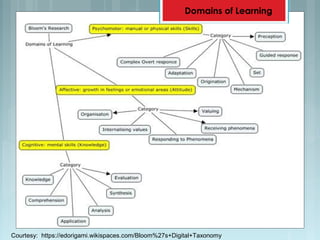
Domains of Learning
Courtesy: https://edorigami.wikispaces.com/Bloom%27s+Digital+Taxonomy
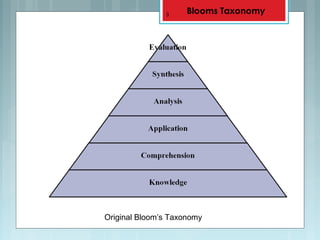
Blooms Taxonomy
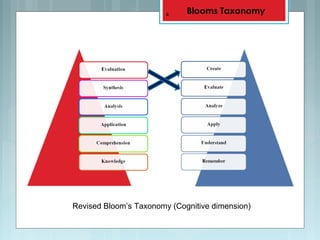
Original Bloom’s Taxonomy
3
Revised Bloom’s Taxonomy (Cognitive dimension)
4 Blooms Taxonomy
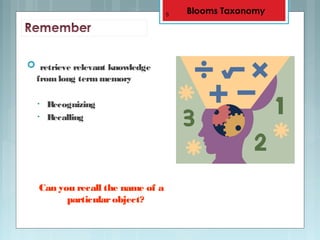
 retrieve relevant knowledge
fromlong termmemory
• Recognizing
• Recalling
Can you recall the name of a
particularobject?
5 Blooms Taxonomy
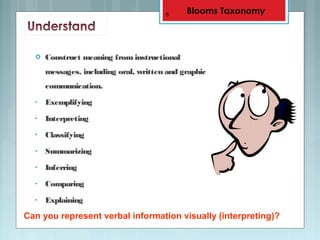
 Construct meaning from instructional
messages, including oral, written and graphic
communication.
• Exemplifying
• Interpreting
• Classifying
• Summarizing
• Inferring
• Comparing
• Explaining
6
Can you represent verbal information visually (interpreting)?
Blooms Taxonomy
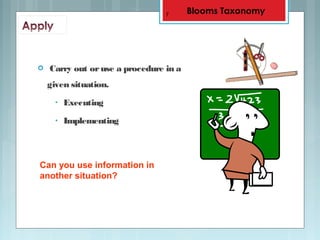
  Carry out oruse a procedure in a
given situation.
• Executing
• Implementing
7
Can you use information in
another situation?
Blooms Taxonomy
 Breakmaterial into its constituent
parts and determine how the parts
relate to one anotherand to an overall
structure orpurpose.
• Differentiating
• Organizing
• Attributing
8
Can you break information into
parts to explore relationships?
Blooms Taxonomy
 make judgments based on
criteria and standards
• Checking
• Critiquing
9
Can you make & justify a
decision or course of action?
Blooms Taxonomy
 Put elements togetherto forma coherent
orfunctional whole; reorganize elements
into a new pattern orstructure
• Generating
• Planning
• Producing
10
Can you generate new products,
ideas, or ways of viewing things?
Blooms Taxonomy
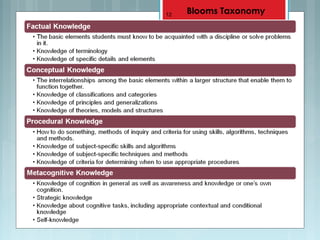
• Factual Knowledge
• Conceptual Knowledge
• Procedural Knowledge
• Metacognitive Knowledge
Revised Bloom’s Taxonomy (Knowledge dimension)
11 Blooms Taxonomy
12 Blooms Taxonomy
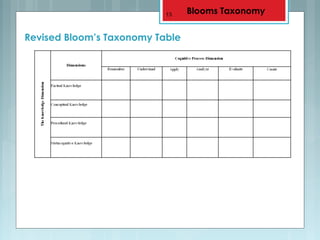
Revised Bloom’s Taxonomy Table
13 Blooms Taxonomy
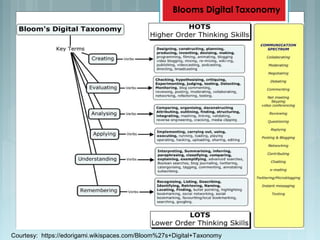
Blooms Digital Taxonomy
Courtesy: https://edorigami.wikispaces.com/Bloom%27s+Digital+Taxonomy

1 revised blooms taxanomy

  • 1.
  • 2.
    Domains of Learning Courtesy:https://edorigami.wikispaces.com/Bloom%27s+Digital+Taxonomy
  • 3.
  • 4.
    Revised Bloom’s Taxonomy(Cognitive dimension) 4 Blooms Taxonomy
  • 5.
     retrieve relevantknowledge fromlong termmemory • Recognizing • Recalling Can you recall the name of a particularobject? 5 Blooms Taxonomy
  • 6.
     Construct meaningfrom instructional messages, including oral, written and graphic communication. • Exemplifying • Interpreting • Classifying • Summarizing • Inferring • Comparing • Explaining 6 Can you represent verbal information visually (interpreting)? Blooms Taxonomy
  • 7.
      Carry outoruse a procedure in a given situation. • Executing • Implementing 7 Can you use information in another situation? Blooms Taxonomy
  • 8.
     Breakmaterial intoits constituent parts and determine how the parts relate to one anotherand to an overall structure orpurpose. • Differentiating • Organizing • Attributing 8 Can you break information into parts to explore relationships? Blooms Taxonomy
  • 9.
     make judgmentsbased on criteria and standards • Checking • Critiquing 9 Can you make & justify a decision or course of action? Blooms Taxonomy
  • 10.
     Put elementstogetherto forma coherent orfunctional whole; reorganize elements into a new pattern orstructure • Generating • Planning • Producing 10 Can you generate new products, ideas, or ways of viewing things? Blooms Taxonomy
  • 11.
    • Factual Knowledge •Conceptual Knowledge • Procedural Knowledge • Metacognitive Knowledge Revised Bloom’s Taxonomy (Knowledge dimension) 11 Blooms Taxonomy
  • 12.
  • 13.
    Revised Bloom’s TaxonomyTable 13 Blooms Taxonomy
  • 14.
    Blooms Digital Taxonomy Courtesy:https://edorigami.wikispaces.com/Bloom%27s+Digital+Taxonomy

Editor's Notes

  • #4 HISTORY – The Original Bloom’s Taxonomy Taxonomy of Cognitive Objectives: Handbook I, The Cognitive Domain 1950s - developed by Benjamin Bloom and fellow university examiners (about 50 people) The name “Bloom’s Taxonomy” came from the senior editor -- being Benjamin Bloom Means of expressing qualitatively different kinds of intellectual skills and abilities Was adapted for classroom use as a planning tool Provides a way to organize thinking skills into six levels, from the most basic to the more complex levels of thinking Was hypothesized to be a cumulative hierarchy; that is, each lower level was believed necessary to move to the next level
  • #5 Changes were based on 50+ years of history of using original Taxonomy and research on learning conducted by cognitive psychologists There are eight authors of the revised Taxonomy; the two editors were Lorin Anderson and David Krathwohl (who was one of the editors of the original Taxonomy) The names of six major categories were changed from noun to verb forms. The word knowledge was inappropriate to describe a category of thinking and was replaced with the word remember instead. Comprehension and synthesis were retitled to understand and create respectively, in order to better reflect the nature of the thinking defined in each category. Create was moved to the highest, that is, most complex, category The revised Taxonomy is not a cumulative hierachy
  • #12 There are four types of knowledge.
  • #13 Explain the knowledge dimensions