WELCOME
Alternative Assessment Technique- RUBRICS
 L – rubric
 The traditional meaning stem from ‘a heading on a
document’
 In the new sense – a scoring rubric is a set of criteria and
standards typically linked to learning objectives
 It is used to assess or communicate about
 Product
 Performance
 Process tasks
Advantages of Rubrics in
General
Forces the teacher to clarify criteria in detail
Useful feedback for the effectiveness of instruction
Motivates students to reach the standards specified
Narrows the gap between instruction and assessment
Potential to be transferred into grades if necessary
Giving the child more control of their own learning process
Disadvantages
Restricts the students mind power
If the criteria that is in the rubrics is too complex, students
may feel overwhelmed with the assignment, and little success
may be imminent
Time consuming
Rubrics
Holistic
vs
analytic
General
vs
specific
Holistic R provide a single score based on an
overall impression of students performance
on a task
Advantages : quick scoring, provide
overview of students achievements
Disadvantages : doesn’t provide detailed
information, may be difficult to provide one
overall score
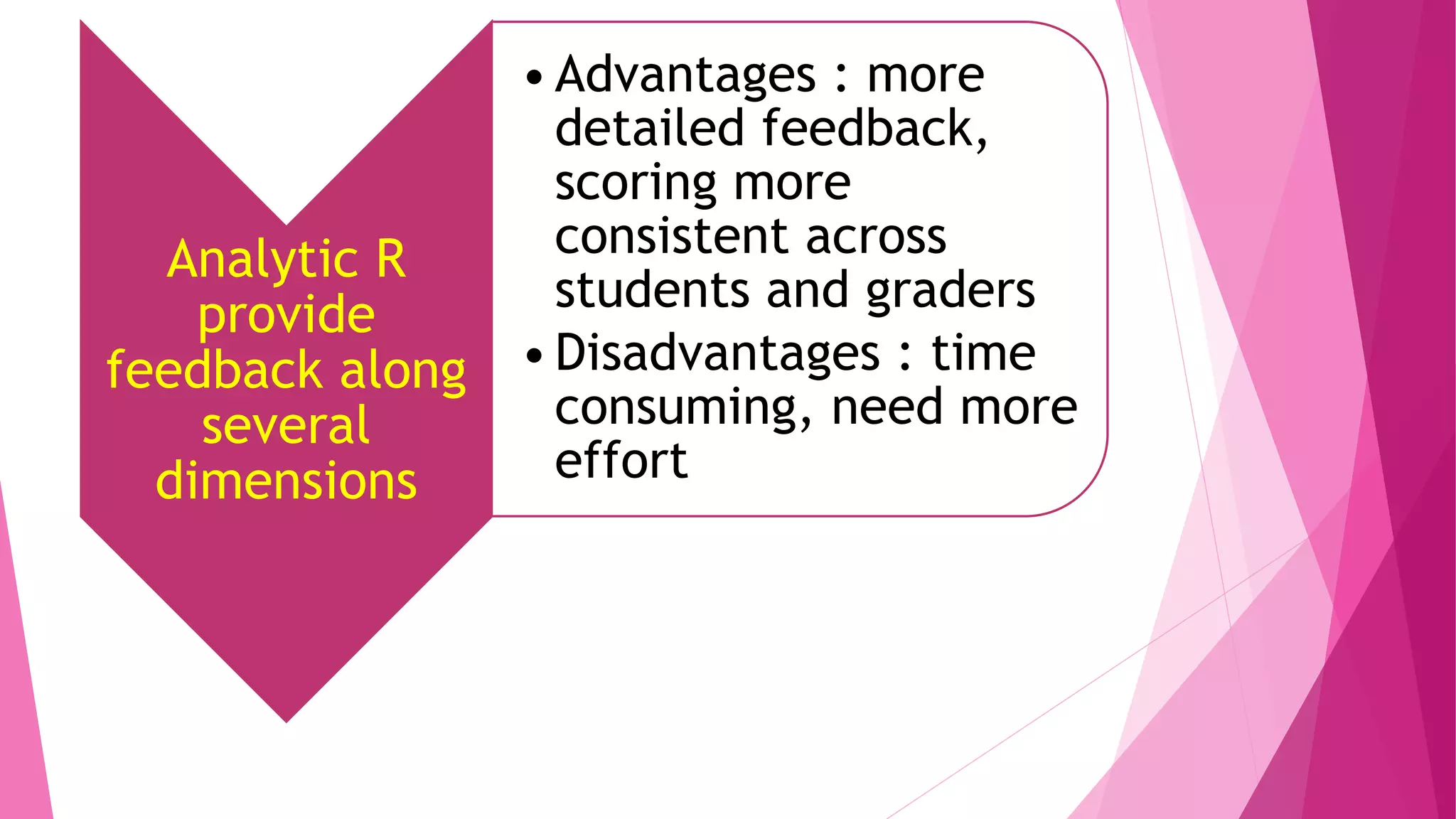
Analytic R
provide
feedback along
several
dimensions
•Advantages : more
detailed feedback,
scoring more
consistent across
students and graders
•Disadvantages : time
consuming, need more
effort
General R
Contain
criteria that
are general
across tasks
Advantages
Can use the
same R across
different tasks
Disadvantages
Feedback may
not be
specific
enough
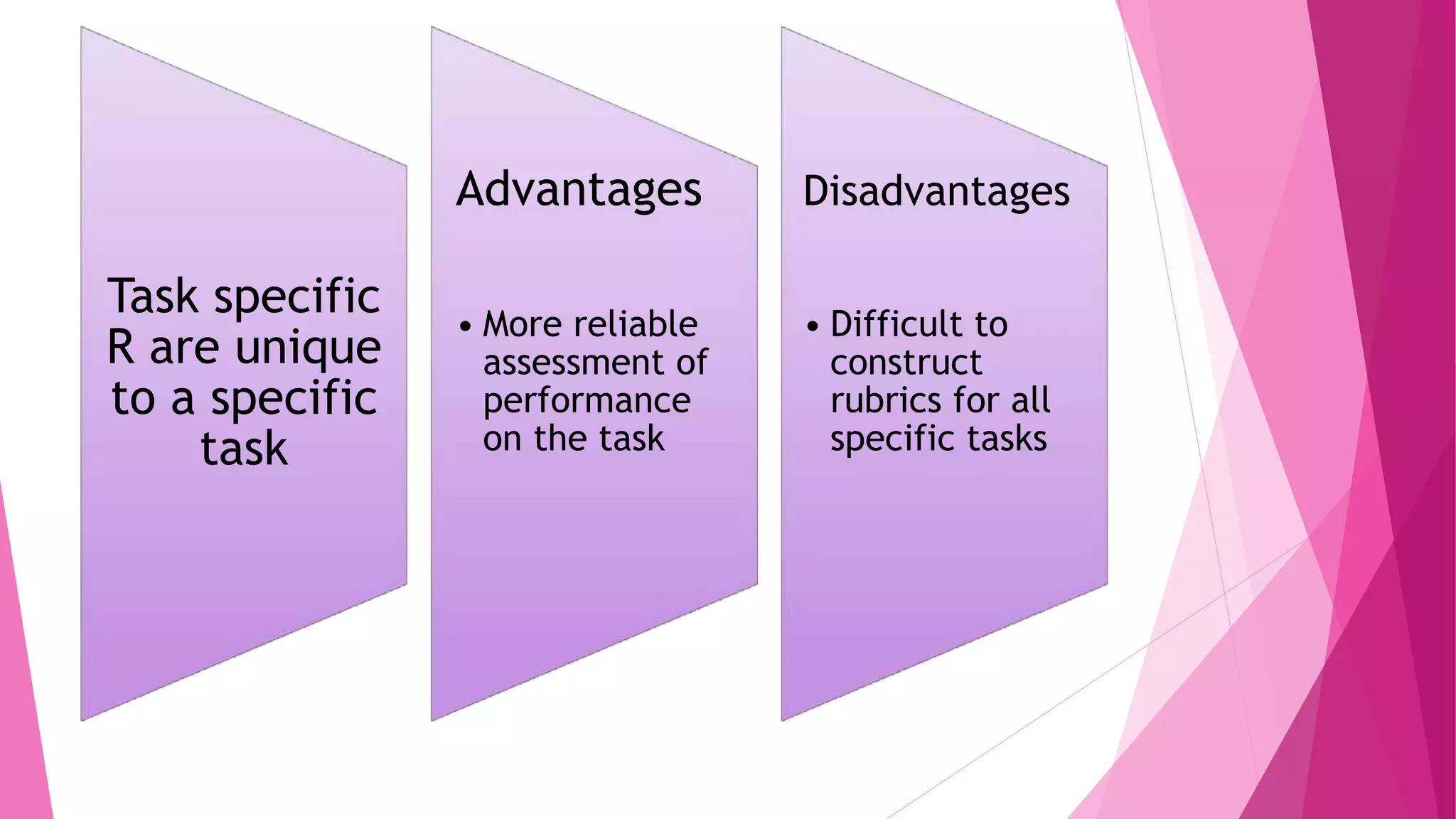
Task specific
R are unique
to a specific
task
Advantages
• More reliable
assessment of
performance
on the task
Disadvantages
• Difficult to
construct
rubrics for all
specific tasks
What type of rubric
works for your purposes?
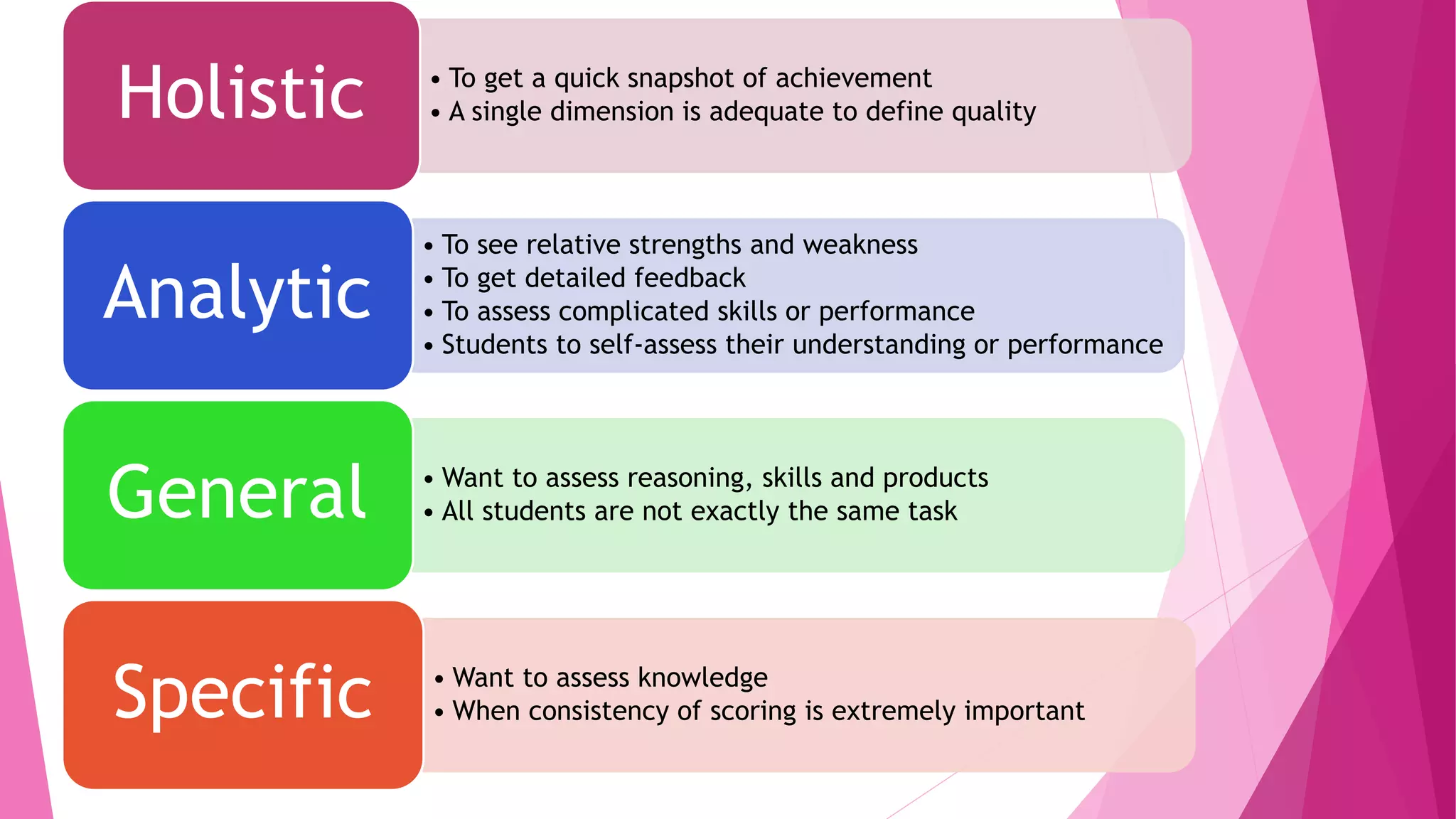
• To get a quick snapshot of achievement
• A single dimension is adequate to define qualityHolistic
• To see relative strengths and weakness
• To get detailed feedback
• To assess complicated skills or performance
• Students to self-assess their understanding or performance
Analytic
• Want to assess reasoning, skills and products
• All students are not exactly the same taskGeneral
• Want to assess knowledge
• When consistency of scoring is extremely importantSpecific
How do Rubrics enhance student learning?
 When students are made aware of the
rubrics prior to instruction and assessment,
they know the level of performance
expected and they are more motivated to
reach those standards
 When they are involved in rubric
construction, the assessment itself
becomes more meaningful to students
Using rubrics for assessment…
 Share it with students before they complete the
assignment. This will help them understand the
performance standards
 Use R for summative and formative evaluation
 R can provide both a grade ( summative) and
detailed feedback to improve future performance
(formative)
 Use R to promote student self-assessment of their
own learning and performance
Alternative assessment technique  rubrics

Alternative assessment technique rubrics

  • 1.
  • 2.
  • 3.
     L –rubric  The traditional meaning stem from ‘a heading on a document’  In the new sense – a scoring rubric is a set of criteria and standards typically linked to learning objectives  It is used to assess or communicate about  Product  Performance  Process tasks
  • 11.
    Advantages of Rubricsin General Forces the teacher to clarify criteria in detail Useful feedback for the effectiveness of instruction Motivates students to reach the standards specified Narrows the gap between instruction and assessment Potential to be transferred into grades if necessary Giving the child more control of their own learning process
  • 13.
    Disadvantages Restricts the studentsmind power If the criteria that is in the rubrics is too complex, students may feel overwhelmed with the assignment, and little success may be imminent Time consuming
  • 15.
  • 16.
    Holistic R providea single score based on an overall impression of students performance on a task Advantages : quick scoring, provide overview of students achievements Disadvantages : doesn’t provide detailed information, may be difficult to provide one overall score
  • 17.
    Analytic R provide feedback along several dimensions •Advantages: more detailed feedback, scoring more consistent across students and graders •Disadvantages : time consuming, need more effort
  • 18.
    General R Contain criteria that aregeneral across tasks Advantages Can use the same R across different tasks Disadvantages Feedback may not be specific enough
  • 19.
    Task specific R areunique to a specific task Advantages • More reliable assessment of performance on the task Disadvantages • Difficult to construct rubrics for all specific tasks
  • 20.
    What type ofrubric works for your purposes?
  • 21.
    • To geta quick snapshot of achievement • A single dimension is adequate to define qualityHolistic • To see relative strengths and weakness • To get detailed feedback • To assess complicated skills or performance • Students to self-assess their understanding or performance Analytic • Want to assess reasoning, skills and products • All students are not exactly the same taskGeneral • Want to assess knowledge • When consistency of scoring is extremely importantSpecific
  • 22.
    How do Rubricsenhance student learning?  When students are made aware of the rubrics prior to instruction and assessment, they know the level of performance expected and they are more motivated to reach those standards  When they are involved in rubric construction, the assessment itself becomes more meaningful to students
  • 23.
    Using rubrics forassessment…  Share it with students before they complete the assignment. This will help them understand the performance standards  Use R for summative and formative evaluation  R can provide both a grade ( summative) and detailed feedback to improve future performance (formative)  Use R to promote student self-assessment of their own learning and performance