THE REVISED BLOOM'S
TAXONOMY OF
EDUCATIONAL
OBJECTIVES
Reporters:
Carpe, Mariane
Castro, Jozyl
Content:
• Old and Revised Taxonomy, similarities and
differences
• Different levels of Bloom's Taxonomy
• Objectives reflecting the levels of taxonomy
• Practical guide in using the taxonomy
• Uses of the revised taxonomy
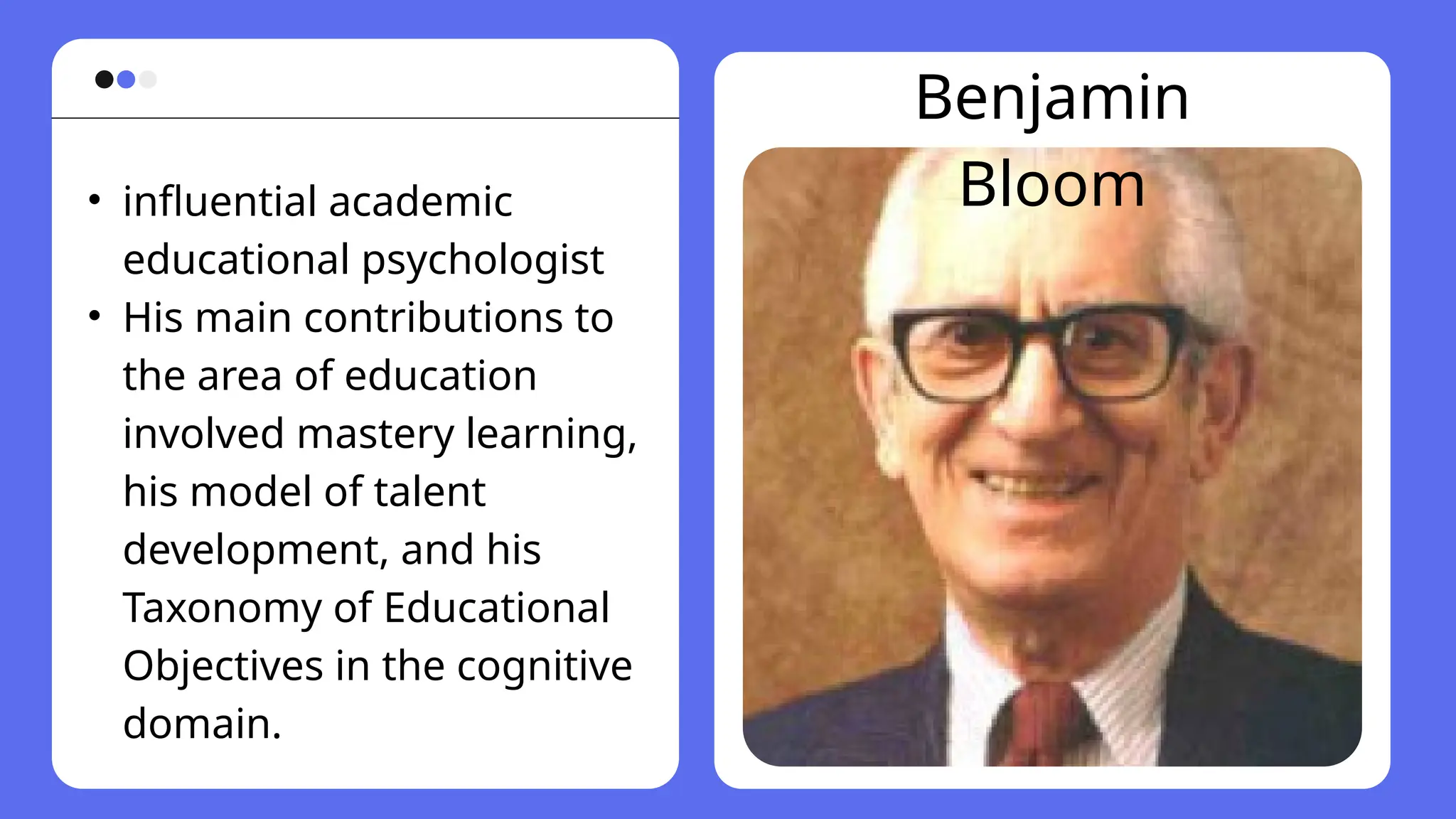
Benjamin
Bloom
• influential academic
educational psychologist
• His main contributions to
the area of education
involved mastery learning,
his model of talent
development, and his
Taxonomy of Educational
Objectives in the cognitive
domain.
What is Bloom's
Taxonomy?
• comprises three learning domains: the
cognitive, affective, and psychomotor, and
assigns to each of these domains a
hierarchy that corresponds to different
levels of learning.
OLD TAXONOMY
• Bloom's taxonomy was a model that described the different levels
of learning outcomes that target what skills and competencies the
teachers aim to develop in the learners. The taxonomy in the
cognitive domain contains the levels from knowledge to
evaluation. The six levels progress from simple to more complex
levels of thinking, the last three being referred to as "higher-order
thinking skills".
• To facilitate learning we begin teaching with facts, stating
memorized rules, principles or definitions (knowledge), which must
lead to understanding concepts, rules and principles
(comprehension).
OLD TAXONOMY
• A proof of comprehension of the concepts and principles is using them in
real-life situations (application). For an in-depth understanding and mastery
of these applied concepts, rules, and principles these are broken down into
parts (analysis). Students may compare, contrast, classify, further investigate,
etc.
• A still higher level of thinking is when students put together elements of what
has been learned in a new way (synthesis). They come up with a holistic,
complete, more integrated, or even a new view or perspective of what was
learned.
• With a full grasp of what was learned, the students can now assess or judge,
based on a set of standards on what they have learned (evaluation).
Lorin Anderson
and David
Krathwohl
• One of those educators was Lorin
Anderson, a former student of
Benjamin Bloom.
• in (2001) revised Bloom's
taxonomy to be more adaptive to
our current age by proposing
another taxonomy that will meet
curriculum designers, teachers,
and students needs better than
the Bloom's one.
REVISED TAXONOMY
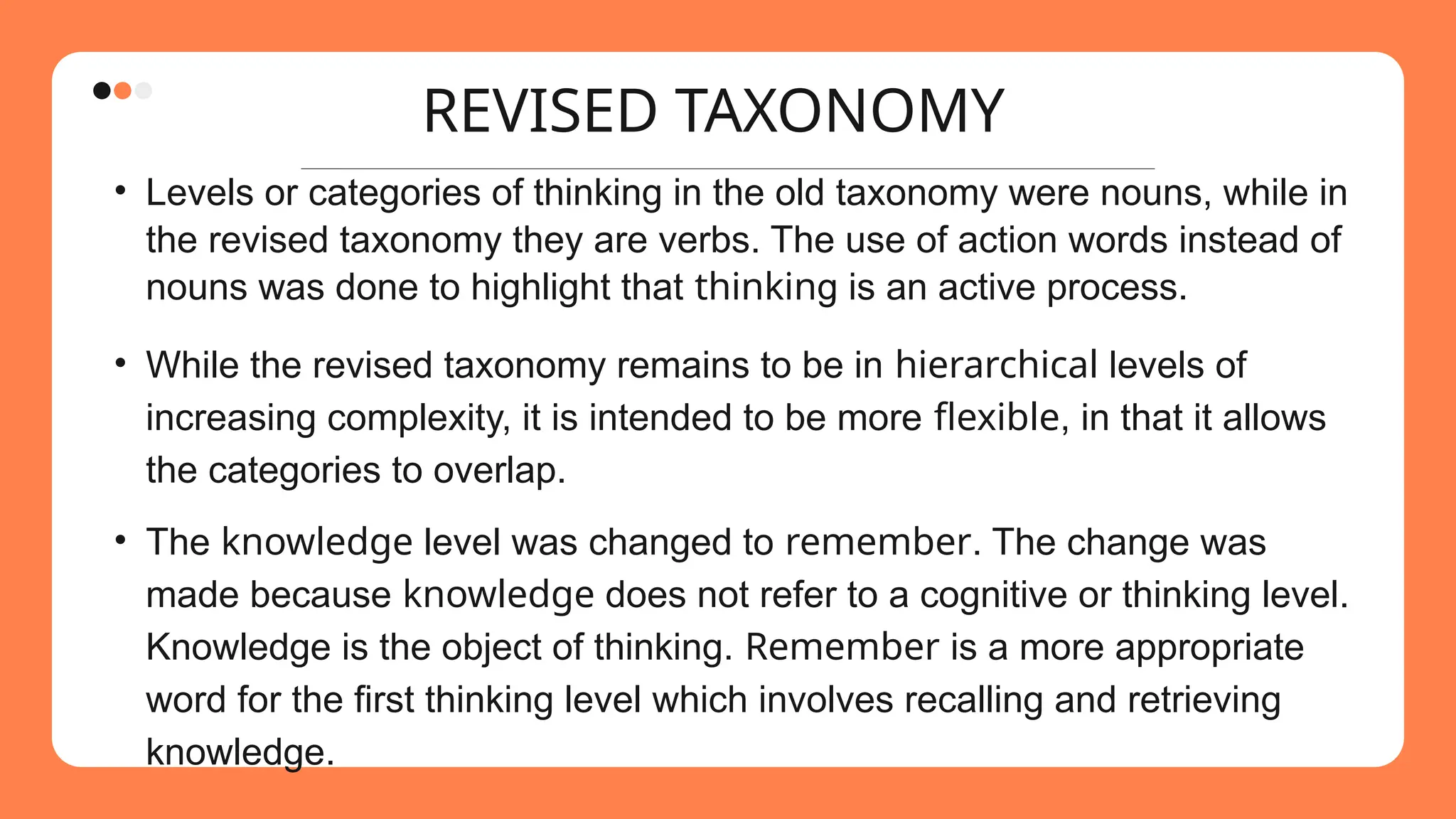
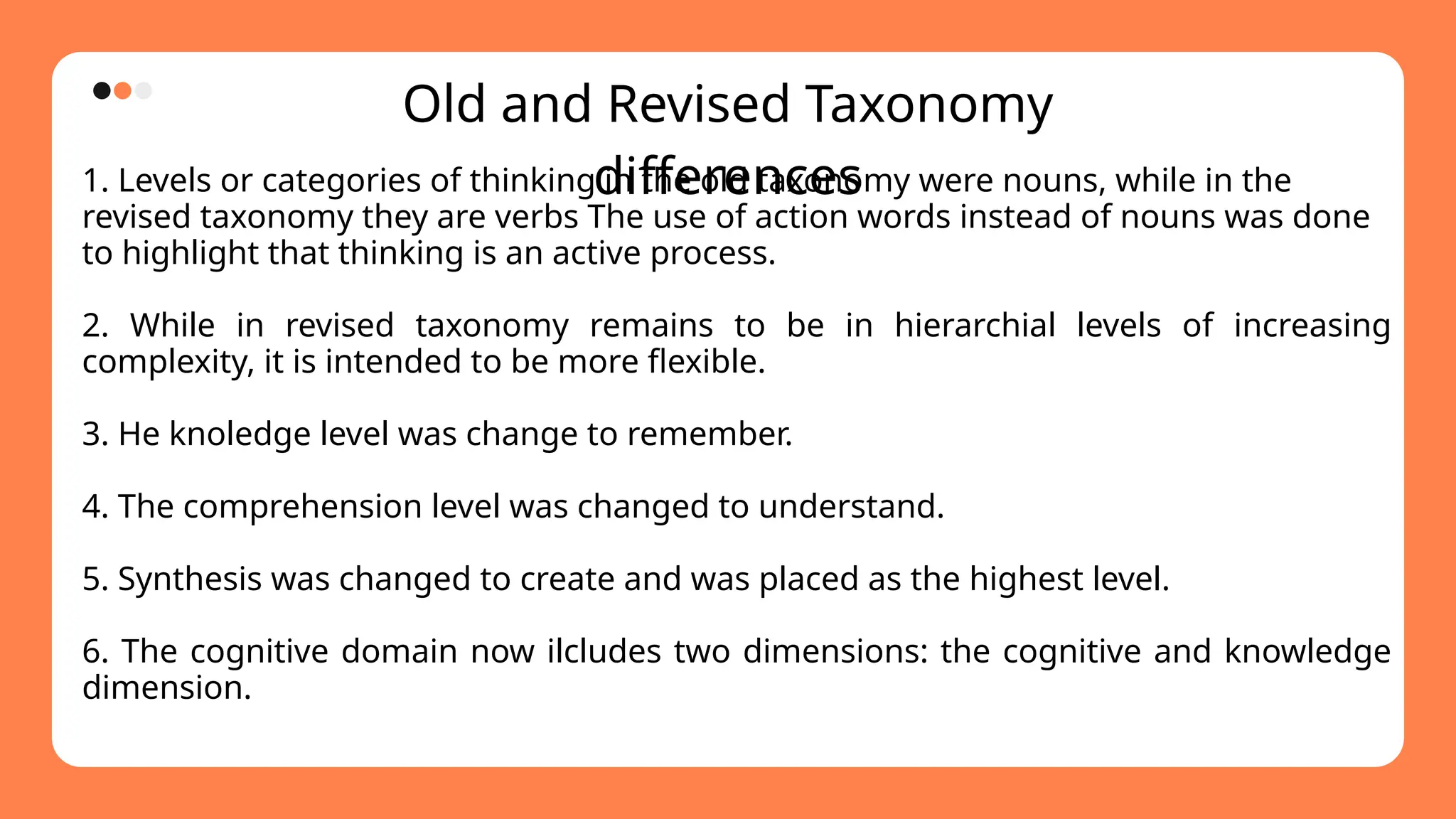
• Levels or categories of thinking in the old taxonomy were nouns, while in
the revised taxonomy they are verbs. The use of action words instead of
nouns was done to highlight that thinking is an active process.
• While the revised taxonomy remains to be in hierarchical levels of
increasing complexity, it is intended to be more flexible, in that it allows
the categories to overlap.
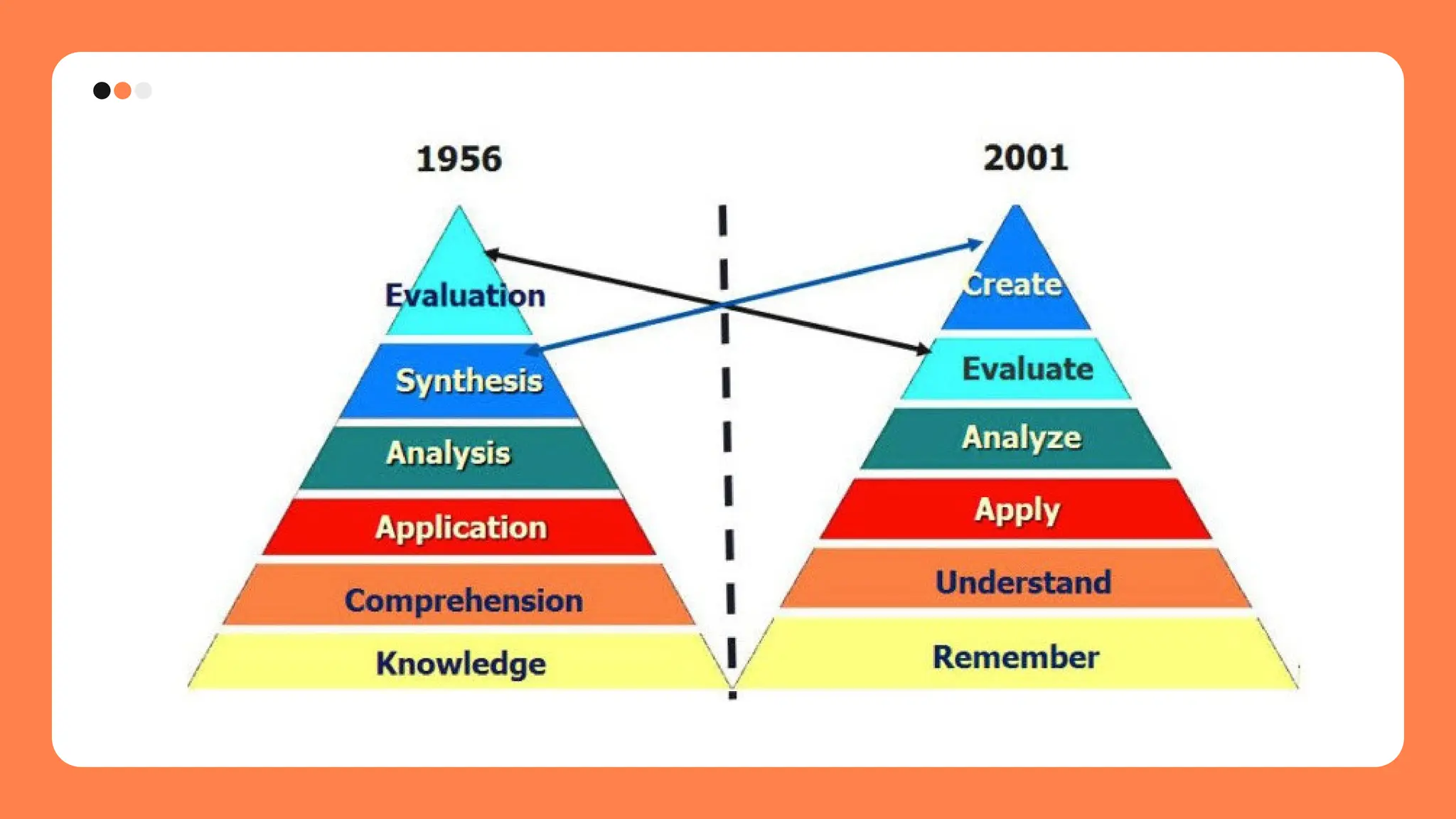
• The knowledge level was changed to remember. The change was
made because knowledge does not refer to a cognitive or thinking level.
Knowledge is the object of thinking. Remember is a more appropriate
word for the first thinking level which involves recalling and retrieving
knowledge.
REVISED TAXONOMY
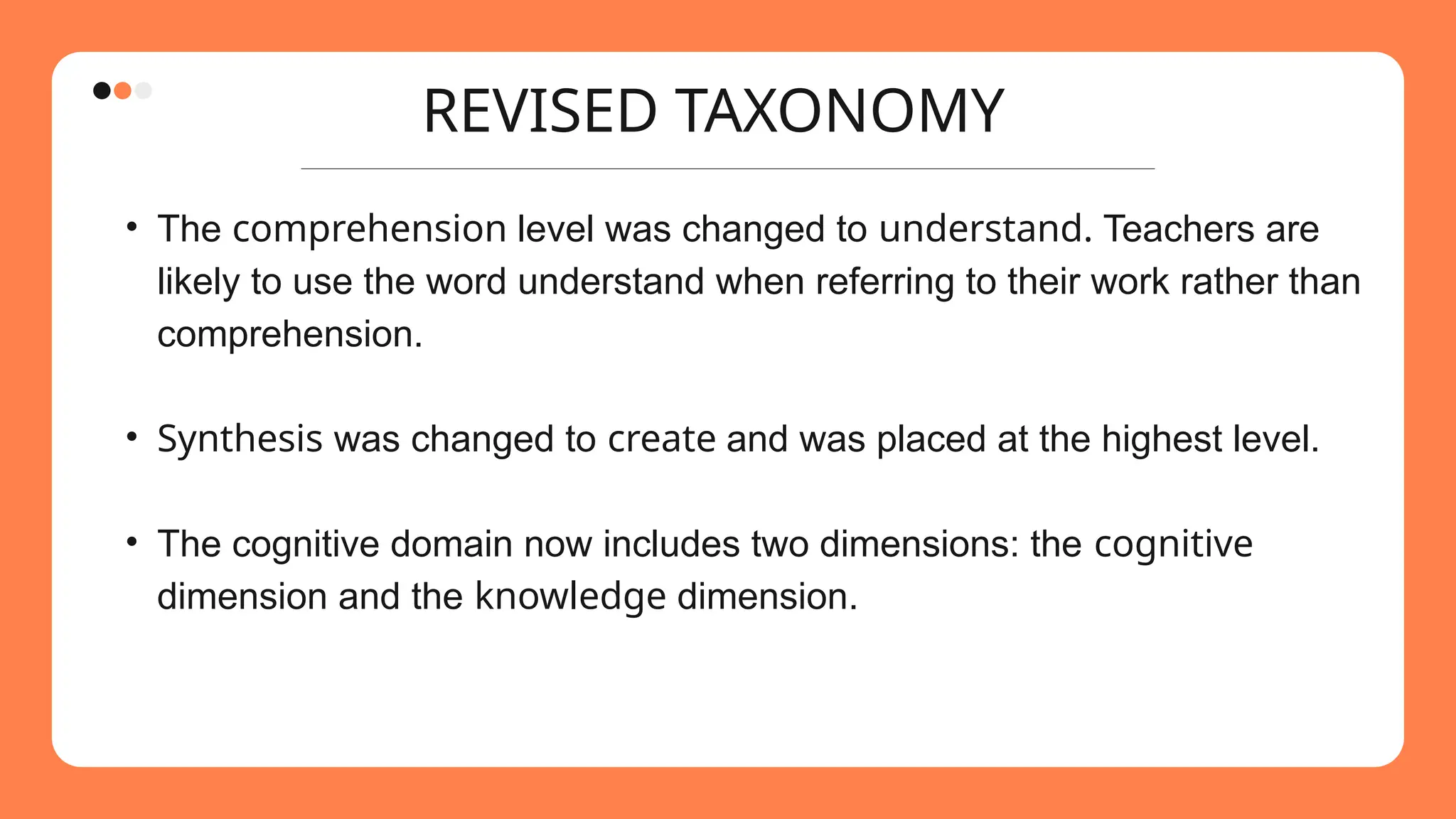
• The comprehension level was changed to understand. Teachers are
likely to use the word understand when referring to their work rather than
comprehension.
• Synthesis was changed to create and was placed at the highest level.
• The cognitive domain now includes two dimensions: the cognitive
dimension and the knowledge dimension.
Old and Revised Taxonomy
differences
1. Levels or categories of thinking in the old taxonomy were nouns, while in the
revised taxonomy they are verbs The use of action words instead of nouns was done
to highlight that thinking is an active process.
2. While in revised taxonomy remains to be in hierarchial levels of increasing
complexity, it is intended to be more flexible.
3. He knoledge level was change to remember.
4. The comprehension level was changed to understand.
5. Synthesis was changed to create and was placed as the highest level.
6. The cognitive domain now ilcludes two dimensions: the cognitive and knowledge
dimension.
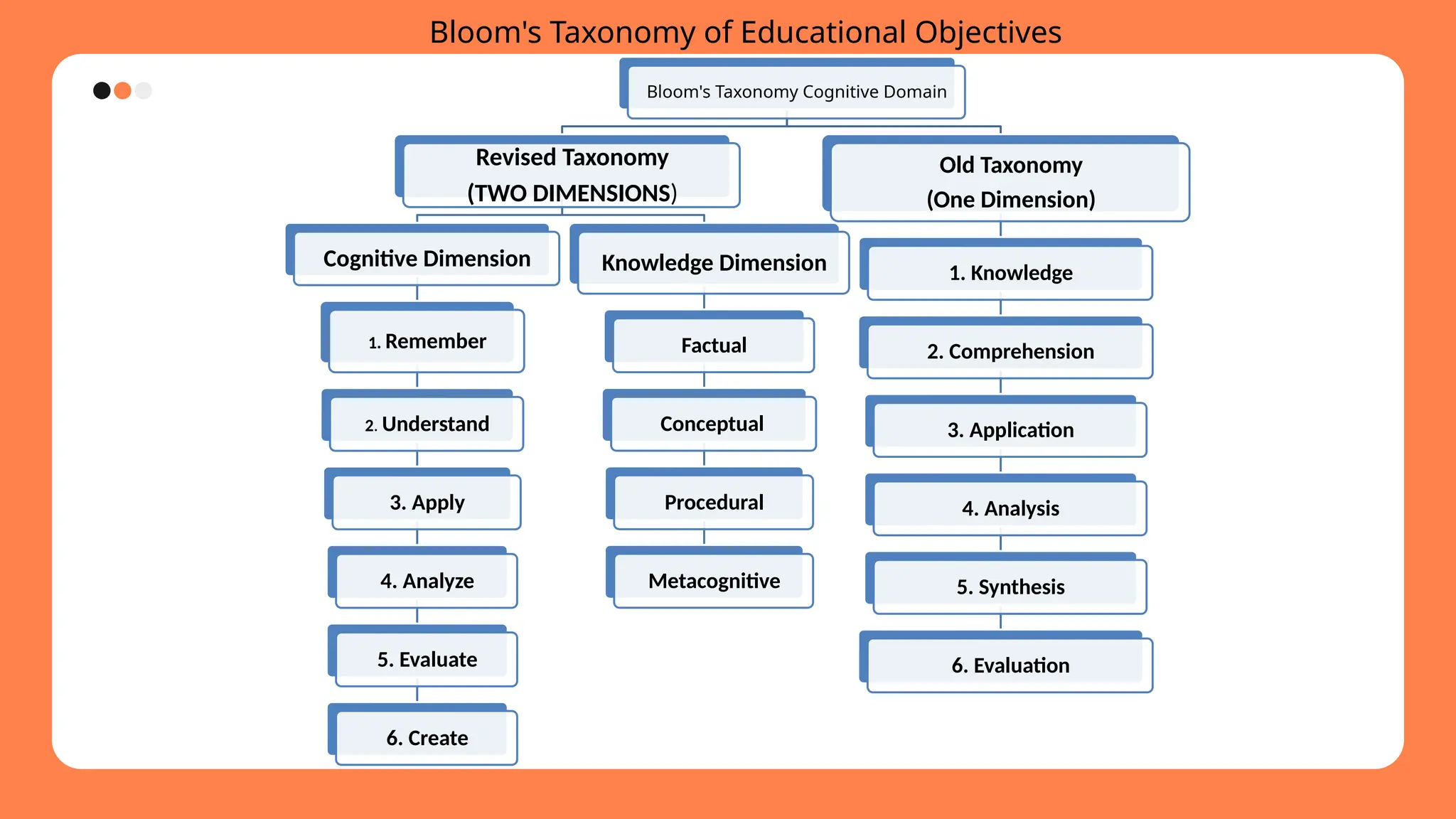
Bloom's Taxonomy of Educational Objectives
Bloom's Taxonomy Cognitive Domain
Revised Taxonomy
(TWO DIMENSIONS)
Cognitive Dimension
1. Remember
2. Understand
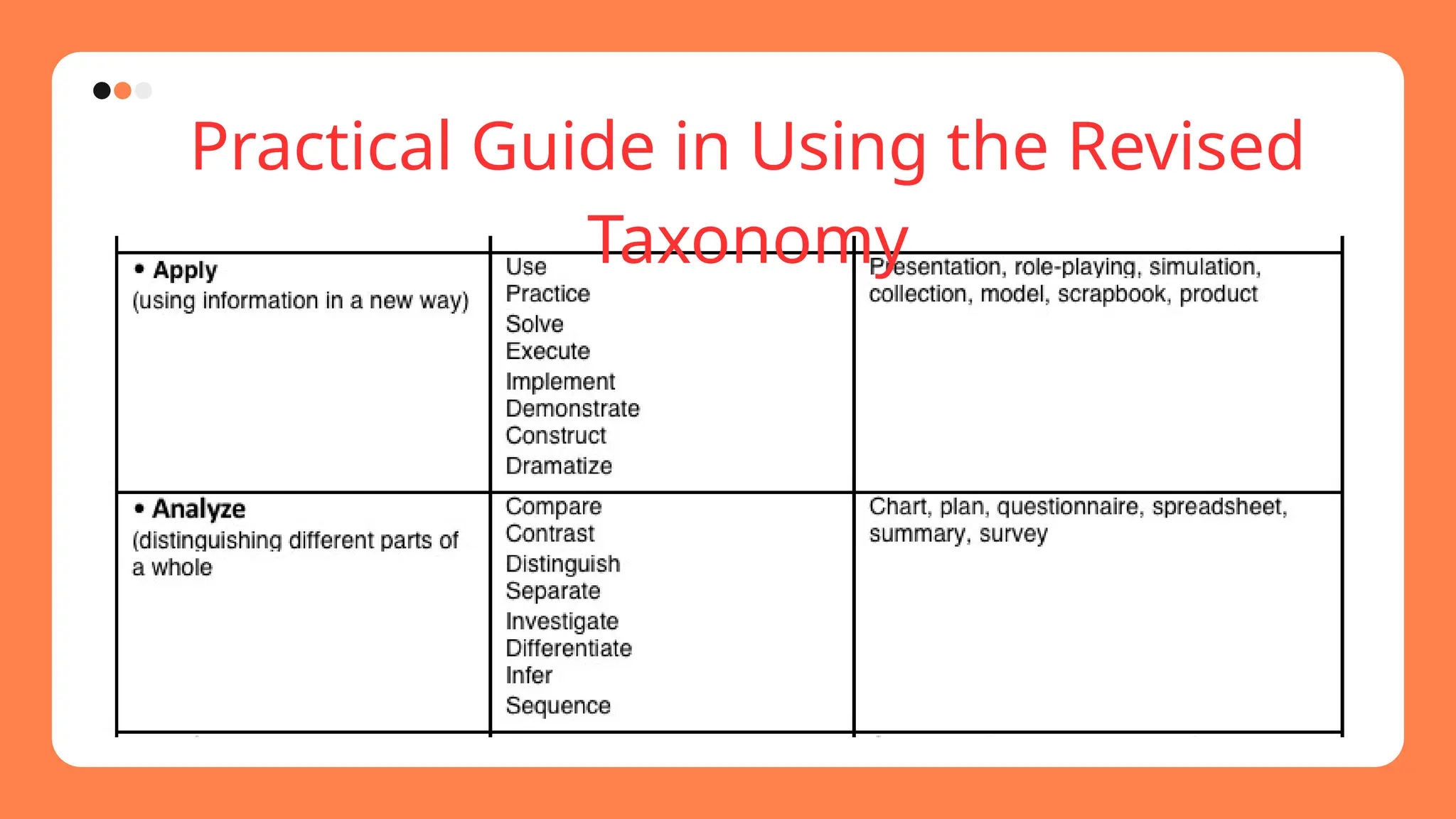
3. Apply
4. Analyze
5. Evaluate
6. Create
Knowledge Dimension
Factual
Conceptual
Procedural
Metacognitive
Old Taxonomy
(One Dimension)
1. Knowledge
2. Comprehension
3. Application
4. Analysis
5. Synthesis
6. Evaluation
The Revised Taxonomy with Dimensions of the
Cognitive Domain ( Krathwohl, 2002)
The Cognitive
Dimension
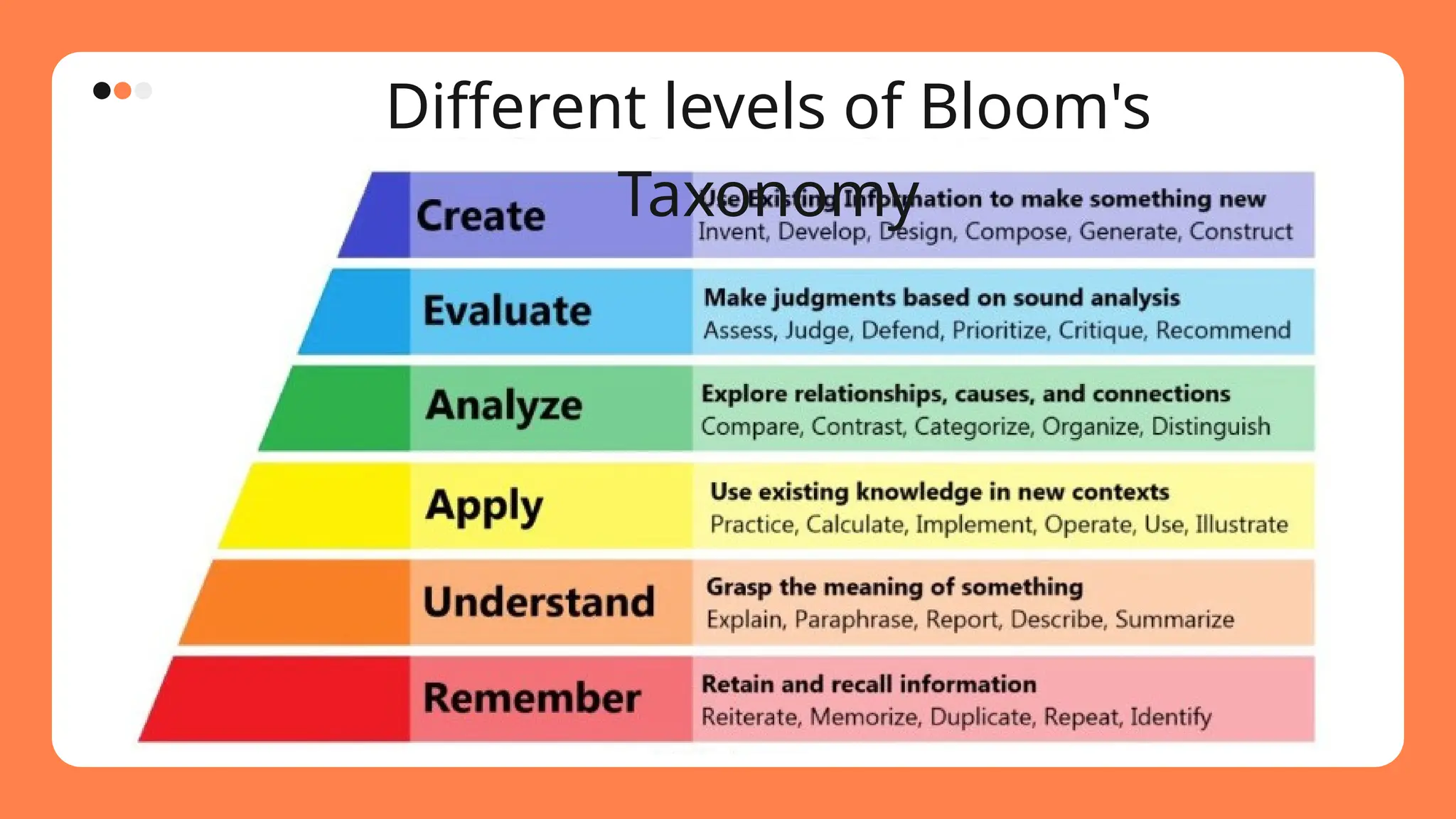
1. Remember
• Retrieving relevant knowledge from long term memory
2. Understand
• Determining the meaning of instructional messages,
including oral, written and graphic communication.
3. Apply
• Carrying out or using a procedure in a given situation.
The Revised Taxonomy with Dimensions of the
Cognitive Domain ( Krathwohl, 2002)
The Cognitive
Dimension
4. Analyze
• Breaking materials into its constituents parts and detecting how the
parts relate to one another and to an overall structure or purpose.
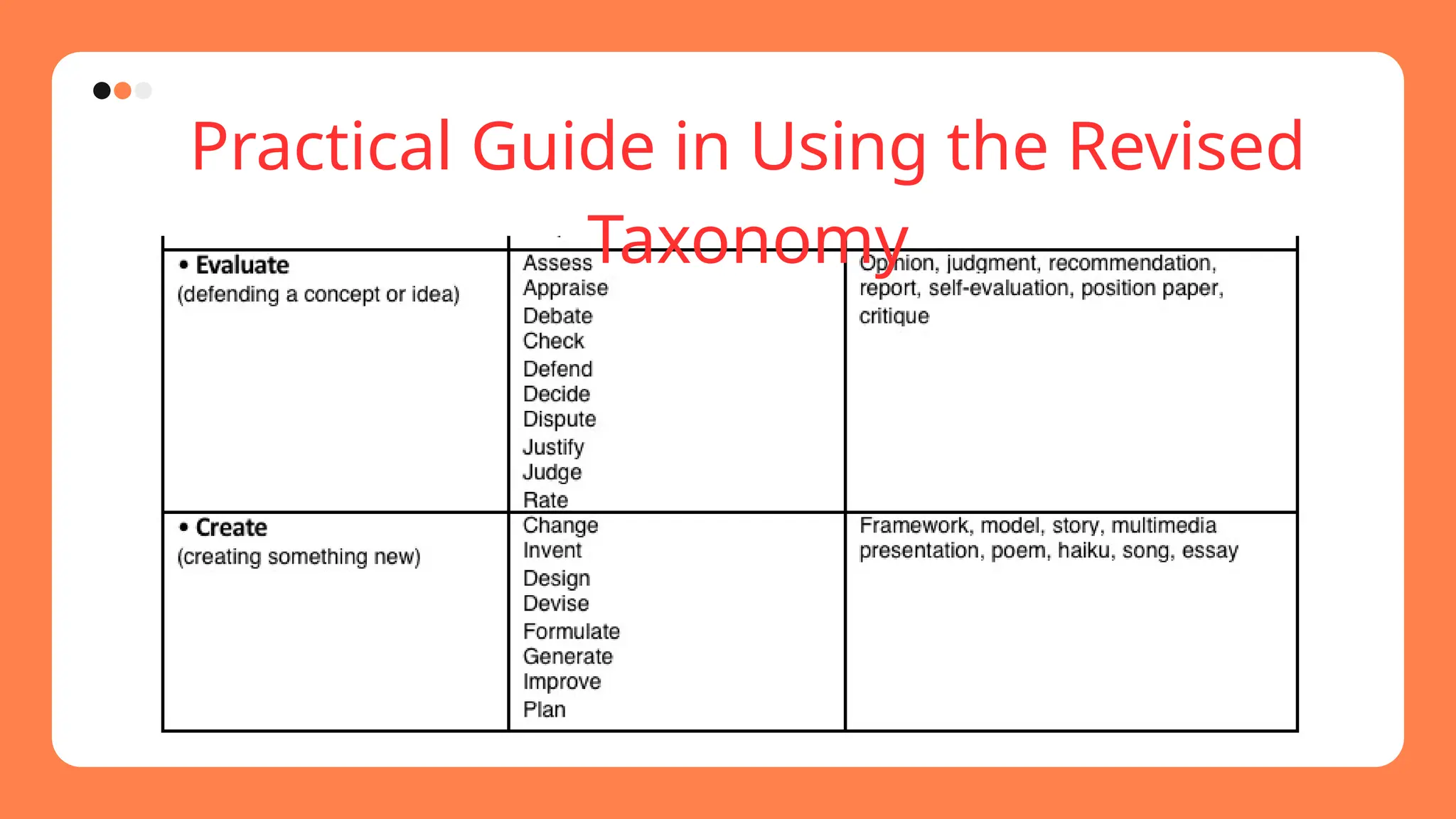
5. Evaluate
• Making judgments based on the criteria and standards.
6. Create
• Putting elements together to form a novel, coherent whole or make
an original product.
The Revised Taxonomy with Dimensions of the
Cognitive Domain ( Krathwohl, 2002)
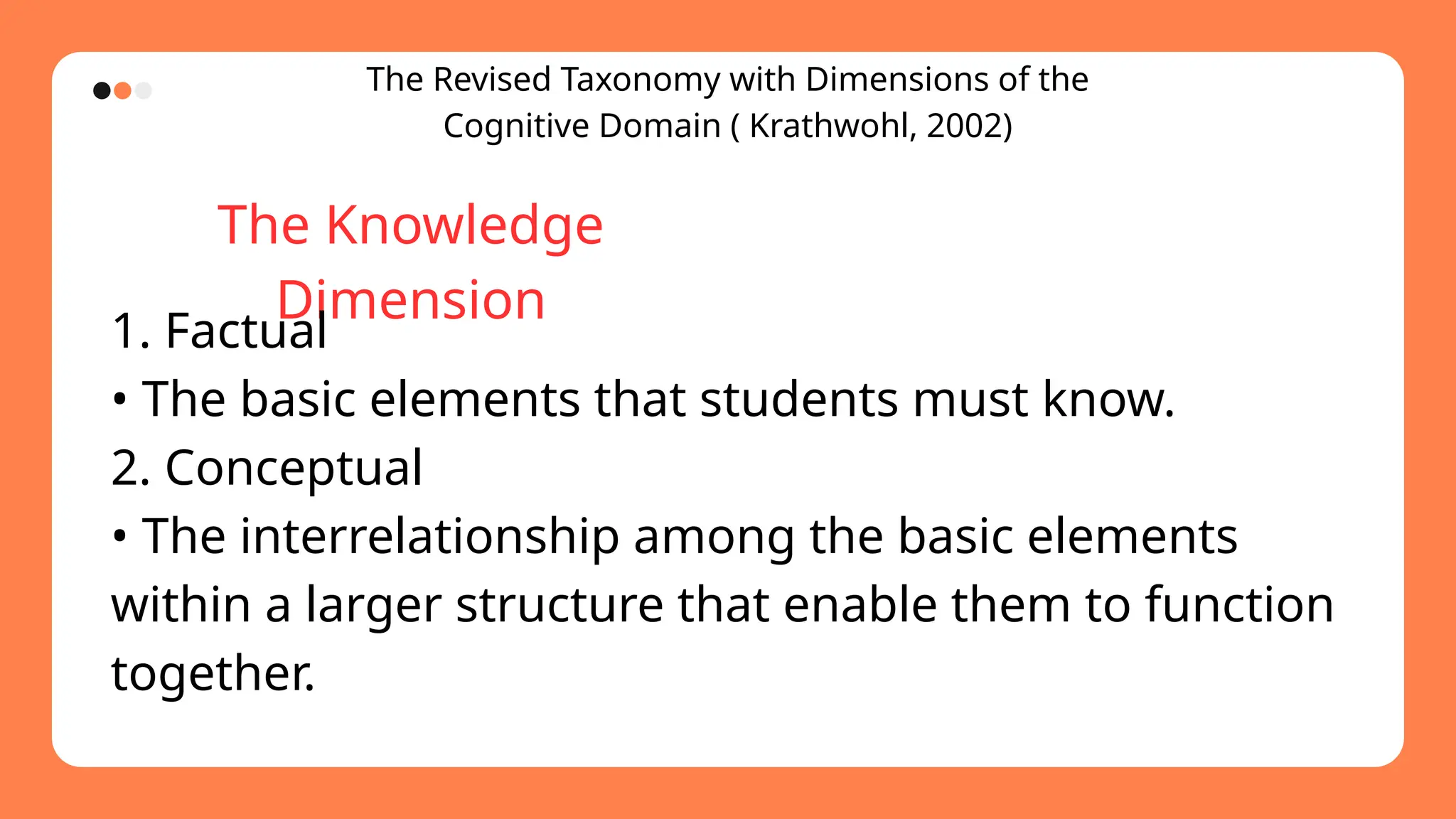
The Knowledge
Dimension
1. Factual
• The basic elements that students must know.
2. Conceptual
• The interrelationship among the basic elements
within a larger structure that enable them to function
together.
The Revised Taxonomy with Dimensions of the
Cognitive Domain ( Krathwohl, 2002)
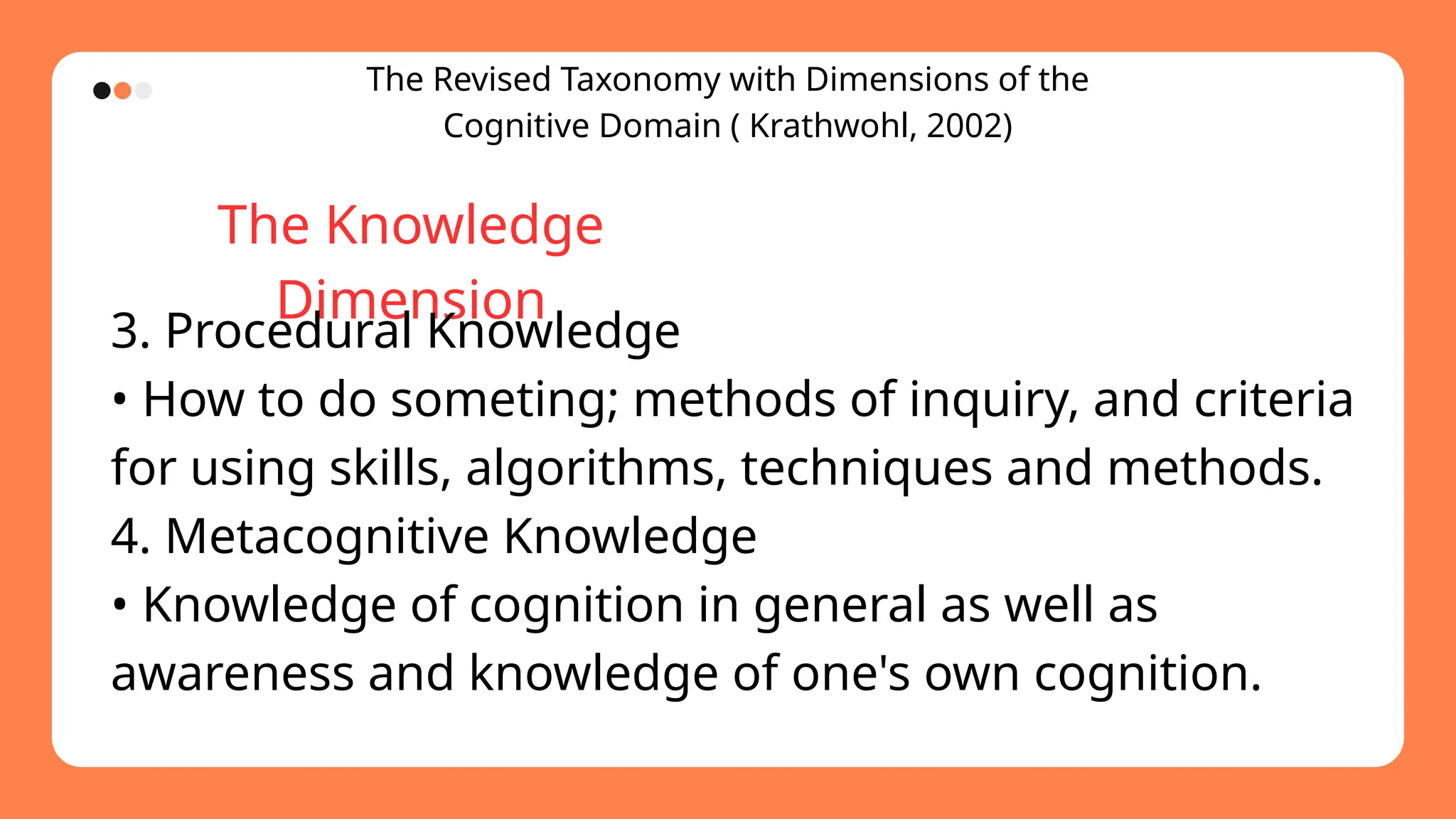
The Knowledge
Dimension
3. Procedural Knowledge
• How to do someting; methods of inquiry, and criteria
for using skills, algorithms, techniques and methods.
4. Metacognitive Knowledge
• Knowledge of cognition in general as well as
awareness and knowledge of one's own cognition.
Different levels of Bloom's
Taxonomy
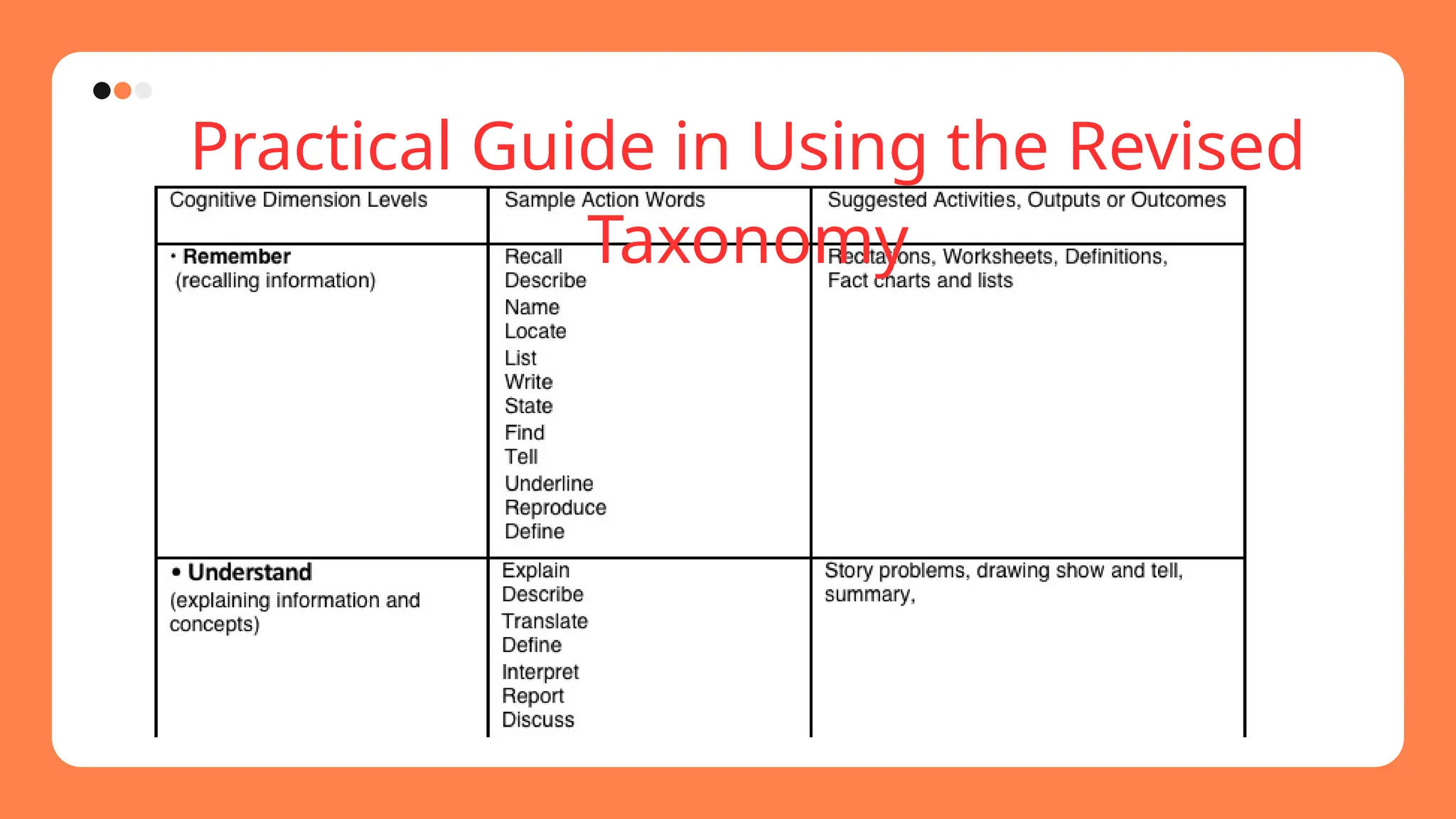
Practical Guide in Using the Revised
Taxonomy
Practical Guide in Using the Revised
Taxonomy
Practical Guide in Using the Revised
Taxonomy
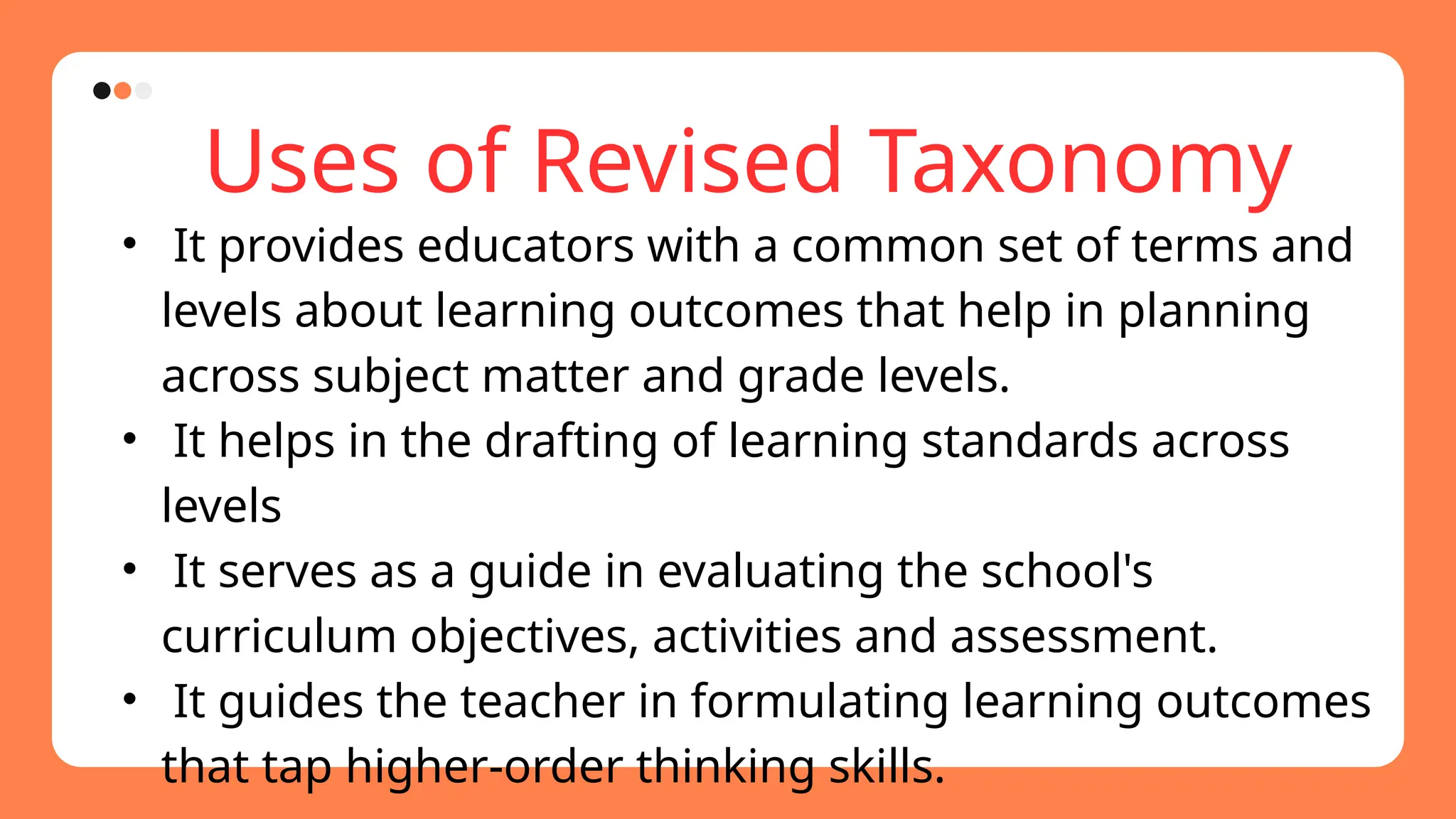
Uses of Revised Taxonomy
• It provides educators with a common set of terms and
levels about learning outcomes that help in planning
across subject matter and grade levels.
• It helps in the drafting of learning standards across
levels
• It serves as a guide in evaluating the school's
curriculum objectives, activities and assessment.
• It guides the teacher in formulating learning outcomes
that tap higher-order thinking skills.
THANK YOU!!

WEEK-16-BLOOMS-TAXONOMY that studies about the new revised bloom taxonomy

  • 1.
    THE REVISED BLOOM'S TAXONOMYOF EDUCATIONAL OBJECTIVES Reporters: Carpe, Mariane Castro, Jozyl
  • 2.
    Content: • Old andRevised Taxonomy, similarities and differences • Different levels of Bloom's Taxonomy • Objectives reflecting the levels of taxonomy • Practical guide in using the taxonomy • Uses of the revised taxonomy
  • 3.
    Benjamin Bloom • influential academic educationalpsychologist • His main contributions to the area of education involved mastery learning, his model of talent development, and his Taxonomy of Educational Objectives in the cognitive domain.
  • 4.
    What is Bloom's Taxonomy? •comprises three learning domains: the cognitive, affective, and psychomotor, and assigns to each of these domains a hierarchy that corresponds to different levels of learning.
  • 5.
    OLD TAXONOMY • Bloom'staxonomy was a model that described the different levels of learning outcomes that target what skills and competencies the teachers aim to develop in the learners. The taxonomy in the cognitive domain contains the levels from knowledge to evaluation. The six levels progress from simple to more complex levels of thinking, the last three being referred to as "higher-order thinking skills". • To facilitate learning we begin teaching with facts, stating memorized rules, principles or definitions (knowledge), which must lead to understanding concepts, rules and principles (comprehension).
  • 6.
    OLD TAXONOMY • Aproof of comprehension of the concepts and principles is using them in real-life situations (application). For an in-depth understanding and mastery of these applied concepts, rules, and principles these are broken down into parts (analysis). Students may compare, contrast, classify, further investigate, etc. • A still higher level of thinking is when students put together elements of what has been learned in a new way (synthesis). They come up with a holistic, complete, more integrated, or even a new view or perspective of what was learned. • With a full grasp of what was learned, the students can now assess or judge, based on a set of standards on what they have learned (evaluation).
  • 7.
    Lorin Anderson and David Krathwohl •One of those educators was Lorin Anderson, a former student of Benjamin Bloom. • in (2001) revised Bloom's taxonomy to be more adaptive to our current age by proposing another taxonomy that will meet curriculum designers, teachers, and students needs better than the Bloom's one.
  • 8.
    REVISED TAXONOMY • Levelsor categories of thinking in the old taxonomy were nouns, while in the revised taxonomy they are verbs. The use of action words instead of nouns was done to highlight that thinking is an active process. • While the revised taxonomy remains to be in hierarchical levels of increasing complexity, it is intended to be more flexible, in that it allows the categories to overlap. • The knowledge level was changed to remember. The change was made because knowledge does not refer to a cognitive or thinking level. Knowledge is the object of thinking. Remember is a more appropriate word for the first thinking level which involves recalling and retrieving knowledge.
  • 9.
    REVISED TAXONOMY • Thecomprehension level was changed to understand. Teachers are likely to use the word understand when referring to their work rather than comprehension. • Synthesis was changed to create and was placed at the highest level. • The cognitive domain now includes two dimensions: the cognitive dimension and the knowledge dimension.
  • 11.
    Old and RevisedTaxonomy differences 1. Levels or categories of thinking in the old taxonomy were nouns, while in the revised taxonomy they are verbs The use of action words instead of nouns was done to highlight that thinking is an active process. 2. While in revised taxonomy remains to be in hierarchial levels of increasing complexity, it is intended to be more flexible. 3. He knoledge level was change to remember. 4. The comprehension level was changed to understand. 5. Synthesis was changed to create and was placed as the highest level. 6. The cognitive domain now ilcludes two dimensions: the cognitive and knowledge dimension.
  • 12.
    Bloom's Taxonomy ofEducational Objectives Bloom's Taxonomy Cognitive Domain Revised Taxonomy (TWO DIMENSIONS) Cognitive Dimension 1. Remember 2. Understand 3. Apply 4. Analyze 5. Evaluate 6. Create Knowledge Dimension Factual Conceptual Procedural Metacognitive Old Taxonomy (One Dimension) 1. Knowledge 2. Comprehension 3. Application 4. Analysis 5. Synthesis 6. Evaluation
  • 13.
    The Revised Taxonomywith Dimensions of the Cognitive Domain ( Krathwohl, 2002) The Cognitive Dimension 1. Remember • Retrieving relevant knowledge from long term memory 2. Understand • Determining the meaning of instructional messages, including oral, written and graphic communication. 3. Apply • Carrying out or using a procedure in a given situation.
  • 14.
    The Revised Taxonomywith Dimensions of the Cognitive Domain ( Krathwohl, 2002) The Cognitive Dimension 4. Analyze • Breaking materials into its constituents parts and detecting how the parts relate to one another and to an overall structure or purpose. 5. Evaluate • Making judgments based on the criteria and standards. 6. Create • Putting elements together to form a novel, coherent whole or make an original product.
  • 15.
    The Revised Taxonomywith Dimensions of the Cognitive Domain ( Krathwohl, 2002) The Knowledge Dimension 1. Factual • The basic elements that students must know. 2. Conceptual • The interrelationship among the basic elements within a larger structure that enable them to function together.
  • 16.
    The Revised Taxonomywith Dimensions of the Cognitive Domain ( Krathwohl, 2002) The Knowledge Dimension 3. Procedural Knowledge • How to do someting; methods of inquiry, and criteria for using skills, algorithms, techniques and methods. 4. Metacognitive Knowledge • Knowledge of cognition in general as well as awareness and knowledge of one's own cognition.
  • 17.
    Different levels ofBloom's Taxonomy
  • 18.
    Practical Guide inUsing the Revised Taxonomy
  • 19.
    Practical Guide inUsing the Revised Taxonomy
  • 20.
    Practical Guide inUsing the Revised Taxonomy
  • 21.
    Uses of RevisedTaxonomy • It provides educators with a common set of terms and levels about learning outcomes that help in planning across subject matter and grade levels. • It helps in the drafting of learning standards across levels • It serves as a guide in evaluating the school's curriculum objectives, activities and assessment. • It guides the teacher in formulating learning outcomes that tap higher-order thinking skills.
  • 22.