Blooms Taxonomy
B.VAJRAIAH
Senior Lecturer in Computer Engineering
S.G.M. Govt. Polytechnic,
Abdullapurmet
Blooms Taxonomy
 Bloom’s taxonomy is a classification system
used to define and distinguish different levels of
human cognition—i.e., thinking, learning, and
understanding.
 Educators have typically used Bloom’s
taxonomy to inform or guide the development
of assessments (tests and other evaluations of
student learning), curriculum (units, lessons,
projects, and other learning activities), and
instructional methods such as questioning
strategies.
What is Blooms Taxonomy ?
 Bloom’s Taxonomy is a categorization that defines
different levels of intelligence including thinking,
learning, and understanding.
 Institutes make use of bloom’s taxonomy to
improve curriculum, assessments, and teaching
methods.
 Originally introduced in 1956, Bloom’s Taxonomy
was a concept created by Mr. Benjamin Bloom
along with Mr. Edward Furst, Mr. Max Englehart,
Mr. David Krathwohl & Mr. Walter Hill.
 The concept or rather the educational model has
categorized the levels of education as well as the
skills that need to be imparted whenever a teacher
teaches something.
Importance of Bloom’s Taxonomy
 Bloom's taxonomy is used as a tool for teaching to
balance the evaluative and assessment-based
questions in exams, assignments, and in-class
engagements.
 It is helpful to ensure that all orders of thinking are
being practiced in the institutes, including aspects of
information searching.
Three Domains of Bloom's Taxonomy
I) Cognitive Domain
II) Affective Domain
III) Psychomotor Domain
Three Domains of Bloom's Taxonomy
I) Cognitive Domain
In the cognitive domain of Bloom’s taxonomy, the major focus is given to the
development of knowledge and intellectual skills. As per the complexity,
there are six sub-heads of the cognitive domain.
1. Knowledge
Gaining knowledge about facts, figures, and basic concepts.
2. Comprehension
Understanding the facts gathered during the knowledge stage .
3. Application
Applying the knowledge and the concepts in the best way possible.
4. Analysis
Analyzing the application, making conclusions, and understanding
relationships between the different aspects of the application.
5. Evaluation
Judging and defending conclusions about the information generated
from the application.
6. Creation
Creating new results by planning, designing, developing the actual
application.
Three Domains of Bloom's Taxonomy
II)Affective Domain
 This domain of Bloom's taxonomy deals with the
feelings and the emotions associated with the
passage. It contains complex ideas and conscience,
phenomena, and characters. The main aspects of
the affective domain are as follows.
• Reception
• Response
• Values
• Organization
• Characterization
Three Domains of Bloom's Taxonomy
III) Psychomotor Domain
 The psychomotor domain of bloom’s taxonomy
deals with coordination, sensory organ movement,
and the physical movement of the body of a
student.
 A great practice is required to be good at these
skills.
 The physical act of driving, playing the keyboard,
guitar, are major examples of the psychomotor
domain.
Applications of Bloom’s Taxonomy
• Finding meanings of words, phrases, idioms
that are used in the paragraph using
application and understanding
• Concluding the passage and its points using
evaluation and analysis
• Gaining details and remembering them using
understanding and remembering
• Understanding the author’s tone by using the
concept of evaluation
• Give a proper title for the passage using the
concept of evaluation and understanding
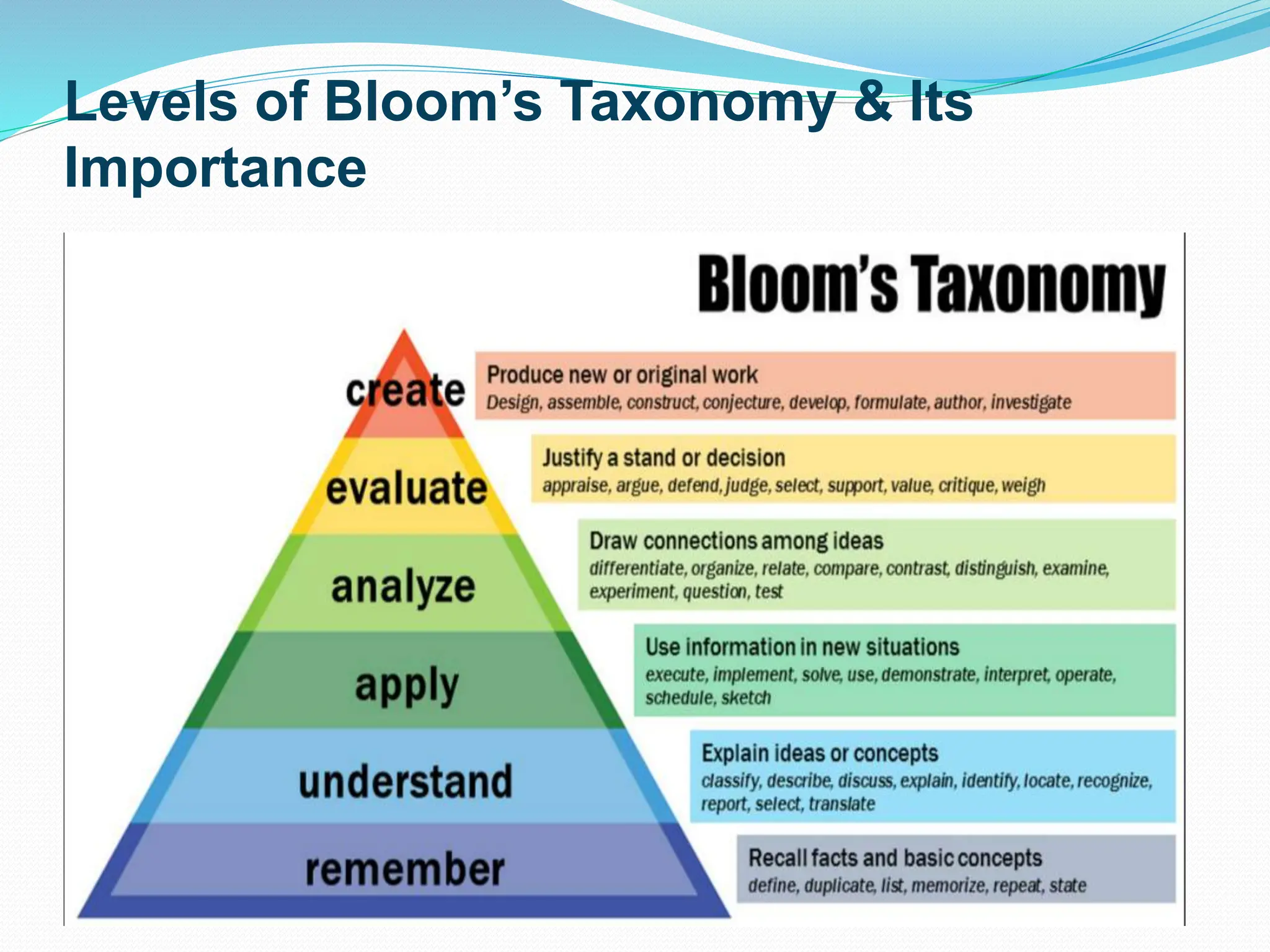
Levels of Bloom’s Taxonomy & Its
Importance
Definitions of the different levels of thinking skills in Bloom’s taxonomy:
1. Remember–recalling relevant terminology, specific facts, or
different procedures related to information and/or course
topics. At this level, a student can remember something, but
may not really understand it.
 Remember - it indicates the learning of students in the
classroom.
 Whatever a student has learned theoretically or practically,
both are considered as knowledgeable aspects. Just like any
other aspect of education, knowledge, though basic, but is
one of the most important.
 A student’s knowledge level acts as a “catalyst” in unlocking
the other levels.
 If a student has good knowledge, he/she can implement it in
a way that no one could imagine.
 So, this level could be considered as the pillar of the
educational model.
Definitions of the different levels of thinking skills in Bloom’s taxonomy:
2. Understand–the ability to grasp the meaning of
information (facts, definitions, concepts, etc.) that has
been presented.
3. Apply–being able to use previously learned information
in different situations or in problem solving.
4. Analyze–the ability to break information down into its
component parts. Analysis also refers to the process of
examining information in order to make conclusions
regarding cause and effect, interpreting motives, making
inferences, or finding evidence to support
statements/arguments.
Definitions of the different levels of thinking skills in Bloom’s taxonomy:
5. Evaluate–being able to judge the value of information and/or
sources of information based on personal values or opinions.
6. Create–the ability to creatively or uniquely apply prior
knowledge and/or skills to produce new and original thoughts,
ideas, processes, etc. At this level, students are involved in
creating their own thoughts and ideas.
How Bloom’s Taxonomy Is Useful for Teachers?
 Bloom’s taxonomy helps the teachers to think and
analyze their teaching and student’s learning.
 The framework is used to state clear objectives which
can help the teachers to plan lessons accordingly.
 Moreover, it can provide a framework for cognitive
behaviors which can be applied to understand the
difficulty of tasks, conduct an assessment, and simplify or
complicate the activities.
 Bloom’s Taxonomy helps the teachers to understand the
objectives of classroom teaching.
 It guides them to change the complexity of the questions
and helps students to achieve higher levels of hierarchy.
 Further, it helps to develop critical thinking among
teachers.
KNOWLEDGE DOMAIN VERBS
Remembering Understanding Applying Analyzing Evaluating Creating
Recall specific
facts.
Grasp meaning
of materials.
Use information
in a new
situation.
Identify
schemas or
relationships.
Use information
to make
judgments.
Create or
develop
something
new.
define
describe
examine
identify
label
list
locate
match
memorize
recall
recite
recognize
record
reproduce
retell
select
state
tabulate
tell
visualize
associate
classify
compare
contrast
convert
describe
discuss
distinguish
explain
illustrate
interpret
order
predict
relate
report
represent
restate
select
summarize
trace
transform
translate
apply
articulate
calculate
change
chart
compute
construct
develop
employ
examine
experiment
explain
illustrate
interpret
manipulate
modify
operate
predict
produce
relate
solve
transfer
analyze
categorize
compare
connect
contrast
criticize
deduce
diagram
differentiate
discriminate
dissect
estimate
evaluate
experiment
infer
organize
plan
prioritize
question
separate
survey
test
appraise
argue
assess
choose
convince
critique
debate
defend
editorialize
estimate
evaluate
grade
judge
justify
measure
persuade
predict
rank
rate
reframe
summarize
support
adapt
assemble
compose
construct
create
design
develop
facilitate
hypothesize
integrate
invent
modify
negotiate
plan
propose
revise
role-play
schematize
simulate
speculate
support
validate
Lower Order Thinking Skills Higher Order Thinking Skills
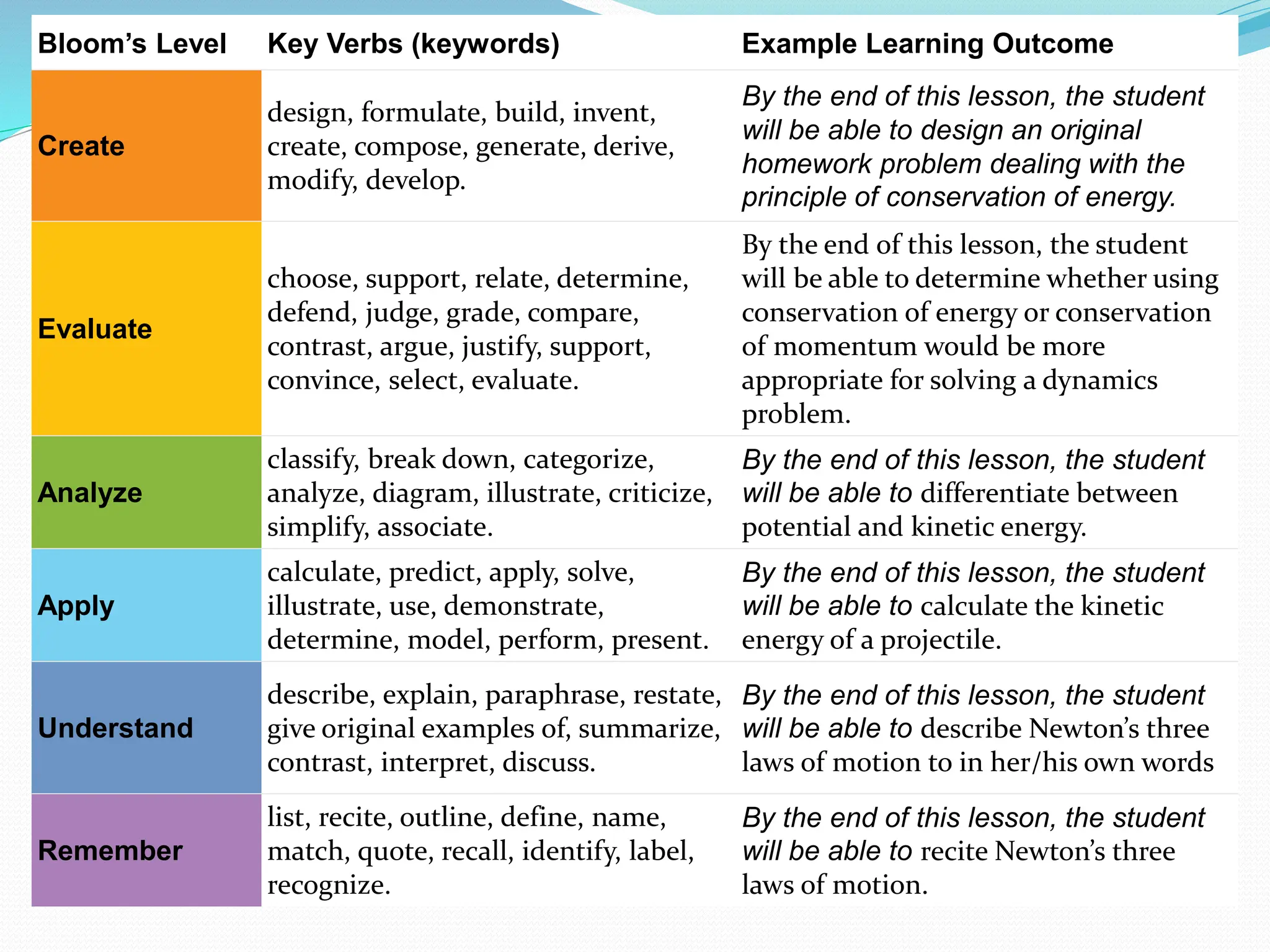
Bloom’s Level Key Verbs (keywords) Example Learning Outcome
Create
design, formulate, build, invent,
create, compose, generate, derive,
modify, develop.
By the end of this lesson, the student
will be able to design an original
homework problem dealing with the
principle of conservation of energy.
Evaluate
choose, support, relate, determine,
defend, judge, grade, compare,
contrast, argue, justify, support,
convince, select, evaluate.
By the end of this lesson, the student
will be able to determine whether using
conservation of energy or conservation
of momentum would be more
appropriate for solving a dynamics
problem.
Analyze
classify, break down, categorize,
analyze, diagram, illustrate, criticize,
simplify, associate.
By the end of this lesson, the student
will be able to differentiate between
potential and kinetic energy.
Apply
calculate, predict, apply, solve,
illustrate, use, demonstrate,
determine, model, perform, present.
By the end of this lesson, the student
will be able to calculate the kinetic
energy of a projectile.
Understand
describe, explain, paraphrase, restate,
give original examples of, summarize,
contrast, interpret, discuss.
By the end of this lesson, the student
will be able to describe Newton’s three
laws of motion to in her/his own words
Remember
list, recite, outline, define, name,
match, quote, recall, identify, label,
recognize.
By the end of this lesson, the student
will be able to recite Newton’s three
laws of motion.
Thank you

Blooms Taxonomy.pptx

  • 1.
    Blooms Taxonomy B.VAJRAIAH Senior Lecturerin Computer Engineering S.G.M. Govt. Polytechnic, Abdullapurmet
  • 2.
    Blooms Taxonomy  Bloom’staxonomy is a classification system used to define and distinguish different levels of human cognition—i.e., thinking, learning, and understanding.  Educators have typically used Bloom’s taxonomy to inform or guide the development of assessments (tests and other evaluations of student learning), curriculum (units, lessons, projects, and other learning activities), and instructional methods such as questioning strategies.
  • 3.
    What is BloomsTaxonomy ?  Bloom’s Taxonomy is a categorization that defines different levels of intelligence including thinking, learning, and understanding.  Institutes make use of bloom’s taxonomy to improve curriculum, assessments, and teaching methods.  Originally introduced in 1956, Bloom’s Taxonomy was a concept created by Mr. Benjamin Bloom along with Mr. Edward Furst, Mr. Max Englehart, Mr. David Krathwohl & Mr. Walter Hill.  The concept or rather the educational model has categorized the levels of education as well as the skills that need to be imparted whenever a teacher teaches something.
  • 4.
    Importance of Bloom’sTaxonomy  Bloom's taxonomy is used as a tool for teaching to balance the evaluative and assessment-based questions in exams, assignments, and in-class engagements.  It is helpful to ensure that all orders of thinking are being practiced in the institutes, including aspects of information searching.
  • 5.
    Three Domains ofBloom's Taxonomy I) Cognitive Domain II) Affective Domain III) Psychomotor Domain
  • 6.
    Three Domains ofBloom's Taxonomy I) Cognitive Domain In the cognitive domain of Bloom’s taxonomy, the major focus is given to the development of knowledge and intellectual skills. As per the complexity, there are six sub-heads of the cognitive domain. 1. Knowledge Gaining knowledge about facts, figures, and basic concepts. 2. Comprehension Understanding the facts gathered during the knowledge stage . 3. Application Applying the knowledge and the concepts in the best way possible. 4. Analysis Analyzing the application, making conclusions, and understanding relationships between the different aspects of the application. 5. Evaluation Judging and defending conclusions about the information generated from the application. 6. Creation Creating new results by planning, designing, developing the actual application.
  • 7.
    Three Domains ofBloom's Taxonomy II)Affective Domain  This domain of Bloom's taxonomy deals with the feelings and the emotions associated with the passage. It contains complex ideas and conscience, phenomena, and characters. The main aspects of the affective domain are as follows. • Reception • Response • Values • Organization • Characterization
  • 8.
    Three Domains ofBloom's Taxonomy III) Psychomotor Domain  The psychomotor domain of bloom’s taxonomy deals with coordination, sensory organ movement, and the physical movement of the body of a student.  A great practice is required to be good at these skills.  The physical act of driving, playing the keyboard, guitar, are major examples of the psychomotor domain.
  • 9.
    Applications of Bloom’sTaxonomy • Finding meanings of words, phrases, idioms that are used in the paragraph using application and understanding • Concluding the passage and its points using evaluation and analysis • Gaining details and remembering them using understanding and remembering • Understanding the author’s tone by using the concept of evaluation • Give a proper title for the passage using the concept of evaluation and understanding
  • 10.
    Levels of Bloom’sTaxonomy & Its Importance
  • 13.
    Definitions of thedifferent levels of thinking skills in Bloom’s taxonomy: 1. Remember–recalling relevant terminology, specific facts, or different procedures related to information and/or course topics. At this level, a student can remember something, but may not really understand it.  Remember - it indicates the learning of students in the classroom.  Whatever a student has learned theoretically or practically, both are considered as knowledgeable aspects. Just like any other aspect of education, knowledge, though basic, but is one of the most important.  A student’s knowledge level acts as a “catalyst” in unlocking the other levels.  If a student has good knowledge, he/she can implement it in a way that no one could imagine.  So, this level could be considered as the pillar of the educational model.
  • 14.
    Definitions of thedifferent levels of thinking skills in Bloom’s taxonomy: 2. Understand–the ability to grasp the meaning of information (facts, definitions, concepts, etc.) that has been presented. 3. Apply–being able to use previously learned information in different situations or in problem solving. 4. Analyze–the ability to break information down into its component parts. Analysis also refers to the process of examining information in order to make conclusions regarding cause and effect, interpreting motives, making inferences, or finding evidence to support statements/arguments.
  • 15.
    Definitions of thedifferent levels of thinking skills in Bloom’s taxonomy: 5. Evaluate–being able to judge the value of information and/or sources of information based on personal values or opinions. 6. Create–the ability to creatively or uniquely apply prior knowledge and/or skills to produce new and original thoughts, ideas, processes, etc. At this level, students are involved in creating their own thoughts and ideas.
  • 16.
    How Bloom’s TaxonomyIs Useful for Teachers?  Bloom’s taxonomy helps the teachers to think and analyze their teaching and student’s learning.  The framework is used to state clear objectives which can help the teachers to plan lessons accordingly.  Moreover, it can provide a framework for cognitive behaviors which can be applied to understand the difficulty of tasks, conduct an assessment, and simplify or complicate the activities.  Bloom’s Taxonomy helps the teachers to understand the objectives of classroom teaching.  It guides them to change the complexity of the questions and helps students to achieve higher levels of hierarchy.  Further, it helps to develop critical thinking among teachers.
  • 17.
  • 18.
    Remembering Understanding ApplyingAnalyzing Evaluating Creating Recall specific facts. Grasp meaning of materials. Use information in a new situation. Identify schemas or relationships. Use information to make judgments. Create or develop something new. define describe examine identify label list locate match memorize recall recite recognize record reproduce retell select state tabulate tell visualize associate classify compare contrast convert describe discuss distinguish explain illustrate interpret order predict relate report represent restate select summarize trace transform translate apply articulate calculate change chart compute construct develop employ examine experiment explain illustrate interpret manipulate modify operate predict produce relate solve transfer analyze categorize compare connect contrast criticize deduce diagram differentiate discriminate dissect estimate evaluate experiment infer organize plan prioritize question separate survey test appraise argue assess choose convince critique debate defend editorialize estimate evaluate grade judge justify measure persuade predict rank rate reframe summarize support adapt assemble compose construct create design develop facilitate hypothesize integrate invent modify negotiate plan propose revise role-play schematize simulate speculate support validate Lower Order Thinking Skills Higher Order Thinking Skills
  • 19.
    Bloom’s Level KeyVerbs (keywords) Example Learning Outcome Create design, formulate, build, invent, create, compose, generate, derive, modify, develop. By the end of this lesson, the student will be able to design an original homework problem dealing with the principle of conservation of energy. Evaluate choose, support, relate, determine, defend, judge, grade, compare, contrast, argue, justify, support, convince, select, evaluate. By the end of this lesson, the student will be able to determine whether using conservation of energy or conservation of momentum would be more appropriate for solving a dynamics problem. Analyze classify, break down, categorize, analyze, diagram, illustrate, criticize, simplify, associate. By the end of this lesson, the student will be able to differentiate between potential and kinetic energy. Apply calculate, predict, apply, solve, illustrate, use, demonstrate, determine, model, perform, present. By the end of this lesson, the student will be able to calculate the kinetic energy of a projectile. Understand describe, explain, paraphrase, restate, give original examples of, summarize, contrast, interpret, discuss. By the end of this lesson, the student will be able to describe Newton’s three laws of motion to in her/his own words Remember list, recite, outline, define, name, match, quote, recall, identify, label, recognize. By the end of this lesson, the student will be able to recite Newton’s three laws of motion.
  • 21.