
Project Management for
TODAY’S World!
Cambridge Center of Excellence
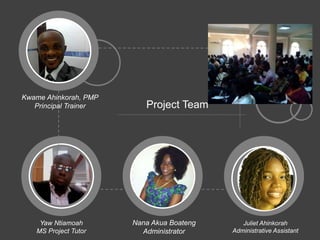
Project Team
Kwame Ahinkorah, PMP
Principal Trainer
Yaw Ntiamoah
MS Project Tutor
Nana Akua Boateng
Administrator
Juliet Ahinkorah
Administrative Assistant
Course Materials
 PMBOK Guide -5th Edition
 RMC Exam Prep
 PM Prep Cast (Videos)
 PM Fastrack
Notable Industries
 Construction
 Engineering
 Real Estates
 Mining/ Oil & Gas
 Finance & Banking
 Telecommunications
 NGO
 Agriculture
 Sales & Marketing
 I.T
 Health
 Manufacturing
 Education
 Central & Local Government
Course Phases
 PMP Lectures
 Concurrent Evaluation Tests
Our Course Objectives
• Enable you pass the PMP® Exam
• Enable you become proficient on projects
• Offer you greater career mobility
Sheryl Thompson, PMP
Introduction
 Your Name and Professional Background
 Your knowledge in Project Management
 Basic
 Intermediate
 Advance
 If you were an animal, what animal will you be
and why…?
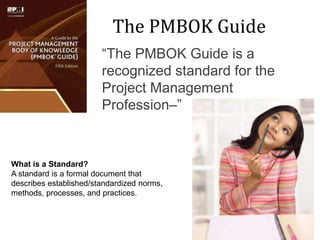
The PMBOK Guide
“The PMBOK Guide is a
recognized standard for the
Project Management
Profession–”
What is a Standard?
A standard is a formal document that
describes established/standardized norms,
methods, processes, and practices.
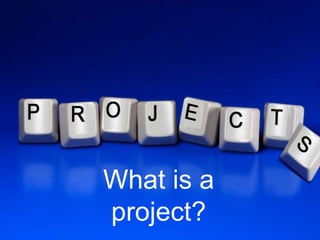
What is a
project?
What is a Project
?
A project is a temporary endeavor
undertaken to create a unique
product, service or result.
The output of every project is
called
↓
a Deliverable
Temporary
Has a beginning and a definite
end.
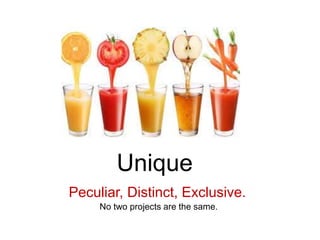
Unique
Peculiar, Distinct, Exclusive.
No two projects are the same.
A Project can beundertaken by:
• a single person
• a single organizational unit
• An entire Organization (multiple organizational
units)
Project Triggers
What is a Project Trigger
?
PROJECT TRIGGERS
Why do weundertake Projects?
Projectsoftenariseas a resultofaBusinessNeed,reflectedinthefollowing:
1. Strategic Opportunity
2. In response to market demand
3. Legal requirements
4. Competition
5. Technologicaladvancement
6. Stakeholders request
Creation of an Infrastructure:Roads, Bridges, Buildings, Office
Complex, Expansions, Masts.
Developing a newproduct or service:Machinery, Technology,
Speed Banking,TiGo Cash, Mentor, Ceremonies
Developing a New Model of an existingproduct or service:
Corolla 2017, ipad5, SamsungGalaxy S7, Mentor 7
Creating a Document – A Research finding, book, constitution,
proposals, business plans
Some Examples of Projects
The End of a Project is
reached:
When project objectives have been achieved.
When its objectives will not or cannot be met.
When the need for a project no longer exists.
Factors That Influence Project Delivery
 EnterpriseEnvironmental Factors (EEFs)
 Organizational ProcessAssets (OPAs)
19
Factors That Influence Project Delivery
EnterpriseEnvironmental Factors(EEFs)
These refer to internal and external environmental factors
that are beyond the direct control of the project team.
20
Examples of EEFs:
• Government/Industry Standards
• ExistingInfrastructure
• ExistingHuman Resources
• Market Conditions(E.g. Price, Inflation, Exchangerate)
• Legal, economic or political climate
• The skillsandorganizational culture of the project
environment – The People
Factors That Influence Project Delivery
 Organisational ProcessAssets (OPAs)
These are documentary assets of an organization or from
previous projects that can be used to influencea current
project’s success.
22
Examples of OPAs
• Procedures,Policies& Guidelines
• Formal& InformalPlans
• HistoricalInformation
• LessonsLearned*
• Templates& Checklist
• Data/Recordof PastProjects
LessonsLearned
What are Lessons Learned
?
LessonsLearned
Lessons learnedare generatedas a resultofvariances (a deviation
fromthe expected)
Foursteps totakewhenthere are variances
1.Documentand namethe variance.
2.Identifyand documentthe causes.
3. Correct thevariance and documenttheaction.
4.MakeRecommendationsfor thefuture.
Operations
What are Operations
?
26
Operations
 This refers to the ongoing function of an
organization that are repetitive in nature
and produce recurrent results.
 Operations work support the business
environment where projects are executed
 In shorts, operations are the Day-to-Day
activities of an organization that define
regular roles.
27
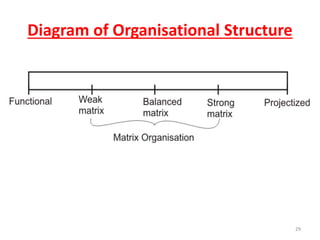
Organisational Structure
1. FunctionalOrganisations
2. Projectized Organisations
3. Matrix Organisation
 WeakMatrix
 Balanced Matrix
 Strong Matrix
28
Diagram of Organisational Structure
29
Project Management
What is ProjectManagement
?
30
Project Management
The applicationof knowledge, skills,toolsand
techniquesto projectactivities tomeet the project
requirements.
31
Project Management Office
A project managementoffice(PMO)is an organizationalbody or
entityassigned various responsibilities related to the centralized
and coordinated managementof thoseprojects under its
domain.
The specificform, function,and structure of a PMO is
dependent upon theneeds of the organization thatit supports.
Project Management Context
Project managementexists in a broader context:
• Project Management
• Program Management
• PortfolioManagement
• Strategic Management/Objectives
Program Management
What isa Program
?
Program Management
• A Programis a group of related projects managedin a
coordinated way to obtain benefits and control not available
from managingthemindividually
Portfolio Management
What isa Portfolio
?
Portfolio Management
• A Portfoliois a collection of programs, projects, operations
and other works of an organization thatare grouped and
managedtogetherto meetstrategicobjectives.
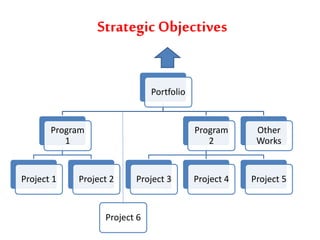
Strategic Objectives
Portfolio
Program
1
Project 1 Project 2
Program
2
Project 3 Project 4 Project 5
Other
Works
Project 6
Project Stakeholders
Who are ProjectStakeholders
?
A ProjectStakeholder is one whose interest may be
positively or negatively impacted bythe project
and/orcan impactthe project positivelyor
negatively.
PROJECT STAKEHOLDERS may Include:
1.Project manager
2.Project team
3.Project managementteam
4.ProgramManager
5.PortfolioManager
6.Functional Managers
7.Project sponsor
8.Customers/Users
9.Performingorganization
10.Requesting Organization
11. Informationprovider
12.Government (Legislative, Regulatory,Tax-collectionAgencies, etc.)
Project Manager
The person appointed by theperforming organisation to see
to the accomplishmentof theproject’s objectives.
Qualitiesof a Project Manager:
• Knowledge
• Performance
• Interpersonal/Soft Skill
42
SomeTechniques of the Project Manager
 Team Involvement/Meetings
 Expert Judgment:Involving (asking) experts to offer
knowledge/expertise to support the project
 FacilitationTechniques
 Analytical Techniques
 Interpersonal Skills/Soft Skills
43
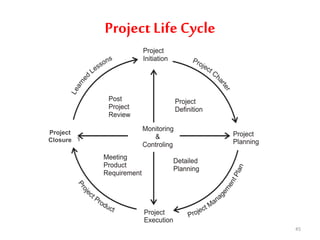
PROJECT LIFE CYCLE
 This refers to a collection of the four (4) stages orphases that onehas to go
through whenundertaking any project.
 Irrespective ofthe size orcomplexity of a project, it couldbemappedto the
following structure :
 Initiation Stage (starting the project)
 Planning Stage (Organising and preparing)
 Execution Stage (carrying out the project work)
 Closure Stage (Closing/completing the project)
44
Project Life Cycle
45
Project
Closure
Project LifecycleContinued
Characteristics of the Project
Lifecycle
46
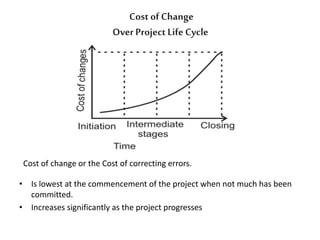
Cost of Change
Over Project Life Cycle
Cost of change or the Cost of correcting errors.
• Is lowest at the commencement of the project when not much has been
committed.
• Increases significantly as the project progresses
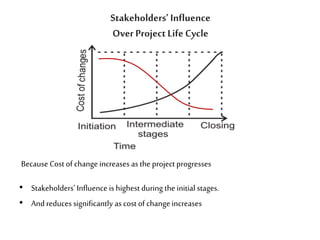
Stakeholders’ Influence
Over Project Life Cycle
Because Cost of change increases as the project progresses
• Stakeholders’ Influence is highest during the initial stages.
• And reduces significantly as cost of change increases
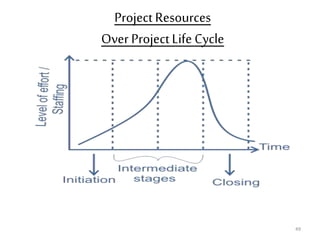
Project Resources
Over ProjectLife Cycle
49
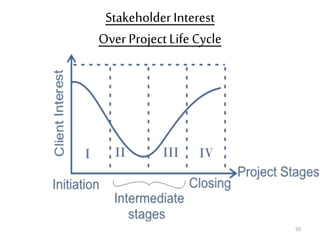
Stakeholder Interest
Over ProjectLife Cycle
50
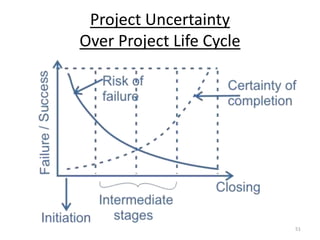
Project Uncertainty
Over Project Life Cycle
51
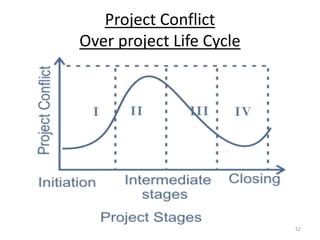
Project Conflict
Over project Life Cycle
52
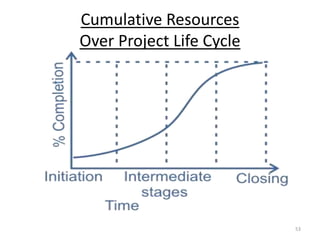
Cumulative Resources
Over Project Life Cycle
53
Project Phases
What are project phases?
Why do we phase projects?
Types of phases
54
Project Management Processes (47)
Knowledge Areas/Modules (10)
 Project Integration Mgmt
 Project Scope Mgmt
 Project Time Mgmt
 Project Cost Mgmt
 Project Quality Mgmt
 Project HumanResource Mgmt
 Project Communication Mgmt
 Project Risk Mgmt
 Project Procurement Mgmt
 Project Stakeholder Mgmt
ProcessGroups(5)
 Initiating Process Group
 Planning Process Group
 Executing Process Group
 Monitoring and Controlling Process
Group
 Closing Process Group
55
56
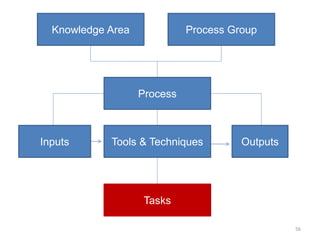
Knowledge Area Process Group
Inputs Tools & Techniques Outputs
Process
Tasks
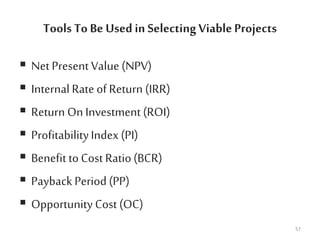
Tools To Be Used in SelectingViableProjects
 Net Present Value (NPV)
 Internal Rate of Return (IRR)
 Return On Investment (ROI)
 ProfitabilityIndex (PI)
 Benefit toCost Ratio(BCR)
 PaybackPeriod (PP)
 Opportunity Cost (OC)
57
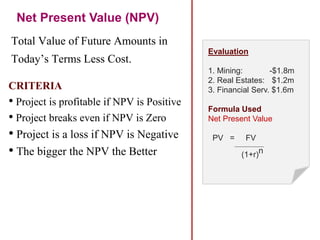
Net Present Value (NPV)
CRITERIA
• Project is profitable if NPV is Positive
• Project breaks even if NPV is Zero
• Project is a loss if NPV is Negative
• The bigger the NPV the Better
Total Value of Future Amounts in
Today’s Terms Less Cost.
Evaluation
1. Mining: -$1.8m
2. Real Estates: $1.2m
3. Financial Serv. $1.6m
Formula Used
Net Present Value
PV = FV
(1+r)n
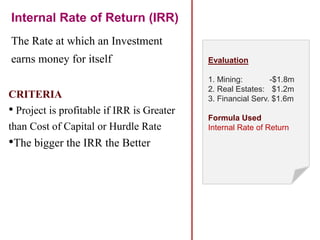
Internal Rate of Return (IRR)
CRITERIA
• Project is profitable if IRR is Greater
than Cost of Capital or Hurdle Rate
•The bigger the IRR the Better
The Rate at which an Investment
earns money for itself Evaluation
1. Mining: -$1.8m
2. Real Estates: $1.2m
3. Financial Serv. $1.6m
Formula Used
Internal Rate of Return
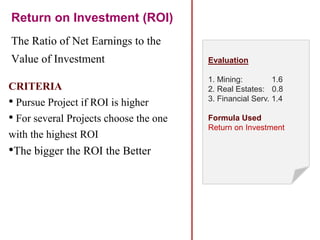
Return on Investment (ROI)
CRITERIA
• Pursue Project if ROI is higher
• For several Projects choose the one
with the highest ROI
•The bigger the ROI the Better
The Ratio of Net Earnings to the
Value of Investment Evaluation
1. Mining: 1.6
2. Real Estates: 0.8
3. Financial Serv. 1.4
Formula Used
Return on Investment
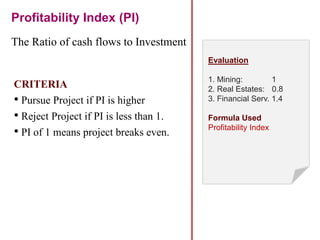
Profitability Index (PI)
CRITERIA
• Pursue Project if PI is higher
• Reject Project if PI is less than 1.
• PI of 1 means project breaks even.
The Ratio of cash flows to Investment
Evaluation
1. Mining: 1
2. Real Estates: 0.8
3. Financial Serv. 1.4
Formula Used
Profitability Index
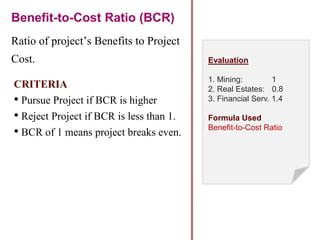
Benefit-to-Cost Ratio (BCR)
CRITERIA
• Pursue Project if BCR is higher
• Reject Project if BCR is less than 1.
• BCR of 1 means project breaks even.
Ratio of project’s Benefits to Project
Cost. Evaluation
1. Mining: 1
2. Real Estates: 0.8
3. Financial Serv. 1.4
Formula Used
Benefit-to-Cost Ratio
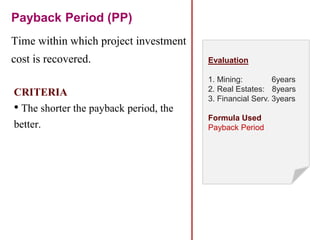
Payback Period (PP)
CRITERIA
• The shorter the payback period, the
better.
Time within which project investment
cost is recovered. Evaluation
1. Mining: 6years
2. Real Estates: 8years
3. Financial Serv. 3years
Formula Used
Payback Period
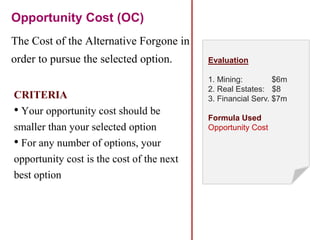
Opportunity Cost (OC)
CRITERIA
• Your opportunity cost should be
smaller than your selected option
• For any number of options, your
opportunity cost is the cost of the next
best option
The Cost of the Alternative Forgone in
order to pursue the selected option. Evaluation
1. Mining: $6m
2. Real Estates: $8
3. Financial Serv. $7m
Formula Used
Opportunity Cost
End
o Assessment
o Questions

1. Introduction to Project Management and the Project Management Framework

  • 1.
    Project Management for TODAY’SWorld! Cambridge Center of Excellence
  • 2.
    Project Team Kwame Ahinkorah,PMP Principal Trainer Yaw Ntiamoah MS Project Tutor Nana Akua Boateng Administrator Juliet Ahinkorah Administrative Assistant
  • 3.
    Course Materials  PMBOKGuide -5th Edition  RMC Exam Prep  PM Prep Cast (Videos)  PM Fastrack
  • 4.
    Notable Industries  Construction Engineering  Real Estates  Mining/ Oil & Gas  Finance & Banking  Telecommunications  NGO  Agriculture  Sales & Marketing  I.T  Health  Manufacturing  Education  Central & Local Government
  • 5.
    Course Phases  PMPLectures  Concurrent Evaluation Tests
  • 6.
    Our Course Objectives •Enable you pass the PMP® Exam • Enable you become proficient on projects • Offer you greater career mobility Sheryl Thompson, PMP
  • 7.
    Introduction  Your Nameand Professional Background  Your knowledge in Project Management  Basic  Intermediate  Advance  If you were an animal, what animal will you be and why…?
  • 8.
    The PMBOK Guide “ThePMBOK Guide is a recognized standard for the Project Management Profession–” What is a Standard? A standard is a formal document that describes established/standardized norms, methods, processes, and practices.
  • 9.
  • 10.
    What is aProject ?
  • 11.
    A project isa temporary endeavor undertaken to create a unique product, service or result. The output of every project is called ↓ a Deliverable
  • 12.
    Temporary Has a beginningand a definite end.
  • 13.
    Unique Peculiar, Distinct, Exclusive. Notwo projects are the same.
  • 14.
    A Project canbeundertaken by: • a single person • a single organizational unit • An entire Organization (multiple organizational units)
  • 15.
    Project Triggers What isa Project Trigger ?
  • 16.
    PROJECT TRIGGERS Why doweundertake Projects? Projectsoftenariseas a resultofaBusinessNeed,reflectedinthefollowing: 1. Strategic Opportunity 2. In response to market demand 3. Legal requirements 4. Competition 5. Technologicaladvancement 6. Stakeholders request
  • 17.
    Creation of anInfrastructure:Roads, Bridges, Buildings, Office Complex, Expansions, Masts. Developing a newproduct or service:Machinery, Technology, Speed Banking,TiGo Cash, Mentor, Ceremonies Developing a New Model of an existingproduct or service: Corolla 2017, ipad5, SamsungGalaxy S7, Mentor 7 Creating a Document – A Research finding, book, constitution, proposals, business plans Some Examples of Projects
  • 18.
    The End ofa Project is reached: When project objectives have been achieved. When its objectives will not or cannot be met. When the need for a project no longer exists.
  • 19.
    Factors That InfluenceProject Delivery  EnterpriseEnvironmental Factors (EEFs)  Organizational ProcessAssets (OPAs) 19
  • 20.
    Factors That InfluenceProject Delivery EnterpriseEnvironmental Factors(EEFs) These refer to internal and external environmental factors that are beyond the direct control of the project team. 20
  • 21.
    Examples of EEFs: •Government/Industry Standards • ExistingInfrastructure • ExistingHuman Resources • Market Conditions(E.g. Price, Inflation, Exchangerate) • Legal, economic or political climate • The skillsandorganizational culture of the project environment – The People
  • 22.
    Factors That InfluenceProject Delivery  Organisational ProcessAssets (OPAs) These are documentary assets of an organization or from previous projects that can be used to influencea current project’s success. 22
  • 23.
    Examples of OPAs •Procedures,Policies& Guidelines • Formal& InformalPlans • HistoricalInformation • LessonsLearned* • Templates& Checklist • Data/Recordof PastProjects
  • 24.
  • 25.
    LessonsLearned Lessons learnedare generatedasa resultofvariances (a deviation fromthe expected) Foursteps totakewhenthere are variances 1.Documentand namethe variance. 2.Identifyand documentthe causes. 3. Correct thevariance and documenttheaction. 4.MakeRecommendationsfor thefuture.
  • 26.
  • 27.
    Operations  This refersto the ongoing function of an organization that are repetitive in nature and produce recurrent results.  Operations work support the business environment where projects are executed  In shorts, operations are the Day-to-Day activities of an organization that define regular roles. 27
  • 28.
    Organisational Structure 1. FunctionalOrganisations 2.Projectized Organisations 3. Matrix Organisation  WeakMatrix  Balanced Matrix  Strong Matrix 28
  • 29.
  • 30.
    Project Management What isProjectManagement ? 30
  • 31.
    Project Management The applicationofknowledge, skills,toolsand techniquesto projectactivities tomeet the project requirements. 31
  • 32.
    Project Management Office Aproject managementoffice(PMO)is an organizationalbody or entityassigned various responsibilities related to the centralized and coordinated managementof thoseprojects under its domain. The specificform, function,and structure of a PMO is dependent upon theneeds of the organization thatit supports.
  • 33.
    Project Management Context Projectmanagementexists in a broader context: • Project Management • Program Management • PortfolioManagement • Strategic Management/Objectives
  • 34.
  • 35.
    Program Management • AProgramis a group of related projects managedin a coordinated way to obtain benefits and control not available from managingthemindividually
  • 36.
  • 37.
    Portfolio Management • APortfoliois a collection of programs, projects, operations and other works of an organization thatare grouped and managedtogetherto meetstrategicobjectives.
  • 38.
    Strategic Objectives Portfolio Program 1 Project 1Project 2 Program 2 Project 3 Project 4 Project 5 Other Works Project 6
  • 39.
    Project Stakeholders Who areProjectStakeholders ?
  • 40.
    A ProjectStakeholder isone whose interest may be positively or negatively impacted bythe project and/orcan impactthe project positivelyor negatively.
  • 41.
    PROJECT STAKEHOLDERS mayInclude: 1.Project manager 2.Project team 3.Project managementteam 4.ProgramManager 5.PortfolioManager 6.Functional Managers 7.Project sponsor 8.Customers/Users 9.Performingorganization 10.Requesting Organization 11. Informationprovider 12.Government (Legislative, Regulatory,Tax-collectionAgencies, etc.)
  • 42.
    Project Manager The personappointed by theperforming organisation to see to the accomplishmentof theproject’s objectives. Qualitiesof a Project Manager: • Knowledge • Performance • Interpersonal/Soft Skill 42
  • 43.
    SomeTechniques of theProject Manager  Team Involvement/Meetings  Expert Judgment:Involving (asking) experts to offer knowledge/expertise to support the project  FacilitationTechniques  Analytical Techniques  Interpersonal Skills/Soft Skills 43
  • 44.
    PROJECT LIFE CYCLE This refers to a collection of the four (4) stages orphases that onehas to go through whenundertaking any project.  Irrespective ofthe size orcomplexity of a project, it couldbemappedto the following structure :  Initiation Stage (starting the project)  Planning Stage (Organising and preparing)  Execution Stage (carrying out the project work)  Closure Stage (Closing/completing the project) 44
  • 45.
  • 46.
  • 47.
    Cost of Change OverProject Life Cycle Cost of change or the Cost of correcting errors. • Is lowest at the commencement of the project when not much has been committed. • Increases significantly as the project progresses
  • 48.
    Stakeholders’ Influence Over ProjectLife Cycle Because Cost of change increases as the project progresses • Stakeholders’ Influence is highest during the initial stages. • And reduces significantly as cost of change increases
  • 49.
  • 50.
  • 51.
  • 52.
  • 53.
  • 54.
    Project Phases What areproject phases? Why do we phase projects? Types of phases 54
  • 55.
    Project Management Processes(47) Knowledge Areas/Modules (10)  Project Integration Mgmt  Project Scope Mgmt  Project Time Mgmt  Project Cost Mgmt  Project Quality Mgmt  Project HumanResource Mgmt  Project Communication Mgmt  Project Risk Mgmt  Project Procurement Mgmt  Project Stakeholder Mgmt ProcessGroups(5)  Initiating Process Group  Planning Process Group  Executing Process Group  Monitoring and Controlling Process Group  Closing Process Group 55
  • 56.
    56 Knowledge Area ProcessGroup Inputs Tools & Techniques Outputs Process Tasks
  • 57.
    Tools To BeUsed in SelectingViableProjects  Net Present Value (NPV)  Internal Rate of Return (IRR)  Return On Investment (ROI)  ProfitabilityIndex (PI)  Benefit toCost Ratio(BCR)  PaybackPeriod (PP)  Opportunity Cost (OC) 57
  • 58.
    Net Present Value(NPV) CRITERIA • Project is profitable if NPV is Positive • Project breaks even if NPV is Zero • Project is a loss if NPV is Negative • The bigger the NPV the Better Total Value of Future Amounts in Today’s Terms Less Cost. Evaluation 1. Mining: -$1.8m 2. Real Estates: $1.2m 3. Financial Serv. $1.6m Formula Used Net Present Value PV = FV (1+r)n
  • 59.
    Internal Rate ofReturn (IRR) CRITERIA • Project is profitable if IRR is Greater than Cost of Capital or Hurdle Rate •The bigger the IRR the Better The Rate at which an Investment earns money for itself Evaluation 1. Mining: -$1.8m 2. Real Estates: $1.2m 3. Financial Serv. $1.6m Formula Used Internal Rate of Return
  • 60.
    Return on Investment(ROI) CRITERIA • Pursue Project if ROI is higher • For several Projects choose the one with the highest ROI •The bigger the ROI the Better The Ratio of Net Earnings to the Value of Investment Evaluation 1. Mining: 1.6 2. Real Estates: 0.8 3. Financial Serv. 1.4 Formula Used Return on Investment
  • 61.
    Profitability Index (PI) CRITERIA •Pursue Project if PI is higher • Reject Project if PI is less than 1. • PI of 1 means project breaks even. The Ratio of cash flows to Investment Evaluation 1. Mining: 1 2. Real Estates: 0.8 3. Financial Serv. 1.4 Formula Used Profitability Index
  • 62.
    Benefit-to-Cost Ratio (BCR) CRITERIA •Pursue Project if BCR is higher • Reject Project if BCR is less than 1. • BCR of 1 means project breaks even. Ratio of project’s Benefits to Project Cost. Evaluation 1. Mining: 1 2. Real Estates: 0.8 3. Financial Serv. 1.4 Formula Used Benefit-to-Cost Ratio
  • 63.
    Payback Period (PP) CRITERIA •The shorter the payback period, the better. Time within which project investment cost is recovered. Evaluation 1. Mining: 6years 2. Real Estates: 8years 3. Financial Serv. 3years Formula Used Payback Period
  • 64.
    Opportunity Cost (OC) CRITERIA •Your opportunity cost should be smaller than your selected option • For any number of options, your opportunity cost is the cost of the next best option The Cost of the Alternative Forgone in order to pursue the selected option. Evaluation 1. Mining: $6m 2. Real Estates: $8 3. Financial Serv. $7m Formula Used Opportunity Cost
  • 65.