LECTURER:
ENG.HISHAM ALI, PMP
Ground Rules:
 Attend early ( time is fixed )
 Silent your mobile to give
y
y g
us chance to focus
 Bring notebook & write to save 
your understandingyour understanding
WHAT IS PMP ??
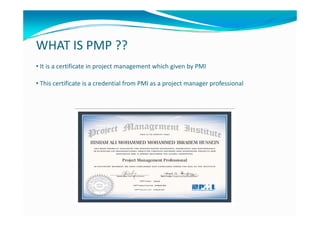
• It is a certificate in project management which given by PMI
• This certificate is a credential from PMI as a project manager professional 
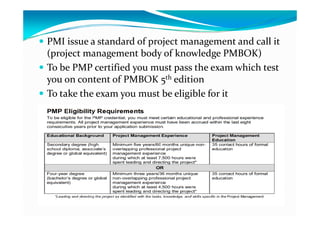
 PMI issue a standard of project management and call it 
(project management body of knowledge PMBOK)
 To be PMP certified you must pass the exam which test 
you on content of PMBOK 5th edition
 To take the exam you must be eligible for it
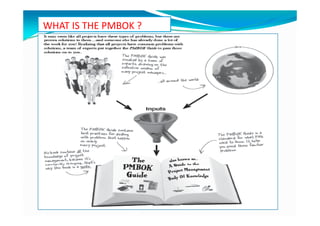
WHAT IS THE PMBOK ?
• PROJECT
 Temporary endeavor undertaken to create a unique Temporary endeavor undertaken to create a unique 
product  service  or resultproduct  service  or resultproduct, service, or result.product, service, or result.
T   dT   dTemporary endeavor.Temporary endeavor.
Has start and an end.Has start and an end.
Create a unique product, service or result.Create a unique product, service or result.
Progressive elaboration.Progressive elaboration.gg
OPERATIONS• OPERATIONS
 Ongoing endeavor that produce repetitive outputs.Ongoing endeavor that produce repetitive outputs.Ongoing endeavor that produce repetitive outputs.Ongoing endeavor that produce repetitive outputs.
Ongoing endeavor.Ongoing endeavor.
RepetitiveRepetitiveRepetitive.Repetitive.
Targets known very will.Targets known very will.
Examples:Examples:
11 (A) Factory produce (A) Factory produce 100100 000 000 bottle of milk every daybottle of milk every day1.1. (A) Factory produce (A) Factory produce 100100,,000 000 bottle of milk every day.bottle of milk every day.
2.2. (B) Building a factory to produce (B) Building a factory to produce 200200,,000 000 bottle of bottle of 
milk every day. milk every day. milk every day. milk every day. 
3.3. Improvement of factory (A) to produce Improvement of factory (A) to produce 200200,,000 000 
bottle within six months.bottle within six months.
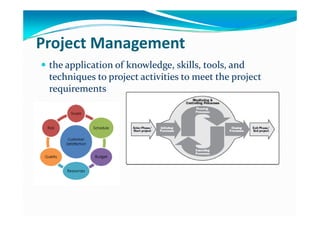
Project Management
h   li i   f k l d   kill   l   d h   li i   f k l d   kill   l   d  the application of knowledge, skills, tools, and the application of knowledge, skills, tools, and 
techniques to project activities to meet the project techniques to project activities to meet the project 
requirementsrequirementsrequirementsrequirements
Operations Management
 an area of management concerned with ongoing an area of management concerned with ongoing 
production of goods and/or services.production of goods and/or services.
 It involves ensuring that business operations continue It involves ensuring that business operations continue 
efficiently by using the optimum resources neededefficiently by using the optimum resources needed
and meeting customer demands.and meeting customer demands.
 It is concerned with managing processes that It is concerned with managing processes that g g pg g p
transform transform inputs (e.g., materials, components, energy, inputs (e.g., materials, components, energy, 
and labor) and labor) 
 into outputs (e.g., products, goods, and/or services).into outputs (e.g., products, goods, and/or services).
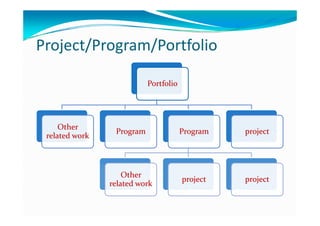
• PROGRAM
 a group of related projects  subprograms  and program a group of related projects  subprograms  and program  a group of related projects, subprograms, and program a group of related projects, subprograms, and program 
activities managed in a coordinated way to obtain benefits activities managed in a coordinated way to obtain benefits 
not available from managing them individually.not available from managing them individually.g g yg g y
• PORTFOLIO
• refers to projects, programs, sub portfolios, and operations refers to projects, programs, sub portfolios, and operations 
managed as a group to achieve strategic objectives.managed as a group to achieve strategic objectives.g g p g jg g p g j
Project/Program/Portfolio
PortfolioPortfolio
Other Other 
related workrelated work
ProgramProgram ProgramProgram projectproject
Other Other 
related workrelated work
projectproject projectproject
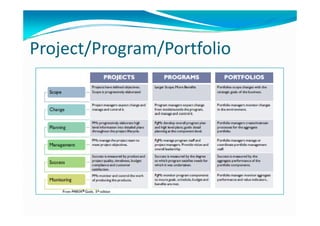
Project/Program/Portfolio
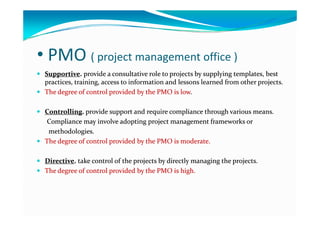
• PMO ( project management office )( p j g )
 SupportiveSupportive. . provide provide a consultative role to projects by supplying templates, a consultative role to projects by supplying templates, best best 
practicespractices, training, access to information and lessons learned from other projects. , training, access to information and lessons learned from other projects. 
 The The degree of control provided by the PMO is lowdegree of control provided by the PMO is low..
 CControllingontrolling. . provide provide support and require compliance through various meanssupport and require compliance through various meansCControllingontrolling. . provide provide support and require compliance through various means.support and require compliance through various means.
Compliance may Compliance may involve adopting project management frameworks or involve adopting project management frameworks or 
methodologies.methodologies.
h  d   f  l  d d b   h  h  d   f  l  d d b   h   O   O    dd The degree of control provided by the The degree of control provided by the PMO is PMO is moderatemoderate..
 DDirectiveirective. . take take control of the projects by directly managing the projects. control of the projects by directly managing the projects. p j y y g g p jp j y y g g p j
 The The degree degree of control of control provided by the PMO is high.provided by the PMO is high.
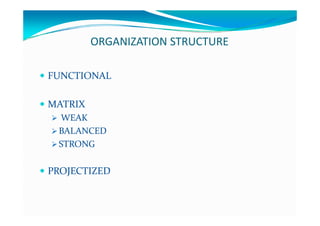
ORGANIZATION STRUCTURE
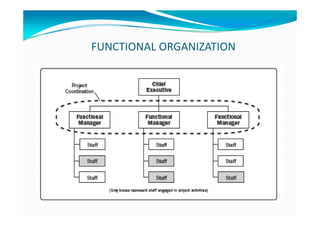
 FUNCTIONALFUNCTIONAL
 MATRIXMATRIX
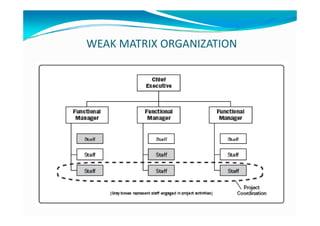
 WEAKWEAK
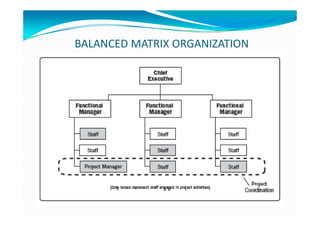
 BALANCEDBALANCED
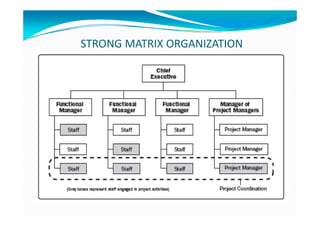
 STRONGSTRONG
 PROJECTIZEDPROJECTIZED
FUNCTIONAL ORGANIZATION
WEAK MATRIX ORGANIZATION
BALANCED MATRIX ORGANIZATION
STRONG MATRIX ORGANIZATION
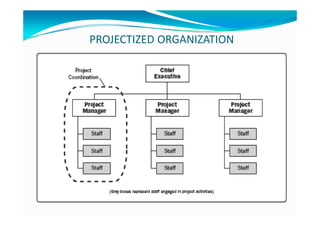
PROJECTIZED ORGANIZATIONPROJECTIZED ORGANIZATION
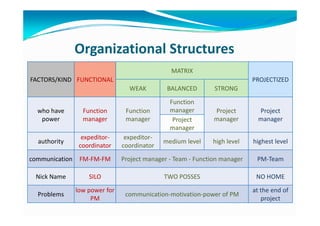
Organizational Structures
FACTORS/KIND FUNCTIONAL
MATRIX
PROJECTIZED
WEAK BALANCED STRONGWEAK BALANCED STRONG
who have  Function  Function 
Function 
manager Project  Project o a e
power
u ct o
manager
u ct o
manager
g oject
manager
oject
managerProject 
manager
expeditor‐ expeditor‐
authority
expeditor
coordinator
expeditor
coordinator
medium level  high level highest level
communication FM‐FM‐FM Project manager ‐ Team ‐ Function manager PM‐Team
Nick Name SILO TWO POSSES NO HOME
low power for at the end of
Problems
low power for 
PM
communication‐motivation‐power of PM
at the end of 
project
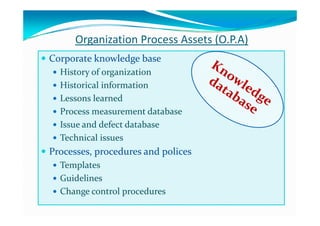
O i i P A (O PA)Organization Process Assets (O.P.A)
 Corporate knowledge baseCorporate knowledge baseCo po ate o edge baseCo po ate o edge base
 History of organizationHistory of organization
 Historical informationHistorical informationHistorical informationHistorical information
 Lessons learnedLessons learned
 Process measurement databaseProcess measurement database Process measurement databaseProcess measurement database
 Issue and defect databaseIssue and defect database
 Technical issuesTechnical issues Technical issuesTechnical issues
 Processes, procedures and policesProcesses, procedures and polices
 TemplatesTemplates TemplatesTemplates
 GuidelinesGuidelines
 Ch   t l  d  Ch   t l  d   Change control procedures Change control procedures 
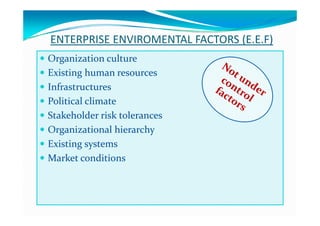
ENTERPRISE ENVIROMENTAL FACTORS (E E F)ENTERPRISE ENVIROMENTAL FACTORS (E.E.F)
 Organization cultureOrganization cultureO ga at o cu tu eO ga at o cu tu e
 Existing human resourcesExisting human resources
 InfrastructuresInfrastructures InfrastructuresInfrastructures
 Political climatePolitical climate
St k h ld   i k t lSt k h ld   i k t l Stakeholder risk tolerancesStakeholder risk tolerances
 Organizational hierarchyOrganizational hierarchy
 Existing systemsExisting systems
 Market conditionsMarket conditions
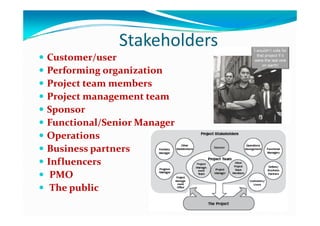
St k h ldStakeholders
 Customer/userCustomer/user
 Performing Performing organizationorganization
 Project Project team membersteam membersjj
 Project Project management teammanagement team
 SponsorSponsorpp
 Functional/Senior Functional/Senior ManagerManager
 OperationsOperationsOperationsOperations
 Business Business partnerspartners
 InfluencersInfluencersInfluencersInfluencers
 PMOPMO
 The publicThe publicThe publicThe public
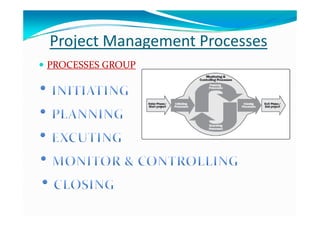
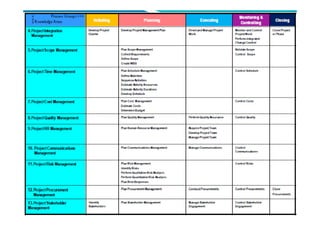
P j M PP j M PProject Management Processes Project Management Processes 
PROCESSES GROUPPROCESSES GROUP PROCESSES GROUPPROCESSES GROUP
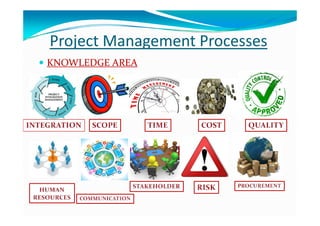
P j M PP j M PProject Management Processes Project Management Processes 
 KNOWLEDGE AREAKNOWLEDGE AREA KNOWLEDGE AREAKNOWLEDGE AREA
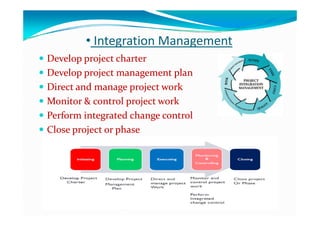
• Integration Management
 Develop project charterDevelop project chartereve op p oject c a teeve op p oject c a te
 Develop project management planDevelop project management plan
 Direct and manage project workDirect and manage project work Direct and manage project workDirect and manage project work
 Monitor & control project workMonitor & control project work
P f  i t t d  h   t lP f  i t t d  h   t l Perform integrated change controlPerform integrated change control
 Close project or phaseClose project or phase
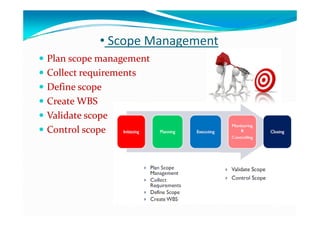
• Scope Management
 Plan scope managementPlan scope managementa scope a age e ta scope a age e t
 Collect requirementsCollect requirements
 Define scopeDefine scope Define scopeDefine scope
 Create WBSCreate WBS
V lid t  V lid t   Validate scopeValidate scope
 Control scopeControl scope
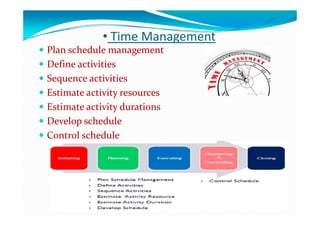
• Time Management• Time Management
 Plan schedule managementPlan schedule management
D fi   ti itiD fi   ti iti Define activitiesDefine activities
 Sequence activitiesSequence activities
 Estimate activity resourcesEstimate activity resources
 Estimate activity durationsEstimate activity durations
 Develop scheduleDevelop schedule
 Control scheduleControl schedule
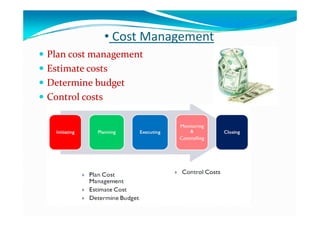
• Cost Management• Cost Management
 Plan cost managementPlan cost management
 Estimate costsEstimate costs
 Determine budgetDetermine budgetgg
 Control costsControl costs
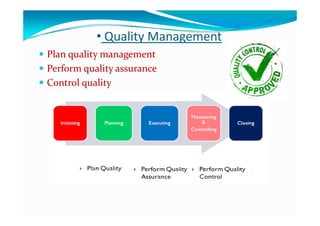
• Quality Management• Quality Management
 Plan quality managementPlan quality management
 Perform quality assurancePerform quality assurance
 Control qualityControl qualityq yq y
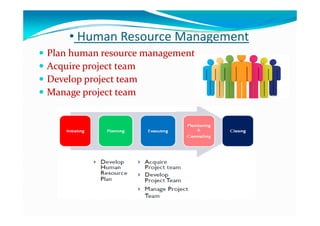
• Human Resource Management• Human Resource Management
 Plan human resource managementPlan human resource management
 Acquire project teamAcquire project team
 Develop project teamDevelop project team
 Manage project teamManage project team
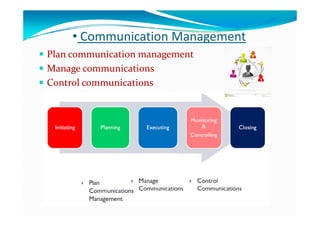
• Communication Management• Communication Management
 Plan communication managementPlan communication management
 Manage communicationsManage communications
 Control communicationsControl communications
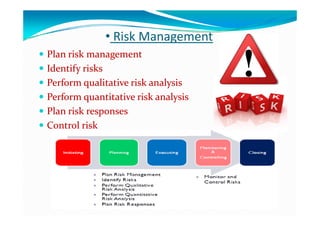
• Risk Management• Risk Management
 Plan risk managementPlan risk management
 Identify risksIdentify risks
 Perform qualitative risk analysisPerform qualitative risk analysisq yq y
 Perform quantitative risk analysisPerform quantitative risk analysis
 Plan risk responsesPlan risk responsesPlan risk responsesPlan risk responses
 Control riskControl risk
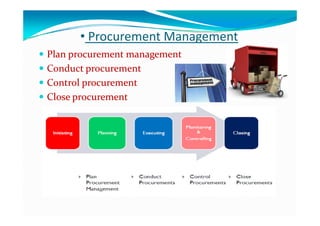
• Procurement Management• Procurement Management
 Plan procurement managementPlan procurement management
 Conduct procurementConduct procurement
 Control procurementControl procurementpp
 Close procurementClose procurement
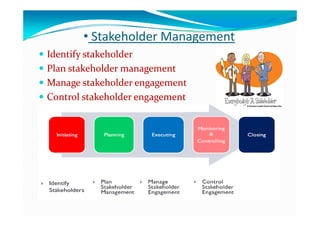
• Stakeholder Management• Stakeholder Management
 Identify stakeholderIdentify stakeholder
 Plan stakeholder managementPlan stakeholder management
 Manage stakeholder engagementManage stakeholder engagementg g gg g g
 Control stakeholder engagementControl stakeholder engagement
Pmp  3 chapter

Pmp 3 chapter