INITITATING Process Group
     By: Pradeep Patel PMP
Initiating: An Introduction

• Initiating is the first Process Group among the 5 Process groups
For details about Process Groups and Knowledge areas, visit the link below.
(http://www.slideshare.net/pradeeppatel05/pmp-an-introduction-10628767)
• This Process Group contains two processes
Develop Project Charter (in Integration Management Knowledge Area)
Identify StakeHolders (in Communications Management Knowledge Area)


This presentation will provide details about these two processes and additionally
   throw some light on the sequence of events that leads to a project’s existence.
Project Selection Methods

• Not Every Project that Business Development team brings to the company
    management, is selected for execution.
• Every Company has committee of experts, whose primary responsibility is to
    apply predefined selection criteria and select projects best suited for the
    company.
• Project selection methods can be grouped into two main categories
 1. Benefit Measurement Methods
These methods use comparative approaches to compare the benefits obtained
    from the prospective projects, that leads to the selection of the project with
    the maximum benefits.
2. Constrianed Optimization Methods
These methods are based on complex mathematical models that use formulae and
    algorithms to predict the success of a project(Don’t worry you don’t need to
    perform these calculations for the exam)
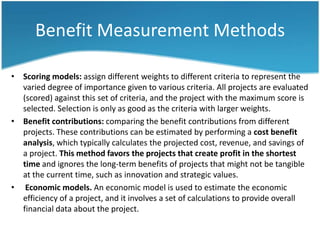
Benefit Measurement Methods

• Scoring models: assign different weights to different criteria to represent the
  varied degree of importance given to various criteria. All projects are evaluated
  (scored) against this set of criteria, and the project with the maximum score is
  selected. Selection is only as good as the criteria with larger weights.
• Benefit contributions: comparing the benefit contributions from different
  projects. These contributions can be estimated by performing a cost benefit
  analysis, which typically calculates the projected cost, revenue, and savings of
  a project. This method favors the projects that create profit in the shortest
  time and ignores the long-term benefits of projects that might not be tangible
  at the current time, such as innovation and strategic values.
• Economic models. An economic model is used to estimate the economic
  efficiency of a project, and it involves a set of calculations to provide overall
  financial data about the project.
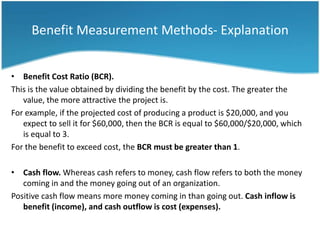
Benefit Measurement Methods- Explanation


• Benefit Cost Ratio (BCR).
This is the value obtained by dividing the benefit by the cost. The greater the
   value, the more attractive the project is.
For example, if the projected cost of producing a product is $20,000, and you
   expect to sell it for $60,000, then the BCR is equal to $60,000/$20,000, which
   is equal to 3.
For the benefit to exceed cost, the BCR must be greater than 1.

• Cash flow. Whereas cash refers to money, cash flow refers to both the money
   coming in and the money going out of an organization.
Positive cash flow means more money coming in than going out. Cash inflow is
   benefit (income), and cash outflow is cost (expenses).
Benefit Measurement Methods- Explanation


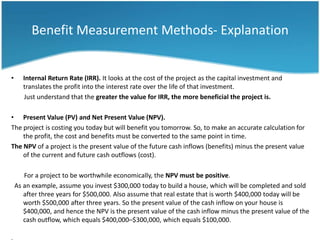
•      Internal Return Rate (IRR). It looks at the cost of the project as the capital investment and
       translates the profit into the interest rate over the life of that investment.
       Just understand that the greater the value for IRR, the more beneficial the project is.

• Present Value (PV) and Net Present Value (NPV).
The project is costing you today but will benefit you tomorrow. So, to make an accurate calculation for
    the profit, the cost and benefits must be converted to the same point in time.
The NPV of a project is the present value of the future cash inflows (benefits) minus the present value
    of the current and future cash outflows (cost).

       For a project to be worthwhile economically, the NPV must be positive.
    As an example, assume you invest $300,000 today to build a house, which will be completed and sold
       after three years for $500,000. Also assume that real estate that is worth $400,000 today will be
       worth $500,000 after three years. So the present value of the cash inflow on your house is
       $400,000, and hence the NPV is the present value of the cash inflow minus the present value of the
       cash outflow, which equals $400,000–$300,000, which equals $100,000.
Benefit Measurement Methods- Explanation


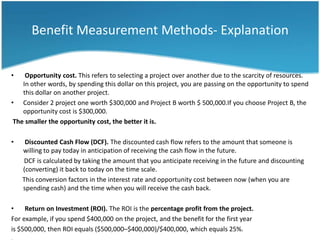
•    Opportunity cost. This refers to selecting a project over another due to the scarcity of resources.
    In other words, by spending this dollar on this project, you are passing on the opportunity to spend
    this dollar on another project.
• Consider 2 project one worth $300,000 and Project B worth $ 500,000.If you choose Project B, the
    opportunity cost is $300,000.
 The smaller the opportunity cost, the better it is.

•    Discounted Cash Flow (DCF). The discounted cash flow refers to the amount that someone is
    willing to pay today in anticipation of receiving the cash flow in the future.
    DCF is calculated by taking the amount that you anticipate receiving in the future and discounting
    (converting) it back to today on the time scale.
    This conversion factors in the interest rate and opportunity cost between now (when you are
    spending cash) and the time when you will receive the cash back.

•    Return on Investment (ROI). The ROI is the percentage profit from the project.
For example, if you spend $400,000 on the project, and the benefit for the first year
is $500,000, then ROI equals ($500,000–$400,000)/$400,000, which equals 25%.
Constrained Optimization Methods


•   These models use the following kinds of algorithms:
•   Linear
•   Nonlinear
•   Dynamic
•   Integer
•   Multiple objective programming

• I’ll not get into the details of these, as it involves a deep level of mathematical
  know-how of these topics. The exam does not require you to go the details of
  these as there are separate expert professionals who perform these activities.
• As a project management professional, you just need to be aware of the tools
  and techniques that are employed in project selection.
.
Developing Project Charter Process
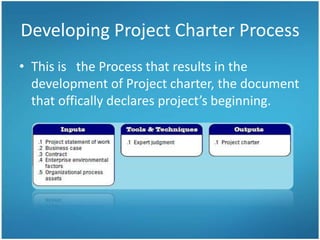
• This is the Process that results in the
  development of Project charter, the document
  that offically declares project’s beginning.
Develop Project Charter- Inputs
   Statement of Work (SOW).
The statement of work describes the products or services that will be delivered by the
   project. For an internal project the SOW is provided by the project initiator or the project
   sponsor, whereas for an external project the SOW is received from the customer as part of
   a bid document, such as a request for proposals, a request for bids, or a contract.
The SOW includes business needs that the project will satisfy, the product scope, and a
   strategic plan..
Business case document contains details as to why the project was chosen to be
    performed. This document contains cost benefit analysis and the project is selected on
    the basis of Feasibility study, Need analysis, Preliminary Plan
Remember: The statement of work lists all of the deliverables that you and your team need to produce. Business case
   helps give justification for the project.

Contract : Contract is the legal document containing the terms and conditions that both
    the parties agree to abide by for the duration of the project.
Enterprise Environmental Factors and Organizational Process Assets have been dealt
    separately in this presentation
(http://www.slideshare.net/pradeeppatel05/pmp-basics-you-need-to-know)
Develop Project Charter- Tools and Techniques

                     Expert Judgment:
• It is the only tools and techniques of the process. Expert judgement can be
  obtained from any of the following sources
• Subject matter Experts.
• Advice from Peers.
• Self obtained experience in the area.
• Consulting OPA documents relate to the subject.

Many a times expert judgment is considered to be the self made decisions based on
  the personal judgment. However personal judgment is clearly different from
  expert judgment.
Heavy drinking on Friday evening causes Hangover next morning..is your personal
  experience….Traffic cops handing you a challan for drunken driving..is Expert
  judgement.
Develop Project Charter- Output(s)

                    Project Charter
It is the only output of the process and is a high-level document that summarizes the
     business needs, the understanding of customer requirements, and how the new product
     or service will satisfy these requirements.
To be specific, the project charter should include the following information.
• The project justification, which includes the purpose of the project and the business case
     for the project, which in turn may include return on investment
• A project description that includes the business needs that the project addresses and the
     high-level product requirements
• Project requirements based on the needs of the customer, the sponsor, and other
     stakeholders
• A list of participating functional departments of the organization and their roles in the
     project Organizational, environmental, and external assumptions and constraints
• A summary of the high-level schedule, including milestones.
• A budget summary.
• An assigned project manager, a specified authority level for that project manager, and
     defined stakeholder influences.
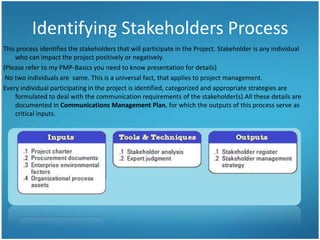
Identifying Stakeholders Process
This process identifies the stakeholders that will participate in the Project. Stakeholder is any individual
    who can impact the project positively or negatively.
(Please refer to my PMP-Basics you need to know presentation for details)
 No two individuals are same. This is a universal fact, that applies to project management.
Every individual participating in the project is identified, categorized and appropriate strategies are
    formulated to deal with the communication requirements of the stakeholder(s).All these details are
    documented in Communications Management Plan, for which the outputs of this process serve as
    critical inputs.
Identify Stakeholders-Inputs


Four major inputs to Identify Stakeholders Process are
• Project Charter
• Procurement documents
• Enterprise Environmental Factors
• Organizational Process Assets
 ( mindmap: PPOE)
This process takes project charter from Develop Project Charter processes( in
    Integration management) and Procurements documents from the Procurement
    management. Project charter helps in identifying the stakeholders as it contains
    all the requirements of the business.
• Procurements documents (if present), will help in identifying the Third Party
    Vendor, that need to be communicated in case there is some legal contract.
Identify Stakeholders-Tools and Techniques


 There are two main TTs that are used in this process
• Stakeholders analysis
• Expert judgment
(MindMap: SE)

•   During Stakeholder Analysis stakeholders are divided into groups based on their level of
    involvement and need for communication. When information gathering about what
    motivates all of stakeholders is complete , a strategy can be made to make sure that all
    the stakeholders are told about the things that they find important.
Stakeholders Analyis is critical activity of creating Power/Interest Grid (Power/Influence
    Grid, Influence/Impact Grid).This grid classifies the criticality of stakeholders, that helps in
    creation of effective communication plan).
Expert Judgement is same discussed in the above slides
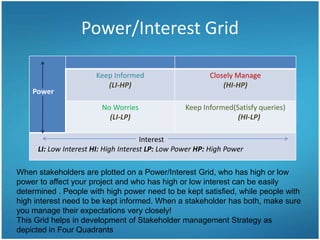
Power/Interest Grid

                       Keep Informed                      Closely Manage
                          (LI-HP)                             (HI-HP)
    Power

                         No Worries                Keep Informed(Satisfy queries)
                           (LI-LP)                                (HI-LP)

                                       Interest
      LI: Low Interest HI: High Interest LP: Low Power HP: High Power

When stakeholders are plotted on a Power/Interest Grid, who has high or low
power to affect your project and who has high or low interest can be easily
determined . People with high power need to be kept satisfied, while people with
high interest need to be kept informed. When a stakeholder has both, make sure
you manage their expectations very closely!
This Grid helps in development of Stakeholder management Strategy as
depicted in Four Quadrants
Identify Stakeholders-Output(s)


Stakeholders register and Stakeholder management strategy are the two main
outputs of this process.

Stakeholders Register Contains the details about all the identified stakeholders
that have been found in the process of stakeholders analysis.

It’s not enough to know who the project stakeholders are –understanding what
motivates them and what it will take it to make the project a success for each of
them is critical . That’s where the Stakeholder Management Strategy comes in.

Stakeholders Management Strategy makes sure everybody gets the right
message at the right time.
Once stakeholders’ concerns have been identified, headway for addressing them
can be started. That’s how a negative stakeholder can be turned into a project
advocate!
“Buy-in “means a stakeholder throws his support behind your project (he’s
“bought into” it).
Thank You!
     For Any Queries/Suggestions
          Please mail me at :
     pradeeppatelpmp@gmail.com
       Follow me on Slideshare:
http://slideshare.net/pradeeppatel05

Pmp inititating process group

  • 1.
    INITITATING Process Group By: Pradeep Patel PMP
  • 2.
    Initiating: An Introduction •Initiating is the first Process Group among the 5 Process groups For details about Process Groups and Knowledge areas, visit the link below. (http://www.slideshare.net/pradeeppatel05/pmp-an-introduction-10628767) • This Process Group contains two processes Develop Project Charter (in Integration Management Knowledge Area) Identify StakeHolders (in Communications Management Knowledge Area) This presentation will provide details about these two processes and additionally throw some light on the sequence of events that leads to a project’s existence.
  • 3.
    Project Selection Methods •Not Every Project that Business Development team brings to the company management, is selected for execution. • Every Company has committee of experts, whose primary responsibility is to apply predefined selection criteria and select projects best suited for the company. • Project selection methods can be grouped into two main categories 1. Benefit Measurement Methods These methods use comparative approaches to compare the benefits obtained from the prospective projects, that leads to the selection of the project with the maximum benefits. 2. Constrianed Optimization Methods These methods are based on complex mathematical models that use formulae and algorithms to predict the success of a project(Don’t worry you don’t need to perform these calculations for the exam)
  • 4.
    Benefit Measurement Methods •Scoring models: assign different weights to different criteria to represent the varied degree of importance given to various criteria. All projects are evaluated (scored) against this set of criteria, and the project with the maximum score is selected. Selection is only as good as the criteria with larger weights. • Benefit contributions: comparing the benefit contributions from different projects. These contributions can be estimated by performing a cost benefit analysis, which typically calculates the projected cost, revenue, and savings of a project. This method favors the projects that create profit in the shortest time and ignores the long-term benefits of projects that might not be tangible at the current time, such as innovation and strategic values. • Economic models. An economic model is used to estimate the economic efficiency of a project, and it involves a set of calculations to provide overall financial data about the project.
  • 5.
    Benefit Measurement Methods-Explanation • Benefit Cost Ratio (BCR). This is the value obtained by dividing the benefit by the cost. The greater the value, the more attractive the project is. For example, if the projected cost of producing a product is $20,000, and you expect to sell it for $60,000, then the BCR is equal to $60,000/$20,000, which is equal to 3. For the benefit to exceed cost, the BCR must be greater than 1. • Cash flow. Whereas cash refers to money, cash flow refers to both the money coming in and the money going out of an organization. Positive cash flow means more money coming in than going out. Cash inflow is benefit (income), and cash outflow is cost (expenses).
  • 6.
    Benefit Measurement Methods-Explanation • Internal Return Rate (IRR). It looks at the cost of the project as the capital investment and translates the profit into the interest rate over the life of that investment. Just understand that the greater the value for IRR, the more beneficial the project is. • Present Value (PV) and Net Present Value (NPV). The project is costing you today but will benefit you tomorrow. So, to make an accurate calculation for the profit, the cost and benefits must be converted to the same point in time. The NPV of a project is the present value of the future cash inflows (benefits) minus the present value of the current and future cash outflows (cost). For a project to be worthwhile economically, the NPV must be positive. As an example, assume you invest $300,000 today to build a house, which will be completed and sold after three years for $500,000. Also assume that real estate that is worth $400,000 today will be worth $500,000 after three years. So the present value of the cash inflow on your house is $400,000, and hence the NPV is the present value of the cash inflow minus the present value of the cash outflow, which equals $400,000–$300,000, which equals $100,000.
  • 7.
    Benefit Measurement Methods-Explanation • Opportunity cost. This refers to selecting a project over another due to the scarcity of resources. In other words, by spending this dollar on this project, you are passing on the opportunity to spend this dollar on another project. • Consider 2 project one worth $300,000 and Project B worth $ 500,000.If you choose Project B, the opportunity cost is $300,000. The smaller the opportunity cost, the better it is. • Discounted Cash Flow (DCF). The discounted cash flow refers to the amount that someone is willing to pay today in anticipation of receiving the cash flow in the future. DCF is calculated by taking the amount that you anticipate receiving in the future and discounting (converting) it back to today on the time scale. This conversion factors in the interest rate and opportunity cost between now (when you are spending cash) and the time when you will receive the cash back. • Return on Investment (ROI). The ROI is the percentage profit from the project. For example, if you spend $400,000 on the project, and the benefit for the first year is $500,000, then ROI equals ($500,000–$400,000)/$400,000, which equals 25%.
  • 8.
    Constrained Optimization Methods • These models use the following kinds of algorithms: • Linear • Nonlinear • Dynamic • Integer • Multiple objective programming • I’ll not get into the details of these, as it involves a deep level of mathematical know-how of these topics. The exam does not require you to go the details of these as there are separate expert professionals who perform these activities. • As a project management professional, you just need to be aware of the tools and techniques that are employed in project selection. .
  • 9.
    Developing Project CharterProcess • This is the Process that results in the development of Project charter, the document that offically declares project’s beginning.
  • 10.
    Develop Project Charter-Inputs Statement of Work (SOW). The statement of work describes the products or services that will be delivered by the project. For an internal project the SOW is provided by the project initiator or the project sponsor, whereas for an external project the SOW is received from the customer as part of a bid document, such as a request for proposals, a request for bids, or a contract. The SOW includes business needs that the project will satisfy, the product scope, and a strategic plan.. Business case document contains details as to why the project was chosen to be performed. This document contains cost benefit analysis and the project is selected on the basis of Feasibility study, Need analysis, Preliminary Plan Remember: The statement of work lists all of the deliverables that you and your team need to produce. Business case helps give justification for the project. Contract : Contract is the legal document containing the terms and conditions that both the parties agree to abide by for the duration of the project. Enterprise Environmental Factors and Organizational Process Assets have been dealt separately in this presentation (http://www.slideshare.net/pradeeppatel05/pmp-basics-you-need-to-know)
  • 11.
    Develop Project Charter-Tools and Techniques Expert Judgment: • It is the only tools and techniques of the process. Expert judgement can be obtained from any of the following sources • Subject matter Experts. • Advice from Peers. • Self obtained experience in the area. • Consulting OPA documents relate to the subject. Many a times expert judgment is considered to be the self made decisions based on the personal judgment. However personal judgment is clearly different from expert judgment. Heavy drinking on Friday evening causes Hangover next morning..is your personal experience….Traffic cops handing you a challan for drunken driving..is Expert judgement.
  • 12.
    Develop Project Charter-Output(s) Project Charter It is the only output of the process and is a high-level document that summarizes the business needs, the understanding of customer requirements, and how the new product or service will satisfy these requirements. To be specific, the project charter should include the following information. • The project justification, which includes the purpose of the project and the business case for the project, which in turn may include return on investment • A project description that includes the business needs that the project addresses and the high-level product requirements • Project requirements based on the needs of the customer, the sponsor, and other stakeholders • A list of participating functional departments of the organization and their roles in the project Organizational, environmental, and external assumptions and constraints • A summary of the high-level schedule, including milestones. • A budget summary. • An assigned project manager, a specified authority level for that project manager, and defined stakeholder influences.
  • 13.
    Identifying Stakeholders Process Thisprocess identifies the stakeholders that will participate in the Project. Stakeholder is any individual who can impact the project positively or negatively. (Please refer to my PMP-Basics you need to know presentation for details) No two individuals are same. This is a universal fact, that applies to project management. Every individual participating in the project is identified, categorized and appropriate strategies are formulated to deal with the communication requirements of the stakeholder(s).All these details are documented in Communications Management Plan, for which the outputs of this process serve as critical inputs.
  • 14.
    Identify Stakeholders-Inputs Four majorinputs to Identify Stakeholders Process are • Project Charter • Procurement documents • Enterprise Environmental Factors • Organizational Process Assets ( mindmap: PPOE) This process takes project charter from Develop Project Charter processes( in Integration management) and Procurements documents from the Procurement management. Project charter helps in identifying the stakeholders as it contains all the requirements of the business. • Procurements documents (if present), will help in identifying the Third Party Vendor, that need to be communicated in case there is some legal contract.
  • 15.
    Identify Stakeholders-Tools andTechniques There are two main TTs that are used in this process • Stakeholders analysis • Expert judgment (MindMap: SE) • During Stakeholder Analysis stakeholders are divided into groups based on their level of involvement and need for communication. When information gathering about what motivates all of stakeholders is complete , a strategy can be made to make sure that all the stakeholders are told about the things that they find important. Stakeholders Analyis is critical activity of creating Power/Interest Grid (Power/Influence Grid, Influence/Impact Grid).This grid classifies the criticality of stakeholders, that helps in creation of effective communication plan). Expert Judgement is same discussed in the above slides
  • 16.
    Power/Interest Grid Keep Informed Closely Manage (LI-HP) (HI-HP) Power No Worries Keep Informed(Satisfy queries) (LI-LP) (HI-LP) Interest LI: Low Interest HI: High Interest LP: Low Power HP: High Power When stakeholders are plotted on a Power/Interest Grid, who has high or low power to affect your project and who has high or low interest can be easily determined . People with high power need to be kept satisfied, while people with high interest need to be kept informed. When a stakeholder has both, make sure you manage their expectations very closely! This Grid helps in development of Stakeholder management Strategy as depicted in Four Quadrants
  • 17.
    Identify Stakeholders-Output(s) Stakeholders registerand Stakeholder management strategy are the two main outputs of this process. Stakeholders Register Contains the details about all the identified stakeholders that have been found in the process of stakeholders analysis. It’s not enough to know who the project stakeholders are –understanding what motivates them and what it will take it to make the project a success for each of them is critical . That’s where the Stakeholder Management Strategy comes in. Stakeholders Management Strategy makes sure everybody gets the right message at the right time. Once stakeholders’ concerns have been identified, headway for addressing them can be started. That’s how a negative stakeholder can be turned into a project advocate! “Buy-in “means a stakeholder throws his support behind your project (he’s “bought into” it).
  • 18.
    Thank You! For Any Queries/Suggestions Please mail me at : pradeeppatelpmp@gmail.com Follow me on Slideshare: http://slideshare.net/pradeeppatel05