Fundamentals of Project Management
Project
2
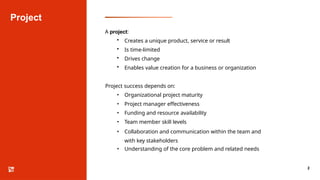
A project:
• Creates a unique product, service or result
• Is time-limited
• Drives change
• Enables value creation for a business or organization
Project success depends on:
• Organizational project maturity
• Project manager effectiveness
• Funding and resource availability
• Team member skill levels
• Collaboration and communication within the team and
with key stakeholders
• Understanding of the core problem and related needs
The Evolution
of Project
Management
3
Can you describe, in your
own words, how project
management has changed
during this time?
ca. 1969 – PMI founded
The application of knowledge, skills,
tools and techniques to project
activities to meet the project
requirements
2022 - Toward a systems view
“Projects do not simply produce outputs, but
more importantly, enable those outputs to
drive outcomes that ultimately deliver value to
the organization and its stakeholders.”
Project
Management
Principles
4
Guidance for
All Project
Practitioners
a. Be a diligent, respectful and caring
steward
b. Recognize, evaluate and respond to system
interactions
c. Navigate
complexity
d. Create a collaborative project team
environment
e. Demonstrate leadership behaviors
f. Optimize risk responses
g. Effectively engage with stakeholders
h. Tailor based on context
i. Embrace adaptability and resiliency
j. Focus on value
k. Build quality into processes and deliverables
l. Enable change to achieve the envisioned future
state
From Principles to Performance Domains
5
Use the 12 principles to
guide behavior in the 8
project performance
domains
Stakeholders
Team
Principles
Development
Approach and
Life Cycle
Planning
Project Work
Delivery
Measurement
Uncertainty
Tailor*
Projects to
Contexts
6
Because each project is unique, we adapt methods to the
unique project context to determine the most appropriate ways
of working to produce the desired outcomes.
Tailor iteratively and continuously throughout the project
PMI Talent
Triangle®
7
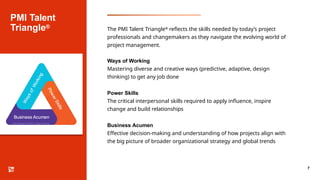
The PMI Talent Triangle® reflects the skills needed by today’s project
professionals and changemakers as they navigate the evolving world of
project management.
Ways of Working
Mastering diverse and creative ways (predictive, adaptive, design
thinking) to get any job done
Power Skills
The critical interpersonal skills required to apply influence, inspire
change and build relationships
Business Acumen
Effective decision-making and understanding of how projects align with
the big picture of broader organizational strategy and global trends
ongoin
g
Note: From PMI’s Standard for Portfolio Management
Strategic Management Elements and Frameworks
8
Some agile projects use a goal-
setting framework such as OKRs
(Objectives and Key Results) that
describes the organization’s
objectives and desired key results.
OPM:
9
A System for
Value
Delivery
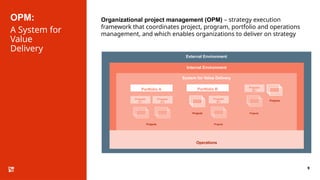
Organizational project management (OPM) – strategy execution
framework that coordinates project, program, portfolio and operations
management, and which enables organizations to deliver on strategy
System for Value Delivery
External Environment
Internal Environment
Operations
Portfolio A
Program
A.1
Program
A.2
Portfolio B
Program
B.1
Projects Projects
Program
B.1
Projects Projects
Projects
Projects,
Programs,
Portfolios
10
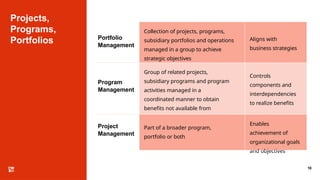
Portfolio
Management
Collection of projects, programs,
subsidiary portfolios and operations
managed in a group to achieve
strategic objectives
Aligns with
business strategies
Program
Management
Group of related projects,
subsidiary programs and program
activities managed in a
coordinated manner to obtain
benefits not available from
managing them individually
Controls
components and
interdependencies
to realize benefits
Project
Management
Part of a broader program,
portfolio or both
Enables
achievement of
organizational goals
and objectives
Business Value
• The net quantifiable benefit
(tangible and/or intangible)
identified from a business
endeavor
• Part of the objectives or description
of the project in the initiating
agreements
• Benefits realization is based on
declared business value
©2023 Project Management Institute, Inc. All rights reserved.
12This material is being provided as part of a PMI® course. 12
Examine
Business
Value
12
• Communicate with stakeholders, do the research and use
expert knowledge
• Examine, evaluate and confirm to determine exactly what is
or can be
of value!
Look especially at:
• Shareholder value (publicly traded companies)
or business growth (private)
• Customer value
• Employee knowledge
• Channel or business partner value
Types of
Business
Value
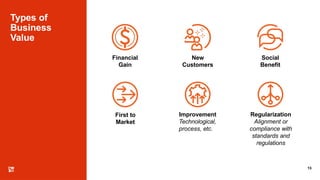
13
Financial
Gain
New
Customers
Social
Benefit
First to
Market
Improvement
Technological,
process, etc.
Regularization
Alignment or
compliance with
standards and
regulations
Needs
Assessment
14
Obtain Data
for the Project
Note: From Business
Analysis for Practitioners: A
Practice Guide
• Usually performed by a business
analyst
• Precedes the business
case
• Involves understanding of:
• Business goals and
objectives
• Issues and opportunities
• Recommends proposals to address:
• What should be done
• Constraints, assumptions, risks and
dependencies
• Success measures
• Implementation approach
Business
Documents
15
• Are developed prior to project start (usually by a business
analyst or key project stakeholder)
• Contain information about the project’s objectives and
contribution to the business goals
• Help the business to determine whether a project is
worth the required investment of time, money, and
resources
Review the business documents periodically
Business
Documents
16
Business Case
and Benefits
Management
Plan
Business case: justifies project and establishes
boundaries
• Cost-benefit analysis
• Business need
• Quality specifications
• Schedule or cost
constraints
Acceptance of the business case usually leads to creation of the
project charter.
Benefits management plan should include:
• Processes for creating, maximizing and sustaining project
benefits
• Time frame for short- and long-term benefits realization
• Benefits owner or accountable person
• Metrics
• Assumptions, constraints and risks
This is a business document, not part of the project management
plan.
Benefit
Measurement
Methods
17
Cost-benefit analysis: How businesses justify the
selection (authorization) of a project
Business - “smaller is better”
• Estimate payback period — Smallest number (duration) chosen
• Assess opportunity cost — What if we didn’t undertake the
project?
Financial - largest number (profit) chosen - “bigger is better”
• Time value of money
• Present value (PV)
• Future value (FV)
• Net present value (NPV)
• Internal rate of return (IRR)
• Return on investment (ROI)
You will not need to calculate any of these for the exam.
Project
Charter*
18
What it does and why it’s important:
• Authorizes project
• Enables project manager to apply resources to project work
• Defines rationale and business need
• Verifies alignment with strategic goals
• Keeps everyone focused on a clear project vision
Usually created by project sponsor or project manager with
executive/stakeholder approval. Sometimes a statement of work
can serve as project charter.
Project
Charter
Conten
ts
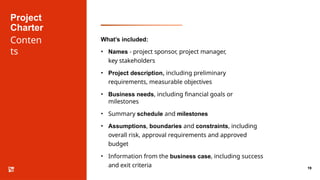
19
What’s included:
• Names - project sponsor, project manager,
key stakeholders
• Project description, including preliminary
requirements, measurable objectives
• Business needs, including financial goals or
milestones
• Summary schedule and milestones
• Assumptions, boundaries and constraints, including
overall risk, approval requirements and approved
budget
• Information from the business case, including success
and exit criteria
Project
Charter:
Exampl
e
20
Kickoff Meeting
Purpose
• Establishes project context
• Assists in team formation
• Aligns team and stakeholders with project
vision
Organizational/Public
• Announce project initiation
• Share understanding of high-level
vision, purpose and value
• Identify sponsor, key stakeholders and
project manager
• Include high-level items from the
project charter
21
Internal/Team – held after agreements are finalized
• Give project charter overview
• Clarify team member roles and
responsibilities (may include the initial team
charter)
• Present results of planning efforts
• Initiate product backlog
• Present product roadmap
Organizational Culture and Change
Management
TOPIC D
22
Project
Management
Office (PMO)*
23
Many large and
established project-
oriented organizations
have a PMO, but PMOs
are not a requirement for
project management
practice.
PMOs can be:
Supportive
• Develop best practices,
methodologies, standards
and templates
• Coach, mentor, train, guide
project managers
Controlling
• Monitor compliance with
project management
standards, policies, procedures
and templates via project
audits
Directive
• Manage shared resources
• Coordinate communication
across projects
Agile Centers of Excellence (ACoEs)
aka Value Delivery Office (VDO)
ACoEs enable, rather than
manage, project efforts:
• Coach teams
• Build agile mindset, skills
and capabilities throughout
the organization
• Mentor sponsors and
product owners
Organizational
Structures
24
• Functional
• Matrix
• Project-oriented
• Composite
Organizational structure and governance
affects/determines:
• How organizational groups and individuals
interrelate
• How much authority the project manager has
• What resources will be available
• How the project will be conducted
Relative Authority in Organizational Structures
25
Functional Matrix Project-oriented
Team member
loyalty
Functional
departme
nt
Conflicted loyalty Project
Team member
reporting
Functional manager
Both functional
manager and
project manager
Project manager
Project manager
role
Seldom identified
Coordinator to
full project
manager
Full-time
and
responsible
Team member role Part-time on project Part-time on project
Full-time on
project (preferred)
Control of project
manager over team
members
Nonexistent
(functional
manager controls)
Medium – shared
with functional
manager/sponsor
High
Conditions outside the
immediate control of
the team, and that
influence, constrain, or
direct the project,
program, or
portfolio.
Refers to all the implicit input
or
assets on processes used by
an organization in operating
a business. This may include,
but is not limited to, business
plans,
processes, policies,
protocols, and knowledge.
Organizational
Influences
Enterprise Environmental Factors
(EEFs)
• Internal and external to
the organization
Organizational Process Assets
(OPAs)
• Project policies, procedures
and templates
• Historical project information
26
Influences
Internal and External
EEFs
(Click to show
definition)
Internal
OPAs
(Click to
show
definitio
n)
External Internal
Process,
Policies and
Procedures
Corporate
Knowledge
Base
Get to Know
the External
Business
Environment
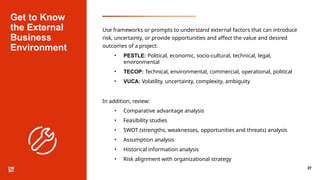
27
Use frameworks or prompts to understand external factors that can introduce
risk, uncertainty, or provide opportunities and affect the value and desired
outcomes of a project:
• PESTLE: Political, economic, socio-cultural, technical, legal,
environmental
• TECOP: Technical, environmental, commercial, operational, political
• VUCA: Volatility, uncertainty, complexity, ambiguity
In addition, review:
• Comparative advantage analysis
• Feasibility studies
• SWOT (strengths, weaknesses, opportunities and threats) analysis
• Assumption analysis
• Historical information analysis
• Risk alignment with organizational strategy
OPAs and
EEFs
28
Processes, policies and procedures
Examples—
• Organizational charts
• Procurement rules
• Hiring and onboarding
procedures
Organizational knowledge bases
Examples—
• Engineering wikis
• Libraries or archives
• Lessons learned repositories
Internal
Examples—
• Resource capabilities
• Organizational culture
• IT software
• Distribution of facilities
External
Examples—
• Marketplace conditions
• Laws, regulations and
standards
• Operating conditions
• Social and cultural influences
OPAs EEFs
Manage
Organizational
Change
Impacts on
Projects
29
• Assess organizational culture
• Evaluate impact of organizational change to project and
determine required actions
• Recommend options for changes to project
• Continually monitor external business environment for
impacts to project scope/backlog
Get to Know
Organizational Cultures
and Styles
• View of leadership, hierarchy
and authority
• Shared vision, beliefs and
expectations
• Diversity, equity and inclusion
practices
• Risk tolerance
• Regulations, policies and
procedures
• Code of conduct
• Operating environments
• Motivation and reward systems
©2023 Project Management Institute, Inc. All rights reserved.
31This material is being provided as part of a PMI® course. 31
Change
Management
Framework
“Organizational change requires individual change”
The ADKAR® model names five milestones an individual must
achieve in order to change successfully:
• A – Awareness of the need for change
• D – Desire to support the change
• K – Knowledge of how to change
• A – Ability to demonstrate new skills and behaviors
• R – Reinforcement to make the change stick
32
Project Governance
The framework, functions, and
processes that guide project
management activities to create a
unique product, service, or result to
meet organizational, strategic, and
operational goals.
Key benefits:
• Offers a single point of accountability
• Encompasses the project life cycle
Governance type differs among
organizations and projects.
©2023 Project Management Institute, Inc. All rights reserved.
33This material is being provided as part of a PMI® course. 33
Governance
Board
33
aka Project
Board or
Steering
Committee
Does anyone have
experience with a project
governance board?
Describe how it works
with your project.
• Provides project oversight
• May include project sponsor, senior managers and PMO
resources
• May be responsible for:
• Reviewing key deliverables
• Providing guidance for project decisions
Projects that use Scrum or SAFe® use intermediary
governance boards to liaise between the project and
organizational governance
Processes for:
• Change
• Communication
• Documentation—e.g., project
management plan
• Decision-making
• Internal stakeholder alignment with
project process requirements
• Review and approval of changes
above project manager authority
level
• Risk and issue identification,
escalation, and resolution
Project Governance:
Components
• Stage gate or phase reviews
• Guidelines for aligning project governance
and organizational strategy
• Project life cycle and development
approach
• Project organization chart with
roles
• Project success and deliverable acceptance
criteria
• Relationship among project team,
organizational groups, and external
stakeholders
34
Governance
Defines
Escalation
Procedures
35
For problems outside a project’s thresholds or tolerance levels:
• Escalate to the responsible stakeholder who is authorized to take
action;
• But if an issue is within the threshold, then work with the team to
find a resolution.
A
U
T
H
O
R
I
T
Y
PR O B L EM
TO L E R A N C
E
Project
Team
Responsible
Stakeholders
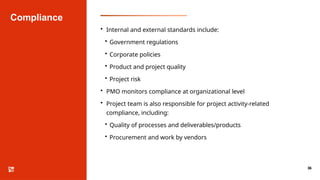
Compliance
36
• Internal and external standards include:
• Government regulations
• Corporate policies
• Product and project quality
• Project risk
• PMO monitors compliance at organizational level
• Project team is also responsible for project activity-related
compliance, including:
• Quality of processes and deliverables/products
• Procurement and work by vendors
Treat
Compliance as
a Project
Objective
37
• Check compliance before the end of the project to avoid transferring
issues
• In a risk or dedicated compliance register, include:
o The identified risk
o A responsible risk owner
o Impact of a realized risk
o Risk responses
Larger organizations or those in highly regulated industries typically
have a compliance department or officer.
• Proactively track and manage risks for compliance
requirements
• Be prepared to perform quality
audits
• Continuously validate legal and regulatory compliance for
deliverables
38
How to solve
PMP
Questions
39
Step # 1 Slow Down
Step # 2 Read the last line
first Step # 3 Find keywords
Step # 4 Use the
Elimination technique
Step# 5 Do root
cause analysis
Check your understanding
40
ement Institute, Inc. All rights reserved.
42
eing provided as part of a PMI® course.
QUESTION No: 01
PMP QUESTIONS
Who can make decision regarding resource in Weak
matrix?
A.PM
B.Sponsor
C.Function
manger
D.Both PM and
. All rights reserved.
43
art of a PMI® course.
QUESTION No: 02 PMP QUESTIONS
Who can make decision regarding resource in balanced
matrix?
A.PM
B.Sponsor
C. Function manger
D.Both PM and
Sponsor
44
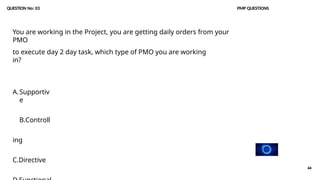
QUESTION No: 03 PMP QUESTIONS
You are working in the Project, you are getting daily orders from your
PMO
to execute day 2 day task, which type of PMO you are working
in?
A.Supportiv
e
B.Controll
ing
C.Directive
All rights reserved.
45
of a PMI® course.
QUESTION No: 04 PMP QUESTIONS
You are working in organization although your title is Project manager but you do not have any
power and
you are action sometimes as Project expeditor or project coordination, which type of organization
you are working in?
A. Functional
B. Weak matrix
C. Strong matrix
D. Projectized
E. Balanced matrix
ement Institute, Inc. All rights reserved.
46
eing provided as part of a PMI® course.
QUESTION No: 01
PMP QUESTIONS
You are the project manager of an organization, you have worked all your life in USA, you went to middle east and you
found
out that you cannot use whatsapp as communication tools, what will you update
A. PMIS
B. OPAs- Organization process
assets
C. Stakeholder register
D. EEF
ghts reserved.
47
PMI® course.
QUESTION No: 02 PMP QUESTIONS
You are the project manager of new organization, you want to start the project where will you
look first?
A. PMIS
B. OPAs- Organization process assets
C. Stakeholder register
D. EEF
48
©2023 Project Management Institute, Inc. All rights
reserved. This material is being provided as part of a
PMI® course.
End of Day 1

theorycccccccccccccccccccccccccccccccccccccccccccc

  • 1.
  • 2.
    Project 2 A project: • Createsa unique product, service or result • Is time-limited • Drives change • Enables value creation for a business or organization Project success depends on: • Organizational project maturity • Project manager effectiveness • Funding and resource availability • Team member skill levels • Collaboration and communication within the team and with key stakeholders • Understanding of the core problem and related needs
  • 3.
    The Evolution of Project Management 3 Canyou describe, in your own words, how project management has changed during this time? ca. 1969 – PMI founded The application of knowledge, skills, tools and techniques to project activities to meet the project requirements 2022 - Toward a systems view “Projects do not simply produce outputs, but more importantly, enable those outputs to drive outcomes that ultimately deliver value to the organization and its stakeholders.”
  • 4.
    Project Management Principles 4 Guidance for All Project Practitioners a.Be a diligent, respectful and caring steward b. Recognize, evaluate and respond to system interactions c. Navigate complexity d. Create a collaborative project team environment e. Demonstrate leadership behaviors f. Optimize risk responses g. Effectively engage with stakeholders h. Tailor based on context i. Embrace adaptability and resiliency j. Focus on value k. Build quality into processes and deliverables l. Enable change to achieve the envisioned future state
  • 5.
    From Principles toPerformance Domains 5 Use the 12 principles to guide behavior in the 8 project performance domains Stakeholders Team Principles Development Approach and Life Cycle Planning Project Work Delivery Measurement Uncertainty
  • 6.
    Tailor* Projects to Contexts 6 Because eachproject is unique, we adapt methods to the unique project context to determine the most appropriate ways of working to produce the desired outcomes. Tailor iteratively and continuously throughout the project
  • 7.
    PMI Talent Triangle® 7 The PMITalent Triangle® reflects the skills needed by today’s project professionals and changemakers as they navigate the evolving world of project management. Ways of Working Mastering diverse and creative ways (predictive, adaptive, design thinking) to get any job done Power Skills The critical interpersonal skills required to apply influence, inspire change and build relationships Business Acumen Effective decision-making and understanding of how projects align with the big picture of broader organizational strategy and global trends
  • 8.
    ongoin g Note: From PMI’sStandard for Portfolio Management Strategic Management Elements and Frameworks 8 Some agile projects use a goal- setting framework such as OKRs (Objectives and Key Results) that describes the organization’s objectives and desired key results.
  • 9.
    OPM: 9 A System for Value Delivery Organizationalproject management (OPM) – strategy execution framework that coordinates project, program, portfolio and operations management, and which enables organizations to deliver on strategy System for Value Delivery External Environment Internal Environment Operations Portfolio A Program A.1 Program A.2 Portfolio B Program B.1 Projects Projects Program B.1 Projects Projects Projects
  • 10.
    Projects, Programs, Portfolios 10 Portfolio Management Collection of projects,programs, subsidiary portfolios and operations managed in a group to achieve strategic objectives Aligns with business strategies Program Management Group of related projects, subsidiary programs and program activities managed in a coordinated manner to obtain benefits not available from managing them individually Controls components and interdependencies to realize benefits Project Management Part of a broader program, portfolio or both Enables achievement of organizational goals and objectives
  • 11.
    Business Value • Thenet quantifiable benefit (tangible and/or intangible) identified from a business endeavor • Part of the objectives or description of the project in the initiating agreements • Benefits realization is based on declared business value ©2023 Project Management Institute, Inc. All rights reserved. 12This material is being provided as part of a PMI® course. 12
  • 12.
    Examine Business Value 12 • Communicate withstakeholders, do the research and use expert knowledge • Examine, evaluate and confirm to determine exactly what is or can be of value! Look especially at: • Shareholder value (publicly traded companies) or business growth (private) • Customer value • Employee knowledge • Channel or business partner value
  • 13.
  • 14.
    Needs Assessment 14 Obtain Data for theProject Note: From Business Analysis for Practitioners: A Practice Guide • Usually performed by a business analyst • Precedes the business case • Involves understanding of: • Business goals and objectives • Issues and opportunities • Recommends proposals to address: • What should be done • Constraints, assumptions, risks and dependencies • Success measures • Implementation approach
  • 15.
    Business Documents 15 • Are developedprior to project start (usually by a business analyst or key project stakeholder) • Contain information about the project’s objectives and contribution to the business goals • Help the business to determine whether a project is worth the required investment of time, money, and resources Review the business documents periodically
  • 16.
    Business Documents 16 Business Case and Benefits Management Plan Businesscase: justifies project and establishes boundaries • Cost-benefit analysis • Business need • Quality specifications • Schedule or cost constraints Acceptance of the business case usually leads to creation of the project charter. Benefits management plan should include: • Processes for creating, maximizing and sustaining project benefits • Time frame for short- and long-term benefits realization • Benefits owner or accountable person • Metrics • Assumptions, constraints and risks This is a business document, not part of the project management plan.
  • 17.
    Benefit Measurement Methods 17 Cost-benefit analysis: Howbusinesses justify the selection (authorization) of a project Business - “smaller is better” • Estimate payback period — Smallest number (duration) chosen • Assess opportunity cost — What if we didn’t undertake the project? Financial - largest number (profit) chosen - “bigger is better” • Time value of money • Present value (PV) • Future value (FV) • Net present value (NPV) • Internal rate of return (IRR) • Return on investment (ROI) You will not need to calculate any of these for the exam.
  • 18.
    Project Charter* 18 What it doesand why it’s important: • Authorizes project • Enables project manager to apply resources to project work • Defines rationale and business need • Verifies alignment with strategic goals • Keeps everyone focused on a clear project vision Usually created by project sponsor or project manager with executive/stakeholder approval. Sometimes a statement of work can serve as project charter.
  • 19.
    Project Charter Conten ts 19 What’s included: • Names- project sponsor, project manager, key stakeholders • Project description, including preliminary requirements, measurable objectives • Business needs, including financial goals or milestones • Summary schedule and milestones • Assumptions, boundaries and constraints, including overall risk, approval requirements and approved budget • Information from the business case, including success and exit criteria
  • 20.
  • 21.
    Kickoff Meeting Purpose • Establishesproject context • Assists in team formation • Aligns team and stakeholders with project vision Organizational/Public • Announce project initiation • Share understanding of high-level vision, purpose and value • Identify sponsor, key stakeholders and project manager • Include high-level items from the project charter 21 Internal/Team – held after agreements are finalized • Give project charter overview • Clarify team member roles and responsibilities (may include the initial team charter) • Present results of planning efforts • Initiate product backlog • Present product roadmap
  • 22.
    Organizational Culture andChange Management TOPIC D 22
  • 23.
    Project Management Office (PMO)* 23 Many largeand established project- oriented organizations have a PMO, but PMOs are not a requirement for project management practice. PMOs can be: Supportive • Develop best practices, methodologies, standards and templates • Coach, mentor, train, guide project managers Controlling • Monitor compliance with project management standards, policies, procedures and templates via project audits Directive • Manage shared resources • Coordinate communication across projects Agile Centers of Excellence (ACoEs) aka Value Delivery Office (VDO) ACoEs enable, rather than manage, project efforts: • Coach teams • Build agile mindset, skills and capabilities throughout the organization • Mentor sponsors and product owners
  • 24.
    Organizational Structures 24 • Functional • Matrix •Project-oriented • Composite Organizational structure and governance affects/determines: • How organizational groups and individuals interrelate • How much authority the project manager has • What resources will be available • How the project will be conducted
  • 25.
    Relative Authority inOrganizational Structures 25 Functional Matrix Project-oriented Team member loyalty Functional departme nt Conflicted loyalty Project Team member reporting Functional manager Both functional manager and project manager Project manager Project manager role Seldom identified Coordinator to full project manager Full-time and responsible Team member role Part-time on project Part-time on project Full-time on project (preferred) Control of project manager over team members Nonexistent (functional manager controls) Medium – shared with functional manager/sponsor High
  • 26.
    Conditions outside the immediatecontrol of the team, and that influence, constrain, or direct the project, program, or portfolio. Refers to all the implicit input or assets on processes used by an organization in operating a business. This may include, but is not limited to, business plans, processes, policies, protocols, and knowledge. Organizational Influences Enterprise Environmental Factors (EEFs) • Internal and external to the organization Organizational Process Assets (OPAs) • Project policies, procedures and templates • Historical project information 26 Influences Internal and External EEFs (Click to show definition) Internal OPAs (Click to show definitio n) External Internal Process, Policies and Procedures Corporate Knowledge Base
  • 27.
    Get to Know theExternal Business Environment 27 Use frameworks or prompts to understand external factors that can introduce risk, uncertainty, or provide opportunities and affect the value and desired outcomes of a project: • PESTLE: Political, economic, socio-cultural, technical, legal, environmental • TECOP: Technical, environmental, commercial, operational, political • VUCA: Volatility, uncertainty, complexity, ambiguity In addition, review: • Comparative advantage analysis • Feasibility studies • SWOT (strengths, weaknesses, opportunities and threats) analysis • Assumption analysis • Historical information analysis • Risk alignment with organizational strategy
  • 28.
    OPAs and EEFs 28 Processes, policiesand procedures Examples— • Organizational charts • Procurement rules • Hiring and onboarding procedures Organizational knowledge bases Examples— • Engineering wikis • Libraries or archives • Lessons learned repositories Internal Examples— • Resource capabilities • Organizational culture • IT software • Distribution of facilities External Examples— • Marketplace conditions • Laws, regulations and standards • Operating conditions • Social and cultural influences OPAs EEFs
  • 29.
    Manage Organizational Change Impacts on Projects 29 • Assessorganizational culture • Evaluate impact of organizational change to project and determine required actions • Recommend options for changes to project • Continually monitor external business environment for impacts to project scope/backlog
  • 30.
    Get to Know OrganizationalCultures and Styles • View of leadership, hierarchy and authority • Shared vision, beliefs and expectations • Diversity, equity and inclusion practices • Risk tolerance • Regulations, policies and procedures • Code of conduct • Operating environments • Motivation and reward systems ©2023 Project Management Institute, Inc. All rights reserved. 31This material is being provided as part of a PMI® course. 31
  • 31.
    Change Management Framework “Organizational change requiresindividual change” The ADKAR® model names five milestones an individual must achieve in order to change successfully: • A – Awareness of the need for change • D – Desire to support the change • K – Knowledge of how to change • A – Ability to demonstrate new skills and behaviors • R – Reinforcement to make the change stick 32
  • 32.
    Project Governance The framework,functions, and processes that guide project management activities to create a unique product, service, or result to meet organizational, strategic, and operational goals. Key benefits: • Offers a single point of accountability • Encompasses the project life cycle Governance type differs among organizations and projects. ©2023 Project Management Institute, Inc. All rights reserved. 33This material is being provided as part of a PMI® course. 33
  • 33.
    Governance Board 33 aka Project Board or Steering Committee Doesanyone have experience with a project governance board? Describe how it works with your project. • Provides project oversight • May include project sponsor, senior managers and PMO resources • May be responsible for: • Reviewing key deliverables • Providing guidance for project decisions Projects that use Scrum or SAFe® use intermediary governance boards to liaise between the project and organizational governance
  • 34.
    Processes for: • Change •Communication • Documentation—e.g., project management plan • Decision-making • Internal stakeholder alignment with project process requirements • Review and approval of changes above project manager authority level • Risk and issue identification, escalation, and resolution Project Governance: Components • Stage gate or phase reviews • Guidelines for aligning project governance and organizational strategy • Project life cycle and development approach • Project organization chart with roles • Project success and deliverable acceptance criteria • Relationship among project team, organizational groups, and external stakeholders 34
  • 35.
    Governance Defines Escalation Procedures 35 For problems outsidea project’s thresholds or tolerance levels: • Escalate to the responsible stakeholder who is authorized to take action; • But if an issue is within the threshold, then work with the team to find a resolution. A U T H O R I T Y PR O B L EM TO L E R A N C E Project Team Responsible Stakeholders
  • 36.
    Compliance 36 • Internal andexternal standards include: • Government regulations • Corporate policies • Product and project quality • Project risk • PMO monitors compliance at organizational level • Project team is also responsible for project activity-related compliance, including: • Quality of processes and deliverables/products • Procurement and work by vendors
  • 37.
    Treat Compliance as a Project Objective 37 •Check compliance before the end of the project to avoid transferring issues • In a risk or dedicated compliance register, include: o The identified risk o A responsible risk owner o Impact of a realized risk o Risk responses Larger organizations or those in highly regulated industries typically have a compliance department or officer. • Proactively track and manage risks for compliance requirements • Be prepared to perform quality audits • Continuously validate legal and regulatory compliance for deliverables
  • 38.
  • 39.
    How to solve PMP Questions 39 Step# 1 Slow Down Step # 2 Read the last line first Step # 3 Find keywords Step # 4 Use the Elimination technique Step# 5 Do root cause analysis
  • 40.
  • 41.
    ement Institute, Inc.All rights reserved. 42 eing provided as part of a PMI® course. QUESTION No: 01 PMP QUESTIONS Who can make decision regarding resource in Weak matrix? A.PM B.Sponsor C.Function manger D.Both PM and
  • 42.
    . All rightsreserved. 43 art of a PMI® course. QUESTION No: 02 PMP QUESTIONS Who can make decision regarding resource in balanced matrix? A.PM B.Sponsor C. Function manger D.Both PM and Sponsor
  • 43.
    44 QUESTION No: 03PMP QUESTIONS You are working in the Project, you are getting daily orders from your PMO to execute day 2 day task, which type of PMO you are working in? A.Supportiv e B.Controll ing C.Directive
  • 44.
    All rights reserved. 45 ofa PMI® course. QUESTION No: 04 PMP QUESTIONS You are working in organization although your title is Project manager but you do not have any power and you are action sometimes as Project expeditor or project coordination, which type of organization you are working in? A. Functional B. Weak matrix C. Strong matrix D. Projectized E. Balanced matrix
  • 45.
    ement Institute, Inc.All rights reserved. 46 eing provided as part of a PMI® course. QUESTION No: 01 PMP QUESTIONS You are the project manager of an organization, you have worked all your life in USA, you went to middle east and you found out that you cannot use whatsapp as communication tools, what will you update A. PMIS B. OPAs- Organization process assets C. Stakeholder register D. EEF
  • 46.
    ghts reserved. 47 PMI® course. QUESTIONNo: 02 PMP QUESTIONS You are the project manager of new organization, you want to start the project where will you look first? A. PMIS B. OPAs- Organization process assets C. Stakeholder register D. EEF
  • 47.
    48 ©2023 Project ManagementInstitute, Inc. All rights reserved. This material is being provided as part of a PMI® course. End of Day 1