Introduction to
Project Management
What Is a Project?
 A project is “a temporary endeavor undertaken
to accomplish a unique product or service”
 Attributes of projects
 unique purpose
 temporary
 require resources, often from various areas
 should have a primary sponsor and/or
customer
 involve uncertainty
 Single unit
 Relatively low frequency
 Defined starting points and ending points
 Defined outcomes / goals
 Complex interrelated tasks, often
transcending functional boundaries
 Require special management tools
Characteristics of Projects
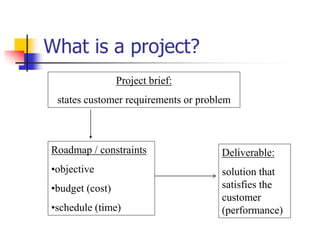
What is a project?
Roadmap / constraints
•objective
•budget (cost)
•schedule (time)
Deliverable:
solution that
satisfies the
customer
(performance)
Project brief:
states customer requirements or problem
What is Project Management?
Project management is “the application of
knowledge, skills, tools, and techniques to
project activities in order to meet project
requirements” (PMI)
History of Project Management
 Some people argue that building the
Egyptian pyramids was a project, as was
building the Great Wall of China
 Most people consider the Manhattan Project
to be the first project to use “modern”
project management
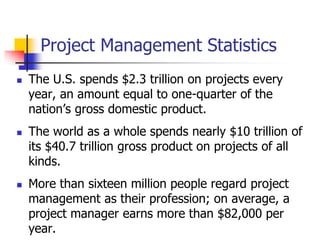
Project Management Statistics
 The U.S. spends $2.3 trillion on projects every
year, an amount equal to one-quarter of the
nation’s gross domestic product.
 The world as a whole spends nearly $10 trillion of
its $40.7 trillion gross product on projects of all
kinds.
 More than sixteen million people regard project
management as their profession; on average, a
project manager earns more than $82,000 per
year.
Advantages of Using Formal Project
Management
 Better control of financial, physical, and
human resources
 Improved customer relations
 Shorter development times
 Lower costs
 Higher quality and increased reliability
 Higher profit margins
 Improved productivity
 Better internal coordination
 Higher worker morale
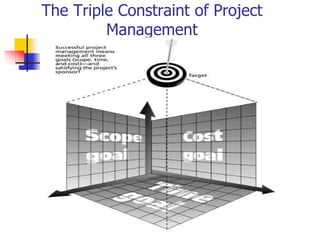
The Triple Constraint
 Every project is constrained in different
ways by its
 Scope goals: What is the project trying to
accomplish?
 Time goals: How long should it take to
complete?
 Cost goals: What should it cost?
 It is the project manager’s duty to balance
these three often competing goals
The Triple Constraint of Project
Management
Reasons for performance
Improvements
"The reasons for the increase in successful
projects vary. First, the average cost of a
project has been more than cut in half. Better
tools have been created to monitor and
control progress and better skilled project
managers with better management
processes are being used. The fact that
there are processes is significant in itself.“*
Project Stakeholders
 Stakeholders are the people involved in
or affected by project activities
 Stakeholders include
 the project sponsor and project team
 support staff
 customers
 users
 suppliers
 opponents to the project
Project Management Knowledge
Areas
 Knowledge areas describe the key
competencies that project managers must develop
 4 core knowledge areas lead to specific project
objectives (scope, time, cost, and quality)
 4 facilitating knowledge areas are the means
through which the project objectives are
achieved (human resources, communication,
risk, and procurement management)
 1 knowledge area (project integration
management) affects and is affected by all of
the other knowledge areas
Project Management Tools and
Techniques
 Project management tools and techniques assist
project managers and their teams in various
aspects of project management
 Some specific ones include
 Project Charter, scope statement, and WBS
(scope)
 Gantt charts, network diagrams, critical path
analysis, critical chain scheduling (time)
 Cost estimates and earned value management
(cost)
How Project Management Relates to
Other Disciplines
 Much of the knowledge needed to
manage projects is unique to the
discipline of project management
 Project mangers must also have
knowledge and experience in
 general management
 the application area of the project
The Project Management Profession
 The job of IT Project Manager is in the
list of the top ten most in demand IT
skills
 Professional societies like the Project
Management Institute (PMI) have
grown tremendously
 Project management research and
certification programs continue to grow
Project Management Certification
 PMI provides certification as a Project
Management Professional (PMP)
 A PMP has documented sufficient project
experience, agreed to follow a code of
ethics, and passed the PMP exam
 The number of people earning PMP
certification is increasing quickly
 PMI and other organizations are offering
new certification programs
Ethics in Project Management
 Ethics is an important part of all
professions
 Project managers often face ethical
dilemmas
 In order to earn PMP certification,
applicants must agree to the PMP
code of professional conduct
Project Management Applications
 Project management applies to work as
well as personal projects
 Project management applies to many
different disciplines (IT, construction,
finance, sports, event planning, etc.)
 Project management skills can help in
everyday life
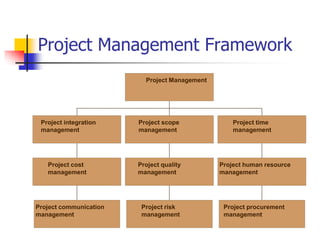
Project Management Framework
Project communication
management
Project cost
management
Project integration
management
Project risk
management
Project quality
management
Project scope
management
Project procurement
management
Project human resource
management
Project time
management
Project Management
Project life cycle
 Projects have beginnings, middle periods
and endings.
 Where you are in the project life cycle
determines what you should be doing
and what alternatives are available
 Iron law of a life cycle: problems
downstream are symptoms of neglect
upstream.
Project life cycle
 Purpose of project life cycle:
 tells us what needs to be done when -
upstream problems can only be solved
upstream
 overcome iron law of a life cycle
 Project life cycle phases:
 concept
 definition / design
 execution / implementation
 close-out
Project life cycle: concept phase
 Clarify customer requirements
 Identify all stakeholders
 Finalize project objectives
 Define key performance indicators
 Generate and evaluate alternative solutions
 Determine best solution & evaluate risk
 Detailed plan for definition phase
 Provisional base line
Life cycle: definition phase
 Develop work breakdown structure (WBS)
 Which contractor(s)?
 Obtain cost and schedule estimates
(estimating)
 Develop detailed plan for implementation
phase & preliminary plan for rest of life
 Develop preliminary plan for rest of life
 Prepare provisional baseline: decision-
making milestone meeting
Life cycle: Implementation phase
 Contract out or in - each task of
implementation phase WBS
 Monitor and control project
performance
 Launch corrective action whenever
needed
Life cycle: close-out phase
 Test all deliverables
 Transfer to owner
 Close project accounts
 Reassign project team
 Conduct project post-mortem
Alternative life cycle phase names:
feasibility, preliminary design, detailed
design, construction, commissioning
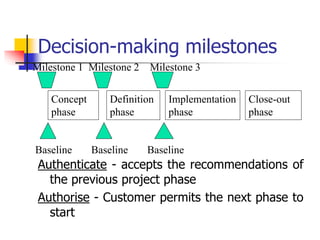
Decision-making milestones
Authenticate - accepts the recommendations of
the previous project phase
Authorise - Customer permits the next phase to
start
Concept
phase
Milestone 1
Definition
phase
Milestone 2
Implementation
phase
Close-out
phase
Milestone 3
Baseline Baseline Baseline
Project life cycle
 Base lines
 Formal change control
 Performance measurement
 Project life cycle = {activity phases, decision-
making milestones, baselines}
 Differentiate between phase & process
 Project risk = certainty of project outcome
 Project risk decreases and customer investment
increases as the project progress
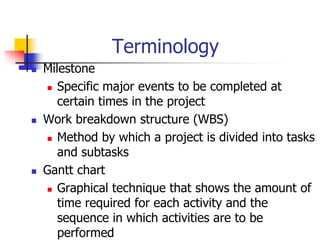
Terminology
 Milestone
 Specific major events to be completed at
certain times in the project
 Work breakdown structure (WBS)
 Method by which a project is divided into tasks
and subtasks
 Gantt chart
 Graphical technique that shows the amount of
time required for each activity and the
sequence in which activities are to be
performed
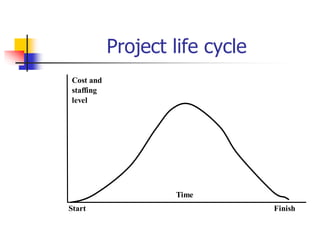
Project life cycle
Cost and
staffing
level
Time
Start Finish
Project Formulation
 Points to be considered:
• The type and level of industrial activity
• To match his financial resources with the
required amount
• Prepare a nice project report
Broad Heads of Project Report
• General Information
• Project Description
• Market potential
• Capital Costs and Sources of Finance
• Assessment of Working Capital
• Other Financial Aspects
• Economic and Social Vairables
General Information
 Name and address of the entrepreneur
 Qualification, Experience and other capabilities
of entrepreneur
 Reference of industry analysis
 Constitution and organization structure of
enterprise
 Registration details with Directorate of
Industries/ Registrar of Firms
 Utility of the products
Project Description
• Location
• Raw Material
• Skilled Labour
• Power
• Fuel
• Water
• Waste disposal
• Communication systems
Project Description (cont.)
• Transport
• Other common facilities
• List of Machinery
• Capacity of the Plant
• Technology
• Manufacturing Process
• Balancing of Plant
• Quality Control
• Research & Development
Market Potential
• Total Demand & Supply
• Estimation of Cost & Price
• Marketing Strategy
• After sales service
• Seasonality
• Transportation of Goods

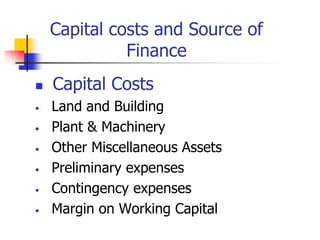
Capital costs and Source of
Finance
 Capital Costs
• Land and Building
• Plant & Machinery
• Other Miscellaneous Assets
• Preliminary expenses
• Contingency expenses
• Margin on Working Capital
Source of Finance
• Capital
• Subsidy/ Incentives
• Unsecured Loan
• Loan from friends and relatives
• Soft Loan
• Term Loan
Assessment of Working Capital
Requirement
 Planning for working capital
requirement
 Estimate of working capital
requirement
Other Financial Aspects
 Projected Profit & Loss Account
 Projected Balance Sheet
 Projected Cash Flow Statement
Break-Even Analysis
Profitability Ratio
Return on Investment
Debt:Equity Ratio
Debt Service Coverage Ratio
Economic and Social Variables
 Promoting Employment
 Import Substitution
 Promoting ancillaries
 Development of the area
Financial Appraisal
 Capital Cost of Project
 Source of Finance
 Financial Projections
 Ratio Analysis
 Break-Even Point
 Discounted Cash Flow
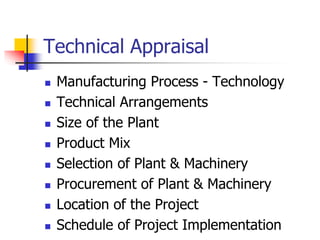
Technical Appraisal
 Manufacturing Process - Technology
 Technical Arrangements
 Size of the Plant
 Product Mix
 Selection of Plant & Machinery
 Procurement of Plant & Machinery
 Location of the Project
 Schedule of Project Implementation
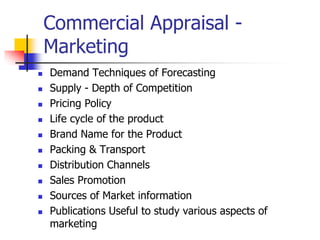
Commercial Appraisal -
Marketing
 Demand Techniques of Forecasting
 Supply - Depth of Competition
 Pricing Policy
 Life cycle of the product
 Brand Name for the Product
 Packing & Transport
 Distribution Channels
 Sales Promotion
 Sources of Market information
 Publications Useful to study various aspects of
marketing
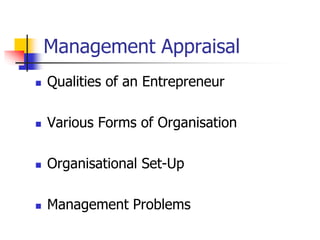
Management Appraisal
 Qualities of an Entrepreneur
 Various Forms of Organisation
 Organisational Set-Up
 Management Problems
Thank you

PM ppt unit 1.ppt

  • 1.
  • 2.
    What Is aProject?  A project is “a temporary endeavor undertaken to accomplish a unique product or service”  Attributes of projects  unique purpose  temporary  require resources, often from various areas  should have a primary sponsor and/or customer  involve uncertainty
  • 3.
     Single unit Relatively low frequency  Defined starting points and ending points  Defined outcomes / goals  Complex interrelated tasks, often transcending functional boundaries  Require special management tools Characteristics of Projects
  • 4.
    What is aproject? Roadmap / constraints •objective •budget (cost) •schedule (time) Deliverable: solution that satisfies the customer (performance) Project brief: states customer requirements or problem
  • 5.
    What is ProjectManagement? Project management is “the application of knowledge, skills, tools, and techniques to project activities in order to meet project requirements” (PMI)
  • 6.
    History of ProjectManagement  Some people argue that building the Egyptian pyramids was a project, as was building the Great Wall of China  Most people consider the Manhattan Project to be the first project to use “modern” project management
  • 7.
    Project Management Statistics The U.S. spends $2.3 trillion on projects every year, an amount equal to one-quarter of the nation’s gross domestic product.  The world as a whole spends nearly $10 trillion of its $40.7 trillion gross product on projects of all kinds.  More than sixteen million people regard project management as their profession; on average, a project manager earns more than $82,000 per year.
  • 8.
    Advantages of UsingFormal Project Management  Better control of financial, physical, and human resources  Improved customer relations  Shorter development times  Lower costs  Higher quality and increased reliability  Higher profit margins  Improved productivity  Better internal coordination  Higher worker morale
  • 9.
    The Triple Constraint Every project is constrained in different ways by its  Scope goals: What is the project trying to accomplish?  Time goals: How long should it take to complete?  Cost goals: What should it cost?  It is the project manager’s duty to balance these three often competing goals
  • 10.
    The Triple Constraintof Project Management
  • 11.
    Reasons for performance Improvements "Thereasons for the increase in successful projects vary. First, the average cost of a project has been more than cut in half. Better tools have been created to monitor and control progress and better skilled project managers with better management processes are being used. The fact that there are processes is significant in itself.“*
  • 12.
    Project Stakeholders  Stakeholdersare the people involved in or affected by project activities  Stakeholders include  the project sponsor and project team  support staff  customers  users  suppliers  opponents to the project
  • 13.
    Project Management Knowledge Areas Knowledge areas describe the key competencies that project managers must develop  4 core knowledge areas lead to specific project objectives (scope, time, cost, and quality)  4 facilitating knowledge areas are the means through which the project objectives are achieved (human resources, communication, risk, and procurement management)  1 knowledge area (project integration management) affects and is affected by all of the other knowledge areas
  • 14.
    Project Management Toolsand Techniques  Project management tools and techniques assist project managers and their teams in various aspects of project management  Some specific ones include  Project Charter, scope statement, and WBS (scope)  Gantt charts, network diagrams, critical path analysis, critical chain scheduling (time)  Cost estimates and earned value management (cost)
  • 15.
    How Project ManagementRelates to Other Disciplines  Much of the knowledge needed to manage projects is unique to the discipline of project management  Project mangers must also have knowledge and experience in  general management  the application area of the project
  • 16.
    The Project ManagementProfession  The job of IT Project Manager is in the list of the top ten most in demand IT skills  Professional societies like the Project Management Institute (PMI) have grown tremendously  Project management research and certification programs continue to grow
  • 17.
    Project Management Certification PMI provides certification as a Project Management Professional (PMP)  A PMP has documented sufficient project experience, agreed to follow a code of ethics, and passed the PMP exam  The number of people earning PMP certification is increasing quickly  PMI and other organizations are offering new certification programs
  • 18.
    Ethics in ProjectManagement  Ethics is an important part of all professions  Project managers often face ethical dilemmas  In order to earn PMP certification, applicants must agree to the PMP code of professional conduct
  • 19.
    Project Management Applications Project management applies to work as well as personal projects  Project management applies to many different disciplines (IT, construction, finance, sports, event planning, etc.)  Project management skills can help in everyday life
  • 20.
    Project Management Framework Projectcommunication management Project cost management Project integration management Project risk management Project quality management Project scope management Project procurement management Project human resource management Project time management Project Management
  • 21.
    Project life cycle Projects have beginnings, middle periods and endings.  Where you are in the project life cycle determines what you should be doing and what alternatives are available  Iron law of a life cycle: problems downstream are symptoms of neglect upstream.
  • 22.
    Project life cycle Purpose of project life cycle:  tells us what needs to be done when - upstream problems can only be solved upstream  overcome iron law of a life cycle  Project life cycle phases:  concept  definition / design  execution / implementation  close-out
  • 23.
    Project life cycle:concept phase  Clarify customer requirements  Identify all stakeholders  Finalize project objectives  Define key performance indicators  Generate and evaluate alternative solutions  Determine best solution & evaluate risk  Detailed plan for definition phase  Provisional base line
  • 24.
    Life cycle: definitionphase  Develop work breakdown structure (WBS)  Which contractor(s)?  Obtain cost and schedule estimates (estimating)  Develop detailed plan for implementation phase & preliminary plan for rest of life  Develop preliminary plan for rest of life  Prepare provisional baseline: decision- making milestone meeting
  • 25.
    Life cycle: Implementationphase  Contract out or in - each task of implementation phase WBS  Monitor and control project performance  Launch corrective action whenever needed
  • 26.
    Life cycle: close-outphase  Test all deliverables  Transfer to owner  Close project accounts  Reassign project team  Conduct project post-mortem Alternative life cycle phase names: feasibility, preliminary design, detailed design, construction, commissioning
  • 27.
    Decision-making milestones Authenticate -accepts the recommendations of the previous project phase Authorise - Customer permits the next phase to start Concept phase Milestone 1 Definition phase Milestone 2 Implementation phase Close-out phase Milestone 3 Baseline Baseline Baseline
  • 28.
    Project life cycle Base lines  Formal change control  Performance measurement  Project life cycle = {activity phases, decision- making milestones, baselines}  Differentiate between phase & process  Project risk = certainty of project outcome  Project risk decreases and customer investment increases as the project progress
  • 29.
    Terminology  Milestone  Specificmajor events to be completed at certain times in the project  Work breakdown structure (WBS)  Method by which a project is divided into tasks and subtasks  Gantt chart  Graphical technique that shows the amount of time required for each activity and the sequence in which activities are to be performed
  • 30.
    Project life cycle Costand staffing level Time Start Finish
  • 31.
    Project Formulation  Pointsto be considered: • The type and level of industrial activity • To match his financial resources with the required amount • Prepare a nice project report
  • 32.
    Broad Heads ofProject Report • General Information • Project Description • Market potential • Capital Costs and Sources of Finance • Assessment of Working Capital • Other Financial Aspects • Economic and Social Vairables
  • 33.
    General Information  Nameand address of the entrepreneur  Qualification, Experience and other capabilities of entrepreneur  Reference of industry analysis  Constitution and organization structure of enterprise  Registration details with Directorate of Industries/ Registrar of Firms  Utility of the products
  • 34.
    Project Description • Location •Raw Material • Skilled Labour • Power • Fuel • Water • Waste disposal • Communication systems
  • 35.
    Project Description (cont.) •Transport • Other common facilities • List of Machinery • Capacity of the Plant • Technology • Manufacturing Process • Balancing of Plant • Quality Control • Research & Development
  • 36.
    Market Potential • TotalDemand & Supply • Estimation of Cost & Price • Marketing Strategy • After sales service • Seasonality • Transportation of Goods 
  • 37.
    Capital costs andSource of Finance  Capital Costs • Land and Building • Plant & Machinery • Other Miscellaneous Assets • Preliminary expenses • Contingency expenses • Margin on Working Capital
  • 38.
    Source of Finance •Capital • Subsidy/ Incentives • Unsecured Loan • Loan from friends and relatives • Soft Loan • Term Loan
  • 39.
    Assessment of WorkingCapital Requirement  Planning for working capital requirement  Estimate of working capital requirement
  • 40.
    Other Financial Aspects Projected Profit & Loss Account  Projected Balance Sheet  Projected Cash Flow Statement Break-Even Analysis Profitability Ratio Return on Investment Debt:Equity Ratio Debt Service Coverage Ratio
  • 41.
    Economic and SocialVariables  Promoting Employment  Import Substitution  Promoting ancillaries  Development of the area
  • 42.
    Financial Appraisal  CapitalCost of Project  Source of Finance  Financial Projections  Ratio Analysis  Break-Even Point  Discounted Cash Flow
  • 43.
    Technical Appraisal  ManufacturingProcess - Technology  Technical Arrangements  Size of the Plant  Product Mix  Selection of Plant & Machinery  Procurement of Plant & Machinery  Location of the Project  Schedule of Project Implementation
  • 44.
    Commercial Appraisal - Marketing Demand Techniques of Forecasting  Supply - Depth of Competition  Pricing Policy  Life cycle of the product  Brand Name for the Product  Packing & Transport  Distribution Channels  Sales Promotion  Sources of Market information  Publications Useful to study various aspects of marketing
  • 45.
    Management Appraisal  Qualitiesof an Entrepreneur  Various Forms of Organisation  Organisational Set-Up  Management Problems
  • 46.