Project Cost Management
Preparedby Presentedby:
Engr. Mohamed Eid , PMP® Engr. Tarek Khairy , PMP®
Project Cost Management
Preparedby Presentedby:
Engr. Mohamed Eid , PMP® Engr. Tarek Khairy , PMP®
Project Cost Management
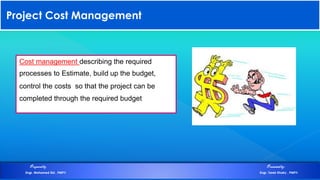
Cost management describing the required
processes to Estimate, build up the budget,
control the costs so that the project can be
completed through the required budget
Preparedby Presentedby:
Engr. Mohamed Eid , PMP® Engr. Tarek Khairy , PMP®
Preparedby Presentedby:
Engr. Mohamed Eid , PMP® Engr. Tarek Khairy , PMP®
Definitions
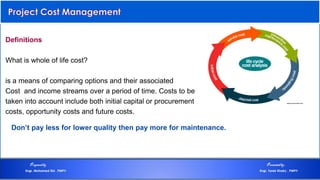
What is whole of life cost?
is a means of comparing options and their associated
Cost and income streams over a period of time. Costs to be
taken into account include both initial capital or procurement
costs, opportunity costs and future costs.
Don’t pay less for lower quality then pay more for maintenance.
Preparedby Presentedby:
Engr. Mohamed Eid , PMP® Engr. Tarek Khairy , PMP®
 On some projects, especially those of smaller scope, cost estimating and cost budgeting are
tightly linked
 and can be viewed as a single process that can be performed by a single person over a
relatively short period of time.
 These are presented here as distinct processes because the tools and techniques for each
are different.
 The ability to influence cost is greatest at the early stages of the project, making early scope
definition critical
Preparedby Presentedby:
Engr. Mohamed Eid , PMP® Engr. Tarek Khairy , PMP®
 Direct vs. Indirect Cost
 Direct Cost: Directly attributable to project work.
 Indirect cost: Such as overhead, benefits, and costs incurred
for more than project like equipments.
 Fixed vs. Variable Cost
 Fixed cost: Costs that are not changed with production such as setup cost and rental cost
 Variable cost: Costs that are changed with production such as material and labors.
Preparedby Presentedby:
Engr. Mohamed Eid , PMP® Engr. Tarek Khairy , PMP®
Now you need to think first about your
plan
1-How you will work to finalize this issue
2-Who will be involved
3-What tool could we need
4-What Process could we follow
5-Do I need to refer to lesson Learned
Many questions will be in mind you need
to answer it
Preparedby Presentedby:
Engr. Mohamed Eid , PMP® Engr. Tarek Khairy , PMP®
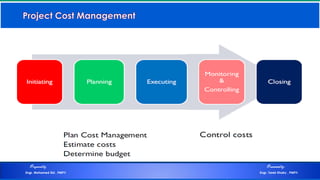
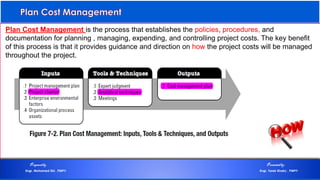
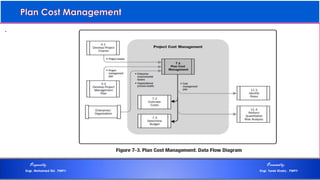
Plan Cost Management is the process that establishes the policies, procedures, and
documentation for planning , managing, expending, and controlling project costs. The key benefit
of this process is that it provides guidance and direction on how the project costs will be managed
throughout the project.
Preparedby Presentedby:
Engr. Mohamed Eid , PMP® Engr. Tarek Khairy , PMP®
.
Preparedby Presentedby:
Engr. Mohamed Eid , PMP® Engr. Tarek Khairy , PMP®
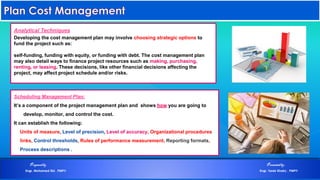
Analytical Techniques
Developing the cost management plan may involve choosing strategic options to
fund the project such as:
self-funding, funding with equity, or funding with debt. The cost management plan
may also detail ways to finance project resources such as making, purchasing,
renting, or leasing. These decisions, like other financial decisions affecting the
project, may affect project schedule and/or risks.
Scheduling Management Plan:
It’s a component of the project management plan and shows how you are going to
develop, monitor, and control the cost.
It can establish the following:
Units of measure, Level of precision, Level of accuracy, Organizational procedures
links, Control thresholds, Rules of performance measurement, Reporting formats,
Process descriptions .
Preparedby Presentedby:
Engr. Mohamed Eid , PMP® Engr. Tarek Khairy , PMP®
NOW Prepare to estimate
Preparedby Presentedby:
Engr. Mohamed Eid , PMP® Engr. Mohamed Abdulhaq , PMP®
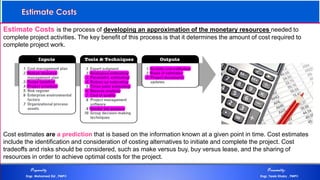
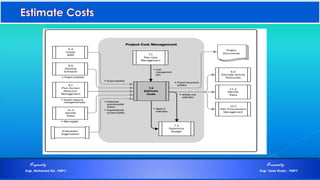
Estimate Costs is the process of developing an approximation of the monetary resources needed to
complete project activities. The key benefit of this process is that it determines the amount of cost required to
complete project work.
Cost estimates are a prediction that is based on the information known at a given point in time. Cost estimates
include the identification and consideration of costing alternatives to initiate and complete the project. Cost
tradeoffs and risks should be considered, such as make versus buy, buy versus lease, and the sharing of
resources in order to achieve optimal costs for the project.
Estimate Costs
Preparedby Presentedby:
Engr. Mohamed Eid , PMP® Engr. Tarek Khairy , PMP®
Preparedby Presentedby:
Engr. Mohamed Eid , PMP® Engr. Tarek Khairy , PMP®
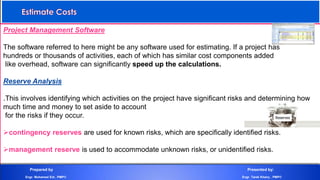
Project Management Software
The software referred to here might be any software used for estimating. If a project has
hundreds or thousands of activities, each of which has similar cost components added
like overhead, software can significantly speed up the calculations.
Reserve Analysis
.This involves identifying which activities on the project have significant risks and determining how
much time and money to set aside to account
for the risks if they occur.
contingency reserves are used for known risks, which are specifically identified risks.
management reserve is used to accommodate unknown risks, or unidentified risks.
Prepared by Presented by:
Engr. Mohamed Eid , PMP® Engr. Tarek Khairy , PMP®
Cost of Quality:
• All costs incurred in preventing nonconformance, apprising, or rework.
This will be discussed later in Quality Management.
Vendor Bid Analysis:
• Analysis of cost estimate based on
responsive bids from qualified vendors.
Prepared by Presented by:
Engr. Mohamed Eid , PMP® Engr. Tarek Khairy , PMP®
Cost Estimates:Costs are estimated for all resources such as:
• Direct Cost (Labor, materials, equipment, services, facilities, IT)
• Cost of financing (interest), inflation allowance, exchange rates.
• Contingency reserve.,Insurance fees.
• Taxes,Overhead (Site overhead and main office)
Rough Order of Magnitude (ROM) Estimate This type of estimate is usually made
during project initiating. A typical range for ROM estimates is -25 to +75 percent from
actual, but this range can vary depending on how much is known about the project when creating
the estimates.
• Budget Estimate This type of estimate is usually made during project planning and is in the
range of -10 to+25 percent from actual.
• Definitive Estimate As the project progresses, the estimate will become more refined. Some
project managers use the range of + / -10 percent from actual, while others use -5 to + 10 percent
from actual.
Prepared by Presented by:
Engr. Mohamed Eid , PMP® Engr. Tarek Khairy , PMP®
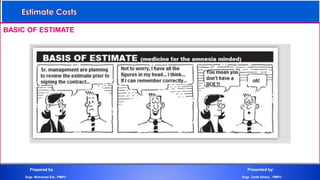
BASIC OF ESTIMATE
Prepared by Presented by:
Engr. Mohamed Eid , PMP® Engr. Tarek Khairy , PMP®
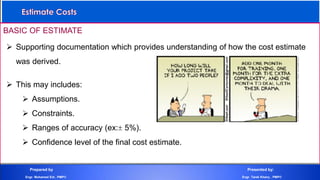
BASIC OF ESTIMATE
 Supporting documentation which provides understanding of how the cost estimate
was derived.
 This may includes:
 Assumptions.
 Constraints.
 Ranges of accuracy (ex: 5%).
 Confidence level of the final cost estimate.
Prepared by Presented by:
Engr. Mohamed Eid , PMP® Engr. Tarek Khairy , PMP®
Prepared by Presented by:
Engr. Mohamed Eid , PMP® Engr. Tarek Khairy , PMP®
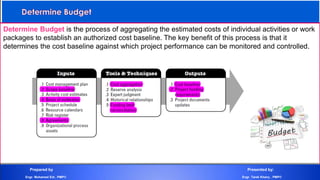
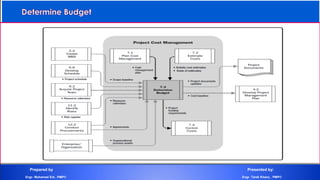
Determine Budget is the process of aggregating the estimated costs of individual activities or work
packages to establish an authorized cost baseline. The key benefit of this process is that it
determines the cost baseline against which project performance can be monitored and controlled.
Prepared by Presented by:
Engr. Mohamed Eid , PMP® Engr. Tarek Khairy , PMP®
Prepared by Presented by:
Engr. Mohamed Eid , PMP® Engr. Tarek Khairy , PMP®
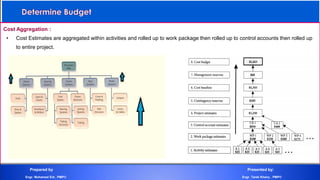
Cost Aggregation :
• Cost Estimates are aggregated within activities and rolled up to work package then rolled up to control accounts then rolled up
to entire project.
Prepared by Presented by:
Engr. Mohamed Eid , PMP® Engr. Tarek Khairy , PMP®
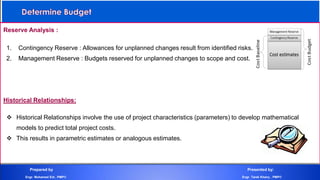
Reserve Analysis :
1. Contingency Reserve : Allowances for unplanned changes result from identified risks.
2. Management Reserve : Budgets reserved for unplanned changes to scope and cost.
Historical Relationships:
 Historical Relationships involve the use of project characteristics (parameters) to develop mathematical
models to predict total project costs.
 This results in parametric estimates or analogous estimates.
Prepared by Presented by:
Engr. Mohamed Eid , PMP® Engr. Tarek Khairy , PMP®
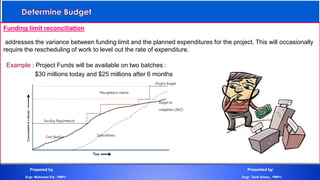
Funding limit reconciliation
addresses the variance between funding limit and the planned expenditures for the project. This will occasionally
require the rescheduling of work to level out the rate of expenditure.
Example : Project Funds will be available on two batches :
$30 millions today and $25 millions after 6 months
Prepared by Presented by:
Engr. Mohamed Eid , PMP® Engr. Tarek Khairy , PMP®
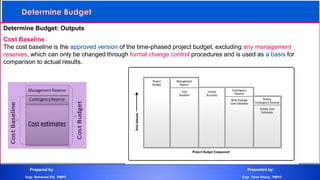
Determine Budget: Outputs
Cost Baseline
The cost baseline is the approved version of the time-phased project budget, excluding any management
reserves, which can only be changed through formal change control procedures and is used as a basis for
comparison to actual results.
Prepared by Presented by:
Engr. Mohamed Eid , PMP® Engr. Tarek Khairy , PMP®
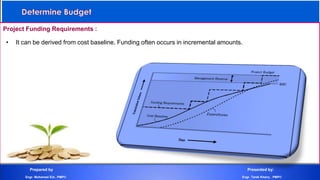
Project Funding Requirements :
• It can be derived from cost baseline. Funding often occurs in incremental amounts.
Prepared by Presented by:
Engr. Mohamed Eid , PMP® Engr. Tarek Khairy , PMP®
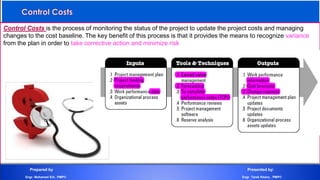
Control Costs is the process of monitoring the status of the project to update the project costs and managing
changes to the cost baseline. The key benefit of this process is that it provides the means to recognize variance
from the plan in order to take corrective action and minimize risk
Prepared by Presented by:
Engr. Mohamed Eid , PMP® Engr. Tarek Khairy , PMP®
Prepared by Presented by:
Engr. Mohamed Eid , PMP® Engr. Tarek Khairy , PMP®
Prepared by Presented by:
Engr. Mohamed Eid , PMP® Engr. Tarek Khairy , PMP®
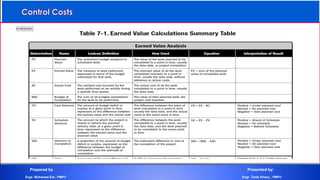
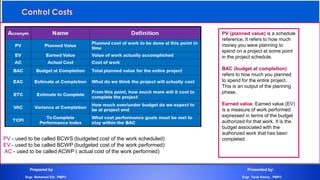
PV - used to be called BCWS (budgeted cost of the work scheduled)
EV - used to be called BCWP (budgeted cost of the work performed)
AC - used to be called ACWP ( actual cost of the work performed)
Prepared by Presented by:
Engr. Mohamed Eid , PMP® Engr. Tarek Khairy , PMP®
PV (planned value) is a schedule
reference. It refers to how much
money you were planning to
spend on a project at some point
in the project schedule.
BAC (budget at completion)
refers to how much you planned
to spend for the entire project.
This is an output of the planning
phase.
Earned value. Earned value (EV)
is a measure of work performed
expressed in terms of the budget
authorized for that work. It is the
budget associated with the
authorized work that has been
completed.
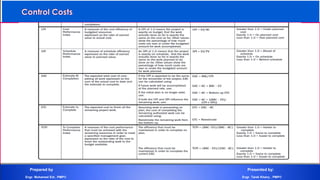
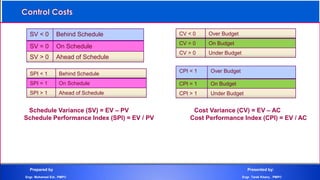
Schedule Variance (SV) = EV – PV Cost Variance (CV) = EV – AC
Schedule Performance Index (SPI) = EV / PV Cost Performance Index (CPI) = EV / AC
Prepared by Presented by:
Engr. Mohamed Eid , PMP® Engr. Tarek Khairy , PMP®
Behind ScheduleSV < 0
On ScheduleSV = 0
Ahead of ScheduleSV > 0
Over BudgetCV < 0
On BudgetCV = 0
Under BudgetCV > 0
Behind ScheduleSPI < 1
On ScheduleSPI = 1
Ahead of ScheduleSPI > 1
Over BudgetCPI < 1
On BudgetCPI = 1
Under BudgetCPI > 1
Prepared by Presented by:
Engr. Mohamed Eid , PMP® Engr. Tarek Khairy , PMP®
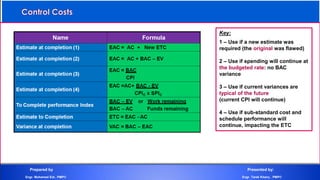
Key:
1 – Use if a new estimate was
required (the original was flawed)
2 – Use if spending will continue at
the budgeted rate: no BAC
variance
3 – Use if current variances are
typical of the future
(current CPI will continue)
4 – Use if sub-standard cost and
schedule performance will
continue, impacting the ETC
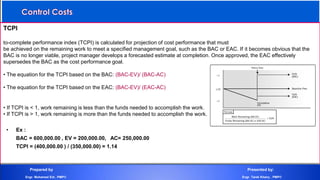
TCPI
to-complete performance index (TCPI) is calculated for projection of cost performance that must
be achieved on the remaining work to meet a specified management goal, such as the BAC or EAC. If it becomes obvious that the
BAC is no longer viable, project manager develops a forecasted estimate at completion. Once approved, the EAC effectively
supersedes the BAC as the cost performance goal.
• The equation for the TCPI based on the BAC: (BAC-EV)/ (BAC-AC)
• The equation for the TCPI based on the EAC: (BAC-EV)/ (EAC-AC)
• If TCPI is < 1, work remaining is less than the funds needed to accomplish the work.
• If TCPI is > 1, work remaining is more than the funds needed to accomplish the work.
• Ex :
BAC = 600,000.00 , EV = 200,000.00, AC= 250,000.00
TCPI = (400,000.00 ) / (350,000.00) = 1.14
Prepared by Presented by:
Engr. Mohamed Eid , PMP® Engr. Tarek Khairy , PMP®
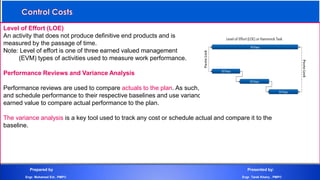
Level of Effort (LOE)
An activity that does not produce definitive end products and is
measured by the passage of time.
Note: Level of effort is one of three earned valued management
(EVM) types of activities used to measure work performance.
Performance Reviews and Variance Analysis
Performance reviews are used to compare actuals to the plan. As such, they compare cost performance
and schedule performance to their respective baselines and use variance analysis, trend analysis and
earned value to compare actual performance to the plan.
The variance analysis is a key tool used to track any cost or schedule actual and compare it to the
baseline.
Prepared by Presented by:
Engr. Mohamed Eid , PMP® Engr. Tarek Khairy , PMP®
Prepared by Presented by:
Engr. Mohamed Eid , PMP® Engr. Tarek Khairy , PMP®

project Cost management

  • 1.
    Project Cost Management PreparedbyPresentedby: Engr. Mohamed Eid , PMP® Engr. Tarek Khairy , PMP®
  • 2.
    Project Cost Management PreparedbyPresentedby: Engr. Mohamed Eid , PMP® Engr. Tarek Khairy , PMP®
  • 3.
    Project Cost Management Costmanagement describing the required processes to Estimate, build up the budget, control the costs so that the project can be completed through the required budget Preparedby Presentedby: Engr. Mohamed Eid , PMP® Engr. Tarek Khairy , PMP®
  • 4.
    Preparedby Presentedby: Engr. MohamedEid , PMP® Engr. Tarek Khairy , PMP®
  • 5.
    Definitions What is wholeof life cost? is a means of comparing options and their associated Cost and income streams over a period of time. Costs to be taken into account include both initial capital or procurement costs, opportunity costs and future costs. Don’t pay less for lower quality then pay more for maintenance. Preparedby Presentedby: Engr. Mohamed Eid , PMP® Engr. Tarek Khairy , PMP®
  • 6.
     On someprojects, especially those of smaller scope, cost estimating and cost budgeting are tightly linked  and can be viewed as a single process that can be performed by a single person over a relatively short period of time.  These are presented here as distinct processes because the tools and techniques for each are different.  The ability to influence cost is greatest at the early stages of the project, making early scope definition critical Preparedby Presentedby: Engr. Mohamed Eid , PMP® Engr. Tarek Khairy , PMP®
  • 7.
     Direct vs.Indirect Cost  Direct Cost: Directly attributable to project work.  Indirect cost: Such as overhead, benefits, and costs incurred for more than project like equipments.  Fixed vs. Variable Cost  Fixed cost: Costs that are not changed with production such as setup cost and rental cost  Variable cost: Costs that are changed with production such as material and labors. Preparedby Presentedby: Engr. Mohamed Eid , PMP® Engr. Tarek Khairy , PMP®
  • 8.
    Now you needto think first about your plan 1-How you will work to finalize this issue 2-Who will be involved 3-What tool could we need 4-What Process could we follow 5-Do I need to refer to lesson Learned Many questions will be in mind you need to answer it Preparedby Presentedby: Engr. Mohamed Eid , PMP® Engr. Tarek Khairy , PMP®
  • 9.
    Plan Cost Managementis the process that establishes the policies, procedures, and documentation for planning , managing, expending, and controlling project costs. The key benefit of this process is that it provides guidance and direction on how the project costs will be managed throughout the project. Preparedby Presentedby: Engr. Mohamed Eid , PMP® Engr. Tarek Khairy , PMP®
  • 10.
    . Preparedby Presentedby: Engr. MohamedEid , PMP® Engr. Tarek Khairy , PMP®
  • 11.
    Analytical Techniques Developing thecost management plan may involve choosing strategic options to fund the project such as: self-funding, funding with equity, or funding with debt. The cost management plan may also detail ways to finance project resources such as making, purchasing, renting, or leasing. These decisions, like other financial decisions affecting the project, may affect project schedule and/or risks. Scheduling Management Plan: It’s a component of the project management plan and shows how you are going to develop, monitor, and control the cost. It can establish the following: Units of measure, Level of precision, Level of accuracy, Organizational procedures links, Control thresholds, Rules of performance measurement, Reporting formats, Process descriptions . Preparedby Presentedby: Engr. Mohamed Eid , PMP® Engr. Tarek Khairy , PMP®
  • 12.
    NOW Prepare toestimate Preparedby Presentedby: Engr. Mohamed Eid , PMP® Engr. Mohamed Abdulhaq , PMP®
  • 13.
    Estimate Costs isthe process of developing an approximation of the monetary resources needed to complete project activities. The key benefit of this process is that it determines the amount of cost required to complete project work. Cost estimates are a prediction that is based on the information known at a given point in time. Cost estimates include the identification and consideration of costing alternatives to initiate and complete the project. Cost tradeoffs and risks should be considered, such as make versus buy, buy versus lease, and the sharing of resources in order to achieve optimal costs for the project. Estimate Costs Preparedby Presentedby: Engr. Mohamed Eid , PMP® Engr. Tarek Khairy , PMP®
  • 14.
    Preparedby Presentedby: Engr. MohamedEid , PMP® Engr. Tarek Khairy , PMP®
  • 15.
    Project Management Software Thesoftware referred to here might be any software used for estimating. If a project has hundreds or thousands of activities, each of which has similar cost components added like overhead, software can significantly speed up the calculations. Reserve Analysis .This involves identifying which activities on the project have significant risks and determining how much time and money to set aside to account for the risks if they occur. contingency reserves are used for known risks, which are specifically identified risks. management reserve is used to accommodate unknown risks, or unidentified risks. Prepared by Presented by: Engr. Mohamed Eid , PMP® Engr. Tarek Khairy , PMP®
  • 16.
    Cost of Quality: •All costs incurred in preventing nonconformance, apprising, or rework. This will be discussed later in Quality Management. Vendor Bid Analysis: • Analysis of cost estimate based on responsive bids from qualified vendors. Prepared by Presented by: Engr. Mohamed Eid , PMP® Engr. Tarek Khairy , PMP®
  • 17.
    Cost Estimates:Costs areestimated for all resources such as: • Direct Cost (Labor, materials, equipment, services, facilities, IT) • Cost of financing (interest), inflation allowance, exchange rates. • Contingency reserve.,Insurance fees. • Taxes,Overhead (Site overhead and main office) Rough Order of Magnitude (ROM) Estimate This type of estimate is usually made during project initiating. A typical range for ROM estimates is -25 to +75 percent from actual, but this range can vary depending on how much is known about the project when creating the estimates. • Budget Estimate This type of estimate is usually made during project planning and is in the range of -10 to+25 percent from actual. • Definitive Estimate As the project progresses, the estimate will become more refined. Some project managers use the range of + / -10 percent from actual, while others use -5 to + 10 percent from actual. Prepared by Presented by: Engr. Mohamed Eid , PMP® Engr. Tarek Khairy , PMP®
  • 18.
    BASIC OF ESTIMATE Preparedby Presented by: Engr. Mohamed Eid , PMP® Engr. Tarek Khairy , PMP®
  • 19.
    BASIC OF ESTIMATE Supporting documentation which provides understanding of how the cost estimate was derived.  This may includes:  Assumptions.  Constraints.  Ranges of accuracy (ex: 5%).  Confidence level of the final cost estimate. Prepared by Presented by: Engr. Mohamed Eid , PMP® Engr. Tarek Khairy , PMP®
  • 20.
    Prepared by Presentedby: Engr. Mohamed Eid , PMP® Engr. Tarek Khairy , PMP®
  • 21.
    Determine Budget isthe process of aggregating the estimated costs of individual activities or work packages to establish an authorized cost baseline. The key benefit of this process is that it determines the cost baseline against which project performance can be monitored and controlled. Prepared by Presented by: Engr. Mohamed Eid , PMP® Engr. Tarek Khairy , PMP®
  • 22.
    Prepared by Presentedby: Engr. Mohamed Eid , PMP® Engr. Tarek Khairy , PMP®
  • 23.
    Cost Aggregation : •Cost Estimates are aggregated within activities and rolled up to work package then rolled up to control accounts then rolled up to entire project. Prepared by Presented by: Engr. Mohamed Eid , PMP® Engr. Tarek Khairy , PMP®
  • 24.
    Reserve Analysis : 1.Contingency Reserve : Allowances for unplanned changes result from identified risks. 2. Management Reserve : Budgets reserved for unplanned changes to scope and cost. Historical Relationships:  Historical Relationships involve the use of project characteristics (parameters) to develop mathematical models to predict total project costs.  This results in parametric estimates or analogous estimates. Prepared by Presented by: Engr. Mohamed Eid , PMP® Engr. Tarek Khairy , PMP®
  • 25.
    Funding limit reconciliation addressesthe variance between funding limit and the planned expenditures for the project. This will occasionally require the rescheduling of work to level out the rate of expenditure. Example : Project Funds will be available on two batches : $30 millions today and $25 millions after 6 months Prepared by Presented by: Engr. Mohamed Eid , PMP® Engr. Tarek Khairy , PMP®
  • 26.
    Determine Budget: Outputs CostBaseline The cost baseline is the approved version of the time-phased project budget, excluding any management reserves, which can only be changed through formal change control procedures and is used as a basis for comparison to actual results. Prepared by Presented by: Engr. Mohamed Eid , PMP® Engr. Tarek Khairy , PMP®
  • 27.
    Project Funding Requirements: • It can be derived from cost baseline. Funding often occurs in incremental amounts. Prepared by Presented by: Engr. Mohamed Eid , PMP® Engr. Tarek Khairy , PMP®
  • 28.
    Control Costs isthe process of monitoring the status of the project to update the project costs and managing changes to the cost baseline. The key benefit of this process is that it provides the means to recognize variance from the plan in order to take corrective action and minimize risk Prepared by Presented by: Engr. Mohamed Eid , PMP® Engr. Tarek Khairy , PMP®
  • 29.
    Prepared by Presentedby: Engr. Mohamed Eid , PMP® Engr. Tarek Khairy , PMP®
  • 30.
    Prepared by Presentedby: Engr. Mohamed Eid , PMP® Engr. Tarek Khairy , PMP®
  • 31.
    PV - usedto be called BCWS (budgeted cost of the work scheduled) EV - used to be called BCWP (budgeted cost of the work performed) AC - used to be called ACWP ( actual cost of the work performed) Prepared by Presented by: Engr. Mohamed Eid , PMP® Engr. Tarek Khairy , PMP® PV (planned value) is a schedule reference. It refers to how much money you were planning to spend on a project at some point in the project schedule. BAC (budget at completion) refers to how much you planned to spend for the entire project. This is an output of the planning phase. Earned value. Earned value (EV) is a measure of work performed expressed in terms of the budget authorized for that work. It is the budget associated with the authorized work that has been completed.
  • 32.
    Schedule Variance (SV)= EV – PV Cost Variance (CV) = EV – AC Schedule Performance Index (SPI) = EV / PV Cost Performance Index (CPI) = EV / AC Prepared by Presented by: Engr. Mohamed Eid , PMP® Engr. Tarek Khairy , PMP® Behind ScheduleSV < 0 On ScheduleSV = 0 Ahead of ScheduleSV > 0 Over BudgetCV < 0 On BudgetCV = 0 Under BudgetCV > 0 Behind ScheduleSPI < 1 On ScheduleSPI = 1 Ahead of ScheduleSPI > 1 Over BudgetCPI < 1 On BudgetCPI = 1 Under BudgetCPI > 1
  • 33.
    Prepared by Presentedby: Engr. Mohamed Eid , PMP® Engr. Tarek Khairy , PMP® Key: 1 – Use if a new estimate was required (the original was flawed) 2 – Use if spending will continue at the budgeted rate: no BAC variance 3 – Use if current variances are typical of the future (current CPI will continue) 4 – Use if sub-standard cost and schedule performance will continue, impacting the ETC
  • 34.
    TCPI to-complete performance index(TCPI) is calculated for projection of cost performance that must be achieved on the remaining work to meet a specified management goal, such as the BAC or EAC. If it becomes obvious that the BAC is no longer viable, project manager develops a forecasted estimate at completion. Once approved, the EAC effectively supersedes the BAC as the cost performance goal. • The equation for the TCPI based on the BAC: (BAC-EV)/ (BAC-AC) • The equation for the TCPI based on the EAC: (BAC-EV)/ (EAC-AC) • If TCPI is < 1, work remaining is less than the funds needed to accomplish the work. • If TCPI is > 1, work remaining is more than the funds needed to accomplish the work. • Ex : BAC = 600,000.00 , EV = 200,000.00, AC= 250,000.00 TCPI = (400,000.00 ) / (350,000.00) = 1.14 Prepared by Presented by: Engr. Mohamed Eid , PMP® Engr. Tarek Khairy , PMP®
  • 35.
    Level of Effort(LOE) An activity that does not produce definitive end products and is measured by the passage of time. Note: Level of effort is one of three earned valued management (EVM) types of activities used to measure work performance. Performance Reviews and Variance Analysis Performance reviews are used to compare actuals to the plan. As such, they compare cost performance and schedule performance to their respective baselines and use variance analysis, trend analysis and earned value to compare actual performance to the plan. The variance analysis is a key tool used to track any cost or schedule actual and compare it to the baseline. Prepared by Presented by: Engr. Mohamed Eid , PMP® Engr. Tarek Khairy , PMP®
  • 36.
    Prepared by Presentedby: Engr. Mohamed Eid , PMP® Engr. Tarek Khairy , PMP®