© AAA University
PMP® Preparation Course
Framework
Project Management Framework
At the completion of this module, you should be able to:
 Define terms & concepts
 Identify project management challenges
 Know the triple constraint
 Recognize skills of an effective project
manager
 Understand organizational influences
 Be familiar with organizational structures
© AAA University
All Rights Reserved
 These materials may not be copied
without express written permission
from the author, Dr. S. Hasnain Rizvi,
PMP, PMI-ACP, PMI-RMP, PMI-SP,
OPM3 CC.
3
© AAA University
WHAT IS A PROJECT?
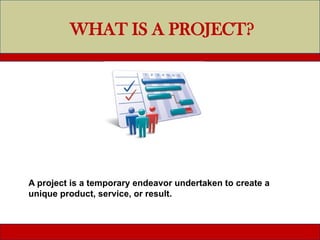
A project is a temporary endeavor undertaken to create a
unique product, service, or result.
Characteristics of a Project
 Is temporary
 Creates unique products, services, or results
 Provides progressive elaboration
 The outcome may be tangible or intangible
 A product that can be a component of another item
 An enhancement of an item,
 Or an end item in itself;
 An improvement in the existing product or service
 A result, such as an outcome or document
Examples of Projects
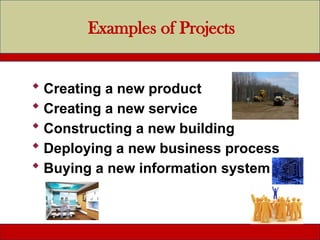
 Creating a new product
 Creating a new service
 Constructing a new building
 Deploying a new business process
 Buying a new information system
Operations, Programs, Plans &
Portfolios
 Both projects and operations:
1. Have people perform them
2. Are constrained by limited resources
3. Are planned, executed, and controlled
 Operations differ from projects because they:
a. Are ongoing and repetitive
b. Have objectives that are continuous
c. Adapt to new objectives so work continues to sustain business.
Operations, Programs, Plans &
Portfolios
 Programs are groups of projects managed in a coordinated
way to obtain greater benefits and control, which could not
be achieved from managing the project separately. They are
a combination of related projects.
 Plans are characterized and classified according to:
1. Their function or use to which they are applied
2. Their objectives, policies, procedures, methods and rules
3. Whether they short-term or long-term in duration
Operations, Programs, Plans &
Portfolios
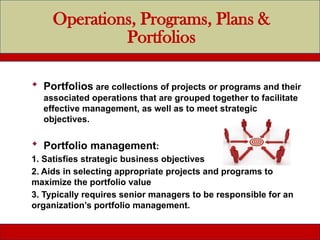
 Portfolios are collections of projects or programs and their
associated operations that are grouped together to facilitate
effective management, as well as to meet strategic
objectives.
 Portfolio management:
1. Satisfies strategic business objectives
2. Aids in selecting appropriate projects and programs to
maximize the portfolio value
3. Typically requires senior managers to be responsible for an
organization’s portfolio management.
Projects and Strategic Planning
 Projects are often utilized as a means of directly or
indirectly achieving objectives within an organization’s
strategic plans.
 Market Demand
 Strategic opportunity/business need
 Social need
 Environmental consideration
 Customer request
 Technological advance
 Legal requirement
Project Management Office
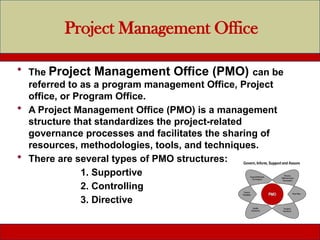
 The Project Management Office (PMO) can be
referred to as a program management Office, Project
office, or Program Office.
 A Project Management Office (PMO) is a management
structure that standardizes the project-related
governance processes and facilitates the sharing of
resources, methodologies, tools, and techniques.
 There are several types of PMO structures:
1. Supportive
2. Controlling
3. Directive
Interpersonal Skills of a Project
Manager
 Leadership
 Motivation
 Communication
 Conflict
management
 Coaching
 Team building
 Influencing
 Decision making
 Political and
cultural awareness
 Negotiation
Key Definitions
 Project
 A temporary endeavor undertaken to create a
unique product, service or result
 Subproject
 A more manageable component of a project
 Subprojects are often contracted out to an
external enterprise or to another functional unit
 Program
 A group of related projects managed in a
coordinated way
© AAA University
Key Definitions (cont.)
 Knowledge Area

An identified area of project management defined by its knowledge
requirements and described in terms of its component process,
practices, inputs, outputs, tools & techniques
© AAA University
15
The PMBOK Guide- 5th Ed
© AAA University
10 knowledge areas that are used on most projects
most of the time:
• Project Integration Management
• Project Scope Management
• Project Time Management
• Project Cost Management
• Project Quality Management
• Project Human Resource Management
• Project Communications Management
• Project Risk Management
• Project Procurement Management
• Project Stakeholder Management
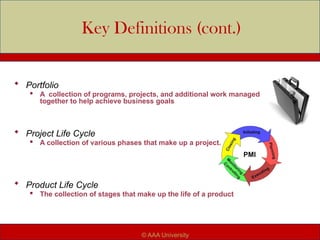
Key Definitions (cont.)
 Portfolio

A collection of programs, projects, and additional work managed
together to help achieve business goals
 Project Life Cycle

A collection of various phases that make up a project.
 Product Life Cycle
 The collection of stages that make up the life of a product
© AAA University
Key Definitions (cont.)
 Project Management Office (PMO)

An organizational unit formed to centralize and coordinate the
management of projects within its domain
 Management by Objectives (MBO)

Establish unambiguous and realistic objectives

Periodically evaluate if objectives are met

Implement corrective action
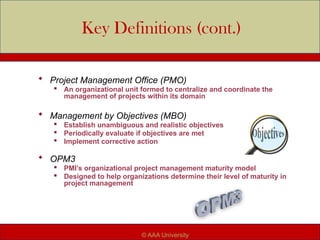
 OPM3

PMI’s organizational project management maturity model

Designed to help organizations determine their level of maturity in
project management
© AAA University
What is a Project Manager?
“The individual
responsible for the
project”
-The PMBOK Guide
© AAA University
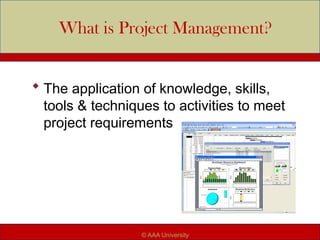
What is Project Management?
 The application of knowledge, skills,
tools & techniques to activities to meet
project requirements
© AAA University
Organizations Perform Work
 Work involves either operations
(processes or systems) or projects
 Operations & projects share many
characteristics:
 Performed by people
 Constrained by limited resources
 Planned, executed, and controlled
© AAA University
How Do Operations & Projects
Differ?
 Operations:
 Are ongoing and repetitive
 Objective: Sustain the business
 Projects:
 Are temporary and unique
 Objective: Attain project objectives and
terminate
© AAA University
Objectives of Projects
 Create Change
 Implement Strategic Plans
 Deliver a product, service or result
 Fulfill Contractual Agreements
 Solve Specific Problems
© AAA University
Key Characteristics of Projects
 Creates a unique outcome
 Has a well defined beginning and end
 Has boundaries and constraints
 Produces a product, service or result
 Uses resources in the form of persons,
places, things, or money
© AAA University
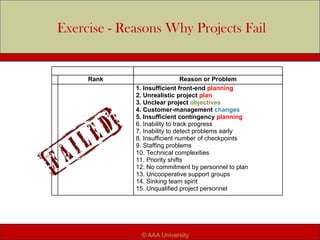
Rank Reason or Problem
1. Insufficient front-end planning
2. Unrealistic project plan
3. Unclear project objectives
4. Customer-management changes
5. Insufficient contingency planning
6. Inability to track progress
7. Inability to detect problems early
8. Insufficient number of checkpoints
9. Staffing problems
10. Technical complexities
11. Priority shifts
12. No commitment by personnel to plan
13. Uncooperative support groups
14. Sinking team spirit
15. Unqualified project personnel
Exercise - Reasons Why Projects Fail
© AAA University
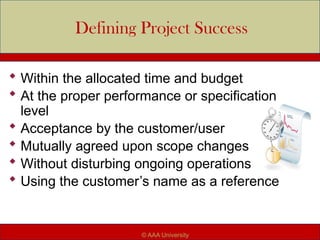
Defining Project Success
 Within the allocated time and budget
 At the proper performance or specification
level
 Acceptance by the customer/user
 Mutually agreed upon scope changes
 Without disturbing ongoing operations
 Using the customer’s name as a reference
© AAA University
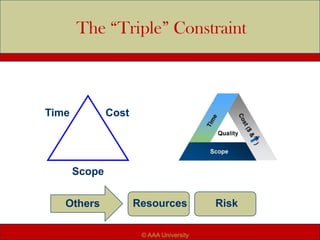
The “Triple” Constraint
Time Cost
Scope
Resources Risk
Others
© AAA University
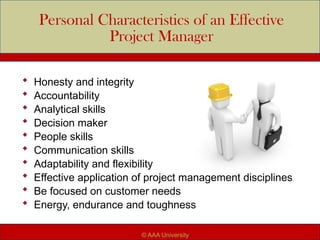
Personal Characteristics of an Effective
Project Manager
 Honesty and integrity
 Accountability
 Analytical skills
 Decision maker
 People skills
 Communication skills
 Adaptability and flexibility
 Effective application of project management disciplines
 Be focused on customer needs
 Energy, endurance and toughness
© AAA University
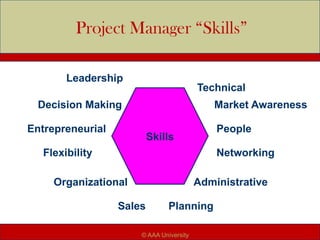
Project Manager “Skills”
Skills
Leadership
Technical
Entrepreneurial People
Organizational Administrative
Sales
Flexibility Networking
Decision Making Market Awareness
Planning
© AAA University
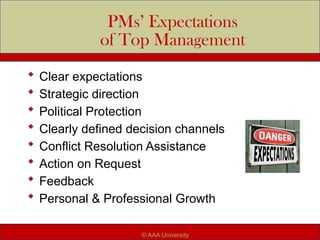
PMs’ Expectations
of Top Management
 Clear expectations
 Strategic direction
 Political Protection
 Clearly defined decision channels
 Conflict Resolution Assistance
 Action on Request
 Feedback
 Personal & Professional Growth
© AAA University
Top Managements’ Expectations of
the PM
 Results & Accountability
 Effective Reporting of Information
 Recommendations - Not Alternatives
 Strong Interpersonal Skills
 Self-discipline
 Problem Solving Skills
 Analytical Skills
 Clear Communication
© AAA University
The Project Teams’
Expectations of the PM
 Leadership
 Facilitate Problem Solving
 Create a Team Atmosphere
 Support
 Manage Conflict
 Protect the team from outside pressures
 Remove Obstacles
 Be a Liaison
© AAA University
The Project Managers’
Expectations of the Team
 Consensus building
 Teamwork
 Willingness to listen to ideas
 Communication of red-flags or issues
© AAA University
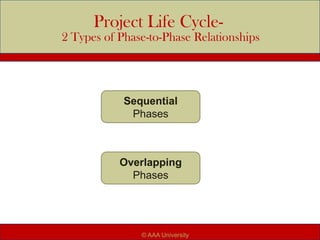
Project Life Cycle-
2 Types of Phase-to-Phase Relationships
Sequential
Phases
Overlapping
Phases
© AAA University
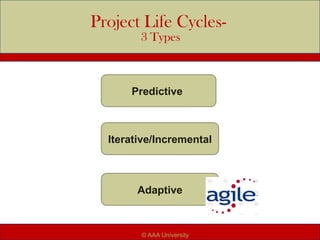
Project Life Cycles-
3 Types
Predictive
Iterative/Incremental
© AAA University
Adaptive
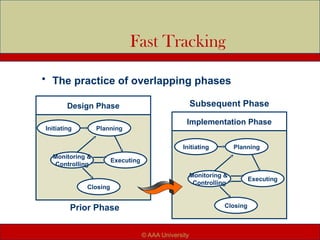
Fast Tracking
Planning
Initiating
Monitoring &
Controlling
Closing
Executing
Planning
Initiating
Monitoring &
Controlling
Closing
Executing
Design Phase
Implementation Phase
Prior Phase
Subsequent Phase
• The practice of overlapping phases
© AAA University
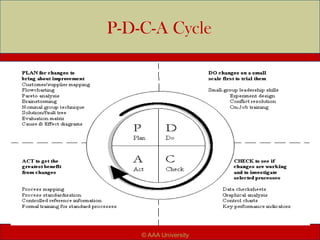
P-D-C-A Cycle
© AAA University
Project Stakeholders
 Project Stakeholders are individuals and organizations
who are involved in or whose interests may be affected
by project activities. E.g. The:
 Project Manager
 Portfolio Managers/portfolio review board
 Team Members
 Performing Organization
 PMO
 Sponsor
Customer
© AAA University
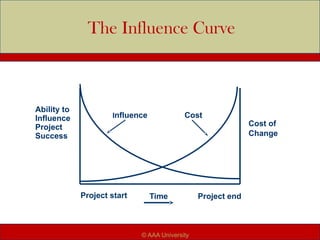
The Influence Curve
Ability to
Influence
Project
Success
Cost of
Change
Time
Influence Cost
Project start Project end
© AAA University
Phase End Reviews
 Phase Exits/Phase Gates/Decision
Gates/Stage Gates
 Kill Points
© AAA University
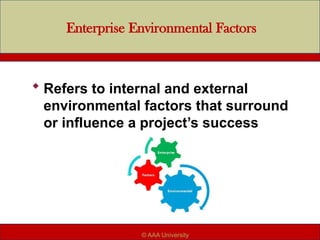
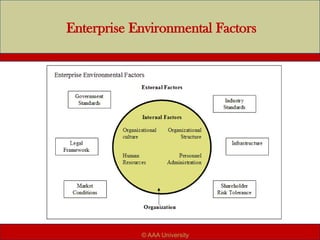
Enterprise Environmental Factors
 Refers to internal and external
environmental factors that surround
or influence a project’s success
© AAA University
Enterprise Environmental Factors
© AAA University
Organizational Process Assets
 Processes and Procedures
 Organizational policies, procedures, and guidelines
for any area (risk, financial, reporting, change, etc.)
 Corporate Knowledge Base
 Templates for common project documents
 Examples from a previous project plan
© AAA University
Organizational Influences
 Projects are influenced by the initiating organization
 Culture, style, organizational structure & PMO
 Project based versus non-project-based
 Authority level of the project manager
 Approach to risk
 Types of Organizations:
 Functional (Pure, Project Expeditor, Project Coordinator,
Composite)
 Matrix (Strong & Weak)
 Projectized
© AAA University
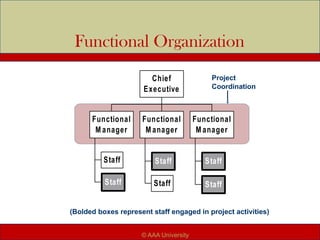
Functional Organization
(Bolded boxes represent staff engaged in project activities)
Staff
Staff
Functional
M anager
Staff
Staff
Functional
M anager
Staff
Staff
Functional
M anager
Chief
Executive
Project
Coordination
© AAA University
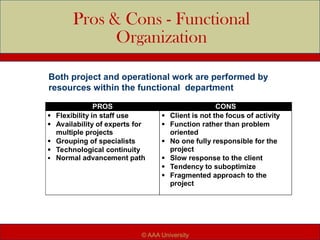
Pros & Cons - Functional
Organization
PROS CONS
 Flexibility in staff use
 Availability of experts for
multiple projects
 Grouping of specialists
 Technological continuity
 Normal advancement path
 Client is not the focus of activity
 Function rather than problem
oriented
 No one fully responsible for the
project
 Slow response to the client
 Tendency to suboptimize
 Fragmented approach to the
project
Both project and operational work are performed by
resources within the functional department
© AAA University
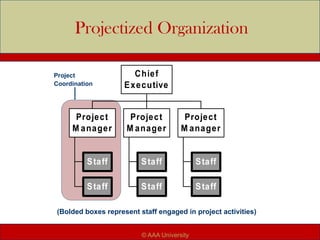
Projectized Organization
Staff
Staff
Project
M anager
Staff
Staff
Project
M anager
Staff
Staff
Project
M anager
Chief
Executive
Project
Coordination
(Bolded boxes represent staff engaged in project activities)
© AAA University
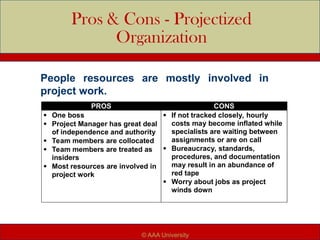
Pros & Cons - Projectized
Organization
PROS CONS
 One boss
 Project Manager has great deal
of independence and authority
 Team members are collocated
 Team members are treated as
insiders
 Most resources are involved in
project work
 If not tracked closely, hourly
costs may become inflated while
specialists are waiting between
assignments or are on call
 Bureaucracy, standards,
procedures, and documentation
may result in an abundance of
red tape
 Worry about jobs as project
winds down
People resources are mostly involved in
project work.
© AAA University
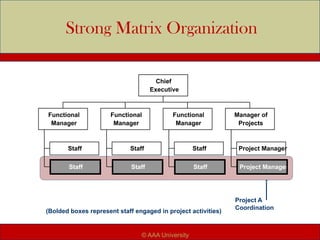
Staff
Staff
Functional
Manager
Staff
Staff
Functional
Manager
Staff
Staff
Functional
Manager
Project Manager
Project Manager
Manager of
Projects
Chief
Executive
Project A
Coordination
Strong Matrix Organization
(Bolded boxes represent staff engaged in project activities)
© AAA University
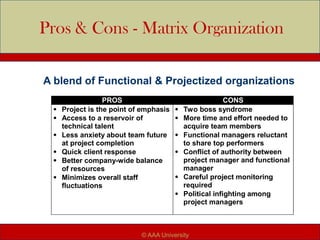
Pros & Cons - Matrix Organization
PROS CONS
 Project is the point of emphasis
 Access to a reservoir of
technical talent
 Less anxiety about team future
at project completion
 Quick client response
 Better company-wide balance
of resources
 Minimizes overall staff
fluctuations
 Two boss syndrome
 More time and effort needed to
acquire team members
 Functional managers reluctant
to share top performers
 Conflict of authority between
project manager and functional
manager
 Careful project monitoring
required
 Political infighting among
project managers
A blend of Functional & Projectized organizations
© AAA University
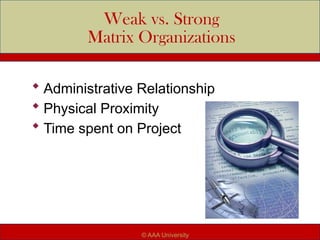
Weak vs. Strong
Matrix Organizations
 Administrative Relationship
 Physical Proximity
 Time spent on Project
© AAA University
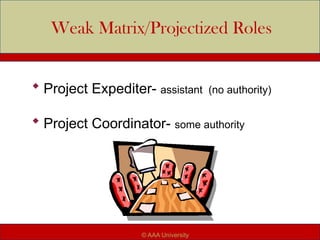
Weak Matrix/Projectized Roles
 Project Expediter- assistant (no authority)
 Project Coordinator- some authority
© AAA University
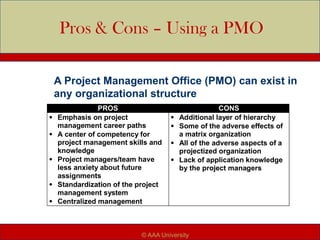
Pros & Cons – Using a PMO
PROS CONS
 Emphasis on project
management career paths
 A center of competency for
project management skills and
knowledge
 Project managers/team have
less anxiety about future
assignments
 Standardization of the project
management system
 Centralized management
 Additional layer of hierarchy
 Some of the adverse effects of
a matrix organization
 All of the adverse aspects of a
projectized organization
 Lack of application knowledge
by the project managers
A Project Management Office (PMO) can exist in
any organizational structure
© AAA University
Tips for Success
 Obtain Charter from top management
 Anticipate and constructively channel conflict
 Develop methods to promote teamwork
 Obtain written approval of objectives, plans and
budgets
 Obtain management and task leader approvals
 Avoid conflict with functional managers
 Reduce project risk through careful and continuous
planning
© AAA University
Framework Review
 What is a project/project manager/project
management?
 Name the 10 knowledge areas
 What is the triple constraint?
 Name some aspects of a project life cycle
 Describe the 3 primary types of organizational
structures

Name a pro and con from each type

In what type of organizational structure can a
PMO exist?
© AAA University
Questions/Comments
 S. Hasnain Rizvi, PMP, CBAP, PMI-ACP, PMI-RMP, PMI-SP, CSM, CPCU, CISA, CISM, CRISC, CSSGB,
CSSBB, CMBB, CITP (Fellow), CDIA+, Project+, OPM3 CC, MBA, PhD
 HRizvi@AAA-U.com
 Skype: GlocalPM
 818-428-7768
© AAA University

Project Management Fundamentals based on the PMBOK Guide

  • 1.
    © AAA University PMP®Preparation Course Framework
  • 2.
    Project Management Framework Atthe completion of this module, you should be able to:  Define terms & concepts  Identify project management challenges  Know the triple constraint  Recognize skills of an effective project manager  Understand organizational influences  Be familiar with organizational structures © AAA University
  • 3.
    All Rights Reserved These materials may not be copied without express written permission from the author, Dr. S. Hasnain Rizvi, PMP, PMI-ACP, PMI-RMP, PMI-SP, OPM3 CC. 3 © AAA University
  • 4.
    WHAT IS APROJECT? A project is a temporary endeavor undertaken to create a unique product, service, or result.
  • 5.
    Characteristics of aProject  Is temporary  Creates unique products, services, or results  Provides progressive elaboration  The outcome may be tangible or intangible  A product that can be a component of another item  An enhancement of an item,  Or an end item in itself;  An improvement in the existing product or service  A result, such as an outcome or document
  • 6.
    Examples of Projects Creating a new product  Creating a new service  Constructing a new building  Deploying a new business process  Buying a new information system
  • 7.
    Operations, Programs, Plans& Portfolios  Both projects and operations: 1. Have people perform them 2. Are constrained by limited resources 3. Are planned, executed, and controlled  Operations differ from projects because they: a. Are ongoing and repetitive b. Have objectives that are continuous c. Adapt to new objectives so work continues to sustain business.
  • 8.
    Operations, Programs, Plans& Portfolios  Programs are groups of projects managed in a coordinated way to obtain greater benefits and control, which could not be achieved from managing the project separately. They are a combination of related projects.  Plans are characterized and classified according to: 1. Their function or use to which they are applied 2. Their objectives, policies, procedures, methods and rules 3. Whether they short-term or long-term in duration
  • 9.
    Operations, Programs, Plans& Portfolios  Portfolios are collections of projects or programs and their associated operations that are grouped together to facilitate effective management, as well as to meet strategic objectives.  Portfolio management: 1. Satisfies strategic business objectives 2. Aids in selecting appropriate projects and programs to maximize the portfolio value 3. Typically requires senior managers to be responsible for an organization’s portfolio management.
  • 10.
    Projects and StrategicPlanning  Projects are often utilized as a means of directly or indirectly achieving objectives within an organization’s strategic plans.  Market Demand  Strategic opportunity/business need  Social need  Environmental consideration  Customer request  Technological advance  Legal requirement
  • 11.
    Project Management Office The Project Management Office (PMO) can be referred to as a program management Office, Project office, or Program Office.  A Project Management Office (PMO) is a management structure that standardizes the project-related governance processes and facilitates the sharing of resources, methodologies, tools, and techniques.  There are several types of PMO structures: 1. Supportive 2. Controlling 3. Directive
  • 12.
    Interpersonal Skills ofa Project Manager  Leadership  Motivation  Communication  Conflict management  Coaching  Team building  Influencing  Decision making  Political and cultural awareness  Negotiation
  • 13.
    Key Definitions  Project A temporary endeavor undertaken to create a unique product, service or result  Subproject  A more manageable component of a project  Subprojects are often contracted out to an external enterprise or to another functional unit  Program  A group of related projects managed in a coordinated way © AAA University
  • 14.
    Key Definitions (cont.) Knowledge Area  An identified area of project management defined by its knowledge requirements and described in terms of its component process, practices, inputs, outputs, tools & techniques © AAA University
  • 15.
    15 The PMBOK Guide-5th Ed © AAA University 10 knowledge areas that are used on most projects most of the time: • Project Integration Management • Project Scope Management • Project Time Management • Project Cost Management • Project Quality Management • Project Human Resource Management • Project Communications Management • Project Risk Management • Project Procurement Management • Project Stakeholder Management
  • 16.
    Key Definitions (cont.) Portfolio  A collection of programs, projects, and additional work managed together to help achieve business goals  Project Life Cycle  A collection of various phases that make up a project.  Product Life Cycle  The collection of stages that make up the life of a product © AAA University
  • 17.
    Key Definitions (cont.) Project Management Office (PMO)  An organizational unit formed to centralize and coordinate the management of projects within its domain  Management by Objectives (MBO)  Establish unambiguous and realistic objectives  Periodically evaluate if objectives are met  Implement corrective action  OPM3  PMI’s organizational project management maturity model  Designed to help organizations determine their level of maturity in project management © AAA University
  • 18.
    What is aProject Manager? “The individual responsible for the project” -The PMBOK Guide © AAA University
  • 19.
    What is ProjectManagement?  The application of knowledge, skills, tools & techniques to activities to meet project requirements © AAA University
  • 20.
    Organizations Perform Work Work involves either operations (processes or systems) or projects  Operations & projects share many characteristics:  Performed by people  Constrained by limited resources  Planned, executed, and controlled © AAA University
  • 21.
    How Do Operations& Projects Differ?  Operations:  Are ongoing and repetitive  Objective: Sustain the business  Projects:  Are temporary and unique  Objective: Attain project objectives and terminate © AAA University
  • 22.
    Objectives of Projects Create Change  Implement Strategic Plans  Deliver a product, service or result  Fulfill Contractual Agreements  Solve Specific Problems © AAA University
  • 23.
    Key Characteristics ofProjects  Creates a unique outcome  Has a well defined beginning and end  Has boundaries and constraints  Produces a product, service or result  Uses resources in the form of persons, places, things, or money © AAA University
  • 24.
    Rank Reason orProblem 1. Insufficient front-end planning 2. Unrealistic project plan 3. Unclear project objectives 4. Customer-management changes 5. Insufficient contingency planning 6. Inability to track progress 7. Inability to detect problems early 8. Insufficient number of checkpoints 9. Staffing problems 10. Technical complexities 11. Priority shifts 12. No commitment by personnel to plan 13. Uncooperative support groups 14. Sinking team spirit 15. Unqualified project personnel Exercise - Reasons Why Projects Fail © AAA University
  • 25.
    Defining Project Success Within the allocated time and budget  At the proper performance or specification level  Acceptance by the customer/user  Mutually agreed upon scope changes  Without disturbing ongoing operations  Using the customer’s name as a reference © AAA University
  • 26.
    The “Triple” Constraint TimeCost Scope Resources Risk Others © AAA University
  • 27.
    Personal Characteristics ofan Effective Project Manager  Honesty and integrity  Accountability  Analytical skills  Decision maker  People skills  Communication skills  Adaptability and flexibility  Effective application of project management disciplines  Be focused on customer needs  Energy, endurance and toughness © AAA University
  • 28.
    Project Manager “Skills” Skills Leadership Technical EntrepreneurialPeople Organizational Administrative Sales Flexibility Networking Decision Making Market Awareness Planning © AAA University
  • 29.
    PMs’ Expectations of TopManagement  Clear expectations  Strategic direction  Political Protection  Clearly defined decision channels  Conflict Resolution Assistance  Action on Request  Feedback  Personal & Professional Growth © AAA University
  • 30.
    Top Managements’ Expectationsof the PM  Results & Accountability  Effective Reporting of Information  Recommendations - Not Alternatives  Strong Interpersonal Skills  Self-discipline  Problem Solving Skills  Analytical Skills  Clear Communication © AAA University
  • 31.
    The Project Teams’ Expectationsof the PM  Leadership  Facilitate Problem Solving  Create a Team Atmosphere  Support  Manage Conflict  Protect the team from outside pressures  Remove Obstacles  Be a Liaison © AAA University
  • 32.
    The Project Managers’ Expectationsof the Team  Consensus building  Teamwork  Willingness to listen to ideas  Communication of red-flags or issues © AAA University
  • 33.
    Project Life Cycle- 2Types of Phase-to-Phase Relationships Sequential Phases Overlapping Phases © AAA University
  • 34.
    Project Life Cycles- 3Types Predictive Iterative/Incremental © AAA University Adaptive
  • 35.
    Fast Tracking Planning Initiating Monitoring & Controlling Closing Executing Planning Initiating Monitoring& Controlling Closing Executing Design Phase Implementation Phase Prior Phase Subsequent Phase • The practice of overlapping phases © AAA University
  • 36.
  • 37.
    Project Stakeholders  ProjectStakeholders are individuals and organizations who are involved in or whose interests may be affected by project activities. E.g. The:  Project Manager  Portfolio Managers/portfolio review board  Team Members  Performing Organization  PMO  Sponsor Customer © AAA University
  • 38.
    The Influence Curve Abilityto Influence Project Success Cost of Change Time Influence Cost Project start Project end © AAA University
  • 39.
    Phase End Reviews Phase Exits/Phase Gates/Decision Gates/Stage Gates  Kill Points © AAA University
  • 40.
    Enterprise Environmental Factors Refers to internal and external environmental factors that surround or influence a project’s success © AAA University
  • 41.
  • 42.
    Organizational Process Assets Processes and Procedures  Organizational policies, procedures, and guidelines for any area (risk, financial, reporting, change, etc.)  Corporate Knowledge Base  Templates for common project documents  Examples from a previous project plan © AAA University
  • 43.
    Organizational Influences  Projectsare influenced by the initiating organization  Culture, style, organizational structure & PMO  Project based versus non-project-based  Authority level of the project manager  Approach to risk  Types of Organizations:  Functional (Pure, Project Expeditor, Project Coordinator, Composite)  Matrix (Strong & Weak)  Projectized © AAA University
  • 44.
    Functional Organization (Bolded boxesrepresent staff engaged in project activities) Staff Staff Functional M anager Staff Staff Functional M anager Staff Staff Functional M anager Chief Executive Project Coordination © AAA University
  • 45.
    Pros & Cons- Functional Organization PROS CONS  Flexibility in staff use  Availability of experts for multiple projects  Grouping of specialists  Technological continuity  Normal advancement path  Client is not the focus of activity  Function rather than problem oriented  No one fully responsible for the project  Slow response to the client  Tendency to suboptimize  Fragmented approach to the project Both project and operational work are performed by resources within the functional department © AAA University
  • 46.
    Projectized Organization Staff Staff Project M anager Staff Staff Project Manager Staff Staff Project M anager Chief Executive Project Coordination (Bolded boxes represent staff engaged in project activities) © AAA University
  • 47.
    Pros & Cons- Projectized Organization PROS CONS  One boss  Project Manager has great deal of independence and authority  Team members are collocated  Team members are treated as insiders  Most resources are involved in project work  If not tracked closely, hourly costs may become inflated while specialists are waiting between assignments or are on call  Bureaucracy, standards, procedures, and documentation may result in an abundance of red tape  Worry about jobs as project winds down People resources are mostly involved in project work. © AAA University
  • 48.
    Staff Staff Functional Manager Staff Staff Functional Manager Staff Staff Functional Manager Project Manager Project Manager Managerof Projects Chief Executive Project A Coordination Strong Matrix Organization (Bolded boxes represent staff engaged in project activities) © AAA University
  • 49.
    Pros & Cons- Matrix Organization PROS CONS  Project is the point of emphasis  Access to a reservoir of technical talent  Less anxiety about team future at project completion  Quick client response  Better company-wide balance of resources  Minimizes overall staff fluctuations  Two boss syndrome  More time and effort needed to acquire team members  Functional managers reluctant to share top performers  Conflict of authority between project manager and functional manager  Careful project monitoring required  Political infighting among project managers A blend of Functional & Projectized organizations © AAA University
  • 50.
    Weak vs. Strong MatrixOrganizations  Administrative Relationship  Physical Proximity  Time spent on Project © AAA University
  • 51.
    Weak Matrix/Projectized Roles Project Expediter- assistant (no authority)  Project Coordinator- some authority © AAA University
  • 52.
    Pros & Cons– Using a PMO PROS CONS  Emphasis on project management career paths  A center of competency for project management skills and knowledge  Project managers/team have less anxiety about future assignments  Standardization of the project management system  Centralized management  Additional layer of hierarchy  Some of the adverse effects of a matrix organization  All of the adverse aspects of a projectized organization  Lack of application knowledge by the project managers A Project Management Office (PMO) can exist in any organizational structure © AAA University
  • 53.
    Tips for Success Obtain Charter from top management  Anticipate and constructively channel conflict  Develop methods to promote teamwork  Obtain written approval of objectives, plans and budgets  Obtain management and task leader approvals  Avoid conflict with functional managers  Reduce project risk through careful and continuous planning © AAA University
  • 54.
    Framework Review  Whatis a project/project manager/project management?  Name the 10 knowledge areas  What is the triple constraint?  Name some aspects of a project life cycle  Describe the 3 primary types of organizational structures  Name a pro and con from each type  In what type of organizational structure can a PMO exist? © AAA University
  • 55.
    Questions/Comments  S. HasnainRizvi, PMP, CBAP, PMI-ACP, PMI-RMP, PMI-SP, CSM, CPCU, CISA, CISM, CRISC, CSSGB, CSSBB, CMBB, CITP (Fellow), CDIA+, Project+, OPM3 CC, MBA, PhD  HRizvi@AAA-U.com  Skype: GlocalPM  818-428-7768 © AAA University

Editor's Notes

  • #2 PMBOK Guide chapters 1 and 2
  • #13 PMBOK Guide section 1.2 Project: It has a definite beginning and an end Performed by people Constrained by resources Creates a unique end result
  • #14 PMBOK Guide section 1.4.3, 1.6, 2.1 and 2.3.4 Knowledge Area There are 9 knowledge areas in the PMBOK guide that make up chapters 4 to 12. Project Life Cycle The prior phase may create deliverables that are needed in subsequent phases. Different from product life cycles.
  • #15 PMBOK Guide 2004 section 3.0 See figures 3-6 to 3-10
  • #16 PMBOK Guide section 1.4.3, 1.6, 2.1 and 2.3.4 Knowledge Area There are 9 knowledge areas in the PMBOK guide that make up chapters 4 to 12. Project Life Cycle The prior phase may create deliverables that are needed in subsequent phases. Different from product life cycles.
  • #17 PMBOK Guide section 1.4.3, 1.6, 2.1 and 2.3.4 Knowledge Area There are 9 knowledge areas in the PMBOK guide that make up chapters 4 to 12. Project Life Cycle The prior phase may create deliverables that are needed in subsequent phases. Different from product life cycles.
  • #18 Other definitions?
  • #19 PMBOK guide V3 Section 1.3
  • #21 PMBOK Guide section 1.2.2
  • #22 Achieve PMP Exam Success Principles of Project Management, John R. Adams, Page 4
  • #23 PMBOK Guide section 3-8
  • #24 Rank reasons in the order of most significant reason to least significant reason NOTE to instructor: Use this as an exercise with class to rank what they think is important Adapted from Source: Joint study Wister Polytech and Syracuse University [insert the results from the Joint Study—need the date it was completed] – can’t find actual research. Will need to be replaced From studies done, #3. Unclear project objectives is the number one reason for project failure
  • #25 # 3 and 6 - Delighted customers is the key indication of project success
  • #26 PMBOK Guide section 1.3 Managing the competing demands of time vs cost vs scope is key skill in achieving successful projects. Increased performance in one area may adversely affect performance in another area.
  • #27 PMBOK Guide section 1.3 to 1.5.5
  • #28 PMBOK Guide section 1.5.4 to 1.5.5
  • #29 Beyond the PMBOK Guide Treat as an exercise/talking points
  • #30 Beyond PMBOK Guide
  • #31 Beyond PMBOK Guide Liaison between the team and other entities
  • #32 Beyond PMBOK Guide Examples of other items: - Ownership of work - Timely completion of work as promised - Reasonable estimate - Communication of red-flags or issues - Accurate reporting of progress - Follow-up & Follow thru (Can be more based on class discussion)
  • #33 PMBOK Guide section 2.1 Projects usually are divided into several project phases to improve management control and provide for links to the ongoing operations.
  • #34 PMBOK Guide section 2.1 Projects usually are divided into several project phases to improve management control and provide for links to the ongoing operations.
  • #35 PMBOK Guide section 2.1.1 NEED to change process groups figure
  • #36 PMBOK Guide section 2.2. Stakeholders ability to influence the project outcomes are high at project start and decreases as the project goes through its life cycle. See PMBOK guide figure 2-2. Stakeholders have different needs and expectations that must be managed for successful project acceptance. Both positive and negative stakeholders exist.
  • #37 PMBOK Guide section 2.2. Stakeholders ability to influence the project outcomes are high at project start and decreases as the project goes through its life cycle. See PMBOK guide figure 2-2. Stakeholders have different needs and expectations that must be managed for successful project acceptance. Both positive and negative stakeholders exist.
  • #38 PMBOK Guide section 2.1.1 Similar to PMBOK Guide figure 2-2.
  • #39 PMBOK guide section 2.1.2
  • #43 PMBOK Guide section 2.3, figures 2-6 to 2-12. Typified by the level of formal authority accorded the project manager. (ADAMS, Page 11) Project Expeditor – Staff assistant to the exec. Who ultimately has responsibility for the project; a facilitator role Project Coordinator – Auth to assign work to individuals in the functional organization; shared authority with functional manager
  • #44 PMBOK Guide section 2.3.3
  • #45 PMBOK Guide section 2.3.3
  • #46 PMBOK Guide section 2.3.3
  • #47 PMBOK Guide section 2.3.3
  • #48 PMBOK Guide section 2.3.3 Figure 2-9 for weak matrix and Figure 2-10 for balanced matrix organizations. Note the difference between a Strong matrix and a composite organization.
  • #49 PMBOK Guide section 2.3.3 Principles of Project Management, Adams pg 18
  • #50 PMBOK Guide section 2.3.3, Figure 2-6. Principles of Project Management, Adams page 20. Levels at which the project and involved functional managers report and the backing they receive from top management Collocation (tight matrix) Percentage of time spent on project.
  • #51 PMBOK Guide section 2.3.3, Figure 2-6. Principles of Project Management, Adams page 20. Levels at which the project and involved functional managers report and the backing they receive from top management Collocation (tight matrix) Percentage of time spent on project.
  • #52 Interpreted from PMBOK Guide section 2.3.4 Project Management System is explained in PMBOK Guide section 2.3.5
  • #53 Principles of Project Management, Adams pg 24 Regardless of the organization
  • #54 PMBOK Guide Section: 1.2 and 1.3 What is a Project? What is Project Management 1.4.3 The PM Knowledge Areas 1.3 What is Project Management? 2.1.1 Characteristics of the Project Life Cycle 2.3.3 Organizational Structure 2.3.4 The role of the PMO