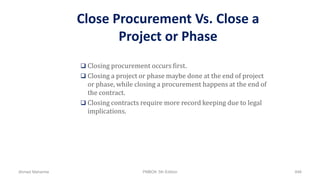
Project Management
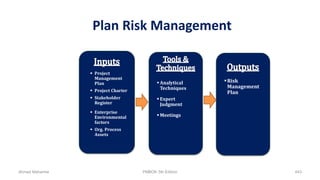
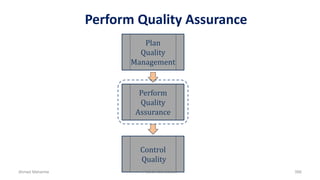
Professional
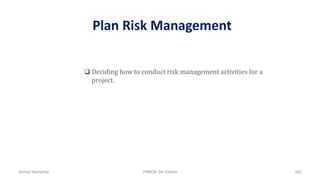
PMP®
Ahmad H. Maharma
Master Of Engineering Management
PMP®,RMP®
Ahmad Maharma PMBOK 5th Edition 2
Getting Acquainted
• Name
• Title
• Why are you here?
• What do you want to learn from this course?
• A little known fact
Ahmad Maharma PMBOK 5th Edition 3
Ground Rules
• Material & Book(s)
• Time & Breaks
• Smoking
• Mobile Phones
• Side Talks
• Respect
• Ask, ask, ask
Ahmad Maharma PMBOK 5th Edition 4
How This Training is Delivered
• Lectures
• Exercises
• Group Work
• Discussions
• Quizzes
Ahmad Maharma PMBOK 5th Edition 5
Basic definitions
• Non-for-profit Professional Association
• Started in 1969
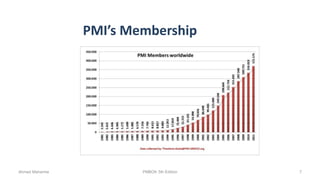
• Over 400,000 members worldwide
• In more than 160 countries
PMI
Ahmad Maharma PMBOK 5th Edition 6
PMI’s Membership
Ahmad Maharma PMBOK 5th Edition 7
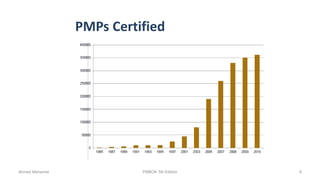
PMPs Certified
Ahmad Maharma PMBOK 5th Edition 8
What is PMP®?
• A Credential initiated by PMI in 1984 “Project
Management Professional”
• Demonstrate to employers, clients and colleagues that
project managers possess project management
knowledge, experience and skills to bring projects to
successful completion
• The most recognized credential in project management
worldwide
Ahmad Maharma PMBOK 5th Edition 9
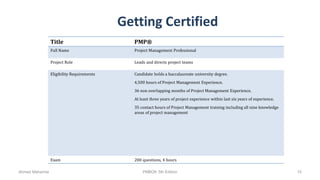
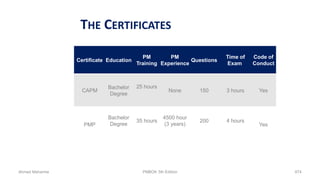
Getting Certified
Title PMP®
Full Name Project Management Professional
Project Role Leads and directs project teams
Eligibility Requirements Candidate holds a baccalaureate university degree.
4,500 hours of Project Management Experience.
36 non overlapping months of Project Management Experience.
At least three years of project experience within last six years of experience.
35 contact hours of Project Management training including all nine knowledge
areas of project management
Exam 200 questions, 4 hours
Ahmad Maharma PMBOK 5th Edition 10
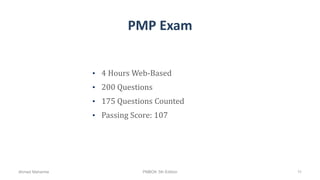
PMP Exam
• 4 Hours Web-Based
• 200 Questions
• 175 Questions Counted
• Passing Score: 107
Ahmad Maharma PMBOK 5th Edition 11
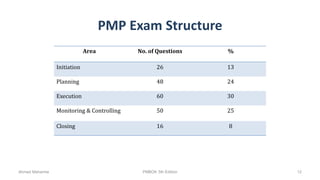
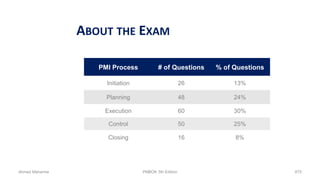
PMP Exam Structure
Area No. of Questions %
Initiation 26 13
Planning 48 24
Execution 60 30
Monitoring & Controlling 50 25
Closing 16 8
Ahmad Maharma PMBOK 5th Edition 12
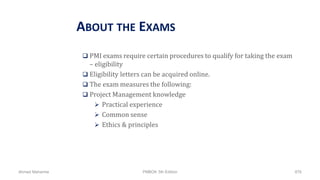
PMP Exam
• Exam tests:
• 1- Theoretical Knowledge (PMBOK)
• 2- Personal Skills
• 3- Practical Experience
• 4- Ethics & professional responsibility
Ahmad Maharma PMBOK 5th Edition 13
Project Management Body
of Knowledge (PMBOK)
• Identifies that subset of the PMBOK that is generally recognized as a good
practice
• “Generally Recognized” means the knowledge and practice described are
applicable to most projects most of the time. There is consensus about their
value and usefulness.
• “Good Practice” means there is a general agreement that the application of
these skills, tools, and techniques can enhance the chances of success over
a wide range of projects.
Ahmad Maharma PMBOK 5th Edition 14
Project Management
Professional
PMP®
Project Management Fundamentals
What is a Project?
“A Temporary endeavor undertaken to create a unique Product,
service, or result”
Ahmad Maharma PMBOK 5th Edition 16
1- Temporary
• Definite Beginning (T-1)& End (T4)
• End reached when:
• Objectives reached
• Objectives cannot be met
• Need for project no longer exists
– Projects are not “ongoing” efforts
– Does not generally apply to outcomes
Ahmad Maharma PMBOK 5th Edition 17
2- Unique
• Products
• Capability
• Results
• Repetitiveness does not change the fundamental
uniqueness of the project
Ahmad Maharma PMBOK 5th Edition 18
3- Progressively Elaborative
• Developing in steps, and continuing by increments.
• Plans get improved and clearer as more information is
obtained and estimates are more accurate.
Ahmad Maharma PMBOK 5th Edition 19
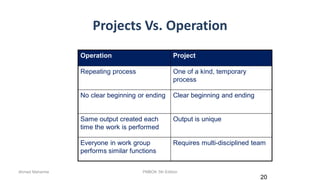
Projects Vs. Operation
20
Operation Project
Repeating process One of a kind, temporary
process
No clear beginning or ending Clear beginning and ending
Same output created each
time the work is performed
Output is unique
Everyone in work group
performs similar functions
Requires multi-disciplined team
Ahmad Maharma PMBOK 5th Edition
What is Project Management?
• Project management is the application of
knowledge, skills, tools and techniques to project
activities to meet project requirements. It includes:
 Identifying requirements
 Establishing clear & achievable objectives
 Balancing the competing demands for quality, scope, time
and cost
 Adapting the specifications, plans & approach
Ahmad Maharma PMBOK 5th Edition 21
What Project Management is Not?
• Managing or buying a software.
• Preparing a schedule or a bar chart
• Preparing progress reports showing accomplishments
• Coordinating work and communicating with
stakeholders
• For Engineers ONLY
• Project Management is a science and art
Ahmad Maharma PMBOK 5th Edition 22
Project Management Context
• Programs & Program Management
• Portfolios & Portfolio Management
• Project Management Office - PMO
Ahmad Maharma PMBOK 5th Edition 23
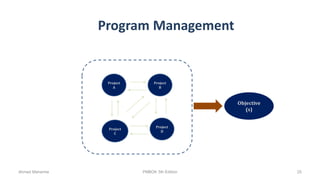
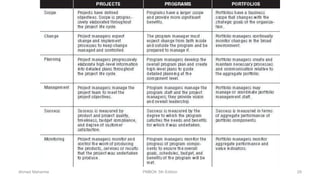
Program Management
• A program is a group of related projects managed in a coordinated way to obtain
benefits and control that cannot be achieved from managing them individually.
• Program Management is the centralized coordinated management of a program to
achieve the program’s strategic objectives and benefits.
Ahmad Maharma PMBOK 5th Edition 24
Program Management
Project
D
Project
C
Project
B
Project
A
Objective
(s)
Ahmad Maharma PMBOK 5th Edition 25
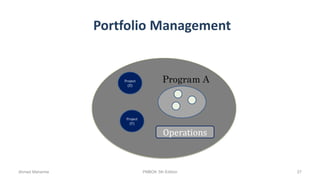
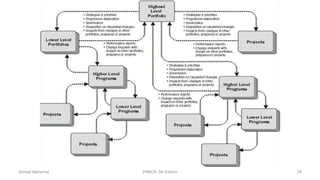
Portfolio management
• A portfolio represents a collection of active programs, projects and other that are
grouped together to facilitate effective management of that work to meet strategic
business objectives.
• Portfolio management, therefore, is the centralized management of one or more
portfolios in order to achieve specific strategic business objectives.
• Focuses on ensuring that projects and programs are reviewed to prioritize resource
allocation, and that the management of the portfolio is consistent with and aligned
to organizational strategies.
Ahmad Maharma PMBOK 5th Edition 26
Portfolio Management
Project
(E)
Program A
Project
(F)
Operations
Ahmad Maharma PMBOK 5th Edition 27
Ahmad Maharma PMBOK 5th Edition 28
Ahmad Maharma PMBOK 5th Edition 29
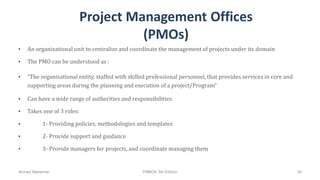
Project Management Offices
(PMOs)
• An organizational unit to centralize and coordinate the management of projects under its domain
• The PMO can be understood as :
• “The organizational entity, staffed with skilled professional personnel, that provides services in core and
supporting areas during the planning and execution of a project/Program”
• Can have a wide range of authorities and responsibilities
• Takes one of 3 roles:
• 1- Providing policies, methodologies and templates
• 2- Provide support and guidance
• 3- Provide managers for projects, and coordinate managing them
Ahmad Maharma PMBOK 5th Edition 30
PMO Types
• There are Three types of PMOs that may exist in an organization:
 Supportive PMO
 Controlling PMO
 Directive PMO
Ahmad Maharma PMBOK 5th Edition 31
Supportive PMO
• The most common type of PMO
• Its purpose is to empower project managers and teams to
deliver their projects more successfully
• It doesn't control or direct projects, instead it focuses on
supporting projects through training, mentoring,
administration and reporting.
Ahmad Maharma PMBOK 5th Edition 32
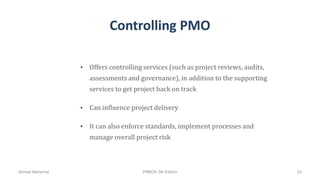
Controlling PMO
• Offers controlling services (such as project reviews, audits,
assessments and governance), in addition to the supporting
services to get project back on track
• Can influence project delivery
• It can also enforce standards, implement processes and
manage overall project risk
Ahmad Maharma PMBOK 5th Edition 33
Directive PMO
• This is the least common, but sometimes most effective type of
PMO
• It offers directive services, where it does not just support and
control projects, but also responsible for actually running them
• Each of the Project Managers report to the PMO Director as
their supervisor. This helps to “corral” all of the project work
within an organization, to one department
Ahmad Maharma PMBOK 5th Edition 34
Project Management Offices
(PMOs)
• The PMO may:
 Manage the interdependencies between projects
 Help provide resources
 Terminate projects
 Monitor compliance with organizational processes
 Help gather lessons learned
 Be more heavily involved during the project initiation
 Be part of the change control board
 Be a stakeholder
Ahmad Maharma PMBOK 5th Edition 35
PMOs-Requirements for Success
1. Role should be clearly defined
2. Only one role, don’t try to do it all
3. Commitment and support of top management
4. All should be PMPs
5. Improve project performance through the use of proper
processes and techniques
6. The repercussions of failure!!
Ahmad Maharma PMBOK 5th Edition 36
The Role of Project Manager
Ahmad Maharma PMBOK 5th Edition 37
Knowledge
 What the Project Manager knows about Project
Management.
Ahmad Maharma PMBOK 5th Edition 38
Performance
 What the Project Manager is able to do or
accomplish while applying his/ her project
management knowledge
Ahmad Maharma PMBOK 5th Edition 39
Personal
 How the Project Manager behaves when
performing the project or related work.
 Encompasses:
 Attitude
 Core personality characteristics
 Leadership
Ahmad Maharma PMBOK 5th Edition 40
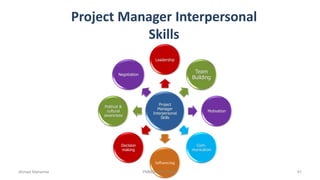
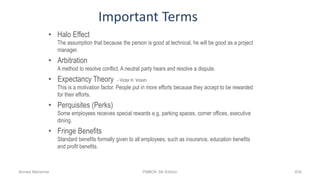
Project Manager Interpersonal
Skills
Project
Manager
Interpersonal
Skills
Leadership
Team
Building
Motivation
Com-
munication
Influencing
Decision
making
Political &
cultural
awareness
Negotiation
Ahmad Maharma PMBOK 5th Edition 41
PMBOK Reading
 Chapter 1
Ahmad Maharma PMBOK 5th Edition 42
Project Management
Professional
PMP®
Project Management Framework
Project Lifecycle
 A collection of generally sequential and sometimes overlapping project phases
 Phases name and number are determined by:
 Management
 Nature of the project
 Control requirements
 Area of application
 Can be determined or shaped by the unique aspects of the organization, industry or
technology
 Can be documented by a methodology
• Provides the basic framework for managing the project
Ahmad Maharma PMBOK 5th Edition 44
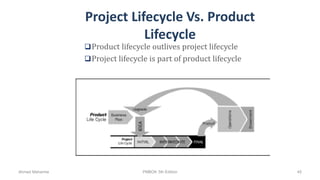
Project Lifecycle Vs. Product
Lifecycle
Product lifecycle outlives project lifecycle
Project lifecycle is part of product lifecycle
Ahmad Maharma PMBOK 5th Edition 45
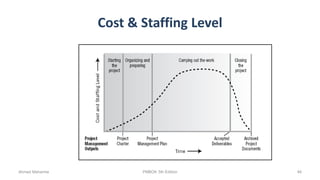
Cost & Staffing Level
Ahmad Maharma PMBOK 5th Edition 46
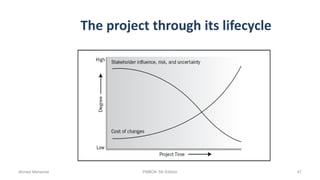
The project through its lifecycle
Ahmad Maharma PMBOK 5th Edition 47
Project Phases
• Divisions within a project where extra control is needed to
effectively manage the completion of a major deliverable.
• A deliverable is a measurable, verifiable work product.
• Each phase ends with a deliverable
• Number and structure of phases is determined by the
organization’s control requirements
• Some organizations have established policies that standardize
all projects.
Ahmad Maharma PMBOK 5th Edition 48
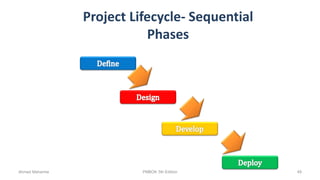
Project Lifecycle- Sequential
Phases
Ahmad Maharma PMBOK 5th Edition 49
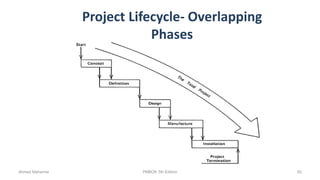
Project Lifecycle- Overlapping
Phases
Ahmad Maharma PMBOK 5th Edition 50
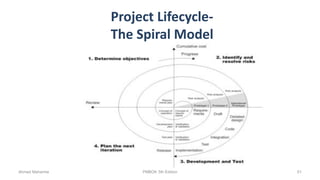
Project Lifecycle-
The Spiral Model
Ahmad Maharma PMBOK 5th Edition 51
TTM deliverables
• Marketing Deliverables
• Customer Journey Deliverables
• Financial & regulatory Deliverables
• ITN Deliverables
• Business processes Deliverables
• Sourcing Deliverables
• Project Deliverables
Ahmad Maharma PMBOK 5th Edition 52
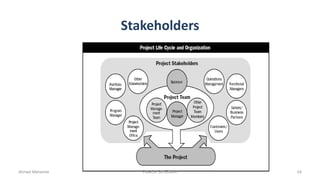
Stakeholders
• Persons or organizations who are actively involved in the
project, or whose interests maybe positively or negatively
affected by the performance or completion of the project
 Project Stakeholders:
 Sponsors
 Customers/ Users
 Vendors/ Suppliers
 Project Manager
 Project Management Team
 Project Team
 PMOAhmad Maharma PMBOK 5th Edition 53
Stakeholders
Ahmad Maharma PMBOK 5th Edition 54
5 Steps to Managing Stakeholders
• Identify ALL of them
• Determine ALL their requirements
• Determine their expectations
• Communicate with them
• Manage their influence
Ahmad Maharma PMBOK 5th Edition 55
Organizational influence
Projects don’t operate in vacuum, they are influenced
by organizational:
• Culture
• Style
• Structure
Organization’s degree of project management
maturity and systems can influence the project
Ahmad Maharma PMBOK 5th Edition 56
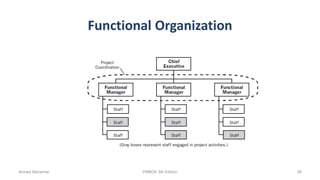
Functional Organization
 Also known as “Silo” organization
 Functional managers control resources
 Communication happens “vertically”
 Good for operation-oriented organizations, such as
banks, government
Ahmad Maharma PMBOK 5th Edition 57
Functional Organization
Ahmad Maharma PMBOK 5th Edition 58
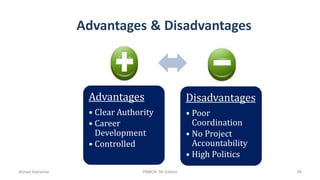
Advantages & Disadvantages
Advantages
• Clear Authority
• Career
Development
• Controlled
Disadvantages
• Poor
Coordination
• No Project
Accountability
• High Politics
Ahmad Maharma PMBOK 5th Edition 59
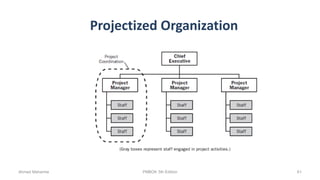
Projectized Organization
 Also known as “No home”
 Systematic approach to project management
 Well defined project management methodology &
lifecycle
 Does not support learning & career development
Ahmad Maharma PMBOK 5th Edition 60
Projectized Organization
Ahmad Maharma PMBOK 5th Edition 61
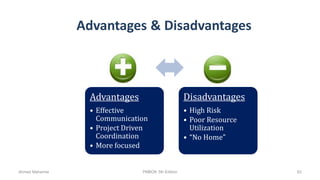
Advantages & Disadvantages
Advantages
• Effective
Communication
• Project Driven
Coordination
• More focused
Disadvantages
• High Risk
• Poor Resource
Utilization
• “No Home”
Ahmad Maharma PMBOK 5th Edition 62
Matrix organization
 Also known as “Two Bosses”
 Has three types:
 Weak matrix
 Balanced matrix
 Strong matrix
Ahmad Maharma PMBOK 5th Edition 63
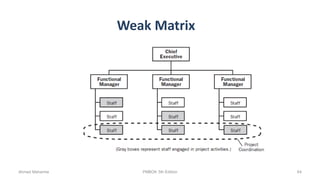
Weak Matrix
Ahmad Maharma PMBOK 5th Edition 64
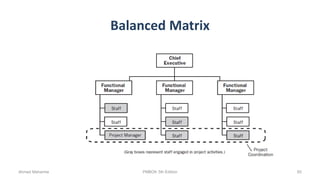
Balanced Matrix
Ahmad Maharma PMBOK 5th Edition 65
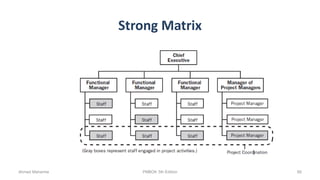
Strong Matrix
Ahmad Maharma PMBOK 5th Edition 66
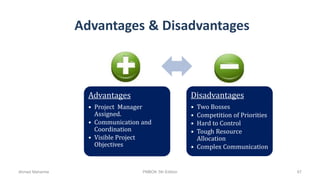
Advantages & Disadvantages
Advantages
• Project Manager
Assigned.
• Communication and
Coordination
• Visible Project
Objectives
Disadvantages
• Two Bosses
• Competition of Priorities
• Hard to Control
• Tough Resource
Allocation
• Complex Communication
Ahmad Maharma PMBOK 5th Edition 67
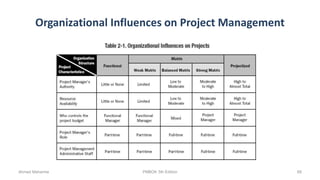
Organizational Influences on Project Management
PMBOK 5th Edition 68Ahmad Maharma
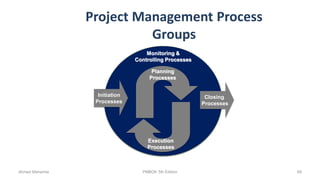
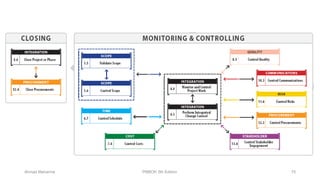
Project Management Process
Groups
Monitoring &
Controlling Processes
Closing
Processes
Initiation
Processes
Planning
Processes
Execution
Processes
Ahmad Maharma PMBOK 5th Edition 69
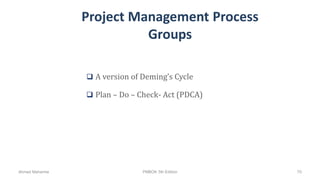
Project Management Process
Groups
 A version of Deming’s Cycle
 Plan – Do – Check- Act (PDCA)
Ahmad Maharma PMBOK 5th Edition 70
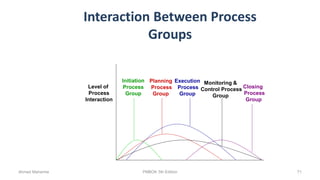
Interaction Between Process
Groups
Level of
Process
Interaction
Initiation
Process
Group
Planning
Process
Group
Execution
Process
Group
Monitoring &
Control Process
Group
Closing
Process
Group
Ahmad Maharma PMBOK 5th Edition 71
72
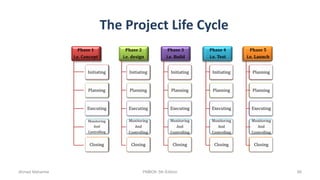
Project Phases
• All projects are divided into phases
• All phases together are known as the Project Life Cycle
• Each phase is marked by completion of Deliverables
Ahmad Maharma PMBOK 5th Edition
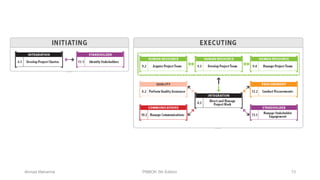
Ahmad Maharma 73PMBOK 5th Edition
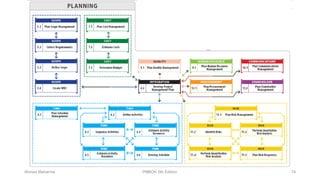
Ahmad Maharma 74PMBOK 5th Edition
Ahmad Maharma 75PMBOK 5th Edition
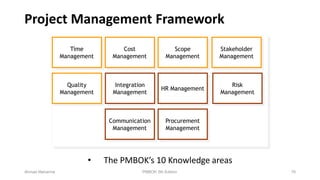
Project Management Framework
• The PMBOK’s 10 Knowledge areas
Time
Management
Cost
Management
Scope
Management
Quality
Management
HR Management
Communication
Management
Procurement
Management
Integration
Management
Stakeholder
Management
Risk
Management
76Ahmad Maharma PMBOK 5th Edition
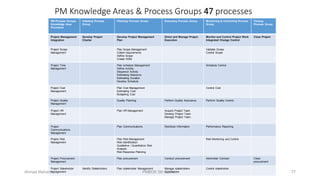
PM Knowledge Areas & Process Groups 47 processes
PM Process Groups
Knowledge Area
Processes
Initiating Process
Group
Planning Process Group Executing Process Group Monitoring & Controlling Process
Group
Closing
Process Group
Project Management
Integration
Develop Project
Charter
Develop Project Management
Plan
Direct and Manage Project
Execution
Monitor and Control Project Work
Integrated Change Control
Close Project
Project Scope
Management
Plan Scope Management
Collect requirements
Define Scope
Create WBS
Validate Scope
Control Scope
Project Time
Management
Plan schedule Management
Define Activity
Sequence Activity
Estimating Resource
Estimating Duration
Develop Schedule
Schedule Control
Project Cost
Management
Plan Cost Management
Estimating Cost
Budgeting Cost
Control Cost
Project Quality
Management
Quality Planning Perform Quality Assurance Perform Quality Control
Project HR
Management
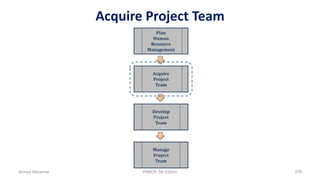
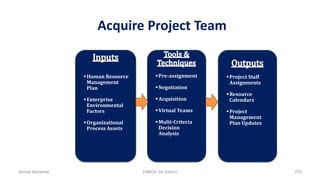
Plan HR Management Acquire Project Team
Develop Project Team
Manage Project Team
Project
Communications
Management
Plan Communications Distribute Information Performance Reporting
Project Risk
Management
Plan Risk Management
Risk Identification
Qualitative / Quantitative Risk
Analysis
Risk Response Planning
Risk Monitoring and Control
Project Procurement
Management
Plan procurement Conduct procurement Administer Contract Close
procurement
Project Stakeholder
Management
Identify Stakeholders Plan stakeholder Management Manage stakeholders
expectations
Control stakeholder
77Ahmad Maharma PMBOK 5th Edition
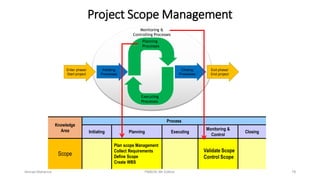
Project Scope Management
Knowledge
Area
Process
Initiating Planning Executing
Monitoring &
Control
Closing
Scope
Plan scope Management
Collect Requirements
Define Scope
Create WBS
Validate Scope
Control Scope
Enter phase/
Start project
Exit phase/
End project
Initiating
Processes
Closing
Processes
Planning
Processes
Executing
Processes
Monitoring &
Controlling Processes
78Ahmad Maharma PMBOK 5th Edition
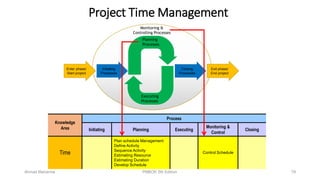
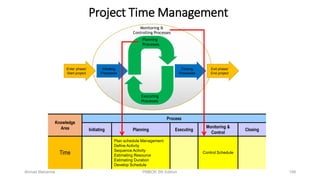
Project Time Management
Knowledge
Area
Process
Initiating Planning Executing
Monitoring &
Control
Closing
Time
Plan schedule Management
Define Activity
Sequence Activity
Estimating Resource
Estimating Duration
Develop Schedule
Control Schedule
Enter phase/
Start project
Exit phase/
End project
Initiating
Processes
Closing
Processes
Planning
Processes
Executing
Processes
Monitoring &
Controlling Processes
79Ahmad Maharma PMBOK 5th Edition
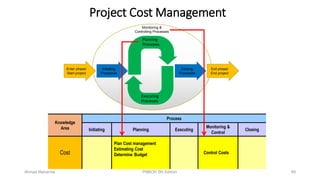
Project Cost Management
Knowledge
Area
Process
Initiating Planning Executing
Monitoring &
Control
Closing
Cost
Plan Cost management
Estimating Cost
Determine Budget Control Costs
Enter phase/
Start project
Exit phase/
End project
Initiating
Processes
Closing
Processes
Planning
Processes
Executing
Processes
Monitoring &
Controlling Processes
80Ahmad Maharma PMBOK 5th Edition
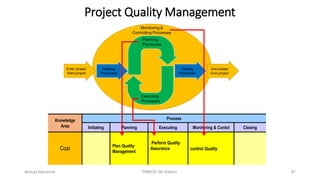
Project Quality Management
Knowledge
Area
Process
Initiating Planning Executing Monitoring & Contol Closing
Cost Plan Quality
Management
Perform Quality
Assurance control Quality
Enter phase/
Start project
Exit phase/
End project
Initiating
Processes
Closing
Processes
Planning
Processes
Executing
Processes
Monitoring &
Controlling Processes
Ahmad Maharma PMBOK 5th Edition 81
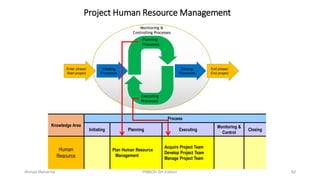
Project Human Resource Management
Knowledge Area
Process
Initiating Planning Executing
Monitoring &
Control
Closing
Human
Resource
Plan Human Resource
Management
Acquire Project Team
Develop Project Team
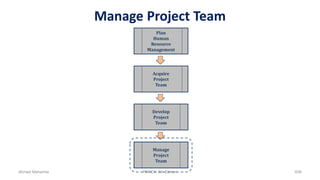
Manage Project Team
Enter phase/
Start project
Exit phase/
End project
Initiating
Processes
Closing
Processes
Planning
Processes
Executing
Processes
Monitoring &
Controlling Processes
82Ahmad Maharma PMBOK 5th Edition
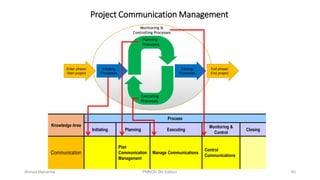
Project Communication Management
Knowledge Area
Process
Initiating Planning Executing
Monitoring &
Control
Closing
Communication
Plan
Communication
Management
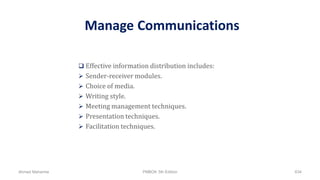
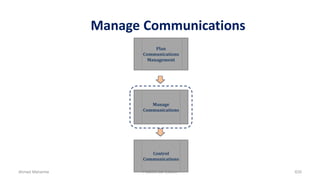
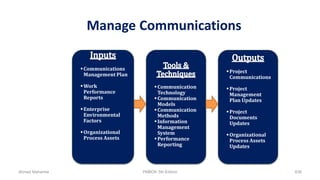
Manage Communications
Control
Communications
Enter phase/
Start project
Exit phase/
End project
Initiating
Processes
Closing
Processes
Planning
Processes
Executing
Processes
Monitoring &
Controlling Processes
83Ahmad Maharma PMBOK 5th Edition
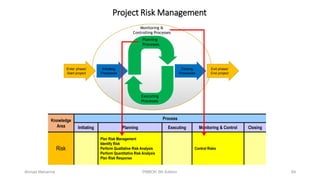
Project Risk Management
Knowledge
Area
Process
Initiating Planning Executing Monitoring & Control Closing
Risk
Plan Risk Management
Identify Risk
Perform Qualitative Risk Analysis
Perform Quantitative Risk Analysis
Plan Risk Response
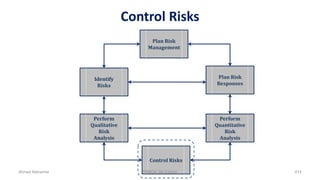
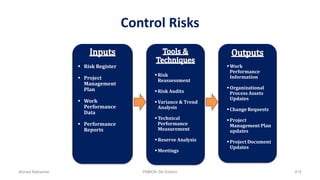
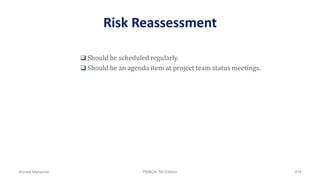
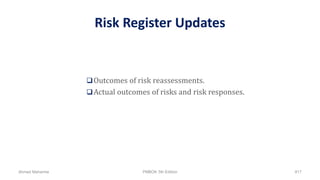
Control Risks
Enter phase/
Start project
Exit phase/
End project
Initiating
Processes
Closing
Processes
Planning
Processes
Executing
Processes
Monitoring &
Controlling Processes
84Ahmad Maharma PMBOK 5th Edition
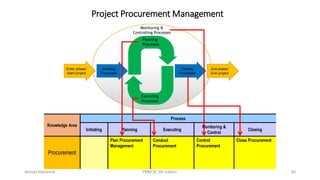
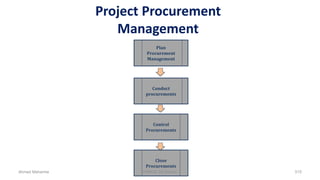
Project Procurement Management
Knowledge Area
Process
Initiating Planning Executing
Monitoring &
Control
Closing
Procurement
Plan Procurement
Management
Conduct
Procurement
Control
Procurement
Close Procurement
Enter phase/
Start project
Exit phase/
End project
Initiating
Processes
Closing
Processes
Planning
Processes
Executing
Processes
Monitoring &
Controlling Processes
85Ahmad Maharma PMBOK 5th Edition
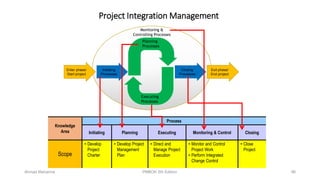
Project Integration Management
Knowledge
Area
Process
Initiating Planning Executing Monitoring & Control Closing
Scope
• Develop
Project
Charter
• Develop Project
Management
Plan
• Direct and
Manage Project
Execution
• Monitor and Control
Project Work
• Perform Integrated
Change Control
• Close
Project
Enter phase/
Start project
Exit phase/
End project
Initiating
Processes
Closing
Processes
Planning
Processes
Executing
Processes
Monitoring &
Controlling Processes
86Ahmad Maharma PMBOK 5th Edition
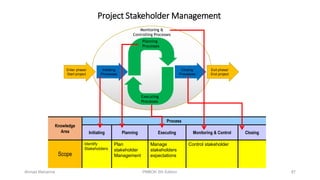
Project Stakeholder Management
Knowledge
Area
Process
Initiating Planning Executing Monitoring & Control Closing
Scope
Identify
Stakeholders
Plan
stakeholder
Management
Manage
stakeholders
expectations
Control stakeholder
Enter phase/
Start project
Exit phase/
End project
Initiating
Processes
Closing
Processes
Planning
Processes
Executing
Processes
Monitoring &
Controlling Processes
87Ahmad Maharma PMBOK 5th Edition
The Project Life Cycle
Ahmad Maharma PMBOK 5th Edition 88
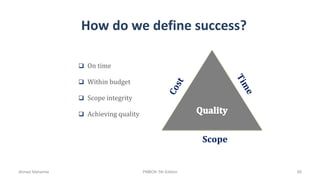
How do we define success?
 On time
 Within budget
 Scope integrity
 Achieving quality
Scope
Ahmad Maharma PMBOK 5th Edition 89
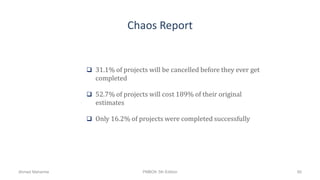
Chaos Report
 31.1% of projects will be cancelled before they ever get
completed
 52.7% of projects will cost 189% of their original
estimates
 Only 16.2% of projects were completed successfully
Ahmad Maharma PMBOK 5th Edition 90
Why Projects Fail?
 A subject for discussion
Ahmad Maharma PMBOK 5th Edition 91
The Opera House Project-
Sydney
 Original cost estimate (in 1957) was US$ 7 million.
 The original completion date was 26 January 1963.
 Finally, the Opera House was formally completed in
1973, having cost $102 million.
Ahmad Maharma PMBOK 5th Edition 92
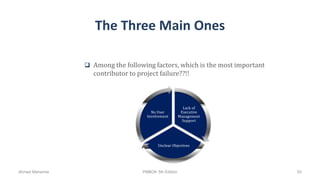
The Three Main Ones
 Among the following factors, which is the most important
contributor to project failure??!!
Lack of
Executive
Management
Support
Unclear Objectives
No User
Involvement
Ahmad Maharma PMBOK 5th Edition 93
Reason 1
 Lack of User Involvement
– Correctly identify proper user
– Develop and Maintain a quality relationship with the
client
– Create and maintain a platform for communication
– Demonstrate results
– Educate the client
– Consider their feedback
– Identify and recruit an evangelist
– Conduct primary research
– Show respect
– Focus on real user needs
Ahmad Maharma PMBOK 5th Edition 94
Reason 2
 No Executive Management Support
– Have a simple vision
– Get clear commitment
– Make fast decisions
– Have a decision pipeline
– Focus of education
– Use measurements
– Understand how and why you need to
negotiate
– Have a well thought plan
– Have a “kill switch”
– CELEBRATE
Ahmad Maharma PMBOK 5th Edition 95
Reason 3
 Absence of clear business objectives
– Make sure everyone understands the project's
objectives
– Elevator pitch
– Consider the big picture
– Promote speed and clarity
– Have a yardstick
– Use RoI
– Collaborate with team members
– Use peer review
– Avoid having “too many cooks”
– Do your homework
Ahmad Maharma PMBOK 5th Edition 96
Enterprise Environmental Factors
 The Internal and External environmental factors surrounding
and/or influencing the project negatively or positively.
 Are Inputs to most of the Project Management Processes.
 Can be categorized into Internal and External
Ahmad Maharma PMBOK 5th Edition 97
Enterprise Environmental Factors
 Culture & structure
 Regulations & Standards
 Infrastructure
 Existing human resources
 Personnel administration
 Political climate
 Commercial databases
 Information systems
 Stakeholders risk tolerance
 Marketplace Conditions
Ahmad Maharma PMBOK 5th Edition 98
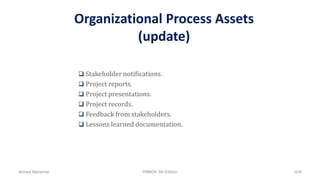
Organizational Process Assets
 Include all process related assets in addition to the
organization’s knowledge bases
 Input to most of the project management processes
 Outputs of many processes may include updating or adding
to these process assets
 Can be categorized into:
 Processes and procedures
 Corporate knowledge base
Ahmad Maharma PMBOK 5th Edition 99
Processes and Procedures
 Standard Processes.
 Templates.
 Communication Requirements.
 Financial Controls Procedures.
 Issue and Defect Management Procedures.
 Change Control Procedure.
 Risk Control Procedures.
 Approval Procedures.
Ahmad Maharma PMBOK 5th Edition 100
Corporate Knowledge
 Process Measurement Database.
 Project Files.
 Historical Information and Lessons Learned.
 Issue and Defect Management Database.
 Configuration Management Knowledge Base.
 Financial Database.
Ahmad Maharma PMBOK 5th Edition 101
PMBOK Reading
 Chapters 2 & 3
Ahmad Maharma PMBOK 5th Edition 102
Project Management
Professional
PMP®
Phase #1: PROJECT INITIATION
Why projects start?
 A market demand,
 An Organizational need,
 A customer request,
 A technological advance,
 A legal requirement,
 A social demand,
 An Ecological impact.
Ahmad Maharma PMBOK 5th Edition 104
Project Management
Professional
PMP®
Phase #1 : INITIATION
Chapter 4: Integration / 4.1 Develop Project Charter
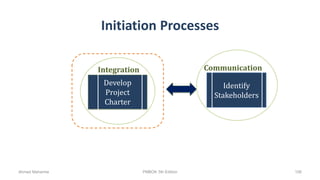
Initiation Processes
Develop
Project
Charter
Integration
Identify
Stakeholders
Communication
Ahmad Maharma PMBOK 5th Edition 106
Develop Project Charter
 The process of developing a document that formally
authorizes a project or a phase and documenting initial
requirements that satisfy the stakeholders needs and
expectations.
Ahmad Maharma PMBOK 5th Edition 107
What is a Project Charter?
 A document that formally authorizes a project or a phase and
documents initial requirements that satisfy the stakeholders
needs and expectations
 Projects are chartered and authorized external to the project
Ahmad Maharma PMBOK 5th Edition 108
Why a charter is needed?
 Defines the reason of the project
 Assigns the project manager and his/ her authority level
 Linking the project to the strategy and ongoing work of the
organization
 Helps in starting the planning for the project
Ahmad Maharma PMBOK 5th Edition 109
Facts about the project charter
 A must for all projects and/ or phases
 Communicate the project purpose or justification, high level
objectives, project and product requirements and initial risks.
 Should be clear enough, yet broad to a level that the charter
doesn’t change over the project’s life.
Ahmad Maharma PMBOK 5th Edition 110
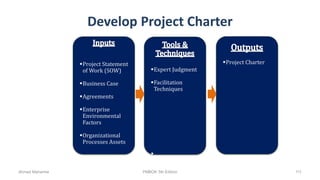
Develop Project Charter
Project Statement
of Work (SOW)
Business Case
Agreements
Enterprise
Environmental
Factors
Organizational
Processes Assets
Expert Judgment
Facilitation
Techniques

Project Charter
Ahmad Maharma PMBOK 5th Edition 111
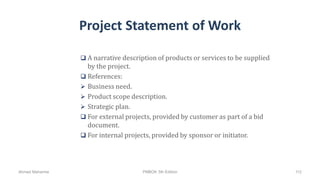
Project Statement of Work
 A narrative description of products or services to be supplied
by the project.
 References:
 Business need.
 Product scope description.
 Strategic plan.
 For external projects, provided by customer as part of a bid
document.
 For internal projects, provided by sponsor or initiator.
Ahmad Maharma PMBOK 5th Edition 112
Business Case
 A document that provides necessary information from a
business perspective on whether or not the project is worth
the investment
Ahmad Maharma PMBOK 5th Edition 113
Agreements
 MoUs
 SLAs
 Letters of Agreement
 Letters of Intent
Ahmad Maharma PMBOK 5th Edition 114
Expert Judgment
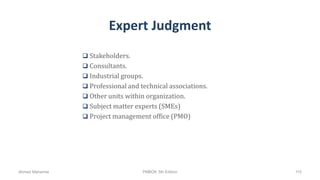
 Stakeholders.
 Consultants.
 Industrial groups.
 Professional and technical associations.
 Other units within organization.
 Subject matter experts (SMEs)
 Project management office (PMO)
Ahmad Maharma PMBOK 5th Edition 115
Facilitation Techniques
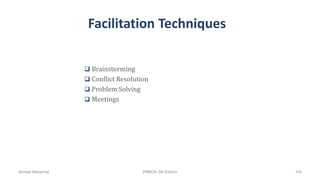
 Brainstorming
 Conflict Resolution
 Problem Solving
 Meetings
Ahmad Maharma PMBOK 5th Edition 116
Contents of project Charter
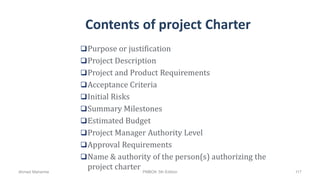
Purpose or justification
Project Description
Project and Product Requirements
Acceptance Criteria
Initial Risks
Summary Milestones
Estimated Budget
Project Manager Authority Level
Approval Requirements
Name & authority of the person(s) authorizing the
project charterAhmad Maharma PMBOK 5th Edition 117
Project Management
Professional
PMP®
Phase #1: PROJECT INITIATION
Chapter 13: Stakeholders / 13.1 Identify Stakeholders
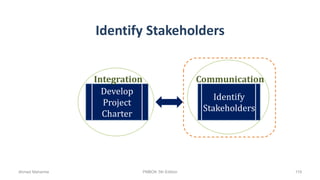
Identify Stakeholders
Develop
Project
Charter
Integration
Identify
Stakeholders
Communication
Ahmad Maharma PMBOK 5th Edition 119
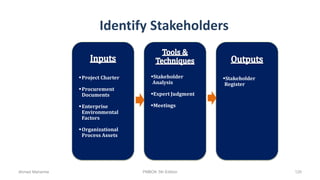
Identify Stakeholders
Project Charter
Procurement
Documents
Enterprise
Environmental
Factors
Organizational
Process Assets
Stakeholder
Analysis
Expert Judgment
Meetings
Stakeholder
Register
Ahmad Maharma PMBOK 5th Edition 120
Stakeholder Analysis
 The process of systematically gathering and analyzing
quantitative and qualitative information to determine whose
interests should be taken into account throughout the
projects.
Ahmad Maharma PMBOK 5th Edition 121
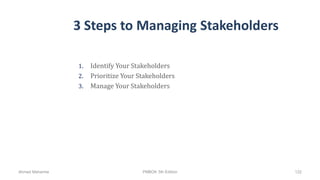
3 Steps to Managing Stakeholders
1. Identify Your Stakeholders
2. Prioritize Your Stakeholders
3. Manage Your Stakeholders
Ahmad Maharma PMBOK 5th Edition 122
Step1- Identify Stakeholders
 Identifying all stakeholders impacted by the project and
documenting relevant Information regarding their interests,
involvement, and impact on the project success.
 It is essential to identify all stakeholders to increase the
likelihood of project success.
 Should be done as early as possible.
Ahmad Maharma PMBOK 5th Edition 123
Identify Stakeholders Purpose
 Enables the project manager to focus on the relationships
necessary to ensure the success of the project.
Ahmad Maharma PMBOK 5th Edition 124
Stakeholder Register
 The Stakeholder Register is used to identify those people and
organizations impacted by the project and document relevant
information about each stakeholder.
 Includes all details related to the identified stakeholders.
 Identification information: Name, organizational position,
location, role in project, contact information.
 Assessment information: Major requirements, main
expectations, potential influence, phase.
 Stakeholder classification: Internal/ external, supporter/
neutral/ resistor, etc.
Ahmad Maharma PMBOK 5th Edition 125
Step2- Prioritize Your
Stakeholders
 Identify the potential impact or support each stakeholder
could generate
 Classify them according to:
1. Power/Interest Grid
2. Power/ Influence Grid
3. Influence/ Impact Grid
4. Salience Model
Ahmad Maharma PMBOK 5th Edition 126
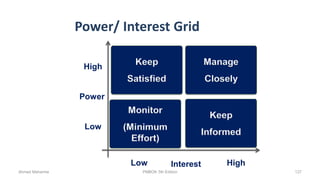
Power/ Interest Grid
Keep
Informed
Monitor
(Minimum
Effort)
Manage
Closely
Keep
Satisfied
High
Low
Low High
Power
Interest
Ahmad Maharma PMBOK 5th Edition 127
Step3: Assess Your Stakeholders
 Anticipate how key stakeholders react in different
situations, in order to plan how to influence them to
enhance their support and mitigate potential negative
impact.
Ahmad Maharma PMBOK 5th Edition 128
PMBOK Reading
 Chapter 4
- Section 4.1
 Chapter 13
- Section13.1
Ahmad Maharma PMBOK 5th Edition 129
Project Management
Professional
PMP®
Phase #2: PROJECT PLANNING
Project Management
Professional
PMP®
Phase #2: PROJECT PLANNING
Chapter 4: Scope / 4.2 Develop Project Management Plan
Develop Project Management
Plan
 Documenting the actions necessary to define, prepare,
integrate, & coordinate all subsidiary plans into a project
management plan.
Ahmad Maharma PMBOK 5th Edition 132
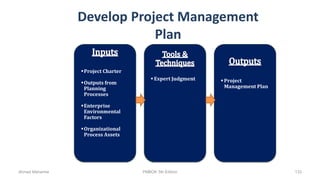
Develop Project Management
Plan
Project Charter
Outputs from
Planning
Processes
Enterprise
Environmental
Factors
Organizational
Process Assets
 Expert Judgment  Project
Management Plan
Ahmad Maharma PMBOK 5th Edition 133
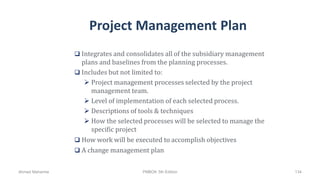
Project Management Plan
 Integrates and consolidates all of the subsidiary management
plans and baselines from the planning processes.
 Includes but not limited to:
 Project management processes selected by the project
management team.
 Level of implementation of each selected process.
 Descriptions of tools & techniques
 How the selected processes will be selected to manage the
specific project
 How work will be executed to accomplish objectives
 A change management plan
Ahmad Maharma PMBOK 5th Edition 134
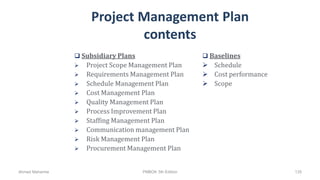
Project Management Plan
contents
 Subsidiary Plans
 Project Scope Management Plan
 Requirements Management Plan
 Schedule Management Plan
 Cost Management Plan
 Quality Management Plan
 Process Improvement Plan
 Staffing Management Plan
 Communication management Plan
 Risk Management Plan
 Procurement Management Plan
 Baselines
 Schedule
 Cost performance
 Scope
Ahmad Maharma PMBOK 5th Edition 135
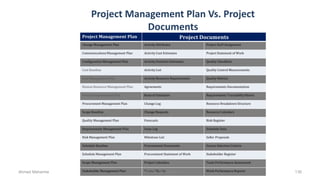
Project Management Plan Vs. Project
Documents
Project Management Plan Project Documents
Change Management Plan Activity Attributes Project Staff Assignment
CommunicationsManagement Plan Activity Cost Estimates Project Statement of Work
Configuration Management Plan Activity Duration Estimates Quality Checklists
Cost Baseline Activity List Quality Control Measurements
Cost Management Plan Activity Resource Requirements Quality Metrics
Human Resource Management Plan Agreements Requirements Documentation
Process Improvement Plan Basis of Estimates Requirements TraceabilityMatrix
Procurement Management Plan Change Log Resource Breakdown Structure
Scope Baseline Change Requests Resource Calendars
Quality Management Plan Forecasts Risk Register
Requirements Management Plan Issue Log Schedule Data
Risk Management Plan Milestone List Seller Proposals
Schedule Baseline Procurement Documents Source Selection Criteria
Schedule Management Plan Procurement Statement of Work Stakeholder Register
Scope Management Plan Project Calendars Team Performance Assessment
Stakeholder Management Plan Project Charter Work Performance ReportsAhmad Maharma PMBOK 5th Edition 136
PMBOK Reading
 Chapter 4
- Section 4.2
Ahmad Maharma PMBOK 5th Edition 137
Project Management
Professional
PMP®
Phase #2: PROJECT PLANNING
Chapter 5: Scope / 5.1 Plan Scope Management
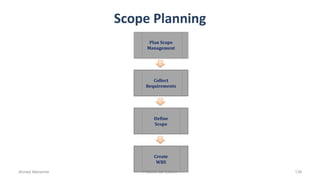
Scope Planning
Plan Scope
Management
Collect
Requirements
Define
Scope
Create
WBS
Ahmad Maharma PMBOK 5th Edition 139
Project Scope Vs. Product Scope
 Project Scope: The work that needs to be accomplished to
deliver a product, service, or result with the specified
features and functions
 Product Scope: The features and functions that characterize a
product, service, or result
Ahmad Maharma PMBOK 5th Edition 140
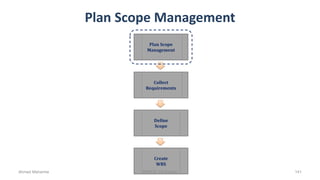
Plan Scope Management
Plan Scope
Management
Collect
Requirements
Define
Scope
Create
WBS
Ahmad Maharma PMBOK 5th Edition 141
Plan Scope management
 The process of creating a scope management plan that
documents how the project scope will be defined, validated
and controlled.
 It provides guidance on how scope will be managed
throughout the project.
Ahmad Maharma PMBOK 5th Edition 142
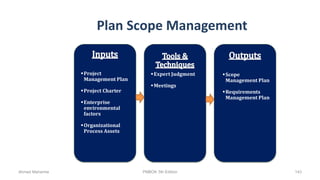
Plan Scope Management
Project
Management Plan
Project Charter
Enterprise
environmental
factors
Organizational
Process Assets
Expert Judgment
Meetings
Scope
Management Plan
Requirements
Management Plan
Ahmad Maharma PMBOK 5th Edition 143
Project Scope Management
Plan
 Part of Develop Project Management Plan
 The outcome of a planning effort that precedes performing
the processes of project scope management
 Documents how the scope will be defined, verified,
controlled, and how the work breakdown structure (WBS)
will be created and defined.
 Can be formal or informal depending on needs of the project.
Ahmad Maharma PMBOK 5th Edition 144
It Includes:
 Processes for:
– Detailing the project scope statement.
– WBS creation, maintenance, and approval.
– Formal verification and acceptance of the completed
project deliverables.
– Control how requests to change the detailed project
scope statement will be processed.
Ahmad Maharma PMBOK 5th Edition 145
Requirements Management Plan
(RQM)
 A Plan that documents how requirements will be analyzed,
document and managed (tracked, reported, prioritized…)
throughout the project life cycle.
Ahmad Maharma PMBOK 5th Edition 146
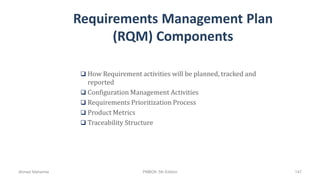
Requirements Management Plan
(RQM) Components
 How Requirement activities will be planned, tracked and
reported
 Configuration Management Activities
 Requirements Prioritization Process
 Product Metrics
 Traceability Structure
Ahmad Maharma PMBOK 5th Edition 147
Project Management
Professional
PMP®
Phase #2: PROJECT PLANNING
Chapter 5: Scope / 5.2 Collect Requirements
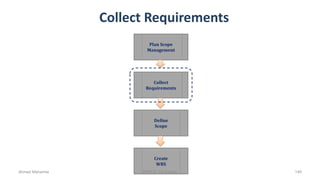
Collect Requirements
Plan Scope
Management
Collect
Requirements
Define
Scope
Create
WBS
Ahmad Maharma PMBOK 5th Edition 149
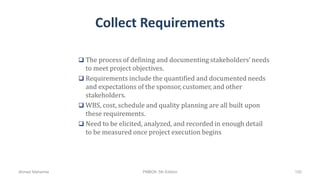
Collect Requirements
 The process of defining and documenting stakeholders’ needs
to meet project objectives.
 Requirements include the quantified and documented needs
and expectations of the sponsor, customer, and other
stakeholders.
 WBS, cost, schedule and quality planning are all built upon
these requirements.
 Need to be elicited, analyzed, and recorded in enough detail
to be measured once project execution begins
Ahmad Maharma PMBOK 5th Edition 150
Collect Requirements
 Project Requirements include business requirements, project
management requirements, delivery requirements, etc.
 Product Requirements include information on technical
requirements, security requirements, performance
requirements, etc.
Ahmad Maharma PMBOK 5th Edition 151
Collect Requirements
Scope
Management Plan
Requirements
Management Plan
Stakeholder
Management Plan
Project Charter
Stakeholder
Register
 Interviews
 Focus Groups
 Facilitated
Workshops
 Group Creativity
Techniques
 Group Decision
Making Techniques
 Questionnaires and
Surveys
 Observations
 Prototypes
 Benchmarking
 Context Diagram
 Document Analysis
Requirements
Documentation
Requirements
Traceability
Matrix
Ahmad Maharma PMBOK 5th Edition 152
Interviews
 Talking to stakeholders directly.
 Asking questions and recording answers
 “One-on-one”, or multiple interviewers and/ or interviewees.
 Interviewing:
 Experienced participants
 Stakeholders
 Subject matter experts
Ahmad Maharma PMBOK 5th Edition 153
Focus Groups
 Bring together prequalified stakeholders and subject matter
experts.
 Trained moderator guides the group through an interactive
discussion.
 More conservational than one-on-one
Ahmad Maharma PMBOK 5th Edition 154
Facilitated Workshops
 Focused sessions that bring key cross-functional stakeholders
together to define product requirements
 Helps in building trust, foster relationships, and improve
communication.
 Reveal and resolve issues more quickly than individual
sessions.
 Examples: Joint Application Development (JAD) & Quality
Function Deployment (QFD)
Ahmad Maharma PMBOK 5th Edition 155
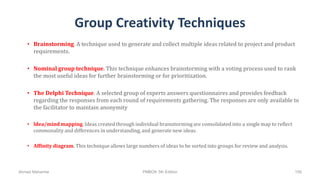
Group Creativity Techniques
• Brainstorming. A technique used to generate and collect multiple ideas related to project and product
requirements.
• Nominal group technique. This technique enhances brainstorming with a voting process used to rank
the most useful ideas for further brainstorming or for prioritization.
• The Delphi Technique. A selected group of experts answers questionnaires and provides feedback
regarding the responses from each round of requirements gathering. The responses are only available to
the facilitator to maintain anonymity
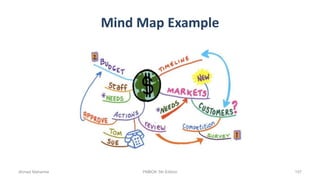
• ldea/mind mapping. Ideas created through individual brainstorming are consolidated into a single map to reflect
commonality and differences in understanding, and generate new ideas.
• Affinity diagram. This technique allows large numbers of ideas to be sorted into groups for review and analysis.
Ahmad Maharma PMBOK 5th Edition 156
Mind Map Example
Ahmad Maharma PMBOK 5th Edition 157
Group decision Making
Techniques
Group decision making is an assessment process of multiple alternatives with an expected outcome in the
form of future actions resolution. These techniques can be used to generate, classify,
and prioritize product requirements.
There are multiple methods of reaching a group decision, for example:
• Unanimity. Everyone agrees on a single course of action.
• Majority. Support from more than 50% of the members of the group.
• Plurality. The largest block in a group decides even if a majority is not achieved.
• Dictatorship. one individual makes the decision for the group.
Almost any of the decision methods described previously can be applied to the group techniques used in the
requirements gathering process.
Ahmad Maharma PMBOK 5th Edition 158
Questionnaires & Surveys
 Written sets of questions.
 Aim to quickly accumulate information from a broad group of
respondents.
 Most appropriate with broad audience, when quick
turnaround is needed, and where statistical analysis is
appropriate.
Ahmad Maharma PMBOK 5th Edition 159
Observations
 Viewing user performance
 Also called “Job shadowing”
 Helpful for detailed processes when people that use the
product have difficulty or reluctant to articulate their
requirements
 Can uncover hidden requirements
Ahmad Maharma PMBOK 5th Edition 160
Prototypes
 Provide a working model of the expected product before
actually building it.
 Support the concept of progressive elaboration through use
of iterative cycles of mock-up creation, user experimentation,
feedback generation and prototype revision.
Ahmad Maharma PMBOK 5th Edition 161
Benchmarking
 Involves comparing actual or planned practices, such as
processes and operations, to those of comparable
organizations to identify best practices, generate ideas for
improvement, and provide a basis for measuring
performance.
 Compared organizations can be external or internal.
Ahmad Maharma PMBOK 5th Edition 162
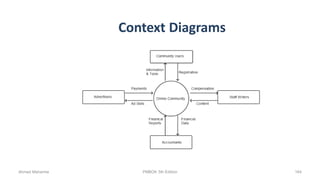
Context Diagrams
 Visually depict the product scope by showing a business
system (process, equipment, computer system…etc.), and
how people and other systems (actors) interact with it.
 Context diagrams show inputs to the business system, the
actor(s) providing the input, the outputs of the business
system, and the actor(s) receiving the output.
Ahmad Maharma PMBOK 5th Edition 163
Context Diagrams
Ahmad Maharma PMBOK 5th Edition 164
Requirements Documentation
 The document including the stakeholders’ requirements to
meet the business need for the project.
 Usually starts at a high level and then gets elaborated within
the life cycle of the project and according to the RQM
Ahmad Maharma PMBOK 5th Edition 165
Requirements Documentation
Elements
 Business need or opportunity
 Functional requirements and non functional requirements
 Quality requirements
 Acceptance criteria
 Business rules
 Impacts to other organizational areas, and other entities inside or
outside the performing organization
 Support and training requirements
 Requirements assumptions and constraints
Ahmad Maharma PMBOK 5th Edition 166
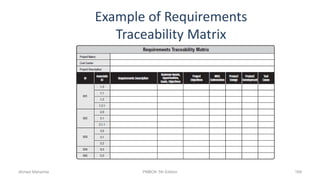
Requirements Traceability Matrix
 A tool that links project objectives to requirements to
deliverables to product features.
 The structure and level of details of the traceability matrix to be
used shall be documented in the RQM as different projects can
use different structures of traceability.
 This tool can be as simple as a table or as complex as a software
program.
Ahmad Maharma PMBOK 5th Edition 167
Requirements Traceability Matrix
Contents
 Business needs, opportunities, goals, and objectives
 Project objectives
 Project scope, WBS deliverables
 Product design
 Product development
 Test strategy and test scenarios
 High level requirements to more detailed requirements
Ahmad Maharma PMBOK 5th Edition 168
Example of Requirements
Traceability Matrix
Ahmad Maharma PMBOK 5th Edition 169
Project Management
Professional
PMP®
Phase #2: PROJECT PLANNING
Chapter 5: Scope / 5.3 Define Scope
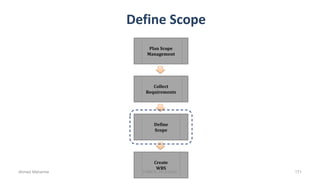
Define Scope
Plan Scope
Management
Collect
Requirements
Define
Scope
Create
WBS
Ahmad Maharma PMBOK 5th Edition 171
Define Scope
 The process of developing a detailed description of the
project and the product
 Critical to project success.
 Builds upon the major deliverables, assumptions, and
constraints documented in the project initiation.
Ahmad Maharma PMBOK 5th Edition 172
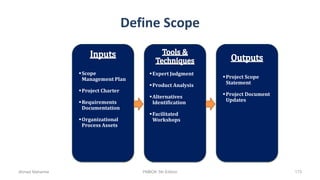
Define Scope
Scope
Management Plan
Project Charter
Requirements
Documentation
Organizational
Process Assets
Expert Judgment
Product Analysis
Alternatives
Identification
Facilitated
Workshops
Project Scope
Statement
Project Document
Updates
Ahmad Maharma PMBOK 5th Edition 173
Product Analysis
 Translating high-level product description into tangible
deliverables
 Includes techniques such as:
 Product breakdown
 System analysis
 Requirements analysis
 System engineering
 Value engineering
 Value analysis
Ahmad Maharma PMBOK 5th Edition 174
Alternatives Identification
 A technique to generate different approaches to execute and
perform the work of the project.
 Includes techniques such as:
 Brainstorming
 Lateral thinking
 Pairwise comparison
Ahmad Maharma PMBOK 5th Edition 175
Project Scope Statement
 The project scope statement describes in details the project
deliverables, and the work required to create those
deliverables.
 Common understanding among stakeholders,
 Enables more detailed planning,
 Guides the project team’s work during execution,
 Provides the baseline for evaluating changes.
Ahmad Maharma PMBOK 5th Edition 176
Project Scope Statement
Contents
 Product scope description
 Product acceptance criteria
 Project deliverables
 Project exclusions
 Project constraints
 Project assumptions
Ahmad Maharma PMBOK 5th Edition 177
Constraints
 Applicable restrictions that will affect the performance of
the project.
 Factors that affect a scheduled activity or when an
activity can be scheduled.
Ahmad Maharma PMBOK 5th Edition 178
Assumptions
 Are factors that, for planning purposes, are considered to be
true, real, or certain.
 Affect all aspects of project planning.
 Part of the project’s progressive elaboration.
 Generally involve a degree of RISK.
 Must be identified, documented and validated.
Ahmad Maharma PMBOK 5th Edition 179
Project Management
Professional
PMP®
Phase #2: PROJECT PLANNING
Chapter 5: Scope / 5.4 Create WBS
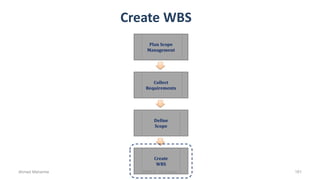
Create WBS
Plan Scope
Management
Collect
Requirements
Define
Scope
Create
WBS
Ahmad Maharma PMBOK 5th Edition 181
Create WBS
 The process of subdividing project deliverables and project
work into smaller, more manageable components.
 WBS is a deliverable-oriented hierarchical decomposition of
the work to be executed by the project team to accomplish
the project objectives, and create the required deliverables.
 Each descending level represents an increasingly detailed
definition of the project work.
 Organizes and defines the total scope of the project.
Ahmad Maharma PMBOK 5th Edition 182
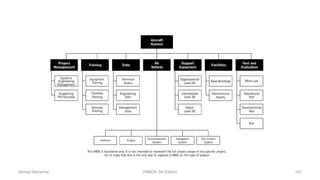
Ahmad Maharma PMBOK 5th Edition 183
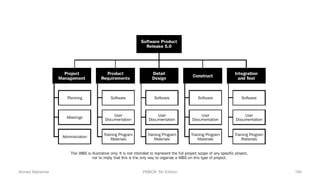
Ahmad Maharma PMBOK 5th Edition 184
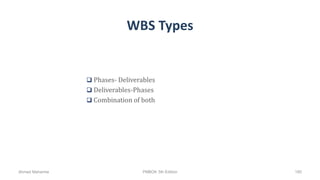
WBS Types
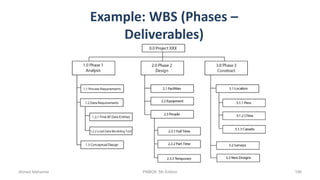
 Phases- Deliverables
 Deliverables-Phases
 Combination of both
Ahmad Maharma PMBOK 5th Edition 185
Example: WBS (Phases –
Deliverables)
Ahmad Maharma PMBOK 5th Edition 186
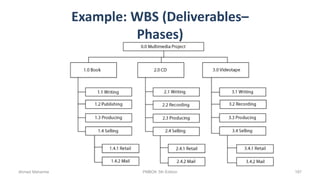
Example: WBS (Deliverables–
Phases)
Ahmad Maharma PMBOK 5th Edition 187
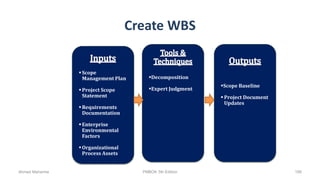
Create WBS
Scope
Management Plan
Project Scope
Statement
Requirements
Documentation
Enterprise
Environmental
Factors
Organizational
Process Assets
Decomposition
Expert Judgment
Scope Baseline
 Project Document
Updates
Ahmad Maharma PMBOK 5th Edition 188
Decomposition
 Subdivision of project deliverables into smaller, more
manageable components until the work and deliverables are
defined to the work package level.
 The level of composition varies per deliverable/ phase with
the size and complexity of project.
Ahmad Maharma PMBOK 5th Edition 189
Work Package
 The “Work Package” level is the lowest level in the WBS.
 Work Package is the point at which the cost and activity
duration can be reliable, estimated and packaged.
Ahmad Maharma PMBOK 5th Edition 190
Decomposition Involves
 Identifying deliverables and related work.
 Structuring and organizing the WBS.
 Decomposing upper levels into lower level detailed
components.
 Developing and assigning identification codes.
 Verifying that the degree of decomposition is necessary and
sufficient.
Ahmad Maharma PMBOK 5th Edition 191
WBS Dictionary Contents
 Code of account identifier
 Statement of work
 Responsible organization
 Schedule milestones
 Associated activities
 Resources required
 Cost estimates
 Quality requirements
 Acceptance criteria
 Technical references
 Contract information
Ahmad Maharma PMBOK 5th Edition 192
Scope Baseline
 Scope statement
 WBS
 WBS dictionary
Ahmad Maharma PMBOK 5th Edition 193
WBS Dictionary
 A document generated by the “Create WBS” process that
supports the WBS.
 Provides more detailed description of the components in the
WBS., including work packages and control accounts.
Ahmad Maharma PMBOK 5th Edition 194
WBS is not
 Organizational Breakdown Structure (OBS)
 Bill Of Materials (BOM)
 Risk Breakdown Structure (RBS)
 Resource Breakdown Structure (RBS)
Ahmad Maharma PMBOK 5th Edition 195
PMBOK Reading
 Chapter 5
- Sections 5.1-5.4
Ahmad Maharma PMBOK 5th Edition 196
Project Management
Professional
PMP®
Phase #2: PROJECT PLANNING
Chapter 6: Time / 6.1 Plan Schedule Management
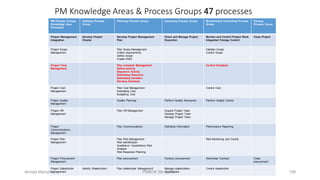
PM Knowledge Areas & Process Groups 47 processes
PM Process Groups
Knowledge Area
Processes
Initiating Process
Group
Planning Process Group Executing Process Group Monitoring & Controlling Process
Group
Closing
Process Group
Project Management
Integration
Develop Project
Charter
Develop Project Management
Plan
Direct and Manage Project
Execution
Monitor and Control Project Work
Integrated Change Control
Close Project
Project Scope
Management
Plan Scope Management
Collect requirements
Define Scope
Create WBS
Validate Scope
Control Scope
Project Time
Management
Plan schedule Management
Define Activity
Sequence Activity
Estimating Resource
Estimating Duration
Develop Schedule
Control Schedule
Project Cost
Management
Plan Cost Management
Estimating Cost
Budgeting Cost
Control Cost
Project Quality
Management
Quality Planning Perform Quality Assurance Perform Quality Control
Project HR
Management
Plan HR Management Acquire Project Team
Develop Project Team
Manage Project Team
Project
Communications
Management
Plan Communications Distribute Information Performance Reporting
Project Risk
Management
Plan Risk Management
Risk Identification
Qualitative / Quantitative Risk
Analysis
Risk Response Planning
Risk Monitoring and Control
Project Procurement
Management
Plan procurement Conduct procurement Administer Contract Close
procurement
Project Stakeholder
Management
Identify Stakeholders Plan stakeholder Management Manage stakeholders
expectations
Control stakeholder
198Ahmad Maharma PMBOK 5th Edition
Project Time Management
Knowledge
Area
Process
Initiating Planning Executing
Monitoring &
Control
Closing
Time
Plan schedule Management
Define Activity
Sequence Activity
Estimating Resource
Estimating Duration
Develop Schedule
Control Schedule
Enter phase/
Start project
Exit phase/
End project
Initiating
Processes
Closing
Processes
Planning
Processes
Executing
Processes
Monitoring &
Controlling Processes
199Ahmad Maharma PMBOK 5th Edition
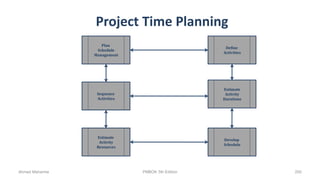
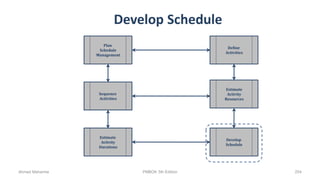
Project Time Planning
Estimate
Activity
Durations
Develop
Schedule
Sequence
Activities
Estimate
Activity
Resources
Define
Activities
Plan
Schedule
Management
Ahmad Maharma PMBOK 5th Edition 200
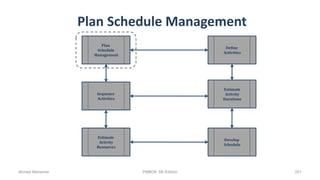
Plan Schedule Management
Estimate
Activity
Durations
Develop
Schedule
Sequence
Activities
Estimate
Activity
Resources
Define
Activities
Plan
Schedule
Management
Ahmad Maharma PMBOK 5th Edition 201
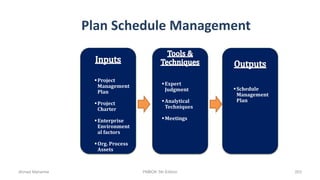
Plan Schedule Management
 The process of establishing policies, procedures, and
documentation for planning, developing, managing,
executing, and controlling the project schedule.
 The key benefit of the process is that it provides guidance and
direction on how the project schedule will be managed
throughout the project.
Ahmad Maharma PMBOK 5th Edition 202
Plan Schedule Management
Project
Management
Plan
Project
Charter
Enterprise
Environment
al factors
Org. Process
Assets
Expert
Judgment
Analytical
Techniques
Meetings
Schedule
Management
Plan
Ahmad Maharma PMBOK 5th Edition 203
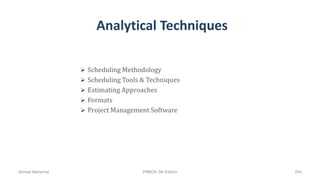
Analytical Techniques
 Scheduling Methodology
 Scheduling Tools & Techniques
 Estimating Approaches
 Formats
 Project Management Software
Ahmad Maharma PMBOK 5th Edition 204
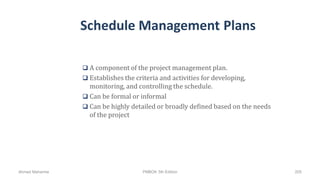
Schedule Management Plans
 A component of the project management plan.
 Establishes the criteria and activities for developing,
monitoring, and controlling the schedule.
 Can be formal or informal
 Can be highly detailed or broadly defined based on the needs
of the project
Ahmad Maharma PMBOK 5th Edition 205
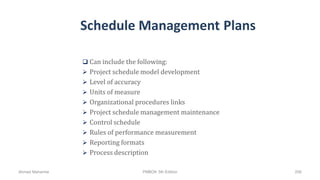
Schedule Management Plans
 Can include the following:
 Project schedule model development
 Level of accuracy
 Units of measure
 Organizational procedures links
 Project schedule management maintenance
 Control schedule
 Rules of performance measurement
 Reporting formats
 Process description
Ahmad Maharma PMBOK 5th Edition 206
Project Management
Professional
PMP®
Phase #2: PROJECT PLANNING
Chapter 6: Time / 6.2 Define Activities
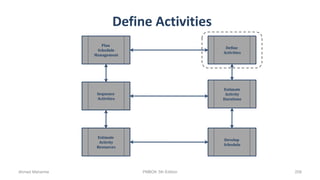
Define Activities
Estimate
Activity
Durations
Develop
Schedule
Sequence
Activities
Estimate
Activity
Resources
Define
Activities
Plan
Schedule
Management
Ahmad Maharma PMBOK 5th Edition 208
Define Activities
 The process of identifying the specific actions to be performed to produce the project
deliverables.
 Decomposed from the “work packages” at the WBS.
 Activities are the smaller components that represent the work necessary to complete the
work package.
 Activities provide basis for estimating, scheduling, executing, and monitoring and controlling
the project work.
Ahmad Maharma PMBOK 5th Edition 209
Define Activities
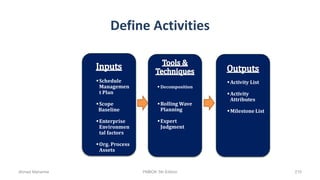
Schedule
Managemen
t Plan
Scope
Baseline
Enterprise
Environmen
tal factors
Org. Process
Assets
 Decomposition
Rolling Wave
Planning
Expert
Judgment
Activity List
Activity
Attributes
Milestone List
Ahmad Maharma PMBOK 5th Edition 210
Rolling Wave Planning
 Progressive detailing of the project management plan
Ahmad Maharma PMBOK 5th Edition 211
Activity List
 A comprehensive list including all schedule activities
required for the project.
 Includes:
 Activity identifier
 Description of each activity
Ahmad Maharma PMBOK 5th Edition 212
Project Management
Professional
PMP®
Phase #2: PROJECT PLANNING
Chapter 6: Time / 6.3 Sequence Activities
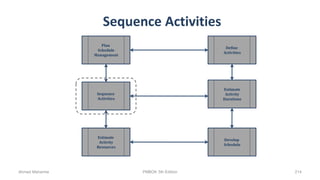
Sequence Activities
Estimate
Activity
Durations
Develop
Schedule
Sequence
Activities
Estimate
Activity
Resources
Define
Activities
Plan
Schedule
Management
Ahmad Maharma PMBOK 5th Edition 214
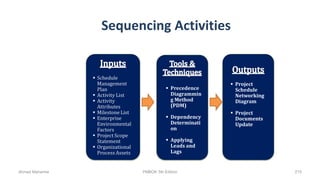
Sequencing Activities
 Schedule
Management
Plan
 Activity List
 Activity
Attributes
 Milestone List
 Enterprise
Environmental
Factors
 Project Scope
Statement
 Organizational
Process Assets
 Precedence
Diagrammin
g Method
(PDM)
 Dependency
Determinati
on
 Applying
Leads and
Lags
 Project
Schedule
Networking
Diagram
 Project
Documents
Update
Ahmad Maharma PMBOK 5th Edition 215
Sequence Activities
 Identifying & documenting dependencies among schedule
activities
 Can be done using software or manually.
Ahmad Maharma PMBOK 5th Edition 216
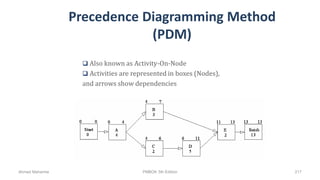
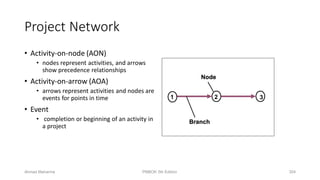
Precedence Diagramming Method
(PDM)
 Also known as Activity-On-Node
 Activities are represented in boxes (Nodes),
and arrows show dependencies
Ahmad Maharma PMBOK 5th Edition 217
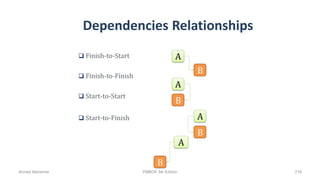
Dependencies Relationships
 Finish-to-Start
 Finish-to-Finish
 Start-to-Start
 Start-to-Finish
A
B
A
B
A
B
A
B
Ahmad Maharma PMBOK 5th Edition 218
Dependencies Relationships
 Use the following Rule of Thumb to understand the
relationships better:
 Activity A should _ _ _ _ _ _
Before activity B can _ _ _ _ _ _
Ahmad Maharma PMBOK 5th Edition 219
Types of Dependencies
 Mandatory
 Discretionary
 External
 Internal
Ahmad Maharma PMBOK 5th Edition 220
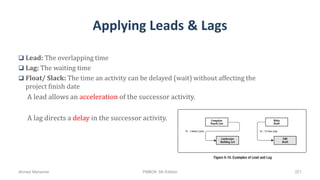
Applying Leads & Lags
 Lead: The overlapping time
 Lag: The waiting time
 Float/ Slack: The time an activity can be delayed (wait) without affecting the
project finish date
A lead allows an acceleration of the successor activity.
A lag directs a delay in the successor activity.
Ahmad Maharma PMBOK 5th Edition 221
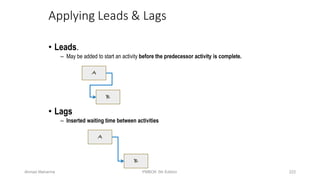
Applying Leads & Lags
• Leads.
– May be added to start an activity before the predecessor activity is complete.
• Lags
– Inserted waiting time between activities
A
B
A
B
Ahmad Maharma PMBOK 5th Edition 222
Project Management
Professional
PMP®
Phase #2: PROJECT PLANNING
Chapter 6: Time / 6.4 Estimate Activity Resources
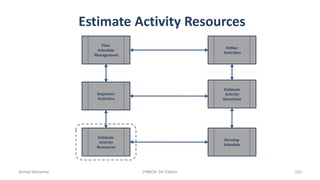
Estimate Activity Resources
Estimate
Activity
Durations
Develop
Schedule
Sequence
Activities
Estimate
Activity
Resources
Define
Activities
Plan
Schedule
Management
Ahmad Maharma PMBOK 5th Edition 224
Estimate Activity Resources
 Estimating the type and quantities of resources required to
perform each schedule activity
Ahmad Maharma PMBOK 5th Edition 225
Types of Resources
 Material
 People
 Equipment
Ahmad Maharma PMBOK 5th Edition 226
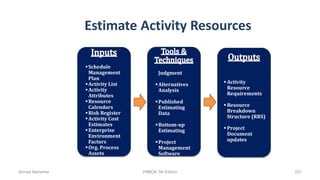
Estimate Activity Resources
Schedule
Management
Plan
Activity List
Activity
Attributes
Resource
Calendars
Risk Register
Activity Cost
Estimates
Enterprise
Environment
Factors
Org. Process
Assets
Expert
Judgment
Alternatives
Analysis
Published
Estimating
Data
Bottom-up
Estimating
Project
Management
Software
 Activity
Resource
Requirements
 Resource
Breakdown
Structure (RBS)
 Project
Document
updates
Ahmad Maharma PMBOK 5th Edition 227
Project Management
Professional
PMP®
Phase #2: PROJECT PLANNING
Chapter 6: Time / 6.4 Estimate Activity Duration
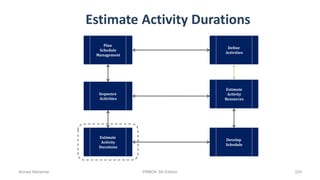
Estimate Activity Durations
Estimate
Activity
Resources
Develop
Schedule
Sequence
Activities
Estimate
Activity
Durations
Define
Activities
Plan
Schedule
Management
Ahmad Maharma PMBOK 5th Edition 229
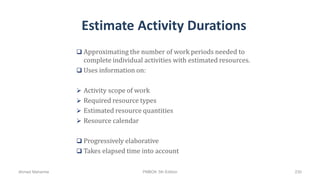
Estimate Activity Durations
 Approximating the number of work periods needed to
complete individual activities with estimated resources.
 Uses information on:
 Activity scope of work
 Required resource types
 Estimated resource quantities
 Resource calendar
 Progressively elaborative
 Takes elapsed time into account
Ahmad Maharma PMBOK 5th Edition 230
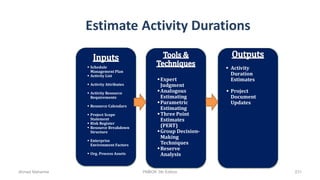
Estimate Activity Durations
 Schedule
Management Plan
 Activity List
 Activity Attributes
 Activity Resource
Requirements
 Resource Calendars
 Project Scope
Statement
 Risk Register
 Resource Breakdown
Structure
 Enterprise
Environment Factors
 Org. Process Assets
Expert
Judgment
Analogous
Estimating
Parametric
Estimating
Three Point
Estimates
(PERT)
Group Decision-
Making
Techniques
Reserve
Analysis
 Activity
Duration
Estimates
 Project
Document
Updates
Ahmad Maharma PMBOK 5th Edition 231
Estimate Activity Durations: Tools and Techniques
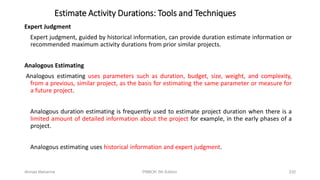
Expert Judgment
Expert judgment, guided by historical information, can provide duration estimate information or
recommended maximum activity durations from prior similar projects.
Analogous Estimating
Analogous estimating uses parameters such as duration, budget, size, weight, and complexity,
from a previous, similar project, as the basis for estimating the same parameter or measure for
a future project.
Analogous duration estimating is frequently used to estimate project duration when there is a
limited amount of detailed information about the project for example, in the early phases of a
project.
Analogous estimating uses historical information and expert judgment.
Ahmad Maharma PMBOK 5th Edition 232
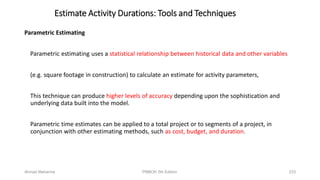
Parametric Estimating
Parametric estimating uses a statistical relationship between historical data and other variables
(e.g. square footage in construction) to calculate an estimate for activity parameters,
This technique can produce higher levels of accuracy depending upon the sophistication and
underlying data built into the model.
Parametric time estimates can be applied to a total project or to segments of a project, in
conjunction with other estimating methods, such as cost, budget, and duration.
Estimate Activity Durations: Tools and Techniques
Ahmad Maharma PMBOK 5th Edition 233
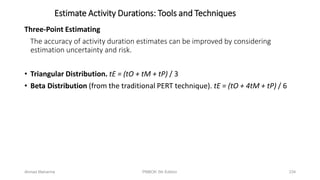
Three-Point Estimating
The accuracy of activity duration estimates can be improved by considering
estimation uncertainty and risk.
• Triangular Distribution. tE = (tO + tM + tP) / 3
• Beta Distribution (from the traditional PERT technique). tE = (tO + 4tM + tP) / 6
Estimate Activity Durations: Tools and Techniques
Ahmad Maharma PMBOK 5th Edition 234
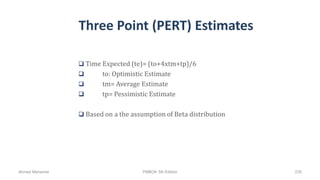
Three Point (PERT) Estimates
 Time Expected (te)= (to+4xtm+tp)/6
 to: Optimistic Estimate
 tm= Average Estimate
 tp= Pessimistic Estimate
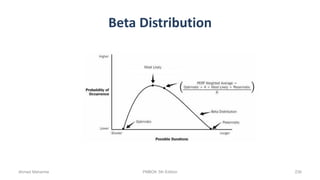
 Based on a the assumption of Beta distribution
Ahmad Maharma PMBOK 5th Edition 235
Beta Distribution
Ahmad Maharma PMBOK 5th Edition 236
Activity Optimistic Duration
 The total number of work periods in calendar units
assigned to perform the schedule activity, considering all of
the variables that could affect performance, and is
determined to be the shortest possible activity duration
 It is determined by answering the question
 How long will it take in the best case scenario?
Ahmad Maharma PMBOK 5th Edition 237
Activity Pessimistic Duration
 The total number of work periods in calendar units
assigned to perform the schedule activity, considering all of
the variables that could affect performance, and is
determined to be the longest possible activity duration
 It is determined by answering the question
 How long will it take in the worst case scenario?
Ahmad Maharma PMBOK 5th Edition 238
Activity Most Likely Duration
 The total number of work periods in calendar units
assigned to perform the schedule activity, considering all
of the variables that could affect performance, and is
determined to be the most probable activity duration
 It is determined by answering the question:
 How long will it most likely take?
Ahmad Maharma PMBOK 5th Edition 239
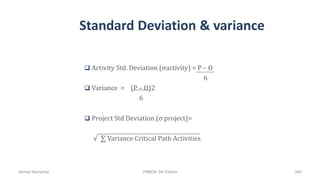
Standard Deviation & variance
 Activity Std. Deviation (σactivity) = P – O
6
 Variance = (P – O)2
6
 Project Std Deviation (σ project)=
√ ∑ Variance Critical Path Activities
Ahmad Maharma PMBOK 5th Edition 240
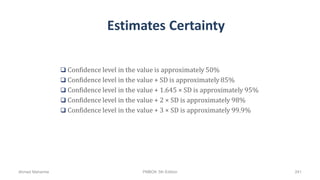
Estimates Certainty
 Confidence level in the value is approximately 50%
 Confidence level in the value + SD is approximately 85%
 Confidence level in the value + 1.645 × SD is approximately 95%
 Confidence level in the value + 2 × SD is approximately 98%
 Confidence level in the value + 3 × SD is approximately 99.9%
Ahmad Maharma PMBOK 5th Edition 241
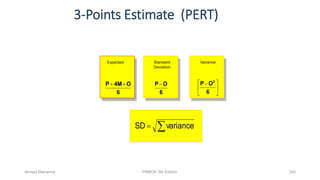
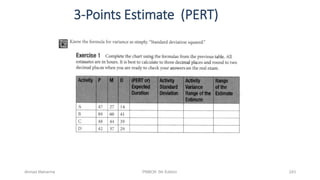
3-Points Estimate (PERT)
Expected
6
Ο4ΜP 
Standard
Deviation
6
ΟP
Variance





 
6
ΟP 2
 varianceSD
Ahmad Maharma PMBOK 5th Edition 242
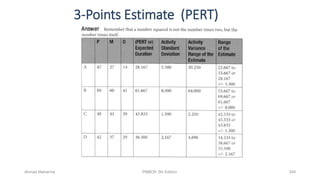
3-Points Estimate (PERT)
Ahmad Maharma PMBOK 5th Edition 243
3-Points Estimate (PERT)
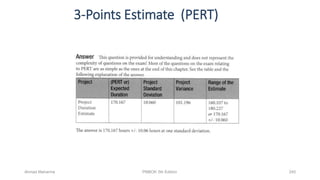
Ahmad Maharma PMBOK 5th Edition 244
3-Points Estimate (PERT)
Ahmad Maharma PMBOK 5th Edition 245
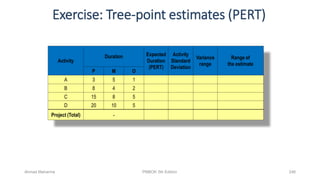
Exercise: Tree-point estimates (PERT)
Activity
Duration Expected
Duration
(PERT)
Activity
Standard
Deviation
Variance
range
Range of
the estimate
P M O
A 3 5 1
B 8 4 2
C 15 8 5
D 20 10 5
Project (Total) -
Ahmad Maharma PMBOK 5th Edition 246
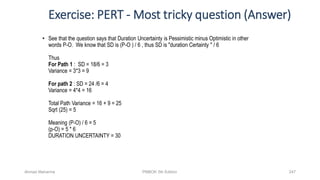
Exercise: PERT - Most tricky question (Answer)
• See that the question says that Duration Uncertainty is Pessimistic minus Optimistic in other
words P-O. We know that SD is (P-O ) / 6 , thus SD is "duration Certainty " / 6
Thus
For Path 1 : SD = 18/6 = 3
Variance = 3*3 = 9
For path 2 : SD = 24 /6 = 4
Variance = 4*4 = 16
Total Path Variance = 16 + 9 = 25
Sqrt (25) = 5
Meaning (P-O) / 6 = 5
(p-O) = 5 * 6
DURATION UNCERTAINTY = 30
Ahmad Maharma PMBOK 5th Edition 247
Schedule Uncertainty & Risk
Analysis Process
 Schedule risk analysis uses information about the
uncertainty of activity durations to help answer the
following questions:
 What is the likelihood of finishing project as scheduled?
 How much contingency is needed to establish a completion
date with a probability of success that is acceptable to the
stakeholders?
 Which activities are the most likely to delay the project?
 What actions can be taken to control risks in the schedule?
Ahmad Maharma PMBOK 5th Edition 248
Schedule Uncertainty & Risk
Analysis Process
 If estimating activity duration involves a great deal of
uncertainty, a commonly used technique is the application of
probabilistic estimates
Ahmad Maharma PMBOK 5th Edition 249
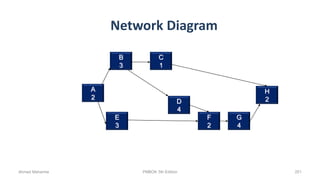
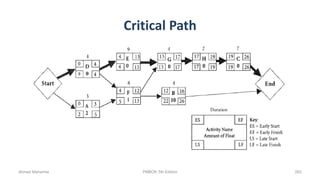
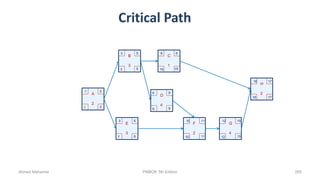
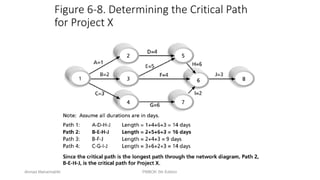
Critical Path
 The longest path from the beginning to the end of the project.
Activities on the critical path cannot be delayed without
delaying the project.
 There can be more than one critical path (riskier)
 Project Manager should focus on critical path.
Ahmad Maharma PMBOK 5th Edition 250
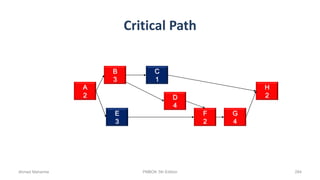
Network Diagram
A
2
B
3
C
1
D
4
E
3
F
2
G
4
H
2
Ahmad Maharma PMBOK 5th Edition 251
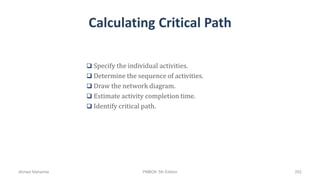
Calculating Critical Path
 Specify the individual activities.
 Determine the sequence of activities.
 Draw the network diagram.
 Estimate activity completion time.
 Identify critical path.
Ahmad Maharma PMBOK 5th Edition 252
Project Management
Professional
PMP®
Phase #2: PROJECT PLANNING
Chapter 6: Time / 6.6 Develop Schedule
Develop Schedule
Estimate
Activity
Resources
Develop
Schedule
Sequence
Activities
Estimate
Activity
Durations
Define
Activities
Plan
Schedule
Management
Ahmad Maharma PMBOK 5th Edition 254
Develop Schedule
 The process of analyzing activity sequences, durations,
resource requirements, and schedule constraints.
 Provides specific start and end dates for activities.
 Iterative process.
Ahmad Maharma PMBOK 5th Edition 255
Develop Schedule
 Schedule
Management Plan
 Activity List
 Activity Attributes
 Project Schedule
Network Diagrams
 Activity Resource
Requirements
 Resource Calendars
 Activity Duration
Estimates
 Project Scope
Statement
 Risk Register
 Project staff
assignment
 Resource
Breakdown
Structure
 Org. Process Assets
 Enterprise
Environmental
Factors
 Schedule Network
Analysis
 Critical Path
Method
 Critical Chain
Method
 Resource
Optimization
Techniques
 Modeling
techniques
 Leads & Lags
 Schedule
Compression
 Scheduling Tool
 Project schedule
 Schedule baseline
 Schedule data
 Project Calendar
 Project
Management Plan
(updates)
 Project document
(updates)
Ahmad Maharma PMBOK 5th Edition 256
Resource Optimization
Techniques
 Resource Leveling
 Resource Smoothing
Ahmad Maharma PMBOK 5th Edition 257
Resource leveling
 Used when shared or critical resources are only available at certain times, or in limited
quantities, or to keep resource usage at a constant level.
 Usually changes the critical path.
Resource leveling can be used when shared or critical required resources are
only available at certain times, are Only available in limited quantities, or to
keep resource usage at a constant level.
Resource leveling is necessary when resources have been
over-allocated.
Resource leveling can often cause the original critical path to change.
Ahmad Maharma PMBOK 5th Edition 258
Ahmad Maharma PMBOK 5th Edition 259
Resource leveling
Modeling Techniques
 What-If Scenario Analysis
 Simulation
Ahmad Maharma PMBOK 5th Edition 260
6.6.2 Develop Schedule: Tools and
Techniques
Ahmad Maharma PMBOK 5th Edition 261
Resource Smoothing. A technique that adjusts the activities of a schedule model such that the
requirements for resources on the project do not exceed certain predefined resource limits. In
resource smoothing, as opposed to resource leveling, the project’s critical path is not changed
and the completion date may not be delayed. In other words, activities may only be delayed within
their free and total float. Thus resource smoothing may not be able to optimize all resources.
What-If Scenario Analysis
 An analysis of the question “what if the situation represented by
scenario ‘X’ happens”.
 Can be used to assess the feasibility of the schedule under
adverse conditions, and in preparing contingency and response
plans.
Ahmad Maharma PMBOK 5th Edition 262
Schedule Compression
 Fast Tracking
 Crashing
Ahmad Maharma PMBOK 5th Edition 263
Fast Tracking
 A schedule compression technique in which phases or
activities normally performed in sequence are performed in
parallel.
 Can result in rework and increased risks.
Ahmad Maharma PMBOK 5th Edition 264
Crashing
 A schedule compression technique in which cost and
schedule tradeoffs are analyzed to determine how to obtain
the greatest amount of compression for the latest
incremental cost.
 Can result in increased cost.
Ahmad Maharma PMBOK 5th Edition 265
Ahmad Maharma PMBOK 5th Edition 266
Crashing
Ahmad Maharma PMBOK 5th Edition 267
Crashing
Ahmad Maharma PMBOK 5th Edition 268
Crashing
Ahmad Maharma PMBOK 5th Edition 269
Crashing
Critical Chain Method
 A schedule network analysis technique that modifies the project schedule to account for
limited resources (according to PMBOK…).
 Combines deterministic and probabilistic approaches.
Ahmad Maharma PMBOK 5th Edition 270
Project schedule
 Milestone Chart
 Bar Chart
 Project schedule network chart
Ahmad Maharma PMBOK 5th Edition 271
Schedule Baseline
 Project schedule with baseline start dates and baseline finish
dates.
Ahmad Maharma PMBOK 5th Edition 272
Start & Finish Dates
 ES: Earliest start time.
 EF: Earliest finish time.
 LF: Latest finish time.
 LS: Latest start time.
Ahmad Maharma PMBOK 5th Edition 273
Critical Path Method Basic
Ahmad Maharma PMBOK 5th Edition 274
275
Figure 6-9. Calculating Early and Late
Start and Finish Dates
Ahmad Maharma PMBOK 5th Edition
Critical Path Method Basic
Ahmad Maharma PMBOK 5th Edition 276
Forward Pass
 Schedule Calculations That Identify The Early Start and Finish
Dates of Tasks and The Project.
 ES = EF of Preceding Task (latest if more than one).
 EF = ES + Duration.
Ahmad Maharma PMBOK 5th Edition 277
Backward Pass
 Schedule Calculations That Identify The Late Start and
Finish Dates of Tasks and The Project.
 LF = LS of succeeding Task (earliest if more than one).
 LS = LF - Duration
Ahmad Maharma PMBOK 5th Edition 278
Float
 Float or slack is the amount of time that a task in a project
network can be delayed without causing a delay to:
 Subsequent tasks (free float)
 Project completion date (total float)
 Total Float = LF – EF
 OR
 LS - ES
 Free Float = Min ES (Succeeding Task) – EF
Ahmad Maharma PMBOK 5th Edition 279
Critical Path
Ahmad Maharma PMBOK 5th Edition 280
Critical Path
Ahmad Maharma PMBOK 5th Edition 281
Critical Path
Ahmad Maharma PMBOK 5th Edition 282
Critical Path
Ahmad Maharma PMBOK 5th Edition 283
Critical Path
A
2
B
3
C
1
D
4
E
3
F
2
G
4
H
2
Ahmad Maharma PMBOK 5th Edition 284
A
2
1 2
21
B
3
3 5
53
E
3
3 5
97
C
1
6 6
1515
D
4
6 9
96
F
2
10 11
1110
G
4
12 15
1512
H
2
16 17
1716
Critical Path
Ahmad Maharma PMBOK 5th Edition 285
286
Figure 6-8. Determining the Critical Path
for Project X
Ahmad Maharma PMBOK 5th Edition
287
Using Critical Path Analysis to Make
Schedule Trade-offs
• Free slack or free float is the amount of time an activity
can be delayed without delaying the early start of any
immediately following activities.
• Total slack or total float is the amount of time an
activity can be delayed from its early start without
delaying the planned project finish date.
Ahmad Maharma PMBOK 5th Edition
Exercise
Ahmad Maharma PMBOK 5th Edition 288
289
Exercise
Ahmad Maharma PMBOK 5th Edition
290
Answer
Ahmad Maharma PMBOK 5th Edition
291
Answer
Ahmad Maharma PMBOK 5th Edition
292
Answer
Ahmad Maharma PMBOK 5th Edition
293
Answer
Ahmad Maharma PMBOK 5th Edition
294
Exercise
Ahmad Maharma PMBOK 5th Edition
295
Exercise
Ahmad Maharma PMBOK 5th Edition
296
Answer
Ahmad Maharma PMBOK 5th Edition
297
Answer
Ahmad Maharma PMBOK 5th Edition
298
Answer
Ahmad Maharma PMBOK 5th Edition
299
Answer
Ahmad Maharma PMBOK 5th Edition
300
Answer
Ahmad Maharma PMBOK 5th Edition
301
GERT
Ahmad Maharma PMBOK 5th Edition
Gantt Chart
• Graph or bar chart with a bar for each project
activity that shows passage of time
• Provides visual display of project schedule
• Slack
• amount of time an activity can be delayed without
delaying the project
Ahmad Maharma PMBOK 5th Edition 302
| | | | |
Activity
Design house
and obtain
financing
Lay foundation
Order and
receive
materials
Build house
Select paint
Select carpet
Finish work
0 2 4 6 8 10
Month
Month
1 3 5 7 9
Example of Gantt Chart
Ahmad Maharma PMBOK 5th Edition 303
Project Network
• Activity-on-node (AON)
• nodes represent activities, and arrows
show precedence relationships
• Activity-on-arrow (AOA)
• arrows represent activities and nodes are
events for points in time
• Event
• completion or beginning of an activity in
a project
1 32
Branch
Node
Ahmad Maharma PMBOK 5th Edition 304
PMBOK Reading
 Chapter 6
- Sections 6.1 – 6.6
Ahmad Maharma PMBOK 5th Edition 305
Project Management
Professional
PMP®
Phase #2: PROJECT PLANNING
Chapter 7: Cost / 7.1 Plan Cost management
Project Cost Management
Plan Cost
Management
Estimate
Costs
Determine
Budget
Ahmad Maharma PMBOK 5th Edition 307
Project Cost management
 On smaller projects, cost estimating and cost budgeting are so
tightly linked that they can be done together and by one
person.
 The work done in cost management is preceded by a cost
planning effort by the project management team.
 Techniques such as Life-Cycle Costing & Value Engineering can
improve decision making and reduce cost while improving
quality and performance of project deliverables.
Ahmad Maharma PMBOK 5th Edition 308
Life-Cycle Costing
 A decision making tool that involves tradeoffs between short
term project costs and long term product or service
operational costs.
 It examines the effects of project decisions not only on project
activities, but also on the cost of maintaining, using and
supporting of the product, service, or result of the project.
Ahmad Maharma PMBOK 5th Edition 309
Plan Cost Management
Plan Cost
Management
Estimate
Costs
Determine
Budget
Ahmad Maharma PMBOK 5th Edition 310
Plan Cost Management
 The process of establishing policies, procedures, and
documentation for planning, managing, expending, and
controlling project costs.
 The key benefit of the process is that it provides guidance and
direction on how the project schedule will be managed
throughout the project.
Ahmad Maharma PMBOK 5th Edition 311
Project Management
Professional
PMP®
Phase #2: PROJECT PLANNING
Chapter 7: Cost / 7.2 Estimate Cost
Estimate Costs
 Project
Management
Plan
 Project Charter
 Enterprise
Environmental
Factors
 Org. Process
Assets
 Expert Judgment
 Analytical
Techniques
 Meetings
 Cost
Management
Plan
Ahmad Maharma PMBOK 5th Edition 313
Cost Management Plan
 Part of Develop Project Management Plan
 The outcome of a planning effort that precedes performing
the processes of project cost management
 Sets out the format and establishes the criteria for planning,
structuring, estimating, budgeting, and controlling project
costs.
 Documents cost management processes and their associated
tools and techniques
Ahmad Maharma PMBOK 5th Edition 314
Cost Management Plan
Establishes
 Level of accuracy
 Level of precision
 Units of measure
 Organizational procedures links
 Control thresholds
 Rules of performance measurement
 Reporting formats
 Process descriptions
 Additional details
Ahmad Maharma PMBOK 5th Edition 315
Estimate Costs
Plan Cost
Management
Estimate
Costs
Determine
Budget
Ahmad Maharma PMBOK 5th Edition 316
Cost Estimating Vs. Cost
Budgeting
 Cost Estimating: Developing an approximation of the costs of
the resources needed to complete project activities
 Cost Budgeting: Aggregating the estimated costs of individual
activities of work packages to establish a cost baseline
Ahmad Maharma PMBOK 5th Edition 317
Estimate Costs
 Cost
Management
Plan
 Scope Baseline
 Project Schedule
 Human Resource
Plan
 Risk Register
 Enterprise
Environmental
Factors
 Org. Process
Assets
 Expert Judgment
 Analogous
Estimating
 Parametric
Estimating
 Bottom-up
estimating
 Three-Point
Estimates
 Reserve analysis
 Cost of Quality
 Project
Management
Estimating
Software
 Vendor Bid
Analysis
 Group Decision-
Making
Techniques
 Activity Cost
Estimates
 Basis of
Estimates
 Project
Document
Updates
Ahmad Maharma PMBOK 5th Edition 318
Analogous Estimating
 Using cost of previous similar projects as basis for estimating.
 Less Costly BUT less accurate.
 Used when information is limited (early phases).
 Reliable when previous projects are similar in fact, not just in
appearance.
Ahmad Maharma PMBOK 5th Edition 319
Parametric Estimating
 Uses relationship between historical data and certain
parameters (cost per square meter, cost per meter, etc).
Ahmad Maharma PMBOK 5th Edition 320
Bottom-Up Estimating
 A method for estimating a component of work.
 The cost is estimated for individual work packages or
activities, and they are then summarized or “rolled-up” to
higher levels.
 Cost and accuracy are influenced by the size and complexity
of the individual package or activity.
Ahmad Maharma PMBOK 5th Edition 321
Vendor Bid analysis
 Includes analysis of what the project should cost, based on
responsive bids from qualified vendors.
Ahmad Maharma PMBOK 5th Edition 322
Activity Cost Estimates
 A quantitative assessment of the likely costs of the resources
required to complete project activities.
Ahmad Maharma PMBOK 5th Edition 323
Basis of Estimates
 Documentation of basis of estimates (how it was developed).
 Documentation of assumptions made.
 Documentation of any known constraints.
 Indication of range of estimates.
 Indication of confidence level of the final estimate.
Ahmad Maharma PMBOK 5th Edition 324
Cost Elements
 Human Resources – Labor
 Hour rate, fringe benefits, overtime, overhead, per diem
 Equipment & Software
 Depreciation, purchase cost, support & Maintenance
 Facilities
 Rent, depreciation, utilities, admin overhead
 Supplies
 Stationary, food, leisure, gas for cars, tickets
 Special expenses
Ahmad Maharma PMBOK 5th Edition 325
Types of Cost
• Variable Costs
– Change with the amount of production/work
– e.g. material, supplies, wages
• Fixed Costs
– Do not change as production change
– e.g. set-up, rental
• Direct Costs
– Directly attributable to the work of project
– e.g. team travel, recognition, team wages
• Indirect Costs
– overhead or cost incurred for benefit of more than one project
– e.g. taxes, fringe benefit, janitorial services
Ahmad Maharma PMBOK 5th Edition 326
Project Management
Professional
PMP®
Phase #2: PROJECT PLANNING
Chapter 7: Cost / 7.3 Determine Budget
Determine Budget
Plan Cost
Management
Estimate
Costs
Determine
Budget
Ahmad Maharma PMBOK 5th Edition 328
Determine Budget
 The process of aggregating the estimated costs to individual
activities or work packages to establish an authorized cost
baseline.
Ahmad Maharma PMBOK 5th Edition 329
Determine Budget
Cost
Management
Plan
Scope Baseline
Activity Cost
Estimates
Basis of Cost
Estimates
Project
Schedule
Risk Register
Resource
Calendars
Agreements
Organizational
Process Assets
Cost Aggregation
Reserve Analysis
Expert Judgment
Historical
Relationships
Funding Limit
Reconciliation
Cost
Performance
Baseline
Project Funding
Requirements
Project
Document
Updates
Ahmad Maharma PMBOK 5th Edition 330
Funding Limit Reconciliation
 The expenditure of funds should be reconciled with any
funding limits on the commitment of funds for the project.
 Variance between the funding limits and the planned
expenditures sometimes necessitate the rescheduling of work
to level out the rate of expenditures.
 Can be accomplished by placing imposed date constraints for
work into the project schedule.
Ahmad Maharma PMBOK 5th Edition 331
Cost Performance Baseline
 Time-phased budget at completion (BAC) used as basis
against which to measure, monitor, and control overall cost
performance.
Ahmad Maharma PMBOK 5th Edition 332
Cost Performance Baseline
Ahmad Maharma PMBOK 5th Edition 333
Cost Aggregation
• Reserves & risk management are important
while estimating!
– Contingency reserves:  Cost Baseline
the cost impacts of the remaining risk
– Management reserves:  Cost Budget
extra fund to cover unforeseen risk or
changes to the project
Activity estimates
Work package estimates
Control account estimates
Project estimates
Contingency reserves
Management reserves
Cost baseline
Cost Budget
Ahmad Maharma PMBOK 5th Edition 334
Contingency Reserves
 Contingency reserves is usually percentage of total estimate
or based on risk analysis, to account for the risks that are
“known unknowns” of the project.
 Under the control of the project manager.
Ahmad Maharma PMBOK 5th Edition 335
Management Reserves
 Budgets reserved for unplanned, but potentially required
changes to project scope. These are the risks that are
“unknown unknowns”.
 Under the control of organization’s management.
Ahmad Maharma PMBOK 5th Edition 336
Cost Budgeting
1. Activities
$75
$25 $25$25
$100 $100
$275
$400
$675
$225
$900
$140
$1040
2. Work
packages
3. Control
Account
4. Project
5.Contingency
Reserve
6.Cost
Baseline
7.Management
Reserve
8.Cost Budget
Ahmad Maharma PMBOK 5th Edition 337
Project Selection Methods
System Description
Benefit Measurement
Models (Economic
Models)
Analyze the predicted value of the completed projects in different
ways.
May present the value in terms of:
 Benefit Cost Ratio (BCR)
 Return on Investment (ROI)
 Present Value (PV) & Net Present Value (NPV)
 Internal Rate of Return (IRR)
 Opportunity Cost
Mathematical Models
(Constrained
Optimization)
Uses different types of mathematical formulas and algorithms to
determine the optimal course of action.
 Linear programming
 Nonlinear programming
 Dynamic programming
 Integer Programming
 Multi-objective programming
Ahmad Maharma PMBOK 5th Edition 338
Benefit Measurement Models (Economic Models)
Accounting Concept Description Keys for Project Selection Notes
Present value (PV)
Value today of future cash
flows.
The higher the PV, the better. PV= FV/(1+r)n
Net present value (NPV)
Present value of cash inflow
(benefits) minus present
value of cash outflow (costs).
A negative NPV is
unfavorable. The higher the
NPV, the better.
Accounts for different project
durations.
Internal rate of return (IRR)
The interest rate that makes
the net present value of all
cash flow equal zero.
The higher the IRR, the
better.
The return that a company would
earn if it invests in the project.
Payback period
The number of time periods
needed to hit the break-even
point.
The lower the payback
period, the better.
Benefit cost ratio (BCR)
A ratio identifying the
relationship between the
cost and benefits of a
proposed project.
A BCR less than 1 is
unfavorable. The higher the
BCR, the better.
Opportunity cost
The difference in return
between a chosen
investment and one that is
passed up.
Sunk costs
A cost that has been incurred
and cannot be reversed.
This should not be a factor in
project decisions.
Ahmad Maharma PMBOK 5th Edition 339
Present Value (PV) and (NPV)
• Present Value (PV) – Present Value of future Cash flows. Higher the better.
• NOTE: present value and NPV are only mention once or twice on the exam
• You will not have to calculate it, nor know formula, just understand the concept
• Amount of money is always more valuable sooner than later, as this enables to take advantage of
investment opportunities.
• Higher PV more preferable project. A potential investment project is selected, if value of NPV is
>= ZERO
• PV = FV / (1 + i) n
• Example:
• Project X is expected to make $50,000 in two years. Project Y is expected to make
to $80,000 in three years. If the cost of capital is 5 percent, which project to choose?
• Using PV formula, PV = FV / (1 + i) n , PV for Project X is $69,107 and Project Y is $45,351.
• Project Y will return the highest investment to the company and should be chosen over Project X.
Ahmad Maharma PMBOK 5th Edition 340
Net Present Value
 The present value of total benefits (income or revenue) minus
the cost over many time periods.
 Allows for comparison of many projects, to select the best to
initiate.
 If NPV is +ve: the investment is a good choice.
 The project with highest NPV is the best.
Ahmad Maharma PMBOK 5th Edition 341
Net Present Value
 NPV=  (FV/ (1+i)n)
 Where FV= Future Value
 i= Interest Rate
 n= Number of period intervals
Ahmad Maharma PMBOK 5th Edition 342
Net Present Value Example
Note that
totals are
equal, but
NPVs are
not because
of the time
value of
money
Ahmad Maharma PMBOK 5th Edition 343
Internal Rate of Return (IRR)
• This is just another way of interpreting the benefit from the project.
• It looks at the cost of the project as the capital investment and translates the profit into the
interest rate over the life of that investment.
• Calculations for IRR are not part of this certification. It is enough if you understand that the
greater the value for IRR, the more beneficial the
• Example:
• You have two projects to choose from: Project A with an IRR of 21%, or project B with an IRR of
15%, which once you prefer?
• Answer: Project A.
Ahmad Maharma PMBOK 5th Edition 344
Internal Rate of return (IRR)
Is the interest rate at which the costs of the
investment lead to the benefits of the investment.
The project with highest IRR is the best.
Ahmad Maharma PMBOK 5th Edition 345
Payback Period
 The period of time required for the return on an investment
to "repay" the sum of the original investment.
 For example, a $1000 investment which returned $500 per
year would have a two year payback period.
 The project with lowest payback period is the best
Ahmad Maharma PMBOK 5th Edition 346
Payback Period
• The payback period is the length of time required to recover the initial cash outlay on the project.
• For example, if a project involves a cash outlay of 600,000$ and generates cash inflows of.
100000$, 150000$, 150000$ and 200000$ in the first, second, third and fourth years respectively,
• its pay back period is 4 years because the sum of cash flows during the four years is equal to the
initial outlay. According to the payback criterion,
• the shorter the payback period, the more desirable the project.
• Payback period = cost of period or investment / Annual cash flow
• Example:
• You have two projects to choose from , Project A with payback period of 6 months or project B
with payback period of 18 months, which one would you prefer?
• Answer : Project A
Ahmad Maharma PMBOK 5th Edition 347
Benefit Cost Ratio
• This is the value obtained by dividing the benefit by the cost.
• The greater the value, the more attractive the project
• A benefit cost ration >1 means the benefit are grater than the cost
• A benefit cost ration <1 means the cost are grater than the benefit
• A benefit cost ration =1 means the benefit are equal the cost
• For example, if the projected cost of producing a product is 10,000$, and you expect to sell it for
40,000$,
then the BCR is equal to 40,000$/10,000$, which is equal to 4. For the benefit to exceed cost, the
BCR must be greater than 1.
Example:
If BCR of project A is 2.3, and the BCR of project B is 1.7, which project would you select?
Answer : Project A
Ahmad Maharma PMBOK 5th Edition 348
Charting the Payback Period
Ahmad Maharma PMBOK 5th Edition 349
Economic Value Added (EVA)
• Economic Value Added (EVA) – Value added to organization by the project
• Economic value should rarely appear in questions or choices
Ahmad Maharma PMBOK 5th Edition 350
Opportunity Cost.
• Opportunity cost (opportunity lost) is the NPV of the next best project, you are not doing,
because you have decided to invest in a project.
• Let us assume that you have 100,000 rupees and you are investing this money in project ‘A’,
whose NPV=200,000 and because of this you are unable to do project ‘B’, whose NPV=150,000 or
project ‘C’, whose NPV = 120,000, then the opportunity cost is 150,000, which is the NPV of
project ‘B’, which is the next best option after ‘A’.
• Example:
• You have two projects to choose from: Project A with an NPV of 45,000$, or project B with an NPV
of 85,000$, what Is the opportunity cost of selecting project B ?
• Answer : 45,000$
Ahmad Maharma PMBOK 5th Edition 351
Sunk Cost
• Sunk Cost – Cost already incurred. This should not be taken into account while taking
decision.
• Are expended costs; accounting standards that sunk costs should not be considered
when deciding whether to continue with a troubled project.
Example :
You have project with an initial budget of 1,000,000 $ , you are halfway through the
project and have spend 2,000,000 $, do you consider the 1,000,000 $ over budget
when determining whether to continue with the project.
• Answer: NO, the money spent is gone
Ahmad Maharma PMBOK 5th Edition 352
Law of Diminishing return
• Law of Diminishing return – After a point, adding more
resources will not have proportional benefit.
• Example:
• A single programmer may produce at 1 module per hour. With
second a programmer the two may produce 1.75 module/ hour.
With third programmer, the group may produce 2.25 modules/
hour
Ahmad Maharma PMBOK 5th Edition 353
Working Capital
• Working Capital – Current assets minus current liabilities.
The amount of money the company has available to invest, including investment
in project
Ahmad Maharma PMBOK 5th Edition 354
Depreciation
• Depreciation – Assets loose value over useful life.
• Depreciation methods based on time
Straight line method
Declining balance method
Sum-of-the-years'-digits method
Depreciation based on use (activity)
Ahmad Maharma PMBOK 5th Edition 355
Straight line depreciation
• Depreciation = (Cost - Residual value) / Useful life
[Example, Straight line depreciation]
On April 1, 2011, Company A purchased an equipment at the cost of
$140,000. This equipment is estimated to have 5 year useful life. At the end of the 5th
year, the salvage value (residual value) will be $20,000. Company A recognizes
depreciation to the nearest whole month. Calculate the depreciation expenses for
2011, 2012 and 2013 using straight line depreciation method.
Depreciation for 2011
= ($140,000 - $20,000) x 1/5 x 9/12 = $18,000
Depreciation for 2012
= ($140,000 - $20,000) x 1/5 x 12/12 = $24,000
Depreciation for 2013
= ($140,000 - $20,000) x 1/5 x 12/12 = $24,000
Ahmad Maharma PMBOK 5th Edition 356
Double declining balance depreciation
Year
Book Value
at the beginning
Depreciation
Rate
Depreciation
Expense
Book Value at
the year-end
2011 $140,000 40%
2012
2013
2014
2015
Ahmad Maharma PMBOK 5th Edition 357
Double declining balance depreciation
(*1) $140,000 x 40% x 9/12 = $42,000
(*2) $98,000 x 40% x 12/12 = $39,200
(*3) $58,800 x 40% x 12/12 = $23,520
(*4) $35,280 x 40% x 12/12 = $14,112
(*5) $21,168 x 40% x 12/12 = $8,467
--> Depreciation for 2015 is $1,168 to keep book value same as
salvage value.
--> $21,168 - $20,000 = $1,168 (At this point, depreciation stops.)
Ahmad Maharma PMBOK 5th Edition 358
Double declining balance depreciation
Year
Book Value
at the beginning
Depreciation
Rate
Depreciation
Expense
Book Value at
the year-end
2011 $140,000 40% $42,000 (*1) $98,000
2012 $98,000 40% $39,200 (*2) $58,800
2013 $58,800 40% $23,520 (*3) $35,280
2014 $35,280 40% $14,112 (*4) $21,168
2015 $21,168 40% $1,168 (*5) $20,000
Ahmad Maharma PMBOK 5th Edition 359
Sum-of-the-years-digits method
Depreciation expense = (Cost - Salvage value) x Fraction
Fraction for the first year = n / (1+2+3+...+ n)
Fraction for the second year = (n-1) / (1+2+3+...+ n)
Fraction for the third year = (n-2) / (1+2+3+...+ n)
...
Fraction for the last year = 1 / (1+2+3+...+ n)
n represents the number of years for useful life.
[Example, Sum-of-the-years-digits method]
Ahmad Maharma PMBOK 5th Edition 360
Sum-of-the-years-digits method
[Example, Sum-of-the-years-digits method]
Company A purchased the following asset on January 1, 2011.
What is the amount of depreciation expense for the year ended December 31, 2011?
Acquisition cost of the asset --> $100,000
Useful life of the asset --> 5 years
Residual value (or salvage value) at the end of useful life --> $10,000
Depreciation method --> sum-of-the-years'-digits method
Calculation of depreciation expense
Sum of the years' digits = 1+2+3+4+5 = 15
Depreciation for 2011 = ($100,000 - $10,000) x 5/15 = $30,000
Depreciation for 2012 = ($100,000 - $10,000) x 4/15 = $24,000
Depreciation for 2013 = ($100,000 - $10,000) x 3/15 = $18,000
Depreciation for 2014 = ($100,000 - $10,000) x 2/15 = $12,000
Depreciation for 2015 = ($100,000 - $10,000) x 1/15 = $6,000
Sum of the years' digits for n years
= 1 + 2 + 3 + ...... + (n-1) + n = (n+1) x (n / 2)
Sum of the years' digits for 500 years
= 1 + 2 + 3 + ...... + 499 + 500
= (500 + 1) x (500 / 2) = (501 x 500) / 2 = 125,250
Ahmad Maharma PMBOK 5th Edition 361
Project selection methods – exercise
Accounting Concept Project A Project B Answer
Net present value (NPV) 1,000,000 $ 75,000 $
Internal rate of return (IRR) 13 % 17 %
Payback period 16 months 18 months
Benefit cost ratio (BCR) 2.27 1.3
Ahmad Maharma PMBOK 5th Edition 362
Project selection methods – exercise
Accounting Concept Project A Project B Answer
Net present value (NPV) 1,000,000 $ 75,000 $ A
Internal rate of return (IRR) 13 % 17 % B
Payback period 16 months 18 months A
Benefit cost ratio (BCR) 2.27 1.3 A
Ahmad Maharma PMBOK 5th Edition 363
PMBOK Reading
 Chapter 7
- Sections 7.1 - 7.3
Ahmad Maharma PMBOK 5th Edition 364
Project Management
Professional
PMP®
Phase #2: PROJECT PLANNING
Chapter 8: Quality / 8.1 Plan Quality Management
What is Quality?
 Conformance to Requirements
 Fitness of use
 According to PMBOK
 “The degree to which a set of inherent characteristics fulfill
requirements.”
Ahmad Maharma PMBOK 5th Edition 366
Project Quality Management
Plan
Quality
Management
Ahmad Maharma PMBOK 5th Edition 367
Quality Management & Project
Management
 Both disciplines recognize the importance of:
 Customer Satisfaction
 Prevention over inspection
 Management Responsibility
 Continuous Improvement
Ahmad Maharma PMBOK 5th Edition 368
Quality Concepts
 Quality vs. Grade
 Precision vs. Accuracy
 Quality Assurance vs. Quality Control
Ahmad Maharma PMBOK 5th Edition 369
Quality Vs. Grade
 Quality is the “Degree to which a set of inherent characteristics
fulfill requirements”
 Grade is “ Category assigned to products or services having the
same functional use but different technical characteristics”.
 Low grade does not necessarily cause a problem, but low
quality does.
Ahmad Maharma PMBOK 5th Edition 370
Precision vs. Accuracy
 Precision is consistency that the value of repeated
measurements are clustered and have little scatter.
 Accuracy means that the measured value is very close to the
true value.
 Precise measurements are not necessarily accurate. A very
accurate measurement is not necessarily precise.
Ahmad Maharma PMBOK 5th Edition 371
Ahmad Maharma PMBOK 5th Edition 372
Quality Assurance vs. Quality
Control
 Quality Assurance is applying the planned, systematic quality
activities to ensure that the project employs all processes
needed to meet requirements.
 Quality Control is the action of monitoring specific project
results to determine whether they comply with relevant
quality standards and identifying ways to eliminate causes of
unsatisfactory performance.
Ahmad Maharma PMBOK 5th Edition 373
Project Quality Management
Plan
Quality
Management
Ahmad Maharma PMBOK 5th Edition 374
Plan Quality Management
 Identifying which quality Standards are relevant to the
project and determining how to satisfy them
 Scope statement
 Quality policies
 Quality standards & regulations in the company, industry.
 Quality is planned, designed and built in- not inspected in.
Ahmad Maharma PMBOK 5th Edition 375
Plan Quality
 Project
Management Plan
 Stakeholder
Register
 Risk Register
 Requirements
Documentation
 Enterprise
Environmental
Factors
 Org. Process
Assets
Cost/ Benefit
Analysis
Cost of Quality
(COQ)
Seven Basic
Quality Tools
Benchmarking
Design of
Experiments
Statistical
Sampling
Additional Quality
Planning Tools
Meetings
 Quality
Management Plan
 Quality Metrics
 Quality Checklists
 Process
Improvement Plan
 Project Document
Updates
Ahmad Maharma PMBOK 5th Edition 376
Seven Basic Quality Tools
1. Cause & Effect Diagram
2. Flowcharts
3. Checksheets
4. Pareto Diagrams
5. Histograms
6. Control Charts
7. Scatter Diagrams
Ahmad Maharma PMBOK 5th Edition 377
Cause & Effect Diagram
 Also known as “Fish-Bone Analysis” or “Ishikawa Analysis”
 Used to identify the problem, discover the underlying causes
leading to it, and develop solutions and preventive actions.
Ahmad Maharma PMBOK 5th Edition 378
Cause & Effect Diagram
Ahmad Maharma PMBOK 5th Edition 379
Flowcharting
 Diagram that shows the relationship between different
elements in a system of processes
 Used to assist team efforts in identifying potential quality
problems and the possible affects of those problems.
 Cause & Affect Diagram
 Process flowcharts
Ahmad Maharma PMBOK 5th Edition 380
Ahmad Maharma PMBOK 5th Edition 381
Checksheets
Category Strokes Frequency
Attribute 1
Attribute 2
Attribute 3
Attribute 4
Ahmad Maharma PMBOK 5th Edition 382
Control Charts
 Graphic display of results, over time, of a process.
 Used to determine if the process is “in control”. When a
process is “in control” it should not be adjusted.
 “Rule of Seven”
Ahmad Maharma PMBOK 5th Edition 383
Ahmad Maharma PMBOK 5th Edition 384
Histogram
 A vertical bar chart showing how often a particular variable
state occurred.
Ahmad Maharma PMBOK 5th Edition 385
Histograms
Ahmad Maharma PMBOK 5th Edition 386
Pareto Diagrams
 Histogram, ordered by frequency of occurrence, that shows how
many results were generated by type or categories of identified
cause.
 Rank ordering is used to guide corrective actions – fix the
problems that are causing the greatest number of defects first.
 Relates to Pareto’s Law & Principle of 80/20
Ahmad Maharma PMBOK 5th Edition 387
Pareto Diagram
Ahmad Maharma PMBOK 5th Edition 388
Scatter Diagram
 A Scatter diagram shows the relationship between two
variables.
 Allows to study and identify the possible relationship
between changes observed in two variables.
Ahmad Maharma PMBOK 5th Edition 389
Scatter Diagram
Ahmad Maharma PMBOK 5th Edition 390
BENCHMARKING
 The evaluation of a groups’ business or project practices in
comparison to those of other groups or projects.
 Includes a number of quantitative or qualitative attributes
that can be assessed in both the benchmark and the subject.
Ahmad Maharma PMBOK 5th Edition 391
Cost of Quality
 Prevention costs – up front costs to design and plan for
quality.
 Appraisal costs – associated with evaluation of results to
make sure that they conform to quality.
 Internal Failure costs – Cost of re-work associated with items
that did not pass the appraisal.
 External Failure costs – Cost of failures found by the
customer.
Ahmad Maharma PMBOK 5th Edition 392
Cost of Quality
 Conformance:
 Training.
 Research.
 Surveys.
 Nonconformance:
 Scrap.
 Rework.
 Warranty.
 Inventory.
Ahmad Maharma PMBOK 5th Edition 393
Check Lists
 Job aid that prompts employees to perform activities
according to a consistent quality standard.
 Could be for quality assurance or quality control.
 Two types of Checklists:
 Imperative
 Interrogative
Ahmad Maharma PMBOK 5th Edition 394
Design of Experiments
 A structured, organized method that is used to determine the
relationship between the different factors affecting a process
and the output of that process.
 It involves designing a set of ten to twenty experiments, in
which all relevant factors are varied systematically.
 The results of these experiments are analyzed, to help
identify optimal conditions
Ahmad Maharma PMBOK 5th Edition 395
Quality Management Plan
 Describes how the project team will implement the
performing organization’s quality policy
Ahmad Maharma PMBOK 5th Edition 396
Quality Management Plan
Contents
 Purpose
 Quality Policy/ Standards
 Quality Assurance Procedures & Test
 Quality Control Procedures & Tests
 Roles & Responsibilities
Ahmad Maharma PMBOK 5th Edition 397
Process Improvement Plan
 Process Boundaries
 Process Configuration
 Process Metrics
 Targets for Improved Performance
Ahmad Maharma PMBOK 5th Edition 398
PMBOK Reading
 Chapter 8
- Section 8.1
Ahmad Maharma PMBOK 5th Edition 399
Project Management
Professional
PMP®
Phase #2: PROJECT PLANNING
Chapter 9: HR / 9.1 Plan HR Management
Project Human resource
Management
Plan
Human
Resource
Management
Ahmad Maharma PMBOK 5th Edition 401
Plan Human Resource
Management
 Identifying, documenting, and assigning project roles,
responsibilities, required skills and reporting relationships,
as well as creating the staffing management plan.
 Identifying who we want, at which skill level, when, and for
how long. Specifying their roles, and responsibilities and
interactions.
Ahmad Maharma PMBOK 5th Edition 402
Develop Human Resource Plan
Project
Management
Plan
Activity
Resource
Requirements
Enterprise
Environmental
Factors
Org. Process
Assets
Organization
Charts &
Position
descriptions
Networking
Organizational
Theory
Expert
Judgment
Meetings
Human
Resource
Management
Plan
Ahmad Maharma PMBOK 5th Edition 403
Organizational Charts & Position
Descriptions
 Hierarchical- type Charts
 Matrix-based Charts
 Text-Oriented Formats
Ahmad Maharma PMBOK 5th Edition 404
Organizational Charts & Position
Descriptions
Ahmad Maharma PMBOK 5th Edition 405
Responsibility Assignment Matrix
(RAM)
Activity Ann Ben Carlos Dina Ed
Define A R I I I
Design I A R C C
Develop I A R C C
Test A I I R I
R= ResponsibleA=Accountable C=Consult I=Inform
Ahmad Maharma PMBOK 5th Edition 406
Organizational Theory
 Provides information regarding the ways that people, teams
and organizational units behave.
Ahmad Maharma PMBOK 5th Edition 407
Halo Effect
 The tendency to rate high or low on all factors due to the
impression of a high or low rating on some specific factor.
Ahmad Maharma PMBOK 5th Edition 408
Team Building Activities (Tools & Techniques)
Tuckman’s stage of team formation and development:
1. FORMING
– The team meets and learns about the project and what their roles and responsibilities.
2. STORMING
– Address the project work, technical decisions and the project management approach.
Conflict/disagreement may occurs.
3. NORMING
– Work together and adjust work habits and behavior that support the team.
4. PERFORMING
– Being a well-organized unit
5. ADJOURNING
– Team completes the work and move on from the project.
Ahmad Maharma PMBOK 5th Edition 409
Motivation Theory: Maslow’s
Hierarchy of Needs
Image source: http://theskooloflife.com/wordpress/self-actualization-in-the-maslow-hierarchy/
Basic Needs
Higher Level
of Needs
Ahmad Maharma PMBOK 5th Edition 410
Motivation Theory: McGregor’s X & Y
Theory
• Theory X
– People tends to be negative, passive
e.g. incapable, avoid responsibility, need
to be watched
– Extrinsic Motivation
•Theory Y
–People tends to be positive e.g. want to achieve, willing to work without
supervision, can direct their own effort
–Intrinsic Motivation
Ahmad Maharma PMBOK 5th Edition 411
Motivation Theory: Acquired Needs
Theory• David McClelland’s Theory
People are motivated by one of the three needs
Needs Behavioral Style
Achievement
(N-Ach)
 These people should be given projects that are
challenging but are reachable
 They like recognition
Affiliation
(N-Affil)
 These people work best when cooperating with
others
 They seek approval rather than recognition
Power
(N-Pow)
 People whose need for power is socially
oriented, should be allowed to manager others
 These people like to organize and influence
others
Ahmad Maharma PMBOK 5th Edition 412
Motivation Theory: Two Factors
Theory• Herzberg’s Theory
– Job dissatisfaction due to lack of hygiene factors
– Job satisfaction due to motivation factors
Hygiene Factors
- Working condition
- Salary
- Personal life
- Relationship at work
- Security
- Status
Motivation Factors
- Responsibility
- Self actualization
- Professional growth
- Recognition
Ahmad Maharma PMBOK 5th Edition 413
Human Resource Plan
 Provides guidance on how project human resources should
be defined, staffed, managed, controlled, and eventually
released.
Ahmad Maharma PMBOK 5th Edition 414
Human Resource Plan Contents
 Roles and Responsibilities
 Project Organization Charts
 Staffing Management Plan
Ahmad Maharma PMBOK 5th Edition 415
Staffing Management Plan
 Staff acquisition
 Resource Calendars
 Staff Release Plan
 Training needs
 Recognition & Rewards
 Compliance
 Safety
Ahmad Maharma PMBOK 5th Edition 416
PMBOK Reading
 Chapter 9
- Section 9.1
Ahmad Maharma PMBOK 5th Edition 417
Project Management
Professional
PMP®
Phase #2: PROJECT PLANNING
Chapter 10: Communications / 8.1 Plan Communications
Management
Project Communications Management
Plan
Communications
Management
Ahmad Maharma PMBOK 5th Edition 419
Consequences of Miscommunication
Ahmad Maharma PMBOK 5th Edition 420
Plan Communication
 The process of determining the project stakeholder
information needs and defining a communication approach.
 Who needs what information,
 When will they need it,
 In which format,
 How will it be given to them,
 How frequently.
Ahmad Maharma PMBOK 5th Edition 421
Communication Body of
Knowledge
 Communication Process
 Choice of Media
 Documentation Skills
 Presentation Skills
 Meeting Management
 Clutter, Noise, & Barriers
Ahmad Maharma PMBOK 5th Edition 422
Effective Communication
 Effective Communication
 Non Verbal
 Para lingual
 Feedback
 Effective Listening
 Feedback
 Active Listening
 Para lingual
Ahmad Maharma PMBOK 5th Edition 423
Communication Methods
Method When Used
Formal Written Complex Problems, PM Plans, Charter, Long
Distance Communication
Formal Verbal Presentations, Speeches
Informal Written Memos, e-mails, notes
Informal Verbal Meetings, Conversations
Ahmad Maharma PMBOK 5th Edition 424
Plan Communications
Management
 Project
Management
Plan
 Stakeholder
Register
 Enterprise
environmental
factors
 Organizational
Process Assets
Communication
Requirements
Analysis
Communication
technology
Communication
Models
Communication
Methods
Meetings
Communications
Management
Plan
Project
Documents
Updates
Ahmad Maharma PMBOK 5th Edition 425
Communication Requirements
Analysis
 Determining the communication requirements of the project
stakeholders.
 Defined by combining the type and format of information
needed with an analysis of the value of that information.
 Project resources are expended only on communicating
information that contribute to success, or where a lack of
communication can lead to failure.
Ahmad Maharma PMBOK 5th Edition 426
Number of Communication
Channels
 N (N-1)/2
Ahmad Maharma PMBOK 5th Edition 427
Communication technology
 Factors that affect the project communication technology:
 Urgency of the need for information.
 Availability of technology
 Expected project staffing
 Duration of the project
 Project Environment
Ahmad Maharma PMBOK 5th Edition 428
Communication Models
Sender Receiver
Medium
Message
Feedback –
Message
Noise
Noise
Acknowledge
MessageNoise
Ahmad Maharma PMBOK 5th Edition 429
Communication Models
 Interactive
 Push
 Pull
Ahmad Maharma PMBOK 5th Edition 430
Communication Management
Plan
 Stakeholder communication requirements
 Information to be communicated
 Reason for distribution
 Responsibility
 Recipients
 Methods and technologies used
 Frequency
 Resources allocated for communication (including time and
budget)
 Escalation process
 Method for updating
 Glossary of terminology
 Information flow in the project (flow chart)
 Communication constraints
Ahmad Maharma PMBOK 5th Edition 431
Communication Matrix
What Why By Whom Recipient When How
Status
report
Performanc
e reporting
PM Sponsor/
Steering
Committee
Weekly
basis
Email
Minutes of
meeting
Reporting
decisions
PC Steering
Committee
After each
meeting
Email
Risk forms Report &
document
risks
Any
stakeholder
PM As needed Email
Risks log Updating
risks log
Risk
Manager
Steering
Committee
Every two
weeks
Meeting &
email
Ahmad Maharma PMBOK 5th Edition 432
PMBOK Reading
 Chapter 10
- Section 10.1
Ahmad Maharma PMBOK 5th Edition 433
Project Management
Professional
PMP®
Phase #2: PROJECT PLANNING
Chapter 11: Risk/ 11.1 Plan Risk Management
Is Risk Good Or Bad?
Ahmad Maharma PMBOK 5th Edition 435
Risk…
Negative
Threat
Positive
Opportunity
Ahmad Maharma PMBOK 5th Edition 436
Ahmad Maharma PMBOK 5th Edition 437
Risk Definition
 Risk: an uncertain event that, if it occurs, has a positive or
negative effect on a project’s deliverables.
Ahmad Maharma PMBOK 5th Edition 438
Project Risk Management
 The systematic process of identifying, analyzing, and
responding, monitoring, and controlling project risks
Ahmad Maharma PMBOK 5th Edition 439
Project Risk Planning
Plan Risk Management
Plan Risk
Responses
Perform
Quantitative
Risk
Analysis
Identify
Risks
Perform
Qualitative
Risk
Analysis
Ahmad Maharma PMBOK 5th Edition 440
Plan Risk Management
Plan
Risk
Management
Plan Risk
Responses
Perform
Quantitative
Risk
Analysis
Identify
Risks
Perform
Qualitative
Risk
Analysis
Ahmad Maharma PMBOK 5th Edition 441
Plan Risk Management
 Deciding how to conduct risk management activities for a
project.
Ahmad Maharma PMBOK 5th Edition 442
Plan Risk Management
 Project
Management
Plan
 Project Charter
 Stakeholder
Register
 Enterprise
Environmental
factors
 Org. Process
Assets
Analytical
Techniques
Expert
Judgment
Meetings
Risk
Management
Plan
Ahmad Maharma PMBOK 5th Edition 443
Risk Management Plan
 Describes how risk management will be structured and
performed on the project.
 A subset of the project management plan.
Ahmad Maharma PMBOK 5th Edition 444
Risk Management Plan
 Methodology.
 Roles and responsibilities.
 Budgeting.
 Timing.
 Risk categories.
 Definitions of risk probability and impact.
 Probability and impact matrix.
 Revised stakeholders’ tolerances.
 Reporting formats.
 Tracking.
Ahmad Maharma PMBOK 5th Edition 445
Risk Categories
Ahmad Maharma PMBOK 5th Edition 446
Definition of Risk Probability &
Impact
Ahmad Maharma PMBOK 5th Edition 447
Exercise
Ahmad Maharma PMBOK 5th Edition 448
Expected Monetary Value
Ahmad Maharma PMBOK 5th Edition 449
Expected Monetary Value
Ahmad Maharma PMBOK 5th Edition 450
Impact Scale
 Cardinal
 Linear
 Non-Linear
 Ordinal
Ahmad Maharma PMBOK 5th Edition 451
Impact Scale
 Cardinal Linear (0.1, 0.3, 0.7, 0.9)
 Cardinal Non-Linear (.05, .1, .2, .4, .8).
 Cardinal Non-Linear is used to reflect focus on high risks.
 Ordinal (Very Low, Low, Medium, High, Very High)
Ahmad Maharma PMBOK 5th Edition 452
Probability Scale
 Cardinal Linear (0.05, 0.1,0.2…etc.)
 Ordinal (Very unlikely, unlikely, moderate, likely, very likely,
almost certain)
Ahmad Maharma PMBOK 5th Edition 453
Probability-Impact Matrix
 Each risk is rated on its probability of occurring and impact
on an objective if it does occur.
 The matrix shows low, moderate or high risks.
 Risk Score= risk probability x risk impact
Ahmad Maharma PMBOK 5th Edition 454
Probability-Impact Matrix
(Cardinal)
Ahmad Maharma PMBOK 5th Edition 455
Probability-Impact Matrix
(Ordinal)
Ahmad Maharma PMBOK 5th Edition 456
Identify Risks
 Determining which risks may affect the project and
documenting their characteristics.
Ahmad Maharma PMBOK 5th Edition 457
Project Management
Professional
PMP®
Phase #2: PROJECT PLANNING
Chapter 11: Risk/ 11.2 Identify Risks
Identify Risks
Plan
Risk
Management
Plan Risk
Responses
Perform
Quantitative
Risk
Analysis
Identify
Risks
Perform
Qualitative
Risk
Analysis
Ahmad Maharma PMBOK 5th Edition 459
Identify Risks
 Risk Management Plan
 Activity Cost Estimates
 Activity Duration
Estimates
 Scope Baseline
 Stakeholder Register
 Cost Management Plan
 Schedule Management
Plan
 Quality Management
Plan
 Human Resource Plan
 Project Documents
 Procurement
Documents
 Enterprise
Environmental Factors
 Org. Process Assets
 Documentation
Review
 Information
Gathering
Techniques
 Checklist Analysis
 Assumptions
analysis
 Diagramming
Techniques
 SWOT Analysis
 Expert Judgment
Risk Register
Ahmad Maharma PMBOK 5th Edition 460
Documentation Review
 Structured review of project documentation, including plans,
assumptions, previous project files, contracts and other
information at project level and detailed scope levels.
Ahmad Maharma PMBOK 5th Edition 461
Information Gathering
Techniques
 Brainstorming
 Delphi Technique
 Interviewing
 Root cause analysis
Ahmad Maharma PMBOK 5th Edition 462
Brainstorming
 A group creativity technique designed to generate a large
number of ideas for the solution of a problem.
 Everyone is allowed to express ideas freely and without
criticism.
Ahmad Maharma PMBOK 5th Edition 463
Delphi Technique
 A way to reach a consensus of experts who participate
anonymously.
 A facilitator uses a questionnaire to solicit ideas about the
important risks.
 Eliminates biasness and influence of individuals
Ahmad Maharma PMBOK 5th Edition 464
Interviewing
 Interviewing experienced project participants, stakeholders,
and subject matter experts to identify risks.
Ahmad Maharma PMBOK 5th Edition 465
Root Cause Analysis
 Also known as “Fish-Bone Analysis” or “Ishikawa Analysis”
 Used to identify the problem, discover the underlying causes
leading to it, and develop solutions and preventive actions.
Ahmad Maharma PMBOK 5th Edition 466
Root Cause Analysis
Ahmad Maharma PMBOK 5th Edition 467
Checklist Analysis
 Based on historical and project information.
 Must be exhaustive (very difficult).
 Important to review at project closure to improve on the
checklist for future projects.
 One of the easier more common first steps.
 Can be grouped into categories.
Ahmad Maharma PMBOK 5th Edition 468
Assumptions Analysis
 Review project assumptions.
 Explores the validity of assumptions as they apply to the
project.
 Identifies risks to the project from inaccuracy, inconsistency,
or incompleteness of assumptions.
Ahmad Maharma PMBOK 5th Edition 469
SWOT Analysis
 Internal Factors
 Strengths.
 Weaknesses.
 External Factors
 Opportunities.
 Threats.
Ahmad Maharma PMBOK 5th Edition 470
Risk Register
 A document that contains the outcomes of risk planning.
 At this stage includes:
 List of identified risks.
 List of potential scenarios.
 Risk triggers
Ahmad Maharma PMBOK 5th Edition 471
Project Management
Professional
PMP®
Phase #2: PROJECT PLANNING
Chapter 11: Risk/ 11.3 Perform Qualitative Risk Analysis
Perform Qualitative Risk
Analysis
Plan
Risk
Management
Plan Risk
Responses
Perform
Quantitative
Risk
Analysis
Identify
Risks
Perform
Qualitative
Risk
Analysis
Ahmad Maharma PMBOK 5th Edition 473
Perform Qualitative Risk Analysis
 Prioritizing risks for further analysis or action by assessing
and combining their probability of occurrence and impact.
 Assesses the priority of identified risks using their relative
probability or likelihood of occurrence.
Ahmad Maharma PMBOK 5th Edition 474
Perform Qualitative Risk Analysis
 Risk Management
Plan
 Risk Register
 Risk Management
Plan
 Project Scope
Statement
 Organizational
Process Assets
 Risk Probability
and Impact
Assessment
 Probability and
Impact Matrix
 Risk Data quality
assessment
 Risk
Categorization
 Risk Urgency
Assessment
 Expert Judgment
 Project Documents
Updates
Ahmad Maharma PMBOK 5th Edition 475
Risk register Updates
 Relative ranking or priority list of project risks.
 Risks grouped by categories.
 Causes of risk or project areas requiring particular attention.
 List of risks requiring responses in the near-term.
 List of risks for additional analysis and responses.
 Watchlists of low-priority risks.
 Trends in qualitative risk analysis results.
Ahmad Maharma PMBOK 5th Edition 476
Perform Quantitative Risk Analysis
 The process of numerically analyzing the effect of identified
risks on overall project objectives.
 Performed on risks that have been prioritized by the
qualitative analysis.
Ahmad Maharma PMBOK 5th Edition 477
Outcomes of Quantitative Risk
Analysis
 Quantify possible outcomes and their probability.
 Assess probability of achieving a specific objective.
 Identify risks requiring most attention.
 Identify realistic and achievable targets.
 Determine best decision under uncertainty.
Ahmad Maharma PMBOK 5th Edition 478
Project Management
Professional
PMP®
Phase #2: PROJECT PLANNING
Chapter 11: Risk/ 11.4 Perform Quantitative Risk Analysis
Perform Quantitative Risk
Analysis
Plan
Risk
Management
Plan Risk
Responses
Perform
Quantitative
Risk
Analysis
Identify
Risks
Perform
Qualitative
Risk
Analysis
Ahmad Maharma PMBOK 5th Edition 480
Perform Quantitative Risk
Analysis
Risk Register
Risk
Management
Plan
Cost
Management
Plan
Schedule
Management
Plan
Enterprise
Environmental
Factors
Organizational
Process Assets
 Data Gathering
and
Representation
Techniques
 Quantitative
Risk Analysis
and Modeling
Techniques
 Expert
Judgment
Project
Documents
Updates
Ahmad Maharma PMBOK 5th Edition 481
Data Gathering and
Representation Techniques
 Interviewing.
 Probability distributions.
Ahmad Maharma PMBOK 5th Edition 482
Quantitative Risk Analysis and
Modeling Techniques
 Sensitivity Analysis
 Expected Monetary Value Analysis
 Modeling and Simulation
Ahmad Maharma PMBOK 5th Edition 483
Sensitivity Analysis
 Helps to determine which risks have the most potential
impact on the project.
 It examines the extent to which the uncertainty of each
project element affects the objectives being examined when
all other uncertain elements are held at their baseline value.
Ahmad Maharma PMBOK 5th Edition 484
Expected Monetary Value (EMV)
 Statistical concept that calculates the average outcomes when
the future includes scenarios that may or may not happen
(i.e. analysis under uncertainty).
 The EMV of opportunities will generally be expressed in
positive values while those of threats in negative values.
 Calculated by multiplying the value of each possible outcome
by its probability of occurrence, and adding them together.
Ahmad Maharma PMBOK 5th Edition 485
Expected Monetary Value (EMV)
 EMV = Σ Probability X Impact
 All possible
 outcomes
 of a decision
Work
Package
Probability Impact EMV
A 10% -$ 20,000 -$2,000
B 30% $45,000 $13,500
C 68% -$18,000 -$12,240
Total -$ 740
Ahmad Maharma PMBOK 5th Edition 486
Decision Tree Analysis
 Graphical means of displaying all available options, their
probability, and their impact, to reach the final project
objective.
Ahmad Maharma PMBOK 5th Edition 487
Decision Tree Analysis
$335
$550
EMV In house = (1000 – 150) * 0.5 + ( -30 – 150) * 0.5 = $ 335
EMV out source = (1000 – 250) * 0.8 + ( 0 – 250) * 0.2 = $ 550
Ahmad Maharma PMBOK 5th Edition 488
Ahmad Maharma PMBOK 5th Edition 489
Modeling & Simulation
 Uses Monte Carlo Technique
 A computerized technique that uses sampling from a random
number sequence to simulate characteristics or events or
outcomes with multiple possible values.
 Used to generate probable outcomes based on estimates
processed / iterated thousands of times.
Ahmad Maharma PMBOK 5th Edition 490
Modeling & Simulation
 Provides probable project results and information for project
decision-making.
 For Cost Risk Analysis, use cost estimates.
 For Schedule Risk Analysis,
use the schedule network
diagram and duration estimates.
 Illustrates the likelihood of
achieving specific cost / schedule
targets.
Ahmad Maharma PMBOK 5th Edition 491
Monte Carlo Simulation
Ahmad Maharma PMBOK 5th Edition 492
Monte Carlo Simulation
Mean=$46.67m
Cost
Probability(Cumulative)
100%
75%
50%
25%
0%
$30m $38.75m $47.5m $56.25m $65m
$41m $50m
12%
Ahmad Maharma PMBOK 5th Edition 493
Project Management
Professional
PMP®
Phase #2: PROJECT PLANNING
Chapter 11: Risk/ 11.5 Plan Risk Responses
Plan Risk Responses
 The process of developing options and actions to enhance
opportunities an to reduce threats to project objectives.
Ahmad Maharma PMBOK 5th Edition 495
Plan Risk Responses
Plan
Risk
Management
Plan Risk
Responses
Perform
Quantitative
Risk
Analysis
Identify
Risks
Perform
Qualitative
Risk
Analysis
Ahmad Maharma PMBOK 5th Edition 496
Plan Risk Responses
Risk Management
Plan
Risk Register
 Strategies for
Negative Risks or
Threats
 Strategies for
Positive Risks or
Opportunities
 Contingent
Response
Strategies
 Expert judgment
Project
Management Plan
updates
Project
Documents
Updates
Ahmad Maharma PMBOK 5th Edition 497
Responses for Negative Risks
(Threats)
 Avoidance.
 Transference.
 Mitigation.
 Acceptance.
Ahmad Maharma PMBOK 5th Edition 498
Avoidance
 Changing project plan to eliminate the risk or condition or to
protect the project objectives from its impact.
Ahmad Maharma PMBOK 5th Edition 499
Transference
 Shifting some or all of the negative impact, along with
ownership of the response to a third party.
 Examples of transference:
 Insurance
 Warranties
 Guaranties
 Performance bonds
 Transfers risk, but does not eliminate it.
Ahmad Maharma PMBOK 5th Edition 500
Mitigation
 Reducing probability and/ or impact of risk to an acceptable
level.
 Does not eliminate risk completely.
 Mitigates probability and/ or impact.
Ahmad Maharma PMBOK 5th Edition 501
Acceptance
 Deciding not to change the project plan, to deal with a risk, or
being unable to identify suitable response strategy.
 Includes active and passive acceptance:
 Active acceptance: developing a contingency plan if risk
occurs.
 Passive acceptance: no action is taken until risk happens.
Ahmad Maharma PMBOK 5th Edition 502
Responses for positive risks
(Opportunities)
 Exploit (vs. Avoid).
 Share (vs. Transfer).
 Enhance (vs. Mitigate).
 Accept. (The same)
Ahmad Maharma PMBOK 5th Edition 503
Outcomes From Risk Response
Planning
 Residual Risk: Those that remain after avoidance, transfer or
mitigation responses have been taken.
 Secondary Risk: That arise as a direct result of implementing a
risk response.
 Contingency reserve needed: The amount of buffer needed to
reduce the risk of over runs.
Ahmad Maharma PMBOK 5th Edition 504
Exercise
Ahmad Maharma PMBOK 5th Edition 505
Exercise
Ahmad Maharma PMBOK 5th Edition 506
Exercise
Ahmad Maharma PMBOK 5th Edition 507
Exercise
Ahmad Maharma PMBOK 5th Edition 508
PMBOK Reading
 Chapter 11
- Section 11.1 - 11.5
Ahmad Maharma PMBOK 5th Edition 509
Project Management
Professional
PMP®
Phase #2: PROJECT PLANNING
Chapter 12: Procurement / 12.1 Plan Procurement
Management
Project Procurement
Management
 The processes necessary to purchase or acquire products,
services or results from outside the project team.
 Includes the contract management and change control
processes required to develop and administer contracts.
 Includes also administering any contracts issued by an
outside organization (the buyer) that is acquiring the project
from the performing organization (the seller).
Ahmad Maharma PMBOK 5th Edition 511
Project Procurement
Management
 The organization, can be the buyer or seller of the product,
service or result under a contract.
 Contract can be called:
 Agreement.
 Subcontract.
 Purchase order.
Ahmad Maharma PMBOK 5th Edition 512
Project Procurement
Management
 Seller can be called:
 Contractor
 Subcontractor
 Vendor
 Service provider
 Supplier
 Buyer can be called:
 Client
 Customer
 Service requester
 Purchaser
Ahmad Maharma PMBOK 5th Edition 513
Seller in a project
Bidder Selected
Source
Contractor,
Supplier or Vendor
Ahmad Maharma PMBOK 5th Edition 514
Project Procurement
Management
Plan
Procurement
Management
Conduct
procurements
Control
Procurements
Close
Procurements
Ahmad Maharma PMBOK 5th Edition 515
Plan Procurements Management
Plan
Procurements
Management
Conduct
procurements
Control
Procurements
Close
Procurements
Ahmad Maharma PMBOK 5th Edition 516
Plan Procurements
 The process of documenting project purchasing decisions,
specifying the approach, and identifying potential sellers.
 Should be accomplished during the scope definition effort to
specify:
 Whether to procure or not?
 How to procure?
 What to procure?
 How much to procure?
 When to procure?
Ahmad Maharma PMBOK 5th Edition 517
Project Manager’s Authority in
Procurement
 It depends on the type of the contracting environment:
 Centralized Contracting Environment
 There is a procurement department & a procurement
manager who handle all procurements
 The project Manager contacts the procurement manager
when he/she needs help regarding procurement
 Decentralized Contracting Environment
 There’s no procurement department
 The project manager hires a procurement manager to work
full time on procurement & he will be reporting directly to
the Project Manager
Ahmad Maharma PMBOK 5th Edition 518
 Because they are part of the
procurement department that
focuses only on procurement,
they have high level of expertise
 It provides its employees with
continuous improvement,
training & shared lessons
learned
 They are more efficient & helpful
in understanding the manager’s
requirement in procurement
 Employees have clear &
defined career path in
procurement profession
 One procurement manager may
work on many projects, so the
attention will be divided among
many procurement projects
 It may be more difficult for the
project manager to obtain
contracting help when needed
 The project manager will not
have a full authority in the
procurement project
Centralized Contracting Environment
Advantages Disadvantages
Ahmad Maharma PMBOK 5th Edition 519
 The project manager has easier
access to contracting expertise
because the procurement
manager is a member of the team
 The procurement manager has
more loyalty to the project
 There is no “home” department for
the procurement manager to
return to after the project is
completed
 It’s more difficult to maintain a high
level of contracting expertise in the
company because there’s no
procurement department
 There may be an inefficient use of
procurement resources in projects
across the organization
 There may be a little
standardization of procurement
practice from one project to the
next
 No career path as a procurement
manager
Decentralized Contracting Environment
Advantages Disadvantages
Ahmad Maharma PMBOK 5th Edition 520
Plan Procurements
 Project
Management Plan
 Requirements
Documentation
 Risk Register
 Activity Resource
Requirements
 Project Schedule
 Activity Cost
Estimates
 Stakeholder
Register
 Enterprise
Environmental
Factors
 Organizational
Process Assets
 Make-or-Buy
Analysis
 Expert Judgment
 Contract Types
Meetings
 Procurement
Management Plan
 Procurements
Statement of Work
 Make-or-Buy
Decisions
 Procurement
Documents
 Source Selection
Criteria
 Change Requests
 Project
Documents
Updates
Ahmad Maharma PMBOK 5th Edition 521
Make-or-Buy Analysis
 A technique used to determine whether particular work can
best be accomplished by the project team or must be
purchased from outside sources.
 If buy: Purchase or lease?
 Should consider all related costs; direct and indirect.
Ahmad Maharma PMBOK 5th Edition 522
12.1.2 Plan Procurements – Tools and Techniques
Ahmad Maharma PMBOK 5th Edition 523
Contract Types
 Fixed price
 Cost reimbursable
 Time and material
Ahmad Maharma PMBOK 5th Edition 524
Fixed Price Contracts
 The most common type.
 A total lump sum price against a well-defined product.
 Three types:
 Firm Fixed Price Contracts (FFP)
 Fixed Price Incentive Fee Contracts (FPIF)
 Fixed Price with Economic Price Adjustment Contracts (FP-
EPA)
Ahmad Maharma PMBOK 5th Edition 525
Fixed Price Contracts
 The most common type.
 The buyer knows the price from the beginning.
 Risk is on the seller
 The buyer must prepare a detailed SOW ( more work on the
buyer)
 The seller might try not to do everything according to the
SOW if he started loosing money
 More cost on the buyer
Advantages:
Disadvantages:
Ahmad Maharma PMBOK 5th Edition 526
Cost reimbursable Contracts
 Paying the seller the actual cost, plus a fee.
 Three types:
 Cost-plus-fixed-fee (CPFF)
 Cost plus incentive fee (CPIF)
 Cost plus award fee (CPAF).
Ahmad Maharma PMBOK 5th Edition 527
Cost reimbursable Contracts
 No detailed SOW.
 Less cost on the buyer than the FPC
 Total cost is unknown
 Risk is on the buyer
 More work on the buyer ( since he has to audit the seller’s
invoices )
Advantages:
Disadvantages:
Ahmad Maharma PMBOK 5th Edition 528
Time & Material Contracts
 Hybrid type of contractual agreement.
 Contain aspects of both cost-reimbursable and fixed-price
types.
 They are open ended, but on certain rates.
Ahmad Maharma PMBOK 5th Edition 529
Time & Material Contracts
 Quick to create
 Duration brief
 Used when expat acquisition & staff augmentation
 Only good in small projects
 Needs daily oversight & reports from the buyer ( more work)
Advantages:
Disadvantages:
Ahmad Maharma PMBOK 5th Edition 530
Type of contract
Ahmad Maharma PMBOK 5th Edition 531
Type of contract
Ahmad Maharma PMBOK 5th Edition 532
Type of contract
Ahmad Maharma PMBOK 5th Edition 533
Type of contract
Ahmad Maharma PMBOK 5th Edition 534
Type of contract
Ahmad Maharma PMBOK 5th Edition 535
Type of contract
Ahmad Maharma PMBOK 5th Edition 536
Contract Types vs. Risk
Fixed Price
FFP
FPIF
Time and Materials
Cost Reimbursable
CPIF
CPFF
CPF
CPPC
•Effect of contract type on buyer & seller risk
SELLER
RISK
High
Low
BUYER
RISK
Low
High
T&M can be a high risk for buyer
if contract does not include a
“total not-to-exceed” (NTE)
Ahmad Maharma PMBOK 5th Edition 537
Which Type is Better?
 Depends on:
 How well defined the contract statement of work is.
 The amount and frequency of change expected.
 The level of effort and expertise the buyer can devote to
managing the seller.
 Industry standards for the types of contract used.
 Amount of market competition.
 Amount of risk.
Ahmad Maharma PMBOK 5th Edition 538
Procurement Documents
 A buyer-prepared formal request sent to each Seller.
 The Basis upon which a seller prepares a bid for the
requested products.
 RFP/ RFQ/RFI/IFB are used to solicit proposals to meet
procurement needs.
 Statement of Work (SOW): procurement item in sufficient
detail to allow prospective sellers to determine if they are
capable of providing the item(s).
 Statement of Objective (SOO): term used for a procurement
item that is presented as a problem to be solved.
Ahmad Maharma PMBOK 5th Edition 539
Procurement Documents (RFP/
RFQ/RFI/IFB )
 Once the contract type is selected & the procurement SOW has been
created, the buyer can put together the procurement documents
that describe their needs
 Request for proposal (RFP): sometimes it’s called request for
Tender, it requests a detailed proposal on how the work will be
accomplished, who will do it, company experience, price, Technical
requirements, etc & it allows the company to detect benefits & risks
at early stage.. ( usually used with CR contracts)
 Invitation for Bid ( IFB, or request for bid RFB): just to request a
total price to do all the work. (usually used with FP contracts)
 Request for Quotation (RFQ): request a price quote per item, hour,
meter, or other unit of measure, used when price is the main factor (
usually used with T&M)
 Request for Information (RFI): is simply looking for information , it
might be used before procurement documents are created, the
received information could help the company to identify the
required in order to send RFQ, RFP or IFBAhmad Maharma PMBOK 5th Edition 540
Collect Requirement
from all stakeholders
Define scope
Of the project
Prepare a detailed
SOW
Prepare RFP
4
3
2
1
Procurement SOW must be as
clear & concise as possible and
it must
describe all the work and
activities the seller is required to
complete
(steps for preparing RFP)
Ahmad Maharma PMBOK 5th Edition 541
How to write (RFP)
 RFP usually includes:
Company
Background
Project
Definition
Project
Requirements
Audience
 which include a short company overview such as a brief
history , industry background, company size, etc..
 It is crucial for the vendor and project team to understand the
underlying business case for the project; that is, why the
project is being attempted. Also understand deliverables
expected from the project by the vendor
which include Technical requirements, functional
requirements, etc…

Information about the und users
Ahmad Maharma PMBOK 5th Edition 542
(RFP Form-Example)
REQUEST FOR PROPOSALS (RFP)
RFP NO. ______________
PROJECT TITLE:
PROPOSAL DUE DATE: __________– Time, Pacific Standard Time or Pacific
Daylight Time, Olympia, Washington, USA.
E-mailed bids will be accepted. Faxed bids will not.
ESTIMATED TIME PERIOD FOR CONTRACT: ________– ___________
The Agency reserves the right to extend the contract for up to two additional one-
year periods at the sole discretion of the Agency.
CONSULTANT ELIGIBILITY: This procurement is open to those consultants that
satisfy the minimum qualifications stated herein and that are available for work in
Washington State.
CONTENTS OF THE REQUEST FOR PROPOSALS:
1. Introduction
2. General Information for Consultants
3. Proposal Contents
4. Evaluation and Award
5. Exhibits
A. Certifications and Assurances
B. Personal Service Contract with General Terms and Conditions
1.1. PURPOSE AND BACKGROUND
(NOTE: Provide a clear statement of the project’s purpose, present system or process, and
perceived need, as well as any other background about the project, which may be
appropriate.)
The Washington State, <insert agency name>, hereafter called "AGENCY,” is initiating this
Request for Proposals (RFP) to solicit proposals from firms interested in participating on a
project to _________________.
1.2. OBJECTIVES AND SCOPE OF WORK
(NOTE: Explain what the contract is intended to accomplish.).
1.3 MINIMUM QUALIFICATIONS
(NOTE: Include what is required to be able to qualify for a contract.)
Ahmad Maharma PMBOK 5th Edition 543
Source Selection Criteria
 Can be only price if an
 off-the-shelf product.
 Other selection criteria take
 into consideration:
 Understanding of needs.
 Overall life-cycle cost
 Technical capability
 Risk
 Management approach
 Technical approach
 Warranty
 Financial capability
 Production capacity
 Past performance
 References
 IP rights
 They are included in the
procurement documents to
give the seller an
understanding of the buyer’s
needs
 They help the seller on how
to prepare the bid
 They become the basis by
which the buyer evaluates
the bids
Ahmad Maharma PMBOK 5th Edition 544
PMBOK Reading
 Chapter 12
- Section 12.1
Ahmad Maharma PMBOK 5th Edition 545
Project Management
Professional
PMP®
Phase #2: PROJECT PLANNING
Chapter 11: Stakeholder / 13.1 Plan Stakeholders
Management
Project Stakeholder Management
Identify
Stakeholders
Plan
Stakeholder
Management
Manage
Stakeholder
Engagement
Control
Stakeholder
Engagement
Ahmad Maharma PMBOK 5th Edition 547
Plan Stakeholder Management
Identify
Stakeholders
Plan
Stakeholder
Management
Manage
Stakeholder
Engagement
Control
Stakeholder
Engagement
Ahmad Maharma PMBOK 5th Edition 548
Plan Stakeholder Management
 The process of developing appropriate management
strategies to effectively engage stakeholders through the
project life cycle, based on the analysis of their needs,
interests, and potential impact on project success.
 It provides a clear, actionable plan to interact with project
stakeholders to support the project’s interests.
Ahmad Maharma PMBOK 5th Edition 549
Plan Risk Responses
Project
Management
Plan
Stakeholder
Register
Enterprise
Environmental
Factors
Organizational
Process Assets
 Expert Judgment
 Meetings
 Analytical
Techniques
Stakeholder
Management
Plan
Project
Documents
Updates
Ahmad Maharma PMBOK 5th Edition 550
Analytical Techniques
The engagement level of stakeholders can be classified as
follows:
 Unaware Unaware of project and potential impacts
 Resistant Aware of project and potential impacts and
resistant to change
 Neutral Aware of project yet neither supportive nor
resistant
 Supportive Aware of project impacts and supportive for
change
 Leading Aware of project impacts and actively engaged in
ensuring the project is a success
Ahmad Maharma PMBOK 5th Edition 551
Stakeholder Engagement
Assessment Matrix
Stakeholder Unaware Resistant Neutral Supportive Leading
Stakeholder 1 C D
Stakeholder 2 C D
Stakeholder 3 DC
Ahmad Maharma PMBOK 5th Edition 552
Stakeholder Management Plan
 A component of project management plan
 Identifies the management strategies required to effectively
engage stakeholders
Ahmad Maharma PMBOK 5th Edition 553
Stakeholder Management Plan
 It can also provide
• Desired and current engagement levels of stakeholders
• Scope and impact of change to stakeholders
• Identified interrelationships and potential overlap between
stakeholders
• Stakeholder communication requirements for the current project
phase
• Information to be distributed to stakeholders, including language,
format, content and level of detail
• Reason for the distribution of that information and expected
impact to stakeholder engagement
• Time frame and frequency for the distribution of required
information to stakeholders; and
• Method for refining and updating the stakeholder management
plan as the project progresses and develops
Ahmad Maharma PMBOK 5th Edition 554
PMBOK Reading
 Chapter 13
- Section 13.1
Ahmad Maharma PMBOK 5th Edition 555
Project Management
Professional
PMP®
Phase #3: PROJECT EXECUTION
The Execution Processes
 Direct & Manage Project Execution
 Perform Quality Assurance
 Acquire Project Team
 Develop Project Team
 Manage Project Team
 Manage Communications
 Conduct Procurement
 Manage Stakeholder Engagement
Ahmad Maharma PMBOK 5th Edition 557
Project Management
Professional
PMP®
Phase #3: PROJECT EXECUTION
Chapter 4: Integration / 4.3 Direct and Manage Project work
Direct & Manage Project
Execution
 The process of performing the work defined in the project
management plan to achieve project objectives.
Ahmad Maharma PMBOK 5th Edition 559
Direct & manage
Project Execution
 Performing activities to accomplish project requirements.
 Creating project deliverables.
 Staffing, training and managing the team members assigned to
the project.
 Obtaining, managing, and using resources including material,
tools, equipment, and facilities.
 Implementing the planned methods and standard .
 Establishing and managing project communication channels,
both external and internal to the project team.
Ahmad Maharma PMBOK 5th Edition 560
Direct & manage Project
Execution
 Generating project data, such as cost, schedule, technical and
quality progress, and status to facilitate forecasting.
 Issuing change requests and adapting approved changes into the
project’s scope, plans and environment.
 Managing risks and implementing risk response activities.
 Managing sellers and suppliers; and
 Collecting & documenting lessons learned, and implementing
approved process improvement activities.
Ahmad Maharma PMBOK 5th Edition 561
Direct & manage Project
Execution
Project
Management
Plan
Approved Change
Requests
Enterprise
environmental
Factors
Organizational
Process Assets
Expert Judgment
Project
Management
Information
System
Meetings
 Deliverables
 Work
Performance
Data
 Change Requests
 Project
Management
Plan Updates
 Project
Document
Updates
Ahmad Maharma PMBOK 5th Edition 562
Deliverables
 Any unique and verifiable product, result, or capability to
perform a service that is identified in the project
management planning documentation, and must be produced
and provided to complete the project.
Ahmad Maharma PMBOK 5th Edition 563
Project Management
Professional
PMP®
Phase #3: PROJECT EXECUTION
Chapter 8: Quality/ 8.2 Perform Quality Assurance
Perform Quality Assurance
 The process of auditing the quality requirements and the
results from quality control measurements to ensure
appropriate quality standards and operational definitions are
used.
Ahmad Maharma PMBOK 5th Edition 565
Perform Quality Assurance
Plan
Quality
Management
Perform
Quality
Assurance
Control
Quality
Ahmad Maharma PMBOK 5th Edition 566
Perform Quality Assurance
Quality
Management
Plan
Process
Improvement
Plan
Quality Metrics
Quality Control
Measurements
Project
Documents
Quality
Management and
Control Tools
Quality Audits
Process Analysis
 Change Requests
 Project
Management
Plan Updates
 Project
Document
Updates
 Organizational
Process Assets
Updates
Ahmad Maharma PMBOK 5th Edition 567
Quality Audits
 A structured, independent review to determine whether
project activities comply with organizational and project
policies, processes, and procedures.
 Can be scheduled or random.
 Can be conducted by external or internal auditors.
 Result in:
 Reduced cost of quality.
 Increase in sponsor or customer acceptance.
Ahmad Maharma PMBOK 5th Edition 568
Objectives of Quality Audits
 Identify all the good/ best practices being implemented.
 Identify all the gaps/ shortcomings.
 Share the good practices introduced or implemented in similar
projects in the organization and/ or industry.
 Proactively offer assistance in a positive manner to improve
implementation of processes to help the team raise productivity.
 Highlight contributions of each audit in the lessons learned
repository of the organization.
Ahmad Maharma PMBOK 5th Edition 569
Process Analysis
 Follows steps outlined in the process improvement plan to
identify needed improvements.
Ahmad Maharma PMBOK 5th Edition 570
Organizational Process Assets
Updates
 Quality Standards.
 Processes.
Ahmad Maharma PMBOK 5th Edition 571
Project Management Plan
Updates
 Quality management plan.
 Schedule management plan.
 Cost management plan.
Ahmad Maharma PMBOK 5th Edition 572
Project Document Updates
 Quality audits reports.
 Training plans.
 Process documentation.
Ahmad Maharma PMBOK 5th Edition 573
Gold Plating
 Giving Extra
 Bad and should be avoided
Ahmad Maharma PMBOK 5th Edition 574
Project Management
Professional
PMP®
Phase #3: PROJECT EXECUTION
Chapter 9: HR / 9.2 Acquire Project Team
Acquire Project Team
 The process of confirming human resources availability and
obtaining the team necessary to complete project assignments.
Ahmad Maharma PMBOK 5th Edition 576
Acquire Project Team
 The project management team may or may not have direct
control over team members selection because of:
 Collective bargaining agreements.
 Use of subcontractor personnel.
 Matrix project environment.
 Internal or external reporting relationships.
Ahmad Maharma PMBOK 5th Edition 577
Acquire Project Team
Plan
Human
Resource
Management
Acquire
Project
Team
Develop
Project
Team
Manage
Project
Team
Ahmad Maharma PMBOK 5th Edition 578
Acquire Project Team
Human Resource
Management
Plan
Enterprise
Environmental
Factors
Organizational
Process Assets
Pre-assignment
Negotiation
Acquisition
Virtual Teams
Multi-Criteria
Decision
Analysis
Project Staff
Assignments
Resource
Calendars
Project
Management
Plan Updates
Ahmad Maharma PMBOK 5th Edition 579
Pre-assignment
 When project team members are known in advance.
 If the project is a result of:
 Specific people being promised as part of a proposal.
 The project is dependent on the expertise of particular
persons.
 Some staff assignments are defined within the project
charter.
Ahmad Maharma PMBOK 5th Edition 580
Negotiation
 Negotiating with:
 Functional managers.
 Other project management teams within the organization.
 External organizations, vendors, suppliers, contractors…etc.
Ahmad Maharma PMBOK 5th Edition 581
Acquisition
 When the needed resources are not available in-house.
 Can involve hiring individual consultants or subcontracting
work to another organization.
Ahmad Maharma PMBOK 5th Edition 582
Virtual Teams
 Groups of people with a shared goal who fulfill their roles
with little or no time spent meeting face-to-face.
 The ease of communication through electronic means made
virtual teams more feasible.
 Communication planning becomes increasingly important in
virtual team environment.
Ahmad Maharma PMBOK 5th Edition 583
Virtual Teams
 Virtual teams make it possible to:
 Form teams of people from the same organization who live in
widespread geographic areas.
 Add expertise that can’t exist at the same location.
 Incorporate employees who work from home.
 Allow team members who work different shifts or hours to
participate.
 Include people with mobility limitations or disabilities.
 Reduce travel expenses.
Ahmad Maharma PMBOK 5th Edition 584
Multi-Criteria Decision Analysis
 Criteria is developed and used to rate or score potential team
members
 Examples Include
– Availability
– Cost
– Experience
– Ability
– Knowledge
– Skills
– Attitude
– International Factors
Ahmad Maharma PMBOK 5th Edition 585
Project Management
Professional
PMP®
Phase #3: PROJECT EXECUTION
Chapter 9: HR / 9.3 Develop Project Team
Develop Project Team
 The process of improving competencies, team interaction,
and the overall team environment to enhance project
performance.
 Project managers should create an environment that
facilitates teamwork.
Ahmad Maharma PMBOK 5th Edition 587
Develop Project Team
 Developing project teams include:
 Improving skills of team members
 Improving feelings of trust & cohesiveness
 Creating a dynamic and cohesive team culture to improve
both individual and team productivity, team spirit and
cooperation
 Examples include assisting one another, and communicate
in ways that fit individual preference.
Ahmad Maharma PMBOK 5th Edition 588
Develop Project Team
Plan
Human
Resource
Management
Acquire
Project
Team
Develop
Project
Team
Manage
Project
Team
Ahmad Maharma PMBOK 5th Edition 589
Develop Project Team
 Interpersonal Skills
 Training
 Team Building
Activities
 Ground Rules
 Co-location
 Reward &
Recognition
 Personnel
Assessment Tools
Team
Performance
Assessments.
Enterprise
Environmental
Factors Update.
Project Staff
Assignments
Human Resource
Management Plan
Resource
Calendars
Ahmad Maharma PMBOK 5th Edition 590
Interpersonal Skills
 Sometime known as “Soft Skills”
 Include:
 Empathy.
 Influence.
 Creativity.
 Group facilitation.
Ahmad Maharma PMBOK 5th Edition 591
Training
 Can be:
 Formal
 Informal
 Training methods:
 Classroom.
 Online.
 Computer-based.
 On the job
 Coaching
 Mentoring.
Ahmad Maharma PMBOK 5th Edition 592
Team Building Activities
 Can vary from a five-minute agenda item to an off-site,
professionally facilitated experience to improve interpersonal
relationships.
 The objective is to help individual team members to work
together effectively.
 Particularly valuable when team members work from
different locations.
 Informal communication and activities can help in building
trust and establishing good working relationships.
Ahmad Maharma PMBOK 5th Edition 593
Team development Stages
 Forming.
 Storming.
 Norming.
 Performing.
 Adjourning.
Ahmad Maharma PMBOK 5th Edition 594
Forming
 The team meets and learns about the project and what their
formal roles and responsibilities are.
 Team members tend to be independent and open in this phase.
 Team members are usually on their best behavior but very
focused on themselves.
 In this stage the members of the team get to know one another,
exchange some personal information, and make new friends.
Ahmad Maharma PMBOK 5th Edition 595
Storming
 Team begins to address the project work, technical decisions,
and the project management approach.
 If team members are not collaborative and open to differing
ideas and perspectives the environment can become
destructive.
 In some cases, the team never leaves this stage.
 The role of project manager is crucial in this stage. Tolerance
and patience will help in passing through it successfully.
Ahmad Maharma PMBOK 5th Edition 596
Norming
 Team members begin to work together and adjust work
habits and behaviors to support the team.
 Team begins to trust each other.
 Motivation increases as the team gets more acquainted with
the project.
 As team members get to know each other better, their views
of each other begin to change
Ahmad Maharma PMBOK 5th Edition 597
Performing
 Teams should try to reach this stage as quickly as possible.
 Teams that reach this stage function as a well-organized unit.
 Teams at this stage are able to function as a unit as they find
ways to get the job done smoothly and effectively without
inappropriate conflict or the need for external supervision.
Ahmad Maharma PMBOK 5th Edition 598
Adjourning
 The team completes the work and move on from the project.
 Mourning over the dissolving of the team relationship, and
begin preparing for change in individual work requirements.
Ahmad Maharma PMBOK 5th Edition 599
Ground Rules
 Establishing clear expectations regarding acceptable and
unacceptable behavior.
 Examples include:
 How team members should resolve conflicts.
 Is interruption in meetings allowed or not.
 Coming late to meetings.
 Phone calls.
 Smoking.
 Who’s allowed to talk to senior management.
 Who’s authorized to give directions to vendors/
subcontractors.
 Work times.
 Codes of dress.
Ahmad Maharma PMBOK 5th Edition 600
Co-location
 Involves placing many of the team members in one physical
location.
 Can be temporary in some cases.
 Can be used in conjunction with virtual teams.
 Enhances ability to perform as a team.
 War rooms.
Ahmad Maharma PMBOK 5th Edition 601
Recognition and Rewards
 For desirable behaviors only.
 Through performance appraisal.
 Should satisfy needs valued by individuals.
 Should focus on win-win instead of win-lose.
 Generally, money is viewed as a very tangible aspect of a
reward system.
Ahmad Maharma PMBOK 5th Edition 602
Team performance Assessments
 Formal or informal
 Conducted by the project management team
 The performance of successful team is measured according to
agreed upon project objectives
 Evaluation indicators include:
 Improvements in skills
 Improvements in competencies
 Reduced staff turn over rate
 Increased team cohesiveness
 Should trigger actions such as training, changes,
recommendations, etc..
Ahmad Maharma PMBOK 5th Edition 603
Project Management
Professional
PMP®
Phase #3: PROJECT EXECUTION
Chapter 9: HR / 9.4 Manage Project Team
Manage Project Team
 The process of tracking team performance, providing
feedback, resolving issues, and managing changes to optimize
project performance.
 The project management team:
 Observes team performance.
 Manages conflict.
 Resolves issues.
 Appraises team performance.
Ahmad Maharma PMBOK 5th Edition 605
Manage Project Team
Plan
Human
Resource
Management
Acquire
Project
Team
Develop
Project
Team
Manage
Project
Team
Ahmad Maharma PMBOK 5th Edition 606
Manage Project Team
 Observation
and
Conversation
 Project
Performance
Appraisals
 Conflict
Management
 Interpersonal
Skills
 Enterprise
Environmental
Factors
Updates
 Organizational
Process Assets
Updates
 Change
Requests
 Project
Management
Plan Updates
 Project
Documents
Updates
Project Staff
Assignments
Human
Resource
Management
Plan
Team
Performance
Assessments
Issue Log
Work
Performance
Reports
Organizational
Process Assets
Ahmad Maharma PMBOK 5th Edition 607
Observation & Conversation
 Used to stay in touch with the work and attitudes of project
team members.
 Project management team monitors progress towards:
 Project deliverables.
 Accomplishments.
 Interpersonal issues.
Ahmad Maharma PMBOK 5th Edition 608
Project Performance Appraisals
 Can be formal or informal depending on the length of the
project, organizational policy, project complexity and the
amount and quality of regular communication.
 Objectives include:
 Clarification of roles and responsibilities.
 Constructive feedback to team members.
 Discovery of unknown or unresolved issues.
 Development of individual training plans.
 Establishment of specific goals for future time periods.
Ahmad Maharma PMBOK 5th Edition 609
Conflict Management
 Should conflict be avoided?
Ahmad Maharma PMBOK 5th Edition 610
Conflict Management
 Conflict in projects is inevitable…
 Why?
Ahmad Maharma PMBOK 5th Edition 611
Conflict Management.
• Conflicts can be beneficial (an opportunities for improvement)
• Conflicts is an inevitable consequence of organizational
interactions.
• Conflicts in the team are caused due to the following reasons in
decreasing order of occurrences.
1. Schedules
2. Project priorities
3. Resources
4. Technical opinions
• The most common cause of conflicts in projects are issues related
to schedules (not personality differences).
• Conflict is best resolved by those involved in the conflict.
Ahmad Maharma PMBOK 5th Edition 612
Sources of Conflict in projects
 Scarcity of resources.
 Scheduling priorities.
 Personalities.
 Limited power of project manager.
Ahmad Maharma PMBOK 5th Edition 613
Facts about Conflict
 Natural and forces search for alternatives.
 Is a team issue.
 Openness resolves conflict.
 Should focus on issues, not personalities.
 Should focus on the present, not the past.
Ahmad Maharma PMBOK 5th Edition 614
How Can Conflict Be Minimized?
 Communication.
 Planning
 Ground rules.
 Identification of root causes and resolving them.
 Involving team members in resolution.
Ahmad Maharma PMBOK 5th Edition 615
Conflict Resolution Techniques
 Withdrawing/Avoiding.
 Smoothing/ Accommodating.
 Compromising.
 Forcing.
 Collaborating.
 Confronting/ problem solving.
Ahmad Maharma PMBOK 5th Edition 616
Conflict Management
• General techniques to resolve conflict
Confronting & Problem Solving
Treating conflict as problem to be
solved by examining alternatives;
Requires a give and take attitude
and open dialogue.
Forcing
Pushing one’s viewpoint at the
expense of others; Offers only win-
lose solutions.
Collaborating
Incorporating multiple viewpoints
and insights from differing
perspectives; Leads to consensus
and commitment.
Withdrawing/Avoiding
Retreating from an actual or
potential conflict situation.
Smoothing/Accommodating
Emphasizing areas of agreement
rather than areas of difference.
Compromising
Searching for solution that bring
some degree of satisfaction to all
parties.
Behaviors that
focused on others
Behaviorsthat
focusedonself
Ahmad Maharma PMBOK 5th Edition 617
Withdrawing/ Avoiding
 Retreating from an actual or potential conflict situation.
 A passive, stop-gap way of handling conflict.
 Appropriate when a “cooling-off’ period is needed, and when
the other party is unassertive and uncooperative.
 A lose-lose technique
 Generally fails to solve the problem.
 Should not be used when the conflict deals with an issue that
is of immediate concern or is important to the successful
completion of the project.
Ahmad Maharma PMBOK 5th Edition 618
Smoothing/ Accommodating
 Emphasizing areas of agreement rather than areas of
difference.
 An appeasing approach.
 Appropriate to keep harmony and avoid outwardly conflictive
situations.
 Fails to provide permanent long-term solution to the
underlying conflict.
 Generally, conflict reappears in a different form.
 A lose-lose technique
Ahmad Maharma PMBOK 5th Edition 619
Compromising
 Searching for a solution that bring some degree of
satisfaction to all parties.
 Is primarily “bargaining”, receiving something in exchange for
something else.
 Appropriate when reached and accepted as a just solution by
both parties involved in conflict.
 Usually provides acceptable solutions.
 Sometimes, important aspects of the project can’t be
compromised to achieve personal objectives.
Ahmad Maharma PMBOK 5th Edition 620
forcing
 Pushing one’s view at the expense of others.
 A win-lose situation.
 Used when there is no common ground for bargaining or
negotiation.
 Also used when both parties are uncooperative and strong-
willed.
 Appropriate when time is of essence, and issue is vital for the
well-being of project.
 Usually takes less time than other techniques, but leaves hard
feelings.
 Conflict resolved by forcing may develop again and haunt the
enforcer.
 Should be used only as a last resort.
Ahmad Maharma PMBOK 5th Edition 621
Collaborating
 Incorporating multiple view points and insights from
differing perspectives.
 Leads to consensus and commitment.
 Used when the situation is too important to be compromised.
 Not very effective when more than a few players are involved
and their viewpoints are mutually exclusive.
Ahmad Maharma PMBOK 5th Edition 622
Confronting/ Problem Solving
 Treating conflict as a problem to be solved by examining
alternatives.
 Requires a give-and-take attitude and open dialogue.
 Involves pinpointing the issue and resolving it objectively by
defining the problem, gathering necessary information,
generating and analyzing alternatives, and selecting the best
alternative.
 Requires open dialogue between participants, who must be
mature, understanding, and competent-both technically and
managerially.
 Takes longer than other techniques.
 Provides ultimate solutions.
Ahmad Maharma PMBOK 5th Edition 623
Techniques Description Solution
Forcing forcing a solution – from one side,
not the best solution.
Permanent Win-lose
Smoothing /
Accommodatin
g
attempting to underestimate the
conflict.
Temporary Lose-lose
Compromising brings some degree of satisfaction
to both parties.
Permanent:
commitmen
t
Lose-lose
Confrontation
/ Problem
Solving
Treating conflict as a problem;
solving the real problem, most
often used by project managers.
Permanent Win-win
Collaborating Incorporating multiple viewpoints
and insights from differing
perspectives; leads to consensus
and commitment.
Permanent Win-win
Withdrawal /
Avoidance
retreating or postponing a
decision never results in
resolution.
Temporary Lose-lose
SUMMARY
Ahmad Maharma PMBOK 5th Edition 624
To Resolve a Conflict
 Assure Privacy
 Empathize than sympathize
 Listen actively
 Maintain equity
 Focus on issue, not on personality
 Avoid blame
 Identify key theme
 Re-state key theme frequently
 Encourage feedback
 Identify alternate solutions
 Give your positive feedback
 Agree on an action plan
Ahmad Maharma PMBOK 5th Edition 625
Exercise: Conflict Management
Description Type of Resolving
“It seems that the real problem here is not a lack of communication, but a lack of
knowledge of what needs to be done and when. Here is a copy of the project schedule.
It should help you understand what you need to know.”
Confronting
"Do it my way!" Forcing
"Let's calm down and get the job done!" Smoothing
“Let us do a little of what both of you suggest” Compromising
“Let's deal with this issue next week" Withdrawal
“Sandy and Amanda, both of you want this project to cause as little distraction to your
departments as possible. With that in mind, I am sure we can come to an agreement
on the purchase of equipment and what is best for the project."
Smoothing
“We have talked about new computers enough. I do not want to get the computers,
and that is it!"
Forcing
"Sandy, you say that the project should include the purchase of new computers, and
Amanda, you say that the project can use existing equipment. I suggest we perform the
following test on the existing equipment to determine if it needs to be replaced."
Confronting
“Let's what everyone thinks, and try to reach a consensus” Collaborating
Ahmad Maharma PMBOK 5th Edition 626
Problem Solving
• The important thing to realize about problems is if they are not
solved completely, they just return again and again.
• The process of problem solving has these steps
1. Define the cause of the problem
2. Analyze the problem
3. Identify solution
4. Implement a decision
5. Review the decision, and confirm that the problem
is solved.
Ahmad Maharma PMBOK 5th Edition 627
Project Manager Power
A Project Manager may yield authority over the project team in one of the following
ways
– Formal (Legitimate) - Power due to Project Managers position
– Reward – Power stems from giving rewards.
– Penalty (Coercive) – Power due to afraid of the power the Project Manager holds.
– Expert (Technical) – Comes from being technical or project management expert.
– Referent – Power of charisma and fame. Make another person liking/respecting the
Project Manager.
The best forms of power: EXPERT and REWARD.
Earned on your own: EXPERT
The worst choice: PENALTY
Derived from position in the company: FORMAL, REWARD and PENALTY.
Ahmad Maharma PMBOK 5th Edition 628
Management & Leadership Style
• Autocratic
– Top down approach. The manager has power to do whatever she/he wants.
– Sometime appropriate when decisions must be made for emergency situation or time
pressure.
• Democratic/Participative
– Encouraging team participation in the decision making process
– Best used for people whose behavior fit with theory Y
• Laissez-faire - a French term means “leave alone”
– The manager is not directly involve in the work of the team.
– Effective for highly skilled team
Ahmad Maharma PMBOK 5th Edition 629
Important Terms
• Halo Effect
The assumption that because the person is good at technical, he will be good as a project
manager.
• Arbitration
A method to resolve conflict. A neutral party hears and resolve a dispute.
• Expectancy Theory - Victor H. Vroom
This is a motivation factor. People put in more efforts because they accept to be rewarded
for their efforts.
• Perquisites (Perks)
Some employees receives special rewards e.g. parking spaces, corner offices, executive
dining.
• Fringe Benefits
Standard benefits formally given to all employees, such as insurance, education benefits
and profit benefits.
Ahmad Maharma PMBOK 5th Edition 630
Project Manager Interpersonal
Skills
• Leadership
• Team building
• Motivation
• Communicating
• Influencing
• Decision Making
• Political and cultural awareness
• Negotiation
Ahmad Maharma PMBOK 5th Edition 631
Project Management
Professional
PMP®
Phase #3: PROJECT EXECUTION
Chapter 10: Communications / 10.2 Manage Communications
Manage Communications
 The process of making relevant information available to
project stakeholders as planned.
 Implementing the “Communications Management Plan”
 Responding to unexpected requests for Information
Ahmad Maharma PMBOK 5th Edition 633
Manage Communications
 Effective information distribution includes:
 Sender-receiver modules.
 Choice of media.
 Writing style.
 Meeting management techniques.
 Presentation techniques.
 Facilitation techniques.
Ahmad Maharma PMBOK 5th Edition 634
Manage Communications
Plan
Communications
Management
Manage
Communications
Control
Communications
Ahmad Maharma PMBOK 5th Edition 635
Manage Communications
Communication
Technology
Communication
Models
Communication
Methods
Information
Management
System
Performance
Reporting
Project
Communications
Project
Management
Plan Updates
Project
Documents
Updates
Organizational
Process Assets
Updates
Communications
Management Plan
Work
Performance
Reports
Enterprise
Environmental
Factors
Organizational
Process Assets
Ahmad Maharma PMBOK 5th Edition 636
Communication Methods
 Individual and group meetings.
 Video and audio conferences.
 Computer chats.
 Other remote communications methods.
Ahmad Maharma PMBOK 5th Edition 637
Organizational Process Assets
(update)
 Stakeholder notifications.
 Project reports.
 Project presentations.
 Project records.
 Feedback from stakeholders.
 Lessons learned documentation.
Ahmad Maharma PMBOK 5th Edition 638
Project Management
Professional
PMP®
Phase #3: PROJECT EXECUTION
Chapter 12: Procurement / 12.2 Conduct Procurement
Plan Procurements Management
Plan
Procurements
Management
Conduct
procurements
Control
Procurements
Close
Procurements
Ahmad Maharma PMBOK 5th Edition 640
Conduct Procurements
Bidder Conferences
Proposal Evaluation
Techniques
Independent
Estimates
Expert Judgment
Advertising
Analytical
Techniques
Procurement
Negotiations
Selected Sellers
Agreements
Resource Calendars
Change Requests
Project Management
Plan Updates
Project Documents
Updates
 Project Management
Plan
 Procurement
Documents
 Source Selection
Criteria
 Seller Proposals
 Project Documents
 Make or Buy
Decisions
 Procurement
Statement of Work
 Organizational
Process Assets
Ahmad Maharma PMBOK 5th Edition 641
Proposal
 Seller-prepared Documents.
 Describe the seller’s ability & willingness to provide the
requested products.
 Constitutes a formal and technical offer in response to a
buyer’s request.
Ahmad Maharma PMBOK 5th Edition 642
Bidder Conference
 Also called: Contractor Conferences, Vendor Conferences, and
Pre-Bid Conferences.
 Meeting Prospective Sellers before bids preparation, to
ensure clear and common understanding of procurement.
 All potential sellers are given equal standing during the
conference.
Ahmad Maharma PMBOK 5th Edition 643
Advertising
 Placing advertisements in general and specialty publications.
Ahmad Maharma PMBOK 5th Edition 644
Proposal Evaluation Techniques
 Can involve subjective and objective components.
 Multiple reviewers.
Ahmad Maharma PMBOK 5th Edition 645
Develop Qualified Sellers List
 List of sellers asked to submit a proposal.
 Developed from the organizational assets.
 Or project management team can develop from own sources.
Ahmad Maharma PMBOK 5th Edition 646
Select Sellers
 Lowest price is not necessarily lowest cost.
 Price might be the only factor in off the shelf items.
 Proposals are split into commercial and technical sections.
 Multiple sources may be required.
Ahmad Maharma PMBOK 5th Edition 647
Select Seller
 Weighed System: method for quantifying qualitative data to
minimize the personal prejudice on source selection
 Independent Estimates: An estimate of what the seller should
price the service/ product
 Screening System: establishing minimum requirements of
performance for one of more of the evaluation criteria
 Contract Negotiation: Clarification & mutual agreement on
contract aspects
Ahmad Maharma PMBOK 5th Edition 648
Independent Estimates
 The procuring organization may either prepare its own
independent estimates, or have an estimate of cost prepared
by an external professional estimator.
 “Should-be” price.
 Significant difference between seller price and estimates
might happen as a result of:
 Statement of work is unclear.
 Prospective seller didn’t understand or fully respond.
 Change in market condition.
Ahmad Maharma PMBOK 5th Edition 649
Select Seller
 Weighed System: Method for quantifying qualitative data to
minimize the personal prejudice on source selection
Criteria Weight Rate
(1-100 scale)
Score
Number of years in
business
5% 50 2.5
Understanding of needs 25% 80 20
Technical Ability 15% 30 4.5
Total 27
Example
Ahmad Maharma PMBOK 5th Edition 650
Conduct Procurements
 The process of obtaining seller responses, selecting a seller,
and awarding a contract.
Ahmad Maharma PMBOK 5th Edition 651
Select Seller
 Independent Estimates: An estimate of what the seller
should price the service/ product
 The procuring organization may either prepare its own
independent estimates, or have an estimate of cost prepared
by an external professional estimator
 Should-be” price.
 Significant difference between seller price and estimates
might happen as a result of:
 Statement of work is unclear.
 Prospective seller didn’t understand or fully respond.
 Change in market condition.
Ahmad Maharma PMBOK 5th Edition 652
Select Seller
 Screening System: Establishing minimum requirements of
performance for one of more of the evaluation criteria
 Eliminates sellers who don’t meet the minimum
requirements of the source selection criteria
Ahmad Maharma PMBOK 5th Edition 653
Select Seller
 Contract Negotiation: Clarification & mutual agreement on
contract aspects, main items to negotiate on are:
 Scope
 Schedule
 Price & terms of payment
 After Sales/After service
Objectives of Negotiations
Obtain a fair &
reasonable price
 Develop a good
relationships with
the seller
Ahmad Maharma PMBOK 5th Edition 654
Select Seller
Attacks
 “ if your organization can’t manage the
details of the operations perhaps it should
get out of the business”
Personal Insults
 “ if you don’t understand what you are doing
perhaps you should find another job”
Good guy/bad
guy
 “ One person is helpful to the other side
while the other is difficult to deal with ”
Deadline  “ We have a flight at 5pm and we must finish
negotiations before that time”
Negotiations Tactics
Ahmad Maharma PMBOK 5th Edition 655
Select Seller
Limited Authority
 I can’t shorten the schedule I’m not
authorized, limited authority statements are
not necessary true”
Missing man  “ Only my boss can agree on that &my boss is
not here, lets only agree on this”
Withdrawal  “ To show that there’s a less interest”
Fair &
Reasonable
 “ Lets be reasonable just accept that offer as
it stands”
Fait accompli  “ This is a done deal”
Negotiations Tactics
Ahmad Maharma PMBOK 5th Edition 656
Seller Rating Systems
 Uses information on:
 Seller’s Past Performance
 Quality Ratings
 Delivery Performance
 Contractual Compliance
Ahmad Maharma PMBOK 5th Edition 657
Selected sellers
 Those sellers who have been judged to be in a competitive
range based upon the outcome of the proposal or bid
evaluation, and who have negotiated a draft contract that will
become the actual contract when the award is made.
Ahmad Maharma PMBOK 5th Edition 658
Agreements
 Includes terms and conditions, and may incorporate other
items that the buyer specifies regarding what the seller is to
perform or provide.
 Mutually binding legal agreement:
 Obligates the seller to provide.
 Obligates the buyer to pay.
 Legal relationship subject to remedy in courts.
Ahmad Maharma PMBOK 5th Edition 659
Agreements
 Components can include:
 Statement of work or deliverables
 Schedule baseline
 Performance reporting
 Period of performance
 Roles and responsibilities
 Pricing
 Payment terms
 Place of delivery
 Others …
Ahmad Maharma PMBOK 5th Edition 660
Terms to conditions (A)
• ACCEPTANCE
The act of accepting by an authorized representative; an indication of a willingness to pay; the assumption of a legal
obligation by a party to the terms and conditions of a contract.
• ACQUISITION
The act of acquiring goods and services (including construction) for the use of a governmental activity through
purchase, rent, or lease. Includes the establishment of needs, description of requirements, selection of procurement
method, selection of sources, solicitation of procurement, solicitation for offers, award of contract, financing,
contraction administration, and related functions.
• ADDENDUM
An addition or supplement to a document; e.g., items or information added to a procurement document.
• ADVERTISE
To make a public announcement of the intention to purchase goods, services or construction with the intention of
increasing the response and enlarging the competition. The announcement must conform to the legal requirements
imposed by established laws, rules, policies and procedures to inform the public.
• AGREEMENT
A duly executed and legally binding contract; the act of agreeing.
• ALP
Authority for Local Purchase: granted by the commissioner of Administration to an individual who has successfully
completed all requirements established by the Materials Management Division.
• ALTERNATE RESPONSE
A substitute response; an intentional substantive variation to a basic provision or clause of a solicitation by a vendor.
• AMENDMENT/CHANGE ORDER
A written modification to a contract or purchase order or other agreements.
• APPROPRIATION
Sum of money from public funds set aside for a specific purpose.
• ARO
After Receipt of Order.
Ahmad Maharma PMBOK 5th Edition 661
Terms to conditions (B)
• BEST VALUE
A result intended in the acquisition of all goods and services. Price must be one of the evaluation criteria when
acquiring goods and services. Other evaluation criteria may include, but are not limited to environmental
considerations, quality, and vendor performance.
• BILL OF LADING
A written receipt or contract, given by a carrier, showing a list of goods delivered to it for transportation. The straight
bill of lading is a contract which provides for direct shipment to a consignee. The order bill of lading is negotiable; it
enables a shipper to collect for a shipment before it reaches its destination (this is done by sending the original bill of
lading with a draft drawn on the consignee through a bank). When the consignee receives the lading indicating that
payment has been made, the lading will be surrendered to the carrier's agent, and the carrier will then ship the goods to
the consignee, and the bill of lading will be surrendered to the carrier. Note: Shippers frequently consign shipments to
themselves on order bills of lading so that delivery is made only upon the shipper's order; the person or firm to be
notified upon arrival of the shipment at destination must be designated.
• BLANKET ORDER
A contract under which a vendor agrees to provide goods or services on a purchase-on-demand basis. The contract
generally establishes prices, terms, conditions and the period covered (no quantities are specified); shipments are to be
made as required by the purchaser.
• "BRAND NAME OR EQUAL" SPECIFICATION
A specification that uses one or more manufacturers brand names or catalog numbers to describe the standards of
quality, performance and other characteristics needed to meet the requirements of a solicitation and provide for the
submission of equivalent products.
• BROKER
A business that carries no inventory and that has no written ongoing agreement with any manufacturer or
manufacturer's authorized distributor to sell the products of the manufacturer.
• BUSINESS
A contractor, subcontractor, supplier, consultant, or provider of technical, administrative, or physical services organized
as a sole proprietorship, partnership, association, corporation, or other entity formed for the purpose of doing business
for profit.Ahmad Maharma PMBOK 5th Edition 662
Terms to conditions (C)
• COMMODITY
A transportable article of trade or commerce that can be bartered or sold.
• COMMODITY/SERVICE CONTRACT
Previously referred to as "M-contracts." Since the inception of MAPS, the contract number is a six-digit number assigned
by the computer system. An "M" number is no longer assigned for these types of contracts.
• COMPREHENSIVE PROCUREMENT GUIDELINES (CPG)
Designates items that must contain recycled content when purchased by federal, state, and local agencies, or by
contractors using appropriated federal funds, when these agencies spend more than $10,000 a year on any of the
designated items. For example, if a state agency spends more than $10,000 a year on copy paper, and part of that money
is from appropriated federal funds, then that state agency must follow the EPS guidelines and buy 30 percent post-
consumer recycled paper. (Section 6002 of the Resource Conservation and Recovery Act [RCRA] and Presidential
Executive Order 13101.)
• CONSIDERATION
Something of value given or done as recompense that is exchanged by two parties; that which binds a contract.
• CONTRACT
Any written instrument or electronic document containing the elements of offer, acceptance, and consideration to which
an agency is a party.
• CONTRACT ADMINISTRATION
The management of all actions after the award of a contract that must be taken to assure compliance with the contract;
e.g., timely delivery, acceptance, payment, closing contract, etc.
• CONTRACTOR
A person who agrees to furnish goods or services for a certain price; may be a prime contractor or subcontractor.
• COOPERATIVE PURCHASING
The combining of requirements of two or more governmental units to obtain the benefits of volume purchases and/or
reduction in administrative expenses.
• COOPERATIVE PURCHASING VENTURE (CPV)
A joint purchasing program designed by the State of Minnesota where governmental units obtain the benefits of volume
purchasing and/or reduction in administrative expenses by participating in the program and purchasing from existing
State of Minnesota commodity contracts.
Ahmad Maharma PMBOK 5th Edition 663
Terms to conditions (D)
• DEALER, JOBBER OR DISTRIBUTOR
A business that maintains a store, warehouse, or other establishment in which a line or lines of products are kept in
inventory and are sold to the public on a wholesale or retail basis.
• DEBARMENT
The disqualification of a person to receive invitations for bids or requests for proposals, or the award of a contract by a
government body, for a specified time commensurate with the seriousness of the offense, the failure, or the inadequacy
of performance.
• DEFAULT
Failure by a party to a contract to comply with contractual requirements.
• DELIVERY
The formal handing over of property; the transfer of possession, such as by carrier to purchaser.
• DEMURRAGE
The detention of a ship, railroad, car or truck beyond a specified time for loading/unloading; the payment required and
made for the delay.
• DESIGN SPECIFICATION
A specification setting forth the required characteristics to be considered for award of contract, including sufficient
detail to show how the product is to be manufactured.
• DESTINATION
The place to which a shipment is consigned.
• DOCUMENT TYPE
MAPS Procurement uses document type to differentiate among different functions for a requisition, solicitation,
contract, or order. The document type is a field to be entered on those screens that are for requisition solicitation,
contract, or order.
• DROP SHIPMENT
Merchandise which is shipped by a manufacturer directly to a customer in response to the seller who collects orders but
does not maintain an inventory.
Ahmad Maharma PMBOK 5th Edition 664
Terms to conditions (E)
• ECONOMICALLY DISADVANTAGED AREA BUSINESS (ED)
Small business eligible for certification as socially disadvantaged business or economically disadvantaged area business:
A small business entity with its principal place of business in Minnesota organized for profit, including an individual,
partnership, corporation, joint venture, association, or cooperative that is 51 percent owned and is operationally
controlled on a day-to-day basis by citizens of the United States. The areas of economic disadvantage are determined by
the US Department of Labor.
• EMERGENCY ACQUISITION
A threat to public health, welfare, or safety that threatens the functioning of government, the protection of property or
the health or safety of people.
• ENERGY STAR
A federal standard applied to office equipment for the purpose of rating the energy efficiency of the equipment. Energy
Star computers, monitors, and printers save energy by powering down and going to "sleep" when not in use, resulting in
a reduction in electrical bills and pollution levels.
• ENVIRONMENTALLY PREFERABLE PRODUCT (EPP)
A product or service that has a lesser or reduced impact on human health and the environment when compared with
competing products or services that serve the same purpose. Such products or services may include, but are not limited
to those which contain recycled content, minimize waste, conserve energy or water, and reduce the amount of toxics
either disposed of or consumed.
• EQUAL OR APPROVED EQUAL
Used to indicate that an item may be substituted for a required item if it is equal in quality, performance and other
characteristics.
• ESCALATION CLAUSE
A contract provision which permits the adjustment of contract prices by an amount or percent if certain specified
contingencies occur, such as changes in the vendor's raw material or labor costs.
• EVALUATION OF RESPONSES
The examination of responses after opening to determine the vendor's responsibility, responsiveness to requirements,
and other characteristics of the solicitation relating to the award.
Ahmad Maharma PMBOK 5th Edition 665
Terms to conditions (F-J)
• FISCAL YEAR
The 12 months between one annual settlement of financial accounts and the next; a term used for budgeting, etc. The
fiscal year for the U.S. Government is October 1 to September 30; the fiscal year for the State of Minnesota is July 1 to
June 30.
• FIXED ASSETS
State property that is in one of four categories:
– all non-expendable property having a normal life expectancy of more than two years and a value of $2,000 or more.
– all semi-expendable property established by the owning agency's policy as fixed assets: any item having a normal life expectancy of more than two years and a value of
less than $2,000.
– all firearms, regardless of their value.
– all sensitive items, as established by the agency policy.
• FORMAL SOLICITATION
A solicitation which requires a sealed response.
• GOODS
All types of personal property including commodities, materials, supplies, and equipment.
• HAZARDOUS WASTE
Any waste (solid, liquid, or gas) which because of its quantity, concentration, or chemical, physical, or infectious
characteristics pose a substantial present or potential hazard to human health or the environment when improperly
treated, stored, transported, or disposed of.
• INFORMAL SOLICITATION
A solicitation which does not require a sealed response.
• INSURANCE
A contract between an insurance company and a person or group which provides for a money payment in case of
covered loss, accident or death.
• INVOICE
A list of goods or services sent to a purchaser showing information including prices, quantities and shipping charges for
payment.
• JOINT VENTURE
The temporary association of two or more businesses to secure and fulfill a procurement bid award.Ahmad Maharma PMBOK 5th Edition 666
Terms to conditions (L)
• LABOR SURPLUS AREA
A civil jurisdiction designated by the U.S. Department of Labor, usually updated annually in the late fall. Used as one of
the criteria for designating economically disadvantaged (ED) vendors.
• LEAD TIME
The time that it would take a supplier to delivery goods after receipt of order.
• LEASE
A contract conveying from one entity to another the use of real or personal property for a designated period of time in
return for payment or other consideration.
• LESS-THAN-TRUCKLOAD (LTL)
A quantity of freight less than the amount necessary to constitute a truckload.
• LESSEE
One to whom a lease is granted.
• LESSOR
One who grants a lease.
• LIFE CYCLE COSTING
A procurement evaluation technique which determines the total cost of acquisition, operation, maintaining and disposal
of the items acquired; the lowest ownership cost during the time the item is in use.
• LINE ITEM
An item of supply or service specified in a solicitation for which the vendor must specify a separate price.
• LIQUIDATED DAMAGES
A specific sum of money, agreed to as part of a contract to be paid by one party to the other in the event of a breach of
contract in lieu of actual damages, unless otherwise provided by law.
• LIST PRICE
The price of an article published in a catalog, advertisement or printed list from which discounts, if any, may be
subtracted.
• LOWEST RESPONSIBLE VENDOR
The vendor with the lowest price whose past performance, reputation and financial capability is deemed acceptable.Ahmad Maharma PMBOK 5th Edition 667
Terms to conditions (M)
• MANDATORY
Required by the order stipulated, e.g., a specification or a specific description that may not be waived.
• MAPS
The Minnesota Accounting and Procurement System. Quite often MAPS or AGPS is referred to when speaking of the
Procurement side of the system and GFS is referred to when speaking of the accounting side.
• MANUFACTURER
A business that makes or processes raw materials into a finished product.
• MARKET
The aggregate forces (including economics) at work in trade and commerce in a specific service or commodity. To sell,
analyze, advertise, package, etc.
• MATERIAL VARIANCE/MATERIAL DEVIATION
A variance or deviation in a response from specifications of conditions that allows a responder a substantial advantage
or benefit not enjoyed by all other responders or that gives the state something significantly different from what the
state requested in the solicitation document.
• MATERIALS MANAGEMENT
Embraces all functions of acquisition, standards, quality control and surplus property management.
• MODEL PROCUREMENT CODE (MPC)
A publication approved by the American Bar Association which sets forth procurement statutory principles and policy
guidelines for managing and controlling the procurement of supplies, services and construction for public purposes;
administrative and judicial remedies for the resolution of controversies relating to public contracts; and a set of ethical
standards governing public and private participants in the procurement process.
• MULTIPLE AWARD
Contracts awarded to more than one supplier for comparable supplies and services. Awards are made for the same
generic types of items at various prices.
Ahmad Maharma PMBOK 5th Edition 668
Terms to conditions (N)
• NAICS (NORTH AMERICAN INDUSTRY CLASSIFICATION SYSTEM) CODE [FORMERLY KNOWN AS SIC (STANDARD
INDUSTRIAL CLASSIFICATION) CODE]
Classification of business established by type of activity for the purpose of facilitating the collection, tabulation,
presentation, and analysis of data collected by various agencies of the United States government, state agencies, trade
associations, and private research organizations for promoting uniformity and comparability in the presentation of
statistical data relating to those establishments and their fields of endeavor.
• NAPM
National Association of Purchasing Management. A nonprofit educational and technical organization of purchasing and
materials management personnel and buying agencies from the public and private sectors.
• NASPO
National Association of State Purchasing Officials. An organization of state procurement representatives for the purpose
of promoting efficient and effective public purchasing policies and procedures at the state level. NASPO is an affiliate of
the Control of State Governments (CSG).
• NEGOTIATION
Requests for proposals are sometimes used as a starting point for negotiations to establish a contract. RFPs generally
include more than just price considerations. This method is especially applicable when dealing with a single source
manufacturer.
• NET PRICE
Price after all discounts, rebates, etc., have been allowed.
• NIGP
National Institute of Governmental Purchasing. A nonprofit, educational and technical assistance corporation of public
purchasing agencies and activities at the federal, state and local levels of government.
• NO BID
A response to a solicitation for bids stating that respondent does not wish to submit an offer. It usually operates as a
procedure consideration to prevent suspension from the vendors list for failure to submit a response.
Ahmad Maharma PMBOK 5th Edition 669
Terms to conditions (O-P)
• OPEN MARKET REQUISITION (OMR)
The requisition document type used in MAPS Procurement to request the purchase of a non-contract item when the
requested item's estimated cost exceeds the authority for purchase level of the buyer. An OMR conveys the request for
purchase to the person with the authority to purchase. The resulting order type is most often the Purchase Order
Requisition (POR).
• OPTION TO EXTEND/RENEW
A provision (or exercise of a provision) which allows a continuance of the contract for an additional time according to
permissible contractual conditions.
• OSHA
The Occupational Safety and Healt
• PACKING LIST
A document which itemizes in detail the contents of a particular package or shipment.
• PARTIAL PAYMENT
The payment authorized in a contract upon delivery of one or more units called for under the contract or upon
completion of one or more distinct items of service called for thereunder.
• PER DIEM
By the day.
• PERFORMANCE BOND
A contract of guarantee, executed subsequent to award by a successful vendor to protect the buyer from loss due to the
vendor's inability to complete the contract as agreed.
• PERFORMANCE SPECIFICATION
A specification setting forth performance requirements determined necessary for the item involved to perform and last
as required.
• PLANT-MATTER BASED OR BIO-BASED PRODUCT
A product derived from renewable resources, including fiber crops, such as kenaf; chemical extracts from oilseeds, nuts,
fruits and vegetables (such as corn and soybeans); agricultural residues, such as wheat straw and corn stover; and wood
wastes generated from processing and manufacturing operations. These products stand in contrast to those made from
fossil fuels (such as petroleum) and other less renewable resources (such as virgin timber).Ahmad Maharma PMBOK 5th Edition 670
Terms to conditions (P)
• POINT OF ORIGIN
(shipping point)
The location where a shipment is received by a transportation line from the shipper.
• POLITICAL SUBDIVISION
A subdivision of a state which has been delegated certain functions of local government. Can include counties, cities,
towns, villages, hamlets, boroughs and parishes.
• POST-CONSUMER MATERIAL
A finished material which would normally be disposed of as a solid waste after its life cycle as a consumer item is
completed. Does not include manufacturing or converting wastes. This refers to material collected for recycling from
office buildings, homes, retail stores, etc.
• PRE-CONSUMER MATERIAL
Material or by-products generated after the manufacture of a product but before the product reaches the consumer,
such as damaged or obsolete products. Pre-consumer material does not include mill and manufacturing trim, scrap, or
broken material which is generated at a manufacturing site and commonly reused on-site in the same or another
manufacturing process.
• PREFERENCE
An advantage in consideration for award for a contract granted to a vendor by reason of the vendor's residence,
business location, or business classifications (e.g., minority, small business).
• PREPAID
A term denoting that transportation charges have been or are to be paid at the point of shipment.
• PREQUALIFICATION OF VENDORS
The screening of potential vendors in which such factors as financial capability, reputation and management are
considered when developing a list of qualified vendors. See Vendors List, Qualified Vendor/Responsible Vendor.
Ahmad Maharma PMBOK 5th Edition 671
Terms to conditions (P)
• PRICE
The amount of money that will purchase a definite weight or other measure of a commodity.
• PRICE AGREEMENT
A contractual agreement in which a purchaser contracts with a vendor to provide the purchaser's requirements at a
predetermined price. Usually involves a minimum number of units, orders placed directly with the vendor by the
purchase, and limited duration of the contract. See Blanket Order and Requirements Contract.
• PRICE FIXING
Agreement among competing vendors to sell at the same price.
• PROCUREMENT
The combined functions of purchasing, inventory control, traffic and transportation, receiving, inspection, store
keeping, and salvage and disposal operations.
• PROPRIETARY
The only items that can perform a function and satisfy a need. This should not be confused with "single source." An item
can be proprietary and yet available from more than one source. For example, if you need a camera lens for a Nikon
camera, the only lens that will fit is a Nikon lens, thus, this lens is "proprietary." However, the Nikon lens is available
from more than one source, thus, it is not single source.
• PUBLIC PURCHASING
The process of obtaining goods and services for public purpose following procedures implemented to protect public
funds from being expended extravagantly or capriciously.
• PURCHASE MANUAL
A document that stipulates rules and prescribes procedures for purchasing with suppliers and other departments.
• PURCHASE ORDER
The signed written acceptance of the offer from the vendor. A purchase order serves as the legal and binding contract
between both parties.
Ahmad Maharma PMBOK 5th Edition 672
Terms to conditions (Q)
• QUALIFIED VENDOR/RESPONSIBLE VENDOR
A vendor determined by a buying organization to meet minimum set standards of business competence, reputation,
financial ability and product quality for placement on the vendor list.
• QUALIFIED PRODUCTS LIST (QPL)
A list of products that, because of the length of time required for test and evaluation, are tested in advance of
procurement to determine which suppliers comply with the specification requirements. Also referred to as an
"approved brands list."
• QUALITY
The composite of material attributes, including performance features and characteristic, of a product or service to
satisfy a given need.
• QUANTITY
Amount or number.
• QUANTITY DISCOUNT
A reduction in the unit price offered for large volume contracts.
• RECYCLED CONTENT
The portion of a product that is made from materials directed from the waste stream; usually stated as a percentage by
weight.
• RECYCLED PRODUCT
A product that contains the highest amount of post-consumer material practicable, or when post-consumer material is
impracticable for a specific type of product, contains substantial amounts of pre-consumer material.
• REMANUFACTURED PRODUCT
Any product diverted from the supply of discarded materials by refurbishing and marketing said product without
substantial change to its original form.
• RENT
A rental contract giving the right to use real estate or property for a specified time in return for rent or other
compensation.
Ahmad Maharma PMBOK 5th Edition 673
Terms to conditions (R)
• REQUEST FOR BID (RFB)
A solicitation in which the terms, conditions, and specifications are described and responses are not subject to
negotiation.
• REQUEST FOR PROPOSAL (RFP)
A solicitation in which it is not advantageous to set forth all the actual, detailed requirements at the time of solicitation
and responses are subject to negotiation. Price must be a factor in the award but not the sole factor.
• REQUIREMENT
Materials, personnel or services needed for a specific period of time.
• REQUIREMENTS CONTRACT
A form or contract that is used when the total long-term quantity required cannot be definitely fixed, but can be stated
as an estimate or within maximum and minimum limits with deliveries on demand.
• REQUISITION
An internal document that a functional department (stores, maintenance, production, etc.) sends to the purchasing
department containing details of materials to meet its needs, replenish stocks or obtain materials for specific jobs or
contracts.
• RESIDENT VENDOR
A person, firm, or corporation authorized to conduct business in the State of Minnesota on the date a solicitation for a
contract is first advertised or announced. It includes a foreign corporation duly authorized to engage in business in
Minnesota.
• RESPONDER
One who submits a response to a solicitation document.
• RESPONSE
The offer received from a vendor in response to a solicitation. A response includes submissions commonly referred to as
"offers," "bids," "quotes," or "proposals."
• RESPONSIBLE BIDDER
A bidder whose reputation, past performance, and business and financial capabilities are such that the bidder would be
judged by an appropriate authority as capable of satisfying an organization's needs for a specific contract.
Ahmad Maharma PMBOK 5th Edition 674
Terms to conditions (R-S)
• RESTRICTIVE SPECIFICATIONS
Specifications that unnecessarily limit competition by eliminating items capable of satisfactorily meeting actual needs.
See Performance Specification.
• REUSED PRODUCT
Any product designed to be used many times for the same or other purpose without additional processing other than
specific requirements, such as cleaning, painting or minor repairs.
• RFP OR RFB CONFERENCE
A meeting arranged by a procurement office to help potential bidders understand the requirements of an RFB or an
RFP.
• SALES TAX
A levy on a vendor's sale by an authorized level of government.
• SEALED
A method determined by the commissioner to prevent the contents being revealed or known before the deadline for
submission of responses.
• SERVICES
Unless otherwise indicated, both professional or technical services and service performed under a service contract.
• SINGLE SOURCE
An acquisition where, after a search, only one supplier is determined to be reasonably available for the required
product, service or construction item.
• SMALL BUSINESS
A designation for certain statutory purposes referring to a firm, corporation or establishment having a small number of
employees, low volume of sales, small amount of assets or limited impact on the market.
• SOLICITATION
The process used to communicate procurement requirements and to request responses from interested vendors. A
solicitation may be, but is not limited to a request for bid and request for proposal.
• SOURCE REDUCTION PRODUCT
A product that results in a net reduction in the generation of waste, and includes durable, reusable and remanufactured
products; products with no packaging or reduced packaging.
Ahmad Maharma PMBOK 5th Edition 675
Terms to conditions (S-T)
• SPECIFICATION
A concise statement of a set of requirements to be satisfied by a product, material or process that indicates whenever
appropriate the procedures to determine whether the requirements are satisfied. As far as practicable, it is desirable
that the requirements are expressed numerically in terms of appropriate units, together with their limits. A
specification may be a standard, a part of a standard, or independent of a standard.
• STANDARD
An item's characteristic or set of characteristics generally accepted by the manufacturers and users of the item as a
required characteristic for all such items.
• STANDARDIZATION
The process of defining and applying the conditions necessary to ensure that a given range of requirements can
normally be met, with a minimum of variety, in a reproducible and economic manner based on the best current
techniques.
• SURPLUS PROPERTY
Property in excess of the needs of an organization and not required for its foreseeable use. Surplus may be used or new,
but it possesses some usefulness for the purpose it was intended or for some other purpose.
• TABULATION OF RESPONSES
The recording of responses for the purposes of comparison, analysis and record keeping.
• TARGETED GROUP BUSINESS (TG)
A certified business designated by the commissioner of Administration that is majority owned and operated by a
woman, person with disabilities, or a member of a specific minority group who provides goods, products, or services
within purchasing categories designated by the commissioner.
• TERMS AND CONDITIONS
A phrase generally applied to the rules under which all bids must be submitted and the stipulations included in most
purchase contracts; often published by the purchasing authorities for the information of all potential vendors.
• TITLE
The instrument or document whereby ownership of property is established.
Ahmad Maharma PMBOK 5th Edition 676
Terms to conditions ( T-V)
• TORT
A wrongful act, other than a breach of contract, such that the law permits compensation of damages.
• TRUCKLOAD (TL)
1. A quantity of freight to which truckload rates apply or a shipment tendered as a truckload.
2. A highway truck or trailer loaded to its carrying capacity. See Less-Than-Truckload.
• UNIFORM COMMERCIAL CODE (UCC)
A comprehensive modernization of various statutes relating to commercial transactions, including sales, lease,
negotiable instruments, bank deposits and collections, funds transfers, letters of credit, bulk sales, documents of title,
investment securities and secured transactions. The Minnesota law is found in Minn. Stat. Ch. 336.
• UNIT PRICE
The price of a selected unit of a good or service (e.g., pound, labor hours, etc.).
• UNSUCCESSFULVENDOR
A vendor whose response is not accepted for reasons such as price, quantity, failure to comply with specifications, etc.
• VALUE ANALYSIS
An organized effort directed at analyzing the function of systems, products, specifications, standards, practices, and
procedures for the purpose of satisfying the required function at the lowest total cost of effective ownership consistent
with the requirements for performance, reliability, quality and maintainability.
• VENDOR
Someone who sells something; a "seller."
• VENDORS LIST
A list of names and addresses of suppliers from whom bids, proposals and quotations might be expected. The list,
maintained by the purchasing office, should include all suppliers who have expressed interest in doing business with
the government.
• VIRGIN PRODUCT
A product that is made with 100 percent new raw materials and contains no recycled materials.
• VOLATILE ORGANIC COMPOUNDS (VOCs)
Compounds that evaporate easily at room tempurature and often have a sharp smell. They can come from many
products, such as office equipment, adhesives, carpeting, upholstery, paints, solvents, and cleaning products. Some VOCs
can cause cancer in certain situations, especially when they are concentrated indoors. VOCs also create ozone, a harmful
outdoor air pollutant.
Ahmad Maharma PMBOK 5th Edition 677
Terms to conditions (W)
• WARRANTY
The representation, either expressed or implied, that a certain fact regarding the subject matter of a contract is
presently true or will be true. Not to be confused with "guarantee," which means a contract or promise by one person to
answer for the performance of another person.
Ahmad Maharma PMBOK 5th Edition 678
Project Management
Professional
PMP®
Phase #3: PROJECT EXECUTION
Chapter 13: Stakeholder / 13.3 Manage Stakeholders
Engagement
Manage Stakeholders Engagement
 The process of communicating and working with
stakeholders to meet their needs and addressing issues as
they occur.
 Increases the likelihood that project will not veer off track
due to unresolved stakeholders issues and unmatched
expectations.
 Key benefit is that it allows project manager to increase
support and minimize resistance from stakeholders.
Ahmad Maharma PMBOK 5th Edition 680
Manage Stakeholders Expectations
 Involves communication activities directed towards project
stakeholders to influence their expectations, address
concerns, and resolve issues. Such as:
 Actively managing the expectations of stakeholders to
increase the likelihood of project acceptance by negotiating
and influencing their desires to achieve project goals.
 Addressing concerns that have not become issues yet.
 Clarifying and resolving issues that have been identified.
Ahmad Maharma PMBOK 5th Edition 681
Manage Stakeholder Engagement
Identify
Stakeholders
Plan
Stakeholder
Management
Manage
Stakeholder
Engagement
Control
Stakeholder
Engagement
Ahmad Maharma PMBOK 5th Edition 682
Manage Stakeholders Engagement
Communication
Methods
Interpersonal
Skills
Management
Skills
Issue Log
Change
Requests
Organizational
Process Assets
Updates
Project
Management
Plan Updates
Project
Document
Updates
Stakeholder
Management Plan
Communications
Management Plan
Change Log
Organizational
Process Assets
Ahmad Maharma PMBOK 5th Edition 683
Issue Logs
 Also called action item log.
 Tool to document and monitor the resolution of issues.
 Addressed in order to maintain good, constructive working
relationships.
Ahmad Maharma PMBOK 5th Edition 684
Interpersonal Skills
 Building trust.
 Resolving conflict.
 Active listening.
 Overcoming resistance to change.
Ahmad Maharma PMBOK 5th Edition 685
The 8 Steps for Leading
Change*
 Establishing a sense of urgency.
 Creating the guiding coalition.
 Developing a vision and strategy.
 Communicating the change vision.
 Empowering employees for broad-based action.
 Generating short-term wins.
 Consolidating (accumulating) gains and producing more
change.
 Anchoring new approaches in the culture.
 * Leading Change- John P. Kotter
Ahmad Maharma PMBOK 5th Edition 686
Management Skills
 Facilitate consensus toward project objectives
 Influence people to support the project
 Negotiate agreements to satisfy the project needs, and
 Modify organizational behavior to accept the project outcomes
Ahmad Maharma PMBOK 5th Edition 687
Project Document (Update)
 Stakeholder management strategy.
 Stakeholder register.
 Issue log.
Ahmad Maharma PMBOK 5th Edition 688
EQ vs. IQ
Ahmad Maharma PMBOK 5th Edition 689
What is Emotions?
“
Ahmad Maharma PMBOK 5th Edition 690
Emotions
Ahmad Maharma PMBOK 5th Edition 691
Can we Control Our Emotions?
•”‫نفسه‬ ‫يملك‬ ‫الذي‬ ‫الشديد‬ ‫إنما‬ ،‫بالصرعة‬ ‫الشديد‬ ‫ليس‬‫عند‬
‫الغضب‬“
•”‫تغضب‬ ‫ال‬“
•”‫يحب‬ ‫وهللا‬ ،‫الناس‬ ‫عن‬ ‫والعافين‬ ،‫الغيظ‬ ‫والكاظمين‬
‫المحسنين‬“
•”‫تحزن‬ ‫ال‬“
Ahmad Maharma PMBOK 5th Edition 692
What is Emotional Intelligence?
Ahmad Maharma PMBOK 5th Edition 693
Goleman’s Framework of
Emotional Competencies
Self Other
(Personal Competence) ( Social Competence)
Recognition
Regulation
Self Awareness
-Emotional self awareness
-Accurate self-assessment
-Self confidence
Social Awareness
-Empathy
-Organizational awareness
-Service
Self –Management
-Emotional self control
-Transparency
-Adaptation
-Achievement
-Initiative
- Optimism
Relationship
Management
-Inspirational leadership
-Influence
-Developing others
-Change catalyst
- Conflict Management
-Building bonds
-Teamwork and
collaboration
Ahmad Maharma PMBOK 5th Edition 694
5.Team Leadership
-Communication
-Conflict Management
-Inspirational Leadership
EMOTIONAL INTELLIGENCE FRAMEWORK FOR
PROJECT MANAGEMENT
3.Social Awareness
-Empathy
-Organizational awareness
- Emotional Boundaries
4. Relationship
Management
-Stakeholder Relationship
-Developing others
-Truth Telling
1.Self Awareness
-Emotional self awareness
-Accurate self-assessment
-Self confidence
• 2.Self –
• Management
-Self -Control
Ahmad Maharma PMBOK 5th Edition 695
Emotional Intelligence Framework for
Project Management
• 2.Self –
• Management
-Self -Control
1.Self Awareness
-Emotional self awareness
-Accurate self-assessment
-Self confidence
3.Social Awareness
-Empathy
-Organizational awareness
- Emotional Boundaries
4. Relationship
Management
-Stakeholder Relationship
-Developing others
-Truth Telling
5.Team Leadership
-Communication
-Conflict Management
-Inspirational leadership
Ahmad Maharma PMBOK 5th Edition 696
Emotional Intelligence Framework for
Project Management
• 2.Self –
• Management
-Self -Control
1.Self Awareness
-Emotional self awareness
-Accurate self-assessment
-Self confidence
3.Social Awareness
-Empathy
-Organizational awareness
- Emotional Boundaries
4. Relationship
Management
-Stakeholder Relationship
-Developing others
-Truth Telling
5.Team Leadership
-Communication
-Conflict Management
-Inspirational leadership
Ahmad Maharma PMBOK 5th Edition 697
Self Awareness
 Accurate Self-Assessment
– Aware of Strengths & Weaknesses
– Reflective, learning from experience
– Open to Candid Feedback
– Able to show a sense of humor and
perspective about oneself.
Ahmad Maharma PMBOK 5th Edition 698
Self Awareness
 Self Confidence
– Present self with self-assurance; have
“presence”
– Can voice views and express opinion even if
unpopular.
– Decisive.
– Able to make decisions despite uncertainties
and pressure
Ahmad Maharma PMBOK 5th Edition 699
Self Awareness
 Emotional Self-Awareness (red flags)
– Inappropriate Humor
– Use of Sarcasm
– Passive Aggressive Behavior
– Playing the Victim
– Hostility
Ahmad Maharma PMBOK 5th Edition 700
Emotional Intelligence Framework for
Project Management
1.Self Awareness
-Emotional self awareness
-Accurate self-assessment
-Self confidence
3.Social Awareness
-Empathy
-Organizational awareness
- Emotional Boundaries
4. Relationship
Management
-Stakeholder Relationship
-Influence
-Developing others
-Truth Telling
5.Team Leadership
-Communication
-Conflict Management
Inspirational Leadership
Ahmad Maharma PMBOK 5th Edition 701
Self- Control
 Self-control is the ability to remain composed in spite of
emotional state.
 Self-control is for all emotions.
Ahmad Maharma PMBOK 5th Edition 702
Hot Buttons
Ahmad Maharma PMBOK 5th Edition 703
Techniques to Improve Self-
Management
 1- Identify the feeling
 2- Determine the underlying cause
 3- Take action to get clear
Ahmad Maharma PMBOK 5th Edition 704
Additional Techniques
 1- Reduce your stress level
 2- Conduct an Inner-Dialogue
 3- Take it out with someone
 4- Give yourself a time out
 5- Write a letter or email you will not send
 6- Take care of yourself
– And Remember: It’s not worth dying for!!!
Ahmad Maharma PMBOK 5th Edition 705
Emotional Intelligence Framework for
Project Management
• 5.Team Leadership
• -Communication
• -Conflict Management
• Inspirationalleadership
3.Social Awareness
-Empathy
-Organizational awareness
- Emotional Boundaries
4. Relationship
Management
-Stakeholder Relationship
-Influence
-Developing others
-Truth Telling
1.Self Awareness
-Emotional self awareness
-Accurate self-assessment
-Self confidence
2.Self –Management
- Self -Control
Ahmad Maharma PMBOK 5th Edition 706
Social Awareness
 Empathetic Listening
– Let others speak
– Maintain eye contact
– Give the speaker your full attention
– Playback and summarize
– Try on their shoes
– Suspend our judgment
Ahmad Maharma PMBOK 5th Edition 707
Social Awareness
 “The ability to read the currents of emotions and political
realities in groups”
- Cary Cherniss and Daniel Goleman
• Organizational Awareness
Ahmad Maharma PMBOK 5th Edition 708
Social Awareness
 Emotional Boundaries
 “Good fences make good neighbors”
Ahmad Maharma PMBOK 5th Edition 709
Emotional Intelligence Framework
for Project Management
• 3.Social Awareness
•
• -Empathy
• -Organizational
awareness
• -Emotional
Boundaries
• 4. Relationship
Management
• -Stakeholder
Relationship
• -Influence
• -Developing others
• -Truth Telling
1.Self Awareness
-Emotional self awareness
-Accurate self-assessment
-Self confidence
2.Self –Management
-Self –Control
5.Team Leadership
• -Communication
• -Conflict Management
• -Inspirational
leadership
Ahmad Maharma PMBOK 5th Edition 710
Emotional Intelligence Framework
for Project Management44
• 2.Self –Management
• -Self –Control
• 1.Self Awareness
• -Emotional self
awareness
- Accurate self-
assessment
- Self confidence
• 3.Social Awareness
•
• -Empathy
• -Organizational
awareness
• - Emotional
Boundaries
4. Relationship
Management
-Stakeholder Relationship
-Influence
-Developing others
-Truth Telling
5.Team Leadership
• -Communication
• -Conflict Management
• -Inspirational
leadership
Ahmad Maharma PMBOK 5th Edition 711
PMBOK Reading
 Chapter 3
– Section 3.5
 Chapter 4
– Section 4.3
 Chapter 8
– Section 8.2
 Chapter 9
– Sections 9.2 - 9.4
 Chapter 10
– Sections 10.2
 Chapter 12
– Section 12.2
 Chapter 13
– Section 13.3Ahmad Maharma PMBOK 5th Edition 712
Project Management
Professional
PMP®
PROJECT MONITORING & CONTROLLING
Project Management
Professional
PMP®
Phase #4: PROJECT MONITORING & CONTROLLING
Chapter 4: Integration / 4.4 Monitor and Control
Project Work
Monitor & Control Project Work
 The process of tracking, reviewing, and regulating the
progress to meet the performance objectives defined in the
project management plan.
 It includes collecting, measuring, and distributing
performance information, and assessing measurements and
trends to effect process performance.
Ahmad Maharma PMBOK 5th Edition 715
Monitor & Control Project Work
 Comparing actual work performance against the project
management plan.
 Assessing performance to determine whether any corrective or
preventive actions are indicated, and then recommending those
actions as necessary.
 Identifying new risks and analyzing, tracking, and monitoring
existing project risks to make sure the risks are identified, their
status is reported, and that appropriate risk response plans are
being executed.
Ahmad Maharma PMBOK 5th Edition 716
Monitor & Control Project Work
 Maintaining an accurate, timely information base concerning
the project’s product(s) and the associated documentation
through project completion.
 Providing information to support status reporting, progress
measurement, and forecasting.
 Providing forecasts to update current cost and current
schedule information; and
 Monitoring implementation of approved changes as they
occur.
Ahmad Maharma PMBOK 5th Edition 717
Monitor & Control Project Work
Expert Judgment
Analytical
Techniques
Project
management
information
software
Meetings
Change Requests
Work
performance
reports
Project
Management
Plan Updates
Project
Document
Updates
Project
Management Plan
Schedule
Forecasts
Cost Forecasts
Validated Changes
Work
Performance
Reports
Enterprise
Environmental
Factors
Organizational
Process Assets
Ahmad Maharma PMBOK 5th Edition 718
Change Requests
 Needed because change is inevitable.
 Happen as a result of comparing actual results with planned results
 May:
– Expand
– Adjust
– Reduce
– Project and product scope
Ahmad Maharma PMBOK 5th Edition 719
Changes May Include
 Corrective Actions: A documented direction for executing the
project work to bring expected future performance of the project
work in line with the project management plan.
 Preventive Actions: A documented direction to perform an
activity that can reduce the probability of negative consequences
associated with project risks.
 Defect Repairs: The formally documented identification of a
defect in a project component with a recommendation to either
repair the defect or completely replace the component.
Ahmad Maharma PMBOK 5th Edition 720
Perform Integrated Change
Control
 The process of reviewing all change requests, approving
changes and managing changes to the deliverable,
organizational process assets, project documents, and the
project management plan.
 Conducted from project inception through completion.
Ahmad Maharma PMBOK 5th Edition 721
Perform Integrated Change
Control
 Influencing the factors that circumvent integrated change
control so that only approved changes are implemented.
 Reviewing, analyzing, and approving change requests promptly,
which is essential, as a slow decision may negatively affect time,
cost or the feasibility of the change.
 Managing the approved changes.
 Maintaining the integrity of baseline by releasing only approved
changes for incorporation into the project management plan
and project documents.
Ahmad Maharma PMBOK 5th Edition 722
Perform Integrated Change
Control
 Reviewing, approving, or denying all recommended
corrective and preventive actions.
 Coordinating changes across the entire project (e.g., a
proposed schedule change will often affect cost, risk, quality,
and staffing); and
 Documenting the complete impact of change requests.
Ahmad Maharma PMBOK 5th Edition 723
Facts About Integrated Change
Control
 Change control is necessary because projects seldom run
exactly according to project management plan.
 Changes are incorporated into a revised plan.
 Corrective and preventive actions are taken to control the
project performance.
 Monitoring gives insight on project health & areas that
require special attention.
Ahmad Maharma PMBOK 5th Edition 724
Steps for Integrated Change
Control
 Prevent the root cause of change.
 Identify change.
 Create a change request.
 Assess the change.
 Assess impact.
 Perform integrated change control.
 Look for options.
 Approve or reject change.
 Adjust the project management plan and baseline.
 Notify stakeholders.
 Manage the project to new project management plan.
Ahmad Maharma PMBOK 5th Edition 725
Impacts of change are
evaluated on the
schedule ,cost ,and/or
quality
PM presents the change
to the committee for
approval with impacts &
alternatives) if any (
Details are sent to the PM
Change
Approved
Change and its impacts
are logged in the
Changes Log ,necessary
amendments to the plan ,
deliverables ,change
orders ,and invoices are
processed
Change is either
discarded ,logged in
future enhancements or
issues log
Decision Made
YES
NO
Risks List
Changes
Log
Project
Cost
Project
Plan
Change Management
Procedure
Name of Project
Change Request is filled ,
with reasons ,details ,and
possible impacts .
Event happens to
trigger a change
to the Scope by
***** or one of its
partners
Change Request is
logged in the Changes
Log as Change
Requested
Issue
Change
Order?
Ahmad Maharma PMBOK 5th Edition 726
Project Management
Professional
PMP®
Phase #4: PROJECT MONITORING & CONTROLLING
Chapter 4: Integration / 4.5 Perform Integrated
Change Control
Perform Integrated Change
Control
Expert Judgment
Meetings
Change Control
Tools
 Approved
Change Request
 Change Log
 Project
Management
Plan Updates
 Project
Document
Updates
Project
Management
Plan
Work
Performance
Reports
Change Requests
Enterprise
Environmental
Factors
Organizational
Process Asset
Ahmad Maharma PMBOK 5th Edition 728
Configuration Management
System
 A configuration management system with integrated
change control provides a standardized, efficient and
effective way to centrally manage approved changes and
baselines within a project.
 Configuration control is focused on the specifications of
both the deliverables and processes,
 While change control is focused on identifying,
documenting and controlling changes to the project and
product baselines.
Ahmad Maharma PMBOK 5th Edition 729
 Configuration management with integrated change control
processes achieve the following objectives;
– Establishes an evolutionary method to consistently identify
and request changes to established baselines, and to assess
the value and effectiveness of those changes
– Provides opportunities to continuously validate and
improve the project by considering the impact of each
change, and
– Provides the mechanism for the project management team
to consistently communicate all approved and rejected
changes to the stakeholders
CONFIGURATION
MANAGEMENT SYSTEM
Ahmad Maharma PMBOK 5th Edition 730
Configuration Management
Activities
 Configuration Identification
 Configuration Status Accounting
 Configuration Verification and Audit
Ahmad Maharma PMBOK 5th Edition 731
Configuration Identification
 Selection and identification of a configuration item provide
the basis for which product configuration is defined and
verified, products and documents are labeled, changes are
managed, and accountability is maintained.
Ahmad Maharma PMBOK 5th Edition 732
Configuration Status Accounting
 Information is recorded and reported as to when appropriate
data about the configuration item should be provided. The
information includes a listing of approved configuration
identification, status of proposed changes to the
configuration, and the implementation status of approved
changes.
Ahmad Maharma PMBOK 5th Edition 733
Configuration Verification and
Audit
 Configuration verifications and configuration audits ensure
the composition of a project’s configuration items is correct
and that corresponding changes are registered, assessed,
approved, tracked and correctly implemented. This ensures
the functional requirements defined in the configuration
documentation can be met.
Ahmad Maharma PMBOK 5th Edition 734
Project Management
Professional
PMP®
Phase #4: PROJECT MONITORING & CONTROLLING
Chapter 5: Scope / 5.5 Validate Scope
Validate Scope
 The process of formalizing acceptance of the completed
project deliverables.
 Includes reviewing deliverables with the customer or
sponsor to ensure that they are completed satisfactorily and
obtaining formal acceptance of deliverables by the customer
or sponsor.
Ahmad Maharma PMBOK 5th Edition 736
Validate Scope Vs. Quality Control
 Verify scope is concerned with acceptance of work results
while perform quality control is concerned with the
correctness of the work results.
 Quality control is generally performed before scope
verification, but the two processes can be performed in
parallel.
Ahmad Maharma PMBOK 5th Edition 737
Validate Scope
Plan Scope
Management
Control Scope
Validate Scope
Define Scope
Create WBS
Collect
Requirements
Ahmad Maharma PMBOK 5th Edition 738
Validate Scope
Inspection
Group decision-
making
techniques
Accepted
Deliverables
Change Requests
Work
performance
information
Project
Document
Updates
Project
Management Plan
Requirements
documentation
Requirements
traceability
matrix
Verified
deliverables
Work
performance data
Ahmad Maharma PMBOK 5th Edition 739
Project Management
Professional
PMP®
Phase #4: PROJECT MONITORING & CONTROLLING
Chapter 5: Scope / 5.6 Control Scope
Control Scope
 The process of monitoring the status of the project and
product scope and managing changes to the scope baseline.
 Controlling project scope ensures all requested changes and
recommended corrective or preventive actions are processed
through the Perform Integrated Change Control process.
Ahmad Maharma PMBOK 5th Edition 741
Control Scope
 Project scope control is also used to manage the actual
changes when they occur and is integrated with the other
control processes.
 Uncontrolled changes are often referred to as “project scope
creep”
Ahmad Maharma PMBOK 5th Edition 742
Control Scope
Plan Scope
Management
Control Scope
Validate Scope
Define Scope
Create WBS
Collect
Requirements
Ahmad Maharma PMBOK 5th Edition 743
Control Scope
Variance
Analysis
Work
Performance
Information
Organizationa
l Process
Assets
Updates
Change
Requests
Project
Management
Plan Updates
Project
Document
Updates
Project
Management
Plan
Work
performance
data
Requirements
documentation
Requirements
traceability
matrix
Organizational
Process Assets
Ahmad Maharma PMBOK 5th Edition 744
Variance Analysis
 Project performance measurements are used to assess the
magnitude of variation from the original baseline.
 It determines the cause and degree of variance relative to the
scope baseline, and decides whether corrective or preventive
action is required.
Ahmad Maharma PMBOK 5th Edition 745
Control Schedule
 The process of monitoring the status of the project to update
project progress and manage changes to the schedule
baseline.
 Schedule control is concerned with:
– Determining the current status of project
schedule.
– Influencing the factors that create schedule
changes.
– Determining that the project schedule has
changed, and
– Managing the actual changes as they occur.
Ahmad Maharma PMBOK 5th Edition 746
Project Management
Professional
PMP®
Phase #4: PROJECT MONITORING & CONTROLLING
Chapter 6: Time / 6.7 Control Schedule
Control Schedule
Define
Activities
Develop
Schedule
Estimate
Activity
Durations
Sequence
Activities
Estimate
Activity
Resources
Control
Schedule
Plan Schedule
Management
Ahmad Maharma PMBOK 5th Edition 748
Control Schedule
 Performance Reviews
 Project Management
Software
 Resource
Optimization
Techniques
 Modeling Techniques
 Leads & Lags
 Schedule Compression
 Scheduling Tool
 Work Performance
Information
 Schedule Forecasts
 Organizational
Process Assets
Updates
 Change Requests
 Project Management
Plan Updates
 Project Document
Updates
 Project Management
Plan
 Work performance
data
 Project Schedule
 Project calendars
 Schedule data
 Organizational
Process Assets
Ahmad Maharma PMBOK 5th Edition 749
Project Management
Professional
PMP®
Phase #4: PROJECT MONITORING & CONTROLLING
Chapter 7: Cost / 7.4 Control Costs
Control Cost
 The process of monitoring the status of the project to update
the project budget and managing changes to the cost
baseline.
 Involves recording actual costs spent to date.
 Important to determine:
– Cause of a variance, whether positive or
negative.
– Magnitude of the variance.
– Decide if variance requires corrective
action.
Ahmad Maharma PMBOK 5th Edition 751
Control Cost Includes
 Influence the factors that create changes to the cost baseline.
 Ensuring requested changes are agreed upon.
 Managing the actual changes when they occur.
 Assuring that potential cost overruns do not exceed the
authorized funding periodically and in total.
 Monitoring cost performance to detect and understand
variances from the cost baseline.
 Recording all appropriate changes accurately against the cost
baseline.
 Preventing incorrect, inappropriate, or unapproved changes
from being included in the reported cost or resource usage.
 Informing appropriate stakeholders of approved changes.
 Acting to bring expected cost overruns within acceptable
limits.Ahmad Maharma PMBOK 5th Edition 752
Control Costs
Plan Cost
Management
Estimate
Costs
Determine
Budget
Control
Costs
Ahmad Maharma PMBOK 5th Edition 753
Control Costs
 Earned Value
Management
 Forecasting
 To-complete
Performance Index
 Performance
Reviews
 Reserve Analysis
 Project
Management
Software
 Work Performance
Information
 Cost Forecasts
 Organizational
Process Assets
Updates
 Change Requests
 Project
Management Plan
Updates
 Project Document
Updates
 Project Management
Plan
 Work performance
data
 Project Funding
Requirements
 Organizational
Process Assets
Ahmad Maharma PMBOK 5th Edition 754
Earned value Management (EVM)
 Methodology that measures project progress by comparing
actual schedule & cost performance against planned
performance as laid out in the schedule & cost baseline.
 Work does not earn value until it is completed.
Ahmad Maharma PMBOK 5th Edition 755
Earned value Management (EVM)
 Relates Three Values:
– Planned Value (PV)
– Earned Value (EV)
– Actual Costs (AC)
– Budget At Completion (BAC).
Ahmad Maharma PMBOK 5th Edition 756
Planned Value (PV)
 Budgeted Cost of Work Scheduled (BCWS)
Ahmad Maharma PMBOK 5th Edition 757
Planned Value (PV) [was Budgeted Cost of Work
Scheduled (BCWS)]
758
JAN FEB MAR APR MAY
Work Package #1
40 40 40 100 60
Work Package #2
100 50 70 20
Work Package #3
40 40 60
Work Package #4
50 70 60 120
PV = 140 180 220 240 180 BAC = 960
Cumulative PV = 540
How much work should be done (what you planned to do)
Ahmad Maharma PMBOK 5th Edition
Earned Value (EV)
 Budgeted Cost of Work Performed (BCWP)
Ahmad Maharma PMBOK 5th Edition 759
Earned Value (EV) [was Budgeted Cost of Work
Performed (BCWP)]
760
JAN FEB MAR APR MAY
Work Package #1
40 40 40 100 60
100% Complete (280)
Work Package #2
100 50 70 20
75% Complete (180)
Work Package #3
40 40 60
50% Complete (70)
Work Package #4
50 70 60 120
20% Complete (60)
PV = 140 180 220 240 180 BAC = 960
PV = 540
EV = 590
How much work is done on a budgeted basis (what you’ve actually
done)
Work completed during a given period of time = “Earned Value”
Ahmad Maharma PMBOK 5th Edition
ACTUAL COSTS (AC)
 Actual Cost of Work Performed (ACWP)
Ahmad Maharma PMBOK 5th Edition 761
Actual Cost (AC) [was Actual Cost of Work
Performed (ACWP)]
762
JAN FEB MAR APR MAY
Work Package #1
40 40 40 100 60
100% Complete (280)
Work Package #2
100 50 70 20
75% Complete (180)
Work Package #3
40 40 60
50% Complete (70)
Work Package #4
50 70 60 120
20% Complete (60)
PV = 140 180 220 240 180 BAC = 960
PV = 540
EV = 590
AC = 560 (not calculated here)
How much did the “is done” work cost (what you actually
spent or what it actually cost)
Ahmad Maharma PMBOK 5th Edition
Schedule Variance
 Any difference between the scheduled completion of an
activity and the actual completion of that activity.
 Schedule Variance is the earned value minus the planned
value
 Schedule Variance = Earned Value - Planned Value
 SV = EV - PV
Ahmad Maharma PMBOK 5th Edition 763
Schedule Variance (SV)
• EV - PV: “Value of Work Performed less value of Work Scheduled”
• *A Negative number indicates a “Potential Slip”
• Schedule Variance status does:
– indicate the dollar value difference between
– work that is ahead or behind the plan
– reflect a given measurement method
• Schedule Variance status does not:
– address impact of work sequence
– address importance of work
– reflect critical path assessment
– indicate amount of time it will slip
– identify source (labor & material) of difference
– indicate the time ahead/behind (or regain) schedule
– indicate the cost needed to regain schedule
764
Example:
PV = $250
EV = $200
SV = EV - PV
= $200 - $250
= - $50
Ahmad Maharma PMBOK 5th Edition
Cost Variance
 Any difference between the budgeted cost of an activity and
the actual cost of that activity.
 Cost Variance is the earned value minus the planned value
 Cost Variance = Earned Value – Actual Cost
 CV = EV - AC
Ahmad Maharma PMBOK 5th Edition 765
Cost Variance (CV)
766
EV - AC: “Value of Work Performed for Each Dollar’s
Worth of Work Scheduled”
*A Negative number indicates an “Overrun”
Example:
EV = $200
AC = $190
CV = EV - AC
= $200 - $190
= $10
Ahmad Maharma PMBOK 5th Edition
Variance Values
 Schedule Variance:
– If SV= 0, then schedule is on track.
– If SV 0, then project is ahead of schedule
– If SV 0, then project is behind schedule
 Cost Variance
– If CV= 0, then project is on budget.
– If CV  0, then project is below budget (Cost Saving)
– If CV  0, then project is above budget (Cost Overrun)
Ahmad Maharma PMBOK 5th Edition 767
Schedule Performance Index (SPI)
 SPI = EV / PV
Ahmad Maharma PMBOK 5th Edition 768
Schedule Performance Index (SPI)
769
Is a Measure of Contractor “Schedule Efficiency”
SPI = EV/PV
Less Than 1.0 is unfavorable = BEHIND schedule
Greater Than 1.0 is favorable = AHEAD of schedule
Example:
PV = $250
EV = $200
SPI = EV/PV
= $200/$250
= .80
Ahmad Maharma PMBOK 5th Edition
Cost Performance Index (CPI)
 CPI = EV / AC
Ahmad Maharma PMBOK 5th Edition 770
Cost Performance Index (CPI)
771
Is a Measure of Contractor “Cost Efficiency”
CPI = EV/AC
Less Than 1.0 is unfavorable = Cost is GREATER than budgeted
Greater Than 1.0 is favorable = Cost is LESS than budgeted
Example:
EV = $200
AC = $190
CPI = EV/AC
= $200/$190
= 1.05
Ahmad Maharma PMBOK 5th Edition
Performance Index Values
 Schedule Variance:
– If SPI= 1, then schedule is on track.
– If SPI 1, then project is ahead of schedule
– If SPI 1, then project is behind schedule
 Cost Variance
– If CPI= 1, then project is on budget.
– If CPI 1, then project is below budget (Cost Saving)
– If CPI 1, then project is above budget (Cost Overrun)
Ahmad Maharma PMBOK 5th Edition 772
Forecasting
 Estimate To Complete (ETC)
 Estimate At Completion (EAC)
Ahmad Maharma PMBOK 5th Edition 773
Estimate To Complete (ETC)
 When current variances are seen as atypical and similar
changes will not continue to happen in the future
• ETC= BAC-EV
 When current variances are seen as typical of future
variances
• ETC= (BAC-EV)/CPI
 When past performance show that the original estimating
assumptions were fundamentally flawed, estimates to
completion has to be re-calculated
• ETC= BTC
Ahmad Maharma PMBOK 5th Edition 774
Estimate At Completion (EAC)
 When past performance show that the original estimating
assumptions were fundamentally flawed:
– EAC = AC + BTC
 When current variances are seen as atypical and similar
changes will not continue to happen in the future:
– EAC = AC + (BAC – EV)
 When current variances are seen as typical of future
variances
– EAC = AC + [(BAC –EV)/CPI]
Ahmad Maharma PMBOK 5th Edition 775
Forecasting - Estimate at Completion (EAC)
776
What is Estimate at Completion (EAC)
Expected total cost for a defined scope of work
Forecast of most likely total project cost
Techniques for developing EAC:
EAC = Actuals to date plus a new estimate for all remaining work (AC + ETC)
*What is ETC? Estimate to Complete (ETC) is the cost for all remaining
work.
EAC = BAC/CPI Total project budget divided by the cost performance index
EAC = AC +BAC – EV
EAC = AC + (BAC – EV)/CPI
Ahmad Maharma PMBOK 5th Edition
Variance At Completion (VAC)
 How much over or under budget do we expect
 to be at the end of the project
 VAC = Budget at Completion - Estimate at Completion
 = BAC - EAC
Ahmad Maharma PMBOK 5th Edition 777
To-Complete Performance Index
(TCPI)
 This helps in determining the efficiency that must be
achieved on the remaining work in order for the project to
meet a specified end point such as Budget at Completion
(BAC) or Estimate at completion (EAC)
 TCPI= Work Remaining/ Funds Remaining
 TCPI based on the BAC:
– TCPI = (BAC-EV) / (BAC-AC)
 TCPI based on the EAC:
– TCPI = (BAC-EV) / (EAC-AC)
Ahmad Maharma PMBOK 5th Edition 778
To-Complete Performance Index (TCPI)
• Helps the team determine the efficiency that must be achieved on
the remaining work for a project to meet a specified endpoint, such
as BAC or the team’s revised EAC
• TCPI
AC)-(EACor– AC)(BACRemainingFunds
EV)–(BACRemainingWork

Ahmad Maharma PMBOK 5th Edition 779
7.3 Control Cost – Tools and techniques
780Ahmad Maharma PMBOK 5th Edition
Budget At Completion (BAC)
 Project Estimated Budget
Ahmad Maharma PMBOK 5th Edition 781
Budget at Completion (BAC)
782
What is Budget at Completion (BAC)
•Sum of the total budgets for a project
BAC = Cum PV (BCWS) for all work packages in the
project
Ahmad Maharma PMBOK 5th Edition
Forecasting EAC
• Common alternative way to calculate EAC
Table captured from Practice Standard for Earned Value Management, PMI © 2005Ahmad Maharma PMBOK 5th Edition 783
Earned Value Graph
784
Time
Cost
BCWS (PV)
(Planned)
BCWP (EV)
(Accomplishment)
ACWP (AC)
(Actual)
EAC
(Forecast)
Spending
Variance
Schedule
Variance
Cost
Variance
40 Mos.
BAC
(Total Budget)
$300M
24 Mos.
CPI
$360M
Cost Overrun
52 Mos.
Schedule
Slippage
Ahmad Maharma PMBOK 5th Edition
Earned Value Technique
Terms and Formulas Definition
Budget at completion (BAC) How much did we BUDGET for the TOTAL project effort?
Estimate at Completion (EAC)
= BAC / CPI
What do we currently expect the TOTAL project cost (a
forecast)?
Estimate to Complete (ETC)
= EAC - AC
From this point on, how much MORE do we expect it to cost to
finish the project (a forecast)?
Variance at Completion (VAC)
= BAC – EAC
As of today, how much over or under budget do we expect to
be at the end of the project?
• EAC is an important forecasting value.
Ahmad Maharma PMBOK 5th Edition 785
Earned Value: Graphical
Representation
TIME
COST
Schedule
Variance
(SV)
Cost
Variance
(CV)
ACTUAL
PLAN
EARN
VALUE
Estimate at
Completion
(EAC)
Budget at
Completion
(BAC)
Projection of
schedule delay
at completion
Projection of
cost variance
at completion
(VAC)
TODAY
(Reporting day)
BAC
EAC
AC
EV
PV
Project is over budget &
behind schedule
Ahmad Maharma PMBOK 5th Edition 786
Earned Value Management
Image captured from Practice Standard for Earned Value Management, PMI © 2005
EV can be calculated by
(%progress) x (planned man-days)
Ahmad Maharma PMBOK 5th Edition 787
Summary of Terms and Formulas
788
TERM DESCRIPTION INTERPRETATION
PV Planned Value
How much work should be done (What you
planned to do)
EV Earned Value
How much work is done on a budgeted basis
(What you’ve actually done)
AC Actual Cost
How much did the “is done” work cost (What you
Actually spent)
BAC Budget at Completion How much you budgeted for the total project.
EAC Estimate at Completion What you currently expect the total project to cost
ETC Estimate to Complete
From a given point in time, what you currently
expect the remaining cost to be
VAC Variance at Completion How much over or under budget you expect to be
Ahmad Maharma PMBOK 5th Edition
Summary of Terms and Formulas
789
NAME FORMULA INTERPRETATION
Cost Variance
(CV)
EV-AC Negative means over budget, Positive means under budget
Schedule
Variance (SV)
EV-PV Negative means behind schedule, Positive means ahead of schedule
Cost
Performance
Index (CPI)
EV/AC You are getting X cents out of every $1
Schedule
Performance
Index (SPI)
EV/PV You progressing at X% of the rate originally planned
Estimate at
Completion
(EAC)
BAC/CPI or AC
+ ETC
What, at this time, you expect the total project to cost
Estimate to
Completion
(ETC)
EAC - AC What, at this time, you expect the remaining scope to cost
Variance at
Completion
(VAC)
BAC - EAC
What, at this time, you expect the final project cost to be more or less
then budgeted.
Ahmad Maharma PMBOK 5th Edition
Present Value (PV) and
Net Present Value (NPV)
790
Present Value (PV) - means the value today of future cash flows or
costs
PV = FV/(1 + r)n
Net Present Value (NPV) - means the total benefits less the costs.
NPV is done by calculating the present value of all benefits and costs,
then subtracting the total benefits from the total cost.
Note: FV = Future value,
r = interest rate
n = number of time periods
Ahmad Maharma PMBOK 5th Edition
Internal Rate of Return (IRR): Payback Period and Benefit Cost Ratio
(BCR)
• Payback Period
– number of time periods it takes to recover your
investment. The shorter time the better.
• Benefit Cost Ratio (BCR)
– Compares the cost to the benefits on a project.
When dealing with multiple project options, you
would select the project with the greatest BCR. BCR
> 1 means benefits are greater than costs, BCR < 1
means costs are greater than benefits, and BCR = 1
means they are the same.
791Ahmad Maharma PMBOK 5th Edition
Earned Value Management
• Method to measure project performance against scope, schedule
and cost baseline (performance measurement baseline)
• Interpretation of basic EVM performance measures
– Cost Performance Index (CPI)
– Schedule Performance Index (SPI)
Ahmad Maharma PMBOK 5th Edition 792
Earned Value Technique
Terms and Formulas Definition
Earned Value (EV) As of today, what is the estimated value of the
work actually accomplished?
Actual Cost (AC) As of today, what is the actual cost incurred for
the work accomplished?
Planned Value (PV) As of today, what is the estimated value of work
planned to be done?
Cost Variance (CV)
= EV - AC
Negative is over budget
Positive is under budget
Schedule Variance (SV)
= EV - PV
Negative is behind schedule
Positive is ahead schedule
Cost Performance Index
(CPI) = EV/AC
We are getting $__ worth of work out of every
$1 spent. Are funds being used efficiently?
Schedule Performance
Index (SPI) = EV/PV
We are (only) progressing at __ percent of the
rate originally planed
Example
$100K
$200K
$300K
$100K – $200K
= ($100K)
$100K - $300K
= ($200K)
$100K/$200K
= 0.5 i.e. 50%
$100K/$300K
= 0.33 i.e 33%
Example:
Project Budget: $400K
Project Schedule: 4
months
At the 3 month
checkpoint:
Spent: $200K
Work completed: $100K
Revised Total Duration Baseline Duration/Schedule Performance Index
4/0.33
= 12 monthsAhmad Maharma PMBOK 5th Edition 793
Exercise
Task Progress Cost spent
Side 1 ||||||||||||||||||||||||||||||||||||||||100% $1,200
Side 2 ||||||||||||||||||||||||||||||||||||||||100% $1,000
Side 3 ||||||||||||||||||||||||||||||75% $750
Side 4 ||||||||||||||||||||50% $500
Side 5 0% $0
Side 6 0% $0
You have a project to build a box. The box is six sided. Each side is to take one day
to build and is budgeted for $1000 per side. The sides are planned to be completed
one after the other. Today is the end of day three.
Using the following project status chart, calculate PV, EV, AC, BAC, CV, CPI, SV,
SPI, EAC, ETC, VAC.
Describe your interpretation based on the calculation!
Ahmad Maharma PMBOK 5th Edition 794
Exercise Solution
Parameter Calculation Result
PV
EV
AC
BAC
CV
CPI
SV
SPI
EAC
ETC
VAC
Project is below/over budget?
Project is late/ahead schedule?
How much more money we need?
Ahmad Maharma PMBOK 5th Edition 795
Exercise Solution
Parameter Calculation Result
PV 1000 + 1000 + 1000 3000
EV (100% x 1000) + (100% x 1000) + (75% x 1000) + (50% x 1000) 3025
AC 1200 + 1000 + 750 + 500 3450
BAC 6 x 1000 6000
CV 3025 - 3450 -425
CPI 3025 / 3450 0.88
SV 3025 - 3000 25
SPI 3025 / 3000 1.01
EAC 6000 / 0.88 6818.18
ETC 6818.18 - 3450 3368.18
VAC 6000 - 6818.18 -818.18
over budget, getting 0.88 dollar for every dollar we spent,
ahead schedule, progressing 101% of the rate planned,
probably will spend $6818 at the end (estimation),
need $3368 to complete,
over budget at the end for about $818 (estimation)
Ahmad Maharma PMBOK 5th Edition 796
Earned Schedule - An emerging
EVM practice
• SPI($)
– At project start SPI is reliable
– At some point SPI accuracy diminishes
– Toward the project end it is useless (SPI = 1 at project end)
– Doest not show weeks/months of schedule variance
• SPI(t)
– Time based schedule measures
– Create a SPI that is accurate to the of the project
SV(t) = ES – AT
SPI(t) = ES / AT
• ES = Earned Schedule (Planned time)
• AT = Actual time
See more resources about earned schedule at http://www.earnedschedule.comAhmad Maharma PMBOK 5th Edition 797
EVM – Hints to remember
• EV comes first in every formula
• If it’s variance, the formula is EV – something
• If it’s index, EV / something
• If it relates to cost, use Actual Cost
• If it relates to schedule, use PV
• Negative numbers are bad, positive is good
Copied from Rita’s bookAhmad Maharma PMBOK 5th Edition 798
Earned Value Chart
799Ahmad Maharma PMBOK 5th Edition
Basic Principles of Cost Management
• Most members of an executive board have a
better understanding and are more interested in
financial terms than IT terms, so IT project
managers must speak their language.
– Profits are revenues minus expenses.
– Life cycle costing considers the total cost of
ownership, or development plus support costs, for a
project.
– Cash flow analysis determines the estimated annual
costs and benefits for a project and the resulting
annual cash flow.
800Ahmad Maharma PMBOK 5th Edition
Cash Flow, Cost Baseline and Funding
801
Time
CumulativeValues
Cost baseline
Expected Cash Flow
Funding
Extra
reserve at
end of
project
Ahmad Maharma PMBOK 5th Edition
Project Management
Professional
PMP®
Phase #4: PROJECT MONITORING & CONTROLLING
Chapter 8: Quality / 8.3 Control Quality
Control Quality
 The process of monitoring and recording results of executing
the quality activities to assess performance and recommend
necessary changes.
 Quality control activities identify causes of poor process or
product quality and recommend and/or take action to
eliminate them.
Ahmad Maharma PMBOK 5th Edition 803
Quality Control-Related Terms
 Prevention (keeping errors out of the process) and inspection
(keeping errors out of the hands of the customer).
 Attribute sampling (the result either conforms or not) versus
variable sampling (the result is rated on a continuous scale
that measure the degree of conformity).
 Special causes (unusual events) and common causes (normal
process variation).
 Tolerances (specified range of acceptable results) and control
limits (range of process in control).
Ahmad Maharma PMBOK 5th Edition 804
Control Quality
Plan
Quality
Management
Perform
Quality
Assurance
Control
Quality
Ahmad Maharma PMBOK 5th Edition 805
Control Quality
 Seven basic Quality
Tools
 Statistical
sampling
 Inspection
 Approved Change
Requests Review
 Quality Control
Measurements
 Validated Changes
 Validated
Deliverables
 Work Performance
Information
 Organizational
Process Assets
Updates
 Change Requests
 Project Management
Plan Updates
 Project Document
Updates
 Project
Management Plan
 Quality Metrics
 Quality Checklists
 Work Performance
data
 Approved Change
Requests
 Deliverables
 Project documents
 Organizational
Process Assets
Ahmad Maharma PMBOK 5th Edition 806
Project Management
Professional
PMP®
Phase #4: PROJECT MONITORING & CONTROLLING
Chapter 10: Communications / 10.3 Control communications
Control Communications
 Monitoring & controlling communications throughout the entire
project lifecycle to ensure the information needs of the project
stakeholders are met.
 It ensures an optimal information flow among all communication
participants, at any moment of time.
Ahmad Maharma PMBOK 5th Edition 808
Plan Communications
Management
Plan
Communications
Management
Manage
Communications
Control
Communications
Ahmad Maharma PMBOK 5th Edition 809
Control Communications
Information
Management
System
Expert Judgment
Meetings
Work
Performance
Information
Organizational
Process Assets
Updates
Change Requests
Project
Management
Plan Update
Project
Document
Updates
Project
Management
Plan
Work
Performance
Data
Project
Communications
Issue Log
Organizational
Process Assets
Ahmad Maharma PMBOK 5th Edition 810
Project Management
Professional
PMP®
Phase #4: PROJECT MONITORING & CONTROLLING
Chapter 11: Risks/ 11.6 Control Risks
Control Risks
 The process of implementing risk response plans, tracking
identified risks, monitoring residual risks, identifying new risks,
and evaluating risk process effectiveness throughout the project.
Ahmad Maharma PMBOK 5th Edition 812
Control Risks
 It determines if:
 Project assumptions are still valid.
 Analysis shows an assessed risk has change or can be
retired.
 Risk Management policies and procedures are being
followed.
 Contingency reserves of cost or schedule should be
modified in alignment with the current risk assessment.
Ahmad Maharma PMBOK 5th Edition 813
Control Risks
Plan Risk
Management
Plan Risk
Responses
Perform
Quantitative
Risk
Analysis
Identify
Risks
Perform
Qualitative
Risk
Analysis
Control Risks
Ahmad Maharma PMBOK 5th Edition 814
Control Risks
 Risk Register
 Project
Management
Plan
 Work
Performance
Data
 Performance
Reports
Risk
Reassessment
Risk Audits
Variance & Trend
Analysis
Technical
Performance
Measurement
Reserve Analysis
Meetings
Work
Performance
Information
Organizational
Process Assets
Updates
Change Requests
Project
Management Plan
updates
Project Document
Updates
Ahmad Maharma PMBOK 5th Edition 815
Risk Reassessment
 Should be scheduled regularly.
 Should be an agenda item at project team status meetings.
Ahmad Maharma PMBOK 5th Edition 816
Risk Register Updates
Outcomes of risk reassessments.
Actual outcomes of risks and risk responses.
Ahmad Maharma PMBOK 5th Edition 817
Project Management
Professional
PMP®
Phase #4: PROJECT MONITORING & CONTROLLING
Chapter 12: Procurement / 12.3 Control Procurement
Control Procurements
 The process of managing procurement relationships,
monitoring contract performance, and making changes and
corrections as needed
Ahmad Maharma PMBOK 5th Edition 819
Control Procurements-
Highlights
 Reviewing and documenting how a seller is performing or has
performed to establish required corrective actions and provide
a basis for future relationships with the seller
 Managing contract related changes
 When appropriate managing the contractual relationship with
the outside buyer of the project.
 Can include managing interfaces across providers.
 For some organizations, might be separate from project
organization. In this case a contract administrator on the
project team reports to a different department.
Ahmad Maharma PMBOK 5th Edition 820
Control Procurements
Plan
Procurements
Management
Conduct
procurements
Control
Procurements
Close
Procurements
Ahmad Maharma PMBOK 5th Edition 821
Control Procurements
• Contract change
control system
• Procurement
performance
reviews
• Inspections and
audits
• Performance
reporting
• Payment systems
• Claims
administration
• Records
management
system
 Work
Performance
Information
 Organizational
Process Assets
Updates
 Change
Requests
 Project
Management
Plan Updates
 Project
Documents
Updates
 Project
Management
Plan
 Procurement
Documents
 Agreements
 Work
Performance
Reports
 Approved
Change Requests
 Work
Performance
Data
Ahmad Maharma PMBOK 5th Edition 822
Procurement Performance
Review
 A structured review of seller’s progress to deliver project
scope and quality within cost and on schedule, as compared
to contract.
 It can include a review of seller-prepared documentation and
buyer inspections, as well as quality audits conducted during
seller’s execution of the work.
 Objectives are:
 Identify performance success or failure.
 Identify progress compared to contract statement of
work.
 Identify contract non-compliance to determine seller’s
ability or inability to deliver.
Ahmad Maharma PMBOK 5th Edition 823
Payment Systems
 Processed by the “Accounts Payable” system of the buyer
 After certification of satisfactory work by an authorized
person on the project team.
 All payments are made in accordance with contract terms.
Ahmad Maharma PMBOK 5th Edition 824
Claims Administration
 The process of documenting, processing, managing, and
monitoring claims throughout the contract lifecycle, in
accordance with terms of contract.
 Contested changes and potential constructive changes are
those requested changes where the buyer and seller cannot
reach an agreement on compensation for the change.
 If parties involved cannot resolve claims, it maybe handled in
accordance with Alternative Dispute Resolution (ADR) or
through negotiation.
Ahmad Maharma PMBOK 5th Edition 825
Records Management System
 Used by project manager to manage contract documents and
records.
 It consists of a specific set of processes, related control
functions, and automation tools that are consolidated and
combined into a whole, as part of the project management
information system.
 The system contains a retrievable archive of contract
documents and correspondence.
Ahmad Maharma PMBOK 5th Edition 826
Project Management
Professional
PMP®
Phase #4: PROJECT MONITORING & CONTROLLING
Chapter 13: Stakeholders/ 13.4 Control Stakeholders
Engagement
Control Stakeholder Engagement
 The process of monitoring overall project stakeholders
relationship and adjusting strategies and plans for engaging
stakeholders.
 It maintains and increases the efficiency and effectiveness of
stakeholder engagement activities as the project evolves and its
environment changes.
Ahmad Maharma PMBOK 5th Edition 828
Control Stakeholder Engagement
Identify
Stakeholders
Plan
Stakeholder
Management
Manage
Stakeholder
Engagement
Control
Stakeholder
Engagement
Ahmad Maharma PMBOK 5th Edition 829
Control Stakeholder Engagement
Information
Management
System
Expert Judgment
Meetings
Work
Performance
Information
Change
Requests
Organizational
Process Assets
Updates
Project
Management
Plan Updates
Project
Document
Updates
Project
Management Plan
Issue Log
Work
Performance Data
Project
Documents
Ahmad Maharma PMBOK 5th Edition 830
PMBOK Reading
 Chapter 3
 Section 3.6
 Chapter 4
 Section 4.4, 4.5
 Chapter 5
 Section 5.5, 5.6
 Chapter 6
 Section 6.7
 Chapter 7
 Section 7.4
 Chapter 8
Section 8.3
 Chapter 10
 Sections 10.3
 Chapter 11
 Section 11.6
 Chapter 12
 Section 12.3
 Chapter 13
 Section 13.4
Ahmad Maharma PMBOK 5th Edition 831
Project Management
Professional
PMP®
Phase #5: PROJECT CLOSING
Closing Processes
Close Project
Or Phase
Close
Procurements
Integration Procurement
Ahmad Maharma PMBOK 5th Edition 833
Project Management
Professional
PMP®
Phase #5: PROJECT CLOSING
Chapter 4: Integration / 4.6 Close Project or Phase
Close Project or Phase
 The process of finalizing all activities across all of the
Project Management Process Groups to formally complete
the project or phase.
 When closing a project, project manager reviews all prior
information from the previous phase closure to ensure all
project work is completed and that the project has met its
objectives.
 Formally establishes that the project or project phase is
finished.
 Also establishes the procedures to investigate and
document the reasons for actions taken if a project is
terminated before completion
Ahmad Maharma PMBOK 5th Edition 835
Close Project or Phase
Close Project
Or Phase
Close
Procurements
Integration Procurement
Ahmad Maharma PMBOK 5th Edition 836
Close Project or Phase
 Completing the project scope doesn’t mean that the project is
done.
 What remains is:
 Collecting & finalizing paperwork.
 Verifying that project product is acceptable.
 Transferring completed project product to those who will
use it & return resources back.
Ahmad Maharma PMBOK 5th Edition 837
Activities taken to Close
a Project or Phase
Confirm all requirements are met.
Verify and document that project or phase meet exit
criteria.
Obtain formal (legal) sign-off from customer.
Prepare final payments & cost reports.
Update records.
Finish lessons learned.
Ahmad Maharma PMBOK 5th Edition 838
Activities taken to Close a Project
or Phase (Cont’d)
 Update procedures and templates based on lessons
learned.
 Analyze and document project success and effectiveness.
 Prepare final report.
 Index & archive records.
 Measure customer satisfaction.
 Hand off completed project deliverables to user(s)
 Release resources
Ahmad Maharma PMBOK 5th Edition 839
Final Report
 The final report is a report that summarizes what happened
in the project .
 It is prepared for all projects , irrespective of weather the
project has been completed successfully or not.
 Includes:
 Overview of the project.
 Evaluation of the team's performance.
 List of issues encountered.
 A summary of what went right and what wrong.
 Deviations from the original plan and budget.
 Summary of major accomplishments.
 Recommendations for future projects.
 Is made available to the senior management,
stakeholders, and other project managers.
Ahmad Maharma PMBOK 5th Edition 840
How to Create a Final Report
 Make a summary of how the project was carried out.
 Evaluate the performance of the project team.
 Explain the issues encountered.
 Provide recommendations for future projects.
 Example: A project to create a website for a client.
 The final report includes:
 An overview of the project's initial objectives and
specification.
 Key changes to the objectives.
 Recommendations for similar projects.
Ahmad Maharma PMBOK 5th Edition 841
Project Management
Professional
PMP®
Phase #5: PROJECT CLOSING
Chapter 4: Integration/ 4.5 Close Project or Phase
Close Project or Phase
 Expert
Judgment
 Analytical
Techniques
 Meetings
 Final product,
service, or
result
 Organizational
process assets
updates
Project
management
plan
Accepted
deliverables
Organizational
process assets
Ahmad Maharma PMBOK 5th Edition 843
Close procurements
 The process of completing each project procurement.
 It supports the “Close Project or Phase” process, since it
involves verification that all work and deliverables were
acceptable.
Ahmad Maharma PMBOK 5th Edition 844
Close procurements
 For all procurements and contracts.
 Happens when:
 A contract ends.
 A contract is terminated before work completion.
 All contracts must be closed, no matter what.
 Closing a contract provides a formal written verification that
work and deliverables were accepted.
Ahmad Maharma PMBOK 5th Edition 845
Close Procurement Vs. Close a
Project or Phase
 Closing procurement occurs first.
 Closing a project or phase maybe done at the end of project
or phase, while closing a procurement happens at the end of
the contract.
 Closing contracts require more record keeping due to legal
implications.
Ahmad Maharma PMBOK 5th Edition 846
Close Project or Phase
Close
Procurements
Close Project
Or Phase
Integration Procurement
Ahmad Maharma PMBOK 5th Edition 847
Contract Terminations
Contracts are terminated usually by buyers due to:
 Cause (seller doesn’t perform)
 Convenience (work no more needed)
 Contracts should have provisions for stopping
work before completion.
 Rights and responsibilities of parties in early
termination are contained in a termination clause
in the contract
Ahmad Maharma PMBOK 5th Edition 848
Project Management
Professional
PMP®
Phase #5: PROJECT CLOSING
Chapter 12: Procurement / 12.4 Close Procurement
Close Procurements
 Procurement
Audits.
 Procurement
Negotiations
 Records
Management
System
 Closed
Procurements
 Organizational
process assets
updates
Project
management
plan
Procurement
Document
Ahmad Maharma PMBOK 5th Edition 850
Activities taken to Close a
Procurement
 Verify Product.
 Close financial records.
 Update records.
 Prepare final contract performance report.
 Close contract file.
 Perform procurement audit.
 Finalize lessons learned.
 Final acceptance and closure.
Ahmad Maharma PMBOK 5th Edition 851
Contents of Contract File
 Contract.
 Change requests.
 Seller performance reports.
 Financial information.
 Inspection (audit) results.
 Lessons learned.
Ahmad Maharma PMBOK 5th Edition 852
PMBOK Reading
 Chapter 4
 Section 4.6
 Chapter 12
 Section 12.4
Ahmad Maharma PMBOK 5th Edition 853
Project Management
Professional
PMP®
PROFESSIONAL RESPONSIBILITY
Code of Ethics and Professional
Conduct
Describes the expectations that we have of ourselves and our
fellow practitioners in the global project management
community
It articulates the ideals to which we aspire as well as the
behaviors that are mandatory in our professional and
volunteer roles
Ahmad Maharma PMBOK 5th Edition 855
Purpose & Target Group
 Purpose
 Instil confidence in the project management
profession
 Help individuals become better practitioners
 Target Group
All PMI members
All PMI credential holders
Individuals in the process of application for PMI
credentials
PMI volunteers
Ahmad Maharma PMBOK 5th Edition 856
Structure
 4 Values
Responsibility
Respect
Fairness
Honesty
Each value has:
Mandatory Conduct
Aspirational Conduct
Ahmad Maharma PMBOK 5th Edition 857
Mandatory Vs. Aspirational
Conduct
 Mandatory
 Establish firm requirements, and in some cases, limit or
prohibit practitioner behavior.
 Aspirational
 Describe the conduct that we strive to uphold as
practitioners
 Although adherence to the aspirational standards is not
easily measured, conducting ourselves in accordance with it
is not optional
 The conduct covered under the aspirational standards and
conduct covered under the mandatory standards are not
mutually exclusive
Ahmad Maharma PMBOK 5th Edition 858
Responsibility
 Definition
Our duty to take ownership for the decisions we make or
fail to make, the actions we take or fail to take, and the
consequences that result.
Ahmad Maharma PMBOK 5th Edition 859
Responsibility-Aspirational
Standards
 We make decisions and take actions based on the best interests
of society, public safety, and the environment
 We accept only those assignments that are consistent with our
background, experience, skills, and qualifications
 We fulfill the commitments that we undertake – we do what we
say we will do.
 When we make errors or omissions, we take ownership and
make corrections promptly.
 When we discover errors or omissions caused by others, we
communicate them to the appropriate body as soon they are
discovered.
 We protect proprietary or confidential information that has
been entrusted to us

Ahmad Maharma PMBOK 5th Edition 860
Responsibility – Mandatory
Responsibility
 We report unethical or illegal conduct to appropriate
management and, if necessary, to those affected by the
conduct.
 We report unethical or illegal conduct to appropriate
management and, if necessary, to those affected by the
conduct.
 We bring violations of this Code to the attention of the
appropriate body for resolution
 We only file ethics complaints when they are substantiated
by facts.
 We pursue disciplinary action against an individual who
retaliates against a person raising ethics concerns.
Ahmad Maharma PMBOK 5th Edition 861
Respect
Description
Our duty to show a high regard for ourselves,
others, and the resources entrusted to us
Ahmad Maharma PMBOK 5th Edition 862
Respect- Aspiriational Standard
 We inform ourselves about the norms and customs of
others and avoid engaging in behaviors they might
consider disrespectful.
 We listen to others’ points of view, seeking to understand
them.
 We approach directly those persons with whom we have a
conflict or disagreement.
 We conduct ourselves in a professional manner, even
when it is not reciprocated.
Ahmad Maharma PMBOK 5th Edition 863
Respect – Mandatory Standard
 We negotiate in good faith.
 We do not exercise the power of our expertise or position to
influence the decisions or actions of others in order to benefit
personally at their expense.
 We do not act in an abusive manner toward others.
 We respect the property rights of others.
Ahmad Maharma PMBOK 5th Edition 864
Fairness
Description
Our duty to make decisions and act impartially
and objectively. Our conduct must be free from
competing self interest, prejudice, and favoritism.
Ahmad Maharma PMBOK 5th Edition 865
Fairness- Aspirational
Responsibility
 We demonstrate transparency in our decision-making
process.
 We constantly reexamine our impartiality and objectivity,
taking corrective action as appropriate.
 We provide equal access to information to those who are
authorized to have that information.
 We make opportunities equally available to qualified
candidates
Ahmad Maharma PMBOK 5th Edition 866
Fairness – Mandatory
Responsibility
 We proactively and fully disclose any real or potential
conflicts of interest to the appropriate stakeholders.
 When we realize that we have a real or potential conflict of
interest, we refrain from engaging in the decision-making
process or otherwise attempting to influence outcomes
 We do not hire or fire, reward or punish, or award or deny
contracts based on personal considerations, including but not
limited to, favoritism, nepotism, or bribery.
 We do not discriminate against others based on, but not
limited to, gender, race, age, religion, disability, nationality, or
sexual orientation.
Ahmad Maharma PMBOK 5th Edition 867
Honesty
 Description
Our duty to understand the truth and act in a truthful
manner both in our communications and in our conduct.
Ahmad Maharma PMBOK 5th Edition 868
Honesty – Aspirational
Responsibility
 We earnestly seek to understand the truth.
 We are truthful in our communications and in our
conduct.
 We provide accurate information in a timely manner.
 We make commitments and promises, implied or
explicit, in good faith.
 We strive to create an environment in which others feel
safe to tell the truth.
Ahmad Maharma PMBOK 5th Edition 869
Honesty – Mandatory Standard
 We do not engage in or condone behaviour that is designed to
deceive others, including but not limited to:
 Making misleading or false statements
 Stating half-truths,
 Providing information out of context, or
 withholding information that, if known, would render our
statements as misleading or incomplete.
 We do not engage in dishonest behaviour with the intention of
personal gain or at the expense of another
Ahmad Maharma PMBOK 5th Edition 870
Project Management
Professional
PMP®
EXAM PREPERATION
GETTING STARTED
 The Certificates
 About the exam
 Applying to take the exam
 Preparing for the exam
 How does the exam look like
 Taking the exam
 Take a sample exam
Ahmad Maharma PMBOK 5th Edition 872
THE CERTIFICATES
 There are a number of project management certificates, taking
this course qualifies you to take one of the following certificates:
 Project Management Professional – PMP®
 Certified Associate in Project Management – CAPM®
Ahmad Maharma PMBOK 5th Edition 873
THE CERTIFICATES
Code of
Conduct
Time of
Exam
Questions
PM
Experience
PM
Training
EducationCertificate
Yes3 hours150None
25 hoursBachelor
Degree
CAPM
Yes
4 hours200
4500 hour
(3 years)
35 hours
Bachelor
DegreePMP
Ahmad Maharma PMBOK 5th Edition 874
ABOUT THE EXAM
% of Questions# of QuestionsPMI Process
13%26Initiation
24%48Planning
30%60Execution
25%50Control
8%16Closing
Ahmad Maharma PMBOK 5th Edition 875
ABOUT THE EXAMS
 PMI exams require certain procedures to qualify for taking the exam
– eligibility
 Eligibility letters can be acquired online.
 The exam measures the following:
 Project Management knowledge
 Practical experience
 Common sense
 Ethics & principles
Ahmad Maharma PMBOK 5th Edition 876
Applying for the Exam
 Apply for the Eligibility Online
 Visit PMI’s website
 https://certification.pmi.org/
 Log in using username and password
 You have 3 months to complete the process
 Fill all the required information:
 Address
 Education
 Experience
 Details of completed projects
 Contact Information for Managers and Supervisors
 Project management education
Ahmad Maharma PMBOK 5th Edition 877
Applying for The Exam
 In the experience section: fill in all the information about your
project management related experience.
 Project Title
 Role in project
 Primary Industry
 Time spent on the project
 Summary of tasks
 Only Project-related work counts, operational work is not
considered part of the required experience.
Ahmad Maharma PMBOK 5th Edition 878
 Contact Prometric® Center to schedule for the exam.
 Specify a time, date, and exam center
 Make sure you know where the exam center is ahead
of time, visit before the day of the exam
Applying for The Exam
Ahmad Maharma PMBOK 5th Edition 879
Application Rules
 A new and improved online application.
 Collection of project contact information.
 Instant audit notification.
 One-year eligibility period.
 Limit on the number of times candidates will be permitted to
test. Candidates will have three opportunities to take and
pass the PMP® examination within their one-year eligibility
period. If candidates do not succeed on the third attempt,
candidates will have to wait one year from their third
unsuccessful attempt before being permitted to test again.
Ahmad Maharma PMBOK 5th Edition 880
Few Tips
 The exam measures the capability of using knowledge and
experience in real life, therefore most of the questions are
situational
 Only few questions require that you MEMORIZE the inputs,
outputs, tools and techniques.
 Don’t waste your time trying to memorize inputs, outputs, tools
and techniques. It’ll do you no good.
 Time of the exam is enough, no one ever complained about
time.
 You might use the same data for more than one question
Ahmad Maharma PMBOK 5th Edition 881
 Expect 18-22 formula based questions (CPM, EVM and
others)
 The length of the question does not indicate that it’s a
difficult one. And the length of the answer does not
necessarily indicate that it’s the right one.
 Many questions have more than one right answer, you have
to choose the BEST.
 A right statement does not make it the right answer to the
question.
 The questions jump from one topic to another without a
specific sequence.
Few Tips
Ahmad Maharma PMBOK 5th Edition 882
TYPES OF QUESTIONS
 Situational questions
 You received Notification that a major item you are purchasing
for a project will be delayed, what is the BEST Thing to do?
 Ignore it, it will go away
 Notify your boss
 Let the customer know about it and talk over options
 Meet with the team to identify alternatives.
Ahmad Maharma PMBOK 5th Edition 883
TYPES OF QUESTIONS
 Two or more right answers
 Extraneous information
 Questions using made up terms
 Where understanding is important
 New approach to known topic
 Questions with more than one item in each choice
 Excessively wordy questions
Ahmad Maharma PMBOK 5th Edition 884
Extraneous information
 Your company is a major manufacturer of doors, and has
received numerous awards for quality. As the head of
manufacturing department, you have 230 people reporting
to you on 23 different projects. Experience shows that each
time you double the production of doors, unit costs
decrease by 10 percent. Based on this, the company
determines that production of 3,000 doors costs $ 21,000.
This case illustrates:
 Learning cycle
 Law of diminishing return
 80/20 rule
 Parametric estimating
Ahmad Maharma PMBOK 5th Edition 885
Questions Using Made Up Terms
 A form of project organization where power is evenly
shared between the functional manager and the project
manager is called:
 A tight matrix
 A weak matrix
 A balanced matrix
 A strong matrix
Ahmad Maharma PMBOK 5th Edition 886
Where Understanding is
Important
 The process of decomposing deliverables into smaller,
more manageable components is complete when:
 Project justification has been established
 Change requests have occurred
 Cost and duration estimates can be developed for
each work element at this detail
 Each work element can be found in the WBS
Dictionary
Ahmad Maharma PMBOK 5th Edition 887
New approach to know topic
 In a matrix organization, information dissemination is MOST
likely to be effective when:
 Information flows both horizontally and vertically
 The communications flows are kept simple
 There is an inherent logic in the type of matrix shown
 Project managers and functional managers socialize
Ahmad Maharma PMBOK 5th Edition 888
Questions with more than one
item in each choice
 The seller on the project has presented the project manager with a formal
notification that the seller has been damaged by the buyers activities. The seller
claims that the buyer’s slow response to sending the seller approvals has
delayed the project, and has caused the seller unexpected expense. The FIRST
things the project manager should do are:
 Collect all relevant data, send the data to the company lawyer, and consult
with him about legal actions
 Review the contract for specific agreed-upon terms that relate to the issue,
see if there is a clear response, and consult with the lawyer if needed
 Review the statement of work for requirements, send a receipt of claim
response, and meet to resolve the issue without resorting to legal actions if
possible
 Hold a meeting with the team to review why the acceptances have been
late, make a list of the specific reasons, and resolve those reasons
Ahmad Maharma PMBOK 5th Edition 889
STUDYING FOR THE EXAM
 Reading the material
 Reviewing PMBOK® - Project Management Body of
Knowledge
 Processes in each knowledge area
 Inputs, tools & techniques, outputs of processes
 Review code of professional conduct
 Solve a lot of practice questions
Ahmad Maharma PMBOK 5th Edition 890
STUDYING FOR THE EXAM
Rule of Threes
Test-taking mode
Step-by-step
 Take a comprehensive exam
 Go back to the areas you scored less in, and
study them in concentration
 Review other areas
 Review answers
 Retake the entire exam
Ahmad Maharma PMBOK 5th Edition 891
BEFORE THE EXAM
 Review material
 Eat a good meal, see some TV, go out with friends
 Get a good night sleep (don’t study material, don’t stay up all
night)
 Take the day of the exam off work (or at least the morning)
 Eat a good meal, drink some coffee, juice.
Ahmad Maharma PMBOK 5th Edition 892
THE DAY OF THE EXAM
 Schedule the exam between 9-10
 Wear comfortable cloths, shoes
 Leave the house at least 45 minutes before the exam starts
 Take two Identification cards and the eligibility letter
 No calculator, no cell phone, no review notes, no smoking
 Take a snack (they might allow it)
Ahmad Maharma PMBOK 5th Edition 893
DURING THE EXAM
 Watch the time regularly
 Skip questions you can’t answer instantly
 Use “Mark” function
 At the middle mark of the exam, stand up, and do some
exercise
 Use your time wisely
 Control your frustration
Ahmad Maharma PMBOK 5th Edition 894
Ahmad Maharma 895PMBOK 5th Edition
For more information do not hesitate to contact me.
Ahmad H. Maharma
Master Of Engineering Management
PMP®,RMP®
Ramallah, Palestine
E-Mail: ahmad.maharma@gmail.com
www.linkedin.com/in/ahmadmaharma/

Project Management Professional (PMP)

  • 1.
    Project Management Professional PMP® Ahmad H.Maharma Master Of Engineering Management PMP®,RMP®
  • 2.
    Ahmad Maharma PMBOK5th Edition 2
  • 3.
    Getting Acquainted • Name •Title • Why are you here? • What do you want to learn from this course? • A little known fact Ahmad Maharma PMBOK 5th Edition 3
  • 4.
    Ground Rules • Material& Book(s) • Time & Breaks • Smoking • Mobile Phones • Side Talks • Respect • Ask, ask, ask Ahmad Maharma PMBOK 5th Edition 4
  • 5.
    How This Trainingis Delivered • Lectures • Exercises • Group Work • Discussions • Quizzes Ahmad Maharma PMBOK 5th Edition 5
  • 6.
    Basic definitions • Non-for-profitProfessional Association • Started in 1969 • Over 400,000 members worldwide • In more than 160 countries PMI Ahmad Maharma PMBOK 5th Edition 6
  • 7.
  • 8.
    PMPs Certified Ahmad MaharmaPMBOK 5th Edition 8
  • 9.
    What is PMP®? •A Credential initiated by PMI in 1984 “Project Management Professional” • Demonstrate to employers, clients and colleagues that project managers possess project management knowledge, experience and skills to bring projects to successful completion • The most recognized credential in project management worldwide Ahmad Maharma PMBOK 5th Edition 9
  • 10.
    Getting Certified Title PMP® FullName Project Management Professional Project Role Leads and directs project teams Eligibility Requirements Candidate holds a baccalaureate university degree. 4,500 hours of Project Management Experience. 36 non overlapping months of Project Management Experience. At least three years of project experience within last six years of experience. 35 contact hours of Project Management training including all nine knowledge areas of project management Exam 200 questions, 4 hours Ahmad Maharma PMBOK 5th Edition 10
  • 11.
    PMP Exam • 4Hours Web-Based • 200 Questions • 175 Questions Counted • Passing Score: 107 Ahmad Maharma PMBOK 5th Edition 11
  • 12.
    PMP Exam Structure AreaNo. of Questions % Initiation 26 13 Planning 48 24 Execution 60 30 Monitoring & Controlling 50 25 Closing 16 8 Ahmad Maharma PMBOK 5th Edition 12
  • 13.
    PMP Exam • Examtests: • 1- Theoretical Knowledge (PMBOK) • 2- Personal Skills • 3- Practical Experience • 4- Ethics & professional responsibility Ahmad Maharma PMBOK 5th Edition 13
  • 14.
    Project Management Body ofKnowledge (PMBOK) • Identifies that subset of the PMBOK that is generally recognized as a good practice • “Generally Recognized” means the knowledge and practice described are applicable to most projects most of the time. There is consensus about their value and usefulness. • “Good Practice” means there is a general agreement that the application of these skills, tools, and techniques can enhance the chances of success over a wide range of projects. Ahmad Maharma PMBOK 5th Edition 14
  • 15.
  • 16.
    What is aProject? “A Temporary endeavor undertaken to create a unique Product, service, or result” Ahmad Maharma PMBOK 5th Edition 16
  • 17.
    1- Temporary • DefiniteBeginning (T-1)& End (T4) • End reached when: • Objectives reached • Objectives cannot be met • Need for project no longer exists – Projects are not “ongoing” efforts – Does not generally apply to outcomes Ahmad Maharma PMBOK 5th Edition 17
  • 18.
    2- Unique • Products •Capability • Results • Repetitiveness does not change the fundamental uniqueness of the project Ahmad Maharma PMBOK 5th Edition 18
  • 19.
    3- Progressively Elaborative •Developing in steps, and continuing by increments. • Plans get improved and clearer as more information is obtained and estimates are more accurate. Ahmad Maharma PMBOK 5th Edition 19
  • 20.
    Projects Vs. Operation 20 OperationProject Repeating process One of a kind, temporary process No clear beginning or ending Clear beginning and ending Same output created each time the work is performed Output is unique Everyone in work group performs similar functions Requires multi-disciplined team Ahmad Maharma PMBOK 5th Edition
  • 21.
    What is ProjectManagement? • Project management is the application of knowledge, skills, tools and techniques to project activities to meet project requirements. It includes:  Identifying requirements  Establishing clear & achievable objectives  Balancing the competing demands for quality, scope, time and cost  Adapting the specifications, plans & approach Ahmad Maharma PMBOK 5th Edition 21
  • 22.
    What Project Managementis Not? • Managing or buying a software. • Preparing a schedule or a bar chart • Preparing progress reports showing accomplishments • Coordinating work and communicating with stakeholders • For Engineers ONLY • Project Management is a science and art Ahmad Maharma PMBOK 5th Edition 22
  • 23.
    Project Management Context •Programs & Program Management • Portfolios & Portfolio Management • Project Management Office - PMO Ahmad Maharma PMBOK 5th Edition 23
  • 24.
    Program Management • Aprogram is a group of related projects managed in a coordinated way to obtain benefits and control that cannot be achieved from managing them individually. • Program Management is the centralized coordinated management of a program to achieve the program’s strategic objectives and benefits. Ahmad Maharma PMBOK 5th Edition 24
  • 25.
  • 26.
    Portfolio management • Aportfolio represents a collection of active programs, projects and other that are grouped together to facilitate effective management of that work to meet strategic business objectives. • Portfolio management, therefore, is the centralized management of one or more portfolios in order to achieve specific strategic business objectives. • Focuses on ensuring that projects and programs are reviewed to prioritize resource allocation, and that the management of the portfolio is consistent with and aligned to organizational strategies. Ahmad Maharma PMBOK 5th Edition 26
  • 27.
  • 28.
    Ahmad Maharma PMBOK5th Edition 28
  • 29.
    Ahmad Maharma PMBOK5th Edition 29
  • 30.
    Project Management Offices (PMOs) •An organizational unit to centralize and coordinate the management of projects under its domain • The PMO can be understood as : • “The organizational entity, staffed with skilled professional personnel, that provides services in core and supporting areas during the planning and execution of a project/Program” • Can have a wide range of authorities and responsibilities • Takes one of 3 roles: • 1- Providing policies, methodologies and templates • 2- Provide support and guidance • 3- Provide managers for projects, and coordinate managing them Ahmad Maharma PMBOK 5th Edition 30
  • 31.
    PMO Types • Thereare Three types of PMOs that may exist in an organization:  Supportive PMO  Controlling PMO  Directive PMO Ahmad Maharma PMBOK 5th Edition 31
  • 32.
    Supportive PMO • Themost common type of PMO • Its purpose is to empower project managers and teams to deliver their projects more successfully • It doesn't control or direct projects, instead it focuses on supporting projects through training, mentoring, administration and reporting. Ahmad Maharma PMBOK 5th Edition 32
  • 33.
    Controlling PMO • Offerscontrolling services (such as project reviews, audits, assessments and governance), in addition to the supporting services to get project back on track • Can influence project delivery • It can also enforce standards, implement processes and manage overall project risk Ahmad Maharma PMBOK 5th Edition 33
  • 34.
    Directive PMO • Thisis the least common, but sometimes most effective type of PMO • It offers directive services, where it does not just support and control projects, but also responsible for actually running them • Each of the Project Managers report to the PMO Director as their supervisor. This helps to “corral” all of the project work within an organization, to one department Ahmad Maharma PMBOK 5th Edition 34
  • 35.
    Project Management Offices (PMOs) •The PMO may:  Manage the interdependencies between projects  Help provide resources  Terminate projects  Monitor compliance with organizational processes  Help gather lessons learned  Be more heavily involved during the project initiation  Be part of the change control board  Be a stakeholder Ahmad Maharma PMBOK 5th Edition 35
  • 36.
    PMOs-Requirements for Success 1.Role should be clearly defined 2. Only one role, don’t try to do it all 3. Commitment and support of top management 4. All should be PMPs 5. Improve project performance through the use of proper processes and techniques 6. The repercussions of failure!! Ahmad Maharma PMBOK 5th Edition 36
  • 37.
    The Role ofProject Manager Ahmad Maharma PMBOK 5th Edition 37
  • 38.
    Knowledge  What theProject Manager knows about Project Management. Ahmad Maharma PMBOK 5th Edition 38
  • 39.
    Performance  What theProject Manager is able to do or accomplish while applying his/ her project management knowledge Ahmad Maharma PMBOK 5th Edition 39
  • 40.
    Personal  How theProject Manager behaves when performing the project or related work.  Encompasses:  Attitude  Core personality characteristics  Leadership Ahmad Maharma PMBOK 5th Edition 40
  • 41.
  • 42.
    PMBOK Reading  Chapter1 Ahmad Maharma PMBOK 5th Edition 42
  • 43.
  • 44.
    Project Lifecycle  Acollection of generally sequential and sometimes overlapping project phases  Phases name and number are determined by:  Management  Nature of the project  Control requirements  Area of application  Can be determined or shaped by the unique aspects of the organization, industry or technology  Can be documented by a methodology • Provides the basic framework for managing the project Ahmad Maharma PMBOK 5th Edition 44
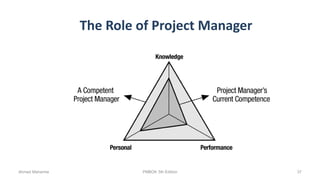
  • 45.
    Project Lifecycle Vs.Product Lifecycle Product lifecycle outlives project lifecycle Project lifecycle is part of product lifecycle Ahmad Maharma PMBOK 5th Edition 45
  • 46.
    Cost & StaffingLevel Ahmad Maharma PMBOK 5th Edition 46
  • 47.
    The project throughits lifecycle Ahmad Maharma PMBOK 5th Edition 47
  • 48.
    Project Phases • Divisionswithin a project where extra control is needed to effectively manage the completion of a major deliverable. • A deliverable is a measurable, verifiable work product. • Each phase ends with a deliverable • Number and structure of phases is determined by the organization’s control requirements • Some organizations have established policies that standardize all projects. Ahmad Maharma PMBOK 5th Edition 48
  • 49.
    Project Lifecycle- Sequential Phases AhmadMaharma PMBOK 5th Edition 49
  • 50.
    Project Lifecycle- Overlapping Phases AhmadMaharma PMBOK 5th Edition 50
  • 51.
    Project Lifecycle- The SpiralModel Ahmad Maharma PMBOK 5th Edition 51
  • 52.
    TTM deliverables • MarketingDeliverables • Customer Journey Deliverables • Financial & regulatory Deliverables • ITN Deliverables • Business processes Deliverables • Sourcing Deliverables • Project Deliverables Ahmad Maharma PMBOK 5th Edition 52
  • 53.
    Stakeholders • Persons ororganizations who are actively involved in the project, or whose interests maybe positively or negatively affected by the performance or completion of the project  Project Stakeholders:  Sponsors  Customers/ Users  Vendors/ Suppliers  Project Manager  Project Management Team  Project Team  PMOAhmad Maharma PMBOK 5th Edition 53
  • 54.
  • 55.
    5 Steps toManaging Stakeholders • Identify ALL of them • Determine ALL their requirements • Determine their expectations • Communicate with them • Manage their influence Ahmad Maharma PMBOK 5th Edition 55
  • 56.
    Organizational influence Projects don’toperate in vacuum, they are influenced by organizational: • Culture • Style • Structure Organization’s degree of project management maturity and systems can influence the project Ahmad Maharma PMBOK 5th Edition 56
  • 57.
    Functional Organization  Alsoknown as “Silo” organization  Functional managers control resources  Communication happens “vertically”  Good for operation-oriented organizations, such as banks, government Ahmad Maharma PMBOK 5th Edition 57
  • 58.
  • 59.
    Advantages & Disadvantages Advantages •Clear Authority • Career Development • Controlled Disadvantages • Poor Coordination • No Project Accountability • High Politics Ahmad Maharma PMBOK 5th Edition 59
  • 60.
    Projectized Organization  Alsoknown as “No home”  Systematic approach to project management  Well defined project management methodology & lifecycle  Does not support learning & career development Ahmad Maharma PMBOK 5th Edition 60
  • 61.
  • 62.
    Advantages & Disadvantages Advantages •Effective Communication • Project Driven Coordination • More focused Disadvantages • High Risk • Poor Resource Utilization • “No Home” Ahmad Maharma PMBOK 5th Edition 62
  • 63.
    Matrix organization  Alsoknown as “Two Bosses”  Has three types:  Weak matrix  Balanced matrix  Strong matrix Ahmad Maharma PMBOK 5th Edition 63
  • 64.
    Weak Matrix Ahmad MaharmaPMBOK 5th Edition 64
  • 65.
    Balanced Matrix Ahmad MaharmaPMBOK 5th Edition 65
  • 66.
    Strong Matrix Ahmad MaharmaPMBOK 5th Edition 66
  • 67.
    Advantages & Disadvantages Advantages •Project Manager Assigned. • Communication and Coordination • Visible Project Objectives Disadvantages • Two Bosses • Competition of Priorities • Hard to Control • Tough Resource Allocation • Complex Communication Ahmad Maharma PMBOK 5th Edition 67
  • 68.
    Organizational Influences onProject Management PMBOK 5th Edition 68Ahmad Maharma
  • 69.
    Project Management Process Groups Monitoring& Controlling Processes Closing Processes Initiation Processes Planning Processes Execution Processes Ahmad Maharma PMBOK 5th Edition 69
  • 70.
    Project Management Process Groups A version of Deming’s Cycle  Plan – Do – Check- Act (PDCA) Ahmad Maharma PMBOK 5th Edition 70
  • 71.
    Interaction Between Process Groups Levelof Process Interaction Initiation Process Group Planning Process Group Execution Process Group Monitoring & Control Process Group Closing Process Group Ahmad Maharma PMBOK 5th Edition 71
  • 72.
    72 Project Phases • Allprojects are divided into phases • All phases together are known as the Project Life Cycle • Each phase is marked by completion of Deliverables Ahmad Maharma PMBOK 5th Edition
  • 73.
  • 74.
  • 75.
  • 76.
    Project Management Framework •The PMBOK’s 10 Knowledge areas Time Management Cost Management Scope Management Quality Management HR Management Communication Management Procurement Management Integration Management Stakeholder Management Risk Management 76Ahmad Maharma PMBOK 5th Edition
  • 77.
    PM Knowledge Areas& Process Groups 47 processes PM Process Groups Knowledge Area Processes Initiating Process Group Planning Process Group Executing Process Group Monitoring & Controlling Process Group Closing Process Group Project Management Integration Develop Project Charter Develop Project Management Plan Direct and Manage Project Execution Monitor and Control Project Work Integrated Change Control Close Project Project Scope Management Plan Scope Management Collect requirements Define Scope Create WBS Validate Scope Control Scope Project Time Management Plan schedule Management Define Activity Sequence Activity Estimating Resource Estimating Duration Develop Schedule Schedule Control Project Cost Management Plan Cost Management Estimating Cost Budgeting Cost Control Cost Project Quality Management Quality Planning Perform Quality Assurance Perform Quality Control Project HR Management Plan HR Management Acquire Project Team Develop Project Team Manage Project Team Project Communications Management Plan Communications Distribute Information Performance Reporting Project Risk Management Plan Risk Management Risk Identification Qualitative / Quantitative Risk Analysis Risk Response Planning Risk Monitoring and Control Project Procurement Management Plan procurement Conduct procurement Administer Contract Close procurement Project Stakeholder Management Identify Stakeholders Plan stakeholder Management Manage stakeholders expectations Control stakeholder 77Ahmad Maharma PMBOK 5th Edition
  • 78.
    Project Scope Management Knowledge Area Process InitiatingPlanning Executing Monitoring & Control Closing Scope Plan scope Management Collect Requirements Define Scope Create WBS Validate Scope Control Scope Enter phase/ Start project Exit phase/ End project Initiating Processes Closing Processes Planning Processes Executing Processes Monitoring & Controlling Processes 78Ahmad Maharma PMBOK 5th Edition
  • 79.
    Project Time Management Knowledge Area Process InitiatingPlanning Executing Monitoring & Control Closing Time Plan schedule Management Define Activity Sequence Activity Estimating Resource Estimating Duration Develop Schedule Control Schedule Enter phase/ Start project Exit phase/ End project Initiating Processes Closing Processes Planning Processes Executing Processes Monitoring & Controlling Processes 79Ahmad Maharma PMBOK 5th Edition
  • 80.
    Project Cost Management Knowledge Area Process InitiatingPlanning Executing Monitoring & Control Closing Cost Plan Cost management Estimating Cost Determine Budget Control Costs Enter phase/ Start project Exit phase/ End project Initiating Processes Closing Processes Planning Processes Executing Processes Monitoring & Controlling Processes 80Ahmad Maharma PMBOK 5th Edition
  • 81.
    Project Quality Management Knowledge Area Process InitiatingPlanning Executing Monitoring & Contol Closing Cost Plan Quality Management Perform Quality Assurance control Quality Enter phase/ Start project Exit phase/ End project Initiating Processes Closing Processes Planning Processes Executing Processes Monitoring & Controlling Processes Ahmad Maharma PMBOK 5th Edition 81
  • 82.
    Project Human ResourceManagement Knowledge Area Process Initiating Planning Executing Monitoring & Control Closing Human Resource Plan Human Resource Management Acquire Project Team Develop Project Team Manage Project Team Enter phase/ Start project Exit phase/ End project Initiating Processes Closing Processes Planning Processes Executing Processes Monitoring & Controlling Processes 82Ahmad Maharma PMBOK 5th Edition
  • 83.
    Project Communication Management KnowledgeArea Process Initiating Planning Executing Monitoring & Control Closing Communication Plan Communication Management Manage Communications Control Communications Enter phase/ Start project Exit phase/ End project Initiating Processes Closing Processes Planning Processes Executing Processes Monitoring & Controlling Processes 83Ahmad Maharma PMBOK 5th Edition
  • 84.
    Project Risk Management Knowledge Area Process InitiatingPlanning Executing Monitoring & Control Closing Risk Plan Risk Management Identify Risk Perform Qualitative Risk Analysis Perform Quantitative Risk Analysis Plan Risk Response Control Risks Enter phase/ Start project Exit phase/ End project Initiating Processes Closing Processes Planning Processes Executing Processes Monitoring & Controlling Processes 84Ahmad Maharma PMBOK 5th Edition
  • 85.
    Project Procurement Management KnowledgeArea Process Initiating Planning Executing Monitoring & Control Closing Procurement Plan Procurement Management Conduct Procurement Control Procurement Close Procurement Enter phase/ Start project Exit phase/ End project Initiating Processes Closing Processes Planning Processes Executing Processes Monitoring & Controlling Processes 85Ahmad Maharma PMBOK 5th Edition
  • 86.
    Project Integration Management Knowledge Area Process InitiatingPlanning Executing Monitoring & Control Closing Scope • Develop Project Charter • Develop Project Management Plan • Direct and Manage Project Execution • Monitor and Control Project Work • Perform Integrated Change Control • Close Project Enter phase/ Start project Exit phase/ End project Initiating Processes Closing Processes Planning Processes Executing Processes Monitoring & Controlling Processes 86Ahmad Maharma PMBOK 5th Edition
  • 87.
    Project Stakeholder Management Knowledge Area Process InitiatingPlanning Executing Monitoring & Control Closing Scope Identify Stakeholders Plan stakeholder Management Manage stakeholders expectations Control stakeholder Enter phase/ Start project Exit phase/ End project Initiating Processes Closing Processes Planning Processes Executing Processes Monitoring & Controlling Processes 87Ahmad Maharma PMBOK 5th Edition
  • 88.
    The Project LifeCycle Ahmad Maharma PMBOK 5th Edition 88
  • 89.
    How do wedefine success?  On time  Within budget  Scope integrity  Achieving quality Scope Ahmad Maharma PMBOK 5th Edition 89
  • 90.
    Chaos Report  31.1%of projects will be cancelled before they ever get completed  52.7% of projects will cost 189% of their original estimates  Only 16.2% of projects were completed successfully Ahmad Maharma PMBOK 5th Edition 90
  • 91.
    Why Projects Fail? A subject for discussion Ahmad Maharma PMBOK 5th Edition 91
  • 92.
    The Opera HouseProject- Sydney  Original cost estimate (in 1957) was US$ 7 million.  The original completion date was 26 January 1963.  Finally, the Opera House was formally completed in 1973, having cost $102 million. Ahmad Maharma PMBOK 5th Edition 92
  • 93.
    The Three MainOnes  Among the following factors, which is the most important contributor to project failure??!! Lack of Executive Management Support Unclear Objectives No User Involvement Ahmad Maharma PMBOK 5th Edition 93
  • 94.
    Reason 1  Lackof User Involvement – Correctly identify proper user – Develop and Maintain a quality relationship with the client – Create and maintain a platform for communication – Demonstrate results – Educate the client – Consider their feedback – Identify and recruit an evangelist – Conduct primary research – Show respect – Focus on real user needs Ahmad Maharma PMBOK 5th Edition 94
  • 95.
    Reason 2  NoExecutive Management Support – Have a simple vision – Get clear commitment – Make fast decisions – Have a decision pipeline – Focus of education – Use measurements – Understand how and why you need to negotiate – Have a well thought plan – Have a “kill switch” – CELEBRATE Ahmad Maharma PMBOK 5th Edition 95
  • 96.
    Reason 3  Absenceof clear business objectives – Make sure everyone understands the project's objectives – Elevator pitch – Consider the big picture – Promote speed and clarity – Have a yardstick – Use RoI – Collaborate with team members – Use peer review – Avoid having “too many cooks” – Do your homework Ahmad Maharma PMBOK 5th Edition 96
  • 97.
    Enterprise Environmental Factors The Internal and External environmental factors surrounding and/or influencing the project negatively or positively.  Are Inputs to most of the Project Management Processes.  Can be categorized into Internal and External Ahmad Maharma PMBOK 5th Edition 97
  • 98.
    Enterprise Environmental Factors Culture & structure  Regulations & Standards  Infrastructure  Existing human resources  Personnel administration  Political climate  Commercial databases  Information systems  Stakeholders risk tolerance  Marketplace Conditions Ahmad Maharma PMBOK 5th Edition 98
  • 99.
    Organizational Process Assets Include all process related assets in addition to the organization’s knowledge bases  Input to most of the project management processes  Outputs of many processes may include updating or adding to these process assets  Can be categorized into:  Processes and procedures  Corporate knowledge base Ahmad Maharma PMBOK 5th Edition 99
  • 100.
    Processes and Procedures Standard Processes.  Templates.  Communication Requirements.  Financial Controls Procedures.  Issue and Defect Management Procedures.  Change Control Procedure.  Risk Control Procedures.  Approval Procedures. Ahmad Maharma PMBOK 5th Edition 100
  • 101.
    Corporate Knowledge  ProcessMeasurement Database.  Project Files.  Historical Information and Lessons Learned.  Issue and Defect Management Database.  Configuration Management Knowledge Base.  Financial Database. Ahmad Maharma PMBOK 5th Edition 101
  • 102.
    PMBOK Reading  Chapters2 & 3 Ahmad Maharma PMBOK 5th Edition 102
  • 103.
  • 104.
    Why projects start? A market demand,  An Organizational need,  A customer request,  A technological advance,  A legal requirement,  A social demand,  An Ecological impact. Ahmad Maharma PMBOK 5th Edition 104
  • 105.
    Project Management Professional PMP® Phase #1: INITIATION Chapter 4: Integration / 4.1 Develop Project Charter
  • 106.
  • 107.
    Develop Project Charter The process of developing a document that formally authorizes a project or a phase and documenting initial requirements that satisfy the stakeholders needs and expectations. Ahmad Maharma PMBOK 5th Edition 107
  • 108.
    What is aProject Charter?  A document that formally authorizes a project or a phase and documents initial requirements that satisfy the stakeholders needs and expectations  Projects are chartered and authorized external to the project Ahmad Maharma PMBOK 5th Edition 108
  • 109.
    Why a charteris needed?  Defines the reason of the project  Assigns the project manager and his/ her authority level  Linking the project to the strategy and ongoing work of the organization  Helps in starting the planning for the project Ahmad Maharma PMBOK 5th Edition 109
  • 110.
    Facts about theproject charter  A must for all projects and/ or phases  Communicate the project purpose or justification, high level objectives, project and product requirements and initial risks.  Should be clear enough, yet broad to a level that the charter doesn’t change over the project’s life. Ahmad Maharma PMBOK 5th Edition 110
  • 111.
    Develop Project Charter ProjectStatement of Work (SOW) Business Case Agreements Enterprise Environmental Factors Organizational Processes Assets Expert Judgment Facilitation Techniques  Project Charter Ahmad Maharma PMBOK 5th Edition 111
  • 112.
    Project Statement ofWork  A narrative description of products or services to be supplied by the project.  References:  Business need.  Product scope description.  Strategic plan.  For external projects, provided by customer as part of a bid document.  For internal projects, provided by sponsor or initiator. Ahmad Maharma PMBOK 5th Edition 112
  • 113.
    Business Case  Adocument that provides necessary information from a business perspective on whether or not the project is worth the investment Ahmad Maharma PMBOK 5th Edition 113
  • 114.
    Agreements  MoUs  SLAs Letters of Agreement  Letters of Intent Ahmad Maharma PMBOK 5th Edition 114
  • 115.
    Expert Judgment  Stakeholders. Consultants.  Industrial groups.  Professional and technical associations.  Other units within organization.  Subject matter experts (SMEs)  Project management office (PMO) Ahmad Maharma PMBOK 5th Edition 115
  • 116.
    Facilitation Techniques  Brainstorming Conflict Resolution  Problem Solving  Meetings Ahmad Maharma PMBOK 5th Edition 116
  • 117.
    Contents of projectCharter Purpose or justification Project Description Project and Product Requirements Acceptance Criteria Initial Risks Summary Milestones Estimated Budget Project Manager Authority Level Approval Requirements Name & authority of the person(s) authorizing the project charterAhmad Maharma PMBOK 5th Edition 117
  • 118.
    Project Management Professional PMP® Phase #1:PROJECT INITIATION Chapter 13: Stakeholders / 13.1 Identify Stakeholders
  • 119.
  • 120.
    Identify Stakeholders Project Charter Procurement Documents Enterprise Environmental Factors Organizational ProcessAssets Stakeholder Analysis Expert Judgment Meetings Stakeholder Register Ahmad Maharma PMBOK 5th Edition 120
  • 121.
    Stakeholder Analysis  Theprocess of systematically gathering and analyzing quantitative and qualitative information to determine whose interests should be taken into account throughout the projects. Ahmad Maharma PMBOK 5th Edition 121
  • 122.
    3 Steps toManaging Stakeholders 1. Identify Your Stakeholders 2. Prioritize Your Stakeholders 3. Manage Your Stakeholders Ahmad Maharma PMBOK 5th Edition 122
  • 123.
    Step1- Identify Stakeholders Identifying all stakeholders impacted by the project and documenting relevant Information regarding their interests, involvement, and impact on the project success.  It is essential to identify all stakeholders to increase the likelihood of project success.  Should be done as early as possible. Ahmad Maharma PMBOK 5th Edition 123
  • 124.
    Identify Stakeholders Purpose Enables the project manager to focus on the relationships necessary to ensure the success of the project. Ahmad Maharma PMBOK 5th Edition 124
  • 125.
    Stakeholder Register  TheStakeholder Register is used to identify those people and organizations impacted by the project and document relevant information about each stakeholder.  Includes all details related to the identified stakeholders.  Identification information: Name, organizational position, location, role in project, contact information.  Assessment information: Major requirements, main expectations, potential influence, phase.  Stakeholder classification: Internal/ external, supporter/ neutral/ resistor, etc. Ahmad Maharma PMBOK 5th Edition 125
  • 126.
    Step2- Prioritize Your Stakeholders Identify the potential impact or support each stakeholder could generate  Classify them according to: 1. Power/Interest Grid 2. Power/ Influence Grid 3. Influence/ Impact Grid 4. Salience Model Ahmad Maharma PMBOK 5th Edition 126
  • 127.
  • 128.
    Step3: Assess YourStakeholders  Anticipate how key stakeholders react in different situations, in order to plan how to influence them to enhance their support and mitigate potential negative impact. Ahmad Maharma PMBOK 5th Edition 128
  • 129.
    PMBOK Reading  Chapter4 - Section 4.1  Chapter 13 - Section13.1 Ahmad Maharma PMBOK 5th Edition 129
  • 130.
  • 131.
    Project Management Professional PMP® Phase #2:PROJECT PLANNING Chapter 4: Scope / 4.2 Develop Project Management Plan
  • 132.
    Develop Project Management Plan Documenting the actions necessary to define, prepare, integrate, & coordinate all subsidiary plans into a project management plan. Ahmad Maharma PMBOK 5th Edition 132
  • 133.
    Develop Project Management Plan ProjectCharter Outputs from Planning Processes Enterprise Environmental Factors Organizational Process Assets  Expert Judgment  Project Management Plan Ahmad Maharma PMBOK 5th Edition 133
  • 134.
    Project Management Plan Integrates and consolidates all of the subsidiary management plans and baselines from the planning processes.  Includes but not limited to:  Project management processes selected by the project management team.  Level of implementation of each selected process.  Descriptions of tools & techniques  How the selected processes will be selected to manage the specific project  How work will be executed to accomplish objectives  A change management plan Ahmad Maharma PMBOK 5th Edition 134
  • 135.
    Project Management Plan contents Subsidiary Plans  Project Scope Management Plan  Requirements Management Plan  Schedule Management Plan  Cost Management Plan  Quality Management Plan  Process Improvement Plan  Staffing Management Plan  Communication management Plan  Risk Management Plan  Procurement Management Plan  Baselines  Schedule  Cost performance  Scope Ahmad Maharma PMBOK 5th Edition 135
  • 136.
    Project Management PlanVs. Project Documents Project Management Plan Project Documents Change Management Plan Activity Attributes Project Staff Assignment CommunicationsManagement Plan Activity Cost Estimates Project Statement of Work Configuration Management Plan Activity Duration Estimates Quality Checklists Cost Baseline Activity List Quality Control Measurements Cost Management Plan Activity Resource Requirements Quality Metrics Human Resource Management Plan Agreements Requirements Documentation Process Improvement Plan Basis of Estimates Requirements TraceabilityMatrix Procurement Management Plan Change Log Resource Breakdown Structure Scope Baseline Change Requests Resource Calendars Quality Management Plan Forecasts Risk Register Requirements Management Plan Issue Log Schedule Data Risk Management Plan Milestone List Seller Proposals Schedule Baseline Procurement Documents Source Selection Criteria Schedule Management Plan Procurement Statement of Work Stakeholder Register Scope Management Plan Project Calendars Team Performance Assessment Stakeholder Management Plan Project Charter Work Performance ReportsAhmad Maharma PMBOK 5th Edition 136
  • 137.
    PMBOK Reading  Chapter4 - Section 4.2 Ahmad Maharma PMBOK 5th Edition 137
  • 138.
    Project Management Professional PMP® Phase #2:PROJECT PLANNING Chapter 5: Scope / 5.1 Plan Scope Management
  • 139.
  • 140.
    Project Scope Vs.Product Scope  Project Scope: The work that needs to be accomplished to deliver a product, service, or result with the specified features and functions  Product Scope: The features and functions that characterize a product, service, or result Ahmad Maharma PMBOK 5th Edition 140
  • 141.
    Plan Scope Management PlanScope Management Collect Requirements Define Scope Create WBS Ahmad Maharma PMBOK 5th Edition 141
  • 142.
    Plan Scope management The process of creating a scope management plan that documents how the project scope will be defined, validated and controlled.  It provides guidance on how scope will be managed throughout the project. Ahmad Maharma PMBOK 5th Edition 142
  • 143.
    Plan Scope Management Project ManagementPlan Project Charter Enterprise environmental factors Organizational Process Assets Expert Judgment Meetings Scope Management Plan Requirements Management Plan Ahmad Maharma PMBOK 5th Edition 143
  • 144.
    Project Scope Management Plan Part of Develop Project Management Plan  The outcome of a planning effort that precedes performing the processes of project scope management  Documents how the scope will be defined, verified, controlled, and how the work breakdown structure (WBS) will be created and defined.  Can be formal or informal depending on needs of the project. Ahmad Maharma PMBOK 5th Edition 144
  • 145.
    It Includes:  Processesfor: – Detailing the project scope statement. – WBS creation, maintenance, and approval. – Formal verification and acceptance of the completed project deliverables. – Control how requests to change the detailed project scope statement will be processed. Ahmad Maharma PMBOK 5th Edition 145
  • 146.
    Requirements Management Plan (RQM) A Plan that documents how requirements will be analyzed, document and managed (tracked, reported, prioritized…) throughout the project life cycle. Ahmad Maharma PMBOK 5th Edition 146
  • 147.
    Requirements Management Plan (RQM)Components  How Requirement activities will be planned, tracked and reported  Configuration Management Activities  Requirements Prioritization Process  Product Metrics  Traceability Structure Ahmad Maharma PMBOK 5th Edition 147
  • 148.
    Project Management Professional PMP® Phase #2:PROJECT PLANNING Chapter 5: Scope / 5.2 Collect Requirements
  • 149.
  • 150.
    Collect Requirements  Theprocess of defining and documenting stakeholders’ needs to meet project objectives.  Requirements include the quantified and documented needs and expectations of the sponsor, customer, and other stakeholders.  WBS, cost, schedule and quality planning are all built upon these requirements.  Need to be elicited, analyzed, and recorded in enough detail to be measured once project execution begins Ahmad Maharma PMBOK 5th Edition 150
  • 151.
    Collect Requirements  ProjectRequirements include business requirements, project management requirements, delivery requirements, etc.  Product Requirements include information on technical requirements, security requirements, performance requirements, etc. Ahmad Maharma PMBOK 5th Edition 151
  • 152.
    Collect Requirements Scope Management Plan Requirements ManagementPlan Stakeholder Management Plan Project Charter Stakeholder Register  Interviews  Focus Groups  Facilitated Workshops  Group Creativity Techniques  Group Decision Making Techniques  Questionnaires and Surveys  Observations  Prototypes  Benchmarking  Context Diagram  Document Analysis Requirements Documentation Requirements Traceability Matrix Ahmad Maharma PMBOK 5th Edition 152
  • 153.
    Interviews  Talking tostakeholders directly.  Asking questions and recording answers  “One-on-one”, or multiple interviewers and/ or interviewees.  Interviewing:  Experienced participants  Stakeholders  Subject matter experts Ahmad Maharma PMBOK 5th Edition 153
  • 154.
    Focus Groups  Bringtogether prequalified stakeholders and subject matter experts.  Trained moderator guides the group through an interactive discussion.  More conservational than one-on-one Ahmad Maharma PMBOK 5th Edition 154
  • 155.
    Facilitated Workshops  Focusedsessions that bring key cross-functional stakeholders together to define product requirements  Helps in building trust, foster relationships, and improve communication.  Reveal and resolve issues more quickly than individual sessions.  Examples: Joint Application Development (JAD) & Quality Function Deployment (QFD) Ahmad Maharma PMBOK 5th Edition 155
  • 156.
    Group Creativity Techniques •Brainstorming. A technique used to generate and collect multiple ideas related to project and product requirements. • Nominal group technique. This technique enhances brainstorming with a voting process used to rank the most useful ideas for further brainstorming or for prioritization. • The Delphi Technique. A selected group of experts answers questionnaires and provides feedback regarding the responses from each round of requirements gathering. The responses are only available to the facilitator to maintain anonymity • ldea/mind mapping. Ideas created through individual brainstorming are consolidated into a single map to reflect commonality and differences in understanding, and generate new ideas. • Affinity diagram. This technique allows large numbers of ideas to be sorted into groups for review and analysis. Ahmad Maharma PMBOK 5th Edition 156
  • 157.
    Mind Map Example AhmadMaharma PMBOK 5th Edition 157
  • 158.
    Group decision Making Techniques Groupdecision making is an assessment process of multiple alternatives with an expected outcome in the form of future actions resolution. These techniques can be used to generate, classify, and prioritize product requirements. There are multiple methods of reaching a group decision, for example: • Unanimity. Everyone agrees on a single course of action. • Majority. Support from more than 50% of the members of the group. • Plurality. The largest block in a group decides even if a majority is not achieved. • Dictatorship. one individual makes the decision for the group. Almost any of the decision methods described previously can be applied to the group techniques used in the requirements gathering process. Ahmad Maharma PMBOK 5th Edition 158
  • 159.
    Questionnaires & Surveys Written sets of questions.  Aim to quickly accumulate information from a broad group of respondents.  Most appropriate with broad audience, when quick turnaround is needed, and where statistical analysis is appropriate. Ahmad Maharma PMBOK 5th Edition 159
  • 160.
    Observations  Viewing userperformance  Also called “Job shadowing”  Helpful for detailed processes when people that use the product have difficulty or reluctant to articulate their requirements  Can uncover hidden requirements Ahmad Maharma PMBOK 5th Edition 160
  • 161.
    Prototypes  Provide aworking model of the expected product before actually building it.  Support the concept of progressive elaboration through use of iterative cycles of mock-up creation, user experimentation, feedback generation and prototype revision. Ahmad Maharma PMBOK 5th Edition 161
  • 162.
    Benchmarking  Involves comparingactual or planned practices, such as processes and operations, to those of comparable organizations to identify best practices, generate ideas for improvement, and provide a basis for measuring performance.  Compared organizations can be external or internal. Ahmad Maharma PMBOK 5th Edition 162
  • 163.
    Context Diagrams  Visuallydepict the product scope by showing a business system (process, equipment, computer system…etc.), and how people and other systems (actors) interact with it.  Context diagrams show inputs to the business system, the actor(s) providing the input, the outputs of the business system, and the actor(s) receiving the output. Ahmad Maharma PMBOK 5th Edition 163
  • 164.
    Context Diagrams Ahmad MaharmaPMBOK 5th Edition 164
  • 165.
    Requirements Documentation  Thedocument including the stakeholders’ requirements to meet the business need for the project.  Usually starts at a high level and then gets elaborated within the life cycle of the project and according to the RQM Ahmad Maharma PMBOK 5th Edition 165
  • 166.
    Requirements Documentation Elements  Businessneed or opportunity  Functional requirements and non functional requirements  Quality requirements  Acceptance criteria  Business rules  Impacts to other organizational areas, and other entities inside or outside the performing organization  Support and training requirements  Requirements assumptions and constraints Ahmad Maharma PMBOK 5th Edition 166
  • 167.
    Requirements Traceability Matrix A tool that links project objectives to requirements to deliverables to product features.  The structure and level of details of the traceability matrix to be used shall be documented in the RQM as different projects can use different structures of traceability.  This tool can be as simple as a table or as complex as a software program. Ahmad Maharma PMBOK 5th Edition 167
  • 168.
    Requirements Traceability Matrix Contents Business needs, opportunities, goals, and objectives  Project objectives  Project scope, WBS deliverables  Product design  Product development  Test strategy and test scenarios  High level requirements to more detailed requirements Ahmad Maharma PMBOK 5th Edition 168
  • 169.
    Example of Requirements TraceabilityMatrix Ahmad Maharma PMBOK 5th Edition 169
  • 170.
    Project Management Professional PMP® Phase #2:PROJECT PLANNING Chapter 5: Scope / 5.3 Define Scope
  • 171.
  • 172.
    Define Scope  Theprocess of developing a detailed description of the project and the product  Critical to project success.  Builds upon the major deliverables, assumptions, and constraints documented in the project initiation. Ahmad Maharma PMBOK 5th Edition 172
  • 173.
    Define Scope Scope Management Plan ProjectCharter Requirements Documentation Organizational Process Assets Expert Judgment Product Analysis Alternatives Identification Facilitated Workshops Project Scope Statement Project Document Updates Ahmad Maharma PMBOK 5th Edition 173
  • 174.
    Product Analysis  Translatinghigh-level product description into tangible deliverables  Includes techniques such as:  Product breakdown  System analysis  Requirements analysis  System engineering  Value engineering  Value analysis Ahmad Maharma PMBOK 5th Edition 174
  • 175.
    Alternatives Identification  Atechnique to generate different approaches to execute and perform the work of the project.  Includes techniques such as:  Brainstorming  Lateral thinking  Pairwise comparison Ahmad Maharma PMBOK 5th Edition 175
  • 176.
    Project Scope Statement The project scope statement describes in details the project deliverables, and the work required to create those deliverables.  Common understanding among stakeholders,  Enables more detailed planning,  Guides the project team’s work during execution,  Provides the baseline for evaluating changes. Ahmad Maharma PMBOK 5th Edition 176
  • 177.
    Project Scope Statement Contents Product scope description  Product acceptance criteria  Project deliverables  Project exclusions  Project constraints  Project assumptions Ahmad Maharma PMBOK 5th Edition 177
  • 178.
    Constraints  Applicable restrictionsthat will affect the performance of the project.  Factors that affect a scheduled activity or when an activity can be scheduled. Ahmad Maharma PMBOK 5th Edition 178
  • 179.
    Assumptions  Are factorsthat, for planning purposes, are considered to be true, real, or certain.  Affect all aspects of project planning.  Part of the project’s progressive elaboration.  Generally involve a degree of RISK.  Must be identified, documented and validated. Ahmad Maharma PMBOK 5th Edition 179
  • 180.
    Project Management Professional PMP® Phase #2:PROJECT PLANNING Chapter 5: Scope / 5.4 Create WBS
  • 181.
  • 182.
    Create WBS  Theprocess of subdividing project deliverables and project work into smaller, more manageable components.  WBS is a deliverable-oriented hierarchical decomposition of the work to be executed by the project team to accomplish the project objectives, and create the required deliverables.  Each descending level represents an increasingly detailed definition of the project work.  Organizes and defines the total scope of the project. Ahmad Maharma PMBOK 5th Edition 182
  • 183.
    Ahmad Maharma PMBOK5th Edition 183
  • 184.
    Ahmad Maharma PMBOK5th Edition 184
  • 185.
    WBS Types  Phases-Deliverables  Deliverables-Phases  Combination of both Ahmad Maharma PMBOK 5th Edition 185
  • 186.
    Example: WBS (Phases– Deliverables) Ahmad Maharma PMBOK 5th Edition 186
  • 187.
    Example: WBS (Deliverables– Phases) AhmadMaharma PMBOK 5th Edition 187
  • 188.
    Create WBS Scope Management Plan ProjectScope Statement Requirements Documentation Enterprise Environmental Factors Organizational Process Assets Decomposition Expert Judgment Scope Baseline  Project Document Updates Ahmad Maharma PMBOK 5th Edition 188
  • 189.
    Decomposition  Subdivision ofproject deliverables into smaller, more manageable components until the work and deliverables are defined to the work package level.  The level of composition varies per deliverable/ phase with the size and complexity of project. Ahmad Maharma PMBOK 5th Edition 189
  • 190.
    Work Package  The“Work Package” level is the lowest level in the WBS.  Work Package is the point at which the cost and activity duration can be reliable, estimated and packaged. Ahmad Maharma PMBOK 5th Edition 190
  • 191.
    Decomposition Involves  Identifyingdeliverables and related work.  Structuring and organizing the WBS.  Decomposing upper levels into lower level detailed components.  Developing and assigning identification codes.  Verifying that the degree of decomposition is necessary and sufficient. Ahmad Maharma PMBOK 5th Edition 191
  • 192.
    WBS Dictionary Contents Code of account identifier  Statement of work  Responsible organization  Schedule milestones  Associated activities  Resources required  Cost estimates  Quality requirements  Acceptance criteria  Technical references  Contract information Ahmad Maharma PMBOK 5th Edition 192
  • 193.
    Scope Baseline  Scopestatement  WBS  WBS dictionary Ahmad Maharma PMBOK 5th Edition 193
  • 194.
    WBS Dictionary  Adocument generated by the “Create WBS” process that supports the WBS.  Provides more detailed description of the components in the WBS., including work packages and control accounts. Ahmad Maharma PMBOK 5th Edition 194
  • 195.
    WBS is not Organizational Breakdown Structure (OBS)  Bill Of Materials (BOM)  Risk Breakdown Structure (RBS)  Resource Breakdown Structure (RBS) Ahmad Maharma PMBOK 5th Edition 195
  • 196.
    PMBOK Reading  Chapter5 - Sections 5.1-5.4 Ahmad Maharma PMBOK 5th Edition 196
  • 197.
    Project Management Professional PMP® Phase #2:PROJECT PLANNING Chapter 6: Time / 6.1 Plan Schedule Management
  • 198.
    PM Knowledge Areas& Process Groups 47 processes PM Process Groups Knowledge Area Processes Initiating Process Group Planning Process Group Executing Process Group Monitoring & Controlling Process Group Closing Process Group Project Management Integration Develop Project Charter Develop Project Management Plan Direct and Manage Project Execution Monitor and Control Project Work Integrated Change Control Close Project Project Scope Management Plan Scope Management Collect requirements Define Scope Create WBS Validate Scope Control Scope Project Time Management Plan schedule Management Define Activity Sequence Activity Estimating Resource Estimating Duration Develop Schedule Control Schedule Project Cost Management Plan Cost Management Estimating Cost Budgeting Cost Control Cost Project Quality Management Quality Planning Perform Quality Assurance Perform Quality Control Project HR Management Plan HR Management Acquire Project Team Develop Project Team Manage Project Team Project Communications Management Plan Communications Distribute Information Performance Reporting Project Risk Management Plan Risk Management Risk Identification Qualitative / Quantitative Risk Analysis Risk Response Planning Risk Monitoring and Control Project Procurement Management Plan procurement Conduct procurement Administer Contract Close procurement Project Stakeholder Management Identify Stakeholders Plan stakeholder Management Manage stakeholders expectations Control stakeholder 198Ahmad Maharma PMBOK 5th Edition
  • 199.
    Project Time Management Knowledge Area Process InitiatingPlanning Executing Monitoring & Control Closing Time Plan schedule Management Define Activity Sequence Activity Estimating Resource Estimating Duration Develop Schedule Control Schedule Enter phase/ Start project Exit phase/ End project Initiating Processes Closing Processes Planning Processes Executing Processes Monitoring & Controlling Processes 199Ahmad Maharma PMBOK 5th Edition
  • 200.
  • 201.
  • 202.
    Plan Schedule Management The process of establishing policies, procedures, and documentation for planning, developing, managing, executing, and controlling the project schedule.  The key benefit of the process is that it provides guidance and direction on how the project schedule will be managed throughout the project. Ahmad Maharma PMBOK 5th Edition 202
  • 203.
    Plan Schedule Management Project Management Plan Project Charter Enterprise Environment alfactors Org. Process Assets Expert Judgment Analytical Techniques Meetings Schedule Management Plan Ahmad Maharma PMBOK 5th Edition 203
  • 204.
    Analytical Techniques  SchedulingMethodology  Scheduling Tools & Techniques  Estimating Approaches  Formats  Project Management Software Ahmad Maharma PMBOK 5th Edition 204
  • 205.
    Schedule Management Plans A component of the project management plan.  Establishes the criteria and activities for developing, monitoring, and controlling the schedule.  Can be formal or informal  Can be highly detailed or broadly defined based on the needs of the project Ahmad Maharma PMBOK 5th Edition 205
  • 206.
    Schedule Management Plans Can include the following:  Project schedule model development  Level of accuracy  Units of measure  Organizational procedures links  Project schedule management maintenance  Control schedule  Rules of performance measurement  Reporting formats  Process description Ahmad Maharma PMBOK 5th Edition 206
  • 207.
    Project Management Professional PMP® Phase #2:PROJECT PLANNING Chapter 6: Time / 6.2 Define Activities
  • 208.
  • 209.
    Define Activities  Theprocess of identifying the specific actions to be performed to produce the project deliverables.  Decomposed from the “work packages” at the WBS.  Activities are the smaller components that represent the work necessary to complete the work package.  Activities provide basis for estimating, scheduling, executing, and monitoring and controlling the project work. Ahmad Maharma PMBOK 5th Edition 209
  • 210.
    Define Activities Schedule Managemen t Plan Scope Baseline Enterprise Environmen talfactors Org. Process Assets  Decomposition Rolling Wave Planning Expert Judgment Activity List Activity Attributes Milestone List Ahmad Maharma PMBOK 5th Edition 210
  • 211.
    Rolling Wave Planning Progressive detailing of the project management plan Ahmad Maharma PMBOK 5th Edition 211
  • 212.
    Activity List  Acomprehensive list including all schedule activities required for the project.  Includes:  Activity identifier  Description of each activity Ahmad Maharma PMBOK 5th Edition 212
  • 213.
    Project Management Professional PMP® Phase #2:PROJECT PLANNING Chapter 6: Time / 6.3 Sequence Activities
  • 214.
  • 215.
    Sequencing Activities  Schedule Management Plan Activity List  Activity Attributes  Milestone List  Enterprise Environmental Factors  Project Scope Statement  Organizational Process Assets  Precedence Diagrammin g Method (PDM)  Dependency Determinati on  Applying Leads and Lags  Project Schedule Networking Diagram  Project Documents Update Ahmad Maharma PMBOK 5th Edition 215
  • 216.
    Sequence Activities  Identifying& documenting dependencies among schedule activities  Can be done using software or manually. Ahmad Maharma PMBOK 5th Edition 216
  • 217.
    Precedence Diagramming Method (PDM) Also known as Activity-On-Node  Activities are represented in boxes (Nodes), and arrows show dependencies Ahmad Maharma PMBOK 5th Edition 217
  • 218.
    Dependencies Relationships  Finish-to-Start Finish-to-Finish  Start-to-Start  Start-to-Finish A B A B A B A B Ahmad Maharma PMBOK 5th Edition 218
  • 219.
    Dependencies Relationships  Usethe following Rule of Thumb to understand the relationships better:  Activity A should _ _ _ _ _ _ Before activity B can _ _ _ _ _ _ Ahmad Maharma PMBOK 5th Edition 219
  • 220.
    Types of Dependencies Mandatory  Discretionary  External  Internal Ahmad Maharma PMBOK 5th Edition 220
  • 221.
    Applying Leads &Lags  Lead: The overlapping time  Lag: The waiting time  Float/ Slack: The time an activity can be delayed (wait) without affecting the project finish date A lead allows an acceleration of the successor activity. A lag directs a delay in the successor activity. Ahmad Maharma PMBOK 5th Edition 221
  • 222.
    Applying Leads &Lags • Leads. – May be added to start an activity before the predecessor activity is complete. • Lags – Inserted waiting time between activities A B A B Ahmad Maharma PMBOK 5th Edition 222
  • 223.
    Project Management Professional PMP® Phase #2:PROJECT PLANNING Chapter 6: Time / 6.4 Estimate Activity Resources
  • 224.
  • 225.
    Estimate Activity Resources Estimating the type and quantities of resources required to perform each schedule activity Ahmad Maharma PMBOK 5th Edition 225
  • 226.
    Types of Resources Material  People  Equipment Ahmad Maharma PMBOK 5th Edition 226
  • 227.
    Estimate Activity Resources Schedule Management Plan ActivityList Activity Attributes Resource Calendars Risk Register Activity Cost Estimates Enterprise Environment Factors Org. Process Assets Expert Judgment Alternatives Analysis Published Estimating Data Bottom-up Estimating Project Management Software  Activity Resource Requirements  Resource Breakdown Structure (RBS)  Project Document updates Ahmad Maharma PMBOK 5th Edition 227
  • 228.
    Project Management Professional PMP® Phase #2:PROJECT PLANNING Chapter 6: Time / 6.4 Estimate Activity Duration
  • 229.
  • 230.
    Estimate Activity Durations Approximating the number of work periods needed to complete individual activities with estimated resources.  Uses information on:  Activity scope of work  Required resource types  Estimated resource quantities  Resource calendar  Progressively elaborative  Takes elapsed time into account Ahmad Maharma PMBOK 5th Edition 230
  • 231.
    Estimate Activity Durations Schedule Management Plan  Activity List  Activity Attributes  Activity Resource Requirements  Resource Calendars  Project Scope Statement  Risk Register  Resource Breakdown Structure  Enterprise Environment Factors  Org. Process Assets Expert Judgment Analogous Estimating Parametric Estimating Three Point Estimates (PERT) Group Decision- Making Techniques Reserve Analysis  Activity Duration Estimates  Project Document Updates Ahmad Maharma PMBOK 5th Edition 231
  • 232.
    Estimate Activity Durations:Tools and Techniques Expert Judgment Expert judgment, guided by historical information, can provide duration estimate information or recommended maximum activity durations from prior similar projects. Analogous Estimating Analogous estimating uses parameters such as duration, budget, size, weight, and complexity, from a previous, similar project, as the basis for estimating the same parameter or measure for a future project. Analogous duration estimating is frequently used to estimate project duration when there is a limited amount of detailed information about the project for example, in the early phases of a project. Analogous estimating uses historical information and expert judgment. Ahmad Maharma PMBOK 5th Edition 232
  • 233.
    Parametric Estimating Parametric estimatinguses a statistical relationship between historical data and other variables (e.g. square footage in construction) to calculate an estimate for activity parameters, This technique can produce higher levels of accuracy depending upon the sophistication and underlying data built into the model. Parametric time estimates can be applied to a total project or to segments of a project, in conjunction with other estimating methods, such as cost, budget, and duration. Estimate Activity Durations: Tools and Techniques Ahmad Maharma PMBOK 5th Edition 233
  • 234.
    Three-Point Estimating The accuracyof activity duration estimates can be improved by considering estimation uncertainty and risk. • Triangular Distribution. tE = (tO + tM + tP) / 3 • Beta Distribution (from the traditional PERT technique). tE = (tO + 4tM + tP) / 6 Estimate Activity Durations: Tools and Techniques Ahmad Maharma PMBOK 5th Edition 234
  • 235.
    Three Point (PERT)Estimates  Time Expected (te)= (to+4xtm+tp)/6  to: Optimistic Estimate  tm= Average Estimate  tp= Pessimistic Estimate  Based on a the assumption of Beta distribution Ahmad Maharma PMBOK 5th Edition 235
  • 236.
    Beta Distribution Ahmad MaharmaPMBOK 5th Edition 236
  • 237.
    Activity Optimistic Duration The total number of work periods in calendar units assigned to perform the schedule activity, considering all of the variables that could affect performance, and is determined to be the shortest possible activity duration  It is determined by answering the question  How long will it take in the best case scenario? Ahmad Maharma PMBOK 5th Edition 237
  • 238.
    Activity Pessimistic Duration The total number of work periods in calendar units assigned to perform the schedule activity, considering all of the variables that could affect performance, and is determined to be the longest possible activity duration  It is determined by answering the question  How long will it take in the worst case scenario? Ahmad Maharma PMBOK 5th Edition 238
  • 239.
    Activity Most LikelyDuration  The total number of work periods in calendar units assigned to perform the schedule activity, considering all of the variables that could affect performance, and is determined to be the most probable activity duration  It is determined by answering the question:  How long will it most likely take? Ahmad Maharma PMBOK 5th Edition 239
  • 240.
    Standard Deviation &variance  Activity Std. Deviation (σactivity) = P – O 6  Variance = (P – O)2 6  Project Std Deviation (σ project)= √ ∑ Variance Critical Path Activities Ahmad Maharma PMBOK 5th Edition 240
  • 241.
    Estimates Certainty  Confidencelevel in the value is approximately 50%  Confidence level in the value + SD is approximately 85%  Confidence level in the value + 1.645 × SD is approximately 95%  Confidence level in the value + 2 × SD is approximately 98%  Confidence level in the value + 3 × SD is approximately 99.9% Ahmad Maharma PMBOK 5th Edition 241
  • 242.
    3-Points Estimate (PERT) Expected 6 Ο4ΜP Standard Deviation 6 ΟP Variance        6 ΟP 2  varianceSD Ahmad Maharma PMBOK 5th Edition 242
  • 243.
    3-Points Estimate (PERT) AhmadMaharma PMBOK 5th Edition 243
  • 244.
    3-Points Estimate (PERT) AhmadMaharma PMBOK 5th Edition 244
  • 245.
    3-Points Estimate (PERT) AhmadMaharma PMBOK 5th Edition 245
  • 246.
    Exercise: Tree-point estimates(PERT) Activity Duration Expected Duration (PERT) Activity Standard Deviation Variance range Range of the estimate P M O A 3 5 1 B 8 4 2 C 15 8 5 D 20 10 5 Project (Total) - Ahmad Maharma PMBOK 5th Edition 246
  • 247.
    Exercise: PERT -Most tricky question (Answer) • See that the question says that Duration Uncertainty is Pessimistic minus Optimistic in other words P-O. We know that SD is (P-O ) / 6 , thus SD is "duration Certainty " / 6 Thus For Path 1 : SD = 18/6 = 3 Variance = 3*3 = 9 For path 2 : SD = 24 /6 = 4 Variance = 4*4 = 16 Total Path Variance = 16 + 9 = 25 Sqrt (25) = 5 Meaning (P-O) / 6 = 5 (p-O) = 5 * 6 DURATION UNCERTAINTY = 30 Ahmad Maharma PMBOK 5th Edition 247
  • 248.
    Schedule Uncertainty &Risk Analysis Process  Schedule risk analysis uses information about the uncertainty of activity durations to help answer the following questions:  What is the likelihood of finishing project as scheduled?  How much contingency is needed to establish a completion date with a probability of success that is acceptable to the stakeholders?  Which activities are the most likely to delay the project?  What actions can be taken to control risks in the schedule? Ahmad Maharma PMBOK 5th Edition 248
  • 249.
    Schedule Uncertainty &Risk Analysis Process  If estimating activity duration involves a great deal of uncertainty, a commonly used technique is the application of probabilistic estimates Ahmad Maharma PMBOK 5th Edition 249
  • 250.
    Critical Path  Thelongest path from the beginning to the end of the project. Activities on the critical path cannot be delayed without delaying the project.  There can be more than one critical path (riskier)  Project Manager should focus on critical path. Ahmad Maharma PMBOK 5th Edition 250
  • 251.
  • 252.
    Calculating Critical Path Specify the individual activities.  Determine the sequence of activities.  Draw the network diagram.  Estimate activity completion time.  Identify critical path. Ahmad Maharma PMBOK 5th Edition 252
  • 253.
    Project Management Professional PMP® Phase #2:PROJECT PLANNING Chapter 6: Time / 6.6 Develop Schedule
  • 254.
  • 255.
    Develop Schedule  Theprocess of analyzing activity sequences, durations, resource requirements, and schedule constraints.  Provides specific start and end dates for activities.  Iterative process. Ahmad Maharma PMBOK 5th Edition 255
  • 256.
    Develop Schedule  Schedule ManagementPlan  Activity List  Activity Attributes  Project Schedule Network Diagrams  Activity Resource Requirements  Resource Calendars  Activity Duration Estimates  Project Scope Statement  Risk Register  Project staff assignment  Resource Breakdown Structure  Org. Process Assets  Enterprise Environmental Factors  Schedule Network Analysis  Critical Path Method  Critical Chain Method  Resource Optimization Techniques  Modeling techniques  Leads & Lags  Schedule Compression  Scheduling Tool  Project schedule  Schedule baseline  Schedule data  Project Calendar  Project Management Plan (updates)  Project document (updates) Ahmad Maharma PMBOK 5th Edition 256
  • 257.
    Resource Optimization Techniques  ResourceLeveling  Resource Smoothing Ahmad Maharma PMBOK 5th Edition 257
  • 258.
    Resource leveling  Usedwhen shared or critical resources are only available at certain times, or in limited quantities, or to keep resource usage at a constant level.  Usually changes the critical path. Resource leveling can be used when shared or critical required resources are only available at certain times, are Only available in limited quantities, or to keep resource usage at a constant level. Resource leveling is necessary when resources have been over-allocated. Resource leveling can often cause the original critical path to change. Ahmad Maharma PMBOK 5th Edition 258
  • 259.
    Ahmad Maharma PMBOK5th Edition 259 Resource leveling
  • 260.
    Modeling Techniques  What-IfScenario Analysis  Simulation Ahmad Maharma PMBOK 5th Edition 260
  • 261.
    6.6.2 Develop Schedule:Tools and Techniques Ahmad Maharma PMBOK 5th Edition 261 Resource Smoothing. A technique that adjusts the activities of a schedule model such that the requirements for resources on the project do not exceed certain predefined resource limits. In resource smoothing, as opposed to resource leveling, the project’s critical path is not changed and the completion date may not be delayed. In other words, activities may only be delayed within their free and total float. Thus resource smoothing may not be able to optimize all resources.
  • 262.
    What-If Scenario Analysis An analysis of the question “what if the situation represented by scenario ‘X’ happens”.  Can be used to assess the feasibility of the schedule under adverse conditions, and in preparing contingency and response plans. Ahmad Maharma PMBOK 5th Edition 262
  • 263.
    Schedule Compression  FastTracking  Crashing Ahmad Maharma PMBOK 5th Edition 263
  • 264.
    Fast Tracking  Aschedule compression technique in which phases or activities normally performed in sequence are performed in parallel.  Can result in rework and increased risks. Ahmad Maharma PMBOK 5th Edition 264
  • 265.
    Crashing  A schedulecompression technique in which cost and schedule tradeoffs are analyzed to determine how to obtain the greatest amount of compression for the latest incremental cost.  Can result in increased cost. Ahmad Maharma PMBOK 5th Edition 265
  • 266.
    Ahmad Maharma PMBOK5th Edition 266 Crashing
  • 267.
    Ahmad Maharma PMBOK5th Edition 267 Crashing
  • 268.
    Ahmad Maharma PMBOK5th Edition 268 Crashing
  • 269.
    Ahmad Maharma PMBOK5th Edition 269 Crashing
  • 270.
    Critical Chain Method A schedule network analysis technique that modifies the project schedule to account for limited resources (according to PMBOK…).  Combines deterministic and probabilistic approaches. Ahmad Maharma PMBOK 5th Edition 270
  • 271.
    Project schedule  MilestoneChart  Bar Chart  Project schedule network chart Ahmad Maharma PMBOK 5th Edition 271
  • 272.
    Schedule Baseline  Projectschedule with baseline start dates and baseline finish dates. Ahmad Maharma PMBOK 5th Edition 272
  • 273.
    Start & FinishDates  ES: Earliest start time.  EF: Earliest finish time.  LF: Latest finish time.  LS: Latest start time. Ahmad Maharma PMBOK 5th Edition 273
  • 274.
    Critical Path MethodBasic Ahmad Maharma PMBOK 5th Edition 274
  • 275.
    275 Figure 6-9. CalculatingEarly and Late Start and Finish Dates Ahmad Maharma PMBOK 5th Edition
  • 276.
    Critical Path MethodBasic Ahmad Maharma PMBOK 5th Edition 276
  • 277.
    Forward Pass  ScheduleCalculations That Identify The Early Start and Finish Dates of Tasks and The Project.  ES = EF of Preceding Task (latest if more than one).  EF = ES + Duration. Ahmad Maharma PMBOK 5th Edition 277
  • 278.
    Backward Pass  ScheduleCalculations That Identify The Late Start and Finish Dates of Tasks and The Project.  LF = LS of succeeding Task (earliest if more than one).  LS = LF - Duration Ahmad Maharma PMBOK 5th Edition 278
  • 279.
    Float  Float orslack is the amount of time that a task in a project network can be delayed without causing a delay to:  Subsequent tasks (free float)  Project completion date (total float)  Total Float = LF – EF  OR  LS - ES  Free Float = Min ES (Succeeding Task) – EF Ahmad Maharma PMBOK 5th Edition 279
  • 280.
    Critical Path Ahmad MaharmaPMBOK 5th Edition 280
  • 281.
    Critical Path Ahmad MaharmaPMBOK 5th Edition 281
  • 282.
    Critical Path Ahmad MaharmaPMBOK 5th Edition 282
  • 283.
    Critical Path Ahmad MaharmaPMBOK 5th Edition 283
  • 284.
  • 285.
    A 2 1 2 21 B 3 3 5 53 E 3 35 97 C 1 6 6 1515 D 4 6 9 96 F 2 10 11 1110 G 4 12 15 1512 H 2 16 17 1716 Critical Path Ahmad Maharma PMBOK 5th Edition 285
  • 286.
    286 Figure 6-8. Determiningthe Critical Path for Project X Ahmad Maharma PMBOK 5th Edition
  • 287.
    287 Using Critical PathAnalysis to Make Schedule Trade-offs • Free slack or free float is the amount of time an activity can be delayed without delaying the early start of any immediately following activities. • Total slack or total float is the amount of time an activity can be delayed from its early start without delaying the planned project finish date. Ahmad Maharma PMBOK 5th Edition
  • 288.
  • 289.
  • 290.
  • 291.
  • 292.
  • 293.
  • 294.
  • 295.
  • 296.
  • 297.
  • 298.
  • 299.
  • 300.
  • 301.
  • 302.
    Gantt Chart • Graphor bar chart with a bar for each project activity that shows passage of time • Provides visual display of project schedule • Slack • amount of time an activity can be delayed without delaying the project Ahmad Maharma PMBOK 5th Edition 302
  • 303.
    | | || | Activity Design house and obtain financing Lay foundation Order and receive materials Build house Select paint Select carpet Finish work 0 2 4 6 8 10 Month Month 1 3 5 7 9 Example of Gantt Chart Ahmad Maharma PMBOK 5th Edition 303
  • 304.
    Project Network • Activity-on-node(AON) • nodes represent activities, and arrows show precedence relationships • Activity-on-arrow (AOA) • arrows represent activities and nodes are events for points in time • Event • completion or beginning of an activity in a project 1 32 Branch Node Ahmad Maharma PMBOK 5th Edition 304
  • 305.
    PMBOK Reading  Chapter6 - Sections 6.1 – 6.6 Ahmad Maharma PMBOK 5th Edition 305
  • 306.
    Project Management Professional PMP® Phase #2:PROJECT PLANNING Chapter 7: Cost / 7.1 Plan Cost management
  • 307.
    Project Cost Management PlanCost Management Estimate Costs Determine Budget Ahmad Maharma PMBOK 5th Edition 307
  • 308.
    Project Cost management On smaller projects, cost estimating and cost budgeting are so tightly linked that they can be done together and by one person.  The work done in cost management is preceded by a cost planning effort by the project management team.  Techniques such as Life-Cycle Costing & Value Engineering can improve decision making and reduce cost while improving quality and performance of project deliverables. Ahmad Maharma PMBOK 5th Edition 308
  • 309.
    Life-Cycle Costing  Adecision making tool that involves tradeoffs between short term project costs and long term product or service operational costs.  It examines the effects of project decisions not only on project activities, but also on the cost of maintaining, using and supporting of the product, service, or result of the project. Ahmad Maharma PMBOK 5th Edition 309
  • 310.
    Plan Cost Management PlanCost Management Estimate Costs Determine Budget Ahmad Maharma PMBOK 5th Edition 310
  • 311.
    Plan Cost Management The process of establishing policies, procedures, and documentation for planning, managing, expending, and controlling project costs.  The key benefit of the process is that it provides guidance and direction on how the project schedule will be managed throughout the project. Ahmad Maharma PMBOK 5th Edition 311
  • 312.
    Project Management Professional PMP® Phase #2:PROJECT PLANNING Chapter 7: Cost / 7.2 Estimate Cost
  • 313.
    Estimate Costs  Project Management Plan Project Charter  Enterprise Environmental Factors  Org. Process Assets  Expert Judgment  Analytical Techniques  Meetings  Cost Management Plan Ahmad Maharma PMBOK 5th Edition 313
  • 314.
    Cost Management Plan Part of Develop Project Management Plan  The outcome of a planning effort that precedes performing the processes of project cost management  Sets out the format and establishes the criteria for planning, structuring, estimating, budgeting, and controlling project costs.  Documents cost management processes and their associated tools and techniques Ahmad Maharma PMBOK 5th Edition 314
  • 315.
    Cost Management Plan Establishes Level of accuracy  Level of precision  Units of measure  Organizational procedures links  Control thresholds  Rules of performance measurement  Reporting formats  Process descriptions  Additional details Ahmad Maharma PMBOK 5th Edition 315
  • 316.
  • 317.
    Cost Estimating Vs.Cost Budgeting  Cost Estimating: Developing an approximation of the costs of the resources needed to complete project activities  Cost Budgeting: Aggregating the estimated costs of individual activities of work packages to establish a cost baseline Ahmad Maharma PMBOK 5th Edition 317
  • 318.
    Estimate Costs  Cost Management Plan Scope Baseline  Project Schedule  Human Resource Plan  Risk Register  Enterprise Environmental Factors  Org. Process Assets  Expert Judgment  Analogous Estimating  Parametric Estimating  Bottom-up estimating  Three-Point Estimates  Reserve analysis  Cost of Quality  Project Management Estimating Software  Vendor Bid Analysis  Group Decision- Making Techniques  Activity Cost Estimates  Basis of Estimates  Project Document Updates Ahmad Maharma PMBOK 5th Edition 318
  • 319.
    Analogous Estimating  Usingcost of previous similar projects as basis for estimating.  Less Costly BUT less accurate.  Used when information is limited (early phases).  Reliable when previous projects are similar in fact, not just in appearance. Ahmad Maharma PMBOK 5th Edition 319
  • 320.
    Parametric Estimating  Usesrelationship between historical data and certain parameters (cost per square meter, cost per meter, etc). Ahmad Maharma PMBOK 5th Edition 320
  • 321.
    Bottom-Up Estimating  Amethod for estimating a component of work.  The cost is estimated for individual work packages or activities, and they are then summarized or “rolled-up” to higher levels.  Cost and accuracy are influenced by the size and complexity of the individual package or activity. Ahmad Maharma PMBOK 5th Edition 321
  • 322.
    Vendor Bid analysis Includes analysis of what the project should cost, based on responsive bids from qualified vendors. Ahmad Maharma PMBOK 5th Edition 322
  • 323.
    Activity Cost Estimates A quantitative assessment of the likely costs of the resources required to complete project activities. Ahmad Maharma PMBOK 5th Edition 323
  • 324.
    Basis of Estimates Documentation of basis of estimates (how it was developed).  Documentation of assumptions made.  Documentation of any known constraints.  Indication of range of estimates.  Indication of confidence level of the final estimate. Ahmad Maharma PMBOK 5th Edition 324
  • 325.
    Cost Elements  HumanResources – Labor  Hour rate, fringe benefits, overtime, overhead, per diem  Equipment & Software  Depreciation, purchase cost, support & Maintenance  Facilities  Rent, depreciation, utilities, admin overhead  Supplies  Stationary, food, leisure, gas for cars, tickets  Special expenses Ahmad Maharma PMBOK 5th Edition 325
  • 326.
    Types of Cost •Variable Costs – Change with the amount of production/work – e.g. material, supplies, wages • Fixed Costs – Do not change as production change – e.g. set-up, rental • Direct Costs – Directly attributable to the work of project – e.g. team travel, recognition, team wages • Indirect Costs – overhead or cost incurred for benefit of more than one project – e.g. taxes, fringe benefit, janitorial services Ahmad Maharma PMBOK 5th Edition 326
  • 327.
    Project Management Professional PMP® Phase #2:PROJECT PLANNING Chapter 7: Cost / 7.3 Determine Budget
  • 328.
  • 329.
    Determine Budget  Theprocess of aggregating the estimated costs to individual activities or work packages to establish an authorized cost baseline. Ahmad Maharma PMBOK 5th Edition 329
  • 330.
    Determine Budget Cost Management Plan Scope Baseline ActivityCost Estimates Basis of Cost Estimates Project Schedule Risk Register Resource Calendars Agreements Organizational Process Assets Cost Aggregation Reserve Analysis Expert Judgment Historical Relationships Funding Limit Reconciliation Cost Performance Baseline Project Funding Requirements Project Document Updates Ahmad Maharma PMBOK 5th Edition 330
  • 331.
    Funding Limit Reconciliation The expenditure of funds should be reconciled with any funding limits on the commitment of funds for the project.  Variance between the funding limits and the planned expenditures sometimes necessitate the rescheduling of work to level out the rate of expenditures.  Can be accomplished by placing imposed date constraints for work into the project schedule. Ahmad Maharma PMBOK 5th Edition 331
  • 332.
    Cost Performance Baseline Time-phased budget at completion (BAC) used as basis against which to measure, monitor, and control overall cost performance. Ahmad Maharma PMBOK 5th Edition 332
  • 333.
    Cost Performance Baseline AhmadMaharma PMBOK 5th Edition 333
  • 334.
    Cost Aggregation • Reserves& risk management are important while estimating! – Contingency reserves:  Cost Baseline the cost impacts of the remaining risk – Management reserves:  Cost Budget extra fund to cover unforeseen risk or changes to the project Activity estimates Work package estimates Control account estimates Project estimates Contingency reserves Management reserves Cost baseline Cost Budget Ahmad Maharma PMBOK 5th Edition 334
  • 335.
    Contingency Reserves  Contingencyreserves is usually percentage of total estimate or based on risk analysis, to account for the risks that are “known unknowns” of the project.  Under the control of the project manager. Ahmad Maharma PMBOK 5th Edition 335
  • 336.
    Management Reserves  Budgetsreserved for unplanned, but potentially required changes to project scope. These are the risks that are “unknown unknowns”.  Under the control of organization’s management. Ahmad Maharma PMBOK 5th Edition 336
  • 337.
    Cost Budgeting 1. Activities $75 $25$25$25 $100 $100 $275 $400 $675 $225 $900 $140 $1040 2. Work packages 3. Control Account 4. Project 5.Contingency Reserve 6.Cost Baseline 7.Management Reserve 8.Cost Budget Ahmad Maharma PMBOK 5th Edition 337
  • 338.
    Project Selection Methods SystemDescription Benefit Measurement Models (Economic Models) Analyze the predicted value of the completed projects in different ways. May present the value in terms of:  Benefit Cost Ratio (BCR)  Return on Investment (ROI)  Present Value (PV) & Net Present Value (NPV)  Internal Rate of Return (IRR)  Opportunity Cost Mathematical Models (Constrained Optimization) Uses different types of mathematical formulas and algorithms to determine the optimal course of action.  Linear programming  Nonlinear programming  Dynamic programming  Integer Programming  Multi-objective programming Ahmad Maharma PMBOK 5th Edition 338
  • 339.
    Benefit Measurement Models(Economic Models) Accounting Concept Description Keys for Project Selection Notes Present value (PV) Value today of future cash flows. The higher the PV, the better. PV= FV/(1+r)n Net present value (NPV) Present value of cash inflow (benefits) minus present value of cash outflow (costs). A negative NPV is unfavorable. The higher the NPV, the better. Accounts for different project durations. Internal rate of return (IRR) The interest rate that makes the net present value of all cash flow equal zero. The higher the IRR, the better. The return that a company would earn if it invests in the project. Payback period The number of time periods needed to hit the break-even point. The lower the payback period, the better. Benefit cost ratio (BCR) A ratio identifying the relationship between the cost and benefits of a proposed project. A BCR less than 1 is unfavorable. The higher the BCR, the better. Opportunity cost The difference in return between a chosen investment and one that is passed up. Sunk costs A cost that has been incurred and cannot be reversed. This should not be a factor in project decisions. Ahmad Maharma PMBOK 5th Edition 339
  • 340.
    Present Value (PV)and (NPV) • Present Value (PV) – Present Value of future Cash flows. Higher the better. • NOTE: present value and NPV are only mention once or twice on the exam • You will not have to calculate it, nor know formula, just understand the concept • Amount of money is always more valuable sooner than later, as this enables to take advantage of investment opportunities. • Higher PV more preferable project. A potential investment project is selected, if value of NPV is >= ZERO • PV = FV / (1 + i) n • Example: • Project X is expected to make $50,000 in two years. Project Y is expected to make to $80,000 in three years. If the cost of capital is 5 percent, which project to choose? • Using PV formula, PV = FV / (1 + i) n , PV for Project X is $69,107 and Project Y is $45,351. • Project Y will return the highest investment to the company and should be chosen over Project X. Ahmad Maharma PMBOK 5th Edition 340
  • 341.
    Net Present Value The present value of total benefits (income or revenue) minus the cost over many time periods.  Allows for comparison of many projects, to select the best to initiate.  If NPV is +ve: the investment is a good choice.  The project with highest NPV is the best. Ahmad Maharma PMBOK 5th Edition 341
  • 342.
    Net Present Value NPV=  (FV/ (1+i)n)  Where FV= Future Value  i= Interest Rate  n= Number of period intervals Ahmad Maharma PMBOK 5th Edition 342
  • 343.
    Net Present ValueExample Note that totals are equal, but NPVs are not because of the time value of money Ahmad Maharma PMBOK 5th Edition 343
  • 344.
    Internal Rate ofReturn (IRR) • This is just another way of interpreting the benefit from the project. • It looks at the cost of the project as the capital investment and translates the profit into the interest rate over the life of that investment. • Calculations for IRR are not part of this certification. It is enough if you understand that the greater the value for IRR, the more beneficial the • Example: • You have two projects to choose from: Project A with an IRR of 21%, or project B with an IRR of 15%, which once you prefer? • Answer: Project A. Ahmad Maharma PMBOK 5th Edition 344
  • 345.
    Internal Rate ofreturn (IRR) Is the interest rate at which the costs of the investment lead to the benefits of the investment. The project with highest IRR is the best. Ahmad Maharma PMBOK 5th Edition 345
  • 346.
    Payback Period  Theperiod of time required for the return on an investment to "repay" the sum of the original investment.  For example, a $1000 investment which returned $500 per year would have a two year payback period.  The project with lowest payback period is the best Ahmad Maharma PMBOK 5th Edition 346
  • 347.
    Payback Period • Thepayback period is the length of time required to recover the initial cash outlay on the project. • For example, if a project involves a cash outlay of 600,000$ and generates cash inflows of. 100000$, 150000$, 150000$ and 200000$ in the first, second, third and fourth years respectively, • its pay back period is 4 years because the sum of cash flows during the four years is equal to the initial outlay. According to the payback criterion, • the shorter the payback period, the more desirable the project. • Payback period = cost of period or investment / Annual cash flow • Example: • You have two projects to choose from , Project A with payback period of 6 months or project B with payback period of 18 months, which one would you prefer? • Answer : Project A Ahmad Maharma PMBOK 5th Edition 347
  • 348.
    Benefit Cost Ratio •This is the value obtained by dividing the benefit by the cost. • The greater the value, the more attractive the project • A benefit cost ration >1 means the benefit are grater than the cost • A benefit cost ration <1 means the cost are grater than the benefit • A benefit cost ration =1 means the benefit are equal the cost • For example, if the projected cost of producing a product is 10,000$, and you expect to sell it for 40,000$, then the BCR is equal to 40,000$/10,000$, which is equal to 4. For the benefit to exceed cost, the BCR must be greater than 1. Example: If BCR of project A is 2.3, and the BCR of project B is 1.7, which project would you select? Answer : Project A Ahmad Maharma PMBOK 5th Edition 348
  • 349.
    Charting the PaybackPeriod Ahmad Maharma PMBOK 5th Edition 349
  • 350.
    Economic Value Added(EVA) • Economic Value Added (EVA) – Value added to organization by the project • Economic value should rarely appear in questions or choices Ahmad Maharma PMBOK 5th Edition 350
  • 351.
    Opportunity Cost. • Opportunitycost (opportunity lost) is the NPV of the next best project, you are not doing, because you have decided to invest in a project. • Let us assume that you have 100,000 rupees and you are investing this money in project ‘A’, whose NPV=200,000 and because of this you are unable to do project ‘B’, whose NPV=150,000 or project ‘C’, whose NPV = 120,000, then the opportunity cost is 150,000, which is the NPV of project ‘B’, which is the next best option after ‘A’. • Example: • You have two projects to choose from: Project A with an NPV of 45,000$, or project B with an NPV of 85,000$, what Is the opportunity cost of selecting project B ? • Answer : 45,000$ Ahmad Maharma PMBOK 5th Edition 351
  • 352.
    Sunk Cost • SunkCost – Cost already incurred. This should not be taken into account while taking decision. • Are expended costs; accounting standards that sunk costs should not be considered when deciding whether to continue with a troubled project. Example : You have project with an initial budget of 1,000,000 $ , you are halfway through the project and have spend 2,000,000 $, do you consider the 1,000,000 $ over budget when determining whether to continue with the project. • Answer: NO, the money spent is gone Ahmad Maharma PMBOK 5th Edition 352
  • 353.
    Law of Diminishingreturn • Law of Diminishing return – After a point, adding more resources will not have proportional benefit. • Example: • A single programmer may produce at 1 module per hour. With second a programmer the two may produce 1.75 module/ hour. With third programmer, the group may produce 2.25 modules/ hour Ahmad Maharma PMBOK 5th Edition 353
  • 354.
    Working Capital • WorkingCapital – Current assets minus current liabilities. The amount of money the company has available to invest, including investment in project Ahmad Maharma PMBOK 5th Edition 354
  • 355.
    Depreciation • Depreciation –Assets loose value over useful life. • Depreciation methods based on time Straight line method Declining balance method Sum-of-the-years'-digits method Depreciation based on use (activity) Ahmad Maharma PMBOK 5th Edition 355
  • 356.
    Straight line depreciation •Depreciation = (Cost - Residual value) / Useful life [Example, Straight line depreciation] On April 1, 2011, Company A purchased an equipment at the cost of $140,000. This equipment is estimated to have 5 year useful life. At the end of the 5th year, the salvage value (residual value) will be $20,000. Company A recognizes depreciation to the nearest whole month. Calculate the depreciation expenses for 2011, 2012 and 2013 using straight line depreciation method. Depreciation for 2011 = ($140,000 - $20,000) x 1/5 x 9/12 = $18,000 Depreciation for 2012 = ($140,000 - $20,000) x 1/5 x 12/12 = $24,000 Depreciation for 2013 = ($140,000 - $20,000) x 1/5 x 12/12 = $24,000 Ahmad Maharma PMBOK 5th Edition 356
  • 357.
    Double declining balancedepreciation Year Book Value at the beginning Depreciation Rate Depreciation Expense Book Value at the year-end 2011 $140,000 40% 2012 2013 2014 2015 Ahmad Maharma PMBOK 5th Edition 357
  • 358.
    Double declining balancedepreciation (*1) $140,000 x 40% x 9/12 = $42,000 (*2) $98,000 x 40% x 12/12 = $39,200 (*3) $58,800 x 40% x 12/12 = $23,520 (*4) $35,280 x 40% x 12/12 = $14,112 (*5) $21,168 x 40% x 12/12 = $8,467 --> Depreciation for 2015 is $1,168 to keep book value same as salvage value. --> $21,168 - $20,000 = $1,168 (At this point, depreciation stops.) Ahmad Maharma PMBOK 5th Edition 358
  • 359.
    Double declining balancedepreciation Year Book Value at the beginning Depreciation Rate Depreciation Expense Book Value at the year-end 2011 $140,000 40% $42,000 (*1) $98,000 2012 $98,000 40% $39,200 (*2) $58,800 2013 $58,800 40% $23,520 (*3) $35,280 2014 $35,280 40% $14,112 (*4) $21,168 2015 $21,168 40% $1,168 (*5) $20,000 Ahmad Maharma PMBOK 5th Edition 359
  • 360.
    Sum-of-the-years-digits method Depreciation expense= (Cost - Salvage value) x Fraction Fraction for the first year = n / (1+2+3+...+ n) Fraction for the second year = (n-1) / (1+2+3+...+ n) Fraction for the third year = (n-2) / (1+2+3+...+ n) ... Fraction for the last year = 1 / (1+2+3+...+ n) n represents the number of years for useful life. [Example, Sum-of-the-years-digits method] Ahmad Maharma PMBOK 5th Edition 360
  • 361.
    Sum-of-the-years-digits method [Example, Sum-of-the-years-digitsmethod] Company A purchased the following asset on January 1, 2011. What is the amount of depreciation expense for the year ended December 31, 2011? Acquisition cost of the asset --> $100,000 Useful life of the asset --> 5 years Residual value (or salvage value) at the end of useful life --> $10,000 Depreciation method --> sum-of-the-years'-digits method Calculation of depreciation expense Sum of the years' digits = 1+2+3+4+5 = 15 Depreciation for 2011 = ($100,000 - $10,000) x 5/15 = $30,000 Depreciation for 2012 = ($100,000 - $10,000) x 4/15 = $24,000 Depreciation for 2013 = ($100,000 - $10,000) x 3/15 = $18,000 Depreciation for 2014 = ($100,000 - $10,000) x 2/15 = $12,000 Depreciation for 2015 = ($100,000 - $10,000) x 1/15 = $6,000 Sum of the years' digits for n years = 1 + 2 + 3 + ...... + (n-1) + n = (n+1) x (n / 2) Sum of the years' digits for 500 years = 1 + 2 + 3 + ...... + 499 + 500 = (500 + 1) x (500 / 2) = (501 x 500) / 2 = 125,250 Ahmad Maharma PMBOK 5th Edition 361
  • 362.
    Project selection methods– exercise Accounting Concept Project A Project B Answer Net present value (NPV) 1,000,000 $ 75,000 $ Internal rate of return (IRR) 13 % 17 % Payback period 16 months 18 months Benefit cost ratio (BCR) 2.27 1.3 Ahmad Maharma PMBOK 5th Edition 362
  • 363.
    Project selection methods– exercise Accounting Concept Project A Project B Answer Net present value (NPV) 1,000,000 $ 75,000 $ A Internal rate of return (IRR) 13 % 17 % B Payback period 16 months 18 months A Benefit cost ratio (BCR) 2.27 1.3 A Ahmad Maharma PMBOK 5th Edition 363
  • 364.
    PMBOK Reading  Chapter7 - Sections 7.1 - 7.3 Ahmad Maharma PMBOK 5th Edition 364
  • 365.
    Project Management Professional PMP® Phase #2:PROJECT PLANNING Chapter 8: Quality / 8.1 Plan Quality Management
  • 366.
    What is Quality? Conformance to Requirements  Fitness of use  According to PMBOK  “The degree to which a set of inherent characteristics fulfill requirements.” Ahmad Maharma PMBOK 5th Edition 366
  • 367.
  • 368.
    Quality Management &Project Management  Both disciplines recognize the importance of:  Customer Satisfaction  Prevention over inspection  Management Responsibility  Continuous Improvement Ahmad Maharma PMBOK 5th Edition 368
  • 369.
    Quality Concepts  Qualityvs. Grade  Precision vs. Accuracy  Quality Assurance vs. Quality Control Ahmad Maharma PMBOK 5th Edition 369
  • 370.
    Quality Vs. Grade Quality is the “Degree to which a set of inherent characteristics fulfill requirements”  Grade is “ Category assigned to products or services having the same functional use but different technical characteristics”.  Low grade does not necessarily cause a problem, but low quality does. Ahmad Maharma PMBOK 5th Edition 370
  • 371.
    Precision vs. Accuracy Precision is consistency that the value of repeated measurements are clustered and have little scatter.  Accuracy means that the measured value is very close to the true value.  Precise measurements are not necessarily accurate. A very accurate measurement is not necessarily precise. Ahmad Maharma PMBOK 5th Edition 371
  • 372.
    Ahmad Maharma PMBOK5th Edition 372
  • 373.
    Quality Assurance vs.Quality Control  Quality Assurance is applying the planned, systematic quality activities to ensure that the project employs all processes needed to meet requirements.  Quality Control is the action of monitoring specific project results to determine whether they comply with relevant quality standards and identifying ways to eliminate causes of unsatisfactory performance. Ahmad Maharma PMBOK 5th Edition 373
  • 374.
  • 375.
    Plan Quality Management Identifying which quality Standards are relevant to the project and determining how to satisfy them  Scope statement  Quality policies  Quality standards & regulations in the company, industry.  Quality is planned, designed and built in- not inspected in. Ahmad Maharma PMBOK 5th Edition 375
  • 376.
    Plan Quality  Project ManagementPlan  Stakeholder Register  Risk Register  Requirements Documentation  Enterprise Environmental Factors  Org. Process Assets Cost/ Benefit Analysis Cost of Quality (COQ) Seven Basic Quality Tools Benchmarking Design of Experiments Statistical Sampling Additional Quality Planning Tools Meetings  Quality Management Plan  Quality Metrics  Quality Checklists  Process Improvement Plan  Project Document Updates Ahmad Maharma PMBOK 5th Edition 376
  • 377.
    Seven Basic QualityTools 1. Cause & Effect Diagram 2. Flowcharts 3. Checksheets 4. Pareto Diagrams 5. Histograms 6. Control Charts 7. Scatter Diagrams Ahmad Maharma PMBOK 5th Edition 377
  • 378.
    Cause & EffectDiagram  Also known as “Fish-Bone Analysis” or “Ishikawa Analysis”  Used to identify the problem, discover the underlying causes leading to it, and develop solutions and preventive actions. Ahmad Maharma PMBOK 5th Edition 378
  • 379.
    Cause & EffectDiagram Ahmad Maharma PMBOK 5th Edition 379
  • 380.
    Flowcharting  Diagram thatshows the relationship between different elements in a system of processes  Used to assist team efforts in identifying potential quality problems and the possible affects of those problems.  Cause & Affect Diagram  Process flowcharts Ahmad Maharma PMBOK 5th Edition 380
  • 381.
    Ahmad Maharma PMBOK5th Edition 381
  • 382.
    Checksheets Category Strokes Frequency Attribute1 Attribute 2 Attribute 3 Attribute 4 Ahmad Maharma PMBOK 5th Edition 382
  • 383.
    Control Charts  Graphicdisplay of results, over time, of a process.  Used to determine if the process is “in control”. When a process is “in control” it should not be adjusted.  “Rule of Seven” Ahmad Maharma PMBOK 5th Edition 383
  • 384.
    Ahmad Maharma PMBOK5th Edition 384
  • 385.
    Histogram  A verticalbar chart showing how often a particular variable state occurred. Ahmad Maharma PMBOK 5th Edition 385
  • 386.
  • 387.
    Pareto Diagrams  Histogram,ordered by frequency of occurrence, that shows how many results were generated by type or categories of identified cause.  Rank ordering is used to guide corrective actions – fix the problems that are causing the greatest number of defects first.  Relates to Pareto’s Law & Principle of 80/20 Ahmad Maharma PMBOK 5th Edition 387
  • 388.
    Pareto Diagram Ahmad MaharmaPMBOK 5th Edition 388
  • 389.
    Scatter Diagram  AScatter diagram shows the relationship between two variables.  Allows to study and identify the possible relationship between changes observed in two variables. Ahmad Maharma PMBOK 5th Edition 389
  • 390.
    Scatter Diagram Ahmad MaharmaPMBOK 5th Edition 390
  • 391.
    BENCHMARKING  The evaluationof a groups’ business or project practices in comparison to those of other groups or projects.  Includes a number of quantitative or qualitative attributes that can be assessed in both the benchmark and the subject. Ahmad Maharma PMBOK 5th Edition 391
  • 392.
    Cost of Quality Prevention costs – up front costs to design and plan for quality.  Appraisal costs – associated with evaluation of results to make sure that they conform to quality.  Internal Failure costs – Cost of re-work associated with items that did not pass the appraisal.  External Failure costs – Cost of failures found by the customer. Ahmad Maharma PMBOK 5th Edition 392
  • 393.
    Cost of Quality Conformance:  Training.  Research.  Surveys.  Nonconformance:  Scrap.  Rework.  Warranty.  Inventory. Ahmad Maharma PMBOK 5th Edition 393
  • 394.
    Check Lists  Jobaid that prompts employees to perform activities according to a consistent quality standard.  Could be for quality assurance or quality control.  Two types of Checklists:  Imperative  Interrogative Ahmad Maharma PMBOK 5th Edition 394
  • 395.
    Design of Experiments A structured, organized method that is used to determine the relationship between the different factors affecting a process and the output of that process.  It involves designing a set of ten to twenty experiments, in which all relevant factors are varied systematically.  The results of these experiments are analyzed, to help identify optimal conditions Ahmad Maharma PMBOK 5th Edition 395
  • 396.
    Quality Management Plan Describes how the project team will implement the performing organization’s quality policy Ahmad Maharma PMBOK 5th Edition 396
  • 397.
    Quality Management Plan Contents Purpose  Quality Policy/ Standards  Quality Assurance Procedures & Test  Quality Control Procedures & Tests  Roles & Responsibilities Ahmad Maharma PMBOK 5th Edition 397
  • 398.
    Process Improvement Plan Process Boundaries  Process Configuration  Process Metrics  Targets for Improved Performance Ahmad Maharma PMBOK 5th Edition 398
  • 399.
    PMBOK Reading  Chapter8 - Section 8.1 Ahmad Maharma PMBOK 5th Edition 399
  • 400.
    Project Management Professional PMP® Phase #2:PROJECT PLANNING Chapter 9: HR / 9.1 Plan HR Management
  • 401.
  • 402.
    Plan Human Resource Management Identifying, documenting, and assigning project roles, responsibilities, required skills and reporting relationships, as well as creating the staffing management plan.  Identifying who we want, at which skill level, when, and for how long. Specifying their roles, and responsibilities and interactions. Ahmad Maharma PMBOK 5th Edition 402
  • 403.
    Develop Human ResourcePlan Project Management Plan Activity Resource Requirements Enterprise Environmental Factors Org. Process Assets Organization Charts & Position descriptions Networking Organizational Theory Expert Judgment Meetings Human Resource Management Plan Ahmad Maharma PMBOK 5th Edition 403
  • 404.
    Organizational Charts &Position Descriptions  Hierarchical- type Charts  Matrix-based Charts  Text-Oriented Formats Ahmad Maharma PMBOK 5th Edition 404
  • 405.
    Organizational Charts &Position Descriptions Ahmad Maharma PMBOK 5th Edition 405
  • 406.
    Responsibility Assignment Matrix (RAM) ActivityAnn Ben Carlos Dina Ed Define A R I I I Design I A R C C Develop I A R C C Test A I I R I R= ResponsibleA=Accountable C=Consult I=Inform Ahmad Maharma PMBOK 5th Edition 406
  • 407.
    Organizational Theory  Providesinformation regarding the ways that people, teams and organizational units behave. Ahmad Maharma PMBOK 5th Edition 407
  • 408.
    Halo Effect  Thetendency to rate high or low on all factors due to the impression of a high or low rating on some specific factor. Ahmad Maharma PMBOK 5th Edition 408
  • 409.
    Team Building Activities(Tools & Techniques) Tuckman’s stage of team formation and development: 1. FORMING – The team meets and learns about the project and what their roles and responsibilities. 2. STORMING – Address the project work, technical decisions and the project management approach. Conflict/disagreement may occurs. 3. NORMING – Work together and adjust work habits and behavior that support the team. 4. PERFORMING – Being a well-organized unit 5. ADJOURNING – Team completes the work and move on from the project. Ahmad Maharma PMBOK 5th Edition 409
  • 410.
    Motivation Theory: Maslow’s Hierarchyof Needs Image source: http://theskooloflife.com/wordpress/self-actualization-in-the-maslow-hierarchy/ Basic Needs Higher Level of Needs Ahmad Maharma PMBOK 5th Edition 410
  • 411.
    Motivation Theory: McGregor’sX & Y Theory • Theory X – People tends to be negative, passive e.g. incapable, avoid responsibility, need to be watched – Extrinsic Motivation •Theory Y –People tends to be positive e.g. want to achieve, willing to work without supervision, can direct their own effort –Intrinsic Motivation Ahmad Maharma PMBOK 5th Edition 411
  • 412.
    Motivation Theory: AcquiredNeeds Theory• David McClelland’s Theory People are motivated by one of the three needs Needs Behavioral Style Achievement (N-Ach)  These people should be given projects that are challenging but are reachable  They like recognition Affiliation (N-Affil)  These people work best when cooperating with others  They seek approval rather than recognition Power (N-Pow)  People whose need for power is socially oriented, should be allowed to manager others  These people like to organize and influence others Ahmad Maharma PMBOK 5th Edition 412
  • 413.
    Motivation Theory: TwoFactors Theory• Herzberg’s Theory – Job dissatisfaction due to lack of hygiene factors – Job satisfaction due to motivation factors Hygiene Factors - Working condition - Salary - Personal life - Relationship at work - Security - Status Motivation Factors - Responsibility - Self actualization - Professional growth - Recognition Ahmad Maharma PMBOK 5th Edition 413
  • 414.
    Human Resource Plan Provides guidance on how project human resources should be defined, staffed, managed, controlled, and eventually released. Ahmad Maharma PMBOK 5th Edition 414
  • 415.
    Human Resource PlanContents  Roles and Responsibilities  Project Organization Charts  Staffing Management Plan Ahmad Maharma PMBOK 5th Edition 415
  • 416.
    Staffing Management Plan Staff acquisition  Resource Calendars  Staff Release Plan  Training needs  Recognition & Rewards  Compliance  Safety Ahmad Maharma PMBOK 5th Edition 416
  • 417.
    PMBOK Reading  Chapter9 - Section 9.1 Ahmad Maharma PMBOK 5th Edition 417
  • 418.
    Project Management Professional PMP® Phase #2:PROJECT PLANNING Chapter 10: Communications / 8.1 Plan Communications Management
  • 419.
  • 420.
    Consequences of Miscommunication AhmadMaharma PMBOK 5th Edition 420
  • 421.
    Plan Communication  Theprocess of determining the project stakeholder information needs and defining a communication approach.  Who needs what information,  When will they need it,  In which format,  How will it be given to them,  How frequently. Ahmad Maharma PMBOK 5th Edition 421
  • 422.
    Communication Body of Knowledge Communication Process  Choice of Media  Documentation Skills  Presentation Skills  Meeting Management  Clutter, Noise, & Barriers Ahmad Maharma PMBOK 5th Edition 422
  • 423.
    Effective Communication  EffectiveCommunication  Non Verbal  Para lingual  Feedback  Effective Listening  Feedback  Active Listening  Para lingual Ahmad Maharma PMBOK 5th Edition 423
  • 424.
    Communication Methods Method WhenUsed Formal Written Complex Problems, PM Plans, Charter, Long Distance Communication Formal Verbal Presentations, Speeches Informal Written Memos, e-mails, notes Informal Verbal Meetings, Conversations Ahmad Maharma PMBOK 5th Edition 424
  • 425.
    Plan Communications Management  Project Management Plan Stakeholder Register  Enterprise environmental factors  Organizational Process Assets Communication Requirements Analysis Communication technology Communication Models Communication Methods Meetings Communications Management Plan Project Documents Updates Ahmad Maharma PMBOK 5th Edition 425
  • 426.
    Communication Requirements Analysis  Determiningthe communication requirements of the project stakeholders.  Defined by combining the type and format of information needed with an analysis of the value of that information.  Project resources are expended only on communicating information that contribute to success, or where a lack of communication can lead to failure. Ahmad Maharma PMBOK 5th Edition 426
  • 427.
    Number of Communication Channels N (N-1)/2 Ahmad Maharma PMBOK 5th Edition 427
  • 428.
    Communication technology  Factorsthat affect the project communication technology:  Urgency of the need for information.  Availability of technology  Expected project staffing  Duration of the project  Project Environment Ahmad Maharma PMBOK 5th Edition 428
  • 429.
    Communication Models Sender Receiver Medium Message Feedback– Message Noise Noise Acknowledge MessageNoise Ahmad Maharma PMBOK 5th Edition 429
  • 430.
    Communication Models  Interactive Push  Pull Ahmad Maharma PMBOK 5th Edition 430
  • 431.
    Communication Management Plan  Stakeholdercommunication requirements  Information to be communicated  Reason for distribution  Responsibility  Recipients  Methods and technologies used  Frequency  Resources allocated for communication (including time and budget)  Escalation process  Method for updating  Glossary of terminology  Information flow in the project (flow chart)  Communication constraints Ahmad Maharma PMBOK 5th Edition 431
  • 432.
    Communication Matrix What WhyBy Whom Recipient When How Status report Performanc e reporting PM Sponsor/ Steering Committee Weekly basis Email Minutes of meeting Reporting decisions PC Steering Committee After each meeting Email Risk forms Report & document risks Any stakeholder PM As needed Email Risks log Updating risks log Risk Manager Steering Committee Every two weeks Meeting & email Ahmad Maharma PMBOK 5th Edition 432
  • 433.
    PMBOK Reading  Chapter10 - Section 10.1 Ahmad Maharma PMBOK 5th Edition 433
  • 434.
    Project Management Professional PMP® Phase #2:PROJECT PLANNING Chapter 11: Risk/ 11.1 Plan Risk Management
  • 435.
    Is Risk GoodOr Bad? Ahmad Maharma PMBOK 5th Edition 435
  • 436.
  • 437.
    Ahmad Maharma PMBOK5th Edition 437
  • 438.
    Risk Definition  Risk:an uncertain event that, if it occurs, has a positive or negative effect on a project’s deliverables. Ahmad Maharma PMBOK 5th Edition 438
  • 439.
    Project Risk Management The systematic process of identifying, analyzing, and responding, monitoring, and controlling project risks Ahmad Maharma PMBOK 5th Edition 439
  • 440.
    Project Risk Planning PlanRisk Management Plan Risk Responses Perform Quantitative Risk Analysis Identify Risks Perform Qualitative Risk Analysis Ahmad Maharma PMBOK 5th Edition 440
  • 441.
    Plan Risk Management Plan Risk Management PlanRisk Responses Perform Quantitative Risk Analysis Identify Risks Perform Qualitative Risk Analysis Ahmad Maharma PMBOK 5th Edition 441
  • 442.
    Plan Risk Management Deciding how to conduct risk management activities for a project. Ahmad Maharma PMBOK 5th Edition 442
  • 443.
    Plan Risk Management Project Management Plan  Project Charter  Stakeholder Register  Enterprise Environmental factors  Org. Process Assets Analytical Techniques Expert Judgment Meetings Risk Management Plan Ahmad Maharma PMBOK 5th Edition 443
  • 444.
    Risk Management Plan Describes how risk management will be structured and performed on the project.  A subset of the project management plan. Ahmad Maharma PMBOK 5th Edition 444
  • 445.
    Risk Management Plan Methodology.  Roles and responsibilities.  Budgeting.  Timing.  Risk categories.  Definitions of risk probability and impact.  Probability and impact matrix.  Revised stakeholders’ tolerances.  Reporting formats.  Tracking. Ahmad Maharma PMBOK 5th Edition 445
  • 446.
    Risk Categories Ahmad MaharmaPMBOK 5th Edition 446
  • 447.
    Definition of RiskProbability & Impact Ahmad Maharma PMBOK 5th Edition 447
  • 448.
  • 449.
    Expected Monetary Value AhmadMaharma PMBOK 5th Edition 449
  • 450.
    Expected Monetary Value AhmadMaharma PMBOK 5th Edition 450
  • 451.
    Impact Scale  Cardinal Linear  Non-Linear  Ordinal Ahmad Maharma PMBOK 5th Edition 451
  • 452.
    Impact Scale  CardinalLinear (0.1, 0.3, 0.7, 0.9)  Cardinal Non-Linear (.05, .1, .2, .4, .8).  Cardinal Non-Linear is used to reflect focus on high risks.  Ordinal (Very Low, Low, Medium, High, Very High) Ahmad Maharma PMBOK 5th Edition 452
  • 453.
    Probability Scale  CardinalLinear (0.05, 0.1,0.2…etc.)  Ordinal (Very unlikely, unlikely, moderate, likely, very likely, almost certain) Ahmad Maharma PMBOK 5th Edition 453
  • 454.
    Probability-Impact Matrix  Eachrisk is rated on its probability of occurring and impact on an objective if it does occur.  The matrix shows low, moderate or high risks.  Risk Score= risk probability x risk impact Ahmad Maharma PMBOK 5th Edition 454
  • 455.
  • 456.
  • 457.
    Identify Risks  Determiningwhich risks may affect the project and documenting their characteristics. Ahmad Maharma PMBOK 5th Edition 457
  • 458.
    Project Management Professional PMP® Phase #2:PROJECT PLANNING Chapter 11: Risk/ 11.2 Identify Risks
  • 459.
  • 460.
    Identify Risks  RiskManagement Plan  Activity Cost Estimates  Activity Duration Estimates  Scope Baseline  Stakeholder Register  Cost Management Plan  Schedule Management Plan  Quality Management Plan  Human Resource Plan  Project Documents  Procurement Documents  Enterprise Environmental Factors  Org. Process Assets  Documentation Review  Information Gathering Techniques  Checklist Analysis  Assumptions analysis  Diagramming Techniques  SWOT Analysis  Expert Judgment Risk Register Ahmad Maharma PMBOK 5th Edition 460
  • 461.
    Documentation Review  Structuredreview of project documentation, including plans, assumptions, previous project files, contracts and other information at project level and detailed scope levels. Ahmad Maharma PMBOK 5th Edition 461
  • 462.
    Information Gathering Techniques  Brainstorming Delphi Technique  Interviewing  Root cause analysis Ahmad Maharma PMBOK 5th Edition 462
  • 463.
    Brainstorming  A groupcreativity technique designed to generate a large number of ideas for the solution of a problem.  Everyone is allowed to express ideas freely and without criticism. Ahmad Maharma PMBOK 5th Edition 463
  • 464.
    Delphi Technique  Away to reach a consensus of experts who participate anonymously.  A facilitator uses a questionnaire to solicit ideas about the important risks.  Eliminates biasness and influence of individuals Ahmad Maharma PMBOK 5th Edition 464
  • 465.
    Interviewing  Interviewing experiencedproject participants, stakeholders, and subject matter experts to identify risks. Ahmad Maharma PMBOK 5th Edition 465
  • 466.
    Root Cause Analysis Also known as “Fish-Bone Analysis” or “Ishikawa Analysis”  Used to identify the problem, discover the underlying causes leading to it, and develop solutions and preventive actions. Ahmad Maharma PMBOK 5th Edition 466
  • 467.
    Root Cause Analysis AhmadMaharma PMBOK 5th Edition 467
  • 468.
    Checklist Analysis  Basedon historical and project information.  Must be exhaustive (very difficult).  Important to review at project closure to improve on the checklist for future projects.  One of the easier more common first steps.  Can be grouped into categories. Ahmad Maharma PMBOK 5th Edition 468
  • 469.
    Assumptions Analysis  Reviewproject assumptions.  Explores the validity of assumptions as they apply to the project.  Identifies risks to the project from inaccuracy, inconsistency, or incompleteness of assumptions. Ahmad Maharma PMBOK 5th Edition 469
  • 470.
    SWOT Analysis  InternalFactors  Strengths.  Weaknesses.  External Factors  Opportunities.  Threats. Ahmad Maharma PMBOK 5th Edition 470
  • 471.
    Risk Register  Adocument that contains the outcomes of risk planning.  At this stage includes:  List of identified risks.  List of potential scenarios.  Risk triggers Ahmad Maharma PMBOK 5th Edition 471
  • 472.
    Project Management Professional PMP® Phase #2:PROJECT PLANNING Chapter 11: Risk/ 11.3 Perform Qualitative Risk Analysis
  • 473.
    Perform Qualitative Risk Analysis Plan Risk Management PlanRisk Responses Perform Quantitative Risk Analysis Identify Risks Perform Qualitative Risk Analysis Ahmad Maharma PMBOK 5th Edition 473
  • 474.
    Perform Qualitative RiskAnalysis  Prioritizing risks for further analysis or action by assessing and combining their probability of occurrence and impact.  Assesses the priority of identified risks using their relative probability or likelihood of occurrence. Ahmad Maharma PMBOK 5th Edition 474
  • 475.
    Perform Qualitative RiskAnalysis  Risk Management Plan  Risk Register  Risk Management Plan  Project Scope Statement  Organizational Process Assets  Risk Probability and Impact Assessment  Probability and Impact Matrix  Risk Data quality assessment  Risk Categorization  Risk Urgency Assessment  Expert Judgment  Project Documents Updates Ahmad Maharma PMBOK 5th Edition 475
  • 476.
    Risk register Updates Relative ranking or priority list of project risks.  Risks grouped by categories.  Causes of risk or project areas requiring particular attention.  List of risks requiring responses in the near-term.  List of risks for additional analysis and responses.  Watchlists of low-priority risks.  Trends in qualitative risk analysis results. Ahmad Maharma PMBOK 5th Edition 476
  • 477.
    Perform Quantitative RiskAnalysis  The process of numerically analyzing the effect of identified risks on overall project objectives.  Performed on risks that have been prioritized by the qualitative analysis. Ahmad Maharma PMBOK 5th Edition 477
  • 478.
    Outcomes of QuantitativeRisk Analysis  Quantify possible outcomes and their probability.  Assess probability of achieving a specific objective.  Identify risks requiring most attention.  Identify realistic and achievable targets.  Determine best decision under uncertainty. Ahmad Maharma PMBOK 5th Edition 478
  • 479.
    Project Management Professional PMP® Phase #2:PROJECT PLANNING Chapter 11: Risk/ 11.4 Perform Quantitative Risk Analysis
  • 480.
    Perform Quantitative Risk Analysis Plan Risk Management PlanRisk Responses Perform Quantitative Risk Analysis Identify Risks Perform Qualitative Risk Analysis Ahmad Maharma PMBOK 5th Edition 480
  • 481.
    Perform Quantitative Risk Analysis RiskRegister Risk Management Plan Cost Management Plan Schedule Management Plan Enterprise Environmental Factors Organizational Process Assets  Data Gathering and Representation Techniques  Quantitative Risk Analysis and Modeling Techniques  Expert Judgment Project Documents Updates Ahmad Maharma PMBOK 5th Edition 481
  • 482.
    Data Gathering and RepresentationTechniques  Interviewing.  Probability distributions. Ahmad Maharma PMBOK 5th Edition 482
  • 483.
    Quantitative Risk Analysisand Modeling Techniques  Sensitivity Analysis  Expected Monetary Value Analysis  Modeling and Simulation Ahmad Maharma PMBOK 5th Edition 483
  • 484.
    Sensitivity Analysis  Helpsto determine which risks have the most potential impact on the project.  It examines the extent to which the uncertainty of each project element affects the objectives being examined when all other uncertain elements are held at their baseline value. Ahmad Maharma PMBOK 5th Edition 484
  • 485.
    Expected Monetary Value(EMV)  Statistical concept that calculates the average outcomes when the future includes scenarios that may or may not happen (i.e. analysis under uncertainty).  The EMV of opportunities will generally be expressed in positive values while those of threats in negative values.  Calculated by multiplying the value of each possible outcome by its probability of occurrence, and adding them together. Ahmad Maharma PMBOK 5th Edition 485
  • 486.
    Expected Monetary Value(EMV)  EMV = Σ Probability X Impact  All possible  outcomes  of a decision Work Package Probability Impact EMV A 10% -$ 20,000 -$2,000 B 30% $45,000 $13,500 C 68% -$18,000 -$12,240 Total -$ 740 Ahmad Maharma PMBOK 5th Edition 486
  • 487.
    Decision Tree Analysis Graphical means of displaying all available options, their probability, and their impact, to reach the final project objective. Ahmad Maharma PMBOK 5th Edition 487
  • 488.
    Decision Tree Analysis $335 $550 EMVIn house = (1000 – 150) * 0.5 + ( -30 – 150) * 0.5 = $ 335 EMV out source = (1000 – 250) * 0.8 + ( 0 – 250) * 0.2 = $ 550 Ahmad Maharma PMBOK 5th Edition 488
  • 489.
    Ahmad Maharma PMBOK5th Edition 489
  • 490.
    Modeling & Simulation Uses Monte Carlo Technique  A computerized technique that uses sampling from a random number sequence to simulate characteristics or events or outcomes with multiple possible values.  Used to generate probable outcomes based on estimates processed / iterated thousands of times. Ahmad Maharma PMBOK 5th Edition 490
  • 491.
    Modeling & Simulation Provides probable project results and information for project decision-making.  For Cost Risk Analysis, use cost estimates.  For Schedule Risk Analysis, use the schedule network diagram and duration estimates.  Illustrates the likelihood of achieving specific cost / schedule targets. Ahmad Maharma PMBOK 5th Edition 491
  • 492.
    Monte Carlo Simulation AhmadMaharma PMBOK 5th Edition 492
  • 493.
    Monte Carlo Simulation Mean=$46.67m Cost Probability(Cumulative) 100% 75% 50% 25% 0% $30m$38.75m $47.5m $56.25m $65m $41m $50m 12% Ahmad Maharma PMBOK 5th Edition 493
  • 494.
    Project Management Professional PMP® Phase #2:PROJECT PLANNING Chapter 11: Risk/ 11.5 Plan Risk Responses
  • 495.
    Plan Risk Responses The process of developing options and actions to enhance opportunities an to reduce threats to project objectives. Ahmad Maharma PMBOK 5th Edition 495
  • 496.
    Plan Risk Responses Plan Risk Management PlanRisk Responses Perform Quantitative Risk Analysis Identify Risks Perform Qualitative Risk Analysis Ahmad Maharma PMBOK 5th Edition 496
  • 497.
    Plan Risk Responses RiskManagement Plan Risk Register  Strategies for Negative Risks or Threats  Strategies for Positive Risks or Opportunities  Contingent Response Strategies  Expert judgment Project Management Plan updates Project Documents Updates Ahmad Maharma PMBOK 5th Edition 497
  • 498.
    Responses for NegativeRisks (Threats)  Avoidance.  Transference.  Mitigation.  Acceptance. Ahmad Maharma PMBOK 5th Edition 498
  • 499.
    Avoidance  Changing projectplan to eliminate the risk or condition or to protect the project objectives from its impact. Ahmad Maharma PMBOK 5th Edition 499
  • 500.
    Transference  Shifting someor all of the negative impact, along with ownership of the response to a third party.  Examples of transference:  Insurance  Warranties  Guaranties  Performance bonds  Transfers risk, but does not eliminate it. Ahmad Maharma PMBOK 5th Edition 500
  • 501.
    Mitigation  Reducing probabilityand/ or impact of risk to an acceptable level.  Does not eliminate risk completely.  Mitigates probability and/ or impact. Ahmad Maharma PMBOK 5th Edition 501
  • 502.
    Acceptance  Deciding notto change the project plan, to deal with a risk, or being unable to identify suitable response strategy.  Includes active and passive acceptance:  Active acceptance: developing a contingency plan if risk occurs.  Passive acceptance: no action is taken until risk happens. Ahmad Maharma PMBOK 5th Edition 502
  • 503.
    Responses for positiverisks (Opportunities)  Exploit (vs. Avoid).  Share (vs. Transfer).  Enhance (vs. Mitigate).  Accept. (The same) Ahmad Maharma PMBOK 5th Edition 503
  • 504.
    Outcomes From RiskResponse Planning  Residual Risk: Those that remain after avoidance, transfer or mitigation responses have been taken.  Secondary Risk: That arise as a direct result of implementing a risk response.  Contingency reserve needed: The amount of buffer needed to reduce the risk of over runs. Ahmad Maharma PMBOK 5th Edition 504
  • 505.
  • 506.
  • 507.
  • 508.
  • 509.
    PMBOK Reading  Chapter11 - Section 11.1 - 11.5 Ahmad Maharma PMBOK 5th Edition 509
  • 510.
    Project Management Professional PMP® Phase #2:PROJECT PLANNING Chapter 12: Procurement / 12.1 Plan Procurement Management
  • 511.
    Project Procurement Management  Theprocesses necessary to purchase or acquire products, services or results from outside the project team.  Includes the contract management and change control processes required to develop and administer contracts.  Includes also administering any contracts issued by an outside organization (the buyer) that is acquiring the project from the performing organization (the seller). Ahmad Maharma PMBOK 5th Edition 511
  • 512.
    Project Procurement Management  Theorganization, can be the buyer or seller of the product, service or result under a contract.  Contract can be called:  Agreement.  Subcontract.  Purchase order. Ahmad Maharma PMBOK 5th Edition 512
  • 513.
    Project Procurement Management  Sellercan be called:  Contractor  Subcontractor  Vendor  Service provider  Supplier  Buyer can be called:  Client  Customer  Service requester  Purchaser Ahmad Maharma PMBOK 5th Edition 513
  • 514.
    Seller in aproject Bidder Selected Source Contractor, Supplier or Vendor Ahmad Maharma PMBOK 5th Edition 514
  • 515.
  • 516.
  • 517.
    Plan Procurements  Theprocess of documenting project purchasing decisions, specifying the approach, and identifying potential sellers.  Should be accomplished during the scope definition effort to specify:  Whether to procure or not?  How to procure?  What to procure?  How much to procure?  When to procure? Ahmad Maharma PMBOK 5th Edition 517
  • 518.
    Project Manager’s Authorityin Procurement  It depends on the type of the contracting environment:  Centralized Contracting Environment  There is a procurement department & a procurement manager who handle all procurements  The project Manager contacts the procurement manager when he/she needs help regarding procurement  Decentralized Contracting Environment  There’s no procurement department  The project manager hires a procurement manager to work full time on procurement & he will be reporting directly to the Project Manager Ahmad Maharma PMBOK 5th Edition 518
  • 519.
     Because theyare part of the procurement department that focuses only on procurement, they have high level of expertise  It provides its employees with continuous improvement, training & shared lessons learned  They are more efficient & helpful in understanding the manager’s requirement in procurement  Employees have clear & defined career path in procurement profession  One procurement manager may work on many projects, so the attention will be divided among many procurement projects  It may be more difficult for the project manager to obtain contracting help when needed  The project manager will not have a full authority in the procurement project Centralized Contracting Environment Advantages Disadvantages Ahmad Maharma PMBOK 5th Edition 519
  • 520.
     The projectmanager has easier access to contracting expertise because the procurement manager is a member of the team  The procurement manager has more loyalty to the project  There is no “home” department for the procurement manager to return to after the project is completed  It’s more difficult to maintain a high level of contracting expertise in the company because there’s no procurement department  There may be an inefficient use of procurement resources in projects across the organization  There may be a little standardization of procurement practice from one project to the next  No career path as a procurement manager Decentralized Contracting Environment Advantages Disadvantages Ahmad Maharma PMBOK 5th Edition 520
  • 521.
    Plan Procurements  Project ManagementPlan  Requirements Documentation  Risk Register  Activity Resource Requirements  Project Schedule  Activity Cost Estimates  Stakeholder Register  Enterprise Environmental Factors  Organizational Process Assets  Make-or-Buy Analysis  Expert Judgment  Contract Types Meetings  Procurement Management Plan  Procurements Statement of Work  Make-or-Buy Decisions  Procurement Documents  Source Selection Criteria  Change Requests  Project Documents Updates Ahmad Maharma PMBOK 5th Edition 521
  • 522.
    Make-or-Buy Analysis  Atechnique used to determine whether particular work can best be accomplished by the project team or must be purchased from outside sources.  If buy: Purchase or lease?  Should consider all related costs; direct and indirect. Ahmad Maharma PMBOK 5th Edition 522
  • 523.
    12.1.2 Plan Procurements– Tools and Techniques Ahmad Maharma PMBOK 5th Edition 523
  • 524.
    Contract Types  Fixedprice  Cost reimbursable  Time and material Ahmad Maharma PMBOK 5th Edition 524
  • 525.
    Fixed Price Contracts The most common type.  A total lump sum price against a well-defined product.  Three types:  Firm Fixed Price Contracts (FFP)  Fixed Price Incentive Fee Contracts (FPIF)  Fixed Price with Economic Price Adjustment Contracts (FP- EPA) Ahmad Maharma PMBOK 5th Edition 525
  • 526.
    Fixed Price Contracts The most common type.  The buyer knows the price from the beginning.  Risk is on the seller  The buyer must prepare a detailed SOW ( more work on the buyer)  The seller might try not to do everything according to the SOW if he started loosing money  More cost on the buyer Advantages: Disadvantages: Ahmad Maharma PMBOK 5th Edition 526
  • 527.
    Cost reimbursable Contracts Paying the seller the actual cost, plus a fee.  Three types:  Cost-plus-fixed-fee (CPFF)  Cost plus incentive fee (CPIF)  Cost plus award fee (CPAF). Ahmad Maharma PMBOK 5th Edition 527
  • 528.
    Cost reimbursable Contracts No detailed SOW.  Less cost on the buyer than the FPC  Total cost is unknown  Risk is on the buyer  More work on the buyer ( since he has to audit the seller’s invoices ) Advantages: Disadvantages: Ahmad Maharma PMBOK 5th Edition 528
  • 529.
    Time & MaterialContracts  Hybrid type of contractual agreement.  Contain aspects of both cost-reimbursable and fixed-price types.  They are open ended, but on certain rates. Ahmad Maharma PMBOK 5th Edition 529
  • 530.
    Time & MaterialContracts  Quick to create  Duration brief  Used when expat acquisition & staff augmentation  Only good in small projects  Needs daily oversight & reports from the buyer ( more work) Advantages: Disadvantages: Ahmad Maharma PMBOK 5th Edition 530
  • 531.
    Type of contract AhmadMaharma PMBOK 5th Edition 531
  • 532.
    Type of contract AhmadMaharma PMBOK 5th Edition 532
  • 533.
    Type of contract AhmadMaharma PMBOK 5th Edition 533
  • 534.
    Type of contract AhmadMaharma PMBOK 5th Edition 534
  • 535.
    Type of contract AhmadMaharma PMBOK 5th Edition 535
  • 536.
    Type of contract AhmadMaharma PMBOK 5th Edition 536
  • 537.
    Contract Types vs.Risk Fixed Price FFP FPIF Time and Materials Cost Reimbursable CPIF CPFF CPF CPPC •Effect of contract type on buyer & seller risk SELLER RISK High Low BUYER RISK Low High T&M can be a high risk for buyer if contract does not include a “total not-to-exceed” (NTE) Ahmad Maharma PMBOK 5th Edition 537
  • 538.
    Which Type isBetter?  Depends on:  How well defined the contract statement of work is.  The amount and frequency of change expected.  The level of effort and expertise the buyer can devote to managing the seller.  Industry standards for the types of contract used.  Amount of market competition.  Amount of risk. Ahmad Maharma PMBOK 5th Edition 538
  • 539.
    Procurement Documents  Abuyer-prepared formal request sent to each Seller.  The Basis upon which a seller prepares a bid for the requested products.  RFP/ RFQ/RFI/IFB are used to solicit proposals to meet procurement needs.  Statement of Work (SOW): procurement item in sufficient detail to allow prospective sellers to determine if they are capable of providing the item(s).  Statement of Objective (SOO): term used for a procurement item that is presented as a problem to be solved. Ahmad Maharma PMBOK 5th Edition 539
  • 540.
    Procurement Documents (RFP/ RFQ/RFI/IFB)  Once the contract type is selected & the procurement SOW has been created, the buyer can put together the procurement documents that describe their needs  Request for proposal (RFP): sometimes it’s called request for Tender, it requests a detailed proposal on how the work will be accomplished, who will do it, company experience, price, Technical requirements, etc & it allows the company to detect benefits & risks at early stage.. ( usually used with CR contracts)  Invitation for Bid ( IFB, or request for bid RFB): just to request a total price to do all the work. (usually used with FP contracts)  Request for Quotation (RFQ): request a price quote per item, hour, meter, or other unit of measure, used when price is the main factor ( usually used with T&M)  Request for Information (RFI): is simply looking for information , it might be used before procurement documents are created, the received information could help the company to identify the required in order to send RFQ, RFP or IFBAhmad Maharma PMBOK 5th Edition 540
  • 541.
    Collect Requirement from allstakeholders Define scope Of the project Prepare a detailed SOW Prepare RFP 4 3 2 1 Procurement SOW must be as clear & concise as possible and it must describe all the work and activities the seller is required to complete (steps for preparing RFP) Ahmad Maharma PMBOK 5th Edition 541
  • 542.
    How to write(RFP)  RFP usually includes: Company Background Project Definition Project Requirements Audience  which include a short company overview such as a brief history , industry background, company size, etc..  It is crucial for the vendor and project team to understand the underlying business case for the project; that is, why the project is being attempted. Also understand deliverables expected from the project by the vendor which include Technical requirements, functional requirements, etc…  Information about the und users Ahmad Maharma PMBOK 5th Edition 542
  • 543.
    (RFP Form-Example) REQUEST FORPROPOSALS (RFP) RFP NO. ______________ PROJECT TITLE: PROPOSAL DUE DATE: __________– Time, Pacific Standard Time or Pacific Daylight Time, Olympia, Washington, USA. E-mailed bids will be accepted. Faxed bids will not. ESTIMATED TIME PERIOD FOR CONTRACT: ________– ___________ The Agency reserves the right to extend the contract for up to two additional one- year periods at the sole discretion of the Agency. CONSULTANT ELIGIBILITY: This procurement is open to those consultants that satisfy the minimum qualifications stated herein and that are available for work in Washington State. CONTENTS OF THE REQUEST FOR PROPOSALS: 1. Introduction 2. General Information for Consultants 3. Proposal Contents 4. Evaluation and Award 5. Exhibits A. Certifications and Assurances B. Personal Service Contract with General Terms and Conditions 1.1. PURPOSE AND BACKGROUND (NOTE: Provide a clear statement of the project’s purpose, present system or process, and perceived need, as well as any other background about the project, which may be appropriate.) The Washington State, <insert agency name>, hereafter called "AGENCY,” is initiating this Request for Proposals (RFP) to solicit proposals from firms interested in participating on a project to _________________. 1.2. OBJECTIVES AND SCOPE OF WORK (NOTE: Explain what the contract is intended to accomplish.). 1.3 MINIMUM QUALIFICATIONS (NOTE: Include what is required to be able to qualify for a contract.) Ahmad Maharma PMBOK 5th Edition 543
  • 544.
    Source Selection Criteria Can be only price if an  off-the-shelf product.  Other selection criteria take  into consideration:  Understanding of needs.  Overall life-cycle cost  Technical capability  Risk  Management approach  Technical approach  Warranty  Financial capability  Production capacity  Past performance  References  IP rights  They are included in the procurement documents to give the seller an understanding of the buyer’s needs  They help the seller on how to prepare the bid  They become the basis by which the buyer evaluates the bids Ahmad Maharma PMBOK 5th Edition 544
  • 545.
    PMBOK Reading  Chapter12 - Section 12.1 Ahmad Maharma PMBOK 5th Edition 545
  • 546.
    Project Management Professional PMP® Phase #2:PROJECT PLANNING Chapter 11: Stakeholder / 13.1 Plan Stakeholders Management
  • 547.
  • 548.
  • 549.
    Plan Stakeholder Management The process of developing appropriate management strategies to effectively engage stakeholders through the project life cycle, based on the analysis of their needs, interests, and potential impact on project success.  It provides a clear, actionable plan to interact with project stakeholders to support the project’s interests. Ahmad Maharma PMBOK 5th Edition 549
  • 550.
    Plan Risk Responses Project Management Plan Stakeholder Register Enterprise Environmental Factors Organizational ProcessAssets  Expert Judgment  Meetings  Analytical Techniques Stakeholder Management Plan Project Documents Updates Ahmad Maharma PMBOK 5th Edition 550
  • 551.
    Analytical Techniques The engagementlevel of stakeholders can be classified as follows:  Unaware Unaware of project and potential impacts  Resistant Aware of project and potential impacts and resistant to change  Neutral Aware of project yet neither supportive nor resistant  Supportive Aware of project impacts and supportive for change  Leading Aware of project impacts and actively engaged in ensuring the project is a success Ahmad Maharma PMBOK 5th Edition 551
  • 552.
    Stakeholder Engagement Assessment Matrix StakeholderUnaware Resistant Neutral Supportive Leading Stakeholder 1 C D Stakeholder 2 C D Stakeholder 3 DC Ahmad Maharma PMBOK 5th Edition 552
  • 553.
    Stakeholder Management Plan A component of project management plan  Identifies the management strategies required to effectively engage stakeholders Ahmad Maharma PMBOK 5th Edition 553
  • 554.
    Stakeholder Management Plan It can also provide • Desired and current engagement levels of stakeholders • Scope and impact of change to stakeholders • Identified interrelationships and potential overlap between stakeholders • Stakeholder communication requirements for the current project phase • Information to be distributed to stakeholders, including language, format, content and level of detail • Reason for the distribution of that information and expected impact to stakeholder engagement • Time frame and frequency for the distribution of required information to stakeholders; and • Method for refining and updating the stakeholder management plan as the project progresses and develops Ahmad Maharma PMBOK 5th Edition 554
  • 555.
    PMBOK Reading  Chapter13 - Section 13.1 Ahmad Maharma PMBOK 5th Edition 555
  • 556.
  • 557.
    The Execution Processes Direct & Manage Project Execution  Perform Quality Assurance  Acquire Project Team  Develop Project Team  Manage Project Team  Manage Communications  Conduct Procurement  Manage Stakeholder Engagement Ahmad Maharma PMBOK 5th Edition 557
  • 558.
    Project Management Professional PMP® Phase #3:PROJECT EXECUTION Chapter 4: Integration / 4.3 Direct and Manage Project work
  • 559.
    Direct & ManageProject Execution  The process of performing the work defined in the project management plan to achieve project objectives. Ahmad Maharma PMBOK 5th Edition 559
  • 560.
    Direct & manage ProjectExecution  Performing activities to accomplish project requirements.  Creating project deliverables.  Staffing, training and managing the team members assigned to the project.  Obtaining, managing, and using resources including material, tools, equipment, and facilities.  Implementing the planned methods and standard .  Establishing and managing project communication channels, both external and internal to the project team. Ahmad Maharma PMBOK 5th Edition 560
  • 561.
    Direct & manageProject Execution  Generating project data, such as cost, schedule, technical and quality progress, and status to facilitate forecasting.  Issuing change requests and adapting approved changes into the project’s scope, plans and environment.  Managing risks and implementing risk response activities.  Managing sellers and suppliers; and  Collecting & documenting lessons learned, and implementing approved process improvement activities. Ahmad Maharma PMBOK 5th Edition 561
  • 562.
    Direct & manageProject Execution Project Management Plan Approved Change Requests Enterprise environmental Factors Organizational Process Assets Expert Judgment Project Management Information System Meetings  Deliverables  Work Performance Data  Change Requests  Project Management Plan Updates  Project Document Updates Ahmad Maharma PMBOK 5th Edition 562
  • 563.
    Deliverables  Any uniqueand verifiable product, result, or capability to perform a service that is identified in the project management planning documentation, and must be produced and provided to complete the project. Ahmad Maharma PMBOK 5th Edition 563
  • 564.
    Project Management Professional PMP® Phase #3:PROJECT EXECUTION Chapter 8: Quality/ 8.2 Perform Quality Assurance
  • 565.
    Perform Quality Assurance The process of auditing the quality requirements and the results from quality control measurements to ensure appropriate quality standards and operational definitions are used. Ahmad Maharma PMBOK 5th Edition 565
  • 566.
  • 567.
    Perform Quality Assurance Quality Management Plan Process Improvement Plan QualityMetrics Quality Control Measurements Project Documents Quality Management and Control Tools Quality Audits Process Analysis  Change Requests  Project Management Plan Updates  Project Document Updates  Organizational Process Assets Updates Ahmad Maharma PMBOK 5th Edition 567
  • 568.
    Quality Audits  Astructured, independent review to determine whether project activities comply with organizational and project policies, processes, and procedures.  Can be scheduled or random.  Can be conducted by external or internal auditors.  Result in:  Reduced cost of quality.  Increase in sponsor or customer acceptance. Ahmad Maharma PMBOK 5th Edition 568
  • 569.
    Objectives of QualityAudits  Identify all the good/ best practices being implemented.  Identify all the gaps/ shortcomings.  Share the good practices introduced or implemented in similar projects in the organization and/ or industry.  Proactively offer assistance in a positive manner to improve implementation of processes to help the team raise productivity.  Highlight contributions of each audit in the lessons learned repository of the organization. Ahmad Maharma PMBOK 5th Edition 569
  • 570.
    Process Analysis  Followssteps outlined in the process improvement plan to identify needed improvements. Ahmad Maharma PMBOK 5th Edition 570
  • 571.
    Organizational Process Assets Updates Quality Standards.  Processes. Ahmad Maharma PMBOK 5th Edition 571
  • 572.
    Project Management Plan Updates Quality management plan.  Schedule management plan.  Cost management plan. Ahmad Maharma PMBOK 5th Edition 572
  • 573.
    Project Document Updates Quality audits reports.  Training plans.  Process documentation. Ahmad Maharma PMBOK 5th Edition 573
  • 574.
    Gold Plating  GivingExtra  Bad and should be avoided Ahmad Maharma PMBOK 5th Edition 574
  • 575.
    Project Management Professional PMP® Phase #3:PROJECT EXECUTION Chapter 9: HR / 9.2 Acquire Project Team
  • 576.
    Acquire Project Team The process of confirming human resources availability and obtaining the team necessary to complete project assignments. Ahmad Maharma PMBOK 5th Edition 576
  • 577.
    Acquire Project Team The project management team may or may not have direct control over team members selection because of:  Collective bargaining agreements.  Use of subcontractor personnel.  Matrix project environment.  Internal or external reporting relationships. Ahmad Maharma PMBOK 5th Edition 577
  • 578.
  • 579.
    Acquire Project Team HumanResource Management Plan Enterprise Environmental Factors Organizational Process Assets Pre-assignment Negotiation Acquisition Virtual Teams Multi-Criteria Decision Analysis Project Staff Assignments Resource Calendars Project Management Plan Updates Ahmad Maharma PMBOK 5th Edition 579
  • 580.
    Pre-assignment  When projectteam members are known in advance.  If the project is a result of:  Specific people being promised as part of a proposal.  The project is dependent on the expertise of particular persons.  Some staff assignments are defined within the project charter. Ahmad Maharma PMBOK 5th Edition 580
  • 581.
    Negotiation  Negotiating with: Functional managers.  Other project management teams within the organization.  External organizations, vendors, suppliers, contractors…etc. Ahmad Maharma PMBOK 5th Edition 581
  • 582.
    Acquisition  When theneeded resources are not available in-house.  Can involve hiring individual consultants or subcontracting work to another organization. Ahmad Maharma PMBOK 5th Edition 582
  • 583.
    Virtual Teams  Groupsof people with a shared goal who fulfill their roles with little or no time spent meeting face-to-face.  The ease of communication through electronic means made virtual teams more feasible.  Communication planning becomes increasingly important in virtual team environment. Ahmad Maharma PMBOK 5th Edition 583
  • 584.
    Virtual Teams  Virtualteams make it possible to:  Form teams of people from the same organization who live in widespread geographic areas.  Add expertise that can’t exist at the same location.  Incorporate employees who work from home.  Allow team members who work different shifts or hours to participate.  Include people with mobility limitations or disabilities.  Reduce travel expenses. Ahmad Maharma PMBOK 5th Edition 584
  • 585.
    Multi-Criteria Decision Analysis Criteria is developed and used to rate or score potential team members  Examples Include – Availability – Cost – Experience – Ability – Knowledge – Skills – Attitude – International Factors Ahmad Maharma PMBOK 5th Edition 585
  • 586.
    Project Management Professional PMP® Phase #3:PROJECT EXECUTION Chapter 9: HR / 9.3 Develop Project Team
  • 587.
    Develop Project Team The process of improving competencies, team interaction, and the overall team environment to enhance project performance.  Project managers should create an environment that facilitates teamwork. Ahmad Maharma PMBOK 5th Edition 587
  • 588.
    Develop Project Team Developing project teams include:  Improving skills of team members  Improving feelings of trust & cohesiveness  Creating a dynamic and cohesive team culture to improve both individual and team productivity, team spirit and cooperation  Examples include assisting one another, and communicate in ways that fit individual preference. Ahmad Maharma PMBOK 5th Edition 588
  • 589.
  • 590.
    Develop Project Team Interpersonal Skills  Training  Team Building Activities  Ground Rules  Co-location  Reward & Recognition  Personnel Assessment Tools Team Performance Assessments. Enterprise Environmental Factors Update. Project Staff Assignments Human Resource Management Plan Resource Calendars Ahmad Maharma PMBOK 5th Edition 590
  • 591.
    Interpersonal Skills  Sometimeknown as “Soft Skills”  Include:  Empathy.  Influence.  Creativity.  Group facilitation. Ahmad Maharma PMBOK 5th Edition 591
  • 592.
    Training  Can be: Formal  Informal  Training methods:  Classroom.  Online.  Computer-based.  On the job  Coaching  Mentoring. Ahmad Maharma PMBOK 5th Edition 592
  • 593.
    Team Building Activities Can vary from a five-minute agenda item to an off-site, professionally facilitated experience to improve interpersonal relationships.  The objective is to help individual team members to work together effectively.  Particularly valuable when team members work from different locations.  Informal communication and activities can help in building trust and establishing good working relationships. Ahmad Maharma PMBOK 5th Edition 593
  • 594.
    Team development Stages Forming.  Storming.  Norming.  Performing.  Adjourning. Ahmad Maharma PMBOK 5th Edition 594
  • 595.
    Forming  The teammeets and learns about the project and what their formal roles and responsibilities are.  Team members tend to be independent and open in this phase.  Team members are usually on their best behavior but very focused on themselves.  In this stage the members of the team get to know one another, exchange some personal information, and make new friends. Ahmad Maharma PMBOK 5th Edition 595
  • 596.
    Storming  Team beginsto address the project work, technical decisions, and the project management approach.  If team members are not collaborative and open to differing ideas and perspectives the environment can become destructive.  In some cases, the team never leaves this stage.  The role of project manager is crucial in this stage. Tolerance and patience will help in passing through it successfully. Ahmad Maharma PMBOK 5th Edition 596
  • 597.
    Norming  Team membersbegin to work together and adjust work habits and behaviors to support the team.  Team begins to trust each other.  Motivation increases as the team gets more acquainted with the project.  As team members get to know each other better, their views of each other begin to change Ahmad Maharma PMBOK 5th Edition 597
  • 598.
    Performing  Teams shouldtry to reach this stage as quickly as possible.  Teams that reach this stage function as a well-organized unit.  Teams at this stage are able to function as a unit as they find ways to get the job done smoothly and effectively without inappropriate conflict or the need for external supervision. Ahmad Maharma PMBOK 5th Edition 598
  • 599.
    Adjourning  The teamcompletes the work and move on from the project.  Mourning over the dissolving of the team relationship, and begin preparing for change in individual work requirements. Ahmad Maharma PMBOK 5th Edition 599
  • 600.
    Ground Rules  Establishingclear expectations regarding acceptable and unacceptable behavior.  Examples include:  How team members should resolve conflicts.  Is interruption in meetings allowed or not.  Coming late to meetings.  Phone calls.  Smoking.  Who’s allowed to talk to senior management.  Who’s authorized to give directions to vendors/ subcontractors.  Work times.  Codes of dress. Ahmad Maharma PMBOK 5th Edition 600
  • 601.
    Co-location  Involves placingmany of the team members in one physical location.  Can be temporary in some cases.  Can be used in conjunction with virtual teams.  Enhances ability to perform as a team.  War rooms. Ahmad Maharma PMBOK 5th Edition 601
  • 602.
    Recognition and Rewards For desirable behaviors only.  Through performance appraisal.  Should satisfy needs valued by individuals.  Should focus on win-win instead of win-lose.  Generally, money is viewed as a very tangible aspect of a reward system. Ahmad Maharma PMBOK 5th Edition 602
  • 603.
    Team performance Assessments Formal or informal  Conducted by the project management team  The performance of successful team is measured according to agreed upon project objectives  Evaluation indicators include:  Improvements in skills  Improvements in competencies  Reduced staff turn over rate  Increased team cohesiveness  Should trigger actions such as training, changes, recommendations, etc.. Ahmad Maharma PMBOK 5th Edition 603
  • 604.
    Project Management Professional PMP® Phase #3:PROJECT EXECUTION Chapter 9: HR / 9.4 Manage Project Team
  • 605.
    Manage Project Team The process of tracking team performance, providing feedback, resolving issues, and managing changes to optimize project performance.  The project management team:  Observes team performance.  Manages conflict.  Resolves issues.  Appraises team performance. Ahmad Maharma PMBOK 5th Edition 605
  • 606.
  • 607.
    Manage Project Team Observation and Conversation  Project Performance Appraisals  Conflict Management  Interpersonal Skills  Enterprise Environmental Factors Updates  Organizational Process Assets Updates  Change Requests  Project Management Plan Updates  Project Documents Updates Project Staff Assignments Human Resource Management Plan Team Performance Assessments Issue Log Work Performance Reports Organizational Process Assets Ahmad Maharma PMBOK 5th Edition 607
  • 608.
    Observation & Conversation Used to stay in touch with the work and attitudes of project team members.  Project management team monitors progress towards:  Project deliverables.  Accomplishments.  Interpersonal issues. Ahmad Maharma PMBOK 5th Edition 608
  • 609.
    Project Performance Appraisals Can be formal or informal depending on the length of the project, organizational policy, project complexity and the amount and quality of regular communication.  Objectives include:  Clarification of roles and responsibilities.  Constructive feedback to team members.  Discovery of unknown or unresolved issues.  Development of individual training plans.  Establishment of specific goals for future time periods. Ahmad Maharma PMBOK 5th Edition 609
  • 610.
    Conflict Management  Shouldconflict be avoided? Ahmad Maharma PMBOK 5th Edition 610
  • 611.
    Conflict Management  Conflictin projects is inevitable…  Why? Ahmad Maharma PMBOK 5th Edition 611
  • 612.
    Conflict Management. • Conflictscan be beneficial (an opportunities for improvement) • Conflicts is an inevitable consequence of organizational interactions. • Conflicts in the team are caused due to the following reasons in decreasing order of occurrences. 1. Schedules 2. Project priorities 3. Resources 4. Technical opinions • The most common cause of conflicts in projects are issues related to schedules (not personality differences). • Conflict is best resolved by those involved in the conflict. Ahmad Maharma PMBOK 5th Edition 612
  • 613.
    Sources of Conflictin projects  Scarcity of resources.  Scheduling priorities.  Personalities.  Limited power of project manager. Ahmad Maharma PMBOK 5th Edition 613
  • 614.
    Facts about Conflict Natural and forces search for alternatives.  Is a team issue.  Openness resolves conflict.  Should focus on issues, not personalities.  Should focus on the present, not the past. Ahmad Maharma PMBOK 5th Edition 614
  • 615.
    How Can ConflictBe Minimized?  Communication.  Planning  Ground rules.  Identification of root causes and resolving them.  Involving team members in resolution. Ahmad Maharma PMBOK 5th Edition 615
  • 616.
    Conflict Resolution Techniques Withdrawing/Avoiding.  Smoothing/ Accommodating.  Compromising.  Forcing.  Collaborating.  Confronting/ problem solving. Ahmad Maharma PMBOK 5th Edition 616
  • 617.
    Conflict Management • Generaltechniques to resolve conflict Confronting & Problem Solving Treating conflict as problem to be solved by examining alternatives; Requires a give and take attitude and open dialogue. Forcing Pushing one’s viewpoint at the expense of others; Offers only win- lose solutions. Collaborating Incorporating multiple viewpoints and insights from differing perspectives; Leads to consensus and commitment. Withdrawing/Avoiding Retreating from an actual or potential conflict situation. Smoothing/Accommodating Emphasizing areas of agreement rather than areas of difference. Compromising Searching for solution that bring some degree of satisfaction to all parties. Behaviors that focused on others Behaviorsthat focusedonself Ahmad Maharma PMBOK 5th Edition 617
  • 618.
    Withdrawing/ Avoiding  Retreatingfrom an actual or potential conflict situation.  A passive, stop-gap way of handling conflict.  Appropriate when a “cooling-off’ period is needed, and when the other party is unassertive and uncooperative.  A lose-lose technique  Generally fails to solve the problem.  Should not be used when the conflict deals with an issue that is of immediate concern or is important to the successful completion of the project. Ahmad Maharma PMBOK 5th Edition 618
  • 619.
    Smoothing/ Accommodating  Emphasizingareas of agreement rather than areas of difference.  An appeasing approach.  Appropriate to keep harmony and avoid outwardly conflictive situations.  Fails to provide permanent long-term solution to the underlying conflict.  Generally, conflict reappears in a different form.  A lose-lose technique Ahmad Maharma PMBOK 5th Edition 619
  • 620.
    Compromising  Searching fora solution that bring some degree of satisfaction to all parties.  Is primarily “bargaining”, receiving something in exchange for something else.  Appropriate when reached and accepted as a just solution by both parties involved in conflict.  Usually provides acceptable solutions.  Sometimes, important aspects of the project can’t be compromised to achieve personal objectives. Ahmad Maharma PMBOK 5th Edition 620
  • 621.
    forcing  Pushing one’sview at the expense of others.  A win-lose situation.  Used when there is no common ground for bargaining or negotiation.  Also used when both parties are uncooperative and strong- willed.  Appropriate when time is of essence, and issue is vital for the well-being of project.  Usually takes less time than other techniques, but leaves hard feelings.  Conflict resolved by forcing may develop again and haunt the enforcer.  Should be used only as a last resort. Ahmad Maharma PMBOK 5th Edition 621
  • 622.
    Collaborating  Incorporating multipleview points and insights from differing perspectives.  Leads to consensus and commitment.  Used when the situation is too important to be compromised.  Not very effective when more than a few players are involved and their viewpoints are mutually exclusive. Ahmad Maharma PMBOK 5th Edition 622
  • 623.
    Confronting/ Problem Solving Treating conflict as a problem to be solved by examining alternatives.  Requires a give-and-take attitude and open dialogue.  Involves pinpointing the issue and resolving it objectively by defining the problem, gathering necessary information, generating and analyzing alternatives, and selecting the best alternative.  Requires open dialogue between participants, who must be mature, understanding, and competent-both technically and managerially.  Takes longer than other techniques.  Provides ultimate solutions. Ahmad Maharma PMBOK 5th Edition 623
  • 624.
    Techniques Description Solution Forcingforcing a solution – from one side, not the best solution. Permanent Win-lose Smoothing / Accommodatin g attempting to underestimate the conflict. Temporary Lose-lose Compromising brings some degree of satisfaction to both parties. Permanent: commitmen t Lose-lose Confrontation / Problem Solving Treating conflict as a problem; solving the real problem, most often used by project managers. Permanent Win-win Collaborating Incorporating multiple viewpoints and insights from differing perspectives; leads to consensus and commitment. Permanent Win-win Withdrawal / Avoidance retreating or postponing a decision never results in resolution. Temporary Lose-lose SUMMARY Ahmad Maharma PMBOK 5th Edition 624
  • 625.
    To Resolve aConflict  Assure Privacy  Empathize than sympathize  Listen actively  Maintain equity  Focus on issue, not on personality  Avoid blame  Identify key theme  Re-state key theme frequently  Encourage feedback  Identify alternate solutions  Give your positive feedback  Agree on an action plan Ahmad Maharma PMBOK 5th Edition 625
  • 626.
    Exercise: Conflict Management DescriptionType of Resolving “It seems that the real problem here is not a lack of communication, but a lack of knowledge of what needs to be done and when. Here is a copy of the project schedule. It should help you understand what you need to know.” Confronting "Do it my way!" Forcing "Let's calm down and get the job done!" Smoothing “Let us do a little of what both of you suggest” Compromising “Let's deal with this issue next week" Withdrawal “Sandy and Amanda, both of you want this project to cause as little distraction to your departments as possible. With that in mind, I am sure we can come to an agreement on the purchase of equipment and what is best for the project." Smoothing “We have talked about new computers enough. I do not want to get the computers, and that is it!" Forcing "Sandy, you say that the project should include the purchase of new computers, and Amanda, you say that the project can use existing equipment. I suggest we perform the following test on the existing equipment to determine if it needs to be replaced." Confronting “Let's what everyone thinks, and try to reach a consensus” Collaborating Ahmad Maharma PMBOK 5th Edition 626
  • 627.
    Problem Solving • Theimportant thing to realize about problems is if they are not solved completely, they just return again and again. • The process of problem solving has these steps 1. Define the cause of the problem 2. Analyze the problem 3. Identify solution 4. Implement a decision 5. Review the decision, and confirm that the problem is solved. Ahmad Maharma PMBOK 5th Edition 627
  • 628.
    Project Manager Power AProject Manager may yield authority over the project team in one of the following ways – Formal (Legitimate) - Power due to Project Managers position – Reward – Power stems from giving rewards. – Penalty (Coercive) – Power due to afraid of the power the Project Manager holds. – Expert (Technical) – Comes from being technical or project management expert. – Referent – Power of charisma and fame. Make another person liking/respecting the Project Manager. The best forms of power: EXPERT and REWARD. Earned on your own: EXPERT The worst choice: PENALTY Derived from position in the company: FORMAL, REWARD and PENALTY. Ahmad Maharma PMBOK 5th Edition 628
  • 629.
    Management & LeadershipStyle • Autocratic – Top down approach. The manager has power to do whatever she/he wants. – Sometime appropriate when decisions must be made for emergency situation or time pressure. • Democratic/Participative – Encouraging team participation in the decision making process – Best used for people whose behavior fit with theory Y • Laissez-faire - a French term means “leave alone” – The manager is not directly involve in the work of the team. – Effective for highly skilled team Ahmad Maharma PMBOK 5th Edition 629
  • 630.
    Important Terms • HaloEffect The assumption that because the person is good at technical, he will be good as a project manager. • Arbitration A method to resolve conflict. A neutral party hears and resolve a dispute. • Expectancy Theory - Victor H. Vroom This is a motivation factor. People put in more efforts because they accept to be rewarded for their efforts. • Perquisites (Perks) Some employees receives special rewards e.g. parking spaces, corner offices, executive dining. • Fringe Benefits Standard benefits formally given to all employees, such as insurance, education benefits and profit benefits. Ahmad Maharma PMBOK 5th Edition 630
  • 631.
    Project Manager Interpersonal Skills •Leadership • Team building • Motivation • Communicating • Influencing • Decision Making • Political and cultural awareness • Negotiation Ahmad Maharma PMBOK 5th Edition 631
  • 632.
    Project Management Professional PMP® Phase #3:PROJECT EXECUTION Chapter 10: Communications / 10.2 Manage Communications
  • 633.
    Manage Communications  Theprocess of making relevant information available to project stakeholders as planned.  Implementing the “Communications Management Plan”  Responding to unexpected requests for Information Ahmad Maharma PMBOK 5th Edition 633
  • 634.
    Manage Communications  Effectiveinformation distribution includes:  Sender-receiver modules.  Choice of media.  Writing style.  Meeting management techniques.  Presentation techniques.  Facilitation techniques. Ahmad Maharma PMBOK 5th Edition 634
  • 635.
  • 636.
    Manage Communications Communication Technology Communication Models Communication Methods Information Management System Performance Reporting Project Communications Project Management Plan Updates Project Documents Updates Organizational ProcessAssets Updates Communications Management Plan Work Performance Reports Enterprise Environmental Factors Organizational Process Assets Ahmad Maharma PMBOK 5th Edition 636
  • 637.
    Communication Methods  Individualand group meetings.  Video and audio conferences.  Computer chats.  Other remote communications methods. Ahmad Maharma PMBOK 5th Edition 637
  • 638.
    Organizational Process Assets (update) Stakeholder notifications.  Project reports.  Project presentations.  Project records.  Feedback from stakeholders.  Lessons learned documentation. Ahmad Maharma PMBOK 5th Edition 638
  • 639.
    Project Management Professional PMP® Phase #3:PROJECT EXECUTION Chapter 12: Procurement / 12.2 Conduct Procurement
  • 640.
  • 641.
    Conduct Procurements Bidder Conferences ProposalEvaluation Techniques Independent Estimates Expert Judgment Advertising Analytical Techniques Procurement Negotiations Selected Sellers Agreements Resource Calendars Change Requests Project Management Plan Updates Project Documents Updates  Project Management Plan  Procurement Documents  Source Selection Criteria  Seller Proposals  Project Documents  Make or Buy Decisions  Procurement Statement of Work  Organizational Process Assets Ahmad Maharma PMBOK 5th Edition 641
  • 642.
    Proposal  Seller-prepared Documents. Describe the seller’s ability & willingness to provide the requested products.  Constitutes a formal and technical offer in response to a buyer’s request. Ahmad Maharma PMBOK 5th Edition 642
  • 643.
    Bidder Conference  Alsocalled: Contractor Conferences, Vendor Conferences, and Pre-Bid Conferences.  Meeting Prospective Sellers before bids preparation, to ensure clear and common understanding of procurement.  All potential sellers are given equal standing during the conference. Ahmad Maharma PMBOK 5th Edition 643
  • 644.
    Advertising  Placing advertisementsin general and specialty publications. Ahmad Maharma PMBOK 5th Edition 644
  • 645.
    Proposal Evaluation Techniques Can involve subjective and objective components.  Multiple reviewers. Ahmad Maharma PMBOK 5th Edition 645
  • 646.
    Develop Qualified SellersList  List of sellers asked to submit a proposal.  Developed from the organizational assets.  Or project management team can develop from own sources. Ahmad Maharma PMBOK 5th Edition 646
  • 647.
    Select Sellers  Lowestprice is not necessarily lowest cost.  Price might be the only factor in off the shelf items.  Proposals are split into commercial and technical sections.  Multiple sources may be required. Ahmad Maharma PMBOK 5th Edition 647
  • 648.
    Select Seller  WeighedSystem: method for quantifying qualitative data to minimize the personal prejudice on source selection  Independent Estimates: An estimate of what the seller should price the service/ product  Screening System: establishing minimum requirements of performance for one of more of the evaluation criteria  Contract Negotiation: Clarification & mutual agreement on contract aspects Ahmad Maharma PMBOK 5th Edition 648
  • 649.
    Independent Estimates  Theprocuring organization may either prepare its own independent estimates, or have an estimate of cost prepared by an external professional estimator.  “Should-be” price.  Significant difference between seller price and estimates might happen as a result of:  Statement of work is unclear.  Prospective seller didn’t understand or fully respond.  Change in market condition. Ahmad Maharma PMBOK 5th Edition 649
  • 650.
    Select Seller  WeighedSystem: Method for quantifying qualitative data to minimize the personal prejudice on source selection Criteria Weight Rate (1-100 scale) Score Number of years in business 5% 50 2.5 Understanding of needs 25% 80 20 Technical Ability 15% 30 4.5 Total 27 Example Ahmad Maharma PMBOK 5th Edition 650
  • 651.
    Conduct Procurements  Theprocess of obtaining seller responses, selecting a seller, and awarding a contract. Ahmad Maharma PMBOK 5th Edition 651
  • 652.
    Select Seller  IndependentEstimates: An estimate of what the seller should price the service/ product  The procuring organization may either prepare its own independent estimates, or have an estimate of cost prepared by an external professional estimator  Should-be” price.  Significant difference between seller price and estimates might happen as a result of:  Statement of work is unclear.  Prospective seller didn’t understand or fully respond.  Change in market condition. Ahmad Maharma PMBOK 5th Edition 652
  • 653.
    Select Seller  ScreeningSystem: Establishing minimum requirements of performance for one of more of the evaluation criteria  Eliminates sellers who don’t meet the minimum requirements of the source selection criteria Ahmad Maharma PMBOK 5th Edition 653
  • 654.
    Select Seller  ContractNegotiation: Clarification & mutual agreement on contract aspects, main items to negotiate on are:  Scope  Schedule  Price & terms of payment  After Sales/After service Objectives of Negotiations Obtain a fair & reasonable price  Develop a good relationships with the seller Ahmad Maharma PMBOK 5th Edition 654
  • 655.
    Select Seller Attacks  “if your organization can’t manage the details of the operations perhaps it should get out of the business” Personal Insults  “ if you don’t understand what you are doing perhaps you should find another job” Good guy/bad guy  “ One person is helpful to the other side while the other is difficult to deal with ” Deadline  “ We have a flight at 5pm and we must finish negotiations before that time” Negotiations Tactics Ahmad Maharma PMBOK 5th Edition 655
  • 656.
    Select Seller Limited Authority I can’t shorten the schedule I’m not authorized, limited authority statements are not necessary true” Missing man  “ Only my boss can agree on that &my boss is not here, lets only agree on this” Withdrawal  “ To show that there’s a less interest” Fair & Reasonable  “ Lets be reasonable just accept that offer as it stands” Fait accompli  “ This is a done deal” Negotiations Tactics Ahmad Maharma PMBOK 5th Edition 656
  • 657.
    Seller Rating Systems Uses information on:  Seller’s Past Performance  Quality Ratings  Delivery Performance  Contractual Compliance Ahmad Maharma PMBOK 5th Edition 657
  • 658.
    Selected sellers  Thosesellers who have been judged to be in a competitive range based upon the outcome of the proposal or bid evaluation, and who have negotiated a draft contract that will become the actual contract when the award is made. Ahmad Maharma PMBOK 5th Edition 658
  • 659.
    Agreements  Includes termsand conditions, and may incorporate other items that the buyer specifies regarding what the seller is to perform or provide.  Mutually binding legal agreement:  Obligates the seller to provide.  Obligates the buyer to pay.  Legal relationship subject to remedy in courts. Ahmad Maharma PMBOK 5th Edition 659
  • 660.
    Agreements  Components caninclude:  Statement of work or deliverables  Schedule baseline  Performance reporting  Period of performance  Roles and responsibilities  Pricing  Payment terms  Place of delivery  Others … Ahmad Maharma PMBOK 5th Edition 660
  • 661.
    Terms to conditions(A) • ACCEPTANCE The act of accepting by an authorized representative; an indication of a willingness to pay; the assumption of a legal obligation by a party to the terms and conditions of a contract. • ACQUISITION The act of acquiring goods and services (including construction) for the use of a governmental activity through purchase, rent, or lease. Includes the establishment of needs, description of requirements, selection of procurement method, selection of sources, solicitation of procurement, solicitation for offers, award of contract, financing, contraction administration, and related functions. • ADDENDUM An addition or supplement to a document; e.g., items or information added to a procurement document. • ADVERTISE To make a public announcement of the intention to purchase goods, services or construction with the intention of increasing the response and enlarging the competition. The announcement must conform to the legal requirements imposed by established laws, rules, policies and procedures to inform the public. • AGREEMENT A duly executed and legally binding contract; the act of agreeing. • ALP Authority for Local Purchase: granted by the commissioner of Administration to an individual who has successfully completed all requirements established by the Materials Management Division. • ALTERNATE RESPONSE A substitute response; an intentional substantive variation to a basic provision or clause of a solicitation by a vendor. • AMENDMENT/CHANGE ORDER A written modification to a contract or purchase order or other agreements. • APPROPRIATION Sum of money from public funds set aside for a specific purpose. • ARO After Receipt of Order. Ahmad Maharma PMBOK 5th Edition 661
  • 662.
    Terms to conditions(B) • BEST VALUE A result intended in the acquisition of all goods and services. Price must be one of the evaluation criteria when acquiring goods and services. Other evaluation criteria may include, but are not limited to environmental considerations, quality, and vendor performance. • BILL OF LADING A written receipt or contract, given by a carrier, showing a list of goods delivered to it for transportation. The straight bill of lading is a contract which provides for direct shipment to a consignee. The order bill of lading is negotiable; it enables a shipper to collect for a shipment before it reaches its destination (this is done by sending the original bill of lading with a draft drawn on the consignee through a bank). When the consignee receives the lading indicating that payment has been made, the lading will be surrendered to the carrier's agent, and the carrier will then ship the goods to the consignee, and the bill of lading will be surrendered to the carrier. Note: Shippers frequently consign shipments to themselves on order bills of lading so that delivery is made only upon the shipper's order; the person or firm to be notified upon arrival of the shipment at destination must be designated. • BLANKET ORDER A contract under which a vendor agrees to provide goods or services on a purchase-on-demand basis. The contract generally establishes prices, terms, conditions and the period covered (no quantities are specified); shipments are to be made as required by the purchaser. • "BRAND NAME OR EQUAL" SPECIFICATION A specification that uses one or more manufacturers brand names or catalog numbers to describe the standards of quality, performance and other characteristics needed to meet the requirements of a solicitation and provide for the submission of equivalent products. • BROKER A business that carries no inventory and that has no written ongoing agreement with any manufacturer or manufacturer's authorized distributor to sell the products of the manufacturer. • BUSINESS A contractor, subcontractor, supplier, consultant, or provider of technical, administrative, or physical services organized as a sole proprietorship, partnership, association, corporation, or other entity formed for the purpose of doing business for profit.Ahmad Maharma PMBOK 5th Edition 662
  • 663.
    Terms to conditions(C) • COMMODITY A transportable article of trade or commerce that can be bartered or sold. • COMMODITY/SERVICE CONTRACT Previously referred to as "M-contracts." Since the inception of MAPS, the contract number is a six-digit number assigned by the computer system. An "M" number is no longer assigned for these types of contracts. • COMPREHENSIVE PROCUREMENT GUIDELINES (CPG) Designates items that must contain recycled content when purchased by federal, state, and local agencies, or by contractors using appropriated federal funds, when these agencies spend more than $10,000 a year on any of the designated items. For example, if a state agency spends more than $10,000 a year on copy paper, and part of that money is from appropriated federal funds, then that state agency must follow the EPS guidelines and buy 30 percent post- consumer recycled paper. (Section 6002 of the Resource Conservation and Recovery Act [RCRA] and Presidential Executive Order 13101.) • CONSIDERATION Something of value given or done as recompense that is exchanged by two parties; that which binds a contract. • CONTRACT Any written instrument or electronic document containing the elements of offer, acceptance, and consideration to which an agency is a party. • CONTRACT ADMINISTRATION The management of all actions after the award of a contract that must be taken to assure compliance with the contract; e.g., timely delivery, acceptance, payment, closing contract, etc. • CONTRACTOR A person who agrees to furnish goods or services for a certain price; may be a prime contractor or subcontractor. • COOPERATIVE PURCHASING The combining of requirements of two or more governmental units to obtain the benefits of volume purchases and/or reduction in administrative expenses. • COOPERATIVE PURCHASING VENTURE (CPV) A joint purchasing program designed by the State of Minnesota where governmental units obtain the benefits of volume purchasing and/or reduction in administrative expenses by participating in the program and purchasing from existing State of Minnesota commodity contracts. Ahmad Maharma PMBOK 5th Edition 663
  • 664.
    Terms to conditions(D) • DEALER, JOBBER OR DISTRIBUTOR A business that maintains a store, warehouse, or other establishment in which a line or lines of products are kept in inventory and are sold to the public on a wholesale or retail basis. • DEBARMENT The disqualification of a person to receive invitations for bids or requests for proposals, or the award of a contract by a government body, for a specified time commensurate with the seriousness of the offense, the failure, or the inadequacy of performance. • DEFAULT Failure by a party to a contract to comply with contractual requirements. • DELIVERY The formal handing over of property; the transfer of possession, such as by carrier to purchaser. • DEMURRAGE The detention of a ship, railroad, car or truck beyond a specified time for loading/unloading; the payment required and made for the delay. • DESIGN SPECIFICATION A specification setting forth the required characteristics to be considered for award of contract, including sufficient detail to show how the product is to be manufactured. • DESTINATION The place to which a shipment is consigned. • DOCUMENT TYPE MAPS Procurement uses document type to differentiate among different functions for a requisition, solicitation, contract, or order. The document type is a field to be entered on those screens that are for requisition solicitation, contract, or order. • DROP SHIPMENT Merchandise which is shipped by a manufacturer directly to a customer in response to the seller who collects orders but does not maintain an inventory. Ahmad Maharma PMBOK 5th Edition 664
  • 665.
    Terms to conditions(E) • ECONOMICALLY DISADVANTAGED AREA BUSINESS (ED) Small business eligible for certification as socially disadvantaged business or economically disadvantaged area business: A small business entity with its principal place of business in Minnesota organized for profit, including an individual, partnership, corporation, joint venture, association, or cooperative that is 51 percent owned and is operationally controlled on a day-to-day basis by citizens of the United States. The areas of economic disadvantage are determined by the US Department of Labor. • EMERGENCY ACQUISITION A threat to public health, welfare, or safety that threatens the functioning of government, the protection of property or the health or safety of people. • ENERGY STAR A federal standard applied to office equipment for the purpose of rating the energy efficiency of the equipment. Energy Star computers, monitors, and printers save energy by powering down and going to "sleep" when not in use, resulting in a reduction in electrical bills and pollution levels. • ENVIRONMENTALLY PREFERABLE PRODUCT (EPP) A product or service that has a lesser or reduced impact on human health and the environment when compared with competing products or services that serve the same purpose. Such products or services may include, but are not limited to those which contain recycled content, minimize waste, conserve energy or water, and reduce the amount of toxics either disposed of or consumed. • EQUAL OR APPROVED EQUAL Used to indicate that an item may be substituted for a required item if it is equal in quality, performance and other characteristics. • ESCALATION CLAUSE A contract provision which permits the adjustment of contract prices by an amount or percent if certain specified contingencies occur, such as changes in the vendor's raw material or labor costs. • EVALUATION OF RESPONSES The examination of responses after opening to determine the vendor's responsibility, responsiveness to requirements, and other characteristics of the solicitation relating to the award. Ahmad Maharma PMBOK 5th Edition 665
  • 666.
    Terms to conditions(F-J) • FISCAL YEAR The 12 months between one annual settlement of financial accounts and the next; a term used for budgeting, etc. The fiscal year for the U.S. Government is October 1 to September 30; the fiscal year for the State of Minnesota is July 1 to June 30. • FIXED ASSETS State property that is in one of four categories: – all non-expendable property having a normal life expectancy of more than two years and a value of $2,000 or more. – all semi-expendable property established by the owning agency's policy as fixed assets: any item having a normal life expectancy of more than two years and a value of less than $2,000. – all firearms, regardless of their value. – all sensitive items, as established by the agency policy. • FORMAL SOLICITATION A solicitation which requires a sealed response. • GOODS All types of personal property including commodities, materials, supplies, and equipment. • HAZARDOUS WASTE Any waste (solid, liquid, or gas) which because of its quantity, concentration, or chemical, physical, or infectious characteristics pose a substantial present or potential hazard to human health or the environment when improperly treated, stored, transported, or disposed of. • INFORMAL SOLICITATION A solicitation which does not require a sealed response. • INSURANCE A contract between an insurance company and a person or group which provides for a money payment in case of covered loss, accident or death. • INVOICE A list of goods or services sent to a purchaser showing information including prices, quantities and shipping charges for payment. • JOINT VENTURE The temporary association of two or more businesses to secure and fulfill a procurement bid award.Ahmad Maharma PMBOK 5th Edition 666
  • 667.
    Terms to conditions(L) • LABOR SURPLUS AREA A civil jurisdiction designated by the U.S. Department of Labor, usually updated annually in the late fall. Used as one of the criteria for designating economically disadvantaged (ED) vendors. • LEAD TIME The time that it would take a supplier to delivery goods after receipt of order. • LEASE A contract conveying from one entity to another the use of real or personal property for a designated period of time in return for payment or other consideration. • LESS-THAN-TRUCKLOAD (LTL) A quantity of freight less than the amount necessary to constitute a truckload. • LESSEE One to whom a lease is granted. • LESSOR One who grants a lease. • LIFE CYCLE COSTING A procurement evaluation technique which determines the total cost of acquisition, operation, maintaining and disposal of the items acquired; the lowest ownership cost during the time the item is in use. • LINE ITEM An item of supply or service specified in a solicitation for which the vendor must specify a separate price. • LIQUIDATED DAMAGES A specific sum of money, agreed to as part of a contract to be paid by one party to the other in the event of a breach of contract in lieu of actual damages, unless otherwise provided by law. • LIST PRICE The price of an article published in a catalog, advertisement or printed list from which discounts, if any, may be subtracted. • LOWEST RESPONSIBLE VENDOR The vendor with the lowest price whose past performance, reputation and financial capability is deemed acceptable.Ahmad Maharma PMBOK 5th Edition 667
  • 668.
    Terms to conditions(M) • MANDATORY Required by the order stipulated, e.g., a specification or a specific description that may not be waived. • MAPS The Minnesota Accounting and Procurement System. Quite often MAPS or AGPS is referred to when speaking of the Procurement side of the system and GFS is referred to when speaking of the accounting side. • MANUFACTURER A business that makes or processes raw materials into a finished product. • MARKET The aggregate forces (including economics) at work in trade and commerce in a specific service or commodity. To sell, analyze, advertise, package, etc. • MATERIAL VARIANCE/MATERIAL DEVIATION A variance or deviation in a response from specifications of conditions that allows a responder a substantial advantage or benefit not enjoyed by all other responders or that gives the state something significantly different from what the state requested in the solicitation document. • MATERIALS MANAGEMENT Embraces all functions of acquisition, standards, quality control and surplus property management. • MODEL PROCUREMENT CODE (MPC) A publication approved by the American Bar Association which sets forth procurement statutory principles and policy guidelines for managing and controlling the procurement of supplies, services and construction for public purposes; administrative and judicial remedies for the resolution of controversies relating to public contracts; and a set of ethical standards governing public and private participants in the procurement process. • MULTIPLE AWARD Contracts awarded to more than one supplier for comparable supplies and services. Awards are made for the same generic types of items at various prices. Ahmad Maharma PMBOK 5th Edition 668
  • 669.
    Terms to conditions(N) • NAICS (NORTH AMERICAN INDUSTRY CLASSIFICATION SYSTEM) CODE [FORMERLY KNOWN AS SIC (STANDARD INDUSTRIAL CLASSIFICATION) CODE] Classification of business established by type of activity for the purpose of facilitating the collection, tabulation, presentation, and analysis of data collected by various agencies of the United States government, state agencies, trade associations, and private research organizations for promoting uniformity and comparability in the presentation of statistical data relating to those establishments and their fields of endeavor. • NAPM National Association of Purchasing Management. A nonprofit educational and technical organization of purchasing and materials management personnel and buying agencies from the public and private sectors. • NASPO National Association of State Purchasing Officials. An organization of state procurement representatives for the purpose of promoting efficient and effective public purchasing policies and procedures at the state level. NASPO is an affiliate of the Control of State Governments (CSG). • NEGOTIATION Requests for proposals are sometimes used as a starting point for negotiations to establish a contract. RFPs generally include more than just price considerations. This method is especially applicable when dealing with a single source manufacturer. • NET PRICE Price after all discounts, rebates, etc., have been allowed. • NIGP National Institute of Governmental Purchasing. A nonprofit, educational and technical assistance corporation of public purchasing agencies and activities at the federal, state and local levels of government. • NO BID A response to a solicitation for bids stating that respondent does not wish to submit an offer. It usually operates as a procedure consideration to prevent suspension from the vendors list for failure to submit a response. Ahmad Maharma PMBOK 5th Edition 669
  • 670.
    Terms to conditions(O-P) • OPEN MARKET REQUISITION (OMR) The requisition document type used in MAPS Procurement to request the purchase of a non-contract item when the requested item's estimated cost exceeds the authority for purchase level of the buyer. An OMR conveys the request for purchase to the person with the authority to purchase. The resulting order type is most often the Purchase Order Requisition (POR). • OPTION TO EXTEND/RENEW A provision (or exercise of a provision) which allows a continuance of the contract for an additional time according to permissible contractual conditions. • OSHA The Occupational Safety and Healt • PACKING LIST A document which itemizes in detail the contents of a particular package or shipment. • PARTIAL PAYMENT The payment authorized in a contract upon delivery of one or more units called for under the contract or upon completion of one or more distinct items of service called for thereunder. • PER DIEM By the day. • PERFORMANCE BOND A contract of guarantee, executed subsequent to award by a successful vendor to protect the buyer from loss due to the vendor's inability to complete the contract as agreed. • PERFORMANCE SPECIFICATION A specification setting forth performance requirements determined necessary for the item involved to perform and last as required. • PLANT-MATTER BASED OR BIO-BASED PRODUCT A product derived from renewable resources, including fiber crops, such as kenaf; chemical extracts from oilseeds, nuts, fruits and vegetables (such as corn and soybeans); agricultural residues, such as wheat straw and corn stover; and wood wastes generated from processing and manufacturing operations. These products stand in contrast to those made from fossil fuels (such as petroleum) and other less renewable resources (such as virgin timber).Ahmad Maharma PMBOK 5th Edition 670
  • 671.
    Terms to conditions(P) • POINT OF ORIGIN (shipping point) The location where a shipment is received by a transportation line from the shipper. • POLITICAL SUBDIVISION A subdivision of a state which has been delegated certain functions of local government. Can include counties, cities, towns, villages, hamlets, boroughs and parishes. • POST-CONSUMER MATERIAL A finished material which would normally be disposed of as a solid waste after its life cycle as a consumer item is completed. Does not include manufacturing or converting wastes. This refers to material collected for recycling from office buildings, homes, retail stores, etc. • PRE-CONSUMER MATERIAL Material or by-products generated after the manufacture of a product but before the product reaches the consumer, such as damaged or obsolete products. Pre-consumer material does not include mill and manufacturing trim, scrap, or broken material which is generated at a manufacturing site and commonly reused on-site in the same or another manufacturing process. • PREFERENCE An advantage in consideration for award for a contract granted to a vendor by reason of the vendor's residence, business location, or business classifications (e.g., minority, small business). • PREPAID A term denoting that transportation charges have been or are to be paid at the point of shipment. • PREQUALIFICATION OF VENDORS The screening of potential vendors in which such factors as financial capability, reputation and management are considered when developing a list of qualified vendors. See Vendors List, Qualified Vendor/Responsible Vendor. Ahmad Maharma PMBOK 5th Edition 671
  • 672.
    Terms to conditions(P) • PRICE The amount of money that will purchase a definite weight or other measure of a commodity. • PRICE AGREEMENT A contractual agreement in which a purchaser contracts with a vendor to provide the purchaser's requirements at a predetermined price. Usually involves a minimum number of units, orders placed directly with the vendor by the purchase, and limited duration of the contract. See Blanket Order and Requirements Contract. • PRICE FIXING Agreement among competing vendors to sell at the same price. • PROCUREMENT The combined functions of purchasing, inventory control, traffic and transportation, receiving, inspection, store keeping, and salvage and disposal operations. • PROPRIETARY The only items that can perform a function and satisfy a need. This should not be confused with "single source." An item can be proprietary and yet available from more than one source. For example, if you need a camera lens for a Nikon camera, the only lens that will fit is a Nikon lens, thus, this lens is "proprietary." However, the Nikon lens is available from more than one source, thus, it is not single source. • PUBLIC PURCHASING The process of obtaining goods and services for public purpose following procedures implemented to protect public funds from being expended extravagantly or capriciously. • PURCHASE MANUAL A document that stipulates rules and prescribes procedures for purchasing with suppliers and other departments. • PURCHASE ORDER The signed written acceptance of the offer from the vendor. A purchase order serves as the legal and binding contract between both parties. Ahmad Maharma PMBOK 5th Edition 672
  • 673.
    Terms to conditions(Q) • QUALIFIED VENDOR/RESPONSIBLE VENDOR A vendor determined by a buying organization to meet minimum set standards of business competence, reputation, financial ability and product quality for placement on the vendor list. • QUALIFIED PRODUCTS LIST (QPL) A list of products that, because of the length of time required for test and evaluation, are tested in advance of procurement to determine which suppliers comply with the specification requirements. Also referred to as an "approved brands list." • QUALITY The composite of material attributes, including performance features and characteristic, of a product or service to satisfy a given need. • QUANTITY Amount or number. • QUANTITY DISCOUNT A reduction in the unit price offered for large volume contracts. • RECYCLED CONTENT The portion of a product that is made from materials directed from the waste stream; usually stated as a percentage by weight. • RECYCLED PRODUCT A product that contains the highest amount of post-consumer material practicable, or when post-consumer material is impracticable for a specific type of product, contains substantial amounts of pre-consumer material. • REMANUFACTURED PRODUCT Any product diverted from the supply of discarded materials by refurbishing and marketing said product without substantial change to its original form. • RENT A rental contract giving the right to use real estate or property for a specified time in return for rent or other compensation. Ahmad Maharma PMBOK 5th Edition 673
  • 674.
    Terms to conditions(R) • REQUEST FOR BID (RFB) A solicitation in which the terms, conditions, and specifications are described and responses are not subject to negotiation. • REQUEST FOR PROPOSAL (RFP) A solicitation in which it is not advantageous to set forth all the actual, detailed requirements at the time of solicitation and responses are subject to negotiation. Price must be a factor in the award but not the sole factor. • REQUIREMENT Materials, personnel or services needed for a specific period of time. • REQUIREMENTS CONTRACT A form or contract that is used when the total long-term quantity required cannot be definitely fixed, but can be stated as an estimate or within maximum and minimum limits with deliveries on demand. • REQUISITION An internal document that a functional department (stores, maintenance, production, etc.) sends to the purchasing department containing details of materials to meet its needs, replenish stocks or obtain materials for specific jobs or contracts. • RESIDENT VENDOR A person, firm, or corporation authorized to conduct business in the State of Minnesota on the date a solicitation for a contract is first advertised or announced. It includes a foreign corporation duly authorized to engage in business in Minnesota. • RESPONDER One who submits a response to a solicitation document. • RESPONSE The offer received from a vendor in response to a solicitation. A response includes submissions commonly referred to as "offers," "bids," "quotes," or "proposals." • RESPONSIBLE BIDDER A bidder whose reputation, past performance, and business and financial capabilities are such that the bidder would be judged by an appropriate authority as capable of satisfying an organization's needs for a specific contract. Ahmad Maharma PMBOK 5th Edition 674
  • 675.
    Terms to conditions(R-S) • RESTRICTIVE SPECIFICATIONS Specifications that unnecessarily limit competition by eliminating items capable of satisfactorily meeting actual needs. See Performance Specification. • REUSED PRODUCT Any product designed to be used many times for the same or other purpose without additional processing other than specific requirements, such as cleaning, painting or minor repairs. • RFP OR RFB CONFERENCE A meeting arranged by a procurement office to help potential bidders understand the requirements of an RFB or an RFP. • SALES TAX A levy on a vendor's sale by an authorized level of government. • SEALED A method determined by the commissioner to prevent the contents being revealed or known before the deadline for submission of responses. • SERVICES Unless otherwise indicated, both professional or technical services and service performed under a service contract. • SINGLE SOURCE An acquisition where, after a search, only one supplier is determined to be reasonably available for the required product, service or construction item. • SMALL BUSINESS A designation for certain statutory purposes referring to a firm, corporation or establishment having a small number of employees, low volume of sales, small amount of assets or limited impact on the market. • SOLICITATION The process used to communicate procurement requirements and to request responses from interested vendors. A solicitation may be, but is not limited to a request for bid and request for proposal. • SOURCE REDUCTION PRODUCT A product that results in a net reduction in the generation of waste, and includes durable, reusable and remanufactured products; products with no packaging or reduced packaging. Ahmad Maharma PMBOK 5th Edition 675
  • 676.
    Terms to conditions(S-T) • SPECIFICATION A concise statement of a set of requirements to be satisfied by a product, material or process that indicates whenever appropriate the procedures to determine whether the requirements are satisfied. As far as practicable, it is desirable that the requirements are expressed numerically in terms of appropriate units, together with their limits. A specification may be a standard, a part of a standard, or independent of a standard. • STANDARD An item's characteristic or set of characteristics generally accepted by the manufacturers and users of the item as a required characteristic for all such items. • STANDARDIZATION The process of defining and applying the conditions necessary to ensure that a given range of requirements can normally be met, with a minimum of variety, in a reproducible and economic manner based on the best current techniques. • SURPLUS PROPERTY Property in excess of the needs of an organization and not required for its foreseeable use. Surplus may be used or new, but it possesses some usefulness for the purpose it was intended or for some other purpose. • TABULATION OF RESPONSES The recording of responses for the purposes of comparison, analysis and record keeping. • TARGETED GROUP BUSINESS (TG) A certified business designated by the commissioner of Administration that is majority owned and operated by a woman, person with disabilities, or a member of a specific minority group who provides goods, products, or services within purchasing categories designated by the commissioner. • TERMS AND CONDITIONS A phrase generally applied to the rules under which all bids must be submitted and the stipulations included in most purchase contracts; often published by the purchasing authorities for the information of all potential vendors. • TITLE The instrument or document whereby ownership of property is established. Ahmad Maharma PMBOK 5th Edition 676
  • 677.
    Terms to conditions( T-V) • TORT A wrongful act, other than a breach of contract, such that the law permits compensation of damages. • TRUCKLOAD (TL) 1. A quantity of freight to which truckload rates apply or a shipment tendered as a truckload. 2. A highway truck or trailer loaded to its carrying capacity. See Less-Than-Truckload. • UNIFORM COMMERCIAL CODE (UCC) A comprehensive modernization of various statutes relating to commercial transactions, including sales, lease, negotiable instruments, bank deposits and collections, funds transfers, letters of credit, bulk sales, documents of title, investment securities and secured transactions. The Minnesota law is found in Minn. Stat. Ch. 336. • UNIT PRICE The price of a selected unit of a good or service (e.g., pound, labor hours, etc.). • UNSUCCESSFULVENDOR A vendor whose response is not accepted for reasons such as price, quantity, failure to comply with specifications, etc. • VALUE ANALYSIS An organized effort directed at analyzing the function of systems, products, specifications, standards, practices, and procedures for the purpose of satisfying the required function at the lowest total cost of effective ownership consistent with the requirements for performance, reliability, quality and maintainability. • VENDOR Someone who sells something; a "seller." • VENDORS LIST A list of names and addresses of suppliers from whom bids, proposals and quotations might be expected. The list, maintained by the purchasing office, should include all suppliers who have expressed interest in doing business with the government. • VIRGIN PRODUCT A product that is made with 100 percent new raw materials and contains no recycled materials. • VOLATILE ORGANIC COMPOUNDS (VOCs) Compounds that evaporate easily at room tempurature and often have a sharp smell. They can come from many products, such as office equipment, adhesives, carpeting, upholstery, paints, solvents, and cleaning products. Some VOCs can cause cancer in certain situations, especially when they are concentrated indoors. VOCs also create ozone, a harmful outdoor air pollutant. Ahmad Maharma PMBOK 5th Edition 677
  • 678.
    Terms to conditions(W) • WARRANTY The representation, either expressed or implied, that a certain fact regarding the subject matter of a contract is presently true or will be true. Not to be confused with "guarantee," which means a contract or promise by one person to answer for the performance of another person. Ahmad Maharma PMBOK 5th Edition 678
  • 679.
    Project Management Professional PMP® Phase #3:PROJECT EXECUTION Chapter 13: Stakeholder / 13.3 Manage Stakeholders Engagement
  • 680.
    Manage Stakeholders Engagement The process of communicating and working with stakeholders to meet their needs and addressing issues as they occur.  Increases the likelihood that project will not veer off track due to unresolved stakeholders issues and unmatched expectations.  Key benefit is that it allows project manager to increase support and minimize resistance from stakeholders. Ahmad Maharma PMBOK 5th Edition 680
  • 681.
    Manage Stakeholders Expectations Involves communication activities directed towards project stakeholders to influence their expectations, address concerns, and resolve issues. Such as:  Actively managing the expectations of stakeholders to increase the likelihood of project acceptance by negotiating and influencing their desires to achieve project goals.  Addressing concerns that have not become issues yet.  Clarifying and resolving issues that have been identified. Ahmad Maharma PMBOK 5th Edition 681
  • 682.
  • 683.
    Manage Stakeholders Engagement Communication Methods Interpersonal Skills Management Skills IssueLog Change Requests Organizational Process Assets Updates Project Management Plan Updates Project Document Updates Stakeholder Management Plan Communications Management Plan Change Log Organizational Process Assets Ahmad Maharma PMBOK 5th Edition 683
  • 684.
    Issue Logs  Alsocalled action item log.  Tool to document and monitor the resolution of issues.  Addressed in order to maintain good, constructive working relationships. Ahmad Maharma PMBOK 5th Edition 684
  • 685.
    Interpersonal Skills  Buildingtrust.  Resolving conflict.  Active listening.  Overcoming resistance to change. Ahmad Maharma PMBOK 5th Edition 685
  • 686.
    The 8 Stepsfor Leading Change*  Establishing a sense of urgency.  Creating the guiding coalition.  Developing a vision and strategy.  Communicating the change vision.  Empowering employees for broad-based action.  Generating short-term wins.  Consolidating (accumulating) gains and producing more change.  Anchoring new approaches in the culture.  * Leading Change- John P. Kotter Ahmad Maharma PMBOK 5th Edition 686
  • 687.
    Management Skills  Facilitateconsensus toward project objectives  Influence people to support the project  Negotiate agreements to satisfy the project needs, and  Modify organizational behavior to accept the project outcomes Ahmad Maharma PMBOK 5th Edition 687
  • 688.
    Project Document (Update) Stakeholder management strategy.  Stakeholder register.  Issue log. Ahmad Maharma PMBOK 5th Edition 688
  • 689.
    EQ vs. IQ AhmadMaharma PMBOK 5th Edition 689
  • 690.
    What is Emotions? “ AhmadMaharma PMBOK 5th Edition 690
  • 691.
  • 692.
    Can we ControlOur Emotions? •”‫نفسه‬ ‫يملك‬ ‫الذي‬ ‫الشديد‬ ‫إنما‬ ،‫بالصرعة‬ ‫الشديد‬ ‫ليس‬‫عند‬ ‫الغضب‬“ •”‫تغضب‬ ‫ال‬“ •”‫يحب‬ ‫وهللا‬ ،‫الناس‬ ‫عن‬ ‫والعافين‬ ،‫الغيظ‬ ‫والكاظمين‬ ‫المحسنين‬“ •”‫تحزن‬ ‫ال‬“ Ahmad Maharma PMBOK 5th Edition 692
  • 693.
    What is EmotionalIntelligence? Ahmad Maharma PMBOK 5th Edition 693
  • 694.
    Goleman’s Framework of EmotionalCompetencies Self Other (Personal Competence) ( Social Competence) Recognition Regulation Self Awareness -Emotional self awareness -Accurate self-assessment -Self confidence Social Awareness -Empathy -Organizational awareness -Service Self –Management -Emotional self control -Transparency -Adaptation -Achievement -Initiative - Optimism Relationship Management -Inspirational leadership -Influence -Developing others -Change catalyst - Conflict Management -Building bonds -Teamwork and collaboration Ahmad Maharma PMBOK 5th Edition 694
  • 695.
    5.Team Leadership -Communication -Conflict Management -InspirationalLeadership EMOTIONAL INTELLIGENCE FRAMEWORK FOR PROJECT MANAGEMENT 3.Social Awareness -Empathy -Organizational awareness - Emotional Boundaries 4. Relationship Management -Stakeholder Relationship -Developing others -Truth Telling 1.Self Awareness -Emotional self awareness -Accurate self-assessment -Self confidence • 2.Self – • Management -Self -Control Ahmad Maharma PMBOK 5th Edition 695
  • 696.
    Emotional Intelligence Frameworkfor Project Management • 2.Self – • Management -Self -Control 1.Self Awareness -Emotional self awareness -Accurate self-assessment -Self confidence 3.Social Awareness -Empathy -Organizational awareness - Emotional Boundaries 4. Relationship Management -Stakeholder Relationship -Developing others -Truth Telling 5.Team Leadership -Communication -Conflict Management -Inspirational leadership Ahmad Maharma PMBOK 5th Edition 696
  • 697.
    Emotional Intelligence Frameworkfor Project Management • 2.Self – • Management -Self -Control 1.Self Awareness -Emotional self awareness -Accurate self-assessment -Self confidence 3.Social Awareness -Empathy -Organizational awareness - Emotional Boundaries 4. Relationship Management -Stakeholder Relationship -Developing others -Truth Telling 5.Team Leadership -Communication -Conflict Management -Inspirational leadership Ahmad Maharma PMBOK 5th Edition 697
  • 698.
    Self Awareness  AccurateSelf-Assessment – Aware of Strengths & Weaknesses – Reflective, learning from experience – Open to Candid Feedback – Able to show a sense of humor and perspective about oneself. Ahmad Maharma PMBOK 5th Edition 698
  • 699.
    Self Awareness  SelfConfidence – Present self with self-assurance; have “presence” – Can voice views and express opinion even if unpopular. – Decisive. – Able to make decisions despite uncertainties and pressure Ahmad Maharma PMBOK 5th Edition 699
  • 700.
    Self Awareness  EmotionalSelf-Awareness (red flags) – Inappropriate Humor – Use of Sarcasm – Passive Aggressive Behavior – Playing the Victim – Hostility Ahmad Maharma PMBOK 5th Edition 700
  • 701.
    Emotional Intelligence Frameworkfor Project Management 1.Self Awareness -Emotional self awareness -Accurate self-assessment -Self confidence 3.Social Awareness -Empathy -Organizational awareness - Emotional Boundaries 4. Relationship Management -Stakeholder Relationship -Influence -Developing others -Truth Telling 5.Team Leadership -Communication -Conflict Management Inspirational Leadership Ahmad Maharma PMBOK 5th Edition 701
  • 702.
    Self- Control  Self-controlis the ability to remain composed in spite of emotional state.  Self-control is for all emotions. Ahmad Maharma PMBOK 5th Edition 702
  • 703.
    Hot Buttons Ahmad MaharmaPMBOK 5th Edition 703
  • 704.
    Techniques to ImproveSelf- Management  1- Identify the feeling  2- Determine the underlying cause  3- Take action to get clear Ahmad Maharma PMBOK 5th Edition 704
  • 705.
    Additional Techniques  1-Reduce your stress level  2- Conduct an Inner-Dialogue  3- Take it out with someone  4- Give yourself a time out  5- Write a letter or email you will not send  6- Take care of yourself – And Remember: It’s not worth dying for!!! Ahmad Maharma PMBOK 5th Edition 705
  • 706.
    Emotional Intelligence Frameworkfor Project Management • 5.Team Leadership • -Communication • -Conflict Management • Inspirationalleadership 3.Social Awareness -Empathy -Organizational awareness - Emotional Boundaries 4. Relationship Management -Stakeholder Relationship -Influence -Developing others -Truth Telling 1.Self Awareness -Emotional self awareness -Accurate self-assessment -Self confidence 2.Self –Management - Self -Control Ahmad Maharma PMBOK 5th Edition 706
  • 707.
    Social Awareness  EmpatheticListening – Let others speak – Maintain eye contact – Give the speaker your full attention – Playback and summarize – Try on their shoes – Suspend our judgment Ahmad Maharma PMBOK 5th Edition 707
  • 708.
    Social Awareness  “Theability to read the currents of emotions and political realities in groups” - Cary Cherniss and Daniel Goleman • Organizational Awareness Ahmad Maharma PMBOK 5th Edition 708
  • 709.
    Social Awareness  EmotionalBoundaries  “Good fences make good neighbors” Ahmad Maharma PMBOK 5th Edition 709
  • 710.
    Emotional Intelligence Framework forProject Management • 3.Social Awareness • • -Empathy • -Organizational awareness • -Emotional Boundaries • 4. Relationship Management • -Stakeholder Relationship • -Influence • -Developing others • -Truth Telling 1.Self Awareness -Emotional self awareness -Accurate self-assessment -Self confidence 2.Self –Management -Self –Control 5.Team Leadership • -Communication • -Conflict Management • -Inspirational leadership Ahmad Maharma PMBOK 5th Edition 710
  • 711.
    Emotional Intelligence Framework forProject Management44 • 2.Self –Management • -Self –Control • 1.Self Awareness • -Emotional self awareness - Accurate self- assessment - Self confidence • 3.Social Awareness • • -Empathy • -Organizational awareness • - Emotional Boundaries 4. Relationship Management -Stakeholder Relationship -Influence -Developing others -Truth Telling 5.Team Leadership • -Communication • -Conflict Management • -Inspirational leadership Ahmad Maharma PMBOK 5th Edition 711
  • 712.
    PMBOK Reading  Chapter3 – Section 3.5  Chapter 4 – Section 4.3  Chapter 8 – Section 8.2  Chapter 9 – Sections 9.2 - 9.4  Chapter 10 – Sections 10.2  Chapter 12 – Section 12.2  Chapter 13 – Section 13.3Ahmad Maharma PMBOK 5th Edition 712
  • 713.
  • 714.
    Project Management Professional PMP® Phase #4:PROJECT MONITORING & CONTROLLING Chapter 4: Integration / 4.4 Monitor and Control Project Work
  • 715.
    Monitor & ControlProject Work  The process of tracking, reviewing, and regulating the progress to meet the performance objectives defined in the project management plan.  It includes collecting, measuring, and distributing performance information, and assessing measurements and trends to effect process performance. Ahmad Maharma PMBOK 5th Edition 715
  • 716.
    Monitor & ControlProject Work  Comparing actual work performance against the project management plan.  Assessing performance to determine whether any corrective or preventive actions are indicated, and then recommending those actions as necessary.  Identifying new risks and analyzing, tracking, and monitoring existing project risks to make sure the risks are identified, their status is reported, and that appropriate risk response plans are being executed. Ahmad Maharma PMBOK 5th Edition 716
  • 717.
    Monitor & ControlProject Work  Maintaining an accurate, timely information base concerning the project’s product(s) and the associated documentation through project completion.  Providing information to support status reporting, progress measurement, and forecasting.  Providing forecasts to update current cost and current schedule information; and  Monitoring implementation of approved changes as they occur. Ahmad Maharma PMBOK 5th Edition 717
  • 718.
    Monitor & ControlProject Work Expert Judgment Analytical Techniques Project management information software Meetings Change Requests Work performance reports Project Management Plan Updates Project Document Updates Project Management Plan Schedule Forecasts Cost Forecasts Validated Changes Work Performance Reports Enterprise Environmental Factors Organizational Process Assets Ahmad Maharma PMBOK 5th Edition 718
  • 719.
    Change Requests  Neededbecause change is inevitable.  Happen as a result of comparing actual results with planned results  May: – Expand – Adjust – Reduce – Project and product scope Ahmad Maharma PMBOK 5th Edition 719
  • 720.
    Changes May Include Corrective Actions: A documented direction for executing the project work to bring expected future performance of the project work in line with the project management plan.  Preventive Actions: A documented direction to perform an activity that can reduce the probability of negative consequences associated with project risks.  Defect Repairs: The formally documented identification of a defect in a project component with a recommendation to either repair the defect or completely replace the component. Ahmad Maharma PMBOK 5th Edition 720
  • 721.
    Perform Integrated Change Control The process of reviewing all change requests, approving changes and managing changes to the deliverable, organizational process assets, project documents, and the project management plan.  Conducted from project inception through completion. Ahmad Maharma PMBOK 5th Edition 721
  • 722.
    Perform Integrated Change Control Influencing the factors that circumvent integrated change control so that only approved changes are implemented.  Reviewing, analyzing, and approving change requests promptly, which is essential, as a slow decision may negatively affect time, cost or the feasibility of the change.  Managing the approved changes.  Maintaining the integrity of baseline by releasing only approved changes for incorporation into the project management plan and project documents. Ahmad Maharma PMBOK 5th Edition 722
  • 723.
    Perform Integrated Change Control Reviewing, approving, or denying all recommended corrective and preventive actions.  Coordinating changes across the entire project (e.g., a proposed schedule change will often affect cost, risk, quality, and staffing); and  Documenting the complete impact of change requests. Ahmad Maharma PMBOK 5th Edition 723
  • 724.
    Facts About IntegratedChange Control  Change control is necessary because projects seldom run exactly according to project management plan.  Changes are incorporated into a revised plan.  Corrective and preventive actions are taken to control the project performance.  Monitoring gives insight on project health & areas that require special attention. Ahmad Maharma PMBOK 5th Edition 724
  • 725.
    Steps for IntegratedChange Control  Prevent the root cause of change.  Identify change.  Create a change request.  Assess the change.  Assess impact.  Perform integrated change control.  Look for options.  Approve or reject change.  Adjust the project management plan and baseline.  Notify stakeholders.  Manage the project to new project management plan. Ahmad Maharma PMBOK 5th Edition 725
  • 726.
    Impacts of changeare evaluated on the schedule ,cost ,and/or quality PM presents the change to the committee for approval with impacts & alternatives) if any ( Details are sent to the PM Change Approved Change and its impacts are logged in the Changes Log ,necessary amendments to the plan , deliverables ,change orders ,and invoices are processed Change is either discarded ,logged in future enhancements or issues log Decision Made YES NO Risks List Changes Log Project Cost Project Plan Change Management Procedure Name of Project Change Request is filled , with reasons ,details ,and possible impacts . Event happens to trigger a change to the Scope by ***** or one of its partners Change Request is logged in the Changes Log as Change Requested Issue Change Order? Ahmad Maharma PMBOK 5th Edition 726
  • 727.
    Project Management Professional PMP® Phase #4:PROJECT MONITORING & CONTROLLING Chapter 4: Integration / 4.5 Perform Integrated Change Control
  • 728.
    Perform Integrated Change Control ExpertJudgment Meetings Change Control Tools  Approved Change Request  Change Log  Project Management Plan Updates  Project Document Updates Project Management Plan Work Performance Reports Change Requests Enterprise Environmental Factors Organizational Process Asset Ahmad Maharma PMBOK 5th Edition 728
  • 729.
    Configuration Management System  Aconfiguration management system with integrated change control provides a standardized, efficient and effective way to centrally manage approved changes and baselines within a project.  Configuration control is focused on the specifications of both the deliverables and processes,  While change control is focused on identifying, documenting and controlling changes to the project and product baselines. Ahmad Maharma PMBOK 5th Edition 729
  • 730.
     Configuration managementwith integrated change control processes achieve the following objectives; – Establishes an evolutionary method to consistently identify and request changes to established baselines, and to assess the value and effectiveness of those changes – Provides opportunities to continuously validate and improve the project by considering the impact of each change, and – Provides the mechanism for the project management team to consistently communicate all approved and rejected changes to the stakeholders CONFIGURATION MANAGEMENT SYSTEM Ahmad Maharma PMBOK 5th Edition 730
  • 731.
    Configuration Management Activities  ConfigurationIdentification  Configuration Status Accounting  Configuration Verification and Audit Ahmad Maharma PMBOK 5th Edition 731
  • 732.
    Configuration Identification  Selectionand identification of a configuration item provide the basis for which product configuration is defined and verified, products and documents are labeled, changes are managed, and accountability is maintained. Ahmad Maharma PMBOK 5th Edition 732
  • 733.
    Configuration Status Accounting Information is recorded and reported as to when appropriate data about the configuration item should be provided. The information includes a listing of approved configuration identification, status of proposed changes to the configuration, and the implementation status of approved changes. Ahmad Maharma PMBOK 5th Edition 733
  • 734.
    Configuration Verification and Audit Configuration verifications and configuration audits ensure the composition of a project’s configuration items is correct and that corresponding changes are registered, assessed, approved, tracked and correctly implemented. This ensures the functional requirements defined in the configuration documentation can be met. Ahmad Maharma PMBOK 5th Edition 734
  • 735.
    Project Management Professional PMP® Phase #4:PROJECT MONITORING & CONTROLLING Chapter 5: Scope / 5.5 Validate Scope
  • 736.
    Validate Scope  Theprocess of formalizing acceptance of the completed project deliverables.  Includes reviewing deliverables with the customer or sponsor to ensure that they are completed satisfactorily and obtaining formal acceptance of deliverables by the customer or sponsor. Ahmad Maharma PMBOK 5th Edition 736
  • 737.
    Validate Scope Vs.Quality Control  Verify scope is concerned with acceptance of work results while perform quality control is concerned with the correctness of the work results.  Quality control is generally performed before scope verification, but the two processes can be performed in parallel. Ahmad Maharma PMBOK 5th Edition 737
  • 738.
    Validate Scope Plan Scope Management ControlScope Validate Scope Define Scope Create WBS Collect Requirements Ahmad Maharma PMBOK 5th Edition 738
  • 739.
    Validate Scope Inspection Group decision- making techniques Accepted Deliverables ChangeRequests Work performance information Project Document Updates Project Management Plan Requirements documentation Requirements traceability matrix Verified deliverables Work performance data Ahmad Maharma PMBOK 5th Edition 739
  • 740.
    Project Management Professional PMP® Phase #4:PROJECT MONITORING & CONTROLLING Chapter 5: Scope / 5.6 Control Scope
  • 741.
    Control Scope  Theprocess of monitoring the status of the project and product scope and managing changes to the scope baseline.  Controlling project scope ensures all requested changes and recommended corrective or preventive actions are processed through the Perform Integrated Change Control process. Ahmad Maharma PMBOK 5th Edition 741
  • 742.
    Control Scope  Projectscope control is also used to manage the actual changes when they occur and is integrated with the other control processes.  Uncontrolled changes are often referred to as “project scope creep” Ahmad Maharma PMBOK 5th Edition 742
  • 743.
    Control Scope Plan Scope Management ControlScope Validate Scope Define Scope Create WBS Collect Requirements Ahmad Maharma PMBOK 5th Edition 743
  • 744.
    Control Scope Variance Analysis Work Performance Information Organizationa l Process Assets Updates Change Requests Project Management PlanUpdates Project Document Updates Project Management Plan Work performance data Requirements documentation Requirements traceability matrix Organizational Process Assets Ahmad Maharma PMBOK 5th Edition 744
  • 745.
    Variance Analysis  Projectperformance measurements are used to assess the magnitude of variation from the original baseline.  It determines the cause and degree of variance relative to the scope baseline, and decides whether corrective or preventive action is required. Ahmad Maharma PMBOK 5th Edition 745
  • 746.
    Control Schedule  Theprocess of monitoring the status of the project to update project progress and manage changes to the schedule baseline.  Schedule control is concerned with: – Determining the current status of project schedule. – Influencing the factors that create schedule changes. – Determining that the project schedule has changed, and – Managing the actual changes as they occur. Ahmad Maharma PMBOK 5th Edition 746
  • 747.
    Project Management Professional PMP® Phase #4:PROJECT MONITORING & CONTROLLING Chapter 6: Time / 6.7 Control Schedule
  • 748.
  • 749.
    Control Schedule  PerformanceReviews  Project Management Software  Resource Optimization Techniques  Modeling Techniques  Leads & Lags  Schedule Compression  Scheduling Tool  Work Performance Information  Schedule Forecasts  Organizational Process Assets Updates  Change Requests  Project Management Plan Updates  Project Document Updates  Project Management Plan  Work performance data  Project Schedule  Project calendars  Schedule data  Organizational Process Assets Ahmad Maharma PMBOK 5th Edition 749
  • 750.
    Project Management Professional PMP® Phase #4:PROJECT MONITORING & CONTROLLING Chapter 7: Cost / 7.4 Control Costs
  • 751.
    Control Cost  Theprocess of monitoring the status of the project to update the project budget and managing changes to the cost baseline.  Involves recording actual costs spent to date.  Important to determine: – Cause of a variance, whether positive or negative. – Magnitude of the variance. – Decide if variance requires corrective action. Ahmad Maharma PMBOK 5th Edition 751
  • 752.
    Control Cost Includes Influence the factors that create changes to the cost baseline.  Ensuring requested changes are agreed upon.  Managing the actual changes when they occur.  Assuring that potential cost overruns do not exceed the authorized funding periodically and in total.  Monitoring cost performance to detect and understand variances from the cost baseline.  Recording all appropriate changes accurately against the cost baseline.  Preventing incorrect, inappropriate, or unapproved changes from being included in the reported cost or resource usage.  Informing appropriate stakeholders of approved changes.  Acting to bring expected cost overruns within acceptable limits.Ahmad Maharma PMBOK 5th Edition 752
  • 753.
  • 754.
    Control Costs  EarnedValue Management  Forecasting  To-complete Performance Index  Performance Reviews  Reserve Analysis  Project Management Software  Work Performance Information  Cost Forecasts  Organizational Process Assets Updates  Change Requests  Project Management Plan Updates  Project Document Updates  Project Management Plan  Work performance data  Project Funding Requirements  Organizational Process Assets Ahmad Maharma PMBOK 5th Edition 754
  • 755.
    Earned value Management(EVM)  Methodology that measures project progress by comparing actual schedule & cost performance against planned performance as laid out in the schedule & cost baseline.  Work does not earn value until it is completed. Ahmad Maharma PMBOK 5th Edition 755
  • 756.
    Earned value Management(EVM)  Relates Three Values: – Planned Value (PV) – Earned Value (EV) – Actual Costs (AC) – Budget At Completion (BAC). Ahmad Maharma PMBOK 5th Edition 756
  • 757.
    Planned Value (PV) Budgeted Cost of Work Scheduled (BCWS) Ahmad Maharma PMBOK 5th Edition 757
  • 758.
    Planned Value (PV)[was Budgeted Cost of Work Scheduled (BCWS)] 758 JAN FEB MAR APR MAY Work Package #1 40 40 40 100 60 Work Package #2 100 50 70 20 Work Package #3 40 40 60 Work Package #4 50 70 60 120 PV = 140 180 220 240 180 BAC = 960 Cumulative PV = 540 How much work should be done (what you planned to do) Ahmad Maharma PMBOK 5th Edition
  • 759.
    Earned Value (EV) Budgeted Cost of Work Performed (BCWP) Ahmad Maharma PMBOK 5th Edition 759
  • 760.
    Earned Value (EV)[was Budgeted Cost of Work Performed (BCWP)] 760 JAN FEB MAR APR MAY Work Package #1 40 40 40 100 60 100% Complete (280) Work Package #2 100 50 70 20 75% Complete (180) Work Package #3 40 40 60 50% Complete (70) Work Package #4 50 70 60 120 20% Complete (60) PV = 140 180 220 240 180 BAC = 960 PV = 540 EV = 590 How much work is done on a budgeted basis (what you’ve actually done) Work completed during a given period of time = “Earned Value” Ahmad Maharma PMBOK 5th Edition
  • 761.
    ACTUAL COSTS (AC) Actual Cost of Work Performed (ACWP) Ahmad Maharma PMBOK 5th Edition 761
  • 762.
    Actual Cost (AC)[was Actual Cost of Work Performed (ACWP)] 762 JAN FEB MAR APR MAY Work Package #1 40 40 40 100 60 100% Complete (280) Work Package #2 100 50 70 20 75% Complete (180) Work Package #3 40 40 60 50% Complete (70) Work Package #4 50 70 60 120 20% Complete (60) PV = 140 180 220 240 180 BAC = 960 PV = 540 EV = 590 AC = 560 (not calculated here) How much did the “is done” work cost (what you actually spent or what it actually cost) Ahmad Maharma PMBOK 5th Edition
  • 763.
    Schedule Variance  Anydifference between the scheduled completion of an activity and the actual completion of that activity.  Schedule Variance is the earned value minus the planned value  Schedule Variance = Earned Value - Planned Value  SV = EV - PV Ahmad Maharma PMBOK 5th Edition 763
  • 764.
    Schedule Variance (SV) •EV - PV: “Value of Work Performed less value of Work Scheduled” • *A Negative number indicates a “Potential Slip” • Schedule Variance status does: – indicate the dollar value difference between – work that is ahead or behind the plan – reflect a given measurement method • Schedule Variance status does not: – address impact of work sequence – address importance of work – reflect critical path assessment – indicate amount of time it will slip – identify source (labor & material) of difference – indicate the time ahead/behind (or regain) schedule – indicate the cost needed to regain schedule 764 Example: PV = $250 EV = $200 SV = EV - PV = $200 - $250 = - $50 Ahmad Maharma PMBOK 5th Edition
  • 765.
    Cost Variance  Anydifference between the budgeted cost of an activity and the actual cost of that activity.  Cost Variance is the earned value minus the planned value  Cost Variance = Earned Value – Actual Cost  CV = EV - AC Ahmad Maharma PMBOK 5th Edition 765
  • 766.
    Cost Variance (CV) 766 EV- AC: “Value of Work Performed for Each Dollar’s Worth of Work Scheduled” *A Negative number indicates an “Overrun” Example: EV = $200 AC = $190 CV = EV - AC = $200 - $190 = $10 Ahmad Maharma PMBOK 5th Edition
  • 767.
    Variance Values  ScheduleVariance: – If SV= 0, then schedule is on track. – If SV 0, then project is ahead of schedule – If SV 0, then project is behind schedule  Cost Variance – If CV= 0, then project is on budget. – If CV  0, then project is below budget (Cost Saving) – If CV  0, then project is above budget (Cost Overrun) Ahmad Maharma PMBOK 5th Edition 767
  • 768.
    Schedule Performance Index(SPI)  SPI = EV / PV Ahmad Maharma PMBOK 5th Edition 768
  • 769.
    Schedule Performance Index(SPI) 769 Is a Measure of Contractor “Schedule Efficiency” SPI = EV/PV Less Than 1.0 is unfavorable = BEHIND schedule Greater Than 1.0 is favorable = AHEAD of schedule Example: PV = $250 EV = $200 SPI = EV/PV = $200/$250 = .80 Ahmad Maharma PMBOK 5th Edition
  • 770.
    Cost Performance Index(CPI)  CPI = EV / AC Ahmad Maharma PMBOK 5th Edition 770
  • 771.
    Cost Performance Index(CPI) 771 Is a Measure of Contractor “Cost Efficiency” CPI = EV/AC Less Than 1.0 is unfavorable = Cost is GREATER than budgeted Greater Than 1.0 is favorable = Cost is LESS than budgeted Example: EV = $200 AC = $190 CPI = EV/AC = $200/$190 = 1.05 Ahmad Maharma PMBOK 5th Edition
  • 772.
    Performance Index Values Schedule Variance: – If SPI= 1, then schedule is on track. – If SPI 1, then project is ahead of schedule – If SPI 1, then project is behind schedule  Cost Variance – If CPI= 1, then project is on budget. – If CPI 1, then project is below budget (Cost Saving) – If CPI 1, then project is above budget (Cost Overrun) Ahmad Maharma PMBOK 5th Edition 772
  • 773.
    Forecasting  Estimate ToComplete (ETC)  Estimate At Completion (EAC) Ahmad Maharma PMBOK 5th Edition 773
  • 774.
    Estimate To Complete(ETC)  When current variances are seen as atypical and similar changes will not continue to happen in the future • ETC= BAC-EV  When current variances are seen as typical of future variances • ETC= (BAC-EV)/CPI  When past performance show that the original estimating assumptions were fundamentally flawed, estimates to completion has to be re-calculated • ETC= BTC Ahmad Maharma PMBOK 5th Edition 774
  • 775.
    Estimate At Completion(EAC)  When past performance show that the original estimating assumptions were fundamentally flawed: – EAC = AC + BTC  When current variances are seen as atypical and similar changes will not continue to happen in the future: – EAC = AC + (BAC – EV)  When current variances are seen as typical of future variances – EAC = AC + [(BAC –EV)/CPI] Ahmad Maharma PMBOK 5th Edition 775
  • 776.
    Forecasting - Estimateat Completion (EAC) 776 What is Estimate at Completion (EAC) Expected total cost for a defined scope of work Forecast of most likely total project cost Techniques for developing EAC: EAC = Actuals to date plus a new estimate for all remaining work (AC + ETC) *What is ETC? Estimate to Complete (ETC) is the cost for all remaining work. EAC = BAC/CPI Total project budget divided by the cost performance index EAC = AC +BAC – EV EAC = AC + (BAC – EV)/CPI Ahmad Maharma PMBOK 5th Edition
  • 777.
    Variance At Completion(VAC)  How much over or under budget do we expect  to be at the end of the project  VAC = Budget at Completion - Estimate at Completion  = BAC - EAC Ahmad Maharma PMBOK 5th Edition 777
  • 778.
    To-Complete Performance Index (TCPI) This helps in determining the efficiency that must be achieved on the remaining work in order for the project to meet a specified end point such as Budget at Completion (BAC) or Estimate at completion (EAC)  TCPI= Work Remaining/ Funds Remaining  TCPI based on the BAC: – TCPI = (BAC-EV) / (BAC-AC)  TCPI based on the EAC: – TCPI = (BAC-EV) / (EAC-AC) Ahmad Maharma PMBOK 5th Edition 778
  • 779.
    To-Complete Performance Index(TCPI) • Helps the team determine the efficiency that must be achieved on the remaining work for a project to meet a specified endpoint, such as BAC or the team’s revised EAC • TCPI AC)-(EACor– AC)(BACRemainingFunds EV)–(BACRemainingWork  Ahmad Maharma PMBOK 5th Edition 779
  • 780.
    7.3 Control Cost– Tools and techniques 780Ahmad Maharma PMBOK 5th Edition
  • 781.
    Budget At Completion(BAC)  Project Estimated Budget Ahmad Maharma PMBOK 5th Edition 781
  • 782.
    Budget at Completion(BAC) 782 What is Budget at Completion (BAC) •Sum of the total budgets for a project BAC = Cum PV (BCWS) for all work packages in the project Ahmad Maharma PMBOK 5th Edition
  • 783.
    Forecasting EAC • Commonalternative way to calculate EAC Table captured from Practice Standard for Earned Value Management, PMI © 2005Ahmad Maharma PMBOK 5th Edition 783
  • 784.
    Earned Value Graph 784 Time Cost BCWS(PV) (Planned) BCWP (EV) (Accomplishment) ACWP (AC) (Actual) EAC (Forecast) Spending Variance Schedule Variance Cost Variance 40 Mos. BAC (Total Budget) $300M 24 Mos. CPI $360M Cost Overrun 52 Mos. Schedule Slippage Ahmad Maharma PMBOK 5th Edition
  • 785.
    Earned Value Technique Termsand Formulas Definition Budget at completion (BAC) How much did we BUDGET for the TOTAL project effort? Estimate at Completion (EAC) = BAC / CPI What do we currently expect the TOTAL project cost (a forecast)? Estimate to Complete (ETC) = EAC - AC From this point on, how much MORE do we expect it to cost to finish the project (a forecast)? Variance at Completion (VAC) = BAC – EAC As of today, how much over or under budget do we expect to be at the end of the project? • EAC is an important forecasting value. Ahmad Maharma PMBOK 5th Edition 785
  • 786.
    Earned Value: Graphical Representation TIME COST Schedule Variance (SV) Cost Variance (CV) ACTUAL PLAN EARN VALUE Estimateat Completion (EAC) Budget at Completion (BAC) Projection of schedule delay at completion Projection of cost variance at completion (VAC) TODAY (Reporting day) BAC EAC AC EV PV Project is over budget & behind schedule Ahmad Maharma PMBOK 5th Edition 786
  • 787.
    Earned Value Management Imagecaptured from Practice Standard for Earned Value Management, PMI © 2005 EV can be calculated by (%progress) x (planned man-days) Ahmad Maharma PMBOK 5th Edition 787
  • 788.
    Summary of Termsand Formulas 788 TERM DESCRIPTION INTERPRETATION PV Planned Value How much work should be done (What you planned to do) EV Earned Value How much work is done on a budgeted basis (What you’ve actually done) AC Actual Cost How much did the “is done” work cost (What you Actually spent) BAC Budget at Completion How much you budgeted for the total project. EAC Estimate at Completion What you currently expect the total project to cost ETC Estimate to Complete From a given point in time, what you currently expect the remaining cost to be VAC Variance at Completion How much over or under budget you expect to be Ahmad Maharma PMBOK 5th Edition
  • 789.
    Summary of Termsand Formulas 789 NAME FORMULA INTERPRETATION Cost Variance (CV) EV-AC Negative means over budget, Positive means under budget Schedule Variance (SV) EV-PV Negative means behind schedule, Positive means ahead of schedule Cost Performance Index (CPI) EV/AC You are getting X cents out of every $1 Schedule Performance Index (SPI) EV/PV You progressing at X% of the rate originally planned Estimate at Completion (EAC) BAC/CPI or AC + ETC What, at this time, you expect the total project to cost Estimate to Completion (ETC) EAC - AC What, at this time, you expect the remaining scope to cost Variance at Completion (VAC) BAC - EAC What, at this time, you expect the final project cost to be more or less then budgeted. Ahmad Maharma PMBOK 5th Edition
  • 790.
    Present Value (PV)and Net Present Value (NPV) 790 Present Value (PV) - means the value today of future cash flows or costs PV = FV/(1 + r)n Net Present Value (NPV) - means the total benefits less the costs. NPV is done by calculating the present value of all benefits and costs, then subtracting the total benefits from the total cost. Note: FV = Future value, r = interest rate n = number of time periods Ahmad Maharma PMBOK 5th Edition
  • 791.
    Internal Rate ofReturn (IRR): Payback Period and Benefit Cost Ratio (BCR) • Payback Period – number of time periods it takes to recover your investment. The shorter time the better. • Benefit Cost Ratio (BCR) – Compares the cost to the benefits on a project. When dealing with multiple project options, you would select the project with the greatest BCR. BCR > 1 means benefits are greater than costs, BCR < 1 means costs are greater than benefits, and BCR = 1 means they are the same. 791Ahmad Maharma PMBOK 5th Edition
  • 792.
    Earned Value Management •Method to measure project performance against scope, schedule and cost baseline (performance measurement baseline) • Interpretation of basic EVM performance measures – Cost Performance Index (CPI) – Schedule Performance Index (SPI) Ahmad Maharma PMBOK 5th Edition 792
  • 793.
    Earned Value Technique Termsand Formulas Definition Earned Value (EV) As of today, what is the estimated value of the work actually accomplished? Actual Cost (AC) As of today, what is the actual cost incurred for the work accomplished? Planned Value (PV) As of today, what is the estimated value of work planned to be done? Cost Variance (CV) = EV - AC Negative is over budget Positive is under budget Schedule Variance (SV) = EV - PV Negative is behind schedule Positive is ahead schedule Cost Performance Index (CPI) = EV/AC We are getting $__ worth of work out of every $1 spent. Are funds being used efficiently? Schedule Performance Index (SPI) = EV/PV We are (only) progressing at __ percent of the rate originally planed Example $100K $200K $300K $100K – $200K = ($100K) $100K - $300K = ($200K) $100K/$200K = 0.5 i.e. 50% $100K/$300K = 0.33 i.e 33% Example: Project Budget: $400K Project Schedule: 4 months At the 3 month checkpoint: Spent: $200K Work completed: $100K Revised Total Duration Baseline Duration/Schedule Performance Index 4/0.33 = 12 monthsAhmad Maharma PMBOK 5th Edition 793
  • 794.
    Exercise Task Progress Costspent Side 1 ||||||||||||||||||||||||||||||||||||||||100% $1,200 Side 2 ||||||||||||||||||||||||||||||||||||||||100% $1,000 Side 3 ||||||||||||||||||||||||||||||75% $750 Side 4 ||||||||||||||||||||50% $500 Side 5 0% $0 Side 6 0% $0 You have a project to build a box. The box is six sided. Each side is to take one day to build and is budgeted for $1000 per side. The sides are planned to be completed one after the other. Today is the end of day three. Using the following project status chart, calculate PV, EV, AC, BAC, CV, CPI, SV, SPI, EAC, ETC, VAC. Describe your interpretation based on the calculation! Ahmad Maharma PMBOK 5th Edition 794
  • 795.
    Exercise Solution Parameter CalculationResult PV EV AC BAC CV CPI SV SPI EAC ETC VAC Project is below/over budget? Project is late/ahead schedule? How much more money we need? Ahmad Maharma PMBOK 5th Edition 795
  • 796.
    Exercise Solution Parameter CalculationResult PV 1000 + 1000 + 1000 3000 EV (100% x 1000) + (100% x 1000) + (75% x 1000) + (50% x 1000) 3025 AC 1200 + 1000 + 750 + 500 3450 BAC 6 x 1000 6000 CV 3025 - 3450 -425 CPI 3025 / 3450 0.88 SV 3025 - 3000 25 SPI 3025 / 3000 1.01 EAC 6000 / 0.88 6818.18 ETC 6818.18 - 3450 3368.18 VAC 6000 - 6818.18 -818.18 over budget, getting 0.88 dollar for every dollar we spent, ahead schedule, progressing 101% of the rate planned, probably will spend $6818 at the end (estimation), need $3368 to complete, over budget at the end for about $818 (estimation) Ahmad Maharma PMBOK 5th Edition 796
  • 797.
    Earned Schedule -An emerging EVM practice • SPI($) – At project start SPI is reliable – At some point SPI accuracy diminishes – Toward the project end it is useless (SPI = 1 at project end) – Doest not show weeks/months of schedule variance • SPI(t) – Time based schedule measures – Create a SPI that is accurate to the of the project SV(t) = ES – AT SPI(t) = ES / AT • ES = Earned Schedule (Planned time) • AT = Actual time See more resources about earned schedule at http://www.earnedschedule.comAhmad Maharma PMBOK 5th Edition 797
  • 798.
    EVM – Hintsto remember • EV comes first in every formula • If it’s variance, the formula is EV – something • If it’s index, EV / something • If it relates to cost, use Actual Cost • If it relates to schedule, use PV • Negative numbers are bad, positive is good Copied from Rita’s bookAhmad Maharma PMBOK 5th Edition 798
  • 799.
    Earned Value Chart 799AhmadMaharma PMBOK 5th Edition
  • 800.
    Basic Principles ofCost Management • Most members of an executive board have a better understanding and are more interested in financial terms than IT terms, so IT project managers must speak their language. – Profits are revenues minus expenses. – Life cycle costing considers the total cost of ownership, or development plus support costs, for a project. – Cash flow analysis determines the estimated annual costs and benefits for a project and the resulting annual cash flow. 800Ahmad Maharma PMBOK 5th Edition
  • 801.
    Cash Flow, CostBaseline and Funding 801 Time CumulativeValues Cost baseline Expected Cash Flow Funding Extra reserve at end of project Ahmad Maharma PMBOK 5th Edition
  • 802.
    Project Management Professional PMP® Phase #4:PROJECT MONITORING & CONTROLLING Chapter 8: Quality / 8.3 Control Quality
  • 803.
    Control Quality  Theprocess of monitoring and recording results of executing the quality activities to assess performance and recommend necessary changes.  Quality control activities identify causes of poor process or product quality and recommend and/or take action to eliminate them. Ahmad Maharma PMBOK 5th Edition 803
  • 804.
    Quality Control-Related Terms Prevention (keeping errors out of the process) and inspection (keeping errors out of the hands of the customer).  Attribute sampling (the result either conforms or not) versus variable sampling (the result is rated on a continuous scale that measure the degree of conformity).  Special causes (unusual events) and common causes (normal process variation).  Tolerances (specified range of acceptable results) and control limits (range of process in control). Ahmad Maharma PMBOK 5th Edition 804
  • 805.
  • 806.
    Control Quality  Sevenbasic Quality Tools  Statistical sampling  Inspection  Approved Change Requests Review  Quality Control Measurements  Validated Changes  Validated Deliverables  Work Performance Information  Organizational Process Assets Updates  Change Requests  Project Management Plan Updates  Project Document Updates  Project Management Plan  Quality Metrics  Quality Checklists  Work Performance data  Approved Change Requests  Deliverables  Project documents  Organizational Process Assets Ahmad Maharma PMBOK 5th Edition 806
  • 807.
    Project Management Professional PMP® Phase #4:PROJECT MONITORING & CONTROLLING Chapter 10: Communications / 10.3 Control communications
  • 808.
    Control Communications  Monitoring& controlling communications throughout the entire project lifecycle to ensure the information needs of the project stakeholders are met.  It ensures an optimal information flow among all communication participants, at any moment of time. Ahmad Maharma PMBOK 5th Edition 808
  • 809.
  • 810.
    Control Communications Information Management System Expert Judgment Meetings Work Performance Information Organizational ProcessAssets Updates Change Requests Project Management Plan Update Project Document Updates Project Management Plan Work Performance Data Project Communications Issue Log Organizational Process Assets Ahmad Maharma PMBOK 5th Edition 810
  • 811.
    Project Management Professional PMP® Phase #4:PROJECT MONITORING & CONTROLLING Chapter 11: Risks/ 11.6 Control Risks
  • 812.
    Control Risks  Theprocess of implementing risk response plans, tracking identified risks, monitoring residual risks, identifying new risks, and evaluating risk process effectiveness throughout the project. Ahmad Maharma PMBOK 5th Edition 812
  • 813.
    Control Risks  Itdetermines if:  Project assumptions are still valid.  Analysis shows an assessed risk has change or can be retired.  Risk Management policies and procedures are being followed.  Contingency reserves of cost or schedule should be modified in alignment with the current risk assessment. Ahmad Maharma PMBOK 5th Edition 813
  • 814.
    Control Risks Plan Risk Management PlanRisk Responses Perform Quantitative Risk Analysis Identify Risks Perform Qualitative Risk Analysis Control Risks Ahmad Maharma PMBOK 5th Edition 814
  • 815.
    Control Risks  RiskRegister  Project Management Plan  Work Performance Data  Performance Reports Risk Reassessment Risk Audits Variance & Trend Analysis Technical Performance Measurement Reserve Analysis Meetings Work Performance Information Organizational Process Assets Updates Change Requests Project Management Plan updates Project Document Updates Ahmad Maharma PMBOK 5th Edition 815
  • 816.
    Risk Reassessment  Shouldbe scheduled regularly.  Should be an agenda item at project team status meetings. Ahmad Maharma PMBOK 5th Edition 816
  • 817.
    Risk Register Updates Outcomesof risk reassessments. Actual outcomes of risks and risk responses. Ahmad Maharma PMBOK 5th Edition 817
  • 818.
    Project Management Professional PMP® Phase #4:PROJECT MONITORING & CONTROLLING Chapter 12: Procurement / 12.3 Control Procurement
  • 819.
    Control Procurements  Theprocess of managing procurement relationships, monitoring contract performance, and making changes and corrections as needed Ahmad Maharma PMBOK 5th Edition 819
  • 820.
    Control Procurements- Highlights  Reviewingand documenting how a seller is performing or has performed to establish required corrective actions and provide a basis for future relationships with the seller  Managing contract related changes  When appropriate managing the contractual relationship with the outside buyer of the project.  Can include managing interfaces across providers.  For some organizations, might be separate from project organization. In this case a contract administrator on the project team reports to a different department. Ahmad Maharma PMBOK 5th Edition 820
  • 821.
  • 822.
    Control Procurements • Contractchange control system • Procurement performance reviews • Inspections and audits • Performance reporting • Payment systems • Claims administration • Records management system  Work Performance Information  Organizational Process Assets Updates  Change Requests  Project Management Plan Updates  Project Documents Updates  Project Management Plan  Procurement Documents  Agreements  Work Performance Reports  Approved Change Requests  Work Performance Data Ahmad Maharma PMBOK 5th Edition 822
  • 823.
    Procurement Performance Review  Astructured review of seller’s progress to deliver project scope and quality within cost and on schedule, as compared to contract.  It can include a review of seller-prepared documentation and buyer inspections, as well as quality audits conducted during seller’s execution of the work.  Objectives are:  Identify performance success or failure.  Identify progress compared to contract statement of work.  Identify contract non-compliance to determine seller’s ability or inability to deliver. Ahmad Maharma PMBOK 5th Edition 823
  • 824.
    Payment Systems  Processedby the “Accounts Payable” system of the buyer  After certification of satisfactory work by an authorized person on the project team.  All payments are made in accordance with contract terms. Ahmad Maharma PMBOK 5th Edition 824
  • 825.
    Claims Administration  Theprocess of documenting, processing, managing, and monitoring claims throughout the contract lifecycle, in accordance with terms of contract.  Contested changes and potential constructive changes are those requested changes where the buyer and seller cannot reach an agreement on compensation for the change.  If parties involved cannot resolve claims, it maybe handled in accordance with Alternative Dispute Resolution (ADR) or through negotiation. Ahmad Maharma PMBOK 5th Edition 825
  • 826.
    Records Management System Used by project manager to manage contract documents and records.  It consists of a specific set of processes, related control functions, and automation tools that are consolidated and combined into a whole, as part of the project management information system.  The system contains a retrievable archive of contract documents and correspondence. Ahmad Maharma PMBOK 5th Edition 826
  • 827.
    Project Management Professional PMP® Phase #4:PROJECT MONITORING & CONTROLLING Chapter 13: Stakeholders/ 13.4 Control Stakeholders Engagement
  • 828.
    Control Stakeholder Engagement The process of monitoring overall project stakeholders relationship and adjusting strategies and plans for engaging stakeholders.  It maintains and increases the efficiency and effectiveness of stakeholder engagement activities as the project evolves and its environment changes. Ahmad Maharma PMBOK 5th Edition 828
  • 829.
  • 830.
    Control Stakeholder Engagement Information Management System ExpertJudgment Meetings Work Performance Information Change Requests Organizational Process Assets Updates Project Management Plan Updates Project Document Updates Project Management Plan Issue Log Work Performance Data Project Documents Ahmad Maharma PMBOK 5th Edition 830
  • 831.
    PMBOK Reading  Chapter3  Section 3.6  Chapter 4  Section 4.4, 4.5  Chapter 5  Section 5.5, 5.6  Chapter 6  Section 6.7  Chapter 7  Section 7.4  Chapter 8 Section 8.3  Chapter 10  Sections 10.3  Chapter 11  Section 11.6  Chapter 12  Section 12.3  Chapter 13  Section 13.4 Ahmad Maharma PMBOK 5th Edition 831
  • 832.
  • 833.
    Closing Processes Close Project OrPhase Close Procurements Integration Procurement Ahmad Maharma PMBOK 5th Edition 833
  • 834.
    Project Management Professional PMP® Phase #5:PROJECT CLOSING Chapter 4: Integration / 4.6 Close Project or Phase
  • 835.
    Close Project orPhase  The process of finalizing all activities across all of the Project Management Process Groups to formally complete the project or phase.  When closing a project, project manager reviews all prior information from the previous phase closure to ensure all project work is completed and that the project has met its objectives.  Formally establishes that the project or project phase is finished.  Also establishes the procedures to investigate and document the reasons for actions taken if a project is terminated before completion Ahmad Maharma PMBOK 5th Edition 835
  • 836.
    Close Project orPhase Close Project Or Phase Close Procurements Integration Procurement Ahmad Maharma PMBOK 5th Edition 836
  • 837.
    Close Project orPhase  Completing the project scope doesn’t mean that the project is done.  What remains is:  Collecting & finalizing paperwork.  Verifying that project product is acceptable.  Transferring completed project product to those who will use it & return resources back. Ahmad Maharma PMBOK 5th Edition 837
  • 838.
    Activities taken toClose a Project or Phase Confirm all requirements are met. Verify and document that project or phase meet exit criteria. Obtain formal (legal) sign-off from customer. Prepare final payments & cost reports. Update records. Finish lessons learned. Ahmad Maharma PMBOK 5th Edition 838
  • 839.
    Activities taken toClose a Project or Phase (Cont’d)  Update procedures and templates based on lessons learned.  Analyze and document project success and effectiveness.  Prepare final report.  Index & archive records.  Measure customer satisfaction.  Hand off completed project deliverables to user(s)  Release resources Ahmad Maharma PMBOK 5th Edition 839
  • 840.
    Final Report  Thefinal report is a report that summarizes what happened in the project .  It is prepared for all projects , irrespective of weather the project has been completed successfully or not.  Includes:  Overview of the project.  Evaluation of the team's performance.  List of issues encountered.  A summary of what went right and what wrong.  Deviations from the original plan and budget.  Summary of major accomplishments.  Recommendations for future projects.  Is made available to the senior management, stakeholders, and other project managers. Ahmad Maharma PMBOK 5th Edition 840
  • 841.
    How to Createa Final Report  Make a summary of how the project was carried out.  Evaluate the performance of the project team.  Explain the issues encountered.  Provide recommendations for future projects.  Example: A project to create a website for a client.  The final report includes:  An overview of the project's initial objectives and specification.  Key changes to the objectives.  Recommendations for similar projects. Ahmad Maharma PMBOK 5th Edition 841
  • 842.
    Project Management Professional PMP® Phase #5:PROJECT CLOSING Chapter 4: Integration/ 4.5 Close Project or Phase
  • 843.
    Close Project orPhase  Expert Judgment  Analytical Techniques  Meetings  Final product, service, or result  Organizational process assets updates Project management plan Accepted deliverables Organizational process assets Ahmad Maharma PMBOK 5th Edition 843
  • 844.
    Close procurements  Theprocess of completing each project procurement.  It supports the “Close Project or Phase” process, since it involves verification that all work and deliverables were acceptable. Ahmad Maharma PMBOK 5th Edition 844
  • 845.
    Close procurements  Forall procurements and contracts.  Happens when:  A contract ends.  A contract is terminated before work completion.  All contracts must be closed, no matter what.  Closing a contract provides a formal written verification that work and deliverables were accepted. Ahmad Maharma PMBOK 5th Edition 845
  • 846.
    Close Procurement Vs.Close a Project or Phase  Closing procurement occurs first.  Closing a project or phase maybe done at the end of project or phase, while closing a procurement happens at the end of the contract.  Closing contracts require more record keeping due to legal implications. Ahmad Maharma PMBOK 5th Edition 846
  • 847.
    Close Project orPhase Close Procurements Close Project Or Phase Integration Procurement Ahmad Maharma PMBOK 5th Edition 847
  • 848.
    Contract Terminations Contracts areterminated usually by buyers due to:  Cause (seller doesn’t perform)  Convenience (work no more needed)  Contracts should have provisions for stopping work before completion.  Rights and responsibilities of parties in early termination are contained in a termination clause in the contract Ahmad Maharma PMBOK 5th Edition 848
  • 849.
    Project Management Professional PMP® Phase #5:PROJECT CLOSING Chapter 12: Procurement / 12.4 Close Procurement
  • 850.
    Close Procurements  Procurement Audits. Procurement Negotiations  Records Management System  Closed Procurements  Organizational process assets updates Project management plan Procurement Document Ahmad Maharma PMBOK 5th Edition 850
  • 851.
    Activities taken toClose a Procurement  Verify Product.  Close financial records.  Update records.  Prepare final contract performance report.  Close contract file.  Perform procurement audit.  Finalize lessons learned.  Final acceptance and closure. Ahmad Maharma PMBOK 5th Edition 851
  • 852.
    Contents of ContractFile  Contract.  Change requests.  Seller performance reports.  Financial information.  Inspection (audit) results.  Lessons learned. Ahmad Maharma PMBOK 5th Edition 852
  • 853.
    PMBOK Reading  Chapter4  Section 4.6  Chapter 12  Section 12.4 Ahmad Maharma PMBOK 5th Edition 853
  • 854.
  • 855.
    Code of Ethicsand Professional Conduct Describes the expectations that we have of ourselves and our fellow practitioners in the global project management community It articulates the ideals to which we aspire as well as the behaviors that are mandatory in our professional and volunteer roles Ahmad Maharma PMBOK 5th Edition 855
  • 856.
    Purpose & TargetGroup  Purpose  Instil confidence in the project management profession  Help individuals become better practitioners  Target Group All PMI members All PMI credential holders Individuals in the process of application for PMI credentials PMI volunteers Ahmad Maharma PMBOK 5th Edition 856
  • 857.
    Structure  4 Values Responsibility Respect Fairness Honesty Eachvalue has: Mandatory Conduct Aspirational Conduct Ahmad Maharma PMBOK 5th Edition 857
  • 858.
    Mandatory Vs. Aspirational Conduct Mandatory  Establish firm requirements, and in some cases, limit or prohibit practitioner behavior.  Aspirational  Describe the conduct that we strive to uphold as practitioners  Although adherence to the aspirational standards is not easily measured, conducting ourselves in accordance with it is not optional  The conduct covered under the aspirational standards and conduct covered under the mandatory standards are not mutually exclusive Ahmad Maharma PMBOK 5th Edition 858
  • 859.
    Responsibility  Definition Our dutyto take ownership for the decisions we make or fail to make, the actions we take or fail to take, and the consequences that result. Ahmad Maharma PMBOK 5th Edition 859
  • 860.
    Responsibility-Aspirational Standards  We makedecisions and take actions based on the best interests of society, public safety, and the environment  We accept only those assignments that are consistent with our background, experience, skills, and qualifications  We fulfill the commitments that we undertake – we do what we say we will do.  When we make errors or omissions, we take ownership and make corrections promptly.  When we discover errors or omissions caused by others, we communicate them to the appropriate body as soon they are discovered.  We protect proprietary or confidential information that has been entrusted to us  Ahmad Maharma PMBOK 5th Edition 860
  • 861.
    Responsibility – Mandatory Responsibility We report unethical or illegal conduct to appropriate management and, if necessary, to those affected by the conduct.  We report unethical or illegal conduct to appropriate management and, if necessary, to those affected by the conduct.  We bring violations of this Code to the attention of the appropriate body for resolution  We only file ethics complaints when they are substantiated by facts.  We pursue disciplinary action against an individual who retaliates against a person raising ethics concerns. Ahmad Maharma PMBOK 5th Edition 861
  • 862.
    Respect Description Our duty toshow a high regard for ourselves, others, and the resources entrusted to us Ahmad Maharma PMBOK 5th Edition 862
  • 863.
    Respect- Aspiriational Standard We inform ourselves about the norms and customs of others and avoid engaging in behaviors they might consider disrespectful.  We listen to others’ points of view, seeking to understand them.  We approach directly those persons with whom we have a conflict or disagreement.  We conduct ourselves in a professional manner, even when it is not reciprocated. Ahmad Maharma PMBOK 5th Edition 863
  • 864.
    Respect – MandatoryStandard  We negotiate in good faith.  We do not exercise the power of our expertise or position to influence the decisions or actions of others in order to benefit personally at their expense.  We do not act in an abusive manner toward others.  We respect the property rights of others. Ahmad Maharma PMBOK 5th Edition 864
  • 865.
    Fairness Description Our duty tomake decisions and act impartially and objectively. Our conduct must be free from competing self interest, prejudice, and favoritism. Ahmad Maharma PMBOK 5th Edition 865
  • 866.
    Fairness- Aspirational Responsibility  Wedemonstrate transparency in our decision-making process.  We constantly reexamine our impartiality and objectivity, taking corrective action as appropriate.  We provide equal access to information to those who are authorized to have that information.  We make opportunities equally available to qualified candidates Ahmad Maharma PMBOK 5th Edition 866
  • 867.
    Fairness – Mandatory Responsibility We proactively and fully disclose any real or potential conflicts of interest to the appropriate stakeholders.  When we realize that we have a real or potential conflict of interest, we refrain from engaging in the decision-making process or otherwise attempting to influence outcomes  We do not hire or fire, reward or punish, or award or deny contracts based on personal considerations, including but not limited to, favoritism, nepotism, or bribery.  We do not discriminate against others based on, but not limited to, gender, race, age, religion, disability, nationality, or sexual orientation. Ahmad Maharma PMBOK 5th Edition 867
  • 868.
    Honesty  Description Our dutyto understand the truth and act in a truthful manner both in our communications and in our conduct. Ahmad Maharma PMBOK 5th Edition 868
  • 869.
    Honesty – Aspirational Responsibility We earnestly seek to understand the truth.  We are truthful in our communications and in our conduct.  We provide accurate information in a timely manner.  We make commitments and promises, implied or explicit, in good faith.  We strive to create an environment in which others feel safe to tell the truth. Ahmad Maharma PMBOK 5th Edition 869
  • 870.
    Honesty – MandatoryStandard  We do not engage in or condone behaviour that is designed to deceive others, including but not limited to:  Making misleading or false statements  Stating half-truths,  Providing information out of context, or  withholding information that, if known, would render our statements as misleading or incomplete.  We do not engage in dishonest behaviour with the intention of personal gain or at the expense of another Ahmad Maharma PMBOK 5th Edition 870
  • 871.
  • 872.
    GETTING STARTED  TheCertificates  About the exam  Applying to take the exam  Preparing for the exam  How does the exam look like  Taking the exam  Take a sample exam Ahmad Maharma PMBOK 5th Edition 872
  • 873.
    THE CERTIFICATES  Thereare a number of project management certificates, taking this course qualifies you to take one of the following certificates:  Project Management Professional – PMP®  Certified Associate in Project Management – CAPM® Ahmad Maharma PMBOK 5th Edition 873
  • 874.
    THE CERTIFICATES Code of Conduct Timeof Exam Questions PM Experience PM Training EducationCertificate Yes3 hours150None 25 hoursBachelor Degree CAPM Yes 4 hours200 4500 hour (3 years) 35 hours Bachelor DegreePMP Ahmad Maharma PMBOK 5th Edition 874
  • 875.
    ABOUT THE EXAM %of Questions# of QuestionsPMI Process 13%26Initiation 24%48Planning 30%60Execution 25%50Control 8%16Closing Ahmad Maharma PMBOK 5th Edition 875
  • 876.
    ABOUT THE EXAMS PMI exams require certain procedures to qualify for taking the exam – eligibility  Eligibility letters can be acquired online.  The exam measures the following:  Project Management knowledge  Practical experience  Common sense  Ethics & principles Ahmad Maharma PMBOK 5th Edition 876
  • 877.
    Applying for theExam  Apply for the Eligibility Online  Visit PMI’s website  https://certification.pmi.org/  Log in using username and password  You have 3 months to complete the process  Fill all the required information:  Address  Education  Experience  Details of completed projects  Contact Information for Managers and Supervisors  Project management education Ahmad Maharma PMBOK 5th Edition 877
  • 878.
    Applying for TheExam  In the experience section: fill in all the information about your project management related experience.  Project Title  Role in project  Primary Industry  Time spent on the project  Summary of tasks  Only Project-related work counts, operational work is not considered part of the required experience. Ahmad Maharma PMBOK 5th Edition 878
  • 879.
     Contact Prometric®Center to schedule for the exam.  Specify a time, date, and exam center  Make sure you know where the exam center is ahead of time, visit before the day of the exam Applying for The Exam Ahmad Maharma PMBOK 5th Edition 879
  • 880.
    Application Rules  Anew and improved online application.  Collection of project contact information.  Instant audit notification.  One-year eligibility period.  Limit on the number of times candidates will be permitted to test. Candidates will have three opportunities to take and pass the PMP® examination within their one-year eligibility period. If candidates do not succeed on the third attempt, candidates will have to wait one year from their third unsuccessful attempt before being permitted to test again. Ahmad Maharma PMBOK 5th Edition 880
  • 881.
    Few Tips  Theexam measures the capability of using knowledge and experience in real life, therefore most of the questions are situational  Only few questions require that you MEMORIZE the inputs, outputs, tools and techniques.  Don’t waste your time trying to memorize inputs, outputs, tools and techniques. It’ll do you no good.  Time of the exam is enough, no one ever complained about time.  You might use the same data for more than one question Ahmad Maharma PMBOK 5th Edition 881
  • 882.
     Expect 18-22formula based questions (CPM, EVM and others)  The length of the question does not indicate that it’s a difficult one. And the length of the answer does not necessarily indicate that it’s the right one.  Many questions have more than one right answer, you have to choose the BEST.  A right statement does not make it the right answer to the question.  The questions jump from one topic to another without a specific sequence. Few Tips Ahmad Maharma PMBOK 5th Edition 882
  • 883.
    TYPES OF QUESTIONS Situational questions  You received Notification that a major item you are purchasing for a project will be delayed, what is the BEST Thing to do?  Ignore it, it will go away  Notify your boss  Let the customer know about it and talk over options  Meet with the team to identify alternatives. Ahmad Maharma PMBOK 5th Edition 883
  • 884.
    TYPES OF QUESTIONS Two or more right answers  Extraneous information  Questions using made up terms  Where understanding is important  New approach to known topic  Questions with more than one item in each choice  Excessively wordy questions Ahmad Maharma PMBOK 5th Edition 884
  • 885.
    Extraneous information  Yourcompany is a major manufacturer of doors, and has received numerous awards for quality. As the head of manufacturing department, you have 230 people reporting to you on 23 different projects. Experience shows that each time you double the production of doors, unit costs decrease by 10 percent. Based on this, the company determines that production of 3,000 doors costs $ 21,000. This case illustrates:  Learning cycle  Law of diminishing return  80/20 rule  Parametric estimating Ahmad Maharma PMBOK 5th Edition 885
  • 886.
    Questions Using MadeUp Terms  A form of project organization where power is evenly shared between the functional manager and the project manager is called:  A tight matrix  A weak matrix  A balanced matrix  A strong matrix Ahmad Maharma PMBOK 5th Edition 886
  • 887.
    Where Understanding is Important The process of decomposing deliverables into smaller, more manageable components is complete when:  Project justification has been established  Change requests have occurred  Cost and duration estimates can be developed for each work element at this detail  Each work element can be found in the WBS Dictionary Ahmad Maharma PMBOK 5th Edition 887
  • 888.
    New approach toknow topic  In a matrix organization, information dissemination is MOST likely to be effective when:  Information flows both horizontally and vertically  The communications flows are kept simple  There is an inherent logic in the type of matrix shown  Project managers and functional managers socialize Ahmad Maharma PMBOK 5th Edition 888
  • 889.
    Questions with morethan one item in each choice  The seller on the project has presented the project manager with a formal notification that the seller has been damaged by the buyers activities. The seller claims that the buyer’s slow response to sending the seller approvals has delayed the project, and has caused the seller unexpected expense. The FIRST things the project manager should do are:  Collect all relevant data, send the data to the company lawyer, and consult with him about legal actions  Review the contract for specific agreed-upon terms that relate to the issue, see if there is a clear response, and consult with the lawyer if needed  Review the statement of work for requirements, send a receipt of claim response, and meet to resolve the issue without resorting to legal actions if possible  Hold a meeting with the team to review why the acceptances have been late, make a list of the specific reasons, and resolve those reasons Ahmad Maharma PMBOK 5th Edition 889
  • 890.
    STUDYING FOR THEEXAM  Reading the material  Reviewing PMBOK® - Project Management Body of Knowledge  Processes in each knowledge area  Inputs, tools & techniques, outputs of processes  Review code of professional conduct  Solve a lot of practice questions Ahmad Maharma PMBOK 5th Edition 890
  • 891.
    STUDYING FOR THEEXAM Rule of Threes Test-taking mode Step-by-step  Take a comprehensive exam  Go back to the areas you scored less in, and study them in concentration  Review other areas  Review answers  Retake the entire exam Ahmad Maharma PMBOK 5th Edition 891
  • 892.
    BEFORE THE EXAM Review material  Eat a good meal, see some TV, go out with friends  Get a good night sleep (don’t study material, don’t stay up all night)  Take the day of the exam off work (or at least the morning)  Eat a good meal, drink some coffee, juice. Ahmad Maharma PMBOK 5th Edition 892
  • 893.
    THE DAY OFTHE EXAM  Schedule the exam between 9-10  Wear comfortable cloths, shoes  Leave the house at least 45 minutes before the exam starts  Take two Identification cards and the eligibility letter  No calculator, no cell phone, no review notes, no smoking  Take a snack (they might allow it) Ahmad Maharma PMBOK 5th Edition 893
  • 894.
    DURING THE EXAM Watch the time regularly  Skip questions you can’t answer instantly  Use “Mark” function  At the middle mark of the exam, stand up, and do some exercise  Use your time wisely  Control your frustration Ahmad Maharma PMBOK 5th Edition 894
  • 895.
    Ahmad Maharma 895PMBOK5th Edition For more information do not hesitate to contact me. Ahmad H. Maharma Master Of Engineering Management PMP®,RMP® Ramallah, Palestine E-Mail: ahmad.maharma@gmail.com www.linkedin.com/in/ahmadmaharma/