Project Management Foundations
Course 102 – Project Management Processes


                             Presented By: Think For A Change
                                                   © Think For A Change, LLC.
Target Student Audience

• Little to no experience with:
   – Formal Project Management Concepts
   – PMI Project Management Body of Knowledge
   – Project Management Process Models


• Frustrated with:
   – Failed Projects
   – Poorly Organized Work Efforts
   – Lack of Leadership in Project Efforts

                                             © Think For A Change, LLC.
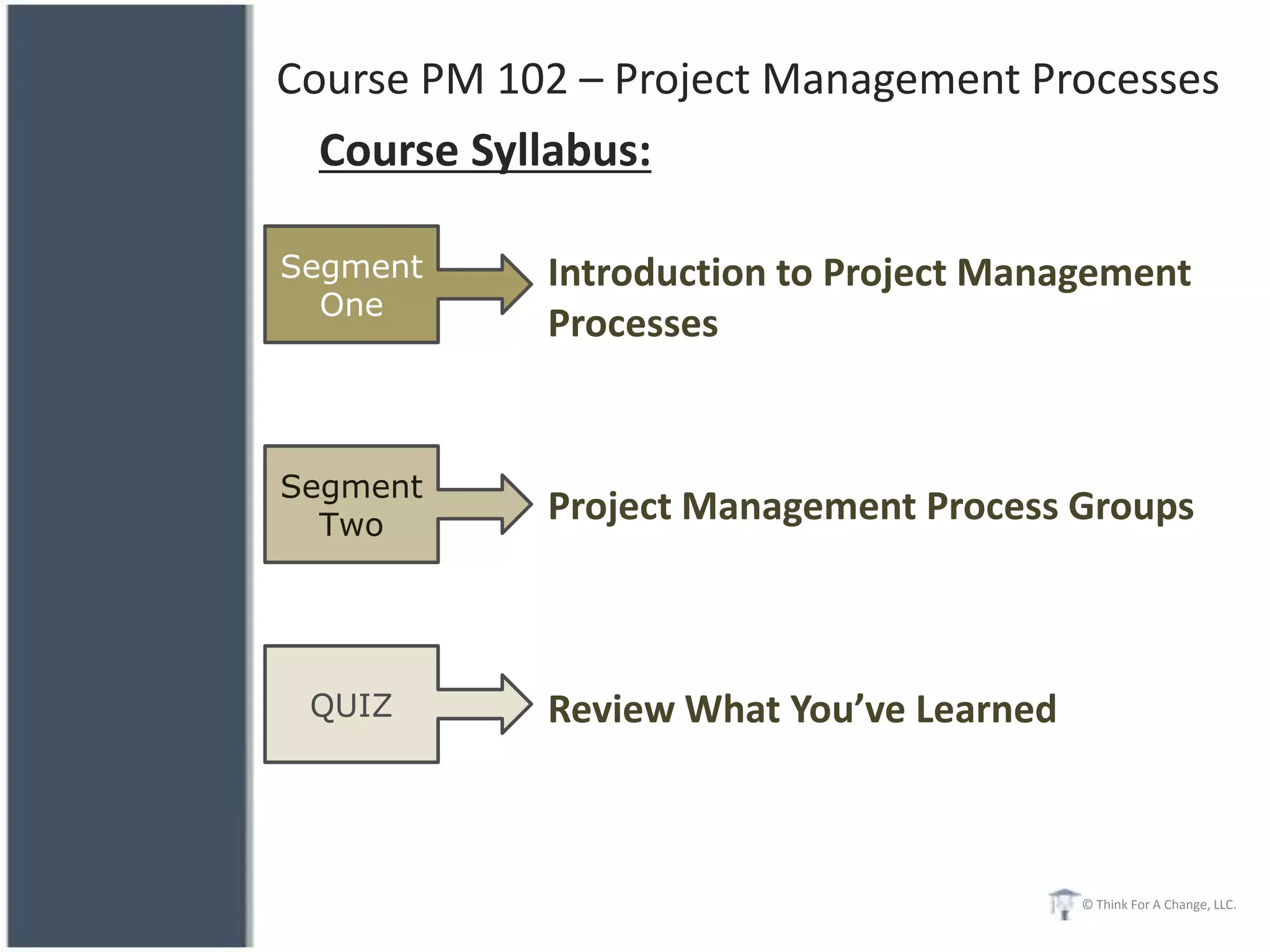
Course PM 102 – Project Management Processes
 Course Syllabus:

Segment     Introduction to Project Management
  One
            Processes


Segment
  Two
            Project Management Process Groups


 QUIZ       Review What You’ve Learned


                                         © Think For A Change, LLC.
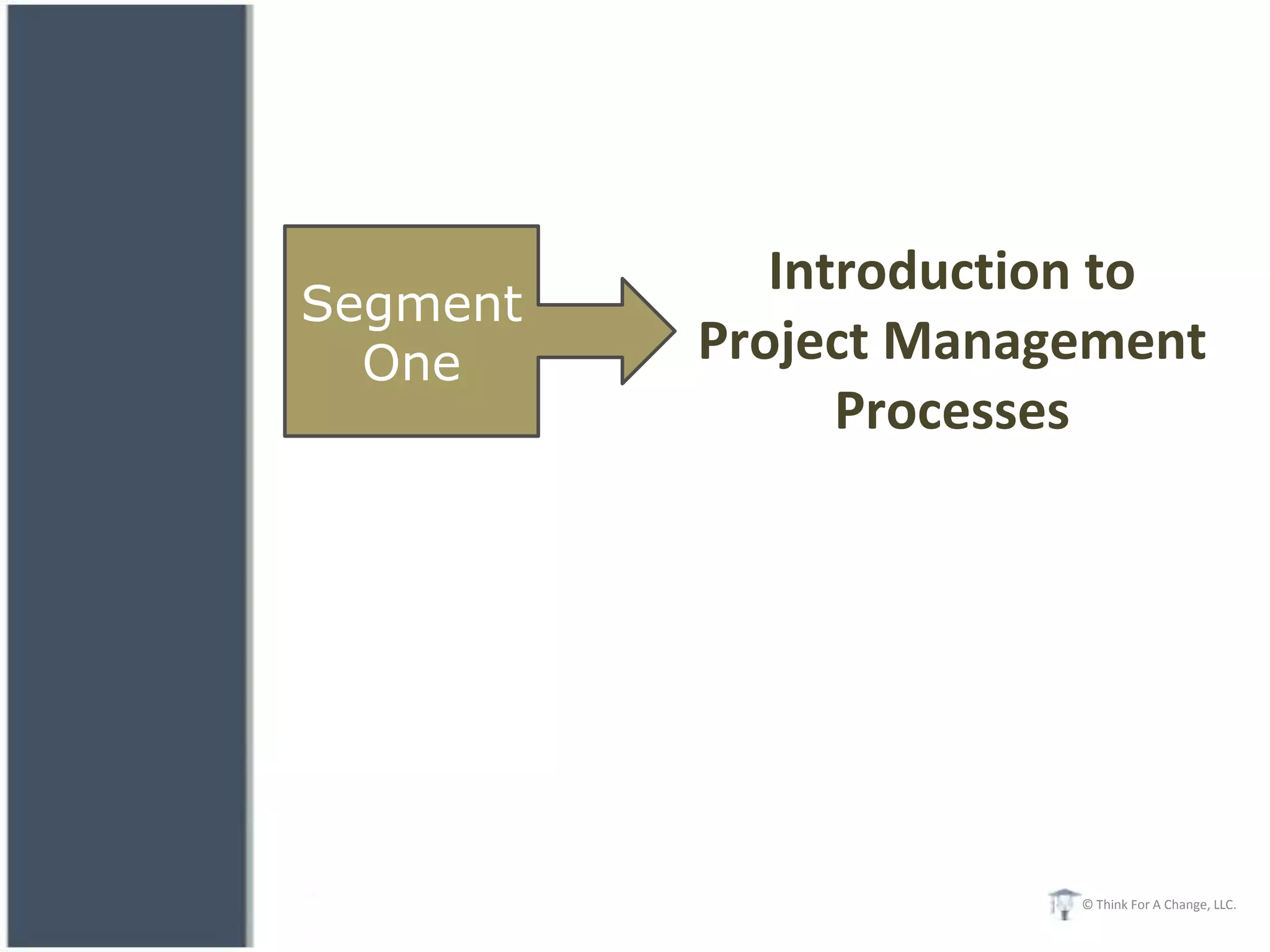
Introduction to
Segment
  One     Project Management
                Processes


                       © Think For A Change, LLC.
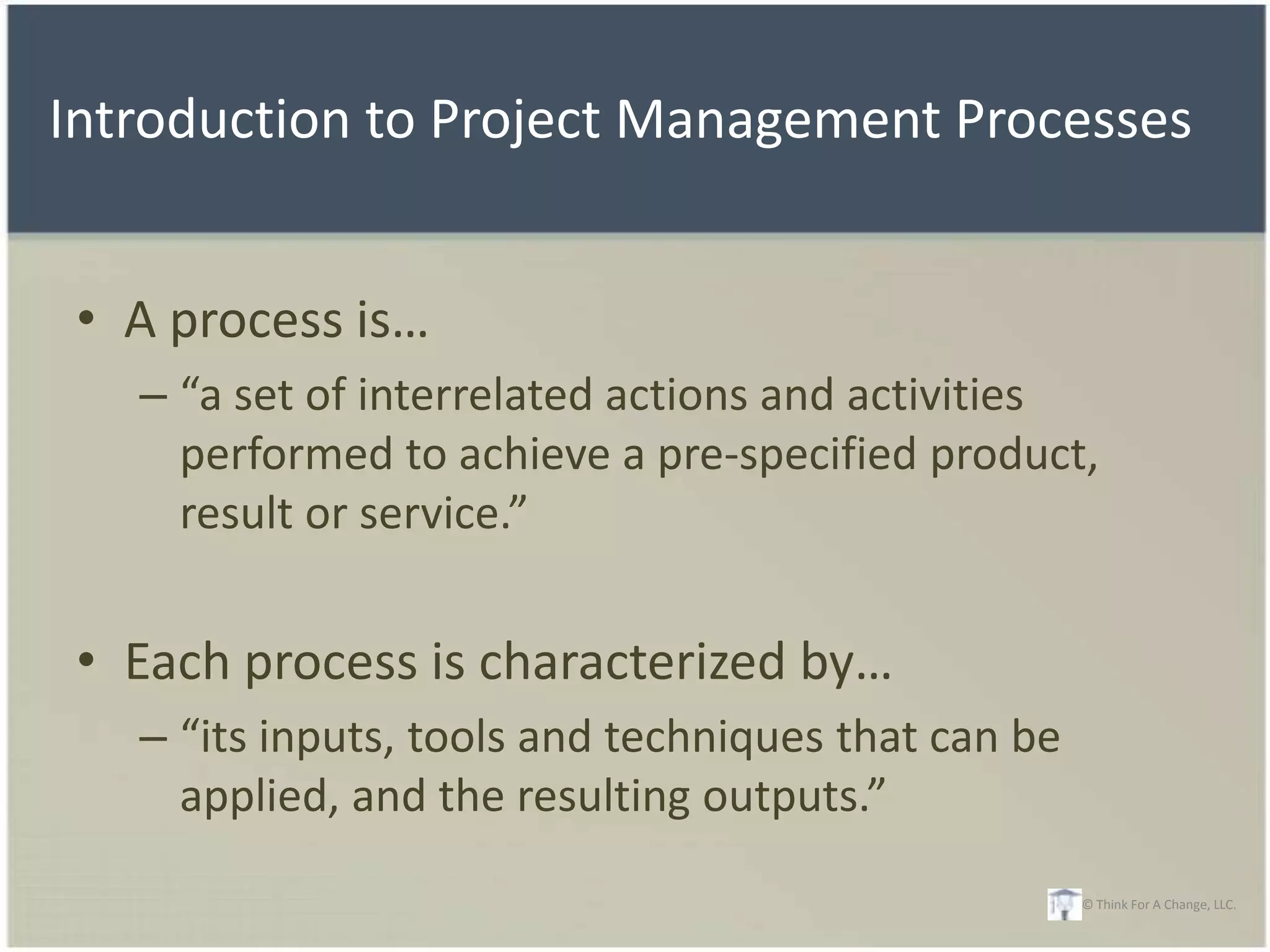
Introduction to Project Management Processes


 • A process is…
   – “a set of interrelated actions and activities
     performed to achieve a pre-specified product,
     result or service.”


 • Each process is characterized by…
   – “its inputs, tools and techniques that can be
     applied, and the resulting outputs.”
                                                     © Think For A Change, LLC.
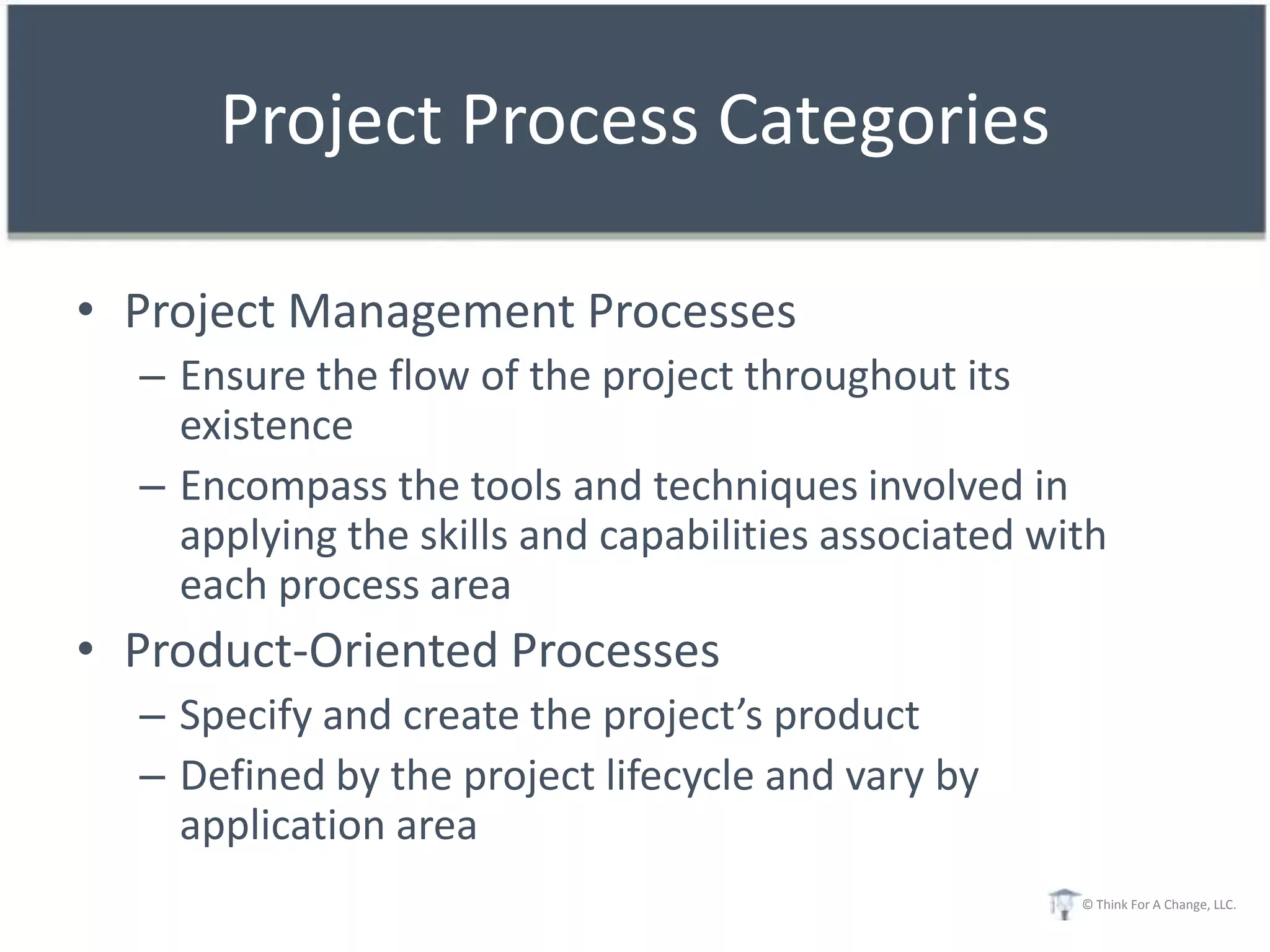
Project Process Categories

• Project Management Processes
  – Ensure the flow of the project throughout its
    existence
  – Encompass the tools and techniques involved in
    applying the skills and capabilities associated with
    each process area
• Product-Oriented Processes
  – Specify and create the project’s product
  – Defined by the project lifecycle and vary by
    application area
                                                      © Think For A Change, LLC.
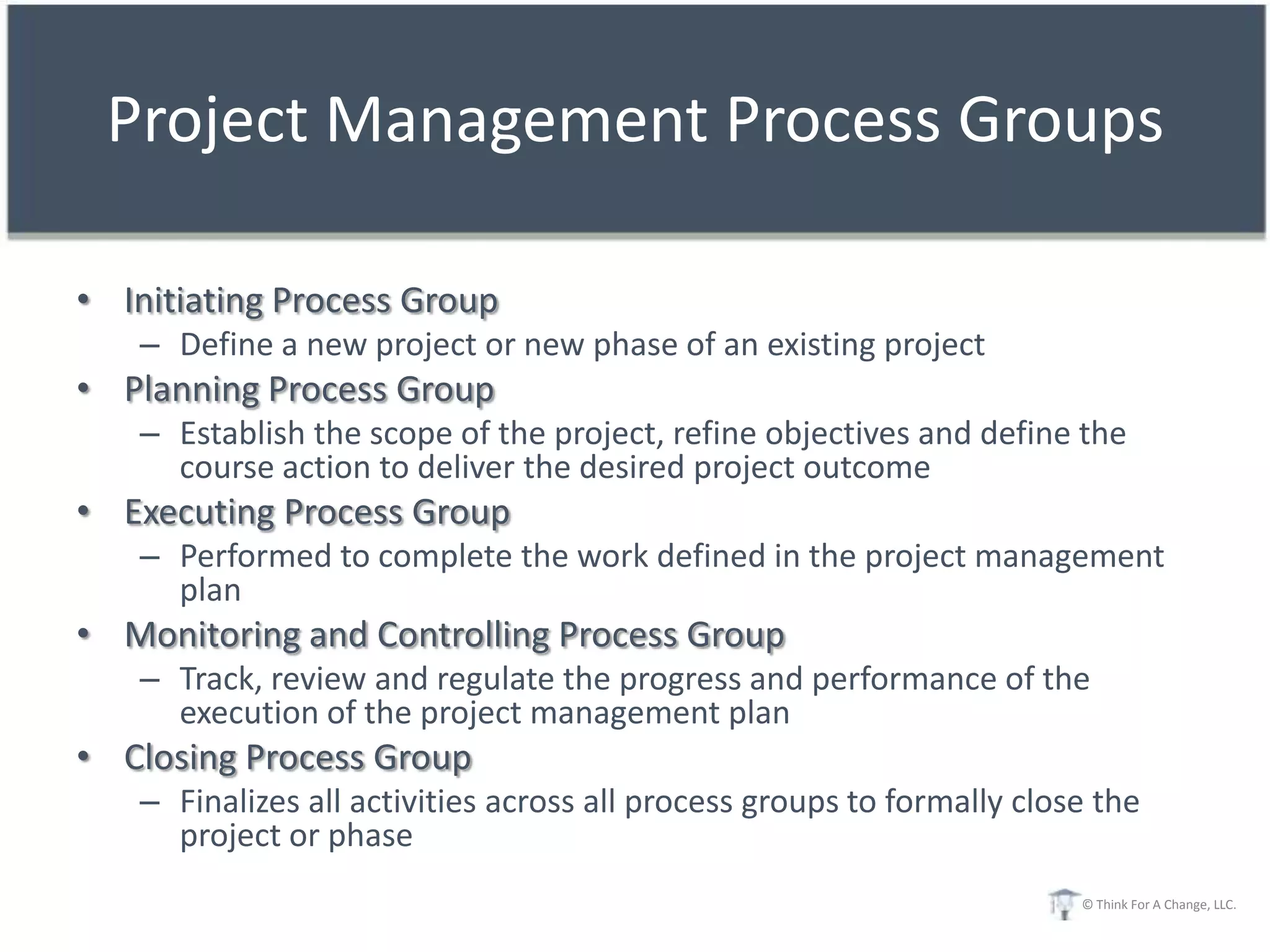
Project Management Process Groups

• Initiating Process Group
   – Define a new project or new phase of an existing project
• Planning Process Group
   – Establish the scope of the project, refine objectives and define the
     course action to deliver the desired project outcome
• Executing Process Group
   – Performed to complete the work defined in the project management
     plan
• Monitoring and Controlling Process Group
   – Track, review and regulate the progress and performance of the
     execution of the project management plan
• Closing Process Group
   – Finalizes all activities across all process groups to formally close the
     project or phase
                                                                        © Think For A Change, LLC.
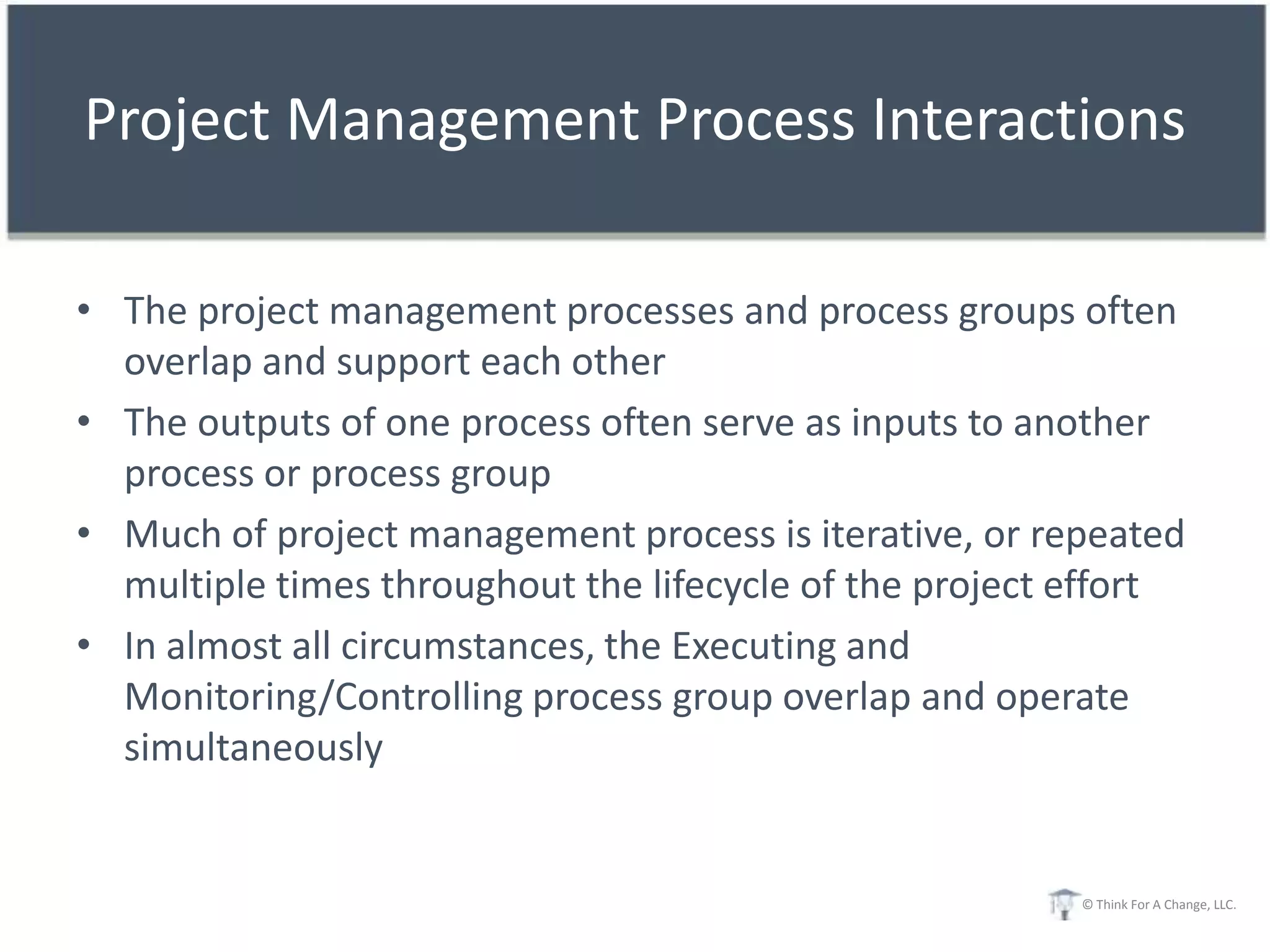
Project Management Process Interactions

• The project management processes and process groups often
  overlap and support each other
• The outputs of one process often serve as inputs to another
  process or process group
• Much of project management process is iterative, or repeated
  multiple times throughout the lifecycle of the project effort
• In almost all circumstances, the Executing and
  Monitoring/Controlling process group overlap and operate
  simultaneously


                                                         © Think For A Change, LLC.
Project
Segment
  Two
           Management
          Process Groups


                     © Think For A Change, LLC.
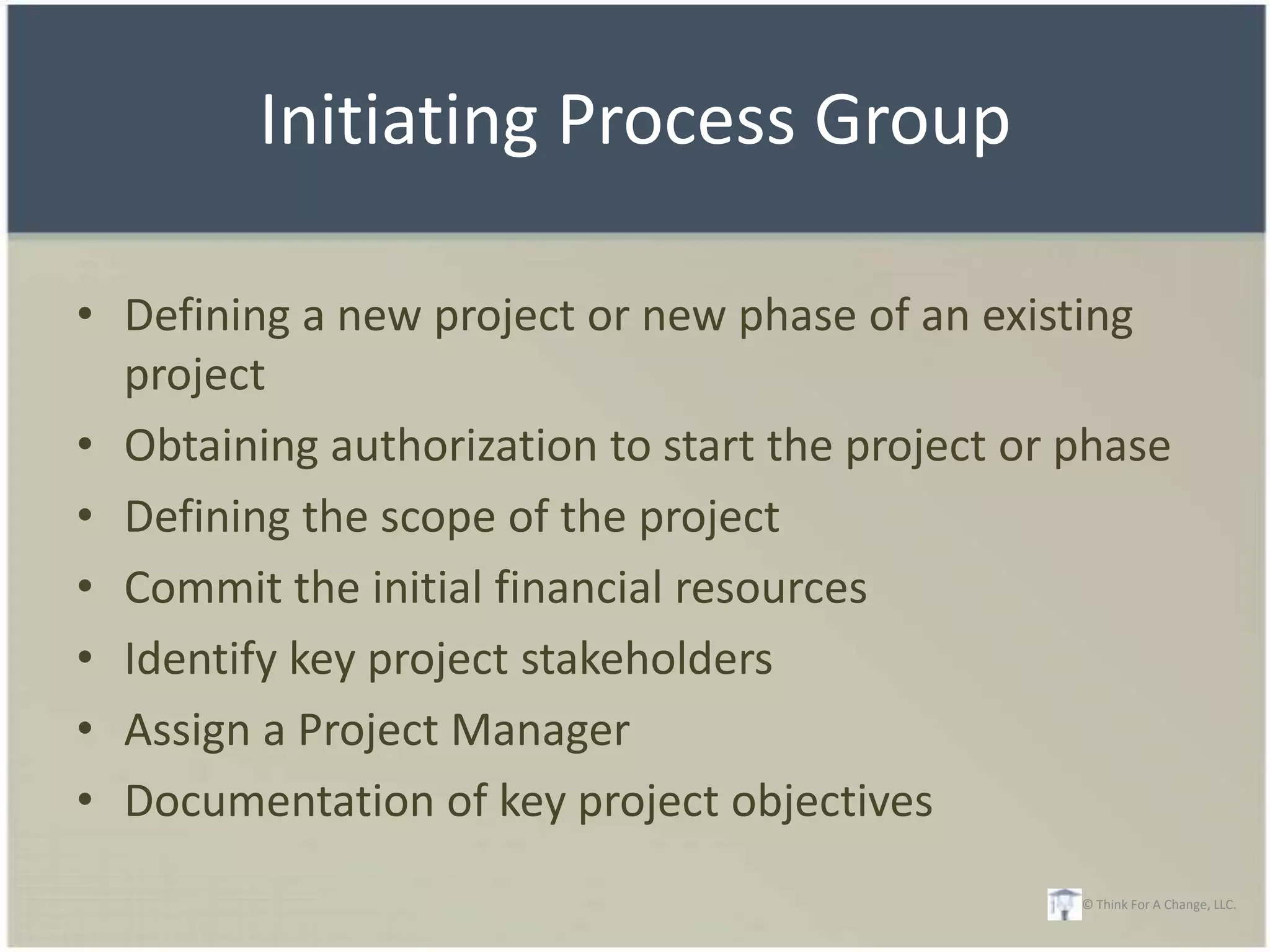
Initiating Process Group

• Defining a new project or new phase of an existing
  project
• Obtaining authorization to start the project or phase
• Defining the scope of the project
• Commit the initial financial resources
• Identify key project stakeholders
• Assign a Project Manager
• Documentation of key project objectives
                                                  © Think For A Change, LLC.
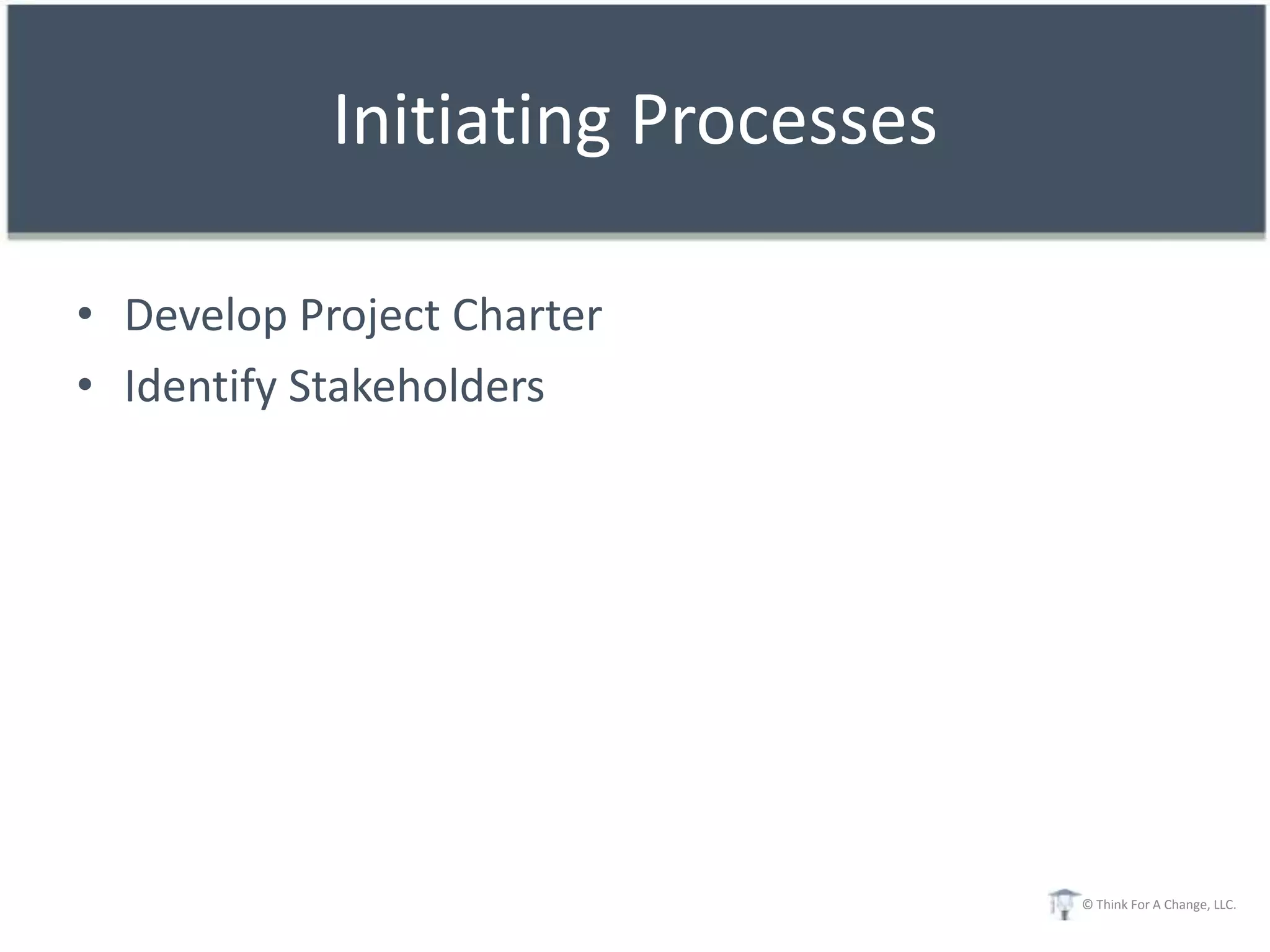
Initiating Processes

• Develop Project Charter
• Identify Stakeholders


                                   © Think For A Change, LLC.
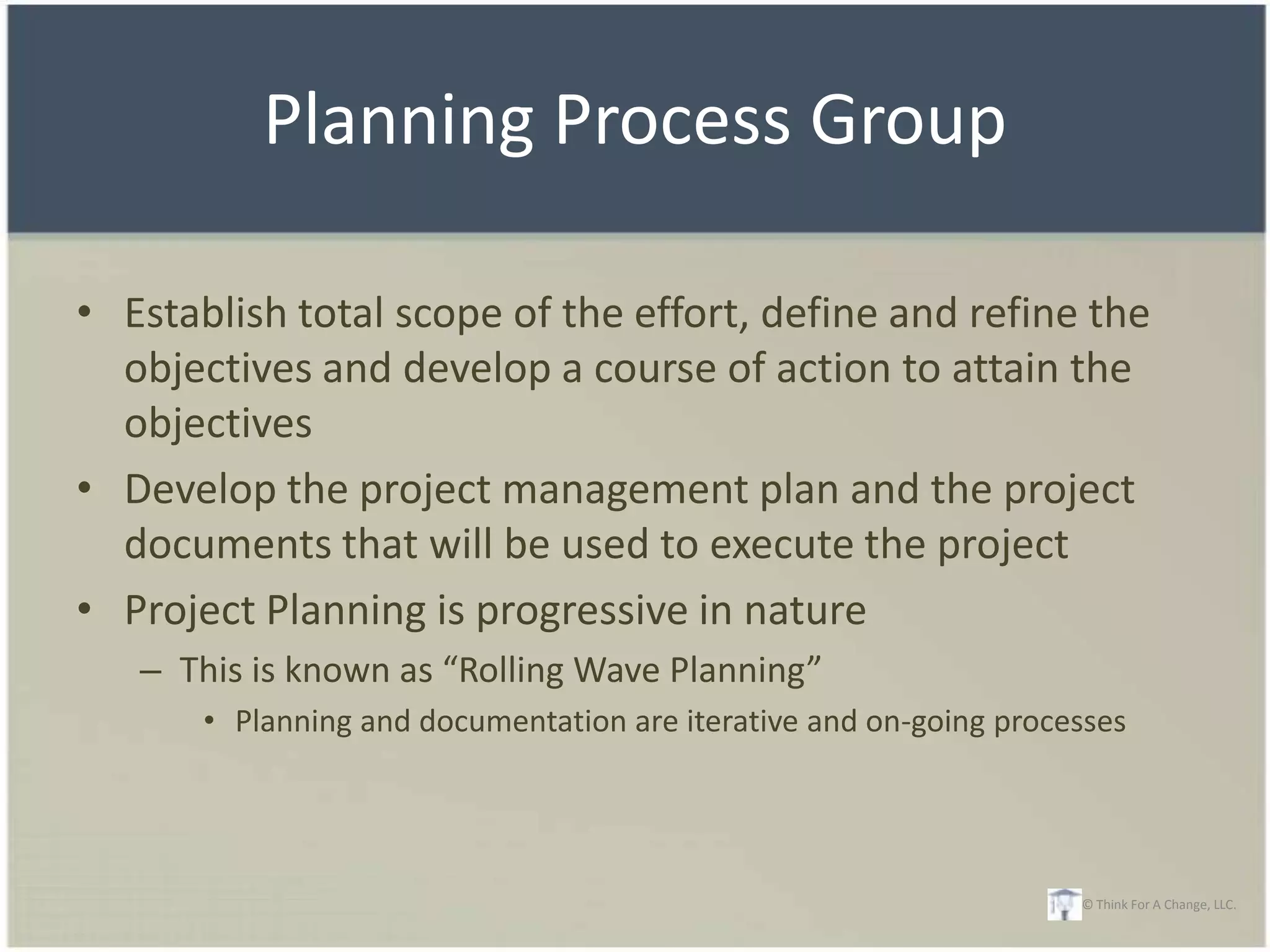
Planning Process Group

• Establish total scope of the effort, define and refine the
  objectives and develop a course of action to attain the
  objectives
• Develop the project management plan and the project
  documents that will be used to execute the project
• Project Planning is progressive in nature
   – This is known as “Rolling Wave Planning”
       • Planning and documentation are iterative and on-going processes


                                                                    © Think For A Change, LLC.
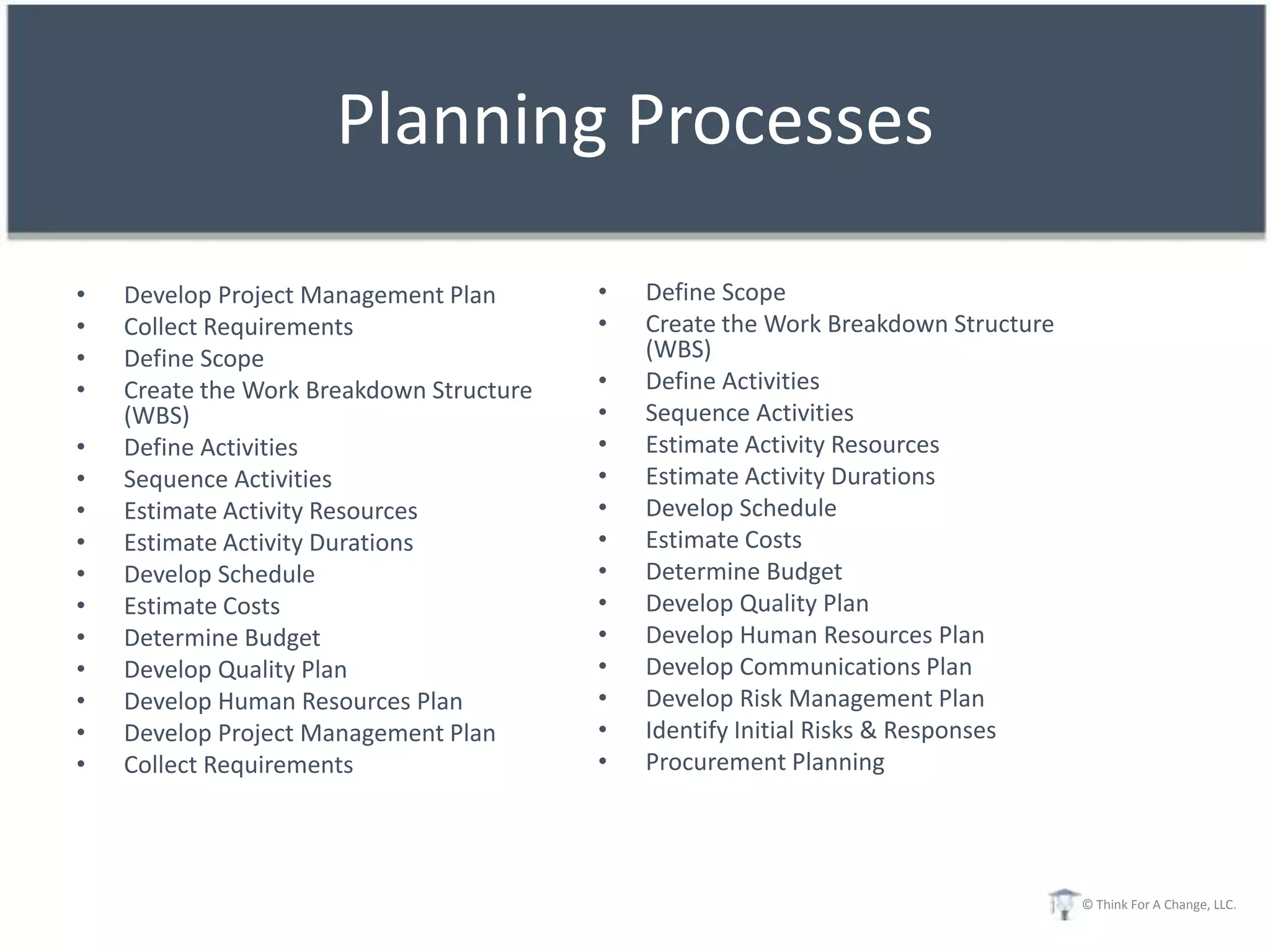
Planning Processes

•   Develop Project Management Plan       •   Define Scope
•   Collect Requirements                  •   Create the Work Breakdown Structure
•   Define Scope                              (WBS)
•   Create the Work Breakdown Structure   •   Define Activities
    (WBS)                                 •   Sequence Activities
•   Define Activities                     •   Estimate Activity Resources
•   Sequence Activities                   •   Estimate Activity Durations
•   Estimate Activity Resources           •   Develop Schedule
•   Estimate Activity Durations           •   Estimate Costs
•   Develop Schedule                      •   Determine Budget
•   Estimate Costs                        •   Develop Quality Plan
•   Determine Budget                      •   Develop Human Resources Plan
•   Develop Quality Plan                  •   Develop Communications Plan
•   Develop Human Resources Plan          •   Develop Risk Management Plan
•   Develop Project Management Plan       •   Identify Initial Risks & Responses
•   Collect Requirements                  •   Procurement Planning


                                                                                    © Think For A Change, LLC.
Executing Process Group

• The processes performed to complete the work
  defined in the Project Management Plan
• Management of the tasks required to satisfy the
  project specifications
• Coordination of people and resources


                                                © Think For A Change, LLC.
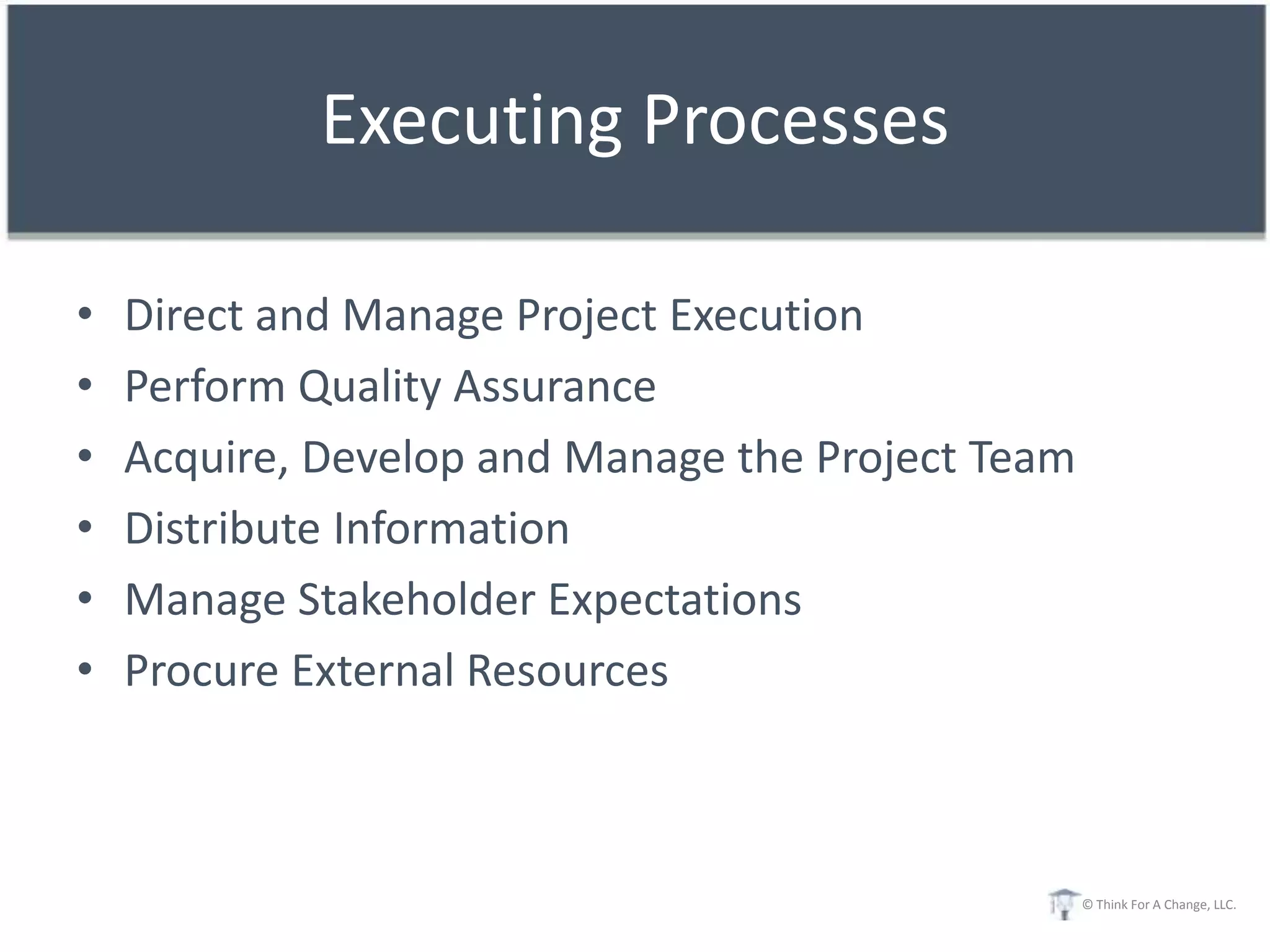
Executing Processes

•   Direct and Manage Project Execution
•   Perform Quality Assurance
•   Acquire, Develop and Manage the Project Team
•   Distribute Information
•   Manage Stakeholder Expectations
•   Procure External Resources


                                                   © Think For A Change, LLC.
Monitoring and Controlling Process Group

• Track, review and regulate the progress, pace and
  performance of the project tasks against the baseline
• Identify, manage and control any areas of the project where
  changes to the plan are required
   – Monitor and enforce adherence to the change management protocol
• Log, track and manage any issue that arise during execution of
  the project task plan
• Execute risk responses for risks that are triggered
• Monitor and report on overall project health


                                                              © Think For A Change, LLC.
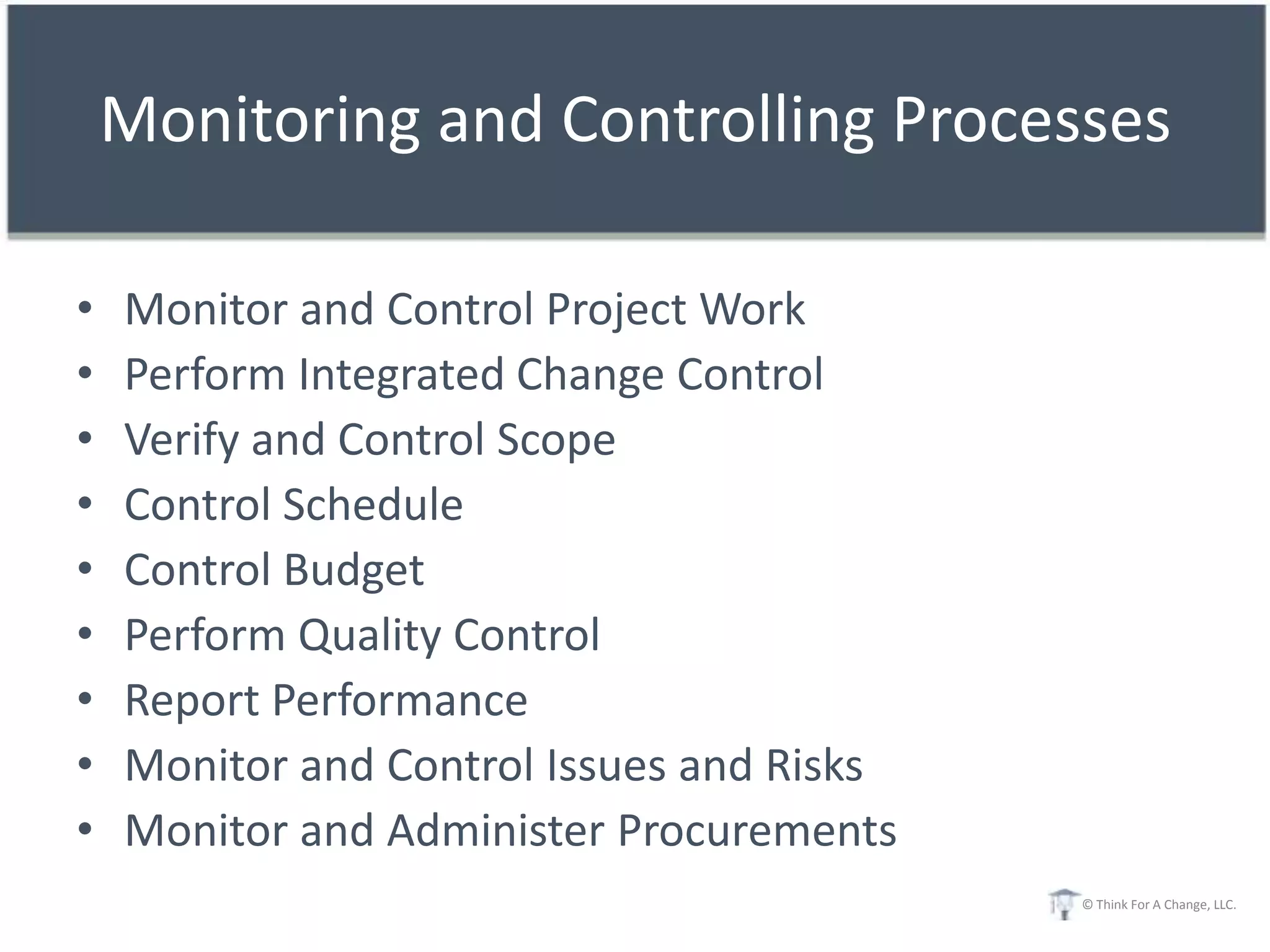
Monitoring and Controlling Processes

•   Monitor and Control Project Work
•   Perform Integrated Change Control
•   Verify and Control Scope
•   Control Schedule
•   Control Budget
•   Perform Quality Control
•   Report Performance
•   Monitor and Control Issues and Risks
•   Monitor and Administer Procurements
                                           © Think For A Change, LLC.
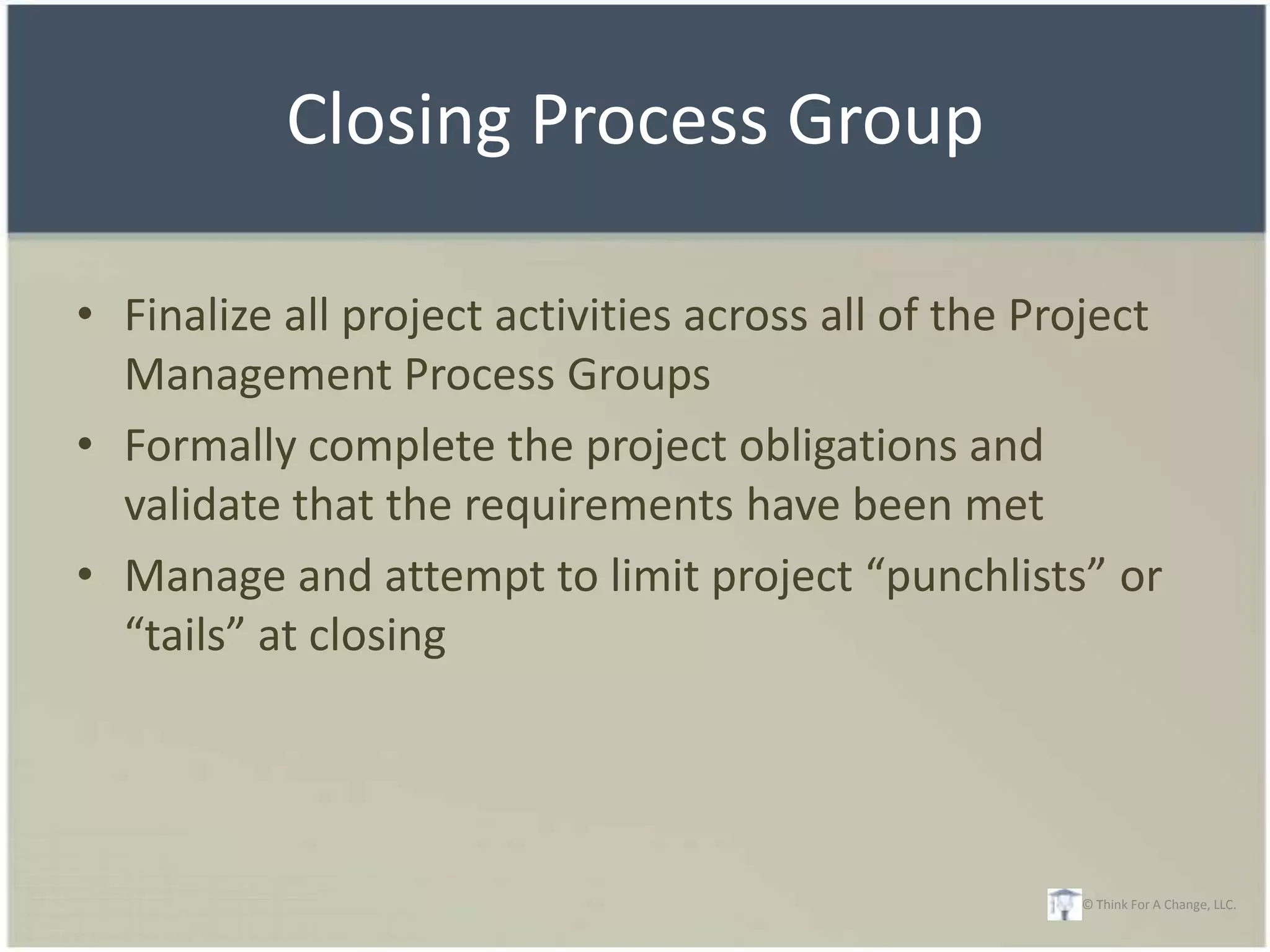
Closing Process Group

• Finalize all project activities across all of the Project
  Management Process Groups
• Formally complete the project obligations and
  validate that the requirements have been met
• Manage and attempt to limit project “punchlists” or
  “tails” at closing


                                                      © Think For A Change, LLC.
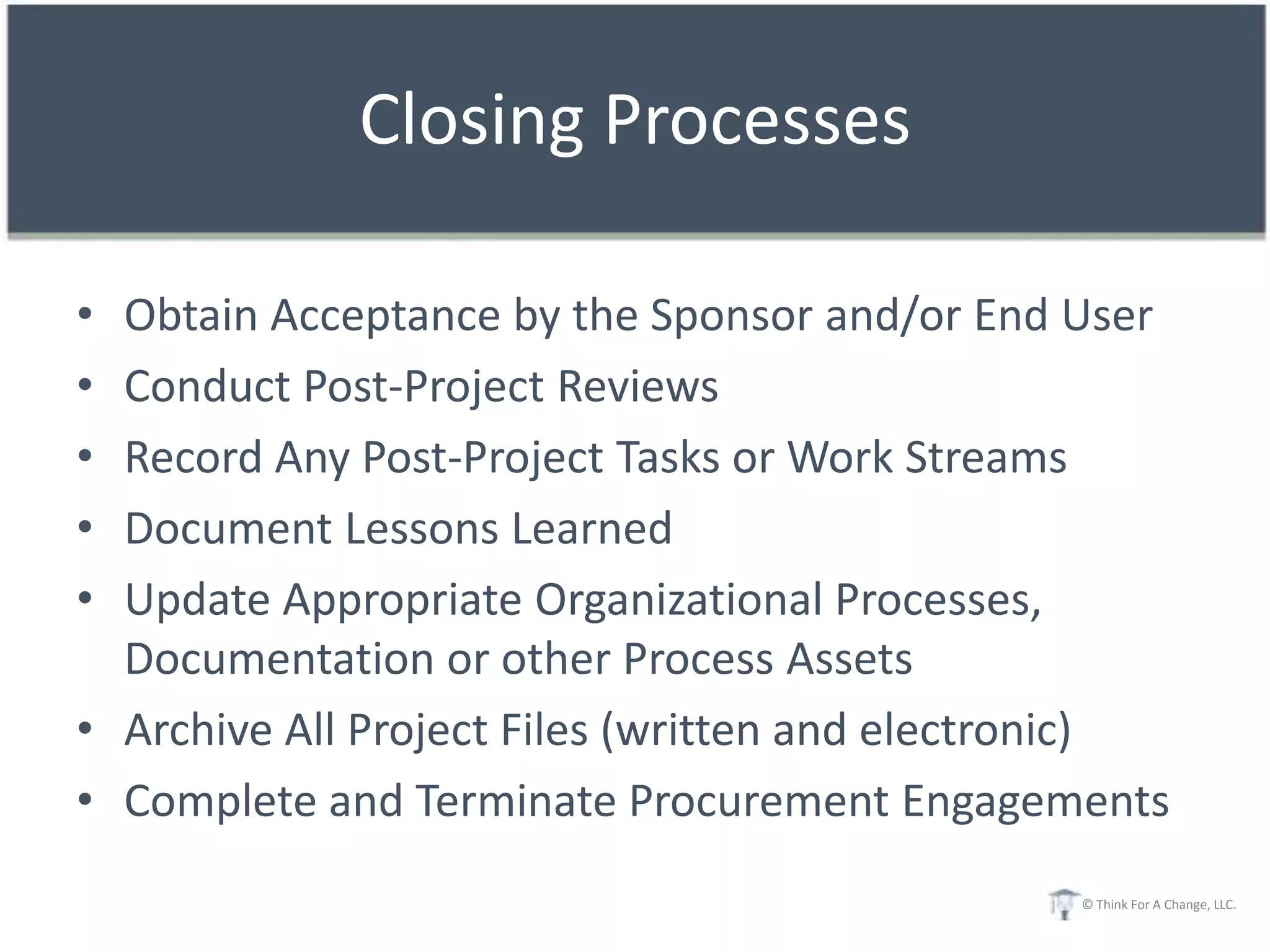
Closing Processes

• Obtain Acceptance by the Sponsor and/or End User
• Conduct Post-Project Reviews
• Record Any Post-Project Tasks or Work Streams
• Document Lessons Learned
• Update Appropriate Organizational Processes,
  Documentation or other Process Assets
• Archive All Project Files (written and electronic)
• Complete and Terminate Procurement Engagements
                                               © Think For A Change, LLC.
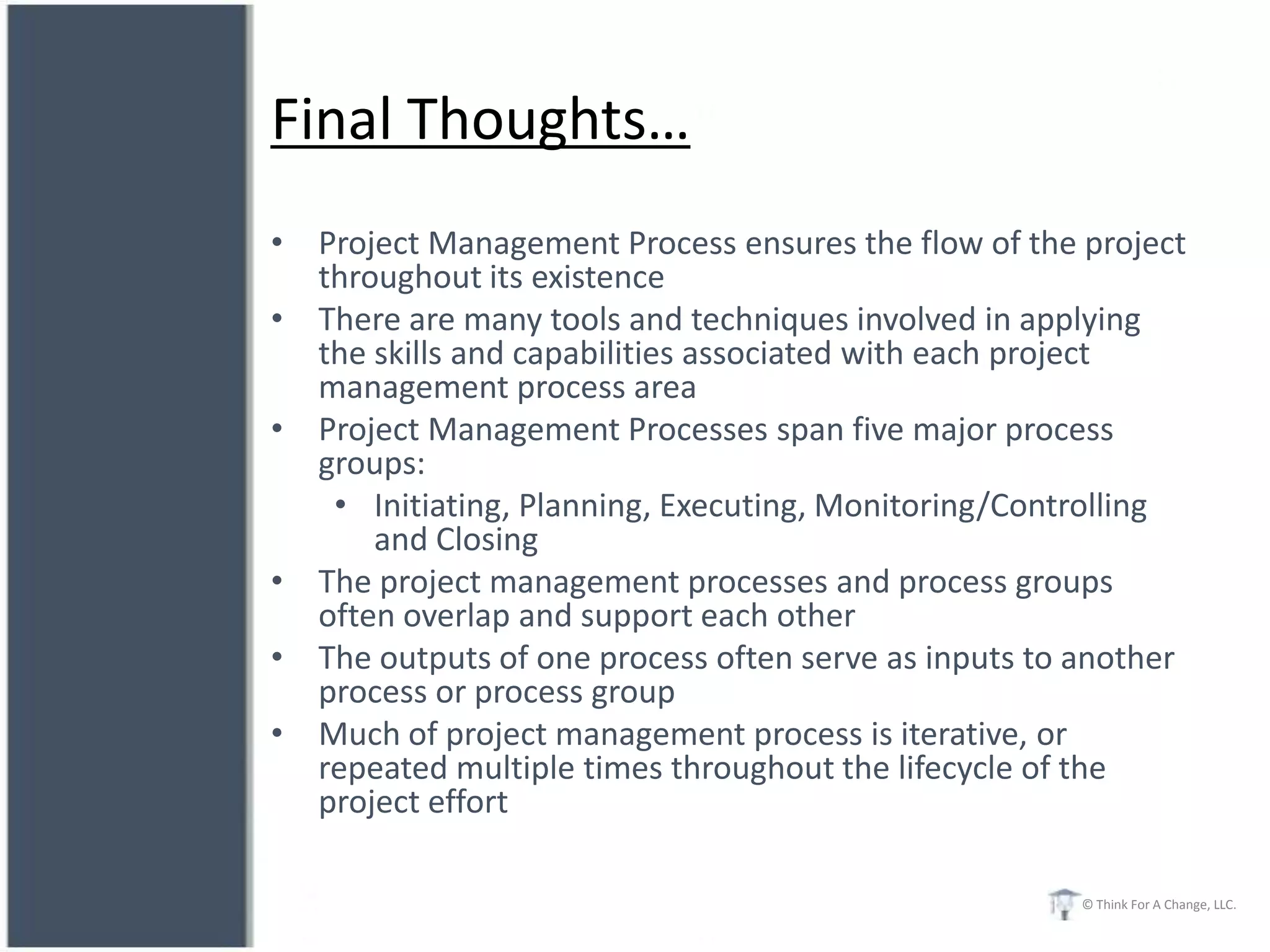
Final Thoughts…
• Project Management Process ensures the flow of the project
  throughout its existence
• There are many tools and techniques involved in applying
  the skills and capabilities associated with each project
  management process area
• Project Management Processes span five major process
  groups:
   • Initiating, Planning, Executing, Monitoring/Controlling
      and Closing
• The project management processes and process groups
  often overlap and support each other
• The outputs of one process often serve as inputs to another
  process or process group
• Much of project management process is iterative, or
  repeated multiple times throughout the lifecycle of the
  project effort

                                                      © Think For A Change, LLC.
Review What
QUIZ   You’ve Learned!


                   © Think For A Change, LLC.
Course 102 – Project Management Processes
QUIZ


Question 1:
True or False.

   A process is a set of
   interrelated actions
   and activities
   performed to achieve
   a pre-specified
   product, result or
   service.


                                      © Think For A Change, LLC.
Course 102 – Project Management Processes
QUIZ


Question 1:                Answer:
True or False.             • TRUE

   A process is a set of
   interrelated actions
   and activities
   performed to achieve
   a pre-specified
   product, result or
   service.


                                      © Think For A Change, LLC.
Course 102 – Project Management Processes
QUIZ


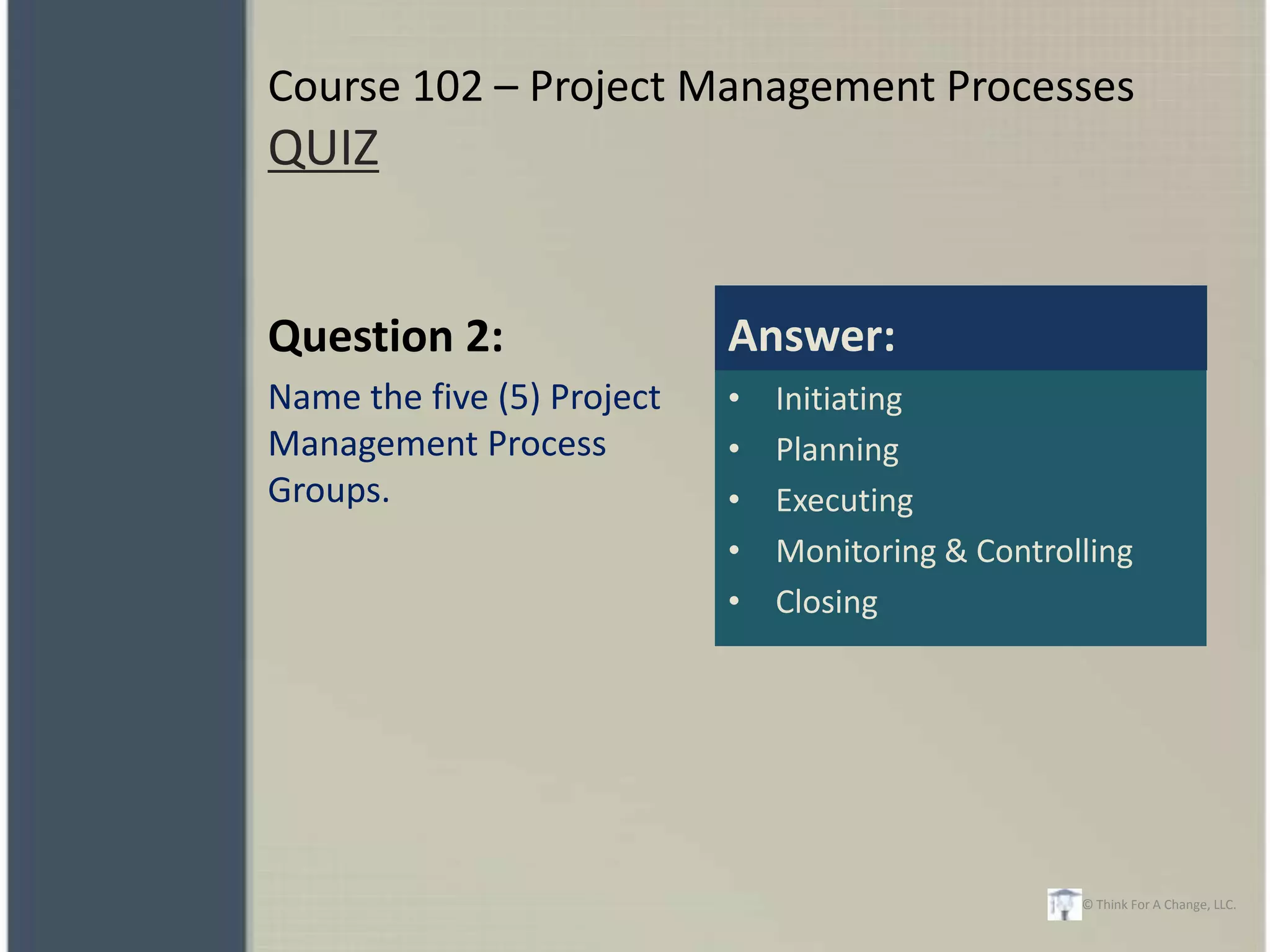
Question 2:
Name the five (5) Project
Management Process
Groups.


                                      © Think For A Change, LLC.
Course 102 – Project Management Processes
QUIZ


Question 2:                 Answer:
Name the five (5) Project   •   Initiating
Management Process          •   Planning
Groups.                     •   Executing
                            •   Monitoring & Controlling
                            •   Closing


                                                    © Think For A Change, LLC.
Course 102 – Project Management Processes
QUIZ


Question 3:
Much of project
management process is
________________, or
repeated multiple times
throughout the lifecycle
of the project effort.


                                      © Think For A Change, LLC.
Course 102 – Project Management Processes
QUIZ


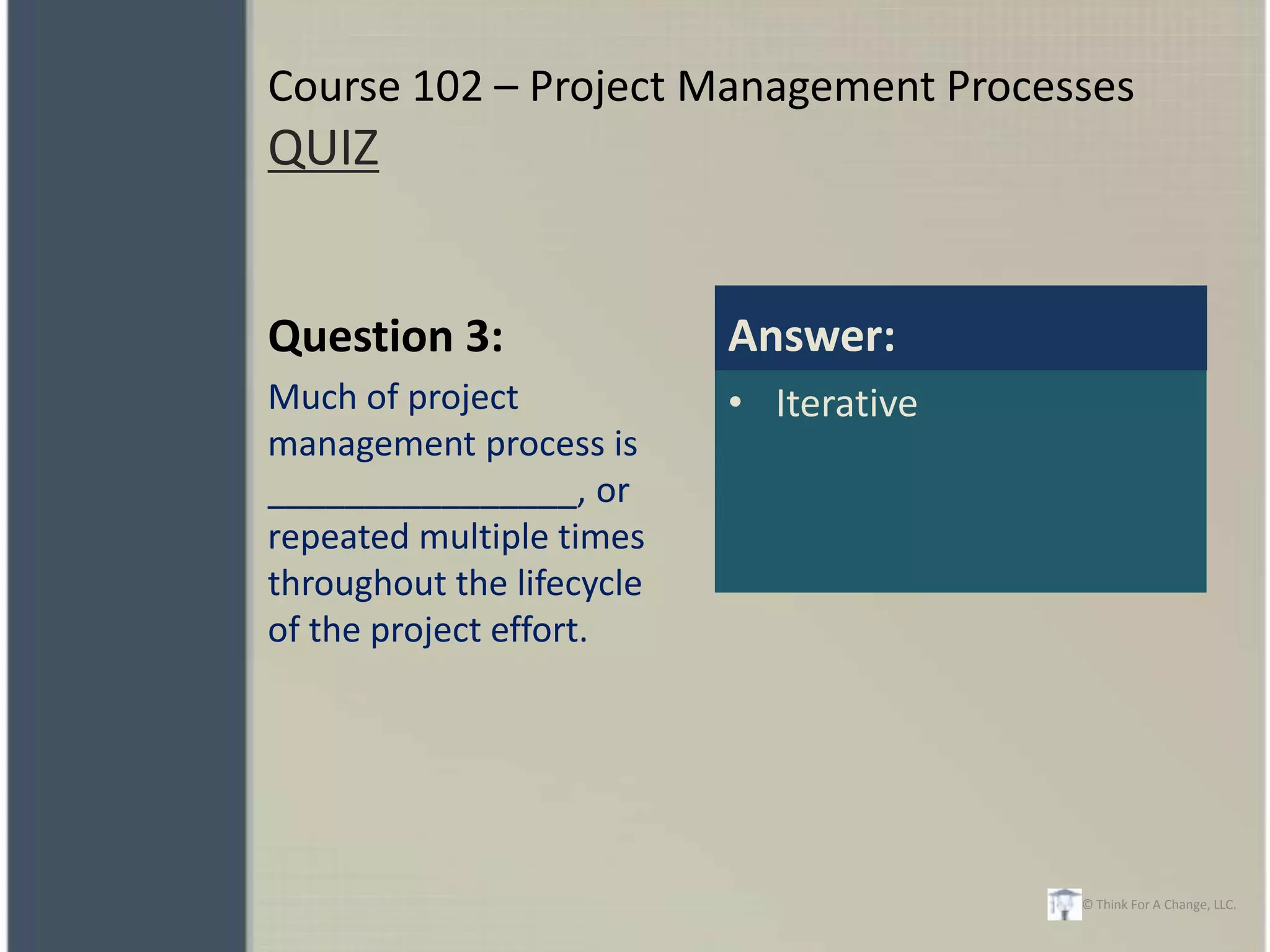
Question 3:                Answer:
Much of project            • Iterative
management process is
________________, or
repeated multiple times
throughout the lifecycle
of the project effort.


                                         © Think For A Change, LLC.
Course 102 – Project Management Processes
QUIZ


Question 4:
Acquiring, Developing
and Managing the
Project Team occurs in
what Project
Management Process
Group?


                                      © Think For A Change, LLC.
Course 102 – Project Management Processes
QUIZ


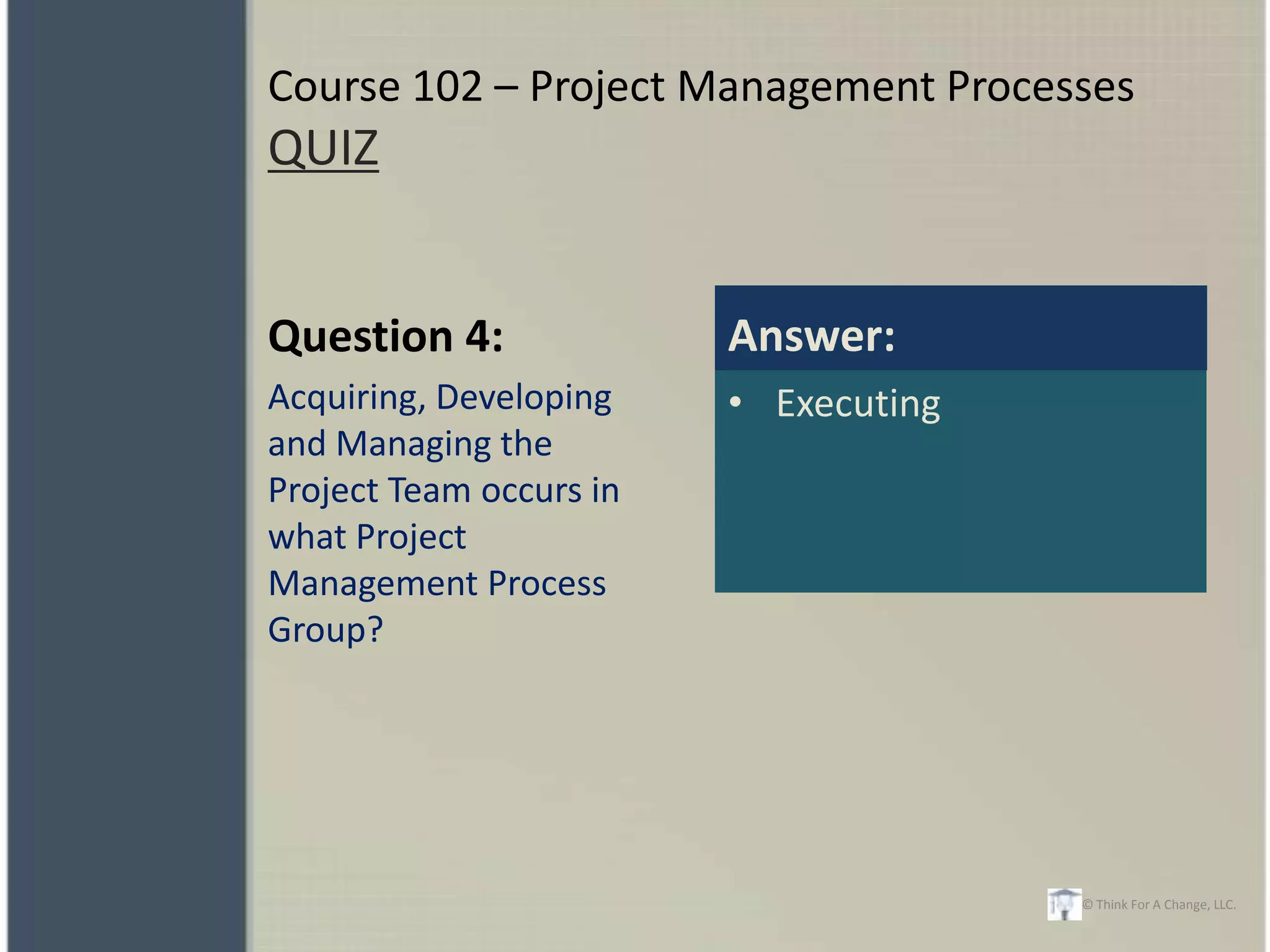
Question 4:              Answer:
Acquiring, Developing    • Executing
and Managing the
Project Team occurs in
what Project
Management Process
Group?


                                       © Think For A Change, LLC.
Course 102 – Project Management Processes
QUIZ


Question 5:
Project Planning is
progressive in nature and
occurs throughout the
lifecycle of the project.
This is also known as
_______________.


                                      © Think For A Change, LLC.
Course 102 – Project Management Processes
QUIZ


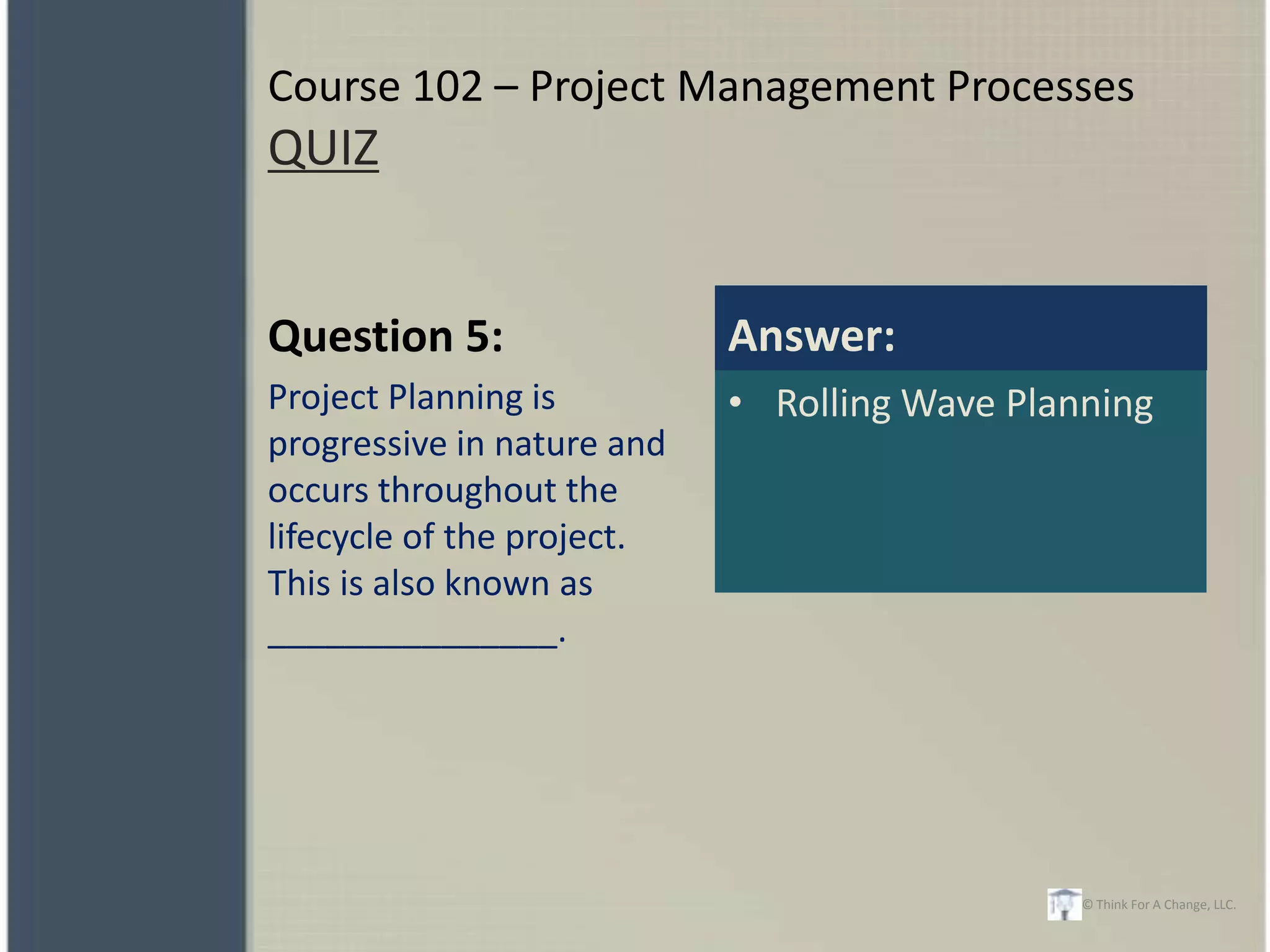
Question 5:                 Answer:
Project Planning is         • Rolling Wave Planning
progressive in nature and
occurs throughout the
lifecycle of the project.
This is also known as
_______________.


                                               © Think For A Change, LLC.
CONGRATULATIONS!
 You have successfully completed:

Project Management Foundations
Course 102 – Project Management Processes

        PRESENTED BY:
        Think For A Change, LLC.


                                            © Think For A Change, LLC.
For more information on best/next practices,
educational training, tools, techniques and
process models for:
   –   Project Management
   –   Innovation Management
   –   Product Management
   –   Leadership


   Please visit: http://www.thinkforachange.com


                                                  © Think For A Change, LLC.

Project Management Foundations Series Course 102 - Project Management Processes

  • 1.
    Project Management Foundations Course102 – Project Management Processes Presented By: Think For A Change © Think For A Change, LLC.
  • 2.
    Target Student Audience •Little to no experience with: – Formal Project Management Concepts – PMI Project Management Body of Knowledge – Project Management Process Models • Frustrated with: – Failed Projects – Poorly Organized Work Efforts – Lack of Leadership in Project Efforts © Think For A Change, LLC.
  • 3.
    Course PM 102– Project Management Processes Course Syllabus: Segment Introduction to Project Management One Processes Segment Two Project Management Process Groups QUIZ Review What You’ve Learned © Think For A Change, LLC.
  • 4.
    Introduction to Segment One Project Management Processes © Think For A Change, LLC.
  • 5.
    Introduction to ProjectManagement Processes • A process is… – “a set of interrelated actions and activities performed to achieve a pre-specified product, result or service.” • Each process is characterized by… – “its inputs, tools and techniques that can be applied, and the resulting outputs.” © Think For A Change, LLC.
  • 6.
    Project Process Categories •Project Management Processes – Ensure the flow of the project throughout its existence – Encompass the tools and techniques involved in applying the skills and capabilities associated with each process area • Product-Oriented Processes – Specify and create the project’s product – Defined by the project lifecycle and vary by application area © Think For A Change, LLC.
  • 7.
    Project Management ProcessGroups • Initiating Process Group – Define a new project or new phase of an existing project • Planning Process Group – Establish the scope of the project, refine objectives and define the course action to deliver the desired project outcome • Executing Process Group – Performed to complete the work defined in the project management plan • Monitoring and Controlling Process Group – Track, review and regulate the progress and performance of the execution of the project management plan • Closing Process Group – Finalizes all activities across all process groups to formally close the project or phase © Think For A Change, LLC.
  • 8.
    Project Management ProcessInteractions • The project management processes and process groups often overlap and support each other • The outputs of one process often serve as inputs to another process or process group • Much of project management process is iterative, or repeated multiple times throughout the lifecycle of the project effort • In almost all circumstances, the Executing and Monitoring/Controlling process group overlap and operate simultaneously © Think For A Change, LLC.
  • 9.
    Project Segment Two Management Process Groups © Think For A Change, LLC.
  • 10.
    Initiating Process Group •Defining a new project or new phase of an existing project • Obtaining authorization to start the project or phase • Defining the scope of the project • Commit the initial financial resources • Identify key project stakeholders • Assign a Project Manager • Documentation of key project objectives © Think For A Change, LLC.
  • 11.
    Initiating Processes • DevelopProject Charter • Identify Stakeholders © Think For A Change, LLC.
  • 12.
    Planning Process Group •Establish total scope of the effort, define and refine the objectives and develop a course of action to attain the objectives • Develop the project management plan and the project documents that will be used to execute the project • Project Planning is progressive in nature – This is known as “Rolling Wave Planning” • Planning and documentation are iterative and on-going processes © Think For A Change, LLC.
  • 13.
    Planning Processes • Develop Project Management Plan • Define Scope • Collect Requirements • Create the Work Breakdown Structure • Define Scope (WBS) • Create the Work Breakdown Structure • Define Activities (WBS) • Sequence Activities • Define Activities • Estimate Activity Resources • Sequence Activities • Estimate Activity Durations • Estimate Activity Resources • Develop Schedule • Estimate Activity Durations • Estimate Costs • Develop Schedule • Determine Budget • Estimate Costs • Develop Quality Plan • Determine Budget • Develop Human Resources Plan • Develop Quality Plan • Develop Communications Plan • Develop Human Resources Plan • Develop Risk Management Plan • Develop Project Management Plan • Identify Initial Risks & Responses • Collect Requirements • Procurement Planning © Think For A Change, LLC.
  • 14.
    Executing Process Group •The processes performed to complete the work defined in the Project Management Plan • Management of the tasks required to satisfy the project specifications • Coordination of people and resources © Think For A Change, LLC.
  • 15.
    Executing Processes • Direct and Manage Project Execution • Perform Quality Assurance • Acquire, Develop and Manage the Project Team • Distribute Information • Manage Stakeholder Expectations • Procure External Resources © Think For A Change, LLC.
  • 16.
    Monitoring and ControllingProcess Group • Track, review and regulate the progress, pace and performance of the project tasks against the baseline • Identify, manage and control any areas of the project where changes to the plan are required – Monitor and enforce adherence to the change management protocol • Log, track and manage any issue that arise during execution of the project task plan • Execute risk responses for risks that are triggered • Monitor and report on overall project health © Think For A Change, LLC.
  • 17.
    Monitoring and ControllingProcesses • Monitor and Control Project Work • Perform Integrated Change Control • Verify and Control Scope • Control Schedule • Control Budget • Perform Quality Control • Report Performance • Monitor and Control Issues and Risks • Monitor and Administer Procurements © Think For A Change, LLC.
  • 18.
    Closing Process Group •Finalize all project activities across all of the Project Management Process Groups • Formally complete the project obligations and validate that the requirements have been met • Manage and attempt to limit project “punchlists” or “tails” at closing © Think For A Change, LLC.
  • 19.
    Closing Processes • ObtainAcceptance by the Sponsor and/or End User • Conduct Post-Project Reviews • Record Any Post-Project Tasks or Work Streams • Document Lessons Learned • Update Appropriate Organizational Processes, Documentation or other Process Assets • Archive All Project Files (written and electronic) • Complete and Terminate Procurement Engagements © Think For A Change, LLC.
  • 20.
    Final Thoughts… • ProjectManagement Process ensures the flow of the project throughout its existence • There are many tools and techniques involved in applying the skills and capabilities associated with each project management process area • Project Management Processes span five major process groups: • Initiating, Planning, Executing, Monitoring/Controlling and Closing • The project management processes and process groups often overlap and support each other • The outputs of one process often serve as inputs to another process or process group • Much of project management process is iterative, or repeated multiple times throughout the lifecycle of the project effort © Think For A Change, LLC.
  • 21.
    Review What QUIZ You’ve Learned! © Think For A Change, LLC.
  • 22.
    Course 102 –Project Management Processes QUIZ Question 1: True or False. A process is a set of interrelated actions and activities performed to achieve a pre-specified product, result or service. © Think For A Change, LLC.
  • 23.
    Course 102 –Project Management Processes QUIZ Question 1: Answer: True or False. • TRUE A process is a set of interrelated actions and activities performed to achieve a pre-specified product, result or service. © Think For A Change, LLC.
  • 24.
    Course 102 –Project Management Processes QUIZ Question 2: Name the five (5) Project Management Process Groups. © Think For A Change, LLC.
  • 25.
    Course 102 –Project Management Processes QUIZ Question 2: Answer: Name the five (5) Project • Initiating Management Process • Planning Groups. • Executing • Monitoring & Controlling • Closing © Think For A Change, LLC.
  • 26.
    Course 102 –Project Management Processes QUIZ Question 3: Much of project management process is ________________, or repeated multiple times throughout the lifecycle of the project effort. © Think For A Change, LLC.
  • 27.
    Course 102 –Project Management Processes QUIZ Question 3: Answer: Much of project • Iterative management process is ________________, or repeated multiple times throughout the lifecycle of the project effort. © Think For A Change, LLC.
  • 28.
    Course 102 –Project Management Processes QUIZ Question 4: Acquiring, Developing and Managing the Project Team occurs in what Project Management Process Group? © Think For A Change, LLC.
  • 29.
    Course 102 –Project Management Processes QUIZ Question 4: Answer: Acquiring, Developing • Executing and Managing the Project Team occurs in what Project Management Process Group? © Think For A Change, LLC.
  • 30.
    Course 102 –Project Management Processes QUIZ Question 5: Project Planning is progressive in nature and occurs throughout the lifecycle of the project. This is also known as _______________. © Think For A Change, LLC.
  • 31.
    Course 102 –Project Management Processes QUIZ Question 5: Answer: Project Planning is • Rolling Wave Planning progressive in nature and occurs throughout the lifecycle of the project. This is also known as _______________. © Think For A Change, LLC.
  • 32.
    CONGRATULATIONS! You havesuccessfully completed: Project Management Foundations Course 102 – Project Management Processes PRESENTED BY: Think For A Change, LLC. © Think For A Change, LLC.
  • 33.
    For more informationon best/next practices, educational training, tools, techniques and process models for: – Project Management – Innovation Management – Product Management – Leadership Please visit: http://www.thinkforachange.com © Think For A Change, LLC.