Microbiology Concepts
IHS Unit 3
Goals
• Identify and discuss organisms that cause
disease in humans.
Pathogens
• An organism that causes disease in humans is
called a pathogen.
– A pathogen that causes a specific disease is the
agent.
Types of Pathogens
• Most communicable (infectious) diseases in
humans are caused by either viruses or
bacteria.
• Some diseases are caused by protozoa or
fungi.
• The specific traits of a given organism
determine what type of disease is caused and
how it passes from person to person.
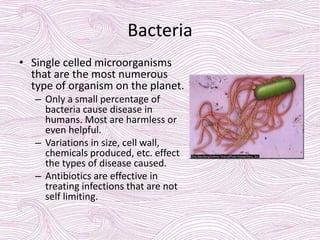
Bacteria
• Single celled microorganisms
that are the most numerous
type of organism on the planet.
– Only a small percentage of
bacteria cause disease in
humans. Most are harmless or
even helpful.
– Variations in size, cell wall,
chemicals produced, etc. effect
the types of disease caused.
– Antibiotics are effective in
treating infections that are not
self limiting.
Viruses
• Viruses are strange organisms that
are not even truly living.
– They do not look like other life on our
planet, leading to some biologists
calling them “aliens.”
– In order to “live” and replicate
themselves, they hijack other cells and
use there organelles to make viral DNA.
– Then, they kill that cell and release the
new viruses.
– Viruses are usually self limiting, and
can be treated by dealing with
symptoms or antiviral medication.
– Antibiotics are NOT effective.
Protozoa
• Literally means
“primitive animal”
– Single celled organisms
that behave sort of like
animals.
– Cause disease such as
amoebic disentery and
malaria.
– Technically a parasite.
– Special antiprotozoal
medicine is used to
treat.
Fungi
• These are organisms
such as molds and
yeast.
– Reproduces via spores
(spores are often an
agent of disease.
– Some fungi even help
us by producing
antibiotics.
– Fungi are treated with
antifungal medicines.
Resistance
• If an organism is resistant, it means that it
does not respond to the normal treatments
used for it.
– This is dangerous, because it often means that
patients have to take stronger medications with
more side effects or that there is no way to treat
the disease.
– Resistance is caused by both overuse of antibiotics
in healthcare and the use in agriculture.
Importance in Healthcare
• Health care providers and Laboratory
specialists have the task of figuring out what
type of organism causes disease.
– This is the only way we can have specific and
effective treatment.
– Choosing the wrong treatment can allow the
disease to get worse, and also contributes to the
growing problem of antibiotic resistant organisms.

Microbiology concepts

  • 1.
  • 2.
    Goals • Identify anddiscuss organisms that cause disease in humans.
  • 3.
    Pathogens • An organismthat causes disease in humans is called a pathogen. – A pathogen that causes a specific disease is the agent.
  • 4.
    Types of Pathogens •Most communicable (infectious) diseases in humans are caused by either viruses or bacteria. • Some diseases are caused by protozoa or fungi. • The specific traits of a given organism determine what type of disease is caused and how it passes from person to person.
  • 5.
    Bacteria • Single celledmicroorganisms that are the most numerous type of organism on the planet. – Only a small percentage of bacteria cause disease in humans. Most are harmless or even helpful. – Variations in size, cell wall, chemicals produced, etc. effect the types of disease caused. – Antibiotics are effective in treating infections that are not self limiting.
  • 6.
    Viruses • Viruses arestrange organisms that are not even truly living. – They do not look like other life on our planet, leading to some biologists calling them “aliens.” – In order to “live” and replicate themselves, they hijack other cells and use there organelles to make viral DNA. – Then, they kill that cell and release the new viruses. – Viruses are usually self limiting, and can be treated by dealing with symptoms or antiviral medication. – Antibiotics are NOT effective.
  • 7.
    Protozoa • Literally means “primitiveanimal” – Single celled organisms that behave sort of like animals. – Cause disease such as amoebic disentery and malaria. – Technically a parasite. – Special antiprotozoal medicine is used to treat.
  • 8.
    Fungi • These areorganisms such as molds and yeast. – Reproduces via spores (spores are often an agent of disease. – Some fungi even help us by producing antibiotics. – Fungi are treated with antifungal medicines.
  • 9.
    Resistance • If anorganism is resistant, it means that it does not respond to the normal treatments used for it. – This is dangerous, because it often means that patients have to take stronger medications with more side effects or that there is no way to treat the disease. – Resistance is caused by both overuse of antibiotics in healthcare and the use in agriculture.
  • 10.
    Importance in Healthcare •Health care providers and Laboratory specialists have the task of figuring out what type of organism causes disease. – This is the only way we can have specific and effective treatment. – Choosing the wrong treatment can allow the disease to get worse, and also contributes to the growing problem of antibiotic resistant organisms.