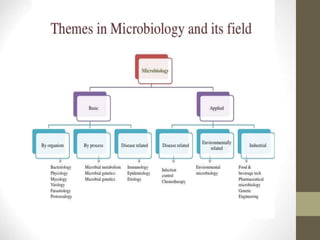
Microbial World
Dr Mazhar Qayyum
Department of Zoology
What is Microbiology?
• Micro - too small to be seen with the naked eye
• Bio - life
• ology - study of
• Clinical Bacteriology: Bacteria that can cause infection in
human beings
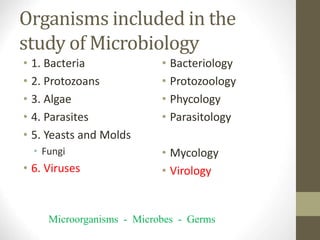
Organisms included in the
study of Microbiology
• 1. Bacteria
• 2. Protozoans
• 3. Algae
• 4. Parasites
• 5. Yeasts and Molds
• Fungi
• 6. Viruses
• Bacteriology
• Protozoology
• Phycology
• Parasitology
• Mycology
• Virology
Microorganisms - Microbes - Germs
5 Kingdoms of Living
Organisms
• 1. Animalia
• 2. Plantae
• 3. Fungi
• 4. Protista
• 5. Monera - Bacteria and Cyanobacteria
• Eukaryotic vs. Prokaryotic
5 Characteristics of Life
• 1. Cells
• 2. Maintain structure by taking up chemicals and energy from
the environment
• 3. Respond to stimuli in the external environment
• 4. Reproduce and pass on their organization to their offspring
• 5. Evolve and adapt to the environment
Taxonomic Classification
• Kingdom
• Phylum
• Class
• Order
• Family
• Genus
• species
• Man
• Animalia
• Chordata
• Mammalia
• Primate
• Hominidae
• Homo
• Homo sapien
Binomial System of Taxonomic
Classification
• Use only the Genus and species
• Homo sapien
• Felis domestica
• Escherichia coli
• Genus and species are either underlined or italicized
• Genus is always capitilized
• species is never capitilized
Classification System
• 3 Domains 1978 Carl Woese
• 1. Bacteria
• Unicellular prokaryotes with cell wall containing peptidoglycan
• 2. Archaea
• Unicellular prokaryotes with no peptodoglycan in cell wall
• 3. Eukarya
• Protista
• Fungi
• Plantae
• Animalia
Bacteria - what comes to mind?
• Diseases
• Infections
• Epidemics
• Food Spoilage
• Only 1% of all known bacteria cause human diseases
• About 4% of all known bacteria cause plant diseases
• 95% of known bacteria are non-pathogens
Microbes Benefit Humans
• 1.Bacteria are primary decomposers - recycle nutrients back
into the environment (sewage treatment plants)
• 2. Microbes produce various food products
• cheese, pickles, sauerkraut, green olives
• yogurt, soy sauce, vinegar, bread
• Beer, Wine, Alcohol
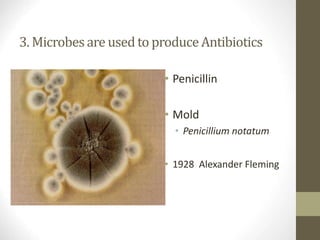
3. Microbesare usedto produceAntibiotics
• Penicillin
• Mold
• Penicillium notatum
• 1928 Alexander Fleming
4. Bacteria synthesize chemicals that our
body needs, but cannot synthesize
• Example: E. coli
• B vitamins - for metabolism
• Vitamin K - blood clotting
• Escherichia coli
• Dr. Escherich
• Colon (intestine)
5. Biochemistry and
Metabolism
• Very simple structure
• rapid rate of reproduction
• provides “instant” data
6. Microbial Antagonism
• Our normal microbial flora prevents potential pathogens from
gaining access to our body
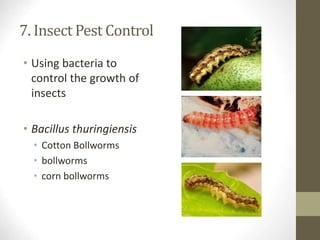
7. Insect Pest Control
• Using bacteria to
control the growth of
insects
• Bacillus thuringiensis
• Cotton Bollworms
• bollworms
• corn bollworms
8. Bioremediation
• Using microbes to clean up pollutants and toxic wastes
• Exxon Valdez - 1989
• 2 Genera
• Pseudomonas sp.
• Bacillus sp.
9. Recombinant DNA Technology
Gene Therapy
Genetic Engineering
• Bacteria can be manipulated to produce enzymes and proteins
they normally would not produce
• Insulin
• Human Growth Hormone
• Interferon
• Enzymes
10. Microbes form the basis of
the food chain
• Marine and fresh water microorganisms
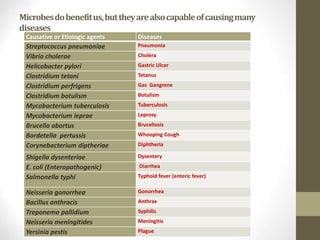
Microbesdobenefitus,buttheyarealsocapableofcausingmany
diseases
Causative or Etiologic agents Diseases
Streptococcus pneumoniae Pneumonia
Vibrio cholerae Cholera
Helicobacter pylori Gastric Ulcer
Clostridium tetani Tetanus
Clostridium perfrigens Gas Gangrene
Clostridium botulism Botulism
Mycobacterium tuberculosis Tuberculosis
Mycobacterium leprae Leprosy
Brucella abortus Brucellosis
Bordetella pertussis Whooping Cough
Corynebacterium diptheriae Diphtheria
Shigella dysenteriae Dysentery
E. coli (Enteropathogenic) Diarrhea
Salmonella typhi Typhoid fever (enteric fever)
Neisseria gonorrhea Gonorrhea
Bacillus anthracis Anthrax
Treponema pallidium Syphilis
Neisseria meningitides Meningitis
Yersinia pestis Plague
Spontaneous Generation
• Theory that life just “spontaneously” developed from non-
living matter
• Example:
• toads, snakes and mice - moist soil
• flies and maggots - manure and decaying flesh
Experiments to disprove
Spontaneous Generation
• Francesco Redi 1668
• Rudolph Virchow 1858
• Theory of Biogenesis
• Cells can only arise from preexisting cells
• Louis Pasteur 1861
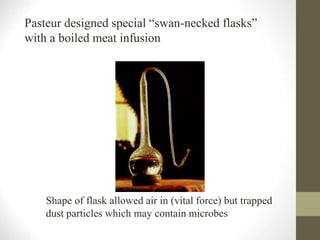
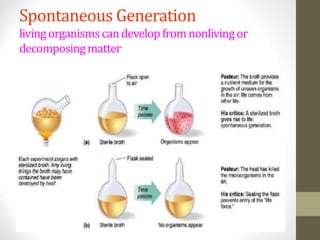
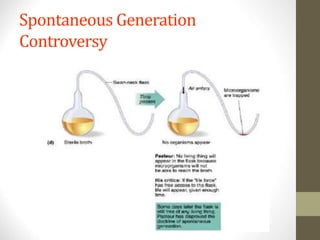
Pasteur designed special “swan-necked flasks”
with a boiled meat infusion
Shape of flask allowed air in (vital force) but trapped
dust particles which may contain microbes
Spontaneous Generation
livingorganismscandevelopfromnonlivingor
decomposingmatter
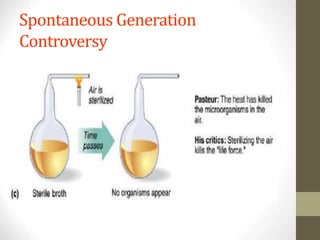
Spontaneous Generation
Controversy
Spontaneous Generation
Controversy
Final blow to theory
of spontaneous generation
• John Tyndall (1820-1893)
demonstrated that dust carries
microorganisms
showed that if dust was absent, nutrient
broths remained sterile, even if directly
exposed to air
also provided evidence for the existence of
 exceptionally heat-resistant forms of
bacteria
Germ Theory of Disease
• Hard for people to believe that diseases were caused by tiny
invisible “wee animalcules”
• Diseases, they thought, were caused by:
• demons
• witchcraft
• bad luck
• the wrath of God
• curses
• evil spirits
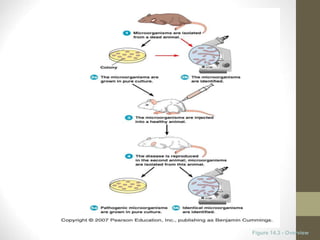
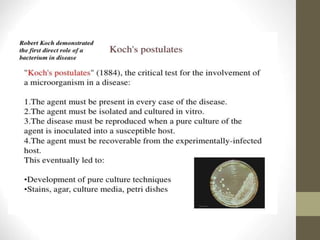
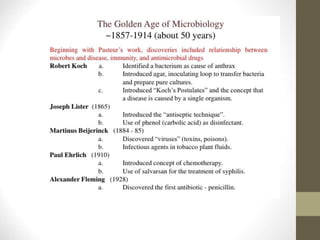
Robert Koch- 1st to prove that
bacteria actually caused diseases
• 1876
• Microbial Etiology of Infectious Disease
• etiology - the cause of a disease
• Established “scientific rules” to show a cause and effect
relationship between a microbe and a disease
• Koch’s Postulates
Figure 14.3 - Overview
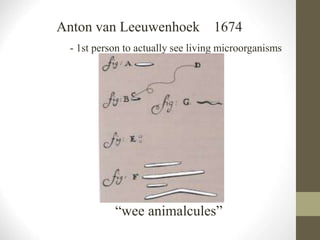
Anton van Leeuwenhoek 1674
- 1st person to actually see living microorganisms
“wee animalcules”
Exceptions to Koch’s Postulates
• Microorganisms that are unable to be cultured on artificial
media
• (example: Treponema pallidum)
• 2 or more organism work in synergy to cause a disease.
• Symptoms and diseases can be causes by any one of several
microbes.
Exceptions to Koch’s Postulates
• In exclusively human diseases, it is not morally acceptable to
inoculate a deadly pathogen into a “human guinea pig”
• HIV
Koch established the Microbial Etiology
of 3 important diseases of his day
• 1. Cholera (fecal-oral disease)
• Vibrio cholerae
• 2. Tuberculosis (pulmonary infection)
• Mycobacterium tuberculosis
• 3. Anthrax (sheep and cattle)
• Bacillus anthracis
The Development of Techniques for
Studying Microbial Pathogens
• Koch - 1st to use Agar to solidify culture media
• Koch’s work led to discovery or development of:
– agar
– petri dish
– nutrient broth and nutrient agar
– methods for isolating microorganisms
Introduction to Microbilogy (FMI))-1.ppt

Introduction to Microbilogy (FMI))-1.ppt

  • 1.
    Microbial World Dr MazharQayyum Department of Zoology
  • 2.
    What is Microbiology? •Micro - too small to be seen with the naked eye • Bio - life • ology - study of • Clinical Bacteriology: Bacteria that can cause infection in human beings
  • 3.
    Organisms included inthe study of Microbiology • 1. Bacteria • 2. Protozoans • 3. Algae • 4. Parasites • 5. Yeasts and Molds • Fungi • 6. Viruses • Bacteriology • Protozoology • Phycology • Parasitology • Mycology • Virology Microorganisms - Microbes - Germs
  • 4.
    5 Kingdoms ofLiving Organisms • 1. Animalia • 2. Plantae • 3. Fungi • 4. Protista • 5. Monera - Bacteria and Cyanobacteria • Eukaryotic vs. Prokaryotic
  • 5.
    5 Characteristics ofLife • 1. Cells • 2. Maintain structure by taking up chemicals and energy from the environment • 3. Respond to stimuli in the external environment • 4. Reproduce and pass on their organization to their offspring • 5. Evolve and adapt to the environment
  • 6.
    Taxonomic Classification • Kingdom •Phylum • Class • Order • Family • Genus • species • Man • Animalia • Chordata • Mammalia • Primate • Hominidae • Homo • Homo sapien
  • 7.
    Binomial System ofTaxonomic Classification • Use only the Genus and species • Homo sapien • Felis domestica • Escherichia coli • Genus and species are either underlined or italicized • Genus is always capitilized • species is never capitilized
  • 8.
    Classification System • 3Domains 1978 Carl Woese • 1. Bacteria • Unicellular prokaryotes with cell wall containing peptidoglycan • 2. Archaea • Unicellular prokaryotes with no peptodoglycan in cell wall • 3. Eukarya • Protista • Fungi • Plantae • Animalia
  • 9.
    Bacteria - whatcomes to mind? • Diseases • Infections • Epidemics • Food Spoilage • Only 1% of all known bacteria cause human diseases • About 4% of all known bacteria cause plant diseases • 95% of known bacteria are non-pathogens
  • 10.
    Microbes Benefit Humans •1.Bacteria are primary decomposers - recycle nutrients back into the environment (sewage treatment plants) • 2. Microbes produce various food products • cheese, pickles, sauerkraut, green olives • yogurt, soy sauce, vinegar, bread • Beer, Wine, Alcohol
  • 11.
    3. Microbesare usedtoproduceAntibiotics • Penicillin • Mold • Penicillium notatum • 1928 Alexander Fleming
  • 12.
    4. Bacteria synthesizechemicals that our body needs, but cannot synthesize • Example: E. coli • B vitamins - for metabolism • Vitamin K - blood clotting • Escherichia coli • Dr. Escherich • Colon (intestine)
  • 13.
    5. Biochemistry and Metabolism •Very simple structure • rapid rate of reproduction • provides “instant” data
  • 14.
    6. Microbial Antagonism •Our normal microbial flora prevents potential pathogens from gaining access to our body
  • 15.
    7. Insect PestControl • Using bacteria to control the growth of insects • Bacillus thuringiensis • Cotton Bollworms • bollworms • corn bollworms
  • 16.
    8. Bioremediation • Usingmicrobes to clean up pollutants and toxic wastes • Exxon Valdez - 1989 • 2 Genera • Pseudomonas sp. • Bacillus sp.
  • 17.
    9. Recombinant DNATechnology Gene Therapy Genetic Engineering • Bacteria can be manipulated to produce enzymes and proteins they normally would not produce • Insulin • Human Growth Hormone • Interferon • Enzymes
  • 18.
    10. Microbes formthe basis of the food chain • Marine and fresh water microorganisms
  • 19.
    Microbesdobenefitus,buttheyarealsocapableofcausingmany diseases Causative or Etiologicagents Diseases Streptococcus pneumoniae Pneumonia Vibrio cholerae Cholera Helicobacter pylori Gastric Ulcer Clostridium tetani Tetanus Clostridium perfrigens Gas Gangrene Clostridium botulism Botulism Mycobacterium tuberculosis Tuberculosis Mycobacterium leprae Leprosy Brucella abortus Brucellosis Bordetella pertussis Whooping Cough Corynebacterium diptheriae Diphtheria Shigella dysenteriae Dysentery E. coli (Enteropathogenic) Diarrhea Salmonella typhi Typhoid fever (enteric fever) Neisseria gonorrhea Gonorrhea Bacillus anthracis Anthrax Treponema pallidium Syphilis Neisseria meningitides Meningitis Yersinia pestis Plague
  • 20.
    Spontaneous Generation • Theorythat life just “spontaneously” developed from non- living matter • Example: • toads, snakes and mice - moist soil • flies and maggots - manure and decaying flesh
  • 21.
    Experiments to disprove SpontaneousGeneration • Francesco Redi 1668 • Rudolph Virchow 1858 • Theory of Biogenesis • Cells can only arise from preexisting cells • Louis Pasteur 1861
  • 22.
    Pasteur designed special“swan-necked flasks” with a boiled meat infusion Shape of flask allowed air in (vital force) but trapped dust particles which may contain microbes
  • 23.
  • 24.
  • 25.
  • 26.
    Final blow totheory of spontaneous generation • John Tyndall (1820-1893) demonstrated that dust carries microorganisms showed that if dust was absent, nutrient broths remained sterile, even if directly exposed to air also provided evidence for the existence of  exceptionally heat-resistant forms of bacteria
  • 27.
    Germ Theory ofDisease • Hard for people to believe that diseases were caused by tiny invisible “wee animalcules” • Diseases, they thought, were caused by: • demons • witchcraft • bad luck • the wrath of God • curses • evil spirits
  • 28.
    Robert Koch- 1stto prove that bacteria actually caused diseases • 1876 • Microbial Etiology of Infectious Disease • etiology - the cause of a disease • Established “scientific rules” to show a cause and effect relationship between a microbe and a disease • Koch’s Postulates
  • 29.
    Figure 14.3 -Overview
  • 31.
    Anton van Leeuwenhoek1674 - 1st person to actually see living microorganisms “wee animalcules”
  • 32.
    Exceptions to Koch’sPostulates • Microorganisms that are unable to be cultured on artificial media • (example: Treponema pallidum) • 2 or more organism work in synergy to cause a disease. • Symptoms and diseases can be causes by any one of several microbes.
  • 33.
    Exceptions to Koch’sPostulates • In exclusively human diseases, it is not morally acceptable to inoculate a deadly pathogen into a “human guinea pig” • HIV
  • 34.
    Koch established theMicrobial Etiology of 3 important diseases of his day • 1. Cholera (fecal-oral disease) • Vibrio cholerae • 2. Tuberculosis (pulmonary infection) • Mycobacterium tuberculosis • 3. Anthrax (sheep and cattle) • Bacillus anthracis
  • 35.
    The Development ofTechniques for Studying Microbial Pathogens • Koch - 1st to use Agar to solidify culture media • Koch’s work led to discovery or development of: – agar – petri dish – nutrient broth and nutrient agar – methods for isolating microorganisms