MEDICAL MICROBIOLOGY
History of microbiology
• Microbiology is the study of microorganisms /
microbes only visible with a microscope.
• The diverse group of organisms includes
algae, archae, bacteria, cyanobacteria, fungi,
protozoa, viruses.
• Most of the microorganisms are harmless,
about 99% of them are good. Eg: Cynobacteria
(blue green algae) 1% are bad. Eg: Pathogens .
DISCOVERY ERA:
• “Spontaneous generation” Aristotle (384-322) and
others believed that living organisms could develop
from non-living materials.
• In 13th century, Rogen Bacon described that the
disease caused by a minute “seed” or “germ”.
• Antony Van Leeuwenhoek (1632 – 1723) described
protozoa, basic types of bacteria, yeasts and algae.
He became father of Bacteriology and protozoology
“Animalcules” in 1676.  He invented the first
microscope (50 – 300x), and was the first to
accurately observe and describe microorganisms
• The term microbe was used by Sedillot in 1878.
TRANSITION ERA
• Francesco Redi (1626 - 1697) showed that
maggots would not arise from decaying
meat, when it is covered.
• Lazzaro Spallanzai (1729 – 1799)
demonstrated that air carried germs to the
culture medium.
• He showed that boiled broth would not give
rise to microscopicforms of life.
GOLDEN ERA
• Louis Pasteur became the father of Medical
Microbiology.
• Pasteur in 1897 suggested that mild heating at
62.8°C (145°F) for 30 minutes rather than
boiling was enough to destroy the undesirable
organisms without ruining the taste of the
product, the process was called Pasteurization.
• He invented the processes of pasteurization,
fermentation and the development of effective
vaccines ( rabies and anthrax).
• Pasteur demonstrated diseases of silkworm
was due to a protozoan parasite.
Contributions of Loius pasteur:
– He coined the term “microbiology”, aerobic,
anaerobic.
– He disproved the theory of spontaneous
germination.
– He demonstrated that anthrax was caused by
bacteria and
– He developed a live attenuated vaccine for
anthrax disease
• John Tyndall (1820 - 1893) discovered highly
resistant bacterial structure, later known as
endospore.
• Prolonged boiling or intermittent heating was
necessary to kill these spores, to make the
infusion completely sterilized, a process known
as Tyndallisation.
• Lord Joseph Lister (1827-1912) became the
father of antiseptic surgery.
• Lister concluded that wound infections too
were due to microorganisms.
• Lister also devised a method to destroy
microorganisms in the operation theatre by
spraying a fine mist of carbolic acid into the
air.
• Robert Koch (1893-1910) demonstrated the
role of bacteria in causing disease.
• He perfected the technique of isolating
bacteria in pure culture.
• Robert Koch used gelatin to prepare solid
media but it was not an ideal because :
(i) Since gelatin is a protein, it is digested
by many bacteria capable of producing
a proteolytic exo-enzyme gelatinase
that hydrolyses the protein to amino
acids.
(ii) It melts when the temperature rises
above 25°C.
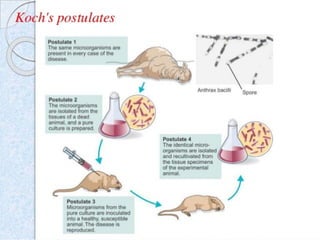
(iii)Koch's postulates
• Fanne Eilshemius Hesse (1850 - 1934) One of
Koch's assistant, first proposed the use of
agar in culture media. It was not attacked by
most bacteria.
• Agar is better than gelatin because of its
higher melting pointing (96°c) and solidifying
(40 – 45°c)points.
• Richard Petri (1887) developed the Petri dish
(plate), a container used for solid culture
media.
• Edward Jenner (1749-1823) First to prevent small
pox.
• He discovered the technique of vaccination.
• Alexander Flemming discovered the penicillin
from penicillium notatum that destroys several
pathogenic bacteria.
• Paul Erlich (1920) discovered the treatment of
syphilis by using arsenic
• He Studied toxins and antitoxins in quantitative
terms & laid foundation of biological
standardization.
IMPORTANT DISCOVERIES
• Bacteria: Hansen (1874) – Leprosy bacllus
• Neisser (1879) – Gonococcus
• Ogston (1881) – Staphylococcus
• Loeffler (1884) – Diphtheria bacillus
• Roux and Yersin – Diphtheria toxin& Viruses:
• Beijerinck (1898) - Coined the term Virus for
filterable infectious agents.
• Pasteur developed Rabies vaccine.
• GoodPasteur - Cultivation of viruses on chick
embryos.
• Charles Chamberland, one of Pasteur’s
associates constructed a porcelain bacterial
filter.
• Twort and d’Herelle - Bacteriophages.
Edward Jenner - Vaccination for Smallpox.
• 
MODERN ERA
• Nobel Laureates Years Nobel laureates
Contribution 1901 Von behring - Dipth antitox
• 1902 Ronald Ross - Malaria
• 1905 Robert koch -Tb
• 1908 Metchnikoff - Phagocytosis
• 1945 Flemming - Penicillin
• 1962 Watson Crick - Structur DNA
• 1968 Holley,Khorana - Genetic code
• 1997 Pruisner Prions ,Brenner, Hervitz -Genetic
regulation of organ development &cell death
Scope of microbiology
• The importance of microbiology and
microorganisms can not be overemphasized. –
• Microorganisms are necessary for the
production of bread, cheese, beer, antibiotics,
vaccines, vitamins, enzymes, etc. –
• Modern biotechnology rests upon a
microbiological foundation.
• Microorganisms are everywhere; almost every
natural surface is colonized by microbes, from
body to ocean.
• Some microorganisms can live hot springs,
and others in frozen sea ice. –
• Most microorganisms are harmless to
humans; You swallow millions of microbes
every day with no ill effects.
• In fact, we are dependent on microbes to help
us digest our food.
• Microbes also keep the biosphere running by
carrying out essential functions such as
decomposition of dead animals and plants.
• They make possible the cycles of carbon,
oxygen, nitrogen and sulfur that take place in
terrestrial and aquatic systems. –
• Microorganisms have also harmed humans
and disrupted society over the millennia.
• They sometimes cause diseases in man, animals
and plants.
• They are involved in food spoilage. - Infectious
diseases have played major roles in shaping
human history (decline of Roman Empire &
conquest of the New World. –
• The Great Plague reduced population of
western Europe by 25%.
• Many microbiologists are primarily interested in
the biology of microorganisms, while others focus
on specific groups;
• Microbiology has an impact on medicine,
agriculture, food science, ecology, genetics,
biochemistry, immunology, and many other fields.
–Virologists - viruses
–Bacteriologists - bacteria
–Phycologists – algae
–Mycologist -fungi
• Protozoologists – protozoa
• Medical Microbiology: deals with diseases of
humans and animals; identify and plan
measures to eliminate agents causing
infectious diseases.
• Immunology: study of the immune system
that protects the body from pathogens. -
Agricultural Microbiology: impact of
microorganisms on agriculture; combat plant
diseases that attack important food crops.
• Food and Dairy Microbiology:
–prevent microbial spoilage of food &
transmission of food-borne diseases (e.g.
salmonellosis);
– use microorganisms to make food such as
cheeses, yogurts, pickles, beer, etc.
• Industrial Microbiology:
–using microorganisms to make products
such as antibiotics, vaccines, steroids,
alcohols & other solvents, vitamins, amino
acids, enzymes, etc.
• Genetic Engineering:
• Engineered microorganisms used to make
hormones, antibiotics, vaccines and other
products. –
• Since viruses are acellular and possess both
living and nonliving characteristics, they are
considered neither prokaryotic nor
eukaryotic.
Composition of the Microbial World :
• Procaryotes: relative simple morphology and
lack true membrane delimited nucleus –
• Eucaryotes: morphologically complex with a
true membrane enclosed nucleus
• Organisms divided into 5 Kingdoms:
–Monera – all procaryotes
–Plantae – multicellular
–Animalia - multicellular
–Protista – unicellular or colonial eucaryotic
cells lacking true tissues; includes algae,
protozoa & simpler fungi
–Fungi – eucaryoutic; includes molds, yeasts
and mushrooms
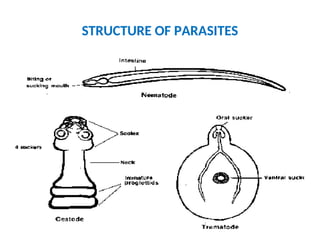
STRUCTURE OF PARASITES
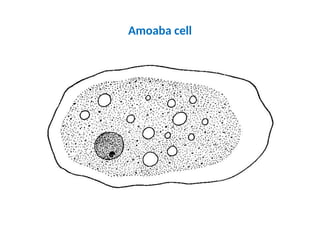
Amoaba cell
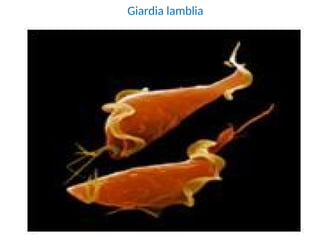
Giardia lamblia
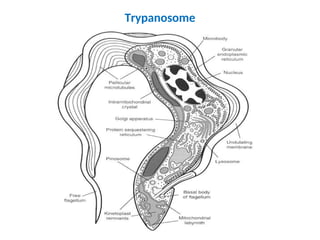
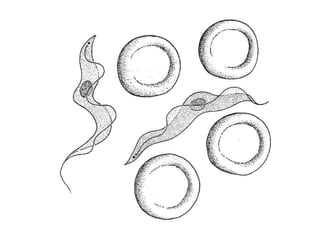
Trypanosome
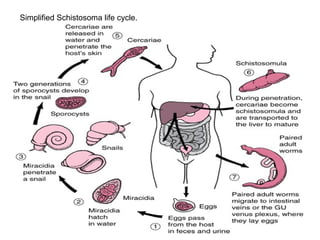
Simplified Schistosoma life cycle.
Nomenclature & Taxonomy
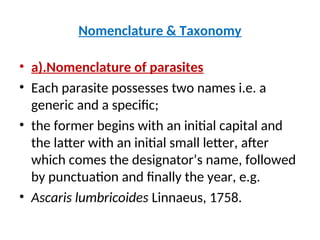
• a).Nomenclature of parasites
• Each parasite possesses two names i.e. a
generic and a specific;
• the former begins with an initial capital and
the latter with an initial small letter, after
which comes the designator’s name, followed
by punctuation and finally the year, e.g.
• Ascaris lumbricoides Linnaeus, 1758.
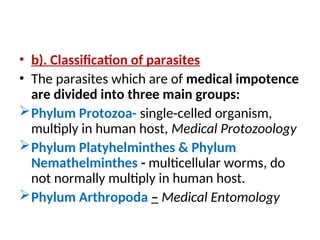
• b). Classification of parasites
• The parasites which are of medical impotence
are divided into three main groups:
Phylum Protozoa- single-celled organism,
multiply in human host, Medical Protozoology
Phylum Platyhelminthes & Phylum
Nemathelminthes - multicellular worms, do
not normally multiply in human host.
Phylum Arthropoda – Medical Entomology
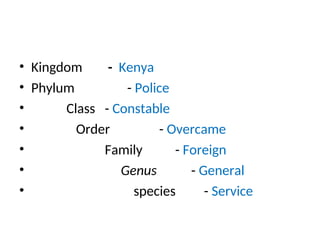
• Kingdom - Kenya
• Phylum - Police
• Class - Constable
• Order - Overcame
• Family - Foreign
• Genus - General
• species - Service
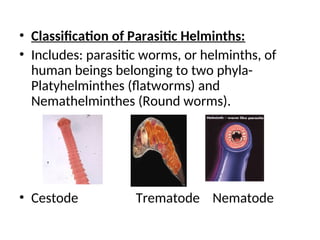
• Classification of Parasitic Helminths:
• Includes: parasitic worms, or helminths, of
human beings belonging to two phyla-
Platyhelminthes (flatworms) and
Nemathelminthes (Round worms).
• Cestode Trematode Nematode
Characteristics of Helminthes
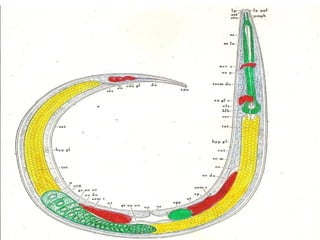
• Nematodes
–Adult and larval roundworms are bisexual,
cylindrical worms.
–They inhabit intestinal and extra-intestinal
sites.
• Cestodes
–Adult tapeworms are elongated, segmented,
hermaphroditic flatworms that inhabit the
intestinal lumen.
–Larval forms, which are cystic or solid, inhabit
extra-intestinal tissues.
• Flukes (Trematodes)
–Adult flukes are leaf-shaped flatworms.
–Prominent oral and ventral suckers help
maintain position in situ.
–Flukes are hermaphroditic except for blood
flukes, which are bisexual.
–The life-cycle includes a snail intermediate
host.
Significance of Parasitology - 1
• Parasitology is the branch of Science which
mainly deals about all the Parasites and
infectious diseases they transmit.
• Intestinal worms, or soil-transmitted
helminths (STH), are the most common
neglected tropical diseases (NTDs) worldwide
(WHO,2014).
Significance of Parasitology - 2
• The World Health Organization (WHO,2014)
estimates that over 1.5 billion people are
infected with one or more STHs.
• Globally, there are 700 million people infected
with hookworm (including 44 million pregnant
women), 807 million people infected with
ascariasis, and 604 million people infected with
trichuriasis.
• Transmission mainly occurs in tropical climates
where sanitation and hygiene normally are poor.
Significance of Parasitology - 3
• Though the standard method of diagnosing STH
infection is by identifying the parasite eggs in
feces under a microscope, the WHO
recommends periodic deworming of all at-risk
individuals.
• At-risk individuals include pre-school children;
school-age children; women of childbearing age
including pregnant women in their second and
third trimesters, and breastfeeding women; and
adults in certain high-risk occupations.
Significance of Parasitology - 4
• Whole Parasitology covers mainly Parasites,
Host and its association between them.
• In order to have a very clear-cut knowledge
about Introduction and Classification of
Parasites some important terms should be
clear and those are:
Terms for association of Parasites:
• Host - an organism which harbors the
parasite.
• Commensalisms
• Symbiosis
• Parasitism
• Etc
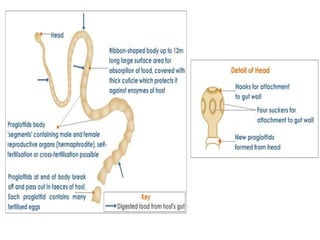
• Terms used in the Cestode
• Strobila: body and trunk of the adult worm
• Scolex: commonly called head that carries the
organs of attachment or suckers
• Neck: the region of growth behind the head
• Proglottid: an individual segment comprising the
complete unit of a tapeworm.
• Cysticercus: it is the resting stage of the larva in
the intermediate host where it develops into a
bladder-worm. Itconsists f a hollow vesicle with
the invaginated scolex on its wall and a central
cavity containing a little fluid.
• Hydatid cyst: the larval stage of the genus
Echinococcus
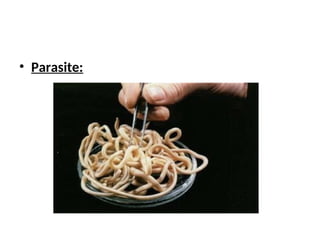
• Parasite:
• A living organism which receives nourishment
and shelter from another organism where it
lives is called parasites.
• does not necessarily cause disease.
• parasitism is living in association with the
host.
• derives all benefits from the association and
the host may either not be harmed or may
suffer the consequences of this association, a
parasite disease.
• an organism that is entirely dependent on
another organism, referred to as its host, for
all or part of its life cycle and metabolic
requirements.
• Classes of parasites
• Parasite are mainly classified into following
two catagories; along with some other types
of Parasites;
Ecto-parasite (ectozoa): lives outside on the
surface of the body of the host.
• Endo-parasite (entozoa): lives inside the body
of the host: in the blood, tissues, body
cavities, digestive tract and other organs.
• Temporary parasite: visits its host for a short
period.
• Permanent parasite: leads a parasitic life
throughout the whole period of its life.
• Facultative parasite: lives a parasitic life when
opportunity arises.
• Obligatory parasite: cannot exist without the
parasitic life.
• Occasional or accidental parasite: attacks an
unusual host.
• Wandering or aberrant parasite: happens to
reach a place where it cannot live.
Classes of host:
• Definitive host: - either harbors the adult
stage of the parasite or where the parasite
utilizes the sexual method of reproduction.
In the majority of human parasitic infections,
man is the definitive host; in malaria and
hydatid disease, however, man acts as the
intermediate host.
• Intermediate host: - harbours the larval or
asexual stages of the parasite.
• Paratenic host (a carrier or transport host):
• a host where the parasite remains viable
without further development.
• Protozoa
• A) Sacromastigophora
• 1) Mastigophora
• All are tissue flagellates.
• Include the intestinal and genitourinary flagellates and
the blood and tissue flagellates.
• The intestinal and genitourinary flagellates are Giardia,
Trichomonas, Dientamoeba, Chilomastik, etc.
• The blood and tissue flagellates are Trypanosoma,
Leishmania, etc.
• They reproduce asexually by binary fission.
• 2) Sarcodina
• Typically amoeboid and include: Entamoeba,
Endolimax, Iodamoeba, Naegleria,
Acanthamoeba, etc.
• Amoebae consist of a shapeless mass of moving
cytoplasm .
• They move by pushing out the ectoplasm to form
pseudopodia (false feet).
• Amoebae reproduce asexually by simply dividing
into two (binary fission)
• B) Apicomplexa
• Sporozoa:
The members undergo complex life cycle with
alternating sexual and asexual reproductive
phases involving two different hosts.
• i)Coccidia - are intacellular parasites that
reproduce asexually by a process called
schizogony (merogony) and sexually by
sporogony.
- Class Coccidia includes Isospora and
Toxoplasma
• ii)Haematozoa – the class includes the malarial
parasites-Plasmodium species.
• C) Ciliophora - Microspora
• These are the complex protozoa bearing cilia
(short hairs) distributed in rows or patches by
which they move.
• They have two kinds of nuclei (macronucleus
and micronucleus) and a large contractile
vacoule.
• Balantidium coli, a giant intestinal ciliate of
humans and pigs, is the only human parasite
Morphology & Habitat of parasites of man-1
• 1)Cestodes:
• These are tape-like, segmented and
hermaphrodite organism.
• They have suckers in their head and in some
species also hooks that attach he tapewor to its
host.. It consists of a head (scolex) and many
proglottids.
• Alimentary canal and body cavity are absent.
Examples are Diphyllobothrium, Taenia,
Echinococcus, Hymenolepsis, etc.
Morphology & Habitat of parasites of man-2
• 2)Trematodes:
• They are leaf-like unsegmented organism. Sexes
are not separate except Schistosomes which are
diecious. They don’t have hooks and suckers in
their head.
• Alimentary canal is present but is not complete
(anus absent).
• The body cavity is absent.
• Examples are Schistosoma, Gastrodiscoides,
Fasciolopsis, Fasciola, Clonorchis, Heterophyes,
etc.
Morphology & Habitat of parasites of man-3
• 3) Nematodes:
• Have elongated, cylindrical and unsegmented
bodies.
• Sexes are separate (diecious). They also lack
hooks and suckers.
• They possess complete alimentary canal and
body cavity. Examples are:
• 1. Intestinal
• i. In small intestine: Ascaris lumbricoides,
Ancyclostoma duodenale (old world hook worm),
Necator americanus (American hookworm).
Morphology & Habitat of parasites of man-4
• ii. In caecum and vermiform appendix:
Enterobius vermicularis (Threadworm or pin
worm), Trichuris trichuria (Whipworm).
• 2. Somatic (inside the tissues and organs)
• i. Lymphatic system: Wuchereria bancrofti,
Brugia malayi
• ii. Subcutaneous tissue: Onchocerca volvulus,
Dracunculus medinensis
• iii. Lungs: Strongyloides stercoralis
• iv. Conjunctiva: Loa loa
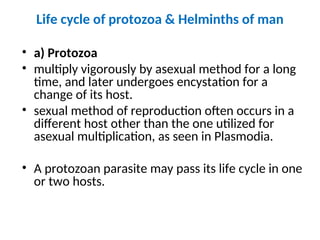
Life cycle of protozoa & Helminths of man
• a) Protozoa
• multiply vigorously by asexual method for a long
time, and later undergoes encystation for a
change of its host.
• sexual method of reproduction often occurs in a
different host other than the one utilized for
asexual multiplication, as seen in Plasmodia.
• A protozoan parasite may pass its life cycle in one
or two hosts.
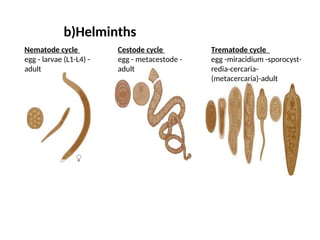
b)Helminths
Nematode cycle
egg - larvae (L1-L4) -
adult
Cestode cycle
egg - metacestode -
adult
Trematode cycle
egg -miracidium -sporocyst-
redia-cercaria-
(metacercaria)-adult
• References:
• Medical microbiology; Kaushal Mishra (2009)
• Classification of Human Parasites, Vectors, and Similar
Organisms. Clinical Infectious Diseases 16:614-615.) by
Lynne S. Garcia (1993).
• Genova Diagnostics; Innovative Testing for Optimal
Health (2008)
• Garcia LS, Bruckner DA. Taxonomy and classification of
human parasites. In: Murray PR, Baron EJ, Pfaller MA,
Tenover FC, Yolken RH, eds. Manual of
• Clinical Microbiology. 7th ed. Washington DC: ASM
Press; 1999; 1330.
• Ending Neglected Tropical Diseases: The End Fund; EIN
number 27-394-1186) © Copyright 2014
• World Health Organization: Weekly
epidemiological record, No. 13, 2014; 89: 133–
140 http://www.who.int/intestinal_worms/en/
• Global Atlas of Helminth Infections:
http://www.thiswormyworld.org
• Copyright © 2010-2014 Merck Sharp &
Dohme Corp., a subsidiary of Merck & Co., Inc.,
Whitehouse Station, N.J., U.S.A.

PARASITOLOGY OVERVIEW.ppt microbio overview

  • 1.
  • 2.
    History of microbiology •Microbiology is the study of microorganisms / microbes only visible with a microscope. • The diverse group of organisms includes algae, archae, bacteria, cyanobacteria, fungi, protozoa, viruses. • Most of the microorganisms are harmless, about 99% of them are good. Eg: Cynobacteria (blue green algae) 1% are bad. Eg: Pathogens .
  • 3.
    DISCOVERY ERA: • “Spontaneousgeneration” Aristotle (384-322) and others believed that living organisms could develop from non-living materials. • In 13th century, Rogen Bacon described that the disease caused by a minute “seed” or “germ”. • Antony Van Leeuwenhoek (1632 – 1723) described protozoa, basic types of bacteria, yeasts and algae. He became father of Bacteriology and protozoology “Animalcules” in 1676.  He invented the first microscope (50 – 300x), and was the first to accurately observe and describe microorganisms • The term microbe was used by Sedillot in 1878.
  • 4.
    TRANSITION ERA • FrancescoRedi (1626 - 1697) showed that maggots would not arise from decaying meat, when it is covered. • Lazzaro Spallanzai (1729 – 1799) demonstrated that air carried germs to the culture medium. • He showed that boiled broth would not give rise to microscopicforms of life.
  • 5.
    GOLDEN ERA • LouisPasteur became the father of Medical Microbiology. • Pasteur in 1897 suggested that mild heating at 62.8°C (145°F) for 30 minutes rather than boiling was enough to destroy the undesirable organisms without ruining the taste of the product, the process was called Pasteurization. • He invented the processes of pasteurization, fermentation and the development of effective vaccines ( rabies and anthrax).
  • 6.
    • Pasteur demonstrateddiseases of silkworm was due to a protozoan parasite. Contributions of Loius pasteur: – He coined the term “microbiology”, aerobic, anaerobic. – He disproved the theory of spontaneous germination. – He demonstrated that anthrax was caused by bacteria and – He developed a live attenuated vaccine for anthrax disease
  • 7.
    • John Tyndall(1820 - 1893) discovered highly resistant bacterial structure, later known as endospore. • Prolonged boiling or intermittent heating was necessary to kill these spores, to make the infusion completely sterilized, a process known as Tyndallisation. • Lord Joseph Lister (1827-1912) became the father of antiseptic surgery. • Lister concluded that wound infections too were due to microorganisms.
  • 8.
    • Lister alsodevised a method to destroy microorganisms in the operation theatre by spraying a fine mist of carbolic acid into the air. • Robert Koch (1893-1910) demonstrated the role of bacteria in causing disease. • He perfected the technique of isolating bacteria in pure culture.
  • 9.
    • Robert Kochused gelatin to prepare solid media but it was not an ideal because : (i) Since gelatin is a protein, it is digested by many bacteria capable of producing a proteolytic exo-enzyme gelatinase that hydrolyses the protein to amino acids. (ii) It melts when the temperature rises above 25°C. (iii)Koch's postulates
  • 11.
    • Fanne EilshemiusHesse (1850 - 1934) One of Koch's assistant, first proposed the use of agar in culture media. It was not attacked by most bacteria. • Agar is better than gelatin because of its higher melting pointing (96°c) and solidifying (40 – 45°c)points. • Richard Petri (1887) developed the Petri dish (plate), a container used for solid culture media.
  • 12.
    • Edward Jenner(1749-1823) First to prevent small pox. • He discovered the technique of vaccination. • Alexander Flemming discovered the penicillin from penicillium notatum that destroys several pathogenic bacteria. • Paul Erlich (1920) discovered the treatment of syphilis by using arsenic • He Studied toxins and antitoxins in quantitative terms & laid foundation of biological standardization.
  • 13.
    IMPORTANT DISCOVERIES • Bacteria:Hansen (1874) – Leprosy bacllus • Neisser (1879) – Gonococcus • Ogston (1881) – Staphylococcus • Loeffler (1884) – Diphtheria bacillus • Roux and Yersin – Diphtheria toxin& Viruses: • Beijerinck (1898) - Coined the term Virus for filterable infectious agents. • Pasteur developed Rabies vaccine. • GoodPasteur - Cultivation of viruses on chick embryos.
  • 14.
    • Charles Chamberland,one of Pasteur’s associates constructed a porcelain bacterial filter. • Twort and d’Herelle - Bacteriophages. Edward Jenner - Vaccination for Smallpox. • 
  • 15.
    MODERN ERA • NobelLaureates Years Nobel laureates Contribution 1901 Von behring - Dipth antitox • 1902 Ronald Ross - Malaria • 1905 Robert koch -Tb • 1908 Metchnikoff - Phagocytosis • 1945 Flemming - Penicillin • 1962 Watson Crick - Structur DNA • 1968 Holley,Khorana - Genetic code • 1997 Pruisner Prions ,Brenner, Hervitz -Genetic regulation of organ development &cell death
  • 16.
    Scope of microbiology •The importance of microbiology and microorganisms can not be overemphasized. – • Microorganisms are necessary for the production of bread, cheese, beer, antibiotics, vaccines, vitamins, enzymes, etc. – • Modern biotechnology rests upon a microbiological foundation.
  • 17.
    • Microorganisms areeverywhere; almost every natural surface is colonized by microbes, from body to ocean. • Some microorganisms can live hot springs, and others in frozen sea ice. – • Most microorganisms are harmless to humans; You swallow millions of microbes every day with no ill effects. • In fact, we are dependent on microbes to help us digest our food.
  • 18.
    • Microbes alsokeep the biosphere running by carrying out essential functions such as decomposition of dead animals and plants. • They make possible the cycles of carbon, oxygen, nitrogen and sulfur that take place in terrestrial and aquatic systems. – • Microorganisms have also harmed humans and disrupted society over the millennia.
  • 19.
    • They sometimescause diseases in man, animals and plants. • They are involved in food spoilage. - Infectious diseases have played major roles in shaping human history (decline of Roman Empire & conquest of the New World. – • The Great Plague reduced population of western Europe by 25%.
  • 20.
    • Many microbiologistsare primarily interested in the biology of microorganisms, while others focus on specific groups; • Microbiology has an impact on medicine, agriculture, food science, ecology, genetics, biochemistry, immunology, and many other fields. –Virologists - viruses –Bacteriologists - bacteria –Phycologists – algae –Mycologist -fungi
  • 21.
    • Protozoologists –protozoa • Medical Microbiology: deals with diseases of humans and animals; identify and plan measures to eliminate agents causing infectious diseases. • Immunology: study of the immune system that protects the body from pathogens. - Agricultural Microbiology: impact of microorganisms on agriculture; combat plant diseases that attack important food crops.
  • 22.
    • Food andDairy Microbiology: –prevent microbial spoilage of food & transmission of food-borne diseases (e.g. salmonellosis); – use microorganisms to make food such as cheeses, yogurts, pickles, beer, etc. • Industrial Microbiology: –using microorganisms to make products such as antibiotics, vaccines, steroids, alcohols & other solvents, vitamins, amino acids, enzymes, etc.
  • 23.
    • Genetic Engineering: •Engineered microorganisms used to make hormones, antibiotics, vaccines and other products. – • Since viruses are acellular and possess both living and nonliving characteristics, they are considered neither prokaryotic nor eukaryotic.
  • 24.
    Composition of theMicrobial World : • Procaryotes: relative simple morphology and lack true membrane delimited nucleus – • Eucaryotes: morphologically complex with a true membrane enclosed nucleus • Organisms divided into 5 Kingdoms: –Monera – all procaryotes –Plantae – multicellular –Animalia - multicellular
  • 25.
    –Protista – unicellularor colonial eucaryotic cells lacking true tissues; includes algae, protozoa & simpler fungi –Fungi – eucaryoutic; includes molds, yeasts and mushrooms
  • 28.
  • 30.
  • 31.
  • 32.
  • 35.
  • 36.
    Nomenclature & Taxonomy •a).Nomenclature of parasites • Each parasite possesses two names i.e. a generic and a specific; • the former begins with an initial capital and the latter with an initial small letter, after which comes the designator’s name, followed by punctuation and finally the year, e.g. • Ascaris lumbricoides Linnaeus, 1758.
  • 37.
    • b). Classificationof parasites • The parasites which are of medical impotence are divided into three main groups: Phylum Protozoa- single-celled organism, multiply in human host, Medical Protozoology Phylum Platyhelminthes & Phylum Nemathelminthes - multicellular worms, do not normally multiply in human host. Phylum Arthropoda – Medical Entomology
  • 38.
    • Kingdom -Kenya • Phylum - Police • Class - Constable • Order - Overcame • Family - Foreign • Genus - General • species - Service
  • 39.
    • Classification ofParasitic Helminths: • Includes: parasitic worms, or helminths, of human beings belonging to two phyla- Platyhelminthes (flatworms) and Nemathelminthes (Round worms). • Cestode Trematode Nematode
  • 40.
    Characteristics of Helminthes •Nematodes –Adult and larval roundworms are bisexual, cylindrical worms. –They inhabit intestinal and extra-intestinal sites. • Cestodes –Adult tapeworms are elongated, segmented, hermaphroditic flatworms that inhabit the intestinal lumen. –Larval forms, which are cystic or solid, inhabit extra-intestinal tissues.
  • 41.
    • Flukes (Trematodes) –Adultflukes are leaf-shaped flatworms. –Prominent oral and ventral suckers help maintain position in situ. –Flukes are hermaphroditic except for blood flukes, which are bisexual. –The life-cycle includes a snail intermediate host.
  • 42.
    Significance of Parasitology- 1 • Parasitology is the branch of Science which mainly deals about all the Parasites and infectious diseases they transmit. • Intestinal worms, or soil-transmitted helminths (STH), are the most common neglected tropical diseases (NTDs) worldwide (WHO,2014).
  • 43.
    Significance of Parasitology- 2 • The World Health Organization (WHO,2014) estimates that over 1.5 billion people are infected with one or more STHs. • Globally, there are 700 million people infected with hookworm (including 44 million pregnant women), 807 million people infected with ascariasis, and 604 million people infected with trichuriasis. • Transmission mainly occurs in tropical climates where sanitation and hygiene normally are poor.
  • 44.
    Significance of Parasitology- 3 • Though the standard method of diagnosing STH infection is by identifying the parasite eggs in feces under a microscope, the WHO recommends periodic deworming of all at-risk individuals. • At-risk individuals include pre-school children; school-age children; women of childbearing age including pregnant women in their second and third trimesters, and breastfeeding women; and adults in certain high-risk occupations.
  • 45.
    Significance of Parasitology- 4 • Whole Parasitology covers mainly Parasites, Host and its association between them. • In order to have a very clear-cut knowledge about Introduction and Classification of Parasites some important terms should be clear and those are:
  • 46.
    Terms for associationof Parasites: • Host - an organism which harbors the parasite. • Commensalisms • Symbiosis • Parasitism • Etc
  • 47.
    • Terms usedin the Cestode • Strobila: body and trunk of the adult worm • Scolex: commonly called head that carries the organs of attachment or suckers • Neck: the region of growth behind the head • Proglottid: an individual segment comprising the complete unit of a tapeworm. • Cysticercus: it is the resting stage of the larva in the intermediate host where it develops into a bladder-worm. Itconsists f a hollow vesicle with the invaginated scolex on its wall and a central cavity containing a little fluid. • Hydatid cyst: the larval stage of the genus Echinococcus
  • 48.
  • 49.
    • A livingorganism which receives nourishment and shelter from another organism where it lives is called parasites. • does not necessarily cause disease. • parasitism is living in association with the host. • derives all benefits from the association and the host may either not be harmed or may suffer the consequences of this association, a parasite disease. • an organism that is entirely dependent on another organism, referred to as its host, for all or part of its life cycle and metabolic requirements.
  • 50.
    • Classes ofparasites • Parasite are mainly classified into following two catagories; along with some other types of Parasites; Ecto-parasite (ectozoa): lives outside on the surface of the body of the host. • Endo-parasite (entozoa): lives inside the body of the host: in the blood, tissues, body cavities, digestive tract and other organs. • Temporary parasite: visits its host for a short period. • Permanent parasite: leads a parasitic life throughout the whole period of its life.
  • 51.
    • Facultative parasite:lives a parasitic life when opportunity arises. • Obligatory parasite: cannot exist without the parasitic life. • Occasional or accidental parasite: attacks an unusual host. • Wandering or aberrant parasite: happens to reach a place where it cannot live.
  • 52.
    Classes of host: •Definitive host: - either harbors the adult stage of the parasite or where the parasite utilizes the sexual method of reproduction. In the majority of human parasitic infections, man is the definitive host; in malaria and hydatid disease, however, man acts as the intermediate host. • Intermediate host: - harbours the larval or asexual stages of the parasite. • Paratenic host (a carrier or transport host): • a host where the parasite remains viable without further development.
  • 53.
    • Protozoa • A)Sacromastigophora • 1) Mastigophora • All are tissue flagellates. • Include the intestinal and genitourinary flagellates and the blood and tissue flagellates. • The intestinal and genitourinary flagellates are Giardia, Trichomonas, Dientamoeba, Chilomastik, etc. • The blood and tissue flagellates are Trypanosoma, Leishmania, etc. • They reproduce asexually by binary fission.
  • 54.
    • 2) Sarcodina •Typically amoeboid and include: Entamoeba, Endolimax, Iodamoeba, Naegleria, Acanthamoeba, etc. • Amoebae consist of a shapeless mass of moving cytoplasm . • They move by pushing out the ectoplasm to form pseudopodia (false feet). • Amoebae reproduce asexually by simply dividing into two (binary fission)
  • 55.
    • B) Apicomplexa •Sporozoa: The members undergo complex life cycle with alternating sexual and asexual reproductive phases involving two different hosts. • i)Coccidia - are intacellular parasites that reproduce asexually by a process called schizogony (merogony) and sexually by sporogony. - Class Coccidia includes Isospora and Toxoplasma • ii)Haematozoa – the class includes the malarial parasites-Plasmodium species.
  • 56.
    • C) Ciliophora- Microspora • These are the complex protozoa bearing cilia (short hairs) distributed in rows or patches by which they move. • They have two kinds of nuclei (macronucleus and micronucleus) and a large contractile vacoule. • Balantidium coli, a giant intestinal ciliate of humans and pigs, is the only human parasite
  • 57.
    Morphology & Habitatof parasites of man-1 • 1)Cestodes: • These are tape-like, segmented and hermaphrodite organism. • They have suckers in their head and in some species also hooks that attach he tapewor to its host.. It consists of a head (scolex) and many proglottids. • Alimentary canal and body cavity are absent. Examples are Diphyllobothrium, Taenia, Echinococcus, Hymenolepsis, etc.
  • 58.
    Morphology & Habitatof parasites of man-2 • 2)Trematodes: • They are leaf-like unsegmented organism. Sexes are not separate except Schistosomes which are diecious. They don’t have hooks and suckers in their head. • Alimentary canal is present but is not complete (anus absent). • The body cavity is absent. • Examples are Schistosoma, Gastrodiscoides, Fasciolopsis, Fasciola, Clonorchis, Heterophyes, etc.
  • 59.
    Morphology & Habitatof parasites of man-3 • 3) Nematodes: • Have elongated, cylindrical and unsegmented bodies. • Sexes are separate (diecious). They also lack hooks and suckers. • They possess complete alimentary canal and body cavity. Examples are: • 1. Intestinal • i. In small intestine: Ascaris lumbricoides, Ancyclostoma duodenale (old world hook worm), Necator americanus (American hookworm).
  • 60.
    Morphology & Habitatof parasites of man-4 • ii. In caecum and vermiform appendix: Enterobius vermicularis (Threadworm or pin worm), Trichuris trichuria (Whipworm). • 2. Somatic (inside the tissues and organs) • i. Lymphatic system: Wuchereria bancrofti, Brugia malayi • ii. Subcutaneous tissue: Onchocerca volvulus, Dracunculus medinensis • iii. Lungs: Strongyloides stercoralis • iv. Conjunctiva: Loa loa
  • 61.
    Life cycle ofprotozoa & Helminths of man • a) Protozoa • multiply vigorously by asexual method for a long time, and later undergoes encystation for a change of its host. • sexual method of reproduction often occurs in a different host other than the one utilized for asexual multiplication, as seen in Plasmodia. • A protozoan parasite may pass its life cycle in one or two hosts.
  • 62.
    b)Helminths Nematode cycle egg -larvae (L1-L4) - adult Cestode cycle egg - metacestode - adult Trematode cycle egg -miracidium -sporocyst- redia-cercaria- (metacercaria)-adult
  • 63.
    • References: • Medicalmicrobiology; Kaushal Mishra (2009) • Classification of Human Parasites, Vectors, and Similar Organisms. Clinical Infectious Diseases 16:614-615.) by Lynne S. Garcia (1993). • Genova Diagnostics; Innovative Testing for Optimal Health (2008) • Garcia LS, Bruckner DA. Taxonomy and classification of human parasites. In: Murray PR, Baron EJ, Pfaller MA, Tenover FC, Yolken RH, eds. Manual of • Clinical Microbiology. 7th ed. Washington DC: ASM Press; 1999; 1330. • Ending Neglected Tropical Diseases: The End Fund; EIN number 27-394-1186) © Copyright 2014
  • 64.
    • World HealthOrganization: Weekly epidemiological record, No. 13, 2014; 89: 133– 140 http://www.who.int/intestinal_worms/en/ • Global Atlas of Helminth Infections: http://www.thiswormyworld.org • Copyright © 2010-2014 Merck Sharp & Dohme Corp., a subsidiary of Merck & Co., Inc., Whitehouse Station, N.J., U.S.A.