Chapter 1
The Value Chain
E-Business
• E-Business is the term used to describe the
information systems and applications that support and
drive business processes, most often using web
technologies.
• e-Business allows companies to link their internal and
external processes more efficiently and effectively
• Work more closely with suppliers and partners to
better satisfy the needs and expectations of their
customers
• Leading to improvements in overall business
performance.
E-Commerce
• The buying and selling of products and services by
businesses and consumers through an
electronic medium, without using any
paper documents.
• E-commerce is widely considered the buying and
selling of products over the internet, but
any transaction that is completed solely through
electronic measures can be considered ecommerce.
Difference between E-Business and ECommerce
• E-commerce is focused on the core processes of
marketing, sales, fulfillment and after market. A
web shop is best thought of as a set of functions
that covers the sales process.
• E-business entails much more than just ecommerce, e-business can provide a wide range
of benefits to your company reaching well beyond
the core e-commerce processes.

4
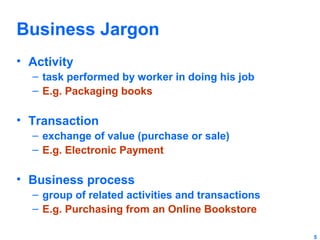
Business Jargon
• Activity
– task performed by worker in doing his job
– E.g. Packaging books

• Transaction
– exchange of value (purchase or sale)
– E.g. Electronic Payment

• Business process
– group of related activities and transactions
– E.g. Purchasing from an Online Bookstore
5
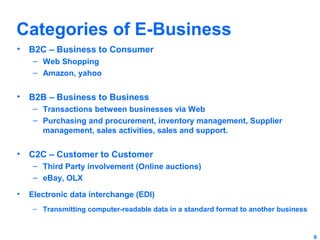
Categories of E-Business
• B2C – Business to Consumer
– Web Shopping
– Amazon, yahoo

• B2B – Business to Business
– Transactions between businesses via Web
– Purchasing and procurement, inventory management, Supplier
management, sales activities, sales and support.

• C2C – Customer to Customer
– Third Party involvement (Online auctions)
– eBay, OLX
•

Electronic data interchange (EDI)
– Transmitting computer-readable data in a standard format to another business

6
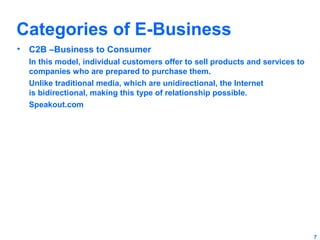
Categories of E-Business
• C2B –Business to Consumer
In this model, individual customers offer to sell products and services to
companies who are prepared to purchase them.
Unlike traditional media, which are unidirectional, the Internet
is bidirectional, making this type of relationship possible.
Speakout.com

7
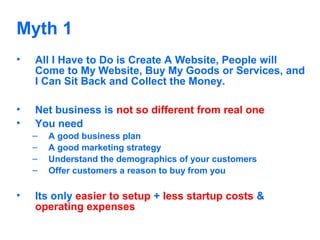
Myth 1
•

All I Have to Do is Create A Website, People will
Come to My Website, Buy My Goods or Services, and
I Can Sit Back and Collect the Money.

•
•

Net business is not so different from real one
You need
–
–
–
–

•

A good business plan
A good marketing strategy
Understand the demographics of your customers
Offer customers a reason to buy from you

Its only easier to setup + less startup costs &
operating expenses
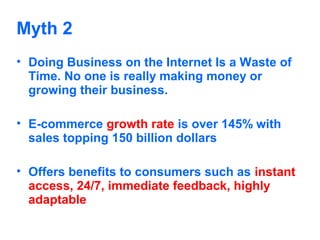
Myth 2
• Doing Business on the Internet Is a Waste of
Time. No one is really making money or
growing their business.
• E-commerce growth rate is over 145% with
sales topping 150 billion dollars
• Offers benefits to consumers such as instant
access, 24/7, immediate feedback, highly
adaptable
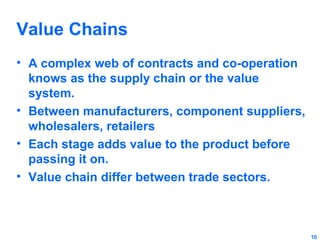
Value Chains
• A complex web of contracts and co-operation
knows as the supply chain or the value
system.
• Between manufacturers, component suppliers,
wholesalers, retailers
• Each stage adds value to the product before
passing it on.
• Value chain differ between trade sectors.

10
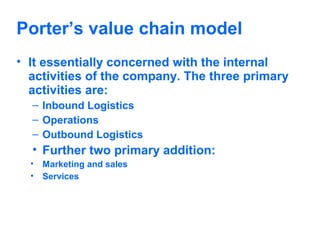
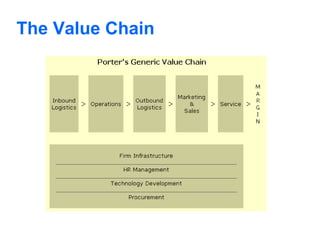
Porter’s value chain model
• It essentially concerned with the internal
activities of the company. The three primary
activities are:
– Inbound Logistics
– Operations
– Outbound Logistics

• Further two primary addition:
•
•

Marketing and sales
Services
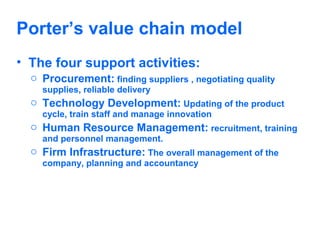
Porter’s value chain model
• The four support activities:
o Procurement: finding suppliers , negotiating quality
supplies, reliable delivery

o Technology Development: Updating of the product
cycle, train staff and manage innovation

o Human Resource Management: recruitment, training
and personnel management.

o Firm Infrastructure: The overall management of the
company, planning and accountancy
The Value Chain
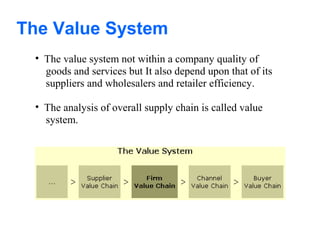
The Value System
• The value system not within a company quality of
goods and services but It also depend upon that of its
suppliers and wholesalers and retailer efficiency.
• The analysis of overall supply chain is called value
system.
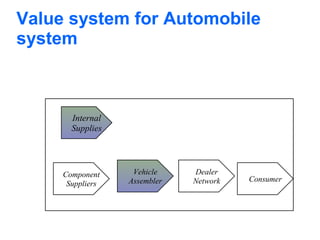
Value system for Automobile
system

Internal
Supplies

Component
Suppliers

Vehicle
Assembler

Dealer
Network

Consumer
Other Examples
• Value system for the supermarket
• Value system for the insurance
Review
• What is e-Commerce?
• What is e-Business?
• Difference between e-commerce and ebusiness.
• Categories of E-business.
• The Porter’s Value Chain Model.
• The Value system.

17

1 hrly eb ch 01 the value chain

  • 1.
  • 2.
    E-Business • E-Business isthe term used to describe the information systems and applications that support and drive business processes, most often using web technologies. • e-Business allows companies to link their internal and external processes more efficiently and effectively • Work more closely with suppliers and partners to better satisfy the needs and expectations of their customers • Leading to improvements in overall business performance.
  • 3.
    E-Commerce • The buyingand selling of products and services by businesses and consumers through an electronic medium, without using any paper documents. • E-commerce is widely considered the buying and selling of products over the internet, but any transaction that is completed solely through electronic measures can be considered ecommerce.
  • 4.
    Difference between E-Businessand ECommerce • E-commerce is focused on the core processes of marketing, sales, fulfillment and after market. A web shop is best thought of as a set of functions that covers the sales process. • E-business entails much more than just ecommerce, e-business can provide a wide range of benefits to your company reaching well beyond the core e-commerce processes. 4
  • 5.
    Business Jargon • Activity –task performed by worker in doing his job – E.g. Packaging books • Transaction – exchange of value (purchase or sale) – E.g. Electronic Payment • Business process – group of related activities and transactions – E.g. Purchasing from an Online Bookstore 5
  • 6.
    Categories of E-Business •B2C – Business to Consumer – Web Shopping – Amazon, yahoo • B2B – Business to Business – Transactions between businesses via Web – Purchasing and procurement, inventory management, Supplier management, sales activities, sales and support. • C2C – Customer to Customer – Third Party involvement (Online auctions) – eBay, OLX • Electronic data interchange (EDI) – Transmitting computer-readable data in a standard format to another business 6
  • 7.
    Categories of E-Business •C2B –Business to Consumer In this model, individual customers offer to sell products and services to companies who are prepared to purchase them. Unlike traditional media, which are unidirectional, the Internet is bidirectional, making this type of relationship possible. Speakout.com 7
  • 8.
    Myth 1 • All IHave to Do is Create A Website, People will Come to My Website, Buy My Goods or Services, and I Can Sit Back and Collect the Money. • • Net business is not so different from real one You need – – – – • A good business plan A good marketing strategy Understand the demographics of your customers Offer customers a reason to buy from you Its only easier to setup + less startup costs & operating expenses
  • 9.
    Myth 2 • DoingBusiness on the Internet Is a Waste of Time. No one is really making money or growing their business. • E-commerce growth rate is over 145% with sales topping 150 billion dollars • Offers benefits to consumers such as instant access, 24/7, immediate feedback, highly adaptable
  • 10.
    Value Chains • Acomplex web of contracts and co-operation knows as the supply chain or the value system. • Between manufacturers, component suppliers, wholesalers, retailers • Each stage adds value to the product before passing it on. • Value chain differ between trade sectors. 10
  • 11.
    Porter’s value chainmodel • It essentially concerned with the internal activities of the company. The three primary activities are: – Inbound Logistics – Operations – Outbound Logistics • Further two primary addition: • • Marketing and sales Services
  • 12.
    Porter’s value chainmodel • The four support activities: o Procurement: finding suppliers , negotiating quality supplies, reliable delivery o Technology Development: Updating of the product cycle, train staff and manage innovation o Human Resource Management: recruitment, training and personnel management. o Firm Infrastructure: The overall management of the company, planning and accountancy
  • 13.
  • 14.
    The Value System •The value system not within a company quality of goods and services but It also depend upon that of its suppliers and wholesalers and retailer efficiency. • The analysis of overall supply chain is called value system.
  • 15.
    Value system forAutomobile system Internal Supplies Component Suppliers Vehicle Assembler Dealer Network Consumer
  • 16.
    Other Examples • Valuesystem for the supermarket • Value system for the insurance
  • 17.
    Review • What ise-Commerce? • What is e-Business? • Difference between e-commerce and ebusiness. • Categories of E-business. • The Porter’s Value Chain Model. • The Value system. 17