Chapter

Noise Pollution
1
What is Noise?
• Definition:
– Unwanted sound
– Excessive, displeasing human, animal, or
machine-created environmental noise that
disrupts the activity or balance of human or
animal life

2
• The unit of sound is Decibel (db)
• 85 dB is the level above which hearing
protection is recommended, to avoid
hearing loss from the cumulative effects
of exposure to noise over time.
• The higher the noise level, the less time
it takes for damage to occur.
3
• How can you tell if the noise level is 85
dB?
• A quick test:
– If you have to raise your voice to talk to
someone who is an arm's length away from
you, you are likely in an environment with a
sound level of 85 dB or more.

4
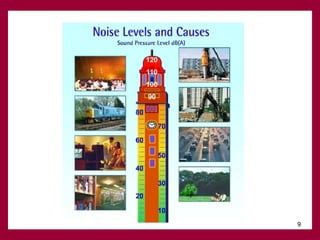
Sources of Noise Pollution
• It is also a by-product of industrialization,
urbanization and modern civilization
– Transportation  Airplanes, Rickshaw, Train,
Trucks, Cars, Motorcycles

– Industrial Buildings  Factory Machines, Air
Conditioning Systems

– Household Equipments  Mixers, Vacuum
cleaners, Intruder alarms of buildings
5
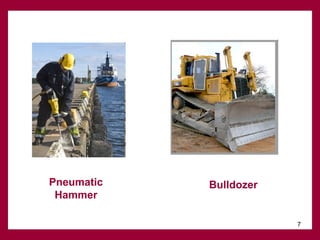
– Construction Equipment  Pneumatic
hammers, Bulldozers, Air compressors, Dump
trucks, Loaders

– Other Causes  Boilers, Plumbing
equipment, Air conditioners, Generators, Fans

– Public Places  Open markets, Streets,
Parks

– Individual  Talking loudly, Listening to loud
music
6
Pneumatic
Hammer

Bulldozer

7
– Underwater Noise Pollution
•
•
•
•
•

Motorboats
Commercial shipping traffic,
Exploration and extraction of oil
Exploration and extraction of other minerals
Military Sonar

8
9
Effects of Noise Pollution
• Noise pollution has adverse effects on:
– Humans
– Animals
– Plants

10
Humans

• Unwanted sound (noise) can
damage physiological and
psychological health
• Noise pollution can cause
– hearing loss
– decreased communication skills
– sleep disturbances
– annoyance and aggression
– heart problems
– high stress levels
– performance reduction

11
Hearing Loss
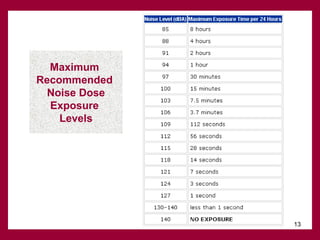
• Chronic exposure to noise may cause
hearing loss, which cannot be cured.
• The risk of hearing loss from noise
exposure depends on two things:
– how loud the noise is
– how long a person is exposed to the noise
12
Maximum
Recommended
Noise Dose
Exposure
Levels

13
Decreased
Communication Skills
• Prolonged noise exposure weakens our
ability to communicate effectively,
causing symptoms such as
–
–
–
–
–

difficulty in concentration
indecision
faltering speech
confusion
impatience
14
Sleep
Disturbances
• High levels of noise make it difficult to
get a full night’s sleep.
• Sleep disturbances often lead to
– insomnia,
• which creates stress, anxiety, depression, mood
swings, and lowers our immunity.

15
– Effects the cognitive processes: Thinking
and Learning
– Lead to serious health problems:
• Heart disease, Heart attack, Heart failure,
Irregular heartbeat, High blood pressure,
Stroke, diabetes

– Increases the chances of getting into an
accident
16
– Lead to forgetfulness
– Lead to weight gain
• When you sleep, you lose weight. Lack of
sleep seems to be related to an increase in
hunger and appetite, and possibly to obesity.

– It may increase risk of death

17
Heart
Problems
• Noise pollution indirectly can contribute
to cardiovascular effects in humans
• Due to insomnia, anxiety, stress, a
person can end up with a
– heart disease,
– higher blood pressure
– a host of stress-related health issues
18
Reduced
Performance
• Noise pollution impairs our cognitive
functioning
• It negatively affects our
– reading comprehension,
– learning and problem-solving skills,
– work performance
– socio-emotional development
19
• People suffer from:
– Headaches
– Fatigue
– Sleepiness
– Annoyance

• These problems decrease their
efficiency levels and hamper the
quality of their work.
20
Animals

• Noise pollution also has an
adverse effect on animals
– Alters the predator or prey detection
and avoidance
– Interferes with navigation
– Interferes with reproduction
– Contributes to permanent hearing
loss

21
• Lombard Vocal Response:
– Noise makes animals communicate louder
• These unheard voices might be warnings, finding of
prey, or preparations of net-bubbling.
• When one species begins speaking louder, it will
mask other species' voice, causing the whole
ecosystem to eventually speak louder

22
• Following is a list of few animals which
are effect by noise pollution:
– Whales
– Dolphins
– Bats
– Owls
– Grey Tree Frogs
– Beetles

23
Plants

• Due to noise pollution, many birds
and animals are changing their
behavior in response to manmade
noise
– Like moving to less nosier places

• Because of this, plants are getting
affected indirectly
– Many animals pollinate plants or eat
or disperse their seeds, to help the
trees spread and grow in other areas
24

Final gs ch 10 noise pollution

  • 1.
  • 2.
    What is Noise? •Definition: – Unwanted sound – Excessive, displeasing human, animal, or machine-created environmental noise that disrupts the activity or balance of human or animal life 2
  • 3.
    • The unitof sound is Decibel (db) • 85 dB is the level above which hearing protection is recommended, to avoid hearing loss from the cumulative effects of exposure to noise over time. • The higher the noise level, the less time it takes for damage to occur. 3
  • 4.
    • How canyou tell if the noise level is 85 dB? • A quick test: – If you have to raise your voice to talk to someone who is an arm's length away from you, you are likely in an environment with a sound level of 85 dB or more. 4
  • 5.
    Sources of NoisePollution • It is also a by-product of industrialization, urbanization and modern civilization – Transportation  Airplanes, Rickshaw, Train, Trucks, Cars, Motorcycles – Industrial Buildings  Factory Machines, Air Conditioning Systems – Household Equipments  Mixers, Vacuum cleaners, Intruder alarms of buildings 5
  • 6.
    – Construction Equipment Pneumatic hammers, Bulldozers, Air compressors, Dump trucks, Loaders – Other Causes  Boilers, Plumbing equipment, Air conditioners, Generators, Fans – Public Places  Open markets, Streets, Parks – Individual  Talking loudly, Listening to loud music 6
  • 7.
  • 8.
    – Underwater NoisePollution • • • • • Motorboats Commercial shipping traffic, Exploration and extraction of oil Exploration and extraction of other minerals Military Sonar 8
  • 9.
  • 10.
    Effects of NoisePollution • Noise pollution has adverse effects on: – Humans – Animals – Plants 10
  • 11.
    Humans • Unwanted sound(noise) can damage physiological and psychological health • Noise pollution can cause – hearing loss – decreased communication skills – sleep disturbances – annoyance and aggression – heart problems – high stress levels – performance reduction 11
  • 12.
    Hearing Loss • Chronicexposure to noise may cause hearing loss, which cannot be cured. • The risk of hearing loss from noise exposure depends on two things: – how loud the noise is – how long a person is exposed to the noise 12
  • 13.
  • 14.
    Decreased Communication Skills • Prolongednoise exposure weakens our ability to communicate effectively, causing symptoms such as – – – – – difficulty in concentration indecision faltering speech confusion impatience 14
  • 15.
    Sleep Disturbances • High levelsof noise make it difficult to get a full night’s sleep. • Sleep disturbances often lead to – insomnia, • which creates stress, anxiety, depression, mood swings, and lowers our immunity. 15
  • 16.
    – Effects thecognitive processes: Thinking and Learning – Lead to serious health problems: • Heart disease, Heart attack, Heart failure, Irregular heartbeat, High blood pressure, Stroke, diabetes – Increases the chances of getting into an accident 16
  • 17.
    – Lead toforgetfulness – Lead to weight gain • When you sleep, you lose weight. Lack of sleep seems to be related to an increase in hunger and appetite, and possibly to obesity. – It may increase risk of death 17
  • 18.
    Heart Problems • Noise pollutionindirectly can contribute to cardiovascular effects in humans • Due to insomnia, anxiety, stress, a person can end up with a – heart disease, – higher blood pressure – a host of stress-related health issues 18
  • 19.
    Reduced Performance • Noise pollutionimpairs our cognitive functioning • It negatively affects our – reading comprehension, – learning and problem-solving skills, – work performance – socio-emotional development 19
  • 20.
    • People sufferfrom: – Headaches – Fatigue – Sleepiness – Annoyance • These problems decrease their efficiency levels and hamper the quality of their work. 20
  • 21.
    Animals • Noise pollutionalso has an adverse effect on animals – Alters the predator or prey detection and avoidance – Interferes with navigation – Interferes with reproduction – Contributes to permanent hearing loss 21
  • 22.
    • Lombard VocalResponse: – Noise makes animals communicate louder • These unheard voices might be warnings, finding of prey, or preparations of net-bubbling. • When one species begins speaking louder, it will mask other species' voice, causing the whole ecosystem to eventually speak louder 22
  • 23.
    • Following isa list of few animals which are effect by noise pollution: – Whales – Dolphins – Bats – Owls – Grey Tree Frogs – Beetles 23
  • 24.
    Plants • Due tonoise pollution, many birds and animals are changing their behavior in response to manmade noise – Like moving to less nosier places • Because of this, plants are getting affected indirectly – Many animals pollinate plants or eat or disperse their seeds, to help the trees spread and grow in other areas 24

Editor's Notes

  • #6 With the growth of superhighways, air traffic, construction and other machine-based activity, the globe has been growing louder and louder over the last century.
  • #22 From birds in the sky to elephants on land to dolphins in the sea, noise pollution is threatening all types of species and altering the way in which these animals communicate, mate and even protect themselves from larger predators.
  • #24 Whales & Dolphins: Noise pollution has caused the death of certain species of whales after being exposed to the loud sound of military sonar Environmental noise has been shown to affect the way that bats and owls find and hunt for prey. For example, gleaning bats such as the Bechstein’s bat are less likely to hunt in noisy areas. According to researchers, too much noise pollution could put these animals at risk of extinction by making once fulfilling environments unlivable. While some birds like great tits, waterbirds, birds of prey, corvids and starlings are able to adapt to urban noise by tweeting louder, other birds with lower frequencies are not as adaptable at changing their tunes, which may affect these winged-friends from communicating with and finding each other for mating, For female grey tree frogs, increasing noise from nearby traffic has been shown to slow their abilities to listen for and locate male frogs that are calling for their services during the mating season. Environmental noise has been shown to affect the way that bats and owls find and hunt for prey. For example, gleaning bats such as the Bechstein’s bat are less likely to hunt in noisy areas. According to researchers, too much noise pollution could put these animals at risk of extinction by making once fulfilling environments unlivable. While some birds like great tits, waterbirds, birds of prey, corvids and starlings are able to adapt to urban noise by tweeting louder, other birds with lower frequencies are not as adaptable at changing their tunes, which may affect these winged-friends from communicating with and finding each other for mating, For female grey tree frogs, increasing noise from nearby traffic has been shown to slow their abilities to listen for and locate male frogs that are calling for their services during the mating season. The deep blue sea would seem to offer some peace and quiet for whales, dolphins and porpoises, but this is not the case as noise from sonar, commercial shipping and drilling for oil and gas are causing great harm. In the case of military sonar and seismic testing, it is believed that whales, dolphins and porpoises can become scared by the high-pitch sounds, causing them to surface in water that is beyond their physical limits and beach themselves. Communication among these animals is also affected by underwater noise pollution like sonar, which has caused some dolphins to go temporarily deaf and whales to be separated from their calves.