What is E-Business? | Definition,
Features, Types, Process &
Applications
Shakila Shaikh
WhatisE-
Business?
 Electronic business is popularly known as 'e-business'
or 'eBusiness'. When communication and information
technologies are used to support the various business
activities then it is known as e business.
 E-commerce is only considered to be a subset of the
overall e-business strategy in which greater emphasis
is given to the strategic focus on the implementation of
business functions using electronic capabilities.
DefinitionofE-
Business
 According to ICT :
 "E-business (Electronic Business) includes any process
that a business organisation conducts, business over a
computer mediated network".
 In e-business, the main processes associated with the
business are transformed with the help of internet
technologies.
 The process of e-business spans the entire value chain
which involves cooperating with business partners,
processing orders electronically, electronic purchasing,
handling customer service and supply chain
management. With the help of special
technical standards, companies are able to exchange
data with each other. It is possible to integrate inter
and intra firm business processes using the various e-
business software solutions. The internet, extra-nets,
web, intranets and their combination facilitate e-
business.
E-business
consistsofe-
commerce,e-
marketingande-
operations:
 1) E-Business :
 All the aspects of business processes are streamlined
by applying Internet technology.
E-business
consistsofe-
commerce,e-
marketingande-
operations:
 2) E-Marketing :
 Online presence of the company can be built and it can
be showcased by providing detailed information. Most
of the small businesses are carrying out e-marketing
these days.
E-business
consistsofe-
commerce,e-
marketingande-
operations:
 3) E-Commerce :
 It includes supporting customer inquiries
automatically, conducting payment, online selling of
services and products and handling transaction details.
E-business
consistsofe-
commerce,e-
marketingande-
operations:
 4) E-Operations :
 The business efficiencies within the functional
departments of a company are streamlined using
various steps. The supply chain between the key
suppliers and the company is also streamlined.
 E-Business = E-Marketing + E-Commerce + E-
Operations
ProcessesofE-
Business
 The processes of an e-business can be broadly categorized in
three categories:
 1) Production :
 This category includes processes like business procurement,
ordering and replacement of stocks from suppliers, payment
processing, transactions with suppliers and processes related
to production control etc.
 2) Customer Relation :
 This category of business processes consists of product
marketing and promotion, online product sale, customer order
processing, payments from customers, customer support
service, after sale service etc.
 3) Internal Management :
 This category business processes normally consists of of
employee's management, employee recruitment, training, and
information transmission within the organisation among
various departments likes production and sales to improve
productivity of the departments.
 E-commerce and e-business substitute each other frequently.
ProcessesofE-
Business
 2) Global Reach :
 Electronic business technologies enable a business to
easily reach across geographic boundaries around the
earth far more conveniently and effectively as
compared to traditional commerce.
 Globally, companies are acquiring greater profits and
business results by expanding their business with e-
business solutions.
 As a result, the potential market size for e-commerce
merchants is approximately equal to size of online
population.
ProcessesofE-
Business
 3) Universal Standards :
 Universal Standards are standards shared by all the
nations around world. These are technical standards of
Internet for conducting e-business.
 It gives all the ability to connect at the same "level"
and it provides network externalities that will benefit
everyone.
 Universal technical standards lower entry costs and
minimal search costs.
ProcessesofE-
Business
 4) Interactivity :
 E- business technologies permits two-way
communication between customer and sellers which
makes it interactive.
 It proves as significant feature of e-business technology
over the commercial traditional technologies of the
20th century.
ProcessesofE-
Business
 5) Information Density :
 Information density means total amount and quality of
information available over Internet to all market
buyers and sellers.
 Internet vastly increases information
density. Information density offers better quality
information to consumer and merchants.
 E commerce technologies increase accuracy and
timeliness of information.
 For example, flipkart.com store has variety of products
with prices.
ProcessesofE-
Business
 6) Richness :
 Richness refers to the complexity and content of a
message.
 Richness means all commercial activity and
experience, conducted through a variety of messages.
 For example, text, pictures, videos, sound, links, SMS
(Short Message Services) etc.
ProcessesofE-
Business
 7) Personalization :
 E-business technology offers, personalization.
Personalization means designing marketing messages
according to particular individuals by customizing it as
per customer personal details like name, interests and
past purchases record.
 Products or services can be modified or altered
according to the user's choice or past buying record.
TypesofE-
BusinessModels
 A set of business entities and the relationship that exists
between them is described by a business model. It is also
possible to identify the participants. of the business and
describe the sources from where the revenue will come by
using business model. With the help of the business
model, it is possible to identify suitable solutions on a
broad perspective at a certain abstraction level.
 E-business is a method by which one can redirect his/her
business into the digital world to generate more revenue.
 E-business model is an approach to directing business
electronically through which a company can generate
profitable revenue.
 There are several types of e-commerce business models
which are classified based on the nature of interaction
with players.
e-commerce
business
models
Consumer-to-
Consumer
(C2C)Models
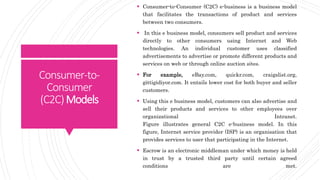
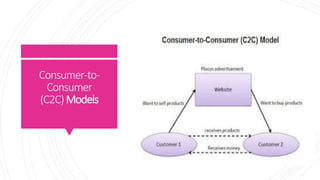
 Consumer-to-Consumer (C2C) e-business is a business model
that facilitates the transactions of product and services
between two consumers.
 In this e business model, consumers sell product and services
directly to other consumers using Internet and Web
technologies. An individual customer uses classified
advertisements to advertise or promote different products and
services on web or through online auction sites.
 For example, eBay.com, quickr.com, craigslist.org,
gittigidiyor.com. It entails lower cost for both buyer and seller
customers.
 Using this e business model, customers can also advertise and
sell their products and services to other employees over
organizational Intranet.
Figure illustrates general C2C e-business model. In this
figure, Internet service provider (ISP) is an organisation that
provides services to user that participating in the Internet.
 Escrow is an electronic middleman under which money is held
in trust by a trusted third party until certain agreed
conditions are met.
Consumer-to-
Consumer
(C2C)Models
Consumer-to-
Business
(C2B)Models
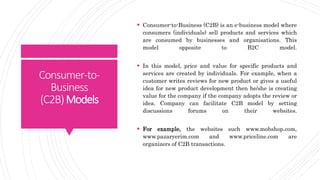
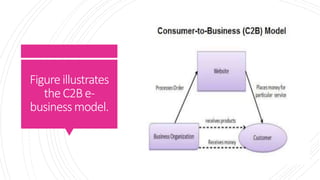
 Consumer-to-Business (C2B) is an e-business model where
consumers (individuals) sell products and services which
are consumed by businesses and organisations. This
model opposite to B2C model.
 In this model, price and value for specific products and
services are created by individuals. For example, when a
customer writes reviews for new product or gives a useful
idea for new product development then he/she is creating
value for the company if the company adopts the review or
idea. Company can facilitate C2B model by setting
discussions forums on their websites.
 For example, the websites such www.mobshop.com,
www.pazaryerim.com and www.priceline.com are
organizers of C2B transactions.
Figureillustrates
theC2Be-
businessmodel.
Business-to-
Consumer(B2C)
Models
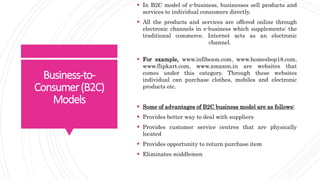
 In B2C model of e-business, businesses sell products and
services to individual consumers directly.
 All the products and services are offered online through
electronic channels in e-business which supplements: the
traditional commerce. Internet acts as an electronic
channel.
 For example, www.infibeam.com, www.homeshop18.com,
www.flipkart.com, www.amazon.in are websites that
comes under this category. Through these websites
individual can purchase clothes, mobiles and electronic
products etc.
 Some of advantages of B2C business model are as follows:
 Provides better way to deal with suppliers
 Provides customer service centres that are physically
located
 Provides opportunity to return purchase item
 Eliminates middlemen
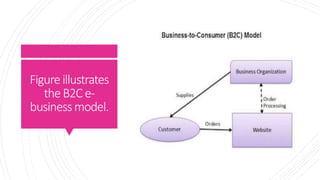
Figureillustrates
theB2Ce-
businessmodel.
Business-to-
Business
(B2B)Models
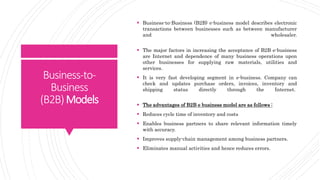
 Business-to-Business (B2B) e-business model describes electronic
transactions between businesses such as between manufacturer
and wholesaler.
 The major factors in increasing the acceptance of B2B e-business
are Internet and dependence of many business operations upon
other businesses for supplying raw materials, utilities and
services.
 It is very fast developing segment in e-business. Company can
check and updates purchase orders, invoices, inventory and
shipping status directly through the Internet.
 The advantages of B2B e business model are as follows :
 Reduces cycle time of inventory and costs
 Enables business partners to share relevant information timely
with accuracy.
 Improves supply-chain management among business partners.
 Eliminates manual activities and hence reduces errors.
Figureillustrates
theB2Be-
businessmodel.
Applicationsof
E-Business
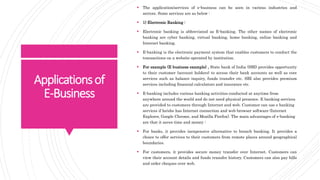
 The application/services of e-business can be seen in various industries and
sectors. Some services are as below :
 1) Electronic Ranking :
 Electronic banking is abbreviated as E-banking. The other names of electronic
banking are cyber banking, virtual banking, home banking, online banking and
Internet banking.
 E-banking is the electronic payment system that enables customers to conduct the
transactions on a website operated by institution.
 For example (E business example) , State bank of India (SBI) provides opportunity
to their customer (account holders) to access their bank accounts as well as core
services such as balance inquiry, funds transfer etc. SBI also provides premium
services including financial calculators and insurance etc.
 E-banking includes various banking activities conducted at anytime from
anywhere around the world and do not need physical presence. E banking services
are provided to customers through Internet and web. Customer can use e banking
services if he/she has Internet connection and web browser software (Internet
Explorer, Google Chrome, and Mozilla Firefox). The main advantages of e-banking
are that it saves time and money :
 For banks, it provides inexpensive alternative to branch banking. It provides a
choice to offer services to their customers from remote places around geographical
boundaries.
 For customers, it provides secure money transfer over Internet. Customers can
view their account details and funds transfer history. Customers can also pay bills
and order cheques over web.
Applicationsof
E-Business
 2) Electronic Trading :
 Electronic trading is abbreviated as E-trading. E-
trading is the method of buying and selling shares and
financial assets through Internet in stock market.
 E- Trading uses internet which provides a common
virtual platform to buyers and sellers.
 For example, in stock exchange industry, e trading is
defined as purchase and sale of financial securities
though internet. Some common advantages of e-
trading are as follows :
 No need of Middlemen (broker).
 Offers real-time stock prices throughout the world.
 Provides information about market, historical data and
graph that are easily understandable.
 Provides the facility to check Demat account balance,
trading history and bank account. balance anytime.
Applicationsof
E-Business
 3) Electronic Learning :
 Electronic learning is abbreviated as E-Learning. It is
the method of learning conducted via electronic media
on the Internet. The Internet plays major role in
learning and teaching process.
 A large number of e-learning websites are available
over the internet.
 For example, www.24x7 learning.com,
www.meritnation.com etc.
 In e-learning, teaching materials and instructions are
delivered by tutors to students over Internet. The main
advantages of e-leaning are as follows:
 It provides flexibility to students.
 Learning materials can be accessed at anytime and
anywhere.
 It is cost effective.

Applicationsof
E-Business
 4) Electronic Recruitment :
 Electronic recruitment is abbreviated as E-
Recruitment. It is the process of personnel recruitment
using Internet. The major tasks of e-recruitment are
finding, attracting, evaluating, interviewing and
hiring new personnel.
 Now a day the job market is one of the biggest markets
in the world. Here employees seek for excellent jobs
and employers search for efficient employees with
extraordinary skills. The Internet and web provides
platform to job seekers and companies seeking
employees. Companies do much of their recruitment
process online to improve the speed.
 For example, www.naukri.com,
www.monsterindia.com, www.timesjobs.com are e-
recruitment websites.
Applicationsof
E-Business
 5) Electronic Publishing :
 It is also known as online publishing. It is electronic
version of newspapers, magazines, news, books, music
and other digitized information available online on the
Internet.
 The material of online publishing are available either
free or takes subscription free.
 For example, newspapers like "The Wall Street
Journal" and "The Chronicle of Higher Education
charge subscription fees from its consumers. Online
publishing becomes common to distribute books,
newspaper and magazine to customers over Internet.
 For example, www.indianexpress.com.,
www.jagran.com, www.livehindustan.com,
www.thehindu.com is some common newspaper
website available in India.
Applicationsof
E-Business
 6) Electronic Healthcare :
 Many health services are provided online through
medical websites on internet. These websites make
available information about health related queries,
medicine, diseases cure and treatments. On several
websites users can also chat online with doctors or
specialist as per availability.
 E-healthcare information are managed and through
Information and Communications Technology
(I.C.T.). The advantages of e-healthcare are as follows:
 Lowers costs
 Improvement of quality of patient care
 Provides better planning and decision-making
Applicationsof
E-Business
 7) Electronic Retailing :
 It is also known as e tailing. E-tailing is related to
retail business on the web. E-tailing is the sale of retail
goods and services from individuals or businesses to
the end-user on Internet.
 Through e-tailing, customer can purchase any goods
online. He/she has to only visit website (virtual shop)
with the help of web browsers and selects online
catalog (list of products) and gets the delivery of
product at home.
Applicationsof
E-Business
 8) Electronic Auctions :
 Electronic auctions are abbreviated as E-Auctions. E-
auction works similar to offline auctions, the only
difference is that it is done over Internet. Websites
(Host sites) that provides electronic auctions over
Internet acts like a broker.
 Auctions generally begin with an opening bid of lowest
price. Internet users access the websites which host an
auction and place a bid for the product in a given time
deadlines. Before placing a bid, bidder reads the
product and auction description and then start bidding
by sending an e mail.
 E-auction provides opportunities to both individual
sellers and companies to sell their goods online
successfully.
Applicationsof
E-Business
 For example, www.ebay.com,
www.ubid.com, www.onsale.com, www.auctionweb.com,
www.auctionindia.com, www.bidfind.com is some
common websites that provides electronic auctions.
Applicationsof
E-Business
 9) Online Insurance :
 General and life insurances are now offered online
through Internet by all financial institutions and many
companies. The customers may buy insurance
contracts online from insurance and risk management
companies and are also llowed to pay their premiums
online using e payment method.
 For example, www.licindia.in, www.hdfcinsurance.com
is websites that provides insurance facilities to their
customers.
Applicationsof
E-Business
 10) Electronic Searching :
 Electronic searching means to locate and identify
relevant research materials using the computer and
Internet as a tools. Internet and e-commerce play
important role in information searching for individuals
and companies. It saves the time and energy of user
because it provides searching and fetching facilities
with quick response about relevant topic.
 Web consists of large amount of information in digital
form. Web contains the personal, business and general
information pages covering almost all the topics.
 For example, websites such as www.yahoo.com,
www.ask.com and www.google.co.in are search engines.
Search engine is software system designed to search
for information on Web.Search engine provide more
optimized searching using keyword, concepts of subject
matters in easy manner and display more search
results.
GERMANTEST
1. List at least 5 types of
auctions?
GERMANTEST
2. List the participants
involved in SET protocol ?
GERMANTEST
3. List 5 digital marketing
strategies for ecommerce?
GERMANTEST
4. Explain First-price
sealed-bid auctions.
GERMANTEST 5. Explain dual signatures?
GERMANTEST
6. Explain Social media
marketing
GERMANTEST
7. What is Ecommerce
Marketing?

What is E-Business.pptx

  • 1.
    What is E-Business?| Definition, Features, Types, Process & Applications Shakila Shaikh
  • 2.
    WhatisE- Business?  Electronic businessis popularly known as 'e-business' or 'eBusiness'. When communication and information technologies are used to support the various business activities then it is known as e business.  E-commerce is only considered to be a subset of the overall e-business strategy in which greater emphasis is given to the strategic focus on the implementation of business functions using electronic capabilities.
  • 3.
    DefinitionofE- Business  According toICT :  "E-business (Electronic Business) includes any process that a business organisation conducts, business over a computer mediated network".  In e-business, the main processes associated with the business are transformed with the help of internet technologies.  The process of e-business spans the entire value chain which involves cooperating with business partners, processing orders electronically, electronic purchasing, handling customer service and supply chain management. With the help of special technical standards, companies are able to exchange data with each other. It is possible to integrate inter and intra firm business processes using the various e- business software solutions. The internet, extra-nets, web, intranets and their combination facilitate e- business.
  • 4.
    E-business consistsofe- commerce,e- marketingande- operations:  1) E-Business:  All the aspects of business processes are streamlined by applying Internet technology.
  • 5.
    E-business consistsofe- commerce,e- marketingande- operations:  2) E-Marketing:  Online presence of the company can be built and it can be showcased by providing detailed information. Most of the small businesses are carrying out e-marketing these days.
  • 6.
    E-business consistsofe- commerce,e- marketingande- operations:  3) E-Commerce:  It includes supporting customer inquiries automatically, conducting payment, online selling of services and products and handling transaction details.
  • 7.
    E-business consistsofe- commerce,e- marketingande- operations:  4) E-Operations:  The business efficiencies within the functional departments of a company are streamlined using various steps. The supply chain between the key suppliers and the company is also streamlined.  E-Business = E-Marketing + E-Commerce + E- Operations
  • 8.
    ProcessesofE- Business  The processesof an e-business can be broadly categorized in three categories:  1) Production :  This category includes processes like business procurement, ordering and replacement of stocks from suppliers, payment processing, transactions with suppliers and processes related to production control etc.  2) Customer Relation :  This category of business processes consists of product marketing and promotion, online product sale, customer order processing, payments from customers, customer support service, after sale service etc.  3) Internal Management :  This category business processes normally consists of of employee's management, employee recruitment, training, and information transmission within the organisation among various departments likes production and sales to improve productivity of the departments.  E-commerce and e-business substitute each other frequently.
  • 9.
    ProcessesofE- Business  2) GlobalReach :  Electronic business technologies enable a business to easily reach across geographic boundaries around the earth far more conveniently and effectively as compared to traditional commerce.  Globally, companies are acquiring greater profits and business results by expanding their business with e- business solutions.  As a result, the potential market size for e-commerce merchants is approximately equal to size of online population.
  • 10.
    ProcessesofE- Business  3) UniversalStandards :  Universal Standards are standards shared by all the nations around world. These are technical standards of Internet for conducting e-business.  It gives all the ability to connect at the same "level" and it provides network externalities that will benefit everyone.  Universal technical standards lower entry costs and minimal search costs.
  • 11.
    ProcessesofE- Business  4) Interactivity:  E- business technologies permits two-way communication between customer and sellers which makes it interactive.  It proves as significant feature of e-business technology over the commercial traditional technologies of the 20th century.
  • 12.
    ProcessesofE- Business  5) InformationDensity :  Information density means total amount and quality of information available over Internet to all market buyers and sellers.  Internet vastly increases information density. Information density offers better quality information to consumer and merchants.  E commerce technologies increase accuracy and timeliness of information.  For example, flipkart.com store has variety of products with prices.
  • 13.
    ProcessesofE- Business  6) Richness:  Richness refers to the complexity and content of a message.  Richness means all commercial activity and experience, conducted through a variety of messages.  For example, text, pictures, videos, sound, links, SMS (Short Message Services) etc.
  • 14.
    ProcessesofE- Business  7) Personalization:  E-business technology offers, personalization. Personalization means designing marketing messages according to particular individuals by customizing it as per customer personal details like name, interests and past purchases record.  Products or services can be modified or altered according to the user's choice or past buying record.
  • 15.
    TypesofE- BusinessModels  A setof business entities and the relationship that exists between them is described by a business model. It is also possible to identify the participants. of the business and describe the sources from where the revenue will come by using business model. With the help of the business model, it is possible to identify suitable solutions on a broad perspective at a certain abstraction level.  E-business is a method by which one can redirect his/her business into the digital world to generate more revenue.  E-business model is an approach to directing business electronically through which a company can generate profitable revenue.  There are several types of e-commerce business models which are classified based on the nature of interaction with players.
  • 16.
  • 17.
    Consumer-to- Consumer (C2C)Models  Consumer-to-Consumer (C2C)e-business is a business model that facilitates the transactions of product and services between two consumers.  In this e business model, consumers sell product and services directly to other consumers using Internet and Web technologies. An individual customer uses classified advertisements to advertise or promote different products and services on web or through online auction sites.  For example, eBay.com, quickr.com, craigslist.org, gittigidiyor.com. It entails lower cost for both buyer and seller customers.  Using this e business model, customers can also advertise and sell their products and services to other employees over organizational Intranet. Figure illustrates general C2C e-business model. In this figure, Internet service provider (ISP) is an organisation that provides services to user that participating in the Internet.  Escrow is an electronic middleman under which money is held in trust by a trusted third party until certain agreed conditions are met.
  • 18.
  • 19.
    Consumer-to- Business (C2B)Models  Consumer-to-Business (C2B)is an e-business model where consumers (individuals) sell products and services which are consumed by businesses and organisations. This model opposite to B2C model.  In this model, price and value for specific products and services are created by individuals. For example, when a customer writes reviews for new product or gives a useful idea for new product development then he/she is creating value for the company if the company adopts the review or idea. Company can facilitate C2B model by setting discussions forums on their websites.  For example, the websites such www.mobshop.com, www.pazaryerim.com and www.priceline.com are organizers of C2B transactions.
  • 20.
  • 21.
    Business-to- Consumer(B2C) Models  In B2Cmodel of e-business, businesses sell products and services to individual consumers directly.  All the products and services are offered online through electronic channels in e-business which supplements: the traditional commerce. Internet acts as an electronic channel.  For example, www.infibeam.com, www.homeshop18.com, www.flipkart.com, www.amazon.in are websites that comes under this category. Through these websites individual can purchase clothes, mobiles and electronic products etc.  Some of advantages of B2C business model are as follows:  Provides better way to deal with suppliers  Provides customer service centres that are physically located  Provides opportunity to return purchase item  Eliminates middlemen
  • 22.
  • 23.
    Business-to- Business (B2B)Models  Business-to-Business (B2B)e-business model describes electronic transactions between businesses such as between manufacturer and wholesaler.  The major factors in increasing the acceptance of B2B e-business are Internet and dependence of many business operations upon other businesses for supplying raw materials, utilities and services.  It is very fast developing segment in e-business. Company can check and updates purchase orders, invoices, inventory and shipping status directly through the Internet.  The advantages of B2B e business model are as follows :  Reduces cycle time of inventory and costs  Enables business partners to share relevant information timely with accuracy.  Improves supply-chain management among business partners.  Eliminates manual activities and hence reduces errors.
  • 24.
  • 25.
    Applicationsof E-Business  The application/servicesof e-business can be seen in various industries and sectors. Some services are as below :  1) Electronic Ranking :  Electronic banking is abbreviated as E-banking. The other names of electronic banking are cyber banking, virtual banking, home banking, online banking and Internet banking.  E-banking is the electronic payment system that enables customers to conduct the transactions on a website operated by institution.  For example (E business example) , State bank of India (SBI) provides opportunity to their customer (account holders) to access their bank accounts as well as core services such as balance inquiry, funds transfer etc. SBI also provides premium services including financial calculators and insurance etc.  E-banking includes various banking activities conducted at anytime from anywhere around the world and do not need physical presence. E banking services are provided to customers through Internet and web. Customer can use e banking services if he/she has Internet connection and web browser software (Internet Explorer, Google Chrome, and Mozilla Firefox). The main advantages of e-banking are that it saves time and money :  For banks, it provides inexpensive alternative to branch banking. It provides a choice to offer services to their customers from remote places around geographical boundaries.  For customers, it provides secure money transfer over Internet. Customers can view their account details and funds transfer history. Customers can also pay bills and order cheques over web.
  • 26.
    Applicationsof E-Business  2) ElectronicTrading :  Electronic trading is abbreviated as E-trading. E- trading is the method of buying and selling shares and financial assets through Internet in stock market.  E- Trading uses internet which provides a common virtual platform to buyers and sellers.  For example, in stock exchange industry, e trading is defined as purchase and sale of financial securities though internet. Some common advantages of e- trading are as follows :  No need of Middlemen (broker).  Offers real-time stock prices throughout the world.  Provides information about market, historical data and graph that are easily understandable.  Provides the facility to check Demat account balance, trading history and bank account. balance anytime.
  • 27.
    Applicationsof E-Business  3) ElectronicLearning :  Electronic learning is abbreviated as E-Learning. It is the method of learning conducted via electronic media on the Internet. The Internet plays major role in learning and teaching process.  A large number of e-learning websites are available over the internet.  For example, www.24x7 learning.com, www.meritnation.com etc.  In e-learning, teaching materials and instructions are delivered by tutors to students over Internet. The main advantages of e-leaning are as follows:  It provides flexibility to students.  Learning materials can be accessed at anytime and anywhere.  It is cost effective. 
  • 28.
    Applicationsof E-Business  4) ElectronicRecruitment :  Electronic recruitment is abbreviated as E- Recruitment. It is the process of personnel recruitment using Internet. The major tasks of e-recruitment are finding, attracting, evaluating, interviewing and hiring new personnel.  Now a day the job market is one of the biggest markets in the world. Here employees seek for excellent jobs and employers search for efficient employees with extraordinary skills. The Internet and web provides platform to job seekers and companies seeking employees. Companies do much of their recruitment process online to improve the speed.  For example, www.naukri.com, www.monsterindia.com, www.timesjobs.com are e- recruitment websites.
  • 29.
    Applicationsof E-Business  5) ElectronicPublishing :  It is also known as online publishing. It is electronic version of newspapers, magazines, news, books, music and other digitized information available online on the Internet.  The material of online publishing are available either free or takes subscription free.  For example, newspapers like "The Wall Street Journal" and "The Chronicle of Higher Education charge subscription fees from its consumers. Online publishing becomes common to distribute books, newspaper and magazine to customers over Internet.  For example, www.indianexpress.com., www.jagran.com, www.livehindustan.com, www.thehindu.com is some common newspaper website available in India.
  • 30.
    Applicationsof E-Business  6) ElectronicHealthcare :  Many health services are provided online through medical websites on internet. These websites make available information about health related queries, medicine, diseases cure and treatments. On several websites users can also chat online with doctors or specialist as per availability.  E-healthcare information are managed and through Information and Communications Technology (I.C.T.). The advantages of e-healthcare are as follows:  Lowers costs  Improvement of quality of patient care  Provides better planning and decision-making
  • 31.
    Applicationsof E-Business  7) ElectronicRetailing :  It is also known as e tailing. E-tailing is related to retail business on the web. E-tailing is the sale of retail goods and services from individuals or businesses to the end-user on Internet.  Through e-tailing, customer can purchase any goods online. He/she has to only visit website (virtual shop) with the help of web browsers and selects online catalog (list of products) and gets the delivery of product at home.
  • 32.
    Applicationsof E-Business  8) ElectronicAuctions :  Electronic auctions are abbreviated as E-Auctions. E- auction works similar to offline auctions, the only difference is that it is done over Internet. Websites (Host sites) that provides electronic auctions over Internet acts like a broker.  Auctions generally begin with an opening bid of lowest price. Internet users access the websites which host an auction and place a bid for the product in a given time deadlines. Before placing a bid, bidder reads the product and auction description and then start bidding by sending an e mail.  E-auction provides opportunities to both individual sellers and companies to sell their goods online successfully.
  • 33.
    Applicationsof E-Business  For example,www.ebay.com, www.ubid.com, www.onsale.com, www.auctionweb.com, www.auctionindia.com, www.bidfind.com is some common websites that provides electronic auctions.
  • 34.
    Applicationsof E-Business  9) OnlineInsurance :  General and life insurances are now offered online through Internet by all financial institutions and many companies. The customers may buy insurance contracts online from insurance and risk management companies and are also llowed to pay their premiums online using e payment method.  For example, www.licindia.in, www.hdfcinsurance.com is websites that provides insurance facilities to their customers.
  • 35.
    Applicationsof E-Business  10) ElectronicSearching :  Electronic searching means to locate and identify relevant research materials using the computer and Internet as a tools. Internet and e-commerce play important role in information searching for individuals and companies. It saves the time and energy of user because it provides searching and fetching facilities with quick response about relevant topic.  Web consists of large amount of information in digital form. Web contains the personal, business and general information pages covering almost all the topics.  For example, websites such as www.yahoo.com, www.ask.com and www.google.co.in are search engines. Search engine is software system designed to search for information on Web.Search engine provide more optimized searching using keyword, concepts of subject matters in easy manner and display more search results.
  • 36.
    GERMANTEST 1. List atleast 5 types of auctions?
  • 37.
    GERMANTEST 2. List theparticipants involved in SET protocol ?
  • 38.
    GERMANTEST 3. List 5digital marketing strategies for ecommerce?
  • 39.
  • 40.
    GERMANTEST 5. Explaindual signatures?
  • 41.
  • 42.
    GERMANTEST 7. What isEcommerce Marketing?