E-BUSINESS
AND
E-COMMERCE
Uttar Tamang
Dipak Pudasaini
CONCEPT OF E-BUSINESS
 Electronic business (e-business) can be defined as the use of the
internet to business processes, electronic commerce, organizational
communication and collaboration within a company and with its
customers, suppliers, and other stakeholders.
 E-businesses utilise the internet, intranets, extranets and other
networks to support their commercial processes
 These electronic business processes include buying and selling
products and services, servicing customers, processing payments,
managing production control, collaborating with business partners;
sharing information; running automated employee services, recruiting
etc.
CONT.
 e-Business is therefore a broader concept and describes
arrangements where organizations have redesigned their business
structures, processes and services to take advantage of Internet
capabilities.
 e-Business can be applied to strategy and operations. For example,
an organization needs an improved e-business strategy (or e-
business technology)
 e-business is used as an adjective to describe businesses that mainly
operate online i.e. they have no physical presence on the high streets
and seek to minimize customer service and support through enabling
web self-service
DEFINING E-BUSINESS
 “The automation of the entire spectrum of interactions between
enterprises and their distributed employees, trading partners,
suppliers and customers” By Aberdeen Group Website
 “The transformation of key business process through the use of
Internet technologies” By IBM
 “Automated business process over computer- mediated network” By
OECD (Organisation for Economic Co-operation and
Development)
ESSENTIAL FEATURES OF AN E-BUSINESS
1. Makes greater use of electronic devices in the processing and
communicating of data.
2. Allows increased integration of databases and hardware devices
(largely to the ‘open protocols’ that govern the transfer of data
between systems).
3. Enables users to engage ‘interactively’ with systems and services –
for instance, to purchase goods, check on orders or collaborate in
virtual teams or communities.
NATURE OF E-BUSINESS
 E-business is used when a company e-enables its processes to do
business in a more efficient way using Web technologies.
 This might include procuring goods and services, dealing with
customers as well as selling products.
 The exponential growth of the Internet has driven the accelerated
expansion of e-business process.
 The development of the Web has made business-to-business (B2B)
activity possible, leading to the development of Internet exchanges.
SCOPE OF E-BUSINESS
 Technology has helped rigid functional and divisional structures to be
replaced by traditional systems.
 Many business processes are now automated.
 Enterprise Resource Planning Solutions (ERP Systems) are now
widely available providing management with information that is
available almost instantaneously.
 All types of business functions such as production, finance, marketing
etc. are carried out through computer network.
 All types of managerial activities such as planning, managing,
controlling etc. are carried out through computer network.
GOAL OF E-BUSINESS
 Positioning on new markets
 Increasing the quality of products or services
 Prospecting new clients
 Increasing customer loyalty
 Increasing the efficiency of internal functioning
 The overall strategy is to create transparency for the employees and favors a common
culture
 The mode of functioning is that the players assume responsibilities
 Teamwork which favors improvement of competences in employees
CONT.
 A drop in prices in connection with an increase in productivity
 Improved listening to clients
 Products and services that are suitable for the clients' needs
 A mode of functioning that is transparent for the user
 Increased relationships with each other
 Increased responsiveness and anticipation
 Resources sharing which is beneficial for clients
IMPACT OF E-BUSINESS
 E-business is fast becoming an important initiative for companies to
consider, one that impacts every aspect of how a business is run.
 Impact of e-business implementation on various aspects of the
organisation such as strategy, human resources, customer
relationship management, the IT department, technology, the
business environment, trust, service management and performance
metrics
 E-business is changing all the rules and models. An organization’s
ability to embrace new technology and business models is key to
increasing the organisation’s productivity.
CONT.
 The Internet economy necessitates a fundamental transformation of traditional
organisations.
 E-business influence on an organisation can impact business efficiency and
should be felt across the organisation from the time the sales force initiates a
transaction, through the manufacturing and service cycles, right up until the
time when the customers pay their bills.
 The impact of e-business on a company’s effectiveness is found in its overall
financial well-being.
 E-business is not just about buying over the Internet, it is about increasing the
value of the organisation by improving the way it operates.
BENEFITS OF E-BUSINESS
• Human resource services such as benefits, retirement planning and
job postings.
• Internal communication.
• An executive information system.
• Purchasing.
• Sales force automation and management.
• Product development teams.
• Knowledge management.
• Improving relationships with partners.
• Improving time to market.
• Reducing operational costs.
• Increasing employee communication and satisfaction.
• Maintaining a competitive edge.
• Improving customer satisfaction.
ADVANTAGES OF E-BUSINESS
 Removes location and availability restrictions
 Reduces time and money spent
 Expedites customer service
 Shows you how to improve
 Keeps your business relevant
E-COMMERCE
 Electronic commerce (e-commerce) is the buying and selling, marketing and
servicing of products and services via computer networks.
 E-commerce can best be conceived as a subset of e-business.
 Electronic commerce or e-commerce refers to a wide range of online business
activities for products and services
 E-commerce is usually associated with buying and selling over the Internet,
or conducting any transaction involving the transfer of ownership or rights to
use goods or services through a computer-mediated network
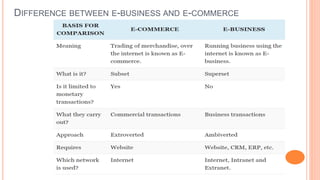
DIFFERENCE BETWEEN E-BUSINESS AND E-COMMERCE
CONT.
1. The terms e-business and e-commerce are often used interchangeably.
When electronic medium is used in all the day-to-day activities, then it may be
termed as e-business. When a commercial transaction takes place over
electronic network, then it is termed as e-commerce.
2. E-business is a very broad concept that involves a business organization to
use electronic medium to carry out all specialized or overall business activities.
In e-business, information and computing technologies are used to enhance
one’s business. It includes any process that a business organization conducts
over electronic and computer enabled network.
3. E-business deals with recruiting, training employees and sharing any internal
information to enhance business process. In e-commerce, information and
computing technologies are used in inter business and intra-business
transactions and in business to consumer transactions.
CONT.
4. Some experts consider when business is completely carried on through an
electronic medium, it may be referred to as e-business. E-business does not
have physical presence in a market. When a business organization physically
owns an office and along with its physical presence carries out a business
transaction over internet, it may be referred as e-commerce.
5. Amazon (Amazon.com) and eBay (ebay.com) are considered to be the
world’s two biggest e-business units. When Nalli Stores along with its physical
presence sells textiles through its web site (nalli.com), then it may be referred
as e-commerce.
ADVANTAGES OF E-COMMERCE
 The possibility of the small companies to compete with the large
companies
 Permanent contact with customers for 24 hours and 7 days
 International markets penetration facilities
 The decrease of the functioning costs
 New possibilities for performing a direct marketing (one-to-one)
DISADVANTAGES OF E-COMMERCE
 The Fraud
 The Security
 Launch and integration costs
 Absence of human contact

E-business and E-commerce

  • 1.
  • 2.
    CONCEPT OF E-BUSINESS Electronic business (e-business) can be defined as the use of the internet to business processes, electronic commerce, organizational communication and collaboration within a company and with its customers, suppliers, and other stakeholders.  E-businesses utilise the internet, intranets, extranets and other networks to support their commercial processes  These electronic business processes include buying and selling products and services, servicing customers, processing payments, managing production control, collaborating with business partners; sharing information; running automated employee services, recruiting etc.
  • 3.
    CONT.  e-Business istherefore a broader concept and describes arrangements where organizations have redesigned their business structures, processes and services to take advantage of Internet capabilities.  e-Business can be applied to strategy and operations. For example, an organization needs an improved e-business strategy (or e- business technology)  e-business is used as an adjective to describe businesses that mainly operate online i.e. they have no physical presence on the high streets and seek to minimize customer service and support through enabling web self-service
  • 4.
    DEFINING E-BUSINESS  “Theautomation of the entire spectrum of interactions between enterprises and their distributed employees, trading partners, suppliers and customers” By Aberdeen Group Website  “The transformation of key business process through the use of Internet technologies” By IBM  “Automated business process over computer- mediated network” By OECD (Organisation for Economic Co-operation and Development)
  • 5.
    ESSENTIAL FEATURES OFAN E-BUSINESS 1. Makes greater use of electronic devices in the processing and communicating of data. 2. Allows increased integration of databases and hardware devices (largely to the ‘open protocols’ that govern the transfer of data between systems). 3. Enables users to engage ‘interactively’ with systems and services – for instance, to purchase goods, check on orders or collaborate in virtual teams or communities.
  • 6.
    NATURE OF E-BUSINESS E-business is used when a company e-enables its processes to do business in a more efficient way using Web technologies.  This might include procuring goods and services, dealing with customers as well as selling products.  The exponential growth of the Internet has driven the accelerated expansion of e-business process.  The development of the Web has made business-to-business (B2B) activity possible, leading to the development of Internet exchanges.
  • 7.
    SCOPE OF E-BUSINESS Technology has helped rigid functional and divisional structures to be replaced by traditional systems.  Many business processes are now automated.  Enterprise Resource Planning Solutions (ERP Systems) are now widely available providing management with information that is available almost instantaneously.  All types of business functions such as production, finance, marketing etc. are carried out through computer network.  All types of managerial activities such as planning, managing, controlling etc. are carried out through computer network.
  • 8.
    GOAL OF E-BUSINESS Positioning on new markets  Increasing the quality of products or services  Prospecting new clients  Increasing customer loyalty  Increasing the efficiency of internal functioning  The overall strategy is to create transparency for the employees and favors a common culture  The mode of functioning is that the players assume responsibilities  Teamwork which favors improvement of competences in employees
  • 9.
    CONT.  A dropin prices in connection with an increase in productivity  Improved listening to clients  Products and services that are suitable for the clients' needs  A mode of functioning that is transparent for the user  Increased relationships with each other  Increased responsiveness and anticipation  Resources sharing which is beneficial for clients
  • 10.
    IMPACT OF E-BUSINESS E-business is fast becoming an important initiative for companies to consider, one that impacts every aspect of how a business is run.  Impact of e-business implementation on various aspects of the organisation such as strategy, human resources, customer relationship management, the IT department, technology, the business environment, trust, service management and performance metrics  E-business is changing all the rules and models. An organization’s ability to embrace new technology and business models is key to increasing the organisation’s productivity.
  • 11.
    CONT.  The Interneteconomy necessitates a fundamental transformation of traditional organisations.  E-business influence on an organisation can impact business efficiency and should be felt across the organisation from the time the sales force initiates a transaction, through the manufacturing and service cycles, right up until the time when the customers pay their bills.  The impact of e-business on a company’s effectiveness is found in its overall financial well-being.  E-business is not just about buying over the Internet, it is about increasing the value of the organisation by improving the way it operates.
  • 12.
    BENEFITS OF E-BUSINESS •Human resource services such as benefits, retirement planning and job postings. • Internal communication. • An executive information system. • Purchasing. • Sales force automation and management. • Product development teams. • Knowledge management. • Improving relationships with partners. • Improving time to market. • Reducing operational costs. • Increasing employee communication and satisfaction. • Maintaining a competitive edge. • Improving customer satisfaction.
  • 13.
    ADVANTAGES OF E-BUSINESS Removes location and availability restrictions  Reduces time and money spent  Expedites customer service  Shows you how to improve  Keeps your business relevant
  • 14.
    E-COMMERCE  Electronic commerce(e-commerce) is the buying and selling, marketing and servicing of products and services via computer networks.  E-commerce can best be conceived as a subset of e-business.  Electronic commerce or e-commerce refers to a wide range of online business activities for products and services  E-commerce is usually associated with buying and selling over the Internet, or conducting any transaction involving the transfer of ownership or rights to use goods or services through a computer-mediated network
  • 15.
  • 16.
    CONT. 1. The termse-business and e-commerce are often used interchangeably. When electronic medium is used in all the day-to-day activities, then it may be termed as e-business. When a commercial transaction takes place over electronic network, then it is termed as e-commerce. 2. E-business is a very broad concept that involves a business organization to use electronic medium to carry out all specialized or overall business activities. In e-business, information and computing technologies are used to enhance one’s business. It includes any process that a business organization conducts over electronic and computer enabled network. 3. E-business deals with recruiting, training employees and sharing any internal information to enhance business process. In e-commerce, information and computing technologies are used in inter business and intra-business transactions and in business to consumer transactions.
  • 17.
    CONT. 4. Some expertsconsider when business is completely carried on through an electronic medium, it may be referred to as e-business. E-business does not have physical presence in a market. When a business organization physically owns an office and along with its physical presence carries out a business transaction over internet, it may be referred as e-commerce. 5. Amazon (Amazon.com) and eBay (ebay.com) are considered to be the world’s two biggest e-business units. When Nalli Stores along with its physical presence sells textiles through its web site (nalli.com), then it may be referred as e-commerce.
  • 18.
    ADVANTAGES OF E-COMMERCE The possibility of the small companies to compete with the large companies  Permanent contact with customers for 24 hours and 7 days  International markets penetration facilities  The decrease of the functioning costs  New possibilities for performing a direct marketing (one-to-one)
  • 19.
    DISADVANTAGES OF E-COMMERCE The Fraud  The Security  Launch and integration costs  Absence of human contact