Michael Porter’s Competitive
Forces Model
Roshan Bhattarai
Kathmandu, Nepal
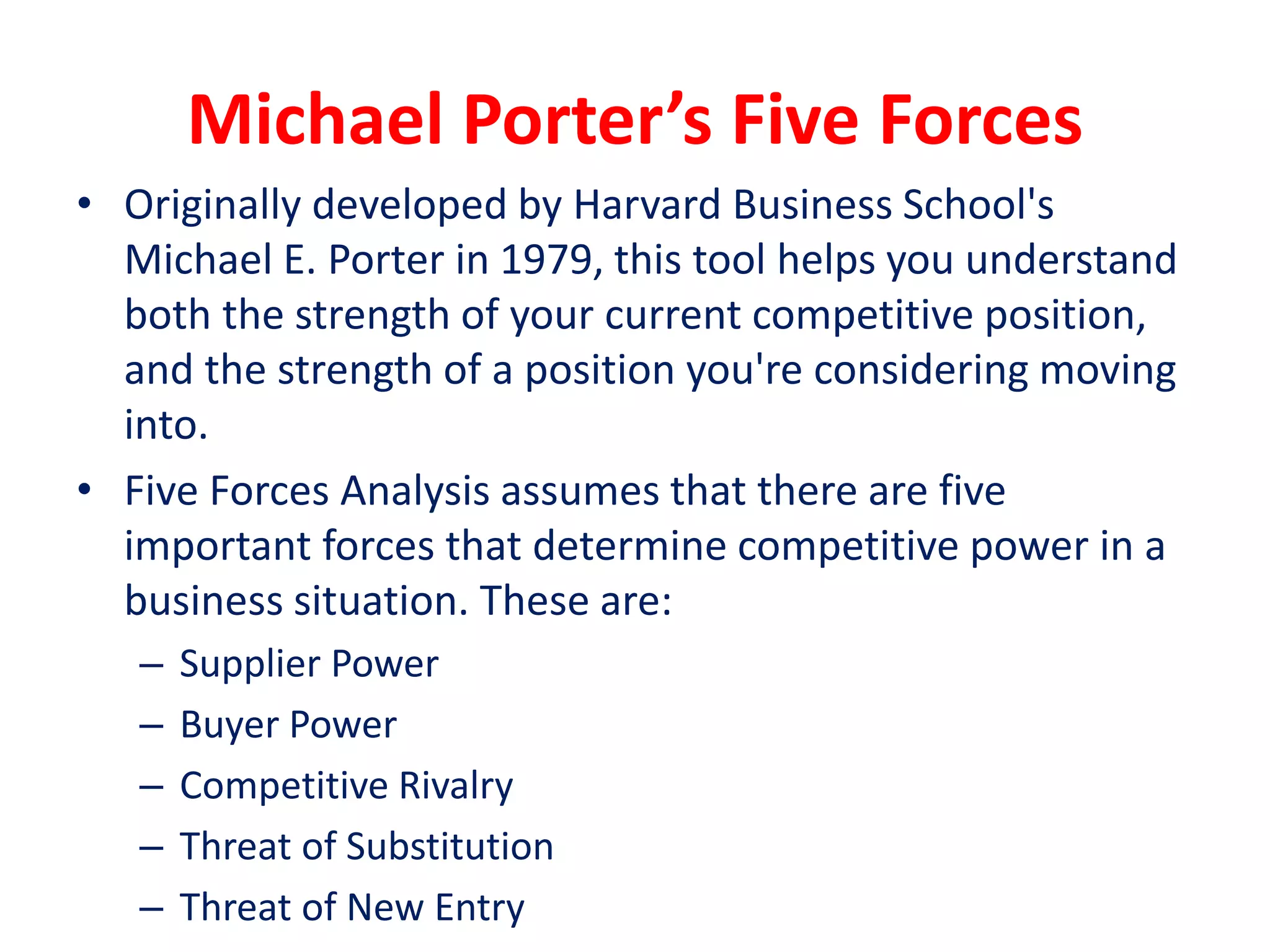
Michael Porter’s Five Forces
• Originally developed by Harvard Business School's
Michael E. Porter in 1979, this tool helps you understand
both the strength of your current competitive position,
and the strength of a position you're considering moving
into.
• Five Forces Analysis assumes that there are five
important forces that determine competitive power in a
business situation. These are:
– Supplier Power
– Buyer Power
– Competitive Rivalry
– Threat of Substitution
– Threat of New Entry
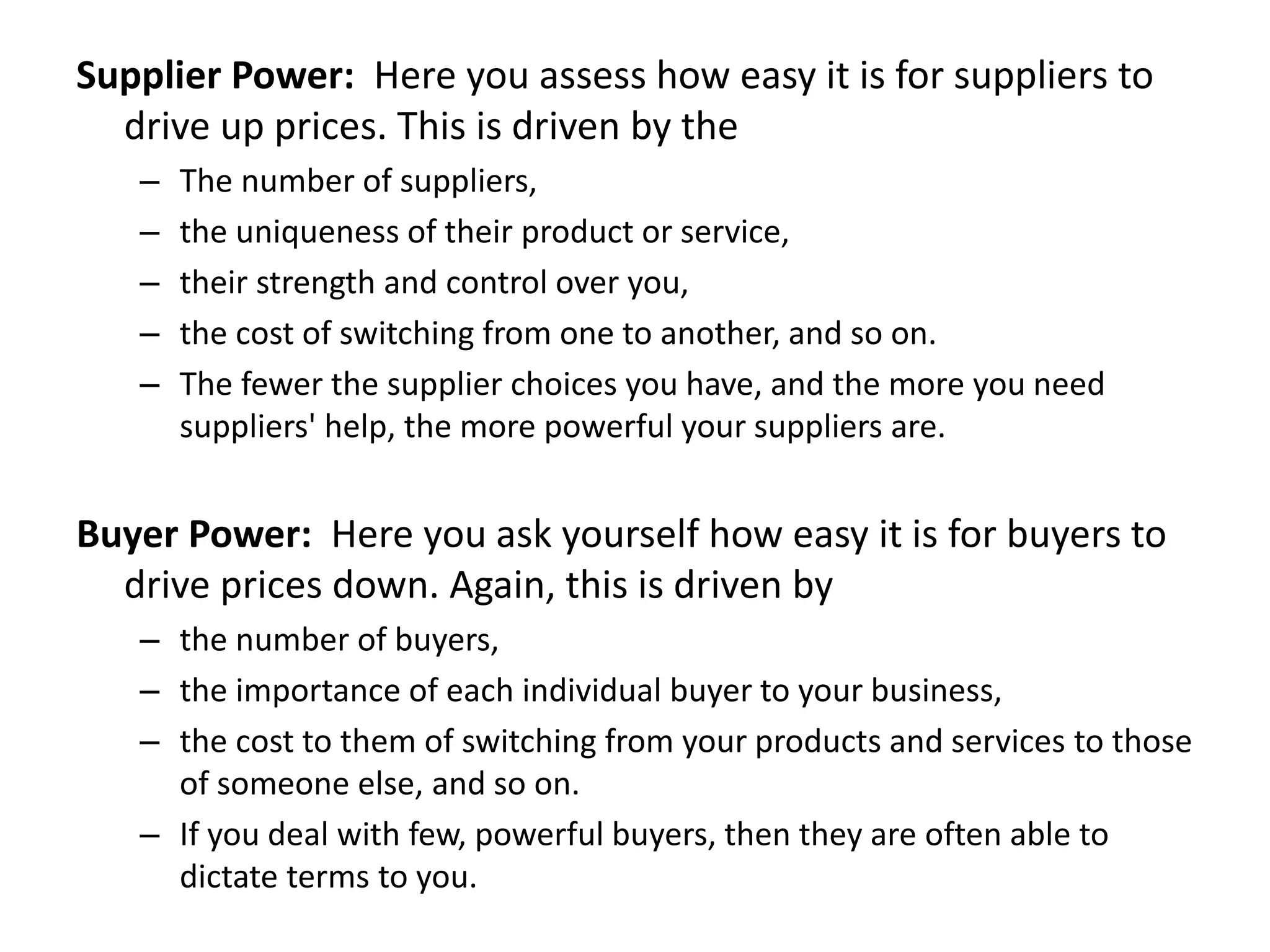
Supplier Power: Here you assess how easy it is for suppliers to
drive up prices. This is driven by the
– The number of suppliers,
– the uniqueness of their product or service,
– their strength and control over you,
– the cost of switching from one to another, and so on.
– The fewer the supplier choices you have, and the more you need
suppliers' help, the more powerful your suppliers are.
Buyer Power: Here you ask yourself how easy it is for buyers to
drive prices down. Again, this is driven by
– the number of buyers,
– the importance of each individual buyer to your business,
– the cost to them of switching from your products and services to those
of someone else, and so on.
– If you deal with few, powerful buyers, then they are often able to
dictate terms to you.
Competitive Rivalry: What is important here is the number
and capability of your competitors.
– If you have many competitors, and they offer equally attractive
products and services, then you'll most likely have little power in the
situation because suppliers and buyers will go elsewhere if they don't
get a good deal from you.
– On the other hand, if no-one else can do what you do, then you can
often have tremendous strength.
Threat of Substitution: This is affected by the ability of your
customers to find a different way of doing what you do.
– for example, if you supply a unique software product that automates
an important process, people may substitute by doing the process
manually or by outsourcing it.
– If substitution is easy and substitution is viable, then this weakens
your power.
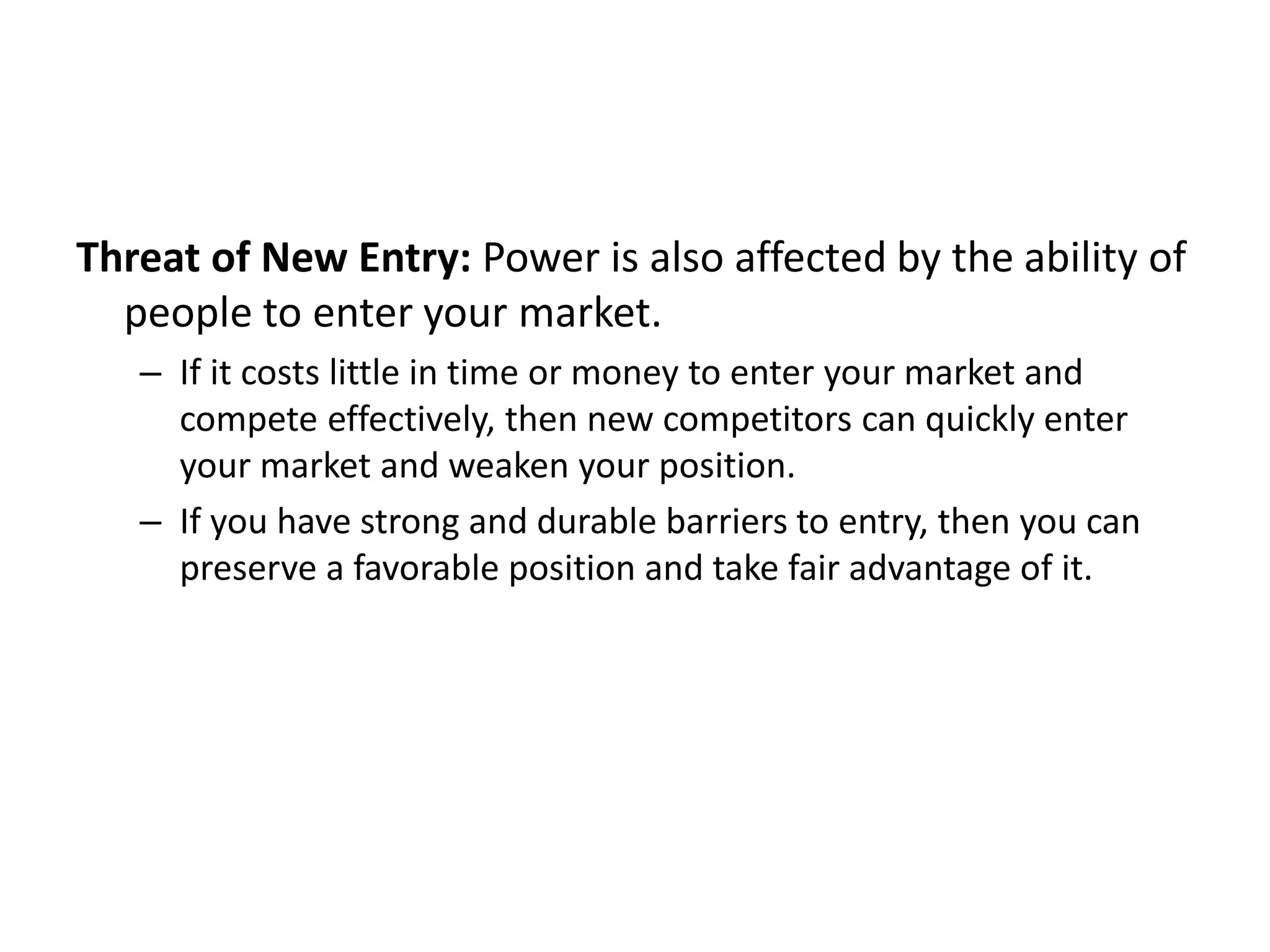
Threat of New Entry: Power is also affected by the ability of
people to enter your market.
– If it costs little in time or money to enter your market and
compete effectively, then new competitors can quickly enter
your market and weaken your position.
– If you have strong and durable barriers to entry, then you can
preserve a favorable position and take fair advantage of it.
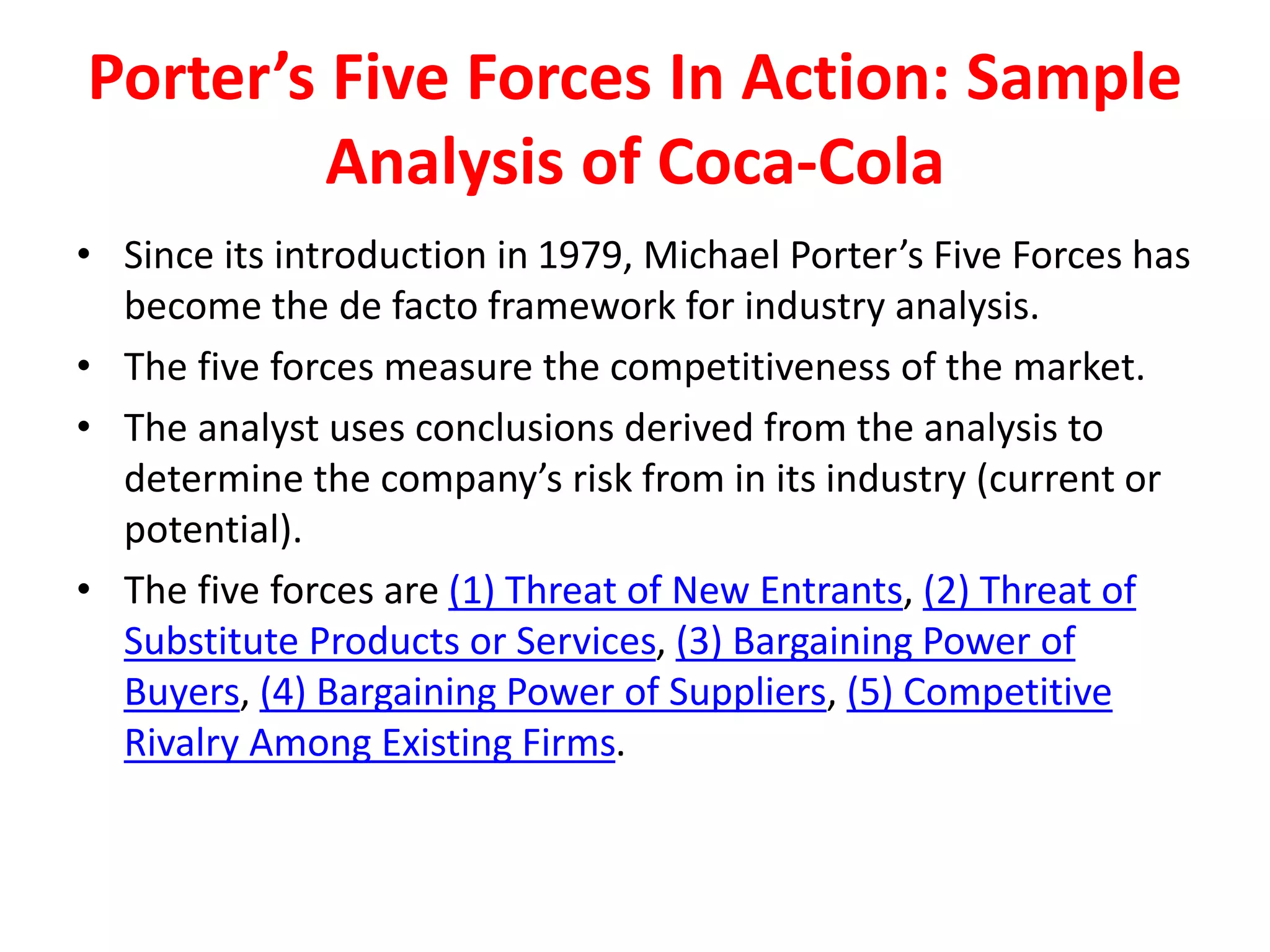
Porter’s Five Forces In Action: Sample
Analysis of Coca-Cola
• Since its introduction in 1979, Michael Porter’s Five Forces has
become the de facto framework for industry analysis.
• The five forces measure the competitiveness of the market.
• The analyst uses conclusions derived from the analysis to
determine the company’s risk from in its industry (current or
potential).
• The five forces are (1) Threat of New Entrants, (2) Threat of
Substitute Products or Services, (3) Bargaining Power of
Buyers, (4) Bargaining Power of Suppliers, (5) Competitive
Rivalry Among Existing Firms.
The following is a Five Forces analysis of The
Coca-Cola Company in relationship to its Coca-
Cola brand.
Threat of New Entrants/Potential Competitors
• Entry barriers are relatively low for the beverage
industry: there is no consumer switching cost
• There is an increasing amount of new brands appearing
in the market with similar prices than Coke products
• Coca-Cola is seen not only as a beverage but also as a
brand. It has held a very significant market share for a
long time and loyal customers are not very likely to try a
new brand.
MEDIUM PRESSURE
Threat of Substitute Products
• There are many kinds of energy drinks/soda/juice
products in the market.
• Coca-cola doesn’t really have an entirely unique flavor. In
a blind taste test, people can’t tell the difference
between Coca-Cola and Pepsi.
HIGH PRESSURE
The Bargaining Power of Buyers
• The individual buyer has no pressure on Coca-Cola
• Large retailers, like Wal-Mart, have bargaining power
because of the large order quantity
• but also, the bargaining power is lessened because of
the end consumer brand loyalty.
LOW PRESSURE
The Bargaining Power of Suppliers
• The main ingredients for soft drink include carbonated
water, phosphoric acid, sweetener, and caffeine, which is
common.
• Coca-Cola is likely the largest customer of any of the
suppliers.
LOW PRESSURE
Rivalry Among Existing Firms
• Currently, the main competitor is Pepsi which also has a
wide range of beverage products under its brand.
• Both Coca-Cola and Pepsi are the predominant
carbonated beverages and committed heavily to
sponsoring outdoor events and activities.
• There are other soda brands in the market that become
popular, like Dr. Pepper, because of their unique flavors.
HIGH PRESSURE
Strategies for success
• Once your analysis is complete, it's time to implement a strategy to
expand your competitive advantage.
• To that end, Porter identified four generic strategies that can be
implemented in any industry (and by companies of any size.)
1. Low Cost leadership : Your goal is to increase profits by reducing
costs while charging industry-standard prices, or to increase market
share by reducing the sales price while retaining profits.
2. Product Differentiation : To implement this strategy, your
company's products need to be significantly better than the
competition's, improving their competitiveness and value to the
public. It requires thorough research and development, plus
effective sales and marketing.
3. Focus on market niche : Successful implementation entails the
company selecting niche markets in which to sell their goods. It
requires an intense understanding of the marketplace, its sellers,
buyers and competitors.
4. Supplier/Customer intimacy: You need to develop strong ties and
loyalty with customers and suppliers.

Michael porter's competitive forces model

  • 1.
    Michael Porter’s Competitive ForcesModel Roshan Bhattarai Kathmandu, Nepal
  • 2.
    Michael Porter’s FiveForces • Originally developed by Harvard Business School's Michael E. Porter in 1979, this tool helps you understand both the strength of your current competitive position, and the strength of a position you're considering moving into. • Five Forces Analysis assumes that there are five important forces that determine competitive power in a business situation. These are: – Supplier Power – Buyer Power – Competitive Rivalry – Threat of Substitution – Threat of New Entry
  • 3.
    Supplier Power: Hereyou assess how easy it is for suppliers to drive up prices. This is driven by the – The number of suppliers, – the uniqueness of their product or service, – their strength and control over you, – the cost of switching from one to another, and so on. – The fewer the supplier choices you have, and the more you need suppliers' help, the more powerful your suppliers are. Buyer Power: Here you ask yourself how easy it is for buyers to drive prices down. Again, this is driven by – the number of buyers, – the importance of each individual buyer to your business, – the cost to them of switching from your products and services to those of someone else, and so on. – If you deal with few, powerful buyers, then they are often able to dictate terms to you.
  • 4.
    Competitive Rivalry: Whatis important here is the number and capability of your competitors. – If you have many competitors, and they offer equally attractive products and services, then you'll most likely have little power in the situation because suppliers and buyers will go elsewhere if they don't get a good deal from you. – On the other hand, if no-one else can do what you do, then you can often have tremendous strength. Threat of Substitution: This is affected by the ability of your customers to find a different way of doing what you do. – for example, if you supply a unique software product that automates an important process, people may substitute by doing the process manually or by outsourcing it. – If substitution is easy and substitution is viable, then this weakens your power.
  • 5.
    Threat of NewEntry: Power is also affected by the ability of people to enter your market. – If it costs little in time or money to enter your market and compete effectively, then new competitors can quickly enter your market and weaken your position. – If you have strong and durable barriers to entry, then you can preserve a favorable position and take fair advantage of it.
  • 6.
    Porter’s Five ForcesIn Action: Sample Analysis of Coca-Cola • Since its introduction in 1979, Michael Porter’s Five Forces has become the de facto framework for industry analysis. • The five forces measure the competitiveness of the market. • The analyst uses conclusions derived from the analysis to determine the company’s risk from in its industry (current or potential). • The five forces are (1) Threat of New Entrants, (2) Threat of Substitute Products or Services, (3) Bargaining Power of Buyers, (4) Bargaining Power of Suppliers, (5) Competitive Rivalry Among Existing Firms.
  • 7.
    The following isa Five Forces analysis of The Coca-Cola Company in relationship to its Coca- Cola brand. Threat of New Entrants/Potential Competitors • Entry barriers are relatively low for the beverage industry: there is no consumer switching cost • There is an increasing amount of new brands appearing in the market with similar prices than Coke products • Coca-Cola is seen not only as a beverage but also as a brand. It has held a very significant market share for a long time and loyal customers are not very likely to try a new brand. MEDIUM PRESSURE
  • 8.
    Threat of SubstituteProducts • There are many kinds of energy drinks/soda/juice products in the market. • Coca-cola doesn’t really have an entirely unique flavor. In a blind taste test, people can’t tell the difference between Coca-Cola and Pepsi. HIGH PRESSURE
  • 9.
    The Bargaining Powerof Buyers • The individual buyer has no pressure on Coca-Cola • Large retailers, like Wal-Mart, have bargaining power because of the large order quantity • but also, the bargaining power is lessened because of the end consumer brand loyalty. LOW PRESSURE
  • 10.
    The Bargaining Powerof Suppliers • The main ingredients for soft drink include carbonated water, phosphoric acid, sweetener, and caffeine, which is common. • Coca-Cola is likely the largest customer of any of the suppliers. LOW PRESSURE
  • 11.
    Rivalry Among ExistingFirms • Currently, the main competitor is Pepsi which also has a wide range of beverage products under its brand. • Both Coca-Cola and Pepsi are the predominant carbonated beverages and committed heavily to sponsoring outdoor events and activities. • There are other soda brands in the market that become popular, like Dr. Pepper, because of their unique flavors. HIGH PRESSURE
  • 12.
    Strategies for success •Once your analysis is complete, it's time to implement a strategy to expand your competitive advantage. • To that end, Porter identified four generic strategies that can be implemented in any industry (and by companies of any size.) 1. Low Cost leadership : Your goal is to increase profits by reducing costs while charging industry-standard prices, or to increase market share by reducing the sales price while retaining profits. 2. Product Differentiation : To implement this strategy, your company's products need to be significantly better than the competition's, improving their competitiveness and value to the public. It requires thorough research and development, plus effective sales and marketing. 3. Focus on market niche : Successful implementation entails the company selecting niche markets in which to sell their goods. It requires an intense understanding of the marketplace, its sellers, buyers and competitors. 4. Supplier/Customer intimacy: You need to develop strong ties and loyalty with customers and suppliers.