1
E-BUSINESS
PROF. MAMATA JENAMANI
DEPARTMENT OF INDUSTRIAL AND SYSTEMS ENGINEERING
IIT KHARAGPUR
COURSE OVERVIEW
Objective
The Internet has changed the way companies
carry out their businesses. The primary objective
of this course is to introduce concepts, tools and
approaches to electronic business to the post-
graduate and the undergraduate students.
Further, the subject will help the students to
develop skills to manage businesses in the digital
world.
Contents
• Introduction to E-Business
• Making Functional Areas E-Business Enabled
• Technologies for E-Business
• Decision Support in E-Business
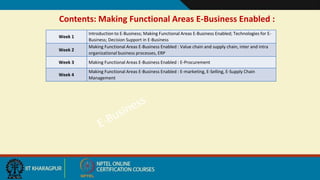
Contents: Making Functional Areas E-Business Enabled :
Week 1
Introduction to E-Business; Making Functional Areas E-Business Enabled; Technologies for E-
Business; Decision Support in E-Business
Week 2
Making Functional Areas E-Business Enabled : Value chain and supply chain, inter and intra
organizational business processes, ERP
Week 3 Making Functional Areas E-Business Enabled : E-Procurement
Week 4
Making Functional Areas E-Business Enabled : E-marketing, E-Selling, E-Supply Chain
Management
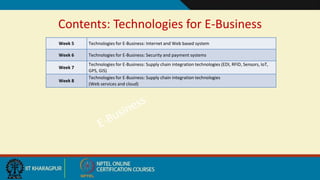
Contents: Technologies for E-Business
Week 5 Technologies for E-Business: Internet and Web based system
Week 6 Technologies for E-Business: Security and payment systems
Week 7
Technologies for E-Business: Supply chain integration technologies (EDI, RFID, Sensors, IoT,
GPS, GIS)
Week 8
Technologies for E-Business: Supply chain integration technologies
(Web services and cloud)
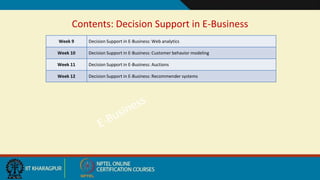
Contents: Decision Support in E-Business
Week 9 Decision Support in E-Business: Web analytics
Week 10 Decision Support in E-Business: Customer behavior modeling
Week 11 Decision Support in E-Business: Auctions
Week 12 Decision Support in E-Business: Recommender systems
INTRODUCTION
Week 1: Lecture 1
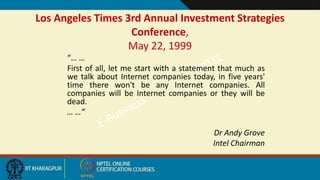
Los Angeles Times 3rd Annual Investment Strategies
Conference,
May 22, 1999
“… …
First of all, let me start with a statement that much as
we talk about Internet companies today, in five years'
time there won't be any Internet companies. All
companies will be Internet companies or they will be
dead.
… …”
Dr Andy Grove
Intel Chairman
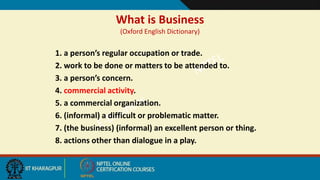
What is Business
(Oxford English Dictionary)
1. a person’s regular occupation or trade.
2. work to be done or matters to be attended to.
3. a person’s concern.
4. commercial activity.
5. a commercial organization.
6. (informal) a difficult or problematic matter.
7. (the business) (informal) an excellent person or thing.
8. actions other than dialogue in a play.
What is Business
Business is the social science of managing people to organize and
maintain collective productivity toward accomplishing particular
creative and productive goals, usually to generate revenue.
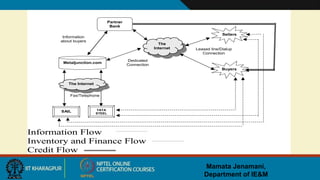
(http://en.wikipedia.org/wiki/Business)
A business (also known as an enterprise, a company, or a firm) is
an organizational entity involved in the provision of goods and
services to consumers. Every business requires some form of
investment and enough customers to whom its output can be sold
on a consistent basis in order to make a profit. Businesses can be
privately owned, not-for-profit, or state-owned.
(http://www.businessdictionary.com/definition/business.html)
What is Business
• A business is generally an organizational unit
that has (that should have) a defined strategy
and a manager with sales and profit
responsibility.
David A. Aaker, Damien McLoughlin, Strategic Market Management: Global Perspectives
What is the purpose of a business
• To generate revenue
• By delivering value to the customer
• And satisfying them
Customer Delivered Value
(Kotler)
• Customer delivered value is the difference between
total customer value and total customer cost.
• Total customer value is the bundle of benefits
customers expect from a given product or service.
• Total customer cost is the bundle of costs the
customers expect to incur in evaluating, obtaining,
using, and disposing of the product or service.
Customer Satisfaction
• Satisfaction is a person’s feeling of pleasure or disappointment
resulting from comparing a product’s perceived performance
(or outcome) in relation to his/her expectation
• Satisfied customers are loyal customers
• The key to generating high customer loyalty is to deliver high
customer value.
• A company must develop a competitively superior value
proposition and superior value-delivery system.
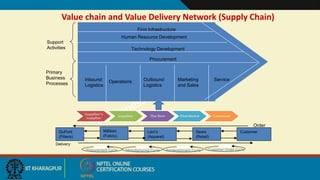
Value chain and Value Delivery Network (Supply Chain)
Primary
Business
Processes
Support
Activities
Procurement
Technology Development
Human Resource Development
Firm Infrastructure
Inbound
Logistics
Operations Outbound
Logistics
Marketing
and Sales
Service
DuPont
(Fibers)
Milliken
(Fabric)
Levi’s
(Apparel)
Sears
(Retail)
Customer
Order
Delivery
Customer Order Cycle
Replenishment Cycle
Manufacturing Cycle
Procurement Cycle
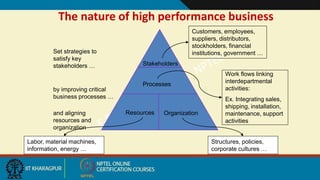
The nature of high performance business
Stakeholders
Processes
Resources Organization
Set strategies to
satisfy key
stakeholders …
by improving critical
business processes …
and aligning
resources and
organization
Customers, employees,
suppliers, distributors,
stockholders, financial
institutions, government …
Work flows linking
interdepartmental
activities:
Ex. Integrating sales,
shipping, installation,
maintenance, support
activities
Labor, material machines,
information, energy …
Structures, policies,
corporate cultures …
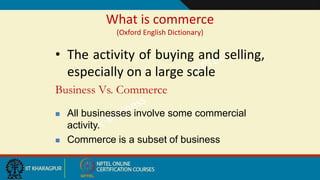
What is commerce
(Oxford English Dictionary)
• The activity of buying and selling,
especially on a large scale
Business Vs. Commerce
 All businesses involve some commercial
activity.
 Commerce is a subset of business
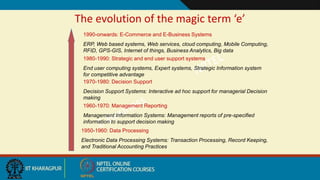
The evolution of the magic term ‘e’
1950-1960: Data Processing
Electronic Data Processing Systems: Transaction Processing, Record Keeping,
and Traditional Accounting Practices
1960-1970: Management Reporting
Management Information Systems: Management reports of pre-specified
information to support decision making
1970-1980: Decision Support
Decision Support Systems: Interactive ad hoc support for managerial Decision
making
1980-1990: Strategic and end user support systems
End user computing systems, Expert systems, Strategic Information system
for competitive advantage
1990-onwards: E-Commerce and E-Business Systems
ERP, Web based systems, Web services, cloud computing, Mobile Computing,
RFID, GPS-GIS, Internet of things, Business Analytics, Big data
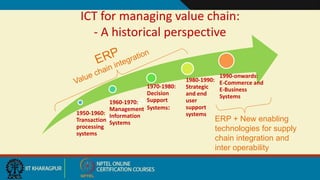
ICT for managing value chain:
- A historical perspective
1950-1960:
Transaction
processing
systems
1960-1970:
Management
Information
Systems
1970-1980:
Decision
Support
Systems:
1980-1990:
Strategic
and end
user
support
systems
1990-onwards:
E-Commerce and
E-Business
Systems
ERP + New enabling
technologies for supply
chain integration and
inter operability
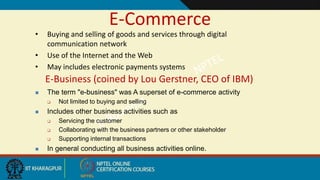
E-Commerce
• Buying and selling of goods and services through digital
communication network
• Use of the Internet and the Web
• May includes electronic payments systems
E-Business (coined by Lou Gerstner, CEO of IBM)
 The term "e-business" was A superset of e-commerce activity
 Not limited to buying and selling
 Includes other business activities such as
 Servicing the customer
 Collaborating with the business partners or other stakeholder
 Supporting internal transactions
 In general conducting all business activities online.
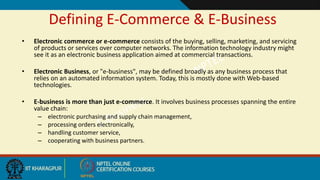
Defining E-Commerce & E-Business
• Electronic commerce or e-commerce consists of the buying, selling, marketing, and servicing
of products or services over computer networks. The information technology industry might
see it as an electronic business application aimed at commercial transactions.
• Electronic Business, or "e-business", may be defined broadly as any business process that
relies on an automated information system. Today, this is mostly done with Web-based
technologies.
• E-business is more than just e-commerce. It involves business processes spanning the entire
value chain:
– electronic purchasing and supply chain management,
– processing orders electronically,
– handling customer service,
– cooperating with business partners.
Books
• Management Information Systems: Managing the Digital
Firm, Laudon, K.C., and Laudon, J.P., Pearson
• Scaling for E-Business: Technologies. Models, Performance,
and Capacity Planning, Menasce & Almeida, PHI
• eBusiness & eCommerce – Managing the Digital Value
Chain, Meier, Andreas, and Stormer, Henrik, Springer
• Some reference books, Internet Resources, and Research
Papers
TYPES OF E-BUSINESS TRANSACTIONS
Week 1: Lecture 2
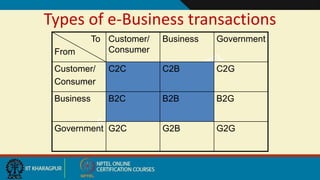
Types of e-Business transactions
To
From
Customer/
Consumer
Business Government
Customer/
Consumer
C2C C2B C2G
Business B2C B2B B2G
Government G2C G2B G2G
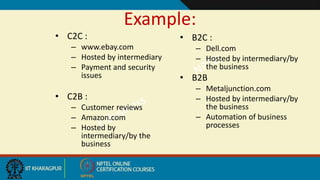
Example:
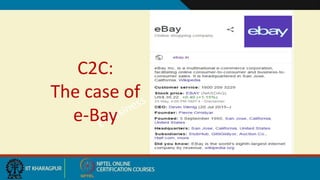
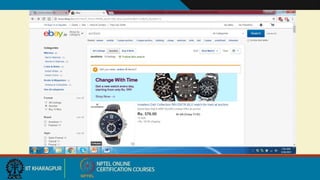
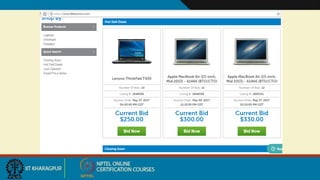
• C2C :
– www.ebay.com
– Hosted by intermediary
– Payment and security
issues
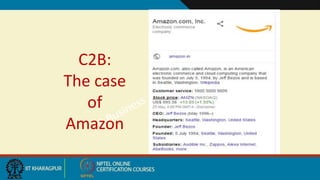
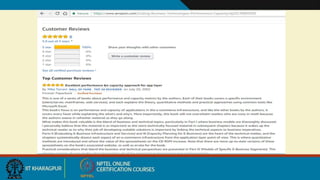
• C2B :
– Customer reviews
– Amazon.com
– Hosted by
intermediary/by the
business
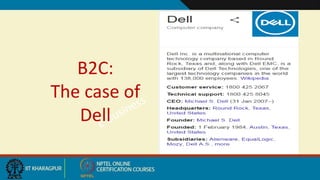
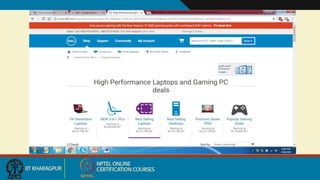
• B2C :
– Dell.com
– Hosted by intermediary/by
the business
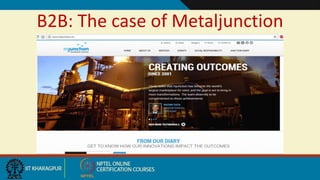
• B2B
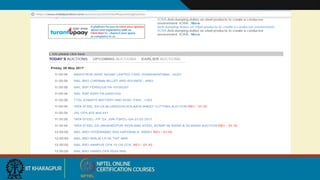
– Metaljunction.com
– Hosted by intermediary/by
the business
– Automation of business
processes
C2C:
The case of
e-Bay
B2C:
The case of
Dell
C2B:
The case
of
Amazon
B2B: The case of Metaljunction
Examples:
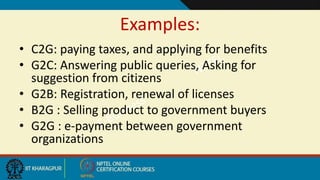
• C2G: paying taxes, and applying for benefits
• G2C: Answering public queries, Asking for
suggestion from citizens
• G2B: Registration, renewal of licenses
• B2G : Selling product to government buyers
• G2G : e-payment between government
organizations
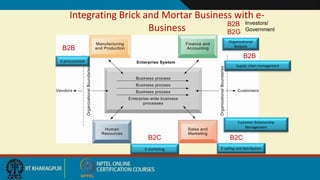
Integrating Brick and Mortar Business with e-
Business
Supply chain management
Investors/
Government
Organizational
Website
Customer Relationship
Management
E-procurement
E-marketing E-selling and distribution
B2B
B2B
B2C
B2G
B2C
B2B
Advantages of Integrating Brick and Mortar
Business with e-Business Operations
 Better availability of service
 Cost reduction in information processing
 Better timeliness of service
 Better access to customer market
 Initial cost of operations less expensive
 Operating costs of operations less expensive
 Better purchasing prices from suppliers
 Improved product development
 Improved scheduling
 Better supplier quality
BUSINESS MODELS ON THE WEB
Week 1: Lecture 3
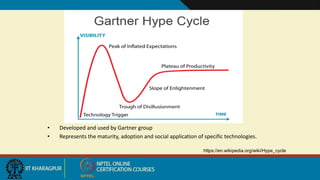
• Developed and used by Gartner group
• Represents the maturity, adoption and social application of specific technologies.
https://en.wikipedia.org/wiki/Hype_cycle
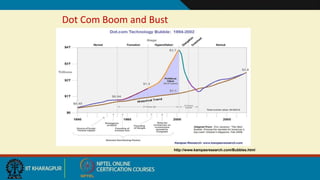
Dot Com Boom and Bust
http://www.kampasresearch.com/Bubbles.html
What is a business model
• A business model articulates the logic and provides
data and other evidence that demonstrates how a
business creates and delivers value to customers.
• It also outlines the architecture of revenues, costs, and
profits associated with the business enterprise
delivering that value.
Teece, D.J., 2010. Business models, business strategy and innovation. Long range planning, 43(2), pp.172-194.
43
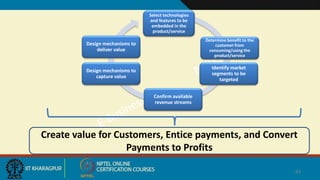
Select technologies
and features to be
embedded in the
product/service
Determine benefit to the
customer from
consuming/using the
product/service
Identify market
segments to be
targeted
Confirm available
revenue streams
Design mechanisms to
capture value
Design mechanisms to
deliver value
Create value for Customers, Entice payments, and Convert
Payments to Profits
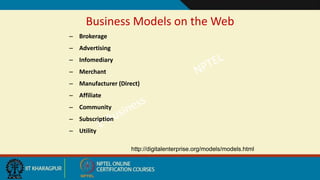
Business Models on the Web
– Brokerage
– Advertising
– Infomediary
– Merchant
– Manufacturer (Direct)
– Affiliate
– Community
– Subscription
– Utility
http://digitalenterprise.org/models/models.html
Brokerage Model
• Brokers are market-makers who bring buyers and sellers together and facilitate transactions.
• Exists in Business-to-business (B2B), business-to-consumer (B2C), consumer-to-consumer (C2C)
markets.
• Usually a broker charges a fee or commission for each transaction it enables.
• Brokerage models include:
• Marketplace Exchange -- Orbitz, ChemConnect
• Buy/Sell Fulfillment -- CarsDirect, Respond.com]
• Demand Collection System --Priceline.com
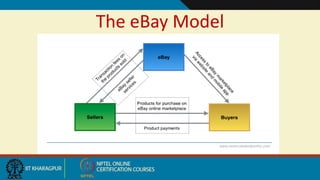
• Auction Broker -- eBay
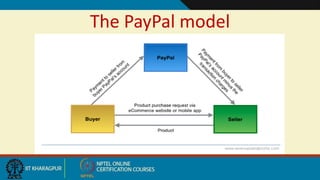
• Transaction Broker -- PayPal, Escrow.com
• Distributor – Catalogue services
• Search Agent – Price bots and shop bots
• Virtual Marketplace -- Amazon.com]
The eBay Model
The PayPal model
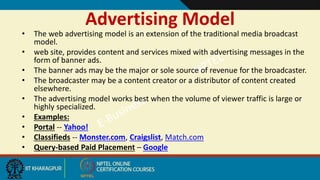
Advertising Model
• The web advertising model is an extension of the traditional media broadcast
model.
• web site, provides content and services mixed with advertising messages in the
form of banner ads.
• The banner ads may be the major or sole source of revenue for the broadcaster.
• The broadcaster may be a content creator or a distributor of content created
elsewhere.
• The advertising model works best when the volume of viewer traffic is large or
highly specialized.
• Examples:
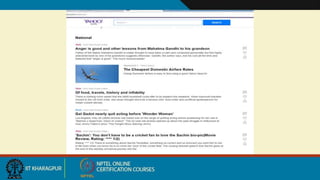
• Portal -- Yahoo!
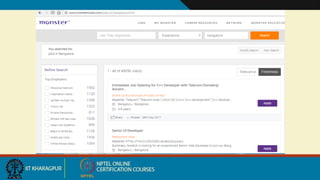
• Classifieds -- Monster.com, Craigslist, Match.com
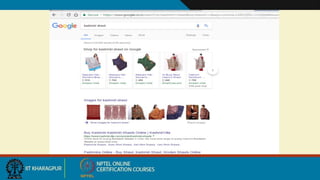
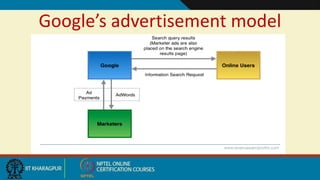
• Query-based Paid Placement – Google
Google’s advertisement model
Infomediary Model
• Some firms function as infomediaries (information
intermediaries) assisting buyers and/or sellers understand a
given market.
• Target marketing campaigns.
• Comparative Purchasing
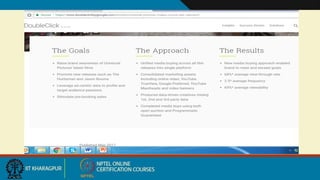
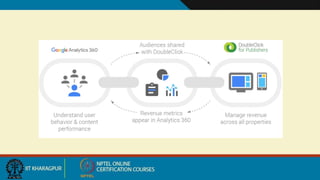
• Advertising Networks -- DoubleClick
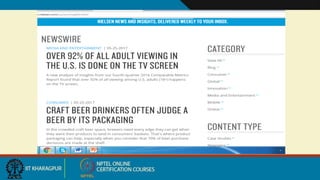
• Audience Measurement Services -- Nielsen/Netratings
BUSINESS MODELS ON THE WEB
Week 1: Lecture 4
Merchant Model
• Wholesalers and retailers of goods and services on the Web
• Sales may be made based on list prices or through auction.
• Virtual Merchant -- Amazon.com]
• Catalog Merchant -- Lands' End
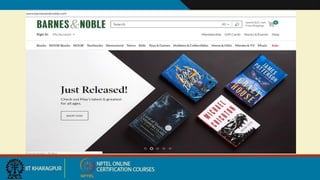
• Click and Mortar -- Barnes & Noble
• Bit Vendor -- Apple iTunes Music Store
Manufacturer (Direct) Model
• Reaching the buyers directly and thereby
compress the distribution channel.
• The manufacturer model can be based on
efficiency, improved customer service, and a
better understanding of customer preferences.
• Ex.: Dell Computer
Affiliate Model
• The affiliates provide purchase-point click-through to
the merchant.
• It is a pay-for-performance model -- if an affiliate does
not generate sales, it represents no cost to the
merchant.
• Variations include, banner exchange, pay-per-click, and
revenue sharing programs.
• Barnes & Noble, Amazon.com with DoubleClick
Community Model
• Revenue can be based on the sale of ancillary products and services or voluntary
contributions; or revenue may be tied to contextual advertising and subscriptions for
premium services.
• Example:
• Open Source -- software developed voluntarily by a global community of programmers who
share code openly. Instead of licensing code for a fee, open source relies on revenue
generated from related services like systems integration, product support, tutorials and user
documentation. [Red Hat]
• Public Broadcasting -- user contributor model used by not-for-profit radio and television
broadcasting extended to the web. The model is based on the creation of a community of
users who support the site through voluntary donations. [The Classical Station ]
• Social Networking Services -- sites that provide individuals with the ability to connect to
other individuals along a defined common interest (professional, hobby etc.). Social
networking services can provide opportunities for contextual advertising and subscriptions
for premium services. [LinkedIn]
Subscription Model
• Users are charged a periodic -- daily, monthly or annual -- fee to subscribe to a service.
• Example:
• Content Services -- provide text, audio, or video content to users who subscribe for a fee to
gain access to the service. [Listen.com, Netflix]
• Person-to-Person Networking Services -- are conduits for the distribution of user-submitted
information, such as individuals searching for former schoolmates. [Classmates]
• Trust Services -- come in the form of membership associations that abide by an explicit code
of conduct, and in which members pay a subscription fee. [Truste]
• Internet Services Providers -- offer network connectivity and related services on a monthly
subscription. [America Online]
Utility Model
• The utility or "on-demand" model is based on metering usage, or a "pay as you go" approach.
Unlike subscriber services, metered services are based on actual usage rates.
• Metered Usage -- measures and bills users based on actual usage of a service. Internet
service providers (ISPs) in some parts of the world operate as utilities, charging customers for
connection minutes, as opposed to the subscriber model.
• Metered Subscriptions -- allows subscribers to purchase access to content in metered
portions (e.g., numbers of pages viewed). [Slashdot]
Instruction for developing the case
• Background and history of the case company
• Focus of the case (which business functionality you like to focus on)
– Procurement, selling, marketing, HR, operations, customer relationship management, supplier
management, supply chain management
• Nature of the underlying information system
• Business process reengineering due to adoption of E-Business practices
• Perceived benefits (revenue models etc.)
• Failure or success stories
• Your view and analysis
• Minimum 20 References (research papers, company website, authentic web resources)
• Maximum 10 PPT, audio, video inclusion if available
INNOVATIVE E-BUSINESS MODELS FOR BRICK AND MORTAR
FIRMS
Week 1: Lecture 5
E-Procurement at Tata Steel
Mamata Jenamani,
Department of IE&M
The Organization
• Tata Steel contributes over 13% of the total
steel production in India
• Total turnover in fiscal year 2002-2003 : 19.6
billion USD
• Company’s profit in the same year was 2.2
billion USD.
Mamata Jenamani,
Department of IE&M
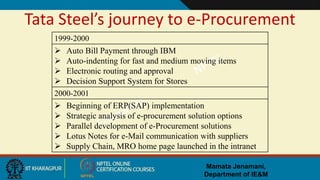
Tata Steel’s journey to e-Procurement
1999-2000
 Auto Bill Payment through IBM
 Auto-indenting for fast and medium moving items
 Electronic routing and approval
 Decision Support System for Stores
2000-2001
 Beginning of ERP(SAP) implementation
 Strategic analysis of e-procurement solution options
 Parallel development of e-Procurement solutions
 Lotus Notes for e-Mail communication with suppliers
 Supply Chain, MRO home page launched in the intranet
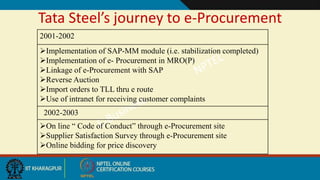
Tata Steel’s journey to e-Procurement
2001-2002
Implementation of SAP-MM module (i.e. stabilization completed)
Implementation of e- Procurement in MRO(P)
Linkage of e-Procurement with SAP
Reverse Auction
Import orders to TLL thru e route
Use of intranet for receiving customer complaints
2002-2003
On line “ Code of Conduct” through e-Procurement site
Supplier Satisfaction Survey through e-Procurement site
Online bidding for price discovery
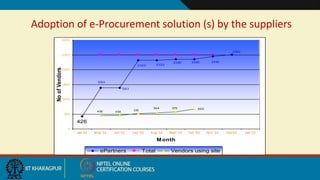
Adoption of e-Procurement solution (s) by the suppliers
665
2500
2450
2350
2350
1
383
426
1
383
2322 2322
575
450 454 51
5
544
0
500
1
000
1
500
2000
2500
3000
Jan' 02 M ay' 02 Jun' 02 July' 02 Aug' 02 Sept' 02 Oct '02 Nov '02 Dec'02 Jan' 03
Month
No
of
Vendors
ePartners Total Vendors using site
Different e-Procurement solutions
• Metaljunction.com – an e-market for steel
industry sponsored by a consortium of SAIL and
Tata Steel
• An internal e-Bidding solution
• E-negotiation solution
• Online Stock Information System for VMI
suppliers
Mamata Jenamani,
Department of IE&M
The
Internet
Buyers
Sellers
Metaljunction.com
SAIL TATA
STEEL
Leased line/Dialup
Connection
Dedicated
Connection
Fax/Telephone
Partner
Bank
Information
about buyers
The Internet
Information Flow
Inventory and Finance Flow
Credit Flow
Mamata Jenamani,
Department of IE&M
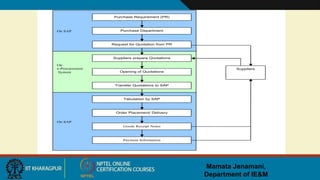
On SAP
On
e-Procurement
System
On SAP
Purchase Requirement (PR)
Purchase Department
Request for Quotation from PR
Suppliers prepare Quotations
Opening of Quotations
Transfer Quotations to SAP
Tabulation by SAP
Order Placement/ Delivery
Payment Information
Suppliers
Goods Receipt Notes
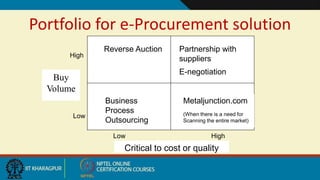
Reverse Auction
Business
Process
Outsourcing
Partnership with
suppliers
E-negotiation
Metaljunction.com
(When there is a need for
Scanning the entire market)
Critical to cost or quality
Buy
Volume
Portfolio for e-Procurement solution
Low
Low High
High
Mamata Jenamani,
Department of IE&M
Benefits from the
e-Procurement
Solutions
Mamata Jenamani,
Department of IE&M
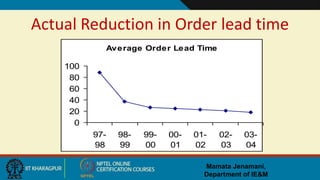
Actual Reduction in Order lead time
Average Order Lead Time
0
20
40
60
80
100
97-
98
98-
99
99-
00
00-
01
01-
02
02-
03
03-
04
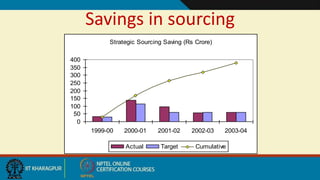
Savings in sourcing
Strategic Sourcing Saving (Rs Crore)
0
50
100
150
200
250
300
350
400
1999-00 2000-01 2001-02 2002-03 2003-04
Actual Target Cumulative
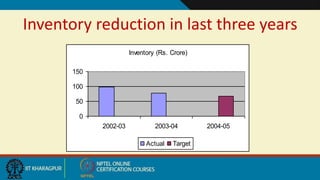
Inventory reduction in last three years
Inventory (Rs. Crore)
0
50
100
150
2002-03 2003-04 2004-05
Actual Target
ITC’s eChoupal Initiative
Mamata Jenamani,
Department of IE&M
The Beginning
• This initiative was implemented by ITC Limited’s International Business
Division (IBD) under the leadership of Chief Executive S. Sivakumar. It
began with the aim of deploying technology to re-engineer procurement of
soybeans and its derivatives such that it serves as a highly profitable
distribution and marketing channel.
• Management Principles adopted
i. Focusing on Re-engineering, Not Reconstructing
ii. Addressing the Whole, Not Just a Part
The eChoupal model
• ITC supplied a computer kit to each village with the following components:
– A PC with a Windows/Intel platform, multimedia kit, and connectivity interface
– Connection lines, either telephone (with bit rate between 28.8 and 36 kbps) or, more commonly,
VSAT
– A power supply consisting of UPS and solar-powered battery backup
– A dot-matrix printer
• The total setup cost to ITC was Rs. 170,000 ($3,762) per choupal. Another Rs. 100,000
($2,213) was spent on people, travel, communication, software, and training.
• Farmers were able to access the World Wide Web through a site dedicated specifically to
them-www.soyachoupal.com
• The company believed it would be able to recover the cost and make a profit within three
years of the initial eChoupal rollout.
www.soyachoupal.com
• This website was updated by the ITC Bhopal office. The data uplink (that provided the source
information for the site), however, took place in Bangalore, home of ITC Infotech India Ltd.
• The site contained much useful information that was previously unavailable to farmers in Madhya
Pradesh.
• The site opened up by welcoming farmers into the “community” of the eChoupal.
• On the left side of the screen, there were nine links to the areas of key information that comprised
the eChoupal:
• Weather, Best Practices, Crop Information, Market Information, FAQs, News, Feedback, and
information about ITC.
• The feature set had been developed progressively with full involvement of the farmers using the
system
Scope and Coverage of the Portal
i. Weather information
ii. Farming practices
iii. Market information -Provides market information under the following
heads:
 Domestic market prices
 International market prices - of selected competing countries
 Global trends – commentary by the expert panel
iv. Agri inputs - This section gives details of India’s best Agri input
manufacturers/ vendors.
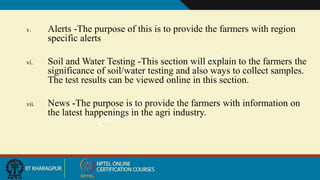
v. Alerts -The purpose of this is to provide the farmers with region
specific alerts
vi. Soil and Water Testing -This section will explain to the farmers the
significance of soil/water testing and also ways to collect samples.
The test results can be viewed online in this section.
vii. News -The purpose is to provide the farmers with information on
the latest happenings in the agri industry.
Kiosk establishment guidelines
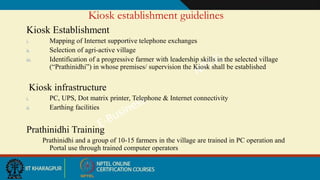
Kiosk Establishment
i. Mapping of Internet supportive telephone exchanges
ii. Selection of agri-active village
iii. Identification of a progressive farmer with leadership skills in the selected village
(“Prathinidhi”) in whose premises/ supervision the Kiosk shall be established
Kiosk infrastructure
i. PC, UPS, Dot matrix printer, Telephone & Internet connectivity
ii. Earthing facilities
Prathinidhi Training
Prathinidhi and a group of 10-15 farmers in the village are trained in PC operation and
Portal use through trained computer operators
Mamata Jenamani,
Department of IE&M
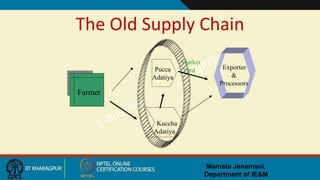
The Old Supply Chain
Farmer
Pucca
Adatiya
Kuccha
Adatiya
Market
Yard Exporter
&
Processors
Mamata Jenamani,
Department of IE&M
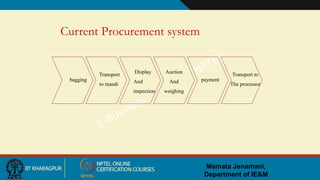
Current Procurement system
Transport
to mandi
bagging
Display
And
inspection
Auction
And
weighing
payment
Transport to
The processor
Mamata Jenamani,
Department of IE&M
Problems of the Existing Mandi System
i. The lack of professional competition combined with the communal stranglehold on rural trading
ii. Agents forward loans to the farmers during sowing season farmers obliged to sell their
produce to these agentsdeductions done by the agents for loan amount and interest.
iii. Dependent on the agents for information regarding prices manipulate prices and information
iv. No resources to analyze or exploit price trendssale not optimal price for the crop.
v. Weights used for the weighing process are tampered with
vi. Crops are displayed in open air courtyards  subject to being negatively affected by the weather
vii. Inspection process is unscientific and often arbitrary  favor the buyer  no incentive to
farmers to invest in better seed or farming practices that lead to higher quality—even though
quality matters to Processors.
viii. The multiple points of handling in the supply-chain require the produce to be bagged, which
takes four to five times longer to be unloaded at the processing plant than unbagged produce.
ix. Traders generally do not have the capacity to store and manage different qualities and grades of
produce, inhibiting efforts to produce better crop grades.
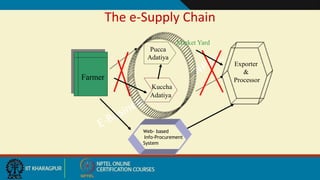
The e-Supply Chain
Farmer
Pucca
Adatiya
Kuccha
Adatiya
Exporter
&
Processor
Market Yard
Web- based
Info-Procurement
System
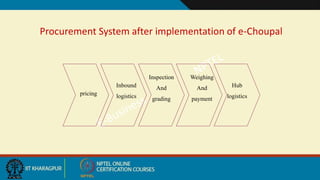
Procurement System after implementation of e-Choupal
pricing
Inbound
logistics
Inspection
And
grading
Weighing
And
payment
Hub
logistics
Benefit-Cost analysis of the
Current and Proposed system
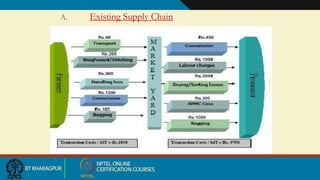
A. Existing Supply Chain
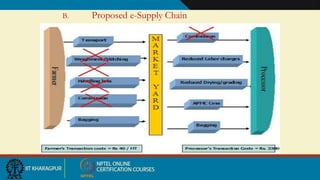
B. Proposed e-Supply Chain
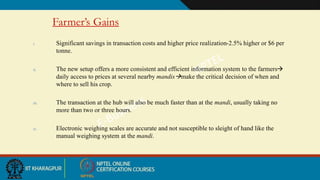
Farmer’s Gains
i. Significant savings in transaction costs and higher price realization-2.5% higher or $6 per
tonne.
ii. The new setup offers a more consistent and efficient information system to the farmers
daily access to prices at several nearby mandismake the critical decision of when and
where to sell his crop.
iii. The transaction at the hub will also be much faster than at the mandi, usually taking no
more than two or three hours.
iv. Electronic weighing scales are accurate and not susceptible to sleight of hand like the
manual weighing system at the mandi.
v. No need to bag produce avoids the associated loss of produce by intentional spillage.
vi. Recognition as not just simply agricultural producers, but integral business partners in the supply process.
vii. Farmers also can make use of the information available to them through the portal to improve yields.
viii. Seed, fertilizer, and consumer products offered them through e-portal cost substantially less than through
other local sources such as village traders.
ix. Net result has been that while the area under soy cultivation has increased, the total procurement made at
the mandis has decreased
Processor’s benefits
i. The Processor no longer needs to go through layers of intermediaries  reduction in transaction
costs.
ii. The current system  unprofessional and corrupt business environment  agri- sector seems
unattractive to the private sector. This has greatly limited the ability of these companies to
rationalize this sector.
iii. Able to directly interact with the farmer which was not possible in the present mandi system. The
fact that the farmer is treated as a business partner goes a long way in winning over his trust and
respect.
iv. Direct procurement from the farmer  high product quality and lesser losses in handling and
transportation.
v. Enables the Processor to influence the farmer to introduce newer better farming techniques, better
agricultural inputs etc. which is beneficial to all the parties concerned.
References
• http://www.nethistory.info/History%20of%20the%20Internet/dotcom.html
• http://www.thebubblebubble.com/dot-com-bubble/
• https://flatworldbusiness.wordpress.com/flat-education/previously/web-1-0-vs-web-2-0-vs-web-3-0-a-bird-eye-on-the-definition/dotcom-bubble/
• Teece, D.J., 2010. Business models, business strategy and innovation. Long range planning, 43(2), pp.172-194.
101

NPTEL E BUSINESS NOTES Week1 for moocs..

  • 1.
    1 E-BUSINESS PROF. MAMATA JENAMANI DEPARTMENTOF INDUSTRIAL AND SYSTEMS ENGINEERING IIT KHARAGPUR
  • 2.
  • 3.
    Objective The Internet haschanged the way companies carry out their businesses. The primary objective of this course is to introduce concepts, tools and approaches to electronic business to the post- graduate and the undergraduate students. Further, the subject will help the students to develop skills to manage businesses in the digital world.
  • 4.
    Contents • Introduction toE-Business • Making Functional Areas E-Business Enabled • Technologies for E-Business • Decision Support in E-Business
  • 5.
    Contents: Making FunctionalAreas E-Business Enabled : Week 1 Introduction to E-Business; Making Functional Areas E-Business Enabled; Technologies for E- Business; Decision Support in E-Business Week 2 Making Functional Areas E-Business Enabled : Value chain and supply chain, inter and intra organizational business processes, ERP Week 3 Making Functional Areas E-Business Enabled : E-Procurement Week 4 Making Functional Areas E-Business Enabled : E-marketing, E-Selling, E-Supply Chain Management
  • 6.
    Contents: Technologies forE-Business Week 5 Technologies for E-Business: Internet and Web based system Week 6 Technologies for E-Business: Security and payment systems Week 7 Technologies for E-Business: Supply chain integration technologies (EDI, RFID, Sensors, IoT, GPS, GIS) Week 8 Technologies for E-Business: Supply chain integration technologies (Web services and cloud)
  • 7.
    Contents: Decision Supportin E-Business Week 9 Decision Support in E-Business: Web analytics Week 10 Decision Support in E-Business: Customer behavior modeling Week 11 Decision Support in E-Business: Auctions Week 12 Decision Support in E-Business: Recommender systems
  • 8.
  • 9.
    Los Angeles Times3rd Annual Investment Strategies Conference, May 22, 1999 “… … First of all, let me start with a statement that much as we talk about Internet companies today, in five years' time there won't be any Internet companies. All companies will be Internet companies or they will be dead. … …” Dr Andy Grove Intel Chairman
  • 10.
    What is Business (OxfordEnglish Dictionary) 1. a person’s regular occupation or trade. 2. work to be done or matters to be attended to. 3. a person’s concern. 4. commercial activity. 5. a commercial organization. 6. (informal) a difficult or problematic matter. 7. (the business) (informal) an excellent person or thing. 8. actions other than dialogue in a play.
  • 11.
    What is Business Businessis the social science of managing people to organize and maintain collective productivity toward accomplishing particular creative and productive goals, usually to generate revenue. (http://en.wikipedia.org/wiki/Business) A business (also known as an enterprise, a company, or a firm) is an organizational entity involved in the provision of goods and services to consumers. Every business requires some form of investment and enough customers to whom its output can be sold on a consistent basis in order to make a profit. Businesses can be privately owned, not-for-profit, or state-owned. (http://www.businessdictionary.com/definition/business.html)
  • 12.
    What is Business •A business is generally an organizational unit that has (that should have) a defined strategy and a manager with sales and profit responsibility. David A. Aaker, Damien McLoughlin, Strategic Market Management: Global Perspectives
  • 13.
    What is thepurpose of a business • To generate revenue • By delivering value to the customer • And satisfying them
  • 14.
    Customer Delivered Value (Kotler) •Customer delivered value is the difference between total customer value and total customer cost. • Total customer value is the bundle of benefits customers expect from a given product or service. • Total customer cost is the bundle of costs the customers expect to incur in evaluating, obtaining, using, and disposing of the product or service.
  • 15.
    Customer Satisfaction • Satisfactionis a person’s feeling of pleasure or disappointment resulting from comparing a product’s perceived performance (or outcome) in relation to his/her expectation • Satisfied customers are loyal customers • The key to generating high customer loyalty is to deliver high customer value. • A company must develop a competitively superior value proposition and superior value-delivery system.
  • 16.
    Value chain andValue Delivery Network (Supply Chain) Primary Business Processes Support Activities Procurement Technology Development Human Resource Development Firm Infrastructure Inbound Logistics Operations Outbound Logistics Marketing and Sales Service DuPont (Fibers) Milliken (Fabric) Levi’s (Apparel) Sears (Retail) Customer Order Delivery Customer Order Cycle Replenishment Cycle Manufacturing Cycle Procurement Cycle
  • 17.
    The nature ofhigh performance business Stakeholders Processes Resources Organization Set strategies to satisfy key stakeholders … by improving critical business processes … and aligning resources and organization Customers, employees, suppliers, distributors, stockholders, financial institutions, government … Work flows linking interdepartmental activities: Ex. Integrating sales, shipping, installation, maintenance, support activities Labor, material machines, information, energy … Structures, policies, corporate cultures …
  • 18.
    What is commerce (OxfordEnglish Dictionary) • The activity of buying and selling, especially on a large scale Business Vs. Commerce  All businesses involve some commercial activity.  Commerce is a subset of business
  • 19.
    The evolution ofthe magic term ‘e’ 1950-1960: Data Processing Electronic Data Processing Systems: Transaction Processing, Record Keeping, and Traditional Accounting Practices 1960-1970: Management Reporting Management Information Systems: Management reports of pre-specified information to support decision making 1970-1980: Decision Support Decision Support Systems: Interactive ad hoc support for managerial Decision making 1980-1990: Strategic and end user support systems End user computing systems, Expert systems, Strategic Information system for competitive advantage 1990-onwards: E-Commerce and E-Business Systems ERP, Web based systems, Web services, cloud computing, Mobile Computing, RFID, GPS-GIS, Internet of things, Business Analytics, Big data
  • 20.
    ICT for managingvalue chain: - A historical perspective 1950-1960: Transaction processing systems 1960-1970: Management Information Systems 1970-1980: Decision Support Systems: 1980-1990: Strategic and end user support systems 1990-onwards: E-Commerce and E-Business Systems ERP + New enabling technologies for supply chain integration and inter operability
  • 21.
    E-Commerce • Buying andselling of goods and services through digital communication network • Use of the Internet and the Web • May includes electronic payments systems E-Business (coined by Lou Gerstner, CEO of IBM)  The term "e-business" was A superset of e-commerce activity  Not limited to buying and selling  Includes other business activities such as  Servicing the customer  Collaborating with the business partners or other stakeholder  Supporting internal transactions  In general conducting all business activities online.
  • 22.
    Defining E-Commerce &E-Business • Electronic commerce or e-commerce consists of the buying, selling, marketing, and servicing of products or services over computer networks. The information technology industry might see it as an electronic business application aimed at commercial transactions. • Electronic Business, or "e-business", may be defined broadly as any business process that relies on an automated information system. Today, this is mostly done with Web-based technologies. • E-business is more than just e-commerce. It involves business processes spanning the entire value chain: – electronic purchasing and supply chain management, – processing orders electronically, – handling customer service, – cooperating with business partners.
  • 23.
    Books • Management InformationSystems: Managing the Digital Firm, Laudon, K.C., and Laudon, J.P., Pearson • Scaling for E-Business: Technologies. Models, Performance, and Capacity Planning, Menasce & Almeida, PHI • eBusiness & eCommerce – Managing the Digital Value Chain, Meier, Andreas, and Stormer, Henrik, Springer • Some reference books, Internet Resources, and Research Papers
  • 24.
    TYPES OF E-BUSINESSTRANSACTIONS Week 1: Lecture 2
  • 25.
    Types of e-Businesstransactions To From Customer/ Consumer Business Government Customer/ Consumer C2C C2B C2G Business B2C B2B B2G Government G2C G2B G2G
  • 26.
    Example: • C2C : –www.ebay.com – Hosted by intermediary – Payment and security issues • C2B : – Customer reviews – Amazon.com – Hosted by intermediary/by the business • B2C : – Dell.com – Hosted by intermediary/by the business • B2B – Metaljunction.com – Hosted by intermediary/by the business – Automation of business processes
  • 27.
  • 29.
  • 32.
  • 34.
    B2B: The caseof Metaljunction
  • 36.
    Examples: • C2G: payingtaxes, and applying for benefits • G2C: Answering public queries, Asking for suggestion from citizens • G2B: Registration, renewal of licenses • B2G : Selling product to government buyers • G2G : e-payment between government organizations
  • 37.
    Integrating Brick andMortar Business with e- Business Supply chain management Investors/ Government Organizational Website Customer Relationship Management E-procurement E-marketing E-selling and distribution B2B B2B B2C B2G B2C B2B
  • 38.
    Advantages of IntegratingBrick and Mortar Business with e-Business Operations  Better availability of service  Cost reduction in information processing  Better timeliness of service  Better access to customer market  Initial cost of operations less expensive  Operating costs of operations less expensive  Better purchasing prices from suppliers  Improved product development  Improved scheduling  Better supplier quality
  • 39.
    BUSINESS MODELS ONTHE WEB Week 1: Lecture 3
  • 40.
    • Developed andused by Gartner group • Represents the maturity, adoption and social application of specific technologies. https://en.wikipedia.org/wiki/Hype_cycle
  • 41.
    Dot Com Boomand Bust http://www.kampasresearch.com/Bubbles.html
  • 42.
    What is abusiness model • A business model articulates the logic and provides data and other evidence that demonstrates how a business creates and delivers value to customers. • It also outlines the architecture of revenues, costs, and profits associated with the business enterprise delivering that value. Teece, D.J., 2010. Business models, business strategy and innovation. Long range planning, 43(2), pp.172-194.
  • 43.
    43 Select technologies and featuresto be embedded in the product/service Determine benefit to the customer from consuming/using the product/service Identify market segments to be targeted Confirm available revenue streams Design mechanisms to capture value Design mechanisms to deliver value Create value for Customers, Entice payments, and Convert Payments to Profits
  • 44.
    Business Models onthe Web – Brokerage – Advertising – Infomediary – Merchant – Manufacturer (Direct) – Affiliate – Community – Subscription – Utility http://digitalenterprise.org/models/models.html
  • 45.
    Brokerage Model • Brokersare market-makers who bring buyers and sellers together and facilitate transactions. • Exists in Business-to-business (B2B), business-to-consumer (B2C), consumer-to-consumer (C2C) markets. • Usually a broker charges a fee or commission for each transaction it enables. • Brokerage models include: • Marketplace Exchange -- Orbitz, ChemConnect • Buy/Sell Fulfillment -- CarsDirect, Respond.com] • Demand Collection System --Priceline.com • Auction Broker -- eBay • Transaction Broker -- PayPal, Escrow.com • Distributor – Catalogue services • Search Agent – Price bots and shop bots • Virtual Marketplace -- Amazon.com]
  • 46.
  • 47.
  • 48.
    Advertising Model • Theweb advertising model is an extension of the traditional media broadcast model. • web site, provides content and services mixed with advertising messages in the form of banner ads. • The banner ads may be the major or sole source of revenue for the broadcaster. • The broadcaster may be a content creator or a distributor of content created elsewhere. • The advertising model works best when the volume of viewer traffic is large or highly specialized. • Examples: • Portal -- Yahoo! • Classifieds -- Monster.com, Craigslist, Match.com • Query-based Paid Placement – Google
  • 52.
  • 53.
    Infomediary Model • Somefirms function as infomediaries (information intermediaries) assisting buyers and/or sellers understand a given market. • Target marketing campaigns. • Comparative Purchasing • Advertising Networks -- DoubleClick • Audience Measurement Services -- Nielsen/Netratings
  • 58.
    BUSINESS MODELS ONTHE WEB Week 1: Lecture 4
  • 59.
    Merchant Model • Wholesalersand retailers of goods and services on the Web • Sales may be made based on list prices or through auction. • Virtual Merchant -- Amazon.com] • Catalog Merchant -- Lands' End • Click and Mortar -- Barnes & Noble • Bit Vendor -- Apple iTunes Music Store
  • 61.
    Manufacturer (Direct) Model •Reaching the buyers directly and thereby compress the distribution channel. • The manufacturer model can be based on efficiency, improved customer service, and a better understanding of customer preferences. • Ex.: Dell Computer
  • 62.
    Affiliate Model • Theaffiliates provide purchase-point click-through to the merchant. • It is a pay-for-performance model -- if an affiliate does not generate sales, it represents no cost to the merchant. • Variations include, banner exchange, pay-per-click, and revenue sharing programs. • Barnes & Noble, Amazon.com with DoubleClick
  • 63.
    Community Model • Revenuecan be based on the sale of ancillary products and services or voluntary contributions; or revenue may be tied to contextual advertising and subscriptions for premium services. • Example: • Open Source -- software developed voluntarily by a global community of programmers who share code openly. Instead of licensing code for a fee, open source relies on revenue generated from related services like systems integration, product support, tutorials and user documentation. [Red Hat] • Public Broadcasting -- user contributor model used by not-for-profit radio and television broadcasting extended to the web. The model is based on the creation of a community of users who support the site through voluntary donations. [The Classical Station ] • Social Networking Services -- sites that provide individuals with the ability to connect to other individuals along a defined common interest (professional, hobby etc.). Social networking services can provide opportunities for contextual advertising and subscriptions for premium services. [LinkedIn]
  • 64.
    Subscription Model • Usersare charged a periodic -- daily, monthly or annual -- fee to subscribe to a service. • Example: • Content Services -- provide text, audio, or video content to users who subscribe for a fee to gain access to the service. [Listen.com, Netflix] • Person-to-Person Networking Services -- are conduits for the distribution of user-submitted information, such as individuals searching for former schoolmates. [Classmates] • Trust Services -- come in the form of membership associations that abide by an explicit code of conduct, and in which members pay a subscription fee. [Truste] • Internet Services Providers -- offer network connectivity and related services on a monthly subscription. [America Online]
  • 65.
    Utility Model • Theutility or "on-demand" model is based on metering usage, or a "pay as you go" approach. Unlike subscriber services, metered services are based on actual usage rates. • Metered Usage -- measures and bills users based on actual usage of a service. Internet service providers (ISPs) in some parts of the world operate as utilities, charging customers for connection minutes, as opposed to the subscriber model. • Metered Subscriptions -- allows subscribers to purchase access to content in metered portions (e.g., numbers of pages viewed). [Slashdot]
  • 66.
    Instruction for developingthe case • Background and history of the case company • Focus of the case (which business functionality you like to focus on) – Procurement, selling, marketing, HR, operations, customer relationship management, supplier management, supply chain management • Nature of the underlying information system • Business process reengineering due to adoption of E-Business practices • Perceived benefits (revenue models etc.) • Failure or success stories • Your view and analysis • Minimum 20 References (research papers, company website, authentic web resources) • Maximum 10 PPT, audio, video inclusion if available
  • 67.
    INNOVATIVE E-BUSINESS MODELSFOR BRICK AND MORTAR FIRMS Week 1: Lecture 5
  • 68.
  • 69.
    Mamata Jenamani, Department ofIE&M The Organization • Tata Steel contributes over 13% of the total steel production in India • Total turnover in fiscal year 2002-2003 : 19.6 billion USD • Company’s profit in the same year was 2.2 billion USD.
  • 70.
    Mamata Jenamani, Department ofIE&M Tata Steel’s journey to e-Procurement 1999-2000  Auto Bill Payment through IBM  Auto-indenting for fast and medium moving items  Electronic routing and approval  Decision Support System for Stores 2000-2001  Beginning of ERP(SAP) implementation  Strategic analysis of e-procurement solution options  Parallel development of e-Procurement solutions  Lotus Notes for e-Mail communication with suppliers  Supply Chain, MRO home page launched in the intranet
  • 71.
    Tata Steel’s journeyto e-Procurement 2001-2002 Implementation of SAP-MM module (i.e. stabilization completed) Implementation of e- Procurement in MRO(P) Linkage of e-Procurement with SAP Reverse Auction Import orders to TLL thru e route Use of intranet for receiving customer complaints 2002-2003 On line “ Code of Conduct” through e-Procurement site Supplier Satisfaction Survey through e-Procurement site Online bidding for price discovery
  • 72.
    Adoption of e-Procurementsolution (s) by the suppliers 665 2500 2450 2350 2350 1 383 426 1 383 2322 2322 575 450 454 51 5 544 0 500 1 000 1 500 2000 2500 3000 Jan' 02 M ay' 02 Jun' 02 July' 02 Aug' 02 Sept' 02 Oct '02 Nov '02 Dec'02 Jan' 03 Month No of Vendors ePartners Total Vendors using site
  • 73.
    Different e-Procurement solutions •Metaljunction.com – an e-market for steel industry sponsored by a consortium of SAIL and Tata Steel • An internal e-Bidding solution • E-negotiation solution • Online Stock Information System for VMI suppliers
  • 74.
    Mamata Jenamani, Department ofIE&M The Internet Buyers Sellers Metaljunction.com SAIL TATA STEEL Leased line/Dialup Connection Dedicated Connection Fax/Telephone Partner Bank Information about buyers The Internet Information Flow Inventory and Finance Flow Credit Flow
  • 75.
    Mamata Jenamani, Department ofIE&M On SAP On e-Procurement System On SAP Purchase Requirement (PR) Purchase Department Request for Quotation from PR Suppliers prepare Quotations Opening of Quotations Transfer Quotations to SAP Tabulation by SAP Order Placement/ Delivery Payment Information Suppliers Goods Receipt Notes
  • 76.
    Reverse Auction Business Process Outsourcing Partnership with suppliers E-negotiation Metaljunction.com (Whenthere is a need for Scanning the entire market) Critical to cost or quality Buy Volume Portfolio for e-Procurement solution Low Low High High
  • 77.
    Mamata Jenamani, Department ofIE&M Benefits from the e-Procurement Solutions
  • 78.
    Mamata Jenamani, Department ofIE&M Actual Reduction in Order lead time Average Order Lead Time 0 20 40 60 80 100 97- 98 98- 99 99- 00 00- 01 01- 02 02- 03 03- 04
  • 79.
    Savings in sourcing StrategicSourcing Saving (Rs Crore) 0 50 100 150 200 250 300 350 400 1999-00 2000-01 2001-02 2002-03 2003-04 Actual Target Cumulative
  • 80.
    Inventory reduction inlast three years Inventory (Rs. Crore) 0 50 100 150 2002-03 2003-04 2004-05 Actual Target
  • 81.
  • 82.
    Mamata Jenamani, Department ofIE&M The Beginning • This initiative was implemented by ITC Limited’s International Business Division (IBD) under the leadership of Chief Executive S. Sivakumar. It began with the aim of deploying technology to re-engineer procurement of soybeans and its derivatives such that it serves as a highly profitable distribution and marketing channel. • Management Principles adopted i. Focusing on Re-engineering, Not Reconstructing ii. Addressing the Whole, Not Just a Part
  • 83.
    The eChoupal model •ITC supplied a computer kit to each village with the following components: – A PC with a Windows/Intel platform, multimedia kit, and connectivity interface – Connection lines, either telephone (with bit rate between 28.8 and 36 kbps) or, more commonly, VSAT – A power supply consisting of UPS and solar-powered battery backup – A dot-matrix printer • The total setup cost to ITC was Rs. 170,000 ($3,762) per choupal. Another Rs. 100,000 ($2,213) was spent on people, travel, communication, software, and training. • Farmers were able to access the World Wide Web through a site dedicated specifically to them-www.soyachoupal.com • The company believed it would be able to recover the cost and make a profit within three years of the initial eChoupal rollout.
  • 84.
    www.soyachoupal.com • This websitewas updated by the ITC Bhopal office. The data uplink (that provided the source information for the site), however, took place in Bangalore, home of ITC Infotech India Ltd. • The site contained much useful information that was previously unavailable to farmers in Madhya Pradesh. • The site opened up by welcoming farmers into the “community” of the eChoupal. • On the left side of the screen, there were nine links to the areas of key information that comprised the eChoupal: • Weather, Best Practices, Crop Information, Market Information, FAQs, News, Feedback, and information about ITC. • The feature set had been developed progressively with full involvement of the farmers using the system
  • 85.
    Scope and Coverageof the Portal i. Weather information ii. Farming practices iii. Market information -Provides market information under the following heads:  Domestic market prices  International market prices - of selected competing countries  Global trends – commentary by the expert panel iv. Agri inputs - This section gives details of India’s best Agri input manufacturers/ vendors.
  • 86.
    v. Alerts -Thepurpose of this is to provide the farmers with region specific alerts vi. Soil and Water Testing -This section will explain to the farmers the significance of soil/water testing and also ways to collect samples. The test results can be viewed online in this section. vii. News -The purpose is to provide the farmers with information on the latest happenings in the agri industry.
  • 87.
    Kiosk establishment guidelines KioskEstablishment i. Mapping of Internet supportive telephone exchanges ii. Selection of agri-active village iii. Identification of a progressive farmer with leadership skills in the selected village (“Prathinidhi”) in whose premises/ supervision the Kiosk shall be established Kiosk infrastructure i. PC, UPS, Dot matrix printer, Telephone & Internet connectivity ii. Earthing facilities Prathinidhi Training Prathinidhi and a group of 10-15 farmers in the village are trained in PC operation and Portal use through trained computer operators
  • 88.
    Mamata Jenamani, Department ofIE&M The Old Supply Chain Farmer Pucca Adatiya Kuccha Adatiya Market Yard Exporter & Processors
  • 89.
    Mamata Jenamani, Department ofIE&M Current Procurement system Transport to mandi bagging Display And inspection Auction And weighing payment Transport to The processor
  • 90.
    Mamata Jenamani, Department ofIE&M Problems of the Existing Mandi System i. The lack of professional competition combined with the communal stranglehold on rural trading ii. Agents forward loans to the farmers during sowing season farmers obliged to sell their produce to these agentsdeductions done by the agents for loan amount and interest. iii. Dependent on the agents for information regarding prices manipulate prices and information iv. No resources to analyze or exploit price trendssale not optimal price for the crop. v. Weights used for the weighing process are tampered with
  • 91.
    vi. Crops aredisplayed in open air courtyards  subject to being negatively affected by the weather vii. Inspection process is unscientific and often arbitrary  favor the buyer  no incentive to farmers to invest in better seed or farming practices that lead to higher quality—even though quality matters to Processors. viii. The multiple points of handling in the supply-chain require the produce to be bagged, which takes four to five times longer to be unloaded at the processing plant than unbagged produce. ix. Traders generally do not have the capacity to store and manage different qualities and grades of produce, inhibiting efforts to produce better crop grades.
  • 92.
  • 93.
    Procurement System afterimplementation of e-Choupal pricing Inbound logistics Inspection And grading Weighing And payment Hub logistics
  • 94.
    Benefit-Cost analysis ofthe Current and Proposed system
  • 95.
  • 96.
  • 97.
    Farmer’s Gains i. Significantsavings in transaction costs and higher price realization-2.5% higher or $6 per tonne. ii. The new setup offers a more consistent and efficient information system to the farmers daily access to prices at several nearby mandismake the critical decision of when and where to sell his crop. iii. The transaction at the hub will also be much faster than at the mandi, usually taking no more than two or three hours. iv. Electronic weighing scales are accurate and not susceptible to sleight of hand like the manual weighing system at the mandi.
  • 98.
    v. No needto bag produce avoids the associated loss of produce by intentional spillage. vi. Recognition as not just simply agricultural producers, but integral business partners in the supply process. vii. Farmers also can make use of the information available to them through the portal to improve yields. viii. Seed, fertilizer, and consumer products offered them through e-portal cost substantially less than through other local sources such as village traders. ix. Net result has been that while the area under soy cultivation has increased, the total procurement made at the mandis has decreased
  • 99.
    Processor’s benefits i. TheProcessor no longer needs to go through layers of intermediaries  reduction in transaction costs. ii. The current system  unprofessional and corrupt business environment  agri- sector seems unattractive to the private sector. This has greatly limited the ability of these companies to rationalize this sector. iii. Able to directly interact with the farmer which was not possible in the present mandi system. The fact that the farmer is treated as a business partner goes a long way in winning over his trust and respect. iv. Direct procurement from the farmer  high product quality and lesser losses in handling and transportation. v. Enables the Processor to influence the farmer to introduce newer better farming techniques, better agricultural inputs etc. which is beneficial to all the parties concerned.
  • 100.
    References • http://www.nethistory.info/History%20of%20the%20Internet/dotcom.html • http://www.thebubblebubble.com/dot-com-bubble/ •https://flatworldbusiness.wordpress.com/flat-education/previously/web-1-0-vs-web-2-0-vs-web-3-0-a-bird-eye-on-the-definition/dotcom-bubble/ • Teece, D.J., 2010. Business models, business strategy and innovation. Long range planning, 43(2), pp.172-194.
  • 101.