1
Anti-septics, disinfectants, dentiferices,
mouth washes, demulcents, emollients,
protectives & hemostatics
‫ال‬ ‫بسم‬‫الرحمن‬‫الرحيم‬
2
Anti-septics & disinfectants
• Antiseptics: Destroy m.o. & used on living things
• Disinfectants: Destroy m.o. & used on non-living things
A. Alcohols: ethyl-alcohol, isopropyl-alcohol (50-70 %)
• Precipitate proteins & enzymes, kill many m.o.
• Used for preparing clean skin for injection and wiping tables
• Also used as vehicle for other antiseptics: iodine, etc
• Inactivated by biological material: pus, blood, etc
• Does not kill spores
B. Aldehydes: Formaldehyde (2-8%), glutaraldehyde (2%)
• Denature proteins & effective against bacteria, fungi & viruses
• Not inactivated by biological materials
• Used for disinfection of dental instruments
• Glutaraldehyde is more effective; less volatile & irritant, & lacks
unpleasant smell of formaldehyde
3
Anti-septics & disinfectants (Cont.)
C. Bis-biguanides: Clorhexidine
• Affect cell membrane & cause lysis. Kill most m.o.
• 0.2 & 1 % with gluconate for oral rinses & in toothpastes
• 1-4 % solution in water & 0.5 % sol in isopropyl alcohol for
cleaning skin, mucosa & hands before surgery
• 5 % solution for disinfection of instruments
D. Halogens: Denature proteins & enzymes; kill most m.o.
• Chlorine: (Na hypochlorite & organic chloramines)
• 2 % sol for irrigation of root canal, cleaning instruments
• Inactivated by organic matter
• Iodine: (KI solution & tincture)
• Not inactivated by organic matter
• Stains skin & may causes allergy
• Pavidone: 1% solution for mouth wash. 10% cream for skin
4
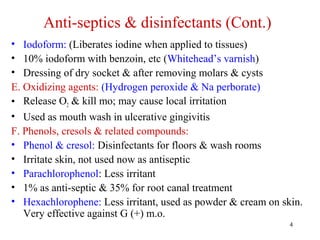
• Iodoform: (Liberates iodine when applied to tissues)
• 10% iodoform with benzoin, etc (Whitehead’s varnish)
• Dressing of dry socket & after removing molars & cysts
E. Oxidizing agents: (Hydrogen peroxide & Na perborate)
• Release O2 & kill mo; may cause local irritation
• Used as mouth wash in ulcerative gingivitis
F. Phenols, cresols & related compounds:
• Phenol & cresol: Disinfectants for floors & wash rooms
• Irritate skin, not used now as antiseptic
• Parachlorophenol: Less irritant
• 1% as anti-septic & 35% for root canal treatment
• Hexachlorophene: Less irritant, used as powder & cream on skin.
Very effective against G (+) m.o.
Anti-septics & disinfectants (Cont.)
5
Anti-septics & disinfectants (Cont.)
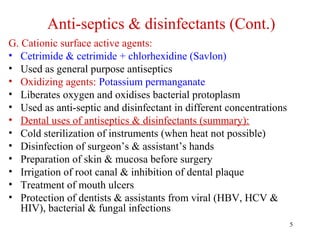
G. Cationic surface active agents:
• Cetrimide & cetrimide + chlorhexidine (Savlon)
• Used as general purpose antiseptics
• Oxidizing agents: Potassium permanganate
• Liberates oxygen and oxidises bacterial protoplasm
• Used as anti-septic and disinfectant in different concentrations
• Dental uses of antiseptics & disinfectants (summary):
• Cold sterilization of instruments (when heat not possible)
• Disinfection of surgeon’s & assistant’s hands
• Preparation of skin & mucosa before surgery
• Irrigation of root canal & inhibition of dental plaque
• Treatment of mouth ulcers
• Protection of dentists & assistants from viral (HBV, HCV &
HIV), bacterial & fungal infections
6
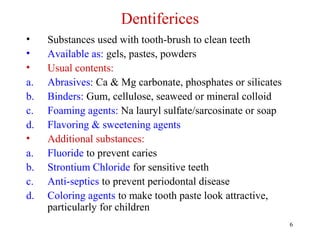
Dentiferices
• Substances used with tooth-brush to clean teeth
• Available as: gels, pastes, powders
• Usual contents:
a. Abrasives: Ca & Mg carbonate, phosphates or silicates
b. Binders: Gum, cellulose, seaweed or mineral colloid
c. Foaming agents: Na lauryl sulfate/sarcosinate or soap
d. Flavoring & sweetening agents
• Additional substances:
a. Fluoride to prevent caries
b. Strontium Chloride for sensitive teeth
c. Anti-septics to prevent periodontal disease
d. Coloring agents to make tooth paste look attractive,
particularly for children
7
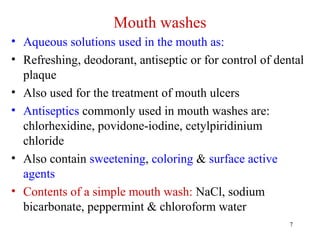
Mouth washes
• Aqueous solutions used in the mouth as:
• Refreshing, deodorant, antiseptic or for control of dental
plaque
• Also used for the treatment of mouth ulcers
• Antiseptics commonly used in mouth washes are:
chlorhexidine, povidone-iodine, cetylpiridinium
chloride
• Also contain sweetening, coloring & surface active
agents
• Contents of a simple mouth wash: NaCl, sodium
bicarbonate, peppermint & chloroform water
8
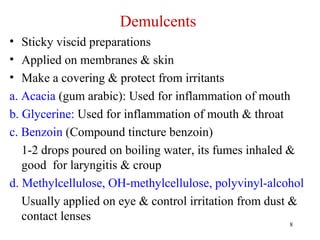
Demulcents
• Sticky viscid preparations
• Applied on membranes & skin
• Make a covering & protect from irritants
a. Acacia (gum arabic): Used for inflammation of mouth
b. Glycerine: Used for inflammation of mouth & throat
c. Benzoin (Compound tincture benzoin)
1-2 drops poured on boiling water, its fumes inhaled &
good for laryngitis & croup
d. Methylcellulose, OH-methylcellulose, polyvinyl-alcohol
Usually applied on eye & control irritation from dust &
contact lenses
9
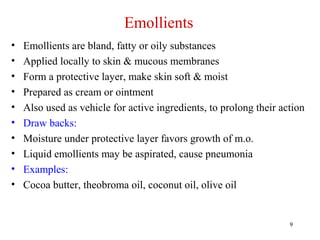
Emollients
• Emollients are bland, fatty or oily substances
• Applied locally to skin & mucous membranes
• Form a protective layer, make skin soft & moist
• Prepared as cream or ointment
• Also used as vehicle for active ingredients, to prolong their action
• Draw backs:
• Moisture under protective layer favors growth of m.o.
• Liquid emollients may be aspirated, cause pneumonia
• Examples:
• Cocoa butter, theobroma oil, coconut oil, olive oil
10
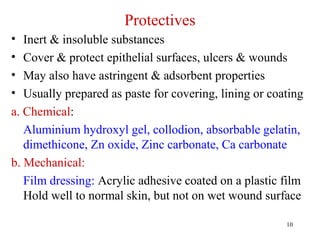
Protectives
• Inert & insoluble substances
• Cover & protect epithelial surfaces, ulcers & wounds
• May also have astringent & adsorbent properties
• Usually prepared as paste for covering, lining or coating
a. Chemical:
Aluminium hydroxyl gel, collodion, absorbable gelatin,
dimethicone, Zn oxide, Zinc carbonate, Ca carbonate
b. Mechanical:
Film dressing: Acrylic adhesive coated on a plastic film
Hold well to normal skin, but not on wet wound surface
11
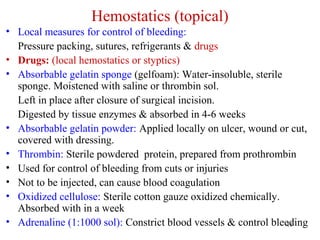
Hemostatics (topical)
• Local measures for control of bleeding:
Pressure packing, sutures, refrigerants & drugs
• Drugs: (local hemostatics or styptics)
• Absorbable gelatin sponge (gelfoam): Water-insoluble, sterile
sponge. Moistened with saline or thrombin sol.
Left in place after closure of surgical incision.
Digested by tissue enzymes & absorbed in 4-6 weeks
• Absorbable gelatin powder: Applied locally on ulcer, wound or cut,
covered with dressing.
• Thrombin: Sterile powdered protein, prepared from prothrombin
• Used for control of bleeding from cuts or injuries
• Not to be injected, can cause blood coagulation
• Oxidized cellulose: Sterile cotton gauze oxidized chemically.
Absorbed with in a week
• Adrenaline (1:1000 sol): Constrict blood vessels & control bleeding
12
Hemostatics (systemic)
• Measures for control of bleeding in bleeding disorders:
• Human plasma:
In Hemophilics & other coagulation factor deficiencies
• Platelet concentrate:
In thrombocytopenia, disseminate intravascular coagulation,
thrombocytopenic purpura
• Anti-hemophillic factor (coagulation factor VIII):
In classical hemophillia (hemophillia A)
• Factor IX complex (Pooled human plasma protein fraction
containing factors II, VII, IX & X):
In hemophillia B & other coagulation factor deficiencies: factors
II, VII & X
• Vitamin K: anti-dote for warfarin
• Protamine: anti-dote for heparin

1. anti septics & disnifectants

  • 1.
    1 Anti-septics, disinfectants, dentiferices, mouthwashes, demulcents, emollients, protectives & hemostatics ‫ال‬ ‫بسم‬‫الرحمن‬‫الرحيم‬
  • 2.
    2 Anti-septics & disinfectants •Antiseptics: Destroy m.o. & used on living things • Disinfectants: Destroy m.o. & used on non-living things A. Alcohols: ethyl-alcohol, isopropyl-alcohol (50-70 %) • Precipitate proteins & enzymes, kill many m.o. • Used for preparing clean skin for injection and wiping tables • Also used as vehicle for other antiseptics: iodine, etc • Inactivated by biological material: pus, blood, etc • Does not kill spores B. Aldehydes: Formaldehyde (2-8%), glutaraldehyde (2%) • Denature proteins & effective against bacteria, fungi & viruses • Not inactivated by biological materials • Used for disinfection of dental instruments • Glutaraldehyde is more effective; less volatile & irritant, & lacks unpleasant smell of formaldehyde
  • 3.
    3 Anti-septics & disinfectants(Cont.) C. Bis-biguanides: Clorhexidine • Affect cell membrane & cause lysis. Kill most m.o. • 0.2 & 1 % with gluconate for oral rinses & in toothpastes • 1-4 % solution in water & 0.5 % sol in isopropyl alcohol for cleaning skin, mucosa & hands before surgery • 5 % solution for disinfection of instruments D. Halogens: Denature proteins & enzymes; kill most m.o. • Chlorine: (Na hypochlorite & organic chloramines) • 2 % sol for irrigation of root canal, cleaning instruments • Inactivated by organic matter • Iodine: (KI solution & tincture) • Not inactivated by organic matter • Stains skin & may causes allergy • Pavidone: 1% solution for mouth wash. 10% cream for skin
  • 4.
    4 • Iodoform: (Liberatesiodine when applied to tissues) • 10% iodoform with benzoin, etc (Whitehead’s varnish) • Dressing of dry socket & after removing molars & cysts E. Oxidizing agents: (Hydrogen peroxide & Na perborate) • Release O2 & kill mo; may cause local irritation • Used as mouth wash in ulcerative gingivitis F. Phenols, cresols & related compounds: • Phenol & cresol: Disinfectants for floors & wash rooms • Irritate skin, not used now as antiseptic • Parachlorophenol: Less irritant • 1% as anti-septic & 35% for root canal treatment • Hexachlorophene: Less irritant, used as powder & cream on skin. Very effective against G (+) m.o. Anti-septics & disinfectants (Cont.)
  • 5.
    5 Anti-septics & disinfectants(Cont.) G. Cationic surface active agents: • Cetrimide & cetrimide + chlorhexidine (Savlon) • Used as general purpose antiseptics • Oxidizing agents: Potassium permanganate • Liberates oxygen and oxidises bacterial protoplasm • Used as anti-septic and disinfectant in different concentrations • Dental uses of antiseptics & disinfectants (summary): • Cold sterilization of instruments (when heat not possible) • Disinfection of surgeon’s & assistant’s hands • Preparation of skin & mucosa before surgery • Irrigation of root canal & inhibition of dental plaque • Treatment of mouth ulcers • Protection of dentists & assistants from viral (HBV, HCV & HIV), bacterial & fungal infections
  • 6.
    6 Dentiferices • Substances usedwith tooth-brush to clean teeth • Available as: gels, pastes, powders • Usual contents: a. Abrasives: Ca & Mg carbonate, phosphates or silicates b. Binders: Gum, cellulose, seaweed or mineral colloid c. Foaming agents: Na lauryl sulfate/sarcosinate or soap d. Flavoring & sweetening agents • Additional substances: a. Fluoride to prevent caries b. Strontium Chloride for sensitive teeth c. Anti-septics to prevent periodontal disease d. Coloring agents to make tooth paste look attractive, particularly for children
  • 7.
    7 Mouth washes • Aqueoussolutions used in the mouth as: • Refreshing, deodorant, antiseptic or for control of dental plaque • Also used for the treatment of mouth ulcers • Antiseptics commonly used in mouth washes are: chlorhexidine, povidone-iodine, cetylpiridinium chloride • Also contain sweetening, coloring & surface active agents • Contents of a simple mouth wash: NaCl, sodium bicarbonate, peppermint & chloroform water
  • 8.
    8 Demulcents • Sticky viscidpreparations • Applied on membranes & skin • Make a covering & protect from irritants a. Acacia (gum arabic): Used for inflammation of mouth b. Glycerine: Used for inflammation of mouth & throat c. Benzoin (Compound tincture benzoin) 1-2 drops poured on boiling water, its fumes inhaled & good for laryngitis & croup d. Methylcellulose, OH-methylcellulose, polyvinyl-alcohol Usually applied on eye & control irritation from dust & contact lenses
  • 9.
    9 Emollients • Emollients arebland, fatty or oily substances • Applied locally to skin & mucous membranes • Form a protective layer, make skin soft & moist • Prepared as cream or ointment • Also used as vehicle for active ingredients, to prolong their action • Draw backs: • Moisture under protective layer favors growth of m.o. • Liquid emollients may be aspirated, cause pneumonia • Examples: • Cocoa butter, theobroma oil, coconut oil, olive oil
  • 10.
    10 Protectives • Inert &insoluble substances • Cover & protect epithelial surfaces, ulcers & wounds • May also have astringent & adsorbent properties • Usually prepared as paste for covering, lining or coating a. Chemical: Aluminium hydroxyl gel, collodion, absorbable gelatin, dimethicone, Zn oxide, Zinc carbonate, Ca carbonate b. Mechanical: Film dressing: Acrylic adhesive coated on a plastic film Hold well to normal skin, but not on wet wound surface
  • 11.
    11 Hemostatics (topical) • Localmeasures for control of bleeding: Pressure packing, sutures, refrigerants & drugs • Drugs: (local hemostatics or styptics) • Absorbable gelatin sponge (gelfoam): Water-insoluble, sterile sponge. Moistened with saline or thrombin sol. Left in place after closure of surgical incision. Digested by tissue enzymes & absorbed in 4-6 weeks • Absorbable gelatin powder: Applied locally on ulcer, wound or cut, covered with dressing. • Thrombin: Sterile powdered protein, prepared from prothrombin • Used for control of bleeding from cuts or injuries • Not to be injected, can cause blood coagulation • Oxidized cellulose: Sterile cotton gauze oxidized chemically. Absorbed with in a week • Adrenaline (1:1000 sol): Constrict blood vessels & control bleeding
  • 12.
    12 Hemostatics (systemic) • Measuresfor control of bleeding in bleeding disorders: • Human plasma: In Hemophilics & other coagulation factor deficiencies • Platelet concentrate: In thrombocytopenia, disseminate intravascular coagulation, thrombocytopenic purpura • Anti-hemophillic factor (coagulation factor VIII): In classical hemophillia (hemophillia A) • Factor IX complex (Pooled human plasma protein fraction containing factors II, VII, IX & X): In hemophillia B & other coagulation factor deficiencies: factors II, VII & X • Vitamin K: anti-dote for warfarin • Protamine: anti-dote for heparin