z
PLAQUE CONTROL
PRESENTED BY :- DR SAIF MOMIN
z
Content
 INTRODUCTION
 METHOD OF PLAQUE CONTROL
(a) MECHANICAL PLAQUE CONTROL
(b) CHEMICAL PLAQUE CONTROL
 HISTORY
 APPROACH OF CHEMICAL PLAQUE CONTROL
 IDEALL REQUISITES OF CHEMICAL PLAQUE CONTROL
 CLASSIFICATIONN OF CHEMICAL PLAQUE CONTROL
 CONCLUSSION
z
INTRODUCTION
z
WHAT IS
PLAQUE??DEFINITION
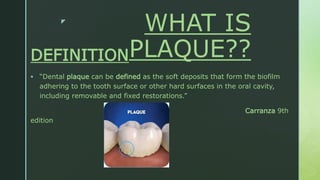
 “Dental plaque can be defined as the soft deposits that form the biofilm
adhering to the tooth surface or other hard surfaces in the oral cavity,
including removable and fixed restorations.”
Carranza 9th
edition
zWhat is plaque control??
DEFINITION
“the removal of dental plaque on a regular basis and the
prevention of its accumulation on the teeth and adjacent
gingival surfaces”
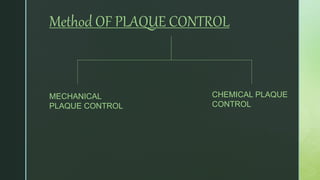
Method OF PLAQUE CONTROL
MECHANICAL
PLAQUE CONTROL
CHEMICAL PLAQUE
CONTROL
z
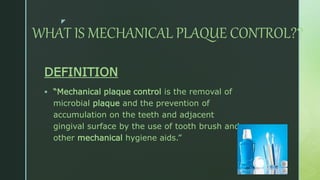
WHAT IS MECHANICAL PLAQUE CONTROL??
DEFINITION
 “Mechanical plaque control is the removal of
microbial plaque and the prevention of
accumulation on the teeth and adjacent
gingival surface by the use of tooth brush and
other mechanical hygiene aids.”
z
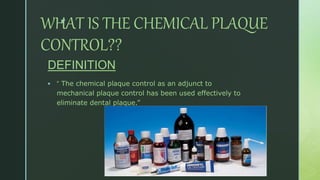
WHAT IS THE CHEMICAL PLAQUE
CONTROL??
DEFINITION
 “ The chemical plaque control as an adjunct to
mechanical plaque control has been used effectively to
eliminate dental plaque.”
z
HISTORY
z1. The Romans used to rinse their mouth with Portuguese urine. It
was believed that ammonia in urine aided in the disinfection of
mouth and could whiten teeth.
2. 12th century:- During the 12th century, Saint Hildegard von
Bingen, a German philosopher advised mouth rinses with pure,
cold water to reventt plaque and tartar formation.
3. 16th century:- In the 16th century during the medieval period,
people used mint and vinegar rinsing solutions to clean their
mouth and get rid of bad breath.
4. 18th century:-The chemical plaque control agents which are
popularly known today as mouthwashes began their journey in
the late 1800s.
z
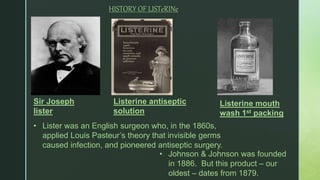
Sir Joseph
lister
• Johnson & Johnson was founded
in 1886. But this product – our
oldest – dates from 1879.
HISTORY OF LISTeRINe
Listerine antiseptic
solution
Listerine mouth
wash 1st packing
• Lister was an English surgeon who, in the 1860s,
applied Louis Pasteur’s theory that invisible germs
caused infection, and pioneered antiseptic surgery.
z
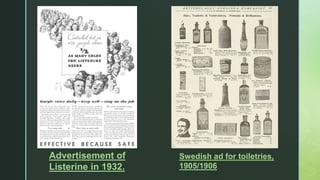
Advertisement of
Listerine in 1932.
Swedish ad for toiletries,
1905/1906.
z
 19th century:-.
use of ESSENTIAL OILS in the form of
mouth rinse. Later with addition of antimicrobial or
antiseptic Agent to the toothpaste or mouth rinse
Devloped.
z
APPROACH OF
CHEMICAL PLAQUE
CONTROL
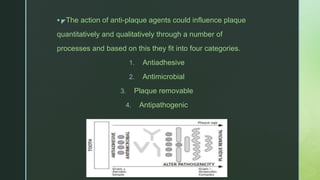
z The action of anti-plaque agents could influence plaque
quantitatively and qualitatively through a number of
processes and based on this they fit into four categories.
1. Antiadhesive
2. Antimicrobial
3. Plaque removable
4. Antipathogenic
z
Vehicles for the delivery of chemical agents:-
 The carriage of chemical agents into the mouth for plaque control has
involved a small but varied range of vehicles.
1. Toothpaste
2. Mouthrinses
3. Sprays
4. Irrigators
5. Chewing gums
6. Varnishes
zIDEAL REQUISITE OF CHEMICAL PLAQUE
CONTROL
 Should decrease plaque & gingivitis.
 Prevent pathogenic growth.
 Should prevent Development of resistance of bacteria.
 Should be biocompatible.
 Should not stain the teeth Or alter taste.
 Should have good retentive properties.
 Should be economic.
z
CHEMICAL PLAQUE CONTROL Agent
CLASSIFICATION
 The European Federation of Periodontology in European
workshop on Periodontology in 1996 , used four
terminologies to describe various agents used for
chemical plaque control,
1) ANTIMICROBIAL AGENTS
2) PLAQUE REDUCING AGENTS
3)ANTI-PLAQUE AGENTS
4)ANTI-GINGIVITIS AGENTS
zAntimicrobial agents
 these are those chemicals that have a
bacteriostatic or bactericidal effect in vitro
that alone cannot be extrapolated to a proven
efficacy against plaque in vivo.
zPlaque reducing agents
 These are the chemicals that have only
been shown to reduce the quantity
and/or affect the quality of plaque,
which may or may not be sufficient to
influence gingivitis and/or caries.
z
Anti-plaque agents
 These chemical agents have an effect on
plaque sufficient to benefit gingivitis and/or
caries.
zAnti-gingivitis agents
 These are the chemicals which reduce gingival
inflammation without necessarily influencing
bacterial plaque (includes anti-inflammatory
agents).
z
 Another classification , describes 3 generations of
chemical plaque control agents. In this classification,
agents in the first , second and third generation have
been classified according to their substantivity.
According to Kormann (1986), anti-
plaque agents based
on their mechanism of action
z
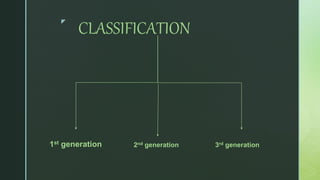
CLASSIFICATION
1st generation 2nd generation 3rd generation
z
1st GENERATION CHEMICAL PLAQUE
CONTROL AGENT
 These are antibacterial agents with limited
substantivity in vivo. They are capable of reducing
plaque scores by 20-50%. The examples include
antibiotics, phenols, quaternary ammonium
compounds, metallic ions, sanguinarine etc.
z 1) Triclosan
1. • It is a Phenol derivative
2. • It is synthetic and non-ionic
3. • Used as a topical antimicrobial agent
4. • Broad spectrum of action including both gram positive
and gram negative bacteria
5. • It also includes mycobacterium spores and Candida
species
Mechanism of action: Triclosan acts on cytoplasmic membrane
induce leakage of cellular constituents and bacteriolysis.
z
2). Metallic ions:-
eg: Zn and Cu ions
Antimicrobial actions including plaque inhibition by metal ions have
been appreciated for many years, with most research interest
centered on copper, tin and zinc.
Mechanism of action • Metalsalts reduce the glycolytic
activity in bacteria and delay bacterial growth and plaque
formation.
z
3).Quaternary ammonium compounds
eg: cetylpyridinium chloride (CPC), Benzanthonium chloride, Benzalleonium chloride
• Cationic antiseptics and surface active agents
• Effective against gram positive organisms and they have greater initial oral retention
and equivalent antibacterial activity to chlorhexidine.
• Mechanism of action:
• Positively charged molecule reacts with negatively charged cell membrane
phosphates and thereby disrupts the bacterial cell wall structure. They are less
effective in inhibiting plaque and gingivitis. The reason for this may be that these
compounds are rapidly desorbed from the oral mucosa. Use of 0.1% of
cetylpyridinium chloride had the lowest plaque scores.
z
4)Sanguinarine:
It is a benzo phenanthridine alkaloid derived from the alcoholic extraction
of powdered rhizomes of the blood root plant, Sanguinaria Canadensis.
The anti-plaqueactivity is mainly due to the chemically reactive iminium
ion which appears to be retained several hours after use, and is poorly
absorbed from the gastrointestinal tract.
• It is most effective against gram –ve organisms
• Used in mouth rinses
z
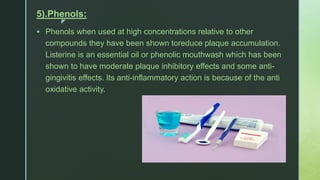
5).Phenols:
 Phenols when used at high concentrations relative to other
compounds they have been shown toreduce plaque accumulation.
Listerine is an essential oil or phenolic mouthwash which has been
shown to have moderate plaque inhibitory effects and some anti-
gingivitis effects. Its anti-inflammatory action is because of the anti
oxidative activity.
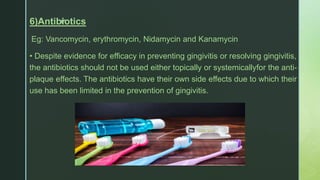
z6)Antibiotics
Eg: Vancomycin, erythromycin, Nidamycin and Kanamycin
• Despite evidence for efficacy in preventing gingivitis or resolving gingivitis,
the antibiotics should not be used either topically or systemicallyfor the anti-
plaque effects. The antibiotics have their own side effects due to which their
use has been limited in the prevention of gingivitis.
z2nd generation chemical plaque control
 These are antibacterial agents with high
substantivity. They are 70-90% more effectively
retained by oral tissues than first generation
agents and are slowly released. An example
includes Bisbiguanides.
z
Bisbiguanides:
Chlorhexidine gluconate (0.2%), Alexidine and Octenidine
Chlorhexidine gluconate:
• It is a cationic bisbiguanide (1, 6 Di chlorophenyl diguanohexane). It is a
synthetic antimicrobial drug which has been widely used in dentistry.
• Effective against gram +ve, gram –ve organisms, fungi, yeasts and
viruses
• Exhibit anti-plaque and antibacterial properties
Mechanism of action:
Its antibacterial action is due to an increase in cellular membrane
permeability followed by coagulation of the cytoplasmic
macromolecules.
z
Antibacterial action of chlorhexidine:
It shows two actions
1. Bacteriostatic action at low concentrations chlorhexidine
2. Bactericidal action: Increased concentration of chlorhexidine
Adverse effects of chlorhexidine include:
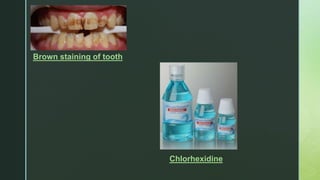
• Brownish staining of tooth or restorations
• Loss of taste sensation
• Rarely hypersensitivity to chlorhexidine has been reported
• Stenosis of parotid duct has also been reported
z
Brown staining of tooth
Chlorhexidine
z
3rd generation chemical plaque control
 These agents are relatively new preparation which
inhibits plaque growth and gingivitis by interfering
with the plaque matrix formation and also by
reducing bacterial adhesion and adherence. An
example includes Delmopinol.
z
1) Delmopinol
• It is a morpholino ethanol derivative.
• Inhibits plaque growth and reduces gingivitis
Mechanism of action:
• It interferes with plaque matrix formation and also reduces bacterial adherence.
• It causes weak binding of plaque to tooth, thusaiding in easy removal of plaque by mechanical
procedures
• It is therefore indicated as a pre brushing mouth rinse
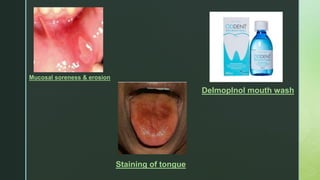
Adverse effects of delmopino
• Staining of tooth and tongue
• Taste disturbances
• Mucosal soreness and erosion
z
Mucosal soreness & erosion
Staining of tongue
DelmopInol mouth wash
z
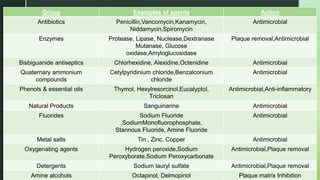
OTHER ANTI-PLAQUE
AGENT
z
Group Examples of agents Action
Antibiotics Penicillin,Vancomycin,Kanamycin,
Niddamycin,Spiromycin
Antimicrobial
Enzymes Protease, Lipase, Nuclease,Dextranase
Mutanase, Glucose
oxidase,Amyloglucosidase
Plaque removal,Antimicrobial
Bisbiguanide antiseptics Chlorhexidine, Alexidine,Octenidine Antimicrobial
Quaternary ammonium
compounds
Cetylpyridinium chloride,Benzalconium
chloride
Antimicrobial
Phenols & essential oils Thymol, Hexylresorcinol,Eucalyptol,
Triclosan
Antimicrobial,Anti-inflammatory
Natural Products Sanguinarine Antimicrobial
Fluorides Sodium Fluoride
,SodiumMonofluorophosphate,
Stannous Fluoride, Amine Fluoride
Antimicrobial
Metal salts Tin , Zinc, Copper Antimicrobial
Oxygenating agents Hydrogen peroxide,Sodium
Peroxyborate,Sodium Peroxycarbonate
Antimicrobial,Plaque removal
Detergents Sodium lauryl sulfate Antimicrobial,Plaque removal
Amine alcohols Octapinol, Delmopinol Plaque matrix Inhibition
z
Vehicles for the
delivery of chemical
agents
zThe carriage of chemical agents into the mouth for
plaque control has involved a small but varied range of
vehicles.
1. Toothpaste
2. Mouthrinses
3. Sprays
4. Irrigators
5. Chewing gums
6. Varnishes
z
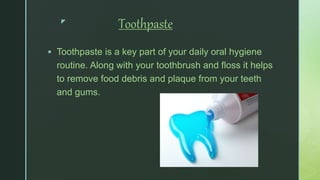
Toothpaste
 Toothpaste is a key part of your daily oral hygiene
routine. Along with your toothbrush and floss it helps
to remove food debris and plaque from your teeth
and gums.
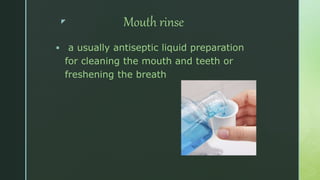
z Mouth rinse
 a usually antiseptic liquid preparation
for cleaning the mouth and teeth or
freshening the breath.
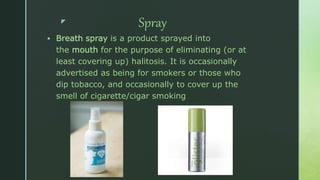
z Spray
 Breath spray is a product sprayed into
the mouth for the purpose of eliminating (or at
least covering up) halitosis. It is occasionally
advertised as being for smokers or those who
dip tobacco, and occasionally to cover up the
smell of cigarette/cigar smoking.
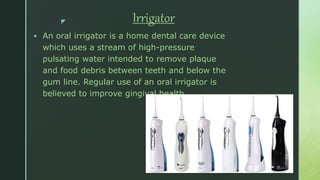
z Irrigator
 An oral irrigator is a home dental care device
which uses a stream of high-pressure
pulsating water intended to remove plaque
and food debris between teeth and below the
gum line. Regular use of an oral irrigator is
believed to improve gingival health.
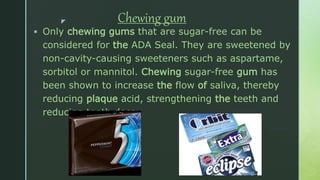
z Chewing gum
 Only chewing gums that are sugar-free can be
considered for the ADA Seal. They are sweetened by
non-cavity-causing sweeteners such as aspartame,
sorbitol or mannitol. Chewing sugar-free gum has
been shown to increase the flow of saliva, thereby
reducing plaque acid, strengthening the teeth and
reducing tooth decay.
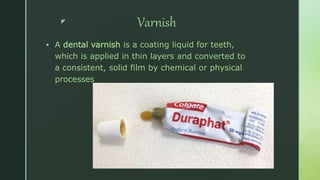
z Varnish
 A dental varnish is a coating liquid for teeth,
which is applied in thin layers and converted to
a consistent, solid film by chemical or physical
processes
z
CONCLUSION
Chemical agents for plaque control hold great promise in disease
control and prevention and potentially delay plaque accumulation on
teeth. Chlorhexedine is the most effective antiplaque agent. Herbal
mouth rinses, quaternary ammonium compounds, phenols,
antibiotics, delmopinol and several other agents have shown
significant anti-plaque activity. The adjunctive use of essential oil
mouth rinses and triclosan dentrifices were found to be effective in
reducing plaque and gingivitis.
z
Thank you
☺️

Chemical plaque control study

  • 1.
  • 2.
    z Content  INTRODUCTION  METHODOF PLAQUE CONTROL (a) MECHANICAL PLAQUE CONTROL (b) CHEMICAL PLAQUE CONTROL  HISTORY  APPROACH OF CHEMICAL PLAQUE CONTROL  IDEALL REQUISITES OF CHEMICAL PLAQUE CONTROL  CLASSIFICATIONN OF CHEMICAL PLAQUE CONTROL  CONCLUSSION
  • 3.
  • 4.
    z WHAT IS PLAQUE??DEFINITION  “Dentalplaque can be defined as the soft deposits that form the biofilm adhering to the tooth surface or other hard surfaces in the oral cavity, including removable and fixed restorations.” Carranza 9th edition
  • 5.
    zWhat is plaquecontrol?? DEFINITION “the removal of dental plaque on a regular basis and the prevention of its accumulation on the teeth and adjacent gingival surfaces”
  • 6.
    Method OF PLAQUECONTROL MECHANICAL PLAQUE CONTROL CHEMICAL PLAQUE CONTROL
  • 7.
    z WHAT IS MECHANICALPLAQUE CONTROL?? DEFINITION  “Mechanical plaque control is the removal of microbial plaque and the prevention of accumulation on the teeth and adjacent gingival surface by the use of tooth brush and other mechanical hygiene aids.”
  • 8.
    z WHAT IS THECHEMICAL PLAQUE CONTROL?? DEFINITION  “ The chemical plaque control as an adjunct to mechanical plaque control has been used effectively to eliminate dental plaque.”
  • 9.
  • 10.
    z1. The Romansused to rinse their mouth with Portuguese urine. It was believed that ammonia in urine aided in the disinfection of mouth and could whiten teeth. 2. 12th century:- During the 12th century, Saint Hildegard von Bingen, a German philosopher advised mouth rinses with pure, cold water to reventt plaque and tartar formation. 3. 16th century:- In the 16th century during the medieval period, people used mint and vinegar rinsing solutions to clean their mouth and get rid of bad breath. 4. 18th century:-The chemical plaque control agents which are popularly known today as mouthwashes began their journey in the late 1800s.
  • 11.
    z Sir Joseph lister • Johnson& Johnson was founded in 1886. But this product – our oldest – dates from 1879. HISTORY OF LISTeRINe Listerine antiseptic solution Listerine mouth wash 1st packing • Lister was an English surgeon who, in the 1860s, applied Louis Pasteur’s theory that invisible germs caused infection, and pioneered antiseptic surgery.
  • 12.
    z Advertisement of Listerine in1932. Swedish ad for toiletries, 1905/1906.
  • 13.
    z  19th century:-. useof ESSENTIAL OILS in the form of mouth rinse. Later with addition of antimicrobial or antiseptic Agent to the toothpaste or mouth rinse Devloped.
  • 14.
  • 15.
    z The actionof anti-plaque agents could influence plaque quantitatively and qualitatively through a number of processes and based on this they fit into four categories. 1. Antiadhesive 2. Antimicrobial 3. Plaque removable 4. Antipathogenic
  • 16.
    z Vehicles for thedelivery of chemical agents:-  The carriage of chemical agents into the mouth for plaque control has involved a small but varied range of vehicles. 1. Toothpaste 2. Mouthrinses 3. Sprays 4. Irrigators 5. Chewing gums 6. Varnishes
  • 17.
    zIDEAL REQUISITE OFCHEMICAL PLAQUE CONTROL  Should decrease plaque & gingivitis.  Prevent pathogenic growth.  Should prevent Development of resistance of bacteria.  Should be biocompatible.  Should not stain the teeth Or alter taste.  Should have good retentive properties.  Should be economic.
  • 18.
    z CHEMICAL PLAQUE CONTROLAgent CLASSIFICATION  The European Federation of Periodontology in European workshop on Periodontology in 1996 , used four terminologies to describe various agents used for chemical plaque control, 1) ANTIMICROBIAL AGENTS 2) PLAQUE REDUCING AGENTS 3)ANTI-PLAQUE AGENTS 4)ANTI-GINGIVITIS AGENTS
  • 19.
    zAntimicrobial agents  theseare those chemicals that have a bacteriostatic or bactericidal effect in vitro that alone cannot be extrapolated to a proven efficacy against plaque in vivo.
  • 20.
    zPlaque reducing agents These are the chemicals that have only been shown to reduce the quantity and/or affect the quality of plaque, which may or may not be sufficient to influence gingivitis and/or caries.
  • 21.
    z Anti-plaque agents  Thesechemical agents have an effect on plaque sufficient to benefit gingivitis and/or caries.
  • 22.
    zAnti-gingivitis agents  Theseare the chemicals which reduce gingival inflammation without necessarily influencing bacterial plaque (includes anti-inflammatory agents).
  • 23.
    z  Another classification, describes 3 generations of chemical plaque control agents. In this classification, agents in the first , second and third generation have been classified according to their substantivity. According to Kormann (1986), anti- plaque agents based on their mechanism of action
  • 24.
    z CLASSIFICATION 1st generation 2ndgeneration 3rd generation
  • 25.
    z 1st GENERATION CHEMICALPLAQUE CONTROL AGENT  These are antibacterial agents with limited substantivity in vivo. They are capable of reducing plaque scores by 20-50%. The examples include antibiotics, phenols, quaternary ammonium compounds, metallic ions, sanguinarine etc.
  • 26.
    z 1) Triclosan 1.• It is a Phenol derivative 2. • It is synthetic and non-ionic 3. • Used as a topical antimicrobial agent 4. • Broad spectrum of action including both gram positive and gram negative bacteria 5. • It also includes mycobacterium spores and Candida species Mechanism of action: Triclosan acts on cytoplasmic membrane induce leakage of cellular constituents and bacteriolysis.
  • 27.
    z 2). Metallic ions:- eg:Zn and Cu ions Antimicrobial actions including plaque inhibition by metal ions have been appreciated for many years, with most research interest centered on copper, tin and zinc. Mechanism of action • Metalsalts reduce the glycolytic activity in bacteria and delay bacterial growth and plaque formation.
  • 28.
    z 3).Quaternary ammonium compounds eg:cetylpyridinium chloride (CPC), Benzanthonium chloride, Benzalleonium chloride • Cationic antiseptics and surface active agents • Effective against gram positive organisms and they have greater initial oral retention and equivalent antibacterial activity to chlorhexidine. • Mechanism of action: • Positively charged molecule reacts with negatively charged cell membrane phosphates and thereby disrupts the bacterial cell wall structure. They are less effective in inhibiting plaque and gingivitis. The reason for this may be that these compounds are rapidly desorbed from the oral mucosa. Use of 0.1% of cetylpyridinium chloride had the lowest plaque scores.
  • 29.
    z 4)Sanguinarine: It is abenzo phenanthridine alkaloid derived from the alcoholic extraction of powdered rhizomes of the blood root plant, Sanguinaria Canadensis. The anti-plaqueactivity is mainly due to the chemically reactive iminium ion which appears to be retained several hours after use, and is poorly absorbed from the gastrointestinal tract. • It is most effective against gram –ve organisms • Used in mouth rinses
  • 30.
    z 5).Phenols:  Phenols whenused at high concentrations relative to other compounds they have been shown toreduce plaque accumulation. Listerine is an essential oil or phenolic mouthwash which has been shown to have moderate plaque inhibitory effects and some anti- gingivitis effects. Its anti-inflammatory action is because of the anti oxidative activity.
  • 31.
    z6)Antibiotics Eg: Vancomycin, erythromycin,Nidamycin and Kanamycin • Despite evidence for efficacy in preventing gingivitis or resolving gingivitis, the antibiotics should not be used either topically or systemicallyfor the anti- plaque effects. The antibiotics have their own side effects due to which their use has been limited in the prevention of gingivitis.
  • 32.
    z2nd generation chemicalplaque control  These are antibacterial agents with high substantivity. They are 70-90% more effectively retained by oral tissues than first generation agents and are slowly released. An example includes Bisbiguanides.
  • 33.
    z Bisbiguanides: Chlorhexidine gluconate (0.2%),Alexidine and Octenidine Chlorhexidine gluconate: • It is a cationic bisbiguanide (1, 6 Di chlorophenyl diguanohexane). It is a synthetic antimicrobial drug which has been widely used in dentistry. • Effective against gram +ve, gram –ve organisms, fungi, yeasts and viruses • Exhibit anti-plaque and antibacterial properties Mechanism of action: Its antibacterial action is due to an increase in cellular membrane permeability followed by coagulation of the cytoplasmic macromolecules.
  • 34.
    z Antibacterial action ofchlorhexidine: It shows two actions 1. Bacteriostatic action at low concentrations chlorhexidine 2. Bactericidal action: Increased concentration of chlorhexidine Adverse effects of chlorhexidine include: • Brownish staining of tooth or restorations • Loss of taste sensation • Rarely hypersensitivity to chlorhexidine has been reported • Stenosis of parotid duct has also been reported
  • 35.
    z Brown staining oftooth Chlorhexidine
  • 36.
    z 3rd generation chemicalplaque control  These agents are relatively new preparation which inhibits plaque growth and gingivitis by interfering with the plaque matrix formation and also by reducing bacterial adhesion and adherence. An example includes Delmopinol.
  • 37.
    z 1) Delmopinol • Itis a morpholino ethanol derivative. • Inhibits plaque growth and reduces gingivitis Mechanism of action: • It interferes with plaque matrix formation and also reduces bacterial adherence. • It causes weak binding of plaque to tooth, thusaiding in easy removal of plaque by mechanical procedures • It is therefore indicated as a pre brushing mouth rinse Adverse effects of delmopino • Staining of tooth and tongue • Taste disturbances • Mucosal soreness and erosion
  • 38.
    z Mucosal soreness &erosion Staining of tongue DelmopInol mouth wash
  • 39.
  • 40.
    z Group Examples ofagents Action Antibiotics Penicillin,Vancomycin,Kanamycin, Niddamycin,Spiromycin Antimicrobial Enzymes Protease, Lipase, Nuclease,Dextranase Mutanase, Glucose oxidase,Amyloglucosidase Plaque removal,Antimicrobial Bisbiguanide antiseptics Chlorhexidine, Alexidine,Octenidine Antimicrobial Quaternary ammonium compounds Cetylpyridinium chloride,Benzalconium chloride Antimicrobial Phenols & essential oils Thymol, Hexylresorcinol,Eucalyptol, Triclosan Antimicrobial,Anti-inflammatory Natural Products Sanguinarine Antimicrobial Fluorides Sodium Fluoride ,SodiumMonofluorophosphate, Stannous Fluoride, Amine Fluoride Antimicrobial Metal salts Tin , Zinc, Copper Antimicrobial Oxygenating agents Hydrogen peroxide,Sodium Peroxyborate,Sodium Peroxycarbonate Antimicrobial,Plaque removal Detergents Sodium lauryl sulfate Antimicrobial,Plaque removal Amine alcohols Octapinol, Delmopinol Plaque matrix Inhibition
  • 41.
    z Vehicles for the deliveryof chemical agents
  • 42.
    zThe carriage ofchemical agents into the mouth for plaque control has involved a small but varied range of vehicles. 1. Toothpaste 2. Mouthrinses 3. Sprays 4. Irrigators 5. Chewing gums 6. Varnishes
  • 43.
    z Toothpaste  Toothpaste isa key part of your daily oral hygiene routine. Along with your toothbrush and floss it helps to remove food debris and plaque from your teeth and gums.
  • 44.
    z Mouth rinse a usually antiseptic liquid preparation for cleaning the mouth and teeth or freshening the breath.
  • 45.
    z Spray  Breathspray is a product sprayed into the mouth for the purpose of eliminating (or at least covering up) halitosis. It is occasionally advertised as being for smokers or those who dip tobacco, and occasionally to cover up the smell of cigarette/cigar smoking.
  • 46.
    z Irrigator  Anoral irrigator is a home dental care device which uses a stream of high-pressure pulsating water intended to remove plaque and food debris between teeth and below the gum line. Regular use of an oral irrigator is believed to improve gingival health.
  • 47.
    z Chewing gum Only chewing gums that are sugar-free can be considered for the ADA Seal. They are sweetened by non-cavity-causing sweeteners such as aspartame, sorbitol or mannitol. Chewing sugar-free gum has been shown to increase the flow of saliva, thereby reducing plaque acid, strengthening the teeth and reducing tooth decay.
  • 48.
    z Varnish  Adental varnish is a coating liquid for teeth, which is applied in thin layers and converted to a consistent, solid film by chemical or physical processes
  • 49.
    z CONCLUSION Chemical agents forplaque control hold great promise in disease control and prevention and potentially delay plaque accumulation on teeth. Chlorhexedine is the most effective antiplaque agent. Herbal mouth rinses, quaternary ammonium compounds, phenols, antibiotics, delmopinol and several other agents have shown significant anti-plaque activity. The adjunctive use of essential oil mouth rinses and triclosan dentrifices were found to be effective in reducing plaque and gingivitis.
  • 50.