By: Dr Rupesh Dalavi
Depart. of Pharmacology
NIMS, Jaipur
 The terms antiseptic and disinfectant denote – “An agent which
inhibits or kills microbes on contact.”
 Conventionally, agents used on living surfaces (patient’s mouth,
dentist’s hands, etc.) are called antiseptics.
 While those used for inanimate objects (instruments, working
surfaces, water supply, privies, etc.) are called disinfectants.
 There is an overlap between the agents used for disinfection and
sterilisation. Most of them show either actions based on their
concentration.
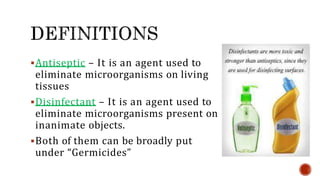
Antiseptic – It is an agent used to
eliminate microorganisms on living
tissues
Disinfectant – It is an agent used to
eliminate microorganisms present on
inanimate objects.
Both of them can be broadly put
under “Germicides”
 Used in dentistry to check cross infection
 To prevent and treat some infective
conditions.
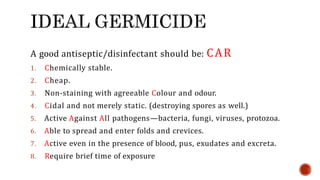
A good antiseptic/disinfectant should be: CAR
1. Chemically stable.
2. Cheap.
3. Non-staining with agreeable Colour and odour.
4. Cidal and not merely static. (destroying spores as well.)
5. Active Against All pathogens—bacteria, fungi, viruses, protozoa.
6. Able to spread and enter folds and crevices.
7. Active even in the presence of blood, pus, exudates and excreta.
8. Require brief time of exposure
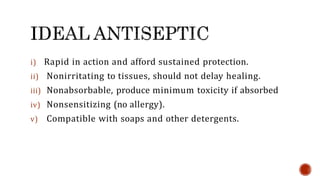
i) Rapid in action and afford sustained protection.
ii) Nonirritating to tissues, should not delay healing.
iii) Nonabsorbable, produce minimum toxicity if absorbed
iv) Nonsensitizing (no allergy).
v) Compatible with soaps and other detergents.
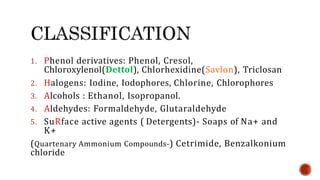
1. Phenol derivatives: Phenol, Cresol,
Chloroxylenol(Dettol), Chlorhexidine(Savlon), Triclosan
2. Halogens: Iodine, Iodophores, Chlorine, Chlorophores
3. Alcohols : Ethanol, Isopropanol.
4. Aldehydes: Formaldehyde, Glutaraldehyde
5. SuRface active agents ( Detergents)- Soaps of Na+ and
K+
(Quartenary Ammonium Compounds-) Cetrimide, Benzalkonium
chloride
6. Metallic Salts:- Silver nitrate, Zinc sulfate, Calamine,
Zinc oxide.
7. Acids: Boric acid, Acetic acid
8. Gases:- Ethylene oxide, ß- propiolactone
9. Oxidising agents- Hydrogen peroxide, Benzoyl Peroxide,
Potassium Permanganate
10.Dyes- Methylene Blue, Gentian Violet, Brilliant Green
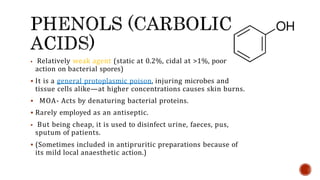
 Relatively weak agent (static at 0.2%, cidal at >1%, poor
action on bacterial spores)
 It is a general protoplasmic poison, injuring microbes and
tissue cells alike—at higher concentrations causes skin burns.
 MOA- Acts by denaturing bacterial proteins.
 Rarely employed as an antiseptic.
 But being cheap, it is used to disinfect urine, faeces, pus,
sputum of patients.
 (Sometimes included in antipruritic preparations because of
its mild local anaesthetic action.)
 1. Phenol (carbolic acid)
 Rarely used as antiseptic, as it is corrosive and can
penetrate intact skin.
 Used to disinfect sputum, pus, excreta and discarded
cultures.
 Accidental or suicidal ingestion can cause corrosion of
gastrointestinal tract (GIT), convulsions,hypothermia
and collapse. Treatment is symptomatic.
 2. Cresol (methylphenol)
 More active and safer than phenol.
 Used to disinfect utensils, excreta and infected glassware.
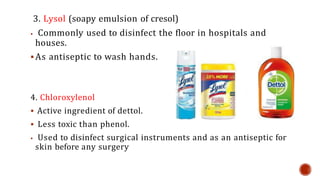
3. Lysol (soapy emulsion of cresol)
 Commonly used to disinfect the floor in hospitals and
houses.
 As antiseptic to wash hands.
4. Chloroxylenol
 Active ingredient of dettol.
 Less toxic than phenol.
 Used to disinfect surgical instruments and as an antiseptic for
skin before any surgery
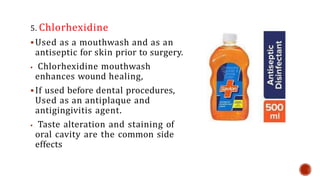
5. Chlorhexidine
 Used as a mouthwash and as an
antiseptic for skin prior to surgery.
 Chlorhexidine mouthwash
enhances wound healing,
 If used before dental procedures,
Used as an antiplaque and
antigingivitis agent.
 Taste alteration and staining of
oral cavity are the common side
effects
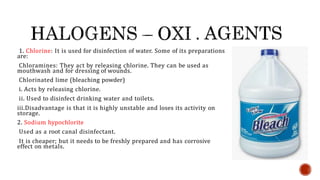
1. Chlorine: It is used for disinfection of water. Some of its preparations
are:
Chloramines: They act by releasing chlorine. They can be used as
mouthwash and for dressing of wounds.
Chlorinated lime (bleaching powder)
i. Acts by releasing chlorine.
ii. Used to disinfect drinking water and toilets.
iii.Disadvantage is that it is highly unstable and loses its activity on
storage.
2. Sodium hypochlorite
Used as a root canal disinfectant.
It is cheaper; but it needs to be freshly prepared and has corrosive
effect on metals.
 3. Iodine
 Property of oxidizing the protoplasm of microbes.
 Antiseptic efficacy decreases in the presence of organic matter.
Hypersensitivity reactions can occur with iodine.
Its preparations are:
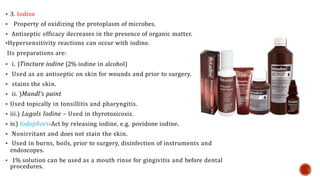
 i. )Tincture iodine (2% iodine in alcohol)
 Used as an antiseptic on skin for wounds and prior to surgery.
 stains the skin.
 ii. )Mandl’s paint
 Used topically in tonsillitis and pharyngitis.
 iii.) Lugols Iodine – Used in thyrotoxicosis.
 iv.) Iodophors-Act by releasing iodine, e.g. povidone iodine.
 Nonirritant and does not stain the skin.
 Used in burns, boils, prior to surgery, disinfection of instruments and
endoscopes.
 1% solution can be used as a mouth rinse for gingivitis and before dental
procedures.
 MOA - They act by denaturing bacterial proteins
and precipitating them.
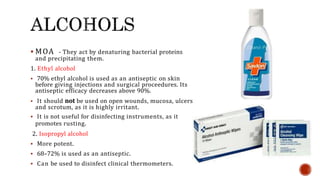
1. Ethyl alcohol
 70% ethyl alcohol is used as an antiseptic on skin
before giving injections and surgical proceedures. Its
antiseptic efficacy decreases above 90%.
 It should not be used on open wounds, mucosa, ulcers
and scrotum, as it is highly irritant.
 It is not useful for disinfecting instruments, as it
promotes rusting.
2. Isopropyl alcohol
 More potent.
 68–72% is used as an antiseptic.
 Can be used to disinfect clinical thermometers.
MOA- They act by denaturing the proteins. They are
protoplasmic poisons.
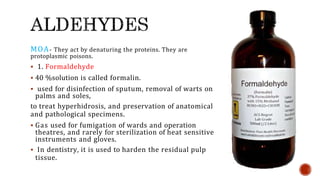
 1. Formaldehyde
 40 %solution is called formalin.
 used for disinfection of sputum, removal of warts on
palms and soles,
to treat hyperhidrosis, and preservation of anatomical
and pathological specimens.
 Gas used for fumigation of wards and operation
theatres, and rarely for sterilization of heat sensitive
instruments and gloves.
 In dentistry, it is used to harden the residual pulp
tissue.
 2. Glutaraldehyde
 Preferred over formaldehyde to sterilize surgical instruments,
plastic endotracheal tubes, face masks,corrugated rubber tubes,
endoscopes, respirators and thermometers, etc.
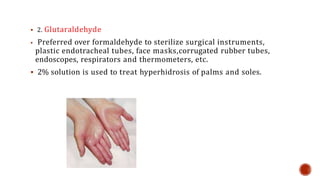
 2% solution is used to treat hyperhidrosis of palms and soles.
 MOA- act by releasing nascent oxygen, which oxidizes the
bacterial protoplasm.
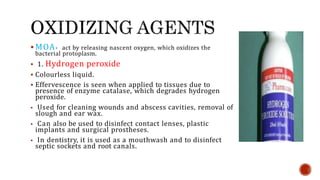
 1. Hydrogen peroxide
 Colourless liquid.
 Effervescence is seen when applied to tissues due to
presence of enzyme catalase, which degrades hydrogen
peroxide.

 Used for cleaning wounds and abscess cavities, removal of
slough and ear wax.
 Can also be used to disinfect contact lenses, plastic
implants and surgical prostheses.
 In dentistry, it is used as a mouthwash and to disinfect
septic sockets and root canals.
 2. Potassium permanganate
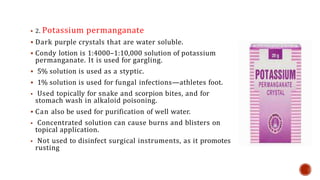
 Dark purple crystals that are water soluble.
 Condy lotion is 1:4000–1:10,000 solution of potassium
permanganate. It is used for gargling.
 5% solution is used as a styptic.
 1% solution is used for fungal infections—athletes foot.
 Used topically for snake and scorpion bites, and for
stomach wash in alkaloid poisoning.
 Can also be used for purification of well water.
 Concentrated solution can cause burns and blisters on
topical application.
 Not used to disinfect surgical instruments, as it promotes
rusting
antiseptics & disinfectants.pptx

antiseptics & disinfectants.pptx

  • 1.
    By: Dr RupeshDalavi Depart. of Pharmacology NIMS, Jaipur
  • 2.
     The termsantiseptic and disinfectant denote – “An agent which inhibits or kills microbes on contact.”  Conventionally, agents used on living surfaces (patient’s mouth, dentist’s hands, etc.) are called antiseptics.  While those used for inanimate objects (instruments, working surfaces, water supply, privies, etc.) are called disinfectants.  There is an overlap between the agents used for disinfection and sterilisation. Most of them show either actions based on their concentration.
  • 3.
    Antiseptic – Itis an agent used to eliminate microorganisms on living tissues Disinfectant – It is an agent used to eliminate microorganisms present on inanimate objects. Both of them can be broadly put under “Germicides”
  • 4.
     Used indentistry to check cross infection  To prevent and treat some infective conditions.
  • 5.
    A good antiseptic/disinfectantshould be: CAR 1. Chemically stable. 2. Cheap. 3. Non-staining with agreeable Colour and odour. 4. Cidal and not merely static. (destroying spores as well.) 5. Active Against All pathogens—bacteria, fungi, viruses, protozoa. 6. Able to spread and enter folds and crevices. 7. Active even in the presence of blood, pus, exudates and excreta. 8. Require brief time of exposure
  • 6.
    i) Rapid inaction and afford sustained protection. ii) Nonirritating to tissues, should not delay healing. iii) Nonabsorbable, produce minimum toxicity if absorbed iv) Nonsensitizing (no allergy). v) Compatible with soaps and other detergents.
  • 8.
    1. Phenol derivatives:Phenol, Cresol, Chloroxylenol(Dettol), Chlorhexidine(Savlon), Triclosan 2. Halogens: Iodine, Iodophores, Chlorine, Chlorophores 3. Alcohols : Ethanol, Isopropanol. 4. Aldehydes: Formaldehyde, Glutaraldehyde 5. SuRface active agents ( Detergents)- Soaps of Na+ and K+ (Quartenary Ammonium Compounds-) Cetrimide, Benzalkonium chloride
  • 9.
    6. Metallic Salts:-Silver nitrate, Zinc sulfate, Calamine, Zinc oxide. 7. Acids: Boric acid, Acetic acid 8. Gases:- Ethylene oxide, ß- propiolactone 9. Oxidising agents- Hydrogen peroxide, Benzoyl Peroxide, Potassium Permanganate 10.Dyes- Methylene Blue, Gentian Violet, Brilliant Green
  • 10.
     Relatively weakagent (static at 0.2%, cidal at >1%, poor action on bacterial spores)  It is a general protoplasmic poison, injuring microbes and tissue cells alike—at higher concentrations causes skin burns.  MOA- Acts by denaturing bacterial proteins.  Rarely employed as an antiseptic.  But being cheap, it is used to disinfect urine, faeces, pus, sputum of patients.  (Sometimes included in antipruritic preparations because of its mild local anaesthetic action.)
  • 11.
     1. Phenol(carbolic acid)  Rarely used as antiseptic, as it is corrosive and can penetrate intact skin.  Used to disinfect sputum, pus, excreta and discarded cultures.  Accidental or suicidal ingestion can cause corrosion of gastrointestinal tract (GIT), convulsions,hypothermia and collapse. Treatment is symptomatic.  2. Cresol (methylphenol)  More active and safer than phenol.  Used to disinfect utensils, excreta and infected glassware.
  • 12.
    3. Lysol (soapyemulsion of cresol)  Commonly used to disinfect the floor in hospitals and houses.  As antiseptic to wash hands. 4. Chloroxylenol  Active ingredient of dettol.  Less toxic than phenol.  Used to disinfect surgical instruments and as an antiseptic for skin before any surgery
  • 13.
    5. Chlorhexidine  Usedas a mouthwash and as an antiseptic for skin prior to surgery.  Chlorhexidine mouthwash enhances wound healing,  If used before dental procedures, Used as an antiplaque and antigingivitis agent.  Taste alteration and staining of oral cavity are the common side effects
  • 14.
    1. Chlorine: Itis used for disinfection of water. Some of its preparations are: Chloramines: They act by releasing chlorine. They can be used as mouthwash and for dressing of wounds. Chlorinated lime (bleaching powder) i. Acts by releasing chlorine. ii. Used to disinfect drinking water and toilets. iii.Disadvantage is that it is highly unstable and loses its activity on storage. 2. Sodium hypochlorite Used as a root canal disinfectant. It is cheaper; but it needs to be freshly prepared and has corrosive effect on metals.
  • 15.
     3. Iodine Property of oxidizing the protoplasm of microbes.  Antiseptic efficacy decreases in the presence of organic matter. Hypersensitivity reactions can occur with iodine. Its preparations are:  i. )Tincture iodine (2% iodine in alcohol)  Used as an antiseptic on skin for wounds and prior to surgery.  stains the skin.  ii. )Mandl’s paint  Used topically in tonsillitis and pharyngitis.  iii.) Lugols Iodine – Used in thyrotoxicosis.  iv.) Iodophors-Act by releasing iodine, e.g. povidone iodine.  Nonirritant and does not stain the skin.  Used in burns, boils, prior to surgery, disinfection of instruments and endoscopes.  1% solution can be used as a mouth rinse for gingivitis and before dental procedures.
  • 16.
     MOA -They act by denaturing bacterial proteins and precipitating them. 1. Ethyl alcohol  70% ethyl alcohol is used as an antiseptic on skin before giving injections and surgical proceedures. Its antiseptic efficacy decreases above 90%.  It should not be used on open wounds, mucosa, ulcers and scrotum, as it is highly irritant.  It is not useful for disinfecting instruments, as it promotes rusting. 2. Isopropyl alcohol  More potent.  68–72% is used as an antiseptic.  Can be used to disinfect clinical thermometers.
  • 17.
    MOA- They actby denaturing the proteins. They are protoplasmic poisons.  1. Formaldehyde  40 %solution is called formalin.  used for disinfection of sputum, removal of warts on palms and soles, to treat hyperhidrosis, and preservation of anatomical and pathological specimens.  Gas used for fumigation of wards and operation theatres, and rarely for sterilization of heat sensitive instruments and gloves.  In dentistry, it is used to harden the residual pulp tissue.
  • 18.
     2. Glutaraldehyde Preferred over formaldehyde to sterilize surgical instruments, plastic endotracheal tubes, face masks,corrugated rubber tubes, endoscopes, respirators and thermometers, etc.  2% solution is used to treat hyperhidrosis of palms and soles.
  • 19.
     MOA- actby releasing nascent oxygen, which oxidizes the bacterial protoplasm.  1. Hydrogen peroxide  Colourless liquid.  Effervescence is seen when applied to tissues due to presence of enzyme catalase, which degrades hydrogen peroxide.  Used for cleaning wounds and abscess cavities, removal of slough and ear wax.  Can also be used to disinfect contact lenses, plastic implants and surgical prostheses.  In dentistry, it is used as a mouthwash and to disinfect septic sockets and root canals.
  • 20.
     2. Potassiumpermanganate  Dark purple crystals that are water soluble.  Condy lotion is 1:4000–1:10,000 solution of potassium permanganate. It is used for gargling.  5% solution is used as a styptic.  1% solution is used for fungal infections—athletes foot.  Used topically for snake and scorpion bites, and for stomach wash in alkaloid poisoning.  Can also be used for purification of well water.  Concentrated solution can cause burns and blisters on topical application.  Not used to disinfect surgical instruments, as it promotes rusting