-S.SARASWATHI
   BDS Final Year
INTRODUCTION:
 CHLORHEXIDINE a GOLD STANDARD IN
  CHEMICAL PLAQUE CONTROL with outstanding
  bacteriostatic and bactericidal properties
 Effective on both gram positive and gram negative
  bacteria, although it is less effective with some
  gram negative bacteria
Chemical structure:
 Chlorhexidine is a symmetrical molecule
  consisting of FOUR CHLOROPHENYL RINGS and
  BISGUANIDE GROUPS connected by a CENTRAL
  HEXAMETHYLENE BRIDGE
 The compound is strongly base & dicationic at ph
  levels above 3.5 with positive charges on either
  side of hexamethylene bridge
 It is the dicationic nature of chlorhexidine
  making it extremely intractive with anions,
  which is relevant to its efficacy
Available in three forms:
 Digluconate- most commonly used & water
  soluble
 Acetate- water soluble
 Hydrochloride salts- sparingly water soluble
Mechanism of action:
 Antimicrobial activity:
CHX shows different effects at different concentrations
The agent is bacteriostatic, whereas at higher concentration it is
bactericidal
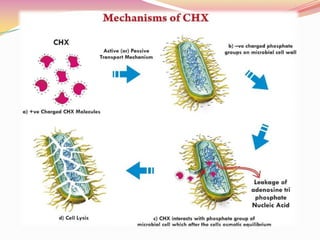
        cationic CHX molecule+ negatively charged bacterial cell wall

      Instant adsorption of CHX to Phosphate containing
compounds

        CHX binds with the phospholipids in the inner cell membrane
                       causing cell wall integrity

   Leakage of the lesser molecular weight components viz. potassium
ions
[This is the sub lethal stage of CHX. The action can be reversed. This
marks the bacteriostatic property of CHX. If the conc. Is increased and
the action continues, the CHX becomes bactericidal in nature]
Intracellular coagulation

Slows down leakage of intracellular
components

      Cytoplasmic coagulation

Irreversible cell damage [bactericidal]
•     Antiplaque activity:
    Three mechanism for inhibition of plaque by CHX:
    1. The effective blocking of the acidic group of
       salivary glycoproteins will reduce their
       adsorption to hydroxyapatite and formation of
       acquired pellicle
    2. The ability of bacteria to bind to tooth surface
       may be reduced by adsorption of CHX to the
       extracellular polysaccharides of their capsule
    3. The CHX may compete with calcium ions for
       acidic agglutination factors in plaques
What makes it so unique?
 Its long lasting bacteriostatic action, also
  termed as ‘substantivity’
 Its action lasts for about 12 hours in the oral
  cavity after a single rinse
 The dicationic CHX molecule, attaches to the
  pellicle by one cation, to the bacteria
  attempting to colonize the tooth surface with
  the other. This is called the ‘Pin-Cushion
  Effect’
 This prolongs the CHX action
Uses:
1.    As an adjunct to oral hygiene
2.    Post oral surgery including periodontal surgery or root
      planing
3.    In patients with inter maxillary fixation.
4.    For oral hygiene & gingival health in physically & mentally
      handicapped
5.    Medically compromised individuals predisposed to oral
      infections
6.    High caries risk patient
7.    Recurrent oral ulceration
8.    Removable & fixed orthodontic wearers
9.    Treatment of denture stomatitis and dry socket
10.   As an immediate prophylactic rinse in the prevention of
      post-extraction bacteremia
Adverse effects:
a) Extrinsic staining
b) Alteration in taste perception
c) Oral mucosal erosion
d) Enhanced supragingival calculus formation
e) Parotid gland swelling
f) Overdosage: ingestion of 1 or 2 ounces of
   CHX oral rinse by a small child might result
   in gastric distress, including nausea or signs
   of alcohol intoxication
Dosage & administration:
 Recommended use is twice daily oral rinsing
  for 30 seconds after tooth brushing
 Usual dosage is 15ml (1 tablespoon) of
  undiluted chlorhexidine oral rinse
 Patient should be instructed not to rinse with
  water or brush teeth or eat immediately after
  CHX oral rinse
 CHX should not be ingested and should be
  expectorated after rinsing
Chlorhexidine products:
 Mouth rinse- aqueous/ alcohol solutions of
  0.2% [Peridex, Periogard, Periosol]
 Gel [corsodyl dental gel]
 Sprays [Hibispray]
 Tooth pastes
 Varnishes
 Chewing gums
 Periodontal dressings
 Subgingival plaque control [Periochip]
Thank you..!!!

Chlorhexidine

  • 1.
    -S.SARASWATHI BDS Final Year
  • 2.
    INTRODUCTION:  CHLORHEXIDINE aGOLD STANDARD IN CHEMICAL PLAQUE CONTROL with outstanding bacteriostatic and bactericidal properties  Effective on both gram positive and gram negative bacteria, although it is less effective with some gram negative bacteria
  • 3.
    Chemical structure:  Chlorhexidineis a symmetrical molecule consisting of FOUR CHLOROPHENYL RINGS and BISGUANIDE GROUPS connected by a CENTRAL HEXAMETHYLENE BRIDGE  The compound is strongly base & dicationic at ph levels above 3.5 with positive charges on either side of hexamethylene bridge  It is the dicationic nature of chlorhexidine making it extremely intractive with anions, which is relevant to its efficacy
  • 4.
    Available in threeforms:  Digluconate- most commonly used & water soluble  Acetate- water soluble  Hydrochloride salts- sparingly water soluble
  • 5.
    Mechanism of action: Antimicrobial activity: CHX shows different effects at different concentrations The agent is bacteriostatic, whereas at higher concentration it is bactericidal cationic CHX molecule+ negatively charged bacterial cell wall Instant adsorption of CHX to Phosphate containing compounds CHX binds with the phospholipids in the inner cell membrane causing cell wall integrity Leakage of the lesser molecular weight components viz. potassium ions [This is the sub lethal stage of CHX. The action can be reversed. This marks the bacteriostatic property of CHX. If the conc. Is increased and the action continues, the CHX becomes bactericidal in nature]
  • 6.
    Intracellular coagulation Slows downleakage of intracellular components Cytoplasmic coagulation Irreversible cell damage [bactericidal]
  • 8.
    Antiplaque activity: Three mechanism for inhibition of plaque by CHX: 1. The effective blocking of the acidic group of salivary glycoproteins will reduce their adsorption to hydroxyapatite and formation of acquired pellicle 2. The ability of bacteria to bind to tooth surface may be reduced by adsorption of CHX to the extracellular polysaccharides of their capsule 3. The CHX may compete with calcium ions for acidic agglutination factors in plaques
  • 9.
    What makes itso unique?  Its long lasting bacteriostatic action, also termed as ‘substantivity’  Its action lasts for about 12 hours in the oral cavity after a single rinse  The dicationic CHX molecule, attaches to the pellicle by one cation, to the bacteria attempting to colonize the tooth surface with the other. This is called the ‘Pin-Cushion Effect’  This prolongs the CHX action
  • 10.
    Uses: 1. As an adjunct to oral hygiene 2. Post oral surgery including periodontal surgery or root planing 3. In patients with inter maxillary fixation. 4. For oral hygiene & gingival health in physically & mentally handicapped 5. Medically compromised individuals predisposed to oral infections 6. High caries risk patient 7. Recurrent oral ulceration 8. Removable & fixed orthodontic wearers 9. Treatment of denture stomatitis and dry socket 10. As an immediate prophylactic rinse in the prevention of post-extraction bacteremia
  • 11.
    Adverse effects: a) Extrinsicstaining b) Alteration in taste perception c) Oral mucosal erosion d) Enhanced supragingival calculus formation e) Parotid gland swelling f) Overdosage: ingestion of 1 or 2 ounces of CHX oral rinse by a small child might result in gastric distress, including nausea or signs of alcohol intoxication
  • 12.
    Dosage & administration: Recommended use is twice daily oral rinsing for 30 seconds after tooth brushing  Usual dosage is 15ml (1 tablespoon) of undiluted chlorhexidine oral rinse  Patient should be instructed not to rinse with water or brush teeth or eat immediately after CHX oral rinse  CHX should not be ingested and should be expectorated after rinsing
  • 13.
    Chlorhexidine products:  Mouthrinse- aqueous/ alcohol solutions of 0.2% [Peridex, Periogard, Periosol]  Gel [corsodyl dental gel]  Sprays [Hibispray]  Tooth pastes  Varnishes  Chewing gums  Periodontal dressings  Subgingival plaque control [Periochip]
  • 14.