DENTAL
PRODUCTS….
Presented By
G.Revathi., M.Pharm.,
Assistant Professor
Dept. Of Pharmaceutical Chemistry, SVCP
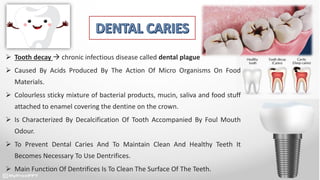
 Tooth decay  chronic infectious disease called dental plague
 Caused By Acids Produced By The Action Of Micro Organisms On Food
Materials.
 Colourless sticky mixture of bacterial products, mucin, saliva and food stuff
attached to enamel covering the dentine on the crown.
 Is Characterized By Decalcification Of Tooth Accompanied By Foul Mouth
Odour.
 To Prevent Dental Caries And To Maintain Clean And Healthy Teeth It
Becomes Necessary To Use Dentrifices.
 Main Function Of Dentrifices Is To Clean The Surface Of The Teeth.
Mechanism of Dental caries & treatment
ROLE OF FLUORIDE
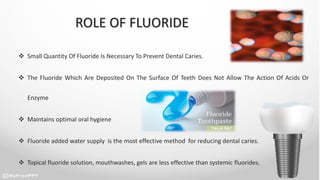
 Small Quantity Of Fluoride Is Necessary To Prevent Dental Caries.
 The Fluoride Which Are Deposited On The Surface Of Teeth Does Not Allow The Action Of Acids Or
Enzyme
 Maintains optimal oral hygiene
 Fluoride added water supply is the most effective method for reducing dental caries.
 Topical fluoride solution, mouthwashes, gels are less effective than systemic fluorides.
DENTAL PRODUCTS….
Substances used to produce effect on teeth and in dental
cavity is called as Dental Products
TYPES
1. Anti caries agent
 Sodium fluoride
2. Cleaning agent
 Dibasic calcium phosphate
3. Polishing agent
 Sodium metaphosphate
4. Desensitization agents
 Zinc chloride
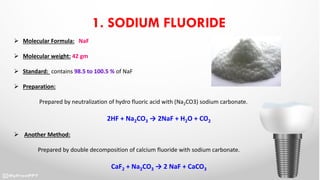
1. SODIUM FLUORIDE
 Molecular Formula: NaF
 Molecular weight: 42 gm
 Standard: contains 98.5 to 100.5 % of NaF
 Preparation:
Prepared by neutralization of hydro fluoric acid with (Na2CO3) sodium carbonate.
2HF + Na2CO3 → 2NaF + H2O + CO2
 Another Method:
Prepared by double decomposition of calcium fluoride with sodium carbonate.
CaF2 + Na2CO3 → 2 NaF + CaCO3
 Physical Properties:
1. It is a white powder.
2. Colorless and odourless.
3. It is soluble in water.
4. Insoluble in alcohol.
 Chemical Properties:
Upon acidification ; hydrofluoric acid is produced.
NaF + HCl → HF + NaCl
 Assay: It is assayed by complexometric titration.
 Test for Purity:
• lead
• Sulphate
• Colour of the solution
• Acidity or alkalinity
• LOD
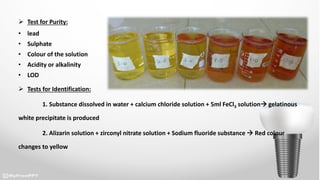
 Tests for Identification:
1. Substance dissolved in water + calcium chloride solution + 5ml FeCl3 solution gelatinous
white precipitate is produced
2. Alizarin solution + zirconyl nitrate solution + Sodium fluoride substance  Red colour
changes to yellow
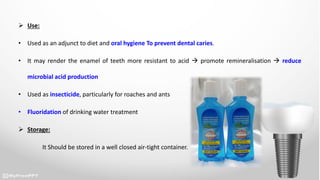
 Use:
• Used as an adjunct to diet and oral hygiene To prevent dental caries.
• It may render the enamel of teeth more resistant to acid  promote remineralisation  reduce
microbial acid production
• Used as insecticide, particularly for roaches and ants
• Fluoridation of drinking water treatment
 Storage:
It Should be stored in a well closed air-tight container.
2. STANNOUS FLUORIDE
• Molecular formula: SnF2
• Molecular weight: 157 gm
• Preparation: It is prepared by dissolving stannous hydroxide in hydro fluoric acid. ‘’
Sn(OH)2 + 2HF→ SnF2 + 2H2O
Sn + 2HF  SnF2 + H2
• Standard: contains NMT 71.2% of stannous ions and not less than 22.3% of
fluoride
• Physical Properties:
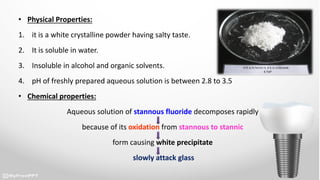
1. it is a white crystalline powder having salty taste.
2. It is soluble in water.
3. Insoluble in alcohol and organic solvents.
4. pH of freshly prepared aqueous solution is between 2.8 to 3.5
• Chemical properties:
Aqueous solution of stannous fluoride decomposes rapidly
because of its oxidation from stannous to stannic
form causing white precipitate
slowly attack glass
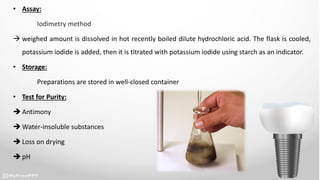
• Assay:
Iodimetry method
 weighed amount is dissolved in hot recently boiled dilute hydrochloric acid. The flask is cooled,
potassium iodide is added, then it is titrated with potassium iodide using starch as an indicator.
• Storage:
Preparations are stored in well-closed container
• Test for Purity:
 Antimony
 Water-insoluble substances
 Loss on drying
 pH
• Test for Identification:
1. calcium chloride + sample solution  white ppt formed due to formation of calcium fluoride
2. Aqueous solution + silver nitrate on spot plate brown-black precipitate is formed
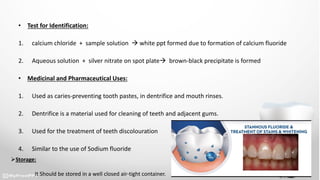
• Medicinal and Pharmaceutical Uses:
1. Used as caries-preventing tooth pastes, in dentrifice and mouth rinses.
2. Dentrifice is a material used for cleaning of teeth and adjacent gums.
3. Used for the treatment of teeth discolouration
4. Similar to the use of Sodium fluoride
Storage:
It Should be stored in a well closed air-tight container.
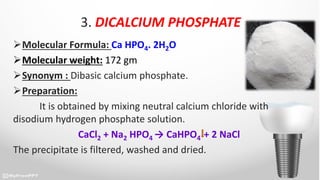
3. DICALCIUM PHOSPHATE
Molecular Formula: Ca HPO4. 2H2O
Molecular weight: 172 gm
Synonym : Dibasic calcium phosphate.
Preparation:
It is obtained by mixing neutral calcium chloride with
disodium hydrogen phosphate solution.
CaCl2 + Na2 HPO4 → CaHPO4 + 2 NaCl
The precipitate is filtered, washed and dried.
 Properties:
1. Very fine powder.
2. Odourless and tasteless.
3. When exposed to air, it effloresces losing waters (forms anhydrous
form).
 Chemical properties:
2CaHPO4 + 2HCl  Ca(H2PO4)2 + CaCl2
 Assay:
Complexometric Titration
Weighed amount is dissolved in hydrochloric acid and titrated with
EDTA using hydroxy naphthol blue as indicator.
 Use:
 Externally as a dentrifice, orally as an electrolyte replenisher
 Storage:
It Should be stored in a well closed air-tight container.
4.Calcium Carbonate
• Refer Gastrointestinal agents
• Uses:
• Calcium carbonate is a fine powder used as dentrifices in
tooth powders and in toothpastes
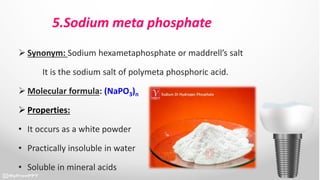
5.Sodium meta phosphate
 Synonym: Sodium hexametaphosphate or maddrell’s salt
It is the sodium salt of polymeta phosphoric acid.
 Molecular formula: (NaPO3)n
 Properties:
• It occurs as a white powder
• Practically insoluble in water
• Soluble in mineral acids
 Preparation:
by dehydration of sodium phosphates
NaH2PO4 NaPO3 + H2O
 Uses:
1. It is used in dentrifices as an abrasive. Also used as an anti-rusting
agent (for surgical instruments).
2. Also as a stabilizing, emulsifying and chelating agent in food industry.
Storage:
It Should be stored in a well closed air-tight container.
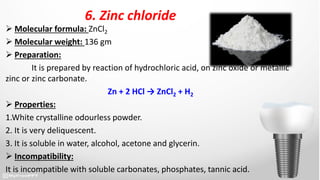
6. Zinc chloride
 Molecular formula: ZnCl2
 Molecular weight: 136 gm
 Preparation:
It is prepared by reaction of hydrochloric acid, on zinc oxide or metallic
zinc or zinc carbonate.
Zn + 2 HCl → ZnCl2 + H2
 Properties:
1.White crystalline odourless powder.
2. It is very deliquescent.
3. It is soluble in water, alcohol, acetone and glycerin.
 Incompatibility:
It is incompatible with soluble carbonates, phosphates, tannic acid.
 Assay:
Complexometric Titration Method
Weighed amount is dissolved in water, and ammonia-ammonium chloride
buffer is added, titrated with standard EDTA using eriochrome black as an
indicator.
 Use
1. It act as desensitizing agent in dental remedies.
2. Used as antiseptic lotion for foul – smelling wounds.
Storage:
It Should be stored in a well closed air-tight
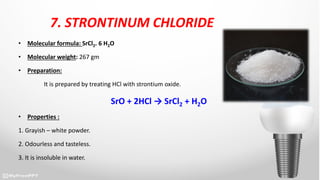
7. STRONTINUM CHLORIDE
• Molecular formula: SrCl2. 6 H2O
• Molecular weight: 267 gm
• Preparation:
It is prepared by treating HCl with strontium oxide.
SrO + 2HCl → SrCl2 + H2O
• Properties :
1. Grayish – white powder.
2. Odourless and tasteless.
3. It is insoluble in water.
Use:
1. To relieve dental hypersensitivity (reduce the sensitivity of teeth to
heat and cold).
2. Strontinum can replace in bone formation and has been used to
hasten bone remineralization in diseases.
Eg. osteoporosis
Storage:
It Should be stored in a well closed air-tight container.

Dental products

  • 1.
    DENTAL PRODUCTS…. Presented By G.Revathi., M.Pharm., AssistantProfessor Dept. Of Pharmaceutical Chemistry, SVCP
  • 2.
     Tooth decay chronic infectious disease called dental plague  Caused By Acids Produced By The Action Of Micro Organisms On Food Materials.  Colourless sticky mixture of bacterial products, mucin, saliva and food stuff attached to enamel covering the dentine on the crown.  Is Characterized By Decalcification Of Tooth Accompanied By Foul Mouth Odour.  To Prevent Dental Caries And To Maintain Clean And Healthy Teeth It Becomes Necessary To Use Dentrifices.  Main Function Of Dentrifices Is To Clean The Surface Of The Teeth.
  • 3.
    Mechanism of Dentalcaries & treatment
  • 4.
    ROLE OF FLUORIDE Small Quantity Of Fluoride Is Necessary To Prevent Dental Caries.  The Fluoride Which Are Deposited On The Surface Of Teeth Does Not Allow The Action Of Acids Or Enzyme  Maintains optimal oral hygiene  Fluoride added water supply is the most effective method for reducing dental caries.  Topical fluoride solution, mouthwashes, gels are less effective than systemic fluorides.
  • 5.
    DENTAL PRODUCTS…. Substances usedto produce effect on teeth and in dental cavity is called as Dental Products
  • 6.
    TYPES 1. Anti cariesagent  Sodium fluoride 2. Cleaning agent  Dibasic calcium phosphate 3. Polishing agent  Sodium metaphosphate 4. Desensitization agents  Zinc chloride
  • 7.
    1. SODIUM FLUORIDE Molecular Formula: NaF  Molecular weight: 42 gm  Standard: contains 98.5 to 100.5 % of NaF  Preparation: Prepared by neutralization of hydro fluoric acid with (Na2CO3) sodium carbonate. 2HF + Na2CO3 → 2NaF + H2O + CO2  Another Method: Prepared by double decomposition of calcium fluoride with sodium carbonate. CaF2 + Na2CO3 → 2 NaF + CaCO3
  • 8.
     Physical Properties: 1.It is a white powder. 2. Colorless and odourless. 3. It is soluble in water. 4. Insoluble in alcohol.  Chemical Properties: Upon acidification ; hydrofluoric acid is produced. NaF + HCl → HF + NaCl  Assay: It is assayed by complexometric titration.
  • 9.
     Test forPurity: • lead • Sulphate • Colour of the solution • Acidity or alkalinity • LOD  Tests for Identification: 1. Substance dissolved in water + calcium chloride solution + 5ml FeCl3 solution gelatinous white precipitate is produced 2. Alizarin solution + zirconyl nitrate solution + Sodium fluoride substance  Red colour changes to yellow
  • 10.
     Use: • Usedas an adjunct to diet and oral hygiene To prevent dental caries. • It may render the enamel of teeth more resistant to acid  promote remineralisation  reduce microbial acid production • Used as insecticide, particularly for roaches and ants • Fluoridation of drinking water treatment  Storage: It Should be stored in a well closed air-tight container.
  • 11.
    2. STANNOUS FLUORIDE •Molecular formula: SnF2 • Molecular weight: 157 gm • Preparation: It is prepared by dissolving stannous hydroxide in hydro fluoric acid. ‘’ Sn(OH)2 + 2HF→ SnF2 + 2H2O Sn + 2HF  SnF2 + H2 • Standard: contains NMT 71.2% of stannous ions and not less than 22.3% of fluoride
  • 12.
    • Physical Properties: 1.it is a white crystalline powder having salty taste. 2. It is soluble in water. 3. Insoluble in alcohol and organic solvents. 4. pH of freshly prepared aqueous solution is between 2.8 to 3.5 • Chemical properties: Aqueous solution of stannous fluoride decomposes rapidly because of its oxidation from stannous to stannic form causing white precipitate slowly attack glass
  • 13.
    • Assay: Iodimetry method weighed amount is dissolved in hot recently boiled dilute hydrochloric acid. The flask is cooled, potassium iodide is added, then it is titrated with potassium iodide using starch as an indicator. • Storage: Preparations are stored in well-closed container • Test for Purity:  Antimony  Water-insoluble substances  Loss on drying  pH
  • 14.
    • Test forIdentification: 1. calcium chloride + sample solution  white ppt formed due to formation of calcium fluoride 2. Aqueous solution + silver nitrate on spot plate brown-black precipitate is formed • Medicinal and Pharmaceutical Uses: 1. Used as caries-preventing tooth pastes, in dentrifice and mouth rinses. 2. Dentrifice is a material used for cleaning of teeth and adjacent gums. 3. Used for the treatment of teeth discolouration 4. Similar to the use of Sodium fluoride Storage: It Should be stored in a well closed air-tight container.
  • 15.
    3. DICALCIUM PHOSPHATE MolecularFormula: Ca HPO4. 2H2O Molecular weight: 172 gm Synonym : Dibasic calcium phosphate. Preparation: It is obtained by mixing neutral calcium chloride with disodium hydrogen phosphate solution. CaCl2 + Na2 HPO4 → CaHPO4 + 2 NaCl The precipitate is filtered, washed and dried.
  • 16.
     Properties: 1. Veryfine powder. 2. Odourless and tasteless. 3. When exposed to air, it effloresces losing waters (forms anhydrous form).  Chemical properties: 2CaHPO4 + 2HCl  Ca(H2PO4)2 + CaCl2
  • 17.
     Assay: Complexometric Titration Weighedamount is dissolved in hydrochloric acid and titrated with EDTA using hydroxy naphthol blue as indicator.  Use:  Externally as a dentrifice, orally as an electrolyte replenisher  Storage: It Should be stored in a well closed air-tight container.
  • 18.
    4.Calcium Carbonate • ReferGastrointestinal agents • Uses: • Calcium carbonate is a fine powder used as dentrifices in tooth powders and in toothpastes
  • 19.
    5.Sodium meta phosphate Synonym: Sodium hexametaphosphate or maddrell’s salt It is the sodium salt of polymeta phosphoric acid.  Molecular formula: (NaPO3)n  Properties: • It occurs as a white powder • Practically insoluble in water • Soluble in mineral acids
  • 20.
     Preparation: by dehydrationof sodium phosphates NaH2PO4 NaPO3 + H2O  Uses: 1. It is used in dentrifices as an abrasive. Also used as an anti-rusting agent (for surgical instruments). 2. Also as a stabilizing, emulsifying and chelating agent in food industry. Storage: It Should be stored in a well closed air-tight container.
  • 21.
    6. Zinc chloride Molecular formula: ZnCl2  Molecular weight: 136 gm  Preparation: It is prepared by reaction of hydrochloric acid, on zinc oxide or metallic zinc or zinc carbonate. Zn + 2 HCl → ZnCl2 + H2  Properties: 1.White crystalline odourless powder. 2. It is very deliquescent. 3. It is soluble in water, alcohol, acetone and glycerin.  Incompatibility: It is incompatible with soluble carbonates, phosphates, tannic acid.
  • 22.
     Assay: Complexometric TitrationMethod Weighed amount is dissolved in water, and ammonia-ammonium chloride buffer is added, titrated with standard EDTA using eriochrome black as an indicator.  Use 1. It act as desensitizing agent in dental remedies. 2. Used as antiseptic lotion for foul – smelling wounds. Storage: It Should be stored in a well closed air-tight
  • 23.
    7. STRONTINUM CHLORIDE •Molecular formula: SrCl2. 6 H2O • Molecular weight: 267 gm • Preparation: It is prepared by treating HCl with strontium oxide. SrO + 2HCl → SrCl2 + H2O • Properties : 1. Grayish – white powder. 2. Odourless and tasteless. 3. It is insoluble in water.
  • 24.
    Use: 1. To relievedental hypersensitivity (reduce the sensitivity of teeth to heat and cold). 2. Strontinum can replace in bone formation and has been used to hasten bone remineralization in diseases. Eg. osteoporosis Storage: It Should be stored in a well closed air-tight container.