DESIGN OF MACHINE ELEMENT
INTRODUCTION
• Design is to formulate a plan to satisfya particular need and
create something with physical reality.
• Realization of a concept or idea into a configuration.
• Design is the creation of a plan or convention for the construction
of an object, system or measurable human interaction
DESIGN
• Machine is a combination of several machine elements arranged
to work together as a whole to accomplish specific purpose.
• Machine Design involves designing the elements and arranging
them optimally to obtain some useful work.
• Machine design is the process of engineering design. A machine
is made up of mechanisms that work together to satisfy the
requirements of what the machine needs to accomplish.
MACHINE DESIGN
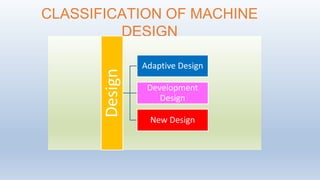
CLASSIFICATION OF MACHINE
DESIGN
Design
Adaptive Design
Development
Design
New Design
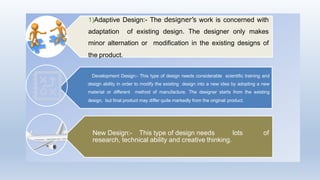
1)Adaptive Design:- The designer’s work is concerned with
adaptation of existing design. The designer only makes
minor alternation or modification in the existing designs of
the product.
1)Development Design:- This type of design needs considerable scientific training and
design ability in order to modify the existing design into a new idea by adopting a new
material or different method of manufacture. The designer starts from the existing
design, but final product may differ quite markedly from the original product.
New Design:- This type of design needs lots of
research, technical ability and creative thinking.
1) Rational Design:- Based on determining the stresses and strains of
components and thereby deciding their dimensions. This type of
design depends upon mathematical formulae of principal of
mechanics.
2) Empirical Design:- This type of design depends upon empirical
formulae based on the practice and past experience .
Types of Design based on method
This type of design depends upon the production aspects to
manufacture any machine component in the industry. Based on
industrial considerations and norms viz. market survey, external
look, production facilities, low cost, use of existing standard products
Industrial Design
 What device or mechanism to be used???
To decide the relative arrangement of the constituent
elements.
 Material
 Forces on the elements
 Size
 Shape and space requirements
 Weight of the product
Factors to be considered in Machine Design
 The method of manufacturing the components and their
assembly.
 How will it operate.
 Reliability and safety aspects.
 Inspectibilty
 Maintenance
 Cost and aesthetics of the designed product.
Factors to be considered in Machine
Design
General procedure in Machine
Design
Need or Aim Synthesis (Mechanisms) Analysis of forces
Material Selection
Design of Elements
Modification Detailed Drawing
Production
• Standardization is defined as obligatory (or compulsory) norms, to
which various characteristics of a product should comply (or agree)
with standard.
• The characteristics include materials, dimensions and shape of the
component, method of testing and method of marking, packing and
storing of the product.
• A standard is defined as a set of specifications for parts, materials or
processes. The objective of, a standard is to reduce the variety and
limit the number of items to a reasonable level.
Standardization
• On the other hand, a code is defined as a set of specifications for the
analysis, design, manufacture, testing and erection of the product.
The purpose of a code is to achieve a specified level of safety.
• There are three types of standards used in design :-
 Company Standards: They are used in a particular company or a
group of sister concerns.
Standardization
 National standards:
– India - BIS (Bureau of Indian Standards),
– Germany - DIN (Deutsches Institut für Normung),
– USA - AISI (American Iron and Steel Institute) or SAE (Society of Automotive
Engineers),
– UK - BS (British Standards)
 International standards:
 These are prepared by the International Standards Organization
(ISO).
Standardization
Standards for Materials, their chemical compositions, Mechanical properties and Heat
Treatment:
For example, Indian standard IS 210 specifies seven grades of grey cast iron
designated as FG 150, FG 200, FG 220, FG 260, FG 300, FG 350 and FG 400. The
number indicates ultimate tensile strength in N/mm2.
Standards for Shapes and dimensions of commonly used Machine Elements:
The machine elements include bolts, screws and nuts, rivets, belts and chains, ball and
roller bearings, wire ropes, keys and splines, etc
For example, IS 2494 (Part 1) specifies dimensions and shape of the cross- section of
endless V-belts for power transmission.
The dimensions of the trapezoidal cross-section of the belt, viz. width, height and included
angle are specified in this standard
 Standards for Fits, Tolerances and Surface Finish of Component:
For example, selection of the type of fit for different applications is illustrated in IS
2709 on 'Guide for selection of fits'.
The tolerances or upper and lower limits for various sizes of holes and shafts are
specified in IS 919 on 'Recommendations for limits and fits for engineering'.
IS 10719 explains method for indicating surface texture on technical drawings.
 Standards for Tes ting of Products:
These standards, sometimes called 'codes', give procedures to test the products
such as pressure vessel, boiler, crane and wire rope, where safety of the
operator is an important consideration.
 Reductions in types and dimensions of identical components (inventory
control).
 Reduction in manufacturing facilities.
 Easy to replace (Interchangeability).
No need to design or test the elements.
 Improves quality and reliability.
 Improves reputation of the company which manufactures standard
components.
 Sometimes it ensures the safety.
Benefits of Standardization

1 a. Introduction design of machine element

  • 1.
    DESIGN OF MACHINEELEMENT INTRODUCTION
  • 3.
    • Design isto formulate a plan to satisfya particular need and create something with physical reality. • Realization of a concept or idea into a configuration. • Design is the creation of a plan or convention for the construction of an object, system or measurable human interaction DESIGN
  • 4.
    • Machine isa combination of several machine elements arranged to work together as a whole to accomplish specific purpose. • Machine Design involves designing the elements and arranging them optimally to obtain some useful work. • Machine design is the process of engineering design. A machine is made up of mechanisms that work together to satisfy the requirements of what the machine needs to accomplish. MACHINE DESIGN
  • 5.
    CLASSIFICATION OF MACHINE DESIGN Design AdaptiveDesign Development Design New Design
  • 6.
    1)Adaptive Design:- Thedesigner’s work is concerned with adaptation of existing design. The designer only makes minor alternation or modification in the existing designs of the product. 1)Development Design:- This type of design needs considerable scientific training and design ability in order to modify the existing design into a new idea by adopting a new material or different method of manufacture. The designer starts from the existing design, but final product may differ quite markedly from the original product. New Design:- This type of design needs lots of research, technical ability and creative thinking.
  • 7.
    1) Rational Design:-Based on determining the stresses and strains of components and thereby deciding their dimensions. This type of design depends upon mathematical formulae of principal of mechanics. 2) Empirical Design:- This type of design depends upon empirical formulae based on the practice and past experience . Types of Design based on method
  • 8.
    This type ofdesign depends upon the production aspects to manufacture any machine component in the industry. Based on industrial considerations and norms viz. market survey, external look, production facilities, low cost, use of existing standard products Industrial Design
  • 9.
     What deviceor mechanism to be used??? To decide the relative arrangement of the constituent elements.  Material  Forces on the elements  Size  Shape and space requirements  Weight of the product Factors to be considered in Machine Design
  • 10.
     The methodof manufacturing the components and their assembly.  How will it operate.  Reliability and safety aspects.  Inspectibilty  Maintenance  Cost and aesthetics of the designed product. Factors to be considered in Machine Design
  • 11.
    General procedure inMachine Design Need or Aim Synthesis (Mechanisms) Analysis of forces Material Selection Design of Elements Modification Detailed Drawing Production
  • 12.
    • Standardization isdefined as obligatory (or compulsory) norms, to which various characteristics of a product should comply (or agree) with standard. • The characteristics include materials, dimensions and shape of the component, method of testing and method of marking, packing and storing of the product. • A standard is defined as a set of specifications for parts, materials or processes. The objective of, a standard is to reduce the variety and limit the number of items to a reasonable level. Standardization
  • 13.
    • On theother hand, a code is defined as a set of specifications for the analysis, design, manufacture, testing and erection of the product. The purpose of a code is to achieve a specified level of safety. • There are three types of standards used in design :-  Company Standards: They are used in a particular company or a group of sister concerns. Standardization
  • 14.
     National standards: –India - BIS (Bureau of Indian Standards), – Germany - DIN (Deutsches Institut für Normung), – USA - AISI (American Iron and Steel Institute) or SAE (Society of Automotive Engineers), – UK - BS (British Standards)  International standards:  These are prepared by the International Standards Organization (ISO). Standardization
  • 15.
    Standards for Materials,their chemical compositions, Mechanical properties and Heat Treatment: For example, Indian standard IS 210 specifies seven grades of grey cast iron designated as FG 150, FG 200, FG 220, FG 260, FG 300, FG 350 and FG 400. The number indicates ultimate tensile strength in N/mm2. Standards for Shapes and dimensions of commonly used Machine Elements: The machine elements include bolts, screws and nuts, rivets, belts and chains, ball and roller bearings, wire ropes, keys and splines, etc For example, IS 2494 (Part 1) specifies dimensions and shape of the cross- section of endless V-belts for power transmission. The dimensions of the trapezoidal cross-section of the belt, viz. width, height and included angle are specified in this standard
  • 16.
     Standards forFits, Tolerances and Surface Finish of Component: For example, selection of the type of fit for different applications is illustrated in IS 2709 on 'Guide for selection of fits'. The tolerances or upper and lower limits for various sizes of holes and shafts are specified in IS 919 on 'Recommendations for limits and fits for engineering'. IS 10719 explains method for indicating surface texture on technical drawings.  Standards for Tes ting of Products: These standards, sometimes called 'codes', give procedures to test the products such as pressure vessel, boiler, crane and wire rope, where safety of the operator is an important consideration.
  • 17.
     Reductions intypes and dimensions of identical components (inventory control).  Reduction in manufacturing facilities.  Easy to replace (Interchangeability). No need to design or test the elements.  Improves quality and reliability.  Improves reputation of the company which manufactures standard components.  Sometimes it ensures the safety. Benefits of Standardization