COURSE MATERIAL
SMEX1014
DESIGN OF MACHINE ELEMENTS
SATHYABAMA UNIVERSITY
CHENNAI
SMEX1014 DESIGN OF MACHINE ELEMENTS
(Common to MECHANICAL and MECHANICAL & PRODUCTION)
L T P Credits Total Marks 2 1 0 3 100
UNIT I STEADY STRESSES AND VARIABLE STRESSES IN MACHINE
MEMBERS 10 hrs.
Introduction to the design process – Factors influencing machine design, selection of
materials based on mechanical properties – Direct, bending and torsional stress equations –
Impact and shock loading – Calculation of principle stresses for various load combinations,
eccentric loading – Factor of safety – Theories of failure –Stress concentration – Design for
variable fatigue loading – Soderberg, Goodman and Gerber relations
UNIT II DESIGN OF SHAFTS AND COUPLINGS 10 hrs.
Design of solid and hollow shafts based on strength, rigidity and critical speed – Design of
keys and key ways, – Design of rigid and flexible couplings – Design of knuckle joint and
cotter joints
UNIT III DESIGN OF FASTNERS AND WELDED JOINTS 10 hrs.
Threaded fastners – Design of bolted joints including eccentric loading – Design of welded
joints for pressure, vessels and structures.
UNIT IV DESIGN OF SPRINGS 10 hrs.
Design of helical, leaf, belleville springs (disc) and torsional springs under constant loads
and varying loads –Concentric springs
UNIT V DESIGN OF BEARINGS AND FLYWHEELS 10 hrs.
Design of bearings – Sliding contact and rolling contact types. – Cubic mean load – Design
of journal bearings– Mckees equation – Lubrication in journal bearings – Calculation of
bearing dimensions – Design of flywheels involving stresses in rim and arm.
Note: (Use of P S G Design Data Book is permitted in the University examination)
TEXT / REFERENCES BOOKS:
1. Juvinall R.C., and Marshek K.M., “Fundamentals of Machine Component Design”,
Third Edition, John Wiley & Sons, 2002.
2. Bhandari V.B., “Design of Machine Elements”, Tata McGraw-Hill Book Co, 2003.
3. Norton R.L., “Design of Machinery”, Tata McGraw-Hill Book Co, 2004.
4. Orthwein W., “Machine Component Design”, Jaico Publishing Co, 2003.
5. Ugural A.C., “Mechanical Design – An Integral Approach, McGraw-Hill Book Co,
2004.
6. Spotts M.F., Shoup T.E., “Design and Machine Elements” Pearson Education, 2004.
Unit-1
Introduction to the design process:
The subject Machine Design is the creation of new and better machines and improving the
existing ones. A new or better machine is one which is more economical in the overall cost
of production and operation. The process of design is a long and time consuming one.
From the study of existing ideas, a new idea has to be conceived. The idea is then studied
keeping in mind its commercial success and given shape and form in the form of drawings.
In the preparation of these drawings, care must be taken of the availability of resources in
money, in men and in materials required for the successful completion of the new idea into
an actual reality. In designing a machine component, it is necessary to have a good
knowledge of many subjects such as Mathematics, Engineering Mechanics, Strength of
Materials, Theory of Machines, Workshop Processes and Engineering Drawing.
Classifications of Machine Design
The machine design may be classified as follows:
1. Adaptive design. In most cases, the designer’s work is concerned with adaptation of
existing designs. This type of design needs no special knowledge or skill and can be
attempted by designers of ordinary technical training. The designer only makes minor
alternation or modification in the existing designs of the product.
2. Development design. This type of design needs considerable scientific training and
design ability in order to modify the existing designs into a new idea by adopting a new
material or different method of manufacture. In this case, though the designer starts from
the existing design, but the final product may differ quite markedly from the original
product.
3. New design. This type of design needs lot of research, technical ability and creative
thinking. Only those designers who have personal qualities of a sufficiently high order can
take up the work of a new design. The designs, depending upon the methods used, may be
classified as follows:
(a) Rational design. This type of design depends upon mathematical formulae of principle
of mechanics.
(b) Empirical design. This type of design depends upon empirical formulae based on the
practice and past experience.
(c) Industrial design. This type of design depends upon the production aspects to
manufacture any machine component in the industry.
(d) Optimum design. It is the best design for the given objective function under the
specified constraints. It may be achieved by minimizing the undesirable effects.
(e) System design. It is the design of any complex mechanical system like a motor car.
(f) Element design. It is the design of any element of the mechanical system like piston,
crankshaft, connecting rod, etc.
(g) Computer aided design. This type of design depends upon the use of computer
systems to assist in the creation, modification, analysis and optimization of a design.
General Considerations in Machine Design
Following are the general considerations in designing a machine component:
1. Type of load and stresses caused by the load. The load, on a machine component,
may act in several ways due to which the internal stresses are set up. The various types
of load and stresses are discussed later.
2. Motion of the parts or kinematics of the machine. The successful operation of any
machine depends largely upon the simplest arrangement of the parts which will give the
motion required.
The motion of the parts may be:
(a) Rectilinear motion which includes unidirectional and reciprocating motions.
(b) Curvilinear motion which includes rotary, oscillatory and simple harmonic.
(c) Constant velocity
(d) Constant or variable acceleration.
3. Selection of materials. It is essential that a designer should have a thorough
knowledge of the properties of the materials and their behavior under working
conditions. Some of the important characteristics of materials are: strength, durability,
flexibility, weight, resistance to heat and corrosion, ability to cast, welded or hardened,
mach inability, electrical conductivity, etc. The various types of engineering materials
and their properties are discussed later.
4. Form and size of the parts. The form and size are based on judgment. The smallest
practicable cross-section may be used, but it may be checked that the stresses induced
in the designed cross-section are reasonably safe. In order to design any machine part
for form and size, it is necessary to know the forces which the part must sustain. It is
also important to anticipate any suddenly applied or impact load which may cause
failure.
5. Frictional resistance and lubrication. There is always a loss of power due to
frictional resistance and it should be noted that the friction of starting is higher than that
of running friction. It is, therefore, essential that a careful attention must be given to the
matter of lubrication of all surfaces which move in contact with others, whether in
rotating, sliding, or rolling bearings.
6. Convenient and economical features. In designing, the operating features of the
machine should be carefully studied. The starting, controlling and stopping levers
should be located on the basis of convenient handling. The adjustment for wear must be
provided employing the various take up devices and arranging them so that the
alignment of parts is preserved. If parts are to be changed for different products or
replaced on account of wear or breakage, easy access should be provided and the
necessity of removing other parts to accomplish this should be avoided if possible. The
economical operation of a machine which is to be used for production or for the
processing of material should be studied, in order to learn whether it has the maximum
capacity consistent with the production of good work.
7. Use of standard parts. The use of standard parts is closely related to cost, because the
cost of standard or stock parts is only a fraction of the cost of similar parts made to
order. The standard or stock parts should be used whenever possible; parts for which
patterns are already in existence such as gears, pulleys and bearings and parts which
may be selected from regular shop stock such as screws, nuts and pins. Bolts and studs
should be as few as possible to avoid the delay caused by changing drills, reamers and
taps and also to decrease the number of wrenches required.
8. Safety of operation. Some machines are dangerous to operate, especially those which
are speeded up to insure production at a maximum rate. Therefore, any moving part of a
machine which is within the zone of a worker is considered an accident hazard and may
be the cause of an injury. It is, therefore, necessary that a designer should always
provide safety devices for the safety of the operator. The safety appliances should in no
way interfere with operation of the machine.
9. Workshop facilities. A design engineer should be familiar with the limitations of this
employer’s workshop, in order to avoid the necessity of having work done in some
other workshop. It is sometimes necessary to plan and supervise the workshop
operations and to draft methods for casting, handling and machining special parts.
10. Number of machines to be manufactured. The number of articles or machines to
be manufactured affects the design in a number of ways. The engineering and shop
costs which are called fixed charges or overhead expenses are distributed over the
number of articles to be manufactured. If only a few articles are to be made, extra
expenses are not justified unless the machine is large or of some special design. An
order calling for small number of the product will not permit any undue expense in the
workshop processes, so that the designer should restrict his specification to standard
parts as much as possible.
11. Cost of construction. The cost of construction of an article is the most important
consideration involved in design. In some cases, it is quite possible that the high cost of
an article may immediately bar it from further considerations. If an article has been
invented and tests of handmade samples have shown that it has commercial value, it is
then possible to justify the expenditure of a considerable sum of money in the design
and development of automatic machines to produce the article, especially if it can be
sold in large numbers. The aim of design engineer under all conditions should be to
reduce the manufacturing cost to the minimum.
12. Assembling. Every machine or structure must be assembled as a unit before it can
function. Large units must often be assembled in the shop, tested and then taken to be
transported to their place of service. The final location of any machine is important and
the design engineer must anticipate the exact location and the local facilities for
erection.
Factors influencing in Machine Design
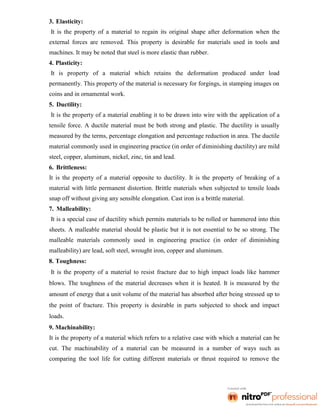
In designing a machine component, there is no rigid rule. The problem may be
attempted in several ways. However, the general procedure to solve a design problem is
as follows:
Fig.1. General Machine Design Procedure
1. Recognition of need:
First of all, make a complete statement of the problem, indicating the need, aim or
purpose for which the machine is to be designed.
2. Synthesis (Mechanisms):
Select the possible mechanism or group of mechanisms which will give the desired
motion.
3. Analysis of forces:
Find the forces acting on each member of the machine and the energy transmitted by
each member.
4. Material selection:
Select the material best suited for each member of the ma chine.
5. Design of elements (Size and Stresses): Find the size of each member of the machine by
considering the force acting on t he member and the permissible stresses for the
material used. It should be kept in mind that each member should not deflect or deform
than th e permissible limit.
6. Modification:
Modify the size of the member to agree with the past experience and judgment to
facilitate manufacture. The modification may also be necessary by consideration of
manufacturing to reduce overall cost.
7. Detailed drawing:
Draw the detailed drawing of each component and the assembly of the machine with
complete specification for the manufacturing processes suggested.
8. Production: The component, as per the drawing, is manufactured in the workshop.
The flow chart for the general procedure in machine design is shown in Fig.
Note: When there are number of components in the market having the same qualities of
efficiency, durability and cost, then the customer will naturally attract towards the most
appealing product. The aesthetic and ergonomics are a very important feature which
gives grace and lustre to product and dominates the market.
Selection of engineering materials based on mechanical properties:
The knowledge of materials and their properties is of great significance for a design
engineer. The machine elements should be made of such a material which has
properties suitable for the conditions of operation. In addition to this, a design engineer
must be familiar with the effects which the manufacturing processes and heat treatment
have on the properties of the materials. Now, we shall discuss the commonly used
engineering materials and their properties in Machine Design.
Classification of Engineering Materials
The engineering materials are mainly classified as:
1. Metals and their alloys, such as iron, steel, copper, aluminum, etc.
2. Non-metals, such as glass, rubber, plastic, etc.
The metals may be further classified as:
(A) Ferrous metals and (B) Non-ferrous metals.
(A) Ferrous metals are those which have the iron as their main constituent, such as
cast iron, wrought iron and steel.
(B) Non-ferrous metals are those which have a metal other than iron as their main
constituent, such as copper, aluminum, brass, tin, zinc, etc.
Selection of Materials for Engineering Purposes
The selection of a proper material, for engineering purposes, is one of the most difficult
problems for the designer. The best material is one which serves the desired objective at
the minimum cost. The following factors should be considered while selecting the
material:
1. Availability of the materials,
2. Suitability of the materials for the working conditions in service, and
3. The cost of the materials.
The important properties, which determine the utility of the material, are physical,
chemical and mechanical properties. We shall now discuss the physical and mechanical
properties of the material in the following articles.
Physical Properties of Metals
The physical properties of the metals include luster, color, size and shape, density,
electric and thermal conductivity, and melting point. The following table shows the
important physical properties of some pure metals.
Mechanical Properties of Metals
The mechanical properties of the metals are those which are associated with the ability
of the material to resist mechanical forces and load. These mechanical properties of the
metal include strength, stiffness, elasticity, plasticity, ductility, brittleness, malleability,
toughness, resilience, creep and hardness. We shall now discuss these properties as
follows:
1. Strength:
It is the ability of a material to resist the externally applied forces without breaking or
yielding. The internal resistance offered by a part to an externally applied force is called
stress.
2. Stiffness:
It is the ability of a material to resist deformation under stress. The modulus of elasticity is
the measure of stiffness.
3. Elasticity:
It is the property of a material to regain its original shape after deformation when the
external forces are removed. This property is desirable for materials used in tools and
machines. It may be noted that steel is more elastic than rubber.
4. Plasticity:
It is property of a material which retains the deformation produced under load
permanently. This property of the material is necessary for forgings, in stamping images on
coins and in ornamental work.
5. Ductility:
It is the property of a material enabling it to be drawn into wire with the application of a
tensile force. A ductile material must be both strong and plastic. The ductility is usually
measured by the terms, percentage elongation and percentage reduction in area. The ductile
material commonly used in engineering practice (in order of diminishing ductility) are mild
steel, copper, aluminum, nickel, zinc, tin and lead.
6. Brittleness:
It is the property of a material opposite to ductility. It is the property of breaking of a
material with little permanent distortion. Brittle materials when subjected to tensile loads
snap off without giving any sensible elongation. Cast iron is a brittle material.
7. Malleability:
It is a special case of ductility which permits materials to be rolled or hammered into thin
sheets. A malleable material should be plastic but it is not essential to be so strong. The
malleable materials commonly used in engineering practice (in order of diminishing
malleability) are lead, soft steel, wrought iron, copper and aluminum.
8. Toughness:
It is the property of a material to resist fracture due to high impact loads like hammer
blows. The toughness of the material decreases when it is heated. It is measured by the
amount of energy that a unit volume of the material has absorbed after being stressed up to
the point of fracture. This property is desirable in parts subjected to shock and impact
loads.
9. Machinability:
It is the property of a material which refers to a relative case with which a material can be
cut. The machinability of a material can be measured in a number of ways such as
comparing the tool life for cutting different materials or thrust required to remove the
material at some given rate or the energy required to remove a unit volume of the material.
It may be noted that brass can be easily machined than steel.
10. Resilience:
It is the property of a material to absorb energy and to resist shock and impact loads. It is
measured by the amount of energy absorbed per unit volume within elastic limit. This
property is essential for spring materials.
11. Creep:
When a part is subjected to a constant stress at high temperature for a long period of time,
it will undergo a slow and permanent deformation called creep. This property is considered
in designing internal combustion engines, boilers and turbines.
12. Fatigue:
When a material is subjected to repeated stresses, it fails at stresses below the yield point
stresses. Such type of failure of a material is known as *fatigue. The failure is caused by
means of a progressive crack formation which are usually fine and of microscopic size.
This property is considered in designing shafts, connecting rods, springs, gears, etc.
13. Hardness:
It is a very important property of the metals and has a wide variety of meanings. It
embraces many different properties such as resistance to wear, scratching, deformation and
machinability etc. It also means the ability of a metal to cut another metal. The hardness is
usually expressed in numbers which are dependent on the method of making the test. The
hardness of a metal may be determined by the following tests:
(a) Brinell hardness test,
(b) Rockwell hardness test,
(c) Vickers hardness (also called Diamond Pyramid) test, and
(d) Shore scleroscope.
The plain carbon steels varying from 0.06% carbon to 1.5% carbon are divided into the
following types depending upon the carbon content.
1. Dead mild steel — up to 0.15% carbon
2. Low carbon or mild steel — 0.15% to 0.45% carbon
3. Medium carbon steel — 0.45% to 0.8% carbon
4. High carbon steel — 0.8% to 1.5% carbon
According to Indian standard *[IS: 1762 (Part-I)–1974], a new system of designating
the steel is recommended. According to this standard, steels are designated on the
following two basis: (a) On the basis of mechanical properties, and (b) On the basis of
chemical composition. We shall now discuss, in detail, the designation of steel on the
above two basis, in the following pages.
Steels Designated on the Basis of Mechanical Properties
These steels are carbon and low alloy steels where the main criterion in the selection
and inspection of steel is the tensile strength or yield stress. According to Indian
standard IS: 1570 (Part–I)- 1978 (Reaffirmed 1993), these steels are designated by a
symbol ‘Fe’ or ‘Fe E’ depending on whether the steel has been specified on the basis of
minimum tensile strength or yield strength, followed by the figure indicating the
minimum tensile strength or yield stress in N/mm2. For example ‘Fe 290’ means a steel
having minimum tensile strength of 290 N/mm2 and ‘Fe E 220’ means a steel having
yield strength of 220 N/mm2.
Steels Designated on the Basis of Chemical Composition
According to Indian standard, IS : 1570 (Part II/Sec I)-1979 (Reaffirmed 1991), the
carbon steels are designated in the following order :
(a) Figure indicating 100 times the average percentage of carbon
content, (b) Letter ‘C’, and
(c) Figure indicating 10 times the average percentage of manganese content. The figure
after multiplying shall be rounded off to the nearest integer.
For example 20C8 means a carbon steel containing 0.15 to 0.25 per cent (0.2 per cent
on average) carbon and 0.60 to 0.90 per cent (0.75 per cent rounded off to 0.8 per cent
on an average) manganese.
Manufacturing considerations in Machine design:
The knowledge of manufacturing processes is of great importance for a design
engineer. The following are the various manufacturing processes used in Mechanical
Engineering.
1. Primary shaping processes. The processes used for the preliminary shaping of the
machine component are known as primary shaping processes. The common operations
used for this process are casting, forging, extruding, rolling, drawing, bending, shearing,
spinning, powder metal forming, squeezing, etc.
2. Machining processes. The processes used for giving final shape to the machine
component, according to planned dimensions are known as machining processes. The
common operations used for this process are turning, planning, shaping, drilling,
boring, reaming, sawing, broaching, milling, grinding, hobbling, etc.
3. Surface finishing processes. The processes used to provide a good surface finish for
the machine component are known as surface finishing processes. The common
operations used for this process are polishing, buffing, honing, lapping, abrasive belt
grinding, barrel tumbling, electroplating, super finishing, sheradizing, etc.
4. Joining processes. The processes used for joining machine components are known
as joining processes. The common operations used for this process are welding,
riveting, soldering, brazing, screw fastening, pressing, sintering, etc.
5. Processes effecting change in properties. These processes are used to impart certain
specific properties to the machine components so as to make them suitable for
particular operations or uses. Such processes are heat treatment, hot-working, cold-
working and shot penning.
Other considerations in Machine design
1. Workshop facilities.
2. Number of machines to be manufactured
3. Cost of construction
References:
1. Machine Design - V.Bandari .
2. Machine Design – R.S. Khurmi
3. Design Data hand Book - S MD Jalaludin.
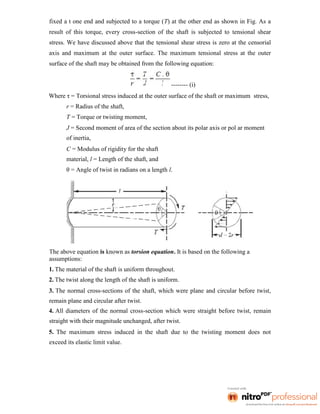
Torsional Stress:
When a machine member is subjected to the action of two equal and opposite couples
acting in parallel planes (or torque or twisting moment), then the machine member is
said to be subjected to torsion. The stress s et up by torsion is known as tensional
stress. It is zero at the censorial axis and maximum at the outer surface. Consider a shaft
fixed a t one end and subjected to a torque (T) at the other end as shown in Fig. As a
result of this torque, every cross-section of the shaft is subjected to tensional shear
stress. We have discussed above that the tensional shear stress is zero at the censorial
axis and maximum at the outer surface. The maximum tensional stress at the outer
surface of the shaft may be obtained from the following equation:
-------- (i)
Where τ = Torsional stress induced at the outer surface of the shaft or maximum stress,
r = Radius of the shaft,
T = Torque or twisting moment,
J = Second moment of area of the section about its polar axis or pol ar moment
of inertia,
C = Modulus of rigidity for the shaft
material, l = Length of the shaft, and
θ = Angle of twist in radians on a length l.
The above equation is known as torsion equation. It is based on the following a
assumptions:
1. The material of the shaft is uniform throughout.
2. The twist along the length of the shaft is uniform.
3. The normal cross-sections of the shaft, which were plane and circular before twist,
remain plane and circular after twist.
4. All diameters of the normal cross-section which were straight before twist, remain
straight with their magnitude unchanged, after twist.
5. The maximum stress induced in the shaft due to the twisting moment does not
exceed its elastic limit value.
Note: 1. Since the tensional stress on any cross-section normal to the axis is directly
proportional to the distance from the centre of the axis, therefore the tensional stress at a
distance x from the centre of the shaft is given by
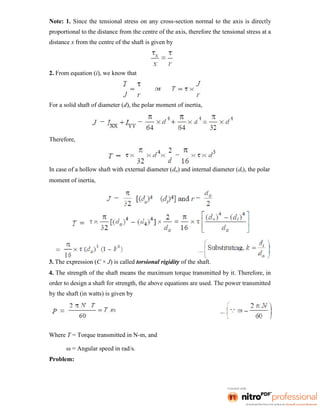
2. From equation (i), we know that
For a solid shaft of diameter (d), the polar moment of inertia,
Therefore,
In case of a hollow shaft with external diameter (do) and internal diameter (di), the polar
moment of inertia,
3. The expression (C × J) is called torsional rigidity of the shaft.
4. The strength of the shaft means the maximum torque transmitted by it. Therefore, in
order to design a shaft for strength, the above equations are used. The power transmitted
by the shaft (in watts) is given by
Where T = Torque transmitted in N-m, and
ω = Angular speed in rad/s.
Problem:
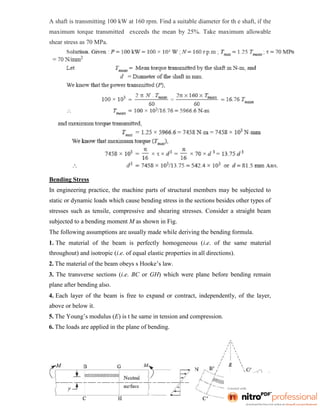
A shaft is transmitting 100 kW at 160 rpm. Find a suitable diameter for th e shaft, if the
maximum torque transmitted exceeds the mean by 25%. Take maximum allowable
shear stress as 70 MPa.
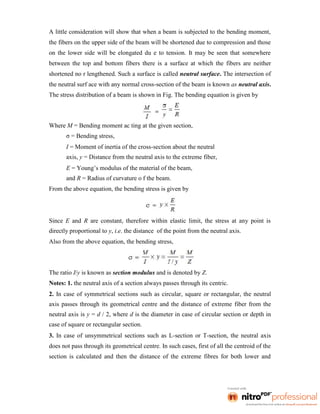
Bending Stress
In engineering practice, the machine parts of structural members may be subjected to
static or dynamic loads which cause bending stress in the sections besides other types of
stresses such as tensile, compressive and shearing stresses. Consider a straight beam
subjected to a bending moment M as shown in Fig.
The following assumptions are usually made while deriving the bending formula.
1. The material of the beam is perfectly homogeneous (i.e. of the same material
throughout) and isotropic (i.e. of equal elastic properties in all directions).
2. The material of the beam obeys s Hooke’s law.
3. The transverse sections (i.e. BC or GH) which were plane before bending remain
plane after bending also.
4. Each layer of the beam is free to expand or contract, independently, of the layer,
above or below it.
5. The Young’s modulus (E) is t he same in tension and compression.
6. The loads are applied in the plane of bending.
A little consideration will show that when a beam is subjected to the bending moment,
the fibers on the upper side of the beam will be shortened due to compression and those
on the lower side will be elongated du e to tension. It may be seen that somewhere
between the top and bottom fibers there is a surface at which the fibers are neither
shortened no r lengthened. Such a surface is called neutral surface. The intersection of
the neutral surf ace with any normal cross-section of the beam is known as neutral axis.
The stress distribution of a beam is shown in Fig. The bending equation is given by
Where M = Bending moment ac ting at the given section,
σ = Bending stress,
I = Moment of inertia of the cross-section about the neutral
axis, y = Distance from the neutral axis to the extreme fiber,
E = Young’s modulus of the material of the beam,
and R = Radius of curvature o f the beam.
From the above equation, the bending stress is given by
Since E and R are constant, therefore within elastic limit, the stress at any point is
directly proportional to y, i.e. the distance of the point from the neutral axis.
Also from the above equation, the bending stress,
The ratio I/y is known as section modulus and is denoted by Z.
Notes: 1. the neutral axis of a section always passes through its centric.
2. In case of symmetrical sections such as circular, square or rectangular, the neutral
axis passes through its geometrical centre and the distance of extreme fiber from the
neutral axis is y = d / 2, where d is the diameter in case of circular section or depth in
case of square or rectangular section.
3. In case of unsymmetrical sections such as L-section or T-section, the neutral axis
does not pass through its geometrical centre. In such cases, first of all the centroid of the
section is calculated and then the distance of the extreme fibres for both lower and
upper side of the section is obtained. Out of these two values, the bigger value is used in
bending equation.
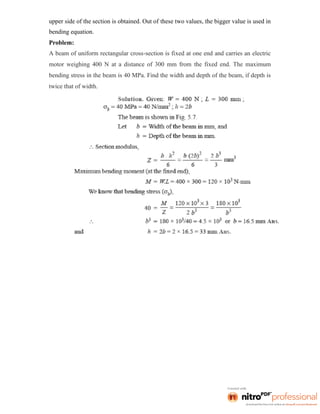
Problem:
A beam of uniform rectangular cross-section is fixed at one end and carries an electric
motor weighing 400 N at a distance of 300 mm from the fixed end. The maximum
bending stress in the beam is 40 MPa. Find the width and depth of the beam, if depth is
twice that of width.
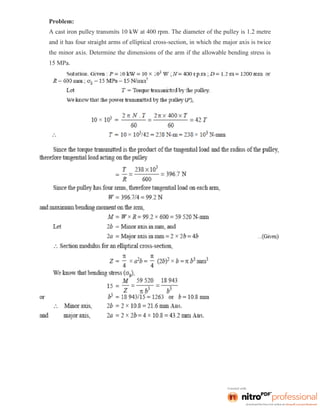
Problem:
A cast iron pulley transmits 10 kW at 400 rpm. The diameter of the pulley is 1.2 metre
and it has four straight arms of elliptical cross-section, in which the major axis is twice
the minor axis. Determine the dimensions of the arm if the allowable bending stress is
15 MPa.
Principal Stresses and Principal Planes
But it has been observed that at any point in a strained material, there are three
planes, mutually perpendicular to each other which carry direct stresses only and no
shear stress. It may be noted that out of these three direct stresses, one will be
maximum and the other will be minimum. These perpendicular planes which have no
shear stress are known as principal planes and the direct stresses along these plane
are known as principal stresses.
Determination of Principal Stresses for a Member Subjected to Bi-axial
Stress
When a member is subjected to bi-axial stress (i.e. direct stress in two mutually
perpendicular planes accompanied by a simple shear stress), then the normal and
shear stresses are obtained as discussed below:
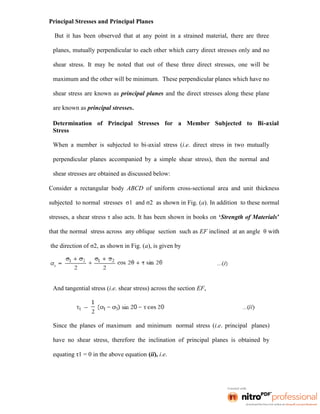
Consider a rectangular body ABCD of uniform cross-sectional area and unit thickness
subjected to normal stresses σ1 and σ2 as shown in Fig. (a). In addition to these normal
stresses, a shear stress τ also acts. It has been shown in books on ‘Strength of Materials’
that the normal stress across any oblique section such as EF inclined at an angle θ with
the direction of σ2, as shown in Fig. (a), is given by
And tangential stress (i.e. shear stress) across the section EF,
Since the planes of maximum and minimum normal stress (i.e. principal planes)
have no shear stress, therefore the inclination of principal planes is obtained by
equating τ1 = 0 in the above equation (ii), i.e.
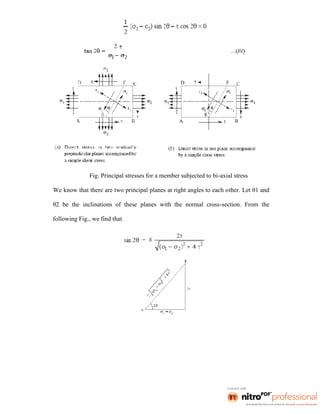
Fig. Principal stresses for a member subjected to bi-axial stress
We know that there are two principal planes at right angles to each other. Let θ1 and
θ2 be the inclinations of these planes with the normal cross-section. From the
following Fig., we find that
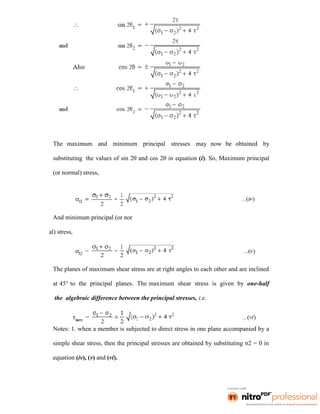
The maximum and minimum principal stresses may now be obtained by
substituting the values of sin 2θ and cos 2θ in equation (i). So, Maximum principal
(or normal) stress,
And minimum principal (or nor
al) stress,
The planes of maximum shear stress are at right angles to each other and are inclined
at 45° to the principal planes. The maximum shear stress is given by one-half
the algebraic difference between the principal stresses, i.e.
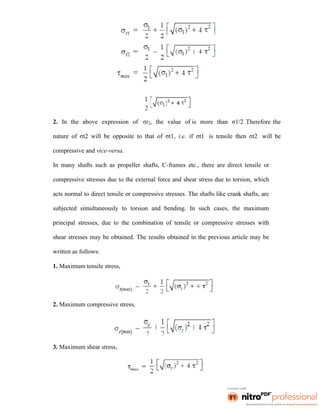
Notes: 1. when a member is subjected to direct stress in one plane accompanied by a
simple shear stress, then the principal stresses are obtained by substituting σ2 = 0 in
equation (iv), (v) and (vi).
2. In the above expression of σt2, the value of is more than σ1/2 Therefore the
nature of σt2 will be opposite to that of σt1, i.e. if σt1 is tensile then σt2 will be
compressive and vice-versa.
In many shafts such as propeller shafts, C-frames etc., there are direct tensile or
compressive stresses due to the external force and shear stress due to torsion, which
acts normal to direct tensile or compressive stresses. The shafts like crank shafts, are
subjected simultaneously to torsion and bending. In such cases, the maximum
principal stresses, due to the combination of tensile or compressive stresses with
shear stresses may be obtained. The results obtained in the previous article may be
written as follows:
1. Maximum tensile stress,
2. Maximum compressive stress,
3. Maximum shear stress,
Where σt = Tensile stress due to direct load and bending,
σc = Compressive stress, and
τ = Shear stress due to torsion.
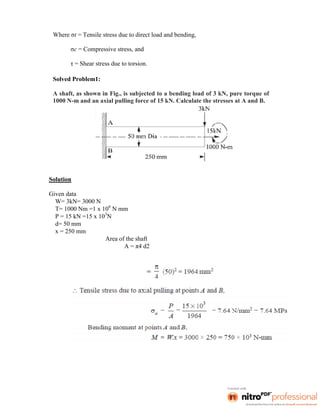
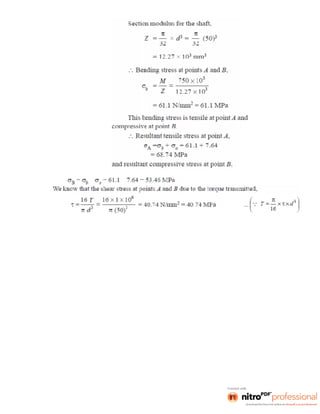
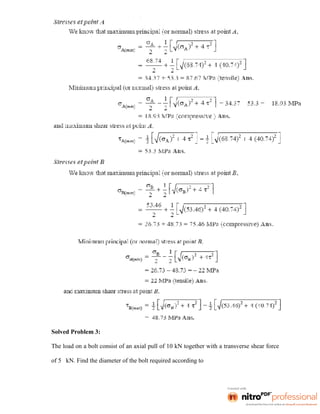
Solved Problem1:
A shaft, as shown in Fig., is subjected to a bending load of 3 kN, pure torque of
1000 N-m and an axial pulling force of 15 kN. Calculate the stresses at A and B.
Solution
Given data
W= 3kN= 3000 N
T= 1000 Nm =1 x 10⁶
N mm
P = 15 kN =15 x 103
N
d= 50 mm
x = 250 mm
Area of the shaft
A = π4 d2
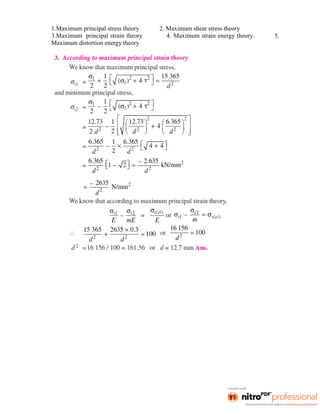
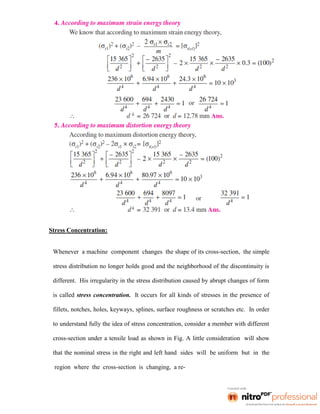
Solved Problem 3:
The load on a bolt consist of an axial pull of 10 kN together with a transverse shear force
of 5 kN. Find the diameter of the bolt required according to
1.Maximum principal stress theory 2. Maximum shear stress theory
3.Maximum principal strain theory 4. Maximum strain energy theory. 5.
Maximum distortion energy theory
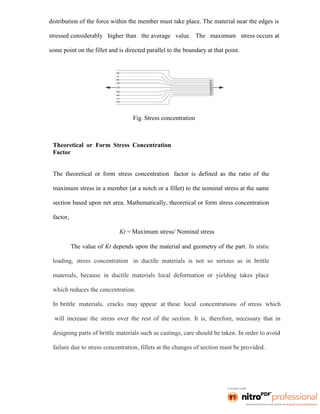
Stress Concentration:
Whenever a machine component changes the shape of its cross-section, the simple
stress distribution no longer holds good and the neighborhood of the discontinuity is
different. His irregularity in the stress distribution caused by abrupt changes of form
is called stress concentration. It occurs for all kinds of stresses in the presence of
fillets, notches, holes, keyways, splines, surface roughness or scratches etc. In order
to understand fully the idea of stress concentration, consider a member with different
cross-section under a tensile load as shown in Fig. A little consideration will show
that the nominal stress in the right and left hand sides will be uniform but in the
region where the cross-section is changing, a re-
distribution of the force within the member must take place. The material near the edges is
stressed considerably higher than the average value. The maximum stress occurs at
some point on the fillet and is directed parallel to the boundary at that point.
Fig. Stress concentration
Theoretical or Form Stress Concentration
Factor
The theoretical or form stress concentration factor is defined as the ratio of the
maximum stress in a member (at a notch or a fillet) to the nominal stress at the same
section based upon net area. Mathematically, theoretical or form stress concentration
factor,
Kt = Maximum stress/ Nominal stress
The value of Kt depends upon the material and geometry of the part. In static
loading, stress concentration in ductile materials is not so serious as in brittle
materials, because in ductile materials local deformation or yielding takes place
which reduces the concentration.
In brittle materials, cracks may appear at these local concentrations of stress which
will increase the stress over the rest of the section. It is, therefore, necessary that in
designing parts of brittle materials such as castings, care should be taken. In order to avoid
failure due to stress concentration, fillets at the changes of section must be provided.
In cyclic loading, stress concentration in ductile materials is always serious
because the ductility of the material is not effective in relieving the concentration of
stress caused by cracks, flaws, surface roughness, or any sharp discontinuity in the
geometrical form of the member. If the stress at any point in a member is above the
endurance limit of the material, a crack may develop under the action of repeated load
and the crack will lead to failure of the member.
Stress Concentration due to Holes and
Notches
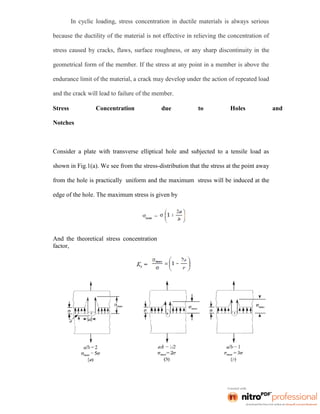
Consider a plate with transverse elliptical hole and subjected to a tensile load as
shown in Fig.1(a). We see from the stress-distribution that the stress at the point away
from the hole is practically uniform and the maximum stress will be induced at the
edge of the hole. The maximum stress is given by
And the theoretical stress concentration
factor,
Fig.1. Stress concentration due to
holes.
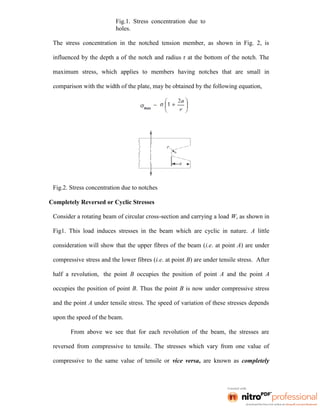
The stress concentration in the notched tension member, as shown in Fig. 2, is
influenced by the depth a of the notch and radius r at the bottom of the notch. The
maximum stress, which applies to members having notches that are small in
comparison with the width of the plate, may be obtained by the following equation,
Fig.2. Stress concentration due to notches
Completely Reversed or Cyclic Stresses
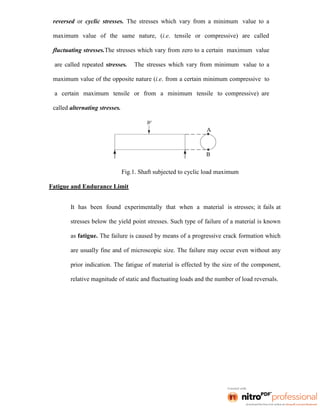
Consider a rotating beam of circular cross-section and carrying a load W, as shown in
Fig1. This load induces stresses in the beam which are cyclic in nature. A little
consideration will show that the upper fibres of the beam (i.e. at point A) are under
compressive stress and the lower fibres (i.e. at point B) are under tensile stress. After
half a revolution, the point B occupies the position of point A and the point A
occupies the position of point B. Thus the point B is now under compressive stress
and the point A under tensile stress. The speed of variation of these stresses depends
upon the speed of the beam.
From above we see that for each revolution of the beam, the stresses are
reversed from compressive to tensile. The stresses which vary from one value of
compressive to the same value of tensile or vice versa, are known as completely
reversed or cyclic stresses. The stresses which vary from a minimum value to a
maximum value of the same nature, (i.e. tensile or compressive) are called
fluctuating stresses.The stresses which vary from zero to a certain maximum value
are called repeated stresses. The stresses which vary from minimum value to a
maximum value of the opposite nature (i.e. from a certain minimum compressive to
a certain maximum tensile or from a minimum tensile to compressive) are
called alternating stresses.
Fig.1. Shaft subjected to cyclic load maximum
Fatigue and Endurance Limit
It has been found experimentally that when a material is stresses; it fails at
stresses below the yield point stresses. Such type of failure of a material is known
as fatigue. The failure is caused by means of a progressive crack formation which
are usually fine and of microscopic size. The failure may occur even without any
prior indication. The fatigue of material is effected by the size of the component,
relative magnitude of static and fluctuating loads and the number of load reversals.
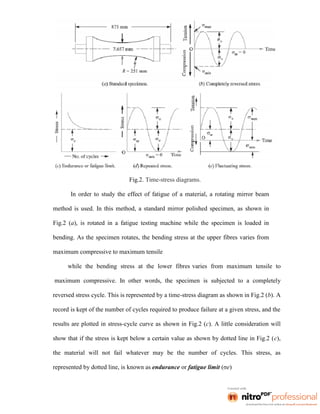
Fig.2. Time-stress diagrams.
In order to study the effect of fatigue of a material, a rotating mirror beam
method is used. In this method, a standard mirror polished specimen, as shown in
Fig.2 (a), is rotated in a fatigue testing machine while the specimen is loaded in
bending. As the specimen rotates, the bending stress at the upper fibres varies from
maximum compressive to maximum tensile
while the bending stress at the lower fibres varies from maximum tensile to
maximum compressive. In other words, the specimen is subjected to a completely
reversed stress cycle. This is represented by a time-stress diagram as shown in Fig.2 (b). A
record is kept of the number of cycles required to produce failure at a given stress, and the
results are plotted in stress-cycle curve as shown in Fig.2 (c). A little consideration will
show that if the stress is kept below a certain value as shown by dotted line in Fig.2 (c),
the material will not fail whatever may be the number of cycles. This stress, as
represented by dotted line, is known as endurance or fatigue limit (σe)
It is defined as maximum value of the completely reversed bending stress which a
polished standard specimen can withstand without failure, for infinite number of cycles
(usually 107 cycles).
It may be noted that the term endurance limit is used for reversed bending only while for
other types of loading, the term endurance strength may be used when referring the
fatigue strength of the material. It may be defined as the safe maximum stress which can be
applied to the machine part working under actual conditions.
We have seen that when a machine member is subjected to a completely
reversed stress, the maximum stress in tension is equal to the maximum stress in
compression as shown in Fig.2 (b). In actual practice, many machine members
undergo different range of stress than the completely reversed stress. The stress
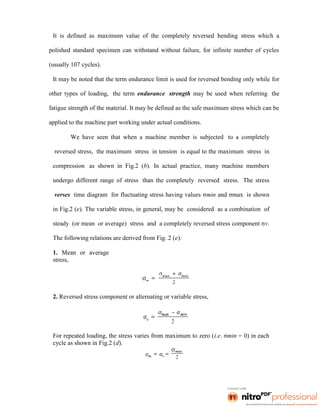
verses time diagram for fluctuating stress having values σmin and σmax is shown
in Fig.2 (e). The variable stress, in general, may be considered as a combination of
steady (or mean or average) stress and a completely reversed stress component σv.
The following relations are derived from Fig. 2 (e):
1. Mean or average
stress,
2. Reversed stress component or alternating or variable stress,
For repeated loading, the stress varies from maximum to zero (i.e. σmin = 0) in each
cycle as shown in Fig.2 (d).
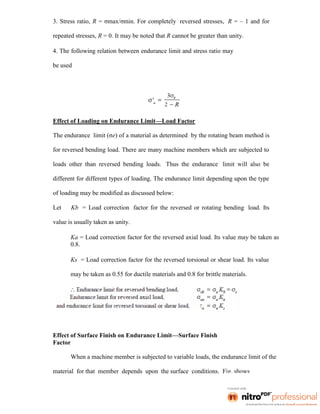
3. Stress ratio, R = σmax/σmin. For completely reversed stresses, R = – 1 and for
repeated stresses, R = 0. It may be noted that R cannot be greater than unity.
4. The following relation between endurance limit and stress ratio may
be used
Effect of Loading on Endurance Limit—Load Factor
The endurance limit (σe) of a material as determined by the rotating beam method is
for reversed bending load. There are many machine members which are subjected to
loads other than reversed bending loads. Thus the endurance limit will also be
different for different types of loading. The endurance limit depending upon the type
of loading may be modified as discussed below:
Let Kb = Load correction factor for the reversed or rotating bending load. Its
value is usually taken as unity.
Ka = Load correction factor for the reversed axial load. Its value may be taken as
0.8.
Ks = Load correction factor for the reversed torsional or shear load. Its value
may be taken as 0.55 for ductile materials and 0.8 for brittle materials.
Effect of Surface Finish on Endurance Limit—Surface Finish
Factor
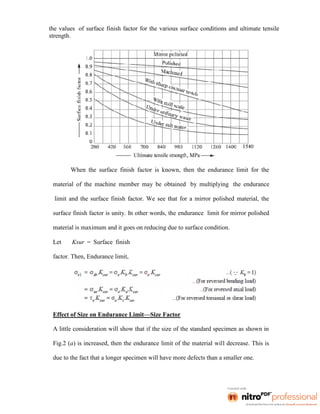
When a machine member is subjected to variable loads, the endurance limit of the
material for that member depends upon the surface conditions. Fig. shows
the values of surface finish factor for the various surface conditions and ultimate tensile
strength.
When the surface finish factor is known, then the endurance limit for the
material of the machine member may be obtained by multiplying the endurance
limit and the surface finish factor. We see that for a mirror polished material, the
surface finish factor is unity. In other words, the endurance limit for mirror polished
material is maximum and it goes on reducing due to surface condition.
Let Ksur = Surface finish
factor. Then, Endurance limit,
Effect of Size on Endurance Limit—Size Factor
A little consideration will show that if the size of the standard specimen as shown in
Fig.2 (a) is increased, then the endurance limit of the material will decrease. This is
due to the fact that a longer specimen will have more defects than a smaller one.
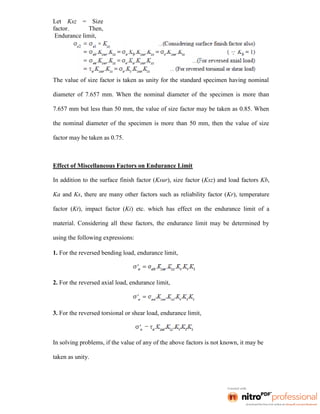
Let Ksz = Size
factor. Then,
Endurance limit,
The value of size factor is taken as unity for the standard specimen having nominal
diameter of 7.657 mm. When the nominal diameter of the specimen is more than
7.657 mm but less than 50 mm, the value of size factor may be taken as 0.85. When
the nominal diameter of the specimen is more than 50 mm, then the value of size
factor may be taken as 0.75.
Effect of Miscellaneous Factors on Endurance Limit
In addition to the surface finish factor (Ksur), size factor (Ksz) and load factors Kb,
Ka and Ks, there are many other factors such as reliability factor (Kr), temperature
factor (Kt), impact factor (Ki) etc. which has effect on the endurance limit of a
material. Considering all these factors, the endurance limit may be determined by
using the following expressions:
1. For the reversed bending load, endurance limit,
2. For the reversed axial load, endurance limit,
3. For the reversed torsional or shear load, endurance limit,
In solving problems, if the value of any of the above factors is not known, it may be
taken as unity.
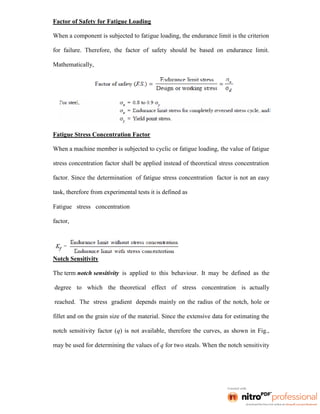
Factor of Safety for Fatigue Loading
When a component is subjected to fatigue loading, the endurance limit is the criterion
for failure. Therefore, the factor of safety should be based on endurance limit.
Mathematically,
Fatigue Stress Concentration Factor
When a machine member is subjected to cyclic or fatigue loading, the value of fatigue
stress concentration factor shall be applied instead of theoretical stress concentration
factor. Since the determination of fatigue stress concentration factor is not an easy
task, therefore from experimental tests it is defined as
Fatigue stress concentration
factor,
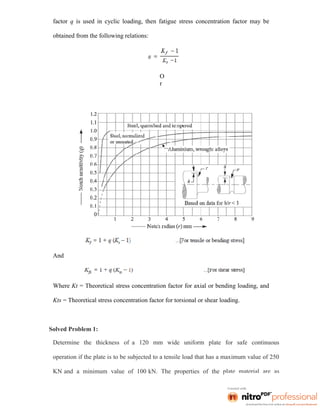
Notch Sensitivity
The term notch sensitivity is applied to this behaviour. It may be defined as the
degree to which the theoretical effect of stress concentration is actually
reached. The stress gradient depends mainly on the radius of the notch, hole or
fillet and on the grain size of the material. Since the extensive data for estimating the
notch sensitivity factor (q) is not available, therefore the curves, as shown in Fig.,
may be used for determining the values of q for two steals. When the notch sensitivity
factor q is used in cyclic loading, then fatigue stress concentration factor may be
obtained from the following relations:
O
r
And
Where Kt = Theoretical stress concentration factor for axial or bending loading, and
Kts = Theoretical stress concentration factor for torsional or shear loading.
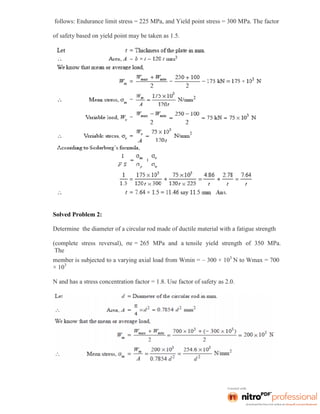
Solved Problem 1:
Determine the thickness of a 120 mm wide uniform plate for safe continuous
operation if the plate is to be subjected to a tensile load that has a maximum value of 250
KN and a minimum value of 100 kN. The properties of the plate material are as
follows: Endurance limit stress = 225 MPa, and Yield point stress = 300 MPa. The factor
of safety based on yield point may be taken as 1.5.
Solved Problem 2:
Determine the diameter of a circular rod made of ductile material with a fatigue strength
(complete stress reversal), σe = 265 MPa and a tensile yield strength of 350 MPa.
The
member is subjected to a varying axial load from Wmin = – 300 × 103
N to Wmax = 700
× 103
N and has a stress concentration factor = 1.8. Use factor of safety as 2.0.
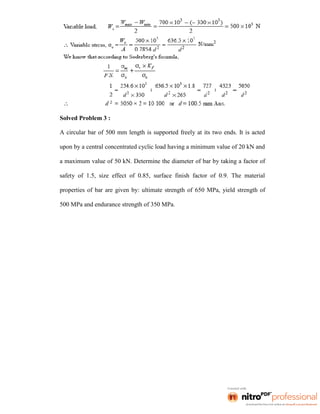
Solved Problem 3 :
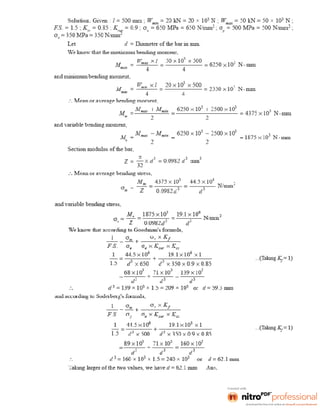
A circular bar of 500 mm length is supported freely at its two ends. It is acted
upon by a central concentrated cyclic load having a minimum value of 20 kN and
a maximum value of 50 kN. Determine the diameter of bar by taking a factor of
safety of 1.5, size effect of 0.85, surface finish factor of 0.9. The material
properties of bar are given by: ultimate strength of 650 MPa, yield strength of
500 MPa and endurance strength of 350 MPa.
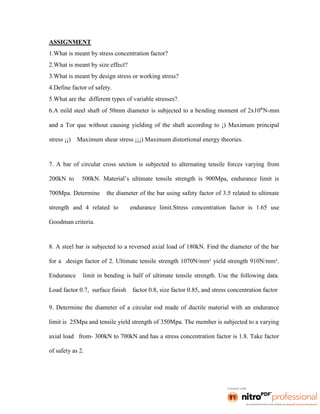
ASSIGNMENT
1.What is meant by stress concentration factor?
2.What is meant by size effect?
3.What is meant by design stress or working stress?
4.Define factor of safety.
5.What are the different types of variable stresses?.
6.A mild steel shaft of 50mm diameter is subjected to a bending moment of 2x10⁶N-mm
and a Tor que without causing yielding of the shaft according to ¡) Maximum principal
stress ¡¡) Maximum shear stress ¡¡¡) Maximum distortional energy theories.
7. A bar of circular cross section is subjected to alternating tensile forces varying from
200kN to 500kN. Material’s ultimate tensile strength is 900Mpa, endurance limit is
700Mpa. Determine the diameter of the bar using safety factor of 3.5 related to ultimate
strength and 4 related to endurance limit.Stress concentration factor is 1.65 use
Goodman criteria.
8. A steel bar is subjected to a reversed axial load of 180kN. Find the diameter of the bar
for a .design factor of 2. Ultimate tensile strength 1070N/mm² yield strength 910N/mm².
Endurance limit in bending is half of ultimate tensile strength. Use the following data.
Load factor 0.7, surface finish factor 0.8, size factor 0.85, and stress concentration factor
9. Determine the diameter of a circular rod made of ductile material with an endurance
limit is 25Mpa and tensile yield strength of 350Mpa. The member is subjected to a varying
axial load from- 300kN to 700kN and has a stress concentration factor is 1.8. Take factor
of safety as 2.
Unit-II DESIGN OF SHAFT
A shaft is a rotating machine element which is used to transmit power from one place to other place.
Materials
Carbon steels of grade 40C8, 45C8, 50C4, 50C12 are normally used as shaft materials.
Material properties
 It should have high strength
 It should have good machinability.
 It should have low notch sensitivity factor.
 It should have good heat treatment properties.
 It should have high wear resistance.
Types of Shaft
1. Transmission shaft:
These shafts transmit power between the source and machines absorbing power. The counter shafts, line
shafts, overhead shafts all shafts are transmission shafts.
2. Machine shafts:
These shafts from an integral part of the machine itself.
Following stresses are induced in the shaft
1. Shear stress due to transmission of torque
2. Bending stress due to forces acting upon machine elements like gears, pulleys etc.
3. Stresses due to combined torsional and bending loads.
DESIGN OF SHAFTS
The shaft may be designed on the basis of
1. Strength
2. Rigidity and
3. Stiffness
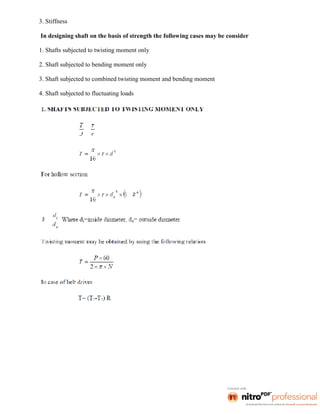
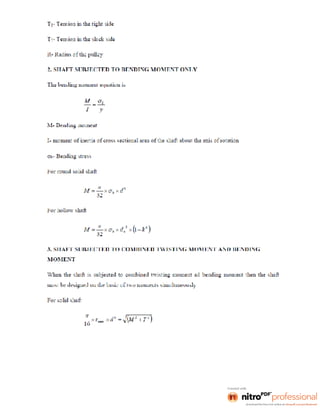
In designing shaft on the basis of strength the following cases may be consider
1. Shafts subjected to twisting moment only
2. Shaft subjected to bending moment only
3. Shaft subjected to combined twisting moment and bending moment
4. Shaft subjected to fluctuating loads
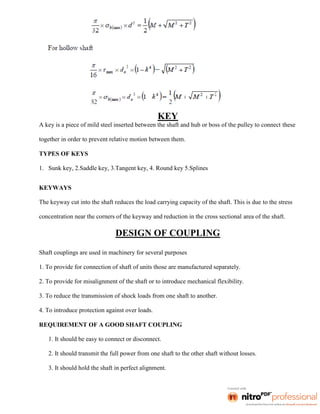
KEY
A key is a piece of mild steel inserted between the shaft and hub or boss of the pulley to connect these
together in order to prevent relative motion between them.
TYPES OF KEYS
1. Sunk key, 2.Saddle key, 3.Tangent key, 4. Round key 5.Splines
KEYWAYS
The keyway cut into the shaft reduces the load carrying capacity of the shaft. This is due to the stress
concentration near the corners of the keyway and reduction in the cross sectional area of the shaft.
DESIGN OF COUPLING
Shaft couplings are used in machinery for several purposes
1. To provide for connection of shaft of units those are manufactured separately.
2. To provide for misalignment of the shaft or to introduce mechanical flexibility.
3. To reduce the transmission of shock loads from one shaft to another.
4. To introduce protection against over loads.
REQUIREMENT OF A GOOD SHAFT COUPLING
1. It should be easy to connect or disconnect.
2. It should transmit the full power from one shaft to the other shaft without losses.
3. It should hold the shaft in perfect alignment.
4. It should have no projecting parts.
TYPES OF SHAFT COUPLINGS
1. Rigid coupling
It is used to connect two shafts which are perfectly aligned. The types are
 Sleeve (or) muff coupling
 Clamp(or) split muff (or) compression coupling
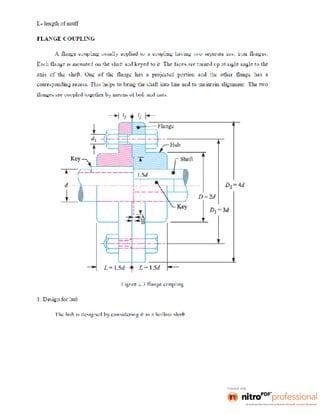
 Flange coupling
2. Flexible coupling
It is used to connect two shafts having lateral and angular misalignments. The types are
 Bushed pin type coupling
 Universal coupling
 Oldham coupling
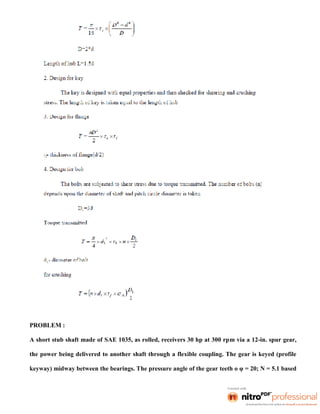
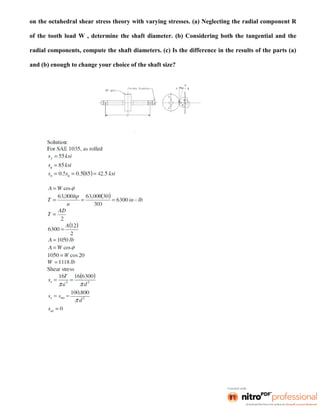
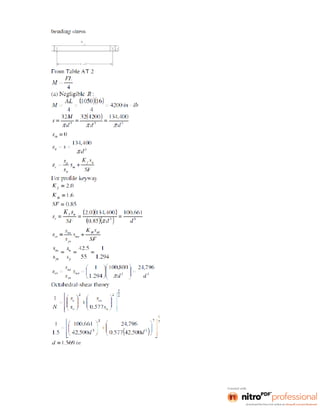
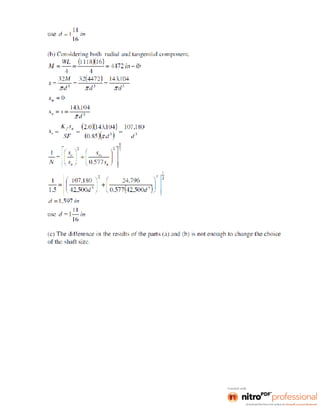
PROBLEM :
A short stub shaft made of SAE 1035, as rolled, receivers 30 hp at 300 rpm via a 12-in. spur gear,
the power being delivered to another shaft through a flexible coupling. The gear is keyed (profile
keyway) midway between the bearings. The pressure angle of the gear teeth o φ = 20; N = 5.1 based
on the octahedral shear stress theory with varying stresses. (a) Neglecting the radial component R
of the tooth load W , determine the shaft diameter. (b) Considering both the tangential and the
radial components, compute the shaft diameters. (c) Is the difference in the results of the parts (a)
and (b) enough to change your choice of the shaft size?
PROBLEM:
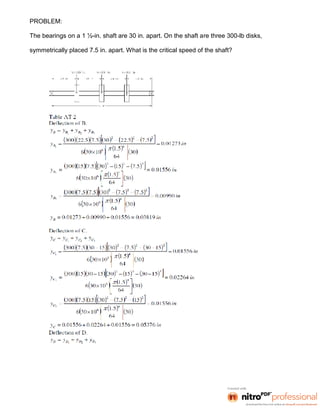
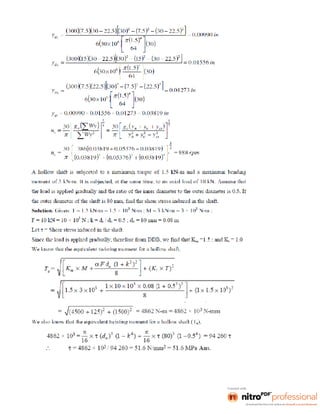
The bearings on a 1 ½-in. shaft are 30 in. apart. On the shaft are three 300-lb disks,
symmetrically placed 7.5 in. apart. What is the critical speed of the shaft?
A
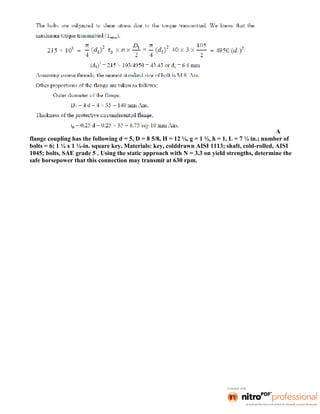
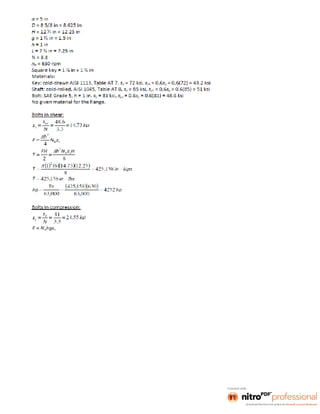
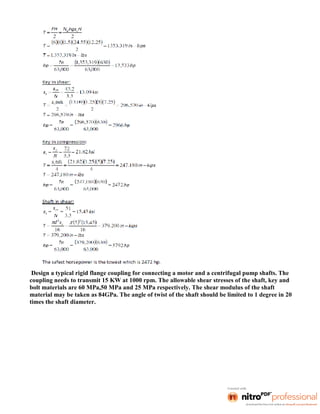
flange coupling has the following d = 5, D = 8 5/8, H = 12 ¼, g = 1 ½, h = 1, L = 7 ¼ in.; number of
bolts = 6; 1 ¼ x 1 ¼-in. square key. Materials: key, colddrawn AISI 1113; shaft, cold-rolled, AISI
1045; bolts, SAE grade 5 . Using the static approach with N = 3.3 on yield strengths, determine the
safe horsepower that this connection may transmit at 630 rpm.
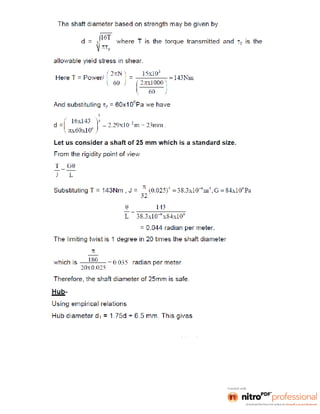
Design a typical rigid flange coupling for connecting a motor and a centrifugal pump shafts. The
coupling needs to transmit 15 KW at 1000 rpm. The allowable shear stresses of the shaft, key and
bolt materials are 60 MPa,50 MPa and 25 MPa respectively. The shear modulus of the shaft
material may be taken as 84GPa. The angle of twist of the shaft should be limited to 1 degree in 20
times the shaft diameter.
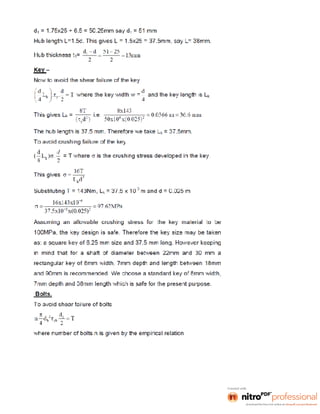
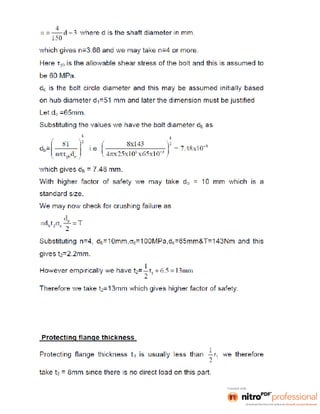
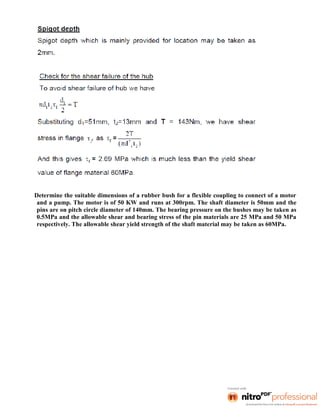
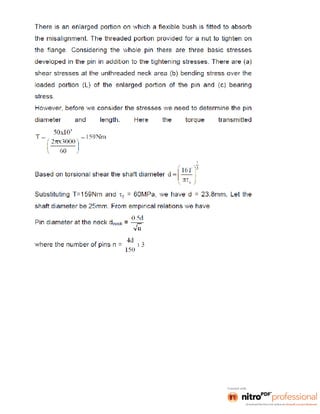
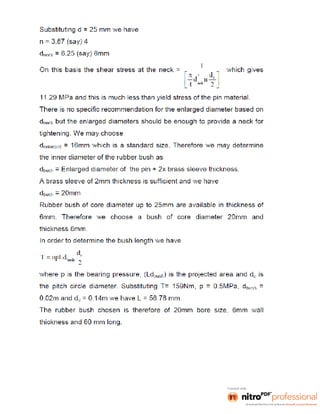
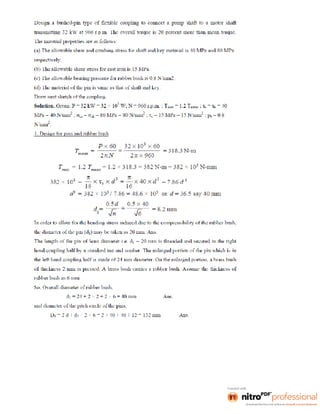
Determine the suitable dimensions of a rubber bush for a flexible coupling to connect of a motor
and a pump. The motor is of 50 KW and runs at 300rpm. The shaft diameter is 50mm and the
pins are on pitch circle diameter of 140mm. The bearing pressure on the bushes may be taken as
0.5MPa and the allowable shear and bearing stress of the pin materials are 25 MPa and 50 MPa
respectively. The allowable shear yield strength of the shaft material may be taken as 60MPa.
Cotter Joints:
A cotter is a flat wedge shaped piece of rectangular cross-section and its width is tapered (either on
one side or both sides) from one end to another for an easy adjustment. The taper varies from 1 in 48
to 1 in 24 and it may be increased up to 1 in 8, if a locking device is provided. The locking device may
be a taper pin or a set screw used on the lower end of the cotter. The cotter is usually made of mild
steel or wrought iron. A cotter joint is a temporary fastening and is used to connect rigidly two co-
axial rods or bars which are subjected to axial tensile or compressive forces. It is usually used in
connecting a piston rod to the crosshead of a reciprocating steam engine, a piston rod and its extension
as a tail or pump rod , strap end of connecting rod etc.
Types of Cotter Joints
Following are the three commonly used cotter joints to connect two rods by a cotter:
1. Socket and spigot cotter joint, 2. Sleeve and cotter joint, and 3. Gib and cotter joint.
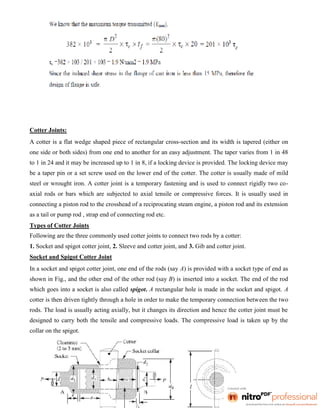
Socket and Spigot Cotter Joint
In a socket and spigot cotter joint, one end of the rods (say A) is provided with a socket type of end as
shown in Fig., and the other end of the other rod (say B) is inserted into a socket. The end of the rod
which goes into a socket is also called spigot. A rectangular hole is made in the socket and spigot. A
cotter is then driven tightly through a hole in order to make the temporary connection between the two
rods. The load is usually acting axially, but it changes its direction and hence the cotter joint must be
designed to carry both the tensile and compressive loads. The compressive load is taken up by the
collar on the spigot.
Fig.1. Socket and spigot cotter joint
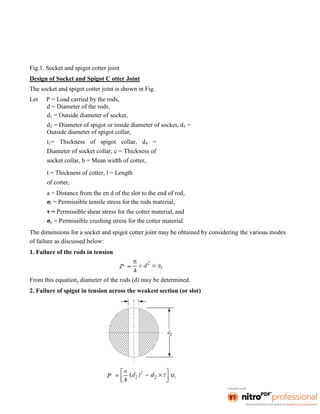
Design of Socket and Spigot C otter Joint
The socket and spigot cotter joint is shown in Fig.
Let P = Load carried by the rods,
d = Diameter of the rods,
d1 = Outside diameter of socket,
d2 = Diameter of spigot or inside diameter of socket, d3 =
Outside diameter of spigot collar,
t1= Thickness of spigot collar, d4 =
Diameter of socket collar, c = Thickness of
socket collar, b = Mean width of cotter,
t = Thickness of cotter, l = Length
of cotter,
a = Distance from the en d of the slot to the end of rod,
σt = Permissible tensile stress for the rods material,
τ = Permissible shear stress for the cotter material, and
σc = Permissible crushing stress for the cotter material.
The dimensions for a socket and spigot cotter joint may be obtained by considering the various modes
of failure as discussed below:
1. Failure of the rods in tension
From this equation, diameter of the rods (d) may be determined.
2. Failure of spigot in tension across the weakest section (or slot)
From this equation, the diameter of spigot or inside diameter of socket (d2) may be determined. In
actual practice, the thickness of cotter is usually taken as d2 / 4.
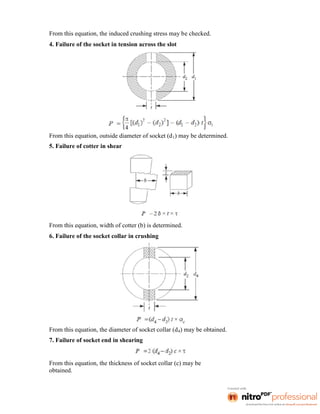
3. Failure of the rod or cotter in crushing
From this equation, the induced crushing stress may be checked.
4. Failure of the socket in tension across the slot
From this equation, outside diameter of socket (d1) may be determined.
5. Failure of cotter in shear
From this equation, width of cotter (b) is determined.
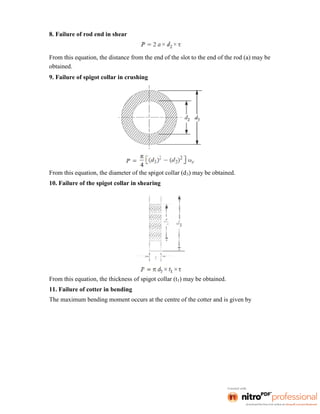
6. Failure of the socket collar in crushing
From this equation, the diameter of socket collar (d4) may be obtained.
7. Failure of socket end in shearing
From this equation, the thickness of socket collar (c) may be
obtained.
8. Failure of rod end in shear
From this equation, the distance from the end of the slot to the end of the rod (a) may be
obtained.
9. Failure of spigot collar in crushing
From this equation, the diameter of the spigot collar (d3) may be obtained.
10. Failure of the spigot collar in shearing
From this equation, the thickness of spigot collar (t1) may be obtained.
11. Failure of cotter in bending
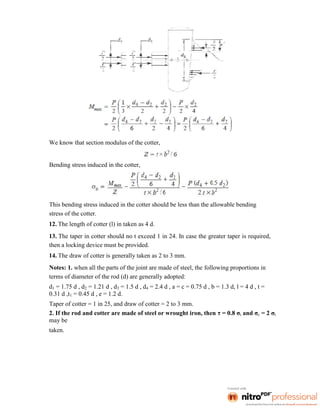
The maximum bending moment occurs at the centre of the cotter and is given by
We know that section modulus of the cotter,
Bending stress induced in the cotter,
This bending stress induced in the cotter should be less than the allowable bending
stress of the cotter.
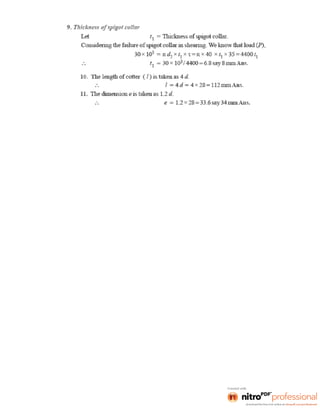
12. The length of cotter (l) in taken as 4 d.
13. The taper in cotter should no t exceed 1 in 24. In case the greater taper is required,
then a locking device must be provided.
14. The draw of cotter is generally taken as 2 to 3 mm.
Notes: 1. when all the parts of the joint are made of steel, the following proportions in
terms of diameter of the rod (d) are generally adopted:
d1 = 1.75 d , d2 = 1.21 d , d3 = 1.5 d , d4 = 2.4 d , a = c = 0.75 d , b = 1.3 d, l = 4 d , t =
0.31 d ,t1 = 0.45 d , e = 1.2 d.
Taper of cotter = 1 in 25, and draw of cotter = 2 to 3 mm.
2. If the rod and cotter are made of steel or wrought iron, then τ = 0.8 σt and σc = 2 σt
may be
taken.
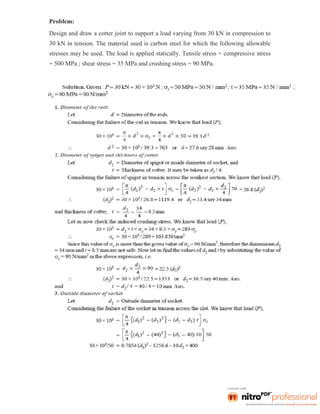
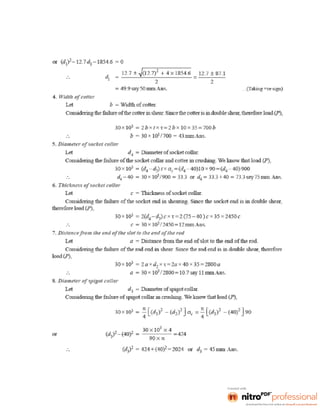
Problem:
Design and draw a cotter joint to support a load varying from 30 kN in compression to
30 kN in tension. The material used is carbon steel for which the following allowable
stresses may be used. The load is applied statically. Tensile stress = compressive stress
= 500 MPa ; shear stress = 35 MPa and crushing stress = 90 MPa.
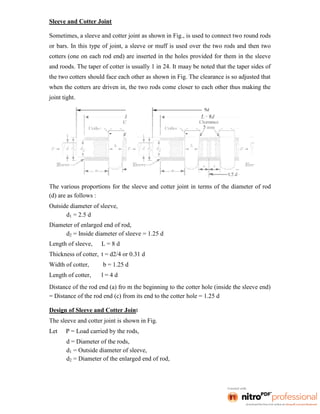
Sleeve and Cotter Joint
Sometimes, a sleeve and cotter joint as shown in Fig., is used to connect two round rods
or bars. In this type of joint, a sleeve or muff is used over the two rods and then two
cotters (one on each rod end) are inserted in the holes provided for them in the sleeve
and roods. The taper of cotter is usually 1 in 24. It maay be noted that the taper sides of
the two cotters should face each other as shown in Fig. The clearance is so adjusted that
when the cotters are driven in, the two rods come closer to each other thus making the
joint tight.
The various proportions for the sleeve and cotter joint in terms of the diameter of rod
(d) are as follows :
Outside diameter of sleeve,
d1 = 2.5 d
Diameter of enlarged end of rod,
d2 = Inside diameter of sleeve = 1.25 d
Length of sleeve, L = 8 d
Thickness of cotter, t = d2/4 or 0.31 d
Width of cotter, b = 1.25 d
Length of cotter, l = 4 d
Distance of the rod end (a) fro m the beginning to the cotter hole (inside the sleeve end)
= Distance of the rod end (c) from its end to the cotter hole = 1.25 d
Design of Sleeve and Cotter Joint
The sleeve and cotter joint is shown in Fig.
Let P = Load carried by the rods,
d = Diameter of the rods,
d1 = Outside diameter of sleeve,
d2 = Diameter of the enlarged end of rod,
t = Thickness cotter,
l = Length of cotter,
b = Width of cotter,
a = Distance of the rod end from the beginning to the cotter hole (inside the
sleeve end),
c = Distance of the rod end from its end to the cotter hole,
σt , τ and σc = Permissible tensile, shear and crushing stresses respectively for
the material of the rods and cotter.
The dimensions for a sleeve and cotter joint may be obtained by considering the various
modes of failure as discussed below:
1. Failure of the rods in tension
The rods may fail in tension due to the tensile load P. We know that
From this equation, diameter of the rods (d) may be obtained.
2. Failure of the rod in tension across the weakest section (i.e. slot)
From this equation, the diameter of enlarged end of the rod (d2) may be obtained. The
thickness of cotter is usually taken as d2 / 4.
3. Failure of the rod or cotter in crushing
From this equation, the induced crushing stress may be checked.
4. Failure of sleeve in tension across the slot
From this equation, the outside diameter of sleeve (d1) may be obtained.
5. Failure of cotter in shear
From this equation, width of cotter (b) may be determined.
6. Failure of rod end in shear
From this equation, distance (a) may be determined
7. Failure of sleeve end in shear
From this equation, distance (c) may be determined.
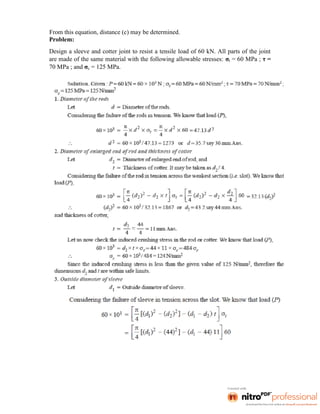
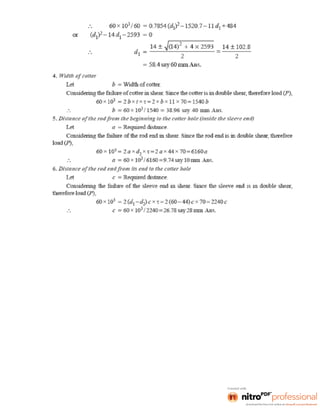
Problem:
Design a sleeve and cotter joint to resist a tensile load of 60 kN. All parts of the joint
are made of the same material with the following allowable stresses: σt = 60 MPa ; τ =
70 MPa ; and σc = 125 MPa.
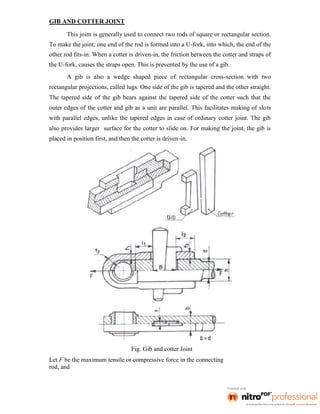
GIB AND COTTER JOINT
This joint is generally used to connect two rods of square or rectangular section.
To make the joint; one end of the rod is formed into a U-fork, into which, the end of the
other rod fits-in. When a cotter is driven-in, the friction between the cotter and straps of
the U-fork, causes the straps open. This is prevented by the use of a gib.
A gib is also a wedge shaped piece of rectangular cross-section with two
rectangular projections, called lugs. One side of the gib is tapered and the other straight.
The tapered side of the gib bears against the tapered side of the cotter such that the
outer edges of the cotter and gib as a unit are parallel. This facilitates making of slots
with parallel edges, unlike the tapered edges in case of ordinary cotter joint. The gib
also provides larger surface for the cotter to slide on. For making the joint, the gib is
placed in position first, and then the cotter is driven-in.
Fig. Gib and cotter Joint
Let F be the maximum tensile or compressive force in the connecting
rod, and
b = width of the strap, which may be taken as equal to the diameter of the
rod. D h = height of the rod end
t1 = thickness of the strap at the thinnest
part t2 = thickness of the strap at the curved
portion t3 =thickness of the strap across the
slot
L1 = length of the rod end, beyond the slot
12 = length of the strap, beyond the
slot B = width of the cotter and gib
t = thickness of the cotter
Let the rod, strap, cotter, and gib are made of the same material with σc σt and τ :as
the permissible stresses. The following are the possible modes of failure, and the
corresponding design equations, which may be considered for the design of the joint:
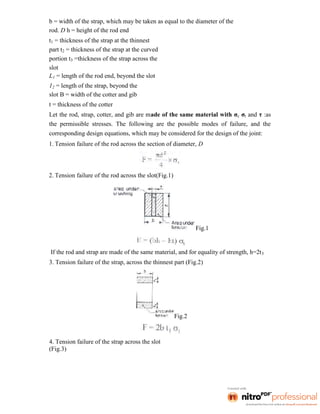
1. Tension failure of the rod across the section of diameter, D
2. Tension failure of the rod across the slot(Fig.1)
Fig.1
If the rod and strap are made of the same material, and for equality of strength, h=2t3
3. Tension failure of the strap, across the thinnest part (Fig.2)
Fig.2
4. Tension failure of the strap across the slot
(Fig.3)
Fig.3
The thickness, t2 may be taken as (1.15 to 1.5) t], and
Thickness of the cotter, t = b/4.
5. Crushing between the rod and cotter (Fig.1)
F = h t σc ; and h = 2t3
6. Crushing between the strap and gib(Fig.3)
F = 2 t t3 σc
7. Shear failure of the rod end. It is under double shear (Fig.4).
Fig.4
F = 2l1hτ
8. Shear failure of the strap end. It is under double shear (Fig.5).
Fig.5
F = 4 l2 t3τ
9. Shear failure of the cotter and gib. It is under double shear.
F=2Btτ
The following proportions for the widths of the cotter and gib may be followed:
Width of the cotter =0.45
B Width of the gib = 0.55
B
The above equations may be solved, keeping in mind about the various relations and
proportions suggested.
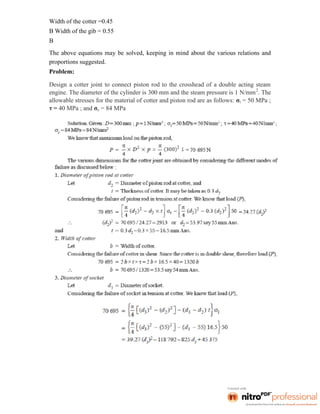
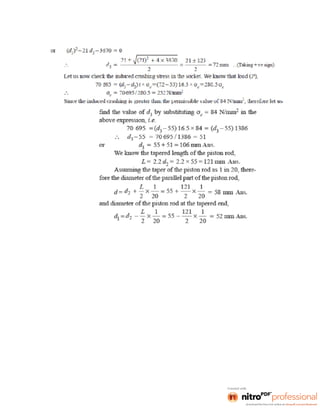
Problem:
Design a cotter joint to connect piston rod to the crosshead of a double acting steam
engine. The diameter of the cylinder is 300 mm and the steam pressure is 1 N/mm2
. The
allowable stresses for the material of cotter and piston rod are as follows: σt = 50 MPa ;
τ = 40 MPa ; and σc = 84 MPa
DESIGN OF KNUCKLE JOINT
The following figure shows a knuckle joint with the size parameters and proportions
Indicated. In general, the rods connected by this joint are subjected to tensile loads,
although if the rods are guided, they may support compressive loads as well.
Let F. = tensile load to be resisted by the joint
d = diameter of the rods
d1 = diameter of the knuckle pin
D = outside diameter of the eye A =thickness of the fork
B = thickness of the eye
Obviously, if the rods are made of the same material, the parameters, A and B are
related as,
B=2A
Fig. Knuckle Joint
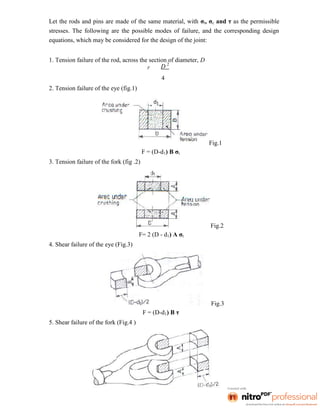
Let the rods and pins are made of the same material, with σt, σc and τ as the permissible
stresses. The following are the possible modes of failure, and the corresponding design
equations, which may be considered for the design of the joint:
1. Tension failure of the rod, across the section of diameter, D
F D 2
4
2. Tension failure of the eye (fig.1)
Fig.1
F = (D-d1) B σt
3. Tension failure of the fork (fig .2)
Fig.2
F= 2 (D - d1) A σt
4. Shear failure of the eye (Fig.3)
Fig.3
F = (D-d1) B τ
5. Shear failure of the fork (Fig.4 )
Fig.4
F = 2 (D-d1) A τ
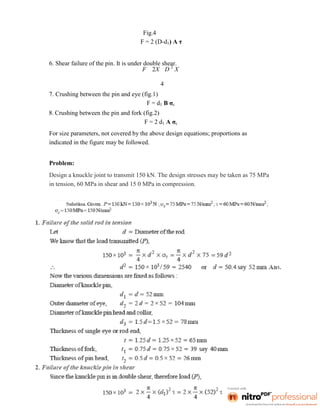
6. Shear failure of the pin. It is under double shear.
F 2X D 2
X
4
7. Crushing between the pin and eye (fig.1)
F = d1 B σc
8. Crushing between the pin and fork (fig.2)
F = 2 d1 A σc
For size parameters, not covered by the above design equations; proportions as
indicated in the figure may be followed.
Problem:
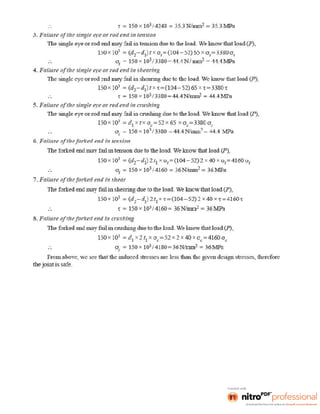
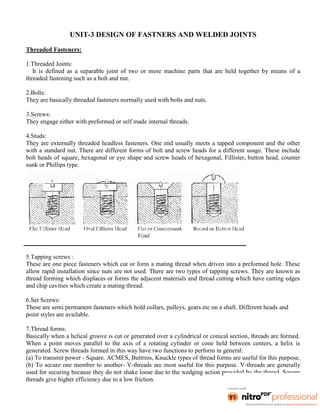
Design a knuckle joint to transmit 150 kN. The design stresses may be taken as 75 MPa
in tension, 60 MPa in shear and 15 0 MPa in compression.
UNIT-3 DESIGN OF FASTNERS AND WELDED JOINTS
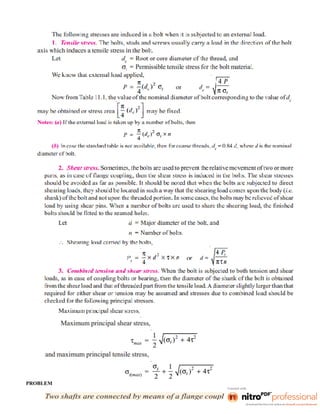
Threaded Fasteners:
1.Threaded Joints:
It is defined as a separable joint of two or more machine parts that are held together by means of a
threaded fastening such as a bolt and nut.
2.Bolts:
They are basically threaded fasteners normally used with bolts and nuts.
3.Screws:
They engage either with preformed or self made internal threads.
4.Studs:
They are externally threaded headless fasteners. One end usually meets a tapped component and the other
with a standard nut. There are different forms of bolt and screw heads for a different usage. These include
bolt heads of square, hexagonal or eye shape and screw heads of hexagonal, Fillister, button head, counter
sunk or Phillips type.
5.Tapping screws :
These are one piece fasteners which cut or form a mating thread when driven into a preformed hole. These
allow rapid installation since nuts are not used. There are two types of tapping screws. They are known as
thread forming which displaces or forms the adjacent materials and thread cutting which have cutting edges
and chip cavities which create a mating thread.
6.Set Screws:
These are semi permanent fasteners which hold collars, pulleys, gears etc on a shaft. Different heads and
point styles are available.
7.Thread forms:
Basically when a helical groove is cut or generated over a cylindrical or conical section, threads are formed.
When a point moves parallel to the axis of a rotating cylinder or cone held between centers, a helix is
generated. Screw threads formed in this way have two functions to perform in general:
(a) To transmit power - Square. ACMES, Buttress, Knuckle types of thread forms are useful for this purpose.
(b) To secure one member to another- V-threads are most useful for this purpose. V-threads are generally
used for securing because they do not shake loose due to the wedging action provided by the thread. Square
threads give higher efficiency due to a low friction.
Advantages of Threaded joints:
 No loosening of the parts, Therefore it called Reliable Joints.
 Due to usage of spanners more mechanical advantage and force required is less
 Compact construction
 Threads are self-locking
 Manufacturing is simple and economic
 It is standardized and used widely for different operations and applications.
A part from transmitting motion and power the threaded members are also used for fastening or jointing two
elements. The threads used in power screw are square or Acme while threads used in fastening screws have a
v profile. Because of large transverse inclination the effective friction coefficient between the screw and nut
increases by equation =  =  / cos  where  is the basic coefficient of friction of the pair of screw and
nut,  is the half of thread angle and  is the effective coefficient of friction. The wedging effect of
transverse inclination of the thread surface was explained in Section 5.4. According to IS : 1362-1962 the
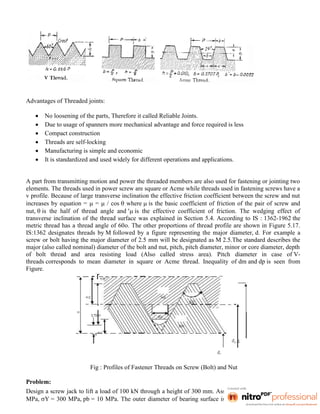
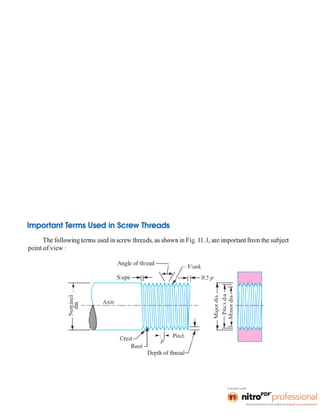
metric thread has a thread angle of 60o. The other proportions of thread profile are shown in Figure 5.17.
IS:1362 designates threads by M followed by a figure representing the major diameter, d. For example a
screw or bolt having the major diameter of 2.5 mm will be designated as M 2.5.The standard describes the
major (also called nominal) diameter of the bolt and nut, pitch, pitch diameter, minor or core diameter, depth
of bolt thread and area resisting load (Also called stress area). Pitch diameter in case of V-
threads corresponds to mean diameter in square or Acme thread. Inequality of dm and dp is seen from
Figure.
Fig : Profiles of Fastener Threads on Screw (Bolt) and Nut
Problem:
Design a screw jack to lift a load of 100 kN through a height of 300 mm. Assume u = 400 MPa, u = 200
MPa, Y = 300 MPa, pb = 10 MPa. The outer diameter of bearing surface is 1.6 d1 and inner diameter of
bearing surface is 0.8 d1.Coefficient of friction between collar on screw and C.I is 0.2. Coefficient of friction
between steel screw and bronze nut is 0.15. Take a factor of safety of 5 for screw and nut but take a factor of
safety of 4 for operating lever.
Solution
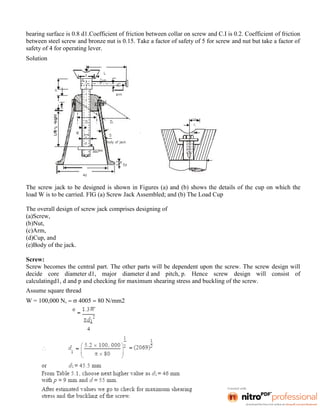
The screw jack to be designed is shown in Figures (a) and (b) shows the details of the cup on which the
load W is to be carried. FIG (a) Screw Jack Assembled; and (b) The Load Cup
The overall design of screw jack comprises designing of
(a)Screw,
(b)Nut,
(c)Arm,
(d)Cup, and
(e)Body of the jack.
Screw:
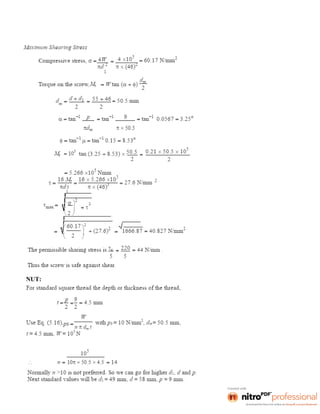
Screw becomes the central part. The other parts will be dependent upon the screw. The screw design will
decide core diameter d1, major diameter d and pitch, p. Hence screw design will consist of
calculatingd1, d and p and checking for maximum shearing stress and buckling of the screw.
Assume square thread
W = 100,000 N,   4005  80 N/mm2
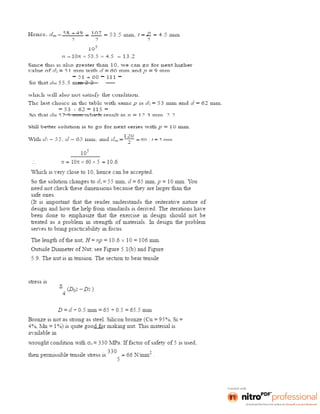
NUT:
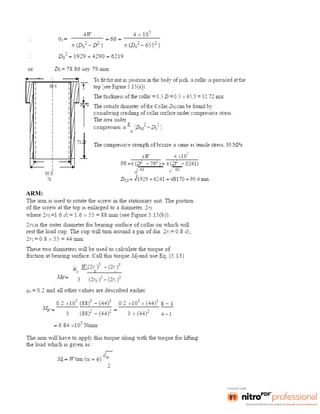
ARM:
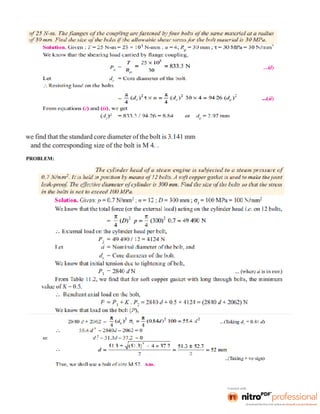
PROBLEM
PROBLEM
PROBLEM:
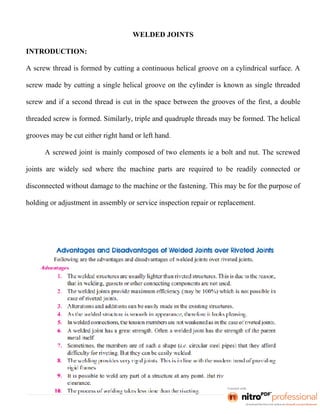
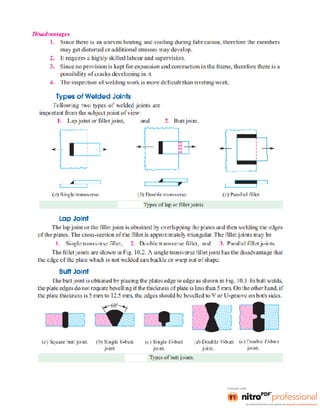
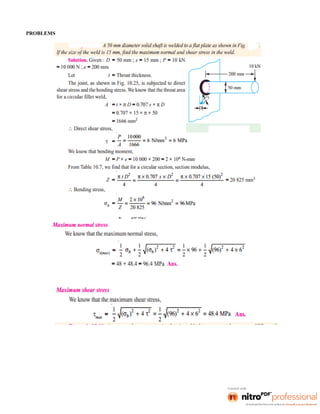
WELDED JOINTS
INTRODUCTION:
A screw thread is formed by cutting a continuous helical groove on a cylindrical surface. A
screw made by cutting a single helical groove on the cylinder is known as single threaded
screw and if a second thread is cut in the space between the grooves of the first, a double
threaded screw is formed. Similarly, triple and quadruple threads may be formed. The helical
grooves may be cut either right hand or left hand.
A screwed joint is mainly composed of two elements ie a bolt and nut. The screwed
joints are widely sed where the machine parts are required to be readily connected or
disconnected without damage to the machine or the fastening. This may be for the purpose of
holding or adjustment in assembly or service inspection repair or replacement.
PROBLEMS
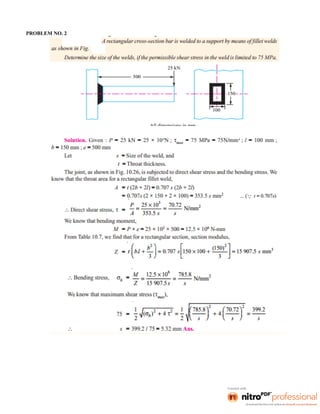
PROBLEM NO. 2
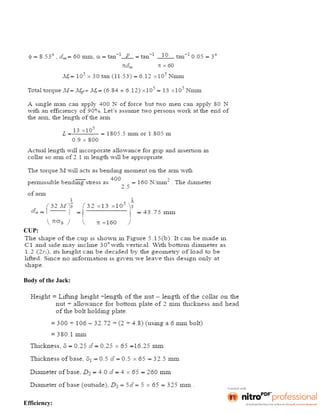
CUP:
Body of the Jack:
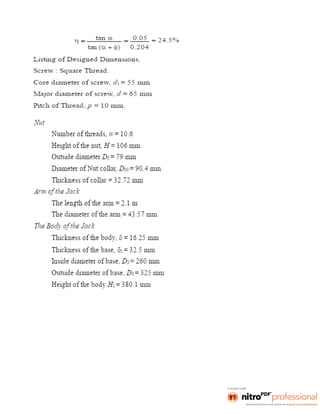
Efficiency:
UNIT IV DESIGN OF SPRINGS
Introduction
A spring is defined as an elastic body, whose function is to distort when loaded and to recover its original shape
when the load is removed. The various important applications of springs are as follows:
1. To cushion, absorb or control energy due to either shock or vibration as in car springs, railway buffers, air-craft
landing gears, shock absorbers and vibration dampers.
2. To apply forces, as in brakes, clutches and spring loaded valves.
3. To control motion by maintaining contact between two elements as in cams and followers.
4. To measure forces, as in spring balances and engine indicators.
5. To store energy, as in watches, toys, etc.
Types of springs:
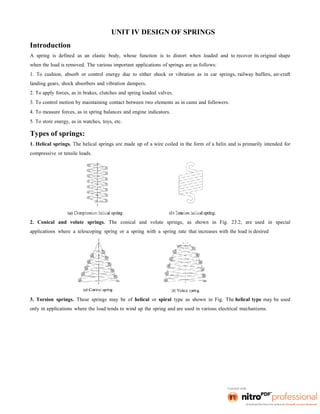
1. Helical springs. The helical springs are made up of a wire coiled in the form of a helix and is primarily intended for
compressive or tensile loads.
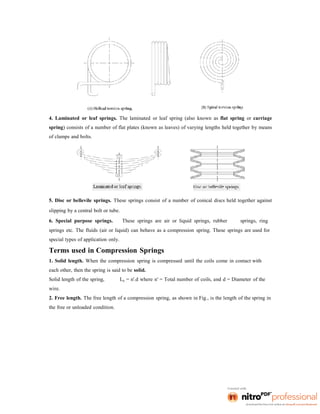
2. Conical and volute springs. The conical and volute springs, as shown in Fig. 23.2, are used in special
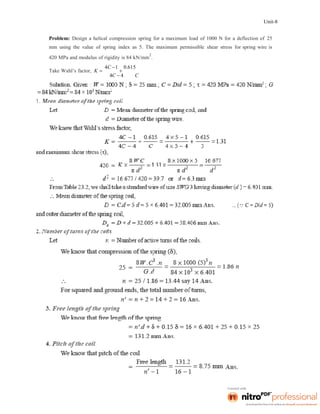
applications where a telescoping spring or a spring with a spring rate that increases with the load is desired
3. Torsion springs. These springs may be of helical or spiral type as shown in Fig. The helical type may be used
only in applications where the load tends to wind up the spring and are used in various electrical mechanisms.
4. Laminated or leaf springs. The laminated or leaf spring (also known as flat spring or carriage
spring) consists of a number of flat plates (known as leaves) of varying lengths held together by means
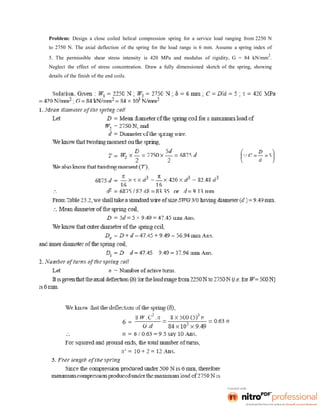

of clamps and bolts.
5. Disc or bellevile springs. These springs consist of a number of conical discs held together against
slipping by a central bolt or tube.
6. Special purpose springs. These springs are air or liquid springs, rubber springs, ring
springs etc. The fluids (air or liquid) can behave as a compression spring. These springs are used for
special types of application only.
Terms used in Compression Springs
1. Solid length. When the compression spring is compressed until the coils come in contact with
each other, then the spring is said to be solid.
Solid length of the spring, Ls = n'.d where n' = Total number of coils, and d = Diameter of the
wire.
2. Free length. The free length of a compression spring, as shown in Fig., is the length of the spring in
the free or unloaded condition.
Free length of the spring,
LF = Solid length + Maximum compression + *Clearance between adjacent coils (or clash
allowance)
= n'.d + δmax + 0.15 δmax
3. Spring index. The spring index is defined as the ratio of the mean diameter of the coil to the
diameter of the wire. Spring index, C = D / d where D = Mean diameter of the coil, and d
= Diameter of the wire.
4. Spring rate. The spring rate (or stiffness or spring constant) is defined as the load required per unit
deflection of the spring. Mathematically, Spring rate, k = W / δ where W = Load, and δ = Deflection of
the spring.
5. Pitch. The pitch of the coil is defined as the axial distance between adjacent coils in
uncompressed state. Mathematically, Pitch of the coil,
p 
Free Length
n
'
1
Stresses in Helical Springs of Circular Wire
Consider a helical compression spring made of circular wire and subjected to an axial load W, as shown
in Fig.(a).
Let D = Mean diameter of the spring coil,
d = Diameter of the spring wire,
n = Number of active coils,
G = Modulus of rigidity for the spring material,
W = Axial load on the spring,
τ = Maximum shear stress induced in the wire,
C = Spring index = D/d,
p = Pitch of the coils, and
δ = Deflection of the spring, as a result of an axial load W.
Now consider a part of the compression spring as shown in Fig. (b). The load W tends to rotate the
wire due to the twisting moment ( T ) set up in the wire. Thus torsional shear stress is induced in the
wire.
A little consideration will show that part of the spring, as shown in Fig.(b), is in equilibrium under
the action of two forces W and the twisting moment T. We know that the twisting moment,
The torsional shear stress diagram is shown in Fig. (a).
In addition to the torsional shear stress (τ1) induced in the wire, the following stresses also act on the
wire:
1. Direct shear stress due to the load W, and
2. Stress due to curvature of wire.
We know that the resultant shear stress induced in the wire,
Maximum shear stress induced in the wire,
= Torsional shear stress + Direct shear stress
Deflection of Helical Springs of Circular Wire
Buckling of Compression Springs
It has been found experimentally that when the free length of the spring (LF) is more than four
times the mean or pitch diameter (D), then the spring behaves like a column and may fail by buckling at
a comparatively low load.
Wcr = k × KB × LF
where k = Spring rate or stiffness of the spring = W/δ,
LF = Free length of the spring, and
KB = Buckling factor depending upon the ratio LF / D.
Surge in springs
When one end of a helical spring is resting on a rigid support and the other end is loaded suddenly, then
all the coils of the spring will not suddenly deflect equally, because some time is required for the
propagation of stress along the spring wire. A little consideration will show that in the beginning, the
end coils of the spring in contact with the applied load takes up whole of the deflection and then it
transmits a large part of its deflection to the adjacent coils. In this way, a wave of compression
propagates through the coils to the supported end from where it is reflected back to the deflected end.
Where d = Diameter of the wire,
D = Mean diameter of the spring, n =
Number of active turns,
G = Modulus of rigidity,
g = Acceleration due to gravity, and
ρ = Density of the material of the spring.
Problem: A helical spring is ma e from a wire of 6 mm diameter and has outside diameter of
75 mm. If the permissible shear stress is 350 MPa and modulus of rigidity 84 kN/mm
2
, find the axial
load which the spring can carry and the deflection per active turn.
Unit-8
Problem: Design a spring for a balance to measure 0 to 1000 N over a scale of length
80 mm. The spring is to be enclosed in a casing of 25 mm diameter. The approximate number of turns
is 30. The modulus of rigidity is 85 kN/mm
2
. Also calculate the maximum shear
stress induced.
Solution:
Unit-8
Problem: Design a helical compression spring for a maximum load of 1000 N for a deflection of 25
mm using the value of spring index as 5. The maximum permissible shear stress for spring wire is
420 MPa and modulus of rigidity is 84 kN/mm
2
.
Take Wahl’s factor, K 
4C 1

0.615
4C  4 C
Problem: Design a close coiled helical compression spring for a service load ranging from 2250 N
to 2750 N. The axial deflection of the spring for the load range is 6 mm. Assume a spring index of
5. The permissible shear stress intensity is 420 MPa and modulus of rigidity, G = 84 kN/mm
2
.
Neglect the effect of stress concentration. Draw a fully dimensioned sketch of the spring, showing
details of the finish of the end coils.
Energy Stored in Helical Springs of Circular Wire
We know that the springs are used for storing energy which is equal to the work done on it by some
external load.
Let W = Load applied on the spring, and
δ = Deflection produced in the spring due to the load W.
Assuming that the load is applied gradually, the energy stored in a spring is,
We have already discussed that the maximum shear stress induced in the spring wire,
We know that deflection of the spring,
Substituting the values of W and δ in equation (i), we have
Where V = Volume of the spring wire
= Length of spring wire × Cross-sectional area of spring wire
Helical Springs Subjected to Fatigue Loading
The helical springs subjected to fatigue loading are designed by using the Soderberg line method.
The spring materials are usually tested for torsional endurance strength under a
repeated stress that varies from zero to a maximum. Since the springs are ordinarily loaded in one
direction only (the load in springs is never reversed in nature), therefore a modified Soderberg
diagram is used for springs, as shown in Fig.
The endurance limit for reversed loading is shown at point A where the mean shear stress is
equal to τe / 2 and the variable shear stress is also equal to τe / 2. A line drawn from A to B (the
yield point in shear, τy) gives the Soderberg’s failure stress line. If a suitable factor of safety (F.S.)
is applied to the yield strength (τy), a safe stress line CD may be drawn
parallel to the line AB, as shown in Fig. Consider a design point P on the line CD. Now the value of
factor of safety may be obtained as discussed below:
From similar triangles PQD and AOB, we have
Springs in Series
Total deflection of the springs,
Springs in Parallel
Surge in Springs or finding natural frequency of a helical spring:
When one end of a helical spring is resting on a rigid support and the other end is loaded
suddenly, then all the coils of the spring will not suddenly deflect equally, because
some time is required for the propagation of stress along the spring wire. A little
consideration will show that in the beginning, the end coils of the spring in contact with the applied
load takes up whole of the deflection and then it transmits a large part of its deflection to the
adjacent coils. In this way, a wave of compression propagates through the coils to the supported end
from where it is reflected back to the deflected end.
This wave of compression travels along the spring indefinitely. If the applied load is of
fluctuating type as in the case of valve spring in internal combustion engines and if the time
interval between the load applications is equal to the time required for the wave to travel from one end
to the other end, then resonance will occur. This results in very large deflections of the coils and
correspondingly very high stresses. Under these conditions, it is just possible that the spring may fail.
This phenomenon is called surge.
It has been found that the natural frequency of spring should be at least twenty times the
frequency of application of a periodic load in order to avoid resonance with all harmonic frequencies up
to twentieth order. The natural frequency for springs clamped between two plates is given by
Where d = Diameter of the wire,
D = Mean diameter of the spring,
n = Number of active turns,
G = Modulus of rigidity,
g = Acceleration due to gravity, and
ρ = Density of the material of the spring.
The surge in springs may be eliminated by using the following methods:
1. By using friction dampers on the centre coils so that the wave propagation dies out.
2. By using springs of high natural frequency.
3. By using springs having pitch of the coils near the ends different than at the centre to have different
natural frequencies.
Energy Stored in Helical Springs of Circular Wire
We know that the springs are used for storing energy which is equal to the work done on it by some
external load.
Let W = Load applied on the spring, and
δ = Deflection produced in the spring due to the load W.
Assuming that the load is applied gradually, the energy stored in a spring is,
We have already discussed that the maximum shear stress induced in the spring wire,
We know that deflection of the spring,
Substituting the values of W and δ in equation (i), we have
Where V = Volume of the spring wire
= Length of spring wire × Cross-sectional area of spring wire
Helical Torsion Springs
The helical torsion springs as shown in Fig., may be made from round, rectangular or square wire. These
are wound in a similar manner as helical compression or tension springs but the ends are shaped to
transmit torque. The primary stress in helical torsion springs is bending stress whereas in
compression or tension springs, the stresses are torsional shear stresses. The helical torsion springs are
widely used for transmitting small torques as in door hinges, brush holders in electric motors,
automobile starters etc. A little consideration will show that the radius of curvature of the coils
changes when the twisting moment is applied to the spring. Thus, the wire is under pure bending.
According to A.M. Wahl, the bending stress in a helical torsion spring made of round wire is
Where K = Wahl’s stress factor = 

C = Spring index,
4C
2
 C 1
4C
2
 4C
M = Bending moment = W × y, W
= Load acting on the spring,
y = Distance of load from the spring axis, and d =
Diameter of spring wire.
And
Total angle of twist or angular deflection,
Where l = Length of the wire = π.D.n,
E = Young’s modulus, 

d
4
64
D = Diameter of the spring, and n
= Number of turns.
And deflection,
When the spring is made of rectangular wire having width b and thickness t, then
Where
Angular deflection,
In case the spring is made of square wire with each side equal to b, then substituting t = b, in the
above relation, we have
Flat Spiral Spring
A flat spring is a long thin strip of elastic material wound like a spiral as shown in Fig. These springs
are frequently used in watches and
gramophones etc. When the outer or inner end of this
type of spring is wound up in such a way that there is a
tendency in the increase of number of spirals of the
spring, the strain energy is stored into its spirals.
This energy is utilised in any useful way while the spirals
open out slowly. Usually the inner end of spring is
clamped to an arbor while the outer end may be
pinned or clamped. Since the radius of curvature of every spiral
decreases when the spring is wound up, therefore the material of the spring is in a state of pure
bending.
Let W = Force applied at the outer end A of the spring,
y = Distance of centre of gravity of the spring from A,
l = Length of strip forming the spring,
b = Width of strip,
t = Thickness of strip,
I = Moment of inertia of the spring section = b.t
3
/12, and
Z = Section modulus of the spring section = b.t
2
/6
When the end A of the spring is pulled up by a force W, then the bending moment on the spring,
at a distance y from the line of action of W is given by
M = W × y
The greatest bending moment occurs in the spring at B which is at a maximum distance from the
application of W.
Bending moment at B,
MB = Mmax = W × 2y = 2W.y = 2M
Maximum bending stress induced in the spring material,
Assuming that both ends of the spring are clamped, the angular deflection (in radians) of the spring is
given by
And the deflection,
The strain energy stored in the spring
Unit-8
Problem: A helical torsion spring of mean diameter 60 mm is made of a round wire of 6 mm diameter.
If a torque of 6 N-m is applied on the spring, find the bending stress induced and the angular
deflection of the spring in degrees. The spring index is 10 and modulus of
elasticity for the spring material is 200 kN/mm
2
. The number of effective turns may be taken
as 5.5.
Problem: A spiral spring is made of a flat strip 6 mm wide and 0.25 mm thick. The length of the strip
is 2.5 metres. Assuming the maximum stress of 800 MPa to occur at the point of greatest bending
moment, calculate the bending moment, the number of turns to wind up the
spring and the strain energy stored in the spring. Take E = 200 kN/mm
2
.
Concentric or Composite Springs or coaxial springs or nested springs
A concentric or composite spring is used for one of the following purposes:
1. To obtain greater spring force within a given space.
2. To insure the operation of a mechanism in the event of failure of one of the springs.
The concentric springs for the above two purposes may have two or more springs and have the same
free lengths as shown in Fig. (a) And are compressed equally.
Such springs are used in automobile clutches; valve springs in aircraft, heavy duty diesel
engines and rail-road car suspension systems. Sometimes concentric springs are used to
obtain a spring force which does not increase in a direct relation to the deflection but increases
faster. Such springs are made of different lengths as shown in Fig. (b). The shorter spring begins to act
only after the longer spring is compressed to a certain amount. These
springs are used in governors of variable speed engines to take care of the variable centrifugal
force. The adjacent coils of the concentric spring are wound in opposite
eliminate any tendency to bind.
directions to
If the same material is used, the concentric springs are designed for the same stress. In order to get
the same stress factor (K), it is desirable to have the same spring index (C ).
Consider a concentric spring as shown in Fig. (a). Let
W = Axial load,
W1 = Load shared by outer spring,
W2 = Load shared by inner spring,
d1= Diameter of spring wire of outer spring,
d2 = Diameter of spring wire of inner spring,
D1 = Mean diameter of outer spring, D2
= Mean diameter of inner spring, δ1 =
Deflection of outer spring,
δ2 = Deflection of inner spring,
n1 = Number of active turns of outer spring, and
n2 = Number of active turns of inner spring.
Assuming that both the springs are made of same material, then the maximum shear stress induced
in both the springs is approximately same, i.e.
When stress factor, K1 = K2, then
If both the springs are effective throughout their working range, then their free length and
deflection are equal, i.e.
When both the springs are compressed until the adjacent coils meet, then the solid length of both the
springs is equal, i.e.
n1.d1 = n2.d2
The equation (ii) may be written as
Now dividing equation (iii) by equation (i), we have
i.e. the springs should be designed in such a way that the spring index for both the springs is same.
From equations (i) and (iv), we have
Usually, the radial clearance between the two springs is taken as
From equation (iv), we find that
D1 = C.d1, and D2 = C.d2
------ (vi)
Substituting the values of D1 and D2 in equation (vi), we have
Leaf Springs
Leaf springs (also known as flat springs) are made out of flat plates. The advantage of leaf spring
over helical spring is that the ends of the spring may be guided along a definite path as
it deflects to act as a structural member in addition to energy absorbing device.
Consider a single plate fixed at one end and loaded at the other end. This plate may be used as a flat
spring.
Let t = Thickness of plate,
b = Width of plate, and
L = Length of plate or distance of the load W
from the cantilever end.
We know that the maximum bending moment at the
cantilever end A,
M = W.L
And section modulus,
Bending stress in such a spring,
We know that the maximum deflection for a cantilever with concentrated load at the free end is given
by
If the spring is not of cantilever type but it is like a simply supported beam, with length 2L
and load 2W in the centre, as shown in Fig. then Maximum bending moment in the centre,
M = W.L
Section modulus, Z = b.t2 / 6
Bending stress,
We know that maximum deflection of a simply supported beam loaded in the centre is given by
From above we see that a spring such as automobile spring (semi-elliptical spring) with length
2L and loaded in the centre by a load 2W, may be treated as a double cantilever. If the plate of
cantilever is cut into a series of n strips of width b and these are placed as shown in Fig., then
equations (i) and (ii) may be written as
And
The above relations give the stress and deflection of a leaf spring of uniform cross section. The
stress at such a spring is maximum at the support.
If a triangular plate is used as shown in Fig., the stress will be uniform throughout. If this triangular
plate is cut into strips of uniform width and placed one below the other, as shown in Fig. to form a
graduated or laminated leaf spring, then
where n = Number of graduated leaves.
We see from equations (iv) and (vi) that for the same deflection, the stress in the uniform cross-section leaves
(i.e. full length leaves) is 50% greater than in the graduated leaves, assuming that each spring element
deflects according to its own elastic curve. If the suffixes
F and G are used to indicate the full length (or uniform cross section) and graduated leaves, then
Adding 1 to both sides, we have
where W = Total load on the spring = WG + WF
WG = Load taken up by graduated leaves, and
WF = Load taken up by full length leaves.
From equation (vii), we may write
Bending stress for full length leaves,
Since
The deflection in full length and graduated leaves is given by equation (iv), i.e.
Equalised Stress in Spring Leaves (Nipping)
We have already discussed that the stress in the full length leaves is 50% greater than the stress in
the graduated leaves. In order to utilise the material to the best advantage, all the leaves should be
equally stressed.
This condition may be obtained in the following two ways:
1. By making the full length leaves of smaller thickness than the graduated leaves. In this way,
the full length leaves will induce smaller bending stress due to small distance from the neutral axis
to the edge of the leaf.
2. By giving a greater radius of curvature to the full length leaves than graduated leaves, as
shown in Fig. before the leaves are assembled to form a spring. By doing so, a gap or
clearance will be left between the leaves. This initial gap, as shown by C in Fig, is called nip.
Consider that under maximum load conditions, the stress in all the leaves is equal. Then at
maximum load, the total deflection of the graduated leaves will exceed the deflection of the
full length leaves by an amount qual to the initial gap C. In other words,
Since the stresses are equal, therefore
Substituting the values of WG and WF in equation (i), we have
The load on the clip bolts (Wb) required to close the gap is determined by the fact that the gap is equal
to the initial deflections of full length and graduated leaves.
Or
The final stress in spring leaves will be the stress in the full length leaves due to the applied
load minus the initial stress.
Final stress,
Length of Leaf Spring Leaves
The length of the leaf spring leaves may be obtained as discussed below : Let
2L1 = Length of span or overall length of the spring,
l = Width of band or distance between centres of U-bolts. It is the in effective length
of the spring,
nF = Number of full length leaves,
nG = Number of graduated leaves, and
n = Total number of leaves = nF + nG.
We have already discussed that the effective length of the spring,
2L = 2L1 – l ... (When band is used)
Problem: Design a leaf spring for the following specifications:
Total load = 140 kN ; Number of springs supporting the load = 4 ; Maximum number
of leaves = 10; Span of the spring = 1000 mm ; Permissible deflection = 80 mm.
Take Young’s modulus, E = 200 kN/mm2 and allowable stress in spring material as
600 MPa.
Problem:A truck spring has 12 number of leaves, two of which are full length leaves.
The spring supports are 1.05 m apart and the central band is 85 mm wide. The central load is
to be 5.4 kN with a permissible stress of 280 MPa. Determine the thickness and width of the
steel spring leaves. The ratio of the total depth to the width of the spring is 3. Also determine
the deflection of the spring.
UNIT – V DESIGN OF BEARINGS AND FLYWHEELS
Study Friction, Wear & Lubrication
Moving parts of every machine is subjected to friction and wear. Friction consumes and
wastes energy. Wear causes changes in dimensions and eventual breakdown of the machine element
and the entire machine. The loss of just a few milligrams of material in the right place, due to
wear can cause a production machine or an automobile to be ready for replacement. If we
imagine the amount of material rendered useless by way of wear, it is startling! Lots of materials
ranging from Antimony to zinc, including titanium, vanadium, iron, carbon, copper, aluminum etc.,
would be lost. It is therefore essential to conserve the natural resources through reduction in wear.
Lubrication plays a vital role in our great and complex civilization.
Bearings
A bearing is machine part, which support a moving element and confines its motion. The supporting
member is usually designated as bearing and the supporting member may be journal. Since there
is a relative motion between the bearing and the moving element, a certain amount of power must
be absorbed in overcoming friction, and if the surface actually touches, there will be a rapid wear.
Classification:
Bearings are classified as follows:
Depending upon the nature of contact between the working surfaces:-
Sliding contact bearings and
Rolling contact bearings.
Sliding bearings:
Hydrodynamically lubricated bearings
Bearings with boundary lubrication
Bearings with Extreme boundary lubrication.
Bearings with Hydrostatic lubrication.
Rolling element bearings:
Ball bearings
Roller bearings
Needle roller bearings
Based on the nature of the load supported:
• Radial bearings - Journal bearings
• Thrust bearings
- Plane thrust bearings
- Thrust bearings with fixed shoes
- Thrust bearings with Pivoted shoes
• Bearings for combined Axial and Radial loads.
Journal bearing
It is one, which forms the sleeve around the shaft and supports a bearing at right angles to the axis
of the bearing. The portion of the shaft resting on the sleeve is called the journal. Example of
journal bearings are-
Solid bearing
Bushed bearing, and
Pedestal bearing.
Solid bearing:
A cylindrical hole formed in a cast iron machine member to receive the shaft which makes a
running fit is the simplest type of solid journal bearing. Its rectangular base plate has two holes
drilled in it for bolting down the bearing in its position as shown in the figure.An oil hole is provided at
the top to lubricate the bearing. There is no means of adjustment for wear and the shaft must be
introduced into the bearing endwise. It is therefore used for shafts, which carry light loads and
rotate at moderate speeds.
Bushed bearing:
It consists of mainly two parts, the cast iron block and bush; the bush is made of soft material such as
brasss, bronze or gunmetal. The bush is pressed inside the bore in the cast iron block and is prevented
from rotating or sliding by means of grub- screw as shown if the figure When the bush gets worn out
it can be easily replaced. Elongated holes in the base are provided for lateral adjustment.
Pedestal bearing:
It is also called Plummer block. Figure shows half sectional front view of the Plummer block. It
consists of cast iron pedestal, phosphor bronze bushes or steps made in two halves and cast iron cap.
A cap by means of two square headed bolts holds the halves of the steps together. The steps are
provided with collars on either side in order to prevent its axial movement. The snug in the
bottom step, which fits into the corresponding hole in the body, prevents the rotation of the steps
along with the shaft. This type of bearing can be placed any where along the shaft length.
Thrust bearing:
It is used to guide or support the shaft, which is subjected to a load along the axis of the shaft. Since a
thrust bearing operates without a clearance between the conjugate parts, an adequate supply of oil to the
rubbing surfaces is extremely important. Bearings designed to carry heavy thrust loads may be broadly
classified in to two groups-
· Foot step bearing, and
· Collar bearing
Footstep bearing:
Footstep bearings are used to support the lower end of the vertical shafts. A simple form
of such bearing is shown in fig. It consists of cast iron block into which a gunmetal bush is fitted. The
bush is prevented from rotating by the snug provided at its neck. The shaft rests on a concave hardened
steel disc. This disc is prevented from rotating along with the shaft by means of pin provided at the
bottom.
Collar bearing:
The simple type of thrust bearing for horizontal shafts consists of one or more collars cut
integral with the shaft as shown in fig These collars engage with corresponding bearing surfaces in the
thrust block. This type of bearing is used if the load would be too great for a step bearing, or if a
thrust must be taken at some distance from the end of the shaft. Such bearings may be oiled by
reservoirs at the top of the bearings.
Collar bearings
Thrust bearings of fixed inclination pad and pivoted pad variety are shown in figure 7.6 a &
b. These are used for carrying axial loads as shown in the diagram. These bearings operate on
hydrodynamic principle.
Fixed-incline-pads thrust bearing Pivoted-pads thrust bearing
Rolling contact bearings:
The bearings in which the rolling elements are included are referred to as rolling contact bearings.
Since the rolling friction is very less compared to the sliding friction, such bearings are known as anti
friction bearings.
Ball bearings:
It consists of an inner ring which is mounted on the shaft and an outer ring which is carried
by the housing. The inner ring is grooved on the outer surface called inner race and the outer ring is grooved on
its inner surface called outer race. In between the inner and outer race there are number of steel balls. A cage
pressed steel completes the assembly and provides the means of equally spacing and holding the balls in place as
shown in the figure . Radial ball bearings are used to carry mainly radial loads, but they can also carry axial loads.
Cylindrical roller bearings
The simplest form of a cylindrical roller bearing is shown in fig . It consists of an inner
race, an outer race, and set of roller with a retainer. Due to the line contact between the roller and the raceways,
the roller bearing can carry heavy radial loads.
Tapered roller bearings:
In tapered roller bearings shown in the fig.,the rollers and the races are all truncated
cones having a common apex on the shaft centre to assure true rolling contact. The tapered roller bearing can
carry heavy radial and axial loads. Such bearings are mounted in pairs so that the two bearings are opposing
each other’s thrust.
Advantages of sliding contact bearings:
They can be operated at high speeds. They can
carry heavy radial loads.
They have the ability to withstand shock and vibration loads. Noiseless
operation.
Disadvantages:
More frictional losses during staring. Length of the
bearing is too large.
Excessive consumption of the lubricant and require more maintenance.
Advantages rolling contact bearings:
Low starting and low running friction.
It can carry both radial as well as thrust loads. Momentary over loads
can be carried without failure.
Shaft alignment is more accurate than in the sliding bearings.
Disadvantages:
More noisy at high speeds.
Low resistance to shock loads. High initial
cost.
Finite life due to eventual failure by fatigue
Hydrodynamic / thick film lubrication / fluid film lubrication
• Metal to Metal contact is prevented. This is shown in figure
• Friction in the bearing is due to oil film friction only.
• Viscosity of the lubricant plays a vital role in the power loss, temperature rise & flow through of the
lubricant through the bearing.
• The principle operation is the Hydrodynamic theory.
• This lubrication can exist under moderately loaded bearings running at sufficiently high speeds.
Thick Film Lubrication
Boudary lubrication (thin film lubrication)
During starting and stopping, when the velocity is too low, the oil film is not capable of supporting the
load. There will be metal to metal contact at some spots as shown in figure
. Boundary lubrication exists also in a bearing if the load becomes too high or if the viscosity of the lubricant is
too low. Mechanical and chemical properties of the bearing surfaces and the lubricants play a vital role.
Boundary Lubrication
Oiliness of lubricant becomes an important property in boundary lubrication. Anti oxidants and Anti-corrosives
are added to lubricants to improve their performance. Additives are added to improve the viscosity index of the
lubricants.
Extreme boundary lubrication
Under certain conditions of temperature and load, the boundary film breaks leading to direct metal to metal
contact as shown in figure . Seizure of the metallic surfaces and destruction of one or both surfaces
begins. Strong intermolecular forces at the point of contact results in tearing of metallic particles.
“Plowing” of softer surfaces by surface irregularities of the harder surfaces. Bearing material properties become
significant. Proper bearing materials should be selected.
Extreme Boundary Lubrication
Extreme-Pressure Agents
Scoring and pitting of metal surfaces might occur as a result of this case, seizure is the
primarily concern. Additives are derivatives of sulphur, phosphorous, or chlorine. These additives prevent
the welding of mating surfaces under extreme loads and temperatures.
Newton’s Law of Viscous Flow
In Fig. let a plate A be moving with a velocity U on a film of lubricant of thickness h. Imagine the film to be
composed of a series of horizontal layers and the force F causing these layers to deform or slide on one another
just like a deck of cards. The layers in contact
with the moving plate are assumed to have a velocity U; those in contact with the stationary surface are assumed
to have a zero velocity. Intermediate layers have velocities that depend upon their distances y from the stationary
surface.
Newton’s viscous effect states that the shear stress in the fluid is proportional to the rate of change of velocity
with respect to y.
Thus
τ =F/A = Z(du/dy)
Viscous flow
where Z is the constant of proportionality and defines absolute viscosity, also called dynamic viscosity.
The derivative du/dy is the rate of change of velocity with distance and may be called the rate of shear, or
the velocity gradient. The viscosity Z is thus a measure of the internal frictional resistance of the fluid.
For most lubricating fluids, the rate of shear is constant, and du/dy = U/h. Fluids exhibiting
this characteristic are known as a Newtonian fluids.
Therefore τ =F/A = Z (U/h).
The absolute viscosity is measured by the pascal-second (Pa · s) in SI; this is the same as a
Newton-second per square meter.
The poise is the cgs unit of dynamic or absolute viscosity, and its unit is the dyne second
per square centimeter (dyn · s/cm2). It has been customary to use the centipoises (cP) in analysis, because
its value is more convenient. The conversion from cgs units to SI units is as follows:
Z (Pa · s) = (10)
−3
Z (cP)
Kinematic Viscosity is the ratio of the absolute Viscosity to the density of the lubricant.
Zk = Z / ρ
The ASTM standard method for determining viscosity uses an instrument called the Saybolt Universal
Viscosimeter. The method consists of measuring the time in seconds for 60 mL of lubricant at a specified
temperature to run through a tube 17.6 micron in diameter and 12.25 mm long. The result is called the
kinematic viscosity, and in the past
the unit of the square centimeter per second has been used. One square centimetre per second is defined as a
stoke.
The kinematic viscosity based upon seconds Saybolt, also called Saybolt Universal viscosity
(SUV) in seconds, is given by:
Zk = (0.22t −180/t )
where Zk is in centistokes (cSt) and t is the number of seconds Saybolt.
Viscosity -Temperature relation
Viscous resistance of lubricating oil is due to intermolecular forces. As the temperature increases, the oil
expands and the molecules move further apart decreasing the intermolecular forces. Therefore the viscosity of the
lubricating oil decreases with temperature as shown in the figure. If speed increases, the oil’s temperature
increases and viscosity drops, thus making it better suited for the new condition. An oil with high viscosity
creates higher temperature and this in turn reduces viscosity. This, however, generates an equilibrium
condition that is not optimum. Thus, selection of the correct viscosity oil for the bearings is essential.
Viscosity temperature relationship
Viscosity index of a lubricating oil
Viscosity Index (V.I) is value representing the degree for which the oil viscosity changes with temperature.
If this variation is small with temperature, the oil is said to have a high viscosity index. The oil is compared
with two standard oils, one having a V.I. of 100 and the other Zero. A viscosity Index of 90 indicates that the oil
with this value thins out less rapidly than an oil with V.I. of 50.
Design Procedure for Journal Bearing
The following procedure may be adopted in designing journal bearings, when the bearing load, the diameter and the speed
of the shaft are known.
1. Determine the bearing length by choosing a ratio of l/d from Table 26.3.
2. Check the bearing pressure, p = W / l.d from Table26.3 for probable satisfactory value.
3. Assume a lubricant from Table 26.2 and its operating temperature (t ). This temperature should be
between 26.5°C and 60°C with 82°C as a maximum for high temperature installations such as
steam turbines.
4. Determine the operating value of ZN / p for the assumed bearing temperature and check this value
with Corresponding values in Table 26.3, to determine the possibility of maintaining fluid film
operation.
5. Assume a clearance ratio c/d
6. Determine the coefficient of friction (µ)
7. Determine the heat generation
8. Determine the heat dissipation
9. Determine the thermal equilibrium to see that the heat dissipated becomes at least equal to the heat
generated. In case the heat generated is more than the heat dissipated then either the bearing is
redesigned or it is artificially cooled by water.
1. Design a journal bearing for a centrifugal pump from the following data :
Load on the journal = 20 000 N; Speed of the journal = 900 r.p.m.; Type of oil is SAE 10, for which the absolute
viscosity at 55°C = 0.017 kg / m-s; Ambient temperature of oil = 15.5°C ; Maximum bearing pressure for the pump =
1.5 N / mm
2
.Calculate also mass of the lubricating oil required for artificial cooling, if rise of temperature of oil be
limited to 10°C. Heat dissipation coefficient = 1232 W/m/°C.
2. A 80 mm long journal bearing supports a load of 2800 N on a 50 mm diameter shaft. The bearing has
a radial clearance of 0.05 mm and the viscosity of the oil is 0.021 kg / m-s at
the operating temperature. If the bearing is capable of dissipating 80 J/s, determine the maximum
safe speed.
3. A full journal bearing of 50 mm diameter and 100 mm long has a bearing pressure of 1.4 N/mm2
. The speed of
the journal is 900 r.p.m. and the ratio of journal diameter to the diametral clearance is 1000. The bearing is
lubricated with oil whose absolute viscosity at the operating temperature of 75°C may be taken as 0.011 kg/m-s.
The room temperature is 35°C. Find : 1. The amount of artificial cooling required, and 2. The mass of the
lubricating oil required, if the difference between the outlet and inlet temperature of the oil is 10°C. Take specific
heat of the oil as 1850 J / kg / °C.
Assignment Problems
1. Design a suitable journal bearing for a centrifugal pump of speed 1440 rpm. Load on
bearing is 12 kN. Journal diameter is 80 mm.
2. A Journal bearing is to be designed for a centrifugal pump for the following data: Load on the Journal = 10 kN;
Diameter of the Journal = 75 mm; Speed = 1440 rpm; Atmospheric temperature = 16°C; Operating oil
temperature = 60°C ; D/C = 1000, Absolute viscosity of oil at 60°C. = 23 CP.
3. Select a suitable deep groove ball bearing for a drilling machine spindle of 40 mm diameter and suggest
necessary tolerances an the shaft and housing.
Radial load is 2.0 kN;. Thrust is 1.5 kN . Spindle speed is 3000 rpm. Desired life 3000 hrs.
4. Select a ball bearing for an axial compressor to carry a radial load of 2.5 kN and a thrust laod of 1.5 kN. The
bearing will be in use for 40 hours/week for 5 years. The speed of the shaft is 1000 rpm. The diameter of the
shaft is 50 mm.

DESIGN OF MACHINE ELEMENTS NOTES.PDF SHARE

  • 1.
    COURSE MATERIAL SMEX1014 DESIGN OFMACHINE ELEMENTS SATHYABAMA UNIVERSITY CHENNAI
  • 2.
    SMEX1014 DESIGN OFMACHINE ELEMENTS (Common to MECHANICAL and MECHANICAL & PRODUCTION) L T P Credits Total Marks 2 1 0 3 100 UNIT I STEADY STRESSES AND VARIABLE STRESSES IN MACHINE MEMBERS 10 hrs. Introduction to the design process – Factors influencing machine design, selection of materials based on mechanical properties – Direct, bending and torsional stress equations – Impact and shock loading – Calculation of principle stresses for various load combinations, eccentric loading – Factor of safety – Theories of failure –Stress concentration – Design for variable fatigue loading – Soderberg, Goodman and Gerber relations UNIT II DESIGN OF SHAFTS AND COUPLINGS 10 hrs. Design of solid and hollow shafts based on strength, rigidity and critical speed – Design of keys and key ways, – Design of rigid and flexible couplings – Design of knuckle joint and cotter joints UNIT III DESIGN OF FASTNERS AND WELDED JOINTS 10 hrs. Threaded fastners – Design of bolted joints including eccentric loading – Design of welded joints for pressure, vessels and structures. UNIT IV DESIGN OF SPRINGS 10 hrs. Design of helical, leaf, belleville springs (disc) and torsional springs under constant loads and varying loads –Concentric springs UNIT V DESIGN OF BEARINGS AND FLYWHEELS 10 hrs. Design of bearings – Sliding contact and rolling contact types. – Cubic mean load – Design of journal bearings– Mckees equation – Lubrication in journal bearings – Calculation of bearing dimensions – Design of flywheels involving stresses in rim and arm. Note: (Use of P S G Design Data Book is permitted in the University examination) TEXT / REFERENCES BOOKS: 1. Juvinall R.C., and Marshek K.M., “Fundamentals of Machine Component Design”, Third Edition, John Wiley & Sons, 2002. 2. Bhandari V.B., “Design of Machine Elements”, Tata McGraw-Hill Book Co, 2003. 3. Norton R.L., “Design of Machinery”, Tata McGraw-Hill Book Co, 2004. 4. Orthwein W., “Machine Component Design”, Jaico Publishing Co, 2003. 5. Ugural A.C., “Mechanical Design – An Integral Approach, McGraw-Hill Book Co, 2004. 6. Spotts M.F., Shoup T.E., “Design and Machine Elements” Pearson Education, 2004.
  • 3.
    Unit-1 Introduction to thedesign process: The subject Machine Design is the creation of new and better machines and improving the existing ones. A new or better machine is one which is more economical in the overall cost of production and operation. The process of design is a long and time consuming one. From the study of existing ideas, a new idea has to be conceived. The idea is then studied keeping in mind its commercial success and given shape and form in the form of drawings. In the preparation of these drawings, care must be taken of the availability of resources in money, in men and in materials required for the successful completion of the new idea into an actual reality. In designing a machine component, it is necessary to have a good knowledge of many subjects such as Mathematics, Engineering Mechanics, Strength of Materials, Theory of Machines, Workshop Processes and Engineering Drawing. Classifications of Machine Design The machine design may be classified as follows: 1. Adaptive design. In most cases, the designer’s work is concerned with adaptation of existing designs. This type of design needs no special knowledge or skill and can be attempted by designers of ordinary technical training. The designer only makes minor alternation or modification in the existing designs of the product. 2. Development design. This type of design needs considerable scientific training and design ability in order to modify the existing designs into a new idea by adopting a new material or different method of manufacture. In this case, though the designer starts from the existing design, but the final product may differ quite markedly from the original product. 3. New design. This type of design needs lot of research, technical ability and creative thinking. Only those designers who have personal qualities of a sufficiently high order can take up the work of a new design. The designs, depending upon the methods used, may be classified as follows: (a) Rational design. This type of design depends upon mathematical formulae of principle of mechanics. (b) Empirical design. This type of design depends upon empirical formulae based on the practice and past experience.
  • 4.
    (c) Industrial design.This type of design depends upon the production aspects to manufacture any machine component in the industry. (d) Optimum design. It is the best design for the given objective function under the specified constraints. It may be achieved by minimizing the undesirable effects. (e) System design. It is the design of any complex mechanical system like a motor car. (f) Element design. It is the design of any element of the mechanical system like piston, crankshaft, connecting rod, etc. (g) Computer aided design. This type of design depends upon the use of computer systems to assist in the creation, modification, analysis and optimization of a design. General Considerations in Machine Design Following are the general considerations in designing a machine component: 1. Type of load and stresses caused by the load. The load, on a machine component, may act in several ways due to which the internal stresses are set up. The various types of load and stresses are discussed later. 2. Motion of the parts or kinematics of the machine. The successful operation of any machine depends largely upon the simplest arrangement of the parts which will give the motion required. The motion of the parts may be: (a) Rectilinear motion which includes unidirectional and reciprocating motions. (b) Curvilinear motion which includes rotary, oscillatory and simple harmonic. (c) Constant velocity (d) Constant or variable acceleration. 3. Selection of materials. It is essential that a designer should have a thorough knowledge of the properties of the materials and their behavior under working conditions. Some of the important characteristics of materials are: strength, durability, flexibility, weight, resistance to heat and corrosion, ability to cast, welded or hardened, mach inability, electrical conductivity, etc. The various types of engineering materials and their properties are discussed later.
  • 5.
    4. Form andsize of the parts. The form and size are based on judgment. The smallest practicable cross-section may be used, but it may be checked that the stresses induced in the designed cross-section are reasonably safe. In order to design any machine part for form and size, it is necessary to know the forces which the part must sustain. It is also important to anticipate any suddenly applied or impact load which may cause failure. 5. Frictional resistance and lubrication. There is always a loss of power due to frictional resistance and it should be noted that the friction of starting is higher than that of running friction. It is, therefore, essential that a careful attention must be given to the matter of lubrication of all surfaces which move in contact with others, whether in rotating, sliding, or rolling bearings. 6. Convenient and economical features. In designing, the operating features of the machine should be carefully studied. The starting, controlling and stopping levers should be located on the basis of convenient handling. The adjustment for wear must be provided employing the various take up devices and arranging them so that the alignment of parts is preserved. If parts are to be changed for different products or replaced on account of wear or breakage, easy access should be provided and the necessity of removing other parts to accomplish this should be avoided if possible. The economical operation of a machine which is to be used for production or for the processing of material should be studied, in order to learn whether it has the maximum capacity consistent with the production of good work. 7. Use of standard parts. The use of standard parts is closely related to cost, because the cost of standard or stock parts is only a fraction of the cost of similar parts made to order. The standard or stock parts should be used whenever possible; parts for which patterns are already in existence such as gears, pulleys and bearings and parts which may be selected from regular shop stock such as screws, nuts and pins. Bolts and studs should be as few as possible to avoid the delay caused by changing drills, reamers and taps and also to decrease the number of wrenches required. 8. Safety of operation. Some machines are dangerous to operate, especially those which are speeded up to insure production at a maximum rate. Therefore, any moving part of a
  • 6.
    machine which iswithin the zone of a worker is considered an accident hazard and may be the cause of an injury. It is, therefore, necessary that a designer should always provide safety devices for the safety of the operator. The safety appliances should in no way interfere with operation of the machine. 9. Workshop facilities. A design engineer should be familiar with the limitations of this employer’s workshop, in order to avoid the necessity of having work done in some other workshop. It is sometimes necessary to plan and supervise the workshop operations and to draft methods for casting, handling and machining special parts. 10. Number of machines to be manufactured. The number of articles or machines to be manufactured affects the design in a number of ways. The engineering and shop costs which are called fixed charges or overhead expenses are distributed over the number of articles to be manufactured. If only a few articles are to be made, extra expenses are not justified unless the machine is large or of some special design. An order calling for small number of the product will not permit any undue expense in the workshop processes, so that the designer should restrict his specification to standard parts as much as possible. 11. Cost of construction. The cost of construction of an article is the most important consideration involved in design. In some cases, it is quite possible that the high cost of an article may immediately bar it from further considerations. If an article has been invented and tests of handmade samples have shown that it has commercial value, it is then possible to justify the expenditure of a considerable sum of money in the design and development of automatic machines to produce the article, especially if it can be sold in large numbers. The aim of design engineer under all conditions should be to reduce the manufacturing cost to the minimum. 12. Assembling. Every machine or structure must be assembled as a unit before it can function. Large units must often be assembled in the shop, tested and then taken to be transported to their place of service. The final location of any machine is important and the design engineer must anticipate the exact location and the local facilities for erection.
  • 7.
    Factors influencing inMachine Design In designing a machine component, there is no rigid rule. The problem may be attempted in several ways. However, the general procedure to solve a design problem is as follows: Fig.1. General Machine Design Procedure 1. Recognition of need: First of all, make a complete statement of the problem, indicating the need, aim or purpose for which the machine is to be designed. 2. Synthesis (Mechanisms): Select the possible mechanism or group of mechanisms which will give the desired motion. 3. Analysis of forces: Find the forces acting on each member of the machine and the energy transmitted by each member. 4. Material selection: Select the material best suited for each member of the ma chine. 5. Design of elements (Size and Stresses): Find the size of each member of the machine by considering the force acting on t he member and the permissible stresses for the material used. It should be kept in mind that each member should not deflect or deform than th e permissible limit.
  • 8.
    6. Modification: Modify thesize of the member to agree with the past experience and judgment to facilitate manufacture. The modification may also be necessary by consideration of manufacturing to reduce overall cost. 7. Detailed drawing: Draw the detailed drawing of each component and the assembly of the machine with complete specification for the manufacturing processes suggested. 8. Production: The component, as per the drawing, is manufactured in the workshop. The flow chart for the general procedure in machine design is shown in Fig. Note: When there are number of components in the market having the same qualities of efficiency, durability and cost, then the customer will naturally attract towards the most appealing product. The aesthetic and ergonomics are a very important feature which gives grace and lustre to product and dominates the market. Selection of engineering materials based on mechanical properties: The knowledge of materials and their properties is of great significance for a design engineer. The machine elements should be made of such a material which has properties suitable for the conditions of operation. In addition to this, a design engineer must be familiar with the effects which the manufacturing processes and heat treatment have on the properties of the materials. Now, we shall discuss the commonly used engineering materials and their properties in Machine Design. Classification of Engineering Materials The engineering materials are mainly classified as: 1. Metals and their alloys, such as iron, steel, copper, aluminum, etc. 2. Non-metals, such as glass, rubber, plastic, etc. The metals may be further classified as: (A) Ferrous metals and (B) Non-ferrous metals. (A) Ferrous metals are those which have the iron as their main constituent, such as cast iron, wrought iron and steel.
  • 9.
    (B) Non-ferrous metalsare those which have a metal other than iron as their main constituent, such as copper, aluminum, brass, tin, zinc, etc. Selection of Materials for Engineering Purposes The selection of a proper material, for engineering purposes, is one of the most difficult problems for the designer. The best material is one which serves the desired objective at the minimum cost. The following factors should be considered while selecting the material: 1. Availability of the materials, 2. Suitability of the materials for the working conditions in service, and 3. The cost of the materials. The important properties, which determine the utility of the material, are physical, chemical and mechanical properties. We shall now discuss the physical and mechanical properties of the material in the following articles. Physical Properties of Metals The physical properties of the metals include luster, color, size and shape, density, electric and thermal conductivity, and melting point. The following table shows the important physical properties of some pure metals. Mechanical Properties of Metals The mechanical properties of the metals are those which are associated with the ability of the material to resist mechanical forces and load. These mechanical properties of the metal include strength, stiffness, elasticity, plasticity, ductility, brittleness, malleability, toughness, resilience, creep and hardness. We shall now discuss these properties as follows: 1. Strength: It is the ability of a material to resist the externally applied forces without breaking or yielding. The internal resistance offered by a part to an externally applied force is called stress. 2. Stiffness: It is the ability of a material to resist deformation under stress. The modulus of elasticity is the measure of stiffness.
  • 10.
    3. Elasticity: It isthe property of a material to regain its original shape after deformation when the external forces are removed. This property is desirable for materials used in tools and machines. It may be noted that steel is more elastic than rubber. 4. Plasticity: It is property of a material which retains the deformation produced under load permanently. This property of the material is necessary for forgings, in stamping images on coins and in ornamental work. 5. Ductility: It is the property of a material enabling it to be drawn into wire with the application of a tensile force. A ductile material must be both strong and plastic. The ductility is usually measured by the terms, percentage elongation and percentage reduction in area. The ductile material commonly used in engineering practice (in order of diminishing ductility) are mild steel, copper, aluminum, nickel, zinc, tin and lead. 6. Brittleness: It is the property of a material opposite to ductility. It is the property of breaking of a material with little permanent distortion. Brittle materials when subjected to tensile loads snap off without giving any sensible elongation. Cast iron is a brittle material. 7. Malleability: It is a special case of ductility which permits materials to be rolled or hammered into thin sheets. A malleable material should be plastic but it is not essential to be so strong. The malleable materials commonly used in engineering practice (in order of diminishing malleability) are lead, soft steel, wrought iron, copper and aluminum. 8. Toughness: It is the property of a material to resist fracture due to high impact loads like hammer blows. The toughness of the material decreases when it is heated. It is measured by the amount of energy that a unit volume of the material has absorbed after being stressed up to the point of fracture. This property is desirable in parts subjected to shock and impact loads. 9. Machinability: It is the property of a material which refers to a relative case with which a material can be cut. The machinability of a material can be measured in a number of ways such as comparing the tool life for cutting different materials or thrust required to remove the
  • 11.
    material at somegiven rate or the energy required to remove a unit volume of the material. It may be noted that brass can be easily machined than steel. 10. Resilience: It is the property of a material to absorb energy and to resist shock and impact loads. It is measured by the amount of energy absorbed per unit volume within elastic limit. This property is essential for spring materials. 11. Creep: When a part is subjected to a constant stress at high temperature for a long period of time, it will undergo a slow and permanent deformation called creep. This property is considered in designing internal combustion engines, boilers and turbines. 12. Fatigue: When a material is subjected to repeated stresses, it fails at stresses below the yield point stresses. Such type of failure of a material is known as *fatigue. The failure is caused by means of a progressive crack formation which are usually fine and of microscopic size. This property is considered in designing shafts, connecting rods, springs, gears, etc. 13. Hardness: It is a very important property of the metals and has a wide variety of meanings. It embraces many different properties such as resistance to wear, scratching, deformation and machinability etc. It also means the ability of a metal to cut another metal. The hardness is usually expressed in numbers which are dependent on the method of making the test. The hardness of a metal may be determined by the following tests: (a) Brinell hardness test, (b) Rockwell hardness test, (c) Vickers hardness (also called Diamond Pyramid) test, and (d) Shore scleroscope. The plain carbon steels varying from 0.06% carbon to 1.5% carbon are divided into the following types depending upon the carbon content. 1. Dead mild steel — up to 0.15% carbon 2. Low carbon or mild steel — 0.15% to 0.45% carbon 3. Medium carbon steel — 0.45% to 0.8% carbon 4. High carbon steel — 0.8% to 1.5% carbon According to Indian standard *[IS: 1762 (Part-I)–1974], a new system of designating the steel is recommended. According to this standard, steels are designated on the
  • 12.
    following two basis:(a) On the basis of mechanical properties, and (b) On the basis of chemical composition. We shall now discuss, in detail, the designation of steel on the above two basis, in the following pages. Steels Designated on the Basis of Mechanical Properties These steels are carbon and low alloy steels where the main criterion in the selection and inspection of steel is the tensile strength or yield stress. According to Indian standard IS: 1570 (Part–I)- 1978 (Reaffirmed 1993), these steels are designated by a symbol ‘Fe’ or ‘Fe E’ depending on whether the steel has been specified on the basis of minimum tensile strength or yield strength, followed by the figure indicating the minimum tensile strength or yield stress in N/mm2. For example ‘Fe 290’ means a steel having minimum tensile strength of 290 N/mm2 and ‘Fe E 220’ means a steel having yield strength of 220 N/mm2. Steels Designated on the Basis of Chemical Composition According to Indian standard, IS : 1570 (Part II/Sec I)-1979 (Reaffirmed 1991), the carbon steels are designated in the following order : (a) Figure indicating 100 times the average percentage of carbon content, (b) Letter ‘C’, and (c) Figure indicating 10 times the average percentage of manganese content. The figure after multiplying shall be rounded off to the nearest integer. For example 20C8 means a carbon steel containing 0.15 to 0.25 per cent (0.2 per cent on average) carbon and 0.60 to 0.90 per cent (0.75 per cent rounded off to 0.8 per cent on an average) manganese. Manufacturing considerations in Machine design: The knowledge of manufacturing processes is of great importance for a design engineer. The following are the various manufacturing processes used in Mechanical Engineering. 1. Primary shaping processes. The processes used for the preliminary shaping of the machine component are known as primary shaping processes. The common operations used for this process are casting, forging, extruding, rolling, drawing, bending, shearing, spinning, powder metal forming, squeezing, etc.
  • 13.
    2. Machining processes.The processes used for giving final shape to the machine component, according to planned dimensions are known as machining processes. The common operations used for this process are turning, planning, shaping, drilling, boring, reaming, sawing, broaching, milling, grinding, hobbling, etc. 3. Surface finishing processes. The processes used to provide a good surface finish for the machine component are known as surface finishing processes. The common operations used for this process are polishing, buffing, honing, lapping, abrasive belt grinding, barrel tumbling, electroplating, super finishing, sheradizing, etc. 4. Joining processes. The processes used for joining machine components are known as joining processes. The common operations used for this process are welding, riveting, soldering, brazing, screw fastening, pressing, sintering, etc. 5. Processes effecting change in properties. These processes are used to impart certain specific properties to the machine components so as to make them suitable for particular operations or uses. Such processes are heat treatment, hot-working, cold- working and shot penning. Other considerations in Machine design 1. Workshop facilities. 2. Number of machines to be manufactured 3. Cost of construction References: 1. Machine Design - V.Bandari . 2. Machine Design – R.S. Khurmi 3. Design Data hand Book - S MD Jalaludin. Torsional Stress: When a machine member is subjected to the action of two equal and opposite couples acting in parallel planes (or torque or twisting moment), then the machine member is said to be subjected to torsion. The stress s et up by torsion is known as tensional stress. It is zero at the censorial axis and maximum at the outer surface. Consider a shaft
  • 14.
    fixed a tone end and subjected to a torque (T) at the other end as shown in Fig. As a result of this torque, every cross-section of the shaft is subjected to tensional shear stress. We have discussed above that the tensional shear stress is zero at the censorial axis and maximum at the outer surface. The maximum tensional stress at the outer surface of the shaft may be obtained from the following equation: -------- (i) Where τ = Torsional stress induced at the outer surface of the shaft or maximum stress, r = Radius of the shaft, T = Torque or twisting moment, J = Second moment of area of the section about its polar axis or pol ar moment of inertia, C = Modulus of rigidity for the shaft material, l = Length of the shaft, and θ = Angle of twist in radians on a length l. The above equation is known as torsion equation. It is based on the following a assumptions: 1. The material of the shaft is uniform throughout. 2. The twist along the length of the shaft is uniform. 3. The normal cross-sections of the shaft, which were plane and circular before twist, remain plane and circular after twist. 4. All diameters of the normal cross-section which were straight before twist, remain straight with their magnitude unchanged, after twist. 5. The maximum stress induced in the shaft due to the twisting moment does not exceed its elastic limit value.
  • 15.
    Note: 1. Sincethe tensional stress on any cross-section normal to the axis is directly proportional to the distance from the centre of the axis, therefore the tensional stress at a distance x from the centre of the shaft is given by 2. From equation (i), we know that For a solid shaft of diameter (d), the polar moment of inertia, Therefore, In case of a hollow shaft with external diameter (do) and internal diameter (di), the polar moment of inertia, 3. The expression (C × J) is called torsional rigidity of the shaft. 4. The strength of the shaft means the maximum torque transmitted by it. Therefore, in order to design a shaft for strength, the above equations are used. The power transmitted by the shaft (in watts) is given by Where T = Torque transmitted in N-m, and ω = Angular speed in rad/s. Problem:
  • 16.
    A shaft istransmitting 100 kW at 160 rpm. Find a suitable diameter for th e shaft, if the maximum torque transmitted exceeds the mean by 25%. Take maximum allowable shear stress as 70 MPa. Bending Stress In engineering practice, the machine parts of structural members may be subjected to static or dynamic loads which cause bending stress in the sections besides other types of stresses such as tensile, compressive and shearing stresses. Consider a straight beam subjected to a bending moment M as shown in Fig. The following assumptions are usually made while deriving the bending formula. 1. The material of the beam is perfectly homogeneous (i.e. of the same material throughout) and isotropic (i.e. of equal elastic properties in all directions). 2. The material of the beam obeys s Hooke’s law. 3. The transverse sections (i.e. BC or GH) which were plane before bending remain plane after bending also. 4. Each layer of the beam is free to expand or contract, independently, of the layer, above or below it. 5. The Young’s modulus (E) is t he same in tension and compression. 6. The loads are applied in the plane of bending.
  • 17.
    A little considerationwill show that when a beam is subjected to the bending moment, the fibers on the upper side of the beam will be shortened due to compression and those on the lower side will be elongated du e to tension. It may be seen that somewhere between the top and bottom fibers there is a surface at which the fibers are neither shortened no r lengthened. Such a surface is called neutral surface. The intersection of the neutral surf ace with any normal cross-section of the beam is known as neutral axis. The stress distribution of a beam is shown in Fig. The bending equation is given by Where M = Bending moment ac ting at the given section, σ = Bending stress, I = Moment of inertia of the cross-section about the neutral axis, y = Distance from the neutral axis to the extreme fiber, E = Young’s modulus of the material of the beam, and R = Radius of curvature o f the beam. From the above equation, the bending stress is given by Since E and R are constant, therefore within elastic limit, the stress at any point is directly proportional to y, i.e. the distance of the point from the neutral axis. Also from the above equation, the bending stress, The ratio I/y is known as section modulus and is denoted by Z. Notes: 1. the neutral axis of a section always passes through its centric. 2. In case of symmetrical sections such as circular, square or rectangular, the neutral axis passes through its geometrical centre and the distance of extreme fiber from the neutral axis is y = d / 2, where d is the diameter in case of circular section or depth in case of square or rectangular section. 3. In case of unsymmetrical sections such as L-section or T-section, the neutral axis does not pass through its geometrical centre. In such cases, first of all the centroid of the section is calculated and then the distance of the extreme fibres for both lower and
  • 18.
    upper side ofthe section is obtained. Out of these two values, the bigger value is used in bending equation. Problem: A beam of uniform rectangular cross-section is fixed at one end and carries an electric motor weighing 400 N at a distance of 300 mm from the fixed end. The maximum bending stress in the beam is 40 MPa. Find the width and depth of the beam, if depth is twice that of width.
  • 19.
    Problem: A cast ironpulley transmits 10 kW at 400 rpm. The diameter of the pulley is 1.2 metre and it has four straight arms of elliptical cross-section, in which the major axis is twice the minor axis. Determine the dimensions of the arm if the allowable bending stress is 15 MPa.
  • 20.
    Principal Stresses andPrincipal Planes But it has been observed that at any point in a strained material, there are three planes, mutually perpendicular to each other which carry direct stresses only and no shear stress. It may be noted that out of these three direct stresses, one will be maximum and the other will be minimum. These perpendicular planes which have no shear stress are known as principal planes and the direct stresses along these plane are known as principal stresses. Determination of Principal Stresses for a Member Subjected to Bi-axial Stress When a member is subjected to bi-axial stress (i.e. direct stress in two mutually perpendicular planes accompanied by a simple shear stress), then the normal and shear stresses are obtained as discussed below: Consider a rectangular body ABCD of uniform cross-sectional area and unit thickness subjected to normal stresses σ1 and σ2 as shown in Fig. (a). In addition to these normal stresses, a shear stress τ also acts. It has been shown in books on ‘Strength of Materials’ that the normal stress across any oblique section such as EF inclined at an angle θ with the direction of σ2, as shown in Fig. (a), is given by And tangential stress (i.e. shear stress) across the section EF, Since the planes of maximum and minimum normal stress (i.e. principal planes) have no shear stress, therefore the inclination of principal planes is obtained by equating τ1 = 0 in the above equation (ii), i.e.
  • 21.
    Fig. Principal stressesfor a member subjected to bi-axial stress We know that there are two principal planes at right angles to each other. Let θ1 and θ2 be the inclinations of these planes with the normal cross-section. From the following Fig., we find that
  • 22.
    The maximum andminimum principal stresses may now be obtained by substituting the values of sin 2θ and cos 2θ in equation (i). So, Maximum principal (or normal) stress, And minimum principal (or nor al) stress, The planes of maximum shear stress are at right angles to each other and are inclined at 45° to the principal planes. The maximum shear stress is given by one-half the algebraic difference between the principal stresses, i.e. Notes: 1. when a member is subjected to direct stress in one plane accompanied by a simple shear stress, then the principal stresses are obtained by substituting σ2 = 0 in equation (iv), (v) and (vi).
  • 23.
    2. In theabove expression of σt2, the value of is more than σ1/2 Therefore the nature of σt2 will be opposite to that of σt1, i.e. if σt1 is tensile then σt2 will be compressive and vice-versa. In many shafts such as propeller shafts, C-frames etc., there are direct tensile or compressive stresses due to the external force and shear stress due to torsion, which acts normal to direct tensile or compressive stresses. The shafts like crank shafts, are subjected simultaneously to torsion and bending. In such cases, the maximum principal stresses, due to the combination of tensile or compressive stresses with shear stresses may be obtained. The results obtained in the previous article may be written as follows: 1. Maximum tensile stress, 2. Maximum compressive stress, 3. Maximum shear stress,
  • 24.
    Where σt =Tensile stress due to direct load and bending, σc = Compressive stress, and τ = Shear stress due to torsion. Solved Problem1: A shaft, as shown in Fig., is subjected to a bending load of 3 kN, pure torque of 1000 N-m and an axial pulling force of 15 kN. Calculate the stresses at A and B. Solution Given data W= 3kN= 3000 N T= 1000 Nm =1 x 10⁶ N mm P = 15 kN =15 x 103 N d= 50 mm x = 250 mm Area of the shaft A = π4 d2
  • 26.
    Solved Problem 3: Theload on a bolt consist of an axial pull of 10 kN together with a transverse shear force of 5 kN. Find the diameter of the bolt required according to
  • 27.
    1.Maximum principal stresstheory 2. Maximum shear stress theory 3.Maximum principal strain theory 4. Maximum strain energy theory. 5. Maximum distortion energy theory
  • 28.
    Stress Concentration: Whenever amachine component changes the shape of its cross-section, the simple stress distribution no longer holds good and the neighborhood of the discontinuity is different. His irregularity in the stress distribution caused by abrupt changes of form is called stress concentration. It occurs for all kinds of stresses in the presence of fillets, notches, holes, keyways, splines, surface roughness or scratches etc. In order to understand fully the idea of stress concentration, consider a member with different cross-section under a tensile load as shown in Fig. A little consideration will show that the nominal stress in the right and left hand sides will be uniform but in the region where the cross-section is changing, a re-
  • 29.
    distribution of theforce within the member must take place. The material near the edges is stressed considerably higher than the average value. The maximum stress occurs at some point on the fillet and is directed parallel to the boundary at that point. Fig. Stress concentration Theoretical or Form Stress Concentration Factor The theoretical or form stress concentration factor is defined as the ratio of the maximum stress in a member (at a notch or a fillet) to the nominal stress at the same section based upon net area. Mathematically, theoretical or form stress concentration factor, Kt = Maximum stress/ Nominal stress The value of Kt depends upon the material and geometry of the part. In static loading, stress concentration in ductile materials is not so serious as in brittle materials, because in ductile materials local deformation or yielding takes place which reduces the concentration. In brittle materials, cracks may appear at these local concentrations of stress which will increase the stress over the rest of the section. It is, therefore, necessary that in designing parts of brittle materials such as castings, care should be taken. In order to avoid failure due to stress concentration, fillets at the changes of section must be provided.
  • 30.
    In cyclic loading,stress concentration in ductile materials is always serious because the ductility of the material is not effective in relieving the concentration of stress caused by cracks, flaws, surface roughness, or any sharp discontinuity in the geometrical form of the member. If the stress at any point in a member is above the endurance limit of the material, a crack may develop under the action of repeated load and the crack will lead to failure of the member. Stress Concentration due to Holes and Notches Consider a plate with transverse elliptical hole and subjected to a tensile load as shown in Fig.1(a). We see from the stress-distribution that the stress at the point away from the hole is practically uniform and the maximum stress will be induced at the edge of the hole. The maximum stress is given by And the theoretical stress concentration factor,
  • 31.
    Fig.1. Stress concentrationdue to holes. The stress concentration in the notched tension member, as shown in Fig. 2, is influenced by the depth a of the notch and radius r at the bottom of the notch. The maximum stress, which applies to members having notches that are small in comparison with the width of the plate, may be obtained by the following equation, Fig.2. Stress concentration due to notches Completely Reversed or Cyclic Stresses Consider a rotating beam of circular cross-section and carrying a load W, as shown in Fig1. This load induces stresses in the beam which are cyclic in nature. A little consideration will show that the upper fibres of the beam (i.e. at point A) are under compressive stress and the lower fibres (i.e. at point B) are under tensile stress. After half a revolution, the point B occupies the position of point A and the point A occupies the position of point B. Thus the point B is now under compressive stress and the point A under tensile stress. The speed of variation of these stresses depends upon the speed of the beam. From above we see that for each revolution of the beam, the stresses are reversed from compressive to tensile. The stresses which vary from one value of compressive to the same value of tensile or vice versa, are known as completely
  • 32.
    reversed or cyclicstresses. The stresses which vary from a minimum value to a maximum value of the same nature, (i.e. tensile or compressive) are called fluctuating stresses.The stresses which vary from zero to a certain maximum value are called repeated stresses. The stresses which vary from minimum value to a maximum value of the opposite nature (i.e. from a certain minimum compressive to a certain maximum tensile or from a minimum tensile to compressive) are called alternating stresses. Fig.1. Shaft subjected to cyclic load maximum Fatigue and Endurance Limit It has been found experimentally that when a material is stresses; it fails at stresses below the yield point stresses. Such type of failure of a material is known as fatigue. The failure is caused by means of a progressive crack formation which are usually fine and of microscopic size. The failure may occur even without any prior indication. The fatigue of material is effected by the size of the component, relative magnitude of static and fluctuating loads and the number of load reversals.
  • 33.
    Fig.2. Time-stress diagrams. Inorder to study the effect of fatigue of a material, a rotating mirror beam method is used. In this method, a standard mirror polished specimen, as shown in Fig.2 (a), is rotated in a fatigue testing machine while the specimen is loaded in bending. As the specimen rotates, the bending stress at the upper fibres varies from maximum compressive to maximum tensile while the bending stress at the lower fibres varies from maximum tensile to maximum compressive. In other words, the specimen is subjected to a completely reversed stress cycle. This is represented by a time-stress diagram as shown in Fig.2 (b). A record is kept of the number of cycles required to produce failure at a given stress, and the results are plotted in stress-cycle curve as shown in Fig.2 (c). A little consideration will show that if the stress is kept below a certain value as shown by dotted line in Fig.2 (c), the material will not fail whatever may be the number of cycles. This stress, as represented by dotted line, is known as endurance or fatigue limit (σe)
  • 34.
    It is definedas maximum value of the completely reversed bending stress which a polished standard specimen can withstand without failure, for infinite number of cycles (usually 107 cycles). It may be noted that the term endurance limit is used for reversed bending only while for other types of loading, the term endurance strength may be used when referring the fatigue strength of the material. It may be defined as the safe maximum stress which can be applied to the machine part working under actual conditions. We have seen that when a machine member is subjected to a completely reversed stress, the maximum stress in tension is equal to the maximum stress in compression as shown in Fig.2 (b). In actual practice, many machine members undergo different range of stress than the completely reversed stress. The stress verses time diagram for fluctuating stress having values σmin and σmax is shown in Fig.2 (e). The variable stress, in general, may be considered as a combination of steady (or mean or average) stress and a completely reversed stress component σv. The following relations are derived from Fig. 2 (e): 1. Mean or average stress, 2. Reversed stress component or alternating or variable stress, For repeated loading, the stress varies from maximum to zero (i.e. σmin = 0) in each cycle as shown in Fig.2 (d).
  • 35.
    3. Stress ratio,R = σmax/σmin. For completely reversed stresses, R = – 1 and for repeated stresses, R = 0. It may be noted that R cannot be greater than unity. 4. The following relation between endurance limit and stress ratio may be used Effect of Loading on Endurance Limit—Load Factor The endurance limit (σe) of a material as determined by the rotating beam method is for reversed bending load. There are many machine members which are subjected to loads other than reversed bending loads. Thus the endurance limit will also be different for different types of loading. The endurance limit depending upon the type of loading may be modified as discussed below: Let Kb = Load correction factor for the reversed or rotating bending load. Its value is usually taken as unity. Ka = Load correction factor for the reversed axial load. Its value may be taken as 0.8. Ks = Load correction factor for the reversed torsional or shear load. Its value may be taken as 0.55 for ductile materials and 0.8 for brittle materials. Effect of Surface Finish on Endurance Limit—Surface Finish Factor When a machine member is subjected to variable loads, the endurance limit of the material for that member depends upon the surface conditions. Fig. shows
  • 36.
    the values ofsurface finish factor for the various surface conditions and ultimate tensile strength. When the surface finish factor is known, then the endurance limit for the material of the machine member may be obtained by multiplying the endurance limit and the surface finish factor. We see that for a mirror polished material, the surface finish factor is unity. In other words, the endurance limit for mirror polished material is maximum and it goes on reducing due to surface condition. Let Ksur = Surface finish factor. Then, Endurance limit, Effect of Size on Endurance Limit—Size Factor A little consideration will show that if the size of the standard specimen as shown in Fig.2 (a) is increased, then the endurance limit of the material will decrease. This is due to the fact that a longer specimen will have more defects than a smaller one.
  • 37.
    Let Ksz =Size factor. Then, Endurance limit, The value of size factor is taken as unity for the standard specimen having nominal diameter of 7.657 mm. When the nominal diameter of the specimen is more than 7.657 mm but less than 50 mm, the value of size factor may be taken as 0.85. When the nominal diameter of the specimen is more than 50 mm, then the value of size factor may be taken as 0.75. Effect of Miscellaneous Factors on Endurance Limit In addition to the surface finish factor (Ksur), size factor (Ksz) and load factors Kb, Ka and Ks, there are many other factors such as reliability factor (Kr), temperature factor (Kt), impact factor (Ki) etc. which has effect on the endurance limit of a material. Considering all these factors, the endurance limit may be determined by using the following expressions: 1. For the reversed bending load, endurance limit, 2. For the reversed axial load, endurance limit, 3. For the reversed torsional or shear load, endurance limit, In solving problems, if the value of any of the above factors is not known, it may be taken as unity.
  • 38.
    Factor of Safetyfor Fatigue Loading When a component is subjected to fatigue loading, the endurance limit is the criterion for failure. Therefore, the factor of safety should be based on endurance limit. Mathematically, Fatigue Stress Concentration Factor When a machine member is subjected to cyclic or fatigue loading, the value of fatigue stress concentration factor shall be applied instead of theoretical stress concentration factor. Since the determination of fatigue stress concentration factor is not an easy task, therefore from experimental tests it is defined as Fatigue stress concentration factor, Notch Sensitivity The term notch sensitivity is applied to this behaviour. It may be defined as the degree to which the theoretical effect of stress concentration is actually reached. The stress gradient depends mainly on the radius of the notch, hole or fillet and on the grain size of the material. Since the extensive data for estimating the notch sensitivity factor (q) is not available, therefore the curves, as shown in Fig., may be used for determining the values of q for two steals. When the notch sensitivity
  • 39.
    factor q isused in cyclic loading, then fatigue stress concentration factor may be obtained from the following relations: O r And Where Kt = Theoretical stress concentration factor for axial or bending loading, and Kts = Theoretical stress concentration factor for torsional or shear loading. Solved Problem 1: Determine the thickness of a 120 mm wide uniform plate for safe continuous operation if the plate is to be subjected to a tensile load that has a maximum value of 250 KN and a minimum value of 100 kN. The properties of the plate material are as
  • 40.
    follows: Endurance limitstress = 225 MPa, and Yield point stress = 300 MPa. The factor of safety based on yield point may be taken as 1.5. Solved Problem 2: Determine the diameter of a circular rod made of ductile material with a fatigue strength (complete stress reversal), σe = 265 MPa and a tensile yield strength of 350 MPa. The member is subjected to a varying axial load from Wmin = – 300 × 103 N to Wmax = 700 × 103 N and has a stress concentration factor = 1.8. Use factor of safety as 2.0.
  • 41.
    Solved Problem 3: A circular bar of 500 mm length is supported freely at its two ends. It is acted upon by a central concentrated cyclic load having a minimum value of 20 kN and a maximum value of 50 kN. Determine the diameter of bar by taking a factor of safety of 1.5, size effect of 0.85, surface finish factor of 0.9. The material properties of bar are given by: ultimate strength of 650 MPa, yield strength of 500 MPa and endurance strength of 350 MPa.
  • 43.
    ASSIGNMENT 1.What is meantby stress concentration factor? 2.What is meant by size effect? 3.What is meant by design stress or working stress? 4.Define factor of safety. 5.What are the different types of variable stresses?. 6.A mild steel shaft of 50mm diameter is subjected to a bending moment of 2x10⁶N-mm and a Tor que without causing yielding of the shaft according to ¡) Maximum principal stress ¡¡) Maximum shear stress ¡¡¡) Maximum distortional energy theories. 7. A bar of circular cross section is subjected to alternating tensile forces varying from 200kN to 500kN. Material’s ultimate tensile strength is 900Mpa, endurance limit is 700Mpa. Determine the diameter of the bar using safety factor of 3.5 related to ultimate strength and 4 related to endurance limit.Stress concentration factor is 1.65 use Goodman criteria. 8. A steel bar is subjected to a reversed axial load of 180kN. Find the diameter of the bar for a .design factor of 2. Ultimate tensile strength 1070N/mm² yield strength 910N/mm². Endurance limit in bending is half of ultimate tensile strength. Use the following data. Load factor 0.7, surface finish factor 0.8, size factor 0.85, and stress concentration factor 9. Determine the diameter of a circular rod made of ductile material with an endurance limit is 25Mpa and tensile yield strength of 350Mpa. The member is subjected to a varying axial load from- 300kN to 700kN and has a stress concentration factor is 1.8. Take factor of safety as 2.
  • 44.
    Unit-II DESIGN OFSHAFT A shaft is a rotating machine element which is used to transmit power from one place to other place. Materials Carbon steels of grade 40C8, 45C8, 50C4, 50C12 are normally used as shaft materials. Material properties  It should have high strength  It should have good machinability.  It should have low notch sensitivity factor.  It should have good heat treatment properties.  It should have high wear resistance. Types of Shaft 1. Transmission shaft: These shafts transmit power between the source and machines absorbing power. The counter shafts, line shafts, overhead shafts all shafts are transmission shafts. 2. Machine shafts: These shafts from an integral part of the machine itself. Following stresses are induced in the shaft 1. Shear stress due to transmission of torque 2. Bending stress due to forces acting upon machine elements like gears, pulleys etc. 3. Stresses due to combined torsional and bending loads. DESIGN OF SHAFTS The shaft may be designed on the basis of 1. Strength 2. Rigidity and
  • 45.
    3. Stiffness In designingshaft on the basis of strength the following cases may be consider 1. Shafts subjected to twisting moment only 2. Shaft subjected to bending moment only 3. Shaft subjected to combined twisting moment and bending moment 4. Shaft subjected to fluctuating loads
  • 47.
    KEY A key isa piece of mild steel inserted between the shaft and hub or boss of the pulley to connect these together in order to prevent relative motion between them. TYPES OF KEYS 1. Sunk key, 2.Saddle key, 3.Tangent key, 4. Round key 5.Splines KEYWAYS The keyway cut into the shaft reduces the load carrying capacity of the shaft. This is due to the stress concentration near the corners of the keyway and reduction in the cross sectional area of the shaft. DESIGN OF COUPLING Shaft couplings are used in machinery for several purposes 1. To provide for connection of shaft of units those are manufactured separately. 2. To provide for misalignment of the shaft or to introduce mechanical flexibility. 3. To reduce the transmission of shock loads from one shaft to another. 4. To introduce protection against over loads. REQUIREMENT OF A GOOD SHAFT COUPLING 1. It should be easy to connect or disconnect. 2. It should transmit the full power from one shaft to the other shaft without losses. 3. It should hold the shaft in perfect alignment.
  • 48.
    4. It shouldhave no projecting parts. TYPES OF SHAFT COUPLINGS 1. Rigid coupling It is used to connect two shafts which are perfectly aligned. The types are  Sleeve (or) muff coupling  Clamp(or) split muff (or) compression coupling  Flange coupling 2. Flexible coupling It is used to connect two shafts having lateral and angular misalignments. The types are  Bushed pin type coupling  Universal coupling  Oldham coupling
  • 53.
    PROBLEM : A shortstub shaft made of SAE 1035, as rolled, receivers 30 hp at 300 rpm via a 12-in. spur gear, the power being delivered to another shaft through a flexible coupling. The gear is keyed (profile keyway) midway between the bearings. The pressure angle of the gear teeth o φ = 20; N = 5.1 based
  • 54.
    on the octahedralshear stress theory with varying stresses. (a) Neglecting the radial component R of the tooth load W , determine the shaft diameter. (b) Considering both the tangential and the radial components, compute the shaft diameters. (c) Is the difference in the results of the parts (a) and (b) enough to change your choice of the shaft size?
  • 57.
    PROBLEM: The bearings ona 1 ½-in. shaft are 30 in. apart. On the shaft are three 300-lb disks, symmetrically placed 7.5 in. apart. What is the critical speed of the shaft?
  • 66.
    A flange coupling hasthe following d = 5, D = 8 5/8, H = 12 ¼, g = 1 ½, h = 1, L = 7 ¼ in.; number of bolts = 6; 1 ¼ x 1 ¼-in. square key. Materials: key, colddrawn AISI 1113; shaft, cold-rolled, AISI 1045; bolts, SAE grade 5 . Using the static approach with N = 3.3 on yield strengths, determine the safe horsepower that this connection may transmit at 630 rpm.
  • 68.
    Design a typicalrigid flange coupling for connecting a motor and a centrifugal pump shafts. The coupling needs to transmit 15 KW at 1000 rpm. The allowable shear stresses of the shaft, key and bolt materials are 60 MPa,50 MPa and 25 MPa respectively. The shear modulus of the shaft material may be taken as 84GPa. The angle of twist of the shaft should be limited to 1 degree in 20 times the shaft diameter.
  • 72.
    Determine the suitabledimensions of a rubber bush for a flexible coupling to connect of a motor and a pump. The motor is of 50 KW and runs at 300rpm. The shaft diameter is 50mm and the pins are on pitch circle diameter of 140mm. The bearing pressure on the bushes may be taken as 0.5MPa and the allowable shear and bearing stress of the pin materials are 25 MPa and 50 MPa respectively. The allowable shear yield strength of the shaft material may be taken as 60MPa.
  • 78.
    Cotter Joints: A cotteris a flat wedge shaped piece of rectangular cross-section and its width is tapered (either on one side or both sides) from one end to another for an easy adjustment. The taper varies from 1 in 48 to 1 in 24 and it may be increased up to 1 in 8, if a locking device is provided. The locking device may be a taper pin or a set screw used on the lower end of the cotter. The cotter is usually made of mild steel or wrought iron. A cotter joint is a temporary fastening and is used to connect rigidly two co- axial rods or bars which are subjected to axial tensile or compressive forces. It is usually used in connecting a piston rod to the crosshead of a reciprocating steam engine, a piston rod and its extension as a tail or pump rod , strap end of connecting rod etc. Types of Cotter Joints Following are the three commonly used cotter joints to connect two rods by a cotter: 1. Socket and spigot cotter joint, 2. Sleeve and cotter joint, and 3. Gib and cotter joint. Socket and Spigot Cotter Joint In a socket and spigot cotter joint, one end of the rods (say A) is provided with a socket type of end as shown in Fig., and the other end of the other rod (say B) is inserted into a socket. The end of the rod which goes into a socket is also called spigot. A rectangular hole is made in the socket and spigot. A cotter is then driven tightly through a hole in order to make the temporary connection between the two rods. The load is usually acting axially, but it changes its direction and hence the cotter joint must be designed to carry both the tensile and compressive loads. The compressive load is taken up by the collar on the spigot.
  • 79.
    Fig.1. Socket andspigot cotter joint Design of Socket and Spigot C otter Joint The socket and spigot cotter joint is shown in Fig. Let P = Load carried by the rods, d = Diameter of the rods, d1 = Outside diameter of socket, d2 = Diameter of spigot or inside diameter of socket, d3 = Outside diameter of spigot collar, t1= Thickness of spigot collar, d4 = Diameter of socket collar, c = Thickness of socket collar, b = Mean width of cotter, t = Thickness of cotter, l = Length of cotter, a = Distance from the en d of the slot to the end of rod, σt = Permissible tensile stress for the rods material, τ = Permissible shear stress for the cotter material, and σc = Permissible crushing stress for the cotter material. The dimensions for a socket and spigot cotter joint may be obtained by considering the various modes of failure as discussed below: 1. Failure of the rods in tension From this equation, diameter of the rods (d) may be determined. 2. Failure of spigot in tension across the weakest section (or slot)
  • 80.
    From this equation,the diameter of spigot or inside diameter of socket (d2) may be determined. In actual practice, the thickness of cotter is usually taken as d2 / 4. 3. Failure of the rod or cotter in crushing
  • 81.
    From this equation,the induced crushing stress may be checked. 4. Failure of the socket in tension across the slot From this equation, outside diameter of socket (d1) may be determined. 5. Failure of cotter in shear From this equation, width of cotter (b) is determined. 6. Failure of the socket collar in crushing From this equation, the diameter of socket collar (d4) may be obtained. 7. Failure of socket end in shearing From this equation, the thickness of socket collar (c) may be obtained.
  • 82.
    8. Failure ofrod end in shear From this equation, the distance from the end of the slot to the end of the rod (a) may be obtained. 9. Failure of spigot collar in crushing From this equation, the diameter of the spigot collar (d3) may be obtained. 10. Failure of the spigot collar in shearing From this equation, the thickness of spigot collar (t1) may be obtained. 11. Failure of cotter in bending The maximum bending moment occurs at the centre of the cotter and is given by
  • 83.
    We know thatsection modulus of the cotter, Bending stress induced in the cotter, This bending stress induced in the cotter should be less than the allowable bending stress of the cotter. 12. The length of cotter (l) in taken as 4 d. 13. The taper in cotter should no t exceed 1 in 24. In case the greater taper is required, then a locking device must be provided. 14. The draw of cotter is generally taken as 2 to 3 mm. Notes: 1. when all the parts of the joint are made of steel, the following proportions in terms of diameter of the rod (d) are generally adopted: d1 = 1.75 d , d2 = 1.21 d , d3 = 1.5 d , d4 = 2.4 d , a = c = 0.75 d , b = 1.3 d, l = 4 d , t = 0.31 d ,t1 = 0.45 d , e = 1.2 d. Taper of cotter = 1 in 25, and draw of cotter = 2 to 3 mm. 2. If the rod and cotter are made of steel or wrought iron, then τ = 0.8 σt and σc = 2 σt may be taken.
  • 84.
    Problem: Design and drawa cotter joint to support a load varying from 30 kN in compression to 30 kN in tension. The material used is carbon steel for which the following allowable stresses may be used. The load is applied statically. Tensile stress = compressive stress = 500 MPa ; shear stress = 35 MPa and crushing stress = 90 MPa.
  • 87.
    Sleeve and CotterJoint Sometimes, a sleeve and cotter joint as shown in Fig., is used to connect two round rods or bars. In this type of joint, a sleeve or muff is used over the two rods and then two cotters (one on each rod end) are inserted in the holes provided for them in the sleeve and roods. The taper of cotter is usually 1 in 24. It maay be noted that the taper sides of the two cotters should face each other as shown in Fig. The clearance is so adjusted that when the cotters are driven in, the two rods come closer to each other thus making the joint tight. The various proportions for the sleeve and cotter joint in terms of the diameter of rod (d) are as follows : Outside diameter of sleeve, d1 = 2.5 d Diameter of enlarged end of rod, d2 = Inside diameter of sleeve = 1.25 d Length of sleeve, L = 8 d Thickness of cotter, t = d2/4 or 0.31 d Width of cotter, b = 1.25 d Length of cotter, l = 4 d Distance of the rod end (a) fro m the beginning to the cotter hole (inside the sleeve end) = Distance of the rod end (c) from its end to the cotter hole = 1.25 d Design of Sleeve and Cotter Joint The sleeve and cotter joint is shown in Fig. Let P = Load carried by the rods, d = Diameter of the rods, d1 = Outside diameter of sleeve, d2 = Diameter of the enlarged end of rod,
  • 88.
    t = Thicknesscotter, l = Length of cotter, b = Width of cotter, a = Distance of the rod end from the beginning to the cotter hole (inside the sleeve end), c = Distance of the rod end from its end to the cotter hole, σt , τ and σc = Permissible tensile, shear and crushing stresses respectively for the material of the rods and cotter. The dimensions for a sleeve and cotter joint may be obtained by considering the various modes of failure as discussed below: 1. Failure of the rods in tension The rods may fail in tension due to the tensile load P. We know that From this equation, diameter of the rods (d) may be obtained. 2. Failure of the rod in tension across the weakest section (i.e. slot) From this equation, the diameter of enlarged end of the rod (d2) may be obtained. The thickness of cotter is usually taken as d2 / 4. 3. Failure of the rod or cotter in crushing From this equation, the induced crushing stress may be checked. 4. Failure of sleeve in tension across the slot From this equation, the outside diameter of sleeve (d1) may be obtained. 5. Failure of cotter in shear From this equation, width of cotter (b) may be determined. 6. Failure of rod end in shear From this equation, distance (a) may be determined 7. Failure of sleeve end in shear
  • 89.
    From this equation,distance (c) may be determined. Problem: Design a sleeve and cotter joint to resist a tensile load of 60 kN. All parts of the joint are made of the same material with the following allowable stresses: σt = 60 MPa ; τ = 70 MPa ; and σc = 125 MPa.
  • 91.
    GIB AND COTTERJOINT This joint is generally used to connect two rods of square or rectangular section. To make the joint; one end of the rod is formed into a U-fork, into which, the end of the other rod fits-in. When a cotter is driven-in, the friction between the cotter and straps of the U-fork, causes the straps open. This is prevented by the use of a gib. A gib is also a wedge shaped piece of rectangular cross-section with two rectangular projections, called lugs. One side of the gib is tapered and the other straight. The tapered side of the gib bears against the tapered side of the cotter such that the outer edges of the cotter and gib as a unit are parallel. This facilitates making of slots with parallel edges, unlike the tapered edges in case of ordinary cotter joint. The gib also provides larger surface for the cotter to slide on. For making the joint, the gib is placed in position first, and then the cotter is driven-in. Fig. Gib and cotter Joint Let F be the maximum tensile or compressive force in the connecting rod, and
  • 92.
    b = widthof the strap, which may be taken as equal to the diameter of the rod. D h = height of the rod end t1 = thickness of the strap at the thinnest part t2 = thickness of the strap at the curved portion t3 =thickness of the strap across the slot L1 = length of the rod end, beyond the slot 12 = length of the strap, beyond the slot B = width of the cotter and gib t = thickness of the cotter Let the rod, strap, cotter, and gib are made of the same material with σc σt and τ :as the permissible stresses. The following are the possible modes of failure, and the corresponding design equations, which may be considered for the design of the joint: 1. Tension failure of the rod across the section of diameter, D 2. Tension failure of the rod across the slot(Fig.1) Fig.1 If the rod and strap are made of the same material, and for equality of strength, h=2t3 3. Tension failure of the strap, across the thinnest part (Fig.2) Fig.2 4. Tension failure of the strap across the slot (Fig.3)
  • 93.
    Fig.3 The thickness, t2may be taken as (1.15 to 1.5) t], and Thickness of the cotter, t = b/4. 5. Crushing between the rod and cotter (Fig.1) F = h t σc ; and h = 2t3 6. Crushing between the strap and gib(Fig.3) F = 2 t t3 σc 7. Shear failure of the rod end. It is under double shear (Fig.4). Fig.4 F = 2l1hτ 8. Shear failure of the strap end. It is under double shear (Fig.5). Fig.5 F = 4 l2 t3τ 9. Shear failure of the cotter and gib. It is under double shear. F=2Btτ The following proportions for the widths of the cotter and gib may be followed:
  • 94.
    Width of thecotter =0.45 B Width of the gib = 0.55 B The above equations may be solved, keeping in mind about the various relations and proportions suggested. Problem: Design a cotter joint to connect piston rod to the crosshead of a double acting steam engine. The diameter of the cylinder is 300 mm and the steam pressure is 1 N/mm2 . The allowable stresses for the material of cotter and piston rod are as follows: σt = 50 MPa ; τ = 40 MPa ; and σc = 84 MPa
  • 96.
    DESIGN OF KNUCKLEJOINT The following figure shows a knuckle joint with the size parameters and proportions Indicated. In general, the rods connected by this joint are subjected to tensile loads, although if the rods are guided, they may support compressive loads as well. Let F. = tensile load to be resisted by the joint d = diameter of the rods d1 = diameter of the knuckle pin D = outside diameter of the eye A =thickness of the fork B = thickness of the eye Obviously, if the rods are made of the same material, the parameters, A and B are related as, B=2A Fig. Knuckle Joint
  • 97.
    Let the rodsand pins are made of the same material, with σt, σc and τ as the permissible stresses. The following are the possible modes of failure, and the corresponding design equations, which may be considered for the design of the joint: 1. Tension failure of the rod, across the section of diameter, D F D 2 4 2. Tension failure of the eye (fig.1) Fig.1 F = (D-d1) B σt 3. Tension failure of the fork (fig .2) Fig.2 F= 2 (D - d1) A σt 4. Shear failure of the eye (Fig.3) Fig.3 F = (D-d1) B τ 5. Shear failure of the fork (Fig.4 )
  • 98.
    Fig.4 F = 2(D-d1) A τ 6. Shear failure of the pin. It is under double shear. F 2X D 2 X 4 7. Crushing between the pin and eye (fig.1) F = d1 B σc 8. Crushing between the pin and fork (fig.2) F = 2 d1 A σc For size parameters, not covered by the above design equations; proportions as indicated in the figure may be followed. Problem: Design a knuckle joint to transmit 150 kN. The design stresses may be taken as 75 MPa in tension, 60 MPa in shear and 15 0 MPa in compression.
  • 100.
    UNIT-3 DESIGN OFFASTNERS AND WELDED JOINTS Threaded Fasteners: 1.Threaded Joints: It is defined as a separable joint of two or more machine parts that are held together by means of a threaded fastening such as a bolt and nut. 2.Bolts: They are basically threaded fasteners normally used with bolts and nuts. 3.Screws: They engage either with preformed or self made internal threads. 4.Studs: They are externally threaded headless fasteners. One end usually meets a tapped component and the other with a standard nut. There are different forms of bolt and screw heads for a different usage. These include bolt heads of square, hexagonal or eye shape and screw heads of hexagonal, Fillister, button head, counter sunk or Phillips type. 5.Tapping screws : These are one piece fasteners which cut or form a mating thread when driven into a preformed hole. These allow rapid installation since nuts are not used. There are two types of tapping screws. They are known as thread forming which displaces or forms the adjacent materials and thread cutting which have cutting edges and chip cavities which create a mating thread. 6.Set Screws: These are semi permanent fasteners which hold collars, pulleys, gears etc on a shaft. Different heads and point styles are available. 7.Thread forms: Basically when a helical groove is cut or generated over a cylindrical or conical section, threads are formed. When a point moves parallel to the axis of a rotating cylinder or cone held between centers, a helix is generated. Screw threads formed in this way have two functions to perform in general: (a) To transmit power - Square. ACMES, Buttress, Knuckle types of thread forms are useful for this purpose. (b) To secure one member to another- V-threads are most useful for this purpose. V-threads are generally used for securing because they do not shake loose due to the wedging action provided by the thread. Square threads give higher efficiency due to a low friction.
  • 101.
    Advantages of Threadedjoints:  No loosening of the parts, Therefore it called Reliable Joints.  Due to usage of spanners more mechanical advantage and force required is less  Compact construction  Threads are self-locking  Manufacturing is simple and economic  It is standardized and used widely for different operations and applications. A part from transmitting motion and power the threaded members are also used for fastening or jointing two elements. The threads used in power screw are square or Acme while threads used in fastening screws have a v profile. Because of large transverse inclination the effective friction coefficient between the screw and nut increases by equation =  =  / cos  where  is the basic coefficient of friction of the pair of screw and nut,  is the half of thread angle and  is the effective coefficient of friction. The wedging effect of transverse inclination of the thread surface was explained in Section 5.4. According to IS : 1362-1962 the metric thread has a thread angle of 60o. The other proportions of thread profile are shown in Figure 5.17. IS:1362 designates threads by M followed by a figure representing the major diameter, d. For example a screw or bolt having the major diameter of 2.5 mm will be designated as M 2.5.The standard describes the major (also called nominal) diameter of the bolt and nut, pitch, pitch diameter, minor or core diameter, depth of bolt thread and area resisting load (Also called stress area). Pitch diameter in case of V- threads corresponds to mean diameter in square or Acme thread. Inequality of dm and dp is seen from Figure. Fig : Profiles of Fastener Threads on Screw (Bolt) and Nut Problem: Design a screw jack to lift a load of 100 kN through a height of 300 mm. Assume u = 400 MPa, u = 200 MPa, Y = 300 MPa, pb = 10 MPa. The outer diameter of bearing surface is 1.6 d1 and inner diameter of
  • 102.
    bearing surface is0.8 d1.Coefficient of friction between collar on screw and C.I is 0.2. Coefficient of friction between steel screw and bronze nut is 0.15. Take a factor of safety of 5 for screw and nut but take a factor of safety of 4 for operating lever. Solution The screw jack to be designed is shown in Figures (a) and (b) shows the details of the cup on which the load W is to be carried. FIG (a) Screw Jack Assembled; and (b) The Load Cup The overall design of screw jack comprises designing of (a)Screw, (b)Nut, (c)Arm, (d)Cup, and (e)Body of the jack. Screw: Screw becomes the central part. The other parts will be dependent upon the screw. The screw design will decide core diameter d1, major diameter d and pitch, p. Hence screw design will consist of calculatingd1, d and p and checking for maximum shearing stress and buckling of the screw. Assume square thread W = 100,000 N,   4005  80 N/mm2
  • 103.
  • 105.
  • 109.
  • 110.
  • 111.
  • 112.
    WELDED JOINTS INTRODUCTION: A screwthread is formed by cutting a continuous helical groove on a cylindrical surface. A screw made by cutting a single helical groove on the cylinder is known as single threaded screw and if a second thread is cut in the space between the grooves of the first, a double threaded screw is formed. Similarly, triple and quadruple threads may be formed. The helical grooves may be cut either right hand or left hand. A screwed joint is mainly composed of two elements ie a bolt and nut. The screwed joints are widely sed where the machine parts are required to be readily connected or disconnected without damage to the machine or the fastening. This may be for the purpose of holding or adjustment in assembly or service inspection repair or replacement.
  • 118.
  • 119.
  • 120.
    CUP: Body of theJack: Efficiency:
  • 122.
    UNIT IV DESIGNOF SPRINGS Introduction A spring is defined as an elastic body, whose function is to distort when loaded and to recover its original shape when the load is removed. The various important applications of springs are as follows: 1. To cushion, absorb or control energy due to either shock or vibration as in car springs, railway buffers, air-craft landing gears, shock absorbers and vibration dampers. 2. To apply forces, as in brakes, clutches and spring loaded valves. 3. To control motion by maintaining contact between two elements as in cams and followers. 4. To measure forces, as in spring balances and engine indicators. 5. To store energy, as in watches, toys, etc. Types of springs: 1. Helical springs. The helical springs are made up of a wire coiled in the form of a helix and is primarily intended for compressive or tensile loads. 2. Conical and volute springs. The conical and volute springs, as shown in Fig. 23.2, are used in special applications where a telescoping spring or a spring with a spring rate that increases with the load is desired 3. Torsion springs. These springs may be of helical or spiral type as shown in Fig. The helical type may be used only in applications where the load tends to wind up the spring and are used in various electrical mechanisms.
  • 123.
    4. Laminated orleaf springs. The laminated or leaf spring (also known as flat spring or carriage spring) consists of a number of flat plates (known as leaves) of varying lengths held together by means of clamps and bolts. 5. Disc or bellevile springs. These springs consist of a number of conical discs held together against slipping by a central bolt or tube. 6. Special purpose springs. These springs are air or liquid springs, rubber springs, ring springs etc. The fluids (air or liquid) can behave as a compression spring. These springs are used for special types of application only. Terms used in Compression Springs 1. Solid length. When the compression spring is compressed until the coils come in contact with each other, then the spring is said to be solid. Solid length of the spring, Ls = n'.d where n' = Total number of coils, and d = Diameter of the wire. 2. Free length. The free length of a compression spring, as shown in Fig., is the length of the spring in the free or unloaded condition.
  • 124.
    Free length ofthe spring, LF = Solid length + Maximum compression + *Clearance between adjacent coils (or clash allowance) = n'.d + δmax + 0.15 δmax 3. Spring index. The spring index is defined as the ratio of the mean diameter of the coil to the diameter of the wire. Spring index, C = D / d where D = Mean diameter of the coil, and d = Diameter of the wire. 4. Spring rate. The spring rate (or stiffness or spring constant) is defined as the load required per unit deflection of the spring. Mathematically, Spring rate, k = W / δ where W = Load, and δ = Deflection of the spring. 5. Pitch. The pitch of the coil is defined as the axial distance between adjacent coils in uncompressed state. Mathematically, Pitch of the coil, p  Free Length n ' 1 Stresses in Helical Springs of Circular Wire Consider a helical compression spring made of circular wire and subjected to an axial load W, as shown in Fig.(a). Let D = Mean diameter of the spring coil, d = Diameter of the spring wire, n = Number of active coils, G = Modulus of rigidity for the spring material, W = Axial load on the spring, τ = Maximum shear stress induced in the wire, C = Spring index = D/d, p = Pitch of the coils, and δ = Deflection of the spring, as a result of an axial load W.
  • 125.
    Now consider apart of the compression spring as shown in Fig. (b). The load W tends to rotate the wire due to the twisting moment ( T ) set up in the wire. Thus torsional shear stress is induced in the wire. A little consideration will show that part of the spring, as shown in Fig.(b), is in equilibrium under the action of two forces W and the twisting moment T. We know that the twisting moment, The torsional shear stress diagram is shown in Fig. (a). In addition to the torsional shear stress (τ1) induced in the wire, the following stresses also act on the wire: 1. Direct shear stress due to the load W, and 2. Stress due to curvature of wire. We know that the resultant shear stress induced in the wire, Maximum shear stress induced in the wire, = Torsional shear stress + Direct shear stress
  • 126.
    Deflection of HelicalSprings of Circular Wire Buckling of Compression Springs It has been found experimentally that when the free length of the spring (LF) is more than four times the mean or pitch diameter (D), then the spring behaves like a column and may fail by buckling at a comparatively low load.
  • 127.
    Wcr = k× KB × LF where k = Spring rate or stiffness of the spring = W/δ, LF = Free length of the spring, and KB = Buckling factor depending upon the ratio LF / D. Surge in springs When one end of a helical spring is resting on a rigid support and the other end is loaded suddenly, then all the coils of the spring will not suddenly deflect equally, because some time is required for the propagation of stress along the spring wire. A little consideration will show that in the beginning, the end coils of the spring in contact with the applied load takes up whole of the deflection and then it transmits a large part of its deflection to the adjacent coils. In this way, a wave of compression propagates through the coils to the supported end from where it is reflected back to the deflected end. Where d = Diameter of the wire, D = Mean diameter of the spring, n = Number of active turns, G = Modulus of rigidity, g = Acceleration due to gravity, and ρ = Density of the material of the spring.
  • 128.
    Problem: A helicalspring is ma e from a wire of 6 mm diameter and has outside diameter of 75 mm. If the permissible shear stress is 350 MPa and modulus of rigidity 84 kN/mm 2 , find the axial load which the spring can carry and the deflection per active turn.
  • 129.
    Unit-8 Problem: Design aspring for a balance to measure 0 to 1000 N over a scale of length 80 mm. The spring is to be enclosed in a casing of 25 mm diameter. The approximate number of turns is 30. The modulus of rigidity is 85 kN/mm 2 . Also calculate the maximum shear stress induced. Solution:
  • 130.
    Unit-8 Problem: Design ahelical compression spring for a maximum load of 1000 N for a deflection of 25 mm using the value of spring index as 5. The maximum permissible shear stress for spring wire is 420 MPa and modulus of rigidity is 84 kN/mm 2 . Take Wahl’s factor, K  4C 1  0.615 4C  4 C
  • 131.
    Problem: Design aclose coiled helical compression spring for a service load ranging from 2250 N to 2750 N. The axial deflection of the spring for the load range is 6 mm. Assume a spring index of 5. The permissible shear stress intensity is 420 MPa and modulus of rigidity, G = 84 kN/mm 2 . Neglect the effect of stress concentration. Draw a fully dimensioned sketch of the spring, showing details of the finish of the end coils.
  • 132.
    Energy Stored inHelical Springs of Circular Wire We know that the springs are used for storing energy which is equal to the work done on it by some external load. Let W = Load applied on the spring, and δ = Deflection produced in the spring due to the load W. Assuming that the load is applied gradually, the energy stored in a spring is, We have already discussed that the maximum shear stress induced in the spring wire, We know that deflection of the spring, Substituting the values of W and δ in equation (i), we have Where V = Volume of the spring wire = Length of spring wire × Cross-sectional area of spring wire Helical Springs Subjected to Fatigue Loading
  • 133.
    The helical springssubjected to fatigue loading are designed by using the Soderberg line method. The spring materials are usually tested for torsional endurance strength under a repeated stress that varies from zero to a maximum. Since the springs are ordinarily loaded in one direction only (the load in springs is never reversed in nature), therefore a modified Soderberg diagram is used for springs, as shown in Fig. The endurance limit for reversed loading is shown at point A where the mean shear stress is equal to τe / 2 and the variable shear stress is also equal to τe / 2. A line drawn from A to B (the yield point in shear, τy) gives the Soderberg’s failure stress line. If a suitable factor of safety (F.S.) is applied to the yield strength (τy), a safe stress line CD may be drawn parallel to the line AB, as shown in Fig. Consider a design point P on the line CD. Now the value of factor of safety may be obtained as discussed below: From similar triangles PQD and AOB, we have
  • 134.
    Springs in Series Totaldeflection of the springs, Springs in Parallel Surge in Springs or finding natural frequency of a helical spring: When one end of a helical spring is resting on a rigid support and the other end is loaded suddenly, then all the coils of the spring will not suddenly deflect equally, because some time is required for the propagation of stress along the spring wire. A little
  • 135.
    consideration will showthat in the beginning, the end coils of the spring in contact with the applied load takes up whole of the deflection and then it transmits a large part of its deflection to the adjacent coils. In this way, a wave of compression propagates through the coils to the supported end from where it is reflected back to the deflected end. This wave of compression travels along the spring indefinitely. If the applied load is of fluctuating type as in the case of valve spring in internal combustion engines and if the time interval between the load applications is equal to the time required for the wave to travel from one end to the other end, then resonance will occur. This results in very large deflections of the coils and correspondingly very high stresses. Under these conditions, it is just possible that the spring may fail. This phenomenon is called surge. It has been found that the natural frequency of spring should be at least twenty times the frequency of application of a periodic load in order to avoid resonance with all harmonic frequencies up to twentieth order. The natural frequency for springs clamped between two plates is given by Where d = Diameter of the wire, D = Mean diameter of the spring, n = Number of active turns, G = Modulus of rigidity, g = Acceleration due to gravity, and ρ = Density of the material of the spring. The surge in springs may be eliminated by using the following methods: 1. By using friction dampers on the centre coils so that the wave propagation dies out. 2. By using springs of high natural frequency. 3. By using springs having pitch of the coils near the ends different than at the centre to have different natural frequencies.
  • 136.
    Energy Stored inHelical Springs of Circular Wire We know that the springs are used for storing energy which is equal to the work done on it by some external load. Let W = Load applied on the spring, and δ = Deflection produced in the spring due to the load W. Assuming that the load is applied gradually, the energy stored in a spring is, We have already discussed that the maximum shear stress induced in the spring wire, We know that deflection of the spring, Substituting the values of W and δ in equation (i), we have Where V = Volume of the spring wire = Length of spring wire × Cross-sectional area of spring wire Helical Torsion Springs The helical torsion springs as shown in Fig., may be made from round, rectangular or square wire. These are wound in a similar manner as helical compression or tension springs but the ends are shaped to transmit torque. The primary stress in helical torsion springs is bending stress whereas in compression or tension springs, the stresses are torsional shear stresses. The helical torsion springs are widely used for transmitting small torques as in door hinges, brush holders in electric motors, automobile starters etc. A little consideration will show that the radius of curvature of the coils changes when the twisting moment is applied to the spring. Thus, the wire is under pure bending. According to A.M. Wahl, the bending stress in a helical torsion spring made of round wire is
  • 137.
    Where K =Wahl’s stress factor =   C = Spring index, 4C 2  C 1 4C 2  4C M = Bending moment = W × y, W = Load acting on the spring, y = Distance of load from the spring axis, and d = Diameter of spring wire. And Total angle of twist or angular deflection, Where l = Length of the wire = π.D.n, E = Young’s modulus,   d 4 64 D = Diameter of the spring, and n = Number of turns. And deflection, When the spring is made of rectangular wire having width b and thickness t, then Where
  • 138.
    Angular deflection, In casethe spring is made of square wire with each side equal to b, then substituting t = b, in the above relation, we have Flat Spiral Spring A flat spring is a long thin strip of elastic material wound like a spiral as shown in Fig. These springs are frequently used in watches and gramophones etc. When the outer or inner end of this type of spring is wound up in such a way that there is a tendency in the increase of number of spirals of the spring, the strain energy is stored into its spirals. This energy is utilised in any useful way while the spirals open out slowly. Usually the inner end of spring is clamped to an arbor while the outer end may be pinned or clamped. Since the radius of curvature of every spiral decreases when the spring is wound up, therefore the material of the spring is in a state of pure bending. Let W = Force applied at the outer end A of the spring, y = Distance of centre of gravity of the spring from A, l = Length of strip forming the spring, b = Width of strip, t = Thickness of strip, I = Moment of inertia of the spring section = b.t 3 /12, and Z = Section modulus of the spring section = b.t 2 /6 When the end A of the spring is pulled up by a force W, then the bending moment on the spring, at a distance y from the line of action of W is given by M = W × y
  • 139.
    The greatest bendingmoment occurs in the spring at B which is at a maximum distance from the application of W. Bending moment at B, MB = Mmax = W × 2y = 2W.y = 2M Maximum bending stress induced in the spring material, Assuming that both ends of the spring are clamped, the angular deflection (in radians) of the spring is given by And the deflection, The strain energy stored in the spring
  • 140.
    Unit-8 Problem: A helicaltorsion spring of mean diameter 60 mm is made of a round wire of 6 mm diameter. If a torque of 6 N-m is applied on the spring, find the bending stress induced and the angular deflection of the spring in degrees. The spring index is 10 and modulus of elasticity for the spring material is 200 kN/mm 2 . The number of effective turns may be taken as 5.5. Problem: A spiral spring is made of a flat strip 6 mm wide and 0.25 mm thick. The length of the strip is 2.5 metres. Assuming the maximum stress of 800 MPa to occur at the point of greatest bending moment, calculate the bending moment, the number of turns to wind up the spring and the strain energy stored in the spring. Take E = 200 kN/mm 2 .
  • 141.
    Concentric or CompositeSprings or coaxial springs or nested springs A concentric or composite spring is used for one of the following purposes: 1. To obtain greater spring force within a given space. 2. To insure the operation of a mechanism in the event of failure of one of the springs. The concentric springs for the above two purposes may have two or more springs and have the same free lengths as shown in Fig. (a) And are compressed equally. Such springs are used in automobile clutches; valve springs in aircraft, heavy duty diesel engines and rail-road car suspension systems. Sometimes concentric springs are used to obtain a spring force which does not increase in a direct relation to the deflection but increases faster. Such springs are made of different lengths as shown in Fig. (b). The shorter spring begins to act only after the longer spring is compressed to a certain amount. These springs are used in governors of variable speed engines to take care of the variable centrifugal force. The adjacent coils of the concentric spring are wound in opposite eliminate any tendency to bind. directions to
  • 142.
    If the samematerial is used, the concentric springs are designed for the same stress. In order to get the same stress factor (K), it is desirable to have the same spring index (C ). Consider a concentric spring as shown in Fig. (a). Let W = Axial load, W1 = Load shared by outer spring, W2 = Load shared by inner spring, d1= Diameter of spring wire of outer spring, d2 = Diameter of spring wire of inner spring, D1 = Mean diameter of outer spring, D2 = Mean diameter of inner spring, δ1 = Deflection of outer spring, δ2 = Deflection of inner spring, n1 = Number of active turns of outer spring, and n2 = Number of active turns of inner spring. Assuming that both the springs are made of same material, then the maximum shear stress induced in both the springs is approximately same, i.e. When stress factor, K1 = K2, then If both the springs are effective throughout their working range, then their free length and deflection are equal, i.e.
  • 143.
    When both thesprings are compressed until the adjacent coils meet, then the solid length of both the springs is equal, i.e. n1.d1 = n2.d2 The equation (ii) may be written as Now dividing equation (iii) by equation (i), we have i.e. the springs should be designed in such a way that the spring index for both the springs is same. From equations (i) and (iv), we have Usually, the radial clearance between the two springs is taken as From equation (iv), we find that D1 = C.d1, and D2 = C.d2 ------ (vi)
  • 144.
    Substituting the valuesof D1 and D2 in equation (vi), we have Leaf Springs Leaf springs (also known as flat springs) are made out of flat plates. The advantage of leaf spring over helical spring is that the ends of the spring may be guided along a definite path as it deflects to act as a structural member in addition to energy absorbing device. Consider a single plate fixed at one end and loaded at the other end. This plate may be used as a flat spring. Let t = Thickness of plate, b = Width of plate, and L = Length of plate or distance of the load W from the cantilever end. We know that the maximum bending moment at the cantilever end A, M = W.L And section modulus, Bending stress in such a spring, We know that the maximum deflection for a cantilever with concentrated load at the free end is given by If the spring is not of cantilever type but it is like a simply supported beam, with length 2L and load 2W in the centre, as shown in Fig. then Maximum bending moment in the centre, M = W.L Section modulus, Z = b.t2 / 6 Bending stress,
  • 145.
    We know thatmaximum deflection of a simply supported beam loaded in the centre is given by From above we see that a spring such as automobile spring (semi-elliptical spring) with length 2L and loaded in the centre by a load 2W, may be treated as a double cantilever. If the plate of cantilever is cut into a series of n strips of width b and these are placed as shown in Fig., then equations (i) and (ii) may be written as And The above relations give the stress and deflection of a leaf spring of uniform cross section. The stress at such a spring is maximum at the support. If a triangular plate is used as shown in Fig., the stress will be uniform throughout. If this triangular plate is cut into strips of uniform width and placed one below the other, as shown in Fig. to form a graduated or laminated leaf spring, then
  • 146.
    where n =Number of graduated leaves. We see from equations (iv) and (vi) that for the same deflection, the stress in the uniform cross-section leaves (i.e. full length leaves) is 50% greater than in the graduated leaves, assuming that each spring element deflects according to its own elastic curve. If the suffixes F and G are used to indicate the full length (or uniform cross section) and graduated leaves, then Adding 1 to both sides, we have where W = Total load on the spring = WG + WF WG = Load taken up by graduated leaves, and WF = Load taken up by full length leaves. From equation (vii), we may write Bending stress for full length leaves,
  • 147.
    Since The deflection infull length and graduated leaves is given by equation (iv), i.e. Equalised Stress in Spring Leaves (Nipping) We have already discussed that the stress in the full length leaves is 50% greater than the stress in the graduated leaves. In order to utilise the material to the best advantage, all the leaves should be equally stressed. This condition may be obtained in the following two ways: 1. By making the full length leaves of smaller thickness than the graduated leaves. In this way, the full length leaves will induce smaller bending stress due to small distance from the neutral axis to the edge of the leaf. 2. By giving a greater radius of curvature to the full length leaves than graduated leaves, as shown in Fig. before the leaves are assembled to form a spring. By doing so, a gap or clearance will be left between the leaves. This initial gap, as shown by C in Fig, is called nip.
  • 148.
    Consider that undermaximum load conditions, the stress in all the leaves is equal. Then at maximum load, the total deflection of the graduated leaves will exceed the deflection of the full length leaves by an amount qual to the initial gap C. In other words, Since the stresses are equal, therefore Substituting the values of WG and WF in equation (i), we have The load on the clip bolts (Wb) required to close the gap is determined by the fact that the gap is equal to the initial deflections of full length and graduated leaves. Or
  • 149.
    The final stressin spring leaves will be the stress in the full length leaves due to the applied load minus the initial stress. Final stress, Length of Leaf Spring Leaves The length of the leaf spring leaves may be obtained as discussed below : Let 2L1 = Length of span or overall length of the spring, l = Width of band or distance between centres of U-bolts. It is the in effective length of the spring, nF = Number of full length leaves, nG = Number of graduated leaves, and n = Total number of leaves = nF + nG. We have already discussed that the effective length of the spring, 2L = 2L1 – l ... (When band is used)
  • 150.
    Problem: Design aleaf spring for the following specifications: Total load = 140 kN ; Number of springs supporting the load = 4 ; Maximum number of leaves = 10; Span of the spring = 1000 mm ; Permissible deflection = 80 mm. Take Young’s modulus, E = 200 kN/mm2 and allowable stress in spring material as 600 MPa.
  • 151.
    Problem:A truck springhas 12 number of leaves, two of which are full length leaves. The spring supports are 1.05 m apart and the central band is 85 mm wide. The central load is to be 5.4 kN with a permissible stress of 280 MPa. Determine the thickness and width of the steel spring leaves. The ratio of the total depth to the width of the spring is 3. Also determine the deflection of the spring.
  • 152.
    UNIT – VDESIGN OF BEARINGS AND FLYWHEELS Study Friction, Wear & Lubrication Moving parts of every machine is subjected to friction and wear. Friction consumes and wastes energy. Wear causes changes in dimensions and eventual breakdown of the machine element and the entire machine. The loss of just a few milligrams of material in the right place, due to wear can cause a production machine or an automobile to be ready for replacement. If we imagine the amount of material rendered useless by way of wear, it is startling! Lots of materials ranging from Antimony to zinc, including titanium, vanadium, iron, carbon, copper, aluminum etc., would be lost. It is therefore essential to conserve the natural resources through reduction in wear. Lubrication plays a vital role in our great and complex civilization. Bearings A bearing is machine part, which support a moving element and confines its motion. The supporting member is usually designated as bearing and the supporting member may be journal. Since there is a relative motion between the bearing and the moving element, a certain amount of power must be absorbed in overcoming friction, and if the surface actually touches, there will be a rapid wear. Classification: Bearings are classified as follows: Depending upon the nature of contact between the working surfaces:- Sliding contact bearings and Rolling contact bearings. Sliding bearings: Hydrodynamically lubricated bearings Bearings with boundary lubrication Bearings with Extreme boundary lubrication. Bearings with Hydrostatic lubrication. Rolling element bearings: Ball bearings Roller bearings Needle roller bearings Based on the nature of the load supported: • Radial bearings - Journal bearings • Thrust bearings - Plane thrust bearings - Thrust bearings with fixed shoes - Thrust bearings with Pivoted shoes • Bearings for combined Axial and Radial loads. Journal bearing It is one, which forms the sleeve around the shaft and supports a bearing at right angles to the axis of the bearing. The portion of the shaft resting on the sleeve is called the journal. Example of journal bearings are- Solid bearing Bushed bearing, and Pedestal bearing.
  • 153.
    Solid bearing: A cylindricalhole formed in a cast iron machine member to receive the shaft which makes a running fit is the simplest type of solid journal bearing. Its rectangular base plate has two holes drilled in it for bolting down the bearing in its position as shown in the figure.An oil hole is provided at the top to lubricate the bearing. There is no means of adjustment for wear and the shaft must be introduced into the bearing endwise. It is therefore used for shafts, which carry light loads and rotate at moderate speeds. Bushed bearing: It consists of mainly two parts, the cast iron block and bush; the bush is made of soft material such as brasss, bronze or gunmetal. The bush is pressed inside the bore in the cast iron block and is prevented from rotating or sliding by means of grub- screw as shown if the figure When the bush gets worn out it can be easily replaced. Elongated holes in the base are provided for lateral adjustment. Pedestal bearing: It is also called Plummer block. Figure shows half sectional front view of the Plummer block. It consists of cast iron pedestal, phosphor bronze bushes or steps made in two halves and cast iron cap. A cap by means of two square headed bolts holds the halves of the steps together. The steps are provided with collars on either side in order to prevent its axial movement. The snug in the bottom step, which fits into the corresponding hole in the body, prevents the rotation of the steps along with the shaft. This type of bearing can be placed any where along the shaft length. Thrust bearing: It is used to guide or support the shaft, which is subjected to a load along the axis of the shaft. Since a thrust bearing operates without a clearance between the conjugate parts, an adequate supply of oil to the rubbing surfaces is extremely important. Bearings designed to carry heavy thrust loads may be broadly classified in to two groups-
  • 154.
    · Foot stepbearing, and · Collar bearing Footstep bearing: Footstep bearings are used to support the lower end of the vertical shafts. A simple form of such bearing is shown in fig. It consists of cast iron block into which a gunmetal bush is fitted. The bush is prevented from rotating by the snug provided at its neck. The shaft rests on a concave hardened steel disc. This disc is prevented from rotating along with the shaft by means of pin provided at the bottom.
  • 155.
    Collar bearing: The simpletype of thrust bearing for horizontal shafts consists of one or more collars cut integral with the shaft as shown in fig These collars engage with corresponding bearing surfaces in the thrust block. This type of bearing is used if the load would be too great for a step bearing, or if a thrust must be taken at some distance from the end of the shaft. Such bearings may be oiled by reservoirs at the top of the bearings. Collar bearings Thrust bearings of fixed inclination pad and pivoted pad variety are shown in figure 7.6 a & b. These are used for carrying axial loads as shown in the diagram. These bearings operate on hydrodynamic principle. Fixed-incline-pads thrust bearing Pivoted-pads thrust bearing Rolling contact bearings: The bearings in which the rolling elements are included are referred to as rolling contact bearings. Since the rolling friction is very less compared to the sliding friction, such bearings are known as anti friction bearings. Ball bearings: It consists of an inner ring which is mounted on the shaft and an outer ring which is carried
  • 156.
    by the housing.The inner ring is grooved on the outer surface called inner race and the outer ring is grooved on its inner surface called outer race. In between the inner and outer race there are number of steel balls. A cage pressed steel completes the assembly and provides the means of equally spacing and holding the balls in place as shown in the figure . Radial ball bearings are used to carry mainly radial loads, but they can also carry axial loads. Cylindrical roller bearings The simplest form of a cylindrical roller bearing is shown in fig . It consists of an inner race, an outer race, and set of roller with a retainer. Due to the line contact between the roller and the raceways, the roller bearing can carry heavy radial loads. Tapered roller bearings: In tapered roller bearings shown in the fig.,the rollers and the races are all truncated cones having a common apex on the shaft centre to assure true rolling contact. The tapered roller bearing can carry heavy radial and axial loads. Such bearings are mounted in pairs so that the two bearings are opposing each other’s thrust. Advantages of sliding contact bearings: They can be operated at high speeds. They can carry heavy radial loads. They have the ability to withstand shock and vibration loads. Noiseless operation. Disadvantages: More frictional losses during staring. Length of the bearing is too large. Excessive consumption of the lubricant and require more maintenance. Advantages rolling contact bearings: Low starting and low running friction. It can carry both radial as well as thrust loads. Momentary over loads can be carried without failure. Shaft alignment is more accurate than in the sliding bearings. Disadvantages: More noisy at high speeds. Low resistance to shock loads. High initial cost. Finite life due to eventual failure by fatigue Hydrodynamic / thick film lubrication / fluid film lubrication • Metal to Metal contact is prevented. This is shown in figure • Friction in the bearing is due to oil film friction only.
  • 157.
    • Viscosity ofthe lubricant plays a vital role in the power loss, temperature rise & flow through of the lubricant through the bearing. • The principle operation is the Hydrodynamic theory. • This lubrication can exist under moderately loaded bearings running at sufficiently high speeds. Thick Film Lubrication Boudary lubrication (thin film lubrication) During starting and stopping, when the velocity is too low, the oil film is not capable of supporting the load. There will be metal to metal contact at some spots as shown in figure . Boundary lubrication exists also in a bearing if the load becomes too high or if the viscosity of the lubricant is too low. Mechanical and chemical properties of the bearing surfaces and the lubricants play a vital role. Boundary Lubrication Oiliness of lubricant becomes an important property in boundary lubrication. Anti oxidants and Anti-corrosives are added to lubricants to improve their performance. Additives are added to improve the viscosity index of the lubricants. Extreme boundary lubrication Under certain conditions of temperature and load, the boundary film breaks leading to direct metal to metal contact as shown in figure . Seizure of the metallic surfaces and destruction of one or both surfaces begins. Strong intermolecular forces at the point of contact results in tearing of metallic particles. “Plowing” of softer surfaces by surface irregularities of the harder surfaces. Bearing material properties become significant. Proper bearing materials should be selected.
  • 158.
    Extreme Boundary Lubrication Extreme-PressureAgents Scoring and pitting of metal surfaces might occur as a result of this case, seizure is the primarily concern. Additives are derivatives of sulphur, phosphorous, or chlorine. These additives prevent the welding of mating surfaces under extreme loads and temperatures. Newton’s Law of Viscous Flow In Fig. let a plate A be moving with a velocity U on a film of lubricant of thickness h. Imagine the film to be composed of a series of horizontal layers and the force F causing these layers to deform or slide on one another just like a deck of cards. The layers in contact with the moving plate are assumed to have a velocity U; those in contact with the stationary surface are assumed to have a zero velocity. Intermediate layers have velocities that depend upon their distances y from the stationary surface. Newton’s viscous effect states that the shear stress in the fluid is proportional to the rate of change of velocity with respect to y. Thus τ =F/A = Z(du/dy) Viscous flow where Z is the constant of proportionality and defines absolute viscosity, also called dynamic viscosity. The derivative du/dy is the rate of change of velocity with distance and may be called the rate of shear, or the velocity gradient. The viscosity Z is thus a measure of the internal frictional resistance of the fluid. For most lubricating fluids, the rate of shear is constant, and du/dy = U/h. Fluids exhibiting this characteristic are known as a Newtonian fluids. Therefore τ =F/A = Z (U/h). The absolute viscosity is measured by the pascal-second (Pa · s) in SI; this is the same as a Newton-second per square meter. The poise is the cgs unit of dynamic or absolute viscosity, and its unit is the dyne second per square centimeter (dyn · s/cm2). It has been customary to use the centipoises (cP) in analysis, because its value is more convenient. The conversion from cgs units to SI units is as follows: Z (Pa · s) = (10) −3 Z (cP) Kinematic Viscosity is the ratio of the absolute Viscosity to the density of the lubricant.
  • 159.
    Zk = Z/ ρ The ASTM standard method for determining viscosity uses an instrument called the Saybolt Universal Viscosimeter. The method consists of measuring the time in seconds for 60 mL of lubricant at a specified temperature to run through a tube 17.6 micron in diameter and 12.25 mm long. The result is called the kinematic viscosity, and in the past the unit of the square centimeter per second has been used. One square centimetre per second is defined as a stoke. The kinematic viscosity based upon seconds Saybolt, also called Saybolt Universal viscosity (SUV) in seconds, is given by: Zk = (0.22t −180/t ) where Zk is in centistokes (cSt) and t is the number of seconds Saybolt. Viscosity -Temperature relation Viscous resistance of lubricating oil is due to intermolecular forces. As the temperature increases, the oil expands and the molecules move further apart decreasing the intermolecular forces. Therefore the viscosity of the lubricating oil decreases with temperature as shown in the figure. If speed increases, the oil’s temperature increases and viscosity drops, thus making it better suited for the new condition. An oil with high viscosity creates higher temperature and this in turn reduces viscosity. This, however, generates an equilibrium condition that is not optimum. Thus, selection of the correct viscosity oil for the bearings is essential. Viscosity temperature relationship
  • 160.
    Viscosity index ofa lubricating oil Viscosity Index (V.I) is value representing the degree for which the oil viscosity changes with temperature. If this variation is small with temperature, the oil is said to have a high viscosity index. The oil is compared with two standard oils, one having a V.I. of 100 and the other Zero. A viscosity Index of 90 indicates that the oil with this value thins out less rapidly than an oil with V.I. of 50. Design Procedure for Journal Bearing The following procedure may be adopted in designing journal bearings, when the bearing load, the diameter and the speed of the shaft are known. 1. Determine the bearing length by choosing a ratio of l/d from Table 26.3. 2. Check the bearing pressure, p = W / l.d from Table26.3 for probable satisfactory value. 3. Assume a lubricant from Table 26.2 and its operating temperature (t ). This temperature should be between 26.5°C and 60°C with 82°C as a maximum for high temperature installations such as steam turbines. 4. Determine the operating value of ZN / p for the assumed bearing temperature and check this value with Corresponding values in Table 26.3, to determine the possibility of maintaining fluid film operation. 5. Assume a clearance ratio c/d 6. Determine the coefficient of friction (µ) 7. Determine the heat generation 8. Determine the heat dissipation 9. Determine the thermal equilibrium to see that the heat dissipated becomes at least equal to the heat generated. In case the heat generated is more than the heat dissipated then either the bearing is redesigned or it is artificially cooled by water. 1. Design a journal bearing for a centrifugal pump from the following data : Load on the journal = 20 000 N; Speed of the journal = 900 r.p.m.; Type of oil is SAE 10, for which the absolute viscosity at 55°C = 0.017 kg / m-s; Ambient temperature of oil = 15.5°C ; Maximum bearing pressure for the pump = 1.5 N / mm 2 .Calculate also mass of the lubricating oil required for artificial cooling, if rise of temperature of oil be limited to 10°C. Heat dissipation coefficient = 1232 W/m/°C.
  • 162.
    2. A 80mm long journal bearing supports a load of 2800 N on a 50 mm diameter shaft. The bearing has a radial clearance of 0.05 mm and the viscosity of the oil is 0.021 kg / m-s at the operating temperature. If the bearing is capable of dissipating 80 J/s, determine the maximum safe speed. 3. A full journal bearing of 50 mm diameter and 100 mm long has a bearing pressure of 1.4 N/mm2 . The speed of the journal is 900 r.p.m. and the ratio of journal diameter to the diametral clearance is 1000. The bearing is lubricated with oil whose absolute viscosity at the operating temperature of 75°C may be taken as 0.011 kg/m-s. The room temperature is 35°C. Find : 1. The amount of artificial cooling required, and 2. The mass of the lubricating oil required, if the difference between the outlet and inlet temperature of the oil is 10°C. Take specific heat of the oil as 1850 J / kg / °C.
  • 163.
    Assignment Problems 1. Designa suitable journal bearing for a centrifugal pump of speed 1440 rpm. Load on bearing is 12 kN. Journal diameter is 80 mm. 2. A Journal bearing is to be designed for a centrifugal pump for the following data: Load on the Journal = 10 kN; Diameter of the Journal = 75 mm; Speed = 1440 rpm; Atmospheric temperature = 16°C; Operating oil temperature = 60°C ; D/C = 1000, Absolute viscosity of oil at 60°C. = 23 CP. 3. Select a suitable deep groove ball bearing for a drilling machine spindle of 40 mm diameter and suggest necessary tolerances an the shaft and housing. Radial load is 2.0 kN;. Thrust is 1.5 kN . Spindle speed is 3000 rpm. Desired life 3000 hrs. 4. Select a ball bearing for an axial compressor to carry a radial load of 2.5 kN and a thrust laod of 1.5 kN. The bearing will be in use for 40 hours/week for 5 years. The speed of the shaft is 1000 rpm. The diameter of the shaft is 50 mm.