MACHINE DESIGN
Presented by:-ARUNENDRA NATH CHAUBEY
INTRODUCTION
• Machine Design is the creation of new and better machines
and improving the existing ones.
• The idea is then studied keeping in mind its commercial
success and given shape and form in the form of drawings.
TOPIC OF MACHINE DESIGN
1.Types of joint
(A)Knuckle joint
(B)Cotter joint
2.Fastener
3.Springs
4.Bearing
JOINTS
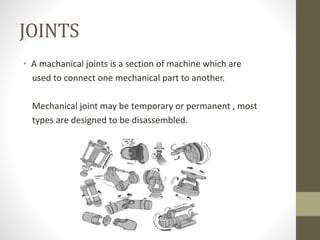
• A machanical joints is a section of machine which are
used to connect one mechanical part to another.
Mechanical joint may be temporary or permanent , most
types are designed to be disassembled.
TYPES OF JOINTS
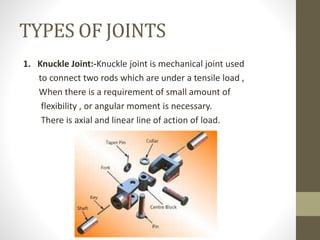
1. Knuckle Joint:-Knuckle joint is mechanical joint used
to connect two rods which are under a tensile load ,
When there is a requirement of small amount of
flexibility , or angular moment is necessary.
There is axial and linear line of action of load.
2. Cotter Joint:-This is used to connect rigidly two rods
which transmit motion in the axial direction,
without rotation. These joints may be subjected to
tensile or compressive forces along the axes of the rods.
Fasteners:-
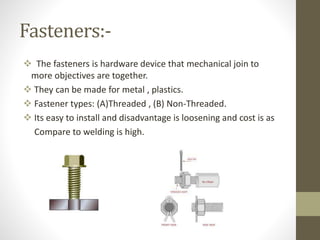
 The fasteners is hardware device that mechanical join to
more objectives are together.
 They can be made for metal , plastics.
 Fastener types: (A)Threaded , (B) Non-Threaded.
 Its easy to install and disadvantage is loosening and cost is as
Compare to welding is high.
SPRING
Springs is an elastic bodies ( generally metal)
that can be twisted , pulled , or stretched by
some force. They can returns to their original
shape when the force is released.
The mainly used material for manufacuring
the spring are as follows:-
(A)Strainless steel
(B)Copper or nickel based alloys
(C)Hard drawn high carbon steel
(D)oil tempered high carbon steel
Types of spring:-
 Generally there are two types of springs.
(A) Helical spring:-
(B) Leaf spring:-
CHOOSING CRITERIA OF
SPRING
When selecting a spring for an application, a design engineer
may be asked to specify the spring in a number of different
ways. Here are just a few:-
1.End type (open, squared, ground)
2.Number of nested spring
3.Minimum and maximum outside diameter
4.Diametrical clearance between nested springs
5. Minimum and maximum wire diameter
6.Minimum number of active coils
7.Maximum working strength
8.Spring force at working length and permissible variation
9.Spring constant and permissible variation
10.Material modulus
11.Spring displacement during work
12.Solid length factor, residual stress
SPRING MATERIALS
 The mainly used material for manufacturing the
springs are as follows:
1) Hard drawn high carbon steel 06) Inconel
2) Oil tempered high carbon steel 07) Monel
3) Stainless steel 08) Titanium
4) Copper or nickel based alloys 09) Chrome vanadium
5) Phosphor bronze 10) Chrome silicon
Helical spring:-
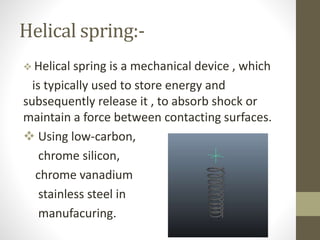
 Helical spring is a mechanical device , which
is typically used to store energy and
subsequently release it , to absorb shock or
maintain a force between contacting surfaces.
 Using
chrome silicon,
chrome vanadium
stainless steel in
manufacuring.
Leaf spring:-
 Some times it is also called as a semi-
elliptical spring , as it takes the form of a
slender arc shaped length of spring steel of
rectangular cross section.
The center of the arc provides the location
for the axle , while the tie holes are provided
at either end for attaching to the vehicle
body.
Material of Leaf spring:-
 Plain carbon steel ,Chromium vanadium steel, Chromium-
Nickel- Molybdenum steel, Silicon- manganese steel, are the
type of materials that are used in the design of leaf springs.
Bearing:-
 A bearing is a device to permit constrained
relative motion b/w two parts typically
rotation or linear movement.
 Bearing may be classified broadly according
to the motion they allow and according to
their principle of operation.
Function of bearing:-
 The main function of rotating shaft is to
transmit power from one end of the line to
the other.
It needs a good support to ensure stability
and frictionless rotation. The support for the
shaft is know as “Bearing”.
Types of bearing:-
 These are following types of bearing.
(A)Rolling contact bearing or Anti-friction bearing or
simply ball bearing:-
(1)Deep groove ball bearing
(2)Cylinder roller bearing
(3)Angular contact bearing
(4)Taper roller bearing
(5)Self aligning bearing
(B)Sliding contact bearing or Plain bearing or Journal bearing
or Sleeve bearing:-
(A)Hydrodynamic bearing
(B)Hydrostatic bearing
Rolling contact bearing:-
 A load is transfer though rolling elements
such as balls straight and tapered cylinders
and spherical rollers.
The designer must deal with such matter as
fatigue, friction, heat , lubrication etc.
Sliding bearing:-
 In these bearing load is transferred though a thin film of
lubricant coils (oils).
Uses:-
Roller Bearing…
1.Deep Groove Ball Bearing- 2.Cylindircal Roller Bearing
3.Angular Contact Bearing 4.Tapper Roller Bearing
Hydrodynamics bearing:-
 A journal bearing , in its simplest form is a cylinder bushing
made of a suitable material and containing property machine
inside and outside diameters. The journal is usually the part
of a shaft or pins that rotates inside the bearing.
 Its handle high load and velocity because metal to metal
contact is minimal due to the oil films.
 They are require large supply of lubrication oil.
Figure of hydrodynamics…
Hydrostatic bearing:-
 Hydrostatic bearings are externally pressurized fluid bearings,
where the fluid is usually oil, water or air, and the
pressurization is done by a pump.
Design of Keys:-
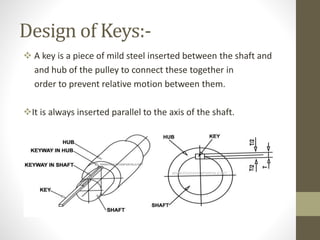
 A key is a piece of mild steel inserted between the shaft and
and hub of the pulley to connect these together in
order to prevent relative motion between them.
It is always inserted parallel to the axis of the shaft.
Types of keys:-
(1)Sunk keys-
(2)Saddle keys-
(3)Tangent keys-
(4)Round keys-
(5)Spines keys-
Sunk keys:-
 The sunk keys are provided, half in the keyway of the shaft
and half in the keyway of the hub of the pulley.
 These are the standard form of key used in practice and may
be either square or rectangular in cross-section.
 The end may be squared and rounded. Its used for duty ,as
the fit between the key and the shaft is positive.
Types of Sunk keys:-
 The sunk keys are provided half in the keyway of the shaft and half
in the keyway of hub or boss of the pulley.
 The sunk keys are following types:
1) Rectangular sunk key
2) Square sunk key
3) Parallel sunk key
4) Gib-head key
5) Feather key
6) Woodruff key
Rectangular Sunk Key Square Sunk key
 Gib-head key :- It is a rectangular sunk key with a head at one
end known as Gib-head. It is usually provided to facilitate the
removal of key.
Feather key :- A key attached to one member of pair and which
permits relative axial movement is known as Feather key.
 Woodruff key :- The woodruff key is an easily adjustable key .It
is a piece from a cylindrical disc having segmental cross- section as
shown in figure:
Saddle keys:-
 The saddle keys are of the following two types:
(A)Flat saddle keys-
(B) Hollow saddle keys-
1) Flat saddle key :- It is a taper key which fits in a keyway in the hub
and is flat on the shaft. It is likely to slip round the shaft under load.
Therefore, it is used for comparatively light loads.
2) A hollow saddle key :-It is a taper key which fits in a keyway in the
hub and the bottom of the key is shaped to fit the curved surface of
the shaft. Since hollow saddle keys hold on by friction, therefore,
these are suitable for light loads. It is usually used as a temporary
fastening in fixing and setting eccentrics, cams, etc.
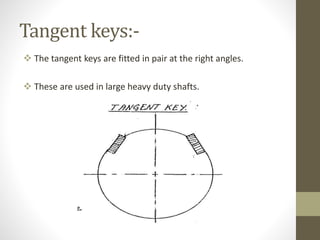
Tangent keys:-
 The tangent keys are fitted in pair at the right angles. Each key
is to withstand torsion in one direction only.
 These are used in large heavy duty shafts.
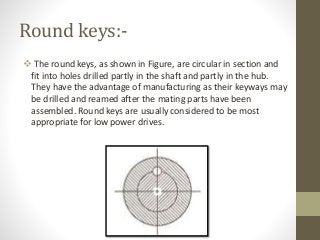
Round keys:-
 The round keys, as shown in Figure, are circular in section and
fit into holes drilled partly in the shaft and partly in the hub.
They have the advantage of manufacturing as their keyways may
be drilled and reamed after the mating parts have been
assembled. Round keys are usually considered to be most
appropriate for low power drives.
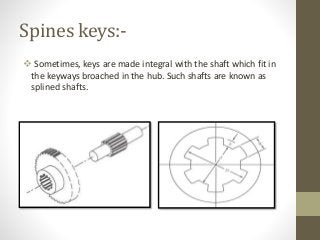
Spines keys:-
 Sometimes, keys are made integral with the shaft which fit in
the keyways broached in the hub. Such shafts are known as
splined shafts.
THANK YOU……

Machine design

  • 1.
  • 2.
    INTRODUCTION • Machine Designis the creation of new and better machines and improving the existing ones. • The idea is then studied keeping in mind its commercial success and given shape and form in the form of drawings.
  • 3.
    TOPIC OF MACHINEDESIGN 1.Types of joint (A)Knuckle joint (B)Cotter joint 2.Fastener 3.Springs 4.Bearing
  • 4.
    JOINTS • A machanicaljoints is a section of machine which are used to connect one mechanical part to another. Mechanical joint may be temporary or permanent , most types are designed to be disassembled.
  • 5.
    TYPES OF JOINTS 1.Knuckle Joint:-Knuckle joint is mechanical joint used to connect two rods which are under a tensile load , When there is a requirement of small amount of flexibility , or angular moment is necessary. There is axial and linear line of action of load.
  • 6.
    2. Cotter Joint:-Thisis used to connect rigidly two rods which transmit motion in the axial direction, without rotation. These joints may be subjected to tensile or compressive forces along the axes of the rods.
  • 7.
    Fasteners:-  The fastenersis hardware device that mechanical join to more objectives are together.  They can be made for metal , plastics.  Fastener types: (A)Threaded , (B) Non-Threaded.  Its easy to install and disadvantage is loosening and cost is as Compare to welding is high.
  • 8.
    SPRING Springs is anelastic bodies ( generally metal) that can be twisted , pulled , or stretched by some force. They can returns to their original shape when the force is released. The mainly used material for manufacuring the spring are as follows:- (A)Strainless steel (B)Copper or nickel based alloys (C)Hard drawn high carbon steel (D)oil tempered high carbon steel
  • 9.
    Types of spring:- Generally there are two types of springs. (A) Helical spring:- (B) Leaf spring:-
  • 10.
    CHOOSING CRITERIA OF SPRING Whenselecting a spring for an application, a design engineer may be asked to specify the spring in a number of different ways. Here are just a few:- 1.End type (open, squared, ground) 2.Number of nested spring 3.Minimum and maximum outside diameter 4.Diametrical clearance between nested springs 5. Minimum and maximum wire diameter 6.Minimum number of active coils 7.Maximum working strength 8.Spring force at working length and permissible variation 9.Spring constant and permissible variation 10.Material modulus 11.Spring displacement during work 12.Solid length factor, residual stress
  • 11.
    SPRING MATERIALS  Themainly used material for manufacturing the springs are as follows: 1) Hard drawn high carbon steel 06) Inconel 2) Oil tempered high carbon steel 07) Monel 3) Stainless steel 08) Titanium 4) Copper or nickel based alloys 09) Chrome vanadium 5) Phosphor bronze 10) Chrome silicon
  • 12.
    Helical spring:-  Helicalspring is a mechanical device , which is typically used to store energy and subsequently release it , to absorb shock or maintain a force between contacting surfaces.  Using chrome silicon, chrome vanadium stainless steel in manufacuring.
  • 13.
    Leaf spring:-  Sometimes it is also called as a semi- elliptical spring , as it takes the form of a slender arc shaped length of spring steel of rectangular cross section. The center of the arc provides the location for the axle , while the tie holes are provided at either end for attaching to the vehicle body.
  • 14.
    Material of Leafspring:-  Plain carbon steel ,Chromium vanadium steel, Chromium- Nickel- Molybdenum steel, Silicon- manganese steel, are the type of materials that are used in the design of leaf springs.
  • 15.
    Bearing:-  A bearingis a device to permit constrained relative motion b/w two parts typically rotation or linear movement.  Bearing may be classified broadly according to the motion they allow and according to their principle of operation.
  • 16.
    Function of bearing:- The main function of rotating shaft is to transmit power from one end of the line to the other. It needs a good support to ensure stability and frictionless rotation. The support for the shaft is know as “Bearing”.
  • 17.
    Types of bearing:- These are following types of bearing. (A)Rolling contact bearing or Anti-friction bearing or simply ball bearing:- (1)Deep groove ball bearing (2)Cylinder roller bearing (3)Angular contact bearing (4)Taper roller bearing (5)Self aligning bearing (B)Sliding contact bearing or Plain bearing or Journal bearing or Sleeve bearing:- (A)Hydrodynamic bearing (B)Hydrostatic bearing
  • 18.
    Rolling contact bearing:- A load is transfer though rolling elements such as balls straight and tapered cylinders and spherical rollers. The designer must deal with such matter as fatigue, friction, heat , lubrication etc.
  • 19.
    Sliding bearing:-  Inthese bearing load is transferred though a thin film of lubricant coils (oils). Uses:-
  • 20.
    Roller Bearing… 1.Deep GrooveBall Bearing- 2.Cylindircal Roller Bearing 3.Angular Contact Bearing 4.Tapper Roller Bearing
  • 21.
    Hydrodynamics bearing:-  Ajournal bearing , in its simplest form is a cylinder bushing made of a suitable material and containing property machine inside and outside diameters. The journal is usually the part of a shaft or pins that rotates inside the bearing.  Its handle high load and velocity because metal to metal contact is minimal due to the oil films.  They are require large supply of lubrication oil.
  • 22.
  • 23.
    Hydrostatic bearing:-  Hydrostaticbearings are externally pressurized fluid bearings, where the fluid is usually oil, water or air, and the pressurization is done by a pump.
  • 24.
    Design of Keys:- A key is a piece of mild steel inserted between the shaft and and hub of the pulley to connect these together in order to prevent relative motion between them. It is always inserted parallel to the axis of the shaft.
  • 25.
    Types of keys:- (1)Sunkkeys- (2)Saddle keys- (3)Tangent keys- (4)Round keys- (5)Spines keys-
  • 26.
    Sunk keys:-  Thesunk keys are provided, half in the keyway of the shaft and half in the keyway of the hub of the pulley.  These are the standard form of key used in practice and may be either square or rectangular in cross-section.  The end may be squared and rounded. Its used for duty ,as the fit between the key and the shaft is positive.
  • 27.
    Types of Sunkkeys:-  The sunk keys are provided half in the keyway of the shaft and half in the keyway of hub or boss of the pulley.  The sunk keys are following types: 1) Rectangular sunk key 2) Square sunk key 3) Parallel sunk key 4) Gib-head key 5) Feather key 6) Woodruff key
  • 29.
    Rectangular Sunk KeySquare Sunk key
  • 30.
     Gib-head key:- It is a rectangular sunk key with a head at one end known as Gib-head. It is usually provided to facilitate the removal of key.
  • 31.
    Feather key :-A key attached to one member of pair and which permits relative axial movement is known as Feather key.
  • 32.
     Woodruff key:- The woodruff key is an easily adjustable key .It is a piece from a cylindrical disc having segmental cross- section as shown in figure:
  • 33.
    Saddle keys:-  Thesaddle keys are of the following two types: (A)Flat saddle keys- (B) Hollow saddle keys-
  • 34.
    1) Flat saddlekey :- It is a taper key which fits in a keyway in the hub and is flat on the shaft. It is likely to slip round the shaft under load. Therefore, it is used for comparatively light loads. 2) A hollow saddle key :-It is a taper key which fits in a keyway in the hub and the bottom of the key is shaped to fit the curved surface of the shaft. Since hollow saddle keys hold on by friction, therefore, these are suitable for light loads. It is usually used as a temporary fastening in fixing and setting eccentrics, cams, etc.
  • 35.
    Tangent keys:-  Thetangent keys are fitted in pair at the right angles. Each key is to withstand torsion in one direction only.  These are used in large heavy duty shafts.
  • 36.
    Round keys:-  Theround keys, as shown in Figure, are circular in section and fit into holes drilled partly in the shaft and partly in the hub. They have the advantage of manufacturing as their keyways may be drilled and reamed after the mating parts have been assembled. Round keys are usually considered to be most appropriate for low power drives.
  • 37.
    Spines keys:-  Sometimes,keys are made integral with the shaft which fit in the keyways broached in the hub. Such shafts are known as splined shafts.
  • 38.