Project Integration
Management

By: Inam Ullah
Institute of Information Technology
Quaid-i-Azam University Islamabad
Pakistan

1
Learning Objectives
• Describe an overall framework for project integration management as
it relates to the other project management knowledge areas and the
project life cycle
• Describe project plan development, including project plan
content, using guidelines and templates for developing plans, and
performing a stakeholder analysis to help manage relationships
• Explain project plan execution, its relationship to project planning, the
factors related to successful results, and tools and techniques to assist
in project plan execution
• Understand the integrated change control process, planning for and
managing changes on information technology projects, and
developing and using a change control system
• Describe how software can assist in project integration management

2
The Key to Overall Project Success:
Good Project Integration Management
• Project managers must coordinate all of the other knowledge
areas throughout a project’s life cycle
• Many new project managers have trouble looking at the “big
picture” and want to focus on too many details
• Project integration management is not the same thing as
software integration

3
Project Integration Management
Processes
• Project Plan Development: taking the results of other
planning processes and putting them into a
consistent, coherent document—the project plan
• Project Plan Execution: carrying out the project plan
• Integrated Change Control: coordinating changes across the
entire project

4
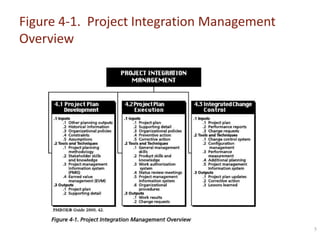
Figure 4-1. Project Integration Management
Overview

5
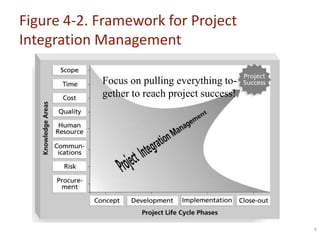
Figure 4-2. Framework for Project
Integration Management
Focus on pulling everything together to reach project success!

6
Project Plan Development
• A project plan is a document used to coordinate all project
planning documents
• Its main purpose is to guide project execution
• Project plans assist the project manager in leading the project
team and assessing project status
• Project performance should be measured against a baseline
plan

7
What Is done during
Project Plan Development…
•
•
•
•
•
•
•
•
•
•
•

Determine Project Management Methodology
Work through Iterations
Meet Resource Managers to get Best Resources
Apply Risk Reserves to Schedule and Budget
Analyze the Skills/Knowledge of Stakeholders
Meet Stakeholders to identify their roles on the project
Other projects impact on your project
Agree on Reporting Formats and Communication Plans
Team Members Buy-in of PM Plan
Hold meetings with Sponsor What cant be done
Crash , Fast Track and Present Options

8
Life During the Planning

Signoffs, Interactions, Negotiations, Compressing, Juggling, beggin
g , crying

9
Attributes of Project Plans
Just as projects are unique, so are project plans
• Plans should be dynamic
• Plans should be flexible
• Plans should be updated as changes occur
• Plans should first and foremost guide project execution
• Realistic
• Buy-in from all stake holder

10
Common Elements of a Project Plan
•
•
•
•

Introduction or overview of the project
Description of how the project is organized
Management and technical processes used on the project
Work to be done, schedule, and budget information

11
What the Winners Do
"The winners clearly spell out what needs to be done in a
project, by whom, when, and how. For this they use an
integrated toolbox, including PM tools, methods, and
techniques…If a scheduling template is developed and
used over and over, it becomes a repeatable action that
leads to higher productivity and lower uncertainty.
Sure, using scheduling templates is neither a
breakthrough nor a feat. But laggards exhibited almost
no use of the templates. Rather, in constructing
schedules their project managers started with a clean
sheet, a clear waste of time." *
12
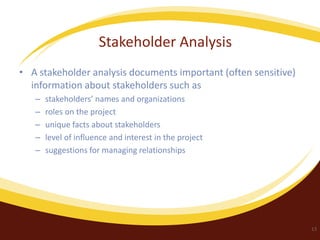
Stakeholder Analysis
• A stakeholder analysis documents important (often sensitive)
information about stakeholders such as
–
–
–
–
–

stakeholders’ names and organizations
roles on the project
unique facts about stakeholders
level of influence and interest in the project
suggestions for managing relationships

13
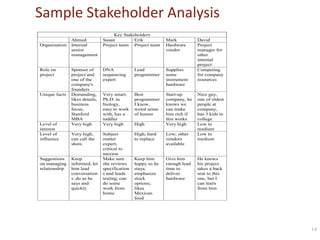
Sample Stakeholder Analysis
Organization

Role on
project

Unique facts

Level of
interest
Level of
influence

Suggestions
on managing
relationship

Ahmed
Internal
senior
management

Key Stakeholders
Susan
Erik
Project team Project team

Mark
Hardware
vendor

Sponsor of
project and
one of the
company's
founders
Demanding,
likes details,
business
focus,
Stanford
MBA
Very high

DNA
sequencing
expert

Lead
programmer

Supplies
some
instrument
hardware

Very smart,
Ph.D. in
biology,
easy to work
with, has a
toddler
Very high

Best
programmer
I know,
weird sense
of humor

Start-up
company, he
knows we
can make
him rich if
this works
Very high

Very high;
can call the
shots

Subject
matter
expert;
critical to
success
Make sure
she reviews
specification
s and leads
testing; can
do some
work from
home

High; hard
to replace

Low; other
vendors
available

Keep him
happy so he
stays;
emphasize
stock
options;
likes
Mexican
food

Give him
enough lead
time to
deliver
hardware

Keep
informed, let
him lead
conversation
s ,do as he
says and
quickly

High

David
Project
manager for
other
internal
project
Competing
for company
resources

Nice guy,
one of oldest
people at
company,
has 3 kids in
college
Low to
medium
Low to
medium

He knows
his project
takes a back
seat to this
one, but I
can learn
from him

14
Project Plan Execution
• Project plan execution involves managing and performing the
work described in the project plan
• The majority of time and money is usually spent on execution
• The application area of the project directly affects project
execution because the products of the project are produced
during execution

15
What Went Wrong?
• Many people have a poor view of plans based on past experiences. Senior
managers often require a plan, but then no one follows up on whether the
plan was followed.
• For example, one project manager said he would meet with each project
team leader within two months to review their plans. The project manager
created a detailed schedule for these reviews. He cancelled the first meeting
due to another business commitment. He rescheduled the next meeting for
unexplained personal reasons. Two months later, the project manager had
still not met with over half of the project team leaders.
• Why should project members feel obligated to follow their own plans when
the project manager obviously did not follow his?

16
Important Skills for Project Execution
• General management skills like
leadership, communication, and political skills
• Product skills and knowledge
• Use of specialized tools and techniques

17
Tools and Techniques for
Project Execution
• Work Authorization System: a method for ensuring that
qualified people do work at the right time and in the proper
sequence
• Status Review Meetings: regularly scheduled meetings used
to exchange project information
• Project Management Software: special software to assist in
managing projects

18
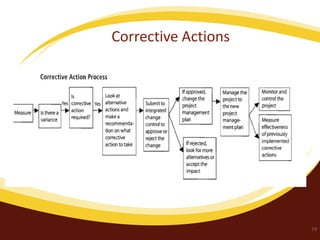
Corrective Actions

19
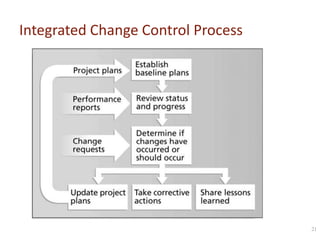
Integrated Change Control
• Integrated change control involves identifying, evaluating, and
managing changes throughout the project life cycle (Note: 1996
PMBOK called this process “overall change control”)
• Three main objectives of change control:

– Influence the factors that create changes to
ensure they are beneficial
– Determine that a change has occurred
– Manage actual changes when and as they
occur

20
Integrated Change Control Process

21
Change Control in
Information Technology Projects
• Former view: The project team should strive to do exactly what was
planned on time and within budget
• Problem: Stakeholders rarely agreed up-front on the project scope,
and time and cost estimates were inaccurate
• Modern view: Project management is a process of constant
communication and negotiation
• Solution: Changes are often beneficial, and the project team should
plan for them

22
Change Control System
• A formal, documented process that describes when and how
official project documents and work may be changed
• Describes who is authorized to make changes and how to
make them
• Often includes a change control board (CCB), configuration
management, and a process for communicating changes

23
Change Control Boards (CCBs)
• A formal group of people responsible for approving or
rejecting changes on a project
• CCBs provide guidelines for preparing change
requests, evaluate change requests, and manage the
implementation of approved changes
• Includes stakeholders from the entire organization

24
Making Timely Changes
• Some CCBs only meet occasionally, so it may take too long for
changes to occur
• Some organizations have policies in place for time-sensitive
changes
– “48-hour policy” allows project team members to make
decisions, then they have 48 hours to reverse the decision pending
senior management approval
– Delegate changes to the lowest level possible, but keep everyone
informed of changes

25
Configuration Management
• Ensures that the products and their descriptions are
correct and complete
• Concentrates on the management of technology by
identifying and controlling the functional and physical
design characteristics of products
• Configuration management specialists identify and
document configuration requirements, control
changes, record and report changes, and audit the
products to verify conformance to requirements

26
Suggestions for Managing
Integrated Change Control
View project management as a process of constant communications and
negotiations
Plan for change
Establish a formal change control system, including a Change Control Board
(CCB)
Use good configuration management
Define procedures for making timely decisions on smaller changes
Use written and oral performance reports to help identify and manage change
Use project management and other software to help manage and
communicate changes

27
Using Software to Assist in
Project Integration Management
• Several types of software can be used to assist in project
integration management
–
–
–
–

Documents can be created with word processing software
Presentations are created with presentation software
Tracking can be done with spreadsheets or databases
Communication software like e-mail and Web authoring tools facilitate
communications
– Project management software can pull everything together and show
detailed and summarized information (see Appendix A for details)

28
Thank You !

29

Integrated Project Management

  • 1.
    Project Integration Management By: InamUllah Institute of Information Technology Quaid-i-Azam University Islamabad Pakistan 1
  • 2.
    Learning Objectives • Describean overall framework for project integration management as it relates to the other project management knowledge areas and the project life cycle • Describe project plan development, including project plan content, using guidelines and templates for developing plans, and performing a stakeholder analysis to help manage relationships • Explain project plan execution, its relationship to project planning, the factors related to successful results, and tools and techniques to assist in project plan execution • Understand the integrated change control process, planning for and managing changes on information technology projects, and developing and using a change control system • Describe how software can assist in project integration management 2
  • 3.
    The Key toOverall Project Success: Good Project Integration Management • Project managers must coordinate all of the other knowledge areas throughout a project’s life cycle • Many new project managers have trouble looking at the “big picture” and want to focus on too many details • Project integration management is not the same thing as software integration 3
  • 4.
    Project Integration Management Processes •Project Plan Development: taking the results of other planning processes and putting them into a consistent, coherent document—the project plan • Project Plan Execution: carrying out the project plan • Integrated Change Control: coordinating changes across the entire project 4
  • 5.
    Figure 4-1. ProjectIntegration Management Overview 5
  • 6.
    Figure 4-2. Frameworkfor Project Integration Management Focus on pulling everything together to reach project success! 6
  • 7.
    Project Plan Development •A project plan is a document used to coordinate all project planning documents • Its main purpose is to guide project execution • Project plans assist the project manager in leading the project team and assessing project status • Project performance should be measured against a baseline plan 7
  • 8.
    What Is doneduring Project Plan Development… • • • • • • • • • • • Determine Project Management Methodology Work through Iterations Meet Resource Managers to get Best Resources Apply Risk Reserves to Schedule and Budget Analyze the Skills/Knowledge of Stakeholders Meet Stakeholders to identify their roles on the project Other projects impact on your project Agree on Reporting Formats and Communication Plans Team Members Buy-in of PM Plan Hold meetings with Sponsor What cant be done Crash , Fast Track and Present Options 8
  • 9.
    Life During thePlanning Signoffs, Interactions, Negotiations, Compressing, Juggling, beggin g , crying 9
  • 10.
    Attributes of ProjectPlans Just as projects are unique, so are project plans • Plans should be dynamic • Plans should be flexible • Plans should be updated as changes occur • Plans should first and foremost guide project execution • Realistic • Buy-in from all stake holder 10
  • 11.
    Common Elements ofa Project Plan • • • • Introduction or overview of the project Description of how the project is organized Management and technical processes used on the project Work to be done, schedule, and budget information 11
  • 12.
    What the WinnersDo "The winners clearly spell out what needs to be done in a project, by whom, when, and how. For this they use an integrated toolbox, including PM tools, methods, and techniques…If a scheduling template is developed and used over and over, it becomes a repeatable action that leads to higher productivity and lower uncertainty. Sure, using scheduling templates is neither a breakthrough nor a feat. But laggards exhibited almost no use of the templates. Rather, in constructing schedules their project managers started with a clean sheet, a clear waste of time." * 12
  • 13.
    Stakeholder Analysis • Astakeholder analysis documents important (often sensitive) information about stakeholders such as – – – – – stakeholders’ names and organizations roles on the project unique facts about stakeholders level of influence and interest in the project suggestions for managing relationships 13
  • 14.
    Sample Stakeholder Analysis Organization Roleon project Unique facts Level of interest Level of influence Suggestions on managing relationship Ahmed Internal senior management Key Stakeholders Susan Erik Project team Project team Mark Hardware vendor Sponsor of project and one of the company's founders Demanding, likes details, business focus, Stanford MBA Very high DNA sequencing expert Lead programmer Supplies some instrument hardware Very smart, Ph.D. in biology, easy to work with, has a toddler Very high Best programmer I know, weird sense of humor Start-up company, he knows we can make him rich if this works Very high Very high; can call the shots Subject matter expert; critical to success Make sure she reviews specification s and leads testing; can do some work from home High; hard to replace Low; other vendors available Keep him happy so he stays; emphasize stock options; likes Mexican food Give him enough lead time to deliver hardware Keep informed, let him lead conversation s ,do as he says and quickly High David Project manager for other internal project Competing for company resources Nice guy, one of oldest people at company, has 3 kids in college Low to medium Low to medium He knows his project takes a back seat to this one, but I can learn from him 14
  • 15.
    Project Plan Execution •Project plan execution involves managing and performing the work described in the project plan • The majority of time and money is usually spent on execution • The application area of the project directly affects project execution because the products of the project are produced during execution 15
  • 16.
    What Went Wrong? •Many people have a poor view of plans based on past experiences. Senior managers often require a plan, but then no one follows up on whether the plan was followed. • For example, one project manager said he would meet with each project team leader within two months to review their plans. The project manager created a detailed schedule for these reviews. He cancelled the first meeting due to another business commitment. He rescheduled the next meeting for unexplained personal reasons. Two months later, the project manager had still not met with over half of the project team leaders. • Why should project members feel obligated to follow their own plans when the project manager obviously did not follow his? 16
  • 17.
    Important Skills forProject Execution • General management skills like leadership, communication, and political skills • Product skills and knowledge • Use of specialized tools and techniques 17
  • 18.
    Tools and Techniquesfor Project Execution • Work Authorization System: a method for ensuring that qualified people do work at the right time and in the proper sequence • Status Review Meetings: regularly scheduled meetings used to exchange project information • Project Management Software: special software to assist in managing projects 18
  • 19.
  • 20.
    Integrated Change Control •Integrated change control involves identifying, evaluating, and managing changes throughout the project life cycle (Note: 1996 PMBOK called this process “overall change control”) • Three main objectives of change control: – Influence the factors that create changes to ensure they are beneficial – Determine that a change has occurred – Manage actual changes when and as they occur 20
  • 21.
  • 22.
    Change Control in InformationTechnology Projects • Former view: The project team should strive to do exactly what was planned on time and within budget • Problem: Stakeholders rarely agreed up-front on the project scope, and time and cost estimates were inaccurate • Modern view: Project management is a process of constant communication and negotiation • Solution: Changes are often beneficial, and the project team should plan for them 22
  • 23.
    Change Control System •A formal, documented process that describes when and how official project documents and work may be changed • Describes who is authorized to make changes and how to make them • Often includes a change control board (CCB), configuration management, and a process for communicating changes 23
  • 24.
    Change Control Boards(CCBs) • A formal group of people responsible for approving or rejecting changes on a project • CCBs provide guidelines for preparing change requests, evaluate change requests, and manage the implementation of approved changes • Includes stakeholders from the entire organization 24
  • 25.
    Making Timely Changes •Some CCBs only meet occasionally, so it may take too long for changes to occur • Some organizations have policies in place for time-sensitive changes – “48-hour policy” allows project team members to make decisions, then they have 48 hours to reverse the decision pending senior management approval – Delegate changes to the lowest level possible, but keep everyone informed of changes 25
  • 26.
    Configuration Management • Ensuresthat the products and their descriptions are correct and complete • Concentrates on the management of technology by identifying and controlling the functional and physical design characteristics of products • Configuration management specialists identify and document configuration requirements, control changes, record and report changes, and audit the products to verify conformance to requirements 26
  • 27.
    Suggestions for Managing IntegratedChange Control View project management as a process of constant communications and negotiations Plan for change Establish a formal change control system, including a Change Control Board (CCB) Use good configuration management Define procedures for making timely decisions on smaller changes Use written and oral performance reports to help identify and manage change Use project management and other software to help manage and communicate changes 27
  • 28.
    Using Software toAssist in Project Integration Management • Several types of software can be used to assist in project integration management – – – – Documents can be created with word processing software Presentations are created with presentation software Tracking can be done with spreadsheets or databases Communication software like e-mail and Web authoring tools facilitate communications – Project management software can pull everything together and show detailed and summarized information (see Appendix A for details) 28
  • 29.