Atmospheric Motion
ENVI 1400: Lecture 3
ENVI1400 : Meteorology and Forecasting : lecture 3 2
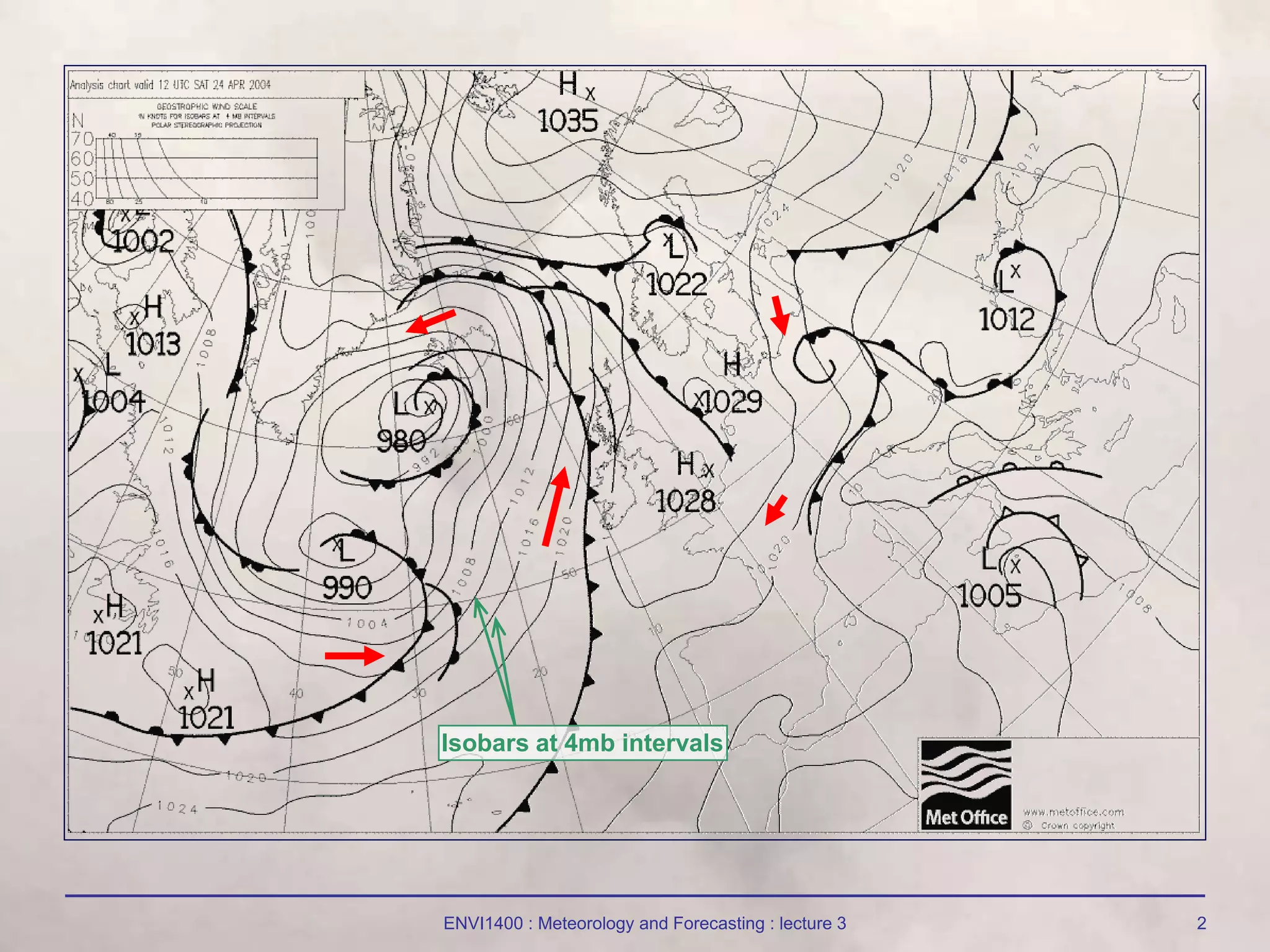
Isobars at 4mb intervals
ENVI1400 : Meteorology and Forecasting : lecture 3 3
The PressureGradient Force
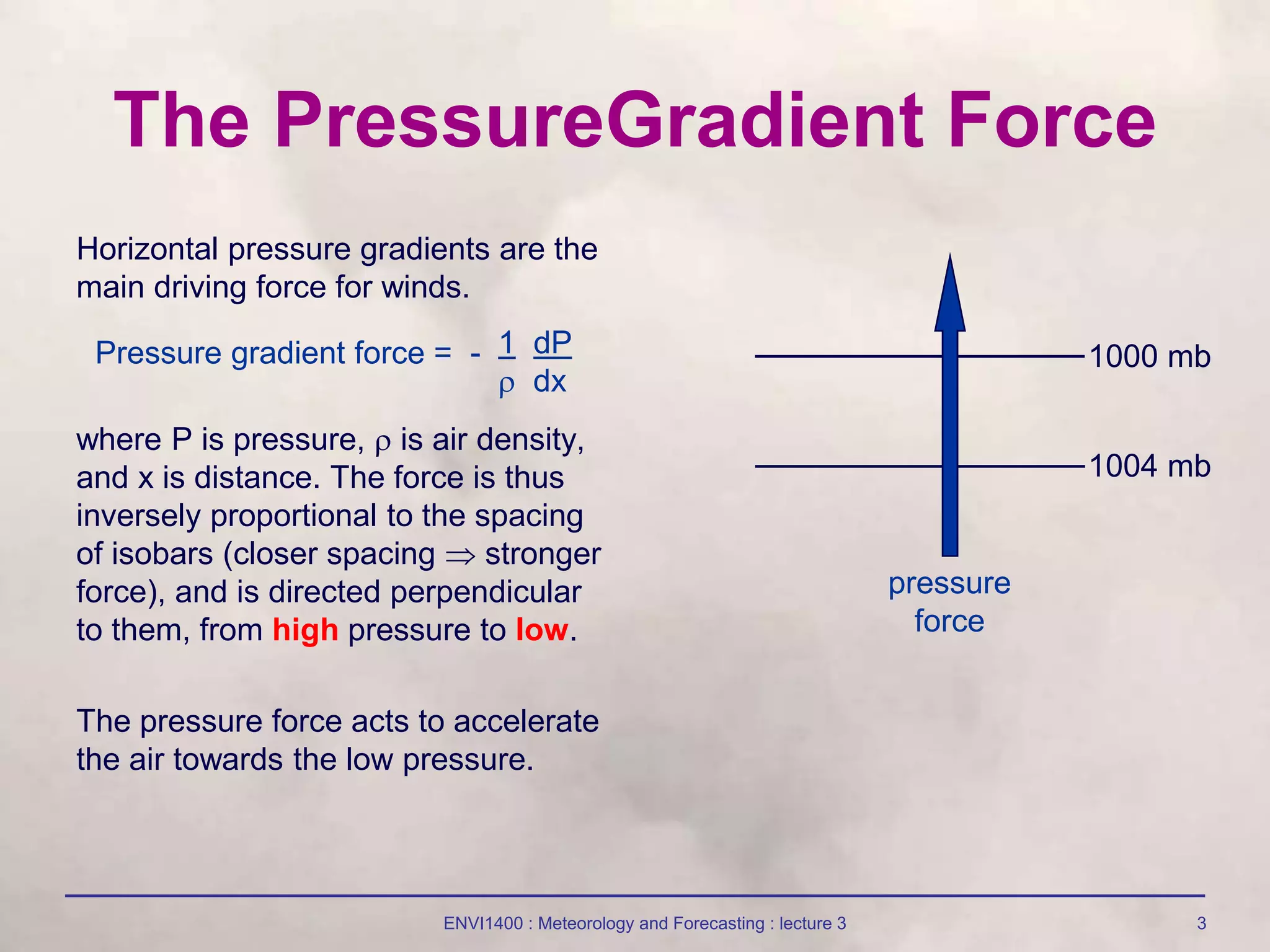
Horizontal pressure gradients are the
main driving force for winds.
where P is pressure,  is air density,
and x is distance. The force is thus
inversely proportional to the spacing
of isobars (closer spacing  stronger
force), and is directed perpendicular
to them, from high pressure to low.
The pressure force acts to accelerate
the air towards the low pressure.
Pressure gradient force = - 1 dP
 dx
1000 mb
1004 mb
pressure
force
ENVI1400 : Meteorology and Forecasting : lecture 3 4
The Coriolis Force
ENVI1400 : Meteorology and Forecasting : lecture 3 5
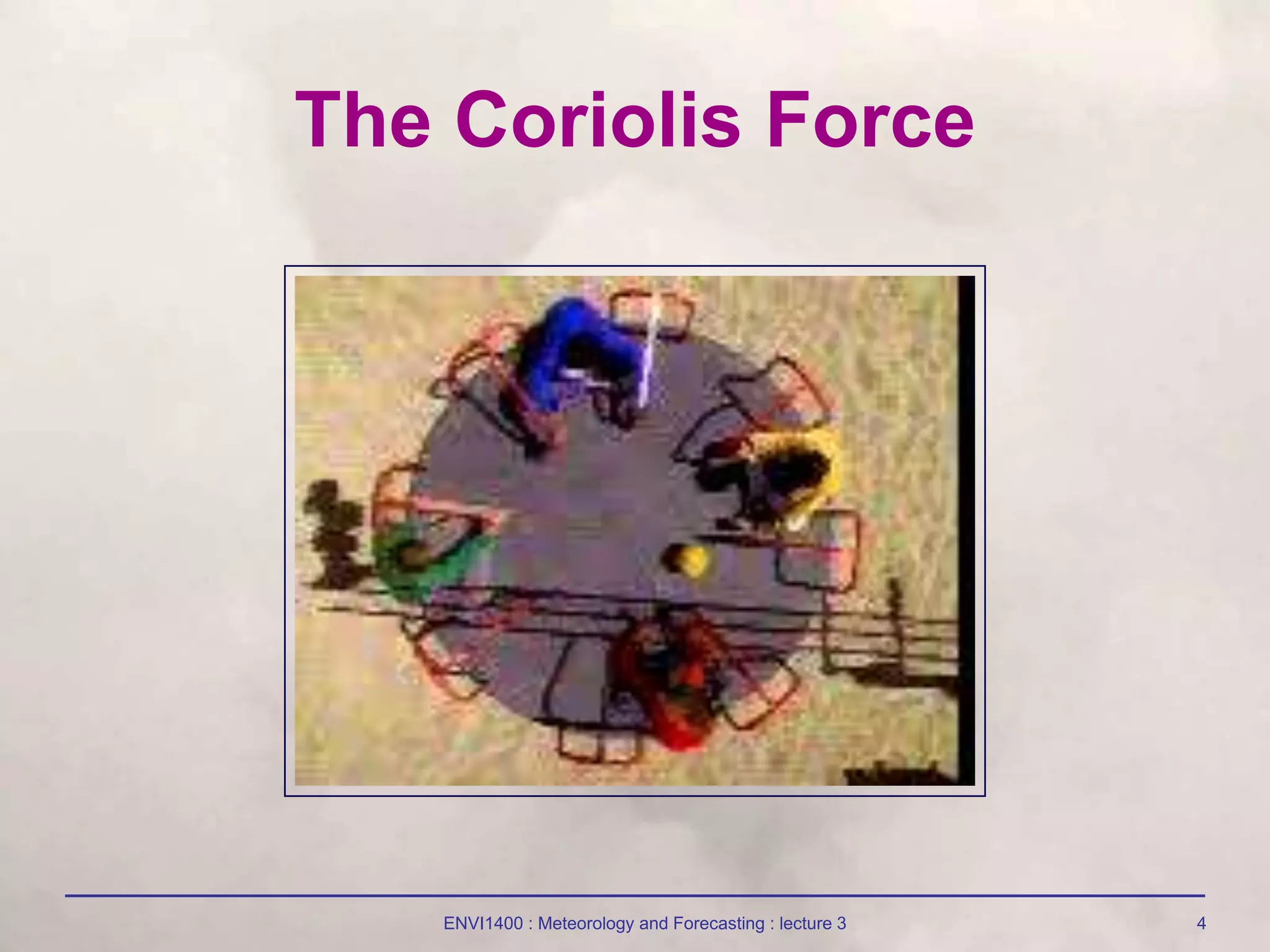
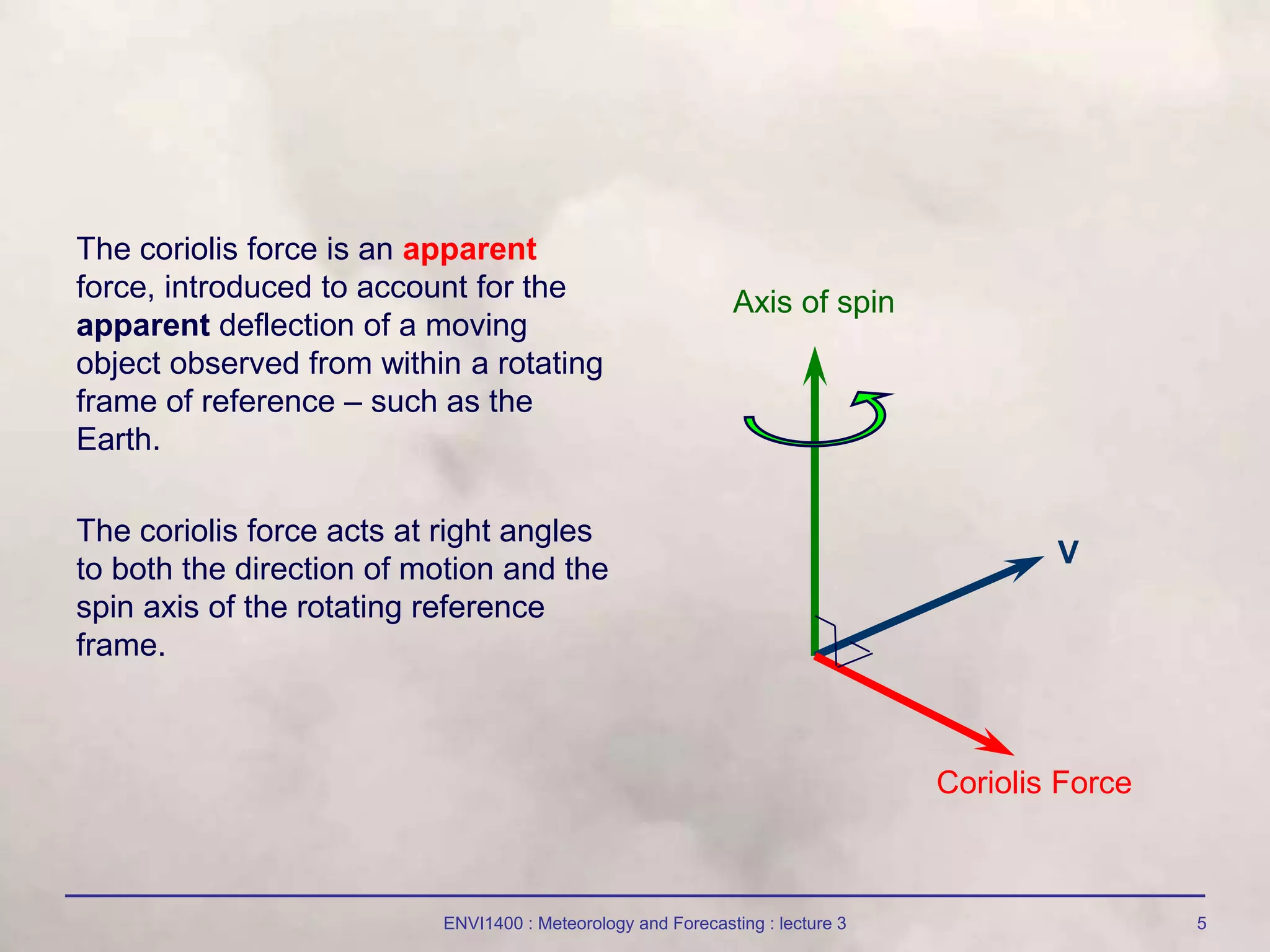
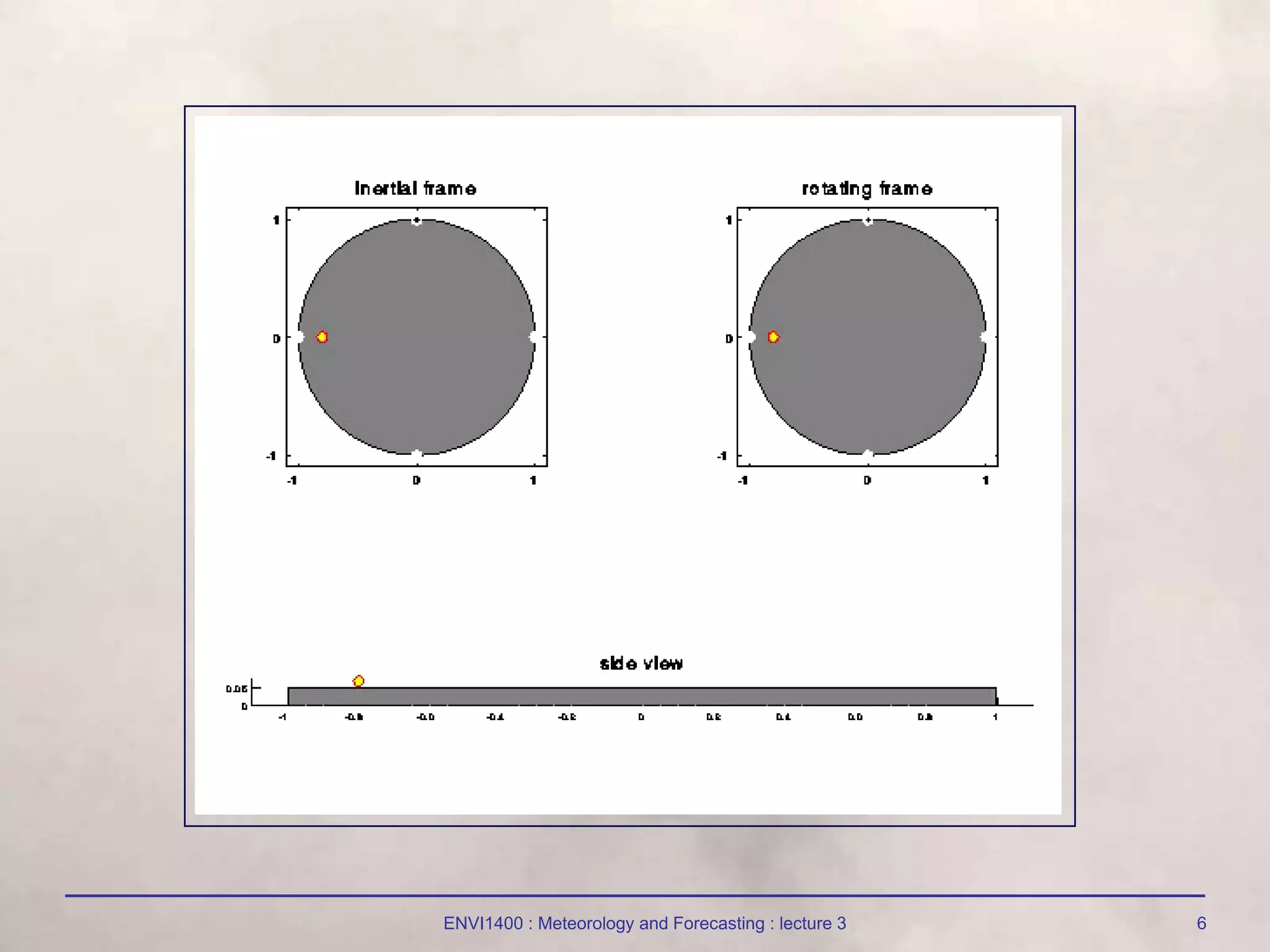
The coriolis force is an apparent
force, introduced to account for the
apparent deflection of a moving
object observed from within a rotating
frame of reference – such as the
Earth.
The coriolis force acts at right angles
to both the direction of motion and the
spin axis of the rotating reference
frame.
V
Coriolis Force
Axis of spin
ENVI1400 : Meteorology and Forecasting : lecture 3 6
ENVI1400 : Meteorology and Forecasting : lecture 3 7
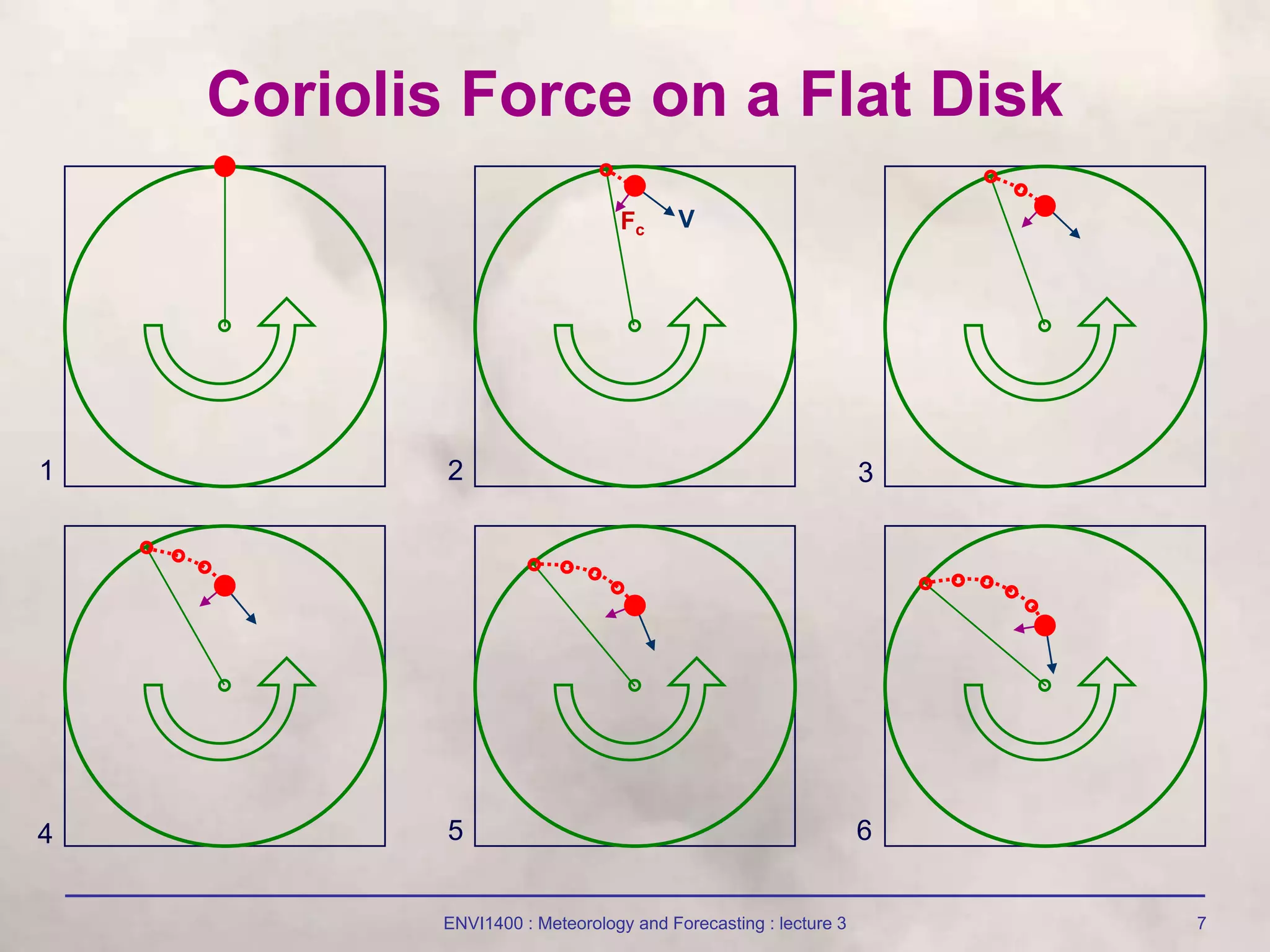
V
Fc
1 2 3
4 5 6
Coriolis Force on a Flat Disk
ENVI1400 : Meteorology and Forecasting : lecture 3 8
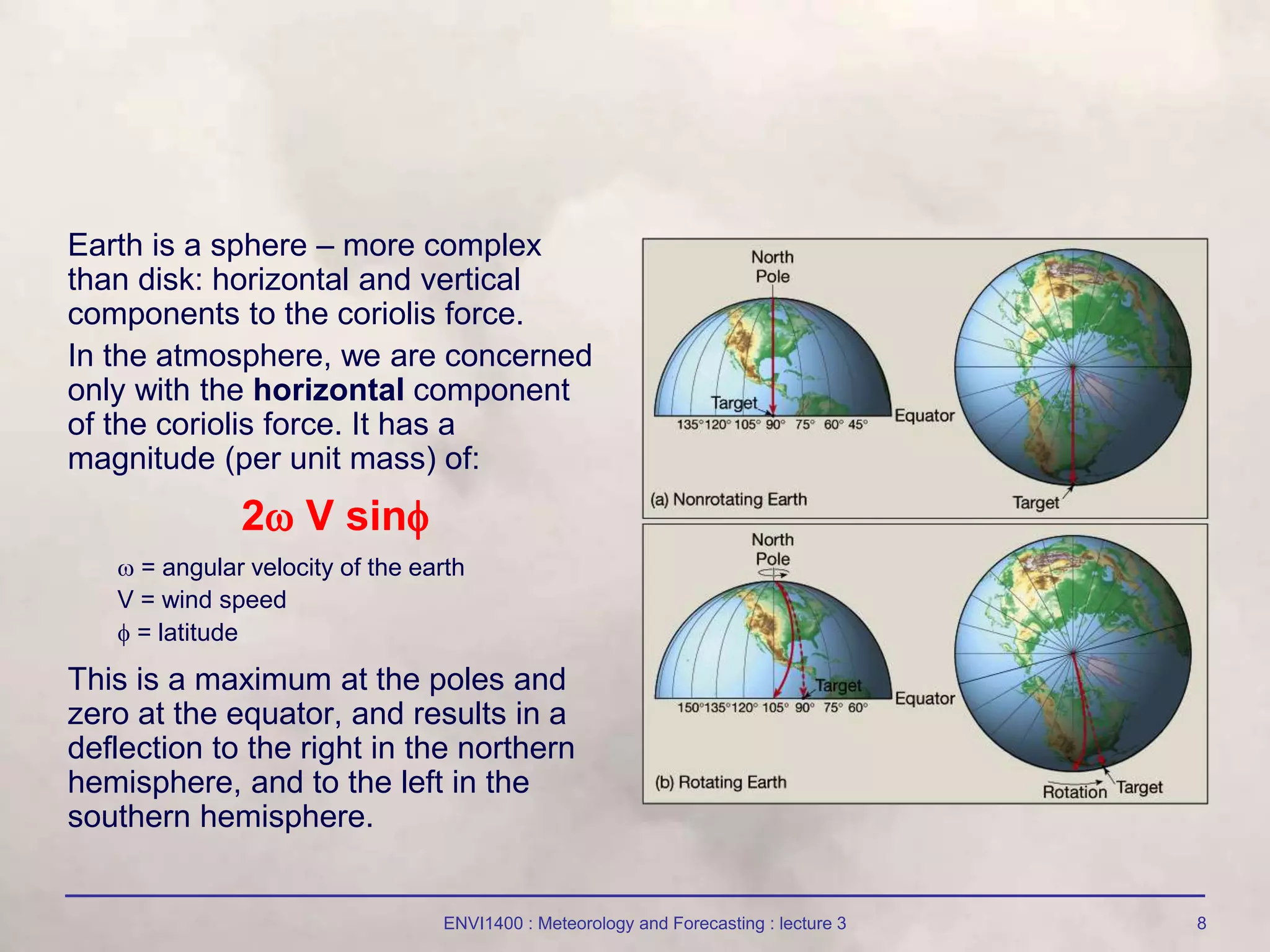
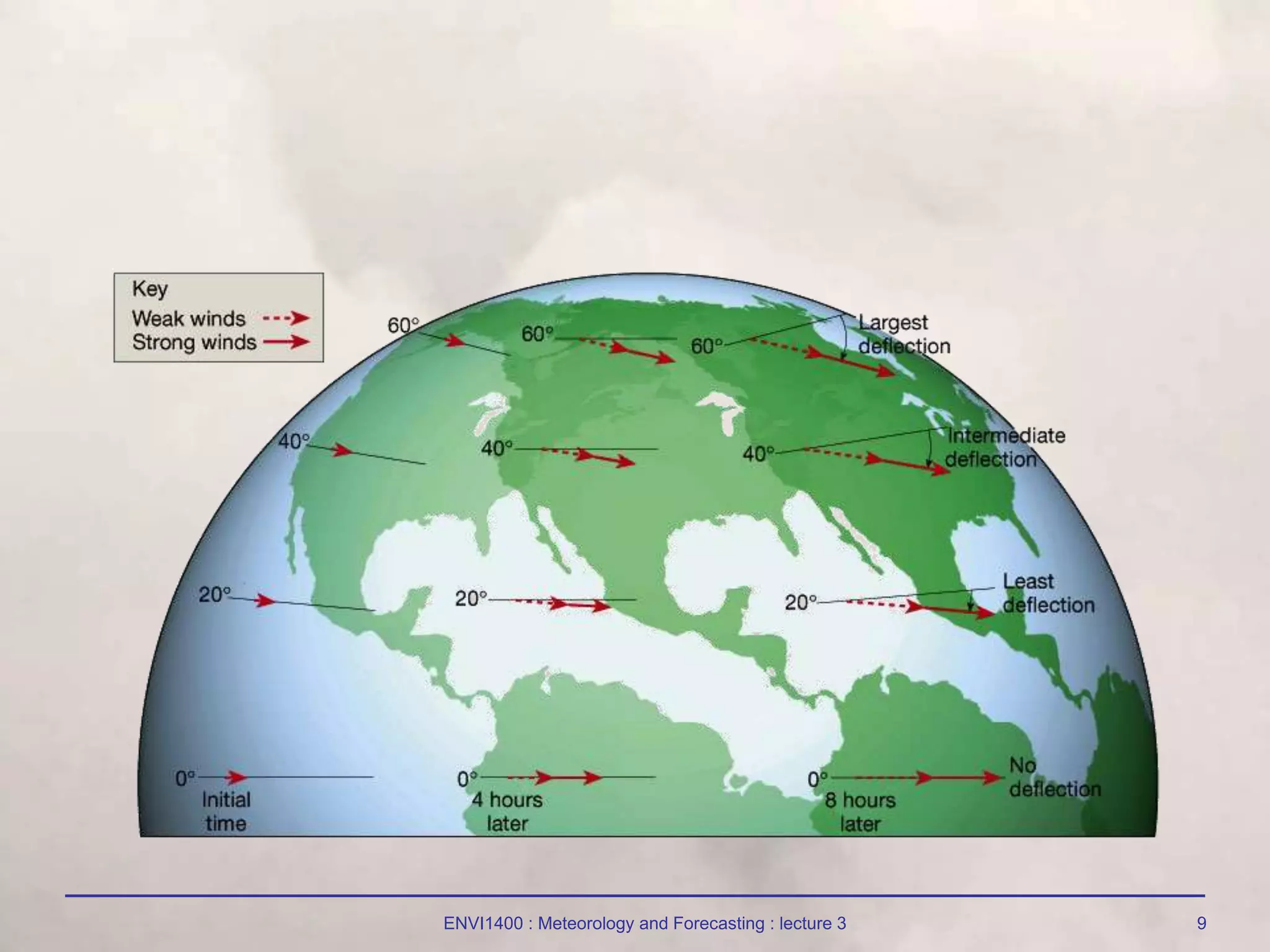
Earth is a sphere – more complex
than disk: horizontal and vertical
components to the coriolis force.
In the atmosphere, we are concerned
only with the horizontal component
of the coriolis force. It has a
magnitude (per unit mass) of:
2 V sin
 = angular velocity of the earth
V = wind speed
 = latitude
This is a maximum at the poles and
zero at the equator, and results in a
deflection to the right in the northern
hemisphere, and to the left in the
southern hemisphere.
ENVI1400 : Meteorology and Forecasting : lecture 3 9
ENVI1400 : Meteorology and Forecasting : lecture 3 10
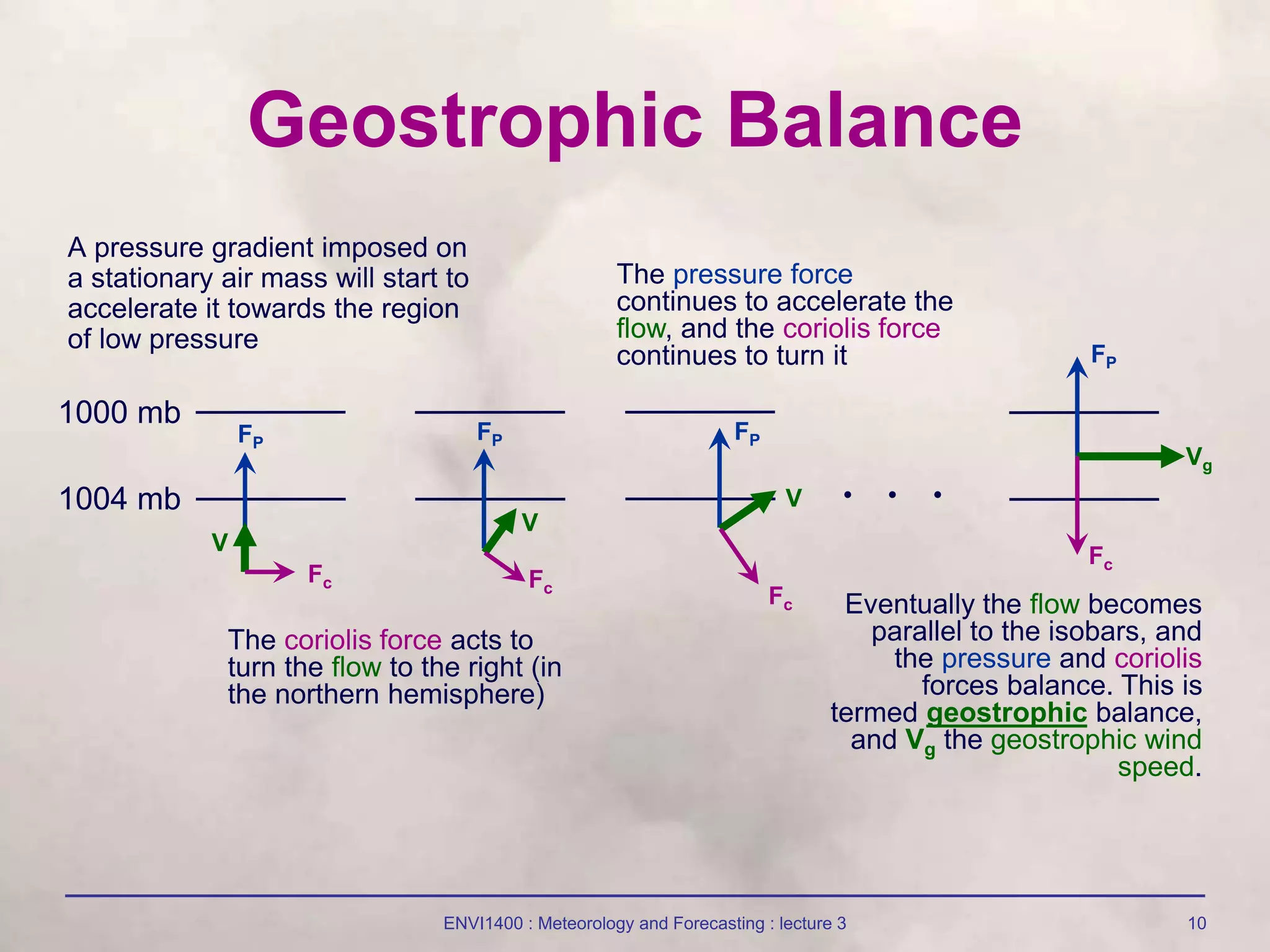
Geostrophic Balance
A pressure gradient imposed on
a stationary air mass will start to
accelerate it towards the region
of low pressure
1000 mb
1004 mb
V
FP
Fc
V
FP
Fc
V
FP
Fc
Vg
FP
Fc
The coriolis force acts to
turn the flow to the right (in
the northern hemisphere)
The pressure force
continues to accelerate the
flow, and the coriolis force
continues to turn it
Eventually the flow becomes
parallel to the isobars, and
the pressure and coriolis
forces balance. This is
termed geostrophic balance,
and Vg the geostrophic wind
speed.
ENVI1400 : Meteorology and Forecasting : lecture 3 11
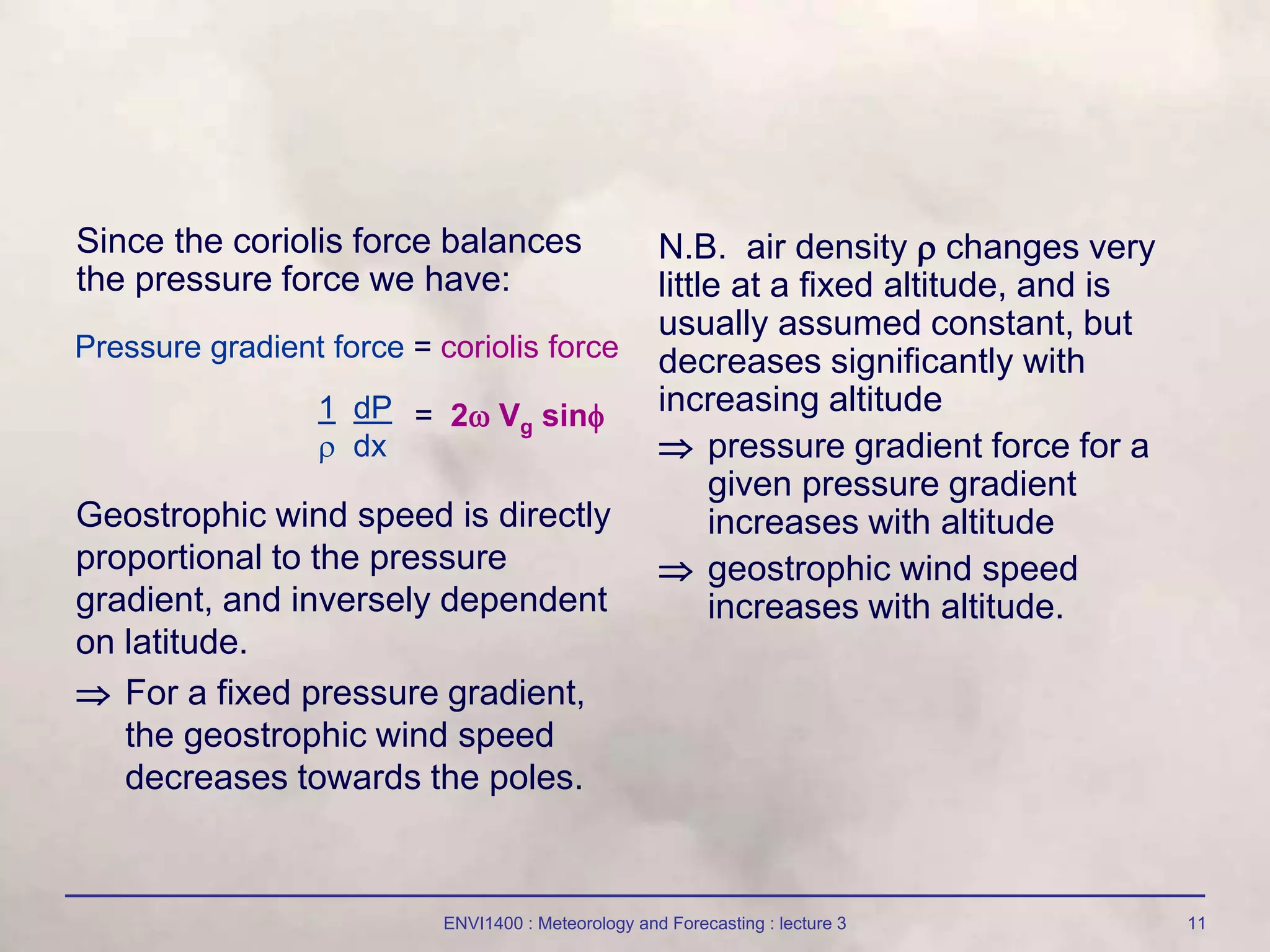
Since the coriolis force balances
the pressure force we have:
N.B. air density  changes very
little at a fixed altitude, and is
usually assumed constant, but
decreases significantly with
increasing altitude
 pressure gradient force for a
given pressure gradient
increases with altitude
 geostrophic wind speed
increases with altitude.
Pressure gradient force = coriolis force
1 dP
 dx
= 2 Vg sin
Geostrophic wind speed is directly
proportional to the pressure
gradient, and inversely dependent
on latitude.
 For a fixed pressure gradient,
the geostrophic wind speed
decreases towards the poles.
ENVI1400 : Meteorology and Forecasting : lecture 3 12
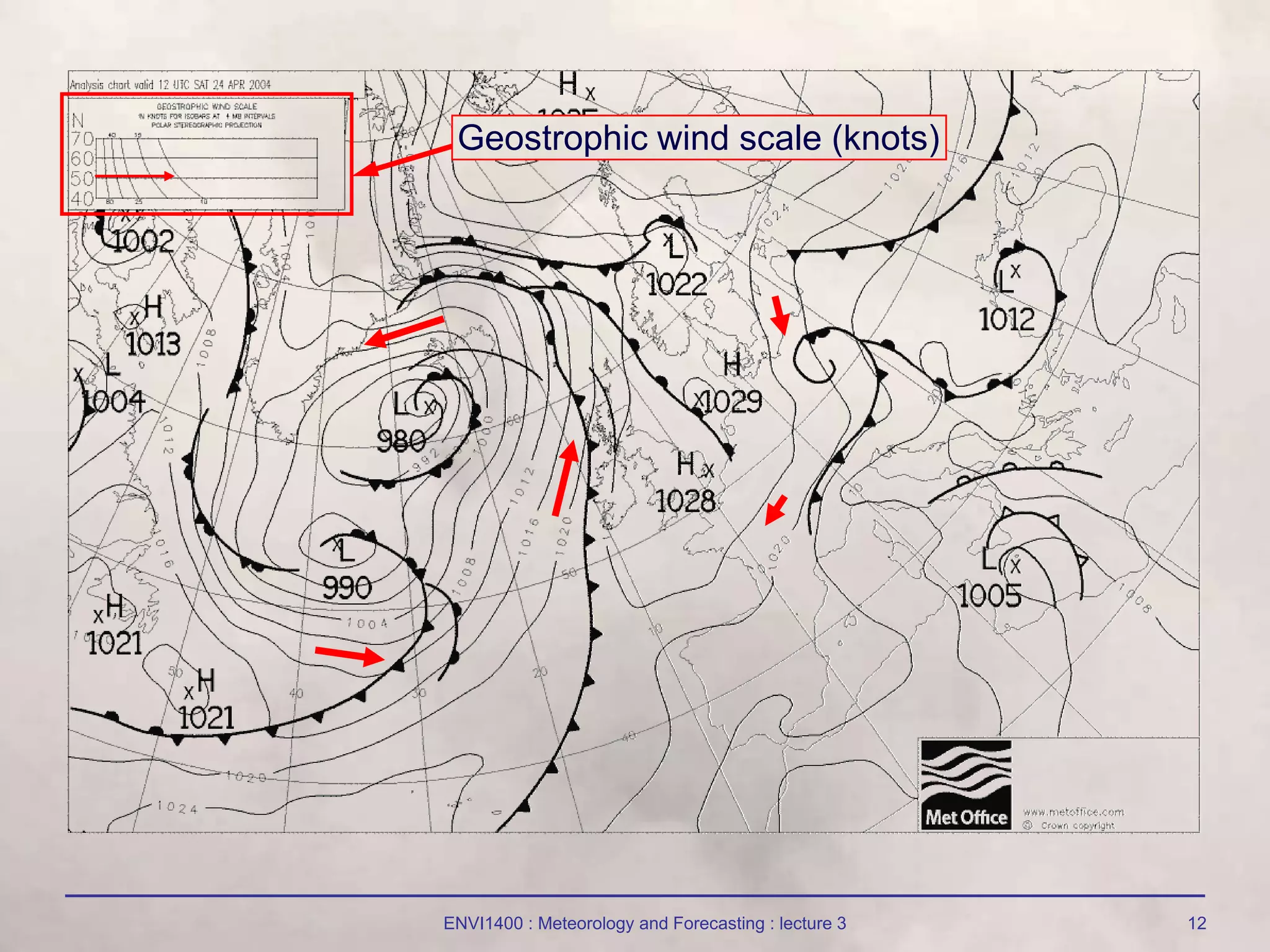
Geostrophic wind scale (knots)
ENVI1400 : Meteorology and Forecasting : lecture 3 13
Geostrophic flow is a close
approximation to observed winds
throughout most of the free
atmosphere, except near the
equator where the coriolis force
approaches zero.
Departures from geostrophic
balance arise due to:
– constant changes in the
pressure field
– curvature in the isobars
– vertical wind shear
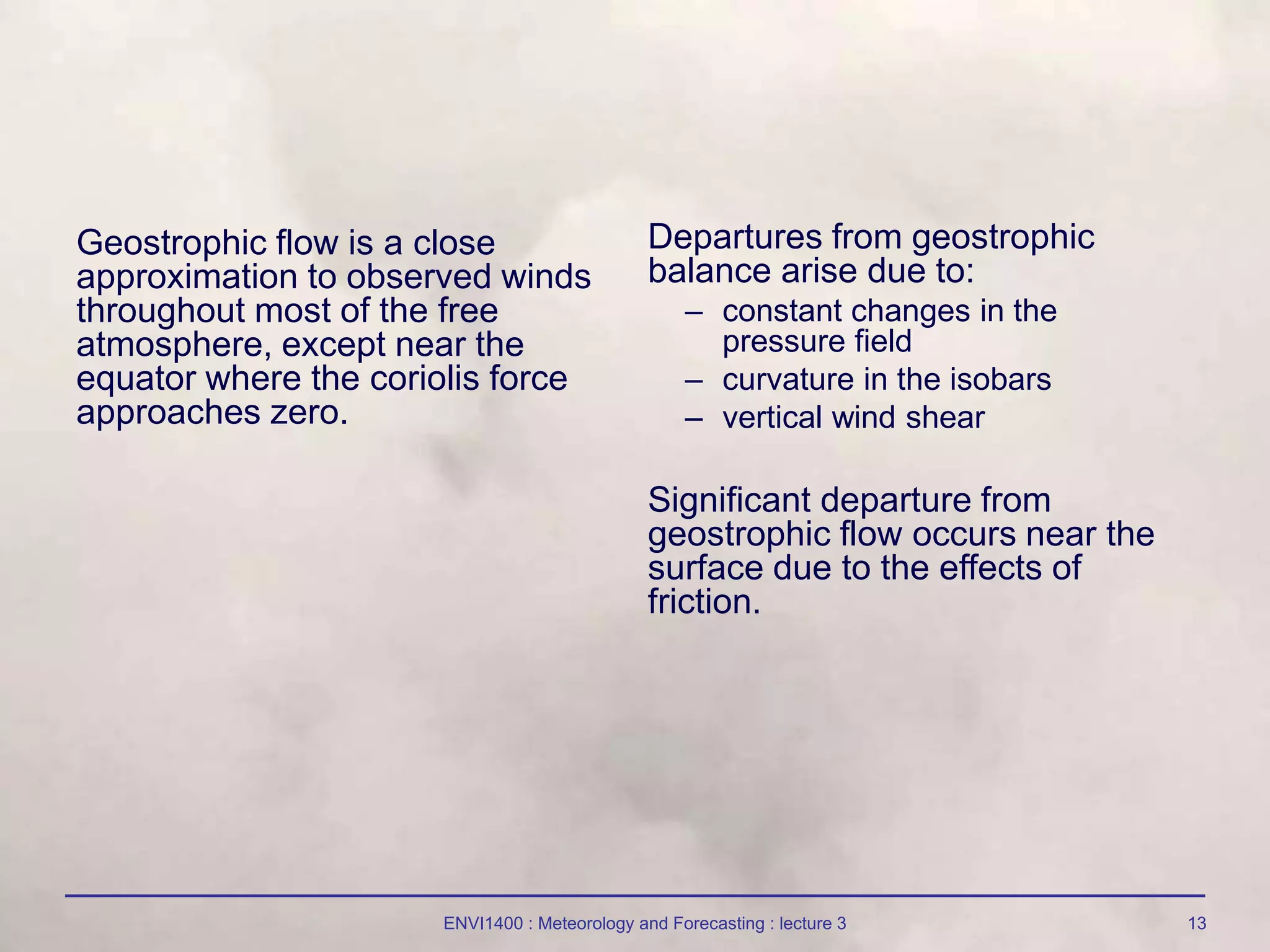
Significant departure from
geostrophic flow occurs near the
surface due to the effects of
friction.
ENVI1400 : Meteorology and Forecasting : lecture 3 14
Centripetal Acceleration
Motion around a curved path requires
an acceleration towards the centre of
curvature: the centripetal
acceleration.
LOW
V
FP
Fc
Centripetal
acceleration
The required centripetal acceleration
is provided by an imbalance between
the pressure and coriolis forces.
V is here called the gradient wind
For a low, the coriolis force is less
than the pressure force; for a high it is
greater than pressure force. This
results in:
LOW: V < geostrophic
(subgeostrophic)
HIGH: V > geostrophic
(supergeostrophic)
HIGH
V
FP
Fc
Centripetal
acceleration
ENVI1400 : Meteorology and Forecasting : lecture 3 15
Effect of Friction
Friction at the surface slows the
wind. Turbulent mixing extends
effects of friction up to ~100 m to
~1.5 km above surface.
Lower wind speed results in a
smaller coriolis force, hence
reduced turning to right.
Wind vector describes a spiral:
the Ekman Spiral. Surface wind
lies to left of geostrophic wind
• 10-20 over ocean
• 25-35 over land
The wind speed a few metres
above the surface is ~70% of
geostrophic wind over the ocean,
even less over land (depending
on surface conditions)
Geostrophic flow
away from surface
Vg
Ekman Spiral
ENVI1400 : Meteorology and Forecasting : lecture 3 16
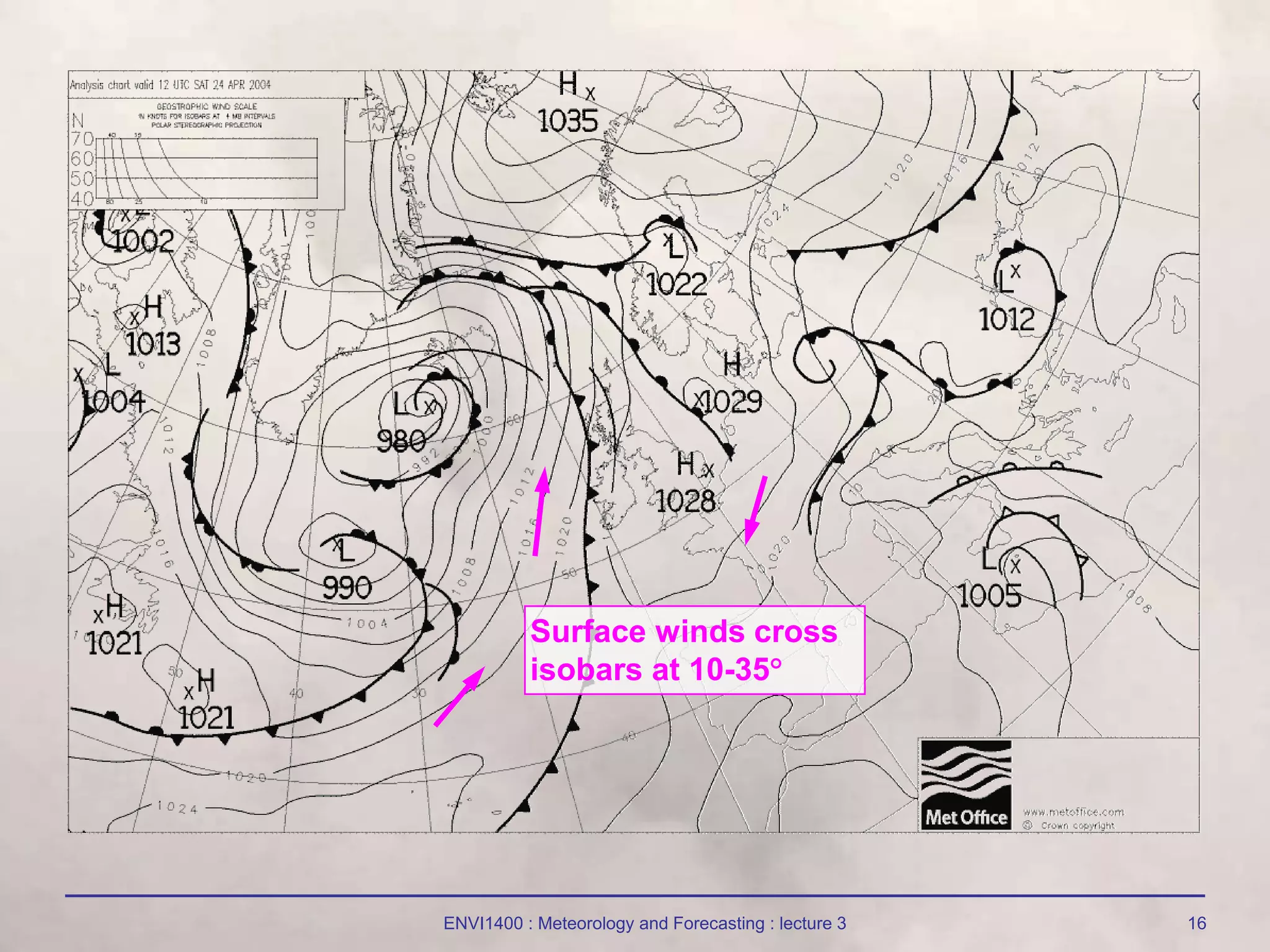
Surface winds cross
isobars at 10-35
ENVI1400 : Meteorology and Forecasting : lecture 3 17
ENVI1400 : Meteorology and Forecasting : lecture 3 18
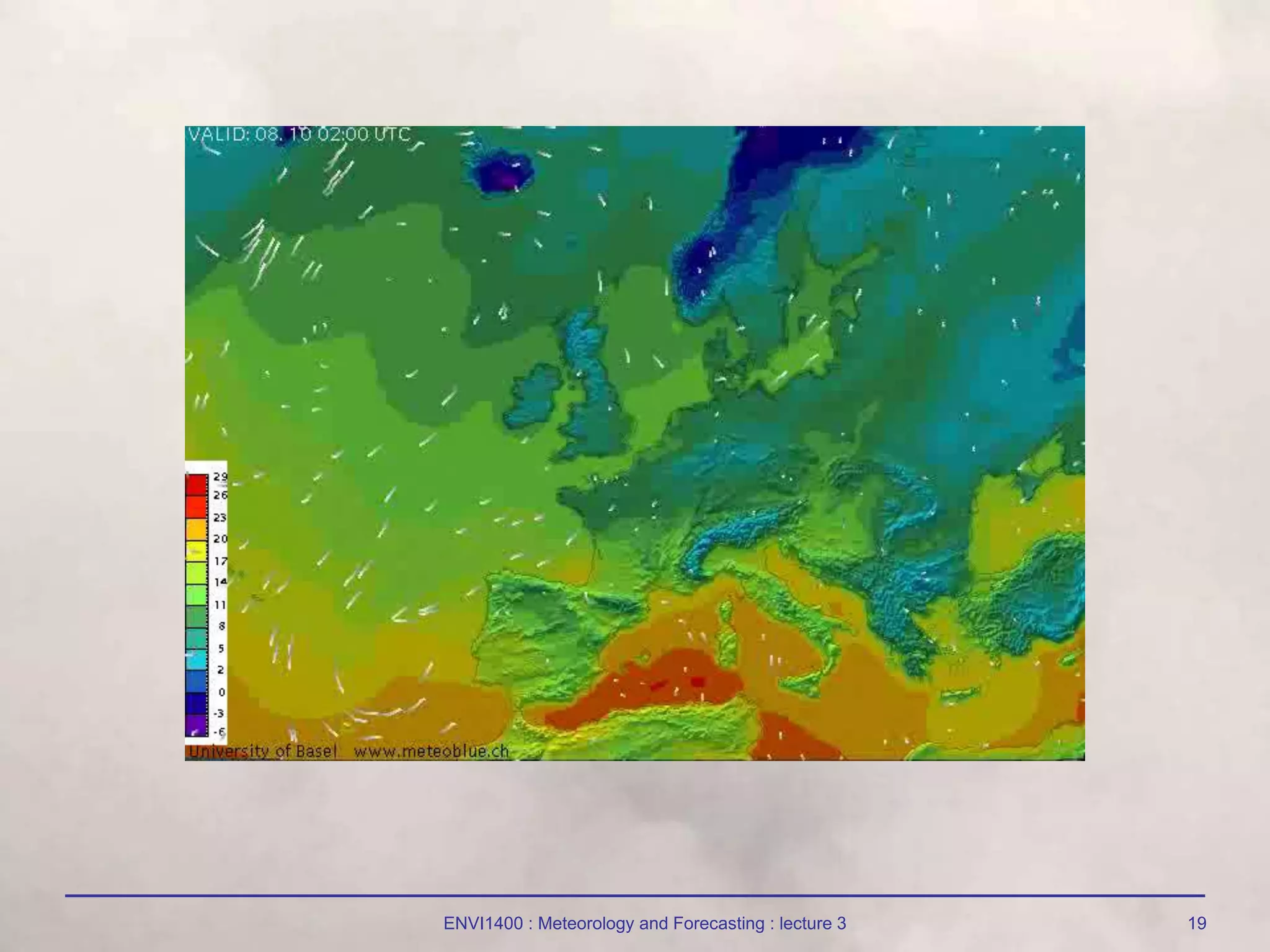
ENVI1400 : Meteorology and Forecasting : lecture 3 19
ENVI1400 : Meteorology and Forecasting : lecture 3 20
Global Circulation
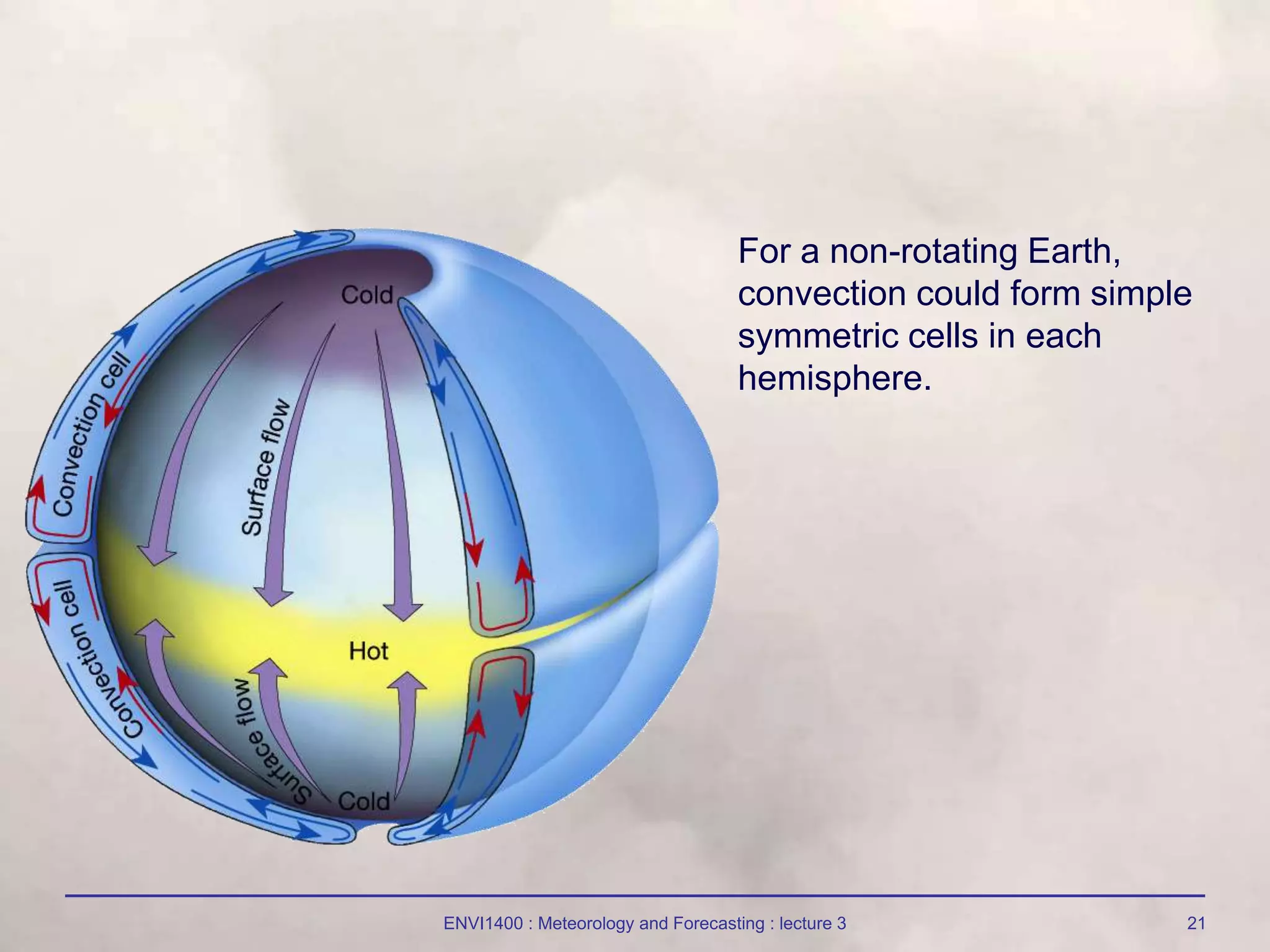
ENVI1400 : Meteorology and Forecasting : lecture 3 21
For a non-rotating Earth,
convection could form simple
symmetric cells in each
hemisphere.
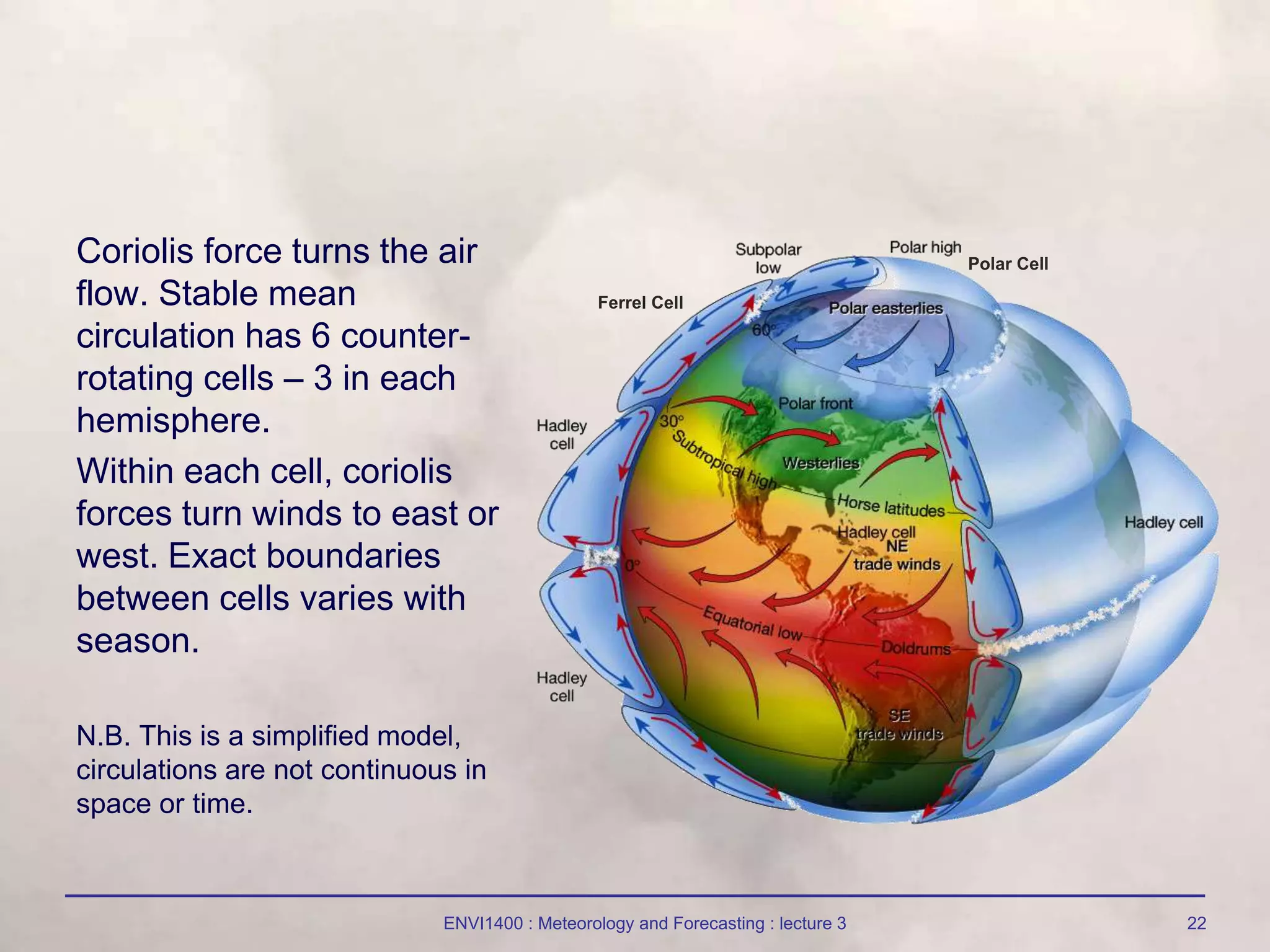
ENVI1400 : Meteorology and Forecasting : lecture 3 22
Coriolis force turns the air
flow. Stable mean
circulation has 6 counter-
rotating cells – 3 in each
hemisphere.
Within each cell, coriolis
forces turn winds to east or
west. Exact boundaries
between cells varies with
season.
N.B. This is a simplified model,
circulations are not continuous in
space or time.
Ferrel Cell
Polar Cell
ENVI1400 : Meteorology and Forecasting : lecture 3 23
Summary
• Balance of pressure and
coriolis forces results in
geostrophic flow parallel to
isobars
• Curvature of isobars around
centres of high and low
pressure requires centripetal
acceleration to turn flow,
resulting gradient wind is:
– supergeostrophic around
HIGH
– subgeostrophic around
LOW
• Friction reduces wind speed
near surface
• Lower wind speed  reduced
coriolis turning, wind vector
describes an Ekman Spiral
between surface and level of
geostrophic flow
• Surface wind lies 10-35 to left
of geostrophic wind, crossing
isobars from high to low
pressure.
ENVI1400 : Meteorology and Forecasting : lecture 3 24
• Difference in solar heating
between tropics and poles
requires a compensating flow
of heat
• Coriolis turning interacts with
large scale convective
circulation to form 3 cells in
each hemisphere
• 6 cell model is an over-
simplification of reality, but
accounts for major features of
mean surface winds

03-Atmospheric-Motion.ppt

  • 1.
  • 2.
    ENVI1400 : Meteorologyand Forecasting : lecture 3 2 Isobars at 4mb intervals
  • 3.
    ENVI1400 : Meteorologyand Forecasting : lecture 3 3 The PressureGradient Force Horizontal pressure gradients are the main driving force for winds. where P is pressure,  is air density, and x is distance. The force is thus inversely proportional to the spacing of isobars (closer spacing  stronger force), and is directed perpendicular to them, from high pressure to low. The pressure force acts to accelerate the air towards the low pressure. Pressure gradient force = - 1 dP  dx 1000 mb 1004 mb pressure force
  • 4.
    ENVI1400 : Meteorologyand Forecasting : lecture 3 4 The Coriolis Force
  • 5.
    ENVI1400 : Meteorologyand Forecasting : lecture 3 5 The coriolis force is an apparent force, introduced to account for the apparent deflection of a moving object observed from within a rotating frame of reference – such as the Earth. The coriolis force acts at right angles to both the direction of motion and the spin axis of the rotating reference frame. V Coriolis Force Axis of spin
  • 6.
    ENVI1400 : Meteorologyand Forecasting : lecture 3 6
  • 7.
    ENVI1400 : Meteorologyand Forecasting : lecture 3 7 V Fc 1 2 3 4 5 6 Coriolis Force on a Flat Disk
  • 8.
    ENVI1400 : Meteorologyand Forecasting : lecture 3 8 Earth is a sphere – more complex than disk: horizontal and vertical components to the coriolis force. In the atmosphere, we are concerned only with the horizontal component of the coriolis force. It has a magnitude (per unit mass) of: 2 V sin  = angular velocity of the earth V = wind speed  = latitude This is a maximum at the poles and zero at the equator, and results in a deflection to the right in the northern hemisphere, and to the left in the southern hemisphere.
  • 9.
    ENVI1400 : Meteorologyand Forecasting : lecture 3 9
  • 10.
    ENVI1400 : Meteorologyand Forecasting : lecture 3 10 Geostrophic Balance A pressure gradient imposed on a stationary air mass will start to accelerate it towards the region of low pressure 1000 mb 1004 mb V FP Fc V FP Fc V FP Fc Vg FP Fc The coriolis force acts to turn the flow to the right (in the northern hemisphere) The pressure force continues to accelerate the flow, and the coriolis force continues to turn it Eventually the flow becomes parallel to the isobars, and the pressure and coriolis forces balance. This is termed geostrophic balance, and Vg the geostrophic wind speed.
  • 11.
    ENVI1400 : Meteorologyand Forecasting : lecture 3 11 Since the coriolis force balances the pressure force we have: N.B. air density  changes very little at a fixed altitude, and is usually assumed constant, but decreases significantly with increasing altitude  pressure gradient force for a given pressure gradient increases with altitude  geostrophic wind speed increases with altitude. Pressure gradient force = coriolis force 1 dP  dx = 2 Vg sin Geostrophic wind speed is directly proportional to the pressure gradient, and inversely dependent on latitude.  For a fixed pressure gradient, the geostrophic wind speed decreases towards the poles.
  • 12.
    ENVI1400 : Meteorologyand Forecasting : lecture 3 12 Geostrophic wind scale (knots)
  • 13.
    ENVI1400 : Meteorologyand Forecasting : lecture 3 13 Geostrophic flow is a close approximation to observed winds throughout most of the free atmosphere, except near the equator where the coriolis force approaches zero. Departures from geostrophic balance arise due to: – constant changes in the pressure field – curvature in the isobars – vertical wind shear Significant departure from geostrophic flow occurs near the surface due to the effects of friction.
  • 14.
    ENVI1400 : Meteorologyand Forecasting : lecture 3 14 Centripetal Acceleration Motion around a curved path requires an acceleration towards the centre of curvature: the centripetal acceleration. LOW V FP Fc Centripetal acceleration The required centripetal acceleration is provided by an imbalance between the pressure and coriolis forces. V is here called the gradient wind For a low, the coriolis force is less than the pressure force; for a high it is greater than pressure force. This results in: LOW: V < geostrophic (subgeostrophic) HIGH: V > geostrophic (supergeostrophic) HIGH V FP Fc Centripetal acceleration
  • 15.
    ENVI1400 : Meteorologyand Forecasting : lecture 3 15 Effect of Friction Friction at the surface slows the wind. Turbulent mixing extends effects of friction up to ~100 m to ~1.5 km above surface. Lower wind speed results in a smaller coriolis force, hence reduced turning to right. Wind vector describes a spiral: the Ekman Spiral. Surface wind lies to left of geostrophic wind • 10-20 over ocean • 25-35 over land The wind speed a few metres above the surface is ~70% of geostrophic wind over the ocean, even less over land (depending on surface conditions) Geostrophic flow away from surface Vg Ekman Spiral
  • 16.
    ENVI1400 : Meteorologyand Forecasting : lecture 3 16 Surface winds cross isobars at 10-35
  • 17.
    ENVI1400 : Meteorologyand Forecasting : lecture 3 17
  • 18.
    ENVI1400 : Meteorologyand Forecasting : lecture 3 18
  • 19.
    ENVI1400 : Meteorologyand Forecasting : lecture 3 19
  • 20.
    ENVI1400 : Meteorologyand Forecasting : lecture 3 20 Global Circulation
  • 21.
    ENVI1400 : Meteorologyand Forecasting : lecture 3 21 For a non-rotating Earth, convection could form simple symmetric cells in each hemisphere.
  • 22.
    ENVI1400 : Meteorologyand Forecasting : lecture 3 22 Coriolis force turns the air flow. Stable mean circulation has 6 counter- rotating cells – 3 in each hemisphere. Within each cell, coriolis forces turn winds to east or west. Exact boundaries between cells varies with season. N.B. This is a simplified model, circulations are not continuous in space or time. Ferrel Cell Polar Cell
  • 23.
    ENVI1400 : Meteorologyand Forecasting : lecture 3 23 Summary • Balance of pressure and coriolis forces results in geostrophic flow parallel to isobars • Curvature of isobars around centres of high and low pressure requires centripetal acceleration to turn flow, resulting gradient wind is: – supergeostrophic around HIGH – subgeostrophic around LOW • Friction reduces wind speed near surface • Lower wind speed  reduced coriolis turning, wind vector describes an Ekman Spiral between surface and level of geostrophic flow • Surface wind lies 10-35 to left of geostrophic wind, crossing isobars from high to low pressure.
  • 24.
    ENVI1400 : Meteorologyand Forecasting : lecture 3 24 • Difference in solar heating between tropics and poles requires a compensating flow of heat • Coriolis turning interacts with large scale convective circulation to form 3 cells in each hemisphere • 6 cell model is an over- simplification of reality, but accounts for major features of mean surface winds

Editor's Notes