

Chapter 4
 Atmospheric and Oceanic
       Circulation
Or: What goes around, comes around.
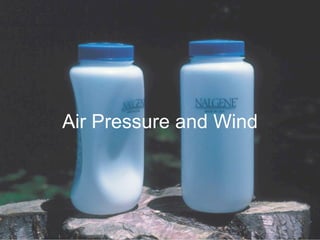
Air Pressure and Wind
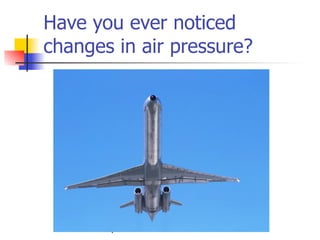
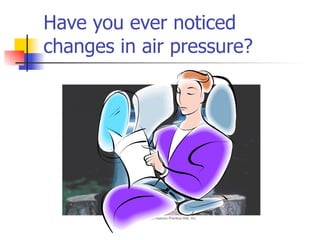
Have you ever noticed
changes in air pressure?
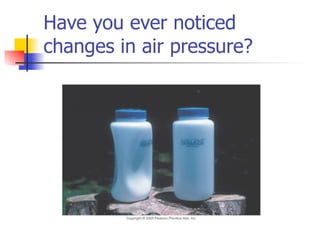
Have you ever noticed
changes in air pressure?
Have you ever noticed
changes in air pressure?
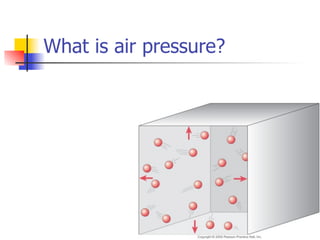
What is air pressure?
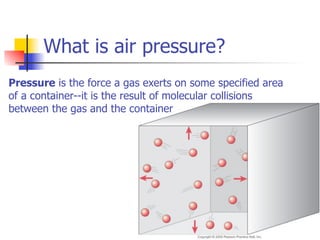
Pressure is the force a gas exerts on some specified area
of a container--it is the result of molecular collisions
between the gas and the container
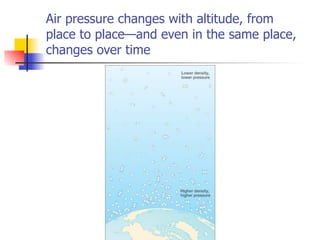
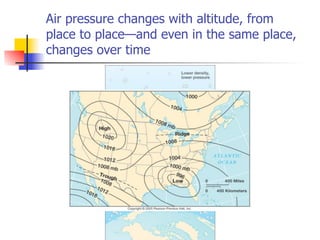
Air pressure changes with altitude, from
place to place—and even in the same place,
changes over time
Air pressure changes with altitude, from
place to place—and even in the same place,
changes over time
Pressure, Density, and Temperature

       Pressure (P), density (D), and temperature
        (T) are all interrelated
           Pressure is the force of molecular collisions per
            unit area (lbs/in2)
           Density is the weight of a material per unit
            volume (g/m2)
           Temperature is a measure of molecular motion
       Changes to one of these variables can cause
        changes in the others

    For example….
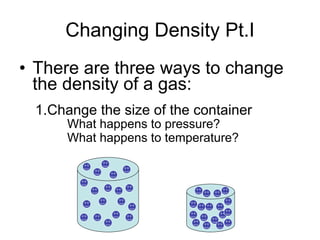
Changing Density Pt.I
• There are three ways to change
  the density of a gas:
 1.Change the size of the container
      What happens to pressure?
      What happens to temperature?
Changing Density—Pt. II
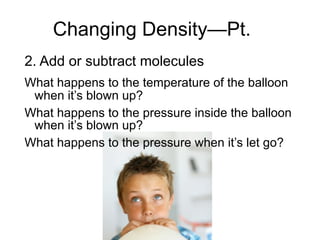
2. Add or subtract molecules
What happens to the temperature of the balloon
 when it’s blown up?
What happens to the pressure inside the balloon
 when it’s blown up?
What happens to the pressure when it’s let go?
   What happens when you change the
    temperature of a confined gas?

   Let’s take our original container full of
    molecules and heat it up!
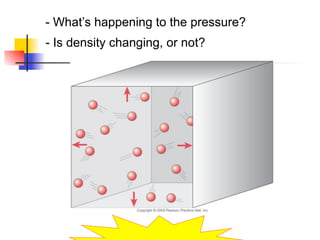
- What’s happening to the pressure?
- Is density changing, or not?
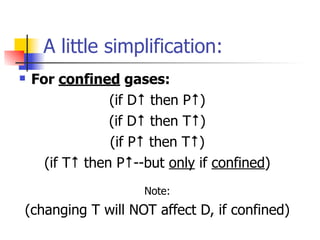
A little simplification:
   For confined gases:
                 (if D↑ then P↑)
                 (if D↑ then T↑)
                 (if P↑ then T↑)
      (if T↑ then P↑--but only if confined)
                      Note:
(changing T will NOT affect D, if confined)
Changing Density—Pt.III


3. Change its
  temperature (if it is
  uncontained)
    - What will happen
    to the density?
    - How will pressure
    be affected?
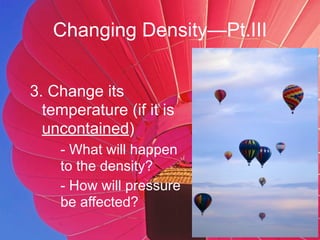
Changing Density—Pt.III


3. Change its
  temperature (if it is
  uncontained)
    - What will happen
    to the density?
    - How will pressure
    be affected?
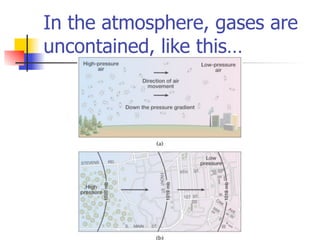
In the atmosphere, gases are
uncontained, like this…
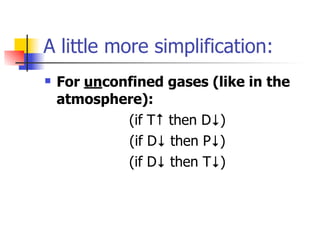
A little more simplification:
   For unconfined gases (like in the
    atmosphere):
             (if T↑ then D↓)
             (if D↓ then P↓)
             (if D↓ then T↓)
Measuring
Atmospheric Pressure
Measuring
Atmospheric Pressure
   In 1643 Evangelista Torricelli (a student
    of Galileo) invented the first barometer…
Measuring
Atmospheric Pressure
   In 1643 Evangelista Torricelli (a student
    of Galileo) invented the first barometer…
Measuring
Atmospheric Pressure
   In 1643 Evangelista Torricelli (a student
    of Galileo) invented the first barometer…

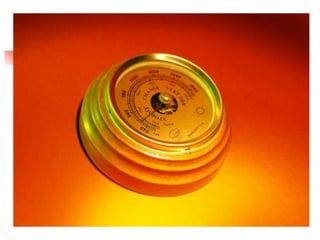
   Today, we use an aneroid barometer
Measuring
Atmospheric Pressure
   In 1643 Evangelista Torricelli (a student
    of Galileo) invented the first barometer…

   Today, we use an aneroid barometer
Average Sea Level Air
Pressure
   29.92 in. (inches of mercury)
   14 lbs/in2
   1013.2 mb (millibars of mercury)
   101.32 kPa (kilopascals, where 1
    kilopascal is equivalent to 10 millibars)

    We will use millibars, as this is the most
    commonly used unit of measurement
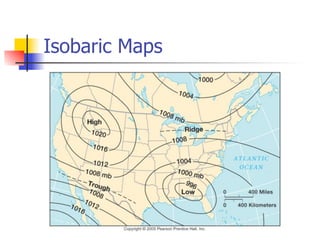
Isobars
   Lines on a map that connect points of
    equal barometric pressure are called
    isobars
   Isobars follow the same rules as other
    iso- lines (don’t cross, form closed
    shapes, etc.)
Isobaric Maps
Isobaric Maps
The Pressure Gradient Force
Wind
   Wind—Air moving horizontally in
    response to pressure differences

   The process is called advection
Convection Cell Diagram
   Draw the convection cell diagram and
    label it, just like you see it on the board

   Practice drawing a simplified version to
    help you remember “out of the high,
    into the low” on exam day
   Air always moves from regions of
    higher air pressure to regions of
    lower air pressure

   In other words:
      “Out of the High, Into the Low!”
Local Winds
Convection Cells in Motion
   Land and Sea Breezes
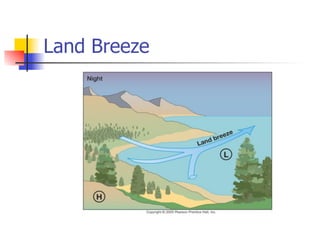
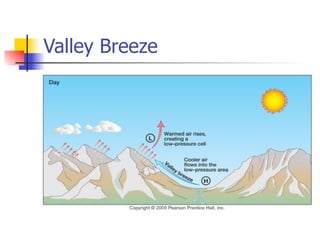
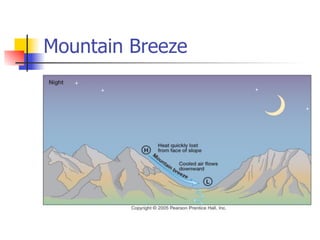
   Mountain and Valley Winds
   Katabatic Winds (a.k.a. Mistral)
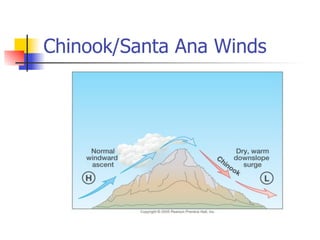
   Chinook Winds (a.k.a. Santa Anas,
    Diablo Winds, Foehn winds, etc.)
Wind Direction
Wind Direction
   Wind direction is determined by where
    the wind is coming from
Wind Direction
   Wind direction is determined by where
    the wind is coming from
       For example, an east wind is one that is
        coming from the east
Wind Direction
   Wind direction is determined by where
    the wind is coming from
       For example, an east wind is one that is
        coming from the east
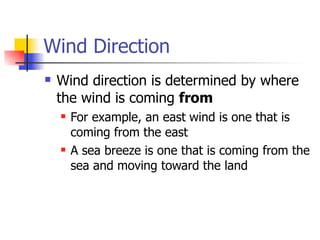
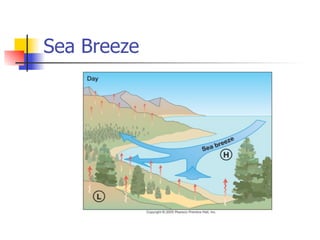
       A sea breeze is one that is coming from the
        sea and moving toward the land
Sea Breeze
Land Breeze
Valley Breeze
Mountain Breeze
Chinook/Santa Ana Winds
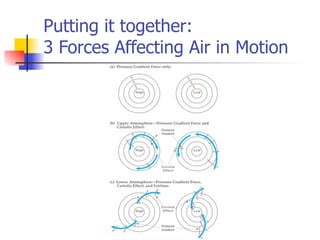
3 Forces Affecting Air in
Motion
 Pressure Gradient Force
 Coriolis Force

 Friction
Force #1:
The Pressure Gradient Force
Force #1:
The Pressure Gradient Force
   The pressure gradient force is the force
    exerted by a gas (in this case, air) at higher
    pressure trying to move to an area of lower
    pressure
Force #1:
The Pressure Gradient Force
   The pressure gradient force is the force
    exerted by a gas (in this case, air) at higher
    pressure trying to move to an area of lower
    pressure
   The PGF pulls air out of the high and into the
    low at a 90º angle relative to the isobars
Force #1:
The Pressure Gradient Force
   The pressure gradient force is the force
    exerted by a gas (in this case, air) at higher
    pressure trying to move to an area of lower
    pressure
   The PGF pulls air out of the high and into the
    low at a 90º angle relative to the isobars
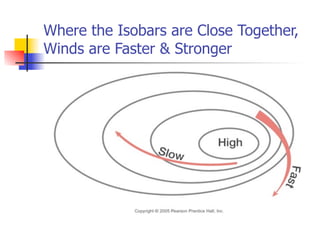
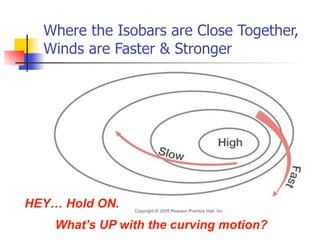
   The greater the “slope”, or gradient, between
    one pressure region and the next, the faster
    the air will move
Where the Isobars are Close Together,
Winds are Faster & Stronger
Where the Isobars are Close Together,
  Winds are Faster & Stronger


HEY… Hold ON.
    What’s UP with the curving motion?
Force #2:
The Coriolis Force
   A force which causes fluids in motion
    over great distances and objects
    moving at high speed to be deflected:
       to the right in the Northern Hemisphere
       to the left in the Southern Hemisphere.

    (Note: Air acts like a fluid in many ways.)
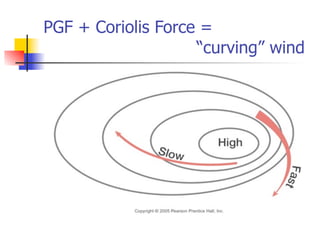
PGF + Coriolis Force =
                    “curving” wind
Coriolis Force—doing the math
   The Coriolis force is a force existing in a
    rotating coordinate system with constant
    angular velocity to a reference frame. It
    acts on a body moving in the rotating
    frame to deflect its motion sideways.
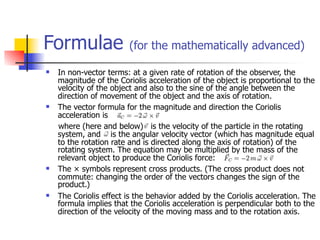
Formulae                (for the mathematically advanced)

   In non-vector terms: at a given rate of rotation of the observer, the
    magnitude of the Coriolis acceleration of the object is proportional to the
    velocity of the object and also to the sine of the angle between the
    direction of movement of the object and the axis of rotation.
   The vector formula for the magnitude and direction the Coriolis
    acceleration is
    where (here and below) is the velocity of the particle in the rotating
    system, and is the angular velocity vector (which has magnitude equal
    to the rotation rate and is directed along the axis of rotation) of the
    rotating system. The equation may be multiplied by the mass of the
    relevant object to produce the Coriolis force:
   The × symbols represent cross products. (The cross product does not
    commute: changing the order of the vectors changes the sign of the
    product.)
   The Coriolis effect is the behavior added by the Coriolis acceleration. The
    formula implies that the Coriolis acceleration is perpendicular both to the
    direction of the velocity of the moving mass and to the rotation axis.
   A force which causes fluids (and air) in
    motion over great distances and objects
    moving at high speed to be deflected
       to the right in the Northern Hemisphere
       to the left in the Southern Hemisphere.
Coriolis Force: In The Toilet
   Is it valid to assume that the water in
    your toilet, sink, or bathtub will be
    deflected to the right while draining?
   A force which causes fluids in motion
    over great distances and objects
    moving at high speed to be deflected
       to the right in the Northern Hemisphere
       to the left in the Southern Hemisphere.
   A force which causes fluids in motion
    over great distances and objects
    moving at high speed to be deflected
       to the right in the Northern Hemisphere
       to the left in the Southern Hemisphere.
Geostrophic Winds
Geostrophic Winds
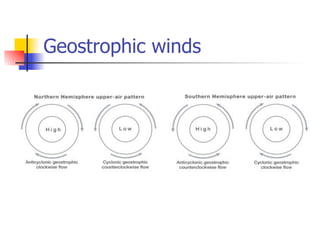
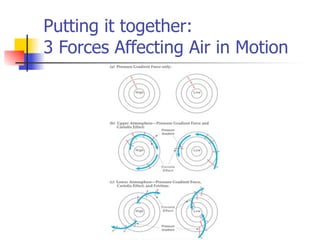
   When the Coriolis Force and Pressure
    Gradient Force balance one another,
    winds spin around a high or low
    pressure cell, parallel to the isobars
Geostrophic Winds
   When the Coriolis Force and Pressure
    Gradient Force balance one another,
    winds spin around a high or low
    pressure cell, parallel to the isobars
   These winds occur in the upper
    atmosphere, where there is no friction
Geostrophic Winds
   When the Coriolis Force and Pressure
    Gradient Force balance one another,
    winds spin around a high or low
    pressure cell, parallel to the isobars
   These winds occur in the upper
    atmosphere, where there is no friction
   They are known as geostrophic
    winds
Geostrophic winds
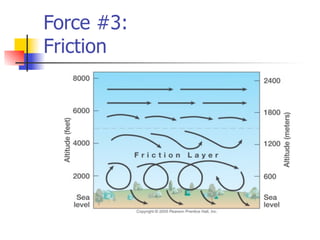
Force #3:
Friction
Putting it together:
3 Forces Affecting Air in Motion
Putting it together:
3 Forces Affecting Air in Motion
Surface winds:
Make a simple drawing
Surface winds:
Make a simple drawing

   Be able to draw it in your sleep...
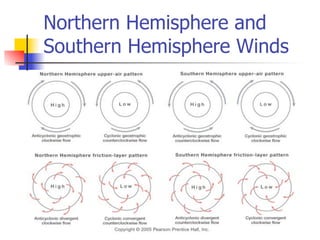
Northern Hemisphere and
Southern Hemisphere Winds
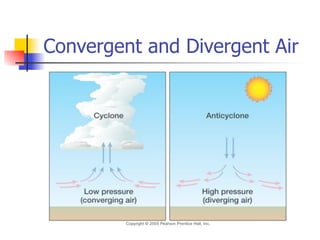
Convergent and Divergent Air
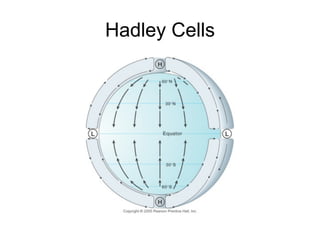
Hadley Cells
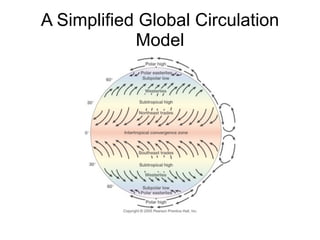
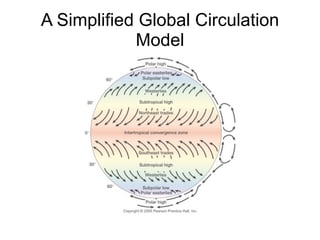
A Simplified Global Circulation
            Model
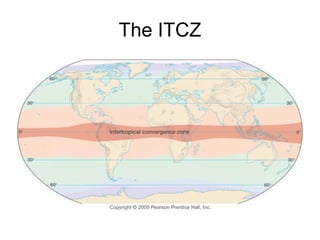
The ITCZ
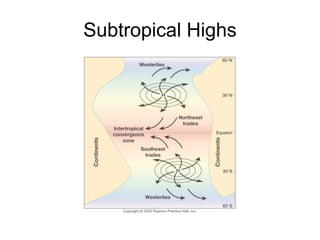
Subtropical Highs
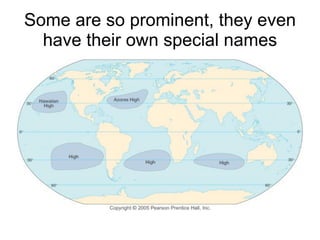
Some are so prominent, they even
  have their own special names
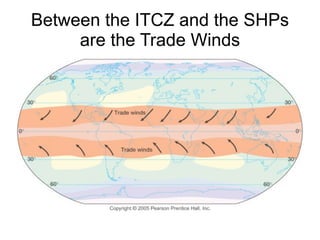
Between the ITCZ and the SHPs
     are the Trade Winds
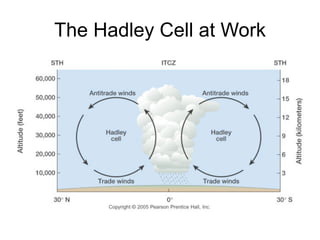
The Hadley Cell at Work
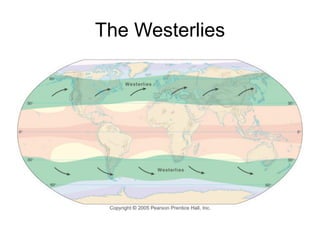
The Westerlies
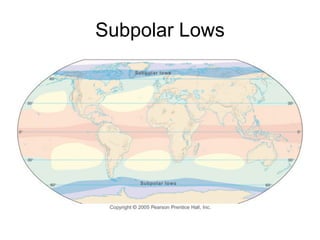
Subpolar Lows
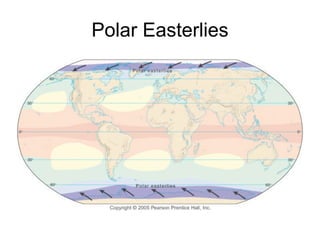
Polar Easterlies
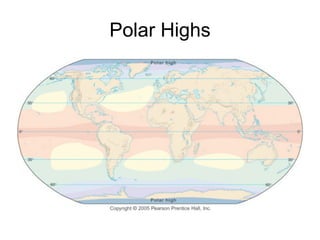
Polar Highs
A Simplified Global Circulation
            Model
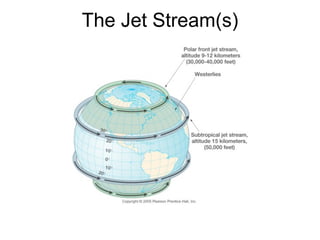
The Jet Stream(s)
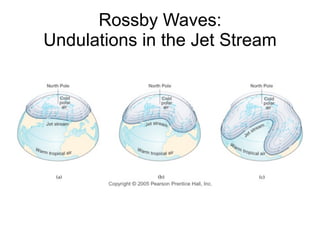
Rossby Waves:
Undulations in the Jet Stream
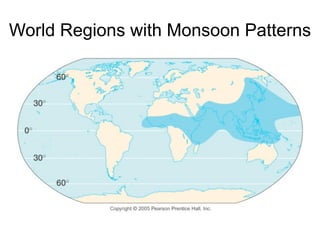
World Regions with Monsoon Patterns
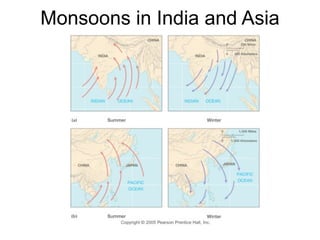
Monsoons in India and Asia
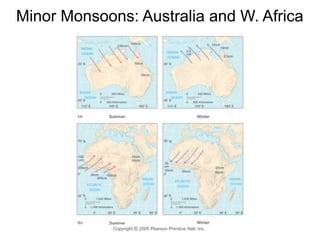
Minor Monsoons: Australia and W. Africa
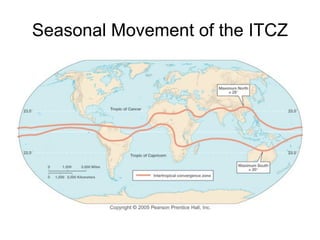
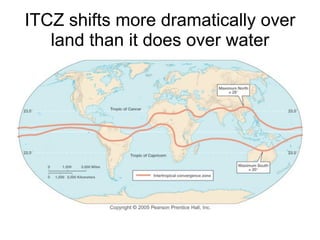
Seasonal Movement of the ITCZ
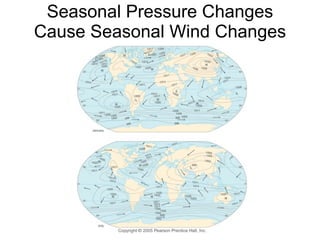
Seasonal Pressure Changes
Cause Seasonal Wind Changes
ITCZ shifts more dramatically over
   land than it does over water
Multi-year Atmospheric Oscillations
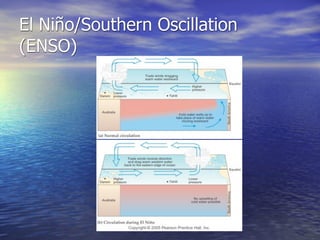
• ENSO--El Niño-Southern Oscillation
  – Ocean-Atmosphere connection
     • (we will discuss this phenomenon in Chapter 7)
• NAO--North Atlantic Oscillation
  – Affects Europe, eastern US, Greenland/
    Canada region; no defined pattern
• AO--Arctic Oscillation
  – Associated with NAO
• PDO--Pacific Decadal Oscillation
                                                 70
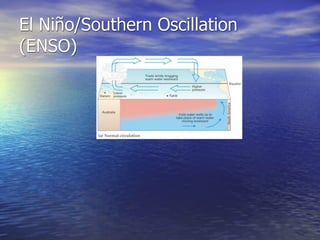
El Niño/Southern Oscillation
(ENSO)
El Niño/Southern Oscillation
(ENSO)
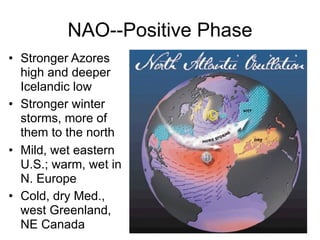
NAO--Positive Phase
• Stronger Azores
  high and deeper
  Icelandic low
• Stronger winter
  storms, more of
  them to the north
• Mild, wet eastern
  U.S.; warm, wet in
  N. Europe
• Cold, dry Med.,
  west Greenland,
  NE Canada                     72
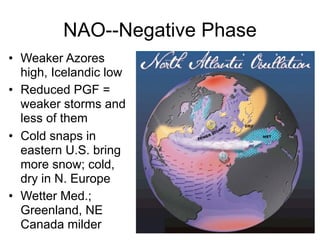
NAO--Negative Phase
• Weaker Azores
  high, Icelandic low
• Reduced PGF =
  weaker storms and
  less of them
• Cold snaps in
  eastern U.S. bring
  more snow; cold,
  dry in N. Europe
• Wetter Med.;
  Greenland, NE
  Canada milder                73
Ocean Currents
• Forces driving ocean currents
  – Frictional drag of wind
  – Coriolis force
  – Temperature, density, and salinity differences
  – Location of contents and shape of the sea floor
  – Tides


                                            74
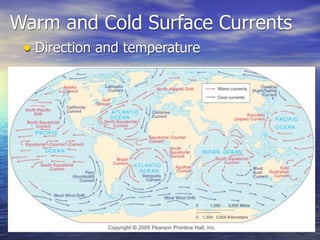
Warm and Cold Surface Currents
 • Direction and temperature
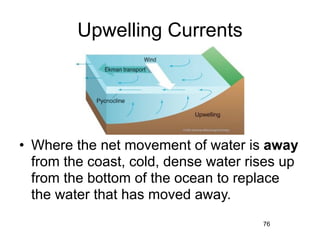
Upwelling Currents


• Where the net movement of water is away
  from the coast, cold, dense water rises up
  from the bottom of the ocean to replace
  the water that has moved away.
                                      76
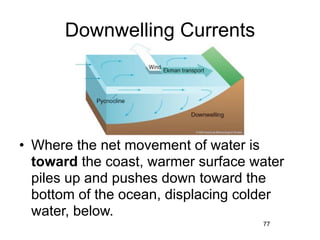
Downwelling Currents


• Where the net movement of water is
  toward the coast, warmer surface water
  piles up and pushes down toward the
  bottom of the ocean, displacing colder
  water, below.
                                    77
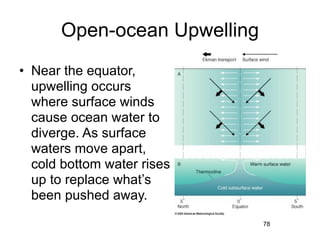
Open-ocean Upwelling
• Near the equator,
  upwelling occurs
  where surface winds
  cause ocean water to
  diverge. As surface
  waters move apart,
  cold bottom water rises
  up to replace what’s
  been pushed away.
                             78
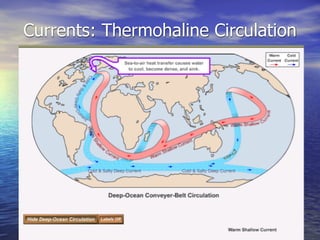
Currents: Thermohaline Circulation

GEOG100--Lecture 06--Atmospheric and ocean circulation

  • 1.
    Chapter 4 Atmosphericand Oceanic Circulation Or: What goes around, comes around.
  • 2.
  • 3.
  • 4.
    Have you evernoticed changes in air pressure?
  • 5.
    Have you evernoticed changes in air pressure?
  • 6.
    Have you evernoticed changes in air pressure?
  • 7.
    What is airpressure?
  • 8.
    What is airpressure? Pressure is the force a gas exerts on some specified area of a container--it is the result of molecular collisions between the gas and the container
  • 9.
    Air pressure changeswith altitude, from place to place—and even in the same place, changes over time
  • 10.
    Air pressure changeswith altitude, from place to place—and even in the same place, changes over time
  • 11.
    Pressure, Density, andTemperature  Pressure (P), density (D), and temperature (T) are all interrelated  Pressure is the force of molecular collisions per unit area (lbs/in2)  Density is the weight of a material per unit volume (g/m2)  Temperature is a measure of molecular motion  Changes to one of these variables can cause changes in the others For example….
  • 12.
    Changing Density Pt.I •There are three ways to change the density of a gas: 1.Change the size of the container What happens to pressure? What happens to temperature?
  • 13.
    Changing Density—Pt. II 2.Add or subtract molecules What happens to the temperature of the balloon when it’s blown up? What happens to the pressure inside the balloon when it’s blown up? What happens to the pressure when it’s let go?
  • 14.
    What happens when you change the temperature of a confined gas?  Let’s take our original container full of molecules and heat it up!
  • 15.
    - What’s happeningto the pressure? - Is density changing, or not?
  • 16.
    A little simplification:  For confined gases: (if D↑ then P↑) (if D↑ then T↑) (if P↑ then T↑) (if T↑ then P↑--but only if confined) Note: (changing T will NOT affect D, if confined)
  • 17.
    Changing Density—Pt.III 3. Changeits temperature (if it is uncontained) - What will happen to the density? - How will pressure be affected?
  • 18.
    Changing Density—Pt.III 3. Changeits temperature (if it is uncontained) - What will happen to the density? - How will pressure be affected?
  • 19.
    In the atmosphere,gases are uncontained, like this…
  • 20.
    A little moresimplification:  For unconfined gases (like in the atmosphere): (if T↑ then D↓) (if D↓ then P↓) (if D↓ then T↓)
  • 21.
  • 22.
    Measuring Atmospheric Pressure  In 1643 Evangelista Torricelli (a student of Galileo) invented the first barometer…
  • 23.
    Measuring Atmospheric Pressure  In 1643 Evangelista Torricelli (a student of Galileo) invented the first barometer…
  • 24.
    Measuring Atmospheric Pressure  In 1643 Evangelista Torricelli (a student of Galileo) invented the first barometer…  Today, we use an aneroid barometer
  • 25.
    Measuring Atmospheric Pressure  In 1643 Evangelista Torricelli (a student of Galileo) invented the first barometer…  Today, we use an aneroid barometer
  • 26.
    Average Sea LevelAir Pressure  29.92 in. (inches of mercury)  14 lbs/in2  1013.2 mb (millibars of mercury)  101.32 kPa (kilopascals, where 1 kilopascal is equivalent to 10 millibars) We will use millibars, as this is the most commonly used unit of measurement
  • 27.
    Isobars  Lines on a map that connect points of equal barometric pressure are called isobars  Isobars follow the same rules as other iso- lines (don’t cross, form closed shapes, etc.)
  • 28.
  • 29.
  • 30.
  • 31.
    Wind  Wind—Air moving horizontally in response to pressure differences  The process is called advection
  • 32.
    Convection Cell Diagram  Draw the convection cell diagram and label it, just like you see it on the board  Practice drawing a simplified version to help you remember “out of the high, into the low” on exam day
  • 33.
    Air always moves from regions of higher air pressure to regions of lower air pressure  In other words: “Out of the High, Into the Low!”
  • 34.
    Local Winds Convection Cellsin Motion  Land and Sea Breezes  Mountain and Valley Winds  Katabatic Winds (a.k.a. Mistral)  Chinook Winds (a.k.a. Santa Anas, Diablo Winds, Foehn winds, etc.)
  • 35.
  • 36.
    Wind Direction  Wind direction is determined by where the wind is coming from
  • 37.
    Wind Direction  Wind direction is determined by where the wind is coming from  For example, an east wind is one that is coming from the east
  • 38.
    Wind Direction  Wind direction is determined by where the wind is coming from  For example, an east wind is one that is coming from the east  A sea breeze is one that is coming from the sea and moving toward the land
  • 39.
  • 40.
  • 41.
  • 42.
  • 43.
  • 44.
    3 Forces AffectingAir in Motion  Pressure Gradient Force  Coriolis Force  Friction
  • 45.
    Force #1: The PressureGradient Force
  • 46.
    Force #1: The PressureGradient Force  The pressure gradient force is the force exerted by a gas (in this case, air) at higher pressure trying to move to an area of lower pressure
  • 47.
    Force #1: The PressureGradient Force  The pressure gradient force is the force exerted by a gas (in this case, air) at higher pressure trying to move to an area of lower pressure  The PGF pulls air out of the high and into the low at a 90º angle relative to the isobars
  • 48.
    Force #1: The PressureGradient Force  The pressure gradient force is the force exerted by a gas (in this case, air) at higher pressure trying to move to an area of lower pressure  The PGF pulls air out of the high and into the low at a 90º angle relative to the isobars  The greater the “slope”, or gradient, between one pressure region and the next, the faster the air will move
  • 49.
    Where the Isobarsare Close Together, Winds are Faster & Stronger
  • 50.
    Where the Isobarsare Close Together, Winds are Faster & Stronger HEY… Hold ON. What’s UP with the curving motion?
  • 51.
    Force #2: The CoriolisForce  A force which causes fluids in motion over great distances and objects moving at high speed to be deflected:  to the right in the Northern Hemisphere  to the left in the Southern Hemisphere. (Note: Air acts like a fluid in many ways.)
  • 52.
    PGF + CoriolisForce = “curving” wind
  • 53.
    Coriolis Force—doing themath  The Coriolis force is a force existing in a rotating coordinate system with constant angular velocity to a reference frame. It acts on a body moving in the rotating frame to deflect its motion sideways.
  • 54.
    Formulae (for the mathematically advanced)  In non-vector terms: at a given rate of rotation of the observer, the magnitude of the Coriolis acceleration of the object is proportional to the velocity of the object and also to the sine of the angle between the direction of movement of the object and the axis of rotation.  The vector formula for the magnitude and direction the Coriolis acceleration is where (here and below) is the velocity of the particle in the rotating system, and is the angular velocity vector (which has magnitude equal to the rotation rate and is directed along the axis of rotation) of the rotating system. The equation may be multiplied by the mass of the relevant object to produce the Coriolis force:  The × symbols represent cross products. (The cross product does not commute: changing the order of the vectors changes the sign of the product.)  The Coriolis effect is the behavior added by the Coriolis acceleration. The formula implies that the Coriolis acceleration is perpendicular both to the direction of the velocity of the moving mass and to the rotation axis.
  • 55.
    A force which causes fluids (and air) in motion over great distances and objects moving at high speed to be deflected  to the right in the Northern Hemisphere  to the left in the Southern Hemisphere.
  • 56.
    Coriolis Force: InThe Toilet  Is it valid to assume that the water in your toilet, sink, or bathtub will be deflected to the right while draining?
  • 57.
    A force which causes fluids in motion over great distances and objects moving at high speed to be deflected  to the right in the Northern Hemisphere  to the left in the Southern Hemisphere.
  • 58.
    A force which causes fluids in motion over great distances and objects moving at high speed to be deflected  to the right in the Northern Hemisphere  to the left in the Southern Hemisphere.
  • 59.
  • 60.
    Geostrophic Winds  When the Coriolis Force and Pressure Gradient Force balance one another, winds spin around a high or low pressure cell, parallel to the isobars
  • 61.
    Geostrophic Winds  When the Coriolis Force and Pressure Gradient Force balance one another, winds spin around a high or low pressure cell, parallel to the isobars  These winds occur in the upper atmosphere, where there is no friction
  • 62.
    Geostrophic Winds  When the Coriolis Force and Pressure Gradient Force balance one another, winds spin around a high or low pressure cell, parallel to the isobars  These winds occur in the upper atmosphere, where there is no friction  They are known as geostrophic winds
  • 63.
  • 64.
  • 65.
    Putting it together: 3Forces Affecting Air in Motion
  • 66.
    Putting it together: 3Forces Affecting Air in Motion
  • 67.
    Surface winds: Make asimple drawing
  • 68.
    Surface winds: Make asimple drawing  Be able to draw it in your sleep...
  • 69.
  • 70.
  • 71.
  • 72.
    A Simplified GlobalCirculation Model
  • 73.
  • 74.
  • 75.
    Some are soprominent, they even have their own special names
  • 76.
    Between the ITCZand the SHPs are the Trade Winds
  • 77.
  • 79.
  • 80.
  • 81.
  • 82.
  • 83.
    A Simplified GlobalCirculation Model
  • 84.
  • 85.
  • 86.
    World Regions withMonsoon Patterns
  • 87.
  • 88.
  • 89.
  • 90.
    Seasonal Pressure Changes CauseSeasonal Wind Changes
  • 91.
    ITCZ shifts moredramatically over land than it does over water
  • 92.
    Multi-year Atmospheric Oscillations •ENSO--El Niño-Southern Oscillation – Ocean-Atmosphere connection • (we will discuss this phenomenon in Chapter 7) • NAO--North Atlantic Oscillation – Affects Europe, eastern US, Greenland/ Canada region; no defined pattern • AO--Arctic Oscillation – Associated with NAO • PDO--Pacific Decadal Oscillation 70
  • 93.
  • 94.
  • 95.
    NAO--Positive Phase • StrongerAzores high and deeper Icelandic low • Stronger winter storms, more of them to the north • Mild, wet eastern U.S.; warm, wet in N. Europe • Cold, dry Med., west Greenland, NE Canada 72
  • 96.
    NAO--Negative Phase • WeakerAzores high, Icelandic low • Reduced PGF = weaker storms and less of them • Cold snaps in eastern U.S. bring more snow; cold, dry in N. Europe • Wetter Med.; Greenland, NE Canada milder 73
  • 97.
    Ocean Currents • Forcesdriving ocean currents – Frictional drag of wind – Coriolis force – Temperature, density, and salinity differences – Location of contents and shape of the sea floor – Tides 74
  • 98.
    Warm and ColdSurface Currents • Direction and temperature
  • 99.
    Upwelling Currents • Wherethe net movement of water is away from the coast, cold, dense water rises up from the bottom of the ocean to replace the water that has moved away. 76
  • 100.
    Downwelling Currents • Wherethe net movement of water is toward the coast, warmer surface water piles up and pushes down toward the bottom of the ocean, displacing colder water, below. 77
  • 101.
    Open-ocean Upwelling • Nearthe equator, upwelling occurs where surface winds cause ocean water to diverge. As surface waters move apart, cold bottom water rises up to replace what’s been pushed away. 78
  • 102.