Shivaji University, Kolhapur
Prasent by: Rameshwar Dhanave
Subject Name.: Fundamentals and Applications
of Remote Sensing
Seminar topic.: Atmospheric window and spectral
reflectance curve
Department of geography
Atmospheric Windows
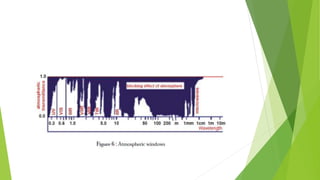
The general atmospheric transmittance across the whole spectrum of wavelengths
is shown in Figure 6. The atmosphere selectively transmits energy of certain
wavelengths. The spectral bands for which the atmosphere is relatively transparent are
known as atmospheric windows. Atmospheric windows are present in the visible part
(.4 μm - .76 μm) and the infrared regions of the EM spectrum. In the visible part
transmission is mainly effected by ozone absorption and by molecular scattering.
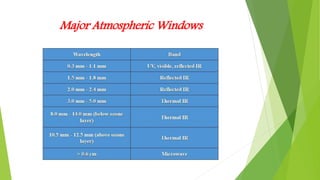
Major Atmospheric Windows
Refraction
The phenomenon of refraction, that is bending of light at the contact between
two media, also occurs in the atmosphere as the light passes through the atmospheric
layers of varied clarity, humidity and temperature. These variations influence the
density of atmospheric layers, which in turn, causes the bending of light rays as they
pass from one layer to another.
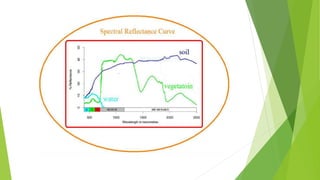
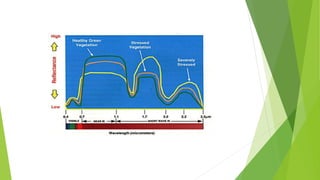
Spectral Reflectance Curve
 Different materials reflect and absorb differently at different wavelengths its
called Spectral Reflectance Signature.
 A graph plotted with wavelength versus spectral reflectance is termed as
spectral reflectance curve
 spectral characteristics of an object and has a strong influence on the choice
of wavelength region in which remote sensing data are acquired for a
particular application.
 For visible bands: vegetation appears dark,
 For near IR band: vegetation appears light tone
 Characteristics of spectral reflectance curve
Vegetation
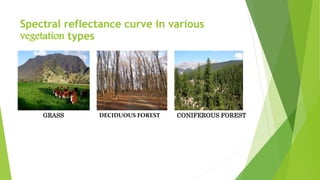
Spectral reflectance curve in various
vegetation types
GRASS DECIDUOUS FOREST CONIFEROUS FOREST
soil
 Some of the factors affecting soil reflectance are moisture content,
soil texture (proportion of sand, silt and clay), surface roughness,
presence of iron oxide and organic matter etc.
 Coarse textured soil will have less reflectance than fine textured soil.
 Increased organic matter content (dark brown or black in color) may
cause the decreased reflectance
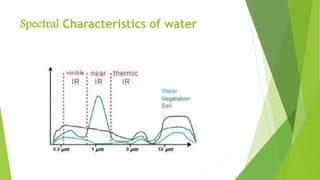
Water
 Locating and delineating water bodies by remote sensing can be done
most easily in the near IR wavelengths.
 The thermal infrared wavelength can be used to define differences in
water temperature.
Spectral Characteristics of water
THANK-YOU

. Atmospheric window and reflectance curve

  • 1.
    Shivaji University, Kolhapur Prasentby: Rameshwar Dhanave Subject Name.: Fundamentals and Applications of Remote Sensing Seminar topic.: Atmospheric window and spectral reflectance curve Department of geography
  • 2.
    Atmospheric Windows The generalatmospheric transmittance across the whole spectrum of wavelengths is shown in Figure 6. The atmosphere selectively transmits energy of certain wavelengths. The spectral bands for which the atmosphere is relatively transparent are known as atmospheric windows. Atmospheric windows are present in the visible part (.4 μm - .76 μm) and the infrared regions of the EM spectrum. In the visible part transmission is mainly effected by ozone absorption and by molecular scattering.
  • 3.
  • 4.
    Refraction The phenomenon ofrefraction, that is bending of light at the contact between two media, also occurs in the atmosphere as the light passes through the atmospheric layers of varied clarity, humidity and temperature. These variations influence the density of atmospheric layers, which in turn, causes the bending of light rays as they pass from one layer to another.
  • 5.
    Spectral Reflectance Curve Different materials reflect and absorb differently at different wavelengths its called Spectral Reflectance Signature.  A graph plotted with wavelength versus spectral reflectance is termed as spectral reflectance curve  spectral characteristics of an object and has a strong influence on the choice of wavelength region in which remote sensing data are acquired for a particular application.
  • 7.
     For visiblebands: vegetation appears dark,  For near IR band: vegetation appears light tone  Characteristics of spectral reflectance curve Vegetation
  • 8.
    Spectral reflectance curvein various vegetation types GRASS DECIDUOUS FOREST CONIFEROUS FOREST
  • 10.
    soil  Some ofthe factors affecting soil reflectance are moisture content, soil texture (proportion of sand, silt and clay), surface roughness, presence of iron oxide and organic matter etc.  Coarse textured soil will have less reflectance than fine textured soil.  Increased organic matter content (dark brown or black in color) may cause the decreased reflectance
  • 11.
    Water  Locating anddelineating water bodies by remote sensing can be done most easily in the near IR wavelengths.  The thermal infrared wavelength can be used to define differences in water temperature.
  • 13.
  • 14.