

WIND
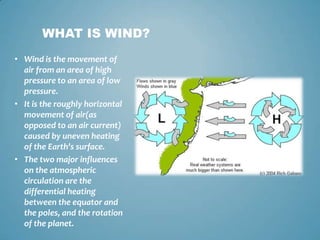
• Wind is the movement of
air from an area of high
pressure to an area of low
pressure.
• It is the roughly horizontal
movement of air(as
opposed to an air current)
caused by uneven heating
of the Earth's surface.
• The two major influences
on the atmospheric
circulation are the
differential heating
between the equator and
the poles, and the rotation
of the planet.
WHAT IS WIND?
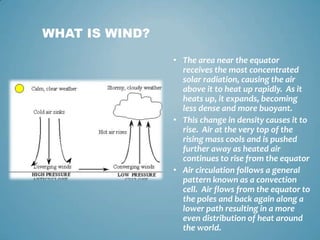
• The area near the equator
receives the most concentrated
solar radiation, causing the air
above it to heat up rapidly. As it
heats up, it expands, becoming
less dense and more buoyant.
• This change in density causes it to
rise. Air at the very top of the
rising mass cools and is pushed
further away as heated air
continues to rise from the equator
• Air circulation follows a general
pattern known as a convection
cell. Air flows from the equator to
the poles and back again along a
lower path resulting in a more
even distribution of heat around
the world.
WHAT IS WIND?
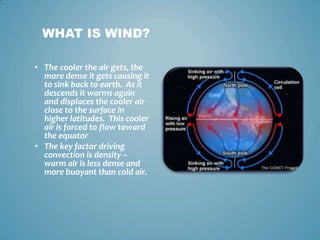
• The cooler the air gets, the
more dense it gets causing it
to sink back to earth. As it
descends it warms again
and displaces the cooler air
close to the surface in
higher latitudes. This cooler
air is forced to flow toward
the equator
• The key factor driving
convection is density –
warm air is less dense and
more buoyant than cold air.
WHAT IS WIND?
• Two factors complicate this general pattern.
1. Earth’s rotation
2. The uneven distribution of land and water over the
Earth’s surface
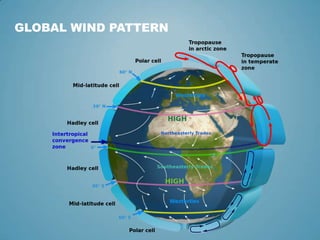
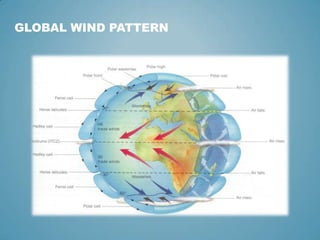
• As a result, the movement of air from the equator to the
polar regions is broken into three different convection
cells for each hemisphere. These include the Trade Winds,
the Westerlies, the Polar Easterlies, and the jet streams.
• They are constant and predictable and are known as
prevailing winds. (fig 4.10 p. 63)
• This description is theoretical. Two factors can change
how prevailing winds blow..
1. Variation in the earth’s surface
2. Earth’s position relative to the sun.
PREVAILING WINDS
GLOBAL WIND PATTERN
GLOBAL WIND PATTERN
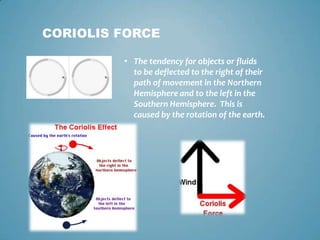
• The tendency for objects or fluids
to be deflected to the right of their
path of movement in the Northern
Hemisphere and to the left in the
Southern Hemisphere. This is
caused by the rotation of the earth.
CORIOLIS FORCE
WIND INSTRUMENTS
• An anemometer is a device used
for measuring wind speed, and is a
common weather
station instrument. The term is
derived from the Greek word
anemos, meaning wind, and is used
to describe any air speed
measurement instrument used
in meteorology or aerodynamics.
• Anemometers can be divided into
two classes: those that measure
the wind's speed, and those that
measure the wind's pressure; but
as there is a close connection
between the pressure and the
speed, an anemometer designed
for one will give information about
both.
ANEMOMETER

Wind - Introduction, Effects, Forces and Instruments.

  • 1.
  • 2.
    • Wind isthe movement of air from an area of high pressure to an area of low pressure. • It is the roughly horizontal movement of air(as opposed to an air current) caused by uneven heating of the Earth's surface. • The two major influences on the atmospheric circulation are the differential heating between the equator and the poles, and the rotation of the planet. WHAT IS WIND?
  • 3.
    • The areanear the equator receives the most concentrated solar radiation, causing the air above it to heat up rapidly. As it heats up, it expands, becoming less dense and more buoyant. • This change in density causes it to rise. Air at the very top of the rising mass cools and is pushed further away as heated air continues to rise from the equator • Air circulation follows a general pattern known as a convection cell. Air flows from the equator to the poles and back again along a lower path resulting in a more even distribution of heat around the world. WHAT IS WIND?
  • 4.
    • The coolerthe air gets, the more dense it gets causing it to sink back to earth. As it descends it warms again and displaces the cooler air close to the surface in higher latitudes. This cooler air is forced to flow toward the equator • The key factor driving convection is density – warm air is less dense and more buoyant than cold air. WHAT IS WIND?
  • 5.
    • Two factorscomplicate this general pattern. 1. Earth’s rotation 2. The uneven distribution of land and water over the Earth’s surface • As a result, the movement of air from the equator to the polar regions is broken into three different convection cells for each hemisphere. These include the Trade Winds, the Westerlies, the Polar Easterlies, and the jet streams. • They are constant and predictable and are known as prevailing winds. (fig 4.10 p. 63) • This description is theoretical. Two factors can change how prevailing winds blow.. 1. Variation in the earth’s surface 2. Earth’s position relative to the sun. PREVAILING WINDS
  • 6.
  • 7.
  • 8.
    • The tendencyfor objects or fluids to be deflected to the right of their path of movement in the Northern Hemisphere and to the left in the Southern Hemisphere. This is caused by the rotation of the earth. CORIOLIS FORCE
  • 9.
    WIND INSTRUMENTS • Ananemometer is a device used for measuring wind speed, and is a common weather station instrument. The term is derived from the Greek word anemos, meaning wind, and is used to describe any air speed measurement instrument used in meteorology or aerodynamics. • Anemometers can be divided into two classes: those that measure the wind's speed, and those that measure the wind's pressure; but as there is a close connection between the pressure and the speed, an anemometer designed for one will give information about both. ANEMOMETER