Climatic Systems:
Its Major Components
and Implications in
Agricultural Planning
PRESENTERS: JACK ABEBE & ELIZABETH NJANI

Thursday, November 14, 2013

1


Definition



Climatic systems



Components of climatic systems



Agricultural Planning



Adaptation to climate change



References
Thursday, November 14, 2013

2
Climate is traditionally defined as the description
in terms of the mean and variability of relevant
atmospheric variables such as temperature,
precipitation and wind.
 Climate can thus be viewed as a synthesis or
aggregate of weather.


Thursday, November 14, 2013

3










A climatic system is an interactive system consisting of five
major components:
the atmosphere,
the hydrosphere,
the cryosphere,
the land surface
and the biosphere, forced or influenced by various external
forcing mechanisms, the most important of which is the
Sun.
Also the direct effect of human activities on the climate
system is considered an external forcing.

Thursday, November 14, 2013

Thursday, November 14, 2013
4

4
Climate change refers to a statistically significant
variation in either the mean state of the climate or
in its variability, persisting for an extended period
(typically decades or longer).
 Climate change may be due to natural internal
processes or external forcing, or to persistent
anthropogenic changes in the composition of the
atmosphere or in land use.


Thursday, November 14, 2013

5
Thursday, November 14, 2013

6








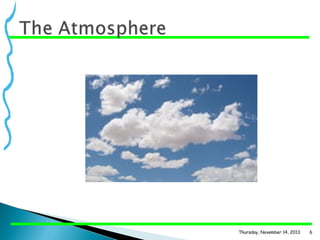
The atmosphere is the most unstable and rapidly
changing part of the system.
the layers of gases surrounding Earth
these gases reach more than 100km above the Earth’s
surface; beyond this height they are present in very low
concentrations
Air: 78% - Nitrogen Gas, 21% - Oxygen Gas
1% - Other (i.e. Argon, Carbon Dioxide, and traces of
Helium, Hydrogen, and Ozone)

Thursday, November 14, 2013

7
this proportion of gases changes at different
levels in the atmosphere
 the atmosphere reflects some of the Sun’s
energy, absorbs and radiates some of the
energy, and transmits some of it to the Earth’s
surface
 once the energy of the Sun reaches Earth’s
surface, the atmosphere traps much of it,
warming Earth


Thursday, November 14, 2013

8
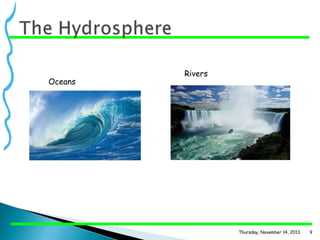
Oceans

Rivers

Thursday, November 14, 2013

9
The hydrosphere is the component comprising all
liquid surface and subterranean water, both fresh
water, including rivers, lakes and aquifers, and
saline water of the oceans and seas.
 Fresh water runoff from the land returning to the
oceans in rivers influences the oceans
composition and circulation.


Thursday, November 14, 2013

10
the part of the climate system that includes all
water on and around Earth
 includes liquid water, water vapour, and ice


Thursday, November 14, 2013

11
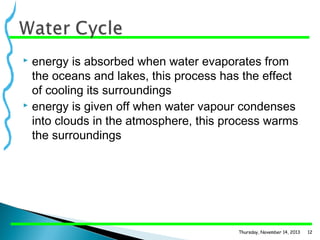
energy is absorbed when water evaporates from
the oceans and lakes, this process has the effect
of cooling its surroundings
 energy is given off when water vapour condenses
into clouds in the atmosphere, this process warms
the surroundings


Thursday, November 14, 2013

12
large bodies of water have an effect on the climate
of nearby regions
 water absorbs and stores more thermal energy
than land, it also eats up and cools down more
slowly than land
 regions near an ocean or large lake tend to be
cooler in the summer than inland locations (the
water takes a long time to warm up as it absorbs
thermal energy), they also tend to be warmer in
the fall (as the water slowly emits stored thermal
energy)


Thursday, November 14, 2013

13
Thursday, November 14, 2013

14


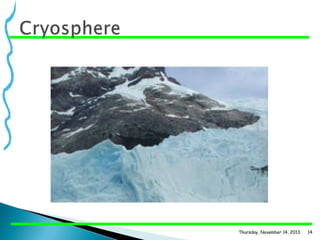
The cryosphere, including the ice sheets of
Greenland and Antarctica, continental glaciers
and snow fields, sea ice and permafrost, derives
its importance to the climate system from its high
reflectivity (albedo) for solar radiation, its low
thermal conductivity, its large thermal inertia and,
especially, its critical role in driving deep ocean
water circulation.

Thursday, November 14, 2013

15
Ice and the Climate System
 about 2% of all Earth’s water is frozen
 most of this ice located at the two poles
 sea ice or pack ice, only a few meters thick,
formed from frozen sea water, floats in the ocean
near the North and South Poles
 surfaces covered in ice and snow reflect more
radiant energy than surfaces covered in soil, rock,
or vegetation

Thursday, November 14, 2013

16
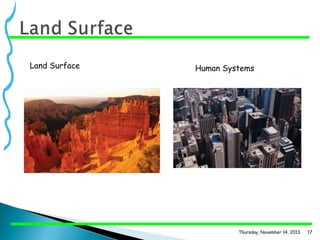
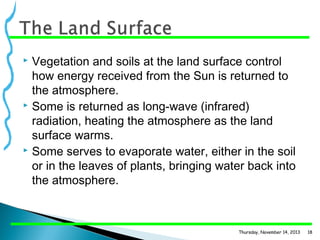
Land Surface

Human Systems

Thursday, November 14, 2013

17
Vegetation and soils at the land surface control
how energy received from the Sun is returned to
the atmosphere.
 Some is returned as long-wave (infrared)
radiation, heating the atmosphere as the land
surface warms.
 Some serves to evaporate water, either in the soil
or in the leaves of plants, bringing water back into
the atmosphere.


Thursday, November 14, 2013

18






Because the evaporation of soil moisture requires
energy, soil moisture has a strong influence on the
surface temperature.
The texture of the land surface (its roughness)
influences the atmosphere dynamically as winds blow
over the land’s surface.
Roughness is determined by both topography and
vegetation. Wind also blows dust from the surface into
the atmosphere, which interacts with the atmospheric
radiation.

Thursday, November 14, 2013

19
Thursday, November 14, 2013

20
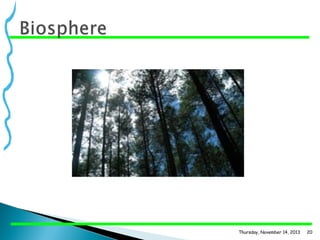
The marine and terrestrial biospheres have a
major impact on the atmosphere’s composition.
 The biota influences the uptake and release of
greenhouse gases.
 Through the photosynthetic process, both marine
and terrestrial plants (especially forests) store
significant amounts of carbon from carbon dioxide.


Thursday, November 14, 2013

21


Thus, the biosphere plays a central role in the
carbon cycle, as well as in the budgets of many
other gases, such as methane and nitrous oxide.

Thursday, November 14, 2013

22


Agricultural planning – strategic (long-term) and
tactical (<10 days) – needs to weigh climaterelated and other risks to attain the producer’s
goals and to spell out the sort of information that
farmers need to aid their planning, such as
climate, technical/managerial, and market data,
for example.

Thursday, November 14, 2013

23
A key aspect needed in linking climate and
weather risk to agricultural planners is an
appreciation of the overall management system in
question from the decision-makers’ viewpoint.
 Managers need infor­mation for both tactical and
strategic decision-making.


Thursday, November 14, 2013

24


As an example, an Australian survey of agricul­
tural planners provided a myriad of planning
horizons and key decisions (sometimes referred to
as “decision points”) that could be influenced by
weather and climate variability at different
timescales. In addition, it has been realized that
the decision system extends across the whole
value chain in agricultural production that is
affected by weather and climate variability.

Thursday, November 14, 2013

25
The sugar industry can serve as an example that
has relevance to many agricultural planning
systems:
 there are decisions at the farm scale (irrigation,
fertilization, fallow practice, land preparation,
planting, pest management) and at the transpor­
tation and milling scale (improved planning for wet
season disruption, planning for season start and
finish, crop size forecasts, civil works sched­ules).


Thursday, November 14, 2013

26
Climatic system is useful in
the following areas of
agricultural planning

Thursday, November 14, 2013

27


The method of selecting crop varieties based on
agroclimatic requirements consists of comparing,
on the one hand, the regional availability of agro­
climatic resources and, on the other, the climatic
requirements of certain crop varieties on the basis
of which the selection is to be made.

Thursday, November 14, 2013

28
The selection of varieties of plants at local or
regional levels should be based on agroclimatic
studies carried out to determine the climatic
requirements of the differ­ent crop varieties.
 Agroclimatic characterization of crops includes
solar radiation, temperature, humid­ity and
photoperiod, among the most important
climatological factors


Thursday, November 14, 2013

29


Intraspecific variability for resistance to drought,
frost and heat stress is often large. Hence, there is
often room for plant breeding for resistance to
these risks. For example, in citrus growing, frost
may not be avoidable; however, selecting for
tolerance to sub-zero temperatures is a valuable
option (Ikeda, 1982). The selection of an
appropriate variety for a given area should take
into account the frost hardi­ness of the varieties in
the species.

Thursday, November 14, 2013

30
A climatic system is important in land preparation
as part of agricultural planning.
 As far as frost protection is concerned, deep
plough­ing has about the same effect as shallow
ploughing on heat transfer, since the layer of soil
that is involved in heat transfer to the surface by
conduction, on a daily basis, is not thicker than
about 0.3 m.


Thursday, November 14, 2013

31
This is an important aspect of agricultural planning
as soils should be moist before a frost period is
likely to occur.
 Hence, irrigation one or two days in advance of a
frost night brings the soil to near field capacity,
which results in an increased soil heat flux during
a subsequent frost night.


Thursday, November 14, 2013

32
Climate systems are useful in pasture and
livestock management. An essential part of
farming in a variable climate is anticipating and
preparing for the next drought.
 This need to be incorporated into a farm’s longterm management strategy, and a good manager
should be cognizant of those factors that threaten
the sustainability and long-term financial viability
of the property.


Thursday, November 14, 2013

33
Knowledge of climate variability can assist in
adapting to climate change.
 In eastern Australia there is a strong correlation
between the Southern Oscillation Index in winter
and spring and subsequent spring and summer
rainfall (McBride and Nicholls, 1983; Stone et al.,
1996; Nicholls, 1998).


Thursday, November 14, 2013

34
Climate may also change outside the range of
previ­ous experience, especially with regard to the
severity and frequency of extreme conditions.
 Longer-term adaptation will require some
foreknowledge of the nature of the climate
change, not simply reliance on recent experience.


Thursday, November 14, 2013

35






Brohan P., J.J. Kennedy, I. Harris, S.F.B. Tett SFB, and
P.D. Jones (2006). Uncertainty estimates in regional and
global observed temperature changes: A new data set
from 1850. J. Geophys. Res. 111 (D12): D12106.
Climate and Cryosphere (Clic) project science and coordination plan (2001). Edited by I. Allison, R.G. Barry
and B.E. Goodison.WCRP-114 WMO/TD No. 1053.
Cushman-Roisin, B. (1994). Introduction to geophysical
fluid dynamics. Prentice Hall, London, 319pp.

Thursday, November 14, 2013

36




Hartmann D.L. (1994). Global physical
climatology.International Geophysics series, volume
56.Academic Press, 412 pp.
IPCC (2007): Climate Change 2007: The Physical
Science Basis. Contribution of Working Group I to the
Fourth Assessment Report of the Intergovernmental
Panel on Climate Change [Solomon, S., D. Qin, M.
Manning, Z. Chen, M. Marquis, K.B. Averyt, M.Tignor
and H.L. Miller (eds.)]. Cambridge University Press,
Cambridge, United Kingdom and New York, NY, USA.

Thursday, November 14, 2013

37
THE END

THANK YOU FOR YOUR ATTENTION

Thursday, November 14, 2013

38

Climatic systems major components and implications in agricultural planning

  • 1.
    Climatic Systems: Its MajorComponents and Implications in Agricultural Planning PRESENTERS: JACK ABEBE & ELIZABETH NJANI Thursday, November 14, 2013 1
  • 2.
     Definition  Climatic systems  Components ofclimatic systems  Agricultural Planning  Adaptation to climate change  References Thursday, November 14, 2013 2
  • 3.
    Climate is traditionallydefined as the description in terms of the mean and variability of relevant atmospheric variables such as temperature, precipitation and wind.  Climate can thus be viewed as a synthesis or aggregate of weather.  Thursday, November 14, 2013 3
  • 4.
           A climatic systemis an interactive system consisting of five major components: the atmosphere, the hydrosphere, the cryosphere, the land surface and the biosphere, forced or influenced by various external forcing mechanisms, the most important of which is the Sun. Also the direct effect of human activities on the climate system is considered an external forcing. Thursday, November 14, 2013 Thursday, November 14, 2013 4 4
  • 5.
    Climate change refersto a statistically significant variation in either the mean state of the climate or in its variability, persisting for an extended period (typically decades or longer).  Climate change may be due to natural internal processes or external forcing, or to persistent anthropogenic changes in the composition of the atmosphere or in land use.  Thursday, November 14, 2013 5
  • 6.
  • 7.
         The atmosphere isthe most unstable and rapidly changing part of the system. the layers of gases surrounding Earth these gases reach more than 100km above the Earth’s surface; beyond this height they are present in very low concentrations Air: 78% - Nitrogen Gas, 21% - Oxygen Gas 1% - Other (i.e. Argon, Carbon Dioxide, and traces of Helium, Hydrogen, and Ozone) Thursday, November 14, 2013 7
  • 8.
    this proportion ofgases changes at different levels in the atmosphere  the atmosphere reflects some of the Sun’s energy, absorbs and radiates some of the energy, and transmits some of it to the Earth’s surface  once the energy of the Sun reaches Earth’s surface, the atmosphere traps much of it, warming Earth  Thursday, November 14, 2013 8
  • 9.
  • 10.
    The hydrosphere isthe component comprising all liquid surface and subterranean water, both fresh water, including rivers, lakes and aquifers, and saline water of the oceans and seas.  Fresh water runoff from the land returning to the oceans in rivers influences the oceans composition and circulation.  Thursday, November 14, 2013 10
  • 11.
    the part ofthe climate system that includes all water on and around Earth  includes liquid water, water vapour, and ice  Thursday, November 14, 2013 11
  • 12.
    energy is absorbedwhen water evaporates from the oceans and lakes, this process has the effect of cooling its surroundings  energy is given off when water vapour condenses into clouds in the atmosphere, this process warms the surroundings  Thursday, November 14, 2013 12
  • 13.
    large bodies ofwater have an effect on the climate of nearby regions  water absorbs and stores more thermal energy than land, it also eats up and cools down more slowly than land  regions near an ocean or large lake tend to be cooler in the summer than inland locations (the water takes a long time to warm up as it absorbs thermal energy), they also tend to be warmer in the fall (as the water slowly emits stored thermal energy)  Thursday, November 14, 2013 13
  • 14.
  • 15.
     The cryosphere, includingthe ice sheets of Greenland and Antarctica, continental glaciers and snow fields, sea ice and permafrost, derives its importance to the climate system from its high reflectivity (albedo) for solar radiation, its low thermal conductivity, its large thermal inertia and, especially, its critical role in driving deep ocean water circulation. Thursday, November 14, 2013 15
  • 16.
    Ice and theClimate System  about 2% of all Earth’s water is frozen  most of this ice located at the two poles  sea ice or pack ice, only a few meters thick, formed from frozen sea water, floats in the ocean near the North and South Poles  surfaces covered in ice and snow reflect more radiant energy than surfaces covered in soil, rock, or vegetation Thursday, November 14, 2013 16
  • 17.
  • 18.
    Vegetation and soilsat the land surface control how energy received from the Sun is returned to the atmosphere.  Some is returned as long-wave (infrared) radiation, heating the atmosphere as the land surface warms.  Some serves to evaporate water, either in the soil or in the leaves of plants, bringing water back into the atmosphere.  Thursday, November 14, 2013 18
  • 19.
       Because the evaporationof soil moisture requires energy, soil moisture has a strong influence on the surface temperature. The texture of the land surface (its roughness) influences the atmosphere dynamically as winds blow over the land’s surface. Roughness is determined by both topography and vegetation. Wind also blows dust from the surface into the atmosphere, which interacts with the atmospheric radiation. Thursday, November 14, 2013 19
  • 20.
  • 21.
    The marine andterrestrial biospheres have a major impact on the atmosphere’s composition.  The biota influences the uptake and release of greenhouse gases.  Through the photosynthetic process, both marine and terrestrial plants (especially forests) store significant amounts of carbon from carbon dioxide.  Thursday, November 14, 2013 21
  • 22.
     Thus, the biosphereplays a central role in the carbon cycle, as well as in the budgets of many other gases, such as methane and nitrous oxide. Thursday, November 14, 2013 22
  • 23.
     Agricultural planning –strategic (long-term) and tactical (<10 days) – needs to weigh climaterelated and other risks to attain the producer’s goals and to spell out the sort of information that farmers need to aid their planning, such as climate, technical/managerial, and market data, for example. Thursday, November 14, 2013 23
  • 24.
    A key aspectneeded in linking climate and weather risk to agricultural planners is an appreciation of the overall management system in question from the decision-makers’ viewpoint.  Managers need infor­mation for both tactical and strategic decision-making.  Thursday, November 14, 2013 24
  • 25.
     As an example,an Australian survey of agricul­ tural planners provided a myriad of planning horizons and key decisions (sometimes referred to as “decision points”) that could be influenced by weather and climate variability at different timescales. In addition, it has been realized that the decision system extends across the whole value chain in agricultural production that is affected by weather and climate variability. Thursday, November 14, 2013 25
  • 26.
    The sugar industrycan serve as an example that has relevance to many agricultural planning systems:  there are decisions at the farm scale (irrigation, fertilization, fallow practice, land preparation, planting, pest management) and at the transpor­ tation and milling scale (improved planning for wet season disruption, planning for season start and finish, crop size forecasts, civil works sched­ules).  Thursday, November 14, 2013 26
  • 27.
    Climatic system isuseful in the following areas of agricultural planning Thursday, November 14, 2013 27
  • 28.
     The method ofselecting crop varieties based on agroclimatic requirements consists of comparing, on the one hand, the regional availability of agro­ climatic resources and, on the other, the climatic requirements of certain crop varieties on the basis of which the selection is to be made. Thursday, November 14, 2013 28
  • 29.
    The selection ofvarieties of plants at local or regional levels should be based on agroclimatic studies carried out to determine the climatic requirements of the differ­ent crop varieties.  Agroclimatic characterization of crops includes solar radiation, temperature, humid­ity and photoperiod, among the most important climatological factors  Thursday, November 14, 2013 29
  • 30.
     Intraspecific variability forresistance to drought, frost and heat stress is often large. Hence, there is often room for plant breeding for resistance to these risks. For example, in citrus growing, frost may not be avoidable; however, selecting for tolerance to sub-zero temperatures is a valuable option (Ikeda, 1982). The selection of an appropriate variety for a given area should take into account the frost hardi­ness of the varieties in the species. Thursday, November 14, 2013 30
  • 31.
    A climatic systemis important in land preparation as part of agricultural planning.  As far as frost protection is concerned, deep plough­ing has about the same effect as shallow ploughing on heat transfer, since the layer of soil that is involved in heat transfer to the surface by conduction, on a daily basis, is not thicker than about 0.3 m.  Thursday, November 14, 2013 31
  • 32.
    This is animportant aspect of agricultural planning as soils should be moist before a frost period is likely to occur.  Hence, irrigation one or two days in advance of a frost night brings the soil to near field capacity, which results in an increased soil heat flux during a subsequent frost night.  Thursday, November 14, 2013 32
  • 33.
    Climate systems areuseful in pasture and livestock management. An essential part of farming in a variable climate is anticipating and preparing for the next drought.  This need to be incorporated into a farm’s longterm management strategy, and a good manager should be cognizant of those factors that threaten the sustainability and long-term financial viability of the property.  Thursday, November 14, 2013 33
  • 34.
    Knowledge of climatevariability can assist in adapting to climate change.  In eastern Australia there is a strong correlation between the Southern Oscillation Index in winter and spring and subsequent spring and summer rainfall (McBride and Nicholls, 1983; Stone et al., 1996; Nicholls, 1998).  Thursday, November 14, 2013 34
  • 35.
    Climate may alsochange outside the range of previ­ous experience, especially with regard to the severity and frequency of extreme conditions.  Longer-term adaptation will require some foreknowledge of the nature of the climate change, not simply reliance on recent experience.  Thursday, November 14, 2013 35
  • 36.
       Brohan P., J.J.Kennedy, I. Harris, S.F.B. Tett SFB, and P.D. Jones (2006). Uncertainty estimates in regional and global observed temperature changes: A new data set from 1850. J. Geophys. Res. 111 (D12): D12106. Climate and Cryosphere (Clic) project science and coordination plan (2001). Edited by I. Allison, R.G. Barry and B.E. Goodison.WCRP-114 WMO/TD No. 1053. Cushman-Roisin, B. (1994). Introduction to geophysical fluid dynamics. Prentice Hall, London, 319pp. Thursday, November 14, 2013 36
  • 37.
      Hartmann D.L. (1994).Global physical climatology.International Geophysics series, volume 56.Academic Press, 412 pp. IPCC (2007): Climate Change 2007: The Physical Science Basis. Contribution of Working Group I to the Fourth Assessment Report of the Intergovernmental Panel on Climate Change [Solomon, S., D. Qin, M. Manning, Z. Chen, M. Marquis, K.B. Averyt, M.Tignor and H.L. Miller (eds.)]. Cambridge University Press, Cambridge, United Kingdom and New York, NY, USA. Thursday, November 14, 2013 37
  • 38.
    THE END THANK YOUFOR YOUR ATTENTION Thursday, November 14, 2013 38