Environmental Engineering- I
By
Akash Padole
Department of Civil Engineering
Water Demand
Need for Water Supply Scheme
• People depend on water for drinking, cooking,
washing, carrying away wastes, and other domestic
needs.
• Water supply systems must also meet requirements
for public, commercial, and industrial activities.
• In all cases, the water must fulfill both quality and
quantity requirements
Akash Padole 2
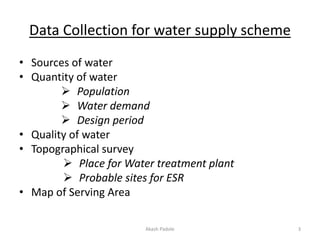
Data Collection for water supply scheme
• Sources of water
• Quantity of water
 Population
 Water demand
 Design period
• Quality of water
• Topographical survey
 Place for Water treatment plant
 Probable sites for ESR
• Map of Serving Area
Akash Padole 3
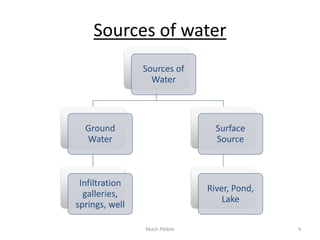
Sources of water
Sources of
Water
Ground
Water
Infiltration
galleries,
springs, well
Surface
Source
River, Pond,
Lake
Akash Padole 4
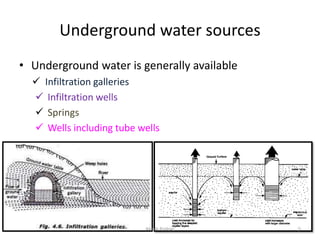
Underground water sources
• Underground water is generally available
 Infiltration galleries
 Infiltration wells
 Springs
 Wells including tube wells
Akash Padole 5
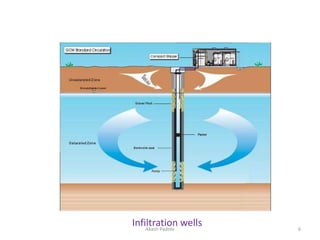
Infiltration wells
Akash Padole 6
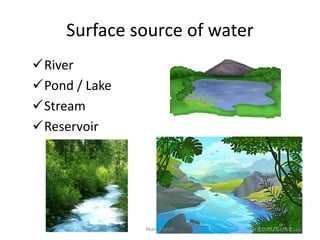
Surface source of water
River
Pond / Lake
Stream
Reservoir
Akash Padole 7
Selection criteria for Source
 Quality and quantity
 Distance between source and supply area
 Transportation cost ( Source to WTP to Consumer)
 Treatment Cost (depends on quality)
Akash Padole 8
Design Period
• The future period of number of years for which a
provision is made in designing the capacities of the
various components of water supply scheme is
known as the Design Period.
Akash Padole 9
• Design period is estimated based on the following:
– Useful life of the component, considering
obsolescence, wear and tear, etc.
– Expandability aspect.
– Anticipated rate of growth of population,
including industrial, commercial developments &
migration-immigration.
– Available resources.
Akash Padole 10
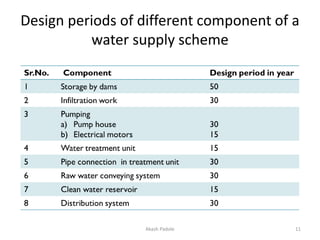
Design periods of different component of a
water supply scheme
Akash Padole 11
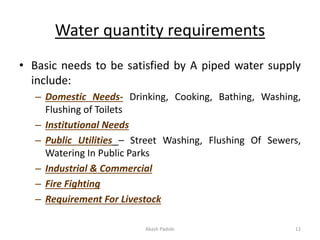
Water quantity requirements
• Basic needs to be satisfied by A piped water supply
include:
– Domestic Needs- Drinking, Cooking, Bathing, Washing,
Flushing of Toilets
– Institutional Needs
– Public Utilities – Street Washing, Flushing Of Sewers,
Watering In Public Parks
– Industrial & Commercial
– Fire Fighting
– Requirement For Livestock
Akash Padole 12
Types of Water Demand
1. Domestic Demand
2. Industrial and Commercial Demand
3. Fire Demand
4. Demand for public use
5. Compensate losses demand
Akash Padole 13
1. Domestic Demand
• This includes the water required in private building for
drinking ,bathing, gardening, sanitary purpose, etc.
• As per IS : 1175-1983
200 l/c/d (with fully flushing system)
135 l/c/d (for weaker sections and LIG)
• Domestic Water Demand is @ 55 to 60 % of total water
demand
IS : 1175-1983
(Code of Basic requirements of for water supply , drainage and sanitation)
Akash Padole 14
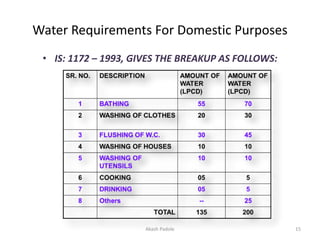
Water Requirements For Domestic Purposes
• IS: 1172 – 1993, GIVES THE BREAKUP AS FOLLOWS:
Akash Padole 15
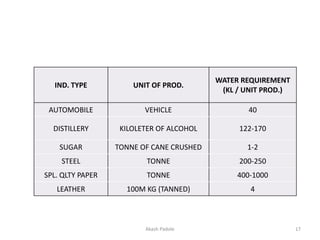
2.1 Industrial Demand
• It represents the water demand of industries which are
earlier existing or are likely to be started in future.
• As per IS :
– 50 l/c/d (for normal industries )
– 450 l/c/d (industrial cities)
• The water required by factories such as paper mills,
Cloth mills, Cotton mills, Breweries, Sugar refineries
etc. comes under industrial use.
• The quantity of water demand for industrial purpose is
around 20 to 25% of the total demand of the city.
Akash Padole 16
IND. TYPE UNIT OF PROD.
WATER REQUIREMENT
(KL / UNIT PROD.)
AUTOMOBILE VEHICLE 40
DISTILLERY KILOLETER OF ALCOHOL 122-170
SUGAR TONNE OF CANE CRUSHED 1-2
STEEL TONNE 200-250
SPL. QLTY PAPER TONNE 400-1000
LEATHER 100M KG (TANNED) 4
Akash Padole 17
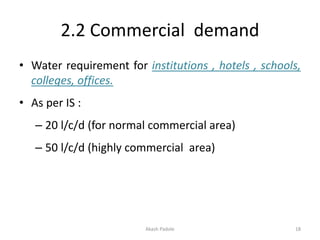
2.2 Commercial demand
• Water requirement for institutions , hotels , schools,
colleges, offices.
• As per IS :
– 20 l/c/d (for normal commercial area)
– 50 l/c/d (highly commercial area)
Akash Padole 18
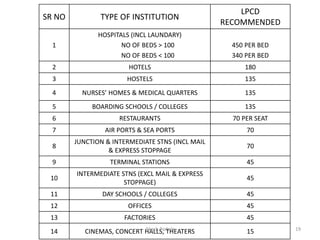
SR NO TYPE OF INSTITUTION
LPCD
RECOMMENDED
1
HOSPITALS (INCL LAUNDARY)
NO OF BEDS > 100
NO OF BEDS < 100
450 PER BED
340 PER BED
2 HOTELS 180
3 HOSTELS 135
4 NURSES’ HOMES & MEDICAL QUARTERS 135
5 BOARDING SCHOOLS / COLLEGES 135
6 RESTAURANTS 70 PER SEAT
7 AIR PORTS & SEA PORTS 70
8
JUNCTION & INTERMEDIATE STNS (INCL MAIL
& EXPRESS STOPPAGE
70
9 TERMINAL STATIONS 45
10
INTERMEDIATE STNS (EXCL MAIL & EXPRESS
STOPPAGE)
45
11 DAY SCHOOLS / COLLEGES 45
12 OFFICES 45
13 FACTORIES 45
14 CINEMAS, CONCERT HALLS, THEATERS 15
Akash Padole 19
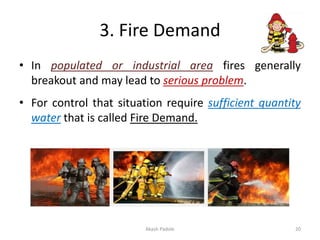
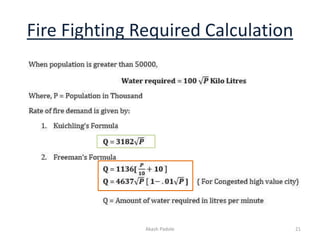
3. Fire Demand
• In populated or industrial area fires generally
breakout and may lead to serious problem.
• For control that situation require sufficient quantity
water that is called Fire Demand.
Akash Padole 20
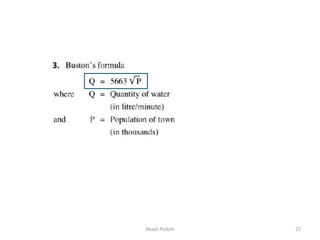
Fire Fighting Required Calculation
Akash Padole 21
Akash Padole 22
3.
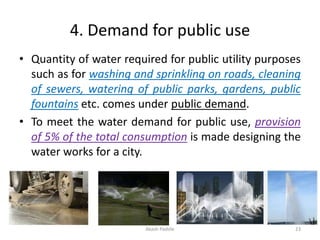
4. Demand for public use
• Quantity of water required for public utility purposes
such as for washing and sprinkling on roads, cleaning
of sewers, watering of public parks, gardens, public
fountains etc. comes under public demand.
• To meet the water demand for public use, provision
of 5% of the total consumption is made designing the
water works for a city.
Akash Padole 23
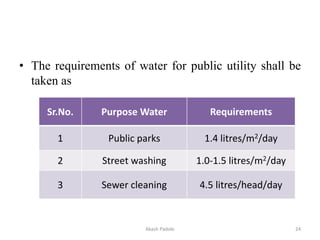
• The requirements of water for public utility shall be
taken as
Sr.No. Purpose Water Requirements
1 Public parks 1.4 litres/m2/day
2 Street washing 1.0-1.5 litres/m2/day
3 Sewer cleaning 4.5 litres/head/day
Akash Padole 24
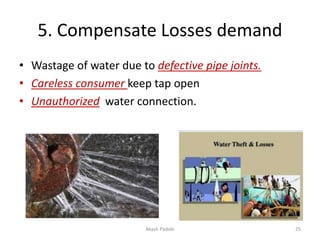
5. Compensate Losses demand
• Wastage of water due to defective pipe joints.
• Careless consumer keep tap open
• Unauthorized water connection.
Akash Padole 25
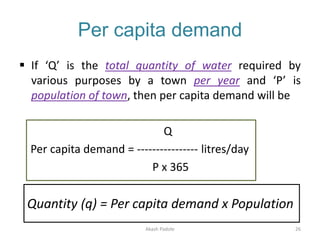
Per capita demand
 If ‘Q’ is the total quantity of water required by
various purposes by a town per year and ‘P’ is
population of town, then per capita demand will be
Q
Per capita demand = ---------------- litres/day
P x 365
Quantity (q) = Per capita demand x Population
Akash Padole 26
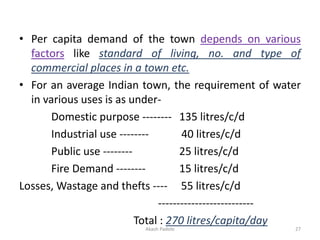
• Per capita demand of the town depends on various
factors like standard of living, no. and type of
commercial places in a town etc.
• For an average Indian town, the requirement of water
in various uses is as under-
Domestic purpose -------- 135 litres/c/d
Industrial use -------- 40 litres/c/d
Public use -------- 25 litres/c/d
Fire Demand -------- 15 litres/c/d
Losses, Wastage and thefts ---- 55 litres/c/d
--------------------------
Total : 270 litres/capita/day
Akash Padole 27
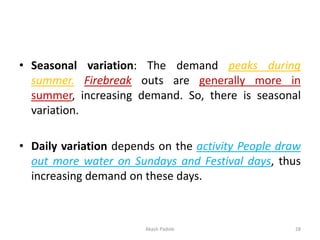
• Seasonal variation: The demand peaks during
summer. Firebreak outs are generally more in
summer, increasing demand. So, there is seasonal
variation.
• Daily variation depends on the activity People draw
out more water on Sundays and Festival days, thus
increasing demand on these days.
Akash Padole 28
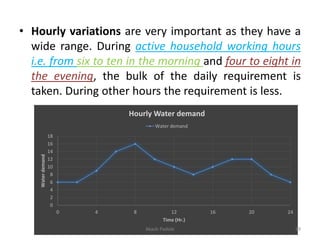
• Hourly variations are very important as they have a
wide range. During active household working hours
i.e. from six to ten in the morning and four to eight in
the evening, the bulk of the daily requirement is
taken. During other hours the requirement is less.
0
2
4
6
8
10
12
14
16
18
0 4 8 12 16 20 24
Water
demand
Time (Hr.)
Hourly Water demand
Water demand
Akash Padole 29
• Moreover, if a fire breaks out, a huge quantity of
water is required to be supplied during short
duration, necessitating the need for a maximum rate
of hourly supply.
Akash Padole 30
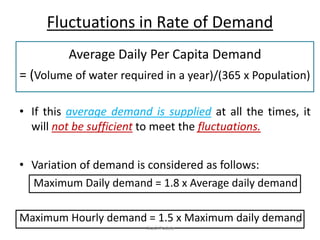
Fluctuations in Rate of Demand
Average Daily Per Capita Demand
= (Volume of water required in a year)/(365 x Population)
• If this average demand is supplied at all the times, it
will not be sufficient to meet the fluctuations.
• Variation of demand is considered as follows:
Maximum Daily demand = 1.8 x Average daily demand
Maximum Hourly demand = 1.5 x Maximum daily demand
Akash Padole
31
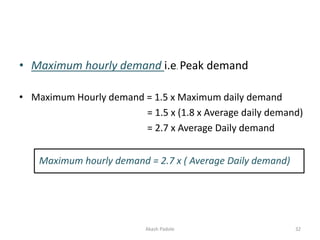
• Maximum hourly demand i.e. Peak demand
• Maximum Hourly demand = 1.5 x Maximum daily demand
= 1.5 x (1.8 x Average daily demand)
= 2.7 x Average Daily demand
Maximum hourly demand = 2.7 x ( Average Daily demand)
Akash Padole 32
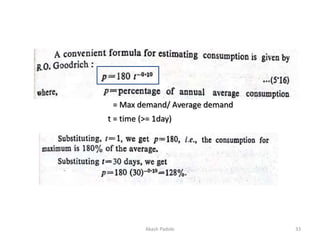
t = time (>= 1day)
= Max demand/ Average demand
Akash Padole 33
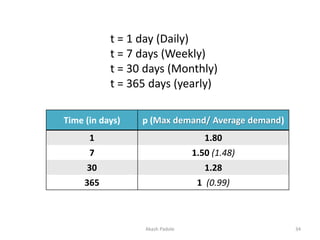
t = 1 day (Daily)
t = 7 days (Weekly)
t = 30 days (Monthly)
t = 365 days (yearly)
Time (in days) p (Max demand/ Average demand)
1 1.80
7 1.50 (1.48)
30 1.28
365 1 (0.99)
Akash Padole 34
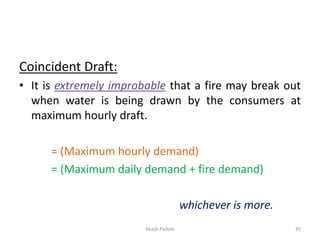
Coincident Draft:
• It is extremely improbable that a fire may break out
when water is being drawn by the consumers at
maximum hourly draft.
= (Maximum hourly demand)
= (Maximum daily demand + fire demand)
whichever is more.
Akash Padole 35
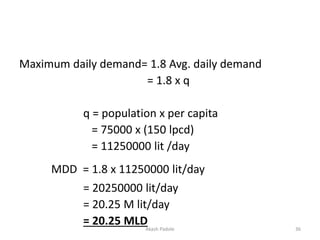
Maximum daily demand= 1.8 Avg. daily demand
= 1.8 x q
q = population x per capita
= 75000 x (150 lpcd)
= 11250000 lit /day
MDD = 1.8 x 11250000 lit/day
= 20250000 lit/day
= 20.25 M lit/day
= 20.25 MLDAkash Padole 36
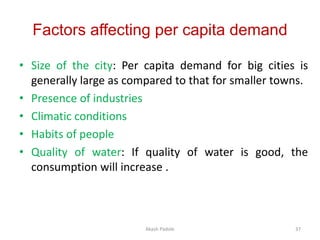
Factors affecting per capita demand
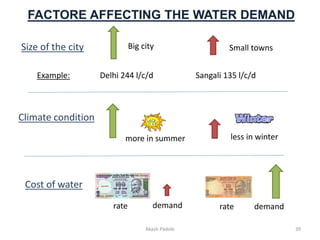
• Size of the city: Per capita demand for big cities is
generally large as compared to that for smaller towns.
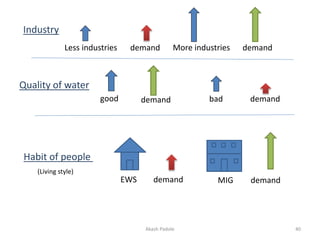
• Presence of industries
• Climatic conditions
• Habits of people
• Quality of water: If quality of water is good, the
consumption will increase .
Akash Padole 37
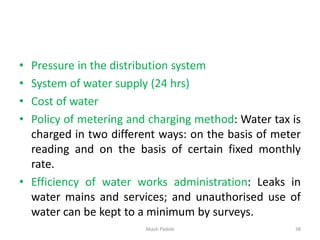
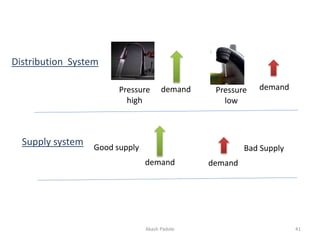
• Pressure in the distribution system
• System of water supply (24 hrs)
• Cost of water
• Policy of metering and charging method: Water tax is
charged in two different ways: on the basis of meter
reading and on the basis of certain fixed monthly
rate.
• Efficiency of water works administration: Leaks in
water mains and services; and unauthorised use of
water can be kept to a minimum by surveys.
Akash Padole 38
FACTORE AFFECTING THE WATER DEMAND
Big city
Size of the city Small towns
Example: Delhi 244 l/c/d Sangali 135 l/c/d
Climate condition
less in winter
more in summer
Cost of water
rate demand rate demand
Akash Padole 39
Industry
Quality of water
good demand demand
bad
demand demand
More industries
Less industries
Habit of people
demand demand
EWS MIG
(Living style)
Akash Padole 40
Supply system
Bad Supply
Distribution System
Good supply
demand
Pressure
high
Pressure
low
demand
demand demand
Akash Padole 41
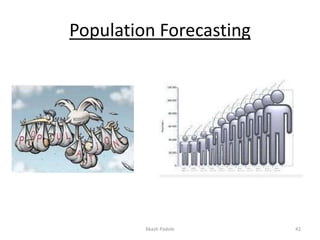
Population Forecasting
Akash Padole 42
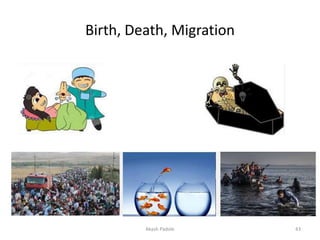
Birth, Death, Migration
Akash Padole 43
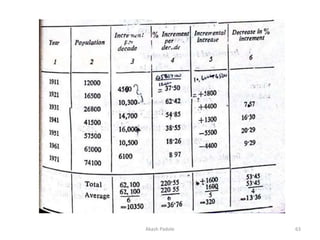
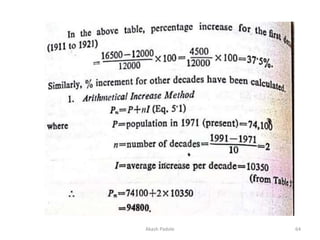
1. Arithmetic Increase Method
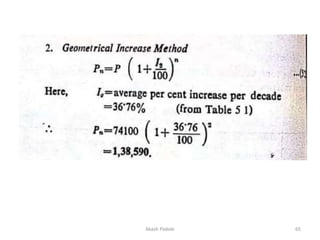
2. Geometric Increase Method
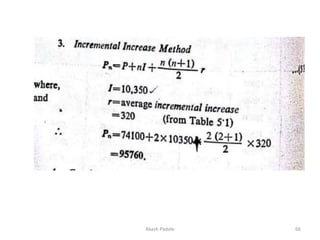
3. Incremental Increase Method
4. Decreasing Rate of Growth Method
5. Simple Graphical Method
6. Comparative Graphical Method
7. Ratio Method
8. Logistic Curve Method
Akash Padole 44
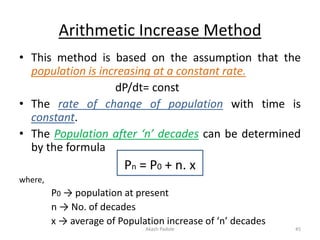
Arithmetic Increase Method
• This method is based on the assumption that the
population is increasing at a constant rate.
dP/dt= const
• The rate of change of population with time is
constant.
• The Population after ‘n’ decades can be determined
by the formula
Pn = P0 + n. x
where,
P0 → population at present
n → No. of decades
x → average of Population increase of ‘n’ decades
Akash Padole 45
Geometric Increase Method
• In this method, the rate of growth of population is
assumed to be constant.
• But the increase in population is compounded over the
present population to compute the future population.
• The average percentage of growth of last few decades is
determined.
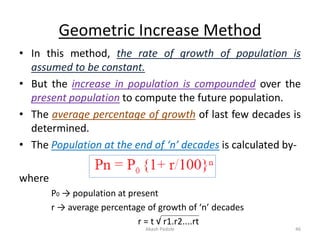
• The Population at the end of ‘n’ decades is calculated by-
where
P0 → population at present
r → average percentage of growth of ‘n’ decades
r = t √ r1.r2....rt
Akash Padole 46
Incremental Increase Method
• In this method, the rate of growth of population is
not constant.
• It may either increase or decrease depending upon
the given past information.
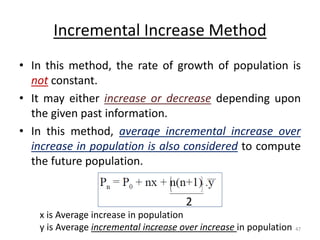
• In this method, average incremental increase over
increase in population is also considered to compute
the future population.
2
x is Average increase in population
y is Average incremental increase over increase in population
Akash Padole 47
• Arithmetic increase method gives the lowest value of
population forecast, hence suitable for old cities or
towns (developed cities)
• Whereas Geometric Increase Method gives the
highest value of population forecast, hence suitable
for young cities or towns.
• GOI manual recommends the use of GM method to
calculate rate of growth of population.
Akash Padole 48
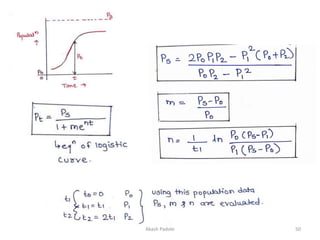
Logistic Curve Method
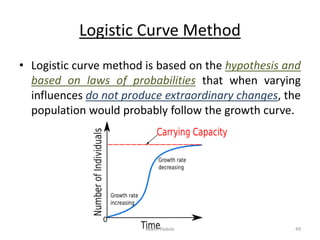
• Logistic curve method is based on the hypothesis and
based on laws of probabilities that when varying
influences do not produce extraordinary changes, the
population would probably follow the growth curve.
Akash Padole 49
Akash Padole 50
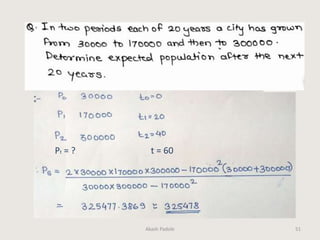
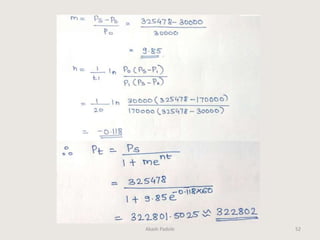
Pt = ? t = 60
Akash Padole 51
Akash Padole 52
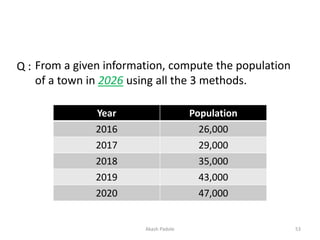
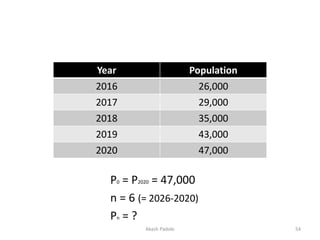
Q : From a given information, compute the population
of a town in 2026 using all the 3 methods.
Year Population
2016 26,000
2017 29,000
2018 35,000
2019 43,000
2020 47,000
Akash Padole 53
P0 = P2020 = 47,000
n = 6 (= 2026-2020)
Pn = ?
Year Population
2016 26,000
2017 29,000
2018 35,000
2019 43,000
2020 47,000
Akash Padole 54
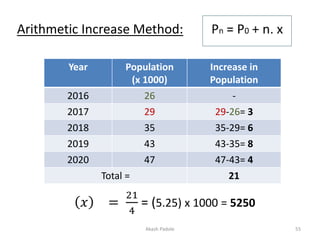
Arithmetic Increase Method:
𝑥 =
21
4
= (5.25) x 1000 = 5250
Year Population
(x 1000)
Increase in
Population
2016 26 -
2017 29 29-26= 3
2018 35 35-29= 6
2019 43 43-35= 8
2020 47 47-43= 4
Total = 21
Akash Padole 55
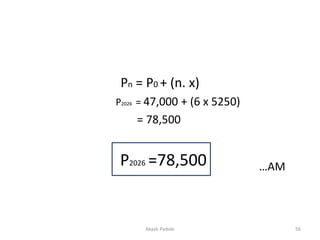
Pn = P0 + (n. x)
P2026 = 47,000 + (6 x 5250)
= 78,500
P2026 =78,500 …AM
Akash Padole 56
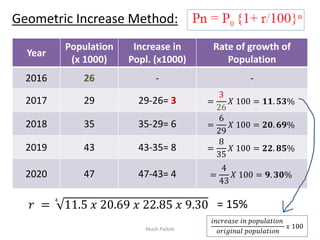
𝑟 = 11.5 𝑥 20.69 𝑥 22.85 𝑥 9.30
1
Geometric Increase Method:
Year
Population
(x 1000)
Increase in
Popl. (x1000)
Rate of growth of
Population
2016 26 - -
2017 29 29-26= 3 =
3
26
𝑋 100 = 𝟏𝟏. 𝟓𝟑%
2018 35 35-29= 6 =
6
29
𝑋 100 = 𝟐𝟎. 𝟔𝟗%
2019 43 43-35= 8 =
8
35
𝑋 100 = 𝟐𝟐. 𝟖𝟓%
2020 47 47-43= 4 =
4
43
𝑋 100 = 𝟗. 𝟑𝟎%
= 15%
4
𝑖𝑛𝑐𝑟𝑒𝑎𝑠𝑒 𝑖𝑛 𝑝𝑜𝑝𝑢𝑙𝑎𝑡𝑖𝑜𝑛
𝑜𝑟𝑖𝑔𝑖𝑛𝑎𝑙 𝑝𝑜𝑝𝑢𝑙𝑎𝑡𝑖𝑜𝑛
𝑥 100
Akash Padole
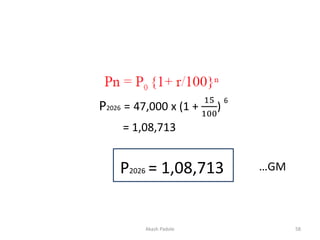
P2026 = 47,000 x (1 +
15
100
)
= 1,08,713
P2026 = 1,08,713 …GM
6
Akash Padole 58
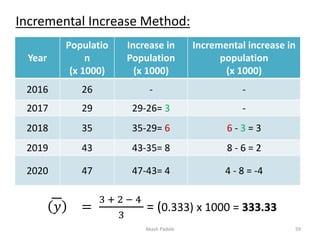
Incremental Increase Method:
Year
Populatio
n
(x 1000)
Increase in
Population
(x 1000)
Incremental increase in
population
(x 1000)
2016 26 - -
2017 29 29-26= 3 -
2018 35 35-29= 6 6 - 3 = 3
2019 43 43-35= 8 8 - 6 = 2
2020 47 47-43= 4 4 - 8 = -4
𝑦 =
3 + 2 − 4
3
= (0.333) x 1000 = 333.33
Akash Padole 59
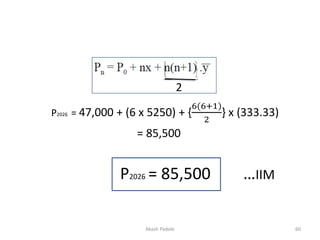
P2026 = 47,000 + (6 x 5250) + {
6(6+1)
2
} x (333.33)
= 85,500
P2026 = 85,500 …IIM
2
Akash Padole 60
AM < IIM < GM
Akash Padole 61
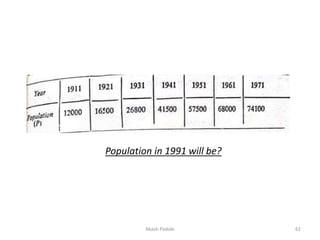
Population in 1991 will be?
Akash Padole 62
Akash Padole 63
Akash Padole 64
Akash Padole 65
Akash Padole 66

03 Water Demand

  • 1.
    Environmental Engineering- I By AkashPadole Department of Civil Engineering Water Demand
  • 2.
    Need for WaterSupply Scheme • People depend on water for drinking, cooking, washing, carrying away wastes, and other domestic needs. • Water supply systems must also meet requirements for public, commercial, and industrial activities. • In all cases, the water must fulfill both quality and quantity requirements Akash Padole 2
  • 3.
    Data Collection forwater supply scheme • Sources of water • Quantity of water  Population  Water demand  Design period • Quality of water • Topographical survey  Place for Water treatment plant  Probable sites for ESR • Map of Serving Area Akash Padole 3
  • 4.
    Sources of water Sourcesof Water Ground Water Infiltration galleries, springs, well Surface Source River, Pond, Lake Akash Padole 4
  • 5.
    Underground water sources •Underground water is generally available  Infiltration galleries  Infiltration wells  Springs  Wells including tube wells Akash Padole 5
  • 6.
  • 7.
    Surface source ofwater River Pond / Lake Stream Reservoir Akash Padole 7
  • 8.
    Selection criteria forSource  Quality and quantity  Distance between source and supply area  Transportation cost ( Source to WTP to Consumer)  Treatment Cost (depends on quality) Akash Padole 8
  • 9.
    Design Period • Thefuture period of number of years for which a provision is made in designing the capacities of the various components of water supply scheme is known as the Design Period. Akash Padole 9
  • 10.
    • Design periodis estimated based on the following: – Useful life of the component, considering obsolescence, wear and tear, etc. – Expandability aspect. – Anticipated rate of growth of population, including industrial, commercial developments & migration-immigration. – Available resources. Akash Padole 10
  • 11.
    Design periods ofdifferent component of a water supply scheme Akash Padole 11
  • 12.
    Water quantity requirements •Basic needs to be satisfied by A piped water supply include: – Domestic Needs- Drinking, Cooking, Bathing, Washing, Flushing of Toilets – Institutional Needs – Public Utilities – Street Washing, Flushing Of Sewers, Watering In Public Parks – Industrial & Commercial – Fire Fighting – Requirement For Livestock Akash Padole 12
  • 13.
    Types of WaterDemand 1. Domestic Demand 2. Industrial and Commercial Demand 3. Fire Demand 4. Demand for public use 5. Compensate losses demand Akash Padole 13
  • 14.
    1. Domestic Demand •This includes the water required in private building for drinking ,bathing, gardening, sanitary purpose, etc. • As per IS : 1175-1983 200 l/c/d (with fully flushing system) 135 l/c/d (for weaker sections and LIG) • Domestic Water Demand is @ 55 to 60 % of total water demand IS : 1175-1983 (Code of Basic requirements of for water supply , drainage and sanitation) Akash Padole 14
  • 15.
    Water Requirements ForDomestic Purposes • IS: 1172 – 1993, GIVES THE BREAKUP AS FOLLOWS: Akash Padole 15
  • 16.
    2.1 Industrial Demand •It represents the water demand of industries which are earlier existing or are likely to be started in future. • As per IS : – 50 l/c/d (for normal industries ) – 450 l/c/d (industrial cities) • The water required by factories such as paper mills, Cloth mills, Cotton mills, Breweries, Sugar refineries etc. comes under industrial use. • The quantity of water demand for industrial purpose is around 20 to 25% of the total demand of the city. Akash Padole 16
  • 17.
    IND. TYPE UNITOF PROD. WATER REQUIREMENT (KL / UNIT PROD.) AUTOMOBILE VEHICLE 40 DISTILLERY KILOLETER OF ALCOHOL 122-170 SUGAR TONNE OF CANE CRUSHED 1-2 STEEL TONNE 200-250 SPL. QLTY PAPER TONNE 400-1000 LEATHER 100M KG (TANNED) 4 Akash Padole 17
  • 18.
    2.2 Commercial demand •Water requirement for institutions , hotels , schools, colleges, offices. • As per IS : – 20 l/c/d (for normal commercial area) – 50 l/c/d (highly commercial area) Akash Padole 18
  • 19.
    SR NO TYPEOF INSTITUTION LPCD RECOMMENDED 1 HOSPITALS (INCL LAUNDARY) NO OF BEDS > 100 NO OF BEDS < 100 450 PER BED 340 PER BED 2 HOTELS 180 3 HOSTELS 135 4 NURSES’ HOMES & MEDICAL QUARTERS 135 5 BOARDING SCHOOLS / COLLEGES 135 6 RESTAURANTS 70 PER SEAT 7 AIR PORTS & SEA PORTS 70 8 JUNCTION & INTERMEDIATE STNS (INCL MAIL & EXPRESS STOPPAGE 70 9 TERMINAL STATIONS 45 10 INTERMEDIATE STNS (EXCL MAIL & EXPRESS STOPPAGE) 45 11 DAY SCHOOLS / COLLEGES 45 12 OFFICES 45 13 FACTORIES 45 14 CINEMAS, CONCERT HALLS, THEATERS 15 Akash Padole 19
  • 20.
    3. Fire Demand •In populated or industrial area fires generally breakout and may lead to serious problem. • For control that situation require sufficient quantity water that is called Fire Demand. Akash Padole 20
  • 21.
    Fire Fighting RequiredCalculation Akash Padole 21
  • 22.
  • 23.
    4. Demand forpublic use • Quantity of water required for public utility purposes such as for washing and sprinkling on roads, cleaning of sewers, watering of public parks, gardens, public fountains etc. comes under public demand. • To meet the water demand for public use, provision of 5% of the total consumption is made designing the water works for a city. Akash Padole 23
  • 24.
    • The requirementsof water for public utility shall be taken as Sr.No. Purpose Water Requirements 1 Public parks 1.4 litres/m2/day 2 Street washing 1.0-1.5 litres/m2/day 3 Sewer cleaning 4.5 litres/head/day Akash Padole 24
  • 25.
    5. Compensate Lossesdemand • Wastage of water due to defective pipe joints. • Careless consumer keep tap open • Unauthorized water connection. Akash Padole 25
  • 26.
    Per capita demand If ‘Q’ is the total quantity of water required by various purposes by a town per year and ‘P’ is population of town, then per capita demand will be Q Per capita demand = ---------------- litres/day P x 365 Quantity (q) = Per capita demand x Population Akash Padole 26
  • 27.
    • Per capitademand of the town depends on various factors like standard of living, no. and type of commercial places in a town etc. • For an average Indian town, the requirement of water in various uses is as under- Domestic purpose -------- 135 litres/c/d Industrial use -------- 40 litres/c/d Public use -------- 25 litres/c/d Fire Demand -------- 15 litres/c/d Losses, Wastage and thefts ---- 55 litres/c/d -------------------------- Total : 270 litres/capita/day Akash Padole 27
  • 28.
    • Seasonal variation:The demand peaks during summer. Firebreak outs are generally more in summer, increasing demand. So, there is seasonal variation. • Daily variation depends on the activity People draw out more water on Sundays and Festival days, thus increasing demand on these days. Akash Padole 28
  • 29.
    • Hourly variationsare very important as they have a wide range. During active household working hours i.e. from six to ten in the morning and four to eight in the evening, the bulk of the daily requirement is taken. During other hours the requirement is less. 0 2 4 6 8 10 12 14 16 18 0 4 8 12 16 20 24 Water demand Time (Hr.) Hourly Water demand Water demand Akash Padole 29
  • 30.
    • Moreover, ifa fire breaks out, a huge quantity of water is required to be supplied during short duration, necessitating the need for a maximum rate of hourly supply. Akash Padole 30
  • 31.
    Fluctuations in Rateof Demand Average Daily Per Capita Demand = (Volume of water required in a year)/(365 x Population) • If this average demand is supplied at all the times, it will not be sufficient to meet the fluctuations. • Variation of demand is considered as follows: Maximum Daily demand = 1.8 x Average daily demand Maximum Hourly demand = 1.5 x Maximum daily demand Akash Padole 31
  • 32.
    • Maximum hourlydemand i.e. Peak demand • Maximum Hourly demand = 1.5 x Maximum daily demand = 1.5 x (1.8 x Average daily demand) = 2.7 x Average Daily demand Maximum hourly demand = 2.7 x ( Average Daily demand) Akash Padole 32
  • 33.
    t = time(>= 1day) = Max demand/ Average demand Akash Padole 33
  • 34.
    t = 1day (Daily) t = 7 days (Weekly) t = 30 days (Monthly) t = 365 days (yearly) Time (in days) p (Max demand/ Average demand) 1 1.80 7 1.50 (1.48) 30 1.28 365 1 (0.99) Akash Padole 34
  • 35.
    Coincident Draft: • Itis extremely improbable that a fire may break out when water is being drawn by the consumers at maximum hourly draft. = (Maximum hourly demand) = (Maximum daily demand + fire demand) whichever is more. Akash Padole 35
  • 36.
    Maximum daily demand=1.8 Avg. daily demand = 1.8 x q q = population x per capita = 75000 x (150 lpcd) = 11250000 lit /day MDD = 1.8 x 11250000 lit/day = 20250000 lit/day = 20.25 M lit/day = 20.25 MLDAkash Padole 36
  • 37.
    Factors affecting percapita demand • Size of the city: Per capita demand for big cities is generally large as compared to that for smaller towns. • Presence of industries • Climatic conditions • Habits of people • Quality of water: If quality of water is good, the consumption will increase . Akash Padole 37
  • 38.
    • Pressure inthe distribution system • System of water supply (24 hrs) • Cost of water • Policy of metering and charging method: Water tax is charged in two different ways: on the basis of meter reading and on the basis of certain fixed monthly rate. • Efficiency of water works administration: Leaks in water mains and services; and unauthorised use of water can be kept to a minimum by surveys. Akash Padole 38
  • 39.
    FACTORE AFFECTING THEWATER DEMAND Big city Size of the city Small towns Example: Delhi 244 l/c/d Sangali 135 l/c/d Climate condition less in winter more in summer Cost of water rate demand rate demand Akash Padole 39
  • 40.
    Industry Quality of water gooddemand demand bad demand demand More industries Less industries Habit of people demand demand EWS MIG (Living style) Akash Padole 40
  • 41.
    Supply system Bad Supply DistributionSystem Good supply demand Pressure high Pressure low demand demand demand Akash Padole 41
  • 42.
  • 43.
  • 44.
    1. Arithmetic IncreaseMethod 2. Geometric Increase Method 3. Incremental Increase Method 4. Decreasing Rate of Growth Method 5. Simple Graphical Method 6. Comparative Graphical Method 7. Ratio Method 8. Logistic Curve Method Akash Padole 44
  • 45.
    Arithmetic Increase Method •This method is based on the assumption that the population is increasing at a constant rate. dP/dt= const • The rate of change of population with time is constant. • The Population after ‘n’ decades can be determined by the formula Pn = P0 + n. x where, P0 → population at present n → No. of decades x → average of Population increase of ‘n’ decades Akash Padole 45
  • 46.
    Geometric Increase Method •In this method, the rate of growth of population is assumed to be constant. • But the increase in population is compounded over the present population to compute the future population. • The average percentage of growth of last few decades is determined. • The Population at the end of ‘n’ decades is calculated by- where P0 → population at present r → average percentage of growth of ‘n’ decades r = t √ r1.r2....rt Akash Padole 46
  • 47.
    Incremental Increase Method •In this method, the rate of growth of population is not constant. • It may either increase or decrease depending upon the given past information. • In this method, average incremental increase over increase in population is also considered to compute the future population. 2 x is Average increase in population y is Average incremental increase over increase in population Akash Padole 47
  • 48.
    • Arithmetic increasemethod gives the lowest value of population forecast, hence suitable for old cities or towns (developed cities) • Whereas Geometric Increase Method gives the highest value of population forecast, hence suitable for young cities or towns. • GOI manual recommends the use of GM method to calculate rate of growth of population. Akash Padole 48
  • 49.
    Logistic Curve Method •Logistic curve method is based on the hypothesis and based on laws of probabilities that when varying influences do not produce extraordinary changes, the population would probably follow the growth curve. Akash Padole 49
  • 50.
  • 51.
    Pt = ?t = 60 Akash Padole 51
  • 52.
  • 53.
    Q : Froma given information, compute the population of a town in 2026 using all the 3 methods. Year Population 2016 26,000 2017 29,000 2018 35,000 2019 43,000 2020 47,000 Akash Padole 53
  • 54.
    P0 = P2020= 47,000 n = 6 (= 2026-2020) Pn = ? Year Population 2016 26,000 2017 29,000 2018 35,000 2019 43,000 2020 47,000 Akash Padole 54
  • 55.
    Arithmetic Increase Method: 𝑥= 21 4 = (5.25) x 1000 = 5250 Year Population (x 1000) Increase in Population 2016 26 - 2017 29 29-26= 3 2018 35 35-29= 6 2019 43 43-35= 8 2020 47 47-43= 4 Total = 21 Akash Padole 55
  • 56.
    Pn = P0+ (n. x) P2026 = 47,000 + (6 x 5250) = 78,500 P2026 =78,500 …AM Akash Padole 56
  • 57.
    𝑟 = 11.5𝑥 20.69 𝑥 22.85 𝑥 9.30 1 Geometric Increase Method: Year Population (x 1000) Increase in Popl. (x1000) Rate of growth of Population 2016 26 - - 2017 29 29-26= 3 = 3 26 𝑋 100 = 𝟏𝟏. 𝟓𝟑% 2018 35 35-29= 6 = 6 29 𝑋 100 = 𝟐𝟎. 𝟔𝟗% 2019 43 43-35= 8 = 8 35 𝑋 100 = 𝟐𝟐. 𝟖𝟓% 2020 47 47-43= 4 = 4 43 𝑋 100 = 𝟗. 𝟑𝟎% = 15% 4 𝑖𝑛𝑐𝑟𝑒𝑎𝑠𝑒 𝑖𝑛 𝑝𝑜𝑝𝑢𝑙𝑎𝑡𝑖𝑜𝑛 𝑜𝑟𝑖𝑔𝑖𝑛𝑎𝑙 𝑝𝑜𝑝𝑢𝑙𝑎𝑡𝑖𝑜𝑛 𝑥 100 Akash Padole
  • 58.
    P2026 = 47,000x (1 + 15 100 ) = 1,08,713 P2026 = 1,08,713 …GM 6 Akash Padole 58
  • 59.
    Incremental Increase Method: Year Populatio n (x1000) Increase in Population (x 1000) Incremental increase in population (x 1000) 2016 26 - - 2017 29 29-26= 3 - 2018 35 35-29= 6 6 - 3 = 3 2019 43 43-35= 8 8 - 6 = 2 2020 47 47-43= 4 4 - 8 = -4 𝑦 = 3 + 2 − 4 3 = (0.333) x 1000 = 333.33 Akash Padole 59
  • 60.
    P2026 = 47,000+ (6 x 5250) + { 6(6+1) 2 } x (333.33) = 85,500 P2026 = 85,500 …IIM 2 Akash Padole 60
  • 61.
    AM < IIM< GM Akash Padole 61
  • 62.
    Population in 1991will be? Akash Padole 62
  • 63.
  • 64.
  • 65.
  • 66.