MODULE 01
Introduction: Need for protected water supply. Demand of Water: Types of water
demands -domestic demand, industrial, institutional and commercial, public use, fire
demand estimation, factors affecting per capita demand, Variations in demand of water, Peak
factor.
Design period and factors governing design period. Methods of population forecasting and
numerical problems
NEED FOR PROTECTED WATER SUPPLY
Water is a chemical compound and may occur in liquid, solid or gaseous
form.
All these three forms are extremely useful to man, providing him the luxuries and
comforts in addition to fulfilling his basic necessities of life.
No life can exists without water, since water is essential for life as the air is.
It has been estimated as two third of human body is constituted of water.
Water is essential for all the living beings on the planet.
The water for the use must be good and should not contain unwanted
impurities or harmful chemical compounds or bacteria in it.
So, in order to ensure the availability of sufficient quantity of good quality of water, it becomes
almost imperative in modern society, to plan and built suitable water supply schemes, which may
provide potable water to the various sections of community in accordance with their requirements
and demands.
The scheme of water supply should be useful for the purposes like cooking,
drinking, bathing, washing, fountains, gardens etc,.
Also, the scheme should provide sufficient quantity of water for the safety against the fire.
Also, the scheme will help attracting the industries and thereby helping in industrialization and
modernization of the society, consequently reducing the unemployment and ensuring better living
standards.
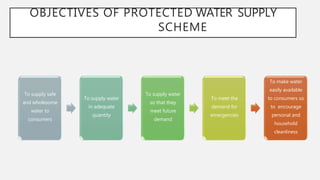
OBJECTIVES OF PROTECTED WATER SUPPLY
SCHEME
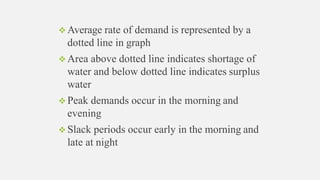
To supply safe
and wholesome
water to
consumers
To supply water
in adequate
quantity
To supply water
so that they
meet future
demand
To meet the
demand for
emergencies
To make water
easily available
to consumers so
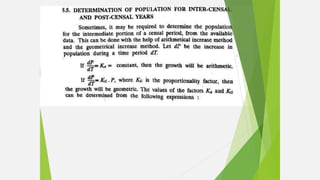
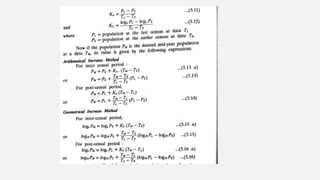
to encourage
personal and
household
cleanliness
DEMAND OF WATER
Whenever an engineer is given the duty to design a water supply scheme for a particular section
of the community, it becomes imperative upon him, to first of all, evaluate the amount of
water available and the amount of water demanded by the public.
In fact, the first study is to consider the demand and then the second requirement is to find the
sources to fulfill the demand.
VARIOUS TYPES OF WATER DEMAND
While planning a water supply scheme, it is necessary to find out not only the total yearly water
demand but also to access the required average rates of flow and the variations in these rates.
The following quantities are generally assessed and recorded.
1. Total annual volume (V) in litres or million litres.
2. Annual average rate of flow in litres per day i.e V/365
3. Annual average rate of draft in litres per day per person(i.e litres per capita per day or lpcd)
called per capita demand (q).
4. Average rate of draft in litres per day per service ie. (V/365)* (1/ No of
services)
5. Fluctuations in flows expressed in terms of percentage ratios of maximum or minimum
yearly, monthly, daily or hourly rates to their corresponding average values.
It is very difficult to precisely assess the quantity of water demanded by the public, since there are
many variable factors affecting water consumptions. Certain thumb rules and empirical formulas
are generally used to assess this quantity which may give fairly accurate results. The various types
of water demands, which a city may have, may be broken down in to the following classes.
1. Domestic water demand
2. Industrial water demand
3. Institution and commercial water demand
4. Demand for public uses
5. Fire demand
6. Water required to compensate losses in wastes and thefts
DOMESTIC WATER DEMAND
This includes the water required in private buildings for drinking, cooking,
bathing, lawn sprinkling, gardening, sanitary purposes etc.
The amount of domestic water consumption per person vary according to the
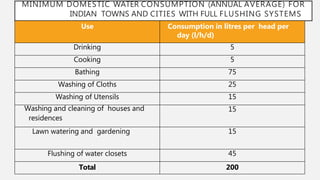
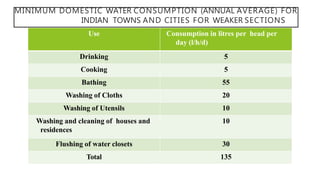
living conditions of the consumers. As per IS: 1172-1993, the minimum
domestic consumption for a town or a city with full flushing system should
be taken at 200l/h/d; although it can be reduced to 135l/h/d for economically
weaker sections.
MINIMUM DOMESTIC WATER CONSUMPTION (ANNUAL AVERAGE) FOR
INDIAN TOWNS AND CITIES WITH FULL FLUSHING SYSTEMS
Use Consumption in litres per head per
day (l/h/d)
Drinking 5
Cooking 5
Bathing 75
Washing of Cloths 25
Washing of Utensils 15
Washing and cleaning of houses and
residences
15
Lawn watering and gardening 15
Flushing of water closets 45
Total 200
MINIMUM DOMESTIC WATER CONSUMPTION (ANNUAL AVERAGE) FOR
INDIAN TOWNS AND CITIES FOR WEAKER SECTIONS
Use Consumption in litres per head per
day (l/h/d)
Drinking 5
Cooking 5
Bathing 55
Washing of Cloths 20
Washing of Utensils 10
Washing and cleaning of houses and
residences
10
Flushing of water closets 30
Total 135
CONT…
.
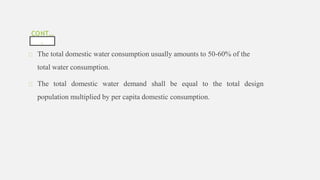
The total domestic water consumption usually amounts to 50-60% of the
total water consumption.
The total domestic water demand shall be equal to the total design
population multiplied by per capita domestic consumption.
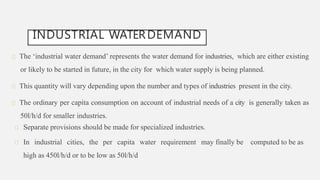
INDUSTRIAL WATERDEMAND
The ‘industrial water demand’ represents the water demand for industries, which are either existing
or likely to be started in future, in the city for which water supply is being planned.
This quantity will vary depending upon the number and types of industries present in the city.
The ordinary per capita consumption on account of industrial needs of a city is generally taken as
50l/h/d for smaller industries.
Separate provisions should be made for specialized industries.
In industrial cities, the per capita water requirement may finally be computed to be as
high as 450l/h/d or to be low as 50l/h/d
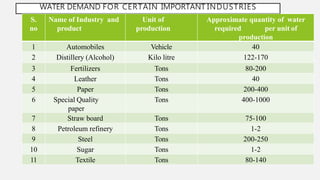
WATER DEMAND FOR CERTAIN IMPORTANT INDUSTRIES
S.
no
Name of Industry and
product
Unit of
production
Approximate quantity of water
required per unit of
production
1 Automobiles Vehicle 40
2 Distillery (Alcohol) Kilo litre 122-170
3 Fertilizers Tons 80-200
4 Leather Tons 40
5 Paper Tons 200-400
6 Special Quality
paper
Tons 400-1000
7 Straw board Tons 75-100
8 Petroleum refinery Tons 1-2
9 Steel Tons 200-250
10 Sugar Tons 1-2
11 Textile Tons 80-140
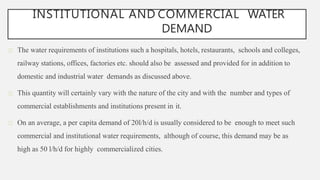
INSTITUTIONAL AND COMMERCIAL WATER
DEMAND
The water requirements of institutions such a hospitals, hotels, restaurants, schools and colleges,
railway stations, offices, factories etc. should also be assessed and provided for in addition to
domestic and industrial water demands as discussed above.
This quantity will certainly vary with the nature of the city and with the number and types of
commercial establishments and institutions present in it.
On an average, a per capita demand of 20l/h/d is usually considered to be enough to meet such
commercial and institutional water requirements, although of course, this demand may be as
high as 50 l/h/d for highly commercialized cities.
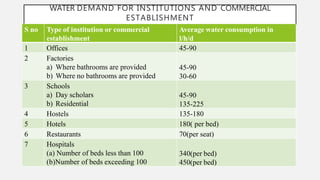
WATER DEMAND FOR INSTITUTIONS AND COMMERCIAL
ESTABLISHMENT
S no Type of institution or commercial
establishment
Average water consumption in
l/h/d
1 Offices 45-90
2 Factories
a) Where bathrooms are provided
b) Where no bathrooms are provided
45-90
30-60
3 Schools
a) Day scholars
b) Residential
45-90
135-225
4 Hostels 135-180
5 Hotels 180( per bed)
6 Restaurants 70(per seat)
7 Hospitals
(a) Number of beds less than 100
(b)Number of beds exceeding 100
340(per bed)
450(per bed)
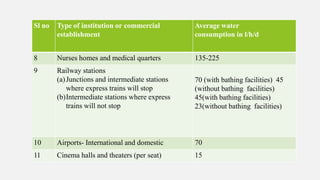
Sl no Type of institution or commercial
establishment
Average water
consumption in l/h/d
8 Nurses homes and medical quarters 135-225
9 Railway stations
(a)Junctions and intermediate stations
where express trains will stop
(b)Intermediate stations where express
trains will not stop
70 (with bathing facilities) 45
(without bathing facilities)
45(with bathing facilities)
23(without bathing facilities)
10 Airports- International and domestic 70
11 Cinema halls and theaters (per seat) 15
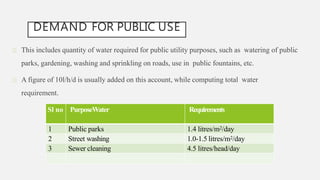
DEMAND FOR PUBLIC USE
This includes quantity of water required for public utility purposes, such as watering of public
parks, gardening, washing and sprinkling on roads, use in public fountains, etc.
A figure of 10l/h/d is usually added on this account, while computing total water
requirement.
Sl no PurposeWater Requirements
1 Public parks 1.4 litres/m2/day
2 Street washing 1.0-1.5 litres/m2/day
3 Sewer cleaning 4.5 litres/head/day
FIRE DEMAND
In thickly populated and industrial areas, fires generally break out and may
lead to serious damages, if no controlled effectively.
Big cities, therefore generally maintain full fire fighting squads.
Fire fighting personnel requires sufficient quantity of water so as to throw it over the fire at high
speeds.
A provision should be made in water supply scheme for fighting fires.
Fire hydrants are usually fitted in water mains at about 100-150 meters apart, and fire fighting
pumps are immediately connected in to them by the fire brigade personnel, as soon as fire breaks
out.
These pumps then throws the water on fire at very high pressure, so as to bring it in to control.
The minimum water pressure available at fire hydrants should be of the order of 100 to
150kN/m2 (10 to 15m of water head) and should be maintained even after 4 to 5 hours of
constant use of fire hydrant.
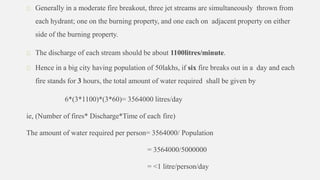
Generally in a moderate fire breakout, three jet streams are simultaneously thrown from
each hydrant; one on the burning property, and one each on adjacent property on either
side of the burning property.
The discharge of each stream should be about 1100litres/minute.
Hence in a big city having population of 50lakhs, if six fire breaks out in a day and each
fire stands for 3 hours, the total amount of water required shall be given by
6*(3*1100)*(3*60)= 3564000 litres/day
ie, (Number of fires* Discharge*Time of each fire)
The amount of water required per person= 3564000/ Population
= 3564000/5000000
= <1 litre/person/day
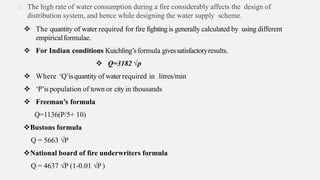
The high rate of water consumption during a fire considerably affects the design of
distribution system, and hence while designing the water supply scheme.
 The quantity of water required for fire fightingis generally calculated by using different
empiricalformulae.
 For Indian conditions Kuichling’s formula givessatisfactoryresults.
 Q=3182 √p
 Where ‘Q’isquantity of water required in litres/min
 ‘P’is population of town or city in thousands
 Freeman’s formula
Q=1136(P/5+ 10)
Bustons formula
Q = 5663 √P
National board of fire underwriters formula
Q = 4637 √P (1-0.01 √P )
LOSSES AND WASTES
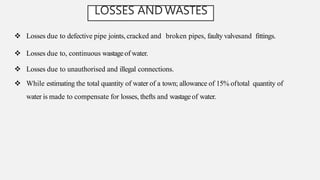
 Losses due to defective pipe joints, cracked and broken pipes, faulty valvesand fittings.
 Losses due to, continuous wastageof water.
 Losses due to unauthorised and illegal connections.
 While estimating the total quantity of water of a town; allowance of 15% oftotal quantity of
water is made to compensate for losses, thefts and wastageof water.
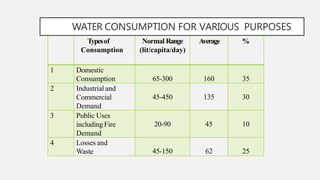
WATER CONSUMPTION FOR VARIOUS PURPOSES
Typesof
Consumption
Normal Range
(lit/capita/day)
Average %
1 Domestic
Consumption 65-300 160 35
2 Industrial and
Commercial
Demand
45-450 135 30
3 Public Uses
including Fire
Demand
20-90 45 10
4 Losses and
Waste 45-150 62 25
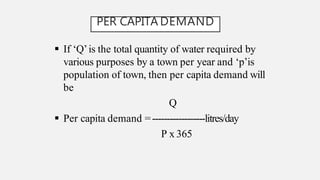
PER CAPITA DEMAND
 If ‘Q’is the total quantity of water required by
various purposes by a town per year and ‘p’is
population of town, then per capita demand will
be
Q
 Per capita demand =------------------litres/day
P x 365
 Per capita demand of the town depends on various
factors like standard of living, no. and type of
commercial places in a town etc.
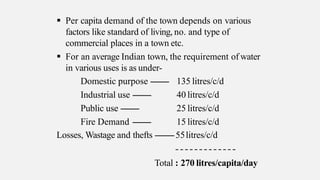
 For an average Indian town, the requirement of water
in various uses is as under-
Domestic purpose --------
Industrial use --------
Public use --------
Fire Demand --------
135 litres/c/d
40 litres/c/d
25 litres/c/d
15 litres/c/d
Losses, Wastage and thefts --------55litres/c/d
Total : 270 litres/capita/day
FACTORS AFFECTING PER CAPITA
DEMAND/ RATE OF DEMAND
 Climatic conditions
 Cost of water
 Distribution pressure
 Standard of living
 Industries
 Policy of metering
 Quality of water
 Sewerage system
 Size of city
 System of supply
 Climatic conditions
Requirement of water in summer is more than
that in winter
 Cost of water
Higher the cost, lower will be the rate of
demand
 Distribution pressure
consumption of water increases with the
increase in the distribution pressure
 Standard of living
Rich and upper class community consume more
water due to their living standards
 Industries
The presence of industrial and commercial activities
at a particular place increases the water consumption by
large amounts
 Policy of metering
Installation of meters reduces the rate of consumption
 Quality of water
If the quality and taste of the water supplied is good,it
will be consumed more
 Sewerage system
water consumption will be more if city is provided
with flush system
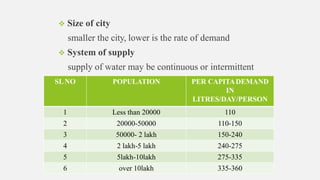
 Size of city
smaller the city, lower is the rate of demand
 System of supply
supply of water may be continuous or intermittent
SLNO POPULATION PER CAPITADEMAND
IN
LITRES/DAY/PERSON
1 Less than 20000 110
2 20000-50000 110-150
3 50000- 2 lakh 150-240
4 2 lakh-5 lakh 240-275
5 5lakh-10lakh 275-335
6 over 10lakh 335-360
VARIATIONIN WATERDEMAND
 There are wide variations in the use of water in different seasons,
in different months of the year, in different days of the month, in
different hours of the day and even in different minutes of the
hour
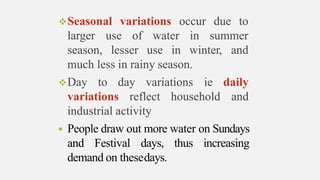
Seasonal variations occur due to
larger use of water
season, lesser use in
in summer
winter, and
much less in rainy season.
Day to day variations
variations reflect household
ie daily
and
industrial activity
 People draw out more water on Sundays
and Festival days, thus increasing
demand on thesedays.
 Hourly variations are very important as they have a wide range.
During active household working hours i.e. from six to ten in the
morning and four to eight in the evening, the bulk of the daily
requirementistaken.
 It will be much higher than the average daily demand. Where
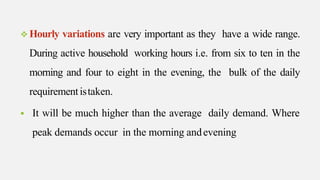
peak demands occur in the morning andevening
V
ARIATIONIN W
A
TERDEMAND
 Average rate of demand is represented by a
dotted line in graph
 Area above dotted line indicates shortage of
water and below dotted line indicates surplus
water
 Peak demands occur in the morning and
evening
 Slack periods occur early in the morning and
late at night
 Then decreases sharply upto about 1PM,
remains constant upto about 4PM, again
 Consumption in the early hours of morning is
generally small, increases sharply as the day
advances, reaching a peak value between 8 –
11AM
increases in the evening reaching a peak
between 7 – 9 PM, finally falling in the late
hours of night
EFFECTS OF VARIATION ON DESIGN OF WATER SUPPLY
SCHEME
 Sources of supply
 Pipe mains
 Filter and other units
 Pumps
 Distribution system
 Service reservoir
 The sources of supply such as wells, etc., may be designed for maximum
daily consumption or sometimes for average daily consumption.
 The pipe mains taking the water from the source up to the service reservoir
may be designed for maximum daily consumption.
 The filter and other units at water treatment plant may also be designed for
maximum daily draft. Sometimes, an additional provision for reserve is also
made for break- downs and repairs. Therefore, they may be designed for twice
the average daily instead of 1.8 times the average daily.
 The pumps lifting the water may be designed for maximum daily draft
plus some additional reserve for break-downs and repairs; say, for twice the
average daily instead of 1.8 times the average daily. Note. When the pumps
do not work for all the 24 hours, such as in small town supplies, the design
draft should be multiplied by24No. of hours in the day for which the pumps
are running
 The distribution system (including the pipes carrying water from service
reservoir to distribution system) should be designed for maximum hourly
draft of the maximum day or coincident draft with fire, whichever is more.
Generally, no provision for reserve is made.
 The service reservoir is designed to take care of the hourly fluctuations, fire
demands, emergency reserve, and the pro-vision required when pumps have
to pump the entire-day's water in fewer hours than 24 hours. Only 2 hours
storage may be considered for fire allowance as sufficient. Ordinarily, the
required storage approximates a day's consumption.
DESIGN PERIODS
 Water supply scheme includes huge and costly structures which cannot be
replaced or increase their capacities, easily and conveniently because
replacement can cause some other complications
 In order to avoid these future complications of expansions, the various
components of a water supply scheme are purposely made larger, so as to
satisfy the community needs for a reasonable numbers of years to come
 The future period for which a provision is made in the water
supply scheme is knownas the designperiod.
 Designperiodshould neitherbetoolongnorit shouldbetooshort
,usuallywaterworksaredesigned for 22-30years
FACTORS GOVERNING THE DESIGN
PERIOD
 Useful life of component structures and the chances of their becoming old and
obsolete. Design periods should not exceed those respective values.
 Ease and difficulty that is likely to be faced in expansions, if undertaken a
future dates. For example, more difficult expansions mean choosing a highe
value of the design period.
 Amount and availability of additional investment likely to be incurred fo
additional provisions. For example, if the funds are not available, one has to
keep a smaller design period.
 The rate of interest on the borrowings and the additional money invested. For
example, if the interest rate is small, a higher value of the design period may be
economically justified and, therefore, adopted.
 Anticipated rate of population growth, including possible shifts in communities,
industries and commercial establishments
POPULATION FORECASTING METHODS
 Population is used to indicate the total number of human beings
residing in a certain area at any particular time
 Water supply project is not designed only for present population but
also made to accommodate the future.
 After fixing the design period ,the next step is to determine the
population of a town or a city which is called as population
forecasting
 Arithmetic Increase Method
 Geometric Increase Method
 Incremental Increase Method
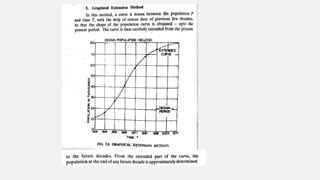
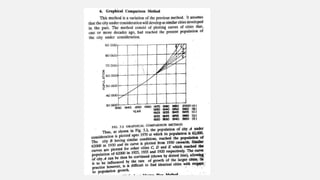
 Simple Graphical Method
 Comparative Graphical Method
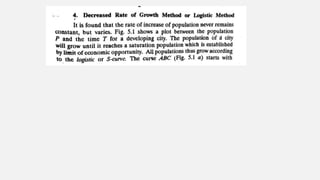
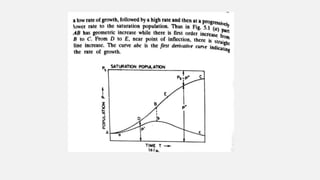
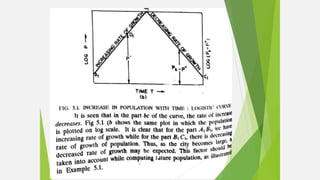
 Decreasing Rate of Growth Method
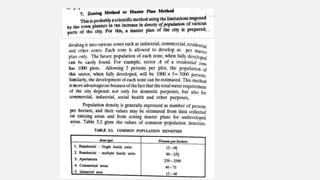
 The Master Plan Method or Zoning Method
 The Ratio Method or The Apportionment Method
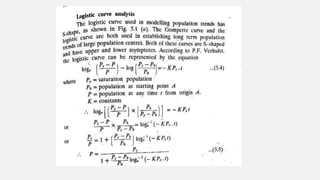
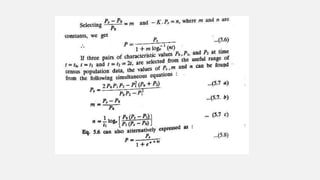
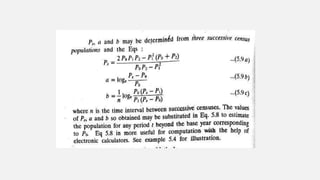
 Logistic Curve Method
DIFFERENT METHODS OF POPULATION FORECASTING
ARITHMETIC INCREASE METHOD
 This method is based on the assumption that the
population is increasing at a constant rate.
 The rate of change of population with time is constant.
The population after ‘n’ decades can be determined by
the formula
Pn =[P+n. ¯x] where
 Pn - Forecasted population after ‘n’ decades from the
present
 Po -Population at present
 n - No. of decades
 x –Average of population increase in the known decades
 ADVANTAGES
Suitable for large and old city with considerable
development
 DISADVANTAGES
If it is used for small, average or compatively new
cities, it will give lower population estimate than actual
value
GEOMETRIC INCREASE METHOD
 This method is based on the assumption that the
percentage increase in population from decade
to decade remains constant.
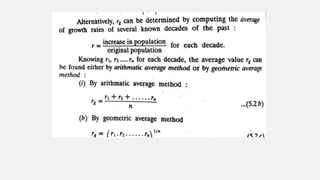
 In this method the average percentage of growth of
last few decades is determined.
 The population at the end of ‘n’ decades is
calculated by- Pn = PO [1 +r/100]where
 Po - initial population
 Pn -future population
 r - assumed growth rate
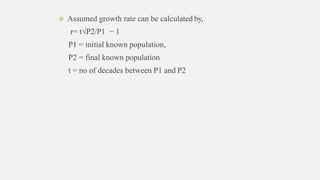
 Assumed growth rate can be calculated by,
r= t√P2/P1 − 1
P1 = initial known population,
P2 = final known population
t = no of decades between P1 and P2
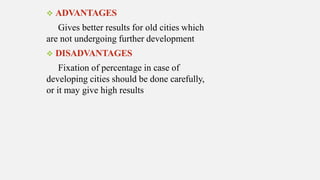
 ADVANTAGES
Gives better results for old cities which
are not undergoing further development
 DISADVANTAGES
Fixation of percentage in case of
developing cities should be done carefully,
or it may give high results
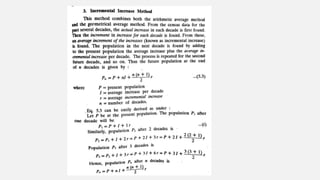
INCREMENTAL INCREASE
METHOD
 This method is improvement over the
above twomethods.
 The average increase in the population is
determined by the arithmetical method and to
this is added the average of the net
incremental increase once for each future
decade.
Water resource treatment

Water resource treatment

  • 1.
    MODULE 01 Introduction: Needfor protected water supply. Demand of Water: Types of water demands -domestic demand, industrial, institutional and commercial, public use, fire demand estimation, factors affecting per capita demand, Variations in demand of water, Peak factor. Design period and factors governing design period. Methods of population forecasting and numerical problems
  • 2.
    NEED FOR PROTECTEDWATER SUPPLY Water is a chemical compound and may occur in liquid, solid or gaseous form. All these three forms are extremely useful to man, providing him the luxuries and comforts in addition to fulfilling his basic necessities of life. No life can exists without water, since water is essential for life as the air is. It has been estimated as two third of human body is constituted of water. Water is essential for all the living beings on the planet. The water for the use must be good and should not contain unwanted impurities or harmful chemical compounds or bacteria in it. So, in order to ensure the availability of sufficient quantity of good quality of water, it becomes almost imperative in modern society, to plan and built suitable water supply schemes, which may provide potable water to the various sections of community in accordance with their requirements and demands.
  • 3.
    The scheme ofwater supply should be useful for the purposes like cooking, drinking, bathing, washing, fountains, gardens etc,. Also, the scheme should provide sufficient quantity of water for the safety against the fire. Also, the scheme will help attracting the industries and thereby helping in industrialization and modernization of the society, consequently reducing the unemployment and ensuring better living standards.
  • 4.
    OBJECTIVES OF PROTECTEDWATER SUPPLY SCHEME To supply safe and wholesome water to consumers To supply water in adequate quantity To supply water so that they meet future demand To meet the demand for emergencies To make water easily available to consumers so to encourage personal and household cleanliness
  • 5.
    DEMAND OF WATER Wheneveran engineer is given the duty to design a water supply scheme for a particular section of the community, it becomes imperative upon him, to first of all, evaluate the amount of water available and the amount of water demanded by the public. In fact, the first study is to consider the demand and then the second requirement is to find the sources to fulfill the demand.
  • 6.
    VARIOUS TYPES OFWATER DEMAND While planning a water supply scheme, it is necessary to find out not only the total yearly water demand but also to access the required average rates of flow and the variations in these rates. The following quantities are generally assessed and recorded. 1. Total annual volume (V) in litres or million litres. 2. Annual average rate of flow in litres per day i.e V/365 3. Annual average rate of draft in litres per day per person(i.e litres per capita per day or lpcd) called per capita demand (q). 4. Average rate of draft in litres per day per service ie. (V/365)* (1/ No of services) 5. Fluctuations in flows expressed in terms of percentage ratios of maximum or minimum yearly, monthly, daily or hourly rates to their corresponding average values.
  • 7.
    It is verydifficult to precisely assess the quantity of water demanded by the public, since there are many variable factors affecting water consumptions. Certain thumb rules and empirical formulas are generally used to assess this quantity which may give fairly accurate results. The various types of water demands, which a city may have, may be broken down in to the following classes. 1. Domestic water demand 2. Industrial water demand 3. Institution and commercial water demand 4. Demand for public uses 5. Fire demand 6. Water required to compensate losses in wastes and thefts
  • 8.
    DOMESTIC WATER DEMAND Thisincludes the water required in private buildings for drinking, cooking, bathing, lawn sprinkling, gardening, sanitary purposes etc. The amount of domestic water consumption per person vary according to the living conditions of the consumers. As per IS: 1172-1993, the minimum domestic consumption for a town or a city with full flushing system should be taken at 200l/h/d; although it can be reduced to 135l/h/d for economically weaker sections.
  • 9.
    MINIMUM DOMESTIC WATERCONSUMPTION (ANNUAL AVERAGE) FOR INDIAN TOWNS AND CITIES WITH FULL FLUSHING SYSTEMS Use Consumption in litres per head per day (l/h/d) Drinking 5 Cooking 5 Bathing 75 Washing of Cloths 25 Washing of Utensils 15 Washing and cleaning of houses and residences 15 Lawn watering and gardening 15 Flushing of water closets 45 Total 200
  • 10.
    MINIMUM DOMESTIC WATERCONSUMPTION (ANNUAL AVERAGE) FOR INDIAN TOWNS AND CITIES FOR WEAKER SECTIONS Use Consumption in litres per head per day (l/h/d) Drinking 5 Cooking 5 Bathing 55 Washing of Cloths 20 Washing of Utensils 10 Washing and cleaning of houses and residences 10 Flushing of water closets 30 Total 135
  • 11.
    CONT… . The total domesticwater consumption usually amounts to 50-60% of the total water consumption. The total domestic water demand shall be equal to the total design population multiplied by per capita domestic consumption.
  • 12.
    INDUSTRIAL WATERDEMAND The ‘industrialwater demand’ represents the water demand for industries, which are either existing or likely to be started in future, in the city for which water supply is being planned. This quantity will vary depending upon the number and types of industries present in the city. The ordinary per capita consumption on account of industrial needs of a city is generally taken as 50l/h/d for smaller industries. Separate provisions should be made for specialized industries. In industrial cities, the per capita water requirement may finally be computed to be as high as 450l/h/d or to be low as 50l/h/d
  • 13.
    WATER DEMAND FORCERTAIN IMPORTANT INDUSTRIES S. no Name of Industry and product Unit of production Approximate quantity of water required per unit of production 1 Automobiles Vehicle 40 2 Distillery (Alcohol) Kilo litre 122-170 3 Fertilizers Tons 80-200 4 Leather Tons 40 5 Paper Tons 200-400 6 Special Quality paper Tons 400-1000 7 Straw board Tons 75-100 8 Petroleum refinery Tons 1-2 9 Steel Tons 200-250 10 Sugar Tons 1-2 11 Textile Tons 80-140
  • 14.
    INSTITUTIONAL AND COMMERCIALWATER DEMAND The water requirements of institutions such a hospitals, hotels, restaurants, schools and colleges, railway stations, offices, factories etc. should also be assessed and provided for in addition to domestic and industrial water demands as discussed above. This quantity will certainly vary with the nature of the city and with the number and types of commercial establishments and institutions present in it. On an average, a per capita demand of 20l/h/d is usually considered to be enough to meet such commercial and institutional water requirements, although of course, this demand may be as high as 50 l/h/d for highly commercialized cities.
  • 15.
    WATER DEMAND FORINSTITUTIONS AND COMMERCIAL ESTABLISHMENT S no Type of institution or commercial establishment Average water consumption in l/h/d 1 Offices 45-90 2 Factories a) Where bathrooms are provided b) Where no bathrooms are provided 45-90 30-60 3 Schools a) Day scholars b) Residential 45-90 135-225 4 Hostels 135-180 5 Hotels 180( per bed) 6 Restaurants 70(per seat) 7 Hospitals (a) Number of beds less than 100 (b)Number of beds exceeding 100 340(per bed) 450(per bed)
  • 16.
    Sl no Typeof institution or commercial establishment Average water consumption in l/h/d 8 Nurses homes and medical quarters 135-225 9 Railway stations (a)Junctions and intermediate stations where express trains will stop (b)Intermediate stations where express trains will not stop 70 (with bathing facilities) 45 (without bathing facilities) 45(with bathing facilities) 23(without bathing facilities) 10 Airports- International and domestic 70 11 Cinema halls and theaters (per seat) 15
  • 17.
    DEMAND FOR PUBLICUSE This includes quantity of water required for public utility purposes, such as watering of public parks, gardening, washing and sprinkling on roads, use in public fountains, etc. A figure of 10l/h/d is usually added on this account, while computing total water requirement. Sl no PurposeWater Requirements 1 Public parks 1.4 litres/m2/day 2 Street washing 1.0-1.5 litres/m2/day 3 Sewer cleaning 4.5 litres/head/day
  • 18.
    FIRE DEMAND In thicklypopulated and industrial areas, fires generally break out and may lead to serious damages, if no controlled effectively. Big cities, therefore generally maintain full fire fighting squads. Fire fighting personnel requires sufficient quantity of water so as to throw it over the fire at high speeds. A provision should be made in water supply scheme for fighting fires. Fire hydrants are usually fitted in water mains at about 100-150 meters apart, and fire fighting pumps are immediately connected in to them by the fire brigade personnel, as soon as fire breaks out. These pumps then throws the water on fire at very high pressure, so as to bring it in to control. The minimum water pressure available at fire hydrants should be of the order of 100 to 150kN/m2 (10 to 15m of water head) and should be maintained even after 4 to 5 hours of constant use of fire hydrant.
  • 19.
    Generally in amoderate fire breakout, three jet streams are simultaneously thrown from each hydrant; one on the burning property, and one each on adjacent property on either side of the burning property. The discharge of each stream should be about 1100litres/minute. Hence in a big city having population of 50lakhs, if six fire breaks out in a day and each fire stands for 3 hours, the total amount of water required shall be given by 6*(3*1100)*(3*60)= 3564000 litres/day ie, (Number of fires* Discharge*Time of each fire) The amount of water required per person= 3564000/ Population = 3564000/5000000 = <1 litre/person/day
  • 20.
    The high rateof water consumption during a fire considerably affects the design of distribution system, and hence while designing the water supply scheme.  The quantity of water required for fire fightingis generally calculated by using different empiricalformulae.  For Indian conditions Kuichling’s formula givessatisfactoryresults.  Q=3182 √p  Where ‘Q’isquantity of water required in litres/min  ‘P’is population of town or city in thousands  Freeman’s formula Q=1136(P/5+ 10) Bustons formula Q = 5663 √P National board of fire underwriters formula Q = 4637 √P (1-0.01 √P )
  • 21.
    LOSSES AND WASTES Losses due to defective pipe joints, cracked and broken pipes, faulty valvesand fittings.  Losses due to, continuous wastageof water.  Losses due to unauthorised and illegal connections.  While estimating the total quantity of water of a town; allowance of 15% oftotal quantity of water is made to compensate for losses, thefts and wastageof water.
  • 22.
    WATER CONSUMPTION FORVARIOUS PURPOSES Typesof Consumption Normal Range (lit/capita/day) Average % 1 Domestic Consumption 65-300 160 35 2 Industrial and Commercial Demand 45-450 135 30 3 Public Uses including Fire Demand 20-90 45 10 4 Losses and Waste 45-150 62 25
  • 23.
    PER CAPITA DEMAND If ‘Q’is the total quantity of water required by various purposes by a town per year and ‘p’is population of town, then per capita demand will be Q  Per capita demand =------------------litres/day P x 365
  • 24.
     Per capitademand of the town depends on various factors like standard of living, no. and type of commercial places in a town etc.  For an average Indian town, the requirement of water in various uses is as under- Domestic purpose -------- Industrial use -------- Public use -------- Fire Demand -------- 135 litres/c/d 40 litres/c/d 25 litres/c/d 15 litres/c/d Losses, Wastage and thefts --------55litres/c/d Total : 270 litres/capita/day
  • 25.
    FACTORS AFFECTING PERCAPITA DEMAND/ RATE OF DEMAND  Climatic conditions  Cost of water  Distribution pressure  Standard of living  Industries  Policy of metering  Quality of water  Sewerage system  Size of city  System of supply
  • 26.
     Climatic conditions Requirementof water in summer is more than that in winter  Cost of water Higher the cost, lower will be the rate of demand  Distribution pressure consumption of water increases with the increase in the distribution pressure  Standard of living Rich and upper class community consume more water due to their living standards
  • 27.
     Industries The presenceof industrial and commercial activities at a particular place increases the water consumption by large amounts  Policy of metering Installation of meters reduces the rate of consumption  Quality of water If the quality and taste of the water supplied is good,it will be consumed more  Sewerage system water consumption will be more if city is provided with flush system
  • 28.
     Size ofcity smaller the city, lower is the rate of demand  System of supply supply of water may be continuous or intermittent SLNO POPULATION PER CAPITADEMAND IN LITRES/DAY/PERSON 1 Less than 20000 110 2 20000-50000 110-150 3 50000- 2 lakh 150-240 4 2 lakh-5 lakh 240-275 5 5lakh-10lakh 275-335 6 over 10lakh 335-360
  • 29.
    VARIATIONIN WATERDEMAND  Thereare wide variations in the use of water in different seasons, in different months of the year, in different days of the month, in different hours of the day and even in different minutes of the hour
  • 30.
    Seasonal variations occurdue to larger use of water season, lesser use in in summer winter, and much less in rainy season. Day to day variations variations reflect household ie daily and industrial activity  People draw out more water on Sundays and Festival days, thus increasing demand on thesedays.
  • 31.
     Hourly variationsare very important as they have a wide range. During active household working hours i.e. from six to ten in the morning and four to eight in the evening, the bulk of the daily requirementistaken.  It will be much higher than the average daily demand. Where peak demands occur in the morning andevening
  • 32.
  • 33.
     Average rateof demand is represented by a dotted line in graph  Area above dotted line indicates shortage of water and below dotted line indicates surplus water  Peak demands occur in the morning and evening  Slack periods occur early in the morning and late at night
  • 34.
     Then decreasessharply upto about 1PM, remains constant upto about 4PM, again  Consumption in the early hours of morning is generally small, increases sharply as the day advances, reaching a peak value between 8 – 11AM increases in the evening reaching a peak between 7 – 9 PM, finally falling in the late hours of night
  • 35.
    EFFECTS OF VARIATIONON DESIGN OF WATER SUPPLY SCHEME  Sources of supply  Pipe mains  Filter and other units  Pumps  Distribution system  Service reservoir
  • 36.
     The sourcesof supply such as wells, etc., may be designed for maximum daily consumption or sometimes for average daily consumption.  The pipe mains taking the water from the source up to the service reservoir may be designed for maximum daily consumption.  The filter and other units at water treatment plant may also be designed for maximum daily draft. Sometimes, an additional provision for reserve is also made for break- downs and repairs. Therefore, they may be designed for twice the average daily instead of 1.8 times the average daily.
  • 37.
     The pumpslifting the water may be designed for maximum daily draft plus some additional reserve for break-downs and repairs; say, for twice the average daily instead of 1.8 times the average daily. Note. When the pumps do not work for all the 24 hours, such as in small town supplies, the design draft should be multiplied by24No. of hours in the day for which the pumps are running  The distribution system (including the pipes carrying water from service reservoir to distribution system) should be designed for maximum hourly draft of the maximum day or coincident draft with fire, whichever is more. Generally, no provision for reserve is made.
  • 38.
     The servicereservoir is designed to take care of the hourly fluctuations, fire demands, emergency reserve, and the pro-vision required when pumps have to pump the entire-day's water in fewer hours than 24 hours. Only 2 hours storage may be considered for fire allowance as sufficient. Ordinarily, the required storage approximates a day's consumption.
  • 40.
    DESIGN PERIODS  Watersupply scheme includes huge and costly structures which cannot be replaced or increase their capacities, easily and conveniently because replacement can cause some other complications  In order to avoid these future complications of expansions, the various components of a water supply scheme are purposely made larger, so as to satisfy the community needs for a reasonable numbers of years to come
  • 41.
     The futureperiod for which a provision is made in the water supply scheme is knownas the designperiod.  Designperiodshould neitherbetoolongnorit shouldbetooshort ,usuallywaterworksaredesigned for 22-30years
  • 42.
    FACTORS GOVERNING THEDESIGN PERIOD  Useful life of component structures and the chances of their becoming old and obsolete. Design periods should not exceed those respective values.  Ease and difficulty that is likely to be faced in expansions, if undertaken a future dates. For example, more difficult expansions mean choosing a highe value of the design period.  Amount and availability of additional investment likely to be incurred fo additional provisions. For example, if the funds are not available, one has to keep a smaller design period.
  • 43.
     The rateof interest on the borrowings and the additional money invested. For example, if the interest rate is small, a higher value of the design period may be economically justified and, therefore, adopted.  Anticipated rate of population growth, including possible shifts in communities, industries and commercial establishments
  • 44.
    POPULATION FORECASTING METHODS Population is used to indicate the total number of human beings residing in a certain area at any particular time  Water supply project is not designed only for present population but also made to accommodate the future.  After fixing the design period ,the next step is to determine the population of a town or a city which is called as population forecasting
  • 45.
     Arithmetic IncreaseMethod  Geometric Increase Method  Incremental Increase Method  Simple Graphical Method  Comparative Graphical Method  Decreasing Rate of Growth Method  The Master Plan Method or Zoning Method  The Ratio Method or The Apportionment Method  Logistic Curve Method DIFFERENT METHODS OF POPULATION FORECASTING
  • 46.
    ARITHMETIC INCREASE METHOD This method is based on the assumption that the population is increasing at a constant rate.  The rate of change of population with time is constant. The population after ‘n’ decades can be determined by the formula Pn =[P+n. ¯x] where  Pn - Forecasted population after ‘n’ decades from the present  Po -Population at present  n - No. of decades  x –Average of population increase in the known decades
  • 47.
     ADVANTAGES Suitable forlarge and old city with considerable development  DISADVANTAGES If it is used for small, average or compatively new cities, it will give lower population estimate than actual value
  • 48.
    GEOMETRIC INCREASE METHOD This method is based on the assumption that the percentage increase in population from decade to decade remains constant.  In this method the average percentage of growth of last few decades is determined.  The population at the end of ‘n’ decades is calculated by- Pn = PO [1 +r/100]where  Po - initial population  Pn -future population  r - assumed growth rate
  • 49.
     Assumed growthrate can be calculated by, r= t√P2/P1 − 1 P1 = initial known population, P2 = final known population t = no of decades between P1 and P2
  • 51.
     ADVANTAGES Gives betterresults for old cities which are not undergoing further development  DISADVANTAGES Fixation of percentage in case of developing cities should be done carefully, or it may give high results
  • 52.
    INCREMENTAL INCREASE METHOD  Thismethod is improvement over the above twomethods.  The average increase in the population is determined by the arithmetical method and to this is added the average of the net incremental increase once for each future decade.