CHAPTER-2
QUANTITY & QUALITY
OF WATER
PRESENTED BY :
DHARA DATTANI
(M.E.TRANSPORTATION)
ATMIYA INSTITUTE OF TECHNOLOGY & SCIENCE FOR DIPLOMA STUDIES, RAJKOT.
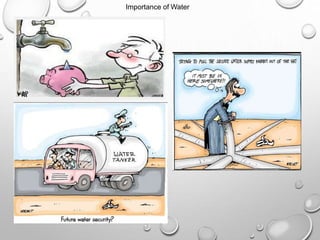
Importance of Water
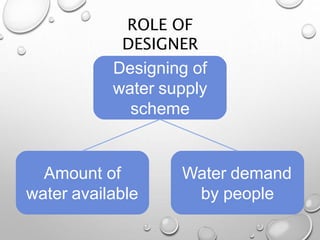
ROLE OF
DESIGNER
Designing of
water supply
scheme
Amount of
water available
Water demand
by people
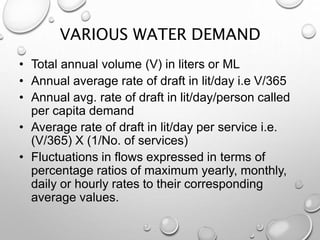
VARIOUS WATER DEMAND
• Total annual volume (V) in liters or ML
• Annual average rate of draft in lit/day i.e V/365
• Annual avg. rate of draft in lit/day/person called
per capita demand
• Average rate of draft in lit/day per service i.e.
(V/365) X (1/No. of services)
• Fluctuations in flows expressed in terms of
percentage ratios of maximum yearly, monthly,
daily or hourly rates to their corresponding
average values.
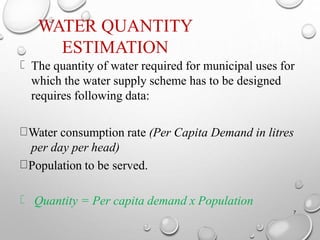
WATER QUANTITY
ESTIMATION
7
The quantity of water required for municipal uses for
which the water supply scheme has to be designed
requires following data:
Water consumption rate (Per Capita Demand in litres
per day per head)
Population to be served.
Quantity = Per capita demand x Population
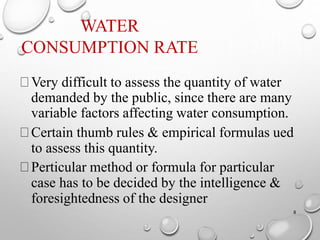
WATER
CONSUMPTION RATE
8
Very difficult to assess the quantity of water
demanded by the public, since there are many
variable factors affecting water consumption.
Certain thumb rules & empirical formulas ued
to assess this quantity.
Perticular method or formula for particular
case has to be decided by the intelligence &
foresightedness of the designer
9
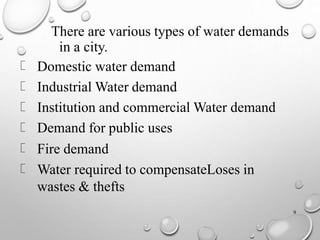
There are various types of water demands
in a city.
Domestic water demand
Industrial Water demand
Institution and commercial Water demand
Demand for public uses
Fire demand
Water required to compensateLoses in
wastes & thefts
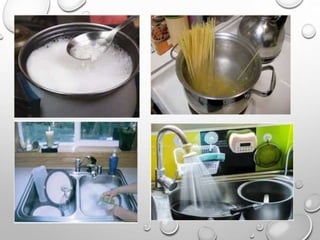
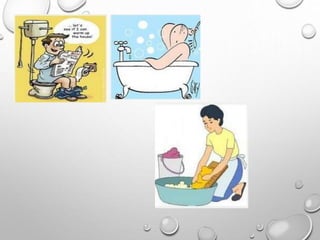
DOMESTIC DEMAND
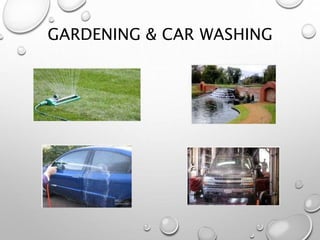
GARDENING & CAR WASHING
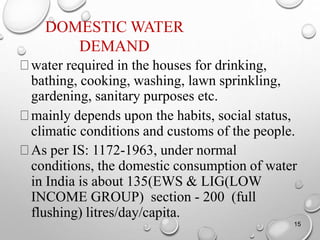
DOMESTIC WATER
DEMAND
water required in the houses for drinking,
bathing, cooking, washing, lawn sprinkling,
gardening, sanitary purposes etc.
mainly depends upon the habits, social status,
climatic conditions and customs of the people.
As per IS: 1172-1963, under normal
conditions, the domestic consumption of water
in India is about 135(EWS & LIG(LOW
INCOME GROUP) section - 200 (full
flushing) litres/day/capita.
15
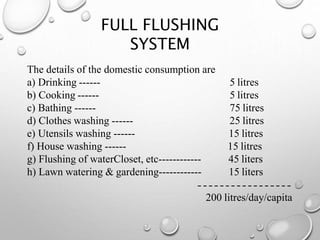
FULL FLUSHING
SYSTEM
The details of the domestic consumption are
a) Drinking ------
b) Cooking ------
c) Bathing ------
d) Clothes washing ------
e) Utensils washing ------
f) House washing ------
g) Flushing of waterCloset, etc------------
h) Lawn watering & gardening------------
5 litres
5 litres
75 litres
25 litres
15 litres
15 litres
45 liters
15 liters
200 litres/day/capita
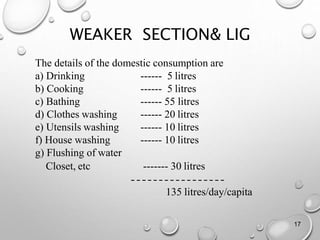
WEAKER SECTION& LIG
The details of the domestic consumption are
------ 5 litres
------ 5 litres
------ 55 litres
------ 20 litres
------ 10 litres
------ 10 litres
a) Drinking
b) Cooking
c) Bathing
d) Clothes washing
e) Utensils washing
f) House washing
g) Flushing of water
Closet, etc ------- 30 litres
135 litres/day/capita
17
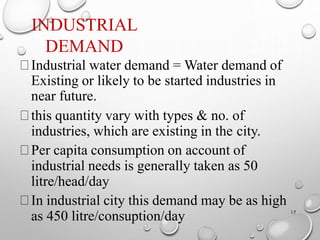
INDUSTRIAL
DEMAND
17
Industrial water demand = Water demand of
Existing or likely to be started industries in
near future.
this quantity vary with types & no. of
industries, which are existing in the city.
Per capita consumption on account of
industrial needs is generally taken as 50
litre/head/day
In industrial city this demand may be as high
as 450 litre/consuption/day
INDUSTRIAL
DEMAND
18
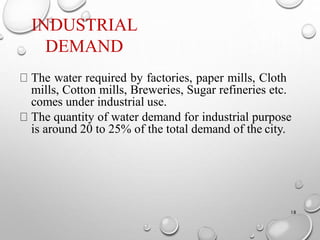
The water required by factories, paper mills, Cloth
mills, Cotton mills, Breweries, Sugar refineries etc.
comes under industrial use.
The quantity of water demand for industrial purpose
is around 20 to 25% of the total demand of the city.
INSTITUTION AND
COMMERCIAL DEMAND
19
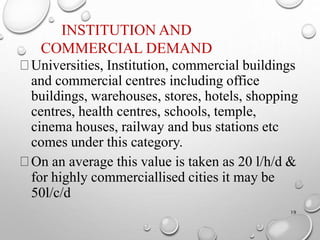
Universities, Institution, commercial buildings
and commercial centres including office
buildings, warehouses, stores, hotels, shopping
centres, health centres, schools, temple,
cinema houses, railway and bus stations etc
comes under this category.
On an average this value is taken as 20 l/h/d &
for highly commerciallised cities it may be
50l/c/d
INDIVIDUAL WATER
REQUIREMENTS.
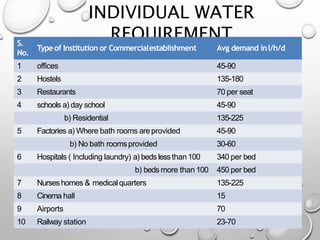
No.
Typeof Institution or Commercialestablishment Avg demand inl/h/d
1 offices 45-90
2 Hostels 135-180
3 Restaurants 70 per seat
4 schools a) day school 45-90
b) Residential 135-225
5 Factories a) Where bath rooms areprovided 45-90
b) No bath roomsprovided 30-60
6 Hospitals ( Including laundry) a) beds lessthan100 340 per bed
b) beds more than 100 450 per bed
7 Nurseshomes & medicalquarters 135-225
8 Cinema hall 15
9 Airports 70
10 Railway station 23-70
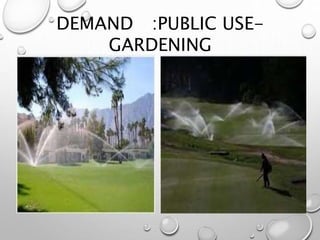
DEMAND :PUBLIC USE-
GARDENING
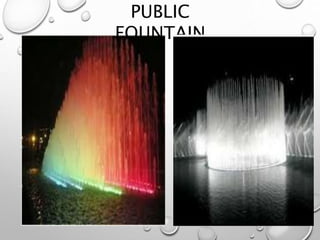
PUBLIC
FOUNTAIN
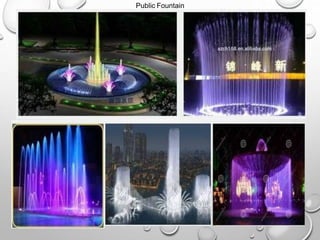
Public Fountain
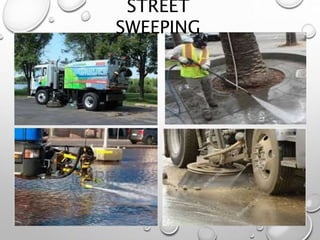
STREET
SWEEPING
DEMAND FOR
PUBLIC
USE
25
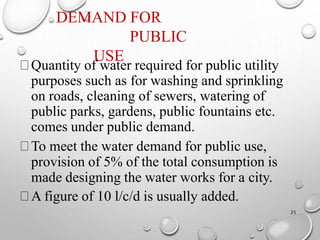
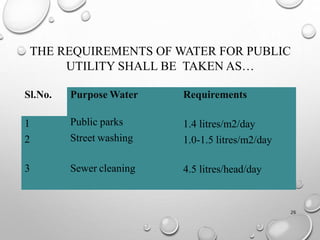
Quantity of water required for public utility
purposes such as for washing and sprinkling
on roads, cleaning of sewers, watering of
public parks, gardens, public fountains etc.
comes under public demand.
To meet the water demand for public use,
provision of 5% of the total consumption is
made designing the water works for a city.
A figure of 10 l/c/d is usually added.
Sl.No. Purpose Water
1
2
Public parks
Street washing
3 Sewer cleaning
Requirements
1.4 litres/m2/day
1.0-1.5 litres/m2/day
4.5 litres/head/day
THE REQUIREMENTS OF WATER FOR PUBLIC
UTILITY SHALL BE TAKEN AS…
26
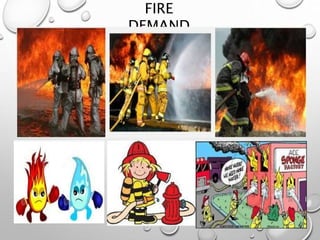
FIRE
DEMAND
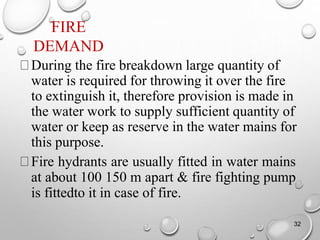
FIRE
DEMAND
32
During the fire breakdown large quantity of
water is required for throwing it over the fire
to extinguish it, therefore provision is made in
the water work to supply sufficient quantity of
water or keep as reserve in the water mains for
this purpose.
Fire hydrants are usually fitted in water mains
at about 100 150 m apart & fire fighting pump
is fittedto it in case of fire.
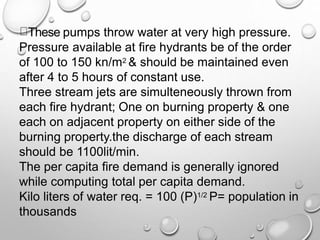
These pumps throw water at very high pressure.
Pressure available at fire hydrants be of the order
of 100 to 150 kn/m2 & should be maintained even
after 4 to 5 hours of constant use.
Three stream jets are simulteneously thrown from
each fire hydrant; One on burning property & one
each on adjacent property on either side of the
burning property.the discharge of each stream
should be 1100lit/min.
The per capita fire demand is generally ignored
while computing total per capita demand.
Kilo liters of water req. = 100 (P)1/2 P= population in
thousands
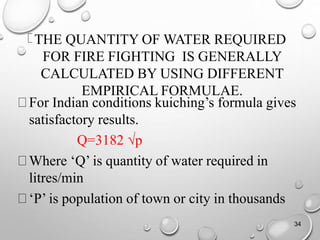
THE QUANTITY OF WATER REQUIRED
FOR FIRE FIGHTING IS GENERALLY
CALCULATED BY USING DIFFERENT
EMPIRICAL FORMULAE.
For Indian conditions kuiching’s formula gives
satisfactory results.
Q=3182 √p
Where ‘Q’ is quantity of water required in
litres/min
‘P’ is population of town or city in thousands
34
NATIONAL BOARD OF FIRE UNDER WRITERS FORMULA:
Q=4637 √P[1-0.01√P]
(THIS FORMULA IS NOT SUITABLE FOR INDIAN CONDITION.)
FREEMAN’S FORMULA: Q=1136[P/10+10]
BUSTON’S FORMULA: Q=5663 √P
WHERE ‘Q’ IS QUANTITY OF WATER REQUIRED IN LITRES/MIN
‘P’ IS POPULATION OF TOWN OR CITY IN THOUSANDS
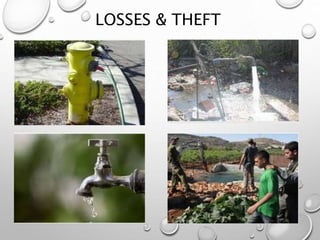
LOSSES &
THEFTS
LOSSES & THEFT
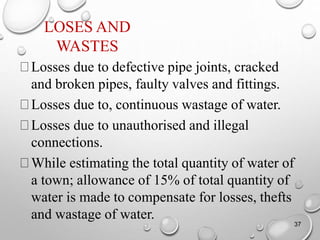
LOSES AND
WASTES
Losses due to defective pipe joints, cracked
and broken pipes, faulty valves and fittings.
Losses due to, continuous wastage of water.
Losses due to unauthorised and illegal
connections.
While estimating the total quantity of water of
a town; allowance of 15% of total quantity of
water is made to compensate for losses, thefts
and wastage of water.
37
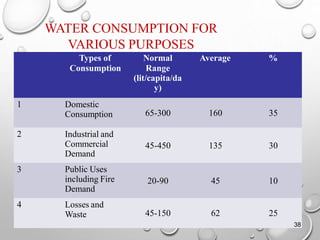
WATER CONSUMPTION FOR
VARIOUS PURPOSES
Types of Normal Average %
Consumption Range
(lit/capita/da
y)
1 Domestic
Consumption 65-300 160 35
2 Industrial and
Commercial
Demand
45-450 135 30
3 Public Uses
including Fire
Demand
20-90 45 10
4 Losses and
Waste 45-150 62 25
38
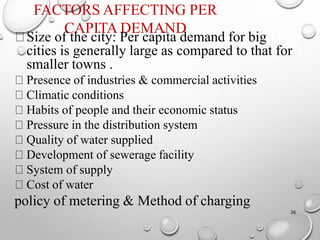
FACTORS AFFECTING PER
CAPITA DEMAND
36
Size of the city: Per capita demand for big
cities is generally large as compared to that for
smaller towns .
Presence of industries & commercial activities
Climatic conditions
Habits of people and their economic status
Pressure in the distribution system
Quality of water supplied
Development of sewerage facility
System of supply
Cost of water
policy of metering & Method of charging
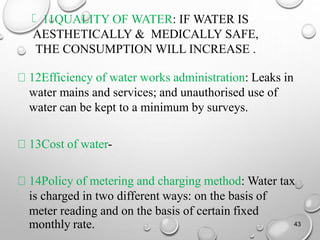
11QUALITY OF WATER: IF WATER IS
AESTHETICALLY & MEDICALLY SAFE,
THE CONSUMPTION WILL INCREASE .
12Efficiency of water works administration: Leaks in
water mains and services; and unauthorised use of
water can be kept to a minimum by surveys.
13Cost of water-
14Policy of metering and charging method: Water tax
is charged in two different ways: on the basis of
meter reading and on the basis of certain fixed
monthly rate. 43
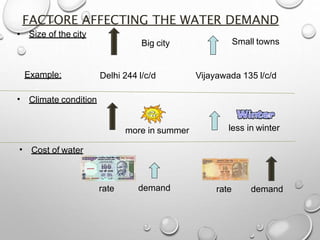
FACTORE AFFECTING THE WATER DEMAND
Big city
• Size of the city
Small towns
Example: Delhi 244 l/c/d Vijayawada 135 l/c/d
• Climate condition
less in wintermore in summer
• Cost of water
rate demand rate demand
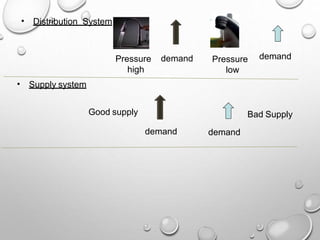
• Supply system
Bad Supply
• Distribution System
Good supply
demandPressure
high
Pressure
low
demand
demand demand
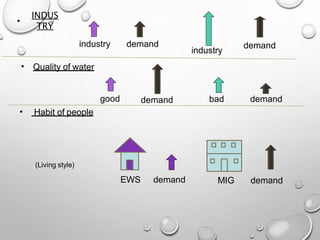
•
INDUS
TRY
• Quality of water
good demand demandbad
demand demand
industry
industry
• Habit of people
EWS demand MIG demand
(Living style)
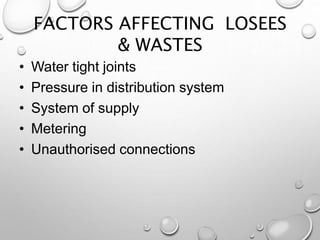
FACTORS AFFECTING LOSEES
& WASTES
• Water tight joints
• Pressure in distribution system
• System of supply
• Metering
• Unauthorised connections
FLUCTUATIONS IN RATE
OF DEMAND
42
Average Daily Per Capita Demand
= Quantity Required in 12 Months/ (365 x
Population)
If this average demand is supplied at all the times, it
will not be sufficient to meet the fluctuations.
Maximum daily demand = 1.8 x average daily
demand
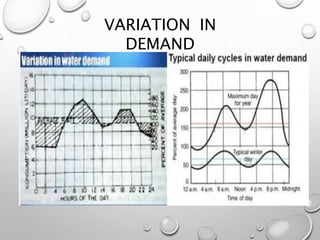
VARIATION IN
DEMAND
VARIATION IN DEMAND OF WATER
 THE PER CAPITA DEMAND IS THE AVERAGE CONSUMPTION OF THE YEAR, WHICH VARIES
THROUGHOUT THE YEAR FROM SEASON TO SEASON, EVEN FROM HOUR TO HOUR.
I. SEASONAL FLUCTUATION
• THE VARIATION FROM SUMMER TO WINTER.
• THE VARIATION MAY BE UP TO 15% TO THE AVERAGE DEMAND OF THE YEAR.
II. DAILYAND HOURLY FLUCTUATION
• THESE VARIATION DEPEND ON GENERAL HABITS OF PEOPLE, CLIMATIC CONDITIONS, AND
WHETHER THE AREA IS INDUSTRIAL, COMMERCIAL OR RESIDENTIAL.
• MORE WATER DEMAND IN SUNDAYS AND HOLIDAYS, WHEN THE PATTERN OF USAGE ALSO
CHANGES (PEAK HOUR, MINIMUM FLOW).
• IN HIGHLY INDUSTRIAL CITIES, MAXIMUM HOURLY CONSUMPTION MAY RISE UP TO 200%
THAT OF AVERAGE DAILY DEMAND.
• DETERMINATION OF HOURLY VARIATION BECOMES VERY
IMPORTANT TO DECIDE RATE OF PUMPING IN ORDER TO
MEET WATER DEMANDS IN ALL TIMES.
• MAXIMUM DAILY CONSUMPTION IS USUALLY TAKEN AS
180% OF THE AVERAGE CONSUMPTION.
• MAXIMUM HOURLY CONSUMPTION IS USUALLY TAKEN AS
150% OF THE AVERAGE CONSUMPTION.
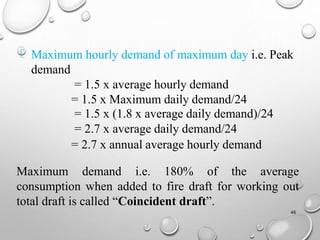
Maximum hourly demand of maximum day i.e. Peak
demand
= 1.5 x average hourly demand
= 1.5 x Maximum daily demand/24
= 1.5 x (1.8 x average daily demand)/24
= 2.7 x average daily demand/24
= 2.7 x annual average hourly demand
46
Maximum demand i.e. 180% of the average
consumption when added to fire draft for working out
total draft is called “Coincident draft”.
Seasonal variation: The demand peaks during
summer. Firebreak outs are generally more in
summer, increasing demand. So, there is seasonal
variation .
Max.Seasonal Demand :130% Of Annual Avg
Daily Rate Of Demand.
=1.3q
MAX.MONTHLY CONSUPTION: 140%
Annual Avg Daily Rate Of Demand.
=1.4q
Daily variation depends on the activity. People draw
out more water on Sundays and Festival days, thus
increasing demand on these days.
47
Hourly variations are very important as they have a
wide range. During active household working hours
i.e. from six to ten in the morning and four to eight in
the evening, the bulk of the daily requirement is
taken. During other hours the requirement is
negligible.
Moreover, if a fire breaks out, a huge quantity of
water is required to be supplied during short duration,
necessitating the need for a maximum rate of hourly
supply.
48
So, an adequate quantity of water must be available to
meet the peak demand.
To meet all the fluctuations, the supply pipes, service
reservoirs and distribution pipes must be properly
proportioned.
The water is supplied by pumping directly and the
pumps and distribution system must be designed to
meet the peak demand.
49
DESIGN PERIODS
50
• water supply projects are designed to serve
over a specified period of time after
completion of the project
• This time period is called "design period”.
• Generally expressed in years. (10-30 years)
• Water works generally are designed with in
period of 30 years
• During the design period the components,
structures and equipment's of the water
project are supposed to be adequate to
serve the requirements
• IT IS THE NUMBER OF YEARS IN FUTURE FOR WHICH THE
PROPOSED FACILITY WOULD MEET THE DEMAND OF THE
COMMUNITY.
• OR
• THIS IS THE PERIOD INTO THE FUTURE FOR WHICH
ESTIMATION IS TO BE MADE
FACTORS AFFECTING THE DESIGN
PERIOD
 FUNDS AVAILABLE FOR THE COMPLETION OF THE PROJECT.
OR MORE FUNDS ARE AVAILABLE, THE DESIGN PERIOD
SHALL BE LESS
 THE ANTICIPATED RATE OF GROWTH OF POPULATION. 'IF
THE RATE IS MORE, DESIGN PERIOD IS LESS
 USEFUL LIFE OF PIPES, STRUCTURES AND EQUIPMENTS USED
IN THE WATER WORKS. IF THE USEFUL LIFE IS MORE, DESIGN
PERIOD IS ALSO MORE.
 THE RATE OF INTEREST OF LOANS TAKEN FOR THE
CONSTRUCTION OF THE PROJECT. IF THIS RATE IS MORE,
THE DESIGN PERIOD WILL BE LESS
 EFFICIENCY OF COMPONENT UNITS OF THE PROJECT
DURING THE EARLY YEARS OF WORKING. THE MORE
EFFICIENCY THE LONGER THE DESIGN PERIOD
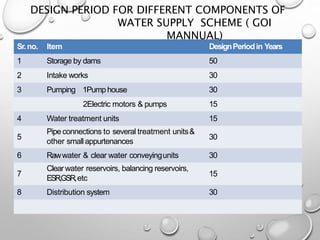
Sr.no. Item DesignPeriodin Years
1 Storage by dams 50
2 Intake works 30
3 Pumping 1Pump house 30
2Electric motors & pumps 15
4 Water treatment units 15
5
Pipeconnections to several treatment units&
other small appurtenances
30
6 Rawwater & clear water conveyingunits 30
7
Clearwater reservoirs, balancing reservoirs,
ESR,GSR,etc
15
8 Distribution system 30
DESIGN PERIOD FOR DIFFERENT COMPONENTS OF
WATER SUPPLY SCHEME ( GOI
MANNUAL)
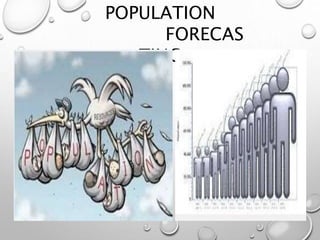
POPULATION
FORECAS
TING
BIRTH, DEATH,
MIGRATION
POPULATION
FORECASTING METHODS
The present population of city is determined by
conducting an official enumeration, called census.
Population growth- a) Births b) Deaths c) Migrations.
The various methods adopted for estimating future
populations .
The particular method to be adopted for a particular
case or for a particular city depends largely on the
factors discussed in the methods, and the selection is
left to the discretion and intelligence of the designer.
66
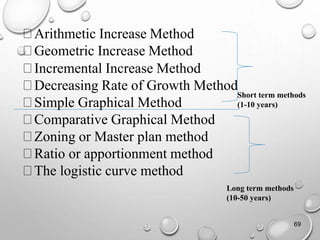
Arithmetic Increase Method
Geometric Increase Method
Incremental Increase Method
Decreasing Rate of Growth Method
Simple Graphical Method
Comparative Graphical Method
Zoning or Master plan method
Ratio or apportionment method
The logistic curve method
69
Short term methods
(1-10 years)
Long term methods
(10-50 years)
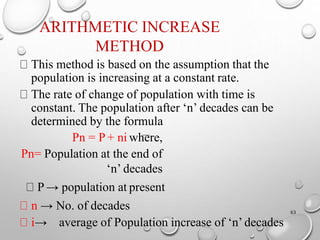
ARITHMETIC INCREASE
METHOD
63
This method is based on the assumption that the
population is increasing at a constant rate.
The rate of change of population with time is
constant. The population after ‘n’ decades can be
determined by the formula
Pn = P + ni where,
Pn= Population at the end of
‘n’ decades
P→ population at present
n → No. of decades
i→ average of Population increase of ‘n’ decades
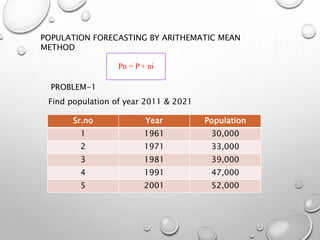
Sr.no Year Population
1 1961 30,000
2 1971 33,000
3 1981 39,000
4 1991 47,000
5 2001 52,000
POPULATION FORECASTING BY ARITHEMATIC MEAN
METHOD
Pn = P + ni
PROBLEM-1
Find population of year 2011 & 2021
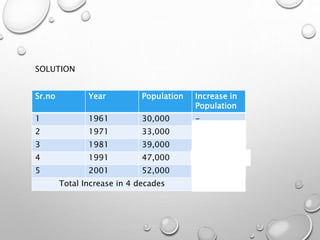
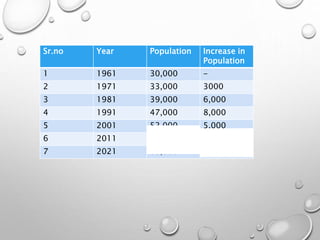
Sr.no Year Population Increase in
Population
1 1961 30,000 -
2 1971 33,000 3000
3 1981 39,000 6,000
4 1991 47,000 8,000
5 2001 52,000 5,000
Total Increase in 4 decades 22,000
SOLUTION
𝒊 =
𝟐𝟐, 𝟎𝟎𝟎
𝟒
=5500
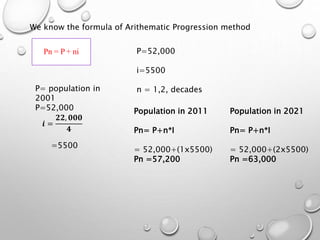
Pn = P + ni
P= population in
2001
P=52,000
P=52,000
i=5500
n = 1,2, decades
Population in 2011
Pn= P+n*I
= 52,000+(1x5500)
Pn =57,200
Population in 2021
Pn= P+n*I
= 52,000+(2x5500)
Pn =63,000
We know the formula of Arithematic Progression method
Sr.no Year Population Increase in
Population
1 1961 30,000 -
2 1971 33,000 3000
3 1981 39,000 6,000
4 1991 47,000 8,000
5 2001 52,000 5,000
6 2011 57,200 5,200
7 2021 63,000 5,800
GEOMETRIC INCREASE
METHOD
68
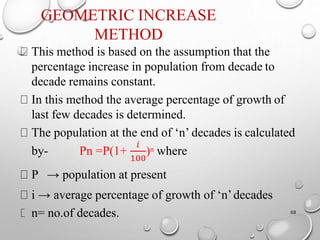
This method is based on the assumption that the
percentage increase in population from decade to
decade remains constant.
In this method the average percentage of growth of
last few decades is determined.
The population at the end of ‘n’ decades is calculated
by- Pn =P(1+
𝑖
100
)n where
P → population at present
i → average percentage of growth of ‘n’decades
n= no.of decades.
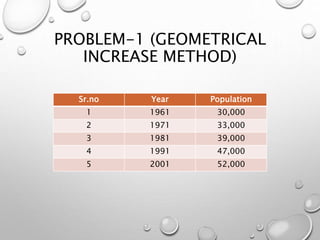
Sr.no Year Population
1 1961 30,000
2 1971 33,000
3 1981 39,000
4 1991 47,000
5 2001 52,000
PROBLEM-1 (GEOMETRICAL
INCREASE METHOD)
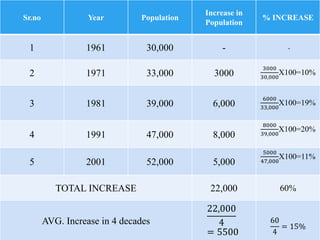
Sr.no Year Population
Increase in
Population
% INCREASE
1 1961 30,000 - -
2 1971 33,000 3000
3000
30,000
X100=10%
3 1981 39,000 6,000
6000
33,000
X100=19%
4 1991 47,000 8,000
8000
39,000
X100=20%
5 2001 52,000 5,000
5000
47,000
X100=11%
TOTAL INCREASE 22,000 60%
AVG. Increase in 4 decades
22,000
4
= 5500
60
4
= 15%
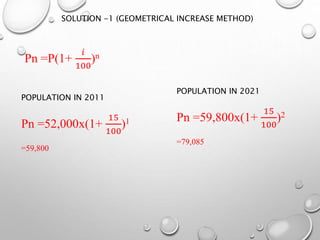
Pn =P(1+
𝑖
100
)n
POPULATION IN 2011
Pn =52,000x(1+
15
100
)1
=59,800
POPULATION IN 2021
Pn =59,800x(1+
15
100
)2
=79,085
SOLUTION -1 (GEOMETRICAL INCREASE METHOD)
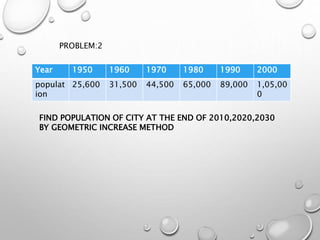
Year 1950 1960 1970 1980 1990 2000
populat
ion
25,600 31,500 44,500 65,000 89,000 1,05,00
0
PROBLEM:2
FIND POPULATION OF CITY AT THE END OF 2010,2020,2030
BY GEOMETRIC INCREASE METHOD
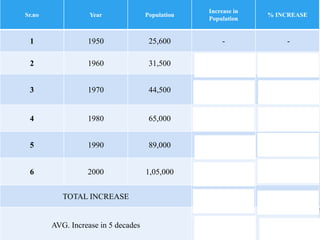
Sr.no Year Population
Increase in
Population
% INCREASE
1 1950 25,600 - -
2 1960 31,500 5900
5900
25600
X100= 23%
3 1970 44,500 13,000
13000
31500
X100= 41%
4 1980 65,000 20,500
20500
44500
X100= 46%
5 1990 89,000 24,000
24000
65000
X100= 36%
6 2000 1,05,000 16,000
16,000
89,000
X100=18%
TOTAL INCREASE 79400 164%
AVG. Increase in 5 decades
79400
5
= 15,800 164
5
= 32%
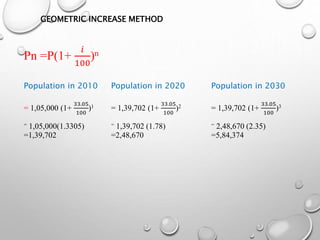
Pn =P(1+
𝑖
100
)n
Population in 2010
= 1,05,000 (1+
33.05
100
)1
= 1,05,000(1.3305)
=1,39,702
Population in 2020
= 1,39,702 (1+
33.05
100
)2
= 1,39,702 (1.78)
=2,48,670
Population in 2030
= 1,39,702 (1+
33.05
100
)3
= 2,48,670 (2.35)
=5,84,374
GEOMETRIC INCREASE METHOD
INCREMENTAL
INCREASE METHOD
75
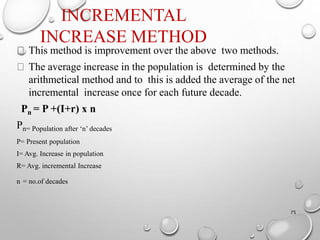
This method is improvement over the above two methods.
The average increase in the population is determined by the
arithmetical method and to this is added the average of the net
incremental increase once for each future decade.
Pn = P +(I+r) x n
Pn= Population after ‘n’ decades
P= Present population
I= Avg. Increase in population
R= Avg. incremental Increase
n = no.of decades
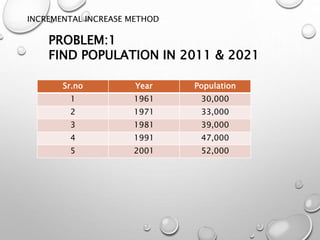
Sr.no Year Population
1 1961 30,000
2 1971 33,000
3 1981 39,000
4 1991 47,000
5 2001 52,000
INCREMENTAL INCREASE METHOD
PROBLEM:1
FIND POPULATION IN 2011 & 2021
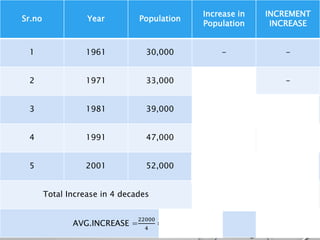
Sr.no Year Population
Increase in
Population
INCREMENT
INCREASE
1 1961 30,000 - -
2 1971 33,000 3000 -
3 1981 39,000 6,000 +3000
4 1991 47,000 8,000 +2000
5 2001 52,000 5,000 -3000
Total Increase in 4 decades 22,000 +2000
AVG.INCREASE =
22000
4
= 5500
2000
3
= 667
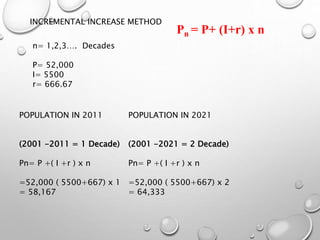
INCREMENTAL INCREASE METHOD
n= 1,2,3…. Decades
P= 52,000
I= 5500
r= 666.67
POPULATION IN 2011
(2001 -2011 = 1 Decade)
Pn= P +( I +r ) x n
=52,000 ( 5500+667) x 1
= 58,167
POPULATION IN 2021
(2001 -2021 = 2 Decade)
Pn= P +( I +r ) x n
=52,000 ( 5500+667) x 2
= 64,333
Pn = P+ (I+r) x n
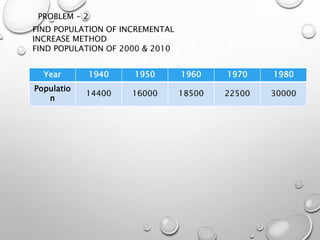
PROBLEM - 2
FIND POPULATION OF INCREMENTAL
INCREASE METHOD
FIND POPULATION OF 2000 & 2010
Year 1940 1950 1960 1970 1980
Populatio
n
14400 16000 18500 22500 30000
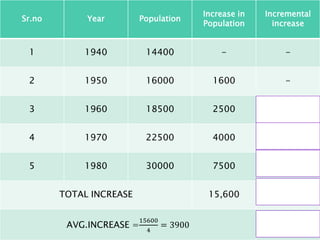
Sr.no Year Population
Increase in
Population
Incremental
increase
1 1940 14400 - -
2 1950 16000 1600 -
3 1960 18500 2500 +900
4 1970 22500 4000 +1500
5 1980 30000 7500 +3500
TOTAL INCREASE 15,600 +5900
AVG.INCREASE =
15600
4
= 3900
5900
3
=1966.7
7
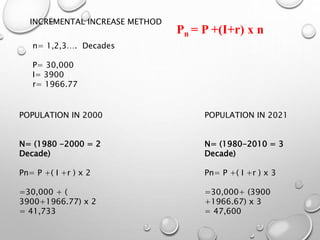
INCREMENTAL INCREASE METHOD
n= 1,2,3…. Decades
P= 30,000
I= 3900
r= 1966.77
POPULATION IN 2000
N= (1980 -2000 = 2
Decade)
Pn= P +( I +r ) x 2
=30,000 + (
3900+1966.77) x 2
= 41,733
POPULATION IN 2021
N= (1980-2010 = 3
Decade)
Pn= P +( I +r ) x 3
=30,000+ (3900
+1966.67) x 3
= 47,600
Pn = P +(I+r) x n
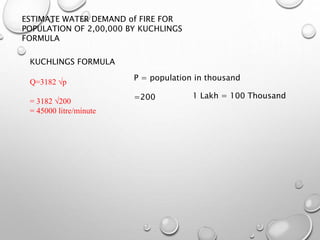
ESTIMATE WATER DEMAND of FIRE FOR
POPULATION OF 2,00,000 BY KUCHLINGS
FORMULA
KUCHLINGS FORMULA
Q=3182 √p
= 3182 √200
= 45000 litre/minute
P = population in thousand
=200 1 Lakh = 100 Thousand
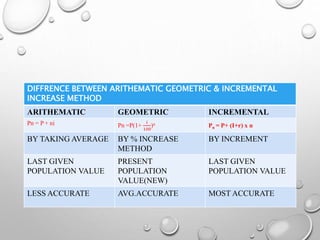
DIFFRENCE BETWEEN ARITHEMATIC GEOMETRIC & INCREMENTAL
INCREASE METHOD
ARITHEMATIC GEOMETRIC INCREMENTAL
Pn = P + ni Pn =P(1+
𝑖
100
)n Pn = P+ (I+r) x n
BY TAKING AVERAGE BY % INCREASE
METHOD
BY INCREMENT
LAST GIVEN
POPULATION VALUE
PRESENT
POPULATION
VALUE(NEW)
LAST GIVEN
POPULATION VALUE
LESS ACCURATE AVG.ACCURATE MOST ACCURATE
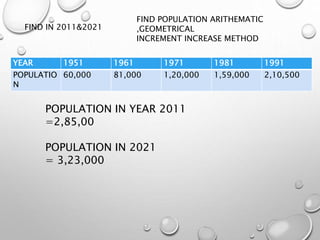
YEAR 1951 1961 1971 1981 1991
POPULATIO
N
60,000 81,000 1,20,000 1,59,000 2,10,500
POPULATION IN YEAR 2011
=2,85,00
POPULATION IN 2021
= 3,23,000
FIND IN 2011&2021
FIND POPULATION ARITHEMATIC
,GEOMETRICAL
INCREMENT INCREASE METHOD
IMPURITIES IN
WATER
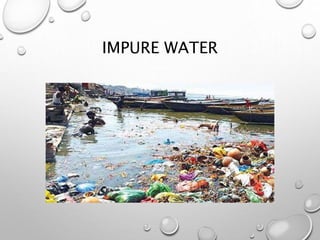
IMPURE WATER
IMPURITIES IN WATER
• ​Impurities are classified into three heads : ​
1) Suspended impurities
​ 2) Dissolved impurities
​ 3) Colloidal impurities​
1) SUSPENDED IMPURITIES :
These impurities are dispersion of solid particles that are large enough to be
removed by filtration on surface & heavier ones settle down.
The suspended particles which have the same specific gravity as that of water ,are
mixed in the water.
•​Suspended impurities include,
•Clay,silts
•Algae,fungi
•​Organic and inorganic matters
•​Mineral matter, etc.
•​​These all impurities are macroscopic and cause turbidity in the
water.
• 2) Dissolved impurities:
​ Some impurities are dissolved in the
water when water flows over the rocks, soils, etc.
Solids, liquids and gases are dissolved in natural
water.
The concentration of total dissolved solids is usually
expressed in p.p.m.(parts per million) and is
obtained by weighing the residue after evaporation of
the water sample from a filtered sample
•3) Colloidal impurities:
• It is very finely divided dispersion of particles in
water.
• These particles are so small that these can not be
removed by ordinary filters and are not visible to the
naked eye.
• ​All the colloidal impurities are electrically charged
and remains in continuous motion.• ​The electrical charge is due to the presence of absorbed
ions on the surface of the solids.
• ​Acid or neutral materials as silica, glass and most
organic particles acquire negative charge in neutral
water, whereas basic materials such as metallic oxides
Al2O3 and Fe2O3 are positively charged.
• ​Due to repelling actions all the colloidal particles
remain in motion and do not settle.
• ​Most of color of the water is due to colloidal impurities.​
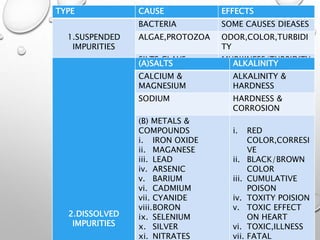
SUSPENDED & DISSOLVED
IMPURITIES TABLE
TYPE CAUSE EFFECTS
1.SUSPENDED
IMPURITIES
BACTERIA SOME CAUSES DIEASES
ALGAE,PROTOZOA ODOR,COLOR,TURBIDI
TY
SILTS,CLAYS MURKINESS/TURBIDITY
2.DISSOLVED
IMPURITIES
(A)SALTS ALKALINITY
CALCIUM &
MAGNESIUM
ALKALINITY &
HARDNESS
SODIUM HARDNESS &
CORROSION
(B) METALS &
COMPOUNDS
i. IRON OXIDE
ii. MAGANESE
iii. LEAD
iv. ARSENIC
v. BARIUM
vi. CADMIUM
vii. CYANIDE
viii.BORON
ix. SELENIUM
x. SILVER
xi. NITRATES
i. RED
COLOR,CORRESI
VE
ii. BLACK/BROWN
COLOR
iii. CUMULATIVE
POISON
iv. TOXITY POISION
v. TOXIC EFFECT
ON HEART
vi. TOXIC,ILLNESS
vii. FATAL
POTABLE WATER ( WHOLESOME
WATER)
• WATER WHICH IS SUITABLE FOR DRINKING PURPOSE IS CALLED
POTABLE WATER OR WHOLESOME WATER
• FOLLOWING QUALITIES FOR WHOLESOME WATER
• ODOURLESS & COLOUR LESS
• FREE FROM TURBIDITY
• FREE FROM TOXIC SUBSTANCES
• FREE FROM PATHOGENIC ORGANISMS
• IT SHOULD BE SOFT
• IT SHOULD BE COOL & FRESH
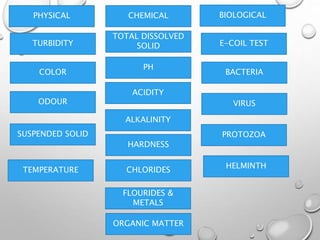
WATER QUALITY PARAMETERS
TURBIDITY
ACIDITY
BIOLOGICAL
COLOR
ODOUR
SUSPENDED SOLID
TEMPERATURE
PHYSICAL CHEMICAL
TOTAL DISSOLVED
SOLID
PH
ALKALINITY
HARDNESS
CHLORIDES
FLOURIDES &
METALS
ORGANIC MATTER
E-COIL TEST
BACTERIA
VIRUS
PROTOZOA
HELMINTH
PHYSICAL QUALITY
PARAMETER
1. TEMPERATURE
2. COLOUR
3. TASTE AND ODOUR
4. TURBIDITY
5. CONDUCTIVITY
1.TEMPERATURE:
FOR DRINKING PURPOSE TEMPERATURES AROUND 10C ARE
HIGHLY TEMPERATURE ABOVE 25C ARE CONSIDERED
OBJECTIONABLE.
2.COLOUR
• PURE WATER IS COLOURLESS BUT WATER GETS COLOURED DUE
TO PRESENCE OF FOREIGN SUBSTANCE. COLOUR OF WATER IS DUE
TO SUBSTANCE IN THE TRUE SOLUTION OR IN COLLOIDAL
SUSPENSION. PRESENCE OF IRON, MANGANESE, ALGAE ALSO
IMPART COLOUR TO THE WATER.
• AN INSTRUMENT CALLED TINTOMETER CAN BE USED TO MEASURE
THE COLOUR.
• FOR DRINKING PURPOSE THE COLOUR NUMBER ON COBALT SCALE
SHOULD NOT EXCEED 20 AND SHOULD BE PREFERABLY LESS THAN
10.
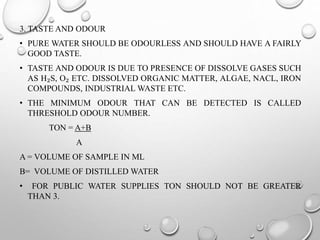
3. TASTE AND ODOUR
• PURE WATER SHOULD BE ODOURLESS AND SHOULD HAVE A FAIRLY
GOOD TASTE.
• TASTE AND ODOUR IS DUE TO PRESENCE OF DISSOLVE GASES SUCH
AS H₂S, O₂ ETC. DISSOLVED ORGANIC MATTER, ALGAE, NACL, IRON
COMPOUNDS, INDUSTRIAL WASTE ETC.
• THE MINIMUM ODOUR THAT CAN BE DETECTED IS CALLED
THRESHOLD ODOUR NUMBER.
TON = A+B
A
A = VOLUME OF SAMPLE IN ML
B= VOLUME OF DISTILLED WATER
• FOR PUBLIC WATER SUPPLIES TON SHOULD NOT BE GREATER
THAN 3.
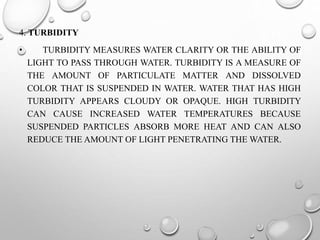
4. TURBIDITY
• TURBIDITY MEASURES WATER CLARITY OR THE ABILITY OF
LIGHT TO PASS THROUGH WATER. TURBIDITY IS A MEASURE OF
THE AMOUNT OF PARTICULATE MATTER AND DISSOLVED
COLOR THAT IS SUSPENDED IN WATER. WATER THAT HAS HIGH
TURBIDITY APPEARS CLOUDY OR OPAQUE. HIGH TURBIDITY
CAN CAUSE INCREASED WATER TEMPERATURES BECAUSE
SUSPENDED PARTICLES ABSORB MORE HEAT AND CAN ALSO
REDUCE THE AMOUNT OF LIGHT PENETRATING THE WATER.
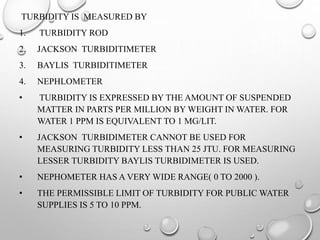
TURBIDITY IS MEASURED BY
1. TURBIDITY ROD
2. JACKSON TURBIDITIMETER
3. BAYLIS TURBIDITIMETER
4. NEPHLOMETER
• TURBIDITY IS EXPRESSED BY THE AMOUNT OF SUSPENDED
MATTER IN PARTS PER MILLION BY WEIGHT IN WATER. FOR
WATER 1 PPM IS EQUIVALENT TO 1 MG/LIT.
• JACKSON TURBIDIMETER CANNOT BE USED FOR
MEASURING TURBIDITY LESS THAN 25 JTU. FOR MEASURING
LESSER TURBIDITY BAYLIS TURBIDIMETER IS USED.
• NEPHOMETER HAS A VERY WIDE RANGE( 0 TO 2000 ).
• THE PERMISSIBLE LIMIT OF TURBIDITY FOR PUBLIC WATER
SUPPLIES IS 5 TO 10 PPM.
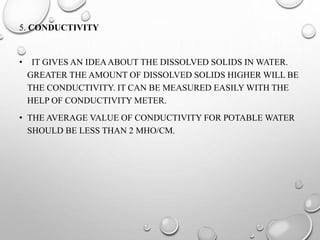
5. CONDUCTIVITY
• IT GIVES AN IDEAABOUT THE DISSOLVED SOLIDS IN WATER.
GREATER THE AMOUNT OF DISSOLVED SOLIDS HIGHER WILL BE
THE CONDUCTIVITY. IT CAN BE MEASURED EASILY WITH THE
HELP OF CONDUCTIVITY METER.
• THE AVERAGE VALUE OF CONDUCTIVITY FOR POTABLE WATER
SHOULD BE LESS THAN 2 MHO/CM.
CHEMICAL PARAMETERS• TOTAL DISSOLVED SOLIDS (TDS)
• PH
• ACIDITY
• ALKALINITY
• HARDNESS
• CHLORIDES
• FLUORIDES
• METALS
• NITROGEN AND ITS COMPOUNDS
• DISSOLVED GASES
TOTAL SOLIDS
• THESE INCLUDE THE SOLID IN SUSPENSION, COLLOIDAL AND DISSOLVED FORM.
• THE QUANTITY DETERMINED BY
SUSPENDED SOLID:- FILTERING THE SAMPLE OF WATER THROUGH A FINE FILTER, DRYING AND WEIGHING.
DISSOLVED AND COLLOIDAL SOLIDS:- EVAPORATING THE FILTERED WATER AND WEIGHING THE RESIDUE.
• THE AMOUNT OF TOTAL SOLIDS SHOULD PREFERABLY BE LESS THAN 500 PPM.
HIGHER AMOUNT OF TOTAL SOLIDS ARE LIKELY TO PRODUCE PSYCHOLOGICAL EFFECTS ON HUMAN
SYSTEM
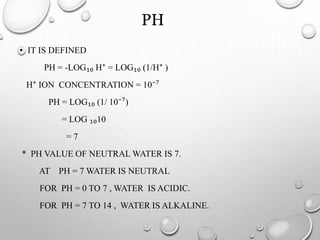
PH
• IT IS DEFINED
PH = -LOG₁₀ H⁺ = LOG₁₀ (1/H⁺ )
H⁺ ION CONCENTRATION = 10⁻⁷
PH = LOG₁₀ (1/ 10⁻⁷)
= LOG ₁₀10
= 7
* PH VALUE OF NEUTRAL WATER IS 7.
AT PH = 7 WATER IS NEUTRAL
FOR PH = 0 TO 7 , WATER IS ACIDIC.
FOR PH = 7 TO 14 , WATER IS ALKALINE.
HARDNESS
• HARDNESS IS DEFINED AS SOAP DESTROYING PROPERTY OF
WATER.
• TWO TYPES OF HARDNESS:
• TEMPORARY
• PERMANENT
TEMPORARY HARDNESS
• CAUSES :
• CARBONATES & BICARBONATES OF CALCIUM AND
MAGNESIUM.
• IT IS CALLED CARBONATE HARDNESS.
• PRECAUTION :
• IT CAN BE REMOVED BY BOILING OF WATER OR ADDING
LIME INTO WATER
PERMANENT HARDNESS
• CAUSES :
• SULPHATES, CHLORIDES AND NITRATE OF CALCIUM AND
MAGNESIUM
• IT CANNOT BE REMOVED BY BOILING AND REQUIRES SPECIAL
METHODS OF WATER SOFTENING LIKE ZEOLITE OR SODA LIME
PROCESS.
• THE PERMANENT HARDNESS IS ALSO CALLED NON-
CARBONATE HARDNESS
• THE HARDNESS IS MEASURED IN MG/LT.
EFFECTS OF HARDNESS
1. THE TASTE OF FOOD IS LOST COOKED IN HARD WATER.
2. IT REQUIRES MORE FUEL ENERGY IN COOKING FOOD WITH
HARD WATER.
3. IT CAUSES CHOKING AND CLOGGING TROUBLES OF HOUSE
PLUMBING DUE TO PRECIPITATION SALTS CAUSING
HARDNESS.
4. IT CAUSES FORMATION OF SCALES ON THE BOILERS.
5. MORE QUANTITY OF SOAP IS REQUIRED FOR WASHING
CLOTHES.
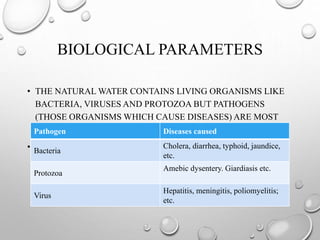
BIOLOGICAL PARAMETERS
• THE NATURAL WATER CONTAINS LIVING ORGANISMS LIKE
BACTERIA, VIRUSES AND PROTOZOA BUT PATHOGENS
(THOSE ORGANISMS WHICH CAUSE DISEASES) ARE MOST
IMPORTANT.
• VARIOUS DISEASES CAUSED BY PATHOGENS ARE:
Pathogen Diseases caused
Bacteria
Cholera, diarrhea, typhoid, jaundice,
etc.
Protozoa
Amebic dysentery. Giardiasis etc.
Virus
Hepatitis, meningitis, poliomyelitis;
etc.
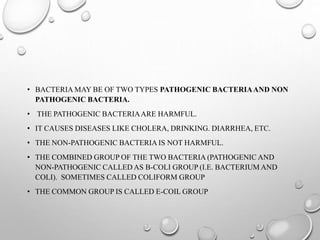
• BACTERIA MAY BE OF TWO TYPES PATHOGENIC BACTERIAAND NON
PATHOGENIC BACTERIA.
• THE PATHOGENIC BACTERIAARE HARMFUL.
• IT CAUSES DISEASES LIKE CHOLERA, DRINKING. DIARRHEA, ETC.
• THE NON-PATHOGENIC BACTERIA IS NOT HARMFUL.
• THE COMBINED GROUP OF THE TWO BACTERIA (PATHOGENIC AND
NON-PATHOGENIC CALLED AS B-COLI GROUP (I.E. BACTERIUM AND
COLI). SOMETIMES CALLED COLIFORM GROUP
• THE COMMON GROUP IS CALLED E-COIL GROUP
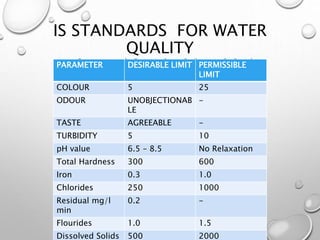
IS STANDARDS FOR WATER
QUALITY
AS PER (IS :10500-1991)PARAMETER DESIRABLE LIMIT PERMISSIBLE
LIMIT
COLOUR 5 25
ODOUR UNOBJECTIONAB
LE
-
TASTE AGREEABLE -
TURBIDITY 5 10
pH value 6.5 – 8.5 No Relaxation
Total Hardness 300 600
Iron 0.3 1.0
Chlorides 250 1000
Residual mg/l
min
0.2 -
Flourides 1.0 1.5
Dissolved Solids 500 2000
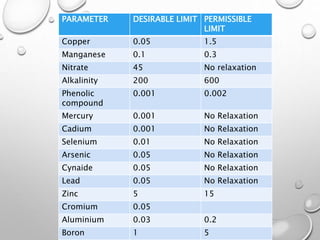
PARAMETER DESIRABLE LIMIT PERMISSIBLE
LIMIT
Copper 0.05 1.5
Manganese 0.1 0.3
Nitrate 45 No relaxation
Alkalinity 200 600
Phenolic
compound
0.001 0.002
Mercury 0.001 No Relaxation
Cadium 0.001 No Relaxation
Selenium 0.01 No Relaxation
Arsenic 0.05 No Relaxation
Cynaide 0.05 No Relaxation
Lead 0.05 No Relaxation
Zinc 5 15
Cromium 0.05
Aluminium 0.03 0.2
Boron 1 5
WATER BORN DISEASE & THEIR
CONTROL
• WATER BORNE DISEASES ARE THOSE DISEASES WHICH SPREAD PRIMARILY THROUGH CONTAMINATED
WATERS.
• WATER BORNE DISEASES ARE CAUSED BY PATHOGENIC ORGANISMS (BACTERIA, VI PROTOZOA) CARRIED BY
WATER CONTAINING SEWAGE CONTAMINATION.
• THE IMPORTANT WATER BORNE DISEASES ARE:
• TYPHOID FEVER, PARATYPHOID FEVER, CHOLERA, DYSENTERIES, GASTRO- ENTERITIS, INFECTIOUS
HEPATITIS, ETC.
• THE WATER BORNE DISEASES MAY BE GROUPED IN :
• BACTERIAL DISEASES
• VIRUS DISEASES
• PROTOZOAL DISEASE.
• WORM DISEASES
CONTROL OF WATER-BORNE
DISEASES
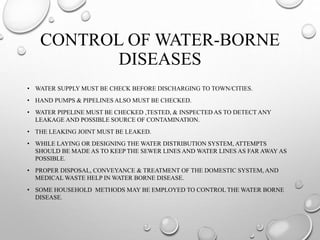
• WATER SUPPLY MUST BE CHECK BEFORE DISCHARGING TO TOWN/CITIES.
• HAND PUMPS & PIPELINES ALSO MUST BE CHECKED.
• WATER PIPELINE MUST BE CHECKED ,TESTED, & INSPECTED AS TO DETECT ANY
LEAKAGE AND POSSIBLE SOURCE OF CONTAMINATION.
• THE LEAKING JOINT MUST BE LEAKED.
• WHILE LAYING OR DESIGNING THE WATER DISTRIBUTION SYSTEM, ATTEMPTS
SHOULD BE MADE AS TO KEEP THE SEWER LINES AND WATER LINES AS FAR AWAY AS
POSSIBLE.
• PROPER DISPOSAL, CONVEYANCE & TREATMENT OF THE DOMESTIC SYSTEM, AND
MEDICAL WASTE HELP IN WATER BORNE DISEASE.
• SOME HOUSEHOLD METHODS MAY BE EMPLOYED TO CONTROL THE WATER BORNE
DISEASE.
CONTROL OF WATER-BORNE
DISEASES
• BOILING OF WATER BEFORE DRINKING
• USE OF REVERSE OSMOSIS SYSTEM OR AQUA GUARD
• USE OF CHLORINE TABLES
• CLEANLINESS MUST BE MAINTAINED IN PUBLIC AWARENESS
• THE FLY NUISANCE IN THE CITY SHOULD BE CHECKED AND REDUCED TO
MINIMUM BY CLEANLINESS
• THE PEOPLE SHOULD BE ADVISED AND ENCOURAGED TO EAT HOT FRESH
FOODS AND TO AVOID RAW FOODS.
• THEY SHOULD ALSO TRY TO USE THEIR OWN UTENSILS WHILE
TRAVELLING.
CONTROL OF WATER-BORNE
DISEASES
• SINCE ALL THESE WATER BORNE DISEASE ARE INFECTIOUS ,
THE FOLLOWING PRECAUTION :
• LEAST OR NO DIRECT TOUCH WITH PATIENT.
• CLEANING AND WASHING OF HANDS WITH SOAP AFTER
EVERY TOUCH WITH THE PATIENT.
• MAINTAINING PROPER SANITATION AROUND THE PATIENT.
• MAKING AVAILABLE PROPER MEDICAL CARE AND
NUTRIENT TO THE PATIENT.
END OF CHAPTER -2

Quality & quantity of water

  • 1.
    CHAPTER-2 QUANTITY & QUALITY OFWATER PRESENTED BY : DHARA DATTANI (M.E.TRANSPORTATION) ATMIYA INSTITUTE OF TECHNOLOGY & SCIENCE FOR DIPLOMA STUDIES, RAJKOT.
  • 2.
  • 5.
    ROLE OF DESIGNER Designing of watersupply scheme Amount of water available Water demand by people
  • 6.
    VARIOUS WATER DEMAND •Total annual volume (V) in liters or ML • Annual average rate of draft in lit/day i.e V/365 • Annual avg. rate of draft in lit/day/person called per capita demand • Average rate of draft in lit/day per service i.e. (V/365) X (1/No. of services) • Fluctuations in flows expressed in terms of percentage ratios of maximum yearly, monthly, daily or hourly rates to their corresponding average values.
  • 7.
    WATER QUANTITY ESTIMATION 7 The quantityof water required for municipal uses for which the water supply scheme has to be designed requires following data: Water consumption rate (Per Capita Demand in litres per day per head) Population to be served. Quantity = Per capita demand x Population
  • 8.
    WATER CONSUMPTION RATE 8 Very difficultto assess the quantity of water demanded by the public, since there are many variable factors affecting water consumption. Certain thumb rules & empirical formulas ued to assess this quantity. Perticular method or formula for particular case has to be decided by the intelligence & foresightedness of the designer
  • 9.
    9 There are varioustypes of water demands in a city. Domestic water demand Industrial Water demand Institution and commercial Water demand Demand for public uses Fire demand Water required to compensateLoses in wastes & thefts
  • 10.
  • 13.
  • 14.
    DOMESTIC WATER DEMAND water requiredin the houses for drinking, bathing, cooking, washing, lawn sprinkling, gardening, sanitary purposes etc. mainly depends upon the habits, social status, climatic conditions and customs of the people. As per IS: 1172-1963, under normal conditions, the domestic consumption of water in India is about 135(EWS & LIG(LOW INCOME GROUP) section - 200 (full flushing) litres/day/capita. 15
  • 15.
    FULL FLUSHING SYSTEM The detailsof the domestic consumption are a) Drinking ------ b) Cooking ------ c) Bathing ------ d) Clothes washing ------ e) Utensils washing ------ f) House washing ------ g) Flushing of waterCloset, etc------------ h) Lawn watering & gardening------------ 5 litres 5 litres 75 litres 25 litres 15 litres 15 litres 45 liters 15 liters 200 litres/day/capita
  • 16.
    WEAKER SECTION& LIG Thedetails of the domestic consumption are ------ 5 litres ------ 5 litres ------ 55 litres ------ 20 litres ------ 10 litres ------ 10 litres a) Drinking b) Cooking c) Bathing d) Clothes washing e) Utensils washing f) House washing g) Flushing of water Closet, etc ------- 30 litres 135 litres/day/capita 17
  • 17.
    INDUSTRIAL DEMAND 17 Industrial water demand= Water demand of Existing or likely to be started industries in near future. this quantity vary with types & no. of industries, which are existing in the city. Per capita consumption on account of industrial needs is generally taken as 50 litre/head/day In industrial city this demand may be as high as 450 litre/consuption/day
  • 18.
    INDUSTRIAL DEMAND 18 The water requiredby factories, paper mills, Cloth mills, Cotton mills, Breweries, Sugar refineries etc. comes under industrial use. The quantity of water demand for industrial purpose is around 20 to 25% of the total demand of the city.
  • 19.
    INSTITUTION AND COMMERCIAL DEMAND 19 Universities,Institution, commercial buildings and commercial centres including office buildings, warehouses, stores, hotels, shopping centres, health centres, schools, temple, cinema houses, railway and bus stations etc comes under this category. On an average this value is taken as 20 l/h/d & for highly commerciallised cities it may be 50l/c/d
  • 20.
    INDIVIDUAL WATER REQUIREMENTS. No. Typeof Institutionor Commercialestablishment Avg demand inl/h/d 1 offices 45-90 2 Hostels 135-180 3 Restaurants 70 per seat 4 schools a) day school 45-90 b) Residential 135-225 5 Factories a) Where bath rooms areprovided 45-90 b) No bath roomsprovided 30-60 6 Hospitals ( Including laundry) a) beds lessthan100 340 per bed b) beds more than 100 450 per bed 7 Nurseshomes & medicalquarters 135-225 8 Cinema hall 15 9 Airports 70 10 Railway station 23-70
  • 21.
  • 22.
  • 23.
  • 24.
  • 25.
    DEMAND FOR PUBLIC USE 25 Quantity ofwater required for public utility purposes such as for washing and sprinkling on roads, cleaning of sewers, watering of public parks, gardens, public fountains etc. comes under public demand. To meet the water demand for public use, provision of 5% of the total consumption is made designing the water works for a city. A figure of 10 l/c/d is usually added.
  • 26.
    Sl.No. Purpose Water 1 2 Publicparks Street washing 3 Sewer cleaning Requirements 1.4 litres/m2/day 1.0-1.5 litres/m2/day 4.5 litres/head/day THE REQUIREMENTS OF WATER FOR PUBLIC UTILITY SHALL BE TAKEN AS… 26
  • 27.
  • 28.
    FIRE DEMAND 32 During the firebreakdown large quantity of water is required for throwing it over the fire to extinguish it, therefore provision is made in the water work to supply sufficient quantity of water or keep as reserve in the water mains for this purpose. Fire hydrants are usually fitted in water mains at about 100 150 m apart & fire fighting pump is fittedto it in case of fire.
  • 29.
    These pumps throwwater at very high pressure. Pressure available at fire hydrants be of the order of 100 to 150 kn/m2 & should be maintained even after 4 to 5 hours of constant use. Three stream jets are simulteneously thrown from each fire hydrant; One on burning property & one each on adjacent property on either side of the burning property.the discharge of each stream should be 1100lit/min. The per capita fire demand is generally ignored while computing total per capita demand. Kilo liters of water req. = 100 (P)1/2 P= population in thousands
  • 30.
    THE QUANTITY OFWATER REQUIRED FOR FIRE FIGHTING IS GENERALLY CALCULATED BY USING DIFFERENT EMPIRICAL FORMULAE. For Indian conditions kuiching’s formula gives satisfactory results. Q=3182 √p Where ‘Q’ is quantity of water required in litres/min ‘P’ is population of town or city in thousands 34
  • 31.
    NATIONAL BOARD OFFIRE UNDER WRITERS FORMULA: Q=4637 √P[1-0.01√P] (THIS FORMULA IS NOT SUITABLE FOR INDIAN CONDITION.) FREEMAN’S FORMULA: Q=1136[P/10+10] BUSTON’S FORMULA: Q=5663 √P WHERE ‘Q’ IS QUANTITY OF WATER REQUIRED IN LITRES/MIN ‘P’ IS POPULATION OF TOWN OR CITY IN THOUSANDS
  • 32.
  • 33.
  • 34.
    LOSES AND WASTES Losses dueto defective pipe joints, cracked and broken pipes, faulty valves and fittings. Losses due to, continuous wastage of water. Losses due to unauthorised and illegal connections. While estimating the total quantity of water of a town; allowance of 15% of total quantity of water is made to compensate for losses, thefts and wastage of water. 37
  • 35.
    WATER CONSUMPTION FOR VARIOUSPURPOSES Types of Normal Average % Consumption Range (lit/capita/da y) 1 Domestic Consumption 65-300 160 35 2 Industrial and Commercial Demand 45-450 135 30 3 Public Uses including Fire Demand 20-90 45 10 4 Losses and Waste 45-150 62 25 38
  • 36.
    FACTORS AFFECTING PER CAPITADEMAND 36 Size of the city: Per capita demand for big cities is generally large as compared to that for smaller towns . Presence of industries & commercial activities Climatic conditions Habits of people and their economic status Pressure in the distribution system Quality of water supplied Development of sewerage facility System of supply Cost of water policy of metering & Method of charging
  • 37.
    11QUALITY OF WATER:IF WATER IS AESTHETICALLY & MEDICALLY SAFE, THE CONSUMPTION WILL INCREASE . 12Efficiency of water works administration: Leaks in water mains and services; and unauthorised use of water can be kept to a minimum by surveys. 13Cost of water- 14Policy of metering and charging method: Water tax is charged in two different ways: on the basis of meter reading and on the basis of certain fixed monthly rate. 43
  • 38.
    FACTORE AFFECTING THEWATER DEMAND Big city • Size of the city Small towns Example: Delhi 244 l/c/d Vijayawada 135 l/c/d • Climate condition less in wintermore in summer • Cost of water rate demand rate demand
  • 39.
    • Supply system BadSupply • Distribution System Good supply demandPressure high Pressure low demand demand demand
  • 40.
    • INDUS TRY • Quality ofwater good demand demandbad demand demand industry industry • Habit of people EWS demand MIG demand (Living style)
  • 41.
    FACTORS AFFECTING LOSEES &WASTES • Water tight joints • Pressure in distribution system • System of supply • Metering • Unauthorised connections
  • 42.
    FLUCTUATIONS IN RATE OFDEMAND 42 Average Daily Per Capita Demand = Quantity Required in 12 Months/ (365 x Population) If this average demand is supplied at all the times, it will not be sufficient to meet the fluctuations. Maximum daily demand = 1.8 x average daily demand
  • 43.
  • 44.
    VARIATION IN DEMANDOF WATER  THE PER CAPITA DEMAND IS THE AVERAGE CONSUMPTION OF THE YEAR, WHICH VARIES THROUGHOUT THE YEAR FROM SEASON TO SEASON, EVEN FROM HOUR TO HOUR. I. SEASONAL FLUCTUATION • THE VARIATION FROM SUMMER TO WINTER. • THE VARIATION MAY BE UP TO 15% TO THE AVERAGE DEMAND OF THE YEAR. II. DAILYAND HOURLY FLUCTUATION • THESE VARIATION DEPEND ON GENERAL HABITS OF PEOPLE, CLIMATIC CONDITIONS, AND WHETHER THE AREA IS INDUSTRIAL, COMMERCIAL OR RESIDENTIAL. • MORE WATER DEMAND IN SUNDAYS AND HOLIDAYS, WHEN THE PATTERN OF USAGE ALSO CHANGES (PEAK HOUR, MINIMUM FLOW). • IN HIGHLY INDUSTRIAL CITIES, MAXIMUM HOURLY CONSUMPTION MAY RISE UP TO 200% THAT OF AVERAGE DAILY DEMAND.
  • 45.
    • DETERMINATION OFHOURLY VARIATION BECOMES VERY IMPORTANT TO DECIDE RATE OF PUMPING IN ORDER TO MEET WATER DEMANDS IN ALL TIMES. • MAXIMUM DAILY CONSUMPTION IS USUALLY TAKEN AS 180% OF THE AVERAGE CONSUMPTION. • MAXIMUM HOURLY CONSUMPTION IS USUALLY TAKEN AS 150% OF THE AVERAGE CONSUMPTION.
  • 46.
    Maximum hourly demandof maximum day i.e. Peak demand = 1.5 x average hourly demand = 1.5 x Maximum daily demand/24 = 1.5 x (1.8 x average daily demand)/24 = 2.7 x average daily demand/24 = 2.7 x annual average hourly demand 46 Maximum demand i.e. 180% of the average consumption when added to fire draft for working out total draft is called “Coincident draft”.
  • 47.
    Seasonal variation: Thedemand peaks during summer. Firebreak outs are generally more in summer, increasing demand. So, there is seasonal variation . Max.Seasonal Demand :130% Of Annual Avg Daily Rate Of Demand. =1.3q MAX.MONTHLY CONSUPTION: 140% Annual Avg Daily Rate Of Demand. =1.4q Daily variation depends on the activity. People draw out more water on Sundays and Festival days, thus increasing demand on these days. 47
  • 48.
    Hourly variations arevery important as they have a wide range. During active household working hours i.e. from six to ten in the morning and four to eight in the evening, the bulk of the daily requirement is taken. During other hours the requirement is negligible. Moreover, if a fire breaks out, a huge quantity of water is required to be supplied during short duration, necessitating the need for a maximum rate of hourly supply. 48
  • 49.
    So, an adequatequantity of water must be available to meet the peak demand. To meet all the fluctuations, the supply pipes, service reservoirs and distribution pipes must be properly proportioned. The water is supplied by pumping directly and the pumps and distribution system must be designed to meet the peak demand. 49
  • 50.
    DESIGN PERIODS 50 • watersupply projects are designed to serve over a specified period of time after completion of the project • This time period is called "design period”. • Generally expressed in years. (10-30 years) • Water works generally are designed with in period of 30 years • During the design period the components, structures and equipment's of the water project are supposed to be adequate to serve the requirements
  • 51.
    • IT ISTHE NUMBER OF YEARS IN FUTURE FOR WHICH THE PROPOSED FACILITY WOULD MEET THE DEMAND OF THE COMMUNITY. • OR • THIS IS THE PERIOD INTO THE FUTURE FOR WHICH ESTIMATION IS TO BE MADE
  • 52.
    FACTORS AFFECTING THEDESIGN PERIOD  FUNDS AVAILABLE FOR THE COMPLETION OF THE PROJECT. OR MORE FUNDS ARE AVAILABLE, THE DESIGN PERIOD SHALL BE LESS  THE ANTICIPATED RATE OF GROWTH OF POPULATION. 'IF THE RATE IS MORE, DESIGN PERIOD IS LESS  USEFUL LIFE OF PIPES, STRUCTURES AND EQUIPMENTS USED IN THE WATER WORKS. IF THE USEFUL LIFE IS MORE, DESIGN PERIOD IS ALSO MORE.
  • 53.
     THE RATEOF INTEREST OF LOANS TAKEN FOR THE CONSTRUCTION OF THE PROJECT. IF THIS RATE IS MORE, THE DESIGN PERIOD WILL BE LESS  EFFICIENCY OF COMPONENT UNITS OF THE PROJECT DURING THE EARLY YEARS OF WORKING. THE MORE EFFICIENCY THE LONGER THE DESIGN PERIOD
  • 54.
    Sr.no. Item DesignPeriodinYears 1 Storage by dams 50 2 Intake works 30 3 Pumping 1Pump house 30 2Electric motors & pumps 15 4 Water treatment units 15 5 Pipeconnections to several treatment units& other small appurtenances 30 6 Rawwater & clear water conveyingunits 30 7 Clearwater reservoirs, balancing reservoirs, ESR,GSR,etc 15 8 Distribution system 30 DESIGN PERIOD FOR DIFFERENT COMPONENTS OF WATER SUPPLY SCHEME ( GOI MANNUAL)
  • 55.
  • 56.
  • 60.
    POPULATION FORECASTING METHODS The presentpopulation of city is determined by conducting an official enumeration, called census. Population growth- a) Births b) Deaths c) Migrations. The various methods adopted for estimating future populations . The particular method to be adopted for a particular case or for a particular city depends largely on the factors discussed in the methods, and the selection is left to the discretion and intelligence of the designer. 66
  • 62.
    Arithmetic Increase Method GeometricIncrease Method Incremental Increase Method Decreasing Rate of Growth Method Simple Graphical Method Comparative Graphical Method Zoning or Master plan method Ratio or apportionment method The logistic curve method 69 Short term methods (1-10 years) Long term methods (10-50 years)
  • 63.
    ARITHMETIC INCREASE METHOD 63 This methodis based on the assumption that the population is increasing at a constant rate. The rate of change of population with time is constant. The population after ‘n’ decades can be determined by the formula Pn = P + ni where, Pn= Population at the end of ‘n’ decades P→ population at present n → No. of decades i→ average of Population increase of ‘n’ decades
  • 64.
    Sr.no Year Population 11961 30,000 2 1971 33,000 3 1981 39,000 4 1991 47,000 5 2001 52,000 POPULATION FORECASTING BY ARITHEMATIC MEAN METHOD Pn = P + ni PROBLEM-1 Find population of year 2011 & 2021
  • 65.
    Sr.no Year PopulationIncrease in Population 1 1961 30,000 - 2 1971 33,000 3000 3 1981 39,000 6,000 4 1991 47,000 8,000 5 2001 52,000 5,000 Total Increase in 4 decades 22,000 SOLUTION
  • 66.
    𝒊 = 𝟐𝟐, 𝟎𝟎𝟎 𝟒 =5500 Pn= P + ni P= population in 2001 P=52,000 P=52,000 i=5500 n = 1,2, decades Population in 2011 Pn= P+n*I = 52,000+(1x5500) Pn =57,200 Population in 2021 Pn= P+n*I = 52,000+(2x5500) Pn =63,000 We know the formula of Arithematic Progression method
  • 67.
    Sr.no Year PopulationIncrease in Population 1 1961 30,000 - 2 1971 33,000 3000 3 1981 39,000 6,000 4 1991 47,000 8,000 5 2001 52,000 5,000 6 2011 57,200 5,200 7 2021 63,000 5,800
  • 68.
    GEOMETRIC INCREASE METHOD 68 This methodis based on the assumption that the percentage increase in population from decade to decade remains constant. In this method the average percentage of growth of last few decades is determined. The population at the end of ‘n’ decades is calculated by- Pn =P(1+ 𝑖 100 )n where P → population at present i → average percentage of growth of ‘n’decades n= no.of decades.
  • 69.
    Sr.no Year Population 11961 30,000 2 1971 33,000 3 1981 39,000 4 1991 47,000 5 2001 52,000 PROBLEM-1 (GEOMETRICAL INCREASE METHOD)
  • 70.
    Sr.no Year Population Increasein Population % INCREASE 1 1961 30,000 - - 2 1971 33,000 3000 3000 30,000 X100=10% 3 1981 39,000 6,000 6000 33,000 X100=19% 4 1991 47,000 8,000 8000 39,000 X100=20% 5 2001 52,000 5,000 5000 47,000 X100=11% TOTAL INCREASE 22,000 60% AVG. Increase in 4 decades 22,000 4 = 5500 60 4 = 15%
  • 71.
    Pn =P(1+ 𝑖 100 )n POPULATION IN2011 Pn =52,000x(1+ 15 100 )1 =59,800 POPULATION IN 2021 Pn =59,800x(1+ 15 100 )2 =79,085 SOLUTION -1 (GEOMETRICAL INCREASE METHOD)
  • 72.
    Year 1950 19601970 1980 1990 2000 populat ion 25,600 31,500 44,500 65,000 89,000 1,05,00 0 PROBLEM:2 FIND POPULATION OF CITY AT THE END OF 2010,2020,2030 BY GEOMETRIC INCREASE METHOD
  • 73.
    Sr.no Year Population Increasein Population % INCREASE 1 1950 25,600 - - 2 1960 31,500 5900 5900 25600 X100= 23% 3 1970 44,500 13,000 13000 31500 X100= 41% 4 1980 65,000 20,500 20500 44500 X100= 46% 5 1990 89,000 24,000 24000 65000 X100= 36% 6 2000 1,05,000 16,000 16,000 89,000 X100=18% TOTAL INCREASE 79400 164% AVG. Increase in 5 decades 79400 5 = 15,800 164 5 = 32%
  • 74.
    Pn =P(1+ 𝑖 100 )n Population in2010 = 1,05,000 (1+ 33.05 100 )1 = 1,05,000(1.3305) =1,39,702 Population in 2020 = 1,39,702 (1+ 33.05 100 )2 = 1,39,702 (1.78) =2,48,670 Population in 2030 = 1,39,702 (1+ 33.05 100 )3 = 2,48,670 (2.35) =5,84,374 GEOMETRIC INCREASE METHOD
  • 75.
    INCREMENTAL INCREASE METHOD 75 This methodis improvement over the above two methods. The average increase in the population is determined by the arithmetical method and to this is added the average of the net incremental increase once for each future decade. Pn = P +(I+r) x n Pn= Population after ‘n’ decades P= Present population I= Avg. Increase in population R= Avg. incremental Increase n = no.of decades
  • 76.
    Sr.no Year Population 11961 30,000 2 1971 33,000 3 1981 39,000 4 1991 47,000 5 2001 52,000 INCREMENTAL INCREASE METHOD PROBLEM:1 FIND POPULATION IN 2011 & 2021
  • 77.
    Sr.no Year Population Increasein Population INCREMENT INCREASE 1 1961 30,000 - - 2 1971 33,000 3000 - 3 1981 39,000 6,000 +3000 4 1991 47,000 8,000 +2000 5 2001 52,000 5,000 -3000 Total Increase in 4 decades 22,000 +2000 AVG.INCREASE = 22000 4 = 5500 2000 3 = 667
  • 78.
    INCREMENTAL INCREASE METHOD n=1,2,3…. Decades P= 52,000 I= 5500 r= 666.67 POPULATION IN 2011 (2001 -2011 = 1 Decade) Pn= P +( I +r ) x n =52,000 ( 5500+667) x 1 = 58,167 POPULATION IN 2021 (2001 -2021 = 2 Decade) Pn= P +( I +r ) x n =52,000 ( 5500+667) x 2 = 64,333 Pn = P+ (I+r) x n
  • 79.
    PROBLEM - 2 FINDPOPULATION OF INCREMENTAL INCREASE METHOD FIND POPULATION OF 2000 & 2010 Year 1940 1950 1960 1970 1980 Populatio n 14400 16000 18500 22500 30000
  • 80.
    Sr.no Year Population Increasein Population Incremental increase 1 1940 14400 - - 2 1950 16000 1600 - 3 1960 18500 2500 +900 4 1970 22500 4000 +1500 5 1980 30000 7500 +3500 TOTAL INCREASE 15,600 +5900 AVG.INCREASE = 15600 4 = 3900 5900 3 =1966.7 7
  • 81.
    INCREMENTAL INCREASE METHOD n=1,2,3…. Decades P= 30,000 I= 3900 r= 1966.77 POPULATION IN 2000 N= (1980 -2000 = 2 Decade) Pn= P +( I +r ) x 2 =30,000 + ( 3900+1966.77) x 2 = 41,733 POPULATION IN 2021 N= (1980-2010 = 3 Decade) Pn= P +( I +r ) x 3 =30,000+ (3900 +1966.67) x 3 = 47,600 Pn = P +(I+r) x n
  • 82.
    ESTIMATE WATER DEMANDof FIRE FOR POPULATION OF 2,00,000 BY KUCHLINGS FORMULA KUCHLINGS FORMULA Q=3182 √p = 3182 √200 = 45000 litre/minute P = population in thousand =200 1 Lakh = 100 Thousand
  • 83.
    DIFFRENCE BETWEEN ARITHEMATICGEOMETRIC & INCREMENTAL INCREASE METHOD ARITHEMATIC GEOMETRIC INCREMENTAL Pn = P + ni Pn =P(1+ 𝑖 100 )n Pn = P+ (I+r) x n BY TAKING AVERAGE BY % INCREASE METHOD BY INCREMENT LAST GIVEN POPULATION VALUE PRESENT POPULATION VALUE(NEW) LAST GIVEN POPULATION VALUE LESS ACCURATE AVG.ACCURATE MOST ACCURATE
  • 84.
    YEAR 1951 19611971 1981 1991 POPULATIO N 60,000 81,000 1,20,000 1,59,000 2,10,500 POPULATION IN YEAR 2011 =2,85,00 POPULATION IN 2021 = 3,23,000 FIND IN 2011&2021 FIND POPULATION ARITHEMATIC ,GEOMETRICAL INCREMENT INCREASE METHOD
  • 85.
  • 86.
  • 87.
    IMPURITIES IN WATER •​Impurities are classified into three heads : ​ 1) Suspended impurities ​ 2) Dissolved impurities ​ 3) Colloidal impurities​
  • 88.
    1) SUSPENDED IMPURITIES: These impurities are dispersion of solid particles that are large enough to be removed by filtration on surface & heavier ones settle down. The suspended particles which have the same specific gravity as that of water ,are mixed in the water. •​Suspended impurities include, •Clay,silts •Algae,fungi •​Organic and inorganic matters •​Mineral matter, etc. •​​These all impurities are macroscopic and cause turbidity in the water.
  • 89.
    • 2) Dissolvedimpurities: ​ Some impurities are dissolved in the water when water flows over the rocks, soils, etc. Solids, liquids and gases are dissolved in natural water. The concentration of total dissolved solids is usually expressed in p.p.m.(parts per million) and is obtained by weighing the residue after evaporation of the water sample from a filtered sample
  • 90.
    •3) Colloidal impurities: •It is very finely divided dispersion of particles in water. • These particles are so small that these can not be removed by ordinary filters and are not visible to the naked eye. • ​All the colloidal impurities are electrically charged and remains in continuous motion.• ​The electrical charge is due to the presence of absorbed ions on the surface of the solids. • ​Acid or neutral materials as silica, glass and most organic particles acquire negative charge in neutral water, whereas basic materials such as metallic oxides Al2O3 and Fe2O3 are positively charged. • ​Due to repelling actions all the colloidal particles remain in motion and do not settle. • ​Most of color of the water is due to colloidal impurities.​
  • 91.
  • 92.
    TYPE CAUSE EFFECTS 1.SUSPENDED IMPURITIES BACTERIASOME CAUSES DIEASES ALGAE,PROTOZOA ODOR,COLOR,TURBIDI TY SILTS,CLAYS MURKINESS/TURBIDITY 2.DISSOLVED IMPURITIES (A)SALTS ALKALINITY CALCIUM & MAGNESIUM ALKALINITY & HARDNESS SODIUM HARDNESS & CORROSION (B) METALS & COMPOUNDS i. IRON OXIDE ii. MAGANESE iii. LEAD iv. ARSENIC v. BARIUM vi. CADMIUM vii. CYANIDE viii.BORON ix. SELENIUM x. SILVER xi. NITRATES i. RED COLOR,CORRESI VE ii. BLACK/BROWN COLOR iii. CUMULATIVE POISON iv. TOXITY POISION v. TOXIC EFFECT ON HEART vi. TOXIC,ILLNESS vii. FATAL
  • 93.
    POTABLE WATER (WHOLESOME WATER) • WATER WHICH IS SUITABLE FOR DRINKING PURPOSE IS CALLED POTABLE WATER OR WHOLESOME WATER • FOLLOWING QUALITIES FOR WHOLESOME WATER • ODOURLESS & COLOUR LESS • FREE FROM TURBIDITY • FREE FROM TOXIC SUBSTANCES • FREE FROM PATHOGENIC ORGANISMS • IT SHOULD BE SOFT • IT SHOULD BE COOL & FRESH
  • 94.
  • 95.
    TURBIDITY ACIDITY BIOLOGICAL COLOR ODOUR SUSPENDED SOLID TEMPERATURE PHYSICAL CHEMICAL TOTALDISSOLVED SOLID PH ALKALINITY HARDNESS CHLORIDES FLOURIDES & METALS ORGANIC MATTER E-COIL TEST BACTERIA VIRUS PROTOZOA HELMINTH
  • 96.
    PHYSICAL QUALITY PARAMETER 1. TEMPERATURE 2.COLOUR 3. TASTE AND ODOUR 4. TURBIDITY 5. CONDUCTIVITY
  • 97.
    1.TEMPERATURE: FOR DRINKING PURPOSETEMPERATURES AROUND 10C ARE HIGHLY TEMPERATURE ABOVE 25C ARE CONSIDERED OBJECTIONABLE. 2.COLOUR • PURE WATER IS COLOURLESS BUT WATER GETS COLOURED DUE TO PRESENCE OF FOREIGN SUBSTANCE. COLOUR OF WATER IS DUE TO SUBSTANCE IN THE TRUE SOLUTION OR IN COLLOIDAL SUSPENSION. PRESENCE OF IRON, MANGANESE, ALGAE ALSO IMPART COLOUR TO THE WATER. • AN INSTRUMENT CALLED TINTOMETER CAN BE USED TO MEASURE THE COLOUR. • FOR DRINKING PURPOSE THE COLOUR NUMBER ON COBALT SCALE SHOULD NOT EXCEED 20 AND SHOULD BE PREFERABLY LESS THAN 10.
  • 98.
    3. TASTE ANDODOUR • PURE WATER SHOULD BE ODOURLESS AND SHOULD HAVE A FAIRLY GOOD TASTE. • TASTE AND ODOUR IS DUE TO PRESENCE OF DISSOLVE GASES SUCH AS H₂S, O₂ ETC. DISSOLVED ORGANIC MATTER, ALGAE, NACL, IRON COMPOUNDS, INDUSTRIAL WASTE ETC. • THE MINIMUM ODOUR THAT CAN BE DETECTED IS CALLED THRESHOLD ODOUR NUMBER. TON = A+B A A = VOLUME OF SAMPLE IN ML B= VOLUME OF DISTILLED WATER • FOR PUBLIC WATER SUPPLIES TON SHOULD NOT BE GREATER THAN 3.
  • 99.
    4. TURBIDITY • TURBIDITYMEASURES WATER CLARITY OR THE ABILITY OF LIGHT TO PASS THROUGH WATER. TURBIDITY IS A MEASURE OF THE AMOUNT OF PARTICULATE MATTER AND DISSOLVED COLOR THAT IS SUSPENDED IN WATER. WATER THAT HAS HIGH TURBIDITY APPEARS CLOUDY OR OPAQUE. HIGH TURBIDITY CAN CAUSE INCREASED WATER TEMPERATURES BECAUSE SUSPENDED PARTICLES ABSORB MORE HEAT AND CAN ALSO REDUCE THE AMOUNT OF LIGHT PENETRATING THE WATER.
  • 100.
    TURBIDITY IS MEASUREDBY 1. TURBIDITY ROD 2. JACKSON TURBIDITIMETER 3. BAYLIS TURBIDITIMETER 4. NEPHLOMETER • TURBIDITY IS EXPRESSED BY THE AMOUNT OF SUSPENDED MATTER IN PARTS PER MILLION BY WEIGHT IN WATER. FOR WATER 1 PPM IS EQUIVALENT TO 1 MG/LIT. • JACKSON TURBIDIMETER CANNOT BE USED FOR MEASURING TURBIDITY LESS THAN 25 JTU. FOR MEASURING LESSER TURBIDITY BAYLIS TURBIDIMETER IS USED. • NEPHOMETER HAS A VERY WIDE RANGE( 0 TO 2000 ). • THE PERMISSIBLE LIMIT OF TURBIDITY FOR PUBLIC WATER SUPPLIES IS 5 TO 10 PPM.
  • 101.
    5. CONDUCTIVITY • ITGIVES AN IDEAABOUT THE DISSOLVED SOLIDS IN WATER. GREATER THE AMOUNT OF DISSOLVED SOLIDS HIGHER WILL BE THE CONDUCTIVITY. IT CAN BE MEASURED EASILY WITH THE HELP OF CONDUCTIVITY METER. • THE AVERAGE VALUE OF CONDUCTIVITY FOR POTABLE WATER SHOULD BE LESS THAN 2 MHO/CM.
  • 102.
    CHEMICAL PARAMETERS• TOTALDISSOLVED SOLIDS (TDS) • PH • ACIDITY • ALKALINITY • HARDNESS • CHLORIDES • FLUORIDES • METALS • NITROGEN AND ITS COMPOUNDS • DISSOLVED GASES
  • 103.
    TOTAL SOLIDS • THESEINCLUDE THE SOLID IN SUSPENSION, COLLOIDAL AND DISSOLVED FORM. • THE QUANTITY DETERMINED BY SUSPENDED SOLID:- FILTERING THE SAMPLE OF WATER THROUGH A FINE FILTER, DRYING AND WEIGHING. DISSOLVED AND COLLOIDAL SOLIDS:- EVAPORATING THE FILTERED WATER AND WEIGHING THE RESIDUE. • THE AMOUNT OF TOTAL SOLIDS SHOULD PREFERABLY BE LESS THAN 500 PPM. HIGHER AMOUNT OF TOTAL SOLIDS ARE LIKELY TO PRODUCE PSYCHOLOGICAL EFFECTS ON HUMAN SYSTEM
  • 104.
    PH • IT ISDEFINED PH = -LOG₁₀ H⁺ = LOG₁₀ (1/H⁺ ) H⁺ ION CONCENTRATION = 10⁻⁷ PH = LOG₁₀ (1/ 10⁻⁷) = LOG ₁₀10 = 7 * PH VALUE OF NEUTRAL WATER IS 7. AT PH = 7 WATER IS NEUTRAL FOR PH = 0 TO 7 , WATER IS ACIDIC. FOR PH = 7 TO 14 , WATER IS ALKALINE.
  • 106.
    HARDNESS • HARDNESS ISDEFINED AS SOAP DESTROYING PROPERTY OF WATER. • TWO TYPES OF HARDNESS: • TEMPORARY • PERMANENT
  • 107.
    TEMPORARY HARDNESS • CAUSES: • CARBONATES & BICARBONATES OF CALCIUM AND MAGNESIUM. • IT IS CALLED CARBONATE HARDNESS. • PRECAUTION : • IT CAN BE REMOVED BY BOILING OF WATER OR ADDING LIME INTO WATER
  • 108.
    PERMANENT HARDNESS • CAUSES: • SULPHATES, CHLORIDES AND NITRATE OF CALCIUM AND MAGNESIUM • IT CANNOT BE REMOVED BY BOILING AND REQUIRES SPECIAL METHODS OF WATER SOFTENING LIKE ZEOLITE OR SODA LIME PROCESS. • THE PERMANENT HARDNESS IS ALSO CALLED NON- CARBONATE HARDNESS • THE HARDNESS IS MEASURED IN MG/LT.
  • 109.
    EFFECTS OF HARDNESS 1.THE TASTE OF FOOD IS LOST COOKED IN HARD WATER. 2. IT REQUIRES MORE FUEL ENERGY IN COOKING FOOD WITH HARD WATER. 3. IT CAUSES CHOKING AND CLOGGING TROUBLES OF HOUSE PLUMBING DUE TO PRECIPITATION SALTS CAUSING HARDNESS. 4. IT CAUSES FORMATION OF SCALES ON THE BOILERS. 5. MORE QUANTITY OF SOAP IS REQUIRED FOR WASHING CLOTHES.
  • 110.
    BIOLOGICAL PARAMETERS • THENATURAL WATER CONTAINS LIVING ORGANISMS LIKE BACTERIA, VIRUSES AND PROTOZOA BUT PATHOGENS (THOSE ORGANISMS WHICH CAUSE DISEASES) ARE MOST IMPORTANT. • VARIOUS DISEASES CAUSED BY PATHOGENS ARE: Pathogen Diseases caused Bacteria Cholera, diarrhea, typhoid, jaundice, etc. Protozoa Amebic dysentery. Giardiasis etc. Virus Hepatitis, meningitis, poliomyelitis; etc.
  • 111.
    • BACTERIA MAYBE OF TWO TYPES PATHOGENIC BACTERIAAND NON PATHOGENIC BACTERIA. • THE PATHOGENIC BACTERIAARE HARMFUL. • IT CAUSES DISEASES LIKE CHOLERA, DRINKING. DIARRHEA, ETC. • THE NON-PATHOGENIC BACTERIA IS NOT HARMFUL. • THE COMBINED GROUP OF THE TWO BACTERIA (PATHOGENIC AND NON-PATHOGENIC CALLED AS B-COLI GROUP (I.E. BACTERIUM AND COLI). SOMETIMES CALLED COLIFORM GROUP • THE COMMON GROUP IS CALLED E-COIL GROUP
  • 112.
    IS STANDARDS FORWATER QUALITY AS PER (IS :10500-1991)PARAMETER DESIRABLE LIMIT PERMISSIBLE LIMIT COLOUR 5 25 ODOUR UNOBJECTIONAB LE - TASTE AGREEABLE - TURBIDITY 5 10 pH value 6.5 – 8.5 No Relaxation Total Hardness 300 600 Iron 0.3 1.0 Chlorides 250 1000 Residual mg/l min 0.2 - Flourides 1.0 1.5 Dissolved Solids 500 2000
  • 113.
    PARAMETER DESIRABLE LIMITPERMISSIBLE LIMIT Copper 0.05 1.5 Manganese 0.1 0.3 Nitrate 45 No relaxation Alkalinity 200 600 Phenolic compound 0.001 0.002 Mercury 0.001 No Relaxation Cadium 0.001 No Relaxation Selenium 0.01 No Relaxation Arsenic 0.05 No Relaxation Cynaide 0.05 No Relaxation Lead 0.05 No Relaxation Zinc 5 15 Cromium 0.05 Aluminium 0.03 0.2 Boron 1 5
  • 114.
    WATER BORN DISEASE& THEIR CONTROL • WATER BORNE DISEASES ARE THOSE DISEASES WHICH SPREAD PRIMARILY THROUGH CONTAMINATED WATERS. • WATER BORNE DISEASES ARE CAUSED BY PATHOGENIC ORGANISMS (BACTERIA, VI PROTOZOA) CARRIED BY WATER CONTAINING SEWAGE CONTAMINATION. • THE IMPORTANT WATER BORNE DISEASES ARE: • TYPHOID FEVER, PARATYPHOID FEVER, CHOLERA, DYSENTERIES, GASTRO- ENTERITIS, INFECTIOUS HEPATITIS, ETC. • THE WATER BORNE DISEASES MAY BE GROUPED IN : • BACTERIAL DISEASES • VIRUS DISEASES • PROTOZOAL DISEASE. • WORM DISEASES
  • 115.
    CONTROL OF WATER-BORNE DISEASES •WATER SUPPLY MUST BE CHECK BEFORE DISCHARGING TO TOWN/CITIES. • HAND PUMPS & PIPELINES ALSO MUST BE CHECKED. • WATER PIPELINE MUST BE CHECKED ,TESTED, & INSPECTED AS TO DETECT ANY LEAKAGE AND POSSIBLE SOURCE OF CONTAMINATION. • THE LEAKING JOINT MUST BE LEAKED. • WHILE LAYING OR DESIGNING THE WATER DISTRIBUTION SYSTEM, ATTEMPTS SHOULD BE MADE AS TO KEEP THE SEWER LINES AND WATER LINES AS FAR AWAY AS POSSIBLE. • PROPER DISPOSAL, CONVEYANCE & TREATMENT OF THE DOMESTIC SYSTEM, AND MEDICAL WASTE HELP IN WATER BORNE DISEASE. • SOME HOUSEHOLD METHODS MAY BE EMPLOYED TO CONTROL THE WATER BORNE DISEASE.
  • 116.
    CONTROL OF WATER-BORNE DISEASES •BOILING OF WATER BEFORE DRINKING • USE OF REVERSE OSMOSIS SYSTEM OR AQUA GUARD • USE OF CHLORINE TABLES • CLEANLINESS MUST BE MAINTAINED IN PUBLIC AWARENESS • THE FLY NUISANCE IN THE CITY SHOULD BE CHECKED AND REDUCED TO MINIMUM BY CLEANLINESS • THE PEOPLE SHOULD BE ADVISED AND ENCOURAGED TO EAT HOT FRESH FOODS AND TO AVOID RAW FOODS. • THEY SHOULD ALSO TRY TO USE THEIR OWN UTENSILS WHILE TRAVELLING.
  • 117.
    CONTROL OF WATER-BORNE DISEASES •SINCE ALL THESE WATER BORNE DISEASE ARE INFECTIOUS , THE FOLLOWING PRECAUTION : • LEAST OR NO DIRECT TOUCH WITH PATIENT. • CLEANING AND WASHING OF HANDS WITH SOAP AFTER EVERY TOUCH WITH THE PATIENT. • MAINTAINING PROPER SANITATION AROUND THE PATIENT. • MAKING AVAILABLE PROPER MEDICAL CARE AND NUTRIENT TO THE PATIENT.
  • 118.