RAVI KUMAR.G
 Importance and Necessity of Protected
Water Supply Schemes
 Water Borne Diseases
 Flow chart of Public Water Supply System
 Role of Environmental Engineer
 Water Demand
 Per-capita Demand
 Types of Water Demands & Its
Variations
 Design Period
 Population Forecasting
The five essentials of human existence are:
i. Air
ii. Water
iii. Food
iv. Heat
v. Light
The contamination of these elements may
cause health hazards. Environmental
Engineering deals with all these elements.
Water is most important and essential. There
will no alternate to water.
Everywhere water is required for various
purposes, few of them are:
• For drinking and cooking
• For bathing and washing
• For watering of lawns and gardens
• For heating and air conditioning systems
• For growing of crops
 To supply safe and wholesome water to
consume
 To supply water in adequate quantity
 To make water easily available to consumers
so as to encourage personal and household
cleanliness
An wholesome water is usually one which is
unpolluted, free from toxic substances as well
as excessive amounts of mineral and organic
matter that may impair the quality of water.
 Whenever there is no water in our taps we
become helpless. Whenever no water in our
surroundings our survival become questionable.
Therefore, it is necessary that to have a water
supply scheme with sufficient quantity.
 From public health point view, the water should
be good in appearance, safe and clean. It means
that the water should be free from contaminants.
Therefore, the provision of such a scheme should
supply water with good quality.
 Such a scheme shall not only help in supply
of wholesome water for drinking, cooking,
bathing, washing, etc.
 Also, to keep the diseases away, and there by
promoting better health.
• development of industrialization
• pollution control
• maintenance of parks, gardens and fountains
• beautification of surroundings
• better sanitation maintenance
• economic development of the particular
community
• promoting welfare of the entire community
Such a scheme will also help in
The water borne diseases are diseases
which spread primarily through the
contaminated water.
When water contains harmful and diseases
producing matter, it lead to water borne
diseases on being consumed by healthy
persons.
The water borne diseases are may be caused
by the following factors:
 Presence of micro organism
 Presence of inorganic matter
 Presence of organic matter
Diseases caused by bacterial infections:
 Typhoid fever and paratyphoid fever (caused
by salmonella typhi bacteria)
 Cholera (caused by vibrio-cholera bacteria)
 Bacillary dysentery(caused by shiga bacillus
or flexner-bacillus, or sonne bacilus)
Diseases caused by viral infections:
 Infectious hepatitis or infectious jaundice
(caused by hepatitis virus)
 Poliomyelitis (caused by polio virus)
Diseases caused by protozoal infections:
 Amoebic dysentery (caused by entamoeba
hystolytic germ)
 Excess fluorides concentration causes
fluorosis
 Excessive amounts of sulphates causes
Diarrhea
 Less amounts of Iodide causes Goiter
 Excess of nitrates cause blue babies in
infants
 Excess of nitrates cause
methemoglobinemia
An excess of vegetable matter in water or the
entrance of sewage effluents into bodies of water
may lead to diarrhoea and other gastic
disturbances in the human body.
The complete control of water borne diseases involves
instituting an environmental health programme that
incorporates personnel and household hygiene practices,
control of fly species and other insects, scientific waste
disposal and water treatment to remove harmful
constituents.
The water demanded by a people of
community for their daily uses, is
known a water demand for a water
supply scheme.
Engineer’s first duty of planning a water
supply scheme is to evaluate the amount
of water available and the amount of water
demanded by the public.
While planning a water
supply scheme, the
assessment of the
following are necessary
•Total annual volume of water demanded by
the public (in litres or million litres)
•Annual average rate of draft per day
•Annual average rate of draft per day per
person
•Average rate of draft in litres per day per
service
•Fluctuations in flows
1. Domestic water demand
2. Industrial water demand
3. Institution and commercial water
demand
4. Demand for public uses
5. Fire demand
6. Water required to compensate losses in
wastes and thefts
Types of water
demands
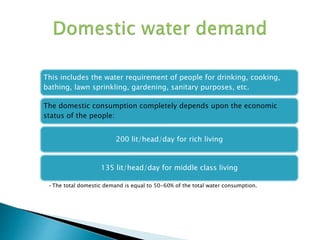
This includes the water requirement of people for drinking, cooking,
bathing, lawn sprinkling, gardening, sanitary purposes, etc.
The domestic consumption completely depends upon the economic
status of the people:
200 lit/head/day for rich living
135 lit/head/day for middle class living
•The total domestic demand is equal to 50-60% of the total water consumption.
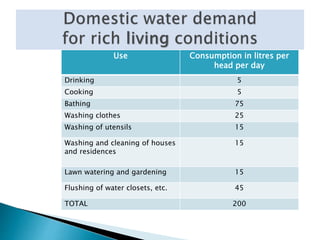
Use Consumption in litres per
head per day
Drinking 5
Cooking 5
Bathing 75
Washing clothes 25
Washing of utensils 15
Washing and cleaning of houses
and residences
15
Lawn watering and gardening 15
Flushing of water closets, etc. 45
TOTAL 200
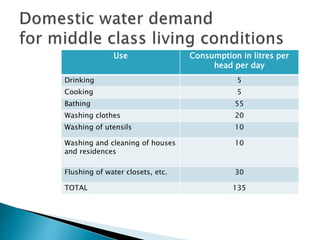
Use Consumption in litres per
head per day
Drinking 5
Cooking 5
Bathing 55
Washing clothes 20
Washing of utensils 10
Washing and cleaning of houses
and residences
10
Flushing of water closets, etc. 30
TOTAL 135
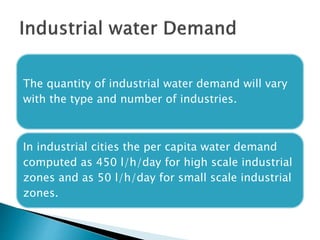
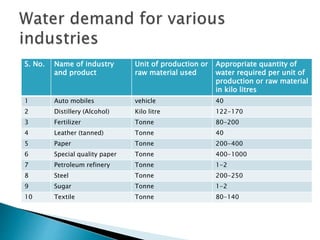
The quantity of industrial water demand will vary
with the type and number of industries.
In industrial cities the per capita water demand
computed as 450 l/h/day for high scale industrial
zones and as 50 l/h/day for small scale industrial
zones.
S. No. Name of industry
and product
Unit of production or
raw material used
Appropriate quantity of
water required per unit of
production or raw material
in kilo litres
1 Auto mobiles vehicle 40
2 Distillery (Alcohol) Kilo litre 122-170
3 Fertilizer Tonne 80-200
4 Leather (tanned) Tonne 40
5 Paper Tonne 200-400
6 Special quality paper Tonne 400-1000
7 Petroleum refinery Tonne 1-2
8 Steel Tonne 200-250
9 Sugar Tonne 1-2
10 Textile Tonne 80-140
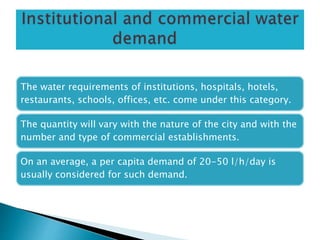
The water requirements of institutions, hospitals, hotels,
restaurants, schools, offices, etc. come under this category.
The quantity will vary with the nature of the city and with the
number and type of commercial establishments.
On an average, a per capita demand of 20-50 l/h/day is
usually considered for such demand.
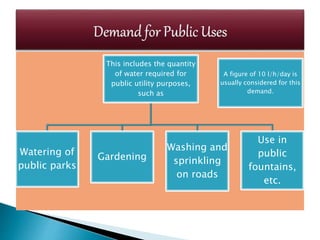
This includes the quantity
of water required for
public utility purposes,
such as
Watering of
public parks
Gardening
Washing and
sprinkling
on roads
Use in
public
fountains,
etc.
A figure of 10 l/h/day is
usually considered for this
demand.
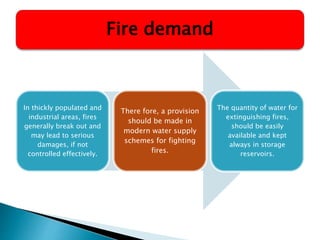
In thickly populated and
industrial areas, fires
generally break out and
may lead to serious
damages, if not
controlled effectively.
There fore, a provision
should be made in
modern water supply
schemes for fighting
fires.
The quantity of water for
extinguishing fires,
should be easily
available and kept
always in storage
reservoirs.
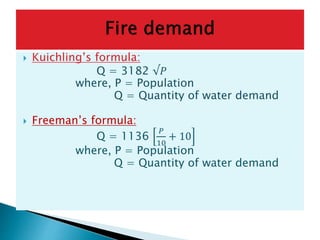
Fire demand
 Kuichling’s formula:
Q = 3182 √𝑃
where, P = Population
Q = Quantity of water demand
 Freeman’s formula:
Q = 1136
𝑃
10
+ 10
where, P = Population
Q = Quantity of water demand
 National Board of Fire Under Writer’s formula
Population < 2,00,000
Q = 4637 sq.rt.(P)[1-0.01sq.rt.(p)]
Population > 2,00,000
Q = 54,600 l/min and more 9600 to
36400 l/min
Introduction, water demand

Introduction, water demand

  • 1.
  • 2.
     Importance andNecessity of Protected Water Supply Schemes  Water Borne Diseases  Flow chart of Public Water Supply System  Role of Environmental Engineer
  • 3.
     Water Demand Per-capita Demand  Types of Water Demands & Its Variations  Design Period  Population Forecasting
  • 4.
    The five essentialsof human existence are: i. Air ii. Water iii. Food iv. Heat v. Light The contamination of these elements may cause health hazards. Environmental Engineering deals with all these elements.
  • 5.
    Water is mostimportant and essential. There will no alternate to water. Everywhere water is required for various purposes, few of them are: • For drinking and cooking • For bathing and washing • For watering of lawns and gardens • For heating and air conditioning systems • For growing of crops
  • 6.
     To supplysafe and wholesome water to consume  To supply water in adequate quantity  To make water easily available to consumers so as to encourage personal and household cleanliness An wholesome water is usually one which is unpolluted, free from toxic substances as well as excessive amounts of mineral and organic matter that may impair the quality of water.
  • 7.
     Whenever thereis no water in our taps we become helpless. Whenever no water in our surroundings our survival become questionable. Therefore, it is necessary that to have a water supply scheme with sufficient quantity.  From public health point view, the water should be good in appearance, safe and clean. It means that the water should be free from contaminants. Therefore, the provision of such a scheme should supply water with good quality.
  • 8.
     Such ascheme shall not only help in supply of wholesome water for drinking, cooking, bathing, washing, etc.  Also, to keep the diseases away, and there by promoting better health.
  • 9.
    • development ofindustrialization • pollution control • maintenance of parks, gardens and fountains • beautification of surroundings • better sanitation maintenance • economic development of the particular community • promoting welfare of the entire community Such a scheme will also help in
  • 10.
    The water bornediseases are diseases which spread primarily through the contaminated water. When water contains harmful and diseases producing matter, it lead to water borne diseases on being consumed by healthy persons.
  • 11.
    The water bornediseases are may be caused by the following factors:  Presence of micro organism  Presence of inorganic matter  Presence of organic matter
  • 12.
    Diseases caused bybacterial infections:  Typhoid fever and paratyphoid fever (caused by salmonella typhi bacteria)  Cholera (caused by vibrio-cholera bacteria)  Bacillary dysentery(caused by shiga bacillus or flexner-bacillus, or sonne bacilus) Diseases caused by viral infections:  Infectious hepatitis or infectious jaundice (caused by hepatitis virus)  Poliomyelitis (caused by polio virus) Diseases caused by protozoal infections:  Amoebic dysentery (caused by entamoeba hystolytic germ)
  • 13.
     Excess fluoridesconcentration causes fluorosis  Excessive amounts of sulphates causes Diarrhea  Less amounts of Iodide causes Goiter  Excess of nitrates cause blue babies in infants  Excess of nitrates cause methemoglobinemia
  • 14.
    An excess ofvegetable matter in water or the entrance of sewage effluents into bodies of water may lead to diarrhoea and other gastic disturbances in the human body. The complete control of water borne diseases involves instituting an environmental health programme that incorporates personnel and household hygiene practices, control of fly species and other insects, scientific waste disposal and water treatment to remove harmful constituents.
  • 15.
    The water demandedby a people of community for their daily uses, is known a water demand for a water supply scheme. Engineer’s first duty of planning a water supply scheme is to evaluate the amount of water available and the amount of water demanded by the public.
  • 16.
    While planning awater supply scheme, the assessment of the following are necessary •Total annual volume of water demanded by the public (in litres or million litres) •Annual average rate of draft per day •Annual average rate of draft per day per person •Average rate of draft in litres per day per service •Fluctuations in flows
  • 17.
    1. Domestic waterdemand 2. Industrial water demand 3. Institution and commercial water demand 4. Demand for public uses 5. Fire demand 6. Water required to compensate losses in wastes and thefts Types of water demands
  • 18.
    This includes thewater requirement of people for drinking, cooking, bathing, lawn sprinkling, gardening, sanitary purposes, etc. The domestic consumption completely depends upon the economic status of the people: 200 lit/head/day for rich living 135 lit/head/day for middle class living •The total domestic demand is equal to 50-60% of the total water consumption.
  • 19.
    Use Consumption inlitres per head per day Drinking 5 Cooking 5 Bathing 75 Washing clothes 25 Washing of utensils 15 Washing and cleaning of houses and residences 15 Lawn watering and gardening 15 Flushing of water closets, etc. 45 TOTAL 200
  • 20.
    Use Consumption inlitres per head per day Drinking 5 Cooking 5 Bathing 55 Washing clothes 20 Washing of utensils 10 Washing and cleaning of houses and residences 10 Flushing of water closets, etc. 30 TOTAL 135
  • 21.
    The quantity ofindustrial water demand will vary with the type and number of industries. In industrial cities the per capita water demand computed as 450 l/h/day for high scale industrial zones and as 50 l/h/day for small scale industrial zones.
  • 22.
    S. No. Nameof industry and product Unit of production or raw material used Appropriate quantity of water required per unit of production or raw material in kilo litres 1 Auto mobiles vehicle 40 2 Distillery (Alcohol) Kilo litre 122-170 3 Fertilizer Tonne 80-200 4 Leather (tanned) Tonne 40 5 Paper Tonne 200-400 6 Special quality paper Tonne 400-1000 7 Petroleum refinery Tonne 1-2 8 Steel Tonne 200-250 9 Sugar Tonne 1-2 10 Textile Tonne 80-140
  • 23.
    The water requirementsof institutions, hospitals, hotels, restaurants, schools, offices, etc. come under this category. The quantity will vary with the nature of the city and with the number and type of commercial establishments. On an average, a per capita demand of 20-50 l/h/day is usually considered for such demand.
  • 24.
    This includes thequantity of water required for public utility purposes, such as Watering of public parks Gardening Washing and sprinkling on roads Use in public fountains, etc. A figure of 10 l/h/day is usually considered for this demand.
  • 25.
    In thickly populatedand industrial areas, fires generally break out and may lead to serious damages, if not controlled effectively. There fore, a provision should be made in modern water supply schemes for fighting fires. The quantity of water for extinguishing fires, should be easily available and kept always in storage reservoirs. Fire demand
  • 26.
     Kuichling’s formula: Q= 3182 √𝑃 where, P = Population Q = Quantity of water demand  Freeman’s formula: Q = 1136 𝑃 10 + 10 where, P = Population Q = Quantity of water demand
  • 27.
     National Boardof Fire Under Writer’s formula Population < 2,00,000 Q = 4637 sq.rt.(P)[1-0.01sq.rt.(p)] Population > 2,00,000 Q = 54,600 l/min and more 9600 to 36400 l/min