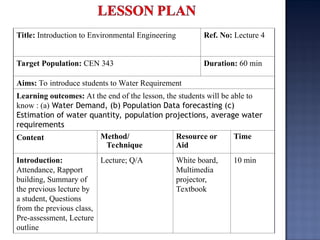
Title: Introduction to Environmental Engineering Ref. No: Lecture 4
Target Population: CEN 343 Duration: 60 min
Aims: To introduce students to Water Requirement
Learning outcomes: At the end of the lesson, the students will be able to
know : (a) Water Demand, (b) Population Data forecasting (c)
Estimation of water quantity, population projections, average water
requirements
Content Method/
Technique
Resource or
Aid
Time
Introduction:
Attendance, Rapport
building, Summary of
the previous lecture by
a student, Questions
from the previous class,
Pre-assessment, Lecture
outline
Lecture; Q/A White board,
Multimedia
projector,
Textbook
10 min
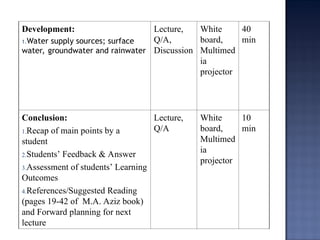
Development:
1.Water supply sources; surface
water, groundwater and rainwater
Lecture,
Q/A,
Discussion
White
board,
Multimed
ia
projector
40
min
Conclusion:
1.Recap of main points by a
student
2.Students’ Feedback & Answer
3.Assessment of students’ Learning
Outcomes
4.References/Suggested Reading
(pages 19-42 of M.A. Aziz book)
and Forward planning for next
lecture
Lecture,
Q/A
White
board,
Multimed
ia
projector
10
min
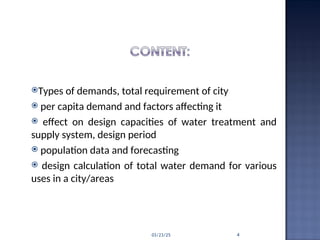
Types of demands, total requirement of city
 per capita demand and factors affecting it
 effect on design capacities of water treatment and
supply system, design period
 population data and forecasting
 design calculation of total water demand for various
uses in a city/areas
03/23/25 4
 Domestic water demand
 Industrial demand
 Institution and commercial demand
 Demand for public use
 Fire demand
 Loses and wastes Water Demand
03/23/25 5
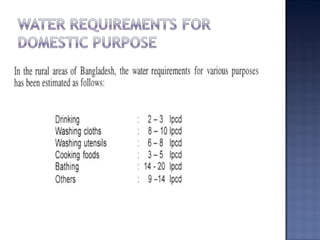
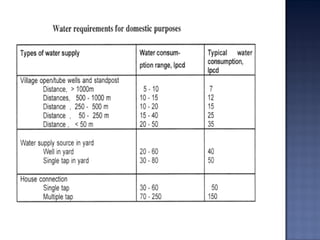
 Water required in the houses for drinking, bathing, cooking,
washing etc.
 Mainly depends upon the habits, social status, climatic
conditions and customs of the people
Industrial Demand
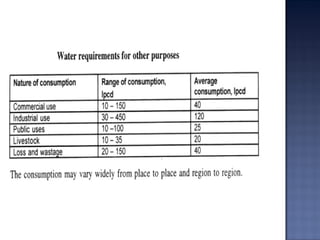
 The water required in the industries mainly depends on the
type of industries, which are existing in the city.
 The water required by factories, paper mills, Cloth mills,
Cotton mills, Breweries, Sugar refineries etc. comes under
industrial use.
 The quantity of water demand for industrial purpose is
around 20 to 25% of the total demand of the city.
03/23/25 6
 Universities, Institution, commercial buildings and
commercial centers including office buildings,
warehouses, stores, hotels, shopping centers, health
centers, schools, temple, cinema houses, railway and
bus stations etc. comes under this category.
Demand for Public Use
 Quantity of water required for public utility purposes
such as for washing and sprinkling on roads, cleaning
of sewers, watering of public parks, gardens, public
fountains etc. comes under public demand.
 To meet the water demand for public use, provision of
5% of the total consumption is made designing the
water works for a city.
03/23/25 7
 At least 4 streams should be available
 Each stream -low risk(175 gpm), High
risk(250 gpm)
 Required water should be At least 5 hours
 Empirical formula
 A hydrant is used an outlet from a water
main and is provided for the purpose of
forming a connection for fire hose
 Losses due to defective pipe joints, cracked and
broken pipes, faulty valves and fittings.
 Losses due to, continuous wastage of water.
 Losses due to unauthorized and illegal
connections.
 While estimating the total quantity of water of a
town; allowance of 15% of total quantity of water
is made to compensate for losses, thefts and
wastage of water.
03/23/25 10
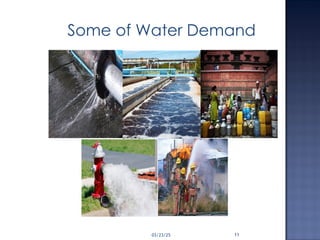
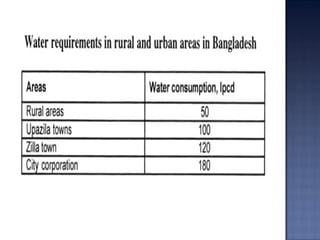
Some of Water Demand
03/23/25 11
 The design of water supply system is the
framing of an estimate giving the total water
required by the community
 Two factors
1.probable population at
the end of the design period
2.Rate of water supply per
capita per day
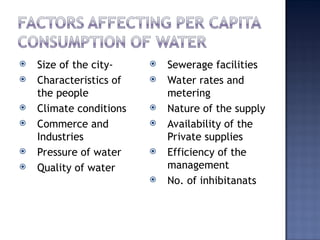
 Size of the city-
 Characteristics of
the people
 Climate conditions
 Commerce and
Industries
 Pressure of water
 Quality of water
 Sewerage facilities
 Water rates and
metering
 Nature of the supply
 Availability of the
Private supplies
 Efficiency of the
management
 No. of inhibitanats
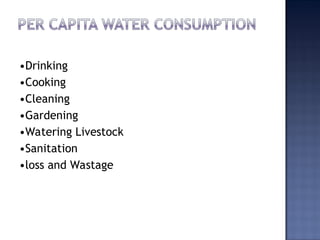
•Drinking
•Cooking
•Cleaning
•Gardening
•Watering Livestock
•Sanitation
•loss and Wastage
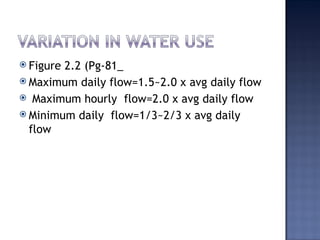
 Figure 2.2 (Pg-81_
 Maximum daily flow=1.5~2.0 x avg daily flow
 Maximum hourly flow=2.0 x avg daily flow
 Minimum daily flow=1/3~2/3 x avg daily
flow
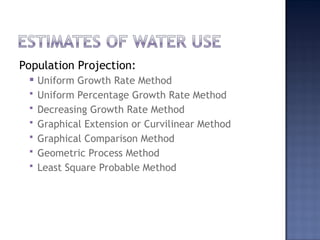
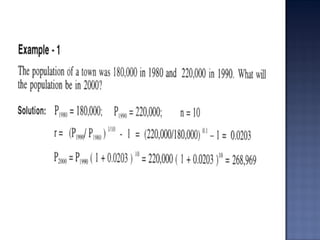
Population Projection:
 Uniform Growth Rate Method
 Uniform Percentage Growth Rate Method
 Decreasing Growth Rate Method
 Graphical Extension or Curvilinear Method
 Graphical Comparison Method
 Geometric Process Method
 Least Square Probable Method
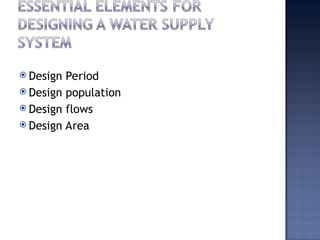
 Design Period
 Design population
 Design flows
 Design Area

Water requirement | Civil Engineering | Environmental Engineering 1

  • 2.
    Title: Introduction toEnvironmental Engineering Ref. No: Lecture 4 Target Population: CEN 343 Duration: 60 min Aims: To introduce students to Water Requirement Learning outcomes: At the end of the lesson, the students will be able to know : (a) Water Demand, (b) Population Data forecasting (c) Estimation of water quantity, population projections, average water requirements Content Method/ Technique Resource or Aid Time Introduction: Attendance, Rapport building, Summary of the previous lecture by a student, Questions from the previous class, Pre-assessment, Lecture outline Lecture; Q/A White board, Multimedia projector, Textbook 10 min
  • 3.
    Development: 1.Water supply sources;surface water, groundwater and rainwater Lecture, Q/A, Discussion White board, Multimed ia projector 40 min Conclusion: 1.Recap of main points by a student 2.Students’ Feedback & Answer 3.Assessment of students’ Learning Outcomes 4.References/Suggested Reading (pages 19-42 of M.A. Aziz book) and Forward planning for next lecture Lecture, Q/A White board, Multimed ia projector 10 min
  • 4.
    Types of demands,total requirement of city  per capita demand and factors affecting it  effect on design capacities of water treatment and supply system, design period  population data and forecasting  design calculation of total water demand for various uses in a city/areas 03/23/25 4
  • 5.
     Domestic waterdemand  Industrial demand  Institution and commercial demand  Demand for public use  Fire demand  Loses and wastes Water Demand 03/23/25 5
  • 6.
     Water requiredin the houses for drinking, bathing, cooking, washing etc.  Mainly depends upon the habits, social status, climatic conditions and customs of the people Industrial Demand  The water required in the industries mainly depends on the type of industries, which are existing in the city.  The water required by factories, paper mills, Cloth mills, Cotton mills, Breweries, Sugar refineries etc. comes under industrial use.  The quantity of water demand for industrial purpose is around 20 to 25% of the total demand of the city. 03/23/25 6
  • 7.
     Universities, Institution,commercial buildings and commercial centers including office buildings, warehouses, stores, hotels, shopping centers, health centers, schools, temple, cinema houses, railway and bus stations etc. comes under this category. Demand for Public Use  Quantity of water required for public utility purposes such as for washing and sprinkling on roads, cleaning of sewers, watering of public parks, gardens, public fountains etc. comes under public demand.  To meet the water demand for public use, provision of 5% of the total consumption is made designing the water works for a city. 03/23/25 7
  • 8.
     At least4 streams should be available  Each stream -low risk(175 gpm), High risk(250 gpm)  Required water should be At least 5 hours  Empirical formula
  • 9.
     A hydrantis used an outlet from a water main and is provided for the purpose of forming a connection for fire hose
  • 10.
     Losses dueto defective pipe joints, cracked and broken pipes, faulty valves and fittings.  Losses due to, continuous wastage of water.  Losses due to unauthorized and illegal connections.  While estimating the total quantity of water of a town; allowance of 15% of total quantity of water is made to compensate for losses, thefts and wastage of water. 03/23/25 10
  • 11.
    Some of WaterDemand 03/23/25 11
  • 12.
     The designof water supply system is the framing of an estimate giving the total water required by the community  Two factors 1.probable population at the end of the design period 2.Rate of water supply per capita per day
  • 13.
     Size ofthe city-  Characteristics of the people  Climate conditions  Commerce and Industries  Pressure of water  Quality of water  Sewerage facilities  Water rates and metering  Nature of the supply  Availability of the Private supplies  Efficiency of the management  No. of inhibitanats
  • 14.
  • 15.
     Figure 2.2(Pg-81_  Maximum daily flow=1.5~2.0 x avg daily flow  Maximum hourly flow=2.0 x avg daily flow  Minimum daily flow=1/3~2/3 x avg daily flow
  • 16.
    Population Projection:  UniformGrowth Rate Method  Uniform Percentage Growth Rate Method  Decreasing Growth Rate Method  Graphical Extension or Curvilinear Method  Graphical Comparison Method  Geometric Process Method  Least Square Probable Method
  • 22.
     Design Period Design population  Design flows  Design Area